
Beyond the Obvious: Finding Hidden Opportunities
A US$2.4 billion deal to supply generators to Amazon’s (NASDAQ: AMZN) data centres might not sound like an AI investment at first glance. But it caught my attention this week because it highlights an interesting side effect of the enormous investment being made in AI. Generac Holdings (NYSE: GNRC) isn’t an AI company, yet it stands to benefit from the need for reliable power as companies build more and larger data centres. Under the agreement, Generac is expected to deliver about US$2.4 billion of generators to Amazon in 2027 and 2028, while the broader arrangement could eventually reach US$8 billion depending on Amazon’s future purchases.
Generac is a good example of something I think investors can overlook when a major trend takes hold. We naturally focus on the companies at the centre of the story. With AI, that means companies such as Nvidia (NASDAQ: NVDA), Microsoft (NASDAQ: MSFT), and the other technology companies building and deploying the technology. But those companies need a lot of help from businesses that don’t necessarily have anything to do with AI themselves.
Consider what is happening inside a data centre. The computers need electricity, cooling, networking equipment, cables, connectors, and backup power. That creates opportunities for companies such as Generac, but also for businesses such as Corning (NYSE: GLW) and Amphenol (NYSE: APH). Corning supplies the optical fibre and connectivity products used to move data through data centres, while Amphenol makes the connectors and other high-speed interconnect products that link the equipment together. Corning has already announced multibillion-dollar agreements with companies including Meta Platforms (NASDAQ: META) and Amazon to supply fibre and connectivity for their expanding data centre infrastructure. Amphenol, meanwhile, continues to develop high-speed copper and optical connectivity specifically for AI and hyperscale data centres.
The same pattern can appear in other industries. The growth of e-commerce, for example, wasn’t just a story about Amazon and online retailers. It created demand for warehouses, automation, packaging, payment systems, shipping and logistics. Companies that supplied those less glamorous pieces of the puzzle could benefit from the trend without ever becoming household names themselves.
That’s what makes these opportunities interesting to me. The goal isn’t to find a company simply because it has some connection to a popular trend. A business can benefit from a powerful trend and still be a poor investment if the stock price gets too far ahead of the underlying business. The more interesting question is whether the company has a genuine role to play, a competitive advantage, and a business model that can benefit from the trend without depending entirely on it.
That’s also one reason I keep a Companies on My Radar list. I’m not necessarily looking for the next Nvidia. Sometimes I’m looking for the companies that quietly provide the equipment or services needed to support what Nvidia and others are building. Generac is the latest example, and it has now joined five other companies I’m watching for potential investment opportunities.
Major investment trends rarely benefit just the companies in the headlines. Sometimes the more interesting opportunities are found one or two steps further down the supply chain. With AI continuing to influence businesses well beyond the technology sector, it was another interesting week for investors. For now, let’s see what other forces impacted the markets this week….
Items that may only interest or educate me ….
The S&P 500 Concentration, Canadian Economic news, US Economic news, ….
The S&P 500 Is Becoming More Concentrated
As of September 25, 2026, Apple (NASDAQ: AAPL) and Nvidia have had strong performances in 2026, rising 25% and 21% respectively, but their growing size in the S&P 500 is creating another interesting market dynamic. Together, the two companies now account for more than 15% of the index, the highest combined weighting ever for its top two stocks. That easily surpasses the previous record, set when IBM (NYSE: IBM) and AT&T (NYSE: T) together represented 10.9% of the index.
The growing concentration is more than just an interesting statistic. Because the S&P 500 is weighted by market capitalization, the biggest companies have a greater influence on its performance. As Apple, Nvidia, and other mega-cap companies have grown, their movements have increasingly determined the direction of the broader index. It also means that an investment in an S&P 500 index fund isn’t quite as diversified as the 500-company name might suggest. As of the end of August, the 10 largest companies, including both technology and non-technology companies, accounted for nearly 38% of the index.
This concentration is largely a reflection of investors’ enthusiasm for the companies leading the artificial intelligence (AI) boom and the enormous growth in their market values. It has helped drive the S&P 500 higher, but it also means the index has become increasingly dependent on a relatively small group of companies. As a result, the index can give the impression that the broader market is stronger or weaker than the average company actually is. If their earnings and growth continue to justify investors’ expectations, this concentration can continue to support the index. If sentiment toward AI or mega-cap technology companies changes, however, the effect could be significant. A sharp decline in just a few of the largest companies could pull the entire S&P 500 lower, even if many of the other companies are performing well. In that sense, the S&P 500’s record concentration means the index doesn’t always tell the whole story about how the broader stock market is performing.
Canadian Economic news
This past week’s key economic data that the Bank of Canada (BoC) considers when deciding whether to raise or lower the interest rate.
Retail Sales
Statistics Canada reported that Canadian retail sales declined 0.7% in July, following a 0.6% gain in June and breaking a six-month streak of increases. The decline was slightly smaller than the preliminary estimate and economists’ expectations of a 0.8% drop. Despite the monthly pullback, sales were still 5.1% higher than a year earlier, only slightly below June’s 5.2% increase.
Sales declined in eight of the nine industry segments tracked by Statistics Canada. Building material, garden equipment and supplies dealers were the only sector to post an increase, rising 0.8%. General merchandise retailers saw the largest monthly decline, falling 1.9%. Over the past year, gasoline sales were up 20.2%, although much of that increase reflects higher prices rather than greater fuel consumption. In volume terms, gasoline sales actually fell 3.5% in July. Furniture, electronics and home furnishings stores again saw the largest year-over-year decline, with sales dropping 4.9% since July 2025.
For a better picture of underlying consumer spending, analysts also look at core retail sales, which exclude the more volatile gasoline, motor vehicle and parts categories. Core sales fell 0.7% in July after climbing 1.2% in June, snapping three consecutive monthly gains. Year over year, however, core retail sales were still up 3.9%, matching June’s increase.
While July’s pullback wasn’t good news, there is an encouraging sign ahead. Statistics Canada’s preliminary estimate suggests retail sales increased 1.3% in August. If that holds, the rebound would more than reverse July’s decline.
Canadian Market Volatility
Canada’s version of the market’s “fear gauge” is the S&P/TSX 60 VIX Index (VIXC). Like the US volatility index (VIX), it measures expected volatility in the Canadian stock market over the next 30 days. Higher readings indicate greater uncertainty, while lower readings point to calmer conditions.
The VIXC opened the week at 13.96, up slightly from the previous week’s close of 13.85, and spent most of the week moving between 13 and 14. The gauge briefly climbed above 14 following the release of July retail sales, which showed that consumer spending declined during the month. The move proved short-lived, however, with the VIXC quickly slipping back below 14 before gradually easing through the rest of the week. It eventually closed at 13.45.
Overall, the VIXC remained relatively subdued, suggesting that expectations for near-term volatility in Canadian stocks remained fairly low. Even with swings in oil prices and bond yields adding some uncertainty, investors appeared relatively comfortable with the outlook for Canadian equities.
Note: The VIXC typically trades at lower levels than the VIX, partly because of the different makeup of the Canadian and US markets. The S&P 500 has a much larger weighting in technology, while the TSX has greater exposure to financials, energy and materials. Because these sectors respond differently to economic conditions and commodity prices, the two indexes can have different levels of expected volatility.
US Economic news
This past week’s key data points that the Federal Reserve (Fed) considers when deciding whether to raise or lower the interest rate.
Consumer Sentiment Index (CSI)
The University of Michigan’s final Consumer Sentiment Index (CSI) came in at 48.1 in September, down from 51.7 in August and 12.7% below its level a year ago. The reading was slightly better than the preliminary estimate of 47.8 and analysts’ expectations of 47.6. At 48.1, September’s reading was the second lowest in the index’s 74-year history.
The decline reflected growing concerns about both consumers’ current financial situation and their outlook for the economy. The Current Economic Conditions Index, which measures views of finances and the job market, fell to 50.9 from 51.9 in August and is down 15.7% from a year ago. Looking ahead, the Expectations Index, which reflects the outlook for the next six months, fell sharply to 46.3 from 51.5 and is down 10.4% year over year.
Adding to those concerns, consumers’ expectations for inflation over the next year jumped to 4.6% from 4.0% in August. This suggests consumers aren’t simply becoming more pessimistic about the economy. They’re increasingly worried that higher prices will continue to erode their purchasing power.
Much of that concern appears to be tied to higher fuel prices and ongoing trade disputes, which consumers believe could put further pressure on the economy. Overall, their view of the economy has weakened since the beginning of the year. The Fed watches inflation expectations closely because if consumers and businesses come to expect persistently higher prices, they may adjust their spending and pricing decisions accordingly, making inflation harder to bring back down.
American Market Volatility
The VIX, often called the market’s “fear gauge,” measures expected S&P 500 volatility over the next 30 days. Higher readings signal greater uncertainty, while levels above 20 are typically associated with elevated volatility.
The VIX opened the week at 14.96, up slightly from the previous Friday’s close of 14.81, and stayed close to the 14 level until midweek, when it drifted lower on hopes that the Strait of Hormuz would be reopened and allow oil to flow more freely. The next day, however, the fear gauge reversed course and climbed to 16.50 as Brent crude oil rose above US$105 per barrel, renewing concerns about inflation. Once oil prices reversed course and fell below US$100 per barrel, the VIX gradually eased, ending the week at 14.90, very close to where it started.
The VIX remained below 20 throughout the week, indicating that volatility was still relatively contained. The midweek spike showed how quickly concerns about oil and inflation could unsettle markets, but the subsequent retreat in both oil prices and the VIX suggested those concerns had eased by week’s end. With the VIX finishing almost exactly where it started, the market appeared to have absorbed the week’s oil-price swings without a significant change in its overall level of uncertainty.
Weekly Market and Portfolio Review
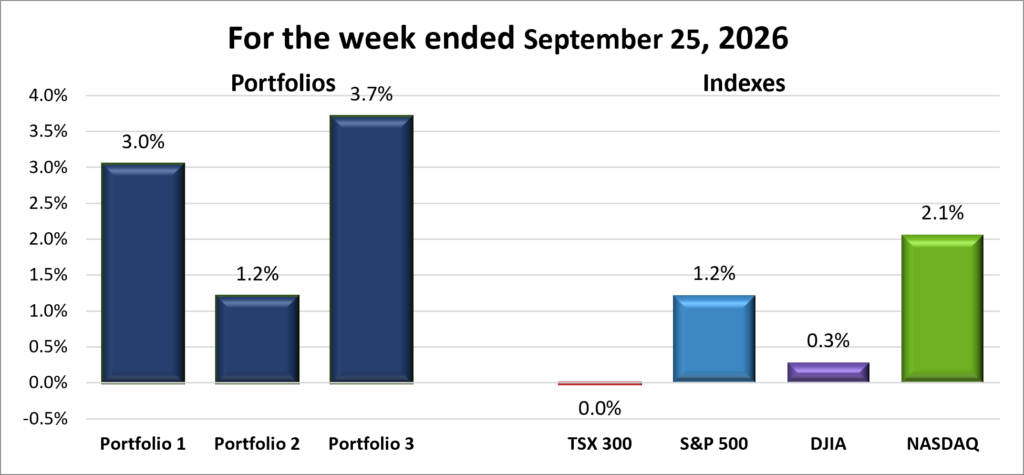
For the week, the TSX (SPTSX) slipped 0.02%, the S&P 500 (SPX) advanced 1.2%, the DJIA (INDU) edged up 0.3% and the Nasdaq (CCMP) climbed 2.1%.
| Index | Weekly Streak |
| TSX: | 1 – week losing streak |
| S&P: | 1 – week winning streak |
| DJIA: | 1 – week winning streak |
| Nasdaq: | 2 – week winning streak |
 The week got off to a good start, with the Nasdaq Composite Index (Nasdaq) setting two consecutive record closing highs, but the momentum didn’t last. The indexes dropped two straight days before rebounding to see the Dow Jones Industrial Average (DJIA) snap its three-week losing streak, while S&P 500 Index (S&P) also got back in the win column and the Nasdaq extended its weekly win streak. In Canada, the Toronto Stock Exchange Composite Index (TSX) started the week on a promising note, but a midweek swoon proved too much for a late rally to overcome, leaving the index just short of the flatline.
For the US markets, oil, inflation and interest rates remained the dominant catalysts, with continued enthusiasm for AI providing an important counterweight. Oil prices climbing back above US$100 a barrel added to inflation concerns, while stronger-than-expected US economic data increased expectations for another Fed rate hike. That combination pushed Treasury yields higher, with the 10-year yield rising above 5% and putting renewed pressure on stocks. Higher yields can make future corporate earnings less attractive, particularly for technology companies whose stock prices depend more heavily on expectations for future growth.
At the same time, investors appeared to be becoming more selective within the AI sector. Strong spending on AI infrastructure and continued developments involving major technology and cloud companies kept demand for AI-related stocks healthy, but concerns about the enormous cost of building and operating AI infrastructure weighed on some companies. Rather than abandoning AI, investors appeared to be paying closer attention to which companies were positioned to benefit from the spending boom and which faced higher costs or less certain returns.
The strength of the economy added another layer of complexity. September business activity remained stronger than expected, while solid orders for business equipment provided further evidence that companies are still investing despite higher borrowing costs. That’s positive for corporate growth and future earnings, but it also makes the Fed’s job more difficult if strong demand keeps inflation elevated. With oil adding another source of inflationary pressure, the possibility of another rate hike as soon as October remained a concern.
In Canada, the TSX faced a different mix of support and pressure. Rising oil prices benefited energy stocks, but higher Canadian bond yields added pressure to interest-sensitive areas as inflation concerns increased expectations for another BoC rate hike. The 10-year Canadian yield approached 4%, offsetting some of the benefit from stronger energy prices.
The bigger drag came from gold and silver. Higher interest rates, rising bond yields and a stronger US dollar reduced the appeal of precious metals, sending prices sharply lower and weighing on Canadian mining stocks. Technology provided some support as renewed enthusiasm for AI lifted Canadian technology stocks, while financials also helped cushion the weakness. With gains in energy unable to offset the selloff in precious metals, the TSX ultimately finished the week just short of flat.
Overall, the week highlighted the competing forces facing investors. A resilient economy and continued AI spending provided reasons for optimism, but rising oil prices, inflation concerns and higher interest rates remained significant headwinds. The US markets managed to recover from their midweek weakness, while Canada’s heavier exposure to energy and precious metals produced a more mixed result. For now, investors appear to be watching closely to see whether economic and AI-driven growth can continue to outweigh the pressure from higher rates and inflation.
| Portfolio | Weekly Streak |
| Portfolio 1: | 2 – week winning streak |
| Portfolio 2: | 2 – week winning streak |
| Portfolio 3: | 2 – week winning streak |
It was a surprisingly strong week for my three portfolios, with all three finishing higher and Portfolios 1 and 3 outperforming the Nasdaq, the week’s best-performing major index. The AI rally may have taken a backseat to inflation concerns and the possibility of higher interest rates in the broader markets, but it stayed an important source of strength for my portfolios. Every stock that gained more than 10% during the week was either directly involved in AI or AI adjacent, including companies supplying the electrical equipment, semiconductors and other specialized products needed to support the AI buildout. Higher oil prices were more of a mixed blessing. Many of my energy holdings moved higher, but enough declined to largely cancel out those gains.
Portfolio 1 posted an impressive 3.0% weekly gain, a performance that would normally have been enough to claim the top spot. This time, however, Portfolio 3 edged it out. Portfolio 1 had 47% of its holdings finish the week higher, led by Datadog (NASDAQ: DDOG), which jumped 17%. Hammond Power Solutions (TSX: HPS.A) and Lattice Semiconductor (NASDAQ: LSCC) both gained 12%, while Shopify (TSX: SHOP) added 11%. The strong gains from several AI and AI-adjacent holdings helped push the portfolio well ahead of the broader market.
Portfolio 2 had the softest performance of the three, but still posted a respectable 1.2% gain. Just 42% of its holdings finished the week higher, but the bigger difference was the size of those gains. With fewer high-growth stocks, most of the portfolio’s winners posted more modest increases than the larger gains seen in Portfolios 1 and 3. Hammond Power Solutions was the standout, gaining 11%, while most of the other winners made smaller contributions, leaving Portfolio 2 trailing its more growth-oriented counterparts.
Portfolio 3 took the top spot with a 3.7% gain, narrowly edging out Portfolio 1. It also had the highest percentage of weekly winners, at 50%. 5N Plus (TSX: VNP), Rocket Lab (NASDAQ: RKLB) and Shopify each gained 11%, while several other technology holdings advanced 5% or more. That broader participation gave Portfolio 3 the extra push it needed to finish the week as the top performer.
Overall, it was a very welcome week for the portfolios. The AI and technology rally provided plenty of fuel for Portfolios 1 and 3, while Portfolio 2 still managed a solid gain despite having fewer high-growth names. After the volatility of recent weeks, seeing all three portfolios finish on a positive note and keep their winning streaks alive was a pretty good way to wrap up the week.
Companies on the Radar
 This week, two new companies came onto my radar: Generac Holdings and Ingredion (NYSE: INGR). They caught my attention for very different reasons, with Generac offering exposure to growing demand for reliable power, while Ingredion provides a more defensive, dividend-oriented business.
Generac first caught my attention after announcing a US$2.4 billion agreement to supply backup generators to Amazon’s data centres, with the potential value rising to US$8 billion. The American company makes power generation and energy management equipment for homes, businesses, and industrial customers. It is best known for its backup generators, but also makes energy storage and power management systems for commercial and data centre applications. Generac makes money by selling this equipment through dealers, distributors, and other channels. With electricity demand rising and data centres requiring reliable backup power, the combination of its established residential business and newer growth opportunities makes Generac an interesting company to watch.
Ingredion caught my attention after I read that the company had increased its dividend for the past 10 years. That made it an interesting potential counterbalance to the more growth-oriented companies in my portfolios. Ingredion turns plant-based raw materials into ingredients used in thousands of everyday products. Its starches, sweeteners, fibres, and speciality ingredients are sold to food and beverage manufacturers, as well as customers in animal nutrition, brewing, and industrial markets. By turning basic agricultural products into higher-value ingredients, Ingredion generates steady cash flow while benefiting from demand for everyday consumer products. Its established business and growing dividend make it an interesting company to watch.
With these two additions, my radar list now has six companies on it.
- Mattr Corp. (TSE: MATR): A small cap Canadian industrial technology company that designs and manufactures specialized infrastructure products using advanced materials. The company may not be familiar to most investors, but its products support industries such as energy, electrification, communications, transportation, and water management. From composite pipes and underground storage tanks to specialized wire and cable solutions, Mattr creates products designed to be lighter, more durable, and resistant to harsh environments. Think of it as a behind-the-scenes supplier helping modern infrastructure operate more safely and efficiently, generating revenue by selling specialized products to industrial customers around the world.
- Capital Power Corporation (TSX: CPX): A mid cap Canadian power producer that generates electricity from a mix of natural gas, wind, solar and battery storage across North America. With electricity demand rising rapidly from AI data centres, industrial growth and electrification, Capital Power is expanding its natural-gas generation while adding renewable and storage capacity. Its recent agreement to supply 250 MW of power to a new Meta (NASDAQ: META) data centre in Alberta for more than 10 years highlights how the AI boom is creating opportunities beyond the technology companies building the data centres themselves.
- Emera Incorporated (TSX: EMA): A large cap Canadian energy company that owns regulated electric and natural gas utilities serving about 2.6 million customers across Canada, the US and the Caribbean. Its utilities provide a relatively stable source of revenue while Emera invests billions in expanding and modernizing its power networks. With electricity demand expected to grow as AI data centres, industrial activity and electrification increase, Emera could benefit from the long-term need for more reliable power.
- S&P Global (NYSE: SPGI): A large cap American company and one of the world’s most important financial information companies. Most investors know it for the S&P 500 Index, but the business also provides credit ratings, market data, analytics, and research used by banks, corporations, governments, and investors worldwide. Think of it as one of the key information providers that helps global financial markets function, generating revenue through subscriptions, licensing fees, and rating services.
As always, these are not buy recommendations. Make sure to do your own research and choose investments that fit your personal financial goals.
The Radar Check was last updated September 25, 2026.


Portfolio Update
Portfolio 3
Sold: Some shares of Nvidia (NASDAQ: NVDA) One reason I invest is to build wealth over the long term, but there are times when the portfolio needs to serve a more immediate purpose. This week, I sold some shares of Nvidia to raise cash to pay some bills. It wasn’t a change in my outlook for the company, just a reminder that sometimes the best reason to sell an investment is simply to put the money to work somewhere else, including covering the costs when life throws an unexpected expense your way.
That’s a wrap for this week, thanks for reading – may your portfolio stay green and your dividends steady. See you next time!