
Connecting the economic dots
You might have noticed that I always highlight economic data in my Weekly Updates. I get it—it can seem a bit dry, and you might wonder why I make it such a priority. Honestly, before I started investing, my eyes glazed over when I saw all those reports too! 😊 But once I began to take investing more seriously, I started paying attention to what really moves the markets, especially those sharper swings.
When you are new to investing, reports like labour data, inflation stats, and economic growth figures might feel overwhelming. But once you understand how they fit together, it all starts to make sense—especially when it comes to how the Bank of Canada (BoC) makes decisions that can directly impact your investments.
Understanding these reports and their influence on interest rates and market performance is essential for building wealth and achieving your financial goals. Here is a quick guide to the key economic reports and their implications for your investments:
1. Labour Force Survey (LFS)
The LFS is like the ultimate health check for the Canadian job market. Every month, it tells us how many jobs are being created, how many people are unemployed, and how engaged the workforce is. A booming job market usually signals that the economy is thriving, while rising unemployment might be a warning sign. The BoC closely tracks this data to decide if the economy needs a push in the form of lower rates – or a break with a rate hike.
2. Gross Domestic Product (GDP)
Think of GDP as the scoreboard for the economy. Released quarterly, it shows the total value of goods and services produced, offering a snapshot of economic health. GDP grows in two ways. First, when more people enter the workforce, they contribute to the economy by producing more, boosting GDP through increased output and consumer spending. Second, even with the same number of workers, GDP can rise if workers become more productive—thanks to new technology or skills, for example. This combination of growth through workforce and productivity drives economic expansion.
While a rising GDP usually signals a healthy economy, the story is not always that simple. In Canada, recent GDP growth has been somewhat misleading due to a surge in immigration. Although the economy is expanding, GDP per capita – the economic output per person – is actually shrinking. This suggests that productivity may be slipping, potentially leading to a lower standard of living for many Canadians, despite the headline growth. The Bank of Canada keeps a close eye on these figures as they assess whether adjustments to interest rates are needed to maintain a balanced and sustainable economy.
3. Inflation Reports (CPI and PCE)
Inflation is like a hidden force that impacts everything—from your grocery bill to the value of your investments. To monitor inflation, two key reports come into play: the Consumer Price Index (CPI) and the Personal Consumption Expenditures (PCE) Price Index. The CPI, released monthly, tracks price changes for essentials like food, gas, and rent. When the CPI goes up, inflation is rising, and your money does not stretch as far.
The PCE Price Index, although more relevant in the US, is another important measure. It tracks price changes but also includes costs not directly paid by consumers, like employer-provided health insurance. While CPI focuses more on out-of-pocket costs, PCE offers a broader view of overall spending. The BoC mostly uses CPI to guide its policies, while the US Federal Reserve (Fed) leans on PCE. Together, these reports help shape how the BoC gauges inflation and adjusts interest rates accordingly.
How the Bank of Canada Reacts:
The BoC does not react to just one data point. They weigh job reports, GDP growth, inflation trends and other data to get a full picture. If the economy is heating up – with strong job creation, climbing GDP, and rising inflation – they might raise interest rates to cool things down. Higher rates make borrowing more expensive, slowing spending and helping control inflation.
When the economy is growing steadily and inflation is in check, the BoC might hold rates steady to avoid disrupting the balance. But if the economy falters – whether GDP growth slows, inflation dips, or unemployment rises – they could lower rates. Lowering rates encourages spending and investment by making borrowing cheaper, giving the economy a needed boost.
Impact on Stock Markets and Investors
So, how does all this affect your investments? When interest rates rise, borrowing costs go up, making it harder for companies – especially high-growth sectors like technology – to expand, which can push stock prices down. Bonds also become more attractive, causing some investors to shift money out of stocks.
Steady rates create stability, which is generally good for the stock market because it gives businesses and investors more confidence.
But when the BoC cuts rates, it is like giving the economy a shot of adrenaline. Lower borrowing costs encourage consumers to spend and businesses to expand, often leading to rising stock prices. Investors also find stocks more appealing since bonds offer lower returns in a low-rate environment. However, if rates are being cut because the economy is struggling, it might hint at underlying issues that could weigh on stock performance.
As an investor, understanding how these reports tie together helps you anticipate market trends and adjust your strategy. If the BoC is likely to raise rates, you might brace for some short-term volatility. If they are about to cut rates, it could be a signal for growth stocks and more opportunities for gains.
Now that we have covered the basics of these key economic reports and their role in shaping the markets, it is time to see how events of the past week played out. The previous week was all about labour data, but this time, inflation took center stage. Let’s take a look at how things unfolded this past week…
Items that may only interest or educate me ….
Canadian Economic news, US Economic news, Has the Magnificent 7 lost a member, ….
Canadian Economic news
This past week’s key economic data that the BoC considers when deciding whether to raise or lower the interest rate.
Canadian market volatility
Canada’s Volatility Index (CVIX) started the week at 13.21, hovered around the 12.0 mark for most of the week, and then dipped to 10.12 at the end of the week. This sharp drop in volatility likely reflects positive market reactions to the latest US inflation report, which showed continued easing, along with expectations of an upcoming rate cut in the US. Additionally, the growing optimism that both Canada and the US may achieve ‘soft landings’—where inflation returns to 2% without triggering a recession—helped calm market nerves.
Tracked under the ticker VIXI on the Toronto Stock Exchange (TSE), the CVIX measures anticipated market volatility. Readings below 10 indicate a calm, stable market; values between 10 and 20 signal moderate volatility and typical market fluctuations, while levels above 20 suggest heightened uncertainty and increased market turbulence.
US Economic news
This past week’s key data points that the Fed considers when deciding whether to raise or lower the interest rate.
Consumer price Index (CPI)
The August CPI report showed inflation rising by 0.2% month over month, matching expectations and maintaining the same pace as July. On an annual basis, all items, or headline, CPI came in lower than anticipated at 2.5%, the slowest annual increase since February 2021, down from July’s 2.9%. Analysts had forecasted a 2.6% rise, so this was a positive surprise.
The biggest monthly increase was seen in ‘Transportation services,’ which jumped 0.9%, while ‘Utility (piped) gas service’ recorded the steepest decline, falling 1.9%. Year over year, ‘Transportation services’ led with a 7.9% price surge, and ‘Fuel oil’ saw the largest price drop, plunging 12.1%, thanks to lower oil prices.
Core CPI, which strips out volatile food and energy costs, increased by 0.3%, slightly higher than both July’s 0.2% rise and market expectations. Year over year, core CPI landed at 3.2%, the same pace as July and in line with predictions.
In short, the August inflation report was a mixed bag. Headline inflation continues its downward trend, but core inflation ticked up on a monthly basis and remains above 3% annually. As a result, the chances of a 0.5% rate cut by the Fed next week now seem slim. Many investors had been hoping for a 0.5% cut, but this report likely dampens those expectations, leaving them to settle for a 0.25% reduction – something they would have been happy with just a few months ago.
American market volatility
The CBOE Volatility Index (VIX), often referred to as the market’s “fear gauge,” surged to 21.37 at the start of the week before steadily dropping to close at 16.56. This 20% decline in the VIX likely stems from the latest CPI report showing further declines in inflation, reinforcing expectations that the Fed is steering the economy toward a soft landing. The anticipation of an upcoming rate cut, expected to be between 0.25% and 0.5%, also contributed to calming investor sentiment.
The VIX measures projected market volatility over the next 30 days. Levels below 12 suggest a calm market, while readings between 12 and 20 indicate normal fluctuations. A range of 20 to 30 reflects rising uncertainty, and levels above 30 signify extreme stress, often associated with major market disruptions or crises.
Consumer Sentiment Index (CSI)
The University of Michigan’s preliminary CSI for September showed an encouraging rise, marking the second consecutive monthly increase. The index came in at 69, a five-month high, beating both the forecast of 68 and August’s reading of 67.9. For comparison, it was 67.8 in September 2023.
Breaking down the components, the Current Economic Conditions index, which reflects how consumers feel about their present financial situation and the broader economy, rose to 62.9 from 61.3 in August, though it remains below last year’s 71.1. Meanwhile, the Index of Consumer Expectations, which measures the economic outlook for the next 6 to 12 months, climbed to 73.0, up from 72.1 in August and significantly higher than the 65.7 recorded a year ago. These gains suggest growing optimism both in current conditions and future prospects, offering a snapshot of consumer confidence.
The improved CSI reflects expectations that inflation will continue to ease, and prices will stabilize. Year-ahead inflation expectations fell for the fourth straight month, reaching 2.7%—the lowest since December 2020 and well within the 2.3-3.0% range seen before the pandemic. Although more consumers believe the Democrats will win the upcoming election, there’s still considerable uncertainty surrounding the outcome, which may temper some of their optimism. Nevertheless, many remain hopeful about near-term economic improvements.
Has the Magnificent 7 lost a member?
The term ‘Magnificent 7’ first came into play in 2023, referring to a powerhouse group of technology stocks: Amazon.com (NASD: AMZN), Apple (NASD: AAPL), Alphabet (NASD: GOOGL), Meta Platforms (NASD: META), Microsoft (NASD: MSFT), Nvidia (NASD: NVDA), and Tesla (NASD: TSLA). While most of these companies are widely recognized as tech giants, Tesla stands out as a bit of an anomaly.
Despite its inclusion in this elite group, Tesla’s performance this year diverges from the trend seen with its peers. As of September 13, Tesla’s stock is down over 7%, whereas the other six companies have collectively risen by an average of 35%, with Nvidia leading the pack with a remarkable 140% gain. This divergence prompts a closer look at Tesla’s identity: is it truly a tech company, or is it fundamentally a car company?
Is Tesla a Car Company or a Tech Company?
Tesla operates at the intersection of automotive and technology worlds, making its classification challenging. Although it might initially appear to be a traditional car manufacturer, there is much more beneath the surface. Let us examine both perspectives to determine where Tesla really fits.
At first glance, Tesla appears to be a traditional car manufacturer in several ways. A sizable portion of Tesla’s revenue stems from selling electric vehicles (EV), including popular models like the Model 3, Model S, Model X, Model Y, and the recently released Cybertruck. Upcoming models such as the Roadster further emphasize its automotive focus. Tesla is often compared to legacy carmakers like Ford, GM, and Toyota, with its success frequently measured by vehicle sales. Additionally, Tesla’s Gigafactories, which produce vehicles on a massive scale, resemble traditional automotive production facilities.
However, Tesla’s story extends beyond traditional boundaries. Looking under the hood (😊), reveals its technological edge. Tesla is a leader in the quest for fully autonomous vehicles, utilizing advanced artificial intelligence (AI) through its Full Self-Driving (FSD) software. Beyond its automotive offerings, Tesla has expanded into energy products, including solar panels and battery storage systems, broadening its role beyond the automotive sector. Unlike traditional cars, Tesla vehicles benefit from over-the-air software updates, a feature typically associated with tech products rather than conventional automobiles. Moreover, Tesla’s substantial investment in areas such as AI, battery technology, and sustainable energy highlights its deep dive into technological innovation, often overlooked by traditional car manufacturers.
So, What Is Tesla?
While Tesla might resemble a car company at first glance, its operations and innovations place it firmly in the tech sector. Its dual focus on transformative technologies and energy solutions highlights its broader impact, redefining multiple industries beyond just automobiles. Ultimately, I feel Tesla is a tech company that happens to manufacture cars, leveraging its technological prowess to drive future industry evolution.
Revisiting the Magnificent 7
Given Tesla’s mixed profile and, more importantly, its underperformance compared to its tech-focused counterparts, the debate about its place in the Magnificent 7 is gaining traction. While Tesla’s innovations are undeniable, its core business and recent share price performance may warrant a reconsideration of its status. Could it be time to rebrand the Magnificent 7 as the Magnificent 6, reflecting a purer focus on high growth, technology-driven stocks?
Weekly Market Review
Monday: it was great to see the markets rebound from the previous week’s losses, the worst week of 2024, and all four indexes – the Toronto Stock Exchange Composite Index (TSX), the S&P 500 Index (S&P), the Dow Jones Industrial Average (DJIA), and the Nasdaq Composite Index (Nasdaq) – gain at least 1% during the session. Oil prices climbed amid concerns over potential supply disruptions at US oil refineries, as a hurricane threatened to hit the Gulf Coast, a key region for American energy production.
In Canada, the TSX broke a five-day losing streak as investors snapped up stocks that had been beaten down last week. In trading, in general it was good day for the TSX, led by the Healthcare sector. The Energy sector was the only sector to end lower, despite the higher price for oil.
In the US, bargain hunting investors push all three American indexes higher as investors await the latest inflation data for clues to how big of a rate cut the Fed will make later this month. All sectors ended the day higher, led by Consumer Staples, with Communications Services trailing the pack.
Tuesday: it was a choppy day in the markets with the TSX and DJIA ending in the red, while the S&P and Nasdaq managed to end the day in the green. Investors are focused on tomorrow’s US inflation report, the last major economic report before the Fed’s meetings next week. A lowered demand growth forecast for oil caused the price of oil to fall to its lowest level since December 2021.
In Canada, lower oil prices were the main reason the TSX ended lower. In trading, Basic Materials (miners and fertilizer manufacturers) advanced the most, while Energy lost the most.
In the US, investors hunkered down, waiting for tonight’s presidential debate and tomorrow’s CPI report. Bank stocks tumbled after JP Morgan (NYSE: JPM) warned about possible lower income in future earnings. In trading, Consumer Cyclicals posted the biggest advance, while Energy saw the biggest decline.
Wednesday: the indexes were trending downward until the release of the US CPI report. Following the release of the mixed inflation data, the indexes reversed course sending all four into positive territory by the end of the day. Due to higher-than-expected core CPI data, investors now anticipate the Fed will lower rates by 0.25%. Oil prices edged higher as worries over shrinking US inventories and potential production delays outweighed fears of weakening demand.
In Canada, the TSX rode the tailwinds of the US inflation report to a two-week high. In trading, Consumer Cyclicals led a broad-based rally that saw only the Communications Services sector end lower.
In the US, the presidential debate was light on policies that could sway independent voters or the markets. In trading, Technology posted the biggest daily gain, while the Energy sector declined the most.
Thursday: all four indexes ended higher following yesterday’s CPI report that showed inflation continued to cool. Oil prices rose after Hurricane Francine battered southern Louisiana, possibly disrupting US oil production and supply.
In Canada, higher commodity prices, especially the price of gold, lifted the TSX to a record high close. In trading it was another day of broad-based gains, led by the Basic Materials sector. Healthcare was the only sector to end in the red.
In the USA, the Producer Price Index (PPI) data came in higher than expected, all but confirming the Fed will cut the interest rate by 0.25% and the economy will have a soft landing. Technology companies are back in favour as the S&P and Nasdaq recorded their fourth straight day of gains. In trading, all sectors ended in the green led by Communications Services, with Financials trailing the pack.
Friday: the indexes jumped on speculation that a 0.5% rate cut by the Fed was still a possibility. Oil prices inched higher as investors gauged the impact of damage caused by Hurricane Francine on output from the Louisiana coast.
In Canada, the TSX hit a new all-time high for the second consecutive day, driven by anticipation of next week’s Fed rate cut and rising commodity prices. The index posted its strongest weekly performance since October 2023, led by gains in the Healthcare sector, while on the downside, Consumer Staples saw the largest losses.
In the US, investors are betting on nearly even odds that the Fed will implement a 0.5% interest rate cut, following comments from a former Fed official suggesting there is a strong case for the larger reduction. This speculation and growing optimism fueled the Nasdaq’s best weekly performance of the year. In trading on Wall Street, all sectors advance led by the Utilities sector, while Healthcare brought up the rear.
Weekly Market and Portfolio Review
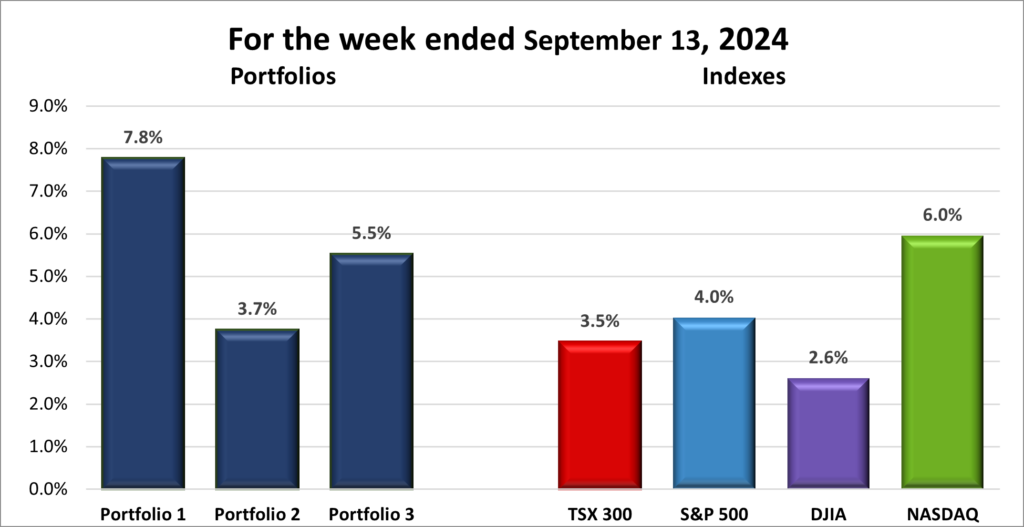
For the week, the TSX (SPTSX) increased 3.5%, the S&P 500 (SPX) rose 4.0%, the DJIA (INDU) advanced 2.6% and the Nasdaq (CCMP) jumped 6.0%.
| Index | Weekly Streak |
| TSX: | 1 – week winning streak |
| S&P: | 1 – week winning streak |
| DJIA: | 1 – week winning streak |
| Nasdaq: | 1 – week winning streak |
 After a rocky start to September, with all major indexes falling by more than 2%, I thought this month might erase August’s gains. Fortunately, a much needed rebound saw each index climb over 2.5% this past week, providing some welcome relief.
The previous week, markets were rattled by worse-than-expected labour data, which weighed heavily on investor sentiment. This week, the focus shifted to inflation. Investors closely analyzed the latest inflation report for clues on whether the Fed would lower US rates by 0.25% or 0.5% at their upcoming meeting. A favourable report, showing inflation continues to slow, followed by stronger-than-expected PPI data, led many to feel that a 0.25% rate cut was almost certain. These reports also bolstered confidence that the economy was on track for a “soft landing.” However, at the end of the week, a former Fed official suggested there was a “strong case for a 50 [0.5%]” rate cut, reigniting speculation about a larger reduction.
In Canada, the TSX hit consecutive record highs, buoyed by optimism surrounding the anticipated US rate cut, confidence in the Canadian economy’s own path to a soft landing, and rising commodity prices.
All eyes are now on next week’s Federal Open Market Committee (FOMC) meeting. Investors are anxiously awaiting the size of the rate cut and the Fed’s outlook for further reductions throughout the rest of 2024. After months of speculation, the key questions remain: how large the upcoming cut will be, and what the pace of future reductions might look like. In a perfect world, the Fed will opt for the bigger 0.5% cut and leave the door open for further cuts. 😊
| Portfolio | Weekly Streak |
| Portfolio 1: | 1 – week winning streak |
| Portfolio 2: | 1 – week winning streak |
| Portfolio 3: | 1 – week winning streak |
After last week’s debacle, it was a relief to see all three portfolios rebound with gains of over 3.5%, as highlighted in the chart below. Portfolio 1 stood out, with 75% of its holdings posting gains, led by an 18% jump from Hammond Power Supply (TSE: HPS.A) and a notable 10% increase in Nvidia’s value. As Nvidia is the largest holding by both share count and portfolio weight, its surge played a pivotal role in driving Portfolio 1’s outperformance, helping it surpass the gains of the other portfolios and all of the indexes. 😊
Portfolio 2 also rebounded, driven by Hammond Power Solutions’ outstanding 18% jump and Guardant Health’s (NASD: GH) 12% rise. A solid performance that saw 72% of the holdings advance helped Portfolio 2 get back in the winner’s circle.
Meanwhile, Portfolio 3 posted a strong 5.5% gain, which on any other week might have secured top honours. However, it had to settle for second place behind Portfolio 1’s breakout week. With 86% of its holdings in the green, Portfolio 3 was buoyed by a 10% gain from Lithium Americas (Argentina) (TSE: LAAC).
Overall, it was a great week, with each portfolio not only recovering from the previous week’s losses but exceeding them. As Oliver Twist might say, “Please, sir, I want some more!” 😊
Companies on the Radar
 This week, I did not spot any new companies that caught my eye. However, I decided to remove Equitable Bank (TSE: EQB) from my radar. With Canadian banks and other financial sector names already represented in all three portfolios, it made sense to clear some space on my radar. If I were to add another financial sector player, Equitable would be at the top of the list.
For now, my Radar List is down to the three companies listed below.
- Payfare Inc. (TSE: PAY), a small-cap Canadian company that provides gig workers with instant access to their earnings along with a comprehensive suite of digital banking services.
- Vertiv Holdings (NYSE: VRT), a large American company that designs and builds infrastructure and continuity solutions to businesses around the world.
- On Holding AG (NYSE: ONON), a medium cap Swiss company, founder-run, sports products company.
The Radar Check was last updated September 13, 2024.


Portfolio Update
Portfolio 1
Portfolio 1 for the week ended September 13, 2024: UP 
- At its annual new product unveiling, Apple showed its latest smartphone, the iPhone 16, with Apple’s version of AI, called Apple Intelligence, integrated into the new devices. The company also revealed their latest watches and AirPods.
- Amazon has unveiled plans to invest a massive US$10.45 billion over the next five years to expand, maintain, and operate data centers in the United Kingdom. Additionally, they will pour 10.1 billion reais into Brazil over the next decade to boost their data center infrastructure there. With surging demand for AI and other technologies, Amazon is building out their infrastructure to meet the growing need for enhanced data capabilities across key global markets.
- General Motors (NYSE: GM) and Hyundai Motors (OTCM: HYMTF) are investigating ways that the two companies can work together on the co-development of “passenger and commercial vehicles, internal combustion engines and clean-energy, electric and hydrogen Technologies.”
Activity
No significant activity to report this week.
Dividends
Dividends Received this week for the following companies:
Canadian $
No C$ dividends this past week.
US $
Skyworks Solutions (NASD: SWKS)
Home Depot (NYSE: HD)
Quarterly Reports
No quarterly reports this past week.
Portfolio 2
Portfolio 2 for the week ended September 13, 2024: UP
- After being rejected in their bid to become the largest operator of convenience stores, Alimentation Couche-Tard (TSE: ATD) said they were prepared to have further confidential conversations with Seven & i Holdings (OTCM: SVNDY) to see if a deal can be reached.
- TC Energy’s (TSE: TRP) deal to sell its Canadian natural gas pipeline system to a group of Indigenous communities has been delayed because of transaction structuring issue. The sale is part of TRP’s plan to reduce it debt load and help finance future opportunities.
In other TRP news, the company was fined C$590,000 by the British Columbia Environmental Assessment Office for deficient erosion and sediment control measures along their pipeline construction route. - Microsoft is planning to let go 650 employees in their Xbox division as they attempt to integrate their purchase of Activision Blizzard and lower their expenses.
in other Microsoft news, the company named former GE chief financial officer Carolina Dybeck Happe as its chief operations officer.
Activity
No significant activity to report this week.
Dividends
Dividends Received this week for the following companies:
Canadian $
No C$ dividends this past week.
US $
Microsoft Corp.
Quarterly Reports
Dollarama Inc.
Second quarter 2025 financial results on September 11, 2024
Portfolio 3
Portfolio 3 for the week ended September 13, 2024: UP
- Brookfield Asset Management (TSE: BAM) announced they will invest up to US$1.1 billion in Infinium, a private company pioneering ultra-low carbon electrofuels (eFuels). This partnership aims to accelerate the development of sustainable aviation fuel, which has the potential to slash greenhouse gas emissions by an impressive 90% compared to conventional jet fuels. If successful, this could be a game-changer for the aviation industry’s carbon footprint and a big step toward a greener future.
Elsewhere in the Brookfield universe, BAM announced their real estate arm would be selling its Brazilian shopping malls to focus on office towers and apartment buildings, as well as logistics. - TD Bank (TSE: TD) has been ordered by an American regulator to pay nearly US$28 million after it was found to have repeatedly provided inaccurate and negative information about its customers to credit reporting agencies, potentially damaging their credit scores.
Activity
No significant activity to report this week.
Dividends
Dividends Received this week for the following companies:
Canadian $
No C$ dividends this past week.
US $
Microsoft Corp.
Quarterly Reports
No quarterly reports this past week.