
Why You Should Care About US –China Trade Talks
Since April, tensions between the world’s two largest economies – China and the US – have escalated into a bruising trade war once again. But this isn’t new. The trade war between the two originally kicked off back in July 2018, after years of growing friction over trade imbalances, intellectual property, and market access. The first Trump administration imposed a 25% tariff on US$34 billion worth of Chinese goods, and China retaliated with tariffs on US exports like soybeans and autos. That tit-for-tat quickly spiralled into a full-scale economic standoff, with hundreds of billions in tariffs and tech restrictions shaking global supply chains. While there were brief truces and ongoing negotiations over the years, the rivalry never really cooled.
Fast forward to April 2025, and tensions ratcheted up fast. The US reignited the trade war with a wave of new “reciprocal” tariffs – including an effective rate of 54% on a wide range of Chinese imports. China hit back hard, launching tariffs as high as 125% and tightening export controls on rare earth minerals – the essential ingredients in everything from smartphones to fighter jets. The US quickly responded with tariffs that climbed to a staggering 145%. Markets were rattled, and fears of a full-blown trade war came roaring back. By May, both sides agreed to a 90-day tariff truce in Geneva to cool things off and restart talks – but the damage was already done. The April flare-up marked a turning point: the trade war was no longer simmering in the background – it was front and centre again.
Talks resumed in earnest this past week. At the heart of these negotiations is a shared goal: avoid another costly trade war while protecting national interests. The US wants guaranteed access to rare earths, which China dominates, and in exchange, it’s offering to ease some restrictions on advanced chips and AI-related tech. The US also wants greater market access for its companies – especially in energy, agriculture, and digital services – and more balanced trade rules. On the flip side, China is pushing for the US to roll back tech export controls that have crippled its semiconductor sector, and to lock in the Geneva tariff truce for longer-term stability.
Here’s the crux of it:
| US Wants | China Wants |
|---|---|
| Reliable rare earth supply | Eased US chip export restrictions |
| Market access for US companies | A stable, formalized tariff truce |
| Reciprocity on trade rules | Space to protect strategic industries |
Both sides recently announced a draft “framework deal”: China would ease rare earth export restrictions, and the US would reduce some of its tech restrictions. But it’s not a done deal – both leaders still need to sign off. Even if they do, this would be more of a ceasefire than a peace treaty. Big-picture tensions around China’s industrial policy and America’s tech leadership are still very much alive.
For us investors, this matters. Whether you’re looking at semiconductors, electric vehicles (EVs), or global logistics, the path of US – China relations can shape everything from supply chains to pricing power. Even the price of oil moves with trade tensions – a deal could boost global economic growth and, in turn, drive up demand for oil and energy products. It’s another reminder that geopolitics can move markets, and why keeping an eye on headlines isn’t just about politics – it’s about smart investing.
With all that geopolitical drama setting the stage, it’s no surprise that markets have been feeling the ripple effects. Let’s take a look at some recent economic data, how the major indexes performed, and how my portfolios are navigating the ups and downs.
Items that may only interest or educate me ….
Canadian economic news, US economic news, .…
Canadian Economic News
This past week’s key economic data that the Bank of Canada (BoC) considers when deciding whether to raise or lower the interest rate.
Canadian market volatility
Canada’s market mood ring – the S&P/TSX 60 Volatility Index (VIXC) – kicked off the week at 10.33 and barely moved, drifting between 9.8 and 11.4 before dropping sharply to 9.61 late Friday. That’s a clear sign investors were feeling pretty relaxed. Solid jobs data from both Canada and the US, and growing optimism about a potential Canada–US trade deal – possibly as soon as next week – helped keep the mood steady and the volatility low.
If you’re new to the VIXC, think of it as Canada’s version of a “fear gauge.” When it’s below 10, it usually means investors are feeling confident. A range of 10 to 20 signals a steady, business-as-usual environment, while readings above 20 suggest anxiety is creeping in.
US Economic News
This past week’s key data points that the Federal Reserve (Fed) considers when deciding whether to raise or lower the interest rate.
Consumer price Index (CPI)
US inflation cooled more than expected in May, giving investors, and the Fed, some welcome breathing room. The CPI rose just 0.1% on the month, down from April’s 0.3%, and below what analysts were expecting. Although that 0.1% is technically a slight increase from the previous month’s base level, it actually points to slowing inflation, as the month-over-month jump is smaller than in earlier reports. On a year-over-year basis, inflation came in at 2.4% – a touch higher than April’s 2.3%, but still better than the forecasted 2.5%.
Digging into the details, fuel oil – also known as heating oil – saw the biggest monthly jump, climbing 0.9%. On the flip side, gasoline prices dropped 2.6%, offering some relief at the pump. Over the past year, utility (piped) gas service – natural gas delivered directly to homes – has surged 15.3%, while gasoline prices are down 12.0%.
Shelter costs, which include rent, mortgages, and homeowner expenses, continued to be one of the biggest contributors to overall inflation. They rose 0.3% in May and are up 3.9% year over year – the smallest increase since November 2021, but still stubbornly high.
Core inflation, which strips out food and energy, also rose just 0.1% on the month – below expectations – and held steady at 2.8% annually, slightly under the 2.9% forecast.
For the Fed, this report is an encouraging sign. Inflation isn’t flaring up again, which opens the door a little wider for a rate cut later this year – potentially as early as September. That said, Fed members will probably stay cautious, especially with trade tensions and tariffs looming in the background. But for now, inflation is easing without dragging down the broader economy, and that’s welcome news for markets, businesses, and consumers alike. 😊
Consumer Sentiment Index (CSI)
Consumer confidence got a lift in June. The University of Michigan’s preliminary CSI came in at 60.5, marking the first increase in six months and beating expectations of 53.5. That’s a 15.9% jump from May’s 52.2 – but still 11.3% below where it was a year ago and about 18% lower than in December 2024, when sentiment spiked following the election of President Trump.
The Current Conditions Index, which reflects how people feel about their personal finances right now, rose to 63.7 from 58.9 – a healthy monthly bump, but still down from last year. And the Expectations Index, which looks ahead six months, saw an even bigger rebound – climbing nearly 22% to 58.4. That said, both measures are still well below pre-pandemic norms, showing that while confidence is improving, consumers are still cautious.
Analysts pointed to April’s tariff shock as a major reason for the earlier drop in sentiment, and June’s bounce suggests that anxiety is starting to ease. Even so, the index is far from signaling all-clear – with uncertainty around inflation, trade policy, and global tensions still lingering.
For us investors, this kind of shift matters. When consumers feel better, they’re more likely to spend, which fuels growth in sectors like retail, housing, and travel. But with confidence still on the low side, we should be watching closely – especially if we’re investing in companies that rely on strong consumer demand.
American market volatility
Wall Street’s “fear gauge” – the CBOE Volatility Index (VIX) – started the week at 17.69 and held within a relatively tight range, fluctuating between 16.25 and 18.90. But at week’s end, it spiked to 20.82 after Iran retaliated against an earlier Israeli air strike, shaking investor confidence. Up until that point, markets had stayed fairly calm, supported by strong labour and inflation data and renewed US–China trade talks. The sudden jump in the VIX was a reminder that geopolitical flare-ups can quickly overshadow economic fundamentals – and that investor sentiment can shift in an instant.
For anyone new to the VIX: it’s basically Wall Street’s stress meter. When investors start getting uneasy, they often pull back from riskier bets like technology stocks, which can lead to sharper swings in prices. That’s when the VIX tends to spike – capturing the rise in market volatility and fear. Readings between 12 and 20 mean things are fairly normal, but when it climbs above 20, it usually signals that investors are bracing for choppier waters ahead. The higher it goes, the more turbulence the market is pricing in.
Weekly Market and Portfolio Review
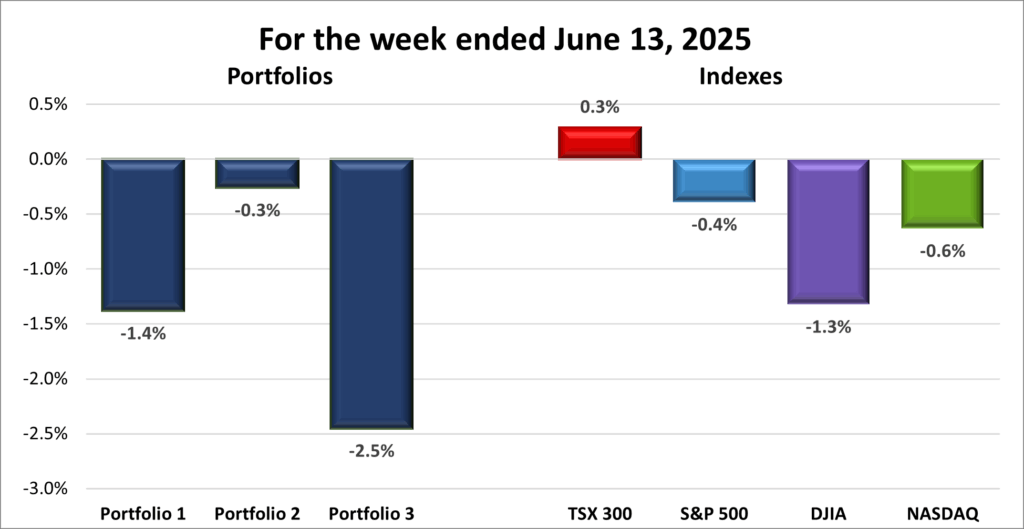
For the week, the TSX (SPTSX) advanced 0.3%, the S&P 500 (SPX) lost 0.4%, the DJIA (INDU) fell 1.3% and the Nasdaq (CCMP) declined 0.6%.
| Index | Weekly Streak |
| TSX: | 3 – week winning streak |
| S&P: | 1 – week losing streak |
| DJIA: | 1 – week losing streak |
| Nasdaq: | 1 – week losing streak |
 As of Thursday, all four major indexes – the Toronto Stock Exchange Composite Index (TSX), the S&P 500 Index (S&P), the Dow Jones Industrial Average (DJIA), and the Nasdaq Composite Index (Nasdaq) – were on track for weekly gains, lifted by strong earnings, easing inflation, and optimism around trade. The S&P even climbed back above 6,000 for the first time since February 2024, and the TSX, S&P, and Nasdaq all hit record closing highs during the week.
But Thursday night brought a jolt: Israel launched a pre-emptive airstrike on Iran to halt its nuclear weapons program. The escalation rattled global markets. Oil prices surged as much as 7%, and investor sentiment quickly turned. By Friday, US indexes had flipped into the red, the S&P was back under 6,000, and the market’s tone had clearly shifted.
Before that, markets were calm. Volatility was low, and investors seemed to grow more comfortable with Trump’s shifting tariff threats. Midweek, optimism got a boost when the US and China agreed on a framework to restart trade talks. As part of the deal, China would ease restrictions on rare earth exports – crucial for everything from smartphones to EVs – and the US would ease limits on Chinese student visas. Tariffs would stay for now, with the US holding at 55% and China at 10%, but investors took this as progress.
Trump also warned that countries not striking a deal by the end of the 90-day pause on July 8 would face new tariffs. But Treasury Secretary Scott Bessent offered reassurance, saying extensions were “highly likely” for those negotiating in good faith. Separately, Trump floated the idea of hiking auto tariffs (already at 25%) to spur more US production – despite automakers pushing for cuts, not hikes.
On the economic front, May’s US inflation data gave investors more to optimism for a rate cut. Headline CPI rose just 0.1%, and core inflation came in below forecasts – a sign that inflation is slowing without stalling growth. Markets are now betting on one or even two Fed rate cuts this year, possibly starting in September. Trump also weighed in, calling for a “jumbo” 0.5% cut, though analysts expect the Fed to stay cautious. Consumer sentiment even ticked up for the first time in six months, rounding out a solid backdrop.
In Canada, the TSX hit record highs on Wednesday and Thursday, helped by rising oil and gold prices and optimism that a Canada–US trade deal could be announced at next week’s G7. A potential trade-off I’d like to see: Canada drops its digital services tax in exchange for the US dropping Section 899 of Trump’s ‘big, beautiful’ tax cut and spending bill, which penalizes foreign investors (like us Canadians).
The TSX dipped Friday as Middle East tensions escalated, but surging oil and gold prices cushioned the blow, helping the index post a third straight weekly gain. Oil jumped on fears of supply disruption through the Strait of Hormuz (off the south coast of Iran) – a chokepoint for nearly 20% of global oil exports. Gold rose as investors sought safety. It’s long been viewed as a safe haven because it tends to hold – or even gain – value during times of uncertainty, exactly what we saw as the week wrapped up.
| Portfolio | Weekly Streak |
| Portfolio 1: | 1 – week losing streak |
| Portfolio 2: | 1 – week losing streak |
| Portfolio 3: | 1 – week losing streak |
Much like the major indexes, all three of my portfolios were on track for a third straight weekly gain – until Israel’s pre-emptive strike on Iran and Iran’s retaliatory missile attack rattled global markets. By Friday, all three had slipped into the red as geopolitical tensions shook investor confidence.
Portfolio 1 ended the week down 1.4%. It was actually in the green heading into Friday, but the broad market selloff pulled it lower. Only 35% of holdings finished higher on the week, so in that context, a 1.4% dip doesn’t feel too bad. Fortunately, a solid 10% surge from International Petroleum Corp (TSE: IPCO) riding the wave of surging oil prices and another strong week from Cameco (TSE: CCO), which hit a new all-time high, cushioned the fall.
Portfolio 2 held up the best — or put another way, it lost the least — dipping just 0.3% for the week. A solid 55% of its holdings finished higher, including fresh record highs from Dollarama (TSE: DOL) and Microsoft (NASD: MSFT). Energy stocks also played defence, benefiting from the oil price surge and helping show, once again, the value of diversification when markets take a hit.
Portfolio 3 took the biggest hit this week, falling 2.5%. With just 23% of its holdings moving higher, there wasn’t much to lean on. Its two energy companies — Alvopetro Energy (TSEV: ALV) and Brookfield Renewable Partners LP (TSE: BEP.UN) — did their part to cushion the drop, but it wasn’t nearly enough to counter the broader pullback.
Despite the pullback at week’s end, the broader trend is still upward. Friday’s events were a sharp reminder that geopolitics can rattle markets in an instant – but volatility isn’t always a setback; sometimes, it’s a setup for opportunity. With solid earnings, cooling inflation, and renewed trade talks in the mix, there’s still plenty of reason to feel optimistic heading into next week.
Companies on the Radar
 There was a fair bit of activity on my radar list this past week as I made a few adjustments to sharpen my focus. I trimmed Unity Bancorp (NASD: UNTY) and Amphenol Corporation (NYSE: APH). With Unity, I figured if I wanted more exposure to banks, I’d likely stick with a Canadian one – something I’m more familiar with, and it would also save me from any foreign exchange headaches. As for Amphenol, it’s a solid company, but I see better opportunities elsewhere right now.
One new name made its way onto the list: Aritzia (TSE: ATZ). Aritzia is a Canadian mid-cap fashion retailer and design house, known for its in-house brands of upscale women’s clothing and accessories. The company runs a vertically integrated model – meaning it controls everything from design to distribution – and sells through more than 130 boutiques across North America, along with a fast-growing ecommerce platform. Its biggest markets are Canada and the US, where it continues to expand its footprint both online and in stores.
With these moves, plus the two companies I held over from the previous week, my radar list is now down to a tight three names – giving me a more focused set of ideas to keep an eye on.
- TerraVest Industries (TSE: TVK): a Canadian mid-cap industrial company that manufactures equipment for the energy, agriculture, and transportation sectors across North America. Its product lineup includes propane tanks, specialized tanks used to store and transport ammonia gas commonly used as fertilizer (anhydrous ammonia vessels), natural gas liquids transport vehicles, and a range of energy processing equipment.
- Secure Energy Services (TSE: SES): a Canadian mid-cap industrial company focused on waste management and energy infrastructure. They serve clients across North America with recycling, disposal, and environmental solutions – a solid pick in the sustainability and infrastructure space.
As always, these are not buy recommendations. Make sure to do your own research and choose investments that fit your personal financial goals.
The Radar Check was last updated June 13, 2025.


That’s a wrap for this week, thanks for reading – may your portfolio stay green and your dividends steady. See you next time!