When I was a kid, one year I had a baseball coach who told me the key to winning was eliminating unforced errors. Fast forward to today and I try to eliminate unforced errors in my investing. Its one thing if a company turns out to be a dud despite doing my due diligence, its another if I make a mistake when I know better. Well, this week I paid the price for an unforced error.
Back in May 2021 I bought my first cryptocurrency – Ethereum (ETH). It was my first venture into cryptocurrencies, so I only invested a small amount (C$ 200). I bought as much Ethereum as I could for $200 in my Wealthsimple crypto account. The price was C$ 5088.2 per coin so I ended up with a small fraction of 1 coin.
Soon after, the cryptocurrency market started to fall when the Chinese government cracked down on crypto miners. I wasn’t concerned about the drop, but I figured I would sell my Ethereum, let the crypto market fall some more and then buy back in once the price of Ethereum had stabilized. I sold my Ethereum four days after I bought it, when it was worth $3928.46. Classic buy high, sell low mistake but I was going to buy back in at a lower price for a bigger gain when the price of Ethereum inevitably rose, and make up for the initial loss.
Unfortunately, I did not actively monitor the price of Ethereum and Wealthsimple does not have a means of sending out alerts when the cryptocurrencies reach a certain price point, nor does Wealthsimple allow what are known as limit orders (an upper limit on how much you’ll pay on a buy order). I use both tactics when investing in companies in my TD Direct Investing account. I would periodically check the price of Ethereum, but the price stayed around C$ 4000.
Today when I checked, Ethereum had jumped up considerably, so I decided I’d better get back into Ethereum. I ended up paying to C$ 6137.23 for 0.02842 of 1 Ethereum coin. Not my finest investing moves buying high, selling low, then buying higher. So far, I’ve managed to turn C$ 200 into almost C$ 164. Sigh!
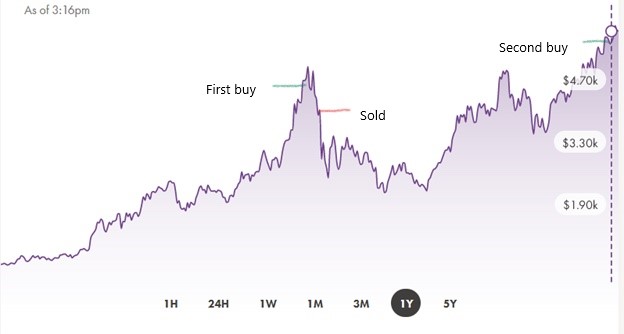
My unforced error was thinking I could time the market to make a few extra bucks. Rather than holding onto the asset (Ethereum, in his case) like I did with stocks during the stock market crash of March 2020, I sold during a drop and never bought back in until the asset was worth more than I originally paid. If I’d followed my buy and hold strategy, I’d be ahead nearly 50%. Instead, I’m down almost 22%.
My takeaway from this: stick to a buy and hold strategy and don’t try to time the market.