
Why a Ceasefire Between Israel and Iran Matters for the Markets
This week brought a rare dose of geopolitical relief as reports of a ceasefire between Israel and Iran signalled a potential cooling of tensions in the Middle East. For us investors, that kind of news matters more than you might think. While peace is always welcome from a humanitarian standpoint, it also tends to be good for the markets.
When tensions rise in the Middle East, especially between major regional powers like Israel and Iran, it adds a wave of uncertainty to global markets. Oil prices typically spike, safe-haven assets like gold and US Treasuries become more attractive, and stock markets often react with caution. That’s because the region plays a key role in the global energy supply, and any threat to that supply chain can ripple through industries and economies. Investors start to worry about rising fuel costs, supply disruptions, and the possibility of a wider military conflict.
In short, markets don’t like uncertainty (I know, I’ve said that before 😊). And few things create more uncertainty than the threat of war.
A ceasefire, on the other hand, brings a sense of stability, at least for now. It lowers the risk of further disruption to global energy supplies and offers investors a reason to feel more confident. That’s why markets rallied after the news. Oil prices edged down, the volatility index (VIX) fell, and sentiment improved. Even though the risks haven’t disappeared entirely, just the possibility that tensions are easing was enough to invite a bit of optimism back into the market.
From an investor’s perspective, reduced geopolitical risk gives companies more room to plan without hesitation. Business leaders are more likely to move ahead with hiring, capital spending, and expansion when they’re not facing added costs or global instability. A more predictable environment supports stronger corporate earnings, which helps drive stock prices higher.
The ceasefire also creates some space for central banks to stay focused on domestic conditions. Had the conflict escalated, we might have seen a sharp rise in oil prices and, in turn, a new wave of inflation. That would have made it harder for the Bank of Canada and the US Federal Reserve to begin lowering interest rates. With oil prices now more stable and a major geopolitical threat temporarily eased, central banks can take a steadier approach. For investors, this reduces the chance of monetary policy surprises, which can be a big driver of market volatility.
It’s also worth pointing out that a calmer global backdrop tends to draw investors back into riskier assets. When uncertainty is high, big institutional investors often park money in safer places or hold more cash. But when conditions start to look more stable, they tend to shift back into equities, including technology and other high-growth sectors. That rotation played out over the past few days, lifting the broader market and rewarding investors who stayed the course.
Of course, this doesn’t mean the situation is fully resolved. A ceasefire is different from lasting peace, and the situation could change again. But in the short term, this break in hostilities has been welcomed by the markets. It gives investors a chance to exhale and focus again on fundamentals like inflation, interest rates, and earnings.
This is a good reminder that global events, even those that don’t seem directly related to finance, can still affect your portfolio. Stability in one part of the world can ease pressure elsewhere, even if you don’t own energy or defence stocks. Everything is more connected than it might seem.
With that in mind, let’s take a look at what else moved the markets and the portfolios this past week.
Items that may only interest or educate me ….
Changing chairs, Canadian economic news, US economic news,
Changing Chairs: Trump Isn’t Happy with Powell
President Trump isn’t happy with US Federal Reserve (Fed) Chair Jerome Powell’s cautious ‘wait and see’ approach to interest rates. Rather than firing Powell outright – which could spook the markets – he’s suggested he might name Powell’s replacement well in advance. This way, markets have time to adjust, and the transition happens more smoothly.
The expectation is that the new Chair would be more in step with the president’s thinking and inclined to lower rates sooner than Powell has signaled. That could mean a quicker shift toward policies aimed at supporting economic growth and borrowing, rather than continuing with tighter conditions to fight inflation. Investors certainly viewed it this way, given Trump’s repeated criticism of the Fed chair for not lowering borrowing costs.
However, this raises an important concern. The Fed Chair is supposed to be an independent figure, making decisions based on data and economic conditions – not political pressure. If the successor is seen as too closely tied to the president’s wishes, especially if they’re expected to push for earlier rate cuts mainly to please political leaders, it could shake confidence in the Fed’s independence.
Markets generally don’t like the idea of political influence over the Fed because it can lead to decisions favouring short-term gains over long-term economic stability. If investors start worrying the Fed Chair is a “lackey” rather than an impartial policymaker, it could increase uncertainty and market volatility.
That said, the Fed’s structure and long Chair terms are designed to limit political interference. But perceptions matter a lot. If the new Chair is viewed as too close to the president, markets might react nervously until the Chair proves they can act independently.
For us investors, this situation means keeping a close eye on how the Fed’s messaging evolves and being prepared for some volatility as the Fed leadership transition approaches. The hope is for a smooth handoff that balances economic needs with Fed independence – but if anyone can turn a smooth transition into market drama, it’s President Trump.
Canadian Economic News
This past week’s key economic data that the Bank of Canada (BoC) considers when deciding whether to raise or lower the interest rate.
Consumer Price Index (CPI)
Statistics Canada reported that inflation held steady at 1.7% year-over-year in May, matching expectations and unchanged from April. On a monthly basis, the Consumer Price Index (CPI) rose 0.6%, slightly higher than April’s 0.5% increase.
The biggest driver of May’s monthly rise was a 1.9% jump in gasoline prices. Shelter costs were unchanged from April, making it the only major category that didn’t increase last month. Over the past year, food prices posted the largest gains, while gasoline had the biggest decline, falling 15.5%.
Shelter is still one of the biggest contributors to overall inflation, even as the pace has slowed. On an annual basis, housing-related costs rose 3.0% in May, down from 3.8% in April, signalling gradual cooling but ongoing pressure.
Core inflation, which strips out more volatile items like gas and food, provides a clearer picture of where prices are heading. It rose 0.6% in May and now sits at 2.6% year-over-year. That’s still above the BoC’s 2% target and suggests inflationary pressure is lingering in everyday goods and services.
While headline inflation appears stable, the underlying numbers tell a different story – and that’s likely what the BoC is watching most closely. For us investors, and for anyone borrowing money, this means the Bank is unlikely to cut interest rates at its next decision on July 30. With core inflation still above target, BoC policymakers are more likely to stay cautious and wait for clearer signs of sustained progress before easing up.
Gross Domestic Product (GDP)
Canada’s economy hit a bit of a speed bump in April. According to Statistics Canada, real GDP slipped by 0.1% compared to March, marking the first monthly decline since October. That dip followed a modest 0.2% gain in March and came after a solid first quarter, when the economy grew at a 2.2% annualized pace.
The pullback came mostly from the goods-producing side of the economy, which contracted by 0.6%. Manufacturing saw the sharpest drop, falling 1.9%, its biggest monthly decline in four years. The steep US tariffs on Canadian steel and aluminum, specifically the 25% tariff on steel and 10% on aluminum introduced earlier this year, are beginning to take a noticeable toll on Canada’s manufacturing sector. On the upside, the services sector managed a modest 0.1% gain, supported by finance, insurance, public administration, and recreation. These industries helped cushion the blow but not enough to keep GDP in positive territory.
Early estimates from StatsCan suggest the economy contracted again by 0.1% in May. If confirmed, that would make two consecutive months of economic decline and could pull second-quarter GDP into negative territory, stalling the momentum built in the first quarter.
Year over year, the economy expanded by 1.3% in April, down from 1.7% in March. While that still marks growth, the pace is slowing, weighed down by high interest rates, rising trade barriers, and softer global demand. One bright spot was the mining, quarrying, and oil and gas extraction sector, which grew 4.4% over the past year. Manufacturing, on the other hand, fell 2.4% compared to April 2024, highlighting the mounting pressure on Canadian exporters.
So while the economy is still growing on an annual basis, momentum is clearly fading. The slowdown reflects a combination of domestic headwinds, such as elevated borrowing costs, and external challenges, including trade friction and global economic uncertainty.
For us investors, this report brings a few key takeaways. Softer growth increases the likelihood that the BoC could cut interest rates at its July 30 meeting, especially with inflation easing. At the same time, signs of strain in certain parts of the economy could mean more volatility for sectors tied to consumer spending and exports. On the other hand, more stable, defensive sectors, like utilities, consumer staples, and steady dividend payers, could look increasingly appealing in a slower-growth environment.
Canadian Market Volatility
Canada’s volatility barometer, the S&P/TSX 60 Volatility Index (VIXC), opened the week at 10.31, a slight uptick from the previous Friday’s close of 9.86. That initial bump followed rising geopolitical tensions after a US airstrike on Iranian nuclear facilities. But the spike didn’t hold. The VIXC quickly dipped back below 10 and stayed in a narrow range between 8 and 10 for most of the week, reflecting a relatively calm Canadian market. It wasn’t until Friday that volatility edged higher again, climbing to 10.15 after President Trump abruptly ended trade talks with Canada over the digital services tax.
While the VIXC stayed calm, its US counterpart, the VIX, was above 20 at the start of the week, reflecting much higher anxiety south of the border. The Canadian market simply hasn’t been under the same pressure. Investors here don’t seem too concerned about a major market drop, and they haven’t been rushing to buy portfolio protection. That lack of demand for insurance-like strategies keeps volatility low.
It’s unusual to see this wide a gap between the two indexes, but not unheard of. It usually just means US investors are reacting to something Canada hasn’t been pulled into – at least not yet.
If you’re new to the VIXC, think of it as Canada’s version of a fear gauge. When it dips below 10, it’s a sign that investors are feeling relaxed. A range between 10 and 20 signals a steady, business-as-usual market. And once it climbs above 20, that’s when nerves start showing and volatility really starts to pick up.
US Economic News
This past week’s key data points that the Federal Reserve (Fed) considers when deciding whether to raise or lower the interest rate.
Consumer Confidence Index (CCI)
The Conference Board reported that American consumer confidence unexpectedly fell in June, dropping 5.4 points to 93.0, down from 98.4 in May and well below the expected rebound to 100. The decline came as a surprise to many analysts who had anticipated a continued rise in confidence. The pullback was broad-based, with people feeling more pessimistic about both current economic conditions and the outlook ahead.
The Present Situation Index, which reflects how people feel about current business and job conditions, fell to 129.1 from 135.9. The Expectations Index, which measures how consumers feel about the next six months, also reversed course, dropping to 69.0 from 72.8. That’s significant because readings below 80 on this index have historically signaled a heightened risk of recession.
Consumer morale slipped more than expected, mainly due to growing concerns about shrinking job opportunities, ongoing tariff tensions, and the impact of inflation on household budgets. For investors, falling consumer confidence is worth watching, as it often leads to reduced spending — a key driver of economic growth. If sentiment remains weak, it may be a sign that consumers are starting to pull back. Since consumer spending fuels the majority of the US economy, both the markets and the Fed will be keeping a close eye on where confidence goes from here.
Gross Domestic Product (GDP)
The US economy shrank more than expected in the first quarter of 2025, according to the final estimate from the Commerce Department. GDP fell at an annualized rate of 0.5%, worse than both the earlier 0.2% estimate and what analysts had been expecting. For comparison, the economy had grown at a healthy 2.4% pace in the fourth quarter of 2024.
The weaker result was mostly due to slower consumer spending, particularly on big-ticket items like vehicles, and a sharp surge in imports. Many businesses rushed to bring in goods ahead of new tariffs, and that spike dragged down GDP. Since imports subtract from GDP in the official calculation, the timing of those purchases made the economy appear softer than it actually may have been.
Most analysts see this Q1 dip as a temporary stumble rather than a sign of something more serious. The Atlanta Fed, for example, is currently forecasting a solid rebound in the second quarter, thanks in part to the drop in imports, with growth estimated around 3.4%.
For us investors, this is a good reminder that the economy can hit a few bumps without sliding into a recession. If the second quarter shows strong growth, the Fed is likely to stay cautious but steady on interest rates. But if momentum doesn’t return, rate cuts could be pushed further down the road.
Either way, it’s worth keeping an eye on the advance estimate for second-quarter GDP, set to be released on July 30. Economic surprises can shift the market’s mood quickly (and as I’ve said before, markets don’t like surprises). But for long-term investors, those shifts can also create new buying opportunities. 😊
Personal Consumption Expenditures (PCE)
In May, US inflation stayed relatively quiet, according to the latest numbers from the Commerce Department. The headline PCE price index, which measures price changes across the economy, rose 0.1%, matching April’s pace. On a year-over-year basis, headline PCE was up 2.3%, slightly higher than April’s 2.1%, and right in line with forecasts.
The real spotlight, though, was on core PCE, the Fed’s preferred inflation measure that strips out food and energy. It rose 0.2% in May after a milder 0.1% increase in April. On an annual basis, core PCE climbed to 2.7%, just above April’s 2.6%. While the increase wasn’t dramatic, it’s still above the Fed’s 2% target and enough to keep them cautious.
With core inflation running at 2.7%, the case for an immediate rate cut isn’t particularly strong. Still, the Fed is facing mounting political pressure. President Trump has been vocal about wanting lower rates, and a few Fed officials have hinted that cuts could be warranted if economic momentum continues to fade. That puts the central bank in a tight spot, trying to balance its inflation mandate with signs of slowing consumer demand, softening job data, and a political environment that’s heating up fast. While a July cut remains unlikely, the odds of a move later this summer are starting to climb.
Consumer Sentiment Index (CSI)
American consumer sentiment improved in June for the first time in six months. The University of Michigan’s final Consumer Sentiment Index rose to 60.7 from 52.2 in May, a strong jump but still well below recent highs. Sentiment remains 11% lower than in June 2024 and 18% below the post-election peak in December.
The rebound came from both major components of the index. The Current Conditions Index, which reflects how people feel about their personal finances and current economic conditions, climbed to 64.8 from 58.9 – a 10% gain from last month, though still slightly below year-ago levels. Rising prices and stagnant wages continue to weigh on household confidence.
The bigger leap came from the Expectations Index, which looks ahead to the next six months. It jumped to 58.1 from 47.9, up more than 21%. While that’s a significant recovery, it’s still well below the levels typically associated with strong economic optimism.
Analysts suggest the uptick is partly due to “tariff fatigue.” Consumers are adjusting to ongoing trade headlines, and recent easing of tensions with China and the delay of planned European Union tariffs helped ease anxiety. Still, concerns remain. Inflation expectations have dipped slightly but are still elevated, and many Americans remain cautious about job security and the cost of living.
This rebound in sentiment is welcome news after months of gloom. It’s a modest sign that consumers are regaining some confidence, even amid uncertainty. That’s good for the economy and for the markets, since consumer spending drives a substantial portion of US economic activity.
It also matters to the Fed. Stronger sentiment makes it easier for them to consider cutting rates later this year – especially if inflation continues to trend lower. But with overall confidence still below pre-election levels and economic risks still in play, the Fed is likely to move carefully.
American Market Volatility
Wall Street’s “fear gauge,” the CBOE Volatility Index (VIX), started the week on edge, opening at an elevated 21.15 after the previous weekend’s US bombing of Iranian nuclear facilities. That was a step up from last week’s close of 20.62 and reflected heightened geopolitical risk. But as tensions in the Middle East eased over the course of the week, investor anxiety followed suit. The VIX gradually moved lower, moving in the 16 to 18 range for most of the week. By Friday, it had settled at 16.32 – a clear sign that markets were breathing a little easier.
For those new to the VIX, it’s basically Wall Street’s stress meter. When investors grow uneasy about global events like the current hostilities in the Middle East, or economic concerns such as inflation, they tend to move away from riskier assets like tech stocks. That pullback can lead to sharper price swings, which is when the VIX tends to spike. Readings between 12 and 20 usually suggest markets are operating normally, but once it climbs above 20, it’s a signal that investors are bracing for rougher conditions. The higher it goes, the more turbulence the market is pricing in.
Weekly Market and Portfolio Review
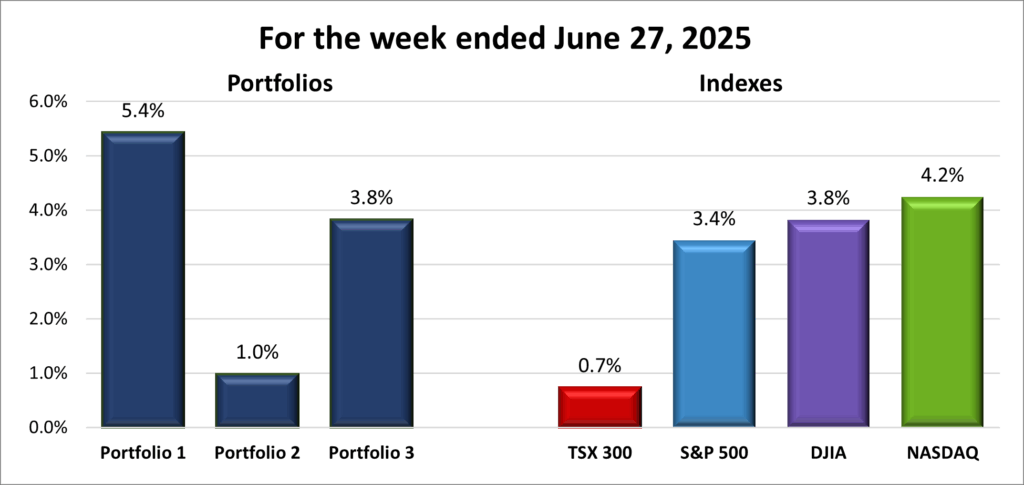
For the week, the TSX (SPTSX) moved up 0.7%, the S&P 500 (SPX) gained 3.4%, the DJIA (INDU) jumped 3.8% and the Nasdaq (CCMP) surged 4.2%.
| Index | Weekly Streak |
| TSX: | 1 – week winning streak |
| S&P: | 1 – week winning streak |
| DJIA: | 2 – week winning streak |
| Nasdaq: | 2 – week winning streak |
 It was a big week in the markets, with investors brushing off geopolitical risks and pushing indexes to fresh highs. Despite opening on shaky ground after the US bombing of Iranian nuclear facilities, markets quickly regained their footing. The S&P 500 (S&P) and the Nasdaq Composite Index (Nasdaq) closed at record highs, with the Nasdaq officially entering a bull market from its April 8 “Liberation Day” low. The Toronto Stock Exchange Composite Index (TSX) also joined the rally, logging multiple all-time high closes. The Dow Jones Industrial Average (DJIA) lagged behind but edged closer to its own record high.
Geopolitics took centre stage early in the week. After the US struck Iran, I expected markets to pull back – sharply. But once again, I proved to myself that trying to predict the market is a fool’s game. 😊 Iran’s retaliation was limited to missile strikes on a US base in Qatar, reportedly telegraphed in advance. President Trump even thanked Iran for the heads-up. Both the target and the warning were seen by investors as a signal that tensions were easing.
By Monday night, a ceasefire between Israel and Iran was in place and held through the week, bringing a rare moment of calm to the region. With fears of escalation fading, investor optimism returned, and heavyweight tech stocks led the charge.
Midweek, attention turned to the Fed as Chair Jerome Powell testified before Congress. Markets initially jumped when Powell said the Fed could act “sooner rather than later,” but those gains faded after he reiterated the need for more data, especially on tariffs and inflation, before making any decisions.
Before Powell’s testimony, two Trump-appointed Fed members came out in favour of a July rate cut, possibly angling for the top job to replace Powell. With President Trump openly calling for lower rates and suggesting he might name Powell’s successor early, the Fed now finds itself in a political squeeze. Meanwhile, other Fed governors have urged caution, arguing for more time and data. It’s shaping up to be a lively FOMC meeting in July. 😊
The economic data leaned dovish. Core PCE, the Fed’s preferred inflation gauge, ticked up to 2.7%—still above target, but not running away. First-quarter GDP shrank more than expected, and consumer spending cooled. Add in a surprise drop in consumer confidence, and the picture is of an economy that’s softening, not stalling.
Late in the week, tariffs grabbed back the spotlight. A breakthrough in US – China trade talks lifted tech stocks, especially artificial intelligence names like Nvidia (NASD: NVDA). Even Trump’s abrupt move to end trade talks with Canada over its new digital services tax didn’t rattle US markets. Investors seemed more focused on progress with China than friction with Canada.
In Canada, sentiment was more cautious. The TSX had benefited earlier from safe-haven demand, thanks to its gold and resource exposure, but that unwound as global tensions cooled. Still, the index closed at new highs. A slowing domestic economy and growing expectations for a BoC rate cut could shift investor focus toward more defensive sectors like utilities, consumer staples, and dividend payers.
One late-week wrinkle: President Trump said he was ending trade talks with Canada and He said he would set a new tariff rate on Canadian goods within the next week. Prime Minister Carney downplayed the tension, saying talks were ongoing, but the headlines rattled Canadian markets.
Overall, the ceasefire lit a fire under stocks – like a bull rider spurring the bull into action. 😊 The speed of the rebound is another reminder of why market timing is so tough. When uncertainty clears, markets tend to move fast.
| Portfolio | Weekly Streak |
| Portfolio 1: | 2 – week winning streak |
| Portfolio 2: | 2 – week winning streak |
| Portfolio 3: | 2 – week winning streak |
They say a rising tide lifts all boats, and this week, all three of my portfolios rode the wave of market optimism. Each gained at least 1%, extending their win streaks to two weeks. 😊
Midweek, when Nvidia became the world’s most valuable company, I figured Portfolio 1 was in for a strong showing – barring another Liberation Day-style plunge. And it delivered. The portfolio surged 5.4% for the week, topping the other portfolios and all the major indexes. A big reason for the strong showing was that 79% of its holdings posted gains, including standout performances from indie Semiconductor (NASD: INDI) up 19%, Carnival Corp (NYSE: CCL) up 16%, Magnite (NASD: MGNI) up 15%, and Celestica (TSE: CLS) up 14%. Adding to the momentum were fresh all-time highs for Cameco (TSE: CCO), CrowdStrike (NASD: CRWD), Cloudflare (NYSE: NET), and Celestica.
Portfolio 2 trailed the others with a more modest 1.0% gain. Only 64% of its holdings finished in the green. Over the past few months, energy stocks helped this portfolio avoid the drops expereinced by the other two portfolios – but with markets heating up and energy names stumbling, they were more of a drag this week. One bright spot: Take-Two Interactive (NASD: TTWO), which hit a new all-time high.
Portfolio 3 also had a strong week, climbing 3.8% as 90% of its holdings finished in the green. Magnite led the way with a 15% gain, and Lithium Americas (TSE: LAC) bounced back with an 11% rise. A handful of others chipped in with steady gains, helping the portfolio quietly rack up another solid win.
It’s always nice when the market tailwinds are at your back – and this week delivered just that. With all three portfolios gaining ground and a solid mix of breakout performers and steady risers, it was a good week. Sure, the road ahead will have its bumps, especially with this President, but weeks like this are why I stay invested through the noise. Now let’s see if we can make it three in a row! 😊
Companies on the Radar
 One new company made it onto my radar list this past week: the large-cap Danish pharmaceutical firm Novo Nordisk B A/S (CPH: NOVO-B), which trades on the Nasdaq Copenhagen Exchange (also known as OMX Copenhagen or CPH). Novo Nordisk is a global leader in diabetes and obesity care, thanks to its breakthrough treatments that continue to make headlines. You’ve probably heard of some of their products: Ozempic (for type 2 diabetes), Wegovy (for obesity), and Rybelsus (an oral version for diabetes). Ozempic and Wegovy, in particular, have pushed the company into the spotlight as demand for medical weight loss solutions continues to grow.
The question for me is whether the stock will keep sliding or start to rebound toward the highs it reached a year ago. Some due diligence is needed to figure out whether recent developments are signs of deeper issues or just a short-term stumble that presents an opportunity. 😊
If I do decide to invest, I’ll most likely go with the American Depositary Receipt (ADR), Novo Nordisk A/S (NYSE: NVO). It represents one ordinary share of NOVO-B, offering the same exposure to the company and its 2.19% dividend, but in a format that’s easier to buy and hold through a North American brokerage.
Novo Nordisk now joins the three companies listed below:
- Aritzia (TSE: ATZ): a fashion retailer and design house known for its upscale in-house brands of women’s clothing and accessories. It controls everything from design to distribution and sells through more than 130 boutiques across North America, along with a fast-growing online platform. Its main markets are Canada and the US, where it continues to expand.
- TerraVest Industries (TSE: TVK): an industrial manufacturer serving the energy, agriculture, and transportation sectors across North America. Its products include propane tanks, ammonia storage vessels used in farming, natural gas transport vehicles, and various energy processing systems. It’s a solid operator in essential industries.
- Secure Energy Services (TSE: SES): an industrial company that focuses on environmental and waste management services for energy and industrial clients. It offers recycling, disposal, and infrastructure support across North America. For anyone interested in sustainability and infrastructure, this one’s worth keeping an eye on.
As always, these are not buy recommendations. Make sure to do your own research and choose investments that fit your personal financial goals.
The Radar Check was last updated June 27, 2025.


That’s a wrap for this week, thanks for reading – may your portfolio stay green and your dividends steady. See you next time!