
If you’ve been following the stock market over the past couple of years, you’ve probably noticed that artificial intelligence (AI) has become one of the hottest topics in investing.
Nearly every earnings call now mentions AI. Technology companies such as Microsoft (NASDAQ: MSFT) and Alphabet (the parent of Google) (NASDAQ: GOOGL) are spending hundreds of billions of dollars building AI infrastructure, while businesses across almost every industry are looking for ways to incorporate AI into their products and services. Yet despite all the attention, many people still aren’t sure what AI actually is or why it has become so important.
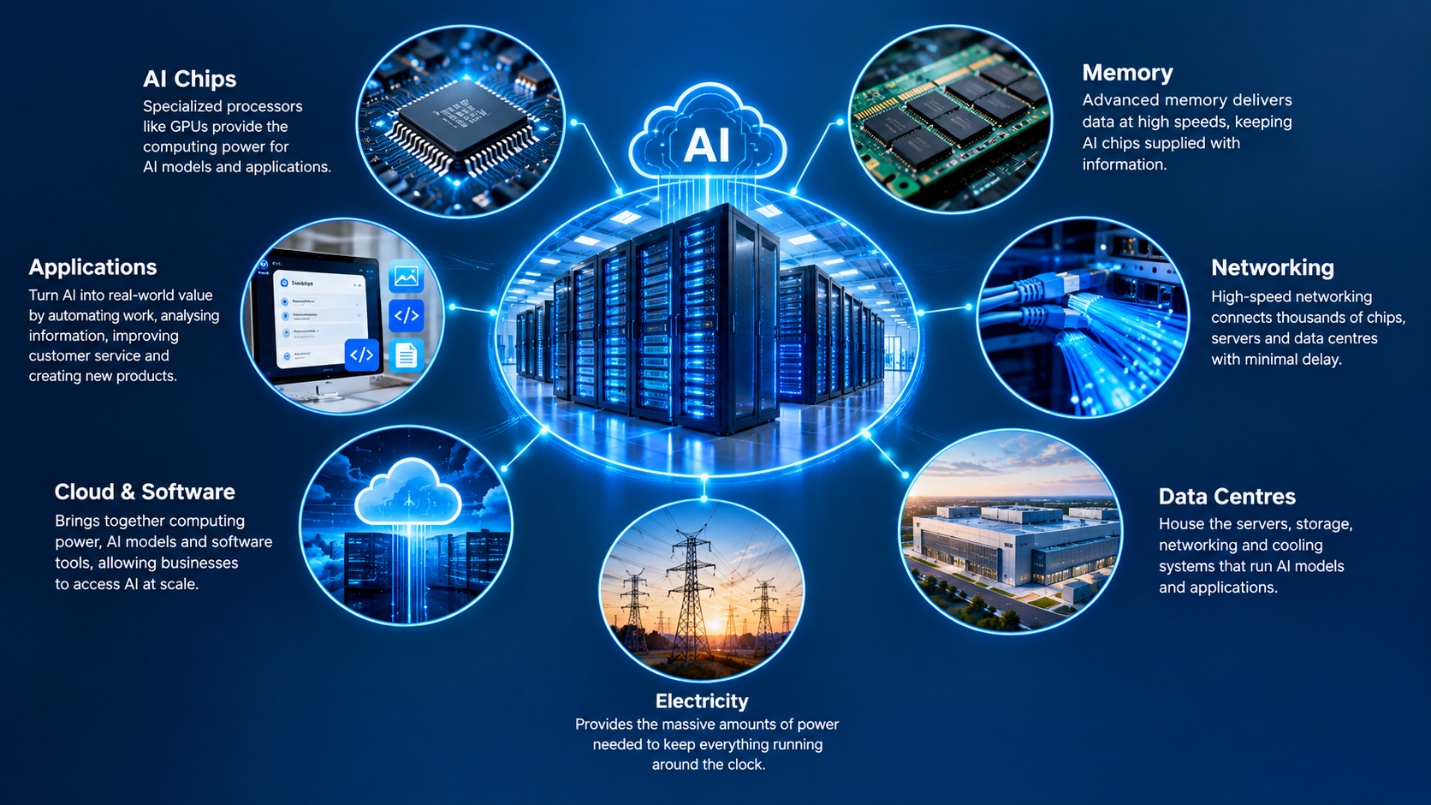
That investment involves far more than the AI software most of us interact with. It spans chips, memory, networking equipment, data centres, electricity, cloud computing, and the software and applications that turn AI into something businesses and consumers can use.
Before we can understand why companies are investing so heavily in AI, it helps to first understand what AI is – and what it isn’t.
Let’s start with the basics.
Part 1: What Is Artificial Intelligence?
At its core, AI is computer software designed to perform tasks that normally require human intelligence. Unlike traditional software that follows a fixed set of instructions, AI is trained using enormous amounts of information, allowing it to learn patterns from that data.
The result is an AI model – the trained system that allows applications like OpenAI’s ChatGPT, Google’s Gemini, and Anthropic’s Claude to answer questions, solve problems, recognise images, write computer code, and make predictions.
You’ve probably used AI already, even if you didn’t realise it. When Netflix (NASDAQ: NFLX) recommends a movie, Google predicts what you’re searching for, or your email automatically filters out spam, AI is working behind the scenes.
More recently, tools like ChatGPT, Gemini, and Claude have introduced millions of people to a new generation of AI by allowing them to have natural conversations, write documents, generate images, and even help write computer code.
Although AI can sometimes seem remarkably human, it doesn’t think the way people do.
Human intelligence is shaped by experience, common sense, emotions, curiosity, and an understanding of the world around us. AI has none of these qualities. It doesn’t have opinions, beliefs, or feelings, and it doesn’t truly understand the information it generates.
Instead, today’s AI identifies patterns learned from vast amounts of training data. When you ask it a question, it analyses your request and predicts the response most likely to be helpful based on what it has learned.
In other words, AI isn’t reasoning like a person – it’s making incredibly sophisticated predictions at extraordinary speed.
That distinction is important because today’s AI is often better described as an extremely powerful assistant than an artificial brain. It can summarise reports in seconds, analyse large amounts of information, translate languages, write software, and help doctors, engineers, researchers, and even blog writers 😊 work more efficiently.
However, it still makes mistakes, can misunderstand context, and requires human oversight for many important decisions.
For investors, understanding what AI is – and what it isn’t – helps separate reality from hype. AI has the potential to transform industries much like the internet did, but it’s not magic.
Behind every AI-generated answer is an enormous amount of data, computing power, and infrastructure.
Part 2: How Does AI Learn?
If AI isn’t programmed with every possible answer, how does it learn?
The answer is a process known as training.
Think of training like teaching a student. A child learns by studying textbooks, listening to teachers, looking at examples, and gaining experience. Over time, they begin to recognise patterns and apply what they’ve learned to new situations.
AI learns in a similar way, but on a vastly larger scale.
Instead of attending school, an AI system is trained using enormous amounts of information known as training data. This can include books, articles, websites, computer code, scientific papers, images, audio, and many other types of information. By processing these examples repeatedly, AI begins to recognise patterns and relationships within the data.
The result is an AI model. You can think of the model as the “brain” of an AI application – the trained system that has learned to recognise patterns and generate responses. Popular applications such as ChatGPT, Gemini, and Claude are built around these models.
So why does training require so much computing power?
Imagine asking someone to read billions of pages, identify patterns across all of them, and repeat the process over and over until they become increasingly accurate. That’s much closer to what happens during AI training.
Modern AI models perform trillions of calculations as they learn, requiring enormous amounts of computing power. Companies rely on thousands of specialised processors called Graphics Processing Units, or GPUs, working together in massive data centres. Training a single AI model can take weeks or even months.
Fortunately, this intensive training doesn’t have to happen every time someone uses the model.
Once training is complete, the AI moves to a stage known as inference. This is the process of using the trained model to answer questions, write documents, generate images, or perform other tasks. Every time you ask ChatGPT a question or use Gemini to summarise an email, you’re using inference – not training.
An easy way to think about it is this: training is like studying for an exam, while inference is writing the exam. The studying takes weeks or months, but answering each question takes only seconds.
For investors, this distinction helps explain why companies such as Google and Microsoft continue to spend hundreds of billions of dollars expanding their AI infrastructure. Building a smarter AI model requires immense computing power, while serving millions of users every day requires fast, reliable systems capable of answering questions almost instantly.
Part 3: What Does It Take to Build AI?
AI is not just software running in the cloud. It requires a massive physical ecosystem of chips, memory, networking equipment, data centres, and energy.
It all begins with AI chips.
Unlike the processor inside your laptop, which is designed to handle many different tasks, AI relies heavily on specialised chips called Graphics Processing Units (GPUs). These chips can perform thousands of calculations simultaneously, making them well suited to training AI models and handling millions of requests.
Nvidia (NASDAQ: NVDA) has become the industry leader by designing GPUs specifically for these demanding AI workloads.
Powerful chips alone aren’t enough.
Imagine trying to solve a puzzle while someone hands you one piece every few seconds. Even the fastest thinker would spend most of their time waiting. AI systems face a similar problem. To keep thousands of GPUs working efficiently, they need immediate access to enormous amounts of information.
That’s where high-speed memory comes in.
Companies such as SK hynix (NASDAQ: SKHY), Samsung (KRX: 005930), and Micron Technology (NYSE: MU) manufacture advanced memory that allows AI chips to retrieve data at incredible speeds, helping prevent costly bottlenecks
The next challenge is communication.
Training today’s most advanced AI models requires thousands of GPUs working together. They must constantly exchange information, creating demand for networking infrastructure capable of moving enormous amounts of data with almost no delay.
Companies such as Broadcom (NASDAQ: AVGO), Arista Networks (NYSE: ANET), Amphenol (NYSE: APH), and Corning (NYSE: GLW) supply many of the networking chips, switches, cables, and fibre-optic components that make this communication possible.
All of this hardware must be housed somewhere.
AI models are trained, stored, and operated inside specialised data centres – large facilities filled with servers, networking equipment, storage systems, and cooling equipment. Technology companies such as Microsoft, Amazon, and Google are investing hundreds of billions of dollars building new AI data centres to support growing demand.
Finally, there’s one requirement that often receives far less attention: electricity.
Training AI models and serving millions of users requires enormous amounts of power, making electricity one of the most important resources in the AI ecosystem. As AI adoption accelerates, utilities and energy infrastructure companies are becoming increasingly important because they provide the power needed to keep these massive data centres operating around the clock.
For investors, the important point is that AI is creating opportunities far beyond software. Semiconductor manufacturers, memory suppliers, networking companies, data-centre operators, utilities, and many others are benefiting as businesses invest in the infrastructure needed to support the AI revolution.
Part 4: Why Does AI Cost So Much?
We now know that AI depends on specialised chips, advanced memory, high-speed networking, massive data centres, and enormous amounts of electricity.
But why does it cost so much?
The answer starts with scale.
Building an advanced AI system requires thousands of specialised chips, massive data centres to house them, sophisticated networking equipment to connect them, and enough electricity to keep everything running. These investments are known as capital expenditures, or CapEx – money spent on assets expected to provide value for years rather than being used up immediately.
One of the biggest expenses is computing power. Training an advanced AI model can require thousands of powerful GPUs working together for weeks or even months.
But the spending doesn’t stop once the model is trained.
Every time millions of people ask an AI chatbot questions, generate images, write computer code, or use AI-powered applications, computers have to process those requests. The more people use AI, the more computing power companies need.
That creates two enormous costs: building the infrastructure and operating it.
Operating costs include electricity, cooling, maintenance, and eventually replacing equipment. As AI models become more capable and usage grows, companies often need to expand their infrastructure simply to keep up.
So why are companies willing to spend hundreds of billions of dollars on all of this?
They believe AI could fundamentally change how businesses operate. It could increase employee productivity, automate routine tasks, reduce operating costs, improve existing products, and create entirely new products and services. For technology companies in particular, AI could become a major source of future revenue.
There’s also another powerful incentive: the fear of being left behind.
If AI becomes as transformative as many companies expect, a business that waits several years to invest could find itself at a significant competitive disadvantage. That helps explain why companies are investing aggressively today, even though the financial benefits may not appear for years.
This spending creates a massive cycle throughout the AI ecosystem. Companies such as Microsoft, Amazon, and Google spend billions building AI infrastructure, and that money flows to the companies supplying the chips, memory, networking equipment, data centres, and electricity needed to operate it. Those suppliers, in turn, invest to expand their own capacity.
For investors, however, there’s an important question behind all this spending: Will the economic benefits of AI eventually justify the enormous investment being made today?
The answer isn’t guaranteed.
Some companies may turn their AI investments into powerful new products and significant profits. Others may spend heavily without generating sufficient returns. That’s why the AI boom isn’t simply a story about how much companies are spending – it’s also about whether that spending ultimately creates enough value to justify the cost.
Part 5: What Are AI Capabilities?
Today’s AI can understand and generate language, recognise images, analyse information, create content, solve increasingly complex problems, and even take actions on our behalf.
Simply put, AI capabilities are the things an AI system is able to do.
One of the most familiar capabilities is understanding and generating language. AI can answer questions, summarise documents, translate languages, write and edit text, and carry on increasingly sophisticated conversations. This is the technology behind tools such as ChatGPT, Gemini, Claude and others.
But the real value isn’t simply that AI can write an email or answer a question. It can process information at a scale and speed that would be difficult for a person to match.
Consider investment research.
An investor could give an AI system a company’s annual report, earnings releases, investor presentations, and recent news. The AI could summarise financial performance, identify changes in revenue and margins, compare management’s latest comments with previous guidance, and highlight potential risks or opportunities. More advanced systems can also work with financial databases to calculate ratios and examine historical data.
That doesn’t mean AI can reliably tell an investor which stock to buy. Capability and accuracy are two different things.
AI can process enormous amounts of information, but it can still misunderstand information, make factual errors, or draw incorrect conclusions. AI can be a powerful research assistant without replacing human judgment.
AI is also developing the ability to see and understand images. It can identify objects in photographs, read documents, interpret charts, and analyse video. A retailer, for example, could use AI to identify products that are out of stock, while a manufacturer could use it to inspect products for defects.
Another major capability is generating new content.
Generative AI can create text, images, audio, video, and computer code based on instructions from a user. It’s important to remember that generative AI is only one part of AI. Other systems are designed to predict, classify, or detect things rather than create new content.
AI is also becoming better at solving problems and working through complex tasks. Newer models can break problems into multiple steps, analyse information, compare alternatives, solve mathematical problems, write and debug code, and assist with research.
A company could, for example, ask AI to investigate why sales have fallen in a particular region. The system could compare product performance, examine customer behaviour, and identify possible explanations.
Perhaps the most significant development is AI’s growing ability to take action rather than simply provide an answer.
These systems, often called AI agents, can increasingly use external tools, access information, interact with software, and carry out multiple steps to accomplish a goal.
Cybersecurity provides a good example.
A human security analyst might need to investigate suspicious activity, determine whether it represents a genuine threat, and decide how to respond. An AI-powered security system can potentially monitor activity continuously, investigate suspicious behaviour, and take defensive action in seconds.
Companies such as CrowdStrike (NASDAQ: CRWD) and Cloudflare (NYSE: NET) are developing increasingly automated security capabilities that can detect and respond to threats at machine speed.
This illustrates the difference between an AI system that simply answers a question and an AI agent that can observe, decide, and act.
For investors, that’s where AI capabilities become particularly important.
The economic value of AI won’t come simply from how impressive a chatbot is. It will come from what businesses can do with these capabilities. If AI allows a company to serve more customers, develop products faster, automate routine work, reduce costs, or allow employees to accomplish more, AI becomes an economic tool rather than simply an interesting technology.
The more capable AI becomes, the greater its potential value – and the greater the competitive advantage for companies that learn how to use it effectively.
Part 6: Why Are Companies Racing to Build AI?
If building AI is so expensive, why are companies around the world racing to develop and adopt it?
The answer comes down to one word: competition.
Companies don’t invest in technology simply because it’s interesting. They invest because they believe it can make them more productive, reduce costs, create new revenue, or give them an advantage over competitors.
AI has the potential to do all four.
One of the biggest opportunities is productivity. AI can help employees complete tasks faster and handle work that previously required significant amounts of time. A software developer can use AI to write and debug code, while a researcher can sift through thousands of documents instead of reading them one at a time.
Alphabet’s Google provides a good example.
Its AI chatbot Gemini is being integrated throughout Google’s products, including Search, YouTube, and Google Cloud. In Search, AI Overviews and AI Mode, Gemini can handle more complex questions, while AI-powered advertising tools can help businesses create more relevant ads.
If AI makes Search more useful, people may use it more often. If it helps advertisers reach customers more effectively, Google can potentially generate more revenue.
But AI isn’t just changing the technology industry.
By automating routine work, it can help businesses in almost any industry improve productivity and reduce costs.
Walmart (NASDAQ: WMT) provides a good example. The retailer is using AI to improve operations, increase employee productivity, and make shopping easier. Its AI shopping assistant, Sparky, can help customers find and compare products and make personalised recommendations.
Walmart says customers who use Sparky currently have an average order value about 35% higher than those who don’t.
The potential benefits go beyond a better shopping experience. If AI allows Walmart employees to spend less time on routine tasks, helps manage its enormous retail operation more efficiently, and encourages customers to buy more, it could ultimately improve the company’s bottom line.
This is why companies that ignore AI risk falling behind.
If Walmart’s rivals can use AI to reduce costs or provide a better shopping experience, they will have an incentive to do so. If Google’s rivals can develop better AI-powered search, advertising, or cloud services, Google can’t simply sit back and wait.
This creates a kind of AI arms race.
Companies aren’t necessarily investing because they know exactly how much money AI will make. They’re investing because they don’t want to discover several years from now that their competitors gained an advantage while they were waiting for the technology to mature.
For investors, this helps explain why AI spending has grown so rapidly. The enormous investment we’ve discussed throughout this series isn’t being driven by one company or one industry. Businesses across the economy are trying to determine how AI can improve their operations – and trying to make sure their competitors don’t get there first.
The big question is whether all this spending will ultimately create enough economic value to justify the cost. If it does, the AI revolution could benefit not only the companies building the technology, but businesses across almost every industry.
Part 7: Investing in the AI Ecosystem
When most people think about investing in AI, Nvidia is probably the first company that comes to mind. Given the extraordinary demand for its graphics processing units (GPUs), that’s understandable.
But there is no single “AI stock.”
AI is an ecosystem.
It starts with the chips providing the computing power required to train and operate AI models. Nvidia is the dominant player, but Advanced Micro Devices and Broadcom also play important roles.
Those chips need enormous amounts of data delivered at high speeds, creating opportunities for memory companies such as SK hynix and Micron Technology. Advanced memory, including high-bandwidth memory, helps keep AI chips supplied with data.
Then comes networking.
Thousands of chips and servers must work together, requiring companies such as Arista Networks, which supplies networking equipment, and Corning, which provides fibre-optic cables that connect those systems.
All of this equipment needs somewhere to operate.
AI data centres house thousands of servers, networking equipment, cooling infrastructure, and complex power systems. They consume enormous amounts of electricity, making power another increasingly important part of the ecosystem. As companies build more AI data centres, demand for reliable electricity is increasing.
In some locations, access to sufficient power has become a constraint on new construction, bringing utilities and energy infrastructure into a conversation once focused almost entirely on technology.
But infrastructure alone doesn’t create value.
The hardware needs software, and businesses need a practical way to access AI. Cloud providers – including Microsoft, Google, and Amazon – bring together computing power, AI models, and software tools, allowing businesses to use AI without building their own infrastructure.
Software companies then turn that technology into applications that can automate work, analyse information, improve customer service, and develop new products. At the same time, the growing use of AI creates new cybersecurity challenges – and opportunities for companies developing AI-powered defences.
For investors, there are two broad ways to think about the opportunity: companies building the ecosystem and companies using AI to improve their businesses. The eventual beneficiaries could extend far beyond the technology sector.
More by accident than design, I realised that Portfolio 3 had gradually become a good example of the ecosystem I’ve been describing.
It already included Microsoft, Nvidia, and data-centre infrastructure company Vertiv Holdings (NYSE: VRT). Recent additions – including Broadcom, Corning, and Amphenol – expanded its exposure to chips, fibre-optic cables, and high-speed interconnect products.
Looking across all three portfolios, the exposure is broader still. I also own major cloud and AI providers Microsoft, Amazon, and Alphabet’s Google, along with cybersecurity companies CrowdStrike and Cloudflare.
Without specifically setting out to build an AI portfolio, I had gradually assembled exposure to many different parts of the ecosystem.
At first, I was concerned that I had increased my exposure to technology – and particularly the more volatile AI companies – more than intended. But the more I thought about it, the more comfortable I became with that exposure.
The journey will undoubtedly be bumpy, with some sizeable potholes along the way, but I believe the long-term opportunities created by AI justify accepting that volatility.
Rather than betting everything on a single company, my three portfolios provide exposure to several parts of the AI ecosystem, with Portfolio 3 offering the broadest exposure.
The key lesson from this series is that AI isn’t a single company, product, or industry – it’s an ecosystem in which each part depends on the others. That creates opportunities across a wide range of businesses, but being part of the AI revolution doesn’t automatically make a company a good investment.
The challenge for investors is to understand where each company fits, how it could benefit, and whether those benefits are already reflected in its share price. Ultimately, the winners won’t necessarily be the companies getting the most attention today, but those that can turn their role in the AI ecosystem into sustainable long-term value for shareholders.