
Board Independence?
Excerpt: Nvidia’s share price soared after Jensen Huang returned as CEO, but the bigger story may be what happened behind the scenes. Why did the Board of Directors reverse its decision, how much influence did President Trump have, and can shareholders trust directors to act independently when political pressure enters the boardroom?
Last week, the big story was Jensen Huang’s resignation from the company he co-founded, Nvidia (NASDAQ: NVDA). While the company’s underlying business had not suddenly deteriorated, its share price certainly took a hit, losing roughly 21% of its market value over the week. But faster than a jittery investor could sell a stock, Huang was back.
Nvidia shares soared after the Board of Directors announced his reinstatement as CEO, but the market reaction may be overshadowing a much bigger story. The sudden reversal raises important questions about corporate governance, political influence and the independence of corporate directors. For long-term investors, those questions deserve as much attention as the share-price rebound.
Huang resigned on November 12 after acknowledging extramarital affairs and apologizing to colleagues, the Board and shareholders. One relationship, with Chinese businesswoman Alice Huang, raised national security concerns because of her reported connections to Chinese intelligence. The Board launched an independent investigation and initially rejected Huang’s offer to return, with Chairman Harvey Jones saying his personal conduct was inconsistent with the company’s standards. Yet less than two weeks later, directors unanimously reinstated him.
So what changed? Nvidia said further discussions convinced directors of Huang’s candour and ability to lead. The Board also received input from senior US government officials and said it was assured his return posed no national security risk. President Trump, however, openly took credit for the reversal, saying he had personally convinced the Board. That raises an uncomfortable question: did directors independently reconsider their position, or did pressure from the White House help determine the outcome?
There is a compelling business argument for bringing Huang back. He co-founded Nvidia and led its transformation into a dominant force in artificial intelligence (AI). His departure created uncertainty at a company central to the AI industry and increasingly important to the US technology sector. The Board may have concluded that retaining him was in shareholders’ best interests. But if one executive is so important that directors feel compelled to reverse an earlier decision, how much influence does Huang have, and how effectively can the Board hold him accountable?
The timing also deserves scrutiny. Nvidia’s investigation is ongoing, and the Board has formed committees of independent directors to oversee the investigation and national security and export-control risks. It is also searching for a Chief Compliance Officer. These are meaningful steps, but reinstating Huang before the investigation is complete leaves shareholders waiting for answers. Recent reporting has also challenged the espionage concerns, with US officials saying they found no evidence that Chinese intelligence directed Alice Huang’s relationship with Jensen Huang.
Trump’s involvement adds another complication. Reuters reported that he holds between US$11 million and US$55 million in Nvidia shares. The White House says his investments are independently managed, and there is no evidence financial gain motivated his intervention. Nevertheless, when a president publicly intervenes in a company’s leadership decision while holding a financial interest in that company, questions about potential conflicts are difficult to avoid.
A Board of Directors is expected to exercise independent judgment, oversee management and protect shareholders’ long-term interests. Government officials can provide valuable information on national security, but there is a difference between receiving that input and allowing political pressure to shape a corporate decision. If a president can help persuade directors to reverse course, where does that leave the Board’s independence?
The market clearly welcomed Huang’s return, but a rising share price doesn’t settle questions about corporate governance. Shareholders still need confidence that Nvidia’s Board can challenge management, investigate potential problems and make difficult decisions independently. For long-term investors, that confidence is every bit as important as the company’s next earnings report.
Nvidia may have put the leadership drama behind it, but questions surrounding its Board remain. And it wasn’t the only story driving the markets this week. Inflation, interest rates and AI spending all added to the uncertainty. Let’s see how it all played out in the markets and my three portfolios.
Items that may only interest or educate me ….
Canadian Economic news, US Economic news, ….
Nvidia Whipsaw
Over the past several weeks, Nvidia’s share price has been battered. From a high of US$243.37 on October 6 to a low of US$124.50 on November 20, shares plunged nearly 50% in roughly six weeks following CEO Jensen Huang’s resignation. The storm clouds were gathering, and the outlook looked bleak.
Then the clouds parted and the sun broke through. Shares of Nvidia surged as much as 35% following the surprise reinstatement of Huang as CEO. The rally added more than US$1 trillion to the company’s market capitalization, a record for a single day. Shares ultimately closed up 31%, marking Nvidia’s fourth-best single-day performance since its 1999 IPO and its biggest gain since May 2003. Almost all of its other top-ten daily gains occurred between 1999 and 2003, when the entire company was worth less than US$4 billion.
Investors welcomed Huang’s return as a stabilizing force for Nvidia and the broader AI industry. As a dominant supplier of AI chips and a key player in financing AI-related growth, Nvidia has an outsized influence on the industry’s fortunes. His reinstatement helped restore confidence after a week of mounting uncertainty and market turmoil.
The storm clouds haven’t disappeared entirely, but the outlook has certainly brightened. Nvidia and the broader AI industry have caught a much-needed break.
Canadian Economic News
This past week’s key economic data that the Bank of Canada (BoC) considers when deciding whether to raise or lower the interest rate.
Canadian Market Volatility
Canada’s version of the market’s “fear gauge,” the S&P/TSX 60 VIX Index (VIXC), measures expected volatility in Canadian stocks over the next 30 days. Higher readings point to greater uncertainty and the potential for larger market swings, while lower readings suggest calmer conditions.
The VIXC opened the week at 21.08, down from the previous Friday’s close of 22.21, and continued to ease following news that Jensen Huang had been reinstated as Nvidia’s CEO. For much of the week, the fear gauge hovered around the 20 mark, briefly climbing above 21 midweek after stronger-than-expected US inflation data increased expectations of further interest rate hikes. Once investors had digested the news, the VIXC resumed its decline, slipping below 20 and remaining there for the rest of the week before closing at 18.11.
The decline suggests investors grew more comfortable with the outlook for Canadian stocks as the week progressed. While inflation and interest rate concerns briefly unsettled markets, the VIXC’s close below 20 pointed to a calmer finish and a modest improvement in investor sentiment.
Note: The VIXC typically trades at lower levels than the VIX, partly because of differences in the makeup of the Canadian and US markets. The S&P 500 has a much larger weighting in technology, while the TSX has greater exposure to financials, energy and materials. These sectors respond differently to economic conditions and commodity prices, which can result in different levels of expected volatility.
US Economic News
This past week’s key data points that the Federal Reserve (Fed) considers when deciding whether to raise or lower the interest rate.
Consumer Confidence Index (CCI)
The Conference Board’s CCI delivered a surprisingly strong rebound, with consumers feeling considerably better about both current conditions and the economic outlook. The headline index surged to 103.3 in November from 91.9 in October, climbing to its highest level since January 2025 and comfortably exceeding economists’ expectations of 92.5.
Both components of the index improved. The Present Situation Index, which measures consumers’ views of current business conditions and the labour market, climbed to 132.8 from 120.4. The Expectations Index, which reflects consumers’ outlook for the next six months, rose to 83.6, moving back above the widely watched 80 threshold. Readings below 80 have historically been associated with increased recession risk over the following year. The last time the index was above 80 was January 2025, when it registered 83.9. It subsequently spent nearly 22 months below that level, plunging to 54.4 in April 2025 following President Trump’s announcement of sweeping tariffs on US trading partners.
This is an encouraging development, particularly given how long expectations have remained depressed. While one month’s improvement doesn’t guarantee a sustained turnaround, it suggests consumers are becoming less pessimistic about the economy and labour market.
Inflation and Economic Growth
Personal Consumption Expenditures (PCE)
The Commerce Department’s Bureau of Economic Analysis (BEA) delivered another unwelcome inflation reading. Although monthly headline inflation eased from September, the annual rate edged higher, while core PCE inflation climbed to its highest level since late 2023. The PCE price index increased 0.3% in October, down from 0.5% in September. Annually, inflation rose to 3.8% from a revised 3.7%. Analysts had expected monthly and annual increases of 0.3% and 3.8%, respectively.
The Fed’s preferred inflation measure, core PCE, excludes the often-volatile food and energy categories to provide a clearer picture of underlying price pressures. It rose 0.3% in October, matching September’s increase, while the annual rate climbed to 3.3% from 3.1%, its highest level since November 2023. Analysts had expected monthly and annual increases of 0.3% and 3.2%. With both headline and core inflation well above the Fed’s 2% target, the latest figures reinforce the case for keeping interest rates elevated, with further increases still a possibility.
Gross Domestic Product (GDP)
The BEA also released its second estimate of third-quarter 2026 GDP, revealing considerably stronger growth than initially reported. The US economy expanded at an annualized rate of 4.3%, up sharply from the initial estimate of 3.4% and nearly double the 2.2% recorded in the second quarter. Analysts had expected the revised figure to come in at 3.5%.
The upward revision put economic growth at its fastest pace in three years, driven by stronger consumer spending, business investment and government spending. These gains were partly offset by declining exports and rising imports. Since exports add to GDP while imports are deducted, the increase in imports further weighed on growth. Even so, the report highlights just how resilient the US economy remains despite ongoing economic and geopolitical challenges.
Takeaway
This is the last major reading on inflation and economic growth before the Fed’s upcoming Federal Open Market Committee meeting, and the message is hardly reassuring for anyone hoping for lower interest rates. The economy is growing at a healthy clip, but inflation is moving in the wrong direction.
For the Fed, that combination makes an already difficult balancing act even tougher. Strong growth gives officials little reason to maintain or lower rates, while stubborn inflation keeps pressure on them to maintain their hawkish stance. With further rate increases firmly on the table, investors face the prospect of borrowing costs climbing even higher.
A strong economy is generally good news for corporate earnings, but higher interest rates can weigh on stock prices, particularly growth-oriented companies. The economy may be firing on all cylinders, but inflation is keeping investors on edge as we head toward year-end.
American Market Volatility
The VIX, often called the market’s “fear gauge,” measures expected volatility in the S&P 500 over the next 30 days. Higher readings signal greater uncertainty, while levels above 20 are typically associated with heightened market volatility.
The VIX opened the week at 31.38, down from the previous Friday’s close of 35.89, before falling sharply to 27.50 by Monday’s close. News that Jensen Huang had been reinstated as Nvidia’s CEO helped calm investors following the previous week’s leadership turmoil. The fear gauge then fluctuated between 26 and 29 before climbing back above 30 as hotter inflation data increased expectations of further interest rate hikes, and the US announced additional tariffs on major trading partners. After that initial spike, the VIX retreated to below 25, finishing the Thanksgiving-shortened week at 23.81.
Although the VIX finished well below the previous Friday’s close of 35.89, its reading of 23.81 still pointed to elevated investor anxiety. The initial relief over Huang’s return helped ease some of the previous week’s panic, but concerns about AI spending and technology valuations were joined by renewed inflation worries, higher interest rates and trade uncertainty. While the worst of the selling pressure appeared to have subsided, investors remained uneasy about what might come next.
Weekly Market and Portfolio Review
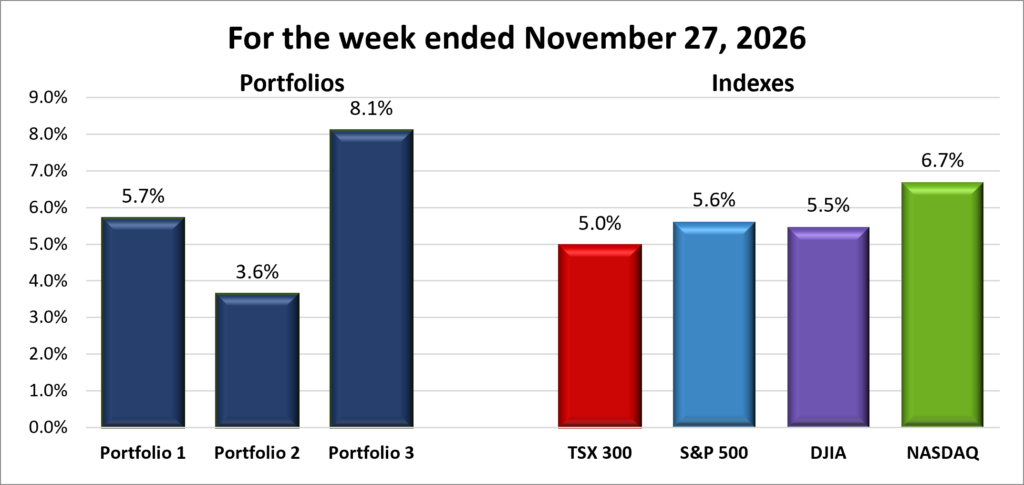
For the week, the TSX (SPTSX) rose 5.0%, the S&P 500 (SPX) surged 5.6%, the DJIA (INDU) gained 5.5% and the Nasdaq (CCMP) soared 6.7%.
| Index | Weekly Streak |
| TSX: | 1 – week wining streak |
| S&P: | 1 – week wining streak |
| DJIA: | 1 – week wining streak |
| Nasdaq: | 1 – week wining streak |
 The markets bookended the week with powerful rallies. It started with a bang as stocks soared on news that Jensen Huang had been reinstated as Nvidia’s CEO. All four indexes, the Toronto Stock Exchange Composite Index (TSX), the S&P 500 Index (S&P), the Dow Jones Industrial Average (DJIA) and the Nasdaq Composite Index (Nasdaq), posted their biggest daily gains since April 2025. It was a welcome turnaround after all four had entered correction territory the previous week. Following mixed trading in the days leading up to the US Thanksgiving holiday, the indexes surged again on Friday, ending the week firmly in positive territory. The S&P recorded its best weekly performance since April 2025, while the TSX had its strongest week since October 2023.
In the US, the three major indexes surged more than 3% on Monday, recovering over half of the previous week’s losses. Huang’s surprise reinstatement helped restore confidence after Nvidia’s leadership turmoil, while bargain hunters stepped in following the steep sell-off. However, enthusiasm quickly faded as doubts about the AI trade resurfaced. Investors continued to question whether the enormous sums being poured into AI infrastructure will generate enough returns to justify the spending. The prospect of greater regulatory scrutiny following the US midterm elections added another concern for technology companies. Huang’s return may have settled Nvidia’s immediate leadership question, but it did little to resolve the broader doubts surrounding the AI boom.
Economic news added to the uncertainty. The latest GDP figures showed the US economy growing faster than initially estimated in the third quarter, while October’s PCE report showed inflation picking up. Strong growth is normally welcome news, but combined with stubborn inflation, it gives the Fed little reason to ease monetary policy. Instead, the combination strengthened expectations of another interest rate increase, with further hikes in early 2027 also being discussed. That raised concerns about higher borrowing costs and the potential pressure on stock prices, particularly those of growth-oriented technology companies.
Trade tensions added to the unease after the Trump administration proposed new tariffs on goods from 14 trading partners, including China and the European Union. The measures threatened to raise business costs and add to inflationary pressure, just as investors were becoming increasingly concerned about interest rates. Together, these developments made it harder for the markets to build on Monday’s rally.
In Canada, the TSX staged a strong rebound, ending a seven-session losing streak with its biggest one-day gain since April 2025. Investors returned to mining stocks as gold and copper prices recovered, while rising oil prices provided additional support to the energy sector. These commodity-related industries carry considerable weight in Canada’s resource-heavy market, making their performance an important influence on the broader index.
Technology stocks also contributed to the initial rebound, benefiting from renewed confidence after Huang’s reinstatement. However, lingering doubts about AI spending and the returns it will generate limited enthusiasm.
Interest rate expectations provided another headwind, particularly for financials and other rate-sensitive stocks. BoC Governor Tiff Macklem warned that the delayed impact of earlier oil price increases could keep inflation elevated into 2027. He also made clear that another rate increase remained possible if inflation proved too persistent, adding to concerns about borrowing costs.
The week ended with a welcome rebound from the previous week’s sell-off, but the sharp swings made clear that investor confidence remains fragile. Investors were already worried about AI stocks, inflation and higher interest rates, and now tariffs have added another headwind. As if the markets didn’t have enough to contend with! Still, all four indexes finished the week in positive territory. Hopefully, the worst of the volatility is behind us, and we can look forward to a nice little rally to close out the year. Actually, a big one would be even better! 😊
| Portfolio | Weekly Streak |
| Portfolio 1: | 1 – week winning streak |
| Portfolio 2: | 1 – week winning streak |
| Portfolio 3: | 1 – week winning streak |
After last week’s dreadful performance, when all three portfolios lost more than 6%, it was a relief to see them reverse course and rebound strongly. While this week’s gains weren’t enough to recover all of the previous week’s losses, it was a welcome change in direction. The return of the AI rally provided much of the lift, with higher energy and gold prices adding to the gains. However, what really stood out was the breadth of the recovery, with a strong majority of holdings across all three portfolios finishing the week in positive territory.
Portfolio 1 had a strong week, gaining 5.7%. The rebound in AI stocks provided the main boost, although there weren’t any standout individual performers. Instead, gains were spread across the portfolio, with 63% of holdings finishing the week higher.
Portfolio 2 had a solid week, gaining 3.6%, although its return was more modest than those of the two more growth-oriented portfolios. What it lacked in overall performance, it made up for in breadth, posting the highest percentage of weekly winners at 84%. Several individual holdings also delivered a nice boost, led by Mitek Systems (NASDAQ: MITK), up 12%, and Take-Two Interactive Software (NASDAQ: TTWO), up 11%. Aritzia (TSE: ATZ) and MongoDB (NASDAQ: MDB) weren’t far behind, both gaining 10%.
Portfolio 3 stole the show with an impressive gain of 8.1%, easily the best performance of the three portfolios and enough to outperform all four indexes. It also recovered more than 60% of the previous week’s loss. Like Portfolio 1, there weren’t any major individual gains driving the results. Instead, it was another broad-based performance, with more than 80% of holdings ending the week higher.
Last week, I asked for a change in direction, and the investing gods certainly delivered! All three portfolios gained more than 3.5%, making for a much-needed turnaround. Hopefully, the worst of the uncertainty and volatility is behind us and the markets are setting themselves up for a year-end rally. Next week, I’d like to see all four indexes and portfolios keep heading in the same direction and extend their winning streaks for a few more weeks. Let’s hope the investing gods are listening again! 😊
Companies on the Radar
 With the previous week’s sell-off still fresh in my mind, I took a hard look at the portfolios and decided to raise the bar for AI and AI-adjacent companies in particular, and technology companies in general. All three portfolios are already heavily weighted toward technology, some more than others, so I’d like to reduce that exposure, diversify into other sectors and add a few more dividend-paying companies with a track record of growing their dividends and reasonable potential for share price appreciation. I’m still naturally drawn to technology companies, but I’m becoming much more selective about which ones make it into a portfolio.
With that in mind, I moved Qnity Electronics (NYSE: Q) to the backburner. The company supplies specialized materials and technologies used in semiconductor manufacturing and electronic devices. Its products help chipmakers produce smaller, faster and more powerful chips, while its interconnect solutions help manage power and heat in increasingly complex electronic systems. Given the important role semiconductors play in AI, Qnity strikes me as very much an AI-adjacent company.
This leaves four companies on my radar, none of which is a technology company. Capital Power Corporation (TSX: CPX) is a bit of an exception, benefiting from growing electricity demand from AI data centres and the broader electrification of the economy.
- BioSyent (TSXV: RX): A small Canadian healthcare company that acquires or licenses established pharmaceutical and healthcare products for marketing and distribution, avoiding the high costs and risks of developing new drugs. Its business model has delivered 65 consecutive profitable quarters through the third quarter of 2026, with revenue growing 23% in 2025. Management has a meaningful ownership stake, and the company has repurchased shares and has paid a quarterly dividend since late 2022. Its expansion into oral health provides another avenue for growth beyond its established pharmaceutical business.
- S&P Global (NYSE: SPGI): A large cap American company and one of the world’s most important financial information companies. Most investors know it for the S&P Index, but the business also provides credit ratings, market data, analytics, and research used by banks, corporations, governments, and investors worldwide. Think of it as one of the key information providers that helps global financial markets function, generating revenue through subscriptions, licensing fees, and rating services.
- Capital Power Corporation: A mid cap Canadian power producer that generates electricity from a mix of natural gas, wind, solar and battery storage across North America. With electricity demand rising rapidly from AI data centres, industrial growth and electrification, Capital Power is expanding its natural-gas generation while adding renewable and storage capacity. Its recent agreement to supply 250 MW of power to a new data centre in Alberta for more than 10 years highlights how the AI boom is creating opportunities beyond the technology companies building the data centres themselves.
- Domino’s Pizza (NASDAQ: DPZ): One of the world’s largest pizza chains, with more than 22,000 locations across over 90 markets. Most are independently owned franchises, generating recurring royalties and fees, while Domino’s also sells food and supplies to franchisees. Its strong brand, digital ordering and efficient delivery model support growth. With more than 13 consecutive years of dividend increases, a high double-digit dividend growth rate and a payout ratio below 50%, Domino’s could offer a relatively stable, cash-generating business to balance the higher-growth companies already in the portfolios.
As always, these are not buy recommendations. Make sure to do your own research and choose investments that fit your personal financial goals.
The Radar Check was last updated November 27, 2026.


That’s a wrap for this week, thanks for reading – may your portfolio stay green and your dividends steady. See you next time!