
When the Share Price Tells a Different Story
While markets bounced around like a yo-yo this past week, one headline stood out: Nvidia (NASDAQ: NVDA). As the largest holding in two of my three portfolios, I’m paying close attention to how this controversy unfolds. This week, I’ll look at what’s happening and the investing lesson it highlights: a company’s share price doesn’t always reflect the performance of its underlying business.
Nvidia is at the centre of an extraordinary controversy after reports emerged about CEO Jensen Huang’s relationships with two women, including a businesswoman suspected by US intelligence officials of being a Chinese spy. The personal scandal quickly became a national security and corporate governance issue, costing Nvidia its co-founder and long-time leader.
On November 12, Nvidia announced that Huang had resigned as president, CEO and board member, effective immediately, after mounting pressure and an independent investigation. Huang acknowledged being unfaithful to his wife and apologized to his family and Nvidia employees, but has not been accused of knowingly participating in espionage or other criminal wrongdoing. The board says it has no reason to believe company secrets or national security information were compromised.
Huang’s departure ends a 33-year tenure. He co-founded Nvidia and transformed it from a graphics chipmaker into a dominant supplier of artificial intelligence (AI) computing technology. He was the driving force behind its growth, strategy and public image. His departure leaves a significant gap at the top.
Nvidia CFO Colette Kress has been appointed interim CEO while the board considers internal and external candidates for a permanent replacement. She will retain her CFO role, which she has held since joining Nvidia in September 2013. Her 13 years with the company provide continuity and deep business knowledge, but leading Nvidia through this transition is a different challenge. Long-time board member Harvey C. Jones has also become the company’s first-ever board chair. Investors still face uncertainty about who will lead Nvidia and whether it can maintain its momentum.
The allegations raise further questions about workplace conduct, conflicts of interest and board oversight. Reports describe a separate relationship with a senior Nvidia executive who reported directly to Huang. More serious are allegations involving Alice Huang, a former executive of Singapore-based Megaspeed International. US intelligence officials reportedly believe she was gathering information for Beijing, and reports suggest a network connected to her may have helped facilitate billions of dollars in Nvidia chip shipments to Chinese companies. The claims remain unverified. If investigators find that confidential information was shared or export restrictions circumvented, Nvidia could face regulatory action, tighter limits on China sales and greater scrutiny from Washington.
Nvidia shares fell sharply after the announcement as investors weighed Huang’s departure and the uncertainty ahead, ending the week down over 6% and wiping out US$284 billion in market value. Potential fallout includes regulatory action, tighter export restrictions and damaged relationships with customers and government agencies. Markets react not only to what has happened but also to what might happen, and Nvidia’s enormous market value means even a modest shift in investor confidence can have a staggering financial impact.
Investors should remember that Huang’s departure hasn’t made Nvidia’s AI chips less capable or competitive, nor has demand for AI infrastructure disappeared. Its technology and competitive position remain intact. What has changed is the uncertainty around leadership, corporate governance and doing business in China. A share price can move dramatically as investors reassess future risks, even when the underlying business remains largely unchanged.
While Nvidia’s headlines grabbed much of the attention this week, it wasn’t the only story moving markets. Inflation data and shifting investor sentiment also played a role. Let’s take a look at how these and other developments influenced the markets and affected my portfolios.
Items that may only interest or educate me ….
Friday the 13th, Canadian Economic news, US Economic news, ….
Friday the 13th: Bad Luck for Investors?
This past week, the markets wrapped up on Friday the 13th. The fear of this supposedly unlucky date is so common that it even has its own name: paraskavedekatriaphobia (also spelled paraskevidekatriaphobia). It’s a specific form of triskaidekaphobia, the fear of the number 13. But should investors have any reason to fear Friday the 13th?
Apparently not! Friday the 13th may be unlucky for some, but the stock market hasn’t seemed to get the memo. Historically, investors have actually enjoyed slightly better returns on the supposedly unlucky day. There’s also no convincing evidence that a trading week ending on Friday the 13th fares any worse than usual. The occasional spectacular gain or sharp sell-off has far more to do with what’s happening in the economy and markets than the date on the calendar. So perhaps investors should worry less about Friday the 13th and more about what the markets have in store! 😊
Canadian Economic news
This past week’s key economic data that the Bank of Canada (BoC) considers when deciding whether to raise or lower the interest rate.
Canadian Market Volatility
Canada’s version of the market’s “fear gauge,” the S&P/TSX 60 VIX Index (VIXC), measures expected volatility in Canadian stocks over the next 30 days. Higher readings point to greater uncertainty, while lower readings suggest calmer market conditions.
The VIXC opened the week at 16.29, down from the previous Friday’s close of 17.56. Despite the ups and downs in the broader market, the fear gauge followed a fairly steady downward path, moving between the 17 and 16 levels before closing the week at 16.61. The decline suggests investors grew somewhat more comfortable with the outlook for the Canadian market.
Note: The VIXC typically trades at lower levels than the VIX, partly because of the different makeup of the Canadian and US markets. The S&P 500 has a much larger weighting in technology, while the TSX has greater exposure to financials, energy, and materials. Because these sectors respond differently to economic conditions and commodity prices, the two indexes can have different levels of expected volatility.
US Economic news
This past week’s key data points that the Federal Reserve (Fed) considers when deciding whether to raise or lower the interest rate.
Consumer Price Index (CPI)
The latest inflation report from the Labor Department’s Bureau of Labor Statistics (BLS) was disappointing. Although headline inflation slowed from September, both headline and core CPI came in higher than economists expected. The results offer little reassurance that inflation is moving back towards the Fed’s 2% target.
Headline CPI rose 0.4% in October, down from September’s 0.6% increase but above the 0.3% analysts had expected. Meanwhile, core CPI, which excludes food and energy, increased 0.3% for the third consecutive month, showing that underlying inflation has yet to gain any meaningful downward momentum.
Among the individual categories, gasoline prices recorded the largest increase, rising 1.0%. Used car and truck prices saw the biggest decline, falling 1.2%. Shelter costs, which include rent, mortgages, and lodging away from home, remain a significant source of inflation. As the largest component of CPI, shelter accounts for roughly one-third of the index. Costs increased 0.3% in October, following a 0.4% increase in September.
The higher-than-expected inflation readings, combined with the latest blowout monthly jobs report showing a labour market that’s holding up and even showing signs of strengthening, have reinforced investor expectations for a December rate hike.
Note: Because of last year’s US government shutdown, the BLS was unable to collect October 2025 price data. As a result, this month’s report did not include the usual year-over-year inflation figures.
American Market Volatility
The VIX, often called the market’s “fear gauge,” measures expected volatility in the S&P 500 over the next 30 days. Higher readings signal greater uncertainty, while levels above 20 are typically associated with heightened market volatility.
The VIX opened the week at 25.08, slightly below the previous Friday’s close of 25.64, before falling to around 20 by the end of the session. It briefly climbed above 21 after October inflation came in higher than expected, raising the likelihood of another interest rate hike. The decline then resumed, with the index dropping as low as 17.5 before jumping above 18.8 following news that Nvidia CEO Jensen Huang had resigned amid the scandal involving an alleged Chinese spy. His departure raised fresh questions about the AI trade and the broader market outlook. The VIX climbed above 20 once again following the October Producer Price Index (PPI) report, which showed annual producer-price inflation accelerating to 6.5%, its highest level in nearly four years. This added to concerns that inflationary pressures remained persistent, making interest rate cuts less likely. The VIX eventually eased back, closing Friday at 19.43.
Despite the sharp swings, the VIX ended well below the previous Friday’s close, suggesting investors were less concerned about near-term market volatility than they had been a week earlier. Initial relief following the election results gave way to renewed anxiety over inflation and Nvidia’s leadership turmoil. Even so, the overall decline suggests these concerns hadn’t erased the improvement in market sentiment seen earlier in the week.
Weekly Market and Portfolio Review
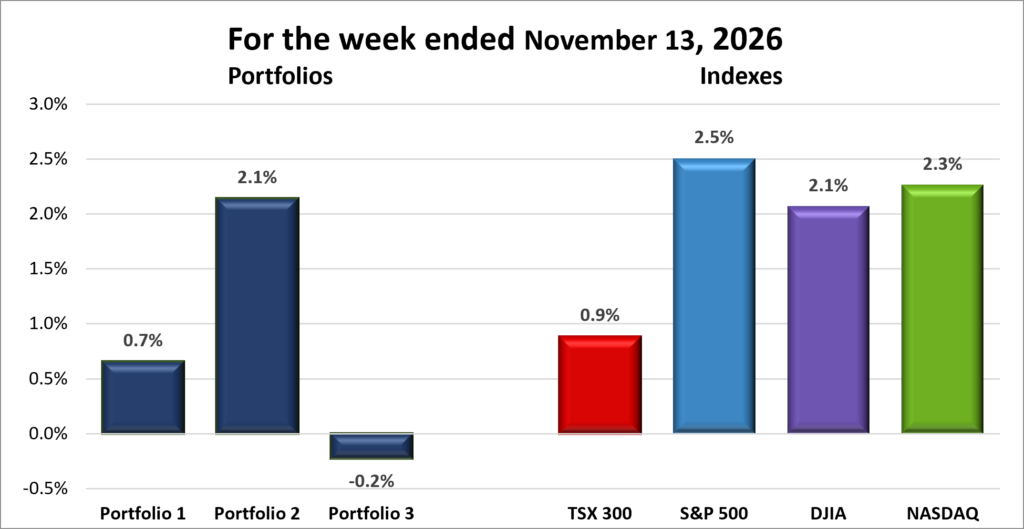
For the week, the TSX (SPTSX) rose 0.9%, the S&P 500 (SPX) jumped 2.5%, the DJIA (INDU) advanced 2.1% and the Nasdaq (CCMP) climbed 2.3%.
| Index | Weekly Streak |
| TSX: | 2 – week winning streak |
| S&P: | 1 – week winning streak |
| DJIA: | 1 – week winning streak |
| Nasdaq: | 1 – week winning streak |
 It was quite the volatile week in the markets, with all four indexes, the Toronto Stock Exchange Composite Index (TSX), S&P 500 Index (S&P), Dow Jones Industrial Average (DJIA) and Nasdaq Composite Index (Nasdaq), swinging sharply throughout the week before closing in positive territory. The gains also allowed the S&P and Nasdaq to snap their four-week losing streaks.
US markets faced a tug-of-war between optimism about AI demand and growing concerns about inflation, interest rates and geopolitical tensions. Although stocks initially recovered from last week’s sharp sell-off, the rebound proved short-lived as developments in each of these areas kept investors on edge.
Falling oil prices helped ease inflation concerns early in the week, providing some support for stocks. However, prices turned higher on Thursday after President Trump said the US no longer needed a deal with Iran. With attacks on shipping and energy infrastructure continuing, his comments renewed concerns that the conflict could drag on, threatening global oil supplies and adding another potential source of inflation.
Technology stocks experienced some of the week’s biggest swings. After last week’s steep losses, semiconductor shares initially rebounded as investors looked for buying opportunities. For the past few years, Nvidia’s fortunes have often set the tone for the broader technology sector and, at times, the overall market. This week was different. While Nvidia struggled with the controversy surrounding CEO Jensen Huang, other technology stocks found support from renewed confidence in AI demand.
That optimism received a boost from strong quarterly results and an improved outlook from CoreWeave (NASDAQ: CRWV), an AI cloud computing company. Its shares surged, helping spark a broader rally in AI-related stocks as investors took the results as evidence that demand for AI infrastructure remained strong. However, concerns about tighter data centre regulations following the Democrats’ midterm victories continued to weigh on the sector. Huang’s eventual departure from Nvidia added another layer of uncertainty, particularly given the company’s financial relationships with several major AI businesses. Investors began questioning whether the leadership upheaval could have wider implications for the industry.
Inflation and interest rates provided another source of pressure. October’s CPI came in hotter than expected, while the PPI painted a more mixed picture. Although the monthly increase was smaller than forecast, annual producer-price inflation accelerated to its highest level in almost four years. The results reinforced concerns that inflation was proving more persistent than hoped. Several Fed officials also struck a more hawkish tone, raising the prospect of another rate hike at their December meeting.
In Canada, the TSX also experienced a choppy week, but its greater exposure to commodity-oriented companies gave it a somewhat different set of influences than its US counterparts. The index began the week by reaching a two-month high as gold and mining shares rallied. The gains were short-lived, however, as gold prices reversed course amid renewed concerns about inflation and the prospect of further US interest rate increases. Higher interest rates and a stronger US dollar tend to make gold less attractive to investors, pushing prices lower. Gold eventually hit its lowest level in more than a year, putting considerable pressure on gold and metal-mining companies.
Energy stocks provided some support as oil prices fluctuated throughout the week. Although falling crude prices initially weighed on energy shares, a subsequent rebound helped lift the sector as renewed concerns about tensions with Iran raised questions about the security of global oil supplies.
Canadian technology stocks also found support from renewed enthusiasm for AI following CoreWeave’s strong results. Unlike their US counterparts, however, Canadian technology stocks were less affected by Nvidia’s troubles. Investors largely looked beyond the uncertainty surrounding the chipmaker and continued to see opportunities in the expanding AI infrastructure market.
Overall, it was a week of shifting sentiment and plenty of uncertainty. Investors were weighing changing expectations for the AI sector, persistent inflation concerns, the prospect of higher interest rates and ongoing geopolitical tensions. Although both markets experienced brief rallies, neither was able to build any lasting upward momentum.
| Portfolio | Weekly Streak |
| Portfolio 1: | 1 – week winning streak |
| Portfolio 2: | 1 – week winning streak |
| Portfolio 3: | 5 – week losing streak |
 Despite a topsy-turvy week, two of the three portfolios managed to snap their losing streaks. I’m pleased to see two finish in positive territory, but it was a tough week for two of the world’s most valuable companies, both of which are significant holdings across my portfolios. Had it not been for their declines, all three portfolios would have finished in the green.
Nvidia shares fell more than 6% over the week amid the controversy surrounding CEO Jensen Huang. It marked Nvidia’s sixth consecutive week of declines, its longest losing streak since October 2012. Over that period, the share price has fallen roughly 29%, wiping an estimated US$1.6 trillion off the company’s market value. Microsoft (NASDAQ: MSFT) also had a difficult week. A widespread outage disrupted Outlook, Teams and other services, and its shares fell as much as 5% before recovering some ground to finish the week down almost 4%.
Portfolio 1 posted a 0.7% gain, despite its largest holding, Nvidia, ending lower. Gains across the rest of the portfolio helped offset the decline, with 65% of holdings finishing the week higher. Celestica (TSX: CLS) led the way with a 15% gain, followed by Arista Networks (NYSE: ANET), up 11%, and International Petroleum (TSX: IPCO), up 10%. Berkshire Hathaway (NYSE: BRK.B) also reached a record high, adding to the portfolio’s gains.
Portfolio 2 was the week’s top performer, gaining 2.1%, with 61% of its holdings advancing. Gains among the energy companies helped offset the weakness in Microsoft. There were no spectacular individual gains, but that wasn’t necessary. The portfolio benefited from a broad base of positive contributions, with no significant losses to undermine the overall result.
Portfolio 3 came up just short, slipping 0.2%. Despite 61% of its holdings advancing, the declines in Nvidia and Microsoft proved too much for the other gains to overcome. Among the week’s standouts were Broadcom (NASDAQ: AVGO), which climbed 13%, and Rocket Lab (NASDAQ: RKLB), which surged 15%. Rocket Lab’s gain followed a two-day rally of nearly 30%, its third-best two-day performance in two years, after the company reported strong quarterly results.
After a turbulent few weeks, it was encouraging to see two portfolios finally break their losing streaks. There’s still plenty of uncertainty hanging over the markets, particularly surrounding Nvidia’s position in the AI industry, its internal leadership and its future direction. Next week’s earnings should give investors another important look at the strength of AI demand and some insight into where the company goes from here. Hopefully, the results and outlook will be well received, giving all three portfolios a chance to finish the following week in positive territory.
Companies on the Radar
 Once again, no new companies caught my eye this week, but I did narrow the list by removing Ingredion (NYSE: INGR). The ingredient manufacturer that turns plant-based raw materials into specialty ingredients used in thousands of everyday products.
Ingredion is a stable, well-managed company operating in the consumer staples sector, and it offers the highest starting dividend yield of the three companies under consideration. However, its capital-intensive business is exposed to agricultural commodity prices, high operating costs and cyclical demand. While it offers a solid defensive income opportunity, I see greater potential for long-term share price appreciation with S&P Global (NYSE: SPGI) and Domino’s Pizza (NASDAQ: DPZ), which I believe would be better fits for my Total Growth objectives.
There’s nothing fundamentally wrong with Ingredion. However, if I’m going to become a long-term owner of a company with a history of growing its dividend, I’d prefer one with greater potential for both dividend growth and capital appreciation. For me, SPGI and DPZ are more compelling choices.
That leaves these five companies on my radar for now.
- Mattr Corp. (TSE: MATR): A small cap Canadian industrial technology company that designs and manufactures specialized infrastructure products using advanced materials. The company may not be familiar to most investors, but its products support industries such as energy, electrification, communications, transportation, and water management. From composite pipes and underground storage tanks to specialized wire and cable solutions, Mattr creates products designed to be lighter, more durable, and resistant to harsh environments. Think of it as a behind-the-scenes supplier helping modern infrastructure operate more safely and efficiently, generating revenue by selling specialized products to industrial customers around the world.
- BioSyent (TSXV: RX): A small Canadian healthcare company that acquires or licenses established pharmaceutical and healthcare products for marketing and distribution, avoiding the high costs and risks of developing new drugs. Its business model has delivered 64 consecutive profitable quarters through Q2 2026, with revenue growing 23% in 2025. Management has a meaningful ownership stake, and the company has repurchased shares and paid a quarterly dividend since late 2022. Its expansion into oral health provides another avenue for growth beyond its established pharmaceutical business.
- S&P Global: A large cap American company and one of the world’s most important financial information companies. Most investors know it for the S&P 500 Index, but the business also provides credit ratings, market data, analytics, and research used by banks, corporations, governments, and investors worldwide. Think of it as one of the key information providers that helps global financial markets function, generating revenue through subscriptions, licensing fees, and rating services.
- Capital Power Corporation (TSX: CPX): A mid cap Canadian power producer that generates electricity from a mix of natural gas, wind, solar and battery storage across North America. With electricity demand rising rapidly from AI data centres, industrial growth and electrification, Capital Power is expanding its natural-gas generation while adding renewable and storage capacity. Its recent agreement to supply 250 MW of power to a new data centre in Alberta for more than 10 years highlights how the AI boom is creating opportunities beyond the technology companies building the data centres themselves.
- Domino’s Pizza (NASDAQ: DPZ): One of the world’s largest pizza chains, with more than 22,000 locations across over 90 markets. Most are independently owned franchises, generating recurring royalties and fees, while Domino’s also sells food and supplies to franchisees. Its strong brand, digital ordering and efficient delivery model support growth. With more than 13 consecutive years of dividend increases, a high double-digit dividend growth rate and a payout ratio below 50%, Domino’s could offer a relatively stable, cash-generating business to balance the higher-growth companies already in the portfolios.
As always, these are not buy recommendations. Make sure to do your own research and choose investments that fit your personal financial goals.
The Radar Check was last updated November 13, 2026.


That’s a wrap for this week, thanks for reading – may your portfolio stay green and your dividends steady. See you next time!