January effect: the belief that markets rise more in January than in other months. This belief is likely fuelled by the optimism of a new year, additional cash available thanks to money raised through tax loss harvesting to offset capital gains and the resulting lower share prices, and Christmas/end of the year bonuses. Its hard to know if there is an actual January effect since if everyone knows about it, then it should disappear according to the market efficiency that states all stock prices reflect all pertinent information. I suspect it is a combination of all the above, plus herd mentality where investors see other investors buying and feel they do not want to miss out.
In Canada, I remember going to Boxing Day sales, similar to Black Friday and Cyber Monday sales in the US and Canada, where people would line up well before the stores open. Once people got in the store they often were too late for the best ‘deals’ (there were only a handful of great deals on older models, designed to get people in the door), but were caught up in the buying frenzy atmosphere and ended up buying something they probably didn’t need. I participated in a few of these Boxing Day sales and was able to purchase only the items I wanted, but I know more than one person who ended up asking themselves a few days later, “why did I buy this?”
I do not fully believe in the January effect, but I try to ensure I’ve some cash available for January in the event companies I am interested in go on ‘sale’ in January. There was not a January effect this past week as the markets tumbled, but maybe with all these stocks going on ‘sale’ the rest of the month is now primed for a January effect. Let us take a look how the week unfolded…
Weekly Market Review
Monday: The first trading day of 2022 ended with a bang as both the S&P 500 (S&P) and the Dow Jones Industrial Average (DJIA) closed the day at record highs. The Nasdaq Composite Index (Nasdaq) was also up for the day but overshadowed by the other two Indexes. Leading the charge were Apple (NASD:AAPL), which temporarily inched above a USD $3 trillion market capitalization before falling back under $3 trillion, and Tesla (NASD:TSLA) which jumped 13.5% on news their quarterly deliveries of electric vehicles beat analysts’ estimates. As well, energy (on higher oil prices) and financial (anticipation of an earlier than expected interest rate hike) sectors’ stocks had a good day. An overarching market sentiment was Omicron will not be as debilitating as previous covid-19 variants and the economy will not be adversely affected.
The Toronto Stock Exchange Composite Index (TSX) was closed for the New Year’s Day statutory holiday and will re-open Tuesday. Let us hope the TSX follows the American Indexes.
Tuesday: A bit of everything for the US markets today: The DJIA set a record high closing; the S&P was essentially flat (down .06%); and the Nasdaq fell. Energy, financials, and industrial sectors led the way for the DJIA, while yesterday’s big names (Apple and Tesla, among others) weighed down the Nasdaq and prevented the S&P from finishing in the black. It seems people are moving from growth-oriented stocks to defensive stocks and value stocks.
North of the border, on the first day of trading in 2022 for the TSX the Index barely made it into the black. As in the US, the energy and financial sectors led the way. However, much of those gains were wiped out by Shopify’s (TSX:SHOP) biggest fall since November 2020 (10% or almost CAD $190). That does not bode well for Portfolio 3.
In a bit of promising news, Datadog (NASD:DDOG), MongoDB (NASD:MDB) and Unity Software (NYSE:U) were among the companies selected by Goldman Sachs as top picks for 2022 based on rapid growth. Portfolio 1 owns Datadog and Unity Software, while Portfolio 2 owns MongoDB. Goldman Sachs also selected Microsoft (NASD:MSFT) among the companies that provide “quality growth at a reasonable price.” Portfolio 2 and 3 both have shares in Microsoft.
Wednesday: The DJIA hit an all time high before retreating as it joined the other three Indexes (TSX, S&P and Nasdaq) and declined on fears the US Federal Reserve may raise interest rates sooner than anticipated. While a rise in interest rates was expected, it was not expected to happen so quickly which spooked investors. Higher interest rates mean increased borrowing costs for businesses, especially technology companies, which tend to carry a lot of debt.
Thursday: Thanks to the price of oil and energy sector stocks, the TSX was the only Index of the four to finish in the black. The three US Indexes were barely in the red but in the red they were. Financial sector stock propelled the American Indexes higher but not enough to overcome the fall of technology companies as investors continued to move away from high growth companies and into more value-oriented companies in anticipation of higher interest rates.
Friday: The TSX was like a yo-yo today: down, up, back down, before a last rally at the end of the day to end .06% in the black, hardly a banner day. And provided no indication of what is to come next week. In the US, all three Indexes ended the first week of 2022 in the red for both day and the week. For the S&P, it was the worst start of a year since 2016. On both sides of the border, anticipation of higher interest rates propelled bank stocks higher but technology companies, and other sectors which benefited from low interest rates, took it on the chin.
Weekly Portfolio Review
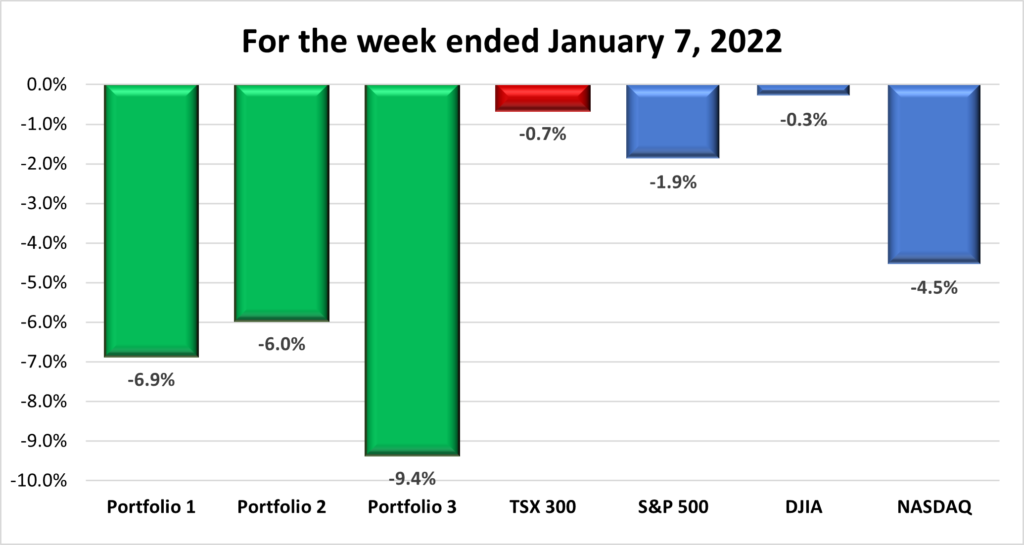
Well, I can say all three portfolios beat all four Indexes at something, with one Portfolio more than doubling the closest Index. Unfortunately, what the Portfolios beat the Indexes at was falling the farthest. Not something to brag about. I cannot say I am surprised when the technology heavy Nasdaq fell the farthest this past week. With investors moving away from high growth technology stocks to value-oriented stocks, I suspect there will be more of this carnage until the higher interest rates are announced and investors move back into growth stocks. I will just have to ride out the current storm and be ready for opportunities should they present themselves.
Companies on the Radar
I reviewed Matterport (NASD:MTTR)’s investor presentation to get a better understanding of their product. I can see the potential. I hope to have a chance to look closer at the company’s management, client base, target market and financials next week.
Stella Jones (TSX:SJ) is a Canadian company that is the leading provider of pressure treated wood products, primarily utility poles, railway ties and timbers, and residential lumber for outdoor uses. I do not see them as high growth stock but neither do I see them as a volatile, high-risk stock. Rather, it is a company that consistently grows its top and bottom lines. A stock I do not need to worry about is not a bad thing considering the more volatile technology companies in all the portfolios.
Portfolio Update
Portfolio 1
Portfolio 1 for the week ended January 7, 2022: DOWN 
It was a poor week for Portfolio 1 with the technology sector having a bad week. The fear of interest rates appeared to be the catalyst this week that caused all the technology companies’ share price to fall. Actually, the technology sector started retreating in mid October 2021 and has continued to fall. Initially Omicron was the culprit that started the fall in share prices, but inflation and higher interest rates are now the primary reason the companies with a high amount of debt are seeing their share prices fall.
On a side note, beware of dividend paying companies that are headquartered in a country other than Canada or the US. Portfolio 1 received a special dividend from ZIM Integrated Shipping (NYSE:ZIM) (ZIM) at the end of 2021 and was dinged a 25% Non-Resident Tax (NRT), even though the stock was held inside a registered account. Typically, there are no taxes on dividends from stocks held in a registered account such as a Registered Retirement Savings Plan or Registered Income Fund. This is true for Canadian and American based companies thanks to a tax treaty between the two countries. However, for other countries it depends on tax treaties between Canada and the companies’ home country. In this case, ZIM is based in Israel. I do not know if the 25% NRT was a result of a tax treaty between Canada and Israel or if there is no tax treaty between the two countries and a 25% tax is the default. Either way, the tax hit was a surprise and something I will keep in mind for future investments.
Activity
No significant activity to report this week.
Dividends
Dividends Received this week for the following companies:
Companies followed by DRIP (Dividend Re-Investment Plan) indicate additional shares were purchased with the dividend. Any cash leftover was added to the cash balance.
Canadian $
Cargojet Inc. (TSX:CJT)
Telus Corp. (TSX:T)
US $
No US$ dividends this past week.
Quarterly Reports
No quarterly reports this past week.
Portfolio 2
Portfolio 2 for the week ended January 7, 2022: DOWN
As with the other two portfolios, the technology sector bias dragged Portfolio 2 down this week. Most of the stocks declined this past week except for Bank of Nova Scotia (TSX:BNS), Disney (NYSE:DIS) and Chorus Aviation (TSX:CHR). Considering that Disney has been drifting down for the last week it was a pleasant surprise to see it in positive territory for the week. More surprising was Chorus having a positive week. It was not much (CAD $.15) but its better than being down.
Activity
No significant activity to report this week.
Dividends
Dividends Received this week for the following companies:
Companies followed by DRIP (Dividend Re-Investment Plan) indicate additional shares were purchased with the dividend. Any cash leftover was added to the cash balance.
Canadian $
Brookfield Renewable Partners LP (TSX:BEP.UN)
US $
No US$ dividends this past week.
Quarterly Reports
No quarterly reports this past week.
Portfolio 3
Portfolio 3 for the week ended January 7, 2022: DOWN
When the largest stock in the portfolio drops more than 10% in one day, smashing through its 200-day moving average, I knew it was not going to be a good week for Portfolio 3. Over the last month Shopify has decreased its share price by almost 25%, or CAD $500, highlighted by the 10% drop on the first day of trading in Canada. Each day it dropped a bit more to finally close out the week at its lowest price since June 2022.
The only companies to finish the week in the black were the bank stocks, as banks tend to make more money higher when interest rates rise. As for the rest of the holdings, the only positive spin is they did not have as bad a week as Shopify.
Activity
Sold TD US Index mutual fund (TSX:TDB661). This fund was purchased a few years ago as part of a TD Bank promotion and one could only invest in TD Bank mutual funds. While looking at the holdings of this fund I noticed its largest holding was the TD US Equity Index ETF (nearly 27%). Comparing the holdings of the mutual fund and the ETF I saw they were holding the same companies in the same allocation percentages. I also saw the management expense ratio (MER) for the fund was .5% while the MER for the ETF was .06%. I decided since they were holding the same companies why should I pay 8X as much in management fees. I sold the mutual fund and with the proceeds purchased shares in the ETF.
Bought TD US Equity Index ETF (TSX:TPU). Essentially a swap of the mutual fund for the ETF and its lower MER. I like that both the mutual fund, and now the ETF, provide broad and diverse exposure to large market capitalization US companies. While the ETF does not explicitly state it mirrors the S&P 500 Index (S&P), when I compared the share price chart of the ETF against the S&P, they were almost identical.
This ETF provides access to the largest publicly traded US corporations without being encumbered by many small and obscure companies. As long as the US economy is running smoothly this stock should perform well with much less risk than trying to pick individual companies.
Dividends
Dividends Received this week for the following companies:
Companies followed by DRIP (Dividend Re-Investment Plan) indicate additional shares were purchased with the dividend. Any cash leftover was added to the cash balance.
Canadian $
Brookfield Asset Management Inc (TSX:BAM.A)
Brookfield Renewable Partners LP (TSX:BEP.UN)
US $
No US$ dividends this past week.
Quarterly Reports
No quarterly reports this past week.