Certainly uncertain
I had planned on opening this week’s post on the market’s ongoing slide and its impact on the three Portfolios but an event on the other side of the world gave the global markets a scare. That event was the Russian invasion of Ukraine. Let’s look at how the uncertainty and then certainty of the invasion impacted the stock market.
Russia is the world’s second-largest natural gas producer, the third-largest oil producer, and supplies Europe with 40% of its gas imports. Disruption of the Russian oil supply would severely impact Europe. However, the rest of the world would feel the loss of Russian energy products despite other oil producing nations attempt to fill the void left by Russia. Consequently, the markets, especially the price of oil, had been bouncing up and down like a yo-yo every time there was news out of tensions along the Ukraine – Russian border. The markets did not know if there would be a war or not.
Stock markets in general don’t like uncertainty and they definitely don’t like surprises. Well, the uncertainty of a Russian invasion has been removed. When Russia invaded Ukraine Thursday morning, oil prices shot up to over USD $100 a barrel and when the various North American stock exchanges opened, other stocks immediately plunged as investors fled stocks for assets traditionally deemed safer, such as bonds and gold.
The invasion itself wasn’t a surprise as Russia had amassed over 150,000 troops and the US had been stating an invasion was imminent for a few weeks. However, I think a lot of people, myself included, didn’t really think Russia would invade Ukraine. I thought this was a lot of posturing and some sort of agreement would be reached that each party could accept. Wrong! The invasion was a surprise to many.
Prior to the invasion, it was unknown what the West’s response would be to Russian aggression (uncertainty, which the markets don’t like). I thought they would freeze various Russian assets. In retaliation, Russia would cut off the oil flow to Europe, and any disruption to global oil supply would put stress on energy prices. Inevitably, this would lead to higher oil prices which in turn would lead inflation.
However, once the uncertainty of what the sanctions against Russia would be was removed, the markets reversed course. The sanctions had stopped short of disrupting Russian energy exports, and Russia had not been locked out of the international banking system. Since the sanctions were announced, all four major North American indexes have climbed higher, while the price of oil has fallen back to below USD $100 a barrel.
From a purely investment point of view, shares in oil and natural gas companies should rise as the war continues (good for owners of oil related companies). However, higher oil prices will lead to higher costs for gas, heating and other oil related products. This in turn will push inflation higher and likely cause the Bank of Canada and the US Federal Reserve to raise interest rates more aggressively. Until these rate hikes are known, uncertainty will gain cause the markets to go up and down, depending on investor sentiment.
War is a terrible thing. Even a war on the other side of the world from North America has already been felt here in North America. As for the stock market, the roller coaster of the last week is the sort of thing that happens amid uncertainty. Once the uncertainty is removed, the market will react accordingly as we saw this past week.
Now, let see how that roller coaster played out for the Indexes this past week ….
Weekly Market Review
Monday: The major North American Exchanges were closed for Family Day in Canada and President’s Day in the USA. Consequently, there was no movement on the four major Indexes: the Toronto Stock Exchange Composite Index (TSX), the S&P 500 Index (S&P), the Dow Jones Industrial Average (DJIA), and the Nasdaq Composite Index (Nasdaq). However, with Russia launching ‘peacekeeping’ missions into eastern Ukraine, the price of oil should jump while the rest of the market tumbles. This could be a rough week, again.
Tuesday: Depending on which side of the argument you’re on, Russian forces moving into Ukraine is either an invasion (US & NATO version) or peacekeeping missions (Russia). Either way, all four Indexes fell today. A war in Ukraine not only would disrupt energy supplies, which in turn lead to increases in inflation (higher prices for cars, for example).
The TSX extended its losing streak to 4 days despite slight gains in the Energy sector caused by oil reaching a 7 year high. The three American Indexes were down but it could have been worse. The S&P fell into correction territory after the US stated Russia’s peacekeeping efforts were the “beginning of an invasion.” The S&P has lost more than 10% since its record high close on January 3.
Wednesday: Another rough day for the Indexes after Ukraine declared a state of emergency. Once again, the TSX declined the least, falling almost .8% while the S&P lost 1.8%, the DJIA was down 1.4%, and the Nasdaq ended down 2.6%.
The DJIA barely avoided joining the S&P in a correction. The Nasdaq can only wish it were down only 10%. It is down nearly 19% from its record high on November 19, 2021. Meanwhile the TSX is down 2.3%, despite Shopify (TSX:SHOP), Canada’s third largest company, falling almost 55% since the start of the year. The TSX’s over weighting in Canadian financial companies and resource companies is what is keeping it from joining its American counterparts down near the -10% or greater decline.
Thursday: All four Indexes plunged this morning on the Russian invasion of Ukraine. However, all the Indexes abruptly changed directions and ended the day in the black. In Canada, the TSX was led upward by a 4% gain in the Technology sector. The Energy sector was also up, with oil breaking the USD $100 a barrel threshold.
The US Indexes were led by the technology heavy Nasdaq which posted a 3.3% gain for the day. The rise in technology companies also helped the S&P reverse its early plunge. To illustrate how volatile the market can be, the Nasdaq opened the day with a 3% plunge before rallying to close over 3% in the black. In the morning, the Nasdaq briefly down more than 20% from its November high. If it had not rallied and stayed at the morning lows, it would have been considered in a bear market.
Friday: It was a good day in the market. All four Indexes were in the black for the day and the DJIA had its largest daily percentage gain since November 2020. In the US, it was abroad based rally with all sectors finishing the day higher. In Canada, the TSX was led upward by the Energy and Financial sectors. For the week, the TSX, the S&P and the Nasdaq ended in positive territory while the DJIA posted a slight decline for the week.
Oil prices dropped below USD $100 per barrel after investors realized Western sanctions were aimed at Russia’s banks and financial sector, rather than Russia’s energy sector. For now, the supply of oil to Europe is still flowing.
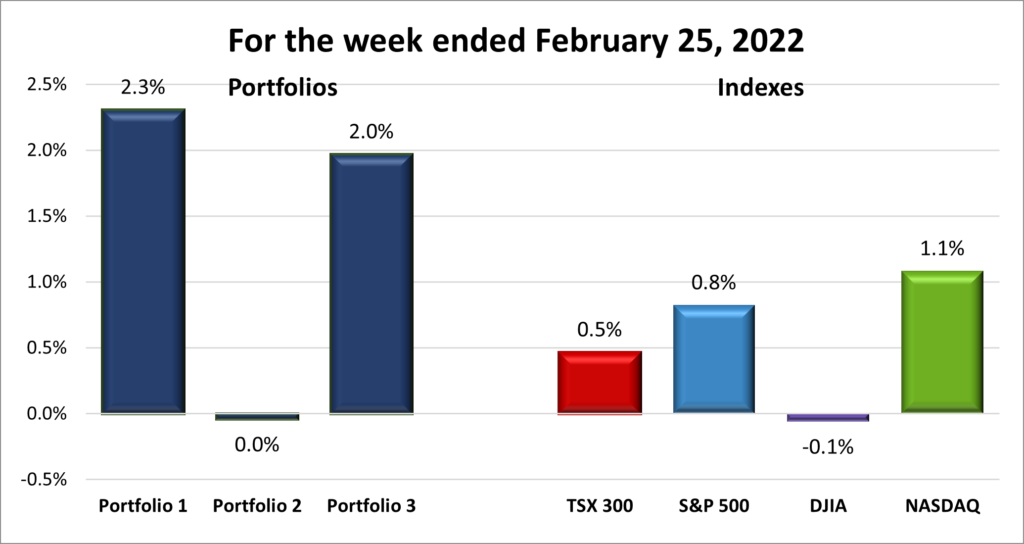
For the week, the TSX, S&P and Nasdaq all had a winning week while the DJIA was down by .1%.
Weekly Portfolio Review
Russia invading Ukraine aside, it was a good week overall with three of the four Indexes rising and two of three Portfolios gaining. The Nasdaq was the best performing Index, gaining 1.1% for the week, while the DJIA was the only Index to end the week in the red. For the Portfolios, Portfolio 1 and Portfolio 3 each gained more than 2%, almost doubling the weekly gain of the Nasdaq Index. While Portfolio 2 was unable to post a gain this past week, neither did it post a loss, finishing the week flat. I cannot remember two Portfolios gaining twice as much as the best performing Index in one week. I’d like to see that more often. Actually, I’d like to see all three Portfolios double the best performing Index.😊
Companies on the Radar
This week I moved Pulse Seismic from the radar to Portfolio 1 (see the write up in Portfolio 1’s Activity section below) and dropped FuboTV (NYSE:FUBO) after their earnings report came out. The report was OK but what I was looking for was for Fubo to have added more of the major North American sports to their package. If I was a big soccer, perhaps, but I’m not. Until they can sign some deals with the major North American sports leagues, I’m content with the shares already in Portfolio 1.
As has been the case for the last few weeks, the following companies are currently on the radar and an old friend returns:
- Nvidia (NYSE:NVDA)
- Microsoft (NASD:MSFT)
- Apple (NASD:AAPL)
- Home Depot (NYSE:HD)
- American Tower (NYSE:AMT)
Portfolio Update
Portfolio 1
Portfolio 1 for the week ended February 28, 2025: UP 
Home Depot fell the most in nearly two years after a decline in gross profit margins for the holiday quarter. Costs were up as the company chartered a cargo ship and used air freight to in attempt to beat supply chain disruptions and get popular products and materials to stores faster. While these measures helped sales, those extra transportation expenses, along with higher labour costs, led decline in fourth-quarter gross margins.
Teladoc Health (NYSE:TDOC) continues to grow its virtual healthcare business. Revenues are up and the net loss improved by 13% (its less than the 2020 loss). Virtual healthcare is here to stay and Teledoc should be fine in the upcoming years.
Kneat.com (TSX:KSI) had record fourth quarter revenues leading to strong 2021 results. As impressive as growth in revenues of 109% sounds, more impressive is their ability to ‘land and expand’ with a net revenue retention rate of 245%. As well as contracting with many of the top global biopharmaceutical companies, Kneat recently signed a deal with a consumer-packaged goods company and are looking to expand into the supply chain, and consumer packaged goods industry. Breaking out of the life sciences industry is a good sign and can only grow the customer base. I look forward to seeing if they can continue their ‘land and expand’ strategy in these new industries.
Cloudflare (NYSE:NET) announced it has agreed to buy email protection provider Area 1 Security for $162 million.
Activity
Bought Pulse Seismic Inc. (TSX:PSD) Following up on last week’s Companies on the Radar, I took a closer look at Pulse Seismic and found they had:
- a long tenured executive team;
- a consistently high return on capital (indicating the company is efficiently using shareholders’ equity to generate a profit);
- a significant moat/competitive advantage (their library of seismic data),
- generate lots of cash which is used to repay debts (long term debt was recently fully repaid making them long term debt free), dividends to shareholders, and repurchase outstanding shares.
As long as the demand for oil and gas remains high, as it’s expected to for another 10 years or so, energy companies will continue to look for opportunities throughout Canada. Pulse Seismic will benefit as they license out their seismic data which is vital to exploration and development of oil and gas resources.
Dividends
Dividends Received this week for the following companies:
Companies followed by DRIP (Dividend Re-Investment Plan) indicate additional shares were purchased with the dividend. Any cash leftover was added to the cash balance.
Canadian $
Shaw Communications Inc (TSX:SJR.B)
US $
No US$ dividends this past week.
Quarterly Reports
Teladoc Health Inc.
All currency listed in US dollars
Selected highlights from their fourth quarter 2021 financial results on February 22, 2022
Fourth quarter highlights
- Fourth quarter revenue grows 45% year-over-year to $554.2 million
- Gross margin was 67.5 percent for the fourth quarter of 2021 compared to 67.2 percent for the fourth quarter of 2020
- Net loss was $10,985 compared to a loss of $393,967 in the same period the previous year
- Total visits increase 41% to 4.4 million
Fiscal 2021 highlights
- Revenue grows 86% year-over-year to $2,032.7 million
- Gross margin was 67.2% compared to 63.1% in 2020
- Net loss was $428,793 compared to a loss of $485,136 in the same period the previous year
- Full year cash flows from operations grew to $194.0 million
- Total visits increase 38% to 15.4 million
Home Depot
Fourth quarter highlights
- Sales were $35.7 billion, an increase of 10.7% from the fourth quarter of fiscal 2020
- Net earnings were $3.4 billion, or $3.21 per diluted share, compared with net earnings of $2.9 billion, or $2.65 per diluted share, in the same period of fiscal 2020
Fiscal 2021 highlights
- Sales were $151.2 billion, an increase of $19.0 billion, or 14.4 percent, from fiscal 2020.
- Net earnings were $16.4 billion, or $15.53 per diluted share, compared with net earnings of $12.9 billion, or $11.94 per diluted share in 2020.
- Approved a 15 percent increase in its quarterly dividend to $1.90 per share, which equates to an annual dividend of $7.60 per share
Magnite Inc.
All currency listed in US dollars
Selected highlights from their fourth quarter 2021 financial results on February 2, 2022
Fourth quarter highlights
- Revenue was $161.3 million for Q4 2021, up 97% from Q4 2020
- Net income for Q4 2021 was $0.5 million, representing diluted earnings per share of $0.00, compared to net income of $5.9 million, or diluted earnings per share of $0.05 for the fourth quarter of 2020
Fiscal 2021 highlights
- Revenue was $468.4 million for 2021, up 111% from 2020
- Net income for 2021 was $0.1 million, compared to net loss of $53.4 million for 2020
Innovative Industrial Properties, Inc.
All currency listed in US dollars
Selected highlights from their fourth quarter 2021 financial results on February 23, 2022
Fourth quarter highlights
- Generated total revenues of approximately $58.9 million in the quarter, representing a 59% increase from the prior year’s quarter.
- Recorded net income attributable to common stockholders of approximately $28.3 million for the quarter, or $1.14 per diluted share, and AFFO of approximately $48.6 million, or $1.85 per diluted share (including the dilutive impact of the assumed full exchange of the Exchangeable Senior Notes).
- Paid a quarterly dividend of $1.50 per common share on January 14, 2022, representing a 21% increase from the prior year’s fourth quarter
Fiscal 2021 highlights
- Generated total revenues of approximately $204.6 million, representing an increase of 75% over 2020.
- Recorded $4.55 of net income attributable to common stockholders per diluted share.
- Declared dividends to common stockholders totaling $5.72 per share, a 28% increase over 2020.
- Approximately $406.0 million in cash and cash equivalents and short-term investments.
- 15% debt to total gross assets, with approximately $2.2 billion in total gross assets, representing a total annual fixed cash interest obligation of approximately $17.8 million, with no debt maturing in 2022 or 2023.
Kneat.com
All currency listed in CAD dollars
Selected highlights from their fourth quarter 2021 financial results on February 23, 2022
Fourth quarter highlights
- Revenues increased 111% to $6.3 million, compared with $3.0 million for the fourth quarter of 2020.
- Gross margin increased 177% to $4.4 million, compared with $1.6 million for the fourth quarter of 2020.
- Gross margin percentage increased to 71% compared with 54% for the fourth quarter of 2020. The increase in gross profit margin was driven by a significant increase in revenue, including some one-time on-premises license revenues, offset by a smaller increase in related cost of revenue.
Fiscal 2021 highlights
- Total revenues increased 109% to $15.5 million, compared with $7.4 million for the year ended December 31, 2020.
- Gross margin increased 224% to $9.3 million compared with $2.9 million for the year ended December 31, 2020.
- Gross margin percentage increased to 60% compared with 39% in the year ended December 31, 2020. The higher gross profit margin was driven by increases in revenue, in particular SaaS license revenues and some one-time on-premises revenue, offset by a smaller increase in related cost of revenue.
- Gross Revenue Retention Rate was 100% for the year ended December 31, 2021.
- Net Revenue Retention Rate was 245% for the year ended December 31, 2021.
FuboTV Inc.
All currency listed in US dollars
Selected highlights from their fourth quarter 2021 financial results on February 23, 2022
(in millions)
Fourth quarter highlights
- Total revenues of $231.06 million
- Revenues increased to $25.9, compared to $13.1 for the same period in 2020, an increase of 98%.
- Net loss decreased to $112 from $195.3 for the same period in 2020
- Customers streamed 404 million hours of content during the quarter, a 96% increase over the same period in 2020.
Fiscal 2021 highlights
- Total revenue of $638 million, an increase of nearly 144%.
- Net loss decreased to $383 million from $609.7 million in 2020
- 1,315,433 global subscribers (including 185,626 attributable to the acquisition of Molotov); on an organic basis FuboTV grew by 581,927 net adds or 106% YoY to 1,130,000
- Surpassed one million total paid subscribers in the U.S. and 114% growth since the IPO in October 2020
Portfolio 2
Portfolio 2 for the week ended February 25, 2022: FLAT 
Zynga (NASD:ZNGA) completed the ‘go-shop’ phase of its tentative deal to be acquired by Take Two Interactive (NASD:TTWO) and now enters the ‘no-shop’ phase. The ‘go-shop’ phase allowed Zynga to look for better offers than the one put forward by Take Two. The ‘no shop’ phase is just as the phrase implies, Zynga limits its ability to seek alternative options, subject to standard fiduciary obligations. At this time, the deal for Take Two to acquire Zynga is still moving forward and expected to close near the end of June.
Guardant Health (NASD:GH) had a solid fourth quarter and fiscal year, beating analysts’ expectations. Management expects 2022 an increase in revenues of 23% to 26% over fiscal 2021 revenues.
For the rest of the Portfolio there were no surprises one way or the other. A few of the technology stocks were down but the non-technology stocks were able to carry the portfolio this week.
Activity
No significant activity to report this week.
Dividends
Dividends Received this week for the following companies:
Companies followed by DRIP (Dividend Re-Investment Plan) indicate additional shares were purchased with the dividend. Any cash leftover was added to the cash balance.
Canadian $
Dream Industrial Real Estate Investment Trust (TSX:DIR.UN) DRIP
US $
No US$ dividends this past week.
Quarterly Reports
Guardant Health
All currency listed in US dollars
Selected highlights from their fourth quarter 2022 financial results on February 23, 2022
Fourth quarter highlights
- Revenue of $108 million, an increase of 38% over the corresponding period of 2020.
- Gross margin was 69%, as compared to 64% for the corresponding prior year period
- Net loss attributable to common stockholders was $90.9 million, as compared to $93.7 million for the corresponding prior year period.
- Net loss per share attributable to common stockholders was $0.89, as compared to $0.94 for the corresponding prior year period.
2021 highlights
- Revenue of $ $374 million for the full year 2021, an increase of 30% over 2020.
- Gross margin was 67%, as compared to 68% for the corresponding prior year period.
- Net loss attributable to common stockholders was $405.7 million for 2021, as compared to $253.8 million for the corresponding prior year period.
- Net loss per share attributable to common stockholders was $4.00 for 2021, as compared to $2.60 for the corresponding prior year period.
Kneat.com
All currency listed in CAD dollars
Selected highlights from their fourth quarter 2021 financial results on February 23, 2022
Fourth quarter highlights
- Revenues increased 111% to $6.3 million, compared with $3.0 million for the fourth quarter of 2020.
- Gross margin increased 177% to $4.4 million, compared with $1.6 million for the fourth quarter of 2020.
- Gross margin percentage increased to 71% compared with 54% for the fourth quarter of 2020. The increase in gross profit margin was driven by a significant increase in revenue, including some one-time on-premises license revenues, offset by a smaller increase in related cost of revenue.
Fiscal 2021 highlights
- Total revenues increased 109% to $15.5 million, compared with $7.4 million for the year ended December 31, 2020.
- Gross margin increased 224% to $9.3 million compared with $2.9 million for the year ended December 31, 2020.
- Gross margin percentage increased to 60% compared with 39% in the year ended December 31, 2020. The higher gross profit margin was driven by increases in revenue, in particular SaaS license revenues and some one-time on-premises revenue, offset by a smaller increase in related cost of revenue.
- Gross Revenue Retention Rate was 100% for the year ended December 31, 2021.
- Net Revenue Retention Rate was 245% for the year ended December 31, 2021.
Portfolio 3
Portfolio 3 for the week ended February 25, 2022: UP
Adyen (OTCM:ADYEY) reports on the Amsterdam Exchange and is only required to report earnings twice a year, compared to North American requirements of quarterly reports. While Adyen reported back on February 9, I only found out about it this week. I think because it’s a European company and its primary Exchange is in Europe it does not get as much attention as North American based companies. That being said, Adyen is a top company in the online payment processing industry, competing with more well-known PayPal and others. Adyen provides a single platform to accept payments across online, mobile or in-store (POS) methods with over 250 payment methods and 187 currencies. They also can help protect revenue streams from fraud and help control a company’s finances. You may not have heard of Adyen, but their list of customers includes eBay, Tiffany & Co., Microsoft, Etsy, KLM airlines, McDonalds and other leading brands.
To purchase shares in Adyen in North America, one must purchase shares on the Over-The-Counter market (OTCM). There are two types of shares of Adyen available on the OTCM: ADYYF and ADYEY (USD $2,012.08 and $20.60, respectively as of market close on February 25). Portfolio 3 owns the ADYEY shares. These are depository receipts (DR), which are negotiable instruments (shares) that allow investors like me to invest in foreign companies, such as Adyen.
Adyen had a great second half earnings report with net revenues up 47% for the half and 46% for fiscal 2021. It takes a bit of hunting around for information on the company but if you go directly to the Adyen website you can find out more about the company and access its financial reports. If you think online and mobile payment processing is only going to increase, you might want to consider this lesser-known European company.
As for the rest of the portfolio, I thought the financial stocks would carry the portfolio this past week, but it turned out a combination of technology and the bank stocks had the biggest impact in getting Portfolio 3 back into the black after previous weeks 9% drop.
Activity
Bought: Brookfield Select Opportunities Fund (TSX:BSO.UN). A little bit of cash was sitting around in an account doing nothing. There wasn’t enough to really invest in a low-risk company, so I decided to take the opportunity to diversify the portfolio with an income fund. I’m familiar with the stock as I’ve bought it for both Portfolios 1 and 2. As with those purchases, I’m confident in the Brookfield management team, it provides diversification and stability to the portfolio, and a 10% dividend provides a solid and reliable stream of income (much better than the 0% it had been doing).
Dividends
Dividends Received this week for the following companies:
Companies followed by DRIP (Dividend Re-Investment Plan) indicate additional shares were purchased with the dividend. Any cash leftover was added to the cash balance.
No dividends this past week.
Quarterly Reports
Adyen N.V.
All currency listed in EUR dollars.
Selected highlights from their second half 2021 financial results on February 9, 2022
Second half highlights
- Net revenues of €556.5 million, up 47% year-on-year
- EBITDA of €357.3 million, up 51% year-on-year. EBITDA margin was 64%
- Net income was €264.9 million for the second half of the year, up 62% year-on-year
- Processed volume was €300.0 billion, up 72% year-on-year
- More than 80% of our growth came from existing merchants, volume churn was minimal at <1%, and net revenue concentration during the period decreased
2021 highlights
- Net revenues for the year were over €1.0 billion, up 46% year-on-year
- EBITDA of €630 million: up 57% year-on-year. EBITDA margin was 63% for the full year.
- Processed volume was €516 billion: up 70% year-on-year
Kneat.com
All currency listed in CAD dollars
Selected highlights from their fourth quarter 2021 financial results on February 23, 2022
Fourth quarter highlights
- Revenues increased 111% to $6.3 million, compared with $3.0 million for the fourth quarter of 2020.
- Gross margin increased 177% to $4.4 million, compared with $1.6 million for the fourth quarter of 2020.
- Gross margin percentage increased to 71% compared with 54% for the fourth quarter of 2020. The increase in gross profit margin was driven by a significant increase in revenue, including some one-time on-premises license revenues, offset by a smaller increase in related cost of revenue.
Fiscal 2021 highlights
- Total revenues increased 109% to $15.5 million, compared with $7.4 million for the year ended December 31, 2020.
- Gross margin increased 224% to $9.3 million compared with $2.9 million for the year ended December 31, 2020.
- Gross margin percentage increased to 60% compared with 39% in the year ended December 31, 2020. The higher gross profit margin was driven by increases in revenue, in particular SaaS license revenues and some one-time on-premises revenue, offset by a smaller increase in related cost of revenue.
- Gross Revenue Retention Rate was 100% for the year ended December 31, 2021.
- Net Revenue Retention Rate was 245% for the year ended December 31, 2021.
Magnite Inc.
All currency listed in US dollars
Selected highlights from their fourth quarter 2021 financial results on February 2, 2022
Fourth quarter highlights
- Revenue was $161.3 million for Q4 2021, up 97% from Q4 2020
- Net income for Q4 2021 was $0.5 million, representing diluted earnings per share of $0.00, compared to net income of $5.9 million, or diluted earnings per share of $0.05 for the fourth quarter of 2020
Fiscal 2021 highlights
- Revenue was $468.4 million for 2021, up 111% from 2020
- Net income for 2021 was $0.1 million, compared to net loss of $53.4 million for 2020
Royal Bank of Canada
All currency listed in CAD dollars
Selected highlights from their first quarter 2022 financial results on February 24, 2022
- net income of $4.1 billion for the quarter, up $248 million or 6% from the prior year.
- Diluted Earnings Per Share of $2.84, up 7% compared to first quarter 2020.
- Return on Equity of 17.3%, down 1.3% compared to first quarter 2020.