Indexes
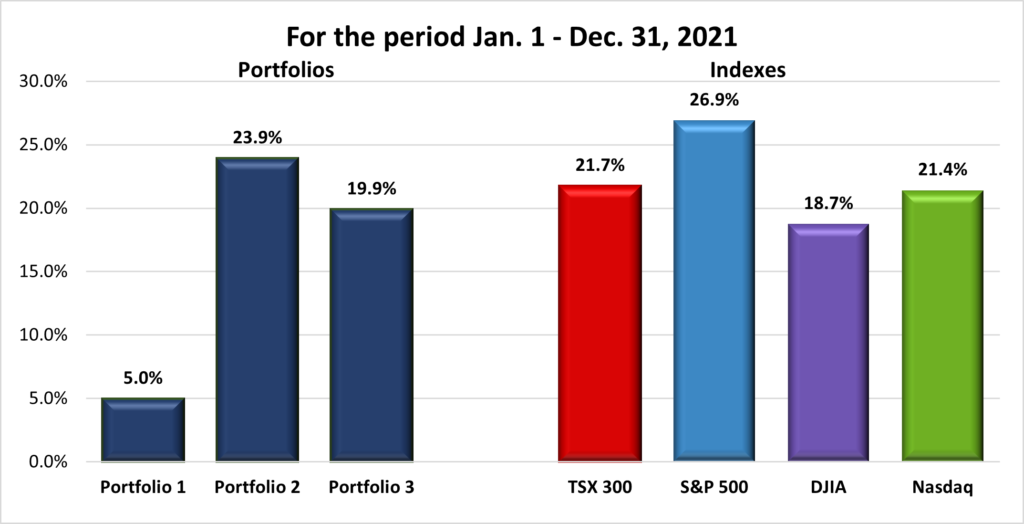
While most of the world had a tough year, it was quite a good year for each of the major North American markets. The Toronto Stock Exchange (TSX) had its best year since 2009, gaining 22%. Helping fuel the rise of Canada’s leading stock exchange were government programs to keep the economy going, covid-19 vaccine rollouts which led to economic recovery through most parts of the world.
South of the 49th, the three American Indexes all had a strong year to make the total gains from 2019 through 2021 the biggest three-year gain since 1999. Not bad considering the last 2 years were amid a pandemic. For the year, the S&P 500 Index (S&P) gained 27%, the Dow Jones Industrial Average (DJIA)was up 18.73% and the Nasdaq Composite Index (Nasdaq) added 21.4%. Leading the way were the energy, real estate, and technology sectors.
In 2021, Covid-19 was still a going concern; everyone grew familiar with the term ‘supply chain issues’; and towards the end of 2021, inflation reared its head leading to fears of higher interest rates. Going into 2022, covid-19 and its variants still linger and will continue to cast a shadow over the markets. As well, the question is no longer will interest rates will be going up, rather, how much will interest rates rise. The new uncertainty impacting the markets is tensions between NATO countries and Russia as Russia masses its military along the Russia – Ukraine border. And who knows what else will happen in 2022.
Portfolio Review
Rather than trying to beat a specific Index, my goal is to get at least a 10% gain each year, preferably 20% or more. As Meatloaf would sing, ‘2 out of 3 ain’t bad’. Portfolio 1 did not have a good 2021, not even keeping up with inflation. On the other hand, Portfolio 2 beat all the Indexes except the S&P 500 Index and Portfolio 3 just missed hitting the 20% goal.
When I look at how the Indexes performed over 2020 and 2021, all three Portfolios performed well. As a result of the pandemic, technological changes that had been slowly occurring were accelerated as people had to work from home and came to rely on technology more and more. Several technology companies were able to benefit from this accelerated digital transformation. Companies that had previously flown under the radar suddenly saw their revenues grow tremendously. Companies like DocuSign (NASD:DOCU) and their electronic signature and document management system; Teladoc Health (NYSE:TDOC) in the US and Well Health Technologies (TSX:WELL) in Canada with their virtual medical appointments; and of course, Amazon with their online sales.
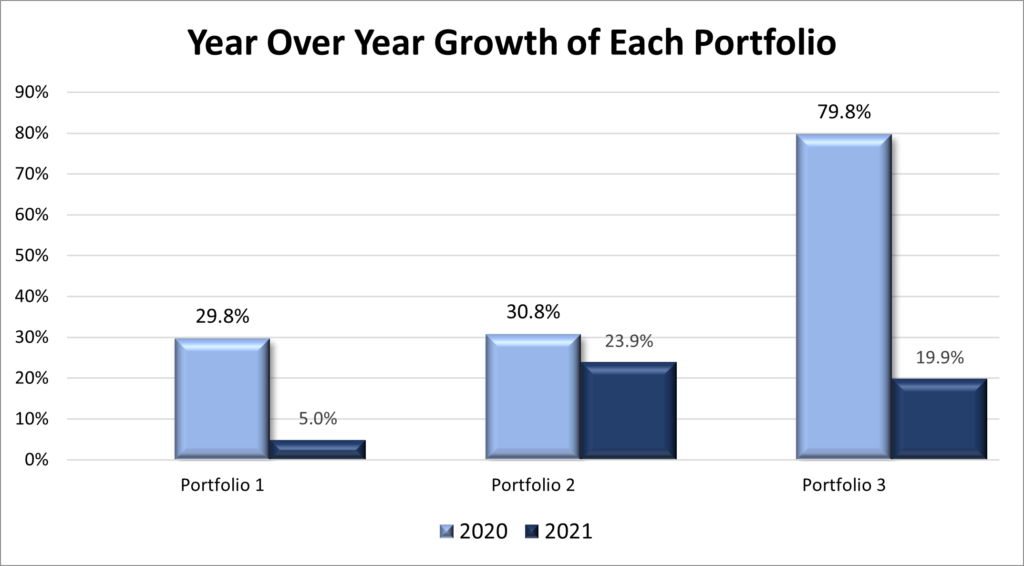
Looking at the chart below, each Portfolio saw stellar growth in 2020, with Portfolio 3 having a fantastic year. While I’d like to think it was my investing skills that were responsible for the performance of all three portfolios, I know it was more a case of luck than anything. A once in a generation, black swan event (the pandemic), with cash available to invest, and identifying trends that would continue after the pandemic.
On its own, 2021 was not a bad year with returns ranging from 5% to 23.9% and an overall average of 15.9%. I’ll discuss each Portfolio individually below.
Portfolio 1
2020
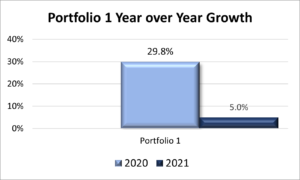
Portfolio 1 was able to take advantage of the 30% market drop caused by the pandemic and the ensuing market recovery. When the pandemic caused the acceleration of the digital transformation, investments were made in many of the top technology trends: cybersecurity (Crowdstrike (NASD:CRWD)); online shopping (Lightspeed Commerce (TSX:LSPD); online payment processing (TSX:NVEI); remote work DocuSign; telehealth (Teladoc and Well Health); and online entertainment (Roku (NASD:ROKU). Other Investments include Fastly (NYSE:FSLY), SEA Limited (NYSE:SE), Visa (NYSE:V), Virgin Galactic (NASD:SPCE), Trisura (TSX:TSU), AcuityAds (TSX:AT), Datadog (NASD:DDOG) and Celsius Holdings (NASD:CELH).
Existing transportation stocks CN Rail (TSX:CNR) and CargoJet (TSX:CJT) also had a strong 2020 thanks to increased shipments as a result of the growth in online shopping.
On the downside for 2020, Luckin Coffee(it has since been delisted from the Nasdaq Exchange) was discovered to have cooked their books, causing the stock to immediately fall from near USD $50 to around USD $2 in less than 5 minutes. Ouch! I finally sold Intel (NASD:INTC) and Cisco (NASD:CSCO) to invest in Apple (NASD:AAPL), a company that has done great for many years.
2021
In 2021, I sold nearly all the cannabis stocks purchased in 2018. Most were sold at a loss. I should have sold these stocks once cannabis was legalised in Canada in late 2018, when they were at their peak. I was hoping the US would legalize cannabis at the federal level, causing shares in the companies to spike. When legalization never materialized, I decided to get out.
I also sold Virgin Galactic which provided the money to buy General Motors (NYSE:GM). I like GM’s Cruise battery technology and I’m hoping GM will be able to ride the electric vehicle tailwinds. I sold Fastly and bought Cloudflare (NASD:NET) with the proceeds.
On the buying side, I attempted to diversify away from the technology sector with investments in Home Depot (NYSE:HD), GM, Tesla (NASD:TSLA) and ZIM Shipping (NYSE:ZIM). I also made a few ‘swing for the fences’ purchases. I don’t expect much to happen with these companies, but I hope within a few years they will get bought out (Yellow Pages (TSX:Y) or become dominant in their respective fields: FuboTV (NYSE:FUBO) in interactive gambling on streaming sporting events; and Unity Software (NYSE:U) in the metaverse.
Finally, Great Canadian Gaming was taken private in September. Those shares were bought in the 1980s. That investment did well. 😊 With the proceeds, money was invested across the best performing companies, and a few new companies such as Alphabet (NASD:GOOGL) and Rivian Automotive (NASD:RIVN).
2022
The plan is to trim the number of companies down to best 40 companies, either through performance or potential.
Portfolio 2
2020
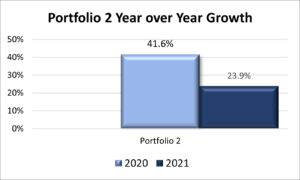
Prior to the onset of the pandemic, investments were made into Real Estate Investment Trusts (REITs) to diversify the portfolio and generate cash while achieving growth. After the initial crash brought on by the pandemic, the portfolio slowly started to climb back to pre-pandemic levels and beyond. The main drivers were Guardant Health (NASD:GH), Microsoft (NASD:MSFT) and MongoDB (NASD:MDB). There was no specific tailwind propelling this portfolio, it just performed well. One notable exception was Chorus Aviation (TSX:CHR). Their share price was cut in half when North America shutdown and then they halted their dividends. Other than Chorus, all other dividend paying companies maintained their dividends. Pure Storage (NASD:PSTG) was sold to free up cash to invest in Zynga (NASD:ZNGA), a mobile gaming company.
2021
The information technology companies Microsoft and MongoDB again were the main drivers in this portfolio. Guardant Health, Zynga and Chorus Aviation dropped during the year while the rest of the companies had decent years. At the start of the year, Savaria (TSX:SIS) was sold because its share price had remained flat for 3 years and I didn’t expect that to change in the near future. That money was invested in Alimentation Couche-Tard Inc (TSX:ATD). In March, money was added to Portfolio 2 and investments were made in three solid, dividend paying stocks: Brookfield Select Opportunities Fund (TSX:BSO.UN) for its 10% dividend; Telus Corporation (TSX:T) for its decent dividend (4.7%) and modest growth potential; and Brookfield Renewable Resources (TSX:BEP.UN) for its modest dividend (3%) and potential growth from renewable energy tailwinds. In the fall, shares in Canopy Growth (TSX:WEED) were sold after there was little to no movement on the legalization of cannabis at the federal level in the US. The proceeds of this sale were invested in iA Financial Corporation Inc. (TSX:IAG), a financial sector company with steady growth and a decent dividend.
Note: none of the money added to the portfolio in March, nor the returns generated from the investments made with that cash infusion, were used in calculating the 2021 returns. It was rolled into the Portfolio 2 calculations on January 4, 2022.
Portfolio 3
2020
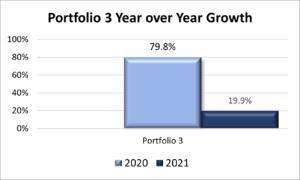
As with Portfolio 2, most of the transactions were made prior to the onset of the pandemic and the stock market crash. Portfolio 3 dropped nearly 15% during the market crash then not only worked back up to pre-pandemic levels but easily surpassed them. As with the other two Portfolios, Portfolio 3 rode the digital transformation tailwinds accelerated by the pandemic. However, growth was primarily driven by Shopify (TSX:SHOP) which went from CAD$ 516.30 on January 2 to CAD$ 1,437.32 at the end of the 2020, a gain of 278%. Another big winner was AcuityAds which gained 527% from its purchase in late August to the end of 2020. Unfortunately, it was a very small position dollar wise so did not have a significant impact on Portfolio 3. In December, a few shares in Shopify were sold to reduce Shopify’s influence on the portfolio and diversify the portfolio. I’d like to think it was skill that generated Portfolio 3’s tremendous return, however, it was more good fortune in owning the right stock – Shopify – at the right time.
2021
Portfolio 3 was very quiet in 2021. No additional money was added but the money from the sale of a few Shopify shares was used to invest in two companies that could ride the cybersecurity (Cloudflare) and the growing metaverse (Unity Software) tailwinds. In addition, investments were made in Enghouse Systems (TSX:ENGH) and Telus International (TSX:TIXT). Finally, Brookfield Asset Management (TSX:BAM.A) spun off their reinsurance business into Brookfield Asset Management Reinsurance Partners (TSX:BAMR), adding another Brookfield company to the portfolio.
Well, that’s it for 2021. I’m confident 2020 returns were a once a decade occurrence, but I’ll be very happy if each of the portfolios can provide a 15% return, or higher. Here’s to a successful 2022!