Weekly Update for the week ending February 6, 2026

AI Turns From Tailwind to Disruptive Headwind

This past week, markets came under pressure as investor sentiment around software companies shifted sharply. While higher interest rates and stretched valuations had already been weighing on the sector, what really rattled investors was a growing belief that parts of the software and professional services industry may be facing real disruption, not just a temporary slowdown.

There’s a certain irony to this shift. Many of these companies were initially seen as some of the biggest beneficiaries of artificial intelligence (AI) – well-positioned to use automation to boost productivity, lock in customers, and expand margins. Instead, investors are now grappling with the idea that the same technology expected to strengthen these businesses could eventually challenge the very products they sell. AI firm Anthropic, the maker of the Claude chatbot, recently introduced a legal plugin for its Claude Cowork product. The tool is designed to automate many routine legal tasks that have traditionally been billed by the hour. What once took hours – tasks such as reviewing contracts, triaging non-disclosure agreements, managing compliance workflows, preparing legal briefs, and generating templated responses – can now be done in minutes, fuelling investor concerns that AI could eventually pressure the billable-hour business model used by many law firms.

Software stocks – particularly legal software and publishing firms – are often valued on the assumption of long-term growth, steady demand, and recurring subscription revenue. These businesses have long been viewed as “safe growth,” especially in professional services where customers rely on specialised tools and switching costs are high. That perception allowed valuations to climb well above the broader market.

New AI tools such as Cowork highlighted how quickly AI is moving into areas once thought to be relatively insulated from automation, including legal research, contract analysis, compliance work, and document drafting. These are core tasks that underpin many high-margin software and data products. Even if AI doesn’t replace these tools outright, the concern is that it could change how value is created and captured. If fewer hours are spent researching or drafting, or if AI-powered alternatives become cheaper and more flexible, traditional subscription models could face pricing pressure over time. For companies built around selling access to information and workflows, that’s a meaningful shift.

Because many of these stocks were already trading at premium valuations, there was little margin for uncertainty. Once investors began questioning whether growth might be structurally challenged rather than temporarily slowed, markets moved quickly to reprice those risks.

That said, disruption doesn’t automatically mean destruction. Many of the companies caught up in this sell-off are already investing heavily in AI themselves. They bring advantages that newer entrants often lack – deep domain expertise, trusted customer relationships, proprietary data, and products that are deeply embedded in day-to-day workflows.

In legal software and professional services especially, accuracy, accountability, and trust still matter. Large organisations need tools that integrate seamlessly with existing systems, meet strict compliance standards, and offer reliable support. In many cases, AI is more likely to be embedded into these platforms rather than replace them outright, becoming a feature that enhances productivity rather than a standalone competitor. In other words, AI didn’t suddenly undermine these businesses – but it did introduce enough uncertainty for investors to treat it as a short-term headwind almost overnight.

For us investors, a company’s ability to evolve matters more than short-term price swings. The challenge is separating companies that can adapt from those that may struggle, or perish, as the industry changes. The recent sell-off reflects uncertainty, not final outcomes. Markets often reprice expectations long before the real-world impact of new technology becomes clear.

The AI-driven shake-up in software and professional services this week is a reminder that markets move on expectations as much as fundamentals. While AI is creating uncertainty in some sectors, let’s take a look at what else moved the major indexes and how portfolios performed over the past week.


Items that may only interest or educate me ….

US Government Takes a Time Out, Canadian Economic News, US Economic News

US Government Takes a Time Out

This past week, the US federal government experienced another shutdown – this time only a partial one that lasted a few days, unlike the full six-week shutdown in October and November 2025. The partial shutdown began at 12:01 a.m. EST on January 31, 2026, because Congress hadn’t passed all the annual funding bills needed to keep federal agencies running. While the Senate had approved most of the funding package, the House of Representatives hadn’t, and both chambers needed to agree on the full set of bills – particularly funding for the Department of Homeland Security (DHS) – before the deadline. Under US law, agencies can’t legally spend money without approved funding, so operations for the affected departments had to pause.

The main roadblock was DHS funding and related policy disagreements, including disputes over immigration enforcement and proposed reforms. When Democrats withdrew support for DHS funding without those changes, and the House didn’t approve a revised deal in time, a lapse in funding triggered the partial shutdown. Because only some appropriations had been passed, this was a partial shutdown rather than a full one, meaning agencies with approved funding continued operating while others paused.

The shutdown ended quickly after Congress passed a new funding bill, signed into law on February 3, 2026. The legislation funds most federal agencies through the end of the fiscal year (September 30, 2026) and provides a short-term extension for DHS while longer-term funding is negotiated.

For us non- US investors, the biggest impact was the delay in key economic reports, like this week’s US labour data.

Canadian Economic News

This past week’s key economic data that the Bank of Canada (BoC) considers when deciding whether to raise or lower the interest rate.

Labour Force Survey (LFS)

Statistics Canada’s January employment report showed that the labour market weakened, with a loss of 24,800 jobs after adding 8,200 positions in December. Economists had been expecting about 7,000 new jobs. Despite the decline in employment, the unemployment rate fell to 6.5% from 6.8% in December, marking the lowest level since September 2024. That apparent contradiction reflects fewer Canadians actively looking for work – a common reason the jobless rate can fall even when employment declines.

Looking beneath the headline numbers, most of the job losses came from part-time positions, which were partly offset by gains in full-time employment. Manufacturing saw notable job losses during the month, while employment increased in information, culture, and recreation industries. On a year-over-year basis, manufacturing employment remains lower, while health care and social assistance continued to lead job growth. Wage growth remained moderate, with average hourly earnings rising about 3.3% year over year, continuing the gradual cooling trend seen in recent months.

Overall, the mixed picture – slower job growth, a lower unemployment rate, and steady wage gains – reinforces the view that Canada’s labour market is cooling but still relatively resilient. From an interest-rate perspective, this report gives the BoC little reason to move rates in either direction for now.

Canadian Market Volatility

Canada’s “fear gauge,” the VIXC (tracked by the VIXI), showed early signs of cooling at the start of the week, opening Monday at 18.50 after ending the prior week near 19.34. Volatility continued to ease through much of the week. Despite lingering concerns around AI-driven disruption and a pullback in gold, silver, and other precious metals, the VIXI mostly traded in the 17–18 range before dropping further to close Friday at 16.42 after the TSX rebounded at the end of the week.

Readings near 20, such as at the start of the week, suggest anxiety is starting to creep in – investors become more defensive, risk appetite fades, and markets grow more sensitive to negative headlines. However, the steady drift lower in the VIXI suggests nerves have been settling rather than intensifying.

US Economic news

This past week’s key data points that the Federal Reserve (Fed) considers when deciding whether to raise or lower the interest rate.

Labour data

The first week of a new month is usually when investors get their first look at fresh US labour data. This time, that rhythm was disrupted after the Bureau of Labor Statistics (BLS) was affected by the partial federal government shutdown that began at midnight on Saturday, January 31. While the shutdown was resolved by February 3, the disruption delayed several key reports. The Job Openings and Labor Turnover Survey (JOLTS) arrived a few days later than usual, and the January Jobs Report – officially known as the Employment Situation Summary (ESS) – is now scheduled for release on February 11.

ADP National Employment Report (ADP)

January’s ADP report showed private-sector hiring came in much weaker than expected, with just 22,000 jobs added. That fell well short of the roughly 45,000 positions analysts had forecast and marked a slowdown from December’s downwardly revised gain of 37,000. The report also pointed to a broader cooling trend in private hiring, with total job gains in 2025 running well below 2024’s pace, even as wages for workers who stayed in their roles rose about 4.5% year over year. Hiring was concentrated in education and health services, while professional and business services and manufacturing saw job losses, highlighting how uneven conditions remain across industries. Because ADP tracks only private employers, it provides a useful – though incomplete – snapshot of the labour market.

Job Openings and Labor Turnover Survey (JOLTS)

The latest JOLTS report reinforced the idea that the US labour market is cooling rather than overheating. Job openings fell to 6.5 million in December, below expectations of 7.2 million and down from 6.9 million in November, marking the lowest level since September 2020. With fewer unfilled positions, modest hiring, and quit rates holding steady, the data suggests that workers have less leverage than they did during the post-pandemic boom.

Summary

The JOLTS report, together with the ADP Employment data, are two key indicators of labour market strength. These softer readings reinforce signs that the jobs market is cooling, even as unemployment stays relatively low. That’s why markets pay close attention to reports like these – a cooler labour market can ease inflationary pressure and eventually open the door to interest rate cuts. With the official government jobs data due next week, investors should get a clearer picture of the overall labour market.

Consumer Sentiment Index (CSI)

The University of Michigan’s preliminary CSI report for February came in better than expected, rising to 57.3 from January’s final reading of 56.4, above economists’ expectations for a reading closer to 55. The modest improvement was largely driven by consumers with larger stock portfolios, who reported slightly better views on their finances and buying conditions. While this marks a 1.6% month-over-month gain and the third straight monthly increase, sentiment is still subdued, sitting 11.4% below year-ago levels and well below historical norms. Even so, it’s the strongest reading since August 2025, suggesting confidence may be slowly returning.

Looking under the hood, the Current Economic Conditions Index – which reflects how consumers feel about their jobs, income, and day-to-day finances – rose 5.2% to 58.3 from 55.4 in January. That improvement is encouraging, but the index is still down 11.3% from a year ago. Meanwhile, the Expectations Index, which looks ahead to the next six months, edged slightly lower to 56.6 from 57.0 and remains about 11.6% below last year’s level, highlighting ongoing uncertainty about the future.

Overall, the report suggests consumers are feeling a bit better than they were a few months ago, but concerns around costs, job security, and the broader economic outlook continue to weigh on confidence.

American Market Volatility

The CBOE Volatility Index (VIX), often called the market’s “fear gauge,” opened the week at 18.06 and climbed as investor unease grew around AI-driven disruption in software and publishing stocks. Volatility built through the week, peaking near 22 by Thursday’s close – a clear sign that caution had intensified. A strong rebound rally on Friday, however, helped calm nerves, pulling the VIX back down to 17.76 by week’s end.

Think of the VIX as the market’s pulse. Readings above 20 signal heightened anxiety, with investors becoming more defensive and markets more sensitive to negative headlines. The pullback below 18 by Friday suggests that while concerns around AI and interest rates haven’t disappeared, fear eased as investors stepped back from worst-case scenarios. In other words, uncertainty remains, but panic didn’t take hold.


Weekly Market and Portfolio Review

For the week, the TSX (SPTSX) gained 1.7%, the S&P 500 (SPX) slipped 0.1%%, the DJIA (INDU) jumped 2.5% and the Nasdaq (CCMP) declined 1.8%.

Index Weekly Streak
TSX: 1 – week winning streak
S&P: 1 – week losing streak
DJIA: 1 – week winning streak
Nasdaq: 4 – week losing streak

Bull market. A good week for the North American stock markets.Bearish market After a volatile start, markets finished the week in mixed fashion – and it could have been a lot worse. What began as a cautious pullback tied to AI spending concerns quickly turned into a broader test of investor confidence before a late-week rebound steadied the ship. In the US, all three major indexes – the S&P 500 (S&P), Dow Jones Industrial Average (DJIA), and Nasdaq Composite Index (Nasdaq) – came under pressure early as AI worries intensified. A strong Friday rally helped the DJIA close above the 50,000 mark for the first time ever, while limiting weekly losses in the S&P and Nasdaq as both snapped three-day losing streaks. The S&P also posted its best single-session gain since May 2025.

Uncertainty had already been building earlier in the week. Investors speculated about which version of Kevin Warsh they might get if he became the next Fed Chair – the more hawkish version similar to his time as a Fed Governor, or a more dovish voice aligned with President Trump’s push for faster rate cuts. At the same time, lingering questions around the scale and sustainability of massive AI infrastructure spending continued to weigh on sentiment.

The real shock came when AI disruption hit closer to home. A broad selloff followed after AI startup Anthropic unveiled new tools capable of automating legal work and conducting financial research – tasks traditionally billed by the hour and often taking days to complete. The announcement highlighted how quickly AI is moving into white-collar work once thought relatively insulated from automation, forcing investors to rethink who ultimately benefits from the AI boom.

That shift hit technology stocks hardest, particularly software and data-driven businesses. The S&P and Nasdaq slid as long-term growth assumptions were reassessed, with the Nasdaq falling to its lowest level since November. Adding to the pressure, Microsoft (NASD: MSFT), Amazon (NASD: AMZN), Alphabet (NASD: GOOGL), and other mega-cap names signalled higher-than-expected AI spending in their earnings presentations, reviving concerns over whether those investments will generate durable returns. As the selloff broadened, investors rotated toward non-technology, blue-chip names. Strong earnings alone are no longer enough – investors want proof that AI is a lasting tailwind, not a disruptive headwind.

Meanwhile, the American economy continues to grow, but the labour market is showing signs of strain. January recorded the highest number of job cuts for that month since the depths of the Great Recession in 2009, according to Challenger, Gray & Christmas, a US-based executive outplacement and business consulting firm. That raises a difficult question: will hiring rebound to match growth, will growth slow to reflect a weaker labour market, or could AI and automation allow expansion without meaningful job creation?

In Canada, the TSX opened February with three straight gains, led by strength in energy and precious metals as commodity prices rebounded. That momentum faded as gold and silver pulled back, while global volatility and a more cautious investor mindset weighed on the resource-heavy index. Still, the TSX rebounded from Thursday’s selloff to post its best single-day performance since October 14, 2025, finishing the week in positive territory despite the turbulence.

In the end, the week was less about deteriorating fundamentals and more about shifting sentiment – driven by the disruptive force of AI. Markets don’t like sudden uncertainty, so it’s no surprise volatility picked up as labour markets cooled and expectations shifted. On the bright side, that volatility created a few attractive buying opportunities. 😊

Portfolio Weekly Streak
Portfolio 1: 4 – week losing streak
Portfolio 2: 1 – week winning streak
Portfolio 3: 4 – week losing streak

Bearish marketBull market. A good week for the North American stock markets. After Thursday’s AI-driven selloff in the software sector, I was bracing for a rough week across all three portfolios. The Friday rally helped claw back some losses, but it was still a tough week, with heavyweight technology companies taking the biggest toll.

Nvidia (NASD: NVDA), the largest holding in two of the three portfolios, fell over 8% after reports that OpenAI was disappointed with its latest AI chips – a blow amplified by the broader AI disruption fears. The Friday rebound trimmed those losses to just 1% for the week, but when your biggest holding loses ground, it can easily turn a winning week into a loss, as it did for Portfolios 1 and 3.

Portfolio 1 fell 2.5% despite 51% of its companies’ recording gains. Big technology companies weighed heavily: Nvidia’s 1% loss, Amazon down 12%, Datadog (NASD: DDOG) down 13%, Shopify (TSE: SHOP) down 15%, and Magnite (NASD: MGNI) down 21% pulled the portfolio down. Bright spots included Hammond Power Solutions’ (TSE: HPS.A) gain of 11%, Alphabet hitting a new all-time high, and Walmart (NASD: WMT) setting a record high as it reached US$1 trillion in market cap becoming the first brick-and-mortar retailer to do so and just the eleventh company overall.

Portfolio 2 was the only portfolio to record a weekly gain, gaining 1.0% as 78% of its holdings posted weekly gains. Hammond Power Solutions 11% gain and Mitek Systems (NASD: MITK) 17% increase stood out, but larger losses in the bigger positions offset smaller gains elsewhere. ☹

Portfolio 3 had the roughest ride, doubling Portfolio 1’s loss, plunging 5.1%. Weekly winners and losers were split 50:50, but Shopify’s 15% decline and Nvidia’s decrease – together representing half the portfolio’s value – ensured the portfolio finished lower. Magnite’s 21% plunge only added salt to the wound. On a brighter note, Brookfield Infrastructure Corporation (TSE: BIPC) set a new all-time high. 😊

This wasn’t the outcome I was hoping for, but it looked far worse before Friday’s rebound. AI-driven volatility rattled markets, yet the late-week rally reinforced a familiar pattern: when fear pushes prices lower, investors don’t stay on the sidelines for long – especially when it comes to high-quality technology leaders. Now, let’s hope Friday’s momentum can carry into the week ahead and all three portfolios will end in the green. 😊

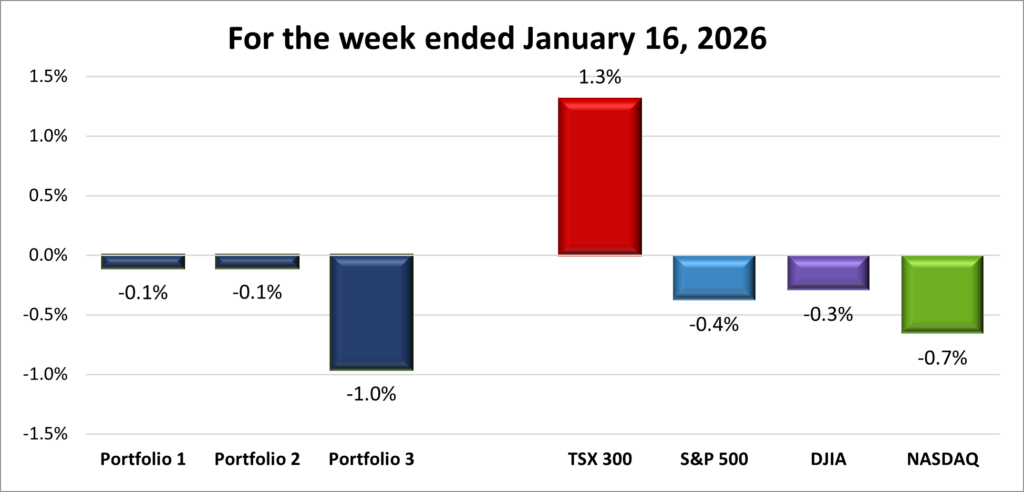
Weekly Portfolio & Index performance
Weekly Portfolio & Index performance for the week ended February 6, 2026.

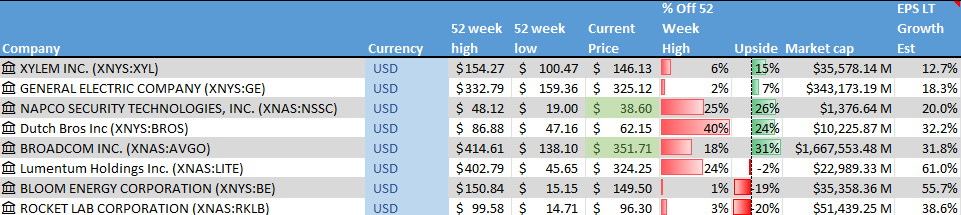
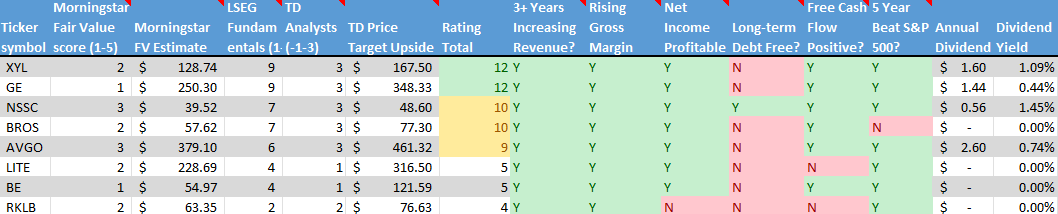
Companies on the Radar

Stocks on my Radar Another relatively quiet week on my investing radar. No new companies crossed my radar, and I was considering removing Lumentum Holdings (NASD: LITE) from my list. I was all set to drop it when I came across a news article reporting that the stock spiked 10% after the company posted a 65% revenue increase in its second-quarter report. I had thought Lumentum was a key player in the growing AI industry, but both the company and share price had seemed stuck in neutral. Feeling I might have been a bit hasty in my decision to drop Lumentum, I decided to keep it on my Radar List for now.

  1. GE Aerospace (NYSE: GE): This is the large American aviation and defence business that remained after General Electric split into three separate companies in 2024. It has been on a strong run thanks to high demand for commercial jet engines as global air travel continues to recover. The company focuses on aircraft propulsion systems and services for both commercial and military customers, and it’s also moving into drones. As a global leader in jet engines and aircraft systems, GE Aerospace offers exposure to long-term trends in travel, defence spending, and emerging aviation technology.
  2. Xylem Inc. (NYSE: XYL): This is a large American company that develops water technology focused on moving, treating, and managing water. Its products and services are used by utilities, industrial customers, and municipalities for everything from clean drinking water and wastewater treatment to flood control and leak detection. With aging water infrastructure and more frequent climate challenges like droughts and flooding, demand for Xylem’s solutions remains strong. The business offers exposure to long-term, essential infrastructure spending tied to water scarcity, sustainability, and smarter cities.
  3. Dutch Bros Inc. (NYSE: BROS): A rapidly expanding drive-thru coffee chain in the US, known for its energetic customer service and customizable drinks. The company is aiming to open at least 160 new locations by the end of 2025 and has long-term goals of surpassing 2,000 stores. Strong brand loyalty, especially in the Western US, makes this an interesting high-growth story – though still in an aggressive build-out phase.
  4. Napco Security Technologies, Inc. (NASD: NSSC): A small US company that provides security hardware and systems like smart locks, intrusion alarms, fire alarms, and access control solutions. It sells through a network of distributors and installers, and has been increasing its recurring service revenue – something investors usually like to see. As demand for security and smart home products grows, Napco has multiple avenues for expansion.
  5. Broadcom (NASD: AVGO): A large cap American company that sells semiconductors and software globally. It designs critical chips used in data centres, networking equipment, and broadband infrastructure, playing a behind-the-scenes role in cloud computing and AI. Broadcom also owns a growing enterprise software business following its acquisition of VMware, giving it exposure to both hardware and software spending tied to AI and cloud growth.
  6. Lumentum Holdings: A large cap US-based optical technology company that makes key components used to move data at extremely high speeds across cloud and data-centre networks. Products like electro-absorption modulated lasers (EMLs) are seeing rising demand as AI workloads require faster and more efficient connections between servers. As large cloud providers continue ramping up AI infrastructure spending, Lumentum has emerged as a key beneficiary of this next wave of data and connectivity growth.

As always, these are not buy recommendations. Make sure to do your own research and choose investments that fit your personal financial goals.

The Radar Check was last updated February 6, 2026.

Stock on the Radar List. 1 of 2.
Stock on the Radar List. 2 of 2.

That’s a wrap for this week, thanks for reading may your portfolio stay green and your dividends steady. See you next time!

A Brief History of the North American Stock Exchanges

As I mentioned in my November 28, 2025 Weekly Update, I recently came across a stock I assumed was listed on Canada’s largest and most senior stock market, the Toronto Stock Exchange (TSE), only to discover it was actually trading on its junior counterpart, the TSX Venture Exchange. That small mix-up sent me down a rabbit hole into how Canada’s exchanges are structured and how they came to be.

What started as a quick clarification turned into a surprisingly interesting history lesson. From there, it felt natural to zoom out even further and look south of the border, where the two primary US exchanges – the New York Stock Exchange (NYSE) and the Nasdaq Stock Market (Nasdaq) – took very different paths to become global financial heavyweights.

Rather than leaving these stories scattered across separate Weekly Updates, I wanted to pull them together into one place. What follows is a walk through North America’s major stock exchanges – how they evolved, how they differ, and how, in Canada, they form a ladder that supports companies at every stage of growth, while in the US the NYSE and Nasdaq evolved along parallel paths.

The TSX: From Trading Club to Major Market

The history of the TSE

The TSX’s story begins in 1852, when a group of Toronto brokers formed an informal trading club. By 1861, they had incorporated as the Toronto Stock Exchange, making it one of the oldest exchanges in the world. In 2001, it became part of the TMX Group and adopted the shorter “TSX” branding we know today.

Despite its long history, the TSX has consistently adapted to change. It fully transitioned to electronic trading in 1997 – well ahead of many major global exchanges. Until the mid-1990s, it even quoted prices in fractions like eighths and sixteenths, a leftover from its early British influences. Today, trading is entirely electronic, and the TSX processes an average of about 1.16 million transactions per day, reflecting steady participation from banks, pension funds, asset managers, and retail investors. The exchange still reflects Canada’s economic backbone: banking, energy, mining, and industrials.

The TSX is home to Canada’s most established public companies – the big banks like Royal Bank (TSX: RY) and TD (TSX: TD), infrastructure and energy giants like TC Energy (TSX: TRP), railways like CN Rail (TSX: CNR), and a growing group of technology and clean-energy firms such as Shopify (TSX: SHOP), Celestica (TSX: CLS), and Brookfield Renewable Partners (TSX: BEP.UN).

Thanks largely to Canada’s dominant financial and resource sectors, the TSX consistently ranks among the world’s top stock exchanges by total market capitalization, giving Canadian companies an outsized presence in global markets compared to the country’s size.

Given that scale, what really sets the TSX apart, though, is that it doesn’t operate in isolation. It sits at the top of a two-tier system that includes a built-in proving ground for younger companies.

From Wild West to Launchpad: The Story of the TSX Venture Exchange

That proving ground is the TSX Venture Exchange (TSXV) – the junior market where many Canadian public companies take their first steps.

While the TSXV officially launched in 2001, its roots stretch back much further. For decades, the Vancouver Stock Exchange was the centre of Canada’s junior markets, especially for early-stage mining and exploration companies. During the boom-and-bust cycles of the 1970s through the 1990s, it earned a reputation for high-risk speculation. At its best, it helped launch future success stories. At its worst, it became known for volatility, weak oversight, and the occasional scandal – eventually earning the nickname “the Wild West.”

By the late 1990s, Canada’s capital markets were fragmented across multiple regional exchanges. As electronic trading became the norm and global competition intensified, that patchwork system no longer made sense. The solution was a national restructuring: Toronto would focus on senior equities, the Montreal Exchange on derivatives, and the Vancouver and Alberta exchanges would merge to form a single, modern home for early-stage companies.

That new exchange debuted in 2001 as the TSX Venture Exchange. Today, the TSXV processes roughly 37,000 transactions per day, giving early-stage companies a liquid, regulated platform to raise capital while still reflecting its smaller, more speculative nature compared with the main TSX.

The TSXV kept the entrepreneurial spirit of its predecessors but paired it with stronger governance, clearer listing requirements, and national oversight under the TMX Group. Its role was simple but powerful: give small-cap and micro-cap companies access to public capital, while offering a clear pathway to “graduate” to the main TSX once they proved themselves.

In fact, Canada is home to more publicly listed mining companies than any other country in the world, a distinction largely driven by the TSX Venture Exchange’s role as a global hub for early-stage exploration firms.

This relationship created a natural growth ladder. Many of Canada’s most successful public companies started on the Venture exchange, built scale and credibility, and eventually moved up to the big board, the TSE. Others choose to remain on the TSXV if growth is slower or the costs of a senior listing don’t make sense.

The ladder to climb from the TSX Venture exchange to the senior board TSE Today, the TSXV is still one of the most active junior markets in the world. Companies like Kraken Robotics (TSXV: PNG), which topped the 2025 Venture 50 list, highlight the type of early-stage firms that often have their sights set on that next rung. For investors, the TSX–TSXV ecosystem offers both ends of the spectrum: speculative early-stage opportunities and mature, stable businesses – all within a single national framework.

Where a company chooses to list isn’t just about size. Listing costs, regulatory requirements, investor base, peer comparisons, and even branding all play a role. That distinction becomes even clearer when you look at how the American markets evolved very differently from Canada’s ladder-style system.

The Engines of US Markets: the NYSE and Nasdaq

South of the border, the US developed its own two-exchange dynamic – not as a formal ladder like Canada’s, but as two very different philosophies of how markets should work. Together, the NYSE and Nasdaq now form the backbone of American equity markets.

New York Stock Exchange (NYSE)

The NYSE traces its origins back to 1792, when 24 brokers gathered under a buttonwood tree on Wall Street and agreed to standardize securities trading. That agreement evolved into the New York Stock & Exchange Board, and by 1863 it became the New York Stock Exchange.

In 1903, the NYSE opened its iconic building at 11 Wall Street, complete with towering columns and a trading floor that would become synonymous with global finance. For most of its history, trading there was loud, chaotic, and intensely human – traders shouting orders, waving papers, and using hand signals in a room that often rivaled a jackhammer in volume. Today, the NYSE handles tens of millions of trades per day, reflecting the massive scale and liquidity of a market built for some of the world’s largest companies.

The NYSE built its reputation around large, established companies with long operating histories. That focus on scale, stability, and global reach cemented its status as the world’s most recognizable stock exchange – a place where blue-chip giants like Visa (NYSE: V) and Coca-Cola (NYSE: KO) list alongside international firms seeking access to U.S. investors, such as the Italian car maker Ferrari (NYSE: RACE), all ringing the opening bell.

Nasdaq

Nasdaq took a completely different path. While the NYSE is home to many of the world’s largest companies by market value, Nasdaq typically lists more companies overall and often handles higher daily trading volumes, reflecting its long-standing focus on growth-oriented and high-turnover stocks. Today, the exchange processes around 1.8 billion trades per day, highlighting the scale and speed needed to support thousands of listed companies.

A picture of the computer systems that make up the Nasdaq Launched in 1971 as the world’s first fully electronic stock market, it replaced the trading floor with computers from day one. Its original name – the National Association of Securities Dealers Automated Quotations – made its mission clear. Over time, it was simply shortened to “Nasdaq.”

Unlike the NYSE, Nasdaq has never had a physical trading floor. The famous Nasdaq Tower in Times Square is symbolic, but the real action happens in high-speed data centres that quietly match millions of orders every day.

From the beginning, Nasdaq became the natural home for technology and high-growth companies – long before technology dominated the market. Apple (NASD: AAPL), Microsoft (NASD: MSFT), Nvidia (NASD: NVDA), and countless others got their start here, shaping Nasdaq’s reputation as the launchpad for innovation. That growth-focused DNA remains central today, supported by infrastructure designed for speed, scale, and massive trading volume.

For clarity, “Nasdaq” can refer to a few different things. The Nasdaq Stock Market is the exchange itself – the electronic venue where thousands of companies are listed and traded. The Nasdaq Composite is an index that tracks the performance of all stocks listed on that exchange, giving a broad view of how Nasdaq-listed companies are performing overall. The Nasdaq-100, by contrast, includes only the 100 largest non-financial companies on the exchange and is often used in Electronically Traded Funds (ETFs) and market tracking. Being precise with these terms makes it easier to follow news and market updates, and prevents confusion between the exchange and the indexes that measure it.

Bringing It All Together

When you step back, the full picture comes into focus. Across the TSXV, TSX, NYSE, and Nasdaq, North America has built a spectrum of markets that support everything from tiny explorers to trillion-dollar giants. Some exchanges emphasize stability and tradition, others speed and innovation – but together, they form the backbone of the investing world we follow every week.

Whether a company is raising its first dollars on the Venture exchange or ringing the bell on Wall Street, these markets provide the pathways that turn small ideas into global businesses – and give investors the chance to become owners along the way.

Most investors interact with these exchanges indirectly through major indexes and ETFs. The TSX Composite reflects the health of Canada’s largest companies, while US benchmarks like the Dow Jones Industrial Average and S&P 500 pull from listings across both the NYSE and Nasdaq. The Nasdaq-100, in contrast, includes only stocks traded on the Nasdaq, translating exchange history into the performance we track week to week.

Understanding where a company trades – and why – adds useful context around its size, risk profile, and growth ambitions, which matters far more than the ticker symbol alone.


Monthly Portfolio Update January 2026

Monthly Market and Portfolio Review

Indexes Monthly Streak
TSX: 9 – month winning streak
S&P: 1 – month winning streak
DJIA: 9 – month winning streak
Nasdaq: 1 – month winning streak

Bull market. A good week for the North American stock markets. January was a bit of a rollercoaster for markets. Indexes pushed to new highs, pulled back to catch their breath, and climbed again, before fading late in the month but still finishing in positive territory. Volatility (also known as buying opportunities 😊) was the name of the game.

Both the Toronto Stock Exchange Composite Index (TSX) and the Dow Jones Industrial Average (DJIA) extended winning streaks that began in May 2025, after the US shook up the global trading system, briefly sending markets lower. The S&P 500 (S&P) and Nasdaq Composite (Nasdaq) also returned to the win column after December’s slip. Among the US indexes, the S&P stood out, setting six record-high closes during the month and briefly crossing the 7,000-point level on January 28, while the DJIA notched four new record closes. Meanwhile, the Nasdaq flirted with record territory but couldn’t quite lock in a new closing high.

Volatility ran through the entire month, but the underlying tone remained constructive. Investor optimism was strongest around the big technology and AI-related names, which continued to do much of the heavy lifting. Solid earnings expectations and ongoing artificial intelligence (AI) enthusiasm helped lift the S&P and gave the Nasdaq enough momentum to finish higher, while that leadership also steadied the broader market and allowed the DJIA to grind upward despite numerous swings. At the same time, geopolitical tensions, tariff threats, and shifting expectations around interest rates and the next Fed Chair sparked short-lived pullbacks. A few late-month earnings disappointments from members of the Magnificent 7 served as a reminder of how concentrated index leadership still is –but they didn’t derail the broader trend.

Precious metals added some colour to the month, though they weren’t major drivers of US equity markets. Gold and silver rallied early as investors looked for hedges against uncertainty, with silver grabbing most of the headlines. Those gains reversed late in January as a stronger American dollar and higher bond yields triggered sharp pullbacks. While metals influenced sentiment at times, US markets were ultimately far more driven by earnings, AI optimism, and shifting macro and policy expectations.

In Canada, January was a strong month for the TSX, which quietly stole the spotlight, posting eleven new record highs – more than the S&P and DJIA combined. The Canadian market rode a wave of optimism driven by energy and basic materials stocks, which benefited from stronger commodity prices early in the year. Oil and natural gas companies moved higher as supply concerns and global demand expectations supported prices. Gold climbed above US$5,500 for the first time as investors sought safe havens amid economic uncertainty, while silver surged above US$100 for the first time ever on strong industrial demand. Strength across precious and industrial metals added further momentum to the index.

Financials played their part as well, with banks and insurance companies posting steady gains as investors looked for stability amid broader market swings. Unlike the US markets, where technology and AI were the main drivers, the TSX’s rally was more diversified across traditional Canadian sectors like financials, energy, and basic materials. That mix helped keep the index moving steadily higher, even during periods of volatility.

By month-end, the major indexes finished with modest gains, even though the path there was anything but smooth. January set the tone for 2026 as a year where fundamentals still matter, AI remains a powerful driver, and short-term headlines can create noise without changing the bigger picture. At the same time, Canada’s resource-heavy market continues to benefit from global demand and steady investor interest in commodities, helping start the year on solid footing.

Portfolio Monthly Streak
Portfolio 1: 3 – month losing streak
Portfolio 2: 1 – month losing streak
Portfolio 3: 1 – month losing streak

Bearish market January ended on a sour note for the portfolios, with all three finishing lower than expected. ☹ After a strong first week where every portfolio was in the green, volatility quickly took over: for the rest of the month, all three portfolios posted weekly losses – except for Portfolio 2, which managed a small win in the third week.

Portfolio 1 held up the best, finishing essentially flat after a month of swings. Early gains gave way to pullbacks in growth and AI-related names, but the broader picture was better than the top line suggested. Cameco (TSE: CCO) repeatedly hit record highs, while energy holdings and steady names like TD Bank (TSE: TD) and Walmart (NASD: WMT) helped stabilize performance. Nvidia (NASD: NVDA), the largest holding, was a key swing factor – cushioning losses at times but adding volatility at others. Late-month drops in Shopify (TSE: SHOP), The Trade Desk (NASD: TTD), Navitas (NASD: NVTS), Constellation Software (TSE: CSU), and Arista Networks (NYSE: ANET) weighed on results, yet overall, the portfolio showed resilience in a tricky market.

Portfolio 2 finished down 1.5%, navigating a choppy month with steady support from energy and defensive holdings. Aritzia (TSE: ATZ) was a bright spot, surging to a record high on strong earnings. Meanwhile, the Bank of Nova Scotia (TSE: BNS) and TC Energy (TSE: TRP) provided reliable stability, while technology companies like Take-Two Interactive Software (NASD: TTWO) weighed on performance in mid- and late-January, but roughly half of holdings rose most weeks, limiting the impact of concentrated declines. January reinforced the portfolio’s balanced approach, showing how a mix of energy, defensives, and selective growth can help weather volatility.

Portfolio 3 took the hardest hit, down 4.7%, largely because of its largest positions. Broad-based gains from smaller holdings provided some cushion, with TD Bank setting a record high and other defensive and energy names adding stability. Nvidia and Shopify remained the key swing factors – modest gains in Nvidia helped limit losses, while sharp drops in Shopify drove much of the decline. Overall, about half of the portfolio’s holdings finished higher each week, softening the impact of concentrated losses. January highlighted the risk of heavy exposure to a few large positions, but also the value of steady contributions from the rest of the portfolio in a turbulent market.

In the January 9 ‘Weekly Update,’ I mentioned how January often sets the tone for the year – the so-called “January barometer,” which suggests the S&P’s performance in the first month can hint at its full-year direction. This year wasn’t as strong as last January, when the S&P gained 2.7%, but a 1.4% rise still kept the index in positive territory. Fingers crossed the January effect foreshadows the markets in 2026! As for the portfolios, there’s no clear barometer – they got off to a mixed start in 2025 but went on to post solid gains by year end. So, let’s hope the January barometer holds for the indexes, and that it stays irrelevant for the portfolios and they all get back in the win column next month. 😊

Monthly Portfolio & Index performance
Monthly Portfolio & Index performance for January 2026.

What My Three Portfolios Did in January 2026

Portfolio 1 for January 2026: DOWN Red Down Arrow

Activity

Sold: TD Investment Savings TDB8150 (TSE: TDB8150). See January 23, 2026, update.

Bought: iShares S&P/TSX Global Gold Index ETF (TSE: XGD). See January 23, 2026, update.

Dividends Received this month:

Companies followed by DRIP (Dividend Re-Investment Plan) indicate additional shares were purchased with the dividend. Any cash leftover was added to the cash balance.

Canadian $

Telus (TSE: T)

Dream Industrial Real Estate Investment Trust (TSE: DIR.UN) DRIP

BSR Real Estate Investment Trust (TSE: HOM.U)

BCE Inc. (TSE: BCE)

Decisive Dividend Corp. (TSE: DE) DRIP

Constellation Software Inc (TSE: CSU)

US $

Walmart (NASD: WMT)

Quarterly Reports

Interactive Brokers Group, Inc.

Fourth quarter 2025 financial results on January 20, 2026

Celestica Inc.

Fourth quarter 2025 financial results on Jan 29, 2026

Visa Inc.

First quarter 2025 financial results on Jan 29, 2026

Apple Inc.

First quarter 2026 financial results on Jan 29, 2026

Canadian National Railway Company

Fourth quarter 2025 financial results on Jan 30, 2026

Portfolio 2 for January 2026: DOWN Red Down Arrow

Activity

No significant activity to report this month.

Dividends Received this month:

Canadian $

Telus (TSE: T)

Canadian Natural Resources Ltd (TSE: CNQ)

Brookfield Renewable Partners LP (TSE: BEP.UN)

Brookfield Infrastructure Partners LP (TSE: BIP.UN) DRIP

Dream Industrial Real Estate Investment Trust (TSE: DIR.UN)

BCE Inc. (TSE: BCE)

SmartCentres Real Estate Investment Trust (TSE: SRU.UN) DRIP

Dream Industrial Real Estate Investment Trust (TSE: DIR.UN)

Whitecap Resources (TSE: WCP) DRIP

South Bow Corporation (TSE: SOBO)

US $

Walt Disney Co (NYSE: DIS)

BSR Real Estate Investment Trust (TSE: HOM.U)

Quarterly Reports

Aritzia Inc.

Third quarter 2026 financial results on January 8, 2026

Microsoft Corp.

Second quarter 2026 financial results on Jan 28, 2026

Brookfield Renewable Partners L.P.

Fourth quarter 2025 financial results on January 30, 2026

Portfolio 3 for January 2026: DOWN Red Down Arrow

Activity

Bought: Rocket Lab USA (NASD: RKLB). See January 23, 2026, update.

Sold: Covered Call of Nvidia shares. See January 30, 2026, update.

Dividends Received this month:

Canadian $

Alvopetro Energy Ltd (TSE: ALV)

SmartCentres Real Estate Investment Trust (TSE: SRU.UN) DRIP

Goeasy Ltd. (TSE: GSY)

TD US Equity Index ETF (TSX: TPU)

US $

No US$ dividends this past month.

Quarterly Reports

Microsoft Corp.

See report under Portfolio 2.

Brookfield Renewable Partners L.P.

See report under Portfolio 2.


Weekly Update for the week ending January 30, 2026

How Central Banks Set Interest Rates (and why it’s called the “overnight rate”)

Interest rates are one of those topics everyone hears about, but few people really understand how they actually work. With both the Bank of Canada (BoC) and the US Federal Reserve (the Fed) recently announcing that they were holding their policy rates steady, it felt like a good time to step back and look at what these rates actually are – and how they’re set.

The Overnight Rate

Interest rates don’t move in isolation — they flow from the central bank to banks, and then to consumers and businesses. When we hear that the BoC or the Fed “sets interest rates,” what they’re really setting is a target overnight rate. It’s called the overnight rate – sometimes referred to as the benchmark rate – because it applies to very short-term loans, literally overnight, between major financial institutions. Think large banks lending to one another to make sure they have enough cash on hand at the end of each business day, such as TD Bank (TSE: TD) lending to the Royal Bank of Canada (TSE: RY).

Interest rates don’t move in isolation — they flow from the central bank to banks, and then to consumers and businesses.

Central banks don’t lend money directly to consumers or businesses. Instead, they influence the economy by controlling the cost of money for banks, and that cost then works its way through the entire financial system.

At the end of each day, some banks have extra cash on hand, while others come up short due to withdrawals, loan activity, or settlement requirements. Banks that are short can borrow from other banks overnight to balance their books. The central bank sets a target rate (in Canada) or a target range (in the US) for these overnight loans and keeps the market rate trading close to that level by standing ready to lend to, or accept deposits from, banks at closely related rates.

If a bank can’t borrow from another bank, it can borrow directly from the central bank as a backstop. In Canada, this happens through the Standing Liquidity Facility, while in the US it’s done through the discount window. These loans are typically priced slightly above the overnight target, which encourages banks to borrow from each other first rather than leaning on the central bank.

Those target rates aren’t adjusted on a whim. Central banks base their decisions on a steady stream of economic data, with inflation and economic growth doing most of the heavy lifting. If prices are rising too quickly, rates may be raised to cool borrowing and spending. If the economy is slowing or showing signs of stress, rates can be lowered to encourage lending and investment. When inflation is moving in the right direction and the economy is holding up reasonably well, rates are often left unchanged. At its core, the goal is to strike a balance between keeping inflation under control and avoiding unnecessary economic pain.

In simple terms, banks lend to each other overnight, the central bank controls the price of that borrowing, and that price is what we call the overnight rate.

The Prime Rate

This is where interest rates start to matter for the rest of us. Banks use the overnight rate as the foundation for all other lending rates, including the prime rate – the benchmark that affects variable-rate mortgages, lines of credit, and some business loans. Credit cards, auto loans, and other borrowing rates are built on top of that same foundation. If you’ve ever dealt with a bank or other financial institution, you’ve almost certainly heard the term “prime.”

In Canada, the prime rate usually sits a couple of percentage points above the overnight rate. So when the BoC raises or cuts its policy rate, banks tend to adjust their prime rates almost immediately – and that’s when borrowers really start to feel the impact.

Why does this matter?

Central banks aren’t setting mortgage or loan rates directly – but they do set the cost of money between banks, and that cost ripples through the entire economy. Higher overnight rates make borrowing more expensive, slow spending, and cool economic growth; lower rates do the opposite. That’s why decisions from the BoC and the Fed matter so much – even if they feel far removed from your day-to-day finances.

Now that you have a high-level understanding of interest rates and how the central bank, banks, and consumers are all connected, let’s see how this week’s rate decisions affected the markets – and what else moved things over the past week.


Items that may only interest or educate me ….

A New Fed Leader?, Canadian Economic news, US Economic news, ….

A New Fed Leader?

President Donald Trump announced that he has nominated Kevin Warsh, a former Federal Reserve governor, to be the next chair of the US central bank, replacing Jerome Powell when his term ends in May. The announcement ends months of speculation and signals the administration’s desire for a clear shift in direction at the Fed.

Warsh, 55, served on the Fed’s Board of Governors from 2006 to 2011 and played a key role during the global financial crisis. Appointed at just 35, he remains the youngest person ever to serve on the Fed’s board and was also a finalist for the chair role in 2017 before Trump ultimately selected Powell. Known for his market-focused approach and deep experience with financial markets and large banks, Warsh was once viewed as favouring higher interest rates to keep inflation in check. More recently, however, his public comments suggest he has shifted toward supporting lower and faster rate cuts, along with criticizing the Fed for relying too heavily on backward-looking data. Those views align more closely with President Trump’s push for a more aggressive change in monetary policy.

The nomination now moves to the Senate, where Warsh must clear a confirmation hearing before the Senate Banking Committee and a full floor vote. If confirmed, he would take over in May 2026 and face the challenge of leading the Fed as it balances its dual mandate of price stability and maximum employment, while operating in a political environment that has been openly critical of the central bank’s independence.

Reaction from analysts and investors has been mixed. Some see Warsh’s experience as reassuring, especially given his crisis-era background, and view him as a “safe” choice who understands how financial markets and big banks operate. Others worry the nomination could make the Fed appear more influenced by politics and less independent. A loss of confidence in the Fed’s independence could increase uncertainty around interest rates, inflation, and market volatility. If confirmed, Warsh would step into the role at a pivotal moment, with inflation, rates, and future rate cuts firmly in focus.

Canadian Economic news

This past week’s key economic data that the Bank of Canada (BoC) considers when deciding whether to raise or lower the interest rate.

Bank of Canada Rate Decision

As expected, the Bank of Canada kept its benchmark rate unchanged at 2.25%, marking the second straight meeting with no move. The central bank signalled a continued wait-and-see approach, noting that inflation is tracking close to its 2% target while economic uncertainty is still elevated. As Governor Tiff Macklem put it, “elevated uncertainty makes it difficult to predict the timing or direction of the next change in the policy rate.” With growth showing signs of softening and global risks still in play, the BoC appears comfortable staying on hold rather than rushing into further rate moves.

The Bank explained that maintaining the rate reflects its view that policy is appropriately balanced for where the economy stands today. Inflation is expected to remain near target, while growth is slowing but not falling off a cliff. At the same time, uncertainty around external risks – including US policy decisions and the upcoming Canada-US-Mexico Agreement review – makes the path forward less predictable. For now, the BoC seems content to wait for clearer signals before making its next move.

Gross Domestic Product (GDP)

According to Statistics Canada, the Canadian economy stalled in November, with real GDP coming in flat after a 0.3% decline in October. Economists had been expecting a modest 0.1% increase, so the report came in slightly softer than hoped. On a year-over-year basis, the economy is still growing, but only by 0.6%, highlighting just how sluggish overall momentum has become.

Under the hood, weakness in goods-producing industries was the main drag. That side of the economy fell 0.3% in November, driven largely by a sharp 1.3% drop in manufacturing. Utilities were a bright spot, rising 0.6%, but not enough to offset broader declines. Over the past year, manufacturing activity is down 4.9%, while agriculture, forestry, fishing, and hunting has been a standout, up 7.1%. On the services side, modest growth of 0.1% helped cushion the blow. Retail sales rose 1.3% from October and are up 2.7% from a year ago, while wholesale trade fell 2.1% month over month. Meanwhile, management of companies and enterprises showed notable weakness, declining 21.1% from a year earlier.

Overall, the report suggests the Canadian economy lost steam heading into the year end. Stronger consumer activity is helping, but it continues to be weighed down by soft manufacturing and trade. That mix helps explain why the BoC has been comfortable keeping interest rates unchanged. Early estimates point to a small 0.1% GDP increase in December, but even with that, many analysts believe the economy likely contracted in the fourth quarter of 2025, a sharp slowdown from the solid growth seen in the third quarter.

Canadian Market Volatility

Canada’s “fear gauge,” the VIXC (tracked by the VIXI), opened the week at 14.82 after President Trump threatened tariffs of up to 100% on Canadian goods. With no major economic surprises through most of the week, the index gradually drifted higher toward the 16 level as geopolitical tensions continued to simmer. Volatility spiked sharply by Friday’s close, with the VIXC jumping to 19.34. That move followed President Trump’s threat to decertify all Canadian-made aircraft and impose 50% tariffs on new Canadian planes, along with renewed uncertainty tied to his nominee to lead the Fed. Unsurprisingly, markets don’t react well to uncertainty.

Think of the VIXC as Canada’s market mood ring. Readings near 20 suggest anxiety is starting to creep in – investors are becoming more defensive, risk appetite is fading, and markets are more sensitive to bad news. It’s not outright panic, but it does signal a shift from cautious confidence to growing unease.

US Economic news

This past week’s key data points that the Federal Reserve (Fed) considers when deciding whether to raise or lower the interest rate.

Federal Open Market Committee (FOMC) Rate Decision

Following the conclusion of its two-day FOMC meeting, Fed Chair Jerome Powell announced that the central bank would keep its benchmark interest rate unchanged in the 3.50% to 3.75% range. This was the Fed’s first rate pause since July 2025, after delivering three consecutive rate cuts to close out last year. The decision was widely expected by markets and reflects policymakers taking stock of mixed economic signals.

In its post-meeting statement, the Fed noted that economic activity continues to expand at a solid pace, while the labour market is showing signs of stabilizing. At the same time, inflation remains somewhat above the Fed’s 2% target. That combination led most FOMC members to hold rates steady rather than move into another cut just yet.

The decision was not unanimous, however, with two members voting in favour of a further rate cut. Still, the majority opted to stay on hold, reinforcing the Fed’s data-dependent, wait-and-see approach rather than moving aggressively in either direction.

In practical terms, this means short-term US borrowing costs tied to the federal funds rate remain stable for now. Markets will be watching upcoming inflation and labour reports closely for clues about the Fed’s next move, with many analysts currently expecting two rate cuts sometime in 2026.

Consumer Confidence Index (CCI)

The Conference Board’s Consumer Confidence Index (CCI) for January fell sharply to 84.5, its lowest level since May 2014, including the COVID-19 years. After a slight improvement in December, American consumer confidence resumed its downward slide. That’s a steep drop from December’s upwardly revised 94.2 and well below expectations. Overall, it’s a clear signal that consumers are feeling the pressure from persistent inflation, a cooling labour market, and rising economic uncertainty.

The Present Situation index, which reflects views on current business conditions and the job market, slipped to 113.7. While this is still above the headline index, it shows that confidence in today’s economy is starting to fade. The bigger concern lies with the Expectations index, which tracks the outlook for the next six months and fell to 65.1. That’s a historically weak reading and marks twelve straight months below the 80 level, often viewed as a recession warning line, pointing to growing pessimism about the future.

Analysts had been expecting the CCI to come in around the 90 level, so the drop to 84.5 was a significant miss and added to concerns that consumer confidence is deteriorating faster than anticipated. Confidence weakened across the board in January, but expectations for the future deteriorated the most, and that’s the part markets tend to watch closely. A cautious consumer is more likely to pull back on spending, which can ultimately weigh on economic growth.

American Market Volatility

The CBOE Volatility Index (VIX), often called the market’s “fear gauge,” opened the week at 16.42, slightly above where it closed the previous week. It spent most of the week hovering around the 16 level before briefly jumping to 19.5 after weekly jobless claims came in higher than expected. Once investors had time to digest the data, the spike faded quickly, with the VIX slipping back below 17. By Friday, volatility ticked higher again, ending the week at 17.59 following President Trump’s announcement that Kevin Warsh would be his nominee to lead the Fed.

Think of the VIX as the market’s pulse. After a brief spike, volatility settled back to more moderate levels by week’s end. Investors are clearly more cautious than they were earlier in the month, but the VIX remaining below 20 suggests there’s concern, not panic. Markets are still trying to balance questions around interest rates, inflation, and the Fed’s next moves, but investors are not rushing for the exits.


Weekly Market and Portfolio Review

For the week, the TSX (SPTSX) plunged 3.7%, the S&P 500 (SPX) rose 0.3%, the DJIA (INDU) fell 0.4% and the Nasdaq (CCMP) slipped 0.2%.

Index Weekly Streak
TSX: 1 – week losing streak
S&P: 1 – week winning streak
DJIA: 3 – week losing streak
Nasdaq: 3 – week losing streak

Bearish marketBull market. A good week for the North American stock markets. Expectations were high going into the last week of January, with rate decisions on both sides of the border and the first of the Magnificent 7 companies set to report fourth-quarter earnings. The week started on a positive note but quickly turned challenging. By Friday, the Toronto Stock Exchange Composite Index (TSX), the Dow Jones Industrial Average (DJIA), and Nasdaq Composite Index (Nasdaq) had all lost ground, while the S&P 500 Index (S&P) managed a modest gain. Before the pullback, the Nasdaq extended a six-day winning streak, and the S&P climbed for five sessions in a row, briefly topping 7,000. In Canada, the TSX hit an intraday record early in the week before plunging into negative territory by Friday.

In the US, markets were largely driven by three forces: technology earnings, the Fed, and investor reactions to mixed corporate results. Early in the week, optimism around upcoming earnings from technology giants like Apple (NASD: AAPL) and Microsoft (NASD: MSFT) lifted the S&P, DJIA, and Nasdaq. A rally in chipmakers, fueled by strong demand for artificial intelligence (AI) and data-centre hardware, added to the upbeat sentiment. Gold briefly topped US$5,500 per ounce, and silver climbed above US$120 before giving back some gains.

Midweek, attention shifted to the Fed, which held its benchmark rate steady at 3.50%–3.75%. The move was widely expected and helped calm markets, reinforcing the Fed’s data-dependent “wait and see” stance after three consecutive rate cuts. Investors continued to speculate on how many rate cuts might come later in 2026.

Later in the week, corporate earnings dominated the headlines. Magnificent 7 member Microsoft’s results showed higher-than-expected AI investment costs alongside slower cloud growth, reigniting lingering concerns about AI spending. Shares fell more than 10% the next day, finishing the week down roughly 7%, and the broader technology sector pulled back as well, weighing on the Nasdaq and S&P.

On Friday, markets reacted to President Trump’s announcement that he had nominated former Fed governor Kevin Warsh as the next central bank chair. Investors had hoped for a more aggressively dovish pick to accelerate rate cuts, so Warsh’s nomination, viewed as more conventional, tempered expectations for near-term interest rate cuts.

In Canada, the TSX started the week strong, lifted by commodities. Gold and silver hovered near record highs, boosting mining stocks, while energy names benefited from firmer oil prices amid heightened US-Iran tensions. Central bank decisions from both the BoC and the Fed came in as expected, offering some stability, but investors grew cautious after data showed Canada’s international trade deficit widened sharply in November, largely due to a drop in merchandise exports tied to American tariffs. Exports to the US fell to 68% of total exports, down from 76% a year earlier, underscoring the impact of tariffs.

By week’s end, caution turned to a rout. Weak earnings from American technology giants weighed on Canada’s technology sector, triggering a sell-off in AI-linked stocks. Adding to the pressure, President Trump threatened to decertify “all Aircraft made in Canada” and impose 50% tariffs on new Canadian-made planes until Canada certified the latest aircraft produced by US rival Gulfstream. A pullback in precious metal prices, including gold’s biggest daily drop since the early 80’s and silver’s biggest daily decline on record, as investors took profits further drove the TSX lower, leaving the index down sharply heading into the weekend.

Overall, it was a volatile week full of ups and downs. Early optimism over the potential of strong earnings from technology giants and soaring commodity prices gave way to market jitters, driven by AI disappointments, a pullback in metals, ongoing trade tensions, and news about the Fed’s next chair.

Portfolio Weekly Streak
Portfolio 1: 3 – week losing streak
Portfolio 2: 1 – week losing streak
Portfolio 3: 3 – week losing streak

Bearish market The week started on a promising note, but by the end, all three portfolios had slid into the red, echoing the broader market’s volatility. Portfolio 1 held up the longest, but the TSX’s late-week plunge dragged everything down. To paraphrase Marvin the Martian, “Not a good week, not a good week at all!”

Portfolio 1 was the best of a bad lot, losing ‘just’ 1.7% over the week. Only 32% of its holdings finished higher, but most importantly, its largest position, Nvidia (NASD: NVDA), was among them. Without Nvidia’s gain, the losses could have been much steeper. Cameco (TSE: CCO) hit a record high early in the week before giving back some ground. Pulling the portfolio down were sharp drops from The Trade Desk (NASD: TTD) down 15%, Navitas Semiconductor (NASD: NVTS) down 13%, and Constellation Software (TSE: CSU) down 11%.

Portfolio 2 shed 2.0% of its value, despite having the highest percentage of winners – 46% of its companies gained value. Energy names, including TC Energy (TSE: TRP), which reached a new high, helped cushion the blow. Still, big declines in technology names, like Take-Two Interactive Software (NASD: TTWO) which slipped 10%, outweighed the gains.

Portfolio 3 had the roughest week, falling 2.3%. Nvidia, which had dragged this portfolio down last week as the largest holding (35%), helped limit the loss this time with its positive performance. Overall, 22% of the holdings finished higher. The biggest decline was Lithium Americas (TSE: LAC), which plunged 27%, keeping the overall performance in check.

All in all, it was a tough week for the portfolios, reflecting the broader market’s ups and downs. All three felt the drag from AI jitters and global tensions, though energy names helped cushion the blow. It wasn’t the week I’d hoped for, but most of the moves were short-term swings rather than shifts in the fundamentals. I’ll chalk this week up to ‘market noise’ and head into Monday hoping for a better week for the markets.

Weekly Portfolio & Index performance
Weekly Portfolio & Index performance for the week ended January 30, 2026.

Companies on the Radar

Stocks on my Radar After a busy couple of weeks of comings and goings on my radar, it was nice to have a relatively quiet week. The only change this time around was removing Bloom Energy (NYSE: BE) from the list after running it through my Quick Test filter, which produced mixed results.

Bloom’s strengths sit mainly in clean energy infrastructure and distributed power, including some exposure to powering AI data centres, alongside recent revenue growth. That said, the fundamentals are less consistent, with uneven profitability, and volatile cash flows. Bloom Energy is a good example of how the AI theme is extending beyond chips and software into the companies that help power energy-hungry AI data centres. For me, I already have plenty of exposure to the AI trend through the technology names across my three portfolios, and I prefer to focus on businesses that score better than “mixed” in my Quick Test.

With Bloom Energy being dropped from the radar, my radar list is down to six companies.

  1. GE Aerospace (NYSE: GE): This is the large American aviation and defence business that remained after General Electric split into three separate companies in 2024. It has been on a strong run thanks to high demand for commercial jet engines as global air travel continues to recover. The company focuses on aircraft propulsion systems and services for both commercial and military customers, and it’s also moving into drones. As a global leader in jet engines and aircraft systems, GE Aerospace offers exposure to long-term trends in travel, defence spending, and emerging aviation technology.
  2. Dutch Bros Inc. (NYSE: BROS): A rapidly expanding drive-thru coffee chain in the US, known for its energetic customer service and customizable drinks. The company is aiming to open at least 160 new locations by the end of 2025 and has long-term goals of surpassing 2,000 stores. Strong brand loyalty, especially in the Western US, makes this an interesting high-growth story – though still in an aggressive build-out phase.
  3. Xylem Inc. (NYSE: XYL): This is a large American company that develops water technology focused on moving, treating, and managing water. Its products and services are used by utilities, industrial customers, and municipalities for everything from clean drinking water and wastewater treatment to flood control and leak detection. With aging water infrastructure and more frequent climate challenges like droughts and flooding, demand for Xylem’s solutions remains strong. The business offers exposure to long-term, essential infrastructure spending tied to water scarcity, sustainability, and smarter cities.
  4. Broadcom (NASD: AVGO): A large cap American company that sells semiconductors and software globally. It designs critical chips used in data centres, networking equipment, and broadband infrastructure, playing a behind-the-scenes role in cloud computing and AI. Broadcom also owns a growing enterprise software business following its acquisition of VMware, giving it exposure to both hardware and software spending tied to AI and cloud growth.
  5. Napco Security Technologies, Inc. (NASD: NSSC): A small US company that provides security hardware and systems like smart locks, intrusion alarms, fire alarms, and access control solutions. It sells through a network of distributors and installers, and has been increasing its recurring service revenue – something investors usually like to see. As demand for security and smart home products grows, Napco has multiple avenues for expansion.
  6. Lumentum Holdings (NASD: LITE): A large cap US-based optical technology company that makes key components used to move data at extremely high speeds across cloud and data-centre networks. Products like electro-absorption modulated lasers (EMLs) are seeing rising demand as AI workloads require faster and more efficient connections between servers. As large cloud providers continue ramping up AI infrastructure spending, Lumentum has emerged as a key beneficiary of this next wave of data and connectivity growth.

As always, these are not buy recommendations. Make sure to do your own research and choose investments that fit your personal financial goals.

The Radar Check was last updated January 30, 2026.

Stock on the Radar List. 1 of 2.
Stock on the Radar List. 2 of 2.

Portfolio Update

Portfolio 3

Sold: Covered Call of Nvidia shares: Over the last few months, you may remember me mentioning that Nvidia makes up a large chunk – about 35% – of Portfolio 3. When a single stock carries that much weight, it adds extra risk: if Nvidia drops, it can drag the whole portfolio down (which it has done a few times ☹). This week, I finally acted – or at least set the wheels in motion. To limit the outsized influence of this one stock, I decided to trim my position and sell some shares once the price hits $200.

Instead of placing a regular sell order, I used a covered call. This means I sold someone the right to buy my shares at $200 by a certain date and collected the premium upfront. If Nvidia hits $200, the shares are sold at my target price, and I keep the premium as extra income. If it doesn’t, I keep both my shares and the premium. Either way, it’s a simple, low-risk way to reduce my exposure while generating a bit of extra income for the portfolio — a good way to manage risk and optimize long-term returns. 😊

Quick refresher: A covered call is an options strategy where you sell a call option on shares you already own. You collect a premium upfront, and if the stock reaches the agreed price, your shares are sold at that level. If it doesn’t, you keep both the shares and the premium.

That’s a wrap for this week, thanks for reading may your portfolio stay green and your dividends steady. See you next time!

Weekly Update for the week ending January 23, 2026

Sell America?

Markets don’t always move because the economy changes – sometimes they move because confidence does. This week, that loss of confidence showed up in a phrase many investors hadn’t heard in a while: “Sell America.” And it returned with a vengeance.

That shift in sentiment was triggered by a sharp rise in geopolitical tension after President Trump said that the US would take control of Greenland, a territory of NATO ally Denmark. When several European NATO members publicly pushed back and backed Denmark, Trump responded by threatening escalating tariffs on countries that opposed the move. The combination of political risk and trade retaliation quickly unsettled markets and pushed “Sell America” back into the spotlight.

So, what does “Sell America” actually mean? In simple terms, it describes a wave of investor caution toward US assets – stocks, bonds, and even the US dollar – driven by uncertainty around politics, policy, or global events. When this mindset takes hold, investors often sell multiple US assets at the same time, which is relatively uncommon and a sign that sentiment, rather than fundamentals, is driving the move.

The idea gained traction again in 2025 amid rising geopolitical tensions, tariff risks, and renewed concerns about policy stability. As investors stepped back from US assets, stock prices weakened, the American dollar softened, and US Treasury yields moved higher. If foreign demand for US Treasuries eases, bond prices fall and yields rise – pushing borrowing costs higher and reflecting a higher risk premium demanded by investors. Safe-haven assets like gold tended to benefit during this period.

A weaker American dollar can also follow. That makes imports more expensive for Americans but can help American exporters. Overall, it creates a short-term shake-up where markets react more to fear and uncertainty than to the day-to-day reality of the economy. The US economy itself isn’t immediately damaged by this kind of sentiment-driven selling – companies still operate and consumers keep spending – but if it persists, higher borrowing costs and weaker confidence could eventually slow investment or hiring.

For Canada, the effects are mixed. A softer American dollar often lifts the Canadian dollar, which is good for consumers but can be a headwind for exporters. Canadian markets can also feel the ripple effects, because when the US sneezes, Canada often catches a cold.

For everyday investors, the key takeaway is that “Sell America” is largely about short-term fear, not a sudden breakdown in economic fundamentals. These periods can bring more volatility and, at times, opportunity, but they’re rarely a reason to abandon long-term investment plans. It’s a useful reminder that markets can move just as much on sentiment as on economic data – even when the underlying story hasn’t really changed.

While headlines and sentiment drove much of the recent volatility, the week also delivered decent earnings reports and more economic data – factors that would normally be the main drivers of markets. With that context in mind, let’s take a look at how markets actually performed.


Items that may only interest or educate me ….

Canadian Economic news, US Economic news, ….

Canadian Economic news

This past week’s key economic data that the Bank of Canada (BoC) considers when deciding whether to raise or lower the interest rate.

Consumer Price Index (CPI)

Canada’s headline inflation rate for December 2025 came in slightly hotter than expected, rising to 2.4% year-over-year, up from 2.2% in November. A big reason for the increase was that prices were temporarily lower a year ago due to the GST holiday on select items, which made this year’s inflation rate look higher by comparison. On a month-to-month basis, inflation actually fell 0.2%, reversing November’s 0.1% increase and signalling some near-term cooling.

Looking a bit closer, food prices were the biggest upward driver, climbing 6.2% from a year ago, while gasoline prices fell sharply, down 13.8% year-over-year. Month-to-month, transportation costs rose 0.6%, even as gasoline prices dropped 7.1%. That decline in gas prices was the main reason inflation didn’t come in even higher. Shelter costs, which include rent and mortgage interest, declined 2.1% annually and edged down 0.1% on the month.

Despite the stronger headline number, the BoC’s preferred core inflation measures continued to show signs of cooling for a third straight month, suggesting the pace of price increases is beginning to slow. While core CPI edged up slightly to 2.5% year-over-year from 2.4% in November, monthly core inflation was flat after falling the month before, pointing to easing momentum rather than renewed inflation pressure.

Overall, inflation is still above the BoC’s 2% target on the surface, but the broader trend suggests price increases are losing steam beneath the headlines. Temporary tax effects helped push the December number higher, while the recent monthly data points to a gradual cooling in price growth. That combination supports the view that the BoC is likely to stay on hold for now.

Retail Sales

Statistics Canada reported that Canadian retail sales rose 1.3% in November 2025, rebounding from a 0.2% decline in October and coming in slightly ahead of expectations. On a year-over-year basis, sales were up 3.1%, a much stronger result than the roughly 2.0% annual gain economists were expecting.

The increase was broad-based, with sales rising in eight of nine subsectors. Food and beverage retailers led the way, posting a 3.0% month-over-month increase, while miscellaneous store retailers slipped 0.5%. Looking at the year-over-year picture, spending on clothing, accessories, shoes, jewellery, luggage, and leather goods jumped 10.7%, while motor vehicle and parts dealers saw sales fall 2.3% compared with a year ago.

Core retail sales, which exclude gasoline stations, fuel vendors, and auto dealers, rose a healthy 1.6% in November, reversing a 0.5% decline in October. On an annual basis, core sales were up a strong 6.3%, well above expectations and a sign that underlying consumer spending remained resilient heading into the end of the year.

The rebound in retail sales was encouraging and suggests consumer spending regained some footing heading into December. However, Statistics Canada’s advance estimate for December points to a potential 0.5% decline, which could mean that the momentum seen in November may not have carried through the holiday period.

Canadian Market Volatility

Canada’s VIXC, essentially the TSX’s own “fear gauge,” opened the week at 13.01 but quickly jumped above 15 as uncertainty grew around President Trump’s threat to impose tariffs on countries that opposed his goal of annexing Greenland. Those headlines raised concerns about a renewed trade conflict between the US and the European Union (EU). Even after Trump cancelled the tariff plans, the fear gauge continued to bounce around the 15 mark for the rest of the week before closing at 14.97.

Think of the VIXC as Canada’s market mood ring. Readings in the low-to-mid teens suggest cautious confidence — investors are alert and paying attention, but there’s no panic in the cabin.

US Economic news

This past week’s key data points that the Federal Reserve (Fed) considers when deciding whether to raise or lower the interest rate.

Gross Domestic Product (GDP)

The American economy delivered a stronger-than-expected performance in the third quarter of 2025. The Bureau of Economic Analysis (BEA) reported that GDP grew at a 4.4% annualized pace in its final estimate, well above the initial 3.3% reading and stronger than the 3.8% growth recorded in the second quarter. That marks the fastest pace of economic growth in roughly two years and slightly exceeded expectations, which had been closer to 4.3%.

The strength was driven primarily by consumer spending, which makes up roughly two-thirds of US economic activity and remained resilient throughout the quarter. Business investment, exports, and government spending also added to growth, while a decline in imports provided an additional boost to the headline GDP figure. Corporate profits were revised higher as well, reinforcing the picture of a healthy expansion.

Overall, the report shows the American economy was more resilient in mid-2025 than many had predicted. Despite ongoing geopolitical tensions and lingering inflation concerns, households and businesses continued to spend, helping keep economic momentum intact. It’s a reminder that headline risks don’t always translate into immediate economic weakness.

For us investors, this kind of growth keeps the focus on earnings and economic fundamentals rather than a sharp slowdown. A stronger-than-expected economy supports corporate revenue and profits, but it also complicates the interest-rate outlook by reinforcing the idea that the Fed may not need to rush into aggressive rate cuts.

Personal Consumption Expenditures (PCE)

The BEA reported that PCE inflation rose 0.2% in both October and November. On a year-over-year basis, headline PCE increased from 2.7% in October to 2.8% in November. Core PCE, which strips out food and energy, followed the same pattern – rising 0.2% month-to-month in both months and ticking up from 2.7% to 2.8% year over year. In other words, inflation edged higher but remained well contained.

PCE is the inflation gauge the Fed watches the closest. Sitting around 2.8% – still above the central bank’s 2% target – suggests price pressures remain persistent rather than falling quickly back to target. That persistence showed up even as consumer spending stayed solid, rising roughly 0.5% month over month as households continued to spend.

Because inflation stayed elevated but didn’t accelerate meaningfully, the report largely met expectations. It shows inflation hasn’t reignited, but it also hasn’t cooled enough to give the Fed much urgency to cut rates. Many analysts and investors see this kind of reading as reinforcing the idea that interest rates are likely to remain on hold in the near term, rather than moving lower quickly.

Consumer Sentiment Index (CSI)

The University of Michigan’s CSI showed a modest improvement in January, climbing to a final reading of 56.4 from 52.9 in December and beating expectations. That marked the highest level in about five months and the second straight monthly increase. Even with that improvement, sentiment is still well below where it stood a year ago, down 21.3% from January 2025, when the index was at 71.7.

Looking under the hood, the Current Economic Conditions index, which reflects how consumers feel about their jobs, income, and day-to-day finances, climbed to 55.4 from 50.4 in December. While that month-to-month improvement is encouraging, the index is still down 26.2% from a year ago, highlighting ongoing pressure from high prices and tighter household budgets. The Expectations Index, which captures how consumers view the next six months, rose to 57.0 from 54.6 in December but remains about 18.0% below last year’s level.

Improvements were seen broadly across age groups, income brackets, and political affiliations. Overall, the report points to cautious optimism, with consumers feeling a bit better about what lies ahead, even as confidence in current conditions is still subdued.

American Market Volatility

The CBOE Volatility Index (VIX), often called the market’s “fear gauge,” opened the shortened week at 19.66. Geopolitical tensions tied to Greenland and new US tariff threats against European countries opposing the US’s desire to takeover Greenland quickly rattled markets, pushing the VIX above 20 and marking its highest level since November 24, 2025.

Once President Trump backed off those tariff threats and signalled progress toward a potential agreement, volatility faded just as quickly. The VIX drifted down toward the 15.50 level before settling at 16.09 by week’s end, well below where it started and firmly out of elevated stress territory.

Think of the VIX as the market’s pulse. After a short-lived spike, it settled into a steadier rhythm by the end of the week. Investors aren’t completely carefree, but the calmer reading suggests growing comfort as inflation continues to cool and interest rates appear to be moving closer to a turning point.


Weekly Market and Portfolio Review

For the week, the TSX (SPTSX) edged up 0.3%, the S&P 500 (SPX) fell 0.4%, the DJIA (INDU) dropped 0.5% and the Nasdaq (CCMP) dipped 0.1%.

 
Index Weekly Streak
TSX: 3 – week winning streak
S&P: 2 – week losing streak
DJIA: 2 – week losing streak
Nasdaq: 2 – week losing streak

Bearish marketBull market. A good week for the North American stock markets. The week got off to a rough start, and the major indexes – the Toronto Stock Exchange Composite Index (TSX), the S&P 500 (S&P), the Dow Jones Industrial Average (DJIA), and the Nasdaq Composite (Nasdaq) – spent much of the week trying to climb out of a hole dug early in the week. While the TSX managed to recover and finish higher, the three major US indexes were not as fortunate, each posting a second straight weekly loss. What many expected to be a strong week quickly turned into a reminder of how fast investor sentiment can shift.

Heading into the week, many investors, me included, were expecting a strong week in US markets as fourth-quarter earnings season kicked off. Few expected geopolitics to dominate the narrative. That changed when President Trump unsettled markets with renewed threats of tariffs on countries that opposed his stated plan to take control of Greenland.

Those threats triggered a sharp sell-off on Tuesday, marking the worst single-day decline for each major US index since October 10, 2025. Unlike that earlier pullback, which was driven by fading rate-cut expectations, profit-taking after strong gains, and lingering trade-related risks, this week’s drop was almost entirely headline-driven. Investors were forced to quickly reassess political risk and the potential economic impact of new tariffs, sparking a broad pullback and a brief move away from riskier assets.

The tone shifted mid-week once the tariff threats were pulled back and a framework for an agreement was announced. Concerns about a broader trade conflict eased, investors grew more comfortable taking on risk again, and all three US indexes staged a solid rebound.

Economic data helped support the recovery. A stronger-than-expected GDP report and inflation data that came in elevated but largely in line with expectations reinforced the view that the US economy is still resilient. As geopolitical concerns faded, markets refocused on fundamentals, allowing the indexes to recover much, but not all, of their early-week losses.

In Canada, the week began on a positive note, with the TSX closing at a record high before being pulled lower by the same trade-related fears that rattled US markets. Once those tariff threats were walked back, sentiment improved quickly. Rising commodity prices helped drive the rebound, with gold posting its best week since 2020 as it surged past US$4,900 per ounce, while silver broke through US$100 per ounce for the first time.

Overall, Canadian markets weathered the headline-driven volatility well. Strength in commodity and energy stocks, and steady economic signals helped the TSX finish the week the same way it started, at a record high.

Looking ahead, volatility may not be behind us just yet. A packed earnings calendar featuring some of the largest technology companies, including four of the Magnificent 7, along with interest rate decisions by the BoC and the Fed, could keep investors on edge. And, as this week reminded investors, a single headline can still move markets in a hurry. 😊

Portfolio Weekly Streak
Portfolio 1: 2 – week losing streak
Portfolio 2: 1 – week winning streak
Portfolio 3: 2 – week losing streak

Bearish market The broader markets weren’t the only things pushed around by this past week’s geopolitical headlines. As the chart below shows, Portfolios 1 and 3 had the toughest weeks, largely due to their outsized exposure to Nvidia (NASD: NVDA), which finished the week slightly lower and acted as a drag on both portfolios.

Portfolio 1 declined 1.2% for the week, even though 53% of its holdings posted gains. Strength from the energy companies and Cameco (TSE: CCO), which reached a new record high, helped cushion the downside. That said, with its largest holding ending the week lower and Shopify (TSE: SHOP) falling 11%, the negatives ultimately outweighed the positives.

Portfolio 2 was the top performer and the only portfolio to finish the week in positive territory, edging up 0.1%. Once again, energy companies did much of the heavy lifting, and 53% of the holdings posted weekly gains. Its largest position, the Bank of Nova Scotia (TSE: BNS), also ended higher, helping keep the portfolio steady during a volatile week.

Portfolio 3, unfortunately, had a rough go of it, falling 3.2%. Its two largest holdings, Nvidia and Shopify, have grown to now make up roughly 52% of the portfolio, and both moved lower on the week, with Shopify’s 11% drop doing the most damage. With only 36% of the holdings posting gains, there was very little to offset the weakness. Sigh. 😅

Once again, over-concentration in one or two companies came back to bite me. As I’ve said before, it’s great when both post weekly gains, but not so great when they both decline, as they did this week. Those losses offset gains across much of Portfolio 1 and really weighed on Portfolio 3. ☹ A good reminder to lessen the concentration, especially in Portfolio 3.

Barring any weekend social media surprises, I’m hoping some strong quarterly reports next week, especially from the technology heavyweights, can push the markets toward new highs and provide some tailwinds for the portfolios as well. Then again, that’s exactly what I was expecting last week too. 😊

Weekly Portfolio & Index performance
Weekly Portfolio & Index performance for the week ended January 23, 2026.

Companies on the Radar

Stocks on my Radar After a busy couple of weeks of comings and goings on my radar, this past week was a bit quieter, with one company leaving the list and one new opportunity catching my attention.

Leaving the list was Rocket Lab (NASD: RKLB), an aerospace company that has since found a home in Portfolio 3 (see write-up in the Portfolio Update section, below).

For the past six months or so, I’ve been hesitant to invest in gold, despite its strong rally. Gold sits outside my circle of competence, and I don’t know enough about the metal or the mining industry to feel comfortable picking individual companies.

Still, with ongoing economic and geopolitical uncertainty unlikely to fade anytime soon, the appeal of gold as a safe-haven asset is hard to ignore. I initially tried to identify a few quality gold miners, but it quickly became clear that rising share prices across the sector were being driven more by geopolitical uncertainty and demand for gold than by anything specific individual companies were doing.

Given my limited knowledge of gold mining industry and the difficulty in separating company skill from broader economic forces, I decided an ETF was the best approach, specifically the iShares S&P/TSX Global Gold Index ETF (TSE: XGD).

An ETF, or exchange-traded fund, holds a collection of investments and trades on the stock exchange like a regular stock. Buying one provides exposure to many companies at once, rather than relying on a single business.

XGD is a Canadian-listed ETF that provides exposure to a basket of large, established gold mining companies that operate around the world. Its performance is influenced by both the price of gold and how well these companies manage costs, production, and growth. For me, it adds diversification – not just within one portfolio, but across the gold industry – something that can be especially valuable during periods of inflation concerns, economic or geopolitical uncertainty, and market stress.

With market volatility elevated at the start of the week, XGD initially surged higher, but as markets calmed, I decided to add it to Portfolio 1 (see write-up in the Portfolio Update section, below).

With the subtraction of Rocket Lab and XGD quickly moving from the radar into Portfolio 1, my radar list is down to seven companies.

  1. GE Aerospace (NYSE: GE): This is the large American aviation and defence business that remained after General Electric split into three separate companies in 2024. It has been on a strong run thanks to high demand for commercial jet engines as global air travel continues to recover. The company focuses on aircraft propulsion systems and services for both commercial and military customers, and it’s also moving into drones. As a global leader in jet engines and aircraft systems, GE Aerospace offers exposure to long-term trends in travel, defence spending, and emerging aviation technology.
  2. Xylem Inc. (NYSE: XYL): This is a large American company that develops water technology focused on moving, treating, and managing water. Its products and services are used by utilities, industrial customers, and municipalities for everything from clean drinking water and wastewater treatment to flood control and leak detection. With aging water infrastructure and more frequent climate challenges like droughts and flooding, demand for Xylem’s solutions remains strong. The business offers exposure to long-term, essential infrastructure spending tied to water scarcity, sustainability, and smarter cities.
  3. Napco Security Technologies, Inc. (NASD: NSSC): A small US company that provides security hardware and systems like smart locks, intrusion alarms, fire alarms, and access control solutions. It sells through a network of distributors and installers, and has been increasing its recurring service revenue – something investors usually like to see. As demand for security and smart home products grows, Napco has multiple avenues for expansion.
  4. Broadcom (NASD: AVGO): A large cap American company that sells semiconductors and software globally. It designs critical chips used in data centres, networking equipment, and broadband infrastructure, playing a behind-the-scenes role in cloud computing and AI. Broadcom also owns a growing enterprise software business following its acquisition of VMware, giving it exposure to both hardware and software spending tied to artificial intelligence (AI) and cloud growth.
  5. Dutch Bros Inc. (NYSE: BROS): A rapidly expanding drive-thru coffee chain in the US, known for its energetic customer service and customizable drinks. The company is aiming to open at least 160 new locations by the end of 2025 and has long-term goals of surpassing 2,000 stores. Strong brand loyalty, especially in the Western US, makes this an interesting high-growth story – though still in an aggressive build-out phase.
  6. Lumentum Holdings (NASD: LITE): A large cap US-based optical technology company that makes key components used to move data at extremely high speeds across cloud and data-centre networks. Products like electro-absorption modulated lasers (EMLs) are seeing rising demand as AI workloads require faster and more efficient connections between servers. As large cloud providers continue ramping up AI infrastructure spending, Lumentum has emerged as a key beneficiary of this next wave of data and connectivity growth.
  7. Bloom Energy (NYSE: BE): A large cap American company but approaches the AI trend from a different angle. Rather than supplying chips or networking gear, it provides clean, on-site power through fuel-cell systems designed for customers that need reliable electricity and can’t afford outages. As AI drives rapid growth in data-centre capacity – and with it, soaring energy demand – interest in resilient, lower-emission power solutions has increased. Bloom offers exposure to the rising power needs created by AI alongside broader trends in energy reliability and decarbonization.

As always, these are not buy recommendations. Make sure to do your own research and choose investments that fit your personal financial goals.

The Radar Check was last updated January 23, 2026.

Stock on the Radar List. 1 of 2.
Stock on the Radar List. 2 of 2.

Portfolio Update

Portfolio 1

Sold: TD Investment Savings Account TDB8150 (TSE: TDB8150) Back in June 2024, I parked some cash in a TD Investment Savings mutual fund (TDB8150) to take advantage of the roughly 4.5% dividend it was offering at the time. I wasn’t sure where best to invest the money, and leaving it sitting idle in my investment account meant it was effectively losing purchasing power to inflation. At that point, the BoC’s policy rate was 4.75%, and outside of AI-related stocks, markets were fairly sluggish.

Fast forward about 18 months and the picture looks very different. The benchmark interest rate has fallen to 2.25%, and the fund’s yield has dropped to around 1.8%. At the same time, my radar list has filled up with several quality investment opportunities, along with chances to add to existing positions.

Given that shift, I decided to sell the mutual fund and redeploy the cash into areas where I feel it has a better chance to work harder for me over the long run, such as….

Bought: iShares S&P/TSX Global Gold Index ETF (TSE: XGD) With the cash from the sale of the TD Investment Savings Account fund, I immediately put that money back to work in iShares S&P/TSX Global Gold Index ETF. Gold has been on a strong run since the start of 2025, driven by elevated economic and geopolitical uncertainty. I wanted to add exposure to this area of the market, and because gold often behaves differently than both technology stocks and traditional operating businesses, it also increases diversification within the portfolio. XGD provides that exposure through a single, diversified investment in the global gold mining industry. Rather than owning one gold company and taking on all the company-specific risks that come with it, the ETF holds a basket of large, established gold miners from around the world. In simple terms, it’s a way to gain broad exposure to gold stocks without having to pick winners in a complex and unfamiliar industry. For me, choosing XGD was fairly straightforward – it was one of the stronger-performing Canadian gold ETFs in 2025 and offered a simple, easy way to gain broad exposure to the sector.

What makes gold stocks stand out is the role they often play during periods of uncertainty. Gold mining companies tend to benefit when demand for gold rises, particularly during times of geopolitical stress, inflation concerns, or market volatility. While XGD doesn’t track the price of gold directly, its performance is influenced by both gold prices and how well the underlying companies manage costs, production, and capital spending. That combination allows gold equities to behave differently than the broader markets, adding a useful layer of diversification.

Another advantage of using an ETF like XGD is simplicity. Mining is a capital-intensive business with a lot of moving parts, and results are often driven more by what’s happening in the economy overall than by any single company’s execution. By owning a diversified group of global miners, XGD reduces the impact of operational issues at any one company while still allowing investors to participate in overall trends in gold demand. For someone like me, without expertise in the mining sector, this approach feels far more appropriate than trying to analyze individual producers.

That said, gold mining stocks are still volatile and can swing more than the price of gold itself. Rising costs, operational challenges, or a pullback in gold prices can all pressure returns. This is not a steady, predictable cash-flow investment, and XGD doesn’t generate meaningful income, making it more about diversification and potential upside than yield.

For Portfolio 1, XGD is about capturing exposure to gold while improving diversification. It adds a sector that often moves differently than growth-oriented equities and can provide some protection during periods of market stress. This investment offers a straightforward way to gain broad exposure to the gold mining industry and round out the portfolio with something that doesn’t move in lockstep with the rest of the market.

Portfolio 3

Bought: Rocket Lab USA (NASD: RKLB): After adding two defensive, income-generating stocks – Canada Packers (TSE: CPKR) and Rockpoint Gas Storage (TSE: RGSI) – to help diversify the portfolio, I wanted to shift back on offence and add a growth-oriented business. After listening to Rocket Lab’s third-quarter earnings call, it felt like a strong fit for that role.

Rocket Lab provides exposure to the growing commercial space industry while adding a business that looks very different from both the technology and the more traditional companies already in the portfolio. It’s a US-based aerospace company that designs and launches rockets for small and medium-sized satellites, helping governments and private companies get payloads into orbit more quickly and efficiently. In simple terms, it’s one of the few companies making space more accessible for missions that don’t require massive rockets.

What really stands out is that Rocket Lab is no longer just a launch company. While its Electron rocket has carved out a niche in dedicated small-satellite launches, the business has steadily expanded into space systems, including satellite components, spacecraft, and mission services. This diversification within the company reduces reliance on launch schedules alone, which can be lumpy from quarter to quarter, and over time could lead to more recurring revenue as customers rely on Rocket Lab across multiple stages of their missions.

Growth is another key part of the story. Demand for satellites continues to rise as communications networks, Earth observation, and defence applications expand, and as more nations look to establish a presence in space. Rocket Lab is positioning itself to benefit from this trend, particularly if its larger Neutron rocket comes online as planned, with greater payload capacity allowing it to serve bigger missions and compete in a much larger market. While Neutron is still in development, it represents a meaningful step up in scale if execution goes well.

Another factor that adds some comfort is that Rocket Lab is founder-led. The company was founded and is still run by CEO Peter Beck, an engineer who built the business from the ground up. In a technically complex industry like space, having a founder with deep product knowledge at the helm supports long-term thinking and better alignment with shareholders, especially as the company works through ambitious projects like its larger, reusable Neutron rocket.

That said, Rocket Lab is still an early-stage company, and with that comes risk. The business isn’t yet consistently profitable, competition in space launch is intense, and execution will matter. Delays, cost overruns, or shifts in customer demand could all impact results. This is not a steady, predictable cash-flow business like an infrastructure asset.

Rocket Lab adds exposure to a sector that’s still in its early innings and brings a different kind of growth potential, helping diversify the technology-heavy portfolio while offering plenty of long-term opportunity in commercial space – and some lift-off potential for the portfolio. 😊

That said, the timing could have been better, as the company did experience a minor setback after my purchase when a Stage 1 tank ruptured during a hydrostatic pressure trial – a reminder that development in this industry is rarely a straight line.

That’s a wrap for this week, thanks for reading may your portfolio stay green and your dividends steady. See you next time!

Weekly Update for the week ending January 16, 2026

Under Pressure: Fed Independence Under Fire

With apologies to Queen and David Bowie, the US government has turned up the pressure on the US Federal Reserve, and on Chair Jerome Powell in particular, to fall in line with President Trump’s push for lower interest rates. For investors, the question isn’t politics – it’s how this could rattle markets and shake confidence in US interest rates.

In November 2025, US Department of Justice (DOJ) prosecutors in Washington, D.C. approved a criminal investigation into Federal Reserve Chair Jerome Powell, centred on his testimony to Congress about a roughly US$2.5 billion renovation of the Fed’s Washington headquarters and whether lawmakers were misled about the project’s scope and costs. The inquiry, approved by US Attorney Jeanine Pirro, a Trump appointee, included document requests from Powell’s team.

The issue stayed under the radar through the fall but burst into headlines in early January 2026 when grand jury subpoenas were served, raising the possibility of indictments tied to Powell’s testimony. Powell responded with a rare public video, calling the move “unprecedented” and describing it as a pretext for political pressure, coming shortly after he resisted White House calls for deeper and faster interest-rate cuts.

This escalation fits into a broader pattern of sustained pressure from President Trump on Powell to lower rates, rather than a simple policy disagreement. While Trump nominated Powell during his first term, tensions escalated after Trump returned to office in 2025. Since then, the president has repeatedly criticized Powell for keeping rates “too high,” publicly attacked him, and even floated the idea of firing him – actions that break with long-standing norms around central bank independence. Powell, for his part, has avoided political engagement and consistently stressed that Fed decisions are driven by economic data, not politics.

President Trump has denied any involvement in the DOJ investigation. Still, many observers believe the broader effort reflects an attempt to assert greater control over the Fed and push for lower rates that align with the administration’s agenda. That perception has triggered significant pushback, including public statements from three former Fed chairs, senior economic officials, and even Republican senators, all warning that political interference risks undermining confidence in US monetary policy.

While the DOJ’s focus on renovation testimony may sound technical, the real issue for investors – including those in Canada – is confidence in the Fed’s independence. Central banks, like the Bank of Canada, operate independently from government, setting interest rates to keep inflation near their 2% target. The Fed’s dual mandate is similar: maintaining price stability while promoting maximum employment in the US economy. To do this effectively, they need the freedom to set policy based on economic data, not political pressure.

If investors start doubting the Fed’s independence, they may demand higher interest rates on government debt to compensate for the risk of politically influenced policy. That can ripple through the financial system, putting pressure on rate-sensitive stocks like technology and housing and increasing overall market volatility. Confidence in the dollar could also waver, and businesses and consumers may hesitate to invest or spend amid greater uncertainty. When political pressure appears aimed at the Fed’s leadership, it raises concerns about future monetary policy and market stability – which is why former Fed chairs, economists, and lawmakers from both parties have pushed back strongly.

In practical terms, nothing about how rates are set has changed. Powell and the Fed are still calling the shots, and inflation, jobs, and growth remain the key drivers of future decisions. But the bigger picture matters – political pressure on the Fed is a reminder that markets can feel under pressure, with swings in stocks, bonds, and the dollar. For now, let’s see what else moved markets this past week.


Items that may only interest or educate me ….

Canadian Economic news, US Economic news, ….

Canadian Economic news

This past week’s key economic data that the Bank of Canada (BoC) considers when deciding whether to raise or lower the interest rate.

Canadian Market Volatility

Canada’s VIXC, essentially the TSX’s own “fear gauge,” opened the week a bit higher at 13.47 after news of the DOJ investigation involving the Fed stirred fresh concerns about Fed independence. Once investors absorbed that development, the VIXC settled into a calm 12–13 range, signaling mild caution rather than outright stress.

The index briefly spiked above 15 midweek and again toward the end of the week as uncertainty crept in, but in both cases it quickly eased, before ending the week at 13.02.

Think of the VIXC as Canada’s market mood ring. Readings in the low teens suggest cautious confidence – investors are alert and paying attention, but there’s no panic in the cabin.

US Economic news

This past week’s key data points that the Federal Reserve (Fed) considers when deciding whether to raise or lower the interest rate.

Consumer Price Index (CPI)

The Department of Labor’s latest CPI report showed inflation holding steady, not heating back up – which is exactly what investors were hoping to see. Headline inflation came in at 2.7% year over year in December, unchanged from November and right in line with expectations. In plain terms, prices are still rising faster than the Fed’s 2% target, but they’re no longer accelerating. On a monthly basis, prices rose 0.3%, matching both last month and forecasts.

Under the hood, energy prices were mixed. Utility gas prices – natural gas delivered to homes – are up 10.8% over the past year, a reminder of how winter heating costs can bite. Gasoline prices, on the other hand, are 3.4% lower than a year ago, even though they jumped 1.9% in December, the biggest monthly increase in the report. Fuel oil (heating oil) moved the opposite way, falling 1.5% on the month. These swings highlight why energy inflation can feel unpredictable from month to month.

Shelter costs – which include rent, homeowner expenses, and other housing-related costs – rose 0.4% in December and remain one of the biggest pressure points for households. The good news is that the annual pace continues to cool, easing to 3.2%, suggesting housing inflation is slowly moving in the right direction.

The most encouraging part of the report was core inflation, which strips out food and energy to give a cleaner view of underlying price trends. Core CPI rose 2.6% year over year, slightly better than the expected 2.7% increase and unchanged from November. On a monthly basis, it increased just 0.2%, below forecasts of a 0.3% gain. For the Fed, this points to inflation pressures beneath the surface gradually easing.

This is the first clean look at inflation since September, and the message is reassuring. Inflation isn’t back to the Fed’s 2.0% target yet, but it’s behaving. Prices are rising more slowly, core inflation is cooling, and the data supports the idea that the Fed can afford to be patient rather than rush into earlier or deeper rate cuts.

Retail Sales

In the first major retail sales report since last year’s federal government shutdown, the Commerce Department showed that US consumer spending picked up meaningfully. Retail sales rose 0.6% in November, beating expectations for a 0.4% increase and improving sharply from October’s flat reading. On a year-over-year basis, sales were up 3.3%, pointing to steady consumer demand.

Spending gains were broad but uneven. Sporting goods, hobbies, music, and bookstores saw a strong 1.9% jump, suggesting discretionary spending held up well heading into the holiday season. Furniture and home furnishings slipped 0.1%, while over the past year, miscellaneous retailers posted a sizable 16.3% increase. On the weaker side, building materials and garden supplies were down 2.8%, reflecting slower housing-related activity.

Looking at core retail sales – which strip out autos and gasoline to give a clearer picture of everyday spending – sales rose 0.4% in November, double October’s 0.2% gain, though slightly below expectations for a 0.7% increase. The annual pace held steady at 4.4%, matching October and reinforcing the idea that consumer spending is still resilient.

Overall, the report points to a consumer that’s still willing to spend, supporting a solid holiday shopping season and continued economic growth. That matters because consumer spending makes up roughly two-thirds of the US economy, so healthy retail sales help underpin economic growth into year-end.

For us investors, retail sales offer an important signal about where the economy is headed. Strong spending can support earnings for companies tied to both discretionary and everyday purchases, while also influencing how the Fed views the economy. As long as consumers continue to spend, Fed officials may feel less urgency to rush into interest-rate cuts, keeping the focus on incoming inflation and jobs data.

American Market Volatility

The CBOE Volatility Index (VIX), often called the market’s “fear gauge,” opened the week around 15.75 after Fed Chair Jerome Powell disclosed that the DOJ had served subpoenas to the Fed, raising questions about the central bank’s independence. While the headline grabbed attention, volatility remained fairly contained, with the VIX generally hovering between 15 and 16.

Midweek, the index pushed closer to 18 as US–Iran tensions flared and a handful of large US banks delivered mixed earnings, giving markets a brief jolt. That unease faded quickly as geopolitical concerns cooled and solid results from additional big US banks helped steady sentiment. By week’s end, the VIX had eased back to 15.86.

Think of the VIX as the market’s pulse. This week, it settled into a steadier, healthier rhythm. Investors aren’t exactly carefree, but they do appear more comfortable as inflation continues to cool and interest rates edge closer to a turning point.


Weekly Market and Portfolio Review

For the week, the TSX (SPTSX) was up 1.3%, the S&P 500 (SPX) lost 0.4%, the DJIA (INDU) dipped 0.3% and the Nasdaq (CCMP) fell 0.7%.

Index Weekly Streak
TSX: 2 – week winning streak
S&P: 1 – week losing streak
DJIA: 1 – week losing streak
Nasdaq: 1 – week losing streak

Bearish marketBull market. A good week for the North American stock markets. The second full week of trading in 2026 got off to a strong start, with all four major indexes ending the opening day higher, including record highs for the Toronto Stock Exchange Composite Index (TSX), the S&P 500 Index (S&P), and the Dow Jones Industrial Average (DJIA). That optimism faded midweek in the US, as the S&P, DJIA, and Nasdaq Composite Index (Nasdaq) slipped into the red and spent the rest of the week trying, but failing, to recover. Canada’s TSX, meanwhile, paused briefly on Tuesday before resuming its climb and finishing the week with two more record-high closes.

Markets opened under a cloud after Fed Chair Jerome Powell revealed he is under investigation by the DOJ, raising concerns about the Fed’s independence and future interest-rate decisions. While the headline rattled investors initially, attention quickly shifted to fourth-quarter earnings and a busy slate of economic data.

Early bank earnings were mixed, dragging US indexes lower. Sentiment improved after strong results from Goldman Sachs (NYSE: GS) and Morgan Stanley (NYSE: MS) reversed the sell-off in financials and steadied the market. Later in the week, technology took the lead when Taiwan Semiconductor (NYSE: TSM) reported strong earnings and issued an upbeat growth outlook. That reassured investors that demand for artificial intelligence (AI) chips remains robust, lifting the S&P and Nasdaq, while the DJIA also benefited from stronger banks and defensive sectors.

Economic data added support. The latest CPI inflation report, the first full reading since last fall’s government shutdown, showed inflation coming in as expected, with core inflation holding steady. Retail sales also surprised to the upside, confirming consumers continued spending through the holiday season. Together, the data pointed to a resilient American economy with easing price pressures and reinforced expectations for two Fed rate cuts in 2026.

Late in the week, uncertainty resurfaced after President Trump suggested he was reluctant to appoint his economic advisor, Kevin Hassett, as Fed Chair due to their strong working relationship. The comments raised fresh questions about who will eventually lead the central bank and whether future interest-rate policy could be less inclined to lower rates than many investors currently expect.

In Canada, the TSX extended its strong start to the year, setting record highs on each of the final three trading days. The main driver was a powerful rally in gold, silver, and other commodities, fueled by concerns over Fed independence and geopolitical tensions. Safe-haven demand pushed gold past US$4,600 per ounce for the first time, setting a positive tone for the week.

Other sectors helped as well. Energy stocks rose with higher oil prices, financials recovered after early weakness tied to US banks, and technology shares got a lift midweek as optimism around AI spilled into the Canadian market.

Overall, it was a noisy but busy week. Political headlines and geopolitical tensions created short-term swings, yet markets largely took it in stride. Beneath the surface, money continued rotating out of some of the larger technology names and into more overlooked areas, suggesting investors remain selective but engaged rather than heading for the exits.

Portfolio Weekly Streak
Portfolio 1: 1 – week losing streak
Portfolio 2: 1 – week losing streak
Portfolio 3: 1 – week losing streak

Bearish market Well, those winning streaks didn’t last long. A mixed week for the major indexes translated into a disappointing week for my portfolios as well ☹️. One important update this week came from the quarterly review of the S&P/TSX 60 Index, which tracks 60 of the largest and most liquid companies on the Toronto Stock Exchange. While the index changes themselves were finalized in December, their impact became clear this week. Because many ETFs and index funds are designed to mirror the index, any additions or removals force those funds to buy or sell shares. That rebalancing can create short-term price moves, and this reshuffle directly affected both Portfolio 1 and Portfolio 3.

Portfolio 1 slipped just 0.1% on the week, despite 54% of its holdings finishing higher. That was a bit surprising given that Nvidia (NASD: NVDA) also posted a weekly gain. Helping limit the downside, Walmart (NASD: WMT) and Cameco (TSE: CCO) both hit record highs on their way to solid weekly gains. One company that benefitted from the shuffling of the S&P/TSX 60 was Celestica (TSE: CLS). Even with that tailwind, the stock still finished the week lower, a reminder that index additions don’t guarantee immediate gains.

There were also a few notable company-specific developments in Portfolio 1. Alphabet (NASD: GOOGL) crossed the US$4 trillion market cap mark, driven by its renewed push in AI. A major validation of their AI strategy came when Apple (NASD: AAPL) announced its AI offerings will be built on Google’s Gemini platform through a multi-year partnership. Meanwhile, Nvidia received approval to sell its China-specific H200 AI chips into the Chinese market, helping ease some concerns around export restrictions.

Technically, Portfolio 2 also finished the week down 0.1%, but on a closer look it actually held up marginally better than Portfolio 1, although only 46% of its holdings posted weekly gains. There weren’t many standout movers, although Aritzia (TSE: ATZ) briefly hit a record high before slipping into a small loss by week’s end.

Portfolio 3 had the toughest week, falling 1.0%. That was another mild surprise, since 60% of its holdings finished higher and Nvidia, the largest position, was also in the green. Unfortunately, Nvidia’s modest gain wasn’t enough to offset a sharper drop in Shopify (TSE: SHOP), the second-largest holding. On the index shuffling front, Lithium Americas (TSX: LAC) was added to the TSX Composite, while Canada Packers (TSX: CPKR) was removed in the same rebalance.

It wasn’t a great week for the portfolios, but there was a silver lining: both Portfolio 1 and Portfolio 3 saw the majority of their holdings post weekly gains. It’s not much of a victory, but in choppy markets, those underlying positives are worth noting. 😊

Next week, fourth-quarter earnings season ramps up, which should give a clearer picture of how companies are really doing. Strong results and companies meeting or beating forecasts could help stabilize the markets and regain upward momentum after a choppy start to the year. And lift my portfolios with them. 😊

Weekly Portfolio & Index performance
Weekly Portfolio & Index performance for the week ended January 16, 2026.

Companies on the Radar

Stocks on my Radar It was a busy week for my radar list, with one company coming off and three new names being added. I decided to drop Build-A-Bear Workshop, Inc. (NYSE: BBW), as it increasingly feels more like a fad than a durable long-term business. The company doesn’t appear to have a strong competitive moat, which leaves it vulnerable to copycats. That said, I wouldn’t rule out the possibility of BBW eventually being acquired by a larger toy company.

Replacing it are three companies benefiting – directly or indirectly – from the ongoing build-out of AI and data-centre infrastructure: Broadcom (NASD: AVGO), Lumentum Holdings (NASD: LITE), and Bloom Energy (NYSE: BE).

Broadcom is a large cap American company that sells semiconductors and software globally. It designs critical chips used in data centres, networking equipment, and broadband infrastructure, playing a behind-the-scenes role in cloud computing and AI. Broadcom also owns a growing enterprise software business following its acquisition of VMware, giving it exposure to both hardware and software spending tied to AI and cloud growth.

Lumentum is a large cap US-based optical technology company that makes key components used to move data at extremely high speeds across cloud and data-centre networks. Products like electro-absorption modulated lasers (EMLs) are seeing rising demand as AI workloads require faster and more efficient connections between servers. As large cloud providers continue ramping up AI infrastructure spending, Lumentum has emerged as a key beneficiary of this next wave of data and connectivity growth.

Bloom Energy is another large cap American company but approaches the AI trend from a different angle. Rather than supplying chips or networking gear, it provides clean, on-site power through fuel-cell systems designed for customers that need reliable electricity and can’t afford outages. As AI drives rapid growth in data-centre capacity – and with it, soaring energy demand – interest in resilient, lower-emission power solutions has increased. Bloom offers exposure to the rising power needs created by AI alongside broader trends in energy reliability and decarbonization.

After these changes, my radar list now stands at eight companies.

  1. Xylem Inc. (NYSE: XYL): This is a large American company that develops water technology focused on moving, treating, and managing water. Its products and services are used by utilities, industrial customers, and municipalities for everything from clean drinking water and wastewater treatment to flood control and leak detection. With aging water infrastructure and more frequent climate challenges like droughts and flooding, demand for Xylem’s solutions remains strong. The business offers exposure to long-term, essential infrastructure spending tied to water scarcity, sustainability, and smarter cities.
  2. GE Aerospace (NYSE: GE): This is the large American aviation and defence business that remained after General Electric split into three separate companies in 2024. It has been on a strong run thanks to high demand for commercial jet engines as global air travel continues to recover. The company focuses on aircraft propulsion systems and services for both commercial and military customers, and it’s also moving into drones. As a global leader in jet engines and aircraft systems, GE Aerospace offers exposure to long-term trends in travel, defence spending, and emerging aviation technology.
  3. Napco Security Technologies, Inc. (NASD: NSSC): A small US company that provides security hardware and systems like smart locks, intrusion alarms, fire alarms, and access control solutions. It sells through a network of distributors and installers, and has been increasing its recurring service revenue – something investors usually like to see. As demand for security and smart home products grows, Napco has multiple avenues for expansion.
  4. Dutch Bros Inc. (NYSE: BROS): A rapidly expanding drive-thru coffee chain in the US, known for its energetic customer service and customizable drinks. The company is aiming to open at least 160 new locations by the end of 2025 and has long-term goals of surpassing 2,000 stores. Strong brand loyalty, especially in the Western US, makes this an interesting high-growth story – though still in an aggressive build-out phase.
  5. Rocket Lab (NASD: RKLB): They are an aerospace company helping make space more accessible. It launches rockets that carry small satellites into orbit – the kind used for communications, Earth observation, and research – and also builds the space hardware that makes those missions possible. Over time, Rocket Lab has grown beyond just launching rockets, evolving into a more complete space company that designs spacecraft, manages missions, and supports customers from launch all the way through operations in space.

As always, these are not buy recommendations. Make sure to do your own research and choose investments that fit your personal financial goals.

The Radar Check was last updated January 16, 2026.

Stock on the Radar List. 1 of 2.

Stock on the Radar List. 2 of 2.


Portfolio Update

Portfolio 1

Bought: Visa (NYSE: V) This week, I made my fourth investment in Visa since my original purchase in 2020, taking advantage of a recent pullback tied to President Trump’s proposed 10% cap on credit card interest rates. In my view, the selloff reflects short-term fear around the headlines rather than any real change in how Visa’s business operates. While the proposal unsettled investors, Visa doesn’t set interest rates or earn interest income – banks do. Visa makes its money from transaction volume, and that core part of the business remains firmly intact.

Visa’s competitive moat is still massive. Its global payments network is deeply embedded with consumers, merchants, banks, and governments, making it extremely difficult to replace. Even when spending slows, transactions don’t disappear – they shift – and Visa continues to collect a small fee almost every time money moves electronically.

Long-term trends also are still firmly in Visa’s favour. The global move away from cash, growth in digital payments, e-commerce, and cross-border travel all support steady transaction growth over time. With strong cash flow, high margins, and ongoing share buybacks and dividends, Visa remains a high-quality compounder. Adding shares during a bout of uncertainty felt like an opportunity to increase ownership in a durable business at a more attractive price.

That’s a wrap for this week, thanks for reading may your portfolio stay green and your dividends steady. See you next time!