Weekly Update for the week ending January 9, 2026

2026 says “Hello”

Welcome to 2026 – and to the first Weekly Update of the year. A new year always brings a fresh sense of optimism for us investors, and after the bull market of the past couple of years, the hope is that the bull still has plenty of life in it. As always, there will be noise along the way, but the backdrop heading into 2026 gives investors a few reasons to stay cautiously optimistic.

One of the bigger themes investors are watching is the growing influence President Trump is having on economic policy, particularly through a reshaped Fed that appears more open to easing interest rates. If lower interest rates do materialize in the US, that would be a meaningful tailwind for markets, businesses, and consumers alike. At the same time, some of the uncertainty around trade policy that weighed on sentiment last year is beginning to fade, helping companies plan with a bit more confidence. Add in Trump’s much-discussed “Big, Beautiful Bill,” with its business-friendly tax code changes, and it’s not hard to see why many investors believe 2026 could still offer opportunities – even if the ride has occasional pockets of turbulence.

Beyond that, the overall environment feels sturdier than it did a few years ago. Inflation has cooled enough to be less of a daily headline and has been relatively “well behaved,” giving central banks more flexibility to lower rates and reducing the risk of surprise hikes. For investors, that kind of stability matters – it keeps borrowing costs from becoming a constant headwind and makes planning a little easier for businesses.

At the same time, many companies are focusing on what they can control: improving efficiency, managing costs, and growing profits in practical ways. Artificial intelligence (AI) and productivity gains are starting to show up beyond just the mega-cap names, quietly helping margins over time. Add in a consumer that’s still holding up reasonably well, and a market that continues to reward patience if momentum stays intact, and it’s easier to see why many investors are heading into 2026 feeling hopeful – even while expecting the occasional bout of volatility along the way. Although a smooth upward trajectory would be greatly appreciated. 😊

With that market optimism in mind, let’s take a look at what actually moved the markets over the past week.


Items that may only interest or educate me ….

End of an Era, TFSA contribution limit for 2026, January effect, Canadian Economic news, US Economic news, ….

End of an Era

January 1, 2026, marked the end of an era in investing as 95-year-old Warren Buffett officially handed over the reins of Berkshire Hathaway (NYSE: BRK.B) to his hand-picked successor, Greg Abel. Buffett’s legendary career – spanning more than seven decades – transformed Berkshire from a small, struggling textile company into one of the world’s largest, most influential, and respected conglomerates. The company is one of only two non-technology firms to have crossed the US$1 trillion value threshold.

While Buffett’s presence will be missed, Greg Abel is no stranger to the business. As Vice Chair of Berkshire’s non-insurance operations, he has long been groomed to takeover the leadership of Berkshire, bringing a steady, disciplined approach to the company’s future. Mr. Abel will now be picking the companies Berkshire invests in, while Mr. Buffett will remain as chair, continuing to share his folksy wisdom in the annual shareholder letters. For investors, this transition is a reminder that even the most iconic leadership eventually passes the torch. The key question, of course, is whether the culture that defined Berkshire can endure.

That culture is rooted in the principles that made Berkshire Hathaway a powerhouse in the first place. Buffett focused on businesses he understood, with strong management, predictable earnings, and lasting competitive advantages. He combined patience with financial discipline, holding cash when opportunities were scarce and acting decisively when value appeared. Above all, he thought long-term, letting quality investments compound over time – a philosophy Greg Abel is expected to carry forward.

TFSA contribution limit for 2026

Good news for Canadians starting the year: you can now put another C$7,000 into your Tax-Free Savings Account (TFSA). If you’re new to investing, think of a TFSA as a special account where your money can grow completely tax-free – any interest, dividends, or gains you earn inside the account are yours to keep. Even better, you can take money out whenever you need it, and it won’t count as income or trigger a tax bill.

The annual contribution limit is C$7,000, but if you haven’t maxed out contributions from past years, you may have even more room. TFSAs aren’t just for cash – you can hold stocks, ETFs, and other eligible investments, letting your money work harder for you while staying sheltered from taxes. For new investors, it’s one of the easiest ways to start building long-term wealth without worrying about the taxman taking a cut.

January effect

The January effect is the idea that stocks tend to perform better in January than in other months, particularly small-cap stocks.

The logic is straightforward. Late in the year, investors often sell losing positions to realize tax losses, which can drive down stock prices in November and December. Once the calendar flips to January, that selling pressure fades and fresh money comes back into the market, helping prices rebound.

Historically, the effect showed up most clearly in smaller and more beaten-down stocks, which are more sensitive to year-end selling. That said, it’s far from reliable. As markets have become more efficient, the January effect has weakened and doesn’t appear every year.

Today, it’s best viewed as a seasonal tendency rather than something to trade on blindly – a possible early-year tailwind, but never a guarantee.

Canadian Economic news

This past week’s key economic data that the Bank of Canada (BoC) considers when deciding whether to raise or lower the interest rate.

Labour Force Survey (LFS)

According to Statistics Canada, the December Labour Force Survey showed that employment was largely unchanged, with the economy adding 8,200 jobs. That came in well above expectations for a decline of about 5,000 jobs and continues the slower, more cautious hiring trend seen in recent months. At the same time, the unemployment rate rose to 6.8% from 6.5% in November, partly because more Canadians entered the labour force looking for work. That increase suggests people are still confident enough to job hunt, even as hiring cools.

Looking beneath the headline numbers, most of the gains came from full-time employment, led by areas such as health care and social assistance, construction, and other services. Those gains were partly offset by job losses in sectors like professional and scientific services and accommodation and food services. Wage growth remained moderate, with average hourly earnings rising about 3.4% year over year, continuing a gradual cooling trend.

Overall, the report points to a labour market that’s slowing but not rolling over. Job growth has clearly lost momentum and unemployment is edging higher, but there are no signs of sudden stress. For investors and policymakers alike, it reinforces the idea of a softening economy rather than a sharp downturn as Canada heads into 2026.

Canadian Market Volatility

Canada’s VIXC – essentially the TSX’s own “fear gauge” – began the week at 12.27 and spent most of the time drifting in a calm 12.0–12.5 range, signalling a relatively steady market backdrop. Volatility picked up briefly later in the week, pushing the index above 15 as investors braced for the latest Canadian labour data. Once the jobs numbers from both Canada and the US were out, without any surprises, nerves settled quickly, and the VIXC cooled back down to finish the week at 12.11.

Think of the VIXC as Canada’s market mood ring. Readings in the low teens point to cautious confidence rather than outright stress – investors are alert and paying attention, but there’s no sense of panic in the cabin.

US Economic news

This past week’s key data points that the Federal Reserve (Fed) considers when deciding whether to raise or lower the interest rate.

Labour data

This week’s labour data from three key reports – the Job Openings and Labor Turnover Survey (JOLTS), the ADP Employment Report, and the Employment Situation Summary (ESS) – offers a well-rounded snapshot of the US job market. Each report looks at a different angle: JOLTS measures demand for workers through openings and quits, ADP provides a read on private sector hiring, and the ESS delivers the headline picture with job growth, unemployment, and wages. Together, they help answer a simple question: is the labour market still running hot, or is it cooling?

Labor Department’s JOLTS

The Department of Labor’s JOLTS report for November showed 7.1 million job openings, one of the lowest levels in nearly five years. That was down from a downwardly revised 7.4 million in October and well below expectations of 7.6 million, signalling a continued pullback in labour demand. While the job market remains relatively resilient, the steady decline in openings suggests employers are becoming more cautious after several years of exceptionally tight conditions.

ADP Employment Report

ADP’s December report showed private sector hiring rebounded modestly, with 41,000 jobs added after a revised 29,000 decline in November. While the return to growth was encouraging, it still fell short of expectations for 47,000 new jobs. Hiring was concentrated in service-oriented sectors such as education, health services, and leisure and hospitality, while goods-producing industries continued to shed jobs. Taken alongside JOLTS, the ADP data points to a labour market that’s cooling rather than re-accelerating.

The Bureau of Labor Statistics’ ESS

The Labor Department’s December ESS confirmed that trend. Employers added 50,000 jobs, down from 64,000 in November and below expectations for 60,000, reinforcing the slower hiring pattern seen in recent months. Job gains were again concentrated in health care, social assistance, and leisure and hospitality, with many other sectors showing little change. Despite softer job growth, the unemployment rate edged down to 4.4% from 4.6%, and wage growth cooled to 3.8% year over year, pointing to easing pressure on labour costs.

Summary

Taken together, JOLTS, ADP, and the ESS tell a consistent story: hiring is slowing, wage growth is easing, and the US labour market is losing momentum – but there are still no clear signs of a sharp deterioration. It looks more like a gradual cooling than a sudden break. As a result, investors are increasingly betting that the Fed will have room to ease interest rates later in the year. Investors expect the Fed to keep rates unchanged at the January meeting, with attention shifting to the months ahead, when slowing labour market momentum could open the door to rate cuts.

Consumer Sentiment Index (CSI)

The preliminary University of Michigan Consumer Sentiment Index for January edged higher, rising to 54.0 from 52.9 in December, slightly beating expectations. That marks the second straight monthly improvement and the highest reading since September. Even so, sentiment remains deeply subdued, sitting roughly 25% below where it stood a year ago.

Digging into the details shows a mixed picture. The Current Economic Conditions index, which reflects how consumers feel about their jobs, income, and day-to-day finances, rose to 52.4, up 4.0% from December. Even with that improvement, it remains 30.2% below its level a year ago, highlighting the ongoing pressure many households are still feeling. Meanwhile, the Expectations Index edged higher to 55.0, up 0.7% month over month, but still 20.9% lower than in January 2025. That suggests consumers are a bit more hopeful about the next six months, even if confidence is still well below last year’s levels.

Concerns about high prices and a cooling labour market remain front and centre, with inflation expectations little changed. In short, consumers feel slightly better than they did at the end of 2025, but confidence remains cautious rather than carefree – a tone that fits neatly with the broader economic backdrop.

American Market Volatility

The CBOE Volatility Index (VIX), often called the market’s “fear gauge,” had a relatively calm week. It opened at 14.47 and spent most of the time hovering around the 15 level, reflecting steady – if cautious – sentiment. Volatility ticked up slightly as the week progressed and investors prepared themselves ahead of Friday’s much anticipated US jobs report, the first official snapshot of how the American economy and labour market were shaping up for the new year. After a mixed but largely as expected jobs report, the VIX eased back to finish the week at 14.49.

Think of the VIX as the market’s pulse. A few weeks ago it was racing, signaling elevated nerves. This week, it settled into a steadier, healthier rhythm. Investors aren’t carefree, but they do appear more comfortable as inflation continues to cool and borrowing costs begin to edge lower.


Weekly Market and Portfolio Review

For the week, the TSX (SPTSX) jumped 2.3%, the S&P 500 (SPX) gained 1.6%, the DJIA (INDU) climbed 2.3% and the Nasdaq (CCMP) advanced 1.9%.

Index Weekly Streak
TSX: 1 – week winning streak
S&P: 1 – week winning streak
DJIA: 1 – week winning streak
Nasdaq: 1 – week winning streak

Bull market. A good week for the North American stock markets. After a holiday‑shortened week that left all four major indexes in the red, the first full trading week of 2026 brought a much stronger rebound. The Toronto Stock Exchange Composite Index (TSX), the S&P 500 Index (S&P), the Dow Jones Industrial Average (DJIA) all finished the week at fresh record highs, while the Nasdaq Composite (Nasdaq) also ended higher, even if it didn’t quite notch a new high along the way. The TSX notched multiple record closes and its strongest week since November. The DJIA also had multiple high high closes during the week, including crossing the 49,000 milestone, and the S&P also reached record highs twice during the week — a clear sign that confidence has swung back after year‑end uncertainty.

US markets opened the year with a mix of optimism and caution. The DJIA led the charge, helped by strong gains in energy, industrials, and other bigger blue‑chip sectors, as investors rotated into areas that had lagged in recent years. Early‑week geopolitical headlines, including actions in Venezuela that lifted oil prices and energy stocks, gave markets an initial boost. Meanwhile, the S&P and Nasdaq were more reserved, with broad gains in semiconductors and select technology stocks offset by profit‑taking and sector rotation as investors diversified into non‑technology names.

Sentiment shifted again midweek after President Trump signaled plans for a significant increase in US defence spending. Aerospace and defence names rallied, while some of the largest technology names saw relative weakness as money flowed into sectors expected to benefit from higher government budgets.

Labour market data played a big role later in the week. With the latest US jobs data returning after the government shutdown, the mixed results – slower hiring but a falling unemployment rate – helped markets balance optimism about growth with caution about inflation and interest rates.

In Canada, the TSX also had a strong week, though it experienced a mid‑week wobble in energy stocks. Canadian oil producers initially sold off amid concerns that increased Venezuelan oil exports could affect market share in the US. That pressure eased later in the week as oil prices stabilized, allowing energy stocks to recover much of those losses. Combined with solid showings from financials and materials, and a generally resilient labour report, this helped push the TSX solidly into the green by week’s end.

Hopefully, the strong start to 2026 is a sign of good things ahead, in line with the “January barometer,” which suggests the S&P’s performance in the first month can hint at its full-year direction. Over the past four years, January gains have often set the tone, with the index finishing higher for the year 79% of the time, according to Dow Jones Market Data. Let’s hope this first week is a sign of things to come for the markets. 😊

Portfolio Weekly Streak
Portfolio 1: 1 – week winning streak
Portfolio 2: 1 – week winning streak
Portfolio 3: 1 – week winning streak

Bull market. A good week for the North American stock markets. The portfolios closed out 2025 on a soft note, with all three finishing the final (shortened) week of the year in the red. While prices bounced on the final trading day, that single session wasn’t enough to erase the weekly losses. I consider that holiday-shortened stretch as the final week of what was still a very strong 2025, which technically means all three portfolios began the new year with a one-week losing streak.

That said, the first full week of trading in 2026 told a much more encouraging story. With investors fully back from the holidays, markets found their footing, and more importantly, all three portfolios moved higher to start the year on a positive note. 😊

The week began with some excitement around Nvidia (NASD: NVDA), which unveiled its next-generation AI GPU, the Vera Rubin, set to launch in the second half of the year. Despite the optimism from the announcement, Nvidia still finished the week down about 4%, which weighed on Portfolios 1 and 3.

Despite the downward pressure caused by the drop in Nvidia, the largest holding, Portfolio 1 led the way with a 2.2% gain, supported by 60% of its holdings finishing higher. Standout performers included Navitas Semiconductor (NASD: NVTS), up 18%, and Kraken Robotics (TSX: PNG), which jumped 13%. Adding to the positives, TD Bank (TSX: TD) and Cameco (TSX: CCO) both hit record highs during the week. On the downside, Arista Networks (NYSE: ANET) pulled back 10%. Investor enthusiasm around AI continued to dominate headlines, pushing Alphabet (NASD: GOOGL) past Apple to become the world’s second-largest company by market capitalization, behind Nvidia.

Portfolio 2 trailed the other two portfolios but still posted a 0.7% gain, with 57% of its holdings ending the week higher. The clear highlight was Aritzia (TSX: ATZ), which surged 10% and reached a new record high following a strong third-quarter earnings report.

As with Portfolio 1, Portfolio 3 overcame the weight of Nvidia’s drop to record a 1.4% gain, as 52% of its holdings moved higher. There were no major breakout performers, but steady, broad-based strength carried the portfolio higher, with TD Bank also setting a record high here.

Taken together, it was a solid and encouraging start to 2026, with all three portfolios moving higher as markets found their footing after the stumble the previous week. As with the indexes, I’m hoping this week is a harbinger of things to come this year, with the exception that Nvidia consistently posts weekly gains. 😊

Weekly Portfolio & Index performance
Weekly Portfolio & Index performance for the week ended January 9, 2026.

Companies on the Radar

Stocks on my Radar The start of a new year brings with it an updated radar list. Gone are Mainstreet Equity Corp. (TSE: MEQ), XPEL, Inc. (NASD: XPEL), and Rockpoint Gas Storage (TSE: RGSI). My preference is either an income-generating stock with a dividend above 3% or a high-growth company, and MEQ doesn’t really fit into either bucket. XPEL does not pay a dividend, and I feel there are better growth opportunities elsewhere.

Rockpoint Gas Storage, however, fit nicely into the income-generating category and offered added diversification and stability for the technology-heavy Portfolio 3 – which is why it moved from the radar list into the portfolio.

New to the radar are Build-A-Bear Workshop, Inc. (NYSE: BBW) and Xylem Inc. (NYSE: XYL). BBW is a specialty retailer built around an interactive, build-your-own stuffed animal experience, sold both in-store and online. XYL is a global water technology company that designs and manufactures equipment and solutions for water and wastewater applications, helping utilities, businesses, and communities move, treat, and test water efficiently.

While very different businesses, both BBW and XYL share traits that make them worth a closer look. Each operates in a niche where demand is relatively durable, and both have shown an ability to adapt their business models in changing environments. For now, they remain on the radar – names to watch more closely as opportunities develop.

Following these changes, my radar list now sits at six companies.

  1. GE Aerospace (NYSE: GE): This is the large American aviation and defence business that remained after General Electric split into three separate companies in 2024. It has been on a strong run thanks to high demand for commercial jet engines as global air travel continues to recover. The company focuses on aircraft propulsion systems and services for both commercial and military customers, and it’s also moving into drones. As a global leader in jet engines and aircraft systems, GE Aerospace offers exposure to long-term trends in travel, defence spending, and emerging aviation technology.
  2. Dutch Bros Inc. (NYSE: BROS): A rapidly expanding drive-thru coffee chain in the US, known for its energetic customer service and customizable drinks. The company is aiming to open at least 160 new locations by the end of 2025 and has long-term goals of surpassing 2,000 stores. Strong brand loyalty, especially in the Western US, makes this an interesting high-growth story – though still in an aggressive build-out phase.
  3. Napco Security Technologies, Inc. (NASD: NSSC): A small US company that provides security hardware and systems like smart locks, intrusion alarms, fire alarms, and access control solutions. It sells through a network of distributors and installers, and has been increasing its recurring service revenue – something investors usually like to see. As demand for security and smart home products grows, Napco has multiple avenues for expansion.
  4. Rocket Lab (NASD: RKLB): They are an aerospace company helping make space more accessible. It launches rockets that carry small satellites into orbit – the kind used for communications, Earth observation, and research – and also builds the space hardware that makes those missions possible. Over time, Rocket Lab has grown beyond just launching rockets, evolving into a more complete space company that designs spacecraft, manages missions, and supports customers from launch all the way through operations in space.

As always, these are not buy recommendations. Make sure to do your own research and choose investments that fit your personal financial goals.

The Radar Check was last updated January 9, 2026.

Stock on the Radar List. 1 of 2.
Stock on the Radar List. 2 of 2.

Portfolio Update

Portfolio 3

Bought: Rockpoint Storage Systems Inc. In what turned out to be the final investing move of 2025, I added Rockpoint to Portfolio 3 to diversify the holdings and bring in a business tied more to physical infrastructure than the more volatile technology companies that dominate this portfolio. Rockpoint is a smaller, under-the-radar Canadian company that owns and operates natural gas storage facilities across Canada and the US. In simple terms, it helps balance supply and demand in the natural gas market – storing gas when it’s abundant and releasing it when demand rises. This type of business isn’t about flashy growth; it’s about steady, contracted cash flow, which adds a different flavour to an otherwise technology-heavy portfolio.

Beyond diversification, there are a few reasons why a company like Rockpoint stands out. Gas storage businesses tend to generate predictable, recurring revenue through long-term contracts, making results less dependent on daily swings in natural gas prices and helping smooth performance when markets get choppy. The service itself is essential – natural gas is still a key energy source in both Canada and the US, especially during colder months, and storage plays a critical role in keeping supply and demand balanced. Unlike producers, Rockpoint isn’t constantly drilling or chasing new reserves, which keeps ongoing capital needs lower and allows more cash to stay within the business. That steady cash flow also supports a healthy dividend – around 4.3% at time of purchase – adding an income component alongside the potential for long-term growth.

Another factor that adds some comfort is Brookfield’s involvement. Brookfield Asset Management (TSE: BAM) remains the controlling owner of the underlying gas storage assets, retaining roughly a 60% interest after the company went public, while investors own the remainder. Having a global infrastructure investor like BAM, with deep experience in long-life, cash-flow-generating assets as the majority owner adds credibility and a sense of alignment, even though it also means minority shareholders don’t have full control.

That said, Rockpoint is still a small-cap company, so it comes with higher risk, less liquidity, and fewer eyes on it compared to large, well-known stocks. For Portfolio 3, this addition is about balance and stability – owning a straightforward, easy-to-understand business that behaves differently than the technology-heavy holdings, while also generating some ongoing income rather than chasing quick gains.

That’s a wrap for this week, thanks for reading may your portfolio stay green and your dividends steady. See you next time!

Monthly Portfolio Update December 2025

Monthly Market and Portfolio Review

Bull market. A good week for the North American stock markets.Bearish market The markets weren’t quite as strong as I’d hoped for December. The more traditional, value-oriented Toronto Stock Exchange Composite Index (TSX) and the Dow Jones Industrial Average (DJIA) both extended their monthly winning streaks. For the TSX it was the longest monthly winning streak since 2014, and it was the longest streak since 2017 for the DJIA, impressive runs when you step back. Meanwhile, the more growth-oriented Nasdaq Composite (Nasdaq) and the S&P 500 (S&P), started slow, rallied, and faded towards the end of the month.

December’s market action largely came down to two forces: where interest rates are headed and where investors chose to take profits after a very strong year for big technology companies once again.

The first – and most important – driver was interest rate expectations. By December, markets had already adjusted to rates coming down in 2025, and attention shifted to how aggressive the Federal Reserve (Fed) might be in 2026. Cooling inflation data and signs of a slowing, but still resilient, economy reinforced the idea that borrowing costs were easing rather than tightening. That helped lift stocks across the board, especially companies that benefit from lower financing costs and steadier growth. It kept the S&P and the DJIA near their highs, even as gains faded late in the month and holiday trading volumes thinned out.

The second theme was investors locking in gains and rotating out of technology into parts of the market that had been left behind. After a powerful run driven by AI, semiconductors, and mega-cap technology companies, many technology stocks looked expensive compared to the rest of the market. In December, investors took profits and shifted money toward sectors that appeared cheaper and offered more room to grow. That weighed on the Nasdaq at times, even though lower interest rates are generally good news for growth stocks. This appears to be just a case of normal rebalancing after an outsized run.

In Canada, the TSX followed a slightly different path, shaped mainly by commodity price swings and year-end profit-taking, with lighter holiday trading amplifying both. After a massive 2025 that saw the S&P/TSX Composite rise close to 30%, December felt more like a pause than a fresh push higher. Record highs earlier in the month highlighted how strong the year had been, and commodity prices were a major driver of the index. Canada’s market tends to live and breathe oil, gas, and metals, putting mining and energy stocks front and centre. Precious metals, especially gold and silver, helped lift the TSX earlier in the month, and because these sectors make up such a large portion of the TSX, even small price moves had an outsized impact. Firmer metals prices later in December sparked a brief rebound in mining shares, though momentum slowed as gains were locked in.

After such a strong year, investors trimmed positions, and with many investors away for the holidays, lower volumes made the TSX more sensitive to sector moves and commodity price swings. That nudged the index off its highs in the final sessions as basic materials (mining companies) and energy companies consolidated gains and technology stocks remained under pressure.

In a nutshell, December felt like a microcosm of the year for the TSX: commodities and resource stocks did most of the heavy lifting, but seasonal slowing and profit-taking capped gains as 2025 wrapped up. In the US, markets took a breather after a very strong run. Lower interest rate expectations helped keep the S&P and DJIA near their highs, even as late-month selling pushed the S&P and Nasdaq into modest losses. Rotation out of heavyweight technology companies and light holiday trading limited upside, resulting in a calm, orderly finish to the year. It wasn’t a flashy ending, but all the major indexes closed out 2025 on solid footing.

Portfolio Monthly Streak
Portfolio 1: 2 – month losing streak
Portfolio 2: 9 – month winning streak
Portfolio 3: 1 – month winning streak

Bull market. A good week for the North American stock markets.Bearish market I had hoped for a big Santa Claus rally in December, but the month turned out mixed across my portfolios. Portfolio 2 exceeded expectations, Portfolio 3 was solid but could’ve done better, and Portfolio 1 was quite disappointing. Clearly, Santa wasn’t equally generous this year.

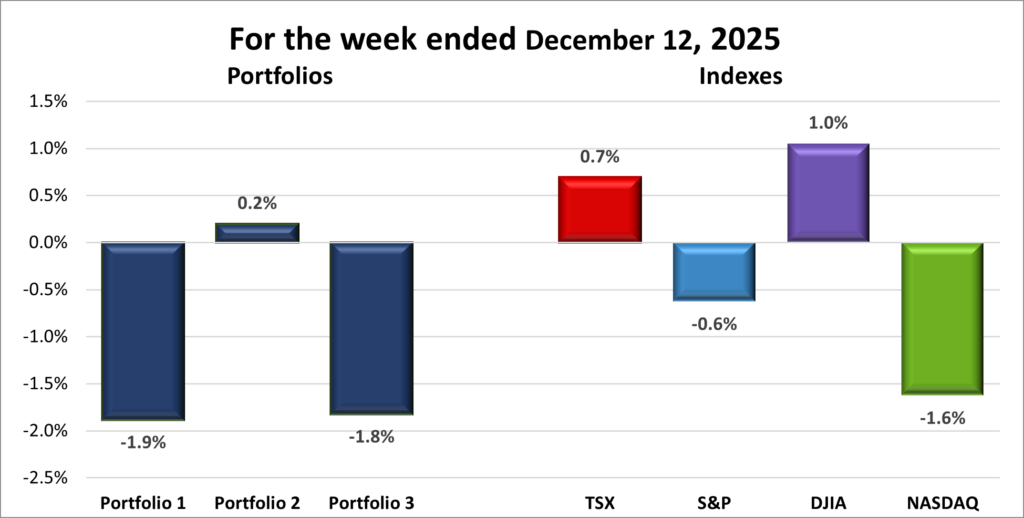
Portfolio 1 finished down 1.0%, as two weak weeks – including a 1.9% drop mid-month and a 0.9% decline in the final week – outweighed modest gains elsewhere during the month. Volatility in AI-related stocks drove most of the swings, with selloffs in some of the portfolio’s largest positions limiting upside. Still, several core holdings hit new all-time highs, and the month felt more like a period of consolidation than a breakdown.

Portfolio 2 was the star of the month, rising 2.9% with gains in each of the first four weeks before slipping slightly at the end. Strong, stock-specific wins powered the move, including a 26% surge in MongoDB and fresh highs for Aritzia (TSE: ATZ), Dollarama (TSE: DOL), and Bank of Nova Scotia (TSE: BNS). Even when fewer holdings advanced, the portfolio steadily moved higher, making December a strong finish overall.

Portfolio 3 ended slightly lower, with performance largely shaped by its two largest holdings, Nvidia (NASD: NVDA) and Shopify (TSE: SHOP), which make up over half the portfolio. Weeks when both climbed helped offset losses elsewhere, while a mid-month dip in Nvidia and Vertiv Holdings (NYSE: VRT) weighed on overall returns. Canadian banks provided occasional support, but December highlighted the portfolio’s sensitivity to key positions Nvidia and Shopify.

December ended on a mixed note for the portfolios. Portfolio 2 stole the spotlight, Portfolio 3 held its own, and Portfolio 1 felt the weight of AI volatility. The month may have been uneven, but it didn’t erase the strong gains accumulated throughout the year – leaving us investors heading into 2026 with plenty of opportunities in what’s likely to be another volatile year. 😊

Monthly Portfolio & Index performance
Chart 1: Monthly Performance

Fourth Quarter

The fourth quarter was a mixed period for my portfolios. As shown in Chart 2 below, Portfolio 2 was the only one to finish higher, posting an impressive 9.2% gain and outperforming all four major indexes. Portfolios 1 and 3 both ended the quarter lower, taking some of the momentum out of what had started as a strong stretch. Portfolio 1 declined 2.0%, while Portfolio 3 slipped 0.3%, as concerns around stretched valuations in AI-related stocks weighed on several holdings.

The broader markets moved higher at a more measured pace, with Canada once again standing out. The TSX rose 5.6% as higher gold and silver prices lifted the resource-heavy index and extended its quarterly winning streak to five straight quarters. Strength in precious metals and energy – sectors that make up a large share of the TSX – provided steady support throughout the quarter, even as lighter year-end trading volumes kept market moves in check. In the US, gains were more modest but still positive, with the S&P up 2.3%, the DJIA climbing 3.6%, and the Nasdaq adding 2.6%.

Both the S&P and the DJIA reached all-time highs late in the quarter, reflecting broad strength across large, established companies. Optimism around AI, resilient corporate earnings, and growing expectations for lower interest rates helped support markets, even as momentum slowed toward year-end.

Fourth Quarter Portfolio & Index performance
Chart 2: Quarterly Performance

Twelve Months

To wrap things up, 2025 turned out to be quite the rollercoaster ride, especially in April, when President Trump upended the global trading system and rattled markets. Even so, as you can see in Chart 3 below, all three portfolios and the major indexes still managed to post impressive gains by year-end.

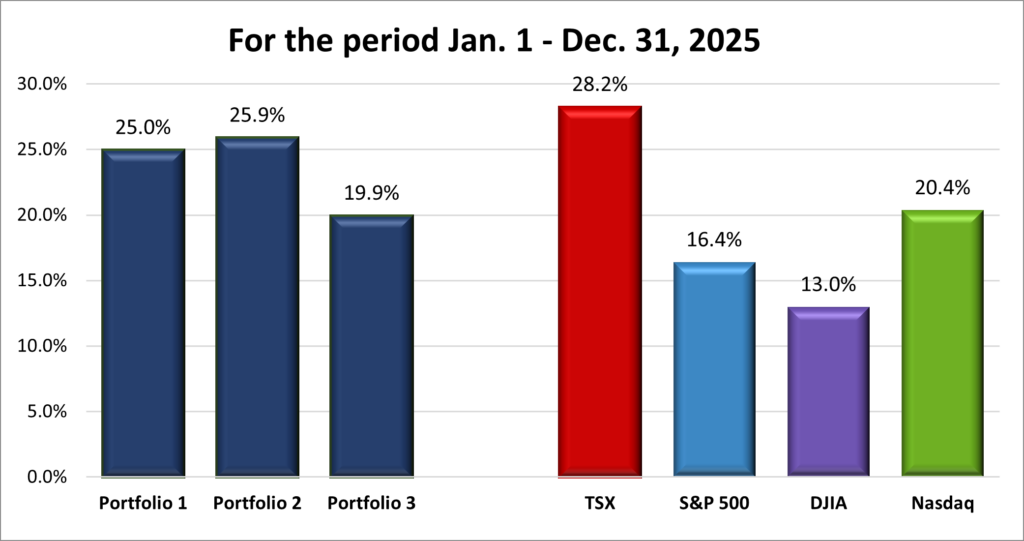
For the full year, Portfolio 1 posted an impressive 25.0% gain. However, that was eclipsed by Portfolio 2’s 25.9% increase in value. At the start of November, Portfolio 1 looked certain to retain its first place standing but two consecutive losing months saw it drop in value, while Portfolio 2 stretched its monthly winning streak to nine months, including minor gains in a tough April and November, was enough for Portfolio 2 to snatch the number 1 position this year. Portfolio 3 slipped into third, gaining 19.9% for the year after being weighed down by a weak November.

Portfolio 1 had a tough act to follow after riding the Nvidia and artificial intelligence (AI) wave to gains of 61.9% in 2024 and 32.9% in 2023. 😊 Portfolio 2 rebounded nicely after a modest 4.5% gain in 2024, though it came in just below its 28.9% return in 2023. Meanwhile, Portfolio 3 has been on a gradual downward trend over the past three years – from 33.4% in 2023, to 24.3% in 2024, and 21.5% in 2025.

Stepping back to the broader markets, the TSX clearly stole the show in 2025. The index surged 28.2%, making it the top-performing major index of the year. The Nasdaq followed with a 20.4% gain, driven by investors’ continued enthusiasm for AI-related companies – marking the third straight year the Nasdaq delivered gains over 20%. The S&P also received help from strength in technology, rising 16.4%, while the more traditional DJIA posted a still-respectable 13.0% gain.

All that said, I’m very happy with the overall results. Any portfolio growing by around 20% in a single year is doing a lot of things right. At that pace, each portfolio would more than double in value in roughly four years. If I can reverse the downward trend in Portfolio 3 in 2026 while keeping the other two above the 20% mark, I’ll be very happy, very happy indeed. 😊

Annual Portfolio & Index performance
Chart 3: Performance for the year

What My Three Portfolios Did in December

Portfolio 1 for December 2025: DOWN Red Down Arrow

Activity

No significant activity to report this month.

Dividends Received this month:

Companies followed by DRIP (Dividend Re-Investment Plan) indicate additional shares were purchased with the dividend. Any cash leftover was added to the cash balance.

Canadian $

Cameco (TSE: CCO)

BSR Real Estate Investment Trust (TSE: HOM.U)

Yellow Pages (TSE: Y)

Hammond Power Solutions (TSE: HPS.A)

Decisive Dividend Corp (TSE: DE) DRIP

Dream Industrial Real Estate Investment Trust (TSE: DIR.UN) DRIP

CN Rail (TSE: CNR)

Tourmaline Oil Corp (TSE: TOU)

US $

Visa (NYSE: V)

Interactive Brokers (NASD: IBKR)

Alphabet (NASD: GOOGL)

Home Depot (NYSE: HD)

Nvidia (NASD: NVDA)

Quarterly Reports

Bank of Nova Scotia

Fourth quarter 2025 financial results on December 2, 2025

CrowdStrike Holdings, Inc.

Third quarter 2026 financial results on December 2, 2025

TD Bank Group

Fourth quarter 2025 financial results on December 4, 2025

Costco Wholesale Corporation

First quarter 2026 financial results on December 11, 2025

Carnival Corporation & plc

Fourth quarter 2025 financial results on December 19, 2025

Portfolio 2 for December 2025: UP Green Up Arrow, signifying a positive week

Activity

No significant activity to report this month.

Dividends Received this month:

Canadian $

Fortis (TSE: FTS)

Whitecap Resources (TSE: WCP)

Alimentation Couche-Tard Inc (TSE: ATD)

SmartCentres Real Estate Investment Trust (TSE: SRU.UN) DRIP

Hammond Power Solutions (TSE: HPS.A)

Supremex (TSE: SXP)

Dream Industrial Real Estate Investment Trust (TSE: DIR.UN) DRIP

iA Financial Group (TSE: IAG)

Brookfield Infrastructure Partners LP (TSE: BIP.UN)

Brookfield Infrastructure Corp (TSE: BIPC)

Tourmaline Oil Corp (TSE: TOU)

US $

Zoetis (NYSE: ZTS)

Microsoft (NASD: MSFT)

Quarterly Reports

MongoDB, Inc.

Third quarter 2025 financial results on December 1, 2025

Bank of Nova Scotia

See report under Portfolio 1.

Mitek Systems, Inc.

Fourth quarter 2025 financial results on December 11, 2025

Dollarama Inc.

Third quarter 2026 financial results on December 11, 2025

Birkenstock Holding plc

Fourth quarter 2025 financial results on December 18, 2025

Portfolio 3 for December 2025: UP Green Up Arrow, signifying a positive week

Activity

Bought: Rockpoint Storage Systems Inc. (TSE: RGSI) see January 9, 2026 update.

Dividends Received this month:

Canadian $

SmartCentres Real Estate Investment Trust (TSE: SRU.UN) DRIP

Brookfield Corporation (TSE: BN)

Brookfield Renewables Corp (TSE: BEPC)

Brookfield Wealth Solutions Ltd (TSE: BNT)

Canada Packers (TSE: CPKR)

US $

Microsoft (NASD: MSFT)

Vertiv Holdings (NYSE: VRT)

Nvidia Corporation (NASD: NVDA)

Quarterly Reports

Royal Bank of Canada

Fourth quarter 2025 financial results on December 3, 2025

TD Bank Group

See report under Portfolio 1.


Weekly Update for the week ending December 19, 2025

An image of a bull wearing a Santa's cap and scarf in a forest while its snowing. Stay bullish during the holidays.
Stay bullish during the holidays.

This marks the final Weekly Update of 2025 – and somehow, another year has flown by while markets did what they do best: surprise, frustrate, and occasionally reward us patient investors. 😊 I’ll be taking a short break over the holidays, but the Weekly Update will be back in early January to kick off 2026.

Stay bullish during the holidays.

A sincere thank you for following along throughout the year and sticking with me through the twists and turns markets threw our way. Here’s hoping the momentum we’ve seen over the last few years carries into the new year, and that the seeds long-term investors are planting grow into majestic oak trees – preferably a bit faster than nature intended! 😊 In the meantime, enjoy the holiday season as 2025 wraps up, and may 2026 bring good health, happiness, and plenty of reasons to feel optimistic.

With Christmas just around the corner, markets gave us one final hectic week full of economic data before year-end. But before diving into the numbers, let’s pause for a little holiday spirit and peek at the markets through the lens of A Christmas Carol.

Picture Ebenezer Scrooge fretting over every market dip – a scene many investors will recognize. He’s checking his portfolio more than he checks his holiday lights and sighing louder than anyone untangling Christmas lights ever could. Then in stroll the three ghosts:

  • The Ghost of Markets Past reminds us of the surprises that shaped the year. Remember Liberation Day sending markets into a tailspin? That rough patch quickly turned into a rally that carried much of 2025.
  • The Ghost of Markets Present highlights the opportunities quietly compounding today – Canadian banks generating solid returns, technology giants continuing to climb higher, and sectors like Financials and Basic Materials (gold, copper, and more) quietly adding gains even if headlines overlooked them. Think of it as gifts quietly piling up under the tree while everyone else is distracted by the tinsel.
  • The Ghost of Markets Yet to Come teases the potential of 2026: long-term investors staying the course, disciplined strategies paying off, and letting the snowball effect of compounding work its magic. The moral? Patience may not be flashy, but it’s usually the best present of all.

Even in a year full of twists, a little perspective – and a dose of holiday cheer – goes a long way. So, grab your cocoa, relax, and let’s take a look at what happened this past week….


Items that may only interest or educate me ….

Canadian Economic news, US Economic news, ….

Canadian Economic news

This past week’s key economic data that the Bank of Canada (BoC) considers when deciding whether to raise or lower the interest rate.

Consumer Price Index (CPI)

Canada’s headline inflation for November 2025 came in at 2.2% year-over-year, unchanged from October and slightly below expectations of around 2.3%. Inflation continues to sit comfortably within the Bank of Canada’s 1%–3% target range. On a monthly basis, CPI rose 0.1%, easing from October’s 0.2% increase and reinforcing the idea that price pressures are cooling rather than re-accelerating.

Looking under the hood, food prices were the biggest annual driver, rising 4.2% year-over-year, while gasoline was the only major category to post lower prices, down 7.8% from last year. Month-to-month, gasoline prices jumped 1.8%, while costs tied to recreation, education, and reading fell 2.0%, helping keep overall inflation in check.

Core inflation, which strips out the more volatile food and energy components, continued to move in the right direction. Core CPI slowed to 2.4% year-over-year, down from 2.7% in October, while monthly core inflation fell 0.4%, reversing much of the prior month’s increase.

With headline inflation steady, food prices still running hot, and core inflation easing, the latest data supports the BoC’s decision to pause rates at 2.25%. Barring a meaningful re-acceleration in labour markets or economic growth, this report points toward rates remaining on hold into early 2026.

Retail Sales

Statistics Canada’s October Retail Sales report showed consumer spending continuing to cool, with sales slipping 0.2% after a 0.7% decline in September. The result came in weaker than economists expected and marked the second straight monthly pullback. On a year-over-year basis, sales were still up 2.0%, but that pace has slowed meaningfully from the 3.4% growth seen in September. Once price changes are stripped out, the picture looks even softer, with real (volume) retail sales falling 0.6%.

At the category level, food and beverage retailers led the decline, with sales dropping 2.0% month over month. That weakness was partially offset by strength elsewhere, as furniture, home furnishings, electronics, and appliance retailers saw sales rise 1.1%. Looking over the past year, the strongest gains continue to come from clothing, accessories, shoes, jewelry, luggage, and leather goods retailers, where sales climbed 8.9%, while food and beverage sales were essentially flat compared with a year ago.

Core retail sales, which exclude volatile categories like gasoline and motor vehicles, fell 0.5% in October after being flat in September. On a year-over-year basis, core sales are still up a healthy 3.4%, though that too is a slowdown from the 4.1% pace recorded in September.

This latest data suggests Canada’s holiday shopping season got off to a sluggish start, with consumers clearly more cautious in October. While early indications point to a rebound in November, the broader trend lines up with what we’ve been seeing elsewhere: households are spending more selectively as higher prices, a softening labour market, and economic uncertainty continue to weigh on confidence.

Canadian Market Volatility

Canada’s VIXC, essentially the TSX’s own “fear gauge”, started the week at 11.67 and spent most of the time trading in a calm 11–13 range. The exception came mid-week, when the index briefly jumped to near 15 before quickly retreating below 13 the following day and finishing the week at 12.26. That short-lived spike had more to do with US-driven uncertainty spilling into Canadian markets than anything uniquely domestic. Investors were hedging ahead of key US inflation data, and once those numbers came in better than expected, the uncertainty faded just as quickly.

Think of the VIXC as Canada’s market mood ring: readings in the low teens suggest a steady, watchful tone rather than outright anxiety. Investors are keeping an eye on the road ahead, but there’s no panic in the cabin.

US Economic news

This past week’s key data points that the Federal Reserve (Fed) considers when deciding whether to raise or lower the interest rate.

Labour data

The recent US government shutdown put several key economic reports on pause, leaving both the Fed and investors a little in the dark on the health of the labour market. This week, that gap was finally filled with the release of October’s Employment Situation Summary (ESS). Looking ahead, January should bring a return to the usual timing schedule, with the ESS, Job Openings and Labor Turnover Survey, and ADP Employment Report all arriving in the first week of the month – back to the predictable schedule everyone relies on.

Employment Situation Summary (ESS)

After a 43-day government shutdown delayed the data, the Bureau of Labor Statistics (BLS) finally released a combined look at October and November employment. The numbers show a labour market that’s clearly losing momentum. October payrolls fell by roughly 105,000 jobs, largely driven by cuts to federal government positions, while November delivered a modest rebound with about 64,000 jobs added, slightly better than expectations of 50,000. Even with that bounce, job growth has slowed meaningfully compared with recent trends. For context, September – the last report published before the shutdown – showed job gains of 108,000.

The unemployment rate also moved higher than expected, rising to 4.6% from 4.4% in September. Economists had expected the rate to hold steady, making this the highest unemployment reading since September 2021. The increase reflects a combination of softer hiring and the outsized impact of government workforce reductions, reinforcing the picture of a cooling labour market.

Wage growth continued to ease as well. Average hourly earnings rose just 0.1% month-over-month, down from 0.2% previously, while the annual pace slowed to around 3.5% from 3.8%. That marks the slowest year-over-year wage growth in a couple of years and suggests inflation pressures tied to labour costs are gradually easing.

This report is unusual because it blends two months of data after the shutdown disrupted normal surveys, adding some noise to the numbers. Still, the broader message is consistent: hiring is slowing, unemployment is drifting higher, and wage growth is cooling. Those are exactly the kinds of shifts the Fed watches as it assesses the overall direction of the economy and weighs the path forward for interest rates.

Retail Sales

The Commerce Department’s October retail sales report showed US consumer spending losing momentum. Headline sales, which include all categories, from autos and gasoline to food and clothing, were flat month-over-month after seasonal adjustment, falling short of expectations for a 0.3% increase and marking a clear slowdown from September’s modest 0.1% gain. While retail sales were still up 3.5% from a year ago, the pace has cooled compared with earlier in 2025, reinforcing signs that the burst of summer spending is fading.

Beneath the surface, the picture was mixed. Furniture and home furnishings stores posted a solid 2.3% monthly increase, while motor vehicle and parts dealers saw sales fall 1.6%, weighing on the overall result. Over the past year, spending at miscellaneous retailers jumped 9.5%, but sales at building materials and garden supply stores declined 4.5%, reflecting pockets of both strength and weakness across categories.

Core retail sales, which exclude autos, parts, and gasoline, rose a healthy 0.5% in October, even as the year-over-year pace edged down slightly from 4.4% to 4.2%. That suggests consumers are still spending, but doing so more selectively rather than broadly.

Retail sales are still one of the clearest monthly gauges of consumer health, and with consumer spending accounting for the lion’s share of US economic activity, a flat headline number matters. It points to households becoming more cautious amid higher interest rates and economic uncertainty. Still, the resilience in core categories shows spending hasn’t fallen off a cliff – it’s simply cooling. Paired with recent data showing slower job growth and a rising unemployment rate, this report adds to the growing narrative of an economy gradually losing steam, something the Fed will be watching closely.

Consumer Price Index (CPI)

This week’s CPI report from the BLS delivered more encouraging news on inflation, though with a small asterisk. Headline inflation, which measures the overall change in prices consumers pay, rose about 2.7% year over year in November, down from roughly 3.0% in September and below expectations for a similar 3.0% reading. On a monthly basis, prices rose 0.2% over the two months from October to November 2025, also coming in below forecasts of a 0.3% increase.

Under the surface, price trends were mixed but generally supportive of cooling inflation. Fuel oil prices jumped 11.3% over the past year, while clothing prices rose just 0.2%. Shelter costs, which include rent, mortgages, and homeowner expenses, continued to slow, increasing 0.2% in November, while the annual pace eased from 3.6% in September to 3.0%. Given shelter’s heavy weight in CPI, that deceleration matters.

Core inflation, which strips out the more volatile food and energy categories, also continued to cool. Core CPI rose around 2.6% year over year, while the monthly pace slowed to 0.2% over the October–November period, both slightly below expectations of 3.0% and 0.3%, respectively.

Taken together, the data suggest price pressures across the economy are gradually easing. That said, this report follows the recent government shutdown, which disrupted normal data collection and forced the BLS to rely on alternative sources, adding some noise to the numbers. Even so, the broader trend still points in the right direction – something the Fed will be watching closely as it weighs the timing and pace of future interest rate moves.

Consumer Sentiment Index (CSI)

The University of Michigan’s final CSI for December inched higher to 52.9, up from 51.0 in November, but slightly below the preliminary December reading of 53.3 and expectations for 53.5. Even with that improvement, sentiment remains deeply depressed, sitting about 28.5% below its level a year ago, when the index stood at 74.0.

Looking under the hood, the Current Economic Conditions index, which reflects how consumers feel about their jobs, income, and day-to-day finances, slipped to 50.4 from 51.1 in November and remains roughly 33% lower than a year ago. In contrast, the Expectations Index, which captures how consumers view the next six months, edged up to 54.6. That marked a 7.1% improvement from November, though it’s still about 25.5% below last December’s level. In short, consumers are feeling slightly better about the future, even as their assessment of current conditions has weakened.

Heading into the Christmas holidays, consumers appear slightly less pessimistic than last month, but overall confidence is still subdued and near historically low levels. That lines up with other recent data showing that while spending hasn’t collapsed, sentiment has stayed weak amid lingering inflation concerns, a softening labour market, and broader economic uncertainty.

American Market Volatility

The CBOE Volatility Index (VIX), often called the market’s “fear gauge”, had a relatively calm week. It opened at 15.52 and spent most of the time drifting in a narrow 16–17 range. The employment data barely moved the needle, though volatility briefly spiked toward 18 in the lead-up to the inflation release. When inflation came in better than expected, the VIX dipped below 16 before climbing back toward 17 as markets braced for the PCE inflation report. That report also landed on the softer side, fueling hopes for one or two rate cuts in 2026 and helping push the VIX down to 14.91 by week’s end.

Think of the VIX as the market’s pulse. A few weeks ago, it was racing, signalling elevated nerves. This week, it settled into a steadier, healthier rhythm. Investors aren’t completely carefree, but they’re clearly breathing a bit easier as inflation cools and borrowing costs begin to edge lower.


Weekly Market and Portfolio Review

For the week, the TSX (SPTSX) gained 0.7%, the S&P 500 (SPX) increased 0.1%, the DJIA (INDU) dropped 0.7% and the Nasdaq (CCMP) added 0.5%.

Index Weekly Streak
TSX: 2 – week winning streak
S&P: 1 – week winning streak
DJIA: 1 – week losing streak
Nasdaq: 1 – week winning streak

Bull market. A good week for the North American stock markets. Once again, markets stumbled out of the gate, and this time the weakness lingered for much of the week. The Toronto Stock Exchange Composite Index (TSX), the S&P 500 Index (S&P), the Dow Jones Industrial Average (DJIA), and the Nasdaq Composite Index (Nasdaq) all spent several sessions in the red. The Nasdaq snapped a three-day losing streak on Tuesday, while the other indexes had to wait until Thursday to break four-day skids. A late-week rally made all the difference. By Friday’s close, the TSX, S&P, and Nasdaq had posted modest weekly gains, while the DJIA finished just shy of breakeven.

Markets reacted to a mix of economic data and renewed uncertainty around artificial intelligence (AI) spending. Early in the week, investors worried that AI stocks had run too far, too fast, and questioned whether companies investing billions in AI infrastructure would see significant returns. Companies borrowing heavily to fund AI expansion came under close scrutiny, as investors feared high debt levels could magnify losses if projects fail, hitting the most leveraged firms hardest.

Sentiment improved midweek after Micron Technology (NASD: MU) reported strong earnings and an upbeat outlook, citing rising demand from a global memory chip shortage affecting everything from smartphones to data centres. AI-linked stocks steadied further when reports surfaced that the US administration is reviewing potential sales of Nvidia’s (NASD: NVDA) H200 chips to China, clearing the way for increased sales to Nvidia’s second biggest market.

On the economic front, November’s Employment Situation Summary offered little clarity on interest rates. Job growth remained positive, but unemployment ticked higher, reaching its highest level since 2021. The Fed continues to weigh a cooling labour market against inflation that has eased but not fully disappeared.

Retail sales added more context. Headline sales were flat in October, showing a cautious consumer, while core sales held up better, indicating households are spending selectively. This fits with higher interest rates starting to bite, slowing job growth, and gradually easing inflation pressures.

The CPI report tied everything together. Inflation continues to cool, both at the headline and core level, with shelter costs moderating. Slower wage growth and a softer job market are reducing one of inflation’s key drivers, suggesting policy is having its intended effect.

Taken together, the employment, retail sales, and inflation data tell a consistent story. The economy is losing momentum but not stalling. Consumers and businesses are more cautious, inflation pressures are easing, and growth is slowing in a controlled way. For the Fed, this combination supports the idea that monetary policy is working without tipping the economy into a sharp downturn.

In Canada, the TSX started the week slowly but recovered by Friday. Early weakness mirrored US indexes as investors digested American economic data and interest rate uncertainty, AI concerns, and falling oil prices. By the end of the week, easing US inflation data, a stronger-than-expected Canadian economy, and rising commodity prices helped lift the TSX into positive territory and finish the week on a positive note.

While uncertainty around AI spending and global developments remains, markets have shown resilience, suggesting investors are cautiously optimistic that growth can continue without major disruptions. The rosier inflation picture, combined with a softening labour market, has reignited hopes that the Fed will continue its recent string of rate cuts, fueling the late-month rally, hinting at a last-minute Santa Claus rally. As 2025 winds down, investors fine-tuning their portfolios before year-end are likely to keep markets busy, but the broader trend still points to a steady, if measured, start to 2026.

Portfolio Weekly Streak
Portfolio 1: 1 – week winning streak
Portfolio 2: 4 – week winning streak
Portfolio 3: 1 – week winning streak

Bull market. A good week for the North American stock markets. It was looking like I was going to head into the Christmas break with all three portfolios riding losing streaks. Early in the week, a pullback in AI-related stocks weighed on all three portfolios, while falling oil prices added extra pressure on Portfolio 2. As the week went on, though, hopes of lower interest rates started dancing in investors’ heads, helping markets rebound and claw back much of the early damage. I was more than happy to see that rising tide lift all three portfolios from underwater to solidly back in the green.

Portfolio 1 was deep in the red heading into Friday, but the late rally in AI stocks catapulted it into positive territory, finishing the week up 0.2%. Despite the modest gain, it posted the lowest share of weekly winners, with just 42% of holdings ending in the green. The early-week AI selloff did most of the damage, though a rebound in AI names, including a weekly gain from Nvidia, the portfolio’s largest holding, helped turn things around. Highlights were few, but TD Bank (TSE: TD) reached an all-time high, and Carnival Corp. (NYSE: CCL) cruised to 10% gain following a strong quarterly earnings report.

Portfolio 2 lagged the other two but still managed to post a 0.1% gain, with 44% of holdings finishing higher on the week. There were no standout winners or painful laggards, but sometimes a quiet, uneventful week is a win in itself. Maybe that’s the highlight. 😊

Portfolio 3 was the pleasant surprise. Given the early AI weakness, I was expecting results closer to Portfolio 1, but it finished the week up an impressive 2.0%. Half of the holdings ended higher, and more importantly, the two largest positions, Nvidia and Shopify (TSE: SHOP), both finished in the green. As those two go, so goes the portfolio. 😊 Adding to the good news, TD Bank and Royal Bank (TSE: RY) both reached new all-time highs.

All told, it turned out to be a much better week than it looked early on. It hasn’t been a great month, but the late-week rebound and shift in tone, especially around AI companies, was a welcome change. With inflation cooling, rate-cut hopes back on the table, and several core holdings advancing, the stage is at least set for a little holiday cheer. If this turns out to be the start of a late Santa Claus rally, I’ll happily take it – better late than never. 😊

Weekly Portfolio & Index performance
Weekly Portfolio & Index performance for the week ended December 19, 2025.

Companies on the Radar

Stocks on my Radar This week, two very different companies came across my radar. One is an innovation-driven business offering exposure to the commercial space economy – Rocket Lab (NASD: RKLB). The other is largely unknown and often overlooked yet plays a critical role in North America’s energy supply chain – Rockpoint Gas Storage (TSE: RGSI).

Let’s start with Rocket Lab, an aerospace company focused on space launch services and space systems. At its core, it launches rockets that carry small satellites into orbit and builds space hardware such as spacecraft platforms and mission management solutions. The company was founded in 2006 by Peter Beck, a New Zealand engineer who remains CEO today, and went public via a SPAC merger in August 2021. Under Beck’s leadership, Rocket Lab has steadily evolved from a pure small rocket launch provider into a more integrated, end-to-end space solutions company.

On the other end of the spectrum is Rockpoint Gas Storage, a natural gas infrastructure company and the largest independent pure-play operator focused solely on gas storage in North America. It owns and operates six strategically located underground storage facilities across Alberta and California. These assets help balance seasonal and short-term swings in natural gas supply and demand by storing gas when supply is abundant and releasing it when demand rises.

While Rockpoint’s operations trace back more than 35 years, the company only became publicly listed on October 15, 2025. Its IPO was the largest in Canada since mid-2022, and Brookfield Infrastructure remains the majority owner, retaining control of the core assets. Unlike commodity producers, Rockpoint’s business is built around infrastructure services backed by long-term, contracted revenue, offering a higher degree of stability and predictability.

These two companies are about as opposite in style as you can find. Rocket Lab is a growth-oriented investment, offering exposure to the commercial space economy, with the key challenge being the trade-off between meaningful near-term losses – the company is still well in the red – and long-term expansion potential. Rockpoint, by contrast, is an infrastructure business with stable, long-term cash flows and exposure to critical energy markets, with storage services backed by contracted revenue that provide a level of predictability commodity producers typically lack.

With the addition of these two very different opportunities, my radar list now sits at seven companies.

  1. GE Aerospace (NYSE: GE): This is the large American aviation and defence business that remained after General Electric split into three separate companies in 2024. It has been on a strong run thanks to high demand for commercial jet engines as global air travel continues to recover. The company focuses on aircraft propulsion systems and services for both commercial and military customers, and it’s also moving into drones. As a global leader in jet engines and aircraft systems, GE Aerospace offers exposure to long-term trends in travel, defence spending, and emerging aviation technology.
  2. Mainstreet Equity Corp. (TSE: MEQ): A Calgary-based real estate company focused on mid-market apartment buildings across Western Canada. Their business model is straightforward: buy underperforming buildings, renovate them, improve operations, and increase rental income. With strong demand for rentals, a disciplined approach, and shares that trade below the estimated value of the properties, Mainstreet offers a combination of income, stability, and long-term upside.
  3. Napco Security Technologies, Inc. (NASD: NSSC): A small US company that provides security hardware and systems like smart locks, intrusion alarms, fire alarms, and access control solutions. It sells through a network of distributors and installers, and has been increasing its recurring service revenue – something investors usually like to see. As demand for security and smart home products grows, Napco has multiple avenues for expansion.
  4. Dutch Bros Inc. (NYSE: BROS): A rapidly expanding drive-thru coffee chain in the US, known for its energetic customer service and customizable drinks. The company is aiming to open at least 160 new locations by the end of 2025 and has long-term goals of surpassing 2,000 stores. Strong brand loyalty, especially in the Western US, makes this an interesting high-growth story – though still in an aggressive build-out phase.
  5. XPEL, Inc. (NASD: XPEL): A growing, founder-led maker of protective films, coatings, and related products – best known for automotive paint protection film. XPEL has been expanding into window films and architectural applications, and sells through multiple channels, giving it both reach and control. It’s a company with a focused niche and strong brand recognition in that niche.

As always, these are not buy recommendations. Make sure to do your own research and choose investments that fit your personal financial goals.

The Radar Check was last updated December 19, 2025.

Stock on the Radar List. 1 of 2.
Stock on the Radar List. 2 of 2.

Note: Rockpoint only became publicly traded recently, so there isn’t enough historical data yet for the Long-Term Growth Estimate and LSEG Fundamentals columns shown below.

That’s a wrap for this week – and for 2025. Thanks for reading! May Santa bring you a great stock idea in the new year, and as always, may your portfolio stay green and your dividends steady. See you next year! 🎄

Weekly Update for the week ending December 12, 2025

From Wild West to Launchpad: The Story of the TSXV

A few weeks ago, I took a look at the history of Canada’s premier stock market – the Toronto Stock Exchange (TSX). Also known as the big board, it’s the top rung on the TSX ladder. I also mentioned its junior counterpart, the TSX Venture Exchange (TSXV). This week, I thought I’d follow up with a closer look at this often overlooked but essential part of Canada’s market ecosystem. So, without further ado, in the words of Daenerys Stormborn – “Let’s begin.”

TSX Venture Exchange (TSXV)

The story of the TSX Venture Exchange actually starts long before its 2001 launch. For decades, the Vancouver Stock Exchange (VSE) was the beating heart of Canada’s junior markets – a place where early-stage mining, exploration, and resource companies tried to raise their first rounds of public capital. Through the boom-and-bust decades of the 70s, 80s, and especially the 90s, the VSE built a reputation for fast-moving, high-risk speculation. At its best, it helped launch companies that later became major players. At its worst, it was known for volatility, lightly capitalised issuers, and the occasional scandal – all of which gradually eroded investor confidence, earning it the moniker ‘the Wild West,’ where anything could happen.

By the late 1990s, Canada’s capital markets were split across four regional exchanges – Toronto, Montreal, Vancouver, and Alberta – each running independently. With electronic trading becoming standard and markets becoming more global, that patchwork system started to feel dated. Regulators and the exchanges agreed a more modern structure was needed.

In 1999, a national restructuring plan was announced: Toronto would take over senior equities, Montreal would handle derivatives, and the Vancouver and Alberta exchanges would merge to form a unified, modern home for early-stage companies. That new exchange officially debuted in 2001 as the TSX Venture Exchange (TSXV).

The TSXV inherited the entrepreneurial spirit of the VSE but paired it with stronger governance, national oversight, and clearer listing rules. Its purpose was straightforward: provide a home for Canada’s small-cap and micro-cap companies – especially those in mining, energy, technology, and emerging sectors – while giving them a clear pathway to “graduate” to the main TSX once they demonstrated financial strength, liquidity, and stability.

In other words, the TSXV took the adventurous DNA of the old Vancouver market and blended it with the credibility and structure of the modern TMX Group (owners of the TSX) ecosystem. Today, it remains one of the most active junior markets in the world and an essential starting point for companies aiming to grow into future leaders on the big board. Kraken Robotics (TSXV: PNG), which ranked #1 on the TSXV’s 2025 Venture 50 list, is a great example of the type of early-stage firm that often eyes that next step.

Together, the TSX and TSXV form a pretty unique ecosystem: a place where brand-new, high-potential companies can get their start, and where the most successful eventually grow into some of Canada’s biggest names. It’s a ladder that supports every stage of the journey — from the first raise to the big board. For investors, it offers both ends of that spectrum — speculative early-stage opportunities on one side and mature, stable companies on the other.

So, as you follow the markets each week, it’s worth remembering that Canada’s investing landscape isn’t just about the giant blue-chips on the TSX. The TSXV is where a lot of those stories actually begin – long before they hit the headlines. After all, today’s small-cap company (a smaller, early-stage firm with a market value under about $2 billion) could be tomorrow’s market heavyweight (one of the big, established leaders on the TSX, often valued in the tens of billions), and becoming an early owner of one of those future leaders is one of the most exciting parts of investing. With that quick tour of how Canada’s junior market went from the Wild West to a proper launchpad, let’s shift back to what’s been happening in the markets this past week.


Items that may only interest or educate me ….

Walmart Reveals Its Inner Tech, Canadian Economic News, US Economic News, ….

Walmart Reveals Its Inner Tech

As of Tuesday, Walmart (NASD: WMT) no longer trades on the New York Stock Exchange (NYSE) – but don’t worry, it didn’t go private or pull any dramatic stunts. Instead, it’s now officially a Nasdaq-listed company, marking a symbolic shift in how it wants the world to see it. After more than half a century on the NYSE, Walmart says the move better matches what it’s becoming: a “people-led, technology -powered omnichannel retailer,” as CEO Doug McMillon puts it.

The switch isn’t just a change of scenery. It’s Walmart raising its hand and saying, “We don’t want to be seen as old-school retail anymore.” Nasdaq is home to the world’s biggest technology and growth names – Apple (NASD: AAPL), Microsoft (NASD: MSFT), Amazon (NASD: AMZN), Nvidia (NASD: NVDA) – and by joining them, Walmart is signaling that its future is tied to technology and innovation just as much as store aisles and rollback stickers. With major investments in automation, artificial intelligence (AI) tools, logistics technology, e-commerce, and its fast-growing advertising business, Walmart is clearly angling for a perception shift toward higher-growth territory.

For investors, the move is really about reframing the story. The day-to-day business didn’t suddenly change, but the narrative around the stock might. Trading alongside technology leaders puts Walmart in a brighter, more growth-focused spotlight, which helps underline the direction the company is already heading. It’s also a practical move: some index funds and ETFs only hold Nasdaq-listed companies, so the switch naturally broadens the pool of potential investors. More visibility can translate into more demand over time.

At the end of the day, the fundamentals still matter most – revenue, margins, execution – but this exchange change reinforces Walmart’s long-term transition into a technology enabled retail powerhouse. It’s a small tweak with the potential for a big perception lift as the company keeps pushing further into digital growth.

Canadian Economic News

This past week’s key economic data that the Bank of Canada (BoC) considers when deciding whether to raise or lower the interest rate.

Bank of Canada Rate Decision

As expected, the BoC held its benchmark interest rate at 2.25%, marking its first pause after two straight cuts. The Bank didn’t commit to more easing, but it kept the option open depending on how the economy plays out.

The decision to stay put comes down to one thing: the Canadian economy has been handling global uncertainty better than many expected. Even with the drag from US tariffs, recent data showed stronger-than-expected Gross Domestic Product (GDP) growth in the third quarter and steady job gains, suggesting the slowdown isn’t as heavy as feared. Still, the Bank sees the economy as being in a slump overall. Officials noted that the third quarter bump “largely reflected volatility in trade” as Canada adjusts to the new global backdrop shaped by President Trump’s trade policy. They also expect fourth-quarter GDP to come in weak, with net exports likely to decline because of tariff fees. Inflation is edging closer to the Bank’s target, even though some underlying pressures are still sticking around. Taken together, BoC officials feel the current rate is “about the right level” to keep inflation moving in the right direction while giving the economy enough support heading into 2026.

For now, holding steady brings a bit of stability – borrowing costs should stay roughly where they are, giving households and businesses a clearer path to plan ahead. But with global risks still swirling and economic signals mixed, all eyes will be on the BoC’s next decision on January 28, 2026, and on how inflation, jobs, and trade develop in the months ahead.

Canadian Market Volatility

Canada’s VIXC – basically the TSX’s own “fear gauge” – started the week at 12.15 and stayed pretty much in a tight band between 12.5 and 13 heading into the BoC and the Fed’s rate decisions. The reaction to the Canadian central bank’s decision was largely anticlimactic and barely moved the fear gauge’s needle. However, following the Fed’s announcement the needle dropped as low as 11.57 from 12.9. Once the decision passed, the fear gauge returned to the 12.5 range before drifting lower to end the week at 11.75.

Think of the VIXC as Canada’s market mood ring: the low teens mean things are steady and watchful, not tense – investors are keeping an eye on the road, but there’s no panic in the cabin.

US Economic News

This past week’s key data points that the Federal Reserve (Fed) considers when deciding whether to raise or lower the interest rate.

Federal Reserve Rate Decision

The Fed wrapped up its last meeting of the year with a move most people saw coming: another 0.25% rate cut. That brings the US benchmark rate down to 3.5%–3.75%, marking the third cut in a row. The vote wasn’t unanimous, though – it came in at 9–3, the most disagreement the Fed has seen in years. Two officials wanted to keep rates where they were, and President Trump’s newly appointed member pushed for a much larger 0.5% cut. With this move, the Fed has now lowered rates by 1.75 percentage points over the past 15 months.

During his press conference, Fed Chair Jerome Powell explained the reasoning behind the move. The economy is still growing, but at a slower, steadier pace. Hiring has cooled, unemployment has edged a bit higher, and inflation is still above where the Fed wants it. With those factors in mind, policymakers feel the job market is becoming more vulnerable, and this rate cut is meant to give the economy a bit of support and help prevent a deeper slowdown in hiring.

Powell’s term ends in May 2026, which means he has only three more rate decisions left. With that in mind, this cut could very well be the final one he oversees, depending on how the economy evolves in the months ahead.

For consumers, lower rates basically mean borrowing becomes a bit cheaper. Things like mortgages, car loans, and business loans could see slightly lower costs, which can help support spending and hiring. But because inflation is still a concern, the Fed doesn’t expect to keep cutting at the same pace. Officials signalled they expect only one cut in 2026, and Powell repeated that future moves will depend on what happens with inflation, the job market, and overall economic momentum.

Labour data

The recent US government shutdown has thrown a wrench into the usual flow of labour data, delaying several key reports the Fed and investors typically lean on. This week we finally got the October Job Openings and Labor Turnover Survey (JOLTS) report, with the Employment Situation Summary (ESS) set to follow next week. Things should settle down in January, when the release schedule returns to normal and we get JOLTS, the ESS, and the ADP Employment Report all in the first week of the month like usual.

Job Openings and Labor Turnover Survey (JOLTS)

The Bureau of Labor Statistics (BLS) finally released the delayed October JOLTS report, showing 7.670 million job openings – just barely above September’s 7.658 million. Because of the recent government shutdown, BLS cancelled the September report and folded that data into the October release, so this update is doing double duty.

At first glance, the headline number looks steady enough, but the details tell a softer story. The quits rate – basically how confident workers feel about leaving a job for something better – slipped to 1.8%, the lowest (outside the pandemic) since 2014. Layoffs also ticked higher, hinting that employers are becoming more cautious and more willing to trim staff than take on new hires.

So, while the openings number looks fine, the underlying trends suggest a labour market that’s losing some momentum. A cooling job market can mean weaker consumer spending ahead, which puts pressure on profits, especially for companies tied to retail, services, and other interest-rate-sensitive areas. With inflation still hanging around and job growth showing cracks, reports like this add fuel to the fire that the Fed will lower rates at this week’s meeting.

American Market Volatility

The CBOE Volatility Index (VIX) – the market’s “fear gauge” – had a pretty relaxed week. It opened at 16.15 and inched up toward 17.5 as traders braced for the Fed’s rate decision. But the moment the cut was announced, the VIX let out a sigh of relief, slipping back under 16 and finishing the week at 15.74.

Think of the VIX as the market’s pulse. A few weeks ago it was racing, signalling nerves, but this week it settled into a steady, healthy rhythm. Investors aren’t totally carefree, but they’re definitely breathing easier as borrowing costs edge lower.


Weekly Market and Portfolio Review

For the week, the TSX (SPTSX) gained 0.7%, the S&P 500 (SPX) slipped 0.6%, the DJIA (INDU) climbed 1.0% and the Nasdaq (CCMP) declined 1.6%.

 
Index Weekly Streak
TSX: 1 – week winning streak
S&P: 1 – week losing streak
DJIA: 3 – week winning streak
Nasdaq: 1 – week losing streak

Bull market. A good week for the North American stock markets.Bearish market Once again, the week opened on a soft note, leaving the four indexes – the Toronto Stock Exchange Composite Index (TSX), the S&P 500 Index (S&P), the Dow Jones Industrial Average (DJIA), and the Nasdaq Composite Index (Nasdaq) – each starting out in a small hole. From there, the indexes steadily climbed their way back as the days went on. The rebound was strong enough to push the TSX, S&P, and DJIA to fresh record highs midweek, but some late week selling trimmed those gains. By Friday’s close, only the TSX and the DJIA managed to hang on to gains, while the S&P and Nasdaq slipped back into the red.

With earnings season essentially wrapped up, central banks took centre stage. The BoC’s decision to hold rates was important to Canadians, but all eyes were on the Fed’s final rate decision of 2025. Slower job growth ultimately overshadowed stubborn inflation, and the Fed lowered its benchmark rate to 3.75%. Many analysts now see one, maybe two, cuts in 2026. One isn’t ideal, but it’s better than none, and the overall tone was positive enough to lift market sentiment.

After the announcement, Fed Chair Jerome Powell said the reduction leaves policy “well positioned” and back in a neutral zone, meaning interest rates aren’t holding the economy back the way they were before. He emphasized that the Fed wants to give these cuts time to work through the economy before making any further moves.

In Washington, President Trump said he’s leaning toward either National Economic Council Director Kevin Hassett or Fed Governor Kevin Warsh as the next Fed chair once Powell’s term ends in May. Both are generally viewed as more open to rate cuts than Powell, and Trump has been clear he wants a chair more aligned with his push for looser policy. No decision has been made yet, but markets are already watching closely since the next chair will help shape the policy outlook for years.

Late in the week, the technology sector ran into fresh wobbles. Oracle (NASD: ORCL) missed earnings expectations and announced plans to pour an additional US$15 billion into new datacentres. Broadcom (NASD: AVGO) then added pressure by warning that its margins could shrink going forward. Together, these updates revived concerns about an AI bubble and whether the massive investment pouring into the sector will pay off quickly enough to justify today’s lofty price tags. The sharp pullback in Oracle and Broadcom spilled over into the rest of the AI-related names, weighing on the Nasdaq and, to a lesser extent, the S&P.

In Canada, the TSX dipped early in the week as investors took profits and waited for the BoC and Fed decisions. Once the BoC held rates at 2.25% and pointed to the economy’s better-than-expected resilience, and the Fed followed with its cut, confidence returned. Strong trade data and rising gold and silver prices gave the TSX an extra lift, helping it outperform its American counterparts by the week’s end.

All told, it was a week shaped by central-bank decisions, supported by commodities, and briefly unsettled by another round of AI spending worries. The selling pressure was largely confined to the technology sector, rather than a sign of broader market weakness. With only a few weeks left in the year, Santa and his rally are welcome to show up anytime now. 😊

Portfolio Weekly Streak
Portfolio 1: 1 – week losing streak
Portfolio 2: 3 – week winning streak
Portfolio 3: 1 – week losing streak

Bearish marketBull market. A good week for the North American stock markets. If the markets had shut down on Thursday, all three portfolios would have looked much healthier. Instead, a full five-day week brought renewed fears of an AI bubble, dragging Portfolios 1 and 3 lower. That headwind offset some good news for those two portfolios when the US Commerce Department cleared Nvidia to sell its H200 AI chips in China. The H200 is currently the most powerful chip Nvidia can sell in the Chinese market and was specifically designed for it, though it doesn’t match the capabilities of the Blackwell chips. With China representing a US$50 billion opportunity for Nvidia, this is a major win for the company and its shareholders (of which I’m one 😊).

Portfolio 1 had the roughest week, tumbling 1.9%. Still, the overall performance was better than expected, with 43% of holdings posting gains. With less than half the holdings in positive territory, the portfolio needed a lift from its largest positions. Unfortunately, seven of the ten biggest holdings lost ground, and a 13% drop by Navitas Semiconductor (NASD: NVTS) basically locked in the weekly loss. The one bright spot was TD (TSE: TD), which set a record high and provided a rare highlight.

Portfolio 2 was the only portfolio to finish the week higher, posting a modest 0.2% gain. Interestingly, it had the lowest percentage of winners at just 42%, but that didn’t stop it from outpacing the others. Record highs from Aritzia (TSE: ATZ) and Dollarama (TSE: DOL) were early-week highlights, even though both eased back slightly by Friday.

Portfolio 3 also had a tough week. It had the best winning percentage at 45% of holdings in positive territory, but losses from Nvidia, the largest holding, and a 13% drop in Vertiv Holdings (NYSE: VRT) outweighed the gains, leaving the portfolio down 1.8% for the week. Shopify (TSE: SHOP), the second-largest holding, posted a weekly gain that helped limit the damage. As with Portfolio 1, TD reaching a record high was a rare but welcome bright spot.

All in all, it was a week of mixed results. The AI stocks that powered the markets, and my portfolios, for much of the year took a step back as AI bubble concerns resurfaced, prompting a rotation toward more value-oriented names. I’ve been riding the tailwinds of the AI theme for nearly two years now, so it’s hard to complain when the portfolios run into a bit of headwind. As the band Trooper put it, every now and then, a little rain has to fall. 😊

Weekly Portfolio & Index performance
Weekly Portfolio & Index performance for the week ended December 12, 2025.

Companies on the Radar

Stocks on my Radar Once again, no brand-new names landed on my radar this week, but there was some movement. After giving Corning Incorporated (NYSE: GLW) a closer look – the glassware and fibre-optics company – I decided to move it to the back burner. I was really hoping it would score above 80% on my Quick Test and give me the green light to invest, but a few things held it back. The stock looks a bit expensive right now, and a couple of other companies on my list scored noticeably better, including GE Aerospace (NYSE: GE), which has stronger recurring revenue and a more durable moat. On top of that, all three of my portfolios are already fairly technology-heavy, so I’m reluctant to add another technology-leaning name at the moment.

Corning not gone for good, though. It’s still on my radar, just not front and centre. If the share price pulls back and the valuation becomes more reasonable, I’d happily take another look. I’d love to be an owner someday – just not at today’s price. For now, my focus stays on the five companies below.

  1. GE Aerospace: This is the large American aviation and defence business that remained after General Electric split into three separate companies in 2024. It has been on a strong run thanks to high demand for commercial jet engines as global air travel continues to recover. The company focuses on aircraft propulsion systems and services for both commercial and military customers, and it’s also moving into drones. As a global leader in jet engines and aircraft systems, GE Aerospace offers exposure to long-term trends in travel, defence spending, and emerging aviation technology.
  2. Napco Security Technologies, Inc. (NASD: NSSC): A small US company that provides security hardware and systems like smart locks, intrusion alarms, fire alarms, and access control solutions. It sells through a network of distributors and installers, and has been increasing its recurring service revenue – something investors usually like to see. As demand for security and smart home products grows, Napco has multiple avenues for expansion.
  3. Mainstreet Equity Corp. (TSE: MEQ): A Calgary-based real estate company focused on mid-market apartment buildings across Western Canada. Their business model is straightforward: buy underperforming buildings, renovate them, improve operations, and increase rental income. With strong demand for rentals, a disciplined approach, and shares that trade below the estimated value of the properties, Mainstreet offers a combination of income, stability, and long-term upside.
  4. Dutch Bros Inc. (NYSE: BROS): A rapidly expanding drive-thru coffee chain in the US, known for its energetic customer service and customizable drinks. The company is aiming to open at least 160 new locations by the end of 2025 and has long-term goals of surpassing 2,000 stores. Strong brand loyalty, especially in the Western US, makes this an interesting high-growth story – though still in an aggressive build-out phase.
  5. XPEL, Inc. (NASD: XPEL): A growing, founder-led maker of protective films, coatings, and related products – best known for automotive paint protection film. XPEL has been expanding into window films and architectural applications, and sells through multiple channels, giving it both reach and control. It’s a company with a focused niche and strong brand recognition in that niche.

As always, these are not buy recommendations. Make sure to do your own research and choose investments that fit your personal financial goals.

The Radar Check was last updated December 12, 2025.

Stock on the Radar List. 1 of 2.
Stock on the Radar List. 2 of 2.

That’s a wrap for this week, thanks for reading may your portfolio stay green and your dividends steady. See you next time!
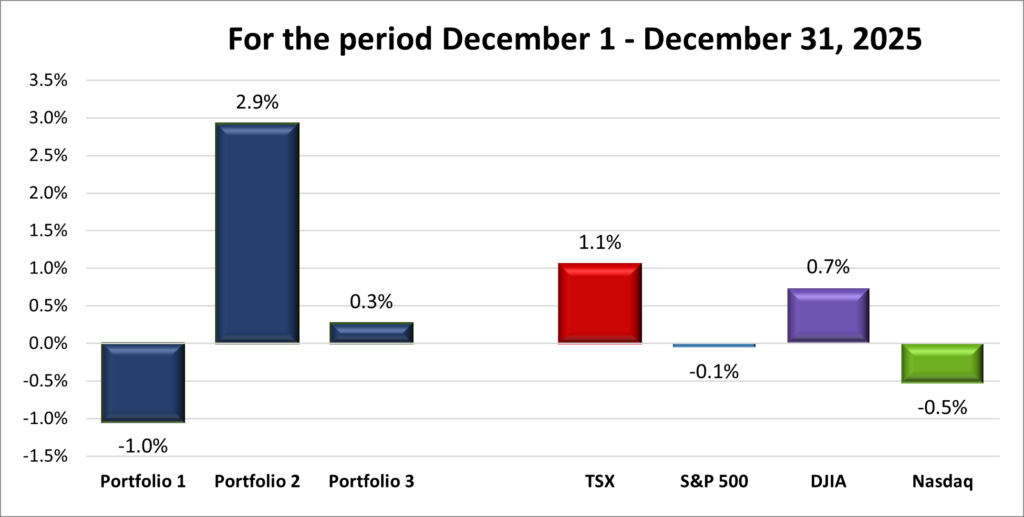
 

Weekly Update for the week ending December 5, 2025

Will Santa Show Up for the Markets This Year?

Typically, September and October are considered two of the softer months for the markets, while November and December are traditionally stronger. This year has been the opposite, with a surprisingly solid September and October. By the end of October, I was feeling optimistic – with two of the more volatile months in the rear-view mirror, a strong finish to the year seemed likely. Unfortunately, that optimism didn’t pan out, as November came in weaker than usual and barely avoided slipping into the red.

Now December is here, and I’m not sure what to expect. December is usually a strong month for stocks, thanks to what’s known as the Santa Claus Rally. But some analysts are suggesting we may not see Santa’s visit this time around, which got me wondering why a month that’s typically upbeat might fall short. So why do analysts think Santa may sit this year out? Let’s take a brief look – but first, what makes December a strong month?

A Santa Claus Rally is a stretch of time when markets tend to drift higher during the last week of December and the first couple of trading days in January. It’s not guaranteed, but historically this period has shown a fairly strong pattern of positive returns. There isn’t one official reason why it happens, but there are a few popular theories: lighter trading volumes around the holidays, investors feeling more optimistic heading into the new year, and portfolio managers making final adjustments before closing the books. Over time, this seasonal bump showed up often enough that it earned the nickname “Santa Claus Rally.”

Some analysts think a Santa Claus Rally might not show up this year, and it mostly comes down to uncertainty and caution in the markets. If investors are worried about slowing economic growth, sticky inflation, or what the Fed might do next, that usual year-end optimism can fade pretty quickly. On top of that, if markets already made a strong run earlier in the fall, there may simply be less momentum left. And with holiday trading volumes typically thin, even minor negative headlines can have an outsized impact, making it harder for that seasonal rally to take shape.

So, will Santa make an appearance this year? It’s impossible to know for sure. December has historically been a strong month for stocks, but with lingering economic uncertainties and a market that’s already had a good run, this year could be different. With that in mind, let’s take a look at what actually happened in the markets this past week and see how things are shaping up as we head into the end of the year.


Items that may only interest or educate me ….

ChatGPT Turns 3, Cyber Weekend, Canadian Economic news, US Economic news, ….

ChatGPT Turns 3: From Experiment to Must-Have Tool

It’s hard to believe it’s already been three years since ChatGPT made its public debut. What started as an experiment in conversational artificial intelligence (AI) has grown into a tool millions of people use every day, yours truly included, – for writing, learning, brainstorming, coding, and even managing complex projects. Along the way, each new version has brought smarter, faster, and more reliable capabilities, and the journey isn’t stopping anytime soon. Let’s take a quick look back at how ChatGPT has evolved and what the future might hold.

November 2022 – ChatGPT (GPT-3.5)
The first public release of ChatGPT was based on GPT-3.5, and it made waves for being able to have surprisingly human-like conversations. Users could ask questions, get explanations, write content, or brainstorm ideas. While it was powerful, it sometimes gave inaccurate answers, struggled with very long conversations, and didn’t fully understand context in complex discussions.

March 2023 – GPT-4
GPT-4, available to ChatGPT Plus users, was a big step forward. It could handle more complex prompts, keep track of longer conversations, and generate more accurate, nuanced responses. It also improved reasoning skills, creativity, and context understanding, making it more useful for both casual users and professional tasks.

2023 – GPT-5 mini (current version)
GPT-5 mini focuses on speed, reliability, and conciseness, while keeping high-quality responses. It’s designed to be more aware of subtle context cues and follow nuanced instructions better than previous versions. This makes it great for tasks like writing, research summaries, code, and interactive Q&A.

Looking Ahead – Future Versions
Looking ahead, GPT‑6 is shaping up to be a big step forward. One of the biggest goals is memory and personalization, so the AI can remember your preferences, writing style, and past conversations – making it feel more like a long-term assistant than a series of one-off chats. It’s also expected to handle multi-step tasks more intelligently, break projects into parts, fetch data, and even plan complex workflows.

On top of that, GPT‑6 should be smarter, more reliable, and more versatile. We’re talking improved reasoning, fewer mistakes, better explanations, and stronger multimodal skills – including images, video, and other dynamic inputs. Faster performance and more efficient responses are also in the works, so it could feel snappy even when tackling complicated tasks. If these features arrive, GPT‑6 may finally feel less like a tool and more like a true personal assistant, guiding projects, offering continuity, and anticipating your needs in a way today’s AI can’t quite match.

In short, ChatGPT started as a surprisingly capable conversational AI and has steadily improved in accuracy, reasoning, and usability – and the future promises even smarter, more helpful, and more adaptable versions.

Cyber Weekend Shows Consumers Still Have Some Spark

This year’s Cyber Weekend was a strong reminder that consumers are still willing to open their wallets when the deals are good enough. In the US, online spending from Thanksgiving through Cyber Monday reached an impressive US $44.2 billion, up 7.7% from last year. Cyber Monday alone brought in US $14.25 billion, making it the biggest online shopping day ever recorded. In Canada, national spending totals are harder to pin down, but we did get a solid hint from Block, Inc. (NYSE: XYZ), which processed over 6.15 million transactions during the long weekend – an 18% jump compared to last year.

At first glance, this record spending seems to contradict last week’s Consumer Confidence Index, which suggested Americans were becoming more cautious and cutting back. But this mix of signals actually lines up with how consumers behave when money feels tight. Instead of stopping spending altogether, many people simply wait for major sales and hunt for the best deals – and Cyber Weekend is basically the Super Bowl of discounts. Even when confidence is low, a few days of aggressive markdowns can still spark a buying frenzy.

For us investors, this tells an important story. Strong holiday sales don’t necessarily mean consumers feel great about the economy, but they do show that demand is still there, at least when prices are right. That can give retail, e-commerce, and consumer-focused companies a short-term lift. But it also suggests a bit of fragility underneath – if economic pressures keep building, spending could cool quickly once the holiday bargains disappear.

Canadian Economic news

This past week’s key economic data that the Bank of Canada (BoC) considers when deciding whether to raise or lower the interest rate.

Labour Force Survey

Statistics Canada’s latest employment report surprised to the upside, showing a gain of 53,600 jobs in November – well above expectations of a 5,000-job decline. This follows a 66,600-job increase in October, marking the third consecutive month of employment gains.

The unemployment rate also came in better than expected, dropping to 6.5% from October’s 6.9%, the lowest level in 16 months. Analysts had forecast a rise to 7.0%. This follows two months of declines after a peak of 7.1% in September, which was the highest reading since May 2016, excluding the pandemic years of 2020 and 2021. Wage growth edged up slightly, reaching 3.6% year-over-year, compared with 3.5% in October.

On the surface, November’s labour numbers are encouraging. Employment is rising, unemployment is falling, and young workers saw a particularly strong boost. For consumers and investors, stronger employment usually supports spending, which helps corporate revenues and economic momentum – especially heading into the holiday season.

That said, there’s a subtle yellow caution flag. Most of the new jobs were part-time, not full-time, suggesting employers are still hesitant to make long-term commitments. Wage growth is still modest, which helps keep inflation in check but may limit additional consumer spending if paycheques aren’t rising meaningfully. In other words, the job market is healthy, but not all gains are equally strong in driving sustained economic momentum.

For the BoC, this hotter-than-expected labour data effectively rules out a rate cut at next week’s meeting. The trend of an improving labour market also dampens expectations of a rate reduction next year, likely keeping the benchmark rate at 2.25% for the foreseeable future.

Canadian Market Volatility

Canada’s VIXC – basically the TSX’s own “fear gauge” – started the week at 14.99 and steadily drifted lower, finishing at 11.77. That’s a pretty calm reading, showing investors are feeling relaxed after strong earnings from the Big 6 banks and growing hopes of a rate cut in the US.

Think of the VIXC as Canada’s market mood ring: the low teens mean things are steady and watchful, not tense – investors are keeping an eye on the road, but there’s no panic in the cabin.

US Economic news

This past week’s key data points that the Federal Reserve (Fed) considers when deciding whether to raise or lower the interest rate.

Labour data

Because of the recent US government shutdown, several key labour reports that the Fed and investors normally rely on have been delayed. Job Openings and Labor Turnover Survey (JOLTS), and the Employment Situation Summary (ESS) were supposed to arrive this week, but they’ve been pushed back until the government fully reopens. That leaves everyone, especially the Fed, working with less visibility into how the job market is actually holding up. For now, the ADP Employment Report is essentially the only fresh labour data we have to go on.

ADP Employment Report

The November ADP National Employment Report came in weaker than expected. Instead of adding the forecasted 10,000 jobs, the private sector shed 32,000 positions – a sharp reversal from October’s 42,000 gain. The decline was broad, but small businesses (those with fewer than 50 employees) were hit the hardest, suggesting they’re tightening their belts as economic uncertainty drags on.

This points to a job market that may be starting to cool. When smaller firms pull back on hiring, it often signals a broader shift toward caution. The silver lining is that softer labour data raises the odds the Fed could lean toward cutting interest rates at next week’s meeting to help support the economy.

It’s also worth keeping in mind that ADP is just one piece of the labour picture. Once the government fully reopens, the delayed labour reports will provide a more complete read on how the labour market is holding up. Until then, visibility is limited, and the ADP numbers are the best guide available.

Consumer Sentiment Index (CSI)

The University of Michigan’s preliminary consumer sentiment index for December surprised to the upside, rising to 53.3 from November’s 51.0 and topping forecasts of 52. Even with that improvement, sentiment remains well below where it stood a year ago, sitting 28% under December 2024’s 74.0. The lift was broad-based across demographics, but younger consumers were the biggest drivers of the rebound, showing an uptick in confidence heading into the new year.

The two sub-indexes offered a more mixed read. The Current Economic Conditions gauge – essentially how people feel about their jobs, income, and day-to-day finances – slipped to 50.7, a modest decline from last month and roughly one-third lower than a year ago. The Expectations Index, which captures what consumers anticipate over the next six months, edged up to 55.0, a 7.8% improvement from November but still 25% weaker than last December. This blend of softer current views and a slightly better outlook points to a cautious shift in sentiment: things still feel tough, but people are a bit more hopeful about what comes next.

On the inflation front, consumers expect prices to rise about 4.1% over the next year and 3.2% over the next five. These readings reflect what people believe the inflation rate will be – and both are down from November, suggesting consumers see inflation easing a little. Even so, expectations remain higher than they were a year ago.

Personal Consumption Expenditures (PCE)

The Commerce Department’s latest PCE report showed that inflation in September barely moved. Headline PCE, which includes all components, rose 0.3%, the same as in August, while the year-over-year increase ticked up slightly to 2.8% from 2.7%, right in line with expectations.

Looking at the core PCE, which strips out the often-volatile food and energy costs, prices rose 0.2% for the month, matching forecasts. On an annual basis, the core index came in at 2.8%, just below the expected 2.9%, but still above the Fed’s 2% target. In other words, inflation is steady, but it hasn’t yet cooled to the level the Fed wants to see.

As we head into the Fed’s meeting next week, the picture is mixed. The PCE report for September is already two months old, so it probably won’t play a key role in the debate. Still, it shows that inflation was stable, if elevated, back then in the early fall. The softer labour market could make the Fed more open to cutting rates to support the economy, but with inflation still above their target, they’re likely to remain cautious. In other words, the door for a rate cut is slightly ajar, but it’s not wide open.

American Market Volatility

The CBOE Volatility Index (VIX) — often dubbed the market’s “fear gauge” — opened the week at 18.05 and steadily drifted lower, dipping below 16 near week’s end before settling at 15.41. The drop reflects growing investor confidence that the Fed is likely to follow through with another 0.25% rate cut. Think of the VIX as the market’s mood ring: in recent weeks it was flashing bright red, signaling worry, but now it’s a calm shade of blue. This reading suggests investors are feeling relatively relaxed, keeping a watchful eye on the markets while anticipating slightly lower borrowing costs.


Weekly Market and Portfolio Review

For the week, the TSX (SPTSX) declined 0.2%, the S&P 500 (SPX) rose 0.3%, the DJIA (INDU) advanced 0.5% and the Nasdaq (CCMP) climbed 0.9%.

Index Weekly Streak
TSX: 1 – week losing streak
S&P: 2 – week winning streak
DJIA: 2 – week winning streak
Nasdaq: 2 – week winning streak

Bull market. A good week for the North American stock markets. After last week’s furious rally that erased most of November’s losses, the markets eased into December with more of a sigh than a sprint. All four major North American indexes – the Toronto Stock Exchange Composite Index (TSX), the S&P 500 Index (S&P), the Dow Jones Industrial Average (DJIA), and the Nasdaq Composite Index (Nasdaq) – stumbled out of the gate but eventually shook off the early dip and all but the TSX had climbed back into the green. By the end of the week, the S&P and Nasdaq had run their win streak to four, bringing the S&P close its a record high. Meanwhile, the TSX had pushed to a new all-time high multiple times during the week before pulling back as investors took some profit after the run up.

With earnings season essentially wrapped up and the Fed in its pre-meeting blackout period, investors were left leaning on economic data for direction. Softer labour and manufacturing numbers pointed to a cooling economy, while the September PCE inflation data came in as expected and hinted that inflation is finally stabilizing. Taken together, this latest batch of reports sparked renewed hope that the Fed would trim rates at its next meeting. That shift in expectations helped revive interest in tech and other growth names, which tend to benefit most when borrowing costs start moving lower.

There was also no shortage of speculation about who will lead the Fed next. Chair Jerome Powell’s term runs until May 2026, but President Trump has made it clear he wants someone new in the role. This week he said he’s already made his choice, and many analysts think Kevin Hassett, his top economic adviser, is the favourite. Whoever ends up in the chair is widely expected to take a more dovish approach, reinforcing the idea that rates could trend lower in 2026.

In Canada, the TSX shook off its early-week stumble and powered to all-time highs twice, helped along by a solid set of earnings from the Big Six banks. Strong results from the country’s financial heavyweights gave the index some welcome momentum just when it needed it.

Commodity strength added even more lift, with oil prices pushing higher and giving energy stocks a noticeable boost. Canada’s latest labour data also surprised to the upside for a third straight month, giving analysts a bit more confidence that the economy may finally be picking up steam heading into the new year. On top of that, growing optimism that the US might cut rates soon encouraged investors to take on a bit more risk, pushing money into sectors that tend to shine when sentiment improves. That positive mood spilled into Canada and helped fuel gains in energy, resources, and financials, rounding out the week for the TSX.

As we head into next week’s big rate decisions, it feels like investors are collectively holding their breath. Everyone knows the next move by the Fed will shape the final stretch of the year, and even small changes in expectations have been enough to sway the markets lately. For now, the mood leans cautiously optimistic. Earnings have held up, the Canadian labour market appears to be gaining momentum, US economic data is cooling just enough to keep hopes for lower borrowing costs alive, and both the American and Canadian markets seem to be finding their rhythm again after a choppy November. If the Fed delivers an early Christmas present for investors, December could still finish on a high note and a late-year rally. 😊

Portfolio Weekly Streak
Portfolio 1: 2 – week winning streak
Portfolio 2: 2 – week winning streak
Portfolio 3: 2 – week winning streak

Bull market. A good week for the North American stock markets. The week started off a bit sluggish, but as markets found their footing, all three of my portfolios moved higher as well. Strong fourth-quarter results from Canada’s Big Six banks gave things an extra lift across the board.

Telus (TSE: T) also made headlines. The company said it will maintain its dividend at 41.84 cents per share but won’t raise it again until the share price better reflects its growth prospects. It’s also phasing out its discounted DRIP (Dividend Re Investment Plan), which lets investors buy shares at a discount using their dividends. Analysts generally liked the move, but the stock price still pulled back – and that weighed slightly on Portfolios 1 and 2 where it’s held. With that said, here’s how each portfolio performed…

Portfolio 1 lagged the others with a 0.1% gain, but it still saw 56% of its holdings finish the week in positive territory. Lattice Semiconductor (NASD: LSCC) jumped 13%, Navitas Semiconductor (NASD: NVTS) added 12%, and several big names – Apple (NASD: AAPL), Bank of Nova Scotia (TSE: BNS), Walmart (NYSE: WMT), and TD (TSE: TD) – all hit fresh record highs.

Portfolio 2 led the pack with a solid 2.0% gain, handily beating the other portfolios and even doubling the Nasdaq’s 0.9% return, the strongest of the major indexes. About 57% of holdings ended the week higher, helped by a massive 26% surge in MongoDB (NASD: MDB) after strong earnings and an upgraded outlook. Bank of Nova Scotia also reached a new high, riding momentum from its impressive fourth-quarter results.

Portfolio 3 landed in the middle with a 0.3% rise, despite only 45% of its holdings posting weekly gains. The difference-maker was its two giants – Nvidia (NASD: NVDA) and Shopify (TSE: SHOP) – which now make up nearly 55% of the portfolio. Both moved higher this week, easily offsetting losses elsewhere. It’s great when they’re both up… though not nearly as fun when they drop together! 😊 The Royal Bank (TSE: RY) and TD also hit new highs after strong earnings, adding to the portfolio’s momentum.

All in all, it was a solid week across the board. Strong earnings, improving sentiment, and a bit of year-end optimism helped push things in the right direction, and it was great to see all three portfolios moving higher together. With markets entering the final stretch of the year, I’m hopeful this momentum carries through the rest of December and into the new year. 😊

Weekly Portfolio & Index performance
Weekly Portfolio & Index performance for the week ended December 5, 2025.

Companies on the Radar

Stocks on my Radar Once again, no new companies made it onto my radar this week, which gave me the chance to take a deep dive into GE Aerospace (NYSE: GE). The more I dug, the more impressed I was: this is arguably one of the highest-quality industrial businesses in the world today. It dominates the narrow-body engine market, runs a recurring revenue model that consistently prints cash, and benefits from elite leadership under CEO Larry Culp, who previously led parent GE before the aerospace division was spun out as GE Aerospace in June 2022.

That said, the stock is priced for perfection. Its current P/E multiple sits well above both the industry and broader-market averages, making it sensitive to potential setbacks – from aviation and defense demand cycles, to costly new engine development, to macroeconomic or geopolitical turbulence.

I’m very interested in owning a piece of this company, but the current valuation makes me want to wait. For now, I’ll stay patient, keep it on my radar, and watch the price closely – re-evaluating if a dip brings it into a more reasonable range. When that happens, I could see myself becoming an owner.

So, once again, my radar list remains the same six companies:

  1. Napco Security Technologies, Inc. (NASD: NSSC): A small US company that provides security hardware and systems like smart locks, intrusion alarms, fire alarms, and access control solutions. It sells through a network of distributors and installers, and has been increasing its recurring service revenue – something investors usually like to see. As demand for security and smart home products grows, Napco has multiple avenues for expansion.
  2. GE Aerospace: This is the large American aviation and defence business that remained after General Electric split into three separate companies in 2024. It has been on a strong run thanks to high demand for commercial jet engines as global air travel continues to recover. The company focuses on aircraft propulsion systems and services for both commercial and military customers, and it’s also moving into drones. As a global leader in jet engines and aircraft systems, GE Aerospace offers exposure to long-term trends in travel, defence spending, and emerging aviation technology.
  3. Mainstreet Equity Corp. (TSE: MEQ): A Calgary-based real estate company focused on mid-market apartment buildings across Western Canada. Their business model is straightforward: buy underperforming buildings, renovate them, improve operations, and increase rental income. With strong demand for rentals, a disciplined approach, and shares that trade below the estimated value of the properties, Mainstreet offers a combination of income, stability, and long-term upside.
  4. Corning Incorporated (NYSE: GLW): A large US company known for specialty glass and optical technologies. Corning is the longstanding supplier of the glass used in iPhones and is also benefiting from the surge in demand for high quality fiber optics as datacentres expand to support AI and cloud computing. The company is riding several tailwinds with long-term growth potential.
  5. Dutch Bros Inc. (NYSE: BROS): A rapidly expanding drive-thru coffee chain in the US, known for its energetic customer service and customizable drinks. The company is aiming to open at least 160 new locations by the end of 2025 and has long-term goals of surpassing 2,000 stores. Strong brand loyalty, especially in the Western US, makes this an interesting high-growth story – though still in an aggressive build-out phase.
  6. XPEL, Inc. (NASD: XPEL): A growing, founder-led maker of protective films, coatings, and related products – best known for automotive paint protection film. XPEL has been expanding into window films and architectural applications, and sells through multiple channels, giving it both reach and control. It’s a company with a focused niche and strong brand recognition in that niche.

As always, these are not buy recommendations. Make sure to do your own research and choose investments that fit your personal financial goals.

The Radar Check was last updated December 5, 2025.

Stock on the Radar List. 1 of 2.
Stock on the Radar List. 2 of 2.

That’s a wrap for this week, thanks for reading may your portfolio stay green and your dividends steady. See you next time!
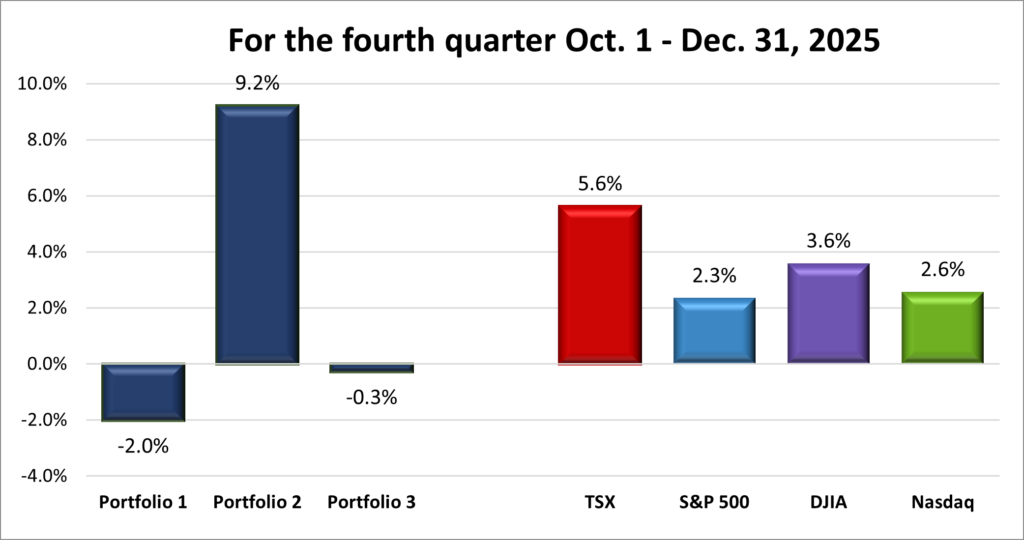
Monthly Portfolio Update November 2025

Monthly Market and Portfolio Review

Bull market. A good week for the North American stock markets.Bearish market November didn’t feel like a typically strong month for the markets, even though most major indexes still finished in the green. After such a strong run over the past six months — including a choppy September and October — I had expected that momentum to carry right into year-end. The Toronto Stock Exchange Composite Index (TSX), the S&P 500 Index (S&P), and the Dow Jones Industrial Average (DJIA) all stretched their monthly win streaks to seven, but the S&P and DJIA only managed it thanks to a late-month surge. The Nasdaq Composite Index (Nasdaq) wasn’t so lucky, spending most of the month trying — and failing — to climb out of the hole it had dug. With another month of gains, the TSX hit its longest winning streak since 2021.

Instead of the strong month I’d been expecting, the markets were quite volatile in November, a month that normally gives investors a smoother ride. The US government shutdown that began on October 1 carried into November, making it harder to get a clean reading on the American economy. At the same time, two major headwinds took over the narrative: uncertainty over whether the US Federal Reserve (Fed) would deliver another rate cut, and mounting concern that many artificial intelligence (AI) stocks — the same names driving so much of this year’s gains — were becoming too expensive. Those worries overshadowed what was actually a very solid earnings season.

For a while, November looked rough, especially with the S&P down as much as 4.4%. But sentiment slowly shifted. The shutdown ended, earnings kept holding steady, and fears of the Fed staying put at 4.0% gave way to growing optimism the Fed would lower the benchmark rate to support a softening labour market. Meanwhile, concerns about stretched AI valuations eased after Nvidia (NASD: NVDA), the face of the AI boom, posted another impressive earnings beat and raised guidance. What started as a month defined by headwinds turned into one fuelled by supportive tailwinds, setting the stage for a strong late-month rally.

In Canada, November shaped up to be a strong month for the TSX, led by the country’s commodity-heavy sectors and a renewed wave of rate-cut optimism. Gold, copper, and other metals surged, lifting mining stocks, while rising oil prices gave energy names a boost. Hopes that both the Bank of Canada and the Fed might ease rates also rekindled interest in more cyclical sectors, helping financials, industrials, and other economically sensitive names move higher.

On many days, the strength in commodities and growing rate-cut hopes more than offset weakness in technology companies, a reminder that the TSX’s resource-and-value orientation gives it a personality very different from its American cousins. By month’s end, that mix lifted the index to new all-time highs and extended its monthly winning streak, showing that when global conditions line up just right, Canada’s old-school engines – commodities, and steady value plays – can still take the lead.

As we head into the final month of the year, those same two headwinds are still hanging over the markets. The big “will they or won’t they” around rate cuts will finally be answered on December 10 when both central banks announce their latest moves. But stretched AI valuations aren’t disappearing anytime soon, and they could easily take some shine off the usual Santa Claus rally. Hopefully they don’t take too much of the “merry” out of the season. 😊

Portfolio Monthly Streak
Portfolio 1: 1 – month losing streak
Portfolio 2: 8 – month winning streak
Portfolio 3: 1 – month losing streak

Bearish market Bull market. A good week for the North American stock markets. So much for being cautiously optimistic. Every time I think I’ve finally got a handle on things, the markets toss me a curveball and remind me I have absolutely no idea what’s coming next. As you can see in Chart 1 below, Portfolios 1 and 3 took it on the chin in November as the heavyweight technology pullback hit them squarely, while Portfolio 2 – less technology heavy and helped by rising oil prices – held up much better.

Portfolio 1 had the toughest month of the three, falling 7.7% after three straight losing weeks before a late-month rally helped soften the blow. Its heavy exposure to growth and AI-related names amplified the broader technology slump, making the decline sharper than what we saw in the markets overall. The first three weeks were especially rough, with names like Celsius (NASD: CELH), Navitas (NASD: NVTS), Cloudflare (NYSE: NET), Arista (NYSE: ANET), and Cameco (TSE: CCO) tumbling into double-digit losses and only about a third of holdings finishing in the green each week. The turnaround finally came in the last week of November, when Alphabet’s (NASD: GOOGL) massive AI-chip deal with Meta (NASD: META) sparked a broad rally. With 84% of the portfolio climbing – led by strong rebounds in Celestica (TSE: CLS), Navitas, Hammond Power Solutions (TSE: HPS.A), and Cameco – Portfolio 1 managed to claw back a meaningful chunk of its earlier losses.

Portfolio 2, on the other hand, was quietly solid. While the broader markets wobbled and the other portfolios struggled under technology driven volatility, this one did exactly what it was designed to do: stay balanced. After a mix of modest ups and downs, Portfolio 2 finished November with a small gain, making it the only one of the three to end the month in positive territory. Losses were limited, with no major blowups, and the setbacks – like Zoetis (NYSE: ZTS) and Hammond Power Solutions – were eventually outweighed by strength elsewhere. Energy names held steady, and Aritzia (TSE: ATZ) kept building momentum with multiple new highs. By the final week, 78% of holdings were rising, led by Hammond Power Solutions, Zoetis, and iA Financial (TSE: IAG) – enough to push the portfolio to a 0.6% monthly gain. It lived up to its role as the “steady one,” quietly outperforming the others in an otherwise choppy month.

Portfolio 3 also had a difficult stretch, dropping 7.2% as its growth-heavy lineup made it especially vulnerable to the technology selloff. Three of the four weeks landed in the red, with sharp pullbacks in goeasy (TSE: GSY), Shopify (TSE: SHOP), Cloudflare, and Nvidia weighing heavily on returns. Even when the markets bounced, recoveries in this portfolio were slower and less consistent. The pattern through the month was clear: the losers hit harder than the winners could offset. Early November saw the steepest damage, including goeasy’s 30% slide after missing expectations and several technology names posting double-digit drops. Mid-month remained volatile as Nvidia and Shopify, the portfolio’s two largest positions, continued to pull back. The bright spots did emerge in the final week with 75% of the portfolio recording a weekly win. But even with that strong finish, the earlier losses were too much to fully recover, leaving Portfolio 3 down sharply for November.

Heading into December, I’m choosing to look at November as a reminder, sometimes a painful one, that volatility is just part of the investing journey. Technology heavy portfolios like Portfolios 1 and 3 will always swing harder, balanced portfolios are more even-keeled, and every so often the market humbles you right when you think you’ve got it figured out. With major rate decisions around the corner and the usual year-end optimism trying to push through lingering worries about AI valuations, December could still surprise us. Here’s hoping the final stretch of 2025 finishes on a stronger, merrier note. 😊

Monthly Portfolio & Index performance
Chart 1: Monthly Performance

Year to date, Portfolio 1 is still out in front with a strong 24.4% gain, even after giving up a bit of ground in a choppy November. Portfolio 2 moved into second place, lifting its year-to-date return to 22.3% and standing out as the only one of the three to finish the month in positive territory. That strength helped it leap ahead of Portfolio 3, which had a rough November and saw its 2025 gain slide to 19.6%.

Among the major indexes, the TSX has now surged ahead of all three portfolios with a year-to-date gain of 26.9%. The S&P and the DJIA inched higher to 16.4% and 12.2%, respectively, while a volatile November knocked the Nasdaq’s year-to-date performance down to 21.0%.

11 Months YTD Portfolio & Index performance
Chart 2: YTD Performance

What My Three Portfolios Did in November

Portfolio 1 for November 2025: DOWN Red Down Arrow

Activity

Bought: Constellation Software (TSE: CSU) see November 14 update.

Dividends Received this month:

Companies followed by DRIP (Dividend Re-Investment Plan) indicate additional shares were purchased with the dividend. Any cash leftover was added to the cash balance.

Canadian $

TD Bank (TSE: TD) DRIP

Bank of Nova Scotia (TSE: BNS) DRIP

BSR REIT (TSE: HOM.U)

Decisive Dividend Corp. (TSXV: DE) DRIP

Pulse Seismic Inc (TSE: PSD) DRIP

Dream Industrial Real Estate Investment Trust (TSE: DIR.UN) DRIP

Tourmaline Oil Corp (TSE: TOU)

TMX Group (TSE: X)

US $

Apple (NASD: AAPL)

Costco Wholesale (NASD: COST)

Quarterly Reports

Berkshire Hathaway Inc.

Third quarter 2025 financial results on November 1, 2025

Lattice Semiconductor Corporation

Third quarter 2025 financial results on November 3, 2025

Navitas Semiconductor Corporation

Third quarter 2025 financial results on November 3, 2025

Decisive Dividend Corporation

Third quarter 2025 financial results on November 4, 2025

Shopify Inc.

Third quarter 2025 financial results on November 4, 2025

Grab Holdings Limited

Third quarter 2025 financial results on November 4, 2025

Arista Networks, Inc.

Third quarter 2025 financial results on November 4, 2025

Magnite, Inc.

Third quarter 2025 financial results on November 5, 2025

Cameco Corporation

Third quarter 2025 financial results on November 5, 2025

Tourmaline Oil Corp

Third quarter 2025 financial results on November 5, 2025

Trisura Group Ltd.

Third quarter 2025 financial results on November 6, 2025

The Trade Desk, Inc.

Third quarter 2025 financial results on November 6, 2025

BCE Inc.

Third quarter 2025 financial results on November 6, 2025

Celsius Holdings, Inc.

Third quarter 2025 financial results on November 6, 2025

Datadog, Inc.

Third quarter 2025 financial results on November 6, 2025

TELUS Corporation

Third quarter 2025 financial results on November 7, 2025

Sea Limited

Third quarter 2025 financial results on November 11, 2025

The Home Depot, Inc.

Third quarter 2025 financial results on November 18, 2025

Nvidia Corporation

Third quarter 2025 financial results on November 19, 2025

Walmart Inc.

Third quarter 2025 financial results on November 20, 2025

Kraken Robotics Inc.

Third quarter 2025 financial results on November 26, 2025

Portfolio 2 for November 2025: UP Green Up Arrow, signifying a positive week

Activity

No significant activity to report this month.

Dividends Received this month:

Canadian $

Dollarama (TSE: DOL)

TC Energy (TSE: TRP)

Bank of Nova Scotia (TSE: BNS) DRIP

Whitecap Resources (TSE: WCP) DRIP

SmartCentres REIT (TSE: SRU.UN)

Dream Industrial Real Estate Investment Trust (TSE: DIR.UN) DRIP

Tourmaline Oil Corp (TSE: TOU)

US $

No US$ dividends this past month.

Quarterly Reports

Fortis Inc.

Third quarter 2025 financial results on November 4, 2025

iA Financial Group

Third quarter 2025 financial results on November 4, 2025

Zoetis Inc.

Third quarter 2025 financial results on November 4, 2025

Brookfield Renewable Partners L.P.

Third quarter 2025 financial results on November 5, 2025

Tourmaline Oil Corp.

See report under Portfolio 1.

Canadian Natural Resources Limited

Third quarter 2025 financial results on November 6, 2025

TC Energy Corporation

Third quarter 2025 financial results on November 6, 2025

Supremex Inc.

Third quarter 2025 financial results on November 6, 2025

Airbnb, Inc.

Third quarter 2025 financial results on November 6, 2025

TELUS Corporation

See report under Portfolio 1.

The Walt Disney Company

Fourth quarter 2025 financial results on November 13, 2025

South Bow Corp.

Third quarter 2025 financial results on November 13, 2025

Alimentation Couche-Tard Inc.

Second quarter 2026 financial results on November 24, 2025

Portfolio 3 for November 2025: DOWN Red Down Arrow

Activity

Bought: Canada Packers (TSE: CPKR). See November 7 update.

Dividends Received this month:

Canadian $

TD Bank (TSE: TD)

SmartCentres REIT (TSE: SRU.UN) DRIP

Royal Bank of Canada (TSE: RY)

US $

No US$ dividends this past month.

Quarterly Reports

Shopify Inc.

See report under Portfolio 1.

Alvopetro Energy Ltd.

Third quarter 2025 financial results on November 5, 2025

Brookfield Renewable Partners L.P.

See report under Portfolio 2.

goeasy Ltd.

Third quarter 2025 financial results on November 5, 2025

Magnite, Inc.

See report under Portfolio 1.

Brookfield Asset Management Ltd.

Third quarter 2025 financial results on November 7, 2025

Brookfield Corporation

Third quarter 2025 financial results on November 13, 2025

Nvidia Corporation

See report under Portfolio 1.