Second Quarter Market Recap: Navigating Volatility and Tech-Driven Rallies
The second quarter of 2024 was nothing short of a rollercoaster, with markets swinging between strong economic data, shifting rate expectations, and a tech-fueled rally that dominated much of the narrative.
 In the US, investor sentiment shifted from early-year optimism about imminent rate cuts to a more cautious “higher for longer” outlook, as persistent inflation and robust labour market data complicated the Federal Reserve’s (Fed) plans. Yet, by May, cooling inflation rekindled hopes for potential rate cuts later in the year, propelling the Nasdaq Composite Index (Nasdaq) and S&P 500 (S&P) to record highs, largely driven by the surge in artificial intelligence (AI) stocks.
In Canada, the Toronto Stock Exchange (TSX) faced a bumpier ride. Rising commodity prices offered some support in April but concerns about a US economic slowdown and weaker domestic data weighed on performance in May. The Bank of Canada’s (BoC) rate cut in June provided a brief respite, but stronger-than-expected labour data tempered expectations for further cuts, keeping the TSX subdued until a late rebound fueled by recovering resource prices.
As the quarter drew to a close, the markets reflected a blend of cautious optimism and tech-fueled volatility, setting the stage for what could be an equally unpredictable second half of the year. Let’s look at what happened over the second quarter of 2024 ….
Second Quarter Portfolio Update
Second Quarter Review
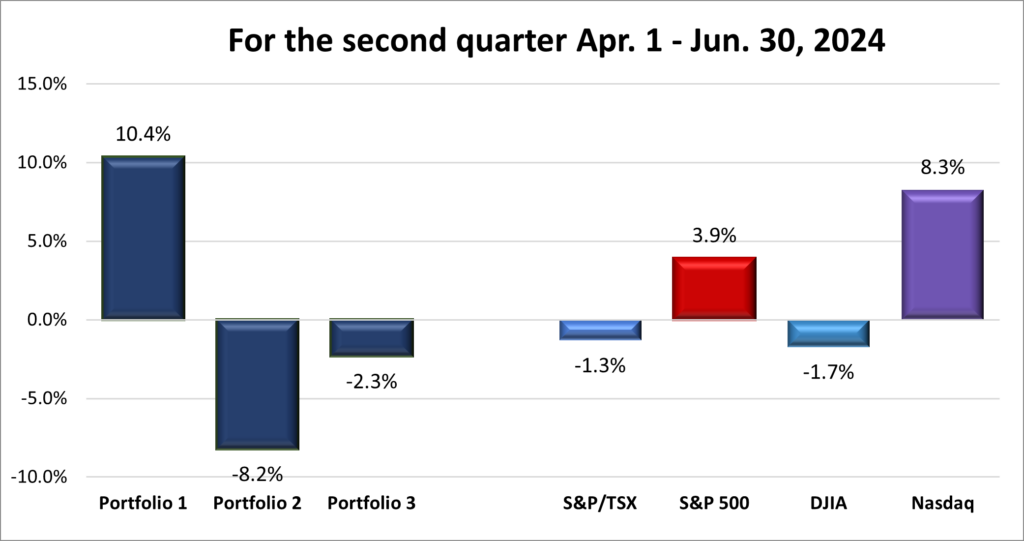
For the second quarter, the TSX (SPTSX) lost 1.3%, the S&P (SPX) rose 3.9%, the DJIA (INDU) fell 1.7% while the Nasdaq (CCMP) grew 8.3%.


The second quarter of 2024 presented a mixed picture for North American markets. While tech-heavy indexes like the Nasdaq and S&P surged on the back of AI-driven enthusiasm, more traditional, value-focused indexes like the TSX and Dow Jones Industrial Average (DJIA) faced challenges.
April was particularly rough, as strong economic and labour data from March and April complicated the Fed’s efforts to curb inflation. This solid data, while positive for workers, heightened concerns about ‘higher-for-longer’ interest rates, prompting investors to shift toward safer assets, such as bonds.
Despite these headwinds, tech stocks maintained their momentum from the first quarter, with the Nasdaq and S&P both reaching record highs. The DJIA flirted with new intraday records but fell short of closing at historic levels. Meanwhile, the TSX, with its limited exposure to major technology companies, missed out on the AI-fueled rally that drove American markets.
Key Factors Driving the Market
AI: The undisputed star of Q2 2024, AI hype dominated the markets. Investors poured into companies leading AI development, particularly the “Magnificent 7” tech giants – Alphabet (NASD: GOOGL), Amazon (NASD: AMZN), Apple (NASD: AAPL), Microsoft (NASD: MSFT), Meta (NASD: META), Nvidia (NASD: NVDA), and Tesla (NASD: TSLA) – whose involvement in AI and cutting-edge technologies propelled their stock prices to new heights. This AI-driven momentum boosted not just the tech sector but the broader market as well.
Economic Resilience: Inflation continued to cool, edging closer to the BoC’s and the Fed’s targets, which bolstered investor confidence. A resilient American labour market, characterized by low unemployment and steady job growth, sustained consumer spending and economic stability. Despite lingering inflationary pressures, the US economy remained robust, fueled by pent-up consumer demand and strong employment figures.
Corporate Earnings: Earnings reports, especially from technology and consumer-focused companies, further fueled investor optimism. Strong results reinforced confidence in the broader economic outlook, maintaining the market’s upward trajectory. Although some companies lagged, the overall earnings trend was positive, particularly in corporate America.
The second quarter wrapped up with mixed results. The BoC’s rate cut sparked some optimism, with the possibility of further reductions in Canada on the horizon. Meanwhile, uncertainty around when the Fed might begin lowering US rates kept investors on edge. Despite the AI-driven surge that boosted technology stocks, the broader market reflected the ongoing tug-of-war between economic resilience and lingering uncertainties about inflation, rate cuts and corporate performance.
Second Quarter Portfolio Update
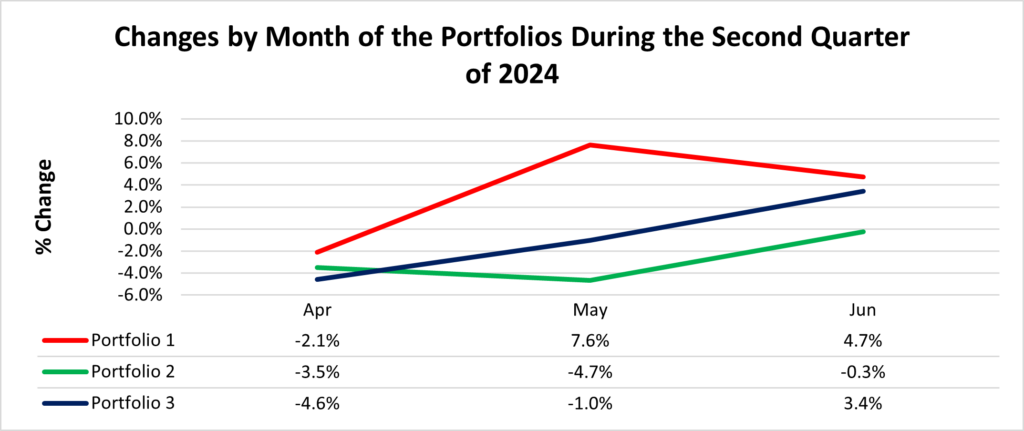
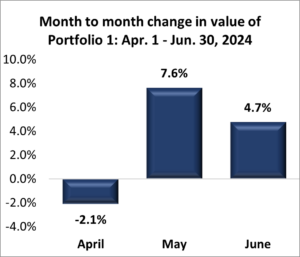
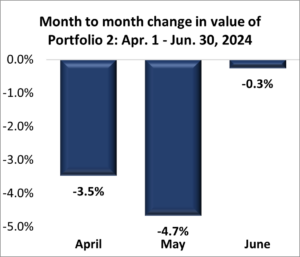
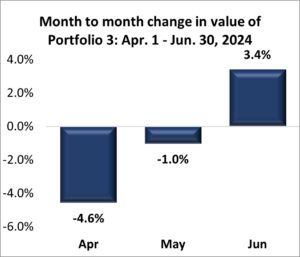
The chart below highlights how each portfolio performed throughout the quarter. April started on a tough note, as all portfolios experienced declines alongside the broader market. In May, Portfolio 1 staged an impressive rebound, while Portfolios 2 and 3 continued their slide. June brought strength to US markets, with an AI-driven rally pushing the major American indexes higher. However, the resource-heavy TSX did not ride this wave and fell further. Portfolios 1 and 3 gained ground, but Portfolio 2 posted its fourth consecutive losing month. Overall, it was a challenging quarter for Portfolios 2 and 3, but Portfolio 1 closed out strong. Let us hope for continued momentum in Portfolio 1 and a turnaround for the others in the third quarter!
Portfolio 1 for the second quarter: UP 
The second quarter got off to a sluggish start, but a strong rebound in the final two months turned things around, allowing the portfolio to close with an impressive quarterly gain.
Activity: Bought: Celestica Inc., Carnival Corp., Grab Holdings Limited, Hammond Power Solutions, TD Investment Savings Account mutual fund, Shopify.
Bought additional share in: Amazon.com, Visa Inc., BCE Inc., Atlanta Braves Holdings, Inc., CN Railway Company, Ferrari N.V., Celsius Holdings, Inc.
Sold: Nuvei Corporation, some Nvidia Corporation shares because Nvidia had grown significantly in value and represented an outsized portion of the Portfolio 1.
Portfolio 2 for the second quarter: DOWN 
Portfolio 2 had a rough second quarter. I initially thought April was tough, but it turned out to be just a warm-up for the sharp drop in May. Surprisingly, June became the “best” month, not because it saw gains, but simply because the losses were not as steep as the previous two months.
Activity: Sold Chorus Aviation.
Portfolio 3 for the second quarter: DOWN
Portfolio three stumbled out of the gate in the second quarter and struggled to climb out of a deep hole, finally posting a gain in June. Despite a gradual recovery, it was not enough to avoid a quarterly loss.
Activity: none.
Six Month Review in Charts
They say a picture is worth a thousand words, but when it comes to understanding market trends, a well-crafted graph might be worth even more. Rather than rehashing what has already been discussed, I thought it would be more insightful to let the graphs do the talking. They will clearly show the paths taken by the indexes and portfolios, along with the final results, providing a more impactful view of how things played out over the first half of the year.
This first chart below illustrates the rollercoaster ride that each index took on its way to first-half gains in 2024. In the first half of 2024, the TSX (SPTSX) climbed 4.4%, offering a solid start to the year. Meanwhile, the S&P (SPX) soared 14.5%, showing its strength. The DJIA (INDU) saw a respectable gain of 3.8%, while the Nasdaq (CCMP) led the charge with an impressive surge of 18.1%.
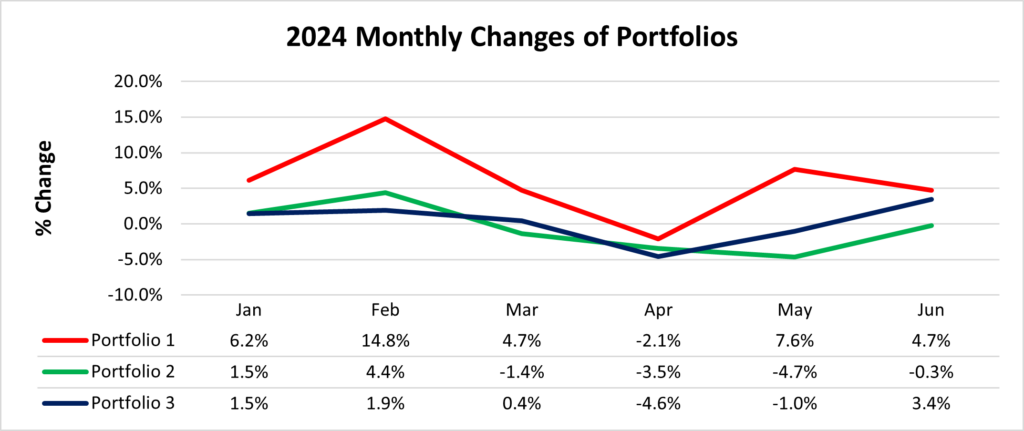
This next chart shows the monthly performance of our three portfolios over the first six months of the year, based on percentage increase. Portfolio 1 saw a value increase every month except April. Portfolio 2 had a strong start but has experienced four consecutive months of losses. On the bright side, Portfolio 3 ended the first half in positive territory, despite a two-month losing streak in the second quarter.
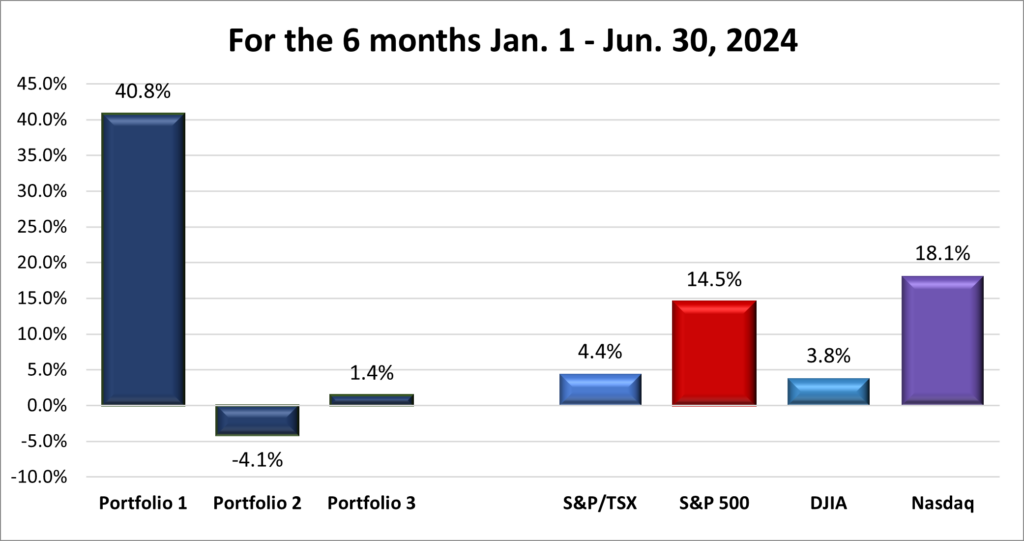
This final chart below illustrates the performance of the three portfolios and the four major North American indexes at the end of the first half of 2024. Impressively, Portfolio 1 more than doubled the Nasdaq’s remarkable 18.1% gain. This standout performance can be attributed to the stellar contributions from the four of the heavyweight technology companies held in the portfolio that are riding the AI tailwind, along with robust results from the rest of the holdings. Now, if only I could replicate this success across the other two portfolios! 😊
Looking Forward
I will not claim to have a crystal ball for predicting the markets – in fact, my track record might better align with the Costanza Rule, where doing the opposite of my instincts could yield better results! 😊 But with that disclaimer, let us dive into what could be a wild third quarter, filled with uncertainty due to the upcoming American presidential campaign, corporate earnings, and central bank rate decisions.
Historically, stock markets tend to perform well during election years. With both parties rolling out promises to attract voters, a bit of investor euphoria usually follows. However, markets despise uncertainty, and with campaign drama, earnings surprises, and rate announcements looming, volatility is likely to ramp up as we move through the second half of the year.
On the economic front, the American economy will likely continue to feel the effects of higher interest rates, which could drag on growth. Hopefully, the recent rate cut by the BoC, along with potential future cuts, will help inject some life into Canada’s sluggish economy. Meanwhile, inflation should keep cooling off, opening the door for the Fed to start cutting the US rate and the BoC to continue trimming the Canadian rate.
Corporate earnings will be another critical factor in the third quarter. Strong results might help markets weather ongoing economic challenges, while weaker earnings or cautious guidance could add to the uncertainty and volatility. If earnings hold up and inflation continues to cool, we could see a strong finish to the third quarter – but expect some choppy waters along the way.
The big wildcard here is the Fed. If inflation continues to ease and economic growth slows further, we could see rate cuts sooner rather than later. That prospect could inject fresh optimism into the markets, especially as we approach the end of the year. Investors are hungry for signs that the higher rates are over, and even a hint of rate cuts might ignite a rally. Combine that with election year excitement, and the third quarter and the second half of 2024 could bring some surprising upside – though we should buckle up for some bumps along the way.