
Monthly Market and Portfolio Review
| Indexes | Monthly Streak |
| TSX: | 1 – month losing streak |
| S&P: | 1 – month losing streak |
| DJIA: | 1 – month losing streak |
| Nasdaq: | 2 – month winning streak |

 September is historically the worst month for US equities, the only month with a negative average return since 1926. Stocks entered the month with double-digit year-to-date gains and rising earnings expectations, but September gave investors plenty of reasons to reinforce the stereotype: oil prices climbed as war tensions escalated, artificial intelligence (AI) “end of the world” fears resurfaced, and the Fed raised interest rates.
The Nasdaq Composite Index (Nasdaq) was the only major index to finish September in positive territory, extending its monthly winning streak. The S&P 500 (S&P), Dow Jones Industrial Average (DJIA) and Toronto Stock Exchange Composite Index (TSX) all finished lower. The DJIA and TSX snapped their respective six-month and five-month winning streaks, while the S&P slipped back into negative territory.
In the US, September had a clear split. Higher Treasury yields and oil prices pressured much of the market, while large technology and AI-related companies kept the Nasdaq and, limited losses for the S&P.
The biggest market driver was the sharp rise in US Treasury bond yields. The 10-year yield climbed more than 50 basis points to 5.22%, its highest level since 2007, while the 30-year yield reached 5.50%, its highest since 2004. The 10-year’s monthly increase was its largest since September 2022.
Higher yields increase borrowing costs, reduce the value investors place on future corporate earnings and make bonds a more attractive alternative. When investors can earn roughly 5% from a US Treasury bond backed by the federal government, the appeal of taking on the additional risk and volatility of stocks becomes harder to ignore. The rise in yields reflected concerns about inflation, higher oil prices and interest rates remaining higher for longer, while also signalling that investors are demanding a higher return for lending money as government debt and spending continue to rise.
The month brought conflicting signals on inflation and economic growth. The Fed raised interest rates for the first time since 2023, as persistent inflation and a resilient economy gave it less reason to lower rates. By month-end, however, cooler inflation data provided some relief. Core PCE inflation slowed to 3.0% year over year, down from 3.3% the previous month, helping technology stocks recover and lifting the Nasdaq into positive territory.
Oil added another layer of inflation uncertainty. Brent crude rose roughly 14% during September, finishing around US$103.50 a barrel, as tensions involving Iran and uncertainty surrounding the Strait of Hormuz threatened to keep energy supplies tight. Higher oil prices raised transportation and production costs, potentially pushing inflation higher and making it harder for the Fed to lower rates.
The big exception was technology. Technology and communication services were the only two S&P 500 sectors to finish September higher, while all nine other sectors declined. Large-cap technology companies, including several of the biggest AI beneficiaries, were strong enough to offset weakness elsewhere. Their large weighting also helped the S&P hold up better than the average stock.
In Canada, the TSX snapped its five-month winning streak. Canada’s heavier exposure to mining, banks and energy meant the same forces affecting US markets produced a different mix of winners and losers.
Gold miners were among the biggest drags. Gold initially benefited from geopolitical uncertainty and expectations for lower interest rates, but rising bond yields and a stronger US dollar eventually weighed on the metal. Gold fell sharply late in the month, putting significant pressure on the overall materials sector.
Energy provided an important counterweight. The surge in oil prices helped Canadian producers, making energy one of the TSX’s strongest sectors. Financials, however, struggled as higher rates put pressure on borrowers, and the broader economy. With investors increasingly concerned that rates could remain higher for longer, or go higher, Canada’s heavily weighted financial sector added to the TSX’s weakness.
September wasn’t really a strong month for the stock market. Beneath the headline numbers, higher yields, rising oil prices and persistent inflation created a much more challenging environment for many stocks. Instead, a relatively small group of large technology and AI-related companies had an outsized influence on the indexes, making the difference between finishing the month in the red or green. In the end, September was a good reminder that headline index performance doesn’t always tell the full story of what is happening beneath the surface.
| Portfolio | Monthly Streak |
| Portfolio 1: | 2 – month winning streak |
| Portfolio 2: | 1 – month losing streak |
| Portfolio 3: | 2 – month winning streak |
Considering September is historically a weak month for stocks, my portfolios didn’t fare too badly. Two finished higher, while the third slipped just 1.0%. Even more encouraging, all three started the month with losses in each of the first two weeks before recovering much of that ground. A late-month rally in AI and technology stocks helped turn things around, although the results varied depending on each portfolio’s holdings.
Portfolio 1 was the top performer, gaining 3.9% for its second consecutive monthly advance. Celsius Holdings (NASDAQ: CELH), Grab Holdings (NASDAQ: GRAB) and Kraken Robotics (TSEV: PNG) weighed on results, but strong gains in Datadog (NASDAQ: DDOG), Hammond Power Solutions (TSX: HPS.A) and Lattice Semiconductor (NASDAQ: LSCC) helped drive the late-month recovery. Shopify (TSX: SHOP) also staged a turnaround. Its shares fell sharply early in the month amid concerns that AI could compete with some of its services but rebounded after its partnership with Meta (NASDAQ: META). The deal positioned Shopify’s checkout technology as part of the AI shopping experience rather than something that could be bypassed. Shopify’s rebound illustrated how perceptions of AI can shift, from viewing it as a threat to seeing it as an opportunity for companies that find ways to use it.
Portfolio 2 was the only portfolio to finish September in the red, falling 1.0%. Its more balanced composition helped limit losses during the weaker, early weeks, and gains in the final two weeks erased most of the earlier declines. However, its smaller exposure to AI stocks also meant it benefited less from the late-month rally, leaving it just short of breaking even. Dollarama (TSX: DOL) rose after raising its forecast for sales growth at existing stores, while Guardant Health (NASDAQ: GH) also contributed to the rebound. MongoDB (NASDAQ: MDB) was an early drag despite beating earnings estimates, as investors focused on management’s forecast for slower third-quarter growth.
Portfolio 3 extended its monthly winning streak, gaining 1.5% despite a sharp mid-month sell-off. Nvidia (NASDAQ: NVDA), its largest holding, helped cushion the initial decline, but weakness across other AI-related stocks and space holdings dragged the portfolio lower. The recovery gathered momentum in the final two weeks, led by gains in 5N Plus (TSX: VNP), Rocket Lab (NASDAQ: RKLB) and Shopify, alongside advances across several other technology holdings. The rebound highlighted the portfolio’s growth potential, but the mid-month slide showed how quickly its concentration in growth stocks can magnify losses when sentiment turns.
September turned out to be OK overall, but I wouldn’t have complained if all three portfolios had posted monthly gains. 😊 It was also a good reminder that how a portfolio is invested can matter just as much as where the market is headed. With so much uncertainty around AI, interest rates and the economy, I expect my portfolios to continue producing different results depending on what’s moving the market. Hopefully, AI stocks will keep leading the way higher! 😊
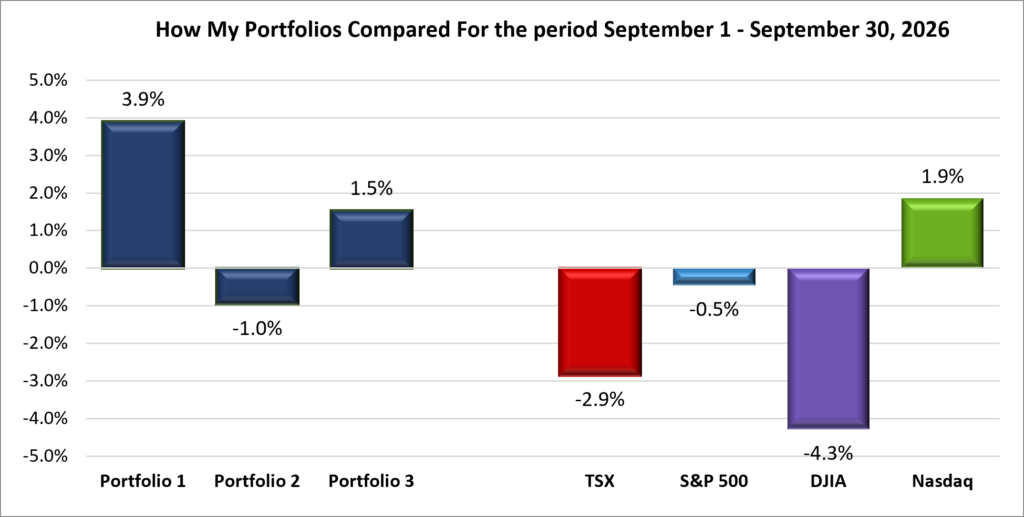
A comparison of the monthly returns of my three portfolios and the major market indexes.
Third Quarter
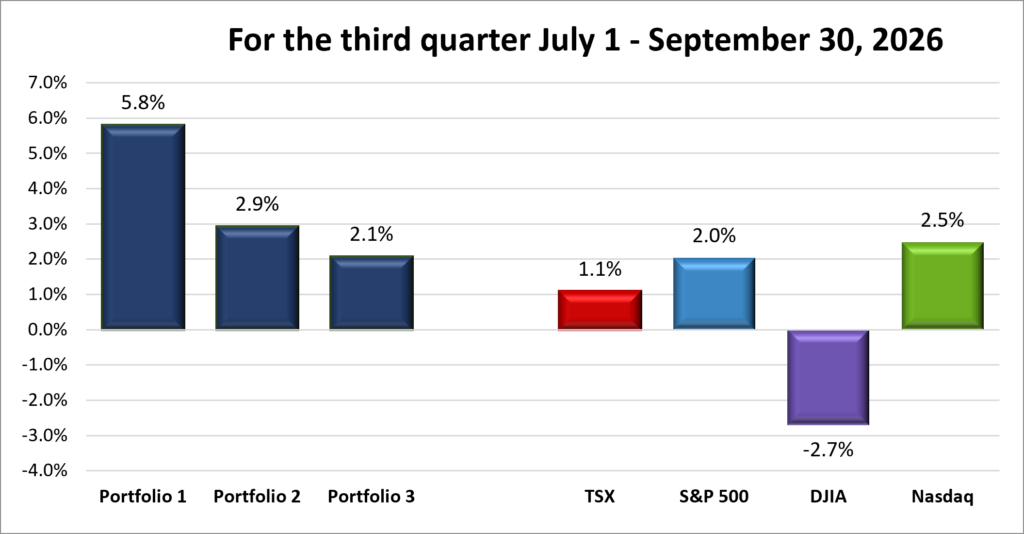
A comparison of the quarterly returns of my three portfolios and the major market indexes.
After a weak first quarter and a strong second, I was hoping the third quarter would keep the upward momentum going. Alas, it wasn’t to be for the markets, which delivered mixed results. The TSX recorded a 1.1% gain, extending its winning streak to nine consecutive quarters, its longest on record. In the US, the Nasdaq was the top performer, rising 2.5%, followed by the S&P at 2.0%. Both posted their second straight quarterly gains. The DJIA bucked the trend, falling 2.7% to finish the quarter in the red.
My portfolios, on the other hand, all finished higher. Portfolio 1 led with a 5.8% gain, more than doubling the Nasdaq’s return. Portfolio 2 was next at 2.9%, also beating the best-performing index. Portfolio 3 trailed the other two with a 2.1% gain, but still outperformed the S&P, DJIA and TSX. While the quarter wasn’t a clean sweep against all four indexes, having all three portfolios finish in positive territory was a satisfying result.
With the final stretch of 2026 ahead, and the fourth quarter historically a strong period for stocks, I’m hoping the markets and my portfolios can recapture some of the second quarter’s momentum. Of course, seasonal trends are no guarantee of future performance, but one can hope. 😊
Year To Date
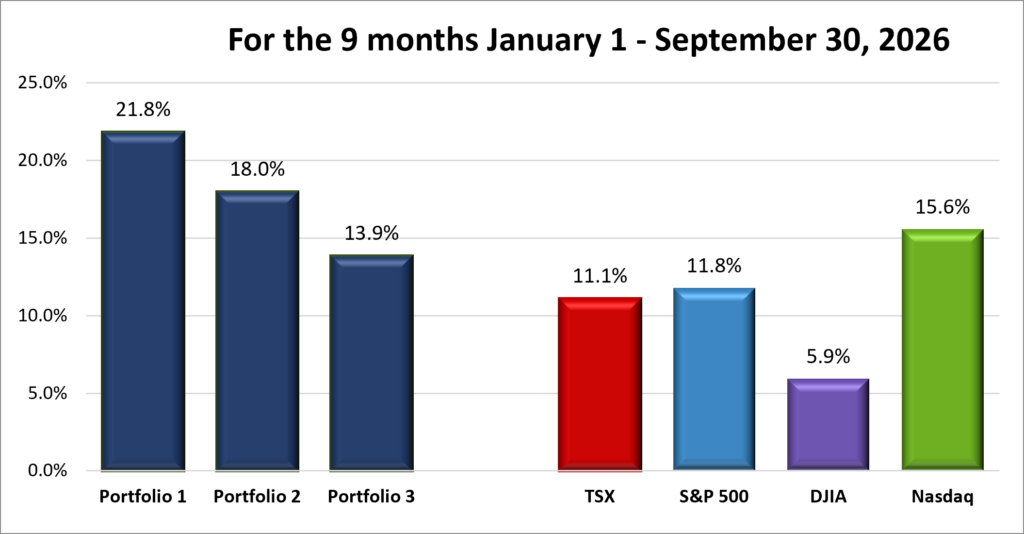
A comparison of the year-to-date returns of my three portfolios and the major market indexes.
September’s volatility reshuffled the year-to-date leaderboard. The Nasdaq jumped from third place to first, with a 15.6% gain for the year, after being the only index to advance in September. The S&P moved into second place at 11.8%, while the TSX tumbled from first place, where it had sat for eight consecutive months, to third at 11.1%. The DJIA remained in last place, with its year-to-date gain slipping to 5.9% after a difficult month.
The strength in technology and AI stocks also helped Portfolio 1 extend its lead, rising to a 21.8% gain for 2026. Portfolio 2 slipped slightly to 18.0%, while Portfolio 3 benefited from the AI rally to reach 13.9%. All three portfolios are outperforming the TSX, S&P and DJIA, while Portfolios 1 and 2 are even outperforming the Nasdaq. Not bad, not bad at all! 😊 Let’s keep it rolling into October and beyond.
What My Three Portfolios Did in September 2026
Portfolio 1 for September 2026: UP 
Activity
No significant activity to report this month.
Dividends Received this month:
Companies followed by DRIP (Dividend Re-Investment Plan) indicate additional shares were purchased with the dividend. Any cash leftover was added to the cash balance.
Canadian $
Dream Industrial REIT (TSE: DIR.UN) DRIP
Yellow Pages (TSE: Y)
Decisive Dividend (TSE: DE) DRIP
Hammond Power Solutions (TSE: HPS.A)
Tourmaline Oil (TSE: TOU)
Canadian National Railway (TSE: CNR)
US $
Visa (NYSE: V)
Walmart (NASDAQ: WMT)
Alphabet (NASDAQ: GOOGL)
BSR Real Estate Investment Trust (TSE: HOM.U)
Interactive Brokers Group (NASDAQ: IBKR)
Home Depot (NYSE: HD)
Quarterly Reports
Costco Wholesale Corporation
Fourth quarter 2026 financial results on September 24, 2026
Carnival Corp.
Third quarter 2026 financial results on September 29, 2026
Portfolio 2 for September 2026: DOWN 
Activity
No significant activity to report this month.
Dividends Received this month:
Canadian $
Fortis (TSE: FTS)
Dream Industrial REIT (TSE: DIR.UN) DRIP
Whitecap Resources (TSE: WCP)
SmartCentres Real Estate Investment Trust (TSE: SRU.UN)
iA Financial Corporation Inc (TSE: IAG)
Alimentation Couche-Tard (TSE: ATD)
Hammond Power Solutions (TSE: HPS.A)
Tourmaline Oil (TSE: TOU)
US $
Microsoft (NASDAQ: MSFT)
Quarterly Reports
MongoDB, Inc.
Second quarter 2027 financial results on September 1, 2026
Alimentation Couche-Tard Inc.
First quarter 2027 financial results on September 1, 2026
Dollarama Inc.
Second quarter 2027 financial results on September 16, 2026
Portfolio 3 for September 2026: UP
Activity
Trimmed: Nvidia (NASDAQ: NVDA) Please see September 25 Weekly Update
Dividends Received this month:
Canadian $
SmartCentres Real Estate Investment Trust (TSE: SRU.UN) DRIP
Brookfield Asset Management (TSE: BAM)
Brookfield Corporation (TSE: BN)
Rockpoint Gas Storage (TSE: RGSI)
US $
Corning (NYSE: GLW)
Broadcom (NASDAQ: AVGO)
Quarterly Reports
Broadcom Inc.
Third quarter 2026 financial results on September 2, 2026