Weekly Update for the week ending November 22, 2024

What Falling Interest Rates Mean for Your Portfolio

Last week, we explored how rising interest rates can challenge investors. This week, let us flip the script and talk about something that could actually work in your favour—falling rates. When interest rates drop, it is not just borrowers who feel the relief. If you know where to look, your stock portfolio can benefit too.

Why Do Central Banks Lower Interest Rates?
Central banks, like the Bank of Canada (BoC) or the US Federal Reserve (Fed), lower interest rates to stimulate a sluggish economy. Cheaper borrowing encourages spending and investment, helping businesses expand, creating jobs, and keeping inflation in check. Think of it as their way of giving the economy a boost when growth hits a wall.

How Falling Rates Impact Stocks
When interest rates fall, borrowing becomes cheaper, giving certain sectors a significant advantage. Growth-oriented industries, such as technology, can fund new projects and expand operations more easily, which often lifts their stock prices.

Real estate is another major beneficiary. Real Estate Investment Trusts (REITs), for example, rely on debt to finance property acquisitions and developments. With lower rates, their borrowing costs shrink, improving profitability. It is like snagging a lower mortgage rate—more cash stays available for growth.

Investors also tend to pivot away from bonds and savings accounts, which become less appealing as yields drop. This shift into stocks can give the overall market a broader boost.

On the flip side, financial stocks like banks and insurers may struggle. Lower rates reduce the margins on loans and mortgages, which can impact their profitability.

Consumer Spending and Stocks
Falling rates do not just help businesses – they also benefit consumers. Lower borrowing costs for mortgages, car loans, and other financing encourage spending. This increased confidence often benefits sectors like retail, travel, and luxury goods, as well as housing-related stocks.

How to Navigate Falling Rates as an Investor

  • Spot Growth Opportunities: Focus on sectors like technology and real estate, which tend to thrive in low-rate environments.
  • Monitor Financial Stocks: Banks and insurers might face challenges, so keep an eye on your financial holdings.
  • Follow Consumer Spending Trends: Look to retail, travel, and other consumer-driven industries for potential gains.

Falling interest rates can open up exciting opportunities for your portfolio. By understanding which sectors thrive and which face challenges, you can adjust your strategy and position yourself for growth. Focus on the winners, keep an eye on shifting consumer behaviour, and adapt to these market changes to maximize your returns.

Now that we have covered how falling interest rates can benefit your portfolio, let’s take a closer look at how the markets played out over the past week.


Items that may only interest or educate me ….

Canadian Economic news, US Economic news, “Age of AI,” Canadian 2025 TFSA and RRSP limits, .…

Canadian Economic news

This past week’s key economic data that the BoC considers when deciding whether to raise or lower the interest rate.

Consumer price Index (CPI)

Statistics Canada’s latest CPI report revealed a bigger-than-expected jump in inflation. The annual rate rose to 2.0% in October, up from September’s 1.6%, while monthly inflation climbed 0.4% after a 0.4% decline the month prior. Analysts had anticipated smaller increases of 1.9% annually and 0.3% monthly.

Among CPI categories, ‘Clothing and footwear’ led the charge, surging 2.4% month-over-month, while ‘Health and personal care’ and ‘Recreation, education, and reading’ remained flat. On an annual basis, ‘Shelter’ saw the largest rise, up 4.8%, though slightly lower than September’s 5.0%. Meanwhile, gasoline prices provided some relief, dropping 4.0% year-over-year.

Core CPI, which excludes volatile items like food and energy, increased 0.5% monthly and rose 2.3% annually.

The higher-than-expected inflation was partly driven by gas prices, which did not drop as sharply as they did in September. While one month does not make a trend, this latest data may disappoint those hoping for a jumbo-sized 0.5% rate cut from the Bank of Canada (BoC). While inflation remains within the BoC’s target range of 1% to 3%, analysts are now divided on whether the bank will opt for a 0.25% or 0.5% cut in December. The final decision will hinge on other key data, including labour market and Gross Domestic Product figures, as policymakers assess the broader economic picture ahead of their December 11 meeting.

Retail Sales

Canadian retail sales rose 0.4% in September, matching August’s growth, with annual sales up 0.8% – a slight slowdown from the 1.4% gain seen in August. For the third quarter as a whole, sales rose 0.9%. An advance estimate for October indicates sales were up 0.7%, however, that number is likely to be revised as more data is reported.

Taking a closer look at the data, the ‘Building material and garden equipment and supplies dealers’ and the ‘Food and beverage retailers’ categories led the way, each posting a solid 3.0% monthly increase. On the other side, ‘Gasoline stations and fuel vendors’ continued their slump, with sales dropping 2.3% – marking the fifth consecutive month of declines. Year-over-year, ‘Health and personal care retailers’ shone brightest with a 3.5% sales boost, while ‘Gasoline stations and fuel vendors’ faced a sharp 9.8% decline.

Core retail sales, which strip out gas stations, fuel vendors, and motor vehicle and parts dealers, bounced back with a 1.4% monthly increase after a revised 0.5% dip in August. On an annual basis, core sales grew 1.9%, a significant improvement from August’s modest 0.3% growth.

The rebound in core sales hints that lower interest rates are energizing consumer spending, and with October’s strong initial data, the fourth quarter could be shaping up to give a needed boost to Canada’s stagnant economy.

Canadian market volatility

Canada’s Volatility Index (CVIX) began the week at 10.07 and experienced a sharp, brief spike on Tuesday morning, likely triggered by concerns over the Ukraine missile attack on Russia. However, it quickly stabilized around the 11-point level for the rest of the week, closing at 10.72 on Friday.

Tracked under the ticker VIXI on the Toronto Stock Exchange (TSE), the CVIX gauges how much market volatility investors expect. A reading below 10 points to a calm, stable market, while numbers between 10 and 20 signal typical market fluctuations with moderate volatility. But when the index climbs above 20, it is a sign of rising uncertainty and the potential for a bumpy ride ahead.

US Economic news

This past week’s key data points that the Fed considers when deciding whether to raise or lower the interest rate.

Consumer Sentiment Index (CSI)

The University of Michigan’s CSI closed November at 71.8, edging up from October’s 70.5 but falling short of the anticipated 73.7. This marks a modest 1.8% monthly increase and a robust 17.1% jump year-over-year, reflecting a steady recovery in consumer confidence.

Looking closer, the Current Economic Conditions index, which measures how people feel about their immediate financial situation, slipped 1.5% to 63.9 from October. Meanwhile, the forward-looking Index of Consumer Expectations climbed 3.8% to 76.9, a notable 35.4% improvement from the same time last year. This suggests a growing optimism about the months ahead, even as current conditions show slight strain.

November marks the fourth straight month of rising consumer sentiment, supported in part by easing interest rates. Political dynamics also played a notable role. Future expectations surged among Republicans to their highest level since 2021, while slipping for Democrats to a one-year low – highlighting contrasting perspectives on how the incoming administration’s policies could impact the economy. While this rise in optimism is encouraging, uncertainty lingers over the specifics of the new economic agenda.

American market volatility

The CBOE Volatility Index (VIX), often called the market’s ‘fear gauge,’ started the week at 16.58 and edged slightly lower to close at 15.24. With little in the way of major economic or political developments, market activity remained subdued, leaving earnings reports from big-name companies as the primary driver of the modest volatility shifts.

For some context, the VIX tracks expected market volatility over the next 30 days. When it is below 12, it signals a calm market. Readings between 12 and 20 reflect normal market swings. But once the VIX climbs into the 20-30 range, it indicates increased investor anxiety. Anything above 30 typically means the market is stressed, often a precursor to major turbulence or even a crisis.

“Age of AI”

This past week, all eyes turned to Nvidia (NASD: NVDA), the world’s most valuable company with a jaw-dropping US$3.6 trillion market cap (calculated by multiplying the share price by the total number of outstanding shares). Investors were eager to see if the tech behemoth could sustain its meteoric rise, fueled by surging demand from leading technology companies for Nvidia’s artificial intelligence (AI) chips driving their cutting-edge applications and services.

Once again, Nvidia delivered. The company reported third quarter revenues of $35.1 billion, surpassing Wall Street’s $33.2 billion forecast. Even better, Nvidia’s fourth quarter revenue outlook came in strong at $37.5 billion, slightly ahead of analyst expectations. This performance underscores the extraordinary demand for Nvidia’s high-powered, AI-focused chips, which sit at the core of the rapidly expanding AI market.

Looking ahead, the company’s optimism is centered on the launch of its next-generation Blackwell GPUs (Graphics Processing Units), expected to further accelerate revenue growth. Chief Executive Officer Jensen Huang captured the moment, calling it the “Age of AI,” a transformational era Nvidia is not just participating in but actively shaping through its groundbreaking innovations in AI computing.

While analysts praised the report, some raised concerns about potential near-term risks, including supply constraints and possible overheating issues with the Blackwell chips. These challenges could cause shipment delays, but they may also lead to demand outpacing supply – potentially deferring revenues rather than losing them outright. Despite these hurdles, Nvidia remains a favourite among analysts, bolstered by its unrivalled market dominance and remarkable growth in the AI sector.

Investor reactions were more muted, with Nvidia’s stock dipping 1% in after-hours trading. Even with revenues and adjusted earnings per share exceeding estimates, some investors may have been hoping for even bigger surprises to justify the company’s lofty valuation.

If you are not keeping up with technology companies or the AI craze, you might wonder why Nvidia is often considered the world’s most important stock. At the heart of the AI revolution, Nvidia is not just a player – it is a catalyst, providing the hardware and software driving explosive growth, industry advancements, and solutions to global challenges.

Nvidia is the crown jewel of the three portfolios, with its remarkable 291% share price growth since November 22, 2023, being a key driver of Portfolio 1’s performance. Their stellar results and bullish outlook suggest the AI rally has plenty of fuel left. As an owner of this exceptional company, I am pleased with this latest update. While the AI fuelled rally may be slowing, I am hopeful its far from over. 😊

Canadian 2025 TFSA and RRSP limits

The Canada Revenue Agency (CRA) has announced the 2025 contribution limits for Registered Retirement Savings Plans (RRSPs) and Tax-Free Savings Accounts (TFSAs). While I am not a tax expert (or an accountant), I wanted to share the key updates that matter most to Canadian investors like us. For personalized advice, it is always wise to consult a tax professional or certified financial planner.

TFSA Contribution Limit for 2025

The TFSA is a fantastic tool for growing your savings tax-free. Contributions are made with after-tax dollars, so all earnings and withdrawals within the account are tax-free. For 2025, the annual contribution limit remains at C$7,000, unchanged from 2024. Unused contribution room carries forward indefinitely, giving you flexibility to catch up whenever it suits you.

RRSP Contribution Limit for 2025

The RRSP offers immediate tax advantages, making it a powerful tool for building retirement savings. For 2025, the contribution limit is the lesser of 18% of your 2024 earned income (including self-employment and rental income) or C$32,490, plus any unused contribution room carried forward from previous years. Be aware that pension adjustments may reduce your available contribution room.

For more details on contribution rules and limits, check out the CRA’s resources on TFSA and RRSP limits, or consult a tax professional for advice tailored to your situation.

These accounts are some of the best tools to make your money work harder, helping you achieve long-term goals while keeping taxes in check. 😊


Weekly Market Review

Monday: the indexes kicked off the week with a strong start, but the Dow Jones Industrial Average (DJIA) could not keep the momentum going and fell into the red. Now, all eyes are on Nvidia as its Wednesday earnings report promises to shed light on the ever-evolving AI market. Oil prices rose after hostilities between Ukraine and Russia intensified.

In Canada, the Toronto Stock Exchange Composite Index (TSX) rose on higher oil and gold prices. In trading, Basic Materials (mining companies and fertilizer manufacturers) had the best day, while Consumer Staples had the worst day.

In the US, the S&P 500 Index (S&P) and the Nasdaq Composite Index (Nasdaq) both ended in the green thanks to a 5.6% jump in Tesla’s (NASD: TSLA) share price. In trading it was a day of broad-based gains led by the Energy sector. The Industrials sector was the only sector to post a loss.

Tuesday: a Ukraine missile attack into Russian territory leading to fears of nuclear escalation caused investors to rush into safe haven investments such as gold, the US dollar and Swiss francs resulting in an early morning sell off in stocks before spending rest of the session clawing back the losses. The DJIA was the only index that failed to get out of negative territory. Heightened tensions led investors to flock to gold, considered a traditional safe haven investment.

In Canada, a higher-than-expected CPI inflation report caused analysts to speculate that the BoC may cut rates by 0.25%, rather than 0.5%. That and higher gold prices lifted the TSX into positive territory. In trading, the Basic Materials sector advanced the most, while Consumer Staples declined the most.

In the US, excitement over Nvidia’s earnings report, due Wednesday, gave the technology sector a boost and lifted the Nasdaq and S&P into the green. In trading, the Technology sector was the big winner, while the Energy sector recorded the biggest drop.

Wednesday: all four indexes fell into the red in morning trading as investors grew cautious ahead of Nvidia’s highly anticipated earnings release after the end of the session. However, the Nasdaq was the only index unable to get out of the red by the end of the day. The spotlight was firmly on Nvidia to deliver another strong report that could sustain the markets’ upward momentum. With heightened tensions in Ukraine, investors have become more conservative with their investments. Oil prices were down slightly as tensions in the Ukraine – Russia war were offset by rising US crude oil stockpiles.

In Canada, for the third day this week the TSX was lifted by the Energy sector, despite lower oil prices. In trading, the Energy sector posted the largest gain, while Consumer Cyclicals sector suffered the biggest decline.

In the USA, the American indexes were mixed with the DJIA higher, the S&P flat and the Nasdaq lower as concerns about the Nvidia and the broader AI rally weighed on the market. In trading, the Healthcare sector rose the most, the Consumer Cyclicals sector dropped the most.

Thursday: all four indexes ended in the green, as investors digested Nvidia’s earnings report, and its implications for the AI rally. Oil prices were higher as the Ukraine – Russia conflict intensified.

In Canada, the TSX hit a record close thanks to government measures meant to stimulate the economy and higher commodity prices. In trading, it was a day of broad-based gains led by the Technology sector. The Communication Services sector was the only sector to close lower.

In the US, the Nasdaq and S&P were weighed down by the Department of Justice asking a federal judge to break up Alphabet’s (NASD: GOOGL) empire, and Amazon (NASD: AMZN) announced they were likely to be investigated by the European Union’s (EU) anti trust regulator, the European Commission (EC). In trading, the Utilities sector led all sectors while Consumer Cyclicals and Communication Services were the only sectors to end in the red.

Friday: positive economic news from both Canada and the US gave markets a strong finish to the week, with all four major indexes closing in the green. Oil prices moved higher amid growing tensions in the Middle East and Ukraine.

In Canada, stronger-than-expected retail sales lifted investor sentiment, propelling the TSX to another record high – topping yesterday’s milestone. On Bay Street, Industrials led the charge, while the Healthcare sector lagged.

South of the border, lower interest rates and optimism about possible upcoming business-friendly policies propelled the DJIA to a new record close. Investors seemed to rotate out of heavyweight tech stocks, shifting their focus to small-cap companies and a broader range of sectors. On Wall Street, Industrials led the charge as the top-performing sector, while Communication Services saw the steepest decline.


Weekly Market and Portfolio Review

For the week, the TSX (SPTSX) surged 2.2%, the S&P 500 (SPX) rose 1.7%, the DJIA (INDU) jumped 2.0% and the Nasdaq (CCMP) rose 1.7%.

Index Weekly Streak
TSX: 3 – week winning streak
S&P: 1 – week winning streak
DJIA: 1 – week winning streak
Nasdaq: 1 – week winning streak

Bull market. A good week for the North American stock markets. The markets had a strong week, with all four major indexes posting weekly gains, as shown in the weekly progress chart above. Leading the charge was Canada’s TSX, lifted by surging energy and gold prices as investors flocked to safe-haven assets amid escalating tensions between Ukraine and Russia. Federal stimulus measures aimed at reviving Canada’s sluggish economy and a better-than-expected retail sales report also gave the index a boost, propelling it to a record high. The only stumbling block was a hotter-than-expected inflation report, which dimmed hopes for a larger rate cut in December. Many now expect the BoC to opt for a modest 0.25% reduction instead of the more aggressive 0.5% “jumbo” cut.

In the US, the week began with investor speculation about how the recent presidential election might influence the Fed’s upcoming rate decison. However, earnings season quickly stole the spotlight, with Nvidia – the AI poster child – a highly anticipated report. While its results impressed, they fell short of the lofty expectations of some investors, triggering a pullback after the midweek announcement. Even so, Nvidia’s earnings signaled that the AI rally isn’t over, even if its pace has cooled. Encouragingly, this week also showed signs of the rally broadening beyond heavyweight tech companies, with gains spreading across multiple sectors.

On the economic front, it was a relatively quiet week, though geopolitical tensions remained in sharp focus. Ukraine’s conflict regained the spotlight after both sides exchanged missile fire, briefly overshadowing tensions in the Middle East.

All in all, it was a solid week for the markets, bolstered by optimism around potential lower taxes and lighter regulations, the resilience of energy and gold, and signs that the AI rally still has room to grow. Looking ahead, next week’s economic data could set the tone, with US inflation numbers and Canada’s productivity report in the spotlight. If inflation surprises to the downside and productivity surprises to the upside, the markets could extend their rally. Let’s keep our fingers crossed for more good news! 😊

Portfolio Weekly Streak
Portfolio 1: 1 – week winning streak
Portfolio 2: 3 – week winning streak
Portfolio 3: 3 – week winning streak

Bull market. A good week for the North American stock markets. Another solid week for the portfolios, with all three gaining value. Portfolio 2 even outpaced the TSX, this week’s top-performing index, while Portfolio 3 barely made it into the green. Still, a win’s a win—progress is progress! 😊

Portfolio 1 bounced back in style, with 82% of its holdings posting weekly gains. The stars of the show were Navitas Semiconductor (NASD: NVTS), which soared 36%, and Datadog (NASD: DDOG), up 21%. Other notable performers included Cloudflare (NYSE: NET) up 15%, Celsius Holdings (NASD: CELH) and indie Semiconductor (NASD: INDI), each up 14%, and Hammond Power Solutions (TSE: HPS.A) and Trade Desk (NASD: TTD), both climbing 10%. Walmart (NYSE: WMT) also hit an all-time high, though its weekly gain fell short of the double digits. The only downside was Nvidia gained just over 1% for the week.

Portfolio 2 was the top performer of the indexes and the portfolios, extending its winning streak to two weeks. A remarkable 81% of its holdings gained ground, led by MongoDB (NASD: MDB), which jumped 17%, and Hammond Power Solutions’ 10% gain. iA Financial Group (TSE: IAG) also reached an all-time high, adding to the portfolio’s strong showing.

Portfolio 3 lagged this week, but even a narrow win is still a win. About 63% of its holdings moved higher, with standout performances from Cloudflare, up 15%, and Vertiv Holdings (NYSE: VRT), which hit an all-time high with a 13% weekly gain.

By week’s end, all three portfolios were worth more than they started, with over 60% of each portfolio’s holdings in the green and no single company suffering a drop greater than 10%. Like I said at the start, whether it’s a big leap or a small step forward, I’ll take weekly wins any day. 😊

Weekly Portfolio & Index performance
Weekly Portfolio & Index performance for the week ended November 22, 2024.

Companies on the Radar

Stocks on my Radar This past week, two new companies caught my attention. The first is Global Dividend Growth Split Corp. (TSE: GDV), a Canadian investment company offering exposure to a diverse portfolio of global dividend-paying equities. With a current dividend yield of 9.87%, GDV aims to provide both income and capital appreciation.

The second is Cardinal Energy (TSE: CJ), a mid-cap Canadian oil and natural gas company. Cardinal stands out with its impressive 11.16% dividend yield, displaying its focus on rewarding shareholders.

Despite the eye-catching dividends, neither company will be staying on my radar list next week. While those yields are tempting, I have my doubts about their ability to maintain such generous payouts. With plenty of other opportunities out there – like the two companies listed below – I am happy to move on.

Once again, the Radar Check has done exactly what it is meant to do: save time and help me focus on the most promising prospects.

  • On Holding AG (NYSE: ONON), a medium cap Swiss company, founder-run, sports products company.
  • Topaz Energy Corp. (TSE: TPZ), a mid-cap Canadian energy investment firm that focuses on strategic investments in premium energy assets operated by top-tier Canadian companies, and currently pays a 4.69% dividend.

As always, these are not buy recommendations – be sure to do your own research and make decisions that align with your personal financial goals!

The Radar Check was last updated November 22, 2024.

Stock on the Radar List. 1 of 2.
Stock on the Radar List. 2 of 2.

Portfolio Update

Portfolio 1

Portfolio 1 for the week ended November 22, 2024: UP Green Up Arrow, signifying a positive week

  • Nvidia is running into delays for their newest Blackwell chips which are used for AI applications. The chips reportedly overheat when joined together in server racks that can hold up to 72 of the chips. Nvidia, its suppliers and customers are working together to resolve the problem. In the short term this is not good news, but the company will need to resolve the problem otherwise they could open the door to their competitors.
  • The Department of Justice has argued that Alphabet’s Google should be required to sell its Chrome browser, share data and search results with competitors, and potentially take other measures to break its alleged monopoly in online search. Obviously, Google opposes these recommendations, claiming they are “wildly overboard.” The final decision on whether to implement these remedies now rests with a federal judge.
  • Amazon said they were likely to be investigated by the EU’s anti trust regulator, the EC. Amazon has been charged with favouring their own products brands in their e-commerce marketplace at the expense of other merchants.
    In other Amazon news, the company invested an additional US$4 billion in AI startup Anthropic, bringing their total investment to $8 billion.

Activity

Remember the covered call I wrote for Nvidia a few weeks ago? Well, as trading wrapped up on November 22, the stock price remained below the agreed strike price, which means the option expired worthless (that is a win for me 😊). In simple terms, I get to keep both my Nvidia shares and the premium the buyer paid me upfront for the option. Think of it like getting paid a nonrefundable downpayment for agreeing to sell your house at a certain price, but the potential buyer never followed through – you keep the house AND the downpayment!

Dividends

Dividends Received this week for the following companies:

Companies followed by DRIP (Dividend Re-Investment Plan) indicate additional shares were purchased with the dividend. Any cash leftover was added to the cash balance.

Canadian $

Decisive Dividend Corp (TSEV: DE) DRIP

US $

No US$ dividends this past week.

Quarterly Reports

Walmart Inc.

Third quarter 2024 financial results on November 19, 2024

Nvidia Corporation

Third quarter 2025 financial results on November 20, 2024

Portfolio 2

Portfolio 2 for the week ended November 22, 2024: UP Green Up Arrow, signifying a positive week

  • TC Energy (TSE: TRP) announced plans to move forward with four projects totalling C$1.5 billion, including the conversion of two existing power plants from coal to cleaner, natural gas-powered operations.
  • Microsoft (NASD: MSFT) announced they were building two new semiconductors for their own data centres. These custom designed chips will reduce Microsoft’s reliance on the higher end, expensive Nvidia chips.

Activity

After adding a new company and boosting shares in existing holdings the previous week, I still had enough cash left to do a bit more shopping. This week, I decided to increase my stake in Brookfield Infrastructure Partners L.P. (TSE: BIP.UN), doubling down on my confidence in their long-term potential. 😊

Bought: Brookfield Infrastructure Partners L.P. I first invested in Brookfield Infrastructure Partners L.P. back in 2018, and while the journey has had its ups and downs, one thing has remained consistent: its reliable dividend, which has never dipped below 3%. Today, the stock offers an attractive 4.75% yield, and with its current upward trajectory, I decided to increase my position (still exceedingly small 😊).

What makes BIP.UN stand out is its focus on high-demand, high-growth sectors like cell towers and data centres – key infrastructure for generative AI and emerging technologies. Its strong financial performance over the years, with consistent growth in revenue, income, cash flow, and EPS, reflects its solid execution. Margins are robust too, with a 25.4% gross margin and 23.8% operating income margin for the last twelve months and in line with the margins over the last five years, showcasing profitability despite a modest free cash flow margin of 0.33%.

Since spinning off from Brookfield Corporation in 2007, BIP.UN has built a diversified portfolio spanning utilities, transport, energy, and data infrastructure. This provides both stability and growth opportunities, backed by a reputation for operational excellence.

Of course, no investment is without risks. Rising interest rates could increase debt servicing costs, while economic downturns or regulatory changes may impact operations. Global exposure brings currency fluctuations into play, and its focus on capital-intensive sectors like cell towers and data centres could face delays or cost overruns. Additionally, the modest free cash flow margin might limit flexibility.

Ultimately, success hinges on Brookfield’s ability to execute its ambitious investments effectively. With its strong reputation and history of delivering results, I feel confident increasing my investment in BIP.UN, expecting steady, reliable dividends with some growth potential thrown in. Not a bad combination! 😊

Dividends

Dividends Received this week for the following companies:

No dividends this past week.

Quarterly Reports

No quarterly reports this past week.

Portfolio 3

Portfolio 3 for the week ended November 22, 2024: UP Green Up Arrow, signifying a positive week

  • Brookfield Corporation (TSE: BN) is reportedly preparing to acquire Spanish drugmaker Grifols (OTCM: GIKLY) for €7 billion. Brookfield is looking to take advantage of a 30% drop in Grifols’s market value due to being accused of overstating earnings and understating debt, which Grifols denied.

Activity

No significant activity to report this week.

Dividends

Dividends Received this week for the following companies:

No dividends this past week.

Quarterly Reports

Real Matters Inc.

Fourth quarter 2024 financial results on November 21, 2024


Weekly Update for the week ending November 15, 2024

This week, we resume our ‘Tips for Those New to Investing’ series and take a look at how rising interest rates can shake up your stock portfolio.

What Rising Interest Rates Mean for Your Portfolio

Interest rates might seem like background noise, but they can have a big impact on your investments. When central banks, like the Bank of Canada (BoC) or the US Federal Reserve (Fed), raise rates, it is more than just a headline—it is a shift that ripples through your portfolio. Understanding how rising rates work can help you make smarter decisions with your stock picks.

Why Do Central Banks Raise and Lower Interest Rates?

Central banks hike rates to fight inflation. When prices rise too fast, higher rates make borrowing more expensive, cooling spending and investing. While this helps control inflation, it can also slow economic growth, which pressures businesses and investments.

On the flip side, when they lower rates, it is to jump-start the economy. Cheaper borrowing fuels spending and investment, supports job growth, and keeps inflation in check. Central banks use this strategy to give the economy a nudge during slowdowns or recessions.

How Rising Interest Rates Affect Stocks

When interest rates rise, the stock market can feel the heat. Higher rates mean borrowing costs go up, directly impacting companies that rely on loans for growth. Sectors like tech and real estate, which often need large amounts of capital for things like research or property deals, may slow their growth plans.

It is a bit like paying more interest on your credit card – you have less left over for things you want. 😊 For companies, that means less cash for reinvestment or innovation, which can weigh on their profits and stock prices.

Not all sectors feel the pinch, though. Financial companies, like banks and insurers, actually benefit from rising rates. They can charge more on loans, boosting their profit margins, so financial stocks often perform well when rates rise.

Higher rates also hit consumer spending, affecting retail and consumer goods stocks. With borrowing more expensive, people save more and spend less, cutting back on discretionary purchases like vacations or luxury items, which can shrink revenues in those sectors.

However, some stocks are more resilient when rates go up. Energy, utilities, and consumer staples – companies that sell essential goods and services – tend to hold up better. They have steady demand and can pass higher costs to consumers, making them less sensitive to rate hikes.

In short, while rising rates can challenge companies that rely heavily on borrowing, not all stocks are impacted equally. Knowing which sectors are more vulnerable and which stand to benefit can help you make smarter portfolio adjustments.

How to Navigate Rising Interest Rates as a Stock Investor

  • Stay Diversified: Even with stocks, do not put all your eggs in one basket. A mix of sectors can help cushion your portfolio when rates rise.
  • Focus on Fundamentals: Companies with strong balance sheets and less debt are better equipped to handle higher borrowing costs. Prioritize those.
  • Watch Inflation: Rising rates often signal a fight against inflation. Sectors like energy or commodities tend to perform better when inflation is up.

Rising interest rates do not have to be bad news for your stock portfolio. By understanding how different sectors react, you can adjust your strategy and stay ahead. The key? Stay diversified, focus on strong fundamentals, and keep your eyes on the long game.

Next week, we will take a look at how falling interest rates affect us investors, but for now let’s see what happened this past week….


Items that may only interest or educate me ….

Canadian Economic news, US Economic news,

Canadian Economic news

This past week’s key economic data that the BoC considers when deciding whether to raise or lower the interest rate.

Canadian market volatility

Canada’s Volatility Index (CVIX) started the week at 11.74 and drifted lower, finishing at 10.12 by Friday’s close. This dip suggests that the market continues to be less anxious due to the certainty of the US presidential election and falling interest rates.

Tracked under the ticker VIXI on the Toronto Stock Exchange (TSE), the CVIX gauges how much market volatility investors expect. A reading below 10 points to a calm, stable market, while numbers between 10 and 20 signal typical market fluctuations with moderate volatility. But when the index climbs above 20, it is a sign of rising uncertainty and the potential for a bumpy ride ahead.

US Economic news

This past week’s key data points that the Fed considers when deciding whether to raise or lower the interest rate.

Consumer price Index (CPI)

The Labor Department’s Bureau of Labor Statistics released October’s inflation data, which came in as expected. Consumer prices rose by 0.2% for the fourth month in a row, while the annual CPI edged up to 2.6%, compared to September’s 2.4%.

Looking at the details ‘Used cars and trucks’ saw the biggest monthly jump, climbing 2.7%, while ‘Fuel oil’ dropped 4.6%. Over the past year, ‘Transportation services’ continued to soar, rising 8.2%, while ‘Fuel oil’ plunged 20.8% – the largest annual decline. On the housing front, something that affects everyone, ‘Shelter’ costs, which include rent and mortgage payments, rose 0.4% in October, doubling September’s 0.2% gain, while shelter costs were up 4.9% year over year, maintaining the same pace as in September.

Core CPI, which excludes the more volatile energy and food components, rose 0.3% for the third consecutive month, in line with expectations. On an annual basis, core inflation remained steady at 3.3%, matching both September’s figures and analysts’ forecasts.

While inflation ticked up slightly year over year, there were no surprises in this report. With inflation still on track toward the Fed’s 2% target, this data boosts the likelihood of an interest rate cut in December, as Fed officials have grown more confident in their inflation outlook.

Retail Sales

The Commerce Department’s Census Bureau released its advanced estimate for October retail sales, reporting a 0.4% monthly increase. This follows a revised 0.8% gain in September – double the initially reported 0.4%. October’s numbers also edged past analysts’ expectations of a 0.3% rise, showing that consumer spending remains steady despite economic headwinds. On a year-over-year basis, retail sales rose 2.8%, building on September’s 1.7% growth.

Looking closer at the data, ‘Electronics & appliance stores’ took the spotlight with a 2.3% monthly increase, while ‘Miscellaneous store retailers’ posted the sharpest drop, down 1.6%. On an annual scale, spending at ‘Nonstore retailers’ – think online shopping – soared by 7.0%, while spending at ‘Gasoline stations’ dropped 7.1%, likely reflecting relief at the pump from lower fuel prices.

Core retail sales, which exclude the more volatile categories like motor vehicles and gasoline, nudged up 0.1% in October. Annually, core sales rose 3.8%, bolstered by reduced gas prices and steady spending on everyday essentials.

This report underscores the enduring strength of the American consumer, who continues to spend even in uncertain times. With strong retail sales in September and October, another solid quarter of economic growth is likely on the horizon. However, the strong retail sales may leave the Fed with less room to manoeuvre – potentially delaying a third and final interest rate cut for the year.

American market volatility

The CBOE Volatility Index (VIX), also known as the market’s “fear gauge,” opened the week at 15.00, dropping sharply to the 14-point range following the release of the latest inflation data, and continued downward before spiking higher at the end of the week to 16.14. Stronger than expected retail sales indicating a strong economy, created uncertainty for a December rate cut. The markets do not like uncertainty.

For some context, the VIX tracks expected market volatility over the next 30 days. When it is below 12, it signals a calm market. Readings between 12 and 20 reflect normal market swings. But once the VIX climbs into the 20-30 range, it indicates increased investor anxiety. Anything above 30 typically means the market is stressed, often a precursor to major turbulence or even a crisis.


Weekly Market Review

Monday: the post election rally continued as the Toronto Stock Exchange Composite Index (TSX), the S&P 500 Index (S&P), the Dow Jones Industrial Average (DJIA), and the Nasdaq Composite Index (Nasdaq) all ended in the green. Oil prices dropped after investors were not impressed by China’s latest economic measures to stimulate the world’s second largest economy.

In Canada, the TSX continues to ride the tailwinds of the US rally. In trading, the Technology sector rose the most, while Basic Materials (miners and fertilizer manufacturers) dropped the most by a wide margin.

In the US, the S&P hit 6,000 for the first time, while the DJIA closed above 44,000, with all three major indexes reaching record highs as investors continued to pour into stocks expected to benefit from the incoming administration’s economic policies, including tariffs, deregulation, and tax reforms. In trading, Consumer Cyclicals was the big winner, while Technology lost the most.

Tuesday: the markets took a breather in the US, with all three major indexes pulling back, while the rally in Canada continued. Investors are now eagerly awaiting tomorrow’s US CPI inflation report to see if inflation continues to ease, potentially paving the way for another rate cut in December.

In Canada, the TSX climbed to another record close, largely on the strength of Shopify (TSE: SHOP) which saw its share price jump 21% on the strength of earnings which beat expectations, and raising their fourth quarter growth estimates. In trading, the Technology and Consumer Staples sectors were the only ones to advance, with Basic Materials suffering the biggest drop.

In the USA, investors took some profits after the weeklong election rally as analysts think about whether the new administration’s upcoming policies could reignite inflation. In trading, Communication Services gained the most, while Basic Materials lost the most.

Wednesday: It was a mixed day for the markets, with the TSX and DJIA posting gains, the S&P was flat, and the Nasdaq slipped into the red. US inflation data came in as expected, keeping the Fed on course for another 0.25% rate cut. Meanwhile, oil prices edged higher despite OPEC downgrading its global demand forecast for the next two years.

In Canada, the TSX hit yet another record high, driven by rising oil prices and increased expectations of a US rate cut. In trading, Technology led the sectors, while Basic Materials lagged.

In the US, investor confidence grew with inflation data meeting expectations, reinforcing hopes of a rate cut. In trading, Consumer Staples posted the biggest gains, while Communication Services saw the biggest decline.

Thursday: the post election rally seems to have stalled, at least in America where all three indexes lost ground. Oil prices edged higher after a run on US oil supplies.

In Canada, the TSX bucked the downward direction of the US indexes and posted a record high close on the back of higher prices for energy companies. In trading, the Energy sector increased the most, while the Technology sector suffered the biggest decline.

In the US, weighing on the markets were comments from Fed Chair Jerome Powell who said the Fed was not in a rush to lower interest rates, lowering the odds of another rate cut this year. In trading, the Energy sector posted the biggest gain while Industrials recorded the biggest loss.

Friday: all four indexes sank after investors digested yesterday’s comments from the Fed cautioning that they are in no hurry to lower rates. Oil prices tumbled as weaker demand from a sluggish Chinese economy weighed on the market.

In Canada, concerns about the US rate cuts being paused caused the TSX to give back much of the gains made earlier in the week after. In trading, Utilities and Consumer Cyclicals were the only sectors to register a gain, while the Healthcare sector dropped the most.

In the US, the post election rally lost more steam after higher-than-expected retail sales data cast doubt on the need for another rate cut this year. As a result, investors decided to take some of their gains off the table. In trading, the Utilities sector rose the most while the Technology sector fell the farthest.


Weekly Market and Portfolio Review

For the week, the TSX (SPTSX) rose 0.5%, the S&P 500 (SPX) fell 2.1%, the DJIA (INDU) dropped 1.2% and the Nasdaq (CCMP) declined 3.1%.

 
Index Weekly Streak
TSX: 2 – week winning streak
S&P: 1 – week losing streak
DJIA: 1 – week losing streak
Nasdaq: 1 – week losing streak

Bearish marketThe markets stumbled this week as the post-election rally lost steam, weighed down by concerns that the Fed might delay its next interest rate cut. After an initial boost fueled by election optimism and the prior week’s rate cut, momentum waned midweek before the rally unraveled by Friday, as shown in the weekly progress chart above.

Investors initially cheered Donald Trump’s election win, widely viewed as pro-business, but the focus soon shifted to the Fed. Fed Chair Jerome Powell highlighted that with strong economic growth, a robust job market, and inflation still above the 2% target, there was little urgency to lower rates further. This cautious tone deflated the enthusiasm that had propelled Wall Street to record highs, resulting in the worst weekly market performance in over two months.

In Canada, the post-election rally spilled over, lifting the TSX to new heights multiple times during the week. Shopify’s stellar earnings report, a rebound in oil prices, and hopes for additional rate cuts by both the BoC and the Fed added fuel to the climb. However, strong US retail sales data tempered expectations for further Fed rate cuts, dragging down both the US and Canadian markets. By week’s end, even the TSX had succumbed to the downward pressure from its southern neighbours.

Overall, it was a tough week for investors as many took profits following the previous week’s surge to new heights. The TSX managed to stay in positive territory a bit longer but eventually followed suit. With a little luck – and perhaps a few rate cuts from the BoC or the Fed – markets could regain their footing. Here is hoping for a Santa Claus rally to deliver some year-end cheer. And yes, I am adding a few rate cuts to my holiday wish list. 😊

Portfolio Weekly Streak
Portfolio 1: 1 – week losing streak
Portfolio 2: 2 – week winning streak
Portfolio 3: 2 – week winning streak

Bull market. A good week for the North American stock markets.It wasn’t the best week for the markets overall, so it was a pleasant surprise to see all three portfolios outperform the indexes. Here’s how things unfolded:

Portfolio 1 was the only one to end the week in the red, facing an uphill battle with just 34% of its holdings posting gains. Despite the challenges, there were some standout performers: Amazon (NASD: AMZN) and Liberty Media’s Formula One (NASD: FWONK) reached all-time highs, Shopify surged 22%, and Magnite (NASD: MGNI) climbed 13%.

Unfortunately, losses across too many holdings overshadowed these wins. Semiconductor stocks in particular were a drag, with Navitas Semiconductor (NASD: NVTS) plummeting 16% and indie Semiconductor (NASD: INDI) falling 15%. Even the portfolio’s heavyweight, Nvidia (NASD: NVDA), dipped slightly, though it managed to stay just below its starting point for the week, softening the overall blow.

Portfolio 2 also delivered gains, with 44% of its holdings posting positive results. The clear standout was The Walt Disney Company (NYSE: DIS), which surged 16% following a solid earnings report. It’s great to see Disney gaining momentum and being rewarded with a healthy boost to its share price.

Portfolio 3 had the most surprising performance of the group. Despite only two stocks logging weekly gains, it recorded the biggest overall increase in value. Shopify led the way with its 22% jump, backed by Magnite’s 13% rise. These two alone powered the portfolio higher, showcasing the influence of its largest holding – Shopify. Vertiv Holdings (NYSE: VRT) also made headlines, setting a record high early in the week before retreating to post a weekly loss.

Overall, the portfolios turned in a surprising but rewarding performance, especially given the broader market weakness. Gains like these are always welcome – especially when they come from unexpected places. 😊

Weekly Portfolio & Index performance
Weekly Portfolio & Index performance for the week ended November 15, 2024.

Companies on the Radar

Stocks on my Radar Once again, no new companies made it onto my radar this past week, but one has officially dropped off. With the cash freed up from trimming my Bank of Nova Scotia (TSE: BNS) position in Portfolio 2, I decided to invest in Zoetis Inc. (NYSE: ZTS), making me a proud shareholder of this animal wellness company.

As for the remaining cash, I am still weighing whether to explore new opportunities or double down on some of the winners already in one of my portfolios. Now that Zoetis has joined the mix, I am leaning towards boosting my stake in a few existing companies, even if adding a few shares still keeps me as a very small (but happy!) owner in each. 😊

For now, my radar list remains focused on the two companies below:

  • On Holding AG (NYSE: ONON), a medium cap Swiss company, founder-run, sports products company.
  • Topaz Energy Corp. (TSE: TPZ), a mid-cap Canadian energy investment firm that focuses on strategic investments in premium energy assets operated by top-tier Canadian companies, and currently pays a 4.69% dividend.

As always, these are not buy recommendations – be sure to do your own research and make decisions that align with your personal financial goals!

The Radar Check was last updated November 15, 2024.

Stock on the Radar List. 1 of 2.

Stock on the Radar List. 2 of 2.


Portfolio Update

Portfolio 1

Portfolio 1 for the week ended November 15, 2024: DOWN Red Down Arrow

  • Amazon’s Amazon Web Services (AWS) unit announced they will provide free computing power to researchers who are prepared to use AWS’s custom artificial intelligence (AI) Trainium chips. AWS is hoping this will draw users to their first-generation AI chip and away from other AI chip competitors and services, such as Alphabet’s (NASD: GOOGL) Google cloud division which uses Google’s own AI chips.
    In other Amazon news, the company has introduced a budget-friendly service called Amazon Haul through its e-commerce platform. The new service offers a selection of products priced under $20. Currently, Amazon Haul is available to a limited number of customers but will soon be accessible through the Amazon app.
  • Rivian Automotive (NASD: RIVN) announced that Volkswagen (OTCM: VWAGY) plans to increase its investment in Rivian to US$5.8 billion. The two companies plan to build electric vehicle (EV) architecture and software.
  • Liberty Media’s Formula One announced current Chief Executive Officer (CEO) Greg Maffei will be stepping down from his role as CEO and becoming s senior advisor. Board Chair John Malone will become interim CEO until a new CEO is appointed.
    Separately, Liberty Media has decided to concentrate on its Formula One property by spinning off many of its non motorsport assets.
  • General Motors (NYSE: GM) are recalling 77,824 vehicles due to faulty software in the transmission control module of certain 2022 – 2023 models. The software glitch may cause the vehicle to shift in an unintended direction.
    In other GM news, in attempts to streamline the company, GM will lay off approximately 1,000 employees worldwide, though most layoffs will occur in the US. Many of those cuts will be in the EV side of the company as they look to reduce their losses in the EV market.

Activity

No significant activity to report this week.

Dividends

Dividends Received this week for the following companies:

Canadian $

No C$ dividends this past week.

US $

Apple Inc (NASD: AAPL)

BSR Real Estate Investment Trust (TSE: HOM.U)

Costco Wholesale Corp (NASD: COST)

Quarterly Reports

Grab Holdings Limited

Third quarter 2024 financial results on November 11, 2024

Skyworks Solutions, Inc.

Fourth quarter 2024 financial results on November 12, 2024

Shopify Inc.

Third quarter 2024 financial results on November 12, 2024

Sea Limited

Third quarter 2024 financial results on November 12, 2024

The Home Depot, Inc.

Third quarter 2024 financial results on November 12, 2024

Boston Omaha Corporation

Third quarter 2024 financial results on November 12, 2024

Portfolio 2

Portfolio 2 for the week ended November 15, 2024: UP Green Up Arrow, signifying a positive week

  • The Walt Disney Company is being sued by technology company Adeia (NASD: ADEA) for infringing on six of its streaming technology patents. Adeia claims Disney’s Hulu, ESPN+ and Disney+ used their technology to improve their streaming services.

Activity

After trimming my position in Bank of Nova Scotia last week to rebalance the portfolio, I found myself with a healthy amount of cash sitting idly in the account—earning a grand total of 0%. So, rather than let it lose buying power due to inflation, I decided to put it to work and went on a little shopping spree. 😊

Bought: Zoetis Inc. Zoetis is not just a leader in animal healthcare—it is the largest animal health company in the world. They develop a wide range of vaccines, medicines, and diagnostics for livestock and pets. Originally part of Pfizer, Zoetis spun off in 2013 and has consistently grown since. As a large-cap company with a market cap over $79 billion, it offers relative stability. Thanks to highly regarded leadership, the company consistently scores high in employee satisfaction ratings indicating it is a good place to work.

What sets Zoetis apart is its competitive edge. It has a robust moat, backed by a trusted brand, a broad product portfolio, and strong pricing power. Many of its vaccines and treatments face little to no direct competition, allowing the company to command premium prices. Its patented innovations and regulatory expertise make it tough for new entrants to compete. Plus, its global distribution network boosts market reach, reinforcing its dominant position.

Growth prospects are also compelling. Zoetis benefits from optionality through emerging market expansion, new pet health products, and continued R&D investments that keep it ahead in innovation. With diverse revenue streams from both livestock and pets, the company is well-insulated from sector-specific risks.

Financially, Zoetis boasts steady growth in revenues, earnings, and cash flow, driven by strong demand for animal health products. Earnings per share have consistently risen, supported by revenue growth and share buybacks. The company also provides a modest 1% dividend.

That said, there are risks. Its premium valuation could limit upside if growth slows, and low insider ownership might raise concerns about shareholder alignment. Zoetis is also exposed to regulatory risks and fluctuations in the livestock market, which could be impacted by disease outbreaks or economic shifts. Global operations bring currency risks, and slower innovation in some areas may affect long-term growth. Pet owners may also cut spending during downturns.

Overall, Zoetis stands out as a financially solid company with impressive revenue growth and strong margins. While insider ownership is on the lower side, its track record of consistent performance and its potential in the rapidly growing animal health sector make it a great pick for diversifying this balance-oriented, steady growth portfolio. Not only does it offer steady income through dividends, but it also has the upside potential for share price growth—making it a win-win for us long-term investors. 😊

Bought: Dollarama (TSE: DOL) I made an initial investment in Dollarama a year ago, and since then, the stock has increased in value by 48%. Not a bad return for just one year, especially considering Dollarama is considered a defensive stock in the Consumer Staples sector.

Despite being considered a defensive investment, the company has a strong track record of growth, even in tough times, which makes it a resilient choice—particularly when consumers are looking for value. Dollarama’s business model shines in economic uncertainty, and as inflation makes people more price-conscious, demand for affordable goods remains high. This steady demand gives Dollarama an edge over higher-priced retailers that may struggle during challenging periods. As a result, the company benefits from more stable earnings and less price volatility, making it a safer bet in uncertain times.

With ongoing expansion plans and its strong position in the Canadian market, Dollarama seems well-positioned for continued growth. For me, this makes it a good fit in Portfolio 2 – especially in unpredictable markets. I believe the steady demand for its affordable products and the company’s ability to weather economic uncertainty will continue to support its growth, which could help increase both the value of my portfolio and my wealth. 😊

Bought: Microsoft (NASD: MSFT) This company has been a part of my investing journey since the late ’90s. Unfortunately, I sold my shares during the early 2000s, when the stock seemed stuck in a flat stretch for what felt like forever. Fortunately, I reinvested in Microsoft when I got back into investing in the late teens, and it has since become a key holding in Portfolio 3. I eventually added it to Portfolio 2 as well. Both investments have performed well, and with additional cash on hand, I have decided to further increase my position in Portfolio 2.

My confidence in Microsoft remains high, thanks to its consistent financial strength, robust revenue growth, and reliable earnings. Under strong leadership, the company continues to innovate and expand, particularly in the booming AI and cloud computing markets through its Azure platform. With a stable, growing dividend and promising long-term growth prospects, adding to my stake in this market-leading technology heavyweight brings even more growth potential to the portfolio. Microsoft’s unique balance of near-term performance and future opportunities solidifies its place as a standout within the portfolio.

Dividends

Dividends Received this week for the following companies:

Canadian $

Whitecap Resources Inc (TSE: WCP)

TC Energy Corp (TSE: TRP)

SmartCentres Real Estate Investment Trust (TSE: SRU.UN)

US $

No US$ dividends this past week.

Quarterly Reports

SmartCentres Real Estate Investment Trust

Third quarter 2024 financial results on November 13, 2024

The Walt Disney Company

Fourth quarter 2024 financial results on November 14, 2024

Portfolio 3

Portfolio 3 for the week ended November 15, 2024: UP Green Up Arrow, signifying a positive week

Activity

No significant activity to report this week.

Dividends

Dividends Received this week for the following companies:

Companies followed by DRIP (Dividend Re-Investment Plan) indicate additional shares were purchased with the dividend. Any cash leftover was added to the cash balance.

Canadian $

SmartCentres Real Estate Investment Trust (TSE: SRU.UN) DRIP

US $

No US$ dividends this past week.

Quarterly Reports

Shopify Inc.

See report under Portfolio 1.

SmartCentres Real Estate Investment Trust

See report under Portfolio 2.

Brookfield Corporation

Third quarter 2024 financial results on November 14, 2024


Weekly Update for the week ending November 8, 2024

Let’s take a moment this November 11th to honour and remember those who served. Lest we forget.

A single red poppy flower blowing gently in the wind against a soft, slightly overcast sky.


Items that may only interest or educate me ….

Canadian Economic news, US Economic news, Covered calls, …

Canadian Economic news

This past week’s key economic data that the Bank of Canada (BoC) considers when deciding whether to raise or lower the interest rate.

Bank of Canada minutes

The Bank of Canada’s Governing Council cut the benchmark interest rate by 0.5% on October 23, bringing it down to 3.75%. This marks the fourth consecutive cut, aimed at reviving the sluggish economy. The decision came after a thorough discussion of key factors, as outlined in the minutes of their latest meeting.

Internationally, the American economy continues to outperform expectations, driven by strong consumer spending and cooling inflation. However, the robust US labour market could delay reaching the 2% inflation target, which may slow future rate cuts there. In China, despite government efforts to revive its struggling economy, uncertainty persists, potentially reducing demand for raw materials—a concern for resource rich Canada. Overall, global conditions are improving as inflation falls and rates ease.

Domestically, Canada’s GDP remains weak, with rising unemployment and slowing population growth adding to concerns. Higher interest rates have led consumers to save more and spend less, while mortgage holders feel the pinch of rising payments. Business investment has also slowed. However, energy exports have increased thanks to the Trans Mountain Expansion, offering a bright spot. Inflation has dropped, with the Consumer Price Index at 1.6% and core inflation at 2.5%, largely due to lower oil prices.

In the end, the Council agreed that with inflation likely to keep cooling, a 0.5% rate cut was appropriate given the weak labour market and economy. Some members worried that such a large cut could be seen as a sign of trouble, “leading to expectations of more moves of this size.” While more cuts may be needed, they emphasized that future decisions will be data-driven, cautioning against expecting more large cuts ahead.

Labour Force Survey (LFS)

Statistics Canada’s latest Labour Force Survey revealed that the economy added 15,000 jobs in October – well below the expected 25,000 and a sharp decline from September’s impressive 46,700. The unemployment rate held steady at 6.5%, slightly better than the forecasted 6.6%, but still 0.8% higher than this time last year. Meanwhile, the employment rate edged down by 0.1%, from 60.7% to 60.6%, as job growth could not quite keep pace with the growing population.

On a positive note, wage growth showed solid momentum, rising 0.4% month-over-month and 4.9% year-over-year, up from 4.6% in September. This suggests that while the overall job market remains soft, those who are employed are seeing healthy pay increases.

After September’s unexpected surge in jobs, October’s results appear to reflect the ongoing cooling of the labour market. For now, the outlook remains mixed—job growth is slowing, but wage growth provides a silver lining for workers. This combination of data could lead to more cautious decision-making by the Bank of Canada, likely resulting in a 0.25% rate cut rather than the hoped-for 0.5% reduction. Investors should keep a close eye on these developments, as they could have a big impact on future monetary policy and overall economic growth.

Canadian market volatility

Canada’s Volatility Index (CVIX) kicked off the week at 12.59 and steadily dropped, finishing at 11.57 by Friday’s close. This dip suggests that the market was feeling more confident, likely due to the clarity following the US presidential election.

Tracked under the ticker VIXI on the Toronto Stock Exchange (TSE), the CVIX gauges how much market volatility investors expect. A reading below 10 points to a calm, stable market, while numbers between 10 and 20 signal typical market fluctuations with moderate volatility. But when the index climbs above 20, it is a sign of rising uncertainty and the potential for a bumpy ride ahead.

US Economic news

This past week’s key data points that the Federal Reserve (Fed) considers when deciding whether to raise or lower the interest rate.

Fed rate decision

Following the latest FOMC meeting, Fed Chair Jerome Powell announced a 0.25% cut to the benchmark interest rate, bringing it down to 4.75%—the second reduction in seven weeks. This move comes as inflation continues to cool but remains slightly above the Fed’s 2% target.

The Fed also noted that while economic activity is expanding at a solid pace, the labour market has eased, with unemployment ticking up but still staying relatively low. Powell emphasized that the recent US election results will not impact near-term monetary policy (interest rates), though the Fed will monitor potential tax and regulatory changes from the new administration for any effects on inflation and employment.

While Powell did not provide clues about future rate changes, he struck an optimistic tone, saying, “We think the economy, and our policies, are both in a very good place.”

For us investors, a lower rate combined with a strong economy is a win-win. Lower interest rates make it cheaper for businesses to borrow, which can lead to more growth and potentially higher profits. This often gives the stock market a boost, as investors shift towards stocks when bonds and savings accounts offer lower returns.

For Canadian investors with exposure to US markets, rising prices in American stocks could lead to gains, and since our markets often follow the US, we might see some positive movement here in Canada too.

So, for long-term investors, rate cuts can create some exciting opportunities for growth – something I am always happy to see. 😊

Consumer Sentiment Index (CSI)

The University of Michigan’s preliminary consumer sentiment reading came in higher than expected, climbing to 73.0—the highest reading since April—up 3.5% from October’s 70.5. Analysts had predicted a reading of 71, so this improvement was a welcome surprise. Year-over-year, sentiment has surged by over 19% from last November’s 61.3, marking the fourth consecutive month of rising optimism among consumers.

Looking at the details, the Current Economic Conditions index, which measures how consumers feel about their current financial situation, dipped slightly by 0.8% from October’s 64.9 to 64.4, and is down 5.7% from a year ago when it stood at 68.3. On the other hand, the Index of Consumer Expectations, which reflects how people feel about the future, jumped from 74.1 to 78.5—its highest point since the summer of 2021, reflecting a solid 5.9% increase. Year-over-year, this component has surged by 38.2% from 56.8, signaling growing confidence in job prospects, a stable economy, and easing inflation.

This positive trend in consumer sentiment suggests that optimism is building, which could help support ongoing economic growth in the months ahead.

American market volatility

The CBOE Volatility Index (VIX), also known as the market’s “fear gauge,” started the week at 21.84 but took a sharp dive following the US election, dropping into the 15-16 range, and finally closing the week at 14.94. This post-election plunge marked the biggest drop since August. Adding to the calm, the Fed’s recent rate cut helped ease investor concerns and further smoothed the market’s nerves.

For some context, the VIX tracks expected market volatility over the next 30 days. When it is below 12, it signals a calm market. Readings between 12 and 20 reflect normal market swings. But once the VIX climbs into the 20-30 range, it signals growing uncertainty. Anything above 30 typically means the market is stressed, often a precursor to major turbulence or even a crisis.

New sheriff in town: What Long-Term Investors Need to Know Post-US Election

Technically, this is political news rather than economic news, but it will undoubtedly impact the American economy, and as the world’s largest economy, that effect will ripple through global markets.

As you have probably heard, Donald Trump is heading back to the White House. This time, the Republicans are not just in control of the presidency – they have secured both the Senate and the House of Representatives. When one party controls the White House and both chambers of Congress, like the Republicans do now, it often leads to a more predictable policy environment. With less gridlock, it becomes easier to pass laws and policies – something markets tend to appreciate.

That said, market reactions will depend on the specifics of the policies Republicans put forward. Changes to trade agreements, government spending, or social programs could create shifts that impact different sectors in varying ways. For example, traditional energy might benefit, while sectors like green energy or healthcare could face more challenges, depending on the agenda.

For us long-term investors, it is crucial to focus on the bigger picture rather than getting swept up by short-term political waves. While power shifts, like Republicans winning the White House and both chambers of Congress, may cause market reactions, long-term growth is driven by fundamentals – company earnings, economic trends, and overall market performance.

Here are a few key points long-term investors should keep in mind:

  1. Stick to Your Strategy: If you have a well-diversified portfolio, there is no need to make drastic changes just because of political outcomes. A disciplined, long-term approach helps you avoid emotional, reactionary moves in the market.
  2. Monitor Policy Changes: While you should not overhaul your portfolio based solely on elections, it is wise to keep an eye on major policy shifts, especially around taxes, regulations, and trade. These can create both opportunities and risks in specific industries.
  3. Diversify Across Sectors: If you are worried about how new policies might impact certain sectors, ensure your portfolio is spread across a range of industries. This way, you are not overly exposed to one area that could be affected by political changes.
  4. Focus on Fundamentals: In the long run, a company’s performance, earnings growth, and broader economic trends will matter more than short-term political shifts. Keeping your focus on these key indicators will help you make informed, long-term decisions.
  5. Stay Patient: Political cycles will come and go, but long-term investors benefit the most from riding out short-term volatility. Stick with investments that have strong growth potential over time.

In short, while political changes can shake up certain sectors and cause short-term market movements, the best strategy is to stay steady, diversified, and focused on the long-term horizon.

With the political landscape in the US shifting, it is important to remember that market movements are influenced by many factors beyond politics, including this week’s announcements from the Fed.

Covered Calls

This past week, I placed my first ‘covered call’ in over five years. I had almost forgotten about this strategy, but it is a smart way to generate extra income from stocks you already own.

If you are new to investing, covered calls might not be the best fit just yet. Your focus should be on buying great companies that you would be proud to own long term. Once you have a handle on that, options trading – like covered calls – could be worth exploring. That said, many investors do not use options at all, so sticking with solid stock picks and letting them grow in value is perfectly fine. Personally, the only type of options trading I do is covered calls. If you are curious, here is my take on how they work:

What is a Covered Call?

A covered call is when you own shares of a stock and sell a call option on them. The “covered” part means you already own the shares, so if the option buyer decides to buy the stock at the agreed price (the strike price), you are prepared to sell.

In simple terms, you are giving someone the right to buy your stock at a set price by a certain date, and in return, you get paid a premium—like rent for your shares. If the stock does not reach that price, you keep both the shares and the premium.

How Does it Help Grow Wealth?

The idea behind a covered call is to create extra income from stocks you already own. You still benefit from any dividends or stock price growth, but you also get the premium from selling the call option. It is a way to boost your returns, especially in flat or mildly rising markets where the stock price is not moving dramatically.

Pros of Covered Calls:

  • Extra Income: You collect a premium, adding some cash flow to your portfolio.
  • Reduced Risk: The premium helps offset potential losses if the stock price drops.
  • Control Over Selling: You choose the strike price, meaning you only sell if the stock reaches a price you are prepared to sell at.

Cons of Covered Calls:

  • Capped Upside: If the stock soars past your strike price, you miss out on those gains since you are obligated to sell at the lower price.
  • Stock Ownership Risk: You still own the stock, so if the price falls significantly, the premium may not fully cover your loss.
  • Limited Growth: In fast-growing markets, covered calls can limit your profits if the stock takes off.

When to Use a Covered Call

Covered calls are a solid strategy if you expect the stock to stay flat or rise gradually. They are not ideal for high-growth situations, but they can help generate extra income while you hold onto your shares in calmer markets. In my case, I was looking to trim my position in a company and the share price was already close to the price I was prepared to sell at. By writing a covered call, I am not only giving someone the option to buy at my price, but I also get paid a premium for giving them that right. So, if the stock hits my target, I will get the price I want plus the extra cash from the premium. Not a bad deal at all. 😊

In summary, covered calls can be a smart strategy for boosting your income, but they do come with trade-offs, especially when it comes to limiting your upside potential if the stock price jumps.


Weekly Market Review

Monday: the markets led off what looks to be a volatile week with a mixed bag, the Toronto Stock Exchange Composite Index (TSX) ended in the green while the S&P 500 Index (S&P), the Dow Jones Industrial Average (DJIA), and the Nasdaq Composite Index (Nasdaq) all ended in the red. An uncertain presidential election and a rate announcement by the Fed has investors on edge and happy to remain on the sidelines. Oil prices surged after OPEC+, the Organization of the Petroleum Exporting Countries plus Russia and other allies, announced they would delay increasing monthly output by 180,000 barrels per day.

In Canada, higher oil prices was the main reason the TSX was able to avoid a loss. In trading, the Energy sector advanced the most, while Communications Services dropped the most.

In the US, investors were feeling the jitters ahead of tomorrow’s election, with its widespread consequences likely to shake up the markets. In trading, the Energy sector posted the biggest gain, while the Utilities sector recorded the biggest loss.

Tuesday: the markets rallied on election day, pushing all four indexes into positive territory, as investors wait for today’s election results. Oil prices also got a slight boost on news that storms in the Gulf of Mexico could lower US oil output.

In Canada, the TSX extended its winning streak to three days, despite the country reporting a higher-than-expected trade deficit of C$1.26 billion. The deficit was driven by falling prices, despite a rise in export volumes for September. In trading, the Utilities sector posted the largest increase, while Consumer Cyclicals recorded the largest loss.

In the US, all three indexes each gained at least 1% on positive economic data. In trading, Consumer Cyclicals was the big winner for the day, while Basic Materials (miners and fertilizer manufacturers) suffered the biggest decline.

Wednesday: it seems the markets approve of the US elections, as all four major indexes surged over 1%, sparking a global rally. Oil prices rose slightly as investors feel the new administration could lead to tighter supplies.

In Canada, the TSX also rode the tailwinds of the Republican victory, as investors caught the positive sentiment coming from the US. In trading, the Technology sector advanced the farthest, while Healthcare suffered the largest loss.

In the US, the three major indexes each surged over 2%, with each hitting new all-time highs as investors reacted positively to the prospect of a Republican-led government. The Dow and S&P 500 posted their largest one-day percentage gains since November 2022, while the Nasdaq saw its biggest daily jump since February. In trading, the Financials sector gained the most, while Consumer Staples declined the furthest.

Thursday: the post-election rally continued, boosted by a 0.25% rate cut from the Fed, pushing three of the four major indexes higher. The only exception was the DJIA, which ended the day right at the same level as it began.

In Canada, with the uncertainty of the US elections removed, and an interest rate reduction in the US, the TSX was lifted to a new all time high. In trading, Basic Materials rose the farthest, while Communication Services sank the furthest.

In the USA, investor optimism that the incoming government will be better for business, combined with the interest rate cut, propelled the S&P and Nasdaq to new record highs. In trading, Communication Services advanced the most, while Financials dropped the farthest.

Friday: investor optimism continued to push US indexes to new heights, while protectionist worries weighed on the TSX. Oil prices slipped after disruptions from Gulf of Mexico hurricanes, adding to market concerns.

In Canada, the TSX snapped its five-day winning streak amid concerns over potential tariffs from the Trump administration, which could hit Canada’s economy hard. The latest labour report also fell short of expectations, adding to the downside. On Bay Street, Utilities led the charge with the biggest gains, while Basic Materials took the hardest hit.

In the USA, election momentum lifted all three major indexes, with the S&P and Nasdaq stretching their daily win streaks to four. The DJIA soared above 44,000 for the first time, and the S&P briefly passed 6,000 before both pulled back toward the day’s end. In trading, Utilities had the strongest performance, while Basic Materials lagged behind.


Weekly Market and Portfolio Review

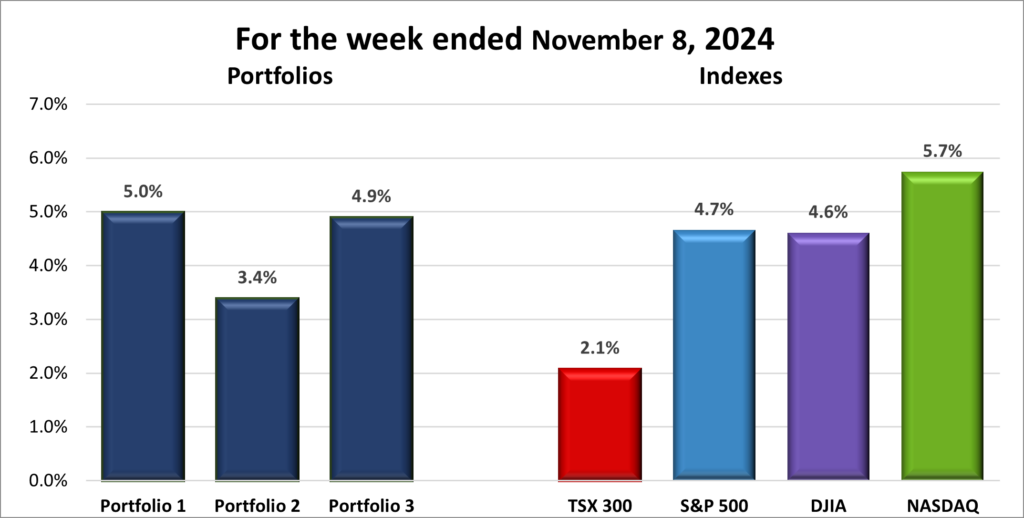
For the week, the TSX (SPTSX) gained 2.1%, the S&P 500 (SPX) rose 4.7%, the DJIA (INDU) advanced 4.6% and the Nasdaq (CCMP) surged 5.7%.

Index Weekly Streak
TSX: 1 – week winning streak
S&P: 1 – week winning streak
DJIA: 1 – week winning streak
Nasdaq: 1 – week winning streak

Bull market. A good week for the North American stock markets. It was an eventful week in the markets, with the US election and a second rate cut in the US fueling a strong rally, as illustrated in the chart above. It’s not often a Fed decision takes a back seat, but election buzz stole the spotlight, even prompting the Fed to delay its meeting by a day.

The US election emerged as the main catalyst behind the market’s best week of the year. As the potential for a Republican sweep came into focus (with the House still undecided, as of this writing), optimism surged. Investors started pricing in expectations for tax cuts and deregulation, while a late-week rate cut from the Fed added more fuel to the rally. The Fed also highlighted that although the labour market had slowed, the economy remained stable, with steady progress being made toward its 2% inflation goal. As uncertainty around a divided government faded (and markets love clarity 😊), investor confidence soared.

The prospect of pro-business policies pushed major indexes to new highs. The DJIA briefly touched 44,000 before closing just shy at 43,988.99, while the S&P crossed 6,000 before pulling back, still able to log its 50th record close this year. Both indexes saw their best performance since a year ago. Not to be left out, the Nasdaq set record highs for three straight days.

In Canada, optimism from the American markets spilled over, lifting the TSX to a record high. However, the rally cooled as concerns about potential US tariffs surfaced. Given America is Canada’s largest trading partner, such tariffs could hit the commodities-heavy economy hard. Analysts warn these measures, if enacted, could reduce Canada’s GDP by 1.7% by 2028.

Currently, the markets are riding the post-election and rate cut tailwinds to new heights. However, it’s important to remember that they can’t rise every day, and volatility is always a possibility. But for now, the optimism around potential pro-business policies and the Fed’s actions provides a solid foundation for growth. I’m definitely happy to ride these tailwinds and see the markets rally to new heights. 😊

Portfolio Weekly Streak
Portfolio 1: 1 – week winning streak
Portfolio 2: 1 – week winning streak
Portfolio 3: 1 – week winning streak

Bull market. A good week for the North American stock markets. This past week’s rally, gave all three portfolios a solid boost, as seen in the chart below. At least 72% of the holdings in each portfolio recorded gains for the week.

Portfolio 1 stole the show, with 75% of its companies in the green, including a gain by Nvidia (NASD: NVDA), the portfolios biggest holding. Several heavyweights hit all-time highs, including Amazon (NASD: AMZN), Liberty Media’s Formula 1 (NASD: FWONK), Visa (NYSE: V), and Walmart (NYSE: WMT). Despite a 16% drop from Innovative Industrial Properties Inc. (NYSE: IIPR), the portfolio easily shook it off with indie Semiconductor Inc. (NASD: INDI) skyrocketing 57% and Celestica Inc. (TSE: CLS) jumping 21%. Shopify (TSE: SHOP) and Carnival Corp. (NYSE: CCL) both gained 11%, with CrowdStrike (NASD: CRWD) and Magnite Inc. (NASD: MGNI) each adding 10%.

Portfolio 2 had what would typically be a standout week, but it lagged behind the others with a ‘measly’ 3.4% gain. 😊 Still, 77% of its holdings posted gains, with Guardant Health (NASD: GH) up 28% and iAG Financial (TSE: IAG) climbing 13%. Both iAG Financial and Dollarama (TSE: DOL) hit all-time highs, adding some strong momentum.

Portfolio 3 had a strong week as well, though it was bested by Portfolio 1’s performance. With 72% of its holdings advancing, Vertiv Holdings (NYSE: VRT) surged 18% to hit an all-time high, Shopify gained 11%, and Magnite added 10%. While Adyen (OTCM: ADYEY) slipped 10%, the overall gains easily kept the portfolio in comfortable positive territory.

A fantastic week across the board! I will happily take these kinds of gains week after week.

Weekly Portfolio & Index performance
Weekly Portfolio & Index performance for the week ended November 8, 2024.

Companies on the Radar

Stocks on my Radar Still no new additions to my radar list this past week. That said, I am debating whether it is better to invest in a new company or add to one of the existing positions in my portfolios. For now, my radar list remains focused on the three companies below:

  • On Holding AG (NYSE: ONON), a medium cap Swiss company, founder-run, sports products company.
  • Topaz Energy Corp. (TSE: TPZ), a mid-cap Canadian energy investment firm that focuses on strategic investments in premium energy assets operated by top-tier Canadian companies, and currently pays a 4.95% dividend.
  • Zoetis Inc. (NYSE: ZTS), a leading animal health company that discovers, develops, manufactures, and commercializes vaccines, medicines, diagnostics, and other technologies for both companion animals and livestock.

As always, these are not buy recommendations – be sure to do your own research and make decisions that align with your personal financial goals!

The Radar Check was last updated November 8, 2024.

Stock on the Radar List. 1 of 2.
Stock on the Radar List. 2 of 2.

Portfolio Update

Portfolio 1

Portfolio 1 for the week ended November 8, 2024: UP Green Up Arrow, signifying a positive week

  • BCE (TSE: BCE) announced they planned to purchase private American internet services provider Ziply Fiber for C$5 billion. BCE plans to use the acquisition as a means of increasing their presence in the US market.

Activity

Sold: Nvidia If you’ve been following my ‘Weekly Updates,’ you know Nvidia has been the star player in this portfolio, often determining whether it ends the week in the green or red. Riding Nvidia’s artificial intelligence tailwind has been amazing so far, but with its stock becoming such a dominant part of the portfolio, it was time to take some risk off the table. You have probably heard me mention that I need to trim my Nvidia position to avoid having the portfolio’s performance hinge on just one stock. Well, this week, I finally took action—or rather, I set the wheels in motion. Let me explain.

At first, I was planning to place a simple ‘Sell’ order for X shares at $150, good until the end of November. But then I had a better idea—why not write a covered call? With a covered call, instead of just selling the shares, I get paid a premium upfront for the option. Essentially, I am agreeing to sell those shares if Nvidia hits $150, but in the meantime, I get paid for waiting.

Since I was already comfortable selling at $150, getting that extra premium felt like a win-win. Now, if Nvidia reaches that price, I will sell as planned, but with a little bonus on top. If it does not, I keep the premium and the shares. Either way, it is a smart way to trim my position while putting some extra cash in my pocket. 😊

Sold: Lightspeed Commerce (TSE: LSPD) I first invested in Lightspeed Commerce back in September 2019, and I added more to my position when the stock started to soar in January 2020. Like many technology stocks, Lightspeed took off during the pandemic, rallying through 2021 and hitting a high of $150. Unfortunately, I did not lock in those gains when I had the chance. Instead, I held on and watched the stock slide all the way down to its current level in the low $20s. ☹

As part of my ongoing effort to streamline this portfolio, Lightspeed became an obvious choice to sell. The company continues to face profitability challenges and has a long road ahead to turn things around. Given these factors, I do not see the stock returning to its 2021 highs anytime soon. With better opportunities out there, I decided it was time to cut my losses—admittedly, much later than I should have.

Dividends

Dividends Received this week for the following companies:

No dividends this past week.

Quarterly Reports

Berkshire Hathaway Inc.

Third quarter 2024 financial results on November 2, 2024

Navitas Semiconductor Corporation

Third quarter 2024 financial results on November 4, 2024

Lattice Semiconductor Corporation

Third quarter 2024 financial results on November 4, 2024

Decisive Dividend Corporation

Third quarter 2024 financial results on November 5, 2024

Andlauer Healthcare Group Inc.

Third quarter 2024 financial results on November 5, 2024

Ferrari N.V.

Third quarter 2024 financial results on November 5, 2024

Celsius Holdings, Inc.

Third quarter 2024 financial results on November 6, 2024

Atlanta Braves Holdings, Inc.

Third quarter 2024 financial results on November 6, 2024

Innovative Industrial Properties, Inc.

Third quarter 2024 financial results on November 6, 2024

Tourmaline Oil Corp

Third quarter 2024 financial results on November 6, 2024

Supremex Inc.

Third quarter 2024 financial results on November 6, 2024

Cameco Corporation

Third quarter 2024 financial results on November 7, 2024

Pinterest, Inc.

Third quarter 2024 financial results on November 7, 2024

BCE Inc.

Third quarter 2024 financial results on November 7, 2024

indie Semiconductor, Inc.

Third quarter 2024 financial results on November 7, 2024

Cloudflare, Inc.

Third quarter 2024 financial results on November 7, 2024

Datadog, Inc.

Third quarter 2024 financial results on November 7, 2024

Rivian Automotive, Inc.

Third quarter 2024 financial results on November 7, 2024

Magnite, Inc.

Third quarter 2024 financial results on November 7, 2024

The Trade Desk, Inc.

Third quarter 2024 financial results on November 7, 2024

Telus Corporation

Third quarter 2024 financial results on November 7, 2024

Trisura Group Ltd.

Third quarter 2024 financial results on November 7, 2024

Docebo Inc.

Third quarter 2024 financial results on November 8, 2024

Portfolio 2

Portfolio 2 for the week ended November 8, 2024: UP Green Up Arrow, signifying a positive week

  • The Walt Disney Company (NYSE: DIS) is being sued by technology company Adeia (NASD: ADEA) for infringing on six of its streaming technology patents. Adeia claims Disney’s Hulu, ESPN+ and Disney+ business units used their technology to improve their streaming services.

Activity

Sold: Bank of Nova Scotia (TSE: BNS) This investment had grown to almost 45% of my portfolio—putting way too many eggs in one basket. 😊 That single stock had become too dominant, making the portfolio vulnerable to its ups and downs. By selling some shares, I now have cash to invest in new opportunities or to add to my existing holdings. Rebalancing not only lowers my risk but also helps protect against overall portfolio volatility caused by one company.

Dividends

Dividends Received this week for the following companies:

No dividends this past week.

Quarterly Reports

iA Financial Corporation Inc.

Third quarter 2024 financial results on November 5, 2024

Fortis Inc.

Third quarter 2024 financial results on November 5, 2024

Tourmaline Oil Corp.

See report under Portfolio 1.

Take-Two Interactive Software, Inc.

Third quarter 2024 financial results on November 6, 2024

Guardant Health, Inc.

Third quarter 2024 financial results on November 6, 2024

Brookfield Infrastructure Partners L.P.

Third quarter 2024 financial results on November 6, 2024

TC Energy Corporation

Third quarter 2024 financial results on November 7, 2024

Airbnb, Inc.

Third quarter 2024 financial results on November 7, 2024

Telus Corporation

See report under Portfolio 1.

Brookfield Renewable Partners L.P.

Third quarter 2024 financial results on November 8, 2024

Portfolio 3

Portfolio 3 for the week ended November 8, 2024: UP Green Up Arrow, signifying a positive week

Activity

No significant activity to report this week.

Dividends

Dividends Received this week for the following companies:

No dividends this past week.

Quarterly Reports

Brookfield Asset Management Ltd.

Third quarter 2024 financial results on November 4, 2024

Lithium Americas (Argentina) Corp.

Third quarter 2024 financial results on November 5, 2024

Alvopetro Energy Ltd.

Third quarter 2024 financial results on November 6, 2024

Magnite, Inc.

See report under Portfolio 1.

goeasy Ltd.

Third quarter 2024 financial results on November 7, 2024

Lithium Americas Corp.

Third quarter 2024 financial results on November 7, 2024

Cloudflare, Inc.

See report under Portfolio 1.

TELUS Digital Experience

Third quarter 2024 financial results on November 8, 2024

Brookfield Renewable Partners L.P.

See report under Portfolio 2.

Weekly Update for the week ending November 1, 2024

November has a reputation for being a standout month for the stock market, and the numbers back it up. Over the past 30 years, the S&P 500 has posted gains in 23 Novembers, with a solid median return of 2.8%. But when it is an election year, there is always a little more drama. While pre-election uncertainty can cause some bumps, markets tend to rally once the results are in and stability returns.

This year is no different: we are not only dealing with a closely contested election, but also a key Federal Reserve (Fed) decision on US interest rates. On top of that, November kicks off the “best three months” for stocks—alongside December and January—adding to its seasonal strength.

Canadian markets also tend to fare well in November. Historically, the Toronto Stock Exchange has seen positive performance, driven by rising commodity prices (especially oil and gold) and strong corporate earnings reports. The energy sector, in particular, often benefits from increased seasonal demand and geopolitical factors affecting oil prices.

With so many factors at play, November shines bright on the financial calendar. But as always, the market’s unpredictability means nothing is ever a sure bet. It is a fascinating blend of historical trends, market psychology, and real-time events all coming together in this action-packed month.

That said, it is important to remember that past performance does not guarantee future results. Current economic conditions, corporate earnings, and global events can all shape how the market performs, so it is always wise to stay informed and prepared.

Before we turn our attention to next week’s election, the Fed’s next move, and key economic indicators, let’s take a look at what unfolded over the past week.

Items that may only interest or educate me ….

Canadian Economic news, US Economic news, ….


Canadian Economic news

This past week’s key economic data that the Bank of Canada (BoC) considers when deciding whether to raise or lower the interest rate.

Gross Domestic Product (GDP)

Statistics Canada reported that GDP for August remained flat, following a revised 0.1% growth in July (down from the initial 0.2%), matching analysts’ expectations. On an annual basis, GDP has grown by 1.3%.

Digging deeper, the “Goods-producing sector’ declined by 0.4% in August. The biggest gainer was ‘Agriculture, forestry, fishing, and hunting,’ up 0.4%, while ‘Utilities’ saw a sharp 1.9% drop. On the services side, the sector posted a slight 0.1% increase, with ‘Finance and insurance’ and ‘Public administration’ leading at 0.5%. ‘Management of companies and enterprises’ was the hardest hit, down 3.7%.

Year-over-year, the ‘Goods-producing industries’ shrank by 0.5%, with ‘Agriculture, forestry, fishing, and hunting’ growing by an impressive 8.2%, though it could not offset declines led by a 4.0% drop in ‘Manufacturing’. Meanwhile, ‘Services-producing industries’ grew 1.9%, driven by a 3.5% rise in ‘Finance and insurance,’ while the much smaller ‘Management of companies and enterprises’ category continued its steep decline, dropping 32.5%.

August’s sluggish performance puts Canada’s economy on track for just 1.0% growth in the third quarter, falling well short of the BoC’s 1.5% forecast. High interest rates, which continue to weigh on consumers and businesses, alongside work stoppages at Canada’s two largest rail companies, were key contributors to the weaker-than-expected GDP. While the recent 0.5% rate cut may provide some relief, this latest data will likely grab the BoC’s attention and leave the door open for another potential jumbo sized 0.5% cut at their December 11 meeting. Before making any decisions, the central bank will have time to assess the final third-quarter GDP figures, as well as upcoming inflation and labour reports.

Preliminary data suggests GDP grew by 0.3% in September, with a finalized estimate set to be released on November 29, 2024.

Canadian market volatility

Canada’s Volatility Index (CVIX) opened the week at 11.28 and was relatively stable throughout, rising to 12.17 at Friday’s close. This late surge was likely the result of uncertainty over next week’s US presidential election and the Fed’s upcoming interest rate decision.

Tracked under the ticker VIXI on the Toronto Stock Exchange (TSE), the CVIX gauges anticipated market volatility. A reading below 10 suggests calm and stable market conditions, while values between 10 and 20 indicate moderate volatility with typical market fluctuations. When the index climbs above 20, it signals heightened uncertainty and the likelihood of more turbulent market conditions.

US Economic news

This past week’s key data points that the Fed considers when deciding whether to raise or lower the interest rate.

Personal Consumption Expenditures (PCE)

The Commerce Department’s Bureau of Economic Analysis reported that the PCE price index rose 0.2% in September, slightly higher than the 0.1% gain in August. Annually, inflation as measured by the PCE grew 2.1%, down from 2.3% in August.

Excluding food and energy, the core PCE price index, the Fed’s preferred inflation gauge, increased by 0.3%, up from August’s 0.2% rise. Year-over-year, core PCE inflation held steady at 2.7%, just above forecasts of a 2.6% increase.

Other than the slight dip in annual PCE, the figures either matched or slightly exceeded August’s numbers. This report mirrors the recent Consumer Price Index data, which showed inflation climbing at its slowest pace since early 2021. While the Fed is progressing toward its 2% inflation target, the journey remains bumpy. Still, this data is unlikely to affect the size of the Fed’s upcoming rate cut.

Gross Domestic Product (GDP)

The Bureau of Economic Analysis also released its initial estimate of third-quarter GDP, showing that the American economy grew at an annualized rate of 2.8%. This marks a slight slowdown from the second quarter’s 3.0% growth and falls short of analysts’ expectations for the same 3.0% growth. The decline was primarily due to decreases in private inventory investment and residential fixed investment; however, it was somewhat offset by higher consumer spending, exports, and government spending.

The data suggests that the economy is still expanding but at a slower-than-expected pace. Strong consumer and government spending continue to fuel growth, signaling that both households and businesses remain active despite current economic headwinds. Nevertheless, the drop in inventory investment and signs of a softening housing market hint that businesses may be more cautious about stocking up, indicating potential challenges for the real estate sector.

For investors, this mixed picture suggests that while the economy remains resilient, certain sectors are cooling down. That said, the 2.8% growth rate indicates that the economy is still on solid ground.

Labour data

Recent reports on US labour conditions from the Labor Department’s Job Openings and Labor Turnover Survey (JOLTS), the Bureau of Labor Statistics’ Employment Situation Summary (ESS), and the ADP Employment Report (ADP) offer valuable insights into the current state of the labour market and broader economy.

JOLTS

The JOLTS report offers a snapshot of labour demand by revealing how many positions are available on the last business day of the month and whether companies are actively hiring or pulling back. Job openings fell to 7.4 million in September, down from 7.9 million in August—marking the lowest level since January 2021 and falling short of the expected 7.9 million. Despite this decline, the ratio of job openings to unemployed workers held steady at 1.1, signalling that the labour market remains tight, even as employers are showing more caution in their hiring strategies.

ADP

In contrast, the ADP report exceeded expectations, showing private-sector job growth of 233,000 in October, more than double the forecast of 115,000. This is the strongest job growth since July 2023, when the economy faced disruptions from hurricanes. The report highlights that sectors such as services and construction continue to experience strong labour demand, reflecting resilience in key parts of the economy.

ESS

The ESS wrapped up the week with a sharp slowdown in job creation, reporting only 12,000 jobs added in October, far below expectations of 113,000. This steep decline from September’s downwardly revised figure of 223,000 is largely attributed to disruptions caused by hurricanes Helene and Milton, along with the Boeing (NYSE: BA) strike, which sidelined many workers.

On a positive note, the unemployment rate held steady at 4.1%, as expected, though it remains slightly elevated compared to last year’s 3.8%. Wage growth also provided some relief, with average hourly earnings rising by 0.4% in October, up from 0.3% in September. Year-over-year, wages increased by 4%, showing a modest gain from the 3.9% growth in the prior month.

The takeaway for investors is mixed. While the sharp drop in job creation is widely seen as a temporary result of hurricane disruptions and strikes, the slower pace of gains could signal that the economy is cooling. However, stable unemployment and rising wages suggest that the labour market remains healthy enough to support moderate economic growth. This report is particularly significant as it is the final major piece of data the Fed will review before their post-election meeting next week, likely shaping their future rate decisions.

Conclusion

The US labour market remains resilient but is showing signs of transition. Job openings are declining, while private sector hiring continues to show strength in key sectors. The sharp drop in job creation seen in the ESS, coupled with the downward revision of September’s numbers, suggests that the broader economy may be starting to slow down. Rising wages, while providing relief, could also lead to inflationary pressures, complicating the Fed’s upcoming decision on interest rates.

Consumer Confidence Index (CCI)

The Conference Board’s Consumer Confidence Index (CCI) for October exceeded expectations, coming in at 108.7, up from 98.7 in September. Analysts had predicted a more modest increase to 99.3.

Breaking down the CCI’s key components, the Present Situation Index surged by 14.2 points to 138.0, signalling a more optimistic view of current business and labour market conditions. Meanwhile, the Expectations Index rose by 6.3 points to 89.1, comfortably above the recession-warning threshold of 80. The Present Situation Index reflects how consumers feel about today’s economic conditions, while the Expectations Index gauges their outlook for income, business, and jobs in the near term.

This marks the largest monthly gain since March 2021, with all components showing improvement. The data suggest that consumers are feeling upbeat not only about their current situation but also about what lies ahead. This points to a strong short-term outlook for the economy, which is encouraging for the markets and us investors. 😊

American market volatility

The CBOE Volatility Index (VIX), often referred to as the market’s “fear gauge,” opened the week at 19.11 and gradually climbed above the 20-point threshold by midweek. Following the PCE announcement on Thursday morning, the VIX spiked above 23 before settling at 21.88 at the close of the market on Friday. This increase in volatility was influenced not only by the latest PCE inflation news but also by the jobs report, corporate earnings results, the upcoming US presidential election, and the Fed’s impending rate-setting meeting. Investors should brace for further volatility next week as these significant events unfold.

For context, the VIX measures expected market volatility over the next 30 days. Readings below 12 suggest calm conditions, while levels between 12 and 20 reflect typical market fluctuations. When the index moves into the 20-30 range, it indicates increasing uncertainty, and anything above 30 points to elevated market stress, often signaling a looming crisis or major market disruption.


Weekly Market Review

Monday: after taking a breather for most of last week, the markets got off to a good start with all four indexes – the Toronto Stock Exchange Composite Index (TSX), the S&P 500 Index (S&P), the Dow Jones Industrial Average (DJIA), and the Nasdaq Composite Index (Nasdaq) – ending the session in the green. Oil price took a tumble and were down sharply after Israel’s retaliatory air strikes were confined to Iranian military targets and avoided their energy producing facilities.

In Canada, despite lower oil prices, the TSX still managed to eke out a gain as investors have become confident are moving back into the market. In trading, Consumer Cyclicals posted the biggest gain, while the Energy sector dipped the most.

In the US, investors were optimistic of about upcoming economic data and earnings from the heavyweight technology companies. In trading, the Financials sector lead a day of widespread advances, the Technology and Energy sectors were the only sectors to lose ground.

Tuesday: it was a mixed day for the indexes with the S&P and Nasdaq ending in the green, the TSX was essentially flat, while the DJIA ended in the red.

In Canada, falling oil prices weighed on the TSX. In trading, the Basic Materials (miners and fertilizer manufacturers) sector posted the biggest gain, the Utilities sector declined the most.

In the USA, Nasdaq set a record high as investors prepared for earnings from the heavyweight technology companies. In trading, Communication Services rose the most of the sectors, while the Utilities sector declined the most.

Wednesday: all four indexes went for a tumble today as the latest US GDP data showed consumers continue to spend at a healthy rate and private payrolls expanded much more than anticipated. Oil prices rose on news of an unexpected drop in US inventories.

In Canada, the TSX ended lower for the seventh day in the last eight sessions as investors took some profits from mining companies that had benefitted from the run up in higher commodity prices. In trading, Consumer Staples was the top performer, while the Basic Materials sector fell the farthest.

In the USA, investors digested the latest economic news to look for clues about the Fed’s next rate announcement. In trading, Communication Services advanced the most, while the Technology sector declined the most.

Thursday: three of the four indexes fell over 1%, with the DJIA falling almost 1% as investors have become concerned about growth prospects for the heavyweight technology companies and mounting AI costs. Oil prices moved higher on news of possible Iranian retaliation against Israel following airstrikes on Iranian military installations.

In Canada, the TSX fell to a three-week low, driven by a broader market pullback following a downturn in US markets. In trading, the Healthcare sector was the only one to post a gain, while Technology had the biggest drop.

In the US, investors reacted negatively to news that both Microsoft (NASD: MSFT) and Meta (NASD: META) plan to ramp up AI spending at the expense of short-term profits, sending their stocks – and other heavyweight tech companies – lower, which in turn pulled down the major indexes. In trading, only the Utilities and Energy sectors ended in the green, while Technology was the deepest in the red.

Friday: the markets staged a comeback as investors capitalized on Thursday’s sell-off. Meanwhile, oil prices continued to climb, fueled by expectations of escalating retaliation between Iran and Israel.

In Canada, investors shrugged off losses from the past three days, marking the start of November – a historically positive month for the markets. In trading on Bay Street, Consumer Cyclicals advanced the most while the Utilities sector declined the most.

In the US, strong earnings from Amazon (NASD: AMZN) buoyed indexes, offsetting a disappointing jobs report. On Wall Street, Amazon’s surge propelled the Consumer Cyclicals sector to the top performer spot, whereas Utilities recorded the largest losses.


Weekly Market and Portfolio Review

For the week, the TSX (SPTSX) lost 0.9%, the S&P 500 (SPX) dropped 1.4%, the DJIA (INDU) slipped 0.1% and the Nasdaq (CCMP) fell 1.5%.

 
Index Weekly Streak
TSX: 2 – week losing streak
S&P: 2 – week losing streak
DJIA: 2 – week losing streak
Nasdaq: 1 – week losing streak

Bearish market The markets were on track for a strong end to the month, with all four major indexes moving higher midweek. However, the rally ran into turbulence in the final days, erasing earlier gains and leaving the indexes in the red by week’s end, as shown in the progress chart above. The Nasdaq, in particular, saw its seven-week winning streak come to an abrupt halt.

Several key factors drove the markets this week, including three crucial economic indicators: GDP (productivity), PCE (inflation), and the jobs report (labour). It was also the busiest week for third-quarter earnings, with some of America’s most valuable companies reporting.

In the US, productivity slowed, inflation continued to ease, and the jobs report presented a mixed picture, with a sharp drop in new jobs—potentially due to incomplete data.

Earnings season had a major impact, especially with reports from the Magnificent 7 tech giants. These companies make up nearly 25% of the S&P 500 and have driven much of its 36% gain over the past year, with the index hitting record highs earlier this month. Five of these tech giants reported earnings, each announcing increased spending on datacentres to meet soaring demand for AI and cloud services. Despite solid financials, the market reacted cautiously as investors focused on the hefty spending, which could delay near-term revenue gains. While Apple (NASD: AAPL), Microsoft and Meta stumbled, Alphabet (Google) (NASD: GOOGL) and Amazon surged, with Amazon’s report driving the late-week rebound.

In Canada, the TSX initially rallied on renewed investor confidence as interest rates continued to fall. However, declining oil prices and profit-taking after a run-up in commodity stocks weighed down the index. Canadian GDP growth remains sluggish, trailing the BoC’s third-quarter growth estimates. While US GDP posted a solid 2.8% gain, Canadian GDP is expected to come in at a more modest 1%. Good news for our neighbours to the south, but less so for us Canadians.

Despite October’s rocky finish, there’s still reason for cautious optimism ahead. November, known for its historically strong market performance, holds the potential for a rebound that could lift all four indexes back into positive territory. That said, it is likely to be a volatile month. With the hotly contested US election and an upcoming Fed meeting, where another rate cut is expected, we might be in for some turbulence—so fasten your seat belt and prepare for a bit of rough weather. 😊

Portfolio Weekly Streak
Portfolio 1: 1 – week losing streak
Portfolio 2: 2 – week losing streak
Portfolio 3: 2 – week losing streak

Bearish market It was a tough week for the three portfolios, with all of them ending lower. Mixed earnings from heavyweight tech stocks weighed heavily on the markets and the portfolios—especially Portfolio 1, which saw its seven-week winning streak come to an end. Meanwhile, the other two portfolios extended their losing streaks to two weeks. ☹

Portfolio 1 had a rough week, with only 26% of its holdings increasing in value. The bright spots were all-time highs from The Trade Desk (NASD: TTD) and TMX Group (TSE: X). On the downside, Hammond Power Solutions (TSE: HPS.A) dropped 11%, and, most significantly, Nvidia – the largest holding – posted a slight weekly loss. ☹

Portfolio 2 fared the best, though that is not saying much. It declined the least, with 42% of its companies posting gains. Dollarama (TSE: DOL) reached an all-time high, offering some relief. But like Portfolio 1, Hammond Power Solutions also dragged things down with its 11% drop.

Portfolio 3 had a rough ride, with only 18% of holdings gaining value, making it the second worst performer of the week. While there were not any major losses, the bright spot came from Lithium Americas Corp (TSE: LAC), which surged 15% – its second consecutive week of double-digit gains. Too bad its share price was not higher to begin with! 😊

All in all, it was not a great week. Whether you measure by percentage loss or the number of companies gaining, either Portfolio 1 or Portfolio 3 had the worst performance. Let us hope November’s historically positive trends kick in and bring all three portfolios get back on the winning side next week.

Weekly Portfolio & Index performance
Weekly Portfolio & Index performance for the week ended November 1, 2024.

Monthly Market and Portfolio Review

For the month of October, the TSX (SPTSX) rose 0.7%, the S&P 500 (SPX) fell 1.0%, the DJIA (INDU) dropped 1.3% and the Nasdaq (CCMP) declined 0.5%.

Bearish market October was a bit of a rollercoaster for the markets. As shown in the monthly progress chart above, the month started slow, rallied mid-month, but ultimately ended on a down note. All four major North American indexes posted monthly losses, snapping a five-month winning streak for both the S&P and the DJIA.

It felt like two different months rolled into one. In the first half, markets surged on optimism and positive momentum carried over from a strong September. Economic news initially drove the gains, with a blowout jobs report signaling a robust economy. This fueled investor confidence but also raised concerns about rising inflation, which could prompt the Fed to pause its rate cuts. Adding to the unease was a higher-than-expected CPI inflation report that spooked the markets and shifted sentiment.

Earnings season played a significant role in shaping market movements as well. Strong reports from major US banks, along with a better-than-expected performance from Taiwan Semiconductor (NYSE: TSM), the world’s largest chipmaker, helped propel the S&P and DJIA to record highs during the month. However, as October progressed, the initial optimism began to wane, ultimately pushing all three American indexes into negative territory by month’s end.

In Canada, rising commodity prices—particularly oil—propelled the TSX to record highs. Lower interest rates also began to make an impact, with the Bank of Canada signaling the possibility of further cuts ahead. However, similar to their US counterparts, the TSX relinquished many of its early gains. Unlike the American indexes, though, the TSX managed to end October with a minor gain.

As we close the book on October, it is evident that the markets were pulled in different directions by a mix of strong economic data, inflation fears, and corporate earnings. While the early gains offered a glimpse of optimism, the subsequent volatility serves as a reminder that the markets are always unpredictable. Now that we have turned the calendar to November—traditionally one of the best months for stocks—there is plenty of potential for markets to resume their upward march, especially with major events like the US election and key economic reports on the horizon. Let us hope November lives up to its reputation as a great month for us investors! 😊

Bull market. A good week for the North American stock markets.Bearish market October started off strong for the three portfolios, and I was optimistic it would be another stellar month. But as the markets reversed course toward the end, the gains began to fade. In the end, only Portfolio 1 managed to finish the month in positive territory, as you can see in the chart below.

Portfolio 1 was the clear standout, posting gains in four out of the five weeks. The major driver? Nvidia, which hit an all-time high in October before slipping back slightly by month’s end. While companies like The Trade Desk and Celestica (TSE: CLS) also had solid performances, it was Nvidia leading the charge this month.

Portfolio 2 had a more turbulent ride. It kicked off with a loss, bounced back with two consecutive weekly gains, but ended the month on a sour note with two straight weekly declines. Despite a few bright spots, no single or group of stocks stood out enough to push the portfolio into the green for the month.

Portfolio 3 was off to a great start with three straight weeks of gains. Unfortunately, it could not hold onto the momentum and ended the month just barely in positive territory. Still, there were impressive performances along the way, especially from Lithium Americas (TSE: LAC), which posted back-to-back gains of 18% and 15% in the last two weeks, helping the portfolio finish in the black.

Despite October’s ups and downs, Portfolio 1’s strength and a few standout gains helped prevent things from turning too negative. As we roll into November, I am cautiously optimistic heading into one of the best months of the year. Let us hope the markets build on the solid start and deliver a strong performance, lifting all three portfolios into positive territory and making November a winning month! 😊

Monthly Portfolio & Index performance
Monthly Portfolio & Index performance for October, 2024.

Companies on the Radar

Stocks on my Radar Once again, no new additions to my radar list, but I removed Coca-Cola (NYSE: KO) from the list. As much as I like the company, it is my favourite soft drink, it did not have a big enough dividend end yield to go with a relatively minor future growth estimate. In addition, the stock seems expensive at the current price and the share price has been falling since peaking in early September. If it drops to a more attractive range, around $55, I would consider becoming an owner of the company. But for now, I will pass on becoming a co-owner with one the world’s greatest investors – Warren Buffett. 😊

For now, my radar list stays focused on the three companies listed below:

  • On Holding AG (NYSE: ONON), a medium cap Swiss company, founder-run, sports products company.
  • Topaz Energy Corp. (TSE: TPZ), a mid-cap Canadian energy investment firm that focuses on strategic investments in premium energy assets operated by top-tier Canadian companies, and currently pays a 4.95% dividend.
  • Zoetis Inc. (NYSE: ZTS), a leading animal health company that discovers, develops, manufactures, and commercializes vaccines, medicines, diagnostics, and other technologies for both companion animals and livestock.

As always, these are not buy recommendations – be sure to do your own research and make decisions that align with your personal financial goals!

The Radar Check was last updated November 1, 2024.

Stock on the Radar List. 1 of 2.
Stock on the Radar List. 2 of 2.

Portfolio Update

Portfolio 1

Portfolio 1 for the week ended November 1, 2024: DOWN Red Down Arrow

  • CrowdStrike (NASD: CRWD) is being sued by Delta Air Lines (NYSE: DAL) for a global outage of Delta’s technology systems in the summer which resulted in mass flight cancellations that disrupted over 1.3 million customers and cost the airline over US$500 million.
  • Celsius Holdings (NASD: CELH) has acquired Big Beverages Contract Manufacturing for US$75 million in cash, a strategic move to enhance its supply chain and product development. This acquisition includes a large manufacturing and warehouse facility focused on Celsius-branded products, while Big Beverages will keep its existing management and workforce intact.
  • Nvidia (NASD: NVDA) is set to replace Intel (NASD: INTC) in the DJIA to better reflect the semiconductor industry’s influence. This change will take effect before the market opens on November 8.

Activity

No significant activity to report this week.

Dividends

Dividends Received this week for the following companies:

Companies followed by DRIP (Dividend Re-Investment Plan) indicate additional shares were purchased with the dividend. Any cash leftover was added to the cash balance.

Canadian $

Toronto-Dominion Bank (TSE: TD) DRIP

Bank of Nova Scotia (TSE: BNS) DRIP

US $

No US$ dividends this past week.

Quarterly Reports

Alphabet Inc.

Third quarter 2024 financial results on October 29, 2024

PayPal Holdings, Inc.

Third quarter 2024 financial results on October 29, 2024

Visa Inc.

Fourth quarter 2024 financial results on October 29, 2024

TMX Group Limited

Third quarter 2024 financial results on October 30, 2024

Amazon.com, Inc.

Third quarter 2024 financial results on October 31, 2024

Apple Inc.

Fourth quarter 2024 financial results on October 31, 2024

Portfolio 2

Portfolio 2 for the week ended November 1, 2024: DOWN Red Down Arrow

  • Magnite (NASD: MGNI) announced they have extended their relationship with Disney (NYSE: DIS) to provide them with ad technology services for another two years.

Activity

No significant activity to report this week.

Dividends

Dividends Received this week for the following companies:

Companies followed by DRIP (Dividend Re-Investment Plan) indicate additional shares were purchased with the dividend. Any cash leftover was added to the cash balance.

Canadian $

Tourmaline Oil Corp (Alberta) (TSE: TOU)

Bank of Nova Scotia (TSE: BNS) DRIP

Dollarama Inc (TSE: DOL)

US $

No US$ dividends this past week.

Quarterly Reports

Hammond Power Solutions Inc.

Third quarter 2024 financial results on October 29, 2024

Microsoft Corp.

First quarter 2025 financial results on October 30, 2024

Canadian Natural Resources Limited

Fourth quarter 2024 financial results on October 31, 2024

Portfolio 3

Portfolio 3 for the week ended November 1, 2024: DOWN Red Down Arrow

  • Lithium Americas announced the US Department of Energy has finalized a US$2.26 billion loan to build their Thacker Pass lithium mine. The mine is one of the US’s largest mining investments as the government attempts to secure and increase the domestic production of critical minerals used in the production of electric batteries used in electric vehicles.
  • Brookfield Asset Management (TSE: BAM) and Brookfield Corporation (TSE: BN) announced plans to improve BAM’s corporate structure, including moving its head office from Toronto to New York, aiming to position the company for broader equity index inclusion, especially in the US markets.

Activity

No significant activity to report this week.

Dividends

Dividends Received this week for the following companies:

Canadian $

Toronto-Dominion Bank (TSE: TD)

US $

No US$ dividends this past week.

Quarterly Reports

Vertiv Holdings Co

Third quarter 2024 financial results on October 23, 2024

Microsoft Corp.

See report under Portfolio 2.

Weekly Update for the week ending October 25, 2024

This is another in the series of ‘Tips for Those New to Investing.’ This week we take a look at Dollar cost averaging.

The Power of Dollar-Cost Averaging: A Beginner’s Best Friend

When markets get unpredictable, it is easy to feel unsure about when to invest. Should you wait for prices to drop further, or jump in now? One simple strategy that can remove some of the guesswork is Dollar-Cost Averaging (DCA).

What Is Dollar-Cost Averaging?

Dollar-cost averaging means investing a fixed amount of money at regular intervals, no matter what is happening in the market. Whether stocks are rising, falling, or going sideways, you are consistently buying in, which helps average out the price over time.

Let us say you invest $100 every month into a company or an index fund. Some months, the price will be higher, meaning you will buy fewer shares. Other months, when prices are lower, you will scoop up more shares for the same amount of money. Over time, this strategy helps smooth out the market’s highs and lows.

Benefits of Dollar-Cost Averaging

  1. Reduces the Impact of Market Volatility Trying to time the market perfectly often leads to missed opportunities or overpaying for stocks. With DCA, you do not have to worry about timing – you are consistently investing, helping you stay steady during market swings.
  2. Builds Discipline DCA encourages a consistent investing habit, which is especially important when you are just starting out. You are regularly growing your portfolio without second-guessing every market move.
  3. Lowers Emotional Investing Market volatility can lead to emotional decisions, like panic selling or buying into a rally out of fear of missing out (commonly referred to as FOMO). DCA takes emotions out of the equation by keeping you focused on a long-term plan, no matter what is happening in the market today.
  4. Accessible for New Investors With DCA, you do not need a large sum to start investing. Even small, regular contributions can help grow your portfolio over time. This makes it perfect for those just starting out who might not have a lump sum to invest upfront.

Why It Works in Volatile Markets

During volatile periods – like October, when markets can get particularly unpredictable – DCA really shines. Instead of stressing over market drops, you can view them as opportunities to buy more shares at lower prices, setting yourself up for potential gains when the market rebounds.

How to Get Started with Dollar-Cost Averaging

  • Set a Budget: Decide how much you can comfortably invest each month. It does not have to be a lot – the key is consistency.
  • Choose Your Investments: DCA works well with both index funds and individual stocks. For beginners, broad market index funds can help diversify your portfolio.
  • Stay Committed: Stick to your plan, especially when the market is down. Remember, this strategy is for the long term.

Conclusion

Dollar-cost averaging is one of the easiest and most effective strategies for new investors to start building wealth without worrying about market timing. By investing regularly, you will benefit from market dips, stay disciplined, and avoid the emotional rollercoaster that comes with volatility. If you are new to investing, this strategy is a steady friend in both calm and stormy markets!

Now that we have covered the benefits of dollar-cost averaging, let us shift gears and look at what has been happening in the markets this past week. Let’s look into the latest developments and see how the markets have been reacting.

Items that may only interest or educate me ….

Canadian Economic news, US Economic news, ….


Canadian Economic news

This past week’s key economic data that the Bank of Canada (BoC) considers when deciding whether to raise or lower the interest rate.

Bank of Canada makes super sized cut

The BoC delivered a widely anticipated 0.5% cut to its benchmark interest rate on Wednesday, lowering it to 3.75%. This marks the fourth consecutive rate cut and the first “super-sized” reduction in over 15 years, excluding the pandemic period.

With inflation seemingly under control, BoC officials have shifted their focus to reviving the economy. Third-quarter growth came in well below expectations, and unemployment remains high. The economy has underperformed, with per capita GDP shrinking for five consecutive quarters. Officials voiced concerns that inflation could dip too low and hope this rate reduction – and potential future cuts – will stimulate demand and foster stronger growth, keeping inflation near their 2% target.

The BoC attributed the easing inflation to lower shelter costs (mortgages and rents), a cooling demand-supply imbalance, and falling global oil prices. Although the sluggish economic growth is concerning – third-quarter GDP is projected to grow by just 1% annually, well below the bank’s forecast – officials remain optimistic about a rebound over the next two years.

Governor Tiff Macklem explained the larger cut, stating, “We took a bigger step today because inflation is back at the 2% target, and we want to keep it there.” The BoC expects inflation to remain stable at 2% through 2025, signaling that more rate cuts could be on the horizon, assuming the economy evolves as expected.

In the short term, the rate cut will lower the cost of variable-rate mortgages and loans, as well as new loans, giving consumers and businesses more disposable income. Over time, this extra cash is expected to fuel consumer spending and business investment, helping to jumpstart the economy.

The next interest rate announcement is scheduled for Dec. 11.

Retail prices

Statistics Canada’s retail sales report for August showed a 0.4% increase, down from a stronger-than-expected 0.9% gain in July. On an annual basis, retail sales grew by 1.4%, surpassing analysts’ prediction of a 0.9% rise for the year. Monthly gains came in slightly below the forecast of 0.5%, but the overall trend remains positive.

Digging deeper into the numbers, ‘Shoe retailers’ led the monthly growth with a 6.5% surge, while the ‘Jewellery, luggage, and leather goods’ sector saw the largest drop, falling by 2.9%. Over the year, ‘New car dealers’ posted the biggest gain, jumping 7.5%, while ‘Convenience retailers and vending machine operators’ struggled, down 5.7%.

Core retail sales, which exclude gas stations, fuel vendors, and motor vehicle and parts dealers, took a slight hit, falling 0.4% in August after two consecutive monthly gains. Year-over-year, core retail sales edged up by 0.3%, slowing from July’s 0.9% growth.

This mixed picture suggests that while some sectors are thriving, others are struggling as consumer spending shifts. Consumers have yet to fully benefit from easing inflation and the BoC’s recent rate cuts, which lowered the benchmark rate by a total of 0.75%. However, further reductions may be necessary to drive sustained growth in spending and boost the broader economy.

Canadian market volatility

Canada’s Volatility Index (CVIX) began the week at 10.57, climbing to a midweek high of 12.99 before settling at 11.04 by Friday’s close. The early rise was likely driven by anticipation of the BoC’s interest rate decision, with a brief spike coinciding with the announcement. Afterward, Canadian markets remained relatively calm, gradually drifting to lower levels as the week went on.

Tracked under the ticker VIXI on the Toronto Stock Exchange (TSE), the CVIX gauges anticipated market volatility. A reading below 10 suggests calm and stable market conditions, while values between 10 and 20 indicate moderate volatility with typical market fluctuations. When the index climbs above 20, it signals heightened uncertainty and the likelihood of more turbulent market conditions.

US Economic news

This past week’s key data points that the Federal Reserve (Fed) considers when deciding whether to raise or lower the interest rate.

Consumer Sentiment Index (CSI)

The University of Michigan’s CSI for October came in at 70.5, slightly up from September’s 70.1 and 10.5% higher than last year’s 63.8 reading. This is the highest level since April 2024, though still well below the 88.3 peak recorded in 2021, post-pandemic.

Looking closer, the Current Economic Conditions index rose to 64.9, a 2.5% increase from September. However, it remains 8.1% lower than the 70.6 recorded in October 2023, showing that short-term confidence still lags. On the flip side, the Index of Consumer Expectations dipped slightly to 74.1 from 74.4 in September, but it is up 25% from 59.3 a year ago, reflecting growing optimism about future economic prospects.

The Current Economic Conditions index reflects how consumers feel about their immediate financial situation, while the Consumer Expectations index captures their outlook for the months ahead.

This marks the third consecutive month of rising consumer sentiment, largely driven by easing interest rates. However, political uncertainty surrounding the upcoming presidential election is also influencing consumers. As the gap between Democrats and Republicans narrows, many are adopting a “wait-and-see” approach to their economic outlook, with political outcomes likely weighing heavily on future expectations.

American market volatility

The CBOE Volatility Index (VIX), often referred to as the market’s “fear gauge,” started the week at 18.02, fluctuating between 18.0 and 19.5 before spiking above 20 on Wednesday. It continued to bounce between 20 and 18.3 for the rest of the week, ultimately closing at 20.33. A VIX above 20 tends to grab Wall Street’s attention, as it signals heightened market volatility.

The midweek spike coincided with Tesla’s stronger-than-expected earnings report, while growing concerns over the Fed’s upcoming interest rate decision likely added to the market jitters.

For context, the VIX measures expected market volatility over the next 30 days. Readings below 12 suggest calm conditions, while levels between 12 and 20 reflect typical market fluctuations. When the index moves into the 20-30 range, it indicates increasing uncertainty, and anything above 30 points to elevated market stress, often signaling a looming crisis or major market disruption.


Weekly Market Review

Monday: the week got off to a slow start with three of the four major North American indexes – the Toronto Stock Exchange Composite Index (TSX), the S&P 500 Index (S&P), the Dow Jones Industrial Average (DJIA) – ending the day lower. Investors are preparing for a week of big-name earnings reports. A week of solid earnings should keep the bull market running, whereas weak reports will act as a drag on the indexes. Oil prices were up slightly as a result of ongoing tensions in the Middle East.

In Canada, investors are waiting third quarter earnings results and this week’s upcoming rate decision by the BoC. In trading, Energy was the only sector to end in the green, while Healthcare fell the farthest.

In the US, the Nasdaq Composite Index (Nasdaq) was the only index to post a gain, largely on the strength of a surging Nvidia (NASD: NVDA). In trading, Technology was the only sector to close in the green, while Healthcare ended the deepest in the red.

Tuesday: the indexes started the day lower but steadily climbed throughout the session, with the Nasdaq being the only one to break into positive territory, while the others hovered just below the flatline. Oil prices ended higher on tightening supplies and the conflict in the Middle East.

In Canada, most analysts expect the BoC to cut the benchmark interest rate by 0.5% in a bid to jumpstart the sluggish economy. Higher commodity prices limited the declines caused by a drop in the Financials sector. In trading, the Healthcare sector recoded the largest gain while Consumer Cyclicals suffered the biggest fall.

In the US, investors are starting to worry that the recent strong economic data might prompt the Fed to hold off on any rate cuts at their next meeting, stirring some unease in the markets. In trading, Consumer Staples advanced the farthest, while the Industrials declined the most.

Wednesday: the indexes all closed lower as investors reassessed the odds that the Fed will lower the interest rate at their next meeting. Oil prices returned to their downward trajectory following a report of a large build up in American inventories.

In Canada, the BoC lowered their lending rate by 0.5% to 3.75% but that was not enough to prevent the TSX from falling for a third straight day, dragged lower by falling commodity prices. In trading, Consumer Cyclicals and Communications Services were the only sectors to advance, the Technology sector incurred the biggest decline.

In the USA, investors were taking some profits after the previous week’s rally. In trading it was day of broad-based losses, with only the Utilities sector managing to post a gain. Leading the sectors down was Consumer Cyclicals.

Thursday: the markets saw mixed results today, with the TSX and DJIA closing in the red, while the Nasdaq and S&P finished higher. The S&P snapped a three-day losing streak, buoyed by a strong earnings report from Tesla (NASD: TSLA) which caused its share price to jump 21%, giving investors hope that the rest of the “Magnificent 7” will deliver similarly upbeat earnings. Oil prices fell on news of peace talks in the Middle East.

In Canada, the TSX lost ground for the fourth straight day, weighed down by lower commodity prices. It appears investors are waiting for earnings from some of the bigger companies. In trading, the technology sector was the biggest gainer, while Communications Services had the biggest fall.

In the USA, high yields on US Treasury bonds and profit taking continued to put downward pressure on the markets. In trading, the Consumer Cyclicals led all sectors thanks to the surge in Tesla shares. On the downside, Basic Materials (mining companies and fertilizer manufacturers) declined the most.

Friday: after a strong start in the morning that saw all four indexes in the green, the markets cooled off in afternoon trading, leaving only the Nasdaq in the green at the end of the day. Uncertainty over the next move by the Fed regarding the US interest rate continues to weigh on the markets. Oil prices surged nearly 1.5%, driven by growing doubts over the success of Middle East peace talks.

In Canada, the TSX extended its longest losing streak since April, marking five consecutive days of decline. Investors grew increasingly risk-averse ahead of the upcoming US election and a series of earnings reports from major bellwether companies, both of which could impact market sentiment in the near term. In trading, rising oil prices propelled the Energy sector to the biggest daily gains, while Consumer Cyclicals suffered the largest decline.

In the US, optimism surrounding strong earnings reports expected from five of the “Magnificent 7” companies next week helped the Nasdaq buck the trend and avoid the declines seen in the other indexes. In trading, Communication Services posted the biggest gain, while Utilities suffered the biggest loss.


Weekly Market and Portfolio Review

For the week, the TSX (SPTSX) slipped 1.4%, the S&P (SPX) fell 1.0%, the DJIA (INDU) declined 2.7% and the Nasdaq (CCMP) gained 0.2%.

Index Weekly Streak
TSX: 1 – week losing streak
S&P: 1 – week losing streak
DJIA: 1 – week losing streak
Nasdaq: 7 – week winning streak

Bearish market As we move through the historically volatile months of September and October, I’ve had my fingers crossed to avoid any downside surprises. After the previous week’s strong upward trend that saw several of the major North American indexes hit fresh highs, this past week felt like the markets were hitting the pause button. Let’s hope it’s just a breather! 😊

In the US, with limited economic data to guide the way, third-quarter earnings and speculation around the Fed’s next moves took the spotlight. Add in rising US Treasury yields, tensions in the Middle East, and the increasingly tight US election race, and it’s no surprise that American indexes pulled back from their recent highs.

So far, earnings have been solid, with Tesla delivering a surprise boost that sparked optimism ahead of next week’s tech-heavy lineup. Many of the tech giants – including members of the Magnificent 7 – are set to report. Strong corporate earnings are key to keeping this bull market alive.

The Fed also remains in focus – not so much for what it’s done, but for what it might do next. Investors are growing uneasy about the possibility of the Fed slowing down or even pausing their rate cuts at their upcoming meeting.

Here in Canada, the TSX hit an all-time high the previous Friday but spent most of this past week giving back some of those gains. Despite the Bank of Canada’s hefty 0.5% rate cut, lower commodity prices and similar challenges affecting US markets weighed on the index.

Overall, it wasn’t a great week, but there were no major drops – just more of a breather. Looking ahead, next week brings a wave of economic news and a flurry of earnings reports, including from Magnificent 7 members Alphabet (NASD: GOOGL), Microsoft (NASD: MSFT), Amazon (NASD: AMZN), and Apple (NASD: AAPL). Strong results from these companies, along with positive earnings overall, could keep the bulls running – otherwise we might see a major stumble. We’ll find out soon enough. 😊

Portfolio Weekly Streak
Portfolio 1: 7 – week winning streak
Portfolio 2: 1 – week losing streak
Portfolio 3: 1 – week losing streak

Bearish market After two strong weeks of gains in October, a market pullback felt almost inevitable, as the weekly performance chart below shows. I was expecting the portfolios to take a hit as well, but to my surprise, Portfolio 1 managed to extend its weekly winning streak to seven, despite the dip.

Portfolio 1 was the only one to increase in value, as well as outperform all four indexes. Despite only 46% of its holdings posting a gain, a stellar 22% rise in Celestica (TSE: CLS) and a small bump from Nvidia, the portfolio’s most valuable stock, pushed it into positive territory. During the week, both Nvidia and Apple hit record highs, and after a slight pullback from Apple, Nvidia claimed the crown as the world’s most valuable company by market cap.

Portfolio 2 had a rough week, showing the weakest performance of the bunch. Only 30% of the companies in the portfolio increased in value, and none were significant enough to offset the losses. On the bright side, there were no major drops, but that’s a small consolation.

Portfolio 3 didn’t fare much better, with just 31% of its holdings posting gains. Fortunately, Lithium Americas (TSE: LAC) had a strong week, jumping 18%, which helped cushion the overall loss.

With three of the four indexes in the red, it wasn’t surprising to see the portfolios have an off week. To paraphrase the band Trooper, “the markets can’t shine every day.” 😊 Here’s hoping the markets shine once again next week!

Weekly Portfolio & Index performance
Weekly Portfolio & Index performance for the week ended October 25, 2024.

Companies on the Radar

Stocks on my Radar Once again, no new companies have caught my eye. To be fair, I am not actively hunting for them, as I am content with the ones already in any of the three portfolios. In fact, I am more inclined to trim a few positions rather than add more. That said, if a great company popped up at the right price, it would definitely grab my attention. For now, though, the radar stays focused on the four companies listed below.

  • On Holding AG (NYSE: ONON), a medium cap Swiss company, founder-run, sports products company.
  • Topaz Energy Corp. (TSE: TPZ), a mid-cap Canadian energy investment firm that focuses on strategic investments in premium energy assets operated by top-tier Canadian companies
  • Zoetis Inc. (NYSE: ZTS), a leading animal health company that discovers, develops, manufactures, and commercializes vaccines, medicines, diagnostics, and other technologies for both companion animals and livestock.
  • Coca-Cola (NYSE: KO), a global beverage giant, best known for its flagship soft drink, Coca-Cola. They offer a wide range of non-alcoholic drinks, including sodas, juices, teas, and bottled water, catering to consumers worldwide.

As always, these are not buy recommendations – be sure to do your own research and make decisions that align with your personal financial goals!

The Radar Check was last updated October 25, 2024.

Stock on the Radar List. 1 of 2.
Stock on the Radar List. 2 of 2.

Portfolio Update

Portfolio 1

Portfolio 1 for the week ended October 25, 2024: UP Green Up Arrow, signifying a positive week

  • Walmart (NYSE: WMT) announced plans to begin delivering prescription medicines and refills alongside groceries and other items, all in a single order delivered that day, if not within 30 minutes of being placed. This new service, however, will only be available in the US, adding another level of convenience for their American customers.
  • Nvidia announced that, in collaboration with their manufacturing partner Taiwan Semiconductor (NYSE: TSMC), they have resolved a design flaw in their latest Blackwell chips. These artificial intelligence (AI) – specific chips are set to begin shipping later this year.
    In other Nvidia news, the company expanded its relationship with India’s Reliance Industries (NSE: RELIANCE) to launch an AI model for the Hindi language. This new model would be used to help other businesses develop their own Hindi language AI models.

Activity

No significant activity to report this week.

Dividends

Dividends Received this week for the following companies:

Companies followed by DRIP (Dividend Re-Investment Plan) indicate additional shares were purchased with the dividend. Any cash leftover was added to the cash balance.

Canadian $

Decisive Dividend Corp (TSEV: DE) DRIP

BCE Inc (TSE: BCE) DRIP

Dream Industrial Real Estate Investment Trust (TSE: DIR.UN) DRIP

US $

No US$ dividends this past week.

Quarterly Reports

General Motors Company

Third quarter 2024 financial results on October 22, 2024

Canadian National Railway Company

Third quarter 2024 financial results on October 22, 2024

Celestica Inc.

Third quarter 2024 financial results on October 23, 2024

Portfolio 2

Portfolio 2 for the week ended October 25, 2024: DOWN Red Down Arrow

  • Walt Disney (NYSE: DIS) named Morgan Stanley (NYSE: MS) executive chair James Gorman as the board of governors’ chair and announced they plan to have a replacement for current Chief Executive Officer (CEO) Bob Iger in 2026. Mr. Gorman brings valuable succession planning experience, having successfully appointed his own successor as CEO at Morgan Stanley while retaining the other two internal CEO candidates within the company.
  • Canadian Natural Resources (TSE: CNQ) is set to boost its use of the newly completed Trans Mountain pipeline after acquiring Athabasca oil sands assets from Chevron (NYSE: CVX) earlier this year. With the added capacity, CNQ will be able to ramp up its oil shipments by 75%, bringing its total to 164,000 barrels per day (bpd). Considering the pipeline’s overall capacity of 890,000 bpd, CNQ will command around 18% of the total – not a small amount!

Activity

No significant activity to report this week.

Dividends

Dividends Received this week for the following companies:

Companies followed by DRIP (Dividend Re-Investment Plan) indicate additional shares were purchased with the dividend. Any cash leftover was added to the cash balance.

Canadian $

Dream Industrial Real Estate Investment Trust (TSE: DIR.UN) DRIP

US $

No US$ dividends this past week.

Quarterly Reports

Whitecap Resources Inc.

Third quarter 2024 financial results on October 23, 2024

Portfolio 3

Portfolio 3 for the week ended October 25, 2024: DOWN Red Down Arrow

  • Microsoft launched the latest installment in the Call of Duty series, Call of Duty: Black Ops 6 – one of the most successful video game franchises in history. This is the first major release from Microsoft since they acquired the gaming giant Activision Blizzard last year, underscoring the company’s big bet on the video game industry. Microsoft is betting that gamers will prefer a streaming version enough to pay a more lucrative monthly subscription fee rather make a one-time purchase.

Activity

No significant activity to report this week.

Dividends

Dividends Received this week for the following companies:

Canadian $

goeasy Ltd. (TSE: GSY)

US $

No US$ dividends this past week.

Quarterly Reports

No quarterly reports this past week.


Weekly Update for the week ending October 18, 2024

Index Funds vs. Individual Stocks: Which Strategy is Best for New Investors

When you are new to investing, the sheer number of stocks listed on various exchanges can feel overwhelming. Starting with an index fund might offer a smoother entry into the world of investing. However, deciding between index funds and individual stocks can be daunting. Both have their pros and cons, and finding the right fit depends on your financial goals and risk tolerance. So, which strategy is best for you? Let us take a quick look at the strengths and weaknesses of each.

Index Funds:

Pros

  • Diversification: Index funds spread your money across the stocks of many companies, reducing the risk tied to any single company.
  • Low Maintenance: They track an index (like the S&P 500), so no active management is needed – a great option for beginners.
  • Low Management Fees: While individual stocks do not have ongoing fees, index funds typically have very low expense ratios compared to actively managed funds, such as mutual funds, making them a cost-effective option over the long term.

Cons

  • Limited Upside: You will not see the same explosive growth that individual high-performing stocks might offer.
  • No Control Over Picks: You are buying the whole index, so you will hold both strong and weak performers.

Individual Stocks:

Pros

  • Higher Potential Returns: You can handpick stocks with higher growth potential, aiming to reach your goals faster.
  • Control: You choose which companies to invest in, allowing for a more personalized portfolio that aligns with your objectives and risk tolerance.

Cons

  • Higher Risk: A poor-performing stock can hurt your portfolio more than in an index fund.
  • Time-Consuming: Stock picking requires research and constant monitoring.

Which Should You Choose?
Deciding between index funds and individual stocks comes down to your risk tolerance and time commitment. If you are looking for a low-risk, hands-off option, index funds provide steady growth with minimal volatility—perfect for beginners. On the other hand, if you are willing to take on more risk and enjoy researching individual companies, individual stocks offer the potential for higher returns. For many new investors, a hybrid approach works best: start with index funds for stability and gradually add individual stocks as you gain experience. Stick to your goals, stay disciplined, and let your portfolio grow along with your knowledge!

Now that we have outlined the key differences between index funds and individual stocks, let’s see what happened this past week….

Items that may only interest or educate me ….

Canadian Economic news, US Economic news, ….


Canadian Economic news

This past week’s key economic data that the Bank of Canada (BoC) considers when deciding whether to raise or lower the interest rate.

Consumer price Index (CPI)

Statistics Canada reported that inflation cooled more than expected in September, with the annual rate falling to 1.6%, down from 2.0% in August, which had hit the BoC’s target. This marks the lowest inflation rate since February 2021. On a month-to-month basis, headline CPI declined by 0.4% in September, following a 0.2% drop in August. Analysts had been expecting slightly higher numbers, with predictions of 1.8% for annual inflation and a 0.2% monthly decrease.

Among the CPI categories, ‘Shelter’ saw the largest year-over-year increase, rising 5.0%, while ‘Gasoline’ prices tumbled 10.7%. On a monthly basis, ‘Clothing and footwear’ posted the biggest gain, up 0.9%, while ‘Gasoline’ prices took another hit, falling 7.1%. The sharp drop in gas prices was the primary driver behind the broader decline in inflation, both monthly and annually.

Core CPI, which strips out volatile food and energy prices, remained steady with an annual rate of 2.4%, unchanged from August. On a monthly basis, core prices edged down by 0.1%.

With headline inflation now below the 2% target and core inflation stable, analysts believe the odds of the BoC lowering rates by an additional 0.5% have risen. Lower rates generally support economic growth, creating a more favourable environment for equities which is good news for us investors. 😊 However, the BoC will need to monitor inflation to ensure it does not fall too far, as dipping below 1% could raise the risk of deflation. Deflation, while it may sound appealing with cheaper prices, can dampen consumer spending and hurt business profits as people delay purchases in anticipation of further price drops.

Canadian market volatility

Canada’s Volatility Index (CVIX) began the week at 11.0, fluctuating between 10.0 and 11.5 before settling at 10.87 at week’s end. The Canadian market remained relatively steady, buoyed by rising commodity prices, along with growing investor optimism that the BoC might cut interest rates by 0.5%. This combination of factors helped ease market jitters, keeping volatility in check.

Tracked under the ticker VIXI on the Toronto Stock Exchange (TSE), the CVIX gauges anticipated market volatility. A reading below 10 suggests calm and stable market conditions, while values between 10 and 20 indicate moderate volatility with typical market fluctuations. When the index climbs above 20, it signals heightened uncertainty and the likelihood of more turbulent market conditions.

US Economic news

This past week’s key data points that the Federal Reserve (Fed) considers when deciding whether to raise or lower the interest rate.

Retail sales

September’s retail sales report from the Commerce Department exceeded expectations, with a 0.4% gain, up from August’s modest 0.1% increase. Analysts were predicting a smaller monthly increase of 0.3%, so this came as a pleasant surprise. Year-over-year, sales climbed 1.7%, slightly outpacing August’s figures.

Taking a closer look, ‘Miscellaneous store retailers’ saw the biggest monthly jump at 4.0%, while ‘Electronics & appliance stores’ took a hit, falling 3.3%. Over the year, ‘Miscellaneous store retailers’ also led the pack with a 7.9% gain, while sales at ‘Gasoline stations’ tumbled 10.7%.

Core retail sales, which exclude motor vehicles, parts, and gasoline stations, climbed 0.7% month-over-month. On an annual basis, core sales rose 3.7%, reflecting stronger performance in areas outside of fuel and vehicle-related purchases.

This report indicates the American consumer remains resilient, with spending continuing to support economic growth. However, the upside surprise in retail sales suggests the Fed may lean toward a smaller rate cut of 0.25%, dashing hopes for the more substantial 0.5% cut some were expecting.

American market volatility

The CBOE Volatility Index (VIX), often called the market’s “fear gauge,” started the week at 19.47 but quickly spiked to 21.01 after ASML Holdings (NASD: ASML) posted disappointing earnings, raising concerns about a slowdown in artificial intelligence (AI) chip demand. As the week progressed, however, the VIX steadily declined, closing at 18.03, as stronger-than-expected retail sales and a surge in AI chip demand reported by Taiwan Semiconductor (NYSE: TSMC) helped calm investor nerves and boost market sentiment.

The VIX measures expected market volatility over the next 30 days. Readings below 12 suggest calm, stable conditions, while levels between 12 and 20 indicate normal market fluctuations. When the index falls in the 20 to 30 range, it signals rising uncertainty, and levels above 30 point to heightened stress, often linked to significant market disruptions or crises.


Weekly Market Review

Monday: The Canadian markets were closed for the Thanksgiving Day holiday. However, the American markets were open and all three US indexes – the S&P 500 Index (S&P), the Dow Jones Industrial Average (DJIA), and the Nasdaq Composite Index (Nasdaq) – all ended higher. Investor optimism about upcoming third quarter earnings buoyed the markets in a light day of trading. The S&P set another record high close, while the DJIA surpassed 43,000 for the first time on its way to a record high close. Slowing demand for oil, in particular from China, led to lower oil prices. A broad-based rally was led by the Technology sector, with Energy the only sector left behind.

Tuesday: the markets took a step back after yesterday’s strong rally, with all four major indexes finishing in the red. The drop was triggered by a weaker-than-expected earnings report and a gloomy forecast from ASML Holdings, the top supplier of semiconductor manufacturing equipment. Oil prices also slid as news broke that Israel will not target Iran’s oil production facilities in response to an Iranian missile attack, coupled with the International Energy Agency’s projection of a global oil surplus.

In Canada, falling oil prices more than offset the possibility of a 0.5% rate cut by the BoC after a lower-than-expected inflation report, sending the Toronto Stock Exchange Composite Index (TSX) into the red. In trading, Healthcare had the biggest advance, while the Energy sector had the biggest decline.

In the US, despite stronger-than-expected earnings reports from a few major banks, the pullback in oil and chip stocks proved too heavy to offset. In trading, the top performing sector was Consumer Staples, while the biggest loss was recorded by the Energy sector.

Wednesday: after yesterday’s pullback the markets resumed their upward march, with all four indexes ending higher. Oil prices were choppy throughout the day before settling in the green as investors weighed uncertainty in the Middle East and ambiguity over demand out of China.

In Canada, the TSX ended at another record high as investors are betting the BoC will drop its lending rate by a 0.5% to provide a much-needed boost to the Canadian economy. In trading, the Utilities sector advanced the most while Energy and Technology were the only sectors to decline.

In the USA, the DJIA set another record high close as more financial companies presented strong third quarter earnings reports. In trading, it was day of widespread gains led by the Utilities sector, while Consumer Staples and Communications Services were the only sector not to advance.

Thursday: A stronger-than-expected earnings report from Taiwan Semiconductor prompted the company to raise its outlook, boosting chipmaker stocks and sending all but the S&P into the green for the day. Oil prices nudged higher after data showed lower US fuel inventories.

In Canada, the TSX set another record high close thanks to higher oil and commodity prices. In trading, the Energy sector had the biggest advance while Consumer Staples suffered the biggest loss.

In the US, the DJIA set another record high close thanks to a higher-than-expected September retail sales indicating the American economy remains strong and reinforcing the case for a smaller 0.25% rate cut rather than another 0.5% reduction. In trading, the Energy sector rose the most while the Utilities incurred the biggest drop.

Friday: strong earnings from the big US banks and a blow out earnings report by Netflix (NASD: NFLX) put investors in an optimistic mood for next week’s earnings reports from the heavyweight technology companies. Oil prices ended lower on worries about lower demand and weak Chinese growth projections.

In Canada, the TSX set its third straight record high close on the back of rising commodity prices, especially gold and copper prices. In trading on Bay Street, Basic Materials (mining companies and fertilizer manufacturers) climbed the farthest, while Industrials fell the furthest.

In the USA, the S&P and DJIA each set another record high close as strong earnings increased investors’ confidence. In trading on Wall Street, it was a day of broad-based gains, led by the Communication Services sector. The Energy sector was the only sector to fall back.


Weekly Market and Portfolio Review

For the week, the TSX (SPTSX) increased by 1.4%, the S&P 500 (SPX) rose 0.9%, the DJIA (INDU) advanced 1.0% and the Nasdaq (CCMP) climbed 0.8%.

 
Index Weekly Streak
TSX: 6 – week winning streak
S&P: 6 – week winning streak
DJIA: 6 – week winning streak
Nasdaq: 6 – week winning streak

Bull market. A good week for the North American stock markets. North American markets continued their impressive run, with the major indexes notching six straight weeks of gains. Aside from a brief stumble on Tuesday, the trend remained upward, as highlighted in the weekly progress chart above.

The only major economic news came from the US September retail sales report, which exceeded expectations. While strong sales point to a resilient economy, it also tempered hopes for a larger rate cut. Now, the Fed is expected to lower rates by just 0.25%, rather than the hoped-for 0.5%.

The main focus this week was earnings, and they didn’t disappoint. Earnings season kicked off with a surprise stumble from ASML, whose underwhelming report sent its stock plummeting. As a critical supplier for chipmakers, ASML’s results raised concerns about a potential slowdown in AI chip demand, briefly dragging the indexes down. However, many analysts believe the miss was more a result of overcapacity at chip factories rather than weakening demand.

Two days later, the narrative shifted dramatically. TSMC, the world’s largest chipmaker, reported strong earnings and an upbeat sales forecast, easing fears of an industry slowdown and boosting investor confidence, especially around AI processors.

The big US banks also impressed with strong earnings, signaling robust consumer spending, business investment, and loan demand—further proof of a resilient economy. This, alongside TSMC’s report, helped push the DJIA and S&P 500 to record highs, with the S&P marking its 47th record close of the year as the two-year bull market rolls on.

In Canada, rising commodity prices powered the TSX to nearly daily record highs, extending its own six-week winning streak—the longest since April. Investors are also eyeing a potential 0.5% rate cut from the BoC, which would bring the benchmark rate to 3.75%, marking the largest reduction outside of the pandemic years.

As we head into next week, investors will remain focused on earnings reports and any economic data that could influence the market’s direction. While the streak of gains has been impressive, it’s essential to remember that market sentiment can shift quickly. For now, the balance of strong earnings and resilient economic data is sustaining the momentum of this broad rally. Let us hope the markets can extend their winning streak to seven weeks! 😊

Portfolio Weekly Streak
Portfolio 1: 6 – week winning streak
Portfolio 2: 2 – week winning streak
Portfolio 3: 6 – week winning streak

Bull market. A good week for the North American stock markets. It has been another strong week for the portfolios, with Portfolios 1 and 3 outperforming all four major North American indexes, while Portfolio 2 beat the three American indexes, as shown in the chart below. However, lower oil prices did weigh on Portfolios 1 and 2, limiting their weekly gains.

Portfolio 1 extended its winning streak to five weeks, with 64% of its holdings posting gains. Leading the charge, Cameco (TSE: CCO) soared 15%, hitting an all-time high. Nvidia (NASD: NVDA) also contributed with a modest 2% gain, but it too reached an all-time high.

Portfolio 2 finally built some upward momentum, achieving two consecutive weeks of growth. Sixty-one percent of the companies in the portfolio recorded gains, with South Bow Corp (TSE: SOBO) up 12% and Brookfield Renewable Partners LP (TSE: BEP.UN) up 10%. The portfolio also benefited from iAG Financial (TSE: IAG) hitting a new high for the second week running.

Portfolio 3 took the top spot as the best performer, with a remarkable 81% of its holdings showing gains. Standouts included Brookfield Renewable Corp (TSE: BEPC) up 12% and Brookfield Renewable Partners LP up 10%. Also contributing to the impressive performance were the Royal Bank of Canada (TSE: RY) and Vertiv Holdings (NYSE: VRT), both of which reached all-time highs.

Overall, it was another strong week for the portfolios, with impressive gains across various sectors despite the pressure from falling oil prices. Moving forward, it will be interesting to see how the energy sector develops. While the dividends from energy companies are solid, I would still prefer to see the share price rising rather than falling. 😊 For now, the widespread gains have provided a good balance between stability and growth. Here is hoping this momentum continues into next week! 😊

Weekly Portfolio & Index performance
Weekly Portfolio & Index performance for the week ended October 18, 2024.

Companies on the Radar

Stocks on my Radar Things were quiet on my radar this past week, but one new company grabbed my attention – Topaz Energy Corp. (TSE: TPZ). This mid-cap Canadian energy investment firm, with a market cap between $2 billion and $10 billion (calculated by multiplying outstanding shares by share price), focuses on strategic investments in premium energy assets operated by top-tier Canadian companies. What stood out to me is their focus on driving cash flow growth, which fuels steady, growing dividends, currently yielding 4.77%. With Topaz added to the mix, my radar list now totals four companies, including the three listed below.

As always, these are not buy recommendations—be sure to do your own research and make decisions that align with your personal financial goals!

  • On Holding AG (NYSE: ONON), a medium cap Swiss company, founder-run, sports products company.
  • Zoetis Inc. (NYSE: ZTS), a leading animal health company that discovers, develops, manufactures, and commercializes vaccines, medicines, diagnostics, and other technologies for both companion animals and livestock.
  • Coca-Cola (NYSE: KO), a global beverage giant, best known for its flagship soft drink, Coca-Cola. They offer a wide range of non-alcoholic drinks, including sodas, juices, teas, and bottled water, catering to consumers worldwide.

The Radar Check was last updated October 18, 2024.

Stock on the Radar List. 1 of 2.
Stock on the Radar List. 2 of 2.

Portfolio Update

Portfolio 1

Portfolio 1 for the week ended October 18, 2024: UP Green Up Arrow, signifying a positive week

  • Amazon (NASD: AMZN) has signed agreements to develop three Small Modular Reactors (SMRs) in the Pacific Northwest, aimed at meeting the growing energy demands of its expanding data centres, which power its cloud computing division. The project is set to cost the company over US$500 million, marking a significant investment in sustainable energy to support its infrastructure growth
  • General Motors (NYSE: GM) announced they have formed a joint venture with Lithium Americas (TSE: LAC) to develop LAC’s Thacker Pass lithium mine, North America’s largest source of lithium used in batteries. This is part of GM’s plan to secure their supply chain of key materials used in the production of electric vehicles.

Activity

No significant activity to report this week.

Dividends

Dividends Received this week for the following companies:

Canadian $

No C$ dividends this past week.

US $

BSR Real Estate Investment Trust (TSE: HOM.U)

Innovative Industrial Properties Inc (NYSE: IIPR)

Andlauer Healthcare Group Inc (TSE: AND)

Quarterly Reports

No quarterly reports this past week.

Portfolio 2

Portfolio 2 for the week ended October 18, 2024: UP Green Up Arrow, signifying a positive week

  • Microsoft (NASD: MSFT) and OpenAI are in talks to restructure Microsoft’s nearly $14 billion investment in OpenAI into equity, as OpenAI transitions from a nonprofit to a for-profit entity,

Activity

No significant activity to report this week.

Dividends

Dividends Received this week for the following companies:

Canadian $

Whitecap Resources Inc (TSE: WCP)

SmartCentres Real Estate Investment Trust (TSE: SRU.UN)

US $

No US$ dividends this past week.

Quarterly Reports

No quarterly reports this past week.

Portfolio 3

Portfolio 3 for the week ended October 18, 2024: UP Green Up Arrow, signifying a positive week

  • Brookfield Renewable Partners L.P. and Brookfield Renewable Corporation announced they will reorganize the company in a manner that maintains the benefits of their existing business structure, while taking into account proposed amendments to the Canadian Income Tax Act that are likely to result in additional costs to BEPC shareholders if the restructuring doesn’t occur.

Activity

No significant activity to report this week.

Dividends

Dividends Received this week for the following companies:

Companies followed by DRIP (Dividend Re-Investment Plan) indicate additional shares were purchased with the dividend. Any cash leftover was added to the cash balance.

Canadian $

TD US Equity Index ETF (TSE: TPU)

Alvopetro Energy Ltd (TSE: ALV)

SmartCentres Real Estate Investment Trust (TSE: SRU.UN) DRIP

US $

No US$ dividends this past week.

Quarterly Reports

No quarterly reports this past week.