Many professional investors took a break for the Christmas holidays, leading to light trading in the Canadian and American markets. I also stepped back from closely tracking daily market moves, but one thing stood out—the absence of a Santa Claus rally this year. As a result, three of the four major indexes, with only the Nasdaq Composite Index (Nasdaq) spared, and all three of my portfolios posted losses for December, though they still managed gains for the year overall.
With December, and 2024, officially behind us, this ‘Weekly Update’ offers a quick visual snapshot of how the indexes and my portfolios fared over the past two weeks, and for December as a whole. I’ve kept this week’s update brief, letting the charts do most of the talking. After all, they say a picture is worth a thousand words, so with four charts, consider this a four-thousand-word recap! 😊
Without further ado ….
Weekly Market and Portfolio Review
Over the last two weeks, the TSX (SPTSX) advanced 1.9%, the S&P (SPX) edged upward 0.2%, the DJIA (INDU) lost 0.3% and the Nasdaq (CCMP) gained 0.3%.
Streaks as of January 3, 2025
Index
Weekly Streak
Portfolio
Weekly Streak
TSX:
2 – week winning streak
Portfolio 1:
1 – week winning streak
S&P:
1 – week losing streak
Portfolio 2:
1 – week winning streak
DJIA:
1 – week losing streak
Portfolio 3:
1 – week winning streak
Nasdaq:
1 – week losing streak
The first week of the Christmas break brought a glimmer of hope as the markets enjoyed the start of a Santa Claus rally. In the second week, the Grinch swooped in, threatening to snatch back those hard-earned gains. But a rally at the start of the new year saved the day, ensuring all three portfolios kicked off the new year with a weekly win. 😊 Here’s hoping it’s a sign of good things to come as we work toward growing the value of our investments in 2025. 😊
Monthly Market and Portfolio Review
For the month, the TSX (SPTSX) lost 3.4%, the S&P 500 (SPX) dropped 2.5%, the DJIA (INDU) plunged 5.3%, while the Nasdaq (CCMP) rose 0.5%.
After a stellar November, I was hopeful the momentum would carry into December—and at first, it seemed promising. All four indexes started the month strong, as shown in the monthly progress chart above. However, the Toronto Stock Exchange Composite Index (TSX), the S&P 500 Index (S&P), and the Dow Jones Industrial Average (DJIA), soon lost steam. The turning point came with the US Federal Reserve’s announcement of only two expected interest rate cuts in 2025. For many, this signaled rates could stay higher for longer, raising borrowing costs and triggering sharp declines across the indexes.
In Canada, the TSX faced additional pressure from political uncertainty following Finance Minister Chrystia Freeland’s unexpected resignation, leaving investors uneasy about the potential impact on economic policies and market stability.
A brief Santa Claus rally offered some hope, lifting markets slightly before a final year-end pullback. Ultimately, the Nasdaq was the only index to finish December in the green, while the others closed out the month in the red.
Hopefully, this pullback is nothing more than the professional money managers cleaning up their portfolios to look good at the end of the year. Once the pros are back in January and trading volume picks up again, the markets will pick up and the indexes will resume their relentless march upward.
Turning to the portfolios, all three struggled to sustain November’s momentum, ending December with declines. Given that three of the four indexes also lost ground, this wasn’t entirely unexpected. However, the biggest surprise came from Portfolio 2, which, as the most balanced and typically least volatile, posted the largest drop of the three.
Ending the year on a brighter note, all three portfolios posted solid quarterly gains, with Portfolios 1 and 3 delivering standout performances, achieving double-digit growth, and easily outperforming the indexes. For the year as a whole, all three portfolios increased in value, with Portfolio 1 more than doubling the return of the top-performing index, the Nasdaq, and Portfolio 3 surpassing every index except the Nasdaq. All in all, it’s been a great year! 😊 Here’s to more wins in 2025—wishing you all the best for the new year!
This marks the final Weekly Update of 2024 – time flies when you’re navigating the markets, doesn’t it? 😊 I’ll be taking the next two weeks off, but don’t worry, the scintillating commentary will return on January 3, 2025.
A heartfelt thank you for sticking with me through the ups and downs of the market this year. Here’s to hoping 2025 keeps the bull run alive that’s been charging ahead since early 2023. 😊 In the meantime, enjoy the Christmas holiday season as 2024 wraps up, and may the new year bring you health, happiness, and, of course, prosperity!
It is the final week before Christmas, and the markets kept us on our toes with a flurry of economic data. But rather than dive straight into the numbers, I thought a little Christmas spirit would set the tone for this Weekly Update. So, without further ado, here is an investing spin on a Christmas classic!
‘Twas the Night Before Christmas
”Twas the week before Christmas, and all through the Street,
The markets were stirring, not ready to retreat.
Investors were watching their tickers with care,
In hopes that a Santa Rally soon would be there.
The bulls were nestled, still dreaming of gains,
While whispers of rate cuts danced in their brains.
And I with my spreadsheets, all set for review,
Had just settled in to assess what I knew.
When out on the floor there arose such a clatter,
I sprang to the charts to see what was the matter.
Away to the data I flew like a flash,
Checking the headlines for signs of a crash.
The candles on charts with their flickering glow,
Gave a glimmer of hope to the bulls down below.
When what to my wondering eyes should appear,
But a strong rebound rally to close out the year.
With a savvy old trader, so sharp and so quick,
I knew in a moment it must be St. Nick.
More rapid than algo trades, upward they came,
And he whistled and shouted and called them by name::
“Now Apple! Now Tesla! Now Microsoft, too!
On Nvidia! On Amazon! On stocks breaking through!
To the top of the charts, to the highs we can see,
Dash away! Cash away! A green close is key!”
As dry powder’s deployed when opportunities call,
When buyers step in to prevent a freefall,
So up to the new highs the tickers they flew,
With portfolios rising and St. Nicholas, too.
And then, in a twinkling, I heard on the news,
The Fed’s steady stance calming Wall Street’s views.
As I refreshed my screen and was spinning around,
Down came St. Nick with a leap and a bound.
He was dressed like a trader from head to his feet,
And his suit was as crisp as the Nasdaq’s last beat.
A bundle of insights he had in his hand,
Ready to share with investors across the land.
His eyes – how they twinkled! His wisdom so cheery!
His forecasts were balanced, not overly dreary.
He spoke of the long game, of patience and care,
Of building portfolios designed to outlast a scare.
“The markets, my friend, can be fickle, it’s true,
But stay in the game, and returns will accrue.
Diversify wisely, avoid chasing the trend,
And remember, each dip can bring gains in the end.”
He finished his speech with a wink of his eye,
And soared from the market with gains flying high.
But I heard him exclaim as he vanished from sight,
“Happy investing to all, and to all a good night!”
While St. Nick and his rallying bulls might be a fun holiday vision, the real markets were not quite as magical this week. Let’s take a look at how the Fed – and Santa – shaped the markets as we head into the final stretch before Christmas.
Items that may only interest or educate me ….
Canadian Economic news, US Economic news,
Canadian Economic news
This past week’s key economic data that the Bank of Canada (BoC) considers when deciding whether to raise or lower the interest rate.
Government fiscal update
As many had expected, the fiscal update revealed that the federal government missed one of its key fiscal targets for the 2023/2024 budget, running a fiscal deficit of C$40 billion. However, what caught many off guard was just how badly they overshot their goal, with the deficit coming in at a whopping $61.9 billion—nearly 50% higher than projected.
The news was further shaken up by Finance Minister Chrystia Freeland’s sudden resignation just hours before the Fall Economic Statement. Her departure has left a significant void in the government, raising critical questions about the future direction of Canada’s economic policies. The timing – just before such an important fiscal update – has only deepened the uncertainty about the government’s ability to manage the country’s finances and fueled the political intrigue surrounding her unexpected exit.
Consumer price Index (CPI)
Statistics Canada reported that inflation remained flat in November, slowing from October’s 0.4% increase, and coming in slightly better than the expected 0.1% rise. On an annual basis, inflation stood at 1.9%, just shy of October’s 2.0% and the rate analysts had forecast.
Monthly data showed ‘Food’ prices rising the most with a 0.5% increase, while ‘Household operations, furnishings, and equipment’ saw the steepest drop, declining 0.9%. On a yearly basis, ‘Shelter’ costs, which include mortgages and rent, continued to cool but still posted the largest increase at 4.6%, down from October’s 4.8%. In contrast, prices for ‘Clothing and footwear’ had the sharpest annual decline, falling 3.8%. Inflationary pressures are easing overall but rising costs in key areas like food and shelter still weigh on consumers.
Core CPI, which excludes volatile the food and energy categories, also cooled. It dropped 0.1% month over month and slowed to a yearly growth rate of 1.9%, down from 2.3% in October.
With both the annual headline and core inflation rates dipping below the BoC 2% target, the central bank is likely to return to smaller, more conventional rate cuts of 0.25%, following the last two jumbo sized 0.5% reductions. However, December’s inflation data could shift the narrative – if the numbers come in higher than expected, the BoC might pause its rate-cutting to reassess.
For now, the BoC’s priority seems to be supporting economic growth, but it faces a tricky balancing act. On one hand, letting Canadian interest rates fall too far below US levels could weaken the loonie, driving up the cost of US imports and risking a new bout of inflation. On the other hand, keeping rates too high could stifle domestic growth, which the economy can ill afford.
Retail sales
Statistics Canada reported that retail sales in Canada rose by 0.6% in October, surpassing September’s 0.4% increase but falling short of analysts’ expectations of a 0.7% gain. On a year-over-year basis, sales grew by 1.5%, a stronger performance than the 0.8% increase in September, and ahead of the expected 0.8%.
At the sector level, the ‘Furniture, home furnishings, electronics, and appliances’ category saw the largest monthly gain, jumping 2.5%. On the flip side, ‘Food and beverage retailers’ experienced the biggest decline, down 0.7%. Year-over-year, ‘Motor vehicle and parts dealers’ posted the largest sales increase, up 3.6%, while ‘Gasoline stations and fuel vendors’ reported the biggest annual drop for the second consecutive month, down 5.9%.
Core retail sales, which exclude gasoline stations and fuel vendors and motor vehicle and parts dealers, rose 0.2% in October, a slowdown from September’s 1.4% increase. Annually, core sales were up 1.8%, slightly below the 1.9% growth in September.
This data suggests retail spending is beginning to slow, reflecting the broader trend of a cooling Canadian economy. Since retail sales account for nearly 40% of total consumer spending and are considered an early indicator of GDP growth, this slowdown may signal a slowdown in overall economic momentum. Statistics Canada also provided an early estimate for November, which will be published on January 23, 2025, indicating that the pace of retail sales was largely unchanged.
Canadian market volatility
Canada’s Volatility Index (VIXC) had a relatively calm week, starting at 9.23 before spiking to 11.90 on Wednesday following the US Federal Reserve’s announcement that they only expect to lower US rates twice in 2025. Investor anxiety fluctuated throughout the week, but the VIXC eased back slightly, closing at 11.66—on the lower end of what is considered normal market fluctuations.
Tracked under the ticker VIXI on the Toronto Stock Exchange (TSE), the VIXC measures investor expectations for market volatility. A reading below 10 signals a calm, stable market, while numbers between 10 and 20 indicate typical market fluctuations with moderate volatility. When the index rises above 20, it reflects increased uncertainty and the potential for a bumpier ride ahead.
US Economic news
This past week’s key data points that the Federal Reserve (Fed) considers when deciding whether to raise or lower the interest rate.
FOMC rate decision
At its final Federal Open Market Committee (FOMC) meeting of the year, Fed Chair Jerome Powell announced a widely expected 0.25% cut to the benchmark interest rate, lowering it to a range of 4.25%–4.5%. While the move itself did not surprise analysts or investors, the Fed’s updated forecast – predicting just two rate cuts in 2025, down from four projected in September – caught markets off guard. Investors interpreted this revised outlook as a potential signal of a pause in rate cuts as early as January.
The decision was not unanimous, with one member dissenting in favour of holding rates steady. This marks only the second instance during the Fed’s current rate-cutting cycle where a member did not agree with the majority decision. The latest adjustment is the third cut this year, following a 0.5% reduction in September and a 0.25% cut in November. The updated forecast reflects persistent concerns about stubborn inflation, which the Fed expects could remain elevated into the new year.
Future rate decisions will hinge on whether inflation resumes its downward trajectory after recent resistance. Adding to the uncertainty are the sweeping tax reforms and deregulation efforts promised by the incoming Trump administration, which could further complicate the Fed’s delicate balancing act between fostering economic growth and keeping inflation in check. As 2025 approaches, all eyes will be on the Fed to see how it navigates these competing pressures.
Retail sales
The Commerce Department’s Census Bureau reported a stronger-than-expected November 2024 Advance Monthly Retail Sales report, showing a 0.7% increase in retail and food services sales. This beat analyst expectations of a 0.5% rise and followed an upwardly revised 0.4% gain in October. On an annual basis, retail sales climbed 3.8%, improving on October’s revised growth of 2.9%.
The impact of lower interest rates was evident in the 2.8% surge in sales in the ‘Auto & Other Motor Vehicle Dealers’ category, marking the biggest monthly increase. Meanwhile, ‘Miscellaneous Store Retailers’ experienced the steepest drop, down 3.4% for the month. Year-over-year, ‘Nonstore Retailers’ (online shopping) led the pack with a 9.9% jump, while spending at ‘Gasoline Stations’ declined 3.9%, likely due to lower fuel prices.
Core retail sales – which exclude the volatile categories of motor vehicles, parts, and gasoline—rose modestly by 0.2% in November, following a 0.1% increase in October. Annually, core sales continued their steady climb, rising 3.9%, slightly higher than October’s 3.8% growth.
This latest report underscores the resilience of the American consumer, with lower interest rates, a strong labour market, and rising wages fueling increased retail sales. Car purchases, in particular, surged to their strongest level in three years, while robust Cyber Weekend sales gave online shopping a notable boost. Consumer confidence has also climbed since the presidential election, buoyed by expectations of lower rates and reduced taxes.
This latest data is unlikely to influence the Fed’s rate decision tomorrow, as higher holiday sales are typically expected. However, the stronger-than-anticipated figures are sure to grab their attention as they remain vigilant for signs of rising inflation. When combined with the potential impact of lower taxes, import tariffs, and the pro-growth agenda of the new administration, this retail sales momentum could prompt the Fed to reconsider further rate cuts in January.
Gross Domestic Product (GDP)
The final reading of third-quarter GDP revealed stronger-than-expected growth, with the economy expanding at an annualized rate of 3.1%. This marks an upward revision from the second estimate of 2.8% and exceeds analysts’ forecasts of 2.8%. The revision reflects improved data across key areas: exports, consumer spending, non-residential fixed investment, and federal government spending. These gains were partially offset by a decline in private inventory investment and a steeper drop in residential fixed investment.
With GDP accelerating from 1.6% in the first quarter to 3.0% in the second, and now 3.1% in the third quarter, the data suggests the economy will finish 2024 on a strong note. Analysts now turn to the advance estimate for fourth-quarter GDP, scheduled for release on January 30, 2025, to determine if this momentum carried through the year’s final stretch.
Personal Consumption Expenditures (PCE)
The Commerce Department’s Bureau of Economic Analysis reported that inflation, as measured by the PCE Price Index, slowed to 0.1% in November on a monthly basis, falling short of analysts’ expectations for a 0.2% rise and after two consecutive months of 0.2% increases. On an annual basis, the headline PCE (which includes all items) rose 2.4%, slightly below October’s 2.6% and the forecasted 2.5%.
Core PCE, the Fed’s preferred inflation gauge, which excludes the more volatile food and energy sectors, also came in softer than expected. It rose just 0.1% in November, down from October’s 0.3% increase. Year-over-year, core PCE eased to 2.8%, a noticeable drop from October’s 3.2%, and below the anticipated 2.9%.
After a series of reports showing inflation holding steady or rising slightly, this latest data suggests inflationary pressures are continuing to cool, providing the Fed with some breathing room. While the slowdown in price growth is a positive sign, the Fed remains cautious, as core inflation is still above their 2% target.
The December PCE is scheduled for release on January 31, 2025.
Consumer Sentiment Index (CSI)
The University of Michigan’s final Consumer Sentiment Index (CSI) for December landed at 74, matching expectations and reaching its highest level since April 2024. This marks a 3.1% boost from November’s 71.8 and a solid 6.2% improvement over December 2023, when it stood at 69.7. The December reading also marked the fifth consecutive monthly gain, highlighting a steady climb in consumer confidence.
Digging deeper, the Current Economic Conditions index – which measures how consumers feel about their present financial situation – surged to 75.1. This impressive 17.5% jump from November’s 63.9 contrasts with a more modest 2.5% increase compared to December 2023. Meanwhile, the Index of Consumer Expectations, which gauges optimism about the next six months, slipped 4.7% to 73.3 from November’s 79.9. Still, it remains 8.8% higher than last December’s 67.4.
The rise in overall sentiment appears to be driven by favourable buying conditions for big-ticket items like cars and appliances, supported by lower interest rates and a strong labour market. Many consumers are adopting a “buy now, avoid paying more later” mindset, anticipating the potential for rising interest rates or import tariffs to drive up costs in the future. Interestingly, political affiliation influenced expectations: Republicans were optimistic about improving conditions, while Democrats were more cautious.
American market volatility
The CBOE Volatility Index (VIX), known as the market’s “fear gauge,” started the week at 14.37 and gradually crept higher as investors anticipated the midweek FOMC rate decision. When the Fed announced fewer rate cuts for next year, the VIX spiked to 27.62, a dramatic 74% jump—its largest single-day surge since February 2018. Afterward, the VIX dipped just as sharply, only to rise again above 26 before tumbling back down on Friday, closing the week at 18.37.
For context, the VIX measures expected market volatility over the next 30 days. Readings below 12 signal a calm market, while values between 12 and 20 reflect normal market fluctuations. When the VIX rises into the 20-30 range, it indicates heightened investor anxiety, and anything above 30 typically signals market stress, often foreshadowing major turbulence or even a crisis.
Weekly Market Review
Monday: The week kicked off with a bit of mixed sentiment as the S&P 500 Index (S&P) and the Nasdaq Composite Index (Nasdaq) finished the day in the green, while the Toronto Stock Exchange Composite Index (TSX) and the Dow Jones Industrial Average (DJIA) closed lower. Investors were largely holding their breath ahead of the Fed’s midweek rate update, with most expecting a 0.25% rate cut. Meanwhile, oil prices took a dip, weighed down by weaker-than-expected Chinese retail sales data.
In Canada, the TSX was weighed down by lower oil price and the sudden resignation of the Finance Minister. In trading, Financials was the only sector to advance, while Communication Services had the worst day.
In the US, the Nasdaq soared on the backs of the heavyweight technology companies to another record high in anticipation of a rate cut later this week. On the downside, the DJIA dropped for the eighth straight session, its longest losing streak since June 2018. In trading, the Consumer Cyclicals sector rose the most, while the Energy sector saw the biggest decline.
Tuesday: after a mixed start yesterday, it got worse with all four indexes ending in the red as investors await the Fed’s rate decision tomorrow. Oil prices fell on poor economic reports from the world’s second and third largest economies, China and Germany, respectively.
In Canada, political uncertainty at the federal level, with lower commodity prices, and mixed inflation data combined to knock the TSX to its lowest point in four weeks. In trading, the Healthcare sector posted the biggest gain, while the Communication Services fell the farthest.
In the US, the markets fell after higher-than-expected retail sales data hinted a rate cut tomorrow could be the last cut for a while. The DJIA’s losing streak stretched to nine games, its longest losing streak since February 1978. The DJIA has been weighed down by profit taking in Nvidia (NASD: NVDA) after its recent run up, and UnitedHealth (NYSE: UNH) following the murder of their Chief Executive Officer. In trading, it was a day of wide-ranging losses with only the Consumer Cyclicals able to climb higher, while the Industrials sector dropped the most.
Wednesday: all four indexes were relatively flat prior to the Fed’s rate announcement but they plunged after the Fed announced they expected fewer rate cuts in 2025. Oil prices also fell on the news from the Fed.
In Canada, the TSX was dragged down by the US Fed announcement, sending the index to its lowest level in six weeks. It was a day of across-the-board losses in trading, with the Communication Services sector the best of the lot while the Technology sector fell the farthest.
In the USA, all three indexes reversed earlier gains following the Fed’s announcement. The DJIA extended its losing streak to 10 sessions, its longest since 1974 (50 years). In trading, all sectors lost ground. The Healthcare sector dropped the least while the Consumer Cyclicals sector fell the farthest.
Thursday: the markets started off on the right foot, rebounding from yesterday’s sell off, but at the end of the day only the DJIA remained in the green, making today slightly better than yesterday. Oil prices dropped on concerns that sticky inflation could slow rate cuts and eat into demand.
In Canada, worries over a more aggressive stance from the US Fed weighed heavily on the markets, pushing the Canadian dollar lower and extending the TSX’s losing streak to six straight sessions—its longest slide since October 2023. In trading it was another day of across-the-board losses, with Consumer Staples falling the least and Industrials falling the farthest.
In the USA, the DJIA snaps its longest losing streak in 50 years, barely getting into positive territory. In trading, the Utilities sector increased the most, while the Basic Materials (mining companies and fertilizer manufacturers) gave up the most ground.
Friday: the indexes had a rough start, but all four quickly bounced back after lower-than-expected inflation data from the PCE report, ending the day solidly higher. Oil was down slightly, weighed down by concerns over weaker global demand and an impending supply surplus.
In Canada, the TSX made a strong comeback after six straight losing sessions, boosted by higher commodity prices and lower inflation in the US. The Healthcare sector led the way with impressive gains, while Consumer Staples was the only sector to finish in the red.
In the US, a potential government shutdown was averted at the last minute, bringing relief to investors and employees alike. The three major indexes each posted gains of at least 1%, helped by the inflation data suggesting that price pressures are continuing to ease. It was a day of broad-based gains, with all sectors closing in the green, led by the Technology sector, while Consumer Staples lagged behind.
Weekly Market and Portfolio Review
For the week, the TSX (SPTSX) plunged 2.7%, the S&P 500 (SPX) fell 2.0%, the DJIA (INDU) lost 2.3% and the Nasdaq (CCMP) sank 1.8%.
Index
Weekly Streak
TSX:
2 – week losing streak
S&P:
2 – week losing streak
DJIA:
3 – week losing streak
Nasdaq:
1 – week losing streak
The Santa Claus rally seems to be struggling to take off this year. Despite a sharp rebound at the end of the week, all four major indexes still recorded weekly losses, as highlighted in the performance chart above.
The week started on a rocky note, with Nvidia playing an outsized role in dragging down the three American indexes. A sharp 12% drop in Nvidia’s share price – marking a correction from its all-time high in early November – had a significant impact, as the heavyweight is a component of the S&P 500, Nasdaq, and DJIA. This alone set a negative tone, but things went from bad to worse after the Fed’s much-anticipated rate announcement.
While the Fed delivered a widely expected 0.25% rate cut, it was their guidance for 2025 that sent shockwaves through the markets. The Fed indicated it only expects to lower rates twice next year, a sharp contrast to their earlier forecast of four cuts. This cautious stance, driven by concerns over stalled inflation progress, triggered a broad sell-off in both the US and Canadian markets. The DJIA dropped over 1,100 points as investors processed the reality of slower rate relief. However, the American economy remains strong, and the Fed is unlikely to raise rates again anytime soon.
Adding to the mix, the looming threat of a government shutdown added a layer of volatility to the American markets. Political uncertainty of this kind rattles investors, especially as the budget impasse raises concerns about economic disruptions. With the second Trump term looming, markets are bracing for even more political drama.
In Canada, the TSX faced a rough start to the week, and things worsened after the Fed’s announcement of just two rate cuts in 2025. With last week’s cut behind us, it seems the Fed will likely pause further rate reductions for now. If US interest rates hold steady while Canada’s continue to fall, the Canadian dollar could weaken, making US imports more expensive for Canadians. A hawkish Fed typically strengthens the US dollar by attracting foreign capital, putting pressure on other currencies like the loonie. While a weaker loonie could spark inflation by driving up import costs, a stronger US dollar could make Canadian exports more attractive, potentially boosting demand for Canadian goods.
As we move into the final weeks of the year, market volatility is likely to persist as investors digest the latest inflation data and the Fed’s rate cut forecast. Hopefully, Santa’s got his reindeer ready to go, and the Santa rally finally makes an appearance next week! 😊
Portfolio
Weekly Streak
Portfolio 1:
2 – week losing streak
Portfolio 2:
2 – week losing streak
Portfolio 3:
2 – week losing streak
It was a rough week across the board for the three portfolios, mirroring the tough conditions in the markets. Unfortunately, none managed to eke out a gain, with all posting losses of at least 2%.
Portfolio 1 emerged as the “least worst,” limiting its losses to 1.1%. Only 13% of its holdings managed weekly gains, but Mitek Systems (NASD: MITK) stole the spotlight with a 30% surge following a strong earnings report. On the flip side, Innovative Industrial Properties (NYSE: IIPR) plummeted 28% after it was announced that it was being investigated for securities fraud, and Celsius Holdings (NASD: CELH) slid 13%. Alphabet (NASD: GOOGL) hit an all-time high early in the week before reversing to finish lower at the end of the week. Nvidia, the portfolio’s largest holding, chipped in a modest 1% gain, helping soften the blow and keeping the portfolio’s decline the smallest of the portfolios and the four indexes.
Portfolio 2 had the highest percentage of stocks posting gains, with 22% in the green—not exactly a high bar. Still, it wasn’t enough to avoid a weekly loss above 2%.
Portfolio 3 had a tough week all around, posting the largest percentage decline of the three portfolios. Only 13% of its holdings managed to post gains, and there was no standout performer to offset the broader losses. Unlike Portfolio 1, which benefited from Nvidia’s modest gain, Portfolio 3 lacked any significant holding to help limit the damage, resulting in a particularly rough showing.
Tough weeks like this are part of the investing journey. Let’s see what next week brings—hopefully, the Santa Claus rally will finally begin, bringing a brighter outlook for the portfolios! 😊
Weekly Portfolio & Index performance for the week ended December 20, 2024.
Companies on the Radar
This week, I stumbled upon a company that initially did not pass my Radar Check but still piqued my interest—Rubrik, Inc. (NASD: RBRK). Despite presenting a few red flags, including no net income, no operating income, and negative cash flow, I was intrigued by the company’s potential. Rubrik is a large American company in the rapidly growing cybersecurity industry, with over 3,000 employees across 22 global offices and a market cap of over US$13 billion. Founded in 2014 and going public just this past April, the company’s size and the sheer scale of the cybersecurity market have me curious enough to dig deeper.
On the flip side, I’ve decided to part ways with Domino’s Pizza (NYSE: DPZ), the giant pizza chain. While it is a well-established company, its relatively low dividend does not fit the income profile I am after, and its growth potential does not quite align with my goals for more aggressive, growth-oriented stocks.
With one company making its way onto my radar and another exiting, my list remains at four companies, including the ones listed below.
On Holding AG (NYSE: ONON), a medium cap Swiss company, founder-run, sports products company.
Topaz Energy Corp. (TSE: TPZ), a mid-cap Canadian energy investment firm that focuses on strategic investments in premium energy assets operated by top-tier Canadian companies, and currently pays a dividend in the 5% neighbourhood.
Topicus.com Inc. (TSE.V: TOI), a mid-cap spinoff from Constellation in 2020, focusing on delivering vertical software solutions in the European Union market.
As always, these are not buy recommendations – be sure to do your own research and make decisions that align with your personal financial goals!
The Radar Check was last updated December 20, 2024.
Stock on the Radar List. 1 of 2.Stock on the Radar List. 2 of 2.
Portfolio Update
Portfolio 1
Portfolio 1 for the week ended December 20, 2024: DOWN
Alphabet’s Waymo autonomous car division announced they will start testing their robotaxis in Japan, starting in 2025. It will be Waymo’s first entrance into a foreign market.
Walmart (NYSE: WMT) has teamed up with Chinese delivery giant Meituan to enhance its delivery services in China. Meituan, the country’s leading platform for quick delivery of everyday household goods, will now feature Walmart on its app. This partnership aims to accelerate Walmart’s e-commerce growth in the Chinese market by tapping into Meituan’s extensive customer base and efficient delivery network.
In other Walmart news, the company was named Yahoo Finance’s Company of the Year. The company has quietly morphed into a leader of utilizing technology, building up their capabilities in artificial intelligence (AI), online advertising through their acquisition of TV maker Visio, same day delivery service, not to mention inexpensive groceries.
Amazon.com (NASD: AMZN) employees at seven US fulfilment centres went on strike during the holiday shopping rush, over the company’s refusal to recognize the Teamsters Union.
Activity
No significant activity to report this week.
Dividends
Dividends Received this week for the following companies:
Companies followed by DRIP (Dividend Re-Investment Plan) indicate additional shares were purchased with the dividend. Any cash leftover was added to the cash balance.
Portfolio 2 for the week ended December 20, 2024: DOWN
Guardant Health (NASD: GH) announced they will be working with Boehringer Ingelheim, a German pharmaceutical company. The partnership aims to secure regulatory approval for Guardant’s cutting-edge Guardant360 CDx test as a companion diagnostic to identify non-small cell lung cancer patients who could benefit from one of Boehringer’s advanced cancer treatments.
Activity
No significant activity to report this week.
Dividends
Dividends Received this week for the following companies:
Companies followed by DRIP (Dividend Re-Investment Plan) indicate additional shares were purchased with the dividend. Any cash leftover was added to the cash balance.
Canadian $
SmartCentres Real Estate Investment Trust (TSE: SRU.UN)
Portfolio 3 for the week ended December 20, 2024: DOWN
Enghouse Systems (TSE: ENGH), announced its United Kingdom division had purchased Aculab PLC, for an undisclosed price. Aculab specializes in on-premise and cloud-based communications solutions as well as AI driven answering machine technology.
Activity
No significant activity to report this week.
Dividends
Dividends Received this week for the following companies:
Companies followed by DRIP (Dividend Re-Investment Plan) indicate additional shares were purchased with the dividend. Any cash leftover was added to the cash balance.
Canadian $
SmartCentres Real Estate Investment Trust (TSE: SRU.UN) DRIP
We are not in the era of Skynet – the rogue AI from The Terminator movies – just yet, but Artificial intelligence (AI) has moved from science fiction to everyday life, and tools like ChatGPT have become the poster child of this transformation. Launched just two years ago, ChatGPT isn’t just a tech innovation – it’s a prime example of how AI is reshaping the way we communicate, work, and even invest. For investors keen on spotting trends, understanding ChatGPT’s rise and its impact on industries offers valuable insights into how AI is driving change and creating new opportunities. But first, let’s start with the basics: what exactly is a chatbot?
Chatbots are virtual assistants designed to interact with people through text or voice, helping with everything from answering questions to managing tasks. They come in two flavors: rule-based chatbots that follow scripts for simple tasks, and AI-powered ones like ChatGPT that use innovative technology to understand context and hold dynamic, meaningful conversations. Whether streamlining customer service, powering virtual assistants like Siri, or enhancing online shopping, chatbots are changing how we interact with technology in ways that are fast, efficient, and surprisingly human-like.
Now that we know what a chatbot is, let’s take a look at OpenAI’s ChatGPT.
What is ChatGPT? A Closer Look at OpenAI’s Breakthrough
ChatGPT, developed by OpenAI and introduced in November 2022, is an AI-powered chatbot designed to generate human-like responses. Using GPT (Generative Pre-trained Transformer) technology, it simulates dynamic, meaningful conversations, making it a versatile tool for writing, coding, brainstorming, and more. OpenAI, co-founded in 2015 by visionaries like Elon Musk and Sam Altman, has established itself as an innovator in the AI space, with backing from key supporters like Microsoft (NASD: MSFT).
The chatbot’s versatility, coupled with OpenAI’s commitment to ethical AI development, has helped ChatGPT capture widespread attention. Whether it’s generating content or simplifying complex ideas, ChatGPT showcases how AI is not only reshaping industries but also making technology accessible to millions.
ChatGPT doesn’t learn from your individual chats (your chats are private!), but it’s always improving, meaning it can provide more accurate and useful responses over time. Think of it as your creative assistant, always ready to lend a hand with content creation, strategies, or simply making complex ideas easier to understand. Whether you’re writing a blog post (like me), exploring investment options, or diving into something new, it’s here to help.
How Does ChatGPT Compare to Its Competitors?
While ChatGPT is a standout, it’s part of a rapidly growing field of AI-powered tools. Though it was the first to capture the public’s attention, several other companies have developed their own AI assistants. Here’s a look at some of the major players and what they specialize in:
Microsoft Copilot: A productivity powerhouse, Copilot integrates with Microsoft Office, making tasks like email drafting and report creation seamless. Its strength lies in its focus on workplace efficiency.
Google Gemini: Known for its versatility, Gemini handles text, images, and video. It’s an all-in-one AI tool.
Claude by Anthropic: Prioritizing user safety, Claude emphasizes ethical AI use and excels in coding but lacks real-time web access or image capabilities.
Meta AI’s Llama: An open-source option for developers, Llama offers unmatched flexibility but requires significant resources and expertise to customize effectively.
Amazon’s Alexa: Renowned for voice commands and smart home integration, Alexa shines in task-based assistance but isn’t built for deep, conversational AI like ChatGPT.
Each tool has its own strengths, but ChatGPT’s versatility across industries makes it a great choice – whether for personal projects or business applications. I’ve used Copilot, Gemini, and Claude, but I always find myself coming back to ChatGPT (I even used it to proofread this text! 😊). My experience with Alexa is pretty basic – mostly weather updates and setting timers 😊 – and I haven’t had a chance to try Llama yet. With so many AI options available, it’s interesting to see how these tools continue to evolve.
How is AI Impacting Businesses?
AI’s influence goes far beyond just chatbots. Industries across the board are tapping into its transformative power, customizing its capabilities to address unique challenges and unlock new opportunities. Here’s how some key sectors are embracing AI to innovate and thrive:
Healthcare: AI is revolutionizing patient care and diagnostics. Tools like ChatGPT assist in medical research by analyzing vast datasets to uncover insights quickly, while machine learning models are improving early disease detection, such as identifying cancer through imaging scans. Companies like IBM (NYSE: IBM), through its Watson Health division, use AI to help patients better understand their symptoms and navigate healthcare services more efficiently.
Finance: In the financial sector, AI streamlines processes like fraud detection, algorithmic trading, and personalized financial planning. Financial companies such as the Royal Bank of Canada (TSE: RY), JPMorgan Chase (NYSE: JPM), and Visa (NYSE: V) use AI to analyze transaction patterns and flag suspicious activities, while investment firms leverage machine learning models to predict market trends and optimize portfolios.
Manufacturing: Factories are becoming smarter through AI-driven automation. Predictive maintenance systems analyze machinery data to reduce downtime and extend equipment life. Companies like Tesla (NASD: TSLA) and Rockwell Automation (NYSE: ROK) are utilizing AI to enhancing precision in assembly lines and logistics.
Retail and E-Commerce: AI is reshaping how businesses connect with consumers. Personalized recommendation engines – like those used by Amazon (NASD: AMZN) and Shopify (TSE: SHOP) – analyze user behavior to suggest products, while AI chatbots handle customer inquiries in real-time, improving the shopping experience. Additionally, AI-driven inventory management systems optimize stock levels and reduce waste.
Transportation and Logistics: Autonomous vehicles are taking the spotlight, with companies like Tesla and Alphabet’s (NASD: GOOGL) Waymo leading the charge. AI also optimizes supply chain logistics, enabling companies to predict demand, improve route efficiency, and reduce fuel consumption, ultimately lowering costs and environmental impact.
Energy and Utilities: AI helps utilities manage power grids more efficiently by integrating renewable energy sources while balancing supply and demand. Companies like NextEra Energy (NYSE: NEE) use AI to predict energy production from solar and wind farms, enhancing reliability. In oil and gas, AI driven analytics optimize exploration and production processes.
Entertainment and Media: AI powers personalized content recommendations on platforms like Netflix (NASD: NFLX) and Spotify (NASD: SPOT), creating highly tailored user experiences. It’s also being used in content creation, from generating scripts to designing immersive video game environments.
Agriculture: Companies like Deere & Company (NYSE: DE) are using AI to make farming smarter with technologies like precision agriculture, where drones and sensors gather data to optimize crop planting, irrigation, and pest control. This helps maximize yields and minimize resource use, supporting more sustainable farming practices.
Education: AI-powered tools are reshaping learning experiences. Platforms like Duolingo (NASD: DUOL) use adaptive learning algorithms to tailor lessons to individual students’ needs, while tools like ChatGPT assist with tutoring, helping students grasp complex subjects more effectively.
From improving operational efficiency to driving innovation, AI’s integration across industries demonstrates its potential to create value, solve complex problems, and unlock new growth opportunities. As these technologies mature, their impact on industries – and the investment opportunities they generate – will only continue to grow.
Why Should Investors Pay Attention?
The AI market is projected to skyrocket to US$826 billion by 2030, driven by its integration into industries like healthcare, manufacturing, finance, and beyond. As AI reshapes efficiency and innovation, investors have a unique opportunity to tap into this fast-growing market.
Tech giants such as Nvidia (NASD: NVDA), Microsoft, and Alphabet are at the forefront of this revolution. Nvidia’s cutting-edge GPUs form the backbone of many AI advancements, Microsoft is integrating AI tools like Copilot into its ecosystem, and Alphabet (Google) is driving progress with AI-powered Google Search and its autonomous vehicle division, Waymo.
But the AI ecosystem extends far beyond the headline-grabbing tech giants. Companies like AMD (NASD: AMD) and Intel (NASD: INTC) are fierce competitors in the AI semiconductor race, while data centre operators such as Equinix (NASD: EQIX) and Digital Realty Trust (NYSE: DLR) provide the infrastructure to handle AI’s massive computational demands. Supporting this backbone are companies like Vertiv Holdings (NYSE: VRT), which deliver essential infrastructure and services to keep data centres running efficiently, reliably, and sustainably. Even utilities like NextEra Energy are stepping up to meet AI’s growing energy needs, often leveraging renewable sources to power this tech revolution.
By understanding the relationship between these key industries, investors can uncover opportunities across the entire AI ecosystem—not just in the companies creating AI tools and capturing the headlines, but also in the sectors enabling its widespread adoption.
AI: A Revolution in Progress
ChatGPT burst onto the scene just over two years ago, marking a pivotal moment in the rise of AI. Since then, AI has been reshaping industries, driving technological breakthroughs, and unlocking possibilities that once seemed like science fiction. For investors, the opportunities go far beyond the creators of AI tools. By exploring the broader ecosystem – from chipmakers to the builders and operators of data centres, and even the utilities supplying the immense energy required – you can position yourself to ride this transformative wave.
While the AI market is still in its early stages, its potential to disrupt industries and create value is undeniable. This isn’t just another technology trend; it’s a revolution in progress. For us investors, it’s a chance to gain early exposure to one of the most impactful technological shifts of our time. The future of AI is bright, the opportunities are vast, and its ability to shape the world – and your portfolio – is simply too significant to ignore. AI could be a game-changer for growing your Wealth Through Investing! 😊
How Economic Indicators Influence the Stock Market
Ever wonder how the broader economy ties into your investments? Economic indicators like Gross Domestic Product (GDP), unemployment rates, and inflation serve as the heartbeat of the economy, giving us a window into its health and influencing stock market movements. Understanding these metrics can feel like unlocking a cheat code – helping you spot trends, anticipate changes, and make decisions with confidence. Let us explore these key indicators and their influence on your investments.
Gross Domestic Product (GDP)
Think of GDP as the economy’s report card. It measures the total value of goods and services a country produces within a specific timeframe—usually quarterly or annually. When GDP is climbing, it signals a thriving economy. Businesses are booming, sales are up, and profits are flowing, conditions that often drive stock prices higher.
But it is not always sunshine. A falling GDP can hint at an economic slowdown or recession. With lower consumer spending and shrinking corporate profits, stock prices often take a hit. While Canada has not technically seen a GDP decline, growth has been sluggish, largely fuelled by high immigration rather than increased productivity. Meanwhile, the US continues to benefit from more robust economic expansion.
Unemployment Rate
The unemployment rate is another key barometer of economic health. Low unemployment means more people with jobs, more disposable income, and more spending – music to the ears of companies and their shareholders. This virtuous cycle often supports rising stock prices.
Rising unemployment is often a warning sign for the economy. With fewer people earning paychecks, consumer spending tends to drop, which can lead to weaker corporate earnings and downward pressure on the market. Keeping an eye on unemployment trends provides valuable insights into consumer behaviour and overall market sentiment.
Inflation
Inflation measures how much prices for goods and services are increasing over time, eroding your purchasing power bit by bit. It is often tracked using metrics like the Consumer Price Index (CPI) or the Personal Consumption Expenditures (PCE) Price Index. The CPI highlights how inflation hits your wallet directly, while the PCE offers a broader perspective that is favoured by the US Federal Reserve for shaping policy.
Moderate inflation is a sign of a growing economy – it is like the Goldilocks zone, boosting confidence without overheating the system. But when inflation spirals out of control, it drives up business costs and squeezes profit margins, often dragging stock prices down. Central banks respond by raising interest rates, which can make borrowing more expensive and weigh on corporate earnings, further pressuring markets.
Bringing It All Together
Economic indicators do not operate in isolation—they are all deeply connected. High unemployment can weigh on GDP, while surging inflation often prompts higher interest rates, slowing economic growth and affecting jobs. When the economy strikes the right balance—rising GDP, low unemployment, and moderate inflation—investor confidence grows, and stock prices tend to climb. But when that balance tips, markets can face turbulence.
Conclusion
GDP, unemployment, and inflation are more than just headlines— they are powerful tools for understanding market trends. While they will not make you a market psychic, staying informed about these relationships can sharpen your decisions and strengthen your long-term strategy. With patience and sound judgement, you will be well-equipped to ride out market ups and downs.
Now that we have covered the basics, let’s see how one of these indicators, the latest US inflation data, shaped North American markets this past week.
Items that may only interest or educate me ….
Canadian Economic news, US Economic news, ….
Canadian Economic news
This past week’s key economic data that the Bank of Canada (BoC) considers when deciding whether to raise or lower the interest rate.
Bank of Canada makes another super sized cut
For the second consecutive time, the Bank of Canada delivered a super-sized 0.5% rate cut, bringing its benchmark interest rate down to 3.25%. This marks the fifth straight reduction and underscores the central bank’s efforts to support a faltering economy while keeping inflation within its 1% – 3% target range.
The decision follows weaker-than-expected economic growth in the third quarter and a rise in unemployment to 6.8% – a near eight-year high when excluding the pandemic years. BoC Governor Tiff Macklem noted that while further rate cuts remain an option, the Bank plans to take a more measured approach moving forward, potentially opting for smaller 0.25% cuts or even pausing reductions. He also reassured Canadians that a recession is not on the horizon.
However, challenges persist. Canada’s recent economic growth has been heavily reliant on immigration, which is projected to slow in the coming years. Additionally, the looming threat of tariffs from the incoming Trump administration could add uncertainty to trade and economic stability.
On the positive side, the rate cut is expected to provide relief for debt-burdened Canadians, particularly those with variable-rate mortgages. The Bank also highlighted the temporary GST holiday, which could drive consumer spending during the holiday season and provide a short-term boost to the economy. While this may nudge inflation upwards, any effects are expected to fade once the holiday ends.
Overall, it is a solid announcement. Canadians benefit from lower interest rates, with many banks already reflecting this change. That said, some clouds loom on the horizon, hinting at challenges that could shape the road ahead.
Canadian market volatility
Canada’s Volatility Index (CVIX) had a relatively calm week, starting at 9.12 and hovering mostly between 8 and 9. Midweek excitement struck when the Bank of Canada announced a 0.5% rate cut, causing the CVIX to spike sharply to 10.49. However, the excitement was short-lived, as the index gradually descended through the remainder of the week, closing at a serene 7.39.
Tracked under the ticker VIXI on the Toronto Stock Exchange (TSE), the CVIX gauges how much market volatility investors expect. A reading below 10 points to a calm, stable market, while numbers between 10 and 20 signal typical market fluctuations with moderate volatility. But when the index climbs above 20, it is a sign of rising uncertainty and the potential for a bumpy ride ahead.
US Economic news
This past week’s key data points that the Federal Reserve (Fed) considers when deciding whether to raise or lower the interest rate.
Consumer price Index (CPI)
The Labor Department’s November CPI report landed right on target, showing inflation ticking up slightly. Monthly inflation rose 0.3%, edging higher than October’s 0.2% increase, while the annual CPI climbed to 2.7%, up from 2.6% the previous month.
In the details, the ‘Used cars and trucks’ category posted the biggest monthly gain, jumping 2.0%, while ‘Electricity’ costs dipped 0.4%. Year over year, the ‘Transportation services’ category continued its sharp ascent, rising 7.1%, while the ‘Fuel oil’ prices category plunged 19.5%. On the housing front – a key area for many households – ‘Shelter’ costs rose 0.3% in November, a slight cooldown from October’s 0.4%. Annually, shelter costs increased 4.7%, easing from 4.9% in the prior month.
Core CPI, which excludes the often-volatile food and energy categories, rose 0.3% monthly for the fourth consecutive month and climbed 3.3% annually for the third month in a row.
This latest data suggests that while inflation has come down from last year’s highs, the pace of improvement has stalled above the Fed’s 2% target. Fortunately, there were no surprises in the report, reinforcing expectations that the Fed will move ahead with its third straight rate cut – likely a 0.25% reduction—at next week’s meeting. We will find out next week!
American market volatility
The CBOE Volatility Index (VIX), often called the market’s “fear gauge,” began the week at 13.37 and mostly traded within a tight 13.0–14.0 range. Midweek, the VIX briefly spiked above 14 on inflation concerns but settled back down as the CPI report met expectations and helped calm investor nerves. By the end of the week, the VIX closed slightly higher than where it started at 13.81.
For some context, the VIX tracks expected market volatility over the next 30 days. When it is below 12, it signals a calm market. Readings between 12 and 20 reflect normal market swings. But once the VIX climbs into the 20-30 range, it indicates increased investor anxiety. Anything above 30 typically means the market is stressed, often a precursor to major turbulence or even a crisis.
Weekly Market Review
Monday: the markets took a breather as all four indexes – the Toronto Stock Exchange Composite Index (TSX), the S&P 500 Index (S&P), the Dow Jones Industrial Average (DJIA), and the Nasdaq Composite Index (Nasdaq) – ended lower. Oil prices rose as China’s interest rate adjustment spurred hopes of increased demand, while the fall of the Syrian government added to supply concerns in the Middle East.
In Canada, despite touching an intraday high and higher commodity prices, the TSX was unable to overcome losses in the majority of sectors. In trading, the Basic Materials (miners and fertilizer manufacturers) sector gained the most, while the Utilities sector had the largest decline.
In the US, the three American indexes were weighed down by news that Nvidia (NASD: NVDA) was being investigated by China on antitrust issues. Many investors saw the investigation as a response to the US restricting semiconductor sales to China. Nvidia’s drop dragged other technology shares lower. In trading, Healthcare was the only sector to end in the green, while the Financials sector was the deepest in the red.
Tuesday: not a great day in the markets as all four indexes ended in the red. Oil prices were little changed despite the potential disruption caused by the overthrow of the Syrian government.
In Canada, investors appear to be taking a breather as investors await the BoC’s latest interest rate announcement. Many analysts are expecting a jumbo sized 0.5% rate cut after the latest labour data showed a sharp increase in unemployment. In trading, it was a day of broad-based declines, with only the Consumer Cyclicals sector able to post a gain. Healthcare saw the biggest decline.
In the US, investors are waiting for tomorrow’s CPI inflation report to provide clues about whether they should expect a rate cut at the Fed’s meeting next week. In trading, the Communications Services sector recorded the biggest increase following Google’s announcement of their new quantum computing chip (see Portfolio Updates, Portfolio 1). On the downside, the Technology sector suffered the biggest decline.
Wednesday: the markets rebounded with all but the DJIA ending in positive territory. Oil prices rose following China’s latest efforts to kickstart their slumping economy caused investors to anticipate greater demand for oil. Also boosting oil prices was news that the European Union agreed to further sanctions of Russia that could impact global oil supplies.
In Canada, the BoC lowered interest rates by 0.5% making it cheaper to borrow money, sending the TSX into the green. In trading, the Basic Materials sector rose the highest, while the Healthcare sector dropped the most.
In the USA, mild inflation data increased investor confidence that the Fed will lower rates at their meeting next week, sparking a run in the heavyweight technology companies that led to the Nasdaq breaking 20,000 for the first time. The mini rally also dragged the S&P into the green, while the DJIA was weighed down by health insurers following the introduction of a bill that is seen as limiting their profits. In trading, Communication Services was the big winner, while Healthcare saw the biggest decline.
Thursday: another down day in the markets following hotter than expected inflation data from the US Producer Price Index (PPI) report raised concerns about the Fed’s upcoming rate decision. Oil prices remained steady as over supply concerns were counterbalanced by expectations of lower interest rates.
In Canada, the TSX was weighed down by lower commodity prices, and concerns about the economy amid looming tariff threats. In trading, Consumer Staples was the only sector to squeak out a gain, while Basic Materials suffered the largest decline.
In the US, doubt creeped into investors’ minds after producer prices came in higher than anticipated, dragging all three indexes into the red. It was a day of broad-based losses, as Consumer Staples was the only sector to rise, while Consumer Cyclicals dropped the farthest.
Friday: a mixed day in the markets to end a tough week, with the TSX, S&P, and DJIA all losing ground, while the Nasdaq gained ground. Oil prices ended higher due to supply concerns following new sanctions on Iran and Russia, coupled with expectations that lower interest rates would boost demand.
In Canada, lower commodity prices dragged the TSX into negative territory. In trading on Bay Street, Technology was the only sector to advance, the Basic Materials sector sank the furthest.
In the US, the DJIA ran its daily losing streak to seven, weighed down by health insurance companies, while a rally in the heavyweight technology companies was enough to lift the Nasdaq into positive territory. In trading on Wall Street, the Technology sector recorded the biggest increase, while the Communication Services sector saw the biggest decrease.
Weekly Market and Portfolio Review
For the week, the TSX (SPTSX) fell 1.6%, the S&P 500 (SPX) dropped 0.6%, the DJIA (INDU) declined 1.8% and the Nasdaq (CCMP) bucked the downward trend and gained 0.3%.
Index
Weekly Streak
TSX:
1 – week losing streak
S&P:
1 – week losing streak
DJIA:
2 – week losing streak
Nasdaq:
4 – week winning streak
The markets struggled to maintain the previous week’s upward momentum, with a downward trend taking over – aside from a brief midweek rally. The spotlight was on US inflation data, sparking both excitement and uncertainty.
Ahead of the CPI report, markets drifted lower, but when the numbers met expectations, investor enthusiasm soared. The Nasdaq celebrated a historic milestone, crossing the 20,000 mark for the first time and reaching another all-time high. This rally was fueled by hopes for another Fed rate cut and continued optimism around AI and the technology heavyweights, even as Nvidia faced potential headwinds from a Chinese antitrust investigation – widely seen as more political than legal.
Later in the week, hotter-than-expected PPI numbers reignited inflation concerns, which tempered some of the optimism. Despite this, many analysts and investors are still betting on a 0.25% rate cut in next week.
In Canada, the TSX saw its winning streak snapped, weighed down by falling commodity prices and looming tariff threats. While the BoC’s rate cut offered some relief for borrowers, many saw it as a sign that the economy could be in rougher shape than previously thought. They might not be wrong. ☹
This week was a clear reminder of how swiftly market sentiment can shift. Don’t get caught up in the short-term noise – it pays to stay focused on the bigger picture: growing your wealth! 😊 And hey, the Santa Claus rally could kick off any time now.
Portfolio
Weekly Streak
Portfolio 1:
1 – week losing streak
Portfolio 2:
1 – week losing streak
Portfolio 3:
1 – week losing streak
As shown in the weekly percentage change chart below, it was a tough week for all three portfolios, with each losing over 1% in value during a challenging week for the markets. Portfolio 1 led the pack with the highest percentage of weekly gainers among the three – but at just 38%, it wasn’t much to celebrate. Winning percentages that low make it hard to make headway.
After last week’s strong performance, Portfolio 1 gave back much of those gains, slipping 2%. Only 38% of its holdings managed to end the week in the green, and unfortunately, Nvidia wasn’t among the winners this time. ☹ While there were not any standout gainers, Cameco (TSE: CCO) took a significant 10% hit.
On a brighter note, members of the Magnificent 7 in the portfolio – Apple (NASD: AAPL), Amazon (NASD: AMZN), and Alphabet (NASD: GOOGL) – reached record highs, offering a silver lining. Celestica (TSE: CLS) also made its mark as the only Canadian company in the portfolio to achieve an all-time high.
Portfolio 2 had the roughest week, with just 18% of its holdings posting gains. A sharp 27% drop in MongoDB (NASD: MDB) – one of the portfolio’s larger holdings – was a key factor in its struggles.
Portfolio 3 held up slightly better than the others, dropping “only” 1.4%. That said, it still underperformed both the Nasdaq and the S&P. Only 38% of the companies in the portfolio posted a weekly gain, making it challenging to offset the losses. Enghouse Systems (TSE: ENGH) was a major drag, tumbling 12% after lower-than-expected revenue in their fourth quarter earnings report.
Overall, it wasn’t a good week for the portfolios, with none seeing more than 38% of their holdings in the green. It’s tough to advance when declines outweigh gains. Here’s hoping for some positive economic news next week, coupled with a rate cut from the Fed, to give markets – and the portfolios – a much-needed boost to get back into the win column. 😊
Weekly Portfolio & Index performance for the week ended December 13, 2024.
Companies on the Radar
No new companies caught my attention this week, but I did whittle my radar list down to four. Dropping off the list was Genuine Parts Company (NYSE: GPC), the American auto and industrial parts distributor. With a dividend yield under 1%, it did not make the cut as an income generator. And while it is a solid, steady-growth company, I am after faster-growing names – preferably with the kind of explosive growth we have seen from Nvidia, which has soared 382% over the past two years. 😊 It is all about finding the right mix of income and growth to match my strategy!
On Holding AG (NYSE: ONON), a medium cap Swiss company, founder-run, sports products company.
Domino’s Pizza (NYSE: DPZ), the well-known American pizza giant.
Topaz Energy Corp. (TSE: TPZ), a mid-cap Canadian energy investment firm that focuses on strategic investments in premium energy assets operated by top-tier Canadian companies, and currently pays a 4.89% dividend.
Topicus.com Inc. (TSE.V: TOI), a mid-cap spinoff from Constellation in 2020, focusing on delivering vertical software solutions in the European Union market.
As always, these are not buy recommendations – be sure to do your own research and make decisions that align with your personal financial goals!
The Radar Check was last updated December 13, 2024.
Stock on the Radar List. 1 of 2.Stock on the Radar List. 2 of 2.
Portfolio Update
Portfolio 1
Portfolio 1 for the week ended December 13, 2024: DOWN
In a firm response to US government trade sanctions, China’s antitrust regulator, the State Administration for Market Regulation, announced an investigation into Nvidia. The probe centres on suspicions that Nvidia breached the terms of the conditional approval granted by China in 2020 for its acquisition of Israeli networking firm, Mellanox Technologies.
On a more positive note, Nvidia recently added 200 employees in China to their autonomous vehicle (AV) research unit as the company seeks to integrate itself further into the growing AV industry.
Alphabet’s Google claimed it made a breakthrough in quantum computing. Google claims its new ‘Willow’ quantum chip was able to solve a mathematical equation in five minutes, whereas a supercomputer would take over ten septillion years, which is longer than the entire history of the universe.
General Motors (NYSE: GM) announced they were ‘restructuring’ their Cruise robotaxi unit and focusing their energies on self driving technologies that can be used by everyone. The Cruise unit will be combined with GM’s autonomous driving unit. GM said increasing competitiveness in the robotaxi market led to their decision, leaving Tesla (NASD: TSLA) and Alphabet’s Waymo unit alone in the robotaxi market.
Activity
Sold:Rivian Automotive (NASD: RIVN) After two rounds of investments in Rivian Automotive and a loss of 75% of the total investment, I finally decided it was time to pull the plug. I held on for three years, rooting for the company’s success. Unfortunately, Rivian is still not profitable, continues to burn through cash, and has seen its negative profit margins grow.
The EV market is becoming increasingly competitive, with fierce rivals like Tesla, General Motors, and a slew of new entrants. Adding to the uncertainty, the incoming US administration has threatened to eliminate subsidies, casting doubt on the future of EV sales and the stability of some EV companies.
While it was a tough decision to sell my shares in Rivian, I believe there are better opportunities to grow the portfolio both within the current holdings and beyond. I have to take my lumps on this investment, but by reallocating the funds to more promising companies, I have a better chance at growing my wealth elsewhere.
Sold: Boston Omaha (NASD: BOC) I made my initial investment in Boston Omaha back in May 2020, partly because one of the co-founders is a relative of Warren Buffet – who has not done a bad job with Berkshire Hathaway (NYSE: BRK.B) 😊. I doubled down in October 2021 after the share price had more than doubled. However, since then, the stock price has plummeted and then remained relatively flat, with a slight decline recently. This lack of growth is concerning. While the company might start to grow in the future, I do not want to wait for it to become another Berkshire Hathaway. 😊
Given that Boston Omaha represents a very small portion of the overall portfolio, it was an obvious choice as I continue to trim Portfolio 1’s holdings to a more manageable number. Over the past year, Boston Omaha’s stock has underperformed compared to the broader market. While the S&P saw a return of around 30% (as of December 13), Boston Omaha’s share price dropped by 3.82%. Overall, the investment lost 14%, which, while not as significant as the loss with Rivian, is still a loss. More importantly, I do not see the share price climbing out of that hole any time soon. With that in mind, I decided to move on and look for better opportunities to grow my wealth elsewhere.
Dividends
Dividends Received this week for the following companies:
Portfolio 2 for the week ended December 13, 2024: DOWN
When GM announced it was shutting down its robotaxi ambitions, Microsoft (NASD: MSFT) incurred a US$800 million charge tied to its 2021 investment in the venture.
Activity
No significant activity to report this week.
Dividends
Dividends Received this week for the following companies:
December is here, bringing hope that this historically strong month for stocks will close out the year on a high note. 2024 has already seen indexes setting and breaking record highs, leaving investors eager for a festive flourish to finish the year. Historically, December has earned its reputation as a strong performer, thanks in part to the “Santa Claus rally.” This phenomenon often lifts markets during the last week of December and the first few trading days of January. While the rally is not guaranteed, several factors help explain why December tends to shine.
What Fuels December’s Market Optimism?
December’s upbeat reputation stems from a mix of seasonal factors that often work in favour of the markets. For starters, positive sentiment tends to dominate this time of year. Strong holiday spending, year-end bonuses, and the general cheer of the season can boost consumer confidence, creating a ripple effect in the stock market. Investors, buoyed by the festive spirit, are often more optimistic, which can drive prices higher.
Portfolio rebalancing also plays a big role. As the year winds down, fund managers and individual investors adjust their holdings to lock in gains, optimize tax strategies, or prepare for the new year. This activity often creates short-term buying pressure, adding to December’s upward momentum.
Lighter trading volumes during the holiday season are another factor. With many traders and institutional investors taking time off, leaving the field open to us smaller retail investors. 😊 This reduced activity can amplify market moves, often skewing them to the upside. Meanwhile, key economic data – such as retail sales, consumer confidence, and employment reports – can provide an additional boost. Strong holiday shopping figures, in particular, tend to lift retail and consumer stocks.
Finally, the Bank of Canada and US Federal Reserve meetings in December are always worth watching. This year, it is less about whether they will cut interest rates and more about how big those rate cuts will be. Surprises in rate decisions or forward guidance could steer markets in unexpected directions. And let us not overlook the holiday spirit itself – optimism and a reduced focus on negative news often set a positive tone for markets during this season.
What is the Takeaway for Us Investors?
While December’s track record gives us plenty of reasons to feel hopeful, it is a good reminder that the markets do not follow a script. Past performance is never a guarantee of future results – but here is to closing the year with a little holiday cheer! 😊
With December’s market optimism in mind, let’s shift gears and take a look at how the markets performed this past week.
Items that may only interest or educate me ….
Canadian Economic news, US Economic news, ….
Canadian Economic news
This past week’s key economic data that the Bank of Canada (BoC) considers when deciding whether to raise or lower the interest rate.
Labour Force Survey (LFS)
Statistics Canada’s Labour Force Survey for November revealed a mixed bag for Canada’s job market. The economy added 51,000 jobs—more than double analysts’ expectations of 25,000 and a sharp increase from the 14,500 jobs added in October. However, most of this growth came from the public sector (funded by taxpayers) rather than the private sector, raising concerns about the long-term sustainability of these gains.
Meanwhile, the unemployment rate climbed to 6.8% in November, up from 6.5% in October and above the expected 6.6%. Monthly unemployment increased by 6.1%, and year-over-year, it is up 22.2%. Excluding the pandemic years, this marks the highest unemployment rate since January 2017. This rise underscores a growing challenge: while jobs are being added, they are not keeping up with population growth, pushing unemployment higher.
For workers, there is a silver lining in wages. Average hourly earnings rose 4.1% year-over-year in November, though this was a slowdown from October’s 4.9% pace. While slower wage growth is not ideal for workers, it helps on the inflation front, as businesses are less likely to pass rising labour costs onto consumers, potentially easing inflationary pressures.
This latest data will undoubtedly weigh on the BoC’s upcoming rate decision. Rising unemployment and cooling wage growth strengthen the case for a more aggressive rate cut, with many expecting the BoC to lower the benchmark interest rate by 0.5% to 3.25% next week. While such a move could offer relief to borrowers, it highlights the ongoing struggles facing Canada’s labour market.
Canadian market volatility
Canada’s Volatility Index (CVIX) had an eventful week, starting at 10.84 before seeing some early-week jitters with spikes to the 11.5 range. However, thoughts of rate cuts in Canada and the US quickly calmed investors, allowing the CVIX to drift lower for the remainder of the week, ending at 9.12.
Tracked under the ticker VIXI on the Toronto Stock Exchange (TSE), the CVIX gauges how much market volatility investors expect. A reading below 10 points to a calm, stable market, while numbers between 10 and 20 signal typical market fluctuations with moderate volatility. But when the index climbs above 20, it is a sign of rising uncertainty and the potential for a bumpy ride ahead.
US Economic news
This past week’s key data points that the Federal Reserve (Fed) considers when deciding whether to raise or lower the interest rate.
Labour data
Recent reports from the Labor Department’s Job Openings and Labor Turnover Survey (JOLTS), the Bureau of Labor Statistics’ Employment Situation Summary (ESS), and the ADP Employment Report provide valuable insights into the current state of the US labour market.
JOLTS
The October JOLTS report showed a modest uptick in job openings, rising to 7.7 million, up from a 3.5-year low of 7.4 million in September. This exceeded analysts’ expectations of 7.475 million openings. However, compared to last year, job openings have decreased by 941,000. The job openings-to-unemployed worker ratio held steady at 1.1, meaning there are still more available jobs than there are job seekers. Despite slower hiring, businesses remain confident and continue to seek workers, indicating a tight labour market.
ADP
The ADP National Employment Report for November revealed a gain of 146,000 jobs, falling short of the 150,000 expected and down from 233,000 in October. Of these, 120,000 were created by large companies (500+ employees). While the numbers missed expectations, they still reflect a resilient job market. However, the slowdown suggests that the labour market may be cooling slightly.
ESS
The November Employment Situation Summary came in stronger than expected, with non-farm payrolls increasing by 227,000—well above the forecasted 200,000. This follows a smaller increase of just 12,000 jobs in October, which was impacted by hurricanes and the Boeing (NYSE: BA) strike. The unemployment rate rose slightly to 4.2% from 4.1% in October, in line with expectations. Wages saw a 0.4% rise, matching October’s increase and surpassing the anticipated 0.3%. Year-over-year, wages grew 4.0%, in line with October’s pace and slightly ahead of forecasts.
Summary
Overall, these reports paint a picture of a labour market that remains relatively strong but is showing signs of cooling, with slower job growth and rising unemployment. Hopefully, these trends support the case for a 0.25% rate cut at the Fed’s upcoming meeting, as the central bank works to balance economic growth with inflation control.
Consumer Sentiment Index (CSI)
The University of Michigan’s preliminary CSI for December delivered an upside surprise, climbing to 74.0. This beat analysts’ expectations of 73.0 and marked a 3.1% increase from November’s final reading of 71.8. Year over year, sentiment is up 6.2% from 69.7, reflecting steady gains.
Looking below the surface, the Current Economic Conditions Index, which gauges how consumers feel about their immediate financial situation, soared to 77.7 from November’s 63.9 – a staggering 21.6% jump. Compared to December 2023, the improvement was a more modest 6.0%. Meanwhile, the Index of Consumer Expectations, which looks forward six months, dipped 6.9% from last month to 71.6. Still, it outpaced last year’s 67.4, suggesting cautious optimism for the road ahead despite some lingering concerns.
This marks the fifth straight monthly gain for the CSI, hitting its highest level in seven months. The sharp rise in current conditions is tied to consumers’ growing belief that purchasing durable goods now – like vehicles, appliances, or furniture – will save money in the long run, as prices for these big-ticket items are expected to climb. Durable goods, built to last three years or more, often see demand rise when consumers feel confident about their financial footing.
Interestingly, political leanings shaped expectations. Republican respondents expressed increased optimism, anticipating inflation to ease due to potential policy changes, while Democrats were more cautious, fearing these same shifts could spark higher inflation.
American market volatility
The CBOE Volatility Index (VIX), often referred to as the market’s “fear gauge,” opened the week at 14.08 and held within a narrow 14.0–13.0 range before sliding to 12.77 by week’s end. This drop was supported by reassuring comments from Fed Chair Jerome Powell about the resilience of the American economy, boosting hopes for another rate cut. The latest labour data, which showed rising unemployment, further strengthened these expectations, helping the VIX close the week at its calmest level since this past summer in July.
For some context, the VIX tracks expected market volatility over the next 30 days. When it is below 12, it signals a calm market. Readings between 12 and 20 reflect normal market swings. But once the VIX climbs into the 20-30 range, it indicates increased investor anxiety. Anything above 30 typically means the market is stressed, often a precursor to major turbulence or even a crisis.
Weekly Market Review
Monday: the last month of the year got off to a mixed start with the Toronto Stock Exchange Composite Index (TSX) and the Dow Jones Industrial Average (DJIA) ending lower, while the S&P 500 Index (S&P), and the Nasdaq Composite Index (Nasdaq) both ended higher.
In Canada, the commodity-heavy TSX dipped as a stronger American dollar made commodities more expensive for buyers using local currencies. Since many commodities, including energy, are priced in US dollars, a stronger dollar can lead to lower demand from abroad. This lower demand is what led to the drop in commodity prices. On a positive note, manufacturing reached its fastest pace since early 2023. In trading, the Consumer Staples sector posted the biggest gain, while Healthcare saw the biggest loss.
In the US, the S&P and Nasdaq closed at record highs, again, driven by gains in technology stocks. Investors are waiting for this week’s labour data to get a sense of what the Fed will do with rates at their next meeting. In trading, Communications Services advanced the most, while Utilities saw the biggest decline.
Tuesday: another mixed day in the markets, with the DJIA the only index to lose ground. Oil prices rose ahead of an OPEC+ (Organization of the Petroleum Exporting Countries, plus ten other oil producing countries) meeting later this week where member nations are expected to extend their current supply cuts.
In Canada, a rebound in commodity prices helped the TSX finish higher, offsetting weakness in the Financials sector following Bank of Nova Scotia’s earnings, which fell short of analysts’ expectations. On the trading front, the Basic Materials sector emerged as the day’s standout performer, while the Technology sector sank the farthest.
In the USA, the S&P and Nasdaq reached another record high close. Stronger-than-expected labour data, coupled with comments from Fed officials expressing confidence in progress toward the 2% inflation target, fueled the optimism. In trading, Communication Services gained the most, while the Utilities sector lost the most.
Wednesday: comments from Fed Chair Jerome Powell, stating that the American economy is in “remarkably good shape,” sparked a rally in technology stocks, driving all four major indexes into positive territory. The comments has increased confidence in analysts and investors that the Fed will lower the US interest rate at their next meeting. Oil prices dropped as investors await a decision from OPEC+ members regarding future supply cuts.
In Canada, the technology rally in the US spilled over into the TSX, driving it close to its all-time high. In trading, the Technology sector posted the biggest advance, while the Energy sector weighed the most on the index.
In the US, all three indexes set record high closes following Mr. Powell’s upbeat comments on the state of the economy and inflation. In trading, the Technology sector had the best day, while the Energy sector had the worst.
Thursday: it was another mixed day in the markets with the TSX ending higher and the three American all ending lower as investors await Friday’s employment reports in Canada and the US. Oil prices fell despite OPEC+ pushing back its planned output increase to April 2025 in order to support prices.
In Canada, the TSX had another record high close today despite mixed earnings results from the country’s biggest banks. Investors are expecting the BoC to lower the rate at their meeting next week. In trading, the Energy sector gained the most, while the Consumer Cyclicals sector dropped the farthest.
In the US, Fed Chair Powell’s remarks on Wednesday about the economy’s surprising resilience have investors closely eyeing tomorrow’s labour report for hints about the Fed’s next move. A weaker report could strengthen the case for a rate cut, while robust data might raise doubts about the Fed’s readiness to ease monetary policy. In trading, the Consumer Cyclicals posted the biggest gain, while the Basic Materials sector (miners and fertilizer manufacturers) sank the farthest.
Friday: labour reports from Canada and the US that showed higher unemployment boosted expectations of rate cuts in each country. This optimism propelled all major indexes, except the DJIA, into positive territory. Oil prices were lower on concerns of weak demand and a supply surplus.
In Canada, the TSX rallied to a record high following the release of the latest labour data which had investors anticipating lower interest rates. On Bay Street, the Technology sector led all sectors, while the Energy dropped sharply.
In the USA, the ESS delivered close to a ‘Goldilocks’ reading, where the data is strong enough to dampen concerns about the economy but soft enough to keep the Fed’s options open on lowering rates this month and into next year. The DJIA has been weighed down for the last few days by the shooting death of the CEO of UnitedHealth Group (NYSE: UNH). On Wall Street, the Consumer Cyclicals sector posted the largest increase, while the Energy sector had the biggest decline.
Weekly Market and Portfolio Review
For the week, the TSX (SPTSX) gained 0.2%, the S&P 500 (SPX) increased 1.0%, the DJIA (INDU) fell 0.6% and the Nasdaq (CCMP) surged 3.3%.
Index
Weekly Streak
TSX:
5 – week winning streak
S&P:
3 – week winning streak
DJIA:
1 – week losing streak
Nasdaq:
3 – week winning streak
The final month of what has been a rewarding year for investors kicked off with three of the four major North American indexes posting weekly gains – and, just as importantly, maintaining upward momentum. The DJIA came close to joining the winners’ circle but was held back by the tragic murder of UnitedHealth’s CEO. UnitedHealth, one of the 30 companies in the DJIA, saw its stock tumble midweek, dragging the index into negative territory.
It was almost another week, another set of record highs. The S&P, Nasdaq, and the DJIA reached record levels on Wednesday, but while the DJIA stumbled at the end of the week, the S&P and Nasdaq climbed to fresh records on Friday, closing the week on a high note and setting an upbeat tone for what is ahead.
Driving the markets were strong consumer and investor optimism, bolstered by record-breaking Black Friday and Cyber Monday sales, estimated to exceed $24 billion. Investor enthusiasm surrounding Trump’s potential tax reforms and deregulatory policies continued to add fuel to the rally. Heavyweight tech stocks surged, with Amazon leading the pack thanks to its impressive holiday sales figures. Lower interest rate expectations provided additional support for the sector, drawing in fresh buying activity. To top it off, the latest labour market data offered reassurance to investors. While mixed, the results were seen as paving the way for another rate cut, which helped the S&P and Nasdaq finish the week with upward momentum.
North of the border, the TSX closed the week with two consecutive record highs, powered by strong commodity prices and labour market developments. Canada’s big six banks reported mixed earnings, reflecting varied challenges across the sector. Labour data provided a twist: stronger-than-expected job gains coupled with rising unemployment boosted expectations of a jumbo 0.5% rate cut by the BoC at its December 11 meeting. Such a move would lower the benchmark rate to 3.25%, with hopes of jumpstarting the stagnant economy. However, falling oil prices limited the TSX’s gains.
Overall, December kicked off on a high note, with record highs, consumer optimism, and renewed momentum driving the markets. While falling oil prices and mixed earnings reports held back gains in some areas, the overall sentiment remains positive. Looking ahead, next week’s US inflation data and Canada’s final BoC interest rate decision for the year will be key events to watch—both with the potential to impact this holiday rally. Here is hoping the momentum keeps rolling so us investors can close out the year on a high. Let us extend the winning streaks and get the DJIA back into the win column! 😊
Portfolio
Weekly Streak
Portfolio 1:
1 – week winning streak
Portfolio 2:
5 – week winning streak
Portfolio 3:
5 – week winning streak
The final month of what has been a strong year so far started on a high note, with all three portfolios posting weekly gains, as highlighted in the chart below.
Portfolio 1 made a solid rebound from the previous week’s decline, which was largely driven by Nvidia’s (NASD: NVDA) 5% drop, offsetting the gains of 73% of the portfolio’s other holdings. This past week, 61% of the holdings saw a boost, highlighted by impressive 34% gains from Navitas Semiconductor (NASD: NVTS), and 10% increases from both Celestica (TSE: CLS) and Datadog (NASD: DDOG). Additionally, Amazon (NASD: AMZN), Apple (NASD: AAPL), Cameco (TSE: CCO), Datadog, The Trade Desk (NASD: TTD), and Walmart (NYSE: WMT) all hit all-time highs. However, the main reason for the gain was Nvidia posted a slight weekly gain. The only downside was an 18% drop in Indie Semiconductor (NASD: INDI), but overall, it was a strong recovery for Portfolio 1.
Portfolio 2 had a decent week and managed to extend its winning streak. Even though only 40% of the companies recorded a weekly increase, solid performances from the four technology sector companies helped offset losses in the five energy sector stocks. It was not much, but it is enough to keep the positive momentum going. 😊
Portfolio 3 continued its streak of solid gains, building on its impressive performance from the previous week. While it did not have any big winners like Portfolio 1, it did have the highest percentage of weekly gains (63%). However, the 11% drop in Lithium Americas (TSE: LAC) kept the overall gains in check. On a brighter note, the Royal Bank of Canada (TSE: RY) reached an all-time high, following a stellar earnings report.
Overall, it was a solid week for all three portfolios, with a good mix of gains and a few challenges along the way. Portfolio 1 led the charge with a strong rebound from the previous week’s dip and multiple all-time highs, while Portfolio 2 kept its winning streak alive despite having more weekly losses than winners. Portfolio 3 showed solid, consistent growth. Any time I can increase my wealth through my investments, I am happy. Now, let us keep the winning ways rolling! 😊
Weekly Portfolio & Index performance for the week ended December 6, 2024.
Companies on the Radar
No new companies caught my eye this week, but I did some housekeeping and trimmed my radar list down to five names. The one change was dropping Constellation Software (TSE: CSU). It is an exceptional company, but the price tag is a little too steep for my liking. While I briefly considered buying a fractional share, it is just not my style—not that there is anything wrong with fractional shares, they are just not for me.
That said, I’m still a fan of Constellation’s management, which is why I’ve kept an eye on Topicus (TSV: TOI), its spinoff. Topicus offers a more affordable entry point while still benefiting from the expertise of Constellation’s leadership. Several senior executives from Constellation, including their CEO Mark Leonard, sit on Topicus’s board. Plus, Constellation retained a significant ownership stake in Topicus during the spinoff, showing their confidence in its long-term growth and highlighting the strong connection between the two companies. It feels like a way to get the best of both worlds! 😊
On Holding AG (NYSE: ONON), a medium cap Swiss company, founder-run, sports products company.
Domino’s Pizza (NYSE: DPZ), the well-known American pizza giant.
Topaz Energy Corp. (TSE: TPZ), a mid-cap Canadian energy investment firm that focuses on strategic investments in premium energy assets operated by top-tier Canadian companies, and currently pays a 4.69% dividend.
Topicus.com Inc., a mid-cap spinoff from Constellation in 2020, focusing on delivering vertical software solutions in the European Union market.
Genuine Parts Company (NYSE: GPC), is a large-cap American company that operates globally, providing automotive and industrial replacement parts along with a range of value-added services.
As always, these are not buy recommendations – be sure to do your own research and make decisions that align with your personal financial goals!
The Radar Check was last updated December 6, 2024.
Stock on the Radar List. 1 of 2.Stock on the Radar List. 2 of 2.
Portfolio Update
Portfolio 1
Portfolio 1 for the week ended December 6, 2024: UP
Amazon.com is gearing up to pilot a groundbreaking carbon-removal material for its data centres, aiming to tackle the rising emissions tied to the artificial intelligence (AI) systems they power. Developed by the AI-driven startup Orbital Materials, this innovative carbon-filtering substance promises to cut carbon dioxide output while slashing costs. By reducing the need for pricey carbon offsets, Amazon could make its operations greener and leaner—a win for the planet and their bottom line.
In other Amazon news, Amazon Web Services (AWS) unveiled new data centres powered by its custom-built Trainium2 chips. Designed specifically for AI applications, these chips will compete with Nvidia’s high-end Blackwell chips in the race to capture AI data centre clients. Early adopters include tech giant Apple and AI startup AnthropicAI.
Amazon and Walmart reported record-breaking sales in the US during Black Friday and Cyber Monday this year, surpassing last year’s figures.
General Motors (NYSE: GM) announced they are selling their stake in the Lansing, Michigan joint venture battery plant to partner LG Energy Solution (KSE: 373220). The move come as GM cuts back its electric vehicle (EV) plans amid slowing demand for EVs. GM will retain its interest in the Ultium Cells battery plants.
In other GM news, the company announced plans to record two non-cash charges exceeding US$5 billion tied to its joint venture in China. One charge relates to restructuring the operation, while the other reflects a decrease in its valuation.
Activity
No significant activity to report this week.
Dividends
Dividends Received this week for the following companies:
Portfolio 2 for the week ended December 6, 2024: UP
OpenAI is looking to revise a key clause in its corporate structure to allow Microsoft (NASD: MSFT) to increase its investment in the company and gain full access to all of OpenAI’s technologies, beyond the versions it currently has access to. This change would open the door for more funding from Microsoft, enabling OpenAI to accelerate its ambitions while deepening their partnership in advancing AI innovation.
Activity
Bought:Whitecap Resources (TSE: WCP) This is the final purchase made from the proceeds of trimming my Bank of Nova Scotia shares back in October. It took some time, but the share price eventually dropped to my target bid.
This is my second purchase of Whitecap Resources, effectively doubling my investment in the company. The decision was driven by its attractive 7.3% dividend yield, which provides a steady monthly income stream amounting to an annual payout of C$8.76 per share. This also enables me to take advantage of the dividend reinvestment program, which compounds growth as the monthly dividend exceeds the price of a single share. Beyond the dividend, Whitecap also offers growth potential, especially if oil prices rebound—a realistic prospect given the cyclical nature of the energy sector.
Whitecap has demonstrated strong financial health, with consistent growth in revenue, income, cash flow, and earnings per share (EPS) in recent years. This solid performance underscores its operational efficiency and ability to navigate market challenges effectively. Additionally, the company’s share buyback program highlights management’s confidence in Whitecap’s future and their commitment to enhancing shareholder value. Share buybacks not only signal optimism but also increase the value of remaining shares, benefiting long-term investors like me.
By increasing my position in Whitecap, I am aiming to benefit from both the reliable income generated by its dividend and the potential upside tied to its growth prospects. With strong financials, a shareholder-friendly strategy, and room to capitalize on future opportunities, I feel Whitecap is a solid addition to Portfolio 2.
Dividends
Dividends Received this week for the following companies:
Portfolio 3 for the week ended December 6, 2024: UP
Fortune, previously known as Fortune Magazine, has named Cloudflare (NYSE: NET) to its Fortune Future 50 list for the second straight year. This year the company was ranked 14th. The list is an annual ranking compiled by Fortune and Boston Consulting Group that they believe are the top 50 companies worldwide best positioned for long-term growth and success.
Activity
No significant activity to report this week.
Dividends
Dividends Received this week for the following companies:
How Global Events Affect Your Portfolio: A Beginner’s Guide
If you are new to investing, you might assume your portfolio – especially if it is packed with Canadian or American stocks—is safely tucked away from global drama. But the truth is, events like geopolitical tensions or economic slowdowns often send ripples through the markets, and your investments can feel the effects. Let us take a look into how these international factors influence your portfolio and how you can navigate them.
Global Economy: A Big, Connected Web
Even local companies rely on global markets and supply chains, which means major events overseas can quickly cause shockwaves at home. Think trade disputes, conflicts, or an economic slowdown in a major region – any of these can shake up stock prices, even if they are thousands of miles away. Remember 2020? During the height of the COVID-19 pandemic, global supply chain disruptions led to shortages across industries and around the world, highlighting just how interconnected the world economy is.
Geopolitical Tensions: Markets and Uncertainty
Markets hate uncertainty (and honestly, who does not? 😊). When geopolitical tensions arise – like conflicts, trade wars, or political instability—they can disrupt supply chains, drive up costs, and make investors uneasy. Oil prices, for instance, often spike during conflicts in oil-producing regions, hitting energy stocks and rippling through the broader economy. We have seen this repeatedly, from the Middle East to the Ukraine–Russia war.
Global Economic Developments
The world’s economic heavyweights—like the USA, China, and the European Union—drive global growth, while emerging markets influence demand and shape investment opportunities. When these economies slow down, demand for exports like oil or metals often takes a hit. For example, sluggish demand from China has dragged down the prices of oil and other commodities, impacting industries reliant on international trade.
Currency Fluctuations
Global events can make currencies swing. If the Canadian dollar weakens against the American dollar, as it has recently, your US investments might look better in CAD terms. But if the loonie strengthens, your foreign holdings might lose some shine.
Safe-Haven Assets: When Investors Play It Safe
During global crises, investors often flock to “safe havens” like gold or US government bonds. We saw this recently when gold prices climbed following increased missile attacks in the Ukraine – Russia conflict. While this shift can temporarily dip the stock market, such moments often create opportunities for long-term investors to scoop up quality stocks at a discount.
How to Stay Calm and Invest On
When global events shake up the markets, here is how to keep your cool and make smart moves:
Diversify Your Portfolio: Spread your investments across sectors, asset classes, and regions to manage risk effectively.
Keep Tabs on Global Trends: Stay aware of economic developments in major markets like the USA, China, or the European Union, especially if your portfolio includes export-heavy industries.
Mind Currency Swings: Remember, currency fluctuations can impact your returns when investing abroad. Currency-hedged funds can help offset substantial changes.
Know Your Exposure: Sectors like energy, technology, and consumer goods often feel the brunt of global tensions. Understand how these might impact your holdings.
Embrace Dips as Opportunities: Short-term market drops caused by global events can be a chance to buy quality stocks at bargain prices.
Stick to Your Strategy: Do not let headlines derail your long-term goals. Investing success is built on patience and staying the course.
Conclusion
Global events might shake the markets, but they do not let them rattle your confidence. With a diversified portfolio, a clear strategy, and a focus on the long term, you can weather any storm the world throws your way. Remember, the sun still shines after the storm has passed—stay focused on your long-term goals, and brighter days will follow.
Now that we have covered the bigger picture, let’s take a closer look at what unfolded in the North American markets this past week
Items that may only interest or educate me ….
Canadian Economic news, US Economic news, Tariffs, ….
Canadian Economic news
This past week’s key economic data that the Bank of Canada (BoC) considers when deciding whether to raise or lower the interest rate.
Gross Domestic Product (GDP)
Canada’s economy hit a soft patch in September, with GDP inching up just 0.1% after a flat August. Analysts had hoped for a 0.3% gain, making the weaker result a letdown. Over the past year, GDP grew 1.6%, reflecting a broader slowdown in momentum.
The details tell a mixed story. ‘Goods-producing industries’ shrank 0.3% in September, weighed down by a 1.4% drop in ‘Mining, quarrying, and oil and gas extraction,’ though ‘Construction’ saw a modest 0.4% gain. Meanwhile, ‘Services-producing industries’ edged up 0.2%, helped by a 0.5% boost in ‘Retail trade,’ but ‘Management of companies and enterprises’ plunged 2.7%.
Year-over-year, the divide persists. While ‘Goods-producing industries’ barely gained 0.1%, led by an 8.8% jump in ‘Agriculture,’ ‘Manufacturing’ contracted 4%. In contrast, ‘Services-producing industries’ rose 2.1%, driven by a 3.8% climb in ‘Finance and insurance.’ However, ‘Management of companies and enterprises’ continued its descent, falling 32.5%.
Quarterly GDP grew at an annualized 1% in third quarter, meeting expectations but trailing the BoC’s 1.5% forecast. This marked a slowdown from the second quarter’s 2.2% pace. Early October estimates suggest sluggish growth continues, with another 0.1% gain on the horizon.
These figures pose challenges for the BoC, as GDP per capita fell for a sixth straight quarter, down 0.4%. Speculation is mounting over a December 11 rate cut, with analysts split between a 0.25% or 0.5% reduction. A deeper cut could weaken the loonie further, raising the cost of American imports – a headache for Canadian consumers already feeling the pinch. 😊
Looking ahead, the October GDP report will be released on December 23, 2024, and fourth quarter data will be released on February 28, 2025. Whether Canada regains momentum in 2025 remains to be seen, but it is shaping up to be a pivotal year for the economy.
Canadian market volatility
Canada’s Volatility Index (CVIX) started the week at 10.72 and held steady for the most part, reflecting a calm market environment. Thursday morning saw a brief dip to 9.8, hinting at a momentary surge in confidence due to the prospects of lower rates in Canada and the US. However, the CVIX quickly rebounded to its usual mid-10 range, finishing the week at 11.07, highlighting the week’s overall stability in Canadian markets.
Tracked under the ticker VIXI on the Toronto Stock Exchange (TSE), the CVIX gauges how much market volatility investors expect. A reading below 10 points to a calm, stable market, while numbers between 10 and 20 signal typical market fluctuations with moderate volatility. But when the index climbs above 20, it is a sign of rising uncertainty and the potential for a bumpy ride ahead.
US Economic news
This past week’s key data points that the Federal Reserve (Fed) considers when deciding whether to raise or lower the interest rate.
Federal Open Market Committee minutes
The Fed’s Federal Open Market Committee (FOMC) met on November 6-7, 2024, grappling with a familiar dilemma: robust economic growth alongside persistent inflation. Newly released minutes provide insights into their decision-making and outlook.
Globally, economic growth improved in third quarter, and inflation eased, prompting central banks, including the Bank of Canada, to lower rates. These trends likely influenced the Fed, highlighting global interdependence.
Domestically, the American economy showed resilience. GDP maintained robust growth in 2024, job gains slowed slightly, and inflation cooled from last year’s highs but remained above target. Markets reflected confidence in the Fed’s trajectory, with volatility subsiding despite geopolitical tensions and the presidential election.
Fed officials cited strong consumer spending and a tight labour market as economic strengths but acknowledged inflation’s persistence, revising forecasts slightly higher. While most expect continued progress towards the 2% goal, some warned of slower-than-expected improvements.
At the end of the meetings, the Fed cut its benchmark rate by 0.25%, to 4.50% – 4.75%, aiming to support growth while fighting inflation. Members were divided on next steps, balancing cautious optimism with concerns about inflation and potential economic weakness.
Looking forward, the Fed’s next moves depend on data, including job growth and inflation. Officials have hinted that current rates may already be appropriate. The final 2024 meeting on December 17-18 will be closely watched, with a 0.25% rate cut expected – barring surprises from upcoming inflation reports.
Personal Consumption Expenditures (PCE)
The PCE Price Index, the Fed’s preferred measure of inflation, rose to an annual pace of 2.6% in October, surpassing analysts’ expectations of 2.3% and increasing from September’s upwardly revised 2.4%. On a monthly basis, the index gained 0.2%, matching both September’s rise and analysts’ forecasts.
Core PCE, which excludes volatile food and energy costs, matched expectations, increasing 0.3% month-over-month, consistent with September’s pace. Annually, however, core inflation rose to 3.2%—up from September’s 2.7% and above predictions of 2.8%.
The economy showed strength in October, buoyed by robust consumer spending, but inflation presents a mixed picture. Monthly inflation has held steady since August at 0.2% for headline PCE (also known as all items PCE) and 0.3% for core PCE, but the annual increases suggest inflationary pressures may be lingering. This has led some analysts and Fed officials to question whether inflation’s downward momentum has stalled.
Despite these concerns, most analysts expect the Fed to cut rates by 0.25% at its December meeting, barring any surprises in the November Consumer Price Index data. However, the higher-than-expected annual readings could limit the Fed’s flexibility in further reducing the benchmark rate.
The PCE’s significance lies in its comprehensive approach to measuring inflation. Unlike other metrics, it considers both out-of-pocket spending and indirect costs covered by third parties, making it a critical tool for the Fed’s decision-making.
Gross Domestic Product (GDP)
The Commerce Department’s Bureau of Economic Analysis (BEA) has released its second estimate for third-quarter GDP, confirming that the US economy grew at an annualized rate of 2.8%. This matches the initial estimate and is slightly below the second quarter’s 3.0% growth. Key drivers of this expansion include consumer spending, exports, and federal government spending.
There were a few revisions in the details: exports and consumer spending were adjusted downward, while private inventory investment and non-residential fixed investment saw upward revisions. If you are wondering how consumer spending could increase overall while being revised downward—good question!
Here is the deal: GDP estimates start with preliminary data and are refined as more comprehensive information comes in. The initial estimate might show a certain growth rate for consumer spending, but by the second estimate, this rate can be fine-tuned. In this case, consumer spending still grew, just at a slightly slower pace than originally estimated.
Overall, the economy continues to grow, though at a more measured pace compared to the second quarter. Paired with robust consumer spending highlighted in the October PCE report, the data points to a resilient US economy in October and sets an optimistic tone for the remainder of the fourth quarter.
Consumer Confidence Index (CCI)
The Conference Board’s Consumer Confidence Index (CCI) climbed to 111.7 in November, topping expectations of 111.3 and up from October’s 109.6. This marks the second straight month of rising confidence—a promising sign for the economy.
Breaking it down, the Present Situation Index surged to 140.9, highlighting stronger sentiment about current business and labour market conditions. Meanwhile, the Expectations Index rose to 92.3, comfortably above the recession-warning threshold of 80, reflecting optimism about the months ahead. While the Present Situation Index gauges how consumers feel about today’s economic landscape, the Expectations Index measures their outlook for income, jobs, and business activity in the near future (typically the next six months).
This boost in confidence is largely driven by a resilient labour market, with job availability hitting its highest level in nearly three years. Consumers are also feeling more positive about the stock market, and concerns about inflation have eased—although rising prices are still a worry for many Americans.
Overall, consumers are not just confident about the present—they are optimistic about what is next. This points to a strong short-term outlook for the economy, which is good news for the markets and for us investors. 😊
American market volatility
The CBOE Volatility Index (VIX), often dubbed the market’s “fear gauge,” kicked off the week at 15.23 and gradually eased, staying within a narrow 15.0–14.0 range. By week’s end, it settled at 13.51, reflecting a calmer mood in the markets. Midweek, however, the VIX briefly flared up after the latest PCE inflation data came in hotter than expected, reminding investors that uncertainty still lingers despite the overall downward trend of inflation.
For some context, the VIX tracks expected market volatility over the next 30 days. When it is below 12, it signals a calm market. Readings between 12 and 20 reflect normal market swings. But once the VIX climbs into the 20-30 range, it indicates increased investor anxiety. Anything above 30 typically means the market is stressed, often a precursor to major turbulence or even a crisis.
The Impact of Tariffs on the Canadian and US economies
Before taking office, President-elect Donald Trump pledged to impose significant tariffs on the US’s three largest trading partners – Canada, Mexico, and China. This past week, he proposed a 25% tariff on imports from Canada and Mexico and a 10% tariff on goods from China. Together, these countries supply nearly half of all US food and beverage imports. While economists and trade experts will undoubtedly analyze the broader implications, I am particularly interested in how these measures could affect Canada – its economy, key industries, and consumers.
For Canada, the proposed tariffs would likely have far-reaching consequences. Economists estimate a 2.6% hit to Canada’s GDP, equating to a loss of roughly $2,000 per person annually. Ontario’s auto manufacturing and Alberta’s energy sectors would be among the hardest hit, while inflation could rise as businesses pass higher costs onto consumers. South of the border, the US economy would not escape unscathed, with an estimated $125 billion in annual economic costs. American consumers could lose purchasing power due to higher prices, and industries heavily reliant on Canadian imports, such as energy, could face significant supply chain disruptions – especially since nearly 60% of American oil imports come from Canada.
Ultimately, both economies would feel the strain, but Canada would bear the heavier burden due to its deep reliance on trade with the US. Canadian consumers would face rising costs, while key industries grapple with economic ripple effects. For American consumers, higher prices would also sting, though the overall impact on the US economy might be less severe. In short, these proposed tariffs risk unravelling the tightly woven economic ties between the two nations, creating significant challenges for both.
Weekly Market Review
Monday: The last week of November kicked off on a positive note, with all three major US indexes – the S&P 500 (S&P), Dow Jones Industrial Average (DJIA), and Nasdaq Composite – closing in the green. Oil prices, however, slipped amid reports of a ceasefire in the Middle East leading to concerns of oversupply.
In Canada, despite a boost in investor confidence, the Toronto Stock Exchange Composite Index (TSX) was weighed down by falling oil, gold, and other commodity prices. In trading, the Technology sector rose the most, while Basic Materials (miners and fertilizer manufacturers) had the biggest drop.
In the US, the DJIA hit a record high, as the markets reacted favourably to the nomination of the incoming administration’s pick for Treasury Secretary, sparking a wave of global optimism. In trading, Consumer Cyclicals led a broad market rally that saw only the Technology and Energy sectors fail to make it into the green.
Tuesday: threats of a 25% tariff had little impact on the American indexes as they all ended in positive territory. However, it was a different story for Canada’s TSX which ended lower. Oil prices ended lower after Israel and Hezbollah agreed to a ceasefire.
In Canada, the thought of crippling tariffs on exports to Canada’s largest trading partner weighed on the TSX. In trading, the Technology sector climbed the highest, while the Energy sector fell the farthest.
In the USA, despite concerns of possible trade wars, and worries over how much lower the Fed was prepared to lower interest rates, the S&P and DJIA both set new record closes. In trading, the Utilities sector was today’s big winner, while Energy and Basic Materials sectors were the only sectors to lose ground.
Wednesday: the markets delivered a mixed performance ahead of the US Thanksgiving holiday, with all three major US indexes closing lower while the TSX edged higher. Investors adopted a cautious stance after the latest American inflation data showed minimal progress toward the Fed’s 2% target.
In Canada, the TSX set another record high close after investors became less concerned about potential US tariffs. In trading, it was a day of broad-based gains, led by the Consumer Staples sector, while the Basic Materials sector was the only one to lose ground.
In the US, concerns about the Fed maintaining interest rates at their current level after the higher-than-expected inflation data weighed on the indexes. In trading, Healthcare was the top performing sector, while the Technology sector had the worst day.
Thursday: With the American markets closed for the American Thanksgiving Day holiday, the TSX took center stage. Seizing the spotlight, the TSX surged to another record high, fueled by investor optimism about the possibility of further rate cuts in both Canada and the US. In a day of light trading, the index saw widespread gains, led by the Healthcare sector, while Financials was the only sector to close lower.
Friday: Black Friday brought more than just shopping deals – it delivered gains for investors, with all four major indexes closing in the green. Optimism over potential rate cuts outweighed concerns about potential tariffs on two of the US’s biggest trading partners, Canada, and Mexico. Oil prices slid lower following the ceasefire in the Middle East.
In Canada, lower-than-expected GDP data put another 0.5% rate cut by the BoC back on the table, lifting the TSX to yet another record high close. In trading, the Technology sector advanced the most, while the Consumer Staples sector recorded the biggest drop.
In America, it was a shortened trading session as the US markets closed early as part of the extended Thanksgiving holiday, but that did not prevent the DJIA and the S&P from setting record high closes. In trading, Consumer Cycles advanced the farthest, while Utilities was the only sector to decline.
Weekly Market and Portfolio Review
For the week, the TSX (SPTSX) rose 0.8%, the S&P 500 (SPX) increased 1.1%, the DJIA (INDU) climbed 1.4% and the Nasdaq (CCMP) gained 1.1%.
Index
Weekly Streak
TSX:
4 – week winning streak
S&P:
2 – week winning streak
DJIA:
2 – week winning streak
Nasdaq:
2 – week winning streak
It was a shortened trading week in America due to US Thanksgiving, but Canadian markets stayed open for business all week. Overall, markets climbed higher, driven by hopes for lower taxes and deregulation in the US, lifting all four major indexes, as shown in the weekly progress chart above.
In the US, the week mostly followed an upward trend, with just a brief midweek dip after the latest PCE report showed a slight rise in inflation. But that news did not linger. By Friday, holiday cheer dominated, with the S&P posting its best post-Thanksgiving performance since 2012, marking its 53rd record close of the year. The DJIA was not far behind, securing its 47th record close during a strong Black Friday session. Optimism around lower interest rates, tax cuts, and reduced regulation has investors eyeing a more business-friendly environment. In theory, this sets the stage for a stronger economy, higher corporate earnings, and rising stock prices – keeping investors smiling and buying. 😊
Canada’s TSX took a rockier path to its weekly gain. Markets tumbled early in the week after President-elect Trump announced plans for a 25% tariff on Canadian goods, sending the loonie to a four-year low. However, those concerns faded as the week progressed. Optimism over potential rate cuts in both countries, coupled with a soft GDP report that raised hopes for another 0.5% cut from the BoC, helped the TSX finish in the green – stretching its weekly win streak to four.
As the holiday season kicks into gear, investor optimism remains strong, fueled by hopes for a more business-friendly environment and lower interest rates. Next week brings the latest jobs data for Canada and the US – let us hope there are no surprises. If the numbers match expectations, the markets could continue riding the tailwind of optimism into the year’s final stretch.
Portfolio
Weekly Streak
Portfolio 1:
1 – week losing streak
Portfolio 2:
4 – week winning streak
Portfolio 3:
4 – week winning streak
It was a solid week for the portfolios, with two gaining ground and one slipping slightly, as shown in the bar chart below.
Portfolio 1 was the only one to lose value this week, despite 73% of its holdings posting gains. Highlights included standout performances by Navitas Semiconductor Corp (NASD: NVTS), up 31%, Rivian Automotive (NASD: RIVN), up 21%, and indie Semiconductor (NASD: INDI), up 11%. Liberty Media’s Formula 1 (NASD: FWONK) and Walmart (NYSE: WMT) also hit all-time highs. But even with these bright spots, the portfolio could not overcome a 5% drop in Nvidia (NASD: NVDA), which makes up a hefty 37% of its total value. This is a textbook case of the risks of over-concentration – great when the stock climbs, not so much when it dips. Note to self: time to trim some Nvidia shares. 😊
Portfolio 2 had a respectable week, with 66% of its holdings in the green. Guardant Health (NASD: GH) led the charge, jumping 15% and adding solid momentum to the portfolio.
Portfolio 3 was the star performer, beating not just the other portfolios but also the major indexes. Even with Vertiv Holdings (NYSE: VRT) pulling back 10% after the previous week’s record high, the portfolio cruised ahead. A whopping 72% of its holdings posted gains, with no major standouts or steep losses—just a steady, balanced performance.
Overall, it was a positive week, with each portfolio seeing at least 66% of its holdings register gains and only one stock across all three portfolios posting a significant loss. Portfolio 1’s Nvidia lesson aside, it is encouraging to see strength across the board. Here is hoping the momentum carries into next week!
Weekly Portfolio & Index performance for the week ended November 29, 2024.
Monthly Market and Portfolio Review
For November, the TSX (SPTSX) advanced 6.2%, the S&P 500 (SPX) rose 5.7%, the DJIA (INDU) surged 7.5% and the Nasdaq (CCMP) gained 6.2%.
November was a standout month for the markets, with all four major indexes firmly higher, as shown in the monthly progress chart above. In fact, it has been the best month of 2024 so far – a real high point for the year.
Uncertainty at the start of the month surrounding the US election quickly gave way to clarity and optimism after President-elect Donald Trump’s victory. His promises of tax cuts and deregulation sparked hopes for stronger corporate profits and economic growth, sending markets higher. Adding momentum was another interest rate cut, with the possibility of a third if inflation continues to ease. However, the Fed reminded investors it might hit pause on further cuts if the economy’s strength causes inflation progress to stall.
The month was not without its bumps, including a brief pullback in artificial intelligence (AI) stocks after Nvidia’s strong earnings, while impressive, did not fully satisfy some lofty investor expectations. Still, these concerns were overshadowed by the broader rally. The DJIA delivered its biggest monthly gain since late 2023, while the S&P enjoyed its best month in a year. Not to be left out, the Nasdaq hit record highs twice in November.
In Canada, the TSX had its strongest month in a year and its fifth straight monthly gain, boosted by Trump’s election win, strong earnings from Shopify (TSE: SHOP), and rate-cut speculation. Impressively, it was the only index to post weekly wins throughout the month. The index also hit multiple record highs throughout the month, with three straight to end the month. Still, gains were tempered by fluctuating oil and gold prices, inflation concerns, and ongoing geopolitical tensions.
With November’s momentum setting the stage, December looks primed for a Santa Claus rally. 😊 Here is to the markets staying in a festive mood through the holidays and into the new year!
November was a stellar month for the markets and even better for the portfolios, as shown in the performance chart below. While a 6.5% monthly gain by Portfolio 1 would typically be impressive, it was outpaced by the other two, with Portfolio 3 more than doubling that return.
Portfolio 1 had a strong month, powered by big performances from heavyweights like Amazon (NASD: AMZN), Visa (NYSE: V), and Walmart, all reaching all-time highs. Shopify stood out with a 22% weekly gain, and indie Semiconductor had a remarkable 63% gain for the month (its much easier to have this type of gain when the share price is low to begin with 😊). Even with a 16% dip from Innovative Industrial Properties (NYSE: IIPR) one week and a 5% pullback in Nvidia – the portfolio’s largest holding – in the final week of the month, Portfolio 1 showed impressive resilience.
Portfolio 2 had an even better month, led by Guardant Health, which surged 28% in a week, and both iA Financial Group (TSE: IAG) and Dollarama (TSE: DOL) hitting all-time highs. MongoDB (NASD: MDB) added 17% in a week, and Disney (NYSE: DIS) gained 16% after a solid earnings report. The portfolio delivered steady growth throughout November, with consistent weekly wins.
Portfolio 3 stole the spotlight in November, outperforming both its peers and the broader markets. Shopify’s stellar 22% weekly gain after its earnings release was a key driver, as it accounts for over 25% of the portfolio’s value. Magnite (NASD: MGNI) added a solid 13% weekly gain, while Vertiv Holdings surged 18% in one week to hit an all-time high. With the majority of its holdings consistently logging weekly gains, Portfolio 3 maintained strong momentum, avoided significant losses, and closed the month with standout returns.
November was a strong month for all three portfolios, with each showing impressive growth. As we head into December, the momentum is strong, and hopefully, a Santa Claus rally awaits and will provide similar monthly returns! 😊
Monthly Portfolio & Index performance for November 2024.
Companies on the Radar
This week, four intriguing companies joined my Radar List.
First, there’s Constellation Software (TSE: CSU), a large-cap Canadian leader in building vertical market software businesses throughout the world. Alongside it is Topicus.com Inc. (TSV: TOI), a mid-cap spinoff from Constellation in 2020, focusing on delivering vertical software solutions in the European Union market.
Looking to America, two more companies caught my eye: Domino’s Pizza (NYSE: DPZ) and Genuine Parts Company (NYSE: GPC). Domino’s, the well-known pizza giant, continues to expand its menu and footprint, while Genuine Parts Company is a leading provider of automotive and industrial replacement parts, along with value-added services, to customers around the globe.
I am drawn to each of these companies’ mix of reliable dividends, steady growth, and strong long-term potential. With these four additions, my Radar List has grown to six names (including two holdovers), and I expect at least one new company to be dropped after further investigation. Want to know which one makes the cut? Check back next week! 😊
On Holding AG (NYSE: ONON), a medium cap Swiss company, founder-run, sports products company.
Topaz Energy Corp. (TSE: TPZ), a mid-cap Canadian energy investment firm that focuses on strategic investments in premium energy assets operated by top-tier Canadian companies, and currently pays a 4.69% dividend.
As always, these are not buy recommendations – be sure to do your own research and make decisions that align with your personal financial goals!
The Radar Check was last updated November 29, 2024.
Stock on the Radar List. 1 of 2.Stock on the Radar List. 2 of 2.
Portfolio Update
Portfolio 1
Portfolio 1 for the week ended November 29, 2024: DOWN
Rivian Automotive and Tesla (NASD: TSLA) have reached a conditional settlement over allegations that Rivian misappropriated Tesla’s electric vehicle (EV) trade secrets.
In other Rivian news, the company announced they have received conditional approval for a loan from the US Department of Energy for up to US6.6 billion. The money will be used to build a production facility in Georgia for their second generation of EVs.
Activity
No significant activity to report this week.
Dividends
Dividends Received this week for the following companies:
Companies followed by DRIP (Dividend Re-Investment Plan) indicate additional shares were purchased with the dividend. Any cash leftover was added to the cash balance.
Canadian $
Dream Industrial Real Estate Investment Trust (TSE: DIR.UN) DRIP
Portfolio 2 for the week ended November 29, 2024: UP
Guardant Health announced that they were awarded US$292.5 million in a false advertising lawsuit. A jury found that competitor Natera Inc. (NASD: NTRA) deliberately misled cancer clinicians about Guardant’s tissue-free minimal residual disease test for early-stage colorectal cancer, Guardant Revel, to promote their own competing product.
The US Federal Trade Commission has launched an antitrust investigation into Microsoft (NASD: MSFT). They will be investigating its cloud computing, software licensing practices, cybersecurity services, and AI products.
Activity
No significant activity to report this week.
Dividends
Dividends Received this week for the following companies:
Canadian $
Dream Industrial Real Estate Investment Trust (TSE: DIR.UN) DRIP
Portfolio 3 for the week ended November 29, 2024: UP
TD Bank (TSE: TD) is planning to implement US government-mandated monitoring systems in order to meet government anti-money laundering regulations.
Last week it was reported that Brookfield Asset Management Ltd. (TSE: BAM) was preparing to purchase Spanish pharmaceutical company Grifols (OTCM: GIKLY). This week BAM has walked away from the deal after the Grifols board rejected BAM’s offer.
Activity
No significant activity to report this week.
Dividends
Dividends Received this week for the following companies:
 The first week of the Christmas break brought a glimmer of hope as the markets enjoyed the start of a Santa Claus rally. In the second week, the Grinch swooped in, threatening to snatch back those hard-earned gains. But a rally at the start of the new year saved the day, ensuring all three portfolios kicked off the new year with a weekly win. 😊 Here’s hoping it’s a sign of good things to come as we work toward growing the value of our investments in 2025. 😊
 After a stellar November, I was hopeful the momentum would carry into December—and at first, it seemed promising. All four indexes started the month strong, as shown in the monthly progress chart above. However, the Toronto Stock Exchange Composite Index (TSX), the S&P 500 Index (S&P), and the Dow Jones Industrial Average (DJIA), soon lost steam. The turning point came with the US Federal Reserve’s announcement of only two expected interest rate cuts in 2025. For many, this signaled rates could stay higher for longer, raising borrowing costs and triggering sharp declines across the indexes.
 This marks the final Weekly Update of 2024 – time flies when you’re navigating the markets, doesn’t it? 😊 I’ll be taking the next two weeks off, but don’t worry, the scintillating commentary will return on January 3, 2025.
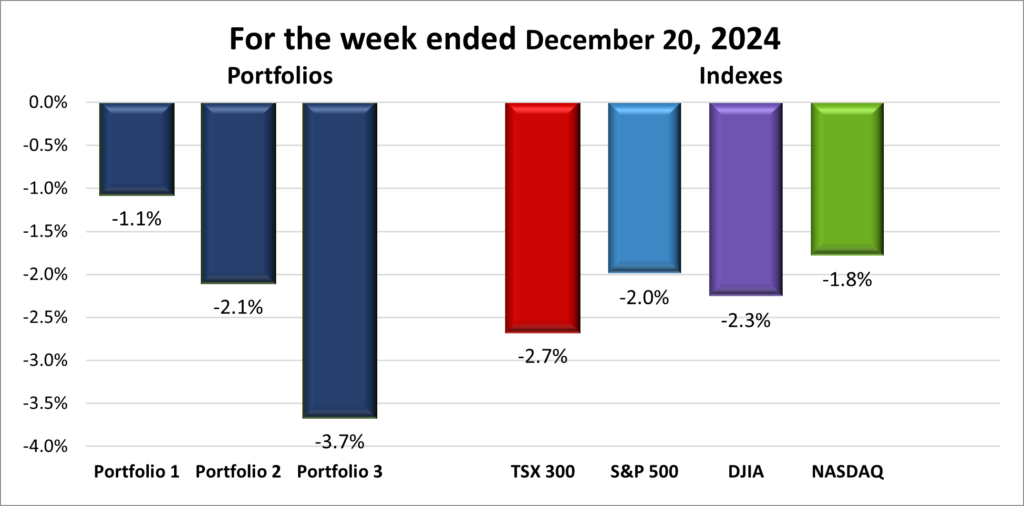
 This week, I stumbled upon a company that initially did not pass my Radar Check but still piqued my interest—Rubrik, Inc. (


 We are not in the era of Skynet – the rogue AI from The Terminator movies – just yet, but Artificial intelligence (AI) has moved from science fiction to everyday life, and tools like ChatGPT have become the poster child of this transformation. Launched just two years ago, ChatGPT isn’t just a tech innovation – it’s a prime example of how AI is reshaping the way we communicate, work, and even invest. For investors keen on spotting trends, understanding ChatGPT’s rise and its impact on industries offers valuable insights into how AI is driving change and creating new opportunities. But first, let’s start with the basics: what exactly is a chatbot?
 Healthcare: AI is revolutionizing patient care and diagnostics. Tools like ChatGPT assist in medical research by analyzing vast datasets to uncover insights quickly, while machine learning models are improving early disease detection, such as identifying cancer through imaging scans. Companies like IBM (
 AI: A Revolution in Progress


