Weekly Update for the week ending June 16, 2023

Items that may only interest or educate me ….

Canadian economic news, US economic news, Global economic news, Google versus the European Commission …


The good news is that the ongoing bull market in the US has managed to recover most of the S&P’s losses from 2022 and has completely offset the losses incurred since the Fed’s initial rate hike in March 2022. However, the not-so-good news is that this rally has primarily been driven by a select group of large and mega cap technology companies, rather than a broad-based market rally. On a positive note, investors have recently begun exploring other sectors of the market, such as small-cap, energy, and industrial companies, which have resulted in significant gains in those areas as well as lifting the American markets in general.

Despite the recent advancements, the TSX continues to lag the American indexes by a significant margin. The bull market has primarily been fueled by growth in the technology sector, especially through an Artificial Intelligence (AI) driven rally in the US markets. In contrast, the TSX lacks major technology companies, with Shopify (TSX: SHOP) being one of the exceptions. The technology sector only accounts for 7.7% of the TSX so its hard for that sector to drive the TSX. On the other hand, the energy sector constitutes 16.6% of the TSX. In 2022, the energy sector drove the TSX and helped limit losses, but this year it is acting as a drag rather than a driver for the index.

Canadian economic news

Last week, the Bank of Canada (BoC) raised the Canadian benchmark interest rate to 4.75%, marking 22-year high and surprising many analysts. Despite this unexpected increase, many of those same analysts are predicting that the BoC will raise the rate by another 0.25% at their upcoming July meeting.

Their reasoning is that a mere 0.25% hike would not be sufficient to drive down inflation fast enough to reach the BoC’s desired goal of a 2% inflation rate. Analysts point to several factors supporting their prediction, including a robust labor market, a surging housing market, a strong economy in the first quarter with a growth rate of 3.1%, and inflation falling at a slower pace than desired. Housing prices have started to rise as banks extend the terms of variable interest rate loans to minimize the impact of higher rates. Furthermore, these analysts are also predicting that there will be no rate decrease in 2023.

US economic news

Latest from the Fed

As expected, the Federal Reserve’s (Fed) Federal Open Market Committee (FOMC) maintained the US benchmark interest rate at 5.25%, marking the first pause in rate hikes in fifteen months. However, the FOMC cautioned that additional rate hikes were likely, with the possibility of raising the rate as high as 5.75% by the end of 2023.

The pause in rate hikes suggests that the FOMC is giving the economy time to adjust to the higher rates and evaluate the implications of future actions. Fed Chair Jerome Powell noted that while conditions for reducing inflation were emerging, it would take time for the impact to be felt. These conditions include slower economic growth, a weaker labor market, and improved supply chains to meet demand.

Looking ahead, FOMC officials conveyed a hawkish stance, indicating that additional rate hikes would be necessary to bring inflation down to the Fed’s 2% target. They project an inflation rate of 4.6% in 2024, which is expected to drop to 3.4% in 2025. Additionally, the FOMC predicts by the end of 2023 a 1% gain in Gross Domestic Product (GDP), compared to their initial 0.4% forecast, and an increase in unemployment to 4.1% from the current rate of 3.7%.

While the decision to pause rate hikes was anticipated, the markets initially reacted negatively due to the FOMC signaling the likelihood of two more rate hikes before year-end. However, Fed Chair Powell reassured investors that no definitive decisions had been made regarding a rate hike at their July 25-26 meeting. Once the markets were calmed, they resumed their upward trajectory, albeit somewhat flatter. The press release from the Fed can be read here.

CPI

Consumer Price Index (CPI) rose by 0.1% in May, following a 0.4% increase in April, indicating a decrease in the growth rate. On an annual basis, the CPI saw a growth rate of 4.0%, marking the slowest pace of growth since April 2021. Analysts had predicted a monthly increase of 0.2% and an annual rise of 4.1% for the CPI.

Meanwhile, the Core CPI, which excludes the more volatile food and energy prices, remained unchanged at 0.4% in May, matching the April figure. On a yearly basis, the core CPI increased by 5.3%, down slightly from the 5.5% growth observed in April. Analysts had projected a monthly rise of 0.4% and an annual increase of 5.2% for the core CPI.

While it would have been great to see decline in both the core CPI and overall CPI in May, it is expected that the core CPI will begin to decrease as the effects of the interest rate hikes continue to work their way through the economy. We will never know if this bit of economic news indicating slowing and falling inflation was what caused the FOMC to pause their rate hikes, but it did not hurt.

The CPI serves as a measure of the price changes experienced by consumers for various goods and
services over a specified period, typically on a monthly or yearly basis.

PPI

The Labor Department reported the May Producer Price Index (PPI) for final demand dropped more than expected, falling 0.3%. This comes on the heels of a 0.2% climb in April. On an annual basis, the PPI increased 1.1%, the smallest gain since 2020. The decrease in the PPI can be attributed primarily to a significant drop in the costs of energy goods (such as gasoline) by 6.8% and food by 1.3%. Meanwhile, the Core PPI, which excludes food, energy, and trade services, remained unchanged at the same rate as in April. On a yearly basis, the Core PPI showed a 2.8% increase.

Falling PPI is one factor the Fed considers when deciding whether to adjust interest rates to stimulate economic activity and avoid deflationary risks. The lower PPI data indicates that producers are facing reduced costs, particularly in energy, which in turn leads to lower prices for finished goods. This can contribute to an overall decrease in inflationary pressures within the economy and suggests a drop in inflation.

Retail sales

The Commerce Department recently announced that retail sales in May unexpectedly rose by 0.3%, following a 0.4% increase in April. Among the areas that experienced the largest increases were building materials, which saw a growth of 2.2%, and motor vehicles, which saw a rise of 1.4%. On the other hand, gas stations had the biggest decline, experiencing a decrease of 2.6%.

When comparing the retail sales data to May 2022, there was an overall increase of 1.6%. The sectors that showed the most significant increases were restaurants, with a rise of 8.0%, and personal care products, which saw growth of 7.8%. Conversely, gas stations experienced a substantial decline of 20.5%, while furniture retailers saw a decrease of 6.4%.

Consumer Sentiment Index

The University of Michigan’s preliminary reading on the June consumer sentiment index came in at 63.9, better than expectations of 60.0 and up from 59.2 in May. The overall sentiment remains at a moderate level, but it does indicate a slight improvement in consumer sentiment regarding factors such as job prospects, income expectations, and general economic conditions. As a result, there could be a minor increase in consumer spending which would be good for the economy.

Global economic news

The European Central Bank (ECB) followed the lead of the BoC and The Reserve Bank of Australia, Australia’s central bank, and raised the European Union (EU) benchmark rate by 0.25% to 3.5%. This was the ECB’s eighth straight increase. ECB officials also said they “will continue to hike at our next meeting. So we are not thinking about pausing, as you can tell.”

As in North America, the higher rates are slowly starting to have an impact but there is still along way to go from the current EU inflation rate of 6.1% to the ECB’s target of 2% (2% seems to be every central bank’s target 😊). The ECB said additional increases are likely, possibly as soon as their next meeting on July 27.

Google versus the European Commission

Alphabet’s (NASD: GOOGL) Google is currently engaged in a high-stakes battle with the European Union’s antitrust regulator, the European Commission (EC). The EC alleges that Google has exploited its dominant position in the online advertising market to the detriment of its competitors. Google holds a significant role as both a buyer and seller of online ads, as well as owning the intermediary service that connects advertisers and publishers. This gives Google substantial control over the online advertising ecosystem, as it commands a 28% share of the global digital advertising market. Consequently, the EC may require Google to divest a portion of its advertising technology business and it could potentially impose a fine of up to 10% of Google’s annual global revenue. Google, naturally, disputes these allegations and has been granted several months to respond to the charges brought by the EC. This is a significant threat for Alphabet since advertising revenue accounts for 79% of their total revenue.


Now that we have gone over the big economic news of the past week, let’s see what happened this past week….

Weekly Market Review

Monday: Investors were bullish to start the week, pushing all four major North American indexes – the Toronto Stock Exchange Composite Index (TSX), the S&P 500 Index (S&P), the Dow Jones Industrial Average (DJIA), and the Nasdaq Composite Index (Nasdaq) – into the green. Investors are betting the Fed will pause their interest rate hikes. Oil prices slid over concerns about the global economy and demand for energy.

In Canada, a rally in technology companies was mostly offset by a drop in energy companies, allowing the TSX to make it into positive territory. In trading in the Canadian sectors, the Technology and Consumer Cyclicals had the biggest gains while Energy and Utilities had the biggest losses.

In the US, investors appear confident there will be no change to the US interest rate and pushed the Nasdaq and S&P to their August 2022 highs. In trading, Technology and Consumer Cyclicals advanced the most of the American sectors, while Energy and Financials dropped the most.

Tuesday: All four indexes advanced after the US inflation data showed prices continue to fall, rising less than forecast. Investors are now keeping their fingers crossed that the Fed will pause their rate hikes when they conclude their meeting tomorrow. Oil prices inched higher on news China lowered its short-term lending rate for the first time in almost a year to kickstart their economy.

In Canada, signs of slowing inflation in the world’s largest economy (the USA) spurred the TSX higher. In trading, Consumer Cyclicals and Consumer Staples led the Canadian sectors higher, while Technology, Utilities and Healthcare were the only sectors to slide back.

In the US, investors believe there is a 95% chance the Fed will not increase the benchmark interest rate tomorrow. This optimism sent the Nasdaq and S&P to their highest closing numbers since April 2022. The American sectors were led higher by the Basic Materials and Consumer Cyclicals sectors. Telecommunications Services and Utilities were the only sectors to end lower.

Wednesday: A mixed day in the North American stock markets. The DJIA headed south early and stayed down all day. The other three indexes had a temporary dip into negative territory following the Fed’s decision to maintain the US interest rate at 5.0% before rallying to each end the day higher. The possibility of additional rate hikes sent oil prices lower.

In Canada, the TSX edged higher as investors digested the implications of the Fed’s interest rate pause. In trading on Bay Street, the interest sensitive Technology and Consumer Cyclicals sectors posted the biggest gains with Energy and Utilities the biggest losses.

In the US, the pause in interest rates was good news for the technology heavy Nasdaq and S&P, lifting both into positive territory. In trading on Wall Street, the Technology and Consumer Staples sectors had the biggest advances, while Healthcare and Energy had the biggest declines.

Thursday: Despite warnings from the Fed of possible rate hikes down the road, investors focused on yesterday’s good news of a pause in rate increases and pushed all four indexes higher.

In Canada, the TSX ended up slightly, lifted by the rising tide of optimism in the US that the Fed is nearing the end of their rate hikes. In trading, it was a mixed day in the Canadian sectors with half of the sectors ending higher, led by Energy and Financials. On the other side, Utilities and Technology suffered the biggest losses.

In the US, a day after the Fed paused their rate hikes, investors believe the end of the Fed’s rate hikes are on the horizon and are returning to the stock markets. It was a day of broad-based gains that saw every American sector end higher, led by Telecommunications Services and Healthcare, while Consumer Cyclicals and Financials brought up the rear.

Friday: The indexes were up and down most of the day before ending lower. The recent rally lost momentum as investors took some profits as they try to figure out the Fed’s next move. There was additional volatility in the markets due to the expiration of index futures and options that all came due today. Oil prices ended the week on an upbeat note as supply cuts and increased Chinese demand combined to send oil prices higher.

In Canada, the TSX ended its four-day winning streak as investors took some of their money off the table after a run up in Canadian technology companies. Leading the winners in the Canadian sectors were Telecommunications Services and Consumer Cyclicals, while Technology and Consumer Staples had the largest drops.

In the USA, all three indexes dropped slightly after Fed officials said they were ‘comfortable’ with additional rate hikes. The Nasdaq and S&P both fell back after a week of big gains, dragged downward by the big technology companies like Microsoft (NASD: MSFT) and Apple (NASD: AAPL) — which had recently closed at all-time highs. In trading, the defensive sectors Utilities and Consumer Staples were the only ones to advance, while Technology and Telecommunications Services had the biggest declines.


Weekly Market and Portfolio Review

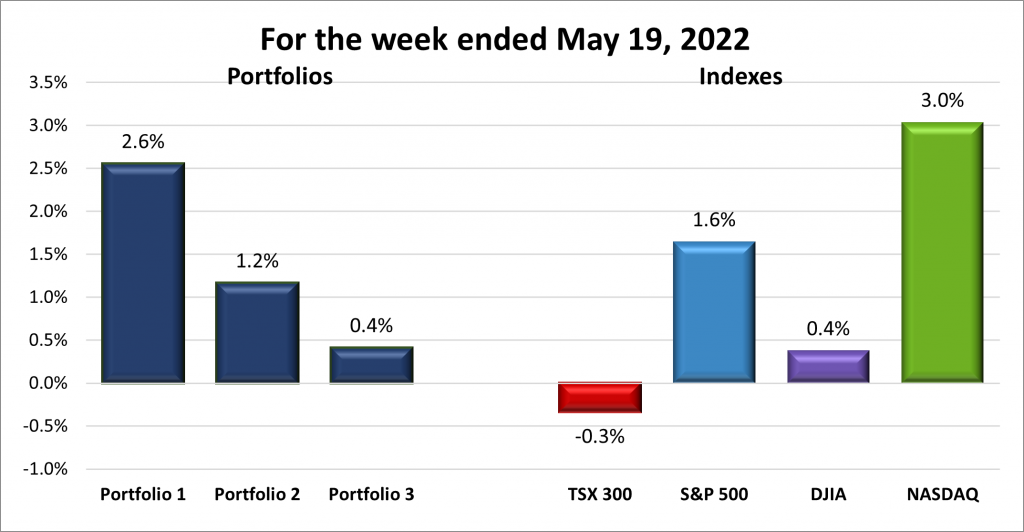
For the week, the TSX (SPTSX) rose 0.4%, the S&P 500 (SPX) had its best week since March gaining 2.6%, the DJIA (INDU) advancing 1.2%, and the Nasdaq (CCMP) posted its eighth consecutive winning week, its longest winning streak since March 2019, up 3.2%.

Bull market. A good week for the North American stock markets.The chart above illustrates another positive week for all four indexes. The Nasdaq and S&P, driven by major technology companies, particularly those with artificial intelligence (AI) capabilities, continued their upward momentum. Throughout the week, apart from the DJIA, the indexes maintained a consistent upward trend. However, on Friday, some investors opted to lock in profits following the recent rally, leading to a slight pullback.

On Wednesday, the Fed paused their rate hikes. As a result, all three American indexes closed significantly higher on Thursday as optimistic investors regained confidence and returned to the markets.

The TSX also posted a weekly gain, helped by the Canadian technology sector but that was barely enough to lift the TSX into positive territory for the week. The Canadian technology sector accounts for 7.7% of the TSX, while the energy and financials sectors constitute 16.6% and 30.1% of the TSX, respectively. For the TSX to have a good week, it usually needs one of these two sectors to have a good week.

Bull market. A good week for the North American stock markets. It was another positive week for all three portfolios. Portfolio 1 had a good week thanks to the strong performance of its core holdings of dominant technology companies Alphabet, Amazon (NASD: AMZN), Apple, Nvidia (NASD: NVDA), and Tesla (NASD: TSLA). Portfolio 3 also experienced a good week, driven by the continued strength of Microsoft and Shopify.

Portfolio 2 also gained ground this past week. While its technology companies performed well, the gains were limited by the lacklustre performance of its energy companies. A year ago, the diversified and balanced nature of Portfolio 2 was seen as an advantage during the 2022 bear market. However, those advantages now limit the gains during a bull market like the ones in the Nasdaq and S&P.

While I would prefer all three Portfolios to post 3+% gains in each portfolio on a weekly basis, I will be happy as long as the portfolios each keep posting weekly gains. 😊

Weekly Portfolio & Index performance
Weekly Portfolio & Index performance for the week ended June 16, 2023.

Companies on the Radar

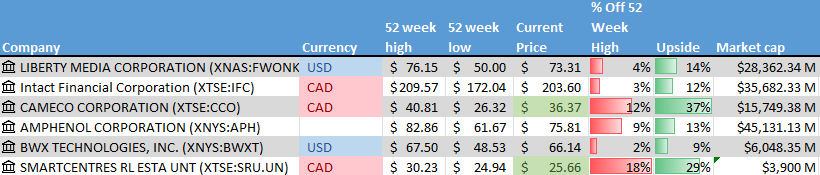
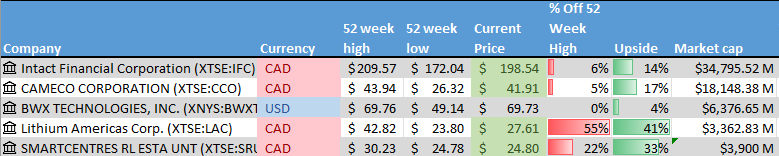
Stocks on my RadarNo new companies came across my radar this past week, leaving the companies listed below as the frontrunners if I were to add a new company to any of the portfolios.

  • Intact Financial (TSX: IFC): A Canadian mid-size insurance company that offers home, car, and business insurance in Canada, the US, and the UK.
  • Cameco (TSX: CCO): A large Canadian company involved in uranium mining, sales, and the construction of reactor components.
  • BWX Technologies (NYSE: BWXT): A mid cap size American company specializing in the construction and sale of nuclear components to customers worldwide, including the US Navy.
  • Lithium Americas (TSX: LAC): A mid size Canadian company operating lithium mines in the USA and Argentina. They are a provider of lithium to the emerging electric vehicle battery industry.
  • Smartcentres Real Estate Investment Trust (TSX: SRU.UN): A mid size fully integrated REIT that owns and manages a number of income producing shopping centres and retails spaces throughout Canada.

The Radar Check was last updated June 16, 2023.
A screenshot of a computer screen Description automatically generated with low confidence

A screenshot of a computer Description automatically generated with medium confidence


Portfolio Update

Portfolio 1

Portfolio 1 for the week ended June 23, 2023: UP Green Up Arrow, signifying a positive week

  • Copperleaf’s (TSX: CPLF) Asset Solution for Investment Planning was chosen by Baltimore Gas & Electric (BGE) to manage its transmission and substation asset sustainment plans. BGE is Maryland’s largest natural gas and electric utility provider.
  • Docebo (TSX: DCBO) enhances its AI capabilities with the acquisition of Edugo.AI. This will help Docebo optimize learning paths for individual users.
  • General Motors (NYSE: GM) will partner with Samsung SDI to build a US$ 3 billion electric vehicle (EV) battery plant in Indiana. This will help secure a reliable supply of batteries for GM’s EVs. I assume this facility will be eligible for any tax deductions under the US’s Inflation Reduction Act.
    In other GM news, GM has indicated it plans to keep producing its highly profitable trucks and SUVs for another 10 – 12 years. GM has said it will be years before their electric trucks and SUVs can match the profit from their conventional trucks and SUVs. By extending the timeline, GM has the potential to make US$ 50+ billion in profit.
  • TMX Group (TSX: X) owners of the Toronto Stock Exchange and other Canadian based exchanges executed a 5 for 1 stock split.
  • Bell (TSX: BCE) closed six radio stations and let go 1,300 employees across Canada as part of reducing expenses. Bell also closed their London and Los Angeles bureaus and reduced staff at their Washington bureau. Bell plans to operate a single newsroom across Canada. I am sure everyone outside the greater Toronto area will be thrilled to know what is going on in Toronto but not in their hometown.
  • Britain’s competition regulator, Competition and Markets Authority (CMA), signed off on Amazon’s acquisition of iRobot (NASD: IRBT), the manufacturer of Roomba vacuum cleaners. The deal now waits approval from the US Federal Trade Commission and the European Union’s European Commission.

Activity

Bought: Amazon. After reading the letter to shareholders in their Annual Report, I decided to increase my holdings. Amazon stands to benefit from optimizing its workforce, concentrating on its core strengths, and leveraging the increasing advancements in AI.

One thing that intrigues me is they are developing their own semiconductors, specifically tailored for their Amazon Web Services (AWS) AI services. These custom chips have the potential to enhance both Amazon’s internal AI capabilities and the services offered by AWS. This should put Amazon in a good position to capitalize on the growing demand for AI-related technologies and services and take a leadership position in the emerging AI market.

Dividends

Dividends Received this week for the following companies:

Companies followed by DRIP (Dividend Re-Investment Plan) indicate additional shares were purchased with the dividend. Any cash leftover was added to the cash balance.

Canadian $

Dream Industrial Real Estate Investment Trust (TSX: DIR.UN)

Yellow Pages Ltd (TSX: Y)

US $

BSR Real Estate Investment Trust (TSX: HOM.U)

General Motors Co (NYSE: GM)

Home Depot Inc (NYSE: HD)

Quarterly Reports

No quarterly reports this past week.

Portfolio 2

Portfolio 2 for the week ended June 23, 2023: UP Green Up Arrow, signifying a positive week

  • The US Federal Trade Commission (FTC) has asked a federal court to block Microsoft’s purchase of gaming developer Activision Blizzard (NASD: ATVI). So far, the deal has been vetoed by the United Kingdom’s Competition & Markets Authority, while it was approved by the European Union’s European Commission and Japan’s Fair Trade Commission.
  • Mitek Systems (NASD: MITK) announced they have been notified by the Nasdaq Stock Market company they have started the process to delist Mitek from the exchange. Mitek has not filed its Form 10-K for the fiscal year ended September 30, 2022, nor its Quarterly Reports (Form 10-Q) for the quarters ended December 31, 2022, and March 31, 2023, in a timely manner and did not meet the terms of a previously granted filing extension by the compliance deadline.

Activity

No significant activity to report this week.

Dividends

Dividends Received this week for the following companies:

Companies followed by DRIP (Dividend Re-Investment Plan) indicate additional shares were purchased with the dividend. Any cash leftover was added to the cash balance.

Canadian $

iA Financial Corporation Inc (TSX: IAG)

US $

No US$ dividends this past week.

Quarterly Reports

No quarterly reports this past week

Portfolio 3

Portfolio 3 for the week ended June 23, 2023: UP Green Up Arrow, signifying a positive week

  • Brookfield Renewables (TSX: BEP.UN) has agreed to buy Duke Energy Corp’s (NYSE: DUKE) unregulated utility scale Commercial Renewables business for US$ 2.8 billion. The sale adds more than 3,400 megawatts of utility-scale solar, wind and battery storage throughout the US to BEP.UN’s renewable energy portfolio.

Activity

No significant activity to report this week.

Dividends

Dividends Received this week for the following companies:

Companies followed by DRIP (Dividend Re-Investment Plan) indicate additional shares were purchased with the dividend. Any cash leftover was added to the cash balance.

No dividends this past week.

Quarterly Reports

Enghouse Systems Limited

All currency listed in thousands of Canadian dollars, except for per share data.

Selected highlights from their second quarter 2023 financial results on June 12, 2023

  • Revenue of $113,461 for the three months ended April 30, compared to $106,312 for the same period in 2022. An increase of almost 7%.
  • Net income of $12,536 for the three months ended April 30, compared to net income of $17,871 in the same period in 2022.
  • Diluted earnings per ordinary share of $0.23 for the three months ended April 30, compared to earnings of $0.32 per share for the same period in 2022.


  • Revenue of $219,896 for the six months ended April 30, compared to $217,414 for the same period in 2021. An increase of over 1%.
  • Net earnings of $29,599 for the six months ended April 30, compared to net earnings of $39,468 in the same period in 2021.
  • Diluted earnings per ordinary share of $0.53 for the six months ended April 30, compared to earnings of $0.71 per share for the same period in 2021.
 

Weekly Update for the week ending June 9, 2023

Items that may only interest or educate me ….

US debt ceiling increased, Canadian economic news, US economic news, EU economic news, OPEC+ lowers oil production …

With the resolution of the US debt ceiling issue, attention has now shifted back to the ongoing global battle with inflation. While recent data in both Canada and the US has shown a decline in inflation numbers, indicating some progress, it is important to note that the fight against inflation is far from over. Despite this, both countries have demonstrated strong economies, particularly the US, as evidenced by their robust job numbers.

In terms of monetary policy, the Bank of Canada (BoC) recently decided to raise the Canadian benchmark rate to 4.75%. Looking ahead to the upcoming week, it remains uncertain whether the US Federal Reserve (Fed) will follow suit and raise the US rate or opt to pause their hiking. Personally, I am hopeful that the Fed will pause their rate hikes. Regardless of the decision they make, it is likely that interest rates will remain at their current levels for some time before any potential decrease.

Canadian economic news

Interest rate hike

The Bank of Canada (BoC) has raised its key interest rate by 0.25% to 4.75%, marking the first increase in the overnight interest rate since it was paused at 4.50% in January 2023. This decision is a response to the higher-than-expected Gross Domestic Product (GDP) growth of 3.1% for the first three months of 2023. Furthermore, inflation has accelerated to 4.4% on a yearly basis, marking the first increase since June 2022 and well above the BoC’s target of 2%. With this increase, the interest rate is now at its highest level since May 2001.

The BoC’s decision is influenced by the persistence of high global inflation, despite lower energy prices. Earlier in the week, the Reserve Bank of Australia hiked its benchmark interest rate to 4.1%, an eleven-year high, in their fight with inflation. In the US, the world’s largest economy, inflation remains elevated despite a slowdown in economic growth. Both the Canadian and US economies are being driven by strong consumer spending and tight job markets. In Canada specifically, various goods and services continue to be priced higher than estimated, indicating that demand is still exceeding supply.

This latest interest rate increase reflects the BoC’s efforts to address the rising and persistent inflationary pressures. The central bank also indicated that further interest rate hikes are possible in the future, possibly as early as their next meeting in July. The BoC faced criticism in 2022 for not acting sooner in response to rising inflation. This time the BoC is proactively attempting to tackle inflation.

As a result of the BoC’s interest rate hike, Canadian banks immediately increased their respective lending rates by 0.25%. Not only do higher interest rates make any form of a loan or mortgage more expensive, but they also dampen the growth prospects of technology firms and other high growth-oriented companies.

Canada’s trade balance

Overshadowed by the interest rate hike, Canada’s exports surged by 2.5% in April, reaching an all-time high by volume, while imports saw a slight decline of 0.2%. As a result, Canada recorded a surplus of C$ 1.94 billion, more than double the anticipated C$ 900 million.

The leading exports included metal and non-metallic mineral products, such as gold (up 13.6%), motor vehicles (up 7.4%), and energy products (up 6.4%). On the other hand, there was a drop in exports of farm and fish products (down 6.4%) and consumer goods (down 5.5%).

Imports experienced a decline for the third consecutive month, primarily driven by a decrease in energy, metal ores, and non-metallic minerals. However, there were significant gains in imports of aircraft equipment (up 17.4%) and consumer goods (up 4.0%).

Unsurprisingly, the United States remained Canada’s largest trading partner both in terms of exports and imports. Export to the US increased by 4.4%, accounting for 76% of total exports, while imports from the US decreased by 0.4%, making up nearly 64% of total imports.

The report indicates a robust Canadian economy that has surpassed pre-pandemic levels. However, the question remains whether Canada can sustain strong export numbers throughout the summer.

Jobs data

Statistics Canada’s jobs data showed that the economy unexpectedly lost 17,300 jobs in May, representing a decline of 0.1%. Employment gains have been decelerating since February and eventually turned into a net loss in May. However, when compared to the previous year, employment is still up by 1.8%. The unemployment rate also increased by 0.2% to 5.2% in May, marking the first monthly rise since August 2022. Analysts had anticipated a gain of 23,200 jobs and an unemployment rate of 5.1% for May. Finally, hourly wages for permanent, full-time employees saw a year-over-year increase of 5.1%, slightly lower than the 5.2% rise observed in April.

These economic indicators suggest that the BoC’s rate hikes are starting to have an effect. The question now is whether this impact is sufficient for the BoC to pause the rate increases at their upcoming July meeting.

US economic news

The US debt ceiling issue was resolved last weekend when President Biden signed the bill, suspending the debt ceiling for two years, after which they will have to address it again. Neither side appeared overly enthusiastic about the deal, but both parties claimed victory. President Biden and the Democrats celebrated avoiding a historic crisis, while the Republicans touted their success in curbing spending (conveniently ignoring their previous willingness to spend under the previous administration).

The looming question now is whether the Federal Reserve (Fed) will increase the US benchmark interest rate at the upcoming meeting of the Federal Open Market Committee (FOMC), the body responsible for determining the interest rate. Could the Bank of Canada’s recent rate hike be a hint of the Fed’s next move? We will have to wait and see.

In other news, the weekly jobless claims data revealed a significant jump in unemployment claims, increasing by 28,000 to 261,000. This marks the highest level in eighteen months and indicates a slowdown in the once robust US job market.

Meanwhile, the CBOE Volatility index fell by 2.01% to 13.66, suggesting a moderate level of market volatility. Please see the April 21 Weekly Update for an explanation of the VIX.

EU economic news

According to the latest economic data for the first three months of 2023, the European Union (EU) has officially entered a technical recession. A recession is typically defined as two consecutive quarters of economic contraction, and following a decline in the last quarter of 2022, the EU experienced a further loss of 0.1% in the first quarter of 2023. This slowdown was primarily attributed to a significant decrease in German output and government spending, as well as a 4.6% drop in output in Ireland.

Despite the challenging economic conditions, there are some positive indicators. Employment showed a slight increase of 0.6%, suggesting some resilience in the labor market. Additionally, investment saw a rise of 0.6%, which could potentially contribute to future economic growth. Furthermore, inflation appears to be cooling down, which can alleviate some economic pressures.

Analysts maintain an optimistic outlook for the EU economy, expecting growth to rebound in the second quarter. However, it is noteworthy that analysts believe the EU central bank will still proceed with raising its benchmark interest rate following the June 15 meeting, despite the technical recession. This suggests that the central bank is prioritizing inflation control and financial stability over the short-term recessionary conditions.

OPEC+ lowers oil production

At the OPEC+ meeting held on June 3-4, Saudi Arabia made the decision to unilaterally reduce its crude oil production by 1 million barrels per day. This move aims to limit the global oil supply and support higher oil prices. Meanwhile, the other OPEC+ members have agreed to maintain their current production levels, as previously agreed upon in April, and extend those levels through 2024.

Saudi Arabia’s decision to cut production is driven by their goal of keeping oil prices above $75 per barrel. They are concerned about a potential slowdown in the global economy, which could lead to reduced consumption as consumers and businesses scale back their expenses. For instance, individuals might opt for stay-at-home vacations instead of traveling by car or plane.

The revenue generated from oil sales will be utilized by Saudi Arabia to transform the country into a global supply chain hub, develop green technologies, and support their ambitious “city of tomorrow” project known as Noem. These plans reflect Saudi Arabia’s efforts to diversify its economy and reduce its dependence on oil.

* OPEC+ members: Algeria, Angola, Azerbaijan, Bahrain, Brunei, Congo, Equatorial Guinea, Gabon, Iraq, Kazakhstan, Kuwait, Malaysia, Mexico, Nigeria, Oman, Russia, Saudi Arabia, Sudan, South Sudan, and United Arab Emirates.


With all those economic updates out of the way, let’s see what happened this past week….

Weekly Market Review

Monday: With the US debt ceiling crisis in the rear-view mirror, investors’ attention turned to next week’s Fed meeting. Concerns over another US interest rate hike, led to a fair bit of uncertainty in the markets, and the markets do not like uncertainty. Accordingly, the four major North American indexes – the Toronto Stock Exchange Composite Index (TSX), the S&P 500 Index (S&P), the Dow Jones Industrial Average (DJIA), and the Nasdaq Composite Index (Nasdaq) – all ended lower. As for oil companies, it was a good day after Saudi Arabia announced it would reduce its supply of crude oil by 1 million barrels a day starting in July.

In Canada, stronger than expected Canadian economic data had investors wondering if the BoC may be forced to increase the Canadian benchmark interest rate later this week. Despite the announced Saudi Arabia oil production cut that boosted the price of oil, energy companies on the TSX still saw share prices fall. In trading, Technology and Consumer Cyclicals were the only Canadian sectors to advance, while the biggest drops were by Financials and Consumer Staples.

In the USA, mixed economic news may turn out to be good news for the Fed and enable them to hold off on an increase to the interest rate. Investors are betting the Fed will not increase the interest rate, despite the hawkish tone from Fed members over the last few weeks. In trading, Telecommunications Services and Utilities had the biggest gains in the American sectors. Industrials and Financials had the biggest drops.

Tuesday: All four major indexes closed the day higher suggesting investors were optimistic. However, oil prices retreated from their previous day’s increase as optimism surrounding a potential supply cut diminished.

In Canada, despite the falling oil prices, the TSX spent the day on an upward trajectory in anticipation of the BoC’s interest rate announcement tomorrow. The growth-oriented sectors Technology and Consumer Cyclicals were the best performers of the Canadian sectors, while Utilities, Industrials and Healthcare were the only sectors to end lower.

In the US, the American indexes bounced above and below the breakeven line as investors await tomorrow’s Consumer Price Index. The top performers in the American sectors were the Financials and Consumer Cyclicals, while Healthcare and Consumer Staples were the only sectors to fall.

Wednesday: After the BoC unexpectedly raised its benchmark interest rate, the fear of higher interest rates led to a drop in all indexes except for the blue chip DJIA. A slowdown in Chinese exports raised concerns of a global recession further dampening investors optimism.

In Canada, the TSX dropped after the BoC raised the key rate to 4.75%. Higher oil prices lifted energy companies which prevented the TSX was falling further. On Bay Street, Energy and Consumer Staples had the biggest gains of the Canadian sectors, while Technology and Consumer Staples fell the furthest.

In the US, investors took profits after a bullish May for the mega cap technology companies, sending the tech heavy Nasdaq and S&P lower. After Canada’s surprise interest rate increase, investors now nervously await next week’s update by the Fed. On Wall Street, Energy and Utilities were the biggest winners of the American sectors, while interest sensitive, Technology and Consumer Staples had the biggest drops.

Thursday: Another day of mixed indexes, with the TSX retreating while all three American indexes advanced. Investors were uncertain whether way the Fed would pause rate increases or increase the rate after unexpected rate hikes in Australia and Canada.

In Canada, Wednesday’s surprise interest rate hike, with the likelihood of an additional 0.25% increase in July, dragged the TSX down. Basic Materials (miners and fertilizer manufacturers) and Utilities were the only two Canadian sectors to advance, while Industrials and Telecommunications Services suffered the biggest drops.

In the US, other than a rebound in technology companies, investors essentially sat on the sidelines ahead of next week’s Fed meeting. Among the American sectors, Consumer Cyclicals and Technology led the charge, while Financials and Energy slipped.

Friday: Once again the TSX ended lower, while the three American indexes ended higher. It was a relatively quiet day in the markets as investors await a slew of news next week, including the latest American inflation report and the latest interest rate decision by the Fed. Oil prices ended lower after China reported disappointing economic data leading to concerns about lower demand.

In Canada, the TSX was dragged down by a recent jobs report that indicated the country shed over 17,000 jobs and unemployment rose for the first time in nine months. The loss of jobs could signal the start of an economic slowdown while inflation remained high. Not a good combination. In the Canadian sectors, Technology was the only sector to end higher. Consumer Staples and Industrials fell the farthest.

In the US, the rally that has lifted the mega cap technology companies is beginning to spread beyond a group of mega cap technology companies and other high growth companies. Small cap companies were late to the rally but have recently started to gain upward momentum. In trading, Technology, Consumer Cyclicals and Consumer Staples were the only American sectors to advance, while Basic Materials and Utilities had the biggest declines.


Weekly Market and Portfolio Review

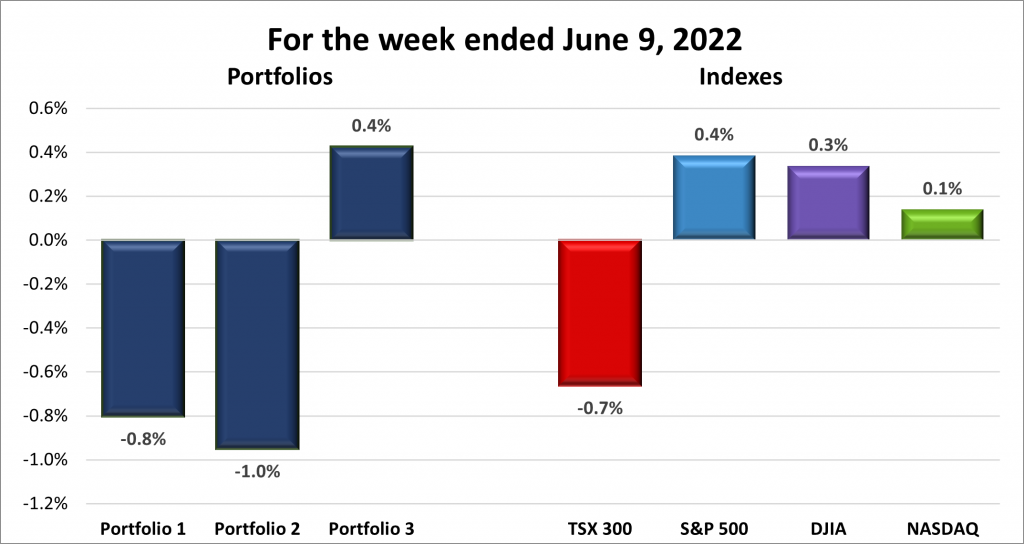
For the week, the TSX (SPTSX) fell 0.7%, the S&P 500 (SPX) gained 0.4%, the DJIA (INDU) increased 0.3% and the Nasdaq (CCMP) posted a seventh straight weekly gain, this time rising 0.1%.

Bull market. A good week for the North American stock markets. It was a positive week for the American markets, as all three indexes recorded gains, as shown in the chart above. The Nasdaq has been particularly strong, with a 30% increase since its low point in December, indicating a bull market trend in recent weeks. The S&P also experienced a mid-week rally, pushing it up by over 20% since its October 2022 lows, officially entering a bull market. The DJIA is not far behind, with an 18% increase since October.

During the past week, the American indexes were primarily driven by a small group of mega-cap technology companies. These companies, fueled by the optimism surrounding artificial intelligence (AI) and the potential pause in rate hikes by the Fed, contributed to the market’s positive performance.

In contrast, the TSX has been underperforming in comparison to the technology-heavy S&P and Nasdaq indexes. This is mainly due to the limited presence of mega cap technology companies in Canada, which hampers the index’s ability to make gains like its American cousins. The TSX is predominantly composed of the Financials, Energy, and Basic Materials sectors, accounting for 58% of the index. The Financial sector has been affected by higher interest rates, while the sluggish economic recovery in China has led to lower commodity prices, which have traditionally been a key driver for the TSX.

Bull market. A good week for the North American stock markets. Last week was tough for the portfolios, as only one of them experienced a gain in value. Portfolio 1 faced a decline due to the drop in bank stocks following the Bank of Canada’s decision to raise the interest rate. The possibility of another rate increase as early as July further impacted the portfolio. However, the ongoing rally in American mega-cap companies helped limit the overall decline.

Similarly, Portfolio 2 was negatively affected by its holdings in the Financials sector, which contributed to the downward movement. Unlike Portfolio 1, Portfolio 2 did not have multiple Technology sector companies to offset the decline.

On a more positive note, Portfolio 3 managed to advance during the week, primarily driven by the strong performance of Shopify(TSX: SHOP). The upcoming week is expected to be eventful, with the release of key data on US inflation and retail sales. Of significant importance is the update on the US interest rate, and a potential pause in its increase would be favorable for the market.

Weekly Portfolio & Index performance
Weekly Portfolio & Index performance for the week ended June 9, 2023.

Companies on the Radar

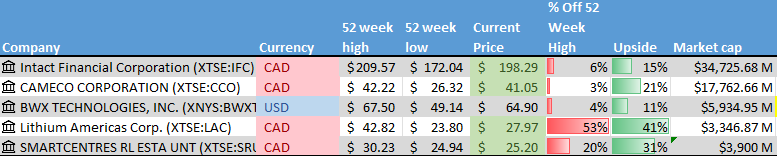
Stocks on my RadarI have decided to remove Amphenol (NYSE: APH) from my radar list and add Lithium Americas (TSX: LAC) instead. Based on my research, it seems that the world may face a shortage of lithium to meet the increasing demand for electric vehicles (EVs), possibly by 2025. Furthermore, General Motors recently invested US$ 650 million in LAC to secure a lithium supply for their Ultima EV batteries. Although LAC carries risks, it is worth a closer examination so I will place it on my radar list alongside the companies below.

  • Intact Financial (TSX: IFC): A Canadian mid-size insurance company that offers home, car, and business insurance in Canada, the US, and the UK.
  • Cameco (TSX: CCO): A large Canadian company involved in uranium mining, sales, and the construction of reactor components.
  • BWX Technologies (NYSE: BWXT): A mid cap size American company specializing in the construction and sale of nuclear components to customers worldwide, including the US Navy.
  • Smartcentres Real Estate Investment Trust (TSX: SRU.UN): A mid size fully integrated REIT that owns and manages a number of income producing shopping centres and retails spaces throughout Canada.

The Radar Check was last updated June 9, 2023.

A screenshot of a computer screen Description automatically generated with low confidence

A screenshot of a computer Description automatically generated with medium confidence


Portfolio Update

Portfolio 1

Portfolio 1 for the week ended June 9, 2023: DOWN Red Down Arrow

  • Apple (NASD: AAPL) announced their latest device to take your money – the Vision Pro augmented reality headset – at last week’s Apple Developers Conference. It will be available for US$ 3,499 starting early in 2024, initially in the US before spreading to other countries.
  • Unity Software (NYSE: U) announced a new partnership with Apple to port iOS apps to Apple’s visionOS operating system for their new Vision Pro2 mixed-reality headset.
  • General Motors (NYSE: GM) announced they plan to spend up to US$ 1 billion to re-tool two of their manufacturing plants in Flint, Michigan. The upgrades will be at facilities that produce GM’s combustion engine heavy duty trucks. Apparently there still is demand for conventional engine trucks. 😊
    In other GM news, the company announced it planned to use Tesla’s EV charging network. With the three largest automakers (Tesla (NASD: TSLA), GM and Ford (NYSE: F)), accounting for almost 60% of the North American EV market, it will be very hard for any company to compete with Tesla for the charging market.
  • Segueing into Tesla, the company is eligible for government subsidies to build more charging stations if they include the Combined Charging System adapters so other EVs can use the Tesla charging devices.
    Tesla has been in talks with Spanish government officials about the possibility of building a car factory in Valencia, Spain. All this good news certainly did not hurt the share price. 😊
  • According to the Wall Street Journal, Amazon (NASD: AMZN) is considering advertising supported version of their Prime Video service. They are contemplating making the current Prime Video included with a Prime subscription ad supported, with an additional fee for an ad free service.
  • CrowdStrike (NASD: CRWD) announced a new set of cloud security capabilities featuring their “1 click XDR” that automatically identifies and deploys their Falcon security agent to secure unprotected cloud assets. This will help secure any computing and network assets that slip through the cracks.

Activity

No significant activity to report this week.

Dividends

Dividends Received this week for the following companies:

Companies followed by DRIP (Dividend Re-Investment Plan) indicate additional shares were purchased with the dividend. Any cash leftover was added to the cash balance.

No dividends this past week.

Quarterly Reports

DocuSign, Inc.

All currency listed in thousands of US dollars, except for per share data.

Selected highlights from their first quarter 2024 financial results on June 8, 2023

  • Revenue of $661,388 for the three months ended April 30, compared to $588,692 for the same period in 2022. An increase of over 12%.
  • Net income of $539 for the three months ended April 30, compared to a net loss of $27,373 in the same period in 2022.
  • Diluted earnings per ordinary share of $0.00 for the three months ended April 30, compared to a loss of $0.14 per share for the same period in 2022.

Portfolio 2

Portfolio 2 for the week ended June 9, 2023: DOWN Red Down Arrow

  • Microsoft (NASD: MSFT) announced they were bringing their AI capabilities to US government agencies that use Microsoft’s Azure Cloud Services platform. Government customers will be able to use it for a variety of uses including content generation, coding assistance, and summarization.
  • Alimentation Couche-Tard (TSX: ATD) appointed Filipe Da Silva as Chief Financial Officer to succeed Claude Tessier, who plans to retire, effective July 1.

Activity

No significant activity to report this week.

Dividends

Dividends Received this week for the following companies:

Companies followed by DRIP (Dividend Re-Investment Plan) indicate additional shares were purchased with the dividend. Any cash leftover was added to the cash balance.

Canadian $

No C$ dividends this past week.

US $

Microsoft Corp. (NASD: MSFT)

Quarterly Reports

No quarterly reports this past week.

Portfolio 3

Portfolio 3 for the week ended June 9, 2023: UP Green Up Arrow, signifying a positive week

  • Alvopetro Energy (TSXV: ALV) began production on another of their natural gas fields in Brazil. The well is now generating 1.3 million standard cubic feet per day.
  • Fortuna Silver Mines (TSX: FVI) reported the death of a contractor at one of their underground mines in Peru. The nature of the accident has not been revealed but no other personnel were injured.
  • Shopify closed on the sale of its Shopify Logistics unit to Flexport. In exchange, Shopify now has a 13% stake in Flexport.
  • Brookfield Asset Management (TSX: BAM) will sell it 49.5% interest in New Zealand’s One New Zealand for C$ 1.1 billion to New Zealand based Infratil. One New Zealand is the countries second largest mobility operator.
    BAM also announced they were buying payments provider Network International for US$ 2.5 billion, as part of their efforts to expand their payments footprint in the Middle East and Africa.

Activity

No significant activity to report this week.

Dividends

Dividends Received this week for the following companies:

Companies followed by DRIP (Dividend Re-Investment Plan) indicate additional shares were purchased with the dividend. Any cash leftover was added to the cash balance.

Canadian $

No C$ dividends this past week.

US $

Microsoft Corp. (NASD: MSFT)

Quarterly Reports

No quarterly reports this past week.

Weekly Update for the week ending June 2, 2023

Items that may only interest or educate me ….

Canadian economic news, US economic news, Better to be lucky …

Canadian economic news

Statistics Canada showed that the nation’s economy continued to grow in the first quarter, rising by 3.1%, which is well above the anticipated 2.5% increase. On a monthly basis, the economy remained flat at 0% in March, surpassing estimates of a 0.1% decline. Early projections for April indicate a 0.2% growth in the economy. Canadian consumers have continued their spending habits in the first part of 2023, particularly on new vehicles, dining, and vacations.

Consumer spending plays a crucial role in the Canadian economy, but it also contributes to upward pressure on inflation. To address inflation, the Bank of Canada (BoC) raises the benchmark interest rate, thereby increasing the cost of borrowing. Consequently, consumers allocate more of their funds toward debt obligations, leaving less money available for other expenses. The underlying theory is that if there is less money for spending, demand will moderate, leading to a decrease in inflation.

Given the better-than-projected economic growth and the persistent high inflation, there is an increased likelihood that the BoC will raise the benchmark interest rate. However, that does not mean another increase will occur at their next meeting. If there is an increase, it may occur as early as next week or sometime this summer.

US economic news

The non-farm payrolls data for May indicated a robust increase in job numbers, surpassing expectations and pointing to a strong labor market. The gain of 339,000 jobs exceeded the forecast of 195,000 and outperformed the previous month’s increase. However, it is important to note that the unemployment rate also rose slightly from the previous month.

Despite the strong job numbers, wage growth did not accelerate at the same pace, which suggests a potential “soft landing” scenario where the economy can sustain growth without triggering excessive inflation. This dynamic has led investors to believe that the Federal Reserve (Fed) may pause their rate hike cycle and maintain the current benchmark interest rate, as they seek to balance economic growth with inflation concerns.

On the consumer front, the decline in the Consumer Confidence Index to a six-month low of 102.3 from 103.7 (out of 200) indicates lingering uncertainty among Americans about the economy. Factors such as the recently concluded debt ceiling negotiations and the upcoming interest rate announcement by the Fed are likely contributing to this uncertainty. However, it is noteworthy that consumer confidence remains slightly higher than the 99.1 anticipated by analysts, suggesting a moderate level of consumer optimism.

Better to be lucky

Back in 2017-2018, “blockchain technology” companies were the darlings of the North American stock markets, but they were soon replaced by “metaverse” companies in 2020-2021. Currently, artificial intelligence (AI) is the latest trend in the stock markets. Although I missed out on the blockchain surge, I managed to invest in Nvidia (NASD: NVDA) because reports indicated that their graphic processor units (GPUs) were well-suited for the computing power demands of blockchain technologies, cloud computing, and the emerging metaverse. However, I regretfully chased after Unity Software (NYSE: U) to capitalize on the metaverse. ☹

Fortunately, with the emergence of AI, I have investments in the right companies at the right time. Both Nvidia and Microsoft (NASD: MSFT) were purchased in 2020, before the AI craze, and are currently market leaders in AI technology. In 2022, during a bear market for technology companies (a decline of 20+% over an extended period), I acquired Alphabet (NASD: GOOGL) and Amazon (NASD: AMZN). Alphabet’s Google, with their Bard AI product, is likely positioned as the third major player in the race to capture AI market share. While Amazon may not currently lead in AI, according to their annual letter to shareholders, AI is core to every area of their business. They are leveraging AI internally and developing AI tools for their Amazon Web Services (AWS) customers to integrate into their own offerings.

As Microsoft and Google compete for AI leadership, Nvidia is content to be at the forefront of significant technological mega-trends. Amazon’s position in the AI race is not as clear, but I anticipate they will be among the top five AI companies within a year. Having four of the top five AI-related companies is largely luck, especially since these investments were made prior to AI becoming the “hot thing.” Sometimes its better to be lucky rather than good. 😊

A new oil benchmark

The world’s oil benchmark, Brent crude, is about to acquire a touch of Texas flavor. Brent crude, formally known as Dated Brent, is the most widely traded oil benchmark worldwide. Initially, it was based solely on oil from the Brent oilfield off the coast of Scotland. However, in the 1980s, due to falling supplies, four other North Sea oilfields were included in the formula that determined the price for Brent crude.

Previously, Brent crude consisted of five North Sea oil fields’ grades: Brent, Forties, Oseberg, Ekofisk, and Troll. However, in early May, West Texas Intermediate (WTI) Midland crude, produced in the oil fields of Texas, became part of the Brent benchmark. This change is considered the most significant overhaul of the measure since the 1980s.

There are two primary reasons for including WTI Midland in the Brent basket. Firstly, the United States has emerged as one of the top oil producers globally, and the addition of WTI Midland to the Brent index acknowledges the growing influence of the US in the global energy market. Secondly, the supply from the North Sea oil fields has been declining for a few years, and incorporating WTI Midland enhances the liquidity of the Brent benchmark.


Now, let’s see what happened this past week….

Weekly Market Review

Monday: The American markets were closed for Memorial Day. Over the weekend, US negotiators struck a deal to prevent the US defaulting on its debt.

In Canada, the Toronto Stock Exchange Composite Index (TSX) ended higher on rising oil prices that were a result of news a deal had been struck that would prevent the US from defaulting on its debt. Technology and Consumer Cyclicals led the Canadian sectors higher, while Healthcare was the only sector to decline.

Tuesday: Concerns about the viability of the US debt ceiling deal cooled the major North American indexes. The TSX and the Dow Jones Industrial Average (DJIA) both ended lower, the S&P 500 Index (S&P) was flat, while the Nasdaq Composite Index (Nasdaq) was the only index to advance. The price of oil plunged on uncertainty over the US debt deal and mixed signals from major oil producers regarding the supply outlook for the summer.

In Canada, the resource heavy TSX closed at a two-month low thanks to the fall in oil prices. In trading, all Canadian sectors were down. The Industrials and Utilities dropped the least, while Energy and Technology had the biggest drops.

In the US, the Nasdaq extended last week’s Nvidia and AI fuelled rally. Today’s surge in Nvidia pushed the company into the US$ 1 trillion market cap club. Lost in the debt negotiations drama and looming on the horizon, is the upcoming Federal Reserve (Fed) meeting where the Fed members will decide whether to raise the US benchmark interest rate or leave it at its current 5.25%. In trading, Consumer Cyclicals, Technology and Financials were the only sectors to end higher, while Energy and Consumer Staples suffered the biggest drops.

Wednesday: All four indexes ended lower as investors worried about the US debt ceiling deal ahead of an evening vote in the US House of Representatives. Also weighing on the markets, concerns about interest rate hikes in Canada and the US, and bumps in China’s economy.

In Canada, falling oil prices caused by expectations of lower demand from China added another layer of downward pressure on the TSX, sending it to its lowest level in two months. In trading on Bay Street, Technology and Basic Materials (miners and fertilizer manufacturers) ended higher, while Consumer Cyclicals and Energy had the biggest falls.

In the US, an unexpected increase in job openings, coupled with hawkish comments from Fed officials has investors concerned there will be another interest rate hike. In trading on Wall Street, Utilities, Healthcare and Telecommunications Services were the only American sectors to advance. Leading the remaining sectors lower were Energy and Industrials.

Thursday: Two bits of good news sent all four indexes surging higher today. First, the deal to raise the US debt ceiling was approved by the House of Representatives last night. The other bit was indications from Fed officials suggested a potential pause in interest-rate hikes. Oil prices also rose on news of the passage of the debt ceiling bill.

In Canada, the TSX responded positively to the news out of US about the progress of the debt ceiling deal. Basic Materials and Energy were the top gainers of the Canadian sectors, while Consumer Staples and Utilities dropped the most.

In the US, in addition to the debt deal moving through Congress, signs of slowing inflation led investors to believe the Fed would pass on an interest rate hike at their next meeting. Basic Materials and Energy led a broad-based advance of the American sectors, while Utilities was the only sector not to advance.

Friday: All four indexes soared after the US debt deal was passed by the US Senate, putting it a presidential signature away from being a done deal. Progress of the debt ceiling bill and the latest jobs report showing a strong US economy gave a much-needed boost to the price of oil.

In Canada, the TSX had its best day since November 2022 thanks to the rise in the price of oil and a rally in financial stocks. It was a broad-based rally in the Canadian sectors that saw all of them end higher. Leading the way were Energy and Consumer Cyclicals, while Telecommunications Services and Basic Materials brought up the rear.

In the US, diminished fears of a debt default and a strong jobs report sent the three American indexes soaring, with the S&P closing at its highest point since August 2022. The jobs report indicated slowing wage growth and higher unemployment, had investors hoping that would provide the Fed a reason to pause their rate hike. In trading in the American sectors, Basic Materials and Energy had the biggest gains while Telecommunications Services was the only sector to drop.


Weekly Market and Portfolio Review

For the week, the TSX (SPTSX) added 0.5%, the S&P 500 (SPX) added 1.8%, the DJIA (INDU) jumped 2.0% and the surged (CCMP) rose 2.0%.

Bull market. A good week for the North American stock markets.

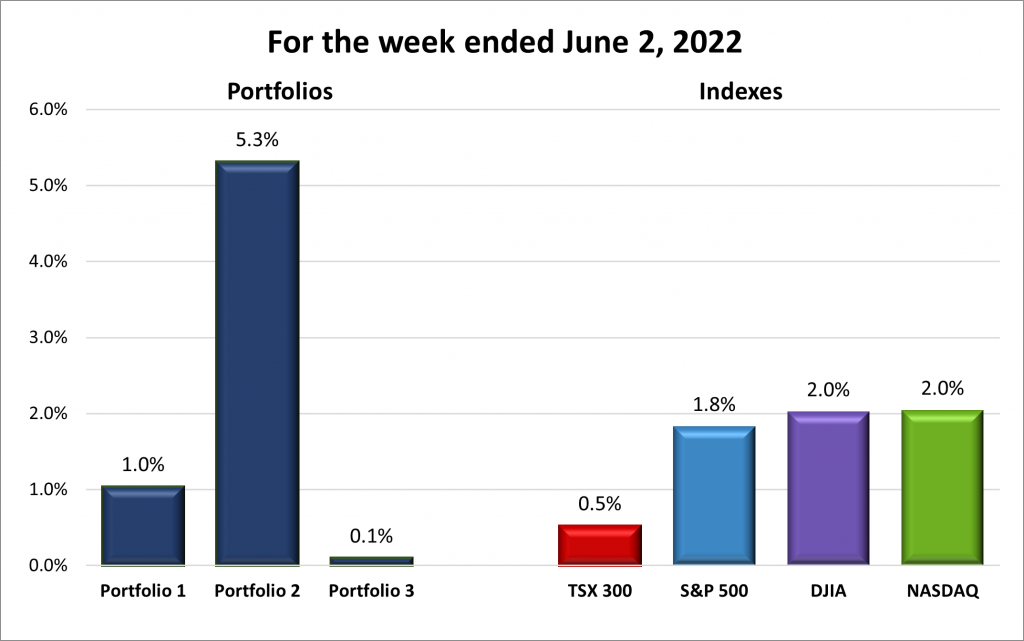
As you can see from the chart above, an end of the week surge lifted all four indexes into the money this past week. Driving the market this past week was the progress of the US debt ceiling negotiations. Once the deal passed through the House of Representatives on Wednesday the indexes surged, followed by another surge Friday when it passed through the Senate. Even the rising tide of optimism created by the US debt ceiling deal lifted the TSX into positive territory for the week. That was the first weekly gain for the TSX in five weeks.

Bull market. A good week for the North American stock markets.

The end-of-week rally propelled all three portfolios into positive territory. As depicted in the chart below, Portfolio 2 emerged as the clear winner, primarily due to a substantial 28% gain from MongoDB (NASD: MDB). Portfolio 1 benefited from its significant technology holdings, as well as the growth companies like Celsius Holdings (NASD: CELH). On the other hand, Portfolio 3 was somewhat disappointing, despite the overall upward movement in the indexes. The gains in technology companies were offset by declines in a few other stocks, particularly a pullback in Shopify (TSX: SHOP) as investors, including myself, took profits following its recent surge.

However, considering the portfolios’ consistent decline last year, any week where all three portfolios experience growth is considered a positive outcome. 😊

Weekly Portfolio & Index performance
Weekly Portfolio & Index performance for the week ended June 2, 2023.

Monthly Portfolio Review

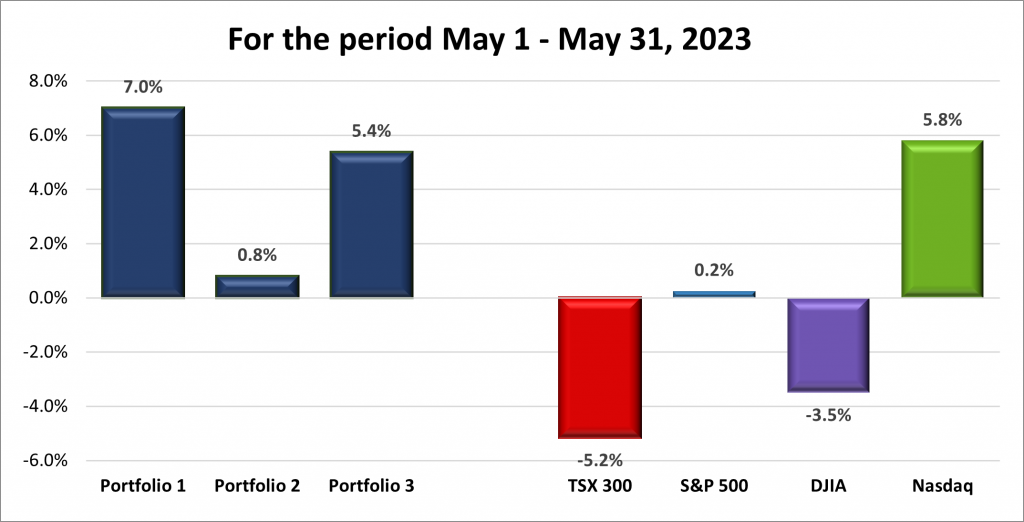
For the month, the TSX (SPTSX) fell 5.2%%, the S&P 500 (SPX) nudged up 0.2%, the DJIA (INDU) dropped 3.5% and the Nasdaq (CCMP) surged 5.8%.

Bearish market

Aside from the Nasdaq, May was not a favorable month for the four major North American indexes. The Nasdaq outperformed the others, as indicated in the chart above. This was primarily driven by the strong performance of technology stocks, particularly semiconductor companies, which surged on the excitement surrounding artificial intelligence. The positive momentum in big technology stocks on the Nasdaq also had a positive impact on the S&P index. However, the industrial-focused companies that make up the 30-company DJIA dragged it into negative territory for May and the year.

In Canada, the TSX experienced its worst monthly performance in 2023, largely due to declining commodity prices, such as oil and copper, as well as disappointing earnings from banks.

Bull market. A good week for the North American stock markets.

In terms of the portfolios, May proved to be a positive month, with all three portfolios experiencing growth. Portfolio 1 saw significant growth, primarily driven by a surge in its mega-cap companies. Portfolio 2 managed to achieve positive returns, as its American technology companies were able to overcome the drag of Canadian bank stocks in the portfolio. Portfolio 3 benefited from the performance of Shopify and its other American technology companies, contributing to its overall growth.

Monthly Portfolio & Index performance
Monthly Portfolio & Index performance for May, 2023.

Companies on the Radar

Stocks on my Radar

Given the uncertainty in the markets, including the US debt ceiling and interest rates in both Canada and the US, I have decided to remain on the sidelines unless an exceptional opportunity presents itself. I recall the costly lesson from late 2021 when I ignored signs of a slowing economy and watched the value of the portfolios drop significantly in 2022. Having learned from that experience, I plan to wait for the resolution of the US debt ceiling issue before making any new investment decisions. As of now, my radar list of potential investment opportunities remains unchanged:

  • Intact Financial (TSX: IFC): A Canadian mid-size insurance company that offers home, car, and business insurance in Canada, the US, and the UK.
  • Cameco (TSX: CCO): A large Canadian company involved in uranium mining, sales, and the construction of reactor components.
  • Amphenol: (NYSE: APH) A large cap producer of high-tech interconnect, sensor, and antenna solutions for industries such as automotive, aerospace, industrial, and technology.
  • BWX Technologies (NYSE: BWXT): A mid cap size American company specializing in the construction and sale of nuclear components to customers worldwide, including the US Navy.
  • Smartcentres Real Estate Investment Trust (TSX: SRU.UN): A mid size fully integrated REIT that owns and manages a number of income producing shopping centres and retails spaces throughout Canada.

The Radar Check was last updated June 2, 2023.

A screenshot of a computer screen Description automatically generated with low confidence

A screenshot of a computer Description automatically generated with medium confidence


Portfolio Update

Portfolio 1

Portfolio 1 for the week ended June 2, 2023: UP Green Up Arrow, signifying a positive week

  • At the start of the week, Nvidia joined the US$ trillion-dollar club, as investors climbed aboard Nvidia’s AI bandwagon. Nvidia is the dominant semiconductor company with over 80% of the high-end semiconductor market. As a result of the growing interest in AI, Nvidia has gained roughly 240% since October 2022. I am very glad to have invested in the company well before investors started piling into the stock. 😊
  • Amazon has been talking with telecom firms about being able to offer Amazon Prime members low-cost wireless services. I suspect this is only in the US, for now, but would be great if it came to Canada since Canadians already pay some of the highest fees for mobile services.
  • General Motors (NYSE: GM) is predicting its Cruise unit of self driving vehicles could bring in US$ 50 billion a year by 2030. That assumes Cruise vehicles will be deployed internationally.

Activity

No significant activity to report this week.

Dividends

Dividends Received this week for the following companies:

Companies followed by DRIP (Dividend Re-Investment Plan) indicate additional shares were purchased with the dividend. Any cash leftover was added to the cash balance.

Canadian $

TMX Group Ltd (TSX: X)

US $

Visa Inc. (NYSE: V)

Quarterly Reports

CrowdStrike Holdings, Inc.

All currency listed in thousands of US dollars, except for per share data.

Selected highlights from their first quarter 2024 financial results on May 31, 2023

  • Revenue of $692,580 for the three months ended April 30, compared to $487,834 for the same period in 2022. An increase of almost 42%.
  • Net income of $499 for the three months ended April 30, compared to a net loss of $31,523 in the same period in 2022.
  • Diluted earnings per ordinary share of $0.00 for the three months ended April 30, compared to a loss of $0.14 per share for the same period in 2022.

Portfolio 2

Portfolio 2 for the week ended June 2, 2023: UP Green Up Arrow, signifying a positive week

  • TC Energy Corp’s (TSX: TRP) received permission from US energy regulators to put their North Baja natural gas pipeline expansion in Arizona and California into service. The pipeline expansion will supply additional natural gas from the southwestern USA to Mexico.
  • Guardant Health (NASD: GH) obtained regulatory approval for its Guardant360 CDx blood test by the Singapore Health Sciences Authority. The liquid biopsy test provides comprehensive genomic profiling for patients with advanced solid cancers.

Activity

No significant activity to report this week.

Dividends

Dividends Received this week for the following companies:

Companies followed by DRIP (Dividend Re-Investment Plan) indicate additional shares were purchased with the dividend. Any cash leftover was added to the cash balance.

Canadian $

Fortis Inc. (TSX: FTS)

US $

No US$ dividends this past week.

Quarterly Reports

MongoDB, Inc.

All currency listed in thousands of US dollars, except for per share data.

Selected highlights from their first quarter 2024 financial results on June 1, 2023

  • Revenue of $368,280 for the three months ended April 30, compared to $285,447 for the same period in 2022. An increase of over 29%.
  • Net loss of $54,246 for the three months ended April 30, compared to a net loss of $77,294 in the same period in 2022.
  • Diluted loss per ordinary share of $0.77 for the three months ended April 30, compared to a loss of $1.14 per share for the same period in 2022.

Portfolio 3

Portfolio 3 for the week ended June 2, 2023: UP Green Up Arrow, signifying a positive week

  • Shopify is facing a class-action lawsuit by recently laid off employees who allege Shopify reneged on a deal it offered when they were laid off recently.
  • Microsoft signed a deal with Nvidia-backed CoreWeave to ensure their OpenAI integrated applications would have sufficient computing power going forward. CoreWeave provides GPU-accelerated solutions to the machine learning industries.
  • Brookfield Asset Management (TSX: BAM) announced it had purchased a controlling stake in CleanMax Enviro Energy Solutions, an Indian solar-panel maker. CleanMax operates solar and wind farms, as well as rooftop panels for corporate clients throughout India.

Activity

Sold: Shopify has grown significantly and represented nearly 30% of the value of Portfolio 3. In light of this concentration, I decided to sell some Shopify shares after the recent surge to over C$ 80 per share. This was done to reduce the concentration of Shopify in the portfolio and mitigate potential risks associated with a single stock holding. By selling some Shopify shares, I have freed up cash that can be used to further diversify the portfolio to reduce risk and increase the potential for overall returns.

Dividends

Dividends Received this week for the following companies:

Companies followed by DRIP (Dividend Re-Investment Plan) indicate additional shares were purchased with the dividend. Any cash leftover was added to the cash balance.

Canadian $

Enghouse Systems Ltd (TSX: ENGH)

Royal Bank of Canada (TSX: RY)

US $

No US$ dividends this past week.

Quarterly Reports

No quarterly reports this past week.

Weekly Update for the week ending May 26, 2023

Items that may only interest or educate me ….

Canadian economic news, US economic news, US debt ceiling negotiations, ….

Canadian economic news

Canada’s 2022 – 2023 budget deficit came in at C$ 41.3 billion, less than half of the C$ 95.6 billion it was the previous year. The decrease was due increased revenues of C$ 34.2 billion, or 8.6%, as the country’s economy grew after the Covid-19 pandemic. Expenses were lower by C$ 29.9 billion, or 6.5%, as the Covid-19 programs wound down. Considering the higher interest rates, its good to see the deficit shrinking in order to lower the debt charges. Money saved on debt charges can be used in other more beneficial areas. At the same time, would it not be great if there was a business case for exporting more natural gas? The inflow of cash could really put a dent in the deficit. 😊

US economic news

On Thursday, the Commerce Department reported Gross Domestic Product rose at an annual rate of 1.3% pace in its second estimate of first-quarter GDP growth. A second estimate is based on more complete data. Compared to the fourth quarter 2022, the US economy is slowing down. A slowing economy leads to higher unemployment as is borne out by the latest Labor Department report indicating unemployment benefits increased by 4,000 to a seasonally adjusted 229,000 for the week ended May 20.

The Commerce Department’s April Personal Consumption Expenditures (PCE) price index, a measure of the prices that people in the US pay for goods and services, was up 0.4%, accelerating from the 0.1% increase in March. The core PCE (PCE less food and energy components) was 0.4% for April, up from 0.3% in March. On a yearly basis, the core PCE came in at 4.7% for April, slightly higher than March’s 4.6.

Both the monthly and yearly PCE and core PCE numbers were higher than expected, indicating that inflation is at least sticking around, if not inching higher. Add in the Consumer Price Index from a few weeks ago that indicated inflation accelerated from March to April and this combination is not good news for the US Federal Reserve (Fed). If anything, it puts pressure on them to increase the US benchmark interest rate in their fight to get inflation down to 2%. We shall see what they do in a few weeks time.

US debt ceiling negotiations

In case you missed it, negotiations to lift the US debt ceiling are rapidly running out of time. It is possible the US government could reach the nation’s debt ceiling on June 1. For more on what a US default on its debt payments could mean the world in general and us Canadian investors, check out the post “What if the US Defaults on its Debt?”


Now, let’s see what happened this past week….

Weekly Market Review

Monday: The Canadian markets were closed for Victoria Day; however, the markets were open in the US where the three American indexes had mixed results. The technology heavy Nasdaq Composite Index (Nasdaq) and the S&P 500 Index (S&P) each finished higher while the blue-chip Dow Jones Industrial Average (DJIA) ended lower.

Other than mega cap technology stocks, investors were gun shy as they awaited news on the US debt default negotiations. Cash heavy mega caps have become the new safe haven when market direction is uncertain. As well, a member of the Fed suggested they might need to increase the US benchmark rate to shrink inflation faster. Leading the way in the American sectors were the Financials and Technology sectors. The biggest decliners were Consumer Staples and Basic Materials (miners and fertilizer manufacturers).

Tuesday: Ongoing US debt negotiations knocked all four indexes lower. The confidence that a deal would get done in time is slowly ebbing and as I have said before, the markets do not like uncertainty. The price of oil shot up on forecasts for tighter gas supplies and concerns of additional Organization of Petroleum Exporting Countries and allies (OPEC+) production reductions.

In Canada, the Toronto Stock Exchange Composite Index (TSX) ended at its lowest close in eight weeks as US debt concerns reached across the border. Canada’s big five banks will report their second quarter earnings later this week and analysts are suggesting they may not be as rosy as usual. In trading, Energy was the only Canadian sector to end higher, while Technology and Consumer Staples had the greatest decrease.

In the US, joining the worries about debt ceiling discussions, Fed members are hinting US interest rates may need to go higher to bring down inflation. It was a relatively quiet day in trading with Energy the only American sector to end in positive territory, while Technology and Basic Materials had the largest pullbacks.

Wednesday: Pessimism over US debt-ceiling talks, and concerns of additional interest rate hikes in Canada and the US led all four indexes to end the day sharply lower. Its looking more and more likely a debt deal will come down to the last minute, if its to get done in time to avoid a US default. Meanwhile, the chance of interest rate hikes in both countries mounts. The price of oil was one of the few bright spots for investors as it continued yesterday’s advance.

In Canada, the earnings for the Bank of Nova Scotia (TSX: BNS) and Bank of Montreal (TSX: BMO), two of Canada’s big five bank, came in lower than expected to further rattle jittery investors. Hopefully, these two banks have not set an ominous tone for the remaining banks. Canada’s banks are being required to set aside more cash in event of more consumer and business loan defaults, so their profits are lower. The Financial sector accounts for almost 30% of the TSX’s weighting, so when Financials fall, the entire TSX tends to get dragged down with it. In trading on Bay Street, Consumer Staples and Technology were the only Canadian sectors to end in the green, Basic Materials and Financials led the other sectors downward.

In the US, the debt deadline is one day closer while a deal seems not to be any closer leading to increasing pessimism in the markets. In trading on Wall Street, once again Energy was the only American sector to post a gain while Basic Materials and Financials were the worst performing sectors.

Thursday: Uncertainty around the US debt ceiling continued to weigh on the broader market, except for the mega cap technology companies, especially those on the front lines of artificial intelligence (AI). As a result, the traditional value oriented TSX and the DJIA ended lower, while the growth-oriented Nasdaq and S&P ended higher.

In Canada, the TSX dropped to a two-month low on lower energy prices and disappointing earnings by two more of Canada’s big five banks. Canada’s largest bank, The Royal Bank of Canada (TSX: RY), reported a decline in earnings, while Canada’s second largest bank TD Bank (TSX: TD) missed its earnings growth target. Not a good day for banks. In the Canadian sectors, Industrials was the only one to advance, leading the decliners were Telecommunications Services and Energy.

In the US of A, a mixed day in the market with the Nasdaq and S&P advancing while the DJIA ended slightly lower. A stellar report by Nvidia (NASD: NVDA) jumpstarted the Nasdaq and started a rally in other AI related companies. Holding back the markets is investors belief there will be another intertest rate increase in June. Despite two of the three indexes ending higher, Technology and Industrials were the only American sectors to end in positive territory. Leading the rest of the sectors downward were Telecommunications Services and Energy.

Friday: All four indexes surged higher on reports US debt negotiators were closing in on a deal to raise the US debt ceiling. As well, a wave of AI optimism boosted the Nasdaq and S&P, while the TSX and DJIA were carried higher by the rising tide. 😊 The optimism of a debt deal getting done also lifted oil prices higher.

In Canada, a rebound in the Canadian bank shares helped lift the TSX in positive territory for the day. Leading the Canadian sectors were the Technology and Consumer Cyclicals sectors while Healthcare was the only sector to decline.

In the USA, a continued rally in all things related to artificial intelligence (AI) combined with optimism that a deal to lift the US debt would get done this weekend pushed all three American indexes higher. The Technology and Consumer Cyclicals sectors led the American indexes higher, while Energy and Consumer Staples were the only sectors to end lower.


Weekly Market and Portfolio Review

For the week, the TSX (SPTSX) lost 2.1%, the S&P 500 (SPX) increased 0.3%, the DJIA (INDU) dropped 1.0% and the Nasdaq (CCMP) gained 2.5%.

Bull market. A good week for the North American stock markets.Bearish marketAnother week of mixed results for the four major North American indexes, as you can see in the chart above. The technology-oriented Nasdaq and S&P ended above the bar, in the green, whereas the more traditional TSX and DJIA both ended lower, in the red. The main driver of the markets was the political brinkmanship of the US debt ceiling negotiations, sending the four indexes lower through the first part of the week. The American indexes rebounded on a blow out earnings report from Nvidia, which sparked a run in companies associated with AI. Thanks to investor enthusiasm for AI companies, both the Nasdaq and S&P posted a weekly gain.

The TSX posted its fifth straight weekly loss, its biggest weekly drop in two months, due to lower demand for Canadian resources, primarily from a slowing economy in China, and unimpressive earnings reports from Canada’s big five banks. The TSX finally turned upward on Friday’s overall market optimism that a deal to resolve the US debt ceiling crisis was near, but it too little, too late to break the losing streak.

Bull market. A good week for the North American stock markets.As for the Portfolios, another good week with all portfolios advancing, led by a strong performance from Portfolio 1, as you can see in the chart below. Portfolio 1 was easily the best performer of the week, led by Nvidia’s big surge, and the AI tailwinds that propelled the other mega cap technology companies higher. The gains by the technology companies were more than enough offset the drag of the Canadian bank stocks. Portfolios 2 and 3 were also led by their respective technology companies to overcome the drag of their Canadian banks, but they do not hold as many big technology companies as Portfolio 1.

Weekly Portfolio & Index performance
Weekly Portfolio & Index performance for the week ended May 26, 2023.

Companies on the Radar

Stocks on my Radar

No new companies came onto my radar this past week but the Formula One Group (NASD: FWONK) is now part of Portfolio 1. For now, my radar list includes the five companies listed below:

  • Intact Financial (TSX: IFC): A Canadian mid size insurance company supplying home, car and business insurance in Canada, the US, and the UK.
  • Cameco (TSX: CCO): A Canadian company that mines and sells uranium, and builds components for reactors.
  • Amphenol: (NYSE: APH) Producer of a high-tech interconnect, sensor, and antenna solutions for the automotive, aerospace, industrial and various technology industries.
  • BWX Technologies (NYSE: BWXT): BWX is an American company that builds and sells nuclear components to the US Navy and other customers throughout the world.
  • Smartcentres Real Estate Investment Trust (TSX: SRU.UN): Owns and manages a number of income producing malls and retails spaces throughout Canada.

The Radar Check was last updated May 26, 2023.

A screenshot of a computer screen Description automatically generated with low confidence

A screenshot of a computer Description automatically generated with medium confidence


Portfolio Update

Portfolio 1

Portfolio 1 for the week ended May 26, 2023: UP Green Up Arrow, signifying a positive week

  • PayPal (NASD: PYPL) announced their Venmo unit has launched a new service for teenagers, aged 13- 17. Parents and guardians can open accounts for their teenagers and then monitor transactions and manage their privacy settings. The Teen Account comes with a debit card which allows the kids to send money. Get them when they are young and hopefully, they will be PayPal customers for life. 😊
  • Apple (NASD: AAPL) signed a deal with US semiconductor maker Broadcom (NASD: AVGO). The multi billion dollar, multi year deal will see Broadcom manufacture 5G radio frequency chips for Apple’s mobile products.
  • Tesla (NASD: TSLA) announced they will sell some of their China made electric vehicles (EV) in Canada. Tesla EVs made in China qualify for Canada’s EV rebates but not for US EV rebates. This will allow Tesla to keep their made in the USA EVs for the American market.
    On a separate note, Tesla and Ford (NYSE: F) announced a deal that will allow Ford EVs to use Tesla’s Supercharger charging station. This is good news as it might be the start of a universal standard for charging stations. Its even better news for Tesla shareholders since it will not require any modifications and Tesla may make a bit of money from each charge.
  • Waymo, a division of Alphabet’s (NASD: GOOGL) Google is partnering with once rival Uber. Waymo’s self driving taxis in Phoenix, AZ will now be available via Uber’s ride hailing app. The Waymo vehicles will also be used for food delivery as part of the Uber Eats service.
  • A spectacular earnings report from Nvidia pushed the companies market capitalization closer to US$ 1 trillion. If it does surpass the $1 trillion mark it will be the first semiconductor company to break the trillion-dollar mark, and only the fifth public company to break the trillion-dollar mark. Nvidia saw its sales sore on the tailwinds of AI, causing it to raise its outlook for the remainder of the year. While numerous software companies are busy integrating AI into their existing products, they are all turning to Nvidia for the necessary chips to run AI applications. Nvidia is the dominant chip maker for the burgeoning AI market.

Activity

Bought: Liberty Media’s Formula One Group (NASD: FWONK): As I mentioned previously, FWONK first came on my radar while watch the F1 Miami Grand Prix. I was kicking myself for not buying more Ferrari (NYSE: RACE) when I discovered I could own the entire F1 racing series. The popularity of F1 has been growing since the release of the Netflix series ‘Drive to Survive’ and the addition of more races in America. Liberty Media has done a great job promoting the F1 brand and series. This was reflected in the growing revenue, net income, and cash flows, plus the share price has easily beaten the S&P each of the last few years. I expect F1 popularity to increase which will lead to more revenues. And I can say I am a part owner of the F1 racing series, although I doubt that will get me VIP access to any of the races. 😊

Bought: A 1-year cashable TD Bank GIC paying 3.35%. The GIC can be cashed out after 30 days without any penalties, plus accrued interest. The GIC is a short term (< 1 year) holding area for cash that may be needed within a year. 😊

Dividends

Dividends Received this week for the following companies:

Companies followed by DRIP (Dividend Re-Investment Plan) indicate additional shares were purchased with the dividend. Any cash leftover was added to the cash balance.

Canadian $

Pulse Seismic Inc (TSX: PSD)

US $

No US$ dividends this past week.

Quarterly Reports

ZIM Integrated Shipping Services Ltd.

All currency listed in millions of US dollars, except for per share data.

Selected highlights from their first quarter 2023 financial results on May 22, 2023

  • Revenue of $1,374.3 for the three months ended March 31, compared to $3,716.4 for the same period in 2022. A decrease of almost 74%.
  • Net loss of $58.1 for the three months ended March 31, compared to net income of $1,711.0 in the same period in 2022.
  • Diluted loss per ordinary share of $0.50 for the three months ended March 31, compared to earnings of $14.19 per share for the same period in 2022.

Global-e Online Ltd.

All currency listed in thousands of US dollars, except for per share data.

Selected highlights from their first quarter 2023 financial results on May 22, 2023

  • Revenue of $45,876 for the three months ended March 31, compared to $27,183 for the same period in 2022. An increase of almost 69%.
  • Net loss of $43,083 for the three months ended March 31, compared to a net loss of $53,586 in the same period in 2022.
  • Diluted loss per ordinary share of $0.26 for the three months ended March 31, compared to a loss of $0.35 per share for the same period in 2022.

Nano – X Imaging Ltd

All currency listed in thousands of US dollars, except for per share data.

Selected highlights from their first quarter 2022 financial results on May 25, 2023

  • Revenue of $2,447 for the three months ended March 31, compared to $1,808 for the same period in 2022. An increase of almost 35%.
  • Net loss of $11,761 for the three months ended March 31, compared to a net loss of $21,666 in the same period in 2022.
  • Diluted earnings per ordinary share of $0.21 for the three months ended March 31, compared to earnings of $0.41 per share for the same period in 202.

Nvidia Corporation

All currency listed in millions of US dollars, except for per share data.

Selected highlights from their first quarter 2023 financial results on May 24, 2023

  • Revenue of $7,192 for the three months ended April 30, compared to $8,288 for the same period in 2022. A decrease of over 13%.
  • Net earnings of $2,043 for the three months ended April 30, compared to net income of $1,618 in the same period in 2022.
  • Diluted loss per ordinary share of $0.82 for the three months ended April 30, compared to a loss of $0.64 per share for the same period in 2022.

Bank of Nova Scotia

All currency listed in millions of Canadian dollars, except for per share data.

Selected highlights from their second quarter 2023 financial results on May 24, 2023

  • Revenue of $7,220 for the three months ended April 30, compared to $7,723 for the same period in 2022. A decrease of almost 7%.
  • Net income of $2,159 for the three months ended April 30, compared to net income of $2,747 in the same period in 2022.
  • Diluted earnings per ordinary share of $1.69 for the three months ended April 30, compared to earnings of $2.16 per share for the same period in 2022.


  • Revenue of $14,562 for the six months ended April 30, compared to $15,550 for the same period in 2022. An increase of over 6%.
  • Net earnings of $3,931 for the six months ended April 30, compared to net earnings of $5,487 in the same period in 2022.
  • Diluted earnings per ordinary share of $3.04 for the six months ended April 30, compared to earnings of $4.30 per share for the same period in 2022.

TD Bank Group

All currency listed in millions of Canadian dollars, except for per share data.

Selected highlights from their second quarter 2023 financial results on May 25, 2023

  • Revenue of $12,366 for the three months ended April 30, compared to $11,263 for the same period in 2022. An increase of almost 10%.
  • Net income of $3,351 for the three months ended April 30, compared to net income of $3,811 in the same period in 2022.
  • Diluted earnings per ordinary share of $1.72 for the three months ended April 30, compared to earnings of $2.07 per share for the same period in 2022.


  • Revenue of $24,592 for the six months ended April 30, compared to $22,544 for the same period in 2022. An increase of over 9%.
  • Net earnings of $4,933 for the six months ended April 30, compared to net earnings of $7,544 in the same period in 2022.
  • Diluted earnings per ordinary share of $2.54 for the six months ended April 30, compared to earnings of $4.09 per share for the same period in 2022.

Costco Wholesale Corporation

All currency listed in millions of US dollars, except for per share data.

Selected highlights from their third quarter 2023 financial results on May 25, 2023

  • Revenue of $53,648 for the three months ended May 7, compared to $52,596 for the same period in 2022. An increase of over 2%.
  • Net income of $1,302 for the three months ended May 7, compared to net income of $1,353 in the same period in 2022.
  • Diluted earnings per ordinary share of $2.93 for the three months ended May 7, compared to earnings of $3.04 per share for the same period in 2022.


  • Revenue of $163,351 for the nine months ended May 7, compared to $154,863 for the same period in 2022. An increase of over 5%.
  • Net earnings of $4,132 for the nine months ended May 7, compared to net earnings of $3,976 in the same period in 2022.
  • Diluted earnings per ordinary share of $9.30 for the nine months ended May 7, compared to earnings of $8.94 per share for the same period in 2022.

Portfolio 2

Portfolio 2 for the week ended May 26, 2023: UP Green Up Arrow, signifying a positive week

  • The Bank of Nova Scotia had a case of silver price fixing dismissed. A group of investors claimed the bank, and two other banks had conspired to manipulate silver prices from 2007 – 2013. The lawsuit was dismissed with prejudice; therefore, it cannot be brought again.
  • Guardant Health (NASD: GH) announced it has begun a public offering of 12.5 million common shares at $28 per share for expected gross proceeds of $350 million, upsized from $250 million previously. The underwriters have a 30-day window to purchase an additional 1.9 million shares of its common stock at the public offering price. I am guessing this is to raise money for Guardant, but I do not see how this is good news for existing shareholders as this will dilute the earnings.
  • MongoDB (NASD: MDB) announced a four-year extension to their strategic global partnership with Alibaba Cloud. The relationship allows Alibaba Cloud users to quickly build enterprise level applications based on the MongoDB’s non-relational database.
  • TC Energy (TSX: TRP) has applied to US regulators to open the taps on part of its natural gas pipeline that runs from Arizona and California to Mexico.

Activity

No significant activity to report this week.

Dividends

Dividends Received this week for the following companies:

Companies followed by DRIP (Dividend Re-Investment Plan) indicate additional shares were purchased with the dividend. Any cash leftover was added to the cash balance.

Canadian $

Dream Industrial Real Estate Investment Trust (TSX: DIR.UN) DRIP

US $

No US$ dividends this past week.

Quarterly Reports

Bank of Nova Scotia

All currency listed in millions of Canadian dollars, except for per share data.

Selected highlights from their second quarter 2023 financial results on May 24, 2023

  • Revenue of $7,220 for the three months ended April 30, compared to $7,723 for the same period in 2022. A decrease of almost 7%.
  • Net income of $2,159 for the three months ended April 30, compared to net income of $2,747 in the same period in 2022.
  • Diluted earnings per ordinary share of $1.69 for the three months ended April 30, compared to earnings of $2.16 per share for the same period in 2022.


  • Revenue of $14,562 for the six months ended April 30, compared to $15,550 for the same period in 2022. An increase of over 6%.
  • Net earnings of $3,931 for the six months ended April 30, compared to net earnings of $5,487 in the same period in 2022.
  • Diluted earnings per ordinary share of $3.04 for the six months ended April 30, compared to earnings of $4.30 per share for the same period in 2022.

Portfolio 3

Portfolio 3 for the week ended May 26, 2023: UP Green Up Arrow, signifying a positive week

  • Microsoft (NASD: MSFT) announced their ChatGPT infused Bing search engine will no longer be limited to information as recent as 2021. Responses will now feature live search results. Currently this is available only for paid subscribers but Microsoft plans to make it available for all users.
    As well, Microsoft is bringing its Bing search engine to OpenAI’s ChatGPT. Initially it will be only available in the paid subscription offering but will eventually be implemented in the free version as well.
  • Brookfield Corporation (TSX: BN) received permission to purchase about 142 million Class A limited voting shares, or about 10% of the outstanding Class A shares. Assuming they purchase the shares when they are underpriced, this is good news for shareholders.
  • Shopify (TSX: SHOP) announced the launch of new point-of-sale hardware in Canada. The company seeks to increase its products for traditional stores during a slowdown in e-commerce growth.
  • TD Bank has decided how to spend some of the money it had set aside for its failed acquisition of a US regional bank – they will build out their network of branches. TD plans to grow organically by opening new branches throughout the US and building its wealth management business. TD also plans to buy back up to 30 million of its own shares.

Activity

No significant activity to report this week.

Dividends

Dividends Received this week for the following companies:

No dividends this past week.

Quarterly Reports

Royal Bank of Canada

All currency listed in thousands of Canadian dollars, except for per share data.

Selected highlights from their second quarter 2023 financial results on May 25, 2023

  • Revenue of $13,520 for the three months ended April 30, compared to $11,220 for the same period in 2022. An increase of over 20%.
  • Net income of $3,649 for the three months ended April 30, compared to net income of $4,253 in the same period in 2022.
  • Diluted earnings per ordinary share of $2.58 for the three months ended April 30, compared to earnings of $2.96 per share for the same period in 2022.


  • Revenue of $28,614 for the six months ended April 30, compared to $24,286 for the same period in 2022. An increase of almost 18%.
  • Net earnings of $6,863 for the six months ended April 30, compared to net earnings of $8,348 in the same period in 2022.
  • Diluted earnings per ordinary share of $4.86 for the six months ended April 30, compared to earnings of $5.80 per share for the same period in 2022.

TD Bank Group

All currency listed in millions of Canadian dollars, except for per share data.

Selected highlights from their second quarter 2023 financial results on May 25, 2023

  • Revenue of $12,366 for the three months ended April 30, compared to $11,263 for the same period in 2022. An increase of almost 10%.
  • Net income of $3,351 for the three months ended April 30, compared to net income of $3,811 in the same period in 2022.
  • Diluted earnings per ordinary share of $1.72 for the three months ended April 30, compared to earnings of $2.07 per share for the same period in 2022.


  • Revenue of $24,592 for the six months ended April 30, compared to $22,544 for the same period in 2022. An increase of over 9%.
  • Net earnings of $4,933 for the six months ended April 30, compared to net earnings of $7,544 in the same period in 2022.
  • Diluted earnings per ordinary share of $2.54 for the six months ended April 30, compared to earnings of $4.09 per share for the same period in 2022.

What if the US Defaults on its Debt?

US debt default

With interest rate updates a week away for both countries, the immediate concern for investors is the fast-approaching deadline for lifting the US debt ceiling. The US government’s debt ceiling currently stands at over US$ 31.4 trillion but risks running out of cash. That is something the US has not done since 1789. US Treasury Secretary Janet Yellen stated the government could run out of cash to cover its expenses as soon as June 1.

Time is running out on US debt negotiations.

If the US were to default on its debt payments, it means that the US government is unable to pay back the money it borrowed from people, organizations, and other countries. This borrowed money is represented by US Treasury bonds, which are like IOUs or promises to repay the borrowed amount with interest.

If America were to default on these payments, it would have serious consequences for everyone. No one is quite sure what those consequences would be since this has never happened before. US Federal Reserve (Fed) Chairman Jerome Powell warned that not raising the debt limit would be unprecedented, with highly uncertain and negative effects on the American economy, as well as the global economy. Many financial experts are sure a default would be extremely damaging, depending on how long the US would remain in default. Here are a few examples of what could happen:

  1. Financial Market Problems: A US default would create a lot of uncertainty and worry in the global financial markets. Investors who own these US Treasury bonds would become concerned about getting their money back, so they might start selling them quickly. This would cause the prices of these US Treasury bonds to drop, and US interest rates would go up. It would become more expensive for people and businesses in America to borrow money.
  2. Economic Slowdown: When borrowing becomes more expensive, it affects the economy. Businesses would likely find it harder to get loans to expand their operations, and individuals might have difficulty getting affordable loans for items like buying a car or a mortgage for buying a house. This could lead to a slowdown in economic growth and job creation, and it could cause widespread unemployment.
  3. Stock Market Decline: The stock markets, American and others, would also likely be affected. Investors would be worried about the overall health of the economy, so they might start selling their stocks to preserve their wealth. This most likely would cause share prices to drop. People who have invested in stocks and sold their shares in a panic could lose money. It could also make it more difficult for companies to raise money by selling shares, which might hinder their ability to grow and create new jobs.
  4. Global Impact: The US is a major player in the global economy (the largest economy in the world), so a default would have worldwide consequences. Many countries and organizations hold US Treasury bonds as part of their investments or reserves. If the US were to default, these entities would suffer financial losses, it could create instability in the global financial system, and severely damage America’s reputation as a trustworthy borrower. It might also weaken the US dollar, which is widely used in international trade and finance. Other nations would likely try to exploit the situation and spread global doubt about the value of the US dollar, American institutions, and US leadership.
  5. Social and Political Unrest: People might lose trust in the US government’s ability to manage its finances, leading to unrest and protests. It would probably cause a lot of anxiety and uncertainty for individuals and families as the American economy struggles and job opportunities become scarce.

To avoid these serious consequences, the American government usually takes steps to prevent a default. The usual course of action is for the US Congress to authorize more government borrowing so the US can keep paying its bills. This time the Republicans who control the House of Representatives are trying to use the looming deadline to their advantage. They are playing a risky game of brinkmanship with the White House.

Impact on Canada and Canadian Investors

It is important to remember these are potential impacts, and the exact consequences would depend on the specific circumstances surrounding a US default. Governments and central banks typically take measures to mitigate the effects of such events and stabilize their respective economies. I am sure the Bank of Canada (BoC) is aware of what is happening in the US and are planning accordingly. Nonetheless, a US default would undoubtedly present challenges for Canada due to the countries’ close economic relationship (Canada and the USA are each others largest trading partner). Here are some of the ways it could affect Canada in general:

  1. Economic Impact: As Canada’s largest trading partner, any disruption in the US economy would have a direct impact on Canada. A US default could trigger an economic slowdown or recession in the US, which would lead to reduced demand for Canadian exports. The decline in trade activity could also affect the demand for the Canadian dollar, putting downward pressure on the value of the Canadian dollar. Canadian businesses that rely heavily on exporting to the US would face challenges as their sales decrease. This could result in job losses, reduced investment, and a slowdown in the Canadian economy.
  2. Currency Exchange Rates: During times of uncertainty or market turmoil, investors often seek safe-haven currencies and assets. A US debt default could lead to global economic instability and a decrease in investor confidence in the US economy and the US dollar. As a result, investors may seek to sell off their US dollar holdings, causing its value to decline relative to other currencies, including the Canadian dollar. The Canadian dollar could benefit from its perceived stability and become a preferred safe-haven currency. This could potentially strengthen the Canadian dollar against the American dollar as investors move their funds into Canadian assets at the expense of the US dollar. For Canadian consumers, this would make buying products in the US less expensive. However, for businesses exporting to the US, their products would be more expensive which could lead to lower demand.
  3. Financial Market Volatility: If the US defaults, it would send shockwaves through the global financial markets, and Canadian stock markets would not be immune. Investor uncertainty and risk aversion could lead to increased volatility, likely resulting in declining stock prices. Canadian investors would feel the impact as stock markets plunge, and portfolios take a hit. The fear and uncertainty in the air would make investors anxious, and panic selling might take hold. On a positive note, it could also affect Canadian bond markets, as Canadian government bonds may be seen as a safer alternative during times of uncertainty and lead to increased demand. As a result, interest rates could fall, making borrowing costs more favorable for Canadian businesses and consumers.
  4. Trade and Investment Confidence: A US default could erode confidence in the global economy and financial system. This could impact investor sentiment and decision-making, leading to reduced investment in Canada. Uncertainty and market volatility may cause businesses to delay or scale back their investment plans, affecting economic growth and job creation in Canada.
  5. Commodity Prices: Canada is a major exporter of commodities such as oil, natural gas, and minerals. The Canadian energy sector in particular is closely tied to the American market. A US default could lead to a decrease in US economic activity and energy consumption, which would impact Canadian energy exports. Lower demand for Canadian oil and gas could result in reduced revenue for energy companies and have negative effects on employment in the sector. As well, the prices of other commodities, such as minerals and metals, are often influenced by global market conditions, including the strength of the US economy. If a US default led to an economic downturn, it could lower global demand for commodities, which may negatively affect Canadian commodity exports and, consequently, the Canadian dollar. It would also lead to lower tax revenues for the government which collects taxes on all exports.

If the US were to default on its debt, it would be a turbulent time for us investors. Canadian investors, like investors in America and throughout the world, would likely face losses on their investments. The value of stocks and other investments linked to the US market would likely plummet. That would be painful, to say the least. Keep in mind, any losses would only be on ‘paper.’ They do not become actual losses until you sell those shares. If time is on your side, you could hold onto to your shares and wait for the markets to rebound (this is my preferred course of action).

However, crises can also bring opportunities. While a US default would create challenges, sharp investors could find a few hidden gems in the chaos and seize the chance to buy undervalued stocks, betting on a market recovery.

I do not know what will happen in the North American stock markets if the US defaults, but in investing, flexibility and the ability to seize opportunities can make all the difference. If the US does default, keep your wits about you, and remember that even amidst the chaos, there will be opportunities to increase your wealth. 😊

Weekly Update for the week ending May 19, 2023

Items that may only interest or educate me ….

Canadian economic data, US economic data, The Big 5 market Movers, Relative Strength Index …

Canadian economic data

Statistics Canada’s April Consumer Price Index (CPI) report showed annual inflation in Canada unexpectedly rose 4.4%, following a 4.3% increase in March. That was the first-time inflation grew since June 2022. It was not much, only 0.1%, but it must have caught the Bank of Canada’s (BoC) attention, thereby increasing the chances of another rate hike. On a monthly basis, inflation in April rose 0.7%, after gaining 0.5% in March. As for Core CPI, (CPI, less food and energy) the numbers matched the CPI numbers, up 4.4% on an annual basis, and up 0.5% monthly.

The report said higher mortgages, rent and fuel were the main cause of higher inflation numbers. The higher interest rates would have led to higher mortgages and rent, and I am sure its no coincidence fuel went up the same time the carbon tax was increased.

Canada’s March retail sales fell 1.4% in, after dropping 0.2% in February. On an annual basis, retails sales were up 2.4%. Core retail sales (retail sales less vehicles and vehicle parts, and gasoline) increased to 0.3% in March on a monthly basis and rose 2.5% on a yearly basis.

The slowing in overall retail sales may be enough to offset the increase in inflation and allow the BoC to hold the Canadian benchmark interest rate at 4.5%. However, if the BoC does raise the rate it likely will boost the value of the Canadian dollar.

US economic data

The Commerce Department’s April Advanced Monthly Sales for Retail and Food Services reported retail sales for April rose 0.4%, following a 0.6% decline in March. Analysts had been expecting an increase of 0.8%. On a yearly basis, retail sales were up 1.6%. Core retail sales (retail sales less vehicles, gasoline, building materials and food services) gained 0.7% in April, after falling 0.4% in March. Core retail sales is a value analysts pay attention to because it most closely corresponds with the consumer spending component of gross domestic product.

My takeaway is Americans continue to spend despite the higher interest rates. Analysts suggest consumer spending will provide a moderate amount of economic growth and help the US avoid a recession or at least have a soft landing (slowdown in economic growth that avoids recession).

The Big 5 market Movers

According to a report from DataTrek Research, five companies are responsible for the S&P 500’s year to date return of 9% – Alphabet (NASD: GOOGL), Apple (NASD: AAPL), Meta Platforms (NASD: META), Microsoft (NASD: MSFT), and Nvidia (NASD: NVDA). Of those companies rise in share prices, the report says up to 50% of those gains are from the hot topic of the day – Artificial Intelligence (AI). If not for these big tech companies and their AI appeal, the S&P would be in negative territory for 2023. I am glad I invested in four of those companies well before AI became the latest must have technology. 😊

Relative Strength Index

Just when I thought I was done with indexes, along comes another one – the Relative Strength Index (RSI).

The RSI is a technical indicator used by traders and investors to assess the strength and momentum of a price trend. It is primarily used to identify potential overbought and oversold conditions in a market or a specific security such as stocks.

The RSI is measured on a scale from 0 to 100 and is calculated based on the average gains and losses over a specified period, typically 14 days. The formula considers the ratio of upward price movements to downward price movements during that period.

When the RSI is above 70, it suggests that the market or security is potentially overbought, meaning it may have risen too quickly and could be due for a price correction or reversal. On the other hand, when the RSI is below 30, it indicates potential oversold conditions, suggesting that the market or security may have declined too much and could be poised for a price bounce or recovery.

Investors often use the RSI to help identify potential entry and exit points for trades. For example, if the RSI is above 70 and starts to decline, it may signal a potential sell or short opportunity (where an investor sells shares he does not already own and plans to buy the shares when the share price falls). Conversely, if the RSI is below 30 and starts to rise, it may indicate a potential buy.

The RSI readings can be found on the TD Direct Investing (DI) platform. If you do not use TD DI, it may be available on your trading platform, but if not, you can go to Yahoo! Finance and follow these steps:

  1. Go to the Yahoo! Finance Canada or the yahoo! finance website.
  2. In the search bar at the top of the page, enter the name of the company or ticker symbol you are interested in.
  3. On the stock’s summary page, you will see various tabs such as Summary, Chart, Statistics, etc. Click on the “Chart” tab.
  4. On the chart page, you should find a toolbar above the chart with several options. Look for an “Indicators” button or a similar feature. Click on it.
  5. A dropdown menu should appear with various technical indicators. Scroll down until you see “RSI” or “Relative Strength Index.” Click on it.
  6. The RSI indicator should now be displayed on the chart along with the stock’s price movements. You can adjust the timeframe and other settings as needed.

So, there you have it, another tool to add to your investing toolkit.


Now that you have another tool in your tool bag, let’s see what happened this past week….

Weekly Market Review

Monday: All four major North American indexes started the week on a positive note, ending their respective losing streaks. While the US debt ceiling deadline approaches, many investors believe the debt ceiling will be resolved. However, until the issue is resolved its likely to be a bumpy ride in the stock markets.

In Canada, the Toronto Stock Exchange Composite Index (TSX) was lifted by higher oil prices owing to tightening supplies, due in part to wildfires in Alberta that could lock in crude oil supplies from that province. The Canadian sectors were led upward by Basic Materials (miners and fertilizer manufacturers) and Financials, while Consumer Staples, Healthcare and Telecommunications Services were the only sectors to fall back.

In the US, the S&P 500 Index (S&P), the Dow Jones Industrial Average (DJIA), and the Nasdaq Composite Index (Nasdaq) all edged higher despite the ongoing US debt negotiations and tough talk from the US Federal Reserve (Fed) that they expect interest rates to remain high for a while. It was a broad rally in the American sectors, led higher by Basic Materials and Financials. Defensive sectors Utilities and Consumer Staples were the only two sectors to decline.

Tuesday: In contrast to yesterday when all four indexes finished in the green, today all four ended in the red. Investors continue to monitor the US debt negotiations, hoping the debt ceiling will be raised sooner rather than later.

In Canada, the CPI came in higher than expected at 4.4%, igniting concerns the BoC may decide to raise the interest again to bring down inflation. The TSX dipped to its lowest level in a few months due to interest rate concerns, lower commodity prices dragging down resource companies, and the US bank situation weighing down the Canadian financial sector. It was a day of broad-based declines in the Canadian sectors. Industrial and Telecommunications Services dropped the least while Energy and Basic Materials had the biggest drops.

In the US, lower retail sales caused investors to believe the US economy is slowing down, possibly heading for a recession. Causing more angst for investors, Fed members have indicated they are not ready to lower interest rates any time soon. The Technology sector was the only one of the American sectors to end in the green today. Leading the downward plunge were Energy and Utilities.

Wednesday: Investors’ optimism grew as progress seemed to be made in the US’s debt ceiling negotiations, causing all four indexes to end the day higher. However, concerns persist over the chance of a historic default.

In Canada, after spending the morning in the red, an afternoon rally in energy and financial companies lifted the TSX into the green. On Bay Street, it was a mixed day in the Canadian sector with Healthcare and Consumer Cyclicals pulling the TSX higher, while Utilities and Telecommunications Services were the biggest drag.

In the US of A, US debt negotiators on both sides believe a deal can be done to avoid the US from defaulting on its debt payments, spurring investors to push all three indexes higher. It was a good day on Wall Street, led by the Financials and Consumer Cyclicals sectors. Utilities, Telecommunications Services, and Consumer Staples were the only sectors to end lower.

Thursday: The TSX ended basically flat, while progress in the US debt ceiling negotiations sparked hopes that the US could avoid a recession, pushing the American indexes ending higher. Oil prices fell on economic news that raised the possibility the Fed could increase the cost of borrowing again.

In Canada, the TSX was in negative territory for most of the day on concerns the BoC would raise the Canadian interest rate. Late in the day, a last-minute rally, fueled by optimism from south of the border, nudged the TSX barely into the green. In trading, leading the way in the Canadian sectors were Healthcare and Industrials, while Basic Materials and Utilities had the biggest declines.

In the US, after a rollercoaster ride most of the day, all three indexes ended on a high note thanks to continuing optimism a deal will be done in time to avoid the US default on its debt commitments. Comments from Fed members continue to warn they are not ready to pause or lower interest rates. In trading, Technology and Consumer Cyclicals were the best performers in the American sectors, while Telecommunications Services and Utilities dropped the most.

Friday: A mixed day in the markets with the TSX ending higher, and the American indexes all falling (remember that warning on Monday about a bumpy ride). The big news was once again in the US where US debt ceiling negotiations stalled, after Republicans walked out of negotiations.

In Canada, despite the latest retail sales report showing a drop of 1.4% in March and the pullback of the American indexes, the TSX advanced on stronger commodity prices (such as oil and gold). In trading, the Energy and Consumer Staples sectors were the big winners. Consumer Cyclicals, Financials, and Healthcare were the only sectors to end lower.

In the US, the three indexes started the morning in positive territory before dropping on news of the pause in debt ceiling negotiations. Adding to downward pressure, the Fed said inflation was “far above” their 2% target and indicated it was too soon to tell if another interest rate hike was needed. Of the American sectors, Healthcare, Energy and Consumer Staples were the only sectors to advance. Dropping the most were Consumer Cyclicals and Financials.


Weekly Market and Portfolio Review

For the week, the TSX (SPTSX) dipped 0.3%, the S&P 500 (SPX) was up 1.6%, the DJIA (INDU) added 0.4% and the Nasdaq (CCMP) surged 3.0%.

Bull market. A good week for the North American stock markets.The stock market does respond to optimism. It was investor optimism that the US would be able to raise its debt ceiling that pushed the American indexes higher for most of the week, as you can see in the chart above. Investor optimism drove both the S&P and the Nasdaq to their best week since March. It was not until the negotiations hit a snag on Friday morning that the optimism took a hit and caused the three indexes to pullback. The TSX, posted its fourth consecutive weekly decline thanks to the latest Canadian inflation report that came in higher than expected, raising concerns the BoC would raise the Canadian interest rate.

Bull market. A good week for the North American stock markets.A good week for the technology heavy Nasdaq usually means another good week for the technology biased Portfolios. And indeed it was, with each posting another positive week. Portfolio 1 was helped by its three mega cap companies – Alphabet, Apple and Nvidia – which continue to outperform. Portfolio 2 was pushed higher by its big mega cap stock Microsoft, but also received lift from its other US technology companies and its Canadian energy companies. Bringing up the rear was Portfolio 3. Along with mega cap Microsoft, Portfolio 3 had good performances from a few of its US technology companies and its lone Canadian energy company. Unfortunately, it had too many companies that drifted lower, limiting the gains this past week.

With the US debt ceiling negotiations gaining urgency next week I expect the markets to be more volatile as investors react to every bit of information and rumour coming out of those meetings. The sooner the deal gets done, the better. Investors will regain confidence in US markets and hopefully the rally that has boosted the mega cap technology companies will spread to the overall market. Until next week, onward and upward! 😊

Weekly Portfolio & Index performance
Weekly Portfolio & Index performance for the week ended May 19, 2023.

Companies on the Radar

Stocks on my Radar

This past week two new companies came on my radar – Cameco (TSX: CCO) and BWX Technologies (NYSE: BWXT). Both are involved in the nuclear energy industry which is seeing a bit more interest lately as countries seek to lower their carbon footprint. Cameco is a Canadian company that mines and sells uranium and builds reactor components for reactors. BWX is an American company that builds and sells nuclear components globally. One of its biggest customers is the US Navy.

There is a bit of a tailwind for nuclear energy as many countries are starting to realize solar and wind power alone cannot supply enough reliable energy to meet their needs. Nuclear energy has zero carbon footprint and can supply reliable energy to a large area. However, nuclear energy faces a significant headwind – fear of a meltdown. Both companies are already successful, but if the world does turn to nuclear energy, these two companies would be in the right place at the right time. I will take a closer look to get a better understanding of both companies to see if they will join the other companies below:

  • Liberty Media’s Formula One Group (NASD: FWONK): tracks the performance of their Formula One World Championship unit.
  • Intact Financial (TSX: IFC): A Canadian mid size insurance company supplying home, car and business insurance in Canada, the US, and the UK.
  • Amphenol: (NYSE: APH) Producer of a high-tech interconnect, sensor, and antenna solutions for the automotive, aerospace, industrial and various technology industries.
  • Smartcentres Real Estate Investment Trust (TSX: SRU.UN): Owns and manages a number of income producing malls and retails spaces throughout Canada.

The Radar Check was last updated May 19, 2023.

A screenshot of a computer Description automatically generated with low confidence

A screenshot of a computer Description automatically generated with medium confidence


Portfolio Update

Portfolio 1

Portfolio 1 for the week ended May 19, 2023: UP Green Up Arrow, signifying a positive week

  • Home Depot (NYSE: HD) had a disappointing earnings report and forecast a drop in annual sales and a sharper than expected decline in profit. Management blamed declines on a wet spring season, falling lumber prices and consumers shifting to travel oriented vacations after the past few years of staying at home. The pandemic home improvement boom appears to be over.
  • At Tesla’s (NASD: TSLA) annual shareholder meeting, CEO Elon Musk indicated he had no plans to step down from his role at Tesla and assured shareholders the Cybertruck would finally start rolling out to customers later this year. He also said the company would venture into the field of advertising to sell more vehicles.
    On a separate note, the company said it is considering building a factory in India to service that market as well as export to other countries.
  • General Motors (NYSE: GM) said despite the capability to build over 1 million electric vehicles (EVs) by 2025, it would likely be restrained by its ability to produce enough batteries for those EVs. The battery bottleneck could reduce the number of EVs produced to less than 600,000.
  • CrowdStrike (NASD: CRWD) announced they have been named a leader in Forrester Research’s The Forrester Wave: Managed Detection and Response (MDR) for the second quarter 2023. As well, CrowdStrike ranked first in market share for the second year in a row in Gartner MDR for Managed Security Services.

Activity

No significant activity to report this week.

Dividends

Dividends Received this week for the following companies:

Companies followed by DRIP (Dividend Re-Investment Plan) indicate additional shares were purchased with the dividend. Any cash leftover was added to the cash balance.

Canadian $

Dream Industrial Real Estate Investment Trust (TSX: DIR.UN)

US $

BSR Real Estate Investment Trust (TSX: HOM.U)

Apple Inc. (NASD: AAPL)

Quarterly Reports

Home Depot, Inc.

All currency listed in millions of US dollars, except for per share data.

Selected highlights from their first quarter 2023 financial results on May 16, 2023

  • Revenue of $37,257 for the three months ended April 30, compared to $38,908 for the period ended May 1, 2022. A decrease of over 4%.
  • Net income of $3,873 for the three months ended April 30, compared to net income of $4,231 for the period ended May 1, 2022.
  • Diluted earnings per ordinary share of $3.82 for the three months ended April 30, compared to earnings of $4.11 per share for the period ended May 1, 2022.

SEA Limited

All currency listed in thousands of US dollars, except for per share data.

Selected highlights from their first quarter 2023 financial results on May 16, 2023

  • Revenue of $3,041,104 for the three months ended March 31, compared to $2,899,571 for the same period in 2022. An increase of almost 5%.
  • Net income of $87,292 for the three months ended March 31, compared to a net loss of $580,136 in the same period in 2022.
  • Diluted earnings per ordinary share of $0.15 for the three months ended March 31, compared to a loss of $1.04 per share for the same period in 2022.

Lightspeed Commerce Inc.

All currency listed in thousands of US dollars, except for per share data.

Selected highlights from their fourth quarter 2022 financial results on May 18, 2023

  • Revenue of $184,228 for the three months ended March 31, compared to $146,558 for the same period in 2022. An increase of over 25%.
  • Net loss of $74,468 for the three months ended March 31, compared to a net loss of $114,517 in the same period in 2022.
  • Diluted loss per ordinary share of $0.49 for the three months ended March 31, compared to a loss of $0.77 per share for the same period in 202.


  • Revenue of $730,506 for the six months ended March 31, compared to $548,372 for the same period in 2022. An increase of over 33%.
  • Net loss of $1,070,009 for the six months ended March 31, compared to a net loss of $288,433 in the same period in 2022.
  • Diluted loss per ordinary share of $7.11 for the six months ended March 31, compared to a loss of $2.04 per share for the same period in 2022.

Portfolio 2

Portfolio 2 for the week ended May 19, 2023: UP Green Up Arrow, signifying a positive week

  • The Bank of Nova Scotia (TSX: BNS) was handed US$ 35 million in fines because employees used their personal devices and apps for work related communications. BNS notified the US Security Exchange Commission (SEC) of the issues, prompting an investigation by the SEC into the bank’s record keeping practises.
  • Guardant Health (NASD: GH) announced it’s Guardant360 CDx/Guardant360 liquid biopsy test is now covered for comprehensive genomic profiling by all major U.S. commercial health insurers. The test is used to detect actionable cancer biomarkers in a patient’s blood that may help determine their course of therapy.
  • Walt Disney Company (NYSE: DIS) announced they cancelled plans to build a new US$ 1 billion campus on their Disney World location and relocate 2,000 well paying jobs to the new campus. Disney attributes the decision to “leadership changes” and “changing business conditions.”
    Disney also announced they were shutting down their luxury hotel Star Wars: Galactic Starcruiser, also at Disney World.

Activity

No significant activity to report this week.

Dividends

Dividends Received this week for the following companies:

Companies followed by DRIP (Dividend Re-Investment Plan) indicate additional shares were purchased with the dividend. Any cash leftover was added to the cash balance.

No dividends this past week.

Quarterly Reports

Take-Two Interactive Software, Inc.

All currency listed in millions of US dollars, except for per share data.

Selected highlights from their fourth quarter 2022 financial results on May 17, 2023

  • Revenue of $1,266.3 for the three months ended March 31, compared to $930.0 for the same period in 2022. An increase of over 55%.
  • Net loss of $610.3 for the three months ended March 31, compared to net income of $110.9 in the same period in 2022.
  • Diluted loss per ordinary share of $3.62 for the three months ended March 31, compared to earnings of $0.95 per share for the same period in 202.


  • Revenue of $5,349.9 for the year ended March 31, compared to $3,504.8 for the same period in 2022. An increase of over 52%.
  • Net loss of $1,124.7 for the year ended March 31, compared to net earnings of $418.0 in the same period in 2022.
  • Diluted loss per ordinary share of $7.03 for the year ended March 31, compared to earnings of $3.58 per share for the same period in 2022.

Portfolio 3

Portfolio 3 for the week ended May 19, 2023: UP Green Up Arrow, signifying a positive week

  • The Microsoft acquisition of Activision Blizzard (NASD: ATVI) got interesting when the deal got the go ahead from the European Union (EU). The EU gave their thumbs up to the deal saying the numerous licensing deals Microsoft has made with its competitors makes the deal acceptable. The deal is now knotted 1 approval by the EU, 1 veto by Britain. Microsoft and Activision still need to obtain approval from the US antitrust officials as well as other regulators.
  • A few weeks ago, TD Bank (TSX: TD) pulled out of their deal to acquire US regional bank First Horizon (NASD: FHN) after learning US regulators would not sign off on how TD handled suspicious customer transactions. I thought this meant TD would be able to go looking for another US bank to acquire but it turns out TD could be in the penalty box for the next few years. Not only do they have to change the way they handle suspicious transactions, but they must show and prove to the regulators that they have made the required changes that will satisfy the regulators.
  • Enghouse Systems Ltd. (TSX: ENGH) announced it has entered into an Agreement with Lifesize Inc., to acquire most of Lifesize’s assets and brands. Lifesize is a global provider of video conferencing and omnichannel contact center solutions.

Activity

No significant activity to report this week.

Dividends

Dividends Received this week for the following companies:

Companies followed by DRIP (Dividend Re-Investment Plan) indicate additional shares were purchased with the dividend. Any cash leftover was added to the cash balance.

No dividends this past week.

Quarterly Reports

Fortuna Silver Mines Inc.

All currency listed in thousands of US dollars, except for per share data.

Selected highlights from their first quarter 2023 financial results on May 15, 2023

  • Revenue of $175,653 for the three months ended March 31, compared to $182,239 for the same period in 2022. A decrease of almost 4%.
  • Net income of $11,857 for the three months ended March 31, compared to net income of $26,296 in the same period in 2022.
  • Diluted earnings per ordinary share of $0.04 for the three months ended March 31, compared to earnings of $0.09 per share for the same period in 2022.