Weekly Update for the week ending July 21, 2023

Items that may only interest or educate me ….

Canadian Economic news, US Economic news, Magnificent Seven, An AI primer, …


Canadian Economic news

Consumer Price Index report for June

Statistics Canada reported that Canada’s annual inflation rate for June, as measured by the Consumer Price Index (CPI), dropped to 2.8%, marking a 27-month low. This rate was lower than May’s 3.4% increase and below analysts’ expectations of 3% growth. On a month-over-month basis, the CPI increased by 0.1%, which was lower than May’s 0.4% rise and below analysts’ expectations of a 0.3% increase. The decrease in gas prices, which were down 21.6% since June 2022, was the primary factor contributing to the lower CPI. However, grocery prices continued to rise, up 9.1%, and mortgage interest costs were up by more than 30% in the past year.

Before getting too excited and thinking the Bank of Canada (BoC) is done with rate hikes, it is important to consider core CPI, which is the BoC’s preferred measure. Core CPI grew by 3.5% on an annual basis, down from May’s 4.0%. On a monthly basis, core CPI remained unchanged at 0.0%. Core CPI is a version of the CPI that excludes the volatile components food and energy, providing a more stable and accurate measure of underlying inflation trends. It provides a clearer view of longer-term inflation trends in the economy.

CPI and core CPI are key pieces of the puzzle that the BoC considers when deciding whether to raise or lower the benchmark interest rate. The CPI is commonly used to track changes in the cost of living for consumers, representing the average price change of a basket of goods and services typically purchased by households over a period of time. This is also known as ‘headline CPI.’ A decrease in the CPI suggests lower costs for everyday goods and services, something we all can appreciate. Core CPI provides a more accurate view of the underlying inflationary pressures in the economy and helps policymakers gauge longer-term trends in inflation more accurately.

Retail Sales

The May retail sales report from Statistics Canada shows a slowdown in consumer spending compared to the previous month. Retail sales increased by 0.2%, which is lower than the 1.1% gain observed in April and below analysts’ expectations of a 0.5% increase for May. On an annual basis, retail sales were up by 0.5%, led by strong performances in motor vehicle and parts dealers, up 6.3%, as well as food and beverage retailers, up 5.2%.

Core retail sales, which exclude the sub sectors gas stations and fuel vendors, and, motor vehicle and parts dealers, remained flat in May. Food and beverage sales saw an increase of 1.0%, but this was offset by a decline of 1.5% in building materials and garden equipment and supplies dealers.

The slowing growth in retail sales indicates a potential slowdown in the Canadian economy. While the Consumer Price Index (CPI) is within the BoC target range of 1% – 3%, the higher core CPI, which now exceeds headline CPI, is a cause for concern for the BoC. If core inflation remains elevated, there is a possibility that the BoC may opt for an additional rate hike at their next meeting in September.

US Economic news

Retail sales

The Commerce Department’s June report on retail sales indicated a slowdown in consumer spending compared to the previous month. Retail sales rose by 0.2%, which was lower than the 0.5% pace observed in May. On an annual basis, retail sales increased by 1.5%, marking the second slowest pace since May 2020.

The decline in gas station purchases by 22.7% and home furnishings by 4.6% contributed to the overall decrease in retail sales. However, there were some areas where consumers continued to spend, such as motor vehicles and personal care, which saw increases of 5.3% and 6.3%, respectively.

Retail sales serve as an important measure of household spending. The Federal Reserve (Fed) is likely to view this slowdown in spending positively, since slower consumer spending can alleviate some of the demand-driven inflation that the economy has experienced.

Retail sales data are some of the key data points the Fed considers regarding the US interest rate. If the trend of slower spending continues, it will likely give the Fed more confidence to hold off on increasing the interest rate and consider lowering it in the future.

Magnificent Seven

The rise of the “Magnificent Seven”, namely Apple (NASD: AAPL), Microsoft (NASD: MSFT), Alphabet (NASD: GOOGL), Amazon (NASD: AMZN), Nvidia (NASD: NVDA), Tesla (NASD: TSLA), and Meta Platforms (NASD: META), has been nothing short of remarkable in 2023. Their collective surge, with share price increases ranging from 40% to over 200%, has been the driving force behind the S&P 500’s impressive 17% year-to-date rise, pushing the index to its highest level since April 2022.

These mega-cap stocks, each valued at over US$200 billion, have come to dominate benchmark indexes, accounting for a substantial 27.9% of the S&P 500’s total weight. Because of their meteoric rise, I now consider them essential core holdings rather than growth stocks. Each portfolio contains at least one of these companies and has become a critical component of all three portfolios.

One of the key factors contributing to their dominance is their strong presence in the current artificial intelligence (AI) trend. Being at the forefront of AI development, these companies have positioned themselves to capitalize on future technological advancements.

Given their significant impact on the overall market and their potential for future growth, the “Magnificent Seven” have become almost necessary additions to any portfolio. It is important to have exposure to these companies, not only for their outstanding performance but also for their potential to lead technological innovations in the years to come. For more information on the Magnificent Seven, check out this post here.

An AI primer

If you are looking for a decent primer on AI, check out this article on AI, it is as good as anything I have seen. It is a bit technical, but it covers the key terms and the key players in the emerging market. A quick example of AI, while typing this, when I typed “art” the program instantly suggested artificial intelligence. Now, if I can get it to tell me the next hot stock. 😊


Now, let’s see what moved the markets this past week….

Weekly Market Review

Monday: The American markets got the week off to a good start with the S&P 500 Index (S&P), the Dow Jones Industrial Average (DJIA), and the Nasdaq Composite Index (Nasdaq) all advancing. Unfortunately, Canada’s Toronto Stock Exchange Composite Index (TSX) stumbled on news that China’s Gross Domestic Product data for the second quarter came in lower than expected, up only 0.8% from the first quarter. Slow growth in China will likely have some negative spillovers for Canada and the US, such as lower oil and commodity prices because of lower demand from China.

In Canada, the TSX was dragged down by the lower commodity price as a result of slowing demand from China. In trading, Healthcare, Technology and Financials were the only Canadian sectors to end in the green. The biggest drops were in Telecommunications Services and Energy.

In the US, the DJIA had its best day of the year as investors await second quarter earning from many of the big US banks and technology companies. As long as earnings report match expectations, the markets should continue moving higher. In trading, Technology and Financials were the best performing American sectors, while Telecommunications Services and Utilities had the biggest declines.

Tuesday: After yesterday’s dip into the red, the TSX reached a two-month high and joined the other indexes in the green at the end of the day. Oil prices rebounded from yesterday’s sell off on hopes a Chinese economic support plan will increase demand. In Canada and the US, data continues to indicate a positive combination of strong economies, cooling inflation, and a robust labour market. A great combination for the economies and the markets.

In Canada, spurred on by the declining rate of inflation, investors gained confidence that rising interest rates will end sooner rather than later and pushed the TSX higher. In trading, Basic Materials (miners and fertilizer manufacturers) gained the most, while Consumer Staples and Technology had the biggest declines,

In the USA, thanks to strong earning from the big American banks that reside on the DJIA, the DJIA led all indexes higher and stretched its winning streak to seven. The markets were led higher by the Financials and Energy sectors. The defensive sectors Utilities and Consumer Staples were the only sectors to end lower.

Wednesday: Its hump day and all four indexes ended higher as better than expected earnings reports continue to roll in for DJIA listed companies and several other US banks.

In Canada, Canadian banks were lifted higher by the positive earnings reports coming from US banks, helping the TSX to its highest close in two months. The Canadian Financials sector accounts for 29% of the TSX’s market capitalization, so a good day for the sector is usually a good day for the index. On Bay Street, Telecommunications Services and Utilities posted the biggest gains while Consumer Staples was the only sector to end in the red.

In the US, the DJIA ran its winning streak to eight while the Nasdaq barely ended in the green after a dip from Microsoft after Apple announced it was getting into the artificial intelligence game. Elsewhere on Wall Street, Telecommunications Services and Utilities were the best performers, while Basic Materials, Technology and Industrials were the only American sectors to end lower.

Thursday: Investors were not impressed with yesterday’s weak earnings from Netflix (NASD: NFLX) and shrinking margins from Tesla, casting a pall over the markets. The DJIA was the only index to end in the green. Oil prices rose on news US crude oil inventories were low, and China reported higher imports of crude oil.

In Canada, the TSX fell as investors moved away from Canadian technology companies as concerns higher interest rates will reduce their cash flow these firms require to further their high growth needs. Of the four Canadian sectors that ended higher, Utilities and Energy led the way. On the downside, Technology and Basic Materials had the biggest drops.

In the US, the disappointing results from big name technology companies Netflix and Tesla dragged the technology heavy Nasdaq lower and weighed on the S&P. Meanwhile, the blue chip oriented DJIA touched a 52-week high while running its winning streak to nine days. In the American sectors, Utilities and Healthcare posted the biggest gains while Technology and Consumer Cyclicals suffered the biggest declines.

Friday: A mixed day for the four major North American indexes, with the TSX posting the day’s biggest gain, the Nasdaq posted the biggest loss, and the DJIA and S&P were essentially flat. Investors are looking ahead to next week’s Fed meeting and earnings reports from many of the technology titans. Investors are hoping lacklustre reports from Netflix and Tesla are not a sign of things to come for the big technology companies. Oil prices moved higher after China said they would introduce measures to jumpstart the Chinese economy.

In Canada, higher oil prices drove the TSX higher despite the latest Canadian retail sales data showing retail sales slowing down. In trading on Bay Street, Telecommunications Services and Energy were the big gainers, Technology was flat, while Basic Materials was the only Canadian sector to fall back.

In the US, the DJIA inched into positive territory to run its streak to an impressive ten days, its longest winning streak since August 2017. The Nasdaq was choppy as various funds that track the Nasdaq 100 index must rebalance themselves to lower their concentration of some of the biggest technology companies to match the Nasdaq 100’s new weightings. In trading on Wall Street, the Utilities and Healthcare sectors notched the biggest gains, while Financials and Industrials had the biggest drops.


Weekly Market and Portfolio Review

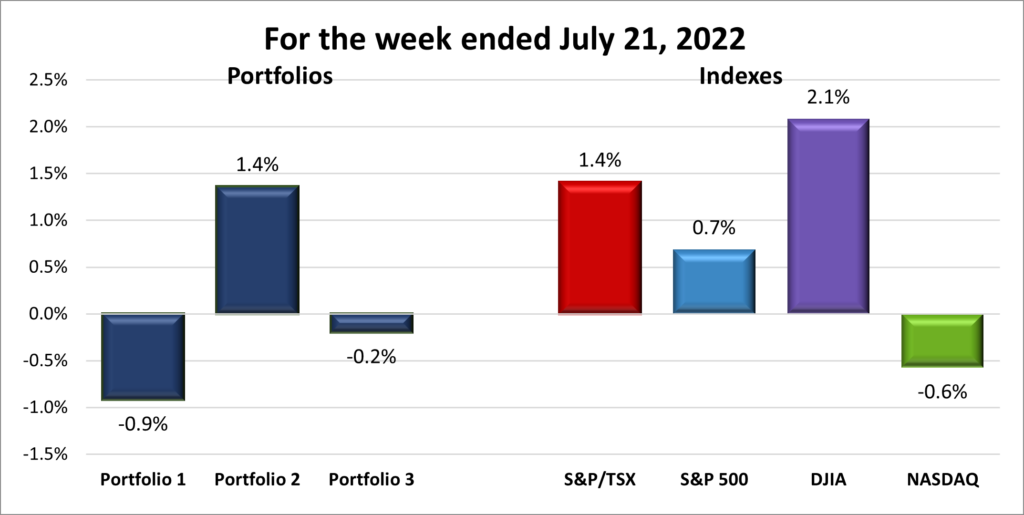
For the week, the TSX (SPTSX) advanced 1.4%, the S&P 500 (SPX) rose 0.7%, the DJIA (INDU) jumped 2.1% and the Nasdaq (CCMP) slumped 0.6%.

Bull market. A good week for the North American stock markets.It was a mostly positive week for the stock markets, with three of the four indexes advancing, as seen in the graph above. The Nasdaq saw a decline due to concerns over the earnings reports of well-known technology companies Netflix and Tesla. This dragged down both the Nasdaq, which is home to many technology companies, and the S&P 500, which includes the largest 500 companies, including major technology firms.

On the other hand, the DJIA was the clear winner of the week, benefiting from solid earnings reports from big American banks.

In Canada, the TSX saw gains driven by higher oil prices. Analysts expect increased demand from China thanks to government programs aimed at stimulating their economy. At the same time, supply shortages caused by production cutbacks from Saudi Arabia and Russia, along with ongoing tensions between Russia and Ukraine, are likely to lead to higher oil prices.

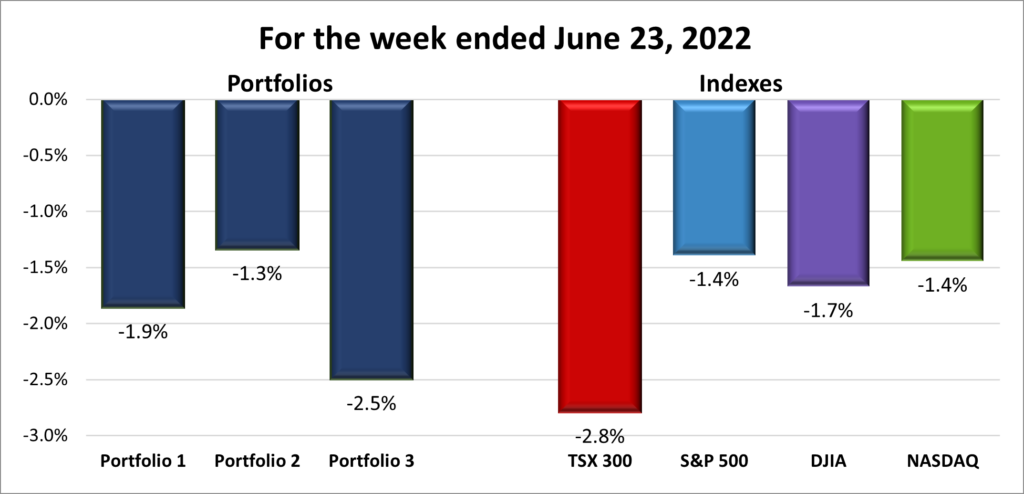
Bearish marketAs you can see in the chart below, it was a mixed week for the portfolios, with two of the three ending lower. Portfolio 2 saw gains thanks to strong performances from its financial companies, which were lifted by solid results from American banks. However, Portfolio 1 was dragged down by Tesla’s lackluster earnings report and the overall drop in the technology sector. Portfolio 3 also experienced a decline as the gains in its financial companies were outweighed by the decline in technology companies.

Looking ahead to the upcoming week, the focus will be on the second-quarter earnings reports of many big technology companies. Investors will be hoping for more impressive results compared to this past week. If earnings disappoint, it could lead to share price declines for many technology firms.

Additionally, the Fed’s update on the US benchmark interest rate will be closely watched. While an interest rate increase is widely expected after it was left unchanged in the last June session, investors will be more interested in the path the Fed outlines going forward. The central bank’s approach will likely be data-driven, meaning they will consider relevant economic data to determine their future policy decisions. Hopefully the data indicates inflation continues to fall. 😊
Weekly Portfolio & Index performance
Weekly Portfolio & Index performance for the week ended July 21, 2023.

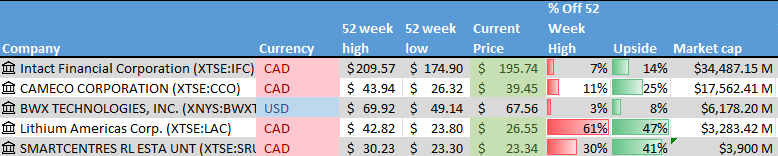
Companies on the Radar

Stocks on my Radar After weeks of remining unchanged, my Radar List has now dropped to just two companies. I am still working my way through deeper dives on each company but so far, I like what I see in each company. Cameco and BWX should benefit from a tailwind if nuclear energy gains more prominence as an alternative energy option. As governments focus on reducing carbon emissions and addressing climate change, nuclear power is being considered for its low greenhouse gas emissions compared to traditional fossil fuel-based sources.

  • Cameco (TSX: CCO): A large Canadian company involved in uranium mining, sales, and the construction of nuclear reactor components.
  • BWX Technologies (NYSE: BWXT): A mid cap size American company specializing in the construction and sale of nuclear components to customers worldwide, including the US Navy.

The Radar Check was last updated July 21, 2023.


Portfolio Update

Portfolio 1

Portfolio 1 for the week ended July 21, 2023: DOWN Red Down Arrow

  • After years of delays, Tesla’s first Cybertruck finally came off their Texas giga-factory assembly line, two years later than planned. The Cybertruck prototype was first unveiled in 2019 and after a few stumbles has finally started shipping. It will take a while to fulfill all the orders if rumours are true that 2 million people made $100 refundable deposits. Even if half the depositors back out, that is still a huge backorder.
    Separately, Tesla is facing a National Highway Traffic Safety Administration (NHTSA) special crash investigation into a fatal accident. The Tesla involved is suspected of using Tesla’s advanced driver assistance systems when it collided head on with another vehicle.
    Tesla reported strong revenue growth thanks to its strategy price cuts to boost sales. However, their margins hit a three year low of 18.9%, down from 25.9% a year ago. What was not in the report is the boost from other electric vehicle (EV) manufacturers adopting Tesla’s American Charging Standard. That revenue should appear in their next earnings report.
    Finally, Tesla is prepared to make additional price cuts to drive sales if the economy stalls. The lower prices would be offset by the tax cuts provided in the US government’s Inflation Reduction Act.
  • Amazon is building a satellite launch facility for the launching of its planned 3,200 low Earth-orbiting satellites that will create a network to beam broadband internet globally. Amazon will spend a US$ 120 million on the facility as part of their US$ 10 billion satellite program, named Kuiper. The facility is expected to receive its first batch of satellites for processing in 2025.

Activity

No significant activity to report this week.

Dividends

Dividends Received this week for the following companies:

Companies followed by DRIP (Dividend Re-Investment Plan) indicate additional shares were purchased with the dividend. Any cash leftover was added to the cash balance.

Canadian $

Andlauer Healthcare Group Inc (TSX: AND)

BCE Inc (TSX: BCE)

US $

BSR Real Estate Investment Trust (TSX: HOM.U)

Quarterly Reports

Tesla, Inc.

All currency listed in millions of US dollars, except for per share data.

Selected highlights from their second quarter 2023 financial results on July 19, 2023

  • Revenue of $24,927 for the three months ended June 30, compared to $16,934 for the same period in 2022. An increase of over 47%.
  • Net income of $2,614 for the three months ended June 30, compared to net income of $2,269 in the same period in 2022.
  • Diluted earnings per ordinary share of $0.78 for the three months ended June 30, compared to earnings of $0.65 per share for the same period in 2022.

Portfolio 2

Portfolio 2 for the week ended July 21, 2023: UP Green Up Arrow, signifying a positive week

  • MongoDB (NASD: MDB) announced they have extended their partnership with Microsoft to help customers move their MongoDB applications to Microsoft’s Azure cloud computing platform.
  • Telus (TSX: T) signed a multi year agreement with Canada Soccer to become their Official Telecommunications, Digital Health, and Home Security Partner for the Federation and its National Teams. Hopefully this deal will turn out a lot better for Canada Soccer than a deal with Canada Soccer Business which all but hid the national teams from Canadian soccer fans.
    As well, Telus teamed up with the Victoria Cool Aid Society to provide a second mobile health van to provide aid to the homeless in Victoria.
  • Guardant Health (NASD: GH) announced their Guardant Reveal molecular residual disease (MRD) test will be covered by Blue Cross and Blue Shield of Louisiana. This is a blood test that detects circulating tumor DNA in blood after treatment, including surgery, to help identify cancer patients with residual or recurring disease who may benefit most from further therapy or surveillance.
  • The House of the Mouse, Walt Disney Company (NYSE: DIS) has spoken with both the NFL and NBA about the two leagues becoming minority investors in Disney’s ESPN sports broadcasting unit.

Activity

No significant activity to report this week.

Dividends

Dividends Received this week for the following companies:

Companies followed by DRIP (Dividend Re-Investment Plan) indicate additional shares were purchased with the dividend. Any cash leftover was added to the cash balance.

Canadian $

Alimentation Couche-Tard Inc (TSX: ATD)

US $

No US$ dividends this past week.

Quarterly Reports

No quarterly reports this past week, except for per share data.

Portfolio 3

Portfolio 3 for the week ended July 21, 2023: DOWN Red Down Arrow

  • Microsoft finally was able to sign an agreement with Sony that would keep the ‘Call of Duty’ game on PlayStation devices for the next 10 years. The agreement was necessary for Microsoft to close its acquisition of Activision Blizzard (NASD: ATVI). Now, to get the OK from British regulators. Microsoft and Britain’s competition regulator, the Competition and Markets Authority (CMA) have been granted a three-month extension to resolve their differences so Microsoft and Activision can close their deal.
    While potentially dodging the Activison bullet, Microsoft now finds itself in the crosshairs of the European Unions’ (EU) anti trust regulator, the European Commission (EC). The last time Microsoft was under investigation by the EC was in 2008 over Internet Explorer (now known as Edge) imbedded in Windows. This time its over their Teams workplace messaging platform, which until April automatically enrolled users in Teams.
    Finally, Microsoft’s share price hit an all time high this past week after they announced they will charge at least 53% more for its Microsoft 365 plans that included AI.

Activity

Bought Lithium Americas (TSX: LAC): Investing in a company with no revenues is riskier, but it also provides a significant opportunity due to the growing demand for lithium in the expanding EV market.

Lithium is a crucial component in EV batteries, and as more countries and industries shift towards EVs, the demand for lithium is expected to surge. The company’s existing contract to supply lithium to GM (NYSE: GM) for their Ultium batteries adds credibility to their potential in the EV market.

The company’s plan to split into two separate entities, Lithium Americas Corp, and Lithium Argentina, provides investors with exposure to different geographic regions and markets. The US-based Lithium Americas Corp will retain the agreement with GM and stands to benefit from the US government’s desire for domestic manufacturers and supply chains, potentially gaining access to tax breaks and financial incentives provided by the US government.

Moreover, given the global push towards renewable energy and clean transportation, the Argentine operation can provide opportunities in the international market as well.

While this investment carries more risk, it does offer an opportunity to capitalize on the growing global demand for lithium. However, I expect the share price to be quite volatile as the industry and company matures.

Dividends

Dividends Received this week for the following companies:

Companies followed by DRIP (Dividend Re-Investment Plan) indicate additional shares were purchased with the dividend. Any cash leftover was added to the cash balance.

Canadian $

goeasy Ltd (TSX: GSY)

US $

No US$ dividends this past week.

Quarterly Reports

No quarterly reports this past week.
 

Weekly Update for the week ending July 14, 2023

Items that may only interest or educate me ….

Canadian Economic news, US Economic news, NASDAQ’s balancing act, ….


Canadian Economic news

As was expected, the Bank of Canada (BoC) raised the Canadian benchmark interest rate by 0.25% to 5.0%, reaching its highest level in 22 years. This marks the tenth increase by the central bank since March 2022.

In their announcement, the BoC acknowledged the downward trajectory of global inflation and the strength of the Canadian economy, which is supported by a tight labor market. While inflation fell to 3.4% in May, a significant drop from the peak of 8.1% last summer, underlying inflation, as measured by the core Consumer Price Index (CPI), which excludes food and fuel prices, remained at 4%.

The BoC expects inflation to continue easing, but they are concerned that progress towards their 2% target could stall, and inflation could potentially rise again if there are unexpected upward surprises. BoC Governor Tiff Macklem emphasized the importance of taking necessary actions now to prevent the need for more significant measures in the future. The central bank projects that inflation will hover around 3% for the next twelve months before eventually reaching the BoC’s 2% target by 2025. The rate increase serves as a reminder that achieving a 2% inflation rate remains the BoC’s primary objective.

While the BoC did not explicitly state that this would be the last rate increase, they did not rule out further rate hikes. The central bank will continue to monitor the data and assess the need for additional rate adjustments as the effects of the rate hikes work their way through the economy. Analysts are split on whether there will be another increase at their next meeting on September 6. Hopefully, this will be the last increase before the BoC starts lowering the rate.

Of course, Canada’s big banks announced they will raise their rates, accordingly, making it more expensive for anyone with a variable rate mortgage or outstanding loan. ☹

US Economic news

Consumer Price Index

Data from the Bureau of Labor Statistics indicates that the June Consumer Price Index (CPI) showed moderate increases, both on a monthly and annual basis, but both came in lower than expected. In June, the CPI increased by 0.2%, following a 0.1% gain in May. On an annual basis, the CPI grew by 3.0%, a decrease from May’s 4.0% growth rate.

The core CPI, which excludes the volatile components of energy and food prices, also experienced a 0.2% increase in June, compared to a larger gain of 0.4% in May. The annual growth rate for core CPI stood at 4.8%, a significant decline from May’s 5.3% increase and the lowest rate of growth in over two years.

Energy prices saw a substantial decrease of 16.7% on a yearly basis, while food prices increased by 5.7%. In terms of monthly drivers, shelter costs played a significant role, accounting for 70% of the overall increase in CPI.

The positive aspect of this data is that overall CPI, or headline CPI, continues to decline, indicating some easing in price pressures. Additionally, the deceleration in core CPI suggests that many of the various subsectors are experiencing slower growth rates in prices.

Producer Price Index

The June Producer Price Index (PPI) for final demand, as reported by the Labor Department, experienced a modest increase of 0.1% following a 0.4% decline in May. On an annual basis, the PPI rose by 0.1%, a decrease from May’s 0.9% increase.

The core PPI, which excludes the volatile components of food, energy, and trade services, also saw a 0.1% increase in June, compared to no change in May. Over the twelve months through June, the core PPI increased by 2.6%, slightly lower than the 2.8% growth rate recorded in May.

The PPI is a measure of the average price changes received by American producers for their goods and services. A decrease in the PPI suggests lower production costs for producers, which may lead to lower prices for consumers. The latest data indicates that the annual increase in US producer inflation was the smallest seen in nearly three years.

Jobs report and unemployment rate

The Department of Labor’s latest data revealed that the number of Americans filing new claims for unemployment benefits unexpectedly dropped to 237,000, which was below both the expected 250,000 claims and the previous week’s 249,000 claims. This decline indicates that the American labour market remains tight, as fewer individuals are seeking unemployment assistance.

A tight labour market is generally considered a positive sign for the economy, as it indicates lower levels of unemployment and a higher demand for workers. However, in the context of the Federal Reserve (Fed) and their interest rate decision, a tight labour market can also raise concerns about inflationary pressures. When there is strong demand for labour and a limited supply of available workers, it can lead to wage increases and potentially contribute to rising inflation.

Given this unexpected decline in unemployment claims and the continued tightness of the labor market, it may provide another reason for the Federal Reserve (Fed) to consider raising the interest rate again.

What does it all mean?

The drop in CPI and slowing PPI indicate a decrease in inflationary pressures, which could potentially lead the Federal Reserve to leave the interest rate unchanged. However, the lower jobless claims data suggests a tight job market and the possibility of inflation reversing course. While one month of positive data is unlikely to prevent the Fed from proceeding with an interest rate hike, continued positive results in CPI, PPI, and jobless claims data in July and August could potentially signal that the last rate increase has already taken place.

For us investors, this environment could be favorable for stocks. If second quarter corporate earnings are strong, we could find ourselves in a bull market. Second quarter earnings reports started this week so we shall know shortly.

Consumer Sentiment Index

The University of Michigan’s initial consumer sentiment index (CSI) reading for July came in 72.6, its highest since September 2021. The CSI is up 12.7% from June, and on an annual basis, it is up 41.0%. The sharp increase is largely a result of the continuing drop in inflation.

NASDAQ over concentration

The operators of the Nasdaq have announced a “special rebalance” of the Nasdaq 100 index. The rebalance aims to reduce the weight of the mega cap companies and allow smaller companies to have a greater influence on the index. This adjustment is necessary to ensure the index remains a relevant benchmark for investors.

At the beginning of the year, Amazon (NASD: AMZN), Apple (NASD: AAPL), Microsoft (NASD: MSFT), Nvidia (NASD: NVDA), and Tesla (NASD: TSLA) accounted for 43.8% of the Nasdaq 100 index’s weight. However, the rally in mega-cap technology companies this year, including a recent surge in Tesla’s share price, pushed the combined weight of these five companies over the 48% threshold that triggers a rebalancing. After the rebalance, these five companies will drop to 38.5% of the Nasdaq 100.

This special rebalancing will likely have some impact on investors as index funds and mutual funds that track the Nasdaq 100 will need to buy and sell billions of dollars’ worth of shares to align with the updated weightings. The increased buying and selling activity may lead to price volatility, presenting opportunities for investors. However, given the liquidity of the shares in the Nasdaq 100 companies, significant impacts on share prices are not expected, especially for long-term investors.

The rebalance will take place before the markets open on July 24 and does not involve the removal or addition of any companies. The Nasdaq 100 was previously rebalanced in 1998 and 2011.

Retail Investor index

I recently discovered the TD Direct Investing Index (DII). I do not and will not use it for my investment decisions, but it was interesting to see how my market sentiment compared to other TD Direct Investing customers. If you are interested in the market sentiment of other individual investors, check out TD’s Direct Investing Index.


If you made it through all that economic news, please try and stay with me and let’s see what happened this past week….

Weekly Market Review

Monday: Weak economic data out of China, upcoming inflation data out of the US, and the next BoC interest rate decision all factored into market movements today. Concerns of higher interest rates caused the price of oil to slip.

In Canada, the Toronto Stock Exchange Composite Index (TSX) ended lower as investors anticipate the BoC will raise the interest rate by 0.25% for the second time in a row. In trading, the biggest gains in the Canadian sectors were made by the Basic Materials (miners and fertilizer manufacturers) and Healthcare sectors. The biggest losses were posted by the Telecommunications Services and Utilities.

In the US, the S&P 500 Index (S&P), the Dow Jones Industrial Average (DJIA), and the Nasdaq Composite Index (Nasdaq) each snapped three day losing streaks. The indexes rebounded from last week’s stumble after several members of the Fed suggested the end of rate hikes is getting closer. In trading, Industrials and Healthcare led the way upward while Telecommunications Services and Utilities were the only two American sectors not to post a gain.

Tuesday: In anticipation of Wednesday’s US CPI report, investors pushed all four indexes higher, betting inflation will be lower and an end to rate hikes will be in sight. China, the world’s second largest economy, announced they will implement measures to support their sagging economy. Oil prices surged thanks to a combination of tighter supplies (supply cuts by Saudia Arabia and Russia) and higher demand (analysts anticipate higher demand from developing countries).

In Canada, analysts and investors expect the BoC to raise the interest rate by 0.25% and are hoping for a sign it will be the last increase. The TSX ended higher thanks to sharply higher oil prices lifting many of the energy companies. A strike at Canada’s Pacific ports that started July 11 is starting to impact Canadian exporters and importers alike. In trading, Energy and Technology posted the biggest gains, while Consumer Staples and Industrials had the largest decline.

In the US, south of the 49th, investors are waiting to see the latest inflation numbers from the world’s largest economy. It was a day of broad-based gains in trading, led by Energy and Financials. Healthcare was the only sector to end in the red.

Wednesday: All four indexes rose as US inflation fell to its slowest pace since March 2021. Investors are hoping the Fed is near the end of their interest rate hiking campaign and will reconsider the need for additional rate hikes. Slowing inflation led to higher oil prices as analysts anticipate more demand.

In Canada, the TSX rose as news of cooling US inflation was more than enough to overcome the news of the higher interest rate. In trading on Bay Street, the Basic Materials and Utilities sectors led the gainers, while Healthcare, Consumer Cyclicals and Consumer Staples were the only sectors to end lower.

In the US, inflation continued its downward trend with a rate of 3%, the smallest annual increase since March 2021, down from May’s 4%. It was a good day on Wall Street, with all sectors in the green. Basic Materials and Utilities were the top gainers, while Healthcare and Telecommunications Services posted the smallest gains.

Thursday: The four indexes extended this week’s rally, as each ended higher. Yesterdays’ news of lower inflation in June, followed by today’s better than expected PPI suggested the Fed may finally be winning their battle with inflation. Today’s PPI news further raised investor hopes the Fed would ease up on interest rate hikes. Oil prices continued their rally after inflation data suggested inflation had peaked.

In Canada, optimism the BoC is finished with raising the interest rate propelled the TSX higher. As well, the 13-day port strike on the Pacific Coast was tentatively resolved, unclogging supply chain bottlenecks that threatened to raise inflation in Canada. Every Canadian sector advanced today, led by Technology and Utilities, with Consumer Cyclicals and Consumer Staples bringing up the rear.

South of the border, the Nasdaq improved by more than 1% for the second straight session. With inflation headed in the right direction, big institutional investors, and us individual investors 😊, prepare for the second quarter earnings session which starts this week. All the American sectors ended higher, led by Technology and Basic Materials with Telecommunications Services and Energy trailing the pack.

Friday: Despite decent earnings reports from big American banks, three of the four indexes ended lower in the red. After the strong rally throughout the week, it appears investors took some profits off the table as the second quarter earnings season got underway. Oil prices fell as investors took profits after a strong rally.

In Canada, the TSX ended just below the breakeven line. The Canadian banks rose on the news of strong earnings reports by the big US banks, but it was not enough to drag the TSX into positive territory. In trading, Consumer Staples and Industrials were the biggest gainers of the Canadian sectors. On the losing side, Telecommunications Services and Energy had the biggest losses.

In the US, the DJIA was the only index to end higher, buoyed by American banks and a strong showing from UnitedHealth Group (NYSE: UNH). In trading, Healthcare and Consumer Staples were the only American sectors to end higher, while the Energy and Telecommunications Services sectors suffered the largest declines.


Weekly Market and Portfolio Review

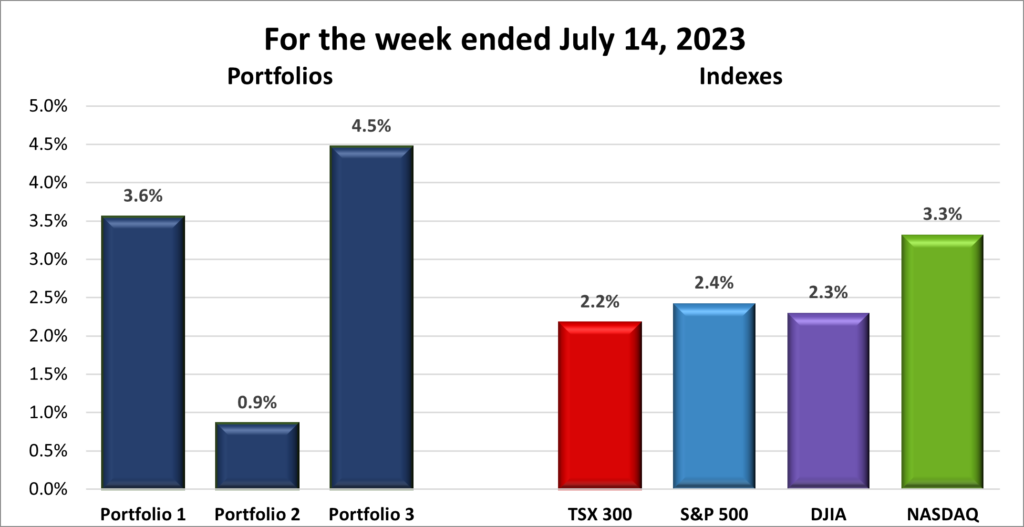
For the week, the TSX (SPTSX) advanced 2.2%, the S&P 500 (SPX) gained 2.4%, the DJIA (INDU) rose 2.3% and the Nasdaq (CCMP) jumped 3.3%.

Bull market. A good week for the North American stock markets.Better-than-expected inflation data and a robust labour market led to a four-day rally that saw all four major North American indexes end the week higher, as seen in the chart above. What really got investors excited was the data suggested inflation is actually decelerating, opening the door for the end of the central bank’s fastest interest raising cycle since the 1980s. As usual, when investor optimism is high, the technology companies are the big winners pushing the Nasdaq and S&P higher. This week’s rally was still fairly narrow but other sectors started to rise. Strong earnings reports from America’s big banks lifted the Financials sector which in turn pushed the DJIA to its best week since March. Finally, the TSX advanced on higher oil prices and overall market optimism.

Bull market. A good week for the North American stock markets.After a rough start to July last week, it is good to see all three portfolios advancing and getting back on the winning track, as illustrated below. It is particularly satisfying to note that Portfolio 1 and 3 outperformed the Nasdaq. However, I was a bit surprised that Portfolio 2 significantly underperformed. Upon closer inspection of Portfolio 2, there were some mid-week stumbles by a few companies that brought their performance back to where they started the week. Aside from that, there were no significant winners or losers in the portfolio.

Portfolio 1 once again benefited from the strength of mega-cap companies and the overall surge in the technology sector. Meanwhile, Portfolio 3 had an impressive week with almost every company ending higher, except for Telus International (TSX: TIXT), which experienced a 30% drop after the company estimated a loss for the second quarter. Without the stumble by Telus International it could have been a great week for Portfolio 3.

Weekly Portfolio & Index performance
Weekly Portfolio & Index performance for the week ended July 14, 2023.

Companies on the Radar

Stocks on my Radar

My radar has looked relatively empty the last few weeks. Other than these three companies listed below, nothing has really jumped out at me. For now, I am looking deeper into these companies to get a better understanding of their business, competitive advantages, financial performance, and their potential for future success.

  • Cameco (TSX: CCO): A large Canadian company involved in uranium mining, sales, and the construction of nuclear reactor components.
  • BWX Technologies (NYSE: BWXT): A mid cap size American company specializing in the construction and sale of nuclear components to customers worldwide, including the US Navy.
  • Lithium Americas (TSX: LAC): A mid size Canadian company operating lithium mines in the USA and Argentina. They are a provider of lithium to the emerging electric vehicle battery industry.

The Radar Check was last updated July 14, 2023.

A screenshot of a computer screen Description automatically generated


Portfolio Update

Portfolio 1

Portfolio 1 for the week ended July 14, 2023: UP Green Up Arrow, signifying a positive week

  • General Motors (NYSE: GM) has dropped the price of their Cadillac Lyriq electric vehicle (EV) by 14% in China. GM slashed the price to match price cuts announced by other foreign EV companies to better compete with domestic Chinese EV companies.
    In separate news, the US National Highway Traffic Safety Administration (NHTSA) said they will announce in a few weeks if GM’s Cruise division of self driving cars can be deployed without human controls. Items used by human drivers such as steering wheels, mirrors, turn signals or windshield wipers are obviously not needed for self driving cars.
  • Berkshire Hathaway Energy, a unit of Berkshire Hathaway (NYSE: BRK.B) purchased Dominion Energy’s 50% stake in the Cove Point liquefied natural gas facility, bringing Berkshire’s stake to 75%. Brookfield Infrastructure Partners (TSX: BIP.UN) owns the remainder.
  • The new MacBook Air helped Apple grow its market share of the personal computing market from 6.4% to 11%, on an annual basis.
  • Nuvei (TSX: NVEI), announced they have been selected by inDrive, a mobility solutions provider available in 47 countries, as its payments provider for payouts to its drivers in Latin America.
  • Amazon reported that Americans alone purchased US$ 12.7 billion during the two-day Amazon Prime event, up 6.1% over last year’s Prime Days.

Activity

No significant activity to report this week.

Dividends

Dividends Received this week for the following companies:

Companies followed by DRIP (Dividend Re-Investment Plan) indicate additional shares were purchased with the dividend. Any cash leftover was added to the cash balance.

Canadian $

Dream Industrial Real Estate Investment Trust (TSX: DIR.UN)

Algonquin Power & Utilities Corp (TSX: AQN)

US $

Innovative Industrial Properties Inc (NYSE: IIPR)

Quarterly Reports

No quarterly reports this past week.

Portfolio 2

Portfolio 2 for the week ended July 14, 2023: UP Green Up Arrow, signifying a positive week

  • It was a double win for Microsoft this week. First, a US judge ruled that Microsoft can move forward with its planned acquisition of Activision Blizzard (NASD: ATVI). A judge ruled the regulators were unable to show how the merger “is likely to substantially lessen competition.” An hour later, Britain’s anti trust regulator, the Competition and Markets Authority (CMA), said it would consider proposals from Microsoft to address the CMA’s concerns. If you are keeping score, the biggest merger in technology history has now received a green light from the US and the European Union, and an amber light from Britain.
  • The Walt Disney company (NYSE: DIS) extended the contract of their Chief Executive Officer Bob Iger by two years, expiring at the end of 2026.
    Separately, Disney has decided to hold onto their ESPN business unit and are looking for strategic partners to help with content and distribution.

Activity

No significant activity to report this week.

Dividends

Dividends Received this week for the following companies:

Companies followed by DRIP (Dividend Re-Investment Plan) indicate additional shares were purchased with the dividend. Any cash leftover was added to the cash balance.

Canadian $

Telus Corp (TSX: T) DRIP

Brookfield Infrastructure Partners LP (TSX: BIP.UN)

US $

No US$ dividends this past week.

Quarterly Reports

No quarterly reports this past week, except for per share data.

Portfolio 3

Portfolio 3 for the week ended July 14, 2023: UP Green Up Arrow, signifying a positive week

  • Shopify (TSX: SHOP) has become the latest company to integrate an AI assistant into their offerings. The AI assistant, called ‘Sidekick’, will be able to answer questions from Shopify merchants, as well as provide them with insights about their sales trends.

Activity

No significant activity to report this week.

Dividends

Dividends Received this week for the following companies:

Companies followed by DRIP (Dividend Re-Investment Plan) indicate additional shares were purchased with the dividend. Any cash leftover was added to the cash balance.

Canadian $

TD US Equity Index ETF (TSX: TPU)

Alvopetro Energy Ltd (TSXV: ALV)

Brookfield Asset Management (TSX: BAM)

Brookfield Corp (TSX: BN)

US $

No US$ dividends this past week.

Quarterly Reports

No quarterly reports this past week.

 

2023 Second Quarter Review

Since the start of the first quarter, all four of the major North American indexes – Toronto Stock Exchange Composite Index (TSX), the S&P 500 Index (S&P), the Dow Jones Industrial Average (DJIA), and the Nasdaq Composite Index (Nasdaq) – finished the quarter higher than they started, as did the three portfolios, thanks to a bull run in the Nasdaq and the S&P. Let’s look at what happened over the second quarter of 2023 ….

The running of the bulls

Contents

Second Quarter Review

Second Quarter Portfolio Update

Portfolio 1 for the second quarter

Portfolio 2 for the second quarte

Portfolio 3 for the second quarter

Six Month Review

Six Month portfolio Review

Looking forward

Second Quarter Review

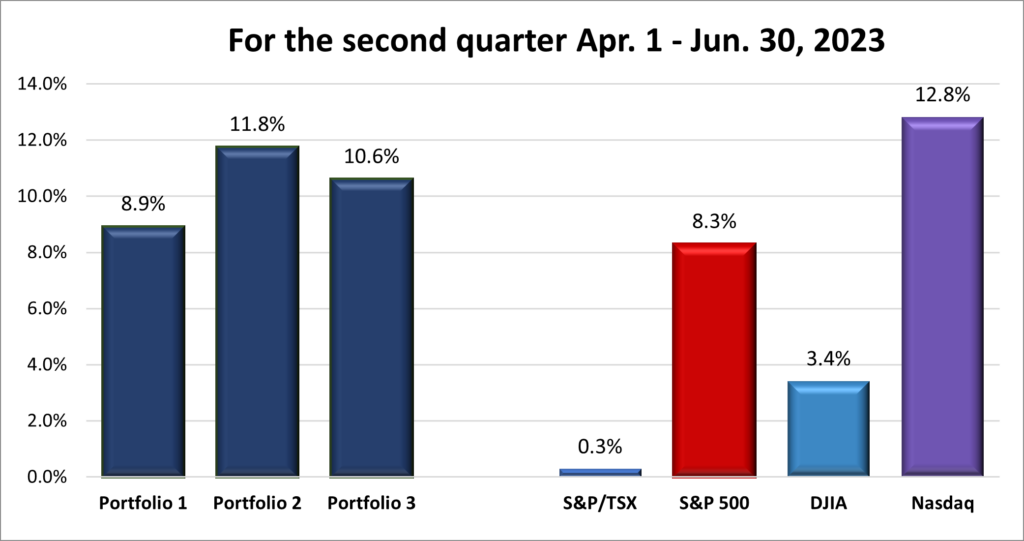
For the second quarter, the TSX (SPTSX) climbed 3.7%, the S&P (SPX) gained 7.0%, the DJIA (INDU) gained 0.4% while the Nasdaq (CCMP) surged 16.8%.

Bull market. A good week for the North American stock markets.The second quarter of 2023 was marked by a solid performance in the North American stock markets, with each of the four major North American indexes recording positive returns. The Nasdaq posted its best quarterly gain since the fourth quarter of 2020. As you can see in the chart above, the biggest gains came in June. The late surge even pushed the TSX into positive territory for the three months.

The gains were driven by a number of factors, including stronger-than-expected corporate earnings in the first quarter, the resolution of the US debt ceiling, a pause in the Fed’s rate hike campaign and technology led by the Magnificent 7  — Alphabet (Google), Amazon, Apple, Meta (Facebook), Microsoft, Nvidia and Tesla. Without these seven companies, the overall market would have been flat, making for the most concentrated market in history. However, by the end of the quarter the rally did broaden. Technology continued to outperform as any company associated with artificial intelligence (AI) jumped, but the Communication Services, and Consumer Cyclical sectors started to rise. Other sectors like Healthcare and Financials also started to show signs of life.

On the downside, Utilities and Energy stocks suffered in the second quarter. Investors moved out of the defensive Utilities sector after sheltering there for dividends in 2022. The Energy sector fell because of fears of a recession and the uncertain situation in Russia, one of the largest global oil exporters. Oil prices posted their fourth straight quarterly loss as investors worried that sluggish global economic activity could curb fuel demand.

Overall, the second quarter of 2023 was a positive one for the North American stock markets. I would be happy if the indexes and portfolios put together a string of quarters like this one. 😊

Back to Table of Contents


Second Quarter Portfolio Update

Quarterly Portfolio & Index performance
Second Quarter 2023 (April 1 – June 30) Portfolio & Index performance

Portfolio 1 for the second quarter: UP Green Up Arrow, signifying a positive week

The second quarter started off on the wrong foot for Portfolio 1 but resumed the upward march for the last two months. Portfolio 1 continued to benefit from the surge of the mega cap technology companies as five of the Magnificent Seven companies are in this portfolio.

Activity: Shaw & Magnet Forensics were acquired by other companies; sold shares of Innovative Industrial Properties, sold all Upwork; bought shares of Costco, Liberty Media (Formula 1); added shares of Amazon and Alphabet.

Portfolio 1: Second Quarter 2023 Performance

Back to Table of Contents

Portfolio 2 for the second quarter UP Green Up Arrow, signifying a positive week

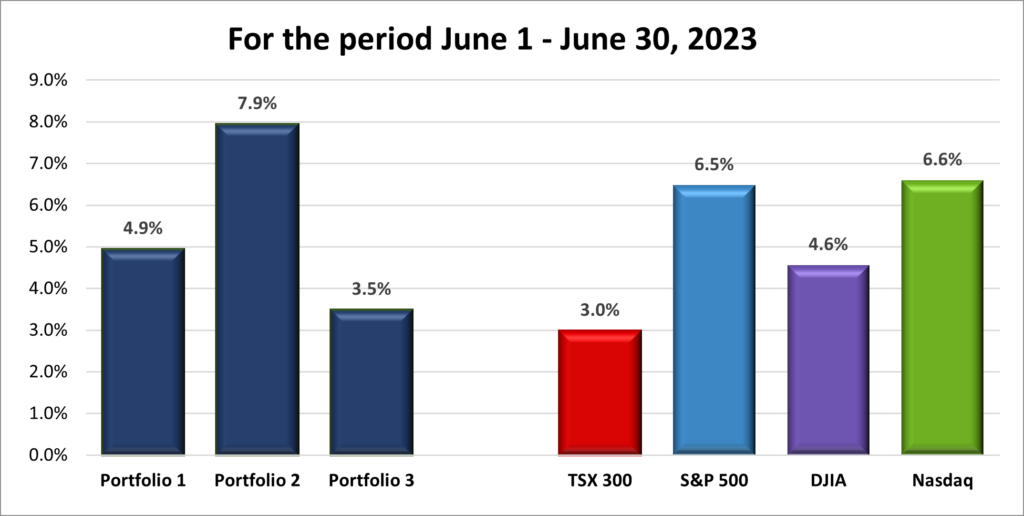
Portfolio 2 posted gains in each month of the quarter. The portfolio was driven by its lone mega cap company, Microsoft, with help from its other technology companies. The bank stocks limited growth of the portfolio in May but rebounded in June leading to a stellar one month increase of 7.9%.

Activity: bought shares in Supremex, Airbnb, and Hammond Power Solutions.

Portfolio 2: Second Quarter 2023 Performance

Back to Table of Contents

Portfolio 3 for the second quarter: UP Green Up Arrow, signifying a positive week

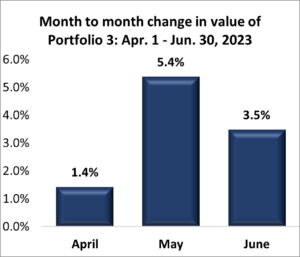
Portfolio 3 also increased in value each month. As with the other portfolios, it benefitted from the technology bull run. Microsoft, Shopify and the other technology companies were the primary drivers of the portfolio’s growth during the quarter.

Activity: bought additional shares of Brookfield Asset Management; sold some shares of Shopify.

Portfolio 3: Second Quarter 2023 Performance

Back to Table of Contents


Six Month Review

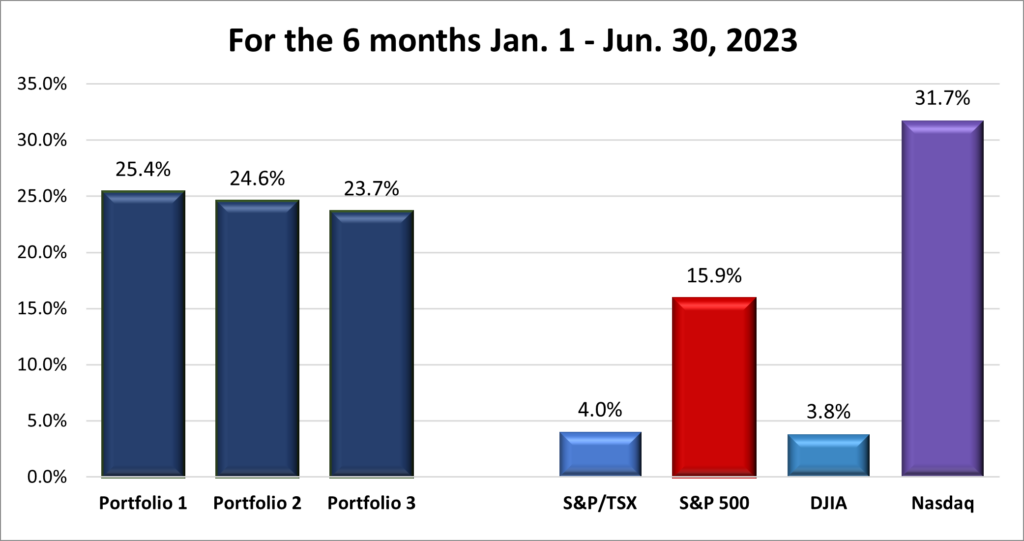
For the first half of 2023, the TSX (SPTSX) climbed 4.0%, the S&P (SPX) jumped 15.9%, the DJIA (INDU) gained 3.8% while the Nasdaq (CCMP) surged 31.7%.

The year started on an optimistic note, with optimism stemming from China’s post-COVID-19 recovery, global economic resilience, and signs of inflation stabilizing. As you can see by the dips in the graph above, this optimism was shaken by the collapse of a few regional US banks raising concerns about the stability of the US financial system, the Credit Suisse failure in March raised concerns about the global banking system, central banks worldwide continued their rate hikes, and the US debt ceiling brinkmanship which was resolved in late May, early June.

Despite these challenges, the North American stock markets demonstrated remarkable strength throughout the first half of the year. With a gain of over 31% in the first half, the Nasdaq’s had its best first half performance since 1971, almost entirely erasing its losses from 2022. This rally was largely propelled by the buzz surrounding artificial intelligence (AI), in particular the Magnificent Seven’s AI efforts. Nvidia, in particular, experienced a remarkable 189.5% gain, marking its most exceptional first-half performance since going public in 1999.

The S&P 500 was no slouch either, up a respectable 15.9% for the first half. However, without the top 10 stocks, the remaining 490 would have only achieved a modest 4% gain. The DJIA was primarily powered by strong earnings from many of its 30 companies. While Canada’s resource heavy TSX was lifted by strong commodity prices and solid earnings from TSX listed companies.

Several key factors contributed to this market upward trajectory. First, were are no signs of an imminent recession. Second, investors were anticipating, correctly, that the Fed would soon pause its rate hikes. Third, the surge in artificial intelligence technologies has significantly shaped market dynamics. Finally, investors are optimistic about the future of the economy and the stock market, believing that the economy and corporate earnings will continue to grow in 2023. As investors became more optimistic about the future, they were more willing to invest in stocks.

Back to Table of Contents

Six Month portfolio Review

As bad as 2022 was, the first half of 2023 has been particularly good to all three Portfolios, as you can see in the chart below. All were lifted by the AI frenzy, especially their respective Magnificent Seven technology companies.

First Half 2023 Portfolio & Index performance
First Half 2023 (January 1 – June 30) Portfolio & Index performance

Back to Table of Contents


Looking forward

The impressive performance of the “Magnificent Seven” mega-cap stocks contributed to nearly 75% of the total market gains in the first half of 2023. However, for the ongoing bull market to sustain its momentum, it is crucial that the rally extends to companies beyond the technology sector. AI should remain a driving force behind earnings growth and investor sentiment.

However, the overall market gains are unlikely to match the gains seen in the first half of the year, partly due to the deceleration in economic growth in both countries. Additionally, the persistence of high interest rates through the remainder of 2023 will impact market dynamics.

Inflation continues to fall in Canada and the US as both the BoC and the Fed battle to get inflation down to their 2% target. However, getting there is likely to require at least one more rate hike. Despite the rate hikes the respective economies are slowing but remain strong, particularly the US economy. Investors are increasingly believing the Fed will be able to pull off a soft landing for the world’s largest economy, which is good news for all us investors. Investor and consumer optimism is growing and barring an unforeseen incident, it should remain high. This is good news for us investors as it means consumers will continue to spend, corporate earnings will continue to grow, and share prices should continue to rise. Of course, this prediction and a couple of bucks will buy you a cup of coffee. 😊 

Thats a second bullish quarter this year, may there be two more this year!Bull market

Back to Table of Contents

Weekly Update for the week ending July 7, 2023

Items that may only interest or educate me ….

Strong June for the markets, Canadian Economic news, US Economic news, Driving the markets, Global energy demand increases, …


Despite facing some concerns about a potential recession in the middle of the month, June ultimately turned out to be a positive month for the markets. Looking ahead, recent historical data suggests that July has been a favorable month for the North American stock markets. The S&P 500 Index (S&P) has posted a gain in the last eight consecutive Julys, the growth-oriented Nasdaq Composite Index (Nasdaq) rose in July in each of the last ten years, while the Dow Jones Industrial Average (DJIA), and the Toronto Stock Exchange Composite Index (TSX) each have strung together three straight winning Julys.

Before rushing into the market in anticipation of another positive July, it is important to remember that investing comes with no guarantees. The past week serves as a reminder of this fact. Let us hope this past week is simply investors taking a breather, rather than an omen for the rest of the month, before resuming the upward trend into July. I am hoping each index adds another positive July to their respective winning streak. 😊

Canadian Economic news

Statistics Canada’s recent international trade report reveals a potential slowdown in Canada’s economic growth, with the country recording a significant global trade deficit of C$3.44 billion in May, the largest since October 2020. This comes as a surprise, as Canada was expected to have a trade surplus of C$1.15 billion for the same month.

Imports saw a 3% increase from April to May, with sizable gains in sectors such as: metal ores and non-metallic minerals, and metal; and non-metallic mineral products. However, declines were observed in sectors including: farm, fishing and intermediate food products; basic and industrial chemical, plastic and rubber products; and industrial machinery, equipment, and parts. On an annual basis, imports increased by 1.5%, primarily due to growth in aircraft and other transportation equipment and parts, as well as motor vehicles and parts.

On the exports side, a majority of sectors experienced declines, leading to a total monthly decline of 3.8%. Farm, fishing and intermediate food products; as well as energy products, suffered the largest losses. Lower energy prices were a significant factor in the decline of energy products exports. However, there were gains in motor vehicles and parts, as well as industrial machinery, equipment and parts. On an annual basis, exports were down 9.8%, primarily driven by declines in energy products, and forestry products and building and packaging materials.

Despite these economic indicators pointing towards a potential slowdown, the labor market continued to expand. The Statistics Canada labour survey for June revealed that the economy added 59,000 jobs, blowing past expectations of 20,000 new jobs. This represented a 0.3% growth from May to June and a 2.2% increase on an annual basis. At the same time, the unemployment rate also saw a slight increase of 0.2% to 5.4%, marking the highest level since February 2022. The rise in unemployment can be attributed to an increase in the population, resulting in more individuals actively seeking employment. This combination of job growth and a higher unemployment rate presents a mixed picture for the Bank of Canada (BoC).

Despite the unexpected trade deficit and signs of a slowing economy, the surge in job creation indicates a strong labour market. This data all but guarantees another increase to the benchmark interest rate by the Bank of Canada (BoC). While the higher unemployment rate and slowing wage growth will be considered, they are unlikely to dissuade the BoC from implementing another 0.25% rate hike at their upcoming meeting.

US Economic news

After a streak of ten consecutive interest rate increases, the Federal Reserve’s rate setting committee, the Federal Open Market Committee (FOMC), decided to pause the rate increases at their June 13-14 meetings. The recently released minutes from these sessions shed light on their decision-making process. According to the minutes, “almost all participants” agreed to maintain the rate at 5.25%, which stands as the highest level since September 2007. This decision was made to allow the committee to assess the impact of previous rate hikes on the economy.

Looking ahead, the Federal Reserve (Fed) anticipates a mild recession towards the end of the year as part of their ongoing efforts to achieve their target inflation rate of 2%. The majority of FOMC members expected at least one more 0.25% rate increase would be necessary before the end of the year and have signalled they are likely to increase the rate at their July 25-26 meeting, subject to incoming data.

The decision to maintain higher interest rates for a longer duration is driven by the fact that various measures of inflation remain elevated. Last week, the Fed’s favourite measure of inflation, Personal Consumption Expenditures (PCE), fell to 3.8% in June. However, core PCE, which excludes volatile energy and food prices, remained at 4.6%. The Consumer Price Index (CPI) is a similar story. Overall CPI has dropped sharply, but the core CPI, excluding food and energy, remains elevated at 5%.

This week saw several employment reports. The latest Job Openings and Labor Turnover Survey (JOLTS) showed a surge in private hiring as job openings declined from 10.3 million in April to 9.8 million in May. The ADP employment report showed private sector jobs increased by 497,000 in June, easily surpassing May’s 267,000 and beating analysts’ 220,000 forecast. The Department of Labor’s June nonfarm payroll data indicated a cooling employment trend with the addition of 209,000 jobs, down from May’s 339,000 new jobs. The unemployment rate decreased to 3.6% in June from 3.7% in May. Average hourly earnings rose by 0.4% in June, compared to 0.3% in May, with a 12-month increase of 4.4%. The data suggests that the labor market remains strong but may be showing signs of softening.

A strong job market typically drives wage gains and consumer spending, contributing to higher inflation levels. Given the core PCE and core PCI show no clear indications of inflation falling towards the Fed’s 2% target, and the job market remains robust, it would appear another rate hike is more than likely at the next FOMC session n July 25-26.

Driving the markets

So far, 2023 looks to be a great year for the North American stock markets, at least the American ones. The American indexes are on quite a roll this year. As of July 7, the S&P 500 is up 14.65% year to date; the Nasdaq has surged over 30%; and the DJIA is up 1.7%. Meanwhile, thanks to a rally the last week of June, the TSX snuck into positive territory with a year-to-date gain of 2.36%. A year ago, I would have been happy with any index in the green. 😊

The upward trend in the North American stock markets since the start of the year has been impressive, with only a minor setback caused by the collapse of a few U.S. regional banks in late March. At first glance, this steady rise is positive news. However, upon closer examination, it becomes evident that the dramatic surge in both the Nasdaq and S&P indexes has been primarily driven by the performance of a handful of technology companies, particularly the mega cap companies such as Alphabet (NASD: GOOGL), Amazon (NASD: AMZN), Apple (NASD: AAPL) and Microsoft (NASD: MSFT) and Nvidia (NASD: NVDA). These are not the only big technology companies responsible for the gains, but these are the ones in my portfolios. 😊

Interestingly, these same companies played a significant role in dragging down the market last year. However, this year they have spearheaded the rally and played a crucial part in the current bull market. As of July 7, Amazon, Apple, Microsoft, and Alphabet have shown impressive year-to-date gains of 54.5%, 42.2%, 41.3% and 35.4%, respectively. While these returns would typically be considered great, they are overshadowed by Nvidia’s exceptional year-to-date gain of 190.9%, as depicted in the chart below.

The dominance of mega-cap technology companies in driving the markets, particularly in the US, is undeniable. Their strong performance has contributed significantly to the overall market gains. However, if sentiment towards the big technology companies’ changes, there could be a repeat of the 2022 market downturn. When market gains are concentrated in a few specific companies or sectors, it increases the vulnerability of the markets to any negative developments or shifts in sentiment towards those companies.

Since all five of these companies are in at least one of the three Portfolios, I am very happy with these gains 😊, but it would be better for the overall market, and the Portfolios, if the gains broaden beyond these handful of companies.

Global energy demand increases

According to the latest report from the Energy Institute, global energy demand experienced a slowdown, growing by only 1% in 2022 compared to a growth rate of 5.5% in 2021. Despite record growth in renewable energy sources, oil and other fossil fuels still dominate the global energy supply, accounting for 82% of the total. However, due to the disruption in the supply of oil and natural gas caused by the Russian invasion of Ukraine, many countries turned to coal, the dirtiest fossil fuel, to meet their energy needs.

Here is a breakdown of the sources of global energy:

  1. Renewable energy sources (excluding hydropower) grew by 1% and accounted for 7.5% of the total energy supply.
  2. Oil consumption and production continued to increase, although consumption remained below pre-Covid-19 levels.
  3. Natural gas demand dropped by 3%, and its share in primary energy decreased by 1% to 24%.
  4. Coal consumption increased by 0.6%, driven primarily by China and India. More concerning is the 7% increase in coal production, with most of the new production occurring in southeast Asia.
  5. Renewable power (excluding hydropower) experienced a growth of 14%, which is lower than the 16% growth rate in 2021. Solar energy accounted for 72% of this growth.
  6. Hydropower increased by 1.1%.
  7. Nuclear power witnessed a decline of 4.4%.

For more detailed information, you can refer to the complete report by clicking here.


With the likelihood of increased interest rates on the horizon, let’s see what happened this past week to increase those odds ….

Weekly Market Review

Monday: It was a short trading day to start the second half of the year as the Canadian exchanges were closed for the Canada Day national holiday and the American exchanges closed early ahead of their Independence Day national holiday tomorrow.

In the US, the three major American indexes – S&P, DJIA, and the Nasdaq – each ended slightly higher in this shortened trading day. Trading was light as many investors took the day off to extend their weekend. In the American sectors, the Consumer Cyclicals and Financials sectors led the advance. Only Healthcare and Technology failed to gain ground on a day of thin trading.

Tuesday: The American markets were closed for the American Independence Day holiday.

In Canada, the TSX picked up where it left off last week, posting a sixth consecutive day of advances. Today it was pulled higher by rising prices for oil and gold. Oil prices gained on supply cuts by Saudia Arabia and Russia, two of the largest global exporters.

Wednesday: Weak economic data out of China, and ongoing tensions between the world’s two largest economies, dragged all four indexes lower. The release of the minutes from the Fed’s last meeting suggested the members were leaning towards additional interest hikes to drive down inflation, almost guaranteeing another hike is coming.

In Canada, lower commodity prices and concerns about higher interest rates in both countries weighed down the TSX. In trading in the Canadian sectors, Telecommunications Services was the only sector to advance, while Basic Materials (miners and fertilizer manufacturers) led the rest of the sectors lower.

In the US, minutes from the June Federal Open Market Committee (FOMC) meeting showed most of the Fed members were in favour of skipping the June interest rate hike. Investors scrutinized the minutes to gather any additional clues about the Fed’s future actions. In trading in the American sectors, the only sectors to advance were Utilities and Healthcare. Basic Materials and Financials suffered the biggest drops.

Thursday: All four indexes ended sharply lower again as strong labour data left investors concerned the Fed will resume their interest rate hikes.

In Canada, interest rate fears led to a drop in commodity prices pushing the TSX lower. All Canadian sectors were in the red today. Consumer Cyclicals and Telecommunications Services fell the least while Technology and Basic Materials had the biggest drops.

In the US, private payroll data came in higher than expected leading to a broad-based decline in the stock markets. Consumer Staples and Technology fell the least while Energy and Consumer Cyclicals had the biggest declines.

Friday: The latest jobs reports for Canada and the US led to a mixed day for the indexes, with the TSX the only one to post a gain. Oil prices surged on supply concerns as production cuts from major producers Saudi Arabia and Russia kick in. It appears a shortage of oil outweighs fears of higher interest rates slowing global economic growth.

In Canada, a surprisingly strong jobs report is good for the economy but not so great if you were hoping the BoC would pause interest rate hikes at their meeting next week. More Canadians working means more upward pressure on prices which will likely cause the BoC do increase the interest rate by 0.25%. On Bay Street, Healthcare and Basic Materials posted the biggest gains of the Canadian sectors, while Industrials and Utilities fell the most.

In the US, all three American indexes fell when the latest jobs showed a slowdown in job creation, unemployment edged lower, but hourly wages continued to rise. The mixed data increased the odds the Fed will raise the interest rate at their next meeting later this month. In trading on Wall Street, the best performers in the American sectors were Energy and Basic Materials, with Healthcare and Consumer Staples suffering the biggest drops.


Weekly Market and Portfolio Review

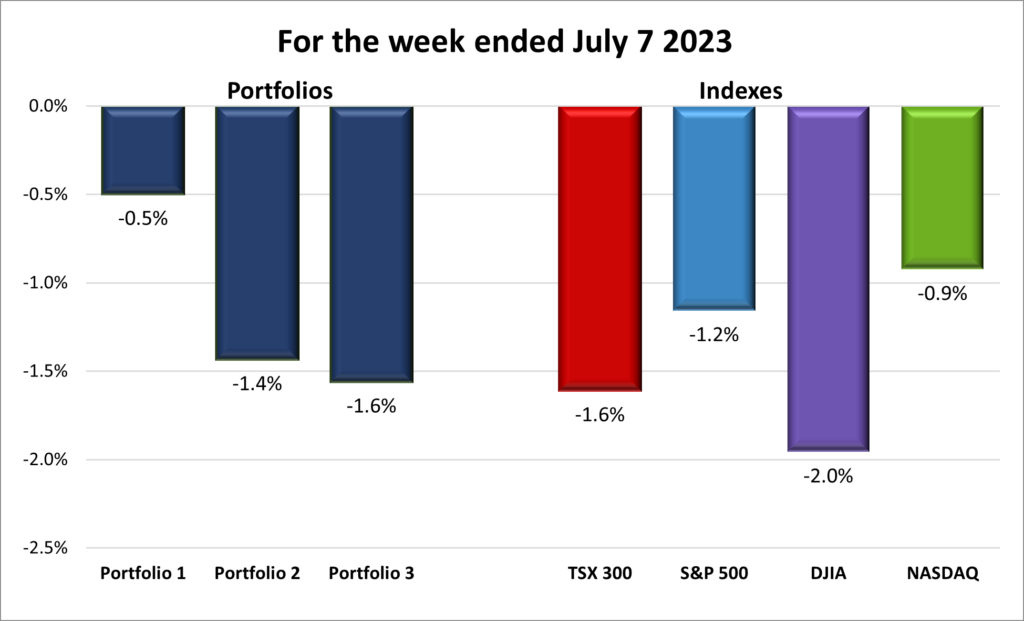
For the week, the TSX (SPTSX) fell 1.6%, the S&P 500 (SPX) lost 1.2%, the DJIA (INDU) dropped 2.0% and the Nasdaq (CCMP) declined 0.9%.

Bearish marketIt was a short week for the stock markets as Canada and America celebrated their birthdays. On the Canada Day holiday the American indexes rose and on Independence Day the TSX ended higher. Once investors returned from celebrating their respective countries birthdays, they sent the markets tumbling, leading to a weekly loss for each index, as you can see in the chart above. Belief that both the BoC and the Fed will increase their respective interest rates was the main cause of the downturn.

Bearish market As the indexes go, typically the portfolios follow, and that was once again the case. As shown below, Portfolio 1 was the best of a bad lot as losses were limited by gains in its big technology companies. Portfolio 2 fell primarily on a 5% drop in MongoDB (NASD: MDB), otherwise many of the other companies were essentially flat. Finally, Portfolio 3 was dragged down by a general decline in the portfolio’s technology companies.

I hope this week was just a pothole and next week the markets return to their winning ways of June.

Weekly Portfolio & Index performance
Weekly Portfolio & Index performance for the week ended July 7, 2023.

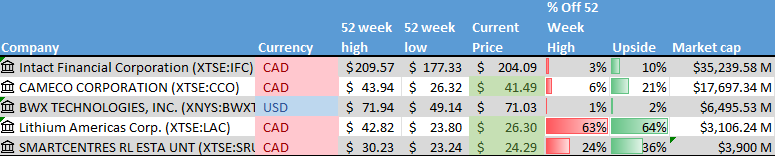
Stocks on my Radar Smartcentres Real Estate Investment Trust (TSX: SRU.UN) leaves the Radar List to land in Portfolio 3. I’ve decided to pass on Intact Financial (TSX: IFC) since there are a number of financial companies across the three portfolios and the upside is relatively limited. If I were starting out in investing, I would definitely consider IFC as one of my first investments because of its steady growth and decent dividend (4%).

I am still working my way through deeper dives on the remaining three companies before deciding whether they can land in a portfolio or leave the list.

  • Cameco (TSX: CCO): A large Canadian company involved in uranium mining, sales, and the construction of nuclear reactor components.
  • BWX Technologies (NYSE: BWXT): A mid cap size American company specializing in the construction and sale of nuclear components to customers worldwide, including the US Navy.
  • Lithium Americas (TSX: LAC): A mid size Canadian company operating lithium mines in the USA and Argentina. They are a provider of lithium to the emerging electric vehicle battery industry.

The Radar Check was last updated July 7, 2023.

Stock on the Radar List. 1 of 2.

Stock on the Radar List. 2 of 2.


Portfolio Update

Portfolio 1

Portfolio 1 for the week ended July 7, 2023: DOWN Red Down Arrow

  • Tesla (NASD: TSLA) reported a record number of vehicles deliveries in the second quarter. Looks like those price cuts really worked. To further boost sales, Tesla started a referral program to provide extra incentive for new buyers.
  • Alphabet, Amazon, Apple, and Microsoft are among a group of seven companies that meet the European Union’s ‘gatekeeper’ criteria and therefore must adhere to stricter rules. ‘Gatekeepers’ are defined as those companies that operate a core platform service that has more than 45 million active users and a market capitalization of more than US$ 82 billion. The ‘gatekeeper’ label requires companies to make their messaging apps interoperable with rivals, as well as letting users decide which apps to pre-install on their devices.
  • Google announced they will start using their own custom phone chips for their Pixel line of smartphones in 2025. Google currently uses chips jointly designed with Samsung for its Pixel phones.
  • Rivian (NASD: RIVN) must face a lawsuit alleging they defrauded shareholders by knowingly underpricing their vehicles prior to the company going public. The shareholders must prove Rivian knew they would have to raise prices because of higher materials costs which led to even higher losses.
    Separately, Rivian reported better than expected second quarter deliveries of their electric vehicles. Finally, some good news for the company, which led to a good bump in their share price. 😊
  • Amazon’s acquisition of iRobot (NASD: IRBT) will get a full scale review by the European Union’s antitrust regulator, the European Commission (EC). The EC alleges the acquisition of iRobot’s robot vacuums would reduce competition and boost Amazon’s position as an online marketplace vendor.

Activity

No significant activity to report this week.

Dividends

Dividends Received this week for the following companies:

Companies followed by DRIP (Dividend Re-Investment Plan) indicate additional shares were purchased with the dividend. Any cash leftover was added to the cash balance.

Canadian $

Cargojet Inc (TSX: CJT)

Telus Corp (TSX: T)

US $

No US$ dividends this past week.

Quarterly Reports

No quarterly reports this past week.

Portfolio 2

Portfolio 2 for the week ended July 7, 2023: DOWN Red Down Arrow

  • The European Union’s anti trust regulator the European Committee (EC) is considering launching a formal investigation into Microsoft. The EC is looking into a complaint that Microsoft has unfairly integrated its Teams collaboration and video conferencing platform into their Office suite. Microsoft has offered to cut the price of a non-Teams version of Office, but the EC wants a bigger discount than Microsoft has proposed.
  • Guardant health (NASD: GH) announced it will begin receiving national reimbursement approval from the Japanese government for its Guardant360 CDx liquid biopsy test, effective July 24. The test enables comprehensive genomic profiling for patients with advanced or metastatic solid tumor cancers.

Activity

No significant activity to report this week.

Dividends

Dividends Received this week for the following companies:

Companies followed by DRIP (Dividend Re-Investment Plan) indicate additional shares were purchased with the dividend. Any cash leftover was added to the cash balance.

Canadian $

Canadian Natural Resources Ltd (TSX: CNQ)

Brookfield Renewable Partners LP (TSX: BEP.UN)

US $

No US$ dividends this past week.

Quarterly Reports

No quarterly reports this past week, except for per share data.

Portfolio 3

Portfolio 3 for the week ended July 7, 2023: DOWN Red Down Arrow

  • Alvopetro Energy Ltd. (TSXV: ALV) announced they had discovered a total of 35.4 metres of potential net oil pay, which should lead to the next stage of a development drilling program.

Activity

Bought: SmartCentres Real Estate Investment Trust (REIT). The Trust manages over 185 properties throughout Canada. They are Walmart’s only real estate development partner in the world, with Walmart stores the primary anchor tenant in many of the Trusts’ shopping centres. SmartCentres has recently started converting their shopping centres into city centres, or smart centres, that include retail, offices, residential and self-storage facilities.

SmartCentres provides diversification and stability to this technology heavy portfolio. It pays a monthly 7+% dividend but the reason I added this REIT was for the potential for earnings growth as their smart centres start to take hold.

Dividends

Dividends Received this week for the following companies:

Companies followed by DRIP (Dividend Re-Investment Plan) indicate additional shares were purchased with the dividend. Any cash leftover was added to the cash balance.

No dividends this past week.

Quarterly Reports

No quarterly reports this past week.
 

Weekly Update for the week ending June 30, 2023

Items that may only interest or educate me ….

Canadian economic news, US economic news, …


I realize Canada’s birthday is July 1 and this week covers the week ended June 30, but what the heck, next week will be too late. Happy 156th birthday Canada.

Canadian flag marking Canada's 156th birthday


Canadian economic news

CPI

Statistics Canada released the latest inflation figures for May, indicating a growth of 0.4% following a rise of 0.7% in April. On an annual basis, inflation increased by 3.4% in May, marking a significant slowdown compared to April’s rate of 4.4%. In fact, the May figure represents the smallest annual inflation increase since June 2021.

The primary factor contributing to the annual decline in inflation was the drop in gas prices, which decreased by 18.3% compared to the previous year. However, even after excluding the volatile fuel component, several other sectors continued to experience considerable inflationary growth. For example, grocery prices rose by 9%, slightly lower than the 9.1% increase seen in April. Mortgage interest costs also contributed significantly to annual inflation, surging by 29.9% in May, surpassing the 29.5% increase seen in April.

GDP

In terms of Gross Domestic Product (GDP), the Canadian economy showed signs of regaining momentum after a stagnant period in April. The preliminary data suggests a monthly gain of 0.4% in May, although this estimate is subject to change when the final data is released on July 28. On an annual basis, GDP grew by 1.7% in April.

Considering the overall slowdown in inflation, it is possible that the Bank of Canada (BoC) may decide to skip a rate increase at their next meeting in July. However, the BoC will take into account the underlying Consumer Price Index (CPI) data and the growth of the economy when making their decision. While the CPI report suggests a potential pause in rate hikes, the combination of inflationary pressures and the growing economy may still lead to a 0.25% increase in the Canadian benchmark interest rate. We will have to wait for the official announcement from the BoC in a few weeks to know their if interest rates go higher.

US economic news

This week has seen a slew of economic data releases. Let us start with the US Federal Reserve’s (Fed) preferred measure, the Personal Consumption Expenditure (PCE) index. The May data shows a 0.1% monthly gain, slightly lower than the 0.4% increase in April. On an annual basis, PCE rose by 3.8%, a slight decrease from April’s 4.3%. The Core PCE, which excludes food and energy components, also increased by 0.3% in May, down from April’s 0.4%. Annually, the Core PCE for May stood at 4.6%, slightly lower than April’s 4.7%. While these figures suggest a decline in inflation, the pace of the decline may not be fast enough for the Fed.

Turning to consumer spending, the growth rate in May slowed to a 0.1% increase, compared to the 0.6% increase seen in April. This growth fell short of analysts’ expectations of a 0.2% increase for May. The higher interest rates have prompted many consumers to scale back their spending on bigger ticket purchases.

Shifting our focus to the Commerce Department, their latest GDP report reveals that the US economy grew by 2.0% in the first quarter on an annual basis, surpassing the initial estimate of 1.4%.

In addition, the Labor Department reported an unexpected drop of 26,000 in initial claims for state unemployment benefits, marking the largest decline in unemployment in 20 months. The total number of claims reached 239,000 for the week ending June 24. This unexpected decrease in jobless claims underscores the strength and resilience of the largest economy in the world, beating analysts’ expectations of around 265,000 claims.

In other economic news, the CBOE Volatility Index, which measures market volatility and investor sentiment, closed the week at 13.59, its lowest level since January 2020. Moreover, the Consumer Sentiment Index (CSI) increased to 64.4 in June, representing an 8.8% monthly increase and a 28.8% annual increase. This rise can be attributed to the resolution of the debt ceiling and falling inflation. Similarly, the Consumer Confidence Index (CCI) increased to 109.7 in June from 102.3 in May, indicating a positive sentiment among consumers.

Taking all this data into consideration, a mixed picture for inflation emerges. On one hand, the May PCE and Core PCE showed a decrease in inflation compared to the previous month, indicating a potential slowdown. However, the annual PCE and Core PCE figures still indicate inflationary pressures, albeit at a slightly lower rate.

Unfortunately, these numbers may not be declining at a fast enough pace for the Fed who are concerned about the potential for inflation to persist or even accelerate in the future. Following a pause in rate adjustments in June, the Fed has been signalling the likelihood they will return to rate hikes at their next meeting in late July. If there is another increase, it won’t be the likely 0.25% increase, but what they say about future increases.


Lots of economic data this past week as the first half of the year drew to a close. Now, let’s see how the four major North American indexes responded this past week….

Weekly Market Review

Monday: The Toronto Stock Exchange Composite Index (TSX) was the only index to end the day in positive territory. Weighing down the indexes were uncertainty over Russia after a weekend challenge to Russian leadership. From an investing perspective, the situation in Russia led to higher oil prices over concerns of disruption to Russian oil supplies. Investors are also concerned rate hikes in many of the first world countries could lead to a global economic slowdown.

In Canada, investors booked gains in technology companies and moved to energy and resource companies, as well as banks. in trading, the Energy and Consumer Staples sectors posted the biggest gains, while Technology and Healthcare were the only Canadian sectors to slide backward.

In the US, all three American indexes – the S&P 500 Index (S&P), the Dow Jones Industrial Average (DJIA), and the Nasdaq Composite Index (Nasdaq) – fell as investors are becoming concerned upcoming economic data could lead to additional rate hikes. Investors were also taking profit after the rally in technology stocks. The Energy and Telecommunications Services sectors were the big winners on the day, while growth sectors Technology and Consumer Cyclicals were the big losers.

Tuesday: All four indexes were green from the opening bell and stayed higher for the entire day. Despite the Canadian and American central banks indicating future interest rate hikes were likely, investors are feeling more confident in the economies of both countries. The market has also been busier with institutional investors rebalancing their portfolios as the second quarter and first half of 2023 winds down. Oil prices retreated on concerns of higher interest rates.

In Canada, the TSX rose on news inflation cooled off significantly in May. Investors are hoping the drop in the inflation rate will prompt the Bank of Canada to not raise the interest rate at their next meeting. In trading, Consumer Cyclicals and Technology led the Canadian sectors while Consumer Staples, Basic Materials (miners and fertilizer manufacturers), and Energy were the only sectors to lose ground.

In the US, positive economic data soothed investors concerns of a recession, giving investors a reason to re-enter the markets. In trading, Consumer Cyclicals and Technology posted the biggest gains in the American sectors, while Healthcare and Energy were the only sectors to fallback.

Wednesday: All four indexes got off to a shaky start, headed higher before ending the day with mixed results. The odd couple of the resource heavy TSX and technology laden Nasdaq both ended the day in the green, while the S&P and DJIA spent most of the day in the red before a late uptick mitigated their losses. Weighing on the markets were comments from the Fed Chair that he would not take two consecutive hikes ‘off the table’ and he did not see inflation falling to the Fed’s 2% target in 2023. A larger than expected drop in US oil stockpiles led to a rise in oil prices.

In Canada, yesterday’s CPI report showed the rate of inflation declining, leading to increased investor confidence that interest rates will stop rising soon. In trading on Bay Street, the Technology and Energy sectors posted the biggest gains, while the Utilities, Industrials and Basic Materials sectors were the only Canadian sectors to end lower.

In the US, semiconductor companies lost ground after reports the US government plans to increase restrictions on chip sales to China. However, those concerns did not carry over to other subsectors of the Technology sector as a few of the big mega cap technology companies all advanced. In trading on Wall Street, Energy and Consumer Cyclicals had the largest advances, while Utilities and Basic Materials posted the largest drops.

Thursday: It has been a while since this has happened but the only index to not to end higher was the Nasdaq, and even then, it was essentially flat. Strong economic data out of the US drove the markets today.

In Canada, the positive economic news out of the US and an uptick in the energy sector boosted the TSX higher. Today’s rally covered almost all the Canadian sectors, led by Consumer Cyclicals and Energy. Technology was the only sector to end lower.

In the US, the big US banks passed the Fed’s annual stress test (enough capital to ride out a severe economic slump), pushed the DJIA higher. On the economic front, the final GDP number for the first quarter came in higher than expected, and there was an unexpected drop in the number of people filing unemployment claims. Both suggest the US economy remains strong, but on the downside, it likely means the Fed will raise the interest rate at their next session. In trading, Financials and Basic Materials led the way higher, while Consumer Staples was the only sector to lose ground and the Technology sector was flat.

Friday: The combination of lower inflation and strong economies in both Canada and the US powered all four indexes sharply higher today. It was a positive way to close the second quarter and the first half of 2023. Hopefully a promising sign for the rest of the year.

In Canada, the TSX closed at its highest point since January and its best weekly performance since February 2021. Today’s gains were a result of the latest CPI data showing inflation slowing. Every Canadian sector ended higher, led by Consumer Cyclicals and Basic Materials. The Telecommunications Services and Energy sectors posted gains but trailed the other sectors.

In the USA, an upward adjustment of first quarter US GDP, indicating the US economy remains strong, and falling inflation from the CPI report earlier this week drove the markets higher. In trading, the oddball combination of the high growth Technology and the defensive Utilities sectors led all American sectors. Bringing up the rear were Telecommunications Services and Financials


Weekly Market and Portfolio Review

For the week, the TSX (SPTSX) jumped 3.8%, the S&P 500 (SPX) surged 2.3%, the DJIA (INDU) advanced 2.0% and the Nasdaq (CCMP) gained 2.2%.

Bull market. A good week for the North American stock markets.Looking at the chart above, after a minor pothole on Tuesday, it was nothing but clear open roads for all four indexes. Last week, all four indexes trended upward, with the TSX leading the way and posting the largest weekly gain. This unexpected surge in the TSX was primarily driven by the easing of inflationary pressures in Canada, which led investors to believe that the BoC may soon halt its series of interest rate hikes. Additionally, a rebound in energy prices also contributed to the TSX’s strong performance.

In the US, the three American indexes saw gains as well, propelled by improved economic data showing a robust economy and a slowdown in inflationary pressures. Furthermore, the successful passage of the Fed’s financial stress test by major American banks added to the positive sentiment in the market.

Overall, it was a good week for North America’s stock markets, with increasing investor optimism in the economy and the markets.

Bull market. A good week for the North American stock markets.Of course, a strong week for the indexes generally means a good week for the Portfolios. Once again, that occurred as all three gained at least 2.7%, as shown below. The rise in bank and financial companies following the Fed’s stress test, the ongoing rally in technology companies and improving oil prices all helped propel the portfolios higher. To paraphrase Marvin the Martian, more weeks like this would be very good, very good indeed! 😊

Weekly Portfolio & Index performance
Weekly Portfolio & Index performance for the week ended June 30, 2023.

Monthly Market and Portfolio Review

For the month of June, the TSX (SPTSX) rose 3.0%, the S&P 500 (SPX) rallied 6.5%, the DJIA (INDU) grew 4.6% and the Nasdaq (CCMP) surged 6.6%.

Bull market. A good week for the North American stock markets.After a lackluster performance in May, the indexes experienced a significant rebound in June. The rally began with the successful negotiations surrounding the US debt ceiling at the beginning of the month. The hype surrounding artificial intelligence (AI) and the increasing interest in mega-cap technology companies further fueled the market’s upward momentum.

Another positive development came from the Fed’s decision to pause the hikes in US interest rates, which provided an additional boost to the markets. Following a brief pause, the indexes resumed their rally and ended the month on a high note. The TSX, in particular, experienced a strong surge towards the end of the month, enabling all four indexes to end the month on a positive note.

This upward momentum bodes well for the North American stock markets as they enter a typically favorable month. The positive market sentiment suggest that the momentum may carry forward, setting a positive tone going forward.

Bull market. A good week for the North American stock markets.The portfolios had another impressive month, benefiting from the strong performance of the indexes. Portfolio 2 emerged as the top performer in June, surpassing its previous month’s gain with the help of a rebound in bank stocks and its technology holdings. Despite not matching May’s performance, Portfolio 1 still delivered a solid return of 4.9%, primarily driven by its mega-cap companies: Alphabet (NASD: GOOGL), Amazon (NASD: AMZN), Nvidia (NASD: NVDA), Tesla’s (NASD: TSLA) and Apple (NASD: AAPL), the first company valued at more than US$ 3 trillion. Portfolio 3 also had a positive month, although it didn’t outperform its previous month. Nonetheless, a gain of 3.5% is still commendable.

With all three portfolios ending the month in the green, that makes two consecutive months of gains for the portfolios. With the positive momentum, I am hoping they can all stretch their respective winning streaks to three, and hopefully much higher.😊

Monthly Portfolio & Index performance
Monthly Portfolio & Index performance for June, 2023.

Companies on the Radar

Stocks on my Radar Another week where no new companies came onto my radar. My Radar List remains the same as in previous weeks:

  • Intact Financial (TSX: IFC): A Canadian mid-size insurance company that offers home, car, and business insurance in Canada, the US, and the UK.
  • Cameco (TSX: CCO): A large Canadian company involved in uranium mining, sales, and the construction of nuclear reactor components.
  • BWX Technologies (NYSE: BWXT): A mid cap size American company specializing in the construction and sale of nuclear components to customers worldwide, including the US Navy.
  • Lithium Americas (TSX: LAC): A mid size Canadian company operating lithium mines in the USA and Argentina. They are a provider of lithium to the emerging electric vehicle battery industry.
  • Smartcentres Real Estate Investment Trust (TSX: SRU.UN): A mid size fully integrated REIT that owns and manages a number of income producing shopping centres and retails spaces throughout Canada. They are planning to develop these properties for mixed retail, office, residential and storage.

The Radar Check was last updated June 30, 2023.

Stock on the Radar List. 1 of 2.

Stock on the Radar List. 2 of 2.


Portfolio Update

Portfolio 1

Portfolio 1 for the week ended June 30, 2023: UP Green Up Arrow, signifying a positive week

  • Amazon’s Amazon Web Services (AWS) plans to invest US$ 7.8 billion to expand its data centre capabilities and meet the demand for growing cloud services.
    In an unrelated matter, Amazon is about to be investigated by the US Federal Trade Commission (FTC), again. The investigation will examine their online marketplace to determine whether Amazon abused its power to reward the merchants that used Amazon’s logistics services and punish the ones that did not.
  • Tesla’s electric vehicle (EV) charging technology is being fast tracked to become the charging standard for the USA. Volvo and Volkswagen have become the latest auto makers to adopt the Tesla’s charging design.
  • As if Nvidia was not already the chip of choice for artificial intelligence (AI), Nvidia’s H100 chip recently came out as top dog for training chatbots like ChatGPT.
    In an unrelated matter, the US Commerce Department is considering new restrictions on exports of AI chips to China. This would prohibit Nvidia’s A800 chip, specifically made for export to China.
  • Alphabet’s plans to cut off access to news stories from Canadian based companies after failing to reach an agreement with the Canadian government. The impasse comes over the new Bill C-18, the Online News Act, which requires technology giants like Google to pay Canadian news organizations for linking to their online content.
  • Apple once again broke the US$ 3 trillion market capitalization mark. On Friday, it made history when it became the first company to remain above that mark when the markets closed. Apple is up 49% so far this year. 😊

Activity

Received monthly interest payment on TD 1-year cashable GIC. It was good to finally see some form of interest on the cash component of the portfolio.

Bought: Alphabet. The parent company of Google experienced a decline in its share price following the initial public display of its AI chatbot Bard back in March. The demonstration did not go smoothly, as Bard provided an incorrect response. As someone who has been using OpenAI’s ChatGPT for a few months, I have noticed that even advanced AI models like ChatGPT can make mistakes. Unfortunately, Bard is currently unavailable in Canada, so I have not had the opportunity to try it myself.

However, I believe that Google and Bard have the potential to bounce back from that setback and regain ground against Microsoft’s (NASD: MSFT) implementation of ChatGPT. I have high expectations for Google, and I anticipate that it will emerge as one of the leading AI companies in the coming years. I believe this is a good time to add more shares while it is currently being overshadowed by Microsoft.

Sold: Upwork (NASD: UPWK). With strong economies and low unemployment in Canada and the US, the demand for outsourced works is slipping. Share price has been in decline since late 2021 and I do not see it returning to those 2021 prices (US$ 50+) any time soon. I should have sold these shares a long time ago. ☹

Dividends

Dividends Received this week for the following companies:

Companies followed by DRIP (Dividend Re-Investment Plan) indicate additional shares were purchased with the dividend. Any cash leftover was added to the cash balance.

Canadian $

Canadian National Railway Co (TSX: CNR)

US $

NVIDIA Corp (NASD: NVDA)

Quarterly Reports

No quarterly reports this past week.

Portfolio 2

Portfolio 2 for the week ended June 30, 2023: UP Green Up Arrow, signifying a positive week

  • Telus (TSX: T) has partnered with Check Point Software Technologies (NASD: CHKP) to create a Cloud Security Posture Management service for Telus client. The new service will allow Canadian clients to monitor their cloud security status in real-time.
  • Microsoft announced it will proceed with its appeal of Britain’s Competition and Markets Authority veto of Microsoft’s acquisition of Activision Blizzard (NASD: ATVI).
    On a related note, Canada’s Department of Justice has ruled the acquisition “is likely to” lead to less competition in some aspects of gaming. I have no idea if this means they accept or reject the proposed deal.

Activity

No significant activity to report this week.

Dividends

Dividends Received this week for the following companies:

Companies followed by DRIP (Dividend Re-Investment Plan) indicate additional shares were purchased with the dividend. Any cash leftover was added to the cash balance.

Canadian $

Dream Industrial Real Estate Investment Trust (TSX: DIR.UN) DRIP

Brookfield Infrastructure Partners LP (TSX: BIP.UN)

Brookfield Renewable Partners LP (TSX: BEP.UN)

Hammond Power Supply (TSX: HPS.A)

US $

No US$ dividends this past week.

Quarterly Reports

Alimentation Couche-Tard Inc

All currency listed in millions of US dollars, except for per share data.

Selected highlights from their fourth quarter 2023 financial results on June 27, 2023

  • Revenue of $16,264.4 for the thirteen weeks ended April 30, compared to $16,434.9 for the 12-week period ended April 24, 2022. A decrease of 1%.
  • Net income of $670.7 for the thirteen weeks ended April 30, compared to net income of $477.7 for the 12-week period ended April 24, 2022.
  • Diluted earnings per ordinary share of $0.68 for the thirteen weeks ended April 30, compared to earnings of $0.46 per share for the 12-week period ended April 24, 2022.


  • Revenue of $71,856.7 for the 53-week period ended April 30, compared to $62,809.9 for the 52-week period ended April 24, 2022. An increase of over 14%.
  • Net earnings of $3,090.9 for the 53-week period ended April 30, compared to net earnings of $2,683.3 for the 52-week period ended April 24, 2022.
  • Diluted earnings per ordinary share of $3.07 for the 53-week period ended April 30, compared to earnings of $2.53 per share for the 52-week period ended April 24, 2022.

Mitek Systems, Inc.

All currency listed in thousands of US dollars, except for per share data.

Selected highlights from their fourth quarter 2022 financial results on June 29, 2023

  • Revenue of $19,815 for the three months ended September 30, compared to $17,781 for the same period in 2022. An increase of over 11%.
  • Net loss of $311 for the three months ended September 30, compared to net income of $1,807 for the same period in 2022.
  • Diluted loss per ordinary share of $0.01 for the three months ended September 30, compared to earnings of $0.04 per share for the same period in 2022.


  • Revenue of $72,925 for the 12-month period ended April 30, compared to $30,069 for the same period in 2022. An increase of over 14%.
  • Net earnings of $3,032 for the 12-month period ended April 30, compared to net earnings of $7,948 for the same period in 2022.
  • Diluted earnings per ordinary share of $0.07 for the 12-month period ended April 30, compared to earnings of $0.18 per share for the same period in 2022.

Portfolio 3

Portfolio 3 for the week ended June 30, 2023: UP Green Up Arrow, signifying a positive week

  • Shopify (TSX: SHOP) has been requested by the Canada Revenue Agency to turn over six years of records for Canadian stores that use Shopify’s software. The government agency wants the records to ensure Canadian merchants were paying their appropriate taxes. Shopify has said they will fight the request.
  • Brookfield Reinsurance (TSX: BNRE) has put in an offer to by the shares of American Equity Investment Life Holding (NASD: AEL) that it does not already own. They valued the merger at US$ 4.3 billion. AEL said it will review the offer before deciding.
  • Brookfield Reinsurance’s parent company, Brookfield Corporation (TSX: BN) is the front runner in acquisitions so far this year. All totaled, they have made more than US$ 50 billion in of purchases.

Activity

No significant activity to report this week.

Dividends

Dividends Received this week for the following companies:

Companies followed by DRIP (Dividend Re-Investment Plan) indicate additional shares were purchased with the dividend. Any cash leftover was added to the cash balance.

Canadian $

Brookfield Reinsurance Ltd (TSX: BNRE)

Brookfield Renewable Partners LP (TSX: BEP.UN)

Brookfield Renewable Corp (TSX: BEPC)

Brookfield Asset Management (TSX: BAM)

US $

No US$ dividends this past week.

Quarterly Reports

No quarterly reports this past week.
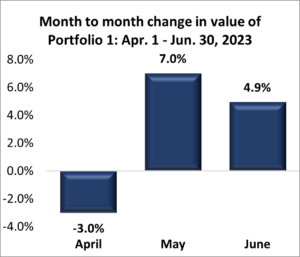
 

Weekly Update for the week ending June 23, 2023

Items that may only interest or educate me ….

Canadian economic news, US Economic news, Global central banks raise interest rates, Canadian banks must increase their reserves, ….


Canadian economic news

Bank of Canada meeting minutes

According to the Bank of Canada’s (BoC) June 7 meeting minutes, the decision to increase the benchmark interest rate was influenced by various factors. One key concern was the persistence of high core inflation figures in many major global economies, which had not exhibited signs of declining. Core inflation, which excludes the volatile components of food and energy, provides a clearer indication of underlying inflationary pressures in an economy. The fact that core inflation remained elevated in multiple global economies raised concerns at the BoC.

The minutes also revealed several higher-than-expected domestic economic indicators that influenced the decision to increase the benchmark interest rate. The Canadian economy ( as measured by Gross Domestic Product) came in above the BoC’s expectations, indicating a strong level of economic activity. Personal consumption remained strong, indicating sustained consumer spending. Business investment and exports experienced solid gains, highlighting increased business confidence and international demand for Canadian goods and services. Finally, the members acknowledged a “resurgence in household spending growth, the pickup in consumer confidence, and the slowing in disinflationary momentum.”

With all these factors in mind, the members recognized the need to address the potential risks of inflationary pressures resulting from strong consumer spending and the slowing disinflationary momentum. The minutes also showed the BoC’s would monitor incoming data and assess its impact on the economy before making any future decisions.

Speaking of incoming data….

Retail sales

After experiencing a 1.4% decline in March, Canadian retail sales rebounded with a vengeance in April, surpassing estimates with a monthly increase of 1.1%. It was a broad based gain as eight of the nine subsectors saw sales increases. General merchandise and beverages led the way with gains of 3.3% and 1.5%, respectively. The furniture subsector was the only one to experience a decline. Core retail sales, which excludes automobile, automotive parts, and gas sales, also showed a healthy increase of 1.5%.

On an annual basis, retail sales in April recorded grew by 2.9%. Convenience retailers and vending machine operators, and health and personal care retailers saw the biggest gains at 11.6% and 10.1%, respectively. On the other hand, fuel vendors and building supplies experienced significant declines of 13.7% and 8.5%, respectively. Core retail sales posted an increase of 3.9%.

When retail sales increase, it indicates that consumers are spending more, which can further stimulate economic growth. This increased demand for goods and services can put upward pressure on prices, leading to inflationary pressures. The increased demand following the pandemic, combined with supply chain disruptions and bottlenecks, played a significant role in how we got into this situation.

These stronger than expected retail sales numbers present a challenge for the BoC in its fight against inflation. Furthermore, Statistics Canada predicts a further 0.5% increase in retail sales for May. With two consecutive months of expanding retail sales, it is highly likely that the BoC will opt to raise the benchmark interest rate again during its upcoming session in July.

Product Price Index

May’s Industrial Product Price Index (IPPI) data revealed a notable decline of 1.0% on a monthly basis, following a 0.2% drop in April. On an annual basis, the IPPI recorded a significant decrease of 6.3%. Among the sectors, refined petroleum, energy products, and softwood lumber experienced the most substantial declines in April. Core IPPI, IPPI less energy and petroleum products, fell 0.4% from April, and dropped 1.6% since May 2022

The IPPI measures the average change over time in the selling prices received by domestic producers for their industrial products. The drop in IPPI indicates a decline in the prices received by Canadian producers, indicating potential downward pressure on inflation. This is good news in the eyes of the BoC.

US Economic news

Fed Reserve (Fed) Chair Jerome Powell presented his semi-annual monetary policy testimony to the US House Financial Affairs Committee on Wednesday, followed by a second day of testimony before the US Senate Banking Committee on Thursday. Consistent with his comments following the Fed’s decision to pause rate hikes the previous week, Mr. Powell reiterated his stance during both sessions: the Fed is likely to raise interest rates at least once more this year due to the persistently high inflation in the service sector of the economy and the unexpectedly tight job market. Another Fed member echoed this sentiment earlier during the Senate session.

Mr. Powell acknowledged the decline in inflation since last summer, citing May’s inflation rate of 4.1% compared to June 2022’s 9.1%. The decrease in inflation was primarily driven by lower prices for groceries and gas, essential expenses which are immediately felt by consumers. However, inflation remains stubbornly high in more discretionary sectors of the economy. Concurrently, unemployment has remained low, currently at 3.7%, as the demand for labor continues to surpass the available workforce. Such a tight labour market inevitably leads to higher wages.

Concluding his two days of testimony, Mr. Powell reiterated that the Fed has not reached the end of its interest rate hike cycle. However, they will carefully analyze the data and adjust interest rates at a “careful pace” going forward.

Global central banks raise interest rates

In the current landscape of central banks, the US stands out as the only central bank that has decided to skip its interest rate hikes. While the Fed has indicated it will resume increasing rates in July, other central banks, such as Canada and Australia, have already resumed their interest rate hike campaigns. This aligns with numerous central banks worldwide that continue to raise rates in their efforts to combat inflation and achieve their respective 2% targets. This week, several more central banks have continued their rate hike trend.

In response to higher-than-expected inflation in the United Kingdom (UK), which reached 8.7%, the Bank of England raised its benchmark interest rate by a surprising 0.5% to 5.0%, marking a 15-year high. This marked the 13th consecutive interest rate hike for the bank. Likewise, the Swiss National Bank, Switzerland’s central bank, increased its policy interest rate by 0.25% to 1.75%, marking the fifth consecutive increase.

Norway’s central bank, Norges Bank, raised its benchmark interest rate by 0.5% basis to 3.75%, also reaching a 15-year high. They further indicated their expectation of another increase in August, with the rate potentially rising to 4.25% during the autumn.

In the previous week, the European Central Bank (ECB), the central bank of the European Union (EU), raised its rate by 0.25% to 3.5%. This marked their eighth consecutive increase since July 2022 for the EU’s 20 countries and their economies. The ECB has stated that additional rate hikes are planned, with the next one expected as early as their upcoming meeting in July.

The primary purpose of the higher interest rates implemented by these central banks is to curb inflation by making borrowing money more expensive for individuals and businesses. The increased interest charges theoretically leave individuals and businesses with less disposable income, thereby reducing demand and alleviating pressure on prices.

Canadian banks must increase their reserves

The recent surge in interest rates in Canada has led to an increase in payment amounts on consumer and business debts. Consequently, the risk of borrowers defaulting on their debts has heightened due to the higher interest rates. Furthermore, recent global banking issues have raised concerns about the global financial system, further exacerbating these concerns. In response, Canada’s Office of the Superintendent of Financial Institutions (OSFI) has decided to raise the amount of money that the country’s major lenders must set aside as a buffer by 0.5%, bringing the total to 3.5%. This change is scheduled to take effect on November 1.

Anticipating potential payment defaults by consumers and businesses alike, Canada’s big six banks had already allocated additional funds to account for possible late or non-payments. Consequently, the new directive from OSFI will further increase these mandatory reserves, reflecting growing concerns about potential rises in defaults for consumer loans, mortgages, and business loans.

In addition to addressing the previously mentioned concerns, the OSFI’s decision to raise the reserve rate aims to further strengthen the Canadian banking system, as well as enhance confidence in the Canadian financial system. However, this positive step for the banking sector comes with a trade-off. Canadian banks will have less cash flowing down to their bottom line and less cash available for shareholder-friendly initiatives such as dividends and share buybacks.


With all that dry news, let’s hope what happened this past week was more exciting see ….

Weekly Market Review

Monday: The American markets and their associated indexes – the S&P 500 Index (S&P), the Dow Jones Industrial Average (DJIA), and the Nasdaq Composite Index (Nasdaq) – were closed for the federal Juneteenth holiday.

In Canada, the Toronto Stock Exchange Composite Index (TSX) was open for business and ended a tad lower. Investors contemplated another interest rate hike in July as well as the possibility of a recession towards the end of the year. In trading, Utilities and Consumer Staples were the only two sectors to end in the green. Technology and Telecommunications Services had the biggest drops.

Tuesday: All four indexes ended lower as investors took some profits after the rally over the past few weeks. As well, concerns about the world’s second largest economy (China) weighed on investors.

In Canada, the resource heavy TSX ran its losing streak to three due to lower commodity prices (gold and oil, among others). The defensive sectors Consumer Staples and Utilities were the only Canadian sectors to advance. The commodity sectors Basic Materials (miners and fertilizer manufacturers) and Energy had the biggest daily declines.

In the US, on top of concerns over the Chinese economy, investors await the Fed Chair Jerome Powell’s semi-annual appearance before the US Congress. They are hoping to gain insight into the direction of future rates hikes. In trading, it was a broad-based day of losses in the American sectors. Consumer Cyclicals and Healthcare fell the least, while Energy and Basic Materials had the biggest drops.

Wednesday: All four indexes ended the day lower after the Fed indicated it would be “appropriate to raise interest rates somewhat further by the end of the year.” That was consistent with the Fed’s post meeting press conference where they forecast of two more increases in 2023.

In Canada, The TSX fell after retail sales for April grew more than predicted, opening the door for another interest rate hike. In trading, Energy and Industrials were the only Canadian sectors to end in the green. Technology and Consumer Staples dropped the farthest.

In the US, all three indexes ran their losing streak to three after the Fed Chair Powell confirmed to Congress the likelihood additional rate increases would be necessary to bring inflation down to their goal of 2%. Advancing sectors in the American sectors were led by Energy and Utilities, while Technology and Consumer Cyclicals led the decliners downward.

Thursday: The day after testimony from the Fed Chair that interest rates will need to go higher to get inflation under control led to a mixed day for the markets. The TSX dropped, the Nasdaq and S&P climbed, and the DJIA was flat. After a second day of testimony, this time before the US Senate, Mr. Powell reiterated his view that additional rate hikes this year will be necessary because of persistently high inflation.

In Canada, the resource heavy TSX once again ended the day lower as falling commodities prices continue to drag the TSX lower. In trading on Bay Steet, defensive sectors Industrials, Consumer Staples and Telecommunications Services were the only sectors to advance. Energy and Consumer Cyclicals posted the biggest loss for the day.

In the US, technology stocks rebounded despite tough talk from the Fed about raising rates at least once more. Investors believe the Fed will only raise the interest rate once more, not twice as the Fed has suggested. Investors responded by moving back into interest sensitive sectors. Trading on Wall Street was led by Technology and Consumer Cyclicals, while Energy and Financials had the biggest declines.

Friday: All four indexes ended lower after the Fed spooked investors saying more rate hikes are needed to bring down inflation. After the recent runup in the markets and in light of potentially higher interest rates, many investors have decided to sell some holdings to book some of their gains.

In Canada, a sixth straight day of declines sent the TSX to a three-month low. This was caused by falling oil prices brought on by concerns of higher interest rates. In trading, Technology and Consumer Staples were the only Canadian sectors to end in positive territory, while the Utilities and Energy sectors had the biggest declines.

In the US, additional comments today from Fed members echoing previous comments about the need for additional rate hikes led to a broad sell off in the American markets. Every American sector ended in the red. Dropping the least were Healthcare and Telecommunications Services, while Utilities and Consumer Cyclicals fell the most.


Weekly Market and Portfolio Review

For the week, the TSX (SPTSX) plunged 2.8%, the S&P 500 (SPX) sank 1.4%, the DJIA (INDU) dropped 1.7% and the Nasdaq (CCMP) broke its eight-week winning streak, falling 1.4%.

Bearish marketAs shown in the chart above, all four indexes experienced declines over the past week. The market was primarily influenced by the testimony of the Fed’s Chairman before the US Congress, where he indicated the strong likelihood of future interest rate hikes. Although he mentioned the Fed would be cautious while considering possible hikes, investors predominantly focused on the prospect of higher rates. Consequently, many chose to capitalize on their gains in response to the Fed’s announcement.

In the US, the drop in the S&P and Nasdaq indexes can be attributed to the decline in mega-cap companies and other growth-oriented artificial intelligence (AI) companies. These companies had previously driven the indexes higher during the strong second quarter.

In Canada, the TSX index experienced a renewed decline driven by multiple factors, including concerns about a potential recession, weakened demand for commodities from China, and a decline in oil prices. The anticipation of higher interest rates added to the worries, as it could potentially contribute to a global economic slowdown and subsequently decrease the demand for oil.

Bearish market It has been quite some time since all three indexes experienced a weekly decline. However, when all four indexes are down by more than 1%, it is a challenge for any of the three portfolios to achieve a weekly gain. Unfortunately, the downward movement in the indexes affected all three portfolios, resulting in losses across the board. Among the portfolios, Portfolio 2 stood out as the best performer, benefiting from its more balanced composition. In times of market downturns, the typically more aggressive Portfolios 1 and 3 tend to experience sharper drops compared to the relatively stable Portfolio 2. This week was no exception. I hope that this week’s decline is only a temporary breather before the markets resume the upward trend that has prevailed for most of the year.

Weekly Portfolio & Index performance
Weekly Portfolio & Index performance for the week ended June 23, 2023.

Companies on the Radar

Stocks on my Radar Once again, no new companies came onto my radar so my Radar List remains the same as previous weeks, with the same five companies:

  • Intact Financial (TSX: IFC): A Canadian mid-size insurance company that offers home, car, and business insurance in Canada, the US, and the UK.
  • Cameco (TSX: CCO): A large Canadian company involved in uranium mining, sales, and the construction of nuclear reactor components.
  • BWX Technologies (NYSE: BWXT): A mid cap size American company specializing in the construction and sale of nuclear components to customers worldwide, including the US Navy.
  • Lithium Americas (TSX: LAC): A mid size Canadian company operating lithium mines in the USA and Argentina. They are a provider of lithium to the emerging electric vehicle battery industry.
  • Smartcentres Real Estate Investment Trust (TSX: SRU.UN): A mid size fully integrated REIT that owns and manages a number of income producing shopping centres and retails spaces throughout Canada. They are planning to develop these properties for mixed retail, office, residential and storage.

The Radar Check was last updated June 23, 2023.

Stock on the Radar List. 1 of 2.

Stock on the Radar List. 2 of 2.


Portfolio Update

Portfolio 1

Portfolio 1 for the week ended June 23, 2023: DOWN Red Down Arrow

  • Lightspeed Commerce Inc. (TSX: LSPD) announced they have extended their partnership with the PGA of Canada to be their official golf management software partner. The software provides PGA of Canada members with insights into how they can provide a better all-around experience for their customer while they are at their facilities.
  • Rivian (NASD: RIVN) plans to join the Tesla (NASD: TSLA) charging club. Rivian will join GM (NYSE: GM) and Ford (NYSE: F) and adapt their vehicles to Tesla’s charging standard. For Rivian, this will provide access to Tesla’s charging network, the largest in the North America, in addition to their own expanding charging network. For Tesla, it provides another customer for their charging network as Tesla leads the charge to electrify North America. It brings Tesla one step closer to becoming the industry standard, at least in North America.
    Separately, Washington state announced any EV charging companies that wanted access to federal funds to build out the charging infrastructure in the state would have to include the Tesla charging plug.
  • Following on the heels of EU’s lawsuit against Alphabet’s (NASD: GOOGL) Google, Gannett Media (NYSE: GCI), the US’s largest newspaper chain, is suing Google for monopolizing the digital ad industry.
  • The US Federal Trade Commission (FTC) alleged Amazon (NASD: AMZN) used manipulative practises to enroll millions of customers into their Amazon Prime service without their consent. The FTC also accused Amazon of making it hard for customers to get out of their subscription.
  • In other FTC news, Alphabet filed a complaint against archrival Microsoft, claiming Microsoft used their dominant position in business and enterprise software to push customers towards their cloud services at the expense of Alphabet. Hmmm, I wonder if Google is aware of the irony that they have been accused of doing the same thing with their dominant position in the digital advertising industry.
  • After getting signoff from Britain’s antitrust watchdog, Amazon now faces a four-month antitrust investigation from the EU over its tentative acquisition of iRobot (NASD: IRBT). It seems longer to get a deal approved than to come up with a deal. ☹

Activity

No significant activity to report this week.

Dividends

Dividends Received this week for the following companies:

Companies followed by DRIP (Dividend Re-Investment Plan) indicate additional shares were purchased with the dividend. Any cash leftover was added to the cash balance.

Canadian $

No C$ dividends this past week.

US $

Skyworks Solutions Inc (NASD: SWKS)

Quarterly Reports

No quarterly reports this past week.
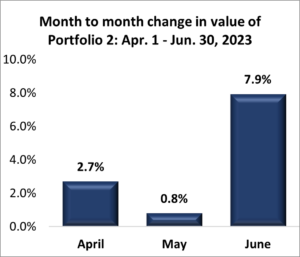
Portfolio 2

Portfolio 2 for the week ended June 23, 2023: DOWN Red Down Arrow

  • Telus (TSX: T) announced they have partnered with Australia’s Jolt, an electric vehicle (EV) charging company. Telus plans to install up to 5,000 fast chargers across Canada. I am guessing Telus will add Wi-Fi capabilities to these charging stations to expand the Telus network.
  • Brookfield Infrastructure Partners LP (TSX: BIP.UN) acquired a stake in Compass Datacenters. Compass manages datacentres used for cloud computing and is one of the fastest growing companies in North America as cloud computing demands continue to rise.
  • MongoDB (NASD: MDB) announced they have partnered with Google to allow developers to use AI tools to build new generative AI applications.

Activity

No significant activity to report this week.

Dividends

Dividends Received this week for the following companies:

Companies followed by DRIP (Dividend Re-Investment Plan) indicate additional shares were purchased with the dividend. Any cash leftover was added to the cash balance.

Canadian $

Supremex Inc. (TSX: SXP)

US $

No US$ dividends this past week.

Quarterly Reports

No quarterly reports this past week,

Portfolio 3

Portfolio 3 for the week ended June 23, 2023: DOWN Red Down Arrow

  • Adyen (OTCM: ADYEY) is now a preferred enterprise payments partner for Shopify (TSX: SHOP). Together they will partner to enhance payment capabilities for enterprise merchants to improve sales in the e-commerce industry.
  • Goeasy’s (TSX: GSY) wholly owned subsidiary LendCare Capital Inc. has partnered with 123Dentist to be their preferred financing partner. The deal will allow 123Dentist’s patient to quickly apply for financing for essential dental services.

Activity

No significant activity to report this week.

Dividends

Dividends Received this week for the following companies:

Companies followed by DRIP (Dividend Re-Investment Plan) indicate additional shares were purchased with the dividend. Any cash leftover was added to the cash balance.

No dividends this past week.

Quarterly Reports

No quarterly reports this past week.