Weekly Update for the week ending May 12, 2023

Items that may only interest or educate me ….

US economic news, FOMC inputs, Market sentiment indicators ….

US economic news

The latest Consumer Price Index (CPI) gained 0.4% in April, after gaining 0.1% in March. On an annual basis, the CPI increased 4.9%, the smallest increase since April 2021. Core CPI (CPI less the volatile food and energy components) increased 0.4%, matching the increase in March. On an annual basis, the April core CPI gained 5.5%, decelerating slightly from March’s 5.6% gain. The April CPI was the 10th consecutive month inflation fell and the first time it has been below 5% in two years.

The report indicates inflation continues to fall. Investors strongly believe the Fed will hit the pause button on rate hikes at their next meeting in June. However, the question is whether it is falling fast enough for the Fed.

Federal Open Market Committee input considerations

With all the attention paid to the recent hikes to the US benchmark interest rate, it got me wondering what they based their decision upon? Here is a quick rundown of some of the key data the US Federal Reserve’s (Fed) Federal Open Market Committee (FOMC) considers when deciding whether to raise or lower the interest rate:

  1. Inflation: The FOMC closely monitors measures of inflation, such as the Personal Consumption Expenditures (PCE) price index (measures the total amount spent by households on goods and services), to assess whether prices are rising too quickly or too slowly.
  2. Employment: The FOMC looks at a variety of indicators related to employment, including the unemployment rate, job creation, and wage growth, to determine whether the labour market is healthy and whether the economy is generating enough jobs and income for workers.
  3. Gross Domestic Product (GDP): The FOMC considers data on GDP, which measures the total value of goods and services produced in the economy, to assess overall economic growth.
  4. Financial Markets: The FOMC pays close attention to financial markets, including stock and bond prices, to assess market expectations for future economic growth and inflation.
  5. International Developments: The FOMC also considers global economic developments, such as changes in trade policies or geopolitical risks, that could affect the U.S. economy.

The FOMC analyzes this and other economic data. If any of the following conditions exist – inflation is above the Fed’s target rate of 2% (as it is currently), employment is strong and the economy is growing too quickly, GDP growth is strong, financial markets are signaling strong economic growth and rising inflation expectations, or global economic conditions are deteriorating – the FOMC may decide to keep interest rates low to maintain price stability, maximize employment and economic growth.

Market sentiment indicators

Over the past three weeks I have talked about the Volatility Index (VIX), the Consumer Confidence Index (CCI) and the Consumer Sentiment Index (CSI). In this final look at these popular indexes used by investors of all levels, let us look at these three together.

If you are a new investor just starting out, you probably have enough to worry about without concerning yourself with these overall market sentiment indicators. For now, you can file these indicators away until you are farther along in your investing journey. However, the VIX, CSI, and CCI are all important indicators that can help you make better investment decisions.

The VIX, or the Volatility Index, is a measure of the market’s expectation of volatility in the near term (typically, over the next several weeks or months). A high VIX (> 20) usually means that the market is expecting more uncertainty, while a low VIX (< 12) suggests that the market is expecting less uncertainty. Typically, the markets and the VIX are inversely related. When the VIX is low, the S&P 500 is going up, and vice versa.

The CCI, or Consumer Confidence Index, measures how consumers feel about the job market, the economy in general, and their financial situation. A higher CCI (> 50) indicates that consumers are more confident in the economy, which can lead to increased consumer spending and investment in businesses.

The CSI, or Consumer Sentiment Index, measures how consumers feel about the economy, their personal finances, and their spending plans. A higher CSI (> 50) generally indicates that consumers are feeling more optimistic about the economy, which could lead to increased consumer spending and more business investments.

By paying attention to these indicators, investors can better gauge market sentiment (VIX), consumer behavior (CCI), and economic trends (CSI), which can help them make more informed investment decisions.

Who uses these indexes?

Professional, institutional, and individual investors can benefit from using the VIX, CCI, and CSI indexes.

Professional investors, like the traders and fund managers, might use these indexes to help them make quick decisions about when to buy or sell certain assets.

Institutional investors, like banks or insurance companies, might use these indexes to help them make more informed decisions about how to allocate large amounts of money across different asset classes.

Individual investors, even new investors just getting started, can use these indexes to help make smarter investment decisions. For example, you might use the VIX to get a sense of how risky the market is right now, or the CCI and CSI to gauge how confident consumers are feeling about the economy.

So, in short, everyone can use the VIX, CCI, and CSI indexes. You do not have to be a professional or institutional investor to benefit from using them in your investment strategy.

Is it OK to ignore the sentiment indexes?

I would say yes, especially if you are new to investing. There is enough to think about without overloading your decision-making process. When I started investing, I did not know about the market sentiment indexes so I never paid attention to them until they kept appearing in articles. In fact, I have never considered them when making an investment decision to this day. Perhaps if I had the Portfolios would not have gotten beaten down as badly in 2022. 😊 In any event, here are a few situations where they may not be useful:

  1. Long-term investments: The VIX, CSI, and CCI are typically used as short-term indicators, and may not be as helpful when considering long-term investments. This is the one that applies to my style of investing – long term, buy and hold. I focused on other factors, such as industry trends, product, customers, management quality, would I want to work there, and company financials when evaluating long-term investment opportunities. Even now that I am aware of these sentiment indexes, I do not pay much attention to them since my goal is to invest in quality companies for the long term.
  2. During major market disruptions: During times of extreme market volatility or major market disruptions, the VIX may be less reliable as a gauge of future market conditions. In these cases, you may want to look at other indicators, such as historical data, company fundamentals, or economic trends, to make informed investment decisions.
  3. When making investment decisions based solely on sentiment: While the CSI and CCI can provide valuable insight into consumer sentiment and economic trends, investors should avoid making investment decisions solely based on sentiment (this is how you can get into trouble). It is important to perform your due diligence and consider a variety of factors, including current and trending economic conditions, market trends, and company financials before making investment decisions.

Wrapping up, the VIX, CSI, and CCI can provide valuable information for investors. However, they are simply more tools to add to your investing toolbox to help you understand market movements and plan accordingly. They should be used in combination with your other investing tools (for example, learning about the company, its products, and customers, and reading its financial statements and notes) when making investment decisions.

The VIX can be found on yahoo! Finance or the source – Chicago Board Options Exchange (Cboe)

The Canadian CCI and CSI is only available on subscription basis from The Conference Board of Canada.

In the US, the CCI can be found at The Conference Board, while the CSI can be found at University of Michigan: Consumer Sentiment.


Now that you are aware of three more tools for your investing toolkit, let’s see what happened this past week….

Weekly Market Review

Monday: Three of the four major North American indexes – the Toronto Stock Exchange Composite Index (TSX), the S&P 500 Index (S&P), and the Nasdaq Composite Index (Nasdaq) – ended slightly higher. The lone exception was the Dow Jones Industrial Average (DJIA). Investors shifted their attention to the upcoming US inflation report (CPI) and are keeping an eye on the game of chicken going on in the US government. The price of oil rose as concerns of a US recession receded.

In Canada, the TSX maintained the upward momentum from last week as the Technology and Consumer Cyclicals led the way. Telecommunications Services, Energy and Healthcare were the only Canadian sectors to lose ground.

In the US, the three American indexes were underwater for most of the day until a late rally pushed the S&P and the Nasdaq above water. In trading, Technology and Consumer Cyclicals were the only American sectors to advance, while Utilities and Telecommunications Services dropped the most.

Tuesday: When the best performing index is flat, that is not a good sign. The TSX was the only index not to fall back as investors await tomorrow’s US inflation data and concerns grow on a possible US debt default.

In Canada, The TSX started the day with a sharp decline but was able to ride higher energy prices to return to where it started by the end of the day. The gains in energy companies offset declines in Canada’s financial sector. In trading, it was a mixed day in the Canadian sectors with half advancing and half declining. Leading the advancers were Industrials and Energy companies, while Financials and Consumer Cyclicals dropped the most.

In the US, all three American indexes slumped on weak earnings reports and forecasts, US debt ceiling negotiations, and tomorrow’s CPI report. Good news for those invested in oil companies, the US announced plans to replenish their Strategic Petroleum Reserve, lifting oil prices. It was another tough day in the American sectors with only Industrials and Energy sectors gaining. The Telecommunications Services and Technology sectors suffered the biggest falls.

Wednesday: It was another mixed bag for the four indexes, with two higher and two lower, following the release of the US CPI report that showed consumer prices rose 4.9% in April, the slowest annual pace in two years. Normally good news like inflation coming in lower than expected would send the markets higher however it was muted by concerns of the US defaulting on its debt.

In Canada, lower commodity prices did in the resource heavy TSX, offsetting the good news US CPI report. On Bay Street, only the Industrials and Telecommunications Services sector ended in the green while Energy and Basic Materials (miners and fertilizer manufacturers) led the other sectors lower.

In the US, the lower CPI data caused investors to hope the Fed will pause its interest rate hikes. Both the growth-oriented Nasdaq and S&P rose on the hope interest rates will top out at 5.25%. Meanwhile, the more traditional DJIA ended slightly lower. On Wall Street, the Technology and Utilities sectors posted the biggest gains, while Energy and Basic Materials posted the biggest declines.

Thursday: Yet another mixed day in the North American stock markets with the Nasdaq the only index to end higher. Rather than concerns about additional interest rate hikes, investors are now concerned how long these higher interest rates in Canada and the US will last and what damage it could do their respective economies.

In Canada, the TSX dropped for a second day as commodity prices (such as oil, gold, and copper) continued to drop. In trading, leading the way in the Canadian sectors were Financials and Consumer Staples, while Basic Materials and Industrials had the biggest drops.

In the US, regional bank concerns flared up again, this time over falling deposits at PacWest Bancorp (NASD: PACW). Lower oil prices, and concerns about the US defaulting on its debt also helped drag the DJIA and S&P lower. Nasdaq was able to finish in the green thanks to a surge in Alphabet (NASD: GOOGL) after Google showcased a few of its artificial intelligence (AI) products in. In trading, Technology, Consumer Cyclicals and Consumer Staples were the only American sectors to end in the green. Basic Materials and Energy suffered the biggest pullbacks.

Friday: The markets started out on an upward track but quickly reversed themselves before an afternoon rally saw the TSX inch into the green, up 0.01%, while all three American indexes failed to get out of the red. Mixed economic data, ongoing US debt default concerns, and a notable rise in consumers’ inflation expectations caused the May CSI to fall to a six-month low of 57.7, down from April’s 63.5. Oil prices ended the week lower on concerns of lower demand in the world’s two biggest economies – USA and China.

In Canada, the TSX was boosted into positive territory on a strong earnings report from Air Canada (TSX: SC) indicating people have been travelling more and there remains pent up travel demand. In trading, Utilities and Industrials led the way higher in the Canadian sectors while Technology and Healthcare had the biggest drops.

In the US, the DJIA ran its losing streak to five days when a member of the Fed said they may have to raise the interest rate again if inflation remains high. The mega cap technology stocks which have been carrying the load for the Nasdaq and S&P most of the year had an off day, perhaps investors taking profits, dragging both indexes lower. In trading in the American sectors, Utilities and Energy gained the most while Consumer Cyclicals and Financials had the biggest declines.


Weekly Market and Portfolio Review

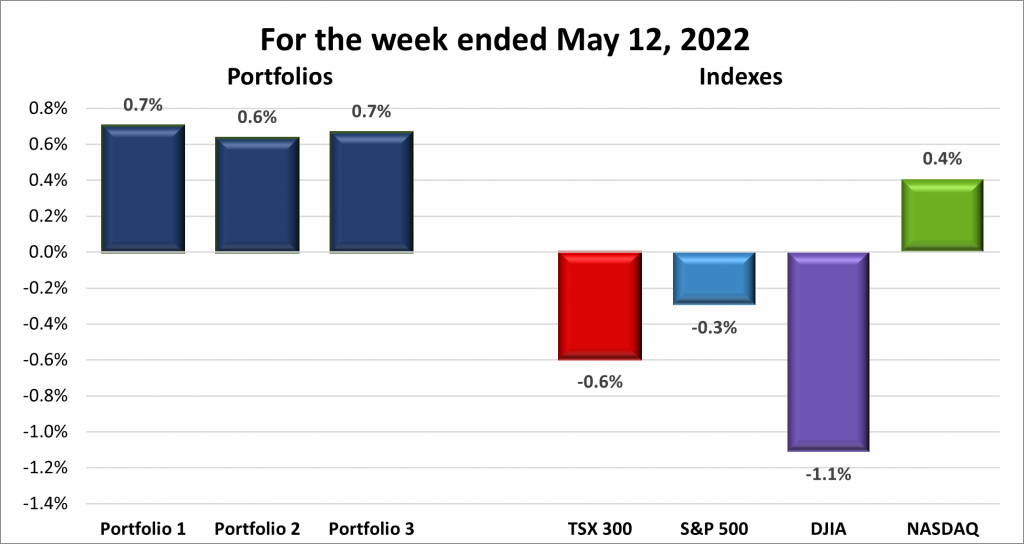
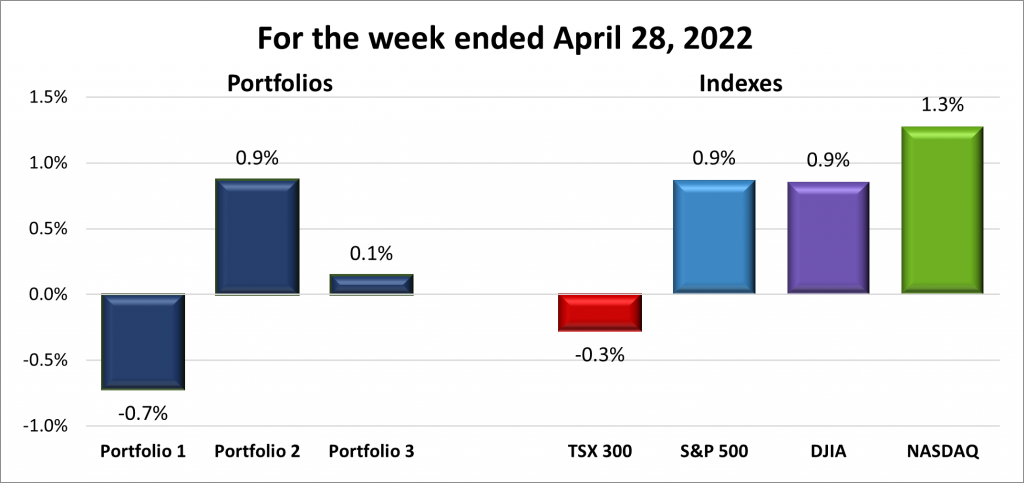
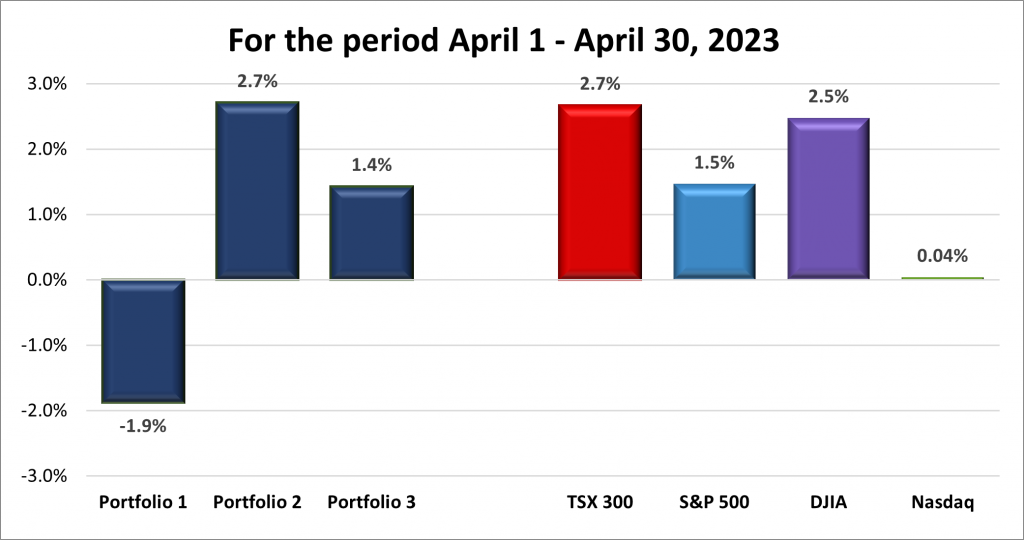
For the week, the TSX (SPTSX) fell for the third week in a row, this time dropping 0.6%, the S&P 500 (SPX) slipped 0.3%, the DJIA (INDU) dropped 1.1% and the Nasdaq (CCMP) advanced 0.4%.

Bearish marketIn general, this current earnings season has been quite good, but after the year we had in 2022 the bar was not set very high to begin with. With most of the reporting companies beating the low bar the indexes got a bit of a boost but as has been the case for the last few weeks, the number one driver of the markets remains the Fed’s interest rate policy. And so, it was again this past week as investors debated whether recent economic data would allow the Fed to hold the line on interest rate hikes. Many investors felt there would be a pause at their next meeting but at the end of the week a member of the Fed said they might have to raise the rate unless inflation dropped. And down they went, as you can see in the chart above.

The Nasdaq continues to advance on the strength of the mega cap technology companies, up 19% in 2023. Unfortunately, the rally has not extended to the broader market. The S&P and blue chip DJIA were both dragged lower on concerns about an interest rate pause, US debt default and ongoing bank issues. The TSX fell when the commodity prices dropped mid week.

Bull market. A good week for the North American stock markets.As for the Portfolios, I do not remember the last time all three portfolios outperformed all four indexes, almost doubling the best performing Nasdaq, as seen below. I also do not remember the portfolios all within 0.1% of each other. All portfolios have a Technology sector bias and contain at least one of the mega cap technology companies. I am sure this is what lifted the portfolios this past week. Granted the gains were less than 1% but a gain is a gain, and I will take that every week. 😊
Weekly Portfolio & Index performance
Weekly Portfolio & Index performance for the week ended May 12, 2023.

Companies on the Radar

Stocks on my Radar

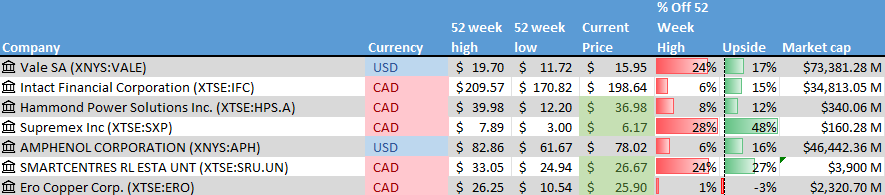
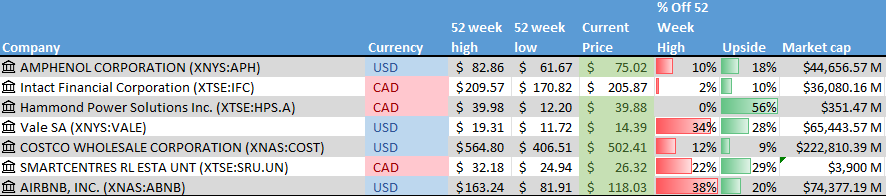
This week Hammond Power Solutions (TSX: HPS.A) leaves the radar list for Portfolio 2. Vale (NYSE: VALE) has been dropped from the list for now because I don’t know enough about the mining industry. If I decide to invest in a mining company I would consider Vale, but it would be as a source of raw materials used in electric vehicles. Joining the Radar List is Liberty Media Corp’s Formula 1 tracking stock (NASD: FWONK). A tracking stock is a type of stock that is designed to track the performance of a particular business unit of a larger company. In this case, FWONK tracks the financial performance of Liberty Media’s ownership in the Formula One Group, which owns and operates the Formula One World Championship.

While watching the Miami F1 race I was thinking I should’ve bought more Ferrari (NYSE: RACE) shares. Then I wondered if it was possible to invest in the entire Formula 1 series. It is possible and when I ran it through my Radar Check it scored well enough to dig deeper.

Other companies on the list are:

  • Intact Financial (TSX: IFC): A Canadian mid size insurance company supplying home, car and business insurance in Canada, the US, and the UK.
  • Amphenol: (NYSE: APH) Producer of a high-tech interconnect, sensor, and antenna solutions for the automotive, aerospace, industrial and various technology industries.
  • Smartcentres Real Estate Investment Trust (TSX: SRU.UN): Owns and manages a number of income producing malls and retails spaces throughout Canada.

The Radar Check was last updated May 12, 2023.

A screenshot of a computer Description automatically generated with low confidence


Portfolio Update

Portfolio 1

Portfolio 1 for the week ended May 12, 2023: UP Green Up Arrow, signifying a positive week

  • Finally, some good news out of Rivian (NASD: RIVN). Rivian was able to trim its losses, beat quarterly revenue estimates and predicted it would meet its annual production targets.
    Rivian said it will hold prices steady on its R1S and R1T electric vehicles, add higher priced versions loaded with additional features as well as lower priced versions.
  • Alphabet held its annual developer day this past week where it showcased its latest technologies. First up was an improved version of its AI chatbot, Bard. Google debuted its Google Pixel Fold, a foldable smartphone; its first Pixel Tablet; a new Pixel 7a smartphone; and a 3D “immersive View” to Google Maps that allows users to see a 3D view of their route, complete with traffic simulation, bike lanes and street parking.
  • Tesla (NASD: TSLA) has been forced to ‘recall’ nearly every car it has sold in China, approximately 1.1 million vehicles. The reason is a braking and acceleration problem that may increase crash and safety risks. Fortunately for Tesla the issue can be fixed with a software update. Rather than owners bringing their cars in for the update, Tesla will be able to push the update ‘over the air’ to the affected vehicles. This will save Tesla and the car owners time and money.

Activity

No significant activity to report this week.

Dividends

Dividends Received this week for the following companies:

Companies followed by DRIP (Dividend Re-Investment Plan) indicate additional shares were purchased with the dividend. Any cash leftover was added to the cash balance.

Canadian $

No C$ dividends this past week.

US $

Ferrari N.V. (NYSE: RACE)

Quarterly Reports

Progeny, Inc.

All currency listed in thousands of US dollars, except earnings per share.

Selected highlights from their first quarter 2023 financial results on May 8, 2023

  • Revenue of $258,394 for the three months ended March 31, compared to $172,217 for the same period in 2022. An increase of over 50%.
  • Net income of $17,678 for the three months ended March 31, compared to net income of $4,971 in the same period in 2022.
  • Diluted earnings per ordinary share of $0.18 for the three months ended March 31, compared to earnings of $0.05 per share for the same period in 2022.

Innovative Industrial Properties, Inc.

All currency listed in thousands of US dollars, except earnings per share.

Selected highlights from their first quarter 2023 financial results on May 8, 2023

  • Revenue of $76,067 for the three months ended March 31, compared to $64,504 for the same period in 2022. An increase of almost 18%.
  • Net income of $40,475 for the three months ended March 31, compared to net income of $34,712 in the same period in 2022.
  • Diluted earnings per ordinary share of $1.43 for the three months ended March 31, compared to earnings of $1.32 per share for the same period in 2022.

PayPal Holdings, Inc.

All currency listed in millions of US dollars, except earnings per share.

Selected highlights from their first quarter 2023 financial results on May 8, 2023

  • Revenue of $7,040 for the three months ended March 31, compared to $6,483 for the same period in 2022. An increase of over 8%.
  • Net income of $795 for the three months ended March 31, compared to net income of $509 in the same period in 2022.
  • Diluted earnings per ordinary share of $0.70 for the three months ended March 31, compared to earnings of $0.43 per share for the same period in 2022.

Skyworks Solutions, Inc.

All currency listed in millions of US dollars, except earnings per share.

Selected highlights from their second quarter 2023 financial results on May 8, 2023

  • Revenue of $1,153.1 for the three months ended March 31, compared to $1,335.6 for the same period in 2022. A decrease of less than 14%.
  • Net income of $232.8 for the three months ended March 31, compared to net income of $305.8 in the same period in 2022.
  • Diluted earnings per ordinary share of $1.46 for the three months ended March 31, compared to earnings of $1.86 per share for the same period in 2022.


  • Revenue of $2,482.4 for the six months ended June 30, compared to $2,846.0 for the same period in 2021. A decrease of almost 13%.
  • Net earnings of $542.2 for the six months ended June 30, compared to net earnings of $705.7 in the same period in 2021.
  • Diluted earnings per ordinary share of $3.39 for the six months ended June 30, compared to earnings of $4.27 per share for the same period in 2021.

Crew Energy Inc.

All currency listed in Canadian dollars, except earnings per share.

Selected highlights from their first quarter 2023 financial results on May 8, 2023

  • Revenue of $112,812 for the three months ended March 31, compared to $53,688 for the same period in 2022. An increase of over 210%.
  • Net income of $41,354 for the three months ended March 31, compared to a net loss of $1,377 in the same period in 2022.
  • Diluted earnings per ordinary share of $0.26 for the three months ended March 31, compared to a loss of $0.01 per share for the same period in 2022.

kneat.com, inc.

All currency listed in thousands of Canadian dollars, except earnings per share.

Selected highlights from their first quarter 2023 financial results on May 9, 2023

  • Revenue of $7,964,908 for the three months ended March 31, compared to $5,199,602 for the same period in 2022. An increase of over 53%.
  • Net loss of $2,474,357 for the three months ended March 31, compared to a net loss of $3,426,260 in the same period in 2022.
  • Diluted loss per ordinary share of $0.03 for the three months ended March 31, compared to a loss of $0.04 per share for the same period in 2022.

Marqueta, Inc.

All currency listed in thousands of US dollars, except earnings per share.

Selected highlights from their first quarter 2023 financial results on May 9, 2023

  • Revenue of $217,343 for the three months ended March 31, compared to $166,102 for the same period in 2022. An increase of almost 31%.
  • Net loss of $68,801 for the three months ended March 31, compared to a net loss of $60,598 in the same period in 2022.
  • Diluted loss per ordinary share of $0.13 for the three months ended March 31, compared to a loss of $0.11 per share for the same period in 2022.

Celsius Holdings, Inc.

All currency listed in thousands of US dollars, except earnings per share.

Selected highlights from their first quarter 2023 financial results on May 9, 2023

  • Revenue of $259,939 for the three months ended March 31, compared to $133,388 for the same period in 2022. An increase of almost 95%.
  • Net income of $41,227 for the three months ended March 31, compared to net income of $6,679 in the same period in 2022.
  • Diluted earnings per ordinary share of $0.40 for the three months ended March 31, compared to earnings of $0.09 per share for the same period in 2022.

Rivian Automotive, Inc.

All currency listed in millions of US dollars, except earnings per share.

Selected highlights from their first quarter 2023 financial results on May 9, 2023

  • Revenue of $661 for the three months ended March 31, compared to $95 for the same period in 2022. An increase of over 695%.
  • Net loss of $1,349 for the three months ended March 31, compared to a net loss of $1,593 in the same period in 2022.
  • Diluted loss per ordinary share of $1.45 for the three months ended March 31, compared to a loss of $1.77 per share for the same period in 2022.

Nuvei Corporation

All currency listed in thousands of US dollars, except earnings per share.

Selected highlights from their first quarter 2023 financial results on May 10, 2023

  • Revenue of $256,498 for the three months ended March 31, compared to $214,544 for the same period in 2022. An increase of over 4%.
  • Net loss of $8,289 for the three months ended March 31, compared to net income of $4,514 in the same period in 2022.
  • Diluted loss per ordinary share of $0.07 for the three months ended March 31, compared to earnings of $0.02 per share for the same period in 2022.

Magnite, Inc.

All currency listed in thousands of US dollars, except earnings per share.

Selected highlights from their first quarter 2023 financial results on May 10, 2023

  • Revenue of $130,150 for the three months ended March 31, compared to $118,075 for the same period in 2022. An increase of over 10%.
  • Net loss of $98,732 for the three months ended March 31, compared to a net loss of $44,593 in the same period in 2022.
  • Diluted loss per ordinary share of $0.73 for the three months ended March 31, compared to a loss of $0.34 per share for the same period in 2022.

The Trade Desk, Inc.

All currency listed in thousands of US dollars, except earnings per share.

Selected highlights from their first quarter 2023 financial results on May 10, 2023

  • Revenue of $382,803 for the three months ended March 31, compared to $315,323 for the same period in 2022. An increase of over 21%.
  • Net income of $9,326 for the three months ended March 31, compared to a net loss of $14,598 in the same period in 2022.
  • Diluted earnings per ordinary share of $0.02 for the three months ended March 31, compared to a loss of $0.03 per share for the same period in 2022.

Unity Software Inc.

All currency listed in thousands of US dollars, except earnings per share.

Selected highlights from their first quarter 2023 financial results on May 10, 2023

  • Revenue of $500,361 for the three months ended March 31, compared to $320,126 for the same period in 2022. An increase of over 56%.
  • Net loss of $253,703 for the three months ended March 31, compared to a net loss of $177,555 in the same period in 2022.
  • Diluted loss per ordinary share of $0.67 for the three months ended March 31, compared to a loss of $0.60 per share for the same period in 2022.

Copperleaf Technologies Inc.

All currency listed in thousands of Canadian dollars, except earnings per share.

Selected highlights from their first quarter 2023 financial results on May 10, 2023

  • Revenue of $19,966 for the three months ended March 31, compared to $15,569 for the same period in 2022. An increase of over 28%.
  • Net loss of $11,790 for the three months ended March 31, compared to net loss of $10,906 in the same period in 2022.
  • Diluted loss per ordinary share of $0.17 for the three months ended March 31, compared to a loss of $0.16 per share for the same period in 2022.

Algonquin Power & Utilities Corp.

All currency listed in thousands of US dollars, except earnings per share.

Selected highlights from their first quarter 2023 financial results on May 11, 2023

  • Revenue of $778,627 for the three months ended March 31, compared to $733,237 for the same period in 2022. An increase of over 6%.
  • Net income of $249,610 for the three months ended March 31, compared to net income of $52,598 in the same period in 2022.
  • Diluted earnings per ordinary share of $0.39 for the three months ended March 31, compared to earnings of $0.13 per share for the same period in 2022.

Trisura Group Ltd.

All currency listed in thousands of Canadian dollars, except earnings per share.

Selected highlights from their first quarter 2023 financial results on May 11, 2023

  • Revenue of $639,100 for the three months ended March 31, compared to $403,669 for the same period in 2022. An increase of over 58%.
  • Net income of $13,976 for the three months ended March 31, compared to net income of $23,338 in the same period in 2022.
  • Diluted earnings per ordinary share of $0.30 for the three months ended March 31, compared to earnings of $0.55 per share for the same period in 2022.

Docebo Inc.

All currency listed in thousands of US dollars, except earnings per share.

Selected highlights from their first quarter 2023 financial results on May 11, 2023

  • Revenue of $41,549 for the three months ended March 31, compared to $32,055 for the same period in 2022. An increase of over 29%.
  • Net income of $1,245 for the three months ended March 31, compared to a net loss of $3,747 in the same period in 2022.
  • Diluted earnings per ordinary share of $0.04 for the three months ended March 31, compared to a loss of $0.21 per share for the same period in 2022.

GDI Integrated Facility Services Inc.

All currency listed in thousands of Canadian dollars, except earnings per share.

Selected highlights from their first quarter 2023 financial results on May 11, 2023

  • Revenue of $591 for the three months ended March 31, compared to $495 for the same period in 2022. An increase of over 19%.
  • Net income of $4 for the three months ended March 31, compared to net income of $7 in the same period in 2022.
  • Diluted earnings per ordinary share of $0.15 for the three months ended March 31, compared to earnings of $0.30 per share for the same period in 2022.

WELL Health Technologies Corp.

All currency listed in thousands of US dollars, except earnings per share.

Selected highlights from their first quarter 2023 financial results on May 12, 2023

  • Revenue of $169,425 for the three months ended March 31, compared to $126,508 for the same period in 2022. An increase of almost 34%.
  • Net loss of $10,627 for the three months ended March 31, compared to a net loss of $2,776 in the same period in 2022.
  • Diluted loss per ordinary share of $0.06 for the three months ended March 31, compared to a loss of $0.04 per share for the same period in 2022.

Portfolio 2

Portfolio 2 for the week ended May 12, 2023: UP Green Up Arrow, signifying a positive week

  • Guardant Health (NASD: GH) filled out its executive team with the hiring of a new chief operating officer from outside the company and the promotion of another person into the role of chief technology officer.
  • The House of the Mouse stumbled after Walt Disney (NYSE: DIS) missed its earnings per share estimate by a penny. The quarterly report also showed Disney lost over four million subscribers to its Disney+ streaming service after it raised the monthly fee. Despite the loss of subscribers, Disney+ did mange to shrink the losses thank to the higher prices. The company plans to raise the fee for the ad free service. I suspect this is to nudge people to their ad supported service where they may feel the can gain advertising fees.

Activity

Bought: Hammond Power Solutions – This small cap Canadian company manufactures electronic devices for diverse markets. I like that it is well established company (100+ years), and a descendant of the founding owner still runs the company. The company is riding a major tailwind of a global movement to electrify the world. On the financials side, the company has growing revenues, net income, earnings per share and free cash flow. It provides a small dividend put I bought it for the growth potential. There is lots of room for the company to grow and if the company goes from a small cap company to a large cap company, the share price will follow.

Bought: A cashable, 1-year GIC paying 3.35% through my TD Direct Investing account. The GIC will pay 3.35% on a small amount of cash sitting in a trading account. Once I figure out what to do with the cash, I can cash out the GIC without any penalties. Until then, at least the cash will be earning something which is a better than nothing. 😊

Dividends

Dividends Received this week for the following companies:

Companies followed by DRIP (Dividend Re-Investment Plan) indicate additional shares were purchased with the dividend. Any cash leftover was added to the cash balance.

No dividends this past week.

Quarterly Reports

Chorus Aviation Inc.

All currency listed in thousands of Canadian dollars, except earnings per share.

Selected highlights from their first quarter 2023 financial results on May 9, 2023

  • Revenue of $415,252 for the three months ended March 31, compared to $342,380 for the same period in 2022. An increase of over 21%.
  • Net income of $32,019 for the three months ended March 31, compared to net income of $22,907 in the same period in 2022.
  • Diluted earnings per ordinary share of $0.11 for the three months ended March 31, compared to earnings of $0.13 per share for the same period in 2022.

Crew Energy Inc.

All currency listed in Canadian dollars, except earnings per share.

Selected highlights from their first quarter 2023 financial results on May 8, 2023

  • Revenue of $112,812 for the three months ended March 31, compared to $53,688 for the same period in 2022. An increase of over 210%.
  • Net income of $41,354 for the three months ended March 31, compared to a net loss of $1,377 in the same period in 2022.
  • Diluted earnings per ordinary share of $0.26 for the three months ended March 31, compared to a loss of $0.01 per share for the same period in 2022.

kneat.com, inc.

All currency listed in thousands of Canadian dollars, except earnings per share.

Selected highlights from their first quarter 2023 financial results on May 9, 2023

  • Revenue of $7,964,908 for the three months ended March 31, compared to $5,199,602 for the same period in 2022. An increase of over 53%.
  • Net loss of $2,474,357 for the three months ended March 31, compared to a net loss of $3,426,260 in the same period in 2022.
  • Diluted loss per ordinary share of $0.03 for the three months ended March 31, compared to a loss of $0.04 per share for the same period in 2022.

Guardant Health, Inc.

All currency listed in thousands of US dollars, except earnings per share.

Selected highlights from their first quarter 2023 financial results on May 9, 2023

  • Revenue of $128,714 for the three months ended March 31, compared to $96,099 for the same period in 2022. An increase of almost 34%.
  • Net loss of $133,533 for the three months ended March 31, compared to a net loss of $123,228 in the same period in 2022.
  • Diluted loss per ordinary share of $1.30 for the three months ended March 31, compared to a loss of $1.21 per share for the same period in 2022.

Airbnb, Inc.

All currency listed in millions of US dollars, except earnings per share.

Selected highlights from their first quarter 2023 financial results on May 9, 2023

  • Revenue of $1,818 for the three months ended March 31, compared to $1,509 for the same period in 2022. An increase of over 20%.
  • Net income of $117 for the three months ended March 31, compared to a net loss of $19 in the same period in 2022.
  • Diluted earnings per ordinary share of $0.18 for the three months ended March 31, compared to a loss of $0.03 per share for the same period in 2022.

The Walt Disney Company

All currency listed in millions of US dollars, except earnings per share.

Selected highlights from their second quarter 2023 financial results on May 10, 2023

  • Revenue of $21,815 for the three months ended March 31, compared to $19,249 for the same period in 2022. An increase of over 13%.
  • Net income of $1,271 for the three months ended March 31, compared to net income of $470 in the same period in 2022.
  • Diluted earnings per ordinary share of $0.69 for the three months ended March 31, compared to earnings of $0.26 per share for the same period in 2022.


  • Revenue of $45,327 for the six months ended March 31, compared to $41,068 for the same period in 2022. An increase of over 10%.
  • Net earnings of $2,849 for the six months ended March 31, compared to net earnings of $1,797 in the same period in 2022.
  • Diluted earnings per ordinary share of $1.39 for the six months ended March 31, compared to earnings of $0.86 per share for the same period in 2022.

iA Financial Group

All currency listed in millions of Canadian dollars, except earnings per share.

Selected highlights from their first quarter 2023 financial results on May 9, 2023

  • Revenue of $1,359 for the three months ended March 31, compared to $1,230 for the same period in 2022. An increase of over 10%.
  • Net income of $270 for the three months ended March 31, compared to a net loss of $25 in the same period in 2022.
  • Diluted earnings per ordinary share of $2.58 for the three months ended March 31, compared to a loss of $0.23 per share for the same period in 2022.

Portfolio 3

Portfolio 3 for the week ended May 12, 2023: UP Green Up Arrow, signifying a positive week

  • When I heard TD Bank (TSX: TD) was pulling out of the deal with First Horizon Bank (NASD: FHN) I thought it was because they viewed it as too risky given the issues in the US regional bank industry. It turns out the problem was TD’s anti-money laundering practises that caused US regulators to reject the deal. TD promised to tighten up its anti-money laundering policies, but promises were not good enough for the regulators to provide their stamp of approval to the deal. TD is now sitting on a pile of cash. What will they do with it?

Activity

No significant activity to report this week.

Dividends

Dividends Received this week for the following companies:

Companies followed by DRIP (Dividend Re-Investment Plan) indicate additional shares were purchased with the dividend. Any cash leftover was added to the cash balance.

No dividends this past week.

Quarterly Reports

goeasy Ltd.

All currency listed in thousands of Canadian dollars, except earnings per share.

Selected highlights from their first quarter 2023 financial results on May 9, 2023

  • Revenue of $287,297 for the three months ended March 31, compared to $232,142 for the same period in 2022. An increase of almost 24%.
  • Net income of $51,436 for the three months ended March 31, compared to net income of $26,096 in the same period in 2022.
  • Diluted earnings per ordinary share of $3.01 for the three months ended March 31, compared to earnings of $1.55 per share for the same period in 2022.

kneat.com, inc.

All currency listed in thousands of Canadian dollars, except earnings per share.

Selected highlights from their first quarter 2023 financial results on May 9, 2023

  • Revenue of $7,964,908 for the three months ended March 31, compared to $5,199,602 for the same period in 2022. An increase of over 53%.
  • Net loss of $2,474,357 for the three months ended March 31, compared to a net loss of $3,426,260 in the same period in 2022.
  • Diluted loss per ordinary share of $0.03 for the three months ended March 31, compared to a loss of $0.04 per share for the same period in 2022.

Alvopetro Energy Ltd.

All currency listed in thousands of US dollars, except earnings per share.

Selected highlights from their first quarter 2023 financial results on May 10, 2023

  • Revenue of $18,005 for the three months ended March 31, compared to $13,134 for the same period in 2022. An increase of over 37%.
  • Net income of $12,202 for the three months ended March 31, compared to net income of $11,115 in the same period in 2022.
  • Diluted earnings per ordinary share of $0.33 for the three months ended March 31, compared to earnings of $0.30 per share for the same period in 2022.

Magnite, Inc.

All currency listed in thousands of US dollars, except earnings per share.

Selected highlights from their first quarter 2023 financial results on May 10, 2023

  • Revenue of $130,150 for the three months ended March 31, compared to $118,075 for the same period in 2022. An increase of over 10%.
  • Net loss of $98,732 for the three months ended March 31, compared to a net loss of $44,593 in the same period in 2022.
  • Diluted loss per ordinary share of $0.73 for the three months ended March 31, compared to a loss of $0.34 per share for the same period in 2022.

Unity Software Inc.

All currency listed in thousands of US dollars, except earnings per share.

Selected highlights from their first quarter 2023 financial results on May 10, 2023

  • Revenue of $500,361 for the three months ended March 31, compared to $320,126 for the same period in 2022. An increase of over 56%.
  • Net loss of $253,703 for the three months ended March 31, compared to a net loss of $177,555 in the same period in 2022.
  • Diluted loss per ordinary share of $0.67 for the three months ended March 31, compared to a loss of $0.60 per share for the same period in 2022.

Brookfield Corporation

All currency listed in millions of US dollars, except earnings per share.

Selected highlights from their first quarter 2023 financial results on May 11, 2023

  • Revenue of $23,297 for the three months ended March 31, compared to $21,882 for the same period in 2022. An increase of over 6%.
  • Net income of $424 for the three months ended March 31, compared to net income of $2,960 in the same period in 2022.
  • Diluted earnings per ordinary share of $0.05 for the three months ended March 31, compared to earnings of $0.84 per share for the same period in 2022.

GDI Integrated Facility Services Inc.

All currency listed in thousands of Canadian dollars, except earnings per share.

Selected highlights from their first quarter 2023 financial results on May 11, 2023

  • Revenue of $591 for the three months ended March 31, compared to $495 for the same period in 2022. An increase of over 19%.
  • Net income of $4 for the three months ended March 31, compared to net income of $7 in the same period in 2022.
  • Diluted earnings per ordinary share of $0.15 for the three months ended March 31, compared to earnings of $0.30 per share for the same period in 2022.



Weekly Update for the week ending May 5, 2023

Items that may only interest or educate me ….

The Fed raises the US interest rate again, Canadian economic data, Jobs and more jobs, Another US regional bank bites the dust, What is the Consumer Sentiment Index (CSI)?

US interest rate rises

In a unanimous decision, the US Federal Reserve’s (Fed) Federal Open Market Committee (FOMC) announced an increase to the US benchmark interest rate of 0.25%, upping the rate to 5.25%. This was the tenth consecutive rate increase since March 2022, pushing the rate to its highest level since 2007. I thought the market would rally on the announcement but once again I proved I am not very good at predicting the markets direction. ☹

The FOMC also said it will, “take into account the cumulative tightening of monetary policy, the lags with which monetary policy affects economic activity and inflation, and economic and financial developments” (a long way of saying they will see how the cumulative increases affect the economy). This is a notable difference from their last announcement in March when they anticipated additional increases may be needed. While this does not mean there will not be an increase, it also does not mean there will be an increase. One thing we do know is there is not a plan to lower the rate any time soon.

The hike was expected as the Fed walks a tightrope between bringing down inflation and the risk of re-igniting the banking crisis. On top of that, they must consider the possibility of a US debt default. If the Fed does pause rate hikes, how long will the pause last? And will the next change in the rate be up or down? More questions for investors to ponder. 😊 However, I suspect investors will now be watching the US debt limit crisis. An avoidable situation that could trigger a recession in the US and eliminate millions of jobs. Stay tuned.

Canadian economic data

Statistics Canada announced Canada’s trade balance for March came in with a C$972 million surplus, easily beating expectations of a C$200 million surplus. Canada went from a trade deficit in February to a surplus in March thanks to a minor decrease in exports (0.7%) and a larger drop in imports (2.9%). On a monthly basis, exports of forestry products (down 6.4) and energy products (down 5.9%) saw the biggest drops, while export of aircraft transportation equipment was up 30.8%. In imports, the biggest declines were consumer goods (down 11%) and metal ores (down 13.9%), while metal and non-metallic mineral products imports grew by 6.1%. On a yearly basis, total exports were down 1.3% and imports were flat.

On a yearly basis, global demand for Canadian products and raw materials has declined. A drop in imports would suggest a drop in domestic demand as well. Both can be seen as signs of a slowing Canadian economy, a necessary evil to get inflation down to the Bank of Canada’s (BoC) target of 2%.

Jobs and more jobs data

While the economy may be slowing, the jobs market remains robust. Another Statistics Canada report showed Canada’s employment rate in April grew 0.2% compared to March. On a yearly basis, employment grew by 2.1%. Meanwhile, the unemployment rate has remained unchanged at 5.0% since December 2022. Both monthly numbers were better than analysts had forecast. Average hourly wages continued to rise, up 5.2% on an annual basis, the same level of growth as in March. The bulk of employment was in part time work.

In the USA, the US Department of Labor’s April jobs report showed unemployment dropped to 3.4%, a 53-year low, indicating the US job market is barely slowing down, despite the rising interest rate. The average hourly wage also rose 0.5% from March and 4.4% on an annual basis. A strong labour market and growing wage gains are key drivers of inflation. As long as jobs and wage growth remain robust the Fed is likely to keep the US interest rate at its current 5.25%, or higher, as they battle to get inflation down to their 2% target.

Another US regional bank bites the dust

First Republic (NYSE: FRC) managed to survive the banking crisis of March thanks to a US$30 billion infusion from a few of the largest American banks, but that did not make its customers feel any safer. When it disclosed results for the first quarter last week, investors discovered that First Republic customers had pulled $72 billion in deposits during that period, more than a 40% drop, and the bank’s stock was down more than 97% in 2023. Last weekend, First Republic became the fourth major US bank to fail in two months and the largest bank failure since the 2008 financial crisis.

The US Federal Deposit Insurance Corp (FDIC) seized First Republic Monday morning and sold the bulk of the bank’s operations to JPMorgan Chase (NYSE: JPM) for US$10.6 billion. JPMorgan beat out PNC Financial Services Group (NYSE: PNC), and Citizens Financial Group Inc (NYSE: CFG) in an auction put on by US regulators. On Monday, First Republic’s 84 offices reopened as JPMorgan Chase branches. As well as the office space, JPMorgan assumed roughly $173 billion in loans, $30 billion in securities, $92 billion in deposits and First Republic’s list of wealthy clients. In addition, JPMorgan plans to return the $30 billion lent to First Republic back in March.

JPMorgan plans to share both losses and gains from First Republic’s single family, residential and commercial loans with the FDIC. That is good news for the FDIC since it cost them US$13 billion from their Deposit Insurance Fund to cover depositors. As for corporate debtors and preferred stockholders, they are out of luck.

This is the latest, and hopefully last, in government brokered acquisitions of bigger banks absorbing smaller banks that had failed (First Citizens snatched the scraps of SVB) or were failing (UBS (NYSE: UBS) took over rival Credit Suisse at the behest of the Swiss government) these past few months. Hopefully, this puts to rest the concerns over the US banking system, but I doubt it.

What is the Consumer Sentiment Index (CSI)?

In Canada, the CSI rose from 47.28 points in March, to 49.24 points in April, suggesting Canadians are slightly pessimistic but their feelings towards the economy and their situation are improving. Meanwhile in the US, the CSI for April remained unchanged at 63.5, suggesting Americans remain optimistic about the economy and their personal financial situation.

You may be wondering, what those numbers mean and how did I come to that conclusion. Well let me tell you. The previous two weeks I have talked about the Volatility Index (VIX), and the Consumer Confidence Index (CCI). This week I will talk about another tool that could help provide a sense of where the markets may be heading – the Consumer Sentiment Index (CSI).

The CSI is a measure of how confident or optimistic consumers feel about the economy and their personal finances. It is based on surveys of consumers and their attitudes towards various economic factors, such as job opportunities, income, and spending habits. The CSI is measured on a scale of 0 to 100. A reading above 50 generally indicates that consumers are feeling optimistic about the economy and their personal finances, while a reading below 50 suggests a more pessimistic outlook.

The CSI is a useful tool for investors because it can provide insight into consumer behavior, which can have a significant impact on the overall economy and the stock market. When consumers are feeling optimistic, they tend to spend more money, which can lead to increased economic growth and corporate profits. On the other hand, when consumers are feeling pessimistic, they tend to save their money and spend less, which can slow down economic growth and negatively affect stock market performance.

Both Canada and the USA have their own CSI measurements. In Canada, the CSI is published by the Conference Board of Canada and is known as the Index of Consumer Confidence. While in the US, the CSI is published by the University of Michigan and is known as the University of Michigan Consumer Sentiment Index.

When I first started looking into the CCI and CSI, I thought these were essentially the same thing – measures of consumer attitudes towards the economy. It turns out there are some subtle, yet key differences.

One major difference is that the CSI is typically based on a smaller sample size of consumers. The University of Michigan surveys about 500 households each month to produce their CSI, while the Conference Board, which publishes the CCI in both Canada and the US, surveys thousands of households each month.

Another difference is that the CSI asks consumers about their overall feelings towards the current economic situation, their personal finances, and their spending plans. The CCI is more forward looking and asks consumers about their perceptions of current business and job market conditions, as well as their expectations for future economic growth.

Despite these slight differences, both indexes can be useful as indicators of consumer behavior, spending patterns, and attitudes towards the economy. Together they provide a good idea of what people are thinking and feeling about the economy.


In April, all four major North American indexes gained ground (one just barely). Let’s see if that upward momentum carried over into the first week of May ….

Weekly Market Review

Monday: the indexes started the week with a whimper as all four major North American indexes ended slightly lower. Most investors remained on the sidelines, waiting for the Fed’s latest update. Its not so much the expected 0.25% increase, its what they say, if anything, about a future pause in the increases. Oil prices fell on soft demand out of China, causing the Energy sectors in both countries to end in the red.

In Canada, on the Toronto Stock Exchange Composite Index (TSX), Consumer Cyclicals and Industrials gained the most of the Canadian sectors. Considering the TSX lost ground today, I was surprised to see only three sectors ended in the red: Energy, Technology and Financials. Those three offset the other seven.

In the USA, JPMorgan Chase & Co acquired failing First Republic Bank to avoid re-igniting the banking crisis and calming investors’ nerves. In trading on the S&P 500 Index (S&P), the Dow Jones Industrial Average (DJIA), and the Nasdaq Composite Index (Nasdaq), the Healthcare and Industrials sectors gained the most, while Energy and Consumer Cyclicals had the biggest drops.

Tuesday: A few financial issues caused all four indexes to end lower. Investors continued to wait and see if the Fed will raise interest rates when they finish their two-day meeting tomorrow. As well, there are concerns the banking crisis is not over after two regional banks wobbled. Investors are getting worried about the possibility the US could default on its debts due to political brinkmanship. That would not be good. Oil prices fell over 5% today on concerns higher interest rates would lead to lower demand.

In Canada, the drop in oil prices led to a fall in the share price of many of the Energy companies, dragging the TSX down. In trading, Basic Materials (miners and fertilizer manufacturers) and Technology were the only Canadian sectors to end higher, while Energy and Financials fell the farthest.

In the US, investors are concerned about higher borrowing costs and how much higher the Fed was prepared to go. In trading, it was a day of across-the-board losses in the American sectors. Consumer Cyclicals and Consumer Staples declined the least, and not surprisingly, Energy and Financials had the worst day.

Wednesday: All four indexes were slightly higher for most of the day. In the afternoon, the Fed announced an expected 0.25% increase to the US benchmark rate and said future hikes would be dependent on the cumulative impact of previous rate hikes to the US economy. However, the indexes took a nosedive when the Fed commented there was no plan for cutting the US benchmark rate. Oil prices continued their fall due to the higher interest rate.

In Canada, the TSX was dragged down by falling oil prices and the Fed declining to give a timeline for lowering the US interest rate. In the Canadian market, the Utilities and Healthcare sectors were the only sectors to end higher, while Consumer Cyclicals and Consumer Staples had the biggest drop.

In the US, all three indexes dropped into the red after the Fed’s said it was too early to say that was the end of the increases. In the American markets, Healthcare and Telecommunications Services were the only two sectors to advance, while the Energy and Financials sectors had the biggest decline.

Thursday: More turmoil in US regional banks caused all four indexes to end lower. PacWest Bancorp’s (NASD: PACW) efforts to explore its options re-ignited fears of a deepening banking crisis in the US. The latest increase to the US lending rate is not going to make it any easy for wobbling regional banks.

In Canada, the TSX closed at a four-week low on lower oil prices and Canadian banks that are getting dragged down by US banking concerns. On Bay Street, the Technology and Basic Materials sectors were the only sectors to advance, while the declining sectors were led lower by Healthcare and Consumer Cyclicals.

In the USA, the American indexes ended down as fears another regional bank could fail fuels concerns of a deeper banking crisis. As well, the latest interest rate hike has raised concerns of a recession for the world’s largest economy. On Wall Street, the defensive Utilities sector was the only one to post a gain, while Financials and Industrials led the rest of the sectors lower.

Friday: All four indexes soared higher on the final day of the week. The big news was employment numbers came in better than expected in both countries, but the growth rates are gradually declining. The US banking industry also saw a rebound after coming under pressure the last few days. Oil prices rebounded after falling most of the week on rumours of a supply cut at the next meeting of oil producing countries (OPEC+) in June.

In Canada, positive Canadian corporate earning reports along with bullish forecasts, and higher oil prices offset concerns about the ongoing US banking crisis, pushing the TSX into positive territory today. On the trading floor, all Canadian sectors ended higher, led by the Technology and Consumer Cyclicals sectors, and trailed by Telecommunications Services and Consumer Staples.

In the US, a solid earnings report from Apple (NASD: AAPL) yesterday jumpstarted the indexes, and combined with a rebound in US regional bank stocks and a strong jobs report to push all three indexes into higher ground. It was a day of broad-based gains, led higher by Energy and Financials. Defensive sectors Consumer Staples and Utilities trailed the pack but still ended higher.


Weekly Market and Portfolio Review

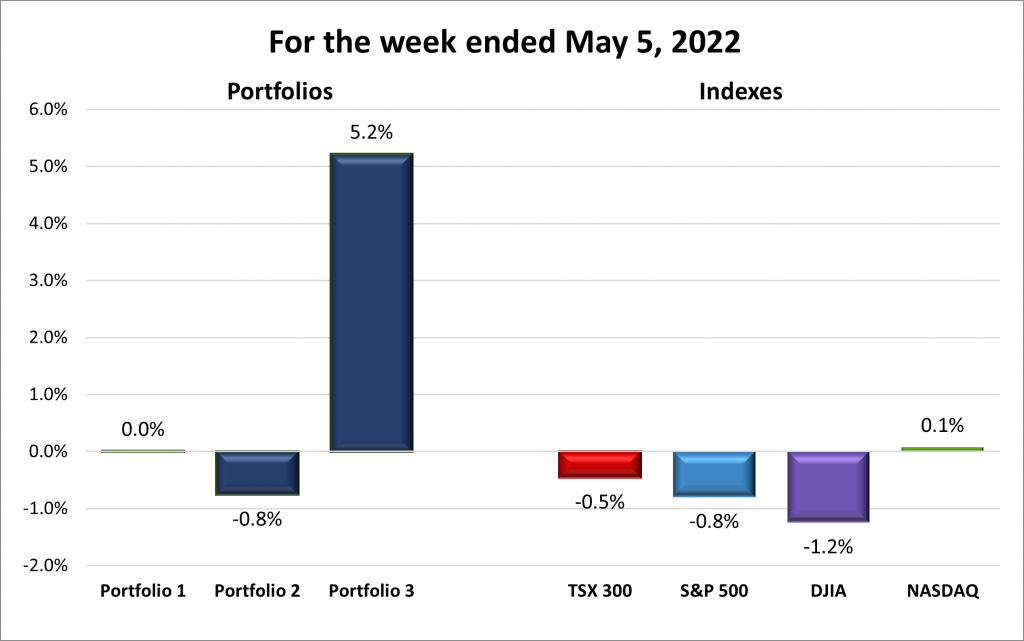
For the week, the TSX (SPTSX) fell 0.5%, the S&P 500 (SPX) dropped 0.8%, the DJIA (INDU) tumbled 1.2% and the Nasdaq (CCMP) rose 0.1%.

Bearish market

All four indexes ended lower the first four days of the week before a strong rally on Friday, as seen in the above chart. The Fed’s interest rate hike, and faltering US regional banks both played a roll in dragging the indexes down at the start of the week. They all then reversed course after a strong Apple earnings report and positive jobs reports in both countries sparked a rally late in the week that nudged the Nasdaq into the green. The S&P and DJIA staged a late rally, but it was not enough to offset the downturn caused by renewed US regional banking concerns and the interest rate hike. In the TSX, a sharp jump by Shopify and a late rise in oil prices raised the TSX but not enough to break into the win column.

Bearish market

Bull market. A good week for the North American stock markets. I am giving the Portfolios a bull and a bear rating for this week because its hard to give a bear rating when Portfolio 3 had a stellar week, as shown below.

If it were not for Shopify (TSX: SHOP), I am sure all three Portfolios would have ended within 1% of the breakeven bar. As it was, a 25+% increase in one of the largest holdings in Portfolio 3 was more than enough to propel it to the top performer position this past week. In what was a mostly a down week, Portfolio 1 was flat thanks to a late surge by Apple. Bringing up the rear, Portfolio 2 reflected the overall direction of the market this past week.

I hope the momentum at the end of this week continues into next week and the indexes and Portfolios all return to their winning ways. More of 5+% increases by the Portfolios would be even better. 😊

Weekly Portfolio & Index performance
Weekly Portfolio & Index performance for the week ended May 5, 2023.

Companies on the Radar

Stocks on my Radar

Airbnb left the Radar List for Portfolio 2, while Costco joined Portfolio 1. Otherwise, no changes to the list this past week.

  • Intact Financial (TSX: IFC): A Canadian mid size insurance company supplying home, car and business insurance in Canada, the US, and the UK.
  • Hammond Power Solutions (TSX: HPS.A): A small cap Canadian company manufacturing transformers used throughout the world in a wide variety of industries.
  • Amphenol: (NYSE: APH) Producer of a high-tech interconnect, sensor, and antenna solutions for the automotive, aerospace, industrial and various technology industries.
  • Vale (NYSE: VALE): A global mining company that extracts various metals and rare earth elements such as nickel, cobalt, gold, copper, that are used in electric vehicles.
  • Smartcentres Real Estate Investment Trust (TSX: SRU.UN): Owns and manages a number of income producing malls and retails spaces throughout Canada.

The Radar Check was last updated May 5, 2023.

5 companies on the radar list

5 companies on the radar list


Portfolio Update

Portfolio 1

Portfolio 1 for the week ended May 5, 2023: Flat Blue tilde, signifying break even or flat for the period.

  • Apple is facing another lawsuit. This one is for US$2 billion. The British based lawsuit claims Apple covered up a defective battery issue with a power management app to limit performance to hide the battery problems. Apple admits they had battery problems with a few iPhone 6s units which they fixed free of charge, but there were no issues with other models. On a personal note, I had one of those defective 6s units and they did fix it free of charge.
    Apple surprised investors with record iPhone sales in South Asia, Latin America, and the Middle East. Apples marketing efforts in those regions is starting to pay off.
  • Alphabet (NASD: GOOGL) and Microsoft (NASD: MSFT) met with President Biden and other top US government officials to discuss the risks and guardrails of Artificial Intelligence (AI). The leaders of the tech companies were told they have a “legal responsibility” to ensure the safety of their AI products. However, the government is open to enacting new regulations and legislation on AI.
  • General Motors (NYSE: GM) announced the end of their popular Chevrolet Bolt electric vehicle (EV). Despite an increase in sales of 50,000 units in 2022 and plans to build 70,000 more in 2023, the Bolt is being discontinued because it has become dated as far as EVs are concerned.
  • At the ‘Woodstock for Capitalists’ Berkshire Hathaway (NYSE: BRK.B), chairman Warren Buffet said he could not imagine the US government allowing the US to default on its debt because it risked putting the global financial system “into turmoil.”

Activity

Bought: Costco (NASD: COST) – This is one of the few times I bought shares in a company without going through my full checklist, but I saw a dip in Costco and bought a few shares. Whenever I go to Costco and see a packed parking lot with masses of people throughout the warehouse, I always wonder why I do not own shares in Costco. The company is an international chain of warehouses for members only. It provides quality, brand-name and private label merchandise at substantially lower prices than found at other sources. It is a strong defensive stock with a solid record of revenue, income, and eps growth. Now when I go to Costco, I will probably wonder why I do not own more shares. 😊

Dividends

Dividends Received this week for the following companies:

Companies followed by DRIP (Dividend Re-Investment Plan) indicate additional shares were purchased with the dividend. Any cash leftover was added to the cash balance.

Canadian $

Toronto-Dominion Bank (TSX: TD) DRIP

Bank of Nova Scotia (TSX: BNS) DRIP

US $

No US$ dividends this past week.

Quarterly Reports

Cargojet Inc.

All currency listed in millions of Canadian dollars, except earnings per share.

Selected highlights from their first quarter 2023 financial results on May 1, 2023

  • Revenue of $231.9 for the three months ended March 31, compared to $233.6 for the same period in 2022. A decrease of less than 1%.
  • Net income of $30.5 for the three months ended March 31, compared to net loss of $56.4 in the same period in 2022.
  • Diluted earnings per ordinary share of $1.67 for the three months ended March 31, compared to a loss of $3.26 per share for the same period in 2022.

TMX Group Limited

All currency listed in millions of Canadian dollars, except earnings per share.

Selected highlights from their first quarter 2023 financial results on May 5, 2023

  • Revenue of $299.1 for the three months ended March 31, compared to $287.4 for the same period in 2022. An increase of over 4%.
  • Net income of $89.0 for the three months ended March 31, compared to net income of $267.4 in the same period in 2022.
  • Diluted earnings per ordinary share of $1.59 for the three months ended March 31, compared to earnings of $4.75 per share for the same period in 2022.
Lattice Semiconductor Corporation

All currency listed in thousands of US dollars, except earnings per share.

Selected highlights from their first quarter 2023 financial results on May 1, 2023

  • Revenue of $184,310 for the three months ended March 31, compared to $150,515 for the same period in 2022. An increase of over 22%.
  • Net income of $55,923 for the three months ended March 31, compared to net income of $36,078 in the same period in 2022.
  • Diluted earnings per ordinary share of $0.40 for the three months ended March 31, compared to earnings of $0.26 per share for the same period in 2022.
Upwork Inc.

All currency listed in thousands of US dollars, except earnings per share.

Selected highlights from their first quarter 2023 financial results on May 3, 2023

  • Revenue of $160,858 for the three months ended March 31, compared to $141,337 for the same period in 2022. An increase of almost 14%.
  • Net income of $17,167 for the three months ended March 31, compared to net loss of $24,738 in the same period in 2022.
  • Diluted loss per ordinary share of $0.15 for the three months ended March 31, compared to a loss of $0.19 per share for the same period in 2022.
Andlauer Healthcare Group Inc.

All currency listed in thousands of Canadian dollars, except earnings per share.

Selected highlights from their first quarter 2023 financial results on May 3, 2023

  • Revenue of $164,774 for the three months ended March 31, compared to $148,351 for the same period in 2022. An increase of over 11%.
  • Net income of $16,528 for the three months ended March 31, compared to net income of $16,471 in the same period in 2022.
  • Diluted earnings per ordinary share of $0.39 for the three months ended March 31, compared to earnings of $0.39 per share for the same period in 2022.

Apple Inc.

All currency listed in millions of US dollars, except earnings per share.

Selected highlights from their second quarter 2023 financial results on May 4, 2023

  • Revenue of $94,836 for the three months ended March 31, compared to $97,278 for the same period in 2022. A decrease of over 2%.
  • Net income of $24,160 for the three months ended March 31, compared to net income of $25,010 in the same period in 2022.
  • Diluted earnings per ordinary share of $1.52 for the three months ended March 31, compared to earnings of $1.52 per share for the same period in 2022.


  • Revenue of $211,990 for the six months ended June 30, compared to $221,223 for the same period in 2022. A decrease of over 4%.
  • Net earnings of $54,158 for the six months ended June 30, compared to net earnings of $59,640 in the same period in 2021.
  • Diluted earnings per ordinary share of $3.41 for the six months ended June 30, compared to earnings of $3.62 per share for the same period in 2022.

Telus Corporation

All currency listed in millions of Canadian dollars, except earnings per share.

Selected highlights from their first quarter 2023 financial results on May 5, 2023

  • Revenue of $4,964 for the three months ended March 31, compared to $4,282 for the same period in 2022. An increase of almost 17%.
  • Net income of $224 for the three months ended March 31, compared to net income of $404 in the same period in 2022.
  • Diluted earnings per ordinary share of $0.15 for the three months ended March 31, compared to earnings of $0.28 per share for the same period in 2022.

Datadog, Inc.

All currency listed in thousands of US dollars, except earnings per share.

Selected highlights from their first quarter 2023 financial results on May 4, 2023

  • Revenue of $481,714 for the three months ended March 31, compared to $363,030 for the same period in 2022. An increase of over 33%.
  • Net loss of $2,086 for the three months ended March 31, compared to net income of $9,738 in the same period in 2022.
  • Diluted loss per ordinary share of $0.08 for the three months ended March 31, compared to earnings of $0.03 per share for the same period in 2022.

BCE Inc.

All currency listed in millions of Canadian dollars, except earnings per share.

Selected highlights from their first quarter 2023 financial results on May 4, 2023

  • Revenue of $6,054 for the three months ended March 31, compared to $5,850 for the same period in 2022. An increase of over 3%.
  • Net income of $788 for the three months ended March 31, compared to net income of $934 in the same period in 2022.
  • Diluted earnings per ordinary share of $0.79 for the three months ended March 31, compared to earnings of $0.96 per share for the same period in 2022.

Ferrari N.V.

All currency listed in thousands of Euros, except earnings per share.

Selected highlights from their first quarter 2023 financial results on May 4, 2023

  • Revenue of €1,429,006 for the three months ended March 31, compared to €1,185,982 for the same period in 2022. An increase of over 20%.
  • Net income of €296,909 for the three months ended March 31, compared to net income of €239,393 in the same period in 2022.
  • Diluted earnings per ordinary share of €1.62 for the three months ended March 31, compared to earnings of €1.29 per share for the same period in 2022.

FuboTV Inc.

All currency listed in thousands of US dollars, except earnings per share.

Selected highlights from their first quarter 2023 financial results on May 5, 2023

  • Revenue of $324,374 for the three months ended March 31, compared to $242,320 for the same period in 2022. An increase of almost 34%.
  • Net loss of $83,368 for the three months ended March 31, compared to a net loss of $128,363 in the same period in 2022.
  • Diluted loss per ordinary share of $0.37 for the three months ended March 31, compared to a loss of $0.89 per share for the same period in 2022.

Portfolio 2

Portfolio 2 for the week ended May 5, 2023: DOWN Red Down Arrow

  • In a silly game of tit for tat, the new district board which oversees Disney World, hand-picked by Florida Governor Ron DeSantis, is counter suing Disney (NYSE: DIS). The board claims that because they were sued, they have no choice but to respond in kind. I can think of better ways to spend taxpayer dollars.
  • Canadian Natural Resources (TSX: CNQ) said if the price of oil continues to fall or stays low it could cause the company to miss its getting down to its net debt target of $10 billion by the end of 2023. That is not good news since it would delay the company from returning 100% of free cash flow to shareholders (currently it returns 50%).

Activity

Bought: Airbnb (NASD: ABNB) – the company is founder led, basically started the short-term rental industry, and now dominates the travel stay industry. The company has a growing base of loyal fans because it provides an extra revenue stream for hosts, saves money for guests while potentially providing a better stay experience. As well as the standard Airbnb service, they have a high end luxury service (Airbnb Luxe) and recently created a hostel like edition (Airbnb Rooms). The company is growing revenues and earnings per share and has lots of cash on hand if needed.

Over the next year, I think tourism will increase as the world continues to come out of the pandemic restrictions, as evidenced by airlines showing growing demand. In the long term, there is still lots of room to expand and it should remain the dominant company in the Travel Services industry for many years to come.

Dividends

Dividends Received this week for the following companies:

Companies followed by DRIP (Dividend Re-Investment Plan) indicate additional shares were purchased with the dividend. Any cash leftover was added to the cash balance.

Canadian $

Bank of Nova Scotia (TSX: BNS) DRIP

US $

No US$ dividends this past week.

Quarterly Reports

Fortis Inc.

All currency listed in millions of Canadian dollars, except earnings per share.

Selected highlights from their first quarter 2023 financial results on May 3, 2023

  • Revenue of $3,319 for the three months ended March 31, compared to $2,835 for the same period in 2022. An increase of over 17%.
  • Net income of $484 for the three months ended March 31, compared to net income of $393 in the same period in 2022.
  • Diluted earnings per ordinary share of $0.90 for the three months ended March 31, compared to earnings of $0.74 per share for the same period in 2022.

Canadian Natural Resources Limited

All currency listed in millions of Canadian dollars, except earnings per share.

Selected highlights from their first quarter 2023 financial results on May 4, 2023

  • Revenue of $8,630 for the three months ended June 30, compared to $10,677 for the same period in 2022. A decrease of over 19%.
  • Net income of $1,799 for the three months ended June 30, compared to net income of $3,101 in the same period in 2022.
  • Diluted earnings per ordinary share of $1.62 for the three months ended June 30, compared to earnings of $2.63 per share for the same period in 2022.

Telus Corporation

All currency listed in millions of Canadian dollars, except earnings per share.

Selected highlights from their first quarter 2023 financial results on May 5, 2023

  • Revenue of $4,964 for the three months ended March 31, compared to $4,282 for the same period in 2022. An increase of almost 17%.
  • Net income of $224 for the three months ended March 31, compared to net income of $404 in the same period in 2022.
  • Diluted earnings per ordinary share of $0.15 for the three months ended March 31, compared to earnings of $0.28 per share for the same period in 2022.

Brookfield Renewable Partners L.P.

All currency listed in millions of US dollars, except earnings per share.

Selected highlights from their first quarter 2023 financial results on May 5, 2023

  • Revenue of $1,331 for the three months ended March 31, compared to $1,136 for the same period in 2022. An increase of over 17%.
  • Net income of $177 for the three months ended March 31, compared to net income of $33 in the same period in 2022.
  • Diluted loss per ordinary share of $0.09 for the three months ended March 31, compared to a loss of $0.16 per share for the same period in 2022.

Portfolio 3

Portfolio 3 for the week ended May 5, 2023: UP Green Up Arrow, signifying a positive week

  • Shopify is getting out of the logistics business. Shopify will sell its logistics unit to Flexport in exchange for a 13% equity interest in Flexport, a private global freight forwarder. In addition, Shopify plans to reduce its headcount by another 20% as it seeks to focus solely on its core business – their ecommerce platform.
    This is great as it will eliminate the distraction and costs of building out a logistics network. I was never big on Shopify’s attempt to compete with logistics king Amazon. But I give them credit for cutting their losses (a few billions were invested). And I was very happy to see the share price jump over 20% after the announcement. 😊
  • TD Bank (TSX: TD) has terminated its acquisition of US regional bank First Horizon (NYSE: FHN). The reason provided was regulatory uncertainty, but I suspect TD is breathing a sigh of relief that they were able to get out of this deal given the problems in the US regional banking industry.

Activity

No significant activity to report this week.

Dividends

Dividends Received this week for the following companies:

Companies followed by DRIP (Dividend Re-Investment Plan) indicate additional shares were purchased with the dividend. Any cash leftover was added to the cash balance.

Canadian $

Toronto-Dominion Bank (TSX: TD)

US $

No US$ dividends this past week.

Quarterly Reports

Telus International Inc.

All currency listed in millions of US dollars, except earnings per share.

Selected highlights from their first quarter 2023 financial results on May 5, 2023

  • Revenue of $686 for the three months ended March 31, compared to $599 for the same period in 2022. An increase of over 14%.
  • Net income of $14 for the three months ended March 31, compared to net income of $34 in the same period in 2022.
  • Diluted earnings per ordinary share of $0.05 for the three months ended March 31, compared to earnings of $0.13 per share for the same period in 2022.

Shopify Inc.

All currency listed in millions of US dollars, except earnings per share.

Selected highlights from their first quarter 2023 financial results on May 4, 2023

  • Revenue of $1,508 for the three months ended March 31, compared to $1,204 for the same period in 2022. An increase of over 25%.
  • Net income of $68 for the three months ended March 31, compared to a net loss of $1,468 in the same period in 2022.
  • Diluted earnings per ordinary share of $0.05 for the three months ended March 31, compared to a loss of $1.17 per share for the same period in 2022.

Brookfield Renewable Partners L.P.

All currency listed in millions of US dollars, except earnings per share.

Selected highlights from their first quarter 2023 financial results on May 5, 2023

  • Revenue of $1,331 for the three months ended March 31, compared to $1,136 for the same period in 2022. An increase of over 17%.
  • Net income of $177 for the three months ended March 31, compared to net income of $33 in the same period in 2022.
  • Diluted loss per ordinary share of $0.09 for the three months ended March 31, compared to a loss of $0.16 per share for the same period in 2022.


Weekly Update for the week ending April 28, 2023

Items that may only interest or educate me ….

Canadian Economic data, US Economic data, First Quarter Earnings Season, What is the Consumer Confidence Index? …

Canadian Economic data

On Friday, Statistics Canada reported Canadian Gross Domestic Product (GDP) gained 0.1% in February, down from a revised 0.6% increase in January. An early estimate of the March GDP had the Canadian economy shrinking by 0.1%. For the first quarter, the economy likely grew by 2.5%, beating the Bank of Canada’s (BoC) 2.3% growth estimate.

All of that simply says, after a quick start to the year, the economy has cooled towards the end of the March. The slowing economy should prevent the BoC from increasing the Canadian benchmark rate. In fact, a BoC survey of Canadian market participants indicates they believe the interest rate will remain at 4.5% for the rest of 2023 before the BoC starts to reduce the rate in 2024.

The BoC itself anticipates inflation in Canada to fall to the high end of its inflation target of 1% – 3% in the second half of 2023. That does not mean it will be a smooth ride. Inflation could spike up before falling closer to the target range. Nor does it mean that once inflation hits the target range that inflation will continue to fall or remain in the range. The minutes from BoC’s last meeting shows the six BoC members wanted to see more evidence the effects of the higher interest rates are lowering inflation before they consider lowering the rate. They want to see signs, such as lower GDP growth (as reported this week), that inflation will not spike upward if they lower the interest rate. If there is to be any change in the interest rate this year, its most likely to be higher, otherwise, the rate will remain at 4.5% for the remainder of 2023.

US Economic data

The Commerce Department released the advance estimate of first-quarter GDP, showing it grew by 1.1% in the first quarter of 2023, on a year over year basis, well below analysts’ expectations of 1.9% and the previous quarters 2.6%. Higher consumer spending was more than offset by businesses blowing out existing inventories rather than building stockpiles of products. Another reason for the drop in productivity was likely the higher borrowing costs caused by the higher interest rate. However, before thinking the US is headed for a recession, consumer spending the first quarter increased by 3.7%, its highest increase in almost two years, and unemployment remains near historic lows.

One of the US Federal Reserve’s (Fed) favourite inflation measures, the Personal Consumption Expenditures (PCE) price index, which measures how much consumers spend on goods and services, rose 0.1% in March, falling from February’s 0.3% increase. On an annual basis, the PCE index rose 4.2%, after gaining 5.1% in February. The Core PCE, which excludes food and energy, held steady at 0.3% on a monthly basis but fell to 4.6% in March from 4.7% in February on an annual basis.

The good news: employment remains high, and consumers continue to spend.

The bad news: the higher numbers will catch the eye of the Fed and all but guarantees a rate increase next week and potentially an additional increase in June.

First Quarter Earnings Season

Last week the markets primary direction was sideways as investors had a lot to think about: mixed earnings, upcoming Fed decision on the US interest rate, and uncertainty about the world’s largest economy. This past week, concerns about the interest rate and a possible recession remain but it was a busy week for earnings reports, including many of the technology giants. The earnings reports should provide another view on how the US economy is performing.

Going into this week, many of the S&P 500 companies have reported their first quarter results. So far, over 75% have beaten analysts’ estimates. Not bad considering the long-term average for beating estimates is 66%. This past week there was a flood of reports, including many of mega cap technology and growth companies that have helped propel the S&P higher during the first quarter.

For the first four months of 2023, Microsoft (NASD: MSFT) is up over 28% this year, Amazon (NASD: AMZN) is up over 25% and Alphabet (NASD: GOOGL) was up over 21% (laggard 😊). Each company is a major player in the cloud services arena as well as the emerging Artificial Intelligence (AI) field. The roll out of AI is in its infancy so the revenue from AI will be negligible this past quarter and hard to determine since none of the companies have broken out that revenue stream. Let us look at these three companies.

Microsoft: revenues and earnings were both up, 7% and 9% respectively, beating expectations. On an annual basis, the Productivity and Business Processes division, includes the Microsoft 365 productivity suite, was up 11%; the Intelligent Cloud division, includes Azure cloud services, gained 16%; and the More Personal Computing (MPC) division was down 9%. Of note, in the MPC division (Bing, Xbox, etc.) the Bing search unit increased revenues 10%. I am guessing this has a lot to do with the integration of the AI bot ChatGPT into Bing. Microsoft said AI was already boosting sales, although they said it was not a big driver in the last quarter. However, they claim to have had a lot of interest from clients so the results should start to show in future earnings reports. Finally, share buybacks and dividends returned US$9.7 billion in value to shareholders.

Alphabet: posted better-than-expected first-quarter results with revenues up 3% on a yearly basis. Its big money maker, Google Search, was up 2.6% after falling 2% in the previous quarter. The company said Bard, their AI bot, boosted sales but probably had little impact since it was only rolled out in March. They did say users can look forward to seeing Bard more integrated into its productivity tools and cloud services. Google saw growth in its Google Cloud division and hopes to be profitable in 2024. Finally, they announced a US$70 billion share buyback plan.

Amazon: beat first quarter expectations in revenues (up 9%), operating margins (up 30%), and net income was US$3.2 billion compared to a net loss of US$3.8 billion in the previous year. A lot of the gains can be attributed to Amazon reducing its staff count by 10% this past quarter. Their highly profitable Amazon Web Services (AWS) cloud unit brought in sales of $21.4 billion, up 16% year-over-year. However, Amazon’s share price took a hit when its Chief Financial Officer said its customers were trying to reduce their AWS expenses so AWS’s revenue growth was likely to suffer going forward. Amazon has developed their own proprietary chips (“Trainium” and “Inferentia”) to boost their AI capabilities they can offer their AWS customers and stay ahead of rivals Microsoft and Google in cloud computing.

Wrapping up, all three companies did well last quarter, other than slowing sales in Amazon’s AWS unit. Cloud services remains a growth area for each company and AI will play a key role in their respective futures. Fortunately, all three are in at least one portfolio but I may look to add shares on a sizable drop in share price.

What is the Consumer Confidence Index?

In the US, The Conference board reported consumer confidence dropped to 101.3 in April from 104.2 in March. In Canada, the consumer confidence index rose to 49.24 in April. Great but what is the Consumer Confidence Index and how is it relevant to investors?

Last week I explained the Volatility index (VIX), this week let us look at the Consumer Confidence Index (CCI).

Both countries have their own CCI and use it as an important economic indicator to assess consumer sentiment and its impact on their respective economies. In Canada, the CCI is measured by The Conference Board of Canada, while in the US, it is measured by the Conference Board (it would be easy to get the two confused). Obviously if you are Canadian investing in Canada, you would check the Canadian CCI. Likewise, if you are investing in the American markets, you would want to check the American CCI.

The CCI measures how confident consumers feel about the economy and their own financial situation. It is like taking a temperature reading of the economy from the perspective of regular, ordinary people. In both countries, the CCI is measured on a scale of 0 to 200, with 100 representing a neutral level of confidence.

If the CCI is high, it means consumers are feeling relatively good and might be more likely to spend money on things they want or need. But if the CCI is low, it probably means they are feeling a more cautious and may focus spending on needs rather than wants. They are less likely to splurge on that extra fancy coffee or new designer shoes.

As an investor, you can use the CCI to get a sense of how confident or cautious consumers are feeling, which can help you make informed decisions about which sectors or companies might be doing well or not-so-well. When the CCI is high, investors tend to look at growth sectors such as consumer cyclicals, technology, and financials. On the other hand, when consumer confidence is low, investors tend to focus on defensive sectors like healthcare, utilities, and consumer staples.

In closing, the CCI is another tool you may want to use to help understand constantly changing market conditions. Use it in combination with other relevant information and analysis to make informed investment decisions. And keep in mind that market conditions can change quickly, so it is always good to keep an eye on the horizon!


With another index in our investing tool belt, let’s see what happened this past week….

Weekly Market Review

Monday: Another day, another lateral move by the indexes. Investors are waiting for the first quarter earnings reports later this week and the Fed update next week. Oil prices were higher as analysts expect rising demand in China, lifting Energy companies in both countries.

In Canada, the Toronto Stock Exchange Composite Index (TSX) ended slightly lower as investors wait for earnings announcements later this week. In trading in the Canadian sectors, Energy and Consumer Cyclicals had the biggest gains, while Technology, Financials and Healthcare were the only sectors to end lower.

In he US, the S&P 500 Index (S&P) and the Dow Jones Industrial Average (DJIA) moved higher, while the Nasdaq Composite Index (Nasdaq) dropped. Investors were cautious ahead of earnings reports from the technology giants this week. In the American sectors, Energy and Basic Materials (miners and fertilizer manufacturers) led gainers, while Telecommunications Services and Technology had the biggest declines.

Tuesday: Not a good day for the North American markets as all four major indexes ended lower by more than 1%. Falling commodity prices, concerns the banking crisis could flare up and fears the US will fall into a recession all put downward pressure on the markets.

In Canada, the TSX had its biggest drop in almost six weeks as lower commodity prices (crude oil and copper) had a significant impact on the resource heavy index. In the Canadian sectors, the defensive Utilities sector was the only one to advance while the Industrials and Consumer Cyclicals had the biggest declines.

In the US, a significant drop in deposits at US regional bank First Republic (NYSE: FRC) led to a record low share price and reignited concerns about regional banks, dragging the markets down. Disappointing earnings and gloomy forecasts by several companies increased concerns the US was heading for a recession, sending investors looking for less risky assets. It was a day of broad-based declines in the American sectors. Consumer Staples and Telecommunication Services fell the least while Basic Materials and Technology had the greatest declines.

Wednesday: Better than expected earnings reports by Microsoft and Alphabet yesterday led to a rebound in the indexes this morning before dropping into negative territory in the afternoon. Only the Nasdaq was able to move into positive territory on a late rally. Fear of the world’s largest economy falling into a recession and concerns about higher interest rates was too much for better than expected earnings reports to offset.

In Canada, the TSX fell as lower oil prices were too much for a rally in Canadian technology companies to overcome. In the Canadian sectors, the Technology and Consumer Staples sectors led gainers, while Industrials and Energy were the biggest decliners.

In the US, the strong earnings report from Microsoft led to a rally in technology companies as the Nasdaq bounced up and down for most of the day, finishing higher on a late rally. Otherwise, it was another day of mixed earnings and economic concerns that weighed on the S&P and DJIA. In trading, the Technology sector was the only American sector to advance, with Utilities and Industrials dropping the most.

Thursday: in a reversal of yesterday’s decline, all four indexes were up considerably today. More strong earnings report from the big technology companies was the catalyst that drove the indexes higher. Investors have started to move back into the growth-oriented Technology sector, especially the biggest companies.

In Canada, Canadian bank shares rebounded after falling on concerns the US banking crisis would flare up and side swipe the Canadian banking industry. On Bay Street, the heart of Canada’s financial industry, the Financials and Technology sectors were the best performers that saw all Canadian sectors end higher. Bringing up the rear were the Utilities and Industrials sectors.

In the US, strong earnings from Meta (NASD: META) in the morning followed up better than expected earnings from Alphabet and Microsoft earlier in the week to jumpstart a bullish day for the Nasdaq. GDP came in lower than expected indicating a slowing economy. On Wall Street, the heart of America’s financial district, it was a day of broad-based gains with all sectors ending higher. Leading the way were the growth-oriented Consumer Cyclicals, Technology, and Telecommunications Services sectors, which were up over 2% each. Trailing the pack were Energy and Healthcare.

Friday: All four indexes ended in positive territory today, a good way to end a volatile week. Earnings continue to meet or beat expectations, offsetting concerns of a slowdown in the US economy. After a mid week slump, oil prices rebounded on rising demand and lower production. Investors now turn their attention to the Fed meeting next week.

In Canada, the TSX benefitted from higher oil prices that lifted the Canadian Energy sector. Canada’s GDP grew less than expected, leading analysts to believe there will be no more increases to the Canadian benchmark interest rate. Trading on the last day of April was led higher by the Energy and Industrials sectors. The Utilities and Basic Materials sectors fell the most.

In the US, all three indexes were largely driven by gains in the big technology companies. There are more earnings to come but investors are concerned about higher interest rates and a possible recession. In the marketplace, leading the American sectors were Energy and Industrials, while Utilities and Telecommunications Services were the only two sectors to decline.


Weekly Market and Portfolio Review

For the week, the TSX (SPTSX) fell 0.3%, the S&P 500 (SPX) increased 0.9%, the DJIA (INDU) added 0.9% and the Nasdaq (CCMP) rose 1.3%.

Bull market. A good week for the North American stock markets.

As shown in the chart above, the week didn’t start out well but a late rally lifted the three American indexes into positive territory, unfortunately the TSX came up a bit short. The main drivers this past week were earnings reports. Once Alphabet and Microsoft produced better than expected reports, investors started moving back into the big technology companies which in turn pushed the markets higher. Weighing on the indexes were concerns about the Fed’s interst rate announcement next week. Could an increase break another bank or push the US into a recession? Next week will provide an answer on the interest rate and also provide a glimpse of what the Fed is thinking going forward.

It was a mixed bag for the Portfolios with two out of three ending higher, as shown below. To paraphrase MeatLoaf, “two outa three ain’t bad.” 😊 I’m a bit surprised Porfolio 1 was down this week but it had no big winners and many of the technology companies in the portfolio ended lower for the week, including drops of more than 20% by Cloudflare (NYSE: NET) and Pinterest (NASD: PINS). Portfolio 2 advanced on the strength of Microsoft and MongoDB (NASD: MDB). Portfolio 3 was flat as gains by Microsoft were offset by the losses in Cloudflare.

Weekly Portfolio & Index performance
Weekly Portfolio & Index performance for the week ended April 28, 2023.

Monthly Portfolio Review

For the month, the TSX (SPTSX) advanced 2.7%, the S&P 500 (SPX) added 1.5%, the DJIA (INDU) rose 2.5% and the Nasdaq (CCMP) inched higher by 0.04%.

Bull market. A good week for the North American stock markets.

Looking at the chart above, you can see it was a volatile month for all four indexes, with good weeks and bad weeks. Earnings were the big market mover this month. On average, earnings were 6% lower compared with the first quarter of 2022, largely thanks to rising interest rates and inflation. But earnings season wasn’t as bad as many feared. In the end, all four indexes ended the month higher with the Nasdaq barely scrapping into positive territory. The TSX and DJIA each posted weekly gains for three of the four weeks in April, helping them become the top two performing indexes in April. While the S&P and Nasdaq posted weekly gains only twice in April.

As for the Portfolios, again, I’m surprised Portfolio 1 droppped but it declined two of the four weeks and when it did advance, it wasn’t as much as the other portfolios. Portfolio 2 and 3 posted there second straight month of gains. Both were buoyed by Microsoft’s strong performance.

I hope Portfolios 2 and 3 continue their monthly winning streak through May and Portfolio 1 gets back in the monthly win column.

Monthly Portfolio & Index performance
Monthly Portfolio & Index performance for April 2023.

Companies on the Radar

Stocks on my Radar Ero Copper Corp. (TSX: ERO) has been dropped from the list because it felt too risky for me.

New to the Radar List is Costco (NYSE: COST), the global retailer selling out of giant warehouses. Every time I go there the place is packed and I wonder why I do not own shares in the company. Time to consider purchasing a few shares.

  • Amphenol: (NYSE: APH) Producer of a high-tech interconnect, sensor, and antenna solutions for the automotive, aerospace, industrial and various technology industries.
  • Intact Financial (TSX: IFC): A Canadian mid size insurance company supplying home, car and business insurance in Canada, the US, and the UK.
  • Hammond Power Solutions (TSX: HPS.A): A small cap Canadian company manufacturing transformers used throughout the world in a wide variety of industries.
  • Vale (NYSE: VALE): A global mining company that extracts various metals and rare earth elements such as nickel, cobalt, gold, copper, that are used in electric vehicles.
  • Smartcentres Real Estate Investment Trust (TSX: SRU.UN): Owns and manages a number of income producing malls and retails spaces throughout Canada.
  • Airbnb (NASD: ABNB): provider of short term rental unit, connecting hosts and guests.

The Radar Check was last updated April 28, 2023.

Table Description automatically generated

A picture containing graphical user interface Description automatically generated


Portfolio Update

Portfolio 1

Portfolio 1 for the week ended April 28, 2023: DOWN Red Down Arrow

  • Apple (NASD: AAPL) lost its bid to have the US Court of Appeals overturn a previous decision to allow developers to provide the ability for third party in app payment options to avoid paying sales commissions to Apple. This is likely to have an impact on Apple’s revenues.
  • General Motors (NYSE: GM) reported better than expected earnings thanks to higher demand for higher priced vehicles. However, GM warned the good times will not last throughout 2023.
  • Tesla (NASD: TSLA) is at it again with price cuts. This time they have lowered the price on their popular Model Y, making the cheapest version of the Model Y lower than the average price of a conventional car or truck. Good for buyers, not so good for Tesla investors due to the lower profit margin.
    Tesla also announced Canada will soon be receiving Model Y’s produced in China. The Shanghai plant must be extremely efficient if its cheaper to ship vehicles from China rather than from their US factories.

Activity

Sold: Innovative Industrial Properties Inc. (NYSE: IIPR) After watching IIPR drift down from a high of nearly US$280 in November 2021, I finally decided to sell the shares. I had been holding the company hoping it would return to the heady days of late 2021 but it was not to be. I don’t see cannabis being a high growth industry so decided to take the 50%+ gains but annoyed at myself for leaving to much money on the table. I should have sold when it dropped below US$200. ☹

Dividends

Dividends Received this week for the following companies:

Companies followed by DRIP (Dividend Re-Investment Plan) indicate additional shares were purchased with the dividend. Any cash leftover was added to the cash balance.

Canadian $

BCE Inc (TSX: BCE) DRIP

US $

No US$ dividends this past week.

Quarterly Reports

CN Railway Company

All currency listed in millions of Canadian dollars, except earnings per share.

Selected highlights from their first quarter 2023 financial results on April 24, 2023

  • Revenue of $4,313 for the three months ended March 31, compared to $3,708 for the same period in 2022. An increase of over 16%.
  • Net income of $1,220 for the three months ended March 31, compared to net income of $918 in the same period in 2022.
  • Diluted earnings per ordinary share of $1.82 for the three months ended March 31, compared to earnings of $1.31 per share for the same period in 2022.

General Motors Co.

All currency listed in thousands of US dollars, except earnings per share.

Selected highlights from their first quarter 2023 financial results on April 25, 2023

  • Revenue of $39,985 for the three months ended March 31, compared to $35,979 for the same period in 2022. An increase of over 11%.
  • Net income of $2,395 for the three months ended March 31, compared to net income of $2,939 in the same period in 2022.
  • Diluted earnings per ordinary share of $2.21 for the three months ended March 31, compared to earnings of $2.09 per share for the same period in 2022.

Alphabet Inc.

All currency listed in millions of US dollars, except earnings per share.

Selected highlights from their first quarter 2023 financial results on April 25, 2023

  • Revenue of $69,787 for the three months ended March 31, compared to $68,011 for the same period in 2022. An increase of over 2%.
  • Net income of $15,051 for the three months ended March 31, compared to net income of $16,436 in the same period in 2022.
  • Diluted earnings per ordinary share of $1.17 for the three months ended March 31, compared to earnings of $1.23 per share for the same period in 2022.

Visa Inc.

All currency listed in millions of US dollars, except earnings per share.

Selected highlights from their second quarter 2022 financial results on April 25, 2023

  • Revenue of $7,985 for the three months ended March 31, compared to $7,189 for the same period in 2022. An increase of over 11%.
  • Net income of $4,257 for the three months ended March 31, compared to net income of $3,647 in the same period in 2022.
  • Diluted earnings per ordinary share of $2.04 for the three months ended March 31, compared to earnings of $1.70 per share for the same period in 2022.


  • Revenue of $15,921 for the six months ended March 31, compared to $14,248 for the same period in 2022. An increase of almost 12%.
  • Net income of $8,436 for the six months ended March 31, compared to net income of $7,606 in the same period in 2022.
  • Diluted earnings per ordinary share of $4.03 for the six months ended March 31, compared to earnings of $3.54 share for the same period in 2022.

Roku, Inc.

All currency listed in thousands of US dollars, except earnings per share.

Selected highlights from their first quarter 2022 financial results on April 26, 2023

  • Revenue of $740,990 for the three months ended March 31, compared to $733,699 for the same period in 2022. An increase of almost 1%.
  • Net loss of $193,604 for the three months ended March 31, compared to net loss of $26,306 in the same period in 2022.
  • Diluted loss per ordinary share of $1.38 for the three months ended March 31, compared to a loss of $0.19 per share for the same period in 2022.

Teladoc Health, Inc.

All currency listed in thousands of US dollars, except earnings per share.

Selected highlights from their first quarter 2022 financial results on April 26, 2023

  • Revenue of $629,244 for the three months ended March 31, compared to $565,350 for the same period in 2022. An increase of over 11%.
  • Net loss of $69,228 for the three months ended March 31, compared to net loss of $6,674,523 in the same period in 2022.
  • Diluted loss per ordinary share of $0.42 for the three months ended March 31, compared to a loss of $41.58 per share for the same period in 2022.

Cloudflare, Inc.

All currency listed in thousands of US dollars, except earnings per share.

Selected highlights from their first quarter 2022 financial results on April 27, 2023

  • Revenue of $290,175 for the three months ended March 31, compared to $212,167 for the same period in 2022. An increase of over 37%.
  • Net loss of $38,082 for the three months ended March 31, compared to a net loss of $41,381 in the same period in 2022.
  • Diluted loss per ordinary share of $0.12 for the three months ended March 31, compared to a loss of $0.13 per share for the same period in 2022.

Amazon.com, Inc.

All currency listed in millions of US dollars, except earnings per share.

Selected highlights from their first quarter 2022 financial results on April 27, 2023

  • Revenue of $127,358 for the three months ended March 31, compared to $116,444 for the same period in 2022. An increase of over 10%.
  • Net income of $3,172 for the three months ended March 31, compared to net loss of $3,844 in the same period in 2022.
  • Diluted earnings per ordinary share of $0.31 for the three months ended March 31, compared to a loss of $0.38 per share for the same period in 2022.

Pinterest, Inc.

All currency listed in thousands of US dollars, except earnings per share.

Selected highlights from their first quarter 2022 financial results on April 27, 2023

  • Revenue of $602,581 for the three months ended March 31, compared to $574,885 for the same period in 2022. An increase of almost 5%.
  • Net loss of $208,579 for the three months ended March 31, compared to a net loss of $5,281 in the same period in 2022.
  • Diluted loss per ordinary share of $0.31 for the three months ended March 31, compared to a loss of $0.01 share for the same period in 2022.

Portfolio 2

Portfolio 2 for the week ended April 28, 2023: UP Green Up Arrow, signifying a positive week

  • Walt Disney (NYSE: DIS) underwent a second round of layoffs this week as part of their ongoing efforts to lower cost by eliminating approximately 7,000 workers this year. The first round of layoffs to their 220,000-person workforce was in March. Disney has been trying to stop or at least slow losses incurred by their Disney+ streaming service. When the streaming service began in 2019, the goal was to grow the subscriber base. Now, investors are starting to focus on the cost of online video platforms.
    Separately, Disney launched a lawsuit against Florida governor Ron DeSantis. Disney says DeSantis is weaponizing the state government to harm Disney in retaliation for criticizing a state law banning discussion of sexuality in classrooms. Disney maintains voicing an opinion is protected by free-speech rights.
  • Guardant Health (NASD: GH) announced they will be working with the Parker Institute for Cancer Immunotherapy to study the connection between cancer biomarkers and immunotherapy treatment response.
  • In their earnings conference call, TC Energy (TSX: TRP) said they were looking to sell some of their assets to reduce debt and/or fund other projects.

Activity

No significant activity to report this week.

Dividends

Dividends Received this week for the following companies:

Companies followed by DRIP (Dividend Re-Investment Plan) indicate additional shares were purchased with the dividend. Any cash leftover was added to the cash balance.

Canadian $

Dream Industrial Real Estate Investment Trust (TSX: DIR.UN) DRIP

TC Energy Corp (TSX: TRP)

US $

No US$ dividends this past week.

Quarterly Reports

Microsoft Corporation

All currency listed in millions of US dollars, except earnings per share.

Selected highlights from their third quarter 2022 financial results on April 25, 2023

  • Revenue of $52,857 for the three months ended March 31, compared to $49,360 for the same period in 2022. An increase of over 7%.
  • Net income of $18,299 for the three months ended March 31, compared to net income of $16,728 in the same period in 2022.
  • Diluted earnings per ordinary share of $2.45 for the three months ended March 31, compared to earnings of $2.22 per share for the same period in 2022.


  • Revenue of $155,726 for the nine months ended March 31, compared to $146,405 for the same period in 2022. An increase of over 6%.
  • Net income of $52,280 for the nine months ended March 31, compared to net income of $55,998 in the same period in 2022.
  • Diluted earnings per ordinary share of $6.99 for the nine months ended March 31, compared to earnings of $7.41 per share for the same period in 2022.

TC Energy Corporation

All currency listed in millions of Canadian dollars, except earnings per share.

Selected highlights from their first quarter 2022 financial results on April 28, 2023

  • Revenue of $3,928 for the three months ended March 31, compared to $3,500 for the same period in 2022. An increase of over 12%.
  • Net income of $1,313 for the three months ended March 31, compared to net income of $358 in the same period in 2022.
  • Diluted earnings per ordinary share of $1.29 for the three months ended March 31, compared to earnings of $0.36 per share for the same period in 2022.

Portfolio 3

Portfolio 3 for the week ended April 28, 2023: UP Green Up Arrow, signifying a positive week

  • Shopify (TSX: SHOP) expanded its financial technology offerings with Shopify Bill Pay. The new, free service that will allow merchants to manage and pay vendors from their Shopify admin dashboard.
  • Microsoft’s acquisition of Activision (NASD: ATVI) is all but dead after Britain’s Competition and Markets Authority (CMA) blocked the deal. The CMA said agreements Microsoft offered rivals only covered consoles, not cloud platforms, and would hinder competition in cloud gaming. Microsoft already has a tremendous advantage in the cloud environment where it holds 60% – 70% of the gaming market. Microsoft plans to appeal the decision, but the veto sets a precedent for upcoming decisions by the European Commission and the US Federal Trade Commission. I just do not see a split decision among the three trade commissions, but it would make for an interesting situation. 😊
    Despite the setback in Britain, Microsoft signed a ten-year deal with Spain’s Nware to bring Xbox and Activision games to Nware’s cloud platform. I suspect the deal was to prove a point to the CMA as well as the European and US regulatory bodies.
  • A study by Magnite (NASD: MGNI) revealed streaming TV is now the most watched form of TV in the Nordic region (Denmark, Finland, Norway, and Sweden), watched by 78% of viewers in the Nordic countries.

Activity

No significant activity to report this week.

Dividends

Dividends Received this week for the following companies:

Companies followed by DRIP (Dividend Re-Investment Plan) indicate additional shares were purchased with the dividend. Any cash leftover was added to the cash balance.

Canadian $

goeasy Ltd. (TSX: GSY)

US $

No US$ dividends this past week.

Quarterly Reports

Microsoft Corporation

All currency listed in millions of US dollars, except earnings per share.

Selected highlights from their third quarter 2022 financial results on April 25, 2023

  • Revenue of $52,857 for the three months ended March 31, compared to $49,360 for the same period in 2022. An increase of over 7%.
  • Net income of $18,299 for the three months ended March 31, compared to net income of $16,728 in the same period in 2022.
  • Diluted earnings per ordinary share of $2.45 for the three months ended March 31, compared to earnings of $2.22 per share for the same period in 2022.


  • Revenue of $155,726 for the nine months ended March 31, compared to $146,405 for the same period in 2022. An increase of over 6%.
  • Net income of $52,280 for the nine months ended March 31, compared to net income of $55,998 in the same period in 2022.
  • Diluted earnings per ordinary share of $6.99 for the nine months ended March 31, compared to earnings of $7.41 per share for the same period in 2022.

Cloudflare, Inc.

All currency listed in thousands of US dollars, except earnings per share.

Selected highlights from their first quarter 2022 financial results on April 27, 2023

  • Revenue of $290,175 for the three months ended March 31, compared to $212,167 for the same period in 2022. An increase of over 37%.
  • Net loss of $38,082 for the three months ended March 31, compared to a net loss of $41,381 in the same period in 2022.
  • Diluted loss per ordinary share of $0.12 for the three months ended March 31, compared to a loss of $0.13 per share for the same period in 2022.

Real Matters Inc.

All currency listed in thousands of US dollars, except earnings per share.

Selected highlights from their second quarter 2022 financial results on April 28, 2023

  • Revenue of $37,610 for the three months ended March 31, compared to $94,981 for the same period in 2022. A decrease of almost 60%.
  • Net loss of $2,580 for the three months ended March 31, compared to a net loss of $509 in the same period in 2022.
  • Diluted earnings per ordinary share of $0.04 for the three months ended March 31, compared to a loss of $0.01 per share for the same period in 2022.


  • Revenue of $75,775 for the six months ended March 31, compared to $202,738 for the same period in 2022. A decrease of over 62%.
  • Net loss of $7,199 for the six months ended March 31, compared to net earnings of $2,127 in the same period in 2022.
  • Diluted loss per ordinary share of $0.10 for the six months ended March 31, compared to earnings of $0.03 per share for the same period in 2022.

Weekly Update for the week ending April 21, 2023

Items that may only interest or educate me ….

Canadian economic news, Headwinds buffeting the American markets, What is a VIX?

Canadian economic news

Statistics Canada reported the March Consumer Price Index (CPI) fell to 4.3% in March, down from 5.2% in February. This was the smallest increase since August 2021. Month over month, the CPI rose 0.5% in March, after a 0.4% increase in February. A drop in energy prices helped offset higher mortgage costs caused by higher interest rates. The Core CPI (CPI less energy and food prices) gained 4.5% on an annual basis, down slightly from February’s 4.8%. The CPI is a widely used measure of inflation that reflects the price changes that Canadian households experience in their day-to-day expenses.

The Industrial Producer Price Index (IPPI) for March rose 0.1%, on a monthly basis, after falling 0.6% in February. On a yearly basis, the PPI fell 1.8%. Core IPPI (IPPI less energy and petroleum) gained 0.4% on a monthly basis but lost 0.1% on an annual basis. The IPPI measures the price movements of a basket of goods and services that are typically sold by Canadian manufacturers, including raw materials, intermediate goods, and finished products.

On Friday, Statistics Canada showed February retail sales fell 0.2% compared to January’s increase of 1.4%. On a yearly basis, sales grew by 4.3%. Of the nine retail sales subsectors, the biggest drop was in the gas and fuel vendors subsectors which fell 5.0% on a monthly basis. Core retail sales (excludes gas, fuel vendors, vehicles, and vehicle parts) increased 0.1% on a monthly basis and grew by 3.5% on a yearly basis. Monthly gains were led by clothing and clothing accessories which gained 4.4%.

Canada’s Gross Domestic Product is expected to expand 1.4% in 2023. The stronger than expected growth means the Bank of Canada (BoC) does not have to worry too much about the Canadian economy falling into a recession and can focus on getting inflation back to their 2% target. Analysts are predicting inflation should fall to the 3% range by the end of the year but getting that last bit to 2% will not be easy. As a result, interest rates likely will stay at the current rate of 4.5% for an extended period to ensure inflation falls to 2%. As always seems to be the case, the BoC gave itself some wiggle room and warned additional increases may be necessary if inflation does not continue to fall.

The silver lining of all this economic news is the BoC should be able to be able to maintain the pause on their interest rate increases for the remainder of the year. With any luck, the BoC may even possibly start lowering the benchmark rate towards the latter end of the year.

US market headwinds

Inflation in the US continues to cool. Last week’s US CPI report showed inflation was down to 5.0%, one of its smallest increases in two years. However, 5% is still more than twice the Federal Reserve’s (Fed) target of 2% so there is still a way to go before the Fed starts to lower the interest rate. Until inflation gets down to the Fed’s target, inflation and higher interest rates will continue to act as headwinds to the markets. Based on the recent economic data, its likely the Fed will bump up the interest rate by another 0.25% at their May 2 – 3 meeting, giving strength to the interest rate headwind.

Another headwind that is growing is earnings. Depending how the first quarter earnings season plays out, the headwinds could turn into a tailwind and lift the markets higher. On the other hand, if earnings do not meet expectations, the headwind will gain strength and act as a further drag on the markets.

The first quarter 2023 earnings season started last week, getting off to a decent start with a few of the big US banks presenting strong reports, and many of the US regional banks at least met expectations. This week has been a mixed bag, but a few big names came in lower than expected, sending the markets lower. Tesla (NASD: TSLA), American Express (NYSE: AXP) and AT&T (NYSE: T) all came in lower than estimated.

Many of the mega cap technology companies that powered the Nasdaq Composite Index (Nasdaq) and S&P 500 (S&P) higher in the first quarter report next week (April 24 – 28). The earnings reports will provide insight to how revenues and earnings have been affected by the ongoing higher interest rates. If earnings do not meet expectations, expect this headwind to further buffet the markets.

The VIX

The CBOE Volatility index (VIX), is commonly referred to as investors’ fear gauge, fell to its lowest point since November 2021 during the session. Investor fear is dropping. Great! But what is the VIX?

Imagine you are out on the open ocean on a three-hour tour on the trusty yacht, let us call it the Minnow. Like the waves of the ocean, the stock market can be choppy and unpredictable at times. That is where the CBOE Volatility Index, or the VIX, comes in as your handy-dandy wave forecast!

The VIX is like a weathervane that tells you how rough the market waters might get in the next 30 days. It looks at how much investors, are willing to pay for options contracts, which are like safety nets, or life vests if we are sticking with the sailing analogy, for their investments. When the VIX is low, it is like calm waters and smooth sailing ahead. Everyone is feeling calm and relaxed. But when the VIX is high, it is like stormy seas are brewing, and investors are getting a bit sea-sick! If the Minnow had had a VIX like weathervane they would not have gone on that three-hour tour and ended up stranded on a deserted island.

The VIX reflects the expected volatility of the S&P index over the next 30 days. It is calculated by analyzing the prices of options contracts on the S&P index. Options are financial instruments used to speculate on the future movement of the stock market.

The VIX is often used as an indicator of market sentiment and risk appetite. When the VIX is high, it suggests that investors are expecting a greater degree of market volatility and uncertainty, which is often associated with a higher level of fear or pessimism. Conversely, when the VIX is low, it suggests that investors are anticipating less market volatility and are generally more optimistic.

The VIX is measured on a scale from 0 to 100, with higher readings indicating higher expected volatility. A reading below 12 is considered relatively low. Investors are expecting lower levels of market volatility and are generally more optimistic. Typically, a calmer market environment with less perceived risk. An average VIX reading typically falls in the range of 12 – 20, suggesting investors are expecting a moderate level of market volatility, but not necessarily extreme or unusual movements. Generally, it indicates a relatively stable market with a reasonable level of risk. A VIX reading of 20 or above is generally considered to be relatively high, indicating increased market uncertainty, fear, and pessimism. The range 20 – 25 indicates growing concern; 25 – 30 usually indicates turbulence in the markets, while 30+ suggest extreme turbulence. The all time high was March 2020 when it reached 82.69. While

Investors may use the VIX as a tool for risk management and to assess the overall level of market risk. For example, during periods of high VIX readings, investors may consider taking precautionary measures such as adjusting their investment portfolios, hedging their positions, or reducing their exposure to higher-risk assets.

Its important to remember that the VIX is not a crystal ball that predicts the future. It is just a tool that gives investors an idea of the market’s mood. So, if you see the VIX rising like a big wave, do not panic! Just remain calm, stay informed, adjust if necessary and ride out the storm.


Now that you know what the VIX is, let’s see what happened this past week….

Weekly Market Review

Monday: The week got off to a promising start as all four major North American indexes – the Toronto Stock Exchange Composite Index (TSX), the S&P, the Dow Jones Industrial Average (DJIA), and the Nasdaq – ended the day higher. Investors are waiting to hear from various Fed members who will be giving speeches throughout the week. Investors are hoping to gather insight into the Fed’s thinking ahead of their next meeting – will the rate be going up or will they pause.

In Canada, the TSX ran its winning streak to seven days as investor sentiment continues to rise in lockstep with improving Canadian economy. Also contributing to the gains on the TSX is investors bidding up the share price of takeover target Teck Resources. It was a day of widespread gain in trading as the Technology and Healthcare sectors led all Canadian sectors higher. Consumer Staples, Energy and Basic Materials (mining companies and fertilizer manufacturers) were the only sectors to end down.

In the US, the indexes inched higher as investors prepare for many of the first quarter 2023 earnings announcements. Investors will be looking to see how companies did in the first three months as well as their outlook for the remainder of the year. In the markets, Financials and Consumer Cyclicals led the gainers while Energy was the only sector to lose ground.

Tuesday: After a strong start to corporate earnings season boosted the markets yesterday, today the indexes were largely flat on mixed results from the big names that reported earnings today. The TSX and S&P inched higher while the DJIA and Nasdaq were down slightly. Investor optimism is rising thanks to strong economic performance in Canada and the US. The downside to strong economic performance is the Fed will most likely increase the US interest rate at least once more, while the BoC may increase the Canadian rate to cool the economy.

In Canada, the TSX recorded its eight straight positive day as inflation in Canada slowed to 4.3% in March, down significantly from 5.2% in February. Falling inflation provides the BoC a reason not to increase the benchmark interest rate. In trading, it was a big day for the Canadian Healthcare sector, up 3.25%, followed by the Financials sector. Of the sectors that lost ground today, the biggest declines were the Utilities and Consumer Staples sectors.

In the US, the DJIA and Nasdaq were slightly lower while the S&P was barely higher as the markets ease into first quarter earnings season. Separately, two members of the Fed, speaking to separate audiences, said they felt there would be at least one more interest rate hike to drive down sticky inflation. In the American markets, Basic Materials and Financials led the gainers while Utilities, Healthcare, and Telecommunications Services were the only sectors to end in the red.

Wednesday: Everything was down today, well, almost everything. Somehow the technology heavy Nasdaq scratched out a gain at the last minute, despite the US Technology sector ending in the red. Otherwise, the other three indexes and oil were all down and gold broke even.

In Canada, the TSX’s winning streak came to a halt as commodity prices dropped. Lower commodity prices led to lower share prices for many of the resource companies on the resource heavy TSX. However, all was not gloom and doom on the TSX as more than half of the Canadian sectors ended in the green, led by Industrials and Healthcare. Of the four sectors that dropped, Basic Materials and Energy had the biggest fall.

In the US, the American indexes were largely unchanged while investors reviewed earnings and looked for signs if a recession is coming or if the Fed can pull off a ‘soft landing’ (a gradual economic slowdown rather than a sudden, sharp decline). In trading, only four US sectors ended in the green, led by Utilities and Financials. Of the sectors that ended in the red, Basic Materials and Telecommunications Services fell the most.

Thursday: All four indexes retreated on mixed earnings results across various sectors. News that jobless claims in the US came in higher than expected, suggested a recession in the US is possible. Oil prices fell as investors are concerned the US could slip into a recession, leading to lower demand.

In Canada, the TSX started a losing streak with another day in the red thanks to falling oil prices sending oil company shares lower. In trading in the Canadian sectors, the Industrials sector was the only sector to end higher, while the Technology and Energy sectors had the biggest drop.

In the US, disappointing earnings from a few of the biggest American companies dragged all three indexes lower. Investors continue to try and decipher what the Fed will do at their upcoming meeting as well as their outlook for the rest of 2023. In trading in the American sectors, Consumer Staples and Industrials were the only sectors to advance, while Telecommunications Services and Consumer Staples led the decliners.

Friday: All four indexes ended slightly higher. Prior to the blackout period ahead of the Fed’s next Federal Open Market Committee’s (FOMC) meeting, several Feb members have suggested they support further interest rate increases, adding to concerns about a recession hitting the US later this year. There is a strong chance the US interest rate will go up another 0.25%. News of tightening oil supplies in Europe finally stopped the weeklong skid of oil prices.

In Canada, the technology companies pushed the TSX into the green, overcoming the drag of falling gold prices. In the Canadian market it was a day of broad-based gains across the Canadian sectors, led by the Technology and Consumer Staples sectors. Basic Materials was the only sector to end in the red.

In the US of A, all three indexes hovered slightly under the break even point most of the afternoon before creeping into positive territory in the last hour. It was another mixed bag of earnings which has not moved the indexes one way or the other for most of the week. However, there should be some movement next week when many of the biggest American companies report their first quarter earnings. In trading, the American sectors were fairly evenly split between gains and losses today. The biggest gainers were the Healthcare and Consumer Cyclical sectors, while the biggest drops were Basic Materials and Financials.


Weekly Market and Portfolio Review

For the week, the TSX (SPTSX) notched a fifth straight weekly advance, gaining 0.6%, the S&P 500 (SPX) dropped 0.1%, the DJIA (INDU) had it worst week in six weeks, slipping 0.2% and the Nasdaq (CCMP) fell 0.4%.

Bearish market

After last week’s step forward when all four indexes gained ground, the TSX was the only index to maintain a weekly winning streak. The TSX benefitted from rising metal commodity prices, especially gold, and falling inflation in Canada. As shown in the chart above, the three American indexes were basically flat for most of the week on a mixed bag of corporate earnings reports. The indexes faltered at the end of the week on concerns the Fed will raise the US benchmark interest rate that could send the world’s largest economy into a recession. Investors will now be focused on upcoming earnings reports from most of the big technology companies. I am confident there will be a great amount of speculation on whether the Fed will raise the interest rate the following week. 😊

Bull market. A good week for the North American stock markets.

Its not too often all three Portfolios outperform the indexes when all the American indexes decline, but that is what happened this past week. Not only did all three portfolios end in positive territory but they almost all beat the best index performer, the TSX, as seen below. Portfolio 1 was pushed higher by the big technology companies in the portfolio. Portfolio 2 benefitted from a strong week from MongoDB (NASD: MDB). Portfolio 3 was buoyed by a week of 10% gains by Shopify (TSX: SHOP) and Alvopetro Energy (TSXV: ALV). It is a fluke the portfolios did so well when the American indexes all ended lower. That will not happen to often. I would prefer to see all indexes end the week higher since that provides the best chance that the three portfolios will advance. But a win is a win. 😊

Weekly Portfolio & Index performance
Weekly Portfolio & Index performance for the week ended April 21, 2023.

Companies on the Radar

Stocks on my RadarSupremex (TSX: SXP) leaves the Radar List after being added to Portfolio 2.

After talking with a few friends, Airbnb (NASD: ABNB) is back on the Radar List. They all were very satisfied with their stays at Airbnb locations, would use the service again, and explained why people would use them rather than hotels. I then did a quick search on the Airbnb site and discovered there were approximately a dozen Airbnb host location in my neighbourhood alone. Happy customers and a growing number of locations got me interested in the company again, so it has been added to the list below.

  • Vale (NYSE: VALE): A global mining company that extracts various metals and rare earth elements such as nickel, cobalt, gold, copper, that are used in electric vehicles. *For some reason, this weeks Thomson Reuters report shows Vale as ‘Not Rated’ so I maintained last weeks rating of 10.
  • Intact Financial (TSX: IFC): A Canadian mid size insurance company supplying home, car and business insurance in Canada, the US, and the UK.
  • Amphenol: Producer of a high-tech interconnect, sensor, and antenna solutions for the automotive, aerospace, industrial and various technology industries.
  • Hammond Power Solutions (TSX: HPS.A): A small cap Canadian company manufacturing transformers used throughout the world in a wide variety of industries.
  • Smartcentres Real Estate Investment Trust (TSX: SRU.UN): Owns and manages a number of income producing malls and retails spaces throughout Canada.
  • Ero Copper Corp. (TSX: ERO): A small cap Canadian copper mining company with mines in Brazil.

The Radar Check was last updated April 21, 2023.

Radar list companies

Radar list companies


Portfolio Update

Portfolio 1

Portfolio 1 for the week ended April 21, 2023: UP Green Up Arrow, signifying a positive week

  • The US Treasury Department dealt a blow to Rivian (NASD: RIVN) and other electric vehicle (EV) manufacturers when they announced that EV makers will lose access to the US Inflation Reduction Act (IRA) tax credits. The IRA requires 50% of the value of battery components be produced or assembled in North America to qualify for $3,750 tax credit, and that 40% of the value of critical minerals used in the vehicle be sourced from the US or a free trade partner for a $3,750 credit.
  • Apple (NASD: AAPL) opened their first retail store in India. As in North America, hundreds of people lined up, some overnight, to be among the first to enter the store. One of the reasons I invested in Apple was because they have a tremendously loyal customer base, as evidenced by people lining up to enter the store.
  • Tesla reported that all those discounts (six this year alone) caused profits to fall 24% compared to the same period last year. Rather than suggesting an end to discounts, founder Elon Musk suggested additional discounts are in the works and the company was sticking to its plan to sell more cars for less. Tesla is putting sales growth ahead of profit for now. Unfortunately, Tesla’s earnings miss and forecast also side swiped other EV manufacturers like GM (NYSE: GM) and Rivian.
    Tesla had a big victory in court when a jury found Tesla’s Autopilot did not fail to perform safely when the vehicle was involved in a crash. That was the first trial of what is expected too be more involving the company’s self driving system.
  • Alphabet (NASD: GOOGL) announced they are combining two of their artificial intelligence (AI) units – Google Brain and DeepMind. This is Googles latest attempt to get back in the AI race, currently led by OpenAI’s ChatGPT.

Activity

No significant activity to report this week.

Dividends

Dividends Received this week for the following companies:

Companies followed by DRIP (Dividend Re-Investment Plan) indicate additional shares were purchased with the dividend. Any cash leftover was added to the cash balance.

Canadian $

BSR Real Estate Investment Trust (TSX: HOM.U)

Andlauer Healthcare Group Inc (TSX: AND)

US $

No US$ dividends this past week.

Quarterly Reports

Tesla, Inc.

All currency listed in millions of US dollars.

Selected highlights from their first quarter 2023 financial results on April 19, 2023

  • Revenues of $23,239 for the three months ended March 31, compared to $18,756 for the same period in 2021. An increase of over 23%.
  • Net income of $2,539 for the three months ended March 31, compared to net income of $3,280 in the same period in 2021.
  • Diluted earnings per ordinary share of $0.73 for the three months ended March 31, compared to earnings of $0.95 per share for the same period in 2021.

Portfolio 2

Portfolio 2 for the week ended April 21, 2023: UP Green Up Arrow, signifying a positive week

  • Alimentation Couche-Tard Inc. (TSX: ATD) signed a license agreement with Fire & Flower Holdings Corp. (TSX: FAF) to develop Fire & Flower retail cannabis stores in Ontario and other markets outside Canada. I wonder if they will sell cannabis products at their gas station convenience stores. 😊
  • TC Energy (TSX: TRP) has partnered with Chemours Co (NYSE: CC), a chemical producer, to develop, build and operate clean hydrogen producing plants in West Virginia. Clean hydrogen is a favourite of many governments even though very few facilities currently exist. I am guessing there are some government incentives involved because the Canadian and US governments are big on clean hydrogen.
    Separately, TRP said a crack caused by fatigue led to the oil spill in Kansas last December. An independent third-party investigation found the fatigue crack came from a weld connecting a manufactured elbow fitting to the section of pipe constructed near Mill Creek. The girth weld met applicable standards when it was fabricated.
  • Mitek (NASD: MITK) announced its flagship Check Fraud Defender identity verification mobile API (Application Programming Interface). Check Fraud Defender can determine if a cheque is authentic and not simply a picture of a check. Banks and other financial institutions can use the software to limit cheque fraud and reduce losses.
  • Walt Disney Corp (NYSE: DIS) plans to build 1,400 affordable housing units on Disney property, a few miles from Disney World’s Magic Kingdom. The homes will near be near schools and shopping stores. The first homes should be available sometime in 2026. I imagine many of Disney World’s employees are looking forward to the homes built by the Mouse.
  • Guardant Health (NASD: GH) received notice its Guardant360 Response test will be covered by Medicare in the US. Guardant360 Response is a blood only test that allows doctors for early indication of metastatic or advanced cancer. This should make it easier for the product to be used by doctors and medical facilities.

Activity

Bought: Supremex – A small cap company that sells packaging solutions throughout Canada and the USA. The company should continue to grow the box side of the business given the growth of the ecommerce industry. Items must be packaged to be shipped. 😊 The company did not score high on my growth oriented Multibagger test, not surprising since its not a high growth company. However, it did well in the financials section of the test. It has steadily increased revenues, net income, gross and profit margins. Debt has grown because of recent acquisitions but revenues from the acquisitions should help pay down the debt. It currently has a 2.29% dividend yield. Not the most exciting business but it provides diversification, income in the form of dividends, and growth potential with low risk.

Dividends

Dividends Received this week for the following companies:

Companies followed by DRIP (Dividend Re-Investment Plan) indicate additional shares were purchased with the dividend. Any cash leftover was added to the cash balance.

No dividends this past week.

Quarterly Reports

No quarterly reports this past week.

Portfolio 3

Portfolio 3 for the week ended April 21, 2023: UP Green Up Arrow, signifying a positive week

  • A story in the New York Times suggested Samsung may change the default search engine on its smartphones from Google to Microsoft’s (NASD: MSFT) AI enhanced Bing. Samsung has the largest smartphone market share so this would be a big deal for both Microsoft and Alphabet.
  • TD Bank (TSX: TD) announced their deal to acquire US regional bank First Horizon (NYSE: FHN) is unlikely to close as scheduled. I suspect the US banking crisis has led to some speed bumps in negotiations between the two banks. Some TD shareholders are suggesting TD renegotiate the price or cancel the deal outright.
    On a related note, many investors have shorted TD, betting the purchase of First Horizon will not happen. The short position has grown by 45% in the last two weeks.
  • Brookfield Asst Management (TSX: BAM) has joined the fray to acquire Network International, the largest payment processing firm in the Middle East and Africa. BAM’s offer top is now the top offer, but it may have started a bidding war for Network International.

Activity

Bought: BAM – I received a few shares of BAM when it was spun off from Brookfield Corporation (TSX: BN), one of the best Canadian companies. I decided to build up my holdings of BAM and purchased more shares.

BAM is one of the largest alternative asset managers, owning and operating a wide range of long-life assets and businesses across a number of sectors. Before BAM was spun off as separate entity and part of Brookfield Corporation, it developed a successful track record of generating returns. I see no reason this will not continue since BAM benefits from being part of the greater Brookfield family. Financially, BAM revenues and net income are growing, plus it has a strong balance sheet with no debt and lots of cash. Finally, it has a dividend of 3.92%.

Dividends

Dividends Received this week for the following companies:

Companies followed by DRIP (Dividend Re-Investment Plan) indicate additional shares were purchased with the dividend. Any cash leftover was added to the cash balance.

No dividends this past week.

Quarterly Reports

No quarterly reports this past week.


Weekly Update for the week ending April 14, 2023

Items that may only interest or educate me ….

April investing, Canadian interest rate remains unchanged, US economic data that impacts investors…


April has generally been a decent month for the four major North American indexes. According to historical data, the S&P 500 (S&P) produced positive returns about 60% of the time, slightly above the average for all months; the Dow Jones Industrial Average (DJIA) produced positive returns for approximately 58% of the time, again slightly above the average for all months; the Nasdaq Composite Index (Nasdaq) has had positive returns about 57% of the time; and finally, the Toronto Stock Exchange Composite Index (TSX), from its inception in 1977, has generated positive returns in April for roughly 53% of the time.

That’s a long way of saying April is a good time to be invested. 😊


BoC Benchmark at 4.50%

The Bank of Canada’s (BoC) left the benchmark interest rate at 4.50% but it could remain “higher for longer” than originally forecast to ensure both the cost for services cools off and wage growth slows. The members discussed a rate increase but recent data supported the BoC’s belief that inflation will continue to fall to the 3% range sometime this summer, before reaching their 2% target near the end of 2024.

The Canadian economy remains strong as economic growth was higher than expected and the labour market remains strong. The BoC’s latest forecast is Canada will likely avoid a recession, with “positive but weak growth and declining inflation.” They raised their economic growth expectations from their original 1.0% in January to 1.4%. Despite the likelihood of a recession diminishing, the BoC also cooled investor expectations that a there would be an interest rate cut this year, saying “the BoC remains prepared to raise the policy rate further if needed to return inflation to the (two per cent) target.”

A quick reminder, higher interest rates, also known as tighter monetary policy, make loans more expensive and harder to get for individuals and businesses alike. In theory, this lowers demand for goods and services obtained on credit, which in turn lowers inflation.


US economic data

Consumer Price Index (CPI)

The US Labor Department announced the March CPI climbed 0.1%, after gaining 0.4% in February. On an annual basis, the CPI rose 5.0% in March, the smallest annual gain since May 2021, after rising 6.0% in February. Both the monthly and yearly gains were lower than analysts 0.3% and 5.2% forecasts. Core CPI (less food and energy prices) increased 0.4% in March, after increasing 0.5% in February. On an annual basis, core CPI rose 5.6%, following a 5.5% rise in the February. The price of gas declined by 4.6% but was offset by higher housing prices to keep inflation high.

While inflation continues to fall, it does not mean interest rate increases are finished. Core CPI continues well above the Federal Reserve’s (Fed) inflation rate target of 2%. Its likely the Fed will have at least one more interest rate hike before it can declare victory over inflation, but they will maintain that level until inflation approaches their target.

Producer Price Index (PPI)

The March PPI fell by 0.5% in March, after falling 0.1% in February. That was the biggest monthly decline since April 2020. On an annual basis, the PPI grew 2.7% in March, after rising 4.6% in February. Analysts had expected gains of 0.1% and 3.0%, respectively. Core PPI (less food, energy and trade services) rose 0.1% in March, slightly below February’s 0.2% increase. On an annual basis, the core PPI grew 3.6% in March, after a 4.5% increase in February.

Retail Sales

The Commerce Department reported March retail sales fell 1.0% since February, however, they were up 2.9% on an annual basis. For the first quarter, retail sales grew 5.4% compared to the same period a year ago.

Fed Minutes

The Fed’s Federal Open Market Committee (FOMC) March Meeting minutes revealed they considered a pause because of the banking crisis but ultimately went ahead with a 0.25% increase to the US benchmark interest rate. The FOMC acknowledged the impact the banking crisis could have on the economy, but they felt the crisis was contained. The minutes from their meeting also showed:

  • Fed staff felt the banking crisis could lead to a ‘mild recession.’
  • A number of Fed members were prepared to consider a 0.5% increase if the banking crisis had not occurred.
  • FOMC members remarked inflation remained too high and the job market was too strong. An additional increase might be necessary to bring inflation down at a faster pace.

What does all this data mean? My guess is the mixed economic data all but confirms the Fed will add another 0.25% to the US benchmark interest rate, barring any unforeseen event (like a bank collapse 😊) between now and their meeting in early May.


With that brief economic update out of the way, let’s see what happened this past week….

Weekly Market Review

Monday: It was the first day of trading after the Easter holiday, but more importantly, it was the first day of trading after the release of last Friday’s jobs report. The data strengthened the case for additional interest rate increases so it was interesting to see how investors responded. All four major North American indexes – the TSX, the S&P, the DJIA, and the Nasdaq – started the day lower before rallying. The Nasdaq was the only index that failed to make it into positive territory by the end of the day. Investors confidence is growing as the banking crisis drops farther into the rear view mirror.

In Canada, the TSX ended higher as investors wait for the BoC’s latest update on Wednesday. Investors expect the benchmark interest rate to remain at 4.5%. In the Canadian sectors, Healthcare and Consumer Cyclicals had the biggest advance, while Basic Materials (miners and fertilizer manufacturers) was the only sector to decline.

In the US, concerns of another interest rate hike caused the American indexes to break even, with the blue chip DJIA up, the S&P flat and the Nasdaq down. Investors digested the latest US jobs data which showed the economy cooling but not enough to avoid another rate increase by the Fed. The latest Consumer Price Index (CPI) data comes out Wednesday and should provide additional clues what to expect from the Fed. In trading, the Basic Materials and Industrials sectors gained the most while the Technology and Consumer Staples dropped the most.

Tuesday: A mixed but essentially flat day in the markets as investors await the latest economic news from Canada and the US.

In Canada, it was a good day for the TSX as it closed at a five-week high thanks to higher commodity prices, especially gold, which provided a boost to the resource heavy index. Tomorrow the BoC will announce any changes to the Canadian benchmark interest rate. Most analysts expect the rate to remain unchanged at 4.5%. In trading on Bay Street, the Basic Materials and Energy sectors had the best day while Technology was the only Canadian sector to end lower.

In the US, it was another mixed day for the American indexes as the DJIA gained, the Nasdaq fell and the S&P split the difference and ended flat. Investors are waiting for tomorrow’s key US CPI data to see if inflation continues to fall in the US. On Wall Street, Basic Materials and Energy were the best of the American sectors, and Technology was the only sector not to gain ground.

Wednesday: Another mixed day for the North American indexes with the TSX the only index to end higher. There was a lot of information to digest today, starting with the BoC maintaining its pause on the Canadian interest rate, leaving it at 4.5%. Throughout the day investors reviewed the minutes of the Fed’s Federal Open Market Committee’s (FOMC) last meeting when they raised the US benchmark interest rate. As well, US CPI data showed inflation rose at an annual rate of 5%, while Core CPI increased by 5.6%, in line with expectations.

In Canada, the TSX received a boost from higher commodity prices and the BoC maintain the pause on the benchmark interest rate. In the Canadian sectors, Industrials and Basic Materials led the gainers. Only the Healthcare, Consumer Staples and Consumer Cyclicals sectors declined.

In the US, despite the CPI suggesting inflation was falling, albeit slowly, the three American indexes all dropped into the red when the FOMC minutes showed the FOMC members had concerns about a possible recession. In the American sectors, Energy, Industrials and Healthcare were the only sectors to advance. Dropping the most were the interest sensitive Consumer Cyclicals and Technology sectors.

Thursday: A good day for all four indexes as more US data indicated US inflation continues to cool. The combination of yesterday’s conflicting CPI data – CPI was down but core CPI remained high – and additional data today showing US inflation trending downward led investors to believe the Fed could pause hikes and possibly lower interest rates by the end of 2023.

In Canada, the TSX continues to advance as investor sentiment continues to improve after positive economic news in both Canada (interest rate remains unchanged) and the US (cooling inflation). Surging gold prices are also giving the TSX a boost. Basic Materials and Telecommunications Services were the biggest gainers of the Canadian sectors, while Consumer Staples and Utilities were the only sectors to end in the red.

In the US, the PPI came in below expectations and weekly jobless claims were up. Both good news to the Fed in their battle with inflation. Analysts and investors are hoping the CPI and PPI data will cause the Fed to pause rate hikes sooner rather than later. In trading, all US sectors ended higher, led by the interest sensitive Technology and Consumer Cyclicals sectors. The defensive sectors Utilities and Consumer Staples brought up the rear.

Friday: Another mixed day to close out the week. An afternoon rally nudged the TSX into positive territory. Meanwhile, all three American index ended the day lower when a member of the Fed stated inflation remains “much too high,” suggesting a 0.25% increase was all but certain at the Fed’s next meeting. A warning from the International Energy Association about a significant supply deficit later this year sent oil prices higher.

In Canada, the TSX hit its highest point in six weeks thanks to higher oil prices and a rebound in Canadian bank stocks. In trading, the Canadian sectors were split 50/50 with the Technology and Consumer Staples sectors leading the gainers, while Utilities and Basic Materials sectors fell the most of the decliners.

In the US, strong first quarter earnings by a handful of big American banks that beat expectations wasn’t enough to overcome investors’ expectations of another rate increase by the Fed. In trading, the Financials and Energy sectors were the only two American sectors to end higher. Dropping the most were Utilities and Basic Materials.


Weekly Market and Portfolio Review

For the week, the TSX (SPTSX) posted a fourth straight gain, up 1.9%, the S&P 500 (SPX) gained 0.8%, the DJIA (INDU) advanced 1.2% and the Nasdaq (CCMP) increased 0.3%.

Bull market. A good week for the North American stock markets.Despite a mid week swoon (as shown on the chart above), the American indexes did enough on Thursday to join the TSX in the weekly winners’ column. The main driver of the markets was US economic data and the BoC maintaining the pause on the Canadian interest rate. The TSX was the beneficiary of interest rate pause as well as rising commodity prices, especially oil and gold prices. All three American indexes were buffeted by the economic news, with the blue chip DJIA able to ride the turbulence the best. The interest sensitive Nasdaq and S&P had deeper drops but rallied to end the week in positive territory.

As seen on the chart below, it was another week with all three portfolios ending higher. Portfolios 2 and 3 each had a strong week. In both portfolios, no one company had an outstanding week, rather almost all companies had a solid week with very few companies not ending higher. Bringing up the rear was Portfolio 1. I was surprised it did not do as well as the other two Portfolio but at least it did not lose money.

Weekly Portfolio & Index performance
Weekly Portfolio & Index performance for the week ended April 14, 2023.

Companies on the Radar

Stocks on my Radar Once again, no new companies to add to my radar list. The radar list currently consists of:

  • Vale (NYSE: VALE): A global mining company that extracts various metals and rare earth elements such as nickel, cobalt, gold, copper, that are used in electric vehicles.
  • Intact Financial (TSX: IFC): A Canadian mid size insurance company supplying home, car and business insurance in Canada, the US, and the UK.
  • Hammond Power Solutions (TSX: HPS.A): A small cap Canadian company manufacturing transformers used throughout the world in a wide variety of industries.
  • Supremex (TSX: SXP): A small cap company selling packing solutions throughout Canada and the USA.
  • Amphenol: Producer of a high-tech interconnect, sensor, and antenna solutions for the automotive, aerospace, industrial and various technology industries.
  • Smartcentres Real Estate Investment Trust (TSX: SRU.UN): Owns and manages a number of income producing malls and retails spaces throughout Canada.
  • Ero Copper Corp. (TSX: ERO): A small cap Canadian copper mining company with mines in Brazil.

The Radar Check was last updated April 14, 2023.

Table Description automatically generated

A picture containing calendar Description automatically generated


Portfolio Update

Portfolio 1

Portfolio 1 for the week ended April 14, 2023: UP Green Up Arrow, signifying a positive week

  • Tesla (NASD: TSLA) announced they intend to build a Megapack battery factory in China as a complement to their existing electric vehicle (EV) Gigafactory. It will be interesting to see how Tesla navigates the issue of receiving US government tax breaks while at the same investing heavily in China. The tax breaks are to encourage companies to invest in the US, not foreign countries, especially the US’s top economic competitor.
  • General Motors (NYSE: GM) will get more into the mining business to secure its supply chain. GM plans to invest in private company EnergyX to secure lithium supplies for its EV batteries. In exchange for a US$50 million investment, GM will have the right of first refusal for lithium from any EnergyX projects. Earlier this year GM became the largest shareholder of Lithium Americas Corp (TSX: LAC), another lithium miner.
  • Amazon (NASD: AMZN) joined the Artificial Intelligence (AI) battle, releasing a number of proprietary AI tools to allow Amazon Web Services (AWS) customers to build their own AI chatbots and image-generation services.
  • Apple (NASD: AAPL) continues to increase the amount of recycled materials it uses in its products. Apple plans to use only recycled cobalt in its batteries by 2025. Currently 66% of its aluminum, 95% of tungsten and 75% of other rare earth metals it uses in its products are recycled.

Activity

Rogers Communications’ (TSX: RCI.B) acquisition of Shaw Communications closed. Shares exchanged for C$40.50 per share.

Private software investment firm Thoma Bravo’s acquisition of Magnet Forensics closed. Shares exchanged for C$44.25 per share.

Dividends

Dividends Received this week for the following companies:

Companies followed by DRIP (Dividend Re-Investment Plan) indicate additional shares were purchased with the dividend. Any cash leftover was added to the cash balance.

Canadian $

Dream Industrial Real Estate Investment Trust (TSX: DIR.UN)

Algonquin Power & Utilities Corp (TSX: AQN)

US $

Innovative Industrial Properties Inc (NYSE: IIPR)

Quarterly Reports

No quarterly reports this past week.

Portfolio 2

Portfolio 2 for the week ended April 14, 2023: UP Green Up Arrow, signifying a positive week

  • The Bank of Nova Scotia (TSX: BNS) continues to make changes to the executive management team. CEO Scott Thomson recently replaced Brian Porter (retirement) and now Francisco Aristeguieta will be replacing the retiring Ignacio Deschamps as Group Head, International Banking. Its hard to tell if the share price is higher because investors approve of these changes or it is a result of the banking crisis fading into the background. I am guessing more of the latter. 😊
  • Brookfield Infrastructure Corp (TSX: BIP.UN/BIPC) will purchase Triton International Ltd (NYSE: TRTN), a freight container lessor, for about US$4.7 billion. BIP.UN hopes to capitalize on growing demand for shipping containers by customers wanting to eliminate shipping delays.
  • Telus’s (TSX: T) western Canada broadband network won a number of awards in BC and Alberta. Telus won Consistent Quality, Video Experience and Upload Speed in the two provinces; best Broadband Success Rate in BC, second best in Alberta; and tied for first in Peak Download Speed in both provinces. If nothing else, Telus can claim they are Western Canada’s best internet provider.

Activity

No significant activity to report this week.

Dividends

Dividends Received this week for the following companies:

Companies followed by DRIP (Dividend Re-Investment Plan) indicate additional shares were purchased with the dividend. Any cash leftover was added to the cash balance.

Canadian $

Telus Corp (TSX: T) DRIP

Brookfield Infrastructure Partners LP (TSX: BIP.UN)

US $

No US$ dividends this past week.

Quarterly Reports

No quarterly reports this past week.

Portfolio 3

Portfolio 3 for the week ended April 14, 2023: UP Green Up Arrow, signifying a positive week

  • A recent report anticipates the global cyber security market will reach US$266.2 billion by 2027, with a Compound Annual Growth Rate of 8.9% through to 2027. This presents a great opportunity for Cloudflare, Inc. (NYSE: NET) and CrowdStrike (NASD: CRWD), two of the leading cybersecurity companies, and more importantly, both are in .

Activity

No significant activity to report this week.

Dividends

Dividends Received this week for the following companies:

Companies followed by DRIP (Dividend Re-Investment Plan) indicate additional shares were purchased with the dividend. Any cash leftover was added to the cash balance.

Canadian $

TD U.S. Equity Index ETF (TSX: TPU)

Alvopetro Energy Ltd (TSX: ALV)

Brookfield Corp (TSX: BN)

US $

No US$ dividends this past week.

Quarterly Reports

No quarterly reports this past week.


2023 First Quarter Review

Since the start of the first quarter, all four of the major North American indexes – Toronto Stock Exchange Composite Index (TSX), the S&P 500 Index (S&P), the Dow Jones Industrial Average (DJIA), and the Nasdaq Composite Index (Nasdaq) – finished the quarter higher than they started, as were the three portfolios. Let’s take a look at what happened over the first three months of 2023 ….

Contents

First Quarter Review

Portfolio 1 for the first quarter

Portfolio 2 for the first quarter

Portfolio 3 for the first quarter

Looking forward 4

First Quarter Review

For the first quarter, the TSX (SPTSX) climbed 3.7%, the S&P (SPX) gained 7.0%, the DJIA (INDU) gained 0.4% while the Nasdaq (CCMP) surged 16.8%.

Bull market. A good week for the North American stock markets.

As seen in the chart above, the indexes started the year off on the right foot in January thanks to increased demand from China’s reopening after the Covid-19 pandemic shutdown most of China. In February, the indexes gave back some of January’s gain as fears of US interest rates reaching 6% became investors’ predominant concern and cooled the markets. While higher interest rates were paramount in investors’ minds, by the end of the February the focus turned to a liquidity crisis which claimed two regional US banks as well as one of the thirty large, global systemic banks – Credit Suisse. By the end of March, the markets rallied as investors gained confidence that the banking crisis had been contained and interest rates returned to the forefront.

In January, the Bank of Canada (BoC) raised the Canadian benchmark interest rate by 0.25% to 4.5%, then held it there through the remainder of the quarter. The number of consecutive interest increases by the US Federal Reserve (Fed) reached nine, including two hikes of 0.25% in the first quarter, sending the rate up to 5%, the highest its been since 2007. As well, the regional banking crisis led to tighter credit conditions, acting as an additional brake on the US economy. On the corporate side, many of the big technology companies reversed their pandemic hiring sprees by laying off up tp 10% of their workforce during the first quarter.

Despite all this, the Nasdaq notched its biggest quarterly percentage gain since June 2020, benefiting from a shift away from financial stocks to the mega cap technology stocks as a safe haven during the banking crisis. The S&P 500 posted a second straight quarter of gains, led by the technology sector’s more than 20% advance. As shown in the chart below, the Nasdaq and S&P enjoyed gains of 16.8% and 7%, respectively, as investors moved back into beaten down technology companies. In general, growth stocks enjoyed a sizable rebound after falling for most of 2022. The TSX had a decent quarter, up 3.7%. It was a reversal from the first quarter of 2022, as the Technology and Consumer Cyclicals (last year’s first quarter deadwights) did the heavy lifting this year, while the Energy sector (last year’s first quarter winner) was the deadwight in 2023. Finally, the DJIA, home of the blue chips, trailed with a gain of 0.4%.

Despite the strong start to 2023, all four indexes are still lower than they were on April 1, 2022. Going back to January 1, 2022, The S&P is still in a market correction (down more than 10%) and the Nasdaq remains in a bear market (down 20% or more). We are not out of the woods yet.

Quarterly Portfolio & Index performance
First Quarter 2023 (January 1 – March 31) Portfolio & Index performance

Back to Table of Contents


First Quarter Portfolio Update

Portfolio 1 for the first quarter: UP Green Up Arrow, signifying a positive week

Portfolio 1 benefitted from the surge in Nasdaq, especially the surge in the big US technology companies – Alphabet up 18%, Apple gained 27% and Nvidia had a great quarter growing 90%. It was the only portfolio not to post a monthly loss. If it was not for the smaller technology companies that remain beaten down from 2022, the portfolio might have grown by 20%. However, 15.1% is great.

Activity: Sold Brookfield Select Opportunities; sold Viemed Healthcare; sold and bought back Trisura Group.

Portfolio 1: First Quarter 2023 Performance

Back to Table of Contents

Portfolio 2 for the first quarter UP Green Up Arrow, signifying a positive week

The first quarter saw Portfolio 2 bookend a monthly loss in February with gains in January and March. The surge in the Technology sector boosted the portfolio in January, then the banking crisis dragged it down in February. Once the banking crisis started to fade, the technology companies in the portfolio pushed the portfolio back into the winning side, lifting it up 11.5% for the quarter.

Activity: Bought Crew Energy; sold Brookfield Select Opportunities; Summit Industrial Income REIT taken private, cash received for shares.

Portfolio 2: First Quarter 2023 Performance

Back to Table of Contents

Portfolio 3 for the first quarter UP Green Up Arrow, signifying a positive week

The first quarter was much better for Portfolio 3, as it rode the surge in technology companies, despite a February swoon highlighted by a 20% drop in Shopify’s share price. The portfolio gained 11.8% for the quarter.

Activity: Bought more Alvopetro; sold Brookfield Select Opportunities; sold Viemed Healthcare.

Portfolio 3: First Quarter 2023 Performance

Back to Table of Contents


Looking forward

A year ago, the concerns were the Russian invasion of Ukraine and rising inflation. As the second quarter of 2023 begins, the Russian invasion continues, a banking crisis came and seems to have gone (but not completely out of the picture). The BoC paused its interest rate hike campaign it began a year ago and plans to hold it there unless data dictates otherwise. Investors have once again focused on the Fed to see what they will do at their upcoming meeting in early May. Will they raise the interest rate and possibly send the US into a recession, or will they pause the rate hikes? Even if the Fed pauses the rate hikes, investors still need to keep in mind:

  • The banking crisis has caused banks to tighten their lending standards making cash harder to obtain.
  • As the economy cools there will be higher unemployment, leading to lower demand.
  • With slowing demand, corporate earnings could falter.

Despite the almost singular focus on the US benchmark interest rate and whether another increase will tip the world’s largest economy into a recession, the outlook for the markets remains cloudy. The Nasdaq is currently in a bull market (up 20% since its October low). Hopefully, that bull market is contagious and will spread to the other three indexes. 😊 At this point I am cautiously optimistic that the markets and portfolios will continue their upward trends. One bull is back, may the other three return!

Bull market

Back to Table of Contents