
The week ending July 1, 2022

First half review

After two years of the stock markets being dominated by Covid-19 related issues (inflation, supply chain, etc.), the first half of 2022 was the bumpiest first half ever for the markets. The four major North American Indexes look like the Canadian flag – lots of red. According to Bloomberg data, over $9 trillion has disappeared from the market since the end of 2021. Other than the Energy sector, no S&P 500 sector has gone unscathed. The ongoing prospects of war and inflation are ominous signs for the rest of the year. Buckle up for more bumps as we head into the second half of 2022.

But the future is impossible to predict so let’s see how the second half of 2022 plays out. In the meantime, lets take a look at the week ended that ended on Canada Day.

Weekly Market Review

Monday: Oil and natural resources lifted the Toronto Stock Exchange Composite Index (TSX) into positive territory. The price of oil rose because the Group of Seven nations announced plans to further tighten the restrictions on Russian oil while at the same time lowering energy prices. That will be a neat trick if they can pull it off – lower the supply of oil while lowering the price of a commodity in high demand.

In the US, all three American Indexes – the S&P 500 Index (S&P), the Dow Jones Industrial Average (DJIA), and the Nasdaq Composite Index (Nasdaq) – ended the day in the red thanks to interest rate sensitive stocks (read growth stocks) dragging down the market, especially the mega cap technology stocks.

Tuesday: The downward trend resumed with all four major North American indexes falling lower thanks to consumer expectations reaching a ten-year low. In Canada, thanks to 4.2% gains in the Canadian Energy sector, the TSX did not drop as much as its American cousins.

In the US, ten of the eleven S&P sectors dropped in a broad-based selloff. The lone winner was the Energy sector. The gains in the Technology sector from the previous week are turning into a bounce rather than upward momentum as the Technology sectors fell the most in both countries, down 2.4% in Canada and down 3.15% in the US.

Wednesday: Oil was down. The Technology sector was down. With that combination, only the DJIA was able to post a gain today. In Canada, with oil prices dropping today, the Canadian Energy sector returned some of the gains it had managed over the last few days.

In the US, both the S&P and the Nasdaq sagged slightly while the DJIA made it into the black. Mega cap technology companies provided a boost but not enough to offset declines in smaller technology companies.

Thursday: For those familiar with The Kings only hit single “This Beat Goes On/Switchin’ to Glide,” let me paraphrase a line from the song, “this beatdown goes on and on and on.” 😊 All four major North American Indexes ended in the red today. June was not a good month for any of the four Indexes, so I will not be sorry to see the end of June 2022. 😊

Fears of inflation continue to unsettle the markets as there were broad based declines in both Canada and the USA. In Canada, every Canadian sector ended lower today and in America, eight of the eleven S&P sectors fell.

Friday: The TSX was closed for Canada Day. However, the US Indexes ended the week on a positive note with all three gaining ground today as American investors prepared for the July 4 long weekend. Unfortunately, Friday’s rally was not enough to offset another down week. On the positive side, the start of the second half of the year got off to a positive start. 😊 It was a broad-based rally, with all eleven S&P sectors finishing higher.

For the week, the TSX was down 1.1%, the S&P declined 2.2%, the DJIA fell 1.3%, and the Nasdaq dropped 4.1%.

Month of June

For the month, all four major North American stock indexes finished the month in negative territory. The TSX fell 9%, the S&P dropped 8.4%, the DJIA declined 6.7%, and the Nasdaq fell 8.7%.

Second Quarter

TSX had its worst quarterly performance since the pandemic slump in 2020. All three American indexes had their second straight losing quarter. The last time that happened for the S&P and the DJIA was in 2015, while the Nasdaq had not done that trick since 2016.

For the second quarter, the TSX was down 13.8%, the S&P fell 16.4%, the DJIA dropped 11.2%, and the Nasdaq plummeted 22.4%. Ouch!

First-half 2022

Clubber Lang could not have described the first half of 2022 any better – pain! The first half of 2022 definitely was painful, especially if you have a growth-oriented portfolio. The TSX performed the best thanks to its heavy weighting of energy and natural resource companies, however that was not enough to stop the TSX from a market correction (a drop of more than 10% from its recent high). In the US, the S&P had its worst first half in more than half a century, the DJIA had its biggest first half drop since 1962, and the Nasdaq simply had had its worst-ever first-half performance.

For the first half, the TSX was down 11.1%, the S&P fell 20.6%, the DJIA declined 15.3%, and the Nasdaq plummeted 29.5%. Ouch!

Weekly Portfolio Review

Well that sucked! Once again, all four Indexes ended the week lower. The usual suspects – rising inflation, interest rates that continue to inch upward to fight inflation, ongoing supply chain problems, and war in Ukraine – continue to drag the market lower.

With all four North American Indexes lower, there can be only one direction for the three Portfolios – down. The technology heavy Portfolios 1 and 3 fell the hardest, taking the first and second, respectively for worst performances of the week. If it were not for the Nasdaq dropping more than Portfolio 2, my Portfolios would have won the trifecta for biggest losers of the week. ☹ Unfortunately, there is not much I can do but ride out the storm.
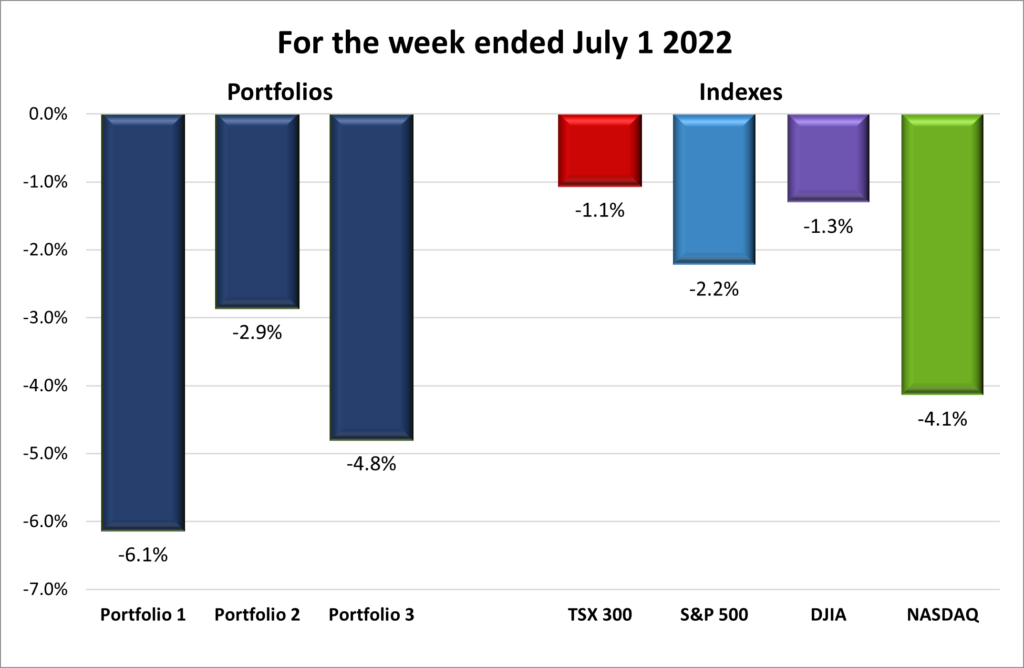
Weekly Portfolio & Index performance
Weekly Portfolio & Index performance for the week ended July 1, 2022.

Companies on the Radar

Currently, there is only one companies on the Radar List:

  • Amazon (NASD:AMZN): The leader in e-commerce sales, the leader in cloud services (Amazon Web Services), one of the top providers of streaming services through their Prime service; and they quietly have their finger in a number of other pies. I still must perform the Multibagger Analysis deep dive on Amazon but the share price has been beaten down so much its hard to ignore this opportunity.
  • Ferrari (NYSE:RACE): I was talking with Rob the web guy about cars we always wanted to own when I said I always wanted a Ferrari. As we continued to talk, it occurred to me that while owning an actual Ferrari was still a long way off, I could buy shares in the company and tell others that I am an owner of Ferrari. 😊 Like all other non energy sector, publicly traded companies in 2022, Ferrari’s share price has taken a tumble. I plan to run it through my Radar Check and go from there.

Portfolio Update

Portfolio 1

Portfolio 1 for the week ended July 1, 2022: DOWN Red Down Arrow

  • This week, Cruise became the first self-driving ride-hail service to receive a permit to charge for fully autonomous rides in San Francisco. Majority-owned by General Motors (NYSE:GM), Cruise is undercutting Uber’s prices by about 15%, though its rides are limited to 30 miles per hour (mph) during the night from 10pm to 6am.
    GM’s CEO, Mary Barra, has suggested that rides could cost less than $1 per mile in the long run, and former Cruise CEO, Dan Ammann, suggested the that its revenues could scale to $50 billion by 2030. To lower costs, we believe Cruise must increase its vehicle utilization rates, which will depend not only on a daytime permit but also on scaling autonomous car units to a level high enough to minimize passenger wait times.
  • Voyager Digital (TSX:VOYG) announced they were temporarily suspending all transactions (trades, deposits and most importantly, withdrawals) on their platform because of market conditions. Essentially, Voyager is having liquidity issues and cannot afford customers to withdraw their funds or fail to pay back loans. To that end, Voyager issued a notice of default to Three Arrows Capital (a hedge fund) for failure to make required loan payments. Voyager lent 15,250 Bitcoin at the then value of $324 million, plus $350 million in other cryptocurrencies. I am glad I never followed through on opening an account on Voyager but wish I had sold my shares in the company in 2021. ☹
  • Pinterest (NYSE:PINS) is getting a new Chief Executive Officer as the current CEO, Ben Silbermann, will be replaced by Google commerce veteran Bill Ready. Analysts suggest that with this change Pinterest will change its business model from being advertising oriented to e-commerce focused. If Pinterest can start to generate revenue anywhere close to Google parent Alphabet (NASD:GOOGL), I will be very happy. Very happy indeed!
  • Apple (NASD:AAPL) continues to update its CarPlay software. This time they will allow drivers to purchase gas directly from a screen in the car, avoiding the usual inserting or tapping of a credit card.
  • Lattice Semiconductor (NASD:LSCC) won another award. This time it was the Gold Vendor Award from VDC Research in the Processors category. It was the second consecutive win for Lattice in this category.

Activity

No significant activity to report this week.

Dividends

Dividends Received this week for the following companies:

Companies followed by DRIP (Dividend Re-Investment Plan) indicate additional shares were purchased with the dividend. Any cash leftover was added to the cash balance.

Canadian $

Shaw Communications Inc (TSX:SJR.B)

Canadian National Railway Co (TSX:CNR)

US $

No US$ dividends this past week.

Quarterly Reports

Shaw Communications Inc.

All currency listed in Canadian dollars

Selected highlights from their third quarter 2022 financial results on June 30, 2022

  • On a year-over-year basis, consolidated revenue decreased by 2.1% to $1.35 billion.
  • Net income decreased $151 million, 42.7%, to $203 million due to a revision to liabilities for uncertain tax positions that became statute barred in the prior year, which reduced income tax expense by $125 million and interest expense by $35 million. These decreases in net income were offset by higher adjusted EBITDA compared to a year ago and an $11 million decrease in non-operating costs related to the Rogers-Shaw Transaction.
  • Announced a divestiture agreement for the sale of Freedom Mobile to Quebecor to obtain regulatory approval for the merger with Roger Communications.

Portfolio 2

Portfolio 2 for the week ended July 1, 2022: DOWN Red Down Arrow

  • Telus (TSX:T) agrees to acquire 3 million shares of Telus International (TSX:TIXT) from for US$ 22 per share. In 2021, Telus spun off Telus International. With this purchase, Telus will control 56.17% of Telus International’s outstanding share. Combined with Telus’s 74.78% of Telus international’s outstanding multiple voting shares, Telus will now have control of 72.38% of the outstanding voting rights of Telus International.
  • Disney (NYSE:DIS) announced it plans to re-open its Shanghai Disneyland this week after a month-long lockdown of Shanghai. They also announced the launch of their latest cruise ship, The Wish. This is fifth cruise ship to join the Disney navy. According to Disney Chief Executive Officer Bob Chapek, Disney cruises provide the company with a double digit return on investment. Not bad. And there are two more ships scheduled to join the Disney navy in 2025.

Activity

No significant activity to report this week.

Dividends

Dividends Received this week for the following companies:

Companies followed by DRIP (Dividend Re-Investment Plan) indicate additional shares were purchased with the dividend. Any cash leftover was added to the cash balance.

Canadian $

Brookfield Infrastructure Partners LP (TSX:BIP.UN)

Brookfield Infrastructure Corp (TSX:BIPC)

US $

No US$ dividends this past week.

Quarterly Reports

Alimentation Couche-Tard Inc

View on: All currency listed in millions of US dollars

Selected highlights from their fourth quarter 2022 and fiscal year 2022 financial results on June 28, 2022

Highlights for the fourth quarter:

  • Revenue of $16,434 compared to $12,237 for the same period in 2021. Up 34.3%
  • Gross profit was $2.6 billion for the fourth quarter of fiscal 2022, up by $222.5 million or 9.5%, compared with the corresponding quarter of fiscal 2021, mainly attributable to higher road transportation fuel gross margins in the United States and Canada, improved merchandise and service gross margin, and organic growth in our convenience activities
  • Net earnings were $477.7 million compared with $563.9 million for the fourth quarter of fiscal 2021. Down 15.3%. The results for the fourth quarter of fiscal 2022 were affected by a pre-tax impairment loss of $56.2 million resulting from the deconsolidation and impairment of Russian subsidiaries, a pre-tax impairment loss of $33.7 million on our investment in Fire & Flower Holdings Corp., a pre-tax expense of $15.1 million due to a change in the accounting policy relating to cloud computing arrangements, a pre-tax net foreign exchange gain of $3.0 million, as well as pre-tax acquisition costs of $0.9 million.
  • Repurchased 5.8% of outstanding shares, reaching the Program’s authorized share repurchase limit.

Highlights for the fiscal year 2022:

  • Revenue of $62,809 compared to $45,760 for the same period in 2021. Up 37.3%
  • Gross profit increased by $889.5 million, or 8.8%, compared with fiscal 2021, mainly attributable to higher road transportation fuel gross margins in the United States and Canada, higher road transportation fuel demand, the contribution from acquisitions, improved merchandise and service gross margin, organic growth, and the net positive impact of approximately $44.0 million from the translation of our foreign currency operations into US dollars.
  • Net earnings of $477.7 compared to $2,683 in 2021. Down 0.8%.

Portfolio 3

Portfolio 3 for the week ended July 1, 2022: DOWN Red Down Arrow

  • Enghouse Systems Limited (TSX:ENGH) acquired Competella AB, a Swedish provider of SaaS and on-premises contact center and attendant console technologies. Competella, provides a Microsoft Teams based contact centre platform to the Scandinavian and Swiss markets.
  • A resolution has been put forward by large institutional investors (managing over $350 billion of assets) in Microsoft (NASD:MSFT) that the company publish financial and tax information for each country outside the US so investors can assess whether it is paying fair taxes and identify any risks posed by tax reforms.
  • Brookfield Asset Management (TSX:BAM.A) bought a 2.6% investment in AGL Energy just months after AGL rejected their A$5.4 billion ($3.7 billion) takeover bid. This makes Brookfield the number 4 shareholder.
  • goeasy Ltd. (TSX:GSY) announced a $40 million equity investment in Canada Drives, an online car shopping site, as part of a strategic growth plan to capture a growing share of the automotive financing market.

Activity

No significant activity to report this week.

Dividends

Dividends Received this week for the following companies:

Companies followed by DRIP (Dividend Re-Investment Plan) indicate additional shares were purchased with the dividend. Any cash leftover was added to the cash balance.

Canadian $

Brookfield Renewable Corp (TSX:BEPC)

Brookfield Asset Management Inc (TSX:BAM.A)

US $

No US$ dividends this past week.

Quarterly Reports

No quarterly reports this past week.
 

The week ending June 24, 2022

Inflation – what is it good for?

In the last few weeks, inflation has made its way from the Business section of the newspaper to the front pages. Almost weekly we hear the price of gas and groceries has gotten more and more expensive. The price of gas is up nearly 50% in the last year, 12 per cent alone in May. Most of the time we ignore the headline, until we need to get groceries or buy gas for our cars.

So, what exactly is inflation?

Glad you asked. Inflation is when the price of a product steadily increases while purchasing power decreases. The current cause is too many dollars (thanks to government subsidies during the Covid-19 pandemic, and too few places to spend your money) chasing too few goods (thanks to supply chain issues caused by the pandemic).

Typically, inflation increases about 2% per year. A little bit of inflation is good because it indicates a healthy, growing economy. However, inflation has nearly quadrupled in Canada and gone up more than fourfold in the USA. The previous week, the rate of inflation in the US rose to 8.6%. This past week, Canada reported its highest inflation rate in almost 40 years, at 7.7%. That means that the cash in your savings account will lose 7.7% of its value in 2022. For example, $100 on December 31, 2021, would have the buying power equivalent to $92.30 on December 21, 2022. Every time I fill up my car with gas, I can feel the result of inflation in my pocketbook. Every time I go to the grocery store, I see the effects of inflation as the same grocery list costs more than it did last year.

These higher than anticipated inflation numbers all but guarantee that the Bank of Canada will hike interest rates by 0.75% at its next meeting in July, in an attempt to get control of runaway inflation.

According to Reuters, it’s estimated the average Canadian saved C$ 8,300 over the last two years thanks to the Covid-19 pandemic. However, because of inflation, two-thirds of the buying power of that $8,300 has disappeared and some recipients are having to reach into the money they saved to pay for everyday essentials rather than saving the money for future needs.

Not only do your hard-earned dollars not go as far as they did in 2021 but inflation can also erode your investing gains. Inflation also impacts investing because the central banks, Bank of Canada, and US Federal Reserve, raise interest rates to get inflation down to the desired 2 – 3% range. When interest rates go up, it costs companies more to service their debt. Rather than spending money to service their debt, that money that could have been spent to grow the business, thus slowing down the growth of the company. This is especially true for high growth technology companies, like a few that are in any of my three Portfolios.

That is the short, laymen’s explanation of inflation. As long as you get the idea that inflation is a bad thing that impacts you both now (pushing up the cost of just about everything) and down the road (eating into your investments), then I got my point across. 😊

Now, lets take a look at the past week….

Weekly Market Review

Monday: A strong start to the week for the Toronto Stock Exchange Composite Index (TSX) as the Energy (higher oil prices) and Communications sectors had a good day. In the US, the S&P 500 Index (S&P), the Dow Jones Industrial Average (DJIA), and the Nasdaq Composite Index (Nasdaq) were all closed for Juneteenth.

Tuesday: The TSX put together a second day of gains on the strength of the Energy sector. The American Indexes joined in, with each Index posting a gain of greater than 2% and all eleven S&P sectors were up as investors picked up shares of the mega cap technology companies that were beaten down last week.

Wednesday: So much for a second consecutive day of gains in the stock markets with all four major North American Indexes falling back today. In Canada, inflation jumped to 7.7% in May, close to a 40-year high. It was largely fueled (pun intended) by rising oil prices which lead to higher gasoline prices. As a result of the higher-than-expected inflation rate, the Bank of Canada (BoC) is most likely to raise interest rates by 0.75%, possibly 1.0%, at their next meeting. The price of borrowing money in Canada is only going to get more expensive. Sigh! On the TSX, the Energy and Basic Materials sectors fell the most, dragging down the TSX.

In the US, the three US Indexes were up and down all day before ending the day just under the breakeven bar. The Energy and Basic Materials sectors were the worst performers in both Canada and the US.

Thursday: A good day for the American Indexes as all three rose, not such a good day for Canada’s TSX as it had closed at its lowest point since March 2021. The TSX was weighed down by the two sectors which had carried it for most of 2022 so far – Energy and Basic Materials. Both fell more than 5%. The Technology sector was the big winner on the TSX, gaining 4%.

It was a similar story in the US, with the Energy and Basic Materials the worst of the eleven sectors. However, that was offset by gains in the Healthcare, Utilities, Consumer Staples, and Technology sectors.

Friday: This week ended on a positive note as all four Indexes gained ground today. The TSX rebounded from yesterday’s lowest level since March 2021 thanks to the Technology and Healthcare sectors. Rising oil prices helped the TSX Energy sector end with a win after having a rough week.

In the US, it was a great day for all three Indexes as investors picked up some beaten down companies. All eleven sectors of the S&P posting gains of at least 1.5%, helping the S&P to its best single day since May 2020.

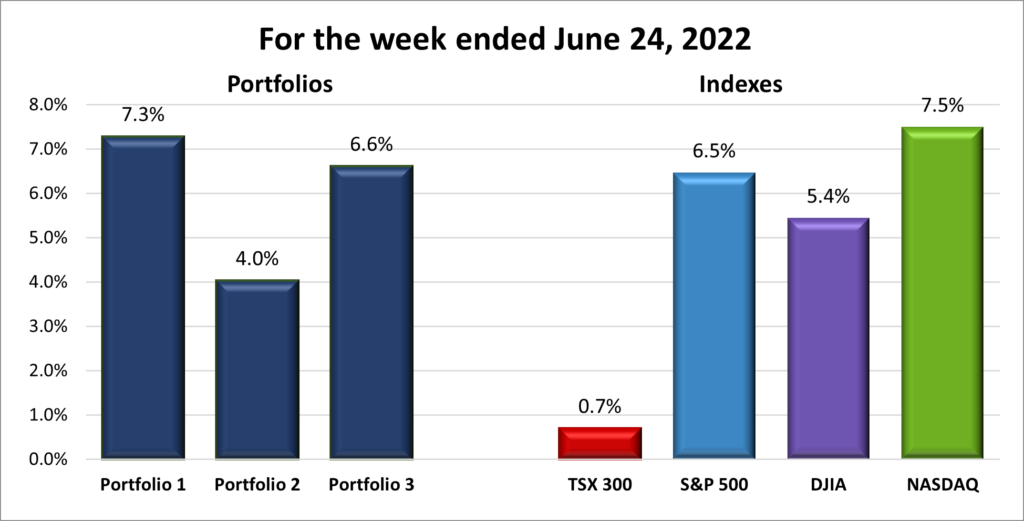
For the week, the TSX was up 0.7%, the S&P rose 6.5%, the DJIA gained 5.4%, and the Nasdaq jumped 7.5%.

Weekly Portfolio Review

I thought it would be another week of declines. Instead, it was gains across the board for the Indexes, with the American Indexes having a great week, especially the Nasdaq. In a reversal of what has been happening in 2022, the Energy (oil) and Basic Materials sectors (mining companies) are down over 6% for the week, while the Technology sector had a nice little bounce this past week. This is reflected in the resource heavy TSX up less than 1% for the week and the technology-oriented Nasdaq and S&P each up over 6.5%.

A strong week for the Nasdaq, generally means a good week for the Portfolios, and this past week was no exception. All three Portfolios rose at least 2% for the week on the strength of the various technology companies in the portfolios. I suspect this is a mini rally rather than a bottom has been reached and the market will continue to drift downward, especially as the July session of the US Federal Reserve approaches.

Weekly Portfolio & Index performance
Weekly Portfolio & Index performance for the week ended June 24, 2022.

Companies on the Radar

Currently, there is only one companies on the Radar List as I added Alvopetro Energy Ltd. (TSXV:ALV) to Portfolio 3:

  • Amazon (NASD:AMZN): The leader in e-commerce sales, the leader in cloud services (Amazon Web Services), one of the top providers of streaming services through their Prime service; and they quietly have their finger in a number of other pies. Amazon scored a 3 out of 10 from Thomson Reuters, and a 3 out of 3 (Strong Buy) from TD Direct Investing, for a 6 out of 13 score. Morningstar has a FVE of $169.33. With almost any other company I would stop and not spend any more time on this company. However, it is Amazon (currently trading at US$ 106.22), with a target price of US$ 178.66 for close to 70% upside, so Amazon will be moving on to the next stage – Multibagger Analysis.

Portfolio Update

Portfolio 1

Portfolio 1 for the week ended June 24, 2022: UP Green Up Arrow, signifying a positive week

  • Roku (NASD:ROKU) signed a deal with Walmart (NYSE:WMT) on a new advertising feature called “shoppable ads.” Viewers will be able to buy from Walmart directly from their television when using a Roku device. Payments will be processed through Roku Pay, their payments system. This adds another stream of revenue for Roku, and I suspect it will be the first of many deals of this nature.
  • Lattice Semiconductor (NASD:LSCC) won the Best-in-Show award in the Processor & IP category at the embedded world 2022 exhibition and conference. Lattice’s CertusPro-NX FPGAs ships are intended to “accelerate application development for the Communications, Compute, Industrial, Automotive, and Consumer markets.”
  • Crowdstrike (NASD:CRWD) has won SC Awards Europe 2022 Best Emerging Technology category for their CrowdStrike Falcon XDR (Extended Detection and Response) solution. The SC Awards Europe are for the best cybersecurity products and services.
  • On the heels of the US Supreme Court overturning Roe v Wade, Disney (NYSE:DIS) announced they would provide travel benefits for any employee that has to travel for abortion services.

Activity

No significant activity to report this week.

Dividends

Dividends Received this week for the following companies:

Companies followed by DRIP (Dividend Re-Investment Plan) indicate additional shares were purchased with the dividend. Any cash leftover was added to the cash balance.

No dividends this past week.

Quarterly Reports

No quarterly reports this past week.

Portfolio 2

Portfolio 2 for the week ended June 24, 2022: UP Green Up Arrow, signifying a positive week

  • On June 17, Rogers (TSX:RCI.B) announced they planned to sell Shaw’s (TSX:SJR.B) mobile division to Quebecor, Canada’s fourth largest mobile carrier. This deal will turn Quebecor from a largely provincial (Quebec) based carrier to one with a national footprint with customers in BC, Alberta, and Ontario. More importantly for Shaw shareholders like myself, it is a crucial step in obtaining regulatory approval for the merger with Rogers.
    On June 24, Rogers, Shaw, and the Canadian competition bureau agreed to enter meditation to resolve the antitrust concerns of the competition bureau. If all parties can come to an agreement, its likely the Rogers and Shaw merger will receive the greenlight from the competition bureau.

Activity

No significant activity to report this week.

Dividends

Dividends Received this week for the following companies:

Companies followed by DRIP (Dividend Re-Investment Plan) indicate additional shares were purchased with the dividend. Any cash leftover was added to the cash balance.

Canadian $

Dream Industrial Real Estate Investment Trust (TSX:DIR.UN) DRIP

US $

No US$ dividends this past week.

Quarterly Reports

No quarterly reports this past week.
Portfolio 3

Portfolio 3 for the week ended June 24, 2022: UP Green Up Arrow, signifying a positive week

  • At Shopify’s (TSX:SHOP) semi annual showcase of product updates, Shopify announced a partnership with Twitter to display products on user profiles to facilitate sales through Twitter and other social media; synchronize a merchants’ local inventory with Google to let nearby customers know when products are available in store; and, they will offer merchants a tap to pay service that allows merchants the ability to process transactions through their iPhone (sounds like what Square, er, Block (NYSE:SQ) has been doing for a while now)

Activity

Bought

Alvopetro Energy Ltd.: A Canadian oil and natural gas company, developing assets in Brazil. I like that the company has:

  • Seasoned management with experience in Brazil.
  • The Energy sector is riding the energy tailwind so there is demand for their product.
  • A Return on Invested Capital over 23%
  • A 5+% dividend.

Dividends

Dividends Received this week for the following companies:

Companies followed by DRIP (Dividend Re-Investment Plan) indicate additional shares were purchased with the dividend. Any cash leftover was added to the cash balance.

No dividends this past week.

Quarterly Reports

No quarterly reports this past week.
 

The week ending June 17, 2022

You would think a combination of a surging economy, low unemployment, strong corporate earnings, and people with money in their pockets would be enough to calm an unnerved market. You would be wrong! Inflation and the fight to drive inflation back to the desired 2% – 3% level continues to send the markets into a tailspin. Look what happened this week. To start the week, there was a sharp drop in the markets from the fallout of Friday’s higher than expected inflation rate of 8.6%. In an effort to knock inflation back down to the target range, the US Federal Reserve announced an interest rate of hike of 0.75% and suggested they were prepared to be just as aggressive at their next session in July, and again September. Just to show this is not an American issue, the Bank of Canada is now making noises about a possible 0.75% increase at their next session. So much for the days of cheap money and high-flying growth stocks.

Rather than dwelling on something we have no control over, lets get to the fourth installment of my investing process. For the last three weeks, I have been discussing my process for identifying companies I would like to own – a 4-stage process to quickly eliminate companies from consideration as I work my way through the process. These stages are:

The previous three weeks I explained stages 1, 2 and 3 of my 4-part process. I put companies through an initial 5-minute, high level look at a company (Radar Check). If the company passes the Radar Check, the company moves on to a much deeper analysis to see if it is capable of doubling in value multiple times (Multibagger Analysis). If the company passes this stage, I next look at the cold hard numbers to back up the story told by the previous two stages (Financial Analysis). In the fourth and final stage, I put it all together on the ‘Scorecard’ spreadsheet, the subject of this week’s commentary.

Scorecard

There is not much to this stage as the Scorecard gathers selected results from the three previous stages and consolidates them in one location. On this one spreadsheet, I can see from the Radar Check how professionals (Morningstar, Thomson – Reuters, and TD Direct Investing) view the company; the company’s score on the Multibagger Analysis from stage 2; selected financial metrics from Stage 3; and the company’s current share price.

I also list my interest in the company on a scale of 1 – 5, where higher is better. In other words, how much do I really like this company? I also give a Conviction score of 1 – 5, where higher is better. How confident am I that the company will succeed in disrupting its market and/or becoming a market leader? For example, I liked everything about Rivian (NASD:RIVN), giving it a 5 for interest, but gave it a score of 2 for conviction given the amount of new and established competition in the electric vehicle market.

At this point, I have a good feel for the company, its products, its customers, competition, management, competitive advantage (moat), selected financial information, as well as my level of interest and conviction in the company. It is unlikely that I will rush out and buy a tiny piece of the company but if a terrific opportunity presents itself, I will have the knowledge to act.

Finally, like in Stage 2 and 3, I keep all the companies I analyze so I can compare apples to apples. Its better to compare Rivian to other car makers like Tesla (NASD:TSLA) and GM (NYSE:GM) than to a technology company like Shopify (TSX:SHOP) or a shipping company like ZIM Marine Shipping (NYSE:ZIM).

It took a few months and numerous checklist I read about online and in books to produce the current iteration and I am already getting ideas how I can improve or adapt the system as my choice of companies evolves. While I was keen on high growth companies in 2020, this year has taught me that high growth companies have a painful downside.

The point of my system was to create an objective system that would remove the emotion from selecting companies. With the four-stage system I can quickly filter out companies that do not meet my desired criteria. As soon as I find something I do not like – from a product, to management, to lack of competitive advantage – I stop and move on. And there you have it. If you would like to know more, drop a comment below. In the meantime, lets take a look at one of the worst weeks for the stock markets in 2 years.

Weekly Market Review

Monday: Well, this was a particularly painful way to start the week, with all four major North American Indexes (the Toronto Stock Exchange Composite Index (TSX), the S&P 500 Index (S&P), the Dow Jones Industrial Average (DJIA), and the Nasdaq Composite Index (Nasdaq)) down over 2%. Last Friday’s higher than expected inflation report has investors awaiting the US Federal Reserve’s (Fed) rate hike. The market is anticipating a 0.5% hike. Investors are also anxiously awaiting clues to the size (possibly a 0.75% hike) and timing of future rate hikes.

In Canada, the TSX booked its fourth consecutive losing day, putting it officially in a market correction (down more than 10% from its high in March). The Basic Materials and Technology sectors fell the hardest. 4.8% and 3.6%, respectively. TSX investors are concerned about interest rate hikes by the Bank of Canada (BoC) of 0.75% at their next meeting in July, and by the US Fed later this week.

In the US, investors bailed out of the US markets on fears of impending rate hikes, sending the S&P back into a bear market (down over 20% since its all time high). Of the 504 companies that make up the S&P 500 Index, only five of them finished the day in the black. That is a broad-based sell off! Technology companies bore the brunt of the market meltdown with the Nasdaq dropping 4.65% for a two-day drop of 10%. For 2022, the Nasdaq is down over 30%. While falling 800+ points sounds bad, the DJIA fell the least dropping 2.8%. I hope Tuesday is a lot better, but I do not expect much upward movement until after Wednesday’s US Fed interest rate announcement.

Tuesday: The losing streak almost hit three days but was broken by the unlikeliest Index. The Nasdaq was able to scratch out a minor gain while the other three Indexes fell for a third consecutive day.

In Canada, the TSX fell to its lowest level since May 2021. The Industrials sector was the only Canadian sector to post a gain, while the Utilities and Telecommunications sector dropped the most.

In America, both the S&P and the DJIA continued their losing streak as investors wait to hear from the US Fed about the upcoming interest rate increase. Investors are expecting a 0.5% increase, but a 0.75% increase is not out of the question after last Friday’s higher than expected inflation number. A 0.75% increase will not be good for technology and growth stocks, but a surprise higher increase or more aggressive stance from the Fed will be send the Indexes sharply downward.

Wednesday: The big news of the day was the US Fed raised interest rates 0.75%, the largest increase since 1994, bringing the US interest rate to 1.75%. Just as important, they signalled they were likely at their July session. I was surprised to see the market place not only did not suffer a sharp drop, but all four Indexes finished the day in the black, led by the Nasdaq with a 2.5% gain and the TSX bringing up the rear with a 0.32% improvement. I guess investors were pleased to see the Fed taking aggressive measures to get inflation under control. It will take time for the effects of higher interest rates to take effect but there will be pain along the way as more cash will be required to service debts. For companies, long term debt will become more expensive. For individuals, mortgages, lines of credit, loans and other types of personal debt will require more cash.

In Canada, the Fed’s increase all but provides a green light for the BoC to increase the Canadian interest rates by another 0.75%. On the TSX, the Technology and Consumer Cyclical sectors pulled the Index higher, offsetting the drag of the Energy sector which fell on rumours of lower demand for oil.

In the US, once the Fed announced the rate hike all three US Indexes headed higher, led by the Technology and Consumer Cyclical sectors.

Thursday: I was not surprised to see Wednesday’s euphoria over the interest rate hike slam head on into the realization the money is getting more expensive to borrow. All four Indexes fell hard today with the DJIA doing the ‘best’ and only losing 2.4%.

In Canada, all the Canadian sectors lost ground, with Energy falling over 4.6% and Technology and Consumer Cyclical not far behind. In the US, it was a broad selloff as all 11 S&P sectors dropped with Energy, Consumer Cyclical, and Technology falling the farthest.

Friday: It was the worst week in the stock markets since the pandemic meltdown in March 2020 thanks to the US Fed upping interest rates in an effort to tame inflation in the US. The TSX had its biggest weekly drop since March 2020 and the S&P 500 officially hit bear-market territory (a fall of 20%+ from recent highs thanks to its worst week since March 2020). With this broad-based sell off even bringing down well performing companies, now is a good time to be a buyer.

In Canada, a drop in the price of oil caused a fall Energy sector. The overall drop of the TSX was limited thanks to gains in the technology and Consumer Cyclical sectors. South of the border, the S&P and Nasdaq had slight rebound today but was not enough to prevent them from joining the DJIA with a third straight weekly loss. Of the eleven S&P sectors, the Communications and Consumer Cyclicals had slight gains while the Energy had the biggest drop.

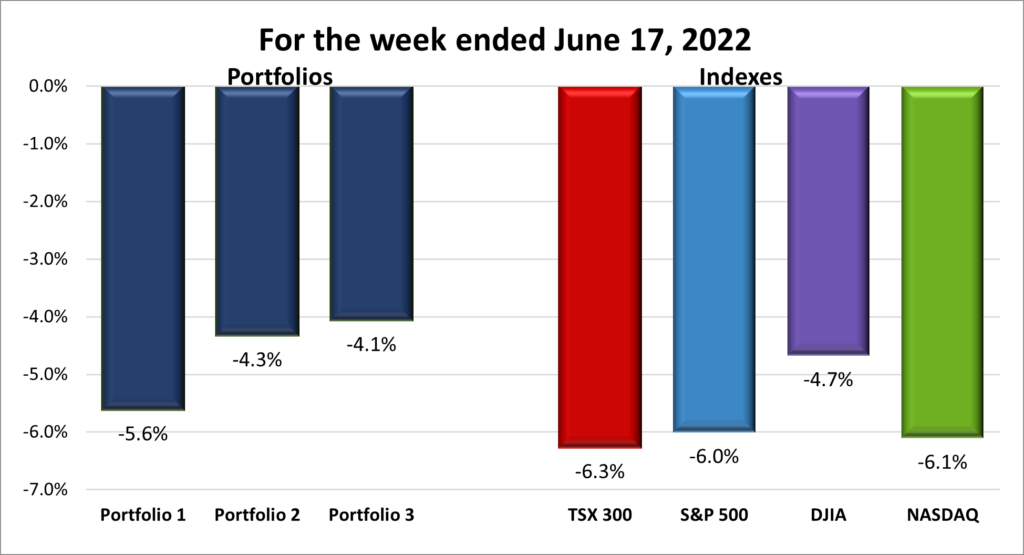
For the week, the TSX was down 6.6%, the S&P fell 5.79%, the DJIA dropped 4.79%, and the Nasdaq declined 4.78%.

Weekly Portfolio Review

Going into this week, the S&P was in a historic slump, having fallen in nine out of the past ten weeks for the third time since 1980. Make that ten of the past eleven. With inflation showing no signs of falling, the central banks, Bank of Canada, and the US Federal Reserve, continued to raise interest rates to fight inflation in their respective countries. This past week the US Federal Reserve took the gloves off and raised rates by 0.75% for the first time in 28 years and suggested they would do it again if inflation does not cool off.

The higher interest rates caused all four Indexes to fall sharply this past week. Naturally if the Indexes decline the Portfolios cannot help but be lower at the end of the week. The good news is Portfolios 2 and 3 were the best performers of the three Portfolios and the four Indexes. Portfolio 1 just missed outperforming all four Indexes and making it a clean sweep for the Portfolios as the best performers.

Unfortunately, being the best of a bad lot does not mean any of the Portfolios increased in value. Instead, it was another week of losses across the board. I am really getting tired of seeing the Portfolios shrinking in value week after week, but I think we are in for more of the same at least until the next session of the US Federal Reserve in July.

Weekly Portfolio & Index performance
Weekly Portfolio & Index performance for the week ended June 17, 2022.

Companies on the Radar

Currently, there are only two companies on the Radar List:

  • Alvopetro Energy Ltd.: (TSXV:ALV) A Canadian oil and natural gas company, developing assets in Brazil. On my Radar Check, Alvopetro scored a 10 out of 10 from Thomson Reuters, and a 2 out of 3 (Buy) from TD Direct Investing, for a 12 out of 13 score. Morningstar has a Fair value Estimate (FVE) of $18.67. This company will be moving on to the next stage – Multibagger Analysis.
  • Amazon (NASD:AMZN): The leader in e-commerce sales, the leader in cloud services (Amazon Web Services), one of the top providers of streaming services through their Prime service; and they quietly have their finger in a number of other pies. Amazon scored a 3 out of 10 from Thomson Reuters, and a 3 out of 3 (Strong Buy) from TD Direct Investing, for a 6 out of 13 score. Morningstar has a FVE of $169.33. With almost any other company I would stop and not spend any more time on this company. However, it is Amazon (currently trading at US$ 106.22), with a target price of US$ 178.66 for close to 70% upside, so Amazon will be moving on to the next stage – Multibagger Analysis.

Portfolio Update

Portfolio 1

Portfolio 1 for the week ended June 17, 2022: DOWN Red Down Arrow

  • Apple (NASD:AAPL) is expected to grow their revenue from gaming and music to US$ 8.2 million by 2025, a gain of 36%. Its good to see Apple use its huge user base to find another source of revenues. If the rumoured augmented reality headsets sell half as well as the revolutionary iPhone, Apple should be in decent shape until the rumoured iCar becomes more than a rumour. 😊
  • Pinterest (NASD:PINS) signed deal with Tastemade, a social media firm, to create TV shows, live videos, and events to be accessed on Pinterest.
  • Tesla announced they would be raising the price of their vehicles due to the rising cost of raw materials needed in their cars. Even Tesla has fallen victim to supply chain challenges.

Activity

No significant activity to report this week.

Dividends

Dividends Received this week for the following companies:

Companies followed by DRIP (Dividend Re-Investment Plan) indicate additional shares were purchased with the dividend. Any cash leftover was added to the cash balance.

Canadian $

Automotive Properties Real Estate Investment Trust (TSX:APR.UN) DRIP

Yellow Pages Ltd (TSX:Y)

US $

Skyworks Solutions Inc (NASDAQ:SWKS)

BSR Real Estate Investment Trust (TSX:HOM.U)

Home Depot Inc (NYSE:HD)

Quarterly Reports

No quarterly reports this past week.
Portfolio 2

Portfolio 2 for the week ended June 17, 2022: DOWN Red Down Arrow

  • Guardant Health (NASD:GH) announced it has bought the remaining shares of Guardant Health AMEA, Inc., from SoftBank Vision Fund, its original partner in the joint venture. Guardant now has full control of Guardant Health AMEA which will allow Guardant to accelerate the rollout of its various cancer tests in the Asia, Middle East, and Africa region (AMEA).
  • I missed an announcement in May by Brookfield Infrastructure Partners LP (TSX:BIP.UN) that they had authorized a three-for-two split for both itself and Brookfield Infrastructure Corp (TSX:BIPC). Those transactions were completed this past week. According to the Board of Directors, the purpose of the split was for the units to “remain accessible to individual unitholders and further enhance their liquidity.”
  • Telus (TSX:T) has acquired Lifeworks and will fold it into their Telus Health unit. Lifeworks specializes in mental health services. Telus Health is seeing an increase in the need for mental health services by employers and Telus is looking to fill that need.

Activity

No significant activity to report this week.

Dividends

Dividends Received this week for the following companies:

Companies followed by DRIP (Dividend Re-Investment Plan) indicate additional shares were purchased with the dividend. Any cash leftover was added to the cash balance.

Canadian $

Summit Industrial Income REIT (TSX:SMU.UN)

iA Financial Corporation Inc (TSX:IAG)

US $

No US$ dividends this past week.

Quarterly Reports

No quarterly reports this past week.

Portfolio 3

Portfolio 3 for the week ended June 17, 2022: DOWN Red Down Arrow

  • Funds managed by Brookfield Asset Management’s (TSX:BAM.A) were the beneficiary of a merger between two Brazilian car rental companies. For the merger to go forward, the Brazilian antitrust regulator demanded the companies divest assets to avoid dominating the Brazilian market. Brookfield was able to scoop up 49,000 rental and used cars for C$ 715.6 million, an average of C$ 14,600. That sounds like a good deal, but I would need to know the models involved, the mileage and condition of the vehicles before I could say for sure.
  • Despite the market turmoil, Microsoft (NASD:MSFT) maintained their quarterly dividend at US$ 0.62 a share, payable Sept. 8 to shareholders of record on Aug. 18.
  • TD Bank (TSX:TD) is jumping onto the buy now, pay later bandwagon with the introduction of a new buy now, pay later feature available with TD credit cards. TD cardholders can elect to pay off their TD credit card purchases over C$100 in equal monthly payments spread out over 6-, 12- or 18-month terms.

Activity

No significant activity to report this week.

Dividends

Dividends Received this week for the following companies:

Companies followed by DRIP (Dividend Re-Investment Plan) indicate additional shares were purchased with the dividend. Any cash leftover was added to the cash balance.

No dividends this past week.

Quarterly Reports

No quarterly reports this past week.


The week ending June 10, 2022

For the last few months, I have been trying to ignore the share price fluctuations, er, downwards trend, and instead, focus on the companies I own. Sometimes that is easier said than done. This week is no exception. It was almost like shooting fish in a barrel when it came to selecting technology companies in 2020 -2021 (much like it was in the late 1990s). However, 2022 has been a whole different investing environment. Now is when doing your homework is more important than ever. Performing due diligence is key to identifying the companies that can survive this downturn and thrive when the markets turn around. In that vein ….

…. Its time for another discussion of the process I follow when researching companies. 😊

The last two weeks, I have been discussing my process for identifying companies I would like to own, even though it would be a very, very, small piece of the company. To that end, I have created a 4-stage process to quickly eliminate companies from consideration as I work my way through the process. These stages are:

The previous 2 weeks I explained stages 1 and 2 of my 4-part process. This is where companies go through an initial 5-minute, high level look at a company (Radar Check). If the company passes the Radar Check, the company moves on to a much deeper analysis (Multibagger Analysis). If the company passes this stage, I am confident in the company, but I want to take a look at the numbers to verify my impression of the company and identify any areas of concern. This stage is called Financial Analysis (sorry, no fancy name like in the previous two stages) and is what I am going to describe this week.

Financial Analysis

Before your eyes start to glaze over at the mention of financial analysis, hear me out. This is probably the fastest section to complete of the entire process. I am not a numbers person, but I realize they have value. It is easy to tell a good story, but numbers do not lie. After getting familiar with a company from the previous two stages, I am expecting to see numbers consistent with the story. If I do not see the numbers I expect, this raises a yellow flag. I will take a quick look to see if I can figure out why the discrepancy but if I cannot determine why the numbers do not match my impression, I will consider the company as either ‘too hard’ or ‘suspicious.’ Either way, I will move on to another company.

As with the previous two stages, I use an Excel spreadsheet. On the left of the spreadsheet is the data entry section and on the right are the numerous calculations (15 to be exact) that I created. Currently, I have all the financial information I want, but if I come across another useful financial metric, I would build the formula in the Calculations side of the spreadsheet. If the required data is not already collected in the Data section, I would insert a column in the Data section to collect the necessary information to complete the calculation. The calculations are fairly straightforward, they can be found on various websites, then it is just a matter of creating the formulas in Excel.

Data section

For this section, I get the information from either Microsoft or Yahoo! Finance. The data supplied by Microsoft is automatically generated thanks to Excel’s built in Stocks data type which is linked to an online data source (Refinitiv). Using this data saves me from having to manually enter it and constantly updating it.

The data I get from Yahoo! Finance I must look up and enter manually. The bulk of the information can be found under the Financials tab, with the numbers in the Income Statement, Balance Sheet, or Cash Flow statements. Other information from Yahoo! Finance can be found under the Analysis, Statistics, and Summary tabs. I have organized the columns so I all information from one section is together, then I move to the next section and collect all the information from that page before moving to the next section. It is tedious but it only takes a few minutes to collect all the information for a company.

Calculations section

All the work was done creating the formulas back when I originally created this spreadsheet so there is not much, if anything, to do in this section. Once all the data has been entered, all the calculations occur automatically, and I have all the information I need.

At this point I do a quick review of the numbers to see if anything odd has shown up, such as a typo when I was entering the data. If any mistakes occurred, I correct them and then I am done.


A lot of the information can be found on various web sites, but I chose to perform the calculations for myself for a few reasons. First, I felt if I did the calculations myself, I would better understand the numbers and how they were related. If I just saw the result, I would not learn how the different pieces of information were related. Second, now that the all the formulas are created, its faster for me to go to Yahoo! Finance and enter the numbers rather than visiting numerous sites to find the information, especially for companies that are only listed on the Toronto Stock Exchange. Finally, it gave me chance to utilize my Excel skills (which had gone rusty) 😊.

If you are a numbers person, then check out the numbers of companies you are interested in to see if the company’s ‘story’ matches with what the numbers are telling you. Either build your own spreadsheet or check the numbers at Yahoo! Finance, MSN Money, or Google Finance. If you are not a numbers person, do not worry about it. However, you should at least be aware of the company’s revenues (sales) and net income (you want them improving, or at least an explanation why they are not), as well as their Cash & Cash Equivalents (the more the better) and long-term debt (the less the better). The more debt, the more cash required to service that debt, therefore less cash to grow the company or pay you a dividend.

That is it for financial analysis. If you made it this far, thank you! 😊 Next week, I will go over the final stage of my process. For now, lets take a look at what happened this past week in the markets and the Portfolios…

Weekly Market Review

Monday: A good day as all four major North American Indexes made it into the black, but barely. In Canada, the Toronto Stock Exchange Composite Index (TSX), was dragged upward by the Technology and Energy sectors.

In the US, the big news was Amazon (NASD:AMZN) splitting their shares 20 for 1, sparking a surge in mega cap companies. The mega cap rally lifted the S&P 500 Index (S&P) and the Nasdaq Composite Index (Nasdaq). The Dow Jones Industrial Average (DJIA) had a late afternoon rally to complete the sweep of Indexes ending the day in positive territory.

Tuesday: With a second consecutive day with all four Indexes finishing higher, a streak has begun, but how long will it last. And which Index will be the first to falter?

All four Indexes were led upward by the Energy (oil prices rose again) and the Technology sector. In Canada, Shopify’s (TSX:SHOP) rise drove the Technology sector, while the gain of mega cap companies drove the Technology sector on the US Indexes.

Wednesday: The winning streak ended today with all four Indexes falling back. The TSX was led lower by the Financial and Technology sectors. In the US, it was a broad-based selloff as only the S&P Energy sector ended the day higher. It appears that investors got the jitters in anticipation of the release of US consumer price index on Friday. If the data shows inflation has creeped higher, it all but guarantees a 0.5% interest rate hike later in June, followed by similar interest rate hikes in July and September. As you know, higher interest rates do not bode well for technology and other growth stocks.

Thursday: The spectre of looming interest rate increases in both Canada and the US dragged all four Indexes lower today. Of the Canadian sectors, only the Utilities sector posted a gain, a meager one at that. In the US, all the S&P sectors declined as investors await the release of the US consumer price report on Friday.

Friday: Inflation in the US hit a 40 year – 8.6%, all but guaranteeing a summer of aggressive interest rate hikes. The inflation rate was higher than expected so naturally this sent the stock markets into a sharp decline. The resource heavy TSX was the ‘best’ of the four Indexes, only falling 1.4%. The technology heavy Nasdaq and S&P bore the brunt of todays news, the falling 3.75% and 2.91%, respectively. The DJIA’s ‘only’ fell 2.73%.

In Canada, the Technology sector fell the hardest as higher interest rates reduce the future cash flows that high growth, technology companies are expected to generate.

In the US it was a similar story, the technology and other high growth companies took it in on the chin thanks to the higher-than-expected rise in inflation. After another bad week, the S&P 500 is down 18.2% for the year so far and the Nasdaq is down about 25%.

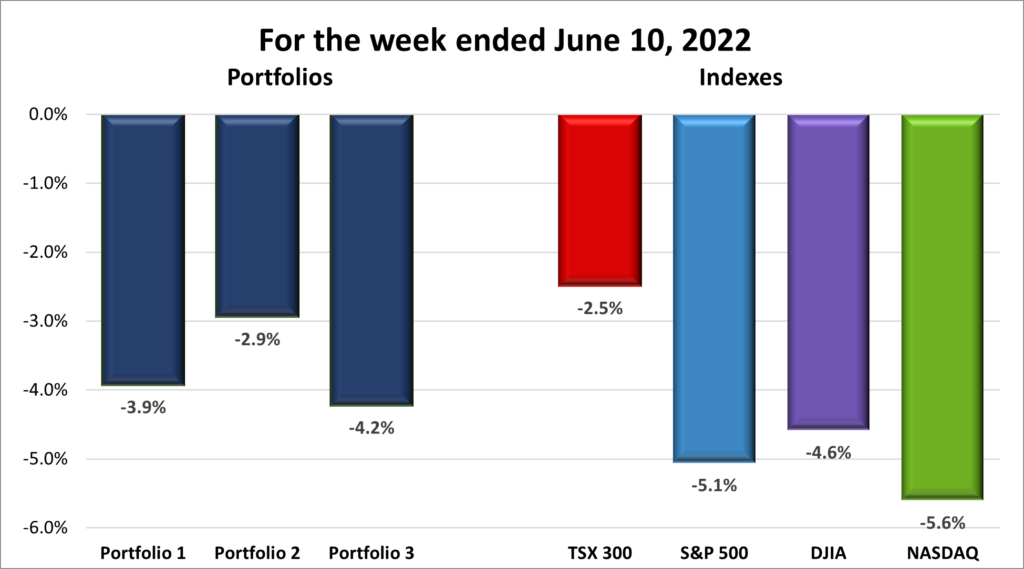
For the week, the TSX was down 2.5%, the S&P fell 5.6%, the DJIA dropped 4.58%, and the Nasdaq declined 5.60%.

Weekly Portfolio Review

The week started off innocently enough with 2 days of modest gains for all four Indexes. Followed by 2 days of a minor pullback in anticipation of the American Consumer Price Index Report (CPI) on Friday. Then the wheels fell off. The CPI was higher than expected and the markets do not like surprises, especially bad news. This bad news turned what was looking like an essentially treading water week for the Indexes into a week of losses.

If the Indexes are down, there is a good chance the Portfolios are down. If the Indexes drop considerably, like this past week, it is all but guaranteed the Portfolios fell. And fall they did. The only bright spot I can take away is all three Portfolios had a better week than the US Indexes. A shallow victory, but I will take it.

Barring a major decline in the June inflation rate, I am expecting the Indexes and the Portfolios to have another tough few months. Both the Bank of Canada and the US Federal Reserve have all but guaranteed they will raise interest rates at least 0.5% a few times over the coming months, with talk the Bank of Canada might crank rates up 0.75%. It should be an interesting, if not painful, summer.

Weekly Portfolio & Index performance
Weekly Portfolio & Index performance for the week ended June 10, 2022.

Companies on the Radar

In previous weeks, the Radar list has drifted from my original intention of a list of companies that caught my eye, for one reason or another. It has gradually transformed into a list of companies I would be interested in buying if I had the money. Not only has the intent changed, but because I do not have any spare cash this list became stagnant. I have reverted to the original purpose of the radar List: a tight list of companies that have recently caught my eye. These companies could be completely new to me; companies I am familiar with and do not own but have suddenly become accessible (share price is within my reach); or currently owned companies that are selling at a great discount for no good reason. Currently, there are only two companies on the Radar List:

  • Alvopetro Energy Ltd.: (TSXV:ALV) A Canadian oil and natural gas company, developing assets in Brazil. There is a huge global demand for oil and natural gas and Alvopetro is riding this tailwind. In addition, the company is paying a 5% dividend.
  • Amazon: They are the leader in e-commerce sales, the leader in cloud services (Amazon Web Services), one of the top providers of streaming services through their Prime service; and they quietly have their finger in a number of other pies. Thanks to their recent stock spit (20:1), Amazon is more accessible to retail investors (like me), and they are once again on my radar.

Portfolio Update

Portfolio 1

Portfolio 1 highlights for the week ended June 10, 2022: DOWN Red Down Arrow

  • In an unusual move, despite strong and growing demand for electric vehicles, GM (NYSE:GM) is lowering the price of its Chevy Bolt electric vehicles. However, there is a method to their madness. GM is trying to get a bigger share of the growing electric vehicle market with these entry level cars while it increases production of newer, higher end models. The hope must be car buyers will think GM, as well as Tesla (NASD:TSLA), when considering an electric vehicle. In other GM news, GM’s self driving division Cruise, received commercial approval for its robotaxi service in San Francisco.
  • This past week was Apple’s (NASD:AAPL) Worldwide Developers Conference. They introduced several new products, and announced a buy now pay later service that will be fully integrated into their Apple Pay service. This new service will be part of the upcoming iOS 16 update. As well, its rumoured that the company that sparked smartphone boom is reportedly nearing the launch of its first augmented reality headset. Both from a personal level and financial level, I am interested to see this new headset and the reaction to an Apple augmented reality headset. If it turns out to be another game changer like the iPhone, Apple stock should get a nice bump. 😊
  • In other Apple news, the European Union settled on a single charging port for cell phones, tablets, and cameras by 2024. That port will be a USB-C, meaning Apple will have to either have one charging port for Europe (USB-C) and one for the rest of the world (their current Lightening port) or completely switch to USB-C. After having a few different cell phones over the years, it will be great to finally have 1 universal charging port rather than having to buy a new set of accessories every time Apple has ‘a better way’.
  • Docebo (TSX:DCBO) and WELL health technologies (TSX:WELL) will be among 6 companies removed from the S&P/TSX Composite Index effective June 20, 2022. These changes were a result of a quarterly review of the companies in the Index. Of the 6 incoming companies, 5 will be from the Energy and Basic Materials sectors. These changes should not be a surprise given the weakness in technology companies and strength in energy and mining companies. I look forward to when technology companies replace energy and mining companies. 😊
  • The investigation into Tesla’s Autopilot (advanced driver assistance system) has moved to the next stage, an engineering analysis. This step is required before the National Highway Traffic Safety Administration can request a recall of Tesla vehicles with Autopilot installed.

Activity

No significant activity to report this week.

Dividends

Dividends Received this week for the following companies:

Companies followed by DRIP (Dividend Re-Investment Plan) indicate additional shares were purchased with the dividend. Any cash leftover was added to the cash balance.

Canadian $

No C$ dividends this past week.

US $

ZIM Integrated Shipping Services Ltd (NYSE:ZIM)

Quarterly Reports

DocuSign, Inc.

All currency listed in US dollars

Selected highlights from their first quarter 2023 financial results on June 9, 2022

  • Revenue was $588.7 million, an increase of 25% year-over-year.
  • Gross margin was 78% for first quarter 2023 and 2022.
  • Net loss per basic and diluted share was $0.14 on 200 million shares outstanding compared to $0.04 on 194 million shares outstanding in the same period last year.
  • Net cash provided by operating activities was $196.3 million compared to $135.6 million in the same period last year.
  • Free cash flow was $174.6 million compared to $123.0 million in the same period last year.
  • Cash, cash equivalents, restricted cash and investments were $1,063.8 million at the end of the quarter.
  • Added nearly 67,000 new customers, bringing the total global customer base to 1.24 million.

Portfolio 2

Portfolio 2 highlights for the week ended June 10, 2022: DOWN Red Down Arrow

  • Disney (NYSE:DIS) launched its streaming service Disney+ in the largely untapped Middle East and North Africa.

Activity

No significant activity to report this week.

Dividends

Dividends Received this week for the following companies:

Companies followed by DRIP (Dividend Re-Investment Plan) indicate additional shares were purchased with the dividend. Any cash leftover was added to the cash balance.

Canadian $

No C$ dividends this past week.

US $

Microsoft (NASD:MSFT)

Quarterly Reports

No quarterly reports this past week.

Portfolio 3

Portfolio 3 highlights for the week ended June 10, 2022: DOWN Red Down Arrow

  • Shopify shareholders voted in favor of giving Chief Executive Officer Tobias Lutke a Founders share, ensuring he will retain a 40% voting stake and effective control of the company until he leaves Shopify. Shares of Shopify jumped 5.3% upon release of this news.
  • Enghouse Systems (TSX:ENGH) took a major hit on Wednesday, falling 20%, after a less than impressive earnings reports. Top line (revenues) and bottom line (net income) were both lower than 2021 numbers. Not a good sign at all!

Activity

No significant activity to report this week.

Dividends

Dividends Received this week for the following companies:

Companies followed by DRIP (Dividend Re-Investment Plan) indicate additional shares were purchased with the dividend. Any cash leftover was added to the cash balance.

Canadian $

No C$ dividends this past week.

US $

Microsoft (NASD:MSFT)

Quarterly Reports

Enghouse Systems Ltd

All currency listed in CAD dollars

Selected highlights from their second quarter 2022 financial results on June 7, 2022

For the three and six months ended April 30, 2022, compared to the three and six months ended April 30, 2021, are as follows:

  • Revenue achieved was $106.3 and $217.4 million, respectively, compared to revenue of $117.3 and $236.4 million.
  • Results from operating activities was $31.1 and $66.8 million, respectively, compared to $36.9 and $77.6 million.
  • Net income was $17.9 and $39.5 million, respectively, compared to $20.7 and $41.4 million.
  • Ended the second quarter with $231.2 million in cash, cash equivalents, and short-term investments with no external debt.


The week ending June 3, 2022

Last week, I started discussing my process for identifying companies I would like to own, albeit a very, very, small piece of the company. I created a 4-stage process to eliminate companies from consideration relatively quickly while going through the process. These stages of the process are:

Last week I described Stage 1 – Radar Check. This is where companies that come to my attention, or get on my radar, are put through a 5-minute, high level look at a company. If the company still looks good after the Radar Check, the company moves on to this week’s topic – Stage 2 – Multibagger Analysis.

Multibagger Analysis

The term ‘multibagger’ originated with one of the best investors of all time – Peter Lynch – where each ‘bag’ symbolizes a 100% increase of your original investment. For example, a one bagger is doubling your original investment, while a five bagger would be 5 times your original investment. The more bags, the better and I want as many multibaggers as possible. 😊

My Multibagger Analysis (MA) is designed to find high growth companies that are utilizing technology to grow their revenues and earnings. The MA provides me with a better understanding of a company’s products, customers, management, culture, and a few financial metrics. There are four steps in this Stage:

  1. Quick Test
  2. Deep Dive
  3. Gut Check
  4. The Numbers

If a company does not score well in any step, I do not bother going further with my analysis. If the company meets or exceeds the threshold for that section, I proceed to the next step. For example, if a company scores low on the Quick Test, I do not go any further. However, if it meets or exceeds my threshold I proceed to the Deep Dive. The same process occurs going from the Deep Dive to the Gut Check, and from the Gut Check to The Numbers.

Note: It is important to compare apples to apples when comparing scores for both the Quick Test section and the Deep Dive section. For example, since my tests are weighted to prefer growth companies, a high growth technology company like Apple (NASD:AAPL) will score much higher than a mature, slow but steady, dividend paying company like CN Rail (TSX:CNR). For this reason, I complete steps 1 and 2 so I have several relevant companies to compare scores against.

The information I look for is available from the company’s corporate website and can typically be found in the About section, and the Investor Relations section where you can find investor presentations, financial statements, and Information Circulars for companies on the Toronto Stock Exchange or Proxy Statements for companies on the New York Stock Exchange or Nasdaq Stock Exchange. Financial numbers and metrics can also be found in the research section of my TD Direct Investing account, as well as Yahoo Finance.

So, without further ado, lets look at the steps in the Multibagger Analysis.

Quick Test

The Quick Test is a 10-question subset of the Deep Dive and is designed to get more of a feel for the company than the Radar Check. I am looking for: founder led or visionary leadership, such as Apple; are their sales and earnings per share growing; a return on capital of more than 15%; market size; do people enjoy working there (company culture); does the company have a strong competitive advantage (a moat to protect it from other companies stealing its’ market share). Each question receives a 1, .5 or 0. After answering each question the numbers are added up to produce a score out of 10. The threshold is 7.5 but I prefer an 8.5. If the company passes the threshold, I move on to the next step – Deep Dive.

Deep Dive

The Deep Dive is similar to the Quick Test but more in-depth, or a deeper dive (hence the name 😊). Whereas the Quick Test has a maximum of 10 questions, the Deep Dive currently has 85 questions, including the 10 questions from the Quick test. The questions are a mix of objective (for example, is the company founder led?) and subjective (for example, does the company have a loyal, enthusiastic fanbase) questions. Most of the questions receive a score between 0 and 1, however, some questions can receive a negative score (such as, declining sales) or can receive up to 3 points for questions I feel are important.

I’m not going to discuss all 85 questions of the Deep Dive but these are the major sections I’m interested in: products, customers, the company, competitive advantage, management and culture, how the company compares to its industry in regard to financial metrics, and a few questions that provide bonus points and some questions that subtract points if the company is in a high risk situation (such as, accounting irregularities).

The points are added to get a total out of 100. The threshold is 65 points but ideally, I am looking for companies that score above 80. Companies that have scored above 80 include Alphabet (NASD:GOOGL) and Shopify (TSX:SHOP). If a company scores between 65 to 79, I may or may not proceed to the next step. If the company scores above 80, I proceed to the next step, the Gut Check.

Gut Check

After doing a Deep Dive on the company, I should have a good feel for the company. The Gut Check is designed as a breather, like a sober second thought before spending any more time on the company. The Gut Check is four Yes or No questions to help me decide if the company still appeals to me.

  • Do I ‘get’ the company? (Y/N)
  • Do I think this company can increase its share price at 10x or more within 10 years? (Y/N)
  • Will I be excited to own this company for 10 years? (Y/N)
  • Is this investment more attractive than buying more of what I already own? (Y/N)

If the answer is No to any of these 4 questions, I stop. If I answer Yes to all four questions, I proceed to the next step, the Numbers.

The Numbers

This section is last because I want to get a sense of the company before looking at the numbers. Here, I’m looking to get a sense of the margins, the profitability, and the value of the company. Once I have these calculations, I compare them to the industry averages and other similar companies. This section is mainly to confirm the image of the company I have developed from the three previous sections.

And with that, the MA is complete, and I should have a very good understanding of the company (if I do not, the company is too hard for me to understand). This does not mean I will rush out and buy shares in the company, only that I have the greenlight to buy shares. The next step is to run the numbers and do some financial analysis, but I will leave that for next time.

For now, lets take a look at the past week….

Weekly Market Review

Monday: The US markets were closed for Memorial Day. However, the Toronto Stock Exchange Composite Index (TSX) was open for business, reaching its highest level in almost four weeks. The TSX was lifted higher on the strength of the Technology and Energy (oil specifically) sectors.

Tuesday: All four major North American markets ended May almost exactly where they started thanks to a late afternoon drop by the S&P which left it less than a point higher than at the end of April. In Canada, the TSX ended seven consecutive days of gains to end the month 0.2% lower than it started the month. The main culprit was a drop in the Energy (oil) and Basic Materials (natural resources) sectors thanks to renewed fears of aggressive rate hikes by the Bank of Canada (BoC).

In the US, it was similar story as the S&P 500 Index (S&P), the Dow Jones Industrial Average (DJIA), and the Nasdaq Composite Index (Nasdaq) all gave back gains from last weeks rally. Comments by the US Federal Reserve suggesting higher interest rates led to a late afternoon decline.

Wednesday: All four Indexes ended down. If I am looking for a silver lining, at least they were only down les than 1%. In Canada, the BoC raised interest rates by 0.5% for the second consecutive time. They also hinted there could be similar hikes coming at a faster pace as they battle to get inflation under control. The higher interest rates caused the Canadian technology sector to drop which offset gains in the Energy and Basic Materials sectors.

In America, fears of a 0.5% interest rate hike continued to cause investors to remain on the sidelines, as the S&P, the DJIA and Nasdaq to all lost ground. Of the eleven S&P sectors, the Energy sector was the only sector to gain ground.

Thursday: A good day for all four Indexes with each gaining a minimum of 1.3%. The TSX rose on the strength of the Basic Materials and Technology (led by Shopify’s 9.6% gain) sectors. The BoC indicated it may have to raise interest rates to 3% or higher to get inflation back down from 6% to their ideal 2% – 3% range.

In the US, the mega cap companies led the Nasdaq and S&P higher. However, trading was relatively light today as investors await the US jobs report. If the jobs report is less than expected, it could be a sign higher interest rates are starting to kick and cool off inflation. If inflation is cooling off, it could be an indicator of how aggressive the Federal Reserve will act for future interest rate hikes. A less aggressive Fed is good news for growth companies.

Friday: One step forward, one step back. All four Indexes ended the day lower after Thursday’s advance. In the US, the unemployment rate held steady and led many to believe that the Fed will proceed with additional aggressive interest rate hike of 0.5% at their next meetings in June and July. As a result, the higher interest rates headwind resumed battering high growth technology companies. Accordingly, the Nasdaq had the sharpest drop, dragged lower by the same mega cap companies that lifted the Nasdaq on Thursday. The S& Energy sector the lone sector not to fallback today.

In Canada, The Energy and Consumer Staples sectors were the lone bright spots, while the Technology and Consumer Cyclicals dropped the most.

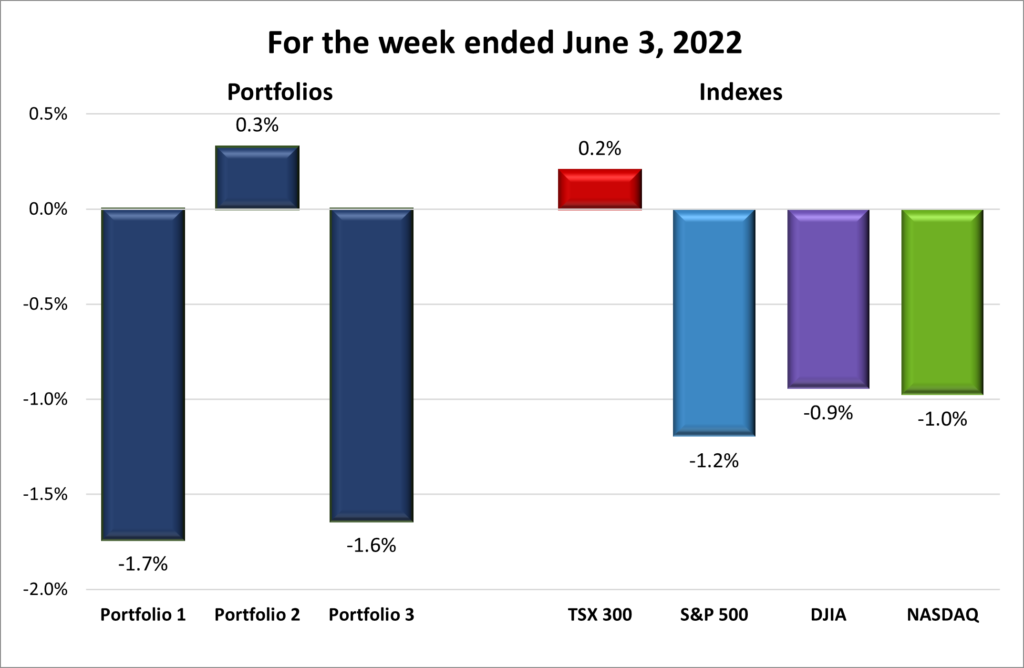
And on that down note, so ends another rollercoaster week. For the week, the TSX was up 0.2%, the S&P fell 1.2%, the DJIA dropped 0.95%, and the Nasdaq declined 0.98%.

For the month, the TSX was down 0.2%, the S&P rose 0.01%, the DJIA gained 0.04%, and the Nasdaq dropped 2.05%.

Weekly Portfolio Review

So much for a winning streak, at least for the American Indexes as all three lost close to 1%. I was hoping last week would see the market bottom, perhaps flatten for a while and then slowly inch upward but it was not to be. The 0.5% interest rate hike by the Bank of Canada, with talks of additional 0.5% hikes to come, along with the US Federal Reserve signalling its intention to raise interest rates 0.5% at least once more caused the share prices of high growth companies to keep falling. In Canada, The TSX is more focused on resource companies and less on technology companies, so the TSX gained a bit this week. Another reason to be diversified and not put all your eggs in one basket.

As for the Portfolios, once again the lower risk Portfolio 2 is the best performer with a gain of 1.2%. Prior to Friday, Portfolios 1 and 3 were looking good but the fears of aggressive interest rate hikes that caused the markets to fall on Friday dragged down both Portfolios. I suspect this will continue to be the way – Portfolio 2 leading the way – until the stock market bottoms out and starts heading upward again. For the next little while, I will have to grin and bear it. And hope for a sooner rather than later return an optimistic marketplace. 😐 (that is a grin and bear it emoji)

Weekly Portfolio & Index performance
Weekly Portfolio & Index performance for the week ended June 3, 2022.

Companies on the Radar

No new companies came to my attention this week so the two lists remain the same, although I still need to dig into Alvopetro (TSXV:ALV) to get a better understanding of the company. The other companies in these lists have already gone through my 4-stage research process.

Growth companies on my radar include:

Less volatile companies with reasonable growth:

Portfolio Update

Portfolio 1

Portfolio 1 for the week ended June 3, 2022: DOWN Red Down Arrow

NVIDIA (NASD:NVDA) announced that Dell Technologies (NYSE:DELL), Hewlett Packer Enterprise (NYSE:HPE), and Lenovo were amongst a group of computer makers will be using Nvidia’s Grace superchips for the next generation of super computers used for Artificial Intelligence and High-Performance Computing.

Once again, Tesla (NASD:TSLA) CEO is in the news. This time for delicately telling employees to return to the office or you will be considered resigned. “Everyone at Tesla is required to spend a minimum of 40 hours in the office per week. If you do not show up, we will assume you have resigned. The more senior you are, the more visible must be your presence.”

General Motors (NYSE:GM) announced its Buick lineup will be all electric by 2030. In other GM news, Cruise, their line of self driving cars, faces one last hurdle to become the first company to be allowed to charge for self driving rides. The only thing left is to convince San Francisco city officials that driverless taxis are safe.

Crowdstrike is ranked #1 in corporate endpoint security and has captured 12.6% of the endpoint security market. An endpoint is any physical device connected to a network. I like owning shares in companies that are top dog in their market.

Lightspeed (TSX:LSPD) launches their B2B service to connect many of the world’s leading brands and retailers. Retailers will be able to use this platform to order directly from companies in the Lightspeed Commerce system.

Activity

No significant activity to report this week.

Dividends

Dividends Received this week for the following companies:

Companies followed by DRIP (Dividend Re-Investment Plan) indicate additional shares were purchased with the dividend. Any cash leftover was added to the cash balance.

No dividends this past week.

Canadian $

Shaw Communications Inc (TSX:SJR.B)

Quinsam Capital Corp (TSX:QCA)

TMX Group Ltd (TSX:X)

US $

Visa Inc (NYSE:V)

Quarterly Reports

CrowdStrike Holdings, Inc.

All currency listed in US dollars

Selected highlights from their first quarter 2023 financial results on June 2, 2022

  • Total revenue was $487.8 million, a 61% increase, compared to $302.8 million in the first quarter of fiscal 2022.
  • Net loss attributable to CrowdStrike was $31.5 million, compared to $85.0 million in the first quarter of fiscal 2022.
  • Net cash generated from operations was $215.0 million, compared to $147.5 million in the first quarter of fiscal 2022. Free cash flow was $157.5 million, compared to $117.3 million in the first quarter of fiscal 2022.
  • Added 1,620 net new subscription customers in the quarter for a total of 17,945 subscription customers as of April 30, 2022, representing 57% growth year-over-year.
  • Annual Recurring Revenue (ARR) increased 61% year-over-year and grew to $1.92 billion as of April 30, 2022, of which $190.5 million was net new ARR added in the quarter.

Portfolio 2

Portfolio 2 for the week ended June 3, 2022: UP Green Up Arrow, signifying a positive week

Microsoft has lowered its expected revenues for its fourth quarter. With half of their revenues coming from outside the US, Microsoft has become a victim of the strong US dollar. A stronger US dollar typically lowers the profits of companies with large international operations that must convert foreign currency into US dollars. Microsoft’s foreign subsidiaries collect their sales in the respective local currencies. These are converted to US dollars to roll up into Microsoft’s overall sales. When the US dollar rises compared to other currencies, the foreign currencies end up with less US dollars. So, although sales remain strong, the number of US dollars brought in are less than past quarterly reports, thanks to foreign exchange rates.

Activity

No significant activity to report this week.

Dividends

Dividends Received this week for the following companies:

Companies followed by DRIP (Dividend Re-Investment Plan) indicate additional shares were purchased with the dividend. Any cash leftover was added to the cash balance.

Canadian $

Fortis Inc. (TSX:FTS)

US $

No US$ dividends this past week.

Quarterly Reports

MongoDB, Inc.

All currency listed in US dollars

Selected highlights from their first quarter 2023 financial results on June 1, 2022

  • Revenue of $285.4 million, up 57% Year-over-Year.
  • Gross profit was $207.2 million for the first quarter fiscal 2023, representing a 73% gross margin compared to 70% in the year-ago period.
  • Net loss was $77.3 million, or $1.14 per share, based on 67.7 million weighted-average shares outstanding, for the first quarter fiscal 2023. This compares to a net loss of $64.0 million, or $1.04 per share, based on 61.4 million weighted-average shares outstanding, in the year-ago period.
  • During the three months ended April 30, 2022, MongoDB generated $11.6 million of cash from operations, used $2.5 million of cash in capital expenditures and used $0.6 million of cash in principal repayments of finance leases, leading to free cash flow of $8.4 million, compared to free cash flow of $8.4 million in the year-ago period.

Portfolio 3

Portfolio 3 for the week ended June 3, 2022: DOWN Red Down Arrow

Brookfield Asset Management (TSX:BAM.A) plans to take public its Brazilian sanitation subsidiary BRK Ambiental. The money raised will be used to expand its operations.

GDI Integrated Facility Services (TSX:GDI) announced that over the next 12 months they plan to purchase up to 500,000 shares for the purpose of cancellation. Given the low share prices in 2022, it is a good time for GDI to buyback its own shares. This is a shareholder friendly move that will increase the earnings per share, albeit only a very small amount.

Activity

No significant activity to report this week.

Dividends

Dividends Received this week for the following companies:

Companies followed by DRIP (Dividend Re-Investment Plan) indicate additional shares were purchased with the dividend. Any cash leftover was added to the cash balance.

Canadian $

Enghouse Systems Ltd (TSX:ENGH)

US $

No US$ dividends this past week.

Quarterly Reports

No quarterly reports this past week.


The week ending May 27, 2022

“Sell in May and go away,” refers to the tendency of stocks to perform worse in May through October than during the rest of the year. I hope that is not the case this year given the decline in the stock markets. The S&P 500 Index and Dow Jones Industrial Average are both in market correction territory (down more than 10% from their respective highs) and the Nasdaq Index is in a full-blown bear market (down more than 20% from its high). The S&P/TSX composite, meanwhile, is down three per cent. I would not be happy if the markets performed worse during the summer. On the flipside, its times like now that are made for good investors. As Warren Buffet said, “Be Fearful When Others Are Greedy and Greedy When Others Are Fearful.”

Selecting Companies

In my ongoing attempt to not pay too much attention to what is happening to the three Portfolios I manage (they have fallen considerably), I am going to go over my process for selecting the companies I invest in.

My process is relatively new (started in 2020) and is still evolving as I learn more about investing, what to look for, and the type of companies in which I am interested. It is a result of plenty of spare time thanks to the pandemic, lots of companies “on sale,” and the need for a consistent way to evaluate and decide which companies to invest in. Currently, I have a 4-stage process that acts like a funnel, eliminating companies as I work my way through the process. These stages are:

At the end, I am very familiar with the company, and I am in a much better position to decide if the company is worthy of my money. Today I am going to talk about Stage 1, the Radar Check.

Radar Check

There are many ways companies can get on my radar. The most common is from investing newsletters, but Twitter and word of mouth are also sources of information. No matter how a company comes across my radar, I run it through what I call my Radar Check.

The purpose of the Radar Check is to take a quick, high-level look at companies. Generally, it takes five minutes or less to run a company through the Radar Check and record the information in an Excel file. So, without further ado, here is what is on my Radar Check.

Note: I use Microsoft Excel and its built-in features, as well as custom formulas, to automatically generate information.

The first thing I do is enter the company name. Utilizing a built in Microsoft Excel feature (the Data type – Stocks, which automatically generates specific stock information) I can see the closing share price for the last two days, the 52 week hi, 52 week low and the market capitalization. This provides the range the stock has traded over the last year, and I can see if the current price is closer to the high or low. Knowing the market capitalization provides a sense of the size of the company and sets my expectations accordingly. For example, I do not expect small or mid cap companies to provide a dividend, whereas large cap companies are more likely to provide a dividend.

Next, I make a brief note of what it is about the company that interests me. It could a favourable tailwind, an excellent product or service, multiple opportunities to generate sales, or anything that interests me about the company. A short note helps me remember what originally piqued my interest if I must come back to the company.

Ratings

Next, I look to see what the professionals think about the company. One of the benefits of having a TD Direct Investing (TDDI) account is their research capabilities, and I take advantage of that benefit (for comparison, I’ve yet to find any research capabilities in my Wealthsimple account). During the Radar Check I do not read the reports, I only look at a company’s ratings from 3 reports:

  • Morningstar’s Quant Report: to see if Morningstar’s professionals think the share price is overvalued, fair valued or undervalued. They rate the share price on a scale of 1 – 5 (higher indicates undervalued and better) and provide their estimate of the fair market value of a share.
  • Thomson Reuters StockReports+ (TR): to see how TR rates the companies technically (various ratios and numbers). TR rates the company in several technical areas and provides an overall score. I am looking for this overall rating which is a scale of 1 – 10 (higher is better).
  • TD Direct Investing Analysts section: to see what the pros from different companies think about the company and the overall Analyst Consensus (AC). I award a consensus ‘Strong Buy’ rating a 3, a ‘Buy’ a 2 or 1 (a 2 if more than five analysts follow the company), a ‘Hold’ is 0 and a ‘Sell’ rating is -1. I also note the upside to the estimated target price.

I then add up the TR rating and the AC score to provide a score out of 13. I am interested in anything above 9.

As an example, lets look at Take Two Interactive (NASD:TTWO) which I suddenly own because of its acquisition of Zynga, which was in Portfolio 2. As of May 21, Take Two trades at US$ 125.78. Morningstar gives them 5 out of 5 as being undervalued with a fair value estimate of US$ 181.66. TR gives them a 5 out of 10, while TD’s AC rates the company as a ‘Strong Buy’ so I give them a 3 out of 3. Add up the TR and AC to get an 8 out of 13. If I did not own the company, I generally would stop there. However, if I were still interested, my take away would be Take Two is undervalued but has considerable upside (45%). If I were looking to invest in a gaming company, Take Two would be of interest.

High Level Financials

The last step is to look at some high-level financials which all can be found on Yahoo! Finance. I look for:

  • 3+ Years Increasing Revenue: to see if the company is growing sales.
  • Net Income Profitable: to see if the company is making money.
  • EBITDA Profitable: if the company is profitable, this is irrelevant. If the company is not profitable, is it profitable before it pays Interest, Tax, Depreciation and Amortization.
  • Long-term Debt Free: how much, if any, long term debt does the company have. The less long-term debt, the less cash required to service that debt. With interest rates going up in 2022, more money will be required to make the interest payments, money that could be better used to grow the company.
  • Free Cash Flow Positive: does the company have cash left over after it has paid all the bills to keep operating.
  • Beat the S&P 500 over 5 Years: I want a company that has proven itself by outperforming the S&P 500 Index over 5 years and looks capable of continuing to beat the S&P 500 Index.

Ideally, I want to see six ‘Yes’ for this section, however, I have found that to be rare. If I do get six ‘Yes,’ the company has my interest. Using Take Two as an example again, I had five ‘Yes’ with a ‘No’ for Long Term Debt Free. Pretty good.

There you have it, the Radar Check is complete. At this point I decide whether to move on from the company or to dig deeper into it. If I did not own Take Two, I would move on because of its 8 out of 13 score in the Ratings sections, although the High-Level Financials section was good. However, I suddenly find myself an owner of Take Two, so I want to know more about the company before I decide whether to remain an owner or if I want to sell my stake in the company.

For any company that makes it through the Radar Check, the next step would be my Multibagger Analysis but that will be another time. For now, lets look at the past week ……

Weekly Market Review

Monday: The Toronto Stock Exchange Composite Index (TSX) was closed for Victoria Day in Canada. In the USA, it was business as usual for the S&P 500 Index (S&P), the Dow Jones Industrial Average (DJIA), and the Nasdaq Composite Index (Nasdaq). Maybe not so usual for 2022 as all three Indexes end higher thanks to gains in the banks (Financial sector), and a rebound in the beaten down mega cap technology companies. However, it was a broad-based rally with all 11 S&P sectors ending in positive territory.

Tuesday: A mixed day for the markets with the TSX and DJIA rising, and the S&P and Nasdaq both lost ground. The TSX was buoyed by the Energy, Basic Materials (natural resources) and Financial sectors. Despite a late afternoon rally, only the DJIA was able to make into positive territory. The S&P and Nasdaq were weighed down by the interest rate sensitive Technology and Consumer Cyclicals sectors as investors continue to fear the unknown of how aggressive the US Federal Reserve (the Fed) will be with upcoming interest rate hikes.

Wednesday: All four major North American Indexes gained ground today. The TSX was propelled higher by the Energy sector (thanks to higher oil prices) and the Financial sector (better than expected earnings by the Bank of Nova Scotia (TSX:BNS) and the Bank of Montreal (TSX:BMO).

The US based Indexes rose after the release of the Fed’s notes from their last meeting in early May were released, indicating a good chance of additional .5% rate increases later this year. The notes also showed there was a unanimous agreement among the Fed members that the US economy was strong. The stock markets like certainty and these notes provided as much certainty as could be expected.

Thursday: Thanks to strong earnings reports from Canada’s big five banks, the TSX notched its fifth straight day of gains. The Canadian Technology and Consumer Discretionary sectors helped boost the TSX higher.

In the US, all three Indexes finished higher thanks to the strong earnings season recently completed, and optimistic guidance by retailers. For the DJIA, it was the fifth straight day in the black. The US Indexes were buoyed by the S&P’s Technology and Consumer Discretionary (home of many retailers) sectors.

Friday: Peaking inflation and optimism about the strength of the economy caused investors to jump into the market on the last day before the American Memorial Day holiday. It was a good way to end the week with all four Indexes ending higher for the day. For the TSX it was the sixth consecutive day in the black, and its second straight week of gains. In the US, the S&P and Nasdaq snapped their seven-week skid, and the DJIA broke an eight-week decline. For the S&P, it was the best week since November 2020

The TSX rose on strength in the Canadian Technology, Energy and Financials sectors, while the S&P Technology, Consumer Cyclical and Basic Materials sectors led the way for the S&P and Nasdaq.

For the week, the TSX was up 2.7%, the S&P rose 6.59%, the DJIA gained 6.24%, and the Nasdaq gained 6.84%.

Weekly Portfolio Review

After almost two months of constant beat downs in the stock markets, all four Indexes are solidly in the black this past week. I do not know if this signifies a bottom or another false start but its good to finally post four wins.

As for the Portfolios, I do not know if I am simply happy to finally see all three portfolios in the black or relieved that the crushing constant weekly declines has ended, at least for a week. Its no coincidence that the Nasdaq was the best performing Index this past week and all the Portfolios are up. I am not going to look any deeper than that, rather, I am going to just enjoy the win. Hopefully the first of many in 2022.

Note: Cash was transferred out of Portfolio 1 to pay a few bills. No shares were sold to generate the cash for withdrawal purposes. The value of Portfolio 1 was adjusted by deducting the amount of the withdrawal to the start of the week/end of last week value so the withdrawal would have no impact on Portfolio 1’s performance this past week.

Weekly Portfolio & Index performance
Weekly Portfolio & Index performance for the week ended May 27, 2022.

Companies on the Radar

Plenty of stocks “on sale.” Unfortunately, I am still short on cash, so I remain on the sidelines. However, there is one new Energy company I have added to my radar – Alvopetro Energy Ltd. (TSXV:ALV). Alvopetro is a Canadian based natural gas company that is looking to develop natural gas in Brazil. It provides a 7% dividend and has favourable energy tailwind for growth potential. I need to perform due diligence to get a better feel for the company.

Other growth companies on my radar include:

Or for less volatile companies with reasonable growth:

Portfolio Update

Portfolio 1

Portfolio 1 for the week ended May 27, 2022: UP Green Up Arrow, signifying a positive week

An early week earning miss (there revenues and earnings were lower than analysts expected) side swiped other social media companies such as Alphabet (NASD:GOOGL) and Pinterest (NYSE:PINS). Its one thing when companies you own miss their anticipated numbers and get punished, but its very frustrating when the companies you own get knocked down by other companies’ earnings miss. ☹

Electric vehicle maker Rivian (NASD:RIVN) restructured its operations team with one executive vice-president leaving and a new Chief Operation Officer moving in. Rivian plans to double the production, assuming no supply chain issues, specifically access to semiconductors.

Activity

No significant activity to report this week.

Dividends

Dividends Received this week for the following companies:

Companies followed by DRIP (Dividend Re-Investment Plan) indicate additional shares were purchased with the dividend. Any cash leftover was added to the cash balance.

Canadian $

Pulse Seismic Inc (TSX:PSD)

US $

No US$ dividends this past week.

Quarterly Reports

Bank of Nova Scotia

All currency listed in CAD dollars

Selected highlights from their second quarter 2022 financial results on May 25, 2022

  • Net income of $2,747 million, compared to $2,456 million compared to the same period in 2021.
  • Earnings per share (diluted) of $2.16, compared to $1.88, a 15% growth.
  • Return on equity of 16.2%, compared to 14.8%.

Nvidia Corp.

All currency listed in millions of US dollars

Selected highlights from their first quarter 2023 financial results on May 25, 2022

  • Record quarterly revenue of $8.29 billion, up 46% from a year ago.
    • Record revenues in both its data center and gaming segments.
  • Net income of $1,618, down 15% from $1,912 in the same quarter in 2022.
  • Returned to shareholders $2.10 billion in share repurchases and cash dividends.
  • Increased and extended the company’s share repurchase program to repurchase additional common stock up to a total of $15 billion through December 2023.

Toronto-Dominion Bank

All currency listed in CAD dollars

Selected highlights from their second quarter 2022 financial results on May 26, 2022

  • Net income of $3.8 billion, compared with net income of $3.69 billion for the prior year period.
  • Diluted Earnings per Share of $2.07, compared with $1.99 per share for the prior year period.
  • Return on Equity of 16.4%, compared to 15.3% in the same period in 2021.

Enwave Corporation

All currency listed in thousands of CAD dollars

Selected highlights from their second quarter 2022 financial results on May 26, 2022

  • Revenue of $6,881, compared to $4,686 in second quarter of 2021, an increase of $2,195 or 47%.
  • Net loss of $2,386, compared to a net loss of $2,285 in the same period in 2021. A net loss increase of 4%.

Portfolio 2

Portfolio 2 for the week ended May 27, 2022: UP Green Up Arrow, signifying a positive week

Zynga completed its merger with Take Two Interactive Interactive on May 23, 2022. The combined company will be Take two Interactive Software, Inc, trading under the ticker TTWO on the Nasdaq Exchange. For us Zynga investors, we received $3.50 in cash and 0.0406 shares of Take-Two common stock per share of Zynga common stock. The acquisition of Zynga will help grow Take Two’s footprint in the rapidly growing and very lucrative mobile gaming industry.

Activity

No significant activity to report this week.

Dividends

Dividends Received this week for the following companies:

Companies followed by DRIP (Dividend Re-Investment Plan) indicate additional shares were purchased with the dividend. Any cash leftover was added to the cash balance.

No dividends this past week.

Quarterly Reports

Bank of Nova Scotia

All currency listed in CAD dollars

Selected highlights from their second quarter 2022 financial results on May 25, 2022

  • Net income of $2,747 million, compared to $2,456 million compared to the same period in 2021.
  • Earnings per share (diluted) of $2.16, compared to $1.88, a 15% growth.
  • Return on equity of 16.2%, compared to 14.8%.

Portfolio 3

Portfolio 3 for the week ended May 27, 2022: UP Green Up Arrow, signifying a positive week

Glass Lewis, a shareholder advisory firm, recommended shareholders oppose Shopify’s (TSX:SHOP) proposal for the creation of a “Founder Share” for Chief Executive Officer Tobi Lutke. Currently Mr. Lutke and one other Board member control 51% of the voting rights. However, the conditions on which they maintain this control is expected to change in the next few years. Shopify is proposing Mr. Lutke be granted 1 Founder Share which will allow him to maintain 40% of the voting rights, no matter how the share structure and number of shares evolves over time. Joining with Glass Lewis, Institutional Shareholder Services Inc. has also advised shareholders reject Shopify’s “founder share” proposal.
I had already voted “For” this proposal by the time I read these notices. My reasoning was Shopify’s leadership had done a great job so far. In addition, the vision and the execution of management was one of the reasons I invested in Shopify. The other reason I voted “For” was this would protect the management I believe in from shareholder activism.

Activity

No significant activity to report this week.

Dividends

Dividends Received this week for the following companies:

Companies followed by DRIP (Dividend Re-Investment Plan) indicate additional shares were purchased with the dividend. Any cash leftover was added to the cash balance.

Canadian $

Royal Bank of Canada (TSX:RY)

US $

No US$ dividends this past week.

Quarterly Reports

Toronto-Dominion Bank

All currency listed in CAD dollars

Selected highlights from their second quarter 2022 financial results on May 26, 2022

  • Net income of $3.8 billion, compared with net income of $3.69 billion for the prior year period.
  • Diluted Earnings per Share of $2.07, compared with $1.99 per share for the prior year period.
  • Return on Equity of 16.4%, compared to 15.3% in the same period in 2021.

Royal Bank of Canada

All currency listed in CAD dollars

Selected highlights from their second quarter 2022 financial results on May 26, 2022

  • Net income of $4.3 billion for the quarter ended April 30, 2022, up $238 million or 6% from the prior year.
  • Diluted Earnings per Share of $2.96, up 7% compared to the same period in 2021.
  • Return on Equity of 18.4%, down 1% or 100 basis points, compared to the same period in 2021.
  • Declared an increase to the quarterly common share dividend of $0.08, to $1.28 per share, an increase of 7%.