
Over the last few weeks, I have been writing about common questions people ask when they first start investing. From ‘What is Investing?’ to today’s topic of ‘When should I start investing?’ with a few more questions to come in the next few weeks. While answering these questions, it occurred to me: before people even start asking questions (which is a good place to start), what else is preventing people from starting to invest? Here are a few common barriers that I’ve either encountered myself or heard other people cite:
- Lack of knowledge: Many people feel they do not have enough knowledge about the financial markets or investing strategies, making them hesitant to start.
- Limited financial resources: Investing often requires some initial capital, which can be a barrier for those with limited savings.
- Risk Aversion: Fear of losing money often holds people back from investing, as the potential for financial loss can seem overwhelming.
- Investment complexity: The vast array of investment options and complex financial jargon can be intimidating for new investors.
- Time constraints: Investing requires research and ongoing monitoring, which can be challenging for busy individuals.
- Debt: Debt payments can limit available funds for investing and create financial pressure.
- Life events: Major life events like starting a family or buying a home can impact your financial situation and risk tolerance, potentially affecting investment decisions.
- Inertia: Even with knowledge and resources, you need to avoid procrastination and take the first step.
Do any of them look familiar to you? I have faced them all at one time or another. The first step to overcoming these barriers is to acknowledge them, then make a plan to address them head-on.
Do not be discouraged by the initial complexity. Do not overthink it, avoid paralysis by analysis. It becomes easier once you overcome the initial inertia and get started. Open a free trading account and deposit a bit of cash. There, you have made your first investment. 😊 Keep adding money to your investing account while you learn and decide what to invest in. When you find an investment that fits your plan and risk tolerance, you will have already put some money aside.
I hope these weekly updates help you with some of the questions you may have and will provide you with some knowledge and confidence to take control of your financial future. With that said, let’s see what happened this past week….
Items that may only interest or educate me ….
Canadian Economic news, US Economic news, When should I start investing?, What I learned this week?, ….
Canadian Economic news
This past week’s key economic data that the Bank of Canada (BoC) considers when deciding whether to raise or lower the interest rate.
Canadian market volatility
Canada’s Volatility Index (VIXC), tracked by the TSX 60, dipped to 9.56 over the past week, down from 9.73. This slight decline occurred amid a generally stable market environment but was influenced by a few factors. Speculation about potential rate cuts by the BoC in July and the US Federal Reserve’s decision to maintain US interest rates at 5.5% likely played roles in this movement.
The VIXC, often dubbed Canada’s ‘fear gauge,’ offers insights into expected market volatility. When the VIXC trends lower, it suggests reduced uncertainty and a calmer market sentiment among investors.
US Economic news
This past week’s key data points that the Federal Reserve (Fed) considers when deciding whether to raise or lower the interest rate.
Federal Open Market Committee monetary policy meeting
The Federal Open Market Committee (FOMC), which is responsible for setting the benchmark interest rate, decided to hold the benchmark interest rate steady at their current range of 5.25% – 5.5%. While investors were hoping for a September rate cut, the FOMC hinted at a delay until December. They also revised their forecast from three cuts to just one in 2024. Looking ahead, they project four rate cuts in 2025, maintaining a policy of “higher for longer” interest rates as inflation continues to cool. (For those unfamiliar, “higher for longer” refers to keeping rates elevated for a sustained period to combat inflation.)
Although inflation has moderated, it remains above the Fed’s 2% target. With a robust labour market and strong economy, the FOMC plans to keep rates steady until clear evidence of sustained inflation reduction, such as significant price declines or increased unemployment, emerges. Fed Chair Jerome Powell described the decision to hold rates as a close call, reflecting the Fed’s willingness to accept a gradual decline toward the 2% target amidst ongoing economic strength.
Recent data on both headline (all items) and core CPI indicates a slowdown in inflation on a monthly and annual basis, aligning with the Fed’s objectives. Further reports showing continued inflation slowdown could pave the way for anticipated rate cuts. And lower rates would be welcomed by consumers and businesses in the US, Canada, and globally.
Consumer price Index (CPI)
As expected, the May CPI was unchanged (0.0%), down from a 0.3% gain in April. Year over year, the CPI slowed to 3.3%, slightly below April’s 3.4% growth. The biggest monthly increase was in ‘Tobacco and smoking products,’ which rose by 1.6%, while the largest decline was in ‘Energy commodities,’ including fuel and oil products, which dropped by 3.5%. Annually, ‘Transportation services’ saw the most significant increase, up 10.5% due to higher fuel costs. This rise in ‘Transportation services’ was partly driven by a 3.6% year-over-year increase in fuel prices, despite some cooling in recent months. Meanwhile, ‘Used cars and trucks’ experienced the biggest annual decline, falling by 9.3%.
Core CPI, which excludes the volatile food and energy components, grew 0.2% in May, slightly below April’s 0.3% increase. On an annual basis, core CPI slowed to 3.4% in May from 3.6% in April, marking the slowest pace in three years. Analysts had predicted an increase of 3.5%.
The May CPI report was a sign the Fed had been waiting for: both the pace of headline (all items) and core inflation were slowing down, both monthly and year over year. While the Fed was likely pleased to see inflation cooling, they still considered it too high to start lowering the benchmark rate. However, this report was a step in the right direction. If future reports indicate that inflation continues to move towards the Fed’s 2% target, we could see a rate cut as early as September, with the possibility of a second cut later in the year.
American market volatility
The CBOE Volatility Index (VIX), often referred to as the market’s fear gauge, edged up to 12.66 from the previous week’s 12.22. This slight increase likely stems from the Fed’s decision to maintain the current interest rate of 5.5%, reduce the anticipated rate cuts from three to one, and delay a potential rate cut towards the end of the year. With the VIX remaining below the 20 threshold, which typically indicates market calmness, investors appear to be less apprehensive in the near term.
Consumer Sentiment Index (CSI)
The University of Michigan’s preliminary reading on the overall index of consumer sentiment, a gauge of consumer confidence, fell to 65.6 in June, marking a 5.1% drop from 69.1 in May. This was the third consecutive monthly decrease and the lowest reading in seven months. Analysts had predicted a higher reading of 72. Despite the monthly decline, the CSI was up 2.2% year-over-year.
The lower reading likely reflects consumer concerns about persistent inflation, which is causing interest rates to remain higher for longer, and slowing wage growth.
When should I start investing?
If you are not already investing your money, the best time to start is now! However, before diving in, make sure you have a stable financial foundation. This means having an emergency fund, being free of high-interest debt, and understanding your financial goals and risk tolerance. Once you are financially stable, the best time to start investing is as early as possible. Now, let us take a look at why starting early is so crucial:
- Compound Interest: The earlier you start, the more time your investments have to grow. Compound interest can significantly boost your wealth over time, as you earn returns on your returns.
- Learning Curve: Investing is a skill that improves with experience. Starting early allows you to learn from mistakes and successes, refine your strategies, and build confidence.
- Risk Tolerance: Younger investors typically have a higher risk tolerance because they have more time to recover from potential losses. This allows for more aggressive investment strategies that can lead to higher returns.
- Financial Goals: Early investing helps you work towards long-term financial goals, such as retirement, buying a home, or funding education.
- Habit Formation: Starting early helps you develop good financial habits, such as regular saving and investing, budgeting, and financial planning.
To illustrate the power of early investing, consider the following example:
Marie starts investing at age 20, investing $2,400 annually at the beginning of each year. Life starts to ‘happen’ at 30, so she stops contributing at age 30. Meanwhile, John starts to ‘enjoy life’ at 20 but when he turns 40, he starts to think he should plan for his future, so he invests $4,800 at the start of every year until he reaches 65. Both assume an 8% annual growth rate (The historical average growth rate of the S&P 500 is around 10.26% but let us be conservative). Who will have the larger retirement nest egg at 65?
| Marie | John |
| Age | Amt invested | YE Value | Age | Amt invested | YE Value | |
| 20 | $ 2,400 | $ 2,592 | 40 | $ 4,800 | $ 5,184 | |
| 21 | $ 2,400 | $ 5,391 | 41 | $ 4,800 | $ 10,783 | |
| 22 | $ 2,400 | $ 8,415 | 42 | $ 4,800 | $ 16,829 | |
| 23 | $ 2,400 | $ 11,680 | 43 | $ 4,800 | $ 23,360 | |
| 24 | $ 2,400 | $ 15,206 | 44 | $ 4,800 | $ 30,412 | |
| 25 | $ 2,400 | $ 19,015 | 45 | $ 4,800 | $ 38,029 | |
| 26 | $ 2,400 | $ 23,128 | 46 | $ 4,800 | $ 46,256 | |
| 27 | $ 2,400 | $ 27,570 | 47 | $ 4,800 | $ 55,140 | |
| 28 | $ 2,400 | $ 32,368 | 48 | $ 4,800 | $ 64,735 | |
| 29 | $ 2,400 | $ 37,549 | 49 | $ 4,800 | $ 75,098 | |
| 30 | $ 2,400 | $ 43,145 | 50 | $ 4,800 | $ 86,290 | |
| Stops contributing at 30 | Contributes for another 15 years | |||||
| 65 | $ – | $ 637,915 | 65 | $ 4,800 | $ 414,484 | |
Over 11 years, Marie invests a total of $26,400 (11 x $2,400) and ends up with a nest egg of $637,915. John, on the other hand, invests a total of $124,800 over 26 years (26 x $4,800) and accumulates $414,484. Despite investing more than twice as much, John’s nest egg is almost 54% less than Marie’s, highlighting the power of compounding.
It is pretty obvious that the earlier you jump into investing, the better. Think of it like laying the foundation for a sturdy financial future. By starting early, you give your money more time to grow and multiply. So, do not wait around—get started as soon as you can, and let your money start doing the heavy lifting for your financial goals! 😊
Cautionary note: The downside of compound interest
Just as compound interest can grow your savings, it can also work against you when paying off debt. Some credit cards compound interest daily on your balance, leading to higher interest amounts if you carry a balance month-to-month. Therefore, it is essential to pay off debt as quickly as possible.
What I learned this week
- When I decided to increase my investment in Shopify, I found myself short on Canadian dollars in my TFSA Canadian dollar account, which I intended to use for purchasing shares on the Toronto Stock Exchange (TSE). To proceed, I transferred funds from my US dollar TFSA account into the Canadian dollar TFSA account. Although the transfer itself incurred no fees, I did experience a minor loss due to currency exchange between the US and Canadian dollars.However, given that Shopify is listed on both the TSE and the Nasdaq Stock Exchange, I could have alternatively purchased the Shopify shares on the Nasdaq exchange. This would have allowed me to sidestep any losses stemming from currency exchange fluctuations. While the loss was not significant, I will keep this in mind for future investments in companies listed in both Canada and the US. Every little bit helps. 😊
- Something else I learned about was brand value, which refers to the financial worth attributed to a brand itself, such as Apple (NASD: AAPL). Factors contributing to brand value include:
- Brand recognition and reputation: How well-known and respected the brand is.
- Customer loyalty: The degree to which customers prefer a particular brand over competitors.
- Perceived quality and value: How consumers perceive the quality and value of the brand’s products or services.
- Brand associations: The positive attributes and associations that consumers connect with the brand.
- Intellectual property: Trademarks, logos, and other brand-specific elements.
I think it would be fair to say Apple meets all five of these points. 😊
Brand valuation differs from market valuation (also known as market capitalization). Market valuation refers to the total market value of a publicly traded company’s outstanding shares of stock. It is calculated by multiplying the current share price by the total number of outstanding shares. Whereas brand value is a component of a company’s overall worth, typically listed as Intangible Assets, that captures the power and influence of the brand itself, while market valuation provides a broader picture of the company’s financial standing and investor confidence.
Weekly Market Review
Monday: the week got off to a good start with the four major North American indexes – the Toronto Stock Exchange Composite Index (TSX), the S&P 500 Index (S&P), the Dow Jones Industrial Average (DJIA), and the Nasdaq Composite Index (Nasdaq) – all ending higher. The price of oil joined the rally, finishing higher thanks to prospects of increased demand this summer.
In Canada, higher oil and commodity prices helped the TSX get in and stay in positive territory. In trading, Technology and Basic Materials (miners and fertilizer manufacturers) advanced the most of the Canadian sectors, while Telecommunications Services and Consumer Staples declined the most.
In the US, the S&P and Nasdaq set record highs, again, as investors prepare for Wednesday’s double whammy of the latest inflation report and an update from the Fed on interest rates. In trading, Utilities and Energy posted the biggest gains in the US sectors, while Telecommunications Services and Consumer Staples were the only sectors to end lower.
Tuesday: it was mixed day with the TSX and the DJIA ending in the red. All eyes turned towards tomorrow’s announcement from the Fed. Not so much for their interest rate decision, but more for clues they provide on when the rates might be lowered.
In Canada, the TSX slipped on shrinking commodities prices, concerns about a slowing global economy, and fears of a hawkish stance taken by the Fed regarding interest rates remaining higher for longer. In trading, Technology and Healthcare advanced the most while Utilities and Consumer Cyclicals fell the farthest.
In the US, once again the S&P and Nasdaq closed at record highs thanks in part to Apple jumping 7%. In trading, Technology and Financials were the top performers, while Telecommunications Services and Consumer Staples incurred the biggest drops.
Wednesday: another mixed bag day for the four indexes, this time the DJIA ended barely in the red. Otherwise, the indexes ended higher thanks to the May CPI report that showed inflation had slowed, and the Fed maintained their pause in interest rates. The price of oil rose on supply concerns from increasing tensions in the Middle East.
In Canada, lower US inflation and a merger of two Canadian banks – National Bank of Canada (TSE: NA) acquired Canadian Western Bank (TSE: CWB) – helped get the TSX back into positive territory. In trading, Technology and Healthcare posted the biggest gains while Consumer Cyclicals and Utilities were the only sectors to end lower.
In the USA, the S&P and Nasdaq set record closes for the third straight session on news of slowing inflation. In trading, Technology and Industrials gained the most, while Telecommunications Services and Consumer Staples lost the most.
Thursday: after a bullish day on Wednesday, the markets were mixed, with the Nasdaq and S&P closing higher while the DJIA and TSX edged lower. Investors were processing the likelihood that the Fed would postpone US rate cuts until year-end, at the same time reducing the number of cuts from three to one. Oil prices bounced around most of the day before finally falling into the red at the end of the day.
In Canada, the TSX fell to a two-month low as investors’ concerns about higher for longer interest rates south of the border weighed on the TSX. In trading, all sectors ended lower. Consumer Staples and Consumer Cyclicals dropped the least, while Energy and Basic Materials suffered the biggest losses.
In the US, the Nasdaq and S&P both set record closes for the fourth straight day as stocks of Technology companies continue to rally. In trading, technology, Consumer Staples, and Utilities were the only sectors to climb higher, while Energy and Financials slid the farthest.
Friday: the week ended on a down note as only the Nasdaq was able to finish above the flatline. The price of oil fell today but oil still had its best week since April due to forecasts of growing demand.
In Canada, the TSX fell to a three-month low as lower oil prices weighed on the TSX. In trading, Technology was the only sector to advance while Telecommunications Services and Energy suffered the biggest losses.
In the US, the Nasdaq set a record high close for the fifth straight day. Lower wholesale prices provided more evidence that inflation was slowing. In trading, Technology was the only one of the American sectors to end higher, while Energy and Industrials fell the farthest into the red.
Weekly Market and Portfolio Review
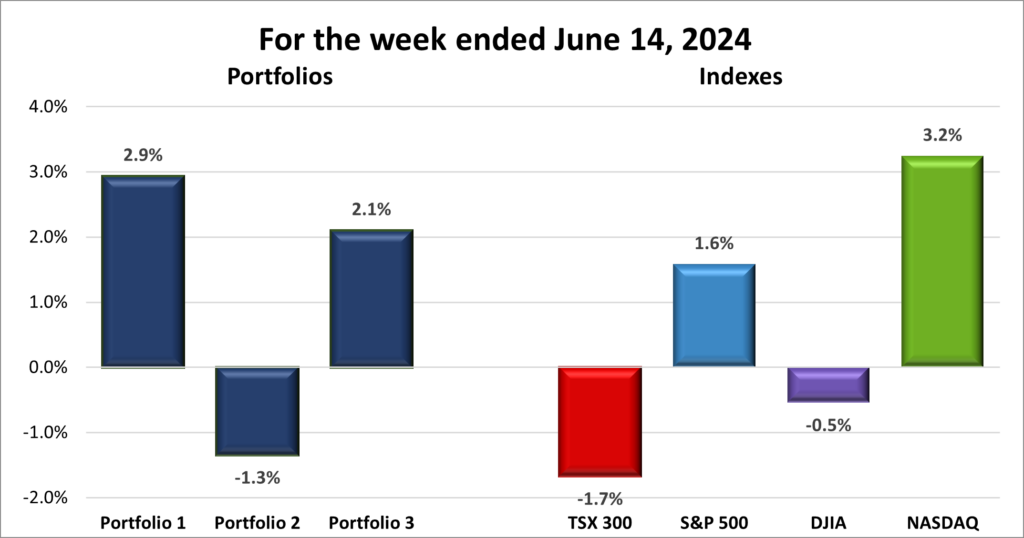
For the week, the TSX (SPTSX) slumped 1.7%, the S&P 500 (SPX) rose 1.6%, the DJIA (INDU) slid 0.5% and the Nasdaq (CCMP) jumped 3.2%.
| Index | Weekly Streak |
| TSX: | 4 – week losing streak |
| S&P: | 2 – week winning streak |
| DJIA: | 1 – week losing streak |
| Nasdaq: | 2 – week winning streak |

 An impressive performance from the Technology sector helped counterbalance the impact of a hawkish Fed, allowing the S&P and Nasdaq to extend their weekly winning streaks, as illustrated in the chart above. Meanwhile, the DJIA lost ground, and the TSX continued its losing streak.
It was an eventful week on the economic front in the US. The May CPI report and other economic indicators showed signs of continued slowing inflation. At the FOMC meeting, Fed Chair Powell acknowledged this significant easing but emphasized that inflation remains too high. The Fed seeks more consistent data to ensure inflation is on track to hit their 2% target. As expected, the Fed stuck with its higher-for-longer rate strategy, stating they expect only one rate cut in 2024, rather than the three initially forecasted at the beginning of the year. Despite the Fed’s stance, investors seemed to believe otherwise.
The combination of positive economic data and investors’ belief that rates might drop more than once, and possibly as soon as September, seemed to ignite the S&P and Nasdaq. The S&P enjoyed a four-day streak of record closing highs, while the Nasdaq set new record highs each day of the week. However, the TSX and DJIA did not share in the tech-driven rally. The technology sector’s lighter weight in these indices meant they did not benefit as much from the surge in technology stocks.
The Fed’s news about fewer rate was also felt in the Canadian markets. As the old saying goes, ‘when the US sneezes, Canada catches a cold.’ ☹ The TSX recorded its fourth consecutive weekly decline and its biggest weekly decline since October 2023. Many are speculating that if the BoC cuts the rate in July while the Fed holds steady, the Canadian dollar is likely to weaken against the US dollar. This would make imports from the US more expensive, possibly triggering another round of high prices.
Looking forward, I will be keeping an eye for further signs of falling inflation that could lead to lower interest rates, both in Canada and the US. While it is great that the technology sector continues to outperform, it would be even better if the current rally could broaden. A broader rally implies increased investor confidence and economic strength, which in turn reduces risks and improves the sustainability of market gains. A more balanced rally benefits a larger portion of the economy and us investors alike. 😊
| Portfolio | Weekly Streak |
| Portfolio 1: | 2 – week winning streak |
| Portfolio 2: | 1 – week losing streak |
| Portfolio 3: | 2 – week winning streak |
As illustrated in the chart below, it was a mixed week for the portfolios with two of the three increasing in value.
Portfolio 1 continues to shine, even with more than half the holdings losing ground. Despite a significant (more than 10%) drop of 14% in Celsius Holdings (NASD: CELH), the portfolio was buoyed by a stellar 15% surge in Skyworks Solutions Inc (NASD: SWKS) and strong performances from tech titans Nvidia and Apple. Talk about resilience!
Portfolio 2 hit a bit of a rough patch, extending its losing streak to two weeks. Over half the holdings took a dip, but there were no dramatic swings. The silver lining? MongoDB, which had taken a steep dive the previous week, seems to have found its footing and is inching upward, posting a slight weekly gain.
Portfolio 3 joined the winner’s circle this week. Despite more than half of its holdings slipping, there were no major price swings. Shopify, however, came through with a notable dollar value increase, pushing the portfolio into the green.
Overall, not a bad week! Sure, I would love to see all three portfolios on the rise, but as Mick Jagger wisely sings, “You can’t always get what you want.” 😊
Companies on the Radar
 No new companies came across my radar this past week, leaving my list with the six companies listed below.
- Equitable Bank (TSE: EQB), a mid sized Canadian bank, considered Canada’s 7th bank, that provides financial services to consumers and businesses.
- Quanta Services, Ltd. (NYSE: PWR), a large-cap American company offering a wide range of specialty infrastructure solutions throughout the world
- RELX PLC (NYSE: RELX), provides information-based analytics and decision tools for professional and business customers worldwide.
- Vertiv Holdings (NYSE: VRT), an American company that designs and builds infrastructure and continuity solutions to businesses around the world.
- Vistra Corp (NYSE: VST), an American company operating in the integrated retail electricity and power generation sector.
- Lumine Group (TSE: LMN), a young Canadian mid sized company that acquires communications and media software companies, and then strengthens and grows those companies.
Please keep in mind that these are only companies that have piqued my interest. This is not a recommendation or financial advice. You should do your own research or contact a professional before making any investment decisions.
The Radar Check was last updated June 14, 2024.


Portfolio Update
Portfolio 1
Portfolio 1 for the week ended June 14, 2024: UP 
- At Apple’s annual developer conference, the company unveiled their artificial intelligence (AI) strategy and their latest software, complete with its new integrated ‘Apple Intelligence.’ Apple also announced a deal with leading AI developer OpenAI that will allow Apple to integrate ChatGPT with their voice assistant Siri and other Apple software.
Following the recent surge in Apple’s share price, the company regained the title of world’s most valuable company. They also became the first brand to surpass the US$ 1 billion in brand value, up 15% from a year ago.
In other Apple news, the company was served a possible class action lawsuit that claims Apple underpays women performing the same or comparable jobs as men. - CrowdStrike (NASD: CRWD) has been added to the S&P 500 index list of companies. Any mutual or index fund that tracks the S&P will have to purchase an appropriate number of CrowdStrike shares, which should raise the share price.
- Following, Nvidia’s (NASD: NVDA) recent 10 for 1 stock split, there is talk Nvidia could possibly replace fellow chipmaker Intel (NASD: INTC) in the DJIA. That would mean any fund that tracks the DJIA would have to purchase shares in Nvidia, which would likely give the share price a nice little bump. 😊
- Amazon (NASD: AMZN) announced they have partnered with South American telecom company Vrio to beam broadband internet down over the actual Amazon. The deal will see Amazon’s Project Kuiper satellite internet business unit provide internet access across even the remotest parts of the Amazon, which spans Argentina, Brazil, Chile, Uruguay, Peru, Ecuador, and Colombia.
- A federal judge has ruled that Alphabet’s (NASD: GOOGL) Google must face trial on antitrust claims by the US Department of Justice (DOJ) who claim the company illegally dominates the online advertising market.
Activity
Bought: Shopify (TSE: SHOP) This is my second investment in Shopify, but the first for this portfolio. Shopify had performed exceptionally well in Portfolio 3, so I decided to add more shares, this time in Portfolio 1. This also aligns with my strategy of re-investing in companies that have proven they can grow their business and share price.
Shopify is a major player in the e-commerce industry, providing a user-friendly platform for businesses to set up and manage their online stores. With a large and growing merchant base, Shopify benefits from a strong network effect. The more merchants that join Shopify, the more valuable the platform becomes for everyone involved. Given the expected continued growth of the e-commerce market, Shopify is well-positioned to thrive. Their recurring revenue from subscription fees offers stability and predictability to its cash flow. Moreover, Shopify is an innovative company, constantly expanding its product offerings, including payments, fulfillment services, and marketing tools.
Of course, there are some risks to consider. The e-commerce industry is highly competitive, and Shopify faces significant competition. Economic slowdowns could also impact Shopify as businesses might cut back on e-commerce spending. Additionally, the current environment of high inflation and high interest rates could pose challenges to Shopify’s business.
Despite these risks, Shopify is considered one of the best, if not the best, all-in-one e-commerce, and retail platform. They continue to innovate with new tools and are integrating AI features into their existing products. They continue to expand globally and are constantly acquiring more customers while driving down their customer acquisition costs and improving operational efficiency.
Overall, Shopify holds a strong position in a growing industry and should make a great addition to the portfolio.
Dividends
Dividends Received this week for the following companies:
Companies followed by DRIP (Dividend Re-Investment Plan) indicate additional shares were purchased with the dividend. Any cash leftover was added to the cash balance.
Canadian $
Dream Industrial Real Estate Investment Trust (TSE: DIR.UN)
US $
Home Depot, Inc. (NYSE: HD)
Skyworks Solutions Inc (NASD: SWKS)
Quarterly Reports
No quarterly reports this past week.
Portfolio 2
Portfolio 2 for the week ended June 14, 2024: DOWN 
- At Microsoft’s (NASD: MSFT) Xbox Games Showcase, the company announced their all-digital Xbox console, and a host of new video games.
In other Microsoft news, the company announced they have cancelled the rollout of their new AI powered feature ‘Recall’ which tracks computer usage. ‘Recall’ allows users to search their computers browsing and web chat histories for something they did previously, even months earlier. The downside is anyone accessing the computer could also see another user’s history. The feature will be available only to those with new CoPilot+ enhanced computers and enrolled in Microsoft’s Windows Insider Program.
The company announced they plan to invest over US$ 7 billion to develop datacentres in northeastern Spain. - Canadian Natural Resources Limited (TSX: CNQ) executed a 2-for-1 split basis on Tuesday, June 11, 2024. While stock splits change the number of outstanding shares in circulation, they do not change a company’s market capitalization (outstanding shares X share price), nor underlying fundamentals.
- MongoDB partnered with Bendigo and Adelaide Bank (ASX: BEN), a leading Australian bank, to update BEN’s core banking technology using MongoDB Atlas with AI as the underlying platform of the modernization. As a result of using MongoDB Atlas with AI, BEN cut the migration time by up to 90%, completing the task in three months, and doing it at 10% of the cost of a typical legacy system to cloud migration. Very impressive!
Activity
No significant activity to report this week.
Dividends
Dividends Received this week for the following companies:
Companies followed by DRIP (Dividend Re-Investment Plan) indicate additional shares were purchased with the dividend. Any cash leftover was added to the cash balance.
Canadian $
No C$ dividends this past week.
US $
Microsoft Corp.
Quarterly Reports
Dollarama Inc.
First quarter 2025 financial results on June 11, 2024
Portfolio 3
Portfolio 3 for the week ended June 14, 2024: UP
- Shopify was on quite the winning streak, reaching 13 straight days before the shares ended lower on June 13. Its previous longest winning streak was 10 days ending May 6, 2024.
Activity
No significant activity to report this week.
Dividends
Dividends Received this week for the following companies:
Companies followed by DRIP (Dividend Re-Investment Plan) indicate additional shares were purchased with the dividend. Any cash leftover was added to the cash balance.
Canadian $
No C$ dividends this past week.
US $
Microsoft Corp.
Quarterly Reports
Enghouse Systems Limited
Second quarter 2024 financial results on June 10, 2024