
Why are many motorists turning to HEVs as their vehicle of choice?
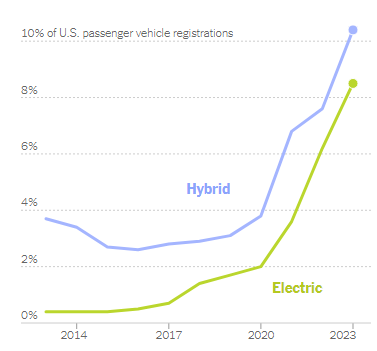
In an era where sustainability and green technology are at the forefront of global priorities, the automotive industry is undergoing a significant transformation. Electric vehicles (EVs) are often hailed as the future of transportation. However, hybrid electric vehicles (HEVs) have been on a roll and are increasingly capturing the attention of consumers and investors alike, as shown in the graph on the right. In the US, industry leaders Toyota (NYSE: TM), Honda (NYSE: HMC), and Hyundai (OTCM: HYMTF) are leading the charge, closely followed by Detroit’s giants. But what exactly makes HEVs the current favored choice over their fully electric counterparts?
Figure 1: This graph by Steve Milloy shows the growth of HEVs and EVs registrations in the US from 2014 to 2023.
At their core, HEVs blend the reliability of internal combustion engines (ICE) with the efficiency of electric motors. This hybrid approach allows for energy recovery through regenerative braking and while driving, enhancing fuel economy. Plug-in Hybrids (PHEVs), with larger batteries and the option to recharge from external sources, extend this principle further. For simplicity, our discussion includes both under the HEV umbrella.
Now, let us take a look at why many motorists are choosing HEVs as their ICE replacement. This dominance can be attributed to several key factors that make hybrids a more attractive option for many drivers today.
The biggest hurdle for EVs is their price tag. HEVs offer a significant cost advantage over EVs due to lower upfront prices and slightly higher, but often offset by fuel savings, maintenance costs. This price difference can be a dealbreaker for many budget-conscious consumers.
Hybrid technology has been around for decades, with pioneers like the Toyota Prius leading the way. This extended track record translates to established reliability. Mechanics are familiar with hybrid systems, and replacement parts are readily available. Conversely, EVs are a relatively new technology, with many mechanics unable to properly service EVs, leaving some consumers hesitant to embrace potential reliability issues that might arise with a less-proven system.
The limited availability of charging stations for EVs creates “range anxiety” for potential buyers. The fear of running out of power and being stranded far from a charger is a major deterrent. Hybrids, on the other hand, offer the best of both worlds. They can run on gasoline when the battery is depleted, eliminating the need to constantly search for charging stations and allowing for longer trips without worry.
For drivers accustomed to gasoline-powered vehicles, hybrids offer a familiar driving experience. They still have a traditional gas brake pedals that function the same as in ICE vehicles, and they do not require any special charging routines. This ease of transition can be a major selling point for those who are hesitant to adapt to a completely new way of driving.
It is important to note that while hybrids boast better fuel economy, their maintenance costs can be slightly higher than those of traditional ICE vehicles. This is because they have two powertrains to maintain – a gasoline engine and an electric motor. However, the fuel savings often outweigh these additional costs.
While not entirely emissions-free, hybrids are significantly cleaner than traditional gasoline vehicles. They offer a significant reduction in tailpipe emissions, particularly in city driving where regenerative braking can recapture energy lost during braking. This makes them a good option for environmentally conscious consumers who may not be ready to fully commit to an EV.
In summary, hybrids offer a compelling alternative to EVs, with advantages in affordability, established technology, and range anxiety. They provide a familiar driving experience and act as a stepping stone towards cleaner transportation. Automakers understand this appeal, and some may see HEVs as a gateway to future EV sales.
Are hybrids an investing opportunity?
While the transition to EVs is inevitable, HEVs offer a valuable stepping stone. This concept might have been helpful during my own past investment decisions, where I focused heavily on pure EV companies such as Tesla (NASD: TSLA) and Rivian (NASD: RIVN), as well as General Motors (NYSE: GM) with their Ultium battery system to power GM and other manufacturers’ vehicles.
For investors interested in the HEV market, a company’s track record in hybrid technology, their commitment to sustainable practices, and their future plans for electrification are all insightful factors to consider when making investment decisions. Established automakers with a proven track record and substantial resources might be equally well-positioned, if not better, to navigate the transition towards a greener future due to their experience and infrastructure.
For more information on the outlook for EVs, check out the International Energy Association’s latest Global EV Outlook.