Weekly Update for the week ending January 31, 2025

I originally planned to kick off this update with an in-depth look at dividends—a topic I’ve been wanting to discuss for a while. However, two things changed that plan. First, the discussion on dividends grew much larger than I anticipated, making it tough to fit within this post. Second, an unexpected market-shaking event took centre stage: the rise of a new artificial intelligence (AI) player, sending ripples through the markets and making waves among the current AI leaders.

Rather than glossing over this event, I felt it warranted a more detailed discussion. This week, China’s DeepSeek AI entered the scene, disrupting expectations and raising major questions about the future of AI investments. While the dividend discussion is still on my mind, I decided to give it its own standalone post, which you can find here.

With that out of the way, let’s jump into the big story that set the tone for the week: the emergence of DeepSeek AI and the surprise it delivered to the markets.

DeepSeek AI: Disrupting Reshaping Magnificent 7 and the Markets

DeepSeek Logo A Chinese AI startup, DeepSeek, has just turned the tech world on its head with the launch of DeepSeek-R1 – a powerful yet cost-efficient AI model. Unlike competitors that pour hundreds of millions into development, DeepSeek-R1 was built for less than US$6 million—a fraction of the cost.

Why is this such a big deal? It raises serious questions for the biggest players in AI. If DeepSeek can create a cutting-edge model at a bargain price, what does that mean for companies like Nvidia (NASD: NVDA), Microsoft (NASD: MSFT), and Alphabet’s (NASD: GOOGL) Google, which have spent billions on AI? Investors didn’t like the uncertainty, and the markets reacted accordingly.

Why Did DeepSeek AI Shake the Markets?

  1. Cost Shock – Companies like OpenAI and Google spend fortunes on AI, but DeepSeek showed that cutting-edge models don’t need to break the bank. Investors are now wondering if the big players have been overspending.
  2. Performance Surprise – Despite its budget-friendly development, DeepSeek-R1 performs just as well—if not better—than ChatGPT or Google’s Gemini. This unexpected leap has raised concerns about whether US tech giants are at risk of losing their edge.
  3. The Open-Source Disruptor – DeepSeek went open source, meaning its code is available for anyone to use or tweak. This move could upend the pay-to-play model used by companies that rely on selling proprietary AI tools.

How DeepSeek’s Innovation Challenges the Magnificent 7

The Magnificent 7—Apple (NASD: AAPL), Microsoft, Google (Alphabet), Amazon (NASD: AMZN), Meta (Facebook) (NASD: META), Tesla (NASD: TSLA), and Nvidia—felt the ripple effects of DeepSeek’s debut. Here’s how the damage unfolded:

  • Nvidia: The hardest hit – its stock plunged 17% in a single day. Nvidia’s business thrives on selling high-end AI chips, but DeepSeek’s approach suggests fewer expensive chips may be needed in the future. That’s a direct threat to Nvidia’s growth.
  • Microsoft, Google, and Apple: These heavyweights also took a hit as investors began questioning the massive sums they’ve invested in AI. Cheaper and more efficient rivals like DeepSeek could pressure these companies to rethink their strategies.

What’s Next for the Big Tech Giants?

DeepSeek has raised the bar, but the Magnificent 7 aren’t out of the game. Here’s what they might focus on:

  • Cut Costs Without Cutting Corners – DeepSeek proved you can build innovative AI without a massive budget. Big players may need to streamline their processes to remain competitive.
  • Strategic Open Source – DeepSeek’s open-source success highlights the power of collaboration. Companies like Google and Microsoft might explore more open approaches to foster innovation while managing costs.
  • Relentless Innovation – The AI race isn’t just about cost – it’s about creativity. Expect tech giants to double down on smarter algorithms and next-gen designs to stay ahead.
  • Global Adaptability – DeepSeek’s AI isn’t just affordable; it’s bilingual and globally tailored. US tech companies may need to develop more localized solutions to maintain relevance in international markets.

Nvidia’s AI Dominance Under Threat

Nvidia faces the toughest challenge of all. Its dominance relies on the demand for high-powered AI chips, but if companies can achieve similar results with cheaper hardware, demand could soften. Investors are understandably questioning whether Nvidia’s AI-fueled growth can last.

A Wake-Up Call for Investors

DeepSeek AI just proved that the AI industry is anything but predictable. Its rise is pushing technology companies to rethink their strategies, potentially ushering in an era of faster, cheaper innovation. Whether this is a short-term shakeup or the start of a major shift, one thing is clear: the AI race just got a lot more competitive.

For us investors, DeepSeek is a wake-up call that disruption and volatility can come from the least expected corners. While AI insiders might have seen this coming, it blindsided me – and the markets. I thought holding shares in the top AI companies meant smooth sailing for at least another year. As I’ve said before, the markets hate surprises, and that was evident with the sharp sell-off on Monday. Still, moments like these often create opportunities, and this shakeup was no exception. 😊

Now that you know what rattled the markets to kick off the week, let’s review how the markets fared the rest of the past week. With a whirlwind of economic news, earnings reports, and central bank rate announcements, there’s a lot to consider – so grab your drink of choice and, as Daenerys Targaryen would say, “Let’s begin.” 😊


Items that may only interest or educate me ….

Canadian Economic news, US Economic news

Canadian Economic news

This past week’s key economic data that the Bank of Canada (BoC) considers when deciding whether to raise or lower the interest rate.

Bank of Canada rate decision

As widely expected, the BoC kicked off 2025 with another rate cut, lowering its benchmark rate by 0.25% to 3.0%—its sixth consecutive reduction. Governor Tiff Macklem pointed to easing inflation, which has stayed at or below the bank’s 2% target since August, as a key reason for the move.

While inflation is under control, a new threat is emerging: US trade policy. Macklem acknowledged that the risk of tariffs played a significant role in the Bank of Canada’s decision. He warned that potential tariffs from the US could be a “major source of uncertainty” for Canada’s economy and could cause a serious shock if trade tensions escalate. Broad, severe tariffs would not only slow growth but also drive-up prices, putting the BoC in a tough position. By cutting rates now, the BoC hopes to cushion the impact if these tensions intensify.

For us investors, lower interest rates usually bring some upside – cheaper borrowing, more consumer spending, which often leads to rising stock prices. However, the BoC made it clear they’re keeping a close eye on the evolving trade situation. If tensions escalate, markets could face more volatility, and the economic outlook could shift quickly.

Gross Domestic Product (GDP)

Canada’s economy shrank more than expected in November, with GDP falling 0.2% after growing 0.3% in October. Analysts had only expected a 0.1% drop, so this came as a bit of a disappointment. The slowdown was widespread, with 13 of 20 industries contracting. On an annual basis, GDP growth cooled to 1.5%, down from 1.9% in October.

One of the key factors behind the decline was work stoppages in transportation services (trucking and rail) and at ports, which disrupted economic activity. However, there’s some good news – early estimates suggest the economy rebounded in December, growing 0.2%, thanks to gains in retail trade, manufacturing, and construction. For the fourth quarter, GDP is expected to rise by 1.8%.

Looking ahead, the Bank of Canada (BoC) has lowered its 2025 growth forecast from 2.1% to 1.8%, largely due to slower population growth. But there’s another wildcard in play: if the US moves forward with a 25% tariff on Canadian imports this weekend, the BoC may have to revise its forecast even lower.

So, why does GDP matter to us investors? It’s a key indicator of economic health, showing how much the country is producing. The BoC keeps a close eye on GDP to make decisions about interest rates, inflation control, and economic stability. A weaker economy could increase the chances of rate cuts, while stronger growth might push the BoC to hold rates steady for longer.

Canadian market volatility

Canada’s Volatility Index (VIXC) had a bumpy ride this week, opened at 16.69 before settling at 14.53 at the close of the Friday session. Concerns over interest rates, weak economic data, and looming US tariffs on Canadian exports kept market jitters high, triggering several swings in the index.

If you’re new to the VIXC (traded as VIXI on the TSX), think of it as the market’s fear gauge. A reading below 10 signals smooth sailing, while 10 to 20 reflects typical market ups and downs. When it jumps past 20, uncertainty is on the rise, and things could get choppy. This week’s quick recovery and lower close suggest investors aren’t panicking over the tariff risk—at least not yet. 😊

US Economic news

This past week’s key data points that the Federal Reserve (Fed) considers when deciding whether to raise or lower the interest rate.

Federal Open Market Committee rate decision

The Fed just wrapped up its first policy meeting of 2025, and as expected, they decided to hit pause on interest rate cuts. After three straight reductions at the end of 2024, the benchmark rate is staying put in the 4.25–4.5% range. But what does that mean for us investors?

The Fed emphasized that while the labour market remains solid, inflation is still a bit too high for comfort – especially the stubborn kind that lingers longer than expected. By keeping rates steady, they’re aiming to bring inflation back to their 2% target without disrupting economic growth.

After cutting rates three times in late 2024, they’re now taking a breather to assess the impact before making their next move. Meanwhile, higher tariffs and other government policies could add another layer of uncertainty. Fed Chair Jerome Powell noted that these potential shifts could significantly influence inflation and economic growth, so the Fed is keeping a close eye on developments before deciding on its next steps.

What This Means for Borrowers and the Markets

  • For Americans: If you’ve got a mortgage, personal or business loan, or credit card debt, your interest rates will stay high for now, so borrowing costs won’t be easing up just yet. The stock market might also remain cautious since lower rates – often a boost for stocks – are on hold for the time being.
  • For Canadians: While the Fed’s decision doesn’t directly impact us, it could still have ripple effects. A steady US rate might weaken the Canadian dollar, making US imports more expensive and potentially adding to inflation pressures here. It could also lead to more money flowing into US investments, which might tighten financial conditions in Canada.

At the end of the day, the Fed’s job is to keep the US economy growing without letting inflation spiral out of control. While this decision might not change things overnight, it’s something to watch – especially since any big moves by the Fed can influence economic conditions here in Canada. 😊

Consumer Confidence Index (CCI)

Consumer confidence took a hit in January, according to The Conference Board’s latest CCI report, dropping to 104.1 from a revised 109.5 in December – falling short of expectations at 105.6. This unexpected dip suggests growing unease among consumers.

The Present Situation Index, which reflects views on current business and labour market conditions, plunged 9.7 points to 134.3 – a sharp decline that signals rising concerns. Meanwhile, the Expectations Index, which measures short-term outlooks for income, business, and jobs, slipped 2.6 points to 83.9. While it’s still above the key 80 level that often raises recession alarms, the decline hints at mounting uncertainty about what lies ahead.

With inflation still high, interest rates elevated, and job market worries creeping in, consumers are feeling the pressure. While sentiment hasn’t reached crisis levels, the trend suggests that economic challenges are weighing on confidence.

GDP

The latest GDP report from the Bureau of Economic Analysis shows that the US economy lost some momentum in Q4 2024, growing at an annualized 2.3% – falling short of the 2.6% expected by economists and slowing from 3.1% in Q3.

What fueled growth? Consumer spending remained strong, rising at an impressive 4.2% annualized rate. However, weaker business investment and a drag from net exports weighed on the economy, holding back overall GDP growth.

For the full year, the economy expanded 2.8%, slightly below 2023’s 2.9% but still ahead of 2022’s 2.5% – a sign that, despite some headwinds, economic resilience remains.

For us investors, a slowdown in US growth could bring more market swings. Uncertainty tends to fuel volatility, making markets more unpredictable. If the Fed responds by cutting interest rates to support growth, it could weaken the US dollar. For us Canadian investors holding US stocks, a weaker dollar means any gains could shrink when converted back to Canadian dollars.

On the business side, many Canadian companies, particularly in energy and manufacturing, depend on US demand. If the US economy slows, it could hit profits here at home – especially with tariffs already in the mix. Keeping an eye on these cross-border impacts will be key in the months ahead.

A weaker US economy doesn’t just stay south of the border – it ripples through markets, currencies, and trade, meaning we investors need to stay sharp and adaptable. 😊

Personal Consumption Expenditures (PCE)

The latest PCE price index – the Fed’s go-to measure for inflation – came in largely on target. In December, prices rose 0.3%, following a 0.1% increase in November. Over the past year, PCE inflation landed at 2.6%, slightly above November’s 2.4%. In simple terms, this means the cost of goods and services continued to rise, though not at an alarming pace.

Core PCE, which strips out the more unpredictable food and energy prices, ticked up 0.2% for the month (compared to 0.1% in November) and held steady at 2.8% year-over-year. Since core PCE removes the more volatile stuff, it gives us a clearer picture of the overall inflation trend.

Because the Fed uses this report to guide interest rate decisions, investors keep a close eye on it. If inflation heats up too much, the Fed might keep rates higher for longer to cool things down. While inflation is still above the Fed’s 2.0% target, December’s numbers were right in line with expectations, so markets weren’t caught off guard. However, with uncertainty surrounding the impact of President Trump’s planned tariffs, the Fed is likely to wait and see how inflation reacts before making its next move.

American market volatility

The CBOE Volatility Index (VIX), often called the market’s “fear gauge,” kicked off the week at 18.83 and spiked to 22.03 within hours after news of a cheaper Chinese AI assistant shook investors’ confidence in the dominant AI players. But as the week went on, the panic faded, and the VIX steadily drifted lower, closing at 16.44.

For those new to the VIX, think of it as the market’s stress meter. A reading below 12 means calm waters, while 12 to 20 signals normal market swings. If it climbs above 20, nerves are rising, and anything over 30 usually signals real trouble. This week’s cooldown suggests investors have settled down – for now. 😊


Weekly Market and Portfolio Review

For the week, the TSX (SPTSX) gained 0.3%, the S&P (SPX) fell 1.0%, the DJIA (INDU) increased 0.3% and the Nasdaq (CCMP) dropped 1.6%%.

 
Index Weekly Streak
TSX: 3 – week winning streak
S&P: 1 – week losing streak
DJIA: 3 – week winning streak
Nasdaq: 1 – week losing streak

Bull market. A good week for the North American stock markets. Bearish market The markets started the week on shaky ground, stumbling out of the gate before recovering some losses. By the end of the week, only the DJIA, which stayed in positive territory throughout, and the TSX, which clawed its way back, managed to post gains. Meanwhile, the S&P and Nasdaq struggled to rebound, with looming tariff concerns ensuring both indexes finished in the red.

A major shake-up came when Chinese startup DeepSeek AI unveiled an AI platform that rivaled those developed by American tech giants—at a fraction of the cost. The news sent shockwaves through the markets, raising concerns about the future demand for high-end semiconductors and the energy needed to power them. Tech stocks plunged, but once the initial panic subsided, investors jumped in to buy the dip, helping indexes recover some of the losses.

Once the dust settled, markets found support from a Fed rate pause, strong corporate earnings, and inflation data that aligned with expectations. But the upward momentum was short-lived. President Trump’s long-discussed tariffs on the America’s three biggest trading partners became a reality when the White House confirmed it planned to move forward with the tariffs. While investors had been bracing for this, the official announcement still pressured markets, leading to a late-week pullback.

In Canada, the TSX extended its winning streak to three weeks, proving its resilience despite rising tariff concerns. With Canada firmly in President Trump’s crosshairs, uncertainty loomed over the market. Still, the TSX reached a new record high, boosted by the BoC’s sixth straight rate cut. However, the rally lost steam as news broke that tariffs on Canadian imports would take effect on February 1, stalling its momentum.

All in all, it was a week of navigating familiar risks—rate policy, earnings, economic data, and tech volatility—with an added twist: tariffs. With so much in play, the next few weeks will likely keep us investors on our toes, watching for opportunities as they come. 😊

Portfolio Weekly Streak
Portfolio 1: 1 – week losing streak
Portfolio 2: 1 – week losing streak
Portfolio 3: 3 – week winning streak

Bearish marketBull market. A good week for the North American stock markets.It wasn’t a great week, but it also wasn’t as bad as I expected—thanks to Portfolio 3 managing to post a strong win, as shown in the chart below. With the unexpected market drop early in the week and the tariff announcement on Canada and Mexico, volatility was the name of the game this past week.

Portfolio 1 had a rough start, with Celestica (TSE: CLS) and Nvidia both tumbling 17% on Monday. Nvidia’s drop erased roughly US$593 billion in market value—the largest one-day loss in US market history and more than double the previous record loss from September 2024, also set by Nvidia. Fortunately, Nvidia clawed back most of those losses, ending the week down just 3.6%, while Celestica staged an even stronger rebound, turning Monday’s loss into an 18% weekly gain.

Overall, 59% of the portfolio’s holdings finished higher, but it still ended up as the biggest loser among the three portfolios and the four major indexes. Shopify (TSE: SHOP) jumped 13%, while Cloudflare (NYSE: NET) and Kelly Partners Group (OTCM: KPGHF) climbed 12% each. Carnival Corp. (NYSE: CCL) also had a solid week, gaining 10%. On top of that, several stocks hit all-time highs including, Alphabet (Google), Amazon, CrowdStrike (NASD: CRWD), Visa (NYSE: V), and Walmart (NYSE: WMT). Unfortunately, none of that was enough to counter Nvidia’s decline. With Nvidia making up nearly 40% of the portfolio’s value, when it drops, the portfolio follows—and that was exactly the case this week. Adding to the downside, Hammond Power Solutions (TSE: HPS.A) slid 12%, likely weighed down by tariff concerns.

Portfolio 2 had the weakest performance of the three, with only 55% of its holdings finishing higher. The biggest mover was Hammond Power Solutions, down 12%. Otherwise, not much to report.

Portfolio 3 was the surprise of the week, managing to edge higher despite Vertiv Holdings (NYSE: VRT) plunging 20% on Monday. Investors quickly bought the dip, pushing Vertiv’s stock back up and helping it end the week nearly 1% higher—not a bad recovery! 😊 Meanwhile, 65% of the portfolio’s holdings posted gains, including Cloudflare, which jumped 12%. On the flip side, Real Matters (TSE: REAL) fell 11%, capping overall gains.

All in all, it was a bumpy week, but given how things started, I’ll take it. Portfolio 3’s unexpected gain helped soften the blow, and seeing some stocks hit all-time highs was a nice silver lining. With tariff concerns looming and volatility sticking around, the next few weeks could be just as unpredictable. But hey, that’s the market—never a dull moment! 😊
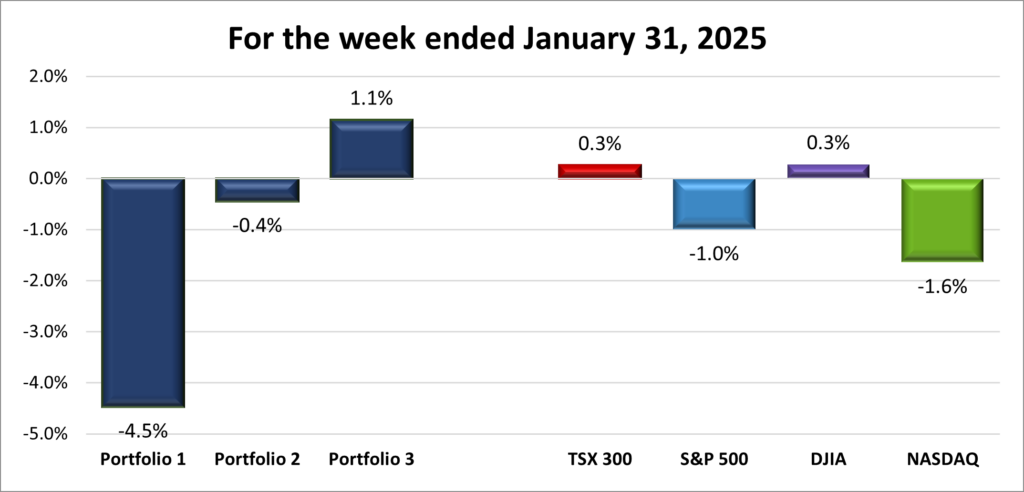
Weekly Portfolio & Index performance
Weekly Portfolio & Index performance for the week ended January 31, 2025.

Monthly Market and Portfolio Review

For the month, the TSX (SPTSX) increased 3.3%, the S&P (SPX) rose 2.7%, the DJIA (INDU) surged 4.7% and the Nasdaq (CCMP) gained 1.6%.

Bull market. A good week for the North American stock markets. January was a comeback month for the markets, with all four major North American indexes finishing in the green and getting back in the win column, as shown in the monthly progress chart above. The rally was fueled by strong earnings, solid economic data, and the Fed’s decision to keep interest rates steady. Excitement around AI also played a big role, pushing technology stocks higher—at least for most of the month. But it wasn’t all smooth sailing. Growing concerns over new trade tariffs on the US’s top three trading partners rattled investors, and AI momentum hit a wall in the final week after a Chinese AI firm introduced a platform that rivaled much pricier American alternatives, raising questions about future AI spending.

Up north, the TSX rode the wave of another interest rate cut, economic growth, and a surge in gold stocks as investors looked for safety amid the tariff uncertainty. But with Canada in the crosshairs of potential trade restrictions, volatility in the Canadian market spiked.

January got the new year off to solid start, with the DJIA and TSX leading the way thanks to their heavier weighting in traditional industries. While strong earnings and AI enthusiasm helped fuel gains, trade tensions kept markets on edge. With tariffs set to take effect on February 1, the next few months could be a wild ride. Buckle up! 😊

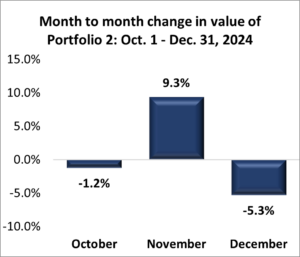
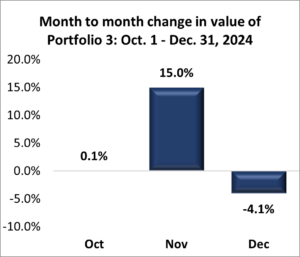
Bull market. A good week for the North American stock markets. As for the three portfolios, I was pleasantly surprised by Portfolio 3’s standout performance in January, crushing the competition by outpacing the next best portfolio fivefold and even outperforming all four major indexes. The only downside? Portfolio 1 ended the month in the red, keeping it from a clean sweep of all portfolios ending in the green. Overall, it was a solid month for the portfolios, but it would’ve been even better if Portfolio 1 had joined the others in the win column—and even better if the other two had matched Portfolio 3’s stellar performance! 😊
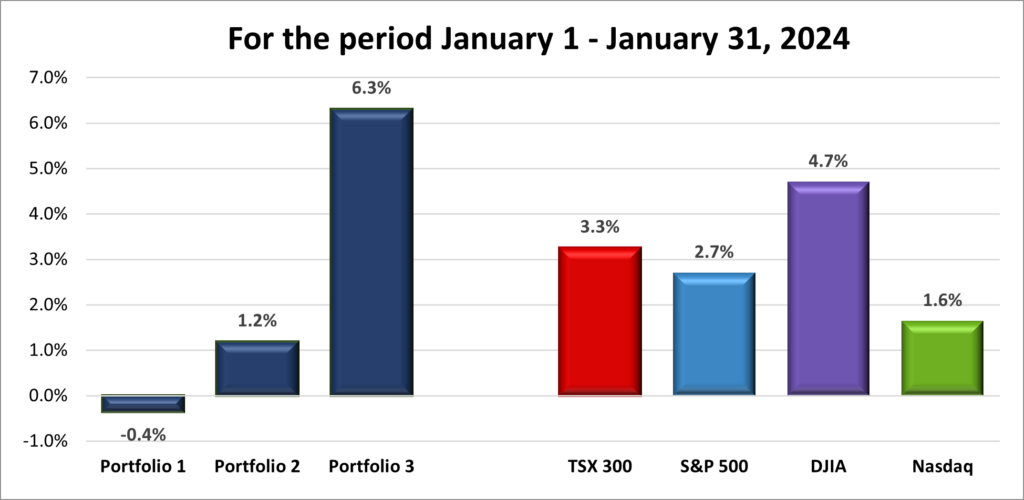
Monthly Portfolio & Index performance
Monthly Portfolio & Index performance for December 2025.

Companies on the Radar

Stocks on my Radar This past week, no new companies made it onto my radar. However, I did make a change by removing EQT Corporation (NYSE: EQT), the American natural gas company, from the list. While the company’s five-year growth estimate of 113% looks impressive on paper, it’s still just an estimate. Plus, with plenty of Canadian-listed natural gas companies offering similar potential, I’m better off avoiding the extra cost of foreign exchange.

With that, my radar list is now down to these five companies:

  • Sportradar Group AG (NASD: SRAD): A mid-cap Swiss company specializing in sports data, content, and integrity services that support businesses in sports, media, and betting industries.
  • Howmet Aerospace Inc. (NYSE: HWM): A large-cap American company producing cutting-edge engineered products like airfoils, titanium forgings, and forged aluminum wheels for aerospace, energy, and transportation sectors.
  • Rubrik, Inc. (NASD: RBRK): a high-growth, large-cap American cybersecurity firm.
  • Axon Enterprise, Inc. (NASD: AXON): A large-cap innovator in body cameras, TASER devices, and cloud-based evidence management software, serving law enforcement and public safety agencies.
  • GitLab Inc. (NASD: GTLB): A large-cap American firm offering software tools that developers can use for coding, project management, and workflow automation.

As always, these are not buy recommendations – be sure to do your own research and make decisions that align with your personal financial goals!

The Radar Check was last updated January 31, 2025.

Stock on the Radar List. 1 of 2.
Stock on the Radar List. 2 of 2.

Portfolio Update

Portfolio 1

Portfolio 1 for the week ended January 31, 2025: DOWN Red Down Arrow

  • CrowdStrike announced they achieved a perfect score on an industry test for ransomware detection, protection, and accuracy, sending the share price up almost 7% for the week. So much for companies leaving CrowdStrike following last year’s botched rollout of an update. 😊
  • The US government is weighing additional restrictions on Nvidia’s H20 AI chips exported to China. These chips were specifically designed for the Chinese market to comply with earlier trade restrictions, but they may now face even tighter controls.

Activity

Sold: BCE Inc. (TSE: BCE) I first invested in BCE back in September 2019, drawn by its stability and solid dividend. As the share price fell, the dividend yield climbed to 8.6%, prompting me to buy more shares, thinking the stock had bottomed out. Unfortunately, the price continued to decline, and I’m now concerned that the current 11.9% dividend may not be sustainable.

Over the past five years, BCE’s stock has dropped 45%, while the broader market has posted gains. This underperformance raised a red flag for me. Key concerns include BCE’s high debt levels, which limit its ability to invest in growth, and its inconsistent earnings. Despite a slight increase in free cash flow, the company missed revenue and earnings estimates, signaling potential future struggles.

My biggest concern is BCE’s dividend. With an 11.56% yield, it looks attractive, but if the company’s financial health continues to weaken, a dividend cut could be on the horizon, further dragging down the stock price.

Given these factors, I sold some BCE shares to limit potential losses but kept a few to continue benefiting from the dividend. I’ll reinvest the proceeds into more stable or promising opportunities for growth.

Sold: General Motors (NYSE: GM) I initially invested in GM because I was excited about their innovative Ultium battery powerplant, the promising Cruise robo cars, and their lineup of electric vehicles (EV). However, they recently decided to discontinue the Cruise robo cars to shift their focus towards integrating advanced driver assistance systems (ADAS) into their vehicles. Additionally, GM has turned back to building conventional vehicles, particularly plug-in hybrid electric vehicles (PHEVs), due to challenges they faced with slowing EV sales. None of these prompted me to sell my shares.

However, the looming threat of US tariffs on Canada and Mexico – which could seriously disrupt GM’s tightly integrated supply chain – led me to reluctantly sell my shares. Adjusting to new trade rules won’t happen overnight, and higher costs could weaken sales. If revenues take a hit, the stock price might struggle for a while. Of course, that’s just my take – but I’ve been wrong before! 😊

That said, I still believe GM is a solid long-term investment. The uncertainty around tariffs and supply chain disruptions just made me cautious for now. If things settle, I wouldn’t rule out becoming a shareholder again down the road.

Dividends

Dividends Received this week for the following companies:

No dividends this past week.

Quarterly Reports

General Motors Company

Fourth quarter 2025 financial results on January 28, 2025

Apple Inc.

First quarter 2025 financial results on January 30, 2025

Celestica Inc.

Fourth quarter 2024 financial results on January 30, 2025

Canadian National Railway Company

Fourth quarter 2024 financial results on January 30, 2025

Visa Inc.

First quarter 2025 financial results on January 30, 2025

Portfolio 2

Portfolio 2 for the week ended January 31, 2025: DOWN Red Down Arrow

  • Guardant Health (NASD: GH) announced their Shield product has been selected by the Abu Dhabi Department of Health for their Blood-Based Colorectal Cancer Screening Program. The Shield test is a non-invasive blood-based screening program for colorectal cancer.

Activity

No significant activity to report this week.

Dividends

Dividends Received this week for the following companies:

Canadian $

South Bow Corp (TSE: SOBO)

US $

No US$ dividends this past week.

Quarterly Reports

Microsoft Corp.

Second quarter 2025 financial results on January 29, 2025

Brookfield Renewable Partners L.P.

Fourth quarter 2024 financial results on January 31, 2025

Portfolio 3

Portfolio 3 for the week ended January 31, 2025: UP Green Up Arrow, signifying a positive week

  • The Royal Bank of Canada (TSE: RY) announced they were leaving the Net-Zero Banking Alliance, following a similar move by the other major Canadian banks as well as the big US banks. The Net-Zero Banking Alliance was created to encourage financial institutions to limit the effects of climate change and push toward achieving net-zero emissions.

Activity

No significant activity to report this week.

Dividends

Dividends Received this week for the following companies:

No dividends this past week.

Quarterly Reports

Microsoft Corp.

See report under Portfolio 2.

Real Matters Inc.

First quarter 2025 financial results on January 31, 2025

Brookfield Renewable Partners L.P.

See report under Portfolio 2.

The Power of Dividends

The markets kicked off the week of January 27–31 on shaky ground, with the Nasdaq sliding more than 3% on Monday. As I’ve said before, markets don’t like surprises—and Monday morning delivered a big one. A Chinese artificial intelligence (AI) company announced that its AI assistant could match the performance of major American AI bots while using a fraction of the resources—cheaper chips and smaller data sets. This sent shockwaves through the market, raising doubts about whether the massive spending on AI by heavyweight tech companies will generate the returns many are banking on. AI-driven stocks took a hit, dragging the broader market down with them.

With volatility back in the spotlight, now is a great time to talk about a strategy that can help weather these ups and downs: dividend investing. While stock prices fluctuate, dividends provide a steady stream of income—helping investors stay grounded when markets get choppy.

The Power of Dividends: Why They Matter for Long-Term Investors

Ever dreamt of earning money while doing nothing more than holding your investments? That’s the power of dividends—turning passive income from a dream into reality. Dividend-paying stocks can be a game-changer, offering a unique mix of income, growth, and stability that appeals to investors at all levels.

What Are Dividends?

Dividends are payments companies make to shareholders, usually drawn from their profits. They’re often paid quarterly, rewarding investors simply for holding onto their shares.

For example, if you own 100 shares of a company that pays a $1 annual dividend, you’d earn $100 per year—without lifting a finger.

Why Dividends Matter

Dividend investing has a few key advantages:

  1. Reliable Income Stream:
    Dividends provide steady cash flow, even during market downturns. While stock prices fluctuate, many companies continue paying—or even increasing—their dividends.
  2. Compounding Growth:
    Reinvesting dividends accelerates wealth-building. Many brokers offer automatic dividend reinvestment plans (DRIPs), allowing you to buy more shares with your  A dividend reinvestment is like a snowball rolling down a hill—it starts small but grows bigger and bigger as more snow (or in this case, dividends) accumulates. This compounding effect is what makes long-term dividend investing so powerful. payouts. Over time, those extra shares generate even more dividends, creating a powerful snowball effect. Personally, I have every new holding in my accounts set to reinvest automatically—it’s a simple step, but the compounding effect over the years could be extraordinary.

    Think of dividend reinvestment like a snowball rolling down a hill—it starts small but grows bigger and bigger as more snow (or in this case, dividends) accumulates. This compounding effect is what makes long-term dividend investing so powerful.
  3. Inflation Hedge:
    Companies that consistently raise their dividends help investors keep up with rising costs. A stock that pays a $1 dividend today might increase it to $1.10 next year, protecting your purchasing power over time.
  4. Stability During Market Turbulence:
    Dividend-paying companies tend to be well-established, making their stocks less volatile. This stability is especially attractive during uncertain times.

Finding the Right Dividend Stocks

Not all dividend stocks are created equal—focus on quality and sustainability.

  • Start with Dividend Aristocrats: These are companies that have increased their dividends for at least 25 consecutive years, proving their reliability. Names like Johnson & Johnson (NYSE: JNJ), Procter & Gamble (NYSE: PG), and Coca-Cola (NYSE: KO) have paid dividends for over 60 years, making them strong contenders for long-term portfolios.
  • Look Beyond High Yields: A high dividend yield might seem tempting, but it can sometimes be a red flag. As I mentioned in a recent Weekly Update, if a yield looks too good to be true, it’s worth digging into the company’s financials.
  • Check the Payout Ratio: A key metric for assessing dividend sustainability is the payout ratio—how much of a company’s earnings are paid out as dividends versus reinvested for growth. A lower payout ratio suggests room for future dividend increases.

A reasonable payout ratio depends on the industry.

    • Stable, slow-growing companies (like utilities) often have higher payout ratios.
    • Growth-focused companies (like tech firms)—if they pay dividends at all—tend to have lower payout ratios, as they reinvest profits into expansion.

To calculate the payout ratio:

👉 Payout Ratio = (Dividends Paid / Net Earnings) × 100

For example, if a company earns $1 million in profit and pays out $300,000 in dividends, its payout ratio would be: ($300,000 ÷ $1,000,000) × 100 = 30%

This means 30% of earnings go to shareholders, while the remaining 70% is reinvested into the business.

For long-term investors, a moderate payout ratio with consistent growth is a sign of a well-managed company that balances rewarding shareholders with reinvesting for future expansion.

  • Diversify: Holding dividend stocks across different sectors reduces risk and helps maintain a steady income stream.

Incorporating Dividends into Your Strategy

If you’re considering dividend investing, start by setting clear goals. Want to generate $5,000 per year in passive income? Work backward to calculate how much you need to invest in dividend stocks to reach that target.

It’s also crucial to stay informed. Keep an eye on the financial health and dividend track record of the companies you own to ensure they remain solid investments.

Most importantly, be patient. Dividend investing is a long-term game, but with consistency and discipline, the rewards can be substantial.

Conclusion

Dividend-paying stocks offer a powerful combination of income, growth, and stability that can enhance your portfolio over the long term. Whether you’re just starting your journey or are already building your portfolio, dividends are like the gift that keeps on giving.

With a little patience and a solid strategy, they can help you build wealth and create a future you’ll thank yourself for. o when market volatility shakes things up, remember: dividend income doesn’t waver just because stock prices do. That steady cash flow might just become your ultimate financial safety net. 😊


Weekly Update for the week ending January 24, 2025

Dividend Fallacy

When a friend told me they were choosing stocks based on dividend yields, it got me thinking—how many of us have fallen into this same trap? High dividend yields can feel like a golden ticket, but are they always as good as they seem? Let’s look at two common pitfalls: the “dividend fallacy” and the “dividend trap.”

First, let’s define dividend yield. It’s the percentage of a stock’s price paid out as dividends each year. For example, if a stock costs $100 and pays a $5 annual dividend, its yield is 5%. While this metric is useful, focusing on it alone can lead to trouble. Dividend yield is only one piece of a much bigger puzzle.

Take this example: You spot a stock offering a 10% dividend yield and think it’s a steal. But what if that yield is high because the stock price recently plummeted after poor earnings? A falling stock price can artificially inflate the yield, creating the illusion of a great opportunity. If the company can’t maintain its payouts, it might cut the dividend, and the stock price could fall further. In the end, you’re left with less income and a shrinking investment.

This is where the “dividend fallacy” comes in—the assumption that higher yields always mean better investments. Some companies offer big payouts to attract investors, even when their profits can’t sustain them. If they’re paying out more than they earn, those dividends are at risk, and so is your investment. Meanwhile, focusing too much on yield might make you miss other important factors, like whether the company is growing or if its stock price has room to rise.

The “dividend trap” takes this one step further. It happens when you buy a stock for its high yield alone, only to discover the company is struggling. Sometimes, a high yield signals financial trouble, not stability. For instance, a high yield might result from the stock price dropping sharply, which increases the yield percentage. While this might look attractive at first glance, it often signals that the market has concerns about the company’s health. If the company pays out most of its profits as dividends, it has little flexibility to reinvest in growth or handle financial setbacks. This lack of flexibility can leave investors vulnerable during challenging times.

So, how do you avoid these pitfalls? Don’t chase high yields blindly. Instead, ask yourself: Can the company afford the dividend? Is the yield high because the stock price is falling? Does the company have room to grow and reinvest? Looking at the bigger picture—such as the company’s financial health, growth potential, and total return—can help you make smarter decisions.

Investing is about the long game, and while high yields can be tempting, they’re not the full story. By digging deeper, you’ll avoid common pitfalls and build a portfolio that stands the test of time. 😊

Now that we’ve covered the risks of chasing high dividend yields, let’s take a step back and look at how the broader markets performed this week—and what it all means for my three portfolios…


Items that may only interest or educate me ….

Canadian Economic news, US Economic news, …

Canadian Economic news

This past week’s key economic data that the Bank of Canada (BoC) considers when deciding whether to raise or lower the interest rate.

Consumer price Index (CPI)

Statistics Canada reported that inflation cooled by 0.4% in December, following a flat reading in November. On a yearly basis, inflation eased to a three-month low of 1.8%, matching analysts’ expectations and dipping slightly below November’s 1.9%. December also marked the fifth consecutive month where inflation remained at or below the BoC’s 2% target – a bit of good news for Canadians! 😊

Month over month, ‘Transportation’ prices saw the largest increase, rising 1.8%, while ‘Clothing and footwear’ saw the sharpest decline, falling 3.0%. Annually, ‘Shelter’ costs, which include mortgages and rent, continued to lead price growth at a growth rate of 4.5%, though that’s down slightly from November’s 4.6%. On the flip side, ‘Clothing and footwear’ posted the largest annual drop, tumbling 4.5%.

Core CPI, which excludes the often-volatile food and energy categories, also pointed to easing pressures. It declined by 0.1% month over month for the second straight month, although the annual rate edged up to 2.1% from November’s 1.9%.

December’s decline in inflation was largely driven by the temporary GST sales tax break introduced mid-month, giving Canadians a welcome reprieve. While the overall trend points to slowing inflation, higher costs for essentials like food and shelter remain a strain. The tax break has provided some breathing room, but with its expiration looming on February 15, 2025, and the potential for new US tariffs as early as February 1, inflationary pressures could resurface.

These developments complicate the BoC’s upcoming meeting on January 29. However, the BoC will need to carefully weigh the temporary relief from the GST holiday against the broader inflationary trends and economic conditions before making their decision.

Retail Sales

Canada’s retail sales were unexpectedly flat in November, according to Statistics Canada’s Thursday report, missing the anticipated 0.2% increase. This followed a 0.6% rise in October. On a brighter note, annual sales grew 1.6%, edging up from October’s 1.5% and beating expectations of 0.8%.

Breaking it down by industry, ‘Motor vehicle and parts dealers’ led the pack with a 2.0% monthly increase, while ‘Building material and garden equipment and supplies dealers’ took a hit, dropping 2.1%. Year-over-year, ‘Motor vehicle and parts dealers’ also shone, with a 5.8% gain. Meanwhile, ‘Gasoline stations and fuel vendors’ saw sales decline 5.1% year-over-year, marking the third straight month of falling sales in this category.

Core retail sales—which exclude the often-volatile auto and fuel categories—dropped 1.0% in November, the steepest monthly decline in six months, compared to a modest 0.2% gain in October. However, on an annual basis, core sales still managed to rise by 0.8%, though this was slower than October’s 1.8%.

Retail sales are a key early indicator of GDP growth, accounting for nearly 40% of total consumer spending. Unfortunately, this latest data paints a less optimistic picture for next week’s GDP report. Some analysts believe the softer numbers reflect consumers postponing purchases ahead of the GST tax break that began in mid-December. On a brighter note, early indicators suggest sales bounced back in December. Here’s hoping those forecasts prove correct! 😊

Canadian market volatility

Canada’s Volatility Index (VIXC) saw a brief surge this week, opening at 13.58 and jumping above 19 on tariff concerns. However, the spike was short-lived, as the index quickly settled below 16 within 30 minutes. From there, the VIXC drifted lower throughout the week, closing at a calmer 12.99.

For those unfamiliar with the VIXC (listed as VIXI on the Toronto Stock Exchange), think of it as a measure of market jitters. Readings under 10 indicate calm waters, while levels between 10 and 20 reflect normal market fluctuations. If it shoots above 20, it signals growing uncertainty and the potential for more turbulence. This week’s quick recovery and lower close suggest that markets might be shrugging off the tariff worries—for now. 😊

US Economic news

This past week’s key data points that the Federal Reserve (Fed) considers when deciding whether to raise or lower the interest rate.

Consumer Sentiment Index (CSI)

The University of Michigan’s January CSI brought a bit of a surprise, marking its first drop in six months. The index slipped to 71.1, missing analysts’ expectations of 73.2. That’s a 3.9% decline from December’s 74.0 and 10% lower than this time last year.

Breaking down the components: the Current Economic Conditions Index, which reflects how consumers feel about their finances right now, edged down to 74.0 from 75.1 in December—a 1.5% drop—and is 9.6% below where it stood in January 2024. On the other hand, the Index of Consumer Expectations, which looks at optimism about the next six months, fell more sharply to 69.3, down 5.5% from December and 10.1% year-over-year.

Overall, the decline in sentiment highlights growing concerns about inflation and unemployment. The drops were consistent across income, wealth, and age groups, suggesting a broad-based anxiety. To complicate matters, some consumers are rushing to make purchases early, hoping to avoid price hikes tied to potential tariffs.

Consumer sentiment is a key indicator of how people might spend in the months ahead, so this decline could signal caution in the economy. Let’s hope this is just a blip on the radar and not the start of a larger trend! 😊

American market volatility

The CBOE Volatility Index (VIX), often called the market’s “fear gauge,” began the week at 16.46 and steadily drifted lower, closing at 14.85. Optimism around the new administration’s policies, including the delay of potential tariffs, helped ease investor fears and stabilize markets, contributing to the decline in the VIX.

For those new to the VIX, it tracks expected market volatility over the next 30 days. Think of it like a stress meter for the market: below 12 suggests calm and smooth sailing, while 12 to 20 signals routine ups and downs. When the VIX climbs above 20, it means nerves are rising, and anything over 30 often points to significant market tension or even a potential crisis. This week’s lower reading reflects a more relaxed mood among investors. 😊


Weekly Market and Portfolio Review

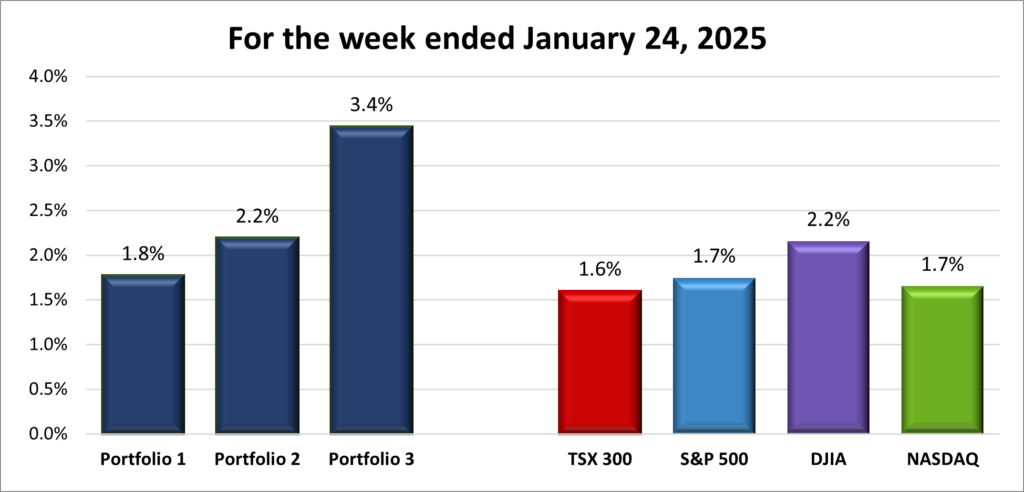
For the week, the TSX (SPTSX) climbed 1.6%, the S&P 500 (SPX) rose 1.7%, the DJIA (INDU) advanced 2.2% and the Nasdaq (CCMP) increased 1.7%.

 
Index Weekly Streak
TSX: 2 – week winning streak
S&P: 2 – week winning streak
DJIA: 2 – week winning streak
Nasdaq: 2 – week winning streak

Bull market. A good week for the North American stock markets. The first week of President Trump’s second term ended on a high note, with all four major indexes posting weekly gains, as shown in the chart above. Markets rallied on strong corporate earnings and optimism over the administration’s business-friendly stance. The S&P closed at a record high, and the DJIA hit its highest level in over a month, with all three US indexes stringing together four straight winning sessions.

Investors’ hopes for lower taxes and reduced regulations overshadowed their concerns about proposed tariffs, which could raise costs and spark inflation. In a speech to the World Economic Forum, President Trump urged central banks to cut interest rates, called on OPEC to lower oil prices, and reaffirmed plans for broad tariffs starting February 1. While lower rates and cheaper oil appeal to investors, the tariff threat dampened enthusiasm.

Meanwhile, the TSX stretched its winning streak to nine sessions – the longest since October 2021 – driven by gold-mining stocks, optimism about US growth, and lower-than-expected CPI inflation data. With inflation easing, the BoC could be on track to cut rates, adding more momentum to Canadian equities.

As the first week of the presidency shows, this administration could bring both opportunities and risks. Pro-business policies have lifted markets, but tariffs remain a wildcard, particularly for the Canadian economy.

Looking ahead, next week should be action-packed with rate decisions from the BoC and the Fed, plus earnings from major tech giants. After a calm start to the year, things are about to heat up. Stay tuned! 😊

Portfolio Weekly Streak
Portfolio 1: 2 – week winning streak
Portfolio 2: 2 – week winning streak
Portfolio 3: 2 – week winning streak

Bull market. A good week for the North American stock markets. After the ups and downs of the first two weeks of the year, I wasn’t sure what to expect heading into this past week. But the start of President Trump’s second term brought a pleasant surprise for all three portfolios, each gaining at least 1.8%, as shown in the chart below. Investor optimism gave a nice lift to heavyweight technology companies, which benefited my tech-heavy portfolios. That said, it wasn’t all smooth sailing – declining oil and natural gas prices created headwinds for energy holdings, limiting the overall weekly gains.

Portfolio 1 had a strong week, with 71% of its holdings closing in the green. By Thursday, it was leading the charge among all portfolios and indexes, bolstered by a rally in technology stocks, including Amazon (NASD: AMZN), which hit an all-time high. However, a Friday pullback in the tech sector caused the portfolio to slip behind the other two. Thankfully, its largest holding, Nvidia (NASD: NVDA), posted a weekly gain, helping secure a positive finish for the week.

Portfolio 2 had an even better week, increasing in value by 2.2% on the strength of 71% of its holdings finishing in the green. Leading the way was Guardant Health (NASD: GH), which jumped an impressive 26% after gaining expanded Medicare coverage for its Guardant Reveal test for colon cancer.

Portfolio 3 stole the show this week, with 77% of its holdings moving higher and outperforming the other portfolios as well as all four indexes. The crown jewel? Vertiv Holdings (NYSE: VRT), which hit a new all-time high, adding an extra spark to the portfolio’s impressive run. Sometimes, being third in line means first in performance! 😊

Overall, while there weren’t any jaw-dropping surprises, a steady gains across all three portfolios made for a solid week. As the tortoise said to the hare, “Slow and steady wins the race.” 😊

Weekly Portfolio & Index performance
Weekly Portfolio & Index performance for the week ended January 24, 2025.

Companies on the Radar

Stocks on my Radar Once again, my radar list has seen some reshuffling! This time, though, the stocks leaving – Kenvue Inc. (NYSE: KVUE), Astera Labs, Inc. (NASD: ALAB), and RxSight, Inc. (NASD: RXST) – didn’t make their way into one of my portfolios. Here’s why:

  • Kenvue didn’t offer the growth potential I’m looking for right now.
  • Astera Labs is a strong player in semiconductors, but my portfolios already have plenty of chip exposure. If I weren’t so semiconductor-heavy, this one would stay on my radar longer.
  • RxSight faced stiff competition from the five new names I added to the list – sometimes, it’s just about finding better fits!

That leaves Rubrik, Inc. (NASD: RBRK), the high-growth, large-cap American cybersecurity firm, as the lone holdover. Joining it on my radar list are these five new additions:

  • Sportradar Group AG (NASD: SRAD): A mid-cap Swiss company specializing in sports data, content, and integrity services that support businesses in sports, media, and betting industries.
  • Howmet Aerospace Inc. (NYSE: HWM): A large-cap American company producing cutting-edge engineered products like airfoils, titanium forgings, and forged aluminum wheels for aerospace, energy, and transportation sectors.
  • GitLab Inc. (NASD: GTLB): A large-cap American firm offering software tools that developers love for coding, project management, and workflow automation.
  • Axon Enterprise, Inc. (NASD: AXON): A large-cap innovator in body cameras, TASER devices, and cloud-based evidence management software, serving law enforcement and public safety agencies.
  • EQT Corporation (NYSE: EQT): A vertically integrated, large-cap natural gas company, focused on production and midstream operations – a powerhouse in the energy sector.

This latest radar list is a great mix of innovation, steady growth, and untapped potential. Now, the fun part begins: taking a closer look at these companies and deciding if any will make the leap into one of the portfolios. 😊

As always, these are not buy recommendations – be sure to do your own research and make decisions that align with your personal financial goals!

The Radar Check was last updated January 24, 2025.

Stock on the Radar List. 1 of 2.
Stock on the Radar List. 2 of 2.

Portfolio Update

Portfolio 1

Portfolio 1 for the week ended January 24, 2025: UP Green Up Arrow, signifying a positive week

  • TD Bank (TSE: TD) and the Bank of Nova Scotia (TSE: BNS) have dropped out of the Net-Zero Banking Alliance. Both banks stated that they have the necessary internal capabilities to continue their climate work independently. This comes on the heels of six major US banks withdrawing from the Alliance.
  • Alphabet’s (NASD: GOOGL) announced they plan to invest another US$1 billion in artificial intelligence (AI) startup AnthropicAI.
    In other Google related news, Britain’s anti trust regulator, the Competition and Markets Authority (CMA), has started an investigation into Google’s and Apple’s (NASD: AAPL) smartphone operating systems, app stores and browsers. The CMA is looking to see if the two companies are using their mobile system dominance to favour their own apps and services and pushing unfair terms on developers.
  • General Motors (NYSE: GM) announced they are recalling certain 2025 Chevrolet Equinox EV all-wheel drive electric vehicles (EV). The National Highway Traffic Safety Administration found that the vehicles’ adaptive cruise control may not engage the brakes properly, due to faulty brake module software, increasing the risk of a crash. GM dealers will update the software free of charge.

Activity

Sold: A covered call option on some Nvidia shares Back in November 2024, I decided to try something a bit different with my Nvidia shares: I placed a covered call options order [link to Nov8]. For those unfamiliar with the term, a covered call lets you generate income from stocks you already own. Here’s how it works: instead of just selling my shares outright, I was paid a premium upfront for agreeing to sell them at an agreed price, in this case $150 per share, if Nvidia’s price reached that level. Essentially, I got paid to wait, and if Nvidia hit $150, the shares would be taken as agreed—with a little extra bonus. If the share price didn’t reach the strike price by the expiration date, I’d keep both the shares and the premium.

When the option expired at the end of November, Nvidia’s share price was below $150, so the buyer didn’t exercise the option because it was cheaper for them to buy the shares on the open market. That meant I kept my shares and the premium.

This past week, I decided to place another covered call for some of my Nvidia shares. As with the November trade, I set the strike price at $150 per share, with the option expiring on February 7, 2025. If Nvidia’s share price hits $150, the shares will go to the buyer, and I’ll trim my position as planned. If it doesn’t, I’ll keep the premium and my shares.

Either way, I’m happy with the outcome. 😊 If the shares are sold, my portfolio becomes less concentrated, giving me extra cash to invest elsewhere. If they’re not sold, I’ve earned a bit of income while holding onto a stock I still like. It’s a win-win strategy that fits nicely with my goals.

Dividends

Dividends Received this week for the following companies:

Companies followed by DRIP (Dividend Re-Investment Plan) indicate additional shares were purchased with the dividend. Any cash leftover was added to the cash balance.

Canadian $

Dream Industrial Real Estate Investment Trust (TSE: DIR.UN) DRIP

Decisive Dividend Corp (TSE: DE) DRIP

BCE Inc (TSE: BCE) DRIP

US $

No US$ dividends this past week.

Quarterly Reports

No quarterly reports this past week.

Portfolio 2

Portfolio 2 for the week ended January 24, 2025: UP Green Up Arrow, signifying a positive week

  • Guardant Health announced that Palmetto GBA, a Medicare administrative contractor, approved coverage for the company’s Guardant Reveal test to monitor for disease recurrence in colorectal cancer patients after curative intent therapy, expanding the prior coverage that only covered monitoring in the early post-surgical setting.

Activity

No significant activity to report this week.

Dividends

Dividends Received this week for the following companies:

Canadian $

Brookfield Infrastructure Partners LP (TSE: BIP.UN) DRIP

Dream Industrial Real Estate Investment Trust (TSE: DIR.UN) DRIP

US $

No US$ dividends this past week.

Quarterly Reports

No quarterly reports this past week.

Portfolio 3

Portfolio 3 for the week ended January 24, 2025: UP Green Up Arrow, signifying a positive week

  • TD Bank announced Chief Global Anti-Money Laundering Officer Herbert Mazariegos has stepped down and has been replaced by Jacqueline Sanjuas. Considering the huge fine TD received from US regulators over money laundering, this shouldn’t be a surprise to anyone.

Activity

No significant activity to report this week.

Dividends

Dividends Received this week for the following companies:

Canadian $

goeasy Ltd (TSE: GSY)

TD US Equity Index ETF (TSX: TPU)

US $

No US$ dividends this past week.

Quarterly Reports

No quarterly reports this past week.


Weekly Update for the week ending January 17, 2025

With the start of another earnings season, I thought it’d be a great time to talk about earnings reports. These reports can seem a bit intimidating, but they’re one of the most important tools for assessing how a company is performing.

Understanding Earnings Reports: What New Investors Should Know

Earnings reports are like a company’s report card, showing how well they’ve performed over a specific period – usually a quarter or a year. They provide key details like revenue, profits, expenses, and earnings per share (EPS), helping investors gauge how a business is doing. For example, steadily growing revenue signals a thriving business, while shrinking profits may raise concerns. Earnings reports also offer management insights about the industry and plans for the future, giving a clearer picture of what’s ahead.

One critical aspect of earnings reports is how they stack up against expectations. Companies provide guidance and analysts make predictions. If actual results beat these forecasts, it’s often good news for the stock. But missing expectations can trigger a sell-off as investors worry about underlying issues. These reports also help calculate valuation metrics like the price-to-earnings (P/E) ratio, making it easier to decide if a stock is overpriced or a potential bargain.

Earnings reports don’t just affect individual stocks—they can influence entire markets. For instance, if a major player like Nvidia (NASD: NVDA) posts strong results, it could lift the technology sector as a whole. On the flip side, weak results from a market leader can drag down related industries. Forward-looking guidance is equally important; even if a company meets expectations, weak forecasts can weigh on its stock, while an optimistic outlook can boost confidence and prices.

Key Elements of an Earnings Report

  • Revenue: Often called the “top line,” this is the total money the company made during the period. Higher-than-expected revenue is a positive sign, while missing expectations could signal slowing growth or weak demand.
  • Earnings Per Share: This metric shows how much profit the company earns per share. Beating EPS expectations often drives stock prices up, while missing them can lead to declines.
  • Guidance: A forward-looking statement outlining the company’s expectations for future earnings and revenue. Strong guidance can boost investor confidence, while weak forecasts may raise concerns.
  • Net Income: Known as the “bottom line,” this is what’s left after expenses are deducted from revenue. Growing net income signals efficient cost management and a healthy business.
  • Margins: These measure how much profit is kept after expenses. Increasing margins suggest improved efficiency, while shrinking margins may signal rising costs or slowing demand.

Key Takeaway

When it’s earnings season, don’t worry about reading every detail of the report—focus on the big picture. Look for key takeaways like revenue growth, EPS, and the company’s guidance for the future. These highlights can give you a quick sense of how a business is doing and what might come next. Even if you’re not digging into the fine print, pay attention to how the market reacts. Big surprises—good or bad—can create risks or opportunities that might affect your investments.

So, the next time a company you own makes headlines during earnings season, take a moment to see what’s driving the buzz. It’s a simple way to stay informed about your portfolio and maybe even discover where the market is headed! 😊

Strong earnings reports were a key driver of the markets’ performance throughout 2024. As we kick off another earnings season, the big question is whether this strength will continue to lift the markets in the weeks ahead. For now, let’s take a look back at what shaped the past week….


Items that may only interest or educate me ….

Changes, Canadian Economic news, US Economic news,

Changes to Weekly Updates

Before diving into the always-exciting economic news and updates, you may have noticed a few changes in last week’s ‘Weekly Update.’ After some thought, I’ve made tweaks to make the posts shorter and more enjoyable to read.

First, I’ve decided to drop the ‘Weekly Market Review’ section. While it offered a quick recap of daily market movements, there are plenty of resources out there that provide more details. My focus is to provide content that’s insightful and adds value rather than just rehashing headlines.

Second, I’ve shifted the grammar and spell-checking style to a more casual tone. You’ll notice this most in the use of contractions, like “I’ve” instead of “I have.” The goal is to make the updates flow better, feel more natural, and align with the relaxed and conversational tone I aim for here.

With these tweaks, I’m hoping to keep delivering updates that are both informative and a little easier to read. Let me know what you think – I’m always open to feedback! 😊

Canadian Economic news

This past week’s key economic data that the Bank of Canada (BoC) considers when deciding whether to raise or lower the interest rate.

End of Quantitative Tightening

The Bank of Canada (BoC) recently announced that its quantitative tightening (QT) program will conclude in the first half of this year. This shift allows the bank to resume normal bond purchases and maintain an appropriate level of settlement balances. A well-managed settlement balance provides the BoC with flexibility to inject money into the economy during times of economic crisis. The BoC is among the first central banks globally to halt the unwinding of pandemic-era asset purchases.

If you’re new to investing, even if you’re not, QT might sound complicated, but it’s essentially a way for the central bank to reduce the amount of money circulating in the economy. Let’s use an analogy to explain QT.

Imagine the economy is a garden, and money is the water. During QT, the BoC is like a gardener turning the faucet tighter and tighter to reduce the water flow. This helps control inflation but can also slow economic growth.

When QT ends, it doesn’t mean the faucet is turned back on. Instead, the tightening stops, and the flow of money remains steady. If the BoC were to switch to quantitative easing (QE), that’s when the faucet would turn back on, allowing more money to flow into the economy.

In simpler terms:

  • Ending QT: Stops reducing the flow of money but doesn’t add more.
  • QE: Actively increases the flow of money, like turning the faucet back on.

For us investors, this distinction is key. Ending QT can stabilize financial conditions, which is good news, but it doesn’t mean the economy is getting an extra boost – at least not yet. 😊

Canadian market volatility

Canada’s Volatility Index (VIXC) had a steady week, starting at 12.73 and edging up to close at 13.63, reflecting a modest uptick in investor uncertainty.

Listed as VIXI on the Toronto Stock Exchange (TSE), the VIXC gauges market sentiment by measuring expected volatility. A reading below 10 points to calm and stability, while levels between 10 and 20 suggest moderate, typical market fluctuations. When the index climbs above 20, it signals growing uncertainty and the likelihood of a more turbulent market environment. For now, the VIXC remains comfortably within the range of typical market movements, suggesting investors aren’t overly anxious at this time.

US Economic news

This past week’s key data points that the Federal Reserve (Fed) considers when deciding whether to raise or lower the interest rate.

Consumer Price Index (CPI)

The latest CPI report from the Labor Department shows that prices are still on the rise, though there’s a slight twist in the tale. December’s CPI went up by 0.4%, a touch higher than November’s 0.3% and a bit more than what experts predicted. On a yearly basis, the CPI climbed by 2.9%, following a 2.7% rise in November.

On a monthly basis, the prices of ‘Gasoline’ and ‘Fuel oil’ were the big drivers of inflation for the month, each shooting up by 4.4%. On the flip side, the price for ‘Medical care commodities’ was the only category to not post an increase, coming in flat after four months of declines.

Year-over-year, ‘Transportation services’ continued to see the biggest jump, up by 7.3%. Meanwhile, ‘Fuel oil’ prices saw the steepest decline in prices, falling by 13.1%.

On the housing front, ‘Shelter’ costs inched up by 0.3% in December, mirroring November’s pace. Annually, the rate of shelter costs slowed slightly, rising by 4.6%, down from 4.7% the previous month.

This is where the twist comes in. Excluding the more volatile food and energy prices, the Core CPI rose, but at a slower pace of 0.2% in December, compared to 0.3% in the prior four months. Over the year, Core CPI grew by 3.2%, the first time since July that core CPI has slowed just a tad lower than November’s 3.3%.

The monthly and annual rise in December’s headline, or all-items, CPI suggests that inflationary pressures persist. However, the slower increases in Core CPI show that while underlying inflation is cooling, it remains elevated. Analysts expect the Fed to hold the US benchmark interest rate at 4.5% at heir next meeting on January 28 – 29, giving them time to analyze incoming data and the potential impact of President Trump’s proposed regulations.

Retail Sales

The latest retail sales data from the US Census Bureau showed that consumer spending grew in December, though not as much as expected. Retail sales rose 0.4% for the month, falling short of the anticipated 0.6% and down from the upwardly revised 0.8% increase in November. On an annual basis, however, retail sales climbed 3.9%, improving on November’s 2.9% growth and slightly exceeding forecasts of 3.8%.

The strongest monthly growth came from ‘Miscellaneous store retailers,’ with a 4.3% jump in sales. At the other end of the spectrum, ‘Building material & garden equipment & supplies dealers’ saw a 2.0% decline. Looking at yearly changes, ‘Auto & other motor vehicle dealers’ led the pack with an 8.8% increase, while ‘Building material & garden equipment & supplies dealers’ posted the steepest decline, dropping 1.8%.

Core retail sales – which strip out the more volatile categories like motor vehicles, parts, and gasoline stations – rose 0.3% in December, topping the expected 0.2% increase and improving on November’s modest 0.1% growth. Annually, core sales were up 3.3%, below November’s 3.8% and the forecast of 3.9%.

These figures highlight the resilience of American consumers, who continue to spend despite rising prices and higher interest rates. Strong job growth and rising wages have sustained upward momentum in retail spending, helping to support the broader economy. This steady growth explains the Fed’s cautious approach to cutting interest rates, as robust consumer spending remains a key driver of economic growth. The rise in retail sales reflects continuing consumer confidence and a solid economic foundation.

American market volatility

The CBOE Volatility Index (VIX), known as the market’s “fear gauge,” started the week at a jittery 21.18, reflecting heightened investor anxiety. However, it steadily eased, ending at 15.97 after relatively upbeat CPI inflation data calmed the markets.

For those new to the VIX, it measures expected market volatility over the next 30 days. A reading below 12 suggests calm and stability, while 12 to 20 signals typical market fluctuations. When the VIX climbs into the 20-30 range, it points to rising investor unease, and anything above 30 signals significant stress, often hinting at major market turbulence or even a crisis.


Weekly Market and Portfolio Review

For the week, the TSX (SPTSX) rose 1.2%, the S&P 500 (SPX) gained 2.9%, the DJIA (INDU) surged 3.7% and the Nasdaq (CCMP) advanced 2.4%.

 
Index Weekly Streak
TSX: 1 – week winning streak
S&P: 1 – week winning streak
DJIA: 1 – week winning streak
Nasdaq: 1 – week winning streak

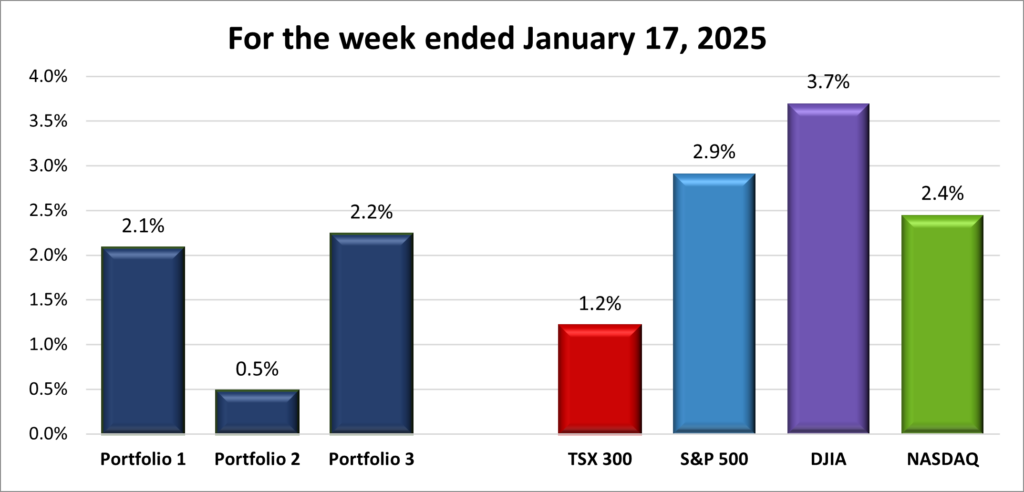
Bull market. A good week for the North American stock markets. The week started on shaky ground, but better-than-expected US inflation data midweek turned the tide, propelling all four major indexes higher, as shown in the chart above.

After a slow start to 2025, the Nasdaq Composite Index (Nasdaq) and S&P 500 Index (S&P) finally climbed into positive territory this past week with year-to-date gains of 1.8% and 2.2%, respectively. Technology stocks, which seemed stuck in a rut earlier this year, found renewed strength, helping lift these indexes. The Dow Jones Industrial Average (DJIA) has so far outpaced them with a 2.6% year-to-date gain. This marked the best week since early November for the S&P and DJIA, while the Nasdaq had its best performance since December.

Markets turned optimistic following the inflation data and strong earnings reports from several major US banks. This newfound confidence has sparked investor speculation about potential rate cuts later this year. However, uncertainty persists, especially regarding the potential impact of tariffs under President-elect Donald Trump’s administration. These tariffs will increase the cost of products and could cause inflation to rise, with Canada likely to bear the brunt of the fallout. Opinions are divided on how much strain American consumers and businesses might face.

In Canada, the Toronto Stock Exchange Composite Index (TSX) followed a slightly different path. It started the week on the wrong foot but gradually gained traction to post a modest weekly increase, pushing its year-to-date gain to 0.6%. Still, concerns over Trump’s threats to impose 25% tariffs on Canadian goods weighed on Canadian stocks, adding an extra layer of uncertainty to the country’s economic outlook.

Looking ahead, investors on both sides of the border are preparing for President Trump’s inauguration next week. His promises to lower taxes and cut regulations, along with threats of tariffs on Canada and other trading partners, are expected to stir market volatility. These actions could significantly impact the markets in the weeks to come. It’s shaping up to be an exciting week. 😊

Portfolio Weekly Streak
Portfolio 1: 1 – week winning streak
Portfolio 2: 1 – week winning streak
Portfolio 3: 1 – week winning streak

Bull market. A good week for the North American stock markets. After starting the year on shaky ground, the tide turned this week as all three portfolios rallied back into positive territory, buoyed by a market rebound driven by better-than-expected inflation data.

Portfolio 1 came in a close second in terms of percentage gain thanks to an impressive 89% of its holdings ending in the green. While its weekly percentage gain wasn’t the highest among the three portfolios, strong showings from Celestica (TSE: CLS), up 16%, PayPal (NASD: PYPL), up 12%, and Sea Limited (NYSE: SE), up 10%, provided a significant boost. And, most importantly, Nvidia – making up nearly 40% of the portfolio’s value – also posted a gain, helping solidify the portfolio’s positive performance.

Portfolio 2 had the smallest weekly gain, with 74% of its holdings posting positive results. Normally, having 74% of holdings post a weekly gain would be considered impressive, but this time, it was eclipsed by both of the other portfolios. In a reversal from last week, oil and gas stocks—previously cushioning losses—acted as a drag, limiting the portfolio’s overall recovery.

Portfolio 3 stole the spotlight with the largest percentage growth, supported by 86% of its holdings finishing higher. Leading the charge were Lithium Americas (TSE: LAC), up 14%, Telus Digital (TSE: TIXT), up 11%, and Vertiv Holdings (NYSE: VRT), also up 11%.

With the tide turning in our favour, all three portfolios sailed into calmer waters, buoyed by the market’s renewed momentum. While choppy seas may still lie ahead, here’s to fair winds and following seas to continue driving the portfolios higher! 😊

Weekly Portfolio & Index performance
Weekly Portfolio & Index performance for the week ended January 17, 2025.

Companies on the Radar

Stocks on my Radar My radar list got a bit leaner this week as two companies found new homes in my portfolios. Kraken Robotics Inc. (TSE: PNG) joined Portfolio 1, while Evolution AB (OTCM: EVVTY) was added to Portfolio 3. On the flip side, I removed Kyndryl Holdings, Inc. (NYSE: KD), the IBM IT infrastructure services spin-off. Although Kyndryl has made progress in narrowing its losses, declining revenues since 2021 and an ongoing lack of profitability remain concerns. More critically, its lack of a strong competitive moat in both its consulting arm and managed services division leaves it vulnerable to rivals. As an IBM spinoff, it has potential, but it doesn’t offer the level of growth I’m looking for from companies in the technology sector.

With three companies leaving the list, my radar list is down to these four remaining companies:

  • Kenvue Inc. (NYSE: KVUE): A large-cap (a market value greater than $10 billion) American consumer health company, spun off from Johnson & Johnson in 2023. Kenvue is behind household names like Tylenol and Band-Aid, offering a wide range of health products with which you are probably familiar.
  • Astera Labs, Inc. (NASD: ALAB): A large-cap American semiconductor company that’s making a mark with its purpose-built connectivity solutions, powering artificial intelligence (AI) and cloud infrastructure.
  • RxSight, Inc. (NASD: RXST): A mid-cap medical technology company that’s reshaping the way cataract surgery patients experience vision. RxSight specializes in adjustable intraocular lenses, allowing for better post-surgery outcomes.
  • Rubrik, Inc. (NASD: RBRK): A large-cap American player in the fast-growing cybersecurity sector.

As always, these are not buy recommendations – be sure to do your own research and make decisions that align with your personal financial goals!

The Radar Check was last updated January 17, 2025.

Stock on the Radar List. 1 of 2.
Stock on the Radar List. 2 of 2.

Portfolio Update

Portfolio 1

Portfolio 1 for the week ended January 17, 2025: UP Green Up Arrow, signifying a positive week

  • Nvidia’s revenues may face headwinds as the US imposed additional export restrictions on AI chips. These measures aim to solidify US leadership in the burgeoning AI sector while restricting China’s access to the most advanced American-designed AI technology.
  • Following calls from the US Federal Trade Commission to break up Alphabet’s (NASD: GOOGL) Google, Britain’s Competition and Markets Authority (CMA) has decided to investigate Google to see how their search services impact consumers and businesses alike.

Activity

Bought: Kraken Robotics is a growing marine technology company at the forefront of ocean exploration. Designing cutting-edge sensors, software, and robotic systems, Kraken specializes in high-resolution 3D acoustic imaging that helps clients tackle the challenges of ocean exploration safely, efficiently, and sustainably. Founded in 2012 and going public in 2015, the company has carved out a solid niche in underwater technology.

At the helm is a team of seasoned executives with deep expertise in marine innovation. Collectively owning nearly 9% of the company, their vested interests align with those of investors. This blend of experience and insider confidence strengthens Kraken’s foundation and positions it for long-term success.

Financially, Kraken is on an impressive trajectory. Profitable since 2023, the company continues to deliver rising revenues, earnings per share, and gross margins. A $150 million contract pipeline spanning military and commercial sectors underscores Kraken’s ability to diversify its client base while mitigating reliance on any single market—a strategic advantage in a competitive industry.

Kraken’s competitive edge lies in its innovative technology and robust intellectual property portfolio. As a leader in sonar and subsea battery technologies, its solutions power critical applications, from military mine countermeasures to offshore wind farm surveys. High-resolution imaging and extended Unmanned Underwater Vehicle (UUV) endurance create a strong moat that sets Kraken apart from competitors.

Expansion fuels Kraken’s momentum. With a growing presence in the US, the company is opening service centres and capitalizing on rising naval spending and the booming offshore energy sector. Canadian government funding and contracts with NATO navies—including the US, Netherlands, and Poland—bolster financial stability and credibility, cementing Kraken’s role as a trusted partner.

Every investment carries risks, and Kraken is no exception. Challenges include market volatility, intense competition, reliance on government spending, regulatory hurdles, and the rapid pace of technological change.

Despite these risks, Kraken’s future appears bright. With growing applications for its technology in defence and renewable energy, alongside strategic acquisitions and partnerships, the company is well-positioned for sustained growth.

With its innovative edge, growing demand for its solutions, and a clear strategy for growth, Kraken will be a valuable addition to this portfolio.

Dividends

Dividends Received this week for the following companies:

Companies followed by DRIP (Dividend Re-Investment Plan) indicate additional shares were purchased with the dividend. Any cash leftover was added to the cash balance.

Canadian $

Telus Corp (TSE: T) DRIP

Andlauer Healthcare Group Inc (TSE: AND)

US $

BSR Real Estate Investment Trust (TSE: HOM.U)

Innovative Industrial Properties Inc. (NYSE: IIPR)

Quarterly Reports

No quarterly reports this past week.

Portfolio 2

Portfolio 2 for the week ended January 17, 2025: UP Green Up Arrow, signifying a positive week

  • Guardant Health (NASD: GH) is teaming with ConcertAI, an oncology data and AI software-as-a-service company, to combine patient data with their tumor profiles to improve cancer treatments.

Activity

No significant activity to report this week.

Dividends

Dividends Received this week for the following companies:

Canadian $

Telus Corp (TSE: T) DRIP

Whitecap Resources Inc (TSE: WCP) DRIP

SmartCentres Real Estate Investment Trust (TSE: SRU.UN)

US $

Walt Disney Co. (NYSE: DIS)

Quarterly Reports

No quarterly reports this past week.

Portfolio 3

Portfolio 3 for the week ended January 17, 2025: UP Green Up Arrow, signifying a positive week

  • TD Bank (TSE: TD) is fast-tracking their leadership changes with the current CEO retiring and the Chairman of the board set to depart earlier than previously announced. The bank is attempting to move past the scandal over its anti-money-laundering failings.

Activity

Bought: Evolution AB was founded in 2006 and has become a powerhouse in the iGaming industry (online gambling). Specializing in live casino solutions, this Swedish company serves over 600 global gaming operators and leads the way in blending cutting-edge technology with engaging gaming experiences.

I chose to invest in Evolution for several reasons. First, the company dominates the booming live casino segment, a market that grew at an impressive 38% annual rate from 2015 to 2019. Their relentless innovation has earned numerous awards, cementing their reputation as industry pioneers. Simply put, Evolution isn’t just keeping up—they’re setting the standard.

Financially, Evolution excels. They consistently deliver strong revenue and earnings growth through organic expansion, with robust margins and rising EPS reflecting efficiency and profitability. Positive free cash flow fuels growth initiatives, keeping them ahead of the curve.

What truly sets Evolution apart is its people. The co-founders remain active on the board, and senior executives, with at least nine years at the company, hold significant stakes. This alignment with shareholders, paired with a culture of innovation and customer focus, drives their success.

Evolution’s competitive edge is formidable. Proprietary technology, strong brand recognition, extensive licensing agreements, and room for expansion make them hard to beat. With online gambling and sports betting on the rise, Evolution is well-positioned to capture market growth. Their share buyback program further underscores management’s confidence.

As with every investment, there are risks and Evolution is no exception. Regulatory scrutiny, legal challenges, and reliance on key markets bring uncertainties. These concerns have likely contributed to the share price dropping over 40% in the last ten months—or at least, that’s what I’m betting on. 😊

Despite these hurdles, I see Evolution as a leader in a thriving industry with significant upside. The rising demand for online gambling, evident in the wave of advertising, signals a growth trajectory that’s hard to ignore. By investing in Evolution, I’m betting on a market leader with the innovation, financial strength, and vision to deliver long-term value.

Note: Evolution AB shares are primarily traded on the Nasdaq Stockholm Exchange under the ticker EVO.ST. While I considered buying them through TD Direct Investing, the hefty foreign transaction fees made me rethink. Instead, I chose EVVTY, an American Depositary Receipt (ADR) (for more on ADRs, check out this post on ADRs) that trades over the counter (OTC) in the US. This option allows North American investors to access Evolution AB without incurring steep international fees. While EVVTY closely mirrors the performance of EVO.ST, it’s traded on the OTC market for added convenience.

Dividends

Dividends Received this week for the following companies:

Canadian $

Alvopetro Energy Ltd. (TSEV: ALV)

SmartCentres Real Estate Investment Trust (TSE: SRU.UN) DRIP

US $

No US$ dividends this past week.

Quarterly Reports

No quarterly reports this past week.


Weekly Update for the week ending January 10, 2025

Kicking Off 2025

After wrapping up a disappointing December and saying goodbye to 2024, it’s a great time to look ahead to 2025 with fresh optimism. January is when many of us take stock (pun intended 😉) of our portfolios, set new financial goals, and strategize for the year to come (OK, maybe not too much strategizing). The markets had their ups and downs in 2024, as in all years, but the start of a new year always brings the potential for fresh opportunities and lessons learned.

Historically, January has been considered a favorable time to invest, with the “January Effect” often driving a boost in stock prices, especially for smaller companies. The “January Effect” is likely due to factors like investors putting money to work after year-end tax adjustments or simply a renewed sense of optimism as we turn the page to a new year. While January does tend to bring some positive momentum, it’s important to remember that timing the market is tricky, and the best strategy for long-term success is often sticking to a disciplined approach. So, whether you’re adjusting your strategy or just reviewing your portfolio, January is a great time to reset and set the tone for a productive year ahead.

With that in mind, let’s take a closer look at what’s been happening in the markets this past week.


Items that may only interest or educate me ….

Canadian Economic news, US Economic news,

Canadian Economic news

This past week’s key economic data that the Bank of Canada (BoC) considers when deciding whether to raise or lower the interest rate.

Labour Force Survey (LFS) and the Job Vacancy and Wage Survey (JVWS)

Statistics Canada’s Labour Force Survey for December revealed that the Canadian labour market ended 2024 on a strong note, with a surprising addition of 91,000 jobs—far exceeding expectations of 25,000 and well above November’s 51,000. This marks the largest monthly gain in nearly two years.

The positive momentum continued with the unemployment rate falling to 6.7%, down from 6.8% in November and beating expectations. While the monthly unemployment rate dropped by 0.1%, it was up 0.9% compared to the same time last year.

On the downside, the annual pace of wage growth slowed to 3.8% from 4.1% in November, the slowest growth rate since May 2022. While workers may not be thrilled with slower wage growth, this decline could ease inflationary pressures, as businesses are less likely to pass on rising labour costs to consumers.

The report exceeded analysts’ expectations, suggesting to a strengthening labour market. However, it will take several more months of consistent job growth to confirm a fully healthy economy. While the positive data is encouraging, it could lead to a slower pace of interest rate cuts than many analysts had predicted. For us investors, this means that those hoping for cheaper borrowing costs or a quicker drop in rates might have to adjust their expectations.

Canadian market volatility

Canada’s Volatility Index (VIXC) had a relatively calm week, opening at 11.5 and closing slightly higher at 11.7. However, there were a few spikes above 16 on the last day of the week following the release of Canadian and US labour data, reflecting brief moments of heightened uncertainty.

Tracked under the ticker VIXI on the Toronto Stock Exchange (TSE), the VIXC measures investor expectations for market volatility. A reading below 10 signals a calm, stable market, while numbers between 10 and 20 indicate typical market fluctuations with moderate volatility. When the index rises above 20, it reflects increased uncertainty and the potential for a bumpier ride ahead.

US Economic news

This past week’s key data points that the Federal Reserve (Fed) considers when deciding whether to raise or lower the interest rate.

FOMC minutes

At its December 17–18 meeting, the Federal Open Market Committee (FOMC) lowered interest rates by 0.25%, bringing the target range to 4.25%–4.5%. This was the third cut of the year, aimed at stimulating economic growth and supporting the job market. Lower interest rates make borrowing cheaper—think lower payments on loans or credit cards—which can encourage spending and investment.

The Fed also signalled a cautious outlook for 2025, projecting just two rate cuts as uncertainty looms over how incoming President Donald Trump’s policies might affect inflation. This suggests the Fed plans to move more gradually, keeping rates higher for longer. Such a stance could weigh on growth-oriented companies or heavily indebted firms, as elevated borrowing costs continue to add pressure. While inflation showed a slight uptick in the short term, long-term expectations remained stable. Meanwhile, stock prices largely shrugged off the presidential election, reflecting a wait-and-see approach from investors. The Fed’s updated forecasts point to stronger economic growth, higher inflation, and a lower unemployment rate in the year ahead.

Additionally, the Fed discussed its balance sheet—the funds it holds and manages—now expecting the reduction process to finish by June 2025. Globally, central banks in advanced economies are projected to continue lowering rates next year, but uncertainty looms over how monetary policies will evolve in the face of shifting economic conditions.

Labour data

The latest reports from the Job Openings and Labor Turnover Survey (JOLTS), the ADP Employment Report, and the Employment Situation Summary (ESS) provide a snapshot of the US labour market, highlighting both its strength and potential challenges.

JOLTS

The November JOLTS report showed 8.1 million job openings, exceeding expectations and October’s upwardly revised 7.8 million. This translates to more than 1.1 job openings per unemployed worker, signalling a robust job market.

While this is great news for job seekers, it’s a double-edged sword for us investors. A strong labour market makes the Fed less likely to cut interest rates soon, as they remain focused on keeping inflation in check. So, while job prospects are solid, those waiting for lower borrowing costs may need a bit more patience.

ADP

The ADP National Employment Report for December revealed private payroll growth of 122,000 jobs, falling short of the 140,000 expected and below November’s 146,000. Education and health services led the charge, adding 57,000 jobs, while manufacturing struggled, shedding 27,000 positions—the steepest drop among sectors.

On wages, private sector pay for those staying in their roles rose by 4.6%, the slowest pace since July 2021. This suggests the labour market is holding firm despite signs of cooling in some areas, but it also hints at potential headwinds for certain industries in a slowing economy.

ESS

December’s ESS delivered a pleasant surprise, with 256,000 jobs added—the largest gain since March 2024—well above November’s 212,000 and crushing the 160,000 projection. The unemployment rate dipped to 4.1% from November’s 4.2%, marking its seventh consecutive month within this tight range and coming in better than expected.

On the wage front, average earnings grew 0.3% in December, matching expectations but easing from November’s 0.4% increase. Year-over-year, wages climbed 3.9%, just below the 4.0% pace of the prior two months. While the labour market’s strength is encouraging, the moderation in wage growth adds a layer of complexity for inflation watchers as the new year gets underway.

Summary

The US labour market remains robust, but signs of strain are appearing in sectors like manufacturing, reflecting the broader economic slowdown. While cooling wage growth could ease inflation concerns, the strong job creation and tight labour supply suggest the Fed will likely maintain the current rate of 4.5% for the next few months.

The strong job gains bring relief to households and businesses but could raise concerns for investors and those hoping for another rate cut. The data effectively rules out an interest rate cut at the Fed’s upcoming meeting on January 28-29 and lowers the likelihood of a cut at their March meeting.

Consumer Sentiment Index (CSI)

The University of Michigan’s preliminary CSI for January came in at 73.2, slightly below expectations of 74. This marks a 1.1% decline from December’s reading of 74.0 and a notable 7.3% drop from January 2024, when it stood at 79.0. This latest figure breaks a six-month streak of improving consumer sentiment.

Breaking down the subcomponents, the Current Economic Conditions Index—which reflects how consumers view their present financial situation—climbed to 77.9, marking a 3.7% increase from December. However, it remains 4.9% below January 2024’s level of 81.9. On the other hand, the Expectations Index, which gauges consumers’ outlook for the future, dropped to 70.2, down 4.2% from December and 8.9% year-over-year. This divergence between present and future expectations reflects the impact of falling rates and easing inflation at the end of the year. However, growing concerns about inflation’s persistence—or even the potential for it to worsen—have weighed on future sentiment, tempering optimism for the months ahead.

American market volatility

The CBOE Volatility Index (VIX), often referred to as the market’s ‘fear gauge,’ opened the week at 16.8 and saw increased volatility as the week progressed, closing at 19.5. This uptick was fueled by a spike above 20 following the release of the latest US employment data.

For context, the VIX measures expected market volatility over the next 30 days. Readings below 12 signal a calm market, while values between 12 and 20 reflect normal market fluctuations. When the VIX rises into the 20-30 range, it indicates heightened investor anxiety, and anything above 30 typically signals market stress, often foreshadowing major turbulence or even a crisis


Weekly Market and Portfolio Review

For the week, the TSX (SPTSX) shrunk by 1.2%, the S&P 500 (SPX) fell 1.9%, the DJIA (INDU) shed 1.9% and the Nasdaq (CCMP) dropped 2.3%.

 
Index Weekly Streak
TSX: 1 – week losing streak
S&P: 2 – week losing streak
DJIA: 2 – week losing streak
Nasdaq: 2 – week losing streak

Bearish market The first full week of trading in 2025 was tough for all four major indexes, as shown in the weekly progress chart above.

In December, the Fed took on the role of the Grinch for investors, dashing dreams of lower borrowing costs, rising stock prices and lowered investor sentiment. Unfortunately, this sentiment seems to have spilled over into January, causing all four indexes to finish the week sharply lower.

In the US, fears of “higher for longer” interest rates, coupled with concerns over persistent inflation—or worse, rising inflation—kept markets under pressure. Initial optimism about an incoming US administration promising tax cuts and regulatory rollbacks quickly faded as worries over potential inflationary impacts from tariffs took center stage. A much stronger-than-expected labour report at the end of the week further fueled the sell-off, with investors taking some profits while they weighed the reports implications for the Fed’s interest rate policy. Still, a member of the Fed offered a silver lining, stating, “The economy is in a good place. It’s growing strongly, and the labor market is at full employment.” The strong economic backdrop provides the Fed some leeway to observe how President Trump’s policies play out before making moves.

In Canada, the TSX slipped from its December peak after an impressive 18% gain in 2024. The Fed’s “higher for longer” messaging, coupled with the threat of 25% US trade tariffs and strong labour reports in both Canada and the US, has reignited inflation concerns. A bright spot was the increase in oil prices, which recorded their third straight weekly gain.

This wasn’t the start to the year I envisioned once professional investors returned to the markets. Hopefully, this bout of market turbulence will prove to be just a brief setback. As always, though, opportunities can be found even within the chaos. 😊

Portfolio Weekly Streak
Portfolio 1: 1 – week losing streak
Portfolio 2: 1 – week losing streak
Portfolio 3: 1 – week losing streak

Bearish market The first full week of trading wasn’t just a bust—it was a disappointing start for my three portfolios. As the chart below shows, all three dropped at least 2% last week. The silver lining? There was none. ☹

Portfolio 1 saw the largest percentage of weekly gainers, with 31% of its holdings in the green. However, it also posted the biggest overall decline. Nvidia (NASD: NVDA) kicked off the week with a record high but ended down 3%, weighing heavily on the portfolio.

Portfolio 2 also had a rough time, with just 15% of its companies eking out a weekly gain—the lowest percentage across the portfolios. Interestingly, the energy sector came to the rescue here. I’d been considering trimming my exposure to oil and gas, but most of the week’s gainers were energy companies benefiting from rising oil prices. Good thing I procrastinated. 😊

With only 23% of its holdings posting gains, Portfolio 3 could be seen as either the second-best or second-worst performer of the three portfolios, depending on your perspective. However, there’s no denying it suffered the second-largest drop in value among the three portfolios and four indexes.

To borrow from Marvin the Martian, “Not a good week, not a good week at all.” The overall market struggled, and as the saying goes, an ebbing tide lowers all boats. It’s no surprise the portfolios drifted lower along with the broader market. After stumbling out of the gate, here’s hoping the tide turns, and things start to improve from here. 😊

Weekly Portfolio & Index performance
Weekly Portfolio & Index performance for the week ended January 10, 2025.

Companies on the Radar

Stocks on my Radar Over the holiday break, a number of exciting companies made their way onto my radar. With the fresh start of a new year, I thought it would be a great time to kick off the first radar list of 2025 with a mix of new companies, along with a familiar face from the previous list and one company making a return after last being featured on May 31, 2024.

The company that’s staying on the list is Rubrik, Inc. (NASD: RBRK), a large-cap American player in the fast-growing cybersecurity sector. Making a comeback after a long break is Evolution AB (OTCM: EVVTY), the Swedish giant known for providing live casino solutions to global gaming operators.

Joining the list are:

  • Kendryl Holdings, Inc. (NYSE: KD): This mid-cap (a market value between $2 billion and $10 billion) American company, spun off from IBM in 2021, specializes in global IT infrastructure services. Kendryl focuses on modernizing and transforming enterprise IT systems, helping businesses manage the increasingly complex digital world.
  • Kraken Robotics Inc. (TSE: PNG): A small-cap (a market value less than $2 billion) Canadian marine technology innovator, Kraken is making waves 😊 in the world of underwater robotics, providing cutting-edge sonar, optical sensors, and equipment for both military and commercial applications.
  • Kenvue Inc. (NYSE: KVUE): A large-cap (a market value greater than $10 billion) American consumer health company, spun off from Johnson & Johnson in 2023. Kenvue is behind household names like Tylenol and Band-Aid, offering a wide range of health products with which you are probably familiar.
  • Astera Labs, Inc. (NASD: ALAB): A large-cap American semiconductor company that’s making a mark with its purpose-built connectivity solutions, powering AI and cloud infrastructure.
  • RxSight, Inc. (NASD: RXST): A mid-cap medical technology company that’s reshaping the way cataract surgery patients experience vision. RxSight specializes in adjustable intraocular lenses, allowing for better post-surgery outcomes.

As always, these are not buy recommendations – be sure to do your own research and make decisions that align with your personal financial goals!

The Radar Check was last updated January 10, 2025.

Stock on the Radar List. 1 of 2.
Stock on the Radar List. 2 of 2.

Portfolio Update

Portfolio 1

Portfolio 1 for the week ended January 10, 2025: DOWN Red Down Arrow

  • Amazon’s (NASD: AMZN), Amazon Web Services, announced they planned to invest US$11 billion to expand their datacentre infrastructure in Georgia to support their cloud computing and AI technologies.
  • At the 2025 Consumer Electronics Show (CES), Nvidia unveiled an impressive new desktop computer powered by their cutting-edge “Blackwell” AI chip, set to hit the market at a price of US$3,000. This machine also features a brand-new central processor co-developed with MediaTek, their partner in their DIGITS project.
  • Liberty Media’s Formula One (NASD: FWONK) named veteran sports executive Derek Chang as president and chief executive officer (CEO), effective Feb. 1, replacing long-time CEO Greg Maffei who stepped down at the end of 2024.

Activity

Sold: Pinterest (NYSE: PINS) I first invested in Pinterest back in January 2020, adding to my position a year later. Initially, things looked promising, but by 2021, the share price began to slide and settled into the $20–$40 range by late that year. Over the past five years, the stock has remained in that price range and has failed to deliver meaningful growth. During this time, Pinterest has grappled with slowing user growth and struggled to effectively monetize its platform. Compounding these challenges, the company faces fierce competition from social media giants like Instagram, TikTok, and Facebook, which not only boast larger user bases but also offer similar features. After watching my investment in Pinterest stagnate and with my goal to streamline this portfolio, it feels like the right time to move on.

Sold: Innovative Industrial Properties Inc. (NYSE: IIPR) I first invested in Innovative Industrial Properties Inc. in October 2018 as part of a basket of cannabis-related stocks, aiming to capitalize on Canada’s cannabis legalization. The stock soared, and I added more shares in October 2021—unfortunately, near its peak. Since then, the share price has steadily declined to around $100. While I sold my initial investment for a healthy profit, I held onto a few shares for the generous 11% dividend.

However, IIPR’s third-quarter results in November raised red flags. The share price dropped nearly 30% after missing revenue and funds from operations estimates. On closer inspection, I learned one of IIPR’s largest tenants had defaulted on rent for six of its eleven properties, and IIPR is now facing a stock fraud lawsuit.

The cannabis industry continues to face headwinds, with many companies struggling to stay profitable. If one major tenant is in trouble, others could follow. With lost revenue, legal challenges, and ongoing struggles in the sector, I decided it was time to exit IIPR. I’ll miss the 11% dividend, but I’d miss further share price declines even more. 😊

Dividends

Cash Dividends Received the past three weeks for the following companies:

Companies followed by DRIP (Dividend Re-Investment Plan) indicate additional shares were purchased with the dividend. Any cash leftover was added to the cash balance.

Canadian $

Canadian National Railway (TSE: CN)

Tourmaline Oil Corp (TSE: TOU)

US $

Walmart (NYSE: WMT)

Skyworks Solutions (NASD: SWKS)

Nvidia Corp (NASD: NVDA)

Quarterly Reports

No quarterly reports this past week.

Portfolio 2

Portfolio 2 for the week ended January 10, 2025: DOWN Red Down Arrow

  • The Walt Disney Company (NYSE: DIS), Fox Corp (NASD: FOX) and Warner Bros. Discovery (NASD: WBD) dropped their plan to create a giant sports streaming service in the face of legal opposition. While Disney had removed FuboTV’s (NASD: FUBO) objection after purchasing a majority stake in Fubo and merging it with their Hulu+ unit, opposition from other large companies remained for the proposed sports streaming service.
  • The Bank of Nova Scotia (TSE: BNS) announced they planned to sell their operations in Colombia, Costa Rica and Panama to Colombian bank Davivienda (BVC: PFDAVVNDA). BNS will receive a 20% interest in Davivienda as BNS continues to consolidate and focus on their North American operations.

Activity

No significant activity to report this week.

Dividends

Cash Dividends Received the past three weeks for the following companies:

Companies followed by DRIP (Dividend Re-Investment Plan) indicate additional shares were purchased with the dividend. Any cash leftover was added to the cash balance.

Canadian $

Brookfield Infrastructure Partners (TSE: BIP.UN) DRIP

Brookfield Infrastructure Partners Corp. (TSE: BIPC)

iA Financial Group (TSE: IAG)

Tourmaline Oil Corp. (TSE: TOU)

Canadian Natural Resources (TSE: CNQ)

US $

No US$ dividends this past week.

Quarterly Reports

No quarterly reports this past week.

Portfolio 3

Portfolio 3 for the week ended January 10, 2025: DOWN Red Down Arrow

  • Microsoft (NASD: MSFT) plans to invest US$3 billion over two years to build out India’s cloud and AI capabilities. This is on top of the US$80 billion the company plans to invest in AI enabled datacentres in 2025.
  • Lithium Americas (TSE: LAC) now expects a reserve estimate of 14.3 million tonnes (Mt) of lithium carbonate, an increase of 286% from the original estimate. LAC’s Thacker Pass mine is now the largest measured lithium reserve and resource in the world.

Activity

No significant activity to report this week.

Dividends

Cash Dividends Received the past three weeks for the following companies:

Canadian $

Brookfield Corporation (TSE: BN)

Brookfield Renewable Partners (TSE: BEP.UN)

Brookfield Asset management (TSE: BAM)

US $

No US$ dividends this past week.

Quarterly Reports

No quarterly reports this past week.

2024 Fourth Quarter Review

Fourth Quarter Market Recap: A Look Back at the Markets and Portfolios Performance

The Fourth Quarter 2024 review, represented by a magnifying glass examining a bar chart over the skyline of a city.As we say goodbye to 2024 and step into the new year, it’s the perfect time to reflect on how the North American markets closed out the year. After an impressive third quarter, I was hopeful that the momentum would carry into the fourth—and while it wasn’t a fireworks finish, the markets held steady. All four major indexes – the Toronto Stock Exchange Composite Index (TSX), the S&P 500 Index (S&P), the Dow Jones Industrial Average (DJIA), and the Nasdaq Composite Index (Nasdaq) – posted gains, with the Nasdaq leading the charge, gaining even more steam, while the others navigated a mix of challenges and opportunities.
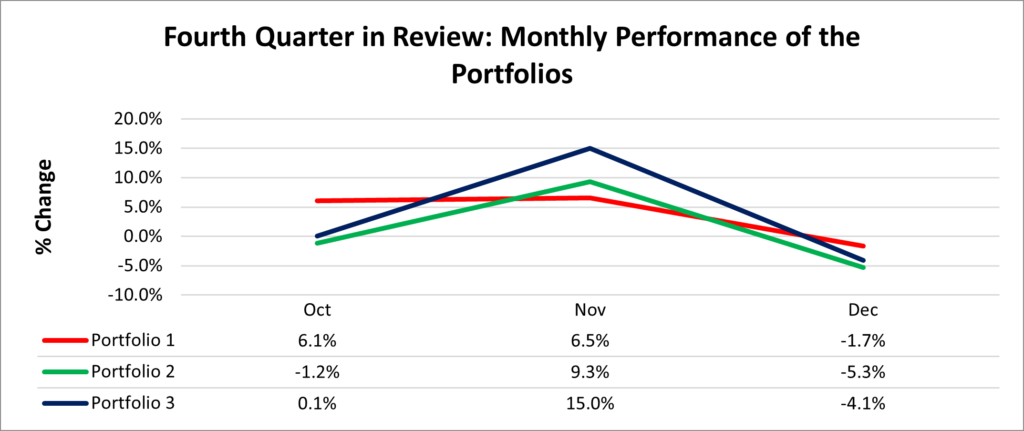
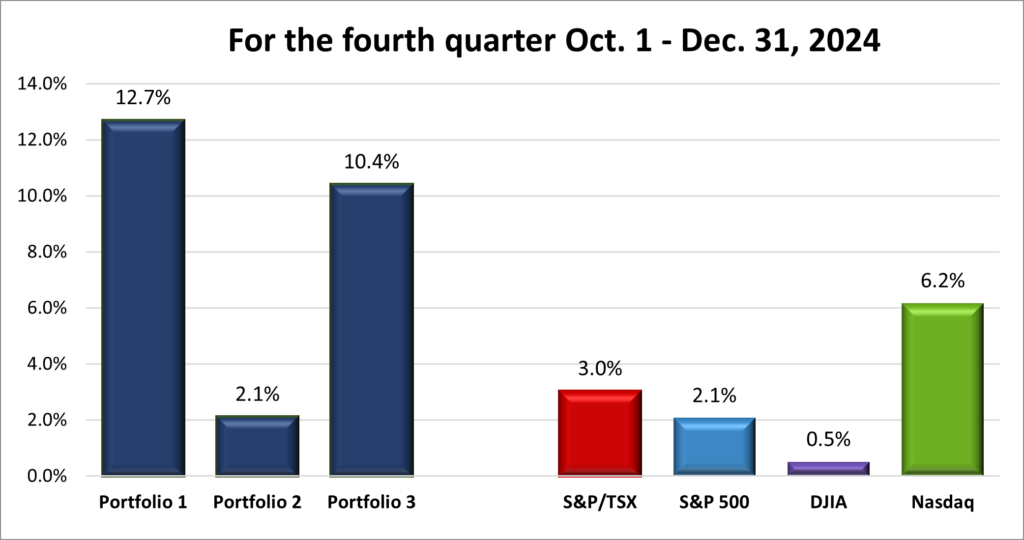
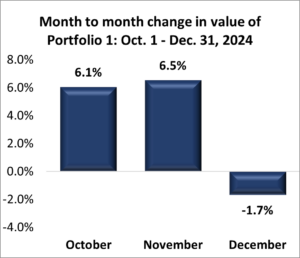
While we missed out on a classic “Santa Claus rally,” the markets showed impressive resilience. 2024 shaped up to be another remarkable year, driven by explosive growth in artificial intelligence (AI), the first interest rate cuts in over three years from both the Bank of Canada (BoC) and the US Federal Reserve (Fed), and the strength of a robust American economy.

My three portfolios also had a solid fourth quarter. They got off to a slow start but caught fire midway through the quarter. Unfortunately, the Grinch made a late appearance and stole some of the joy from those gains after a red-hot November.

While the fourth quarter had its share of ups and downs, the scale tipped more toward the positives, with the indexes and the portfolios finishing higher than where they started (exactly what we want 😊). As 2025 approaches, let’s take a quick look at the key factors that shaped the markets and how the three portfolios performed during the quarter.


Contents

Fourth Quarter Review

Fourth Quarter Portfolio Update

Looking Forward

Fourth Quarter Review

For the fourth quarter, the TSX (SPTSX) added 3.0%, the S&P (SPX) gained 2.1%, the DJIA (INDU) advanced 0.5% while the Nasdaq (CCMP) surged 6.2%.

Bull market. A good week for the North American stock markets. The stock markets closed out 2024 with a flourish, as all four major North American indexes posted gains in the fourth quarter. It wasn’t a smooth ride, though—October’s strong start was overshadowed by a sharp pullback at month’s end. November showed promise but didn’t deliver the ‘Santa Claus rally’ at the end of the year as many had hoped for, with indexes trimming gains at the end of December. Still, the overall quarter was a win for investors, showcasing the resilience of both markets and the economy.

Here’s how the major indices performed:

  • S&P: Up 2.1%, driven by an 11.7% year-over-year jump in earnings per share (EPS), reflecting strong corporate health.
  • DJIA: edged up 0.5%, benefiting from robust corporate earnings and economic strength.
  • Nasdaq: Continued its upward climb, rising 6.2%, fuelled by tech dominance and surging demand for AI-driven solutions.
  • TSX: Gained 3.0%, bolstered by strong performances in energy and materials sectors, a weaker Canadian dollar, and falling interst rates.

What Powered the Markets in America?
The fourth quarter’s strong performance was underpinned by several key drivers. Corporate earnings exceeded expectations, highlighting the resilience of American businesses even before rate cuts began to take effect. The Fed’s two interest rate reductions, including a bold 0.5% cut, signaled growing confidence that inflation was under control. These moves reassured investors and encouraged spending by making borrowing cheaper.

Meanwhile, the US presidential election brought Donald Trump back to the White House, sparking a post-election rally as markets welcomed his pro-business policies. The tech sector’s dominance continued, driven by innovation in AI, with giants like Nvidia (NASD: NVDA), Apple (NASD: AAPL), Amazon (NASD: AMZN), Meta (NASD: META), and Microsoft (NASD: MSFT) leading the charge. Broader market participation also played a role, as investors rotated into small-cap and value stocks, expanding the rally beyond AI. Globally, stabilizing economic conditions and easing monetary policies (lower Interst rates) provided additional support, while inflation, though still present, posed less of a drag compared to earlier in the year.

The Canadian Story

The TSX ended 2024 with a solid 3.0% gain for the quarter, reflecting a mix of domestic and international factors. The BoC’s two interest rate cuts during the quarter gave a significant boost to economic activity and investor sentiment. At the same time, a 3.6% decline in the Canadian dollar, partly due to tariff threats from US President-elect Donald Trump, made Canadian exports more competitive.

Key sectors like energy and basic materials thrived, supported by rising commodity prices and robust global demand. Additionally, improving domestic economic indicators and strengthening business sentiment helped sustain the rally. The TSX’s performance highlighted how interconnected global events and local policy decisions shape the Canadian market, setting a promising tone for 2025.

As we bid farewell to 2024, the fourth quarter’s performance highlights the relentless climb of the markets and the dynamic factors shaping their trajectory. From corporate earnings exceeding expectations to the tech sector’s relentless innovation and the impact of rate cuts on economic activity, the past three months have been a masterclass in how interconnected forces drive investment opportunities. Here’s to carrying this momentum into a prosperous and exciting 2025! 😊

Back to top

Fourth Quarter Portfolio Update

The line chart below illustrated the path each portfolio performed throughout the fourth quarter of 2024, capturing their overall progress.

Fourth Quarter 2024 Portfolio progress
Fourth Quarter 2024 (October 1 – December 31) Portfolio progress

This next chart compares the performance of the portfolios and indexes at the end of the quarter.

Fourth Quarter of 2024 Portfolio & Index performance

Next, you’ll find summaries of each portfolio’s monthly highlights, accompanied by a bar chart showcasing their individual performance throughout the quarter.

Portfolio 1 for the fourth quarter: UP Green Up Arrow, signifying a positive week

Portfolio 1: Fourth Quarter 2024 Performance

Portfolio 1 had an impressive fourth quarter, starting strong in October and November before facing headwinds in December.

October belonged to Nvidia, which hit an all-time high and drove gains in four out of five weeks. The Trade Desk (NASD: TTD) and Celestica (TSE: CLS) also contributed, but Nvidia was the clear standout.

November kept the momentum going, with Amazon, Visa (NYSE: V), and Walmart (NYSE: WMT) hitting record highs. Shopify dazzled with a 22% gain in one week, and indie Semiconductor soared 63% for the month. Even a 16% drop from Innovative Industrial Properties (NYSE: IIPR) and a late-month 5% dip in Nvidia couldn’t derail the portfolio’s gains.

December, however, saw declines as concerns over inflation, steady interest rates, and potential US policy shifts – including tariffs on Canadian imports – took a toll.

Despite the December slowdown, the fourth quarter was a strong one overall, highlighting Portfolio 1’s ability to deliver standout gains and hold its ground in the face of challenges.

Activity:

Received: shares of Tourmaline Oil (TSE: TOU) as part of their acquisition of Crew Energy.

Sold: Lightspeed Commerce (TSE: LSPD), Rivian Automotive (NASD: RIVN), Boston Omaha Corporation (NYSE: BOC).

Portfolio 2 for the fourth quarter: UP Green Up Arrow, signifying a positive week

Portfolio 2: Fourth Quarter 2024 Performance

Portfolio 2 had an eventful fourth quarter, with highs, lows, and a few surprises.

October started rocky, with a loss, a mid-month rebound, and two straight declines to close. Despite some bright spots, no stock or sector stood out enough to push the portfolio into the green.

November was a different story. Guardant Health (NASD: GH) soared 28% in a week, while iA Financial Group (TSE: IAG) and Dollarama (TSE: DOL) hit all-time highs. Weekly wins powered the portfolio to steady growth for the month.

December reversed that momentum, with Portfolio 2 posting its largest drop of the quarter. Concerns about stubborn inflation, stagnant interest rates, and uncertainty over US policies – including potential tariffs on Canadian imports – took their toll, surprising for the portfolio known for its balance and stability.

Despite December’s struggles, November showcased Portfolio 2’s ability to thrive under favourable conditions – a reminder of its growth potential even amid challenges.

Activity:

Bought: Zoetis (NASD: ZTS).

Bought additional share in: Dollarama, Microsoft, Brookfield Infrastructure Partners L.P. (TSE: BIP.UN), Whitecap Resources (TSE: WCP).

Received: shares of South Bow Corp. (TSE: SOBO) as part of South Bow being spun off from TC Energy (TSE: TRP); shares of Tourmaline Oil as part of their acquisition of Crew Energy.

Sold: some shares of The Bank of Nova Scotia (TSE: BNS)

Portfolio 3 for the fourth quarter: UP Green Up Arrow, signifying a positive week

Portfolio 3: Fourth Quarter 2024 Performance

Portfolio 3 had an eventful fourth quarter, after a slow start in October, it surged in November and cooled off in December.

October kicked off with three straight weeks of gains, but momentum slipped in the final weeks. Lithium Americas (TSE: LAC) stood out with back-to-back gains of 18% and 15%, helping the portfolio finish the month in the green.

November was the portfolio’s standout month, outperforming its peers and the broader markets. Shopify (TSE: SHOP) led with a one week gain of 22%, while Vertiv Holdings (NYSE: VRT) surged 18% during the month to hit an all-time high. With consistent wins across most holdings, Portfolio 3 wrapped up November with impressive returns.

December saw momentum fade, as concerns over inflation, steady interest rates, and concerns over possible US policy changes – including potential tariffs on Canadian imports – led to declines.

Despite December’s slowdown, fourth quarter demonstrated Portfolio 3’s strong growth potential, especially when key holdings perform. It’s a resilient portfolio with room for future gains.

Activity:

There were no transactions in the fourth quarter.

Back to top

Looking Forward

With the fourth quarter of 2024 in the books, we’ve reached that time of year when many people set resolutions, while those of us who follow the markets make predictions. Like resolutions, most predictions don’t stand up well. 😊 A year ago, in my Going Forward: The First Quarter 2024 and Beyond section, I made three bold (but, let’s be honest, fairly safe) predictions: that the US would strengthen domestic supply chains, that the market rally would broaden beyond the Magnificent 7, and that interest rates in both Canada and the US would drop. Well, I’d say that’s three-for-three—though I won’t be taking a victory lap since plenty of people saw these trends coming. 😊

Now, let’s take a shot at forecasting what’s ahead in 2025. The outlook for both Canadian and American markets is cautiously optimistic, but much will depend on the policies of the incoming US administration. Markets initially welcomed Donald Trump’s victory, buoyed by his pro-business stance and promises of tax cuts and deregulation. However, that optimism could be tested if he follows through on his tariff threats, which could drive up costs for consumers in both countries and create headwinds for both Canadian and US businesses. Markets don’t like uncertainty, and a second Trump presidency could bring plenty of it—potentially leading to heightened volatility and even a short-term pullback before stocks resume their historical upward trend.

As for the Magnificent 7, they’ll likely remain dominant, but investors may start looking beyond the big names for fresh growth opportunities. The AI boom isn’t slowing down either—Nvidia, Microsoft, Google, and others will keep pouring resources into AI, but there’s always the chance of an unexpected disruptor shaking things up.

On the economic front, inflation should continue trending downward in both Canada and the US, giving the BoC and the Fed more room to ease monetary policy. Interest rate cuts are expected in both countries, though Canada’s weaker economy may push the BoC to move more aggressively than the Fed. If that happens, the Canadian dollar could weaken against the US dollar.

Overall, markets should continue their upward trend, but the ride could be bumpier due to uncertainties around economic policies, tariffs, and interest rate timing. With a new and unpredictable US administration, markets are likely to see more volatility—but with that comes opportunity. To borrow from Warren Buffett, often considered one of the greatest investors of all time: “Be greedy when others are fearful.” If we can seize opportunities during uncertain times, we’ll be in a great position to keep growing our wealth through investing. 😊

A bull signifying a bull market

Back to top