Weekly Update for the week ending December 22, 2023

A cartoon of a bull wearing a santa hat and a red and white jacket This will be the final ‘Weekly Update’ of 2023. I am sure you will miss the scintillating commentary 😊, as I take a break for the last week of the year. Do not fret, the posts will resume January 5, 2024.

I would like to thank you for following along and bearing with me throughout the year. Hopefully, the 2024 markets will be more like this past year than 2022. 😊 In any event, enjoy the Christmas holiday as 2023 comes to a close and all the best in the coming year!

Items that may only interest or educate me ….

Canadian Economic news, US Economic news, Stock market’s holiday hours …


Canadian Economic news

This past week’s key economic data that the Bank of Canada (BoC) considers when deciding whether to raise or lower the interest rate.

Bank of Canada monetary policy notes

The minutes from the last meeting of the Bank of Canada’s Governing Council meeting on December 6 revealed that officials were confident the current 5% interest rate was sufficiently high to drive inflation down to their goal of 2%. Consequently, they opted to leave the benchmark rate unchanged but expressed readiness to raise it should inflation show an upward trajectory.

During the meeting, members observed a global trend of falling inflation and slowing economic growth, with the exception of the US, which exhibited a growing economy and sustained strong consumer spending. Lower oil prices played a significant role in the falling rate of inflation, although the pace of price growth was decelerating in food and other goods, as well.

In Canada, the Council members deliberated on the stagnant domestic economy due to reduced consumer and business spending. Notably, government spending was on the rise, serving as the primary driver for third-quarter economic growth. Discussions also encompassed the slowdown in job growth, the increase in unemployment, and the deceleration of wage growth in the private sector, in contrast to the rising wage growth in the public sector. Rising wages can lead to increased demand, putting upward pressure on inflation. Additionally, they addressed the latest inflation data, indicating an ongoing decline, although housing prices, continued to rise at a pace higher than desired.

Members acknowledged that the current interest rate was exerting a slowing effect on the economy as it continued to filter through the system. They highlighted that wages were consistently increasing by 4% – 5%, a factor not conducive to lower prices and diminishing inflation.

In conclusion, the officials believed that inflation was moving in the right direction, but uncertainties remained regarding the sustainability of the downward trend in inflation. The council will reconvene in the new year, on January 24 when they will make their next interest rate announcement and publish their next quarterly Monetary Policy Report.

Consumer Price Index

Statistics Canada’s inflation report for November showed the country’s annual inflation rate, as measured by the Consumer Price Index (CPI), unexpectedly remained at 3.1% in November, the same as it was in October. Analysts had been expecting inflation to drop to 2.9%. Month-over-month, the consumer price index rose 0.1% in November, after rising 0.1% the previous month. Analysts had been expecting a drop of 0.1%.

Core CPI, a measure of inflation that excludes the volatile food and energy prices price movements, rose to 3.5% in November on the heels of a 3.4% increase in October. On a monthly basis, core CPI grew at a 0.2% pace following a 0.1% increase in October.

The primary contributor to the yearly increase was higher ‘mortgage interest costs’ (thanks to the higher interest rates) up 29.8%, while the largest drop was in ‘fuel oil and other fuels,’ down 23.6%. On a monthly perspective, the biggest price increases were seen in ‘fresh vegetables,’ up 7.4%, while the biggest drop was 15.4% in ‘traveler accommodation.’

The higher inflation numbers were not what analysts were expecting, and it is not ideal for Canadian households already contending with higher costs for essentials. The data suggests progress on reducing inflation was slowing. The persistent inflation also provided a dose of reality for investors envisioning the BoC lowering interest rates sooner rather than later. Not the best news to end the year but the BoC will continue to monitor the inflation situation closely and adjust its policies as needed to bring inflation down to their 2% target.

Gross Domestic Product

Canada’s Gross Domestic Product (GDP) for October was once again flat at 0.0%. Analysts had predicted 0.2% growth. After the GDP for September was revised downward to 0.0% from 0.1% growth, which made it three consecutive months with little to no growth. On an annual basis, GDP is up 0.9%. Based on preliminary indicators, GDP for November is expected to rise by 0.1% thanks to increases in manufacturing that were partially offset by decreases in retail trade.

On a monthly basis, goods producing industries were flat, led by the ‘Agriculture, forestry, fishing and hunting’ industry, up 1.1%, while ‘Manufacturing’ was down 0.6%. The services producing industries rose 0.1%, led by the ‘Retail trade’ industry, up 1.2%, while ‘Management of companies and enterprises’ was down 2.5%. On an annual basis, the goods producing industries were down 1.0%, with the biggest drop in ‘Agriculture, forestry, fishing and hunting,’ down 12.5%. The services producing industries overall was up 1.5%, led by ‘Public administration,’ up 3.8%, while the biggest drop was in ‘Management of companies and enterprises,’ down 35.5%

As the Canadian economy continues to stutter, investors see this as support for their belief the BoC will start to lower the interest rate in the second quarter of 2024. We will get our first signs of the BoC plan for 2024 at their next meeting on January 24, 2024.

Canadian market volatility

The Canadian Volatility Index (VIXC), represented by the TSX 60 VIXI, ended the week at 9.77, slightly lower than last week’s reading of 10.35. This slight decline suggests lower level of volatility as investors remain optimistic considering the possibility that the BoC will start lowering rates to match the US Federal Reserve’s projected interest rate cuts in 2024.

The VIXC’s “high” and “low” volatility thresholds are generally defined as readings above 20 and below 20, respectively. Therefore, the current level of 9.77 indicates a relatively calm market environment.

Retail Sales

Canadian retail sales rose 0.7% in October after climbing 0.6% in September. Analysts had been expecting a monthly increase of 0.8%. ‘Clothing, clothing accessories, shoes, jewellery, luggage, and leather goods retailers’ saw the biggest increase, up 2.4%, while sales at ‘Gasoline stations and fuel vendors’ suffered the biggest decline, dropping 3.1%. Year over year, retail sales was up 2.2%. Sales of ‘motor vehicles and parts,’ up 7.8%, more than offset the drop in sales at ‘gas stations and fuel vendors,’ down 10.8%.

After 2 straight months of declines, core retail sales (excludes sales at ‘gasoline stations and fuel vendors’, and ‘motor vehicle and parts dealers’) was up 1.2% for October. Annually, core retail sales were up 2.3%. ‘General merchandise retailers’ were the big winners, up 4.7%, while the biggest drop was in ‘Building material and garden equipment and supplies dealers,’ down 6.3%.

However, early indications suggest that retail sales for November were flat, potentially hindering fourth quarter economic growth and dampening consumer spending power. This could be a further challenge for Canadians already facing rising costs of living.

Budget update

The latest update to the Canadian budget for the period April through October showed a C$15.13 billion deficit, a significant shift compared to the C$174 million surplus for the same period in 2022. Revenues increased 1.2%, however, that was offset increased government spending and higher interest rates due to rising borrowing costs contributed to the larger deficit. On a monthly basis, the deficit for October was C$6.96 billion compared to C$1.9 billion in 2022.

The higher deficit could potentially lead to a higher tax burden as the higher interest charges divert funds from other potential services and programs. It also raises the question of long-term sustainability of current fiscal policies. Canadians are already feeling overtaxed so the government will have to take a hard look at its expenses and where it can afford to trim expenses.

US Economic news

This past week’s key data points that the Federal Reserve (Fed) considers when deciding whether to raise or lower the interest rate.

Personal Consumption Expenditures

Inflation, as measured by the Commerce Department’s Personal Consumption Expenditures (PCE) price index, fell 0.1% last month. That was the first monthly decline in the PCE price index since April 2020 and followed an unchanged reading in October. Year over year, the PCE price index increased by 2.6%, down from 2.9% in October and marking the lowest level since February 2022.

The so-called core PCE price index, PCE excluding the more volatile food and energy components, advanced 3.2% year-on-year in November, the smallest rise since April 2021, after increasing 3.4% in October. That was the fifth straight monthly decline. On a monthly basis, core PCE was up 0.1%.

The lower-than-expected inflation numbers boosted investor confidence and led to gains across various market sectors. The falling inflation numbers provide the Fed with another reason to lower the benchmark interest rate. It also indicates the Fed is making progress driving inflation down to their target of 2%, further raising hopes for a softer landing for the economy.

This latest PCE report, the Fed’s preferred measure of inflation, is good news, suggesting that their fight against inflation is making progress. While some uncertainties remain, the declining inflation trend brings optimism for a more stable economic environment and potentially better returns for investors next year.

American market volatility

Heading into the Christmas weekend, Wall Street’s “fear gauge,” the CBOE Volatility Index (VIX), rose to 13.03 at the end of the week, after registering 12.28 the previous week. The increase in the VIX suggests investors are perceiving greater uncertainty and risk in the market, potentially leading to more frequent price fluctuations and changes in investor sentiment. A plausible reason for the increase in the ‘fear gauge’ is the heightened geopolitical tensions as well as concern the markets may have gotten ahead of themselves and a pullback may be coming.

While the “fear gauge” did rise, it is still quite low and may be only a minor fluctuation.

The VIX is a measure of the market’s expectation of short-term volatility based on S&P 500 options prices.

Consumer Confidence Index

The Conference Board’s December Consumer Confidence Index (CCI) surged to 110.7, marking a five-month high, up significantly from a downwardly revised 101.0 in November. The latest reading easily surpassed analysts’ expectations of 104.0. This jump points to a substantial surge in consumer optimism towards both current and future business conditions and employment opportunities resulting from a strong labour market.

A greater number of consumers are now reporting “good” business conditions, suggesting a heightened likelihood of increased spending on major purchases like vehicles, appliances, and vacation packages. While factors like inflation and interest rates can still influence individual spending decisions, the current high level of consumer confidence bodes well for a potentially brighter economic outlook in the coming months.

Consumer Sentiment Index

The University of Michigan’s final reading of the December Consumer Sentiment Index (CSI) edged slightly higher to 69.7 from an initial reading of 69.4 in early December. On a monthly basis, the December CSI was 13.7% higher than the November reading of 61.3, and 16.6% higher than a year ago when it was 59.8.

The improved sentiment was a result of consumers seeing lower inflation, and they expect it to continue to fall over the next few years. The December increase reversed the last four months of declines. The improved sentiment may lead to increased spending by consumers which is good for the economy.

Stock market’s holiday hours

The North American stock markets will have a modified schedule next week due to the holidays. All markets will be closed on Christmas Day (December 25) and New Year’s Day (January 1, 2024). Canadian markets will also be closed on Boxing Day (December 26). Otherwise, markets are open regular hours on December 27 through December 29.

Remember, many investors, especially the big institutional investors, take time off between Christmas and New Year’s, so expect lower trading volume and potentially more price fluctuations during this time. When the big investors are away it gives us individual investors more time to play. 😊


As we conclude the last full week of trading in 2023 and prepare for Christmas long weekend holiday, let’s see what happened this past week….

Weekly Market Review

Monday: Despite Fed officials attempts to temper investor enthusiasm over the weekend, the rally continued as investors hope interest rate cuts will come sooner rather than later. Three of the four indexes ended the day higher, while the Dow Jones Industrial Average (DJIA) ended flat. Oil prices moved higher as multiple shipping lines cancelled trips through the Red Sea to avoid attacks on their ships by Yemeni Houthi rebels.

In Canada, the week got off on the right foot as the Toronto Stock Exchange Composite Index (TSX) rose on the back of higher energy prices. In trading, Energy and Consumer Cyclicals were the biggest winners, while Utilities and Healthcare sank the most.

In the US, building on seven consecutive weeks of weekly gains, the S&P 500 Index (S&P) and the Nasdaq Composite Index (Nasdaq) ended higher. Investor enthusiasm over the possibility of lower rates continues to drive the indexes higher. In trading, most of the American sectors finished higher, led by Energy and Consumer Staples. Utilities and Financials were the only sectors to end lower.

Tuesday: investors seem to have caught the Christmas spirit as they continue to push the markets higher, with all four indexes ending solidly in the green. For now, investors are ignoring warnings from the Fed that it is premature to conclude rate hikes are over. Oil prices continue to inch higher as more shipping companies are avoiding transiting the Red Sea with their cargos of oil.

In Canada, the road to lower inflation hit a pothole when the inflation rate for November unexpectedly remained unchanged, after analysts had predicted the inflation rate to drop. Despite the bump, the TSX moved higher as investors who have been sitting on cash are moving back into the stock markets. They do not want to be on the sidelines when the markets are rallying. In trading, it was a broad-based rally, led by Basic Materials (miners and fertilizer manufacturers) and Consumer Staples. The only Canadian sector to end in the red was the Technology sector.

In the US, the DJIA recorded its fifth consecutive record close, and the S&P is within 1% of its all time high. In trading, every sector ended higher, led by Basic Materials and Energy, with Telecommunications Services and Consumer Staples trailing the pack.

Wednesday: the markets took a breather, sending all indexes sharply lower to close the day. The indexes were doing fine until late in the afternoon when they each took a nosedive and fell more than 1%. After this latest mini rally, investors decided to take some money off the table.

In Canada, the BoC minutes from their December 6 monetary session showed the members are confident that interest rates are high enough to continue to bring inflation down to their 2% goal. In trading, every Canadian sector was down. Consumer Staples and Telecommunications Services were the best of a bad lot, while Basic Materials and Technology had the worst day.

In the US of A, the DJIA consecutive closing highs came to an end, the S&P came with 0.5% of its all time high before reversing course to end with its worst day since October. The DJIA and the Nasdaq’s nine day winning streaks ended with a thud. US consumer confidence came in higher than expected. In trading, all the American sectors ended in the red with Telecommunications Services and Energy dropping the least, while Consumer Cyclicals and Utilities fell the deepest into the red.

Thursday: after taking a breather yesterday, the markets bounced back to end the day solidly in the green. US economic data provided investors with confidence that the Fed could lower the US benchmark rate as early as its March meeting.

In Canada, the TSX rose on investor optimism that the central banks would start cutting interest rates by the second quarter of 2024. In trading, it was a broad-based rally with all Canadian sectors ending higher. Basic Materials and Consumer Cyclicals led the way, with Healthcare and Telecommunications Services trailing the pack.

In the US, the indexes recouped most of Wednesday’s losses as investors stepped back into the markets. Economic data showed the economy was not as strong as analysts expected. In trading, all sectors ended higher, led by Basic Materials and Consumer Cyclicals. Bringing up the rear were Utilities and Consumer Staples.

Friday: the markets ended the week going into Christmas on a high note with three of the four indexes ending in positive territory. The catalyst for today’s markets was the Fed’s preferred measure of inflation, PCE, showed inflation continued to fall in November, as both PCE and core PCE came in lower than expected. Investors see this as another sign the door is open for the Fed to start lowering the benchmark interest rate. Oil prices ended slightly lower after Angola decided to leave OPEC, enabling them to increase the production of their oil reserves.

In Canada, the TSX rode the tailwind of the US inflation good news to reach an 18-month high. In trading on Bay Street, it was a day of broad-based gains led by the Healthcare and Utilities sectors. Telecommunications Services was the only sector to end lower.

In the US, the DJIA ended the day slightly lower but not enough to prevent the index from stretching its weekly winning streak to eight weeks. The S&P and Nasdaq also notched another weekly win, to match the DJIA streak. In trading on Wall Street, gains were seen across almost all the sectors. Healthcare and Basic Materials led the gains while consumer cyclicals was the only sector to not make it into positive territory.


Weekly Market and Portfolio Review

For the week, the TSX (SPTSX) surged 1.7%, the S&P 500 (SPX) rose 0.8%, the DJIA (INDU) gained 0.2% and the Nasdaq (CCMP) advanced 1.3%.

Index Weekly Streak
TSX: 2-week winning streak
S&P: 8-week winning streak
DJIA: 8-week winning streak
Nasdaq: 8-week winning streak

Bull market. A good week for the North American stock markets. Another good week in the North American stock markets that saw all four indexes end the week higher, as shown in the chart above. Other than the Wednesday when investors took a breather, and some money off the table, the indexes moved higher every day this past week. The PCE report in the US and the CPI report in Canada showed inflation continues to fall in both countries. It is looking increasingly likely the Fed will thread the needle and bring inflation down without sending the US economy into a recession. The picture is less clear in Canada, where the latest GDP report indicates the economy has stagnated, and there has been no talk of Canada avoiding a recession.

The rally, which started in November and has become a Santa Claus rally, continues to be driven by growing investor optimism that the Fed will start lowering the US benchmark rate in March or April. In Canada, the BoC has not signaled it has reached the end of interest rate hikes like the Fed has, however, the Canadian economy has been flat for the last three months. If the BoC wishes to avoid a recession, they will need to signal an end to rate hikes sooner rather than later.

Unlike the market rally at the start of the year which was largely driven by the Magnificent 7 companies, the current rally is characterized by the breadth of the rally which continues to expand. This broad rally is much more sustainable than the tightly focused rally at the start of the year and is better for us investors in the long run. 😊

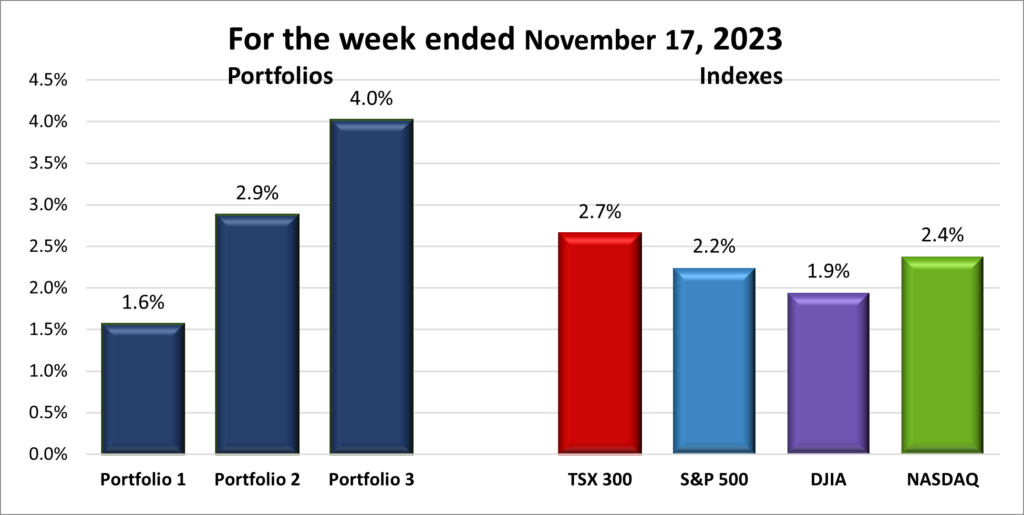
Bull market. A good week for the North American stock markets. Bearish market It was a mixed bag for the three portfolios, with Portfolios 1 and 2 gaining ground, while Portfolio 2 lost ground, as shown in the chart below. Fortunately, the gains of Portfolio 3 were greater than the losses in Portfolio 2, pushing the overall value of the portfolios higher.

Portfolio 1 was barely higher due to most of the companies share prices were just above or just below the price they started the week. There were two notable performers, gains, or losses greater than 10%. Fortunately, both Progeny (NASD: PGNY) and Nuvei (TSE: NVEI) were on the positive side and able to offset the losses.

This week is a strange one for Portfolio 2 as there is no obvious reason for the decline. There were no notable weekly winners or losers. More than half the companies ended the week higher. The only thing I can see is that Telus (TSE: T), one of the larger holdings, ended approximately 2% lower on concerns of its debt and the higher interest payments caused by the higher interest rate, dragging the overall portfolio down.

Finally, Portfolio 3 had no big winners or losers. All the companies were either slightly higher or slightly lower. Fortunately, there were almost twice as many companies that ended higher than lower.

All in all, not a bad week. All the portfolios cannot end higher every week. Hopefully, the Santa Claus rally will continue into the last week of the year and will deliver us a present of all indexes and portfolios solidly in the green for the week. One can hope. 😊

Weekly Portfolio & Index performance
Weekly Portfolio & Index performance for the week ended December 22, 2023.

Companies on the Radar

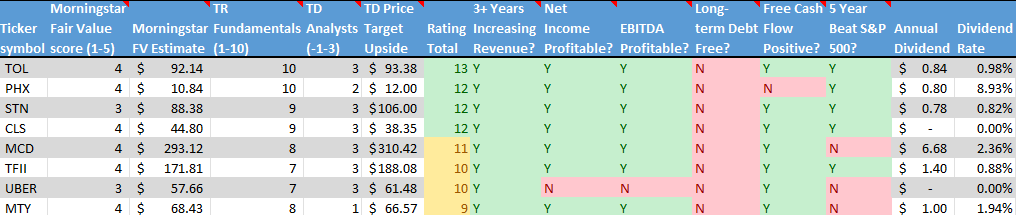
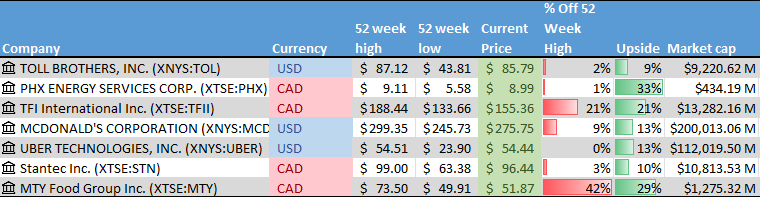
Stocks on my Radar I was a little busy the week before Christmas, so no new companies came on my Radar. However, I was able get an early Christmas present with an investment in Decisive Dividend (TSXV: DE). 😊

As for the four remaining companies on the radar list, I am hoping to have some time over the coming week to finally get a chance to dig a little deeper into each of these companies.

  • PHX Energy Services (TSE: PHX) a small Canadian company that provides drilling technology and services to oil and natural gas exploration companies throughout the world, but mainly in North America.
  • McDonald’s (NYSE: MCD), the large cap American fast-food chain.
  • Celestica Inc. (TSE: CLS), a medium sized Canadian company that manufactures electronic products and provides supply chain services to companies around the world.
  • TFI International Inc. (TSE: TFII), a mid-sized Canadian transportation and logistics company operating across North America.

The Radar Check was last updated December 22, 2023.

Stock on the Radar List. 1 of 2.

Stock on the Radar List. 2 of 2.

Portfolio Update

Portfolio 1

Portfolio 1 for the week ended December 22, 2023: UP Green Up Arrow, signifying a positive week

  • Apple (NASD: AAPL) paused sales of its Series 9 and Ultra 2 smartwatches to comply with a ruling from the US International Trade Commission (ITC) that the company infringed on the patent of a medical technology company. The decision is currently being reviewed but Apple decided to stop sales in the event the ruling is not overturned.
  • Amazon (NASD: AMZN) is considering making an investment in US regional sports network Diamond Sports Group. In return for the investment (cash), Amazon would receive a multiyear streaming partnership with Diamond and become the streaming home for all of Diamond’s game. Diamond currently holds the broadcast rights for more than forty professional teams throughout the NHL, MLB, and NFL. This would provide Amazon with a major inroad into streaming sports games.
  • Alphabet’s (NASD: GOOGL) has been accused of overcharging users through unlawful restrictions on apps available on Android devices and charging unnecessary fees for in-app transactions. Google must pay US$700 million into a settlement fund.
    Google has been fined US$50.4 million by a Russian court for failing to remove ‘fake’ information about the Russian invasion of Ukraine.
  • Tesla (NASD: TSLA) is being investigated by both Sweden’s and Norway’s respective traffic safety regulators over concerns about suspension failures.
    In a separate situation, Tesla has recalled approximately 140,000 Model S and Model X cars due to door locks unlocking during a crash.

Activity

Bought: Decisive Dividend. About ten years ago I was talking with a friend about building a business through acquiring small, family-owned businesses as the founders retired. While doing my due diligence on Decisive Dividend, I quickly discovered that this company was doing something similar to which I had considered many years ago, so it resonated with me.

The two company founders are still on the Board of Directors, with one serving as the Chair. Insiders own approximately 10% of the shares outstanding so their interests are aligned with shareholders. The company’s purpose is to be the “sought-out choice for exiting legacy-minded business owners, while supporting the long-term success of the businesses acquired.” They want the companies they acquire to continue to succeed rather than to absorb them or break them up.

Financially, the company has growing revenues, net income, free cash flow and earnings per share. Long term debt is growing but I expect that from a company that grows through acquisition. It is paying a monthly dividend of over 6%. Not bad for a small company with lots of room to grow. 😊

I see the key considerations as: the company incurs too much debt; there is turnover in management; or the company acquires a business that is a poor fit. The company recently refreshed its upper management ranks with experienced personal and the company seems to have a disciplined approach to the companies it acquires so I do not think these are big risks.

Overall, I like their strategy of growth through acquiring companies whose owners come to them seeking to be acquired. As well, the company is part of the Industrials sector, providing some diversity to a technology heavy portfolio. I feel the risk is low, and getting in early on this small, growing company is worth the risk.

Dividends

Dividends Received this week for the following companies:

Companies followed by DRIP (Dividend Re-Investment Plan) indicate additional shares were purchased with the dividend. Any cash leftover was added to the cash balance.

No dividends this past week.

Quarterly Reports

No quarterly reports this past week.

Portfolio 2

Portfolio 2 for the week ended December 22, 2023: DOWN Red Down Arrow

  • The Bank of Nova Scotia (TSE: BNS) is reducing its efforts in South America to concentrate on North America’s US$1.6 trillion in trade. BNS is betting the Mexican market will give it an edge over other Canadian banks by offering end to end financing through Canada, the US and Mexico.
  • Guardant Health (NASD: GH) announced their Shield(TM) blood test which screens for colorectal cancer is scheduled to be reviewed by the US Food and Drug Administration.

Activity

No significant activity to report this week.

Dividends

Dividends Received this week for the following companies:

Companies followed by DRIP (Dividend Re-Investment Plan) indicate additional shares were purchased with the dividend. Any cash leftover was added to the cash balance.

Canadian $

Dream Industrial Real Estate Investment Trust (TSE: DIR.UN) DRIP

Alimentation Couche-Tard Inc (TSE: ATD)

Supremex Inc (TSE: SXP)

US $

No US$ dividends this past week.

Quarterly Reports

No quarterly reports this past week, except for per share data.

Portfolio 3

Portfolio 3 for the week ended December 22, 2023: UP Green Up Arrow, signifying a positive week

  • Brookfield Corporation (TSE: BN) is looking to sell US$1.64 billion of its renewable energy assets. Brookfield is working with two other companies to sell its wind and photovoltaic plants in Portugal and Spain.
  • Microsoft (NASD: MSFT) and OpenAI are being sued by a group of nonfiction authors. The writers claim these companies infringed on their copyright by using their books to train OpenAI’s GPT large language models.

Activity

No significant activity to report this week.

Dividends

Dividends Received this week for the following companies:

Companies followed by DRIP (Dividend Re-Investment Plan) indicate additional shares were purchased with the dividend. Any cash leftover was added to the cash balance.

No dividends this past week.

Quarterly Reports

No quarterly reports this past week.


Weekly Update for the week ending December 15, 2023

A bull wearing a Santa hat. The US Federal Reserve just gave the markets the gift they have been waiting for: potential cuts to the US interest rate next year! That was enough to get the bulls attention. Investors are cheering, confidence is surging, and it might just be the start of the Santa Claus Rally. Let us dive into what the Fed’s signal means for the portfolios and whether this means we are officially in for a holly jolly market ride.

Items that may only interest or educate me ….

Canadian Economic news, US Economic news, Federal Open Market Committee rate decision, Benchmark rates elsewhere, ….


Canadian Economic news

This past week’s key economic data that the Bank of Canada (BoC) considers when deciding whether to raise or lower the interest rate.

Canadian market volatility

The Canadian Volatility Index (VIXC), represented by the TSX 60 VIXI, ended the week at 10.35, up slightly from last week’s reading of 9.66. This slight increase suggests heightened volatility; however, investors remain optimistic in light of the US Federal Reserve’s projected interest rate cuts in 2024.

The uptick in the VIXC likely stems from BoC’s announcement that Canadian benchmark rates will not see a decrease anytime soon. This divergence in monetary policy (interest rates) stances between Canada and the US could be causing some concern among investors, as divergent economic trajectories or a longer period of high Canadian rates could create uncertainty and potential market fluctuations.

In the context of the VIXC, a reading above 20 is considered high, while below 20 is deemed low.

US Economic news

This past week’s key data points that the Federal Reserve (Fed) considers when deciding whether to raise or lower the interest rate.

Consumer Price Index Inflation Report

November Consumer Price Index (CPI) data revealed that headline CPI, which measures the change in prices of all goods and services consumers purchase, increased by 0.1% in November compared to October. This is the smallest monthly increase since January 2023. On a year over year basis, CPI climbed 3.1%, inline with expectations. This is down from 3.2% in October and the lowest level since January 2023.

On a monthly basis, the biggest drop was in the cost of gas, down 6.0%, while the biggest increase was in the cost of piped gas services, up 2.8%. Annually, the biggest decline was in fuel oil, down 24.8%, while the biggest increase was in transportation services, up 10.1%

Headline inflation fell thanks largely to a significant drop in gas prices in November, however, core inflation is proving more difficult to bring down. Core inflation, or core CPI, which excludes the volatile food and energy components, rose 0.3% in November, slightly higher than the 0.2% increase in October. Again, this is the smallest monthly increase since January 2023. On an annual basis, core CPI maintained a 4.0% growth rate. Both numbers were in line with analysts’ expectations.

In the core sectors, the biggest monthly decline was in apparel, down 1.3%, while the largest increase was in used vehicles, up 1.6%. Annually, the biggest drop was in used vehicles, down 3.8%, and the largest increase was in transportation services.

The CPI report was generally seen as positive news for the economy as it will likely lead to increased consumer spending and business growth. The stock market rallied on the news, as investors viewed it as a sign that the Fed, which views it as one of the key indicators of inflation, was close to ending its series of interest rate hikes.

American market volatility

Wall Street’s “fear gauge,” the CBOE Volatility Index (VIX), fell to 12.28 at the end of the week, after registering 12.65 the previous week. That is the lowest levels in nearly four years. The minor decrease in the VIX suggests investors remain optimistic in the American stock markets. The main reason for the slight decline in the ‘fear gauge’ is the Fed signalled they were done with raising the rates. The VIX is a measure of the market’s expectation of short-term volatility based on S&P 500 options prices.

Retail Sales

The Commerce Department’s retail sales report brought good news for the holiday season: November sales surged 0.3%, exceeding the expected drop of 0.1% and October’s revised decline in sales of 0.2%. Year over year, sales were up 4.1%. This strong start suggests the economy remains robust despite inflationary pressures, with resilient consumer spending offering a welcome sign against recession fears.

Black Friday further fueled this optimism, with healthy sales figures contributing to the overall November increase. Excluding the gas and vehicles categories, retail sales climbed a 0.6% monthly and an impressive 5.2% annually. Even amidst inflation, consumer remained strong, particularly in the ‘electronics and appliances’ category, which saw a remarkable 12.0% year-over-year jump.

Food and beverage establishments also thrived, with a 1.6% monthly increase, while gasoline stations, as expected, saw a decline due to lower gas prices both on a monthly and annual basis. While it is still too early to predict the complete holiday season performance, the fast start fueled by Black Friday provides a positive outlook for the crucial shopping period.

This continued rise in retail sales, even in the face of economic challenges, increases the American economy’s chances of a gradual slowdown rather than a full-blown recession. Good news all around! 😊

Federal Open Market Committee rate decision

Good news for borrowers and us investors! The Fed held the benchmark interest rate at 5.25-5.5% at their final meeting of 2023, as everyone expected. While Fed Chair Jerome Powell cautioned that the fight against inflation is not over, he provided an early Christmas present, suggesting rate cuts were coming in the new year!

While everyone was glad that rates did not climb higher, it was the suggestion of future cuts that really got investors attention. The FOMC released its economic projections, hinting at a 0.75% reduction in rates spread throughout 2024. This signals a gradual shift towards a more relaxed monetary policy, which means lower borrowing costs for everyone.

Think lower debt payments! This is especially good news for companies in sectors like technology, energy, and mining, which often carry hefty amounts of debt. No wonder the market erupted in cheers, with stocks, particularly in interest-rate sensitive sectors, enjoying a triumphant rally.

While the market reaction was understandably upbeat, remember, the Fed is not ready to declare victory just yet. A Fed official cautioned that they have yet to talk internally about rate cuts. In the meantime, they will be keeping a close eye on the economic data and are ready to raise the rates if inflation reverses course and moves higher.

This announcement of lower rates next year is a positive step, a sign that the Fed sees progress in the fight against inflation. But it is not a fait accompli. Keep in mind the Fed’s cautious optimism and focus on future data.

Benchmark rates elsewhere

Canada and the USA were not the only countries to maintain a pause on their benchmark rates hikes. However, the BoC said it was too early too even discuss cutting interest rates, while the Fed signalled they were finished raising rates and planned to start lowering the US benchmark rate in 2024.

Here is a quick look at what other western central banks have done.

Australia: At their last meeting in December, the Reserve Bank of Australia kept the Australian rate at 4.35% as inflation in that country dropped to 4.9% in October. The bank said they expect to be able to start lowering rates at the end of the second quarter in 2024.

European Union: The European Central Bank (ECB) kept their rate at 4%, a record high for the ECB. However, unlike the Fed, they said the benchmark rate will remain high as long as necessary to bring inflation down to the 2% target. European inflation currently runs at 2.4%. Analysts believe rates could start to drop at the end of the first half of 2024.

Great Britain: The Bank of England (BoE) kept their key rate at 5.25% and said there was “still some way to go” to get inflation down to their 2% target. At the BoE’s Monetary Policy Committee meeting, a few members even voted to raise the rate to 5.5%. Inflation was running at a pace of 4.6% in October, considerably higher than their target.

New Zealand: The Reserve Bank of New Zealand held their key rate at 5.5%, a 15 year high, at their meeting in November. However, when talking about future interest rate movement, the bank suggested the rate could go higher. I am sure that was not what New Zealanders wanted to hear.

Norway: The Norges Bank, Norway’s central bank raised its benchmark rate by 0.25% to 4.5% at their last meeting. It also said rates could be higher for longer as they attempt to drive inflation down from its current pace of 5.8%.

Sweden: Riksbank, Sweden’s central bank, kept their key rate at 4% at their November meeting. Swedish inflation was at 3.6% in November.

Switzerland: The Swiss National Bank maintained the current 1.75% rate as inflation remained in the target range of 0% – 2%. Even at that low rate, analysts forecast the bank to lower the rate as soon as March.

So far, the Fed is the only central bank that has indicated it has pivoted to rate cuts, while many others are sticking with the ‘higher for longer’ mantra. I hope the BoC follows the Fed rather than the other central banks and lower the rate sooner rather than later. 😊


Reading about the various central banks plans, how did the Swiss keep inflation low enough that they barely had to raise their benchmark rate? Hmmm. As you ponder that, let’s see what happened this past week….

Weekly Market Review

Monday: the markets, and therefore the indexes, got off to a shaky start but the US indexes – the S&P 500 Index (S&P), the Dow Jones Industrial Average (DJIA), and the Nasdaq Composite Index (Nasdaq) – recovered to end slightly higher, while the Toronto Stock Exchange Composite Index (TSX) was unable to fully recover. Investors hedged their bets, waiting for tomorrow’s US CPI report that will provide another update on the fight against inflation going into the Fed’s meeting on Wednesday. The price of oil edged higher.

In Canada, despite oil prices moving upward, the energy sector edged downward, preventing the TSX from ending in the green. In trading, the Technology and Financials had the biggest gains of the Canadian sectors while Consumer Cyclicals and Basic Materials (mining companies and fertilizer manufacturers) suffered the biggest declines.

In the USA, all three American indexes set new highs for the year as investors anticipate the Fed will signal the end of rate hikes at the end of their meeting. In trading, Industrials and Consumer Staples recorded the biggest gains. Telecommunications Services and Energy were the only sectors to end lower.

Tuesday: another good day for the American indexes with all three hitting their highest points since January 2022. The news was not so good for the TSX, which once again fell into negative territory early and never was able to pull itself out. The big news today was the US inflation report for November showed prices barely higher than they were in October. That is good news going into tomorrow’s meeting of the Fed where they will decide what to do with the US interest rate. Oil prices continued their descent as investors are worried there is a global oversupply of oil.

In Canada, the TSX was dragged lower by falling oil prices that spread into a wider sell off. In the Canadian sectors, only the Industrials and Consumer Staples sectors were able to end in the green. Basic Materials and Energy dropped the deepest in the red.

In the US, it was the third day in a row that the indexes hit highpoints for 2023 as investors are confident the Fed will maintain the pause on interest rates. In trading, the Technology and Healthcare sectors posted the biggest gains while Energy and Telecommunications Services declined the most.

Wednesday: all four major North American indexes were flat before surging upward following the Fed’s post-meeting press conference. In their statement, the Fed maintained the pause on the US interest rate and, more importantly, projected interest rates cuts in 2024. Oil prices inched upward due to concerns about the security of oil stockpiles in the mid east and a larger than expected weekly draw on US crude oil supplies.

In Canada, following the news from the Fed, the TSX closed the day at a ten-month high. All the Canadian sectors ended the day higher, led by Basic Materials and Utilities, each up over 3%. Trailing the pack were Consumer Cyclicals and Industrials.

In the US, it was a broad-based rally that saw all three indexes up over 1%. The DJIA broke the 37,000 barrier to close at its highest ever level, while the S&P and Nasdaq hit new closing highs for the year. In trading, today’s rally produced gains across all American sectors with Utilities and Financials leading the way, while Telecommunications Services and Technology brought up the rear.

Thursday: all four indexes continued to rally on the optimism generated by yesterday’s Fed announcement that the benchmark interest rate should start easing off in 2024. This time the rally has been caused by broad based strength in small and mid cap companies, rather than pulled higher by the heavyweight technology companies. Oil prices were higher for a second straight day as the demand forecast for next year was raised.

In Canada, the TSX reached its highest closing point since June 2022. In trading, the interest sensitive Technology and Consumer Cyclicals sectors led all gainers, while Consumer Staples and Telecommunications Services were the only sectors to end lower.

In the US, the DJIA set a record high close for the second straight day and the S&P is approaching its record close from January 2022. In trading on Wall Street, Energy and Basic Materials were the big winners on the day, while the Consumer Staples and Utilities sectors fell the most.

Friday: the day ended with mixed results as the TSX and S&P ended in the red (OK, the S&P was barely in the red, down only 0.01%), while the DJIA and Nasdaq ended in the green. The indexes stumbled after a Fed official said the bank was not ‘really talking about cutting interest rates right now.’ Oil prices were barely higher but enough to provide oil prices with their first weekly gain in seven weeks.

In Canada, the TSX had its worst day in two months after the BoC Governor said the bank has not even discussed lowering the interest rate. On Bay Street, every sector ended lower. Healthcare and Technology fell the least while Telecommunications Services and Consumer Cyclicals suffered the largest decline.

In the US, ongoing investor optimism lifted the DJIA to a third straight record high close. In trading, only the growth-oriented Technology and Consumer Cyclicals sectors were able to end in positive territory, while Utilities and Telecommunications Services suffered the biggest losses.


Weekly Market and Portfolio Review

For the week, the TSX (SPTSX) rose 1.0%, the S&P 500 (SPX) advanced 2.5%, the DJIA (INDU) surged 2.9% and the Nasdaq (CCMP) gained 2.8%.

 
Index Weekly Streak
TSX: 1-week winning streak
S&P: 7-week winning streak
DJIA: 7-week winning streak
Nasdaq: 7-week winning streak

Bull market. A good week for the North American stock markets.The S&P started the week at its highest level of the year, and then promptly went higher, as you can see in the chart above. Last week’s promising jobs report fueled hopes of a “soft landing” for the US economy, where inflation cools without a recession. This week, we got more good news: inflation continued its downward trend in November, followed by the Fed’s final policy announcement of 2023.

The big news was not that the Fed kept rates steady, as expected, but that it is likely done with rate hikes and is expecting to pivot to cuts in 2024. This dovish pivot breathed new life into the rally that started in November and jumpstarted the “Santa Claus rally”.

With big gains across the market and the portfolios increasing in value, it is hard not to get excited. 😊 The Fed’s shift sent US indexes soaring. Despite trailing the S&P and Nasdaq year-to-date, the DJIA had its best day since January 2022, on its way to setting three consecutive all-time closing highs. Not bad for an index that is composed of mostly ‘old economy’ stocks! Following the Fed’s announcement, technology companies re-joined the rally, pushing the Nasdaq to close the week at an all-time high. The S&P, while not breaking its record close, reached within 2% of it (set in January 2022) and notched its longest winning streak since November 2017 (seven weeks!). Both the S&P and the Nasdaq reached their highest levels since January 2020.

For most of the year the markets have been lifted by the Magnificent Seven. However, this week, they mostly took a breather, while small cap companies, which range in value from $300 million to $7.1 billion, and mid cap companies, which range in value from $7.1 billion to $17.7 billion surged. It is a good sign that the rally is broadening rather than focused on a handful of companies.

As for the TSX, it too got a lift from the investor enthusiasm. However, falling oil prices (reaching a six-month low before a slight rebound) weighed on the index. Additionally, the index stumbled at the end of the week after the BoC Governor said interest rates in Canada were not coming down soon, diverging from the Fed’s stance.

Its great to see the markets rise and the rally broaden, but if the markets get irrationally exuberant, to paraphrase Alan Greenspan, the Fed could decide to hold the rate longer to avoid inflation creeping higher. Still, overall, it has been a stellar week for stocks, setting the stage for a potentially merry end to the year.

Bull market. A good week for the North American stock markets.As for the portfolios, it was another good week as they hitched a ride on the Santa Claus rally. As shown in the chart below, Portfolio 3 posted the biggest percentage gain thanks to gains of 10% or more in Unity Software (NYSE: U) and Cloudflare (NYSE: NET) and no significant drops by the other companies in the portfolio. Portfolio 2 generally had a good week with strong performances from Chorus Aviation (TSE: CHR) and Mitek Systems (NASD: MITK) offsetting a 10% drop by Dollarama (TSE: DOL). Trailing the pack was Portfolio 1. It had a number of significant gains from companies like Lattice Semiconductor (NASD: LSCC), Innovative Industrial Properties (NYSE: IIPR), Global-E Online (NASD: GLBE) and Rivian Automotive (NASD: RIVN).

Another good week for the portfolios. Hopefully, the Santa Claus rally will continue for the rest of the year and lead into a New Year’s rally. 😊

Weekly Portfolio & Index performance
Weekly Portfolio & Index performance for the week ended December 15, 2023.

Companies on the Radar

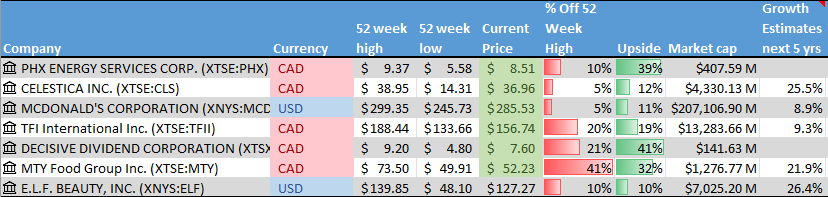
Stocks on my Radar No new companies came on my radar list this past week. However, I decided my Radar list was getting a bit crowded so I removed MTY Food Group Inc. (TSE: MTY) and e.l.f. Beauty, Inc. (NYSE: ELF). MTY had been on the list at least 6 weeks and it never really motivated me to spend more than a few minutes looking into the company. ELF was a similar situation. ELF sounded interesting at first, but it never sparked enough excitement to pursue further research. So, I removed both from the list.

The radar list is back down to a more manageable five companies:

  • PHX Energy Services (TSE: PHX) a small Canadian company that provides drilling technology and services to oil and natural gas exploration companies throughout the world, but mainly in North America.
  • McDonald’s (NYSE: MCD), the large cap American fast-food chain.
  • TFI International Inc. (TSE: TFII), a mid-sized Canadian transportation and logistics company operating across North America.
  • Celestica Inc. (TSE: CLS), a medium sized Canadian company that manufactures electronic products and provides supply chain services to companies around the world.
  • Decisive Dividend Corporation (TSXV: DE), a small cap Canadian company involved in several manufacturing areas. They typically acquire existing profitable manufacturers from owners/founders who are looking to retire and sell their company to someone who will continue to grow and build the business.

The Radar Check was last updated December 15, 2023.

Stock on the Radar List. 1 of 2.

Stock on the Radar List. 2 of 2.


Portfolio Update

Portfolio 1

Portfolio 1 for the week ended December 15, 2023: UP Green Up Arrow, signifying a positive week

  • Lattice Semiconductor won two awards at the 2023 Global Semiconductor Alliance (GSA) Awards: ‘Most Respected Public Semiconductor Company’ for the fourth consecutive year, and ‘Best Financially Managed Semiconductor Company’.
  • The US Department of Commerce confirmed Nvidia (NASD: NVDA) “can, will and should sell artificial intelligence (AI) chips to China because most AI chips will be for commercial applications.” They just cannot sell their most sophisticated, highest processing power AI chips. Nvidia is working with the Government to ensure they only ship the appropriate semiconductors to China.
  • Alphabet’s (NASD: GOOGL) Google lost the antitrust case initiated by Epic Games. Epic accused Google of using their Android operating system to create an antitrust market for its Google Play app store which was used to extract money from developers. Google plans to appeal the verdict. If this verdict holds up it could be a serious dent in Google’s US$10 billion in revenue generated by their app store.
  • More heads rolled at General Motors’ (NYSE: GM) Cruise division as a result of an accident involving one of its driverless cars. Nine more employees were let go following a review of how Cruise managed an incident that seriously injured a pedestrian. Previously, the Chief Executive Officer and the Chief Product Officer, both co-founders of the company, had resigned following the incident.
    Separately, GM announced reduce its Cruise workforce by 24% as it attempts cut expenses to lessen losses.
  • Another automaker is addressing safety concerns. Tesla (NASD: TSLA) has recalled over two million of its electric vehicles in the US and 193,000 in Canada. The largest ever recall was to install safeguards in its Autopilot advanced driver assistance system. Tesla was responding to concerns from the National Highway Traffic Safety Administration (NHTSA) that the system did not adequately ensure drivers paid attention while driving.
    A bit of good news for Tesla, Netherlands’ vehicle authority said they would not issue a recall for European Teslas. The agency said there are differences in specific features of Tesla’s driver assistance system in the two markets.
  • Costco (NASD: COST) announced a special dividend of US$15 per share to shareholders of record as of the close of business on December 28, 2023. That is an unexpected, but appreciated, Christmas present. 😊
  • Amazon (NASD: AMZN) won a six-year legal battle with the European Commission (EC), the European Union’s (EU) antitrust regulator. The EU’s top court ruled Amazon does not have to pay back €250 million of alleged back taxes. The EC claimed Luxembourg, the home of Amazon’s head office in the EU, provided the company with illegal tax benefits allowing the company to avoid taxes on 75% of its profits between 2006 – 2014.

Activity

Sold: Algonquin Power & Utilities Corp (TSE: AQN) I sold the shares in Algonquin back in January. However, the shares were sold after the cutoff point (ex-dividend date) for receiving the next dividend payment. The stock had been part of a Dividend Re-Investment Plan. Even though I no longer owned any shares in Algonquin, when it came time for the dividend payout, I received a few shares. This sale involved getting rid of those few shares and concluding the investment in Algonquin.

Dividends

Dividends Received this week for the following companies:

Companies followed by DRIP (Dividend Re-Investment Plan) indicate additional shares were purchased with the dividend. Any cash leftover was added to the cash balance.

Canadian $

Cameco Corporation (TSE: CCO)

Dream Industrial Real Estate Investment Trust (TSE: DIR.UN)

Yellow Pages Ltd (TSE: Y)

US $

BSR Real Estate Investment Trust (TSE: HOM.U)

Skyworks Solutions Inc (NASD: SWKS)

Home Depot Inc (NYSE: HD)

General Motors Co. (NYSE: GM)

Quarterly Reports

Costco Wholesale Corporation

All currency listed in millions of US dollars, except for per share data.

Selected highlights from their first quarter 2024 financial results on December 14, 2023

  • Revenue of $57,799 for the 12 weeks ended November 26, 2023, compared to $54,437 for the 12 weeks ended November 20, 2022. An increase of over 6%.
  • Net income of $1,589 for the 12 weeks ended November 26, 2023, compared to net income of $1,364 for the 12 weeks ended November 20, 2022.
  • Diluted earnings per ordinary share of $3.58 for the 12 weeks ended November 26, 2023, compared to earnings of $3.07 per share for the for the 12 weeks ended November 20, 2022.

Portfolio 2

Portfolio 2 for the week ended December 15, 2023: UP Green Up Arrow, signifying a positive week

  • Airbnb (NASD: ABNB) has agreed to pay the Italian Revenue Agency US$620 million to settle outstanding income tax obligations for the period 2017 – 2021. In Italy, Airbnb typically withholds part of the money generated by property owners, or ‘hosts,’ and in return pays the taxes generated from the rentals. Airbnb does not plan to attempt to recover any of the money from its hosts.
  • The Bank of Nova Scotia (TSE: BNS) plans to focus on building its business in Canada, Mexico and the Caribbean while leaving underperforming regions, such as Columbia and other Central American countries. The money that would have been spent in in underperforming areas will be re-invested in the above mentioned markets.
  • Canadian Natural Resources (TSE: CNQ) said it plans to ramp up production in the new year. The company believes there will be increased demand for oil-based products.

Activity

No significant activity to report this week.

Dividends

Dividends Received this week for the following companies:

Companies followed by DRIP (Dividend Re-Investment Plan) indicate additional shares were purchased with the dividend. Any cash leftover was added to the cash balance.

Canadian $

SmartCentres Real Estate Investment Trust (TSE: SRU.UN)

Hammond Power Solutions Inc. (TSE: HPS.A)

iA Financial Corporation Inc (TSE: IAG)

US $

Microsoft Corp (NASD: MSFT)

Quarterly Reports

Dollarama Inc.

All currency listed in thousands of Canadian dollars.

Selected highlights from their third quarter 2023 financial results on December 13, 2023

  • Revenue of $1,477,692 for the thirteen-week period ended October 29, compared to $1,289,574 for the same period in 2022. An increase of almost 15%.
  • Net income of $261,055 for the thirteen-week period ended October 29, compared to net income of $201,594 in the same period in 2022.
  • Diluted earnings per ordinary share of $0.92 for the thirteen-week period ended October 29, compared to earnings of $0.70 per share for the same period in 2022.


  • Revenue of $4,228,177 for the 39-week period ended October 30, compared to $3,579,518 for the same period in 2021. An increase of over 18%.
  • Net earnings of $686,690 for the 39-week period ended October 30, compared to net earnings of $540,575 in the same period in 2022.
  • Diluted earnings per ordinary share of $2.41 for the 39-week period ended October 30, compared to earnings of $1.85 per share for the same period in 2022.

Portfolio 3

Portfolio 3 for the week ended December 15, 2023: UP Green Up Arrow, signifying a positive week

  • As part of Unity Software’s corporate reset, the company plans to close 14 offices. Employees affected by this decision will be given the option to work completely remote unless their jobs are location dependent.

Activity

No significant activity to report this week.

Dividends

Dividends Received this week for the following companies:

Companies followed by DRIP (Dividend Re-Investment Plan) indicate additional shares were purchased with the dividend. Any cash leftover was added to the cash balance.

Canadian $

SmartCentres Real Estate Investment Trust (TSE: SRU.UN) DRIP

US $

Microsoft Corp (NASD: MSFT)

Quarterly Reports

Enghouse Systems Limited

All currency listed in thousands of Canadian dollars, except for per share data.

Selected highlights from their fourth quarter 2023 financial results on December 15, 2023

  • Revenue of $123,129 for the three months ended October 31, compared to $108,060 for the same period in 2022. An increase of almost 14%.
  • Net income of $25,122 for the three months ended October 31, compared to net income of $36,949 in the same period in 2022.
  • Diluted earnings per ordinary share of $0.45 for the three months ended October 31, compared to earnings of $0.67 per share for the same period in 2022.


  • Revenue of $454,022 for the twelve months ended October 31, compared to $427,585 for the same period in 2021. An increase of over 6%.
  • Net earnings of $72,248 for the twelve months ended October 31, compared to net earnings of $94,498 in the same period in 2021.
  • Diluted earnings per ordinary share of $1.31 for the twelve months ended October 31, compared to earnings of $1.70 per share for the same period in 2021.


Weekly Update for the week ending December 8, 2023

If you are curious about the future of interest rates, keep a close eye on consumer spending this holiday season. If spending drops by more than 5% compared to last year, we could see rates start to decline sooner rather than later. That would be a welcome Christmas present for many! 😊 Of course, if spending remains strong, rates could stay the same or even rise. ☹

Items that may only interest or educate me ….

Canadian Economic news, US Economic news, Setting money aside for a rainy day, Bard, meet Gemini, …


Canadian Economic news

This past week’s key economic data that the Bank of Canada (BoC) considers when deciding whether to raise or lower the interest rate.

Bank of Canada Rate Decision

As expected, the BoC, Canada’s central bank, held the benchmark interest rate at 5%. The bank has held the rate at this level since July as the economy continues to show signs of slowing and inflation drifts lower towards their 2% target.

The bank said it based its decision on several factors. Globally, inflation continues to fall, along with one of the biggest drivers of inflation – the price of oil. To the south, in the US, the economy continues to grow but lately has shown signs of slowing as the higher rates continue to work through the economy.

Domestically, the bank noted the economy shrunk in the third quarter. As well, the unemployment rate has slowly increased, although wages continue to grow at an above average rate. The BoC believes that, overall, “the economy is no longer in excess demand.” This slowdown has in turn led to inflation falling to 3.1%, although their preferred measure of core inflation (the inflation index, without the gas and food components) remains above 3.5%.

Typically, this would suggest the bank has ended its rate hikes, but the BoC’s Governing Council warned they were prepared to raise rates once again if inflation reverses course and starts to rise. I suspect this is more strategic than anything else. If they did not say they were prepared to act, consumers and investors might take that as a sign that rates are coming down, leading to an increase in demand which could cause inflation to rise.

Currently the bank appears satisfied that the rate is working as intended, bringing inflation down to their target level without damaging the economy. The decision to hold the rate is also likely to be welcomed by businesses and consumers, as it will help to prevent borrowing costs from inching upward.

Canadian market volatility

The Canadian Volatility Index (VIXC), represented by the TSX 60 VIXI, ended the week at 9.66, down from last week’s reading of 10.71. Investors continue to be bullish about the markets because of a growing belief that interest rates in Canada and the US have reached their peak. In the context of the VIXC, a reading above 20 is considered high, while below 20 is deemed low.

US Economic news

This past week’s key data points that the Federal Reserve (Fed) considers when deciding whether to raise or lower the interest rate.

Labour

Are the Fed’s interest rate hikes finally having their intended effect? A closer look at the latest employment data reveals a mixed bag of signals. Let us take a look at the latest Job Openings and Labor Turnover Survey, the ADP National Employment report, and the Employment Situation Summary. Together, these three reports offer a snapshot of the labour market.

The Labor Department’s October Job Openings and Labor Turnover Survey (JOLTS) showed the number of job openings fell to 8.7 million, marking the lowest level since April 2021, after posting 9.55 million openings in September. Analysts expected 9.3 million job openings. This slowdown provides the Fed with more evidence that its higher interest rates are achieving their intended effect of slowing the economy. Among investors, this fueled expectations that the Fed’s interest rate hikes may be nearing an end, which could have significant implications for stock prices, borrowing costs, and other investment decisions.

The ADP National Employment for November showed that private payrolls rose by 103,000 in November, compared with a revised 106,000 increase in October. The increase was well below analysts’ expectations of an increase of 130,000. This latest ADP data reinforces the JOLTS data that suggests the higher interest rates are slowing the labour market and the economy.

The Labor Department’s November Employment Situation Summary showed a higher-than-expected increase of 199,000 jobs, after adding 150,000 jobs in October. Analysts had been expecting an increase of 180,000. The biggest gains were in healthcare and government. Manufacturing also saw a sizable increase as Ford (NYSE: F), General Motors (NYSE: GM) and Stellantis (NYSE: STLA) restarted hiring workers following the conclusion of the auto workers’ strike. The return to work of Hollywood actors also added to the increase in the number of people on payrolls.

The unemployment rate for November fell to 3.7% from October’s 3.9%. This was likely due to auto workers and actors returning to work after their respective strikes. Average hourly earnings rose 0.4% after an increase of 0.2% in October. Year over year, wages increased 4.0%.

Despite the jump in nonfarm payroll employment, the JOLTS data and ADP data suggest the labour market is slowing. This would strengthen the argument that the Fed’s rate hikes have ended. Investors are now looking for clues to when they will start to lower rates. The challenge may now become when and how to signal rate cuts without breathing new life into falling inflation.

Investors use these reports to gain insight into the Fed’s stance on monetary policy (direction of interest rates) for the upcoming year. For now, the Fed is likely in a wait and follow the data mode before making any decision on the interest rate.

American market volatility

Last week the CBOE Volatility Index (VIX) has fallen to a nearly four-year low at 12.65, a post-pandemic low. This week the VIX, also known as Wall Street’s “fear gauge,” fell further to 12.35. The slight decrease in the VIX suggests investors remain relatively unconcerned about volatility in the American stock markets. The main reason is investors remain optimistic that the Fed will leave the benchmark rate unchanged next week. The VIX is a measure of the market’s expectation of short-term volatility based on S&P 500 options prices.

Consumer Sentiment Index (CSI)

The University of Michigan’s preliminary reading of its CSI for December jumped to 69.4, well above November’s final reading of 61.3 and analysts’ expectations of a 62.0 reading. That is a 13.2% monthly improvement and is 16.1% higher than a year ago.

The report reflects consumers improving outlook on the economy and their expectations of lower interest rates and falling inflation. The improved consumer sentiment is a positive indicator for the economy, but it remains to be seen whether this optimism will translate into sustained economic growth in the long run.

Setting money aside for a rainy day

Canada’s Office of the Superintendent of Financial Institutions (OSFI) announced that the Domestic Stability Buffer (DSB) will remain at 3.5% of total risk-weighted assets. This means that Canada’s big six banks, considered “systemically important,” are expected to target a capital ratio of 11.5% of risk-weighted assets.

Risk-weighted assets are a measure of a bank’s overall risk exposure, taking into account the various levels of risk associated with different types of assets. A higher risk-weighted asset ratio indicates a stronger capital position and a greater ability to absorb losses.

According to OSFI, each of the big six banks “has reached a level of reserve capital that is sufficient to absorb losses if current vulnerabilities materialize into actual losses.” This suggests that the banks are well-positioned to withstand potential economic downturns.

The DSB is a countercyclical capital buffer built up during good economic times to be drawn down in challenging times. These buffers allow banks to continue lending money to consumers and businesses even when the economy is struggling. This helps to maintain financial stability and promote economic recovery.

While the DSB is beneficial for overall economic and financial security, it can also have implications for banks’ financial performance. When banks are required to set aside more capital, there is less money available for reinvestment, dividends, and share buybacks. This can dampen investor returns and lead to slower share price appreciation or even share price depreciation.

Overall, the DSB plays a crucial role in ensuring the safety and soundness of the Canadian financial system. However, it is important to strike a balance between financial stability and bank profitability. The decision to maintain the DSB at its current level reflects the OSFI’s carefully considered compromise.

Bard, meet Gemini

Alphabet’s (NASD: GOOGL) Google introduced Gemini, their most “capable and general model” to date. This advanced artificial intelligence (AI) solution can instantly and concurrently analyze text, audio, video, images, and even code, marking a significant leap forward in the field of multimodal intelligence (the ability to understand information presented in various formats).

Gemini’s capabilities promise to dramatically improve the abilities of their existing AI tools like Google’s Bard chatbot. Google claims Gemini has superior reasoning skills and nuanced understanding, surpassing the performance of their previous AI efforts. Effective immediately, Gemini is available in some of Google’s core products. The enhanced Bard will feature more advanced reasoning and understanding, among other capabilities. Additional features will be rolling out throughout 2024.

Currently Gemini comes in three variations:

  • Gemini Nano: Designed for mobile devices, this version can summarize audio recordings and draft message replies, making your on-the-go life easier.
  • Gemini Pro: The next level up, Pro tackles more complex tasks and is already integrated into the Bard chatbot, powering its ever-evolving capabilities.
  • Gemini Ultra: The most powerful of them all, Ultra resides in data centers and serves large companies. This behemoth can simultaneously process text, images, audio, and video, opening up a vast array of possibilities.

By seamlessly integrating with existing Bard and other AI tools, Gemini presents a change in thinking in human-computer interaction. Imagine a future where AI becomes a seamless part of our everyday lives, assisting us in tasks big and small. This is the future that Gemini promises, one with tremendous potential for progress and positive change.

While OpenAI and Microsoft have thrown down the gauntlet with their own AI innovations like GPT-4 and the integration of GPT-4 with Microsoft’s AI tools, Google has boldly picked it up with Gemini. Time will tell which company’s offerings will reign supreme. As an owner of Alphabet, its great to see Google up its game and get back in the race with Microsoft. Its even better to be an owner of both Alphabet and Microsoft, leaders in the AI evolution. No need to stress over picking a winner in the AI market share battle, as both companies are poised for success in this heated competition. 😊


Canada’s benchmark interest rate remained at 5%. Will the Fed follow suit and leave the US rate at 5.5% next week? While you ponder that, let’s see what moved the markets this past week….

Weekly Market Review

Monday: the week got off on the wrong foot as investors wondered whether the markets have gotten ahead of themselves and are due for pullback. The markets took a breather today with all four major North American indexes ending lower. Several key American jobs reports are due this week and investors are waiting to see if the job markets continue to cool, suggesting the end of rate hikes and the possibility of a ‘soft landing,’ where inflation falls to the 2% target without a major drop-in economic activity.

In Canada, the resource heavy Toronto Stock Exchange Composite Index (TSX) fell as commodity prices fell, particularly gold and oil. In trading, it was a mixed day in the Canadian sectors with half ending higher, led by Telecommunications Services and Healthcare. Unfortunately, the resource heavy index’s Basic Materials (miners and fertilizer manufacturers) and Energy sectors were two of the worst three performing sectors, dragging the index into the red.

In the US, investors took a wait and see ahead of the upcoming labour reports, sending the S&P 500 Index (S&P), the Dow Jones Industrial Average (DJIA), and the Nasdaq Composite Index (Nasdaq) lower. In trading, Healthcare and Industrials were the top performing sectors, while Basic Materials and Technology suffered the biggest losses on the day.

Tuesday: other than technology companies, it was generally a down day in the markets. The technology heavy Nasdaq was the only index to end the day in positive territory. Oil prices continue to drift lower as investors are skeptical that the OPEC+ members (Organization of the Petroleum Exporting Countries (OPEC) and allies including Russia) will fully implement their proposed cutbacks.

In Canada, lower commodity prices continued to weigh on the TSX. Analysts expect the BoC to leave the benchmark interest rate unchanged at their meeting tomorrow. In trading, the Technology and Consumer Staples sectors posted the biggest gains, while Basic Materials and Healthcare dropped the most.

In the USA, the October JOLTS report showed slowing growth of new jobs, all but confirming the Fed will maintain the hold on interest rates. In trading, Technology and Telecommunications Services were the only sectors to end in positive territory. The Energy and Basic Materials sectors were the deepest into negative territory.

Wednesday: the four indexes started in the right direction before reversing themselves to end the day in negative territory. Oil prices dipped below US$70 per barrel, their lowest price since June, on concerns of lower demand for gasoline as unemployment numbers inch higher. Inventories have risen to five million barrels in reserve, far above the estimate of 1.3 million stockpiled in reserve.

In Canada, the BoC maintained the benchmark interest rate at 5%, leading analysts and investors to think rate hikes have come to an end. However, that good news was offset by the lower oil prices causing the TSX to run its losing streak to three days. Canada recorded a larger than expected trade surplus in October with a C$2.97 billion surplus. Exports were up by 0.1%, but imports fell 2.8% largely attributed to supply shortages caused by the auto workers strike in the US. In trading, most of the sectors ended higher, led by the Utilities and Telecommunications. Unfortunately, the two biggest sectors – Energy and Basic Materials – were two of the three worst performers today.

In the US, all three indexes ended lower as investors took profits in the heavyweight technology companies after their big run up in November. The downfall was limited by news the labour market continued to cool as the ADP measure of private payrolls came in lower than expected, adding to optimism that the Fed would start lowering the interest rate in 2024. In trading, Utilities and Industrials had the biggest gains of the American sectors, while Energy and Technology had the biggest losses.

Thursday: the markets rebounded after the last few days of declines as investors are betting the Fed will switch to interest rate cutting mode early next year. Slowing economies and rising unemployment bolster the case for the central banks to start lowering rates in the new year. After hitting a five-month low, oil prices rebounded to end slightly higher.

In Canada, the TSX broke a three-day losing streak as gains in technology stocks surpassed losses in the energy sector. In trading, the Technology and Consumer Staples sectors advanced the most while Energy was the only sector to end lower.

In the US, analysts are waiting for Friday’s jobs data to confirm that the labour market is cooling. The markets were led higher by a mega cap rally ignited by Google’s latest AI model called Gemini, and a new chip designed for AI applications built by AMD (NASD: AMD). In trading, Technology and Basic Materials posted the biggest gains while Energy and Utilities were the only sectors to end lower.

Friday: a higher-than-expected US jobs report has analysts and investors believing the Fed will start lowering the US benchmark interest rate early next year and the economy will avoid a recession. Oil prices bounced back from concerns about surplus oil inventory as Saudi Arabia and Russia try to convince their OPEC+ colleagues to cutback on oil production. However, it was not enough to avoid a seventh straight weekly decline in the price of oil.

In Canada, higher oil prices helped the resource heavy TSX extend its winning streak to two days. On Bay Street, the Energy and Healthcare sectors advanced the most, while Telecommunications Services and Utilities suffered the biggest declines.

In the USA, the S&P closed at its highest point since March 2022 and the Nasdaq closed at its highest level since April 2022. The latest CSI rose 13%, indicating consumers were optimistic that inflation was falling and would be followed by lower interest rates. On Wall Street, the Energy and Financials sectors posted the biggest gains, while Consumer Staples, Telecommunications Services and Utilities were the only sectors to lose ground.


Weekly Market and Portfolio Review

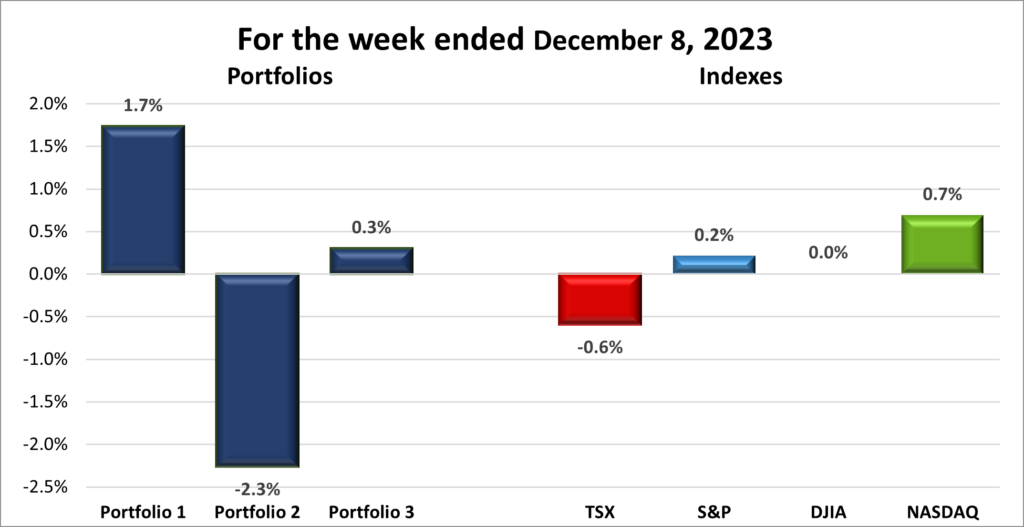
For the week, the TSX (SPTSX) lost 0.6%, the S&P 500 (SPX) added 0.2%, the DJIA (INDU) was essentially flat at 0.01% and the Nasdaq (CCMP) gained 0.7%.

 
Index Weekly Streak
TSX: 1-week losing streak
S&P: 6-week winning streak
DJIA: 6-week winning streak
Nasdaq: 6-week winning streak

Bull market. A good week for the North American stock markets. A slow start to the week had investors reconsidering their belief that the Fed will signal the end of rates hikes, taking the wind out of investors’ sails. However, the markets rebounded by the end of the week to push the American indexes into the green and extend their weekly winning streaks to six weeks. November’s rally was characterized by investor optimism that the Fed could cut interest rates aggressively next year have helped propel stocks higher. However, this week’s labour reports raised investor optimism to not only believe rates will be coming down, but also that the US will experience an economic ‘soft landing.’

The Magnificent 7 companies continue to drive the S&P and Nasdaq, up 20% and 38% year to date, respectively. Both indexes continue to outperform the more value oriented DJIA, which is up 10%. The TSX, up only 4.5% on the year, was not as fortunate as its American cousins this past week, dragged down by falling oil prices. Even growing consumer and investor optimism was not enough to offset the losses in the energy sector.

Overall, it was a mostly positive week for the markets with the indexes gaining ground as the week wore on. Hopefully, the markets are only taking a breather after the big run up in November before a strong Santa Claus rally to end 2023.

Bull market. A good week for the North American stock markets.Bearish market Like the indexes, the portfolios had a mixed week. Portfolios 1 and 3 increased in value, while Portfolio 2 stumbled, as shown in the chart below. Since the drop in Portfolio 2 was greater than the drop of the other two portfolios I have decided to give a bull/bear rating this past week.

Portfolio 1 was carried higher by the overall market trend. It benefited from gains achieved by its Magnificent 7 companies. Gains of 10% or more by Cargojet (TSE: CJT) and Pulse Seismic (TSE: PSD) easily offset a 10% drop in value by Nano-X Imaging (NASD: NNOX). Portfolio 3 appears to have ridden the rising tide of the overall market. None of the companies in the portfolio saw significant share price movement one way or the other.

The drop in Portfolio 2 was a bit of a surprise but upon closer inspection it was dragged down by a 12% decline in MongoDB (NASD: MDB). The company’s share price has bounced back in the past and I expect the share price will do so again. As it has become one of the largest holdings in the portfolio the drop was enough to offset the overall upward trend of the market. Falling oil prices also did not help as it led to a drop in value of the oil and natural gas companies in the portfolio.

This past week was OK, but I would much rather a return to the weekly gains of November. Hopefully, next week investor optimism jumpstarts the Santa Claus rally. 😊

Weekly Portfolio & Index performance
Weekly Portfolio & Index performance for the week ended December 8, 2023.

Companies on the Radar

Stocks on my Radar Disappearing from the Radar List is Cognizant Technology Solution (NASD: CTSH) and Toll Brothers Inc. (NYSE: TOL). Both appeared to have limited upside and I do not want to increase the total number of companies across the three portfolios unless they have significant upside.

Yes, I know McDonalds (NYSE: MCD) doesn’t have a lot of upside but it does provide diversification and is a solid defensive company in the event the economy falters.

Entering the Radar List is e.l.f. Beauty, Inc. (NYSE: ELF), a mid size American company that sells multi-brand beauty products internationally. Over the last three years it has been increasing its revenues and net income, while its long-term debt has been decreasing. It is cash flow positive and has handily outperformed the S&P over the last two years. This company is classified as a Consumer Staples company that would provide diversification while at the same time offering solid growth potential.

ELF joins the six holdovers from last week on the radar list:

  • PHX Energy Services (TSE: PHX) a small Canadian company that provides drilling technology and services to oil and natural gas exploration companies throughout the world, but mainly in North America.
  • Celestica Inc. (TSE: CLS), a medium sized Canadian company that manufactures electronic products and provides supply chain services to companies around the world.
  • McDonald’s, the large cap American fast-food chain.
  • TFI International Inc. (TSE: TFII), a mid-sized Canadian transportation and logistics company operating across North America.
  • Decisive Dividend Corporation (TSXV: DE), a small cap Canadian company involved in several manufacturing areas. They typically acquire existing profitable manufacturers from owners/founders who are looking to retire and sell their company to someone who will continue to grow and build the business.
  • MTY Food Group Inc. (TSE: MTY), a small cap Canadian consumer cyclical company that operates and franchises quick service and casual dining restaurants throughout North America and internationally.

The Radar Check was last updated December 8, 2023.

Stock on the Radar List. 1 of 2.

Stock on the Radar List. 2 of 2.


Portfolio Updates

Portfolio 1

Portfolio 1 for the week ended December 8, 2023: UP Green Up Arrow, signifying a positive week

  • Nuvei (TSE: NVEI) announced they have signed a deal with Microsoft (NASD: MSFT) to provide them with payment technology in the Middle East and Africa markets. Nuvei will supply knowledge of the regional markets to enable Microsoft to optimize its payment processes for Office and Xbox services.
  • General Motors’ Cruise self driving division has been ordered to appear before the California Public Utilities Commission (CPUC). Cruise officials are to address “misleading the Commission” about the details and seriousness of an accident on October 2, 2023. The company could face fines and sanctions if they are found to have withheld relevant details.
  • Apple (NASD: AAPL) broke the US$3 trillion valuation mark, closing the week at US$3.044 trillion. That is a very big number. 😊 Valuation is the number of outstanding shares multiplied by the market price.
  • It should not come as a surprise that Google has come out against the European Union’s antitrust regulator, the European Commission (EC), potential order that Google sell part of its advertising technology business. The EC claims Google has long abused its dominant position in the adtech world. Google claims it is common practise to serve both advertisers and publishers.
  • Nvidia (NASD: NVDA) announced they will partner with Malaysia’s YTL Power to build AI infrastructure throughout the country.

Activity

No significant activity to report this week.

Dividends

Dividends Received this week for the following companies:

Companies followed by DRIP (Dividend Re-Investment Plan) indicate additional shares were purchased with the dividend. Any cash leftover was added to the cash balance.

Canadian $

Nuvei Corp (TSE: NVEI)

US $

No US$ dividends this past week.

Quarterly Reports

No quarterly reports this past week.

Portfolio 2

Portfolio 2 for the week ended December 8, 2023: DOWN Red Down Arrow

  • Guardant Health (NASD: GH) announced they will be working with Cancer Research UK, a charitable funder of cancer research, to improve the development of cancer detection and treatments.
  • Airbnb (NASD: ABNB) made changes to their executive team, promoting their current Chief Financial Officer (CFO) Dave Stephenson to the new role of Chief Business Officer. Their vice president of finance, Ellie Mertz has been elevated to the CFO role. Finally, their global head of hosting, Catherine Powell, has moved to an advisor role as she plans to depart Airbnb sometime in 2024.
  • MongoDB (NASD: MDB) appointed Ann Lewnes to their Board of Directors. Ms. Lewnes previously worked at Adobe (NASD: ADBE) and Intel (NASD: INTC) where she as involved in marketing and corporate strategy.
    Separately, MongoDB was added to the Nasdaq 100 Index. The index is comprised of the 100 largest nonfinancial companies listed on the Nasdaq Exchange. MongoDB and five other companies will be added prior to the market opening on December 18, 2023. This is good news because all funds that mirror the Nasdaq 100 must add shares of MongoDB to their holdings. There should produce a nice little bump in share price. 😊

Activity

No significant activity to report this week.

Dividends

Dividends Received this week for the following companies:

Companies followed by DRIP (Dividend Re-Investment Plan) indicate additional shares were purchased with the dividend. Any cash leftover was added to the cash balance.

No dividends this past week.

Quarterly Reports

MongoDB, Inc.

All currency listed in thousands of US dollars, except for per share data.

Selected highlights from their third quarter 2023 financial results on October 15, 2023

  • Revenue of $432,938 for the three months ended October 31, compared to $333,621 for the same period in 2022. An increase of almost 30%.
  • Net loss of $29,297 for the three months ended October 31, compared to a net loss of $84,841 in the same period in 2022.
  • Diluted loss per ordinary share of $0.41 for the three months ended October 31, compared to a loss of $1.23 per share for the same period in 2022.


  • Revenue of $1,225,009 for the nine months ended October 31, compared to $922,728 for the same period in 2021. An increase of almost 33%.
  • Net loss of $121,140 for the nine months ended October 31, compared to a net loss of $281,000 in the same period in 2022.
  • Diluted loss per ordinary share of $1.71 for the nine months ended October 31, compared to a loss of $4.11 per share for the same period in 2022.

Portfolio 3

Portfolio 3 for the week ended December 8, 2023: UP Green Up Arrow, signifying a positive week

  • As expected, Brookfield Asset Management’s (TSE: BAM) bid to takeover Australia’s largest power retailer Origin Energy, was rejected by Origin’s shareholders. Brookfield will likely walk away from Origin rather than raise its offer.
  • The Royal Bank (TSE: RY) was fined C$7.5 million by the Financial Transactions and Reports Analysis Centre of Canada (Fintrac) for failing to submit suspicious transactions reports. Fintrac officials said it was not unreasonable to suspect the transactions in question were related to money laundering. The Royal Bank said Fintrac found no evidence any bank employees acted in bad faith or “knowingly contributed to violations.”
  • Cloudflare (NYSE: NET) was named a Fortune Future 50 company for 2023, coming in at sixth. The recognition is for their long-term growth prospects and their future potential.
  • Britain’s Competition and Markets Authority (CMA) announced they were taking a closer look at OpenAI’s relationship with Microsoft. The CMA is seeking feedback if the relationship should be considered a de facto merger after the recent events surrounding Chief Executive Officer Sam Altman. If so, the CMA could launch a formal merger review into the partnership.

Activity

No significant activity to report this week.

Dividends

Dividends Received this week for the following companies:

Companies followed by DRIP (Dividend Re-Investment Plan) indicate additional shares were purchased with the dividend. Any cash leftover was added to the cash balance.

No dividends this past week.

Quarterly Reports

No quarterly reports this past week.


Weekly Update for the week ending December 1, 2023

Items that may only interest or educate me ….

Canadian Economic news, US Economic news, Cyber weekend, Passing of an investing giant, ChatGPT turns 1….

Well, that was quite the November to remember, wasn’t it? It has only been a day but the investor optimism that propelled the markets higher in November seems to have carried over to December as the S&P 500 had its best day of the year to keep the November rally rolling into December. This optimism largely stems from analysts’ belief that the central banks are finished raising rates. Talk has turned from when will the banks stop raising rates to when will they start lowering rates.

Hopefully investor confidence will provide a strong tailwind leading into the annual Santa Claus rally. The rally typically lasts from mid December to early January. During this period, the markets have performed well 75% of the time. Let us hope Santa Claus arrives early and stays late. 😊


Canadian Economic news

This past week’s key economic data that the Bank of Canada (BoC) considers when deciding whether to raise or lower the interest rate.

Gross Domestic Product

Statistics Canada’s latest report on the Canadian economy, as represented by Gross Domestic Product (GDP), showed the economy shrunk in the third quarter at an annualized rate of 1.1%, following a revised second quarter increase of 1.2%.

On a quarterly basis, GDP fell 0.3% after growing 0.3% in the second quarter. The main reason for the decline was the drop in exports of energy products, down 25.4%. The import of goods and services also fell, down 0.2%. An increase in the import of cars and trucks was more than offset by a decline in consumer products. These declines were partially offset by increases in government spending and investment in housing.

In September, GDP was up 0.1% after being flat in August. There was growth in 10 of the 20 sectors with the biggest gains coming in ‘Construction’, up 1.0%, and ‘Manufacturing’, up 0.9%. The biggest declines were in ‘Management of companies and enterprises’ and ‘Arts, entertainment and recreation’, down 6.6% and 2.1%, respectively. Year over year, GDP gained 0.6%. The biggest contributor was ‘Public administration’ (government spending) and ‘Healthcare’ The largest declines were seen in ‘Management of companies and enterprises’ down 35.8% and ‘Agriculture, forestry, fishing and hunting’, down 18.5%.

Its better than the flat growth reported in the second quarter, but a far cry from the US’s 5.2% growth (see US economic news, below). Fortunately, the preliminary data for October shows GDP growing by 0.2%. Technically Canada is not in a recession, but we are in danger of falling into a recession.

Labour Force Survey (LFS)

The LFS for November revealed 25,000 new jobs, exceeding analysts’ expectations of 15,000. This marked the second consecutive month of sluggish growth, around 0.1%. The ‘manufacturing’ sector saw the most significant monthly job increase (1.6%), while ‘natural resources’ experienced the largest decline in jobs (1.4%). Annually, the ‘transportation and warehousing’ sector saw the biggest gains, while ‘finance, insurance, and real estate’ suffered the most losses (2.6%).

Meanwhile, the unemployment rate continued its upward trend, rising from October’s 5.7% to 5.8%. This marks a 0.8% increase since April, aligning with the slowdown in job growth. The current rate is close to pre-pandemic levels but is predicted to rise further as businesses grapple with the effects of higher interest rates.

Notably, average hourly wages grew by 4.8%, mirroring the increase in October. This suggests that wage growth remains steady despite the economic slowdown. Unfortunately, it is also a sign of lingering inflation pressures.

The slowdown in job creation and rising unemployment corroborates the latest GDP report, indicating a decelerating Canadian economy.

Canadian market volatility

The Canadian Volatility Index (VIXC), represented by the TSX 60 VIXI, ended the week at 10.71, down considerably from last week’s reading of 13.06. Investors are becoming more bullish about the markets because of a growing belief that interest rates in Canada and the US have reached their peak. In the context of the VIXC, a reading above 20 is considered high, while below 20 is deemed low.

US Economic news

This past week’s key data points that the Federal Reserve (Fed) considers when deciding whether to raise or lower the interest rate.

Personal consumption expenditures

The latest Personal Consumption Expenditures (PCE) price index report revealed a continued slowdown in inflation. In October, headline PCE, or overall inflation, grew less than 0.1%, down from September’s 0.4% gain. This decline aligns with analysts’ forecasts. Year over year, Headline PCE rose 3.0%, again in line with analysts’ forecasts.

Core PCE (PCE excluding the volatile food and energy components), the Fed’s preferred inflation metric, edged up 0.2% in October, following a 0.3% increase in September. Annually, Core PCE climbed 3.5%, after a 3.7% gain in September. Both monthly and annual Core PCE figures indicate the pace of inflation is slowing.

Both headline and core inflation numbers are two-year lows. This continued deceleration in inflation provides further weight to the belief among analysts and investors that the Fed has reached the end of its rate hike cycle. In fact, some are suggesting that rate cuts may be coming sooner than previously anticipated. Their next meeting is scheduled for December 13-14, and it will be closely watched to see if they signal a change in their stance on monetary policy.

Gross Domestic Product

According to the Commerce Department’s Bureau of Economic Analysis, the American economy, as measured by Gross Domestic Product (GDP) grew at an annual rate of 5.2%. This was higher than analysts’ expectations of a 5.0% gain and better than the initial estimate of 4.9%.

The strong economy coincides with strong employment reports. When people are working, they have the money to spend and keep the economy rolling. For now, the higher interest rates are having little effect on the economy while inflation eases. It is looking more and more likely the US will be able to avoid a recession. Good news all around!

American market volatility

By the end of the week, the CBOE Volatility Index (VIX) rose to 12.65, up slightly from 12.46 the previous week. Investors are optimistic that the Fed will leave the benchmark rate unchanged leading them to feel bullish about the stock markets. The slight rise in the VIX suggests investors remain relatively unconcerned about volatility in the American stock markets.

Consumer Confidence Index

The latest reading from The Conference Board showed the Consumer Confidence Index (CCI), which measures consumers’ optimism about the state of the economy, increased to 102.0 in November from a downward revised 99.1 in October. Analysts had predicted a reading of 101.0. The increase followed three straight months of declines in the CCI, suggesting consumers are feeling more optimistic and confident about the economy.

With the holiday shopping season shifting into high gear, its great to hear consumer confidence is on the upswing. That ties in nicely with a recent survey from the National Retail Federation that suggests Americans plan to spend about 5% more this year.

Cyber weekend

In the US, the four day Cyber Weekend shopping holiday, from Black Friday through Cyber Monday, generated a record US$ 35.1 billion in online sales, up 7.8% compared to Cyber Week 2022. Black Friday generated US$ 9.8 billion in online sales, a 7.5% increase over a year ago, while Cyber Monday generated US$ 12.4 billion, a 10.1% increase over 2022. An additional US$ 5.6 billion of sales occurred on Thanksgiving while US$ 7.3 billion occurred over the weekend between Black Friday and Cyber Monday. Cyber Monday was the biggest online shopping day in US history.

Online consumer spending increased 7.8% during the Cyber Week frenzy, beating expectations of a 5.4% increase. Keep in mind that the Cyber Week sales figures only include online sales. If you were to include in-store sales, the total Cyber Week sales would be even higher. The holiday shopping was a reminder that retail sales remained strong despite uncertainty in the economy.

Overall, Cyber Week 2023 was a strong year for online retail, with shoppers spending more than ever before. The growth in Buy Now Pay Later (BNPL) usage and cross-border spending suggests that these trends will continue in the years to come.

Charlie Munger: Warren Buffet’s right-hand man

Berkshire Hathaway’s (NYSE: BRK.B) vice chairman Charles Thomas “Charlie” Munger passed away this past week at the age of 99.

Born in Omaha, Nebraska, on January 1, 1924, Munger embarked on a remarkable career, graduating from Harvard Law School in 1951. After practicing law for several years, he established his own investment firm, Wesco Financial Corporation, in 1959.

In what would be a transformational move, Munger joined Berkshire Hathaway in 1978 as vice chairman. Ever since, he has served as a trusted advisor to Warren Buffett, garnering widespread respect for his investment wisdom and profound understanding of human psychology. Buffett aptly described Munger as his closest confidant and right-hand man.

Charlie Munger
Charlie Munger

Together, Munger and Buffett orchestrated Berkshire’s transformation from a textile manufacturer into a diversified conglomerate, meticulously acquiring brands like Dairy Queen and Fruit of the Loom while growing stakes in other large public companies. As of the end of September 2023, Berkshire’s top five holdings were Apple (NASD: AAPL), Bank of America (NYSE: BAC), Chevron (NYSE: CVX), Coca-Cola (NYSE: KO), and American Express (NYSE: AXP). Not a bad basket of companies to own outright or partially.

Together they transformed Berkshire into one of the most successful and long-lasting business partnerships that resulted in a multi billion-dollar conglomerate with dozens of business units. Shareholders would annually flock to Omaha, Nebraska to attend Berkshire’s Annual General meeting to hear Buffet and Munger discuss the company and respond to shareholder questions.

Munger adhered to a value investing philosophy, advocating for buying stocks below their intrinsic value. He also embraced a contrarian approach, willingly purchasing stocks that had fallen out of favor with other investors. According to Buffett, Munger’s most significant contribution to Berkshire’s success was his insistence on prioritizing “wonderful businesses at fair prices” over the conventional wisdom of acquiring “fair businesses at wonderful prices.”

Munger’s contributions to the world of investing earned him widespread recognition. He was not only a member of the Forbes 400, an annual ranking of the 400 wealthiest Americans, but also an inductee into the Barron’s Hall of Fame, an award reserved for financial advisors with exceptional long-term performance. Moreover, he was bestowed with the Graham and Dodd Award, the highest honor bestowed upon value investors.

Munger’s legacy extends far beyond his investment acumen, encompassing his profound understanding of human behavior and his unwavering commitment to ethical conduct. His wit and wisdom, often expressed through his long, rambling speeches, captivated audiences worldwide. He was a true original, a man who left an indelible mark on the world of investing and beyond.

Happy birthday ChatGPT

OpenAI unveiled ChatGPT, a form of artificial intelligence (AI), to the public on November 30, 2022. Initially launched as a complimentary service, it swiftly gained traction, attracting over a million users within just two days. By January 2023, ChatGPT boasted over 100 million users, establishing itself as the fastest-growing consumer application to date. The latest iteration, GPT-4, rolled out in March 2023 as a paid subscription service.

ChatGPT transcends the boundaries of a conventional chatbot, like you see in online Help chat sessions. It has evolved into a sophisticated computer program capable of engaging in natural conversations. Unlike traditional chatbots that rely on predefined scripts and responses, ChatGPT possesses the remarkable ability to comprehend and respond to human queries in an engaging and conversational manner. Its capabilities extend beyond mere communication, encompassing the generation of diverse creative text formats, including poems, code, scripts, musical pieces, emails, and letters. Chatbots can produce text remarkably like human speech, but with access to a broader knowledge base and operating at a far swifter pace than their human counterparts.

While still under development, ChatGPT has mastered a wide range of tasks, including:

  • Providing informative answers to questions, regardless of their open-ended, challenging, or unusual nature.
  • Diligently following instructions and completing requests quickly.

ChatGPT version 3.5, accessible with limited features at no cost, utilizes knowledge derived from pre-existing data up to September 2021. Consequently, it may lack information on recent events, developments, or changes. GPT-4, offered as a subscription service, boasts real-time access to the internet and the capability to generate AI images.

A year has elapsed since ChatGPT’s public debut, and during that time, it has evolved into a powerful tool with diverse applications. With its potential to revolutionize human-computer interaction, ChatGPT has ignited the race for AI market share among the technology giants. AI has become the technology world’s darling, propelling the share prices of companies that provide AI products or services ever higher. Prior to the AI frenzy, I was fortunate to invest in several heavyweight technology companies. While I would love to claim far sightedness in recognizing AI’s emergence and the subsequent benefits for these companies, it was primarily a stroke of luck.

Skynet: a fictional artificial neural network

AI stands at its infancy, and the future holds exciting possibilities. Will AI enhance productivity and simplify our lives, or will it morph into SkyNet, wreaking catastrophic harm on humanity? The answer lies in the hands of responsible developers, users, and the passage of time.


One birthday, one passing. Let’s see what else happened this past week….

Weekly Market Review

Monday: All four major North American indexes – the Toronto Stock Exchange Composite Index (TSX), the S&P 500 Index (S&P), the Dow Jones Industrial Average (DJIA), and the Nasdaq Composite Index (Nasdaq) – ended in the red. Investors were busy spending money on Cyber Monday, it just was not in the stock markets today. Elsewhere, the latest economic data out of China called into question the health of that country’s economy. Oil prices fell ahead of an OPEC+ meeting.

In Canada, lower oil prices overwhelmed the optimism caused by record cyber weekend sales to drag the TSX lower. This week Canada’s big banks present their fourth quarter earnings. Investors expect higher bad debt provisions to lead to another quarter of lower profits. In the Canadian sectors, Technology, Basic Materials (miners and fertilizer manufacturers) and Consumer Staples were the only ones to advance. Energy and Industrials dropped the most.

In the USA, investors took another pause after a fourth consecutive week of weekly gains as they prepare for more key inflation data later this week. In the American sectors, Utilities was the only sector to post a gain, while Healthcare and Energy experienced the biggest declines.

Tuesday: a rollercoaster day that saw all four indexes swing above and below the break-even line before they all finished in positive territory. After the November rally investors are trying to determine if there is more to the rally or if its overdone and a pullback is coming. Oil prices rose ahead of an upcoming OPEC+ meeting where additional supply cuts are expected to be announced.

In Canada, the TSX barely made it into positive territory after the first of Canada’s big banks, the Bank of Nova Scotia (TSE: BNS) missed profit expectations due to higher loan provisions. The loss in the Financials sector was offset by the higher oil prices, which pulled oil companies higher. In trading, only Basic Materials and Energy ended higher, while Consumer Staples and Financials fell the most.

In the US, investors are trying to decide what the Fed is thinking after one member said she thought the interest rate would have to go higher, while another member thought the current rate was appropriate to get inflation down to 2%, depending on the economic data. With key economic data out later this week, investors were reluctant to boldly move back into the markets. In trading, Basic Materials and Technology recorded the biggest gains, while Healthcare and Industrials were the only sectors to decline.

Wednesday: another mixed day in the markets with the TSX and DJIA finishing higher while the S&P and Nasdaq ended barely below the breakeven line. Investors were processing more mixed messages from Fed officials. One cautioned about keeping rates “too high for too long”, while another was “skeptical” inflation was headed towards the 2% target without another rate hike.

In Canada, investor optimism in the US about the end of rate hikes spilled into Canada, pushing the interest sensitive sectors higher. Another good day for energy companies as they saw their share prices follow oil prices higher. In trading on Bay Street, Financials and Industrials had the biggest gains while Telecommunications Services and Utilities suffered the biggest losses.

In the US, today’s GDP report showed the economy grew faster than forecast. Data from the same report also suggested that inflation was on a downward trend. Both are good news for consumers and investors. In trading on Wall Street, Financials and Telecommunications Services posted the biggest gains, while Consumer Staples and Utilities posted the biggest declines.

Thursday: the last day of a red-hot November ended with another mixed day. The DJIA, TSX and the S&P finished the day in the green. Investors continue to believe the Fed has finished raising the US benchmark rate after the Fed’s preferred measure of inflation showed inflation continues to fall. Oil prices dipped slightly after OPEC+ members agreed to voluntarily cut production by one million barrels per day (BPD). Saudi Arabia also extended their existing production cut of one million bpd, to bring the total reduction to approximately two million bpd. With a reduction in supply of that size, we are likely to see higher prices at the pump. ☹

In Canada, the TSX finished off its best month in three years. Positive earnings reports from two of Canada’s big banks combined with news indicating Canada’s GDP grew in October pushed the index higher. Trading in the Canadian sectors was led higher by Telecommunications Services and Financials, while Consumer Staples and Technology declined the most.

In the USA, the DJIA closed at its highest point of the year and all three indexes posted their best monthly performance of 2023. Healthcare and Financials were the best performers in the American sectors, while Technology and Consumer Cyclicals were the worst performers on the day.

Friday: after a shaky start to the trading day, the indexes found their footing and resumed their upward momentum, starting December moving in the right direction. At a speaking engagement, Fed Chair Jerome Powell said it was clear the higher interest rates were having the desired effect on inflation. However, he warned that it was too early to conclude rate hikes were finished or to speculate when interest rates could start to fall. His comments only seemed to reinforce investors’ belief that rate hikes were at an end. Oil prices continued their downward drift.

In Canada, the TSX closed at its highest point since mid September as investors believe rate cuts are coming in 2024. In trading, it was a day of broad-based gains in the Canadian sectors. Telecommunications Services and Industrials posted the biggest gains while Energy and Consumer Staples made the smallest gains.

In the US of A, investor optimism pushed the S&P to its highest closing level of 2023 and the Nasdaq rebounded from yesterday’s pullback. In trading, it was a good day for the American sectors with all sectors in the green, led by Basic Materials and Industrials. Bringing up the rear were Energy and Technology.


Weekly Market and Portfolio Review

For the week, the TSX (SPTSX) advanced 1.7%, the S&P 500 (SPX) added 0.8%, the DJIA (INDU) surged 2.4% and the Nasdaq (CCMP) climbed 0.4%.

Index Weekly Streak
TSX: 1-week winning streak
S&P: 5-week winning streak
DJIA: 5-week winning streak
Nasdaq: 5-week winning streak

Bull market. A good week for the North American stock markets. As shown in the chart above, it was another good week in the markets with all four major North American indexes ending the week in positive territory. It was good news on the economic front this past week as the Fed’s preferred inflation gauge, Core PCE, continued to show signs of slowing. As well, recent data has shown consumer spending has slowed, the job market is cooling, and inflation continues to fall. Analysts now see an economic soft landing as achievable rather than the recession many predicted. All of this has investors confident that the Fed might soon pause or even reverse its rate hike cycle.

The DJIA was propelled to a yearly high by broad gains across many of its components, particularly its medical, industrial, and financial components. The S&P also reached its highest point of the year, fueled by investor optimism that rate hikes were finished. Investor confidence overcame mixed earnings from Canada’s big banks to lift the TSX back into positive territory for the week. Finally, a Friday surge was able to extend the Nasdaq’s weekly win streak to five weeks.

I hope the weekly advances become a full-on nine reindeer Santa Claus rally. 😊

Bull market. A good week for the North American stock markets. All portfolios enjoyed another week in the green, as you can see in Chart 1 below, fueled by a rising market. Portfolio 1, though weighed down by drops in its five technology giants, still managed a gain, thanks to impressive performances from Global-E (NASD: GLBE), General Motors (NYSE: GM), and CrowdStrike (NASD: CRWD) – all up over 10% each!

Portfolio 2 and 3 tied for the biggest weekly gains. No single stock in either portfolio made a large move up or down, driven by steady, solid growth riding the overall positive market tailwind.

Weekly Portfolio & Index performance
Weekly Portfolio & Index performance for the week ended December 1, 2023.

Monthly Market and Portfolio Review

November was a great month for the indexes. The TSX (SPTSX) gained 7.2%, the S&P 500 (SPX) rose 8.9%, the DJIA (INDU) advanced 8.8% and the Nasdaq (CCMP) jumped 10.7%.

Bull market. A good week for the North American stock markets. November saw a dramatic turnaround in the markets, with all four indexes experiencing strong gains for the month, as shown in the chart above. This marked a significant rebound from the October gloom, fueled by a combination of positive factors.

A stronger-than-expected earnings season provided a strong foundation for the rally. Falling inflation added further momentum, coupled with growing optimism that interest rates in Canada and, especially, the US are nearing their peak. Recent economic data and comments from Fed officials have bolstered this optimism, leading analysts, and investors to believe that rate cuts may be on the horizon as inflation continues to slow down in both countries.

The S&P had one of the best performances in the past decade, as investors bet the Fed could finally be done raising interest rates. The DJIA had its best month since October 2022, while the S&P and the Nasdaq’s had their best monthly gains since July 2022. As for the TSX, it had its best month since November 2021.

As momentum increases, be it up or down, the harder it is to stop. In the case of November in the stock markets, momentum was definitely upward, and investors are coming back into the markets to avoid missing out on the rally. Inflation going down equals stocks going up. 😊

Bull market. A good week for the North American stock markets. As good a month as it was for the indexes, if was even better for the portfolios, particularly Portfolio 3, as shown in Chart 2 below. The month got off to a fast start and continued throughout November. There was only one week where one of the portfolios, Portfolio 1, did not advance. Otherwise, each portfolio posted a weekly gain, every week. Much better than October!

Portfolio 1 rode the tailwind of its Magnificent 7 companies Alphabet (NASD: GOOGL), Amazon (NASD: AMZN), Apple, Nvidia (NASD: NVDA) and Tesla (NASD: TSLA). Its one losing week was weighed down by a drop in Nvidia’s share price when it delayed the shipment of AI chips for China. Portfolio 2 was propelled by the overall rise in the markets, in particular its one Magnificent 7 member company Microsoft (NASD: MSFT). Last, but certainly not least, Portfolio 3 had an outstanding month. It also benefitted from the rising markets, but it received an additional boost thanks to a jump of 47% in Shopify’s share price in November.

Please sir, I want more! 😊

Monthly Portfolio & Index performance

Monthly Portfolio & Index performance for November, 2023.


Companies on the Radar

Stocks on my Radar I made some changes to my radar list this past week. Gone are Stantec (TSE: STN) and Uber (NYSE: UBER). New to the list are Cognizant Technology Solution (NASD: CTSH) and Decisive Dividend Corporation (TSXV: DE).

Cognizant is a large cap American professional services company. They provide consulting and outsourcing services to clients throughout the world. I am intrigued by their exposure to AI, and robotics, among other areas, in a few areas including Financials, Healthcare and Technology.

Decisive is a small cap Canadian company involved in several manufacturing areas. The company typically acquires existing profitable manufacturers from owners/founders who are looking to retire and sell their company to someone who will continue to grow and build the business. I like the idea of acquiring small, successful businesses and helping them grow. It reminds me of how Berkshire Hathaway grew to be the conglomerate it is today. I also like the 6+% dividend at today’s share price. 😊 Decisive has lots of room to grow, and along the way it pays a healthy monthly dividend.

These two companies join the six holdovers from last week:

  • PHX Energy Services (TSE: PHX) a small Canadian company that provides drilling technology and services to oil and natural gas exploration companies throughout the world, but mainly in North America.
  • Toll Brothers Inc. (NYSE: TOL), a mid size American company that builds luxury homes throughout the US.
  • McDonald’s (NYSE: MCD), the large cap American fast-food chain.
  • TFI International Inc. (TSE: TFII), a mid-sized Canadian transportation and logistics company operating across North America.
  • Celestica Inc. (TSE: CLS), a medium sized Canadian company that manufactures electronic products and provides supply chain services to companies around the world.
  • MTY Food Group Inc. (TSE: MTY), a small cap Canadian consumer cyclical company that operates and franchises quick service and casual dining restaurants throughout North America and internationally.

The Radar Check was last updated December 1, 2023.

Stock on the Radar List. 1 of 2.

Stock on the Radar List. 2 of 2.


Portfolio Update

Portfolio 1

Portfolio 1 for the week ended December 1, 2023: UP Green Up Arrow, signifying a positive week

  • Berkshire Hathaway sold its 2.5% stake in the Indian digital payments provider Paytm for $164 million.
    Berkshire’s vice Chairman Charlie Munger passed away at the age of 99.
  • Amazon announced their latest chip designed specifically for its Amazon Web Services cloud based artificial intelligence (AI) services – the Trainium2. Amazon says it is four times faster than its predecessor and twice as energy efficient.
  • To show it can generate cash, and lots of it, General Motors announced it plans to buy back up to US$ 10 billion worth of its shares. That would be GM’s largest ever stock buyback program. In another shareholder friendly action, GM increased its dividend by 33% to US$ 0.12, starting in 2024. As a shareholder, both are good news. Now, about the share price…..
  • Alphabet’s Google business unit reached an agreement with the Canadian government to pay Canadian news companies for links to their content. Google will pay C$ 100 million into a fund that will go towards supporting the Canadian news business. Part of the agreement allows Google to only deal with a single group representing all Canadian news organizations rather than having to deal with each news company individually.
  • Telus (TSE: T) and BCE’s (TSE: BCE) Bell division acquired new 3800 MHz spectrum licences nationwide. The new spectrum will allow them to provide faster wireless speeds with greater capacity in order to provide the next generation of 5G services.
  • Canada’s second largest bank, Toronto Dominion (TSE: TD) announced they took a C$ 266 million after tax restructuring charge in their fourth quarter when they eliminated 3,000 positions.
  • Tesla delivered their first twelve Cybertrucks this week, however, the company doesn’t expect to start regular deliveries of the all-wheel drive edition and the Cyberbeast (extended range) version until 2024, and the base model in 2025. Prices for the Cybertruck will start at US$60,990, 50% more than the company initially said it would in 2019. Investors were not impressed as the share price of Tesla stock dropped.

Activity

Received interest on TD 1-year cashable GIC.

Sold: Copperleaf Technologies (TSE: CPLF). Getting got up in the 2021 bull market, I added Copperleaf Technologies to my portfolio, hoping it would follow the trajectory of other Canadian technology companies that experienced rapid share price appreciation upon going public. Initially, my optimism seemed justified. Copperleaf’s share price did rise, mirroring the trend of other newly public Canadian tech companies like Nuvei (TSE: NVEI) and Lightspeed (TSE: LSPD). However, while Nuvei and Lightspeed have seen their share prices partially recover from the subsequent market downturn in 2022, Copperleaf’s share price has only moved lower over the past 2.5 years. As my interest in the company waned and I started to rebalance the portfolio, Copperleaf became a casualty of my decision to prune non-performing holdings.

Dividends

Dividends Received this week for the following companies:

Companies followed by DRIP (Dividend Re-Investment Plan) indicate additional shares were purchased with the dividend. Any cash leftover was added to the cash balance.

Canadian $

TMX Group Ltd (TSE: X)

US $

Visa Inc (NYSE: V)

Quarterly Reports

Bank of Nova Scotia

All currency listed in millions of Canadian dollars, except for per share data.

Selected highlights from their fourth quarter 2023 financial results on November 28, 2023

  • Revenue of $8,308 for the three months ended October 31, compared to $7,626 for the same period in 2022. An increase of almost 9%.
  • Net income of $1,385 for the three months ended October 31, compared to net income of $2,093 in the same period in 2022.
  • Diluted earnings per ordinary share of $1.02 for the three months ended October 31, compared to earnings of $1.63 per share for the same period in 2022.


  • Revenue of $32,307 for the twelve months ended October 31, compared to $31,416 for the same period in 2022. An increase of almost 3%.
  • Net earnings of $7,528 for the twelve months ended October 31, compared to net earnings of $10,174 in the same period in 2022.
  • Diluted earnings per ordinary share of $5.78 for the twelve months ended October 31, compared to earnings of $8.02 per share for the same period in 2022.

Nano-X Imaging Ltd.

All currency listed in thousands of US dollars, except for per share data.

Selected highlights from their third quarter 2023 financial results on November 28, 2023

  • Revenue of $2,479 for the three months ended September 30, compared to $2,438 for the same period in 2022. An increase of almost 2%.
  • Net loss of $21,403 for the three months ended September 30, compared to a net loss of $19,126 in the same period in 2022.
  • Diluted loss per ordinary share of $0.37 for the three months ended September 30, compared to a loss of $0.37 per share for the same period in 2022.


  • Revenue of $7,508 for the nine months ended September 30, compared to $6,446 for the same period in 2022. An increase of over 16%.
  • Net loss of $50,528 for the nine months ended September 30, compared to a net loss of $60,406 in the same period in 2022.
  • Diluted loss per ordinary share of $0.90 for the nine months ended September 30, compared to a loss of $1.16 per share for the same period in 2022.

CrowdStrike Holdings, Inc.

All currency listed in thousands of US dollars, except for per share data.

Selected highlights from their third quarter 2023 financial results on November 28, 2023

  • Revenue of $786,014 for the three months ended September 30, compared to $580,882 for the same period in 2022. An increase of over 35%.
  • Net income of $26,669 for the three months ended September 30, compared to a net loss of $54,631 in the same period in 2022.
  • Diluted earnings per ordinary share of $0.11 for the three months ended September 30, compared to a loss of $0.24 per share for the same period in 2022.


  • Revenue of $2,210,220 for the nine months ended September 30, compared to $1,603,869 for the same period in 2022. An increase of almost 38%.
  • Net earnings of $35,644 for the nine months ended September 30, compared to a net loss of $135,764 in the same period in 2022.
  • Diluted earnings per ordinary share of $0.15 for the nine months ended September 30, compared to a loss of $0.58 per share for the same period in 2022.

Toronto-Dominion Bank

All currency listed in millions of Canadian dollars, except for per share data.

Selected highlights from their fourth quarter 2023 financial results on November 30, 2023

  • Revenue of $13,121 for the three months ended October 31, compared to $15,563 for the same period in 2022. A decrease of almost 16%.
  • Net income of $2,886 for the three months ended October 31, compared to net income of $6,671 in the same period in 2022.
  • Diluted earnings per ordinary share of $1.49 for the three months ended October 31, compared to earnings of $3.62 per share for the same period in 2022.


  • Revenue of $50,492 for the twelve months ended October 31, compared to $49,032 for the same period in 2022. An increase of almost 3%.
  • Net earnings of $10,782 for the twelve months ended October 31, compared to net earnings of $17,429 in the same period in 2022.
  • Diluted earnings per ordinary share of $5.60 for the twelve months ended October 31, compared to earnings of $9.47 per share for the same period in 2022.

Portfolio 2

Portfolio 2 for the week ended December 1, 2023: UP Green Up Arrow, signifying a positive week

  • TC Energy (TSE: TRP) anticipates their core earnings for 2024 to be 5% – 7% higher than this year. They already have contracts for 94% of their Keystone pipeline capacity which ships oil from Alberta to refineries in the American Midwest.
  • MongoDB (NASD: MDB) announced the integration of their MongoDB Atlas Vector Search service with Amazon Web Services’ Bedrock service. The integration should make it easier for joint customers to build better, more secure AI applications.
  • It appears Disney (NYSE: DIS) is heading for a proxy fight after Disney rejected activist investor Nelson Peltz’s request for seats on Disney’s Board of Directors. Peltz is not impressed with the changes Disney has made to the Board and plans to nominate their own candidates for the next election of directors.

Activity

No significant activity to report this week.

Dividends

Dividends Received this week for the following companies:

Companies followed by DRIP (Dividend Re-Investment Plan) indicate additional shares were purchased with the dividend. Any cash leftover was added to the cash balance.

Canadian $

Fortis Inc (TSE: FTS)

US $

No US$ dividends this past week.

Quarterly Reports

Bank of Nova Scotia

See report under Portfolio 1.

Alimentation Couche – Tard Inc.

All currency listed in millions of US dollars, except for per share data.

Selected highlights from their second quarter 2024 financial results on November 28, 2023

  • Revenue of $16,425.6 for the twelve weeks ended October 15, compared to $16,879.5 for the twelve weeks ended October 9, 2022. A decrease of almost 3%.
  • Net income of $819.2 for the twelve weeks ended October 15, compared to net income of $810.4 for the twelve weeks ended October 9, 2022.
  • Diluted earnings per ordinary share of $0.85 for the twelve weeks ended October 15, compared to earnings of $0.79 per share for the twelve weeks ended October 9, 2022.


  • Revenue of $32,048.8 for the twenty-four weeks ended October 31, compared to $35,537.2 for the twenty-four weeks ended October 9, 2022. A decrease of almost 10%.
  • Net earnings of $1,653.3 for the twenty-four weeks ended October 31, compared to net earnings of $1,682.8 for the twenty-four weeks ended October 9, 2022.
  • Diluted earnings per ordinary share of $1.70 for the twenty-four weeks ended October 31, compared to earnings of $1.64 per share for the twenty-four weeks ended October 9, 2022.

Portfolio 3

Portfolio 3 for the week ended December 1, 2023: UP Green Up Arrow, signifying a positive week

  • The good news, Shopify’s (TSE: SHOP) merchants (customers) profited big time on Black Friday, making 22% more in sales than in 2022. The better news for us Shopify shareholders, investors pushed the company’s share price reached its highest level since March 2022.
  • Brookfield Asset Management raises (TSE: BAM) announced they had raised $28 billion for their global infrastructure fund. The money raised will be used for investment in infrastructure assets throughout the world.
  • Already changes can be seen at OpenAI following the ouster and return of Chief Executive Officer Sam Altman. Microsoft now has a nonvoting board seat at OpenAI. Given that they unofficially own 49% of OpenAI, I am surprised they did not get more.

Activity

No significant activity to report this week.

Dividends

Dividends Received this week for the following companies:

Companies followed by DRIP (Dividend Re-Investment Plan) indicate additional shares were purchased with the dividend. Any cash leftover was added to the cash balance.

Canadian $

Enghouse Systems Ltd (TSE: ENGH)

Royal Bank of Canada (TSE: RY)

US $

No US$ dividends this past week.

Quarterly Reports

Royal Bank of Canada

All currency listed in millions of Canadian dollars, except for per share data.

Selected highlights from their fourth quarter 2023 financial results on November 30, 2023

  • Revenue of $13,026 for the three months ended October 31, compared to $12,567 for the same period in 2022. An increase of almost 4%.
  • Net income of $4,131 for the three months ended October 31, compared to net income of $3,882 in the same period in 2022.
  • Diluted earnings per ordinary share of $2.90 for the three months ended October 31, compared to earnings of $2.74 per share for the same period in 2022.


  • Revenue of $56,129 for the twelve months ended October 31, compared to $48,985 for the same period in 2022. An increase of over 14%.
  • Net earnings of $14,886 for the twelve months ended October 31, compared to net earnings of $15,807 in the same period in 2022.
  • Diluted earnings per ordinary share of $10.50 for the twelve months ended October 31, compared to earnings of $11.06 per share for the same period in 2022.

Toronto-Dominion Bank

See report under Portfolio 1.

Weekly Update for the week ending November 24, 2023

Items that may only interest or educate me ….

Canadian Economic news, US Economic news, OpenAI’s Chaotic Leadership Change ….

At the start of each week, I wonder if there will be any investing events that pique my interest enough to write about. The last two weeks have been thin on interesting events, at least to me. However, starting on November 17 it came out that OpenAI’s Chief Executive Officer was unexpectedly let go. And then rehired five days later. I thought this would be a short paragraph or two, but it took on a life of its own. But first …


Canadian Economic news

This past week’s key economic data that the Bank of Canada (BoC) considers when deciding whether to raise or lower the interest rate.

Canadian fiscal update

As expected, Canada’s deficit spending exceeded the government’s initial forecast when they originally released their budget in March. And the debt to Gross Domestic Product (GDP) ratio is projected to increase for another year before gradually declining. The debt to GDP ratio is a key indicator of a country’s economic health. A high debt-to-GDP ratio can limit a country’s fiscal flexibility and potentially hinder economic growth.

The Fall Economic Statement (FES) updated the government’s fiscal projections, forecasting a deficit of C$ 40 billion in 2023-24. This was higher than the previously forecast deficit of C$ 32.1 billion, due to the implementation of additional spending measures. Moreover, the FES revealed the cost to service Canada’s debt has risen to C$52.4 billion from March’s forecast of C$ 46 billion. To put that into perspective, the cost of servicing Canada’s debt has now surpassed the budget allocated to Canada’s Armed Forces (C$ 28.9 billion), more than twice what the government will spend on the Employment Insurance program, and enough to cover the money spent on healthcare.

With such a substantial portion of the budget allocated to interest payments, the government says it does not expect to post a balanced budget for the foreseeable future. No where in the FES did the government make a commitment to balance the budget and it is unlikely that the government can resist spending more money in the future, especially with an election coming within two years. Perhaps the government still believes that the “budget will balance itself.” 😊

Despite the growing debt burden, the government has announced a number of new housing initiatives to promote housing construction. However, many of these policies will not kick in for at least another year. While these initiatives may have long-term benefits, they may not provide immediate relief for the current housing crisis Canada is currently experiencing.

Consumer Price Index

October inflation, as measured by Canada’s Consumer Price Index (CPI) rose 0.1%, in line with analysts’ expectations. This follows a 0.1% drop in the monthly pace of inflation in September. On a year over year basis, inflation was up 3.1% in October, lower than analysts’ prediction of a 3.2% increase and significantly lower than September’s 3.8% pace. Core inflation, which excludes the more volatile energy and food prices, rose 0.5% from September to October and 3.4% year over year.

The slowdown in inflation is mostly due to lower gas prices, which fell 6.4% on a monthly basis and is down 7.8% from a year ago. The cost of food also declined monthly, down 0.1%, but food prices are still up 5.4% from October 2022.

This latest data is good news for the BoC in its quest to bring inflation down to its 2% target. However, we are not out of the woods yet. Inflation is still well above the BoC’s target, and there is still a long way to go to get it back down.

The BoC will likely keep interest rates on hold for a while longer to ensure inflation continues to slow down. If it does, we could see interest rates start to fall sometime in early 2024. That would be great news for borrowers and the economy as a whole.

Overall, things are looking up on the inflation front, but we still have some work to do. The BoC appears to be on the right track, and if we can keep inflation on a downward trajectory, we will be in decent shape.

Canadian market volatility

The Canadian Volatility Index (VIXC), represented by the TSX 60 VIXI, ended the week at 13.06, up slightly from last week’s reading of 12.76. Despite the slight increase, investors remain bullish about the markets because of a sense that interest rates in Canada and the US have reached their peak. In the context of the VIXC, a reading above 20 is considered high, while below 20 is deemed low.

Retail Sales

Statistics Canada’s September Retail Trade report indicates a positive shift in retail sales, increasing by 0.6% following a 0.1% dip in August, easily beating analysts’ expectations of a flat outcome. Of the nine subsectors, ‘Motor vehicle and parts dealers’ led in monthly gains, up 1.5%, while the ‘Sporting goods, hobby, musical instrument, book, and miscellaneous retailers’ subsector suffered the largest sales decline, dropping 1.6%.

On a yearly basis, retail sales grew a solid 2.7%. Once again, ‘Motor vehicle and parts dealers’ had the biggest increase, up 7.1%. Conversely, ‘Building material and garden equipment and supplies dealers’ experienced a substantial downturn, with sales falling by 5.7%.

Core retail sales, which excludes gasoline stations, fuel vendors, motor vehicle and parts dealers, fell 0.3% in September, but was up 1.7% year over year.

Contrary to recent indicators suggesting an economic downturn, the September retail data, coupled with an advanced estimate for October indicating a 0.8% increase in sales, is a good sign for the economy. As long as people are still willing to spend money, that’s good news for the economy.

US Economic news

This past week’s key data points that the Federal Reserve (Fed) considers when deciding whether to raise or lower the interest rate.

FOMC minutes

The minutes from the Federal Open Market Committee’s last meeting on October 31 – November 1 were released this past week. In the minutes, members acknowledged progress was being made in bringing inflation down, but it still remained significantly above their 2% target. They recognized the risk of reigniting inflationary pressures if interest rates were lowered too quickly, leading to a stronger-than-expected economic recovery. On the other hand, continued interest rate hikes could pose risks of slowing economic growth or even triggering a recession.

They indicated a cautious approach to future interest rate decisions but suggested a slower pace of monetary tightening (raising interest rates) in the near future. However, they provided their usual caveat that they remain committed to bringing inflation down and will continue to assess incoming data to determine the appropriate path for policy.

American market volatility

By the end of the week, the CBOE Volatility Index (VIX) fell to 12.46, its lowest snice January 2020, down slightly from 13.80 the previous week. The belief that the Fed will leave the benchmark rate unchanged has investors feeling bullish about the stock markets. The slight decline in the VIX suggests investors remain relatively unconcerned about volatility in the American stock markets.

Consumer Sentiment Index

The final reading of the University of Michigan’s Consumer Sentiment Index (CSI) fell to 61.3 in November from a reading of 63.8 in October. However, it was still up 8.1% from November 2022’s 56.7.

This is the fourth month in a row that the CSI has fallen. A less favourable view of business conditions, which fell 15% to its lowest point since July 2022, offset an improved view of personal financial situations.

OpenAI’s Chaotic Leadership Change

OpenAI is a non-profit research company focused on developing safe and beneficial artificial general intelligence (AGI). The company created the artificial intelligence (AI) chatbot ChatGPT, funded in large part by a US$ 13 billion investment from Microsoft (NASD: MSFT).

On November 17, OpenAI’s board of directors abruptly fired Sam Altman as Chief Executive Officer (CEO), citing a lack of transparency and communication regarding critical company decisions. Company president Greg Brockman resigned in protest when OpenAI’s Board of Directors fired Altman. The board consists of prominent AI researchers and entrepreneurs who felt Altman needed to slow down the rollout of AI before it reached a point of no return. They clearly had a different philosophical vision of AI, seeing it as a potentially dangerous technology while Altman and employees view AI as a commercial opportunity (which would make them rich).

Just hours after Altman’s ouster, Microsoft announced that he would join the company as the head of a new AI research division. Brockman and other top researchers from OpenAI were also scooped up by Microsoft. This move was considered by many as a strategic acquisition of top talent in the AI field. It also kept them from joining Microsoft’s competitors.

Altman’s departure from OpenAI sparked a revolt among the company’s employees. Feeling blindsided by the board’s decision and concerned about the loss of their respected leader, 700 of 770 of OpenAI’s workforce threatened to resign and join Altman at Microsoft.

In response to Altman’s dismissal, OpenAI employees penned a letter to the board, stating they were “unable to work for or with people that lack competence, judgment and care for our mission and employees.” Ouch! They demanded Altman’s reinstatement and the resignation of the board members responsible for his removal. They expressed concerns about the company’s future direction and the impact of the board’s actions on OpenAI’s mission. That would have effectively been the end of OpenAI.

The OpenAI board responded to the employee outcry by acknowledging their concerns and promised to review its governance practices. However, they maintained their decision to remove Altman, citing the need for clear leadership and a unified vision for the company’s future.

Before the dust from Altman’s firing even settled, OpenAI’s board began talking to him about returning to the company. Microsoft was OK with this, saying “irrespective of where Sam is, he’s working with Microsoft.”

Sure enough, after a series of intense negotiations and pressure from employees, investors (primarily Microsoft who own 49% of OpenAI), and the public, Altman returned as CEO to OpenAI on November 22. This reversal of the board’s earlier decision reflects the significant impact Altman’s removal had on the company and the widespread support he continues to hold.

OpenAI also established a new board of directors that includes Bret Taylor, formerly co-CEO of Salesforce and Larry Summers, former US Treasury Secretary, along with two directors from the board that dismissed Altman – Quora CEO Adam D’Angelo and OpenAI chief scientist Ilya Sutskever. Previous board members Tasha McCauley, and Helen Toner are out.

Both Altman and Microsoft came out stronger. Altman has consolidated his power and now has fewer checks on his power, although his reputation was tarnished by his abrupt dismissal. Microsoft have secured their relationship with OpenAI, its researchers, and stand to benefit from their further developments in AI. The changes seemed to resonate with investors as Microsoft’s share price rose each of the three trading days during the drama.

OpenAI also came out of this stronger with new leadership that is expected to bring stability and continuity to the company. Governance reforms and a renewed commitment to transparency will also be crucial to ensure the company’s long-term success and maintain public trust as they attempt to commercialize more of their research. Ultimately, the long-term winners will depend on how OpenAI manages its leadership transition, addresses governance issues, and continues to advance its AI research in a responsible and transparent manner.

Despite Altman’s reinstatement, the underlying issues leading to his removal remain unexplained by the previous board. If his prioritization of commercializing AI was indeed the cause, it aligns with OpenAI’s investors’ goals, including Microsoft’s interest in swift technology monetization. However, this revelation may not satisfy those advocating for a more measured approach to AI progress. The long-term success of OpenAI hinges on effectively managing this leadership transition and ensuring responsible, transparent advancement in AI research. I hope one day soon OpenAI is transparent and provides a reason for his dismissal and subsequent triumphant return.

As OpenAI moves forward, it will face the ongoing challenge of balancing innovation with responsible AI development. The company must continue to push the boundaries of AI research while ensuring that its technologies are developed and utilized in a way that benefits society as a whole. The recent drama has highlighted the importance of clear leadership, transparent communication, and alignment between the board, management, and employees in pursuit of this shared mission. By addressing the underlying issues that led to the turmoil and maintaining a commitment to responsible AI development, OpenAI can emerge as a stronger and more respected organization, playing a positive role in shaping the future of AI.


It was Thanksgiving in America this past week. Time for turkey, football, and family. Ok, may be not in that order. 😊 In any event, while the Canadian markets were open for business all week, the American markets were closed on Thursday and closed early on Friday. Besides the drama at OpenAI, let’s see what else happened this shortened week….

Weekly Market Review

Monday: the markets extended their November rally another day, with all four indexes – the Toronto Stock Exchange Composite Index (TSX), the S&P 500 Index (S&P), the Dow Jones Industrial Average (DJIA), and the Nasdaq Composite Index (Nasdaq) – moving upward. Investors continued to respond positively to a better-than-expected earnings season and economic data that showed inflation was falling and are now contemplating when interest rates will start to fall. Oil prices rose after the Organization of Petroleum Exporting Countries (OPEC), plus other major non-OPEC oil exporting countries (together they form OPEC+) consider additional cuts to the supply of oil.

In Canada, the TSX reached its highest point since mid September as investors are betting the Canadian and US central banks have ended their respective rates hikes. In trading in the Canadian sectors, Technology was the big winner, followed by Healthcare. Consumer Staples and Telecommunications Services were the only sectors to end lower.

In the US, last week’s signs of cooling inflation and an impressive performance from Microsoft propelled the US markets higher. Microsoft (temporarily) hired the two top executives at OpenAI, spurring a rally in other technology companies associated with AI. It was no surprise to see Technology as the top performing American sector, followed by Telecommunications Services. Utilities was the only sectors to slip.

Tuesday: the November rally took a breather today with all four indexes closing in negative territory. The minutes from the last Fed meeting revealed that higher interest rates in the US will be staying for longer. The benchmark rate will not come down “until inflation is clearly moving down sustainably toward the Committee’s objective.” Investors’ belief that the US interest rate has reached its peak sent gold prices to a two-week high.

In Canada, the October CPI report indicated inflation fell more than anticipated. Normally I would expect a mini rally on this good news, however, it appears some investors took some gains after the recent runup in the Canadian markets. Lower oil prices led to a downdraft for energy stocks, putting pressure on the TSX. In trading, it was a dismal day for the Canadian sectors with Basic Materials (mining companies and fertilizer manufacturers) the only sector to advance. Among the sectors that fell, Consumer Staples and Consumer Cyclicals dropped the most.

In the US, the Nasdaq and S&P both saw their winning streaks come to an end. The DJIA also ended lower as many investors decided to book gains going into the American Thanksgiving holiday. In trading, Basic Materials and Healthcare posted the biggest gains, while Technology and Consumer Cyclicals suffered the biggest falls.

Wednesday: the markets resumed their November rally with all four indexes ending in the green as the American markets prepare to shut down for the Thanksgiving holiday. Oil prices dropped after a meeting of the OPEC+ nations was pushed back a few days. Analysts suggested the rescheduling was so all member nations could get on the same page about future production cuts.

In Canada, after hearing BoC Governor Tiff Macklem suggest interest rates may have peaked, investors now believe the BoC will leave interest rates unchanged at their upcoming meeting. Rising expectations that we have seen the last of rate increases has left investors in a good mood, and a good mood usually means markets move higher. In trading, the Consumer Staples and Technology sectors had the biggest gains of the Canadian sectors, while Energy and Consumer Cyclicals suffered the biggest declines.

In the US, slowing demand for labour and a slowdown in business spending on equipment suggests the economy is gradually slowing. However, the economy remains strong enough to avoid a recession. This latest economic news has left investors with a sense of optimism that the Fed has finished with rate hikes. On the last trading day before the Thanksgiving holiday, the Consumer twins – Staples and Cyclicals posted the biggest gain, while Energy, Basic Materials, and Telecommunications Services were the only sectors to end lower.

Thursday: It was a slow day for the North American stock markets as the American exchanges were closed for the US Thanksgiving Day holiday. However, for the Canada’s stock exchanges it was just another day at the office, albeit with less trading volume thanks to the American holiday. The TSX was in positive territory for the entire day before a late minute slide left the index barely in the green, having gained 0.01%. Industrials and Energy had good days, while Consumer Staples fell back after yesterday’s rally.

Friday: trading volume was light in both countries today as the US markets closed early as part of the American Thanksgiving holiday. In the shortened trading session, it was a mixed day that saw the TSX and the Nasdaq end the day lower, while the S&P and DJIA advanced. Oil prices continued to fall because of a dispute between OPEC+ members. Saudi Arabia wants more production cuts while African members do not.

In Canada, retail sales for September came in higher-than-expected retail but investors still feel the BoC will hold interest rate at its current 5.0% level at their upcoming meeting. In a slow day of trading on Bay Street, Healthcare and Basic Materials made the largest advances, while Utilities and Technology posted the heaviest losses.

In the US, the Nasdaq was dragged down by technology heavyweights Nvidia (NASD: NVDA) and Google’s parent Alphabet (NASD: GOOGL). Otherwise, it was a quiet but good day in trading that saw almost all sectors end higher, led by the Energy and Healthcare sectors. The only sector to not post a gain was Technology.


Weekly Market and Portfolio Review

For the week, the TSX (SPTSX) fell 0.4%, the S&P 500 (SPX) advanced 1.0%, the DJIA (INDU) rose 1.3% and the Nasdaq (CCMP) gained 0.9%.

Index Weekly Streak
TSX: 1-week losing streak
S&P: 4-week winning streak
DJIA: 4-week winning streak
Nasdaq: 4-week winning streak

Bull market. A good week for the North American stock markets. After another positive week, the three major American indexes extended their winning streaks to four weeks, while the TSX narrowly missed extending its winning run. The DJIA is on track for its best month since October 2022, while the Nasdaq and S&P 500 are poised for their best months since July 2022. The main driving force behind the bullish sentiment this week was strong earnings reports from some of the largest U.S. companies, which boosted investor confidence. Additionally, comments from Fed officials suggesting a potential slowdown in the pace of interest rate hikes further fueled investor optimism.

Despite the positive news on inflation, the resource heavy TSX retreated due to a decline in energy prices. While inflation continues to drop, this largely stems from lower gas prices.

Bull market. A good week for the North American stock markets.Bearish market The portfolios had a mixed performance this week, with the percentage gains of Portfolios 2 and 3 slightly outweighing the percentage loss of Portfolio 1. Portfolio 1, apart from an 11% gain by Cargojet (TSE: CJT), had gains and losses that were roughly evenly split. However, it was weighed down by Nvidia, the largest holding, after the company delayed the sales of AI chips designed for the Chinese market to comply with US export restrictions. Portfolio 2 recorded a 5% gain from MongoDB (NASD: MDB) along with declines from the energy companies, otherwise companies whose share price gained slightly outnumbered the companies whose share price dropped. Portfolio 3 had no significant moves either way. Fortunately, the companies that advanced were more than the companies that fell.

Its likely that if it were not for the drop by Nvidia, all three portfolios would have posted weekly gains. However, with Nvidia having increased over 225% so far in 2023 its hard to object to a 5% drop this week. 😊

Weekly Portfolio & Index performance
Weekly Portfolio & Index performance for the week ended November 24, 2023.

Companies on the Radar

Stocks on my Radar For some reason, most companies that appear on my radar come from the Technology sector. All three portfolios are already biased towards technology, so I try to find companies from other sectors to diversify and improve the resilience of the portfolios. Try as I might, technology companies keep popping up on my radar and this past week was no exception.

Coming onto my radar was Celestica Inc. (TSE: CLS), a medium sized Canadian company that manufactures electronic products and provides supply chain services to companies around the world.

Celestica joins the seven companies from last week, listed below:

  • Toll Brothers Inc. (NYSE: TOL), a mid cap American company that builds luxury homes throughout the US.
  • PHX Energy Services (TSE: PHX) a small cap Canadian company that provides drilling technology and services to oil and natural gas exploration companies throughout the world, but mainly in North America.
  • Stantec (TSE: STN), a mid size Canadian company that provides a wide range of engineering and construction services to customer throughout North America.
  • McDonald’s (NYSE: MCD), the large cap American fast-food chain.
  • TFI International Inc. (TSE: TFII), a mid-sized Canadian transportation and logistics company operating across North America.
  • Uber (NYSE: UBER), the large cap American ride hailing, delivery and freight handling company (I did not know they handled the logistics of shipping cargo).
  • MTY Food Group Inc. (TSE: MTY), a small cap Canadian consumer cyclical company that operates and franchises quick service and casual dining restaurants throughout North America and internationally.

The Radar Check was last updated November 24, 2023.

Stock on the Radar List. 1 of 2.
Stock on the Radar List. 2 of 2.

Portfolio Update

Portfolio 1

Portfolio 1 for the week ended November 24, 2023: DOWN Red Down Arrow

  • General Motors’ (NYSE: GM) Cruise self driving unit is looking for new leadership. Co-founder and chief product officer Daniel Kan resigned a day after Cruise CEO Kyle Vogt quit. This comes as Cruise’s autonomous electric vehicles (EV) are undergoing a safety review by the National Highway Traffic Safety Administration (NHTSA).
  • Nvidia, the leader by a country mile in AI chips, delivered once again on its revenue forecast. Revenues were up 206%, net income up 1,259%. However, the share price dropped on concerns US government restrictions would negatively impact sales in Nvidia’s third largest market going forward. Nvidia has told customers in China that the launch of a new artificial intelligence chip has been delayed until the first quarter of 2024. The H20 chip was designed for its Chinese customers to comply with US export rules.
  • Docebo (TSE: DCBO) announced their current CEO Claudio Erba will resign as the CEO and a director and become the company’s Chief Innovation Officer, effective February 28, 2024. Current President and Chief Operating officer Alessio Artuffo will become the interim CEO on March 1. The board of directors is likely to name Artuffo as the permanent CEO but is going through a proper due diligence process for the next CEO.
  • On the busiest shopping weekend of the year, Amazon (NASD: AMZN) was hit by strikes at multiple fulfillment centres across Europe. Strikes were to take place in over twenty countries from Black Friday through Cyber Monday. Amazon said 86% of its European workforces had shown up for work on Black Friday and so far, strikes have had no impact.

Activity

No significant activity to report this week.

Dividends

Dividends Received this week for the following companies:

Companies followed by DRIP (Dividend Re-Investment Plan) indicate additional shares were purchased with the dividend. Any cash leftover was added to the cash balance.

Canadian $

Pulse Seismic Inc.

US $

No US$ dividends this past week.

Quarterly Reports

Nvidia Corporation

All currency listed in millions of US dollars, except for per share data.

Selected highlights from their third quarter 2023 financial results on November 21, 2023

  • Revenue of $18,120 for the three months ended October 29, compared to $5,931 for the same period in 2022. An increase of almost 206%.
  • Net income of $9,243 for the three months ended October 29, compared to net income of $680 in the same period in 2022.
  • Diluted earnings per ordinary share of $3.71 for the three months ended October 29, compared to earnings of $0.27 per share for the same period in 2022.


  • Revenue of $38,819 for the nine months ended October 29, compared to $20,923 for the same period in 2022. An increase of over 85%.
  • Net earnings of $17,475 for the nine months ended October 29, compared to net earnings of $2,954 in the same period in 2022.
  • Diluted earnings per ordinary share of $7.01 for the nine months ended October 29, compared to earnings of $1.17 per share for the same period in 2022.

Portfolio 2

Portfolio 2 for the week ended November 24, 2023: UP Green Up Arrow, signifying a positive week

  • Microsoft temporarily hired Sam Altman, the former CEO of OpenAI, and former OpenAI President Greg Brockman who resigned in protest when OpenAI’s Board of Directors fired Mr. Altman. However, both returned to OpenAI within a few days.
  • TC Energy (TSE: TRP) received approval from the US Federal Energy Regulatory Commission for their Virgina Reliability Project (VRP). The VRP is an expansion project to replace two segments of the existing pipeline system. The project is scheduled to start by April 2024 and will create 3,500 jobs in Virginia.

Activity

No significant activity to report this week.

Dividends

Dividends Received this week for the following companies:

Companies followed by DRIP (Dividend Re-Investment Plan) indicate additional shares were purchased with the dividend. Any cash leftover was added to the cash balance.

Canadian $

Dream Industrial Real Estate Investment Trust (TSE: DIR.UN) DRIP

US $

No US$ dividends this past week.

Quarterly Reports

No quarterly reports this past week, except for per share data.

Portfolio 3

Portfolio 3 for the week ended November 24, 2023: UP Green Up Arrow, signifying a positive week

  • The takeover bid by Brookfield Asset Management’s (TSE: BAM) for Australia’s Origin Energy was postponed after the BAM led group revised its offer to try and satisfy Origin’s largest shareholder, AustralianSuper. Brookfield’s bid was likely to fail, and the revised bid does not look much better than the previous bid. AustralianSuper controls 17% of the outstanding shares in Origin and have said they will vote against BAM’s offer.

Activity

Sold: Fortuna Silver Mines (TSX: FVI) This was a relic of my earlier investing days when you had to use a stockbroker to buy and sell stocks. Since I know nothing about mining, I followed his recommendation. My mistake was going outside my circle of competence. The stock was never going back to get back to the purchase price, so I decided to unload it.

This experience reminds me of a valuable lesson I learned a while ago: never invest in something you do not understand. As a result of making this mistake once too often, I developed my own due diligence process which I go through when considering investing in a company.

Dividends

Dividends Received this week for the following companies:

Companies followed by DRIP (Dividend Re-Investment Plan) indicate additional shares were purchased with the dividend. Any cash leftover was added to the cash balance.

No dividends this past week.

Quarterly Reports

No quarterly reports this past week.


Weekly Update for the week ending November 17, 2023

Items that may only interest or educate me ….

Canadian Economic news, US Economic news, US budget battle – round 3, ….

Canadian Economic news

This past week’s key economic data that the Bank of Canada (BoC) considers when deciding whether to raise or lower the interest rate.

Canadian market volatility

The Canadian Volatility Index (VIXC), represented by the TSX 60 VIXI, ended the week at 12.76, down significantly from last week’s reading of 15.03. The 12.76 reading suggests that investors believe the Canadian markets have become less volatile. Consequently, their outlook has become more bullish because of the lower US inflation level and a sense that interest rates have reached their peak. In the context of the VIXC, a reading above 20 is considered high, while below 20 is deemed low.

US Economic news

This past week’s key data points that the Federal Reserve (Fed) considers when deciding whether to raise or lower the interest rate.

Consumer Price Index (CPI)

The October rate of inflation, according to the Bureau of Labor Statistics, remained unchanged from September, but it increased 3.2% over the past 12 months. This was the smallest 12-month increase in headline inflation since September 2021. The increase was lower than analysts’ expectations of a 3.3% increase. The primary reason for the lower rate of inflation was the drop in fuel prices. On a monthly basis, inflation was unchanged in October, down from the 0.4% pace in September. Analysts were expecting a gain of 0.1%.

The sector with the largest monthly gains was utility gas services, up 1.2%, while the biggest decline was energy commodities, down 4.9%. Year over year, the biggest increase was in the transportation services, up 9.2% and the biggest decline was in the fuel oil sector, down 21.4%.

Headline inflation includes all the components of the CPI, whereas core CPI strips out the more volatile food and gas costs.

Core CPI, the Fed’s preferred measure of inflation, rose 4.0% over the past 12 months, matching the increase in September and the slowest pace since September 2021. The energy index decreased 4.5% for the 12 months ending October, and the food index increased 3.3% over the last year. Monthly core prices rose 0.2%, equaling September’s monthly pace. Analysts were expecting gains of 4.1% and 0.3%, respectively.

While core CPI slowed a bit from September, it suggests underlying inflation is hanging around, something the Fed is concerned about. In the last two weeks Fed officials had hinted sticky inflation could be a problem and said the interest rate may not be high enough to drive inflation down to their target of 2%. This latest core CPI data will catch their attention.

Regardless, investors took this as a sign the Fed will leave the benchmark rate unchanged at their next meeting in December. And, more importantly, that the Fed could be done raising interest rates.

American market volatility

During the week, the CBOE Volatility Index (VIX) fell to 13.80, down slightly from 14.17 the previous week. Investors have a bullish outlook on the stock markets, thanks to the lower-than-expected CPI report. The slight decline in the VIX suggests investors remain relatively unconcerned about volatility in the American stock markets.

Retail Sales

The Commerce Department reported retail sales decreased 0.1% in October, compared to a revised 0.9% increase in September. That was the first month-over-month decline since March. A lot of the decline is likely attributable to people spending less on gas.

Excluding automobiles, gasoline, building materials and food services, retail sales actually rose 0.1% in October after gaining 0.6% in September.

Economists had forecast a drop of 0.3% so American consumers are proving to be more resilient than analysts expected. The American consumer drives the economy so the Fed will be pleased with this report because while spending slowed, it still remained strong. Add in improving economic conditions, the Fed will be very pleased indeed.

US budget battle, round 3

In a positive development, the US was able to avoid a third round of budget brinkmanship when the Republican controlled US House of Representatives (House) passed a novel two step temporary spending bill that avoided a government shutdown. The bill received broad support from lawmakers from both parties, receiving more than two-thirds of the House support to fund the government for the next few months. The bill did not receive unanimous support of the Republicans but did garner enough votes from the Democrats to pass and make its way to the Seante.

The Senate swiftly approved the bill and passed it on to President Biden who then signed it into law. It was good to see this third budget standoff did not come down to the last minute to get resolved, unlike the previous two standoffs.


Other than a better-than-expected US inflation report the week was light on economic news and items that interested me. However, that does not mean the markets did nothing this past week. Let’s see what happened ….

Weekly Market Review

Monday: the indexes ended mostly flat ahead of Tuesday’s pivotal US CPI report. The Toronto Stock Exchange Composite Index (TSX) and the Dow Jones Industrial Average (DJIA) ended higher, while the S&P 500 Index (S&P), and the Nasdaq Composite Index (Nasdaq) ended slightly lower. If the CPI data is lower than expected, the chances increase that the Fed will leave the benchmark interest rate unchanged, leading to a surge in the markets. However, if the CPI data is higher than expected, the chances of a rate hike increase and a pullback in the markets. Oil ended higher when the Organization of Petroleum Exporting Countries (OPEC) raised their forecast for demand growth.

In Canada, higher oil prices helped propel the TSX into the green. In trading in the Canadian sectors, Technology and Energy gained the most, while Healthcare and Utilities dropped the most.

In the US of A, many investors adopted a wait and see attitude while they wait for Tuesday’s CPI report. In trading, Energy and Healthcare had the biggest gains, while Utilities and Technology suffered the biggest losses.

Tuesday: a Black Friday gift in the form of a lower-than-expected US inflation report came early, sending all four indexes soaring. If you are an owner of Nvidia, you had a good day as it had its tenth straight day of gains and briefly reached an all time high before pulling back.

In Canada, the TSX rode the good news out of the US to its fourth straight day in the green and an eight-week high. It was an all-around positive trading day for the Canadian sectors, led by Basic Materials (miners and fertilizer manufacturers) and Financials. Energy was the only sector to end in the red.

In the US, the DJIA gained 1.4% and it was the worst performer of the three. The Nasdaq and S&P had their best day percentage wise since late April. It was a good day for the American sectors with all sectors ending in the green. Leading the way were Utilities and Basic Materials, while Energy and Telecommunications Services trailed the pack.

Wednesday: following on yesterday’s good news inflation report, the markets started today strong but drifted downward throughout the day. Fortunately, they all still ended in the green. Investors now feel the Fed will leave the rate unchanged and start lowering the interest rate in the first quarter of 2024.

In Canada, the TSX posted a fifth straight day of gains thanks to a run on technology companies. Investors believe rate hikes have come to an end and have started moving into riskier stocks like Technology companies. In trading in the Canadian sectors, the Technology and Consumer Cyclicals posted the biggest gains, while Consumer Staples and Energy posted the biggest declines.

In the US, the October retail sales report recorded its first monthly drop since March, although its decline was less than analysts predicted. In trading, Consumer Cyclicals and Industrials had the biggest wins, while Energy and Utilities suffered the biggest losses.

Thursday: after a strong start to November the markets took a breather today, leaving the four indexes largely unchanged. The Nasdaq and S&P ended barely in positive territory while the TSX and DJIA ended slightly lower. Oil prices continued to drop, falling to a four-month low. Investors are concerned about a global drop in demand for oil, resulting from the slowdown in economies around the world.

In Canada, the TSX winning streak came to an end thanks to falling oil prices and doubts about Canada’s economic outlook. In trading, Basic Materials and Industrials had the biggest gains while Consumer Cyclicals and Energy had the biggest declines.

In the US, despite a slowdown in the markets, the Nasdaq rose to its highest closing value since early August. However, a disappointing forecast for the upcoming holiday season by retail giant Walmart (NYSE: WMT) put downward pressure on the markets. On Wall Street, Utilities and Technology advanced the most while Energy and Consumer Staples suffered the greatest drops.

Friday: after the market took a breather yesterday, it was good to see all four indexes regained the upward momentum to end the day higher than they started. Investors are taking favourable inflation and jobs data as signs the interest rates will remain unchanged in both countries for the rest of the year. Although oil prices rebounded sharply today, oil prices have entered a bear market, down more than 20% from their recent highs. The fall in oil prices, leading to lower gas prices, is another reason investors are feeling optimistic about the chances of a rate freeze and for interest rate cuts next year.

In Canada, the TSX reached an eight-week high as higher oil prices drove up the share prices of energy companies. In trading on Bay Street, Energy and Consumer Cyclicals advanced the most, while Consumer Staples and Basic Materials suffered the biggest declines.

In the US, a Fed official acknowledged that inflation is falling but dampened investor optimism when she said the Fed was not ready to rule out another rate hike just yet. On Wall Street, the Energy and Financials sectors posted the biggest gains of the American sectors. Technology and Consumer Staples were the only sectors to lose ground.


Weekly Market and Portfolio Review

For the week, the TSX (SPTSX) jumped 2.7%, the S&P 500 (SPX) added 2.2%, the DJIA (INDU) rose 1.9% and the Nasdaq (CCMP) advanced 2.4%.

Bull market. A good week for the North American stock markets.As you can see in the chart above, another good week in the stock markets. All three major US indexes posted a third straight week of weekly gains, and the TSX returned to the weekly wins column. November is shaping up to be one of the best months for stocks this year.

The better-than-expected US CPI report played a big role in driving markets on both sides of the border. A drop in the interest rates of US government bonds also encouraged investors to jump back into the stock market. Signs of slower inflation, more layoffs, and sluggish job creation convinced investors that interest rate hikes might be over. Plus, lower oil prices have given investors hope for potential interest rate cuts next year.

Bull market. A good week for the North American stock markets.Looking at the chart below, the Portfolios also had a good week, with two of the Portfolios outperforming the top performing TSX. All three portfolios were lifted by the overall rising market. Portfolio 3 had a particularly good week, lifted by a surge in Shopify (TSE: SHOP), its largest holding, and Brookfield Renewables (TSE: BEP.UN). Portfolio 2 also beat the indexes thanks to Brookfield Renewables and Hammond Power Supply (TSE: HPS.A). While Portfolio 1 posted the smallest gain of the Portfolios and the indexes, it was still a gain and not a bad weekly gain at that. Portfolio 1 had several companies gain more than 10% but they were mainly smaller holdings, not big enough to really move the needle. Nonetheless, I am glad they made sizable gains and hope they continue to increase their percentage of the portfolio. Of the bigger positions, Docebo (TSE: DCBO) had a good week, up 10%, but if was offset by a 13.7% drop in Celsius Holdings (NASD: CELH).

Overall, I am happy with the performance of all three Portfolios as they all increased in value. Much better than was happening in October. 😊 I hope the markets and the Portfolios continue this upward trend next week and for many weeks to come.

Weekly Portfolio & Index performance
Weekly Portfolio & Index performance for the week ended November 17, 2023.

Companies on the Radar

Stocks on my Radar There was some turnover in my Radar List this past week. Dollarama (TSE: DOL) left the list and went into Portfolio 2. Also leaving the list were Gibson Energy (TSE: GEI) and TerraVest Industries (TSE: TVK).

Joining the list are a few names you may recognize and some you will not. A mix of Canadian and American companies, ranging from small to very large companies, by market capitalization.

  • McDonald’s (NYSE: MCD), the large cap American fast-food chain.
  • Uber (NYSE: UBER), the large cap American ride hailing, delivery and freight handling company (I did not know they handled the logistics of shipping cargo).
  • PHX Energy Services (TSE: PHX) a small cap Canadian company that provides drilling technology and services to oil and natural gas exploration companies throughout the world, but mainly in North America.
  • Stantec (TSE: STN), a mid size Canadian company that provides a wide range of engineering and construction services to customer throughout North America.

Those four companies join the holdovers listed below:

  • Toll Brothers Inc. (NYSE: TOL), a mid cap American company that builds luxury homes throughout the US.
  • TFI International Inc. (TSE: TFII), a mid-sized Canadian transportation and logistics company operating across North America.
  • MTY Food Group Inc. (TSE: MTY), a small cap Canadian consumer cyclical company that operates and franchises quick service and casual dining restaurants throughout North America and internationally.

The Radar Check was last updated November 17, 2023.

Stock on the Radar List. 1 of 2.

Stock on the Radar List. 2 of 2.


Portfolio Update

Portfolio 1

Portfolio 1 for the week ended November 17, 2023: UP Green Up Arrow, signifying a positive week

  • Another week, another round of job cuts at Amazon (NASD: AMZN). This time it was their games and Alexa divisions. On the games side, the losses, approximately 18 positions, were the second round of cuts this year. In the Alexa division, it is expected several hundred positions will be cut. Amazon is trimming its losses in unprofitable units to focus their resources on developing and implementing artificial intelligence (AI) across high revenue business units, such as Amazon.com online commerce and Amazon Web Services.
  • After investing in the trading app Robin Hood (NASD: HOOD) when it was a startup a few years ago, Alphabet (NASD: GOOGL) announced they had sold all of their shares in the company. No word on if they made money on the transaction but they likely did.
    In other Alphabet news, their Google business unit announced a delay of the release of its AI software Gemini AI to the first quarter of 2024.
  • Celsius Holdings (NASD: CELH) executed a 3 for 1 stock split. Each shareholder of record at the close of business on Nov. 13, 2023, will receive two additional shares of Celsius common stock for each share held as of that date.
  • General Motors (NYSE: GM) purchased private company Tooling & Equipment International. Who are they you ask? They are they company the helped Tesla (NASD: TSLA) with gigacasting – the process of casting large body parts for cars to save time and money. The deal should help GM catch up with electric vehicle (EV) leader Tesla.
    In other GM news, the United Auto Workers union ratified their deal with GM.
  • Apple (NASD: AAPL) is working on incorporating a standard that will allow text messaging to operate more smoothly between their iPhones and Android devices. No word if this means iPhone users will receive confirmation their text messages have been received by Android devices.

Activity

No significant activity to report this week.

Dividends

Dividends Received this week for the following companies:

Companies followed by DRIP (Dividend Re-Investment Plan) indicate additional shares were purchased with the dividend. Any cash leftover was added to the cash balance.

Canadian $

Dream Industrial Real Estate Investment Trust (TSE: DIR.UN)

US $

BSR Real Estate Investment Trust (TSE: HOM.U)

Apple Inc.

Costco Wholesale Corp (NASD: COST)

Quarterly Reports

Boston Omaha Corporation

All currency listed in thousands of US dollars, except for per share data.

Selected highlights from their third quarter 2023 financial results on November 13, 2023

  • Revenue of $24,548,101 for the three months ended September 30, compared to $21,447,546 for the same period in 2022. An increase of almost 15%.
  • Net loss of $1,642,506 for the three months ended September 30, compared to a net loss of $1,408,521 in the same period in 2022.
  • Diluted loss per ordinary share of $0.05 for the three months September June 30, compared to a loss of $0.05 per share for the same period in 2022.


  • Revenue of $71,580,280 for the nine months ended September 30, compared to $58,635,509 for the same period in 2022. An increase of over 22%.
  • Net loss of $3,422,048 for the nine months ended September 30, compared to net earnings of $3,397,733 in the same period in 2022.
  • Diluted loss per ordinary share of $0.11 for the nine months ended September 30, compared to earnings of $0.11 per share for the same period in 2022.

Home Depot, Inc.

All currency listed in millions of US dollars, except for per share data.

Selected highlights from their third quarter 2023 financial results on November 14, 2023

  • Revenue of $37,710 for the three months ended September 30, compared to $38,872 for the same period in 2022. A decrease of almost 3%.
  • Net income of $3,810 for the three months ended September 30, compared to net income of $4,339 in the same period in 2022.
  • Diluted earnings per ordinary share of $3.81 for the three months September June 30, compared to earnings of $4.24 per share for the same period in 2022.


  • Revenue of $39,452 for the nine months ended September 30, compared to $40,852 for the same period in 2022. A decrease of over 3%.
  • Net earnings of $12,342 for the nine months ended September 30, compared to net earnings of $13,743 in the same period in 2022.
  • Diluted earnings per ordinary share of $12.28 for the nine months ended September 30, compared to earnings of $13.37 per share for the same period in 2022.

WELL Health Technologies Corp.

All currency listed in thousands of Canadian dollars, except for per share data.

Selected highlights from their third quarter 2023 financial results on November 14, 2023

  • Revenue of $204,461 for the three months ended September 30, compared to $145,789 for the same period in 2022. An increase of over 40%.
  • Net loss of $4,482 for the three months ended September 30, compared to net income of $611 in the same period in 2022.
  • Diluted loss per ordinary share of $0.03 for the three months September June 30, compared to a loss of $0.02 per share for the same period in 2022.


  • Revenue of $544,808 for the nine months ended September 30, compared to $412,623 for the same period in 2022. An increase of over 32%.
  • Net loss of $17,125 for the nine months ended September 30, compared to a net loss of $3,409 in the same period in 2022.
  • Diluted loss per ordinary share of $0.12 for the nine months ended September 30, compared to a loss of $0.09 per share for the same period in 2022.

SEA Limited

All currency listed in thousands of US dollars, except for per share data.

Selected highlights from their third quarter 2023 financial results on November 14, 2023

  • Revenue of $3,310,168 for the three months ended September 30, compared to $3,155,951 for the same period in 2022. An increase of almost 5%.
  • Net loss of $569,275 for the three months ended September 30, compared to a net loss of $143,978 in the same period in 2022.
  • Diluted loss per ordinary share of $1.01 for the three months September June 30, compared to a loss of $0.26 per share for the same period in 2022.


  • Revenue of $9,446,932 for the nine months ended September 30, compared to $8,998,121 for the same period in 2022. An increase of over 73%.
  • Net loss of $2,080,610 for the nine months ended September 30, compared to net earnings of $260,466 in the same period in 2022.
  • Diluted loss per ordinary share of $3.73 for the nine months ended September 30, compared to earnings of $0.44 per share for the same period in 2022.

Global-e Online Ltd.

All currency listed in thousands of US dollars, except for per share data.

Selected highlights from their third quarter 2023 financial results on November 15, 2023

  • Revenue of $133,605 for the three months ended September 30, compared to $105,556 for the same period in 2022. An increase of almost 27%.
  • Net loss of $33,091 for the three months ended September 30, compared to a net loss of $64,551 in the same period in 2022.
  • Diluted loss per ordinary share of $0.20 for the three months September June 30, compared to a loss of $0.41 per share for the same period in 2022.


  • Revenue of $384,545 for the nine months ended September 30, compared to $269,184 for the same period in 2022. An increase of almost 43%.
  • Net loss of $111,707 for the nine months ended September 30, compared to a net loss of $166,934 in the same period in 2022.
  • Diluted loss per ordinary share of $0.68 for the nine months ended September 30, compared to a loss of $1.07 per share for the same period in 2022.

Portfolio 2

Portfolio 2 for the week ended November 17, 2023: UP Green Up Arrow, signifying a positive week

  • Guardant Health (NASD: GH) announced that it is working with Samsung Medical Center in South Korea on a blood-based colorectal cancer screening test, ShieldTM.
    In separate Guardant news, the company announced it intends to appeal an earlier verdict related to intellectual property claims brought against Guardant. The company is confident that it did not infringe any of the patents in question.
  • Alimentation Couche-Tard Inc. (TSE: ATD) has partnered with Nayax (NASD: NYAX), a global payments and loyalty platform company, to enable ATD customers to purchase products through various cashless and contactless payment options at their locations throughout North America.

Activity

Bought: Dollarama: Dollarama is a well-established Canadian company that is founder led with a proven record of success. The company has been operating for over 30 years and has consistently generated strong revenue and profits, suggesting the company has a solid business model and is well-positioned for long-term growth.

As a defensive stock, Dollarama is less likely to be affected by economic downturns than other types of riskier, high growth stocks. The company will benefit from increased demand for value-oriented products. This is because consumers are more likely to continue spending at discount retailers like Dollarama even when times are tough. While it will never have explosive growth like riskier technology companies, it is unlikely to experience dramatic swings in share price. Instead, it is a stable and reliable company that will continue to grow my investment.

Dollarama has a strong growth strategy in place. The company continues to expand its store network in Canada while exploring new growth opportunities, such as online sales. It has also expanded into Colombia, Guatemala, El Salvador, and Peru. As well, the company has a history of generating attractive returns for investors through share price appreciation and dividends.

As for the financial numbers, the company has shown impressive financial performance in recent years, with steadily increasing revenue, profitability, Earnings Per Share, and free cash flow.

The risks include facing increased competition from rivals like Walmart and other discount retailers, as well as online marketplaces like Amazon. The company could stumble on its expansion into Central and South America, dragging down the profitability of its overall operations. However, they have a track record of success of competing against major rivals, expansion, and thriving in in tough economic conditions.

Overall, Dollarama is a stable and reliable company, offering diversity to the portfolio. It is a resilient company that has done well in the good times and bad, like the high-interest-rate environment we are currently experiencing.

Dividends

Dividends Received this week for the following companies:

Companies followed by DRIP (Dividend Re-Investment Plan) indicate additional shares were purchased with the dividend. Any cash leftover was added to the cash balance.

Canadian $

SmartCentres Real Estate Investment Trust (TSE: SRU.UN)

US $

No US$ dividends this past week.

Quarterly Reports

No quarterly reports this past week, except for per share data.

Portfolio 3

Portfolio 3 for the week ended November 17, 2023: UP Green Up Arrow, signifying a positive week

  • Microsoft (NASD: MSFT) announced they were designing their own semiconductors to help with their AI plans. The chips, the Maia 100 AI accelerator and the Cobalt 100 Arm chip, should help Microsoft lower the cost of building out their internal AI capabilities. Currently there are no plans to sell the chips to other companies.

Activity

No significant activity to report this week.

Dividends

Dividends Received this week for the following companies:

Companies followed by DRIP (Dividend Re-Investment Plan) indicate additional shares were purchased with the dividend. Any cash leftover was added to the cash balance.

Canadian $

SmartCentres Real Estate Investment Trust (TSE: SRU.UN) DRIP

US $

No US$ dividends this past week.

Quarterly Reports

Real Matters Inc.

All currency listed in thousands of US dollars, except for per share data.

Selected highlights from their fourth quarter 2023 financial results on November 17, 2023

  • Revenue of $163,914 for the year ended September 30, compared to $339,642 for the same period in 2021. A decrease of almost 52%.
  • Net loss of $6,196 for the year ended September 30, compared to a net loss of $9,265 in the same period in 2022.
  • Diluted loss per ordinary share of $0.08 for the year ended September 30, compared to a loss of $0.12 share for the same period in 2022.