Weekly Update for the week ending January 26, 2024

While the rally that started 2023, and the year end rally got plenty of news, the start of 2024 has quietly rallied. Year to date, the three American indexes have climbed into positive territory for 2024 after an uneven start to the year. So far, the technology driven Nasdaq has already surged 4.7%, the S&P is ahead 3.1%, the DJIA is up 1.0%, while the more resource oriented TSX has risen 1.2%.

The case for a ‘soft landing’ in the US grew stronger after recent data from the latest Personal Consumption Expenditures report showed inflation in the US continues to ease, while the US economy remains strong based on the early estimate of fourth quarter Gross Domestic Product.

In Canada, the Bank of Canada left the interest rate unchanged and signals they are no longer considering rate hikes.

The US economy continues to grow, inflation cools, Canada hits the brakes on rate hikes, and the markets continue to rise. Good news all around!

Items that may only interest or educate me ….

Canadian Economic news, US Economic news, Why should I invest in the stock market? …


Canadian Economic news

This past week’s key economic data that the Bank of Canada (BoC) considers when deciding whether to raise or lower the interest rate.

Bank of Canada

As expected, the BoC, which controls Canada’s interest rates, left its key, or benchmark, rate unchanged at 5.0% following its latest meeting. This means the cost of borrowing stays the same, impacting things like mortgages and business loans. This was the fourth straight time they left the rate unchanged. In their announcement, BoC Governor Tiff Macklem said the Governing Council wanted to see “further and sustained easing in core inflation” to ensure inflation was headed to their 2% target.

Although the bank did not specify a timeline for potential interest rate cuts, the removal of previous references to they were prepared to raise rates indicates a shift in focus. Governor Macklem noted that while it is currently too early to consider lowering rates, given the current inflation level and wage growth in the 4%–5% range, their attention has moved from contemplating rate hikes to assessing when to initiate rate cuts. This shift strongly suggests that interest rates have peaked, opening the door to potential rate cuts.

While deciding to keep the rate at 5.0%, the BoC acknowledged global economic growth was slowing and inflation was falling. The US is a notable exception where the economy remains strong, although it is expected to slow down later in the year. The bank also forecast weak economic growth in Canada, as measured by Gross Domestic Product (GDP), in the first quarter, with expectations of improvement later in 2024.

In summary, the BoC did as expected by leaving the rate unchanged. The good news for consumers and investors alike was rates have likely peaked, and the bank’s board of governors is now considering when to start lowering rates. Their next meeting is scheduled for March 6, 2024. At that time investors are hoping the BoC will either announce the first rate cut in four years or a timeline when we can expect the rate to start falling. The sooner the rates begin to fall, the better, as it could stimulate borrowing and boost economic growth. 😊

Canadian market volatility

Canada’s stock markets’ ‘fear gauge,’ represented by the TSX 60 VIXI, ended the week at 11.49, lower than last week’s reading of 12.26. On Friday, the VIXI rose as high as 12.70 in the morning before dropping nearly 10% to 11.49 at noon. I do not know what happened at noon to precipitate the sharp drop, but low reading suggests investors are feeling more confident and optimistic about the Canadian markets.

The VIXC’s ‘high’ and ‘low’ volatility thresholds are defined as readings above 20 and below 20, respectively. Therefore, the current level of 11.49 indicates a calm market environment.

US Economic news

This past week’s key data points that the Federal Reserve (Fed) considers when deciding whether to raise or lower the interest rate.

Gross Domestic Product

The Commerce Department’s advanced estimate of the fourth quarter Gross Domestic Product (GDP) recorded a 3.3% increase compared to the same period a year ago. Despite exceeding analysts’ expectations of a 2% increase, the 3.3% growth rate marked a deceleration from the revised 4.9% increase in the third quarter.

Both goods and services saw increased annual spending. In the Goods category, the ‘Other nondurable goods’ subsector experienced the most significant growth, up by 0.29%, while the ‘Motor vehicles and parts’ subsector was the only one to decline, dropping by 0.03%. For Services, the ‘Food services and accommodations’ subsector led the growth, rising 0.37%, whereas the ‘Financial services and insurance’ was the only subsector to shrink, falling 0.14%. Additionally, the overall growth in GDP was bolstered by businesses accelerating their inventory restocking, and a rise in exports, which was slightly tempered by a minor increase in imports.

This higher-than-anticipated GDP data indicates that the American consumer remained resilient in the face of inflation. This resilience, supported by continued spending on both goods and services, suggests the American consumer remained a driving force behind the economic expansion. This data also suggests that the Fed might successfully achieve a ‘soft landing,’ where inflation eases back to its 2% target without triggering a severe economic recession. However, the robust GDP figures might lead the Fed to reconsider or delay potential rate cuts in their upcoming meeting on March 19 and 20, as they assess the implications of this strong economic performance.

This was the advance estimate. Revisions to the data are possible, with the final estimate being released on March 28.

Personal Consumption Expenditures

The Commerce Department’s latest report on inflation, tracked via the Personal Consumption Expenditures (PCE) price index, showed a 0.2% rise in December, after a 0.1% decrease in November. This indicates a modest increase in spending over the holiday season despite inflationary pressures. Annually, the PCE price index grew by 2.6%, maintaining the same rate of growth as the previous month. Both numbers were inline with analysts’ expectations.

In December, ‘core’ PCE, which excludes the often volatile food and energy components, also increased by 0.2%, following a 0.1% rise in November. On a year-over-year basis, core PCE slowed to a 2.9% rate, down from 3.2% in November. This is the first time in almost three years that the core PCE has dropped below 3.0%.

These figures suggest a relative moderation in inflation compared to earlier months. While the annual PCE rate of 2.6% and the core PCE rate of 2.9% are still slightly above the Fed’s 2% target, the 0.2% monthly growth rates for both PCE and core PCE are similar to the trends observed prior to the pandemic.

The recent deceleration in the core PCE to below 3% for the first time in nearly three years is a significant indication that the Fed’s measures to lower inflation are having an effect. Coupled with the GDP report that suggests continued economic strength, there’s growing optimism that the Fed might achieve a ‘soft landing’—effectively reducing inflation to its target level without triggering a recession.

The PCE index is a comprehensive measure of US household spending encompassing various goods and services, reflecting both price changes and shifts in consumer patterns. The Fed and other analysts closely monitor it for insights into inflation trends and economic activity, with the core PCE metric being the Fed’s preferred gauge of underlying price pressures.

American market volatility

By the end of this past week, the ‘fear gauge,’ formally known as the CBOE Volatility Index (VIX), had slipped to 13.26, after registering 13.30 the previous week. The VIX reading was essentially flat after a week of good economic data and mixed corporate quarterly earnings, offset by ongoing tensions in the Middel East. The fear gauge remains in a historically low range and investors continue to be optimistic about the markets.

The VIX is a measure of the US investors’ expectation of short-term volatility based on S&P 500 options prices.

Why should I invest in the stock market?

Last week I discussed ‘What is investing?’ This week, I will talk about why you should consider investing in the stock market.

There are two primary reasons to invest in the stock market. The first is to grow your financial wealth to help you reach your financial goals and build up your nest egg for retirement or other goals. Currently, the average savings account provides interest at a rate of approximately 1%. In 2021, most GIC (Guaranteed Investment Certificate) paid 1 – 2%, depending on the length of term. Meanwhile the stock market (represented by the S&P 500 index, a collection of the 500 largest companies in the US) has averaged 12.32%, or had an annual return of 10.46%, for the last 100 years (January 1, 1920, to December 31, 2020. When adjusted for inflation, the stock market has an average return of 8.53% and an annualized return of 7.63% for the same period.

Now, the market rarely hits the average, instead the yearly returns can vary wildly. It’s great to be invested when the S&P 500 is up over 25% as in 2019 but not so great when the S&P 500 was down 37% during the 2008 banking crisis. The key is to leave your money invested over time as the markets have shown they will recover and continue to grow. Keep in mind, past performance does not guarantee future results.

The second reason is to protect your savings from inflation. Inflation is where money loses its purchasing power over time. Or, to put it another way, over time, prices for goods and services tend to rise.

With an inflation rate of 3.4% in Canada (3.4% in the US), in January 2024, the purchasing power of your hard earned cash is weakening. So, let me flip that around and ask why wouldn’t you invest in the market and get your money working for you?

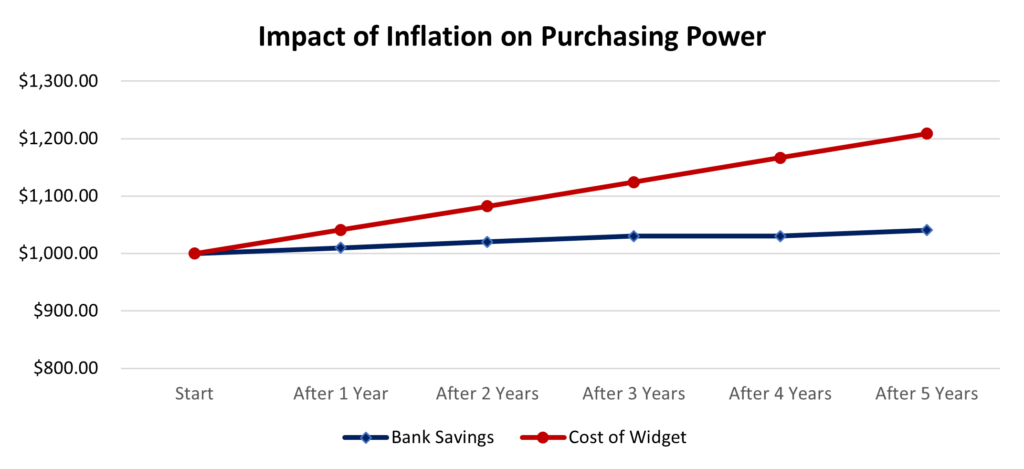
Take the following example: If I wanted to purchase a $1,000 widget and if I had the money, I could buy it today for $1,000. However, if I decide to put off the purchase for a year and leave the money in a savings account earning interest, a year from now, thanks to inflation, I would no longer be able to purchase the widget for $1,000. The widget would cost $1034.00 ($1000 x 1.034) and the money in the savings account would have grown to only $1010 ($1000 x 1.01). And it gets worse as the years add up.

The chart below illustrates the increasing gap between the cost of a widget and the amount put away in a regular bank account. Each year you will need more money to buy the same product.
Impact of inflation on Purchases
Impact of inflation on purchases.

Keep in mind that investing involves inherent risks, and it is important that you understand your own risk tolerance. If you plan to invest in stocks, only invest in companies where you would be proud to call yourself an owner. With any investment, you should be able to sleep at night.

While there may be other ways to protect your money from inflation, investing wisely in the market is the best way to not only keep up with inflation but also get your money working for you, even when you are sleeping. 😊


Now, let’s see how all that good economic news influenced the markets this past week….

Weekly Market Review

Monday: riding last week’s momentum and fourth quarter earning that have been better than expected, all four indexes – the Toronto Stock Exchange Composite Index (TSX), the S&P 500 Index (S&P), the Dow Jones Industrial Average (DJIA), and the Nasdaq Composite Index (Nasdaq) – ended higher. The artificial intelligence (AI) technology continues to drive the markets, and therefore the indexes, as investors continue to pour money into AI related companies. Oil prices rose on supply concerns caused by the Middle East and Ukraine conflicts, and increased demand caused by the wintry weather across North America.

In Canada, gains on the TSX were muted as investors ahead of the BoC’s latest interest rate announcement. In trading, Consumer Cyclicals and Financials posted the biggest gains while the Telecommunications Services and Basic Materials (miners and fertilizer manufacturers) dropped the most.

In the US, driven by the mega cap technology companies, the S&P and DJIA both hit all time highs, with the DJIA rising above the 38,000 mark for the first time ever. In a positive sign, the breadth of the rally has increased the last few days of trading. In trading, Industrials and Financials had the biggest increases of the American sectors, while Consumer Staples, Utilities and Consumer Cyclicals were the only sectors to end lower.

Tuesday: quarterly earnings was the story today. Mixed quarterly earnings reports led to a mixed day for the indexes. The DJIA was the only index to end lower after 3M (NYSE: MMM) forecast lower profits in 2024. Otherwise, the majority of companies that reported today had positive earnings.

In Canada, the TSX ended higher after news came out that the Chinese government was considering measures to boost its ailing economy. If China’s economy starts to rebound there will be more demand for raw materials, leading to rising share prices of mining companies. In trading, Basic Materials and Consumer Staples led the gainers, while Healthcare and Utilities were the only Canadian sectors to end in the red.

In the US of A, upbeat earnings helped the S&P set a new closing high for the third day in a row. In trading, Telecommunications Services and Consumer Staples rose the most while Financials, Healthcare and Consumer Cyclicals were the only sectors to end in the red.

Wednesday: earnings continued to drive the markets. Another day of mixed earnings reports led to the TSX and DJIA ended the day slightly below the bar, while the S&P and the Nasdaq finished just above the bar. The price of oil edged higher on news of a higher-than-expected drawdown of oil stored in the US.

In Canada, the BoC left the Canadian benchmark interest rate at 5.0% and indicated it was too early to tell when they would start lowering the rate. The TSX briefly touched its highest level in twenty months before falling into negative territory to break a string of four straight gains. In trading, Energy and Financials were the only sectors to end in the green, while the Telecommunications Services and Basic Materials sectors declined the most.

In the US, the S&P climbed to a fourth straight record close on the continued strength of the big technology companies. In trading in the American sectors, Energy, Technology and Financials were the only sectors to end in the green. Telecommunications Services and Utilities fell the deepest into the red.

Thursday: a better-than-expected initial reading of the US economy in the fourth quarter spurred all four indexes into the green. Oil prices rose when economic data showed the US economy performed better than expected.

In Canada, higher oil prices helped the TSX reach its highest level in 20 months. In trading on Bay Street, Utilities and Energy were the two best performers. Telecommunications Services and Technology were the only Canadian sectors to end lower.

In the US, the DJIA and the S&P set new closing highs. What makes this more impressive is that it came despite a bad stumble by one of the Magnificent 7. Tesla (NASD: TSLA) fell more than 12% in market value after a poor fourth quarter report and then forecasting slower growth in the future. In trading on Wall Street, Energy and Utilities advanced the most while Consumer Cyclicals and Healthcare were the only American sectors to decline.

Friday: it was a mixed day in the markets with S&P and Nasdaq ending lower and the TSX and DJIA closing higher. The indexes bounced up and down throughout the day as investors considered the latest PCE data that showed headline and core PCE dropped below 3%. Oil prices rose on solid US economic data and signs of increased demand from China.

In Canada, a rally in Canadian technology companies, coupled with higher oil prices lifted the TSX to its highest point since May 2022. In trading, the Technology and Healthcare sectors were the farthest in the green, while Consumer Staples, Basic Materials and Utilities were the only sectors to slide lower.

In America, the S&P’s run of consecutive closing highs came to an end. The Nasdaq and S&P were weighed down by technology companies after Intel’s (NASD: INTC) forecast for the rest of the year fell well short of investors’ expectations. In the markets, Energy and Telecommunications Services recorded the biggest gains, while Technology was the lone sector to end lower.


Weekly Market and Portfolio Review

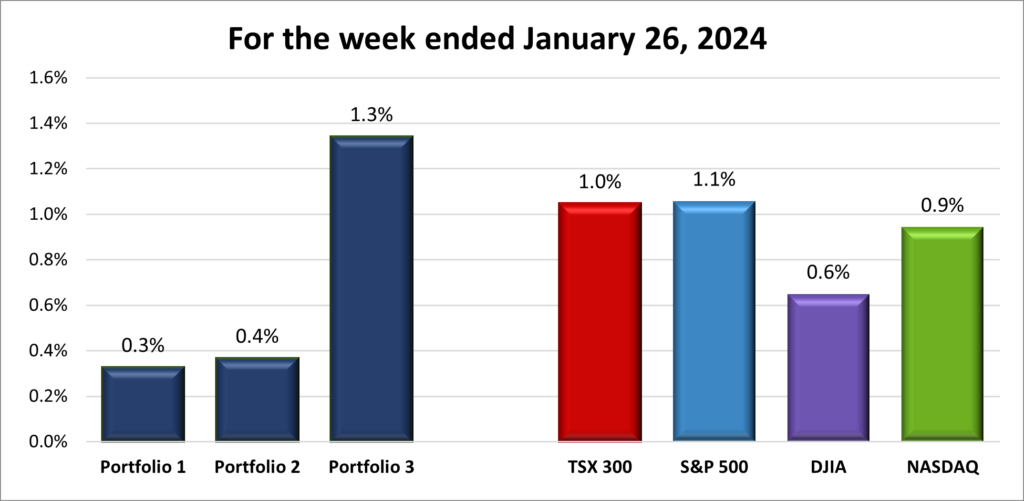
For the week, the TSX (SPTSX) gained 1.0%, the S&P 500 (SPX) advanced 1.1%, the DJIA (INDU) rose 0.6% and the Nasdaq (CCMP) grew by 0.9%.

Index Weekly Streak
TSX: 2-week winning streak
S&P: 3-week winning streak
DJIA: 3-week winning streak
Nasdaq: 3-week winning streak

Bull market. A good week for the North American stock markets. This week has been full of good news for us investors. With the Fed in a quiet period this past week ahead of their upcoming meeting and rate announcement, economic news and quarterly earnings drove the markets. Data released this past week, including the latest US PCE report showing easing inflation and a strong initial estimate of fourth quarter GDP, has bolstered the case for a ‘soft landing’ in the US. This positive outlook has fueled a steady stock market rally since January 1st of this year, with the Nasdaq surging 4.7%, the S&P gaining 3.1%, and the DJIA up 1.0%. Even the resource-heavy TSX has joined the climb, rising 1.2% year-to-date thanks to an almost 7% gain in oil prices this past week.

The markets, and therefore the indexes, have been driven by investor optimism about the robust American economy and the potential for lower interest rates. The main beneficiaries continue to be technology stocks, especially mega technology companies like Nvidia (NASD: NVDA) and Microsoft (NASD: MSFT), up 26.7% and 8.9%, respectively, since the start of the year. These two companies are viewed as leaders in the emerging AI market boom and investors have been drawn to them, pushing their respective share prices to record highs. Both these companies are in great shape whether interest rates go up or down thanks to their low debt and reliable cash flow.

The one downside to the rally is that once again it is narrowly focused on technology companies, whereas at the end of 2023 the rally had broadened to other sectors. Analysts were hoping the current rally would be significantly broader.

Next week will be pivotal for the market rally as five of the Magnificent 7 – Microsoft, Alphabet (NASD: GOOGL), Apple (NASD: AAPL), Meta Platforms (NASD: META) and Amazon.com (NASD: AMZN)– report earnings. These companies are followed by many investors because of the influence they have on the markets and on portfolios. Strong reports and forecasts from all five will turbocharge the current rally. On the other hand, if the results are mixed or poor, it could stop the rally cold. I look forward to stellar reports from these companies.

With apologies to the musical group the Kings, the rally goes on and on, and on and on… 😊

Portfolio Weekly Streak
Portfolio 1: 3-week winning streak
Portfolio 2: 3-week winning streak
Portfolio 3: 3-week winning streak

Bull market. A good week for the North American stock markets. Each of the portfolios ran their respective weekly winning streaks to three, buoyed by the rising tide of the North American markets. Portfolio 3 emerged as the week’s top performer, outperforming all the indexes, as illustrated in the table below. The portfolio’s rise was helped by a 12% gain by kneat.com (TSE: KSI). This significant mover – a move up or down over 10% – helped boost the otherwise modest gains and minimal losses across the portfolio. The cumulative effect of these small gains proved to have a noticeable impact.

Portfolio 2’s performance, while not as great, benefitted from its stake in kneat.com, up 12%. Without this boost, the portfolio would have likely finished the week nearly flat, as most of its holdings ended the week around the breakeven point. However, small incremental gains across various holdings contributed to a net increase in its value.

Portfolio 1 posted the smallest gain for the week. It was lifted by kneat.com’s performance and a 10.5% increase in SEA Limited (NYSE: SE). However, these gains, and the rest of the portfolio’s gains, were partially offset by significant losses in Tesla, plunging 16%, and Lattice Semiconductor Corp (NASD: LSCC), which fell by 11%.

Despite two of the portfolios underperforming relative to the broader markets, all portfolios saw an increase in value over the past week. For me, the key takeaway is that even small gains can accumulate significantly over time, making a positive contribution to overall wealth growth. 😊
Weekly Portfolio & Index performance
Weekly Portfolio & Index performance for the week ended January 26, 2024.

Companies on the Radar

Stocks on my Radar Another week with no new companies on my radar. Once again, my Radar List consists of the five companies listed below:

  • Equitable Bank (TSE: EQB), a mid sized Canadian bank that provides financial services to consumers and businesses.
  • McDonald’s (NYSE: MCD), the large sized American fast-food chain.
  • Celestica Inc. (TSE: CLS), a medium sized Canadian company that manufactures electronic products and provides supply chain services to companies around the world.
  • Kinaxis (TSE: KXS), a Canadian mid sized company that provides cloud based supply chain solutions to customers around the world.
  • Lumine Group (TSE: LMN), a young Canadian mid sized company spun off from Constellation Software (TSE: CSU). It acquires communications and media software companies and then strengthens and grows the companies.

The Radar Check was last updated January 26, 2024.

Stock on the Radar List. 1 of 2.
Stock on the Radar List. 2 of 2.

Portfolio Update

Portfolio 1

Portfolio 1 for the week ended January 26, 2024: UP Green Up Arrow, signifying a positive week

  • Alphabet’s fully autonomous electric vehicle (EV) division Waymo, has applied to the California Public Utilities Commission to expand its service in Los Angeles. The company already operates on a limited basis in San Francisco and Phoenix.
    Elsewhere under the Alphabet umbrella, their technology incubator division X Lab let go dozens of employees, mostly support staff. X Lab also changed its structure to make it easier to spin out promising ventures.
    The lawsuit that Alphabet’s Google was engaged in over patent infringement on AI chips has been settled. So far, no details have been released.
  • Amazon was fined US$ 35 million dollars by French regulator CNIL for ‘excessively intrusive’ monitoring of staff. Amazon tracked the inactivity time of employees’ scanners as well as the speed at which employees scanned items.
    Amazon announced they were investing US$ 10 billion into two new data centres in Mississippi. The new buildings will provide additional storage and compute power to meet the growing demand for cloud and AI services. The company also made a US$ 15 billion investment in their Japanese facilities.
  • During Tesla’s earnings report, the company warned of slower growth for 2024 than the 38+% increase they have enjoyed the last few years. As well, Tesla’s profit margin took a hit thanks to the price cuts Tesla implemented throughout 2023. With slowing growth and shrinking profit margins, perhaps its time to reconsider my investment in the company.
    Tesla also announced during the earnings announcement that they planned to build an EV for the masses, starting in 2025.
    Tesla has recalled almost 200,000 of its Model S, X, and Y EVs due to a software issue that could cause an obstruction of a driver’s view when reversing.
  • General Motors (NYSE: GM) Cruise division is being probed by the US Justice Department and the Securities and Exchange Commission. The two government agencies are looking into an accident in October when one of Cruise’s robotaxis accidently dragged a pedestrian who had been struck by another vehicle.

Activity

Received interest on TD 1-year cashable GIC.

Dividends

Dividends Received this week for the following companies:

Companies followed by DRIP (Dividend Re-Investment Plan) indicate additional shares were purchased with the dividend. Any cash leftover was added to the cash balance.

Canadian $

BCE Inc (TSE: BCE) DRIP

US $

No US$ dividends this past week.

Quarterly Reports

Canadian National Railway Company

All currency listed in millions of Canadian dollars, except for per share data.

Selected highlights from their fourth quarter 2023 financial results on January 23, 2024

  • Revenue of $4,471 for the three months ended December 31, compared to $4,542 for the same period in 2022. A decrease of almost 2%.
  • Net income of $2,130 for the three months ended December 31, compared to net income of $1,420 in the same period in 2022.
  • Diluted earnings per ordinary share of $3.29 for the three months ended December 31, compared to earnings of $2.10 per share for the same period in 2022.


  • Revenue of $16,828 for year ended December 31, compared to $17,107 for the same period in 2022. A decrease of almost 2%.
  • Net earnings of $5,625 for the year ended December 31, compared to net earnings of $5,118 in the same period in 2022.
  • Diluted earnings per ordinary share of $8.53 for the year ended December 31, compared to earnings of $7.44 per share for the same period in 2022.

Tesla, Inc.

All currency listed in millions of US dollars, except for per share data.

Selected highlights from their fourth quarter 2023 financial results on January 23, 2024

  • Revenue of $25,167 for the three months ended December 31, compared to $24,318 for the same period in 2022. An increase of over 3%.
  • Net income of $7,928 for the three months ended December 31, compared to net income of $3,687 in the same period in 2022.
  • Diluted earnings per ordinary share of $2.27 for the three months ended December 31, compared to earnings of $1.07 per share for the same period in 2022.

Visa Inc.

All currency listed in millions of US dollars, except for per share data.

Selected highlights from their first quarter 2024 financial results on January 25, 2024

  • Revenue of $8,634 for the three months ended December 31, compared to $7,936 for the same period in 2022. An increase of almost 9%.
  • Net income of $4,890 for the three months ended December 31, compared to net income of $4,179 in the same period in 2022.
  • Diluted earnings per ordinary share of $2.39 for the three months ended December 31, compared to earnings of $1.99 per share for the same period in 2022.

Portfolio 2

Portfolio 2 for the week ended January 26, 2024: UP Green Up Arrow, signifying a positive week

  • Alimentation Couche-Tard Inc. (TSE: ATD) announced a private offering of unsecured notes in order to raise money to pay off outstanding debt. The debt was used as part of the recent purchase of specific European retail assets from TotalEnergies (NYSE :TTE). The offering plans to raise C$ 500 million at an interest rate of 4.603%, maturing January 25, 2029.

Activity

No significant activity to report this week.

Dividends

Dividends Received this week for the following companies:

Companies followed by DRIP (Dividend Re-Investment Plan) indicate additional shares were purchased with the dividend. Any cash leftover was added to the cash balance.

No dividends this past week.

Quarterly Reports

No quarterly reports this past week, except for per share data.

Portfolio 3

Portfolio 3 for the week ended January 26, 2024: UP Green Up Arrow, signifying a positive week

  • Microsoft reported that it was hacked by a Russian state sponsored group called ‘Midnight Blizzard’ on January 12, 2024. The hackers were able to access ‘a very small percentage’ of email accounts, including those of a few senior level staff.
    Microsoft became the second company to join the US$ 3 trillion in market capitalization club when its share price reached a record high. It joins Apple as the only companies with a market value over US$ 3 trillion. Market capitalization is the total number of outstanding shares multiplied by the share price.
    Microsoft is the latest technology company to announce layoffs. Following the close of its acquisition of Activision Blizzard, Microsoft had announced it will layoff 1,900 employees across Activision Blizzard and Microsoft’s Xbox division, with most of the layoffs occurring at Activision.
  • TD Bank (TSE: TD) is looking at a sizable financial penalty for its flawed anti-money laundering controls. Canada’s Financial Transactions and Reports Analysis Centre of Canada (FinTRAC) agency reviewed TD’s procedures and found them inadequate.

Activity

No significant activity to report this week.

Dividends

Dividends Received this week for the following companies:

Companies followed by DRIP (Dividend Re-Investment Plan) indicate additional shares were purchased with the dividend. Any cash leftover was added to the cash balance.

Canadian $

goeasy Ltd (TSE: GSY)

US $

No US$ dividends this past week.

Quarterly Reports

No quarterly reports this past week.
 

Weekly Update for the week ending January 19, 2024

I have often been asked what is gambling? Is not investing the same as gambling? Or similar variations of these questions. As an amateur investor myself, I remember feeling similar confusion when I first started. This week, I will attempt to answer this question for those who are considering investing in public companies or have just started investing in companies. I will also review the broader economic landscape, gauge the pulse of the markets, and, of course, peek into the performance updates of our portfolios.

Let’s begin.

Items that may only interest or educate me ….

Canadian Economic news, US Economic news, Another US budget extension, What is Investing? …


Canadian Economic news

This past week’s key economic data that the Bank of Canada (BoC) considers when deciding whether to raise or lower the interest rate.

Consumer Price Index

Statistics Canada’s December inflation report, as measured by the Consumer Price Index (CPI), revealed that annual headline inflation in Canada rose by 3.4%, a slight increase from November’s 3.1%. On a monthly basis, inflation decreased by 0.3% in December, following a 0.1% increase in November – both in line with analysts’ expectations.

In December, the most significant monthly price increases were observed in the ‘Air transportation’ and ‘Mortgage interest cost’ categories, rising by 31.1% and 1.8%, respectively. The largest downward pressures came from ‘Travel tours,’ down 18.2%, and ‘Gasoline,’ which saw a 4.4% drop – marking the fourth consecutive month of falling gas prices. Year over year, key contributors to inflation were ‘Mortgage interest cost,’ up 28.6%, ‘Rent,’ up 7.7%, and ‘Food from restaurants,’ up 5.6%. Conversely, downward pressure came from ‘Telephone Services’ and ‘Natural gas,’ down 20.6% and 14.5%, respectively.

Excluding the more volatile food and energy components, more commonly referred to as core CPI, prices increased by 3.4% annually, slightly down from the 3.5% rise in November. On a monthly basis, core prices fell by 0.3%, following a 0.2% increase in November.

In the ‘CPI: Annual review for 2023’, data revealed that inflation averaged 3.9%, significantly lower than 2022’s 6.8% average which was a 20-year high. The primary factor contributing to this decrease was the drop in gas prices, down 4.2% in 2023 after a 22% increase in 2022.

While December headline inflation, the overall inflation picture, edged slightly higher than expected, making an interest rate cut unlikely, the report hints at potential easing on the horizon. On a monthly basis, inflation dipped, and even core inflation, while still elevated, showed signs of slowing. Overall, this appears to be a temporary deviation from the Bank of Canada’s path to their 2% target, suggesting that interest rate adjustments might still be on the table for later in the year, hopefully sooner rather than later. 😊

Retail Sales

Canadian retail sales data for November came in lower than expected, falling 0.2% after a gain of 0.6% in October. Analysts had expected a drop of 0.1%. On an annual basis, retail sales were up 1.8%.

The biggest monthly and annual increases were in ‘Motor vehicle and parts dealers,’ up 0.5%, and 7.0%, respectively. The biggest monthly decline was in ‘General merchandise retailers,’ down 1.8%, while the biggest annual decline was in ‘Gasoline stations and fuel vendors,’ down 11.1%.

Core retail sales, retail sales less sales from gasoline stations and motor-vehicle and parts dealers, dropped 0.6% from October, but were up 2.1% year over year.

The weak sales data suggests a period of slower growth for the economy, however, initial estimates for December show an increase of 0.8%. This latest report open’s the door for the BoC’s to signal the end of rate hikes at their January 24 meeting.

Canadian market volatility

Canada’s stock markets’ ‘fear gauge,’ represented by the TSX 60 VIXI, ended the week at 12.26, 16% higher than last week’s reading of 10.57. That is a significant jump and signals growing concern among investors about the Canadian market. Geopolitical tensions, a struggling Canadian economy and the upcoming fourth quarter earning could all factor into the increased anxiety. However, keep in mind that this latest volatility reading is still considered low, and investors remain cautiously optimistic about the Canadian markets.

The VIXC’s “high” and “low” volatility thresholds are defined as readings above 20 and below 20, respectively. Therefore, the current level of 12.26 indicates a calm market environment.

US Economic news

This past week’s key data points that the Federal Reserve (Fed) considers when deciding whether to raise or lower the interest rate.

American market volatility

By the end of the week, the ‘fear gauge,’ formally known as the CBOE Volatility Index (VIX), had risen to 13.30 at the end of the week, after registering 12.70 the previous week. The higher VIX reading suggests investors are expecting more volatility in the weeks ahead. Tensions in the Middel East, upcoming fourth quarter earnings and the likelihood the interest rate will remain at 5.5% past March are likely contributors to the higher VIX reading. The fear gauge remains in a historically low range and investors continue to be optimistic about the markets.

The VIX is a measure of the US investors’ expectation of short-term volatility based on S&P 500 options prices.

Consumer Sentiment Index

The preliminary measure of consumer sentiment for January, as indicated by the University of Michigan’s Consumer Sentiment Index (CSI), surged by 13% to 78.8, surpassing December’s reading of 69.7. Analysts had expected a reading of 70. On an annual basis, the CSI recorded a significant increase of 21.4%.

This marks the highest point for the CSI since July 2021. Following a significant upturn in December, the index has now risen by 29% since November, representing the largest two month increase since 1991. However, the CSI remains 20% lower than before the COVID-19 pandemic in 2020. The improved sentiment was seen in all five components of the CSI and spanned all age and income groups, as well as across the USA.

Consumer sentiment was buoyed by falling inflation, a strong labour market, and expectations of declining interest rates. That translates to cheaper groceries, more job security, and the possibility of lower interest rates – all things that could mean more spending and a stronger economy. The rising sentiment since November could provide some upward momentum for the American economy, which is good news for us investors. 😊

Retail Sales

The Commerce Department’s early numbers for December retail and food services sales surpassed expectations, showing a 0.6% increase compared to November’s 0.3% rise. Analysts had anticipated a 0.4% increase. On an annual basis, sales experienced a 5.6% boost compared to December 2022.

For the month, the biggest increase was in motor vehicle and parts dealers, up 1.1%, while the largest decrease was in gasoline, down 1.3%. Year over year, motor vehicle and parts dealers saw the biggest increase, up 10.3%, while gasoline sales dropped the most, down by 6.6%.

Excluding automobile sales, retail and food services sales grew by 0.4% in December, following a 0.2% increase the previous month.

In 2023, retail and food services sales were 3.2% higher than 2022, indicating robust growth despite economic challenges, such as rising interest rates. This growth was primarily driven by ‘non-store retailers’ and ‘Food services and drinking places,’ which increased by 9.7% and 11.1%, respectively.

The strong December retail sales data suggests that consumers remain resilient and are still spending money despite rising prices and higher interest rates. This could signal positive momentum for the economy in the near term.

In summary, the December retail and food services data provides mixed signals. While continued consumer spending is encouraging, the long-term impact of inflation remains a concern. Higher retail sales are beneficial for the US economy, boosting Gross Domestic Product, but they also exert upward pressure on inflation, reducing the likelihood of a rate cut. Higher interest rates not only pose challenges for consumers but also for us investors as they can limit growth opportunities for companies. ☹

Another US budget extension

Without all the drama of previous budget showdowns, the American Congress was able to pass a temporary budget. The bill was passed by the Senate, quickly followed by passage in the House of Representatives, before being sent to President Biden for approval. This is the third extension and simply pushes the deadline to approve a full fiscal 2024 budget out to early March.

The bill provides temporary funding at current levels for most agencies, with funding for some others (such as the Pentagon) extending slightly longer. Congress now has more time to negotiate and finalize the twelve individual appropriations bills that make up the full federal budget for the fiscal year.

If a budget had not been approved by the US House of Representatives and the US Senate, parts of the US government would have shut down. The Transportation agency, which covers air traffic controllers, the Food and Drug Administration are among the agency that would have been affected.

A month from now Congress will likely face another round of brinkmanship to produce a budget acceptable to both the Republican controlled House and the Democrat controlled Senate.

What is Investing?

Let me start by saying investing is not gambling. Gambling is a form of instant gratification. It is like playing a game of chance, with the house often having an advantage. Investing is about growing your money over time, like planting seeds and nurturing them to grow into a bountiful harvest. You can do this by putting your money to work in various assets, such as shares of companies (stocks), bonds, or even funds that hold a mix of these. While the hope is to see your investments grow in value, it is important to remember that there is also a chance they could lose some value. Different investments have different levels of risk, so finding the right ones for you depends on your goals and how comfortable you are with potential losses.

Remember, investing should be a long-term strategy, not a get-rich-quick scheme. By investing in well run companies, with strong financials, good track records, promising prospects and staying patient, you can increase your chances of achieving your financial goals over time. By spreading your investments across companies in different sectors, with a mix of growth, dividend paying and defensive companies (those that provide essential products or services, such as utility companies) can help mitigate the impact of losses in any one area.


Now that we know the economic news for the past week, let’s see what impact it had on the stock markets this past week….

Weekly Market Review

Monday: in the US, American exchanges were closed for Martin Luther King Jr. Day.

In Canada, trading was light as investors waited for tomorrow’s CPI report to hopefully reveal clues on the BoC’s interest rate outlook. In trading, the Toronto Stock Exchange Composite Index (TSX) edged higher, led by Basic Materials (miners and fertilizer manufacturers) and Healthcare. Consumer Cyclicals and Financials suffered the biggest losses.

Tuesday: Investor optimism took a hit after a Fed official said, “I see no reason to move as quickly or cut as rapidly as in the past,” causing all four major North American indexes to end lower.

In Canada, shaken investor optimism, lower oil and commodity prices, and the latest inflation report showing inflation rose in December all weighed on the TSX. In trading, Consumer Cyclicals and Telecommunications Services posted the biggest daily gain, with Basic Materials and Energy dropping the most.

In the US, the shortened week began with a thud. All three American indexes ended the day in the red – the Nasdaq Composite Index (Nasdaq), the S&P 500 Index (S&P) and the Dow Jones Industrial Average (DJIA). The Nasdaq was the only index to even break into the green, even if it was only temporary. In trading, Telecommunications Services was the only sector to end in the green, while Energy and Basic Materials suffered the biggest declines.

Wednesday: the markets fell as investors unwound bets that the Fed would lower interest rates starting in March. Oil prices reversed course at mid day to end higher as Middle East supply concerns outweighed weak economic data out of China could lead to lower demand.

In Canada, the TSX suffered its biggest one day fall since mid October as investor confidence in early rate cuts continues to wane. In trading, it was day of sector wide declines. Consumer Cyclicals and Consumer Staples dropped the least while Basic Materials and Utilities incurred the biggest declines.

In America, US retail sales came in higher than expected, further dampening the possibility of an early rate cut by the Fed. It was a day of broad-based declines as all sectors ended lower. Healthcare and Consumer Staples dropped the least while Utilities and Basic Materials dropped the most.

Thursday: an artificial intelligence (AI) led rally in technology companies helped the markets rebound into positive territory. The rally came after two straight days of losses as investors are coming to the conclusion there is unlikely to be a rate cut in March. Oil prices rose on forecasts of higher demand by the International Energy Agency (IEA). The freezing weather gripping North America also helped to draw down oil reserves in the US.

In Canada, the TSX advanced on gains led by Consumer Staples and Industrials. The only sectors to end lower were Healthcare, Technology and Utilities.

In the US, despite losing ground the previous two days, the S&P approached a record high today on the strength of a rally in semiconductor companies. It likely would have set a record if not for one Fed member who said he did not think the Fed would lower the interest rates until the second half of the year. In trading, Technology and Industrials were the top performers, while Utilities and Healthcare were the only two American sectors to decline.

Friday: optimism that the US economy would have a soft landing, which is lowering inflation without sending the economy into a recession, propelled all four indexes into positive territory.

In Canada, November retail sales came in below expectations, suggesting the Canadian economy is slowing. Otherwise, it was a case of a rising tide lifts all boats as the TSX was lifted by investor optimism from the US. In trading on Bay Street, Technology and Financials posted the biggest gains, while Consumer Staples and Energy were the only two sectors to lose ground.

In the US, the ongoing rally in technology companies, especially those associated with AI, combined with strong economic news, and rising consumer sentiment sent the S&P and DJIA to record closing highs. In trading on Wall Street, Technology and Financials were the big winners, while Consumer Staples and Utilities were the only sectors to end lower.


Weekly Market and Portfolio Review

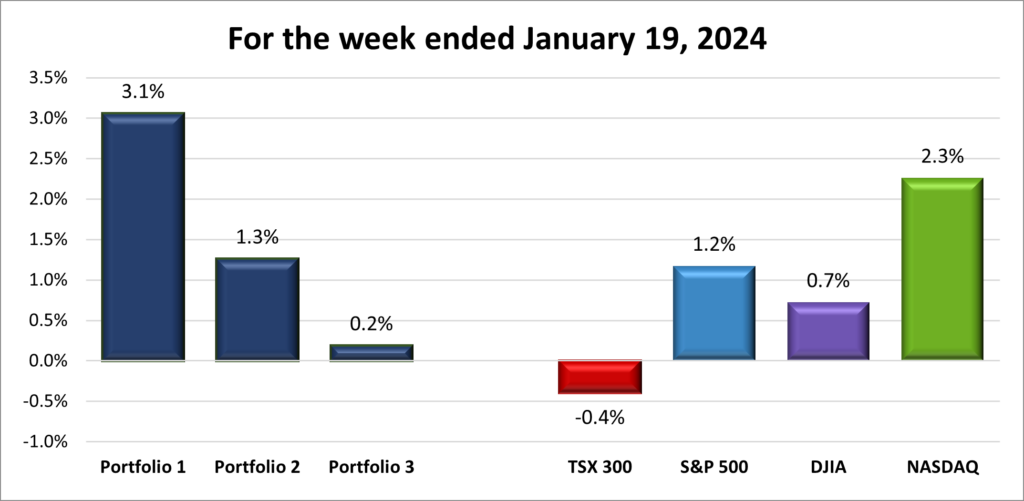
For the week, the TSX (SPTSX) slipped 0.4%, the S&P 500 (SPX) rose 1.2%, the DJIA (INDU) gained 0.7% and the Nasdaq (CCMP) advanced 2.3%.

Index Weekly Streak
TSX: 1-week losing streak
S&P: 2-week winning streak
DJIA: 2-week winning streak
Nasdaq: 2-week winning streak

Bull market. A good week for the North American stock markets. As shown in the chart above, a slow start to the week saw a rebound that sent the American indexes higher and the TSX falling just short of the breakeven line.

Buoyed by lower jobless claims, resilient retail sales and soaring consumer sentiment (its biggest two month jump since 1991), the American indexes extended their winning streaks to two weeks. A rally in technology companies, especially the Magnificent 7 group of companies (Alphabet (NASD: GOOGL), Amazon (NASD: AMZN), Apple (NASD: AAPL), Meta (NASD: META), Microsoft (NASD: MSFT), Nvidia (NASD: NVDA) and Tesla (NASD: TSLA)), propelled the indexes higher. The S&P and DJIA each set record highs at the end of the week, while the Nasdaq closed at a two year high. Interestingly, Apple and Microsoft are members of all three indexes, indicating their sizable roles in the US economy and their appeal to a wide range of investors. When the the Magnificent 7, especially Apple and Microsoft, are moving, the indexes tend to follow along. This week the direction was upward. 😊

Speaking of being dragged along, the TSX was influenced by the overall market sentiment in the US. However, it was hampered by its smaller technology component (8.7% as of December 29, 2023) so it did not receive the same boost from the rally in technology companies. The TSX has a large resource sector, including energy and basic materials companies which account for 28% of the TSX, which acted as a drag on the index.

Hopefully the momentum generated at the end of this past week will carry over and all four indexes will end in positive territory.

Portfolio Weekly Streak
Portfolio 1: 2-week winning streak
Portfolio 2: 2-week winning streak
Portfolio 3: 2-week winning streak

Bull market. A good week for the North American stock markets. As shown in the chart below, it was another week of gains for each of the three portfolios, extending their respective weekly winning streaks to two.

Portfolio 1 had the best week of the three portfolios and outperformed the Nasdaq, the best of the indexes. The portfolio was primarily lifted by its Magnificent 7 companies. None of the companies in the portfolio saw significant (share price changes greater than 10%) upward movement. However, there were significant drops by Rivian (NASD: RIVN) down 17%, and Celsius Holdings (NASD: CELH) down 12.8%.

Portfolio 2 generally had a positive week outperfoming the S&P. It was led by its tehcnology companies. However, it was held down by a near 10% decline in the share price of energy company Crew Energy (TSE: CR).

Finally, Portfolio 3 had no significant ups or downs, however, a big rebound on Friday boosted the portfolio into the win column for the week. A surge in the share prices of the technology companies overcame declines in resource companies Alvoptero Energy (TSXV: ALV), Lithiium Americas (TSE: LAC) and Lithium America Argentina (TSE: LAAC). The gain was not as big as the increase of the other two portfolios but a win is still a win. 😊

Weekly Portfolio & Index performance
Weekly Portfolio & Index performance for the week ended January 19, 2024.

Companies on the Radar

Stocks on my Radar No new companies came on my radar this past week. For now, my Radar List consists of the five companies listed below:

  • Equitable Bank (TSE: EQB), a mid sized Canadian bank that provides financial services to consumers and businesses.
  • McDonald’s (NYSE: MCD), the large sized American fast-food chain.
  • Celestica Inc. (TSE: CLS), a medium sized Canadian company that manufactures electronic products and provides supply chain services to companies around the world.
  • Kinaxis (TSE: KXS), a Canadian mid sized company that provides cloud based supply chain solutions to customers around the world.
  • Lumine Group (TSE: LMN), a young Canadian mid sized company that acquires and strengthens communications and media software companies.

The Radar Check was last updated January 19, 2024.

Stock on the Radar List. 1 of 2.
Stock on the Radar List. 2 of 2.

Portfolio Update

Portfolio 1

Portfolio 1 for the week ended January 19, 2024: UP Green Up Arrow, signifying a positive week

  • Apple did what was once unthinkable and offered a discount on its newest iPhones. Before you go rushing out to buy a new iPhone 15, you should know the lower price is only available in China, and only for a limited time. China is Apple’s second largest smartphone market and sales fell 30% in 2023 as China’s Huawei introduced its latest smartphones.
    More bad news for Apple, their latest Apple Watch models have been banned from sale in the US while the company fights a legal battle over technology used in their Series 9 and Ultra 2 watches. The dispute is over patents for the blood oxygen measurement feature. Apple is expected to disable any feature related to the disputed technology until the dispute is resolved.
  • Afte lowering prices on their Model Y electric vehicles (EV) in China, Tesla announced price reductions in the European market.

Activity

No significant activity to report this week.

Dividends

Dividends Received this week for the following companies:

Companies followed by DRIP (Dividend Re-Investment Plan) indicate additional shares were purchased with the dividend. Any cash leftover was added to the cash balance.

Canadian $

Dream Industrial Real Estate Investment Trust (TSE: DIR.UN)

Decisive Dividend (TSE: DE)

Andlauer Healthcare Group Inc (TSE: AND)

US $

BSR Real Estate Investment Trust (TSE: HOM.UN)

Quarterly Reports

No quarterly reports this past week.

Portfolio 2

Portfolio 2 for the week ended January 19, 2024: UP Green Up Arrow, signifying a positive week

  • A fight for control of Walt Disney’s (NYSE: DIS) board of directors is shaping up as a battle of the incumbents against activist investors led by Trian Fund Management. Trian claims it will bring brand expertise to the company, restore “the magic” to the company and focus on building shareholder value. Disney’s current earnings per share remain below where they were ten years ago. A rise in share price would make this shareholder happy. 😊

Activity

No significant activity to report this week.

Dividends

Dividends Received this week for the following companies:

Companies followed by DRIP (Dividend Re-Investment Plan) indicate additional shares were purchased with the dividend. Any cash leftover was added to the cash balance.

Canadian $

Dream Industrial Real Estate Investment Trust (TSE: DIR.UN) DRIP

SmartCentres Real Estate Investment Trust (TSE: SRU.UN)

US $

No US$ dividends this past week.

Quarterly Reports

No quarterly reports this past week, except for per share data.

Portfolio 3

Portfolio 3 for the week ended January 19, 2024: UP Green Up Arrow, signifying a positive week

  • Cloudflare (NYSE: NET) made the news this past week, but for the wrong reason. An employee filmed her firing by two Cloudflare representatives. She was fired via a video call and the two company representatives failed to explain why she was being let go and why her manager was not present. The video of the firing went viral and will probably go down as one of the best examples of how not to let people go.

Activity

No significant activity to report this week.

Dividends

Dividends Received this week for the following companies:

Companies followed by DRIP (Dividend Re-Investment Plan) indicate additional shares were purchased with the dividend. Any cash leftover was added to the cash balance.

Canadian $

Alvopetro Energy Ltd (TSE: ALV)

SmartCentres Real Estate Investment Trust (TSE: SRU.UN)

TD U.S. Equity Index ETF (TSX: TPU)

US $

No US$ dividends this past week.

Quarterly Reports

No quarterly reports this past week.

 

Weekly Update for the week ending January 12, 2024

The markets kicked off 2024 with a stumble the previous week but recovered nicely this past week. While December often sees a surge due to year-end bonuses and holiday spirit (the “Santa Claus rally”), January can bring a return to normalcy with potential pullbacks. This week’s rebound shows the market’s inherent fluctuations, emphasizing the importance of a long-term perspective for investors.

Investing can be like planting an acorn – through careful selection, nurturing, and patience our portfolios will grow big and resilient. Remember, investing is a long-term game, and focusing on quality companies can help you reach your financial goals, even with the occasional dip along the way.

Items that may only interest or educate me ….

Canadian Economic news, US Economic news, AI gets its own button, 2024 TFSA contributions, A new #1, ….


Canadian Economic news

This past week’s key economic data that the Bank of Canada (BoC) considers when deciding whether to raise or lower the interest rate.

Canadian market volatility

Canada’s stock markets’ ‘fear gauge,’ represented by the TSX 60 VIXI, ended the week at 10.57, almost a full point lower than last week’s reading of 11.55. This decrease suggests investors anticipate smaller price swings in the near future. investors are more confident and prepared to risk more in Canadian stocks. Investors are also anticipating interest rate cuts by the central banks of Canada and the US.

The VIXC’s “high” and “low” volatility thresholds are defined as readings above 20 and below 20, respectively. Therefore, the current level of 10.57 indicates a calm market environment.

Canadian trade balance

Statistics Canada’s latest update on Canada’s trade balance revealed the trade surplus shrank to a C$1.6 billion surplus in November, following a revised surplus of C$3.2 billion in October. Analysts had expected the surplus to shrink to C$1 billion. The surplus marked the fourth consecutive monthly surplus.

On a monthly basis, imports increased by 1.9% over October, driven by an 11.6% surge in ‘Energy products.’ The most significant decline was observed in ‘Consumer goods,’ down 2.2%. Regarding exports, there was a 0.6% decrease, primarily due to a 6.5% decline in ‘Metal and non-metallic mineral products.’

On an annual basis, exports were up 3.0%, while imports dipped 0.1%. The biggest gain in exports was by the ‘Motor vehicles and parts’ sector, rising 43.2% while the biggest decrease was in ‘Farm, fishing and intermediate food products,’ down 19.4%. On the import side, ‘Aircraft and other transportation equipment and parts,’ saw the largest increase, up 13.8%, while Energy products’ suffered the biggest decline, down 16.0%.

While Canada still maintained a surplus, the reduction indicates a potential moderation in economic activity, consistent with the slowing Gross Domestic Product. As well, the decrease in imports of ‘consumer goods’ confirms a slowdown in domestic consumption, as consumers tend to reduce spending on goods when interest payments are higher.

US Economic news

This past week’s key data points that the Federal Reserve (Fed) considers when deciding whether to raise or lower the interest rate.

Consumer Product Index

The Labor Department’s December inflation report, measured by the Consumer Price Index (CPI), shows a 0.3% increase compared to November’s 0.1% rise. Year-over-year, CPI grew by 3.4%, exceeding analysts’ expectations of 3.2%. This indicates that inflation has increased slightly after a period of decline, potentially due to the holiday season.

‘Medical Care services’ led the monthly increases, rising by 0.7%, while ‘Shelter’ saw a 0.5% bump. Conversely, the price of ‘Fuel oil’ experienced the steepest monthly decline, down 5.5%. On an annual basis, ‘Motor vehicle insurance’ saw the biggest rate increase, up 20.3%, while ‘Fuel oil’ dropped the most, by 14.7%.

The core CPI, which excludes the volatile food and energy price components, also saw a 0.3% increase in prices in December, mirroring November’s growth. Annually, it grew by 3.9%, higher than expectations of a projected 3.8% increase. ‘Medical Care services’ led monthly price increases, while ‘Motor vehicle maintenance’ saw the largest dip, down 0.3%. On an annual basis, ‘Motor vehicle insurance’ saw the largest price increases, while ‘Used cars and trucks’ saw the steepest price decline, down 1.3%.

The Labor Department’s Producer Price Index (PPI), which tracks the prices producers get for their goods and services before they reach consumers, came in lower than expected. The data suggests inflation is still falling despite the higher CPI, which tracks the average change in prices paid by consumers for goods and services over time. The data from these reports suggests that a soft landing for the economy might still be possible. If inflation continues to fall in the coming months and the robust labour market holds steady, the Fed may be able to lower the benchmark interest rate at their March meeting without triggering a recession. This would be a positive development for businesses and consumers alike.

American market volatility

By the end of the week, the ‘fear gauge,’ formally known as the CBOE Volatility Index (VIX), had dipped to 12.70 at the end of the week, after registering 13.35 the previous week. The decrease suggests increased investor confidence that the markets will continue their upward trend that they resumed this past week. Investors are less anxious about potential risks and more willing to invest in stocks.

The VIX is a measure of the market’s expectation of short-term volatility based on S&P 500 options prices.

AI gets its own button

Microsoft (NASD: MSFT) introduced a dedicated keyboard button for its Windows keyboard, specifically for its artificial intelligence (AI) Copilot service. The button will be a standard feature on all new Windows 11 PCs. When users press the AI key, it will activate the Copilot chatbot, designed to assist with various computer tasks like summarizing articles or emails, creating images, and adjusting system settings. Copilot is already seamlessly integrated into Bing, Microsoft’s search engine, and users of the Edge browser will find the Copilot button in the top right corner.

This marks the first alteration to the keyboard layout since 1994 when Microsoft introduced the special ‘Windows’ key, positioned to the left of the spacebar. The new Copilot key will be located to the right of the spacebar. The introduction of a dedicated key for AI signifies Microsoft’s recognition of the importance and impact it anticipates AI will have on computing in the future.

If there were any doubts about Microsoft’s commitment to AI, their significant investment and effort in this emerging technology should dispel them.

2024 TFSA contributions

As of January 1, 2024, Canadians can contribute an additional C$ $7,000 to their Tax-Free Savings Accounts (TFSAs). Contributions can be made in the form of cash or securities to your TFSA. If you are moving stocks into your TFSA, remember to match their currency with the relevant currency account (Canadian stocks for Canadian dollar accounts, US stocks for US dollar accounts).

A quick reminder, with a TFSA you do not get a tax deduction when you contribute to a TFSA. However, your investments grow tax free and are withdrawn tax-free from your TFSA. If used properly, TFSAs are a terrific way to grow your wealth. 😊 You can make regular monthly contributions, one lump sum deposit up to your limit or whenever you have extra cash but do contribute. TFSAs are a terrific way to save for retirement, a down payment, or any other goal you have in mind.

If you do not already have a TFSA and are interested in starting one, check with a financial planner or tax specialist before depositing cash or other investments into a TFSA.

A new #1

The market landscape underwent a significant shift this week as Microsoft surpassed Apple (NASD: AAPL) to claim the title of the world’s most valuable company. Microsoft’s valuation at the week’s close stood at US$2.887 trillion, edging past Apple’s US$2.874 trillion by US$13 billion. While Apple has long been a dominant force in consumer electronics with its iPhones and Macs, a slight dip in its market capitalization opened the door for Microsoft’s rise. This transformation underscores the increasing influence of AI, an area where Microsoft has firmly established itself as a leader.

Despite Apple retaining its formidable status and enjoying substantial brand loyalty, recent sales figures for iPhones and Mac computers have shown a slowdown. In contrast, Microsoft’s stock has experienced a consistent ascent, driven by its achievements in implementing AI technology. This technological edge played a crucial role in propelling Microsoft to the top spot.

Such market shifts are relatively common and should be kept in perspective. Both Microsoft and Apple are industry giants with impressive portfolios and dedicated followings. Between the two, one or the other has held the title of world’s most valuable company since February 4, 2019, with Apple holding the title since November 2021. Together, their combined market capitalization represents approximately 14% of the S&P.

The question now is: Can Apple regain its title as the world’s most valuable company, or is Microsoft poised for an extended reign? Only time will tell.


The indexes and the portfolios all got back on the winning track this past week even after US inflation came in higher than expected. Let’s look into the market’s ups and downs of the past week and see how it impacted the portfolios ….

Weekly Market Review

Monday: investors returned to the technology sector after last week’s pullback, boosting all four indexes – the Toronto Stock Exchange Composite Index (TSX), the S&P 500 Index (S&P), the Dow Jones Industrial Average (DJIA), and the Nasdaq Composite Index (Nasdaq) – solidly into positive territory. Oil prices fell after Saudi Arabia lowered the price of crude oil and the Organization of Petroleum Exporting Countries (OPEC) nations decided to boost output.

In Canada, gains in Canada’s technology sector overcame the declines in the Energy sector. For the Canadian technology sector to overcome the much bigger Energy sector it must have been a good day for technology companies. And it was, with the Technology sector advancing almost 2.5 times as high as the next best performer – Consumer Cyclicals. Energy and Basic Materials (miners and fertilizer manufacturers) were the only Canadian sectors to end lower.

In the US, the yields on US government bonds fell, causing investors to move back into stocks, pushing the S&P and Nasdaq to their best single day in almost 2 months. The DJIA’s gains were held back by a drop in Boeing (NYSE: BA) following the inflight blow out of a panel on one of its planes. In the American sectors, it was a day of broad-based gains, led by Technology and Consumer Cyclicals. Energy was the only sector to end the day lower.

Tuesday: the markets gave back much of yesterdays gains as only the Nasdaq was able to inch up into positive territory. Two members of the Fed said its likely that if the US interest rate remains at its current level, inflation could fall to their target of 2%. Oil rebounded from yesterday’s losses after Libya closed one of its largest oilfields and the ongoing conflict in the Middle East.

In Canada, investors continue to take profits from the late 2023 rally as they look toward the BoC and the Fed for clues as to when rates might start to decline. In trading, the Technology was the only Canadian sector to post a gain, followed by the Telecommunications Services sector that ended the day flat. On the losing side, Healthcare and Financials fell the hardest.

In the US, investors are now doubting interest rates will start to fall in the first quarter, causing US government bond yields to creep higher and the markets to wobble. In trading, the Technology sector was the only sector to post a gain, while the Basic Materials and Telecommunications sectors fell the farthest into negative territory.

Wednesday: the markets moved modestly higher as investors await tomorrow’s US inflation report hoping they will show inflation continuing to drop, opening the door for the Fed to lower the interest rate. In anticipation, investors moved back into the riskier, growthier sectors like Technology and Consumer Cyclicals. Oil prices fell on higher US oil inventories, suggesting a slowdown in demand.

In Canada, analysts are forecasting that the BoC will not start lowering the Canadian benchmark rate until the second half of 2024. In trading, the Technology and Consumer Staples sectors led the TSX higher. The biggest declines were in Healthcare and Financials.

In the USA, a Fed official said it was too soon to consider rate cuts causing investors to lower expectations of a rate cut in March. In trading, Technology and Consumer Cyclicals were the big winners, while Energy, Basic Materials and Utilities were the only sectors to end lower.

Thursday: All four indexes fell in morning trading after US inflation data came in higher than expected. However, an afternoon rally enabled the DJIA and the Nasdaq to rise above the breakeven point, although barely. Investors had been expecting the US inflation data to be lower so today’s report raises doubts the Fed will lower rates as early as expected. Oil prices rose when tensions in the Middle East escalated after Iran seized an oil tanker.

In Canada, the TSX ended the day lower as investors reacted to the likelihood that interest rates will not be coming down as previously expected. In trading on Bay Street, the Consumer Cyclicals and Consumer Staples sectors posted the biggest gains for the day, while Utilities and Financials recorded the biggest daily losses.

In the US, the S&P was the only American index to end the day in the red. Investors got skittish after higher inflation data and a strong weekly employment report combined to decrease the odds the Fed will lower rates in March. In trading on Wall Street, Technology, Energy and Consumer Staples were the only sectors to end in the green, while Utilities and Telecommunications Services had the biggest declines.

Friday: it was a mostly positive day with the DJIA the only index to end lower. Investors who were concerned about Thursday’s higher then expected inflation for December received some upbeat news when the US Producer Price Index (PPI), came in lower than expected. Oil prices rose after the US and Britain struck Houthi militant targets in Yemen to protect the vital Red Sea shipping channel.

In Canada, rising oil and commodity prices helped the TSX get back into positive territory for the week as it closed at its highest level in almost 21 months. In trading, the top performing sectors were Basic Materials and Healthcare, while Consumer Cyclicals and Financials incurred the biggest decline.

In the US, the three American indexes started the day with a small rally before falling into negative territory and then climbing back to the flatline to end the day relatively unchanged. In trading, the Energy and Telecommunications Services sectors were the biggest winners on the day, while Consumer Cyclicals and Financials suffered the biggest losses.


Weekly Market and Portfolio Review

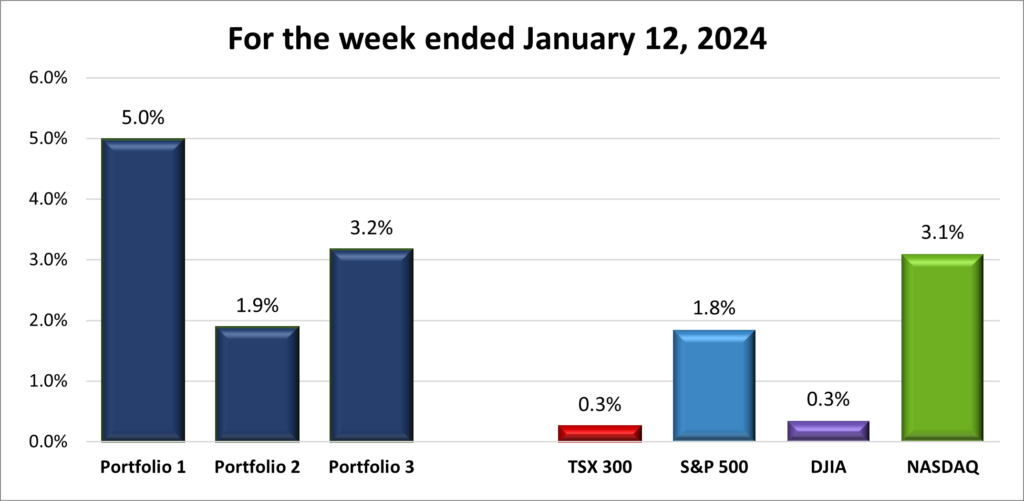
For the week, the TSX (SPTSX) inched higher 0.3%, the S&P 500 (SPX) gained 1.8%, the DJIA (INDU) added 0.3% and the Nasdaq (CCMP) advanced 3.1%.

Index Weekly Streak
TSX: 1-week winning streak
S&P: 1-week winning streak
DJIA: 1-week winning streak
Nasdaq: 1-week winning streak

Bull market. A good week for the North American stock markets. After a shaky start, the North American returned to their winning ways this week, as seen on the chart above. Despite a sluggish start to 2024 for the indexes last week, the three American indexes are approaching their respective highs. The S&P is almost at its record highs set in January 2022, the Nasdaq is approaching a two-year high, while the DJIA is close to its all-time high set on January 2 of this year. As in 2023, the vanguard of these gains has been the bigger technology companies, especially the Magnificent 7 companies. All seven companies reside on the Nasdaq so its no coincidence that that index posted the largest weekly gain.

As for the TSX, it does not have as robust of a technology sector component as its American cousins, so it has not experienced the same success. The commodity-heavy TSX got off to a slow start last week as optimism of early rate cuts started to fade. However, the TSX has quietly gained over 12% since a late October swoon.

The main drivers of the markets this past week were inflation data, with the worrying news of the CPI offset by the good news of the PPI. The mixed inflation news led investors once again contemplate rate cuts sooner rather than later. Also impacting the markets was the ongoing conflict in the Middle East where concerns about the supply of oil helped the energy sector recover some of the losses from the previous week.

Overall, the positive factors held sway during this week, leading to gains for the four major North American indexes.

Portfolio Weekly Streak
Portfolio 1: 1-week winning streak
Portfolio 2: 1-week winning streak
Portfolio 3: 1-week winning streak

Bull market. A good week for the North American stock markets. With each of the indexes posting a weekly gain it was no surprise to see the three portfolios all get back into the win column, outperforming the S&P and the TSX, both are considered common benchmarks. As shown in the chart below, Portfolio 1 had the best week of the portfolios and the indexes. It was lead by significant (more than 10% up or down) gains in uranium producer Cameco (TSE: CCO), up 18% to reach an all time high as uranium prices surged. Crowdstrike (NASD: CRWD) also posted an impressive 12% gain for the week.

Portfolio 2 lagged the other two portfolios as it had no significant movers up or down. It was lifted by the rising tide of the overall market. Portfolio 3 also benefitted from the overall market rise but got an extra boost from e-commerce giant Shopify which gained 8% over the week. Shopify has grown to represent almost 23% of the portfolio so when it moves, the portfolio moves.

After last week’s stumble, it was good to see all three portfolios increase in value.

Weekly Portfolio & Index performance
Weekly Portfolio & Index performance for the week ended January 12, 2024.

Companies on the Radar

Stocks on my RadarThis week the radar list says good bye to Jacobs Solutions (NYSE: J) and MP Materials (NYSE: MP), and welcomes Equitable Bank (TSE: EQB), a Canadian mid sized company based on market capitalization (number of shares outstanding X market price that falls between $1 billion – $4 billion). As the name implies, this is a bank that provides financial services to consumers and businesses. Unlike the big 6 Canadian banks that saw their share prices remain flat for most of 2023, Equitable’s share price increased 50%. That got my attention. 😊 It joins the four companies listed below.

  • McDonald’s (NYSE: MCD), the large sized American fast-food chain.
  • Celestica Inc. (TSE: CLS), a medium sized Canadian company that manufactures electronic products and provides supply chain services to companies around the world.
  • Kinaxis (TSE: KXS), a Canadian mid sized company that provides cloud based supply chain solutions to customers around the world.
  • Lumine Group (TSE: LMN), a young Canadian mid sized company that acquires and strengthens communications and media software companies.

The Radar Check was last updated January 12, 2024.

Stock on the Radar List. 1 of 2.
Stock on the Radar List. 2 of 2.

Portfolio Update

Portfolio 1

Portfolio 1 for the week ended January 12, 2024: UP Green Up Arrow, signifying a positive week

  • Nvidia (NASD: NVDA) is putting the finishing touches on a semiconductor specifically designed for the Chinese AI market. The H20 chip, and two other chips destined for the Chinese market, were designed to adhere to US export restrictions. The company says the chip should be ready to ship in the second quarter of 2024.
  • Apple announced its Vision Pro mixed-reality headset will be available in the US starting February 2. The headset is considered the company’s biggest product launch since the iPhone back in 2007. Prices start at US$ 3,499.
  • After new US government vehicle regulations were implemented, Tesla (NASD: TSLA) has started to lower their driving range estimates. Its good to see the government taking a harder line with inflated ranges estimates by electric vehicle (EV) manufacturers.
    Separately, Tesla has launched a revamped Model 3 EV for North America.
  • In a blow to EV manufacturers, Hertz Rent a Car (NASD: HTZ) is selling the bulk of its EV fleet, citing higher repair costs for damaged EVs. Hertz plans to sell approximately 20,000 EVs and replace them with conventional vehicles. Hertz EVs for sale include vehicles from Tesla and General Motors (NYSE: GM).
  • Amazon (NASD: AMZN) laid off a few hundred employees from their Prime Video and Amazon MGM Studios as the company continues to reduce expenses.
  • Alphabet’s (NASD: GOOGL) Google is back in court, this time arguing they did not infringe on patents belonging to computer scientist Joseph Bates during the development of their internal usage AI chips. At stake is US$ 1.67 billion in damages. The complainant said Google copied his code after collaborating with him to solve a problem Google had with AI. Google argues its developers never met with Mr. Bates and the chips were designed independently.
    In other Google news, the company is laying off hundreds of employees across multiple business units as it continues to cut costs.
  • Crowdstrike was named a Leader in Gartner’s Magic Quadrant for Endpoint Protection. That was the fourth straight time Crowdstrike has been selected as a Leader in this category.

Activity

No significant activity to report this week.

Dividends

Dividends Received this week for the following companies:

Companies followed by DRIP (Dividend Re-Investment Plan) indicate additional shares were purchased with the dividend. Any cash leftover was added to the cash balance.

Canadian $

Yellow Pages Ltd (TSE: Y)

Pulse Seismic Inc (TSE: PSD)

US $

Costco Wholesale Corp (NASD: COST)

Innovative Industrial Properties Inc (NYSE: IIPR)

Quarterly Reports

No quarterly reports this past week.
Portfolio 2

Portfolio 2 for the week ended January 12, 2024: UP Green Up Arrow, signifying a positive week

  • Guardant Health (NASD: GH) announced they have partnered with multinational pharmaceutical company Hikma Pharmaceuticals to market Guardant’s collection of liquid and tissue biopsy tests for cancer screening throughout the Middle East and North Africa.

Activity

No significant activity to report this week.

Dividends

Dividends Received this week for the following companies:

Companies followed by DRIP (Dividend Re-Investment Plan) indicate additional shares were purchased with the dividend. Any cash leftover was added to the cash balance.

Canadian $

Telus (TSE: T) DRIP

US $

Walt Disney Co (NYSE: DIS)

Quarterly Reports

No quarterly reports this past week, except for per share data.

Portfolio 3

Portfolio 3 for the week ended January 12, 2024: UP Green Up Arrow, signifying a positive week

  • The European Union’s antitrust regulator, the European Commission (EC) is considering opening an investigation into the relationship between Microsoft and OpenAI, a leader in AI. The EC is considering whether Microsoft’s US$10 billion investment in OpenAI is the same as a merger.
  • Shopify (TSE: SHOP) announced they are partnering with Manhattan Associates (NASD: MANH), a global supply chain commerce company. Together they will create omnichannel order management solutions to help their merchants deliver a top-notch experience to their customers.

Activity

No significant activity to report this week.

Dividends

Dividends Received this week for the following companies:

Companies followed by DRIP (Dividend Re-Investment Plan) indicate additional shares were purchased with the dividend. Any cash leftover was added to the cash balance.

No dividends this past week.

Quarterly Reports

No quarterly reports this past week.

 

2023 Fourth Quarter and Twelve-Month Review

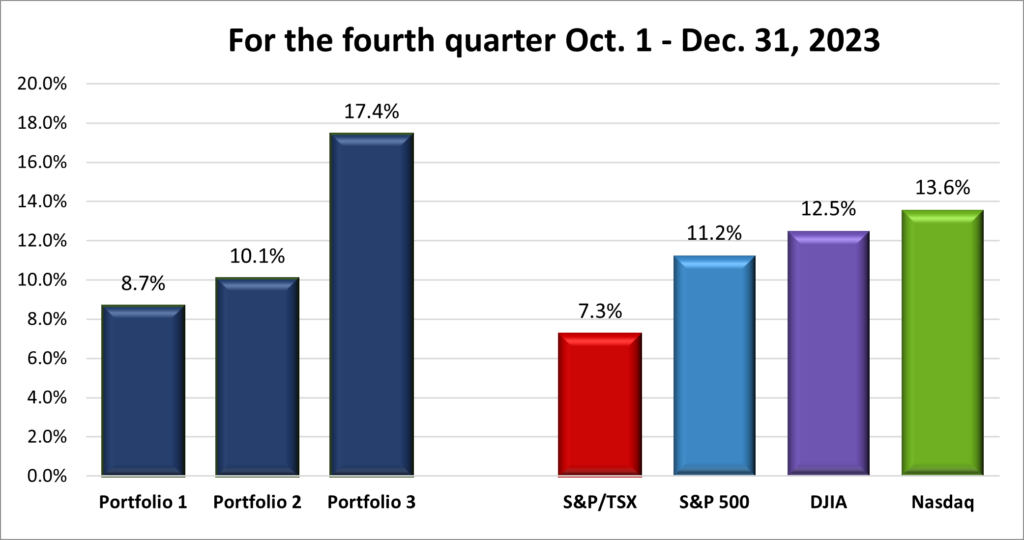
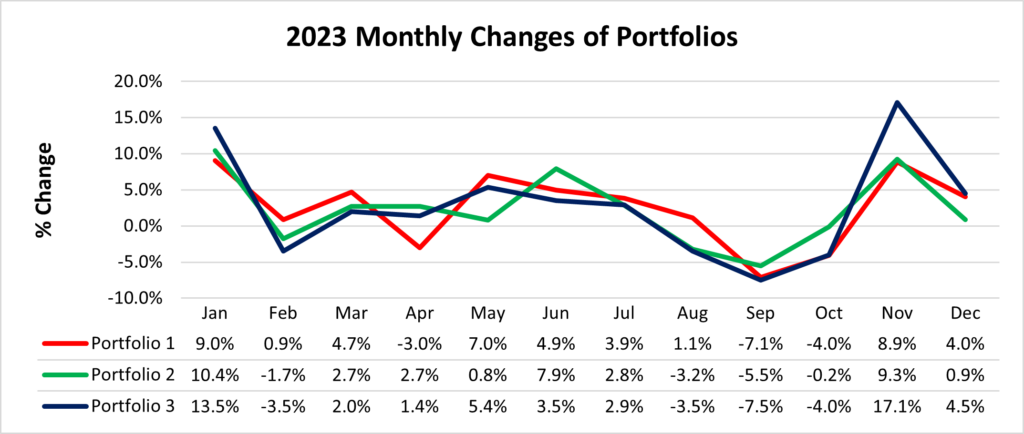
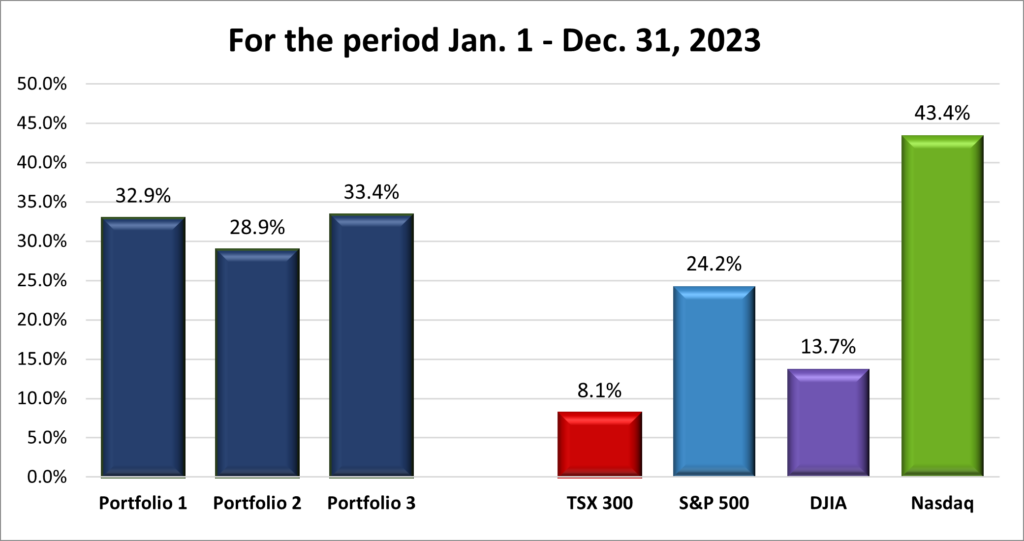
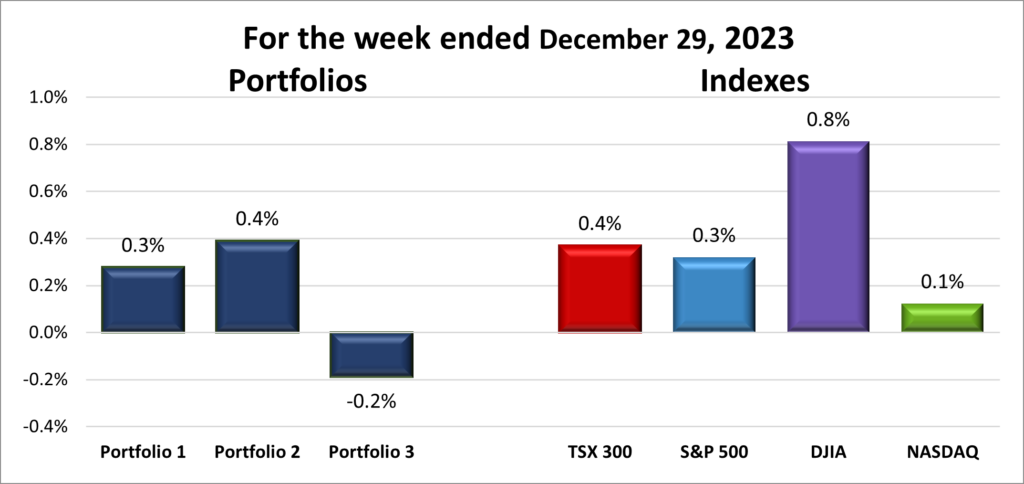
After a dismal 2022 for the four major North American indexes, it was great to see they closed out 2023 with big gains in the fourth quarter, leading to record highs. The three American indexes – the S&P 500 Index (S&P), the Dow Jones Industrial Average (DJIA), and the Nasdaq Composite Index (Nasdaq) – all ended the year riding a 9-week weekly winning streak. The Toronto Stock Exchange Composite Index (TSX) was not as hot but still concluded the year with three straight weeks of gains.

Despite initial concerns about inflation and recession, 2023 turned out to be a remarkable year for stock market performance. This unexpected rally was led by mega-cap technology stocks and other growth companies that had faced significant losses during the bear market in 2022.

In Canada, the economy slowed before becoming stagnant towards the end of the year and the Bank of Canada (BoC) raised the Canadian interest rate four times in the first half of the year to 5.0% before pausing additional increases. The American economy remained solid throughout the year despite the regional banking crises in the first quarter. The Federal Reserve (Fed) raised interest rates four times during the year to 5.5% but signaled no further increases and potential rate cuts in the coming year.

The year ended on a high note with a rally that started in early November before turning into a Santa Claus rally to end the year on a high note. After the bear market of 2022 that took a big bite out of all three portfolios, you will hear no complaints from me about the gift Santa left in the form of a fourth quarter rally. 😊

Let’s take a look at what transpired over the last three months as well as a quick review of the entire year ….

Contents

Fourth Quarter Review

Fourth Quarter Portfolio Update

Portfolio 1 for the fourth quarter

Portfolio 2 for the fourth quarter

Portfolio 3 for the fourth quarter

Twelve Month Review

Twelve Month Portfolio Review

2023 in Review

Going Forward: The First Quarter 2024 and beyond


Fourth Quarter Review

For the fourth quarter, the TSX, gained 7.3%, the S&P surged 11.2%, the DJIA rose 12.5% while the Nasdaq advanced 13.6%.

Bull market. A good week for the North American stock markets.The North American stock markets experienced quite the upward ride during the fourth quarter of 2023, fueled by investor optimism surrounding the prospect of falling interest rates. This enthusiasm, rooted in falling inflation and the anticipation of rate cuts in the approaching year, propelled the markets to new heights, buoyed further by the year-end “Santa Claus rally.” Despite a brief dip in October, the quarter concluded with all four major North American indexes notching positive returns, propelled by a robust rally in November and December.

Several factors contributed to the markets’ movements, including the ongoing conflict in Ukraine and conflict in the Middle East. However, the overarching drivers were the cooling inflation and the growing belief that the Fed would begin lowering the benchmark interest rate in the first quarter of 2024. Following inflation’s decline from multi-decade highs, thanks in part to the BoC and the Fed’s interest rate hikes, the pause in rate hikes and hints at potential cuts fueled investor optimism for future economic growth, mitigating fears of a looming recession and adding momentum to the rally.

Unlike at the start of 2023 when the indexes were lifted by the Magnificent 7 technology companies – Apple Inc. (NASD: AAPL), Alphabet Inc. (NASD: GOOGL), Amazon.com Inc. (NASD: AMZN), Meta Platforms Inc. (NASD: META), Microsoft Corp. (NASD: MSFT), Nvidia Corp. (NASD: NVDA), and Tesla Inc. (NASD: TSLA) – the rally saw gains across a wider range of sectors, including energy, healthcare, and consumer staples. This diversification contributed to its stability and resilience. Technology companies continue to drive the Nasdaq, but the increased breadth of the rally pushed the S&P and DJIA higher, with the DJIA setting an all time high.

In Canada, the BoC did not signal an end to rate hikes like the Fed did at their last meeting in December. However, the TSX also benefited from falling inflation throughout the final quarter of 2023. This lowered concerns about rising interest rates. Unlike 2022, which saw strong performances in the energy and basic materials sectors, the fourth quarter saw a shift towards value (underpriced) stocks on the TSX. This included sectors like financials, consumer staples, and utilities, which are typically seen as less volatile and offer relatively higher dividend yields. This rotation towards value was likely driven by a combination of factors, including the easing inflation concerns and the pursuit of income in a potentially slowing economic environment.

Overall, after a stumbling start, the fourth quarter had a remarkable turnaround. Following a downturn in the third quarter, the markets surged in November and continued into December, steering all three American indexes to double-digit growth for the quarter, with the TSX trailing at a commendable 7.3%. Not a bad recovery for a quarter that initially stumbled out of the gate. 😊

Back to Table of Contents

Fourth Quarter Portfolio Update

The portfolios rode the tailwind of the November rally that became a Santa Claus rally in December to end the fourth quarter. All three portfolios had a strong fourth quarter, with Portfolio 3 having a great quarter, easily outperforming the indexes, as shown in the chart below.

Quarterly Portfolio & Index performance
Fourth Quarter 2023 (October 1 – December 31) Portfolio & Index performance

Portfolio 1 for the fourth quarter:

Portfolio 1 got off to a disappointing start, weighed down by the overall market’s decline that was caused by fears of an economic slowdown and stubborn inflation. However, the portfolio reversed course and rode the tailwinds of the two-month rally to end the quarter in positive territory. Strong performances from the mega cap technology companies helped the portfolio reach double digit gains for the quarter.

Activity: Second investment in Rivian Automotive Inc. An initial Investment in Decisive Dividends Corporation. Sold Marqeta Inc., Copperleaf Technologies Inc., WELL Health Technologies Corp., and Voyager Digital Ltd.

Portfolio 1: Fourth Quarter 2023 Performance

Portfolio 2 for the fourth quarter

Despite a significant drop in the markets at the start of the fourth quarter, Portfolio 2 managed to achieve double-digit gains for the quarter. Riding the coattails of the overall market surge during the year-end rally, the portfolio was propelled higher, notably by the stellar performance of Microsoft. The more balanced composition of the portfolio, which helped it avoid a substantial decline in October, also contributed to limiting its gains in December. ☹

Activity: Bought Dollarama Inc.

Portfolio 2: Fourth Quarter 2023 Performance

Portfolio 3 for the fourth quarter

When the markets dropped in October, Portfolio 3 fell farther than the four indexes, weighed down by its overwight in Shopify. However, when the markets reversed course, it was Shopify that propelled the portfolio to a huge monthly gain in November, as shown in the chart below. Portfolio 3 posted a more modest gain in December, inline with the monthly gains of the indexes, to end a great fourth quarter that saw it out perform the four indexes. Here is to more quarters with double-digit gains! 😊

Activity: Lithium Americas Corp. split into Lithium Americas Corp (North America operations) and Lithium Americas (Argentina) Corp. (South America operations). Sold Fortuna Silver Mines Inc.

Portfolio 3: Fourth Quarter 2023 Performance

Back to Table of Contents


Twelve Month Review

For 2023, the TSX rose 8.1%, the S&P surged 24.2%, the DJIA climbed 13.7% while the Nasdaq soared 43.4%.

Bull market. A good week for the North American stock markets. Twelve months ago, analysts almost universally anticipated a recession, arguing that only an economic downturn triggered by the steepest interest rate increases since the 1990s could temper inflation. Yet, the expected downturn did not materialize as predicted. In Canada, inflation decreased from 5.9% in January to 3.4% by December, however, the economy was stagnant in the latter half of the year. In the US, inflation dropped from 6.4% to 3.4% over the same period. Unlike in Canada where the economy stalled, the American economy remained robust. A strong economy suggests that the Fed may indeed achieve a ‘soft landing’ (where inflation falls to the 2% target without the economy going into a recession), highlighting the precarious nature of market predictions.

As shown in the chart above, all four major North American indexes posted sizable gains in 2023. The S&P closed the year up 24.2%, marking its largest gain since 2021, though it fell short of reaching a new record high. This past year’s performance underscores the S&P’s resilience, despite the absence of setting a new peak for the first time since 2012. Over 65% of S&P member companies ended the year higher, though more than half underperformed the index itself. The year’s gains were disproportionately driven by the ‘Magnificent 7’ technology companies, which capitalized on the artificial intelligence (AI) tailwind, highlighting the increasing market concentration in these top performers. Their dominance reflects the broader sectoral performance, with Technology and Communications Services sectors soaring by 56.4% and 54.4%, respectively, and together constituting 38% of the S&P’s weight.

Despite its 43.4% surge, the Nasdaq did not reach a new high, while the DJIA set a record on December 13, contributing to its 13.7% annual gain. The TSX lagged behind, with ‘only’ an 8.1% increase. 😊

These impressive performances comes on the heels of a dismal 2022 that saw the S&P decline 19.4%, the DJIA fell 8.8%, the Nasdaq tumble 33.1% and the TSX drop 8.2%. Despite the higher interest rates in both countries that started climbing in 2022, the markets demonstrated remarkable resilience.

While the monetary decisions made by the BoC can weigh on the TSX, the Canadian stock markets are more influenced by what the Fed does when it comes to interest rate movements. The markets tend to move to the beat of the Fed. On June 7, 2023, the BoC raised the Canadian key interest rate, or benchmark rate, to 5.0% where it remained as of December 31, 2023. In July, the Fed raised the benchmark interest rate to the current target range of 5.25% to 5.50% where it remained at the end of the year.

In December, at the last meeting of the Federal Open Market Committee (FOMC), the Fed forecast up to three rate cuts in 2024, making it the only central bank in the world to signal a readiness for lowering interest rates in the coming year. Investors are now keenly watching for signs of when the Fed might start lowering the rate. Given the considerable influence of the Fed’s monetary policies (interest rate decisions) on market dynamics, especially in sectors sensitive to interest rate changes, the anticipation around these potential cuts is considerable. The sooner both central banks start lowering their respective rates the better, I say. 😊

Reflecting on the past year, the anticipated economic downturn due to aggressive interest rate hikes did not unfold as expected. Instead, inflation rates moderated in both Canada and the US, displaying resilience in the American economy and a period of stagnation in Canada. Stock markets across North America rebounded impressively, with technology and AI advancements driving significant gains, particularly within the technology heavy S&P and Nasdaq indexes. The focus now shifts to central banks, especially the Fed, which hinted at potential rate cuts in 2024, highlighting the critical influence of monetary policy on market dynamics and investor sentiment.

Back to Table of Contents

Twelve Month Portfolio Review

2023 was a year that saw the American markets soar and the Canadian markets climb steadily, but our portfolios did something spectacular—they mostly outperformed the S&P, DJIA, and the TSX, with only the Nasdaq’s staggering 43% gain edging them out, as shown in the char below. Each portfolio’s journey through 2023 was a testament to forward thinking and patience in the dynamic world of investing.

The journey was not smooth, as seen in the chart below, but the result was rewarding. Each portfolio had its unique set of ups and downs, resembling a rollercoaster ride more than a straightforward path to success. Despite this volatility, each portfolio managed to record eight months of gains against four months of losses, with the best performances in January and November when each portfolio posted outsized gains.

Change in Portfolios over the course of 2023.
Change in the three Portfolios over the course of 2023.

Portfolio 1 benefited significantly from its investment in six of the “Magnificent 7” technology giants, highlighting the power of leading tech firms in driving growth. Despite a brief setback due to falling oil prices and interest rate worries, strategic investments led to a strong finish, especially as worries over central bank rate hikes began to subside.

Portfolio 2 rode the early tailwind of technology stocks higher and, despite the shake-up from the US banking crisis, managed to rebound through most of the summer. After a dip in the fall, Portfolio 2 closed the year strongly, propelled by a late surge caused by positive investor sentiment toward impending lower interest rates.

Portfolio 3 demonstrated the impact of having surging tech giants like Microsoft and Shopify (TSE: SHOP), with their significant gains highlighting the portfolio’s strength. Despite interest rate concerns, a late-year rally, particularly in Shopify, underscored the value of strategic stock selection.

As the chart below vividly shows, 2023 was indeed a remarkable year for each portfolio. I am looking forward to more years like this past one. 😊

Twelve Month Portfolio & Index performance
Twelve Month (January 1 – December 31) Portfolio & Index performance

Back to Table of Contents

2023 in Review

Looking back on 2023, it was an eventful year. The year kicked off with the meteoric rise of what has been dubbed the “Magnificent 7” – a group of large American technology companies. These firms carried the S&P in 2023, gaining nearly 75%, while the remaining 493 companies of the index only gained about 9%. The rising tide of these companies also helped lift the DJIA and the TSX. The common thread among these companies was their significant involvement in, or benefit from, a burgeoning tailwind in AI. These companies gained momentum in late 2022 and investor optimism about the promise of AI carried them and others associated with AI throughout 2023.

By the end of the first quarter, a banking crisis unfolded in the US, marked by the collapse of several regional banks. This was primarily due to the strain of rising interest rates, which exposed vulnerabilities in their financial health. As the year progressed, the focus shifted to the trajectory of interest rates. Both the BoC and the Fed had raised benchmark interest rates in 2022 to combat inflation, a trend that continued into 2023. The cessation of rate hikes in the latter half of the year led to speculation about potential decreases. However, both central banks maintained a stance that higher rates would persist to ensure inflation returned to target levels, signaling a ‘higher for longer’ policy approach.

November saw the markets embark on a rally that persisted until year’s end, fueled by declining inflation, the halt of interest rate increases in the US, and optimism that the Fed could achieve a ‘soft landing’. To end the year, supply chain issues, which first burst into consumers’ consciousness during the COVID-19 pandemic, made a surprising return. Initially thought to be resolved, these challenges were reignited by geopolitical tensions in the Middle East that impacted the vital Red Sea shipping lane, once again threw global supply chains into disarray.

However, a review of 2023 would be incomplete without highlighting the profound impact of AI. This sector was a focal point throughout the year, with any company involved in AI experiencing a surge in both sales and stock prices. Two companies stood at the forefront of this AI revolution: Nvidia and Microsoft. Nvidia’s share price skyrocketed by 230%, thanks to its dominance in supplying the chips crucial for AI development. This demand for Nvidia’s hardware underscored the integral role of AI-specific infrastructure in technological advancement.

Microsoft, on the other hand, emerged as a pioneer with its rollout of AI-enhanced applications, establishing itself as a leader in this nascent industry. This strategic positioning rewarded Microsoft with a 53% increase in its share price—a remarkable achievement for a corporation of its size and a testament to the transformative potential of AI.

As we bid farewell to 2023, a year marked by both headwinds and tailwinds, it is clear that economic resilience and innovation have driven the investment landscape. From the resurgence of supply chain issues to the AI revolution, there were many challenges and opportunities. With markets moving higher, it was a much easier time mentally to be an investor. 😊

Back to Table of Contents


Going Forward: The First Quarter 2024 and beyond

2024 brings a mix of familiar trends and exciting new opportunities in the investment world. Smart planning, combined with lessons learned in the past, should help you ride these waves with confidence. Let’s delve into the key themes shaping our investment strategies in the year ahead.

The drive to fortify supply chains, a lesson underscored by the COVID-19 pandemic, continues with vigor. Efforts to minimize dependencies by enhancing North American infrastructure signal robust opportunities in sectors like semiconductors, renewable energy, raw materials, and resources, as well as infrastructure. Investors should watch for companies and projects at the forefront of this transformation, as they stand to gain from governmental and corporate investments aimed at ensuring resilience against future disruptions.

The remarkable performance of the ‘Magnificent 7’ dominated market narratives in 2023, but as these giants face the law of large numbers, attention is shifting. The landscape is ripe for the emergence of new leaders or the reconfiguration of market dominance. This transition period presents an opportunity for investors to diversify, seeking growth in undervalued sectors or companies poised to benefit from broader economic shifts, including technology, healthcare, and green energy.

The Fed has signaled potential interest rate cuts in 2024 with the BoC likely to follow suit, the overall market appears conducive to a broader market rally. Lower interest rates could relieve pressure on consumer and corporate debt, thereby stimulating spending and investment. However, investors should remain vigilant, adapting to the pace and scale of policy shifts, and considering their implications across asset classes—from equities to real estate.

While the cooling American economy and stabilizing inflation rates suggest a move towards a ‘soft-landing’, unforeseen geopolitical events, including the US presidential election, could introduce volatility. Investors would benefit from maintaining a balanced portfolio, hedging against potential market turbulence through diversification across geographies and sectors.

On a personal note, the gradual consolidation of holdings—from 65 to 60 companies in Portfolio 1—reflects a strategic choice to focus on quality over quantity. Hopefully, some of the companies will become the next stars of the investing world, with Nvidia like performance, while others will just continue their relentless ascent in value. 😊 The aim is not just to replicate the success of 2023 but to build a resilient and dynamic portfolio prepared for the opportunities and challenges of 2024.

As we look ahead with cautious optimism, we will need to maintain an eye on evolving market dynamics, to improve the chances for success in 2024. Wishing you all the best in your investments in the year ahead. Good luck, and long may the bulls run! 😊

Bull market

Back to Table of Contents


Weekly Update for the week ending January 5, 2024

A black bull with a moon and snow, behind '2024' Welcome to 2024! I hope everyone had a good Christmas break to recharge and get ready for 2024.

There was no Weekly Update for the last week of 2023, however, that does not mean all was quiet here. There were a few minor changes to the web site. As you may have noticed, the website received a fresh, new look and feel towards the end of 2023.

To better see how the stock market indexes were trending, tables were introduced in the general market review section of the Weekly Market and Portfolio Review section. Since tracking the streaks of the indexes seemed like a good idea, I thought “why not track the streaks of the portfolios.”

Even though the portfolios were riding win streaks to end 2023, I decided to start the portfolio tracker effective January 1, 2024. Hopefully, the streaks will reach a 52 week weekly win streak. 😊 Finally, a behind the scenes change to the grammar style on the site. Whereas the previous style was ‘formal,’ it has been changed to ‘professional.’

The new streak tables are intended to make the information easier to understand, while the updated grammar style was done to make the posts easier to read. As for the improvement in investing, that is still a work in progress. 😊

So…. in the words of Daenerys Targaryen when she was at Dragonstone, planning to take the Iron Throne, “Shall we begin?”

Items that may only interest or educate me ….

Canadian Economic news, US Economic news, Changes at the FOMC, ….


Canadian Economic news

This past week’s key economic data that the Bank of Canada (BoC) considers when deciding whether to raise or lower the interest rate.

Labour Force Survey (LFS)

Statistics Canada’s LFS for December showed employment was essentially unchanged, adding 100 jobs in December after adding 24,900 jobs the month before. The number of new jobs was well below analysts’ prediction of 13,500 jobs. Meanwhile, the unemployment rate remained at 5.8%, the same as in November. Analysts had forecast a slightly higher unemployment rate of 5.9%.

The size of hourly wage increased to 5.7% from 5.0% in November. That is the highest pace since January 2021. On an annual basis, average hourly wages increased 5.4% after rising 4.8% in November.

Fewer jobs and steady unemployment indicate the Canadian economy continues to slow but an increase in the pace of wage growth would be worrisome to the BoC. Higher wages put upward pressure on inflation.

The flatlining employment figure points to a potential slowdown in the labour market, a shift from the consistent job growth seen in the first part of 2023. This is consistent with Canada’s stagnant Gross Domestic Product over the last few months. The mixed picture presented by the unchanged unemployment rate and slowing job growth, alongside persistent wage increases, might lead the Bank of Canada to adopt a more cautious approach to monetary policy decisions. They will need to balance controlling inflation with supporting a fragile economy.

Canadian market volatility

The Canadian Volatility Index (VIXC), represented by the TSX 60 VIXI, ended the week at 11.55, higher than last week’s reading of 10.82. This increase suggests investors perceive a higher level of volatility. A dismal jobs report that came in lower than expected has investors worried the Canadian economy may fall into a recession.

The VIXC’s “high” and “low” volatility thresholds are generally defined as readings above 20 and below 20, respectively. Therefore, the current level of 11.55 indicates a relatively calm market environment.

US Economic news

This past week’s key data points that the Federal Reserve (Fed) considers when deciding whether to raise or lower the interest rate.

Fed meeting minutes

The Federal Open Market Committee (FOMC) released the minutes from its December policy meeting, revealing a cautious optimism that inflation risks have ‘diminished’ and are finally heading towards their 2% target. While price pressures showed downward trends due to factors like lower energy prices and slowing wage growth, the Fed remains committed to holding the current rate of 5.5% until inflation is “sustainably” on track.

While none of the members anticipate immediate rate hikes, the minutes acknowledge the possibility of further increases if inflation does not follow the estimated downward trend. This cautious stance reflects their awareness of potential economic risks caused by higher rates, such as a slowdown in growth and headwinds from the global economy. Like a pilot navigating turbulence, the Fed plans to closely monitor the situation and adjust course as needed, balancing inflation control with economic stability.

Officials are hopeful the economy will experience a ‘soft landing,’ where the economy manages to slow down gradually after a period of robust growth, avoiding a full-blown recession. Unfortunately, the minutes did not provide any insight as to when the interest rate may start to be lowered, leaving many wondering if the wait will be longer than they had hoped. ☹

Labour

Job Openings and Labor Turnover Survey (JOLTS)

The latest JOLTS report showed the number of job openings in November remained relatively unchanged from October, coming in at 8.8 million, the lowest it’s been in almost three years. The number of openings was up slightly from 8.733 million in October, but below analysts’ expectations of 8.85 million.

While the number of job openings remains high, it continues to fall from a high of twelve million in March 2022. The number of hires also decreased, down to 5.5 million from 6.1 million in October. This might suggest a slight slowing in hiring, potentially due to seasonality or a slowing economy caused by higher interest rates or global economic headwinds.

ADP employment

The December ADP employment report showed an increase of 164,000 jobs, surpassing November’s reading of 103,000 and easily beating analysts’ projections of 115,000 new jobs. The bulk (155,000) of new jobs came in the service-providing sectors. Annual wages were up 5.4% on annual basis, slightly lower than November’s 5.6%.

Bureau of Labor Statistics’ Employment Situation Summary (ESS).

The Bureau of Labor Statistics ESS report for December showed nonfarm payrolls rose by 216,000, up significantly from November’s increase of 199,000. Analysts had been expecting 170,000 new jobs. Meanwhile, the unemployment rate held steady at 3.7%, unchanged from November. It was the 23rd consecutive month the unemployment rate was below 4%. Finally, average hourly earnings grew by 0.4% in December, after climbing 0.4% in November. On an annual basis, wages are up 4.1%, up slightly from November’s 4.0% increase. If wages continue to grow at that pace, they could put upward pressure on inflation.

Labour summary

Overall, these three reports showed signs of a strong economy with a resilient labour market and a high demand for workers, rising wages while the inflation continues to fall. However, signs of a potential slowdown in in the pace of hiring activity are starting to appear. Plenty of jobs while the economy slows is good news for the Fed as it suggests they have brought down inflation without killing the labour market. However, the Fed will have to pay close attention to continued job growth and low unemployment that could cause the Fed to maintain the current 5.5% rate longer than anticipated.

American market volatility

A key gauge of market uncertainty on Wall Street, the CBOE Volatility Index (VIX), rose to 13.35 at the end of the week, after registering 12.45 the previous week. The increase suggests investors are seeing greater uncertainty and risk in the market, potentially leading to more volatility. A possible explanation is investors may believe the markets may have gotten ahead of themselves and a pullback is to be expected after a two-month long rally. There is also uncertainty about when the Fed may start to lower the interest rate which often leads to a rise in the VIX.

The VIX is a measure of the market’s expectation of short-term volatility based on S&P 500 options prices.

Changes at the FOMC

Each year the Fed’s FOMC rotates its voting members. While all 19 Fed policymakers, including non-voters, take part in the policy debates that shape the decisions, it is only those members of the FOMC that vote on any changes. The four new members will join the seven permanent Fed Board of Governors on the FOMC.

Effective January 1, 2024, the new voting members include Raphael Bostic, President of the Atlanta Fed; Loretta Mester, President of the Cleveland Fed; Thomas Barkin, president of the Richmond Fed; and Mary C. Daly, President of the San Francisco Fed. Ms. Mester and Mr. Barkin are viewed as more hawkish, advocating for stricter monetary policy (higher rates) to control inflation. Ms. Daly and Mr. Bostic are more centre oriented, focused on data-driven decision-making and advocating for a balanced approach between managing inflation and supporting economic growth.

Leaving the Fed were the more dovish Austan Goolsbee, President of the Chicago Fed, and Patrick Harker, President of the Philadelphia Fed, and hawks Lorie Logan, President of the Dallas Fed, and Neel Kashkari, President of the Minneapolis Fed.

With this year’s four new voting members, the committee takes on a more aggressive stance. The four new members of the FOMC have generally held hawkish (bias towards higher rates) positions regarding inflation control. This does not mean they will increase the US interest rate, but it could suggest a slower pace of rate cuts compared to initial market expectations. While the new FOMC composition might indicate a slightly later and more gradual pace of rate cuts, it does not necessarily rule out three reductions in 2024 as originally indicated at the last FOMC meeting.

If you are interested in finding out more about the Fed and the FOMC, check out this post on the Federal Reserve and the Bank of Canada.


With all the changes out of the way, let’s see what happened this past week….

Weekly Market Review

Monday: The global markets were closed for New Year’s Day.

Tuesday: After ending 2023 with a bang, the markets started the New Year on the wrong foot as three of the four major North American indexes – the Toronto Stock Exchange Composite Index (TSX), the S&P 500 Index (S&P), and the Nasdaq Composite Index (Nasdaq) – ended lower. The Dow Jones Industrial Average (DJIA) was the only index to end higher, barely making it over the flatline. Lower expectations of the Fed’s interest rates cuts weighed on the markets, especially the interest sensitive technology stocks.

In Canada, the higher costs of manufactured goods led to drop in demand causing production in Canadian factories to slow to its lowest pace since the beginning of the Covid-19 pandemic when most businesses were shut down. That is not a good sign for the Canadian economy. In trading, only three Canadian sectors advanced: Telecommunications Services, Energy, and Utilities. The biggest decline was in the Technology sector, which dropped four times as far as Healthcare, the next closest sector.

In the US, the S&P and Nasdaq were dragged down by Apple (NASD: AAPL) amidst talk of weakening sales of their newest iPhones. As well, the yield on US government bonds rose to almost 4% causing investors to move into the safer government bonds. In trading, Telecommunications Services and Healthcare were the biggest gainers, while technology and consumer Cyclicals suffered the biggest declines.

Wednesday: the markets continued to pullback as investors continue to take profits after the December run up, causing all four indexes to end in the red. The US labour market continues to cool as job openings reached their lowest point since March 2021. Oil prices rose after a disruption at a major oilfield in Libya as well as ongoing concerns that the conflict in the Middle East could disrupt global supply.

In Canada, the TSX ran its losing streak to two days as only three sectors made it into the green: Energy, Healthcare and Telecommunications Services. Consumer Cyclicals and Basic Materials (miners and fertilizer manufacturers) fell the deepest into the red.

In the US of A, the minutes from the Fed’s meeting in December showed officials felt the risk of higher inflation had diminished. Many of the sectors that soared in November and December are starting to give back some of their gains as the S&P endures its worst three day stretch since October. In trading, the Energy and Utilities sectors were the only ones to make it above the flatline, while Consumer Cyclicals and Industrials experienced the biggest decline.

Thursday: it was a mixed day for the indexes with the TSX and DJIA finishing in the green, while the S&P and Nasdaq ended in the red. Investors were disappointed the minutes from the last Fed meeting indicated the current interest rate could remain in place longer than investors would like. Oil prices fell as US gasoline inventories rose, recording their highest week over week increase in more than 30 years. The higher inventory suggests lower demand, causing oil prices to fall.

In Canada, the TSX finally broke into the win column for 2024, led by the Technology and Industrials sectors. The largest declines were in the Energy and Consumer Cyclicals sectors.

In the US, investors continue to take profits from the Santa Claus rally, keeping the S&P and Nasdaq out of the win column in the new year. The pullback has the S&P off to its worst start to a year since 2015, and the Nasdaq ran its losing streak to five, making it the index’s longest losing streak in over a year. In trading, it was a day of broad-based losses in the American sectors, with Healthcare and Financials the only sectors to advance. Among the sectors to end lower, Energy and Consumer Cyclicals suffered the biggest declines.

Friday: all four indexes ended the day slightly higher, although it was a hollow victory as all four indexes ended the week lower. Oil prices rose as rising tensions in the Middle East caused investors to worry about supply issues.

In Canada, investors have been rotating out of growth stocks that were hot in December and into value-oriented companies. A disappointing December jobs report led investors to believe the BoC will start lowering the Canadian benchmark rate sooner than originally expected. In trading, Healthcare and Technology gained the most, while Industrials and Consumer Cyclicals were the only Canadian sectors to lose ground.

In the US, the indexes were up and down like a rollercoaster as stronger-than-expected labour data muddied the waters about predictions of when and by how much interest rates would start to fall. In trading, Telecommunications Services and Financials posted the biggest gains, while Consumer Staples and Healthcare were the only two sectors to end lower.


Weekly Market and Portfolio Review

For the first week of 2024, the TSX (SPTSX) was down 0.1%, the S&P 500 (SPX) lost 1.5%, the DJIA (INDU) declined 0.6% and the Nasdaq (CCMP) slumped 3.2%.

Index Weekly Streak
TSX: 1-week losing streak
S&P: 1-week losing streak
DJIA: 1-week losing streak
Nasdaq: 1-week losing streak

Bearish market After a strong run up to end 2023, the first week of 2024 saw the American indexes break their respective nine-week weekly winning streaks, and the TSX snapped a 3-week weekly winning run. For the DJIA and the S&P, it was their worst start to a year since 2016.

This week’s pullback, and I hope it is only a pullback, was likely the result of analysts and investors reassessing recent economic data and seeing that the US economy and jobs remains strong. This is causing many of them to believe interest rate cuts may occur later than expected. Analysts originally felt cuts to the US benchmark would begin in March, but now analysts are thinking May is more likely. In other words, investor optimism shifted as they reassessed the economic landscape and its implications for monetary policy.

In Canada, the economy and jobs continue to shrink, while wage gains exceeded expectations. The stagnating economy is helping to lower inflation but the increase in wages puts upward pressure on inflation. This makes it hard for the BoC to decide when to start lowering the Canadian benchmark rate. While some Canadians might like to think the Canadian economic situation moves the markets, the truth is the American economy is almost ten times as large and is what really moves the markets. When America sneezes, Canada catches a cold. 😊

This second look at the current economic situation opened the door for investors to take some money off the table after the two-month long rally. When the market moves upward that much and that quickly, it is only a matter of time before investors decide to protect the gains they made during the rally.

Portfolio Weekly Streak
Portfolio 1: 1-week losing streak
Portfolio 2: 1-week losing streak
Portfolio 3: 1-week losing streak

Bearish marketAs you can see in the chart below, the Portfolios began 2024 on a sour note with all three portfolios declining in value. The momentum from the previous two months did not carry over into the New Year, with the Portfolios stumbling out of the gate. With all four indexes ending the week lower, it was no surprise to see all three portfolios lost value this past week.

Portfolio 1 was the best performer over the past week, dropping the least amount. The Canadian companies in the portfolio seemed to fair better than the American companies. Unfortunately, the sizable movers (companies that saw their share price move more than 10% up or down) were all down. ☹. These were Lightspeed Commerce (TSE: LSPD) down 12.5%, Rivian Automotive (NASD: RIVN) down 19%, Unity Software (NYSE: U) down 10%, Navitas Semiconductor (NASD: NVTS) down 16%, and FuboTV (NYSE: FUBO) down 10%. Of these five companies, Lightspeed Commerce was the only Canadian company in the group.

Portfolio 2 had the biggest drop of the three portfolios because of a notable drop of MongoDB (NASD: MDB), down 12%. Otherwise, the portfolio had an even mix of stocks that finished the week higher and lower. Finally, other than Unity Software shedding 10% of its share price value, Portfolio 3 had no significant movers this past week.

While this week was not ideal, it is important to remember that market and portfolio fluctuations are inevitable. I am focused on my long-term goals, so I view this as a speedbump on my way to higher returns.

Weekly Portfolio & Index performance
Weekly Portfolio & Index performance for the week ended January 5, 2024.

Companies on the Radar

Stocks on my RadarDuring a two-week break of the Weekly Update, four new companies came across my radar:

  • Kinaxis (TSE: KXS), a Canadian mid cap company. that provides cloud based supply chain solutions to customers around the world. Broken supply chains have been blamed as part of the reason for higher prices globally. Companies should be interested in improving their supply chains and Kinaxis could benefit from that tailwind. A mid cap company has a market value, number of shares outstanding multiplied by the market price, between $1 billion – $4 billion.
  • MP Materials (NYSE: MP), an American mid cap company that mines and produces rare earth materials. Rare earth minerals are crucial elements in the production of electric vehicles (EV) and other electric products such as smartphones, computers, wind turbines, and various high-tech devices. This company could ride the tailwind of electrification.
  • Jacobs Solutions (NYSE: J), an American large cap (market capitalization between $4 billion – $200 billion). The company provides a wide range of professional services including consulting, technical, scientific and project delivery for the government and private sector. They are engaged in a number of sectors including Advanced Manufacturing, Cities & Places, Energy & Environment, Health & Life Sciences, Infrastructure, National Security and Space. They are a company in a wide range of markets and this diversity should help them to grow consistently into the future.
  • Lumine Group (TSE: LMN), a young Canadian mid cap company that acquires and strengthens communications and media software companies. They are a spin off from Constellation Software (TSE: CSU), a highly successful software company that acquires, manages and builds industry specific mission critical software solutions. If Lumine is half as successful as Constellation, Lumine will do very well.

The four companies mentioned above join the two holdovers from the December 22 radar list:

  • McDonald’s (NYSE: MCD), the large cap American fast-food chain.
  • Celestica Inc. (TSE: CLS), a medium sized Canadian company that manufactures electronic products and provides supply chain services to companies around the world.

The Radar Check was last updated January 5, 2024.

Stock on the Radar List. 1 of 2.
Stock on the Radar List. 2 of 2.

Portfolio Update

Portfolio 1

Portfolio 1 for the week ended January 5, 2024: DOWN Red Down Arrow

  • Tesla (NASD: TSLA) beat analysts estimate by delivering a record number of their EVs in the fourth quarter. The record delivery allowed Tesla to meet its 2023 target for deliveries. However, it was not purely due to customer demand as Tesla offered deeper discounts and six months of free fast charging if customers took delivery by the end of 2023.
    In other Tesla news, the company is performing over the air remote upgrades to fix ‘Autosteer’ and doors unlocking and opening during a crash. The recall will cover over 1.6 million Tesla vehicles in China.
  • Apple stocks fell after two banks downgraded Apple stock to “underweight,” which is a polite way of saying “Sell.” Apple accounts for nearly 7% of the S&P. If the price of Apple shares fall it will require heavy lifting from the other 499 companies in the S&P 500 to offset Apple’s decline.
  • Rivian Automotive was not as fortunate as Tesla, missing their estimate for fourth quarter deliveries by as much as 10%. The good news was it easily surpassed its target for the number of EVs the company produced in 2023.
  • General Motors (NYSE: GM) was the top selling auto manufacturer in the US in 2023, up 14% from sales in 2022.

Activity

Sold: Voyager Digital Ltd. (OTCM: VYGVQ) I invested in this company when cryptocurrencies were all the rage. Rather than try to pick a winner amongst the various cryptocurrencies (Bitcoin, Ethereum, etc.) I invested in a company that was building a cryptocurrency platform trading in over fifty cryptocurrencies. As more people bought cryptocurrency, they needed to store and be able to make transactions. Voyager was quietly becoming a leading platform with no transaction fees, and great customer service. Alas, the cryptocurrency boom faded. Unfortunately, a company that Voyager had lent money went bankrupt and dragged Voyager and a few other companies down with it. Voyager is now worthless so getting rid of the reminder of the loss was simply a housekeeping task.

This was a ‘Swing for The Fences’ type of investment. I was hoping to capitalize on the cryptocurrency craze, and it blew up. I think my rationale for investing in Voyager rather than trying to pick a winner amongst all the cryptocurrencies was sound. The risk with ‘Swing for The Fences’ type investments is they come with a tremendous amount of risk. In this instance, it did not work out. It does not feel great to lose all my investment. As a result, I will be much more cautious next time I consider a ‘Swing for The Fences’ type investment.

Sold: WELL Health Technologies Corp (TSE: WELL) I invested in this company during the Covid-19 pandemic when telehealth was a major tailwind. The company was acquiring medical clinics across Canada and intended to improve the delivery of medicine throughout Canada. I felt it was the little brother of the American telehealth firm Teladoc Health (NYSE: TDOC). Three years later, telehealth is no longer a tailwind as many people are now able to see their doctor in person rather than via a phone or video call. WELL Health has seen its share price drop considerably over the last few years and the share price performance has not met my expectations. Since I am looking to reduce the number of companies in this portfolio, WELL Health became an obvious company to sell.

The pandemic really pulled telehealth forward to the point it is now a regular part of a doctor’s practise. Telehealth and telemedicine are still growing in their usage and capabilities, however, often people still need/want to see a doctor in person. The growth rate of telehealth companies has simply slowed as post pandemic life returns to normal.

Dividends

Dividends Received this week for the following companies:

Companies followed by DRIP (Dividend Re-Investment Plan) indicate additional shares were purchased with the dividend. Any cash leftover was added to the cash balance.

Canadian $

Canadian National Railway Co (TSE: CNR)

Telus Corp (TSE: T)

Cargojet Inc. (TSE: CJT)

US $

NVIDIA Corp (NASD: NVDA)

Quarterly Reports

No quarterly reports this past week.

Portfolio 2

Portfolio 2 for the week ended January 5, 2024: DOWN Red Down Arrow

  • Guardant Health (NASD: GH) named Terilyn Juarez Monroe as its chief people officer. The incumbent will be moving to an advisory role with Guardant.
  • Alimentation Couche-Tard Inc. (TSX: ATD) announced they have closed the acquisition of selected retail assets from French company TotalEnergies (NYSE: TTE), a deal that was announced in March 2023. ATD acquired all of TotalEnergies retail assets in Germany and the Netherlands, and a 60% ownership stake in the Belgian and Luxembourg stores. In total ATD received 2,175 locations across the four European Union countries.

Activity

No significant activity to report this week.

Dividends

Dividends Received this week for the following companies:

Companies followed by DRIP (Dividend Re-Investment Plan) indicate additional shares were purchased with the dividend. Any cash leftover was added to the cash balance.

Canadian $

Brookfield Infrastructure Partners LP (TSE: BIP.UN)

Brookfield Infrastructure Corp (TSE: BIPC)

Brookfield Renewables Partners LP (TSE: BEP.UN)

Canadian Natural Resources Ltd (TSE: CNQ)

US $

No US$ dividends this past week.

Quarterly Reports

No quarterly reports this past week, except for per share data.

Portfolio 3

Portfolio 3 for the week ended January 5, 2024: DOWN Red Down Arrow

  • Brookfield Asset Management Ltd (TSE: BAM) announced they will buy American Tower’s (NYSE: AMT) telecom tower business in India for US$2.5 billion. The deal will make Brookfield the largest operator of telecom towers in India as demand for data capabilities continues to grow. Based on the number of subscribers, India is the world’s second largest market.

Activity

No significant activity to report this week.

Dividends

Dividends Received this week for the following companies:

Companies followed by DRIP (Dividend Re-Investment Plan) indicate additional shares were purchased with the dividend. Any cash leftover was added to the cash balance.

Canadian $

Brookfield Renewable Corp (TSE: BEPC)

Brookfield Asset Management (TSE: BAM)

Brookfield Corporation (TSE: BN)

Brookfield Reinsurance Ltd (TSE: BNRE)

Brookfield Renewable Partners LP (TSE: BEP.UN)

US $

No US$ dividends this past week.

Quarterly Reports

No quarterly reports this past week.

 

Weekly Update for the week ending December 29, 2023

As this week was a light week in the markets, I took the week off from following the markets on a daily basis. This week is a quick visual representation of how the indexes and the Portfolios performed this past week and for the month of December. I have kept this one brief and relied on charts rather than words. They say a picture is worth a thousand words so I guess four charts would be four thousand words.

All you will find in this post are the charts of the weekly and monthly performance of the four indexes – the Toronto Stock Exchange Composite Index (TSX), the S&P 500 Index (S&P), the Dow Jones Industrial Average (DJIA), and the Nasdaq Composite Index (Nasdaq).

A bull with horns surrounded by stacks of coins and Happy New Year 2024 across the top.

Without further ado ….

Weekly Market and Portfolio Review

For the week, the TSX (SPTSX) gained 0.4%, the S&P 500 (SPX) rose 0.3%, the DJIA (INDU) advanced 0.8% and the Nasdaq (CCMP) added 0.1%.

Index Weekly Streak
TSX: 3-week winning streak
S&P: 9-week winning streak
DJIA: 9-week winning streak
Nasdaq: 9-week winning streak

Bull market. A good week for the North American stock markets.

Another bullish week as all four indexes extended their winning streaks. Hopefully that momentum will carry through into 2024. As for the portfolios, all three portfolios were on track to post a gain for the last week of the year until the three American indexes pulled back on Friday as investors took profits. Portfolios 1 and 2 were able to post a slight increase, while Portfolio 3 ended lower for the first time in eight weeks, stretching back to the week ended October 27. I would gladly take eight weekly gains for every week of weekly losses. 😊

Weekly Portfolio & Index performance
Weekly Portfolio & Index performance for the week ended December 29, 2023.

Monthly Market and Portfolio Review

For the month, the TSX (SPTSX) rose 3.6%, the S&P 500 (SPX) grew 4.4%, the DJIA (INDU) increased 4.8% and the Nasdaq (CCMP) surged 5.5%.

Bull market. A good week for the North American stock markets.

While December was not as impressive as November, the indexes still had another good month. The rally that started in early November continued into December, becoming a Santa Claus rally. The DJIA even set a record high, while the S&P came remarkably close to setting an all time high.

The portfolios followed up a stellar performance in November with an impressive performance in December. I would have liked Portfolio 2’s performance to be up in the 4% range with the other two portfolios but I will take it. 😊

Overall, a solid month all around! That is two straight months of gains. I hope the momentum carries over into 2024.

Monthly Portfolio & Index performance
Monthly Portfolio & Index performance for December, 2023.

Happy New Year!