Weekly Update for the week ending October 6, 2023

Items that may only interest or educate me ….

Canadian Economic news, US Economic news, …

Canadian Economic news

This week’s key economic data that the Bank of Canada (BoC) considers when deciding whether to raise or lower the interest rate:

International trade balance

The Canadian international trade balance for August was a surprising C$718 million trade surplus, a significant contrast to the C$437 million deficit recorded in July, defying analysts’ projection of a C$1.5 billion deficit. This marked the first surplus since April. Both exports and imports surged, up 5.7% and 3.8% respectively, thanks to a the end of the labour strike on Canada’s west coast. However, on an annual basis, exports and imports were down 1% and 2.3%.

Exports posted their largest increase since October 2021, with ‘Metal and non-metallic mineral products’ posting a substantial gain in August, soaring by 29%. Exports also received a bump from higher oil prices during the quarter. Year over year, ‘motor vehicles and parts’ posted a significant gain of 29.1%. Conversely, the ‘Aircraft and other transportation equipment and parts’ sector saw a sharp monthly decline of 26.1%. ‘Metal ores and non-metallic minerals’ recorded a significant year-over-year drop at 31.3%.

On the import side, ‘Metal ores and non-metallic minerals’ recorded the largest increase in August, rising by 13.6%, while ‘Aircraft and other transportation equipment and parts’ suffered the largest decline. Yearly statistics showed ‘Motor vehicles and parts’ with a gain of 14.7%, whereas ‘Energy products’ experienced a decline of 18.7%.

When a country exports more than it imports, it can indicate economic health. This surplus can instill market optimism and boost investor confidence, and drive growth in sectors benefiting from increased exports.

Labour Force Survey

The Labour Force Survey for September showed Canada added 64,000 jobs in September, three times analysts’ expectations of 20,000 new jobs. The blow out jobs report follows a gain of 40,000 in August. The unemployment rate remained at 5.5% for the third straight month. Finally, wages rose by 5.0% in September, which is the highest rate of wage growth in decades. This follows wage gains of 4.9% in August and 5.0% in July.

The Canadian economy appears to be very strong. However, with the number of jobs soaring, a stable unemployment rate, and wages continuing to climb, the likelihood increases that the BoC will increase Canada’s benchmark rate. The strong jobs report and the high rate of wage growth are likely to put further upward pressure on inflation, so the BoC is inclined to continue raising interest rates in an effort to cool the economy and bring inflation under control.

Canadian market volatility

The Canadian Volatility Index (VIXC), as measured by the TSX 60 VIXC, ended the week at 11.27, suggesting low market volatility and relatively calm investor sentiment in the Canadian stock market. This could indicate a period of stability, potentially encouraging investment in equities.

US Economic news

This week’s key data points that the Federal Reserve (Fed) considers when deciding whether to raise or lower the interest rate.

Jobs reports

There were three main job reports this week: the Labor Department’s Job Openings and Labor Turnover Survey (JOLTS), followed by ADP’s private payrolls report, and finally, the Labor Department’s Employment Situation Summary (ESS).

First up, the Labor Department’s JOLTS for August reported job openings unexpectedly jumped higher to 9.61 million in August, up significantly from July’s 8.92 million openings in July. Analysts had predicted job openings for September would come in significantly lower at 8.80 million. Year-over-year, the number of openings was lower than the 10,198 openings in August 2022.

This report is likely to put upward pressure on inflation and give the Fed reason to increase the benchmark interest rate.

Next there was the ADP National Employment report that showed private payrolls rose by 89,000 in September, compared to an increase of 180,000 in August. The lower than-expected data was the slowest level of job growth since 2021. The data shows the pace in job growth is slowing, as well as a slowdown in wage growth.

The increase in openings suggests the labour market has gone from tight to too tight, likely putting upward pressure on inflation. However, the ADP report indicating slowing jobs and wage growth contrasts sharply with the JOLTS data. Fortunately, we have a tie breaker in the third labour report of the week, the ESS.

The Labor Department’s ESS for September revealed that non-farm payrolls surged by 336,000 in September, well above August’s 187,000 increase, and the average gain of 267,000 over the previous twelve months. It was also double analysts’ expectations of 170,000. The unemployment rate maintained a rate of 3.8% last month, the same as in August. Wage growth slowed but still rose 0.2% in September, and 4.2% on an annual basis.

Well, the ESS data seems an emphatic vote for a strong economy and corroborates the findings of the JOLTS report. The Fed has raised rates, inflation is coming down, yet the economy continues to run smoothly. The surprising strength of the job market indicates companies are confident about their sales prospects and is good news for employees. Plus, wages still continue to grow, albeit at a slower pace. At the same time, the labour market’s strength complicates the Fed’s efforts to combat inflation. And that is the downside, since the Fed may see this data as justification to raise rates again.

American market volatility

During the week, the CBOE Volatility Index (VIX) reached 20.49, its highest reading since March when the mid size regional bank crisis hit. However, by the end of the week, after all the job-related reports, the VIX had settled down to 17.45. Earlier in the week investors were concerned about higher for longer interest rates. However, the strong job-related reports helped to reassure investors and calm market volatility.


The big news items this past week were the surprisingly strong job reports in Canada and the US, but there were other items that moved the markets. Let’s see what else moved the markets this past week….

Weekly Market Review

Monday: The markets got off to a mixed start this week with the Toronto Stock Exchange Composite Index (TSX) and the Dow Jones Industrial Average (DJIA) ending lower, the S&P 500 Index (S&P), was essentially flat, while the Nasdaq Composite Index (Nasdaq) ended higher. Comments from various Fed officials suggested that interest rates will need to remain high, the only question was for how long. As well, one Fed member went further and reiterated a call for multiple additional rate hikes. Ouch!

In Canada, last weeks weak Gross Domestic Product (GDP) data, suggesting a recession is coming, combined with lower energy and commodity prices pushed the TSX sharply lower. In trading, Consumer Staples was the only Canadian sector to gain ground. The Telecommunications Services and Utilities sectors dropped the furthest.

In the US, US government bond yields increased after a deal was reached to avoid a government shutdown. The higher yields led many investors to move into less risky government bonds. Despite the fear of higher interest rates, the Technology sector still managed to perform better than the rest of the market. In trading, Technology was the only American sector to post a gain, while Utilities and Energy posted the biggest losses.

Tuesday: Hawkish comments from various Fed officials sent all four indexes sharply lower. Yesterday’s comments from Fed officials have reinforced their higher rates for longer sentiment, sending investors into US government bonds, where the 10-year yield on Treasury bonds reached a 16 year high.

In Canada, concerns about higher interest rates caused investors to flee the TSX, causing it to hit its lowest point since October 22, 2022. A struggling Chinese economy is also dragging down commodity prices associated with the Basic Materials sector (miners and fertilizer manufacturers) which adversely effects the commodity oriented TSX. In trading, Consumer Staples, Telecommunications Services and Energy were the only Canadian sectors to end in the green. At the other end of the spectrum, Technology and Financials were the farthest into the red.

In the US, all three American indexes dropped more than 1% as investors digested news that the number of job openings increased more than expected. A tighter job market could lead to rising wages and prices which fuels inflation. The selloff caused the DJIA to fall into negative territory for the year. In trading, Utilities was the only American sector to end in the green. The interest sensitive Consumer Cyclicals and Technology sectors suffered the biggest declines.

Wednesday: All four indexes rebounded after yesterday’s selloff, some better than others. Investors appear to be coming to grips with the ‘higher for longer’ interest rates as two more Fed members reiterated the message. US Treasury yields eased lower from 16-year highs, opening the door for investors to wade back into stocks.

In Canada, the TSX barely made it into positive territory, inching into the green at the end of the day. However, gains were limited as oil prices plunged to a six-week low as the investors believe demand is weakening. In trading, the odd pair of Utilities (a defensive sector) and Technology (a high growth sector) led Canadian sectors, while Energy and Basic Materials were the only sectors to fall back.

In the US, the American markets rallied on news that private payrolls in the US came in lower than expected, suggesting the labour market is cooling off and sending the markets higher. It was a day of broad-based gains in the American sectors, led by Consumer Cyclicals and Technology. Energy was the only sector not to advance.

Thursday: The markets were relatively quiet, with the TSX ending higher while the three American indexes all ended slightly lower as investors wait for Friday’s Canadian and US employment reports. The jobs report could go along way to determining whether the respective central banks will hold or raise their benchmark interest rates.

In Canada, after closing at its lowest point in a year earlier this week, the TSX has rebounded and is now on a two-day winning streak. In trading, the Utilities and Telecommunications Services had the largest gains while the Consumer twins, Cyclicals and Staples, posted the biggest declines.

In the US, investors weighed the mixed signals of the latest employment reports. Job openings came in higher than expected on Tuesday, while Wednesday’s private payrolls came in lower than expected. Higher job openings suggest the economy is growing, along with inflation. On the other hand, lower private payroll data suggests the US economy, and inflation, is cooling. Tomorrow’s jobs report will be the tie breaker and is likely to be a big driver of investor sentiment going forward. Strong numbers would suggest another interest rate increase, while low numbers could leave the door open for the Fed to hold the rate at 5.5%. In trading, Financials and Healthcare were the big winners of the American sectors, with Consumer Staples and Basic Materials suffered the biggest losses.

Friday: Each index started the day in the red ahead of the release of jobs reports in Canada and the US. Once the data came out, each index rebounded to finish the day in the green. Investors were hoping the numbers would be in line with expectations but both numbers came in much hotter than expected. Oil prices rose after Russia partially lifted their fuel export ban. However, it was not enough to avoid the price of oil’s biggest weekly loss since March.

In Canada, the TSX ran its winning streak to three thanks to higher oil prices which boosted the share price of energy companies. Higher oil prices more than offset concerns of the higher for longer interest rate concerns brought on by the blowout jobs report that was three times higher than expected. On Bay Street, Technology and Basic Materials posted the biggest gains, while Consumer Cyclicals, Telecommunications Services and Healthcare were the only sectors to decline.

In the US, despite the news that the economy added almost twice as many jobs as expected, investors set aside their concerns about higher interest rates, sending all three indexes higher. The higher number of jobs points to a strong economy but it also boosts the Fed’s case for another interest rate hike. On Wall Street, Technology and Utilities were the best performers of the American sectors, while Telecommunications Services and Consumer Staples were the only sectors to slide lower.


Weekly Market and Portfolio Review

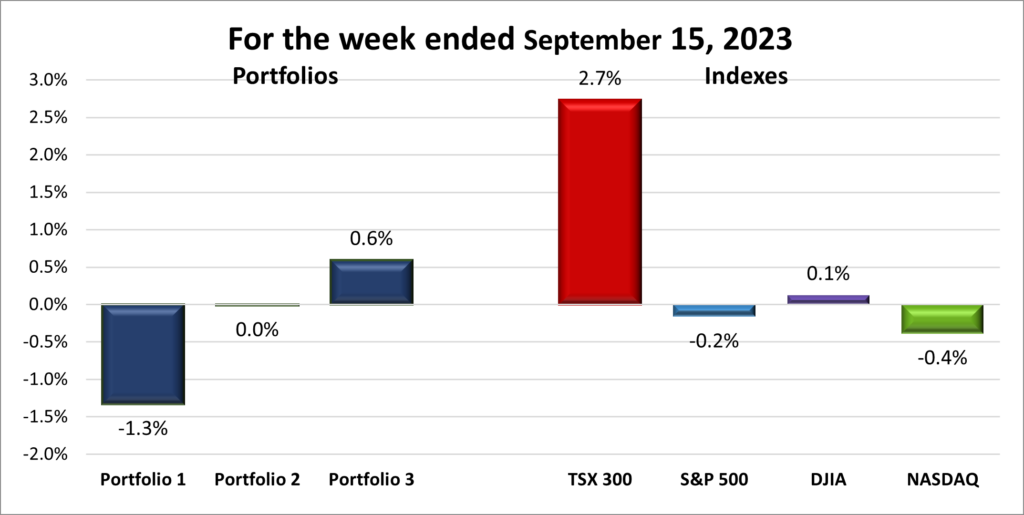
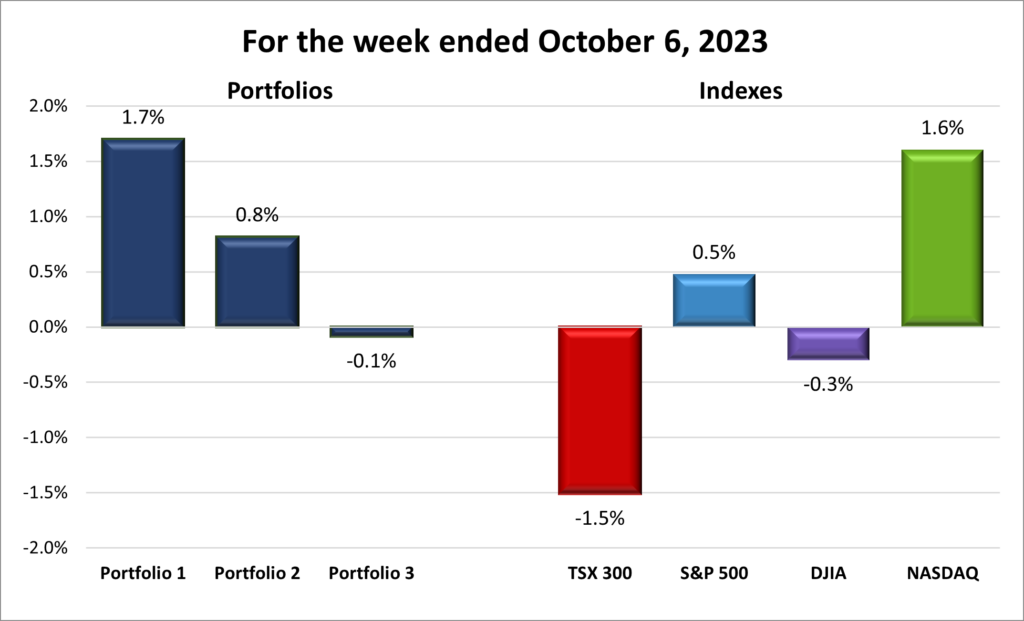
For the week, the TSX (SPTSX) lost 1.5%, the S&P 500 (SPX) added 0.5%, the DJIA (INDU) slipped 0.3% and the Nasdaq (CCMP) advanced 1.6%.

Bull market. A good week for the North American stock markets.Bearish marketThe first week of the fourth and final quarter ended, with the growth-oriented indexes, the Nasdaq and S&P, able to advance, while the value-oriented TSX and DJIA ended the week lower. The week started with the US government able to avoid a shutdown after Congress passed a funding bill that would keep the government operating like normal… for another six weeks, when they will play a game of chicken again.

However, that was not the big driver of the markets this past week.

At the start of the week, another wave of higher for longer interest rate fears drove all four indexes lower, as you can see in the graph above. This led to many investors moving into less risky government bonds as the yields kept going higher, causing the markets, represented by the stock market indexes, to fall. A good example of the higher interest rates is Canadian government bonds. They had a yield of 2.8% in late April. This past week, those same bonds now had a yield of 4.2%. Similar situations occurred in the US bond market. The increase in bond yields was largely the result of investors finally accepting that the BoC and the Fed were not bluffing about ‘higher for longer’ interest rates. Investors had previously believed that interest rate would start falling in early 2024. That no longer appears to be the case.

By mid week, bond rates had come down slightly, but a series of job reports started to lift the indexes. In the US, there were three reports culminating in a blow out report at the end of the week. Investors interpreted the reports as showing a strong and growing economy. In Canada, the jobs report came in three times as high as forecast. Again, investors interpreted the job reports as a sign of a strong economy. I suspect next week investors will start to consider the implications strong job reports have for inflation and the reaction both central banks will have to hot labour markets.

Bull market. A good week for the North American stock markets. As for the three portfolios, two of the three did better than expected. A strong performance from the Nasdaq helped lift both Portfolio 1 and 2 higher, with the more aggressive Portfolio 1 outperforming all four indexes. Portfolio 3 likely would have ended in positive territory but was held down by the split of Lithium Americas into two companies, and by the continued underperformance of the Brookfield family of companies. Hopefully, Portfolio 3 will get back in the weekly win column next week.
Weekly Portfolio & Index performance
Weekly Portfolio & Index performance for the week ended October 6, 2023.

Companies on the Radar

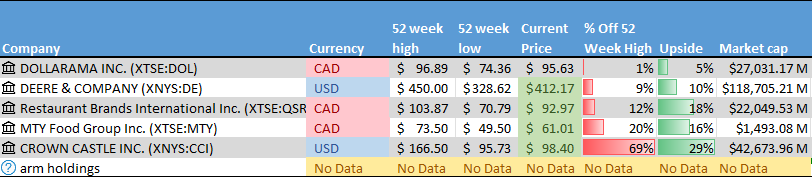
Stocks on my RadarThere were no new companies that came across my radar this past week. Currently the five companies below remain on my mirror:

  • Dollarama (TSX: DOL), a large Canadian company that operates dollar stores across Canada.
  • TFI International Inc. (TSX: TFII), a mid-sized Canadian transportation and logistics company operating across North America.
  • MTY Food Group Inc. (TSE: MTY), A small cap Canadian consumer cyclical company that operates and franchises quick service and casual dining restaurants throughout North America and internationally.
  • Deere & Company (NYSE: DE), a large American company that manufactures and sells agricultural equipment worldwide.
  • Restaurant Brands International Inc. (TSE: QSR), A large cap Canadian consumer cyclical company that operates in the North American quick serve restaurant industry. The company owns Tim Horton’s, Burger King, and Popeye’s Louisiana Kitchen among others.

The Radar Check was last updated October 6, 2023.
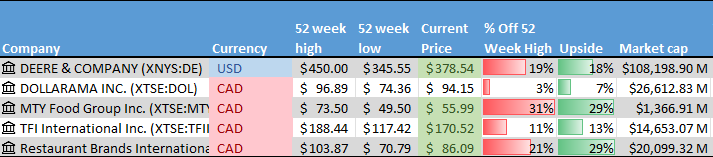
Stock on the Radar List. 1 of 2.

Stock on the Radar List. 2 of 2.


Portfolio Update

Portfolio 1

Portfolio 1 for the week ended October 6, 2023: UP Green Up Arrow, signifying a positive week

  • Tesla (NASD: TSLA) missed analysts’ expectations for the number of vehicles the company would ship in the third quarter. The company shipped 435,059 cars globally, down 7% from the number they shipped in the second quarter. The company indicated the shortfall was a result of factory downtime needed to upgrade the facilities for the latest versions of their popular Model 3 electric vehicle (EV).
    In related news, the company reduced pricing on its Model 3 and Model Y EVs by 2.7% to 4.2%.
  • Rivian (NASD: RIVN) beat expectations of 14,000 deliveries in the third quarter, delivering 15,564 EVs. That is an increase of 23% from same period in the previous year. The bad news: it is reported the company is losing US$33,000 on each sale of their US$80,000 trucks. I am not a business major, but that is not sustainable.
    Separately, Rivian announced it plans to sell US$1.5 billion of convertible bonds. They will mature in October 2030 and investors will have the option to convert to cash or shares.
  • Lattice Semiconductor (NASD: LSCC) was given another award this week. This time the company won a 2023 AutoTech Breakthrough Award in the “Automotive Infotainment Solution of the Year” category for its Lattice Drive solution stack. Lattice Drive helps accelerate infotainment application development and improves the time to market for those applications.
  • General Motors (NYSE: GM) secured a US$6 billon line of credit in the event the United Autoworkers strike lasts for an extended period.
    In other GM news, sales jumped 21% in the third quarter on strong demand for its pickup trucks and SUVs. GM sold 674,336 vehicles in the third quarter compared to 555,580 in the same period a year ago.
  • Alphabet’s Google (NASD: GOOGL) released the Pixel 8 smartphone and a new smartwatch. Both devices feature built in artificial intelligence (AI) capabilities to provide owners with more useful information. One impressive feature is the ability to block spam calls. 😊
  • The co-founder of Voyager Digital (OTCM: VYGVQ) was found to have broken derivatives regulations before the cryptocurrency lender fell into bankruptcy in 2022. Members of the Commodity Futures Trading Commission’s enforcement division said the co-founder misled customers about the safety of their assets after they investigated Voyageur’s conduct.
  • Amazon (NASD: AMZN) launched their first two of many satellites that will become their planned Kuiper internet network. Amazon plans to eventually launch more than 3,200 satellites as part of this project.

Activity

No significant activity to report this week.

Dividends

Dividends Received this week for the following companies:

Companies followed by DRIP (Dividend Re-Investment Plan) indicate additional shares were purchased with the dividend. Any cash leftover was added to the cash balance.

Canadian $

Telus Corp (TSX: T)

Cargojet Inc (TSX: CJT)

US $

No US$ dividends this past week.

Quarterly Reports

No quarterly reports this past week.

Portfolio 2

Portfolio 2 for the week ended October 6, 2023: UP Green Up Arrow, signifying a positive week

  • MongoDB (NASD: MDB) announced Jim Scharf as their new Chief technology Officer. Mr. Scharf spent the previous 17 at Amazon’s Amazon Web Services (AWS), where he was one of AWS’s first employees. He was involved in growing and scaling AWS’s capabilities as it became the top cloud computing platform globally.
    Separately, MongoDB announced the launch of two new initiatives: MongoDB Atlas for Healthcare and MongoDB Atlas for Insurance. Both services should help companies in the respective industries increase their speed of innovation with data driven applications to better serve users.
  • Microsoft (NASD: MSFT) and Amazon are in the crosshairs of British media regulator Ofcom, and now Britain’s antitrust regulator the Competition and Markets Authority (CMA). The CMA will investigate the two companies’ dominance of the British cloud computing market. Together, the two cloud platform behemoths control 60-70% of the British market. Add in Google’s roughly 10% and that does not leave much room for smaller companies.
    In other Microsoft news, the company is hoping to close their deal to acquire Activision Blizzard (NASD: ATVI) late next week, assuming it gets the green light from Britain’s anti trust regulators, the CMA. The deal received preliminary approval in September and is waiting for final approval.

Activity

No significant activity to report this week.

Dividends

Dividends Received this week for the following companies:

Companies followed by DRIP (Dividend Re-Investment Plan) indicate additional shares were purchased with the dividend. Any cash leftover was added to the cash balance.

Canadian $

Canadian Natural Resources Ltd (TSX: CNQ)

Telus Corp (TSX: T) DRIP

US $

No US$ dividends this past week.

Quarterly Reports

No quarterly reports this past week, except for per share data.

Portfolio 3

Portfolio 3 for the week ended October 6, 2023: DOWN Red Down Arrow

  • Brookfield Corporation (TSX: BN) purchased the British renewables division of Britain’s Banks Group. Brookfield will pay US$1 billion and in return will receive eleven offshore wind farms spread across Scotland and northern England, plus other solar and wind projects in development.
  • Lithium Americas (TSX: LAC) split into two separate lithium producers this week. Lithium Americas and Lithium Americas (Argentina) Corp (TSX: LAAC).
  • Cloudflare (NYSE: NET) was named as one of the ‘Top 100 Most Loved Workplaces in 2023’, coming in 55th. It was the second straight year Cloudflare was recognized as a top place to work.

Activity

No significant activity to report this week.

Dividends

Dividends Received this week for the following companies:

Companies followed by DRIP (Dividend Re-Investment Plan) indicate additional shares were purchased with the dividend. Any cash leftover was added to the cash balance.

Canadian $

Brookfield Asset Management (TSX: BAM)

Brookfield Corp (TSX: BN)

US $

No US$ dividends this past week.

Quarterly Reports

No quarterly reports this past week.

 

Weekly Update for the week ending September 29, 2023

Items that may only interest or educate me ….

Canadian Economic news, US Economic news, Oil prices surge, Amazon goes to court, US government shutdown …

But first …. Happy 25th birthday to Google

Google's 25th birthday doodle

Google was launched on September 27, 1998. Originally conceived as a search engine by founders Larry Page and Sergey Brin, it has since evolved into the dominant global search engine, handling over 9 billion searches per day, meaning that Google handles over 99,000 searches every second. Additionally, Google holds a significant presence in online advertising, leveraging its Google search page and YouTube platform. On August 19, 2004, Google went public. It has since grown into one of the world’s leading technology companies, operating under the umbrella of Alphabet Inc.

On August 10, 2015, a significant restructuring occurred, transforming Google into a subsidiary of Alphabet Inc. Under this new arrangement, Google became one of Alphabet’s subsidiaries, with each subsidiary focusing on distinct areas of business. This restructuring provided Alphabet with improved organizational clarity and flexibility. It allowed Alphabet to effectively manage its diverse portfolio of businesses, expanding beyond Google’s core internet search and advertising operations to encompass ventures such as self-driving cars and life sciences.

Canadian Economic news

Gross Domestic Product

In Statistics Canada’s July Gross Domestic Product (GDP) report, Canada’s economy showed no growth, remaining stagnant at 0%, contrary to analysts’ expectations of a 0.1% increase after a 0.2% contraction in June. The service sector saw a slight uptick at 0.1%, driven by a 2.3% surge in accommodation and food services. However, goods producers experienced a 0.3% decline, despite a 1.8% rise in the mining, quarrying, and oil and gas extraction sector.

On an annual basis, GDP grew by 1.1%, propelled by a 2.0% increase in service-producing industries. The public administration (government) sector led the way, showing a significant 3.8% expansion. In contrast, goods-producing industries saw a 1.4% decline, with construction being the best-performing sector, albeit ending flat with a 0.0% change.

Advance data for August indicates that real GDP inched up 0.1%.

GDP stands as a pivotal indicator used by the Bank of Canada (BoC). It provides a snapshot of a country’s economic well-being by reflecting its overall economic activity and growth trends.

Canadian budget update

The Canadian budget posted a C$1.2 billion deficit for the first four months of fiscal 2023/2024. The deficit was driven by a decrease in revenues and an increase in spending. Revenues were down 1.2% from the same period last year, due to a decrease in corporate income taxes and GST/HST revenues. Spending was up 2.3% from the same period last year, due to an increase in federal government program spending and debt servicing costs. Higher interest rates increased public debt charges by $3.3 billion, an increase of 29.9% from the previous year.

Canada runs a budget deficit which is financed by borrowing money. When the government borrows money, it increases the national debt, which must be paid back eventually. A large budget deficit can lead to higher interest rates and inflation.

US Economic news

Personal Consumption Expenditures

The August data for the Personal Consumption Expenditures (PCE) price index came in below expectations, showing a 0.4% increase compared to the projected 0.5%. The annual rise of 3.5% matched expectations. The core PCE, which is PCE excluding the volatile food and energy components, saw a 0.1% increase, below the anticipated 0.2%. On an annual basis, core PCE matched expectations of a 3.9% rate of growth, slightly down from July’s 4.2% pace.

These numbers indicate a slight dip in inflation, a trend welcomed by the Federal Reserve (Fed) and investors alike. The Fed closely monitors these figures, and a decrease in inflation might provide room for the Fed to refrain from raising the benchmark interest rate, which would please investors and consumers. PCE represents the total value of goods and services purchased by American consumers, while Core PCE offers a more stable measure of inflation, making it the Fed’s preferred metric for assessing economic trends.

Gross Domestic Product

The third estimate of Gross Domestic Product (GDP) for the second quarter (April through June) revealed a 2.1% annual increase, slightly lower than the first quarter’s 2.1%. This figure, despite the ongoing auto workers’ strike and the looming government shutdown, signifies the economy’s resilience and strength.

Gross Domestic Product is a crucial economic indicator used by the Fed. It represents the total monetary value of all finished goods and services produced within a country’s borders during a specific period.

For those interested in real-time updates on US GDP, check out GDPNow at the Federal Reserve Bank of Atlanta. It provides a running assessment of the US’s economic performance.

Consumer Confidence Index

The Conference Board’s Consumer Confidence Index (CCI) unexpectedly fell to 103.0 in September, a four-month low. Analysts had been expecting a reading of 105.5, down slightly from August’s 106.1. The fall was a result of higher prices, higher interest rates, a possible recession, and concerns about a government shutdown.

The CCI measures how consumers feel about the job market, the economy in general, and their financial situation. When the CCI drops, it suggests that consumers are more uncertain about the job market, the overall economic conditions, and their financial situations. A lower CCI can lead to reduced consumer spending, which could have a negative economic impact.

Consumer Sentiment Index

On Friday, the University of Michigan’s final reading on the Consumer Sentiment Index (CSI) for September came in higher than expected at 69.5, slightly above August’s 67.7.

A higher CSI typically indicates that consumers are feeling more optimistic and confident about the current and future state of the economy. It suggests that consumers are more likely to spend money on goods and services, which can have a positive impact on businesses and overall economic growth.

Oil prices surge

While the Nasdaq and S&P have fallen for most of this September, one sector that has steadily advanced is the energy sector, specifically the oil industry. Oil prices have surged nearly 30% since June to their highest levels of the year. Several factors contribute to this rise.

On the supply side, Saudi Arabia and Russia extended their production cutbacks through to the end of the year, shrinking supply. Together these two countries account for over 20% of global output. On the demand side, there is increased demand as global economic activity increases. The International Energy Agency (IEA) expects global oil demand to reach 102 million barrels per day in 2023, up from 100 million barrels per day in 2022. One reason for higher demand is China, the world’s second largest economy, is boosting its demand for oil. In addition to reduced supply and increased demand, Russia’s invasion of Ukraine has disrupted supply chains in that region. Together, these conditions have sent oil prices higher, with the possibility oil could reach US$100 per barrel this year.

Higher oil prices equate to increased profits for oil companies, and these gains are often passed on to shareholders in the form of dividends, which benefits investors. However, the surge in oil prices presents a formidable challenge for central banks worldwide, not only the BoC and the Fed. The consequences of higher oil prices can lead to an increase in inflation which could trigger the BoC and the Fed to hike their respective interest rates. Higher oil prices are also felt by consumers, who struggle with a higher cost of living, as well as businesses and governments that must raise prices to offset increased costs in delivering products and services.

Amazon goes to court

The US Federal Trade Commission (FTC) finally filed its long-awaited antitrust lawsuit against Amazon (NASD: AMZN) after a four-year investigation. In this major antitrust case, the FTC alleges that Amazon is a monopoly that abuses its market powers, such as overcharging sellers and stifling competition, which negatively impacting consumers and merchants who use the platform.

The lawsuit is one of the most significant antitrust cases in recent years, signaling a more aggressive approach by the agency. The case’s outcome has the potential to significantly affect Amazon’s business and the e-commerce industry as a whole.

The FTC accused the company of:

  • Favoring their own products and services over those of competitors on its platform. For example, the FTC alleges that Amazon gives its own products better placement on search results pages, and that it uses its Prime program to give Amazon products a shipping advantage.
  • Using its data to give its own products and services an unfair advantage over other merchants on the Amazon platform. The FTC alleges that Amazon uses data from third-party sellers to develop its own competing products.
  • Pressuring third-party sellers to raise prices or sell exclusively on Amazon. For instance, the FTC alleges that Amazon threatens to demote sellers’ products in search results or to charge them higher fees if they sell on other platforms.

The FTC has requested the court to issue a permanent injunction against Amazon, ordering the company to halt its illegal conduct. At this stage, the FTC’s focus is on proving that Amazon violated the law. If Amazon is found guilty, the FTC will propose remedies, including the possibility of breaking up the company.

Apart from the FTC’s lawsuit, Amazon faces antitrust investigations by regulators worldwide, including the European Union and the United Kingdom, with similar allegations of market power abuse.

For investors, the FTC’s lawsuit presents a low-risk situation. If the FTC loses, nothing changes for Amazon, and it can continue its operations as usual. If the FTC prevails and Amazon is broken up, shareholders would end up with shares in multiple companies, including the highly valuable Amazon Web Services.

In summary, the FTC’s lawsuit against Amazon is a significant development. Whether you are a shareholder or considering investing in Amazon, it is crucial to be aware of the lawsuit and its potential consequences. While it is too early to predict the case’s resolution, it holds the potential to profoundly impact Amazon’s business and the broader e-commerce industry.

US government shutdown

As highlighted in the September 15 post, the US government finds itself in a precarious situation, once again engaging in a high-stakes standoff with far-right Republicans in the House of Representatives.

Beyond the immediate impact of putting thousands of Americans out of work or compelling them to work without pay until a resolution is reached, a government shutdown has historically been a non-event for the stock market, other than possible increased volatility.

However, this shutdown could interfere with the collection and reporting of economic data used by the Fed to make decisions in their battle against inflation. Reports such as the GDP and PCE, vital metrics for the Fed, would face delays. Moreover, other economic reports that form the foundation of various economic analyses would also be significantly impacted.

The Fed has said their upcoming decisions are data dependent. The absence of timely and accurate data due to a government shutdown would make the already challenging task of steering the economy even more difficult.


While the US government may shutdown, the markets do not. Let’s see what happened this past week….

Weekly Market Review

Monday: The indexes started the day in negative territory but slowly recouped the losses to end the day in positive territory as investors shook off a tough few days last week. The concern of higher interest rates for longer has led to rising yields on US government bonds, causing investors to move money from riskier assets such as stocks to more secure government bonds. Next up on the list of items for investors to worry about is a possible US government shutdown at the end of this week.

In Canada, the Toronto Stock Exchange Composite Index (TSX) finally ended its losing streak thanks to a rally in energy companies. In trading, Energy and Consumer Cyclicals were the top gainers in the Canadian sectors, with the Telecommunications Services and the Utilities sectors experiencing the biggest drops.

In the US, the S&P 500 Index (S&P), the Dow Jones Industrial Average (DJIA), and the Nasdaq Composite Index (Nasdaq) all got back in the win column as investors came to grips with higher rates for longer. In the American sectors, Energy and Technology posted the biggest gains, while Telecommunications Services and Consumer Staples posted the biggest losses.

Tuesday: All four indexes ended down sharply when a Fed official suggested the resilient US economy will likely result in another interest hike. Concerns of higher for longer interest rates again weighed heavily on the markets. From an investor perspective, higher oil prices were the only positive on a dismal day.

In Canada, the TSX fell to a three-month low as investors worried about a recession caused by the higher rates. The Consumer Staples sector was the only Canadian sector to end in positive territory, while Basic Materials (miners and fertilizer manufacturers) and Utilities had the biggest declines.

In the US, the Moody’s credit rating agency warned the US government it could lose its “AAA” credit rating. The US has already lost its “AAA” rating from the two other global rating agencies. The yield on US government bonds continued to rise, reaching their highest level in a dozen years. The FTC launched a lawsuit claiming Amazon limits consumer choice in online markets. All the American sectors ended in negative territory. Healthcare and Energy dropped the least while Utilities and Consumer Cyclicals dropped the most.

Wednesday: The markets were like a yoyo today. An early morning bump, followed by a steep drop before recovering most of the losses. At the end of the day, the S&P and Nasdaq were able to limp back into the green, but the TSX and the DJIA remained in the red. Higher interest rates continue to worry investors in both countries. Oil prices reached their highest point of the year after US crude oil supplies dropped significantly. Good for oil company shareholders, not so good for the central banks’ battle with inflation.

In Canada, the TSX was weighed down by concerns of weaker demand for commodities from China as well as higher interest rates having a negative impact on demand. In trading, the Energy and Technology sectors were the only one to end in the green. Utilities and Basic Materials fell the deepest into the red.

In the US, investors went bargain hunting after yesterday’s decline, while at the same time remained wary of a government shutdown. In the trading in the American sectors, Energy and Industrials posted the biggest gains while Utilities and Consumer Staples suffered the biggest losses.

Thursday: All four indexes ended higher as investors come to terms with higher for longer interest rates. On a positive note, lower consumer spending data gave investors hope the Fed would hold off on another rate hike. Oil prices ended lower after many investors took profits after the recent surge.

In Canada, the TSX moved solidly into the green after the losses of the previous days. Leading the really were the interest sensitive Technology and Consumer cyclicals sectors. Healthcare and Energy were the only sectors to lose ground.

In the US, investors are waiting to see if the US can avoid a government shutdown. They are also anticipating tomorrow’s PCE data which is expected to come in lower or with no change from last month. It was a broad-based rally in the American sectors, led by Basic Materials and Consumer Cyclicals. Utilities was the only sector to fall back.

Friday: The last day of trading in September, and the third quarter, got off to a good start with all four indexes moving higher when the latest core PCE data came in lower than expected. However, the likelihood of a US government shutdown remained. At the end of the day only the Nasdaq remained in the positive territory. Oil prices drifted lower as many investors took profits as the month and the third quarter came to an end.

In Canada, the TSX ended lower, driven down by lower demand for commodities, caused by higher interest rates, which led to lower commodity prices. In trading on Bay Street, Technology and Consumer Cyclicals posted the biggest gains of the Canadian sectors. The Energy and Utilities sectors experienced the biggest declines.

In the US, morning optimism was caused by core PCE coming in below 4% for the first time in more than two years. Unfortunately, the good news gave way to pessimism as a government shutdown appeared more and more likely. In trading on Wall Street, Consumer Cyclicals, Utilities and Technology were the only sectors to end in positive territory, while the Energy and Industrials sectors fell the deepest into the red.


Weekly Market and Portfolio Review

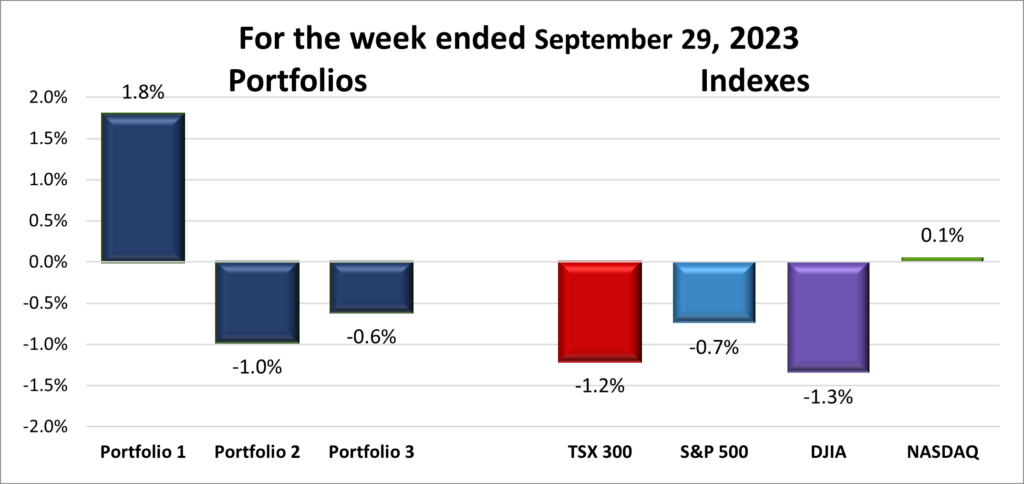
For the week, the TSX (SPTSX) dropped 1.2%, the S&P 500 (SPX) fell 0.7%, the DJIA (INDU) declined 1.3% and the Nasdaq (CCMP) rose 0.1%.

Bearish market The last week of September concluded with three out of four major indexes ending in the red, as you can see in the chart above. While it was not entirely unexpected, there were some surprises. The Nasdaq managed to eke out a slight gain for the week, albeit a modest one, after touching its lowest point in three months earlier in the week. Both the TSX and S&P also hit their lowest levels in three months, and the DJIA experienced its most significant single day drop since March.

The prevailing factor behind this week’s market downturn was the commitment from the Fed and the BoC to maintain higher interest rates for an extended period. Investors also grew apprehensive due to comments from Fed members suggesting the need for another interest rate hike to reach the 2% inflation target. Rising oil prices, which could sustain high inflation, and the looming possibility of a U.S. government shutdown further fueled investor concerns.

Additionally, as interest rates appear poised to rise and remain elevated for longer than anticipated, investors are increasingly drawn to US government bonds that are approaching a 5% yield. These bonds, backed by the US government, are often viewed as virtually risk-free. Consequently, they present a viable alternative to the volatility of stock prices.

Bearish marketBull market. A good week for the North American stock markets. In terms of the portfolios, the week didn’t turn out as bad as anticipated. I had expected all three portfolios to end the week lower, so it came as a pleasant surprise to see Portfolio 1 posting a respectable weekly gain, as illustrated below. There were no significant winners, but, crucially, no substantial losers either. Many holdings, particularly in the technology sector, demonstrated decent performances. Portfolio 2 had reasonable performances from its energy and technology companies, although several Canadian financial holdings didn’t fare well. Portfolio 3’s technology holdings performed strongly, but these gains were offset by losses in its financial companies and the Brookfield family of companies.

Given the gains in Portfolio 1 outweighing the combined losses in the other two portfolios, I decided to award the weekly portfolio performance with both a bull and bear award. Additionally, Portfolios 2 and 3 outperformed both the TSX and the DJIA (a hollow victory, I know). The week, while not as bad as expected, still didn’t achieve the ideal outcome with all three portfolios ending in positive territory. As we say goodbye to September, here’s to hoping for more ups than downs in the coming weeks for both the indexes and the portfolios.

Weekly Portfolio & Index performance
Weekly Portfolio & Index performance for the week ended September 29, 2023.

Monthly Market and Portfolio Review

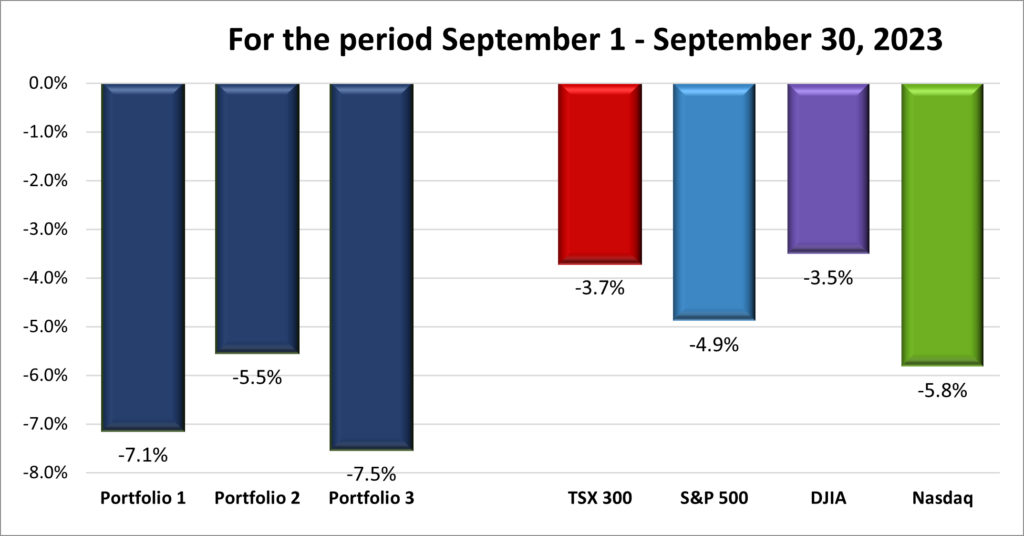
For the month, the TSX (SPTSX) fell 3.7%, the S&P 500 (SPX) sank 4.9%, the DJIA (INDU) dropped 3.5% and the Nasdaq (CCMP) plunged 5.8%.

Bearish market Historically, September stands out as one of the worst months for the North American stock markets, and this year was no exception. In fact, September is easily the frontrunner to be the worst month in 2023.

Following the tailwinds of summer, the markets encountered substantial headwinds. A major factor was the Fed’s decision at their September 20 meeting to maintain the US benchmark rate at its highest level in 22 years. Post-meeting, a few Fed members indicated that these elevated rates might remain for an extended period, which analysts refer to as “higher for longer.” The BoC echoed this higher rates for longer stance.

The impact of these heightened interest rates was felt keenly, not just by the tech-heavy Nasdaq and the S&P but also by the more traditional TSX and the DJIA. Yet, the challenges didn’t end there. Other headwinds, like surging oil prices leading to inflationary pressures, affected all four indexes. Additionally, an autoworkers strike hit the American indexes, while decreased demand for commodities weighed on the resource-centric TSX. Moreover, market volatility prompted many investors to shift from risky stocks to safer government bonds, further weighing down the markets.

The end of September brings a collective sigh of relief. One can only hope that as October unfolds and the year progresses, all four indexes will rebound, and investor confidence will return to both Canadian and American stock markets. Time will tell if this hope turns into reality. 😊

Bearish market The fate of the Portfolios often mirrors that of the broader indexes, and September exemplified this trend. Unfortunately, this month saw the portfolios experience even steeper losses than the indexes, as shown in the chart below. Portfolios 1 and 3, heavily laden with Nasdaq-based technology companies, faced significant declines. These once high-flying mega-cap technology companies, which fueled the summer rally, became a weight, pulling down not only the indexes but also the value of all three portfolios.

Portfolio 2 fared relatively better due to its more balanced nature. With a focus on dividend-paying, stable Canadian blue-chip companies, it weathered the storm better (but not much) than its counterparts.

As we move into a new month, I hope that September’s challenges were merely a temporary setback on the road to better returns in October. Here’s to a more positive trajectory in the coming month. 😊

Monthly Portfolio & Index performance
Monthly Portfolio & Index performance for September, 2023.

Companies on the Radar

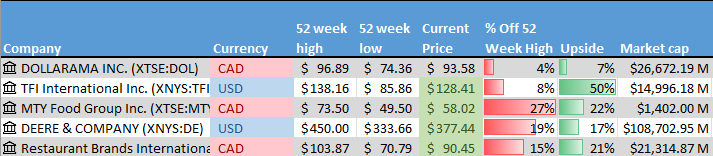
Stocks on my Radar During the past week, I decided to remove Crown Castle Inc. (NYSE: CCI) from my watchlist due to its substantial debt load, especially in the current environment of prolonged higher interest rates. If I am seeking stability, a robust dividend yield (almost 7%), and promising growth, I would definitely consider this company.

Catching my attention this past week was TFI International Inc. (TSX: TFII), a mid-sized Canadian transportation and logistics company operating across North America. This company has shown consistent growth in its sales, net income, earnings per share, and free cash flow over the past three years. Additionally, it offers a 1.1% dividend yield, making it an interesting prospect for further exploration.

I have added this company to the four holdovers from last week:

  • Dollarama (TSX: DOL), a large Canadian company that operates dollar stores across Canada.
  • MTY Food Group Inc. (TSE: MTY), A small cap Canadian consumer cyclical company that operates and franchises quick service and casual dining restaurants throughout North America and internationally.
  • Deere & Company (NYSE: DE), a large American company that manufactures and sells agricultural equipment worldwide.
  • Restaurant Brands International Inc. (TSE: QSR), A large cap Canadian consumer cyclical company that operates in the North American quick serve restaurant industry. The company owns Tim Horton’s, Burger King, and Popeye’s Louisiana Kitchen among others.

The Radar Check was last updated September 29, 2023.

Stock on the Radar List. 1 of 2.

Stock on the Radar List. 2 of 2.


Portfolio Update

Portfolio 1

Portfolio 1 for the week ended September 29, 2023: UP Green Up Arrow, signifying a positive week

  • Amazon has signed a deal to invest up to US$4 billion in startup Anthropic, an artificial intelligence (AI) startup company. Amazon will receive early access to Anthropic’s AI technology, in return Anthropic will use Amazon’s Amazon Web Services for most of their needs. The deal provides Amazon with a key partner in the race for AI market share and should help them compete far more effectively with Google (NASD: GOOGL) and Microsoft (NASD: MSFT). Apparently, the market approved and gave Amazon’s share price a nice bump, sending the S&P and Nasdaq higher on Monday.
  • Apple (NASD: AAPL) is appealing a court order requiring it to change its App Store policies after losing an anti trust claim. Apple is arguing the case was brought by a single company rather than a wide range of developers, thereby not requiring a nationwide remedy.
  • Docebo (TSX: DCBO) announced the launch of ‘Docebo for Microsoft Teams’, an app that can be integrated in the Teams collaboration tool. The app help employees learn and train on corporate software and procedures.

Activity

Received interest on TD 1-year cashable GIC.

Sold Arm Holdings (NASD: ARM) My original reason for investing in Arm was to capitalize on the temporary spike when the company went public. The share price did spike on the Initial Public Offering (IPO), but it quickly fell below the price it went public (and the price I paid) so I decided to sell my shares.

I still like Arm as a long-term investment, but I do not want to ride the price lower. I may invest in Arm in the future but for now there are other less risky options available.

Dividends

Dividends Received this week for the following companies:

Companies followed by DRIP (Dividend Re-Investment Plan) indicate additional shares were purchased with the dividend. Any cash leftover was added to the cash balance.

Canadian $

Canadian National Railway Co (TSX: CNR)

US $

NVIDIA Corp (NASD: NVDA)

Quarterly Reports

Costco Wholesale Corporation

All currency listed in millions of US dollars, except for per share data.

Selected highlights from their fourth quarter 2023 financial results on September 26, 2023

  • Revenue of $78,939 for the 17 weeks ended September 3, 2023, compared to $72,091 for the 16 weeks ended August 28, 2022. An increase of over 9%.
  • Net income of $2,160 for the 17 weeks ended September 3, 2023, compared to net income of $1,868 in the 16 weeks ended August 28, 2022.
  • Diluted earnings per ordinary share of $4.86 for the 17 weeks ended September 3, 2023, compared to earnings of $4.20 per share for the 16 weeks ended August 28, 2022.


  • Revenue of $242,290 for the 53 weeks ended September 3, 2023, compared to $226,954 for the 52 weeks ended August 28, 2022. An increase of almost 7%.
  • Net earnings of $6,292 for the 53 weeks ended September 3, 2023, compared to net earnings of $5,844 in the 52 weeks ended August 28, 2022.
  • Diluted earnings per ordinary share of $14.16 for the 53 weeks ended September 3, 2023, compared to earnings of $13.14 per share for the 52 weeks ended August 28, 2022.

Portfolio 2

Portfolio 2 for the week ended September 29, 2023: DOWN Red Down Arrow

  • MongoDB (NASD: MDB) announced four new AI powered capabilities to help developers quickly and easily automate data migrations, build data driven applications and enhance dashboard creation capabilities. In addition, MongoDB also launched MongoDB Atlas for the Edge, which makes it easier for companies to “deploy applications closer to where real-time data is generated, processed, and stored—across devices, on-premises data centers, and major cloud providers.”

Activity

No significant activity to report this week.

Dividends

Dividends Received this week for the following companies:

Companies followed by DRIP (Dividend Re-Investment Plan) indicate additional shares were purchased with the dividend. Any cash leftover was added to the cash balance.

Canadian $

Alimentation Couche-Tard Inc (TSX: ATD)

US $

No US$ dividends this past week.

Quarterly Reports

No quarterly reports this past week, except for per share data.

Portfolio 3

Portfolio 3 for the week ended September 29, 2023: DOWN Red Down Arrow

  • E-commerce king Shopify (TSX: SHOP) invested in Faire, a global wholesale marketplace platform. The deal will allow Shopify’s merchants to find wholesale buyers and enable retailers to source products from Faire’s network of brands.
  • Brookfield Asset Management (TSX: BAM) has entered into a joint venture with Axis Energy Ventures to create a renewable energy development platform in India. The venture plans to take advantage of the growth in demand for clean energy to supply energy to government, corporations, and emerging industries in the region.
  • Lithium Americas (TSX: LAC) announced they plan to complete the spin out of their Argentina project next week. The new entity will be called Lithium Argentina and trade under the ticker LAAC on the Toronto Stock Exchange and the New York Stock Exchange.
    Separately, LAC is speaking with the US Department of Energy about securing a US$1 billion loan for their Thacker Pass, Nevada mining project. When this mine goes into production it could be the largest source of lithium in North America and go a long way to replacing China as the leading supplier of lithium to North American electric battery makers.

Activity

No significant activity to report this week.

Dividends

Dividends Received this week for the following companies:

Companies followed by DRIP (Dividend Re-Investment Plan) indicate additional shares were purchased with the dividend. Any cash leftover was added to the cash balance.

Canadian $

Brookfield Renewable Corp (TSX: BEPC)

US $

No US$ dividends this past week.

Quarterly Reports

No quarterly reports this past week.
 

Weekly Update for the week ending September 22, 2023

Items that may only interest or educate me ….

Canadian Economic news, US Economic news, Global interest rates ….

Canadian Economic news

The latest of the key economic reports that the Bank of Canada (BoC) considers when deciding whether to raise or lower the interest rate.

Consumer Price Index

The August inflation data, as measured by the Consumer Price Index (CPI), revealed a significant increase in the annual inflation rate, rising to 4.0% following a 3.3% jump in July. This marks the second consecutive month of inflationary upticks and doubles the BoC’s targeted rate of 2%. On a monthly basis, inflation registered a 0.4% increase, a slight slowdown from July’s 0.6% rise. Analysts had anticipated an annual increase of 3.8% and a monthly increase of 0.3%.

The primary driver behind these increases was surging gas prices, which may not be a surprise, considering recent government-imposed taxes on gasoline. However, the cost of food and shelter continued to climb, with increases of 6.9% and 6.0%, respectively.

Core CPI, which excludes energy and food prices, also recorded a 4.1% increase, mirroring July’s figures. On a monthly basis, core CPI showed a 0.6% increase. While the core CPI’s pace remained stable from July, underlying inflation remained “well above the level consistent with our 2% target.”

These unexpectedly high headline and core inflation numbers signal that inflationary pressure is rising in Canada, potentially paving the way for the BoC to raise interest rates if prices continue to climb. With the likelihood of higher oil prices on the horizon, inflation is expected to continue to rise, given the outsized influence of fuel costs on the overall inflation rate. Higher energy prices have a cascading effect, impacting everything from production expenses to the transportation of goods.

The CPI serves as a crucial economic indicator, tracking changes in the average prices paid by consumers for a basket of goods and services over time. It is an essential tool for gauging inflation or deflation within an economy.

Minutes from last Bank of Canada meeting

The minutes from the BoC’s September 6 meeting revealed members discussed the state of the Canadian and global economies. Here is a quick breakdown:

  • US Economy: The US economy was doing better than expected, with strong growth.
  • Global Economy: However, the global economy was slowing down, mainly due to a slowdown in China, one of the world’s largest economies.

In Canada:

  • Consumer Spending: During the second quarter, Canadians were not spending as much as before.
  • Housing Market: The housing market was slowing down, despite high demand and low supply.
  • Jobs: Employment was still good but not growing as fast.
  • Inflation: The inflation rate was 3.5%, which is higher than the BoC’s target of 2%, and prices are expected to continue to climb.

So, what did the BoC decide? They chose to keep the benchmark interest rate at 5%. But here is the part that spooked the markets: they made it clear that they might raise rates again if prices keep going up. In fact, the BoC’s Governor even said that interest rates might need to go even higher to bring prices back to their target.

Given the recent report on prices (the CPI report), I would not be surprised if things get more expensive, especially energy. If the next report shows that prices are still high or going up, I expect the BoC will have to raise interest rates again.

US Economic news

US interest rate update

Last Wednesday, the Federal Reserve’s committee (FOMC) decided not to change the main interest rate, which is currently between 5.25% and 5.50%. This was what most experts anticipated. After the meeting, the Fed said they expect one more 0.25% increase in 2023 and then the rate will remain high with possible cuts in 2024.

The Fed started raising interest rates in March 2022 when rates were at 1.25%. They did this to tackle rising prices (inflation). Since then, they have raised rates a total of 10 times, with six of those increases occurring in 2023. Their main goal is to bring inflation down to 2%. However, even though the Fed has been increasing rates, consumer spending and economic growth have remained robust. Inflation currently stands at 3.7%, which is much better than the 9% rate from a year ago, but it is still far from the Fed’s 2% target. Additionally, with the price of oil on the rise, it presents a challenge for the Fed to further reduce inflation.

For consumers with loans or mortgages that have variable interest rates, be prepared for higher costs. For us investors, when the Fed raises rates, it usually leads to a drop in stock prices, making it harder to generate returns in the stock markets, especially if rates remain elevated for an extended period. Furthermore, businesses will face increased borrowing costs, which could result in slower growth for both companies and the overall economy.

The Fed’s decision to keep interest rates unchanged is a sign that they are taking a cautious approach to fighting inflation. They are aware of the risks of raising rates too quickly, such as causing a recession. However, as Fed Chair Jerome Powell said, they are committed to bringing inflation down to its 2% target. Investors and businesses will be closely watching upcoming data to try and gain insight into the Fed’s future actions.

Global interest rates

Great Britain

By a vote of 5 – 4, the Bank of England’s (BoE) Monetary Policy Committee decided to hold their benchmark interest rate at 5.25%, a fifteen year high. It was the first time since December 2021 that the BoE has not raised Britain’s key interest rate. The latest British CPI report showed that inflation had dropped to 6.7%, its lowest since February 2022, and down from July’s 6.8%.

European Union

The European Central Bank (ECB) raised interest rates 0.25% to 4%. This was the tenth consecutive increase, bringing the rate to its highest level since the start of the Euro in 1999. The ECB hinted this could be the last increase in their fight to bring down inflation.

Switzerland

The Swiss National Bank kept its rates on hold at 1.75% after the Swiss inflation rate came in at 1.6% for August, within their 0 – 2% target range. However, they left the door open for future hikes should inflation rise above the acceptable range.

Sweden

Sweden’s Riksbank raised its benchmark rate 0.25% to 4.0%, as expected. That was the eighth consecutive increase since inflation spiked to 10% in December 2022. Since then, the Riksbank has been able to bring inflation down to 4.7% in August.

Norway

Norges Bank, Norway’s central bank, raised its benchmark rate by 0.25% to 4.25%. The bank signaled there could be another increase in December to bring down inflation which is forecast to be 4.7% in 2024.

Australia

Australia’s central bank, the Reserve Bank of Australia (RBA), left the country’s benchmark rate at 4.1%, an eleven year high. They RBA decided to wait for the previous rate increases to work their way through the Australian economy to see the full effects of the rate hikes before deciding whether to raise or lower the rate.

New Zealand

The Reserve Bank of New Zealand (RBNZ) increased its benchmark rate to 5.5% in May, a fourteen year high, and has kept it their ever since. The RBNZ does not plan to raise rates again, however, they do not expect to start lowering the rate until 2025.

Japan

The Bank of Japan left its ultra low interest rate unchanged at -0.1% (yes, negative 0.1% 😊) for the short term, and 0% for the ten-year bond yield. The government also said it would continue to support the Japanese economy until inflation hit the bank’s 2% goal.


At the start of month, I said September has historically not been kind to the markets. This week did nothing to dispel that trend. Let’s see what happened ….

Weekly Market Review

Monday: The four major North American indexes were largely flat other than the Toronto Stock Exchange Composite Index (TSX). Oil prices rose on supply concerns and recovery of Chinese demand.

In Canada, the TSX was sharply lower by the end of the day as investors prepare for Tuesday’s latest CPI inflation report. Analysts are expecting the report to show inflation rose in August. Investors are concerned the data will come in higher than expected, causing the BoC to respond with an increase to the benchmark rate. In trading, Consumer Staples was the only Canadian sector to advance, while the Technology and Healthcare sectors led broad-based declines.

In the US, all three indexes – the S&P 500 Index (S&P), the Dow Jones Industrial Average (DJIA), and the Nasdaq Composite Index (Nasdaq) – were in the green but essentially flat with minimal gains. The FOMC meeting starts Tuesday. Wednesday they will announce interest rates and release projections about the economy and the likely path forward for interest rates. Until then, investors are sitting on the sidelines to avoid getting caught on the wrong side of the announcement. In trading, Energy and Technology were the best performing American sectors, while Consumer Cyclicals and Healthcare posted the biggest declines.

Tuesday: Not a good day for any of the four indexes as all ended in negative territory. Several central banks are meeting this week to update their monetary policies, with none having more impact than the Fed’s update. Oil prices touched ten-month highs during today’s trading session before retreating.

In Canada, higher than expected inflation numbers raised fears of another interest rate hike. As a result, the TSX fell sharply at the start of the trading session and stayed low for the remainder of the day, sending all Canadian sectors lower. Consumer Cyclicals and Financials declined the least, while Technology and Utilities were the biggest losers.

In the US, the three indexes dropped in morning trading before rebounding in afternoon trading, but it was not enough to recover the morning’s losses. The broad sell off was a result of investors taking money off the table ahead of the Fed’s monetary update announcement tomorrow. In trading, Telecommunications Services and Healthcare were the only American sectors to end in positive territory. Utilities and Energy declined the most.

Wednesday: All four indexes were in the green for most of the day until a last-minute dip put all of them into the red. The markets fell after the FOMC announced they were holding the US benchmark interest rate to 5.5% but suggested one more hike by the end of the year. They also forecast the rate would remain higher for longer, likely through most of 2024. Oil prices also felt the impact of the Fed’s announcement, dropping on worries of higher interest rates.

In Canada, the Fed’s hawkish stance on US interest rates unsettled the TSX. To make matters worse, the energy sector accounts for 20% of the TSX so lower oil prices also dragged the index lower. In trading on Bay Street, the Basic Materials (miners and fertilizer manufacturers) and Utilities led advancers, while Technology, Energy and Consumer Cyclicals were the only sectors to decline.

In the US of A, the markets fell after Fed Chair Jerome Powell said the Fed was focused on bringing inflation down rather than on a soft landing, where inflation falls without a significant economic downturn. In trading on Wall Street, Telecommunications Services, Consumer Staples, and Utilities were the only sectors to end higher. Leading the other sectors downward were the interest rate sensitive Technology and Consumer Cyclicals sectors.

Thursday: All four indexes plummeted today as investors spent most of the day digesting yesterday’s comments from the Fed that rates will go higher and remain their longer.

In Canada, The TSX posted its biggest drop in a year thanks to a decline in oil and commodity prices caused by the Fed’s comments. In trading, all the Canadian sectors ended solidly in the red. Consumer Staples and Healthcare were down the least. The worst performer was Technology, by far, followed by Basic Materials and Industrials.

In the US, the three indexes fell for a third straight day as the Fed’s hawkish tone from yesterday weighed heavily on investors. The good news is the US economy remains strong as the jobless claims fell to their lowest since January 2023. In trading, all sectors were down. The defensive sectors Utilities and Consumer Staples posted the smallest losses, while Consumer Cyclicals and Basic Materials dropped the most.

Friday: The indexes spent most of the day in positive territory before dropping into negative territory in afternoon trading. Investors continued to assess the hawkish comments from the Fed earlier in the week and are not liking the central message of higher interest rates for longer. The higher borrowing costs mean companies will have to use more of their money to pay off their debt rather than invest in their business. For consumers, it means they will have higher interest payments on loans and mortgages and less money to spend on other items. Oil prices inched upward on ongoing supply concerns.

In Canada, the TSX ran its losing streak to five. Already knocked around by the Fed’s hawkish comments, investors are worried the BoC will follow the Fed’s lead and raise the Canadian benchmark rate and hold it longer. In trading on Bay Street, Telecommunications Services and Utilities posted the biggest gains, while the interest sensitive sectors Technology and Consumer Cyclicals posted the biggest declines.

In the US, all three indexes posted a fourth day of losses as investors have become wary of what higher rates will do to the economy. In trading on Wall Street, Technology and Energy had the biggest gains while Consumer Cyclicals and Financials dropped the most.


Weekly Market and Portfolio Review

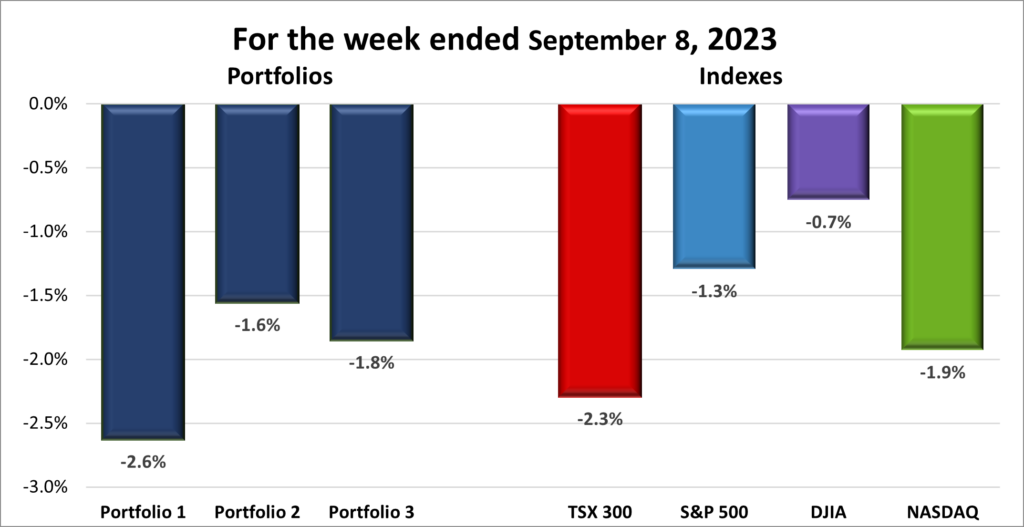
For the week, the TSX (SPTSX) plummeted 4.1%, the S&P 500 (SPX) sank 2.9%, the DJIA (INDU) fell 1.9% and the Nasdaq (CCMP) plunged 3.6%.

Bearish market “Higher for Longer.” These three words, expressed in comments by Fed Chair Jerome Powell at the end of the FOMC meeting, triggered a sharp drop in the four major North American indexes. On Thursday, as illustrated in the graph above, American indexes experienced their most significant single-day decline since March. Investors rushed out of riskier stocks and sought refuge in safer assets, including government bonds and less risky companies. Both the Nasdaq and the S&P recorded their third consecutive weekly losses, while the DJIA, consisting of larger blue-chip firms, faced more modest declines.

The impact of the Fed’s hawkish comments extended beyond the U.S., affecting the TSX, which suffered its most substantial weekly drop since September 2022.

Bearish market As bad as a week as it was for the indexes, it was worse for the three Portfolios, as you can see in the chart below. All three portfolios fell more than the TSX, the worst performing index. The overall decline in the market, especially the riskier technology companies, contributed to the decline of all three portfolios. Even the more balanced Portfolio 2 dropped more than the TSX. Sigh!

It was a dismal week all around. For the indexes and more importantly, the portfolios. I will be glad to see the end of September!

Weekly Portfolio & Index performance
Weekly Portfolio & Index performance for the week ended September 22, 2023.

Companies on the Radar

Stocks on my Radar A new company came onto my radar this past week – TFI International Inc (TSE: TFII). They are a large Canadian trucking and logistics company that operates throughout North America. Over the last three years, their sales, net income, and cash flow have all shown positive growth trends. Additionally, with the increasing trend of online shopping, the company is benefiting from the growing demand for shipping and logistics services.

I have added this company to the five from last week so there are now six companies I want to take a closer look at.

  • Dollarama (TSX: DOL), a large Canadian company that operates dollar stores across Canada.
  • Deere & Company (NYSE: DE), a large American company that manufactures and sells agricultural equipment worldwide.
  • MTY Food Group Inc. (TSE: MTY), A small cap Canadian consumer cyclical company that operates and franchises quick service and casual dining restaurants throughout North America and internationally.
  • Restaurant Brands International Inc. (TSE: QSR), A large cap Canadian consumer cyclical company that operates in the North American quick serve restaurant industry. The company owns Tim Horton’s, Burger King, and Popeye’s Louisiana Kitchen among others.
  • Crown Castle Inc. (NYSE: CCI), a large cap American company that owns and operates cell towers throughout America. The company is currently at its lowest price in five years and offers a 6+% dividend.

The Radar Check was last updated September 22, 2023.

Stock on the Radar List. 1 of 2.

Stock on the Radar List. 2 of 2.


Portfolio Update

Portfolio 1

Portfolio 1 for the week ended September 22, 2023: DOWN Red Down Arrow

  • Tesla (NASD: TSLA) had initial talks with Saudi Arabia about building an electric vehicle (EV) factory in the country. This comes after the Turkish government asked the company to build a factory in Turkey. Both countries are wooing Tesla so you can be sure the company will get a great deal. Currently, Tesla makes it vehicles in the US, China, Germany, and another factory in Mexico under construction.
    Its not an EV factory, but Tesla has proposed to the Indian government to build and sell battery storage systems in India. Tesla is seeking incentives from the government to build the factory in India but so far, the government has indicated there are no incentives on the table. It will be interesting to see who blinks first in these discussions. Tesla would like to build an EV factory in India and the government knows this. I would not be surprised to see a quid pro quo here. Tesla gets to build an EV plant in exchange they will also build a battery storage factory without any taxpayer dollars being spent.
  • Alphabet’s (NASD: GOOGL) Google has started to integrate its artificial intelligence (AI) chatbot into their products. Bard will be able to find information embedded in users’ Gmail accounts, find useful videos on YouTube, get directions from Google Maps, and extract information from files saved on Google Drive. To address privacy concerns, Google has said any data retrieved will not be used to sell targeted ads.
    In unrelated news, Alphabet’s Waymo One ride robotaxis company, fresh off gaining permission to expand service in San Francisco from the California Public Utilities Commission, announced a six-month tour throughout Los Angeles. The plan is to build up excitement in the Waymo service by providing free rides within designated neighbourhoods before Waymo officially rolls out the service across Los Angeles.
  • The United Auto Workers increased the number of strikes at General Motors (NYSE: GM) and Stellantis (NYSE: STLA) distribution centres across the US. Ford (NYSE: F) was spared the additional strikes after it provided key concessions to the union.
  • PayPal (NASD: PYPL) gets a new Chief Executive Officer next week. Alex Chriss, an executive from Intuit (NASD: INTU), will take over from current CEO Dan Schulman on September 27, with Schulman to staying on the board until May 2024.

Activity

No significant activity to report this week.

Dividends

Dividends Received this week for the following companies:

Companies followed by DRIP (Dividend Re-Investment Plan) indicate additional shares were purchased with the dividend. Any cash leftover was added to the cash balance.

Canadian $

No C$ dividends this past week.

US $

Skyworks Solutions Inc (NASD: SWKS)

Quarterly Reports

No quarterly reports this past week.
Portfolio 2

Portfolio 2 for the week ended September 22, 2023: DOWN Red Down Arrow

  • Disney (NYSE: DIS) plans to spend US$ 60 billion over the next ten years to improve their parks and cruise experiences in order to continue to grow attendance numbers.
  • MongoDB (NASD: MDB) announced their MongoDB Atlas for Manufacturing and Automotive initiative. This will allow manufacturers and automotive companies create applications that take advantage of real time data by using the latest in connected technology.

Activity

Cashed in the one-year cashable GIC in order buy ….

Bought: Telus (TSX: T) Added a few more shares of Telus. Although the share price has fallen, I am confident Telus will rebound and prosper over the next 5+ years. In effect, I see this as a buying opportunity for a low-risk company. In addition, with the share price down, the dividend yield is up to 6.36%, almost double the 3.35% yield of the GIC.

Dividends

Dividends Received this week for the following companies:

Companies followed by DRIP (Dividend Re-Investment Plan) indicate additional shares were purchased with the dividend. Any cash leftover was added to the cash balance.

Canadian $

Dream Industrial Real Estate Investment Trust (TSX: DIR.UN) DRIP

Hammond Power Solutions (TSX: HPS.A)

Supremex (TSX: SPX)

US $

No US$ dividends this past week

Quarterly Reports

No quarterly reports this past week, except for per share data.

Portfolio 3

Portfolio 3 for the week ended September 22, 2023: DOWN Red Down Arrow

  • After 20 years at Microsoft (NASD: MSFT), longtime product chief Panos Panay has left to join Amazon (NASD: AMZN) where he will oversee the Alexa and Echo devices division. While at Microsoft, he helped create the Surface brand of products as well as the release of Microsoft’s Windows 11.
    in other Microsoft news, Microsoft announced additional integration of AI with their products. Copilot, the name of their AI tool, is being integrated into their Bing search engine, Edge Browser, Office productivity suite and the latest update to the Windows 11 operating system. The company also announced a few new products in their Surface line of hardware devices.
    Britain’s anti trust regulator, the Competition and Markets Authority (CMA), indicated that Microsoft’s restructured proposal to acquire Activision Blizzard (NASD: ATVI) “substantially addresses previous concerns”. A few minor concerns remain but if/when they are resolved it clear the path for the deal to complete.

Activity

No significant activity to report this week.

Dividends

Dividends Received this week for the following companies:

Companies followed by DRIP (Dividend Re-Investment Plan) indicate additional shares were purchased with the dividend. Any cash leftover was added to the cash balance.

No dividends this past week.

Quarterly Reports

No quarterly reports this past week.
 

Weekly Update for the week ending September 15, 2023

Items that may only interest or educate me ….

US Economic news, Another thing to worry the markets, Alphabet goes to court, New Kid on the block ….

Canadian Economic news

No major Canadian economic news this past week.

US Economic news

Consumer Price Index

The Labor Department’s Consumer Price Index (CPI) Summary for August reveals that the inflation picked up the pace in August, registering a 0.6% increase compared to July’s 0.2% rise. On an annual basis, inflation accelerated to 3.7% from the 3.2% recorded in July. These increases were primarily fueled by the higher prices of oil. Meanwhile, Core CPI, which excludes the volatile food and energy components, showed a 0.3% monthly increase, slightly exceeding July’s 0.2% rise. Yearly figures for Core CPI indicate a 4.3% increase, down from the 4.7% increase reported in July.

Given that inflation remains significantly above the Federal Reserve’s (Fed) 2% target, analysts anticipate that the Fed will maintain the rate at 5.5%. However, they expect the Fed to adopt a hawkish stance on potential rate increases prior their upcoming session in November.

Consumer Sentiment Index

In its preliminary reading for September, the University of Michigan reported a Consumer Sentiment Index (CSI) reading of 67.7, marking a decline from August’s 69.5. This reading is the lowest in two and a half years but still reflects improved consumer confidence compared to a year ago when the CSI stood at 58.6. On a positive note, inflation rates have been gradually decreasing throughout 2023.

Another thing to worry the markets

A looming US government shutdown at the end of September is raising concerns in the North American stock markets. If the US Congress fails to pass a new budget by September 30 for the fiscal year starting on October 1, many government agencies could shut down or operate at reduced capacity.

The budget dispute between Democrats and Republicans revolves around spending levels, especially on social programs, with opposing views on the extent of expenditures. Contentious provisions, like those related to abortion access, add complexity to the negotiations, exacerbated by internal party politics.

The potential consequences of a government shutdown on the stock market are a cause for concern, with the extent of the impact dependent on several factors, including the shutdown’s duration and the overall economic outlook. Analysts estimate that each week of a shutdown could cut US economic growth by 0.2%.

Historically, stock markets have fared poorly during government shutdowns. The uncertainty and economic disruption they entail can lead to decreased corporate profits and declining stock prices. Moreover, a shutdown often results in reduced consumer spending, potentially causing an economic slowdown.

For us investors, we should be aware of the potential risks and prepare accordingly for potential market volatility during a government shutdown. While trying to time the market is not a good strategy, I might just sit on cash and see how this plays out. 😊

Alphabet goes to court

Recently, the Department of Justice (DOJ) opened a second antitrust case against Google (NASD: GOOGL). This case alleges that Google has unlawfully maintained a monopoly in the search engine market through exclusive agreements with device manufacturers like Apple (NASD: AAPL) and Samsung (KSE: 005930.KS), as well as internet browser makers like Mozilla, effectively making Google’s search engine the default option. The DOJ further contends that Google’s 90% share of the search market has been leveraged to impede competitors and stifle innovation. Google’s defense argues that consumers naturally choose its search engine for its quality.

The first case focuses on Google’s alleged monopoly in the digital advertising market. Here, the DOJ asserts that Google has unfairly maintained this dominance by exploiting its control over Google’s Android mobile operating system to grant its advertising products an unfair competitive advantage.

Google’s strong presence in both the search engine and digital advertising markets enables it to amass significant consumer data, giving it an edge over competitors and allowing it to charge higher advertising fees. Consequently, Google captures a substantial portion of global ad revenue displayed alongside search results.

Should Google be found in violation of antitrust regulations, it could face substantial fines and be compelled to adjust its business practices. In the most severe scenario, Google might be subject to breakup. The outcome’s implications are far-reaching, impacting Google’s business endeavors and the future of the internet. As the case unfolds, the final verdict remains uncertain.

New Kid on the block

Arm Holdings (NASD: ARM), a British-based chip design firm, this past week made its debut on the public market at a share price of US$51. Japan’s the SoftBank Group (OTCM: SFTBY), owners of Arm, made 95.5 million shares, or 10%, available to the public. This strategic move generated a substantial cash inflow of at least US$4.87 billion (calculated as 95.5 million shares multiplied by US$51 per share) to fuel Arm’s future growth even before its first share traded on the open market. This initial public offering (IPO) was the biggest and most hyped IPO since Rivian (NASD: RIVN) went public in November 2021. At the end of the first day, Arm’s share price closed up 25% at US$ 63.59, giving Arm a market value of US$ 65 billion.

Arm Holdings specializes in the design, development, and licensing of high-performance, energy-efficient semiconductors. These chips are licensed to various companies for customization and production to cater to their specific needs. Arm’s semiconductor technology played a pivotal role in the evolution of smartphones, and its applications span across mobile computing devices, artificial intelligence (AI), data centers, automobiles, and a wide array of innovative technologies. Many of the technology industry’s giants heavily rely on Arm’s chips for their innovations.


A new hot technology made its public debut this past week, a knock down court battle started and a possible US government shutdown looms just over the horizon. Let’s see what else happened this past week….

Weekly Market Review

Monday: The four indexes – the Toronto Stock Exchange Composite Index (TSX), the S&P 500 Index (S&P), the Dow Jones Industrial Average (DJIA), and the Nasdaq Composite Index (Nasdaq) – got the week off to a good start by ending the day in positive territory. Investors are gaining more confidence that the Fed will not raise the interest rate when they meet next week. As well, the latest economic data out of China suggested the world’s second largest economy has started to recover after a sluggish last few months.

In Canada, higher prices for commodities such as gold and copper trended higher, boosting the resource heavy TSX. In trading, the Healthcare and Technology sectors were the best performers while the Energy sector was the only sector to lose ground.

In the USA, Treasury Secretary Janet Yellen gave investors a reason to celebrate when she said she was “feeling very good” about the US avoiding a recession while continuing to bring inflation down. In trading, the top performing sectors were Consumer Cyclicals and Telecommunications Services. The only sector to end in the red was the Energy sector.

Tuesday: the TSX was the only one of the four major North American indexes to make it into positive territory. Investors are growing concerned that rising oil prices could lead to inflation remaining high, causing interest rates to remain high.

In Canada, energy companies were boosted by reports global oil supplies were tighter than thought. In trading, the Energy and Telecommunications Services sectors posted the biggest gains, while Healthcare and Technology suffered the biggest losses.

In the US, all three indexes sank as investors wait for Wednesday’s CPI data to see if consumer spending slowed down in August. In trading, the biggest gains in the American sectors came from the Energy and Financials sectors, while the biggest drops were the Technology and Consumer Staples sectors.

Wednesday: Another mixed day in the markets, with the indexes bouncing up and down before a late rally left only the DJIA in the red. Investors were focused on the latest US CPI report that showed inflation was up from last month. Investors still believe the Fed will hold steady on the key interest rate but are concerned what they might do at their next session. Oil continues its upward climb as supplies shrink thanks to recent production cutbacks by Saudi Arabia and Russia.

In Canada, the biggest gains were posted by the Consumer Staples and Utilities sectors, while the biggest declines were the Technology and Energy sectors.

In the US, the biggest IPO since Rivian in November 2021 takes place tomorrow when Arm Holdings starts trading. Arm makes many of the chips in mobile devices, including Apple and Samsung devices. In trading, leading the American sectors were Utilities and Consumer Cyclicals, while Energy and Basic Materials (miners and fertilizer manufacturers) suffered the biggest losses.

Thursday: It was a good day for the indexes, with all four sharply higher. Driving the markets higher were stronger than expected US retails sales, indicating the US economy remains strong, easing concerns of a recession in the US. Despite the higher retail sales, investors anticipate the Fed will keep the benchmark interest rate flat at their meeting next week. Tighter oil supplies and higher energy prices through 2023 and beyond have reignited fears of inflation and higher interest rates.

In Canada, higher commodity prices lifted the TSX to its highest close in six weeks. In trading, Basic Materials and Industrials led all Canadian sectors higher, while Telecommunications Services and Consumer Staples brought up the rear of the pack.

In the US, the Nasdaq received a nice bump from the debut of Arm Holdings. Otherwise, it was a day of broad-based gains in the American sectors with Basic Materials and Utilities leading the way. Trailing the pack were the Healthcare and Technology sectors.

Friday: The week ended with mixed results. Canada’s TSX was the only index to end in positive territory thanks to a late day rally. The American indexes started lower and drifted lower throughout the day, driven by concerns of slowing demand for semiconductors, as well as a strike by US auto workers. The lone bright spot was positive economic news from China that showed the world’s second largest economy gained strength in August. The good news out of China lifted energy and commodity prices.

In Canada, higher commodity prices lifted many resource companies to the benefit of the resource heavy TSX. In trading, Basic Materials and Financials posted the biggest daily gains of the Canadian sectors, while Consumer Cyclicals and Technology had the biggest losses.

In the US, the start of a strike in the US against General Motors (NYSE: GM), Ford (NYSE: F) and Chrysler owner Stellantis (NYSE: STLA) drove the three American indexes lower. Investors were concerned a prolonged strike could weaken the US economy while at the same time increase the price of cars, putting upward pressure on inflation. In trading, it was a day of declines across every American sector. The Telecommunications Services and Utilities had the shortest drop, while the Technology and Consumer Cyclicals sectors had the biggest declines.


Weekly Market and Portfolio Review

For the week, the TSX (SPTSX) gained 2.7%, the S&P 500 (SPX) lost 0.2%, the DJIA (INDU) rose 0.1% and the Nasdaq (CCMP) fell 0.4%.

Bull market. A good week for the North American stock markets.Bearish market It was a mixed week for the major North American stock indexes. The TSX and DJIA, which lean more toward value-oriented stocks, closed the week in positive territory, while the growth-focused S&P and Nasdaq ended in the red on Friday. Several factors contributed to the market’s movements throughout the week, including an improving Chinese economy, which drove up commodity prices, optimism regarding the US economy’s ability to avoid a recession, and a mid-week boost from the Arm IPO.

However, toward the end of the week, headwinds emerged. An autoworkers’ strike and a downturn in the semiconductor industry weighed on the three major American indexes. The semiconductor sector faced a significant setback when Taiwan Semiconductor (NYSE: TSMC) asked its suppliers to delay deliveries in anticipation of a slowdown in chip orders.

Bearish market Bull market. A good week for the North American stock markets.When reviewing the weekly results of the indexes, I expected that all three portfolios would end the week in the red, with Portfolio 2 possibly breaking even. To my surprise, it turned out to be a mixed bag, with a positive twist to the story. 😊 Portfolio 2 held steady, as predicted. As for Portfolio 1, it ended lower as anticipated. Had the week concluded on Thursday, Portfolio 1 would have posted a decent gain. Unfortunately, the portfolio’s fortunes reversed on Friday, sending it into the red. The sharp drop in the Nasdaq knocked many of the technology companies lower, dragging down the portfolio.

The positive story was Portfolio 3 which finished the week in the green. Lifting the portfolio were strong performances from the bank stocks, Lithium Americas (TSX: LAC), and the suite of Brookfield companies. While it was not an outstanding week by any measure, it did not turn out as bad as I had anticipated. I will gladly accept the win for Portfolio 3. Let us hope that the coming week brings positive results for all three portfolios.

Weekly Portfolio & Index performance
Weekly Portfolio & Index performance for the week ended September 15, 2023.

Companies on the Radar

Stocks on my Radar This past week, a new company briefly entered and quickly exited my radar list to a home in Portfolio 1. Arm Holdings, as mentioned in the “New Kid on the Block” section earlier, had a much-hyped initial public offering. Initially, I had not decided whether to purchase shares, but after it began trading, I found it reasonably priced for a highly rated chip company, prompting me to acquire a few shares. Aside from this addition, the same five holdovers from last week continue to remain on my radar:

  • Dollarama (TSX: DOL), a large Canadian company that operates dollar stores across Canada.
  • Deere & Company (NYSE: DE), a large American company that manufactures and sells agricultural equipment worldwide.
  • Restaurant Brands International Inc. (TSE: QSR), A large cap Canadian consumer cyclical company that operates in the North American quick serve restaurant industry. The company owns Tim Horton’s, Burger King, and Popeye’s Louisiana Kitchen, among others.
  • MTY Food Group Inc. (TSE: MTY), A small cap Canadian consumer cyclical company that operates and franchises quick service and casual dining restaurants throughout North America and internationally.
  • Crown Castle Inc. (NYSE: CCI), a large cap American company that owns and operates cell towers throughout America. The company is currently at its lowest price in five years and offers a 6+% dividend.

The Radar Check was last updated September 15, 2023.

Stocks on the Radar List. 1 of 2.
Stocks on the Radar List. 2 of 2.

Portfolio Update

Portfolio 1

Portfolio 1 for the week ended September 15, 2023: DOWN Red Down Arrow

  • Tesla’s (NASD: TSLA) share price got a nice bump when it was learned that the company was building a supercomputer to facilitate artificial intelligence models for self driving cars. Investors believe the supercomputer will help Tesla expand their market reach “well beyond selling vehicles at a fixed price.”
  • Apple announced their latest products this past week. Joining the Apple lineup are the new iPhone 15 and the Apple Watch Series 9. Besides more powerful processors, the company highlighted new materials, camera upgrades and new processors for improved performance to convince consumers to upgrade their smartphones. The iPhone 15 devices are the first iPhones to utilize a USB-C connector for charging, reflecting European Union regulators requirements.
  • General Motors upped its offer to autoworkers to a 20% wage increase to avoid a strike, however that was not enough to stop workers from walking out from selected factories.
  • France ordered a stop to the sales of Apple’s iPhone 12 after they found the devices emitted higher than acceptable radiation exposure. Apple maintains their phone are safe and are certified by multiple international agencies that the phones are compliant with radiation standards and no ill effects have been shown to be caused by them.

Activity

Bought: Arm Holdings: As introduced in the ‘New Kid on the Block’ section, Arm Holdings is a British-based semiconductor company that specializes in designing high-performance, energy-efficient semiconductors. These chips can be found in various industries, including information technology and automotive. Arm dominates the smartphone industry, powering approximately 95% of smartphones.

Financial information gathered from the prospectus shows Arm is a profitable company with a healthy balance sheet. This financial strength enables it to engage in ongoing research and development in chip designs, and strategic acquisitions if deemed necessary.

On the risk side, Arm’s revenues are heavily concentrated in a few key customers, such as Apple, although the number of customers is growing rapidly. Additionally, Arm faces competition from other chip design companies, which could pose a threat to its market share. Finally, Arm’s current high valuation leaves the door open for short-term price volatility.

Normally, I use a buy-and-hold strategy for a minimum of five years. However, my experience with Rivian, which initially saw its shares surge to $175 only to settle in the $20 to $25 range, has caused me to adopt a more cautious stance. If Arm’s share price spikes significantly, my plan is to sell. Subsequently, if there is a notable decline in share price, I would consider re-purchasing shares of Arm. If there is no substantial spike in the share price, I am content with holding the shares and watching them grow in value.

Dividends

Dividends Received this week for the following companies:

Companies followed by DRIP (Dividend Re-Investment Plan) indicate additional shares were purchased with the dividend. Any cash leftover was added to the cash balance.

Canadian $

Dream Industrial Real Estate Investment Trust (TSX: DIR.UN)

BSR Real Estate Investment Trust (TSX: HOM.U)

Yellow Pages Ltd (TSX: Y)

US $

Home Depot Inc (NYSE: HD)

General Motors Co (NYSE: GM)

Quarterly Reports

No quarterly reports this past week.

Portfolio 2

Portfolio 2 for the week ended September 15, 2023: FLAT Blue tilde, signifying break even or flat for the period.

  • Disney (NYSE: DIS) and Charter Communications (NASD: CHTR) came to an agreement that will see Disney’s ESPN and Disney+ services available through Charter’s subscription packages. Disney held exploratory talks with Nexstar Media Group (NASD: NXST) about Nexstar acquiring Disney’s ABC network. Separately, Media baron Byron Allen made a US$10 billion offer for ABC, including the FX and National Geographic cable channels.

Activity

No significant activity to report this week.

Dividends

Dividends Received this week for the following companies:

Companies followed by DRIP (Dividend Re-Investment Plan) indicate additional shares were purchased with the dividend. Any cash leftover was added to the cash balance.

Canadian $

iA Financial Corporation Inc (TSX: IAG)

US $

Microsoft Corp (NASD: MSFT)

Quarterly Reports

Mitek Systems, Inc.

All currency listed in thousands of US dollars.

Selected highlights from their second quarter 2023 financial results on September 14, 2023.

  • Revenue of $45,314 for the three months ended March 31, compared to $33,510 for the same period in 2022. An increase of over 35%.
  • Net income of $4,448 for the three months ended March 31, compared to net income of $435 in the same period in 2022.
  • Diluted earnings per ordinary share of $0.10 for the three months ended March 31, compared to earnings of $0.01 per share for the same period in 2022.
  • Revenue of $91,017 for the six months ended March 31, compared to $65,982 for the same period in 2021. An increase of almost 38%.
  • Net earnings of $9,178 for the six months ended March 31, compared to net earnings of $3,559 in the same period in 2022.
  • Diluted earnings per ordinary share of $0.20 for the six months ended March 31, compared to earnings of $0.08 per share for the same period in 2022.

Portfolio 3

Portfolio 3 for the week ended September 15, 2023: UP Green Up Arrow, signifying a positive week

  • Brookfield Asset management (TSX: BAM) has partnered with French money lender Societe Generale to create a private debt fund of ten billion Euros. Funding will be aimed at the power, transportation, and finance sectors, among others.
  • European Union antitrust regulators have requested feedback from Microsoft’s (NASD: MSFT) gaming rivals regarding Microsoft’s sale of its cloud streaming rights to gain approval of Britain’s antitrust regulators for Microsoft’s acquisition of Activision Blizzard (NASD: ATVI).

Activity

No significant activity to report this week.

Dividends

Dividends Received this week for the following companies:

Companies followed by DRIP (Dividend Re-Investment Plan) indicate additional shares were purchased with the dividend. Any cash leftover was added to the cash balance.

Canadian $

SmartCentres Real Estate Investment Trust (TSX: SRU.UN) DRIP

US $

Microsoft Corp (NASD: MSFT)

Quarterly Reports

No quarterly reports this past week.
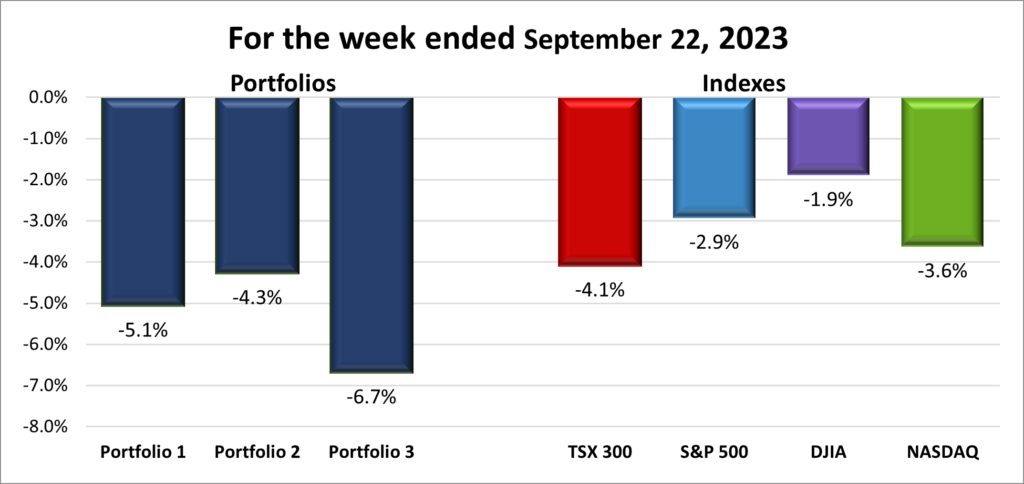
 

Weekly Update for the week ending September 8, 2023

I hope everyone enjoyed the Labour Day long weekend, as well as the short work week.

Items that may only interest or educate me ….

Canadian Economic news, US Economic news, Oil production cuts, A sales dip for consumer cyclical companies, …

Canadian Economic news

Bank of Canada pauses interest rate hikes

As widely anticipated, the Bank of Canada (BoC) maintained Canada’s benchmark interest rate at 5% following two consecutive 0.25% hikes in June and July. The central bank acknowledged an unexpected economic contraction in the second quarter, primarily influenced by various domestic and global factors. There was an unexpected slowdown in China, leading to a decline in global economic growth. However, the American economy remains strong led by strong consumer spending.

On the domestic front, several factors contributed to the economic contraction, including reduced consumer spending, wildfires across the country, a softening labour market, and the impact of higher interest rates. Despite this economic contraction, inflation inched higher, driven primarily by increased gas prices, partially attributable to additional carbon taxes imposed by the federal government. A declining economy and high inflation is not a good combination.

The BoC is particularly worried that prolonged high inflation could complicate efforts to bring it down to the bank’s 2% target. The bank has chosen to maintain the current rate for now as the previous hikes work their way through the Canadian economy. The impact of interest rate adjustments often takes up to 18 months to be felt and it has been nearly 18 months since the BoC first started increasing the rate. While the rate remains unchanged, the bank has left the door ajar for potential future rate hikes.

The BoC’s benchmark rate serves as the foundation for Canada’s borrowing costs, influencing the lending rates set by the country’s banks. When the BoC increases the benchmark rate, these banks subsequently raise the rates at which they lend money to consumers and businesses.

Labour Force Survey

Statistics Canada released the Labour Force Survey (LFS) for August 2023, showing that the Canadian economy added 40,000 jobs during the month. This figure doubled analysts’ expectations, as they had predicted an increase of only 20,000 positions.

Upon closer examination of the data, a slightly different picture emerges. Canada’s population grew by 100,000 individuals, resulting in a 0.1% drop in the employment rate, which now stands at 61.9%. To merely keep up with this population growth, Canada would need to generate 50,000 new jobs.

Despite job gains in each of the previous three months, the unemployment rate remained unchanged at 5.5%. Analysts had expected a fourth consecutive increase that would have pushed it to 5.6%.

Finally, average hourly wages for August recorded a 4.9% increase, slightly lower than the 5.0% gain seen in July.

The LFS is a monthly survey that collects information on the labour market, employment, unemployment, and various other labour-related data in Canada. It plays a key role in helping policymakers and analysts understand the dynamics of the Canadian labour market, identify trends, and make data-driven decisions.

US Economic news

Last week, several reports that the Federal Reserve (Fed) relies on for its decision-making process were released. This week, there were no headline economic reports closely followed by the Fed, nor myself. However, one piece of news that would have undoubtedly caught the Fed’s attention is the increase in energy prices, which could potentially result in rising inflation, as discussed in the following report.

Oil production cuts

Saudi Arabia and Russia have announced an extension of their oil production cutbacks for an additional three months, bringing the total duration to six months. In this arrangement, Saudi Arabia will continue with its 1 million barrels per day production cut until December, keeping production at a historically low 9 million barrels per day (bpd). Simultaneously, Russia will maintain its export cutbacks by 300,000 bpd. The primary goal behind these measures is to bolster oil prices, a strategic move intended to benefit the economies of both nations.

This extension carries significant implications. For consumers, it will likely mean rising gasoline prices, as tighter oil supplies generally result in increased prices at the pump. Additionally, businesses dependent on transportation could face higher fuel costs, potentially affecting their bottom line. Furthermore, home and business heating expenses could rise, impacting household budgets. Moreover, products and services linked to oil, such as food and plastics, might see price hikes, adding to increased consumer expenses.

From an investor’s perspective, the cutbacks will have a mixed impact. On one hand, higher oil prices can boost the profits of oil producers like Canadian Natural Resources (TSX: CNQ) and Chevron (NYSE: CVX), as they command more money for their oil. On the other hand, industries sensitive to energy costs, such as airlines and transportation firms, may face increased expenditures on fuel, impacting their profitability. Additionally, there is the prospect of an adverse impact on stock markets in general. Rising oil prices can trigger inflation, increasing operational costs for businesses and potentially curbing consumer spending. This, in turn, can hamper economic growth and affect stock markets. Just as important, the BoC and the Fed are in the midst of trying to bring inflation back to their respective 2% target. After the upheaval caused by higher interest rates, the last thing we need is for inflation to start to rise.

Overall, the decision by Saudi Arabia and Russia to extend the oil production cutbacks is a significant development that could have a major impact on the global economy and the stock markets.

A sales dip for consumer cyclical companies?

Consumer cyclicals companies are concerned that their sales could take a hit come October when US student debt payments resume. Many individuals, during the debt repayment freeze, redirected their funds that were initially designated for debt payments towards spending on various goods and services, from clothing and dining out to travel.

Now, as they must resume student debt payments, this extra spending cash will return to servicing their debts. The exact amount of these monthly debt payments and the number of individuals affected remain unknown, but this shift is expected to withdraw a substantial sum from the economy, potentially impacting the companies that benefited from the debt repayment freeze.

It was short week in the North American markets but that does not mean nothing happened. Let’s see what moved the markets this past week….


Weekly Market Review

Monday: The Canadian and American exchanges were closed for the Labour Day holiday.

Tuesday: All four indexes – the Toronto Stock Exchange Composite Index (TSX), the S&P 500 Index (S&P), the Dow Jones Industrial Average (DJIA), and the Nasdaq Composite Index (Nasdaq) – ended lower as concerns about the global economy have investors looking for less risky opportunities. Oil prices were a lone bright spot, ending higher after Saudi Arabia and Russia announced they would extend their production cuts another three months through the end of 2023.

In Canada, investors await tomorrow’s BoC’s decision on whether they will hold or raise the benchmark interest rate. The Healthcare, Energy and Consumer Staples were the only Canadian sectors to end in the green. Basic Materials (miners and fertilizer manufacturers) and Telecommunications Services dropped the most.

In the US, investors are still digesting last week’s array of economic data. They are pretty confident the Fed will hold off on an increase this month but are looking for clues to the next meeting of the Fed. The Technology and Energy sectors were the only American sectors to register a gain, while Basic Materials and Industrials had the biggest declines.

Wednesday: The four indexes stretched their losing streaks another day as investors become cautious after reports of a slowing European economy which would lead to lower demand.

In Canada, despite the BoC leaving the benchmark interest rate at 5.0%, the TSX still ended lower on concerns the rate could remain at that level for longer. It was a day where every Canadian sector ended in the red. Consumer Staples and Healthcare dropped the least, while Utilities and Industrials had the biggest plunges.

In the US, investors are concerned about lingering inflation after data showed stronger than expected growth in the services sector hitting a six-month high. Investors are worried interest rates could remain elevated much longer than originally thought, and possibly move higher at the Fed’s November meeting. In trading, the defensive sector Utilities was the only sector to advance, barely making it into the green. On the losing side, the interest sensitive Technology and Consumer Cyclicals had the worst days.

Thursday: The DJIA was the only index to finish the day in the green as the September slump continues. Investors are worried interest rates will remain high as the latest US economic data shows the US economy continues to fire on all cylinders. After nearly two weeks of pushing higher, oil prices fell on data suggesting weaker demand was on the horizon.

In Canada, BoC Governor Tiff Macklem said interest rates may not yet be high enough to bring inflation down to the 2% target, sending the TSX lower. In trading, Utilities and Healthcare were the only Canadian sectors to post gains, while Consumer Cyclical and Consumer Staples declined the most.

In the US, Apple (NASD: AAPL) dragged down the Nasdaq and S&P after China banned the use of iPhones by government officials. As Apple’s share price tumbled, it started to drag down some of the other mega cap technology stock prices. In trading, the defensive sectors Utilities, Healthcare and Consumer Staples were the only American sectors to end higher. The Basic Materials and Technology sectors dropped the most.

Friday: A mixed day in the markets that saw the TSX end lower while the American indexes ended slightly higher. The good news was the Fed hinted it could hold off on an interest rate hike in September, overriding concerns that the strong US economy will lead to interest rates remaining higher for some time. Outside of the US, investors are concerned about a slowdown in the global economy. Oil rebounded from Thursday’s pullback on concerns of tighter supplies.

In Canada, the TSX was weighed down by better-than-expected employment data which caused investors to worry about higher interest rates. In trading on Bay Street, the Healthcare and Consumer Staples sectors led all Canadian sectors, while the Technology and Industrials sectors suffered the biggest drops.

On Wall Street, investors were worried interest rates will stick around longer than anticipated. In trading, the Utilities and Energy sectors led the advance, while the Industrials and Telecommunications Services declined the most.


Weekly Market and Portfolio Review

For the week, the TSX (SPTSX) added 3.1%, the S&P 500 (SPX) gained 3.5%, the DJIA (INDU) grew 3.2% and the Nasdaq (CCMP) rose 3.4%.

Bearish market If you thought the end of last week would generate some upward momentum for the North American stock markets, you would have been wrong. As you can see in the graph above, the TSX fell the most among the four major indexes. While the Bank of Canada (BoC) opted not to raise the Canadian benchmark interest rate, concerns persisted that the current elevated rates might remain in place for an extended duration. The following day, the BoC Governor hinted that the rate might need to climb further if they were to reach their 2% inflation target.

Across the border in the US, market performance did not fare much better. The robust US economy prompted worries among investors that inflation could linger, thereby extending the period of high interest rates. The S&P and Nasdaq experienced further declines when China implemented a ban on Apple devices for government employees. This move raised concerns, not only due to the ban itself but also because of the potential implications for Apple’s sales and operations in China. China is the company’s largest international market and a crucial production hub. Apple is the largest component of both the Nasdaq and the S&P, which explains its significant impact on these indexes. It is not a member of the DJIA, which probably accounts for why the DJIA had a better week than the other two. Fortunately, on Friday, all three snapped their respective losing streaks.

Bearish marketThe three Portfolios had another challenging week, as depicted in the chart below. The overall market downturn had a significant impact on all three portfolios. However, Portfolio 1 suffered the biggest losses due to its holdings in Apple shares. While Portfolios 2 and 3 do not have any Apple shares, they were not immune to the broader sell-off in technology companies. This sell-off was triggered by Apple’s disappointing news, as outlined above. As a result, all three portfolios had a miserable week.

Weekly Portfolio & Index performance
Weekly Portfolio & Index performance for the week ended September 8, 2023.

Companies on the Radar

Stocks on my Radar No new companies came onto my radar this past week. However, I dropped Walmart (NYSE: WMT) from the list because I’m looking for a bit more growth potential at this time. Otherwise, five holdovers from last week remain on my radar:

  • Dollarama (TSX: DOL), a large Canadian company that operates dollar stores across Canada.
  • Deere & Company (NYSE: DE), a large American company that manufactures and sells agricultural equipment worldwide.
  • Restaurant Brands International Inc. (TSE: QSR): A large cap Canadian consumer cyclical company that operates in the North American quick serve restaurant industry. The company owns Tim Horton’s, Burger King, and Popeye’s Louisiana Kitchen among others.
  • MTY Food Group Inc. (TSE: MTY): A small cap Canadian consumer cyclical company that operates and franchises quick service and casual dining restaurants throughout North America and internationally.
  • Crown Castle Inc. (NYSE: CCI), a large cap American company that owns and operates cell towers throughout America. The company is currently at its lowest price in five years and offers a 6+% dividend.

The Radar Check was last updated September 8, 2023.

A screenshot of a computer screen Description automatically generated

A screenshot of a computer Description automatically generated


Portfolio Update

Portfolio 1

Portfolio 1 for the week ended September 8, 2023: DOWN Red Down Arrow

  • Apple signed a deal with British chip designer and manufacturer Arm Holdings that will supply chip technology to Apple to at least 2040. Many of Apple’s products are based on or utilize Arm based technologies. This deal will secure access to Arm products for a long time. Arm develops chips for phones and tablets and licenses the technology to semiconductor manufacturers.
    Separately, China banned the use of Apple iPhones, and other foreign devices, from government workplaces. It will be interesting to see how this plays out since almost all of Apple’s devices are made China. As well, China accounts for about 20% of Apple’s revenue.
  • Tesla (NASD: TSLA) has delayed start of production at their new Mexican plant. It was originally scheduled to start production in 2025 but has been pushed back to 2026 – 2027.
  • It appears General Motors (NYSE: GM) and its unions are at loggerheads over their ongoing contract negotiations. GM offered a 10% wage increase, plus two additional 3% annual lump sum payments over four years. The union is asking for a 46% wage increase.
  • Nvidia (NASD: NVDA) announced they will partner with India’s Tata Group to build an artificial intelligence (AI) supercomputer. Nvidia plans to use its latest GH200 Grace Hopper Superchip, as well as an AI cloud. Tata plans to use the infrastructure and capabilities to boost the company’s AI guided transformation.

Activity

Sold ZIM Integrated Shipping Services Ltd. (NYSE: ZIM) I invested in Zim when supply chains were congested, and shipping companies were charging a premium for their services. ZIM also offered dividends based on their quarterly net income, which were quite substantial due to their excellent earnings.

Fast forward two years, and many of the supply chain issues have been resolved. However, the marine shipping industry has entered a downturn with no signs of improvement on the horizon. The share price has plummeted by nearly 80%, and the company is no longer generating net income, resulting in the suspension of dividends.

This is another instance where waiting too long to sell the shares proved unfortunate. 😞 Fortunately, the dividends collected over the last two years mitigate some of the loss, resulting in a net loss of 34%. Not good, but better than an 80% loss.

Dividends

Dividends Received this week for the following companies:

Companies followed by DRIP (Dividend Re-Investment Plan) indicate additional shares were purchased with the dividend. Any cash leftover was added to the cash balance.

Canadian $

Nuvei Corp (TSX: NVEI)

US $

Costco (NYSE: COST)

Quarterly Reports

No quarterly reports this past week.
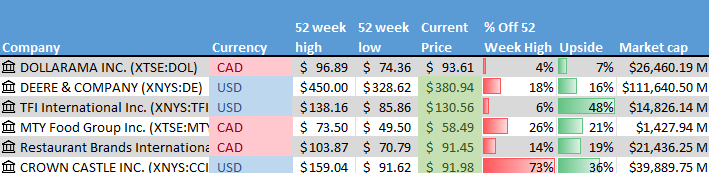
Portfolio 2

Portfolio 2 for the week ended September 8, 2023: DOWN Red Down Arrow

  • Airbnb (NASD: ABNB) was added to the S&P, forcing any funds that track the S&P to purchase shares.
  • Brookfield Infrastructure (TSX: BPI.UN, BIPC) announced their acquisition of Triton Internationals (NYSE: TRTN) was approved by Triton’s shareholders. Triton sells and leases intermodal containers to shipping lines and freight forwarding companies. The deal is expected to close in the next few months.
  • Guardant Health (NASD: GH) announced that the Geisinger Health Plan now provides coverage for the Guardant Reveal blood test that detects circulating tumor DNA in blood after cancer treatment, including surgery. It is the first blood-only liquid biopsy test commercially available for minimal residual disease testing. These tests help oncologists identify cancer patients with residual or recurring disease who may benefit most from additional therapy or surveillance.
    Separately, the Japanese Ministry of Health, Labour, and Welfare approved Guardant’s Guardant360(R) CDx liquid biopsy test for use as a companion diagnostic to select patients with inoperable advanced or recurrent non-small cell lung cancer.

Activity

No significant activity to report this week.

Dividends

Dividends Received this week for the following companies:

Companies followed by DRIP (Dividend Re-Investment Plan) indicate additional shares were purchased with the dividend. Any cash leftover was added to the cash balance.

No dividends this past week.

Quarterly Reports

Mitek Systems, Inc.

All currency listed in thousands of US dollars.

Selected highlights from their first quarter 2023 financial results on September 5, 2023.

  • Revenue of $45,703 for the three months ended December 31, compared to $32,473 for the same period in 2022. An increase of almost 41%.
  • Net income of $4,730 for the three months ended December 31, compared to net income of $3,124 in the same period in 2022.
  • Diluted earnings per ordinary share of $0.10 for the three months ended December 31, compared to earnings of $0.07 per share for the same period in 2022.

Alimentation Couche-Tard Inc.

All currency listed in millions of US dollars.

Selected highlights from their first quarter 2024 financial results on September 6, 2023

  • Revenue of $15,623.2 for the twelve weeks ended July 23, compared to $18,657.7 for the twelve weeks ended July 17, 2022. A decrease of over 16%.
  • Net income of $834.1 for the twelve weeks ended July 23, compared to net income of $872.4 for the twelve weeks ended July 17, 2022.
  • Diluted earnings per ordinary share of $0.86 for the twelve weeks ended July 23, compared to earnings of $0.85 per share for the twelve weeks ended July 17, 2022.


Portfolio 3

Portfolio 3 for the week ended September 8, 2023: DOWN Red Down Arrow

  • Microsoft’s (NASD: MSFT) bundling of software is being looked at by the US Federal Trade Commission as well as regulators in the European Union for anticompetitive practises. Zoom Video Communications (NASD: ZM) has accused Microsoft of giving preference to its own products at the expense of competitors.

Activity

No significant activity to report this week.

Dividends

Dividends Received this week for the following companies:

Companies followed by DRIP (Dividend Re-Investment Plan) indicate additional shares were purchased with the dividend. Any cash leftover was added to the cash balance.

No dividends this past week.

Quarterly Reports

Enghouse Systems Limited

All currency listed in thousands of Canadian dollars.

Selected highlights from their third quarter 2023 financial results on September 7, 2023

  • Revenue of $110,997 for the three months ended July 31, compared to $102,111 for the same period in 2022. An increase of almost 9%.
  • Net income of $17,567 for the three months ended July 31, compared to net income of $18,081 in the same period in 2022.
  • Diluted earnings per ordinary share of $0.32 for the three months ended July 31, compared to earnings of $0.33 per share for the same period in 2022.


  • Revenue of $330,893 for the nine months ended July 31, compared to $319,525 for the same period in 2021. An increase of over 3%.
  • Net earnings of $47,126 for the nine months ended July 31, compared to net earnings of $57,549 in the same period in 2022.
  • Diluted earnings per ordinary share of $0.85 for the nine months ended July 31, compared to earnings of $1.03 per share for the same period in 2022.


Weekly Update for the week ending September 1, 2023

Items that may only interest or educate me ….

Entering a volatile month for trading, Canadian Economic news, US Economic news …

First, lets start by wishing everyone a happy, relaxing Labour Day long weekend!

September Can Be a Volatile Month for Investors

This past week, investors received several key economic reports from both Canada and the United States as they prepare for a potentially volatile September. Historically, the S&P 500 (S&P) has lost an average of 0.6% in September since 1945, making it the worst performing month of the year for that index. The Nasdaq Composite Index (Nasdaq) has lost an average of 0.7% in September since 1971, and the Dow Jones Industrial Average (DJIA) has lost an average of 0.4% in September since 1928. On the other hand, the TSX has risen an average of 0.2% in September since 1960.

Before piling into TSX stocks, it is important to note that past performance is not a guarantee of future results. The markets could perform differently in September 2023 than they have in previous years. However, the historical data does suggest that investors should be prepared for some volatility in September.

There are a few factors that could contribute to volatility in September. One factor is the return of the big financial institutions to the market after the summer months. These institutions often sell stocks in September to raise cash so their balance sheets look good at the end of the third quarter (July through September). This selling pressure can lead to lower prices in the markets.

On top of historical monthly averages, the past few weeks have been volatile. All the indexes were up considerably at the end of July before retreating in August. Investors reacted to a weaker than expected Chinese economy, a surge in government bond yields that provide a less risky, yet viable return, and concerns of higher interest rates that will likely stick around longer than originally forecast.

Finally, the Bank of Canada (BoC) and the US Federal Reserve (Fed) are both meeting in September. These meetings will be closely watched by investors, as they will provide updates on their respective monetary policies (interest rates). Any changes in monetary policy could have a significant impact on the markets. The data this past week could go a long way to influencing their actions. Let us look at some of that information.

Canadian Economic news

The latest measure of the Canadian economy, as measured by the Gross Domestic Product (GDP) report, showed the Canadian economy unexpectedly declined in the second quarter, down 0.2% on a yearly basis. GDP is a measure of the total value of goods and services produced in a country in a given period. It is a key measure of economic health, and a decline in GDP can be a sign of a recession. The BoC had forecast growth of 1.5%, while analysts had expected a growth rate of 1.2%. Statistics Canada also revised its number for the first quarter, showing the economy grew by 2.6%, rather than the 3.1% it initially reported.

The slowdown was attributed to a drop 2.1% in housing investment caused by the higher borrowing costs brought on by the higher interest rates. Slower buildup of inventories by businesses, down by 0.5%, as well as slower growth in exports, down 0.4%, all contributed to the decline in GDP. The only components that contributed to growth were increased business investment in engineering structures and higher government spending (your tax dollars at work).

For the month of June, the Canadian economy, declined by 0.2%, after gaining 0.2% in May. On an annual basis, GDP grew by 1.1%. Statistics Canada initial estimate for July shows GDP was essentially flat.

With this sharp slowdown in economic growth, this could lead the BoC to pause its interest rate hikes. Many analysts are expecting the BoC to do just that, hold the benchmark rate at 5.0% at their upcoming meeting on September 6. Analysts are also predicting the rate will remain at that level until April 2024.

US Economic news

Personal Consumption Expenditures

The latest Personal Consumption Expenditures (PCE) price index for July revealed a 0.2% increase on a monthly basis, mirroring a similar 0.2% upturn observed in June. While the price of goods fell 0.3%, it was offset by a 0.4% rise in service costs. On an annual basis, the PCE price index advanced 3.3%, with a 0.5% dip in goods prices that was overcome by a 5.2% increase in services prices.

The Fed preferred measure of inflation, core PCE, PCE less the volatile food and energy components, gained 0.2% in July, following a 0.2% gain in June. On an annual basis, core PCE rose 4.2%, slightly higher than June’s 4.1%.

Gross Domestic Product

The Department of Commerce revised its second estimate of second-quarter GDP to an increase of 2.1% in the second quarter, on an annual basis. This growth rate is below the governments initial estimates and below analysts 2.4% estimate but slightly higher than the 2.0% increase in the first quarter.

The main drivers of growth in the second quarter were consumer spending and business investment. Consumer spending rose by 2.7%, while business investment rose by 2.3%. However, exports fell by 1.2%, and imports rose by 1.7%, which weighed on growth.

Jobs

The Labor Department’s Job Openings and Labor Turnover Survey (JOLTS) report for July showed the number of job openings for dropped to 8.8 million. That was well down from June’s 9.16 million openings and below analysts’ expectations of 9.5 million openings. The number of people quitting their jobs was also down to 2.3%, the lowest since January 2021. A cooling job market will be viewed as a good sign by the Fed who want to see more softness in the labour market as a sign inflation is dropping.

The Labor Department’s Employment Situation Summary for August showed nonfarm payrolls rose by 187,000 jobs, compared to an increase of 157,000 jobs reported in July, and beating expectations of a gain of 170,000 new jobs. The unemployment rate came in higher than expected at 3.8%, surpassing expectations it would remain unchanged at August’s 3.5%. The report also showed that average hourly earnings rose 0.2% in August, compared with an increase of 0.4% in July, and has grown 4.3% on an annual basis.

The August ADP National Employment report revealed US private employers added 177,000 jobs in August, compared to an increase of 371,000 jobs in July. As well, annual pay was up 5.9% on a yearly basis, the slowest since October 2021. These numbers suggest the job market is softening and wage increases are slowing.

Fitting all these pieces together, these reports indicate that the economy is cooling without breaking. The economy remains strong and continues to create employment opportunities. Nevertheless, the rate of job creation has decelerated somewhat. Additionally, the unemployment rate remains at a low level, and wage growth, while still positive, is slowing down. These trends are favorable for the Fed as they continue their efforts to combat inflation and bring it back towards their 2% target through interest rate adjustments.

On the whole, the economic data presents a mixed picture. Inflation remains elevated, but there has been a deceleration in GDP growth, and the job market is showing signs of softening. These factors seem to align with the Fed’s pragmatic approach to gradually raise interest rates based on the data. With this in mind, hopefully the data will be enough to convince them to maintain the benchmark rate at 5.5%.

Consumer Confidence Index

The Conference Board reported the Consumer Confidence Index (CCI) fell more than expected to 106.1 in August, compared with 114 in July. Analysts had expected a reading of 116 for August. The lower-than-expected reading indicates consumers are becoming more pessimistic about the economy. This is likely due to softening employment conditions, and rising prices, especially for food and gas. When consumers are pessimistic, they are less likely to spend money, which can slow down economic growth. Exactly what the Fed wants!


As you read, lots of economic data this past week. Let’s see how the markets reacted to this information overload ….

Weekly Market Review

Monday: The last week of summer got off to a good start after all four major North American indexes posted gains. In what is normally a quiet week, several economic reports from Canada and the US are due later this week. These reports should provide clues as to whether the BoC and the Fed will raise rates at their respective upcoming meetings.
To further stimulate their economy, China announced they cut in half the stamp duty on stock trading. Stamp duty on stock trading is a tax that is applied to the purchase of shares or securities in certain countries. It is usually paid by the buyer and is intended to generate revenue for the government. Oil prices were flat as concerns of higher interest rates were offset by concerns about disruption to supplies from storm season in the Caribbean.

In Canada, the Toronto Stock Exchange Composite Index (TSX) rose on higher commodity and oil prices. In trading, all sectors ended higher, led by Telecommunications Services and Basic Materials (miners and fertilizer manufacturers) posted the biggest gains. Bringing up the rear were Consumer Staples and Industrials.

In the US of A, higher oil prices and investor optimism that upcoming reports will be favourable to the Fed maintaining the current interest rate lifted the S&P, the DJIA, and the Nasdaq. In trading, all American sectors ended in the green, led by Telecommunications Services and Consumer Cyclicals. Trailing the pack were Utilities and Healthcare.

Tuesday: Another good day in the markets as all four indexes finished in the green thanks to US economic data that showed signs the US labour market cooled in August. The economic data caused investors to gain confidence the Fed will maintain the current 5.5% benchmark interest rate.

In Canada, the momentum caused by the news out of the US lifted the Canadian markets to their best finish in a few weeks. It was a day of broad-based gain in trading, with the interest sensitive Technology and Consumer Cyclicals sector leading all Canadian sectors. Utilities and Healthcare once again trailed the other sectors.

In the US, growing optimism of a pause in rate hikes caused investors to re-enter the stock markets, pushing all three indexes higher. The Nasdaq even had its best day since June thanks to gains in the big technology companies. Once again, all sectors ended higher, led by Telecommunications Services and Technology, with the defensive sectors Utilities and Consumer Staples posting the smallest gains.

Wednesday: Each of the indexes posted there fourth consecutive positive day. The catalyst this time was the latest US GDP report showing the US economy grew slower than forecast and the US labour market continued to weaken. Both are good reasons for the Fed to maintain the current interest rate.

In Canada, The TSX was lifted by the good news out of the US. It was a mixed day in trading on Bay Street, the Technology and Healthcare sectors were the best of the five sectors that posted gains, while the Utilities and Consumer Cyclicals sector fell the farthest of the five sectors that posted losses.

In the US, a slowing economy and softer labour market reinforced investor’s expectations the Fed will not raise the interest rate at their next meeting. In trading on Wall Street, technology and Industrials posted the biggest gains, while Utilities and Healthcare were the only American sectors to post losses.

Thursday: A mixed day for the indexes, as they moved between small gains and losses throughout the day with the Nasdaq the only index able to finish the day in the green.

In Canada, the last of Canada’s big six banks, Canadian Imperial Bank of Commerce (TSX: CM) missed analysts’ estimates for the second quarter, sending the heavily weighted Financials sector lower and dragging the TSX down with it. In trading in the Canadian sectors, the Technology, Healthcare and Consumer Cyclicals were the only sectors to advance. On the losing side, Utilities and Consumer Staples suffered the biggest losses.

In the US, the latest US inflation data, the PCE, came in as analysts expected, further raising expectations the Fed will pause its interest rate hikes. In trading in the American sectors, the interest sensitive Technology and Consumer Cyclicals were the only sectors to advance. Among the sectors that fell, Healthcare and Utilities had the largest declines.

Friday: Overall a good day in the markets with the Nasdaq ending barely below the bar while the other three indexes ended solidly in positive territory. The big news was the US job market continued to cool off. Oil prices hit their highest point in over six months as supplies grew tighter. American crude oil inventories have declined in five of the last six weeks, according to the US Energy Information Administration.

In Canada, the Canadian GDP shrank, providing hope for investors that the BoC will leave the Canadian benchmark rate alone at next week’s meeting. It was a day of broad-based gains in the Canadian sectors, led by Energy and Industrials. Telecommunications Services was the only sector to end in the red.

In the USA, after this week’s economic news suggested the Fed was winning its battle with inflation, investors are expecting the Fed to hold off on a rate hike at their meeting at the end of September. The Energy and Basic Materials sectors led the winners in the American sectors, while Consumer Staples and Telecommunications Services experienced the biggest losses.


Weekly Market and Portfolio Review

For the week, the TSX (SPTSX) jumped 3.6%, the S&P 500 (SPX) gained 2.5%, the DJIA (INDU) rose 1.4% and the Nasdaq (CCMP) advanced 3.2%.

Bull market. A good week for the North American stock markets. All four major indexes had a strong week, with the TSX leading the way thanks to the Friday rally. This boost was fueled by favorable economic reports from both Canada and the US.

In the US, despite a mid-week dip, the American indexes performed well overall. They all received a lift from the US GDP report, which indicated that the American economy remained robust, even though employment numbers softened slightly.

The Nasdaq and S&P indexes particularly benefited from a strong week for growth-oriented companies. Meanwhile, the DJIA trailed the other indexes but still managed to have its best week since July. Investors welcomed these promising economic reports with enthusiasm as evidenced by the gains across all four indexes.

As Oliver Twist would say, “Please sir, I want some more.”

Bull market. A good week for the North American stock markets. It was a great way to wrap up August and start September for all three Portfolios, as shown below. Each portfolio benefited from a rebound in its respective Canadian financial companies. Portfolio 3 had the best performance of the week, thanks to an impressive 18% gain from Shopify (TSX: SHOP) and a rebound in the financial sector. Portfolio 1 also had a strong showing, propelled higher by its growth-oriented companies. While a 3.1% gain would typically be considered good, this week it left Portfolio 2 trailing behind due to the strong performances of the other two portfolios. Portfolio 2 was lifted by MongoDB (NASD: MDB) and the financial companies.

Weekly Portfolio & Index performance
Weekly Portfolio & Index performance for the week ended September 1, 2023.

Monthly Market and Portfolio Review

For August, the TSX (SPTSX) dropped 1.6%, the S&P 500 (SPX) fell 1.8%, the DJIA (INDU) lost 2.4% and the Nasdaq (CCMP) declined 2.2%.

Bearish marketAfter months of steady gains, August brought about a downdraft in the market. The graph above shows a volatile market that witnessed declines across all four major indexes during the initial three weeks of the month. However, a late-month rally helped mitigate some of the losses, although it was not sufficient to push any of the indexes back into positive territory.

This downturn marked the S&P’s first monthly loss since February, the DJIA’s worst performance since May, and the Nasdaq experienced its most challenging month since November of 2022. Both the S&P and Nasdaq saw the end of their five-month winning streaks, while in Canada, the TSX recorded its first losing month since May.

Several factors contributed to this market downturn. Mixed commodity prices, persistent concerns surrounding the Chinese economy, and higher interest rates collectively dampened consumer confidence and investor sentiment. Moreover, the surge in government bond rates, a result of those higher interest rates, prompted a shift among many investors away from stocks toward less risky government bonds.

Bearish market August proved to be a challenging month for the portfolios, especially for Portfolios 2 and 3. A glance at the chart below reveals Portfolio 1’s was able to buck the trend, managing to make gains even though all four major indexes were in the red. Although more than half of the companies in Portfolio 1 ended the month with lower share prices, these losses were not overly significant. On the bright side, substantial gains from companies like Nvidia (NASD: NVDA), Celsius Holdings (NASD: CELH), and a few others more than compensated for the losses.

However, Portfolio 2 and Portfolio 3 faced a different story. They lacked significant winners to offset the losses incurred by their respective bank holdings and the general market downturn, resulting in significant monthly declines.

As we bid farewell to August and usher in September, it is worth noting that September has traditionally posed challenges for North American stock markets, as I mentioned in the opening. Investors will also be closely monitoring the upcoming interest rate updates from both the BoC and the Fed, as these events carry considerable significance in the current economic landscape. Hopefully, the American indexes will not repeat historical performance and post at least modest gains for September. We shall see.

Monthly Portfolio & Index performance
Monthly Portfolio & Index performance for August, 2023.

Companies on the Radar

Stocks on my Radar Nothing new was added to the Radar List this past week, so it is the same six companies as last week:

  • Dollarama (TSX: DOL), a large Canadian company that operates dollar stores across Canada.
  • Deere & Company (NYSE: DE), a large American company that manufactures and sells agricultural equipment worldwide.
  • Walmart (NYSE: WMT), a big American retail and wholesale company that operates globally.
  • Restaurant Brands International Inc. (TSE: QSR): A large cap Canadian consumer cyclical company that operates in the North American quick serve restaurant industry. The company owns Tim Horton’s, Burger King, and Popeye’s Louisiana Kitchen among others.
  • MTY Food Group Inc. (TSE: MTY): A small cap Canadian consumer cyclical company that operates and franchises quick service and casual dining restaurants throughout North America and internationally.
  • Crown Castle Inc. (NYSE: CCI), a large cap American company that owns and operates cell towers throughout America. The company is currently at its lowest price in five years and offers a 6+% dividend.

The Radar Check was last updated September 1, 2023.

Stocks on the Radar List. 1 of 2.
Stocks on the Radar List. 2 of 2.

Portfolio Update

Portfolio 1

Portfolio 1 for the week ended September 1, 2023: UP Green Up Arrow, signifying a positive week

  • A big test for Tesla (NASD: TSLA) is coming up as the company faces two separate claims its Autopilot driver assistant/self driving software caused the death of the driver in each case. If Tesla wins both trials, it will likely set a precedent for future cases. If it loses, it will set back their self driving capabilities claims, likely lead to more claims, and cost the company a lot of money.
    In other Tesla news, the company announced a new look for China made Model 3 electric vehicles (EV). These Chinese made EVs are destined for the growing Chinese market as well as other Asian, Middel East and European markets. The price for these restyled EVs will be 12% higher than the current base model. Tesla also cut prices on its other premium EVs and their self driving software.
  • Alphabet’s (NASD: GOOGL) announced several new products and services at their Google Next conference this past week. Among the new products was its own custom-built chips that are optimized for artificial intelligence (AI). They also announced AI updates to its office and security tools, as well as a tool capable of leaving an invisible watermark on AI generated images.
    Google also announced it would be offering its AI infused office productivity software to enterprise customers for US$ 30 per user, per month.
  • Visa (NYSE: V) is planning to boost the rates that many retailers pay when accepting customers’ credit and debit cards. The additional charges will be for online transactions and commercial credit, debit, and prepaid cards.
  • The Trade Desk (NASD: TTD) announced their Chief Technology Officer Dave Pickles will step down on September 29. He will also be leaving the company’s board of directors but will remain a long-term advisor.
  • Lattice Semiconductor (NASD: LSCC), received Hewlett Packard Enterprise’s (NYSE: HPE) 2023 Cyber Security Supplier of the Year Award. The award goes to companies that provide exceptional performance and leadership in implementing cybersecurity controls that align with HPE’s cybersecurity strategies.

Activity

Sold Docusign Inc. (NASD: DOCU) These shares were bought during the Covid-19 pandemic when businesses were closed, and a lot of paperwork had to be signed electronically. I even experienced their software firsthand when I had to insure my vehicle. It was fast and easy to use. I still think its very efficient. However, when the world started to get back to normal the share price sank, and it became a ‘pandemic stock’. One that rode the tailwinds of remote work and fell back to earth when those tailwinds stopped. I suspect the company will do fine in the long run, but there are currently better opportunities available. In hindsight, I should have sold these shares when the pandemic restrictions began to lift.

Sold Enwave Corporation (TSXV: ENW) In an attempt to capitalize on the then upcoming legalization of marijuana in Canada, investments were made in a number of marijuana related companies. As with many of the marijuana related companies, this was a case of “buy on hype, sell on news” and I should have sold once marijuana was legalized and the hype disappeared. Its share price was clobbered in 2022 but I hoped it might get lifted higher with the rising markets of 2023. Unfortunately, that was not the case and I got tired of being an owner of a company that did not seem to be going anywhere.

Note to self, identify overly hyped companies, and be prepared to sell once the hype dies.

Dividends

Dividends Received this week for the following companies:

Companies followed by DRIP (Dividend Re-Investment Plan) indicate additional shares were purchased with the dividend. Any cash leftover was added to the cash balance.

Canadian $

No C$ dividends this past week.

US $

Visa Inc (NYSE: V)

Quarterly Reports

Bank of Nova Scotia

All currency listed in millions of Canadian dollars, except for per share data.

Selected highlights from their third quarter 2023 financial results on August 29, 2023

  • Revenue of $8,090 for the three months ended July 31, compared to $7,799 for the same period in 2022. An increase of almost 4%.
  • Net income of $2,212 for the three months ended July 31, compared to net income of $2,594 in the same period in 2022.
  • Diluted earnings per ordinary share of $1.72 for the three months ended July 31, compared to earnings of $2.09 per share for the same period in 2022.


  • Revenue of $23,999 for the nine months ended July 31, compared to $23,790 for the same period in 2022. An increase of almost 1%.
  • Net earnings of $6,143 for the nine months ended July 31, compared to net earnings of $7,861 in the same period in 2022.
  • Diluted earnings per ordinary share of $4.76 for the nine months ended July 31, compared to earnings of $6.39 per share for the same period in 2022.

CrowdStrike Holdings, Inc.

All currency listed in thousands of US dollars, except for per share data.

Selected highlights from their second quarter 2024 financial results on August 30, 2023

  • Revenue of $731,626 for the three months ended July 31, compared to $535,153 for the same period in 2022. An increase of almost 37%.
  • Net income of $8,476 for the three months ended July 31, compared to a net loss of $49,285 in the same period in 2022.
  • Diluted earnings per ordinary share of $0.03 for the three months ended July 31, compared to a loss of $0.21 per share for the same period in 2022.


  • Revenue of $1,424,206 for the six months ended July 31, compared to $1,022,987 for the same period in 2022. An increase of over 39%.
  • Net income of $8,963 for the six months ended July 31, compared to a net loss of $80,808 in the same period in 2022.
  • Diluted earnings per ordinary share of $0.04 for the six months ended July 31, compared to a loss of $0.35 per share for the same period in 2022.

Portfolio 2

Portfolio 2 for the week ended September 1, 2023: UP Green Up Arrow, signifying a positive week

  • The Bank of Nova Scotia, also known as Scotiabank, (TSX: BNS) missed earnings estimates for third quarter profits. The main cause was due to setting aside more cash to cover bad loans, which almost doubled compared to a year ago.
    Separately, BNS made a few changes to its senior executives. In February they hired a new Chief Executive Officer and this week he made two notable changes: a new head of digital transformation, Tangerine, marketing and analytics; and a new Chief Human Resources Officer.
  • In an attempt to avoid a fine from the European Union’s European Commission anti trust regulator, Microsoft (NASD: MSFT) announced it would unbundle its Teams workplace collaboration tool from its Office productivity suite. This would make it easier for Teams’ competitors to work with Microsoft’s Office products.
  • Once again, Telus (TSX: T) was chosen by New York based PC Magazine as Canada’s fastest major Internet Service Provider (ISP). This is the fourth consecutive year Telus has won the award.
  • The Mouse went dark for a number of US viewers when Disney (NYSE: DIS) pulled several of its cable channels from Charter Communications’ (NASD: CHTR) cable packages. Disney and Charter are currently at loggerheads over a new distribution agreement.

Activity

No significant activity to report this week.

Dividends

Dividends Received this week for the following companies:

Companies followed by DRIP (Dividend Re-Investment Plan) indicate additional shares were purchased with the dividend. Any cash leftover was added to the cash balance.

Canadian $

Fortis Inc (TSX: FTS)

US $

No US$ dividends this past week.

Quarterly Reports

Bank of Nova Scotia

See report under Portfolio 1.

MongoDB, Inc.

All currency listed in thousands of US dollars, except for per share data.

Selected highlights from their second quarter 2024 financial results on August 31, 2023

  • Revenue of $423,791 for the three months ended July 31, compared to $303,660 for the same period in 2022. An increase of almost 40%.
  • Net loss of $37,597 for the three months ended July 31, compared to a net loss of $118,865 in the same period in 2022.
  • Diluted loss per ordinary share of $0.53 for the three months ended July 31, compared to a loss of $1.74 per share for the same period in 2022.


  • Revenue of $792,071 for the six months ended July 31, compared to $589,107 for the same period in 2022. An increase of over 34%.
  • Net loss of $91,843 for the six months ended July 31, compared to a net loss of $196,159 in the same period in 2022.
  • Diluted loss per ordinary share of $1.30 for the six months ended July 31, compared to a loss of $2.88 per share for the same period in 2022.

Portfolio 3

Portfolio 3 for the week ended September 1, 2023: UP Green Up Arrow, signifying a positive week

  • TD Bank (TSX: TD) announced they plan to buyback up to 90 million common shares between August 31, 2023 and August 30, 2024, which would reduce the float by roughly 4.95%.
  • Magnite (NASD: MGNI) announced they were chosen to provide advertising technology to support Virgin Media’s free ad-supported streaming television channels.
    Separately, Magnite partnered with omnichannel advertising platform Mediaocean to provide direct access to streaming and connected TV ad inventory for local ad buyers.
  • Shopify announced Amazon will release an app in Shopify’s network that will allow US-based merchants to use Amazon’s “Buy with Prime” option. This new app would allow Shopify merchants to give Amazon Prime members access to Prime benefits such as fast, free delivery outside of Amazon.com platform.
    Shopify has started rolling out integration of TikTok Shop into the Shopify platform.
  • The Canadian Competition Bureau gave the thumbs up to the Royal Bank’s (TSX: RY) acquisition of HSBC’s Canadian banking business unit. The deal will consolidate the Royal Bank’s position as the top dog of Canada’s big six banks.

Activity

No significant activity to report this week.

Dividends

Dividends Received this week for the following companies:

Companies followed by DRIP (Dividend Re-Investment Plan) indicate additional shares were purchased with the dividend. Any cash leftover was added to the cash balance.

Canadian $

Enghouse Systems Ltd (TSX: ENGH)

Royal Bank of Canada (TSX: RY)

US $

No US$ dividends this past week.

Quarterly Reports

No quarterly reports this past week.