Weekly Update for the week ending January 27, 2023

Items that may only interest or educate me ….

Canadian interest rate moves higher, Fed inline for a ‘soft landing,’ looking forward, big tech downsizing….


This past week, as widely anticipated, the Bank of Canada (BoC) raised the Canadian interest rate by 0.25%, bringing the benchmark rate to 4.5%. The BoC also said they are prepared to pause future rate hikes while they assess the impact of the recent increases (from 0.25% to 4.5% in ten months). The BoC is the first major central bank to say it likely will hold off on further increases. The head of the BoC emphasized it would be a conditional pause, depending on the economic data. If needed, they were prepared to raise the interest rate further to get the rate of inflation down to their target of 2%.

The Governor of the BoC, Mr. Tiff Macklam, said it was too soon to be talking about rate cuts, but many analysts are saying the next move by the BoC will be to lower rates, they just do not know when. We shall see. In the meantime, the higher benchmark interest rate (the rate BoC lends to Canadian commercial banks) meant the commercial banks would be raising their rates. Sure enough, within hours of the BoC announcement, all major Canadian banks had increased their lending rates by 0.25%. Mortgages, loans, lines of credit and other personal or business loans just got more expensive.


The US Federal Reserve (Fed) has gone into their customary blackout period ahead of their next meeting on January 31 – February 1. However, that did not stop analysts from predicating a 0.25% increase coming out of the meeting. Recent data indicated the US gross domestic product experienced a slight slowdown in the fourth quarter of 2022, dropping to an annualized pace of 2.9% growth after posting a 3.2% rise in the third quarter. At the same time, the weekly US jobless number dropped, indicating the US economy remains strong. Perhaps the Fed can pull off the highwire act of bringing down inflation to their 2% target without bringing down the US economy.

At the Fed’s most recent meeting in December 2022, the Fed indicated they were prepared to slow the pace of their interest rate increases. However, they also suggested that their battle with inflation was a long way from over. Perhaps this week’s BoC latest increase was a harbinger of things to come from the Fed.

If the Fed made a similar move to the BoC (a 0.25% rate increase and a willingness to pause increases), the markets would interpret that as a sign the battle with inflation was winding down and react positively. While it would be great to see markets continue their upward trend of 2023, the markets cannot move too quickly without drawing the attention of the Fed. If the markets rebound back too strongly, too fast, the Fed would likely step in with another interest rate hike too cool off the rally. Of course, this is all speculation and wishful thinking. 😊


Historically, when corporate earnings fall, share prices are more likely to increase. I had to read that twice when I first saw it. It seems counter intuitive. One would think share prices would follow earnings. If earnings are down, then share prices follow. However, the markets are forward looking, anticipating future share prices, preferably higher. Analysts and investors have already factored in the earnings declines into the current share price and are now anticipating the next moves. Being optimistic, they see higher earnings down the road and purchase shares in anticipation of future profits.

A good example of this is Microsoft’s (NASD:MSFT) latest quarterly earnings report. Their net income/earnings beat analysts estimates but the share price declined sharply following the release of their financial statements. One would think beating estimates would cause the share price to rise since the company beat estimates. However, Microsoft suggested future earnings could be lower causing the share price to fall. A day later, investors took the sharp drop in Microsoft’s share price as an opportunity to invest in a growing company. They had factored in the guidance and felt Microsoft was still a worthwhile investment.

In investing, keep in mind the earnings reports are backward looking while forecasts are forward looking. While its important to know what a company has done, its just as important to know what their outlook is going forward (and take their forecasts with a grain of salt). When you look at a company’s financial statement, take a moment to check out their guidance for the upcoming quarter as well as for the fiscal year. This information can usually be found in the quarterly press release or in an investor presentation.


Over the last few weeks there has been a number of layoffs at the big technology companies, such as Alphabet (NASD:GOOGL), Amazon (NASD:AMZN), and Microsoft. Between those three over 40,000 employees have been let go to reduce costs.

While that is a lot, these companies’ current headcount is higher than it was prior to the pandemic. For example, Microsoft hired over 40,000 people between June 2021 and June 22. Subtract the recently released 10,000 staff members and Microsoft’s headcount is still 30,000 higher than it was in June 2021. When the pandemic shutdown most of the world, the big tech companies went on a hiring spree, figuring the good times would last forever as the digital revolution took hold and they had to grow to meet the newfound demand for technology. Unfortunately, they increased their headcounts much higher than necessary.

When the pandemic threat faded away and the world returned to normal routines, the demand for their products and services declined. Add rising inflation and interest rates to declining revenues and companies had to cut costs. For technology companies, this means mothballing some of their lofty ideas, becoming more efficient and using their cash more strategically. Inevitably this means letting employees go.

The lone exception to the hiring big tech frenzy is Apple (NASD:AAPL). According to the Wall Street Journal, While the other technology companies went on a hiring bender and increased their headcount drastically from 2019 through 2022 (from Microsoft’s 53% increase to Amazon’s 100% boost), Apple stuck to its long-time staffing growth rate of 6.5%. Apple historically runs a ‘lean’ operation and was more conservative in growing its workforce. They avoided staffing up projects that were unlikely to generate a profit. As a result of staying calm during the hiring frenzy, Apple does not have to shed employees nor spend cash on severance packages. Well played Apple, well played.


With the educational items there out of the way, let’s see what happened this past week….

Weekly Market Review

Monday: The four major North American markets – the Toronto Stock Exchange Composite Index (TSX), the S&P 500 Index (S&P), the Dow Jones Industrial Average (DJIA), and the Nasdaq Composite Index (Nasdaq) – got off to a quick start ahead of a week of earnings reports. Investors are also moving into technology companies as they focus on the belief the US Federal Reserve (Fed) will raise the interest rate by 0.25% rather than signals from the Fed that rate is likely to go higher than 5%.

In Canada, the TSX ended the day at its highest level in seven months as investors wait for the Bank of Canada’s (BoC) latest increase to Canada’s benchmark interest rate. Technology companies were the big winners on the day, gaining almost three times as much as the next best, the Consumer Cyclicals sector. All but the Telecommunications Services sector ended higher.

In the US, investors continue to move back into high growth technology companies with the technology heavy Nasdaq leading the way. A few of the big technology companies will report their fourth quarter earnings this week, setting the tone for the next few weeks. Decent earnings, coupled with an anticipated 0.25% raise in the US interest rate should lead to a nice bounce in the Technology sector, and the markets in general. In trading today, it was a broad-based advance for the American S&P sectors, led by the Technology and Consumer Cyclicals sectors. The Telecommunications Services sector was the laggard, ending slightly below the bar.

Tuesday: In a mixed day of earnings results, the indexes took an early morning plunge and then spent the rest of the day battling their way higher. At the end of the day, only the DJIA ended higher. The price of oil dropped as analysts raised concerns about a global economic recession, which would slow down the demand for oil.

In Canada, analysts and investors await tomorrow’s interest rate announcement from the BoC. Expectations are for a 0.25% raise. On the TSX, the Telecommunications Services and Basic Materials (miners and fertilizer manufacturers) had the biggest advance, with interest sensitive sectors Technology and Consumer Cyclical having the biggest declines.

South of the border, the morning got off to a slow start when technical glitches caused a number of New York Stock Exchange listed companies to be halted at the start of the trading day. Fortunately, the problem was quickly resolved, and trading resumed in the affected companies. In trading, Telecommunications Services was the best performer of the American S&P sectors, while Healthcare and Energy were the worst performing sectors.

Wednesday: Another early morning dip to start the day this time only the DJIA was able end the day higher, and barely at that. In Canada, the big driver of the TSX was a 0.25% increase to the Canadian benchmark interest rate by the BoC, bringing it to 4.5%, a 15 year high. The BoC also indicated it would pause future increases and monitor economic date to guide future moves. On the TSX, a strong showing from Shopify (TSX:SHOP), helped the Technology sector be the top performing Canadian sector, easily tripling the second place Basic Materials sector. The Industrials and Energy sectors were the worst performers.

In the US, disappointing earnings weighed heavily on the three American indexes. A last-minute surge by the DJIA allowed it to sneak into positive territory at the last minute. Microsoft was the first of the mega cap (mega market capitalization – the very large companies) technology companies to report earnings. They were not great, but worse was bleak guidance for future earnings that suggested an economic slowdown. Let us hope that is not a sign of things to come for the other big technology companies spread across the portfolios. In the US markets, the best of the American S&P sectors was the Telecommunications Services and Basic Materials sectors, while the Utilities and Technology sectors were the worst.

Thursday: The North American stock markets continued the upward momentum after yesterday morning’s initial plunge, with all four indexes ending the day in positive territory. Investor optimism is rising as they believe the market bottomed in October and has been steadily climbing. Oil prices continue to rise as investors believe there will be growing demand from the world’s two biggest economies, USA, and China.

In Canada, the TSX closed at its highest point in seven months. Higher oil prices pushed the Canadian Energy sector into the top performer position, followed by the Financials sector. Meanwhile, the Utilities and Consumer Staples sectors were the worst performers, sliding into the red.

In the US, investors digested another day of mixed earnings reports, data showing a stronger than expected US economy, and a strong labour market. In the marketplace, the American S&P Energy and Technology sectors were the best performers, while Consumer Staples and Telecommunications Services fell back the most.

Friday: All four indexes ended the day higher as investors are trying to figure out what the Fed will do with the latest data showing a strong US economy while inflation continues to fall. Will they or wont they raise rates? That is the big question going into next week.

In Canada, the TSX posted its fourth consecutive weekly advance. Leading the way today were the Canadian Technology and Energy sectors. Of the five sectors that declined, Basic Materials and Telecommunications Services fell the most.

In the US, despite a downward spike at noon, all threes American indexes powered upward throughout the afternoon to end the day higher. Investors digested earnings reports and more economic news suggesting the Fed’s increase were having the desired effect of lowering inflation. In trading, the interest sensitive Consumer Cyclical and Technology sectors advanced the most, with Energy and Basic Materials declining the most.


For the week, the TSX rose 1.0%, the S&P 500 gained 2.5%, the Dow advanced 1.8% and the Nasdaq posted a fourth consecutive weekly gain, jumping 4.3%.

Weekly Portfolio Review

Bull market. A good week for the North American stock markets.

Another week of positive momentum. For the TSX and Nasdaq, that is four weeks in a row. A perfect 2023! The S&P and DJIA got back on the winning track this week, putting up three positive weeks out of four. A very good start to the year!

The only item I see driving the markets was investor belief the worst of inflation is over. The BoC slowed its rate of increases and signalled they would pause future increases to evaluate how the cumulative effect of the rate increases are impacting the Canadian economy. The Fed is set to deliver their next increase this coming week and the market is confident it will be a 0.25% increase. Investors are hoping the Fed will also hint of a pause on future increases. Recent economic news and corporate earnings reports did nothing to dampen investors’ hopes of the smaller increase.

Cautious optimism seems to be returning to the markets. None has benefitted more than the high growth, technology heavy Nasdaq which lead all indexes higher (as shown below). The S&P also benefitted from the rise of the technology heavyweights that are on both the Nasdaq and S&P. The blue chip DJIA rode the rising tide of the American markets while the TSX benefitted from rising oil prices and investors moving back into technology companies.

The Portfolios had another good week, especially Portfolio 3. While Portfolio 3 benefitted from the overall rise in the Technology sector, the main driver was Shopify, the largest holding, which jumped over 17% this week. Portfolios 1 and 2 rode the rising tide of the markets, with Portfolio 1 getting an extra boost from the gains of big technology companies’ such as Tesla’s (NASD:TSLA) 31% spike this week.

Weekly Portfolio & Index performance
Weekly Portfolio & Index performance for the week ended January 27, 2023.

Companies on the Radar

Stocks on my RadarTwo new Canadian companies came across my radar this past week – Intact Financial (TSX:IFC) and Supremex (TSX:SXP). Intact Financial is a mid size insurance company. They provide home, car and business insurance in Canada, the USA, and the United Kingdom. They have been growing their top and bottom lines (revenue and net income) for the last couple of years, as well as outperformed the S&P over the last five years. Not bad for an insurance company. They also provide a 2% dividend for income generation purposes. I have always considered insurance companies as slow growing defensive companies but beating the S&P over five years does not strike me as a slow grower.

The other company is a small packaging company, selling packaging solutions to numerous multinational companies in various industries throughout Canada and the US. As you can see in the images below, it scored well in both the Ratings (first image) and High-Level Financials (second image) sections. It has not outperformed the S&P over five years, but it has doubled its share price over the last year while the S&P tanked in 2022. Per the Yahoo Finance chart, it stopped its dividend at the start of the pandemic and restarted in January 2022. The dividend is currently half of its pre-pandemic level. I do not think Supremex will become mega cap company but if it can quietly grow under the radar that would be OK.

Both companies are intriguing, so I want to take a closer look. For now, I will add them to the four other companies on my Radar List.

  • Crew Energy (TSX:CR): A Canadian oil and gas company with interests in British Columbia.
  • International Petroleum (TSX:IPCO): A Canadian company with oil and gas assets in Canada, Malaysia, and France.
  • Alphabet (NASD:GOOGL): The leading online search engine and advertising company, dominant mobile operating system.
  • DoubleVerify (NYSE:DV): part of the digital advertising industry. Helps the world’s largest brands maximize and optimize the effectiveness of their online advertising.

The Radar Check was last updated January 27, 2022.

Radar Ratings section
Radar High Level Financials section

Portfolio Update

Portfolio 1

Portfolio 1 for the week ended January 27, 2023: UP Green Up Arrow, signifying a positive week

  • Mickey Mouse turns 90: The evolution of the world's most iconic mouse Apple has been talking with various media companies, including Disney (NYSE:DIS) about developing virtual reality (VR) content for Apple’s upcoming mixed reality headsets. The headset will combine two ultra high-resolution displays for the VR content and external cameras to pass through the real world. Together they will create an augmented reality world for the viewer. You could mop your floors while Mickey Mouse conducts a brigade of mops, all to the sounds of The Sorcerer’s Apprentice.
  • The trial of Tesla CEO Elon Musk continued this week. Mr. Musk is accused of pumping the share price of Tesla when he tweeted the company would be taken private, only to see the share price drop when it was reported Tesla would not be going private.
  • Magnet Forensics (TSX:MAGT) is being bought by private equity firm Thoma Bravo for C$ 1.8 billion, or C$ 44.25 per share. Magnet will be added to Thoma Bravo’s cybersecurity portfolio in the fast-growing cybersecurity industry.
    This is a tough one since the shares were bought near C$ 50 so this will go down as a loss. The way the share price rose over the last nine months (almost doubling), I was confident the share price would be higher than C$ 50. Looks like Thoma Bravo agrees the Magnet has a bright future.
  • Amazon (NASD:AMZN) gets wings in India. Amazon became the first e-commerce company in India with its own dedicated air freight fleet. India is a rapidly growing market for Amazon, and they want to be able to deliver their products within two days, like Amazon Prime members have here in North America. Amazon made a deal with Indian airline Quickjet to move their products quickly between major cities throughout India.
  • The US Department of Justice (DoJ) and eight states filed an antitrust lawsuit against Alphabet’s Google for “anticompetitive behaviour” that forced competitors out of the online advertising market. The lawsuit claims Google is attempting to use its near monopoly of the digital ad industry to prevent competition and preventing companies from monetizing their own content. The plaintiffs are calling for Google to divest its ad manager suite.
    As part of Alphabet’s 12,000 layoffs, they are closing their DeepMind Technologies research office in Edmonton. DeepMind is a subsidiary of Alphabet, focused on developing artificial intelligence systems. Alphabet’s version of Microsoft’s OpenAI’s artificial intelligence.
  • Canada’s Federal Court of Appeal has rejected the Canadian Competition Bureau’s request to overturn the Competition Tribunal’s approval of the Rogers Communications (TSX:RCI.B) purchase of Shaw Communications (TSX:SJR.B). This clears the way for the merger to proceed, pending sign off by the Industry Minister.

Activity

No significant activity to report this week.

Dividends

Dividends Received this week for the following companies:

Companies followed by DRIP (Dividend Re-Investment Plan) indicate additional shares were purchased with the dividend. Any cash leftover was added to the cash balance.

No dividends this past week.

Canadian $

Brookfield Select Opportunities Income Fund (TSX:BSO.UN) DRIP

US $

No US$ dividends this past week.

Quarterly Reports

Visa Inc.

All currency listed in millions of US dollars, except for earnings per share

Selected highlights from their first quarter 2023 financial results on January 25, 2023

  • Revenue of $7,936 for the three months ended December 31, compared to $7,059 for the same period in 2021. An increase of over 12%.
  • Net income of $4,179 for the three months ended December 31, compared to net income of $3,959 in the same period in 2021.
  • Diluted earnings per ordinary share of $1.99 for the three months ended December 31, compared to $1.84 for the same period in 2021.

Tesla, Inc.

All currency listed in millions of US dollars, except for earnings per share

Selected highlights from their fourth quarter 2022 financial results on January 25, 2023

  • Revenue of $24,318 for the three months ended December 31, compared to $17,719 for the same period in 2021. An increase of over 37%.
  • Net income of $3,707 for the three months ended December 31, compared to net income of $2,343 in the same period in 2021.
  • Diluted earnings per ordinary share of $1.07 for the three months ended December 31, compared to $0.68 for the same period in 2021.


  • Revenue of $81,462 for the fiscal year ended December 31, compared to $53,823 for the same period in 2021. An increase of over 25%.
  • Net earnings of $12,556 for the fiscal year ended December 31, compared to net earnings of $5,519 in the same period in 2021.
  • Diluted earnings per ordinary share of $3.62 for the fiscal year ended December 31, compared to $1.63 for the same period in 2021.

Canadian National Railway Company

All currency listed in millions of Canadian dollars, except for earnings per share.

Selected highlights from their fourth quarter 2022 financial results on January 24, 2023

  • Revenue of $4,542 for the three months ended December 31, compared to $3,753 for the same period in 2021. An increase of over 21%.
  • Net income of $1,420 for the three months ended December 31, compared to net income of $1,201 in the same period in 2021.
  • Diluted earnings per ordinary share of $2.10 for the three months ended December 31, compared to $1.70 for the same period in 2021.


  • Revenue of $17,107 for the fiscal year ended December 31, compared to $14,477 for the same period in 2021. An increase of over 18%.
  • Net earnings of $5,118 for the fiscal year ended December 31, compared to net earnings of $4,899 in the same period in 2021.
  • Diluted earnings per ordinary share of $7.44 for the fiscal year ended December 31, compared to $6.90 for the same period in 2021.

Portfolio 2

Portfolio 2 for the week ended January 27, 2023: UP Green Up Arrow, signifying a positive week

  • Chorus Aviation (TSX:CHR) unit Jazz Aviation was named Atlantic Canada’s and Nova Scotia’s top employer. Now, to get those earnings and share prices back to pre-pandemic levels and restart their dividend program.
  • Microsoft suffered a network outage that brought down its cloud service Azure, the key service that drives many of the identification management of other Microsoft cloud services. Microsoft’s popular Teams collaboration and Outlook email cloud services, which rely on Azure, were also hit. The outage was the result of a network change, and it impacted companies and users across the world. Microsoft rolled back the change to get its network back up and running again.

Activity

No significant activity to report this week.

Dividends

Dividends Received this week for the following companies:

Companies followed by DRIP (Dividend Re-Investment Plan) indicate additional shares were purchased with the dividend. Any cash leftover was added to the cash balance.

Canadian $

Brookfield Select Opportunities Income Fund (TSX:BSO.UN) DRIP

US $

No US$ dividends this past week.

Quarterly Reports

Microsoft Corporation

All currency listed in millions of US dollars, except for earnings per share.

Selected highlights from their second quarter 2023 financial results on January 24, 2023.

  • Revenue of $16,517 for the three months ended December 31, compared to $20,779 for the same period in 2021. A decrease of almost 21%.
  • Net income of $16,425 for the three months ended December 31, compared to net income of $18,765 in the same period in 2021.
  • Diluted earnings per ordinary share of $2.20 for the three months ended December 31, compared to $2.48 for the same period in 2021.


  • Revenue of $32,528 for the six months ended December 31, compared to $37,410 for the same period in 2021. A decrease of over 13%.
  • Net earnings of $33,981 for the six months ended December 31, compared to net earnings of $39,270 in the same period in 2021.
  • Diluted earnings per ordinary share of $4.54 for the six months ended December 31, compared to $5.19 for the same period in 2021.

Portfolio 3

Portfolio 3 for the week ended January 27, 2023: UP Green Up Arrow, signifying a positive week

  • Brookfield Corporation (TSX:BN) and American Tower (NYSE:AMT) are reportedly talking with Spain’s Cellnex about taking over their mobile phone tower operations.
  • After twelve years of holding the line on the fees of their three levels of services, Shopify decided its time to raise the prices. Shopify said the higher rates are necessary to provide the latest tools and innovations to Shopify merchants. The higher prices, combined with layoffs in 2022 should improve Shopify’s bottom line.

Activity

No significant activity to report this week.

Dividends

Dividends Received this week for the following companies:

Companies followed by DRIP (Dividend Re-Investment Plan) indicate additional shares were purchased with the dividend. Any cash leftover was added to the cash balance.

Canadian $

Brookfield Select Opportunities Income Fund (TSX:BSO.UN) DRIP

goeasy Ltd (TSX:GSY)

US $

No US$ dividends this past week.

Quarterly Reports

Microsoft Corporation

All currency listed in millions of US dollars, except for earnings per share.

Selected highlights from their second quarter 2023 financial results on January 24, 2023.

  • Revenue of $16,517 for the three months ended December 31, compared to $20,779 for the same period in 2021. A decrease of almost 21%.
  • Net income of $16,425 for the three months ended December 31, compared to net income of $18,765 in the same period in 2021.
  • Diluted earnings per ordinary share of $2.20 for the three months ended December 31, compared to $2.48 for the same period in 2021.


  • Revenue of $32,528 for the six months ended December 31, compared to $37,410 for the same period in 2021. A decrease of over 13%.
  • Net earnings of $33,981 for the six months ended December 31, compared to net earnings of $39,270 in the same period in 2021.
  • Diluted earnings per ordinary share of $4.54 for the six months ended December 31, compared to $5.19 for the same period in 2021.

Real Matters Inc.

All currency listed in thousands of US dollars, except for earnings per share

Selected highlights from their first quarter 2023 financial results on January 27, 2023.

  • Revenue of $38,165 for the three months ended December 31, compared to $107,757 for the same period in 2021. A decrease of almost 65%.
  • Net loss of $4,619 for the three months ended December 31, compared to net income of $2,636 in the same period in 2021.
  • Diluted loss per ordinary share of $0.06 for the three months ended December 31, compared to earnings of $0.03 per share for the same period in 2021.



Fourth Quarter and Twelve Month Review

After twelve months of watching global storm clouds constantly pound the three portfolios lower, finally a ray of light. Not much of a ray but at least the storm clouds started to recede. Since the start of the fourth quarter, three of the four major North American indexes finished the quarter higher than they started. The three portfolios are still in the red at the end of the quarter, just not as deeply as they were at the end of the third quarter. Let’s take a look at what transpired over the last three months….

Contents

Fourth Quarter Review

Fourth Quarter Portfolio Update

Portfolio 1 for the fourth quarter

Portfolio 2 for the fourth quarter

Portfolio 3 for the fourth quarter

Twelve Month Review

Twelve Month Portfolio Review

2022 in Review

Going Forward: The First Quarter 2023

Fourth Quarter Review

Going up the roller coaster. . . | ~favorite things~ | Pinterest In the third quarter, the rollercoaster that is the stock market, was heading down with no bottom in sight. In the fourth quarter of 2022 (October 1 through December 31), the rollercoaster finally bottomed in early October and started climbing, as you can see in the chart below. Finally!
Of course, there were many ups and downs during the ride to the end of the quarter, before a slight dip to end the quarter and the year. It was great not talking about bear markets (drops of 20% or more from recent highs) or bear traps (when markets rise for a few days before resuming their downward trajectory).

The primary driver of the fourth quarter was concerns about inflation and corresponding rising interest rates in Canada and the US. The indexes largely moved on investor optimism, rumours the Bank of Canada (BoC) and to a greater extent the US Federal Reserve (Fed) would slow down the pace of its interest rate hikes, hawkish commentary from the Fed, and investors ignoring the Fed’s comments about the need for additional rate hikes. Looking at the chart below, you can see the indexes climbing higher, leading up to the Fed’s Federal Open Market Committee (FOMC) meeting in early November. Upon the announcement of another 0.75% increase the indexes dropped sharply. The same pattern occurred around mid December. The indexes rallied on hopes the interest rate would increase by only 0.25%. However, the Fed dashed those hopes and increased the rate by 0.5%, sending all four indexes tumbling downward. The Dow Jones Industrial Average (DJIA), the S&P 500 Index (S&P) and Toronto Stock Exchange Composite Index (TSX), were able to hold some of their quarterly gains and end the quarter in positive territory, but the Nasdaq Composite Index (Nasdaq) plunged on the December 14 announcement, ending the quarter in the red.

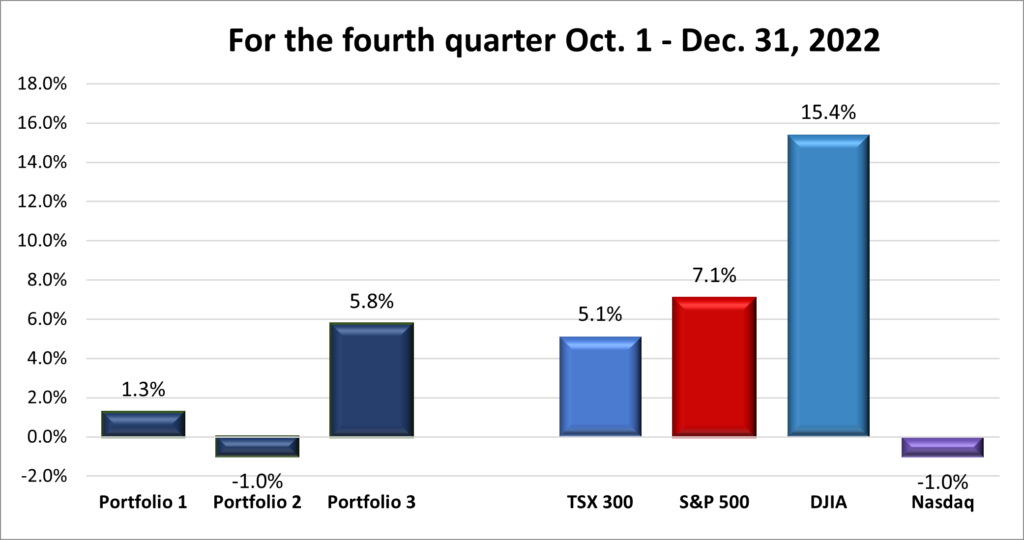
For the fourth quarter, the TSX, rose 5.1%, the S&P, gained 7.1%, the DJIA, jumped 15.4% while the Nasdaq slipped 1.0%.

Back to Table of Contents


Fourth Quarter Portfolio Update

Quarterly Portfolio & Index performance
Fourth Quarter 2022 (October 1 – December 31, 2022) Portfolio & Index performance

Portfolio 1 for the fourth quarter: DOWN Red Down Arrow

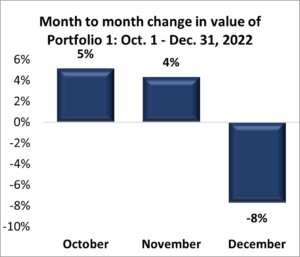
Portfolio 1 benefitted from the October to mid December rally before being dragged lower by the Nasdaq plunge in late December. Energy companies continued to buoy the portfolio, but the technology companies lifted, then sank the portfolio. Portfolio 1 clawed out a 1.3% gain for the quarter.

Portfolio 1: Fourth Quarter Performance

Back to Table of Contents

Portfolio 2 for the fourth quarter: DOWN Red Down Arrow

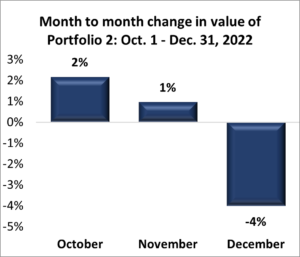
The fourth quarter saw the portfolio post wins in October and November, before a sharp drop in December to end the quarter. Being the least aggressive portfolio of the three, its gains were moderate, but its technology bias still hurt in December. Fortunately, the dividend paying companies and non technology companies were able to soften the December drop. Overall, Portfolio 2 fell back in the fourth quarter, dropping 1.0%.

Portfolio 2: Fourth Quarter Performance

Back to Table of Contents

Portfolio 3 for the fourth quarter: DOWN Red Down Arrow

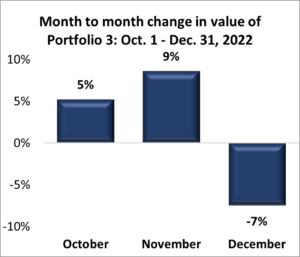
The fourth quarter was much better for Portfolio 3, riding the technology tide higher before plummeting in the last half of December. The gains in October and November more than compensated for December’s losses. Portfolio 3 advanced 5.8%, easily outperforming the other two portfolios.

Portfolio 3: Fourth Quarter Performance

Back to Table of Contents


Twelve Month Review

It was no surprise that all four indexes ended the year down significantly, as shown in the chart below. The TSX was able to stay above water until late April before it dropped into red as interest rates started to climb. The TSX stayed in the red for the rest of the year. Along the way, the TSX dropped into a market correction (a drop of 10% or more) twice, each time for a few weeks before climbing back out. The DJIA was under water from February onward but was able to avoid a market correction except for a dip in June and again for a month starting in early September. Despite ending the year lower, the DJIA was the best of the three American indexes.

The S&P spent a good amount of time in a market correction, with a dip into a bear market in late September, resulting in its biggest annual decline in 15 years. The Nasdaq, home of the high-flying technology stocks, felt the wrath of the bears, plummeting into bear territory in early May and staying there for the rest of the year. Of the eleven S&P sectors that span the DJIA, the S&P and the Nasdaq, six had double digit drops in earnings. The only sectors to post gains in 2022 were energy, industrials, real estate, utilities, and consumer staples. The gains in these sectors ranged from 90% in energy down to 3% in Consumer Staples.

The main reasons for a dismal 2022 were:

  • Rising inflation caused by increased demand from countries emerging from Covid-19 restrictions.
  • Holdover supply chain problems caused by the pandemic.
  • The Russian invasion of Ukraine lead to shortages of oil, natural gas, and wheat.
  • Both the Canadian and American central banks’ delayed response to inflation, then the historic increase in their respective benchmark interest rates, climbing from 0.25% to over 4%, a 15 year high.
  • A flare up in supply chain issues caused by China’s lockdowns in their fight against a covid-19 outbreak.
  • Finally, geopolitical tensions between the west and Russia, and the USA and China.

That’s a lot in one year but I believe rising inflation and the corresponding rising interest rates were the two biggest reasons the North American markets had such a poor year.

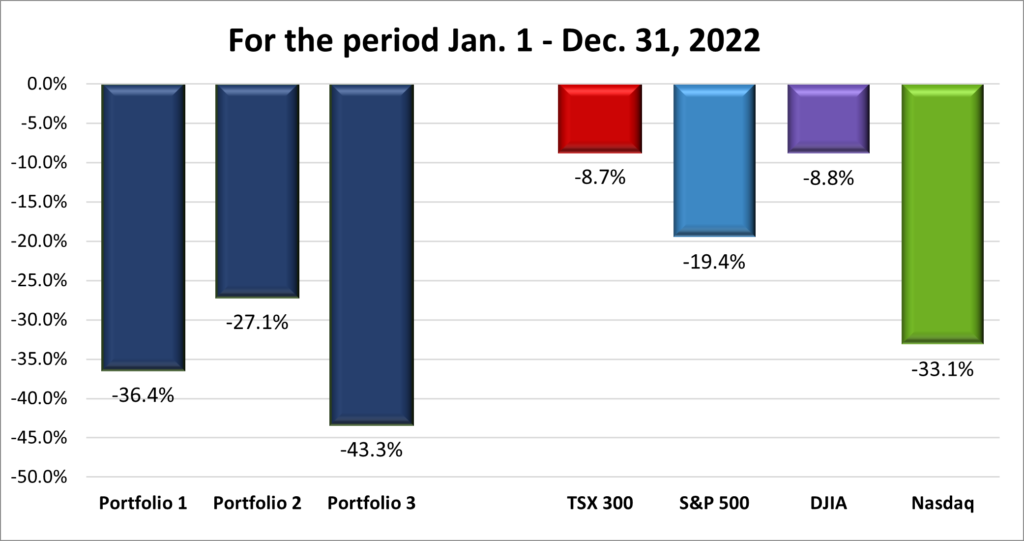
The TSX was the ‘best’ of the major North American indexes, limiting losses to 8.7%, closely followed by the DJIA which fell 8.8%. of the thirty companies that make up the DJIA, ten finished the year higher. The S&P barely avoided bear market territory plunging 19.4% and wiping out roughly $8 trillion in market capitalization from the companies listed in the S&P 500 index. Bringing up the rear was the growth-oriented Nasdaq which plummeted 33.1%, well into bear market country. The past year was the largest percentage decline for all three American indexes since the financial crisis of 2008.

Back to Table of Contents


Twelve Month Portfolio Review

It would be an understatement to say 2022 was not kind to the Indexes, but it was brutal on the three Portfolios, as you can see below. With all three portfolios oriented towards technology companies, and the technology heavy Nasdaq down 33%, it was no surprise the Portfolios were down drastically. All three portfolios paid heavily for their technology orientation, with Portfolio 2 the best of a bad lot, ‘only’ losing 27% of its value. ☹ As bad as that was, the more aggressive Portfolios 1 and 3 lost 36% and 43%, respectively, of their value in 2022. It was largely the energy stocks in Portfolio 1 that prevented it from plunging as far as Portfolio 3. Fortunately beating the S&P is not a priority (but it would be nice) because I failed miserably this year. ☹

Nine Month Portfolio & Index performance
Twelve Month (January 1 – December 31, 2022) Portfolio & Index performance

Back to Table of Contents

2022 in Review

Image result for Grizzly Bear 2022 will not be remembered fondly by this investor. In fact, it will go down as one of the worst years on record for stocks and my worst year of investing. Most of the damage was done in the first half of the year when the Fed spooked the markets with the first of a series of aggressive interest rate increases. Throughout the year there were rallies which turned out to be bear traps, with each rally followed by a drop to a lower low.


In Canada and the US, Interest rates went from 0.25% to over 4.0% in record time, sending the markets sharply downward. The worst off were the interest sensitive technology companies. Across the board, tech companies announced plans late in the year to rein in projects and focus on generating profits, made sizeable cuts to their respective work forces, and operate more strategically and efficiently. As well as higher interest rates eating into their cash flows, an overall market slowdown, higher costs (especially energy), and over expansion during the pandemic years caused many of them to grow faster than they should have. The result was companies lowered their guidance for earnings and future growth and their share prices paid the price.

Back to Table of Contents

Going Forward: The First Quarter 2023

Gone but not forgotten is Covid-19. Most of the world has learned they will have to live with it and are getting back to normal. Replacing Covid-19 concerns is the fear of a recession, especially in the USA (the world’s largest economy). Joining fears of a recession are most of the events that roiled the stock markets during 2022 – supply chain issues, the ongoing war in Ukraine, high inflation, rising interest rates – remain as we start 2023. There is already talk about additional increases to interest rates in Canada and the US in 2023, making it harder for high growth oriented companies, and those with significant debt.

However, there are reasons to believe 2023 will be better (2022 should not be hard to beat 😊). One of these is China’s reversal on their Covid-19 lockdowns. China is the world’s second largest economy and if they can successfully get their economy back on track it will have a significant positive impact not just on China, but for the rest of the world. The BoC and the Fed have already slowed the pace of their interest rate hikes. Despite comments from the Fed that rates will continue to rise, many investors believe the worst is behind us. As a result, investor sentiment has gone from a negative stance in the third quarter to a cautiously optimistic position as we head into 2023. Interest rates should peak and start falling in the second half of 2023 but it would be wise to remember the saying “Don’t fight the Fed” and invest conservatively while the Fed fights its battle with inflation.

Good luck in the coming year. May the bulls return and long may they run.

Image result for Bull Pics

Back to Table of Contents

Weekly Update for the week ending January 20, 2023

Items that may only interest or educate me ….

AI coming to a cloud near you, Canadian interest rates, US interest rate data, globalization meets friendshoring …


Microsoft (NASD:MSFT) is considering adding more cash to its US$ 1 billion investment in start-up OpenAI, the developer of ChatGPT. Microsoft is already previewing ChatGPT under the name Azure OpenAI Service and plans to incorporate ChatGPT into their Bing search engine as well as their cloud-based Office applications.

Reports have Microsoft investing up to US$10 billion in OpenAI, with 75% of OpenAI’s profits going to Microsoft until its initial US$1 billion investment is recovered. At that time, Microsoft will own 49% of OpenAI (other investors will own 49% and OpenAI’s non-profit parent owning the remaining 2%). With that kind of investment and integration, at some point I expect Microsoft to buy out the remaining shareholders to own the company and technology outright. I could not see Microsoft allowing a technology so integrated and vital to its success to be bought out by a rival.


For the third consecutive month inflation in Canada has decreased, according to the latest Statistics Canada Consumer Price Index (CPI) report. On an annual basis, the data showed the inflation rate was 6.3% in December, down from 6.8% on November. Analysts had expected December inflation to come in at 6.4%. Meanwhile, Core CPI (CPI less fuel and housing costs) increased by 5% on a yearly basis, in line with expectations.

The decrease in inflation was largely the result of a 13.1% decline in gas prices. I am sure if you filled up a car with gas in December you noticed the cheaper prices. However, the decline was limited by increases in the cost of mortgages (thank you, higher interest rates), clothing and personal care supplies.

Another set of data released by Statistics Canada this week was the Canadian Industrial Producer Price Index (IPPI) for December. The IPPI measures the prices that producers in Canada receive once their products leave the plant. It does not reflect the price the consumer pays (that is the CPI). The data showed the IPPI fell 1.1% in December from November, thanks to lower prices for petroleum products and softwood lumber. On a year over year basis, the IPPI for December was up 7.6%.

Finally, the Retail Trade data for November revealed retail sales fell by 0.1%. Statistics Canada also provided an estimate of a 0.5% increase in retail sales for December’s. With the moderate decline in November and moderate increase in December, the Canadian economy appears to be holding up despite the higher interest rates.

The December jobs report caused analysts to believe an increase of 0.25% was likely. Despite signs in the latest CPI and IPPI reports that inflation in Canada is declining, there was nothing in these two reports to suggest the Bank of Canada (BoC) will not proceed with another hike. With retail sales remaining steady, in all likelihood, the BoC will raise the interest rate by 0.25% to keep inflation in Canada headed downward. This would bring Canada’s benchmark interest rate to 4.5%. And you can bet it won’t take the commercial banks very long to raise their rates, the interest rates you and I pay.


South of the border, the US Labor Department released data indicating the US Producer Price Index (PPI) had its biggest drop on an annual basis since the pandemic, going from 7.3% in November to 6.2% in December. Analysts had projected the PPI to come in at 6.8% so this was well below expectations. The Core PPI (PPI) came in at 4.6% for December, down from 4.9% in November.

Along with last week’s CPI report that showed inflation had fallen to 6.5%, the PPI was another sign the Fed’s aggressive interest rate hikes are slowing down inflation.

In other US economic news, the US Commerce Department estimated December retail sales dropped 1.1% from November. Analysts had expected a decline of 0.8%. It was the second consecutive month that retail sales decreased. Lower retail sales are indicative of softening demand, most likely caused by consumers having less discretionary cash.

With slowing inflation and weakening demand for goods and services, the signs are promising that the US Federal Reserve (Fed) will slow down the pace of their interest rate increases. However, while the Fed may slow the pace of increases, that does not mean they will stop. They will continue to raise the rate on the US benchmark interest rate, only in smaller increments. And when you consider at least two members of the Fed believe the sooner the rate gets above 5% the better, its likely the next increase will be at least 0.25%, pushing the rate to an even 5%.


It appears the pandemic, and the Russian invasion of Ukraine have combined to put a dent in the ‘globalization’ of supply chains. The pandemic created all sorts of problems for manufacturers. Thanks to lockdowns, we saw shuttered factories, an inability to obtain the necessary raw materials to create products, and when companies had finished products there were tremendous challenges getting them to market, especially if they were transported by boat. Any company that depended on getting raw materials or components from other countries suddenly found their supply chain broken.

Just when those supply challenges were working themselves out, Russia invaded Ukraine, leading to supply constraints of oil and natural gas. Both Europe and Japan were dependent on Russian oil and gas and are now looking at alternate countries for their energy needs. Wheat was another commodity that suddenly came under pricing pressure as Russia and Ukraine, two of the top ten global suppliers, were unable to get their wheat to market, though for different reasons (Ukraine was busy defending itself and Western sanctions limited Russian exports).

Add in China becoming more of a threat to western countries, companies are now scrambling to source or build their own domestic supply chains. Many countries are actively encouraging domestic development or building supply chains with friendly nations, or ‘friendshoring.’ The US CHIPS and Science Act, and the Inflation Reduction Act are examples of a country building out a domestic supply chain and friendshoring.

I suspect you will see more friendshoring arrangements rather than countries trying to build their own internal supply infrastructure. There are too many products and supplies for one nation to deal with. Companies will continue to try to drive down costs which usually means cheaper labour. As companies adapt to the new reality, expect to see a variation of globalization. Only this time it will be between like-minded countries to avoid the problems experienced the last few years.


Another topsy turvy week in the North American stock markets. Overall, it is a good time for investors to stay informed and consider their investing options carefully. With that in mind, let’s see what moved the markets this past week…

Weekly Market Review

Monday: Only one game in town today as the US markets were closed for the Martin Luther King Jr. Day holiday. The Toronto Stock Exchange Composite Index (TSX) ran its winning streak to seven, its longest run since May 2022. Tomorrow the Canadian Consumer Price Index (CPI) report for December is due. Analysts are expecting the data to come in at 6.4% higher than December 2021. In trading, the Technology and Industrials were the best performing Canadian sectors. The Consumer Cyclicals sector was the only sector to slide backward.

Tuesday: The American markets were open for business again and it was a mixed bag for the four major North American indexes. The TSX and the Nasdaq Composite Index (Nasdaq) both ended the session higher while the S&P 500 Index (S&P), the Dow Jones Industrial Average (DJIA) ended lower.

In Canada, oil prices continued to climb, fueling a rise in the TSX’s Energy sector (pun intended). In addition, the Canadian CPI report for December showed inflation had dropped to 6.3%, on an annual basis, from 6.8% in November. Leading the TSX higher were the Utilities and Technology sectors, with Basic Materials and Consumer Staples the only sectors to end the day lower.

In the US, while higher oil prices were good for the American Energy sector, it was not enough to overcome the drag of unimpressive earnings from some of America’s biggest banks. The big, blue-chip banks that are part of the DJIA dragged it down. On the positive side, Tesla (NASD:TSLA) jumped after news of a sales spike in China, helping the Nasdaq run its winning streak to seven. In the markets, the best performing S&P sectors were Technology and Energy, while the biggest loser of the S&P sectors were the Basic Materials (Miners and fertilizer manufacturers).

Wednesday: All four indexes ended the day in negative territory after data showed weak US retail sales for December. Also dampening investor sentiment were comments from a member of the Fed who suggested the Fed should move ‘as quickly as we can’ to raise the benchmark US interest rate over 5%.

In Canada, despite a strong start to the day, the TSX’s 8-day winning streak ended. The Canadian Basic Materials sector was the only Canadian sector to advance. The Technology sector broke even on the day while the remaining sectors all ended lower. The Consumer Staples and Consumer Cyclical sectors were the worst performing Canadian sectors.

In the US, weak retail sales, lower productivity in factories, and investors taking profits, all contributed to the American indexes’ worst day of 2023. In the market it was a broad-based retreat as all American S&P sectors declined. The Basic Materials and Technology sectors fell the least, while the Consumer Staples and Utilities sectors dropped the most.

Thursday: A late afternoon rally kept the markets from having a worse day than yesterday, but it was not enough to prevent all four indexes from ending the day in the red. Disappointing quarterly earnings and fears the Fed would remain aggressive with their upcoming rate hike drove the markets lower.

In Canada, investor concerns about a recession caused the TSX to end the session lower. A weak Canadian retail sales report, due tomorrow, could really cause investors to become pessimistic. Higher oil and commodity prices prevented the TSX from falling as far as its American cousins. In trading, the Canadian Energy and Basic Materials sector were the only sectors to advance. The interest sensitive Technology and Consumer Cyclical sectors fell the farthest.

In the US, all three American indexes fell as investors considered the implications of lower weekly jobless numbers and if a strong labour market would cause the Fed to make another aggressive increase rate hike. In the American markets, only the S&P’s Energy and Healthcare sectors ended the day in the green, with Industrials and Consumer Cyclicals dropping the most.

Friday: All four major North American indexes ended the day higher. Today’s gains were enough to lift the TSX and Nasdaq into the green for a third consecutive week of weekly gains, but not enough to prevent the S&P and DJIA from ending the week in the red. The price of oil continued to rise on expected growing demand for oil from China, the second largest economy behind the USA, as the nation re-opens after its Covid-19 lockdowns.

In Canada, November retail sales dropped 0.1% indicating the Canadian economy is weathering the storm caused by higher Canadian interest rates. On top of that, inflation is coming down. In trading on the TSX, it was good day for the Canadian sectors as only the Utilities sector slid back. Leading the way upward were the Technology and Basic Materials sectors.

In the US, investors moved back into the beaten down high growth sectors, lifting all three American indexes comfortably higher. In trading, it was a day of broad-based gains for the American S&P sectors as all moved solidly upward. Leading the way were the Technology and Consumer Cyclical sectors, with the Healthcare and Utilities sectors bringing up the rear.


For the week, the TSX gained 0.7%, the S&P 500 fell 0.7%, the Dow dropped 2.7% and the Nasdaq rose 0.6%.

Weekly Portfolio Review

Bullish market

Bearish market

A mixed bag this past week with the TSX and Nasdaq advancing, while the S&P and DJIA retreated. Last week, I mentioned the TSX performed a Golden Cross, a technical indicator suggesting an upcoming bull market. This week the upward momentum continued. The TSX benefitted from strong energy and commodity prices, with a late push from the Technology sector.

Down south, after Thursday’s decline I did not think any of the American indexes would end the week higher. However, a mini rally in technology companies pushed the Nasdaq pushed over the line and almost dragged the S&P over the line, falling just short. The DJIA was not so lucky as it was weighed down by mixed results from financials companies.

Overall, it was a good week for the three Portfolios. Portfolio 1 was marginally lower but that was more than offset by gains in Portfolios 2 and 3. Portfolio 1 with its larger number of companies seems to mirror the S&P. With the S&P lower, it was good to see it did not drop as much. Portfolio 2 has the most Canadian companies, so it most closely follows the TSX, while Portfolio 3 is closest to the Nasdaq. With that in mind, its good to see Portfolios 2 and 3 beat both of those indexes. Not that I am keeping track. 😊

Weekly Portfolio & Index performance
Weekly Portfolio & Index performance for the week ended January 20, 2023.

Companies on the Radar

No new companies this week and I haven’t had an opportunity to delve deeper into DoubleVerify (NYSE:DV) other than its in the digital advertising space and it scored well on my Radar Check. I did notice when checking out DoubleVerify on the TD Direct Investing site that TD showed the company had Long Term Debt (LTD), whereas Yahoo Finance (which I use for my Radar Check) shows it with no LTD. Something to investigate when looking deeper into the company. It joins oil and natural gas companies Crew Energy (TSX:CR), International Petroleum (TSX:IPCO), and technology heavyweight Alphabet (NASD:GOOGL) on the radar.

  • Crew Energy: A Canadian oil and gas company with interests in British Columbia.
  • International Petroleum: A Canadian company with oil and gas assets in Canada, Malaysia, and France.
  • Alphabet: The leading online search engine and advertising company, dominant mobile operating system.
  • DoubleVerify: part of the digital advertising industry. Helps the world’s largest brands maximize and optimize the effectiveness of their online advertising.

The Radar Check was last updated January 20, 2022.

Graphical user interface, application Description automatically generated

Graphical user interface, text, application Description automatically generated


Portfolio Update

Portfolio 1

Portfolio 1 for the week ended January 20, 2023: DOWN Red Down Arrow

  • Tesla and its CEO Elon Musk went to trial in a case where Tesla shareholders claim Mr. Musk defrauded them. In 2018, Mr. Musk tweeted funding was ‘secured’ to take Tesla private. In the lawsuit, shareholders claim they lost ‘billions’ when they bought or sold Tesla shares between the time of Mr. Musk’s tweet and when the New York Times reported the funding was ‘far from secure.”
    In other Tesla news, the company made the decision to utilize its production cost advantage over other Electric Vehicle (EV) companies to put pricing pressure on traditional automakers as well as new EV start-ups. With a greater profit margin, Tesla has more room to lower prices than its competitors, especially money losing start-ups such as Rivian (NASD:RIVN).
  • Lightspeed Commerce (TSX:LSPD) plans to shed 300 employees has it re-organizes into a leaner operation. This comes after several years of adding companies and products to Lightspeed’s product line. Its expected half of the positions shed will be in the management area as several positions became redundant after the various acquisitions.
  • Alphabet suffered a significant legal setback in India when India’s Supreme Court ordered Google to implement the Competition Commission of India’s (CCI) edicts. The CCI had ruled that the licensing of Google’s Play Store should not be linked in any way to a requirement to install any other Google products such as Search, YouTube, Chrome or other Google products.
    In other Alphabet news, the company joined the ranks of the other big US technology companies when it announced it will be trimming its workforce by 6%. The losses will be spread across Alphabet’s global offices, coming mainly from the ranks in recruiting, corporate staff and those involved on various product teams.
  • Amazon (NASD:AMZN) plans to beef up its data centres with a US$ 35 billion investment in their Virginia data centres. Amazon Web Services anticipates the expansion will be complete by 2040.

Activity

Sold: Algonquin Power & Utilities (TSX:AQN). Algonquin has significant debt and the increasing interest rates led to higher interest expenses which impacted their bottom line (net income). When this information first appeared in their third quarter earnings report, the share price of Algonquin shares took a significant hit, falling nearly 50% (strike 1). Then in early January they announced they were cutting their quarterly dividend from C$ 0.1808 to C$ 0.1085 (strike 2) and suspending their dividend reinvestment plan (strike 3). While these moves help the company, I feel there are better opportunities available for the money.

Dividends

Dividends Received this week for the following companies:

Companies followed by DRIP (Dividend Re-Investment Plan) indicate additional shares were purchased with the dividend. Any cash leftover was added to the cash balance.

Canadian $

Andlauer Healthcare Group Inc (TSX:AND)

BSR Real Estate Investment Trust (TSX:HOM.U)

Algonquin Power & Utilities Corp (TSX:AQN) DRIP

US $

No US$ dividends this past week.

Quarterly Reports

No quarterly reports this past week.

Portfolio 2

Portfolio 2 for the week ended January 20, 2023: UP Green Up Arrow, signifying a positive week

  • Guardant Health (NASD:GH) announced they are partnering with Britain’s The Royal Marsden NHS Foundation Trust to help track microscopic minimal residual disease (MRD) in post surgical patients. Guardant’s Reveal blood test will check if MRD is present in the bloodstream. If MRD is not detected, patients may not need post surgery chemotherapy (used to eliminate any residual MRD). This would allow doctors to avoid over treating patients, when no MRD is found, and exposing them to the side effects of chemotherapy.

Activity

No significant activity to report this week.

Dividends

Dividends Received this week for the following companies:

Companies followed by DRIP (Dividend Re-Investment Plan) indicate additional shares were purchased with the dividend. Any cash leftover was added to the cash balance.

Canadian $

Dream Industrial Real Estate Investment Trust (TSX:DIR.UN)

US $

No US$ dividends this past week.

Quarterly Reports

No quarterly reports this past week.

Portfolio 3

Portfolio 3 for the week ended January 20, 2023: UP Green Up Arrow, signifying a positive week

  • Microsoft plans to let go approximately 5% of its employees. Most of the layoffs are expected to be in various engineering divisions and human resources.

Activity

No significant activity to report this week.

Dividends

Dividends Received this week for the following companies:

Companies followed by DRIP (Dividend Re-Investment Plan) indicate additional shares were purchased with the dividend. Any cash leftover was added to the cash balance.

No dividends this past week.

Quarterly Reports

No quarterly reports this past week.

Weekly Update for the week ending January 13, 2023

Items that may only interest or educate me ….

TINA meet TARA, Latest US CPI numbers, a golden triangle has appeared…


A new acronym makes its way into the investing world, likely at the expense of another acronym. Following the financial crisis of 2008, central banks lowered the cost to borrow money (interest rates) to restore confidence in the stock markets. With extremely low interest rates and easy access to money, the share prices of public companies took off because the return on bonds and other investments was minimal, leading to the acronym TINA – There Is No Alternative. Investing in stocks was the only way to make any money through investing.

The TINA investing style had a good run until it ran into the high inflation of 2022. As the central banks, such as the Bank of Canada (BoC) and the US Federal Reserve (Fed), battled inflation by raising their respective benchmark interest rates, the pay back on government bonds has once again become a viable alternative. In the US, bonds have seen a net inflow for the last few weeks. While I was unable to find similar data for Canadian based bonds, I suspect it is a comparable situation here in Canada. One option I discovered was TD Market Growth GICs. These GICs (Guaranteed Investment Certificate) provide a minimum 3% and up to a maximum 30% return, for a 3- or 5-year investment, with minimal risk.

As bonds, GICs, and other investment options returned to favour, a new acronym was born – TARA. There is A Reasonable Alternative. I have never been big on bonds or GICs, but with a guaranteed 3% return and the possibility of up to 30% over 3 – 5 years and minimal risk, these are a reasonable alternative. I would have liked to have one of these for 2022. 😊


The December US Consumer Price Index (CPI) came out this past Thursday, meeting analysts’ expectations but not providing many clues on the size of the next increase to the US benchmark interest rate. The US Department of Labor’s December CPI report showed inflation increased 6.5% (analysts expected 6.5%) from December 2021. The good news was the inflation rate was down from 7.1% in November, 2022.

The Core CPI data (CPI less food and fuel prices) showed inflation was 5.7% higher than in December 2021. The data also showed prices had inched higher by 0.3% from November’s Core CPI rate. Not good news, but not bad news as this was what analysts had forecast.

Since the Fed said future changes to the interest rate would be data driven, this mixed information (compared to the previous month, CPI was lower, while the core-CPI was slightly higher) does not provide many clues to the size of the next increase. And yes, there will be an increase. The debate is whether it will be 0.25% or 0.5%. Together, the CPI and Core CPI would indicate the Fed’s series of interest rate hikes has slowed, if not lowered the rate of inflation.

The other bit of news from a separate Department of Labor jobs report was the data showed the jobs market remained strong but the pace of jobs growth has slowed down from the same period in 2021. As well, wage growth continues but at a slower pace.

Judging by the deceleration of inflation, increasing employment levels, and slowing wage growth, the Fed just might thread the needle and lower inflation without damaging the economy.

Before getting too excited, keep in mind the Fed has repeatedly stressed it will keep raising interest rates to bring inflation back down to its 2% target.


On Friday, the TSX triggered a ‘golden cross.’ In the investing world, this is a very good sign. It is a technical indicator of a major trend change indicating an upward trend, or bull market, is coming. In the chart below, on the far right you can see the red 50-day simple moving average line (SMA (50D)) nudged above the grey 200-day simple moving average line (SMA (200D)). The 50-day SMA was 19,849.17 and the 200-day SMA was slightly lower at 19,839.25. That is not much lower, but it is lower. 😊

The red and green vertical bars are the daily closing prices of the TSX. Green bars indicate the market closed higher and the red bars indicate the market ended lower.

While ‘golden cross’ is a good technical signal, it has a cousin known as the ‘death cross.’ As the name implies, it is not a good sign. On the same chart above, you can see the TSX experienced a ‘death cross’ on June 8, 2022. On that day, the red 50-day SMA line dropped below the grey 200-day SMA line.

Let us not worry about the ‘death cross,’ instead, focus on the ‘golden cross’ signifying the start of a bull market for the TSX. The DJIA had its own ‘golden cross’ on December 14, 2022. The S&P is not far away from its own ‘golden cross,’ but the Nasdaq has a long way to go before the 50-day SMA rises above the 200-day SMA.

Two golden crosses and a third one not far away. Not a bad start to 2023. 😊


With the golden cross to lead the way, let’s take a look at the past week…

Weekly Market Review

Monday: The markets got off to a hot start today before fizzling out on news the US Federal Reserve (Fed) suggested the US benchmark interest rates could rise above 5%. At the end of the day, the Toronto Stock Exchange Composite Index (TSX) and the Nasdaq Composite Index (Nasdaq) were able to remain above water while the S&P 500 Index (S&P), the Dow Jones Industrial Average (DJIA) ended lower.

In Canada, the TSX ended the day at its highest point in four weeks thanks to the Canadian Technology and Energy sectors. Weighing down the TSX were the Canadian Consumer Cyclicals and Telecommunications Services.

In the US, early momentum gave way to ongoing concerns about inflation. Investors are waiting to hear from Fed chair Jerome Powell, who will be part of a panel discussing central bank independence, on Tuesday. Analysts and investors are hoping to gain insights into the Fed’s plan to fight inflation going forward. In trading, the best performing American S&P sectors were the interest rate sensitive Technology and Consumer Cyclicals. The biggest losers were Healthcare and Consumer Staples.

Tuesday: It was a mixed day in the markets as all indexes fell early but all four were able to climb out of the early hole to end the day in positive territory. Oil prices advanced when the US government predicted record global consumption in 2024. In Canada, The TSX was pulled higher by rising gold prices that caused the Canadian Basic Materials sector (mining companies and fertilizer manufacturers) to be the best performing sector for the day. The Utilities and Consumer Staples sectors were the worst performers of the Canadian sectors, holding the TSX back.

In the US, Fed Chair Jerome Powell spoke in his first public appearance of 2023 but avoided any comments about the Fed’s rate policy. In a case of no news is good news, optimistic investors responded favourably, turning all three American indexes green. In the market, it was almost a perfect day for the S&P sectors as only the Consumer Staples sector failed to post a gain. Leading the American indexes higher were the Basic Materials (on gold) and Consumer Cyclicals.

Wednesday: All for major North American Indexes ended the day higher as investors await tomorrow’s key US Consumer Price Index (CPI) report. Investors were optimistic the CPI data would indicate inflation was falling, allowing for the Fed to make a smaller interest rate increase. The price of oil rose on an improved global economic forecast, lifting the Energy sectors in both Canada and the USA.

In Canada, higher oil and gold prices helped lift the TSX higher. Leading the charge upward were the Canadian Utilities and Consumer Cyclicals sectors. The Basic Materials sectors slumped as investors took money off the table after a recent rally in the price of gold. The only other Canadian sector to end the day lower was the Consumer Staples sector.

In the US, investors jumped back on the growth companies’ bandwagon today, as the growth-oriented Consumer Cyclicals and Technology sectors helped lift all three indexes. The only S&P sector to slide down was the Telecommunications sector.

Thursday: Data from the US CPI report suggested inflation was on a downward trend, sending all four indexes higher. The statistics showed inflation had dropped since the November report, but the Core CPI number rose slightly. With the mixed, but generally positive news, investors were optimistic the numbers supported the case for a 0.25% increase rather than 0.5% hike, causing the markets to rise.

In Canada, the TSX rode the news coming out of the US, higher oil, and higher gold prices to end the day firmly in the green. The continuing rise in oil and gold prices helped the Canadian Energy and Basic Materials sectors outperform the rest of the Canadian sectors. The only Canadian sectors to end lower were the Consumer Cyclicals, Utilities, and Industrials sectors.

In the US, the CPI data showed the December consumer prices fell for the first time in over two years. The belief in a 0.25% interest rate increase, along with rising oil prices pushed all three American indexes to extend their winning streaks for another day. In trading, Energy and Telecommunications Services led a strong showing from the American S&P sectors. The Consumer Staples and Utilities were the only S&P sectors to end the day lower.

Friday: All four indexes inched higher today on investor optimism after Thursday’s CPI numbers suggested inflation had started trending downward. Concerns about upcoming earnings reports limited today’s gains.

In Canada, strong gold and other commodities’ prices continue to lift the share prices of the companies found in the Basic Materials sector. In trading, the best performing Canadian sectors were Technology and Industrials, while Consumer Cyclicals was the only sector to end lower.

In the US it was the start of earnings seasons. Leading off were the big American banks that performed well considering the challenges of 2022. Amazon (NASD:AMZN) rose 3% today to close off a good week that saw the company gain 14% for the week, its best since April 2020. In the market, riding the coattails of the big banks, the S&P Financials sector led the way, followed by the Technology sector. The only company to fall back was the Utilities sector.


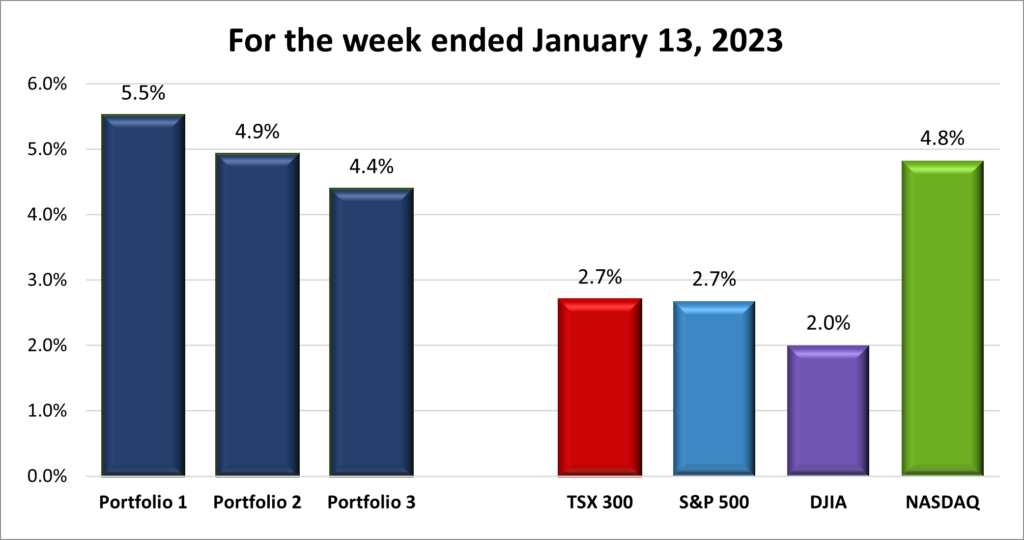
For a second consecutive week all four major North American indexes ended the week higher. For the week, the TSX rose 2.7%, the S&P 500 gained 2.7%, the Dow advanced 2.0% and the Nasdaq jumped 4.8%.

Weekly Portfolio Review

Icon Description automatically generated

So far 2023 has been surprisingly good in the North American stock markets, although there are still 50 weeks to go. 😊 Other than the CPI report there was not a lot of news to move the market one way or the other. The CPI report itself was slightly positive, but investors took the decline in inflation as a sign the Fed would be less aggressive with the upcoming interest rate hike. Oil and gold prices continued to rise, lifting the TSX. In the US, as well as oil and gold moving higher, investors moved back into the big, well known technology companies, lifting the Nasdaq and S&P. The DJIA with its thirty big blue-chip companies rode investor optimism to end the week higher as well.

When the rising tide lifts the markets, it lifts all three portfolios. As shown in the chart below, both Portfolio 2 and 3 gained over 4%. Portfolio 2 was propelled upward by great a week from Microsoft (NASD:MSFT) and MongoDB (NASD:MDB), while Portfolio 3 had a solid week all around, with strong performances from Microsoft and the financial companies. With Portfolio 2 & 3 gaining 4% this past week, my first though was what held Portfolio 1 back. In general Portfolio 1 was in line with the gains of the TSX, the S&P and the DJIA. There were no big losers, with many of the companies ending the week higher. And that is fine.

This was a good week but there is a long way to go to get back to where the portfolios were at this time last year. A long way to go.

Weekly Portfolio & Index performance
Weekly Portfolio & Index performance for the week ended January 13, 2023.

Companies on the Radar

A few changes to the Radar List this week. First, SmartCentres (TSX:SRU.UN) moves off but remains on the periphery if a defensive company is needed. There is nothing wrong with the company and if there were not already REITs in the Portfolios this would be a strong candidate.

Next, Alvopetro (TSXV:ALV) moves off the list and into Portfolio 3 thanks to a brief drop in the share price. I had a low bid in place and when the share price dropped the order was filled.

Finally, two new companies popped onto the Radar List this past week – DoubleVerify (NYSE:DV) and Griffon Corporation (NYSE:GFF). DoubleVerify is a US based company that helps the world’s largest brands maximize and optimize the effectiveness of their online advertising. While the company did not have the greatest score in the Ratings sections (the first image below), it did very well on the High-Level Financials section (the second image, below). The only negative was that it is share price did not beat the S&P index over five years and that comes with an asterisk since the company went public in April 2021, making it impossible to compare it over five years. 😊 Very few companies put up green across the High-Level Financials section, so I will take a closer look at DoubleVerify.

The other company, Griffon Corporation, is a US based company that provides home building products to consumers and professionals throughout the world. Griffon scored slightly higher than DoubleVerify in the Ratings section but had a lot of red in the High-Level Financials sections, including the Net Income and Long-Term Debt sections. If I learned nothing else in 2022, I learned the importance of companies being Net Income positive and having very little debt. With that in mind, I am not interested in looking further into Griffon.

As well as DoubleVerify and Griffon Corporation, the Radar List included:

  • Crew Energy (TSX:CR): A Canadian oil and gas company with interests in British Columbia.
  • International Petroleum (TSX:IPCO): A Canadian company with oil and gas assets in Canada, Malaysia, and France.
  • Alphabet (NASD:GOOGL): The leading online search engine and advertising company, dominant mobile operating system.

The Radar Check was last updated January 13, 2022.

Graphical user interface, application Description automatically generated

Graphical user interface, application Description automatically generated


Portfolio Update

Portfolio 1

Portfolio 1 for the week ended January 13, 2023: UP Green Up Arrow, signifying a positive week

  • Finally, some good news for Tesla (NASD:TSLA) investors. Tesla reported longer wait times in China for its long-range versions of its Model Y vehicle, suggesting its price cuts in China were leading to increased demand. Now to see longer wait times for all models, in all markets. 😊
    It worked well in China, so why not globally? Tesla cut prices globally by up to 20% on its vehicles, sacrificing profits to maintain the company’s growth rate. While lower prices did not help Tesla’s share price, it did cause the share prices of its competitors to tumble. General Motors (NYSE:GM) and Rivian (NASD:RIVN) saw their respective share prices fall. The lone exception was Ferrari (NYSE:RACE) which continued its upward trajectory.
  • To increase its presence in the US, Nuvei, (TSX:NVEI) acquired US based Paya for US$ 1.3 billion. The market reacted favourably to this acquisition.
  • Amazon took aim at Shopify’s (NASD:SHOP) ‘Shopify Pay’ service with the roll out of Amazon’s ‘Pay with Prime.’ The service will allow online merchants outside the Amazon ecosystem to use Amazon’s payment and delivery services. The service will be available in the US near the end of January. No word when ‘Pay with Prime’ will be available to Canadian online merchants. Good for Amazon, not so good for Shopify.
  • Home Depot (NYSE:HD) is changing its hourly wages policy to pay employees to the nearest minute. In the past, the company rounded up or down to the nearest 15 minutes. Home Depot was facing a lawsuit that the company was purposely rounding down employee wages. This change to their hourly compensation policy makes sense and will prevent future concerns of rounding down to the nearest quarter hour. I do not know why they did not do this sooner. Even if it all worked out over time, I can see employees feeling they were being shortchanged.
  • Good news for Trisura (TSX:TSU) as they received two ‘Excellent’ ratings from the AM Best credit rating agency. The ratings reflect Trisura’s very strong Balance Sheet and the company’s “adequate operating performance, neutral business profile and appropriate enterprise risk management.”
  • Porsche Automobile (OTC:POAHY) is evaluating fully integrating Google (NASD:GOOGL) software into the cockpit of their vehicles. The integration would allow Porsche drivers to access Google Maps and Google Assistant without going through their smartphones.
  • Algonquin Power & Utilities Corp (TSX:AQN) saw its share price almost cut in half after it announced it reduced its dividend by 40%. Not only was the dividend significantly reduced but the dividend re-investment plan was suspended. Algonquin’s share price originally fell on troublesome earnings news in November. The earnings report showed the higher interest rates had taken a toll on the company’s cash flow as more cash was required to service their high level of debt.

Activity

No significant activity to report this week.

Dividends

Dividends Received this week for the following companies:

Companies followed by DRIP (Dividend Re-Investment Plan) indicate additional shares were purchased with the dividend. Any cash leftover was added to the cash balance.

Canadian $

Dream Industrial Real Estate Investment Trust (TSX:DIR.UN)

US $

Innovative Industrial Properties Inc (NYSE:IIPR)

Quarterly Reports

Shaw Communications Inc.

All currency listed in millions of Canadian dollars, except per share amounts

Selected highlights from their first quarter 2023 financial results on January 12, 2023

  • Revenue of $1,370 for the three months ended November 30, compared to $1,386 for the same period in 2021. A decrease of over 1%.
  • Net income of $168 for the three months ended November 30, compared to net income of $196 in the same period in 2021.
  • Diluted earnings per ordinary share of $0.34 for the three months ended November 30, compared to $0.39 for the same period in 2021.


Portfolio 2

Portfolio 2 for the week ended January 13, 2023: UP Green Up Arrow, signifying a positive week

  • Guardant Health (NASD:GH) announced preliminary fourth quarter results that not only beat analysts’ estimates for revenue, but it also had US$ 1 billion of cash and cash equivalents.
  • Walt Disney Corporation (NYSE:DIS) is facing a challenge to Disney’s Board of Directors leadership group. Activist investor Nelson Peltz is seeking a seat on Disney’s Board to ‘rescue’ Disney from overspending on their streaming business (Disney+), and to help with succession planning amongst other things. It will be an interesting challenge for recently returned CEO Bob Iger.

Activity

No significant activity to report this week.

Dividends

Dividends Received this week for the following companies:

Companies followed by DRIP (Dividend Re-Investment Plan) indicate additional shares were purchased with the dividend. Any cash leftover was added to the cash balance.

Canadian $

Telus Corp (TSX:T) DRIP

US $

No US$ dividends this past week.

Quarterly Reports

No quarterly reports this past week.

Portfolio 3

Portfolio 3 for the week ended January 13, 2023: UP Green Up Arrow, signifying a positive week

  • Cloudflare (NYSE:NET) added several new email security solutions that can protect employees from phishing, malware, and other security attacks. These new features will enhance Cloudflare’s Zero Trust security platform that protects organizations from cyberattacks.
  • Viemed Healthcare (TSX:VMD), a technology-enabled home medical equipment services provider, has partnered with ModoHealth to enhance ModoHelath’s patient management network. ModoHealth will receive a C$ 2-million-dollar investment from Viemed. In exchange, Viemed will be able to utilize Modohealth’s software platform to monitor and improve Viemed’s patients’ results.

Activity

Bought Alvopetro Energy. This is the second purchase of Alvopetro shares. Over the last three years, the company has grown revenue, net income, and earnings per share. They continue to pay down debt, eliminating more than 40% of long-term debt. Finally, the dividend has grown by almost 60% since my original investment in June 2022.

Dividends

Dividends Received this week for the following companies:

Companies followed by DRIP (Dividend Re-Investment Plan) indicate additional shares were purchased with the dividend. Any cash leftover was added to the cash balance.

Canadian $

TD U.S. Equity Index ETF (TSX:TPU)

Alvopetro Energy Ltd (TSXV:ALV)

Brookfield Corp (TSX:BN)

US $

No US$ dividends this past week.

Quarterly Reports

No quarterly reports this past week.


Weekly Update for the week ending January 6, 2023

Items that may only interest or educate me ….

TFSAs, green is the new black, the yo-yo market moves….

One of the best things about New Year’s is the opportunity for a fresh slate. In 2022, every sector in the S&P declined, except the Energy sector, as the S&P suffered its worst year since the financial crisis of 2008. Let us hope the markets are much greener this year, with the bears of 2022 being stampeded off the field by the bulls by the end of 2023.


A good way to start the year for Canadians is with a Tax-Free Savings Account (TFSA). I believe the American equivalent is a Roth IRA. The great thing about a TFSA is that you can put stocks inside the TFSA and watch them grow, or trade them without triggering any capital gains (taxes). When you need the money inside your TFSA, you can sell your shares, then withdraw the cash tax free (hence the name Tax Free Savings Account😊). TFSAs are great for long-term saving or to help you save for a goal such as a new car, a vacation, a down payment on a home, or anything you want to set money aside for.

I am always surprised when I talk with someone about investing and they treat a TFSA as another bank savings account, earning them 0.05% interest or less, when it can be so much more. If you are considering investing, using your TFSA is a great place to start, but as always, check with a financial planner to help determine how best to get started investing.

This year the TFSA contribution limit is C$ 6,500. You do not want to exceed this limit, or you will have to deal with the taxman (that is never fun). As in past years, any unused portion will be rolled forward. If you have never had a TFSA, check with a financial planner to see how much room you have available.


Speaking of fresh slate, green is the new black. Historically, in the finance and accounting, black has been associated with companies that are turning a profit (more earnings than expenses). Before accounting became computerized and everything was done by hand, black ink was used for profitable companies while red ink was used to signify companies that were losing money. A profitable company was said to be “in the black.” Companies that were losing money were “in the red.”

I do not know when it started but many financial information sites, including online trading sites, use green rather than black to indicate the share price of a company has increased since the previous day’s closing price and red to indicate when the share price had declined. I suspect the timing coincides with the start of online trading when many individuals started trading shares directly via their computers rather than go through a stockbroker. Looking at green and red symbols was easier for investing novices to understand than the traditional monochrome symbols. A quick look and you knew by the colour which direction the share price had moved. Green was up and red was down.

This can be seen on popular investing sites such as Yahoo! Finance, Google Finance, MSN Money, as well online trading sites such as TD Direct Trading and other online trading platforms. To be consistent with these investing sites, future reference to share prices or indexes that end the day higher will be referred to as ‘in the green,’ with the occasional ‘in the black’ for old times sake. When it comes to investing, green is the new black. 😊


Investors’ emotions bounced up and down like a yo-yo this past week, starting with the release of minutes from the US Federal Open Market Committee (Fed) meeting in December. The minutes showed all members agreed the Fed should continue increasing the US’s benchmark interest rate, but to do so gradually to limit damage to the American economy. Investors now anticipate a 0.25% increase to the US interest rate at the Fed’s next meeting at the end of January. While the Fed plans to slowly raise the interest rate, the Fed said the slower pace of interest rate hikes should not be confused with their determination to bring inflation down to their 2% target. The hopes of a 0.25% increase rather than a higher hike outweighed the concerns the higher rates would stick around longer, causing the markets to rise.

Next up was news that the US Department of Labor was expected to show an increase in employment numbers. While this is typically good news, when the Fed is trying to fight inflation, this is not good news for investors. When the market gets what it perceives to be bad news, the markets drop.

The market has wanted to go higher but it needed some good news to set it off. On Friday, it got the spark it was looking for in the Department of Labor’s official payroll report. The data showed that while the number of jobs did increase, the rate and size of wage increases slowed and employment in the services sector shrank. The report of slowing wages and lower employment in the services sector eased investors’ concern the Fed would return to aggressive interest rate hikes to lower inflation, leading to the Friday rally.

Friday was not the perfect storm for Canadian investors as Statistics Canada’s Labour Force Survey for December showed a significant increase in jobs, far exceeding analysts’ expectations. The average Canadian wages continued to rise but not as fast as they did in November. This mixed data has analysts thinking the Bank of Canada will increase Canada’s benchmark interest rate by 0.25%. However, these concerns easily gave way to the good news coming out of the US, allowing the TSX to ride on the coattails of the surging American indexes.


A better start to 2023 than expected. Hopefully a sign of things to come. While we contemplate a bullish upward trend for the year, let us look back at the week ended January 6….

Weekly Market Review

This week will be a short one for investors thanks to the New Year’s holiday, marking the start of 2023.

Tuesday: The markets got the new year off to a quick start before plunging into negative territory. Only the Toronto Stock Exchange Composite Index (TSX) was able to end the day in the green. The three major American indexes – the S&P 500 Index (S&P), the Dow Jones Industrial Average (DJIA), and the Nasdaq Composite Index (Nasdaq) – all ended lower today. The only sector to end higher in 2022 in both Canada and the USA was the respective Energy sectors. In the first day of trading in 2023, both Energy sectors ended lower on concerns about lower demand from China due to ongoing Covid-19 issues.

In Canada, the Canadian Technology and Basic Materials (miners and fertilizer companies) sector, gold in particular, helped drive the TSX higher. Holding back the TSX was the Energy sector, the only Canadian sector to end the day lower.

In the USA, fears about the US Federal Open Market Committee’s (Fed) interest rate plan going forward weighed on investors. It did not help that Tesla (NASD:TSLA) came up short on analysts’ estimate for fourth quarter deliveries. As well, a report out of Asia suggested weaker demand for Apple’s (NASD: AAPL) latest iPhones. On the first day of trading in 2023, it was not a good day as only three of the S&P sectors were able to end in positive territory – Telecommunications Services, Financials, and Industrials. The Energy sector dropped 3.6%, more than the total of all the other sectors that declined.

Wednesday: The stock markets rebounded nicely today, although it was a rollercoaster ride for all four major North American indexes before they each ended the day in the green. The main driver was minutes from the December Fed meeting that revealed the Fed was prepared to lower the amount of future US interest rate increases to 0.25%, although they did not mention how high the interest may go.

In Canada, the price of gold continued to climb, lifting the TSX higher, while the price of oil fell, limiting the TSX’s advance. In the Canadian sectors, the Technology, Healthcare and Basic Materials sectors all rose by 1.7% or more. Once gain, the Energy sector fell the most.

In the US, analysts and investors examined the minutes from the Fed’s last meeting and appeared to like what they saw. Of the American S&P sectors, Consumer Cyclicals, Basic Materials, and Financials all gained more than 1.95%, helping all three US indexes into positive territory. The only sector to slide back today was the Energy sector.

Thursday: Good news for American workers is bad news for investors. Employment in the US grew by more than analysts expected, leading to fears of continued interest rate hikes to the US benchmark rate. This news caused all four indexes to end the day lower.

In Canada, higher oil prices helped Canadian energy companies limit the fall of the TSX. The two day drop in the price of oil at the start of 2023 was the largest in over 30 years. In the Canadian sectors, Consumer Cyclicals and Energy were the best performing sectors. The biggest declines were by the Technology and Utilities sectors.

In the US, the jobs report was a blow to hopes the Fed would hold off on the next interest rate hike, causing the three American indexes to each drop over 1%. In trading, the S&P’s Energy and Telecommunications Services sectors were the only two sectors to end the day in the green. On the red side, Utilities and Technology dropped the most.

Friday: A good way to end the first week of 2023 with all four indexes ending sharply higher today, enough to push each into positive territory for the week (like scoring a goal in the last minute of play 😊). The good news for investors was a slowdown in both wage growth and the services industry. Together, these gave investors hope that the Fed would ease off on upcoming interest rate hikes.

In Canada, the commodity heavy TSX index rose on the continuing rally in gold prices and the share prices of gold mining companies. Every Canadian sector ended higher, with Energy and Basic Materials leading the way, while Healthcare and Technology brought up the rear.

In the US, investors pushed the Nasdaq, the S&P and the DJIA each over 2% higher on the news the Fed may have slowed down the US economy enough to see inflation drift back to the Fed’s 2% target. In the market, all S&P sectors ended higher, led by the Basic Materials and Industrials sectors, with Healthcare and Energy bringing up the rear.

For the week, the TSX jumped 2.3%, the S&P 500 gained 1.4%, the Dow grew 1.5% and the Nasdaq improved 1.0%.

Weekly Portfolio Review

Icon Description automatically generated

It was a roller-coaster week in the marks this past week. I did not expect to see all four major North American indexes end in positive territory after Thursdays drop. It seems the market is primed for a rally on almost any good news from the Fed (and the Bank of Canada to a lesser extent), and the slowing of wage increases was enough to trigger a rally. Along with the good news from south of the border, the TSX was buoyed by higher prices for gold and oil. The encouraging jobs and wage reports was enough to propel the three American indexes out of losing positions into ending the first week of 2023 higher. While the Nasdaq gained ground, it advanced the least of the four indexes.

As for the Portfolios, overall, it was a good week. Portfolio 2 was the big winner thanks to a good week from Disney (NASD:DIS) and an overall strong performance from the Canadian companies in the portfolio. Portfolio 1 was barely lower (0.05%), held back by a falling Tesla. Portfolio 3 was barely higher, with overall gains hampered by a sharply fallen Brookfield Select Opportunities Fund (TSX:BSO.UN) which lost almost 50% over the course of the week.

Weekly Portfolio & Index performance
Weekly Portfolio & Index performance for the week ended January 6, 2023.

Companies on the Radar

A new company came onto the radar this past week – SmartCentres Real Estate Investment Trust (TSX:SRU.UN). SmartCentres is a Canadian REIT that manages a variety of office towers, hotels, and other retail locations, including Wal-Mart (NYSE:WMT) anchored shopping malls. SmartCentres plans to develop many of their shopping centres into mixed usage centres that includes rental units, condos, office space and storage facilities. As well, the REIT currently provides a 6.9% dividend. This would be a defensive/income addition to any of the three Portfolios, and the development plan provides plenty of opportunity to grow for the REIT.

A short and quiet week, with no companies coming on the radar to join the four companies listed below.

  • Crew Energy (TSX:CR): A Canadian oil and gas company with interests in British Columbia.
  • Alvopetro Energy (TSXV:ALV): A Canadian natural gas company developing natural gas projects in Brazil.
  • International Petroleum (TSX:IPCO): A Canadian company with oil and gas assets in Canada, Malaysia, and France.
  • Alphabet (NASD:GOOGL): The leading online search engine and advertising company, dominant mobile operating system.

The Radar Check was last updated January 6, 2022.

Graphical user interface Description automatically generated

A picture containing graphical user interface Description automatically generated


Portfolio Update

Portfolio 1

Portfolio 1 for the week ended January 6, 2023: UP Green Up Arrow, signifying a positive week

  • The Rogers (TSX:RCI.B) Shaw (TSX:SJR.B) saga continues as Canada’s Federal Court put a stay on their planned merger. Canada’s Competition Bureau requested the stay after Canada’s antitrust tribunal had given the green light to the merger last week.
  • Nvidia (NASD:NVDA) has formed a partnership with Foxconn, a leading electronic manufacturer. Foxconn will develop electronic control units (ECUs) for the global automotive market using Nvidia’s Drive Orin chip designed specifically for autonomous and connected cars. The Autonomous Vehicle (AV) market is estimated at US$ 300 billion, yet another growing revenue stream for Nvidia. Being able to branch into several different and growing markets such as AVs and Artificial Intelligence shows good optionality and is one of the reasons I am big on Nvidia.
  • Tesla grew deliveries by 1.3 million vehicles in 2022, an increase of 40%. Despite this impressive growth, the share price was hammered by investors because it missed its’ self-imposed goal for 2022. Tesla did experience some supply chain challenges like all other automakers, but the lower delivery number and price cuts at the end of 2022 led investors to worry about weakening demand. In 2023, electric vehicles from GM and Ford should start to scale up and reach consumers, not to mention other EV newcomers, putting further pressure on Tesla. Hopefully, Mr. Musk can refocus his efforts on Tesla and the challenges the company faces in 2023.
  • Skyworks Solutions (NASD:SWKS) announced new semiconductors and devices to improve charging times for electric vehicles (EVs). The new devices are built using Skyworks’ technology that minimizes the loss of power during the charging process to make the charging systems more efficient and therefore improve the re-charging process. Anything that would speed up the charging process for EVs to get people on the move again faster strikes me as a winner.
  • General Motors (NYSE:GM) is once again king of car sales in America. GM was better able to navigate supply chain issues than other automakers to regain the title from Toyota.
  • The 10,000 employees Amazon (NASD:AMZN) planned to lay off has grown to 18,000 globally. The bulk of the layoffs will be in the e-commerce and human resources areas of the company. Amazon got ahead of itself and overbuilt in reaction to demand caused by the pandemic. With life returning normal, inflation and higher interest rates have caused demand from consumers and businesses to fall, along with Amazon’s once soaring earnings.

Activity

No significant activity to report this week.

Dividends

Dividends Received this week for the following companies:

Companies followed by DRIP (Dividend Re-Investment Plan) indicate additional shares were purchased with the dividend. Any cash leftover was added to the cash balance.

Canadian $

Cargojet Inc (TSX:CJT)

Telus Corp (TSX:T)

US $

No US$ dividends this past week.

Quarterly Reports

No quarterly reports this past week.

Portfolio 2

Portfolio 2 for the week ended January 6, 2023: UP Green Up Arrow, signifying a positive week

  • Microsoft (NASD:MSFT) has its first batch of unionized workers. Videogame testers at Microsoft’s Zenimax Studios voted overwhelmingly to join the Communication Workers of America union (CWA).
    Microsoft plans to integrate its OpenAI’s artificial intelligence engine ChatGPT with its Bing search engine, possibly as soon as April. Bing is a distance second to Alphabet’s Google when it comes to online searches. Microsoft is hoping by adding AI capabilities to its Bing search engine, it will lure users away from Google. If more users flock to Bing for more relevant results and a more interactive feel, more advertisers and revenues will follow to Bing.

Activity

No significant activity to report this week.

Dividends

Dividends Received this week for the following companies:

Companies followed by DRIP (Dividend Re-Investment Plan) indicate additional shares were purchased with the dividend. Any cash leftover was added to the cash balance.

Canadian $

Canadian Natural Resources Ltd (TSX:CNQ)

Brookfield Renewable Partners LP (TSX:BEP.UN)

US $

No US$ dividends this past week.

Quarterly Reports

No quarterly reports this past week.

Portfolio 3

Portfolio 3 for the week ended January 6, 2023: UP Green Up Arrow, signifying a positive week

  • Shopify (TSX:SHOP) started a new subscription service aimed at large retail clients. Using Shopify’s Commerce Components, retailers will be able to integrate their own modules with Shopify components. Mattel (NASD:MAT) is the first big retailer to sign up for this new service.
  • Telus Internationals (TSX:TIXT) and Telus (TSX:T) closed their deal to acquire digital product provider WillowTree. This provides Telus International with a complete set of products they can offer to their customer, spanning the entire customer experience process.

Activity

No significant activity to report this week.

Dividends

Dividends Received this week for the following companies:

Companies followed by DRIP (Dividend Re-Investment Plan) indicate additional shares were purchased with the dividend. Any cash leftover was added to the cash balance.

Canadian $

Brookfield Renewable Partners LP (TSX:BEP.UN)

US $

No US$ dividends this past week.

Quarterly Reports

No quarterly reports this past week.


Weekly Update for the week ending December 30, 2022

Items that may only interest or educate me ….

No Santa rally, January effect …

First, lets start off by saying good riddance to 2022 and a big welcome to 2023!

Here's to a Wonderful 2023! - Reliable Investment Consulting


So much for a Santa Claus rally to end 2022 on a positive note. The Grinch reviewed: a Christmas classic for quarantine Rather than the hoped for year end rally, the Grinch appeared in its place. Concerns about inflation, rising interest rates, and the possibility of a recession squashed hopes for upward momentum as we head into 2023. Instead of a happy ending like in the cartoon where the Grinch’s heart grows in size, the Grinch put an exclamation mark on his handiwork with a down day to end another down week, in a down month in the worst year for the markets since 2008. Let us hope the Grinch’s heart grows three sizes in 2023 and the market triples in the next few years, starting with ….… the January effect.
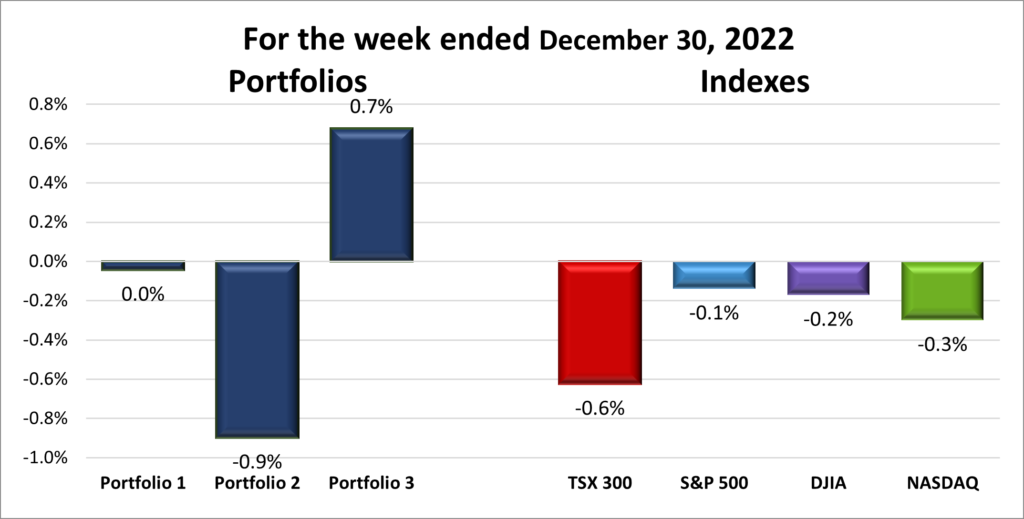
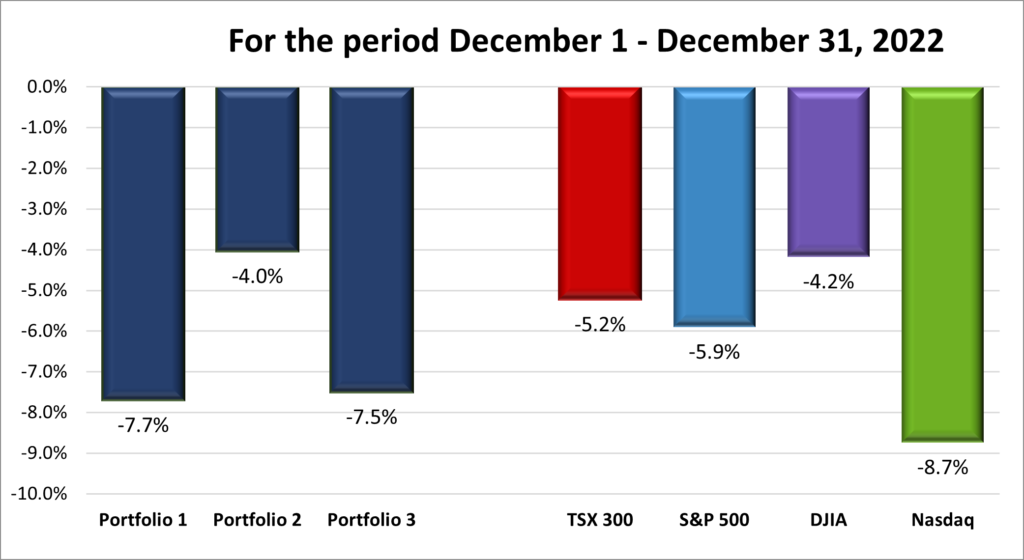


Similar to the Santa Claus rally is the January Effect. Many investors believe the markets perform better in January than the other months, especially the first five trading days.

There are a number of possible explanations for a January Effect including: investors selling their losers in December for tax purposes and are now looking to put their money back into the market; thanks to December selling, share prices have fallen and shares look more attractive; investors have more cash available thanks to corporate bonuses; and people in general tend to be in an upbeat mood coming out of the holiday season. No matter what the reason, they all result in increased buying which pushes share prices higher.

Unfortunately, the January Effect has lost its lustre over the years. As more investors become aware of the supposed January bump, the more people will try to take advantage of it, effectively nullifying whatever dip in share prices there may have been. Add online trading investors to the mix and the January Effect has all but disappeared.

In a sense, the January Effect is a lot like Black Friday, Cyber Monday, and Boxing Day sales. While there are lots of great sales, people tend to get caught up in the buying frenzy, especially if its instore shopping, and feel they must buy something even if what they came for is unavailable.

Since I got back into investing in 2017, the only time I experienced the January Effect was in 2019. Otherwise, I have not experienced another January rally, even in red hot 2021 the markets did not take off until February. Each year I try to keep cash available in the event there is a January Effect. However, I still maintain my strategy of buying great companies with the intent of holding them for the long term.


Now that 2022 year-end has arrived, there will plenty of people claiming how well their portfolio performed in 2022. Take it with a grain of salt. This is especially important in a bearish year like 2022 when the vast majority of investors saw the bottom fall out of their portfolios. Some may be tempted to embellish their results, especially on social media, financial management sites, and elsewhere on the internet. If you are considering paying money for someone to manage your investment or provide advice, try to find out if the results they claim to have achieved have been professionally audited.


Before we call it a wrap for 2023, let’s take a look at how the last week of the year unfolded for the markets and the Portfolios.

Weekly Market Review

Monday: The four major North American indexes – the Toronto Stock Exchange Composite Index (TSX), the S&P 500 Index (S&P), the Dow Jones Industrial Average (DJIA), and the Nasdaq Composite Index (Nasdaq) – were closed for the Christmas holiday.

Tuesday: In Canada, the TSX was closed for the Boxing Day holiday. In the US, it was a mixed bag with the interest sensitive growth technology stocks that dominate the Nasdaq, and to a lesser extent the S&P, ending lower. The lone bright spot was the DJIA, which was held up by the value-oriented companies in the index. In trading, the S&P Energy and Telecommunications Services sectors climbed the most, while the interest sensitive Consumer Cyclicals and Technology sectors had the greatest declines.

Wednesday: I saw a headline from an investing newsletter that said the markets looked set to rise today. Were they wrong! All four indexes plunged in morning trading, followed by a brief lunchtime rally before drifting downward again. Concerns about a surge in Covid-19 cases in China, negative market sentiment, a reluctance to take on risk and lighter trading volumes all contributed to the market’s downward movement.

In Canada, concern over rising Covid cases in China caused oil prices to fall (less work and travel being done mean less need for oil), resulting in many Energy companies ending the day lower. All the Canadian sectors ended lower today. The Consumer Cyclical and Utilities sectors fell the least, while the Energy and Healthcare sectors lost the most.

In the US, slightly over a year ago the Nasdaq hit an all time high. Fast forward to today, the Nasdaq hit a 2022 closing low as investors continued to have concerns about mixed signals after recent economic data, leading to a broad-based decline across all S&P sectors. The Healthcare and Financials sectors dropped the least, while the Energy and Basic Materials (miners and fertilizer manufacturers) fell the most.

Thursday: After Wednesday’s sell off it was good to see all four indexes rebound with solid performances. Each index finished at least 1% higher, with the Nasdaq gaining more than 2%. The main spark for the rally was higher US jobless numbers, indicating the US labour market may finally be cooling off.

In Canada, The Canadian Technology and Healthcare sectors led the way upward. The Consumer Staples sector was the only Canadian sector to slide backward today.

In the US, the growth sectors enjoyed a resurgence. It seems any time there is a hint inflation or interest rates are falling sends investors back into the arms of growth companies, particularly technology companies. It was a complete reversal from Wednesday for the American S&P sectors, with all eleven ending in the black. Leading the way were the Technology and Consumer Cyclical Sectors, with Consumer Staples advancing the least.

Friday: Today pretty much exemplifies 2022 – down. It turns out Thursday was just a one-day speed bump on a downhill road as all four major North American indexes ended the day, week, month, and year lower. The only bright spot was oil ended higher, pushing energy companies’ shares higher.

In Canada, the TSX recorded its first annual drop since 2018 (lets hope drops do not become an annual thing 😊). On the last day of the year for the markets, the TSX had only three Canadian sectors end the day in the black – the Telecommunications Services, Healthcare and Energy sectors. The biggest drops were had by the Utilities and Financials sectors.

In the US, the rapid increase of interest rates has led the S&P, DJIA and Nasdaq to break their three-year winning streak of yearly gains. In trading, only the American S&P Energy and Telecommunications Services sectors ended higher. The biggest losers were the Utilities, and Basic Materials sectors.


For the week, the TSX dropped 0.37%, the S&P 500 declined 0.1%, the Dow fell 0.2% and the Nasdaq sank 0.3%.

For the month, the TSX sank 5.2%, the S&P 500 dropped 5.9%, the Dow fell 4.2% and the Nasdaq plunged 8.7%.

Weekly Portfolio Review

Bearish market
Bearish market

I had hoped the week would go out on a winning note, but as you can see below, it was not to be. With many of the professional traders and institutional investors enjoying time off before getting back to business in the new year, the field was left to us retail investors. Trading volumes were down and on-going concerns about inflation, interest rates and the possibility of a recession did not give investors any reason to jump into the market this week. All four indexes ended lower, with the TSX dropping the most as the price of oil did not turn upward until the end of the week. Since the Energy sector accounts for 19% of the TSX, falling oil prices weighed on the index. As for the three American indexes, the reasons previously mentioned were probably why they ended lower.

For the portfolios, I was surprised to see Portfolio 3 gained 0.7%. Most of the technology companies in the portfolio ended the week higher which would have lifted the portfolio. The other surprise was Portfolio 2 which fell almost 1%. No big loser but the result of numerous smaller losses added up to Portfolio 2 ending the week lower. Portfolio 1 did not gain any ground but not losing money is the next best thing to gaining money. 😊

Weekly Portfolio & Index performance
Weekly Portfolio & Index performance for the week ended December 30, 2022.
Bearish market
Bearish market

There was no Santa Claus rally this year. ☹ The winning streak for monthly returns came to a crashing end in December. After two months of strong monthly gains, all four indexes plunged lower in December. The US interest rate hike and ominous comments from the US Federal Reserve at the start of the month sent the markets in a tailspin and there was not much good news to overcome the downward momentum. The interest sensitive Nasdaq and S&P companies bore the brunt of the pain, with the Nasdaq giving back the gains it had made in the previous two months. Although the TSX and DJIA are not populated with trendy, interest sensitive, growth companies like the Nasdaq and S&P, they were still dragged lower by economic concerns and overall negative market sentiment.

Unfortunately, the three Portfolios tend to mirror the indexes and December was no exception (this past week is the only time I remember a Portfolio advancing when all four indexes declined). The only bright spot (if it can be called a bright spot) was the Portfolios ended like I thought they would. The riskier Portfolios 1 and 3 dropped the most while the more balanced Portfolio 2 fell the least. It seemed for the last few months Portfolio 2 was performing the worst no matter what the markets did so its good see that over time it will not fall as hard as the other two portfolios. I know being the best of a bad lot is not a great achievement, but I am trying to take something positive out of the December results. 😊

That was not how I had hoped December would play out but its over, as is 2022. I hope the bears of 2022 go back into hibernation in 2023, and by the end of the year the bulls once again dominant the stock market field.

Monthly Portfolio & Index performance
Monthly Portfolio & Index performance for December 2022.

Companies on the Radar

A short and quiet week, with no companies coming on the radar to join the four companies listed below.

  • Crew Energy (TSX:CR): A Canadian oil and gas company with interests in British Columbia.
  • Alvopetro Energy (TSXV:ALV): A Canadian natural gas company developing natural gas projects in Brazil.
  • International Petroleum (TSX:IPCO): A Canadian company with oil and gas assets in Canada, Malaysia, and France.
  • Alphabet (NASD:GOOGL): The leading online search engine and advertising company, dominant mobile operating system.

The Radar Check was last updated December 30, 2022.

Graphical user interface, text Description automatically generated

Chart Description automatically generated with low confidence

Portfolio Update

Portfolio 1

Portfolio 1 for the week ended December 30, 2022: DOWN Red Down Arrow

  • Tesla (NASD:TSLA) fell out of the S&P’s Top 10 Index this week. Lower output in China, discounts to US consumers, and a CEO who lost his focus.
  • Canada’s Competition Tribunal has given the green light to Rogers Communications’ (TSX:RCI.B) to acquire Shaw Communications (TSX:SJR.B). The Commissioner of Competition opposed the merger, arguing the merger would cause “materially higher prices” for consumers in Western Canada. The Commissioner of Competition has appealed this decision, so the process goes on. If/once the merger of Rogers and Shaw goes through there will be one less national telecom provider. If prices were already considered high, I do not see how less competition will improve service and pricing.

Activity

No significant activity to report this week.

Dividends

Dividends Received this week for the following companies:

Companies followed by DRIP (Dividend Re-Investment Plan) indicate additional shares were purchased with the dividend. Any cash leftover was added to the cash balance.

Canadian $

Canadian National Railway Co (TSX:CNR)

Shaw Communications Inc (TSX:SJR.B)

US $

No US$ dividends this past week.

Quarterly Reports

No quarterly reports this past week.

Portfolio 2

Portfolio 2 for the week ended December 30, 2022: DOWN Red Down Arrow

  • Some good news for Disney (NYSE:DIS). Imax Corporation (NYSE:IMAX) announced Disney’s latest blockbuster ‘Avatar: The Way of Water’ pulled in over US$ 105 million globally from Imax theatres in the first two weeks. The movie became the highest grossing Imax release of all time in several international markets.
  • TC Energy (TSX:TRP) put its Keystone pipeline back in operation this week. The company completed repairs, passed the testing of the repaired section, and received the necessary approvals.

Activity

No significant activity to report this week.

Dividends

Dividends Received this week for the following companies:

Companies followed by DRIP (Dividend Re-Investment Plan) indicate additional shares were purchased with the dividend. Any cash leftover was added to the cash balance.

Canadian $

Dream Industrial Real Estate Investment Trust (TSX:DIR.UN) DRIP

Brookfield Infrastructure Partners LP (TSX:BIP.UN)

Brookfield Infrastructure Corp (TSX:BIPC)

US $

No US$ dividends this past week.

Quarterly Reports

No quarterly reports this past week.

Portfolio 3

Portfolio 3 for the week ended December 30, 2022: UP Green Up Arrow, signifying a positive week

  • If the Microsoft (NASD:MSFT) deal to acquire Activision Blizzard (NASD:ATVI) goes through, Microsoft will find itself dealing with unions. Employees at Activision’s Proletariat studio in Boston voted to join the Communications Workers of America union. This would be the third Activision studio to unionize, joining studios in Albany, NY, and Wisconsin.
    The Federal Trade Commission’s antitrust case against Microsoft over their acquisition of Activision Blizzard is set to begin January 3, 2023, with the first pretrial hearing. The Commission argues the deal would give Microsoft Xbox exclusive access to popular Activision games, to the detriment of rivals. Microsoft is arguing the deal is good for gamers and companies. They have even offered a legally binding agreement to provide their competitors with access to the Activision games.

Activity

No significant activity to report this week.

Dividends

Dividends Received this week for the following companies:

Companies followed by DRIP (Dividend Re-Investment Plan) indicate additional shares were purchased with the dividend. Any cash leftover was added to the cash balance.

Canadian $

Brookfield Renewable Corp (TSX:BEPC)

US $

No US$ dividends this past week.

Quarterly Reports

No quarterly reports this past week.