Weekly Update for the week ending December 23, 2022

Items that may only interest or educate me ….

Canadian data, Strength of the US dollar, Growth of EV production, but first….


Merry Christmas | Snoopy christmas, Snoopy christmas cards, Snoopy

While investing did not bring the joy it did the past two Christmases, may Santa provide you one or two stock tips that become huge winners.


It was a busy week of reports from Statistics Canada. First, they announced Canadian retails sales rose by 1.4% from September to October, but they expect to see a 0.5% decline in November. October sales were the best in five months, but they still came in lower than expected by analysts. Most of the October sales increases were a result of higher prices, especially at the gas pump, rather than consumers buying more products. The lower retail sales are not a good sign for the economy because it indicates the high inflation (goods cost more), and higher interest rates (borrowing cost more) are having a negative impact on Canadian shoppers. That does not bode well for retailers that depend on holiday shoppers to boost their revenues.

Next, Statistics Canada announced the Canadian Consumer Price Index (CPI) for November rose 6.8%, missing analysts forecast of 6.7%. However, it was still down from October’s 6.9%. The core CPI (CPI without the food and fuel costs) grew 5.4%, slightly higher than October’s 5.3%.

The good news is inflation appears to be slowly but surely drifting downward. The bad news is inflation is still too high despite the record pace of increases, opening the door for another increase to the Canadian benchmark interest rate. Analysts are anticipating a 0.25% increase in January. The Bank of Canada (BoC) has said the size of future interest rates will be determined by the data so we will have an idea what to expect when the next Canadian CPI comes out in January.


American based companies with international operations have been feeling the sting of a strong US dollar. The strength of the US dollar is closely tied to the direction of interest rates, and in 2022 US interest rates rose at their fastest pace in 40 years. After Russia’s invasion of Ukraine, investors around the world looked for a safe haven for their money. Many turned to the US dollar thanks to the higher interest payments on US Treasuries, a product of the US Federal Reserve’s interest rate hikes to fight inflation, and because it is considered the most stable of all currencies. While the US dollar surged, other world currencies tumbled, including the Canadian dollar.

As a result of a strong US dollar, the revenues and profits of US multinationals suffer. When an American company rolls up all the revenues from its foreign branches, all the foreign currencies must be converted to the US dollar. The higher US dollar means the foreign currency cannot purchase as many US dollars. The foreign currencies end up being converted to fewer US dollars which appears on the financial statements as lower revenues and lower overall profitability.

For example, say we have a US company with a Canadian subsidiary. Let us call the US company ‘Parent A’ and the Canadian subsidiary ‘Sub A.’ Sub A has C$ 1 million of revenues in each of the last two years. Each year this money must be converted to the currency of the country where Parent A is located (the US in this example).

In the table below, you can see the impact of a weaker Canadian dollar against the US dollar. When Parent A received the C$ 1 million from Subsidiary A, in December 2021, after converting it to US dollars (using the BoC rate of 0.7727), Parent A would have received US$ 772,700 of revenues from Sub A. This year (December 2022), when Parent A received the C$ 1 million in revenues from Sub A, Parent A would receive US$ 732,400 of revenues from Sub A, after converting from Canadian dollars to US dollars (using the BoC rate of 0.7323.)

Year  Canadian Dollars  Exchange Rate  US Dollars
2022 1,000,000 0.7342 734,200
2021 1,000,000 0.7727 772,700

On Parent A’s Income Statement for 2022, revenues from Sub A would be reported US$ 40,300 lower than what was reported on the Income Statement for 2021. Despite the Canadian revenues being the same for both years, the strength of the US dollar has made it more expensive to buy US Dollars and therefore the same amount of Canadian dollars buys less US dollars. Which in turn appears as lower revenue reported by Parent A.

Now imagine if Parent A had a dozen more subsidiaries located throughout the world. Each of those subsidiaries would have to convert their revenues and earnings into US dollars, many at worse exchange rates than converting Canadian to US dollars. This would cause the big US multinational corporations to see their sales and profits get hammered by currency exchanges. Some analysts estimate the strong US dollar reduced third quarter corporate revenue growth by 4%.

As a strong US dollar leads to lower overall revenues and profits for a US based multinational, a weaker US dollar against the Canadian dollar has the opposite effect. A weaker US dollar would lead to an increase in revenues and earnings from a Canadian subsidiary because the Canadian dollar would be able to buy more US dollars which would show up as higher numbers in the financial statements.

While a strong US dollar is great for American citizens through greater buying power, you can see how its not so great for American multinationals because of lower revenues from foreign offices. When you see a lower, or higher, revenue being reported by any American company that does business abroad, make sure to check the notes to see if foreign currency exchange accounts for the unexpected gain or loss in revenues. Losses or gains due to currency exchange is one area companies have little to no control over.


What started out as a trickle of electric vehicles (EVs) has turned into a steady stream. Tesla (NASD: TSLA) is the name most people recognize, but today there are many EV manufacturers. Well known names such as Hyundai (OTC:HYMTF), General Motors (NYSE:GM), Ford (NYSE:F), and Volkswagen (OTC: VWAGY), together with automotive upstarts such as Rivian (NASD:RIVN), Lucid (NASD:LCID) and numerous Chinese companies, are pouring more than $1 trillion into the move from internal combustion engines to electric vehicles that are controlled by software.

Despite all the competition for EV dominance, Tesla still is the leader in EV sales in North America with over 50% of the market. However, that dominance should fade as GM and Ford roll out more EV models, including trucks and SUVs. The established car companies should be able to make inroads on Tesla’s market dominance easier than the newcomers thanks to their years of experience and very deep pockets. That gives them a big advantage when it comes to scaling up production.

If intense competition was not enough for the start-ups, the past year has not gone well for them. Inflation, higher interest rates and supply chain problems have all had an impact on these companies. Inflation has made components more expensive. More cash has been required to service their debt thanks to the higher interest rates. And supply chain challenges have made it harder to fill their sales orders, leading to lower revenues. Put these together and their quarterly earnings have not inspired investors.

As a result, many of the high-flying start-ups of 2021 have seen their market value plunge dramatically. For example, Rivian and Lucid are each down almost 80%, and Chinese EV company NIO (NYSE:NIO) is down 60%. These losses make Ford’s 40% and GM’s 35% market capitalization losses pale by comparison.

Going forward, inflation and higher interest rates will be around for most of 2023. However, many of the established automakers will debut many of their new EV models. Mass production should begin to ramp up in the later half of 2023 and be in full swing by the end of the year. It will be interesting to see how many of the new companies can survive the current economic environment as well as stiff competition from the incumbents who will not go silently into the night.


Before our thoughts turn to visions of sugar plums, lets see if the markets gave the portfolios a present or a lump of coal….

Weekly Market Review

Monday: The losing streak for all four major North American indexes reached four today with a sell off that spanned every sector in both Canada and the US. The only bright spot was the price of oil ended higher, but barely. The big driver of the market was fear of a recession in 2023, particularly in the world’s largest economy, the US. Not a great way to start the week. ☹

In Canada, on the Toronto Stock Exchange Composite Index (TSX), the Consumer Staples and Energy sectors dropped the least of the Canadian sectors, while the Utilities and Healthcare sectors fell the most.

In the US, the Nasdaq Composite Index (Nasdaq), the S&P 500 Index (S&P), and the Dow Jones Industrial Average (DJIA) all ended lower. The Energy sector just missed getting out of the red by 0.01%. Leading the retreat of the S&P sectors were the interest sensitive Consumer Cyclicals and Technology sectors.

Tuesday: All four indexes got back on the winning track after the US dollar weakened against other major currencies. A weaker dollar means foreign currencies have more purchasing power against the US dollar. For Canadians, it means the Canadian dollar buys more when you visit the US. For us Canadian investors it means it does not cost us as much to buy shares of US companies.

In Canada, investors prepared for tomorrow’s Canadian Consumer Price Index (CPI) report. On the TSX, the Basic Materials (mining companies and fertilizer manufacturers) sector and the Energy sector had the best day of the Canadian sectors, while Consumer Cyclical and Healthcare had the worst day.

In the US, investors were worried about lower spending during the holiday season, leading to poor performance in the retail shopping sector. In the markets, the Energy and Basic Materials sectors led S&P surge that saw all S&P sectors end higher except for the Consumer Cyclicals sector.

Wednesday: Another day in the win column for all for all four indexes thanks to higher oil prices and signs of upbeat consumer confidence going into the Christmas break. In Canada, the Canadian CPI for November came in at 6.8% higher than November 2021, slightly less than the October rate of 6.9%, indicating inflation in Canada was cooling. In trading, all Canadian sectors ended higher, led by the Energy and Consumer Cyclical sectors, with the Consumer Staples and the Telecommunications Services sectors bringing up the rear.

In the US, investors seem to have shaken off last week’s comments from the Fed about ongoing inflation and continue to expect inflation to start coming down in 2023. Consumer confidence has reached its highest point in eight months. Strong quarterly earnings updates from a few big US multinationals did not hurt either. In trading, it was a broad-based rally as all the S&P sectors ended in the black today. Energy and Industrials sectors performed the best while Consumer Staples was the only sector not to gain at least 1%, missing by 0.03%.

Thursday: The stock markets fell sharply in the morning, before regaining some of the ground in the afternoon. Unfortunately, it was not enough as all four indexes ended the day lower. The main story was lower unemployment in the US, which sparked concerns of ongoing aggressive interest rate hikes.

In Canada, thanks to fears of higher interest rates, the TSX gave back gains from the previous two days. Interest sensitive Canadian Technology and Energy sectors had the biggest drop in a broad-based retreat on the TSX. Telecommunications Services and Consumer Staples sectors dropped the least.

South of the border, a recession is in the process of replacing inflation as what concerns investors the most. The US Department of Labor’s recent unemployment data came in lower than expected. As long as there is high employment and inflation remains high, the Fed will keep ratcheting up the US benchmark interest rate. In the US markets, the S&P’s Telecommunications Services was the only sector in the black, avoiding the S&P sectors being shut out of the win column. The interest sensitive Technology and Energy sectors had the worst day.

Friday: The markets were up and down like a yoyo today. The day started with a plunge thanks to ongoing concerns about aggressive interest rate hikes tipping Canada and the US into recessions in 2023. During afternoon trading, good economic news emerged out of the US and the indexes started climbing into positive territory on. The markets were further boosted by news Russia plans to cut their output of crude oil in response to price caps imposed by western governments, pushing oil prices, and the market, higher.

In Canada, thanks to higher oil prices, the TSX ended high enough today to pull the TSX into the black for the week. The Canadian Energy and Utilities sectors led the advance while Technology and Healthcare held the TSX from larger gains today.

In the US, the Commerce Department reported inflation continues to cool. Unfortunately, inflation has not gone down enough to convince the Fed to lower the size of their upcoming interest rate hikes. The Energy and Utilities sectors led the S&P sectors higher while only the Healthcare sector failed to gain ground today.


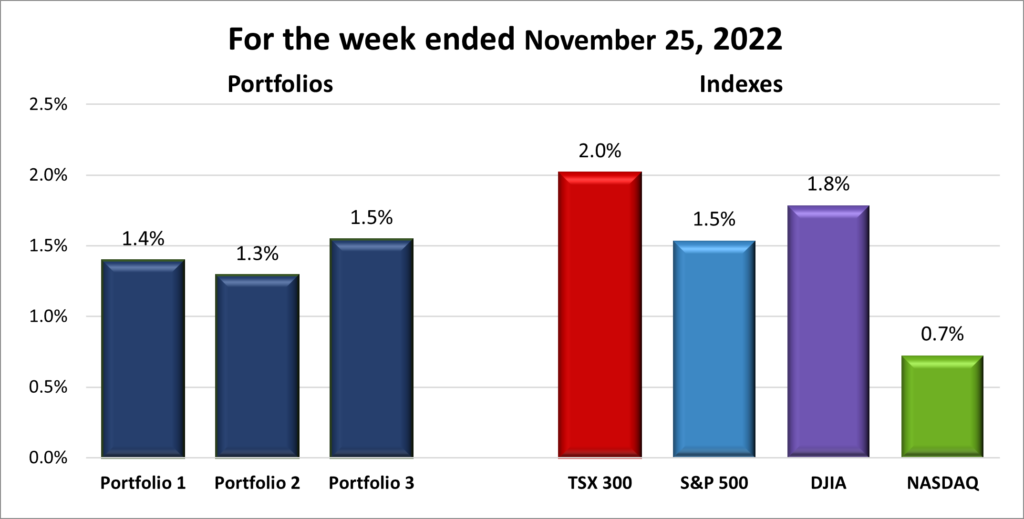
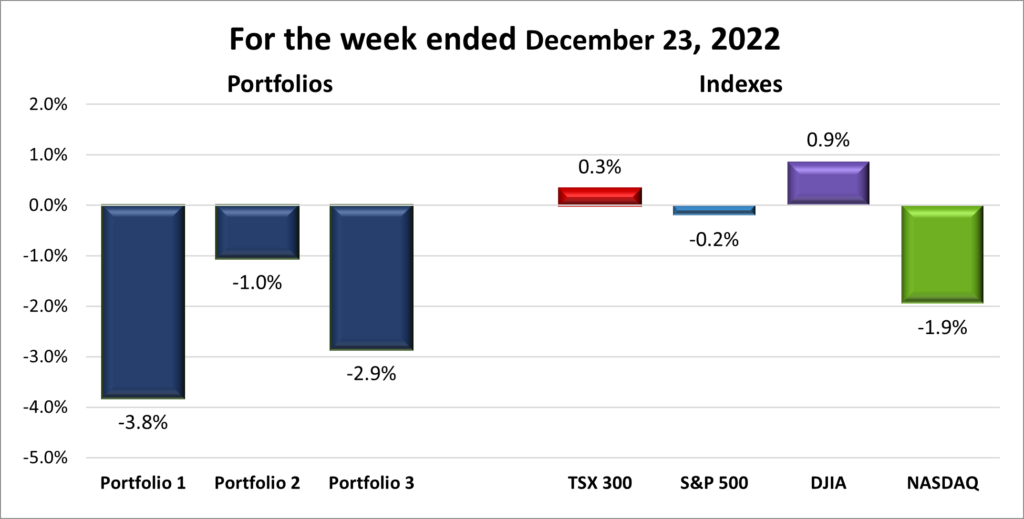
A split decision this past week, with two indexes ending in the black and two ending in the red. For the week, the TSX gained 0.3%, the S&P 500 lost 0.2%, the Dow advanced 0.9% and the Nasdaq dropped 1.9%.

Weekly Portfolio Review

Bearish market
Bearish market

It was a roller coaster ride through the markets this week, before a last-minute rally was able to push the TSX and the DJIA into the black. Once again higher interest rates weighed down the growthier Nasdaq and the S&P.

With the indexes all lower, it appears the Portfolios received a piece of coal from Santa this past week. Once again, the interest sensitive technology companies, were hit the hardest as investors are now looking for companies with profits and minimal debt, something start-ups typically do not have. All three Portfolios are growth oriented, but as you can see in the chart below, Portfolios 1 and 3 contain a higher ratio of high growth companies. Whereas Portfolio 2 has a few growth stocks but it has a higher ratio of mature dividend paying companies.

The three portfolios have ridden out the inflation fears of 2022, albeit not very well. Next week we will see how the Portfolios made out in 2022. In 2023 I suspect I will find out if each portfolio can survive a recession, which was not a consideration when they were being built.
Weekly Portfolio & Index performance
Weekly Portfolio & Index performance for the week ended December 23, 2022.

Companies on the Radar

All is quiet on the radar the week before Christmas. The same four companies listed below remain front and centre.

  • Alvopetro Energy (TSXV:ALV): A Canadian natural gas company developing natural gas projects in Brazil.
  • International Petroleum (TSX:IPCO): A Canadian company with oil and gas assets in Canada, Malaysia, and France.
  • Crew Energy (TSX:CR): A Canadian oil and gas company with interests in British Columbia.
  • Alphabet (NASD:GOOGL): The leading online search engine and advertising company, dominant mobile operating system.

The Radar Check was last updated December 23, 2022.

A picture containing graphical user interface Description automatically generated


Portfolio Update

Portfolio 1

Portfolio 1 for the week ended December 23, 2022: DOWN Red Down Arrow

  • Amazon (NASD:AMZN) was awarded a 5-year contract to supply the US Navy with cloud services from their Amazon Web Services unit. The deal is worth almost US$ 724 million.
    Amazon’s share price hit pre pandemic levels, effectively erasing all its gains pandemic gains. When I bought it a few weeks ago, I knew it would go lower but not this much lower (and falling). ☹ I still think it will bounce back once the markets get out of their funk. Unfortunately, I’ve no idea when that might be.
    The Court of Justice of the European Union (CJEU) has opened the door for European national courts to hold Amazon responsible for advertising counterfeit products, in this case Christian Louboutin shoes. The CJEU said the way Amazon presents the shoes does not clearly delineate between shoes offered by Louboutin and shoes offered by third party sellers. This confusion may cause online shoppers to believe Amazon is benefitting from the sale of the counterfeit shoes. Hopefully, this will put an end to Amazon mixing brand name products with knock off products.
  • Last week FuboTV (NYSE:FUBO) was the victim of a cyber attack that came at a most inopportune time. The attack came during the France v Morocco World Cup semi final, preventing many Fubo customers from accessing their accounts to watch the game. It took Fubo two days to fully restore all the accounts, much too late to watch game but more than enough to catch a lot of flack on social media and see its share price punished.
  • Slowing demand for Tesla’s electric vehicles, especially in China, has the company set to announce another round of layoffs as well as a hiring freeze. Tesla has also started offering discounts in the US on selected models, and free supercharging for up to 10,000 miles for cars received in December.
    Tesla CEO Elon Musk promised not to sell any more of his Tesla shares for two years to calm investors. Mr. Musk had previously sold US$ 40 billion worth of Tesla shares in late 2021. Unfortunately, he said this before, only to sell an additional US$ 15 billion worth of Tesla shares this past spring. It would be nice to have that amount of money available, however, nothing inspires confidence like the founder/CEO selling that many shares. ☹
  • To avoid actions from Germany’s cartel office, Alphabet’s Google division updated their news service. All the changes are for the benefit of publishers. Some will be implemented immediately while others will be rolled out gradually.
    YouTube has signed a multi-year deal with the NFL to be the exclusive streamer of the NFL’s Sunday Ticket program starting next season. YouTube will pay US$ 2 billion a year to add the NFL to their YouTube TV and YouTube Primetime channels. The NFL now has streaming deals with Amazon (Thursday night football) and YouTube, to go along with broadcast deals from NBC, CBS, and Fox. For each game they are generating two income streams, broadcast, and streaming. Well done NFL! 😊

Activity

No significant activity to report this week.

Dividends

Dividends Received this week for the following companies:

Companies followed by DRIP (Dividend Re-Investment Plan) indicate additional shares were purchased with the dividend. Any cash leftover was added to the cash balance.

Canadian $

No C$ dividends this past week.

US $

NVIDIA Corp (NASD:NVDA)

Quarterly Reports

No quarterly reports this past week.

Portfolio 2

Portfolio 2 for the week ended December 23, 2022: DOWN Red Down Arrow

  • The week did not start well for the House of the Mouse (NYSE:DIS) which saw its share price drop almost 5% on Monday thanks to a weak box office opening by their new “Avatar: The Way of Water” movie. The film brought in US$ 134 million but was expected to bring in US$ 135 – US$ 175 million.
  • As part of the process of reopening their Keystone pipeline, TC Energy’s (TSX:TRP) had to submit a plan on what work they were doing to fix the problem, clean up the spill and prevent future spills. This plan was approved by the US Pipeline and Hazardous Materials Safety Administration (PHMSA). TC Energy also sent the damaged segment of the pipeline for metallurgical testing. The spill has become the largest pipeline spill in the US since 2013.
  • Guardant Health (NASD:GH) has teamed up with the Susan G. Komen (R) organization to develop clinical studies to help identify early-stage breast cancer patients who are at substantial risk of the cancer reoccurring. The data from these clinical studies will go towards improving Guardant’s Guardant Reveal test for detecting “minimal residual disease in patients with early-stage breast cancer.”

Activity

No significant activity to report this week.

Dividends

Dividends Received this week for the following companies:

Companies followed by DRIP (Dividend Re-Investment Plan) indicate additional shares were purchased with the dividend. Any cash leftover was added to the cash balance.

No dividends this past week.

Quarterly Reports

No quarterly reports this past week.
Portfolio 3

Portfolio 3 for the week ended December 23, 2022: DOWN Red Down Arrow

  • Microsoft’s (NASD:MSFT) climate innovation fund recently invested in Group14 Technologies, a private company. Group14 claims it makes better batteries for electric vehicles (EV) and energy storage solutions. The company claims its silicon anode material is more efficient than the standard graphite technology, allowing for better ultra fast charging. Microsoft is one of many companies placing bets on companies in the EV sector as the US moves to renewable energy solutions.
  • Enghouse Systems (TSX:ENGH) has agreed to purchase cloud-based video technology company Qumu (NASD:QUMU) in an all-cash deal. This should enhance Enghouse’s enterprise video capabilities.

Activity

No significant activity to report this week.

Dividends

Dividends Received this week for the following companies:

Companies followed by DRIP (Dividend Re-Investment Plan) indicate additional shares were purchased with the dividend. Any cash leftover was added to the cash balance.

No dividends this past week.

Quarterly Reports

No quarterly reports this past week.


Weekly Update for the week ending December 16, 2022

Items that may only interest or educate me ….

Santa rally, US CPI report, US interest change,  EVs killing the AM radio stars …


Will there be a Santa Claus rally in 2022? The stock markets typically get a boost in December’s holiday season thanks to upbeat retail/individual investors, many with year-end bonuses itching to be spent. Since professional and institutional investors tend to take the last week of December off, individual investors have the run of the markets, so to speak, and tend to buy stocks before the end of the year, providing a little boost to the markets to start off the new year. Given the trend of 2022, where rallies are followed by lower lows, if there is a rally, it is likely to be short lived before reverting to the downward trend of 2022.


The US Bureau of Labor Statistics released their Consumer Price Index (CPI) report for November showing US inflation rose 7.1% compared to November 2021 and the core CPI (CPI less volatile food and gas prices) rose 6.0%, year over year. Both numbers came in lower than expected, 7.3% for CPI and 6.1% for the core CPI. Coupled with the last five months of declining inflation data, the numbers suggest a downward trend and the US economy is starting to cool off. This gave the Fed some leeway to slow the pace of increases to the US benchmark interest rate….

A picture containing text, coin, clipart Description automatically generated As expected, the US Federal Reserve (Fed) did indeed ease off the gas pedal of higher interest rates, however slightly. In an effort to keep a recession at bay while reigning in inflation, the Fed announced an increase of 0.5% to the US benchmark interest rate, bringing the interest rate to 4.25%. Considering the previous four increases were 0.75%, a 0.5% increase was a relief. Another hike for sure, but at least its lower than the previous four increases. The Fed also stated it was no longer “as important how fast we go” indicating additional increases but not as big as recent increases.

The belief a smaller interest rate hike was coming, combined with the preceding five months of CPI data indicating inflation was declining, had boosted the optimism of investors and overall market sentiment. However, this week’s announcement by the Fed put an end to that optimism. It was not the hike itself (which was expected), but the Fed’s outlook for 2023 that sent the markets tumbling. The announcement suggested additional rate increases throughout 2023 would be necessary and that could push the interest rate above 5% by the end of 2023. Back in September, the Fed had projected a peak interest rate of 4.6%, so this latest projection came as a surprise. The market does not like surprises.

Going forward, the message from the Fed should be clear by now – the Fed is serious about getting inflation back down to its 2% target. The challenge is that increasing rates too aggressively would risk driving the economy into a painful recession. Not raising the interest rates enough would allow price increases to remain high, leading to stubbornly high inflation. We will see how well the Fed navigates between driving inflation down and avoiding a recession.


The impact of the interest rate hikes made in 2022 will start to have a noticeable impact by the end of spring, if not a few months before. While the US financial system is currently strong, economists are predicting the economy is expected to weaken or even slide into a recession. If a recession is declared, the markets can start looking forward to when the economy exits the recession. However, during the recession, demand will fall allowing supply chains to return to normal, employment and wage growth will soften, and companies that were on financially shaky ground before the recession could go out of business.

During a recession, a sort of law of the jungle take place with the survival of the fittest. Companies with strong Balance Sheets (lots of cash, little debt) can take advantage of weaker companies by acquiring those that would enhance or add value to their existing product line.

For individual companies, if they are going to have a weak earnings report or two (lower revenues and/or net income), they will take the opportunity to dump any useless assets. Its better to get all the bad news out under the cover of a recession than to have the bad news overshadow a good earnings report.


Its not only Canada and the US that are experiencing higher and rising benchmark interest rates. The Bank of Mexico increased its key interest rate by 0.5% to 10.50%, after hiking the rate by 0.75% to 10% in November. In the United Kingdom, The Bank of England raised the key British interest rate by 0.5% to 3.5%. The European Central Bank raised interest rates in the European Union by 0.5%, bringing the European Benchmark interest rate to 2.0%. Misery loves company. 😊


While video may have killed the radio stars, electric vehicles (EV) are slowly but surely killing off AM radios. Due to the electrical interference caused by the batteries in electric cars, electric vehicle manufacturers have decided rather than fix the problem with filters and shielded cables they would simply drop the AM signal all together. Already Audi, Porsche, and Tesla are a few of the companies that have already removed the AM band radios from their EVs, and Ford is planning to drop it from their upcoming electric F-150 models. Drivers currently tune into AM radio for the latest traffic and news updates, or listen to sporting event broadcasts, sports talk shows, or any other AM show. As well, the government utilizes the AM band to communicate directly with the public during an emergency. If/when you buy an EV, you will likely be cutting the AM cord and killing the AM radio industry.


Based on the market this past week, the Grinch may have come early and put an end to a hoped-for rally to end the year. However, there are two weeks left for a Santa rally to emerge. While we wait longingly for Santa to appear, lets take a look at the past week…

Weekly Market Review

Monday: Finally, the four major North American indexes start the week off on a winning note. In Canada, the Toronto Stock Exchange Composite Index (TSX) rose on higher oil prices and investor optimism that the US Consumer Price Index (CPI) will come in lower than the market expects. In the Canadian market, the Technology and the Utilities sectors led the Canadian sectors. The Consumer Staples and Consumer Cyclical sectors were the worst performers and the only two Canadian sectors to slip back.

In the US, the S&P 500 Index (S&P), the Dow Jones Industrial Average (DJIA), and the Nasdaq Composite Index (Nasdaq) all gained more than 1%. Investors lifted the market in anticipation of a good news CPI report that would enable the US Federal Reserve (Fed) to raise the US benchmark interest rate by 0.5%.

It was a broad-based advance across all three indexes, with the S&P Energy sector and the Utilities sector gaining the most, with the Basic Materials (Mineral miners and fertilizer manufacturers) and the Consumer Cyclical sectors bringing up the rear.

Tuesday: For the second consecutive month, inflation in the US came in below expectations sending all four indexes sharply higher in morning trading. Concerns about the Fed’s interest rate hike due tomorrow brought the indexes back down before settling just above the bar. In Canada, oil, technology, and mining companies were the main beneficiaries of the good news out of the US. In the marketplace, Energy and Basic Materials were the best performing Canadian sectors with Financials, Consumer Cyclicals, and Telecommunications Services the only three Canadian sectors to end lower.

In the US, the lower-than-expected CPI data was offset by fears the Fed could remain aggressive with their interest rate increases. In trading, the S&P Energy and Technology sectors gained the most while the Telecommunications Services and Consumer Staples were the only sectors to fall back today.

Wednesday: The markets fell when the Fed announced an increase of 0.5% to the US benchmark interest rate, their seventh hike of 2022. This brought the US benchmark rate to 4.5%, its highest point since 2007. It was not so much the increase as it was the Fed’s forecast that it expected higher rates for longer than originally thought. Despite the markets ending down, the price of oil rebounded on forecasts for increased demand for oil in 2023.

On the TSX, the news out of the US was enough to end the TSX’s winning streak. Only the Canadian Consumer Cyclical sector was able to make it into the black today. The Canadian Financials and Industrials sectors had the biggest setbacks for the day.

In the US, estimates of the US interest rate going higher for longer sent the S&P, DJIA and Nasdaq indexes tumbling. Healthcare and Consumer Staples were the only two S&P sectors to inch into positive territory, while the Telecommunications Services and Financials sectors fell the most.

Thursday: On the heels of Wednesday’s pessimistic outlook from the Fed and fears of a recession in 2023, all four indexes fell sharply today. It was a broad-based retreat as all sectors in Canada and the US ended in the red. In Canada, the Canadian defensive sectors Utilities and Healthcare fell the least while the Canadian Basic Materials and Technology sectors were hit the hardest.

In the US, all three major American indexes each dropped by more than 2%. Of the approximately 500 companies in the S&P, only fourteen ended the day higher. The American S&P Energy and Utilities sectors were the best performers even though both sectors ended the day in the red. The S&P Technology and Basic Materials sectors fared the worst today.

Friday: Fears of a recession grew after data from the latest US Purchasing Managers’ Index (PMI) indicated the fastest decline in business activity in over 2 ½ years, sending all four indexes tumbling for the third day in a row. The latest comments from Fed officials only heightened those fears when they commented it was possible the interest rate could go higher than expected, and that the higher rate may last until 2024.

In Canada, the TSX fell on fears of a recession as well as concerns the demand for oil could decline if there were to be a global economic slowdown. The price of oil fell more than 2%. In trading today, the Canadian Basic Materials and Consumer Staples sectors were the only Canadian sectors to gain ground, while Energy and Utilities had the biggest drop.

In the US, all the S&P sector indexes ended in the red today. The Consumer Staples and Telecommunications Services sectors fell the least of the S&P sectors, with the Utilities and Energy sectors falling the most.


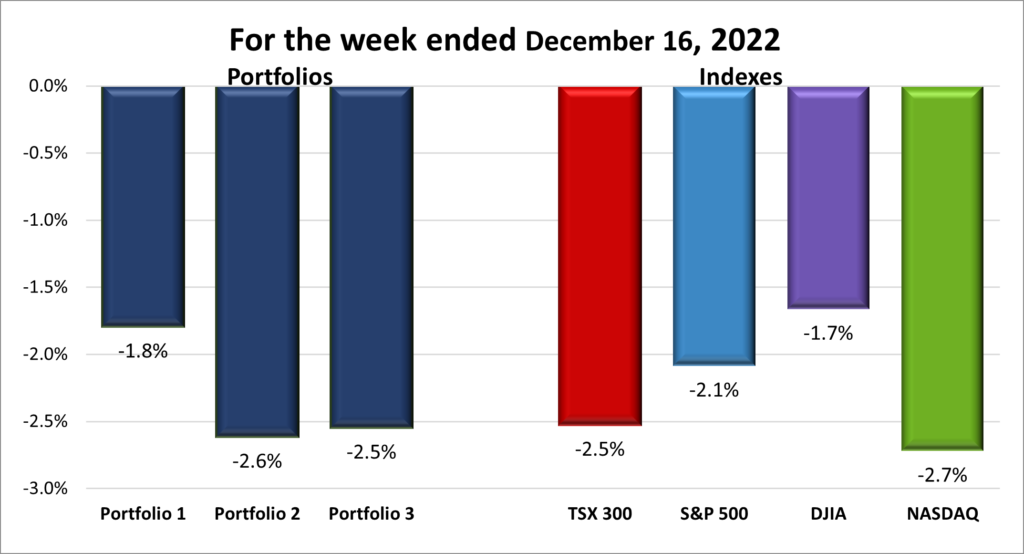
If last week was the hoped for start of a Santa rally, this week the Fed played the role of the Grinch. For the second week in a row the four indexes lost ground. For the week, the TSX dropped 2.5%, the S&P 500 fell 2.1%, the Dow sank 1.7% and the Nasdaq declined 2.7%.

 Weekly Portfolio Review

Icon Description automatically generated After a strong, optimism fueled start to the week by the bulls, the bears appeared and chased away any thoughts the bulls would carry the week. Fears of a recession in the US dominated the stock markets on both sides of the border. Once again, when the US sneezes, Canada gets a cold. The higher US interest rate dragged down the interest sensitive, high growth companies that tend to reside on the Nasdaq and S&P. The higher cost of borrowing negatively impacted the rest of the market because consumers and businesses have less money to spend thanks to higher product and service costs. A few years ago, when interest rates were near 1%, consumers and businesses were prepared to take on debt but with interest rates so high, and probably going higher, they are reluctant to take on debt. As a result, sales are lower and expected to stay down until interest rates fall. The lower revenues from sales impact all sectors and as a result even the less volatile TSX and NYSE saw their numbers fall.

Another tough week. Sigh! Another down week for the indexes, another down week for the three portfolios. Once again, the more growth oriented a portfolio, the harder the fall in a bear market. ☹ While all three portfolios are growth oriented, Portfolio 3 has more technology companies as a percent of the portfolio, without the benefit of other sectors to cushion the fall, as is the case with Portfolio 1. Portfolio 2 had a rough week when investors punished Guardant Health (NASD:GH) for a test that performed well but not as high as the market expected, driving the share price down 25%.

Weekly Portfolio & Index performance
Weekly Portfolio & Index performance for the week ended December 16, 2022.

Companies on the Radar

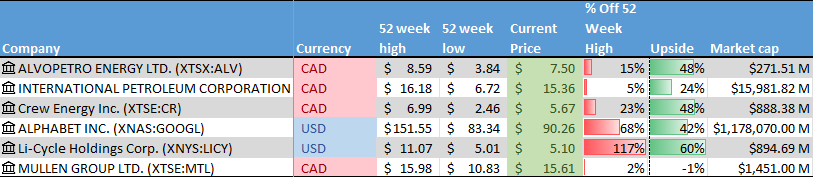
Two new companies briefly came on my Radar this week. The first is Li-Cycle Holdings Corp. (NYSE:LICY), a small cap Canadian company in the Industrials sector that recycles and recovers lithium-ion from lithium batteries. It did not do very well on the Radar Check, shown below, and I suspect it may take a while to become profitable. Plus, it has long term debt. In today’s higher interest environment, debt, negative cash flow and not generating a profit is not a good combination. For me, there are better opportunities out there.

The other company is the Mullin Group Ltd. (TSX:MTL). They are another small cap Canadian company in the Industrials sector, but this one pays a 4.5% dividend. The company provides trucking and logistics services throughout Canada and North America. I like this company better than the previous one but not better than any of the companies currently on my Radar List.

Once again, I will sit on the sidelines unless a tremendous opportunity presents itself. Otherwise, the four companies listed below, plus the two new companies mentioned above, are shown on this week’s Radar List.

  • Crew Energy (TSX:CR): A Canadian oil and gas company with interests in British Columbia.
  • International Petroleum (TSX:IPCO): A Canadian company with oil and gas assets in Canada, Malaysia, and France.
  • Alvopetro Energy (TSXV:ALV): A Canadian natural gas company developing natural gas projects in Brazil.
  • Alphabet (NASD:GOOGL): The leading online search engine and advertising company, dominant mobile operating system.

This week’s Radar Check was last updated December 16, 2022.

Graphical user interface Description automatically generated

A screenshot of a computer Description automatically generated

Portfolio Update

Portfolio 1

Portfolio 1 for the week ended December 16, 2022: DOWN Red Down Arrow

  • Workers at General Motors’s (NYSE:GM) new Ultium factory in Ohio voted to join the United Auto Workers (UAW) union, becoming the first electric vehicle factory to unionize. Ultium plans to build two additional factories in the coming years so I would expect those workers to end up joining the UAW.
    GM and its Ultium partner LG Energy were the beneficiary of a US$ 2.5 billion loan from the US Department of Energy. The money will go towards building three new lithium-ion battery manufacturing factories in the US.
    GM is recalling over 800,000 trucks and SUVs throughout Canada and the US to fix daytime running lights that may not deactivate when the headlights are activated. The running lights are said to cause glare that could lead to collisions.
    The US National Highway Traffic Safety Administration (NHTSA) has launched a safety probe into GM’s Cruise autonomous electric vehicles. The NHTSA said it has received numerous notices of Cruise cars that “engage in inappropriately hard braking or become immobilized” and become road hazards.
  • Good news, bad news. First the good news. During the annual reconstitution of the Nasdaq-100 Index, Rivian Automotive Inc. (NASD:RIVN) was added to the Nasdaq 100. Now the bad news. Skyworks Solutions Inc. (NASD:SWKS) was removed from the Nasdaq 100. Considering how the Nasdaq is down almost 30% for 2022, replacing Skyworks (down 45%) with Rivian (down 75%) is not going to help the Nasdaq 100.
  • Rivian announced it was putting its deal with Mercedes-Benz on hold to focus on becoming cash flow positive. Rivian will concentrate on consumer vehicles and fulfilling existing deals for commercial electric vans to companies such as Amazon (NASD:AMZN).
  • Apple (NASD:AAPL) and Alphabet’s Google have been forced by the European Union (EU) to allow third party app stores onto their respective smartphones and tablets. The EU’s Digital Markets Act is forcing the two dominant mobile device companies to allow other companies onto their respective platforms. I do not see a rush of consumers to these new, unproven app stores, but over time they could make a dent in Apple’s and Google’s revenue streams.

Activity

No significant activity to report this week.

Dividends

Dividends Received this week for the following companies:

Companies followed by DRIP (Dividend Re-Investment Plan) indicate additional shares were purchased with the dividend. Any cash leftover was added to the cash balance.

Canadian $

Automotive Properties Real Estate Investment Trust (TSE:APR.UN)

Yellow Pages Ltd (TSE:Y)

US $

BSR Real Estate Investment Trust (TSX:HOM.U)

Skyworks Solutions Inc (NASD:SWKS)

General Motors Co. (NYSE:GM)

Home Depot (NYSE:HD)

Quarterly Reports

Enwave Corporation

All currency listed in thousands of Canadian dollars, except per share data

Selected highlights from their year ended 2022 financial results on December 15, 2022

  • Revenue of $23,703 for the year ended September 30, compared to $26,476 for the same period in 2021. A decrease of over 10%.
  • Net earnings of $6,927 for the year ended September 30, compared to a net loss of $4,125 in the same period in 2021.
  • Diluted loss per ordinary share of $0.06 for year ended September 30, compared to a loss of $0.04 for the same period in 2021.

Portfolio 2

Portfolio 2 for the week ended December 16, 2022: DOWN Red Down Arrow

  • Microsoft (NASD:MSFT) is reaching a tentacle into the financial services industry. Microsoft made a US$ 2 billion investment for a 4% equity position in the London Stock Exchange Group (LSE) as part of a deal to move the LSE into the cloud. The LSE expects the deal to provide a significant lift to their revenues. I could not find any big win outside of the equity stake, but I expect this will provide Microsoft the opportunity to showcase its cloud and artificial intelligence services. LSE is a high profile opportunity, if Microsoft’s services and products perform as expected this will be a great win both in terms of the cash reward from their equity stack, and in proof of their products.
    In other Microsoft news, in an attempt to obtain the approval of the US Federal Trade Commission for the acquisition of Activision Blizzard (NASD:ATVI), Microsoft offered a 10 year legally binding consent degree to provide their games to competitors at the same time they release the games on their Xbox platform.
    Microsoft is partnering with ViaSat’s expand internet access in Africa. Through the use of ViaSat’s satellite network, Microsoft plans to provide internet access to over 5 million people throughout Africa.
  • Guardant Health reported their DNA blood test was able to identify 83% of colorectal cancers and 13% of advanced adenomas (a cancer precursor). This is great news for health reasons but also because the guidelines of the US Centers for Medicare and Medicaid Services indicate they will “reimburse for blood-based biomarker colorectal cancer screening tests with a minimum sensitivity of 74% if they are approved by the FDA.” If this test is reimbursable, it will likely get used more often, which means more sales for Guardant. Unfortunately, the market did not see it that way because a rival’s stool-based test produced better results.
  • On Wednesday, TC Energy (TSX:TRP) reopened its Keystone pipeline at reduced capacity. The pipeline ships crude oil (diluted bitumen) from Alberta to Illinois and had been shutdown after spilling oil into a Kanas pasture last week.

Activity

No significant activity to report this week.

Dividends

Dividends Received this week for the following companies:

Companies followed by DRIP (Dividend Re-Investment Plan) indicate additional shares were purchased with the dividend. Any cash leftover was added to the cash balance.

Canadian $

Alimentation Couche-Tard Inc (TSX:ATD)

iA Financial Corporation Inc (TSX:IAG)

US $

No US$ dividends this past week.

Quarterly Reports

No quarterly reports this past week.

Portfolio 3

Portfolio 3 for the week ended December 16, 2022: DOWN Red Down Arrow

  • On December 12, the company formerly known as Brookfield Asset Management officially became Brookfield Corporation (TSX:BN). Brookfield will remain focused on deploying capital across all its operating businesses (Renewable, Infrastructure and Reinsurance), grow its cash flows and compounding capital over the long term.
    The spin out of its asset management unit assumed the name Brookfield Asset Management, trading under the ticker BAM on both the Toronto Stock Exchange (TSE) and the New York Stock Exchange (NYSE). BAM is a pure-play global alternative asset management business.
    Not to miss out on the name changing, Brookfield Asset Management Reinsurance Partners Ltd changed their name to Brookfield Reinsurance Ltd. and their ticker symbol to BNRE on both the TSE and the NYSE.
  • Shopify (TSX:SHOP) committed US$ 11 million to encourage projects that remove carbon dioxide from the atmosphere and oceans. Initially Shopify will purchase over 7 million tonnes of carbon credits. However, they have not decided whether to use the credits themselves or offer them to their customers.
  • Adyen (OTC:ADYEY) has been chosen by Instacart to be another of their payment processing partners. Adyen plans to further improve transactions and make the purchasing process even more seamless.
  • Cloudflare (NYSE:NET) received ‘moderate’ status from the US General Services Administration’s Federal Risk and Authorization Management Program (FedRAMP). FedRAMP provides a standardized approach to security issues for cloud products and services. These are categorized into three levels — low, moderate, and high. This should open some more doors within the US government for their services.

Activity

Bought

Added a few more share of Brookfield Select Opportunities (TSX:BSO.UN). I treat BSO as a high interest bank account (11% dividend) to generate income while I wait for other opportunities, such as one of the companies on my Radar List. As long as the share price does not decline, I end up ahead. A bit of a risk but one I can accept. So, rather than leave a small amount of cash doing nothing I decided to invest the spare cash in this high interest fund managed by Brookfield Corporation, one of the top companies in Canada.

Dividends

Dividends Received this week for the following companies:

Companies followed by DRIP (Dividend Re-Investment Plan) indicate additional shares were purchased with the dividend. Any cash leftover was added to the cash balance.

No dividends this past week.

Quarterly Reports

Enghouse Systems Limited

All currency listed in thousands of Canadian dollars, except per share data

Selected highlights from their fourth quarter and annual 2022 financial results on December 15, 2022

  • Revenue of $108,060 for the three months ended September 30, compared to $113,099 for the same period in 2021. A decrease of over 4%.
  • Net income of $36,949 for the three months ended September 30, compared to net income of $30,186 in the same period in 2021.
  • Diluted earnings per ordinary share of $0.67 for the three months ended September 30, compared to $0.54 for the same period in 2021.


  • Revenue of $427,585 for the year ended September 30, compared to $467,585 for the same period in 2021. A decrease of over 8%.
  • Net earnings of $94,498 for the year ended September 30, compared to net earnings of $92,794 in the same period in 2021.
  • Diluted earnings per ordinary share of $1.70 for the year ended September 30, compared to $1.66 for the same period in 2021.

The Weekly Update for the week ending December 9, 2022

Items that may only interest or educate me ….

Oil price caps, latest change to the Canadian interest rate, electric vehicles are not enough to offset the energy consumption of global population and economic growth, will there be a Nickel cartel, …


This week marked the start of the Group of 7 (Canada, France, Germany, Italy, Japan, the United Kingdom, and the USA) and Australia attempting to impose a US$ 60 a barrel price cap on Russian oil. The G7 is hoping the price cap on Russian oil will limit Russia’s ability to finance their invasion of Ukraine. Russia has stated it will cut oil supplies to any country that attempts to implement the G7’s price cap.

As well, at the start of the week, OPEC+ (OPEC members and eleven other non-OPEC nations), who account for 90% of global oil reserves, announced they will maintain their October plan to lower their production by two million barrels a day. The lower OPEC+ output, combined with Russia’s plan not to provide oil to countries that comply with the G7’s price cap on Russian oil, could lead to oil shortages during the coldest part of the year in the northern hemisphere. This in turn would cause the price of oil to return to OPEC+’s desired US$ 90 a barrel. OPEC’s next planned meeting to review production levels is not until June 2023. Assuming the G7 can enforce their price cap, and Russia and OPEC+ stick to their quotas, oil prices should remain high for another six months unless non-OPEC oil producing nations (such as Canada and the US) can fill the void.

That should be good news for those invested in oil companies. However, and those are three major assumptions that need to hold. A break in one and oil prices could fall lower. Either way, I expect shares of oil companies to remain volatile.


Bank of Canada Reduces Overnight Rate to 0.5% | First Foundation

On December 7, the Bank of Canada (BoC) delivered an increase of 0.5% to Canada’s benchmark interest rate, the seventh consecutive increase. This brings the rate to 4.25%, its highest point in 15 years. Economists expected 0.5% increase while the market was hoping for 0.25%. The good news was the BoC indicated the interest rate increases were nearing an end and will now consider upcoming data to determine if further hikes are necessary. Economic data has shown the labour market remains strong and high inflation persists, but demand slowed significantly in the third quarter (July 1 – September 30). The question now is what the BoC’s magic number is when they will stop increasing rates. We will get our next clue at their subsequent meeting planned for January 25, 2023.

Canada’s rate has gone from 0.25% in March to 4.25% nine months later. A record pace that puts it slightly above the current US interest rate of 4.0%. However, the US rate will go higher next week when the US Federal Reserve (Fed) announces its latest change to the US cost of borrowing.

It did not take long for Canada’s big five banks to bump their lending rate. They raised their prime lending rate by 0.5%, effective December 8. For anyone borrowing money from the banks, this is not good news whether you are borrowing is done in the form of credit cards, mortgages, lines of credit, or loans (personal or business).


One would think with the growing number of electric vehicles (EVs) they would at least put a dent in conventional energy (oil, natural gas, and coal) consumption. However, according to Morgan Stanley’s Martin Rats, head of European Oil and Gas Research, that is not the case. Norwegians have readily taken to EVs with over 70% of new cars being EVs, but Norway’s oil consumption has stayed the same, if not grown. On the surface it appears there is a disconnect between the claims that EVs will lower oil consumption, (therefore reduce greenhouse gases) and cold, hard reality.

According to the report, Norwegian population growth and rising standards of living increased the use of oil more than enough to offset oil consumption saved by driving EVs. While the study only looked at Norway, if the data is extrapolated to a global scale, growing population and an increasing standard of living may be the biggest challenge to climate change. While EVs are a step in the right direction, they are not the silver bullet. Renewable energy must scale up considerably, but that cannot happen overnight. Until then the world will require traditional fossil fuels to continue to raise the standard of living for a growing global population.


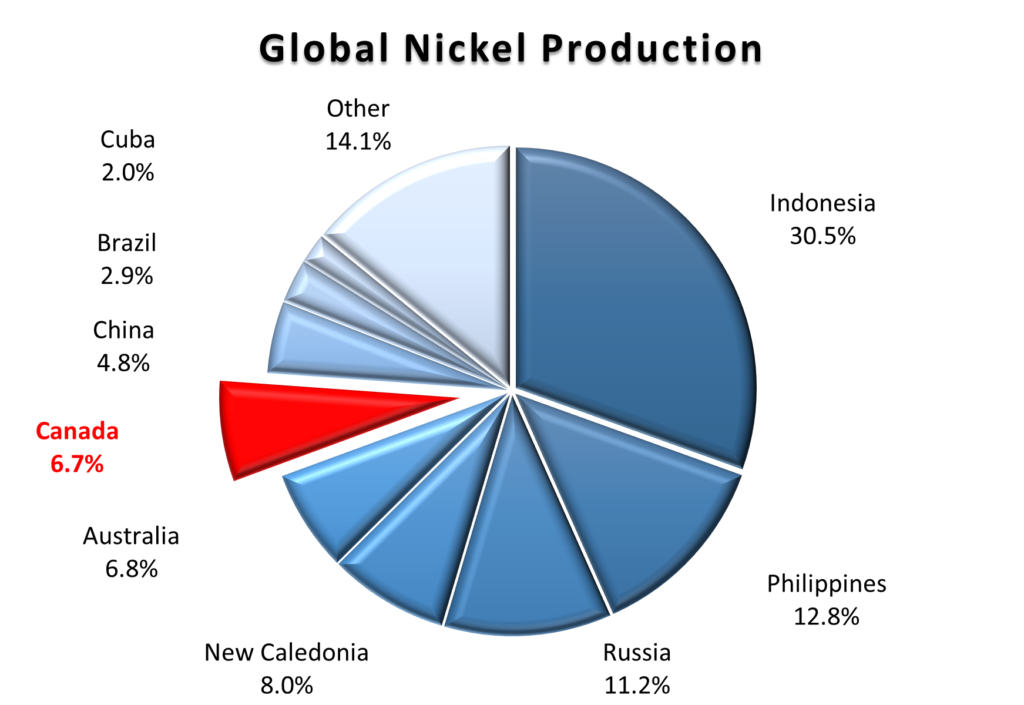
Indonesia wants to be the main player in the electric vehicle industry and has invited other big producers, including Canada, to form a nickel alliance. At the recent United Nations Climate Change Conference, also known as COP27, Canada was approached by Indonesia about joining together with other nickel producing countries to become what would essentially be a nickel cartel. As you can see in the chart below, Indonesia (30.5%), Philippines (12.8%) and Russia (11.2%) currently provide over 54% of the world’s nickel supply. Canada currently provides almost 7% of global production. Add Canada, or one of the other top five nickel producers, and a nickel cartel would have more control over nickel than the Organization of the Petroleum Exporting Countries’ (OPEC) had over the control of oil supply at its highest point of 54% in the early 1970s.

Managing the supply and price of nickel would benefit all member countries, much like OPEC’s supply control benefits its members. However, Canadian producers plan to market their nickel as a better grade of nickel – cleaner and purer – as well as being better for the climate thanks to Canadian producers’ overall lower total carbon footprint to mine and produce the nickel. If companies are prepared to pay more for Canada’s higher-grade nickel, then joining a cartel would eliminate those advantages because Canadian producers would have less control over the price.

Global Nickel Producing Countries

So, why does Indonesia want to create a cartel to control the price of nickel? While over 70% of nickel goes to the production of stainless steel, the growing production of electric vehicles (EV) is causing a surge in the demand for nickel to produce the batteries that power them. As a result, high grade Canadian nickel, which once accounted for 80% of global supply back in the 1960s, is seeing new demand as a key component in batteries. In order to secure a supply of exceptionally pure nickel, car manufacturers are starting to sign deals with miners. A good example is General Motors (NYSE:GM) recent agreement with Vale S.A.’s (NYSE:VALE) Canadian unit to supply GM with battery grade nickel, starting in 2026. Not only does this lock in a supply of high-grade nickel but it also allows GM to take advantage of the US’s Inflation Reduction Act (IRA), which offers tax credits for new and used EVs. It also provides a secure source of nickel from the US’s largest trading partner. For Vale, they have secured a long-term contract for their nickel.

Canada is correct to avoid a cartel if their product is in fact a higher-grade nickel, produced in a more environmentally friendly manner. With the concerns about the environment, companies should be prepared to pay a premium for a better grade of product from a trusted, reliable, and nearby source (lower transportation costs). Not to say that other nickel producing countries are not dependable, but I do not think many companies will want to rely on Russia for their supply given events of 2022. I also think GM’s deal with Vale is a good deal for both companies as it will lock in a supplier and a market for both companies. I suspect there will be similar deals between EV companies and mining companies in the coming months and years.


With that eclectic collection of news tidbits to chew on, lets look back at the week that was December 5 to December 9. As Daenerys would say, “Let’s begin.”

Weekly Market Review

Monday: Once again the bell tolled for the four major North American indexes as they each dropped by more than 1% today. In Canada, on the Toronto Stock Exchange Composite Index (TSX), investors took some money off the table after two weeks of gains and ahead of the Bank of Canada (BoC) announcement. In trading, the defensive Canadian sectors Telecommunications Services and Utilities were the only Canadian sectors to gain any ground. The Canadian Technology and Consumer Cyclical sectors dropped the most.

In the US, it was a case of good news equals bad news that caused a broad retreat across the S&P 500 Index (S&P), the Dow Jones Industrial Average (DJIA), and the Nasdaq Composite Index (Nasdaq). The good news was the better-than-expected US services industry data that followed on last week’s strong job and wage growth in November. The services data, job growth and higher wages suggest the US economy is still strong. The bad news was the strong economic data could lead to a higher interest rate target by the US Federal Reserve (Fed), and the higher rate staying in place longer. In the market, it was broad based retreat where the S&P Utilities and Healthcare sectors were the best of a bad lot, dropping the least.

Tuesday: All four indexes failed to rebound from yesterday’s losses as each index each dropped by more than 1% again. In the US, investors were concerned about next week’s interest rate increase by the Fed, and the possibility the US economy could fall into a recession. In the markets, only the S&P Utilities sector was able make headway today, with the Technology and Energy sectors tumbling the farthest.

In Canada, investors prepared for Wednesday’s BoC interest rate hike. Investors are anticipating a 0.25% hike to the benchmark Canadian interest rate with an outside shot at a 0.5% hike. For what its worth (nothing), I will go with a 0.5% increase. In trading, the TSX was dragged lower by falling oil and natural resources prices. All Canadian sectors fell back with the Healthcare and Energy sectors the worst performers.

Wednesday: The North American markets continued this week’s slide into the third day, causing three of the four major indexes to end lower, while the DJIA was flat. In Canada, lower oil prices, combined with the 0.5% increase to the Canadian interest rate dragged the TSX lower. The 4.25% Canadian interest rate is the highest it has been since January 2008. In the market, the Canadian Consumer Staples and Consumer Cyclical sectors performed the best of five sectors that ended in the black, while the Healthcare and Technology sectors fell the most.

In the US, investors were concerned the Fed will maintain higher interest rates longer than anticipated, which could put the American economy into a recession. Of the S&P sectors, only the Healthcare and Consumer Staples sectors were able to end in the black, with Technology and Consumer Cyclical were the deepest in the red.

Thursday: It was the first time in December that all three American indexes were on the winning side on the same day. Unfortunately, the TSX did not get the memo until late in the day and ended just below the bar, extending its losing streak to five days. In Canada, oil prices fell to their lowest level this year, dragging the TSX lower. Despite the TSX ending lower, the Canadian sectors were evenly split, with Consumer Staples and Consumer Cyclicals leading the way of the group of sectors that ended higher. Of the sectors that dropped, the Telecommunications Services and Energy sectors fell the farthest.

In the US, investors took an increase in weekly jobless claims as a sign interest rate hikes could finally slow down. Investors decided to take advantage of the recent downturn and cautiously waded back into the markets. On the trading floor, the S&P Technology and Consumer Cyclicals sectors advanced the most with the Telecommunications Services and Energy sectors the only S&P sectors to end lower.

Friday: The week ended the same way it started with all four major indexes ending the day lower. The main driver of the markets was on-going fears that higher interest rates in both Canada and the US would push their respective economies into a recession.

In Canada, the TSX ran its losing streak to six days as a late afternoon decline nudged the TSX under the line and into the red. Investors are worried the BoC will need to keep the Canadian interest rate above 4% for most of 2023. Softer global oil prices also contributed to the TSX’s decline. In trading, the odd combination of the defensive Canadian Utilities sector and the growth oriented Canadian Technology sector led the gainers while Consumer Cyclical and Energy sectors fell the most.

In the US, a higher-than-expected Producer Price Index (PPI) showing an increase of 7.4% (investors were expecting 7.2%) triggered a broad-based sell off across the three American indexes, causing all of them to end slightly lower. The PPI report ignited fears the Fed would continue their aggressive rate hike with a 0.5% boost next week. On the real and virtual trading floors, the S&P’s Telecommunications Services and Financials sectors were the best performers because they dropped the least, with Energy and Healthcare tumbling the most.


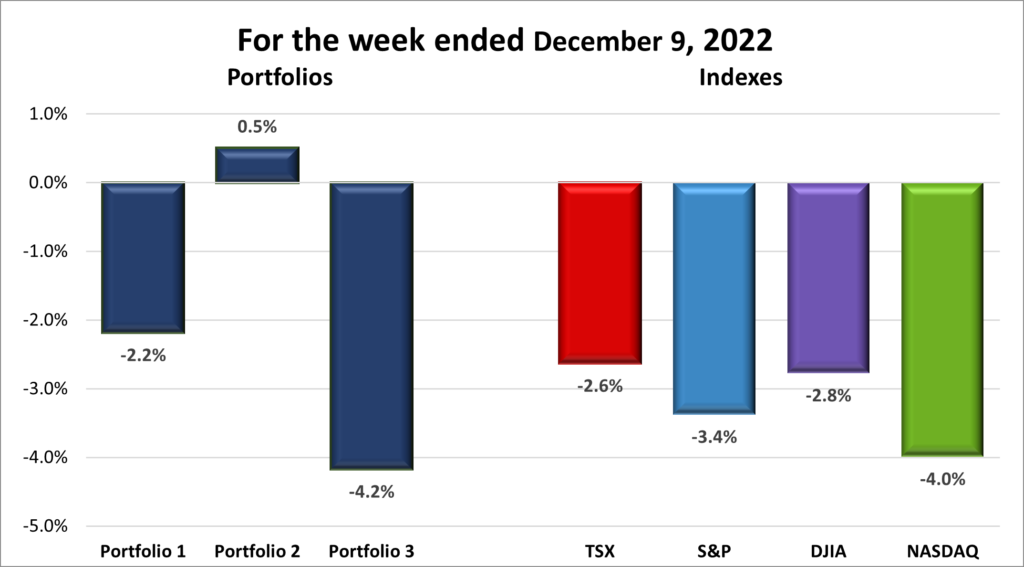
After two straight weeks of weekly gains, all four indexes ended this week lower. As you can see on the chart below, for the week, the TSX (SPTSX) dropped 2.6 %, the S&P 500 (SPX) fell 3.2%, the DJIA (INDU) sank back 2.8% and the Nasdaq (CCMP) declined 4.0%.

Weekly Portfolio Review

Given the downward trend of 2022, its not surprising after 2 consecutive weeks of weekly gains that all four indexes resumed their respective downward trends. Rising interest rates and fear of recessions were the big market drivers this week. Once again, the most interest rate sensitive indexes dropped the most (Nasdaq and S&P). Lower oil prices contributed to the TSX’s fall while the DJIA probably was dragged down by the negative market sentiment.

Given the overall performance of the four indexes, I was surprised to see Portfolio 2 was able to creep higher this week. Normally I would say because its more balanced but this week the credit must go to a high growth technology company – MongoDB (NASD:MDB). The company had a great third quarter earnings report, causing the share price to pop 32% this week. A jump like that will do wonders for a portfolio. As for Portfolio 1 and 3, nothing jumps out other than they were dragged down by the overall market’s downward trend. Portfolio 3’s heavier technology weighting caused it to fall farther than Portfolio 1.

Weekly Portfolio & Index performance
Weekly Portfolio & Index performance for the week ended December 9, 2022.

Companies on the Radar

Several professional investment strategists are predicting a further drop in the market for 2023. I do not know what is going to happen in the market on a day-by-day basis, let alone a few months from now. I suspect it will go down, so I will just sit on the sidelines unless a tremendous opportunity presents itself. In the meantime, I will continue to monitor the three portfolios for opportunities to add to winners such as the ones currently on the Radar list, below.

  • Crew Energy (TSX:CR): A Canadian oil and gas company with interests in British Columbia.
  • International Petroleum (TSX:IPCO): A Canadian company with oil and gas assets in Canada, Malaysia, and France.
  • Alvopetro Energy (TSXV:ALV): A Canadian natural gas company developing natural gas projects in Brazil.
  • Alphabet (NASD:GOOGL): The leading online search engine and advertising company, dominant mobile operating system.

Below are my Radar Checks on these companies, updated December 9, 2022.

Graphical user interface, application Description automatically generated

A picture containing chart Description automatically generated

Portfolio Update

Portfolio 1

Portfolio 1 for the week ended December 9, 2022: DOWN Red Down Arrow

  • Amazon (NASD:AMZN) launched a new service called Amazon Omics aimed at healthcare and life science organizations. This service will provide healthcare researchers the ability to take raw data and convert it into more useful formats. It will also provide more computing power than most medical researchers have available inhouse.
  • General Motors’ (NYSE:GM) BrightDrop electric delivery truck unit saw its first vehicles leave their new, retooled factory in Ontario. BrightDrop also signed DHL Express Canada as its first customer outside the US.
    GM said it is seeing strong demand for its products and expects 2023 to be better than 2022 in terms of new car sales
  • Apple (NASD:AAPL) has rolled back the target date for its self-driving electric car until some time in 2026. Personally, I would be more interested in an electric vehicle from Apple than a self driving version.
  • Tesla (NASD:TSLA) announced a temporary stoppage of production of their Model Y electric vehicles from December 25 to January 1 at their Shanghai facility. While it may be common to take the week off between Christmas and New Year’s Day here in Canada, it is not common in China for the factory to be shut down for the week.

Activity

No significant activity to report this week.

Dividends

Dividends Received this week for the following companies:

Companies followed by DRIP (Dividend Re-Investment Plan) indicate additional shares were purchased with the dividend. Any cash leftover was added to the cash balance.

Canadian $

No C$ dividends this past week.

US $

ZIM Integrated Shipping Services Ltd (NYSE:ZIM)

Quarterly Reports

Docusign, Inc.

All currency listed in thousands of US dollars, except per share data

Selected highlights from their third quarter 2022 financial results on December 8, 2022

  • Revenue of $645,463 for the three months ended October 31, compared to $545,463 for the same period in 2021. An increase of over 19%.
  • Net loss of $29,866 for the three months ended October 31, compared to net loss of $5,676 in the same period in 2021.
  • Diluted loss per ordinary share of $0.15 for the three months ended October 31, compared to a loss of $0.03 for the same period in 2021.


  • Revenue of $1,856,339 for the nine months ended October 31, compared to $1,526,385 for the same period in 2021. An increase of almost 22%.
  • Net loss of $102,317 for the nine months ended October 31, compared to net loss of $39,531 in the same period in 2021.
  • Diluted loss per ordinary share of $0.51 for the nine months ended October 31, compared to a loss of $0.20 for the same period in 2021.

Portfolio 2

Portfolio 2 for the week ended December 9, 2022: UP Green Up Arrow, signifying a positive week

  • Disney’s (NYSE:DIS) recently launched its ad-based Disney+ streaming service to complement its ad free Disney+ subscription service. It looks like there are plenty of companies ready to advertise on this new service as more than 100 companies from a variety of sectors plan to advertise on Disney’s lower cost option. The ad version of Disney+ goes for US$ 7.99 per month while the ad free Disney+ is available for US$ 10.99 per month. In Canada, its C$11.99 per month for the ad free subscription. The ad supported version is currently not available in Canada.
  • TC Energy (TSX:TRP) temporarily shutdown its Keystone pipeline due to 14,000 barrels of crude oil leaking into a pasture in Kansas. The pipeline is a primary feeder of Alberta crude oil to the US refineries in the US Midwest and Gulf coast regions. Without the pipeline, Alberta oil producers may have to turn to rail to get the oil to the refineries. The company immediately dispatched teams to respond to the leak and provide an estimate when the pipeline will be back online.
  • As part of a larger strategy, Guardant Health (NASD:GH) will work with AstraZeneca to create a companion diagnostic test that can be used to identify patients with certain forms of metastatic breast cancer. The project is part of a plan to use a liquid biopsy “as a tool to inform early therapy intervention.”

Activity

No significant activity to report this week.

Dividends

Dividends Received this week for the following companies:

Companies followed by DRIP (Dividend Re-Investment Plan) indicate additional shares were purchased with the dividend. Any cash leftover was added to the cash balance.

Canadian $

No C$ dividends this past week.

US $

Microsoft Corp (NASD:MSFT)

Quarterly Reports

MongoDB, Inc.

All currency listed in thousands of US dollars, except per share data

Selected highlights from their third quarter 2022 financial results on December 6, 2022

  • Revenue of $333,621 for the three months ended October 31, compared to $226,893 for the same period in 2021. An increase of over 47%.
  • Net loss of $84,841 for the three months ended October 30, compared to net loss of $81,293 in the same period in 2021.
  • Diluted loss per ordinary share of $1.23 for the three months ended October 30, compared to a net loss of $1.22 for the same period in 2021.


  • Revenue of $922,728 for the nine months ended October 31, compared to $607,288 for the same period in 2021. An increase of almost 52%.
  • Net loss of $281,000 for the nine months ended October 31, compared to net loss of $222,418 in the same period in 2021.
  • Diluted earnings per ordinary share of $4.11 for the nine months ended October 31, compared to a net loss of $3.49 for the same period in 2021.

Portfolio 3

Portfolio 3 for the week December 9, 2022: DOWN Red Down Arrow

  • Brookfield Asset Management (TSX:BAM.A) announced the spinoff of its asset management unit will start trading December 12. Shareholders of Brookfield will receive one share of the spinoff for every four shares they own of Brookfield. Starting December 12, what is currently known as Brookfield Asset Management will be known as Brookfield Corporation and trade under the ticker BN on the TSX and New York Stock Exchange (NYSE). The spinoff will retain the name Brookfield Asset Management and trade under the ticker BAM on the TSX and NYSE. I wonder how many people will be confused when they see their monthly statements and try to figure out that BAM is the spinoff of BN, a company they knew nothing about on their previous monthly statement? 😊
  • Microsoft (NASD:MSFT) entered into a 10-year commitment to make the popular game ‘Call of Duty’ available on Sony’s PlayStation and Nintendo’s Switch the same day it was released on Xbox. Despite this attempt to appease regulators over their acquisition of Activision Blizzard (NASD:ATVI), the US government took steps to stop Microsoft from gaining control of Activision. The government claims Microsoft will use control of the Activision games and content to harm its competitors in the gaming industry. Microsoft claims it acquired Activision to draw gamers to their various platforms and their Xbox subscription gaming service.

Activity

No significant activity to report this week.

Dividends

Dividends Received this week for the following companies:

Companies followed by DRIP (Dividend Re-Investment Plan) indicate additional shares were purchased with the dividend. Any cash leftover was added to the cash balance.

Canadian $

No C$ dividends this past week.

US $

Microsoft Corp (NASD:MSFT)

Quarterly Reports

No quarterly reports this past week.


Weekly Update for the week ending December 2, 2022

Items that may only interest or educate me ….

Welcome to December, TSX prospects for 2023, a fourth quarter comeback for the S&P, lower interest rate hikes, an inflation speed bump, Canadian banks’ earnings, and the next increase to the Canadian interest rate


November is over and ended with a bang thanks to the optimism created when the Chair of the US Federal Reserve (Fed) suggested it was time to slow the pace of increases to the US benchmark interest rate to see how the US economy was responding. Investors responded positively to this news, ensuring all four indexes each recorded their second consecutive monthly advance.

As we head into December, investors are hoping the traditionally strong month will end the year on an upbeat note. December has typically been a great one for stocks, with the S&P rising 71% of the time since 1950 (by my calculations, the Toronto Stock Exchange Composite Index (TSX) has risen in December four of the last five years). Of course, lower corporate profits and the Fed’s rate hikes might play the Grinch this year. Given how 2022 has gone, I am cautiously optimistic December will end higher. One can hope.


A bit of good news to start, analysts are predicting the TSX to gain 8% during 2023 and end 2023 slightly higher than it ended 2021 (21,222.80). They are also predicting the TSX to beat its all time high of 22,087.22 sometime in the late summer before moving higher going into 2024. However, analysts and economists say it depends on Canada experiencing nothing more than a mild recession. As with all predictions, it is just that – an educated guess. Who knows what other national or global events will occur between now and then to blow up those predictions. Afterall, no one predicted a global pandemic in 2020, and most people did not anticipate Russia invading Ukraine in 2021.


Since closing at a two-year low on October 10, the S&P 500 Index (S&P) has rebounded almost 14%. Not a bad gain in six weeks considering the headwinds the markets are experiencing. Higher interest rates, the increasing chances of a recession, lower corporate earnings and negative investor sentiment are all doing their best to buffet the S&P. However, investors seem determined to finish the year clawing back as much of their 2022 losses as possible. Starting with American Thanksgiving (also known as Cyber Weekend), online shoppers did their part with online sales of over US$ 35 billion, over the 5-day period. On Cyber Monday alone, sales hit US$ 11.3 billion, making it the biggest American online shopping day on record. Before rushing out and loading up on shares of retail companies, keep in mind 8% inflation artificially boosted prices.

Investors started December off rather gingerly, but it has only been two days. 😊


During a speech on Wednesday, the Fed’s Chair Jerome Powell said, “It makes sense to moderate the pace of our rate increases …. moderating the pace of rate increases may come as soon as the December meeting.” He indicated it would be a good time to evaluate how the rate hikes are impacting the American economy, given it takes time for the changes to kick in. He cautioned the fight with inflation had a long way to go. The Fed still needed to determine how high rates would go and how long they would remain at that level there before they could start lowering the interest rates. These comments gave investors more confidence of a 0.5% increase at the Fed’s December 13-14 meetings.

Investors should not get too excited about a potential change in direction by the Fed because a decline in earnings is imminent thanks to the cutbacks in spending by consumers and businesses alike. The potential downside to the markets from a significant decline in earnings would probably outweigh the possible upside from the Fed taking their foot off the interest rate gas pedal. It is almost a no-win scenario for share prices. If the Fed does not lower interest rates, share prices are likely headed lower. On the other hand, if the Fed does lower interest rates, expect a strong rally. However, before thinking higher interest rates are a thing of the past, keep in mind that the next earnings season will reflect profits while the interest rates were high. Those earnings reports are likely to be disappointing and the market (analysts and investors) does not like bad news. If companies announce disappointing earnings, the market will likely return to the funk it was in for most of 2022.


On Friday, a speed bump appeared in investors’ road to lower inflation. A report from the US Department of Labor showed the US labour market remains strong. This week’s non-farm payroll report showed US jobs grew more than expected, wages continued to rise, and unemployment remained unchanged. This data supports the Fed’s claim that there is still more work to be done in their battle to get inflation under control and back to their 2% target. The Fed has been saying interest rates will need to go higher and last longer and this data backs their statements. Do not fight the Fed.


Last week I mentioned the possibility of a rail strike in the US. Well, the US government was not going to let that happen because it could cost the US economy up to US$ 2 billion per day. President Biden and Congress intervened in the impasse between rail workers and rail owners to avoid what would have been the first nationwide strike in 30 years. The government imposed the deal originally worked out in September that provided a pay raise, one personal day (in lieu of paid sick days) and other benefits. The deal avoids bringing 30% of American cargo shipments by weight to a grinding halt and stranding millions who rely on rail lines to commute and travel throughout the US.


Canada’s big five banks reported fourth quarter earning this past week. Like other businesses, the banks have been impacted by the highest inflation in decades, and the Bank of Canada’s (BoC) increases to Canada’s benchmark interest rate to get inflation back down to their target 1% – 3% range.

The banks saw declines in revenues from their wealth management services as investors were concerned about preserving capital in the falling markets. The banks also saw a drop in fees from investment banking as businesses shied away from taking on debt due to the higher interest costs. The higher interest rates also caused a decline in the housing market as the higher rates discouraged potential buyers.

Not all has been bad for the banks as they saw increased revenues from their lending services thanks to the higher interest rates that effect mortgages, lines of credit, and business loans. While higher interest rates benefit banks’ lending units, the higher rates are also forcing the banks to set aside more cash in anticipation of a higher number of loan defaults caused by inflation and higher interest rates.

While the banks may not generate as much revenue and profit as previous years, I am confident they will be alright. Banks do not lose money. 😊


The items of interest section started with a bit of good news so let us end with a piece of good news. The latest report from Statistics Canada showed job growth continued to grow but was inline with analysts’ predictions. Wage growth remained the same from October and unemployment dropped to 5.1%. That data appears to indicate the multiple boosts to the benchmark interest rate has not ruined the Canadian economy, and there is room for further increases should they be required. With that in mind, investors are expecting a 0.25% – 0.5% interest rate increase at next week’s BoC interest rate announcement. This would bring the Canadian benchmark rate to 4.25%.


With that mixed bag of information out of the way, let us see how that information impacted the markets and the portfolios during the week of November 28 – December 2. Let’s begin.

Weekly Market Review

Monday: Another week, another Monday the markets took a step backwards. The impetus this time was an old friend that had been relegated to the back bench for most of 2022. Tighter Covid-19 restrictions in China led to numerous protests in China. These Covid-19 lockdowns are causing lower productivity in Chinese factories, and lower demand for raw materials. Many companies rely on China’s manufacturing capabilities so a slowdown in Chinese productivity would impact domestic and global economies.

In Canada, the Toronto Stock Exchange Composite Index (TSX) ended lower thanks to falling oil and natural resources prices. All was not lost on the TSX, as the Canadian Technology and Consumer Staples sectors were the best performers, while the Basic Materials (Natural resource miners and fertilizer manufacturers) and Financials sectors weighed down the TSX.

In the US, the S&P 500 Index (S&P), the Dow Jones Industrial Average (DJIA), and the Nasdaq Composite Index (Nasdaq) all ended sharply lower on concerns how the Covid-19 restrictions in China will impact the growth of the Chinese economy (the second largest after the US). In the American markets, it was a full-blown retreat with all eleven sectors ending lower, with the S&P Energy and Basic Materials having the worst day.

Tuesday: A volatile day in the markets with the more growth-oriented Nasdaq and S&P ending slightly lower and the more value oriented TSX and DJIA ended slightly higher. Investors are watching for signs China could ease some of the restrictions of their zero covid policy that led to protests throughout China.

In Canada, higher prices for metals and natural resources tilted the TSX into positive territory for the day. In the Canadian sectors, the Basic Materials, Healthcare sectors were the best performers while Technology and Utilities fell the most.

In America, trading was relatively subdued ahead of Wednesday’s speech from the head of the US Federal Reserve (Fed). Analysts and investors will be looking for signs about the direction of the upcoming interest rate hike. In the US’s S&P sectors, strong days from the Energy, Basic Materials, Financials, and Industrials could not overcome losses in the remaining sectors.

Wednesday: All four indexes ended the day higher thanks to a speech from the Fed’s Chair, Jerome Powell. The indexes had been in the red until 1:30 when news got out that Mr. Powell had said, “It makes sense to moderate the pace of our rate increases …. moderating the pace of rate increases may come as soon as the December meeting.” Another data point suggesting a lower interest rate hike was the US jobs report showed job openings fell in October, reversing September’s surprising increase. Investors are now anticipating the Fed will raise the US benchmark interest rate by 0.5%, rather than the 0.75% in previous increases.

In Canada, despite poor earnings report from two of Canada’s biggest banks, the TSX rallied on the news the Fed is likely to lower the size of the next US interest rate hike. Canadian banks must increase their loan loss provisions in anticipation of people being unable to meet their loan, mortgage, and credit card requirements in 2023. This means cash they could normally use to grow their businesses or increase dividends is no longer available. On the TSX, the odd combination of Technology (high growth) and Utilities (defensive) sectors led all Canadian sectors. The only Canadian sector not to finish higher was the Energy sector.

In the US, many of the big-name technology stocks surged on Mr. Powell’s comments (which is good news for my three portfolios). Investors now turn to the Friday’s non-farm jobs report for signs job openings continue to fall. In the markets, the interest rate sensitive Technology and Consumer Cyclical S&P sectors were the best of a broad-based rally that saw all eleven sectors end in the black.

Thursday: Wednesday’s rally became a one hit wonder as the odd combination of the TSX and Nasdaq ended slightly higher while the S&P and DJIA were down slightly. An odd mix of a growth companies index paired with a more traditional companies index. Dual odd couples if you will.

In Canada, on the TSX ten of eleven of the Canadian sectors ended higher, with Energy the only sector to lose ground. The top performers on the day were the Technology and Basic Materials sectors.

In the US of A, investors were absorbing Wednesday’s news from the Fed about the likelihood of a 0.5% interest rate hike in mid-December, resulting in the mixed bag of American indexes. The S&P sectors were divided evenly between sectors that ended higher and those that slid back. Among the gainers were the Healthcare and Technology sectors. Dropping the most were the Energy and Financials sector.

Friday: Jobs reports in Canada and the US were the main market movers today. A stronger than expected US jobs report caused all four North American indexes to plunge in early morning trading. However, all four indexes clawed their way upward, with only the DJIA able to end in positive territory.

In Canada, the TSX ended the day down slightly thanks to the mixed bank earnings this week and anticipation of next week’s Canadian interest rate hike. This was reflected on the TSX where the Canadian Technology and Financials sectors had the biggest drop, overwhelming the day’s best performing sectors Healthcare and Consumer Cyclicals.

In the US, the US jobs report put an end to the upward momentum earlier in the week, causing the S&P and Nasdaq to end the day slightly lower while the DJIA barely made it into the black. In the American marketplace, Basic Materials and ad Consumer Staples were the best performers of the S&P sectors, while Energy and Utilities brought up the rear.


For the week, the TSX (SPTSX) increased 0.5%, the S&P (SPX) rose 1.1%, the DJIA (INDU) inched up 0.24% and the Nasdaq (CCMP) gained 2.1%.

For the second consecutive month all four indexes ended higher. In November, the TSX (SPTSX) rose 4.8%, the S&P (SPX) increased 5.4%, the DJIA (INDU) gained 5.7% and the Nasdaq (CCMP) advanced 4.4%.

Weekly Portfolio Review

For the second week in a row all four indexes ended the week higher. The gains are decreasing but they are gains none the less. Many investors took this past week’s comments by the Chair of the Fed as a green light to move back into the more growth-oriented companies that reside on the Nasdaq and S&P.

A mixed week for the portfolios. Portfolios 1 and 3 benefitted from investors taking on more risk by moving into the growthier sectors, such as Technology. The biggest beneficiary was Portfolio 3 which has the heaviest weighting in Technology companies. Portfolio 1 is also biased to the Technology sector, but it also contains a number of non-technology companies. Unfortunately, Portfolio 2 just missed making it three for three for the Portfolios.

Weekly Portfolio & Index performance
Weekly Portfolio & Index performance for the week ended December 2, 2022.

That is two months of gains in a row for the four indexes! Not as good as October’s gains, especially for the DJIA but it was unreasonable to expect another month of 15% growth. A lot of the gains can be attributed to the Fed, and the BoC to a lesser extent, hinting at lower future interest rate hikes. This in turn led to improved investor sentiment, opening the door for investors to cautiously re-enter the markets. Again, the DJIA, home of thirty blue chip companies, was the main beneficiary.

All three portfolios also advanced for the second consecutive month. As investor sentiment improved, investors moved back into the riskier Technology sectors in Canada and the USA. As with October, Portfolios 1 and 3 had the best improvement thanks to their heavier exposure to technology companies. Meanwhile, Portfolio 2, which had often been the best of a bad lot earlier in the year thanks to its more balanced, dividend-oriented portfolio, trailed the pack. As long as they each keep going up, I am happy. 😊

Monthly Portfolio & Index performance
Monthly Portfolio & Index performance for November 2022.

Companies on the Radar

My Radar list is currently comprised of Crew Energy (TSX:CR), International Petroleum (TSX:IPCO), Alvopetro Energy (TSXV:ALV) and Alphabet (NASD:GOOGL).

  • International Petroleum: a Canadian company with oil and gas assets in Canada, Malaysia, and France.
  • Alvopetro Energy: a Canadian natural gas company developing natural gas projects in Brazil.
  • Crew Energy: a Canadian oil and gas company with interests in British Columbia.
  • Alphabet: leading online search engine and advertising company, dominant mobile operating system.

Below are my Radar Checks on these companies, updated December 2, 2022.

Graphical user interface Description automatically generated

Chart Description automatically generated

Portfolio Update

Portfolio 1

Portfolio 1 for the week ended December 2, 2022: UP Green Up Arrow, signifying a positive week

  • Thanks to production problems due to social unrest in China, many shoppers were unable to purchase Apple (NASD:AAPL) iPhones over the Black Friday – Cyber Monday weekend. Analysts are predicting ongoing unrest in China could lead to a shortfall of up to six million iPhones this holiday season. One of Apple’s primary suppliers, Foxconn, is already experiencing lower productivity and additional restrictions in China could only lead to a further shortage of Apple products.
  • Amazon (NASD:AMZN) used its expertise from the retail side of Amazon to rollout a new cloud based service for its Amazon Web Services division. AWS Supply Chain will allow businesses to monitor their inventories and alert them when they run low.
  • Tesla (NASD:TSLA) finally unveiled its long awaited Semi, an all electric semi trailer truck. The 18-wheeler is reported to have an 800 km/500 mile range but there was no information on how fast it took to re-charge nor how much cargo it can haul. The price was originally listed as US$ 180,000, but that was back in 2017. I am guessing the Semi is considerably more than it was in 2017. After waiting three years, PepsiCo (NYSE:PEPS) finally received their first Semis. If Tesla can deliver an electric semitruck that can replace traditional diesel semitrucks, Tesla will have a big win which should provide a nice boost to the share price.

Activity

Sold: Automotive Properties Real Estate Investment Trust (TSX:APR.UN). As I mentioned in the Weekly Update for November 18, APR is an automotive dealership property REIT, with properties located throughout Canada. I do not see an end to dealership lots, but I do see it as a finite market. Many of the new electric vehicle companies are not selling their vehicles on traditional car lots so I do not see huge demand for more car lots in Canada.
APR’s share price has been trending downward since December 2021. The REIT share price has not grown a much as the other REITS across the other the three portfolios, so I decided to sell this stock and replace it with another defensive, income generating REIT….

Bought: Dream Industrial Real Estate Investment Trust (TSX:DIR-UN). Dream has a broad portfolio of industrial properties across North America and they are expanding into Europe. With the growth of online shopping and the accompanying growth of distribution centres, I feel industrial REITs are a reliable source of income (6% monthly dividend) and provide balance and diversification to the portfolio. Finally, Dream has done well in Portfolio 2, and I want to add to this winner. In short, I have replaced APR with DIR.

Dividends

Dividends Received this week for the following companies:

Companies followed by DRIP (Dividend Re-Investment Plan) indicate additional shares were purchased with the dividend. Any cash leftover was added to the cash balance.

Canadian $

Shaw Communications Inc (TSX:SJR.B)

US $

Visa Inc. (NYSE:V)

Quarterly Reports

Scotiabank

All currency listed in millions of Canadian dollars

Selected highlights from their fourth quarter 2022 financial results on November 29, 2022

  • Revenue of $7,626 for the three months ended October 31, compared to $7,687 for the same period in 2021. A decrease of 1%.
  • Net income of $2,093 for the three months ended October 31, compared to net income of $2,559 in the same period in 2021.
  • Diluted earnings per ordinary share of $1.63 for the three months ended October 31, compared to $1.97 for the same period in 2021.


  • Revenue of $31,416 for the twelve months ended October 31, compared to $31,252 for the same period in 2021. An increase of 0.5%.
  • Net earnings of $10,174 for the twelve months ended October 31, compared to net earnings of $9,955 in the same period in 2021.
  • Diluted earnings per ordinary share of $8.02 for the twelve months ended October 31, compared to $7.70 for the same period in 2021.

Shaw Communications Inc.

All currency listed in millions of Canadian dollars

Selected highlights from their fourth quarter 2022 financial results on November 29, 2022

  • Revenue of $1,356 for the three months ended August 31, compared to $1,377 for the same period in 2021. A decrease of 1.5%.
  • Net income of $169 for the three months ended August 31, compared to net income of $252 in the same period in 2021.
  • Diluted earnings per ordinary share of $0.34 for the three months ended August 31, compared to $1.97 for the same period in 2021.


  • Revenue of $5,448 for the twelve months ended August 31, compared to $5,509 for the same period in 2021. A decrease of 1.1%.
  • Net earnings of $764 for the twelve months ended August 31, compared to net earnings of $986 in the same period in 2021.
  • Diluted earnings per ordinary share of $1.52 for the twelve months ended August 31, compared to $1.94 for the same period in 2021.

CrowdStrike Holdings, Inc.

All currency listed in thousands of US dollars

Selected highlights from their third quarter 2022 financial results on November 29, 2022

  • Revenue of $580,882 for the three months ended October 31, compared to $380,051 for the same period in 2021. An increase of almost 53%.
  • Net loss of $54,631 for the three months ended October 31, compared to a net loss of $50,450 in the same period in 2021.
  • Diluted loss per ordinary share of $0.24 for the three months ended October 31, compared to a loss of $0.22 for the same period in 2021.


  • Revenue of $1,603,869 for the nine months ended October 31, compared to $1,020,584 for the same period in 2021. An increase of 57%.
  • Net loss of $133,353 for the nine months ended October 31, compared to a net loss of $190,639 in the same period in 2021.
  • Diluted loss per ordinary share of $0.58 for the nine months ended October 31, compared to a loss of $0.85 for the same period in 2021.

TD Bank Group

All currency listed in millions of Canadian dollars

Selected highlights from their fourth quarter 2022 financial results on December 1, 2022

  • Revenue of $15,563 for the three months ended October 31, compared to $10,941 for the same period in 2021. An increase of over 42%.
  • Net income of $6,564 for the three months ended October 31, compared to net income of $3,718 in the same period in 2021.
  • Diluted earnings per ordinary share of $3.62 for the three months ended October 31, compared to $2.04 for the same period in 2021.


  • Revenue of $49,032 for the twelve months ended October 31, compared to $42,693 for the same period in 2021. An increase of over 44%.
  • Net earnings of $17,170 for the twelve months ended October 31, compared to net earnings of $14,049 in the same period in 2021.
  • Diluted earnings per ordinary share of $9.48 for the twelve months ended October 31, compared to $7.73 for the same period in 2021.

Portfolio 2

Portfolio 2 for the week ended December 2, 2022: DOWN Red Down Arrow

  • The Walt Disney Corporation’s (NYSE:DIS) new CEO Bob Iger said one of his first priorities is for the company to stop chasing subscribers for their streaming services, instead Disney will focus on turning their streaming unit into a profitable business unit.
  • TC Energy (TSX:TRP) anticipates additional cost increases as they complete the Coastal GasLink pipeline in British Columbia. The company is experiencing higher costs due to the mountainous terrain as well as growing wages to attract and maintain workers to lay the pipeline.
    The Canadian government approved the expansion of TC Energy’s pipeline system in Alberta. This expansion will improve market access for Canadian natural gas.
  • The Bank of Nova Scotia (TSX:BNS) had a less than stellar fourth quarter earnings report. Worse, it expects earnings for next year to be lower thanks to higher funding costs, expenses, and taxes.

Despite the fourth quarter report, Scotiabank was named Bank of the Year in Canada by The Banker magazine for the fourth consecutive year. It also received The Bankers global award for Banking in the Community. Well done!

  • Canadian natural Resources (TSX:CNQ) said it would increase production by 4% in 2023 to capitalize on the higher prices for oil and natural gas. They plan to use increased cash to pay down debt, continue its share buyback program and increase dividends. All three are shareholder friendly. 😊
  • iAFinancial Group (TSX:IAG) announced the launch of iA Private Wealth (USA), a registered investment advisor firms that offers cross border wealth management services. Located in Toronto, their Investment Advisors will be dual licensed in Canada and the US to provide solutions that include Canadian registered accounts (RRSP, RIF, TFSA), US non-registered accounts, and US retirement accounts (401k).

Activity

No significant activity to report this week.

Dividends

Dividends Received this week for the following companies:

Companies followed by DRIP (Dividend Re-Investment Plan) indicate additional shares were purchased with the dividend. Any cash leftover was added to the cash balance.

Canadian $

Fortis Inc (TSX:FTS)

US $

No US$ dividends this past week.

Quarterly Reports

Scotiabank

All currency listed in millions of Canadian dollars

Selected highlights from their fourth quarter 2022 financial results on November 29, 2022

  • Revenue of $7,626 for the three months ended October 31, compared to $7,687 for the same period in 2021. A decrease of 1%.
  • Net income of $2,093 for the three months ended October 31, compared to net income of $2,559 in the same period in 2021.
  • Diluted earnings per ordinary share of $1.63 for the three months ended October 31, compared to $1.97 for the same period in 2021.


  • Revenue of $31,416 for the twelve months ended October 31, compared to $31,252 for the same period in 2021. An increase of 0.5%.
  • Net earnings of $10,174 for the twelve months ended October 31, compared to net earnings of $9,955 in the same period in 2021.
  • Diluted earnings per ordinary share of $8.02 for the twelve months ended October 31, compared to $7.70 for the same period in 2021.

Portfolio 3

Portfolio 3 for the week ended December 2, 2022: UP Green Up Arrow, signifying a positive week

  • Shopify (TSX:SHOP) reported a record US$ 3.36 billion in global sales by Shopify merchants, a 17% increase in Black Friday sales in 2021. The sales began in New Zealand and ended at the close of Black Friday in California. Sales volume peaked at US$ 3.5 million per minute at 9:01 Pacific Time. That gave a nice little bump to Shopify’s revenues. 😊
  • The Royal Bank (TSX:RY) acquired HSBC of Canada, the Canadian arm of Britain’s HSBC Bank, for C$ 13.5 billion in cash. The deal will see the Royal Bank (RBC) add C$ 134 billion of assets to its existing assets, and it will increase the Royal’s client base, both commercial, wealthy clients and newcomers. The deal is expected to close in late 2023, after clearing regulatory hurdles.
    RBC raised their quarterly dividend by C$ 0.04 to C$ 1.32. They also announced starting with the February 24, 2023, dividend, investors who are utilizing a Dividend ReInvestment Program (DRIP) to purchase additional Royal Bank shares, rather than taking the cash, will have the option of receiving those shares from RBC’s treasury at a 2% discount from the market price. In the past, shares bought as part of a DRIP were purchased at market price. Investors can opt out of this plan but why would you not take the 2% discount? This is very investor friendly. 😊

Activity

No significant activity to report this week.

Dividends

Dividends Received this week for the following companies:

Companies followed by DRIP (Dividend Re-Investment Plan) indicate additional shares were purchased with the dividend. Any cash leftover was added to the cash balance.

Canadian $

Enghouse Systems Ltd (TSX:ENGH)

Royal Bank of Canada (TSX:RY)

US $

No US$ dividends this past week.

Quarterly Reports

Royal Bank of Canada

All currency listed in millions of Canadian dollars

Selected highlights from their fourth quarter 2022 financial results on November 30, 2022

  • Revenue of $12,567 for the three months ended October 31, compared to $12,376 for the same period in 2021. An increase of almost 1.5%.
  • Net income of $3,882 for the three months ended October 31, compared to net income of $3,892 in the same period in 2021.
  • Diluted earnings per ordinary share of $2.74 for the three months ended October 31, compared to $2.68 for the same period in 2021.


  • Revenue of $48,985 for the twelve months ended October 31, compared to $49,693 for the same period in 2021. An increase of almost 1%.
  • Net earnings of $15,807 for the twelve months ended October 31, compared to net earnings of $16,050 in the same period in 2021.
  • Diluted earnings per ordinary share of $11.06 for the twelve months ended October 31, compared to $11.06 for the same period in 2021.

TD Bank Group

All currency listed in millions of Canadian dollars

Selected highlights from their fourth quarter 2022 financial results on December 1, 2022

  • Revenue of $15,563 for the three months ended October 31, compared to $10,941 for the same period in 2021. An increase of over 42%.
  • Net income of $6,564 for the three months ended October 31, compared to net income of $3,718 in the same period in 2021.
  • Diluted earnings per ordinary share of $3.62 for the three months ended October 31, compared to $2.04 for the same period in 2021.


  • Revenue of $49,032 for the twelve months ended October 31, compared to $42,693 for the same period in 2021. An increase of over 44%.
  • Net earnings of $17,170 for the twelve months ended October 31, compared to net earnings of $14,049 in the same period in 2021.
  • Diluted earnings per ordinary share of $9.48 for the twelve months ended October 31, compared to $7.73 for the same period in 2021.

Weekly Updates for the week ending November 25, 2022

Items that may only interest or educate me ….

Increased TFSA contribution limit, probability of smaller interest rate increases in Canada and the USA, potential rail system gridlock (again)


Let us start with some good news. The annual contribution limit for Canada’s tax-free savings account (TFSA) is set to rise from C$6,000 to C$6,500 for 2023, the first increase since 2019. This gives each investor an extra C$500 to invest tax free. If you are not already, and are able to, you should maximize your TFSA contributions and invest that money in assets such as stocks, mutual funds, electronically traded funds (ETFs) and other investment opportunities. Ideally you want an asset that will grow faster than the rate of inflation, and just as importantly, also will not cause you to lose any sleep.


More good news for Canadians, the Bank of Canada (BoC) believes the higher interest rate is starting to take hold, slowing the Canadian economy. The benchmark rate (what the BoC lends to banks) is currently 3.75%, its highest since the financial crisis in 2008. Analysts anticipate another 0.25% increase at the BoC meeting on Dec. 7, although a 0.5% is possible. Hopefully, we are at the height of the interest rate hikes in Canada and the question becomes how long the higher rates will stay in place.


Potentially good news as Canada posted a C$1.72 billion budget surplus in the first half of the 2022/23 fiscal year. Since government only has one source of revenue, that means the higher revenues came from all the taxes the government collects from individuals and businesses. This will be good news if the extra money goes to pay down the debt but all governments, especially the current government, likes to spend money our money, so I will not hold my breath.


It was a short week in the US markets as they were closed for American Thanksgiving on Thursday and took the afternoon off on Friday. However, that did not mean there was not good news from south of the border as minutes from the US Federal Reserve Bank’s (Fed) November meeting showed a majority of members agreed it would “likely soon be appropriate” for a smaller interest rate increase. The Fed does not believe their fight with inflation is over but slowing the pace from the past interest rate hikes would allow them to gauge the impact the higher rates are having on the American economy.

The minutes also indicated the members were considering how high the interest rate would have to go and how long it would have to remain at that rate. Some members believed a slower rate of increases could reduce the risk of a recession, while others argued they should keep their foot on the gas until they have concrete data that inflation had significantly receded.

The prospect of a lower rate increase opened the door to the possibility of 0.50% or lower rate hike at their next session in mid December. Naturally, investors seized on this news and pushed the markets modestly higher (and higher is always better 😊).

This rally could backfire as it reflects a belief by investors that the US benchmark interest rate has hit its high point. However, the Fed is still planning to raise rates to slow demand, though maybe not as aggressively as in the past. This rally provides ammunition for those Fed members wanting to maintain their aggressive pace since the Fed wants to see demand and spending going down, and a rising market does not reflect lower demand or spending. While the rally is good for investors, in the long run it may lead to more pain from another aggressive interest hike.

In any event, we will find out which way the Fed is going in a few weeks. In the meantime, analysts and investors will be watching for any data that suggests which way the Fed will go regarding the size of the interest rate hike at their upcoming December meeting. Equally important will be the Fed’s projections for inflation and the likely course of interest rate adjustments in 2023.


Analysts are predicting 2023 will be composed of two phases. The first half of the year will be quite volatile for stock prices as companies adjust their earnings guidance lower to account for falling profit expectations. In the last half of 2023, interest rates should be at their peak, if not drifting downward, and companies will have adjusted their earnings guidance, accordingly, setting the table for a moderate rally to end the year and take us into 2024. We shall see.

One exception to these predictions is Goldman Sachs. They point out that the average cyclical bear market, which we are in, typically lasts 26 months, and stock prices generally take 50 months to return to the previous peak. The current bear market is approaching twelve months so there is still room for the market to fall. While riding out this storm, try to be patient and remember the markets will turn upwards again, hopefully much sooner than later.


If you thought supply chains issues were a thing of the past, think again. Back in September [link to September 16] I mentioned how the US avoided a railroad strike with a last-minute contract between the railway unions and the railway owners. Well, not so fast. That screeching you are hearing is the contract coming to grinding halt, just in time for the Christmas season. So far, four national rail unions have rejected the deal. If a deal does not get done it will cost the US economy up to $2 billion a day because so many businesses and people rely on the rail system for transportation of food, raw materials, components, and end products, not to mention moving people around the USA.

It sounds like both sides are dug in, so it could come down to the US Congress stepping in. If that is the case, the field will tip to the rail system owners’ advantage when the Republicans take control of the House of Representatives in January. Historically, Republicans tend to favour businesses over unions. Let’s hope a deal can be reached to keep this vital piece in the supply chain moving.


Now, with that mostly good news out of the way, lets see how it impacted the week of November 21 – 25. In the words of Daenerys Targaryen, “Let’s begin.”

Weekly Market Review

Monday: I had hoped the week would pick up on the same positive note last week ended on, but it was not to be. Instead, all four major North American Indexes started the same way as the previous Monday – drifting downward.

In Canada, the Toronto Stock Exchange Composite Index (TSX) suffered an early downdraft but was able to battle almost all the way back, ending just in the red. The Energy and Basic Materials sectors that had carried the TSX for most of the year has started to soften in recent weeks, causing the TSX to drift lower. The best performing companies were in the Canadian Consumer Staples and Industrials sectors, while the Technology, Energy and Basic Materials sectors dragged the index down.

In the US, investors were concerned that China may once again implement their strict Covid-19 restrictions to fight a recent breakout. A locked down China could create supply chain problems as China is the home to many manufactured products and components. It would also limit the demand of Chinese consumer market. As with the TSX, the S&P 500 Index (S&P), the Dow Jones Industrial Average (DJIA), and the Nasdaq Composite Index (Nasdaq) all dropped in morning trading but were able to recover some of those losses in the afternoon session. The best performing S&P sectors were the Consumer Staples and Utilities sectors, while Energy and Technology had the worst performance today.

Tuesday: All four indexes rode the rising tide of investor optimism to post solid gains. Investors appear to have turned from high growth companies to companies that provide value and will be able to weather the expected economic downturn in 2023. The price of oil reversed the course of the last few days and ended higher after Saudi Arabia announced OPEC would stick to planned output cuts.

In Canada, higher oil and commodity (natural resources) prices lifted the TSX to its best day in three months. On the TSX, the Canadian Basic Materials (natural resource miners and fertilizer companies), and Energy sectors led the way. Healthcare and Telecommunications Services were the only Canadian sectors that ended slightly lower.

In the US, investors believe the Fed’s upcoming interest rate hike will be smaller than the previous four 0.75% hikes. This optimism has investors wading back into the market, looking for companies well poised for 2023. Higher oil prices also provided a lift to the S&P and DJIA. In the market, it was a broad-based rally for the S&P with the Energy and Basic Materials sectors leading the way.

Wednesday: The markets rejoiced with the release of the Fed’s November meeting minutes, showing the Fed was likely to lower the size of the December rate increase. Investors now believe the December interest rate hike will be 0.5%. The minutes also revealed that November was the first time in 2022 that the Fed the spoke about recession in the US, putting the chances at 50/50.

In Canada, the TSX was buoyed by the good news coming from the Fed’s November minutes. It was a strange mix of Canadian sectors, with the growth-oriented Technology being the best performing sector, followed by the defensive Utilities sector. Energy and Healthcare were the only two Canadian sectors to end lower.

As the Americans prepared for the US Thanksgiving holiday, news from the Fed’s minutes gave investors reason to be optimistic, which in turn spurred the three American indexes higher. The best performing S&P sectors were the growth-oriented Consumer Cyclicals and Technology sectors, while the Energy and Telecommunication Services sectors were the only sectors to slide backward.

Thursday: It was a slow day in the North American stock markets as America was closed for business as they celebrated US Thanksgiving. The only major North American market open for business was the Toronto Stock Exchange. Yesterday’s positive news from the Fed led to investor optimism, pushing the TSX to its highest point since June. The Canadian Technology and Basic Materials sectors were the top performers.

Friday: The American markets half heartedly returned to work, but only for the morning before taking the afternoon off. The day was mixed with the growth-oriented S&P and Nasdaq ending slightly lower, while the more traditional TSX and NYSE both ended slightly higher. The good news from the Fed earlier this week, combined with the good feelings of the season has led to positive sentiment in the market.

For Canada’s TSX, it was another regular day at the office. Expectations of a smaller interest hikes by both the BoC and the Fed helped push the TSX to its fourth consecutive day of gains and its highest close since June. Leading the way were the Canadian defensive sectors Utilities and Telecommunication Services. The only two Canadian sectors to end lower were Basic Materials and Technology.

In the US, if investors were not participating Black Friday sales, they were probably waiting to see how inflation and higher interest rates impacted retailers on the biggest shopping day of the year in America. Those numbers should come out next week. On the trading floor, volume was light with the S&P defensive sectors Utilities and Telecommunication Services performing the best, while the Technology and Basic Materials sectors were the only two sectors to end in the red.

For the week, the TSX (SPTSX) was up 2.0%, the S&P 500 (SPX) gained 1.5%, the DJIA (INDU) rose 1.8% and the Nasdaq (CCMP) climbed 0.7%.

Weekly Portfolio Review

All four indexes – the TSX, S&P, DJIA and Nasdaq – ended higher this week. Mind you, the three American indexes had a week many of us would like to have on a regular basis, a short 3.5-day work week. Perhaps if they had put in the extra time, they could have outperformed the TSX. 😊 One can see that the more traditional blue chip, dividend paying companies found on the TSX and the DJIA are currently in favour with investors. When interest rates are high, the TSX and DJIA tend to perform the best since their share prices tend not to get beaten down as much thanks to their strong Balance Sheets (lots of cash, little debt), and paying dividends doesn’t hurt. 😊

After last week’s losses, I was simply glad to see all three portfolios were back on the positive side for the week. Nothing noticeable stood out other than being lifted by the rising tide of the overall marketplace.

Weekly Portfolio & Index performance
Weekly Portfolio & Index performance for the week ended November 25, 2022.

Companies on the Radar

After doing a quick check last week on Restaurant Brands (TSX:QSR) and the Dream REIT (TSX:DIR.UN) to the radar, I determined QSR was priced higher than Morningstar’s Fair Market Value and the current price was higher than analysts’ twelve month price target. With it being considered overpriced with no upside, I will pass on this for now.

As for Dream, you can see it scored a 12 out of 13 on my Radar Check, below. It is considered under priced with almost a projected 25% upside, so it goes to the top of my list.

I’ve added Alphabet (NASD:GOOGL) back to the list because I believe this will continue to be the dominant search company for the next few years at least. Five years from now I think buying additional shares while it is on sale will have been a very good move. 😊

My Radar list is now comprised of Crew Energy (TSX:CR), Dream REIT, International Petroleum (TSX:IPCO) Alvopetro Energy (TSXV:ALV) and Alphabet.

  • Dream REIT: income generating Canadian industrial property operator, with properties across North America and Europe.
  • Crew Energy: a Canadian oil and gas company with interests in British Columbia.
  • International Petroleum: a Canadian company with oil and gas assets in Canada, Malaysia, and France.
  • Alvopetro Energy: a Canadian natural gas company developing natural gas projects in Brazil.
  • Alphabet: leading online search engine and advertising company, dominant mobile operating system.

Below are my Radar Checks on these companies, updated November 25, 2022.

Graphical user interface Description automatically generated

Portfolio Update

Portfolio 1

Portfolio 1 for the week ended November 25, 2022: UP Green Up Arrow, signifying a positive week

  • GM’s (NYSE:GM) Cruise unit expanded its autonomous ride-hail service to daytime hours in most of San Francisco. the company has eighty cars in San Francisco, with plans to scale to a fleet of one million vehicles by 2030
  • Britain’s Competition and Markets Authority (CMA) announced they would perform an in depth investigation of both Apple (NASD:AAPL) and Alphabet’s Google dominant mobile operating systems (iOS and Android). The CMA said they hoped to improve competition and innovation in the mobile platform industry.
  • Amazon (NASD:AMZN) plans to spend more than $1 billion a year to produce movies for release in actual theaters. This could be a huge blackhole for revenue generated by Amazon’s e-commerce business and their AWS cloud services units.
  • Poland’s government regulator is looking into PayPal’s (NASD:PYPL) self proclaimed rights to impose penalties, ranging from blocking accounts to imposing financial penalties to terminating accounts, if a user violated certain provisions of their contract. The regulator said the description of the prohibited activities are unclear and could cause users to go astray unknowingly.
  • Tesla’s (NASD:TSLA) existing ‘Autopilot’ feature allows their vehicles to autonomously steer, accelerate and brake. This past week Tesla released the latest Beta version of its Full Self-Driving software to the public. The US$ 15,000 software add-on provides their cars with the ability to change lanes and park. For those not familiar with the Beta designation, it refers to software that is still being tested to eliminate any problems with the software. Tesla is still waiting regulatory approval to be able to designate their vehicles as self driving. If I were a regulator, I would be very reluctant to approve anything that was in Beta mode.
    Tesla is recalling over 80,000 of their electric vehicles In China. Chinese regulators identified problems with the seatbelts and the battery management system. The battery system is a software upgrade while Tesla will have to check the seatbelts of all recalled cars and reinstall them if necessary. The recall cover vehicles made in China as well as imports, dating back as far as 2013.

Activity

No significant activity to report this week.

Dividends

Dividends Received this week for the following companies:

Companies followed by DRIP (Dividend Re-Investment Plan) indicate additional shares were purchased with the dividend. Any cash leftover was added to the cash balance.

Canadian $

Pulse Seismic Inc (TSX:PSD)

TMX Group Ltd (TSX:X)

Quinsam Capital Corp (TSX:QCA)

US $

No US$ dividends this past week.

Quarterly Reports

No quarterly reports this past week.

Portfolio 2

Portfolio 2 for the week ended November 25, 2022: UP Green Up Arrow, signifying a positive week

  • On Sunday November 20, Disney (NYSE:DIS) brought former CEO Bob Iger out of retirement to replace his successor Bob Chapek, who had been CEO since 2020. Mr. Iger had been with Disney for over 40 years, including the last fifteen as CEO before stepping down. During his tenure as CEO, Disney acquired Pixar Animation Studios, Marvel Entertainment and 21st Century Fox, to name a few. He will lead Disney for the next two year and has been charged with setting “the strategic direction for renewed growth and to work closely with the Board in developing a successor to lead the Company at the completion of his term.”
    Disney shares were down over 40% in 2022 so I can see why the Disney Board of Directors were not happy with Disney’s performance under Mr. Chapek. Apparently, investors approved of this move as Disney shares jumped almost 10% Monday morning from their Friday closing price.
    After shutting down on October 31 due to China’s strict Covid-19 restrictions, Disney’s Shanghai Resort theme park re-opened November 25.
  • Microsoft’s (NASD:MSFT) deal to acquire Activision Blizzard sounds like it will be opposed by the US Federal Trade Commission.
  • Alimentation Couche-Tard Inc. (TSX:ATD) reported a strong second quarter, mostly thanks to higher fuel prices. With the extra money the company bought back shares during the last quarter and raised its quarterly dividend by 27% to $0.14 per share. Both are good for investors.

Activity

No significant activity to report this week.

Dividends

Dividends Received this week for the following companies:

Companies followed by DRIP (Dividend Re-Investment Plan) indicate additional shares were purchased with the dividend. Any cash leftover was added to the cash balance.

Canadian $

Dream Industrial Real Estate Investment Trust (TSX:DIR.UN)

US $

No US$ dividends this past week.

Quarterly Reports

Alimentation Couche-Tard Inc

All currency listed in millions of US dollars

Selected highlights from their second quarter 2023 financial results on November 22, 2023

  • Revenue of $16,879.5 for the 12 weeks ended October 9, 2022, compared to $14,219.7 for 12 weeks ended October 10, 2021. An increase of almost 19%.
  • Net income of $810.4 for the 12 weeks ended October 9, 2022, compared to net income of $694.8 for 12 weeks ended October 10, 2021.
  • Diluted earnings per ordinary share of $0.79 for the 12 weeks ended October 9, 2022, compared to $0.65 for 12 weeks ended October 10, 2021.


  • Revenue of $35,537.2 for the 24 weeks ended October 9, compared to $4,126.3 for the 24 weeks ended October 10, 2021. An increase of almost 28%.
  • Net earnings of $1,682.8 for the 24 weeks ended October 9, compared to net earnings of $1,459.2 for the 24 weeks ended October 10, 2021.
  • Diluted earnings per ordinary share of $1.64 for the 24 weeks ended October 9, compared to $1.36 for the 24 weeks ended October 10, 2021.

Portfolio 3

Portfolio 3 for the week ended November 25, 2022: UP Green Up Arrow, signifying a positive week

  • Brookfield Asset Management (TSX:BAM.A) and its Australian partner State Super (one of Australia’s largest pension funds) are selling Geelongport to US investment group Stonepeak and Australia’s Spirit Super (a money management company) for an estimated A$1.1 billion. Geelongport is the second largest port in the state of Victoria, Australia, handling two million tonnes of cargo and 600 vessel visits per year.
    Brookfield announced all material approvals for the spin-off of their asset management unit (the ‘Manager’) have been received and the shares are expected to be distributed to shareholders of Brookfield on December 9.
  • The Royal Bank (TSX:RY) and TD Bank (TSX:TD) are the only Canadian banks among the 30 globally systemically important banks (G-SIBs). I never knew such a thing existed. Turns out being designated a G-SIB has higher capital requirements, additional compliance costs and regulatory scrutiny. I do not see any benefit for the Royal or TD to be on the list other than to show they are big banks, but it is good to know they are among the biggest, most stable banks in the world.
  • Cloudflare (NYSE:NET) was recently recognized as number 55 in the Top 100 Most Loved Workplaces in 2022. Cloudflare’s mission is to build a better Internet appears to have rubbed off on its work environment.

Activity

No significant activity to report this week.

Dividends

Dividends Received this week for the following companies:

Companies followed by DRIP (Dividend Re-Investment Plan) indicate additional shares were purchased with the dividend. Any cash leftover was added to the cash balance.

No dividends this past week.

Quarterly Reports

No quarterly reports this past week.


The week ending November 18, 2022

Items that may educate or interest only me ….

Thanks to higher interest rates and slowing revenues, many companies are starting to feel the pinch of inflation. Higher interest rates are causing consumers to cutback, and even target what they purchase. According to Howard Marks, of Oaktree Capital, the combination of inflation and higher interest rates will push many companies into ‘distress.’ “We’re going to reach a point where they consider it hopeless,” Marks said of investors. “And that is when you get the big buys. That is when you get to be a buyer of assets cheap and a maker of loans at high yields with safety.”

I interpret this to mean cheap share prices for good companies. I like the sound of that!

I also like to think I am ready to take advantage of this opportunity rather than one of those investors who throw in the towel and sell their shares low and lock in losses. Time will tell.


Statistics Canada released the October Consumer Price Index (CPI) report this past week. The data showed inflation rose 6.9% since October 2021, the same as September’s rate, coming within analysts’ expected range of 6.8% – 7.4%. Core CPI (CPI less fuel and food) rose 5.3%, year over year, down from September’s 5.4%. Analysts were expecting 6.3%.

The main driver of upward inflation was higher gas prices, and new or renewed mortgages and loans at higher interest rates. I’ve experienced both. Offsetting these two drivers was slower growth in the prices for natural gas and groceries. In a nutshell, there were no surprises in the October CPI data, and it appears the rate of inflation growth in Canada is slowing down. This is good news since it means the Bank of Canada (BoC) can slow down the pace of interest rate increases as well as the size of those increases.

I never paid any attention to inflation or CPI reports before but since I started this blog I see how inflation, as reported in the CPI, has a significant influence on interest rates, which in turn have a major impact on the performance of companies and their share price. As far as the market reacting to CPI data showing the rate of inflation and the corresponding interest rate increases or decreases, the news can spark a brief rally or selloff. For example, the US October CPI came in lower than expected, sparking a mini rally that drove all indexes higher for a few days. The market tries to anticipate the announcement and that is factored into share prices. If the there are no surprises in an CPI report or interest rate change, the market keeps moving along, nothing to see here. A surprise, like last weeks CPI report, can send the market up on a positive surprise, or down on a negative news.

However, it seems to me that just as important, if not more so, is what does the announcement mean going forward. Analysts and investors quickly move past the face value of the statement and try to read between the lines to figure out what it means for future actions by the central banks (the BoC, for example). They listen to and read the announcements and comments from the central banks, trying to read the tea leaves. For example, again using the recent US CPI report, investors are hoping that the better-than-expected CPI number will cause the Fed to lower the amount of the upcoming rate increase.

I have learned that the CPI announcements are important bits of information that can help shine a light on the direction likely headed by those that set monetary policy. If you want to have a clearer idea of where the decision makers are going, keep an eye open for the CPI reports.


Following last week’s CPI report, [link to Nov 11 update] the US Federal Reserve Bank (Fed) sent out mixed messaging. They indicated the time was soon coming for it to lower the size of its interest-rate raises. At least one member of the Fed favored lowering the amount of the next hike to 0.5% as early as their next meeting in early December. However, the Fed also said there is, “additional work to do,” indicating their intent to continue to drive inflation down to their 2% target.

This week, the US Department of Labor released the October US Producer Price Index (PPI), which measures what businesses pay for materials, supplies, and final goods for resale. For October, the PPI climbed 8% on a year over year basis, better than the 8.3% predicted by analysts. That is a slight improvement from September’s 8.4% increase and down significantly from March’s 11.7% increase, the highest since the Department of Labor started keeping track in 2010.

The lower PPI is another sign inflation could be declining and appears to confirm last week’s US CPI number of a lower rate of inflation, suggesting the Fed may have rounded the corner in their battle with inflation. The lower CPI and PPI numbers also provide the Fed an opportunity at their December session to lower the interest rate increase, as they suggested last week. However, this past week the Fed made it clear that the fight with inflation was a long way from over, throwing cold water on investors hopes for a rapid decrease in the cost to borrow money.

Next week there will be plenty of tea leaves for analysts and investors to read as the Fed is expected to release the minutes from their November meetings.


Finally, the US mid term elections ground to a conclusion this week with the Democrats retaining control of the Senate while the Republicans took control of the House of Representatives. With split control of the US Congress, its unlikely there will be any major policy changes for the next two years, including no new, higher or windfall taxes. This is good for businesses.


In wrapping up, inflationary indicators in Canada and the US are heading in the right direction – down. No new taxes on consumers or businesses are expected in the US. I tend to agree with Mr. Marks that 2023 will be a buyer’s market and I hope to be savvy enough to take advantage of opportunities should they present themselves.

Now, with that out of the way, lets take a look back at the week of November 14 – 18. In the words of Daenerys Targaryen, “Let’s begin.”

Weekly Market Review

Monday: I’d hoped last week’s late rally would carry over to this week, but that wishful thinking came to a quick end as all four major North American indexes – the Toronto Stock Exchange Composite Index (TSX), the S&P 500 Index (S&P), the Dow Jones Industrial Average (DJIA), and the Nasdaq Composite Index (Nasdaq) – started the week off with a loss. In Canada, the TSX was buffeted by comments from the Fed as well as lower oil prices. The Canadian Energy sector accounts for almost 20% of the TSX, so if the Energy sector is down, it will take a good day in a number of other sectors to offset the fall of the Energy sector.

In the US, sparked by mixed messages from the Fed led to losses across all eleven S&P sectors, knocking down the three American indexes. On Sunday, a member of the Fed said considering slowing the pace of increases does not mean the Fed is ‘softening’ it stance in its fight against inflation. On Monday, another member of the Fed hinted the Fed is soon likely to slow the pace of its interest rate hikes. Sounds to me like the next interest rate hike by the Fed will be less than the previous 0.75% increases. Meanwhile, in the marketplace, the Financials ad Consumer Cyclicals sectors had the biggest drops for the day.

Tuesday: All four indexes were lifted higher by a good news US Producer Price Index (PPI) that followed up last weeks’ positive Consumer Price Index (CPI) report. The PPI dropped to 8.0%, down from September’s 8.4%, while analysts were expecting 8.3%. Investors interpreted this as a further sign that the Fed will ease off on the size of their next interest rate hike.

In Canada, investors welcomed more good news from the US as they await Wednesday’s Canadian CPI report, hoping it will echo last week’s positive US CPI data. On the ‘trading floor,’ the Technology sector was the biggest winner, doubling up the second place Energy sector.

In the US, it was shaping up to be a great day until reports of Russian missiles detonated in Poland, near the Ukraine border, killing two people. Despite a late afternoon pullback cause by the news of the Russian missiles, it was broad paced rally led by the Technology and Consumer Cyclical sectors. The Telecommunications Services was the only S&P sector to end the day lower.

Wednesday: So far this week it has been a bumpy ride for all four indexes, down, up, and down again today. In Canada, Statistics Canada announced Canada’s annual CPI for October held at 6.9%, year over year, matching September’s increase, and falling within the range of analysts’ estimates. Also impacting the TSX was lower oil prices caused by concerns of lower demand from China thanks to Covid-19 restrictions. In the market, the Consumer Staples, Industrials, Utilities and Telecommunications Services sectors were the only sectors to end higher. Of those four, all but Industrials would be considered defensive sectors.

South of the 49th, the three American indexes fell after retailer Target (NYSE:TGT) unexpectedly predicted lower holiday sales, sending the share price of many of the other big US retailers down sharply. In trading, defensive sectors Utilities and Consumer Staples were the only S&P sectors to gain ground today, while the Energy and Consumer Cyclicals sectors led the way downward.

Thursday: The euphoria of last weeks positive US CPI report has worn off as investors ran into the reality of another hike in the US benchmark interest rate, causing all four indexes to retreat for a second day.

In Canada, the ongoing decline in oil and natural resources prices, caused by softening demand from China, added to the downforce on the TSX. On the TSX, Consumer Staples, Healthcare and Telecommunications Services were the only Canadian sectors to end in the black.

In the US, a strong labour markets, coupled with comments from the Fed about the need to continue increasing US interest rates, weighed down the markets. Of the eleven S&P sectors, only the Telecommunications Services and Technology were able to eak out a gain. Interestingly, in the US the S&P Technology sector was higher, barely, while in Canada the Technology sector fell the most.

Friday: The four indexes each ended the day slightly higher, but not high enough to lift the respective indexes into positive territory for the week. In Canada, the TSX ended a two-day losing streak, buoyed by the Industrials and Telecommunications Services sectors as investors attempted to decipher which way the BoC will go at the December BoC meeting.

In the US, a member of the Fed said they may have to raise the benchmark US interest rate by 0.75% to get inflation under control. Analysts and investors had been hoping for a smaller 0.5% increase but now they are back to the drawing board to try and determine what the Fed will do at their last session of the year on December 14. In another bumpy day of trading, all three American indexes ended in the black. Gains by the S&P defensive sectors (Utilities, Healthcare and Consumer Staples) led the way upward, overcoming the drag created by the slumping interest sensitive sectors (Energy, Technology and Consumer Cyclical).

For the week, the TSX slumped 0.6%, the S&P 500 fell 0.7%, the DJIA was flat for the week with a 0.0%, and the Nasdaq declined 1.6%.

Weekly Portfolio Review

Last week, three of the Indexes declined while the DJIA remained unchanged from the previous week. All in all, not a lot of news to push the markets one way or the other. Investors are trying to figure out what the Fed will do next. Given the overall downward trend and negative investor sentiment of 2022, I am not surprised that the markets and indexes default to downward when there is no major news.

As for the three Portfolios, I am a bit surprised they all performed worse than the four indexes, although not by much. Usually at least one of them has a better week than the at least one of the indexes. Looking back over the week I saw defensive sectors such as Utilities, Telecommunication Services and Consumer Staples were the best performing sectors a number of days. Meanwhile, the S&P Technology sector did not have a good week, hence the Nasdaq’s poor showing. Since all three Portfolios are Technology heavy (to one degree or another), I am guessing the combination of these factors led to the Portfolios bringing up the rear this past week.

Weekly Portfolio & Index performance
Weekly Portfolio & Index performance for the week ended November 18, 2022.

Companies on the Radar

Two companies came onto my radar this week: Dream Industrial Real Estate Investment Trust (TSX:DIR-UN) and Restaurant Brands International Inc. (TSX:QSR).

I was reviewing the various Real Estate Investment Trusts (REIT) across all three portfolios and saw that Automotive Properties REIT (TSX:APR.UN) was essentially flat since the shares were acquired, while Dream is down 10%. Both are what I consider to be defensive, income generating stocks, paying in the 6% range.

I must admit it seems odd to consider switching to a company whose share are down, but I have been thinking about the future growth possibilities for both. APR is focused on automotive dealership properties in Canada, basically a one trick pony. Dream has a broader portfolio of properties, encompassing industrial properties across North America and expanding into Europe. In the long term (5+ years), I think Dream has more growth potential as you can see in the Radar Check below, but I will have to investigate further.

As for QSR, they recently hired the former head of Domino’s Pizza where he oversaw 29 consecutive quarters of sales growth causing the share price to go from US$ 12 in March 2010 to US$ 271 in June 2018. Not a bad eight-year run. At QSR, in lieu of compensation he received two million shares. He also receives performance driven stock options based on his ability to grow QSR’s share price at least 6% annually, with additional bonuses at 10% and 15%. He also agreed to purchase 500,000 shares with his own money that he must hold for the next five years. Quick math says 500,000 at US$ 60 equals US$ 30 million. Clearly, he is putting skin in the game. In addition, Tim Horton’s signed a two-year deal with Alibaba’s grocery unit. This should help Timmy’s accelerate expansion into China. Judging by the jump in QSR’s share price, other investors also view this as a positive.

For now, I’m adding QSR and DIR to my radar, joining energy companies Alvopetro Energy (TSXV:ALV), Crew Energy (TSX:CR) and International Petroleum (TSX:IPCO). I’m moving STMicroelectronics N.V. (NYSE:STM), Alphabet (NASD:GOOGL) off my radar.

  • Crew Energy: a Canadian oil and gas company with interests in British Columbia.
  • Dream REIT: income generating Canadian industrial property operator, with properties across North America and Europe.
  • International Petroleum: a Canadian company with oil and gas assets in Canada, Malaysia, and France.
  • Alvopetro Energy: a Canadian natural gas company developing natural gas projects in Brazil.
  • Restaurant Brands: parent of a few major quick service restaurant brands, including Tim Hortons and Burger King. New CEO with proven capabilities of growing sales and share price.
  • Automotive REIT: owns and operates car dealership properties across Canada. Considering replacing with Dream REIT.

Below are my Radar Checks on these companies, updated November 18, 2022.

Graphical user interface, application, table Description automatically generated

Portfolio Update

Portfolio 1

Portfolio 1 for the week ended November 18, 2022: DOWN Red Down Arrow

  • Amazon (NASD:AMZN) is the latest of the technology heavyweights to announce layoffs. This week they announced they would let go approximately 10,000 employees, mainly in corporate and technology roles.
    Amazon is taking another run at the healthcare industry. This time they are launching a virtual service that can treat common ailments.
  • Rising raw material costs is causing Rivian (NASD:RIVN) to lose money with every car they sell. It is not a good situation when every sale costs the company thousands of dollars.
  • Yet another technology company making massive layoffs, this time its Singapore based SEA Ltd. (NYSE:SE). The company has let go almost 7,000 of its employees (10% of the workforces) to reduce rising costs.
  • Home Depot (NYSE:HD) beat analysts’ expectations for the third quarter thanks to raising their prices to offset a lower number of transactions, as well as homeowners choosing renovations over a higher mortgage on a new home. However, Home Depot does not expect a strong fourth quarter.
  • GM (NYSE:GM) plans to enhance its North American based battery supply chain so it is less reliant on China in order for GM to deliver one million electric vehicles a year by 2025. GM has signed approximately 20 battery supply chain agreements to help build out its Ultium battery manufacturing network.
    One of the latest deals of bringing GM’s supply chain back to North America involves a deal with Brazilian mining company Vale S.A. (NYSE:VALE). Starting in late 2026, Vale Canada will supply battery grade nickel, a major resource used in electric vehicles.
  • In an anti competition lawsuit against Alphabet’s Google, Epic Games states Google made deals with twenty-four or more big game developers to keep them from creating their own game stores that would have competed with Google’s Play Store. These agreements ensured the only way to get games on the Google platform was through the Google store, leading to higher prices and lower quality of service for consumers.

Activity

No significant activity to report this week.

Dividends

Dividends Received this week for the following companies:

Companies followed by DRIP (Dividend Re-Investment Plan) indicate additional shares were purchased with the dividend. Any cash leftover was added to the cash balance.

Canadian $

Automotive Properties Real Estate Investment Trust (TSX:APR.UN) DRIP

US $

BSR Real Estate Investment Trust (TSX:HOM.U)

Quarterly Reports

Home Depot, Inc.

All currency listed in millions of US dollars

Selected highlights from their third quarter 2022 financial results on November 15, 2022

  • Revenue of $38,872 for the three months ended September 30, compared to $36,820 for the same period in 2021. An increase of over 5%.
  • Net income of $4,339 for the three months ended September 30, compared to net income of $4,129 in the same period in 2021.
  • Diluted earnings per ordinary share of $4.24 for the three months ended September 30, compared to earnings of $3.92 for the same period in 2021.


  • Revenue of $121,572 for the nine months ended September 30, compared to $115,438 for the same period in 2021. An increase of over 5%.
  • Net income of $13,743 for the nine months ended September 30, compared to net income of $13,081 in the same period in 2021.
  • Diluted earnings per ordinary share of $13.37 for the nine months ended September 30, compared to earnings of $12.31 for the same period in 2021.

SEA Limited

All currency listed in thousands of US dollars

Selected highlights from their third quarter 2022 financial results on November 15, 2022

  • Revenue of $3,155,951 for the three months ended September 30, compared to $2,688,884 for the same period in 2021. An increase of over 17%.
  • Net loss of $569,275 for the three months ended September 30, compared to net loss of $570,981 in the same period in 2021.
  • Diluted loss per ordinary share of $0.66 for the three months ended September 30, compared to a loss of $0.84 for the same period in 2021.


  • Revenue of $8,998,121 for the nine months ended September 30, compared to $6,733,076 for the same period in 2021. An increase of over 33%.
  • Net loss of $2,080,610 for the nine months ended September 30, compared to net loss of $1,429,151 in the same period in 2021.
  • Diluted loss per ordinary share of $3.73 for the nine months ended September 30, compared to a loss of $2.72 for the same period in 2021.

Global-E Online Ltd.

All currency listed in US dollars

Selected highlights from their third quarter 2022 financial results on November 16, 2022

  • Revenue of $105,556 for the three months ended September 30, compared to $59,119 for the same period in 2021. An increase of almost 79%.
  • Net loss of $64,551 for the three months ended September 30, compared to net loss of $28,469 in the same period in 2021.
  • Diluted loss per ordinary share of $0.41 for the three months ended September 30, compared to a loss of $0.19 for the same period in 2021.


  • Revenue of $269,184 for the nine months ended September 30, compared to $162,557 for the same period in 2021. An increase of over 65%.
  • Net loss of $166,934 for the nine months ended September 30, compared to net loss of $52,442 in the same period in 2021.
  • Diluted loss per ordinary share of $1.07 for the nine months ended September 30, compared to a loss of $0.61 for the same period in 2021.

ZIM Integrated Shipping Services Ltd.

All currency listed in millions of US dollars

Selected highlights from their third quarter 2022 financial results on November 16, 2022

  • Revenue of $3,227.5 for the three months ended September 30, compared to $3,136.0 for the same period in 2021. An increase of almost 3%.
  • Net income of $1,165.7 for the three months ended September 30, compared to net income of $1,462.9 in the same period in 2021.
  • Diluted earnings per ordinary share of $9.66 for the three months ended September 30, compared to earnings of $12.16 for the same period in 2021.


  • Revenue of $10,372.7 for the nine months ended September 30, compared to $7,262.3 for the same period in 2021. An increase of almost 43%.
  • Net earnings of $4,212.5 for the nine months ended September 30, compared to net earnings of $2,940.7 in the same period in 2021.
  • Diluted earnings per ordinary share of $34.91 for the nine months ended September 30, compared to earnings of $24.79 for the same period in 2021.

Nvidia Corporation

All currency listed in millions of US dollars

Selected highlights from their third quarter 2022 financial results on November 16, 2022

  • Revenue of $5,931 for the three months ended October 30, compared to $7,103 for the same period in 2021. A decrease of almost 17%.
  • Net income of $680 for the three months ended October 30, compared to net income of $2,464 in the same period in 2021.
  • Diluted earnings per ordinary share of $0.27 for the three months ended October 30, compared to earnings of $0.97 for the same period in 2021.


  • Revenue of $20,923 for the nine months ended October 30, compared to $19,271 for the same period in 2021. An increase of almost 9%.
  • Net earnings of $2,954 for the nine months ended October 30, compared to net earnings of $6,749 in the same period in 2021.
  • Diluted earnings per ordinary share of $1.17 for the nine months ended October 30, compared to earnings of $2.67 for the same period in 2021.

Portfolio 2

Portfolio 2 for the week ended November 18, 2022: DOWN Red Down Arrow

  • Mother Nature was not happy with TC Energy (TSX:TRP) as she threw three separate storms at its Illinois delivery station. The storms knocked out power at two of their pump stations, causing a temporary shutdown. The issues have now been resolved but TC Energy cut back the volume shipped through their Keystone system.

Activity

No significant activity to report this week.

Dividends

Dividends Received this week for the following companies:

Companies followed by DRIP (Dividend Re-Investment Plan) indicate additional shares were purchased with the dividend. Any cash leftover was added to the cash balance.

Canadian $

Summit Industrial Income REIT (TSX:SMU.UN)

US $

No US$ dividends this past week.

Quarterly Reports

No quarterly reports this past week.

Portfolio 3

Portfolio 3 for the week ended November 18, 2022: DOWN Red Down Arrow

  • goeasy (TSX:GSY) announced a C$ 50 million bought deal to a syndicate of underwriters. Goeasy will sell 425,000 common shares to the group at a price od C$ 118.50 per share. The additional money will be used to continue executing goeasy’s growth plan. I’m not thrilled with my ownership percentage being diluted but at least the shares are as high as the current share price.
  • Alvopetro Energy announced that thanks to 68% increase in cash flow from operations, they increased their quarterly dividend by 50% (from $0.08 to $0.12), and plan to buyback shares. Both are shareholder friendly moves. Not bad getting a 50% raise without doing anything. 😊

Activity

No significant activity to report this week.

Dividends

Dividends Received this week for the following companies:

Companies followed by DRIP (Dividend Re-Investment Plan) indicate additional shares were purchased with the dividend. Any cash leftover was added to the cash balance.

No dividends this past week.

Quarterly Reports

Alvopetro Energy Ltd.

All currency listed in thousands of US dollars

Selected highlights from their third quarter 2022 financial results on November 15, 2022

  • Revenue of $15,594 for the three months ended September 30, compared to $9,968 for the same period in 2021. An increase of over 56%.
  • Net income of $8,795 for the three months ended September 30, compared to net loss of $20 in the same period in 2021. I had to check this twice. 😊
  • Diluted earnings per ordinary share of $0.24 for the three months ended September 30, compared to earnings of $0.0 for the same period in 2021.


  • Revenue of $43,552 for the nine months ended September 30, compared to $23,852 for the same period in 2021. An increase of over 73%.
  • Net earnings of $26,541 for the nine months ended September 30, compared to net earnings of $2,817 in the same period in 2021.
  • Diluted earnings per ordinary share of $0.72 for the nine months ended September 30, compared to earnings of $0.08 for the same period in 2021.

Real Matters Inc.

All currency listed in thousands of US dollars

Selected highlights from their fourth quarter 2022 financial results on November 16, 2022

  • Revenue of $58.2 for the three months ended September 30, compared to $125.6 for the same period in 2021. A decrease of almost 54%.
  • Net loss of $10 for the three months ended September 30, compared to net income of $9.1 in the same period in 2021.
  • Diluted loss per ordinary share of $0.14 for the three months ended September 30, compared to earnings of $0.11 for the same period in 2021.


  • Revenue of $339.6 for the twelve months ended September 30, compared to $504.1 for the same period in 2021. A decrease of over 32%.
  • Net loss of $9.3 for the twelve months ended September 30, compared to net earnings of $33.1 in the same period in 2021.
  • Diluted earnings per ordinary share of $0.03 for the nine months ended September 30, compared to earnings of $0.48 for the same period in 2021.