The week ending October 14, 2022

Items that may only interest me ….

For some analysts, semiconductor (chips) manufacturers are considered a proxy for economic growth. That is not good news as lately chipmakers have issued ominous warnings about the economy. Last week, AMD and Samsung both revealed that demand for their chips has plunged — a bad omen for the entire tech sector.

Adding further to weakness in the semiconductor industry, the US imposed export controls to deprive China of advanced chips used for artificial intelligence, supercomputers, and weapons, as well as the tools needed to make them. The new rules not only require US companies to get special permission to send the chips to China, but they also ban countries worldwide from selling to China if they are made with US equipment. The loss of the Chinese market can only hurt semiconductors manufacturers.

On the other hand, there is still tremendous demand for chips as automakers are still desperate for chips to complete the manufacture of their respective vehicles. As well, some of the biggest technology companies such as Amazon (NASD:AMZN), Microsoft (NASD:MSFT) and Google (NASD:GOOGL) are rapidly building out data centres to support their growing cloud computing and artificial intelligence initiatives. All these data centres require a tremendous number of advanced semiconductors to supply the needed computing power for these projects. These two industries will not pick up all the slack caused by the loss of the Chinese market, but it will consume a considerable amount.

While there may be a glut of chips on the market for devices that benefited from the ‘stay at home’ and remote working spawned by the global pandemic (personal computers, mobile devices), there does not appear to be a slowing of demand for the more advanced chips required by big technology companies nor the automotive industry.


Recent market declines have been tied in part to increasing fears among investors that aggressive rate hikes and the pace of the hikes (from almost zero in March to today’s 3.00% – 3.25% range) by the US Federal Reserve Bank (Fed) could tip the world’s largest economy (the US economy) into a recession. Add a spike in COVID-19 cases in China, leading to more lockdowns and less demand for products, have led to growing pessimism in the markets.

This past week, investors are reacting to a few items this week that will not make them nor the Fed happy:

  • The US Producer Price Index (PPI) report, measures the change in wholesale prices, showed prices rose 0.4% in September on a month-on-month basis. Analysts were expecting a 0.2% increase. On an annualized basis, the PPI rose 8.5% in September, higher than expected, but slightly lower than August’s 8.7%. The PPI report is considered a forward-looking measure of inflation. If this is correct, inflation will remain high.
  • The US Consumer Price Index for September came in at 8.2% year over year and 0.4% month over month. This is well over the Fed’s target of 2% so they can be expected to act forcefully in their fight against inflation.
  • US Federal Reserve Bank (Fed) members are unanimous in their need to maintain aggressive interest rate hikes and the need to keep the benchmark interest rate high long enough to allow the hikes to kick in and start lowering inflation.

The Fed has been banging the drum all summer that the cost of taking too little action outweighs the cost of taking too much action. With stronger-than-expected US PPI and CPI, and the Fed’s desire to maintain a high interest rate, the Fed is signalling they will not only raise the US benchmark interest rate by at least 0.75% at their November 2 session, but they plan to keep the interest rate high to drive down prices.

These are challenging times not only for the Fed, but also Canada’s Bank of Canada (BoC). Each central bank has two primary tasks to perform in their respective countries. The first is to limit inflation, which requires restraining the growth of the economy. This is what they are currently attempting to do by raising interest rates. The other task is to support employment, which calls for economic growth. These two tasks are in opposition to each other. A delicate balancing act is required to pull it off, but currently the Fed is prepared to sacrifice the latter for the former.

In Canada, the news is not good but its better than in the USA. The Canadian job market is slowing down, as are average hourly wages. Both signs that the BoC’s interest rate hikes are slowly kicking in. Next week the Statistics Canada will present the Canadian CPI numbers and they will shine a light on the current rate of inflation in Canada. If the key inflation data – CPI and Core CPI (CPI without food and fuel costs factored in) – are lower, hopefully the BoC will be able to throttle back the next interest rate increase to 0.5% rather than the 0.75% increase they have done the last four times.

Unfortunately, the Canadian economy is not in a vacuum and the higher-than-expected US inflation prompted analysts to raise their expectations for how high the BoC will raise the Canadian interest rate. Some are predicting Canada’s benchmark interest rate may reach 4.25% by the middle of 2023, which would be the highest level since 2008. I can already feel the sting of higher interest payments. ☹


Enough of the doom and gloom, let’s see what mischief the markets got up to this past week….

Weekly Market Review

Monday: The Canadian markets were closed for Thanksgiving. In the US, the stock markets were open for business on Columbus Day. The S&P 500 Index (S&P), the Dow Jones Industrial Average (DJIA), and the Nasdaq Composite Index (Nasdaq) all ended the day lower, with the Nasdaq closing at its lowest since July 2020. Fears of higher interest rates sending the US into a recession and a slide in semiconductors were the main causes of all three Indexes ending lower. Semiconductors dropped because of US government restrictions on selling advanced chips to China. The Consumer Staples and Basic Materials (natural resources and fertilizers) sectors were the only sectors to finish higher, while Energy and Technology sectors had the biggest declines.

Tuesday: The week got off to a tough start for the North American stock markets as only DJIA was able to limp into positive territory. Investors were skittish over concerns of a global recession induced by aggressive interest rate hikes. It did not help that China increased their Covid-19 restrictions, due to a rise in infections, which could lower demand for oil and other resources.

In Canada, the Toronto Stock Exchange Composite Index (TSX) fell to its lowest point since March 2021. Consumer Staples was the only sector to end the day higher, while the Technology, Energy and Financial sectors all fell more than 2%.

In the US, as investors wait for this week’s Producer Price Index (PPI) and the Consumer Price Index (CPI) to reveal the latest inflation numbers, they were hit with news the International Monetary Fund predicting a dismal 1.6% growth of the American economy for 2022.

Wednesday: The four major North American Indexes all ended lower, barely in the red, essentially flat with a slight downward tilt. The big news of the day, actually two news items, was the US PPI came in higher than expected; and the notes from the US Federal Reserve Bank’s (Fed) last meeting showed the Fed members were determined to remain aggressive in their fight against high inflation. Analysts and investors now await tomorrow’s US CPI report.

Meanwhile, in the Canadian markets, the TSX ran its losing streak to five sessions despite six of the eleven sectors ending slightly higher. The Consumer Staples, Healthcare and Consumer Cyclicals sectors led the upward push, minimizing the drag caused by the Utilities, and Telecommunications Services sectors.

In the US, the three major American indexes continue to drift lower as investors fret about another aggressive rate hike by the Fed. The S&P posted its sixth consecutive loss, dropping down to its lowest point since November 2020. In the stock market, three of the eleven sectors edged into positive territory – Consumer Staples, Energy and Consumer Cyclical.

Thursday: After an early morning plunge, all four Indexes rebounded to end the day well in the black. The cause of the morning drop was the US CPI report for September showed inflation came in higher than expected at 8.2% year over year (compared to an estimated 8.1%), and 0.4% month over month (compared to an estimated 0.2%). The Core CPI (excludes volatile energy and food prices) rose 6.6% since last September, its highest level since 1982, and rose 0.6% from August to September.

In Canada, the TSX end higher as all Canadian sectors ended on the winning side, led by the Energy sector which was propelled higher by rising oil prices. TSX investors also helped lift the Index higher as they covered their short positions (see ‘Short a Stock’ on the Investing Terms  page, under ‘Terms heard in the investing world’ section) they had placed in anticipation of high inflation numbers driving down the share price of numerous companies.

In the US it was a similar story to Canada, investors were covering short positions led to a broad-based surge across all three American Indexes. The mid day surge helped the S&P break into the win column after six straight losing days.

Friday: The day started out strong in the major North American Indexes but quickly reversed itself, ending the day firmly lower. Every sector, in both the Canadian and the American markets, ended the day in the red. In Canada, the resource heavy TSX was weighed down by losses in the Basic Materials (lower commodity prices) and Energy (lower oil prices) sectors.

In the US, inflation concerns and worries about future interest rate hikes by the Fed weighed on the markets. The biggest drags on the American Indexes were the Basic Materials, Consumer Cyclicals, and Energy sectors all dropped more than 3%.

For the week, the TSX dropped 1.4%, the S&P 500 lost 1.6%, the Dow gained 1.2% and the Nasdaq tumbled 3.1%.

Weekly Portfolio Review

Looking at the above chart reminded me of the famous groundhog Wiarton Willie and Groundhog Day. Legend has it Willie the ground hog would stick his head out of his winter hibernation hole and if he saw his shadow, there would be six more weeks of winter. In this case, its like Mr. Market wakes up, pops his head up, does not like what he sees and decides to go back to sleep. In the chart above, all four Indexes were drifting downward, they popped up for a day, and they dove back down. This seems to be a common occurrence in 2022 – the occasional upward surge, only to retreat and continue the downward trend of 2022.

Once again, the Nasdaq and the S&P, with their growth-oriented stocks fell the hardest as higher and rising interest rates take a bite out of growth companies. Lower prices for oil and natural resources dragged the TSX into the red while the DJIA collection of 30 large, blue-chip companies was able to limit Friday’s pullback and keep the Index in the black.

As for the three Portfolios, going into Friday, all were barely underwater, down less than 1%. As you can see in the chart below, Friday’s sell off pushed all three considerably lower, especially Portfolio 1 with its preponderance of Nasdaq listed companies. Portfolio 2 is still being dragged down by (NASD:MDB). As for Portfolio 3, no big drop by any of the companies, just caught up in the overall direction of the stock market.
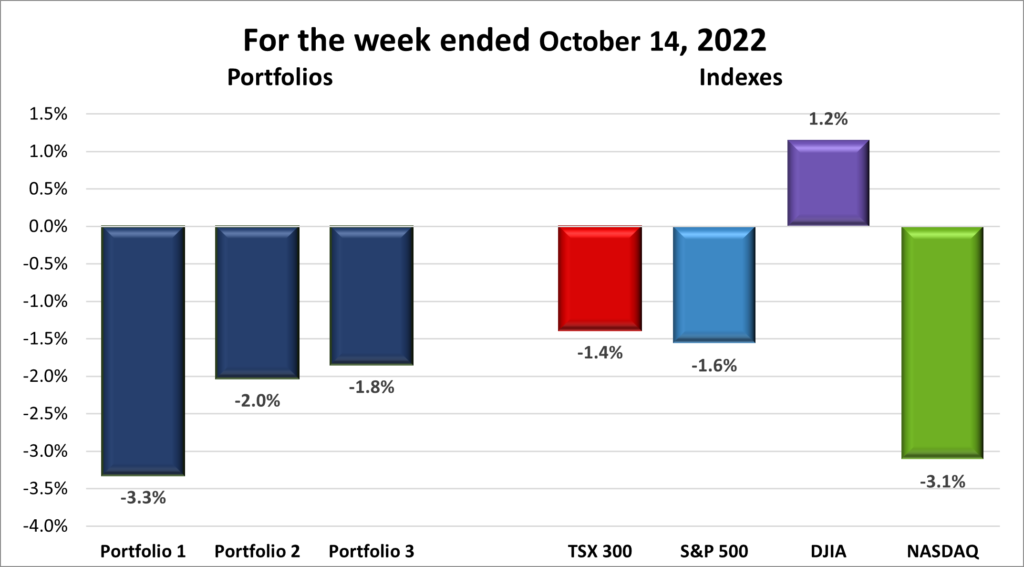
Weekly Portfolio & Index performance
Weekly Portfolio & Index performance for the week ended October 14, 2022.

Companies on the Radar

One company moved off the radar and into a Portfolio, making way for a new company on the radar.

STMicroelectronics N.V. (NYSE:STM), a European manufacturer of semiconductors (chips) for the automotive industry, recently came on my radar. Given the four automotive companies held in the Portfolios are all claiming sales are down due to a shortage of chips, I see plenty of opportunity for STM. The first step is put the company through my Radar Check.

Otherwise, with the markets continuing their downward spiral, I am going to sit on the sidelines waiting to take advantage of dips like the one this past week. Amazon remains on the radar.

Portfolio Update

Portfolio 1

Portfolio 1 for the week ended October 14, 2022: DOWN Red Down Arrow

  • General Motors (NYSE:GM) is getting into the energy storage business. GM’s new energy division, GM Energy, is leveraging their Ultium battery technology and will offer two new stationary storage solutions – Ultium Home and Ultium Commercial – as well as solar panels and hydrogen fuel cells. GM will now be competing with Tesla (NASD:TSLA) in the energy services industry as well as electric vehicles.On a side note, the Ultium power unit was the primary reason I decided to invest in GM. The addressable market for energy storage and management is estimated to be US$ 120 billion or more. If their Ultium battery technology is as good as they say it is, it will be the powerplant for most of their electric vehicles, they will be able to license it to other car manufacturers, and I can see them grabbing a good piece of the emerging energy storage industry.
  • Once again Alphabet is being dragged in front of the European Commission, the European Union’s competition bureau. This time Alphabet’s Google business unit is being investigated for its digital advertising practises. If the Commission finds against Alphabet, they could face their fourth billion euro fine.

Activity

Bought: Ferrari (NYSE:RACE) Purchased a few shares in Ferrari when the market dipped upon the release of the US CPI report that consumer prices rose more then expected. I have always wanted to own a Ferrari but never able to purchase an actual Ferrari, so instead I decided to become an owner of the legendary Italian car maker. 😊

Aside from being able to say one owns a Ferrari, investing in the company is a bit of a sleeper investment. Ferrari is a powerful brand with tons of racing history and prestige, providing it with a competitive advantage that very few other car makers can claim. To maintain the prestige of the brand, Ferrari limits the production and sale of their cars to maintain exclusivity and pricing power. On the financial side, revenues, net income, and margins are all increasing. In June 2020, the company started a share buyback program. As well, Ferrari has recently entered the SUV market with their Purosangue SUV. Finally, they have released two hybrid models and have announced a fully electric Ferrari for 2025. Given the price tag of existing Ferrari sports car, I expect these SUVs, hybrids and electric cars will carry hefty price tags, and more importantly for investors, a sizable margin to add to the bottom line. 😊

Dividends

Dividends Received this week for the following companies:

Companies followed by DRIP (Dividend Re-Investment Plan) indicate additional shares were purchased with the dividend. Any cash leftover was added to the cash balance.

Canadian $

Yellow Pages Ltd (TSX:Y)

US $

Innovative Industrial Properties Inc (NYSE:IIPR)

Quarterly Reports

No quarterly reports this past week.

Portfolio 2

Portfolio 2 for the week ended October 14, 2022: DOWN Red Down Arrow

  • Cameco (TSX:CCO) and Brookfield Renewable Partners (TSX:BEP.UN and TSX:BEPC) partnered to acquire nuclear power plant equipment maker Westinghouse Electric for almost US$ 8 billion. When the deal closes, Brookfield will own 51% of Westinghouse with Cameco controlling the remaining 49%. The deal comes amid renewed interest in nuclear energy as the world looks for energy alternatives. Cameco is one of the largest miners and suppliers of uranium fuel, while Brookfield Renewables manages many renewable power facilities throughout the world. This partnership and acquisition seem like a natural for all parties.

Activity

No significant activity to report this week.

Dividends

Dividends Received this week for the following companies:

Companies followed by DRIP (Dividend Re-Investment Plan) indicate additional shares were purchased with the dividend. Any cash leftover was added to the cash balance.

Canadian $

Summit Industrial Income REIT (TSX:SMU.UN)

Brookfield Renewable Partners LP (TSX:BEP.UN)

US $

No US$ dividends this past week.

Quarterly Reports

No quarterly reports this past week.
Portfolio 3

Portfolio 3 for the week ended October 14, 2022: DOWN Red Down Arrow

  • The Royal Bank of Canada (TSX:RY) is being investigated by Canada’s Competition Bureau for alleged ‘greenwashing’ or exaggerating their environmental record. Banks have started to find themselves in the crosshairs of activists for their support of oil and natural gas companies. The Royal Bank believes the complaint is without merit. I suspect other Canadian banks that deal with energy companies will see similar complaints come there way.

Activity

No significant activity to report this week.

Dividends

Dividends Received this week for the following companies:

Companies followed by DRIP (Dividend Re-Investment Plan) indicate additional shares were purchased with the dividend. Any cash leftover was added to the cash balance.

Canadian $

goeasy Ltd (TSX:GSY)

Alvopetro Energy Ltd (TSXV:ALV)

Brookfield Renewable Partners LP (TSX:BEP.UN)

US $

No US$ dividends this past week.

Quarterly Reports

No quarterly reports this past week.

The week ending October 7, 2022

Fractional shares….

With the start of a new quarter, comes an update of all three Portfolios as of September 30. Check out the latest holdings and gains for Portfolio 1, Portfolio 2, and Portfolio 3.


After a terrible third quarter, investor sentiment is definitely bearish. However, with very low expectations its possible the fourth quarter could bring a surprise for investors, preferably not a nasty surprise. Heck, after last quarter anything positive would be great!

That being said, I do not have high expectations for this quarter because the US Federal Reserve Bank (Fed) is serious about getting inflation back to its 2% inflation target and they have been very clear about using whatever tools are available in their battle with inflation. As well, I do not expect the Bank of Canada (BoC) to stop hiking interest rates until the Canadian economy starts to feel the pinch of higher interest rates.

On that note, the head of the BoC said, “We have yet to see clear evidence that underlying inflation has come down.” That all but guarantees an aggressive hike in the Canadian interest rate at the BoC’s October 26 meeting. While in the US, the US Labor Department’s employment report showed strong job growth and historic 50-year low unemployment. With high employment numbers and rising wages comes increased spending, which keeps adding fuel to the inflation fire. These numbers essentially force the Fed to maintain aggressive interest rate hikes to get inflation under control.

While we can expect a hike, perhaps in Canada it will not be as big as the last rate hike as Canadian manufacturing activity contracted for the second month in a row. This is a sign those interest rate hikes are starting to dig in as higher borrowing costs, combined with an uncertain economic future, has led to a drop in demand.

As well, the Reserve Bank of Australia (Australia’s central bank) became the first major central bank to slow the pace of interest rate hikes, raising their benchmark interest rate by 0.25% rather than the expected 0.5%.

It will be interesting to see if the BoC announces a smaller interest rate hike or if it will maintain its aggressive 0.75% streak. However, in the US, the higher jobs report almost locks in another aggressive rate hike by the Fed.


In other news this week, the Organization of Petroleum Exporting Countries and their allies, or more commonly known as OPEC+, decided to reduce their collective output by 2 million barrels per day to maintain high oil prices as global demand slows down. It looks like higher gas prices are here for the winter and higher fuel prices are unlikely to dampen inflation. In another sign that rising fuel prices are impacting consumer spending habits, retailer Best Buy (NYSE:BBY) announced that fewer TVs and electronics were purchased this past summer because consumers are having to spend more on gas and groceries.


Subsequent to knocking off US$ 500 billion from the London Stock Exchange, the British government has now seriously damaged its own credibility with investors by reversing course. After making the case that cutting taxes will jumpstart the British economy, and eventually raise greater tax revenues, the British government abandoned their ill-advised plan to drop the top 45% rate of income tax paid on earnings above 150,000 pounds (US$ 167,000) a year, a policy that received near unanimous opposition. Oddly, reducing taxes for the wealthy, while millions of Britons face a cost-of-living crisis, was not popular with the vast majority of British citizens. Who knew? 😊


One thing we do know, the markets started out strong before giving back most of their gains this past week. Now, let’s take a closer look at what happened in the markets and the portfolios this past week….

Weekly Market Review

Monday: The fourth quarter got off to a good start with all four major North American Indexes ending the day up sharply. Analysts and investors are starting to believe the Bank of Canada (BoC) and the US Federal Reserve (Fed) will back off their aggressive interest rate hikes as global financial stability is threatened by the pace and size of the hikes (who am I kidding, they are only concerned about the Fed’s hikes). Investors re-entered the markets to snap up beaten down companies. Oil prices surged as Organization of the Petroleum Exporting Countries (OPEC) considers a sizable reduction in production to maintain prices.

In Canada, gains in energy shares helped Canada’s main stock index, the Toronto Stock Exchange Composite Index (TSX), start the final quarter of the year on a positive note, its biggest one-day gain since April 2020. All eleven Canadian sectors ended higher led by the Energy sector, with the Healthcare sector bringing up the rear.

In the US, the S&P 500 Index (S&P), the Dow Jones Industrial Average (DJIA), and the Nasdaq Composite Index (Nasdaq) had a great day, each up over 2.5%. For the S&P and Nasdaq, it was their best first day of a quarter since 2009. All eleven S&P sectors ended in the black with the Energy sector leading the way and the Consumer Cyclical sector coming in last.

Tuesday: Another big day in the markets with all four Indexes up at least 2.5% as investors feel the central banks (BoC and Fed) will slow their roll when it comes time for the next interest rate hikes. In Canada, the TSX gained more than yesterday which was the highest single day move in two and a half years. Once again, all eleven Canadian sectors ended higher, this time led by the Technology sector which saw Shopify (TSX:SHOP) jump over 12%.

In the US, the S&P and DJIA had their biggest 2-day rally since April 2020. Amongst those leading the charge were the technology generals Microsoft (NASD:MSFT), Alphabet (NASD:GOOGL) and Apple (NASD:AAPL).

Wednesday: Well, that was quick. After a strong two-day rally, the markets came back to earth with all four Indexes ending slightly lower. The question is, are the Indexes taking a breather or is it back to the reality of the downward trend of 2022? The Energy sector was the best performing sector in both Canada and US. Good for oil and gas companies, not so good for us consumers.

In Canada, the gains in the Energy sector were more than offset by losses in nine of the eleven Canadian sectors.

In the US, despite a late afternoon surge all three major American Indexes were unable to dig themselves out of the hole they dug in morning trading, ending the day lower. Despite investor optimism earlier this week, the Fed maintains it will stay the course and continue its aggressive fight against inflation. Despite the gains in the Energy, Technology, and Healthcare sectors, losses in the eight other sectors kept the market’s gains underwater.

Thursday: Another step back for the four major North American Indexes as both the Canadian central bank (the BoC) and the US central bank (the Fed) reiterated they will maintain their respective hawkish stances when it comes to fighting inflation with higher interest rates.

In Canada, the Energy and Basic Materials sectors were the only sectors to advance today. While higher oil prices are good for oil companies, they are not helping the BoC’s battle with inflation. Higher oil prices push the cost of almost everything higher, which fuels inflation.

In the US, the Fed said it expects to raise the US benchmark interest rate by 1.25% by the end of the year. That through a wet blanket on early morning optimism that the Fed would back off their aggressive rate hike pace because of rising jobless claims last week. In the stock market, the higher oil prices propelled the S&P Energy sector higher. Unfortunately, it was the only sector to end in the black.

Friday: The markets want the central banks to ease off on the aggressive interest rate hikes, while the central banks (BoC and Fed) are committed to stay the course. Guess who won. 😊 As a result, the Indexes continued their downward drift for a third straight day. However, the rally at the beginning of the week was enough for each of the four major indexes to post a weekly gain.

In Canada, higher oil prices pushed the Canadian Energy sector to a 15% gain for the week, its largest weekly gain since November 2020. Elsewhere on the TSX, only the Consumer Staples sector was able to end the day in the black, with the other ten sectors all in the red.

In the US, higher job numbers in today’s US Labor Department’s nonfarm payroll report was another nail in the coffin for hopes of a smaller interest rate hike by the Fed. The market sentiment towards another 0.75% interest rate hike plunged all three American into the red this session. However, it was not enough to prevent all three indexes from snapping a three-week losing streak. Analysts and investors now turn to next week’s Consumer Price Index report to see the level of inflation in the US of A.

On the American stock markets, the picture was bleak with all eleven sectors down with the interest rate sensitive Technology sector fairing the worst.

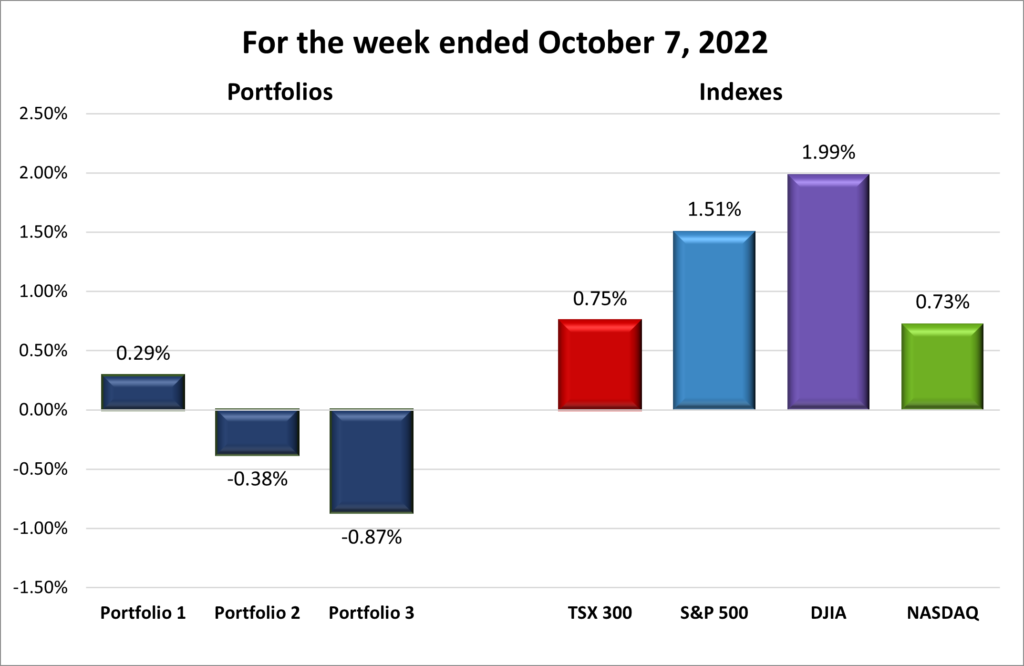
For the week, the TSX gained 0.75%, the S&P 500 added 1.5%, the Dow advanced 1.99% and the Nasdaq rose 0.73%.

Weekly Portfolio Review

What a strange week it was in the North American stock markets. The week started off with strong upward movement thanks to investor optimism that the Fed would be less aggressive with their next interest rate hike. When the Fed reiterated their commitment to aggressive action in their battle to reign in inflation on Wednesday, the markets gradually retreated for the rest of the week (as you can see in the above chart). Fortunately, the great start was enough for all four Indexes to overcome the late week slide and end the week in the black.

In the chart below, you can see the DJIA, with it is 40 large, mature companies, performed better than the S&P and Nasdaq with their interest sensitive, growth-oriented companies, and the more commodity weighted TSX.

As for the Portfolios, considering all four Indexes ended the week higher, I was a bit surprised that only Portfolio 1 ended higher. As of Thursday, all three were well into the positive but Friday’s sharp declines pushed them down considerably. After looking at Portfolio 2’s ‘market movers’ on the TD Direct Trading platform, MongoDB (NASD:MDB) sank almost 5%, Microsoft slipped over 5% and Guardant Health dropped almost 7%. As for Portfolio 3, along with Microsoft’s fall, Shopify and Cloudflare (NYSE:NET) each plunged more than 9%. Declines like that would do it. Sigh!

Weekly Portfolio & Index performance
Weekly Portfolio & Index performance for the week ended October 7, 2022.

Companies on the Radar

For avid sports car buffs, Volkswagen’s Porsche went public September 29 on the Frankfurt Stock Exchange under the trading symbol “P911,” a tribute to their iconic sports car. One week later, Porsche surpassed parent company Volkswagen as the most valuable car maker in Europe. Porsche was worth US$ 81.2 billion, compared to VW’s US$ 76.7 billion.

No word if/when Porsche shares will be available in North America. With Porsche only trading on the Frankfurt Exchange it would be hard/expensive to become an owner of Porsche. Plus, while Porsche makes fine cars, I would be happy to have one, Porsche does not have the same appeal for me as Ferrari. 😊

Otherwise, with the markets continuing their downward spiral, I am going to sit on the sidelines for now. However, I’m still keeping an eye on Amazon (NASD:AMZN) and Ferrari (NYSE:RACE). Taking advantage of low share prices for long term gain is the first half of buy low, sell high, and is rarely a bad thing. 😊

Portfolio Update

Portfolio 1

Portfolio 1 for the week ended October 7, 2022: UP Green Up Arrow, signifying a positive week

  • Lightspeed Commerce (TSX:LSPD) added a new piece to their Lightspeed Restaurant product. Lightspeed Advanced Insights. The add on module provides instantaneous analysis on every transaction and identifies developing trends that may help improve the business.
  • Despite record deliveries for the third quarter, Tesla (NASD:TSLA) missed expectations due to problems delivering the electric vehicles to buyers. This puts them in a hard spot to meet their own stated goal of growing deliveries by 50% annually.
    This will help. Tesla is set to deliver 100 of their Semi trucks to PepsiCo (NASD:PEP) on December 1. PepsiCo will be the first company to start using Tesla Semi trucks as they attempt to lower their gas emissions.
  • Rivian Automotive (NASD:RIVN) said it produced 7,363 units in the third quarter, 67% more than the preceding quarter, and maintained its full-year target of 25,000. Hopefully, Rivian has its supply chain issues worked out and ramp up productions and deliveries.
  • The European Union (EU) voted to make USB-C connectors the standard for most devices sold in the EU. Companies have until the end of 2024 to comply. Despite what Apple may think, this is good news as consumers will not have to buy different chargers every time they switch vendors.

Activity

No significant activity to report this week.

Dividends

Dividends Received this week for the following companies:

Companies followed by DRIP (Dividend Re-Investment Plan) indicate additional shares were purchased with the dividend. Any cash leftover was added to the cash balance.

Canadian $

Cargojet Inc (TSX:CJT)

Telus Corp (TSX:T)

US $

No US$ dividends this past week.

Quarterly Reports

No quarterly reports this past week.

Portfolio 2

Portfolio 2 for the week ended October 7, 2022: DOWN Red Down Arrow

  • The Banker Magazine named Scotiabank (TSX:BNS) Investment Bank of the Year for the Americas region. The award is for providing excellence to their Global Banking and Markets clients. This award joins other awards won by Scotiabank in 2022, including three wins in the 2022 Euromoney Awards for Excellence and six wins in the 2022 Global Finance Sustainable Finance Awards.
  • Disney’s (NYSE:DIS) ESPN unit is on the verge of entering a partnership with DraftKings (NASD:DKNG), a leader in online sports netting. The partnership will allow ESPN to take advantage of the growing sports betting industry.

Activity

No significant activity to report this week.

Dividends

Dividends Received this week for the following companies:

Companies followed by DRIP (Dividend Re-Investment Plan) indicate additional shares were purchased with the dividend. Any cash leftover was added to the cash balance.

Canadian $

Canadian Natural Resources Ltd (TSX:CNQ)

Telus Corp (TSX:T) DRIP

US $

No US$ dividends this past week.

Quarterly Reports

No quarterly reports this past week.

Portfolio 3

Portfolio 3 for the week ended October 7, 2022: DOWN Red Down Arrow

  • Cloudflare (NYSE:NET) announced a plan to make physical security keys more accessible and economical for customers to improve the security of their business and their employees. Security keys are the most secure form of phishing-resistant multi-factor authentication and Cloudflare will make Yubico security keys available at a reasonable price to Cloudflare customers.
  • Brookfield Asset Management (TSX:BAM.A) is putting up US$ 1.7 billion to get into the music industry. Brookfield is taking a sizable minority interest in Primary Wave Music to invest in music copyrights. The infusion of cash will be used to acquire music rights from top artists.
  • Following talks with the European Commission that some of Shopify’s merchants engaged in fraudulent practises, such as fake offers and counterfeit products, Shopify plans to implement stronger consumer protection measures.

Activity

Sold Acuity Ads (TSX:AT) Similar to last week’s sale of Acuity in Portfolio 1, I bought these shares around C$ 2.50, should have sold a long time ago but kept believing in their new Illumin product. After a few disappointing quarters where sales have not been as high as expected, I have lost faith in management and their much-hyped Illumin product.

Dividends

Dividends Received this week for the following companies:

Companies followed by DRIP (Dividend Re-Investment Plan) indicate additional shares were purchased with the dividend. Any cash leftover was added to the cash balance.

Canadian $

TD U.S. Equity Index ETF (TSX:TPU)

Brookfield Asset Management Inc (TSX:BAM.A)

US $

No US$ dividends this past week.

Quarterly Reports

No quarterly reports this past week.


The week ending September 30, 2022

Fractional shares….

And so ends the third quarter of 2022. After a rally to start the quarter, the markets ended with a thud! The Toronto Stock Exchange Composite Index (TSX) is doing the best of the four major North American Indexes, and it is in a market correction (down more than 10% from recent highs). The three major American exchanges – the S&P 500 Index (S&P), the Dow Jones Industrial Average (DJIA), and the Nasdaq Composite Index (Nasdaq) – are each in bear markets (down more than 20% from recent highs).

While it is great to see the end of September, historically the worst month for investing, October is not a whole lot better. Although there are no facts to back this up, October is perceived to be when share prices will fall, if not crash. This perception is called the “October Effect.” Looking back, Black Tuesday occurred October 29, 1929, and triggered the Great Depression; and Black Monday, the stock market crash that saw the DJIA fall 22% in one day, occurred October 19, 1987. Let us hope there is not a similar stock market crash instore for us this October, but if there is I hope you have some investing cash available to take advantage of the companies that go on ‘sale.’


The big economic news this past week came from across the Atlantic. In the United Kingdom, the British government announced plans to lower taxes with no corresponding spending reductions, plunging the UK into a self-inflicted financial crisis. The British pound fell to its lowest ever exchange rate with the US dollar, and the cost of government debt soared. It also sparked a sell-off of stocks and bonds traded on the London Stock Exchange (LSE), wiping out at US$ 500 billion in combined value. As a result, the Bank of England intervened and bought British government bonds to stem the fall in British financial assets.

As I am not invested in any companies on the LSE it did not directly impact the companies I own, but it did send out ripples that were felt globally. The North American stock markets had a roller coaster ride this past week and one of the causes was what occurred in the UK. I bring this up to illustrate how actions in one part of the world can ripple across the world and impact the stock markets here in Canada and the USA.

Staying in Europe, inflation for the 19 member European Union is expected to be above 10% for September, up from 9.1% in August. Already high inflation that continues to rise all but guarantees the European Central Bank will need to aggressively raise interest rates to get inflation down to their 2% target.


The summer rally is gone, the Indexes are back at their June lows, and the bottom is not in sight. Given the ongoing interest rate hikes the central banks (Bank of Canada and the US Federal Reserve) are implementing to battle inflation, I am not surprised a vast majority of investors believe their investments will be worth less by the end of 2022. I am one of those. My question, what are the other investors seeing that leads them to believe they will make a profit on their investments this year? 😊


With a disappointing third quarter in the rear-view mirror, we now turn our attention to the final quarter of 2022. I do not expect the markets to make a furious comeback to end in positive territory, but I would like to see them bottom out to set the stage for a better 2023. But before we get ahead of ourselves (what could possibly go wrong? 😊), let’s take a look back at this past week….

Weekly Market Review

Monday: The week got off to a bumpy start with all four major North American Indexes finishing lower. Canada’s Toronto Stock Exchange Composite Index (TSX) fell to an 18-month low as energy (lower oil prices) and natural resources companies dropped on concerns of ongoing interest rate hikes.

In the US, those same concerns over interest rates sent the S&P 500 Index (S&P) to its lowest point since December 2020, and the Dow Jones Industrial Average (DJIA) into bear market territory (drop of 20% or more from recent highs). Oddly, the growth-oriented Nasdaq Composite Index (Nasdaq) was the best of the three American Indexes even though it declined as well (0.6%).

Tuesday: Ongoing concerns about rising interest rates, worsened by the European energy crisis, led to another day of losses for three of the four Indexes. Surprisingly (at least to me), it was the high growth-oriented Nasdaq that was the lone bright spot.

In Canada, the TSX had its sixth straight losing session, closing at its lowest point since March 2021. Despite a strong showing from the Energy sector, thanks to rising oil prices, it was not enough for the TSX to break its losing streak.

In the US, members of the US Federal Reserve (Fed) were talking about the need for additional rate hikes, possibly as much as 1% by the end of 2022. Talks of higher interest rates did not help the S&P as it fell for the sixth straight session, its longest decline since February 2020. The Nasdaq was the only Index to advance thanks to gains by some of its biggest names such as Tesla (NASD:TSLA), Nvidia (NASD:NVDA) and Apple (NASD:AAPL).

Wednesday: After the Nasdaq broke into positive territory yesterday, the other three major North American Indexes finally got back on the winning side with big gains today. In Canada, the TSX had its best day in four months thanks to strong performances from the Energy (higher oil prices), Basic Materials (Natural resources and fertilizers) and Technology sectors.

In the US, the S&P snapped its six-day losing streak thanks to its best day since early August. A broad-based rally that saw all eleven S&P sectors rise also helped the DJIA break its six-session skid and the Nasdaq to start a winning streak (albeit two days).

Thursday: Well, that was a short rally – one day – only to see most of Wednesday’s gains disappear thanks to a broad-based sell off today. In Canada, the TSX fell on losses in the Technology and Utilities sectors. Even higher oil prices were unable to lift the TSX into the black.

In the US, fears the Fed is prepared to put the US economy into a recession to bring down inflation sent share prices tumbling. On the S&P, the share prices of almost 20% of the companies that make up the S&P 500 reached new 52-week lows. Nasdaq approached its lowest levels since June 2022.

Friday: The week went out with a whimper today as all three American Indexes ended lower and the TSX barely squeaked over the line, gaining 0.01%. In Canada, the TSX started strong but fell back to earth, ending the day essentially flat. If it were not for the dominance of the Energy and the Basic Materials sectors on the TSX, the TSX would be down a similar amount as its American cousins. It was a mixed bag for the Canadian sectors as four of eleven sectors ended in the black, led by the Basic Materials sector. Of the 7 sectors that ended in the red, Consumer Staples fell the most.

In the US, in morning trading, all three Indexes were in the black before diving into the red in afternoon trading. All eleven sectors ended lower as the S&P posted its sharpest September decline in 20 years. On the DJIA, all 30 companies ended the day lower.

For the week, the TSX dropped 0.20%, the S&P 500 fell 2.89%, the Dow lost 2.91% and the Nasdaq sank 2.69%.

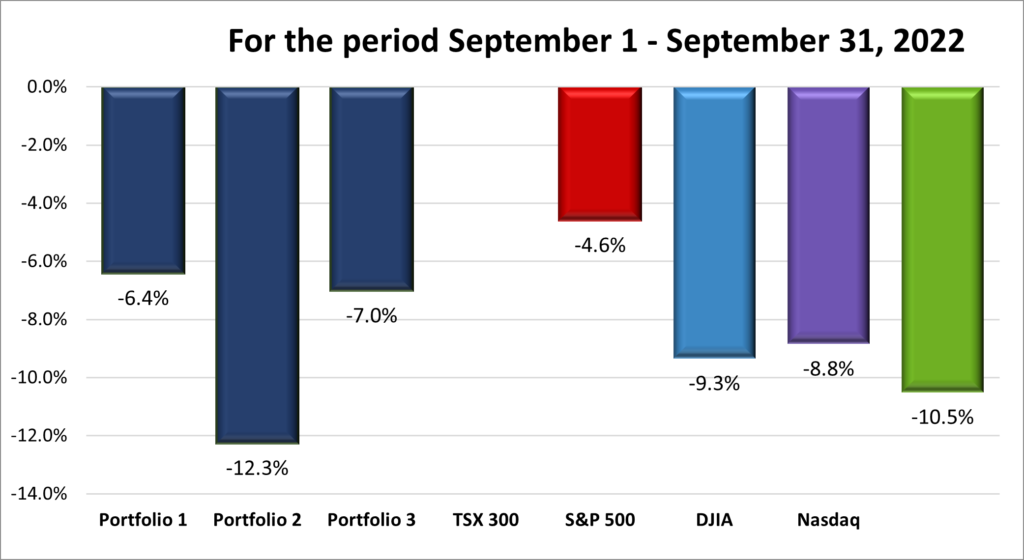
For September, the TSX dropped 4.59% and all three American indexes posted their second consecutive monthly losses. The S&P 500 fell 9.3%, the Dow dropped 8.8% and the Nasdaq plunged 10.5%.

Weekly Portfolio Review

Well, that was not a pleasant week. All three American Indexes declined almost 3%, leaving the TSX as the best of a bad lot. The TSX continues to benefit from being heavy with oil, natural gas and natural resource companies, keeping it from falling as far as its American cousins. In the US, it was not so much the US interest rate hike from the previous week as it was the concerns the Fed would continue their aggressive rate hikes that drove the markets down. Analysts are already talking about US interest rate hikes going north of 4% by the end of the year, with additional hikes to follow in 2023. For companies with significant debt this is not good news and investors reacted accordingly. Surprisingly, for me anyway, the growth-oriented Nasdaq did not fall the farthest.

As for the portfolios, as long as the Indexes keep retreating there is nothing to do but hang in until the stock market turns upward. The good news is none of the Portfolios fell as far as the American Indexes. Not exactly a compliment. 😊 Earlier in the year I was impressed how Portfolio 2 seemed to fair better than the more aggressive Portfolios 1 and 3. However, this has been twice in the last three weeks it has dropped the most of the Portfolios. Not sure what to make of that.

Weekly Portfolio & Index performance
Weekly Portfolio & Index performance for the week ended September 30, 2022.

If last week was bad, the chart for September looks even worse! The interest rate hikes and talks of additional, aggressive hikes and fears of a recession in both Canada and the USA certainly took a bite out of all four Indexes.

As for the Portfolios, not a good month, not a good month at all. I was hoping to say, ‘at least the Portfolios didn’t drop as hard as the American Indexes,’ but Portfolio 2 blew up that plan. It was a shock to see Portfolio 2 down by 12%. Drilling down, I saw that the portfolio’s big winner for the last two years, MongoDB (NASD:MDB), dropped 38% in September. I am guessing if I took MongoDB out of the equation, Portfolio 2 would be more in line with the other two portfolios. The good news, analysts are still very high on the company with an average upside estimate of 82% increase in share price. 😊

Monthly Portfolio & Index performance
Monthly Portfolio & Index performance for September, 2022.

Let us hope that the October Effect proves to just be a perception and there are no negative surprises. Stay tuned!

Companies on the Radar

Given the freefall of the various North American stock markets, I plan to sit on the sidelines for a bit and let things play out. As you can see on the charts below, Amazon (NASD:AMZN) and Ferrari (NYSE:RACE) have been trending downward since late 2021 highs. I am hoping the share price for Amazon and Ferrari continue their downward trajectory so I can buy lower, and I will be able to save a few bucks. I know I should not be playing this game of timing the market, but I do not see the economy suddenly turning around sending share prices higher.

Both the Amazon and Ferrari charts show their respective share price since September 30, 2021, to September 20, 2022, the 50-day moving average share price, and the 200-day moving average share price. Both companies respective share prices are below both the 50 day and 200-day average. Generally, I want to see the share price moving towards or higher than the averages.

As well, if you look at either the Amazon or Ferrari chart, starting at the highest point (late 2021), then draw a line touching the top of the other peaks, you will see the line is heading down, to the right. This is my trend line and I generally want the trend to be going up, to the right. However, since I am looking at buying both companies, I do not mind it going down to the right. If/once I buy ownership in Amazon or Ferrari, I want it going up to the right faster than a Ferrari on a straight away. 😊

Portfolio Update

Portfolio 1

Portfolio 1 for the week ended September 30, 2022: DOWN Red Down Arrow

  • General Motors’ (NYSE:GM) self-driving start-up Cruise is forgoing a partnership with Nvidia to develop its own processors that will be deployed in Cruise vehicles by 2025.
  • Despite the recent completion of upgrade to their Shanghai gigafactory, Tesla has indicated they plan to run at 93% capacity for the rest of the year. They will produce 20,500 units a week. Still an impressive number.
  • Cargojet (TSX:CJT) plans to increase its fleet of aircraft to 40 by the end of 2022. With the six additional planes, Cargojet’s overnight network will now reach 16 Canadian cities and over 90% of the Canadians.
  • Apple has cancelled plans to increase production of its new iPhone 14s this year after an expected surge in demand failed to materialize.

Activity

Sold AcuityAds (TSX:AT) Bought these shares under C$2, watched it run up to C$ 32 and fall back to its current levels. I have not been impressed with the last two quarterly reports as revenues seem to be moving from their old system to their new system. Management had been talking up how their new ad management system would drive organic growth, but revenues seem to be largely coming from their old generation ad system. I kept thinking they would rebound but they never have and with the economy going in the tank I want to book some gains.

I was once told that when a company’s share price takes off without any significant underlying improvement by the company (as was the case with Acuity), sell the shares and take the money. The share price will fall back once the herd moves onto the newest shing object. I should have heeded that warning. I will next time.

Lesson: when investor sentiment pushes the share price well ahead of the company’s underlying performance, take at least some money off the table.

Dividends

Dividends Received this week for the following companies:

Companies followed by DRIP (Dividend Re-Investment Plan) indicate additional shares were purchased with the dividend. Any cash leftover was added to the cash balance.

Canadian $

Canadian National Railway Co (TSX:CNR)

Shaw Communications Inc (TSX:SJR.B)

US $

NVIDIA Corp (NASD:NVDA)

Quarterly Reports

No quarterly reports this past week.

Portfolio 2

Portfolio 2 for the week ended September 30, 2022: DOWN Red Down Arrow

  • Recently, the Bank of Nova Scotia (TSX:BNS) has undergone a few changes at its highest levels. Scott Thomson, a board member for six years, will takeover from existing Chief Executive Officer Brian Porter starting December 1. Mr. Porter will stick around in an advisory role until April 30, 2022. Mr. Thomson is currently the CEO of Finning International (TSX:FTT), a company worth 1/20 the market value of BNS. I am not so concerned about the changes at the executive level, I am more focused on the company’s valuation and the banks long term prospects.

Activity

No significant activity to report this week.

Dividends

Dividends Received this week for the following companies:

Companies followed by DRIP (Dividend Re-Investment Plan) indicate additional shares were purchased with the dividend. Any cash leftover was added to the cash balance.

Canadian $

Brookfield Infrastructure Partners LP (TSX:BIP.UN)

Brookfield Infrastructure Corp (TSX:BIPC)

US $

No US$ dividends this past week.

Quarterly Reports

No quarterly reports this past week.

Portfolio 3

Portfolio 3 for the week ended September 30, 2022: DOWN Red Down Arrow

  • Shopify (TSX:SHOP) is going into the hardware business. The company announced POS Go, a point-of-sale hardware device that allows merchants to accept payments, monitor sales and manage their inventory.
  • Forrester Research named Cloudflare (NYSE:NET) as a Leader in The Forrester Wave: Web Application Firewalls, Q3 2022 report. Cloudflare received full marks in 10 criteria.
  • Brookfield Renewable Partners (TSX:BEP.UN) continues to invest in renewable energy companies. It closed on its acquisition of Standard Solar and their 500 Megawatts (MW) of assets; and bought Scout Clean Energy and their 1,200 MW of wind assets and a over 22,000 MW of wind, solar and storage capacity over 24 states. This brings Brookfield’s US assets almost 60,000 MW of energy capability.
  • As of September 30, Ethereum was trading at C$ 1,834.57. A far cry from the purchase price of a small amount in November 2021 at C$ 6137.23. ☹ Glad it was only a very small amount. 😊

Activity

No significant activity to report this week.

Dividends

Dividends Received this week for the following companies:

Companies followed by DRIP (Dividend Re-Investment Plan) indicate additional shares were purchased with the dividend. Any cash leftover was added to the cash balance.

Canadian $

Brookfield Asset Management Reinsurance Partners Ltd (TSX:BAMR)

Brookfield Renewable Corp (TSX:BEPC)

US $

No US$ dividends this past week.

Quarterly Reports

No quarterly reports this past week.


The week ending September 23, 2022

Fractional shares….

The big news that impacted us investors came out of the USA this week, causing share prices to tumble.

As expected, the US Federal Reserve (Fed) raised the US benchmark interest rate by 0.75% this week. This was the third straight 0.75% increase. What was unexpected was the Fed’s vow to crush inflation, signaling further aggressive increases were coming. Analysts are speculating the US interest rates could rise to 4.4% by the end of this year (June projections were for 3.4%), with the potential to reach 4.6% in 2023. At this point, it seems clear the Fed is not going to ease off on rate hikes in the near term, and with rates at these levels, the US economy cannot help but slow down as businesses must slow their growth plans to pay off debt.

For us investors, that is not good news. After a summer rally that lifted the S&P 500 Index out of a bear market (down more than 20% from its recent highs), it has slid back into a bear market. The technology heavy Nasdaq Composite Index is well into bear territory, down over 30%, while the Dow Jones Industrial Average has fallen 18%, barely avoiding bear territory. But it could still get worse, with some analysts predicting the S&P could fall 40% by the end of 2023. If that projection is correct, we are only at the halfway point. For now, the market will likely be extremely sensitive to any comments from the Fed or upcoming data.


Statistics Canada revealed Canada’s inflation rate was down for the second month in a row in August, at an annualized rate of 7.0% compared to July’s 7.6%. The rate decelerated by even more than analysts’ predictions of 7.3%, mainly because of lower gasoline prices during August. If gasoline is removed from the mix, the August inflation rate was 6.3 % in the last year, compared to 6.6% in July. The Bank of Canada’s (BoC) Core CPI (excludes food and energy prices) declined to 5.8% from 6.1% in July. This too came in below analysts’ expectations of 6%, suggesting the interest rate increases by the BoC are having an impact.

However, the BoC stated “We will continue to take whatever actions are necessary to restore price stability for households and businesses and to maintain Canadians’ confidence that we can deliver on our mandate of bringing inflation back to 2%.”

Inflation rates in Canada and the US are going in the opposite direction. While the Fed has indicated they will continue to be aggressive in their interest rate hikes to battle increasing inflation in the US, the BoC might be able to back off their aggressive rate hikes since inflation appears to be slowing in Canada. Hopefully, with these lower-than-expected numbers, the BoC will ease off the pedal of interest rate hikes at their next planned increase in October.


Higher interest rates and faltering economies are not limited to North America. Around the world, fears are growing that the various central banks’ plans of raising interest rates to wrestle inflation down to their 2% target will drag major economies into recession. Below are a few of the latest interest rate hikes by national central banks:

In their fight to bring down Britain’s 9.9% inflation rate, the Bank of England raised their benchmark interest rate by 0.5%, bringing it to 2.25%.

Norges Bank, Norway’s central bank, raised its interest rate by 0.5% to 2.25%.

The Reserve Bank of Australia raised their interest rate by 0.5% for a fifth straight month, bringing it to 2.35%, a seven year high.

Sweden’s central bank, Riksbank, raised their interest rate by an unexpected 1%, bringing their national interest rate to 1.75% as it battles surging inflation.

The Swiss National Bank raised its rate by 0.75%, lifting it from negative 0.25% to 0.5%. And so ends the negative rates experiment.

In Europe, where inflation hit 9.1% in August, the European Central Bank delivered its largest-ever increase with a 0.75% hike, impacting all 19 countries that use the euro.

Brazil’s central bank, Banco Central do Brasil, voted not to make an any changes to their benchmark interest rate. Now, before you start asking why Brazil did not raise their interest rate like many of the other countries, be aware their interest currently sits at 13.75%. And we think our rates are high!


Ethereum is officially a proof-of-stake blockchain. One of the top achievements was the elimination of Ethereum’s dependence on power-intensive GPUs. Ethereum is down 64% year to date. If you invested in Ethereum, like I did, you are hoping that the “Merge” will renew enthusiasm for the cryptocurrency and send it up to set new highs.

While interest rates around the world were rising, unfortunately the same cannot be said about the North American stock markets this week. Let’s take a look at what happened in the markets and the Portfolios this past week….

Weekly Market Review

Monday: All four major North American Indexes ended the day higher as investors await the US Federal Reserve’s (Fed) upcoming US interest rate hike. In Canada, investors in Canadian equities are waiting for Canada’s Consumer Price Index (CPI) data, due Tuesday, to find clues on the Bank of Canada’s (BoC) next Canadian interest rate hike due October 26. In the marketplace, the Toronto Stock Exchange Composite Index (TSX) rose on the strength of higher shares prices for Energy and Basic Materials (natural resources and Fertilizers) companies.

South of the 49th in the US, the S&P 500 Index (S&P), the Dow Jones Industrial Average (DJIA), and the Nasdaq Composite Index (Nasdaq) were up and down all day before ending the session in the black. Trading was light as investors have adopted a wait and see approach ahead of this week’s US interest rate hike. Analysts and investors expect a 0.75% hike, with an outside chance of a 1.0% hike, and are also looking for signs of how aggressive the Fed will likely be for future rate hikes. Given the fear of the upcoming rate hike, it was generally a good day in the US markets as ten of eleven S&P sectors ended in the black. Healthcare was the lone laggard as shares in vaccine makers slipped on President Bidens declaration “the pandemic is over.”

Tuesday: The Indexes drifted lower as investors continued to hold their breath ahead the Fed’s interest rate hike announcement. In Canada, the Canadian CPI indicated the inflation rate dropped from 7.6% in July to 7.0% for August, below analysts estimates of 7.3%. On the Toronto Stock Exchange, the TSX dipped over concerns aggressive interest rate hikes could send the global economy into downturn which would lower demand for drive commodities (oil, resources, etc.) causing their current prices to fall.

In the US, once again trading was lower in the US markets as investors await tomorrow’s announcement by the Fed. It is anticipated the Fed will raise the interest rate by 0.75%. Across the New York Stock Exchange and the Nasdaq Exchange, all S&P sectors ended the session lower.

Wednesday: The big story in investing today was the Fed raised US interest rates by 0.75% for a third consecutive time, bringing the US benchmark rate to 3.25%. They also signaled additional similar sized rate hikes were likely. When the news of the interest rate increase reached the markets, all four Indexes, which had been slightly higher throughout the day, plunged into negative territory.

In Canada, declines in the Energy sector and the Consumer Cyclical led the TSX lower. The Telecommunications sector was the only Canadian sector to end the day higher.

In the US, it was a broad-based sell off as all eleven S&P sectors reacted poorly to the news additional hawkish interest rate hikes were likely. At the end of the day, all three Indexes slumped, and the S&P slid back into a bear market (a drop of 20% or more from the all-time high value).

Thursday: Tremors continue to ripple through the markets after yesterday’s announcement by the Fed. Not so much the 0.75% increase, but the pace and aggressiveness of future interest rate hikes to get inflation under control in the US.

In Canada, the TSX ended lower as falling share prices in the Technology and Healthcare sectors overwhelmed gains made by the Energy and Basic Materials sectors . Meanwhile in the US, all three major American Indexes ended lower, drawn down by Technology sector companies and other high growth companies. Healthcare was the only sector of the eleven to squeak out a gain, ending 0.01% higher.

Friday: With thoughts of a global recession dancing in their heads, investors sold, sold, sold, and asked questions later. It was tough day in the markets as all four major North American Indexes dropped sharply, with all sectors in both countries losing ground. In Canada, the TSX dropped sharply thanks to a plunge in the price of oil, which led to a 6% drop in Canada’s Energy sector. A recession would lead to less demand for energy, which is why oil sold off.

In the US, the S&P Energy sector had a similar trajectory as the Canadian Energy sector, plunging 6.8%. The DJIA established a new low for 2022. Despite interest sensitive technology and other growth-oriented companies being scorned by investors, the S&P Technology sector was the second-best performing sector, ‘only’ falling 1.53%. I would not have guessed that.

Let us hope next week is significantly better.

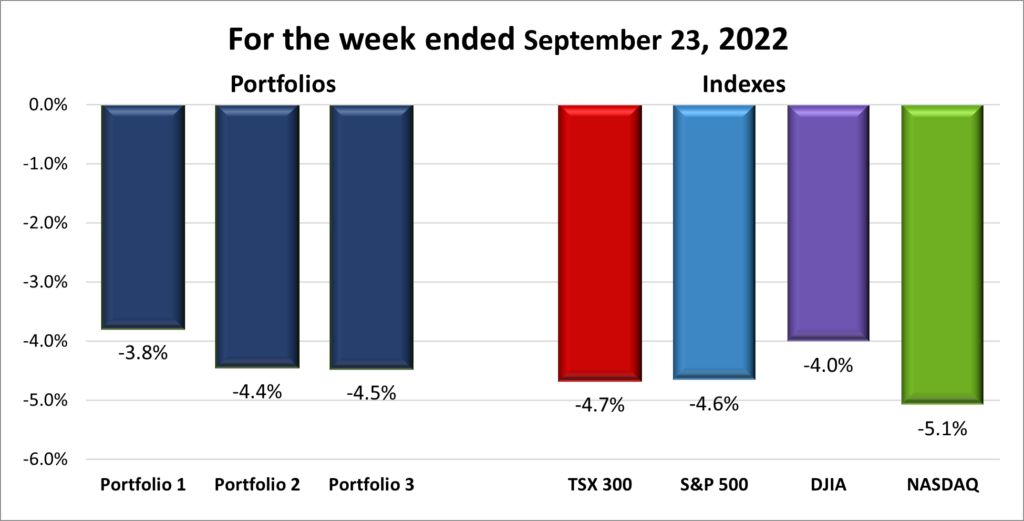
For the week, the TSX dropped 4.7%, the S&P 500 lost 4.6%, the Dow sank 4.0% and the Nasdaq plunged 5.1%.

Weekly Portfolio Review

All four major North American Indexes have dropped in five out of the last six weeks, with interest sensitive growth and technology stocks getting hit the hardest thanks to the Fed’s interest rate-hiking. If you are wondering why the Portfolios are doing so poorly in 2022, consider that the S&P and Nasdaq are both in bear markets (down more than 20% from their respective recent highs), the TSX and DJIA are both in market corrections (down more than 10% from its recent highs), and most importantly for the three Portfolios, the S&P tech sector has fallen 28% since the start of the year. Ouch! ☹ And there are no signs of relief around the corner.

Since it was a bad week for the Indexes, and therefore the Portfolios, the only silver lining is other than the DJIA, all three Portfolios did better than the Indexes. Barely, I admit, but I am trying to take a positive out of this week. 😊

Weekly Portfolio & Index performance
Weekly Portfolio & Index performance for the week ended September 23, 2022.

Companies on the Radar

With the markets falling this week, I’m giving myself a pat on the back for not falling for the summer rally, also known as a bear market rally, or a bear trap, and jumping in to buy Amazon (NASD:AMZN) or Ferrari (NYSE:RACE) when the prices were moving upward during July and August. With prices dropping these two companies move to the front of the radar. The challenge now is how much lower will the share prices fall? WESCO International (NYSE:WCC), XPEL, Inc. (NASD:XPEL) and Brookfield Select Opportunities (TSX:BSO.UN) are on the next level.

As for copper companies, I had thought with the huge demand for copper in the production of batteries for electric vehicles that the earnings and share prices of copper miners would be drifting higher. Unfortunately, copper prices, and by extension, copper mining companies are not doing as well as I had thought.

After doing a bit of due diligence on copper, I discovered the price of copper is considered to provide a consistent barometer of economic health, since changes to the price of copper can suggest global growth or an upcoming recession. Given the price of the metal has fallen considerably since March highs, and the deteriorating state of the economy, that relationship appears intact in this instance. Given the current downward trend of the global economy and copper prices, I am putting copper companies on the outer rings of my radar.

Portfolio Update

Portfolio 1

Portfolio 1 for the week ended September 23, 2022: DOWN Red Down Arrow

  • General Motors’ (NYSE:GM) electric vehicle unit Cruise is currently the only fully licensed, fully autonomous electric vehicle ride service. The service operates only during nighttime hours, in limited areas of San Francisco. Cruise operates up to 70 autonomous vehicles nightly and has been charging for rides since June 2022. Management recently announced plans to expand Cruise’s robotaxi service to Austin, Texas and Phoenix, Arizona by the end of the year.

GM also announced Hertz Rent a Car plans to purchase 175,000 GM electric vehicles over the next five years as part of Hertz’s efforts to green.

  • Tesla (NASD:TSLA) announced the completion of their capacity expansion at their Shanghai Gigafactory. The expansion should enable Tesla to produce up to 22,000 units per week at their Chinese factory.
    In a different type of recall, Tesla is recalling over 1 million vehicles in the US thanks to a faulty window reversal system that does not reverse when it encounters an object while being raised. Whereas in the past recalls involved bringing your vehicle into a dealer to make the repair, Tesla has said they will perform an over the air software update to resolve the problem. Assuming this works as planned, owners will not have to spend time taking their vehicles in for the maintenance and Tesla will save considerable labour expenses with a software update rather than mechanical repairs. If all goes well, I see this as a win-win for both consumers and the company.
  • Apple (NASD:AAPL) announced they will be raising prices in Europe and Asia for apps and in-app purchases. The changes are to adjust for currency fluctuations. Nothing to see here.

Apple won a bidding war to take over sponsorship of the NFL Super Bowl Halftime Show, starting in February 2023. Apple will use this promote their products, naturally, to one of the largest single show audiences, and as an opportunity to highlight their capabilities as Apple attempts to become the host for the NFL Sunday Ticket that allows fans to view every Sunday game.

  • Nvidia (NASD:NVDA) announced a new chip optimized for gaming that will use Artificial Intelligence to enhance graphics capabilities. The new chips will be named after one of the first women in what would become computer science. Ada Lovelace was a British mathematician in the 19th century.

Activity

No significant activity to report this week.

Dividends

Dividends Received this week for the following companies:

Companies followed by DRIP (Dividend Re-Investment Plan) indicate additional shares were purchased with the dividend. Any cash leftover was added to the cash balance.

No dividends this past week.

Quarterly Reports

No quarterly reports this past week.

Portfolio 2

Portfolio 2 for the week ended September 23, 2022: DOWN Red Down Arrow

  • Take-Two Interactive (NASD:TTWO) acknowledged they had been hacked. Initially it was only some early footage of their upcoming Grand Theft Auto VI game that was leaked. However, it turns out Take-Two’s Help Desk platform was also hacked. The company said the hack will have no impact on the development of Grand Theft Auto VI. We shall see.
  • Canadian energy company Pieridae Energy (TSX:PEA) is proposing to build a natural gas terminal on Canada’s Atlantic coast to ship the gas to Europe. The catch, they have asked the Canadian government to ensure pipeline builder/operator TC Energy (TSX:TRP) will be able to acquire the necessary permits in a timely fashion, and not get disrupted by legal challenges or protesters. They are waiting for a response from the federal government. I guess they did not hear the government say there was no business case to ship natural gas to Europe. 😊

Activity

No significant activity to report this week.

Dividends

Dividends Received this week for the following companies:

Companies followed by DRIP (Dividend Re-Investment Plan) indicate additional shares were purchased with the dividend. Any cash leftover was added to the cash balance.

Canadian $

Alimentation Couche-Tard Inc (TSX:ATD)

Dream Industrial Real Estate Investment Trust (TSX:DIR.UN) DRIP

US $

No US$ dividends this past week.

Quarterly Reports

No quarterly reports this past week.

Portfolio 3

Portfolio 3 for the week ended September 23, 2022: DOWN Red Down Arrow

  • Last week I noted Shopify’s (TSX:SHOP) new employee compensation system. This week Royal Bank analysts suggested once Shopify fine tunes their compensation system, they could roll it out to their merchants (also known as their customers). The theory is this would make it easier for merchants to attract employees and grow their business. This would not be the first time Shopify built an in-house system and rolled it out to the public. Afterall, that is how Shopify went from a snowboard company to an e-commerce powerhouse. 😊
  • TD Bank (TSX:TD) announced a contract extension with US retailer Target Corporation (NYSE:TGT) to remain the sole issuer of Target’s consumer credit cards.
    TD is also investing C$ 10 million with the Boreal Wildlands Carbon Project in northern Ontario to protect 1,500 square kilometres of boreal forest. In return, TD will receive carbon offsets generated from the project.
  • Brookfield Asset Management (TSX:BAM.A) controlled NTS, a Brazilian natural gas pipeline operator, announced plans to invest $2.4 billion over the next eight years to build out its pipeline network and natural gas storage facilities. It appears NTS sees the business case for building out their natural gas capabilities. 😊
    In other Brookfield news, the company’s board of Directors approved plans to divide into two publicly traded companies. Brookfield Asset Management will be renamed Brookfield Corp following the split, and will own 75% of the asset management business, called the Manager, with shareholders owning the remaining 25% distributed by the board.

Activity

No significant activity to report this week.

Dividends

Dividends Received this week for the following companies:

Companies followed by DRIP (Dividend Re-Investment Plan) indicate additional shares were purchased with the dividend. Any cash leftover was added to the cash balance.

No dividends this past week.

Quarterly Reports

No quarterly reports this past week.


Look to the future for opportunities

Back at the start of the year, in January 2022, financial analysts were warning, if not screaming, that inflation and higher interest rates were coming. Prices were rising and it was going to cost more to pay off debt, be it loans, mortgages, or corporate debt. That we knew should have planned accordingly (I did not ☹). What most of the world did not expect was for Russia to invade Ukraine.

With the onset of the invasion and the subsequent sanctions against Russia by the US and other western countries, the global supply of natural gas, oil, wheat, and other natural resources from this region were severely disrupted. Shortages of these essential materials that were just beginning to rebound from the pandemic were further squeezed. Manufacturers that had previously sourced materials (oil, metals, etc.) from traditional sources in Russia were suddenly having to secure new suppliers in other parts of the world. These supply constraints, combined high demand caused by a world emerging from a global shutdown, has conspired to send prices surging in many industries. As a result, prices that had been slowly creeping higher suddenly jumped higher. For consumers in North America, that was most noticeably felt at the gas pump. For Europeans, not only were higher prices reflected at the pump but also in their heating bills, with higher prices expected this winter.

For us investors, this was a double-edged sword. On the positive side, if you had the foresight to know the invasion would occur and therefore cause the price of oil to skyrocket or were simply invested in the right sector at the right time (most likely), you would being doing OK in 2022, or not as bad as most investors in 2022.

On the negative side, the conflict accelerated higher prices which negatively impacted all of us, not just investors. As well, the conflict accelerated inflation which has led to higher interest rates as central banks (think Bank of Canada or the US Federal Reserve) attempt to get inflation back to the traditional 2% – 3% target range. As interest rates climbed, the cost of borrowing climbed and sent the shares prices of many non-energy companies plummeting. No where is this more noticeable than for high growth companies like those typically found in the Technology and Consumer Cyclical sectors, where share prices have plunged in 2022. These high-growth companies need to use their cash to build their respective businesses rather than putting more cash towards paying off interest.

I have found one of the keys to investing is to look ahead rather than focus on the present. To paraphrase Wayne Gretzky, “look to where the world is going, not where it has been.” In 2019 – 2020, I was investing in renewable energy companies, figuring that is where the world was going, and various governments were strongly encouraging the move away from traditional energy sources. In 2021, a friend told me he had been investing in oil companies. I wondered why when renewables were the ‘thing,’ and oil and natural gas companies were out of favour. He showed me how the earnings and share prices of the various companies had been moving steadily upward. The light bulb went on.

To make a long story short, after doing due diligence on the oil industry and a few oil and natural gas companies, I did what I never thought I would do – bought my first two oil companies, International Petroleum Corporation (TSX:IPCO) and Crew Energy (TSX:CR) in 2021. (OK, I invested in the oil companies, but I like to think of myself as an owner, albeit an exceedingly small owner). Both companies were doing well prior to the Russian invasion and continue to do well. They have done so well that I bought a third energy company this year – Alvopetro Energy Ltd. (TSV:ALV). As you can see by the chart, these three energy companies have done well since the start of 2022. I do not see buying additional oil and gas companies in the future, but I did not see buy any to begin with. Instead, I am already looking for opportunities where demand could exceed supply.

Do I wish I had been looking farther ahead in 2019? Yes! But I did learn that Mr. Gretzky’s, “look to where the puck is going, not where it has been” can be applied to investing. While I missed the early stages of the oil rush, I like to think I am well positioned in the event hostilities between China and Taiwan breakout.


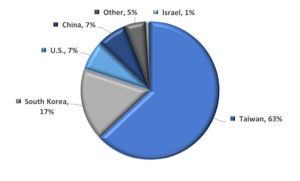
Considering recent events in the waters between China and Taiwan, it is not hard to imagine conflict over Taiwan independence breaking out. Besides the pain and suffering caused by wars, from an investing perspective, the cost of semiconductors (or chips) will skyrocket as most (over 60%) of advanced semiconductors are made in Taiwan (see chart). Smart phones to military weapons utilize chips, chips are important both from an economic standpoint as well as security standpoint.

Semiconductor production by country
Semiconductor production by country. Source: TrendForce, March 2021

Labour shortages were the issue during the pandemic. In the case of conflict, buildings would be destroyed, and it would take billions of dollars to rebuild the foundries, not to mention a significant number of years. If chip foundries were to get damaged or destroyed during a conflict, it could cause a global shortage of semiconductors far worse than shortages caused by the recent Covid-19 pandemic. Imagine paying exorbitant prices for a new iPhone (OK, even more exorbitant prices), assuming you could even get one. The same would be for any smart device, appliance, or vehicle. If you think there were supply issues the last few years, imagine the problems if 60% of the world’s chip makers go offline or are unable to ship their products to their customers. If any existing smart device, appliance, vehicle, or other component that requires chips were to break down, it would be a lengthy wait to get the item repaired. It was hard enough getting parts during the pandemic; this would be much worse.

I had no way of knowing Russia would invade Ukraine and spark an energy shortage. However, my investing takeaway from the energy shortage is to make a semi educated guess where the world is going and try to invest accordingly. While I hope conflict does not break out over Taiwan, with three chip companies (Nvidia (NASD:NVDA), Lattice Semiconductor (NASD:LSCC) and Skyworks Solutions (NASD:SWKS), I am well positioned if a shortage does occur.

The week ending September 16, 2022

Fractional shares….

Just when supply chain problems were slowly being eliminated, rail workers in the US threatened to go on strike. Fortunately, a deal between the major U.S. railroads and the railroad unions was reached to avert a work stoppage. This was such a crucial deal for the US economy that even President Biden took part in the negotiations, though I would guess it was more a signal of the importance of this deal.

According to an Association of American Railroads report, if the railroad system in the US was to grind to a halt, the US economy would lose $2 billion every day the trains were idle. The US railroad system accounts for almost 30% of cargo by weight shipped across America. It would take approximately 467,000 additional freight trucks each day to make up the loss. In other words, a national rail strike would be painful for everyone.


USA: The stock markets ran red, deep red, when this week’s US Consumer Price Index (CPI) data for August was announced. Investors dropped stocks like a hot potato this week as investors braced for the U.S. Federal Reserve (Fed) to come out swinging next week in its battle with inflation.

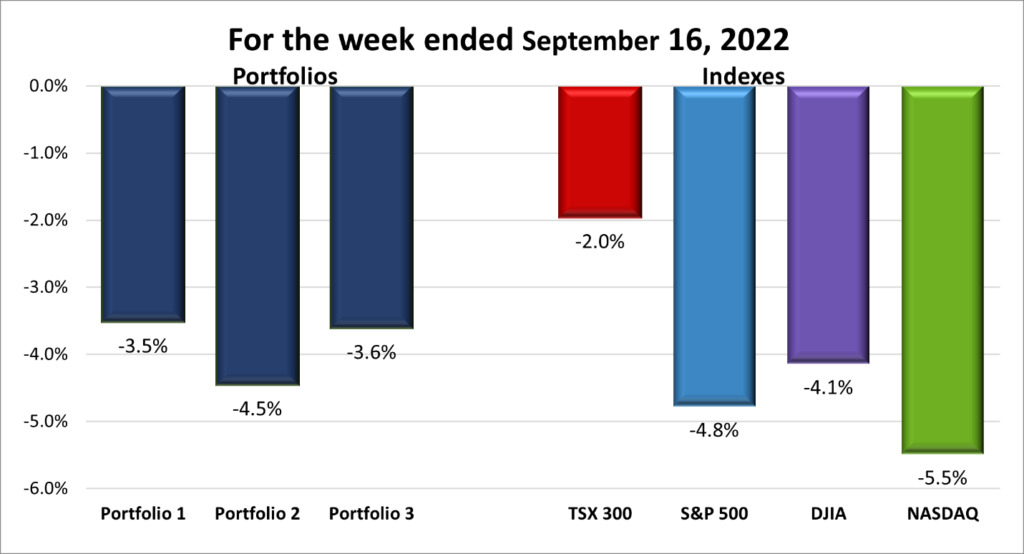
The US CPI increased by 0.1% over July and 8.3% over the previous year. Analysts were expecting 8.1% over the prior year so a higher-than-expected increase was a surprise. Core CPI, which strips out volatile food and energy prices, increased more than expected, rising to 6.3% from 5.9% in July. As I have said before, the markets do not like surprises, especially negative surprises, and the American markets reacted accordingly with the S&P having its worst days since June 2020 and falling 4.8%. If that was not bad enough, the tech heavy Nasdaq fell 5.5%. The DJIA did not escape unscathed, its week was just not as bad as it ‘only’ fell 4.1%. Ouch!

Analysts now expect a 0.75% rate hike by the Fed during their meeting next week to fight inflation. However, the possibility of a full 1% hike lurks in the shadows as the Fed may now feel justified in taking even bigger steps to get a handle on inflation. Going forward, investors are now wondering what the Fed’s plans are for future rate hikes scheduled for November and December.

This does not bode well for the Portfolios.


Canada: There is a saying that when the US sneezes, Canada gets a cold. Well, this week the US sneezed, sending stock markets in Canada and around the tumbling.

Fortunately, energy prices continue to cushion the fall in the Canadian market. On the Toronto Stock Exchange Composite Index (TSX), the Energy sector accounts for 18% of the market capitalization. This heavy weighting of energy companies has helped the TSX avoid the dramatic declines seen in other markets. While higher oil and natural gas prices is good news for those invested in oil and natural gas companies, its not great news for consumers as those higher prices are reflected at the gas pump.

The good news is gas prices continue to drop which should eventually lead to lower transportation costs to bring products to market, resulting in lower prices.

Next week, several key Canadian economic data are due to be released, including the Producer Prices data for August, the Consumer Price Index report for August, and the Retail Sales data for July.


Ethereum merged the two Ethereum blockchains into one, which Ethereum claims will not only reduce its energy use by 99.95%, but it will also enable cheaper cryptocurrency transactions, as well as help the second biggest cryptocurrency network to expand into other areas and opportunities. For here more information on “The Merge.”

With all that foreshadowing about the stock markets falling, lets take a look at what happened in the stock market and to the Portfolios….

Weekly Market Review

Monday: This week picked up where last week left off with all four major North American stock exchanges ending solidly higher. In Canada, higher oil prices lifted the Toronto Stock Exchange Composite Index (TSX) to hits highest close in three weeks, as all Canadian sectors ended the day higher.

In the US, all three American Indexes – the S&P 500 Index (S&P), the Dow Jones Industrial Average (DJIA), and the Nasdaq Composite Index (Nasdaq) – rose on the day before the release of the key Consumer Price Index (CPI) data. Analysts and investors are waiting for Tuesday’s inflation report and how it will impact the US Federal Reserve’s (Fed) upcoming interest rate hike. In the markets, all S&P sectors closed higher, led by the Energy, Consumer Cyclical and Technology sectors.

Tuesday: So ends the four-day rally. Thanks to a higher-than-expected US CPI report, the stock markets took a drubbing today. In Canada, the TSX posted its largest loss in almost three months. All Canadian sectors lost ground with the Utilities and Energy sectors being the only sectors to limit losses to under 1%. Interest sensitive sectors such as Technology and Consumer Cyclical had a tough day.

In the US it was even worse than in Canada. All three American Indexes saw their four day winning streaks broken and all eleven S&P sectors ended deeply in the red. Every single stock in the Nasdaq 100 ended lower – that has not happened since March 2020. The CPI report indicated inflation remained high which crushed any chance of the Fed easing off on their upcoming interest rate hike. Analysts are now considering a full 1% interest rate hike by the Fed later this month.

Leading the way lower were the interest sensitive sectors such as Technology which fell over 5%, and Consumer Cyclical which dropped almost 5%. Not a good day for the growth companies.

Wednesday: I was not sure if today would bring more stock market declines or a bounce. It looks like the markets had a wee bounce with all four Indexes ending the day slightly higher. In Canada, higher oil prices were the main reason the TSX was able to end higher. Other sectors helping the TSX higher include the Technology sector, with a slight bounce back after yesterday’s sharp drop, and the Basic Materials sector (natural resources & fertilizers).

In the US, investors took a deep breath to recover from yesterday’s sell off. It was the largest percentage drop for the S&P, DJIA and Nasdaq since the start of the pandemic. Data from today’s Producers Price Index (PPI) report came in as expected (dropped 0.1%) suggesting inflation has not become entrenched as feared. Although the news helped halt yesterday’s rout, the three American Indexes did not exactly inspire confidence with today’s performance. Nonetheless, a gain is a gain, and better than a loss. 😊

As was the case in Canada, higher oil prices lifted the S&P Energy sector, while rebounds in yesterday’s whipping boys – the Technology and Consumer Cyclical sectors – help push all three Indexes into the black.

Thursday: The markets gave back the wee bounce they took Wednesday with all four major North American Indexes ending lower. Investors are worried about the size of the Fed’s upcoming US interest rate hike and continued to sell their shares, with the high growth technology companies bearing the brunt of the sell-off. In Canada, a drop in the price of oil did not do the TSX any favours as the Energy and Basic Materials sectors had the largest fall. The Telecommunications Services and Financials sectors were the only two to make headway today.

In the US, analysts are confident the Fed will raise the US benchmark rate by 0.75%, with an outside chance at a 1.0% increase, but they are also trying to figure out what the Fed will do for the rest of the year. In the stock markets, the Healthcare sector was the only S&P sector to post a gain today, while Utilities and Energy fell the farthest.

Friday: Fears of inflation and another aggressive interest rate hike by the Fed, and to a lesser extent, another hike by the Bank of Canada, dragged all four Indexes lower. In Canada, the Telecommunications Services and Consumer Staples were the only sectors on the TSX that were able to inch into positive territory.

In the US, the Nasdaq and S&P fell to lows last seen in July 2022 thanks to investors’ concerns about future interest rate increases. Analysts expect another 0.75% increase to come out of the Fed’s meeting next week, but there is an outside chance the Fed will go for a full 1% increase. Now that would send the markets into a tizzy, and not in a good way. Meanwhile, in the markets today all eleven S&P sectors ended in the red.

For the week, the TSX fell 2.0%, the S&P 500 tumbled down 4.8%, the Dow lost 4.1% and the Nasdaq plunged 5.5%.

Weekly Portfolio Review

If last week was a pleasant surprise, this week was an unpleasant surprise thanks to the higher-than-expected US CPI numbers. The chart below shows the Nasdaq and the S&P fell the most. Since both Indexes are heavily weight towards interest sensitive, high growth-oriented companies (primarily technology and consumer cyclical companies), this is hardly surprising since the high growth companies tend to have a lot of debt. The more debt a company has the more of its cash is required to pay the interest on that debt, cash that could have been used to grow the company. The TSX, which is more heavily weighted with energy, mining, and financial companies, fell but no where near as badly as the American Indexes.

If the Indexes drop, the Portfolios must drop (or be lucky). And drop they did, with each falling more than 3%. Ouch! As the week wore on, I fully expected the Portfolios to decline so it was not a surprise to see all three lower. What was a surprise was Portfolio 2 fell the farthest. Given its less risky collection of companies, Portfolio 2 usually falls the least. However, MongoDB (NASD:MDB) had a bad week, dropping over 25%. Add in a bad week by the other technology companies in the portfolio and I can see Portfolio 2 dropping 4.5%. Maybe I should be more surprised that Portfolios 1 and 3 did not fall farther. 😊

I want to think next week will be better for the Indexes and the Portfolios but with the Fed set to announce the latest US interest rate hike, I am not holding my breath.

Companies on the Radar

I recently read that copper is essential to the electric revolution. Electric vehicles, wind turbines, solar power, and the infrastructure required to harness renewable energy, all require copper. Demand for copper is expected to double by 2035. With this growing demand for copper and copper companies appearing to be down from early 2022 highs, I have been looking for a few of the better copper mining companies. So far, I am only at the name gathering stage, but here are a few that I have seen mentioned when searching for “top copper miners 2022.”

  • Copper Mountain Mining Corporation (TSX:CMMC)
  • Capstone Copper Corp. (TSX:CS)
  • Hudbay Minerals Inc. (TSX:HBM)
  • First Quantum Minerals Ltd. (TSX:FM)
  • Lundin Mining Corporation (TSX:LUN)

These are all small cap companies so are likely very volatile, but they could also have more potential than some of the bigger copper miners. I know nothing about mining companies, so I plan to take a high-level look at these companies in the next little while before deciding to dig deeper (get it, mining companies dig deeper 😊). When it comes to copper prices moving higher. I think it’s more a question of when rather than if.

Still on my radar are Amazon (NASD:AMZN), Ferrari (NYSE:RACE) and Brookfield Select Opportunities (TSX:BSO.UN) as well as last week’s additions XPEL, Inc. (NASD:XPEL) and WESCO International (NYSE:WCC).

Portfolio Update

Portfolio 1

Portfolio 1 for the week ended September 16, 2022: DOWN Red Down Arrow

  • Nvidia (NASD:NVDA) anticipates losing as much as US$ 400 million in revenue thanks to US government regulations limiting the shipment of their top semiconductor chips, the A100 and H100, to China. Going forward, Nvidia and other leading US based chip manufacturers will require permission from the US government to sell specific products to Chinese companies.
  • Unity Software (NYSE:U) saw their share price plunge when AppLovin withdrew its buyout offer. With AppLovin’s unsolicited bid out of the way, the path is now clear for Unity to complete their purchase of ironSource. The acquisition of ironSource should help Unity developers grow and monetize their apps and thereby help Unity grow and prosper.
  • Alphabet’s Google (NASD:GOOGL) was hit with a record €4.1 billion (euros) by Europe’s General Court when it ruled Google broke European Union anti-trust rules, specifically the Digital Markets Act. As big as the fine is, Google is more concerned that the decision will embolden other regulators to go after Google.
  • Regulatory oversight is coming to “buy-now, pay-later” (BNPL) companies, such as PayPal (NASD:PYPL). The US Consumer Financial Protection Bureau (CFPB) announced they plan to start regulating the emerging industry over concerns the products of BNPL companies could harm consumers. The CFBP would like to standardize disclosures for all members of the BNPL industry, provide data to credit reporting agencies to provide a better overall picture of the potential borrower, and identify appropriate data collection and surveillance practises.
  • Apple (NASD:AAPL) unveiled a new feature as part of their iPhone 14 release called ‘Emergency SOS via satellite’. This feature would allow the high-end versions of iPhone 14 to make satellite calls. To further iPhone satellite capabilities, Apple is investing US$ 450 million toward building out this satellite capabilities with satellite operator partner Globalstar (NYSE:GSAT). Apple will put up 95% of the costs and in return Apple will receive exclusive access to 85% of Globalstar’s current and future network capacity to support Apple’s satellite features.
  • Cargojet (TSX:CJT) was selected the Shipper’s Carrier of Choice Award by the Canadian Shipper magazine.

Activity

No significant activity to report this week.

Dividends

Dividends Received this week for the following companies:

Companies followed by DRIP (Dividend Re-Investment Plan) indicate additional shares were purchased with the dividend. Any cash leftover was added to the cash balance.

Canadian $

Yellow Pages Ltd (TSX:Y)

Automotive Properties Real Estate Investment Trust (TSX:APR.UN)

US $

BSR Real Estate Investment Trust (TSX:HOM.U)

Skyworks Solutions Inc (NASD:SWKS)

ZIM Integrated Shipping Services Ltd (NYSE:ZIM)

Home Depot Inc (NYSE:HD)

General Motors Co (NYSE:GM)

Quarterly Reports

No quarterly reports this past week.

Portfolio 2

Portfolio 2 for the week ended September 16, 2022: DOWN Red Down Arrow

  • Microsoft’s (NASD:MSFT) acquisition of game maker Activision Blizzard (NASD:ATVI) is going to be put under the microscope by Britain’s Competition and Markets Authority (CMA). The CMA contends the purchase of Activision could harm competition in the gaming industry if competitors were denied access to Activision’s games.

Activity

No significant activity to report this week.

Dividends

Dividends Received this week for the following companies:

Companies followed by DRIP (Dividend Re-Investment Plan) indicate additional shares were purchased with the dividend. Any cash leftover was added to the cash balance.

Canadian $

iA Financial Corporation Inc (TSX:IAG)

Summit Industrial Income REIT (TSX:SMU.UN)

US $

No US$ dividends this past week.

Quarterly Reports

No quarterly reports this past week.
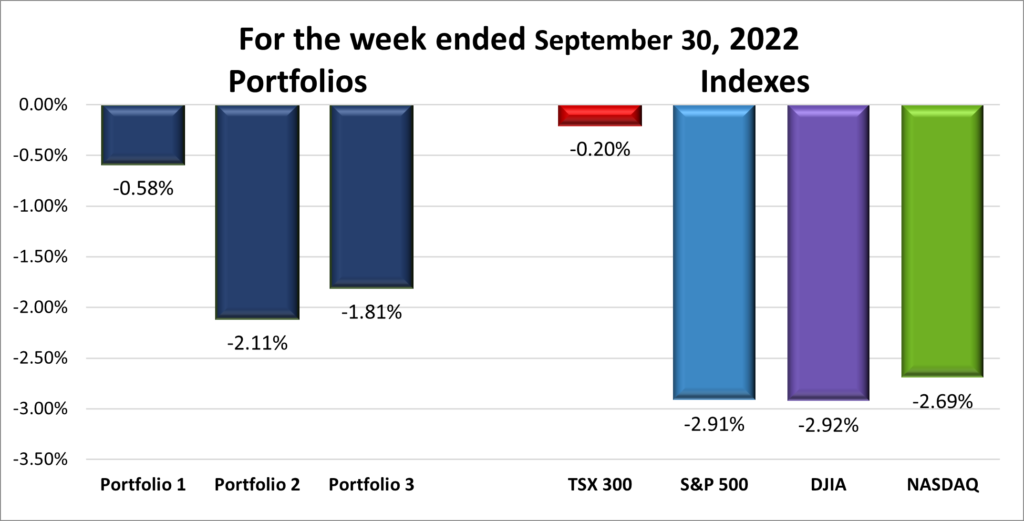
Portfolio 3

Portfolio 3 for the week ended September 16, 2022: DOWN Red Down Arrow

  • Shopify (TSX:SHOP) is rolling out a new compensation structure that will allow employees to structure their awards to better suit their individual needs. Employees who enroll in the new compensation system will be able to choose the mix of cash and equities that works best for them.

Activity

No significant activity to report this week.

Dividends

Dividends Received this week for the following companies:

Companies followed by DRIP (Dividend Re-Investment Plan) indicate additional shares were purchased with the dividend. Any cash leftover was added to the cash balance.

No dividends this past week.

Quarterly Reports

No quarterly reports this past week.