
As I mentioned earlier this month, September usually gets a bad rap as one of the toughest months for stocks. But this year? It has been a pleasant surprise! Thanks to anticipation around the US Federal Reserve’s (Fed) first rate cut since the COVID-19 pandemic began in March 2020, the market’s mood shifted. Add in the Bank of Canada’s (BoC) third rate cut in three months, and it has been a win for Canadian investors too. It seems like both central banks feel they are finally winning the inflation battle—if it is not already won.
With just one trading day left in the month, all four major North American indexes are up at least 2%. The TSX leads the pack, rising 3.0%, while the DJIA is up 2.6%, the Nasdaq 2.1%, and the S&P 2.0%.
September 2024 ended up being a month of anticipation and uncertainty. Investors were on edge, waiting to see if the Fed would cut rates and by how much, to give the economy a bit of breathing room. Now that the Fed has delivered, markets are cautiously optimistic, but everyone is still keeping an eye on the data. It looks like this month might just defy the odds!
As this pleasantly surprising September winds down, the markets have been riding a wave of cautious optimism, largely driven by central bank rate cuts, especially from the Fed. But before we officially turn the page to October, let’s take a look at what happened this past week ….
Items that may only interest or educate me ….
Canadian Economic news, US Economic news, Government shutdown avoided, ….
Canadian Economic news
This past week’s key economic data that the BoC considers when deciding whether to raise or lower the interest rate.
Bank of Canada minutes
Following two consecutive reductions, the BoC’s Governing Council decided to cut the benchmark interest rate by an additional 0.25%, bringing it to 4.25%. The minutes from their recent meeting offer a revealing glimpse into the deliberations and thought processes behind this decision.
Prior to this announcement, Council members engaged in discussions about the shifting global economic landscape, with a particular focus on the contrasting situations in the world’s two largest economies: the United States and China. While the American economy showcased unexpected growth, China’s economy continued to struggle.
Turning their attention to domestic matters, the Council noted a continued cooling in the Canadian labour market. Notably, per capita GDP has declined for the fifth straight quarter, despite overall economic growth exceeding expectations, which was largely fueled by increased government spending. Encouragingly, inflation metrics also showed positive signs, with headline inflation, CPI-trim (which averages price data), and CPI-median (which identifies the midpoint of price changes) all falling below 3%.
While officials expressed confidence in the downward trend towards their 2% inflation target, they remained cautious about the labour market’s weakness, acknowledging that recovery might take longer than initially anticipated. With downside risks to inflation stemming from a slowing economy in mind, the Council felt it prudent to lower the rate. They indicated that if the data continued to suggest falling inflation, further reductions would be considered.
Gross Domestic Product (GDP)
In July, the Canadian economy surprised on the upside, with Statistics Canada reporting a 0.2% growth, beating expectations of 0.1%. On an annual basis, GDP expanded by 1.5%.
Breaking it down, the Goods-producing industries saw a modest 0.1% increase, led by a 0.6% rise in ‘Agriculture, forestry, fishing, and hunting.’ However, ‘Construction’ took the hardest hit, dropping 0.4%. Over in the Services-producing industries, ‘Retail trade’ was a standout, climbing 1.0%, while ‘Management of companies and enterprises’ saw the biggest loss, down 3.2%.
Year-over-year, the Goods-producing sector dipped 0.3%. The highlight was ‘Agriculture, forestry, fishing, and hunting’ growing 6.1%. On the downside, ‘Construction’ slumped 2.7%. On the Services side, ‘Educational services’ led the way with a 3.6% increase, while ‘Management of companies and enterprises’ experienced a steep 33.1% decline.
Looking ahead to the August data, preliminary estimates suggest the economy remained flat, with gains in oil and gas extraction and the public sector balancing out losses in manufacturing, transportation, and warehousing.
Canadian market volatility
Canada’s Volatility Index (CVIX) kicked off the week at 10.39, rising above 11.5 on Tuesday before settling below 11 for the remainder of the week, closing at 10.84. The mid-week surge was likely driven by market excitement following China’s announcement of economic stimulus measures to revive its economy.
Tracked under the ticker VIXI on the Toronto Stock Exchange (TSE), the CVIX measures anticipated market volatility. Readings below 10 indicate a calm, stable market; values between 10 and 20 signal moderate volatility and typical market fluctuations, while levels above 20 suggest heightened uncertainty and increased market turbulence.
US Economic news
This past week’s key data points that the Fed considers when deciding whether to raise or lower the interest rate.
Gross Domestic Product (GDP)
The Commerce Department’s Bureau of Economic Analysis final reading of second-quarter GDP held steady at 3% annually, unchanged from the previous estimate in August. Gains in private inventory and federal government spending outweighed the declines in non-residential fixed investment and exports.
This solid performance boosts confidence that the economy will maintain steady growth in the coming year. It also signals that any further slowdown in the labour market may be limited, offering a reassuring outlook for jobs and economic resilience.
Personal Consumption Expenditures (PCE)
The Commerce Department’s Bureau of Economic Analysis released some encouraging news about inflation: the PCE price index grew by just 0.1% in August, down from 0.2% in July. On an annual basis, the PCE inflation rate came in at 2.2%, lower than analysts’ expectations of 2.3% and down from July’s 2.5%.
Turning to core PCE, which excludes the often-volatile food and energy prices, the index rose 0.1% in August, slightly below July’s 0.2% increase. While this result was also below the anticipated 0.2% growth, the year-over-year core PCE figure matched expectations at 2.7%, up from 2.6% in July.
Overall, this latest data paints a positive picture, with both monthly and annual PCE rates slowing more than expected and getting closer to the Fed’s target inflation rate of 2%. While the slight uptick in core PCE raises a minor concern, the broader trend is encouraging. Looking ahead to the Fed’s next meeting in November, it seems more likely they will opt for a modest cut of 0.25% rather than the 0.5% many investors are hoping for.
American market volatility
The CBOE Volatility Index (VIX), often referred to as the market’s “fear gauge,” opened the week at 16.93. During the early part of the week, volatility gradually declined to 15.01, buoyed by positive news about the strength of the American economy in the second quarter. However, in the last two days, volatility increased again, settling at 16.96 by week’s end. This uptick was likely driven by PCE data that met expectations, raising the likelihood of a smaller 0.25% interest rate cut instead of the more aggressive 0.5% reduction many had been hoping for.
The VIX measures projected market volatility over the next 30 days. Levels below 12 indicate a calm market, while readings between 12 and 20 reflect normal fluctuations. A range of 20 to 30 suggests rising uncertainty, and levels above 30 signify extreme stress, often linked to major market disruptions or crises.
Consumer Sentiment Index (CSI)
The University of Michigan’s final September reading on consumer sentiment brought some encouraging news, climbing to 70.1 from August’s 67.9 and surpassing expectations of 69.3. That is a 3.2% month-over-month increase and a 3.4% improvement from last year.
Breaking it down, the Current Economic Conditions index rose to 63.3, up 3.3% from August, although it remains 11% lower than in September 2023. Meanwhile, the Index of Consumer Expectations surged to 74.4, beating both forecasts and August’s reading of 72.1, marking a strong 13.2% gain year-over-year.
The Current Economic Conditions index captures how consumers feel about their immediate financial situation and the broader economy, offering insight into present-day confidence. In contrast, the Consumer Expectations index looks ahead, gauging optimism about personal finances and the economy in the near future.
What do these numbers tell us? Consumers are feeling more secure in their current finances and increasingly optimistic about the future. However, many have indicated that their outlook is closely tied to the upcoming presidential election.
For investors, improving consumer sentiment often signals increased consumer spending, which can drive higher revenues for businesses and, in turn, lift stock prices. This latest CSI reading is a positive sign for the markets, offering a potential boost to us investors’ portfolios. 😊
Consumer Confidence Index (CCI)
The Conference Board reported a sharp drop in its CCI for September, which came in much lower than expected at 98.7, down from a upwardly revised 105.6 in August. Analysts had been predicting a reading of 104, making this the biggest one month drop since August 2021.
Both of the CCI’s main components declined. The Present Situation Index, which reflects consumers’ views on the current business and labour environment, fell to 124.3 from 134.4 in August. The Expectations Index, which gauges six-month outlooks for income, business, and jobs, slipped to 81.7 from 82.5—its third straight monthly decline. Fortunately, it remains above 80, as dipping below that level often signals a recession.
The drop in both components points to growing concerns over the labour market, particularly after unemployment hit a three-year high of 4.2%. While the job market remains relatively strong, the combination of slowing employment growth and persistent inflation has left consumers feeling less optimistic about the future.
Shutdown avoided
A US government shutdown was narrowly avoided as lawmakers in both the House and Senate passed a bill late Wednesday to extend federal funding through late December. This move delays the politically risky prospect of a shutdown until after the upcoming election. With the election on the horizon, Republicans were reluctant to engage in the usual brinkmanship that often accompanies funding negotiations. The bill prevents a shutdown that would have hit after the current funding expired on September 30, with the new deadline now set for December 20. Between now and then, Congress will need to finalize agency budgets, but the election’s outcome could shift priorities.
Weekly Market Review
Monday: It was a choppy day in the markets, but all four major indexes—Toronto Stock Exchange Composite (TSX), S&P 500, Dow Jones Industrial Average (DJIA), and Nasdaq Composite—managed to close in positive territory. Investors are still concerned the Fed’s 0.5% rate cut is an indicator the US economy is performer worse than thought. Oil prices ended lower on concerns of lower demand and a weak Chinese economy.
In Canada, the TSX set a record high close for the third session in a row. In trading, the Consumer Staples sector advanced the most while the Basic Materials sector (miners and fertilizer manufacturers) lost the most.
In the US, the S&P and DJIA both edged up to reach new record highs as investors digested comments from three Fed officials backing the larger rate cut. In trading, despite lower oil prices, the Energy sector posted the biggest gain, with Healthcare recoding the biggest decline.
Tuesday: all four indexes posted modest gains as investors weighed fresh economic stimulus measures from the Chinese government and their potential ripple effects on North American markets. Oil prices surged on news of the Chinese economic stimulus measures.
In Canada, the Chinese economic stimulus measures boosted commodity prices and sent the resource heavy TSX to another record high close. In trading, Basic Materials posted the biggest gain, while Consumer Staples declined the most.
In the US, despite weakening consumer confidence in the labour market, both the DJIA and S&P ended the day at record highs, driven by positive news out of China. In trading, Basic Materials posted the biggest gain while Financials suffered the drop.
Wednesday: The markets cooled today, pushing all but the Nasdaq into the red. Investors are now weighing the possibility that the Fed’s jumbo-sized rate cut was an attempt to stave off a slowing US economy, which could be heading toward a recession. Oil prices dropped as concerns about supply issues in Libya eased.
In Canada, the TSX ended lower as investors took a breather, and some gains, after the recent runup to a record high. Lower oil prices also contributed to the TSX’s pullback. In trading, the Utilities sector scored the biggest gain, while the Energy sector fell the farthest.
In the USA, the Nasdaq was essentially flat, while the S&P and DJIA ended lower as investors await tomorrow’s GDP and Friday’s PCE data. In trading, Utilities and Technology were the only sectors to advance, while the Energy dropped the most.
Thursday: strong US economic data, including second quarter GDP that was higher than expected, combined with Chinese efforts to kickstart their economy lifted all four indexes into the green. Oil prices fell when a report suggested the world’s top oil exporter, Saudi Arabia, was prepared to give up their target of US$100 per barrel as they prepare to increase production.
In Canada, The TSX surpassed the 24,000 mark for the first time thanks to higher commodity prices caused by China’s efforts to boost their economy. It was a good day in the Canadian markets, led higher by the Technology sector. Communications Services and Energy were the only sectors to finish the day lower.
In the US, The S&P rose to an all time high, boosted by better-than-expected economic data, quelling concerns the Fed’s giant sized rate cut was in response to the economy slowing too fast. In trading, the Basic Materials sector advanced the most, while Energy slid the farthest backward.
Friday: It was a mixed day, with all four indexes starting strong but losing momentum just before noon, leaving the DJIA as the only one to close in positive territory. The latest US PCE inflation report indicated a continued decline in inflation, sparking hopes for another potential jumbo-sized rate cut by the Fed. Meanwhile, oil prices closed higher, driven by investor optimism for increased demand from China, the world’s top oil importer, following their recent economic stimulus package.
In Canada, the TSX slipped as advance estimates for GDP in August suggest the economy has stalled. In trading on Bay Street, Energy gained the most, while Basic Materials dropped the furthest.
In the USA, the DJIA posted another record high close, while the S&P and Nasdaq both ended slightly lower. Consumer sentiment improved as a result of falling inflation and lower interest rates. In trading on Wall Street, the Energy sector increased the most, while Technology had the biggest drop-off.
Weekly Market and Portfolio Review
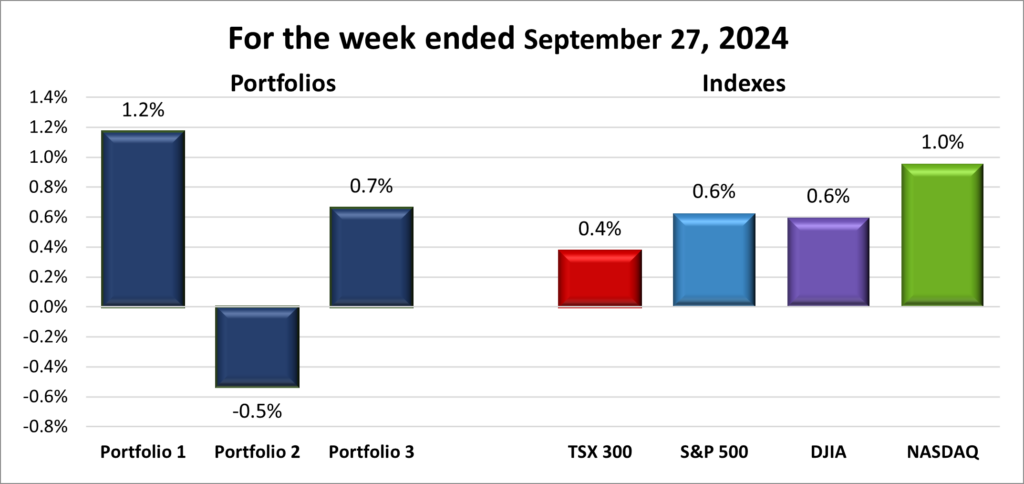
For the week, the TSX (SPTSX) rose 0.4%, the S&P 500 (SPX) advanced 0.6%, the DJIA (INDU) increased 0.6% and the Nasdaq (CCMP) grew 1.0%.
| Index | Weekly Streak |
| TSX: | 3 – week winning streak |
| S&P: | 3 – week winning streak |
| DJIA: | 3 – week winning streak |
| Nasdaq: | 3 – week winning streak |
 This past week continued the upward momentum from the previous week, though it wasn’t without its bumps, as shown in the chart above. The TSX, S&P and DJIA all set record high closes multiple times throughout the week. The rally was primarily driven by the Fed’s recent rate cut, which propelled indexes higher at the start of the week. However, as the week progressed, uncertainty crept in. Analysts and investors began to question the reasons behind the Fed’s 0.5% cut. Some interpreted it as a signal of potential weakness in the US economy, while Fed officials reassured that the move reflected progress in cooling inflation and a softer job market.
Adding a boost to the markets was news from China. Their announcement of new economic stimulus measures provided another lift, particularly to the commodities and energy sectors. As one of the world’s largest consumers of oil and raw materials, China’s efforts to jumpstart its economy raised expectations for increased demand, further fueling market optimism.
Returning to the US, investors looked to key economic reports for more clarity about the jumbo rate cut. Thursday’s better-than-expected second-quarter GDP numbers reassured markets that the American economy remains strong, pushing indexes higher. On Friday, the PCE report showed headline inflation falling to 2.2%, just above the Fed’s 2% target. This solidified expectations of another rate cut in November, with growing speculation of a second consecutive 0.5% reduction.
In Canada, the TSX benefitted from the Fed’s rate cut and China’s stimulus. The combination of lower interest rates and an expected rise in commodity demand created the perfect environment for the resource-heavy TSX to thrive. However, it wasn’t all good news as the advanced estimates for Canada’s GDP suggest the Canadian economy has stalled, which could add to the existing uncertainties and open the door for the BoC to make their own jumbo-sized rate cut at their next meeting at the end of October.
While the Fed’s rate cut, promising economic news from the US, and China’s stimulus provided a boost, lingering questions about the strength of the American and Canadian economies and the pace of inflation remain in focus. Adding to the uncertainty is the fact that we’re entering October—a month historically known for heightened market volatility, thanks to events like the 1929 crash and 1987’s Black Monday. Buckle up, because October’s “rollercoaster” reputation might just live up to its name.
| Portfolio | Weekly Streak |
| Portfolio 1: | 3 – week winning streak |
| Portfolio 2: | 1 – week losing streak |
| Portfolio 3: | 3 – week winning streak |
While the major indexes enjoyed a steady climb this week, the Portfolios delivered a mixed bag of results, as shown in the chart below.
Portfolio 1 led the way but faced some challenges, with only 43% of its companies posting weekly gains. Fortunately, Nvidia Corporation (NASD: NVDA) rose 4.6%, and impressive double-digit surges from Lightspeed Commerce (TSE: LSPD) up 21%, Indie Semiconductor (NASD: INDI) up 16%, and Navitas Semiconductor (NASD: NVTS) up 15% helped extend its winning streak to three weeks. While Nvidia didn’t post a gain over 10%, its dominant position in the portfolio was enough to offset losses from the majority of other stocks.
Portfolio 2 was the only one to slip into the red, snapping a two-week winning streak. With just 48% of holdings posting gains and no standout performances, the portfolio couldn’t overcome losses from the rest of the stocks.
Portfolio 3 had a solid week, with 72% of its holdings increasing in value. Leading the pack was Lithium Americas (Argentina) (TSE: LAAC) skyrocketing 31% (ah, the perks of a low priced, small cap stock! 😊), while Lithium Americas (TSE: LAC) also gained 16%. The combination of a sizable majority of stocks posting weekly gains and a few significant gains, lifted the portfolio into positive territory.
All in all, it was a week of mixed fortunes across the Portfolios. While Portfolios 1 and 3 extended their winning streaks, Portfolio 2 hit a bump in the road. But that’s the nature of investing—sometimes it’s a rollercoaster, and other times it’s a steady climb. While a real rollercoaster is a fun ride, I prefer my investments to be steady climbers. 😊
Companies on the Radar
 This past week, no new companies made it onto my radar, but I did make some changes. Vertiv Holdings (NYSE: VRT) was added to Portfolio 3, while IDEXX Laboratories, Inc. (NASD: IDXX) and Payfare Inc. (TSE: PAY) were dropped. Vertiv stood out due to the growing demand for data centers, which are essential for AI deployment. After running my Radar Check, I found IDEXX to be too similar to Zoetis Inc. (NYSE: ZTS) in the animal health space, and Zoetis ultimately seemed like the better opportunity. As for Payfare, they announced that their agreement with their largest customer, DoorDash (NASD: DASH), would not be renewed, leading to a significant loss in revenue. With Payfare withdrawing its previous revenue and earnings outlook, I decided it was time to remove them from the list.
The companies still on my radar offer a pretty eclectic mix across different sectors. There are two large American giants and one major Swiss player. On top of that, two of these—Zoetis and Coca-Cola (NYSE: KO)—pay steady dividends, rewarding shareholders while leading in their industries. It has become a nicely diversified list of stable, growing companies! 😊
- On Holding AG (NYSE: ONON), a medium cap Swiss company, founder-run, sports products company.
- Zoetis Inc., a leading animal health company that discovers, develops, manufactures, and commercializes vaccines, medicines, diagnostics, and other technologies for both companion animals and livestock.
- Coca-Cola, a global beverage giant, best known for its flagship soft drink, Coca-Cola. They offer a wide range of non-alcoholic drinks, including sodas, juices, teas, and bottled water, catering to consumers worldwide.
The Radar Check was last updated September 27, 2024.


Portfolio Update
Portfolio 1
Portfolio 1 for the week ended September 27, 2024: UP 
- The US Department of Justice filed a lawsuit against Visa (NYSE: V), accusing the company of violating antitrust laws by stifling competition—allegedly through imposing high fees on merchants and paying off potential rivals to maintain its dominance.
- Alphabet’s (NASD: GOOGL) Google lodged a complaint to the European Commission (EC) against what it claimed were Microsoft’s anti-competitive practices that locked customers into Microsoft’s Azure cloud platform. Google said Microsoft used its dominant Windows Server operating system to prevent competition.
- Lightspeed Commerce has enlisted a financial advisor to evaluate its business and operations, exploring strategic options that could include a potential sale of the company.
- PayPal Holdings (NASD: PYPL) announced that US merchants can now buy, hold, and sell cryptocurrency directly from their business accounts, expanding its crypto offerings to businesses.
- Amazon’s (NASD: AMZN) partnership with Anthropic AI has been cleared by Britain’s anti trust regulator, the Competition and Markets Authority (CMA). The CMA said the partnership did not fall under its authority so was unable to probe any further.
Activity
Sold: GDI Integrated Services (TSE: GDI) – A small cap Canadian company that provides a wide range of facility management services across North America, including commercial cleaning, HVAC maintenance and repair, energy management, and more for various commercial, industrial, and institutional clients.
I initially invested in GDI back in January 2020, right before the pandemic made clean office environments a top priority. At the time, this seemed like a brilliant move, as the share price surged to nearly C$60 by February 2022 (though I must admit, that was more luck than foresight 😊).
However, since then, the share price has gradually drifted back to the level I originally paid. While the end of the pandemic has likely reduced demand for their janitorial services, the company’s revenue continues to rise, which is a positive sign. But what concerns me is that despite this revenue growth, GDI’s net income has been declining. Additionally, the company’s long-term debt has increased, so it is not as if they are using profits to pay down debt.
I have been holding out, hoping for a turnaround, but it is becoming clear there are better opportunities with stronger potential on my Radar List. With that in mind, I decided to sell my GDI shares, locking in a small profit, and shifting my focus to those more promising prospects.
Dividends
Dividends Received this week for the following companies:
Companies followed by DRIP (Dividend Re-Investment Plan) indicate additional shares were purchased with the dividend. Any cash leftover was added to the cash balance.
Canadian $
Dream Industrial Real Estate Investment Trust (TSE: DIR.UN) DRIP
Canadian National Railway Company (TSE: CNR)
Hammond Power Solutions (TSE: HPS.A)
US $
No US$ dividends this past week.
Quarterly Reports
Costco Wholesale Corporation
Fourth quarter 2024 financial results on September 26, 2024
Portfolio 2
Portfolio 2 for the week ended September 27, 2024: DOWN 
- Guardant Health (NASD: GH) announced that a recently published study in the journal Nature Medicine revealed that utilizing the Guardant360® CDx liquid biopsy results to guide targeted therapy can significantly extend survival for patients fighting advanced cancer.
Activity
No significant activity to report this week.
Dividends
Dividends Received this week for the following companies:
Companies followed by DRIP (Dividend Re-Investment Plan) indicate additional shares were purchased with the dividend. Any cash leftover was added to the cash balance.
Canadian $
Hammond Power Solutions
Dream Industrial Real Estate Investment Trust (TSE: DIR.UN) DRIP
Alimentation Couche-Tard Inc (TSE: ATD)
Brookfield Infrastructure Partners LP (TSE: BIP.UN)
Brookfield Infrastructure Corp (TSE: BIPC)
US $
No US$ dividends this past week.
Quarterly Reports
No quarterly reports this past week.
Portfolio 3
Portfolio 3 for the week ended September 27, 2024: UP
- Brookfield Asset Management (TSE: BAM) announced it raised US$2.4 billion for the Catalytic Transition Fund (CTF), which seeks to scale up climate finance in emerging markets. BAM’s goal is to raise $5 billion inside the CTF, to be used for clean energy projects and assets.
- Microsoft (NASD: MSFT) announced they were investing US$1.3 billion to build up their cloud computing and artificial intelligence (AI) infrastructure in Mexico.
Activity
Sold: GDI Integrated Services: Please see writeup under Portfolio 1.
Bought: Vertiv Holdings: This large-cap American company is a leader in critical digital infrastructure and continuity solutions. In short, Vertiv designs, builds, and maintains systems that ensure IT equipment runs smoothly. Their products include cooling systems to prevent data center overheating, power distribution units for consistent energy delivery, racks to protect IT hardware, and software to manage critical infrastructure.
With AI and data-heavy applications booming, the demand for data centers is soaring—where Vertiv shines. A notable 75% of their market exposure is tied to data centers, making their products essential for building, and operating these facilities efficiently. As sustainability and energy consumption become key concerns, Vertiv’s energy-efficient solutions are more important than ever. The rise of edge computing, which processes data closer to its source, also presents exciting opportunities for their innovative offerings
Vertiv’s focus on resilience and reliability makes their solutions critical in sectors like finance, healthcare, and telecom, where uninterrupted operations are vital. Their diversified presence across industries, from telecom to government, helps them navigate market fluctuations. Vertiv is benefiting from major trends in AI, edge computing, and the rollout of 5G and future mobile communications technology, positioning the company for continued success.
With a seasoned leadership team, including the CEO who has worked for the company since 1998, Vertiv has shown strong financial performance—growing revenues, net income, earnings per share, and cash flow in recent years. Both gross and profit margins have improved, even as the company manages its long-term debt.
That said, investing in Vertiv does come with risks. The infrastructure industry is competitive and subject to rapid technological changes, particularly the electrical equipment industry. Economic downturns, rising interest rates, or reduced capital expenditure in key sectors like data centers could pose challenges to growth. However, with its focus on innovation and strong demand from sectors like AI and 5G, Vertiv is well-positioned to navigate these challenges and capitalize on the opportunities ahead.
As AI, cloud technologies, and telecom networks expand, the need for reliable infrastructure will only grow. Vertiv’s strategic focus and proven capabilities put it in an excellent position to benefit from this trend. Adding Vertiv to Portfolio 3 not only offers solid growth potential and diversification but also brings in dividend income. More importantly for me, it has the potential to significantly boost the portfolio’s overall value. 😊
Dividends
Dividends Received this week for the following companies:
Canadian $
Brookfield Wealth Solutions Ltd (TSE: BNT)
Brookfield Asset Management (TSE: BAM)
Brookfield Renewable Corp (TSE: BEPC)
US $
No US$ dividends this past week.
Quarterly Reports
No quarterly reports this past week.