
Navigating the world of investing often mirrors the emotional rollercoaster experienced by hockey fans as the season nears its end and the draft lottery looms. The dilemma? To wholeheartedly support your team’s victories or, paradoxically, hope for losses if it secures a superior draft spot. This dichotomy is strikingly similar in the realm of investments, where economic news can simultaneously herald positive developments and trigger investor apprehension. Take, for example, the recent labour report from the US: It showed job growth and wage increases surpassing expectations—a testament to a thriving economy and a win for the workforce. Yet, for those keen on seeing interest rates decline, this was a setback. Rising wages, after all, can exacerbate inflationary pressures. The statement by a Federal Reserve official that it is “much too soon to think about cutting interest rates” effectively quashed any hopes for an imminent rate cut, epitomizing the scenario where robust economic health can dampen prospects for those favoring lower interest rates. ☹
This week we will look at recent labour data from Canada and the US that led to this dilemma, as well as some things you should consider if you are considering investing for the first time or have just started. Now, let’s see what happened this past week….
Items that may only interest or educate me ….
Canadian Economic news, US Economic news, What should I consider before investing? ….
Canadian Economic news
This past week’s key economic data that the Bank of Canada (BoC) considers when deciding whether to raise or lower the interest rate.
Labour Force Survey (LFS)
Statistics Canada’s LFS for March revealed a unexpected decline in employment, with the economy shedding 2,200 jobs following gains in both January and February. Year-over-year, employment has increased by 1.6%. Analysts had expected a gain of 25,000 jobs.
The unemployment rate saw a rise of 0.3%, climbing from February’s 5.8% to 6.1% in March. This marks the highest unemployment rate observed in over two years, surpassing analysts’ expectations of a 5.9% rate. Compared to the previous year, unemployment has increased by 1.0%.
Interestingly, the rate of hourly wage growth saw an acceleration to 5.0% year-over-year, a slight increase from February’s 4.9%. This upturn, the first in three months, might be welcomed by employees but complicates the ongoing battle against inflation.
While the BoC may view the faster wage growth with caution due to its potential to fuel inflation, the overall easing of the labour market could pave the way for a reduction in the benchmark interest rate come June.
Canadian market volatility
Over the past week, Canada’s Volatility Index (VIXC), which tracks the TSX 60 VIX, rose to 11.67, up over 8% from 10.72 the previous week. The slowing Canadian labour market, combined with a higher-than-expected US labour report that could delay the first US rate cuts are likely the primary reasons for the low volatility figure.
The VIXC, often referred to as Canada’s ‘fear gauge,’ provides insights into the expected volatility within the Canadian stock markets. Typically, readings above 20 signify high volatility, while those below 20 indicate low levels. The current reading of 11.67 places it well below the high volatility zone.
Trade Surplus
Canada’s trade surplus widened significantly in February, surpassing analysts’ expectations by turning a C$595 million deficit into a C$367 million surplus. The growth in exports was primarily fueled by record gold shipments. The larger-than-expected surplus suggests a robust economy, underscored by strong international demand for Canadian products and resources, especially gold and crude oil.
US Economic news
This past week’s key data points that the Federal Reserve (Fed) considers when deciding whether to raise or lower the interest rate.
Labour reports
Three recent labour market reports provide a snapshot of the current state of the American economy. Analyzing the latest data from the Job Openings and Labor Turnover Survey (JOLTS), ADP National Employment Report, and the Employment Situation Summary (ESS) provides a comprehensive view of the US labour market and reveals key trends in employment, and wage growth that can influence future economic policy.
Labor Department’s Job Openings and Labor Turnover Survey
The Labor Department’s Bureau of Labor Statistics’ JOLTS report for February showed job openings remained steady at 8.756 million from January’s revised 8.748 million openings. The number of openings was marginally higher than analysts’ expectations of 8.740 million openings. On a monthly basis, the change was negligible, while year over year, the number of openings shrunk 11% from 9.849 million. The report showed there was 1.36 job vacancies for each unemployed individual, down from January’s 1.43.
Despite slowly declining from the 11.2 million average number of job openings in 2022 when the economy was rebounding, the number of openings has been fairly consistent over the last few months. Overall, the JOLTS report paints a picture of a strong labour market with continued demand for workers, although the pace of growth is moderating.
ADP Employment Report
The ADP Employment Report for March revealed that private payrolls had their biggest increase since last July, adding 184,000 jobs. That was 18.7% higher than the revised 155,000 jobs added in February and higher than analysts’ expectations of an additional 148,000 jobs.
Pay increases for those changing jobs was up 10%, on a year-over-year basis, compared to 5.1% for those who remained in their positions. That is the highest rate of wage growth for job changers since July 2023. For those hoping for a sooner rather than later interest rate cut that is not good news because higher wages could increase demand for goods and services, sending prices higher and keeping inflation around longer.
Bureau of Labor Statistics’ Employment Situation Summary (ESS)
The Labor Department’s March ESS reported a robust job market, with nonfarm payrolls surging by 303,000 in March. This surge significantly exceeded expectations of 200,000 new jobs and easily surpassed February’s growth of 275,000 jobs. The strong gains outpace the twelve-month average monthly gain of 231,000 jobs.
Unemployment edged down to 3.8%, lower than analysts’ expectations that it would hold steady at 3.9%. Since last August, the unemployment rate has fluctuated narrowly between 3.7% and 3.9%.
Wage growth also picked up, with average hourly earnings rising by 0.3% in March following a slight 0.1% increase in February. On a year-over-year basis, wages climbed by 4.1%, Both the monthly and yearly numbers were in line with analysts’ forecasts.
The March ESS suggests a resilient economy, underscored by healthy job creation and steady wage growth. However, these positive trends might pose challenges for the Fed, potentially postponing the much-anticipated interest rate cuts due to concerns over inflation.
Conclusion
The US job market displayed its resilience in March, as highlighted by the three labour reports. This trio of reports underscores a robust economy and labour market, suggesting that the US is well-positioned to sidestep a recession while steering inflation toward the Fed’s 2% target.
The sustained strength in the labour market, as evidenced by these reports, is particularly encouraging for the Fed. It bolsters their strategy to maintain a strong labour market as part of their broader efforts to lower inflation to their 2% goal. However, the robust job market also provides the Fed with the leeway to keep interest rates elevated, adopting a cautious stance against reducing rates prematurely.
In essence, the March job market reports strike a positive note for both economic resilience and the Fed’s inflationary objectives, balancing strong employment with the gradual approach needed for lowering the interest rate. Although it will not make those hoping for a June rate cut very happy. 😊
American market volatility
The CBOE Volatility Index (VIX), often referred to as the market’s fear gauge, surged 23% this week, closing at 16.03, up from 13.03 the previous week. Although this uptick keeps the VIX below the 20-point threshold commonly associated with heightened volatility, it signals a rise in investor caution towards potential market fluctuations in the near future. The rise of the VIX is likely driven by the unexpectedly strong job growth reported in the latest ESS, which in turn could delay the anticipated rate cut and lower the number of cuts from three down to two cuts this year. While investor anxiety is not high, it is clear that there’s growing caution around market volatility.
What should I consider before investing?
Starting on your stock market investment journey can be thrilling yet overwhelming. While the journey can be complex, understanding the basics can unlock significant opportunities for growth and financial security. To navigate this path with confidence, it is essential to start with a solid foundation that includes understanding your financial situation, investment goals, risk tolerance, and investment timeline. Here is a streamlined guide to help you get started:
Step 1: Self-Assessment and Financial Housekeeping
Purpose of Investing: Clearly define your investing goals. Whether saving for retirement, a dream home, a new car, or your children’s education, your objectives will direct your investment strategy. For example, saving for retirement might mean aiming for a diverse portfolio that grows over time, while saving for a near-term goal, like a dream vacation, could focus on safer, more liquid investments.
Financial Health Check: Take a close look at your finances by creating a net worth statement and tracking your spending. This step is crucial for identifying potential savings opportunities and setting a realistic investment budget.
Eliminate High-Interest Debt: Prioritize paying off debts, especially those with high interest rates. High-interest debt can hinder your investment progress. Prioritize its repayment to free up more money for investing and reduce financial stress.
Income Stability: Consistent investment contributions are ideal. However, if your income fluctuates, planning for irregular contributions is essential.
Step 2: Preparing for the Unexpected
Emergency Fund: Before diving into investments, ensure you have a safety net. Establish an emergency fund — typically six months’ worth of living expenses — to cover unexpected life events, such as job loss, medical emergencies, or urgent home repairs. This fund is crucial for financial security, allowing you to handle unexpected events without derailing your investment plans.
Step 3: Building Your Investment Foundation
Risk and Time Horizon: Understanding your risk tolerance and investment timeline is pivotal. A longer horizon can generally accommodate more risk, allowing you to potentially benefit from the higher returns often associated with stock investments.
Educate and Research: Familiarize yourself with stock market fundamentals and conduct research on potential investments. Learning about diversification, for example, will show you how spreading your investments across various sectors, asset classes, and geographical areas can help manage risk. There are plenty of good investing resources available such as financial news websites, investment sites, investment news and stock recommendation subscriptions, or go old school read books on investing. 😊
Professional Advice: Consider consulting with a financial advisor for tailored advice. They can guide you on using tax-advantaged accounts and ensuring your investments complement your broader financial goals, including estate planning. They can ensure your investment strategy aligns with your overall financial plan.
Step 4: Diving into Investments
Choosing Investments: Begin with stable companies known for regular dividends, where a company pays out a portion of its profits to shareholders on a regular basis. Essentially, this is a reward for investing in the company. A good place to start is with a ‘dividend aristocrats’. These companies have a proven track record of increasing their dividends for at least 25 consecutive years, offering both growth potential and income. On a personal note, psychologically, it feels good to see money coming into your account no matter what the markets are doing. 😊
Diversification: Mitigate risk by diversifying your portfolio over time. This strategy involves investing in a mix of sectors, asset types, and even geographical regions to safeguard against volatility.
Understanding Costs: Keep an eye on fees, including brokerage and management fees, as they can eat into your returns.
Long-term Perspective: Avoid the temptation to time the market. Adopting a disciplined, long-term approach, and considering strategies like dollar-cost averaging, can be more beneficial than chasing short-term gains.
Step 5: Emotional Discipline and Adhering to Your Plan
Emotional Discipline: The market’s unpredictability requires a steady hand. Be prepared for volatility and resist making hasty decisions based on short-term movements. Recognizing common emotional traps, such as the fear of missing out or panic selling, can help you maintain focus on your long-term objectives.
Regular check ins: set up regular check-in intervals on investment performance (e.g., quarterly, or semi-annually) to avoid the common pitfall of over-monitoring, which can lead to emotional decision-making.
Sticking to Your Plan: Stay committed to your strategy through market ups and downs. While periodic adjustments based on changing circumstances or financial goals are reasonable, they should be thoughtful and not reactive.
Conclusion
While every investment journey comes with its own challenges, arming yourself with knowledge and a clear strategy is the first step towards building a prosperous financial future. Remember, successful investing is not just about selecting the right stocks, but also about aligning your investments with your financial goals and personal risk tolerance. Everyone’s goals and investing path is unique so do what is right for you.
Keep in mind that investing involves risks, including the potential loss of principal. This guide is not financial advice; it is meant to help you get started on your investment journey. As you gain experience and your financial situation evolves, consider adapting your strategy to better suit your changing needs and objectives.
Weekly Market Review
Monday: the first day of trading in the second quarter ended with mixed results as the Toronto Stock Exchange Composite Index (TSX) and the Nasdaq Composite Index (Nasdaq) ended barely higher while the S&P 500 Index (S&P) and the Dow Jones Industrial Average (DJIA) each ended lower. Oil prices continued to rise, spurred on by supply issues caused by the Middle East situation and the potential strong demand from the world’s two largest economies, the USA and China.
In Canada, rising commodity prices helped propel the TSX to a record high close. In trading, Basic Materials (miners and fertilizer companies) and Energy were the top performers of the Canadian sectors, while Utilities and Financials dropped the most.
In the US, the S&P and DJIA were weighed down by higher-than-expected manufacturing data. Investors worried it could cause a delay to a hoped-for interest rate cut in June. In trading, Energy, Technology, and Basic Materials were the only American sectors to end in positive territory. Among the sectors to end lower, Financials and Healthcare incurred the biggest decline.
Tuesday: a tough day in the markets as all four indexes were down sharply. Concerns interest rates will remain high through the summer weighed heavily on the markets today. Oil prices rose on supply concerns after Ukraine drone attacks on Russian refineries and escalating hostilities in the Middel East.
In Canada, recent BoC inflation expectations were still too high causing investors to be concerned the BoC could delay rate cuts until July. Also weighing on the TSX was the timing of interest rate cuts by the Fed. In trading, Basic Materials and Energy were the only sectors to end the day in the green, while Telecommunications Services and Industrials fell the farthest.
In the USA, February labour data came in higher than predicted causing investors to worry the Fed may delay or end up lowering rates twice rather than three times in 2024. In trading, Energy and Utilities were the only sectors to end in positive territory. Healthcare and Industrials dropped the most of the remaining sectors.
Wednesday: The markets got off to a good start after Fed Chair Jerome Powell in a speech today echoed his previous comments when he said the Fed was likely to lower the interest rate this year, despite the “bumpy” road to their 2% inflation target. However, he also signalled that a rate cut was still not in sight, causing the markets to fade in afternoon trading, with the DJIA giving back morning gains and falling into the red.
In Canada, the three heavyweight sectors in the TSX (Basic Materials, Energy and Financials make up over 60% of the index) had a good day, propelling the TSX into positive territory. Commodity and energy prices continued to rise. However, in trading, Healthcare was the top performing sector, followed by Basic Materials. Of the sectors that ended lower, Technology and Consumer Cyclicals suffered the biggest drops.
In the US, the March economic data has many analysts and investors questioning a June rate cut with many now suggesting July as the start of rate cuts. Basic Materials and Energy led all sectors, while Consumer Staples and Utilities were the only sectors to end lower.
Thursday: All four indexes fell as sellers ruled the day after a Fed official suggested it was possible that there would be no rate cuts this year if inflation remained sticky. One factor in inflation remaining sticky is rising oil prices. Worsening conditions in the Middle East has led to supply concerns resulting in rising oil prices.
In Canada, the TSX ended in the red because of a decline in commodity prices. In trading, Consumer Cyclicals, Telecommunications Services, and Energy were the only sectors to end higher, with Consumer Staples and Healthcare losing the most.
In the US, the idea that the highly anticipated rates cuts could be pushed back sent all three indexes sharply downward into the red, with drops of at least 1% each. Investors will be paying close attention to tomorrow’s latest jobs report. In trading, all American sectors ended lower. Energy and Consumer Staples dropped the least, while Technology and Basic Materials fell the most.
Friday: all four indexes rebounded from yesterday’s losses to end the day solidly in positive territory. Oil prices continued to rise on concerns heightened tensions in the Middle East could limit supply. As a result of the steadily rising prices, oil posted its second straight weekly gain.
In Canada, the TSX set another record high on rising commodity prices. As well, the monthly labour report showed the number of jobs decreased and unemployment rose, boosting investors hopes for the BoC to lower the interest rate at their June meeting. It was a good day for trading as all sectors ended higher, led by Basic Materials and Healthcare. The lone exception was Utilities.
In the US, the three American indexes all ended higher despite a surprisingly higher jobs report indicated the American economy remained strong despite the high interest rates. The strong job market could push back the lowering of interest rates. In trading, it was a day of broad-based advances, led by Technology and Industrials. Telecommunications Services was the only sector not to advance.
Weekly Market and Portfolio Review
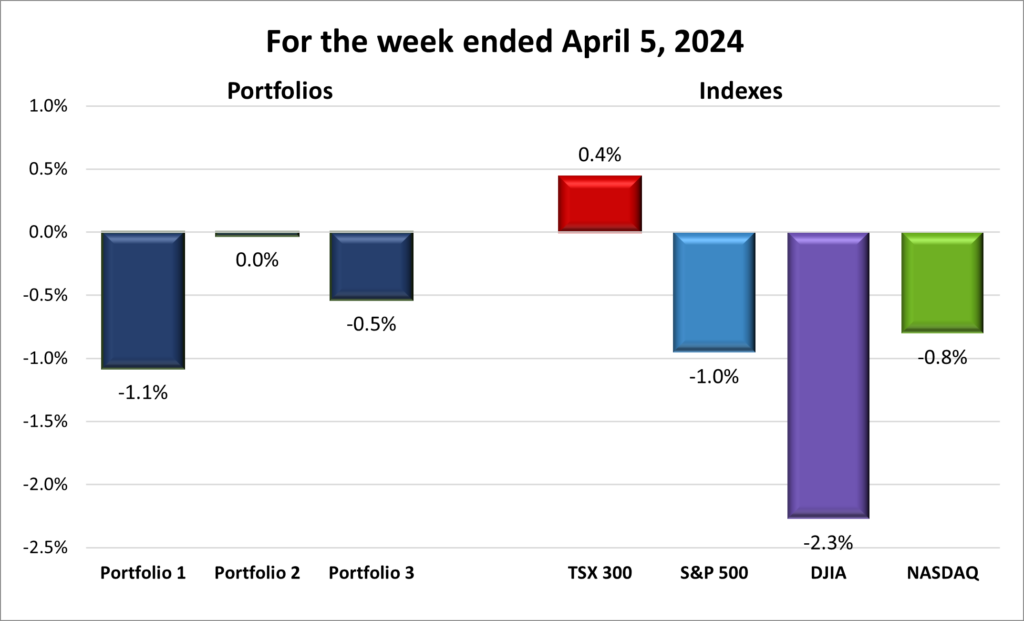
For the week, the TSX (SPTSX) rose 0.4%, the S&P 500 (SPX) dropped 1.0%, the DJIA (INDU) fell 2.3% and the Nasdaq (CCMP) declined 0.8%.
| Index | Weekly Streak |
| TSX: | 8 – week winning streak |
| S&P: | 1 – week losing streak |
| DJIA: | 1 – week losing streak |
| Nasdaq: | 2 – week losing streak |


Last week I suggested that, given the first quarter’s strongest start in five years, April could be primed for a bull run. However, the month began ominously, although this past week did end on a positive note with all four indexes ending higher on Friday.
Driving the markets this week were concerns that March’s robust economic indicators might dampen the prospects for US rate cuts. Following unexpectedly strong US jobs data, investors are now bracing for the Fed to delay interest rate reductions, with predictions now leaning towards two cuts this year, down from the three initially forecasted.
Complicating matters, a Fed official suggested that rate cuts might not be needed this year unless inflation’s decline accelerates, especially if the economy and labour market remain strong. However, another official expressed the view that once more concrete signs of declining inflation appeared, the Fed would be able to lower the interest rate. Of course, all the market heard was no rate cuts in 2024 and sent the markets plunging lower.
In Canada, the TSX was lifted by higher commodity prices and the latest labour report that showed employment had unexpectedly dropped. This has investors feeling the BoC will be compelled to lower the Canadian interest rate to prevent recession.
The energy sector, however, provided a silver lining to a dismal week, marking its second consecutive week of gains. Year to date, the Canadian energy sector has surged over 15%, while its American counterpart has exceeded 14% — both outperforming the TSX’s nearly 7% increase and the S&P’s 9.1%. The disparities between the Canadian and American energy sectors reflect variations in their respective subsector weightings, oil grades, and company performances within each energy sector.
Being an optimist, I believe the five-month rally is merely taking a well-deserved break. Despite a mixed week, I anticipate a return to the upward trajectory for all four indexes in the coming week. 😊
Next week the latest US inflation data from the Consumer Price Index (CPI) comes in. Let us hope the data shows inflation continues to fall.
| Portfolio | Weekly Streak |
| Portfolio 1: | 2 – week losing streak |
| Portfolio 2: | 1 – week losing streak |
| Portfolio 3: | 3 – week losing streak |
To paraphrase Marvin the Martian, it was not a good week, not a good week at all. As you can see in the chart below, all three portfolios posted weekly losses. Portfolio 2 was essentially flat for the week but when I went out another decimal, the portfolio was down slightly so its winning streak came to an end after one week. ☹
Portfolio 1 had its second week of weekly losses after a run of twelve weeks of weekly gains. This past week saw many of the compaines in the portfolio post a weekly loss, including Nvidia (NASD: NVDA) which had a second straight weekly loss afer a run of 11 weekly gains. None of this week’s losses were significant (more than 10%), but they all added up causing the portfolio to suffer the biggest weekly decline. The lone bright spot was Cameco (TSE: CCO) up 10% for the week.
Many of the holdings in Portfolio 2 were down slightly, however, the American technology companies were flat or up slightly, and the two oil producers – Canadian Natural Resources Ltd (TSE: CNQ) and Crew Energy Inc (TSE: CR) – were both higher at the end of the week, offsetting the other losses.
Portfolio 3 had a bad week with almost two thirds of the companies recording a weekly loss. Fortunatley, Alvopetro Energy (TSXV: ALV) posted a 25% gain to limit the damage.
It hasn’t been too often in the last few months that all three portfolios suffered weekly losses. Hopefully all three get out of the red and back into the green next week. 😊
Companies on the Radar
 No new companies came across my radar this past week. My radar list currently sits at a manageable five companies, listed below.
- Celestica Inc. (TSE: CLS), a medium sized Canadian company that manufactures electronic products and provides supply chain services to companies around the world.
- Carnival Cruise Line (NYSE: CCL), a large American company that operates several major global cruise lines.
- Equitable Bank (TSE: EQB), a mid sized Canadian bank, considered Canada’s 7th bank, that provides financial services to consumers and businesses.
- Lumine Group (TSE: LMN), a young Canadian mid sized company that acquires communications and media software companies and then strengthens and grows those companies.
- Evolution AB (OTCM: EVVTY), a Swedish company that provides live casino solutions for global gaming operators.
Please keep in mind that these are only companies that have piqued my interest. This is not a recommendation or financial advice. You should do your own research or contact a professional before making any investment decisions.
The Radar Check was last updated April 5, 2024.
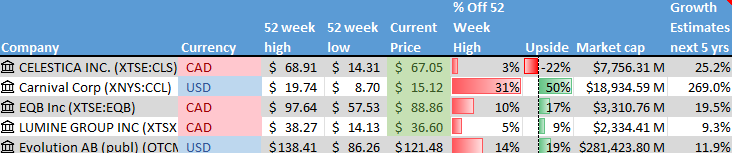

NOTE: Morningstar and Thomson-Reuters analysis is unavailable for Evolution from my usual sources because the company’s home stock exchange is the Nasdaq Stockholm in Sweden. While it is possible to invest in Evolution through the Over the Counter Market, I do not have access to analysis similar to the data available for companies traded on the major North American stock exchanges (Toronto Stock Exchange, New York Stock Exchange, and Nasdaq Stock market). The Analysts Rating and Price Target for Evolution are from Yahoo! Finance, under the Analysis tab once you have searched for the ticker.
Portfolio Update
Portfolio 1
Portfolio 1 for the week ended April 5, 2024: DOWN 
- As part of a lawsuit settlement, Alphabet’s (NASD: GOOGL) Google has agreed to destroy data that tracked users across Google’s Chrome browser when it was in Incognito mode (private browsing). As part of the settlement, the company will also allow users the ability to disable third party cookies while in Incognito mode, and Google will update the disclosures about what data they collect in that mode.
In other Google news, the company is considering acquiring HubSpot (NYSE: HUBS), the maker of cloud based customer relationship management software. - Nuvei (TSE: NVEI) announced they were being taken private by private company Advent International. The purchase is an all-cash deal and is expected to close at the end of 2024 or early 2025.
- Amazon (NASD: AMZN) announced they are removing their ‘Just Walk Out’ technology from their Amazon Fesh stores. ‘Just Walk Out’ utilizes an app on a smartphone that automatically charges the customers once they exit an Amazon Fesh store. Amazon will switch to Dash Carts that allow customers to scan items while shopping, calculate the weight of produce, and when they exit the store, the payment is processed using the credit card associated with their Amazon account and the receipt is emailed to the customer. Very slick!
In other Amazon news, the company will allow Amazon Web Services (AWS) cloud credits to be used to cover costs in using AWS AI platform, known as Bedrock. The move is an attempt to hook startup companies to AWS as their cloud and AI platform of choice.
AWS has laid off a few hundred employees in the sales, marketing, and tech departments as AWS attempts to streamline the organization - General Motors (NYSE: GM) reported their US sales dropped 1.5% in the first quarter due in part to lower deliveries to commercial customers. GM blamed the lower deliveries on availability issues of their vans and mid size trucks.
- Lightspeed Commerce (TSE: LSPD) will let go approximately 280 employees as the company re-organizes and cuts costs in an attempt to become profitable.
Activity
No significant activity to report this week.
Dividends
Dividends Received this week for the following companies:
Companies followed by DRIP (Dividend Re-Investment Plan) indicate additional shares were purchased with the dividend. Any cash leftover was added to the cash balance.
Canadian $
Nuvei Corp (TSE: NVEI)
Telus Corp (TSE: T)
US $
No US$ dividends this past week.
Quarterly Reports
Nano-X Imaging Ltd.
Fourth quarter 2023 financial results on April 1, 2024
Portfolio 2
Portfolio 2 for the week ended April 5, 2024: FLAT 
- Alimentation Couche-Tard Inc (TSE: ATD) won the 2024 Gallup Exceptional Workplace Award for the third straight year. The award is presented to companies that engage and develop their employees, leading to the most engaged work culture.
- The Walt Disney Company (NYSE: DIS) won its battle for complete control of the Board of Directors when shareholders elected all twelve of Disney’s choices for the board. Activist investor Trian Partners had been trying to secure two of the seats on the Board after they grew frustrated with Disney’s share price performance over the last few years and with how Disney handled the succession of current Chief Executive (CEO) Officer Bob Iger.
With the battle for the Board out of the way, Disney now turns its attention to finding a replacement for CEO Iger, who will retire by the end of 2026.
Activity
No significant activity to report this week.
Dividends
Dividends Received this week for the following companies:
Companies followed by DRIP (Dividend Re-Investment Plan) indicate additional shares were purchased with the dividend. Any cash leftover was added to the cash balance.
Canadian $
Canadian Natural Resources Ltd (TSE: CNQ)
Brookfield Renewable Partners LP (TSE: BEP.UN)
Supremex Inc. (TSE: SXP)
US $
No US$ dividends this past week.
Quarterly Reports
Dollarama Inc.
Fourth quarter 2023 financial results on April 4, 2024
Portfolio 3
Portfolio 3 for the week ended April 5, 2024: DOWN
- To head off possible antitrust issues, Microsoft (NASD: MSFT) announced they will sell their Teams application separately from their Office product.
- Experts suggest global lithium revenues will surpass US$ 9 billion this year and the global lithium market will continue to expand beyond 2030. This is good news for Lithium Americas (TSE: LAC) who own the Thacker Pass Mine in Nevada, considered to be the largest source of lithium in the US. Rising demand is also good news for sister company Lithium Americas (Argentina) (TSE: LAAC).
- Alvopetro Energy (TSXV: ALV) reported that after redetermining their working interest in the Cabure unit, their allotment increased from 49.1% to 56.2%, effective June 1, 2024. This provided them with a 25.4% increase in proven or probable natural gas reserves, from 3.7 million barrels of oil equivalent (Mboe) to 4.6 Mboe. Starting June 1, the company will be entitled to 13.9 million cubic feet per day of natural gas production, compared to an average of 11.7 in 2023. Additional gas volumes is good news for us shareholders.
- Cloudflare (NYSE: NET) announced they have purchased cloud-based observability platform company Baselime. This acquired technology allows developers to identify bugs in their product releases, roll back releases and optimize performance.
- The Royal Bank (TSE: RY) fired their Chief Financial Officer Nadine Ahn after the bank discovered she had an undisclosed relationship with a colleague. After an investigation, it was found the colleague received preferential treatment, including promotion and wage increases. That employee was also let go.
Activity
No significant activity to report this week.
Dividends
Dividends Received this week for the following companies:
Companies followed by DRIP (Dividend Re-Investment Plan) indicate additional shares were purchased with the dividend. Any cash leftover was added to the cash balance.
Canadian $
Brookfield Renewable Partners LP (TSE: BEP.UN)
US $
No US$ dividends this past week.
Quarterly Reports
No quarterly reports this past week.