You would think a combination of a surging economy, low unemployment, strong corporate earnings, and people with money in their pockets would be enough to calm an unnerved market. You would be wrong! Inflation and the fight to drive inflation back to the desired 2% – 3% level continues to send the markets into a tailspin. Look what happened this week. To start the week, there was a sharp drop in the markets from the fallout of Friday’s higher than expected inflation rate of 8.6%. In an effort to knock inflation back down to the target range, the US Federal Reserve announced an interest rate of hike of 0.75% and suggested they were prepared to be just as aggressive at their next session in July, and again September. Just to show this is not an American issue, the Bank of Canada is now making noises about a possible 0.75% increase at their next session. So much for the days of cheap money and high-flying growth stocks.
Rather than dwelling on something we have no control over, lets get to the fourth installment of my investing process. For the last three weeks, I have been discussing my process for identifying companies I would like to own – a 4-stage process to quickly eliminate companies from consideration as I work my way through the process. These stages are:
- Stage 1 – Radar Check
- Stage 2 – Multibagger Analysis
- Stage 3 – Financial Analysis
- Stage 4 – Scorecard
The previous three weeks I explained stages 1, 2 and 3 of my 4-part process. I put companies through an initial 5-minute, high level look at a company (Radar Check). If the company passes the Radar Check, the company moves on to a much deeper analysis to see if it is capable of doubling in value multiple times (Multibagger Analysis). If the company passes this stage, I next look at the cold hard numbers to back up the story told by the previous two stages (Financial Analysis). In the fourth and final stage, I put it all together on the ‘Scorecard’ spreadsheet, the subject of this week’s commentary.
Scorecard
There is not much to this stage as the Scorecard gathers selected results from the three previous stages and consolidates them in one location. On this one spreadsheet, I can see from the Radar Check how professionals (Morningstar, Thomson – Reuters, and TD Direct Investing) view the company; the company’s score on the Multibagger Analysis from stage 2; selected financial metrics from Stage 3; and the company’s current share price.
I also list my interest in the company on a scale of 1 – 5, where higher is better. In other words, how much do I really like this company? I also give a Conviction score of 1 – 5, where higher is better. How confident am I that the company will succeed in disrupting its market and/or becoming a market leader? For example, I liked everything about Rivian (NASD:RIVN), giving it a 5 for interest, but gave it a score of 2 for conviction given the amount of new and established competition in the electric vehicle market.
At this point, I have a good feel for the company, its products, its customers, competition, management, competitive advantage (moat), selected financial information, as well as my level of interest and conviction in the company. It is unlikely that I will rush out and buy a tiny piece of the company but if a terrific opportunity presents itself, I will have the knowledge to act.
Finally, like in Stage 2 and 3, I keep all the companies I analyze so I can compare apples to apples. Its better to compare Rivian to other car makers like Tesla (NASD:TSLA) and GM (NYSE:GM) than to a technology company like Shopify (TSX:SHOP) or a shipping company like ZIM Marine Shipping (NYSE:ZIM).
It took a few months and numerous checklist I read about online and in books to produce the current iteration and I am already getting ideas how I can improve or adapt the system as my choice of companies evolves. While I was keen on high growth companies in 2020, this year has taught me that high growth companies have a painful downside.
The point of my system was to create an objective system that would remove the emotion from selecting companies. With the four-stage system I can quickly filter out companies that do not meet my desired criteria. As soon as I find something I do not like – from a product, to management, to lack of competitive advantage – I stop and move on. And there you have it. If you would like to know more, drop a comment below. In the meantime, lets take a look at one of the worst weeks for the stock markets in 2 years.
Weekly Market Review
Monday: Well, this was a particularly painful way to start the week, with all four major North American Indexes (the Toronto Stock Exchange Composite Index (TSX), the S&P 500 Index (S&P), the Dow Jones Industrial Average (DJIA), and the Nasdaq Composite Index (Nasdaq)) down over 2%. Last Friday’s higher than expected inflation report has investors awaiting the US Federal Reserve’s (Fed) rate hike. The market is anticipating a 0.5% hike. Investors are also anxiously awaiting clues to the size (possibly a 0.75% hike) and timing of future rate hikes.
In Canada, the TSX booked its fourth consecutive losing day, putting it officially in a market correction (down more than 10% from its high in March). The Basic Materials and Technology sectors fell the hardest. 4.8% and 3.6%, respectively. TSX investors are concerned about interest rate hikes by the Bank of Canada (BoC) of 0.75% at their next meeting in July, and by the US Fed later this week.
In the US, investors bailed out of the US markets on fears of impending rate hikes, sending the S&P back into a bear market (down over 20% since its all time high). Of the 504 companies that make up the S&P 500 Index, only five of them finished the day in the black. That is a broad-based sell off! Technology companies bore the brunt of the market meltdown with the Nasdaq dropping 4.65% for a two-day drop of 10%. For 2022, the Nasdaq is down over 30%. While falling 800+ points sounds bad, the DJIA fell the least dropping 2.8%. I hope Tuesday is a lot better, but I do not expect much upward movement until after Wednesday’s US Fed interest rate announcement.
Tuesday: The losing streak almost hit three days but was broken by the unlikeliest Index. The Nasdaq was able to scratch out a minor gain while the other three Indexes fell for a third consecutive day.
In Canada, the TSX fell to its lowest level since May 2021. The Industrials sector was the only Canadian sector to post a gain, while the Utilities and Telecommunications sector dropped the most.
In America, both the S&P and the DJIA continued their losing streak as investors wait to hear from the US Fed about the upcoming interest rate increase. Investors are expecting a 0.5% increase, but a 0.75% increase is not out of the question after last Friday’s higher than expected inflation number. A 0.75% increase will not be good for technology and growth stocks, but a surprise higher increase or more aggressive stance from the Fed will be send the Indexes sharply downward.
Wednesday: The big news of the day was the US Fed raised interest rates 0.75%, the largest increase since 1994, bringing the US interest rate to 1.75%. Just as important, they signalled they were likely at their July session. I was surprised to see the market place not only did not suffer a sharp drop, but all four Indexes finished the day in the black, led by the Nasdaq with a 2.5% gain and the TSX bringing up the rear with a 0.32% improvement. I guess investors were pleased to see the Fed taking aggressive measures to get inflation under control. It will take time for the effects of higher interest rates to take effect but there will be pain along the way as more cash will be required to service debts. For companies, long term debt will become more expensive. For individuals, mortgages, lines of credit, loans and other types of personal debt will require more cash.
In Canada, the Fed’s increase all but provides a green light for the BoC to increase the Canadian interest rates by another 0.75%. On the TSX, the Technology and Consumer Cyclical sectors pulled the Index higher, offsetting the drag of the Energy sector which fell on rumours of lower demand for oil.
In the US, once the Fed announced the rate hike all three US Indexes headed higher, led by the Technology and Consumer Cyclical sectors.
Thursday: I was not surprised to see Wednesday’s euphoria over the interest rate hike slam head on into the realization the money is getting more expensive to borrow. All four Indexes fell hard today with the DJIA doing the ‘best’ and only losing 2.4%.
In Canada, all the Canadian sectors lost ground, with Energy falling over 4.6% and Technology and Consumer Cyclical not far behind. In the US, it was a broad selloff as all 11 S&P sectors dropped with Energy, Consumer Cyclical, and Technology falling the farthest.
Friday: It was the worst week in the stock markets since the pandemic meltdown in March 2020 thanks to the US Fed upping interest rates in an effort to tame inflation in the US. The TSX had its biggest weekly drop since March 2020 and the S&P 500 officially hit bear-market territory (a fall of 20%+ from recent highs thanks to its worst week since March 2020). With this broad-based sell off even bringing down well performing companies, now is a good time to be a buyer.
In Canada, a drop in the price of oil caused a fall Energy sector. The overall drop of the TSX was limited thanks to gains in the technology and Consumer Cyclical sectors. South of the border, the S&P and Nasdaq had slight rebound today but was not enough to prevent them from joining the DJIA with a third straight weekly loss. Of the eleven S&P sectors, the Communications and Consumer Cyclicals had slight gains while the Energy had the biggest drop.
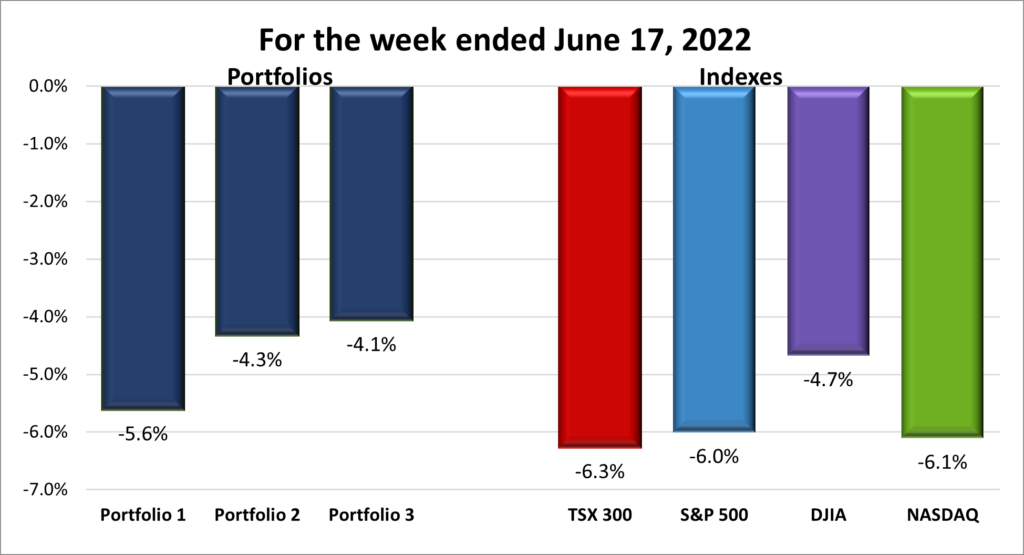
For the week, the TSX was down 6.6%, the S&P fell 5.79%, the DJIA dropped 4.79%, and the Nasdaq declined 4.78%.
Weekly Portfolio Review
Going into this week, the S&P was in a historic slump, having fallen in nine out of the past ten weeks for the third time since 1980. Make that ten of the past eleven. With inflation showing no signs of falling, the central banks, Bank of Canada, and the US Federal Reserve, continued to raise interest rates to fight inflation in their respective countries. This past week the US Federal Reserve took the gloves off and raised rates by 0.75% for the first time in 28 years and suggested they would do it again if inflation does not cool off.
The higher interest rates caused all four Indexes to fall sharply this past week. Naturally if the Indexes decline the Portfolios cannot help but be lower at the end of the week. The good news is Portfolios 2 and 3 were the best performers of the three Portfolios and the four Indexes. Portfolio 1 just missed outperforming all four Indexes and making it a clean sweep for the Portfolios as the best performers.
Unfortunately, being the best of a bad lot does not mean any of the Portfolios increased in value. Instead, it was another week of losses across the board. I am really getting tired of seeing the Portfolios shrinking in value week after week, but I think we are in for more of the same at least until the next session of the US Federal Reserve in July.
Companies on the Radar
Currently, there are only two companies on the Radar List:
- Alvopetro Energy Ltd.: (TSXV:ALV) A Canadian oil and natural gas company, developing assets in Brazil. On my Radar Check, Alvopetro scored a 10 out of 10 from Thomson Reuters, and a 2 out of 3 (Buy) from TD Direct Investing, for a 12 out of 13 score. Morningstar has a Fair value Estimate (FVE) of $18.67. This company will be moving on to the next stage – Multibagger Analysis.
- Amazon (NASD:AMZN): The leader in e-commerce sales, the leader in cloud services (Amazon Web Services), one of the top providers of streaming services through their Prime service; and they quietly have their finger in a number of other pies. Amazon scored a 3 out of 10 from Thomson Reuters, and a 3 out of 3 (Strong Buy) from TD Direct Investing, for a 6 out of 13 score. Morningstar has a FVE of $169.33. With almost any other company I would stop and not spend any more time on this company. However, it is Amazon (currently trading at US$ 106.22), with a target price of US$ 178.66 for close to 70% upside, so Amazon will be moving on to the next stage – Multibagger Analysis.
Portfolio Update
Portfolio 1
Portfolio 1 for the week ended June 17, 2022: DOWN 
- Apple (NASD:AAPL) is expected to grow their revenue from gaming and music to US$ 8.2 million by 2025, a gain of 36%. Its good to see Apple use its huge user base to find another source of revenues. If the rumoured augmented reality headsets sell half as well as the revolutionary iPhone, Apple should be in decent shape until the rumoured iCar becomes more than a rumour. 😊
- Pinterest (NASD:PINS) signed deal with Tastemade, a social media firm, to create TV shows, live videos, and events to be accessed on Pinterest.
- Tesla announced they would be raising the price of their vehicles due to the rising cost of raw materials needed in their cars. Even Tesla has fallen victim to supply chain challenges.
Activity
No significant activity to report this week.
Dividends
Dividends Received this week for the following companies:
Companies followed by DRIP (Dividend Re-Investment Plan) indicate additional shares were purchased with the dividend. Any cash leftover was added to the cash balance.
Canadian $
Automotive Properties Real Estate Investment Trust (TSX:APR.UN) DRIP
Yellow Pages Ltd (TSX:Y)
US $
Skyworks Solutions Inc (NASDAQ:SWKS)
BSR Real Estate Investment Trust (TSX:HOM.U)
Home Depot Inc (NYSE:HD)
Quarterly Reports
No quarterly reports this past week.
Portfolio 2
Portfolio 2 for the week ended June 17, 2022: DOWN
- Guardant Health (NASD:GH) announced it has bought the remaining shares of Guardant Health AMEA, Inc., from SoftBank Vision Fund, its original partner in the joint venture. Guardant now has full control of Guardant Health AMEA which will allow Guardant to accelerate the rollout of its various cancer tests in the Asia, Middle East, and Africa region (AMEA).
- I missed an announcement in May by Brookfield Infrastructure Partners LP (TSX:BIP.UN) that they had authorized a three-for-two split for both itself and Brookfield Infrastructure Corp (TSX:BIPC). Those transactions were completed this past week. According to the Board of Directors, the purpose of the split was for the units to “remain accessible to individual unitholders and further enhance their liquidity.”
- Telus (TSX:T) has acquired Lifeworks and will fold it into their Telus Health unit. Lifeworks specializes in mental health services. Telus Health is seeing an increase in the need for mental health services by employers and Telus is looking to fill that need.
Activity
No significant activity to report this week.
Dividends
Dividends Received this week for the following companies:
Companies followed by DRIP (Dividend Re-Investment Plan) indicate additional shares were purchased with the dividend. Any cash leftover was added to the cash balance.
Canadian $
Summit Industrial Income REIT (TSX:SMU.UN)
iA Financial Corporation Inc (TSX:IAG)
US $
No US$ dividends this past week.
Quarterly Reports
No quarterly reports this past week.
Portfolio 3
Portfolio 3 for the week ended June 17, 2022: DOWN
- Funds managed by Brookfield Asset Management’s (TSX:BAM.A) were the beneficiary of a merger between two Brazilian car rental companies. For the merger to go forward, the Brazilian antitrust regulator demanded the companies divest assets to avoid dominating the Brazilian market. Brookfield was able to scoop up 49,000 rental and used cars for C$ 715.6 million, an average of C$ 14,600. That sounds like a good deal, but I would need to know the models involved, the mileage and condition of the vehicles before I could say for sure.
- Despite the market turmoil, Microsoft (NASD:MSFT) maintained their quarterly dividend at US$ 0.62 a share, payable Sept. 8 to shareholders of record on Aug. 18.
- TD Bank (TSX:TD) is jumping onto the buy now, pay later bandwagon with the introduction of a new buy now, pay later feature available with TD credit cards. TD cardholders can elect to pay off their TD credit card purchases over C$100 in equal monthly payments spread out over 6-, 12- or 18-month terms.
Activity
No significant activity to report this week.
Dividends
Dividends Received this week for the following companies:
Companies followed by DRIP (Dividend Re-Investment Plan) indicate additional shares were purchased with the dividend. Any cash leftover was added to the cash balance.
No dividends this past week.
Quarterly Reports
No quarterly reports this past week.