Weekly Update for the week ending April 17, 2026

What’s the Value of Valuation?

When I got back into investing, one of the most common terms I heard was valuation. I knew what value was – one always wants to get good value for their money, or not overpay for an item. But the term “valuation” seemed a bit different, although I could never quite put my finger on why it felt separate from simply “getting good value for your money.” The difference, I eventually realized, is that in investing, price and value don’t always move together – and that gap between the two is where a lot of opportunity (and risk) tends to show up. This week, I’ll break down what valuation actually means and why it matters when you’re trying to get good value for your money in the stock market.

Valuation is one of the most important concepts in investing, but it’s also one of the easiest to overlook. At its core, valuation is simply about how much you’re paying for a company compared to what it actually earns and produces. Investors often use metrics like the price-to-earnings (P/E) ratio to get a sense of whether a stock looks cheap, fair, or expensive, but the idea itself is much simpler than the numbers might suggest.

What makes valuation so important is that it sets your starting point as an investor. Even the strongest businesses in the world can turn into disappointing investments if you pay too high a price. On the other hand, buying a solid company at a reasonable valuation can give you a much smoother ride over time. In many ways, your long-term return isn’t just about how the company performs, but also about the price you paid to become an owner of it.

This becomes especially relevant in today’s market, where certain sectors – particularly technology and artificial intelligence (AI)-related companies – are often trading at higher valuations. These higher price tags usually reflect strong expectations for future growth. Investors aren’t just paying for what the company is today, they’re paying for what it could become.

Take a company like Nvidia (NASD: NVDA). It’s been one of the biggest winners in the AI boom, with explosive growth and strong demand for its chips. Because of that, its valuation has often traded at a premium. That doesn’t mean it’s a bad investment, but it does mean the bar is set high. Investors are expecting continued rapid growth, and if that growth slows even a little, the stock can react quickly, as we’ve seen after a strong quarterly earnings report and forecast but falls just short of investors’ lofty expectations.

On the other hand, Shopify (TSE: SHOP) offers a great example of how valuation and volatility often go hand in hand. The company has gone through periods of rapid growth followed by sharp pullbacks, sometimes driven more by changing expectations than by the business itself. For long-term investors, those pullbacks can create opportunities. When the share price drops and valuation comes down, it can offer a more attractive entry point and more upside if the company continues to grow over time.

That’s where the risk comes in. When expectations are high, there’s less room for things to go wrong. If a company continues to deliver strong results, the stock may still do well, but if growth slows or expectations aren’t met, the reaction can be sharp. This is why higher-valuation stocks tend to be more volatile. The price already assumes a lot of success, so even small disappointments can have a bigger impact.

This ties into the idea of a “margin of safety,” which is essentially your cushion as an investor. When you buy a company at a lower or more reasonable valuation, you give yourself some protection if things don’t go perfectly. With a higher valuation, that cushion becomes much thinner, meaning the investment depends more heavily on everything going right.

It’s a concept that Warren Buffett has talked about for decades. One of his most well-known ideas is that “price is what you pay, value is what you get.” In other words, the return you earn isn’t just about finding great businesses, it’s about not overpaying for them.

One of the simplest ways to think about valuation is like buying a home. Paying a fair price for a good property gives you flexibility and room to grow over time. Overpaying, even for a great home, can limit your upside and increase your risk if conditions change.

As you’ll see in this week’s update, valuation played a role in deciding which companies stay on my Radar List and an investment decision. It’s not about avoiding great companies, but about being mindful of the price you’re paying to own them. With that in mind, let’s take a look at what happened this past week and how it shaped the three portfolios….


Items that may only interest or educate me ….

Canadian Economic news, US Economic news, ….

Canadian Economic news

This past week’s key economic data that the Bank of Canada (BoC) considers when deciding whether to raise or lower the interest rate.

Canadian Market Volatility

Canada’s version of the market “fear gauge” is the S&P/TSX Volatility Index (VIXC), often shown on trading platforms as VIXI.TO. Like the better-known CBOE Volatility Index in the US, it measures how much volatility investors expect in the Canadian stock market over the next 30 days.

The index opened the week at 18.68 as the US Navy began its blockade of Iranian ports, before dropping into the low 16 range after the US indicated Iran was open to working out a deal. Later in the week, concerns about the impact of higher oil prices on the broader economy pushed the index back above 17. That move didn’t last long. As tensions eased and Iran signalled it would reopen the Strait of Hormuz to all vessels, the VIXC drifted lower again, closing the week at 16.30.

With the VIXC ending the week in the mid-teens and trending lower, it suggests investor confidence is gradually improving. It’s also worth noting that Canadian volatility typically runs lower than in the US, largely because the TSX is more heavily weighted toward financials, energy, and materials. These sectors tend to see steadier price movements compared to the high-growth technology stocks that dominate US markets.

US Economic news

This past week’s key data points that the Federal Reserve (Fed) considers when deciding whether to raise or lower the interest rate.

American Market Volatility

The CBOE Volatility Index (VIX), often referred to as the market’s “fear gauge,” tracks how much volatility investors expect over the next 30 days. Think of it as the market’s pulse, where readings above 20 typically signal rising uncertainty, while levels below 20 suggest a more stable environment.

That uncertainty showed up early in the week. Reports that the US Navy would blockade the Strait of Hormuz, limiting vessels entering or exiting Iranian ports, pushed the VIX above 20, opening at 21.17 as investors grew more cautious.

Sentiment began to shift shortly after. Comments from President Trump that the US had been contacted by Iran to “work out a deal” helped ease tensions, and the VIX quickly dropped back to just above 19 before continuing to trend lower.

By midweek, the VIX reached its lowest level since February 26, as a strong start to earnings season and growing optimism around potential peace talks helped calm markets. It eventually closed the week at 17.48 after Iran announced it would reopen the Strait, and the US suggested peace talks could resume over the weekend. This suggests investor sentiment remained relatively steady, with only a brief uptick in uncertainty that faded as the week went on.


Weekly Market and Portfolio Review

For the week, the TSX (SPTSX) gained 1.9%, the S&P 500 (SPX) climbed 4.5%, the DJIA (INDU) advanced 3.2% and the Nasdaq (CCMP) surged 6.8%.

Index Weekly Streak
TSX: 4 – week winning streak
S&P: 3 – week winning streak
DJIA: 3 – week winning streak
Nasdaq: 3 – week winning streak

Bull market. A good week for the North American stock markets. The momentum from the past few weeks carried into this one, with the S&P 500 (S&P) and the Nasdaq Composite (Nasdaq) joining the Toronto Stock Exchange Composite Index (TSX) and the Dow Jones Industrial Average (DJIA) back in positive territory for 2026. It took a while, but the markets finally got there. 😊

The S&P pushed above 7,000 for the first time, closing at a record high, its first since late January. It has now posted gains in twelve of the past thirteen sessions, including record closes on each of the last three days, finishing above 7,100. The Nasdaq told a similar story, breaking above 24,000 for the first time and notching its first record close since October. It also extended its winning streak to thirteen straight sessions, its longest since 1992. That run marks a sharp turnaround after briefly slipping into correction territory just a few weeks ago amid concerns about the Middle East conflict. Not to be left behind, the DJIA ended the week at its highest point since February 26.

At the centre of it all was the war in Iran, which continued to drive market direction throughout the week. Early on, tensions escalated as the US moved to blockade Iranian shipping routes, raising concerns about disruptions in the Strait of Hormuz. That immediately pushed oil prices higher and sparked fears that inflation could reaccelerate, which would complicate the outlook for interest rates.

However, sentiment shifted fairly quickly. Comments from President Trump suggesting Iran was open to negotiations helped ease fears of further escalation, and that shift gained momentum later in the week when Iran announced the Strait of Hormuz would be reopened to commercial shipping. At the same time, the US suggested that peace talks could resume as early as this weekend, further improving the outlook. As tensions cooled, oil prices pulled back, which in turn helped calm inflation concerns and settle expectations around interest rates. Markets responded accordingly, moving higher as that pressure began to unwind.

At the same time, expectations around interest rates continued to improve. With inflation showing signs of cooling and no major surprises in the latest economic data, investors grew more confident that rate cuts could still be on the table later this year. That shift provided support across equities, particularly in growth-oriented sectors that tend to be more sensitive to interest rate changes.

Earnings season added another layer of support. Early results came in stronger than expected, reinforcing the idea that companies are still navigating the current environment relatively well. After a period of more cautious expectations, which helped boost confidence and gave markets another reason to move higher.

North of the border, the TSX followed a similar path, but with an even stronger connection to oil. The early spike in energy prices provided a lift to energy stocks and helped support the index, reflecting the TSX’s heavier exposure to commodities.

At the same time, higher oil prices briefly raised concerns about inflation and the potential for interest rates to stay elevated, which weighed on more interest-sensitive areas like financials. But as the week progressed and tensions eased, that pressure faded. Oil prices pulled back, inflation concerns cooled, and the broader market regained its footing.

In the end, the week followed a clear chain reaction: geopolitical tensions pushed oil higher, higher oil raised inflation concerns, and shifting expectations around both ultimately guided market direction. As those pressures eased, sentiment improved and markets responded.

That shift was enough to push all four major indexes back into positive territory for the year. It wasn’t a straight line to get there, but the recent momentum is a reminder of how quickly things can turn as uncertainty fades and optimism begins to return. Now, let’s see if the markets can carry that momentum into the weeks ahead. 😊

Portfolio Weekly Streak
Portfolio 1: 3 – week winning streak
Portfolio 2: 3 – week winning streak
Portfolio 3: 3 – week winning streak

Bull market. A good week for the North American stock markets. After a tough March where all three portfolios steadily lost ground, it’s great to see a turnaround. Not only are all three portfolios now higher than they were at the start of the Iran conflict, but they’ve also moved back into positive territory for the year. 😊 As you’ll see, technology companies are once again doing much of the heavy lifting, both in the markets and within my portfolios.

Portfolio 1 had a very strong week, gaining 5.5%, which would normally be enough to lead, but not this time. Performance was broad-based, with 87% of holdings finishing higher. Several companies delivered standout gains, including Navitas Semiconductor (NASD: NVTS) up 31%, Datadog (NASD: DDOG) up 20%, Cloudflare (NYSE: NET) up 17%, Shopify up 17%, Constellation Software (TSE: CSU) up 15%, Grab Holdings (NASD: GRAB) up 15%, Magnite (NASD: MGNI) up 15%, Interactive Brokers (NASD: IBKR) up 15% after the SEC relaxed day trader cash requirements, Arista Networks (NYSE: ANET) up 12%, CrowdStrike (NASD: CRWD) up 11%, and Trade Desk (NASD: TTD) up 11%, all posting double-digit gains.

Despite the strong performance across the board, only Celestica (TSE: CLS) and Lattice Semiconductor (NASD: LSCC) reached new record highs, rising 12% and 10%, respectively.

Portfolio 2 was the laggard this week, but still posted a respectable gain of 4.2%, with 63% of holdings moving higher. The main headwind came from energy stocks, which pulled back after supporting the portfolio through March. On the positive side, MongoDB (NASD: MDB) led the way with a 16% gain, followed by Microsoft (NASD: MSFT) and Guardant Health (NASD: GH) at 13%, and Airbnb (NASD: ABNB) up 10%.

Portfolio 3 was the top performer, climbing an impressive 7.5% and outperforming the top index – the Nasdaq. Gains were once again widespread, with 80% of holdings finishing the week higher. Rocket Lab (NASD: RKLB) blasted higher with a 26% jump, followed by Lithium Americas (TSE: LAC) at 19%, Shopify and Cloudflare each gained 17%, while Magnite added 15% and Microsoft rose 13%. Royal Bank (TSE: RY) also contributed, closing the week at a record high.

It’s a strong reminder of how quickly growth stocks can rebound once sentiment improves. To paraphrase Marvin the Martian, “Yup… a good week, a very good week indeed.” 😊

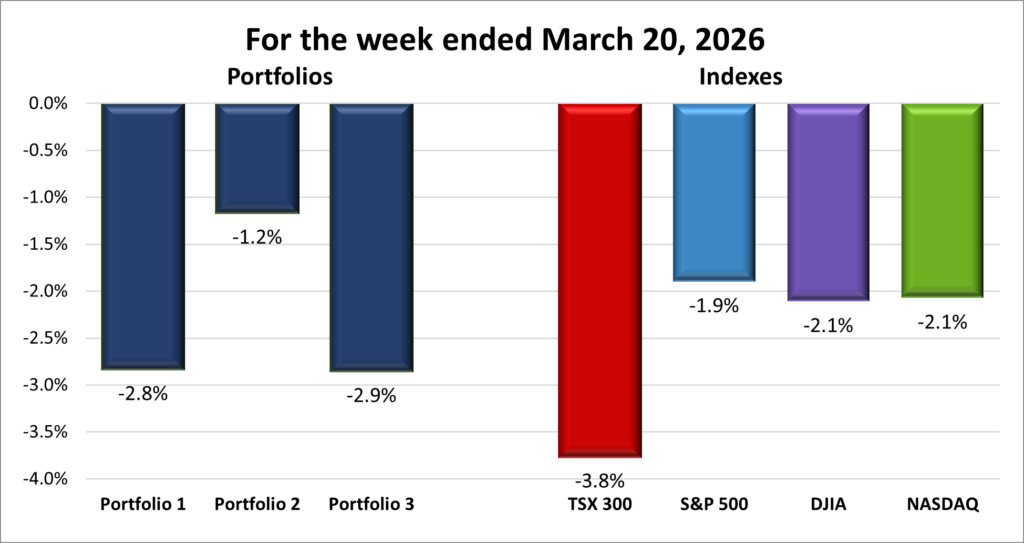
Weekly Portfolio & Index performance
Weekly Portfolio & Index performance for the week ended April 17, 2026.

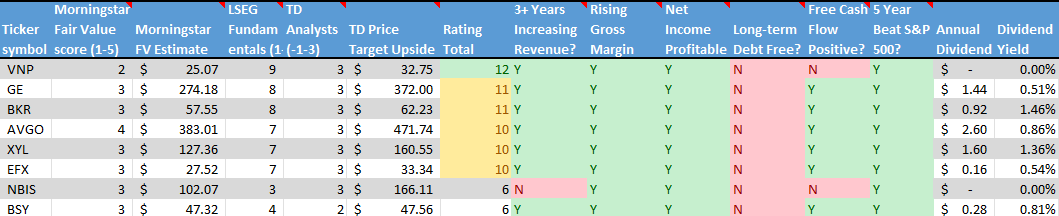
Companies on the Radar

Stocks on my Radar This week was a quieter one for my radar list, with no new companies making an appearance. Instead, I dropped one name and moved one of the two semiconductor companies to the backburner.

I decided to remove Bentley Systems (NASD: BSY), the American software company. The software industry is currently going through a period of disruption driven by the rise of AI, and Bentley is one of many companies feeling that pressure. While the long-term story is still intact, I feel there are better, lower-risk opportunities available right now.

Moving to the backburner was ARM Holdings (NASD: ARM). All three of my portfolios already lean toward technology to varying degrees, and becoming the owner of another technology company requires a bit more caution. Adding two volatile chipmakers would push that exposure even further, so I’m sticking with just one for now.

After running my Quick Test on ARM Holdings and comparing it with Broadcom (NASD: AVGO), the decision became clearer. ARM scored a strong 82%, but Broadcom edged it out at 86%, helped by more consistent earnings per share growth over the past five years.

Broadcom is a cash flow machine with a 15-year track record of dividend increases. Its wide moat comes from being deeply embedded in the infrastructure that powers the internet, which adds a layer of stability that’s hard to ignore. ARM, on the other hand, carries more risk due to its higher valuation, but it also offers more upside potential if it can establish itself as a dominant force in AI-driven data centres.

Valuation also played a role in the decision. At a high level, it’s simply about what you’re paying for a company compared to what it delivers, and as I explained earlier in the update, higher valuations tend to come with higher expectations and less margin for error. Broadcom is currently viewed as about 25% below its fair market value according to Morningstar, offering a solid margin of safety. ARM sits on the other side of that equation, trading roughly 15% above its estimated fair value. That doesn’t automatically rule it out, especially in the world of high-growth technology where premiums are common, but it reinforces the idea of being selective about when and where to take on that extra risk.

For me, Broadcom is the better fit if I decide to add another semiconductor position to one of the portfolios. Looking back, if I had held ARM from my initial investment a few years ago instead of selling after the sharp decline, I would likely feel very differently today. At this point, though, Broadcom simply aligns better with my approach.

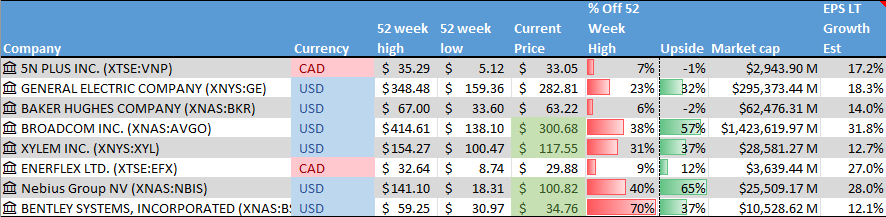
With that pruning, my radar list is now down to these four companies:

  1. 5N Plus Inc. (TSX: VNP): a small-cap Canadian company that produces high-purity specialty metals and semiconductor materials used in space solar power, renewable energy, medical imaging, and electronics. Many of its products are mission-critical, requiring consistent quality and long-term supply. With exposure to space programs, clean energy, and strategic materials, 5N Plus operates in several niche but expanding markets where technical expertise creates competitive advantages.
  2. GE Aerospace (NYSE: GE): This is the large American aviation and defence business that remained after General Electric split into three separate companies in 2024. It has been on a strong run thanks to high demand for commercial jet engines as global air travel continues to recover. The company focuses on aircraft propulsion systems and services for both commercial and military customers, and it’s also moving into drones. As a global leader in jet engines and aircraft systems, GE Aerospace offers exposure to long-term trends in travel, defence spending, and emerging aviation technology.
  3. Broadcom: A large cap American company that sells semiconductors and software globally. It designs critical chips used in data centres, networking equipment, and broadband infrastructure, playing a behind-the-scenes role in cloud computing and AI. Broadcom also owns a growing enterprise software business following its acquisition of VMware, giving it exposure to both hardware and software spending tied to AI and cloud growth.
  4. Xylem Inc. (NYSE: XYL): This is a large American company that develops water technology focused on moving, treating, and managing water. Its products and services are used by utilities, industrial customers, and municipalities for everything from clean drinking water and wastewater treatment to flood control and leak detection. With aging water infrastructure and more frequent climate challenges like droughts and flooding, demand for Xylem’s solutions is still strong. The business offers exposure to long-term, essential infrastructure spending tied to water scarcity, sustainability, and smarter cities.

As always, these are not buy recommendations. Make sure to do your own research and choose investments that fit your personal financial goals.

The Radar Check was last updated April 17, 2026.

Stock on the Radar List. 1 of 2.
Stock on the Radar List. 2 of 2.

Portfolio Update

Portfolio 2

Sold: Bank of Nova Scotia (TSE: BNS) I recently sold a portion of my holdings in Bank of Nova Scotia. Nothing really changed with the business itself, but my position had grown to the point where it made up about 37% of Portfolio 2’s total value.

At that size, it started to feel a bit too concentrated for my comfort. Having that much tied to a single company can quietly increase risk, as it only takes one unexpected development to have an outsized impact on overall performance. Trimming the position brings things back toward a more comfortable level and helps reduce that concentration risk.

The cash from the sale will be redeployed into other holdings over time, helping spread risk across more companies and keeping the portfolios better balanced and more resilient.

Bought: Aritzia: (TSE: ATZ) After trimming my position in Bank of Nova Scotia to reduce its overall weight in the portfolio, I redeployed a portion of that capital by adding to my existing position in Aritzia.

This move was part of a broader effort to create a more balanced portfolio. With my holdings leaning heavily toward financials and energy, adding to Aritzia increases exposure to the consumer sector, which tends to be more growth-oriented. It’s not just about reducing one position, but about improving the overall mix.

I first invested in Aritzia in November 2025, and the position has since grown by about 50% (not bad for six months 😊). The company is still in a growth phase, supported by its continued expansion in the US and strong brand positioning. That gives it a different return profile compared to more mature holdings and adds another layer of potential to the portfolio.

Valuation also played a role in the decision. Both the trailing P/E (based on past earnings) and the forward P/E (based on expected future earnings) are lower than when I first bought the stock. That suggests I’m now paying a more reasonable price for the business, even as it continues to grow.

For me, this wasn’t about replacing one company with another, but about rebalancing across sectors while adding a bit more growth to the portfolio. In simple terms, I liked the business before – now I’m getting it at a better price. 😊

Portfolio 3

Sold: Nvidia (NASD: NVDA) I trimmed my position in NVIDIA this week, something I’ve been planning to do for a while. It had grown into the largest holding in this portfolio, making up over 36% of its value, and at that size, it felt like the entire portfolio was moving with the stock.

As the share price climbed toward US$200, I decided that would be my level to take some profits. There wasn’t anything overly precise about that number, it was simply a price I felt comfortable selling at after the strong run the stock has had. While it took a bit longer than expected to reach that level, I was able to generate some additional income along the way by selling covered calls, which helped make the wait more productive.

Reducing the weighting also helps improve diversification, which is an important part of managing risk over time. When one position grows too large, the portfolio can become overly dependent on how that single company performs. Even a strong business can go through periods of volatility, and at that size, those swings can have a much bigger impact on overall results.

By trimming the position, it creates more room to spread capital across other holdings and sectors, leading to a more balanced portfolio where performance is driven by a mix of companies rather than a single name. In the long run, diversification isn’t about lowering returns, but about making those returns more consistent and reducing the risk that any one position has too much influence.

With the cash from the sale, I plan to put it back to work by building up other positions or adding new companies.

That’s a wrap for this week, thanks for reading may your portfolio stay green and your dividends steady. See you next time!

Monthly Portfolio Update March 2026

Monthly Market and Portfolio Review

Indexes Monthly Streak
TSX: 1 – month losing streak
S&P: 2 – month losing streak
DJIA: 1 – month losing streak
Nasdaq: 2 – month losing streak

Bearish market If February was driven by fears around artificial intelligence (AI) spending and disruption, March marked a sharp shift to geopolitics – and the ripple effects that followed. The month started on a positive note but quickly turned lower after the US/Israel strikes on Iran, a development that changed the tone almost overnight.

Just how tough was March? It ranked among the worst 10% of months this century for both the Toronto Stock Exchange Composite Index (TSX) and the S&P 500 (S&P), a clear sign of how quickly investor sentiment deteriorated. The sell-off was steep enough to push the Nasdaq Composite (Nasdaq) and the Dow Jones Industrial Average (DJIA) into correction territory – a drop of 10% or more from recent highs – while the S&P came close, falling about 9%. The TSX held up relatively better, but still marked its first monthly drop in 11 months and its largest since May 2023.

The conflict quickly became the dominant market driver, introducing a level of uncertainty that hadn’t been present just weeks earlier. Its most immediate impact showed up in energy markets. As tensions rose and concerns grew around potential disruptions to key shipping routes like the Strait of Hormuz, oil prices surged.

Oil prices climbed roughly 20-30% during March, with even sharper spikes at the height of the conflict. Brent crude posted one of its strongest monthly gains on record, while the US’s West Texas Intermediate crude finished above US$100 per barrel for the first time since 2022. For investors, this wasn’t just an energy story – rising oil prices tend to work their way through the entire economy.

Higher energy costs increase expenses for businesses and consumers alike, which can push inflation higher. After months of inflation gradually cooling, even the possibility of it picking up again pushed anticipated rate cuts further out, creating an added headwind for markets.

At the same time, uncertainty surged. Geopolitical conflicts are unpredictable by nature, and the steady flow of headlines – from escalation to potential de-escalation and back – led to sharp swings in investor sentiment. Markets don’t like unknowns, and that showed up clearly through increased volatility.

In Canada, the TSX felt many of these same pressures, though its sector mix led to a slightly different outcome. The index experienced sharp pullbacks at times, but not enough to enter correction territory.

One key difference was energy. With a larger weighting in oil and gas companies, the TSX benefited from rising oil prices, which helped cushion some of the broader weakness. That support was partially offset by financials, as banks faced pressure from the prospect of higher-for-longer interest rates and a slower economic backdrop.

The result was a balancing act. Strength in energy helped limit the downside, while weakness in financials and broader uncertainty kept the index under pressure. Compared to the sharper declines in US markets, the TSX held up relatively well.

The conflict pushed both Canadian and US markets deeper into the red for 2026, but a surge on the last day helped shift investor sentiment as buyers stepped back in after the pullback – a reminder that even during uncertain periods, markets can still bounce back. March – and the first quarter – ended with a bang. Let’s hope that momentum carries into the rest of the year. 😊

Portfolio Monthly Streak
Portfolio 1: 5 – month losing streak
Portfolio 2: 1 – month winning streak
Portfolio 3: 3 – month losing streak

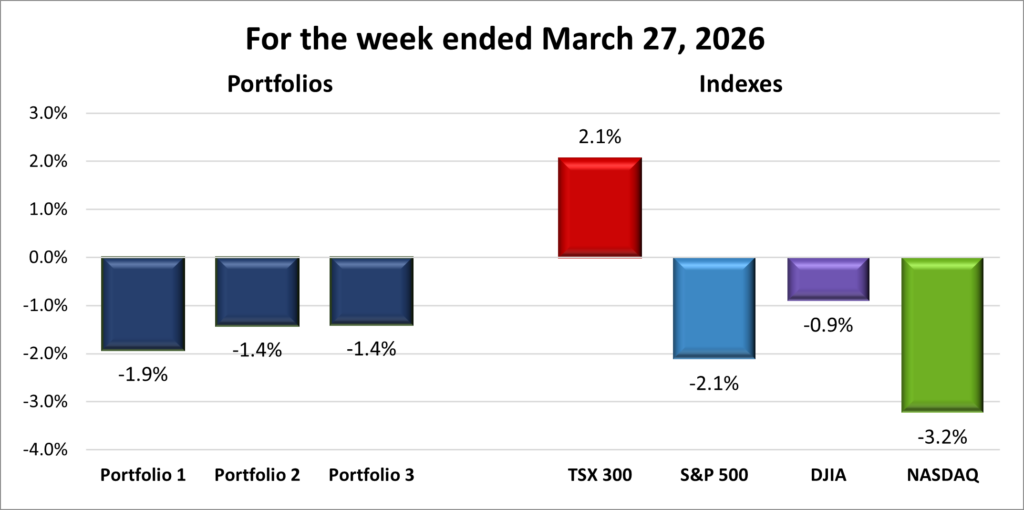
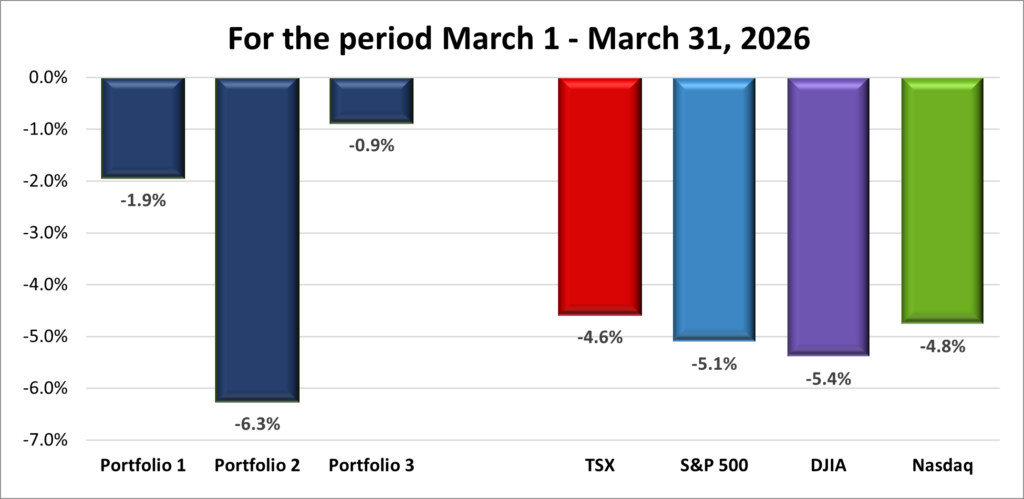
Bearish market Against a backdrop of geopolitical tensions and rising inflation expectations – which pushed interest rate cuts further out – March proved to be a challenging environment for all three portfolios. Despite that, there were a few relative bright spots. Portfolio 1 and Portfolio 3 both outperformed the major indexes, declining ‘only’ 1.9% and 0.9%, respectively. Portfolio 2, however, underperformed both the indexes and the other portfolios, falling 6.3% as it felt a more pronounced impact from market weakness.

Portfolio 1 ended the month slightly lower, extending its losing streak to five months. Weakness in high-growth technology names continued to weigh on performance as AI-related concerns persisted. The conflict also pressured gold prices and gold companies, which had been an important source of support earlier in the year. Despite strong individual performers like Constellation Software (TSE: CSU) and solid contributions from energy holdings, it wasn’t enough to offset broader weakness.

Portfolio 2, which has the highest exposure to energy stocks, also ended the month in the red despite strong support from rising oil prices. While energy holdings generally performed well, gains were more than offset by weakness in several non-energy names, most notably MongoDB (NASD: MDB) and Brookfield Infrastructure Corp (TSE: BIPC).

Portfolio 3 held up best compared to the other two portfolios, finishing with the smallest loss despite extending its monthly losing streak to three months. Results were mixed, with strong gains from names like Cloudflare (NYSE: NET), Shopify (TSE: SHOP), and Alvopetro Energy (TSXV: ALV) offset by sharper declines elsewhere. The biggest drag came from goeasy (TSE: GSY), which fell sharply after forecasting a C$178 million fourth-quarter incremental charge-off and suspending its dividend and share repurchases. Even larger holdings saw volatility, limiting the impact of individual winners.

Overall, limited gains across all three portfolios were not enough to offset broader market pressure, as uncertainty around inflation and interest rates weighed on performance. Hopefully, the late-month rebound carries into April and helps break the losing streaks across all three portfolios. Fingers crossed. 😊

Monthly Portfolio & Index performance
Chart 1: Monthly Portfolio & Index performance for March 2026.

First Quarter and Year to Date

For the quarter, and year to date, it was not pretty. It would’ve been worse if not for the market rally on the last day of the month. All three of the portfolios shed over 4% of their value. Portfolio 1 was the best of a bad lot, falling 4.3%, followed by Portfolio 2 with a loss of 6.3%, and ending with Portfolio 3 plunging 8.5%. Ouch!

Of the indexes, only the TSX was able to advance during the first three months of 2026, posting a quarterly gain of 3.3%. Meanwhile the three American indexes all finished lower, with the S&P down 4.6%, the DJIA down 3.6%, and the Nasdaq falling 7.1%. For the S&P and the DJIA, this past quarter was their deepest quarterly ​declines since 2022.

First Quarter Portfolio & Index performance
Chart 2: Quarterly and YTD Performance

What My Three Portfolios Did in March 2026

Portfolio 1 for March 2026: DOWN Red Down Arrow

Activity

No significant activity to report this month.

Dividends Received this month:

Companies followed by DRIP (Dividend Re-Investment Plan) indicate additional shares were purchased with the dividend. Any cash leftover was added to the cash balance.

Canadian $

Dream Industrial Real Estate Investment Trust (TSE: DIR.UN)

TMX Group (TSE: X)

Yellow Pages (TSE: Y)

Decisive Dividend (TSE: DE) DRIP

Pulse Seismic (TSE: PSD) DRIP

CN Rail (TSE: CNR)

Tourmaline Oil Corp (TSE: TOU)

US $

Visa Inc. (NYSE: V)

Carnival Corp. (NYSE: CCL)

Interactive Brokers Group (NASD: IBKR)

Alphabet Inc. (NASD: GOOGL)

BSR Real Estate Investment Trust (TSE: HOM.U)

Home Depot (NYSE: HD)

Quarterly Reports

CrowdStrike Holdings, Inc.

Fourth quarter 2025 financial results on March 3, 2026

Sea Limited

Fourth quarter 2025 financial results on March 3, 2026

Tourmaline Oil Corp.

Fourth quarter 2025 financial results on March 4, 2026

Costco Wholesale Corporation

Second quarter 2025 financial results on March 5, 2026

Constellation Software Inc.

Fourth quarter 2025 financial results on March 9, 2026

Decisive Dividend Corporation

Fourth quarter 2025 financial results on March 11, 2026

Hammond Power Solutions Inc.

Fourth quarter 2025 financial results on March 19, 2026

Carnival Corporation & plc

First quarter 2026 financial results on March 27, 2026

Portfolio 2 for March 2026: DOWN Red Down Arrow

Activity

Bought: Napco Security Technologies, Inc. (NASD: NSSC). Please see March 13, 2026, update.

Dividends Received this month:

Canadian $

Dream Industrial Real Estate Investment Trust (TSE: DIR.UN)

Whitecap Resources Inc (TSE: WCP)

iA Financial Corporation (TSE: IAG)

Tourmaline Oil Corp (TSE: TOU)

Brookfield Infrastructure Corp (TSE: BIPC)

US $

Zoetis Inc. (NYSE: ZTS)

Microsoft Corp. (NASD: MSFT)

Quarterly Reports

MongoDB, Inc.

Fourth quarter 2025 financial results on March 2, 2026

Tourmaline Oil Corp.

See report under Portfolio 1.

Canadian Natural Resources Limited

Fourth quarter 2025 financial results on March 5, 2026

South Bow Corp.

Fourth quarter 2025 financial results on March 5, 2026

Alimentation Couche-Tard Inc.

Third quarter 2026 financial results on March 17, 2026

Hammond Power Solutions Inc.

See report under Portfolio 1.

Dollarama Inc.

Fourth quarter 2025 financial results on March 24, 2026

Portfolio 3 for March 2026: DOWN Red Down Arrow

Activity

Sold: goeasy Ltd. Please see March 13, 2026, update.

Dividends Received this month:

Canadian $

Royal Bank of Canada (TSE: RY)

SmartCentres Real Estate Investment Trust (TSE: SRU.UN) DRIP

Brookfield Asset Management (TSE: BAM)

Brookfield Corporation (TSE: BN)

Brookfield Wealth Solutions (TSE: BNT)

Brookfield Renewables Corporation (TSE: BEPC)

Canada Packers (TSE: CPKR)

Rockpoint Gas Storage (TSE: RGSI)

US $

Microsoft Corp. (NASD: MSFT)

Vertiv Holdings (NYSE: VRT)

Quarterly Reports

Canada Packers Inc.

Fourth quarter 2025 financial results on March 4, 2026

Alvopetro Energy Ltd.

Fourth quarter 2025 financial results on March 17, 2026


Weekly Update for the week ending April 10, 2026

Fueling Inflation: More Than Just Gas Prices

Oil prices have surged in recent weeks, driven by the US/Israel–Iran conflict and concerns about global supply disruptions – especially around the Strait of Hormuz, where roughly 20% of the world’s oil passes through. If you own a gas-powered vehicle, you’ve likely felt it firsthand. At the beginning of March, I was filling up for around C$1.25 per litre. Earlier this week, it felt like a win to get it for C$1.95 – a 56% jump in just five weeks, and it may not be over yet.

But the story isn’t just about the pump. Different types of oil, benchmarks like Brent and WTI, and even Canadian tar sands crude all help set global prices. This week, I’ll discuss these benchmarks and how rising oil prices ripple through the economy – affecting everything from jet fuel and diesel to shipping costs, and ultimately feeding into inflation.

The two main benchmarks, Brent Crude and West Texas Intermediate (WTI), have both climbed sharply since the conflict began. Brent comes from the North Sea and is named after the Brent oilfield; it’s slightly heavier than WTI but still relatively light and easy to refine. WTI, by contrast, is a light, sweet crude from US oil fields in Oklahoma.

The difference matters because they reflect different parts of the oil market. Brent reacts more to global disruptions, like tensions in the Middle East, while WTI is more influenced by North American supply and demand. In calmer markets, Brent typically trades at a small premium, but during supply shocks, both can spike quickly. Watching both helps investors gauge whether price pressure is global or regional. Since early March, Brent has climbed from the low-US$70s to the mid-US$90s, and WTI from the mid-US$60s to the high-US$90s as of April 10, 2026 – an unusually sharp move that highlights how quickly markets react to supply risk.

Canadian oil adds another layer. Crude from the Alberta tar sands is thicker and denser (“heavier”) and has higher sulfur content (“sourer”) than WTI or Brent, making it more complex and costly to refine. Because of this, it has its own benchmark – Western Canadian Select (WCS), which is currently trading in the mid-US$80s per barrel – and typically trades at a discount to WTI due to quality, pipeline constraints, and refinery demand. As a result, Canadian oil doesn’t always move in lockstep with Brent or WTI, though it’s still influenced by the same global and regional forces.

Where this really hits home is downstream. Oil isn’t just about what we pay at the pump – it drives the cost of moving almost everything. Jet fuel has surged alongside crude, in some cases doubling, pushing up the cost of flights and air cargo. Rail transport, which relies heavily on diesel, becomes more expensive, and marine shipping faces similar pressure from higher bunker fuel costs. That’s part of why rising energy costs eventually show up in the price of everyday goods.

The end result is a ripple effect across the economy. Higher transportation and production costs move through supply chains, showing up in everything from airline tickets to store shelves. While higher oil prices can benefit energy producers, they tend to pressure consumers and transport-heavy industries. When oil prices moves this quickly, the impact doesn’t stay contained – it feeds into inflation and can make central banks more cautious about cutting interest rates.

In other words, what’s happening with oil isn’t just an energy story – it’s a market story. Now, let’s see how those volatile oil prices played out in the markets this week and how they affected my portfolios.


Items that may only interest or educate me ….

Canadian Economic news, US Economic news, ….

Canadian Economic news

This past week’s key economic data that the Bank of Canada (BoC) considers when deciding whether to raise or lower the interest rate.

Labour Force Survey (LFS)

Statistics Canada’s March employment report showed the labour market stabilizing slightly, with the economy adding 14,100 jobs. While that is an improvement on February’s sharp loss of 83,900 jobs, it does little to offset the nearly 110,000 jobs lost over January and February. The result was broadly in line with expectations, as analysts had forecast a gain of around 15,000 positions.

Most of the job gains came from part-time positions, while full-time employment edged lower. Private sector employment also declined, suggesting businesses may be starting to pull back on hiring as economic conditions begin to cool.

The unemployment rate held steady at 6.7%, coming in just below expectations for a slight increase. Wage growth, meanwhile, picked up, with average hourly wages rising 4.7% compared to a year ago. That marks the fastest pace since October 2024 and a noticeable increase from the 3.2% to 3.9% range seen over the past year.

Overall, the report points to a labour market that is softening gradually rather than sharply, adding to the ongoing uncertainty around the path for interest rates and the broader economy.

Canadian Market Volatility

Canada’s version of the market “fear gauge” is the S&P/TSX Volatility Index (VIXC), often shown on trading platforms as VIXI.TO. Like the better known CBOE Volatility Index in the US, it measures how much volatility investors expect in the Canadian stock market over the next 30 days.

The index opened the week at 21.44 and remained elevated early on before dropping sharply to around the 18-level following the announcement of a midweek ceasefire in the Iran conflict. It continued trending lower into the end of the week, closing at 16.78 and signalling a significant decline in investor stress.

With the VIXC ending the week in the mid-teens and moving lower, investor confidence appears to be gradually improving. It’s also worth noting that Canadian volatility typically runs lower than in the US, largely because the TSX is more heavily weighted toward financials, energy, and materials, sectors that tend to see steadier price movements than the high-growth technology stocks that dominate US markets.

US Economic news

This past week’s key data points that the Federal Reserve (Fed) considers when deciding whether to raise or lower the interest rate.

Federal Open Market Committee (FOMC) Minutes

This week, the Fed published the minutes from its March 17–18 FOMC meeting, offering a closer look at how officials are thinking about the economy. The main takeaway was the central bank is becoming more cautious, especially as oil prices climb. Officials spent a good portion of the discussion on how rising energy costs – driven by the Middle East conflict – could push inflation higher and keep it there longer than expected. That matters for both consumers and investors, because inflation is currently the main factor guiding the Fed’s interest rate decisions.

Right now, the Fed is in “wait-and-see” mode. They’re not raising rates, but they’re also in no hurry to cut them. Higher oil prices are already doing some of the tightening for them by increasing costs across the economy – from transportation to everyday goods – which can slow spending. The concern is that if inflation stays elevated because of energy prices, the Fed may have to keep rates higher for longer than investors were hoping. Some officials even noted that persistently higher oil prices could keep inflation elevated for longer than expected, potentially reopening the door to further rate increases.

At the same time, there’s a growing concern about what’s often called a “stagflation-lite” scenario – where economic growth starts to slow, but inflation is still stubbornly high. It’s not full stagflation, but it’s enough to make the Fed’s job more difficult, as they try to balance supporting the economy without letting inflation get out of control.

In other words, what’s happening in oil markets is starting to influence interest rates. And when the Fed stays cautious on rate cuts, it tends to ripple through the markets – affecting everything from borrowing costs to stock valuations.

Gross Domestic Product (GDP)

The US economy ended 2025 on a softer note. The Commerce Department’s Bureau of Economic Analysis (BEA) reported that fourth-quarter GDP grew at just 0.5% on an annualized basis, down from 0.7% previously reported in the second estimate and a sharp slowdown from the 4.4% pace in the third quarter.

The message is fairly straightforward. The economy is still growing, but it has lost momentum. Consumer spending, which does most of the heavy lifting, began to cool, while weaker business investment and a drop in government spending – partly due to the month-long shutdown – added further drag. The economy is still moving forward, just at a slower pace.

For the Fed, this creates a balancing act. Slower growth can ease inflation pressures and support the case for rate cuts, but it also raises questions about how strong the economy really is heading into 2026. In other words, the economy hasn’t stalled, but it has clearly shifted into a lower gear, leaving both the Fed and investors watching closely to see whether this is temporary or something more sustained.

Personal Consumption Expenditures (PCE)

The BEA reported that February’s PCE price index showed headline inflation rising 0.4% for the month, up from 0.3% in January, keeping the year-over-year pace steady at 2.8%, in line with analyst expectations. Headline PCE includes everything – food, energy, and all other goods and services – which can swing month to month (think gas prices jumping around like we’ve seen since the start of the Iran war).

Core PCE, which strips out food and energy to show underlying inflation trends, is what the Fed really focuses on. In February, core PCE also rose 0.4% month over month, pushing the year-over-year rate slightly higher to 3.0% from January’s 2.8%, again matching expectations. This shows that while inflation isn’t running out of control, it’s also not cooling toward the Fed’s 2% target as quickly as they would like. Costs for services and other essentials are still creeping higher, keeping pressure on price stability.

This adds another layer to the story we saw in the GDP data. Slower economic growth might normally support rate cuts, but stubborn inflation complicates the Fed’s decisions. With price pressures still elevated and energy costs influenced by global tensions, the central bank is likely to stay cautious. In short, the economy is shifting into a lower gear, but inflation hasn’t fully eased – and that ongoing tension is a key factor investors are navigating right now.

Together, the GDP and PCE data provide a clearer picture of the US economic landscape, showing both the slowdown in growth and the persistence of inflation – an important backdrop for how us investors approach the markets in 2026.

Consumer Price Index (CPI)

The Labor Department’s March CPI report showed inflation picked up sharply, with headline prices rising 0.9% month over month, in line with expectations and up from 0.3% in February. On an annual basis, inflation accelerated to 3.3%, compared with 2.4% the previous month, also matching forecasts. The increase was the largest monthly jump in nearly four years, driven largely by higher energy prices and the impact of tariffs feeding through into select goods categories.

Energy prices drove much of the increase, surging amid the ongoing Iran conflict. Fuel oil for home heating led the way, jumping 30.7% in March. Natural gas, also used for heating, was the exception, slipping 0.9% and standing as the only fuel category to decline during the month. On an annual basis, fuel oil again saw the largest increase, soaring 44.2%. Outside of energy, prices were broadly higher across most categories, with used cars and trucks the lone exception, falling 3.2% over the past year.

Shelter costs, which include rent and homeowner-related expenses and make up the largest portion of the index, rose a more modest 0.3% in March. On an annual basis, shelter inflation held steady at 3.0%, unchanged from February, continuing to act as a steady but persistent source of inflation.

Core CPI, which excludes food and energy and is closely watched by the Fed for underlying inflation trends, rose 0.2% on the month, matching February’s pace and coming in slightly below expectations. On an annual basis, core inflation edged up to 2.6% from 2.5% in February, also slightly below forecasts. Core CPI and PCE inflation have both been influenced in part by businesses passing through some of the cost impact from tariffs.

Inflation pressures picked up again in March, largely driven by energy, while underlying inflation remained more contained. That split is important for investors, as it points to continued short-term volatility in the data even as the broader disinflation trend stays intact.

Consumer Sentiment Index (CSI)

The University of Michigan’s initial reading of the April Consumer Sentiment Index came in at 47.6, well below expectations for 52.0 and down sharply from March’s final reading of 53.3. This marks a 10.7% monthly decline and the weakest reading on record, highlighting a noticeable deterioration in household confidence. Sentiment now sits firmly in historically weak territory. On an annual basis, the index is down 8.8%.

Looking closer, the Current Economic Conditions Index, which reflects how consumers feel about their finances and job security today, fell 10.2% to 50.1 and is down 16.2% from a year ago. The Expectations Index, which gauges sentiment over the next six months, fell 10.8% to 46.1, down from 51.7 in March and 2.5% lower year over year.

The drop in current conditions suggests households are starting to feel more pressure in real time, whether from prices, market volatility, or broader economic uncertainty. The decline in expectations points to growing caution about the outlook ahead, not just current conditions. Overall, the report reinforces a familiar theme alongside recent inflation and labour data: consumer confidence is clearly weakening, especially around expectations for the months ahead, but not breaking down entirely.

American Market Volatility

The CBOE Volatility Index, often referred to as the market’s “fear gauge,” tracks how much volatility investors expect over the next 30 days. Think of it as the market’s pulse, where readings above 20 signal rising uncertainty.

With the rapidly evolving situation in Iran, the VIX started the week elevated, opening at 24.93. It climbed further midweek, peaking near 28 as tensions remained high. As signs of easing tensions appeared, the VIX dropped sharply, falling toward the 20 level, its lowest point since the start of the conflict. The index continued to cool into the end of the week, closing at 19.23 and signalling a meaningful pullback in investor fear.


Weekly Market and Portfolio Review

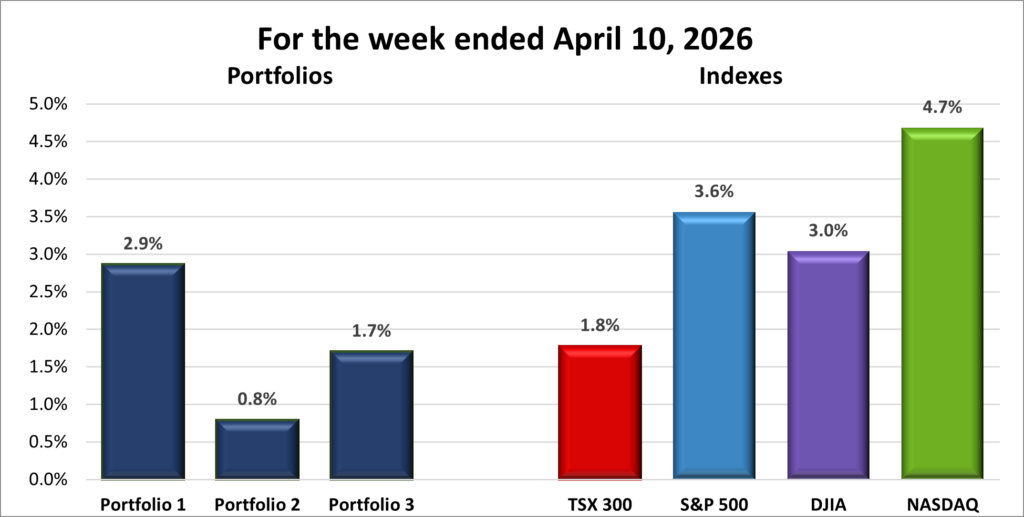
For the week, the TSX (SPTSX) gained 1.8%, the S&P 500 (SPX) rose 3.6%, the DJIA (INDU) advanced 3.0% and the Nasdaq (CCMP) surged 4.7%.

Index Weekly Streak
TSX: 3 – week winning streak
S&P: 2 – week winning streak
DJIA: 2 – week winning streak
Nasdaq: 2 – week winning streak

Bull market. A good week for the North American stock markets. It was another strong but headline-driven week in the markets, as momentum from the previous week carried through with only minor speed bumps along the way. All four major indexes extended their winning streaks at some point during the week. The Nasdaq Composite Index (Nasdaq) stretched its streak to eight straight sessions, while the S&P 500 Index (S&P) posted seven consecutive gains before being snapped at the end of the week. The Toronto Stock Exchange Composite Index (TSX) reached six straight sessions before a late-week setback, while the Dow Jones Industrial Average (DJIA) saw a four-session winning streak snapped midweek before rebounding sharply the next day, marking its largest single-day percentage gain since April 9, 2025.

All three major US indexes posted their biggest weekly gains since November 2025. On a year-to-date basis, the DJIA’s surge pushed it into positive territory, joining the TSX. Meanwhile, the S&P and Nasdaq are now both within 1% of turning positive for the year following their recent two-week rebound.

Once again, the US/Israel conflict with Iran drove the markets. The week got off to an ominous start after President Trump threatened to destroy “an entire civilization” if Iran failed to surrender and reopen the Strait of Hormuz. Tensions cooled following the announcement of a two-week ceasefire. As oil prices pulled back below US$100 per barrel, inflation pressures eased slightly, giving investors more breathing room. That shift showed up quickly in the markets, as energy stocks fell while other sectors moved higher. A strong rebound in technology stocks helped push the Nasdaq to the strongest performance among the major indexes.

Economic data also played a role. A weaker GDP reading reinforced earlier signs that the economy is slowing, while the latest PCE and CPI data showed inflation remains sticky, largely driven by higher energy prices tied to the conflict. That combination raises the risk of stagflation, where growth slows while inflation rises. Minutes from the Fed’s latest meeting added to those concerns, indicating that Fed officials see a risk of inflation remaining elevated even as growth weakens.

While slower growth would typically support rate cuts, persistent inflation makes that option far less clear. Consumer sentiment added to the cautious tone, tumbling to a record low, with near-term expectations falling to their lowest level since May 1980.

In Canada, investor sentiment was shaped by many of the same factors, including the Iran conflict, oil prices, inflation, and interest rate expectations, though the TSX’s heavier weighting toward energy amplified the moves.

Early in the week, strength in energy stocks supported the index as oil prices remained elevated amid Middle East tensions. However, as the ceasefire took hold and oil prices pulled back, energy stocks moved lower. That weakness was partly offset by strength in other areas of the market, along with a broader sense of investor relief as tensions eased.

Late in the week, the latest labour data showed a modest gain following significant job losses in the first two months of the year, providing a slight boost to the TSX.

All in all, it was a positive week for the major indexes, supported by easing geopolitical tensions and cautious optimism around interest rates. With the ceasefire expected to hold in the near term, attention now turns to first-quarter earnings season which starts next week. A strong start could help sustain the recent momentum and give investors something more concrete to build on beyond headlines.

Portfolio Weekly Streak
Portfolio 1: 2 – week winning streak
Portfolio 2: 2 – week winning streak
Portfolio 3: 2 – week winning streak

Bull market. A good week for the North American stock markets. After watching the three portfolios scuffle along for most of March, its great to see all three of them stretch their weekly winning streak to two. While most of the oil and gas stocks pulled back this week, the technology stocks more than picked up the slack, especially the Magnificent 7 members.

Portfolio 1 was the top performer, rising 2.9% on the week. It also had the highest percentage of gainers, with 74% of holdings moving higher. Leading the way were Celestica (TSE: CLS) up 17%, Hammond Power Solutions (TSE: HPS.A) up 16%, Arista Networks (NYSE: ANET) up 15%, and Amazon (NASD: AMZN) up 13%. Offsetting some of those gains were Cloudflare (NYSE: NET) which plunged 21% and a 10% decline by Datadog (NASD: DDOG).

Portfolio 2 trailed the group but still posted a modest 0.8% gain, with 55% of holdings finishing higher. Top performers included Hammond Power Solutions 16% gain, while Aritzia (TSE: ATZ) and Birkenstock (NYSE: BIRK) both were up 11%. On the downside, MongoDB (NASD: MDB) declined 10%. With the highest exposure to energy stocks, it wasn’t surprising to see this portfolio lag as oil prices pulled back.

Portfolio 3 posted a solid 1.7% gain, with an impressive 71% of its holdings moving higher. Vertiv Holdings (NYSE: VRT) was a standout, hitting a record high on its way to an 11% gain for the week. Weighing on performance was Cloudflare, which dropped 21% amid concerns that artificial intelligence (AI) could disrupt its business model.

Overall, it was a solid week across all three portfolios, with broad participation across the markets and strength in technology helping offset weakness in energy. It was a good reminder of the value of diversification, as different sectors took turns driving performance. Fingers crossed earnings season can deliver a bit of stability to the markets, which would help push the portfolios’ weekly winning streaks to three weeks. 😊

Weekly Portfolio & Index performance
Weekly Portfolio & Index performance for the week ended April 10, 2026.

Companies on the Radar

Stocks on my Radar This week brought a bit of a reshuffle on my radar list – one name moved to the backburner, while an old familiar face made its return.

Heading to the backburner is Enerflex Ltd. (TSE: EFX), the Canadian provider of infrastructure and energy transition solutions tied to global natural gas and power markets. After a solid run, the shares feel like they may have lost some momentum, suggesting I may have missed the latest upswing. It also sits in that middle ground – not quite a high-yielding dividend defensive play, but not a true high-growth name either – making it harder to prioritize. For now, it joins Corning (NYSE: GLW) on the backburner rather than front and centre like the other companies on my radar.

Joining the list is an old friend: Arm Holdings (NASD: ARM). I first invested in the company shortly after its Initial Public Offering in September 2023 but ended up selling after a 20% drop from my purchase price (US$59.87) – one of those decisions that’s easy to second-guess in hindsight. Today, the shares sit around US$148, which would’ve been roughly a 250% gain. Not my finest investing moment. ☹

That said, a past mistake doesn’t mean the company isn’t worth revisiting. Arm stands out as a classic picks-and-shovels play in the technology ecosystem. Rather than building end products, it designs the chip architecture that companies like Apple (NASD: AAPL) and Nvidia (NASD: NVDA) rely on. That puts it in a position to benefit from long-term growth across smartphones, AI, and data centres without having to bet on a single winner. Its designs sit quietly at the core of modern computing, and once companies build around its architecture, switching becomes unlikely – giving the business a durable edge that’s hard to ignore.

Sometimes the best opportunities are the ones that deserve a second look – and this time around, I’ll be watching a little more closely. With these two moves, alongside the five holdovers, my radar list stays at six.

  1. 5N Plus Inc. (TSX: VNP): a small-cap Canadian company that produces high-purity specialty metals and semiconductor materials used in space solar power, renewable energy, medical imaging, and electronics. Many of its products are mission-critical, requiring consistent quality and long-term supply. With exposure to space programs, clean energy, and strategic materials, 5N Plus operates in several niche but expanding markets where technical expertise creates competitive advantages.
  2. GE Aerospace (NYSE: GE): This is the large American aviation and defence business that remained after General Electric split into three separate companies in 2024. It has been on a strong run thanks to high demand for commercial jet engines as global air travel continues to recover. The company focuses on aircraft propulsion systems and services for both commercial and military customers, and it’s also moving into drones. As a global leader in jet engines and aircraft systems, GE Aerospace offers exposure to long-term trends in travel, defence spending, and emerging aviation technology.
  3. Broadcom (NASD: AVGO): A large cap American company that sells semiconductors and software globally. It designs critical chips used in data centres, networking equipment, and broadband infrastructure, playing a behind-the-scenes role in cloud computing and AI. Broadcom also owns a growing enterprise software business following its acquisition of VMware, giving it exposure to both hardware and software spending tied to AI and cloud growth.
  4. Xylem Inc. (NYSE: XYL): This is a large American company that develops water technology focused on moving, treating, and managing water. Its products and services are used by utilities, industrial customers, and municipalities for everything from clean drinking water and wastewater treatment to flood control and leak detection. With aging water infrastructure and more frequent climate challenges like droughts and flooding, demand for Xylem’s solutions is still strong. The business offers exposure to long-term, essential infrastructure spending tied to water scarcity, sustainability, and smarter cities.
  5. Bentley Systems (NASD: BSY): an American software company that sits just above the mid-cap threshold (under US$10 billion market cap), leaving plenty of room for growth. They provide specialized software for professionals who design, build, and operate the world’s infrastructure. From bridges and roads to power plants and water networks, Bentley’s tools help engineers and architects model, manage, and maintain complex physical assets throughout their entire lifecycle.

As always, these are not buy recommendations. Make sure to do your own research and choose investments that fit your personal financial goals.

The Radar Check was last updated April 10, 2026.

Stocks on the Radar List. 1 of 2.
Stocks on the Radar List. 2 of 2.

That’s a wrap for this week, thanks for reading may your portfolio stay green and your dividends steady. See you next time!
Weekly Update for the week ending April 3, 2026

Relief Rally on the Horizon?

Exploring the sectors likely to gain – or stumble – if tensions ease.

March has been a rollercoaster for markets on both sides of the 49th parallel, with hostilities in the Middle East sending oil, stocks, and investor nerves on a wild ride. Just when it seemed the turmoil would drag on – and inflation fears start creeping in – a possible ceasefire is now on the horizon. Let’s assume both sides are serious about ending the conflict and coming up with a peace plan. After exploring the potential impacts of both a short and an extended conflict, this week I’d like to discuss what an end to hostilities could mean for markets.

If an extended conflict creates a tougher backdrop for markets, as discussed last week, a ceasefire would largely reverse those same pressures. It starts with oil. Easing tensions would likely bring crude prices down, helping to ease inflation concerns and take pressure off both consumers and businesses. That, in turn, could give central banks like the Bank of Canada and the Federal Reserve more flexibility on interest rates, helping shift the environment toward steadier growth and improved sentiment.

In the immediate aftermath, markets would likely react quickly, with an initial relief rally as oil prices pull back and geopolitical risk fades. Beyond that first move, however, attention would shift back to the usual drivers – economic data, inflation trends, and central bank decisions. If those don’t improve as much as expected, the longer-term impact of a ceasefire may be more limited than that initial reaction suggests.

From there, the impact would ripple through sectors in very different ways. On the Canadian side, three sectors stand out. Energy – a major driver of the TSX – would likely face short-term pressure. Companies like Tourmaline Oil (TSE: TOU) have benefited from elevated prices, so a pullback in crude would likely weigh on their share prices. Financials, particularly the big banks like TD Bank (TSE: TD), could benefit as easing inflation improves the outlook for interest rates and reduces economic uncertainty, supporting lending activity and credit quality. Consumer cyclicals like Aritzia (TSE: ATZ) would also get a boost, as lower fuel costs and reduced inflation pressure leave households with more spending power.

In the US, a similar but more growth-driven pattern would likely emerge. Energy stocks, including Chevron (NYSE: CVX), would likely pull back alongside oil prices. Technology – a dominant force in US markets – could benefit as lower inflation and bond yields support higher valuations for companies like Apple (NASD: AAPL) and CrowdStrike (NASD: CRWD). Consumer cyclicals such as Amazon (NASD: AMZN) would also likely see renewed strength as improving sentiment and lower cost pressures support spending.

Taken together, a ceasefire would likely trigger a rotation in markets – away from energy and toward rate-sensitive, consumer-driven sectors, though how long that shift lasts will ultimately depend on how inflation and interest rates evolve from here.

While a potential ceasefire could shift markets in the weeks ahead, this past week was still very much driven by ongoing uncertainty. Let’s see how markets reacted and the impact on my three portfolios.


Items that may only interest or educate me ….

Canadian Economic news, US Economic news, ….

Canadian Economic news

This past week’s key economic data that the Bank of Canada (BoC) considers when deciding whether to raise or lower the interest rate.

Gross Domestic Product (GDP)

Canada’s economy performed slightly better than expected in January, according to Statistics Canada. GDP rose 0.1% month over month, following a 0.2% increase in December, while analysts had expected little to no growth. On a year-over-year basis, the economy expanded by 0.6% – not exactly strong, but still moving in the right direction.

Under the hood, the growth was driven mainly by goods-producing industries, which rose 0.2% on the month. Mining, quarrying, and oil and gas extraction led the way with a 1.2% gain, continuing to benefit from higher energy activity. Over the past year, agriculture, forestry, fishing, and hunting has been a standout, up 5.4%, while manufacturing remains a weak spot, down 4.6%.

On the services side, activity was essentially flat in January, showing limited momentum from the consumer side of the economy. Retail trade was a bright spot, rising 0.8% on the month, while wholesale trade declined 1.2%. Looking at the past year, sectors like finance and insurance, along with information and cultural industries, grew 3.2%, while wholesale trade slipped 1.7%.

Together, the report suggests the Canadian economy is still growing, but only modestly. Early estimates point to a potential 0.2% increase in February, which would signal slightly firmer momentum heading into the first quarter. For now, though, growth remains sluggish overall, helping explain why the BoC has been taking a cautious, wait-and-see approach.

Canadian Market Volatility

Canada’s version of the market “fear gauge” is the S&P/TSX Volatility Index (VIXC), often shown on trading platforms as VIXI.TO. Like the CBOE Volatility Index in the US, it measures how much volatility investors expect in the Canadian stock market over the next 30 days.

The index opened the week at 22.04 and briefly climbed above 23, reflecting elevated uncertainty tied to ongoing tensions in the Middle East and fears of inflation. That mood began to shift as the week progressed, however, as optimism around a potential de-escalation in the US/Israel–Iran conflict helped ease investor anxiety. As a result, the VIXC fell below 20 before closing the week at 20.41, marking a slight decline in market stress.

With the VIXC spending much of the week in the low 20s and trending lower, investors appear to be gradually regaining confidence. It’s also worth noting that Canadian volatility typically runs lower than in the US, largely because the TSX is more heavily weighted toward financials, energy, and materials – sectors that tend to see steadier price movements than the high-growth technology stocks that dominate US markets.

US Economic news

This past week’s key data points that the Federal Reserve (Fed) considers when deciding whether to raise or lower the interest rate.

Labour data

This week’s labour data, spanning three major reports—the Job Openings and Labor Turnover Survey (JOLTS), the ADP Employment Report, and the Employment Situation Summary (ESS) – offers a full snapshot of the US job market. Each report captures a different angle: JOLTS tracks demand for workers through job openings, hiring, and quits; ADP provides an early read on private-sector payroll growth; and the ESS, better known as the monthly jobs report, delivers the big picture with unemployment, job creation, and wage growth. Taken together, they offer one of the clearest reads on whether the labour market is still holding firm – or starting to show cracks.

Labor Department’s Job Openings and Labor Turnover Survey

The JOLTS report showed job openings fell by 358,000 to 6.882 million in February, down from 7.240 million in January and slightly below expectations of 6.918 million. The decline points to a continued, gradual easing in labour demand, while still remaining at levels consistent with a relatively solid job market.

ADP Employment Report

The ADP Employment Report showed private-sector payrolls rose by 62,000 jobs in March, down slightly from February’s upwardly revised gain of 66,000 and above expectations of around 40,000. The data points to continued, moderate job growth, while remaining below levels typically seen during stronger labour market conditions.

The Bureau of Labor Statistics’ Employment Situation Summary

The latest report from the Bureau of Labor Statistics showed job growth came in much stronger than expected, with the economy adding 178,000 jobs in March, well above forecasts of around 60,000. That marks a solid rebound from February, which was revised down to a loss of 133,000 jobs. The unemployment rate edged lower to 4.3%, down from 4.4% the previous month, while wage growth showed signs of easing, with average hourly earnings rising 0.2% in March after a 0.4% increase in February.

Overall Labour Analysis

Taken together, this week’s labour data presents a more nuanced picture than the headlines might suggest. While job openings declined and private payroll growth remained modest, the ESS showed a much stronger-than-expected surge in hiring, with job creation coming in nearly three times forecasts and the unemployment rate ticking lower. On the surface, that points to a labour market that is still resilient.

However, a closer look at the details tells a slightly different story. The drop in unemployment was partly driven by a decline in labour force participation, meaning fewer people were working or actively looking for work. At the same time, wage growth slowed, which can be an early sign that demand for workers is easing.

For us investors, this creates a bit of a push and pull. Strong job growth reduces the urgency for interest rate cuts, but softer wage growth and declining participation suggest the economy may be cooling rather than overheating. Add in the uncertainty from the Iran conflict and the risk of higher oil prices pushing inflation back up, and it’s easy to see why markets are still sensitive to every new data point.

In short, the labour market is still holding up, but there are enough cracks beneath the surface to keep the Fed firmly in wait-and-see mode and investors on edge.

Retail Sales

The US Commerce Department reported that retail sales rose 0.6% in February, rebounding from a revised 0.1% decline in January and coming in slightly ahead of expectations of 0.5%. On a year-over-year basis, sales increased 3.7%, up from 3.2% in January, pointing to a solid recovery after a weaker start to the year.

Looking under the hood, the results were mixed. Health and personal care stores led the way with a 2.3% monthly gain, while food and beverage stores and furniture and home furnishings stores both saw sales decline by 1.0%. Over the past year, sporting goods, hobby, musical instrument, and book stores stood out with an 11.3% increase, while furniture and home furnishings remained a weak spot, with sales down 5.6%.

Core retail sales – which strip out autos, auto parts, and gasoline to provide a clearer picture of underlying consumer demand – rose 0.4% in February after a 0.2% increase in January, beating expectations for flat growth. On an annual basis, core sales grew 4.1%, a slight slowdown from 4.7% in January, but still a sign that consumer spending is still relatively resilient.

The rebound in headline sales, combined with steady core growth, reinforces the view that the American consumer is still holding up despite higher interest rates and rising costs. With spending continuing across both essential and discretionary categories, the data suggests households are still willing to open their wallets – for now – even as the broader economic backdrop remains uncertain.

Consumer Confidence Index (CCI)

The Conference Board’s latest CCI came in at 91.8 in March, up from 91.0 in February and ahead of expectations of 88, offering a modest upside surprise even as oil prices have been rising rapidly. On the surface, the improvement looks encouraging, but the underlying details tell a more cautious story. The Present Situation Index, which reflects views on current business conditions and the labour market, rose to 123.3, suggesting consumers still feel relatively good about today’s economy. However, the Expectations Index, which tracks the outlook over the next six months, fell to 70.9 – hovering near levels often associated with recession risk. In other words, people feel okay about where things stand now, but are growing more uneasy about what lies ahead.

Adding to that concern, inflation expectations climbed to around 5.2%, driven largely by higher energy prices, which complicates the path toward lower interest rates. Taken together, the report suggests the consumer is holding up for now, but confidence is starting to crack, reinforcing the “higher for longer” interest rates backdrop investors have been grappling with since the start of the US/Israel–Iran conflict.

American Market Volatility

The CBOE Volatility Index – often referred to as the market’s “fear gauge” – tracks how much volatility investors expect over the next 30 days. Think of it as the market’s pulse: readings above 20 signal rising uncertainty, while levels above 30 point to elevated fear and heightened market stress. That’s exactly where the VIX started the week, opening at 30.79 and reflecting the high level of anxiety surrounding geopolitical tensions.

That mood began to shift early in the week, however, as reports suggested the US could scale back its presence in the region and Iranian leadership signalled openness to negotiations. As tensions appeared to ease, so did investor nerves, with the VIX dropping as low as 23.5 – its lowest level in over a week – before closing at 23.87. While still elevated, the move marked a clear step down in market fear compared to where the week began.


Weekly Market and Portfolio Review

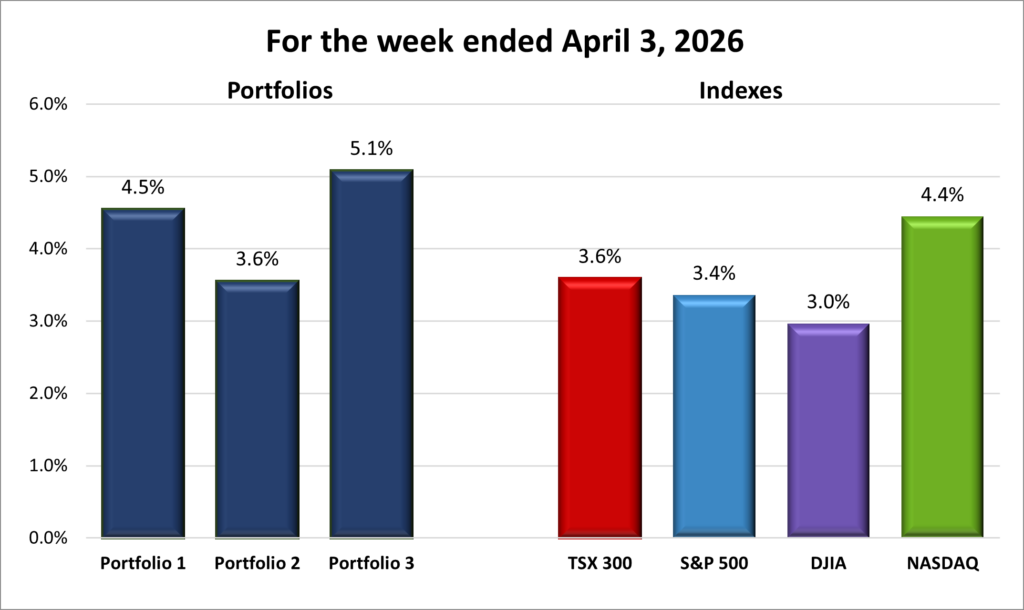
For the week, the TSX (SPTSX) jumped 3.6%, the S&P 500 (SPX) gained 3.4%, the DJIA (INDU) added 3.0% and the Nasdaq (CCMP) surged 4.4%.

 
Index Weekly Streak
TSX: 2 – week winning streak
S&P: 1 – week winning streak
DJIA: 1 – week winning streak
Nasdaq: 1 – week winning streak

Bull market. A good week for the North American stock markets. The sour taste from the previous few weeks lingered at the start of this one, but it didn’t last long. As the week progressed, signs that both sides might be open to ending the conflict lifted investor sentiment. By the close of the shortened trading week, markets had rallied for three straight days, finishing on a more optimistic note.

All four major North American indexes posted their best week of the year. The Toronto Stock Exchange Composite Index (TSX) extended its winning streak to two weeks, while the S&P 500 Index (S&P), the Dow Jones Industrial Average (DJIA), and the Nasdaq Composite Index (Nasdaq) recorded their biggest weekly gains in four months, breaking a six-week losing streak.

The Iran conflict remained the dominant market driver. Early in the week, elevated oil prices supported energy stocks, but that strength wasn’t enough to lift the broader market. Sentiment shifted sharply on Tuesday after reports that President Trump was prepared to pause the military campaign and that Iran was open to negotiations. That combination triggered a powerful rally, sending US indexes to their largest one-day gains since May 2025, when a pause in US–China trade tensions sparked a similar surge.

This marked the fifth week of the conflict, in the middle of earlier expectations of a four- to six-week duration. While there are signs it could end sooner, uncertainty remains, and analysts expect the conflict to leave a lasting mark on global economic growth.

As fears eased and interest rate expectations stabilised, investors rotated back into growth-oriented areas. Technology stocks drove the Nasdaq higher, supported by steady rate expectations and strong momentum in large-cap names, while financials and consumer-focused companies lifted the S&P and DJIA. Energy stocks pulled back later as oil prices eased, but the shift toward growth and rate-sensitive sectors kept the rally going.

Overshadowed by the conflict, US economic data showed a resilient but not overheated economy. Job creation came in well above expectations and the unemployment rate edged lower, though slower wage growth and a dip in labour force participation hinted at easing demand for workers. Retail sales rebounded modestly, while preliminary readings of the CCI suggested confidence is starting to waver. Taken together, the data gives the Fed room to hold its current rate of 3.75%, with many analysts now expecting no cuts this year given the inflationary pressures from the conflict.

In Canada, the TSX followed a similar pattern. Early in the week, high oil prices gave energy stocks a lift, but broader market weakness persisted as uncertainty around the conflict and inflation weighed on sentiment. The turning point came Tuesday, when signs of de-escalation pushed oil prices lower and sparked a broad-based rally. January GDP data showing slightly stronger-than-expected growth further supported the rebound. By week’s end, Canadian markets had rebounded solidly, driven by easing fears of a prolonged Middle East conflict and the inflationary pressures it had threatened to bring.

All in all, it was a week that reminded investors just how quickly sentiment can turn. Signs of de-escalation in the Middle East, a resilient American economy, and solid GDP data in Canada gave markets a lift, even as uncertainty over the conflict and inflation lingers. For now, the rally across growth sectors shows that confidence can bounce back quickly when the picture brightens, as it did this week. Here’s hoping the momentum continues – and that the conflict comes to an end sooner rather than later.

Portfolio Weekly Streak
Portfolio 1: 1 – week winning streak
Portfolio 2: 1 – week winning streak
Portfolio 3: 1 – week winning streak

Bull market. A good week for the North American stock markets. With the major indexes posting strong weekly gains, all three portfolios followed suit, snapping their recent losing streaks. It was also the first time since the week ending February 20, 2026, that all three finished sharply higher together – a welcome sight after a tough stretch.

It wasn’t just the broader markets doing the heavy lifting. Nvidia (NASD: NVDA), the world’s most valuable company and the largest holding in Portfolios 1 and 3, had a strong week, gaining over 5%. At the same time, a clear pattern emerged across all three portfolios: most oil and energy stocks pulled back as talk of de-escalation in the Iran conflict weighed on crude prices.

Portfolio 1 had a solid week, gaining 4.5%. Along with strength from its largest holding, an impressive 80% of its positions ended the week higher. One standout was Decisive Dividend (TSE: DE), which jumped 11%.

Portfolio 2 lagged the other two but still delivered a respectable 3.6% gain. It also had the lowest percentage of winners, with 72% of holdings finishing in the green. A bright spot was Guardant Health (NASD: GH), which rose 10%. On the flip side, most of the declines came from energy stocks. A good example of how quickly investor sentiment can shift was South Bow (TSE: SOBO) – it hit a record high at the start of the week as oil climbed, only to reverse and finish lower as ceasefire hopes emerged.

Portfolio 3 was the top performer, gaining 5.1% and even outpacing the Nasdaq, the best-performing index of the week. Alongside gains from Nvidia, 80% of its holdings moved higher, including a 10% jump from Rocket Lab (NASD: RKLB).

After a rough month and quarter, this week was a much-needed turnaround. April is off to a more encouraging start – let’s hope it sets the tone for the weeks ahead. Looks like keeping my fingers crossed last week worked 😊… I’ll keep them crossed for next few weeks too. 😊

Weekly Portfolio & Index performance
Weekly Portfolio & Index performance for the week ended April 3, 2026.

Companies on the Radar

Stocks on my Radar No new companies popped onto my investing radar this week, which gave me a chance to run last week’s newcomers through my Quick Test. I had expected Baker Hughes Company (NASD: BKR) to pass the filter, while Bentley Systems (NASD: BSY) and Nebius Group N.V. (NASD: NBIS) might be filtered out. Surprisingly, Baker Hughes scored just 66% – not terrible, but not impressive enough for a well-established company, and not strong enough to stay on my radar.

Nebius, a European artificial intelligence (AI) infrastructure provider, scored 52.2%. That’s on the low side, but not unexpected for a growth-stage company. They’re riding the AI wave, though that tailwind has gotten a bit choppy this year. Since I already have enough technology companies in my portfolios, I’m passing on this riskier opportunity for now.

Bentley Systems, on the other hand, caught my attention with a strong score of 86%. It has solid financial fundamentals, strong growth potential, and capable leadership – the founders still control nearly 48% of the company and hold significant board influence. The tricky part is the market’s concern about AI disruption. The question is whether Bentley is genuinely at risk or simply being swept up in the broader AI-related market turbulence.

With Baker Hughes and Nebius off the list, my radar is now down the 6 companies listed below:

  1. 5N Plus Inc. (TSX: VNP): a small-cap Canadian company that produces high-purity specialty metals and semiconductor materials used in space solar power, renewable energy, medical imaging, and electronics. Many of its products are mission-critical, requiring consistent quality and long-term supply. With exposure to space programs, clean energy, and strategic materials, 5N Plus operates in several niche but expanding markets where technical expertise creates competitive advantages.
  2. GE Aerospace (NYSE: GE): This is the large American aviation and defence business that remained after General Electric split into three separate companies in 2024. It has been on a strong run thanks to high demand for commercial jet engines as global air travel continues to recover. The company focuses on aircraft propulsion systems and services for both commercial and military customers, and it’s also moving into drones. As a global leader in jet engines and aircraft systems, GE Aerospace offers exposure to long-term trends in travel, defence spending, and emerging aviation technology.
  3. Broadcom (NASD: AVGO): A large cap American company that sells semiconductors and software globally. It designs critical chips used in data centres, networking equipment, and broadband infrastructure, playing a behind-the-scenes role in cloud computing and AI. Broadcom also owns a growing enterprise software business following its acquisition of VMware, giving it exposure to both hardware and software spending tied to AI and cloud growth.
  4. Xylem Inc. (NYSE: XYL): This is a large American company that develops water technology focused on moving, treating, and managing water. Its products and services are used by utilities, industrial customers, and municipalities for everything from clean drinking water and wastewater treatment to flood control and leak detection. With aging water infrastructure and more frequent climate challenges like droughts and flooding, demand for Xylem’s solutions is still strong. The business offers exposure to long-term, essential infrastructure spending tied to water scarcity, sustainability, and smarter cities.
  5. Enerflex Ltd. (TSE: EFX): a Calgary-based industrial company that provides engineered energy infrastructure and transition solutions for the global natural gas and power markets. Enerflex designs, manufactures, installs and services equipment and modular facilities – including gas compression, processing systems, power generation and treated water solutions – that are critical to natural gas midstream and industrial operations. With a global footprint and expertise spanning engineering, fabrication and after-market support, Enerflex operates in markets where reliable energy handling and infrastructure are essential, and where long-term contracts and technical integration create competitive advantages.
  6. Bentley Systems is an American software company that sits just above the mid-cap threshold (under US$10 billion market cap), leaving plenty of room for growth. They provide specialized software for professionals who design, build, and operate the world’s infrastructure. From bridges and roads to power plants and water networks, Bentley’s tools help engineers and architects model, manage, and maintain complex physical assets throughout their entire lifecycle.

As always, these are not buy recommendations. Make sure to do your own research and choose investments that fit your personal financial goals.

The Radar Check was last updated April 3, 2026.

Stocks on the Radar List. 1 of 2.
Stocks on the Radar List. 2 of 2.

That’s a wrap for this week, thanks for reading may your portfolio stay green and your dividends steady. See you next time!
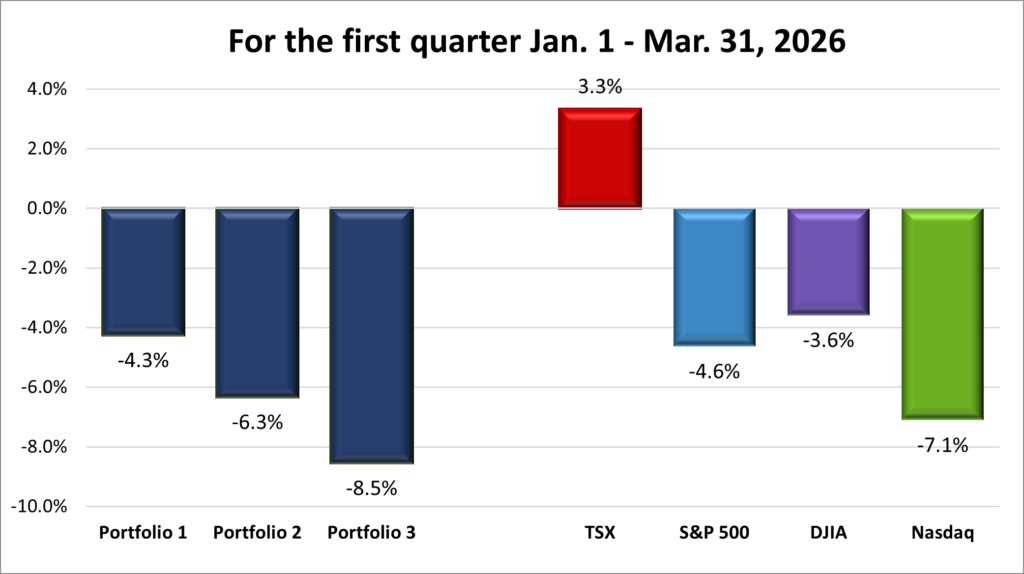
Weekly Update for the week ending March 27, 2026

When Markets Stop Shrugging It Off

The US/Israel-Iran conflict, which began on February 28, is now about to enter its fifth week as you read this. Despite reports of back-channel peace talks, there are still no clear signs of an end in sight. In my March 6, 2026, Weekly Update, I focused on how a short conflict – what was initially expected – could affect markets. This week, the bigger question is what happens if it lasts longer.

Markets can usually shrug off short-lived geopolitical events fairly quickly. But once something stretches beyond a few weeks, the ripple effects start to become more meaningful.

It all starts with oil. The Middle East is a critical hub for global energy, and even the threat of supply disruptions – especially around key routes like the Strait of Hormuz – can push prices higher. We’ve already seen oil spike above US$100 at times as markets price in that risk. If the conflict drags on, those elevated prices are more likely to stick – and that’s where the real impact begins.

Higher oil prices feed directly into inflation. Gas becomes more expensive, transportation costs rise, and that eventually flows through to everyday items like groceries and travel. While this is often described as “transitory” at first, sustained increases in energy prices can make inflation more persistent and harder to bring back down.

At the same time, higher energy costs act like a tax on consumers, leaving less money for other spending and gradually slowing economic growth.

Put those two forces together – higher inflation and slower growth – and you get a tougher backdrop for markets. This type of environment is often referred to as stagflation, and it puts central banks like the Bank of Canada and the Federal Reserve in a difficult position: support growth by lowering rates or keep them higher to control inflation. That uncertainty is one of the main reasons markets tend to become more volatile during extended conflicts.

For Canada, the picture is mixed. As an energy producer, higher oil prices can support parts of the economy and the TSX. But globally, the story leans more negative, with higher inflation, slower growth, and more cautious investors weighing on broader markets.

If the conflict continues, the impact won’t be evenly spread. In Canada, energy companies like Canadian Natural Resources (TSE: CNQ) could benefit, while consumer-focused businesses – such as Aritzia (TSE: ATZ) and Air Canada (TSE: AC) – may feel the squeeze as higher fuel costs reduce discretionary spending. Industrials and transportation companies like Canadian National Railway (TSE: CNR) could also face rising input costs over time.

In the US, energy producers like ExxonMobil (NYSE: XOM) would likely see a similar boost, but the broader market may face more pressure. Higher inflation could keep interest rates elevated, creating a tougher backdrop for rate-sensitive sectors like technology, including companies such as Microsoft (NASD: MSFT) and Nvidia (NASD: NVDA). Meanwhile, airlines and other fuel-heavy industries like Rocket Lab (NASD: RKLB) tend to be among the hardest hit.

The key is that duration matters. If the conflict resolves quickly, the impact on markets could fade just as fast. But if it lingers, it could shift the environment from short-term volatility to a more sustained period of higher inflation and slower growth – something markets don’t tend to handle particularly well.

For now, investors are still trying to gauge how this conflict will unfold, and as always, expectations can shift quickly. While headlines may continue to drive short-term volatility, staying focused on the bigger, long-term picture is key when making investment decisions. With that in mind, let’s take a look at how the ongoing conflict in the Middle East impacted the markets and my portfolios this week.


Items that may only interest or educate me ….

Canadian Economic news, US Economic news, ….

Canadian Economic news

This past week’s key economic data that the Bank of Canada (BoC) considers when deciding whether to raise or lower the interest rate.

Canadian Market Volatility

Canada’s version of the market “fear gauge” is the S&P/TSX Volatility Index (VIXC), often shown on trading platforms as VIXI.TO. Like the CBOE Volatility Index (VIX) in the US, it measures how much volatility investors expect in the Canadian stock market over the next 30 days.

The index opened the week at 19.31 and briefly spiked above 21 before easing back toward the 20 level, where it hovered for a few days. That relative calm didn’t last. As optimism around a potential ceasefire faded, volatility picked up again, pushing the index back above 21. By the end of the week, it had climbed past 22.5 before settling at 22.11, reflecting growing concerns that a prolonged conflict could push energy prices higher and keep inflation pressures elevated. In turn, that could reduce the chances of a near-term rate cut.

With the index spending much of the week above 20, it points to a more cautious tone in the market, as readings at that level typically signal rising investor unease. Canadian volatility also tends to run lower than in the US, largely because the TSX is more heavily weighted toward financials, energy, and materials – sectors that generally see steadier price movements than the high-growth technology stocks that dominate US markets.

US Economic news

This past week’s key data points that the Federal Reserve (Fed) considers when deciding whether to raise or lower the interest rate.

Consumer Sentiment Index (CSI)

The University of Michigan’s final Consumer Sentiment Index (CSI) reading for March came in at 53.3, down from 55.5 in February and slightly below expectations of 54. Compared to a year ago, sentiment is now 6.5% lower. For context, readings in the 50s are typically associated with low confidence, suggesting consumers are growing increasingly uneasy about the economic backdrop.

Drilling down, the details didn’t offer much reassurance. The Current Economic Conditions Index – which reflects how people feel about their finances and job security today – fell to 55.8, down 1.4% month over month and 12.5% lower than a year ago. Meanwhile, the Expectations Index, which looks six months ahead, dropped more sharply, falling 8.7% to 51.7, though it is still just 1.7% below March 2025 levels. That decline points to growing concern about where the economy may be headed.

At its core, this report is a pulse check on the consumer – and right now, that pulse is weakening. Rising gas prices, market volatility, and ongoing geopolitical tensions are weighing on confidence, both in the present and looking ahead.

For us investors, this matters more than it might seem at first glance. When confidence drops, people tend to spend less – and since consumer spending drives a large part of the economy, that can slow growth. At the same time, rising inflation expectations make it less likely that central banks will cut interest rates anytime soon. It’s a tough combination: slowing growth paired with higher-for-longer rates, which helps explain why markets have been feeling more volatile lately.

American Market Volatility

The CBOE Volatility Index – often called the market’s “fear gauge” – tracks how much volatility investors expect over the next 30 days. Think of it as the market’s pulse: while readings above 20 signal rising uncertainty, levels above 30 – where the VIX both started and ended the week – point to elevated fear and heightened market stress.

The index started the week elevated at 30.1, as concerns around escalating tensions between the US and Iran raised fears that higher oil prices could lead to broader inflation. As the week unfolded, the VIX moved within a range of roughly 25 to 27.5, reflecting the back-and-forth nature of headlines as tensions eased and then flared up again. By the end of the week, volatility picked up once more, with the VIX climbing back above 31 before closing at 31.05 slightly higher than where it began, and a sign that investor anxiety continued to build.


Weekly Market and Portfolio Review

For the week, the TSX (SPTSX) gained 2.1%, the S&P 500 (SPX) fell 2.1%, the DJIA (INDU) slipped 0.9% and the Nasdaq (CCMP) dropped 3.2%.

 
Index Weekly Streak
TSX: 1 – week winning streak
S&P: 5 – week losing streak
DJIA: 5 – week losing streak
Nasdaq: 5 – week losing streak

Bearish marketBull market. A good week for the North American stock markets. Fresh off last week’s losses, markets started strong, but the US–Israel conflict’s fourth week quickly turned things into a rollercoaster. By the end, indexes finished mixed. Canada’s resource-heavy Toronto Stock Exchange Composite Index (TSX) was the only one in the green, while American indexes – the S&P 500 (S&P), Dow Jones Industrial Average (DJIA), and Nasdaq Composite Index (Nasdaq) – struggled as fading expectations for 2026 rate cuts weighed on sentiment.

The TSX kicked off the week with its best day in five weeks, extending its winning streak to three sessions by midweek. US markets also surged early, posting their biggest single-day gains since February, but momentum quickly faded. Volatility picked up, with the S&P and Nasdaq posting their largest single-day drops since the conflict began. By Friday, all three US indexes hit their lowest levels since September 2025. The Nasdaq and DJIA slipped into correction territory, down more than 10% from their October 29, 2025, and February 10, 2026, highs, respectively. Meanwhile, the S&P posted its longest weekly losing streak since 2022, finishing down for a fifth straight week.

It was a headline-driven week, with every twist in the conflict moving markets. Oil prices swung sharply – falling on hopes for peace talks, then surging as tensions escalated. Brent crude closed just above $110 per barrel, as geopolitical tensions kept prices elevated – adding to concerns that higher energy costs could feed into inflation. Fertilizer prices became another casualty, spiking as higher energy costs and shipping disruptions made production and delivery more expensive and difficult. Rising energy costs stoked fears that inflation could broaden and remain elevated, reducing the likelihood of near-term rate cuts and keeping investors focused on inflation risks. Even if the conflict ends soon, lingering effects – higher energy costs, slower economic growth, and uncertain interest rate paths – could keep markets choppy.

Fading rate cut expectations also hit the technology sector hard, especially the Magnificent 7 [link to mag 7] mega-cap companies, which lost over $330 billion on Friday alone, bringing their total weekly drop to roughly $870 billion. That is a lot of money!

In Canada, the TSX faced similar pressures but held up better early in the week thanks to its energy-heavy makeup. Rising oil prices lifted energy stocks, but the downside was gold had its worst week since 2011 before a late rebound. The price of gold dropped because as oil surged and concerns about persistent inflation grew, expectations for interest rate cuts moved further out. Higher rates make bonds and other income-generating assets more attractive, and since gold doesn’t pay interest, investors often rotate out of it when yields rise. With investors now pricing in multiple BoC rate hikes before the end of 2026, gold is likely to face continued headwinds.

Once again, it was a challenging week. In the US, recession fears are rising, while in Canada, the bigger concern is stagflation – a mix of slowing growth and rising inflation. That uncertainty limited gains and kept markets choppy. Until there are clearer signs of how and when the conflict will resolve, volatility is likely to continue – but for us long-term investors, it can also create opportunities. 😊

Portfolio Weekly Streak
Portfolio 1: 2 – week losing streak
Portfolio 2: 5 – week losing streak
Portfolio 3: 3 – week losing streak

Bearish market These portfolio losing streaks are starting to feel frustrating. With no clear end to the conflict – and with that uncertainty pushing out expectations for lower interest rates – there’s a good chance these losing streaks will continue before things turn around. 😊

Once again, it was a tough week across all three portfolios, although there was a brief moment of optimism. By the end of Thursday, Portfolios 1 and 3 were actually in the green. Unfortunately, that didn’t last. Markets slid again on Friday, with the semiconductor sector leading the decline. Nvidia, the largest holding in Portfolios 1 and 2, fell more than 4% on the week, which all but guaranteed both portfolios would finish in the red. ☹

Portfolio 1 had the weakest showing, falling 1.9%. The pullback in the Magnificent 7 weighed heavily and more than offset gains from energy holdings. Losses were widespread, with only 17% of holdings finishing the week higher. Among the biggest decliners were The Trade Desk (NASD: TTD), down 12%, and Celsius Holdings (NASD: CELH), which dropped 19%.

Portfolio 2 had a tough week, slipping 1.4%. It had the highest percentage of winners at 34%, with all energy positions posting gains and helping cushion the downside. Still, the volume of losses proved too much to overcome, including a 12% drop in MongoDB (NASD: MDB).

Portfolio 3 completed the trifecta, also declining 1.4% after entering Friday in positive territory. With its two largest holdings – Nvidia and Shopify (TSE: SHOP), which together make up roughly half the portfolio – both posting losses, the odds were already stacked against it. Only 33% of holdings finished higher, although there were some bright spots, including a 16% gain from Alvopetro Energy (TSE.V: ALV). Vertiv Holdings (NYSE: VRT) briefly looked like it might provide a lift after hitting a record high midweek, but it gave back those gains, falling more than 10% over the final two sessions.

That pretty much sums up the week. All three portfolios started strong, buoyed by optimism around a potential ceasefire, but optimism turned to skepticism as doubts of a quick end to the conflict crept in. Rising concerns around inflation and “higher-for-longer” interest rates hit the more interest-sensitive sectors – especially technology and consumer discretionary – hard. With all three portfolios leaning heavily toward technology companies, it wasn’t a great combination. ☹

I’m not expecting a turnaround next week—but I’ll still be crossing my fingers for one. 😊

Weekly Portfolio & Index performance
Weekly Portfolio & Index performance for the week ended March 27, 2026.

Companies on the Radar

Stocks on my Radar This week, three very different companies made their way onto my radar: Bentley Systems, Incorporated (NASD: BSY), Baker Hughes Company (NASD: BKR), and Nebius Group N.V. (NASD: NBIS).

Bentley Systems caught my attention as a classic “behind-the-scenes” business. Its software helps engineers design and manage essential infrastructure like bridges, railways, and power systems. It may not grab headlines, but it plays a crucial role in the real world – and once companies build their workflows around it, they rarely switch.

Baker Hughes brings a completely different angle. It provides the equipment and technology that help produce and manage energy across the globe, from traditional oil and gas to newer areas like carbon capture and hydrogen. It’s an interesting way to gain exposure to energy today while also keeping an eye on where the industry could be heading.

Nebius Group adds a more growth-oriented flavour to the mix. The company is building infrastructure for artificial intelligence (AI), including cloud platforms and high-powered computing systems. In many ways, it’s supplying the “picks and shovels” for the AI boom – though, like most emerging opportunities, it comes with a bit more uncertainty.

With these additions, my radar list now sits at eight companies. I’m looking forward to narrowing that down to a more focused group of five next week – getting one step closer to identifying the best businesses and one that I’d be proud to own. 😊

  1. 5N Plus Inc. (TSX: VNP): a small-cap Canadian company that produces high-purity specialty metals and semiconductor materials used in space solar power, renewable energy, medical imaging, and electronics. Many of its products are mission-critical, requiring consistent quality and long-term supply. With exposure to space programs, clean energy, and strategic materials, 5N Plus operates in several niche but expanding markets where technical expertise creates competitive advantages.
  2. GE Aerospace (NYSE: GE): This is the large American aviation and defence business that remained after General Electric split into three separate companies in 2024. It has been on a strong run thanks to high demand for commercial jet engines as global air travel continues to recover. The company focuses on aircraft propulsion systems and services for both commercial and military customers, and it’s also moving into drones. As a global leader in jet engines and aircraft systems, GE Aerospace offers exposure to long-term trends in travel, defence spending, and emerging aviation technology.
  3. Broadcom (NASD: AVGO): A large cap American company that sells semiconductors and software globally. It designs critical chips used in data centres, networking equipment, and broadband infrastructure, playing a behind-the-scenes role in cloud computing and AI. Broadcom also owns a growing enterprise software business following its acquisition of VMware, giving it exposure to both hardware and software spending tied to AI and cloud growth.
  4. Xylem Inc. (NYSE: XYL): This is a large American company that develops water technology focused on moving, treating, and managing water. Its products and services are used by utilities, industrial customers, and municipalities for everything from clean drinking water and wastewater treatment to flood control and leak detection. With aging water infrastructure and more frequent climate challenges like droughts and flooding, demand for Xylem’s solutions is still strong. The business offers exposure to long-term, essential infrastructure spending tied to water scarcity, sustainability, and smarter cities.
  5. Enerflex Ltd. (TSE: EFX): a Calgary-based industrial company that provides engineered energy infrastructure and transition solutions for the global natural gas and power markets. Enerflex designs, manufactures, installs and services equipment and modular facilities – including gas compression, processing systems, power generation and treated water solutions – that are critical to natural gas midstream and industrial operations. With a global footprint and expertise spanning engineering, fabrication and after-market support, Enerflex operates in markets where reliable energy handling and infrastructure are essential, and where long-term contracts and technical integration create competitive advantages.

As always, these are not buy recommendations. Make sure to do your own research and choose investments that fit your personal financial goals.

The Radar Check was last updated March 27, 2026.

Stock on the Radar List. 1 of 2.
Stock on the Radar List. 2 of 2.

That’s a wrap for this week, thanks for reading may your portfolio stay green and your dividends steady. See you next time!

Weekly Update for the week ending March 20, 2026

Stagflation: What It Is and Why Markets Are Paying Attention Right Now

The last few weeks, I’ve been seeing the term “stagflation” pop up more and more to describe the situation Canada – and to a lesser extent the US – may find themselves in over the coming months. At a basic level, inflation is when the overall cost of living rises over time, meaning your money doesn’t go as far as it used to. Most central banks, including the Bank of Canada (BoC) and the Federal Reserve (Fed), aim for around 2% inflation per year, which is considered healthy for a growing economy. A recession, on the other hand, is when economic activity slows down – businesses earn less, hiring weakens, and unemployment begins to rise. But what exactly is stagflation? This week, I thought I’d take a closer look.

Stagflation is one of those economic terms that sounds complicated, but the idea is actually pretty simple – and a bit uncomfortable.

At its core, stagflation is when three things happen at the same time: slow economic growth, rising unemployment, and high inflation. Normally, these don’t show up together. When the economy slows, inflation usually cools. And when inflation is high, it’s often because the economy is running hot. Stagflation breaks that usual pattern, which is what makes it so tricky.

A helpful way to think about it is this: imagine prices for everyday things like groceries, gas, and rent are rising quickly, but businesses aren’t growing much and hiring slows down. So, people are paying more but not earning more – and some are even losing jobs. That combination can really squeeze households and make it harder for the economy to recover.

So, what causes stagflation? There’s no single trigger, but it usually comes from a mix of supply shocks and policy mistakes. A classic example is a sudden spike in the cost of key resources like oil. When energy prices jump, it becomes more expensive for businesses to produce and transport goods, which pushes prices higher (inflation). At the same time, those higher costs can slow down production and hiring (stagnation). If governments or central banks respond poorly – like keeping interest rates too low for too long or overstimulating the economy – it can make the inflation side even worse without fixing the slowdown.

Getting out of stagflation is where things get difficult. Policymakers are essentially stuck choosing between two tough options. To fight inflation, central banks (like the BoC or the Fed) may raise interest rates. That can help cool prices, but it can also slow the economy further in the short term. On the other hand, trying to boost growth – through lower rates or government spending – can risk making inflation worse. In most cases, the path out involves tightening monetary policy to bring inflation under control first, even if it means a period of economic pain, followed by gradual recovery as stability returns.

Canada experienced a period of stagflation in the 1970s, largely tied to the global oil shocks of that era. After the 1973 oil crisis, oil prices surged, driving up costs across the economy. Inflation in Canada climbed into the double digits at times, while economic growth slowed and unemployment rose. It was a difficult stretch that took years – and much higher interest rates – to bring back under control.

The United States went through a very similar experience during the same decade. Throughout the 1970s, and into the early 1980s, the US dealt with high inflation alongside weak growth and rising unemployment. The turning point came under Paul Volcker, who led the Fed and aggressively raised interest rates to break inflation – even though it triggered a recession in the short term. That painful reset ultimately helped stabilize the economy and end the stagflation cycle.

When you step back, stagflation is really a reminder that the economy doesn’t always follow the “normal” rules. And for investors, it can be a challenging environment, since both economic growth and purchasing power are under pressure at the same time.

With stagflation back in the conversation, it adds another layer of uncertainty to an already choppy market environment. With that in mind, let’s take a look at what drove the markets this week and the impact on my three portfolios.


Items that may only interest or educate me ….

Canadian Economic news, US Economic news, ….

Canadian Economic news

This past week’s key economic data that the BoC considers when deciding whether to raise or lower the interest rate.

Consumer Price Index (CPI)

Statistics Canada reported that headline inflation – the overall rise in prices – came in at 1.8% in February, a nine-month low and just below the Bank of Canada’s 2% target. That’s better than analysts’ expectations of 1.9% and down from January’s 2.3%. On a monthly basis, prices rose only 0.1%, far below the 0.7% expected and following a flat reading in January.

Looking closer, Food prices jumped 5.4% year-over-year, while gasoline fell 14.2% over the same period. Month to month, gas rose 3.6%, while household operations, furnishings, and equipment costs fell 1.4%. Shelter costs, including rent and mortgage interest, were up 1.5% over the year but edged down 0.1% in February.

The BoC’s preferred measure, core CPI, which strips out volatile items like food and energy to show underlying trends, has been slowing on an annual basis for the fourth straight month. Year-over-year, core inflation eased to 2.0% from 2.4% in January, showing that prices are rising more slowly compared to last year. On a monthly basis, however, core CPI still ticked up 0.5% in February after a 0.2% increase in January, meaning prices are slowly ticking up even as the overall pace of inflation eases.

On the surface, this looks like good news – but much of the slowdown is due to temporary factors, like last year’s sales tax relief and falling energy prices. Core areas such as food and restaurant costs are still elevated, so inflation isn’t fully under control. For investors, it’s a mixed signal: the BoC might have room to stay patient or even consider rate cuts, but persistent pressures – including rising oil prices from the US/Israel–Iran conflict – mean any changes will likely be cautious.

The slowdown in price increases is likely temporary, since higher oil costs from the conflict, which began on February 28, are expected to show up in future inflation reports, keeping the outlook uncertain.

Bank of Canada Rate Decision

As expected, the Bank of Canada held its benchmark interest rate steady at 2.25%, marking the third straight meeting with no change. The Bank is taking a wait-and-see approach as it watches how rising oil prices – driven by the Iran conflict – impact inflation in the months ahead.

While recent data shows inflation has dipped below the BoC’s 2% target, Governor Tiff Macklem cautioned that higher energy costs are likely to push inflation back up. At the same time, ongoing trade uncertainty with Canada’s largest trading partner and broader geopolitical tensions are weighing on economic growth.

This leaves the Bank in a tough spot. If inflation rises again, it may need to raise interest rates, even as the economy slows. But if the conflict eases and oil prices fall, it could instead cut rates to support growth. In other words, the BoC is walking a fine line – trying to control inflation without putting too much pressure on an already slowing economy.

Retail Sales

According to Statistics Canada, retail sales in Canada came in stronger than expected, rising 1.1% month over month in January. That’s a solid rebound from December’s 0.4% decline and a sharp contrast to expectations for another drop. On a year-over-year basis, sales rose 1.5% after being flat the previous month, suggesting the Canadian consumer is still holding up despite higher interest rates.

A closer look shows the strength wasn’t evenly spread and was driven by stronger sales at motor vehicles and ​parts dealers. On a percentage basis, gains were driven more by specific categories rather than broad-based spending, pointing to a more selective consumer. Miscellaneous retailers led the way with a 3.0% monthly increase and a strong 13.2% annual gain compared to last year. Meanwhile, spending in discretionary areas like clothing and accessories fell 1.1%, and gasoline sales dropped 5.7% year over year, reflecting both softer demand and lower prices.

Core retail sales, which exclude autos and gasoline to better capture underlying trends, rose 0.9% in January after a downward revised 0.4% decline in December. On an annual basis, core sales grew 3.9%, showing that while spending is still expanding, the pace remains uneven.

Stepping back, the story hasn’t really changed. The Canadian consumer is still spending, but with less consistency and confidence than before. For the BoC, that likely reinforces their cautious, wait-and-see approach. As long as spending holds up and inflation risks linger, there’s little urgency to move quickly on rate cuts.

Looking ahead, Statistics Canada’s advance estimate points to another 0.9% increase in February. If that holds, it would mark the first back-to-back monthly gains in nearly a year, a small but encouraging sign after a choppy stretch for retailers through 2025.

Canadian Market Volatility

Canada’s version of the market “fear gauge” is the S&P/TSX Volatility Index, often shown on trading platforms as VIXI.TO. Like the CBOE Volatility Index in the US, it measures how much volatility investors expect in the Canadian stock market over the next 30 days.

The index opened the week at 20.10 and quickly climbed to just under 21 as concerns around the Iran conflict and rising inflation picked up. It then drifted between 19 and 20 for much of the week before pushing back above 21 toward the end, following reports of tit for tat strikes on oil infrastructure in the Middle East. That raised concerns that oil prices could stay elevated, potentially putting upward pressure on inflation. By the close, however, volatility had eased slightly, with the index finishing at 20.14.

In general, readings in the high teens suggest a more cautious market, while levels above 20 signal rising investor unease. Canadian volatility also tends to run lower than in the US, largely because the TSX is more heavily weighted toward sectors like financials, energy, and materials – industries that typically see steadier price movements than the high-growth technology stocks that dominate American markets.

US Economic news

This past week’s key data points that the Fed considers when deciding whether to raise or lower the interest rate.

Federal Open Market Committee (FOMC) Interest Rate Decision

As expected, the Fed’s FOMC held interest rates steady at its latest meeting, keeping the benchmark rate in the 3.5%–3.75% range while assessing inflation and the strength of the American economy. The decision wasn’t unanimous, with two officials voting in favour of a rate cut, though the majority opted to stay patient for now.

Headline inflation has been trending lower, but underlying price pressures remain persistent, particularly in core measures that strip out volatile food and energy costs. This slower progress complicates the Fed’s decisions, especially as the economy shows signs of slowing with softer hiring and cooling consumer demand.

Fed Chair Jerome Powell reiterated that the central bank is in no rush to cut rates, noting that more evidence is needed to confirm inflation is sustainably under control. He said the Fed expects one rate cut in 2026 while projecting stronger growth and higher inflation than previously anticipated, but risks are becoming more balanced, meaning Fed officials could pivot if conditions weaken. In his post-decision press conference, Powell also acknowledged that the Iran-US conflict and higher energy prices are adding uncertainty and could push inflation higher in the near term, though it’s still too early to know the full scope or duration of the impact.

For now, the Fed is staying patient. If inflation continues to ease, rate cuts could come into view later this year – but if inflation proves stubborn – or rises due to factors like higher energy costs – the Fed may keep rates elevated longer.

American Market Volatility

The CBOE Volatility Index – often called the market’s “fear gauge” – measures how much volatility investors expect in the stock market over the next 30 days. Think of it as the market’s pulse: readings above 20, as was the case this week, typically signal rising caution among investors.

The index opened the week at 25.88 amid heightened tensions in the Middle East, then drifted toward the 21.5 level in the days leading up to the Fed’s rate decision before climbing back above 27. Following the announcement, the fear gauge eased to around 23.50. While the Fed held rates steady, it noted that the Iran conflict is adding uncertainty to the inflation outlook. Ongoing strikes on energy infrastructure raised concerns about supply disruptions, pushing oil prices higher and increasing the chances of reigniting inflation.

Adding to the swings, roughly US$5.7 trillion in options expired at the end of the week, injecting another dose of volatility on top of the geopolitical and inflation concerns, briefly sending the VIX above 29. By week’s end, however, it had cooled slightly to 26.78.


Weekly Market and Portfolio Review

For the week, the TSX (SPTSX) plunged 3.8%, the S&P 500 (SPX) slipped 1.9%, the DJIA (INDU) and the Nasdaq (CCMP) both declined 2.1%.

 
Index Weekly Streak
TSX: 3 – week losing streak
S&P: 4 – week losing streak
DJIA: 4 – week losing streak
Nasdaq: 4 – week losing streak

Bearish market Last week, it was the Middle East conflict that unnerved investors. This week, uncertainty joined geopolitical tensions at centre stage. Concerns over how long the Iran conflict could last—and its impact on energy prices, now more than 40% higher since hostilities began – combined with unclear signals from central banks on when rates might come down, left investors on edge.

Markets started the week on a positive note, with the Toronto Stock Exchange Composite Index (TSX), S&P 500 Index (S&P), Dow Jones Industrial Average (DJIA), and Nasdaq Composite Index (Nasdaq) posting back-to-back gains. That early optimism quickly faded. By midweek, selling pressure pushed the TSX and S&P to their lowest levels since September, the DJIA to its lowest since November, and left the Nasdaq down nearly 10% from its October 29 record high.

The broader pullback has been building since the conflict began three weeks ago. Over that stretch, the TSX is down nearly 9%, the DJIA is lower by almost 7%, the S&P has lost 5.4%, and the Nasdaq has slipped 4.5%. By Thursday, those early gains had fully evaporated, with all four indexes ending the week on a three-session losing streak.

Adding to the cautious tone, all three major American indexes fell below their 200-day moving averages – a widely watched signal that long-term momentum may be weakening. When multiple indexes break this level simultaneously, it often points to broad-based weakness and fading investor confidence.

Energy markets were once again at the centre of it all. Ongoing strikes involving the US, Israel, and retaliatory strikes by Iran raised fears of supply disruptions and pushed oil prices higher, with tensions further escalating after Israel targeted Iran’s South Pars gas field and retaliatory strikes followed.

There were some signs of de-escalation. Reports that the US urged Israel to avoid further attacks on Iranian energy infrastructure, along with efforts to reopen the Strait of Hormuz, helped calm markets slightly. Even so, none of the combatants appear ready to back down. Iran continued targeting regional energy infrastructure, while the US is reportedly considering using troops to take control of Kharg Island, Iran’s main oil export hub, to pressure Iran to reopen the Strait.

The renewed tension pushed oil prices back above US$100 per barrel, with inflation expectations creeping higher. Even if tanker traffic resumes, damage to production infrastructure could take years to repair, leaving a lasting impact on global supply.

The Fed’s latest rate decision came against this backdrop. As expected, it held rates steady but now projects just one rate cut this year. With energy prices rising again, the Fed faces a more complicated path, raising concerns that higher oil costs could keep inflation and interest rates elevated for longer.

In Canada, energy stocks helped support the TSX early in the week. With the index heavily weighted toward energy and financials, rising crude prices lifted the index, while steady bank stocks helped cushion broader weakness. Being a net oil exporter also helped Canada absorb some of the shock, even as higher prices added to inflation concerns.

As the week progressed, that initial support faded. Rising oil prices fuelled concerns that inflation could reaccelerate, while BoC commentary that signalled they were in no rush to cut rates added to the cautious tone. By midweek, those pressures outweighed energy’s benefits, dragging the TSX to a three-month low and shifting sentiment from easing inflation to a more uncertain outlook.

By week’s end, markets on both sides of the border were caught between easing inflation trends and a renewed surge in energy-driven inflation, along with uncertainty around interest rates. That push and pull kept volatility elevated as investors tried to figure out whether this is a temporary shock or the start of another inflationary wave.

Portfolio Weekly Streak
Portfolio 1: 1 – week losing streak
Portfolio 2: 4 – week losing streak
Portfolio 3: 2 – week losing streak

Bearish market With this backdrop, it was no surprise the portfolios once again lost ground. It’s starting to feel a bit like 2022, when inflation pushed every major American index temporarily into full bear markets (20%+ declines), with the Nasdaq falling as much as 35% at one point. That year, Portfolio 2 did the best—or maybe more accurately, lost the least – declining 27% for the year.

We’re nowhere near that level of damage today, even with the Canadian market sliding for three straight weeks and the American indexes logging four consecutive weekly losses. Still, I’d feel a lot better if markets could string together a few winning weeks. 😊

Portfolio 1 had a tough week, slipping 2.8%, which wasn’t surprising given just 17% of holdings finished in the green. Ouch! Falling gold prices weighed heavily, with the iShares S&P/TSX Global Gold Index ETF (TSE: XGD) dropping 13% as gold pulled back from recent all-time highs. Technology names also dragged on performance, including Navitas Semiconductor (NASD: NVTS), down 15%, The Trade Desk (NASD: TTD), which fell 12%, and the largest holding, Nvidia (NASD: NVDA), down 5%.

Portfolio 2 held up the best, falling “only” 1.2%. It also had the highest percentage of winners, with 43% of holdings ending the week higher. Strength in oil prices helped support the portfolio’s energy names and limit broader downside, though that was partly offset by a 12% drop in Brookfield Infrastructure Corporation (TSE: BIPC).

Portfolio 3 had the toughest week, falling 2.9%. With only 23% of holdings advancing – including its two largest positions, Nvidia and Shopify (TSE: SHOP) – the result wasn’t all that surprising. Losses were broad-based, with Lithium Americas Corp. (TSE: LAC) standing out after a 17% drop. On a more positive note, Rocket Lab (NASD: RKLB), despite a weekly loss, announced a US$190 million, four-year contract with the US Department of Defense – the largest launch contract in the company’s history.

It wasn’t an easy week, and there could be more like it if the Iran conflict continues to push oil prices higher and keep inflation concerns front and centre. While it’s never fun seeing red across the board, I still try to look at pullbacks like this as opportunities to become an owner of some of the world’s best companies at better prices – glass half full, I guess. 😊 For now, it’s a matter of grinding through it.

Weekly Portfolio & Index performance
Weekly Portfolio & Index performance for the week ended March 20, 2026.

Companies on the Radar

Stocks on my Radar After a few weeks of companies moving on and off my radar, things were relatively quiet on the investing front this past week, and my list remains unchanged with the five companies below.

Currently, my primary focus is on 5N Plus Inc. (TSX: VNP), GE Aerospace (NYSE: GE), and Broadcom (NASD: AVGO), which scored the highest on my Quick Test – my second step for separating great businesses from merely good ones. These companies earned scores of 89%, 84%, and 86%, respectively.

In the Radar List charts below, companies are ranked based on their total score from my initial radar test. Think of it as a quick, high-level filter that separates the most promising opportunities from the rest, so I can focus my time on the companies that deserve a closer look. That closer look comes with my Quick Test, a checklist I created to assess a company’s quality more thoroughly. By combining hard financial data with key indicators of strong business fundamentals, the Quick Test helps me quickly identify high-quality opportunities versus potential value traps – before I spend time doing a full deep dive.

  1. 5N Plus Inc.: a small-cap Canadian company that produces high-purity specialty metals and semiconductor materials used in space solar power, renewable energy, medical imaging, and electronics. Many of its products are mission-critical, requiring consistent quality and long-term supply. With exposure to space programs, clean energy, and strategic materials, 5N Plus operates in several niche but expanding markets where technical expertise creates competitive advantages.
  2. GE Aerospace: This is the large American aviation and defence business that remained after General Electric split into three separate companies in 2024. It has been on a strong run thanks to high demand for commercial jet engines as global air travel continues to recover. The company focuses on aircraft propulsion systems and services for both commercial and military customers, and it’s also moving into drones. As a global leader in jet engines and aircraft systems, GE Aerospace offers exposure to long-term trends in travel, defence spending, and emerging aviation technology.
  3. Broadcom: A large cap American company that sells semiconductors and software globally. It designs critical chips used in data centres, networking equipment, and broadband infrastructure, playing a behind-the-scenes role in cloud computing and AI. Broadcom also owns a growing enterprise software business following its acquisition of VMware, giving it exposure to both hardware and software spending tied to artificial intelligence (AI) and cloud growth.
  4. Xylem Inc. (NYSE: XYL): This is a large American company that develops water technology focused on moving, treating, and managing water. Its products and services are used by utilities, industrial customers, and municipalities for everything from clean drinking water and wastewater treatment to flood control and leak detection. With aging water infrastructure and more frequent climate challenges like droughts and flooding, demand for Xylem’s solutions is still strong. The business offers exposure to long-term, essential infrastructure spending tied to water scarcity, sustainability, and smarter cities.
  5. Enerflex Ltd. (TSE: EFX): a Calgary-based industrial company that provides engineered energy infrastructure and transition solutions for the global natural gas and power markets. Enerflex designs, manufactures, installs and services equipment and modular facilities – including gas compression, processing systems, power generation and treated water solutions – that are critical to natural gas midstream and industrial operations. With a global footprint and expertise spanning engineering, fabrication and after-market support, Enerflex operates in markets where reliable energy handling and infrastructure are essential, and where long-term contracts and technical integration create competitive advantages.

As always, these are not buy recommendations. Make sure to do your own research and choose investments that fit your personal financial goals.

The Radar Check was last updated March 20, 2026.

Stock on the Radar List. 1 of 2.
Stock on the Radar List. 2 of 2.

That’s a wrap for this week, thanks for reading may your portfolio stay green and your dividends steady. See you next time!