Weekly Update for the week ending February 28, 2025

10 Common Investing Mistakes (And How to Avoid Them!)

Investing is a great way to build wealth, but mistakes can cost you. Trust me – I’ve made plenty. ☹ Whether you’re just starting out or have been at it for a while, knowing what not to do is just as important as knowing what to do.

To help you navigate the investing world with confidence, here are 10 common pitfalls and how to avoid them. The good news? Once you recognize these mistakes, you can sidestep them and make smarter decisions. 😊 Let’s begin!

1. Skipping Research

Jumping into a stock without research is like driving blindfolded. Before investing, understand what the company does, its financial health, and its future prospects. Resources like Yahoo Finance, Bloomberg, and company reports are great places to start. (I also shared my go-to investing tools in my August 15, 2024, post.)

2. Letting Emotions Drive Decisions

Markets rise and fall – it’s normal. But panic selling in a downturn or chasing hype can wreck your returns. Have a strategy and stick to it.

Back in the late ‘90s, I got caught up in dot-com hype and bought 360 Networks just because everyone was talking about it. It went bankrupt a few years later. Lesson learned. ☹

3. Putting All Your Eggs in One Basket

If your portfolio is too focused on one industry (like tech stocks), a downturn can hit hard. Diversification – spreading your investments across sectors – helps manage risk.

Coming from a tech background, my early portfolio was tech heavy. I’ve worked hard to diversify over the years, but my portfolios are still technology oriented. Diversification is key!

4. Ignoring Fees

Fees may seem small, but they add up fast. Frequent stock trading means more transaction costs, while high mutual fund fees can cost you thousands over time.

Low-cost index funds and ETFs help keep more of your money working for you rather than someone else.

5. Chasing Hot Stocks

A stock that soared last year won’t necessarily keep climbing. Instead of chasing past winners, focus on company fundamentals, growth potential, and valuation.

I learned this the hard way during the dot-com bubble – many hyped-up stocks crashed while solid, less sexy companies thrived. Sometimes, the best investments haven’t made headlines yet.

6. Expecting Quick Riches

Investing isn’t a shortcut to wealth. Jumping in and out of stocks often leads to losses (and extra trading fees). Think long-term and let compounding do the heavy lifting.

7. Investing Without a Goal

Would you take a road trip without a destination? Investing works the same way. Define your goals – whether it’s retirement, buying a house, or financial freedom – so your strategy matches your needs.

When I first started, I had no real plan – just a goal to “make money.” Since getting back into investing with clear goals, I make better decisions without stressing over short-term swings.

8. Forgetting About Taxes

The Canada Revenue Agency (or Uncle Sam’s IRS for US investors) always gets its cut. Capital gains, dividends, and interest can eat into returns.

Use tax-advantaged accounts like RRSPs and TFSAs to keep more of your money compounding.

9. Following the Hype

Remember GameStop (NASD: GME)? Just because a stock is popular doesn’t mean it’s a good investment. FOMO (fear of missing out) can be costly – always do your own research and trust your strategy.

⚖️ 10. Ignoring Risk Management

No investment is risk-free, but you can manage risk by diversifying and reviewing your portfolio regularly. Higher returns often come with higher risks, so invest within your comfort level.

Final Thoughts

Mistakes are part of investing, but learning from them is what matters. Stay informed, stick to a plan, and keep emotions in check. And when you do slip up (because we all do!), treat it as a learning opportunity.

Every great investor has stumbled – the key is bouncing back smarter.

Investing is a journey, and avoiding these common mistakes can help you save money and stay on track to reach your goals. The markets are always changing, bringing both opportunities and challenges—and this past week was no exception! Let’s take a look at what moved the markets and how the portfolios fared.


Items that may only interest or educate me ….

Canadian Economic news, US Economic news, Nvidia Beats Estimates, Continues to Drive AI, …

Canadian Economic news

This past week’s key economic data that the Bank of Canada (BoC) considers when deciding whether to raise or lower the interest rate.

Gross Domestic Product (GDP)

Canada’s economy grew 2.6% in the fourth quarter, beating analysts’ expectations of 1.9% and building on the 2.2% growth in the third quarter. This stronger-than-expected performance was driven by household spending, exports, and business investment.

However, on a per capita basis, GDP only inched up 0.2% in the fourth quarter after a 0.1% dip in the previous quarter. For the full year, GDP per capita declined 1.4%, following a decline of 1.3% in 2023 for a second consecutive annual drop.

On a monthly basis, GDP grew 0.2% in December, rebounding from November’s 0.2% decline, though it came in just shy of the 0.3% growth analysts had expected. Both services and goods-producing industries contributed to the gains, with retail and utilities leading the way. Early estimates suggest that January continued the positive trend, with a 0.3% increase.

This latest data highlights a growing economy heading into 2025, supported by steady consumer spending and business activity. That said, external risks like trade tensions could still pose challenges in the months ahead.

Canadian market volatility

Canada’s Volatility Index (VIXC) started the week at 14.46, staying mostly between 13.5 and 15.0 for the rest of the week. Despite renewed tariff threats, the Canadian market appeared unfazed, with the country’s fear gauge slipping to 12.85 by the end of the week. It seems investors have grown numb to the ongoing trade uncertainties.

For those unfamiliar with the VIXC (traded as VIXI on the Toronto Stock Exchange), think of it as Canada’s market “stress-o-meter.” Readings below 10 indicate calm seas, while 10 to 20 signals typical market ups and downs. If the VIXC climbs above 20, it’s a sign of rising uncertainty, and things can start to feel a bit more turbulent.

US Economic news

This past week’s key data points that the Federal Reserve (Fed) considers when deciding whether to raise or lower the interest rate.

Consumer Confidence Index (CCI)

Consumer confidence took a sharp hit in February, according to the latest CCI report from The Conference Board. The index dropped to 98.3, down from 105.3 in January – its biggest monthly decline since August 2021. Economists had expected a smaller dip to 103, making this drop a surprise.

The Present Situation Index, which measures sentiment on current business and job conditions, slipped 3.4 points to 136.5. The bigger concern is the Expectations Index, which gauges the outlook for the next six months. It fell 9.3 points to 72.9, dropping below the key 80-point recession warning level for the first time since June 2024.

Confidence declined across most age and income groups, and inflation expectations jumped – with consumers now expecting prices to rise 6% over the next year, up from 5.2% in January. This reflects growing concerns about stubborn inflation and rising costs for essentials.

Why does this matter? Consumer spending drives two-thirds of the US economy. If people start feeling uneasy about their finances, they may cut back, potentially slowing economic growth. While confidence held steady last year, recent months show a downward trend amid inflation worries, economic uncertainty, and potential trade tariffs.

This latest drop also coincides with President Trump’s return to office and his administration signaling possible tariffs on imports from American allies. While it’s too early to say how this will play out, uncertainty over trade policies could be weighing on sentiment.

This drop in confidence signals growing consumer caution—something to keep an eye on as markets respond to shifting sentiment.

Gross Domestic Product (GDP)

The US economy continued to grow in the fourth quarter, with GDP rising 2.3%, according to the second estimate from the Bureau of Economic Analysis (BEA). That’s a slight bump from the initial 2.2% estimate and in line with analysts’ expectations. However, it marks a slowdown from the 3.1% growth recorded in the third quarter.

The growth was fueled by consumer and government spending, though business investment declined, which could indicate some caution among companies. For the full year of 2024, the economy expanded by 2.8%, driven by steady consumer spending, investment, government spending, and exports.

While the economy is still moving forward, this report suggests a slower, more cautious pace of growth. Households are still spending, but inflation and economic uncertainty might be making them a bit more careful. Meanwhile, businesses pulling back on investment could impact certain sectors that rely on big capital spending.

For investors, this cooling growth might mean more measured corporate earnings ahead, and possibly a shift in market sentiment. A slowdown isn’t necessarily bad – it just means the economy is settling into a more moderate pace after a strong stretch. 😊

Personal Consumption Expenditures (PCE)

The latest PCE price index report from the BEA showed inflation ticked up 0.3% in January, matching December’s increase. On a year-over-year basis, inflation cooled slightly to 2.5%, down from 2.6% in December.

The Fed’s preferred inflation measure, core PCE (which excludes food and energy prices), also ticked up 0.3% for the month, a slight increase from 0.2% in December. Annually, core PCE rose 2.6%, in line with expectations but down from 2.9% a year ago.

While inflation is still easing, it remains above the Fed’s 2% target, suggesting the road to lower inflation could be bumpy. Despite this progress, the Fed is expected to hold interest rates steady at 4.25% – 4.5% for now. A March rate cut is unlikely, with most analysts not expecting any moves until at least June, assuming inflation continues to cool and economic conditions support it. However, ongoing uncertainty – such as tariff threats and potential government job cuts – could impact consumer confidence and spending, adding another layer of complexity to the Fed’s decision-making.

American market volatility

The CBOE Volatility Index (VIX) – often called the market’s “fear gauge” – started the week at 18.08 and hovered between 17.50 and 20.0 before spiking to 22.31, its highest level since December 19, 2024. It then closed the week at 20.78, reflecting heightened market anxiety.

For most of the week, the VIX held steady between 17.5 and 20, as investors grappled with concerns over tariffs and their potential impact on an economy already showing signs of slowing. However, volatility surged on Friday, pushing the VIX to 22.31 after a heated exchange in which President Trump and Vice President Vance criticized Ukraine’s President Zelensky for not showing enough gratitude for US support, sparking fresh geopolitical tensions. The index later eased slightly but still closed the week elevated at 19.63, signaling lingering market uncertainty.

For those new to the VIX, think of it as the market’s stress meter. A reading below 12 means calm waters, while 12 to 20 signals normal market swings. Above 20, investors are getting nervous, and anything over 30 usually signals serious turmoil. With the VIX closing above 20, it suggests traders are feeling uneasy about what’s ahead.

Nvidia Beats Estimates, Continues to Drive AI

With a market cap north of US$3 trillion, Nvidia (NASD: NVDA) is one of the most closely watched stocks, and this week’s earnings report was arguably the most anticipated in a long time. Investors were eager to see whether demand remained strong for Nvidia’s high-end processors, given its dominance in artificial intelligence (AI) hardware. The company’s chips are essential for AI applications across big tech, IT infrastructure, and sectors like architecture and engineering, making Nvidia’s financial performance a key indicator of the AI industry’s health.

Fortunately, Nvidia didn’t disappoint yet again. The company beat expectations, reporting record fourth-quarter revenue of $39.3 billion – up 12% from the previous quarter and a staggering 78% year-over-year. Full-year revenue hit $130.5 billion, marking an eye-popping 114% increase from the prior year. Earnings per diluted share for the quarter were $0.89, up 14% sequentially and 82% from a year ago. Not bad. 😊

Investors initially cheered Nvidia’s strong results, which reaffirmed its leadership in AI and data centres. The report was further proof that the company remains at the epicentre of the AI revolution and a strong validation of its strategy and growth drivers. However, concerns over potential margin pressures and whether Nvidia can sustain its rapid growth sparked some unease. This led investors to question whether the AI-driven rally that has propelled markets over the past two years is losing steam. As a result, heavyweight tech stocks saw a selloff as investors rotated into more defensive sectors.

Now the second-largest company in North America, Nvidia’s stock moves the S&P 500 and other indexes more than any company except Apple. The AI boom – led by Nvidia and a handful of other key players – has been a major driver behind the S&P’s record-breaking rally over the past two years, accounting for more than 20% of the index’s total return last year.

CEO Jensen Huang highlighted surging demand for Blackwell AI supercomputers and rapid advancements in AI technology as key performance drivers. So far, there hasn’t been a demand slump for Nvidia’s next-gen processors since DeepSeek broke onto the scene. Some key takeaways:

  • AI and Data Centre Dominance: Nvidia’s continued strength in these segments isn’t by chance – it’s the result of years of focused R&D and strategic investment, solidifying its competitive edge.
  • Explosive Revenue Growth: The company’s ability to post double-digit percentage gains quarter-over-quarter and year-over-year reinforces its steep growth trajectory, though it also raises expectations for future performance.
  • Strong Guidance and Market Confidence: Nvidia’s upbeat outlook, particularly around AI supercomputers, has reassured investors. However, external risks like supply chain challenges and broader economic trends are still factors to watch.

For everyday investors, this report underscores Nvidia’s role as a bellwether for AI and the semiconductor space. Its ability to sustain this growth in an increasingly competitive landscape is a testament to both its innovation and market position.


Weekly Market and Portfolio Review

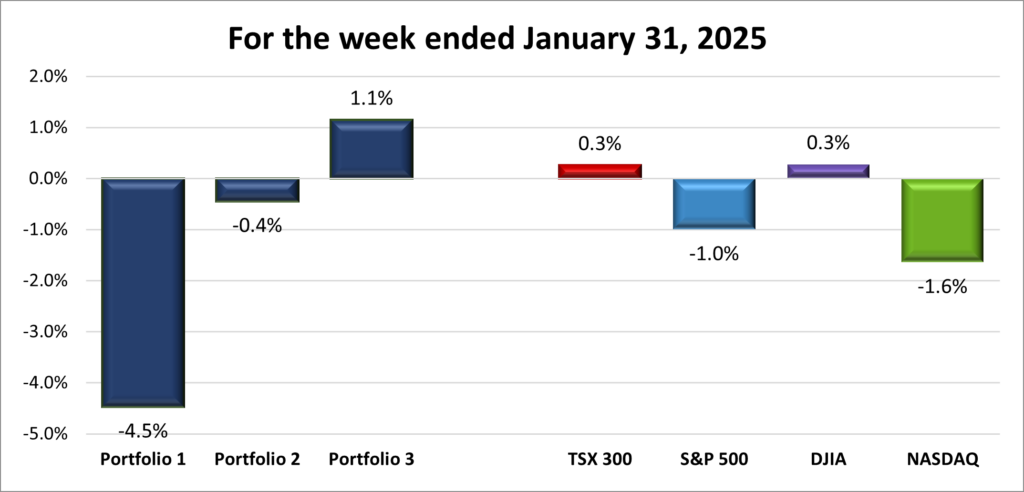
For the week, the TSX (SPTSX) advanced 1.0%, the S&P 500 (SPX) fell 1.0%, the DJIA (INDU) added 1.0% while the Nasdaq (CCMP) dropped 3.5%.

 
Index Weekly Streak
TSX: 1 – week winning streak
S&P: 2 – week losing streak
DJIA: 1 – week winning streak
Nasdaq: 2 – week losing streak

Bull market. A good week for the North American stock markets.Bearish market Markets wrapped up a volatile week, with the Toronto Stock Exchange Composite Index (TSX) and the Dow Jones Industrial Average (DJIA) starting winning streaks, while the S&P 500 Index (S&P) and the Nasdaq Composite Index (Nasdaq) extended their losses. Investors grappled with mixed corporate earnings, signs of a slowing US economy, geopolitical tensions, and renewed tariff threats.

Once again, tariffs took centre stage. President Trump’s threat of 25% tariffs on the European Union added to concerns that prolonged trade uncertainty could weigh on economic growth. While investors are increasingly tuning out the rhetoric, businesses face real challenges planning for the future, potentially delaying investments and hiring. Meanwhile, Trump’s efforts to dismantle parts of the federal bureaucracy have fueled further uncertainty, driving consumer confidence to its sharpest decline since August 2021.

The Nasdaq suffered its worst week since September 2023 after Nvidia posted better-than-expected results but concerns over potential profit-margin pressure and whether it can sustain its rapid growth had investors second-guessing the AI rally. This sparked a selloff in heavyweight tech stocks as investors shifted toward more defensive sectors.

On Friday, markets got a lift from better-than-expected US inflation data, but the good news was overshadowed by a heated exchange between Trump and Ukraine’s President Zelensky over US financial and military aid. The fallout left a US – Ukraine rare earth minerals deal unsigned, complicating peace talks and adding to geopolitical tensions.

Looking ahead, next week brings key jobs data from both Canada and the US, along with the potential implementation of US tariffs on Canadian goods starting March 4. Hopefully, markets can shake off the uncertainty and find some momentum in the week ahead.

Portfolio Weekly Streak
Portfolio 1: 2 – week losing streak
Portfolio 2: 1 – week winning streak
Portfolio 3: 2 – week losing streak

Bearish market It was a choppy week, and unfortunately, the technology sector – especially the Magnificent 7 companies – took a beating. Since all three portfolios have a tech bias, they weren’t spared from the turbulence. As shown in the weekly performance chart below, all three finished in the red. Not exactly the week I was hoping for. ☹

Portfolio 1 had the toughest time, tumbling 2.6% as only 35% of its holdings managed gains. There were a few bright spots—Berkshire Hathaway (NYSE: BRK.B) hit an all-time high, and BSR Real Estate Investment Trust (TSE: HOM.U) surged 11%. But that wasn’t enough to offset some steep declines, with Celsius Holdings (NASD: CELH) dropping 23%, Navitas Semiconductor Corp (NASD: NVTS) falling 21%, and Andlauer Healthcare Group (TSE: AND) slipping 11%.

Portfolio 2 was the only one to eke out a gain, inching up 0.1% with 37% of its holdings ending in the green. No major swings, but South Bow (TSE: SOBO) hit a record high.

Portfolio 3 landed somewhere in between, declining 1.2% with only 26% of its holdings ending higher – the lowest percentage of winners among the three. There were no standout gainers, and the biggest loss came from TELUS Digital (TSE: TIXT), which sank 11%.

Despite the rough week, volatility is part of the game – especially with a tech-heavy focus. With key economic data on deck next week, a shift in sentiment could help turn things around. If you’re investing in high-growth, volatile tech stocks, you’ve got to be ready to take a few bruises along the way. Here’s hoping for fewer bruises and a stronger showing next week! 😊

Weekly Portfolio & Index performance
Weekly Portfolio & Index performance for the week ended February 28, 2025.

Monthly Market and Portfolio Review

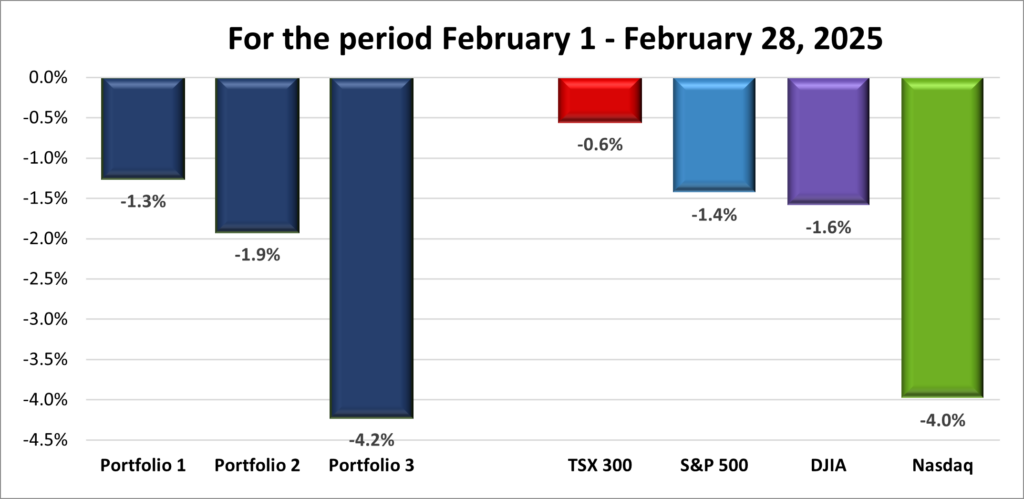
For February, the TSX (SPTSX) slipped 0.6%, the S&P 500 (SPX) lost 1.4%, the DJIA (INDU) slid 1.6% and the Nasdaq (CCMP) plunged 4.0%.

Bearish market February was quite the ride for the North American markets, with plenty of ups and downs. As shown in the monthly progress chart above, the American markets experienced a big drop at the end of the month, giving back much of the gains seen earlier in February.

Several factors contributed to the wild swings in the market. One of the biggest drivers was the announcement of potential tariffs on Canada, Mexico, and China, which caused initial uncertainty. While this sparked worries about how these tariffs might impact the economy, by month’s end, many investors began to tune out the ongoing tariff threats. Still, concerns about how tariffs might hurt consumer confidence were felt throughout the month.

The technology sector, always a rollercoaster, was hit hard. Companies like Nvidia and Tesla (NASD: TSLA) saw their stock prices drop, driven by mixed earnings reports and shifts in market sentiment. On top of that, weaker-than-expected consumer confidence, rising inflation worries, and the fear of higher interest rates put additional pressure on the markets. Many investors were concerned that potential trade wars could lead to rising prices, longer-lasting higher interest rates, a cooling job market, and a slowing economy

Meanwhile, in Canada, the tariff situation was front and centre. The ongoing uncertainty surrounding US trade policies, especially the looming threat of new tariffs, created volatility in Canadian markets as investors worried about how it would impact business investments. However, the outlook wasn’t all doom and gloom. Canada’s economy showed resilience, with growth projected to rise to 1.8% in 2025 – outpacing its potential output. Inflation was expected to remain near the Bank of Canada’s 2% target, providing some stability. Plus, strong earnings from Canada’s big six banks and a growing GDP helped offset some of the market losses.

As February wrapped up, markets faced increased uncertainty with the ongoing Ukraine-Russia conflict, inflation concerns, and signs of a slowing US economy. Meanwhile, Canada’s economy showed signs of growth, though the lingering threat of tariffs remained a wildcard.

Bearish market With all four indexes ending February in the red, it’s no surprise all three portfolios followed suit. Still, that doesn’t make it any less disappointing. ☹ Last month, I had hoped Portfolio 3’s 6.5% gain would set the tone – but I should have specified positive gains. Instead, all three landed in the red.

Portfolio 1 started strong with a two-week win streak but was dragged down by the Magnificent 7 selloff, ending the month down 1.3%. Concerns over slowing AI growth hit tech stocks hard.

Portfolio 2 seesawed between red and green weeks before finishing down 1.9%. It was the least volatile of the three, staying within 1.2% of the flatline.

Portfolio 3 took the biggest hit, dropping 4.2%. Other than a strong second week, it lost ground in three of the four weeks – tough to get ahead when you’re always playing defense.

February didn’t go as I’d hoped, but that’s the reality of investing – ups, downs, and plenty of surprises. With earnings season wrapped up, March will be driven by economic data, tariff concerns, and ongoing political and geopolitical uncertainty. A rebound is always possible, but volatility looks likely. Here’s to a stronger month ahead – hopefully with greener pastures where the bulls can run wild! 😊
Monthly Portfolio & Index performance
Monthly Portfolio & Index performance for February 2025.

Companies on the Radar

Stocks on my Radar No new companies caught my attention this past week, but as expected, I dropped Onto Innovation (NYSE: ONTO). When a stock lands on my radar, I aim to sum it up in a sentence or two for this ‘Companies on the Radar’ section. No matter how hard I tried, I just couldn’t clearly explain what Onto Innovation actually does – and if I can’t understand it, I’m not investing in it. With so many great companies out there, I stick to Charlie Munger’s advice: ‘If something is too hard, we move on to something else.’ So, I did. 😊

With that decision, my radar list is down to five companies below:

  • Sportradar Group AG (NASD: SRAD): A mid-cap Swiss company specializing in sports data, content, and integrity services that support businesses in sports, media, and betting industries.
  • Interactive Brokers (NASD: IBKR), a large-cap, American online brokerage firm known for its advanced trading platform used by professional of all levels.
  • Ultra Clean Holdings (NASD: UCTT): a small cap American company that specializes in critical components and ultra-high purity cleaning and analytical services in the chips industry.
  • Rubrik, Inc. (NASD: RBRK): a high-growth, large-cap American cybersecurity firm.
  • Axon Enterprise, Inc. (NASD: AXON): A large-cap American innovator in body cameras, TASER devices, and cloud-based evidence management software, serving law enforcement and public safety agencies.

As always, these are not buy recommendations – be sure to do your own research and make decisions that align with your personal financial goals!

The Radar Check was last updated February 28, 2025.

Stock on the Radar List. 1 of 2.
Stock on the Radar List. 2 of 2.

Portfolio Update

Portfolio 1

Portfolio 1 for the week ended February 28, 2025: DOWN Red Down Arrow

  • Amazon’s (NASD: AMZN) cloud division, Amazon Web Services (AWS), has unveiled its own quantum computing chip, Ocelot, entering the race alongside Alphabet’s (NASD: GOOGL) Google and Microsoft (NASD: MSFT). While still a prototype with only a fraction of the power needed for practical applications, AWS believes Ocelot could shorten its path to a commercial quantum system by as much as five years.

Activity

No significant activity to report this week.

Dividends

Dividends Received this week for the following companies:

Companies followed by DRIP (Dividend Re-Investment Plan) indicate additional shares were purchased with the dividend. Any cash leftover was added to the cash balance.

Canadian $

Dream Industrial Real Estate Investment Trust (TSE: DIR.UN) DRIP

Decisive Dividend Corp (TSE: DE)

US $

Costco Wholesale Corp (NASD: COST)

Quarterly Reports

Navitas Semiconductor 

Fourth quarter 2024 financial results on February 24, 2025

The Bank of Nova Scotia

First quarter 2025 financial results on February 25, 2025

The Home Depot

Fourth quarter 2024 financial results on February 25, 2025

Andlauer Healthcare Group Inc.

Fourth quarter 2024 financial results on February 26, 2025

Nvidia Corporation

Fourth quarter 2024 financial results on February 26, 2025

Magnite, Inc.

Fourth quarter 2024 financial results on February 26, 2025

TD Bank Group

First quarter 2025 financial results on February 27, 2025

Docebo Inc.

Fourth quarter 2024 financial results on February 28, 2025

Portfolio 2

Portfolio 2 for the week ended February 28, 2025: UP Green Up Arrow, signifying a positive week

Activity

No significant activity to report this week.

Dividends

Dividends Received this week for the following companies:

Canadian $

Dream Industrial Real Estate Investment Trust (TSE: DIR.UN) DRIP

US $

No US$ dividends this past week.

Quarterly Reports

The Bank of Nova Scotia

See report under Portfolio 1.

Portfolio 3

Portfolio 3 for the week ended February 28, 2025: DOWN Red Down Arrow

  • Microsoft announced they have cancelled numerous leases for significant data centre capacity in the US, suggesting a potential oversupply as they build out their AI infrastructure to meet the growing demand.

Activity

No significant activity to report this week.

Dividends

Dividends Received this week for the following companies:

Canadian $

Enghouse Systems Ltd (TSE: ENGH)

US $

No US$ dividends this past week.

Quarterly Reports

Magnite, Inc.

See report under Portfolio 1.

TD Bank Group

See report under Portfolio 1.

Royal Bank of Canada

First quarter 2025 financial results on February 27, 2025
 

Weekly Update for the week ending February 21, 2025

Last week, I talked about sector diversification and how it helps reduce risk in your portfolio. This week, I want to build on that by introducing sector rotation – a strategy some investors use to try and stay ahead of market trends.

But before we dive in, if you’re new to investing, sector rotation might be a bit more complicated than you’d like. It involves tracking economic trends, monitoring data, and making frequent portfolio adjustments, which can be tricky (even for experienced investors). Instead of trying to time the market by jumping between sectors, a better approach for beginners is to focus on building a strong, diversified portfolio of 20+ solid companies across different industries. This way, no matter what’s happening in the economy, part of your portfolio is likely doing well. Over time, as you gain experience, you can decide if sector rotation is something worth exploring.

That said, if you’re curious about how and why some investors rotate between sectors, stick around! If not, feel free to skip to the next section. 😊

So, what is sector rotation?

Sector rotation is the idea that different parts of the market perform better at different points in the economic cycle. Investors who use this strategy try to move their money into sectors that are expected to do well next.

For example, when the economy is booming, people tend to spend more on things like gadgets, vacations, and luxury goods. This benefits technology and consumer cyclicals stocks. But when the economy slows down, people cut back on extras and stick to essentials like groceries and medical care. That’s when healthcare, consumer staples, and utilities tend to hold up better.

The Economic Cycle: Why It Matters

The economy moves in cycles, and each stage affects different sectors in unique ways. Here’s a simplified breakdown:

  • Expansion (Growth Mode 🚀) – The economy is strong, businesses are investing, and consumers are spending. Sectors that do well: Technology, Consumer Cyclicals, and Industrials.
  • Peak (Everything’s Hot 🔥) – Growth is at its highest, but investors start worrying about a slowdown. Sectors that do well: Defensive sectors like Healthcare and Utilities.
  • Contraction (Slowdown 🛑) – The economy cools down, and businesses and consumers cut spending. Sectors that do well: Consumer Staples, Utilities, Healthcare.
  • Trough (Rock Bottom 📉) – The economy is at its weakest, but recovery is on the horizon. Sectors that do well: Financials, Industrials, and early-stage Tech investments.

Real-World Example: Sector Rotation During COVID-19

A great example of sector rotation happened during the COVID-19 crash in early 2020. When the market tanked, investors pulled out of high-risk sectors like Technology and Consumer Discretionary and rushed into safer areas like Healthcare and Consumer Staples (think grocery stores and drug companies). But as the economy started recovering in late 2020 and 2021, the money rotated back into Technology and Consumer Cyclicals stocks, especially as people started spending again.

Should You Use Sector Rotation?

For new investors, probably not yet. Instead of trying to jump between sectors, focus on building a strong, diversified portfolio that can weather different market conditions. Think of it like this: Instead of constantly switching between different teams in a sports league, why not build a well-rounded team from the start?

That said, if you’re interested in learning about sector trends, here are a few tips:

  1. Pay attention to economic indicators – Things like GDP growth, unemployment rates, and inflation give clues about where the economy is headed.
  2. Look at sector performance – Sector ETFs (exchange-traded funds) can help you see which sectors are doing well.
  3. Don’t overcomplicate things – Even professional investors don’t get sector rotation right all the time. Sticking with a diversified approach is often the best bet.

Final Thoughts

Sector rotation is an interesting concept, but it’s not something new investors need to worry about right away. A diversified portfolio across multiple industries already gives you exposure to different sectors at different times. As you gain more experience, you might decide to fine-tune your portfolio based on economic trends – but for now, keeping it simple is often the best strategy. 😊

Knowing how sectors perform in different economic cycles is useful, but the real question is – what’s driving the markets right now? Let’s take a look at this week’s biggest movers and what they mean for us investors.


Items that may only interest or educate me ….

Canadian Economic news, US Economic news .…

Canadian Economic news

This past week’s key economic data that the Bank of Canada (BoC) considers when deciding whether to raise or lower the interest rate.

Consumer Price Index (CPI)

Canada’s inflation rate edged higher in January, coming in above expectations both monthly and annually. According to Statistics Canada, headline inflation rose 0.1%, reversing December’s 0.4% decline, while markets had expected no change. On a yearly basis, inflation climbed to 1.9%, slightly above the forecasted 1.8% and marking the first acceleration since October 2024. Despite the increase, inflation has remained below the BoC’s 2% target for six straight months.

Gas prices were a key driver, jumping 4.0% in January and 8.6% year over year. Meanwhile, ‘Recreation, education, and reading’ and ‘Alcoholic beverages, tobacco products, and recreational cannabis’ both saw prices dip 0.6% for the month. One area that continues to pressure consumers is shelter costs, which rose 0.3% in January and are up 4.5% from a year ago.

Core inflation, which excludes volatile food and energy prices, declined 0.1% for the third straight month. However, on an annual basis, core CPI came in at 2.2%, edging above both the expected and December’s 2.1%.

While rising energy costs, particularly gasoline and natural gas, pushed inflation higher, the temporary GST/HST tax break and falling food prices helped soften the overall increase. It will take until the March CPI report for the effects of the GST break to be fully removed from inflation data.

With higher inflation readings, stronger-than-expected jobs data, and uncertainty around potential US tariffs, many analysts now believe the central bank may hold off on rate cuts at its next meeting on March 12. However, if tariffs are imposed, expectations for rate cuts could shift once again.

Retail Trade

Canadian retail sales saw a major rebound in December, surging 2.5% after staying flat in November – the biggest jump since May 2022. This strong finish to the year pushed annual sales growth to 3.9%, well above November’s 1.6% and crushing expectations of just 0.8%.

Stripping out volatile categories like auto sales and gasoline, core retail sales also jumped 2.5% in December, bouncing back from a 1.0% drop the previous month. Year over year, core sales climbed 3.0%, far outpacing November’s sluggish 0.8% growth.

The sharp rise in spending was largely driven by the GST tax holiday, which kicked in on December 15 and encouraged shoppers to spend more in the second half of the month. However, early data suggests sales dipped 0.4% in January, indicating that the initial boost didn’t sustain into the new year.

Retail sales are a key driver of economic growth, making up nearly 40% of total consumer spending. December’s surge suggests that many Canadians delayed purchases until the tax break kicked in, giving the economy an extra push to close out 2024 on a high note.

Canadian market volatility

Canada’s Volatility Index (VIXC) started the week at 14.86, staying mostly within the range of 14.30 to 16.0. But the week wasn’t all smooth sailing – thanks to some new mid week tariff threats, the VIXC temporarily spiked above 20 following a lumber tariff warning. Things then took an unexpected turn with a sharp, short-lived drop to 10.75 before settling back in the 15-point range, ending the week at 14.99, essentially where the VIXC started.

For those new to the VIXC (traded as VIXI on the Toronto Stock Exchange), think of it as the market’s fear gauge. Readings below 10 signal smooth sailing, while 10 to 20 reflect normal market fluctuations. Once it pushes past 20, uncertainty starts creeping in, and things can get choppy. 😊

US Economic news

This past week’s key data points that the Federal Reserve (Fed) considers when deciding whether to raise or lower the interest rate.

Federal Open Market Committee (FOMC) minutes

The FOMC just released the minutes from its January 28-29 meeting, offering insight into the Fed’s current stance. The key takeaway? Policymakers remain cautious, weighing optimism about economic growth against persistent inflation concerns.

  • Interest Rates Stay Put – The Fed kept its benchmark interest rate unchanged at 4.25% to 4.5%, choosing to wait and see how things unfold. This means borrowing costs – like mortgages, car loans, and business loans – won’t change for now. If you’re considering a big purchase, your financing costs should stay steady.
  • Inflation Worries Remain – The Fed is still keeping a close watch on inflation (aka rising prices), especially with tariffs potentially driving costs higher. Before considering rate cuts, they want more proof that inflation is under control. The goal? Keeping your everyday expenses from spiraling out of control.
  • Economic Optimism – There’s a positive outlook on the economy, partly thanks to expected regulatory changes and tax policy adjustments that could support business growth. A stronger economy can mean more job opportunities and better investment returns.
  • A Wait-and-See Approach – With past rate cuts already making monetary policy less restrictive, the Fed is in no rush to act. They’re assessing economic data before making any major moves.
  • Policy Independence – Fed Chair Jerome Powell emphasized that their decisions are guided by data – not politics. This helps ensure stability and predictability for businesses and investors.
  • Future Rate Cuts? – While the Fed isn’t ruling out future rate adjustments, they’re not in a hurry to lower rates until they’re confident inflation is under control. For now, patience is the plan.

Bottom Line:

The Fed is keeping rates steady, balancing cautious optimism about the economy with concerns about inflation. For both consumers and investors, this means rate cuts aren’t coming just yet. However, understanding the Fed’s decisions – and the reasoning behind them – can help you see the bigger economic picture and make more informed financial choices.

Consumer Sentiment Index (CSI)

The University of Michigan’s final CSI for February came in at 64.7, marking a sharp drop of 9.8% from January’s 71.1 and falling well short of analysts’ expectations of 67.8. Compared to last year’s 76.9, sentiment is down 15.9%, hitting its lowest level since November 2023. This also marks the second straight month of declining consumer confidence.

Looking at the details: The Current Economic Conditions Index, which reflects how people feel about their finances right now, dropped to 65.7 from 75.1—a steep 12.5% decline and 17.3% lower than a year ago. Meanwhile, the Index of Consumer Expectations, which gauges optimism about the next six months, slipped to 64.0, down 7.9% from January and 14.9% year-over-year.

This decline wasn’t limited to one group—sentiment dropped across all age, income, and wealth brackets. The main culprit? Growing concerns that tariff-driven price hikes could erode consumers’ purchasing power.

American market volatility

The CBOE Volatility Index (VIX), often called the market’s “fear gauge,” started the week at 15.57 and hovered around 16 as investors largely brushed off ongoing tariff threats. By week’s end, investors seemed to grow numb to the uncertainty – until a last-minute surge pushed the VIX to 18.21, triggered by weaker-than-expected economic data that reignited concerns about the economy.

For those new to the VIX, think of it as the market’s stress meter. A reading below 12 means calm waters, while 12 to 20 signals normal market swings. If it climbs above 20, nerves are rising, and anything over 30 usually signals real trouble.


Weekly Market and Portfolio Review

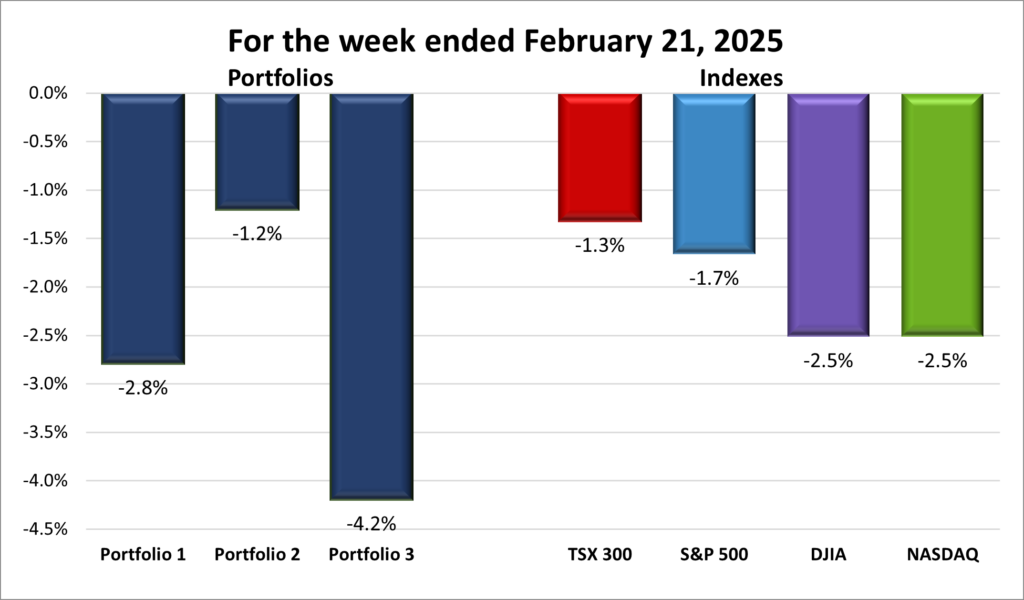
For the week, the TSX (SPTSX) slipped 1.3%, the S&P 500 (SPX) lost 1.7%, the DJIA (INDU) and the Nasdaq (CCMP) both fell 2.5%.

Index Weekly Streak
TSX: 1 – week losing streak
S&P: 1 – week losing streak
DJIA: 1 – week losing streak
Nasdaq: 1 – week losing streak

Bearish market Markets sailed through rough waters this week, with waves of uncertainty growing stronger as fresh tariff threats and weakening consumer demand pulled indexes underwater by week’s end, as shown in the weekly progress chart above.

At first, markets managed to stay afloat despite last week’s stronger-than-expected US inflation report. But the tide turned when President Trump announced a series of industry-specific tariffs. Early in the week, he signaled forthcoming 25% tariffs on imported cars, semiconductors, and pharmaceuticals. Investors barely flinched – until he later tacked on lumber and forest products, sending markets into stormy seas. These latest threats have rattled investors, stoking fears that a broader trade war may be on the horizon.

As businesses and investors try to navigate these shifting currents, the impact is already showing up in inflation expectations. Long-term inflation forecasts among US consumers surged to their highest level since 1995, with many expecting prices to rise at an annual rate of 3.5%. With each new tariff announcement, concerns over higher costs, economic uncertainty, and market volatility continue to mount.

Not long ago, artificial intelligence and Magnificent 7 companies were steering market sentiment, but tariffs, inflation fears, and lackluster corporate earnings have now taken the helm. As a result, consumer confidence has taken a hit, weighed down by growing concerns over employment, a slowing economy, and rising rates.

In Canada, the Big Six banks will report earnings next week against a backdrop of uncertainty. If tariffs take effect, they could create ripple effects for Canadian businesses, making it harder for some to repay loans—bad news for banks and, in turn, the broader economy. A wave of rising defaults from struggling businesses and consumers would only add to an already turbulent environment.

To put an exclamation point on how rough the shortened week was, Friday delivered the worst trading day of 2025 for both the Canadian and U.S. markets – a stormy end to an already turbulent stretch. ☹

Portfolio Weekly Streak
Portfolio 1: 1 – week losing streak
Portfolio 2: 1 – week losing streak
Portfolio 3: 1 – week losing streak

Bearish market At the halfway mark, all three portfolios were sitting in the green – but unfortunately, the week wasn’t over. A rough final two days pushed them into the red ☹, as shown in the weekly performance chart below.

Portfolio 1 had a tough week, slipping 2.8%, with only 32% of holdings managing a gain. There weren’t many bright spots, but Celsius Holdings (NASD: CELH) soared 140% on its acquisition of a competitor. Offsetting that strength were steep losses from Cloudflare (NYSE: NET), down 13%, Trade Desk (NASD: TTD) and indie Semiconductor (NASD: INDI), both down 12%, and Datadog (NASD: DDOG), which slipped 10%.

Portfolio 2 fared the best – or rather, lost the least – dipping 1.2% with 40% of holdings in positive territory. There weren’t any major swings, but iA Financial (TSE: IAG) set a record high early in the week before giving up those gains to finish lower, while Take-Two Interactive (NASD: TTWO) hit an all-time high on its way to a weekly win.

Portfolio 3 had the roughest stretch, with only 21% of its holdings closing higher as it fell 4.2%. Cloudflare took a hit, dropping 13%, while Vertiv Holdings (NYSE: VRT) slid 11%, adding to the drag.

While the week didn’t end the way I’d hoped, that’s just part of the ride in investing. February has brought its fair share of volatility, but with that comes opportunity. Next week is a fresh slate – and a chance for the portfolios to bounce back!

Weekly Portfolio & Index performance
Weekly Portfolio & Index performance for the week ended February 21, 2025.

Companies on the Radar

Stocks on my Radar This past week, two companies in the semiconductor space caught my attention – Onto Innovation (NYSE: ONTO) and Ultra Clean Holdings (NASD: UCTT). Neither of them actually makes semiconductors, but both play a key role in the chip-making process.

Ultra Clean Holdings specializes in critical components and ultra-high purity cleaning and analytical services, helping semiconductor manufacturers improve efficiency from design to production. Onto Innovation, on the other hand, develops advanced process control tools – though, if I’m being honest, their technology is a bit beyond my understanding. And if I can’t easily grasp what a company does, it usually ends up in my ‘too-hard-to-understand basket.’ That said, I’ll still take a quick look before deciding whether to keep it on my radar.

With these two additions, my radar list now sits at six US companies, including the four holdovers below.

  • Sportradar Group AG (NASD: SRAD): A mid-cap Swiss company specializing in sports data, content, and integrity services that support businesses in sports, media, and betting industries.
  • Interactive Brokers (NASD: IBKR), a large-cap, American online brokerage firm known for its advanced trading platform used by professional of all levels.
  • Rubrik, Inc. (NASD: RBRK): a high-growth, large-cap American cybersecurity firm.
  • Axon Enterprise, Inc. (NASD: AXON): A large-cap innovator in body cameras, TASER devices, and cloud-based evidence management software, serving law enforcement and public safety agencies.

As always, these are not buy recommendations – be sure to do your own research and make decisions that align with your personal financial goals!

The Radar Check was last updated February 21, 2025.

Stock on the Radar List. 1 of 2.
Stock on the Radar List. 2 of 2.

Portfolio Update

Portfolio 1

Portfolio 1 for the week ended February 21, 2025: DOWN Red Down Arrow

  • Celsius Holdings made its largest deal in its 20-year history with the acquisition of energy drink rival Alani Nu for US$1.8 billion. Both brands have a strong foothold in the fitness and wellness space, but the acquisition gives Celsius an easy entry into the supplement and snack market, expanding its reach beyond beverages. Celsius is hoping this deal will help them to reclaim lost market share and accelerate growth.

Activity

Buy: Walmart (NYSE: WMT) I first invested in Walmart back in March 2024. Walmart is a steady performer through most of the economic cycle, but it really shines when times get tough – making it a great counterbalance to some of the riskier, growth-focused stocks in my portfolio.

Since that initial investment, Walmart has delivered strong results, and the stock price has followed suit – up nearly 60% as of this update. My original reasons for investing still hold: Walmart’s ability to generate solid, stable revenue and profit, backed by a well-diversified business model that spans retail, wholesale, and e-commerce.

Their fourth-quarter earnings report beat revenue and profit expectations, but the company’s cautious outlook for 2025 gave some investors pause, leading to a temporary drop in the stock price. That didn’t change my conviction. In fact, during their earnings presentation, CEO Doug McMillon reinforced Walmart’s momentum, saying:

“We have momentum driven by our low prices, a growing assortment, and an eCommerce business driven by faster delivery times. We’re gaining market share, our top line is healthy, and we’re in great shape with inventory.”

So, when Walmart’s stock pulled back after the earnings presentation, I saw it as an opportunity to add to my position at a discount – so I did. 😊

Dividends

Dividends Received this week for the following companies:

Canadian $

BSR Real Estate Investment Trust (TSE: HOM.UN)

US $

No US$ dividends this past week.

Quarterly Reports

Cameco Corporation

Fourth quarter 2024 financial results on February 20, 2025

Walmart Inc.

Fourth quarter 2024 financial results on February 20, 2025

Grab Holdings Limited

Fourth quarter 2024 financial results on February 20, 2025

indi Semiconductor, Inc.

Fourth quarter 2024 financial results on February 20, 2025

Celsius Holdings, Inc.

Fourth quarter 2024 financial results on February 20, 2025

Portfolio 2

Portfolio 2 for the week ended February 21, 2025: DOWN Red Down Arrow

  • Zoetis (NASD: ZTS) announced they have received conditional approval for the use of its bird flu vaccine in poultry.

Activity

No significant activity to report this week.

Dividends

Dividends Received this week for the following companies:

Companies followed by DRIP (Dividend Re-Investment Plan) indicate additional shares were purchased with the dividend. Any cash leftover was added to the cash balance.

Canadian $

SmartCentres Real Estate Investment Trust (TSE: SRU.UN)

Whitecap Resources Inc (TSE: WCP) DRIP

US $

No US$ dividends this past week.

Quarterly Reports

iA Financial Group

Fourth quarter 2024 financial results on February 18, 2025

Whitecap Resources Inc.

Fourth quarter 2024 financial results on February 19, 2025

Birkenstock Holding plc

First quarter 2025 financial results on February 20, 2025

Guardant Health, Inc.

Fourth quarter 2024 financial results on February 20, 2025

Supremex Inc.

Fourth quarter 2024 financial results on February 20, 2025

Portfolio 3

Portfolio 3 for the week ended February 21, 2025: DOWN Red Down Arrow

  • Microsoft (NASD: MSFT) announced they planned to spend an additional US$7 million in Poland to help improve Polish cybersecurity capabilities.
    In other Microsoft news, the company announced a new quantum computing chip, the Majorana 1. The company claims the new chip means quantum computers capable of solving industrial-scale problems are only years rather than decades away.

Activity

No significant activity to report this week.

Dividends

Dividends Received this week for the following companies:

Canadian $

SmartCentres Real Estate Investment Trust (TSE: SRU.UN) DRIP

US $

No US$ dividends this past week.

Quarterly Reports

No quarterly reports this past week.


Weekly Update for the week ending February 14, 2025

When it comes to investing, putting all your money into one industry is like relying on a single star player to carry your hockey team. Sure, they might put up big numbers in some games, but if they hit a slump, run into tough opponent or get injured, your team (or portfolio) could struggle. That’s where sector diversification comes in. Just like a championship team needs a mix of scorers, grinders, defenders, and a rock-solid goalie, a strong portfolio benefits from investments across multiple sectors. This strategy helps balance risk and improve long-term performance, no matter what the markets throw your way. Let’s take a closer look.

Building a Strong Investment Portfolio with Sector Diversification

Think of your investment portfolio like a hockey team. If you rely only on star forwards to score goals, you might dominate some games but struggle against tough defenses. But with a balanced lineup—including strong defensemen, a solid goalie, and hardworking, physical grinders—you’re better prepared for any challenge. Sector diversification works the same way. By investing across different industries like technology, healthcare, finance, and energy, you reduce the risk of one sector dragging down your entire portfolio.

How Sector Diversification Strengthens Your Portfolio

Different sectors perform differently depending on the economy, just like players on a hockey team shine in different situations. Tech stocks might thrive during economic booms, like star forwards lighting up the scoreboard in a high-scoring game. But when the economy slows, defensive sectors like utilities rise to the occasion—just like a strong goalie and defense keeping the team in a physical, low-scoring game. By diversifying, you build a portfolio that can adapt to changing market conditions, just like a well-rounded hockey team adjusts to different styles of play.

Why You Should Diversify Across Sectors

  1. Lower Risk and More Stability – A well-diversified portfolio is like a balanced hockey team. If one player has an off night, the rest of the team can step up and keep the team in the game. Similarly, spreading your investments across sectors—like technology, utilities, consumer cyclicals, and consumer staples, for example—helps cushion your portfolio when one sector struggles, keeping your overall performance on track.
  2. Growth Opportunities: Some players are great scorers, some are hard nosed defenders, and others grind out wins. Investing across sectors gives you more chances to benefit from different market trends, just like having a deep lineup with different types of players increases your team’s chances of winning.
  3. Simplicity: It’s a straightforward way to ensure you’re not overly reliant on any single player or style of play. In the case of your investment portfolio, it removes the risk of being reliant on one or two sectors to carry your portfolio.

At the end of the day, sector diversification is like building a championship hockey team—you want a mix of players that can perform in different situations, not just a lineup of goal scorers. By spreading your investments across various sectors and industries, you give yourself a better chance to navigate market ups and downs while positioning your portfolio for long-term growth. So, whether the market is flying down the ice on a breakaway or grinding through a tough defensive battle, a well-diversified strategy can help keep you in the game. 😊🏒

Now that we’ve covered how a well-rounded portfolio can help you handle whatever the market throws your way, much like how a well built team can contend for the Stanley Cup, let’s see what happened this past week….


Items that may only interest or educate me ….

Canadian Economic news, US Economic news, ….

Canadian Economic news

This past week’s key economic data that the Bank of Canada (BoC) considers when deciding whether to raise or lower the interest rate.

Bank of Canada minutes

The BoC’s Governing Council cut the benchmark interest rate by 0.25% at their January 29th, 2025, meeting, bringing it down to 3.0%. This marks the sixth consecutive cut, aimed at stimulating the sluggish economy amidst uncertainty over potential US tariffs that, if prolonged, could permanently harm economic growth.

The minutes revealed that while past rate cuts have helped boost consumer spending and housing, business investment remains sluggish. The BoC expects Canada’s economy to pick up steam in 2025, projecting GDP growth of 1.8% for both 2025 and 2026. However, these forecasts don’t yet account for potential US tariffs, which could throw a wrench into the recovery.

On the global stage, economic growth is expected to hover around 3% over the next two years, but trade tensions remain a major risk. To help support the economy, the BoC also announced it will stop reducing the amount of bonds and other assets it holds and will start buying them again in March. This is meant to keep borrowing costs lower and provide more stability to financial markets.

The Council stressed that Canadians should stay informed about how trade conflicts could impact inflation and the broader economy. With uncertainties ahead, all eyes are on how the central bank and the government navigate the next steps.

Canadian market volatility

Canada’s Volatility Index (VIXC) started the week at a calm 13.78 but gradually climbed as talks of tariffs on Canadian steel and aluminum exporters stirred market jitters. The VIXC saw occasional spikes above 17 before settling at 14.86 by week’s end, as tariff concerns lingered in the background.

For those new to the VIXC (traded as VIXI on the TSX), think of it as the market’s fear gauge. Readings below 10 signal smooth sailing, while 10 to 20 reflect normal market fluctuations. Once it pushes past 20, uncertainty starts creeping in, and things can get choppy. 😊

US Economic news

This past week’s key data points that the Federal Reserve (Fed) considers when deciding whether to raise or lower the interest rate.

Consumer price Index (CPI)

US inflation came in hotter than expected in January, throwing a wrench into hopes for early rate cuts. The CPI rose 0.5% for the month, exceeding both December’s 0.4% gain and economists’ forecast of 0.3%. On an annual basis, CPI ticked up to 3.1%, slightly above December’s 2.9% and the expected 2.9% increase.

On a monthly basis, ‘Fuel oil’ saw the biggest monthly jump at 6.2%, while ‘Apparel’ was the only category to decline, dropping 1.4%. Year-over-year, ‘Transportation services’ led the pack with an 8.0% increase, while ‘Fuel oil’ posted the sharpest decline, down 5.3%.

On the housing front, shelter costs – which include rent and mortgages – rose 0.4% for the month, slightly faster than December’s 0.3% increase. However, the annual rate of shelter inflation continued to cool, landing at 4.4%, down from 4.6% in December.

The Core CPI, which strips out food and energy, also came in hot. It rose 0.4% for the month, surpassing December’s 0.2% increase and expectations of 0.3%. Annually, Core CPI ticked up to 3.3%, compared to 3.2% in December and an expected 3.1%.

Inflation heated up in January, with headline CPI seeing its largest monthly jump since August 2023 and core CPI posting its biggest increase since April 2023. With both measures now running at their fastest annual pace since May 2023, the Fed is likely to keep rates higher for longer to rein in inflation. That means borrowing costs for consumers and businesses may stay elevated, potentially slowing economic growth in the months ahead.

Retail Sales

January’s US retail sales report came in far weaker than expected, with sales plunging 0.9% – far below the predicted 0.1% decline. This marked the largest monthly drop in a year, following a 0.4% gain in December. Despite the rough start to the year, annual retail sales still climbed 4.2%, improving on December’s 3.9% increase and beating forecasts of 3.8% growth.

Core retail sales, which strips out automobiles, vehicle parts, and gas stations, unexpectedly fell 0.5% after December’s 0.4% gain. Analysts had expected a 0.3% increase. However, on an annual basis, core sales rose 3.9%, topping December’s 3.3% gain and aligning with expectations.

While the sharp 0.9% drop signals a notable pullback in consumer spending, the 4.2% year-over-year increase suggests demand is still holding up overall. The unexpected 0.5% decline in core retail sales is another red flag. Since core sales exclude volatile categories like gas and autos, they provide a clearer picture of underlying consumer spending. The fact that analysts were expecting a gain but instead got a decline suggests that households could be pulling back more than expected, possibly due to lingering inflation, high interest rates, or economic uncertainty.

As for the economy, this report reinforces concerns that economic growth may be slowing. Retail sales are a key driver of Gross Domestic Product (GDP), so a sharp monthly drop could signal weaker demand and a cooling economy. If this trend continues, it could pressure the Fed to consider rate cuts sooner rather than later to prevent a sharper downturn. However, the solid year-over-year growth suggests that the economy isn’t collapsing – just losing some steam.

The big question is whether this drop is just a seasonal blip or the start of a more sustained pullback in consumer spending. The February and March reports will provide more clarity, especially as markets gauge whether the economy can maintain its resilience.

For us investors, weaker consumer spending increases the chances of the Fed cutting rates sooner, which could be bullish for equities overall. If markets start pricing in earlier rate cuts, growth stocks – particularly heavyweight technology companies – could benefit as borrowing costs decline.

For now, the key takeaway is to watch for follow-up data. If the next retail sales report confirms a downward trend, we might need to adjust expectations for economic growth – and for market performance in consumer-facing sectors.

American market volatility

The CBOE Volatility Index (VIX), often called the market’s “fear gauge,” started the week at 16.58 and hovered around 16 as investors took ongoing tariff threats in stride. By week’s end, with markets growing numb to the uncertainty, the VIX dipped to 14.78, signaling a more relaxed sentiment.

For those new to the VIX, think of it as the market’s stress meter. A reading below 12 means calm waters, while 12 to 20 signals normal market swings. If it climbs above 20, nerves are rising, and anything over 30 usually signals real trouble.


Weekly Market and Portfolio Review

For the week, the TSX (SPTSX) edged higher 0.2%, the S&P 500 (SPX) advanced 1.5%, the DJIA (INDU) increased 0.5% and the Nasdaq (CCMP) climbed 2.6%.

 
Index Weekly Streak
TSX: 1 – week winning streak
S&P: 1 – week winning streak
DJIA: 1 – week winning streak
Nasdaq: 1 – week winning streak

Bull market. A good week for the North American stock markets. The markets bounced back this past week, with all four major indexes – the Toronto Stock Exchange Composite Index (TSX), the S&P 500 Index (S&P), the Dow Jones Industrial Average (DJIA), and the Nasdaq Composite Index (Nasdaq) – finishing higher. But the ride wasn’t exactly smooth, with markets swinging back and forth throughout the week.

Once again, tariffs were in the spotlight. President Trump announced a 25% tariff on all steel and aluminum imports, and later in the week, he raised the stakes by threatening reciprocal tariffs on all US trading partners. While markets initially shrugged off the news – investors have gotten used to tariff threats – the bigger concern is that tariffs could push prices higher, fueling inflation and keeping interest rates elevated for longer.

That concern only deepened when fresh inflation data came in hotter than expected, raising doubts about how quickly price pressures will ease. Higher inflation makes it less likely the Fed will cut rates anytime soon – something Fed Chair Jerome Powell reinforced in his testimony to Congress, saying the Fed is in no rush to lower rates. In fact, some investors are now questioning whether there will be any rate cuts this year – or if another hike could even be on the table. And since tariffs tend to push prices up rather than down, they only add to the inflation challenge.

On the bright side, strong earnings reports across multiple sectors suggest the bull market isn’t just about the Magnificent 7 anymore. A broader rally is a positive sign, showing that more companies – not just heavyweight tech stocks – are thriving.

Meanwhile, Canada remains in the crosshairs. After delaying 25% tariffs across the board, Trump imposed them on Canadian steel and aluminum and even floated the idea of 100% tariffs on the Canadian auto sector. It’s becoming clear that tariffs – and the threat of them – are a key bargaining tool in American trade negotiations.

Right now, markets are caught between optimism about economic growth, thanks to potential deregulation and tax cuts, and the reality of rising inflation pressures. The coming weeks will tell whether strong earnings can keep the momentum going – or if inflation and interest rate fears take centre stage.

Portfolio Weekly Streak
Portfolio 1: 2 – week winning streak
Portfolio 2: 1 – week winning streak
Portfolio 3: 1 – week winning streak

Bull market. A good week for the North American stock markets. With all the market volatility this past week, I wasn’t sure what to expect from my portfolios. Turns out, it was a pleasant surprise – all three bounced back into the win column! While there were no jaw-dropping gains, Portfolios 1 and 3 posted solid increases, while Portfolio 2 managed a more modest climb. You can check out the weekly performance chart below for the respective performance.

Portfolio 1 took the crown this week, with 56% of holdings finishing in the green. Only the Nasdaq outperformed it among major indexes and portfolios. Ferrari (NASD: RACE) hit the gas, speeding ahead 10% to a record high, joined by CrowdStrike (NASD: CRWD) and TMX Group (TSE: X), which also crossed the finish line at new peaks. However, The Trade Desk (NASD: TTD) stalled out, skidding 33% after missing expectations and forecasting slower revenue growth next quarter.

Portfolio 2 saw the smallest gain of the three, both in percentage terms and in the number of winning stocks, with only 33% of holdings posting gains. However, an 18% jump from Airbnb (NASD: ABNB), along with slight upticks from some larger holdings, was enough to offset the majority of declines.

Portfolio 3 had a decent week, with 56% of its holdings finishing higher – matching Portfolio 1’s percentage of gainers. The biggest boost came from Adyen N.V. (OTCM: ADYEY), which surged 20%, more than making up for an 11% drop in Vertiv Holdings (NYSE: VRT).

After the previous week when all the portfolios lost money, I’m more than happy to see them bounce back into the win column. Overall, a solid week across the board! 😊

Weekly Portfolio & Index performance
Weekly Portfolio & Index performance for the week ended February 14, 2025.

Companies on the Radar

Stocks on my Radar No new companies caught my eye this past week, but I did make one adjustment to my radar list – I decided to remove Howmet Aerospace Inc. (NYSE: HWM). The reason? The uncertainty caused by recently implemented 25% tariff on steel and aluminum products could significantly impact the company. Since Howmet specializes in advanced engineered solutions for aerospace and transportation, it relies heavily on these metals. With costs rising, the company may face tighter profit margins if it can’t pass those costs on to customers. In a competitive market, that’s not always easy. They might have to explore alternative suppliers or materials to offset the impact, but for now, I’m removing it from my watchlist.

My radar list now consists of these four companies:

  • Interactive Brokers (NASD: IBKR), a large-cap, American online brokerage firm known for its advanced trading platform used by professional of all levels.
  • Sportradar Group AG (NASD: SRAD): A mid-cap Swiss company specializing in sports data, content, and integrity services that support businesses in sports, media, and betting industries.
  • Rubrik, Inc. (NASD: RBRK): a high-growth, large-cap American cybersecurity firm.
  • Axon Enterprise, Inc. (NASD: AXON): A large-cap innovator in body cameras, TASER devices, and cloud-based evidence management software, serving law enforcement and public safety agencies.

As always, these are not buy recommendations – be sure to do your own research and make decisions that align with your personal financial goals!

The Radar Check was last updated February 14, 2025.

Stock on the Radar List. 1 of 2.
Stock on the Radar List. 2 of 2.

Portfolio Update

Portfolio 1

Portfolio 1 for the week ended February 14, 2025: UP Green Up Arrow, signifying a positive week

  • CrowdStrike unveiled its Charlotte AI Detection Triage, an advanced tool that autonomously analyzes, prioritizes, and summarizes detections with exceptional accuracy. By instantly distinguishing true threats from false alarms, it allows cybersecurity experts to focus on real risks more efficiently.

Activity

Sold: A covered call option on some Nvidia shares Since I held onto my shares from my last ‘covered call’ in late January, Nvidia (NASD: NVDA) still made up nearly 40% of this portfolio’s value. I still want to trim my position, so this past week, I sold another covered call on some of my shares. Just like the last two, I set the strike price at $150 per share – this time with an expiration date of February 28, 2025. If Nvidia hits $150, my shares will be sold as planned. If not, I’ll keep both my shares and the option premium.

Either way, it’s a win-win. 😊 If the shares are called away, my portfolio becomes more balanced, and I free up cash to invest elsewhere. If they aren’t, I pocket some extra income while holding onto a stock I still like. A solid strategy that fits my goals!

Dividends

Dividends Received this week for the following companies:

Canadian $

No C$ dividends this past week.

US $

Apple Inc. (NASD: AAPL)

Quarterly Reports

Lattice Semiconductor Corporation

Fourth quarter 2024 financial results on February 10, 2025

Shopify Inc.

Fourth quarter 2024 financial results on February 11, 2025

The Trade Desk, Inc.

Fourth quarter 2024 financial results on February 12, 2025

Datadog, Inc.

Fourth quarter 2024 financial results on February 13, 2025

TELUS Corporation

Fourth quarter 2024 financial results on February 13, 2025

Trisura Group Ltd.

Fourth quarter 2024 financial results on February 13, 2025

Portfolio 2

Portfolio 2 for the week ended February 14, 2025: UP Green Up Arrow, signifying a positive week

Activity

No significant activity to report this week.

Dividends

Dividends Received this week for the following companies:

Canadian $

TC Energy (TSE: TRP)

US $

No US$ dividends this past week.

Quarterly Reports

Mitek Systems, Inc.

Fourth quarter 2024 financial results on February 13, 2025

SmartCentres Real Estate Investment Trust

Fourth quarter 2024 financial results on February 12, 2025

Zoetis Inc.

Fourth quarter 2024 financial results on February 13, 2025

TELUS Corporation

See report under Portfolio 1.

Airbnb, Inc.

Fourth quarter 2024 financial results on February 13, 2025

Fortis Inc.

Fourth quarter 2024 financial results on February 14, 2025

TC Energy Corporation

Fourth quarter 2024 financial results on February 14, 2025

Portfolio 3

Portfolio 3 for the week ended February 14, 2025: UP Green Up Arrow, signifying a positive week

  • TD Bank (TSE: TD) announced they will be selling their remaining 10.1% stake in US financial company Charles Schwab. The company expects the sale will bring roughly US$ 14 billion which will be used for share buybacks, to improve performance and enhance organic growth.

Activity

No significant activity to report this week.

Dividends

No dividends this past week.

Quarterly Reports

Shopify Inc.

See report under Portfolio 1.

Vertiv Holdings Co.

Fourth quarter 2024 financial results on February 12, 2025

Brookfield Asset Management Ltd.

Fourth quarter 2024 financial results on February 12, 2025

Brookfield Corporation

Fourth quarter 2024 financial results on February 13, 2025

goeasy Ltd.

Fourth quarter 2024 financial results on February 13, 2025

Telus Digital

Fourth quarter 2024 financial results on February 13, 2025


The Magnificent Seven

The Magnificent Seven: Powerhouses Driving Innovation and Market Growth

The magnificent 7 companies above a western themed 'magnificent Seven' The Magnificent Seven isn’t just a legendary Western movie anymore—it’s also the nickname for the seven technology giants shaping the future and dominating stock markets. These companies aren’t just industry leaders; they’re innovators, disruptors, and the driving forces behind some of the biggest trends in artificial intelligence (AI), cloud computing, automation, and renewable energy.

Who Are the Magnificent Seven:
  • Alphabet (NASD: GOOGL): Google’s parent company is more than just a search engine powerhouse. Alphabet is behind cutting-edge projects in AI (DeepMind), self-driving cars (Waymo), and life sciences. They’re always looking for the next moonshot that could reshape the world.
  • Amazon (NASD: AMZN): More than an e-commerce giant, Amazon is the backbone of the internet thanks to Amazon Web Services (AWS). From retail to cloud to logistics, Amazon is all about scale, speed, and disrupting traditional industries.
  • Apple (NASD: AAPL): Apple isn’t just about iPhones. It’s built an ecosystem of must-have devices and services that keep users locked in. With seamless integration, premium design, and a loyal fanbase, Apple has mastered the art of anticipating what consumers want before they even know it.
  • Meta (NASD: META): Formerly Facebook, Meta is betting big on the metaverse and virtual reality. Whether their vision of a digital world catches on or not, their influence on how we connect, advertise, and consume content is undeniable.
  • Microsoft (NASD: MSFT): What started as a software company is now a cloud computing giant. With their Azure platform leading in enterprise cloud solutions, a strong presence in gaming (Xbox), and massive investments in AI, Microsoft remains one of the most influential companies in tech.
  • Nvidia (NASD: NVDA): Once known mainly for gaming graphics, Nvidia is now the king of AI chips. Their graphic processor units (GPUs) power everything from machine learning to data centres to self-driving cars. Big players like OpenAI, Microsoft, and Google rely on Nvidia’s chips to train advanced AI models, making them a crucial part of the AI revolution.
  • Tesla (NASD: TSLA): Tesla isn’t just an automaker; it’s a clean energy disruptor. With innovative battery technology, AI-driven self-driving advancements, and a bold vision for sustainable transportation, Tesla is pushing the world toward a greener future.
Why These Seven Matter

Much like the seven heroes in the classic film, these companies dominate their respective industries and collectively shape the market. When the broader market struggles, these seven often drive market gains, making them a key force behind major index movements.

Beyond their financial muscle, their influence extends to:

  • Shaping Our Daily Lives: From how we communicate (Apple, Alphabet, Meta) to how we work (Microsoft), shop (Amazon), and power AI (Nvidia).
  • Driving Innovation: Leading breakthroughs in AI, cloud computing, electric vehicles, and virtual reality.
  • Economic Impact: Creating jobs, influencing global trade, and shaping supply chains worldwide.
The Magnificent Seven’s Recent Performance

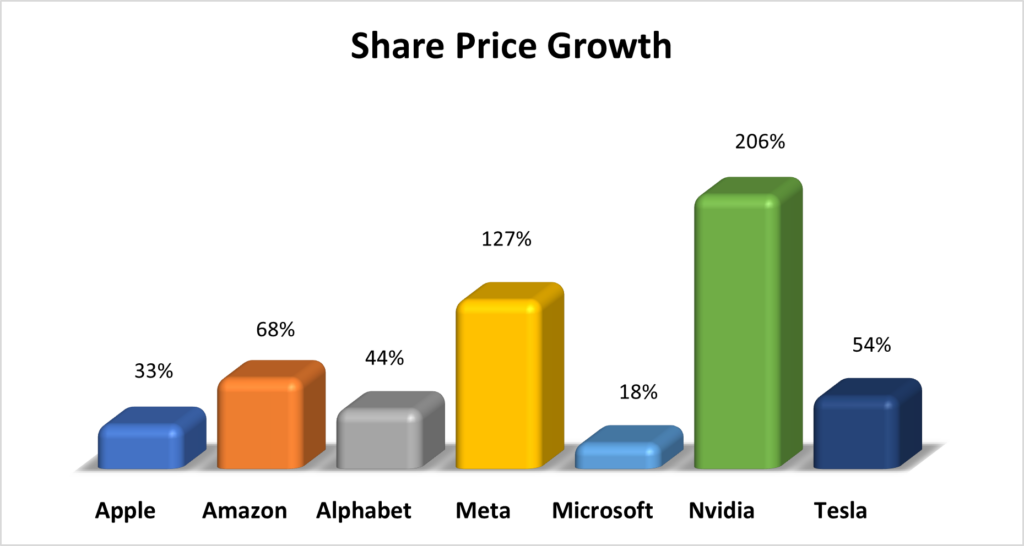
Since the start of this bull run on November 1, 2023, these companies have seen their share prices rise, though at different paces. As of February 1, 2025, here’s how they stack up:

bar chart showing the share price growth of the Magnificent 7 companies
Figure 1: Share price growth from Nov. 1, 2023, to Feb 7, 2025.

While all seven have gained, Nvidia has been the clear standout, tripling in value, while Microsoft has stalled recently, leading to a more modest rise. This divergence highlights how even within the Magnificent Seven, performance can vary widely based on market trends, innovation, and investor sentiment.

Why Investors Should Care
  • Market Movers: Even if you don’t own their stocks, their performance impacts indexes like the S&P 500 and Nasdaq Composite, which means they can still influence your portfolio.
  • Innovation Leaders: These companies are often at the centre of the next big trend—whether it’s AI, cloud computing, or sustainability. Keeping an eye on them can provide valuable insights.
  • Growth Potential: While past performance isn’t a guarantee, these companies have consistently demonstrated strong long-term growth. (But remember, always do your own research before investing! 😉)
What’s Next for the Magnificent Seven?

As we look toward 2025:

  • AI and Machine Learning: Nvidia, Microsoft, and Alphabet are pushing AI forward, transforming industries from healthcare to finance.
  • Sustainability: Tesla continues to drive the clean energy movement, potentially accelerating global adoption of renewables.
  • Metaverse Development: Meta’s big bet could reshape online interaction—or fizzle out. Either way, it’s a space to watch.
  • Regulatory Scrutiny: To paraphrase Peter Parker of Spiderman fame, ‘With great power comes great scrutiny.’ Governments worldwide are keeping a close eye on Big Tech’s influence, and future regulations could shake things up.
The Takeaway: What Investors Can Learn

It’s crazy to think that some of these companies started in garages and dorm rooms, yet today, they wield more influence than entire industries once did. Their rise is a testament to the power of innovation and the rapid pace of technological change.

For investors, understanding the Magnificent Seven isn’t about blindly jumping on the hype train—it’s about recognizing the forces shaping our world and making informed investment decisions. Whether you own their stocks or not, these companies will continue to play a significant role in the future of investing.


Weekly Update for the week ending February 7, 2025

With tariffs dominating the news the last few weeks, I thought it’d be a good time to talk about how they impact us as consumers and investors.

What Are Tariffs?
Tariffs are essentially taxes on imported goods, meant to regulate trade and protect domestic industries. In this case, President Trump is using them as a bargaining chip in trade negotiations. By making foreign products more expensive, tariffs can push consumers toward locally made goods, but they often come with unintended consequences.

Recent Developments

The trade relationship between the US and Canada is one of the largest and most interconnected in the world, but it hasn’t been without its disputes. In this latest one, on February 1, President Trump imposed 25% tariffs on a wide range of Canadian goods, including steel and aluminum, citing the need to curb illegal drug flows – particularly fentanyl – and illegal immigration. To justify these tariffs, he declared a national economic emergency.

This move comes despite the USMCA trade deal negotiated during his first administration. In response, Canada hit back with 25% tariffs on $155 billion worth of US goods, targeting alcohol, furniture, and natural resources. Prime Minister Trudeau defended the decision as necessary to protect Canadian businesses and workers. Fortunately, President Trump agreed to a 30-day suspension of tariffs on Canada. This decision came after both countries committed to enhancing border security measures to address concerns about drug trafficking and illegal immigration.

Both sides are seeking a resolution, but consumers on both sides of the border will pay the price if the tariffs are reintroduced. The Wall Street Journal has even called it the “Dumbest Trade War Ever.”

Impact on Consumers

Tariffs might sound like an issue for big businesses, but they directly affect consumers and investors:

  • Higher Prices 🛒 – Businesses pass tariff costs onto consumers, meaning you could be paying more for everyday goods.
  • Supply Chain Issues 🚛 – Many companies rely on cross-border materials. When those costs rise, it disrupts supply chains and slows production.
  • Stock Market Volatility 📉📈 – Trade uncertainty can increase market volatility, impacting stocks – including those in your portfolio.

Impact on the Canadian Economy and Consumers

For Canada, US-imposed tariffs are a major headache, especially for export-heavy industries. Higher costs make Canadian goods less competitive, leading to potential job losses and slower economic growth. Consumers also feel the squeeze – whether through higher prices or fewer product choices. Economic uncertainty may also cause businesses to delay investments, further dampening growth.

Impact on the American Economy and Consumers

On the US side, tariffs drive up costs for manufacturers relying on Canadian raw materials, making production more expensive and reducing competitiveness. Farmers are also hit hard when retaliatory tariffs shrink their export markets. And just like in Canada, US consumers face higher prices on affected goods, which can lead to lower spending – ultimately slowing economic momentum.

Is There a Winner in a Trade War?

Not really. While tariffs might temporarily shield certain industries from foreign competition, they also create uncertainty and hurt key sectors like manufacturing and agriculture. Over time, they tend to slow economic growth and cost jobs rather than protect them.

Broader Economic Implications

  • Trade Wars 🔥 – Tit-for-tat tariffs can escalate into full-blown trade wars, straining international relations.
  • Market Volatility 📉 – Uncertainty over tariffs often leads to unpredictable stock market swings, affecting investments and retirement funds.
  • Damaged Trade Relationships 🌎 – Long trade battles can damage partnerships, making future deals tougher.

While tariffs may help certain domestic industries in the short term (by reducing foreign competition), they disrupt trade, increase costs, and reduce overall economic efficiency. If these US-Canada tariffs remain in place or escalate, both economies could face slower growth, weaker job creation, and reduced consumer confidence – a situation neither country wants.

A Simple Analogy: The Locked Garden Gate

Imagine Canada and the US as two neighbours who’ve always shared a garden. Over the years, they’ve traded tools, seeds, and harvests, benefiting from each other’s strengths. Then, one day, the US puts up barriers on its side. In response, Canada does the same. Now, both have less variety, increased costs, and the garden isn’t thriving like before. In the end, both sides lose.

Final Thoughts

While tariffs may protect certain industries in the short term, they often lead to higher prices for consumers. For us investors, they create market uncertainty, resulting in stock market volatility and slowing long-term growth. As US-Canada trade tensions continue, the effects will ripple through both economies, driving up prices, and ultimately, there will be no winner.

With trade tensions adding another layer of uncertainty and volatility, investors are watching for signs of progress – or further escalation. But tariffs weren’t the only market-moving factor this past week. Labour data from both countries and earnings reports also played a role. Let’s look at how the markets reacted and what it meant for the three portfolios.


Items that may only interest or educate me ….

Canadian Economic news, US Economic news,

Canadian Economic news

This past week’s key economic data that the Bank of Canada (BoC) considers when deciding whether to raise or lower the interest rate.

Labour Force Survey (LFS)

According to Statistics Canada, the Canadian job market kicked off the year on solid footing, adding 76,000 jobs in January. While that’s down from December’s 91,000, it’s still far better than the 25,000 jobs analysts had expected. Meanwhile, the unemployment rate edged down to 6.6%, marking its second consecutive monthly decline after peaking at 6.9% in November. That’s a positive short-term trend, though unemployment remains higher than the 5.7% recorded a year ago.

Wage growth continued to cool, coming in at a rate of 3.5% compared to 3.8% in December. That’s a noticeable slowdown from the 5% wage growth we saw through most of 2023 and 2024. While slower wage growth might not sound great, it does help ease inflation concerns.

Overall, this report shows a job market that’s still expanding, even if momentum is slowing. For the BoC, strong employment numbers suggest there’s no rush to cut interest rates, keeping the focus on maintaining economic stability and controlling inflation. For us small-time investors, a resilient job market and rising wages typically lead to more consumer spending, which can drive company profits – and potentially lift stock prices. 😊

Canadian market volatility

Canada’s Volatility Index (VIXC) had a wild ride this past week, with sharp jumps and drops. It started at 19.99 as US tariffs took effect, only to plunge below 16 that same day when the tariffs were suspended for a month. The VIXC spent the rest of the week bouncing between 14.0 and 20.38, closing at 14.49 as concerns over tariffs faded into the background – at least for now.

For those new to the VIXC (traded as VIXI on the TSX), think of it as the market’s fear gauge. Readings below 10 signal smooth sailing, while 10 to 20 reflect normal market fluctuations. Once it pushes past 20, uncertainty starts creeping in, and things can get choppy. 😊

US Economic news

This past week, several key job market reports gave investors and the US Federal Reserve (Fed) more insight into the state of the economy and what it could mean for interest rates going forward.

Labour data

Labor Department’s Job Openings and Labor Turnover Survey (JOLTS)

The December JOLTS report showed job openings falling to 7.6 million – below the expected 8.0 million and a sharp drop from November’s 8.2 million. This marks the lowest level since September 2024 and the steepest month-over-month decline since October 2023. A key measure of labour market tightness – the number of job openings per unemployed worker – also ticked down from 1.15 to 1.1, signalling a gradual cooling in demand for workers.

ADP Employment Report

Private employers added 183,000 jobs in January, beating expectations of 150,000 and slightly outpacing December’s revised 176,000 gain. The services sector was the clear winner, adding 190,000 jobs, while goods-producing industries – especially manufacturing – continued to struggle, shedding 6,000 jobs.

This divergence highlights a key trend: while overall job growth remains steady, manufacturing has been in a rough patch for months, raising concerns about the sector’s outlook.

Employment Situation Report (ESR).

The official US jobs report showed a slowdown in hiring, with 143,000 jobs added in January – down from December’s 256,000 and below the 170,000 analysts had expected. Meanwhile, the unemployment rate dipped slightly to 4.0% from 4.1%, and private sector hiring slowed as well, with payrolls increasing by 140,000 compared to 223,000 the previous month.

On the wage front, average earnings rose 0.5% for the month, pushing year-over-year wage growth to 4.1%, up from December’s 3.9%. While slower job growth could suggest some cooling in the labour market, rising wages might keep inflation concerns on the radar – something the Fed will be watching closely.

Implications

The final labour reports of the Biden presidency paints a picture of an economy near full employment. While the job market remains strong, signs of moderation are emerging. A stable but slowing labour market could give the Fed room to cut interest rates later this year – but with wages rising and uncertainty around President Trump’s economic policies, they’ll likely stick to a wait-and-see approach. For us investors, a strong but not overheated job market is a good thing, as it helps support consumer spending and corporate earnings. And when corporate earnings rise, share prices tend to follow.😊

Consumer Sentiment Index (CSI)

Consumer sentiment took a hit in February, with the University of Michigan’s CSI falling for the second month in a row to 67.8 – its lowest level since last July. That’s a 4.6% drop from January’s 71.1 and a steep 11.8% decline from a year ago when sentiment was at 76.9. Analysts had expected a stronger reading, making this slide a bit of a surprise.

Looking under the covers, the Current Economic Conditions Index, which reflects how people feel about their personal finances right now, fell to 74 – down 7.2% from last month and 13.5% lower than a year ago. Meanwhile, the Expectations Index, which measures how consumers feel about the future, dipped to 67.3, marking a 2.9% monthly drop and a 10.5% decline year-over-year.

The drop in sentiment was broad-based, affecting consumers across political lines, ages, and incomes. The main culprits? Growing worries that tariffs could drive up inflation, with short-term inflation concerns reaching their highest level since November 2023. On top of that, many Americans fear rising unemployment could be on the horizon, adding to economic uncertainty.

American market volatility

The CBOE Volatility Index (VIX), often called the market’s ‘fear gauge,’ came out high, opening at 20.36 due to uncertainty surrounding tariffs and retaliatory measures. However, as a suspension of tariffs were announced for both Mexico and Canada, the VIX dropped below the 20 mark, moving out of the high-volatility range. By the end of the week, with the immediate threat of a trade war fading, the VIX settled back into a more normal range between 15 and 17.5, closing at 16.54.

For those new to the VIX, think of it as the market’s stress meter. A reading below 12 means calm waters, while 12 to 20 signals normal market swings. If it climbs above 20, nerves are rising, and anything over 30 usually signals real trouble.


Weekly Market and Portfolio Review

For the week, the TSX (SPTSX) slipped 0.4%, the S&P 500 (SPX) lost 0.2%, the DJIA (INDU) fell 0.5% and the Nasdaq (CCMP) dropped 0.5%.

Index Weekly Streak
TSX: 1 – week losing streak
S&P: 2 – week losing streak
DJIA: 1 – week losing streak
Nasdaq: 2 – week losing streak

Bearish market The markets were on a rollercoaster this past week, with all four major indexes fluctuating as trade uncertainty and mixed technology earnings kept investors on edge. As shown in the weekly progress graph above, the week started on shaky ground after the US imposed tariffs on Canada and Mexico, but markets rebounded the next day after both countries were granted at least 30 days to address concerns. With trade worries temporarily on hold, earnings took centre stage.

Technology company earnings were a mixed bag, raising fresh doubts about the massive AI investments. Amazon and Alphabet (Google) both delivered solid results, however, slower-than-expected growth in their cloud divisions, where AI was expected to shine, left investors underwhelmed. Cautious forecasts for the next quarter didn’t help, dampening enthusiasm despite earnings beats. Still, strong reports by other companies helped claw back much of the market’s early losses.

Just as investors thought tariff concerns had cooled, President Trump reignited tensions by announcing plans for new reciprocal tariffs on unspecified countries next week. If tariffs on America’s top trading partners weren’t enough, this latest move added to market jitters. Analysts warn that prolonged trade conflicts could push inflation higher, delaying long-awaited rate cuts even further.

Finally, January labour data showed President Biden left office with the US job market near full employment. While President Trump campaigned on promises of even better economic times, this latest report suggests there’s little room left for improvement – raising concerns that the job market is more likely to weaken than strengthen, especially if trade tensions escalate. In Canada, the latest labour data showed signs of a strengthening labour market, but the positive labour news was overshadowed by lingering tariff threats. This uncertainty weighed on Canadian stocks, particularly those of companies heavily involved in cross-border trade.

The tug-of-war between strong earnings and tariff uncertainty made for a volatile week. The longer trade uncertainty lingers, the greater the risk to the Canadian economy – and, to a lesser extent, the US economy. But with volatility comes opportunity, and I was more than happy to take advantage of it this past week. 😊

Portfolio Weekly Streak
Portfolio 1: 1 – week winning streak
Portfolio 2: 2 – week losing streak
Portfolio 3: 1 – week losing streak

Bearish marketBull market. A good week for the North American stock markets. With all the ups and downs in the markets this past week, I wasn’t sure how my portfolios would perform. With all four major indexes finishing lower, I braced for a rough week – but to my surprise, one portfolio managed to finish higher, as shown in the weekly performance chart below.

Portfolio 1 was the standout, finishing in the green. A solid 74% of its holdings posted weekly gains, led by big movers like TMX Group (TSE: X) and Kraken Robotics (TSE: PNG), each up 12%, Celestica (TSE: CLS) up 14%, Cloudflare (NYSE: NET) up 25%, and Magnite (NASD: MGNI) surging 29%. Nvidia (NASD: NVDA), the portfolio’s largest holding, jumped 14%, driving overall performance. Liberty Media – Formula 1 (NASD: FWONK), Walmart (NYSE: WMT), and TMX Group also hit record highs. On the downside, PayPal (NASD: PYPL) slid 10%, and Skyworks Solutions (NASD: SWKS) took a heavy 27% hit. If not for Nvidia’s strong run, Portfolio 1 would’ve joined the other portfolios and indexes in the red. A silver lining to the pullback in Nvidia’s share price a few weeks ago, the option I sold for Nvidia at $150 expired on February 7, meaning I keep both the shares and the premium the buyer paid me. 😊

Portfolio 2 was a bit of a mystery. Despite 81% of its holdings posting gains, it still ended the week lower. The reason? A few companies with large declines carried enough weight to offset the gains, including Take-Two Interactive Software’s (NASD: TTWO) 13% jump. While TTWO performed well, its smaller weight in the portfolio – ranking 24th out of 27 holdings – limited its impact.

Portfolio 3 had a tough week, snapping a three week winning streak, with just 54% of holdings finishing higher. There were some bright spots – Vertiv Holdings (NYSE: VRT) climbed 14%, Cloudflare gained 25%, and Magnite surged 29% – but those strong performances couldn’t overcome the sharp declines earlier in the week.

While it wasn’t the strongest week, there were plenty of bright spots. Another solid performance from Nvidia, a few standout gains, and some record highs made it a week worth appreciating, even with just one portfolio finishing in the green. Volatility is part of the game, but sticking to my long-term strategy will help me ride out the bumps on the way to my investing goals. 😊

Weekly Portfolio & Index performance
Weekly Portfolio & Index performance for the week ended February 7, 2025.

Companies on the Radar

Stocks on my Radar There was some movement on my radar list this past week – one company dropped off while another caught my attention. I decided to say goodbye to GitLab Inc. (NASD: GTLB), the large-cap software company specializing in developer tools. There was nothing wrong with the business, but when looking at potential investments in technology companies, I felt there were stronger opportunities elsewhere.

Taking its place is Interactive Brokers (NASD: IBKR), a large-cap online brokerage firm known for its advanced trading platform used by professional investors and retail investors (like us!). With access to 150 global markets, IBKR makes it possible to trade stocks, options, bonds, currencies, and more—all from a single platform. Essentially, it opens the door to investing beyond just Canada and the US. I’m not only interested in it as a potential investment but also as a tool for expanding my own portfolio into international markets.

With this update, my radar list stays at five companies – IBKR and the four listed below:

  • Sportradar Group AG (NASD: SRAD): A mid-cap Swiss company specializing in sports data, content, and integrity services that support businesses in sports, media, and betting industries.
  • Howmet Aerospace Inc. (NYSE: HWM): A large-cap American company producing cutting-edge engineered products like airfoils, titanium forgings, and forged aluminum wheels for aerospace, energy, and transportation sectors.
  • Rubrik, Inc. (NASD: RBRK): a high-growth, large-cap American cybersecurity firm.
  • Axon Enterprise, Inc. (NASD: AXON): A large-cap innovator in body cameras, TASER devices, and cloud-based evidence management software, serving law enforcement and public safety agencies.

As always, these are not buy recommendations – be sure to do your own research and make decisions that align with your personal financial goals!

The Radar Check was last updated February 7, 2025.

Stock on the Radar List. 1 of 2.
Stock on the Radar List. 2 of 2.

Portfolio Update

Portfolio 1

Portfolio 1 for the week ended February 7, 2025: UP Green Up Arrow, signifying a positive week

  • Grab Holdings (NASD: GRAB) is reportedly in advanced talks to merge with its smaller Indonesian rival, GoTo, as both ride-hailing and food delivery giants look to curb years of losses in Southeast Asia.
  • Alphabet (NASD: GOOGL) announced they plan to spend US$75 billion on their AI buildout in 2025, 29% more than analysts expected.

Activity

Bought: Alphabet I’ve invested in Alphabet (or as most people know it – Google) twice before and watched the stock climb steadily. I had been looking for an opportunity to add more shares, ideally on a dip, but what really pushed me to increase my investment was their announcement of Willow, their quantum computing chip, in early December.

When it comes to investing in technology, I try to look ahead and identify which companies will dominate when a new breakthrough goes mainstream. That approach worked out well with Nvidia and Shopify (TSE: SHOP). 😊 While quantum computing isn’t commercially viable yet, when it is, I want to be well-positioned. Among all the companies involved, I see Google as the safest bet – they have deep pockets, strong R&D, and a track record of turning innovation into profit.

Beyond quantum computing, Alphabet offers plenty of other growth opportunities. They’re going all-in on artificial intelligence (AI), with plans to invest $75 billion in AI development in 2025 – a move that should enhance everything from Google Search to their cloud services. Speaking of search, Google remains the undisputed leader, with almost 90% of the global search engine market. Alphabet’s diverse revenue streams – from digital ads to cloud computing, healthcare, and self-driving technology with Waymo—give them a strong edge for long-term growth.

Under CEO Sundar Pichai, Alphabet has consistently grown revenue, earnings per share, and cash flow since he took the reins in 2015. So, when the stock dropped 10% after fourth quarter earnings this past week, mainly due to weaker-than-expected cloud revenue, I saw it as a great buying opportunity – and pounced. 😊

Bought: Amazon.com (NASD: AMZN) After successfully adding to my Alphabet position earlier this past week, I set my sights on Amazon – waiting to see if a post-earnings dip would present a buying opportunity. Sure enough, despite beating revenue and net income estimates, Amazon’s cloud revenue came in slightly below expectations, raising concerns about its AI investments and returns. On top of that, its next-quarter revenue forecast fell short of analyst expectations. These two issues triggered a 5% drop in the share price – and that’s when I stepped in.

So why increase my stake (even if it’s still a very small position 😊)? Amazon dominates US e-commerce, controlling nearly 38% of the market, and its relentless focus on speed, selection, and Prime membership benefits keeps it ahead of competitors. But Amazon is far more than just an online retailer. Amazon Web Services (AWS) remains a major profit driver, and with the rise of AI, Amazon is well-positioned to capitalize. Meanwhile, its advertising business is booming, with ad revenue up 19% last quarter as more companies shift their marketing budgets to Amazon’s platform.

Beyond the US, Amazon continues its global expansion, growing Amazon Fresh, Whole Foods, and Prime benefits worldwide. This international push strengthens its long-term prospects while diversifying revenue streams. Financially, Amazon has a strong history of consistent growth and reinvesting in innovation, making it a solid long-term bet. Given all this, I saw the recent dip as a terrific opportunity to buy more shares – so I did. 😊

Dividends

Dividends Received this week for the following companies:

Companies followed by DRIP (Dividend Re-Investment Plan) indicate additional shares were purchased with the dividend. Any cash leftover was added to the cash balance.

Canadian $

Bank of Nova Scotia (TSE: BNS) DRIP

US $

No US$ dividends this past week.

Quarterly Reports

TMX Group Limited

Fourth quarter 2024 financial results on February 3, 2025

Alphabet Inc.

Fourth quarter 2024 financial results on February 4, 2025

PayPal Holdings, Inc.

Fourth quarter 2024 financial results on February 4, 2025

Skyworks Solutions, Inc.

First quarter 2025 financial results on February 5, 2025

Amazon.com, Inc.

Fourth quarter 2025 financial results on February 6, 2025

BCE Inc.

First quarter 2025 financial results on February 6, 2025

Cloudflare, Inc.

Fourth quarter 2025 financial results on February 6, 2025

Ferrari N.V.

Fourth quarter 2024 financial results on February 4, 2025

Portfolio 2

Portfolio 2 for the week ended February 7, 2025: DOWN Red Down Arrow

  • MongoDB (NASD: MDB) has teamed up with Swiss bank Lombard Odier to modernize the bank’s technology systems. By integrating AI, the partnership aims to simplify the bank’s operations, accelerate innovation, and cut project timelines from days to mere hours – enhancing efficiency across the board.

Activity

No significant activity to report this week.

Dividends

Dividends Received this week for the following companies:

Canadian $

Bank of Nova Scotia (TSE: BNS) DRIP

Dollarama (TSE: DOL)

US $

No US$ dividends this past week.

Quarterly Reports

The Walt Disney Company

First quarter 2025 financial results on February 5, 2025

Take-Two Interactive Software, Inc.

Third quarter 2025 financial results on February 6, 2025

Portfolio 3

Portfolio 3 for the week ended February 7, 2025: DOWN Red Down Arrow

  • Brookfield Asset management (TSE: BAM) has entered the fray to purchase Australian money manager Insignia Financial (ASE: IFL). BAM matched the A$3 billion from other suitors but their offer allowed Insignia shareholders to receive shares in lieu of cash if they prefer.

Activity

No significant activity to report this week.

Dividends

No dividends this past week.

Quarterly Reports

Cloudflare, Inc.

See report under Portfolio 1.


Monthly Portfolio Update January 2025

Monthly Market and Portfolio Review

Bull market. A good week for the North American stock markets. January was a comeback month for the markets, with all four major North American indexes finishing in the green and getting back in the win column, as shown in the monthly progress chart above. The rally was fueled by strong earnings, solid economic data, and the Fed’s decision to keep interest rates steady. Excitement around AI also played a big role, pushing technology stocks higher—at least for most of the month. But it wasn’t all smooth sailing. Growing concerns over new trade tariffs on the US’s top three trading partners rattled investors, and AI momentum hit a wall in the final week after a Chinese AI firm introduced a platform that rivaled much pricier American alternatives, raising questions about future AI spending.

Up north, the TSX rode the wave of another interest rate cut, economic growth, and a surge in gold stocks as investors looked for safety amid the tariff uncertainty. But with Canada in the crosshairs of potential trade restrictions, volatility in the Canadian market spiked.

January got the new year off to solid start, with the DJIA and TSX leading the way thanks to their heavier weighting in traditional industries. While strong earnings and AI enthusiasm helped fuel gains, trade tensions kept markets on edge. With tariffs set to take effect on February 1, the next few months could be a wild ride. Buckle up! 😊

To put January’s market performance in perspective, here’s a look at how the major indexes fared. The TSX (SPTSX) climbed 3.3%, lifted by another rate cut and strength in gold stocks. The S&P 500 (SPX) added 2.7%, while the DJIA (INDU) led the way with a 4.7% surge, thanks to its heavier exposure to traditional industries. The Nasdaq (CCMP) trailed with a 1.6% gain as AI stocks lost steam late in the month.

The chart below tracks how these indexes moved throughout January, capturing the ups and downs of a market balancing strong economic data, AI-driven enthusiasm, and renewed trade uncertainty.

Portfolio Monthly Streak
Portfolio 1: 1 – month winning streak
Portfolio 2: 1 – month winning streak
Portfolio 3: 1 – month winning streak

Bull market. A good week for the North American stock markets. As for the three portfolios, I was pleasantly surprised by Portfolio 3’s standout performance in January, crushing the competition by outpacing the next best portfolio fivefold and even outperforming all four major indexes. The only downside? Portfolio 1 ended the month in the red, keeping it from a clean sweep of all portfolios ending in the green. Overall, it was a solid month for the portfolios, but it would’ve been even better if Portfolio 1 had joined the others in the win column—and even better if the other two had matched Portfolio 3’s stellar performance! 😊

Weekly Portfolio & Index performance
Weekly Portfolio & Index performance for the week ended January 31, 2025.

Portfolio Update

Portfolio 1 for January 2025: DOWN Red Down Arrow

Activity

Sold: Innovative Industrial Properties Inc. (NYSE: IIPR) see Jan 10 update.

Sold: Pinterest (NYSE: PINS) see Jan 10 update.

Bought: Kraken Robotics (TSE: PNG) see Jan 17 update.

Sold: A covered call option on some Nvidia (NASD: NVDA) shares. see Jan 24 update.

Sold: BCE Inc. (TSE: BCE) see Jan 31 update.

Sold: General Motors (NYSE: GM) see Jan 31 update.

Dividends Received this month:

Companies followed by DRIP (Dividend Re-Investment Plan) indicate additional shares were purchased with the dividend. Any cash leftover was added to the cash balance.

Canadian $

Telus Corp (TSE: T) DRIP

Andlauer Healthcare Group Inc (TSE: AND)

Dream Industrial Real Estate Investment Trust (TSE: DIR.UN) DRIP

Decisive Dividend Corp (TSE: DE) DRIP

BCE Inc (TSE: BCE) DRIP

Canadian National Railway (TSE: CN)

Tourmaline Oil Corp (TSE: TOU)

US $

Walmart (NYSE: WMT)

Skyworks Solutions (NASD: SWKS)

Nvidia Corp (NASD: NVDA)

Quarterly Reports

General Motors Company

Fourth quarter 2025 financial results on January 28, 2025

Apple Inc.

First quarter 2025 financial results on January 30, 2025

Celestica Inc.

Fourth quarter 2024 financial results on January 30, 2025

Canadian National Railway Company

Fourth quarter 2024 financial results on January 30, 2025

Visa Inc.

First quarter 2025 financial results on January 30, 2025

Portfolio 2 for January 2025:  UP Green Up Arrow, signifying a positive week

Activity

No significant activity to report this month.

Dividends Received this month:

Canadian $

Telus Corp (TSE: T) DRIP

Whitecap Resources Inc (TSE: WCP) DRIP

SmartCentres Real Estate Investment Trust (TSE: SRU.UN)

Brookfield Infrastructure Partners LP (TSE: BIP.UN) DRIP

Dream Industrial Real Estate Investment Trust (TSE: DIR.UN) DRIP

South Bow Corp (TSE: SOBO)

US $

Walt Disney Co. (NYSE: DIS)

Brookfield Infrastructure Partners (TSE: BIP.UN) DRIP

Brookfield Infrastructure Partners Corp. (TSE: BIPC)

iA Financial Group (TSE: IAG)

Tourmaline Oil Corp. (TSE: TOU)

Canadian Natural Resources (TSE: CNQ)

Quarterly Reports

Microsoft Corp.

Second quarter 2025 financial results on January 29, 2025

Brookfield Renewable Partners L.P.

Fourth quarter 2024 financial results on January 31, 2025

Portfolio 3 for January 2025:  UP Green Up Arrow, signifying a positive week

Activity

Bought: Evolution AB (OTCM: EVVTY) see Jan 17 update.

Dividends Received this month:

Canadian $

goeasy Ltd (TSE: GSY)

TD US Equity Index ETF (TSX: TPU)

Alvopetro Energy Ltd. (TSEV: ALV)

SmartCentres Real Estate Investment Trust (TSE: SRU.UN) DRIP

Brookfield Corporation (TSE: BN)

Brookfield Renewable Partners (TSE: BEP.UN)

Brookfield Asset management (TSE: BAM)

US $

No US$ dividends this past week.

Quarterly Reports

Microsoft Corp.

See report under Portfolio 2.

Real Matters Inc.

First quarter 2025 financial results on January 31, 2025

Brookfield Renewable Partners L.P.

See report under Portfolio 2.