Weekly Update for the week ending September 6, 2024

The September Roller Coaster

September has a long-standing reputation for being one of the worst and most turbulent months for the markets, often marked by increased volatility. This phenomenon is often referred to as the “September Effect.” This year appears to be no exception as investors try to gauge the Federal Reserve’s next moves based on the latest economic data. Historically, it has been the worst-performing month for the indexes. In fact, from 1950 to 2023, the S&P 500 (S&P) averaged a decline of about 0.5% in September, making it one of the few months where the index consistently posts negative returns.

Several notable market crashes have occurred during September. In 1929, the Dow Jones Industrial Average (DJIA) saw sharp losses leading up to the Great Depression, with September’s declines setting the stage for the infamous October crash. More recently, in 2001, the 9/11 terrorist attacks led to a sharp drop in stock prices when markets reopened. In 2008, the collapse of Lehman Brothers triggered the global financial crisis, with September being one of the most turbulent months that year.

Several factors contribute to September’s volatility. Many mutual funds close their fiscal year during this month, prompting portfolio rebalancing, selling off underperforming stocks, and locking in gains, which adds selling pressure. Additionally, critical economic data and earnings reports released in September shape market sentiment, often leading to swift market moves. After the quiet summer trading season, activity ramps up as professional traders return, further intensifying volatility. Moreover, the perception of September as a “bad month” can become a self-fulfilling prophecy, with skittish investors selling or hedging positions, amplifying market movements.

Though September is primarily known for declines, there have been exceptions during strong bull markets, though these instances are rarer.

In summary, September’s volatility stems from a blend of fiscal rebalancing, crucial economic reports, and investor psychology. With its history of market swings and downturns, even minor news can spark nervous reactions, reinforcing its reputation as a tough month for investors. So, buckle up and hang on – it is time for what is typically a wild and woolly roller coaster ride! 😊

Let’s take a closer look at the start of the September roller coaster and see how the market’s ride has played out so far ….

Items that may only interest or educate me ….

Canadian Economic news, US Economic news, ….


Canadian Economic news

This past week’s key economic data that the Bank of Canada (BoC) considers when deciding whether to raise or lower the interest rate.

Bank of Canada rate decision

As widely anticipated, the BoC lowered its benchmark interest rate by 0.25%, bringing it to 4.25%. This marks the third consecutive cut of the same size. The BoC highlighted the absence of significant inflationary pressure and signaled more rate cuts could be on the horizon as long as inflation continues its downward trend.

Governor Tiff Macklem also suggested a larger cut could be on the table if necessary, stating, “If we need to take a bigger step, we’re prepared to take a bigger step.” He emphasized the need to guard against the risk of an overly weak economy that could cause inflation to fall too low.

The BoC is increasingly concerned about the steady slowdown in the economy, which could push inflation below their target of 2%. While inflation below 2% might not seem worrisome at first, it can signal underlying economic weakness, potentially leading to slower growth, reduced investment, and deflation risks.

However, for consumers, businesses, and investors, this latest rate cut is good news. Lower interest rates generally stimulate economic activity by making borrowing more affordable. Consumers benefit from cheaper credit, businesses see reduced financing costs, and investors often enjoy higher stock prices and improved returns. Ultimately, lower interest rates can act as a catalyst for economic growth.

Labour Force Survey (LFS)

Statistics Canada’s August Labour Force Survey revealed that the economy added 22,000 jobs, slightly below the expected 25,000 after shedding 2,800 positions in July. Most of the job gains were part-time, up 1.8%, while full-time positions dipped by 0.3%. The public sector saw a slight monthly decline of 0.2%, while the private sector grew by 0.3%. On a year-over-year basis, public sector employment surged by 4.3%, outpacing the private sector’s 1.0% growth – raising concerns, particularly as the private sector ultimately funds the public one.

The unemployment rate rose to 6.6%, surpassing the anticipated 6.5% and marking the highest level since May 2017 (excluding the COVID-19 years). There were 1.5 million unemployed in August, an increase of 60,000 from July and up 272,000 from a year ago. This rise, which has been slowly climbing since April 2023, is likely linked to increased immigration.

Wage growth also eased, with average hourly earnings rising by 5.0% annually in August, slowing from July’s 5.2% gain. As the job market softens, wage growth is also starting to slow.

Although employment increased slightly, it has remained relatively steady over the past four months. The combination of stagnant job growth and slowing wages should help ease concerns about inflation reversing course. This latest data reinforces the likelihood that the BoC will stay on course for a rate cut at their October 23 meeting, with a potential 0.5% reduction becoming increasingly plausible.

Canadian market volatility

Canada’s Volatility Index (CVIX) began the week at 10.40 and rose to 12.43 by week’s end. This increase, driven by weaker-than-expected labour data from both Canada and the US, represents a nearly 20% rise in volatility. Despite this uptick, the CVIX remains within a normal range of volatility.

Tracked under the ticker VIXI on the Toronto Stock Exchange (TSE), the CVIX measures anticipated market volatility. Readings below 10 indicate a calm and stable market, values between 10 and 20 reflect moderate volatility and normal market fluctuations, while levels above 20 signal increased volatility and heightened market uncertainty.

US Economic news

This past week’s key data points that the Federal Reserve (Fed) considers when deciding whether to raise or lower the interest rate.

Labour data

Three key reports provide a monthly snapshot of the US labour market each month: the Job Openings and Labor Turnover Survey, the ADP National Employment Report, and the Labor Department’s Employment Situation Summary. Analyzing these reports reveals trends in employment, wage growth, and potential future economic policy.

Job Openings and Labor Turnover Survey (JOLTS)

The July JOLTS report showed job openings fell to 7.67 million, down from a downwardly revised 7.91 million in June and the lowest level since January 2021. This decline was well below the anticipated 8.1 million and reduced the job openings-to-worker ratio below 1.1, a significant drop from over two openings per worker in 2022. This cooling in job openings suggests a slowing labour market, reinforcing the case for the Fed to lower the interest rates.

ADP Employment Report

The August ADP Employment Report indicated continued slowdown in private-sector hiring, with only 99,000 jobs added—well below the expected 145,000 and a decrease from July’s downwardly revised 111,000. This slowdown is consistent with broader economic trends showing a deceleration in both employment and economic activity. The ADP report, produced by the ADP Research Institute, provides an early look at private-sector employment before the official government jobs report.

Bureau of Labor Statistics’ Employment Situation Summary (ESS)

The August ESS revealed a steady but slightly slower job market, with non-farm payrolls increasing by 142,000. This was below the anticipated 160,000 but slightly above July’s 114,000. Job growth has been steady in recent months, though it remains below the yearly average of 202,000. The unemployment rate fell to 4.2%, a modest improvement from July’s 4.3%. Wages saw a positive shift, with average earnings rising by 3.8% year-over-year, up from July’s 3.6% and exceeding the expected 3.7%.

Conclusion

The August labour data paints a picture of a cooling job market, highlighted by slower job growth and a decline in job openings. Yet, the silver lining comes with strong wage growth and a slight dip in unemployment, providing a glimmer of optimism for workers. This latest data suggests the Fed is still on track for a soft landing—aiming to bring inflation back to its 2% target without triggering a recession. With these trends in mind, it seems likely the Fed will move forward with a rate cut at their upcoming meeting. The big question now is whether the reduction will be a modest 0.25% or a more substantial 0.5%.

American market volatility

The CBOE Volatility Index (VIX), often dubbed the market’s “fear gauge,” began the week at 15.0 but surged to 22.7 after Friday’s government labour report, eventually settling at 22.38. The jump in volatility was driven by weaker-than-expected labour data, particularly from the JOLTS and ESS reports, which heightened investor concerns about the economy slowing more rapidly than anticipated.

The VIX measures expected market volatility over the next 30 days. Readings below 12 suggest a calm and stable market, while values between 12 and 20 indicate normal fluctuations. Levels between 20 and 30 signal heightened volatility and uncertainty, and readings above 30 reflect extreme stress, often seen during crises.


Weekly Market Review

Monday: the stock markets in Canada and the USA were closed for the Labour Day holiday.

Tuesday: it seemed like the markets were repeating their start of August plunge as all four indexes – the Toronto Stock Exchange Composite Index (TSX), S&P, DJIA, and the Nasdaq Composite Index (Nasdaq) – ended down sharply. Investors are concerned that the upcoming US jobs data could indicate the US labour market is softer than expected. Oil prices plunged on low global demand for oil and a potential deal that would bring Libyan oil supplies back online and add to the over supply of oil.

In Canada, the TSX fell on lower oil and commodity prices. In trading, Communications Services and Healthcare were the only sectors to advance while Basic Materials (miners and fertilizer manufacturers) had the steepest drop.

In the US, Nvidia’s share price plummeted nearly 10%, wiping out approximately $279 billion in market value, the largest single-day loss ever recorded by an American company. In trading, Consumer Staples was the only sector to record a gain, otherwise it was a day of broad losses with the Technology sector getting hit the hardest.

Wednesday: after opening the day higher, most indexes ended lower, except for the DJIA, which managed to close slightly in positive territory. Investors are concerned about a slowing US economy. Oil prices fell for the third consecutive day over concerns about over supply and lower demand.

In Canada, despite another 0.25% cut to the Canadian benchmark interest rate, which gave a boost to interest sensitive sectors, lower energy prices weighed on the index. In trading, Healthcare posted the biggest gain while Energy suffered the biggest decline.

In the USA, the July JOLTS report show job openings fell to the lowest level since January 2021, suggesting the economy was slowing more than expected. In trading, Utilities rose the most while Energy dropped the most.

Thursday: another mixed day in the markets, with the Nasdaq the only index to end higher as the latest US job openings data suggests a slowing US labour market. Investors await tomorrow’s US August labour data for an indication of the size of the upcoming rate cut as well as potential signs of an economic slowdown. Oil prices rose on news of a possible delay to an increase in supply by OPEC+ member nations.

In Canada, despite a slight increase in oil prices, declining oil stocks weighed heavily on the TSX for the third straight session. In trading, Communications Services advanced the farthest while Consumer Cyclicals slipped the most.

In the US, in trading, the Consumer Cyclicals sector advanced the furthest, while Healthcare saw the biggest drop.

Friday: the markets ended the shortened week on a down note with all four indexes down sharply. Weaker than expected labour reports in both countries weighed heavily on the markets on both sides of the border.

In Canada, the poor jobs reports that saw unemployment rise in both countries sent the TSX down to its lowest point in three weeks. In trading, Communications Services and Consumer Staples were the only sectors to advance, while Basic Materials declined the most.

In the US, it was a day of broad losses, with Consumer Staples showing the smallest decline, while Communication Services took the hardest hit.


Weekly Market and Portfolio Review

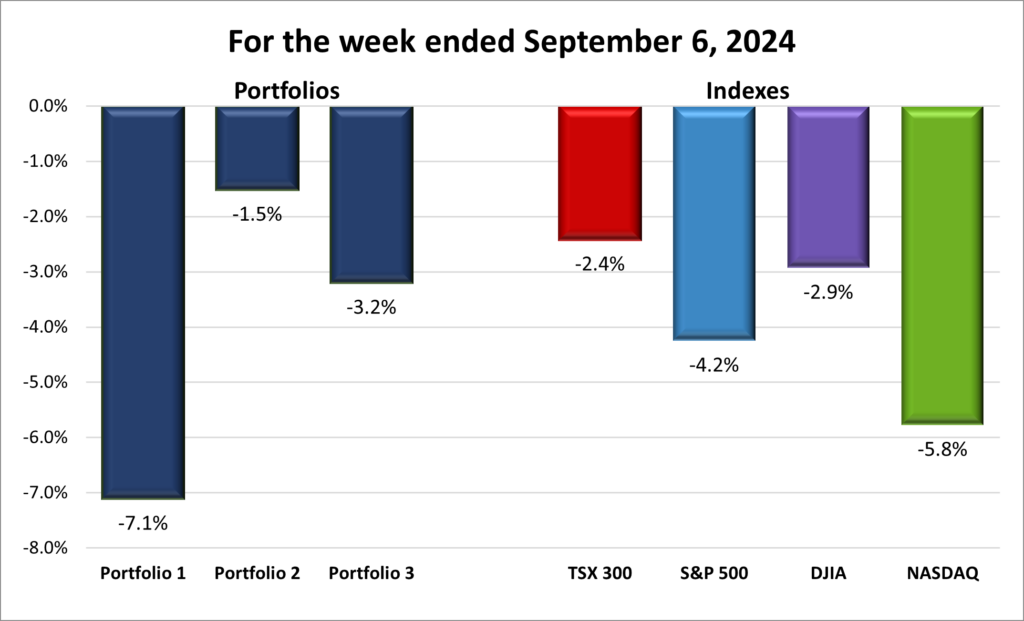
For the week, the TSX (SPTSX) fell 2.4%, the S&P 500 (SPX) lost 4.2%, the DJIA (INDU) declined 2.9% and the Nasdaq (CCMP) tumbled 5.8%.

Index Weekly Streak
TSX: 1 – week losing streak
S&P: 1 – week losing streak
DJIA: 1 – week losing streak
Nasdaq: 2 – week losing streak

Bearish market September wasted no time living up to its reputation as a tough month for stocks, as illustrated in the chart above. On the first trading day, major indexes saw steep declines: the TSX, S&P, DJIA, and Nasdaq dropped by 1.3%, 2.1%, 1.5%, and 1.5%, respectively. By the week’s end, the S&P and DJIA experienced their largest weekly falls since March 2023, while the Nasdaq had its worst week since January 2022.

The market turmoil was driven by multiple factors: weakening job markets in both Canada and the US, growing skepticism around the artificial intelligence (AI) boom, and the uncertainty of the upcoming U.S. election. Investors tend to shy away from uncertainty, and right now, it’s everywhere.

Adding to the tension is the debate over the Federal Reserve’s next move. Analysts and investors aren’t questioning if the Fed will lower rates, but rather by how much. Some fear the Fed’s aggressive rate hikes may have gone on too long, risking a deeper economic slowdown. Weak labour data supports the argument for deeper cuts but raises concerns that a “soft landing,” where inflation falls to the 2% target without causing a recession, might be out of reach, with recession fears creeping back in.

The biggest shock of the week came from Nvidia. The AI giant saw a record US$279 billion wiped from its market cap (number of shares outstanding X the price per share) on Tuesday—the largest single-day loss for any company in history. For comparison, Canada’s largest company by market cap, the Royal Bank of Canada, is worth C$232.2 billion. Nvidia’s sharp decline shook investor confidence in the AI sector, sending other tech stocks tumbling, especially in the Nasdaq and S&P.

Meanwhile, the approaching U.S. election, still a tight race, brings even more uncertainty. If the election mirrors the last one, with contested results lingering beyond voting day, the markets could face at least two more months of instability—adding further stress to an already volatile September.

September may be off to a rough start, just like August, but it’s still early days. Here’s hoping for a rebound as the month progresses! Fingers crossed. 😊

Portfolio Weekly Streak
Portfolio 1: 2 – week losing streak
Portfolio 2: 1 – week losing streak
Portfolio 3: 2 – week losing streak

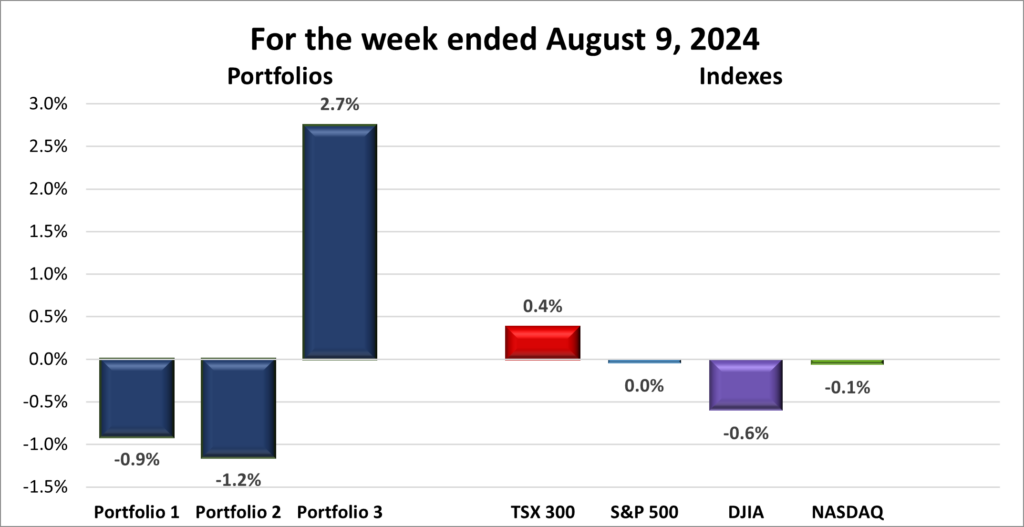
Bearish market It was a rough week across the board, with the major indexes posting losses and dragging down all three portfolios—though some fared worse than others, as shown in the chart below.

Portfolio 1 took the hardest hit, with only 20% of its holdings seeing gains. A series of sharp declines, particularly in technology stocks, contributed to the slump. Nvidia, the portfolio’s largest holding, dropped 13%, while Navitas Semiconductor (NASD: NVTS) plummeted 26%, and Celestica (TSE: CLS) fell 19%. Other notable losers included indie Semiconductor (NASD: INDI) down 16%, Celsius Holdings (NASD: CELH) off by 15%, and CrowdStrike (NASD: CRWD), International Petroleum (TSE: IPCO), and Hammond Power Solutions (TSE: HPS.A) all down 12%, and finally, Skyworks Solutions (NASD: SWKS) dropped 10%. While technology sector stocks were hit the hardest, the portfolio also significant losses in Consumer Staples (Celsius), Energy (IPCO), and Industrials (Hammond).

Portfolio 2 was the best performer of the week, though that is not saying much. 30% of its holdings managed gains, but the rest were not so lucky. Supremex (TSE: SXP) and Hammond Power Solutions each fell 12%, while Birkenstock (NYSE: BIRK) slipped 11%. If only I had waited to invest in Birkenstock. ☹

Portfolio 3 saw a performance between the other two portfolios, faring better than Portfolio 1 but not as well as Portfolio 2. As with portfolio 2, 30% of its holdings showed gains, but the biggest losers were Lithium Americas (TSE: LAC), which dropped 13%, and Lithium Americas (Argentina) (TSE: LAAC), down 11%.

All in all, it was a tough and most definitely bearish week for the portfolios. Let us hope the rest of September brings better news and fewer bumps in the road!
Weekly Portfolio & Index performance
Weekly Portfolio & Index performance for the week ended September 6, 2024.

Companies on the Radar

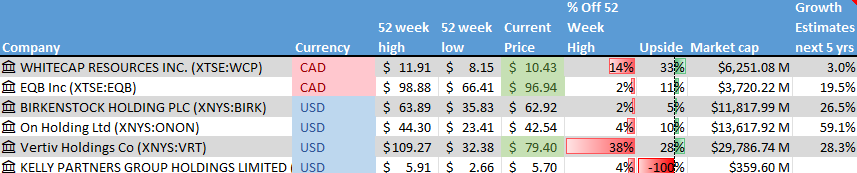
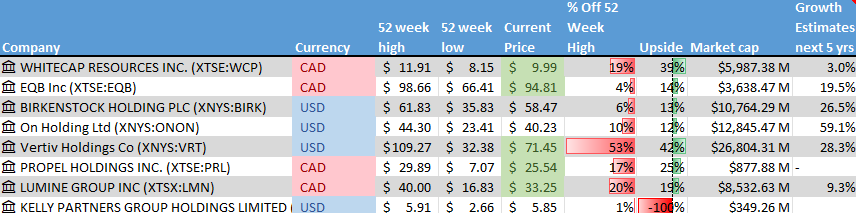
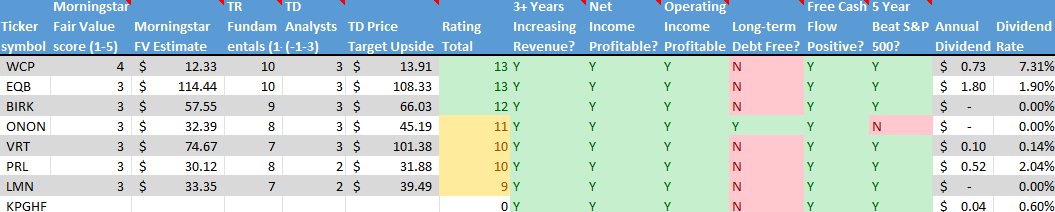
Stocks on my Radar No new companies caught my attention this past week, so my radar list remains focused on the four companies listed below.

  • Equitable Bank (TSE: EQB), a mid sized (when the number of outstanding shares times the shares prices is between $2 billion to $10 billion) Canadian bank, considered Canada’s 7th bank, which provides financial services to consumers and businesses.
  • Payfare Inc. (TSE: PAY), a small-cap Canadian company that provides gig workers with instant access to their earnings along with a comprehensive suite of digital banking services.
  • Vertiv Holdings (NYSE: VRT), a large American company that designs and builds infrastructure and continuity solutions to businesses around the world.
  • On Holding AG (NYSE: ONON), a medium cap Swiss company, founder-run, sports products company.

The Radar Check was last updated September 6, 2024.

Stock on the Radar List. 1 of 2.
Stock on the Radar List. 2 of 2.

Portfolio Update

Portfolio 1

Portfolio 1 for the week ended September 6, 2024: DOWN Red Down Arrow

  • Apple (NASD: AAPL) announced they plan to use organic light-emitting diode (OLED) displays for all iPhone models sold in 2025 and later, moving entirely away from liquid crystal displays (LCDs). OLEDs supposedly provide more vibrant colours and sharper contrast.
  • The US Department of Justice has subpoenaed Nvidia and others in its antitrust investigation into the company, focusing on whether the chipmaker is restricting customers from switching to other suppliers and penalizing those who do not exclusively use its AI chips.
  • General Motors (NYSE: GM) announced plans to start producing its first-ever hybrid-flex vehicles in Brazil, capable of running on 100% ethanol or gasoline in addition to their electric batteries.
  • Alphabet’s (NASD: GOOGL) Google may find themselves before the European Union’s antitrust regulators, the European Commission, once again. Italy’s antitrust authority said the company’s refusal to allow an e-mobility app to access Google’s Android Auto platform is a possible breach of competition rules.
    Elsewhere in Europe, Britain’s antitrust regulator, the Competition and Markets Authority (CMA), has conditionally found that since at least 2015 Google abused its dominant position in digital advertising to restrict competition.
  • PayPal (NASD: PYPL) is expanding into in-person transactions with plans to enter the point-of-sale payments space. The company aims to integrate its debit card with Apple’s mobile wallet, making it easier for users to make contactless payments. To attract customers, PayPal is offering 5% cash back on select purchases, up to $1,000 per month, along with additional rewards from popular brands.

Activity

No significant activity to report this week.

Dividends

Dividends Received this week for the following companies:

Companies followed by DRIP (Dividend Re-Investment Plan) indicate additional shares were purchased with the dividend. Any cash leftover was added to the cash balance.

Canadian $

Decisive Dividend Corp (TSEV: DE) DRIP

US $

Walmart Inc. (NYSE: WMT)

Visa Inc, (NYSE: V)

Quarterly Reports

No quarterly reports this past week.

Portfolio 2

Portfolio 2 for the week ended September 6, 2024: DOWN Red Down Arrow

  • For the second consecutive year, Disney (NYSE: DIS) used its sports channels as negotiating leverage, pulling them from one of its broadcast partners. This time, DirecTV lost access to ESPN, ABC, and other channels after the two companies failed to reach a mutually agreeable deal.
  • Alimentation Couche-Tard Inc. (TSE: ATD) had its bid to acquire the 7-Eleven chain from Japan’s Seven & i Holdings rejected. While Seven & i acknowledged it might consider a significantly higher offer, the company expressed concerns that the deal, which would make ATD the dominant convenience store operator, could face hurdles with U.S. antitrust regulators.

Activity

No significant activity to report this week.

Dividends

Dividends Received this week for the following companies:

Canadian $

Fortis Inc. (TSE: FTS)

US $

No US$ dividends this past week.

Quarterly Reports

Alimentation Couche-Tard Inc

First quarter 2025 financial results on September 4, 2024

Portfolio 3

Portfolio 3 for the week ended September 6, 2024: DOWN Red Down Arrow

  • Brookfield Corporation (TSE: BN) is working on a deal to sell Saeta Yields, a renewable energy company with assets in Portugal and Spain, to United Arab Emirates company Masdar.

Activity

No significant activity to report this week.

Dividends

Dividends Received this week for the following companies:

No dividends this past week.

Quarterly Reports

Enghouse Systems Limited

Third quarter 2024 financial results on September 6, 2024

Weekly Update for the week ending August 30, 2024

Since 2019, Nvidia’s (NASD: NVDA) share price has soared 3,476%, thanks to its pivotal role in supplying the heart of artificial intelligence (AI). Few companies wield as much market influence as Nvidia, and anticipation was sky-high leading up to its earnings release. Investors were on edge, eager to see whether Nvidia would meet or surpass expectations.

Goldman Sachs even dubbed Nvidia “the most important stock on planet Earth,” and it is easy to see why—this tech giant has surged 140% this year alone, despite the recent pullback.

Analysts were divided ahead of the report. Some believed the bar had been set too high, making it nearly impossible for Nvidia to satisfy the market’s lofty expectations. Others were more bullish, predicting that Nvidia would not only meet but surpass estimates, thanks to explosive growth in data centres and a potential boost in forward guidance.

As the heart of the AI rally, Nvidia’s performance was seen as a bellwether for the future of the AI market. More than just another earnings report, it offered a glimpse into the trajectory of AI and the broader tech sector.

When the earnings were finally revealed, Nvidia delivered another strong quarter, exceeding expectations but falling short of the most optimistic hopes. The company forecasted third-quarter revenue of around $32.5 billion, beating the average prediction of $31.9 billion but well below the top-end estimate of $37.9 billion. Adding to concerns were previously announced production issues with Nvidia’s latest high-end Blackwell semiconductor, which contributed to a nearly 4% drop in after-hours trading. By week’s end, Nvidia’s share price was down over 7%.

Investors were particularly on edge because any slowdown in Nvidia could signal a cooling of the AI-fueled rally, raising questions about whether the AI boom has peaked. Despite Nvidia’s stumble, other major tech companies that rely on its chips for their AI projects have so far managed to hold their ground.

Stepping back from the hype, Nvidia still delivered an outstanding quarter. Revenues rose 15% from the previous quarter and an astonishing 122% year-over-year, far exceeding the 5% growth expected for other S&P companies. For their second quarter, Nvidia’s revenue more than doubled to US$ 30 billion from the previous year, with profits also soaring to $16.6 billion. Data center revenue surged over 150% to $26.3 billion, beating expectations by a billion dollars. The company maintained impressive gross margins of 75%, underscoring its robust profitability. It seems investors may be overreacting to Nvidia missing excessive expectations, potentially overlooking the broader strength of the company and the ongoing AI revolution.

Nvidia’s earnings story offers a valuable lesson: even the biggest players can experience ups and downs, and market reactions can sometimes be driven more by expectations than by reality. As you continue your investing journey, remember to focus on the long-term potential of your investments rather than getting caught up in short-term fluctuations. Nvidia maintains a dominant position at the center of the AI revolution, and while the market may react to every quarterly report, your focus should be on the bigger picture and how these innovations can shape the future.

Aside from Nvidia’s earnings announcement, there was a lot of other economic news this week as August came to a close. Let’s take a look at what else happened…

Items that may only interest or educate me ….

Canadian Economic news, US Economic news, Tracking your investments, ….


Canadian Economic news

This past week’s key economic data that the Bank of Canada (BoC) considers when deciding whether to raise or lower the interest rate.

Gross Domestic Product (GDP)

The GDP report for June from Statistics Canada showed that growth in the Canadian economy slowed to 0.1%, down from a 0.2% increase in May, with GDP expanding 1.2% year-over-year.

Diving into the details, the ‘Goods-producing industries’ experienced a 0.4% contraction, marking their largest decline since December 2023. This downturn was partially offset by a modest 0.1% rise in the ‘Services-producing industries.’ Within the goods sector, ‘Utilities’ saw the most significant growth, up 2.3%, while ‘Manufacturing’ fell 1.5%. On the services side, the ‘Energy’ sector led with a 1.5% increase, whereas the ‘Management of companies and enterprises’ sector saw a sharp 3.7% decline.

Year-over-year, the ‘Goods-producing industries’ showed mixed results. The ‘Mining, quarrying, and oil and gas extraction’ industry surged 6.1%, while ‘Manufacturing’ dipped 1.5%. In the ‘Services-producing industries,’ the ‘Energy’ sector posted the biggest gain, up 3.9%, but the ‘Management of companies and enterprises’ sector plummeted by a staggering 32.6%.

Looking ahead, the advance estimate for July suggests that GDP will remain flat, with official data set to be released on September 27, 2024.

For the second quarter, GDP grew at an annualized rate of 2.1%, up from 1.7% in the first quarter and surpassing analysts’ expectations of 1.6% as well as the BoC’s forecast of 1.5%. Despite this stronger-than-expected growth, it still falls short of the BoC’s estimated potential growth rate of approximately 2.4%. This growth is largely driven by increased immigration rather than productivity gains. On a per capita basis, GDP declined for the fifth consecutive quarter, slipping 0.1% in the second quarter.

Canadian market volatility

Canada’s Volatility Index (CVIX) started the week at 11.04 and gradually eased to 10.40 by week’s end. This decline reflects the impact of positive economic news from both Canada and the US, which helped to stabilize market sentiment.

Tracked as VIXI on the Toronto Stock Exchange (TSE), the CVIX gauges anticipated market volatility. Readings below 10 suggest a calm and stable market, while values between 10 and 20 indicate moderate volatility and normal market fluctuations. Levels above 20 signal increased volatility and heightened market uncertainty.

US Economic news

This past week’s key data points that the Federal Reserve (Fed) considers when deciding whether to raise or lower the interest rate.

Personal Consumption Expenditures (PCE)

The July PCE price index from the US Bureau of Economic Analysis showed a 0.2% increase, up slightly from June’s 0.1%, matching analysts’ expectations. On an annual basis, prices rose by 2.5%, matching June’s reading but falling just short of the 2.6% forecast. The core PCE price index, which strips out the volatile food and energy sectors, also rose 0.2% in July, mirroring June’s increase. Year-over-year, core PCE inflation grew by 2.6%, just below the anticipated 2.7%. These figures confirm a steady decline in inflation, a key focus for investors, given that the PCE, especially the core measure, is the Fed’s preferred inflation gauge.

With Fed Chair Jerome Powell hinting at a rate cut in September during his recent speech at Jackson Hole, investors are now weighing the likelihood of a 0.25% reduction versus a more aggressive 0.5% cut. The steady inflation data from July keeps both options open, leaving markets to speculate on the Fed’s next move.

Gross Domestic Product (GDP)

The second estimate for GDP in the second quarter shows the economy gaining momentum, with growth at an annualized rate of 3.0%, surpassing analysts’ expectations of 2.8%. This marks a notable jump from the 1.4% growth in the first quarter and a slight upgrade from the initial 2.8% reported in the advance estimate.

The impressive performance was driven by 2.9% increase in consumer spending, a 7.5% boost in private inventory investment, and growth in non-residential fixed investments, although residential fixed investment saw a decline. This latest GDP report, a key measure of economic health, reflects a resilient economy overall. However, economic momentum has slowed this year after accelerating in the latter half of 2023.

With inflation easing according to the latest Consumer Price Index (CPI) and Personal Consumption Expenditures (PCE) reports, this strong GDP growth suggests the Fed may be on track to achieve a ‘soft landing’—bringing inflation back to 2% without triggering a recession.

This second estimate is based on more comprehensive data than was available for the initial ‘advance’ estimate.

American market volatility

The CBOE Volatility Index (VIX), known as the market’s “fear gauge,” began the week at 15.79. It spiked to 17.79 midweek following Nvidia’s earnings announcement but fell to 15.00 by the end of the week. Falling inflation, a robust economy, and expectations of a rate cut go a long way to calming investors’ jitters. 😊

The VIX measures expected market volatility over the next 30 days. Readings below 12 suggest a calm and stable market, while values between 12 and 20 indicate normal fluctuations. Levels between 20 and 30 signal heightened volatility and uncertainty, and readings above 30 reflect extreme stress, often seen during crises.

Consumer Sentiment Index (CSI)

The University of Michigan’s final reading on consumer sentiment for August came in at 67.9, just shy of analysts’ expectations of 68 but up from July’s 66.4. After four months of decline, the CSI finally edged higher, though it still lags behind last August’s reading of 69.4.

Looking closer, the Current Economic Conditions index rose to 61.3 from the mid-month reading of 60.9, although it remains below July’s 62.7 and significantly lower than last year’s 75.5. The Index of Consumer Expectations improved to 72.1, matching the initial estimate and outperforming July’s 68.8 and August 2023’s 65.4.

The improved sentiment is largely attributed to shifting election expectations, particularly after Kamala Harris became the Democratic candidate. This change boosted optimism among Democrats and independents, while Republicans grew more pessimistic.

Consumer Confidence Index (CCI)

Consumer confidence surged in August, with the Conference Board’s CCI hitting a six-month high of 103.3, surpassing July’s upwardly revised 101.9 and beating analysts’ expectations of 100.7. This rise reflects growing optimism among consumers, particularly in their assessment of current business and labour market conditions, as the Present Situation Index edged up from 133.1 to 134.4.

The Expectations Index, which gauges consumers’ short-term outlook for income, business, and labour market conditions, also showed improvement, climbing from 81.1 in July to 82.5 in August—the highest level since August 2023. Notably, this marks the second consecutive month the index has remained above 80, a positive sign, as readings below 80 often signal a potential recession.

While consumers felt more positive about current business conditions, their outlook on the labour market was slightly less optimistic, likely influenced by the recent rise in unemployment to 4.3% and early August’s stock market stumble. Looking ahead, consumers remain hopeful about the economy but cautious about future labour market conditions.

Overall, the CCI’s reading above 100 suggests a continued sense of optimism among consumers, with the Expectations Index serving as a critical indicator to watch. A sustained reading above 80 in the Expectations Index is encouraging, as anything below that level can hint at an economic slowdown.

How can I track and review my investment performance?

Now that you have dipped your toes into investing, it is time to track your investments to see if they are growing and, on their way to achieving your goals. Monitoring and reviewing your portfolio is essential for understanding how well it is performing. Here is a straightforward guide to get you started:

  1. Set Clear Goals: Start by defining what you want from your investments. Are you saving for retirement, a dream vacation, or a down payment on a home? Are you aiming for long-term growth, income through dividends, or something else? Knowing your goals gives you a clear benchmark to measure your performance against.
  2. Use an Investment Tracker: Most brokerages offer online tools that automatically track your investments. These tools show you how each stock or fund is performing and give you an overall view of your portfolio’s value. For instance, TD Direct Investing and TD Easy Trade provide totals for each sub-account (e.g., Canadian cash, US$ Cash, Canadian$ TFSA, US$ TFSA, etc.), as well as an overall total for each account. These tools make it easy to track your investments.
  3. Compare to Benchmarks: To gauge how well your investments are doing, compare them to relevant benchmarks like the S&P 500 (S&P) or the Toronto Stock Exchange Composite Index (TSX). This is not just about beating the benchmark (though that is always nice! 😊) but also about ensuring your portfolio is not trending down when the markets are moving up.
  4. Review Regularly: Make it a habit to review your portfolio at least once a quarter. This helps you see if your investments are on track to meet your goals. While stock prices will naturally fluctuate, significant drops in any of your holdings might warrant a closer look to understand what is driving the decline.
  5. Adjust as Needed: Based on your review, you might decide to rebalance your portfolio by buying or selling assets to maintain your desired allocation. This helps manage risk and keeps your investments aligned with your goals.

As an investor, remember you are playing the long game. It is easy to get caught up in the day-to-day fluctuations, but do not let emotions drive your decisions. Whether you prefer to “set it and forget it” or check your portfolio daily, having the right tools in place to monitor your investments ensures your money is working for you and helping you achieve your financial goals.


Weekly Market Review

Monday: the last week of August got off to a mixed start with the more traditional TSX and the Dow Jones Industrial Average (DJIA) ending in the green, while the more growth-oriented S&P, and the Nasdaq Composite Index (Nasdaq) ended in the red. Oil prices surged on reports of increased tensions in the Middle East and production shutdowns in Libya.

In Canada, higher oil prices and investors moving into commodity companies lifted the TSX to a record high set the previous Friday. In trading, the Energy sector was the big winner, while the Technology sector suffered the biggest decline.

In the US, the DJIA set a record high close, while the Nasdaq was dragged down by technology stocks ahead of Nvidia’s quarterly report. Investors were concerned that while Nvidia may have a strong report, it may not be good enough to meet extremely lofty expectations. In trading, Energy advanced the most, with Technology dropping the farthest.

Tuesday: the indexes were again mixed on a light day of trading as investors wait for Nvidia’s earnings release tomorrow. This time it was the TSX that fell into the red. Investors are also waiting to see how Friday’s PCE inflation data will impact the Fed’s decision to lower US interest rates. Oil prices declined on concerns about slower economic growth in the US and China, the largest and second largest economies, respectively.

In Canada, the TSX was weighed down by lower energy and commodity prices. In trading it was a day of broad-based losses with Consumer Staples the only sector to end higher, while the Energy sector suffered the biggest drop.

In the USA, The DJIA barely made it into the green, but it was enough to set another record high close. In trading, Technology posted the biggest gain while Energy recorded the biggest decline.

Wednesday: all four indexes ended lower as investors waited Nvidia’s earning announcement that came after the markets closed. Oil prices were down on concerns of a global economic slowdown, making it a very red day. 😊

In Canada, the TSX ended lower as investors booked some profits following the run up to a record high on Monday. In trading, Financials and Telecommunications Services were the only sectors to end higher, while Basic Materials (miners and fertilizer manufacturers) dropped the most.

In the US, despite Nvidia’s better than expected results, the share still fell 3% in after hours trading. In regular market hours, Financials and Healthcare were the only sectors to move higher, while Technology sank the farthest.

Thursday: the markets were mixed once again, with the TSX and DJIA ending higher while the Nasdaq and S&P ended lower. The latest economic news showed the American economy grew more than expected in the second quarter. Oil prices rose as Libya shut down its oil exports terminal and Iraq lowered its production levels.

In Canada, the TSX was lifted by the news the US economy remained strong and robust earnings reports from the majority of Canada’s big six banks. In trading, the Energy sector advanced the most, while Consumer Cyclicals declined the most.

In the US, the DJIA set its third record high close. Meanwhile, the S&P and Nasdaq were dragged lower by investors’ mixed reactions to Nvidia’s quarterly report that beat expectations but not the sky-high hopes of some analysts. In trading, Energy saw the biggest gain while Technology experienced the biggest drop.

Friday: a late afternoon surge in the markets ensured all four indexes ended the day in positive territory. The latest PCE inflation data came in lower than expected, increasing investor confidence that the Fed will lower rates in September. The double whammy of increasing oil inventories and weak demand from China caused oil prices to fall.

In Canada, a stronger than expected economy, combined with positive US inflation news, helped lift the TSX. In trading on Bay Street, the Technology sector advanced the most while Energy was the only sector to end lower.

In the US, the DJIA capped off the week with another record high close, fueled by the better-than-expected inflation report. On Wall Street, the Consumer Cyclicals sector led the charge, while the Energy sector brought up the rear.


Weekly Market and Portfolio Review

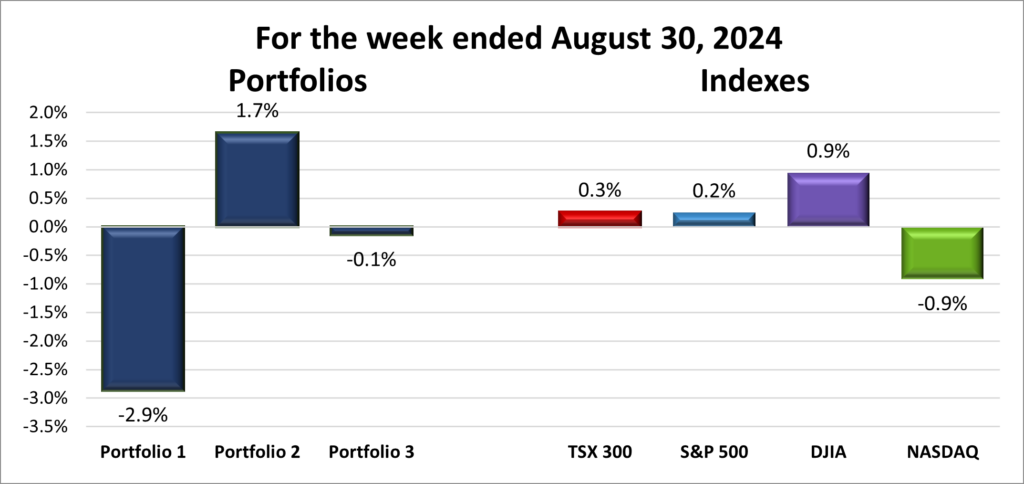
For the week, the TSX (SPTSX) gained 0.3%, the S&P 500 (SPX) advanced 0.2%, the DJIA (INDU) rose 0.9% and the Nasdaq (CCMP) sank 0.9%.

Index Weekly Streak
TSX: 4 – week winning streak
S&P: 3 – week winning streak
DJIA: 3 – week winning streak
Nasdaq: 1 – week losing streak

Bull market. A good week for the North American stock markets. The last week of August was a bit of a rollercoaster ride, with some ups and downs before finishing the month on an upward trend that pulled three of the four indexes into positive territory.

Driving the markets this past week were investor confidence that the Fed might lower the US benchmark rate at their September meeting, Nvidia’s second-quarter earnings, and positive economic news from both Canada and the US.

The likelihood of a rate cut in the US helped push both the value-oriented TSX and DJIA to record highs. The DJIA, which does not include Nvidia, set four new all-time highs this past week, bringing the total to 26 record highs so far this year. The tech-heavy Nasdaq and, to a lesser extent, the S&P dipped on concerns that Nvidia might not meet some investors’ sky-high expectations. However, at the end of the week, a stronger-than-expected Canadian economy lifted the TSX into the green, while the latest US inflation data did the same for the S&P. Unfortunately, the positive economic news wasn’t enough for the Nasdaq to overcome the dip (hopefully just a dip 😊) in Nvidia.

And just like that, the summer investing season wraps up. With the pros returning next week, we might see a bit more action as they start tidying up their portfolios. Buckle up—it looks like September could bring a bit more excitement to the markets!

Portfolio Weekly Streak
Portfolio 1: 1 – week losing streak
Portfolio 2: 1 – week winning streak
Portfolio 3: 1 – week losing streak

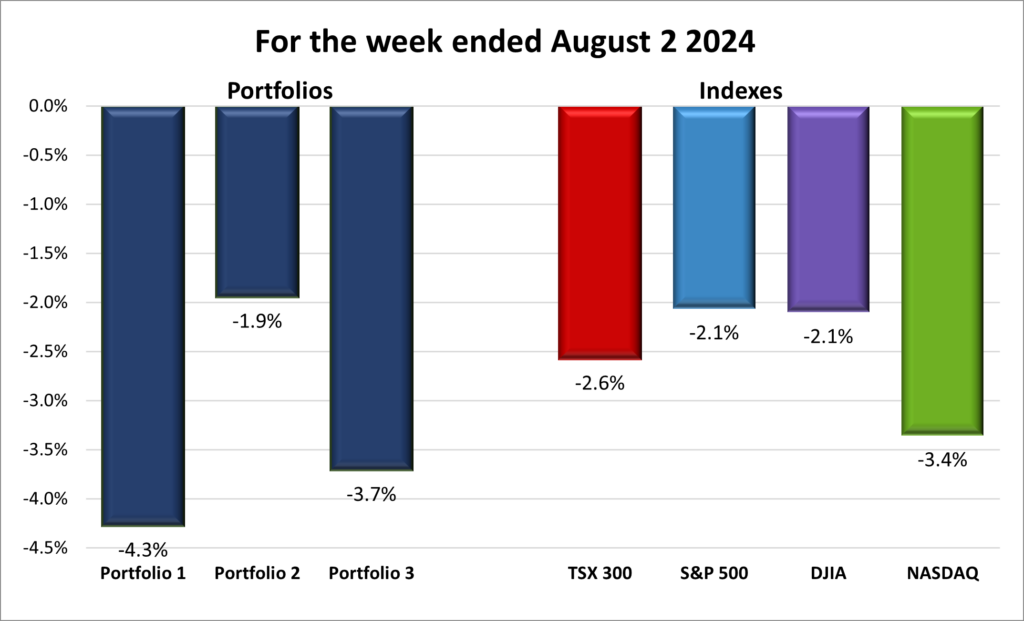
Bearish market Not the ideal way to close out the last week of summer, with two of the three portfolios posting weekly losses, as illustrated in the chart below. Portfolio 1 had the best percentage of stocks that posted a weekly gain, but it also fell the farthest thanks to its overweight in one company – Nvidia.

Portfolio 1 saw a 50/50 mix of winners and losers, with Hammond Power Solutions (TSE: HPS.A) standing out with an impressive 11% gain—the only significant movement (over 10% up or down) in the portfolio. However, a hefty 8% drop in Nvidia dragged the portfolio deep into the red.

Portfolio 2 was the lone bright spot, despite only 44% of the holdings recording a weekly gains. The significant gains of MongoDB (NASD: MDB), which surged 17%, and Hammond Power Solutions’ 11% gain helped offset Birkenstock’s (NYSE: BIRK) 22% plunge.

Portfolio 3 mirrored Portfolio 2 in terms of the percentage of companies posting weekly gains, with just 43% of holdings in the green. However, unlike Portfolio 2, Portfolio 3 had no standout performers, falling just short of positive territory.

This week’s results were a stark contrast to the earlier highs when over 70% of each portfolio’s holdings were in the green. ☹ Once again, I am reminded that being overweight in one company is great when the share price is climbing, but not so great when it dips.

Weekly Portfolio & Index performance
Weekly Portfolio & Index performance for the week ended August 30, 2024.

Monthly Market and Portfolio Review

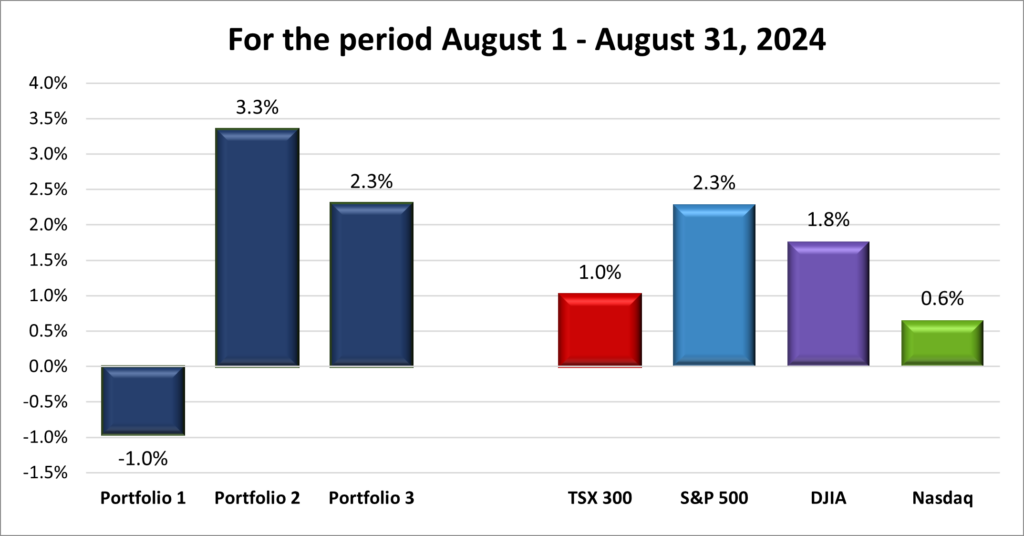
For the month of August, the TSX (SPTSX) rose 1.0%, the S&P 500 (SPX) surged 2.3%, the DJIA (INDU) advanced 1.8% and the Nasdaq (CCMP) was up 0.6%.

Bull market. A good week for the North American stock markets. Despite a rocky start that saw all four major North American indexes drop sharply at the start of the month, they overcame those early losses and rebounded to post a monthly gain, as shown in the chart above.

The month kicked off with recession fears triggered by disappointing US labour reports, underwhelming earnings from heavyweight technology companies, a rotation from technology stocks to smaller, non-technology firms, and an unexpected interest rate hike by the Bank of Japan, which forced many hedge funds to sell off stocks to repay cheap loans they had taken in Japanese yen. This led to the S&P and DJIA suffering their largest single-day losses since September 2022. However, these fears were short-lived as other economic data pointed to a resilient American economy—slowing, but still robust. Inflation has dipped below 3% in both Canada and the US, with both countries inching closer to their respective central banks’ 2% target. Volatility spiked briefly, with indexes hitting 23.56 in Canada and 65.73 in the US, before settling back into the normal range of 10-20.

In Canada, the upward momentum was nearly derailed 😊 by a brief work stoppage at both major Canadian railways, which threatened to disrupt the flow of passengers and goods across the country, potentially harming the economy. Although the stoppage lasted only 17 hours, it took four days to fully restore normal operations.

As the markets stabilized, a sense of calm returned to investors. The turning point came when the minutes from the Fed’s last meeting revealed a shift in focus toward maintaining a strong economy and labour market rather than solely targeting inflation. Confidence grew that a rate cut was imminent in September, especially after Fed Chair Powell stated, “the time had come” to begin lowering interest rates. This optimism sparked a mini rally that, despite a brief midweek dip, helped all four indexes finish the month on a positive note.

With August over, many professional investors are returning to the markets, likely rebalancing their portfolios, which could lead to increased selling pressure. Additionally, mutual funds often sell underperforming stocks before the fiscal year-end, contributing to potential downward pressure. Historically, September has been a tough month for the markets, with increased volatility and negative returns more common. Let us hope history does not repeat itself but be prepared for more market fluctuations with lower rates and a presidential election on the horizon.

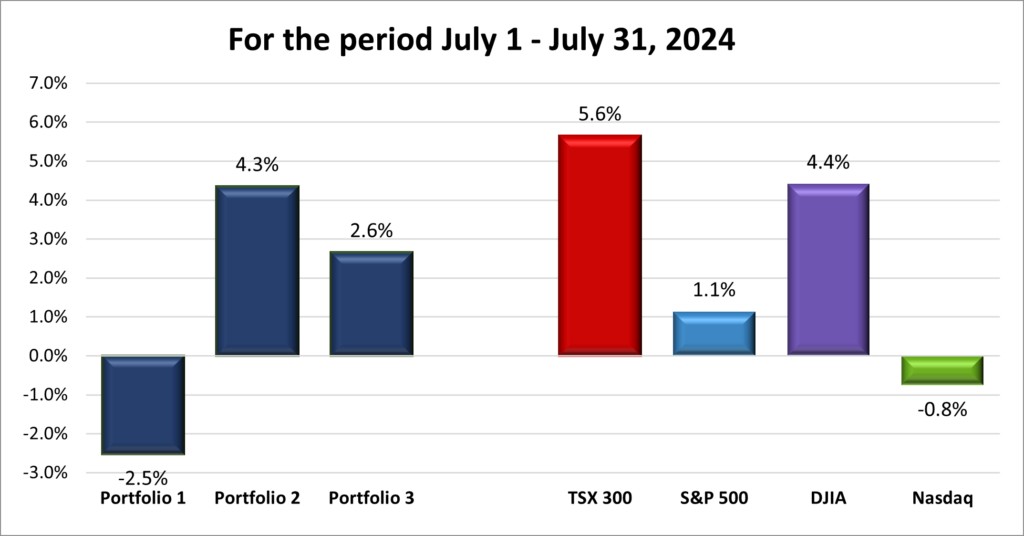
Bull market. A good week for the North American stock markets. As shown in the chart below, August brought a mixed bag for the three portfolios, with two out of the three finishing the month in the green. Interestingly, Portfolio 1 continued its streak from July as the sole portfolio to end August without a gain.

Portfolio 1 struggled due to the heavy weight of Nvidia in the portfolio. As well, the other big technology companies that had driven the portfolio higher over the last year had a mixed month. A losing streak from July carried over into August, reaching four weeks before being interrupted by a substantial gain in the third week of the month. Unfortunately, this upward trend was short-lived as Nvidia fell 7% in the final week, pulling the portfolio into negative territory.

Portfolio 2 was the best performer, despite a tough month, with declines in two of the four weeks. I was surprised to see that not only did it record a monthly gain, but it also outperformed the other two portfolios and all four indexes. Its diversified and balanced approach helped limit the losses and the solid performances gains in two of the weeks provided a sizable gain, that more than offset losses from the other weeks.

Portfolio 3 also had a good month, achieving gains in three out of four weeks. It saw several of its holdings post impressive weekly gains, including some over 10%, but its success was mainly driven by consistent gains across the majority of its holdings.

August was a bit of a rollercoaster, with each portfolio taking a different path. Portfolio 1 hit some bumps, especially with Nvidia’s ups and downs, but Portfolio 2’s more balanced approach came out on top, proving that a little diversity goes a long way. Portfolio 3 had a steady ride, with consistent gains keeping it in good shape. Overall, the gains of Portfolios 2 and 3 more than offset the loss in Portfolio 1. As we move into September, historically a more volatile month, it is a good reminder that a mix of strategies can help weather whatever the market throws our way. 😊

Monthly Portfolio & Index performance
Monthly Portfolio & Index performance for August, 2024.

Companies on the Radar

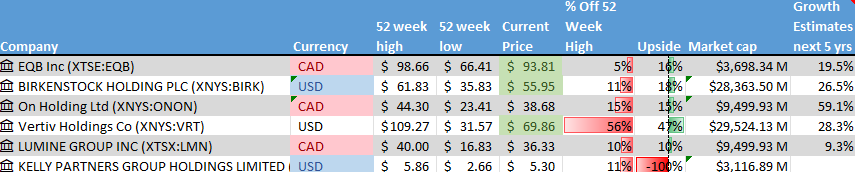
Stocks on my Radar After the flurry of activity last week, which saw three companies graduate to a portfolio, this week was quieter on the investing front. No new companies made the cut, leaving my radar list with just four prospects, each offering a unique and interesting opportunity.

  • Equitable Bank (TSE: EQB), a mid sized (when the number of outstanding shares times the shares prices is between $2 billion to $10 billion) Canadian bank, considered Canada’s 7th bank, which provides financial services to consumers and businesses.
  • Payfare Inc. (TSE: PAY), a small-cap Canadian company that provides gig workers with instant access to their earnings along with a comprehensive suite of digital banking services.
  • Vertiv Holdings (NYSE: VRT), a large American company that designs and builds infrastructure and continuity solutions to businesses around the world.
  • On Holding AG (NYSE: ONON), a medium cap Swiss company, founder-run, sports products company.

The Radar Check was last updated August 30, 2024.

Stock on the Radar List. 1 of 2.
Stock on the Radar List. 2 of 2.

Portfolio Update

Portfolio 1

Portfolio 1 for the week ended August 30, 2024: DOWN Red Down Arrow

  • Berkshire Hathaway (NYSE: BRK.B) became the ninth company in the world to achieve a US$1 trillion valuation. It joins Nvidia Corp., Microsoft Corp. (NASD: MSFT), Apple Inc. (NASD: AAPL), Amazon.com Inc. (NASD: AMZN), Meta Platforms Inc. (NASD: META), Alphabet Inc. (NASD: GOOGL), Tesla Inc. (NASD: TSLA) and Saudi Aramco SA:2223.
  • General Motors (NYSE: GM) and Samsung SDI announced they will invest US$ 3.5 billion to build an electric vehicle (EV) battery factory in Indiana.
  • Amazon intends to replace the internally developed AI behind their upcoming updated Alexa voice system with third party Anthropic’s Claude AI models. The new AI infused Alexa is scheduled for release in October.
  • CrowdStrike’s (NASD: CRWD) senior vice president for counter adversary operations Adam Meyers will testify before the House of Representatives’ Homeland Security Cybersecurity and Infrastructure Protection subcommittee. He will be answering questions about the company’s software update that caused an IT outage for many companies around the world.

Activity

No significant activity to report this week.

Dividends

Dividends Received this week for the following companies:

Companies followed by DRIP (Dividend Re-Investment Plan) indicate additional shares were purchased with the dividend. Any cash leftover was added to the cash balance.

Canadian $

TMX Group Ltd (TSE: X)

US $

No US$ dividends this past week.

Quarterly Reports

The Bank of Nova Scotia

Third quarter 2024 financial results on August 27, 2024

Nvidia Corporation

Second quarter 2025 financial results on August 28, 2024

CrowdStrike Holdings, Inc.

Second quarter 2025 financial results on August 28, 2024

Portfolio 2

Portfolio 2 for the week ended August 30, 2024: UP Green Up Arrow, signifying a positive week

  • The US$ 8.5 billion merger of Walt Disney’s (NYSE: DIS) Indian media assets and India’s Reliance Industries (NSE: RELIANCE) has received conditional approval from the India’s competition regulator, The Competition Commission of India (CCI). The deal is subject to voluntary modifications which will be detailed later.

Activity

No significant activity to report this week.

Dividends

Dividends Received this week for the following companies:

No dividends this past week.

Quarterly Reports

The Bank of Nova Scotia

See report under Portfolio 1.

Birkenstock Holding plc

Third quarter 2024 financial results on August 29, 2024

MongoDB, Inc.

Second quarter 2025 financial results on August 29, 2024

Portfolio 3

Portfolio 3 for the week ended August 30, 2024: DOWN Red Down Arrow

  • Shopify (TSE: SHOP) announced Mikhail Prakhin as their Chief Technology Officer. He joins the company after working at Microsoft where he worked on AI and search technologies.
  • Lithium Americas (TSE: LAC) announced an agreement with GM to postpone an additional US$330 million investment until the end of the year. The company is exploring various options for structuring this second payment. If the deal is not finalized by December 20, 2024, LAC will be required to grant GM additional rights.

Activity

No significant activity to report this week.

Dividends

Dividends Received this week for the following companies:

Canadian $

Enghouse Systems Ltd (TSE: ENGH)

Royal Bank of Canada (TSE: RY)

US $

No US$ dividends this past week.

Quarterly Reports

Royal Bank of Canada

Third quarter 2024 financial results on August 28, 2024


Weekly Update for the week ending August 23, 2024

Inflation and pricing

It was a relatively quiet week for the markets in terms of economic news. In the USA, investors focused on the mid-week release of the minutes from the Federal Reserve’s (Fed) last Federal Open Market Committee meeting and Fed Chair Jerome Powell’s speech at the Jackson Hole Economic Symposium, at the end of the week. These two events are crucial in indicating whether the Fed plans to lower the US benchmark rate at their September meeting.

In Canada, the biggest economic headline was the July Consumer Price Index (CPI) inflation report, which reveals whether inflation is rising or falling. Spoiler alert: it is still falling. 😊 But here is an important point—just because inflation is down does not mean prices are lower. It only means that the pace of price increases has slowed.

For example, if a product costs $10 with inflation at 4%, it will cost $10.40 a year later. If inflation stayed at 4%, it would cost $10.82 in another year. However, if inflation fell to 2% in that second year, the product would cost $10.61. So, while the price is still higher, it is not as high as it would have been if inflation had remained at 4%.

Many people confuse inflation with prices. Price is the amount of money required to purchase a good or service at a specific time, while inflation is the rate at which the general level of prices for goods and services rises over time, leading to a decrease in the purchasing power of money. The key difference is that price is about the cost of individual items, while inflation reflects the overall trend of rising prices across the economy. Inflation impacts most goods and services, but a change in price alone does not necessarily indicate inflation.

So, the next time you hear a friend wonder why prices are higher if inflation is down, you will be able to tell them. 😊

Get comfortable—this week’s update is a bit longer than usual. In addition to discussing a few starter investing strategies, I will explain why I invested in three companies after the market dip triggered the buy orders I placed last week. Now, let’s dive into what happened this past week….

Items that may only interest or educate me ….

Canadian Economic news, US Economic news, The importance of railways, Beginner-friendly investment strategies, ….


Canadian Economic news

This past week’s key economic data that the Bank of Canada (BoC) considers when deciding whether to raise or lower the interest rate.

Consumer price Index (CPI)

Statistics Canada’s July CPI data revealed a 0.4% rise in prices, aligning with expectations after a 0.1% decline in June. On a year-over-year basis, inflation slowed to 2.5% from June’s 2.7%, marking the slowest pace since March 2021. Core CPI, which strips out volatile food and energy prices, also saw a 0.4% increase in July after remaining flat in June. Annually, core inflation decelerated to 2.7% from 2.9%.

Gasoline prices led the monthly gains with a 2.4% increase, while the biggest decline was in the ‘Clothing and footwear’ category, down 0.6%. On an annual scale, ‘Shelter’ costs (including mortgages and rent) saw the steepest rise, up 5.7%, whereas ‘Clothing and footwear’ continued to drop, falling 2.7%.

Both headline and core CPI have remained within the Bank of Canada’s target range of 1% to 3%, and this latest data confirms the downward trend in inflation. This trend strengthens the case for another 0.25% rate cut at the central bank’s September meeting, as their focus shifts from battling inflation to supporting a cooling labour market. Best of all, BoC Governor Tiff Macklem has suggested more rates are coming if inflation continues to fall.

Canadian market volatility

Canada’s Volatility Index (CVIX) began the week at 11.62, spiked to 14.91 on Thursday, and ended the week at 11.04, slightly below its starting point. The spike was driven by concerns about a weaker-than-expected US economy, but signals from the Fed about a likely September rate cut quickly eased investor worries, causing the CVIX to drop as swiftly as it had risen.

Tracked as the VIXI on the Toronto Stock Exchange (TSE), the CVIX measures expected market volatility. A reading below 10 indicates a calm, stable market, while a range of 10 to 20 suggests moderate volatility and typical market fluctuations. Readings above 20 point to high volatility and significant market uncertainty.

Retail Sales

June’s retail sales data showed sales were lower in four of nine subsectors, resulting in an overall decline of 0.3%, a slight improvement over May’s 0.8% drop and in line with analyst expectations. On an annual basis, retail sales inched up by 0.2%.

Breaking it down, ‘Food and beverage retailers’ saw the largest monthly increase at 1.2%, while ‘Motor vehicle and parts dealers’ experienced the steepest decline, down 2.1%. Year-over-year, ‘Health and personal care retailers’ led with a 5.1% gain, whereas ‘Sporting goods, hobby, musical instrument, book, and miscellaneous retailers’ faced the largest drop, down 4.3%.

Core retail sales—which exclude gasoline stations and motor vehicle and parts dealers—rose 0.4% in June, mirroring May’s growth. Annually, core sales increased by 1.2%.

Overall, the report suggests consumers are still feeling the pinch of higher interest rates, leading to reduced spending, particularly on high-end and discretionary items. However, there is a silver lining: preliminary estimates hint at a 0.6% retail sales increase for July, and the BoC is expected to cut interest rates by another 0.25%, potentially easing the strain on consumers.

US Economic news

This past week’s key data points that the Federal Reserve (Fed) considers when deciding whether to raise or lower the interest rate.

Federal Open Market Committee (FOMC) minutes

The minutes from the July 30-31, 2024, FOMC meeting were released this past week, shedding light on the committee’s discussions and providing key insights into their outlook and plans.

FOMC members observed that financial conditions had eased since their last meeting, with investor optimism about a potential September rate cut fueling a stock market rally. The American economy continued to advance but at a slower pace compared to late 2023, marked by a cooling labour market and a still elevated, though easing, inflation rate. Both the Personal Consumption Expenditures (PCE) index and core PCE were under 3.0%, showing progress toward the FOMC’s 2% inflation target. Globally, economic growth slowed, largely due to a downturn in China.

While inflation has eased over the past year, it remains above target. Recent data indicating progress toward the 2% goal and a slowdown in core PCE components boosted members’ confidence in continued inflation decline. They also noted an easing labour market, with slower wage growth and GDP growth decelerating from late 2023. Although the risk of higher inflation has diminished, employment risks have increased.

Despite some members suggesting that recent inflation progress and higher unemployment might justify an immediate 0.25% rate cut, the consensus was to hold the federal funds rate at 5.25% to 5.5% and continue reducing the Fed’s securities holdings. Officials agreed to closely monitor incoming data, especially on inflation, before considering any rate adjustments.

Overall, the Fed aims to balance controlling inflation with maintaining economic stability. A “vast majority” of Fed members believe that if economic data continues to support their expectations, a rate cut is likely at the September meeting.

Fed ready to lower rates

Fed Chair Jerome Powell strongly hinted at upcoming interest-rate cuts, signaling the Fed’s shift toward supporting the American labour market. In his speech at the Jackson Hole conference, Powell emphasized that the time has come to adjust policy to prevent further weakening of the job market. His remarks immediately impacted the markets, causing all indexes to rise.

Powell’s comments suggest that the Fed’s aggressive inflation-fighting stance may be winding down, paving the way for rate cuts as early as mid-September. Investors are now debating the size of the potential cut, with some expecting a 0.25% reduction, while others anticipate a 0.5% cut. Despite his clear message, Powell remained non-committal about the specifics, leaving the door open for larger cuts if labour market conditions deteriorate further.

As the September meeting approaches, the Fed will continue to closely monitor incoming data, including the August jobs report and inflation readings. Powell’s shift in tone emphasizes the Fed’s readiness to support economic growth and achieve price stability, hinting that the much-anticipated rate cuts are on the horizon.

American market volatility

The CBOE Volatility Index (VIX), often dubbed the market’s “fear gauge,” rose from 14.8 to 18.03 in the middle of the week before ending the week at 15.79. The market was spooked by thoughts of a recession when a revised labour report showing new jobs in March were over 818,000 less than originally reported. However, comments from Chair Powell indicating rate cuts were on the horizon calmed the market.

The VIX measures expected market volatility over the next 30 days, with readings below 12 indicating a calm and stable market, while values between 12 and 20 suggest normal fluctuations. Levels between 20 and 30 reflect heightened volatility and uncertainty, and readings above 30 signal extreme stress, typically seen during crises.

The importance of railways

This past week, Canada’s fragile economy almost took a crippling blow when Canada’s two largest railways – Canadian National Railway (TSE: CN) and Canadian Pacific Kansas City Limited (TSE: CP) – were locked out early Thursday morning. It was the first time both railways have had simultaneous work stoppages. Usually contracts between the union and the companies occur a year apart but CN asked for and received a year long extension of their old contract. I am sure the union was happy to oblige, realizing the leverage this would give them. Both companies’ contracts expired at the end of December and negotiations have been ongoing since then. The main obstacles were scheduling, availability of labour and demands for better work-life balance.

As the second-largest country by territory – Canada relies heavily on rail to ship product across the country. As well, approximately 30,000 commuters in Vancouver, Toronto and Montreal rely on the rail service to get to and from work daily. Not only would a stoppage be hard on Canadians and the Canadian economy, but it would also disrupt the US as CN and CP carry millions of tons of goods and commodities across the border. Both railroads continued to operate in the US and Mexico, but the stoppage in Canada could disrupt North American and global supply chains.

Canada sends 75% of its exports to the US, with C$114 billion in freight moved between the two countries by rail last year. A prolonged stoppage would severely impact key industries like agriculture, mining, energy, retail, automaking, construction, and chemicals, including 60% of the chlorine used by water-treatment plants across the western US. The Canadian Chamber of Commerce warned that halting both railways could disrupt $730 million in goods daily. Analysts estimate that a two-week stoppage could slash C$3 billion from Canada’s GDP, with losses escalating the longer it continues. Even a brief disruption would still cost the economy over C$2 billion per week.

Realizing the risk to the economy and that the union and the company were not close to an agreement, the Canadian government stepped in less than 17 hours after the stoppage began and ordered the Canada Industrial Relations Board (CIRB) to issue a back to work order. CIRB will work with both sides before issuing final binding arbitration. Both companies should be able to resume operations “within days.” Until new contracts are reached, both railways will operate under the current collective agreement.

However, just as the railways were set to resume operations, CN was served with a 72-hour strike notice by the union, adding a new layer of uncertainty. Meanwhile, the union representing CP workers is challenging the legality of the government’s directive to move all parties to final binding arbitration. While both railways plan to resume operations soon, pickets remain in place as the unions review their legal options. For now, the railways appear to be back on track 😊, but the situation remains fluid, and the economy may yet face more than just a glancing blow.

From an investor’s point of view, CN’s importance to Canada’s infrastructure adds another layer of security to the investment. The federal government is likely to support and invest in maintaining and expanding critical infrastructure, including implementing favorable policies and regulations to ensure the railways keep rolling. My investment in CN continues to chug uphill, paying off quarterly dividends along the way. 😊

What are some beginner-friendly investment strategies?

If you are new to investing, here are some straightforward and low-risk investment strategies that you can use to build a solid foundation:

  1. Index Funds and ETFs:
    • Index Funds: These are mutual funds designed to track the performance of a specific index, like the S&P 500.
    • Exchange-Traded Funds (ETFs): Like index funds but traded on stock exchanges, ETFs offer flexibility and can track a variety of indexes or sectors.
    • Investing in index funds or ETFs can be a low-cost, diversified, and efficient way to participate in the growth of the stock market, making them an excellent choice for building a stable investment portfolio.
  2. Dollar-Cost Averaging and Automatic Investment Plans:
    • Dollar-Cost Averaging: Invest a fixed amount at regular intervals, regardless of market conditions. This strategy helps reduce the impact of market volatility and lowers the average cost per share over time.
    • Automatic Investment Plans: Set up automatic contributions to your investment accounts, aligning with the dollar-cost averaging approach. This habit ensures you regularly invest without needing to time the market, helping you build your portfolio consistently.
  3. Diversification:
    • Spread your investments across different asset classes (stocks, bonds, real estate) and sectors to reduce risk. For stocks, consider a mix of growth stocks for high potential returns and dividend stocks for regular income. Diversification helps protect your portfolio from significant losses if one investment underperforms.
  4. Robo-Advisors:
    • Automated platforms create and manage a diversified portfolio based on your risk tolerance and goals. They offer a hands-off approach with typically lower fees compared to traditional financial advisors. While I have not used a robo-advisor personally, they can be effective for some investors.
  5. High-Yield Savings Accounts:
    • For a safe place to park your money, high-yield savings accounts offer better interest rates than traditional accounts. They are liquid and government-insured. For example, I have cash in Portfolio 1 parked in a TD Investment Savings Account with a 4.05% interest rate as of August 23, 2024, while I decide where to invest next.
  6. Dividend Stocks:
    • Investing in dividend-paying stocks can provide regular income and potential for capital appreciation. Focus on well-established companies with a history of stable or growing dividends. It always feels good to see a steady stream of cash coming into one’s account, even when the markets are down like in 2022. 😊
  7. Bonds:
    • Bonds are debt securities issued by governments or corporations, offering regular interest payments and return of principal at maturity. They are generally less volatile than stocks and provide steady income. While I do not currently hold bonds, if I were to add a bond component, I would add a bond ETF for diversification and lower risk.
  8. Educational Resources and Financial Literacy:
    • Invest time in learning about basic investment principles, such as asset allocation, risk tolerance, and market fundamentals. I regularly read investment books and newsletters to gain new perspectives and avoid common mistakes.

These strategies can help you start investing with confidence, minimizing risk while building a diversified portfolio suited to your financial goals.


Weekly Market Review

Monday: Strong economic data from last week helped ease investors’ fears about the health of the US economy, sending all four indexes – the Toronto Stock Exchange Composite Index (TSX), the S&P 500 Index (S&P), the Dow Jones Industrial Average (DJIA), and the Nasdaq Composite Index (Nasdaq) – higher. Investors to appear to be fully recovered from the jitters they had at the start of August. Oil prices edged lower on concerns of lower demand from China, the world’s second largest economy, and the prospect of a ceasefire in the Middle East.

In Canada, the TSX advanced for the eighth straight day and set a record high because of higher commodity prices and investor optimism over potential US rates cuts. In trading, Basic Materials (miners and fertilizer manufacturers) advanced the most, while Consumer Staples dropped the most.

In the US, the S&P and Nasdaq recorded their eighth consecutive day of gains, the longest winning streak this year. The S&P and DJIA are now back to near their record highs set in July. Investors are now looking towards Friday, when Fed Chair Jerome Powell speaks at the annual Jackson Hole meeting of central bankers, economists, financial market participants, and policymakers from around the world to discuss global economic issues. Investors are hoping for signs the Fed is prepared to start lowering interest rates. In trading, all sectors advanced, led by Technology, with Consumer Staples trailing the others.

Tuesday: investors took a breather and booked some profits, sending all four indexes lower after an impressive 8-day win streak by the TSX, S&P and Nasdaq, and a 7-day win streak by the DJIA. Oil prices declined as investor concerns over Middle East supply eased.

In Canada, lower oil prices and the looming threat of a railway strike by both of the nation’s major railways, which could severely impact the fragile economy, weighed heavily on the TSX. In trading, Basic Materials gained the most, while the Energy sector fell the farthest.

In the US, the Consumer Staples sector advanced the most, while Energy lost the most.

Wednesday: after a brief pause yesterday, the markets continued their upward journey, pushing al four indexes into the green. Minutes from the last meeting of the Fed showed a majority of members favoured a rate cut in September. Oil prices fell when a revised US jobs report showed the US added a lot less jobs than originally thought, outweighing news of lower US oil inventories.

In Canada, the TSX closed at a record high as the possibility of a rate cuts in Canada and the US outweighed concerns of a possible rail strike that would cripple the Canadian economy. In trading, the Technology sector advanced the farthest while the Energy sector had the biggest decline.

In the USA, it was a day of broad-based gains, led by the interest rate sensitive Consumer Cyclicals sector. Energy and Financials were the only sectors to fall.

Thursday: a downward revision of US labour data from March 2024 that saw 818,000 fewer jobs than originally reported spooked investors, causing all four indexes to end the day in the red. Oil prices rose on expectations of an interest rate cut and a decline in US oil inventories.

In Canada, the TSX fell as a lockout at Canada’s two biggest railways threatened to severely damage Canada’s already shaky economy as well as disrupt North American supply chains. In trading, the Industrials sector posted the biggest gain, while the Basic Materials sector recorded the biggest loss.

In the US, investors appeared to be taking profits, particularly from technology companies, as they prepare for tomorrow’s speech from the head of the Fed, Jerome Powell. Investors are looking for signs that the Fed will lower rates in September and signal that the Fed will be entering a rate cutting phase. In trading, Financials saw the biggest increase, while Technology suffered the deepest decline.

Friday: ‘the time has come.’ With these four words, Fed Chair Powell signaled the Fed’s decision to begin lowering the US benchmark interest rate – a move that sparked widespread optimism and sent market indexes soaring. Oil prices jumped on news of an upcoming rate cut.

In Canada, the TSX surged to a record high following Mr. Powell’s remarks. Lower rates are especially favorable for the Financials sector, which makes up 29% of the TSX’s weighting. On Bay Street, all sectors were in the green, with Healthcare leading the charge, while Consumer Staples lagged the rest.

In the USA, a rate cut, and the possibility of additional rate cuts this year sent the indexes soaring. In trading on Wall Street, all sectors ended higher, led by Consumer Cyclicals with Consumer Staples trailing the pack.


Weekly Market and Portfolio Review

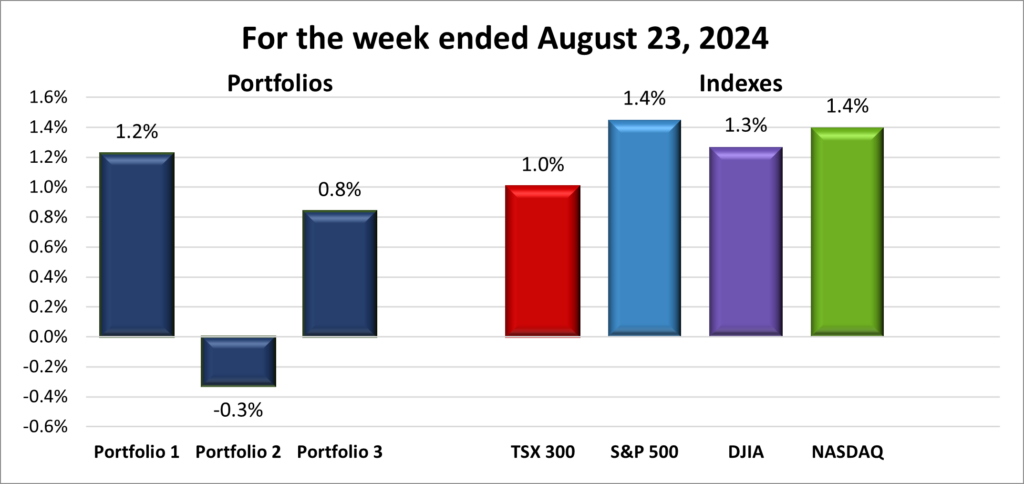
For the week, the TSX (SPTSX) rose 1.0%, the S&P 500 (SPX) advanced 1.4%, the DJIA (INDU) gained 1.3% and the Nasdaq (CCMP) climbed 1.4%.

Index Weekly Streak
TSX: 3 – week winning streak
S&P: 2 – week winning streak
DJIA: 2 – week winning streak
Nasdaq: 2 – week winning streak

Bull market. A good week for the North American stock markets. After the best week of the year, the markets kept their momentum going, with all four indexes finishing in the green—though not quite matching the previous week’s stellar gains. The indexes moved in sync, driven by the release of the FOMC meeting minutes and Fed Chair Jerome Powell’s much-anticipated speech at the Jackson Hole Economic Symposium.

Sifting through the minutes, investors zeroed in on the Fed’s apparent shift in priorities. The minutes revealed a growing focus on maintaining a strong economy and labour market, rather than solely combating inflation. This switch in focus was taken as a clear signal that a rate cut in September is almost certain. Powell further reinforced this outlook during his speech at Jackson Hole, emphasizing the Fed’s commitment to preventing further weakening in the American labour market—a strong indication that their inflation-fighting campaign may be winding down.

As markets positioned themselves for the Fed’s first rate cut in over four years, attention has now turned to the question on everyone’s mind: How deep will that first cut be? And, perhaps more importantly, how many more might follow before the year is out?

Portfolio Weekly Streak
Portfolio 1: 2 – week winning streak
Portfolio 2: 1 – week losing streak
Portfolio 3: 3 – week winning streak

Bull market. A good week for the North American stock markets.Bearish market By the close of Thursday, it looked like all three portfolios were heading for a weekly loss. However, a market rally on Friday lifted two of them out of the red and into the green.

Portfolio 1 was the standout performer, with an impressive 76% of its holdings increasing in value. The portfolio’s rise was driven by solid overall performance across its companies, rather than a few significant gains (like those seen in 2023 with Nvidia (NASD: NVDA) and other big technology companies).

Portfolio 2 could not quite bounce back from Thursday’s dip. Even though 56% of its holdings, including the recent additions of Whitecap and Birkenstock, posted gains, it was not enough to lift the portfolio into positive territory. It just goes to show that a majority of companies posting weekly gains does not always guarantee a positive finish for the portfolio.

Portfolio 3 mirrored Portfolio 1’s strong finish, extending its weekly win streak to three. Like the other portfolios, it saw no major gains or losses, but 77% of its companies notched a weekly gain.

Overall, it was a good week – not as strong as the previous one, but as Meatloaf said, “two out of three ain’t bad.” That said, I would still prefer all three ending the week in the win column. 😊

Weekly Portfolio & Index performance
Weekly Portfolio & Index performance for the week ended August 23, 2024.

Companies on the Radar

Stocks on my Radar This week, I finally trimmed down my Radar List, making room for new opportunities. Whitecap Resources (TSE: WCP), Birkenstock Holding plc (NYSE: BIRK), and Kelly Partners Group (OTCM: KPGHF) have graduated from the Radar List and found their place in my portfolios. Whitecap and Birkenstock are now comfortably settled in Portfolio 2, while Kelly Partners has joined the ranks of Portfolio 1.

As we bid farewell to these three companies on the radar, a new contender has caught my eye—Payfare Inc. (TSE: PAY). This small-cap Canadian company is making a splash in the gig economy with its instant payment and digital banking solutions for gig workers across North America, giving them immediate access to their earnings. With the gig economy booming, Payfare’s innovative approach has piqued my interest, and I am excited to dive deeper into what they have to offer.

Payfare now joins the three remaining companies on my radar list, which are listed below:

  • Equitable Bank (TSE: EQB), a mid sized (when the number of outstanding shares times the shares prices is between $2 billion to $10 billion) Canadian bank, considered Canada’s 7th bank, which provides financial services to consumers and businesses.
  • On Holding AG (NYSE: ONON), a medium cap Swiss company, founder-run, sports products company.
  • Vertiv Holdings (NYSE: VRT), a large American company that designs and builds infrastructure and continuity solutions to businesses around the world.

The Radar Check was last updated August 23, 2024.

Stock on the Radar List. 1 of 2.
Stock on the Radar List. 2 of 2.

Portfolio Update

Portfolio 1

Portfolio 1 for the week ended August 23, 2024: UP Green Up Arrow, signifying a positive week

  • General Motors (NYSE: GM) announced they were laying off over 1,000 employees following a review of their operations. The layoffs will be from their software and service units.
    in other GM news, the company agreed to recall 1,200 of their Cruise electric vehicle robotaxis to address hard braking problems. By voluntarily recalling the vehicles, the National Highway Traffic Safety Administration agreed to close the investigation into the issue.
    With that investigation out of the way, GM and Uber (NYSE: UBER) announced the Cruise robotaxis will be available on the Uber platform starting next year. Uber riders will then be able to select a Cruise vehicle for their trip.
  • Walmart (NYSE: WMT), the largest shareholder in Chinese e-commerce giant JD.com (NASD: JD), has sold its entire stake after an eight-year investment, choosing to focus on its own Sam’s Club operations in China with the proceeds of the sale.
    Elsewhere, Walmart has done a deal with Burger King to offer discounts on Burger King offerings, including a discount of 25% on any order placed via a smartphone or computer.
  • Rivian (NASD: RIVN) has lost another senior executive as Tim Fallon, the vice president of manufacturing operations, departs for traditional automaker Stellantis (NYSE: STLA). Fallon is the latest in a string of over six high-level departures, including at least four senior executives, who have recently left the company.
  • Britain’s competition watchdog, the Competition and Markets Authority (CMA), has closed its ongoing investigations into Apple’s (NASD: AAPL) and Google’s app stores, opting to wait for new legislation governing digital markets. The CMA said once new legislation comes in, they will consider applying new laws to address their concerns.

Activity

Bought: Kelly Partners Group is a small but dynamic Australian accounting firm that has been steadily expanding by acquiring other boutique accounting firms across Australia. Founded and led by Brett Kelly, KPG has carved out a niche in the small to medium-sized enterprise (SME) segment, offering high-quality financial services that these businesses often struggle to access elsewhere. Over the past five years, KPG has consistently grown its revenue and cash flows, achieving profitability each year. This steady financial growth underscores the company’s resilience and effective business strategy, helping it build a loyal client base and a strong market position.

KPG went public on the Australian Securities Exchange (ASX) on June 21, 2017, and made its debut on the American Over The Counter Market (OTCM) on November 3, 2022, under the ticker KLLYF. This move was part of a strategic effort to increase visibility among North American investors and broaden its shareholder base. In June 2023, the ticker was updated to KPGHF to better align with its ASX ticker, “KPG,” reinforcing the company’s identity across different markets. Importantly, the shares are interchangeable, with a 1:1 conversion ratio between KPG on the ASX and KPGHF on the OTCM.

The company benefits from the ongoing demand for professional financial services, particularly among small to medium-sized enterprises (SMEs). By focusing on this niche, KPG has built a competitive edge in Australia, offering specialized accounting, taxation, and audit services. Recently, the company has also ventured into wealth management, opening new growth opportunities, and reducing risk through diversified revenue streams. KPG’s dedication to building long-term relationships with its clients has resulted in high retention rates, providing a stable revenue base and opportunities for cross-selling additional services.

What makes KPG particularly appealing is its ambition for international growth. Brett Kelly’s recent relocation to the United States is a bold move as part of the company’s plan to expand into the American market. This could be a game-changer, positioning KPG to tap into a larger client base and explore new acquisition opportunities. Kelly’s presence in the US underscores the seriousness of KPG’s expansion strategy and could significantly accelerate the company’s global growth.

However, investing in KPG is not without risks. The company’s aggressive growth through acquisitions could lead to integration challenges and financial strain if not carefully managed. As a smaller player, KPG’s limited reach beyond Australia makes it more susceptible to local economic fluctuations. The international expansion introduces new management dynamics, currency risks, and potential regulatory hurdles. Additionally, reliance on key personnel and the economic sensitivity of its SME clients add layers of complexity. Investors should also be mindful of potential concerns about valuation, market liquidity, and the impact of rising interest rates.

Despite these risks, KPG offers a compelling investment opportunity. The company’s consistent revenue growth, strategic expansion efforts, and diversified offerings make it an attractive addition to any portfolio. With a strong founder-led management team and a track record of 23 successful acquisitions, KPG is well-positioned for future growth. If the company can successfully expand its footprint in the US and other English-speaking countries, there’s significant upside potential. As KPG continues to grow, I am excited to be along for the ride. 😊

Dividends

Dividends Received this week for the following companies:

Companies followed by DRIP (Dividend Re-Investment Plan) indicate additional shares were purchased with the dividend. Any cash leftover was added to the cash balance.

Canadian $

Dream Industrial Real Estate Investment Trust (TSE: DIR.UN) DRIP

Pulse Seismic Inc (TSE: PSD) DRIP

US $

No US$ dividends this past week.

Quarterly Reports

The Toronto-Dominion Bank

Third quarter 2024 financial results on August 22, 2024

Portfolio 2

Portfolio 2 for the week ended August 23, 2024: DOWN Red Down Arrow

  • Alimentation Couche-Tard (TSE: ATD) has put in a bid to acquire larger convenience store rival Seven & i Holdings Co. (OTCM: SVNDY) of Japan, the owners of 7-Eleven stores. If the deal goes forward, it would be the biggest foreign takeover of a Japanese company and would make Alimentation the owner of roughly 100,000 convenience stores.
  • The Walt Disney Company’s (NYSE: DIS) proposed joint venture with Indian media giant Reliance to create a broadcast and streaming TV powerhouse has run into a speed bump. India’s antitrust regulators is concerned that the partnership would effectively corner the market on the broadcasting rights to cricket, India’s national pastime. To close the deal, the two companies may have relinquished some of their rights to cricket broadcasts.

Activity

Bought: Whitecap Resources Inc. is a Canadian mid-cap (valued between $2 billion and $10 billion) oil and gas company, specializing in acquiring and developing petroleum and natural gas properties across Canada. Initially, the company’s attractive 7+% dividend grabbed my attention, but a closer look revealed even more compelling aspects. Despite a challenging year due to a global oil price drop, Whitecap has demonstrated resilience, with impressive revenue, net income, and earnings per share growth in previous years. Notably, it boasts a robust gross profit margin of 71% and a solid net profit margin of 22%.

The company’s strong balance sheet and substantial free cash flow offer flexibility for capital allocation, enabling share repurchases and consistent dividend payouts. Whitecap’s experienced management team, with decades in the industry, has effectively controlled costs and achieved efficient production. The company recently reported record quarterly production and plans to meet the high end of its 2024 production guidance, with further growth anticipated in 2025.

Of course, investing in Whitecap carries some risks. The energy sector’s cyclical nature and dependence on volatile oil and gas prices pose challenges, influenced by global economic conditions and geopolitical events. Additionally, the company’s plans to invest over $1 billion in property development could be impacted by fluctuating interest rates.

However, with Canadian interest rates starting to fall and expectations for a US rate cut in September, Whitecap should benefit from a more favorable financial environment. This could provide the company with the necessary resources to advance its production plans. While the dividend was the initial draw, Whitecap’s strong operational performance and production growth potential suggest that if oil prices rise, the share price could follow suit, making this an investment worth considering. 😊

Bought: Birkenstock Holding plc, a British mid-cap company, boasts a globally recognized brand with over 240 years of history. Known for its iconic sandals, the brand has become synonymous with comfort, durability, and distinctive style. Birkenstock’s ability to stay relevant across generations, appealing to both fashion-conscious consumers and those seeking functional footwear, speaks volumes about its enduring appeal.

The brand enjoys a loyal customer base that values quality and comfort, translating into consistent sales, even during economic downturns. While its sandals are the star, Birkenstock has been expanding into new product categories like boots, shoes, and accessories, opening doors to growth in untapped market segments. The company is also broadening its international presence, particularly in regions where it still has room to grow, offering significant potential for further expansion.

Birkenstock has smartly tapped into fashion trends, gaining favor among influencers, celebrities, and the public alike. This trend-driven demand, coupled with the growing focus on health, wellness, and comfort, positions Birkenstock’s products as both stylish and functional—a winning combination.

As for the financials, despite a dip in net income in 2023 due to increased tax rates and one-time expenses, Birkenstock has shown solid revenue growth, profitability, and earnings per share growth, supported by efficient operations. The management team is highly invested in the company’s success, with the CEO appointed in 2013 being the first non-family leader. Executive management holds over 8.5% of the outstanding shares, aligning their interests with shareholders.

Of course, there are risks, including potential market saturation and fierce competition in the footwear industry. Maintaining its competitive edge will be crucial, especially as consumer spending on discretionary items like footwear can be sensitive to economic conditions.

Birkenstock is a heritage brand with a strong reputation for high-quality, comfortable footwear. Its commitment to sustainability and its iconic footbed design have made it a favorite worldwide. Although the company has been around for over two centuries, it only recently became public, debuting on October 11, 2023, at $46 per share. Since then, the share price has risen by 33% as of August 23, 2024. Given the brand’s strong trajectory, I am excited to be an owner of this iconic brand and look forward to reaping the rewards. 😊

Dividends

Dividends Received this week for the following companies:

Companies followed by DRIP (Dividend Re-Investment Plan) indicate additional shares were purchased with the dividend. Any cash leftover was added to the cash balance.

Canadian $

Dream Industrial Real Estate Investment Trust (TSE: DIR.UN) DRIP

US $

No US$ dividends this past week.

Quarterly Reports

No quarterly reports this past week.

Portfolio 3

Portfolio 3 for the week ended August 23, 2024: UP Green Up Arrow, signifying a positive week

  • Microsoft (NASD: MSFT) announced they will host the Windows Endpoint Security Ecosystem Summit on Sept. 10 with other cybersecurity companies, and government officials to discuss ways to improve resiliency and security for joint customers. Following last month’s network outage caused by a CrowdStrike (NASD: CRWD) software update that brought down tens of thousands of Windows systems, it is critical that these companies work together.

Activity

No significant activity to report this week.

Dividends

No dividends this past week.

Quarterly Reports

The Toronto-Dominion Bank

See report under Portfolio 1.


Weekly Update for the week ending August 16, 2024

August bounce back

The markets kicked off August with a stumble, culminating in a sharp meltdown on August 5 that saw the three American indexes fall by more than 2.5% each. Fortunately, this proved to be a one-day selloff. Investors quickly reassessed the situation, recognizing that the American economy remained resilient despite signs of a weakening labour market. Over the following week, investor confidence grew, and the markets gradually recovered, with the four major North American indexes recovering most of their earlier losses by the end of the previous week.

This past week, the recovery continued as favourable economic data rolled in. The US, with the world’s largest economy, appears headed for a soft landing, where inflation continues to fall without triggering a recession. The latest reports showed that inflation is cooling, while retail sales remained strong, though more moderate than a year ago. The cooling job market provides further support for the Fed to start lowering the benchmark rate, although the Fed’s stance on future rate adjustments is data dependent.

This is encouraging news for both consumers and investors. Lower interest rates would reduce borrowing costs for mortgages, car loans, and credit cards, freeing up more disposable income. For investors, reduced rates often boost stock prices as cheaper borrowing can enhance corporate profits, making stocks more attractive compared to bonds. Additionally, lower rates can stimulate economic growth, benefiting both consumers and investors through increased spending, investment, and employment.

Not only is this good news for Americans, but it also bodes well for us Canadians, as our economies are deeply intertwined. As the saying goes, “When America sneezes, Canada catches a cold,” and fortunately, the US economy seems to be in good health.

This week’s swift recovery marks a significant turnaround from the volatility of the previous week. As shown in the chart below, all major indexes initially stumbled but have more than made up for the early-month setbacks.

With the markets’ one-day meltdown now in the rearview mirror, there’s growing optimism on both sides of the border. The key question for the Fed no longer seems to be if they will lower US interest rates, but rather by how much. This anticipated shift should stimulate spending and investment, fostering a more favorable economic environment that benefits both nations.

As mentioned above, the latest US inflation and retail sales reports came out this past. Now, let’s see what happened this past week….

Items that may only interest or educate me ….

Canadian Economic news, US Economic news, How can I find reliable investment information?, …


Canadian Economic news

This past week’s key economic data that the Bank of Canada (BoC) considers when deciding whether to raise or lower the interest rate.

Canadian market volatility

After the previous week’s turbulence, where Canada’s Volatility Index (CVIX) spiked to 23.56 due to a weak US labour report and professional investors covering their Japanese loans when the Bank of Japan unexpectedly raised the Japanese interest rate, the index eventually settled at 15.79. This past week brought some reassurance, as the CVIX continued to decline, closing at 11.62 by week’s end. This marks a one-week drop of 26% from the 15.79 level, driven largely by investors recognizing that they had overreacted to the US labour data, leading to a more balanced sentiment.

Tracked as the VIXI on the Toronto Stock Exchange (TSE), the CVIX measures expected market volatility. A reading below 10 indicates a calm, stable market, while a range of 10 to 20 suggests moderate volatility and typical market fluctuations. Readings above 20 point to high volatility and significant market uncertainty. With the CVIX now at 11.62, it signals a market environment marked by normal volatility—cautious but not panicked, reflecting a more measured investor outlook.

US Economic news

This past week’s key data points that the Federal Reserve (Fed) considers when deciding whether to raise or lower the interest rate.

Consumer Price Index

As anticipated, July’s Consumer Price Index (CPI) ticked up by 0.2%, following a slight 0.1% dip in June. On an annual basis, inflation edged up 2.9% for July, just shy of the expected 3%. This marks the smallest annual increase since March 2021, indicating a continued decline in inflation.

Core CPI, which excludes volatile food and energy prices, also rose by 0.2% in July, building on a 0.1% increase from June. Year-over-year, core CPI growth slowed to 3.2% from 3.3% the previous month. Both the monthly and annual core CPI figures were in line with analysts’ forecasts, with the annual increase being the lowest since April 2021.

Breaking down the details, ‘Fuel Oil’ saw the largest monthly price increase, up 0.9%, while ‘Used cars and trucks’ experienced the steepest decline, falling 2.3%. Annually, ‘Transportation services’ led with an 8.8% price increase, whereas ‘Used cars and trucks’ saw the most significant drop, down 10.9%.

Overall, the CPI data confirms that inflation is trending downward and meets expectations. As inflation moves closer to the Fed’s 2% target, this report provides the evidence the Fed needs to consider a rate cut at their September meeting. The market responded positively, with investors now speculating whether the Fed will implement a 0.25% or possibly a 0.5% reduction in rates.

The CPI and core CPI provide essential data to the Fed as they attempt to manage monetary policy and ensure economic stability. CPI reflects overall price changes across a range of goods and services, helping the Fed gauge inflationary pressures and adjust interest rates to maintain price stability. Core CPI, excluding volatile food and energy prices, offers a clearer view of underlying inflation trends, aiding the Fed in focusing on persistent inflation rather than short-term fluctuations. By targeting 2% inflation and tracking these indices, the Fed aims to maintain price stability, support economic growth, and foster a predictable environment for growth.

American market volatility

The CBOE Volatility Index (VIX), often dubbed the market’s “fear gauge,” saw a dramatic surge to 66.04 the previous week—a level not witnessed since the early days of the pandemic in March 2020. This spike was driven by weak labour data hinting at a potential recession and institutional investors rushing to cover their positions in cheap Japanese loans. However, the VIX has since plummeted, signaling a swift stabilization in investor sentiment despite a turbulent start to the month. In a record-setting move, the VIX dropped from its peak of 66.04 to its long-term median of 17.6 in just seven trading days—the fastest descent from such heights ever recorded. By the end of this past week, the VIX had further declined 15% to 14.8, marking its lowest level in three weeks.

The VIX measures expected market volatility over the next 30 days, with readings below 12 indicating a calm and stable market, while values between 12 and 20 suggest normal fluctuations. Levels between 20 and 30 reflect heightened volatility and uncertainty, and readings above 30 signal extreme stress, typically seen during crises. The recent sharp decline in the VIX suggests that market tensions have eased, and investor anxiety has subsided, leading to a more settled market environment.

Consumer Sentiment Index (CSI)

The University of Michigan’s preliminary CSI for August surprised to the upside, rising to 67.8 from July’s final reading of 66.4. Analysts had predicted a slight increase to 66.9, making this the first uptick in four months.

However, the index’s components told a more nuanced story. The Current Economic Conditions component dropped by 2.9% to 60.9, marking its lowest point since December 2022 and a significant 19.3% decline year over year. On the flip side, the Index of Consumer Expectations showed a more optimistic outlook, climbing 4.8% from July to reach 72.1, and posting a 10.2% gain compared to the same time last year.

The boost in overall sentiment seems to be driven largely by renewed optimism among Democrats, particularly after Vice President Kamala Harris became the Democratic presidential candidate. Additionally, while inflation continues to trend downward, consumers still anticipate that prices will remain elevated over the next few years.

Retail Sales

The Commerce Department’s Census Bureau advance estimate for July retail sales showed a solid increase of 1.0%, significantly surpassing the expected 0.3% gain and following a flat result in June. This was the largest monthly jump in a year and a half, driven mainly by a rebound in auto sales after a cyberattack had previously disrupted dealer transactions. Year over year, retail sales were up 2.7%.

On a monthly basis, ‘Motor vehicle & parts dealers’ led with a 3.6% increase, while ‘Miscellaneous store retailers’ saw a 2.5% decline. Annually, ‘Electronics & appliance stores’ posted the biggest gain, up 5.2%, whereas ‘Sporting goods, hobby, musical instrument, & bookstores’ experienced the steepest drop, down 6.8%.

Core retail sales, which exclude motor vehicles, parts, and gasoline station sales, climbed 0.4% for the month and 3.4% year over year. When excluding ‘Motor vehicle & parts dealers,’ ‘Electronics & appliance stores’ saw the largest monthly growth at 1.6%.

Despite this higher-than-expected increase, consumer spending is still below last year’s levels due to inflation that pushed prices higher and higher interest rates making borrowing more expensive. However, the combination of strong consumer spending, a weakening job market, and continued declines in inflation could pave the way for the Fed to consider lowering interest rates.

How can I find reliable investment information and resources?

When you are starting out with investing, finding reliable information and resources is essential but can feel overwhelming given the sheer volume available. To help simplify this, check out the Educational Resources page, where I have compiled a list of books and tools that have been instrumental in expanding my investing knowledge. Additionally, below you will find a selection of resources to jumpstart your investment journey. While this list is not exhaustive, these tools should provide a solid foundation to begin building your wealth and confidence in investing.

1. Educational Websites and Platforms

  • Investopedia: Offers a wide array of articles and tutorials on investment concepts.
  • Morningstar Canada: Provides in-depth research, analysis, and educational content on stocks, mutual funds, and ETFs.
  • Canadian Securities Institute (CSI): A valuable resource for learning about investing.
  • The Motley Fool: Known for stock recommendations and investment advice, though access typically requires a subscription for its more detailed content.

2. Books

  • “The Intelligent Investor” by Benjamin Graham: A classic on value investing, widely regarded as essential reading.
  • “A Random Walk Down Wall Street” by Burton Malkiel: Covers a variety of investment strategies and principles.
  • “The Art of Quality Investing” by Compounding Quality and Luc Kroeze: Offers insights into how to identify and invest in high-quality companies.
  • “The Wealthy Barber” by David Chilton: A great starting point for beginners who want solid, step-by-step advice on managing their finances responsibly.
  • “The Essays of Warren Buffett” by Warren Buffett: A collection of Buffett’s wisdom on investing.

3. Financial News Outlets

4. Brokerage and Investment Platforms

  • TD Direct Investing and TD Easy Trade: Provides educational resources and tools for Canadian investors.
  • Questrade and Wealthsimple: Third party trading platforms that offer a range of learning materials and market insights.
  • Most Canadian online brokerages offer educational resources and market analysis.

5. Government and Regulatory Websites

6. Professional Advice

  • Financial Advisors: Certified financial planners (CFPs) can provide personalized advice. Consider consulting a fee-only financial advisor for personalized advice.

I have listed just a few resources that I personally use or have heard of. As you can see, there is a wealth of information available. When diving into investment research, it is important to stay focused and think critically. Begin by questioning the credibility of your sources—ensure they are reputable and unbiased. To verify accuracy, cross-check details from multiple sources and avoid taking information at face value. Building a solid understanding of financial jargon will help you navigate complex content and enhance your decision-making. Prefer insights from experts with recognized qualifications and experience, as their advice is more likely to be reliable. Finally, keep your personal investment goals in focus and seek out information that directly supports your objectives, making sure it is relevant and actionable for your financial journey. And of course, I hope you find valuable insights and learn a thing or two about investing from this site! 😊


Weekly Market Review

Monday: after a week of market turbulence, today’s calm was a welcome break for investors, with the Dow Jones Industrial Average (DJIA) being the only major index to slip into negative territory. The rest of the market held steady as everyone braces for Wednesday’s crucial US inflation report. Meanwhile, oil prices are on the rise, fueled by ongoing tensions in the Middle East.

In Canada, the Toronto Stock Exchange Composite Index (TSX) was the beneficiary of higher oil and commodity prices. In trading, the Basic Materials (miners and fertilizer manufacturers) sector was the big gainer on the day, with the Technology sector suffering the biggest loss.

In the US, a rally in technology companies lifted the Nasdaq Composite Index (Nasdaq) higher and dragged the S&P 500 Index (S&P) barely across the break-even line. In trading, the Technology sector advanced the most, while Telecommunications Services had the digest decline.

Tuesday: the latest US Producer Price Index (PPI) rose less than expected, sending all four indexes higher. The PPI is often a sign of where consumer prices are headed, so investors anticipate tomorrow’s CPI will suggest inflation continues to fall. Oil prices fell after the Organization of Petroleum Exporting Countries lowered their forecast for demand growth, overcoming concerns of tighter supplies due to tensions in the Middle East.

In Canada, the TSX was buoyed by the good news out of the US. In trading, led by the Technology sector, all sectors ended higher except the Telecommunications Services sector.

In the USA, technology stocks led the way as all three indexes rose by at least 1% and hit their highest levels in almost two weeks. Investors turned their focus to Wednesday’s CPI report hoping to see inflation continued its descent. In trading, Technology posted the biggest gain, while the Energy sector was the only sector to lose ground.

Wednesday: the markets reacted favourably to the latest US inflation report, sending all four indexes into the green. This latest inflation data boosts the case for a rate cut in September. Higher US inventories sent oil prices lower.

In Canada, the data showing inflation continues to fall in the US boosted the TSX. In trading, it was a day of broad-based gains, led by the Healthcare sector. Telecommunications Services and Basic Materials were the only sectors to end lower.

In the USA, the S&P and Nasdaq ran their respective winning streaks to five on the latest inflation news. In trading, the Financials sector posted the biggest gain, while Telecommunications Services had the biggest decline.

Thursday: a stronger than expected US retail sales report suggested the US consumer market remains strong sent all four indexes well into the green. Oil prices rose after the latest economic news calmed investors worried about an imminent recession.

In Canada, higher energy and metal prices helped the TSX extend its daily win streak to six, its longest since July 2023. It was a day of broad-based gains in the Canadian sector, led by Technology with Telecommunications Services the only sector to fall back.

In the US, weekly jobless claims fell for the second straight week, adding to the positive retail sales news. In trading, Consumer Staples led all sectors while the Utilities sector was the only one to end lower.

Friday: despite a quiet trading session, all four indexes ended higher after bouncing around in the morning before heading higher in afternoon trading. Oil prices continued to slide on lower demand expectations from China.

In Canada, the TSX extended its winning streak to seven days on the strength of higher commodity prices, particularly the price of gold. In trading on Bay Street, Basic Materials recorded the biggest gain, while Energy was down the most.

In the US of A, the S&P and Nasdaq advanced for the seventh straight day as concerns of a US recession continue to fade. In trading on Wall Street, the Financials sector was the top performer, while Industrials saw the biggest losses.


Weekly Market and Portfolio Review

For the week, the TSX (SPTSX) gained 3.3%, the S&P 500 (SPX) advanced 3.9%, the DJIA (INDU) rose 2.9% and the Nasdaq (CCMP) surged 5.3%.

Index Weekly Streak
TSX: 2 – week winning streak
S&P: 1 – week winning streak
DJIA: 1 – week winning streak
Nasdaq: 1 – week winning streak

Bull market. A good week for the North American stock markets. As volatile as the previous week was, this past week could be characterized as calm and upward, with upward being the key word, as shown in the chart above. All four indexes each posted their biggest weekly gain since October 2023 as they recovered the losses from the start of the month.

The fear that gripped the markets earlier seems to have dissipated as volatility indexes in both Canada and the US returned to the ‘normal’ range of 10–20. This range represents typical market conditions with moderate volatility, reflecting day-to-day fluctuations rather than crisis-level swings.

Driving the rally were positive economic signals from the US, including the latest inflation report showing a continued downward trend and stronger-than-expected July retail sales. These indicators suggest that the recession fears that triggered the earlier selloff may have been overblown, and that the Fed is likely to begin cutting rates at their next meeting in September. A robust earnings report from Walmart (NYSE: WMT) further reinforced the strength of the American consumer.

This recent selloff and subsequent rebound are a prime example of the dangers of letting your emotions get the better of you and reacting too quickly to market movements. Short-term traders who panicked and sold off stocks during the initial decline watched as those same stocks rebounded sharply. For instance, Nvidia (NASD: NVDA) traded at $117.60 on August 1, dropped to $94.04 by August 5, and then surged to close at $122.86 by the end of this past week—a textbook case of missing out on recovery by overreacting.

Portfolio Weekly Streak
Portfolio 1: 1 – week winning streak
Portfolio 2: 1 – week winning streak
Portfolio 3: 2 – week winning streak

Bull market. A good week for the North American stock markets. A good week in the indexes usually translates to gains in the portfolios, and this past week was no exception. As shown in the chart below, the three portfolios posted solid returns, with gains ranging from 2.9% for Portfolio 2 to an impressive 8.6% for Portfolio 1.

Portfolio 1 led the pack, significantly outperforming the major indexes. Nearly 75% of its holdings increased in value, highlighted by significant (more than 10%) gains from Sea Limited (NYSE: SE) up 20%, Nvidia up 15%, Celestica (TSE: CLS) up 13%, and Crew Energy (TSE: CR), which skyrocketed 82% on news of its acquisition by Tourmaline Oil (TSE: TOU). While the bump from Crew Energy was substantial, it was the strong performance of Nvidia and other tech giants that truly drove the portfolio’s success.

Portfolio 2 made a strong comeback, with 82% of its holdings posting gains. Although Crew Energy was the standout with its sharp increase, the portfolio’s overall growth was propelled by incremental gains across other stocks.

Portfolio 3 also delivered, extending its weekly win streak with 86% of its investments gaining value. Adyen (OTCM: ADYYF) surged 19%, and Lithium Americas (TSE: LAC) finally posted a positive week with a 15% increase.

After a few hiccups in recent weeks, it was great to see all three portfolios increase in value. Looking ahead, next week’s Canadian CPI inflation report for July and the Fed’s meeting minutes will be key. If inflation in Canada continues to decline and the Fed hints at a rate cut, we should be in for another good week. 😊

Weekly Portfolio & Index performance
Weekly Portfolio & Index performance for the week ended August 16, 2024.

Companies on the Radar

Stocks on my Radar My radar list had become quite a handful, so instead of expanding it further, I decided to streamline things this week by removing two companies: Propel Holdings (TSE: PRL) and Lumine Group (TSE: LMN).

For Propel Holdings, a third party loans company, the choice boiled down to Propel versus Equitable Bank. With several financial services stocks already in my three portfolios, I am wary of overloading on similar sectors. I see more potential and lower risk with Equitable Bank, so it took the spot.

As for Lumine Group, it has been on my radar for a while due to its impressive lineage as a spinoff of Constellation Software (TSE: CSU), one of Canada’s top-performing firms. There is still a lot to like about Lumine, and I might revisit it later. For now, I am focusing on the six companies listed below that fit better with my current investment strategy

  • Whitecap Resources (TSE: WCP), a medium-cap Canadian oil and gas company. The company offers an attractive dividend yield of over 7% per month, which has been steadily growing.
  • Equitable Bank, a mid sized (when the number of outstanding shares times the shares prices is between $2 billion to $10 billion) Canadian bank, considered Canada’s 7th bank, which provides financial services to consumers and businesses.
  • Birkenstock Holding plc (NYSE: BIRK), a medium cap British company that has been making the iconic Birkenstock shoes since 1774.
  • On Holding AG (NYSE: ONON), a medium cap Swiss company, founder-run, sports products company.
  • Vertiv Holdings (NYSE: VRT), a large American company that designs and builds infrastructure and continuity solutions to businesses around the world.
  • Kelly Partners Group (OTCM: KPGHF), a small Australian accounting firm that is growing through serial acquisition of other small accounting firms in Australia. They have recently expanded into the USA and other English-speaking countries.

Please keep in mind that these are only companies that have piqued my interest. This is not a recommendation or financial advice. You should do your own research or contact a professional before making any investment decisions.

The Radar Check was last updated August 16, 2024.

Stock on the Radar List. 1 of 2.
Stock on the Radar List. 2 of 2.

NOTE: Morningstar and Thomson-Reuters analysis is unavailable for Kelly Partners Group most likely because it is a small-cap Australian company with a market value of less than US$360 million and primarily listed on the Australian Stock Exchange. While you can invest in Kelly Partners through the Over-the-Counter Market (OTCM) here in North America, the analysis is not as readily available as it is for companies on major North American exchanges like the Toronto Stock Exchange, New York Stock Exchange, and Nasdaq.

Unlike other non-North American companies I have researched, Yahoo! Finance had no information under the Analysis tab for Kelly Partners. This lack of data meant I could not access any ratings during my routine radar check.


Portfolio Update

Portfolio 1

Portfolio 1 for the week ended August 16, 2024: UP Green Up Arrow, signifying a positive week

  • Natural gas producer Crew Energy announced they were being acquired by Tourmaline Oil Corp. for C$1.3 billion. Tourmaline is Canada’s largest natural gas producer by volume and the fifth largest natural gas producer in North America. It is an all-stock transaction with each Crew shareholder receiving 0.114802 of a Tourmaline share in exchange for each Crew share they hold.
  • CN Rail (TSE: CNR) took the first step to a phased shutting down of its rail network when it stopped shipping hazardous materials. At the end of the week the company was no longer allowing container imports from its US partner railways. CN said it has taken these steps since there has been little progress in negotiations with the Teamsters Union and the likelihood of a strike or lockout has increased. If CN and Canadian Pacific Kansas City Ltd (TSE: CP) shut down it could play havoc with recently recovered supply chains.
  • General Motors (NYSE: GM) recalled over 21 thousand of their SUV electric vehicles (EV) due to concerns of a faulty anti-lock braking system.
  • Alphabet’s (NASD: GOOGL) Google announced a new batch of their Pixel smartphones, complete with integrated artificial intelligence (AI).
  • Rivian (NASD: RIVN) temporarily suspended production of their delivery van EVs for Amazon (NASD: AMZN) due to a shortage of parts. The company said the part shortage does not impact the production of their SUV and pickup EVs.

Activity

No significant activity to report this week.

Dividends

Dividends Received this week for the following companies:

Canadian $

No C$ dividends this past week.

US $

Apple Inc. (NASD: AAPL)

BSR Real Estate Investment Trust (TSE: HOM.U)

Quarterly Reports

Boston Omaha Corporation

Second quarter 2025 financial results on August 13, 2024

Sea Limited

Second quarter 2024 financial results on August 13, 2024

Home Depot, Inc.

Second quarter 2025 financial results on August 13, 2024

Grab Holdings Limited

Second quarter 2025 financial results on August 15, 2024

Walmart Inc.

Second quarter 2025 financial results on August 15, 2024

Portfolio 2

Portfolio 2 for the week ended August 16, 2024: UP Green Up Arrow, signifying a positive week

  • Bank of Nova Scotia (TSE: BNS) purchased a minority 14.9% stake in US regional lender KeyCorp (NYSE: KEY) in an all-stock deal that is valued at US$2.8 billion. The deal values KeyCorp’s shares at US$ 17.17 per share and provides at 17% premium over KeyCorp’s last closing price prior to the announcement.
  • The Walt Disney Company (NYSE: DIS) announced plans for four new cruise ships and six new themed parks.
    In other Disney news, to expedite the approval process with India’s antitrust regulator, the Competition Commission of India (CCI), Disney and Reliance have proposed selling off some of their channels. However, none of their cricket channels are on the chopping block. Given cricket’s immense popularity in India and its status as a beloved national pastime, this decision underscores its significant value in the media landscape.
    Disney’s planned new sports streaming partnership with Warner bros Discovery (NASD: WBD) and Fox Corp (NASD: FOX) has been blocked by a lawsuit filed by FuboTV (NYSE: FUBO). The judge ruled the new streaming service would “substantially lessen competition and restrain trade.”

Activity

No significant activity to report this week.

Dividends

Dividends Received this week for the following companies:

Canadian $

SmartCentres Real Estate Investment Trust (TSE: SRU.UN)

US $

No US$ dividends this past week.

Quarterly Reports

No quarterly reports this past week.

Portfolio 3

Portfolio 3 for the week ended August 16, 2024: UP Green Up Arrow, signifying a positive week

  • Shopify (TSE: SHOP) has partnered with Pivotree (TSEV: PVT) to provide Business-to-Business (B2B) and Direct-to-Consumer (D2C) customers with innovative and scalable e-commerce solutions. As part of the partnership, Pivotree will move their customers onto Shopify’s e-commerce platform.

Activity

No significant activity to report this week.

Dividends

Dividends Received this week for the following companies:

Companies followed by DRIP (Dividend Re-Investment Plan) indicate additional shares were purchased with the dividend. Any cash leftover was added to the cash balance.

Canadian $

SmartCentres Real Estate Investment Trust (TSE: SRU.UN) DRIP

US $

No US$ dividends this past week.

Quarterly Reports

Adyen N.V.

First half 2024 financial results on August 15, 2024


Weekly Update for the week ending August 9, 2024

Market meltdown

This past week began on a shaky note. Weak economic data and disappointing corporate earnings from the previous week fueled fears of a potential recession in the US, the world’s largest economy. A recession—a period of significant economic slowdown marked by declining business profits, rising unemployment, and reduced consumer spending—can spark widespread anxiety. This unease led to a sharp selloff on Monday, starting in Japan and sweeping westward through European markets before hitting North America. By the end of the day, the S&P 500 (S&P) saw its biggest drop in nearly two years, the Dow Jones Industrial Average (DJIA) plunged by 1,000 points, and the tech-heavy Nasdaq Composite index (Nasdaq) recorded its worst start to a month since 2008. The Canadian market, fortunately, avoided the chaos, as it was closed during the selloff.

By Tuesday, experienced investors were suggesting that the sharp decline was more about panic than fundamentals. They believed fears of an imminent downturn were likely overstated, leading to a market recovery by the end of the session, with all three major indexes closing higher.

Reflecting on similar market turmoil from 2020 at the start of the pandemic, I understand the anxiety many new investors are feeling. Back then, despite the urge to sell, I chose to hold onto my stocks, and I am grateful I did. The markets rebounded strongly in 2020 and 2021.

The key lesson from that experience is to stay calm and avoid knee-jerk reactions. Watching your investments drop sharply can be distressing, but panicking and selling is often the worst response. By focusing on the long term—understanding that a time horizon of several years or even decades can smooth out short-term fluctuations—and remembering that markets do recover, Monday’s turbulence felt more manageable.

Looking ahead, analysts predict continued market volatility until September, when the Fed is expected to cut interest rates. This means we might experience more ups and downs on this roller-coaster ride. The key strategy is to stay calm and stick to your investment plan. Use this turbulence as an opportunity to pick up shares of solid companies at a discount when prices drop.

For tips on managing anxiety during market downturns, check out ‘When the Market Falls…’ below.

Besides the volatile start to the week, let’s see what else unfolded over the past few days…

Items that may only interest or educate me ….

Canadian Economic news, US Economic news, When the market falls…, What I learned, ….


Canadian Economic news

This past week’s key economic data that the Bank of Canada (BoC) considers when deciding whether to raise or lower the interest rate.

BoC meeting minutes

Following their June decision to cut rates, the BoC’s Governing Council next met on July 24th to once again review the nation’s monetary policy. Following this meeting, they opted to lower the benchmark interest rate by another 0.25%, down to 4.5%. This adjustment reflects their ongoing strategy to navigate the economic landscape while bringing inflation down to their target of 2%.

Globally, the economic outlook remains steady, with growth expected to hover around 3%. Major economies are seeing inflation gradually ease towards their central bank targets. In the US, signs of a slowing economy are emerging, marked by reduced consumer spending and a cooling job market. Despite this, there is a concern that consumption might rebound unexpectedly. While inflation in the US trends downward, certain service sectors still see stubborn price pressures. Meanwhile, the exchange rate between Canada and the US has stayed stable since the last rate adjustment.

At home, after a sluggish second half of 2023, Canadian GDP growth rebounded in early 2024. Although growth is expected to remain positive, it is subdued, driven largely by high immigration. However, on a per capita basis, GDP has seen a decline. Uncertainty around population growth makes it tricky to forecast future GDP growth. Consumer spending is projected to improve in 2025, even with slower population growth. Unemployment has risen to 6.4%, with slack in the labour market due to immigration outpacing job creation. Wage growth is above 4%, which, despite slowing productivity, fuels inflationary concerns. Yet, inflation has cooled to within the Bank’s target range of 1% to 3% and is expected to drop to 2% by late 2025.

After reviewing the current economic landscape, the Council shifted their focus to the future of economic growth. While higher interest rates have helped ease inflation, they are also unveiling new risks. Economic growth is currently trailing behind population growth, creating excess supply and slack in the labour market. High interest rates are dampening consumer spending, and while spending might bounce back as rates decline, high mortgage costs could pose risks for consumer spending into 2025 and 2026. The housing market also faces potential challenges from high demand and slow construction, which could push rents higher. Although inflation in wage-sensitive services remains a concern, its overall impact on inflation may be limited.

Prior to their June meeting, the Council had been primarily focused on bringing inflation down. With inflation trending towards their target, the Council is now carefully balancing the risks of both rising and falling inflation as they navigate these uncertain economic conditions.

Labour Force Survey (LFS)

Canada’s latest Labour Force Survey from Statistics Canada reveals a mixed picture for July. The economy shed 2,800 jobs in July, following a loss of 1,400 in June, defying analysts’ expectations for a gain of 22,500 jobs. This marks the third consecutive month of virtually flat employment. On a positive note, employment is up 1.7% year-over-year.

Breaking it down further, private sector jobs fell by 0.3% in July but saw a 0.6% increase over the past year. Public sector employment, however, climbed 0.9% monthly and 4.8% annually. Self-employment held steady for the month and grew by 2.1% year-over-year.

Sector-wise, the biggest monthly boost was in ‘Utilities,’ which saw a 4.2% increase, while ‘Wholesale and retail trade’ experienced a 1.5% decline. Annually, ‘Natural Resources’ led with a 9.2% job increase, whereas ‘Agriculture’ saw the largest decrease, down 9.3%.

The unemployment rate remained steady at 6.4%, matching June’s rate and its highest level since January 2022. Analysts had anticipated a rise to 6.5%. The stable unemployment rate, despite the rising population, suggests the economy is struggling to keep pace with workforce growth.

In July, annual wage growth slowed to 5.2%, down from 5.4% in June. As the job market weakens and unemployment rises, wage growth is expected to continue slowing. This cooling trend in wages may help alleviate some inflationary pressures.

The decline in private sector jobs alongside rising public sector employment is concerning. Private sector jobs are vital for economic growth and innovation, and their drop may indicate a slowdown in these areas. Moreover, increasing public sector jobs could lead to higher government spending, potentially resulting in larger budget deficits and growing public debt, which could strain fiscal resources and impact long-term economic stability.

Overall, despite adding jobs over the past year, the recent trend of stagnant employment and rising unemployment raises concerns about the country’s ability to keep up with population growth. With no major surprises in this report, the combination of flat employment, declining inflation, and a sluggish economy have left the door open for the BoC to lower interest rates by another 0.25% at their next meeting on September 4.

Canadian market volatility

In the past week, Canada’s Volatility Index (CVIX) experienced a dramatic swing. It surged from 18.48 at the end of the previous week to a high of 23.56, before settling at 15.79—an overall drop of over 14%. This spike was largely due to investor overreaction to a recent US labour report, which hinted at a slowing economy. However, as the dust settled, investor sentiment calmed, and the CVIX returned to a more balanced level. This volatility could have ripple effects on Canada’s own economic landscape.

Tracked as the VIXI on the Toronto Stock Exchange (TSE), the CVIX gauges expected market volatility. A reading below 10 indicates a calm and stable market, while a reading between 10 and 20 reflects moderate volatility and normal market fluctuations. Readings above 20 suggest high volatility and significant market uncertainty. With the CVIX currently at 15.79, it signals a market environment with somewhat elevated volatility but not extreme, reflecting a cautious yet not panicked investor sentiment.

US Economic news

This past week’s key data points that the Federal Reserve (Fed) considers when deciding whether to raise or lower the interest rate.

American market volatility

The CBOE Volatility Index (VIX), known as the market’s “fear gauge,” soared to a high of 65.73 before the markets opened on Monday, a dramatic leap from the previous Friday close of 23.39. However, the VIX pulled back to close at 38.57, marking its highest one-day spike and peak since October 2020. Despite this sharp increase, the VIX ended the week at 20.37, reflecting an overall decline of almost 12% from the previous week. This marks the second consecutive week the VIX has closed above 20, following a period of being in the teens since last October.

The initial spike was fueled by investor anxiety over weaker-than-expected labour data from the previous week, raising concerns about a potential recession. However, reassuring comments from a member of the Fed and other experienced, professional investors helped temper these fears, bringing the VIX down to a more moderate level.

The VIX measures expected market volatility over the next 30 days. Readings below 12 suggest a calm and stable market, while values between 12 and 20 indicate normal fluctuations. Levels between 20 and 30 signal heightened volatility and uncertainty, and readings above 30 reflect extreme stress, often seen during crises. The recent rise in the VIX indicates increased market tension and suggests that investors are bracing for more volatile conditions ahead.

When the market falls…

A market selloff like the one we experienced at the start of the past week can be particularly daunting for new investors, shaking your confidence and raising questions about your investments. Understanding how to navigate these challenging periods is crucial. Here are some strategies to help you stay steady and make informed decisions during market turbulence.

  1. Stay calm. It is natural to feel anxious when the market drops sharply. However, reacting emotionally can lead to poor decisions and unnecessary losses. Investing is generally about long-term growth, and short-term market fluctuations are a normal part of the process. Instead of panicking, take a step back, assess the situation calmly, and remember that these dips are part of the journey. Staying patient and calm will help you make more informed choices.
  2. Understand Market Cycles: Markets naturally go through ups and downs. History shows that they recover from downturns, sometimes the next day others take longer and can take several months. Do not be tempted to try and time the market—predicting its highs and lows is challenging even for experts. By focusing on the long term, you will be better prepared to handle these fluctuations, knowing that recovery is part of the market’s rhythm.
  3. Review Your Portfolio: Check if the fundamentals of your investments have changed or if the sell-off is more about market sentiment. Focus on the quality of your investments rather than short-term price changes. A well-diversified portfolio of high-quality companies can help reduce losses, so consider rebalancing it to stay aligned with your long-term goals. Make sure your investment strategy reflects your comfort level with market fluctuations.
  4. Stick to Your Plan: Revisit your investment goals and strategy. If you have a well-thought-out investment plan based on your risk tolerance and financial objectives, stick with it. Avoid making hasty adjustments based solely on short-term market movements.
  5. Consult a Financial Advisor: If you are unsure how to navigate a market sell-off, consider consulting a financial advisor. Not only can they offer guidance tailored to your financial situation and goals, but also help build your investing knowledge and confidence.

Although watching your investments drop in value can be tough, remember that market selloffs can offer golden opportunities for long-term investors. A market dip often means you can acquire high-quality stocks at discounted prices. If your financial situation permits, this might be the perfect time to invest in companies you believe in at lower prices, potentially setting the stage for future gains.

By keeping these principles in mind, you can better manage your reactions and make more informed decisions during market downturns.

What I learned this week

Fractional shares

This past week, TD’s Direct Investing and Easy Trade services introduced fractional shares, enabling investors to buy partial shares instead of whole ones. This allows you to invest a specific dollar amount and receive a fraction of a share, rather than rounding down to the nearest whole share. For instance, with a $200 investment in TD (TSE: TD), trading at C$78.36 at the close of this week, you would receive approximately 2.55 shares instead of 2 full shares with some cash left over.

Fractional shares enhance your ability to diversify and balance your portfolio by giving you access to stocks and Electronically Traded Funds (ETFs) at various price points. While you can still trade whole shares if you prefer, fractional shares offer more flexibility in managing your investments. Dividends for fractional shares will be prorated based on the portion you own.

Like whole shares, you can buy and sell fractional shares in real-time trades during market hours, and dollar-based orders can be placed only when the market is open. The addition of this capability simplifies investing, making it easier to access a wider range of securities in both Canadian and US markets.

Although I have not tried it yet, fractional shares mean that rather than needing approximately C$4,000.00 to buy one full share of Constellation Software (TSE: CSU), I could gradually build up to a single share and beyond.

For more on fractional shares, check out the June 7 Weekly Update.

Carry trades

Prior to this past week, I had never heard the term ‘carry trade.’ However, given its role in Monday’s market meltdown, I decided it was time to learn more. Essentially, a carry trade is a strategy that capitalizes on the interest rate differential between currencies or asset.

Here is how it typically works:

  1. Borrowing in Low-Interest Currency: Investors borrow funds in a currency with a low interest rate, such as the Japanese yen.
  2. Investing in High-Interest Assets: They then invest these borrowed funds in assets or currencies that offer higher interest rates or returns, such as government bonds, higher-yielding currencies, or stocks.
  3. Earning the Carry: The profit comes from the difference between the low cost of borrowing and the higher returns on the investments. For example, if you borrow at an interest rate of 1% and invest in an asset yielding 5%, you earn a 4% carry.

Key Points:

  • Interest Rate Differential: The success of a carry trade largely depends on the interest rate differential between the borrowing and investment currencies.
  • Exchange Rate Risk: If the value of the currency you borrowed strengthens significantly, it can reduce or even negate the profits from the carry trade due to the increased cost of repaying the loan in that stronger currency.
  • Market Conditions: Carry trades are highly sensitive to changes in market conditions and investor sentiment. When financial stress increases, or if the value of higher-yielding assets drops or borrowing costs rise, these types of trades can quickly turn unprofitable. This shift can lead to substantial losses or even trigger a market sell-off, as was evident last Monday.

Example: Imagine you borrow yen at 0.5% and invest in American bonds yielding 3%. The 2.5% difference is your potential profit from the carry trade. It is like getting paid to move money from a low-interest account into a high-yield one!


Weekly Market Review

Monday: the selloff that began on Thursday intensified today as the S&P, the DJIA, and the Nasdaq all dropped more than 2.5%. Last week’s lower than expected jobs data has investors concerned the Fed may have waited to long to start lowering the US interest rate. The sell off spread across the globe, dragging other markets down with the American market.

In Canada, the markets were closed for a Civic Holiday, thus avoiding today’s carnage. I suspect the Toronto Stock Exchange Composite Index (TSX) will join in the selloff tomorrow.

In the US, the DJIA fell over 1,000 points, the S&P is off to its worst start of a month since 2002, and the Nasdaq is now down almost 8% since the start of the month. The Nasdaq and S&P closed at their lowest levels since early May. Not surprisingly, all sectors ended lower today. Industrials fell the least while Technology had the biggest plunge.

Tuesday: the Monday panic selling appears to be over for the American indexes as all finished in the green, snapping a three-session losing streak. Meanwhile, the TSX, which missed yesterday’s selloff, did not want to miss the fun, and ended in the red. The price of oil rose on concerns of lower oil supplies.

In Canada, after a 3-day long weekend, the TSX fell to its lowest point at the start of the day before clawing back some of the losses as investors started picking up bargains from the pile of beaten down stocks. In trading, Telecommunications Services was the only sector to advance, while Basic Materials (miners and fertilizer manufacturers) declined the most.

In the US, indexes initially surged but lost ground by the end of the day. However, comments from a Fed official, signaling that the Fed was ready to take action if the economy weakened further, helped ease investor worries. All sectors finished the day in positive territory, with the Financials sector leading the way, while the Energy sector lagged behind.

Wednesday: the indexes started the day in positive territory before all four fell into negative territory by the end of the day. With little economic news and no comments from the Fed, concerns about a possible US recession continue to weigh on investors. The price of oil rose for the second straight day as investors grew concerned about declines in American crude oil stockpiles.

In Canada, the TSX stretched its losing streak to 4 days. in trading, the Technology sector was the top performer, while Basic Materials was the worst performer.

In the US, technology stocks initially lifted the indexes but later dragged them down as investors sought safer assets. The S&P 500 experienced its largest single-day swing in over two years, shifting from a notable gain to a significant loss by the close. Among the sectors, Utilities saw the biggest gain, while Consumer Staples faced the largest decline.

Thursday: all four indexes moved strongly upward following the US weekly jobless claims which dropped more than anticipated, reassuring investors that the economy may not be as bad as they feared. Oil prices continued to rise as a result of the better-than-expected weekly jobs report and ongoing tensions in the Middle East.

In Canada, the TSX rode the upward momentum from the US labour news to close at its highest level in six months. In trading, all sectors finished in the green, led by Healthcare while Utilities brought up the rear.

In the US, the S&P had its best single day since November 2022 as investors moved back into stocks, particularly technology companies. In trading, all sectors ended higher, led by Technology with Utilities trailing the pack.

Friday: the indexes wobbled throughout the day but managed to close higher, ending the week close to where they started. Thursday’s US labour report eased investors’ concerns, leading to a return to the markets. Additionally, rising tensions in the Middle East drove oil prices up, marking the first weekly gain for oil since early July.

In Canada, the TSX rose on higher oil and commodity prices. In trading on Bay Street, Basic Materials gained the most while Utilities dropped the farthest.

In the US, the three indexes bounced above and below the baseline for most of the morning before heading upward in the afternoon. In trading, Telecommunications Services advanced the most while Basic Materials was the only sector to end lower.


Weekly Market and Portfolio Review

For the week, the TSX (SPTSX) gained 0.4%, the S&P 500 (SPX) was essentially flat slipping 0.04%, the DJIA (INDU) fell 0.6% and the Nasdaq (CCMP) declined 0.1%.

 
Index Weekly Streak
TSX: 1 – week winning streak
S&P: 4 – week losing streak
DJIA: 2 – week losing streak
Nasdaq: 4 – week losing streak

Bearish market The week kicked off with a dramatic plunge, setting the stage for a turbulent few days as the indexes struggled to recover. Despite the rocky start, the TSX managed to gain ground, buoyed by rising energy and commodity prices, while the S&P 500 recouped much of its initial losses. The Nasdaq experienced significant volatility, with daily swings of 1% or more before ending close to where it began the week. The DJIA, too, ended lower but recovered a substantial portion of its early-week losses.

Monday’s market meltdown was fueled by a series of impactful events. News that the world’s greatest investor, Warren Buffet, had sold US $ 75.5 billion worth of stocks, including half of his Apple shares, and built-up cash caused investors to wonder if they should follow suit. This came amid a broader shift away from technology stocks, pushing the Nasdaq into a market correction of over 10% within three weeks. The previous week’s disappointing US labour report heightened fears of a potential recession, further amplifying investor anxiety, and prompting a wave of profit-taking.

Compounding the chaos was the unwinding of carry trades. Investors, particularly hedge funds, had borrowed cheap yen to invest in higher-yielding assets like US technology stocks. However, a surprise interest rate hike by the Bank of Japan strengthened the yen, diminishing the profitability of these trades and prompting a sell-off of riskier assets to cover losses. This, in turn, intensified the market declines.

On Monday, the S&P 500 and DJIA experienced their largest daily losses since September 2022, with technology stocks bearing the brunt of the sell-off. The Magnificent Seven tech giants alone lost $800 billion in value. The global sell-off began with Japan’s Nikkei 225, which plunged 12%—its steepest one-day drop since 1987—and spread to major exchanges worldwide, including the London Stock Exchange.

This week highlighted how emotions can drive market movements, particularly when investor sentiment is high. Weak economic data led to profit-taking and a panic-driven sell-off, which evolved into a week of significant volatility. Fortunately, the week ended with some stability, providing a reminder of how swiftly market conditions can change. Here is hoping the upward momentum from the last two days carries into the upcoming week, and we experience a bit less ‘excitement’ ahead. 😊

Portfolio Weekly Streak
Portfolio 1: 4 – week losing streak
Portfolio 2: 2 – week losing streak
Portfolio 3: 1 – week winning streak

Bearish marketBull market. A good week for the North American stock markets. Given the market’s rocky start on Monday, I anticipated a challenging week, and indeed, two of the three portfolios ended lower, as shown in the chart below. However, one portfolio exceeded expectations with a solid weekly gain, outpacing all four indexes.

Portfolio 1 dropped in value despite 60% of its holdings posting weekly gains. While there were no significant losses, several stocks saw impressive increases. After hitting a 52-week low on Monday morning, Nvidia (NASD: NVDA) bounced back with a 13% gain for the week. Other notable performers included Trade Desk (NASD: TTD) up 27%, Shopify (TSE: SHOP) up 25%, CrowdStrike (NASD: CRWD) and Sea Ltd (NYSE: SE) both up 17%, Docebo (TSE: DCBO) up 13%, and Datadog (NASD: DDOG) and Cloudflare (NYSE: NET) both up 11%.

Despite these gains, the portfolio’s overall value decreased. Initially, this was puzzling. On closer inspection, I found that the share prices at the end of the previous week were significantly higher than their Monday opening prices. For example, Nvidia closed the previous week at $107.27 but opened Monday at $92.63 and ended the week at $104.70.

I calculate weekly gains based on the Monday opening price and the Friday closing price, which showed a 13% gain. However, comparing the previous Friday’s close to this past Friday’s close reveals a 2% loss. This discrepancy highlights why Portfolio 1 lost value despite strong weekly performances—sometimes the surface gains do not tell the whole story.

Portfolio 2 had the weakest weekly performance among the portfolios, despite 60% of its stocks showing gains. iA Financial (TSE: IAG) led with a solid 10% increase, but this wasn’t enough to counteract the losses in the portfolio. Mitek Systems (NASD: MITK) suffered a substantial 25% decline, and although Airbnb (NASD: ABNB) didn’t post a significant weekly loss, hitting a 52-week low didn’t help.

Portfolio 3 had a relatively decent week despite a rocky start. Although only 45% of the holdings increased in value, Shopify and Cloudflare led with notable gains, as mentioned earlier. However, the portfolio faced challenges from Telus International (TSE: TIXT), which dropped 36%, and Lithium Americas (TSE: LAC), which declined by 11%.

Looking at the portfolios, it appears that having the majority of stocks post weekly gains does not always translate to an overall increase in portfolio value. ☹ Nonetheless, seeing most holdings with positive weekly performance is still preferable. Hopefully, the upward momentum we saw at the end of the week will carry into the next, leading to more companies advancing in each portfolio and a rise in overall portfolio values. 😊

Weekly Portfolio & Index performance
Weekly Portfolio & Index performance for the week ended August 9, 2024.

Companies on the Radar

Stocks on my Radar Last week, I mentioned that my radar was packed with six companies, and I aimed to trim the list down to five or fewer. However, this past week, I could not resist adding two more interesting names to the mix.

First up is Propel Holdings (TSE: PRL), a small-cap Canadian company with a market value under $2 billion. They specialize in providing credit to individuals who cannot access traditional financial institutions like banks.

Next up is Whitecap Resources (TSE: WCP), a medium-cap Canadian oil and gas company. After a sluggish July, oil prices have recently started to climb, making Whitecap an intriguing prospect. The company offers an attractive dividend yield of over 7% per month, which has been steadily growing. The potential for monthly cash flow combined with the possibility of share price appreciation if oil prices continue to recover makes Whitecap a compelling investment opportunity. 😊

So, despite my initial plan to narrow down the list, it is now grown to eight companies. Looks like I will need to make some tough decisions to trim it down to a more manageable number.

  • Equitable Bank (TSE: EQB), a mid sized (when the number of outstanding shares times the shares prices is between $2 billion to $10 billion) Canadian bank, considered Canada’s 7th bank, that provides financial services to consumers and businesses.
  • Birkenstock Holding plc (NYSE: BIRK), a medium cap British company that has been making shoes since 1774.
  • On Holding AG (NYSE: ONON), a medium cap Swiss company, founder-run, sports products company.
  • Vertiv Holdings (NYSE: VRT), a large American company that designs and builds infrastructure and continuity solutions to businesses around the world.
  • Lumine Group (TSE: LMN), a young Canadian mid sized company that acquires communications and media software companies, and then strengthens and grows those companies.
  • Kelly Partners Group (OTCM: KPGHF), a small Australian accounting firm that is growing through serial acquisition of other small accounting firms in Australia. They have recently expanded into the USA and other English-speaking countries.

Please keep in mind that these are only companies that have piqued my interest. This is not a recommendation or financial advice. You should do your own research or contact a professional before making any investment decisions.

The Radar Check was last updated August 9, 2024.

Stock on the Radar List. 1 of 2.
Stock on the Radar List. 2 of 2.

NOTE: Morningstar and Thomson-Reuters analysis is unavailable for Kelly Partners Group most likely because it is a small-cap Australian company with a market value of less than US$360 million and primarily listed on the Australian Stock Exchange. While you can invest in Kelly Partners through the Over-the-Counter Market (OTCM) here in North America, the analysis is not as readily available as it is for companies on major North American exchanges like the Toronto Stock Exchange, New York Stock Exchange, and Nasdaq.

Unlike other non-North American companies I have researched, Yahoo! Finance had no information under the Analysis tab for Kelly Partners. This lack of data meant I could not access any ratings during my routine radar check.


Portfolio Update

Portfolio 1

Portfolio 1 for the week ended August 9, 2024: DOWN Red Down Arrow

  • Alphabet’s (NASD: GOOGL) was ruled to have engaged in illegal practices to maintain it search engine monopoly. A federal judge ruled the company used its dominant market position to eliminate competitors and paid billions of dollar to become the default search engine of smartphones and web browsers.
  • Berkshire Hathaway (NYSE: BRK.B) seems to have gone defensive and built up its cash pile to US$ 276.9 billion, as of June 30, from what was then a record US$ 189 billion at the end of April. To build up its stockpile of cash, the company sold half of its Apple (NASD: AAPL) shares.
  • CrowdStrike (NASD: CRWD) has firmly denied Delta Air Lines’ (NYSE: DAL) allegation that it should be held responsible for the flight disruptions caused by a global outage on July 19, which was linked to a faulty update. CrowdStrike contends that their CEO reached out to a Delta board member within four hours of the incident, and their Chief Security Officer directly contacted Delta’s Chief Information Security Officer. CrowdStrike also claims that they offered help, which Delta chose to ignore or decline. Additionally, CrowdStrike asserts that its liability is limited by contract to “single-digit millions,” not the hundreds of millions Delta is seeking.
  • TMX Group (TSE: X) announced they have acquired news release service company Newsfile Corp., a private company that provides news release distribution and regulatory filings services. TMX is the operator of many of the Canadian stock exchanges, including the Toronto Stock Exchange. This acquisition bolsters the services TMX can provide the companies that list on their exchanges.
  • Britain’s anti trust regulator, the Competition and Markets Authority (CMA), announced they were investigating Amazon’s (NASD: AMZN) relationship with artificial intelligence (AI) startup Anthropic. The CMA has until October 4 to either clear the companies of anti competition concerns or refer the case for a deeper investigation. Both companies claim their relationship does not create any competition concerns. This will be a tough case for the CMA as they are already investigating Alphabet’s Google and Anthropic for the same reason. With Anthropic working with both technology juggernauts, it would appear hard any of the three companies are being anti competitive.

Activity

No significant activity to report this week.

Dividends

Dividends Received this week for the following companies:

Companies followed by DRIP (Dividend Re-Investment Plan) indicate additional shares were purchased with the dividend. Any cash leftover was added to the cash balance.

Canadian $

No C$ dividends this past week.

US $

Costco Wholesale Corp (NASD: COST)

Quarterly Reports

Navitas Semiconductor Corporation

Second quarter 2024 financial results on August 5, 2024

Innovative Industrial Properties, Inc.

Second quarter 2024 financial results on August 5, 2024

Rivian Automotive, Inc.

Second quarter 2024 financial results on August 6, 2024

Celsius Holdings, Inc.

Second quarter 2024 financial results on August 6, 2024

Magnite, Inc.

Second quarter 2024 financial results on August 7, 2024

Crew Energy Inc.

Second quarter 2024 financial results on August 7, 2024

Shopify Inc.

Second quarter 2024 financial results on August 7, 2024

GDI Integrated Facility Services Inc.

Second quarter 2024 financial results on August 7, 2024

Datadog, Inc.

Second quarter 2024 financial results on August 8, 2024

The Trade Desk, Inc.

Second quarter 2024 financial results on August 8, 2024

Formula 1 Group (Liberty Media)

Second quarter 2024 financial results on August 8, 2024

indie Semiconductor, Inc.

Second quarter 2024 financial results on August 8, 2024

Docebo Inc.

Second quarter 2024 financial results on August 8, 2024

Atlanta Braves Holdings, Inc.

Second quarter 2024 financial results on August 8, 2024

Decisive Dividend Corporation

Second quarter 2024 financial results on August 9, 2024

Portfolio 2

Portfolio 2 for the week ended August 9, 2024: DOWN Red Down Arrow

  • The Walt Disney Company (NYSE: DIS) announced it was raising the monthly fee for its Disney+ and other Disney streaming services.
    In other Disney news, the company said it plans to invest a minimum of US$ 1 billion annually over the next five years in the United Kingdom, Europe, the Middle East, and Africa to produce movies and TV shows.

Activity

No significant activity to report this week.

Dividends

Dividends Received this week for the following companies:

Companies followed by DRIP (Dividend Re-Investment Plan) indicate additional shares were purchased with the dividend. Any cash leftover was added to the cash balance.

No dividends this past week.

Quarterly Reports

Airbnb, Inc.

Second quarter 2024 financial results on August 6, 2024

Crew Energy Inc.

See report under Portfolio 1.

Guardant Health, Inc.

Second quarter 2024 financial results on August 7, 2024

The Walt Disney Company

Third quarter 2024 financial results on August 7, 2024

Mitek Systems, Inc.

Third quarter 2024 financial results on August 8, 2024

Supremex Inc.

Second quarter 2024 financial results on August 8, 2024

Portfolio 3

Portfolio 3 for the week ended August 9, 2024: UP Green Up Arrow, signifying a positive week

  • Microsoft (NASD: MSFT) has partnered with Palantir Technologies (NYSE: PLTR) to provide enhanced cloud, AI and analytics capabilities to the US defense and intelligence agencies.

Activity

No significant activity to report this week.

Dividends

Dividends Received this week for the following companies:

Companies followed by DRIP (Dividend Re-Investment Plan) indicate additional shares were purchased with the dividend. Any cash leftover was added to the cash balance.

No dividends this past week.

Quarterly Reports

Alvopetro Energy Ltd.

Second quarter 2024 financial results on August 7, 2024

Magnite, Inc.

See report under Portfolio 1.

Shopify Inc.

See report under Portfolio 1.

GDI Integrated Facility Services Inc.

See report under Portfolio 1.

goeasy Ltd.

Second quarter 2024 financial results on August 8, 2024

Brookfield Corporation

Second quarter 2024 financial results on August 8, 2024


Weekly Update for the week ending August 2, 2024

Hints of a US rate cut

This past week, the US Federal Reserve (Fed) announced that it would keep the benchmark interest rate at 5.5%, a move that was widely expected. However, the Fed also hinted at the possibility of a rate cut in September, as inflation cools and the labour market shows signs of slowing. The Federal Open Market Committee (FOMC) unanimously agreed to maintain the federal funds rate in the 5.25% to 5.5% range, where it has been for the past year.

Fed officials noted that while job gains have slowed and the unemployment rate has slightly increased to 4.1%, it remains relatively low. Inflation is trending down, though it is still “somewhat elevated.” Fed Chair Jerome Powell mentioned that while there was discussion about cutting rates, a “strong majority” felt it was not the right time. However, he indicated that a September rate cut “could be on the table,” suggesting the economy is nearing a point where a policy rate reduction might be warranted.

Their goal is to achieve a ‘soft landing,’ where inflation returns to the Fed’s 2% target without harming economic growth. However, potential challenges remain. One concern is the possibility of inflation rising again. Another is the political pressure from Republican lawmakers, who have cautioned that lowering rates before the November election could be seen as a political move. They do not want the Democrats to be able to take credit for lowering borrowing cost that would help consumers and businesses alike. However, the Fed said they only thing they were concerned about was the state and direction of the economy and the progress of inflation back to its 2% annual target. Their decisions are driven by data, not politics.

Overall, the Fed’s announcement was in line with expectations, maintaining the rate at 5.5%. However, if inflation continues its downward trend or the economy slows more than anticipated, a rate cut in September is likely on the table. The coming months will be pivotal in determining whether the Fed can successfully navigate a soft landing without jeopardizing economic stability or getting caught up in political debates.

In the meantime, let’s see what happened this past week….

Items that may only interest or educate me ….

Canadian Economic news, US Economic news, How can I beat the TSX or S&P? ….


Canadian Economic news

This past week’s key economic data that the Bank of Canada (BoC) considers when deciding whether to raise or lower the interest rate.

Gross Domestic Product (GDP)

GDP is a key indicator of a country’s economic health, measuring the total value of goods and services produced within an economy over a specific period. This metric offers valuable insights into overall economic performance, helping the BoC make informed decisions on interest rates to promote price stability, full employment, and sustainable economic growth.

This week, Statistics Canada reported GDP growth slowed to 0.2% in May, following a 0.3% increase in April, which was slightly above analysts’ expectations of 0.1% growth. The ‘Goods-producing industries’ saw a 0.4% increase, driven by a 0.9% rise in the ‘Agriculture, forestry, fishing and hunting’ subsector, although ‘Mining, quarrying, and oil and gas extraction’ fell by 0.6%. Meanwhile, the ‘Services-producing industries’ grew by 0.1%, with ‘Accommodation and food services’ up 0.9%, offsetting a 0.9% decline in ‘Retail trade.’

Year-over-year, GDP increased by 1.1%, with ‘Goods-producing industries’ up by 0.1% and ‘Services-producing industries’ rising by 1.4%. The ‘Mining, quarrying, and oil and gas extraction’ subsector led the ‘Goods-producing industries’ with an 8.0% increase, while ‘Manufacturing’ declined by 2.1%. In the ‘Services-producing industries,’ ‘Transportation and warehousing’ gained 3.3%, while ‘Management of companies and enterprises’ dropped by 33.3%.

Looking ahead, Statistics Canada estimates a modest 0.1% growth in GDP for June, with a forecasted annualized growth of 2.2% for the second quarter, surpassing the BoC’s previous estimate of 1.5%. This suggests that while the Canadian economy is performing better than expected, it is still being driven by higher immigration rather than improved productivity and operating below its potential.

The official report will be released on August 30, 2024.

Canadian market volatility

Over the past week, Canada’s Volatility Index (CVIX) saw a significant rise, jumping from 13.14 to a peak of 22.46 before settling at 18.48—a 40% increase. This surge followed the release of new US employment data, which pointed to a slowing labour market and reignited fears of a potential economic slowdown in the world’s largest economy. Such concerns are likely to have ripple effects on Canada’s economy.

Tracked as the VIXI on the Toronto Stock Exchange (TSE), the CVIX measures expected market volatility. A reading below 10 signals a calm and stable market, while 10 to 20 indicates moderate volatility and normal fluctuations. Readings above 20 suggest high volatility and significant market uncertainty. With the CVIX at 18.48, it indicates a market environment where volatility is somewhat elevated but not extreme, suggesting a cautious but not panicked investor sentiment.

US Economic news

This past week’s key data points that the Fed considers when deciding whether to raise or lower the interest rate.

Labour data

Three key reports provide a monthly snapshot of the US labour market: Job Openings and Labor Turnover Survey (JOLTS), ADP National Employment Report, and Employment Situation Summary (ESS). Analyzing these reports reveals trends in employment, wage growth, and potential future economic policy.

Labor Department’s Job Openings and Labor Turnover Survey (JOLTS)

The June JOLTS report revealed a higher than expected 8.184 million job openings as of the last day of the month, nearly matching the upwardly revised 8.230 million from May. Analysts had predicted around 8.0 million openings. The job openings rate remained steady at 4.9%, with the number of openings decreasing by 914,000 from June 2023. The ratio of job openings to unemployed persons dropped to 1.2 from 1.24 in May, indicating a slight cooling in the labour market.

On a monthly basis, ‘Accommodation and food services’ saw the largest increase, adding 120,000 job openings, while ‘Manufacturing of non-durable goods’ experienced a decline of 88,000 openings. Year-over-year, ‘Arts, entertainment, and recreation’ increased by 5,000, and ‘State and local government’ added 48,000 job openings.

Overall, the JOLTS report points to a slight decrease in job openings and a lower ratio of job openings to unemployed workers, suggesting a cooling labour market. However, the number of job openings still exceeds pre-pandemic levels, indicating a relatively strong demand for workers.

ADP Employment Report

The July ADP Employment report revealed that private payrolls increased by just 122,000 jobs, falling short of the 150,000 jobs analysts had expected and well below June’s upwardly revised 155,000 gain. Additionally, wage growth slowed, with annual increases dropping to 4.8% from 4.9% in June. Employees who stayed in their positions saw wages rise by 4.8%, while those who switched jobs experienced a wage increase of 7.2%, down from 7.7% in June. Overall, job creation slowed, and pay gains continued to decelerate, highlighting a cooling labour market.

Bureau of Labor Statistics’ Employment Situation Summary (ESS).

The July ESS data brought some surprises. Nonfarm payrolls increased by only 114,000, falling short of the expected 175,000 and down from June’s 206,000. The unemployment rate also caught analysts off guard, rising to 4.3% from 4.1%, contrary to predictions that it would remain steady. Just a year ago, the unemployment rate was a much lower 3.5%. On the wage front, annual average earnings grew by 3.6% in July, down from June’s 3.9% pace and slightly below the forecasted 3.7%.

These figures suggest a cooling US economy and labour market. The unexpected rise in unemployment indicates more people are either losing jobs or struggling to find employment. Additionally, the deceleration in annual average earnings growth signals reduced wage pressure. Combined, these factors point to slowing economic momentum, potentially prompting the Fed to consider lowering interest rates to stimulate growth and raising concerns about a potential recession.

Conclusion

The July labour market data signals a cooling economy characterized by slowing job creation, rising unemployment, and decelerating wage growth. If these trends persist, the risk of an economic recession increases. This situation heightens concerns and puts additional pressure on the Fed to consider lowering interest rates at their next meeting in September.

American market volatility

The CBOE Volatility Index (VIX), often called the market’s “fear gauge,” surged to 29.44, its highest level since October 2023, before settling at 23.39, marking a 42% increase from 16.38 at the start of the week. This spike was driven by disappointing earnings from major technology companies, weaker-than-expected labour data, and economic indicators suggesting a faster-than-expected slowdown, raising fears of a potential recession.

The VIX gauges expected market volatility over the next 30 days. Readings below 12 suggest calm and stability, while 12 to 20 indicates normal fluctuations. Levels between 20 and 30 point to heightened volatility and uncertainty, and above 30 is starting to get extreme and signals high stress, often seen during crises. The recent uptick in the VIX indicates a period of heightened market tension and suggests that investors are anticipating more volatile conditions in the near term.

Consumer Confidence Index

The Conference Board’s Consumer Confidence Index (CCI) for July increased unexpectedly to 100.3, up from a downwardly revised 97.8 in June, slightly surpassing analysts’ expectations of 99.7. Despite this rise, consumer confidence remains within the tight range observed over the past two years.

The Present Situation Index, which assesses consumers’ perceptions of current business and labour market conditions, dipped slightly to 133.6 from June’s revised 135.3. This indicates that while people may feel somewhat better about the current labour market, concerns about inflation and higher prices persist. Meanwhile, the Expectations Index, reflecting consumers’ outlook over the next six months on income, business, and labour market conditions, rose to 78.2 in July from 72.8 in June. Notably, this marks the sixth consecutive month the Expectations Index has stayed below the critical 80 mark, often signaling a potential recession.

Overall, the combination of these sub-indexes suggests that while consumers feel somewhat confident about their current situation, largely due to a strong labour market, there is growing unease about a slowing economy. The CCI, with a score above 100, indicates optimism, while a score below 100 suggests a more pessimistic outlook. The Expectations Index is particularly crucial, as a reading below 80 can be an early warning sign of an economic downturn.

How can I beat the TSX or S&P?

Out of one million investors worldwide, about 90% are institutional or professional investors, leaving retail investors like us in the minority. When you aim to beat the TSX or S&P 500, you are essentially saying you will outperform over 50% of all investors, including those professionals with their teams of analysts and extensive resources. That is a tall order, and the odds are not in your favour. Instead, consider setting your own personal investment goals.

When investing, focusing too much on beating the TSX or S&P 500 might not be the best approach for several reasons:

  1. Long-Term Focus Over Short-Term Gains: Investing with a long-term perspective often leads to better results than chasing short-term market performance. The markets can be volatile, and trying to outperform them in the short term can lead to high-risk decisions.
  2. Different Goals and Risk Tolerance: Your personal financial goals, risk tolerance, and investment time horizon are unique. The TSX and S&P 500 are benchmarks for broad market performance, but your investment strategy should be tailored to your specific needs and circumstances.
  3. Diversification: Aiming to beat a specific index might lead to an overly concentrated portfolio, increasing risk. Diversification across different asset classes, sectors, and geographic regions can reduce risk and provide more stable returns over time.
  4. Market Timing Challenges: Consistently beating the market requires precise timing, which is extremely difficult even for seasoned, professional investors. Markets are influenced by countless factors, many of which are unpredictable.
  5. Costs and Taxes: Trying to beat the market often involves frequent buying and selling, which can lead to higher transaction costs and taxes. These costs can eat into your returns, making it harder to outperform the benchmarks.
  6. Psychological Stress: Focusing on beating the market can lead to unnecessary stress and emotional decision-making. It is easy to become overly focused on short-term fluctuations and lose sight of your long-term investment strategy.

Instead of aiming to beat the TSX, S&P 500, or even a friend’s portfolio, it is more beneficial to focus on building a diversified portfolio aligned with your financial goals, risk tolerance, and investment horizon. By setting clear goals and planning your portfolio to achieve them, you can avoid the pressure of constantly trying to outperform others or the market. This approach allows you to make the right investment decisions based on your personal objectives, rather than making impulsive moves to keep up with an index or peers. Consistent, disciplined investing and sticking to your plan can lead to satisfactory returns, making it less important what a stock index or others are doing. By moving the goalposts in your favour, you can focus on your own financial journey and success.


Weekly Market Review

Monday: it was a choppy day in the markets as investors await what will be a busy week of news for the markets, headlined by the Fed’s latest announcement on US interest rates. The Toronto Stock Exchange Composite Index (TSX) and the Dow Jones Industrial Average (DJIA) ended lower, while the S&P 500 Index (S&P) and the Nasdaq Composite Index (Nasdaq) ended barely in positive territory. Oil prices fell after Israeli officials said they were trying to avoid widening the Middle East conflict after Hezbollah fired missiles into Israel.

In Canada, investors adopted a wait-and-see approach, anticipating the Fed’s next move and the release of second-quarter earnings for major Canadian companies and US tech giants. In trading, Basic Materials (miners and fertilizer manufacturers) had the biggest gains, while the Technology sector had the biggest drop.

In the US, the July labour data and earnings reports from some of the biggest technology companies comes out this week. Investors will be looking to see if all the money invested in artificial intelligence (AI) is starting to payoff. In trading, Consumer Staples climbed the most, while the Energy sector lost the most ground.

Tuesday: another mixed day for the indexes with the TSX and DJIA advancing, and the S&P and Nasdaq declining. Investors are hoping tomorrow that the Fed signals they are preparing to lower the benchmark interest rate in September. Oil prices continued to slide as investors are concerned about lower demand from China and the likelihood that OPEC+ nations will increase supplies. In after hours trading, Microsoft (NASD: MSFT) slipped almost 5% when its revenues from its cloud computing segment came in lower than expected.

In Canada, the TSX’s smaller exposure to Technology stocks prevented the TSX being dragged lower by technology stocks like the technology-oriented S&P and Nasdaq. In trading, Healthcare posted the biggest gain, while the Technology sector recorded the biggest loss.

In the US, investors are eagerly awaiting earnings reports from major tech companies, hoping to see if their substantial investments in AI are beginning to pay off. There’s growing concern that these investments may not deliver the returns investors had anticipated, putting pressure on the big tech firms. In trading, Energy was the big winner on the day, while Technology was the biggest loser.

Wednesday: investor optimism that US interest rates would fall in September sent all four indexes soaring. The Fed announced they were holding the interest rate at 5.5% but said a rate cut in September could be in the cards. The price of oil rose as tensions increased in the Middle East after Israel killed a top Hamas leader.

In Canada, riding on the good news out of the US, the TSX set a record high close that saw all sectors advance. Leading the way was the Energy sector, with Consumer Staples trailing the pack.

In the US, investors stormed back into technology stocks sending the S&P and Nasdaq to their best one-day performance since February. In trading on Wall Street, Technology gained the most, while Healthcare lost the most.

Thursday: yesterday the markets giveth, today the markets taketh as all four indexes ended sharply lower. Weak US economic data led to global concerns that the US economy is slowing faster than expected. Oil prices were lower despite growing tensions in the Middle East.

In Canada, the TSX had its biggest drop in six months as a result of the weaker US economic news and declining oil prices. In trading, Telecommunications Services advanced the most, while Technology had the biggest loss.

In the USA, disappointing earnings from several semiconductor companies weighed heavily on the indexes Investors are increasingly concerned that the Fed may have delayed lowering interest rates for too long, leading to a recession. In trading, the Utilities sector posted the biggest gain, while Technology saw the biggest decline.

Friday: the indexes tumbled after a weaker-than-expected US labour report raised concerns about a potential recession. Oil prices fell as concerns about lower demand outweighed supply constraints caused by tensions in the Middle East. The price of oil posted its fourth straight weekly decline.

In Canada, the TSX was dragged lower on concerns the US economy was headed for a recession. In trading, Telecommunications Services and Utilities were the only sectors to end higher, while Technology sank the furthest.

In the US, investors exiting technology companies weighed on the indexes and sent the Nasdaq into a correction, where the index falls more than 10% from its last closing high. In trading on Wall Street, Consumer Staples advanced the most, while Consumer Cyclicals fell the farthest.


Weekly Market and Portfolio Review

For the week, the TSX (SPTSX) lost 2.6%, the S&P 500 (SPX) dropped 2.1%, the DJIA (INDU) fell 2.1% and the Nasdaq (CCMP) plunged 3.4%.

Index Weekly Streak
TSX: 1 – week losing streak
S&P: 3 – week losing streak
DJIA: 1 – week losing streak
Nasdaq: 3 – week losing streak

Bearish market It was a challenging week in the markets, with all four major North American indexes falling by at least 2%. Initially, there was hope that the Fed’s announcement about a possible interest rate cut in September would spur a rally, but instead, the markets took a sharp downturn in the final two days of the week, as shown in the chart above.

Midweek, the Fed held the US interest rate steady at 5.5% while leaving the door open for a September rate cut. This brief optimism lifted the indexes, but the mood soured quickly. Weaker-than-expected US employment data ignited fears of a recession. With inflation still higher than desired, rising unemployment rates, and declining consumer spending, the markets reacted negatively. The Nasdaq officially entered correction territory, falling 10% from its record high set earlier in July.

Adding to the gloom were lackluster earnings reports. Tech companies’ second-quarter results raised concerns about ballooning costs from investments in AI infrastructure with only modest gains to show for it. Following disappointing reports from Alphabet (NASD: GOOGL) and Tesla (NASD: TSLA) the previous week, Microsoft and Amazon’s results this past week further rattled investors. On the bright side, earnings growth seems to be spreading beyond the tech giants and all the AI hype.

In Canada, the TSX set a record high midweek but then tumbled 3.8% by week’s end, snapping a five-week streak of weekly gains. Fears of a potential US recession erased gains from the past three weeks.

Investors are now questioning whether the Fed has waited too long to begin lowering rates. Earlier in the year, the Fed was lauded for its efforts to guide the economy towards a ‘soft landing’—bringing inflation down to the 2% target without triggering a recession. Now, concerns are growing that the Fed may have delayed too long and might struggle to cut rates swiftly enough to achieve the desired outcome.

As we move forward, investors will be keenly watching for signs of economic stabilization. The prospect of a rate cut brings a glimmer of hope, but reassurance is needed that the US economy remains robust. A slowdown is manageable, but not to the point of triggering a recession. Strong earnings reports could significantly ease concerns about a slowing economy. Ideally, this market volatility will prove to be a temporary blip, presenting potential buying opportunities. Let’s hope for calmer waters and a more positive outlook in the coming weeks. 😊

Portfolio Weekly Streak
Portfolio 1: 3 – week losing streak
Portfolio 2: 1 – week losing streak
Portfolio 3: 3 – week losing streak

Bearish market At the end of Thursday’s trading session, all three portfolios were showing promising gains of at least 1%. Fast forward to Friday, and the markets took a nosedive, dragging all three portfolios down, way down, as shown in the chart below.

Portfolio 1 had a roughest week, dropping 4.3%. Only 20% of its companies posted weekly gains. The lone bright spot was Nvidia, the largest holding in the portfolio, which surged 13% on Wednesday, adding a record $329 billion in value in a single day. This remarkable gain, however, was sandwiched between a 9% drop in the two days prior and a 10% drop in the two days following. Despite this volatility, Nvidia’s mid-week spike helped it avoid a significant weekly loss.

Unfortunately, many other stocks in Portfolio 1 experienced significant declines of 10% or more. Notable drops included Pinterest (NASD: PINS) down 22%, Lattice Semiconductor (NASD: LSCC) down 19%, indie Semiconductor (NASD: INDI) down 17%, CrowdStrike (NASD: CRWD) down 16%, Navitas Semiconductor (NASD: NVTS) down 16%, Cameco Corp (TSE: CCO) down 15%, Carnival Corporation (NYSE: CCL) down 14%, Celestica (TSE: CLS) down 12%, Celsius Holdings (NASD: CELH) down 11%, and The Trade Desk (NASD: TTD), Rivian Automotive (NASD: RIVN), Datadog (NASD: DDOG), Lightspeed Commerce (TSE: LSPD), and Skyworks Solutions (NASD: SWKS), all down 10%.

Despite a challenging week, Portfolio 2 fared better than the other two portfolios, with a smaller overall loss of 1.9%. Over 85% of the companies in Portfolio 2 experienced a decline in share prices. Among those that did drop in value, only Supremex (TSE: SXP) saw a significant decrease, losing 11% of its value.

Portfolio 3 had a tough week as well, losing 3.7% of its value. I thought 85% of the companies in Portfolio 2 falling was bad, but Portfolio 3 topped that with 90% of its companies declining in value. Significant losses were posted by Telus International (TSE: TIXT) down 35%, Lithium Americas (Argentina) Corp (TSE: LAAC) down 15%, and Lithium Americas (TSE: LAC) down 13%.

To paraphrase Marvin the Martian, it was not a good week, not a good week at all. Stock market fluctuations like this past week are part of the distractions investors must deal with. Hopefully, we will not have to deal with fluctuations of this magnitude for a very, very long time. 😊

Weekly Portfolio & Index performance
Weekly Portfolio & Index performance for the week ended August 2, 2024.

Monthly Market and Portfolio Review

For the month, the TSX (SPTSX) surged 5.6%, the S&P 500 (SPX) rose 1.1%, the DJIA (INDU) advanced 4.4% and the Nasdaq (CCMP) slumped 0.8%.

Bull market. A good week for the North American stock markets. As illustrated in the chart above, July started strong for all four major indexes but experienced a mid-month slide. The TSX and DJIA remained in the green throughout the month, with the TSX surging 5.6% and the DJIA advancing 4.4%. In contrast, the growth-oriented Nasdaq and S&P fell into the red in the last week. However, a strong rally on the final day of July pushed the S&P into positive territory, recording a 1.1% gain for the month, and limited the Nasdaq’s losses to just 0.8%.

The TSX was the top-performing index for July, achieving its largest monthly advance since November 2023, setting a record close along the way. The BoC shifted its focus from curbing inflation to stimulating economic growth, lowering the benchmark interest rate a second time and signaling more possible rate cuts as inflation trends toward their 2% target.

In the US, the S&P, DJIA, and Nasdaq each set record high closes several times during the month, driven by positive economic news: a slowing economy, cooling labour market, and falling inflation. This trifecta boosted investor optimism, fueling expectations of a September Fed rate cut. As confidence grew, investors rotated out of heavyweight tech companies into value stocks and small-cap companies that had been overlooked during the 18-month AI fuelled rally.

The AI-driven rally began to lose momentum as investors began to question whether big tech companies could meet rising expectations and if substantial AI investments would pay off. Consequently, small-cap stocks appeared more attractive, leading to a significant selloff during the last full week of July, wiping out hundreds of billions in value from the Magnificent 7 tech giants. Many of these companies rebounded later, recovering some losses. Growth stocks, particularly those of the big tech companies, were likely due for a pullback after a strong May and June.

The market rally is broadening beyond the big tech companies that have driven it most of the year. Investors are moving money to other sectors and non-tech companies, promoting a more sustainable and beneficial broader rally. While the rotation out of the AI fuelled technology companies is not great for my three portfolios, a broader rally is more sustainable and good for the overall market, which is good for me.

July ended on a high note after Fed Chair Powell hinted that an interest rate cut could happen “as soon as the next meeting” in September. Let us hope he is right and that the markets maintain this positive momentum for the rest of the year! 😊

Bull market. A good week for the North American stock markets.Bearish market July delivered a mixed performance across the three portfolios as you can see in the chart below. Portfolios 2 and 3 enjoyed gains of 4.3% and 2.6%, respectively, while Portfolio 1 faced a setback, dropping 2.5%. All three portfolios maintained the positive momentum from June, but Portfolios 1 and 3 stumbled mid-month.

Portfolio 1 had been riding high on the AI-driven tech stock rally over the past 18 months. However, the shift in investor focus to other sectors and smaller companies hit this portfolio hard. The 40% plunge in CrowdStrike following a global IT shutdown from a flawed software update did not help either. ☹

Portfolio 2 stood out as the top performer for the month, consistently posting weekly gains thanks to its diverse sector exposure. Initially boosted by strong performances from Microsoft and MongoDB (NASD: MDB), it extended its winning streak to five weeks, driven by broad-based gains across a majority of its holdings.

Portfolio 3 had a bumpy ride, with early-month advances followed by two consecutive weekly losses. Although most stocks in the portfolio showed consistent gains, the dollar value of the declining stocks outweighed those that rose.

Overall, July turned out better than expected. Despite recent drops in Portfolios 1 and 3, the month wasn’t as bad as it seemed. Here’s hoping Portfolio 1 gets back on track and all three portfolios increase in value in the coming months! 😊

Monthly Portfolio & Index performance
Monthly Portfolio & Index performance for July, 2024.

Companies on the Radar

Stocks on my Radar No new companies came onto my radar this past week, which is just as well since I already have six companies on my watchlist, as listed below.

  • Equitable Bank (TSE: EQB), a mid sized (when the number of outstanding shares times the shares prices is between $2 billion to $10 billion) Canadian bank, considered Canada’s 7th bank, that provides financial services to consumers and businesses.
  • Birkenstock Holding plc (NYSE: BIRK), a medium cap British company that has been making shoes since 1774.
  • On Holding AG (NYSE: ONON), a medium cap Swiss company, founder-run, sports products company.
  • Vertiv Holdings (NYSE: VRT), a large American company that designs and builds infrastructure and continuity solutions to businesses around the world.
  • Lumine Group (TSE: LMN), a young Canadian mid sized company that acquires communications and media software companies, and then strengthens and grows those companies.
  • Kelly Partners Group (OTCM: KPGHF), a small Australian accounting firm that is growing through serial acquisition of other small accounting firms in Australia. They have recently expanded into the USA and other English-speaking countries.

Please keep in mind that these are only companies that have piqued my interest. This is not a recommendation or financial advice. You should do your own research or contact a professional before making any investment decisions.

The Radar Check was last updated August 2, 2024.

Stock on the Radar List. 1 of 2.
Stock on the Radar List. 2 of 2.

NOTE: Morningstar and Thomson-Reuters analysis is unavailable for Kelly Partners Group most likely because it is a small-cap Australian company with a market value of less than US$360 million and primarily listed on the Australian Stock Exchange. While you can invest in Kelly Partners through the Over-the-Counter Market (OTCM) here in North America, the analysis is not as readily available as it is for companies on major North American exchanges like the Toronto Stock Exchange, New York Stock Exchange, and Nasdaq.

Unlike other non-North American companies I have investigated, even Yahoo! Finance did not have any information under the Analysis tab for Kelly Partners. This means I could not get any ratings during my usual radar check.


Portfolio Update

Portfolio 1

Portfolio 1 for the week ended August 2, 2024: DOWN Red Down Arrow

  • CrowdStrike is facing the backlash from shareholders after a mishandled software update. The company is being sued by investors who allege that CrowdStrike’s assurances about its technology were materially false and misleading, leading to a flawed update that disrupted systems globally.
  • General Motors (NYSE: GM) is changing its employee performance rating system. Employee bonuses will be tied to the rating they receive from the new system.

Activity

No significant activity to report this week.

Dividends

Dividends Received this week for the following companies:

Companies followed by DRIP (Dividend Re-Investment Plan) indicate additional shares were purchased with the dividend. Any cash leftover was added to the cash balance.

Canadian $

Bank of Nova Scotia (TSE: BNS) DRIP

Toronto-Dominion Bank (TSE: TD) DRIP

US $

No US$ dividends this past week.

Quarterly Reports

Lattice Semiconductor Corporation

Second quarter 2024 financial results on July 29, 2024

Skyworks Solutions, Inc.

Third quarter 2024 financial results on July 30, 2024

Pinterest, Inc.

Second quarter 2024 financial results on July 30, 2024

PayPal Holdings, Inc.

Second quarter 2024 financial results on July 30, 2024

Cameco Corporation

Second quarter 2024 financial results on July 31, 2024

TMX Group Limited

Second quarter 2024 financial results on July 31, 2024

Andlauer Healthcare Group Inc.

Second quarter 2024 financial results on July 31, 2024

Lightspeed Commerce Inc.

First quarter 2025 financial results on Aug 1, 2024

Cloudflare, Inc.

Second quarter 2024 financial results on Aug 1, 2024

BCE Inc.

Second quarter 2024 financial results on July 31, 2024

Trisura Group Ltd.

Second quarter 2024 financial results on Aug 1, 2024

Apple Inc.

Third quarter 2024 financial results on Aug 1, 2024

Amazon.com, Inc.

Second quarter 2024 financial results on Aug 1, 2024

Telus Corporation

Second quarter 2024 financial results on Aug 2, 2024

Portfolio 2

Portfolio 2 for the week ended August 2, 2024: DOWN Red Down Arrow

  • Walt Disney (NYSE: DIS) announced “Deadpool & Wolverine” was the largest domestic opening of the year, bringing in US$ 205 million over the weekend.
  • Guardant Health (NASD: GH) announced the US Food and Drug Administration approved its Shield blood test as a “primary screening option” for colorectal cancer in patients 45 and older. With this approval, the test can now be offered by healthcare providers and is also the first blood test for this type of cancer that meets the requirements for Medicare reimbursement.
  • TC Energy (TSE: TRP) announced they plan to sell a minority stake in their Canadian NGTL System and Foothills pipeline assets to specific First Nations communities in Alberta . As part of the deal, TRP has entered into a partnership with those communities to operate the pipelines. The deal will help TRP lower the amount of debt of their books.

Activity

No significant activity to report this week.

Dividends

Dividends Received this week for the following companies:

Companies followed by DRIP (Dividend Re-Investment Plan) indicate additional shares were purchased with the dividend. Any cash leftover was added to the cash balance.

Canadian $

Bank of Nova Scotia (TSE: BNS) DRIP

TC Energy Corp (TSE: TRP)

Dollarama (TSE: DOL)

US $

No US$ dividends this past week.

Quarterly Reports

Hammond Power Solutions Inc.

Second quarter 2024 financial results on Jul 25, 2024

Microsoft Corp.

Fourth quarter 2024 financial results on Jul 30, 2024

Fortis Inc.

Second quarter 2024 financial results on Jul 31, 2024

TC Energy Corporation

Second quarter 2024 financial results on Aug 1, 2024

Canadian Natural Resources Limited

Second quarter 2024 financial results on Aug 1, 2024

Telus Corporation

See report under Portfolio 1.

Brookfield Renewable Partners L.P.

Second quarter 2024 financial results on Aug 2, 2024

Portfolio 3

Portfolio 3 for the week ended August 2, 2024: DOWN Red Down Arrow

  • Telus International announced they were rebranding to Telus Digital Experience (TELUS Digital). The name change will occur sometime in the third quarter of 2024.

Activity

No significant activity to report this week.

Dividends

Dividends Received this week for the following companies:

Companies followed by DRIP (Dividend Re-Investment Plan) indicate additional shares were purchased with the dividend. Any cash leftover was added to the cash balance.

Canadian $

Toronto-Dominion Bank (TSE: TD)

US $

No US$ dividends this past week.

Quarterly Reports

Microsoft Corp.

See report under Portfolio 2.

Real Matters Inc.

Third quarter 2024 financial results on Aug 1, 2024

Cloudflare, Inc.

See report under Portfolio 1.

Brookfield Renewable Partners L.P.

See report under Portfolio 1.

TELUS International (Cda) Inc.

Second quarter 2024 financial results on Aug 2, 2024