Weekly Update for the week ending July 26, 2024

Bank of Canada lowers the interest rate

As expected, the Bank of Canada (BoC) cut its interest rate by 0.25% on Wednesday, marking the second consecutive rate reduction. The rate now sits at 4.5%. This decision was driven by weakening consumer spending and economic growth, including rising unemployment and declining job creation. As well, inflation continues to decline and is now within the BoC’s target range of 1% to 3%. BoC Governor Tiff Macklem indicated a potential for further rate cuts if inflation continues to decline. The bank is now forecasting inflation to reach 2.4% by the end of the year.

The lower rates and an openness to further rate cuts is good news for consumers, businesses, and anyone who has a variable rate loan or mortgage. For consumers, lower interest rates mean cheaper loans for big-ticket items like homes, cars, and student loans. They may also have more money to spend on goods and services which is good for the economy. Businesses will benefit because they will be able to borrow money at lower rates to invest in expansion, research and development, or equipment. They may also see increased sales from consumers who have more disposable income. All of this is good news for us investors as companies with more cash and improved cash flow should lead to companies becoming more profitable, which in turn leads to higher share prices.

While the central bank is optimistic about inflation easing to their 2% target, it remains cautious about the overall economic outlook. The possibility of a prolonged economic slowdown and the potential for renewed inflationary pressures are key concerns. Essentially, the Bank of Canada is trying to balance the need to cool down inflation with the risk of a weakening economy.

With that bit of good news to start off the weekly update, let’s see what else happened this past week….

Items that may only interest or educate me ….

Canadian Economic news, US Economic news, If investing is so easy…..


Canadian Economic news

This past week’s key economic data that the BoC considers when deciding whether to raise or lower the interest rate.

Canadian market volatility

Canada’s Volatility Index, the CVIX, saw a notable uptick this past week, jumping from 10.77 to a high of 14.51 before settling at 13.14 by week’s end. This surge likely mirrors the recent selloff in heavyweight US technology companies as investors shift gears towards smaller-cap companies with higher growth potential. Additionally, the uncertainty surrounding the upcoming US election and the possibility of the US Federal Reserve lowering the US interest rate in September adds to the market’s cautious mood.

Tracked as the VIXI on the Toronto Stock Exchange (TSE), the CVIX measures expected market volatility. A reading below 10 signals a calm and stable market, while 10 to 20 indicates moderate volatility and normal fluctuations. Readings above 20 suggest high volatility and significant market uncertainty. With the CVIX at 13.14, it reflects moderate volatility, suggesting relative investor confidence despite some caution due to recent events or underlying concerns. Overall, this level points to a relatively stable market environment with some risks present.

US Economic news

This past week’s key data points that the Federal Reserve (Fed) considers when deciding whether to raise or lower the interest rate.

Personal Consumption Expenditures (PCE)

The Bureau of Economic Analysis reported a modest 0.1% increase in the PCE price index for June, following a flat reading in May. Annually, the index rose by 2.5%, down slightly from May’s 2.6% increase. Both the monthly and annual readings met analysts’ expectations. PCE are the value of the goods and services purchased by, or on the behalf of, “persons” who reside in the US.

Looking closer, the cost of goods decreased by 0.2% in June, following a 0.4% decline in May. This was offset by a 0.2% rise in the cost of services, matching May’s increase. Year-over-year, the price of goods edged up to 2.3% from 2.2%, while the price of services eased to 2.8% from 2.9%.

Core PCE, which excludes the volatile food and energy sectors, increased by 0.2% in June, slightly above an expected increase of 0.1%. On an annual basis, core PCE matched May’s increase of 2.6%, exceeding the forecast of 2.5%. Despite this higher-than-expected reading, it represents the slowest annual rise in over three years. This latest PCE report reinforces the trend that inflation continues to fall towards the Fed’s 2% inflation target.

The continued cooling of both headline PCE, or all items, and core PCE supports the case for potentially lower interest rates. Analysts expect the Fed to maintain the key interest rate at 5.5% during their July 30-31 meeting, with expectations for a rate cut following their September 17 – 18 meetings. Lower rates would be beneficial for consumers and businesses alike in that less cash would go towards debt payments and could be spent on goods and services which would further stimulate the economy.

Gross Domestic Product (GDP)

The Commerce Department’s Bureau of Economic Analysis delivered some surprising news with their advance estimate of GDP for the second quarter, showing a surge at an annual rate of 2.8%. This was well above analysts’ expectations of 2.0% growth and a significant jump from the 1.4% growth in the first quarter.

The second quarter’s robust performance was driven by a significant upturn in private inventory investment and robust consumer spending, offsetting a dip in residential fixed investment. Consumer spending was especially strong, increasing across both services (up 1.02%) and goods (up 0.55%), reflecting strong demand in healthcare, housing, recreation services, and more. Meanwhile, private inventory investment saw gains in wholesale and retail trade, which helped counterbalance declines in mining, utilities, and construction. Non-residential fixed investment also played a key role, with growth in equipment and intellectual property products, even as structures (construction of new buildings and other structures, as well as the improvements to existing structures that are intended for commercial, industrial, or other non-residential uses) investment took a hit. Notably, imports rose, especially in capital goods excluding automotive, indicating strong business investment.

GDP is a key indicator of a country’s economic health. A rising GDP generally points to a growing economy, while a decline can signal a slowdown. This latest report paints a picture of an American economy that is gaining momentum, though some areas show signs of slowing.

It is important to note that this ‘advance’ estimate is based on source data that are incomplete or subject to further revision. The ‘second’ estimate, which will include more complete data, is scheduled to be released on August 29, 2024.

American market volatility

The CBOE Volatility Index (VIX), known as the market’s “fear gauge,” surged to a peak of 19.24—its highest level since mid-April—before settling slightly lower at 16.38, down from 16.52 at the start of the week. This spike in volatility reflects investor concerns that major tech stocks, which have driven the market for the past eighteen months, may be losing steam. Additionally, speculation about a potential rate cut in September has led investors to cash in on profits and shift towards smaller, more volatile stocks. Meanwhile, uncertainties surrounding the upcoming presidential election and geopolitical tensions are further fueling market anxiety.

The VIX gauges expected market volatility over the next 30 days. Readings below 12 suggest calm and stability, while 12 to 20 indicates normal fluctuations. Levels between 20 and 30 point to heightened volatility and uncertainty, and above 30 signals high stress, often seen during crises. The recent uptick in the VIX indicates growing investor uncertainty and potential market volatility in the near term.

Consumer Sentiment Index (CSI)

The University of Michigan’s latest reading on the Consumer Sentiment Index (CSI) for July dipped to 66.4, down from 66 earlier in the month and 68.2 in June. This marks a 2.6% drop from June and a 7.1% decrease compared to a year ago, and while analysts had predicted a reading of 66, this decline marks the fourth straight month of falling consumer confidence. Despite this downturn, the CSI still stands above its historic low from June 2022.

Diving into the details, the Current Economic Conditions component of the CSI fell to 62.7, its lowest point in nineteen months, while the Index of Consumer Expectations for the next six months component came in at 68.8. It is clear that consumer sentiment is still recovering, as the overall index remains well below the pre-pandemic high of 101 set in February 2020.

The drop in the CSI this July likely stems from ongoing frustration with high prices due to persistent inflation. Additionally, the looming uncertainty of the upcoming presidential election seems to be adding to consumer jitters.

If investing is so easy, why aren’t more people making more money?

Many newcomers to investing wonder why more people are not making significant money in the stock market if it is as easy as it has been made out to be on all the ads for investing. The reality is that successful investing involves several factors that can complicate the process. Here are some key reasons why making money in the stock market is not as straightforward as it seems:

  1. Time, Compounding, and Starting Early: Investing is a long-term endeavor where the magic of compounding plays a crucial role. Just like an acorn does not turn into an oak tree overnight, investments need time to grow. Its never too late to start investing, but the sooner you start, the more time your investments have to compound, leading to greater potential gains.
  2. Lack of Knowledge and Monitoring: Many people do not fully understand how the stock market works and fail to keep an eye on their investments. This can lead to poor choices and missed opportunities.
  3. Emotional Decisions: Fear and greed can lead to impulsive decisions, such as selling during a market dip—like the recent drop in CrowdStrike’s stock after the global IT outage—or buying at a market peak. Sometimes, this fear of losses can even deter people from investing altogether.
  4. Short-Term Focus and Market Timing: Successful investing usually requires a long-term view. Many new investors get impatient, expecting quick returns, and trying to time the market often results in losses.
  5. Lack of Diversification: Putting all your money into one or a few stocks can be risky. If those investments perform poorly, it can lead to significant losses. Diversifying across different stocks and sectors helps spread risk.
  6. Life Circumstances and Unexpected Expenses: Unexpected expenses or life events can force people to withdraw their investments early, affecting overall returns.
  7. Starting Late: Compounding benefits grow over time, so starting late can limit potential gains.
  8. High Fees and Costs: Investing in high-fee funds or incurring high transaction costs can eat into profits. Choosing low-fee funds and minimizing transactions can help retain more of your returns.
  9. Unnoticed Gains: People might be making money but not tracking their investments closely. They might not realize they are making money because they are not monitoring their portfolios regularly.

Making money in the stock market requires knowledge, patience, and discipline. It is not always easy, but with the right strategy, you can get your money working for you and build wealth over time.


Weekly Market Review

Monday: the markets rebounded from Friday’s pullback, with all four indexes – the Toronto Stock Exchange Composite Index (TSX), the S&P 500 Index (S&P), the Dow Jones Industrial Average (DJIA), and the Nasdaq Composite Index (Nasdaq) – ending in the green. The recent shake up in the race to become the next US president has investors re-examining their views on the upcoming election. Oil prices dropped on rising inventories and lower demand.

In Canada, the TSX rose as investors anticipate another 0.25% rate cut later this week. In trading, Healthcare posted the biggest gain, while Basic Materials (miners and fertilizer manufacturers) and Telecommunications Services were the only two Canadian sectors to end in the red.

In the US, investors piled back into the mega cap technology after last weeks sell off. In trading, the Technology sector was the big winner, while Energy was the big loser.

Tuesday: the indexes ended on a down note with all four in the red. Alphabet (NASD: GOOGL), was the first of the big technology companies to report their latest quarterly earnings. Oil prices tumbled to a six-week low amid rising hopes for a ceasefire in Gaza and increasing worries about demand in China.

In Canada, lower oil prices weighed on the TSX as investors await tomorrow’s interest rate announcement from the BoC. In trading, Technology reported the biggest gain, while Energy saw the biggest decline.

Iin the US, the three indexes remained fairly tight to the flatline most of the day before dipping into the red at the end of the day as investors prepared for a flood of earnings reports. In trading, Basic Materials advanced the farthest, while Energy declined the most.

Wednesday: it was not a good day for the indexes, with all firmly lower in the red. Investors are growing concerned that the growth that fueled the big technology companies, and much of the overall rally, may be ending. Oil prices rose as US inventories declined.

In Canada, the good news that the BoC had lowered rates to 4.5% was offset by a sell off in technology companies as many investors took profits after a prolonged run up in share prices. In trading, Utilities advanced the most while Healthcare had the biggest fall.

In the USA, the S&P had its wort day in over a year as it snapped a 356-session streak without a decline over 2%. As well, the Nasdaq had its worst day since October 2022 and fell by more than 3% for the first time in 400 sessions. With underwhelming earnings reports from two of the Magnificent 7 companies, Alphabet and Tesla (NASD: TSLA), investors have grown skeptical of the potential payoff in artificial intelligence (AI). In trading, Utilities rose the farthest into the green, while Technology declined the most.

Thursday: the indexes teetered along the baseline all session before the TSX, S&P and Nasdaq all fell into the red at the end of the day. The DJIA was the only index to end in the green as the markets failed to recover to recover any of the ground lost in Wednesday’s sell off in the big technology companies. Oil prices rose after the latest US GDP report showed the American economy remained strong, offsetting concerns about lower demand from China.

In Canada, the TSX was weighed down by lower oil and commodity prices, as well as some lacklustre earnings reports. In trading, Healthcare gained the most, while Basic Materials sunk the deepest.

In the US, the latest GDP report showed the economy remains strong, growing by 2.8% in the second quarter. In contrast, some unimpressive earnings reports has investors wondering if the magic of the AI fuelled rally is starting to wear off. In trading, Energy posted the biggest gain with Telecommunications Services recording the biggest loss.

Friday: all four indexes bounced back from a turbulent week and ended the day solidly in the green. The latest US inflation data showed inflation continues to cool, increasing expectations the Fed will lower US rates in September. Oil prices fell on reports of lower demand out of China.

In Canada, falling inflation in the US helped the TSX got back in the win column as all ten sectors ended higher. Healthcare was the big winner, while Consumer Staples brought up the rear.

In the US, it was a day of broad-based gains, with both mega-cap technology companies and small-cap stocks rallying. All ten sectors recorded gains, with Industrials leading the charge and Energy trailing behind.


Weekly Market and Portfolio Review

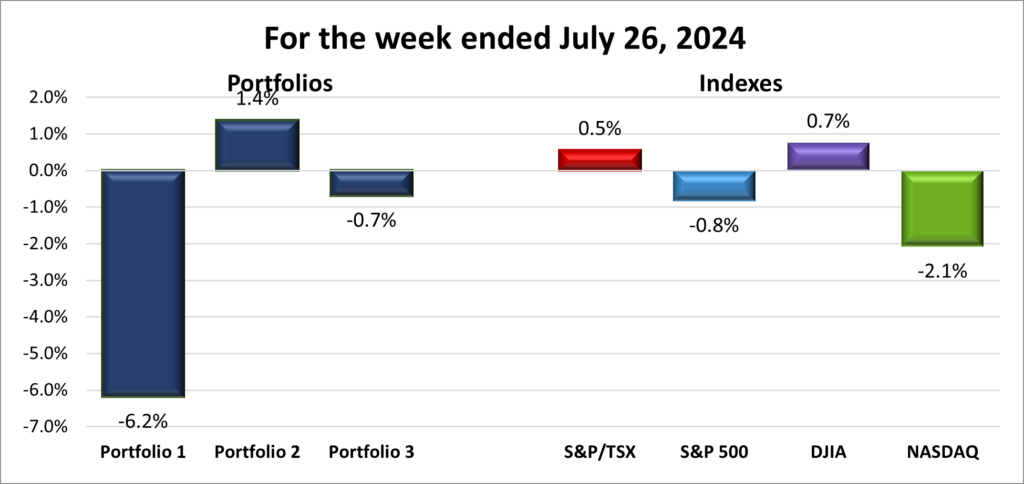
For the week, the TSX (SPTSX) advanced 0.5%, the S&P 500 (SPX) fell 0.8%, the DJIA (INDU) gained 0.7% and the Nasdaq (CCMP) sank 2.1%.

Index Weekly Streak
TSX: 5 – week winning streak
S&P: 2 – week losing streak
DJIA: 4 – week winning streak
Nasdaq: 2 – week losing streak

Bearish market Bull market. A good week for the North American stock markets.It was a mixed week for the indexes, which faced turbulence before rebounding on the last day. As seen in the chart above, only the DJIA and the TSX managed to end in positive territory.

The markets were influenced by a combination of economic news and the beginning of the second-quarter earnings season. In Canada, the TSX had a relatively calm week, ending positively after the BoC lowered interest rates for the second time. The BoC also shifted its focus from curbing inflation to stimulating economic growth. With Canada’s economy slowing, this shift likely signals more rate cuts in the coming months. The BoC is now focused on supporting the economy as inflation trends toward their 2% target.

In the US, the second-quarter GDP reading came in stronger than expected, indicating a robust economy. Simultaneously, the latest inflation report shows that inflation continues to fall.

Despite generally positive economic news, the markets experienced volatility due to mixed earnings reports and a rotation of investor interest from mega-cap technology companies (a market capitalization of $200 billion or more) to small-cap stocks (companies with a market capitalization of less than $2 billion). The early-year market rally, largely driven by excitement over AI, seems to have lost momentum as investors begin to question whether big tech companies can continue to meet ever-rising expectations. There are growing concerns about whether the substantial investments in AI will ultimately pay off.

This uncertainty led to a significant stock market selloff on Wednesday, wiping out hundreds of billions of dollars in value from the Magnificent 7 group of tech giants. Fortunately, many of these companies rebounded on Friday, recovering some of the losses. However, investors are now betting that small-cap stocks will likely outperform them as interest rates decline.

For the past two weeks, the Magnificent 7 technology companies, which have led the market all year, have been struggling. Alphabet’s recent report showed rising revenues and net income, but it was not enough to impress investors. The upcoming week is crucial for this group, with Amazon (NASD: AMZN), Apple (NASD: AAPL), and Microsoft (NASD: MSFT) all set to report their quarterly earnings. These reports will be closely watched to see if they can exceed expectations or, like Alphabet’s recent earnings, be strong but not strong enough.

Next week could be pivotal for the markets. The outcome of the Magnificent 7’s earnings announcements will play a crucial role in determining whether this is just a typical bull-market pullback or the start of an extended downturn. Additionally, the combination of a strong economy and falling inflation has created an opportunity for the Fed to lower interest rates in September. The big question is whether they will take advantage of this opportunity. 😊 Next week, the Fed takes centre stage as they announce their latest US interest rate decision and set the tone for their September meeting, where a rate cut is expected. Let us keep our fingers crossed for good news on all fronts. 😊

Portfolio Weekly Streak
Portfolio 1: 2 – week losing streak
Portfolio 2: 5 – week winning streak
Portfolio 3: 2 – week losing streak

Bearish market It was another mixed week for the three portfolios. Once again, Portfolio 2 was the star, being the only one to see an increase in value, as shown in the chart below.

Portfolio 1 had a particularly rough week, losing almost nine times more than Portfolio 3. The downturn in mega-cap tech stocks hit the portfolio hard, overshadowing a record high by Formula One Group (NASD: FWONK) and a 12% gain from Hammond Power Solutions (TSE: HPS.A).

Portfolio 2, on the other hand, extended its winning streak to five weeks, with nearly 75% of its holdings gaining value, including the impressive 12% increase from Hammond Power Solutions. If only the other portfolios could have 70% or more of their companies posting weekly gains consistently! 😊

Unfortunately, Portfolio 3 also decreased in value this week. While the number of stocks that gained and lost value was evenly split, the losses were greater in dollar terms than the gains. ☹

Overall, it wasn’t the best week for the portfolios, with Portfolio 1 taking a significant hit and Portfolio 3 struggling to gain ground. However, Portfolio 2’s consistent performance underscores the benefits of a balanced and conservative stock selection. Unfortunately, this week’s gains in Portfolio 2 were overshadowed by the losses in Portfolio 1. Hopefully, the positive momentum from the end of the week carries into the next, allowing Portfolio 2 to extend its winning streak and giving Portfolios 1 and 3 a chance to rebound. 😊
Weekly Portfolio & Index performance
Weekly Portfolio & Index performance for the week ended July 26, 2024.

Companies on the Radar

drawing of a Birkenstock shoe in profileStocks on my Radar Two footwear companies caught my attention last week, one familiar and the other not so much. First up is Birkenstock Holding plc (NYSE: BIRK). I always imagined Birkenstock as a California brand that emerged in the 1960s. Boy, was I wrong. Birkenstock is actually a British-based company that has been around since 1774. Famous for their iconic sandals, it is a family-run business now in its sixth generation. Surviving for 250 years is no small feat, so they must be doing something right.

The other company is On Holding AG (NYSE: ONON), a lesser-known but equally interesting Swiss-based, founder-run, sports products company. Founded in 2010, they specialize in athletic shoes, apparel, and accessories.

Both companies sound interesting, and I plan to dig a little deeper into these companies. They will be joining the four holdovers from last week:

  • Equitable Bank (TSE: EQB), a mid sized Canadian bank, considered Canada’s 7th bank, that provides financial services to consumers and businesses.
  • Vertiv Holdings (NYSE: VRT), a large American company that designs and builds infrastructure and continuity solutions to businesses around the world.
  • Lumine Group (TSE: LMN), a young Canadian mid sized company that acquires communications and media software companies, and then strengthens and grows those companies.
  • Kelly Partners Group (OTCM: KPGHF), a small Australian accounting firm that is growing through serial acquiring of other small accounting firms in Australia. They have recently expanded into the USA and other English-speaking countries.

Please keep in mind that these are only companies that have piqued my interest. This is not a recommendation or financial advice. You should do your own research or contact a professional before making any investment decisions.

The Radar Check was last updated July 26, 2024.
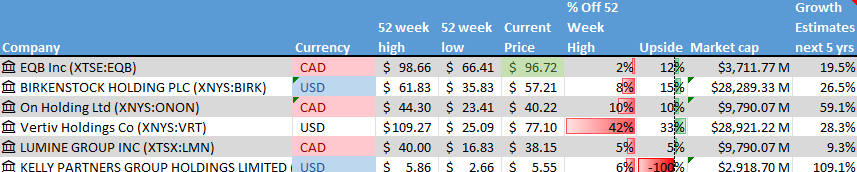
Stock on the Radar List. 1 of 2.
Stock on the Radar List. 2 of 2.

NOTE: Morningstar and Thomson-Reuters analysis is unavailable for Kelly Partners Group most likely because it is a small-cap Australian company with a market value of less than US$360 million and primarily listed on the Australian Stock Exchange. While you can invest in Kelly Partners through the Over-the-Counter Market (OTCM) here in North America, the analysis is not as readily available as it is for companies on major North American exchanges like the Toronto Stock Exchange, New York Stock Exchange, and Nasdaq.

Unlike other non-North American companies I have investigated, even Yahoo! Finance did not have any information under the Analysis tab for Kelly Partners. This means I could not get any ratings during my usual radar check.


Portfolio Update

Portfolio 1

Portfolio 1 for the week ended July 26, 2024: DOWN Red Down Arrow

  • Nvidia is developing a version of its high-end AI chips for the Chinese market that would comply with current US export restrictions.
  • General Motors (NYSE: GM) announced they were delaying the release of a Buick electric vehicle (EV) and pausing the construction of an EV truck factory.
  • Grab Holdings (NASD: GRAB) announced they acquired dining reservation platform Chope to compliment heir food delivery operations in southeast Asia.
  • Canadian National Railway (TSE: CNR) resumed shipping goods through Jasper National Park after a major wildfire forced it to suspend operations.
  • Walmart (NYSE: WMT) is considering investing up to US$ 200 million on autonomous forklifts to increase the automation of their warehouse operations. They are currently conducting pilot projects in four locations.

Activity

No significant activity to report this week.

Dividends

Dividends Received this week for the following companies:

Companies followed by DRIP (Dividend Re-Investment Plan) indicate additional shares were purchased with the dividend. Any cash leftover was added to the cash balance.

Canadian $

Decisive Dividend Corp (TSE: DE) DRIP

US $

No US$ dividends this past week.

Quarterly Reports

Canadian National Railway Company

Second quarter 2024 financial results on July 23, 2024

General Motors Co.

Second quarter 2024 financial results on July 23, 2024

Alphabet Inc.

Second quarter 2024 financial results on July 23, 2024

Visa Inc.

Third quarter 2024 financial results on July 23, 2024

Celestica Inc.

Second quarter 2024 financial results on July 24, 2024

Portfolio 2

Portfolio 2 for the week ended July 26, 2024:  UP Green Up Arrow, signifying a positive week

  • The Walt Disney Company (NYSE: DIS) announced they had reached a tentative labour deal with their Disneyland employees. The new deal is for three years and includes higher wages plus other benefits.

Activity

No significant activity to report this week.

Dividends

Dividends Received this week for the following companies:

Canadian $

No C$ dividends this past week.

US $

Walt Disney Co. (NYSE: DIS)

Quarterly Reports

No quarterly reports this past week.

Portfolio 3

Portfolio 3 for the week ended July 26, 2024: DOWN Red Down Arrow

  • Microsoft reported that the previous week’s IT outage caused by a CrowdStrike (NASD: CRWD) software update impacted almost 8.5 million Microsoft devices. That is fewer than 1% of all Windows devices in the world. CrowdStrike reported that most impacted devices were back online and operational.

Activity

No significant activity to report this week.

Dividends

Dividends Received this week for the following companies:

No dividends this past week.

Quarterly Reports

No quarterly reports this past week.

 

2024 Second Quarter Review

Second Quarter Market Recap: Navigating Volatility and Tech-Driven Rallies

The second quarter of 2024 was nothing short of a rollercoaster, with markets swinging between strong economic data, shifting rate expectations, and a tech-fueled rally that dominated much of the narrative.

A roller coaster with blue rails symbolizing the highs and lows of the market. In the US, investor sentiment shifted from early-year optimism about imminent rate cuts to a more cautious “higher for longer” outlook, as persistent inflation and robust labour market data complicated the Federal Reserve’s (Fed) plans. Yet, by May, cooling inflation rekindled hopes for potential rate cuts later in the year, propelling the Nasdaq Composite Index (Nasdaq) and S&P 500 (S&P) to record highs, largely driven by the surge in artificial intelligence (AI) stocks.
In Canada, the Toronto Stock Exchange (TSX) faced a bumpier ride. Rising commodity prices offered some support in April but concerns about a US economic slowdown and weaker domestic data weighed on performance in May. The Bank of Canada’s (BoC) rate cut in June provided a brief respite, but stronger-than-expected labour data tempered expectations for further cuts, keeping the TSX subdued until a late rebound fueled by recovering resource prices.

As the quarter drew to a close, the markets reflected a blend of cautious optimism and tech-fueled volatility, setting the stage for what could be an equally unpredictable second half of the year. Let’s look at what happened over the second quarter of 2024 ….


Contents

Second Quarter Review

Second Quarter Portfolio Update

Six Month Review In Charts

Looking Forward

Second Quarter Review

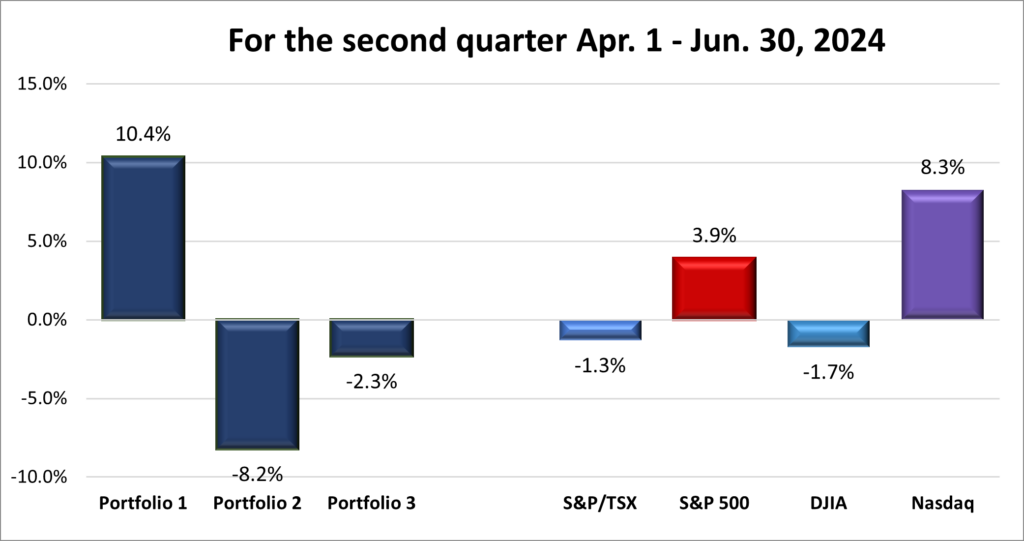
For the second quarter, the TSX (SPTSX) lost 1.3%, the S&P (SPX) rose 3.9%, the DJIA (INDU) fell 1.7% while the Nasdaq (CCMP) grew 8.3%.

Bull market. A good week for the North American stock markets. Bearish market

The second quarter of 2024 presented a mixed picture for North American markets. While tech-heavy indexes like the Nasdaq and S&P surged on the back of AI-driven enthusiasm, more traditional, value-focused indexes like the TSX and Dow Jones Industrial Average (DJIA) faced challenges.

April was particularly rough, as strong economic and labour data from March and April complicated the Fed’s efforts to curb inflation. This solid data, while positive for workers, heightened concerns about ‘higher-for-longer’ interest rates, prompting investors to shift toward safer assets, such as bonds.

Despite these headwinds, tech stocks maintained their momentum from the first quarter, with the Nasdaq and S&P both reaching record highs. The DJIA flirted with new intraday records but fell short of closing at historic levels. Meanwhile, the TSX, with its limited exposure to major technology companies, missed out on the AI-fueled rally that drove American markets.

Key Factors Driving the Market

AI: The undisputed star of Q2 2024, AI hype dominated the markets. Investors poured into companies leading AI development, particularly the “Magnificent 7” tech giants – Alphabet (NASD: GOOGL), Amazon (NASD: AMZN), Apple (NASD: AAPL), Microsoft (NASD: MSFT), Meta (NASD: META), Nvidia (NASD: NVDA), and Tesla (NASD: TSLA) – whose involvement in AI and cutting-edge technologies propelled their stock prices to new heights. This AI-driven momentum boosted not just the tech sector but the broader market as well.

Economic Resilience: Inflation continued to cool, edging closer to the BoC’s and the Fed’s targets, which bolstered investor confidence. A resilient American labour market, characterized by low unemployment and steady job growth, sustained consumer spending and economic stability. Despite lingering inflationary pressures, the US economy remained robust, fueled by pent-up consumer demand and strong employment figures.

Corporate Earnings: Earnings reports, especially from technology and consumer-focused companies, further fueled investor optimism. Strong results reinforced confidence in the broader economic outlook, maintaining the market’s upward trajectory. Although some companies lagged, the overall earnings trend was positive, particularly in corporate America.

The second quarter wrapped up with mixed results. The BoC’s rate cut sparked some optimism, with the possibility of further reductions in Canada on the horizon. Meanwhile, uncertainty around when the Fed might begin lowering US rates kept investors on edge. Despite the AI-driven surge that boosted technology stocks, the broader market reflected the ongoing tug-of-war between economic resilience and lingering uncertainties about inflation, rate cuts and corporate performance.

Quarterly Portfolio & Index performance
Second Quarter 2024 (April 1 – June 30) Portfolio & Index performance

Table of Contents

Second Quarter Portfolio Update

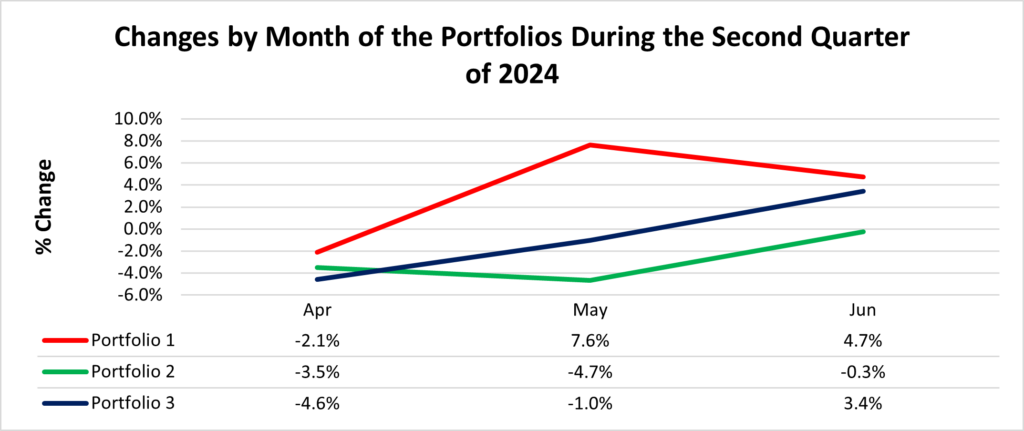
The chart below highlights how each portfolio performed throughout the quarter. April started on a tough note, as all portfolios experienced declines alongside the broader market. In May, Portfolio 1 staged an impressive rebound, while Portfolios 2 and 3 continued their slide. June brought strength to US markets, with an AI-driven rally pushing the major American indexes higher. However, the resource-heavy TSX did not ride this wave and fell further. Portfolios 1 and 3 gained ground, but Portfolio 2 posted its fourth consecutive losing month. Overall, it was a challenging quarter for Portfolios 2 and 3, but Portfolio 1 closed out strong. Let us hope for continued momentum in Portfolio 1 and a turnaround for the others in the third quarter!

Second Quarter 2024 Portfolio performance
Second Quarter 2024 (April 1 – June 30) Portfolio progress

Portfolio 1 for the second quarter: UP Green Up Arrow, signifying a positive week

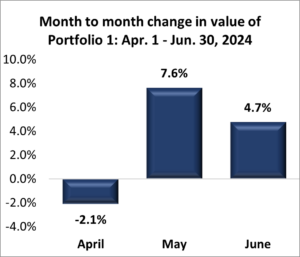
The second quarter got off to a sluggish start, but a strong rebound in the final two months turned things around, allowing the portfolio to close with an impressive quarterly gain.

Activity: Bought: Celestica Inc., Carnival Corp., Grab Holdings Limited, Hammond Power Solutions, TD Investment Savings Account mutual fund, Shopify.

Bought additional share in: Amazon.com, Visa Inc., BCE Inc., Atlanta Braves Holdings, Inc., CN Railway Company, Ferrari N.V., Celsius Holdings, Inc.

Sold: Nuvei Corporation, some Nvidia Corporation shares because Nvidia had grown significantly in value and represented an outsized portion of the Portfolio 1.

Portfolio 1: Second Quarter 2024 Performance

Portfolio 2 for the second quarter: DOWN Red Down Arrow

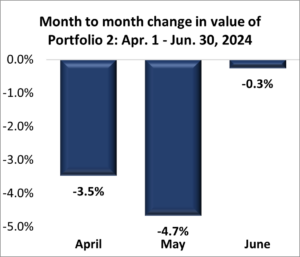
Portfolio 2 had a rough second quarter. I initially thought April was tough, but it turned out to be just a warm-up for the sharp drop in May. Surprisingly, June became the “best” month, not because it saw gains, but simply because the losses were not as steep as the previous two months.

Activity: Sold Chorus Aviation.

Portfolio 2: Second Quarter 2024 Performance

Portfolio 3 for the second quarter: DOWN Red Down Arrow

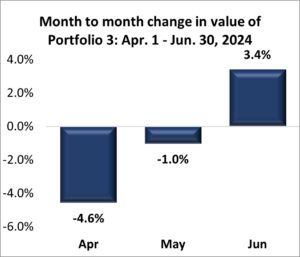
Portfolio three stumbled out of the gate in the second quarter and struggled to climb out of a deep hole, finally posting a gain in June. Despite a gradual recovery, it was not enough to avoid a quarterly loss.

Activity: none.

Portfolio 3: Second Quarter 2024 Performance

Table of Contents

Six Month Review in Charts

They say a picture is worth a thousand words, but when it comes to understanding market trends, a well-crafted graph might be worth even more. Rather than rehashing what has already been discussed, I thought it would be more insightful to let the graphs do the talking. They will clearly show the paths taken by the indexes and portfolios, along with the final results, providing a more impactful view of how things played out over the first half of the year.

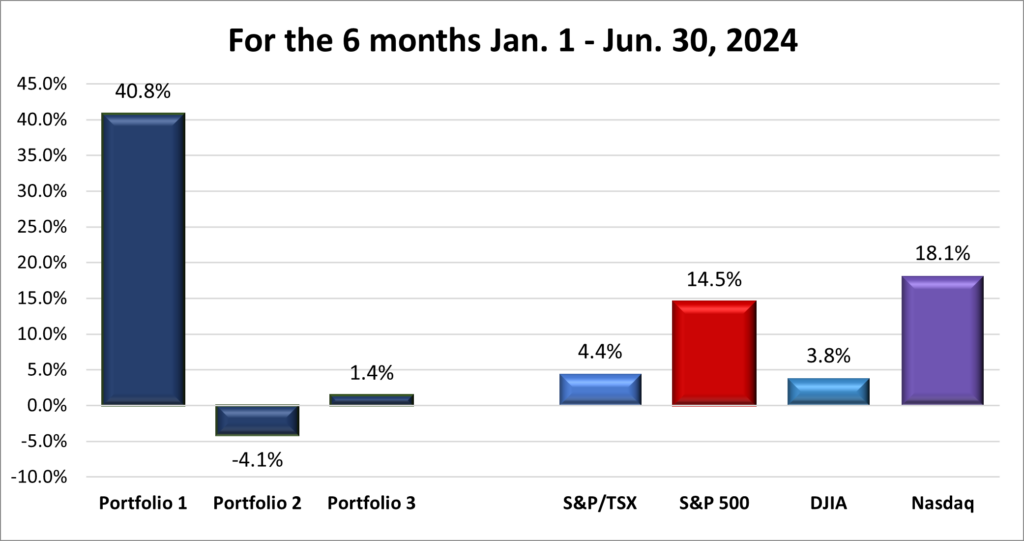
This first chart below illustrates the rollercoaster ride that each index took on its way to first-half gains in 2024. In the first half of 2024, the TSX (SPTSX) climbed 4.4%, offering a solid start to the year. Meanwhile, the S&P (SPX) soared 14.5%, showing its strength. The DJIA (INDU) saw a respectable gain of 3.8%, while the Nasdaq (CCMP) led the charge with an impressive surge of 18.1%.

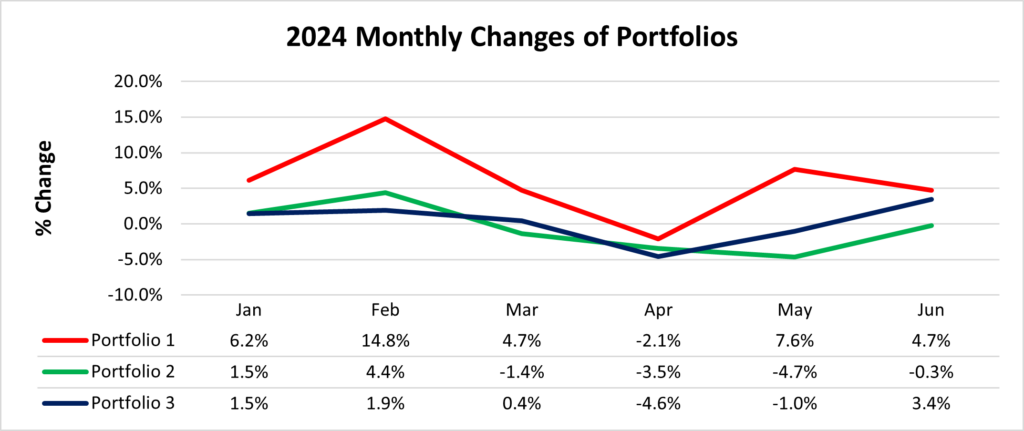
This next chart shows the monthly performance of our three portfolios over the first six months of the year, based on percentage increase. Portfolio 1 saw a value increase every month except April. Portfolio 2 had a strong start but has experienced four consecutive months of losses. On the bright side, Portfolio 3 ended the first half in positive territory, despite a two-month losing streak in the second quarter.

First Half 2024 Portfolio progress

This final chart below illustrates the performance of the three portfolios and the four major North American indexes at the end of the first half of 2024. Impressively, Portfolio 1 more than doubled the Nasdaq’s remarkable 18.1% gain. This standout performance can be attributed to the stellar contributions from the four of the heavyweight technology companies held in the portfolio that are riding the AI tailwind, along with robust results from the rest of the holdings. Now, if only I could replicate this success across the other two portfolios! 😊

First Half 2024 Portfolio & Index performance

Table of Contents

Looking Forward

I will not claim to have a crystal ball for predicting the markets – in fact, my track record might better align with the Costanza Rule, where doing the opposite of my instincts could yield better results! 😊 But with that disclaimer, let us dive into what could be a wild third quarter, filled with uncertainty due to the upcoming American presidential campaign, corporate earnings, and central bank rate decisions.

Historically, stock markets tend to perform well during election years. With both parties rolling out promises to attract voters, a bit of investor euphoria usually follows. However, markets despise uncertainty, and with campaign drama, earnings surprises, and rate announcements looming, volatility is likely to ramp up as we move through the second half of the year.

On the economic front, the American economy will likely continue to feel the effects of higher interest rates, which could drag on growth. Hopefully, the recent rate cut by the BoC, along with potential future cuts, will help inject some life into Canada’s sluggish economy. Meanwhile, inflation should keep cooling off, opening the door for the Fed to start cutting the US rate and the BoC to continue trimming the Canadian rate.

Corporate earnings will be another critical factor in the third quarter. Strong results might help markets weather ongoing economic challenges, while weaker earnings or cautious guidance could add to the uncertainty and volatility. If earnings hold up and inflation continues to cool, we could see a strong finish to the third quarter – but expect some choppy waters along the way.

The big wildcard here is the Fed. If inflation continues to ease and economic growth slows further, we could see rate cuts sooner rather than later. That prospect could inject fresh optimism into the markets, especially as we approach the end of the year. Investors are hungry for signs that the higher rates are over, and even a hint of rate cuts might ignite a rally. Combine that with election year excitement, and the third quarter and the second half of 2024 could bring some surprising upside – though we should buckle up for some bumps along the way.

A bull signifying a bull market

Table of Contents

Weekly Update for the week ending July 19, 2024

This past week, many of the big-name mega-cap technology companies (companies with market capitalization exceeding $200 billion which represents the total value of all outstanding shares) that have driven the indexes to record heights all year long lost favour with investors. In fact, much of this past week’s declines can be attributed to these same companies. This includes Alphabet (NASD: GOOGL), Amazon.com (NASD: AMZN), Apple (NASD: AAPL), Microsoft (NASD: MSFT) and Nvidia (NASD: NVDA).

This rotation is primarily due to a few factors. First, the long-anticipated decline in inflation has led to expectations that the US Federal Reserve (Fed) will lower interest rates, possibly as soon as September. Lower interest rates typically benefit cyclical stocks, such as those in the financial, energy, and industrial sectors, which have underperformed tech stocks in the recent years.

Second, mega-cap tech stocks have enjoyed substantial valuations, fueled by their growth potential and market dominance. However, these valuations have become increasingly stretched, making investors cautious. This has prompted some investors to take profits and reallocate funds to potentially undervalued sectors, such as those mentioned previously. Additionally, smaller-cap stocks have lagged mega-cap tech stocks for some time, creating a valuation gap. As investor sentiment shifts, money is flowing into these potentially undervalued stocks, as investors seek higher returns.

Finally, as the economy continues to grow, investor interest is shifting towards sectors that benefit from increased consumer spending, such as the consumer cyclicals, financials, energy, and industrial sectors. While this rotation suggests a change in market sentiment, it is important to note that mega-cap tech companies still hold considerable influence and are likely to remain key market players.

Now that you have some sense of why the indexes behaved the way they did this past week, let’s see what happened this past week….

Items that may only interest or educate me ….

Canadian Economic news, US Economic news, The second round of investments, The Glitch felt around the world ….


Canadian Economic news

This past week’s key economic data that the Bank of Canada (BoC) considers when deciding whether to raise or lower the interest rate.

Consumer price Index (CPI)

Canada’s June inflation data surprised analysts by coming in lower than expected. Annual inflation dropped to 2.7%, down from 2.9% in May, while analysts had predicted a fall to 2.8%. On a monthly basis, CPI fell 0.1% in June, reversing a 0.6% rise in May when analysts had expected it to remain flat.

In headline CPI, or all items, the biggest monthly price increase was in the ‘Food’ category, which rose by 0.5%, while ‘Gasoline’ saw the steepest decline, down by 3.1%. Year over year, ‘Shelter,’ which includes mortgage and rent costs, saw the largest increase at 6.2%, whereas ‘Clothing and footwear’ was the only category to see a price decrease, dropping by 3.1%.

Core CPI, which excludes volatile food and energy prices, remained flat on a monthly basis after a 0.6% rise in May, and year-over-year core CPI held steady at a rate of 2.9%.

The return to a downward trend in headline inflation, within the BoC’s 1%–3% target range, is reassuring following May’s slight uptick. Although annual core inflation remained at 2.9%, this latest data should give the BoC confidence to consider lowering the benchmark rate in their meeting next week. At the very least, it has boosted investors’ hopes for another rate cut. 😊

Canadian market volatility

Canada’s Volatility Index, the CVIX, saw a notable rise this past week, climbing to 10.77 from 7.97. On Friday morning, the CVIX spiked to 12.94, likely due to the global IT outage, before settling back to 10.77 by the end of the day. Beyond the Friday spike, the week’s increase likely reflects the recent selloff in US stocks and jitters about the upcoming US election. However, the anticipation of a July rate cut by the BoC, and a potential rate cut by the Fed in September is keeping the index relatively low.

The CVIX, tracked via the VIXI on the Toronto Stock Exchange (TSE), gauges expected market volatility. Generally, a CVIX reading below 10 is considered low, indicating a period of relative market calm and stability. A reading between 10 and 20 suggests moderate volatility, which can reflect normal market fluctuations. While a reading above 20 is typically considered high, indicating significant market uncertainty and potential turbulence. Thus, a CVIX reading of 10.77 suggests that investors are relatively confident, with limited market uncertainty.

Retail Sales

Statistics Canada reported retail sales for May came in much lower than forecast. Headline, or all items, retail sales fell 0.8% in May after rising 0.7% in the month before. Analysts had expected a decline of 0.6%. Annually, retail sales increased by 1%.

Retail sales were down across the board, with eight out of nine subsectors reporting lower numbers. Notably, ‘Floor covering, window treatment, and other home furnishing retailers’ saw the biggest monthly increase, up 3.5%. On the flip side, ‘Other motor vehicle dealers’ experienced the steepest decline, down 5.0%. Year over year, ‘Health and personal care retailers’ saw the largest increase, up 4.7%, while ‘Miscellaneous store retailers’ faced the biggest drop, down 7.3%.

Core retail sales, which excludes gasoline stations, fuel vendors, motor vehicle and parts dealers, dropped 1.4% in May after gaining 1.8% in April. Analysts had been expecting a decline of 0.6%. Year over year, retail sales were down by 0.4%.

Retail sales are a key component of consumer spending, which drives a sizable portion of economic activity. When consumers spend less, it typically signals a slowdown in economic growth. The lower-than-expected retail sales figures suggest that the economy is cooling down, throwing the door wide open for the BoC to lower the benchmark interest rate once again in order to provide some rate relief for consumers and businesses alike. Hopefully, this time next week the rate will be at least 0.25% lower. 😊

US Economic news

This past week’s key data points that the Fed considers when deciding whether to raise or lower the interest rate.

American market volatility

The CBOE Volatility Index (VIX), often dubbed the market’s “fear gauge,” soared from 12.46 to a high of 17.16 before settling at 16.52. This marks a significant increase after lingering below 13 for the past few weeks. The primary driver of this spike was the global IT outage on Friday, but it also reflects growing political concerns about the upcoming election, along with geopolitical and trade risks. Despite this substantial jump from last week’s 12.46 and reaching its highest level since late April, the VIX remains relatively low due to the increasing likelihood of a rate cut in September.

Retail Sales

The Commerce Department reported that retail sales were essentially flat in June, following an upwardly revised 0.3% increase in May. Analysts had predicted a 0.3% drop, so this stability was a pleasant surprise. Year over year, retail sales increased by 2.3%, matching the growth rate in May, despite analysts expecting flat annual sales.

Core retail sales, which exclude autos and gas stations, bounced back with a 0.8% increase in June after a 0.1% decline in May. Annually, core retail sales rose by 3.8%, consistent with May’s growth.

Consumer spending is the heart of the US economy, driving two-thirds of its activity. Retail sales, which include spending on goods and food services, form a big part of overall consumer spending. Despite analysts forecasting a drop, this latest report shows that consumer spending is holding steady, even with higher unemployment. This resilience is a positive sign for the economy, suggesting that consumers are continuing to spend despite the economy cooling. The report provides some evidence of consumer resilience, but it does not signal a need for an immediate rate cut.

The second round of investments in an all-stock portfolio

Following up on last week’s discussion about ‘Initial Investments’ for an all-stock portfolio, this week I will share how I added to my portfolios. Keep in mind, that this strategy worked for me to achieve my goals with a level of risk that was acceptable to me. You risk tolerance and goals are undoubtedly different from mine, so this strategy may or may not work for you.

Adding Growth-Oriented Companies

After selecting a core of 3+ companies, I began adding growth-oriented companies to boost my portfolio’s value. I targeted medium and large-cap companies with robust growth histories and promising futures.

Balancing Growth and Stability

To balance growth companies with core/dividend companies, I diversified across company market capitalization (number of shares outstanding X share price) and sectors. This mix helped manage risk and ensured I could sleep easily at night.

Pairing Investments

When building the portfolios, one strategy I used was pairing investments. For example, I invested in both Visa (NYSE: V) and Virgin Galactic (NYSE: SPCE) on the same day. Visa is a stable, core/growth company with dividends, while Virgin Galactic is a high-risk, high-reward Swing For the Fences (SFTF) company. This way, Visa offset some of the risk associated with Virgin Galactic. I still own Visa but sold Virgin Galactic ten months later when it spiked, netting a 70% profit. One SFTF investment that actually paid off. 😊

Market Capitalization and Sector Diversification

Keep track of market capitalization to avoid an imbalance in your portfolio. A mix of small, medium, and large-cap companies reduces volatility and risk. A portfolio of all small cap companies is a lot more volatile and riskier than a mix of market cap sizes.

Additionally, track the sectors of your investments to prevent overloading any one sector. Diversifying across sectors spreads risk, as underperformance in one sector can be balanced by strong performance in another. For instance, during the pandemic in summer 2020, the technology sector was hot, while other sectors cooled. But in early 2021, as vaccines rolled out and people once again started going out, money flowed into sectors like Consumer Cyclicals, Energy, and Industrials, while Technology cooled off.

Exploring Emerging Companies

Once my portfolio was well-diversified and I was comfortable with investing (I consider myself a part owner of every company I invest in because I am), I added a few young, exciting companies. These were high growth or SFTF companies. I investigated their products, management, and culture. They sounded interesting and appeared to have immense potential, so I bought a few shares, and monitored their performance through quarterly reports. These were SFTF companies, so their share price was very volatile. If they performed well, I bought a few more shares. Remember, you are investing in the company, not just the share price. Over the long term (3+ years), a well-performing company will see its share price rise despite short-term fluctuations.

Monitoring Riskier Stocks

For riskier stocks, typically SFTF stocks, frequent performance checks are crucial. Stay informed about the company’s health and market conditions to make informed decisions. If I had not monitored Virgin Galactic I would have missed a sizable gain. At the same time, if I had forgotten about the company, I would have lost a most of the investment as the company trades considerably lower (approximately US$ 0.35 per share on a reverse split basis). If you do not think you will be able to monitor these types of riskier stocks, avoid them all together and stick to companies that have a proven record of growth and share price growth.

Investing is a journey. I started with a solid core of companies that balanced growth and stability, and then added a few high-risk, high-reward companies (most of which did not pan out). This strategy worked well for me, but it might not be the right fit for everyone. Define what you want to achieve with your investments, create a plan to reach your goals, and take the plunge. Stick to your plan as much as possible and be ready to review and adjust it if your circumstances change. Happy investing! 😊

The Glitch felt around the world

On July 19, 2024, a faulty software update from CrowdStrike (NASD: CRWD) triggered a widespread global IT outage. The update, meant to enhance security, caused computers running Microsoft Windows to crash upon startup.

CrowdStrike, a market leader in cybersecurity with its Falcon product widely used by Fortune 500 companies and small businesses alike, faced far-reaching consequences from this outage. With their extensive customer base, millions of organizations worldwide were likely affected, resulting in billions of dollars in lost revenue, productivity losses, and emergency response costs. Critical infrastructure and businesses across the globe were hit hard, including airlines, banks, hospitals, and government agencies. The repercussions were severe, causing flight cancellations, disrupted financial services, delays in healthcare, and other significant impacts.

CrowdStrike quickly identified and resolved the issue within a few hours, issuing public apologies and working diligently to support affected customers. However, this incident has undoubtedly damaged their reputation as a leading cybersecurity firm. It highlights the potential risks of software updates and the critical importance of rigorous testing.

In the wake of this event, CrowdStrike will likely face increased scrutiny from regulators and customers. Implementing stringent measures to prevent similar occurrences and restore trust among its user base will be crucial.

Additionally, this outage could spark discussions about the risks of over-reliance on a single cybersecurity provider, prompting organizations to diversify their security solutions.

Ultimately, the long-term impact on CrowdStrike will depend on how the company responds to this crisis, the extent of the damage to its reputation, and the overall economic and geopolitical environment.


Weekly Market Review

Monday: all four indexes got out of the gate quickly and ended the day in the green. The Toronto Stock Exchange Composite Index (TSX), the S&P 500 Index (S&P), the Dow Jones Industrial Average (DJIA), and the Nasdaq Composite Index (Nasdaq) were lifted by comments from Fed Chair Jerome Powell that they are prepared to lower interest rates before inflation fall to their 2% target.

In Canada, the heightened prospects of a US interest rate decrease, which would boost demand for oil, propelled the TSX to its fourth consecutive day of gains. In trading, Energy advanced the most while Utilities had the biggest decline.

In the US, following the attempted assassination of former President Trump, investors believe he is now more likely to win the upcoming election. The DJIA closed at a new record high after strong earnings reports form a few of the big US banks. in trading, Energy saw the biggest gains while Utilities saw the biggest drop.

Tuesday: the indexes surged on the growing conviction by investors that the Fed will start lowering US rates in September. Oil slipped on concerns of lower demand from China.

In Canada, a better-than-expected CPI inflation report increased investors confidence the BoC will lower rates again next week. Investors rotated back into commodity and resource stocks, sending the TSX to its fourth straight record high close. In trading, it was a day of broad gains, led by the Technology sector. Energy was the only sector to end in the red.

In the US, the DJIA closed at a record high for the second straight day after a flat retail sales report boosted the case for a September rate cut. In trading, Industrials posted the largest gain, while Telecommunications Services had the biggest drop.

Wednesday: the DJIA got into positive territory early and stayed there all day, unlike the other three indexes which started in negative territory and drifted lower throughout the trading session. A selloff in technology stocks was spurred by fears of stricter export restrictions on companies selling technology to China and comments from Republican presidential candidate Donald Trump casting doubt on US support for Taiwan.

In Canada, Lower commodity prices, coupled with the ripple effect of the tech stock selloff in the US, dragged the TSX down, ending its streak of record-high closings at four. In trading, Telecommunications Services was the only sector to end higher, while the Technology sector had the steepest decline.

In the US, the Nasdaq was weighed down by a selloff in technology stocks, leading to its worst day since December 2022. The decline in major tech stocks overwhelmed hopes for a September rate cut. In trading, Consumer Staples was the top performing sector, while the Technology was the worst performing sector.

Thursday: yesterday’s selloff continued into today, this time dragging all four indexes into the red. Many investors continue to rotate out of the high-priced big technology companies and into cash as they try to determine which way the market will go.

In Canada, investors seem to have taken advantage of recent run ups in technology companies and commodity prices and taken some profits off the table, causing the TSX to drop for the second straight day. In trading, Consumer Staples and Telecommunications Services were the only sectors to end higher, while Basic Materials (miners and fertilizer manufacturers) fell the hardest.

In the US, a broad selloff caused the DJIA to end its six-day winning streak as investors took some cash off the table. In trading, the Energy sector was the only American sector to advance, while Healthcare suffered the biggest decline.

Friday: not a great day for the indexes, as all four ended in the red amidst the chaos created by a global IT outage. Investors continue to move out of technology companies and into smaller companies that they believe will benefit more from lower interest rates. Oil prices dropped sharply today, giving back all gains from earlier in the week. Dragging oil prices down were concerns of lower demand from China, the world’s second largest economy behind the US.

In Canada, the TSX was weighed down by softer commodity prices and the fall out of the IT outage. In trading on Bay Street, Consumer Staples posted the biggest gain, while Energy recorded the largest loss.

In America, uncertainty caused by the global IT crash weighed heavily on all three indexes, especially the Nasdaq, home of CrowdStrike, the company responsible for the IT crash. in trading on Wall Street, Healthcare and Utilities were the only sectors to end in the green, while Energy suffered the steepest decline.


Weekly Market and Portfolio Review

For the week, the TSX (SPTSX) rose 0.1%, the S&P 500 (SPX) lost 2.0%, the DJIA (INDU) gained 0.7% and the Nasdaq (CCMP) plunged 3.7%.

 
Index Weekly Streak
TSX: 4 – week winning streak
S&P: 1 – week losing streak
DJIA: 3 – week winning streak
Nasdaq: 1 – week losing streak

Bull market. A good week for the North American stock markets. Bearish marketThe week started off well but went downhill after Tuesday, as seen in the chart above. Both the Nasdaq and S&P had their worst week since April. Meanwhile, the DJIA posted several closing highs midweek, enabling it to extend its weekly win streak to three. Boosted by higher commodity prices, the TSX also extended its weekly win streak to four, setting a record high close along the way. Quietly, the TSX has put together the longest win streak of the four major North American indexes.

The stock market experienced a shift this past week as investors moved out of the tech giants in favour of other sectors and small-cap companies with greater growth potential. The Nasdaq, heavily weighted with technology companies, plummeted, while the DJIA and TSX, comprised of more established companies, extended their weekly win streaks.

This market rotation appears driven by several factors. First, Fed Chair Jerome Powell’s remarks that the Fed does not need to wait to hit its inflation target before lowering interest rates boosted investor confidence that they Fed would start lowering rates. As a result, investors turned their attention to cyclical stocks like those found in the financials, consumer cyclicals, and energy sectors. Second, sky-high valuations and prices of tech companies prompted investors to seek the more reasonably priced cyclical stocks. Finally, the attempted assassination of former President Trump could influence market expectations, with a Republican sweep potentially leading to business-friendly policies.

In Canada, this week’s lower retail sales data, along with cooling inflation and a slowing economy, have analysts and investors anticipating the BoC will lower interest rates for the second time this year.

After a couple of weeks of all four indexes moving upward, the sharp downturn by the S&P and Nasdaq caught me by surprise. These two had been leading the way all year. The Nasdaq, and to a lesser extent the S&P, are dominated by a handful of mega-cap tech giants. Riding the wave of big tech stocks was exhilarating on the way up, but now it feels like we are stuck in the doldrums as they drift lower. Hopefully, starting next week they will find some wind to fill their sails and continue their upward journey.

Portfolio Weekly Streak
Portfolio 1: 1 – week losing streak
Portfolio 2: 4 – week winning streak
Portfolio 3: 1 – week losing streak

Bearish market Given the mixed week for the four indexes, especially the plunge in big technology companies, I wasn’t expecting much from the portfolios. Unfortunately, I wasn’t disappointed as only Portfolio 2 showed a weekly gain, as you can see in the chart below. ☹

Portfolio 1 had the worst week of all. The mega-cap tech companies that had buoyed the portfolio for the last two years became a drag as investors rotated out to other sectors. Almost 60% of the companies in this portfolio posted weekly declines, with significant (more than 10%) losses by CrowdStrike (down over 17% for the week, including an 11% drop on Friday alone), Cameco (TSE: CCO) down 10%, and Navitas Semiconductor (NASD: NVTS) down 10%.

Portfolio 2 was the only portfolio to increase in value this past week. There were no significant movers up or down, but a majority of the companies posted weekly gains, which was enough to extend its winning streak and increase the portfolio’s value.

Portfolio 3 saw its winning streak come to an end, despite a majority of holdings posting weekly gains. Unlike Portfolio 2, where gains by a majority of the companies lifted the portfolio, the gains in Portfolio 3 were not enough to offset the losses of its two largest holdings—Shopify (TSE: SHOP) and Microsoft.

Despite the setbacks this week, it is essential to remember that market ups and downs are all part of the investing adventure. Portfolio 1 may have taken a hit and Portfolio 3 faced some turbulence, but Portfolio 2’s steady performance reminds us of the power of diversification. Here is hoping the winds that buffeted the markets this past week die down, and we return to smoother sailing and brighter days ahead for our investments! 😊

Weekly Portfolio & Index performance
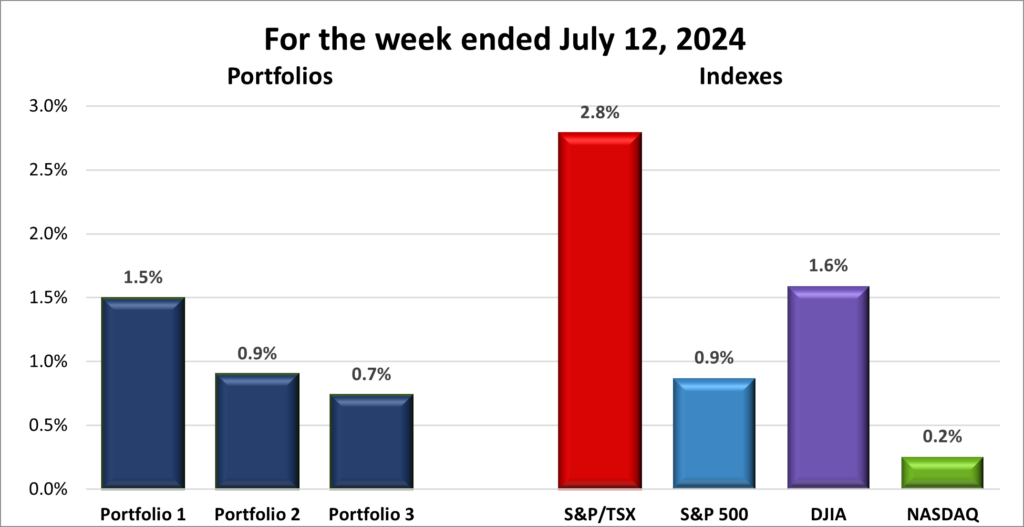
Weekly Portfolio & Index performance for the week ended July 19, 2024.

Companies on the Radar

Stocks on my Radar This past week, I came across SolarWinds (NYSE: SWI). At first, I thought it was a solar energy company, but a quick check on Yahoo! Finance revealed it’s actually an IT infrastructure management platform. Curious about its potential, I consulted the Stock Swami, also known as the Dark Lord of the Interweb. His response was swift and alarming: “They were responsible for a massive cybersecurity breach in 2020 that affected thousands of customers, including the US Government.” With a history like that, I quickly decided to move. Cybersecurity is crucial, and I would rather not invest in a company with such a significant lapse, especially when there are plenty of other opportunities out there.

Another company recently caught my eye and stayed on my radar longer than SolarWinds. Kelly Partners Group (OTCM: KPGHF), an Australian firm, might seem like just another provider of accounting, taxation, and other services to private businesses. But I dug a little deeper and found a fascinating strategy at play. Kelly Partners Group is in the business of acquiring smaller accounting firms across Australia, many of which are facing succession issues within the next five years. What is intriguing is their recent expansion into the US, with plans to extend their reach to other English-speaking countries like Canada, New Zealand, and the United Kingdom. Owning an accounting firm was never something I considered, but their bold move into the US market has sparked my interest.

In addition to the two companies mentioned above, the radar list also included the three holdovers from previous weeks:

  • Equitable Bank (TSE: EQB), a mid sized Canadian bank, considered Canada’s 7th bank, that provides financial services to consumers and businesses.
  • Vertiv Holdings (NYSE: VRT), an American company that designs and builds infrastructure and continuity solutions to businesses around the world.
  • Lumine Group (TSE: LMN), a young Canadian mid sized company that acquires communications and media software companies, and then strengthens and grows those companies.

Please keep in mind that these are only companies that have piqued my interest. This is not a recommendation or financial advice. You should do your own research or contact a professional before making any investment decisions.

The Radar Check was last updated July 19, 2024.

Stock on the Radar List. 1 of 2.
Stock on the Radar List. 2 of 2.

NOTE: Morningstar and Thomson-Reuters analysis is unavailable for Kelly Partners Group from my usual sources most likely because it is a small-cap Australian company with a market value of less than US$360 million and primarily listed on the Australian Stock Exchange. While you can invest in Kelly Partners through the Over-the-Counter Market (OTCM) here in North America, the analysis is not as readily available as it is for companies on major North American exchanges like the Toronto Stock Exchange, New York Stock Exchange, and Nasdaq.

Unlike other non-North American companies I have investigated, even Yahoo! Finance did not have any information under the Analysis tab for Kelly Partners. This means I could not get any ratings during my usual radar check.


Portfolio Update

Portfolio 1

Portfolio 1 for the week ended July 19, 2024: DOWN Red Down Arrow

  • Alphabet is in talk to acquire cybersecurity company Wiz for US$ 23 billion. If the deal goes through it will be Alphabet’s biggest deal ever.
  • Amazon.com reported record sales for its two-day Prime Day shopping event. Amazon does not disclose the details of how much it earns during the event. According to third party Adobe Analytics, the annual event generated US$ 14.2 billions in sales, up 11% from last year. Not bad for what is typically a slow time of year for spending. 😊
  • Not to be left in Amazon’s Prime Day dust, Walmart (NYSE: WMT) started their own July shopping events and deals.

Activity

Bought: Costco Wholesale (NASD: COST) This past week, a trip to Costco reminded me why I love this company: the warehouse was bustling, the parking lot was packed, and the lineups at the gas pumps were long. With this fresh in mind, I decided to purchase more shares when the price dipped below US$850.

Costco’s business model is a powerhouse, featuring consistently growing revenue, net income, free cash flow, and earnings growth—even during economic downturns. Their strategy of membership fees and bulk discounts ensures recurring revenue and fosters deep customer loyalty. Additionally, their constant expansion increases market share and potential customer base.

Costco’s loyal customer base is drawn to their deep discounts, high-quality products, membership benefits, and stellar customer service, creating a strong competitive advantage. Membership fees are a significant profit generator, helping offset expenses and keep prices low.

Recently, Costco announced an increase in membership fees: ‘Goldstar Membership’ will rise by $5 to $65 per year, and ‘Executive Membership’ will go up by $10 to $130 per year. These are the first increases in seven years and will impact approximately 52 million memberships, generating substantial additional revenue.

The reliability of Costco, even during tough economic times, provides a balance for this technology heavy portfolio.

I saw no other reason for the recent dip in share price besides the announcement of higher membership fees. Seeing this as a temporary reaction, I decided to take advantage of the dip and increase my modest ownership of Costco.

Bought: CrowdStrike Holdings Earlier in this post, I mentioned CrowdStrike had caused a global IT meltdown. In hindsight, I wish I had procrastinated so I could swoop down like a falcon (a nod to CrowdStrike’s cybersecurity platform called Falcon 😊) to pick up shares at a steep discount. So, as you read this, remember that my purchase was made before the global IT outage. Technically, my claim that the company’s cybersecurity platform has not been hacked still holds true. 😊

This past week, I decided to increase my investment in CrowdStrike after its share price fell to a level I found attractive. This marks my third investment in the company as I gradually build my stake in the company. The reasons for my initial investment remain as compelling as ever.

I initially invested in CrowdStrike because of its leadership position in cloud-based cybersecurity. Since then, the company has shown impressive revenue growth and expanded its customer base to include large enterprises and government agencies. With its subscription-based business model, CrowdStrike ensures a steady stream of recurring revenue, driving consistent growth in revenue, free cash flow, and earnings. After years of posting a net loss, CrowdStrike posted net income for the first time, a significant milestone in their financial journey. Their product’s quality is reflected in their customer retention rate of over 95% and a net retention rate exceeding 120%, indicating that not only do customers stay, but they also expand their use of CrowdStrike’s services.

In addition to these successes, CrowdStrike has recently joined the S&P 500, underscoring its position as one of the top 500 companies in the USA.

What I find particularly appealing about CrowdStrike is its substantial competitive edge. The high switching costs, strong network effects, and growing brand recognition create a robust moat. Switching to a new cybersecurity provider involves significant costs and risks, making it more likely that companies will stick with a trusted name like CrowdStrike. Moreover, the network effects enhance the platform’s value as more users join, providing CrowdStrike with more data to improve threat detection, which benefits all clients.

However, there are some risks to consider. A major concern would be if a significant security breach affected a CrowdStrike customer. Despite being a prime target for years, CrowdStrike has yet to experience a breach (to my knowledge). The crowded cybersecurity market is another risk, with competitors potentially impacting CrowdStrike’s market share. Additionally, as a high-growth stock, CrowdStrike’s current share price is elevated, and any shortfall in future growth expectations could lead to a significant drop in its price.

On a positive note, the cybersecurity market is projected to keep expanding as businesses and governments invest more in safeguarding their digital assets. With the rising frequency of cyberattacks, the demand for robust cybersecurity solutions like those offered by CrowdStrike is likely to increase.

Investing in CrowdStrike provides exposure to a critical and expanding sector of the high growth technology market. The company has not disappointed since my initial investment back in 2020, and I am confident that adding to a proven winner will benefit the portfolio. I am more than happy to take advantage of the recent pullback in share price to increase my stake in the company. 😊

Dividends

Dividends Received this week for the following companies:

Companies followed by DRIP (Dividend Re-Investment Plan) indicate additional shares were purchased with the dividend. Any cash leftover was added to the cash balance.

Canadian $

Andlauer Healthcare Group Inc. (TSE: AND)

Dream Industrial Real Estate Investment Trust (TSE: DIR.UN) DRIP

BCE Inc (TSE: BCE) DRIP

US $

BSR Real Estate Investment Trust (TSE: HOM.U)
Innovative Industrial Properties Inc (NYSE: IIPR)

Quarterly Reports

No quarterly reports this past week.

Portfolio 2

Portfolio 2 for the week ended July 19, 2024: UP Green Up Arrow, signifying a positive week

  • TC Energy (TSE: TRP) said its claim to recover US$ 15 billion after the cancellation of their Keystone XL pipeline project by the Biden administration had been tossed out. The tribunal decided they did not have the authority to decide if the cancelling of the Presidential Permit violated US obligations in the North American Free Trade Agreement.

Activity

No significant activity to report this week.

Dividends

Dividends Received this week for the following companies:

Companies followed by DRIP (Dividend Re-Investment Plan) indicate additional shares were purchased with the dividend. Any cash leftover was added to the cash balance.

Canadian $

Dream Industrial Real Estate Investment Trust (TSE: DIR.UN) DRIP

Alimentation Couche-Tard Inc (TSE: ATD)

SmartCentres Real Estate Investment Trust (TSE: SRU.UN) DRIP

US $

No US$ dividends this past week.

Quarterly Reports

No quarterly reports this past week.

Portfolio 3

Portfolio 3 for the week ended July 19, 2024: DOWN Red Down Arrow

  • Microsoft was one of the most severely impacted companies by the CrowdStrike-induced global IT outage. The incident led to widespread disruptions across its ecosystem, including Microsoft 365, their Azure cloud computing platform, and other Microsoft services causing significant inconvenience to users worldwide.

Activity

No significant activity to report this week.

Dividends

Dividends Received this week for the following companies:

Companies followed by DRIP (Dividend Re-Investment Plan) indicate additional shares were purchased with the dividend. Any cash leftover was added to the cash balance.

Canadian $

Goeasy Ltd. (TSE: GSY)

TD U.S. Equity Index ETF (TSX: TPU)

Alvopetro Energy Ltd (TSXV: ALV)

SmartCentres Real Estate Investment Trust (TSE: SRU.UN) DRIP

US $

No US$ dividends this past week.

Quarterly Reports

No quarterly reports this past week.


Weekly Update for the week ending July 12, 2024

Mr. Powell goes to Washington

In a week of high anticipation, US Federal Reserve (Fed) Chair Jerome Powell took center stage in Congress, providing crucial updates on the future of rate cuts. During his Senate testimony on Tuesday, Powell expressed optimism as inflation approached the Fed’s 2% target, signaling potential for future rate cuts. He emphasized the need for ‘more good data’ to strengthen the case for sustained downward inflation trends. He also noted that Fed officials “have seen considerable softening” of the labour market.

On Wednesday, Powell reiterated this message to the House of Representatives, emphasizing that while the job market is cooling and inflation is trending downward, the Fed wants to see sustained price stability before reducing the benchmark rate. He noted the delicate balance the Fed faces: keeping rates high for too long could harm the economy but lowering them too soon might rekindle inflation.

Adding to the complexity of the rate decision is the looming Presidential election in November. Democrats advocate for rate cuts to reduce housing costs and maintain a strong job market. Meanwhile, Republicans argue that any rate cut before the election could appear as though the Fed is favoring the current administration.

In the end, Powell’s testimony underscored the Fed’s cautious approach to managing the economy. With the intricate dance between maintaining economic stability and navigating the political landscape, the path forward is anything but clear. As the Presidential election draws closer, all eyes will be on the Fed’s next move, as they strive to balance the fine line between fostering growth and preventing a resurgence of inflation. The stakes are high, and Powell’s leadership will be crucial in steering the US economy through these uncertain times.

As we digest this pivotal information from the Fed and ponder its potential impact on us and our investments, let’s look at what unfolded in the markets over the past week.….

Items that may only interest or educate me ….

Canadian Economic news, US Economic news, First Investments: Building Your All-Stock Portfolio….


Canadian Economic news

This past week’s key economic data that the Bank of Canada (BoC) considers when deciding whether to raise or lower the interest rate.

Canadian market volatility

Canada’s Volatility Index, the CVIX, fell to 7.97 this past week from 8.95 the previous week. This decrease likely stems from the previous week’s labour report indicating a slowing labour market and economy, opening the door for the Bank of Canada (BoC) to reduce the interest rate again this month. Additionally, the latest US inflation report showed cooling inflation in the US, increasing the likelihood of a rate cut in September by the Fed. The CVIX, measured through the VIXI on the Toronto Stock Exchange (TSE), gauges expected market volatility; lower values indicate less uncertainty and a more confident investor sentiment.

US Economic news

This past week’s key data points that the Fed considers when deciding whether to raise or lower the interest rate.

Consumer price Index (CPI)

The Labor Department’s June CPI report, a broad measure of the cost of US goods and services, brought some encouraging news. The all-items index, or headline CPI, fell 0.1% after being unchanged in May, marking the first drop since May 2020. On an annual basis, the CPI rose 3.0% in June, which was lower than analysts’ expectations of 3.1% and down from a 3.3% gain in May. It was also the lowest annual increase since June 2023.

Core CPI, which excludes the more volatile food and energy components, rose by just 0.1%, below the expected 0.2% increase and matching the smallest monthly rise since August 2021. Annually, the core CPI increased by 3.3%, the lowest since April 2021, and below analysts’ expected increase of 3.4%.

In terms of specific categories, the biggest monthly price increase was in ‘Utility (piped) gas service,’ up 2.4%, while ‘Gasoline’ saw the largest drop, down 3.8%. On an annual basis, ‘Transportation services’ had the biggest price increase at 9.4%, while ‘Used cars and trucks’ saw a significant decrease in prices, dropping 10.1%.

This decline in prices is good news for consumers and investors hoping for lower interest rates. The trend of decelerating inflation should also please Fed officials, who are looking for ‘more good data,’ as Fed Chair Powell mentioned. Combined with a softening labour market indicated by last week’s report, this data has boosted investors’ hopes for a rate cut in September. Let us hope the July CPI report continues to show inflation heading towards the Fed’s 2% target.

American market volatility

The CBOE Volatility Index (VIX), often referred to as the market’s “fear gauge,” dropped ever so slightly from 12.48 to 12.46 over the past week. This decrease likely reflects the latest CPI report showing falling inflation, which has increased the chances of an interest rate cut in September. At 12.46, the VIX is currently at its lowest point for a July in the past 5 years, especially during an election year. This low level suggests investors are currently more confident about the future direction of the stock market and the chances of a rate cut.

Consumer Sentiment Index (CSI)

The University of Michigan’s preliminary reading for the July CSI came in at 66.0, lower than the expected 68.2 and down from 68.2 in June. It was the second straight month that consumer sentiment was basically unchanged. On a monthly basis, sentiment dropped 3.2%, while year over year, sentiment is down 7.7%. Consumers were optimistic about the possibility of lower interest rates, but overall sentiment remained largely unchanged for the second month. This suggests a cautious wait-and-see approach, with some optimism about inflation cooling but also concerns due to the upcoming election. Nearly half of consumers are still concerned about high prices, adding to the overall uncertainty.

Overall, the report suggests consumers remain cautious. Inflationary concerns remain present, and upcoming elections are injecting uncertainty into economic outlook.

First Investments: Building Your All-Stock Portfolio

When considering your first investments, focus on those that align with specific types of investments that suit your goals. Whether you are drawn to stable core holdings, income-generating stocks, high-growth opportunities, or even companies that simply bring you enjoyment, building an all-stock portfolio allows you to tailor your investments precisely to your preferences and risk tolerance.

When I first started investing, my choices were all over the place because I had no clear plan. I picked companies I was familiar with, but in hindsight, I wish I had a strategy from the beginning. As I have gotten more serious about investing, I have developed a solid plan for building an initial portfolio. Remember, there is no perfect portfolio, and no one style of investing works for everyone. Your unique situation and personality should drive your portfolio composition.

Here are my thoughts on building an all-stock portfolio from scratch:

1. Diversification: Aim to invest in 15 or more companies across different sectors and categories. This does not mean you need to start with 15 companies immediately, but it is a good target to aim for. Holding 15 to 30 stocks allows you to spread out risk, reducing the impact of any single company or poorly performing sector. Beyond 30 stocks, the benefits of diversification diminish, and managing the portfolio can become complex. Holding between 15 to 30 stocks strikes a balance between diversification and manageability.

2. Company Types: I categorize companies into five groups: Core, Income, Growth, Swing for the Fences (SFTF), and Fun:

  • Core Holdings: These are companies you intend to buy and hold for a long time, allowing them to grow and compound over time. They provide long-term growth and stability. Examples include any of the big six Canadian banks like Royal Bank (TSE: RY) or heavyweight technology companies like Microsoft (NASD: MSFT).
  • Income Companies: These companies should have a regular dividend that yields 3% or more. I want dividends that are higher than the BoC and the Fed’s target of an inflation rate of 2%. Ideally, these companies will also see steady growth in their share price. This category generates income and can balance the more volatile growth companies. Telecommunications companies like Telus (TSE: T) or Real Estate Income Trusts (REITs) such as Dream Industrial Real Estate Investment Trust (TSE: DIR.UN) are good examples of companies that provide regular income.
  • Growth Companies: These are more volatile but offer substantial long-term growth potential. While they are riskier, investing in high-growth companies is where you are likely to achieve substantial long-term capital growth. Look for companies with innovative products or services. It is crucial to identify companies with products or services that are not dependent on unique, fleeting circumstances. For example, Peloton (NASD: PTON) soared during the pandemic when everyone stayed at home but has since seen its share price fall 85% from its late 2020 highs.
  • SFTF Companies: Typically, early-stage ventures with high-risk, high-reward potential. Only consider these after establishing a solid foundation. Monitor these closely and be ready to sell part or all of your investment if the price suddenly soars. Most of my SFTF investments have not worked out and I am now very hesitant to invest in riskier companies. An example of this was Voyager Digital (OTCM: VYGVQ). I thought this was a safer way to play the cryptocurrency craze in early 2021. However, I did not pay close attention to that investment and the company collapsed and went bankrupt. ☹
  • Fun Companies: These are companies you invest in for personal enjoyment or interest, even if you only purchase one share. For instance, I may never own a Ferrari (NYSE: RACE), but I can say I own the company. 😊 I will also never own a professional sports team, but I’m an owner of the Atlanta Braves baseball team (NASD: BATRK). 😊

3. The Trifecta Company: My favorite type of company fits into multiple categories—offering stability, income, and growth potential. For instance, Microsoft is a core holding of Portfolios 2 and 3 (core), provides income through dividends (income), and has shown robust growth (growth). Sometimes, a company may start in one category but over time expands into multiple categories. This happened with Ferrari. I thought it would be great to say I owned Ferrari (fun), but it provides a dividend (income), and the share price grew so much (growth) that I purchased additional shares.

Now that I have outlined the types of companies to consider, let us delve into some specific companies that may be a good way to start building your portfolio. For your initial investments, prioritize less volatile companies. Typically, these are large Canadian or American companies that are less volatile and lower risk, most of which pay dividends.

Canadian Companies to Consider:

  • Any of the big six Canadian banks: Royal Bank, TD Bank (TSE: TD), Bank of Montreal (TSE: BMO), Canadian Imperial Bank of Commerce (TSE: CM) and Bank of Nova Scotia (TSE: BNS)
  • Railway companies like CN Rail (TSE: CNR) or Canadian Pacific Kansas City (TSE: CP)
  • The big three telecommunication companies (Telus, Bell (TSE: BCE), and Rogers (TSE: RCI.B)) despite their recent price trends

American Companies to Consider:

Since I focus on technology companies, these are the ones I recommend, but there are plenty of other options in sectors you might be more familiar with and comfortable in.

Remember, these are not recommendations or financial advice. You should do your own research or contact a professional financial advisor before making any investment decisions. Good luck and happy investing! 😊


Weekly Market Review

Monday: the indexes bounced up and down over the flatline most of the day before the Toronto Stock Exchange Composite Index (TSX), the S&P 500 Index (S&P), and the Nasdaq Composite Index (Nasdaq) ended on the positive side and the Dow Jones Industrial Average (DJIA) on the negative side. Lifting the markets was last week’s US labour data indicating a weakening labour market. Oil prices edged lower as tensions in the Middle East cooled, reducing supply concerns.

In Canada, the TSX was lifted by positive labour news last Friday that opened the door to further rate cuts in Canada, and an initial rate cut in September for the US. In trading, Healthcare posted the biggest gain while Basic Materials (miners and fertilizers) was the only Canadian sector to end in the red.

In the US, the S&P and Nasdaq continued their record setting ways, establishing higher closes. Driving the markets was investor optimism that the Fed could make it first rate cut as soon as September. In trading, the biggest advance was in Technology, while the Communications Services dropped the most.

Tuesday: a mixed day for the indexes with the S&P and Nasdaq each ending in the green while the TSE and DJIA both ended in the red. The big news of the day was Fed Chair Jerome Powell started the first of 2 days of meetings with Congress to shed light on the Fed’s thinking on interest rates. In today’s meeting with the Senate, he said he was encouraged by falling inflation, but the Fed officials want more data showing inflation continues to fall to the Fed’s 2% target. Oil prices dropped after hurricane Beryl caused minimal damages in Texas.

In Canada, the TSX slid lower on fears of a recession after last week’s labour market report showed an increase in unemployment. In a day of broad-based losses, only the Financials and Consumer Staples sectors were able to post gains, while the Energy sector fell the most.

In the US, by ending higher today, the Nasdaq posted its sixth record high closes and S&P extended their run of record setting closes to five. In trading, Financials was the best performing sector, while Basic Materials fell furthest into the red.

Wednesday: all four indexes each surged over 1% after Fed Chair Powell’s testimony to Congress re-enforced investors’ belief that interest-rate cuts could come as soon as September. Tomorrow’s US CPI report will go a long way into determining the chances of a September rate cut. Oil prices climbed following forecasts of increased demand and news of a substantial drawdown in US oil inventories.

In Canada, higher commodity prices, particularly gold, and the possibility of a second rate cut by the BoC drove the TSX higher. In trading, it was a day of broad gains led by the Basic Materials sector. Communications Services was the only sector not to advance.

In the US, the S&P and Nasdaq, which rose above 5,600 for the first time, continued to set record highs on the strength testimony from Mr. Powell which led to a surge in the big technology companies. In trading, all American sectors gained ground, led by the Technology sector with the Financials sector bringing up the rear.

Thursday: the markets were mixed with the TSX and DJIA ending higher, while the S&P and Nasdaq fell lower. Many investors moved out of technology stocks and into other interest sensitive sectors after the latest US CPI report showed prices had fallen more than expected. Hopes for a September rate cut also lifted oil prices.

In Canada, optimism about a US rate cut helped lift the TSX to its highest level in over a month. In trading, Basic Materials posted the biggest gain, while Consumer Staples was the only Canadian sector to end in the red.

In the US, the ‘Magnificent 7’ group of companies had their worst day in almost a year, weighing heavily on the Nasdaq, and to a lesser extent on the S&P. Many investors rotated out of the heavyweight technology stocks and into smaller companies which have been rallying on news of lower rates. In trading, Utilities advanced the most, while Technology suffered the largest decline.

Friday: a good day in the markets that saw all four indexes end in the green. Investor optimism about cuts to the US interest rate drove the indexes higher.

In Canada, the TSX set a record high close buoyed by the prospects of a rate cut in the US. In trading on Bay Street, the Consumer Staples sector posted the largest gains, while the Energy sector recorded the biggest drop.

In the US, the DJIA closed above 40,000 for only the second time ever, just shy of a record high close. Optimism about a rate cut was tempered by mixed earnings reports from a few of the major US banks. In trading on Wall Street, it was a day of broad-based advances led by the Consumer Staples section. The Telecommunications Services sector was the only sector that did not record a gain.

Weekly Market and Portfolio Review

For the week, the TSX (SPTSX) surged 2.8%, the S&P 500 (SPX) added 0.9%, the DJIA (INDU) rose 1.6% and the Nasdaq (CCMP) advanced 0.2%.

Index Weekly Streak
TSX: 3 – week winning streak
S&P: 2 – week winning streak
DJIA: 2 – week winning streak
Nasdaq: 6 – week winning streak

Bull market. A good week for the North American stock markets. As you can see in the chart above, all four indexes ended higher, extending their weekly winning streaks.

The S&P 500 and Nasdaq experienced their longest winning streaks since January but stumbled on Thursday as investors rotated out of tech giants and into smaller companies that have lagged most of the year, seeking greater potential upside. Meanwhile, the DJIA surpassed the 40,000 mark, achieving its best weekly performance since October 2023. The TSX also set a record close to end the week.

The market’s upward momentum was fueled by positive labour and inflation data. Early in the week the indexes were driven by labour reports from the previous week from both Canada and the US, indicating a cooling job market. Midweek, the US CPI report showed broad inflation cooling in June to its slowest pace since 2021, with the overall measure falling for the first time since the pandemic. Core CPI rose by just 0.1% from May, the smallest increase in three years, dragged lower by cheaper gasoline.

The Fed has held the interest rate at a record high of 5.25%–5.50% for a year now. With inflation declining for two straight months, they may be ready to cut rates in September. Waiting too long to reduce rates could slow the economy further and worsen unemployment, which edged higher in June.

Falling inflation and a cooling labour market provide the Fed with the “more good data” that Fed Chair Powell has been seeking. Slowing inflation should bolster the Fed’s confidence, and unless there is a surge in prices over the next two months, a September rate cut seems likely, with the possibility of another cut before the year ends. Additionally, in his recent testimony, Powell highlighted that a cooling labour market reduces the risk of persistently high inflation, though any further weakening in the job market would be unwanted.

One additional benefit of a US rate cut for Canadian consumers and investors is that it clears the way for a second rate cut by the BoC. The central bank may be hesitant to reduce the Canadian benchmark rate to avoid diverging too far from the American benchmark. Diverging rates can make American imports more expensive, leading to a different source of higher prices.

Let us hope ‘more good data’ continues to come in for both countries, kicking the door open for rates cuts in both Canada and the US. 😊

Portfolio Weekly Streak
Portfolio 1: 2 – week winning streak
Portfolio 2: 3 – week winning streak
Portfolio 3: 3 – week winning streak

Bull market. A good week for the North American stock markets. As you can see in the chart below, it was another good week for the portfolios, as each one increased in value and extended their respective winning streaks.

Portfolio 1 was the standout performer with a gain of 1.5%. This success was driven by almost twice as many companies posting weekly advances, including an impressive 20% jump by Rivian (NASD: RIVN).

Portfolio 2 saw a solid increase of 0.9%, despite no significant (greater than 10%) movers. This gain was buoyed by 75% of the stocks increasing in value this past week.

Portfolio 3 trailed slightly with an increase of 0.7%, but still managed to record advances in almost 80% of its holdings.

Overall, it was a strong week for the portfolios, with all three showing gains. I am particularly pleased with the broad-based nature of these advances, which did not rely on just one or two stocks to lift a portfolio. A diversified rally like this is much more sustainable because it spreads the risk and reduces the chance of sharp corrections if any single stock faces negative news or performance issues. Hopefully, next week will see all three portfolios continue their winning streaks, driven by similarly broad gains. 😊

Weekly Portfolio & Index performance
Weekly Portfolio & Index performance for the week ended July 12, 2024.

Companies on the Radar

Stocks on my Radar After consulting with an accountant, I decided to remove Energy Transfer LP (NYSE: ET) from my radar list. The potential tax implications of a Canadian investing in an American Master Limited Partnership (MLP) were too complex and could result in additional taxes for me. If the tax implications were challenging for an accountant, they were certainly too complicated for someone without cross-border tax expertise like me. For more on MLPs, check out the July 5 Weekly Update, What I learned II.

The radar list is back to these three companies below:

  • Equitable Bank (TSE: EQB), a mid sized Canadian bank, considered Canada’s 7th bank, that provides financial services to consumers and businesses.
  • Vertiv Holdings (NYSE: VRT), an American company that designs and builds infrastructure and continuity solutions to businesses around the world.
  • Lumine Group (TSE: LMN), a young Canadian mid sized company that acquires communications and media software companies, and then strengthens and grows those companies.

Please keep in mind that these are only companies that have piqued my interest. This is not a recommendation or financial advice. You should do your own research or contact a professional before making any investment decisions.

The Radar Check was last updated July 12, 2024.

Stock on the Radar List. 1 of 2.
Stock on the Radar List. 2 of 2.

Portfolio Update

Portfolio 1

Portfolio 1 for the week ended July 12, 2024: UP Green Up Arrow, signifying a positive week

  • Trisura (TSE: TSU) announced a number of changes to their senior management team. Allison Kenworthy will become the chief financial officer, Phillip Shirtliff will become the chief risk officer, while Chris Sekine was appointed as an executive director and Richard Grant will be chief underwriting officer.
  • Costco (NASD: COST) announced they were raising their membership fees for the first time since 2017. The new prices will take effect September 1, 2024.
  • Apple announced they will open their tap and go mobile payment system to competitors as the company attempts to avoid investigations by the European Union’s anti trust regulator, the European Commission (EC). The EC’s Digital Markets Act seeks to ensure a level playing field for vendors of all sizes and to provide consumers more mobile payment options.
  • General Motors (NYSE: GM) is set to receive over US $500 million to upgrade a plant in Michigan to build electric vehicles (EV). The grant is part of a $1.1 billion plan to convert 11 existing conventional engine vehicle factories, across eight states, to factories producing EVs and EV components.

Activity

Sold: Unity Software (NYSE: U) I invested in Unity Software in March 2021 because it was the dominant gaming platform and a leader in augmented reality (AR) and virtual reality (VR) development. Back then, the ‘Metaverse’ was all the rage, and Unity seemed poised to be a major player. I was particularly excited about Unity’s expansion into industries beyond gaming, where it could become the dominant force in commercial and industrial VR/AR applications.

Initially, the investment looked promising, with the share price rising. However, as excitement over the ‘Metaverse’ faded, so did Unity’s stock, plummeting 85% from its peak. I kept hoping for a turnaround, but it never came. The final nail in the coffin was Nvidia’s 2024 Annual Review, which highlighted Nvidia’s rise as a major gaming platform and a key player in commercial AR/VR applications.

To simplify my portfolio and focus on 20-30 companies, selling Unity became an obvious choice.

Sold: Nano-X Imaging (NASD: NNOX) I initially invested in Nano-X Imaging as a Swing For The Fences (SFTF) high-risk, high-reward opportunity back in August 2020. The company touted revolutionary digital imaging X-ray devices and a unique business model where they would essentially give away the devices but charge on a per-use basis. This concept sounded promising, and the share price initially soared over 190%. However, it has since plummeted almost 80% from my investment.

Unfortunately, the company was not as advanced in their technology as they led investors to believe. Nano-X’s core product, the low-cost X-ray device, is still under development and has not achieved widespread commercial adoption. They are also still seeking regulatory approval, causing further delays.

With my goal to streamline Portfolio 1, Nano-X emerged as an obvious candidate to sell.

Dividends

Dividends Received this week for the following companies:

Companies followed by DRIP (Dividend Re-Investment Plan) indicate additional shares were purchased with the dividend. Any cash leftover was added to the cash balance.

Canadian $

Telus Corp. (TSE: T) DRIP

US $

No US$ dividends this past week.

Quarterly Reports

No quarterly reports this past week.

Portfolio 2

Portfolio 2 for the week ended July 12, 2024: UP Green Up Arrow, signifying a positive week

  • Walt Disney Company (NYSE: DIS) announced they plan to add a ninth cruise ship to their fleet. The ship is a partnership between Disney and the company that operates Tokyo Disneyland, Oriental Land Company (OTCM: OLCLY). The unnamed vessel will have a maximum capacity of 4,000 passengers and is scheduled to sail from Tokyo in the 2028 fiscal year. The new ship is part of Disney’s 10-year, US$ 60 billion parks, and cruises expansion.
  • Microsoft has dropped its OpenAI Board of Directors’ observer seat after drawing unwanted attention from regulators in the US and the European Union. Microsoft said the seat was no longer necessary after OpenAI improved its governance.

Activity

No significant activity to report this week.

Dividends

Dividends Received this week for the following companies:

Companies followed by DRIP (Dividend Re-Investment Plan) indicate additional shares were purchased with the dividend. Any cash leftover was added to the cash balance.

Canadian $

Telus Corp. (TSE: T) DRIP

US $

No US$ dividends this past week.

Quarterly Reports

No quarterly reports this past week.

Portfolio 3

Portfolio 3 for the week ended July 12, 2024: UP Green Up Arrow, signifying a positive week

  • Magnite (NASD: MGNI) announced their SpringServe ad Server and Magnite Streaming SSP has been selected by Telus to be their ad technology solutions platform. Telus will load their streaming and online video inventory onto a SpringServe ad server and use Streaming SSP to manage and monetize that inventory.
  • After digesting its acquisition of HSBC’s (NYSE: HSBC) Canadian banking unit, the Royal Bank plans to separate its personal and commercial banking business into two separate units.

Activity

Sold: Unity Software I first bought Unity shares for Portfolio 1 in March 2021. Encouraged by the rapid increase in the share price, I made a second purchase in May 2021, this time for Portfolio 3. Unfortunately, since then, the share price has plummeted. Given the same reasons for selling in Portfolio 1, I decided it was prudent to sell the Unity shares in Portfolio 3 as well.

Dividends

Dividends Received this week for the following companies:

No dividends this past week.

Quarterly Reports

No quarterly reports this past week.


Weekly Update for the week ending July 5, 2024

As we pass the halfway mark of the year, it is encouraging to know that the stock market typically performs better during the summer months, with July often cited as one of the strongest. Several compelling reasons contribute to this trend.

Earnings Season: July marks the beginning of earnings season, when many companies report their quarterly financial results. These reports provide valuable insights into corporate health and performance. Strong reports often drive stock prices higher. Coupled with historical trends, July stands out as a robust month for the stock market, making it an attractive time for investors looking to capitalize on seasonal patterns.

Mid year Review: July signals the start of the second half of the year, prompting companies and investors to reassess and adjust their strategies. This mid-year evaluation can lead to increased market activity and new investment opportunities.

Economic Data and Key interest rates: Recently released key economic indicators, such as employment and inflation data, have shown a slowing labour market and cooling inflation. This information offers insights into the current state of the economy and future outlook. This economic data is closely monitored not only by investors but also by the Bank of Canada (BoC) and the US Federal Reserve (Fed) as they decide on their key lending rates. The BoC has already lowered rates once, and some investors anticipate a further cut in July. The Fed might follow suit later in the year if economic data continues to show a slowdown.

Market Corrections and Portfolio Review: Unforeseen market corrections, which are natural price drops, can also occur during July, presenting potential buying opportunities for long-term investors. Regardless of the month, regularly reviewing and diversifying your portfolio is crucial to managing risk and seizing opportunities.

Putting all these factors together, July appears to be an opportune time to review your investments, balance risk, and take advantage of new opportunities. While historical trends suggest that July might be a favorable time for the stock market, it is important to remember that past performance does not guarantee future results. Good luck and happy investing!

Now that we have highlighted why July can be a great month for investing, let’s review the performance of the past week, which was shortened by the Canada Day and American Independence holidays.

Items that may only interest or educate me ….

Canadian Economic news, US Economic news, Getting started, What I learned I, What I learned II, ….


Canadian Economic news

This past week’s key economic data that the BoC considers when deciding whether to raise or lower the interest rate.

Labour Force Survey (LFS)

Statistics Canada’s June Labour Force Survey (LFS) revealed a relatively stagnant employment landscape, with the job market losing 1,400 positions in June, leaving the employment rate virtually unchanged from May. Over the past year, employment has grown by 1.7%, driven by a notable 4.3% increase in the public sector, while the private sector saw a modest 0.8% rise. Month-over-month, the ‘Agriculture’ sector experienced the most significant growth, up 5.5%, whereas ‘Utilities’ saw a decline of 2.0%. Annually, the ‘Natural Resources’ sector boasted the highest increase at 7.8%, while ‘Agriculture’ fell by 6.2%.

The unemployment rate climbed to 6.4%, surpassing both May’s 6.2% and analysts’ expectations of 6.3%, marking the highest rate since January 2022. Over the past year, unemployment has risen by 1.0% and has increased by 1.3% since reaching a record low of 4.9% two years ago.

In June, average hourly wages rose by 5.4% year-over-year, slightly up from May’s 5.1%. However, wage growth is expected to decelerate towards the end of the year.

Overall, the report was weaker than anticipated, with stagnant employment and rising unemployment. This latest labour data suggests a slowing economy, which may prompt the BoC to consider another rate cut. However, the BoC will likely want to see a deceleration in wage growth and will monitor it closely.

On a side note, a point of concern is the continued growth of the public sector compared to the private sector. A larger public sector often entails increased government spending, potentially leading to higher taxes or increased borrowing to fund public sector wages, benefits, and services. This can have significant implications for taxpayers and overall economic stability.

Canadian market volatility

Canada’s Volatility Index, the VIXC, monitored via the VIXI on the TSX, rose to 8.95 this past week from 8.15 the previous week. This increase likely stems from a labour report indicating a cooling labour market, which suggests a slowing economy, and heightens investor anxiety. The VIXC gauges expected market volatility; lower values indicate less uncertainty and a more confident investor sentiment.

US Economic news

This past week’s key data points that the Fed considers when deciding whether to raise or lower the interest rate.

Federal Open Market Committee (FOMC) minutes

The minutes from the June 11 – 12, 2024, FOMC meeting were released this past week, shedding light on the committee’s deliberations, and offering valuable insights into their current outlook and future plans.

Financial markets experienced some easing, thanks to rising equity prices. This shift in the financial landscape led to a slight reduction in expectations for a rate cut by the Fed, suggesting a more dovish stance might be on the horizon. Globally, both the BoC and the European Central Bank started cutting rates, each lowering their respective rates by 0.25%.

Economic growth continued at a solid pace, supported by robust job growth, although the unemployment rate edged up slightly. FOMC members agreed that demand and supply in labour continued to come into better balance. Inflation remained higher than desired but showed modest progress in recent months towards the Fed’s 2% target, and they anticipate inflation to be lower by the end of the year. They continue to maintain a cautiously optimistic economic outlook.

The FOMC decided to maintain the federal funds rate target range at 5.5%. They emphasized the importance of waiting for additional data to confirm that inflation is consistently moving towards their target before considering any rate cuts.

Looking ahead, the FOMC expressed readiness to adjust policy in response to evolving economic conditions. The committee is prepared to raise rates if inflation remains high or lower them if the economy weakens unexpectedly.

Overall, the FOMC acknowledged some progress on inflation but remains steadfast in achieving their 2% target. They are closely monitoring labour market conditions and economic activity to guide their next moves. With a strong focus on controlling inflation, the committee is likely to keep interest rates high until there’s clear evidence of sustained improvement. This commitment underscores their commitment to long-term economic stability.

Labour data

Three key reports provide a monthly snapshot of the US labour market: Job Openings and Labor Turnover Survey (JOLTS), ADP National Employment Report, and Employment Situation Summary (ESS). Analyzing these reports reveals trends in employment, wage growth, and potential future economic policy.

Labor Department’s Job Openings and Labor Turnover Survey (JOLTS)

The Labor Department’s May JOLTS report showed a slight rebound in job openings after hitting a three-year low in April. There were 8.1 million job openings at the end of May, exceeding analysts’ expectations of 7.9 million and up from a downward revised 7.9 million in April. The job openings rate increased slightly to 4.9% in May from 4.8% in April. However, this is still a decrease of 1.2 million job openings compared to May 2023, when the number of openings was 9.3 million, or a rate of 5.6%.

The manufacturing sector, particularly ‘durable goods,’ saw the biggest monthly increase in job openings, rising by 1.1%. Conversely, the ‘real estate and rental and leasing’ sector experienced the largest drop, falling by 1.2%. On a yearly basis, ‘healthcare and social assistance’ saw the most significant growth, up 6.8%, while ‘wholesale trade’ and ‘retail trade’ had the smallest increase at 3.0%. For every unemployed individual, there were 1.22 job openings available in May.

This cooling labour market could pave the way for the Federal Reserve to lower interest rates later this year.

ADP Employment Report

The June ADP Employment Report revealed that private payrolls increased by 150,000, falling short of analysts’ expectations of 160,000 and slightly down from the revised 157,000 in May. The report also highlighted a slowdown in wage growth. Annual pay growth for employees remaining in the same job dipped to 4.9%, the lowest since August 2021. Pay growth for those who switched jobs also declined slightly to 7.7% from a revised 7.8% in May.

Bureau of Labor Statistics’ Employment Situation Summary (ESS).

The June 2024 ESS, released by the Bureau of Labor Statistics (BLS), indicated continued job growth but with some signs of a possible slowdown. Nonfarm payroll employment increased by 206,000 in June, exceeding analysts’ predictions, but down from the revised May figure of 218,000. The unemployment rate also edged slightly higher to 4.1%, exceeding expectations. While average hourly earnings rose as anticipated in June, year-over-year wage growth slowed to 3.9% compared to 4.1% in May.

This report presents a mixed picture. The strong job market is positive, but the decrease in new job creation, rising unemployment, and moderating wage growth suggest a potential economic slowdown. This report aligns with the Fed’s goal of lowering inflation to their 2% target without a significant downturn in the job market.

Conclusion

Despite the slight uptick in job openings, overall job creation is trending downward compared to last year. This trend is confirmed by both the ADP report’s slower job growth and the lower employment figures, coupled with rising unemployment, from the ESS. This data, along with the moderation in wage growth, could pave the way for the Fed to lower interest rates in the future. However, the Fed will closely monitor economic conditions before making any policy changes.

American market volatility

The CBOE Volatility Index (VIX), often referred to as the market’s “fear gauge,” showed a minor change this week, moving from 12.44 to 12.48. This slight increase likely reflects a slow market week due to the Independence Day holiday.

At 12.48, the VIX remains well below the 20 mark, which generally indicates higher market volatility. This low level suggests that investors are currently more confident about the future direction of the stock market and less concerned about imminent market fluctuations.

Getting started investing

If you are unsure how to get started investing, do not worry—most Canadian banks offer their own direct investing online services. Using your financial institution’s service is convenient and allows you to manage all your finances under one roof. While there are likely to be trading fees (check with a tax specialist to see if they are tax-deductible), the benefits include comprehensive tax documents, record keeping, access to research, instant currency transfers, and seamless transfers between your investment and bank accounts. Additionally, your bank can help you set up your direct trading account, link it to your designated bank account, and assist with your initial money transfer into the investment account.

If your financial institution charges a monthly fee and transaction fees, consider third-party investing platforms like Wealthsimple or TD Easy Trade. For more on fees, check out the May 31 post on “What about transaction fees?”

When applying for a direct trading account, request six sub-accounts to be set up if possible. You may not need all of them initially but having them ready can save you from paperwork later. Here is a breakdown of the sub-accounts you should consider:

  • Cash Accounts: Ensure you have enough funds in your cash account to fully pay for any stock, ETF, or mutual fund before placing a buy order. You will need a Canadian dollar account for trades on Canadian exchanges and a US dollar account for trades on US exchanges or Canadian stocks that trade in US dollars.
  • Tax-Free Savings Account (TFSA): Investment earnings in a TFSA are not taxed, and withdrawals are tax-free. However, there is an annual contribution limit and penalties for overcontribution. Additionally, if an investment loses money, there is no capital loss deduction (tax deduction). However, no one makes investments with the intention to lose money 😊. Like the cash account, you will need both a Canadian dollar and a US dollar TFSA for respective trades. Consult with a financial advisor or tax specialist to determine your contribution limits and how to maximize your TFSA.
  • Registered Retirement Savings Plan (RRSP): This account allows you to save for retirement by deferring taxes until withdrawal. Ideally, you will not access these funds until retirement when you might be in a lower tax bracket. Early withdrawals are taxed, and there are annual contribution limits to consider. As with a TFSA, there is an annual contribution limit and penalties for overcontribution. Once again, you will want both a Canadian and US dollar RRSP accounts for trades in the respective currencies.
  • Registered Retirement Income Fund (RRIF): Let me start by saying I haven’t reached this stage yet, so I don’t have firsthand experience with RRIFs. You should consult with a financial advisor or tax specialist to ensure you’re making the best decisions for your specific situation.
    By the end of the year you turn 71, you’ll need to convert your RRSP into a RRIF. Once it’s converted, you’ll begin making mandatory withdrawals the following year, which are considered taxable income. The advantage of a RRIF is that your investments can remain in the account, continuing to grow while providing a steady stream of income during retirement. However, unlike an RRSP, you can no longer contribute to a RRIF, and you’re required to withdraw a minimum amount annually, as determined by the Canada Revenue Agency (CRA).
    It’s also important to remember that if you have both Canadian and American RRSP accounts, they should be converted into matching Canadian and American RRIF accounts to keep everything aligned as you transition into retirement.

Note: You can have either an RRSP or an RRIF, but not both simultaneously. Be sure to consult with a financial advisor or tax specialist.

With these accounts, you should end up with the following six sub-accounts within your direct trading account:

  1. Canadian Cash account
  2. US Cash account
  3. Canadian TFSA account
  4. US TFSA account
  5. Canadian RSP/RIF account
  6. US RSP/RIF account

Now that your accounts are set up, you are ready to start buying and selling shares. Your first trade will likely be in one of your cash accounts, but if you have room in your TFSA, consider transferring funds into your TFSA to make your first trade. Keep in mind that trades in cash accounts can trigger taxes, while trades within a TFSA are tax-free.

For example, if you buy 100 shares of ABC company at $10/share, investing $1,000, and the shares rise to $100/share in two years, your investment will be worth $10,000. Selling in a cash account would result in capital gains taxes on your $9,000 profit. However, if the trades were made within a TFSA, there would be no taxes on the gain.

This is why consulting a Certified Financial Planner (CFP), or your tax advisor is essential to determine the best strategy for your situation.

What I learned I

I did not know that Hudson’s Bay Company (HBC), a Canadian retail business group is the oldest continually operating company in North America. It started as a fur trading business and played a significant role in the early history of Canada. Over the centuries, it has evolved into the modern retail and investment company it is today. HBC itself is a holding company. This means it does not directly sell products to consumers, but rather owns and manages investments in other businesses, primarily in the retail industry.

Among its holdings are:

  • Hudson’s Bay: The namesake department store chain, primarily operating in Canada.
  • Saks Fifth Avenue: A luxury department store chain in the United States.
  • Saks OFF 5TH: A chain of off-price retail stores selling designer brands at discounted prices, also in the United States.

What I learned II

While researching a company that came across my radar, Energy Transfer LP (NYSE: ET), I was intrigued by their high yield and focus on energy infrastructure. However, I was not familiar with their business structure – a Master Limited Partnership (MLP) – so I decided to look deeper into this investment structure.

The key features include:

  • Structure: MLPs have two types of partners: general partners (GPs), who manage the business, and limited partners (LPs), who provide capital and receive periodic distributions.
  • Taxation: MLPs are a US tax designation for pass-through entities, meaning they do not pay corporate income tax. Instead, income is passed directly to the partners, who report it on their personal tax returns, often resulting in tax deferral and lower overall tax rates.
  • Distributions: MLPs typically pay substantial distributions to investors, making them attractive for income-seeking investors.
  • Trading: MLP units are traded on major stock exchanges, providing liquidity and ease of access for investors.

The main benefits of a MLP over a corporation are:

  • Tax Efficiency: Avoids double taxation, enhancing returns for investors.
  • High Distributions: Often provide steady and significant cash distributions.

While this sounds straightforward, there are some consideration to be aware of, such as MLPs are heavily concentrated in the energy sector, which can lead to exposure to commodity price volatility and regulatory changes. However, my bigger concern is taxes. For American investors, I believe there is an additional tax form to fill out, a Schedule K-1 form, which can be more complicated than the typical 1099 form used for stock dividends. However, for Canadians it get even more complex. MLP distributions are generally subject to US withholding tax for Canadians holding them in a taxable account (including non-registered accounts and some registered accounts like TFSAs). This means a portion of the distribution (usually 30% or more) is withheld automatically by the US Internal Revenue Service (IRS).

Given the intricacies of MLP taxation for Canadians, consulting a tax professional familiar with cross-border investments is highly recommended. They can help you understand the specific tax implications for your situation and determine if MLPs are a suitable investment for you. I know nothing about US taxes and tax laws so consult with a financial planner or a tax expert.

If you are an income-focused investor, MLPs may be an attractive investment vehicle for their high yields and tax-efficient income, especially in the energy infrastructure sector. For Canadians, investing in Energy Transfer LP (ET) requires careful consideration due to the tax implications. It might be better to stick to Canadian Income Trusts which offer similar income-generating potential with potentially simpler tax implications. Other US dividend stocks could also provide a better mix of yield and tax efficiency.


Weekly Market Review

Monday: in a week shortened by national holidays, the second half of the year got off to a good start with the S&P 500 Index (S&P), the Dow Jones Industrial Average (DJIA), and the Nasdaq Composite Index (Nasdaq) all ending higher.

In Canada, the Canadian exchanges were closed for Canada Day.

In the US, a good day for the mega cap technology companies propelled the technology heavy Nasdaq to its 21st record close of 2024. In economic news, manufacturing activity slowed in June, reaching a four-month low, causing investors to gain hope for a September rate cut. In trading, Technology was the big winner, while Industrials slipped the most.

Tuesday: all four indexes ended in the green today after Fed Chair Jerome Powell said he was encouraged by recent data showing inflation was once again cooling. Oil prices rose to their highest price in two months on concerns of supply issues caused by Middle East tensions and forecasts for higher demand throughout the summer.

In Canada, the Toronto Stock Exchange Composite Index (TSX) started off the second half on the right note thanks to higher energy prices. In trading, Consumer Staples increased the most, while Telecommunications Services fell the farthest.

In the US, a rally in heavyweight technology stocks propelled the S&P to a new closing record, surpassing 5,500 for the first time. Meanwhile, the Nasdaq also set its 22nd record close this year when it ended above 18,000 for the first time. In trading, Consumer Cyclicals gained the most, while Healthcare and Telecommunications Services were the only sectors to end in the red.

Wednesday: it was generally a positive day in the markets, as the DJIA was the only index to end lower. Oil prices gained after news that US supplies of crude oil were lower than expected.

In Canada, the TSX rose to a four-week high on rising commodity and oil prices, as well as favourable economic news out of the US. It was a good day for the Canadian sectors, with all of them finishing in the green. Leading the charge was the Basic Materials sector while Consumer Cyclicals brought up the rear.

In the US, the markets closed early as Americans prepare for the Fourth of July holiday. However, that did not stop the S&P and Nasdaq from setting new record high closes after economic data indicated a slowing economy and softening labour market, raising investor expectations for a September rate cut. It was a day of broad based gained in the US sectors, led by Basic Materials. Healthcare and Telecommunications Services were the only sectors to end lower.

Thursday: it was slow day in the North American markets as the American exchanges were closed for the US Independence Day holiday. However, that did not stop the TSX from nearing a five-week high as energy and commodity prices continued their ascent. Oil prices hit their highest point since April. In trading, it was another day of broad-based gains, led by the Communications Services sector. Financials was the only sector to lose ground.

Friday: the markets were largely positive, with the TSX the only index to end lower. Oil prices dropped on news of progress in Middle East ceasefire talks.

In Canada, the TSX declined due to falling oil prices and concerns that persistent weak labour data could indicate an approaching recession. In trading, it was a day of broad-based losses on Bay Street. The Basic Materials sector was the only one to end in the green, while Energy had the largest decline.

In the US, June job data, indicating a cooling job market, has heightened investors’ expectations that the Fed could lower rates, potentially as early as September. Both the S&P and Nasdaq once again set record highs, powered by a rally in the mega cap technology companies. In trading on Wall Street, the Telecommunications Services sector posted the biggest gain, while Energy had the biggest drop.


Weekly Market and Portfolio Review

For the week, the TSX (SPTSX) advanced 0.8%, the S&P 500 (SPX) gained 2.0%, the DJIA (INDU) rose 0.7% and the Nasdaq (CCMP) surged 3.5%.

Index Weekly Streak
TSX: 2 – week winning streak
S&P: 1 – week winning streak
DJIA: 1 – week winning streak
Nasdaq: 5 – week winning streak

Bull market. A good week for the North American stock markets. The second half of the year started strong, with all four major indexes closing the week higher despite the holiday interruptions. In Canada, the TSX was closed on Monday for Canada Day but showed robust performance throughout the week, buoyed by rising oil and commodity prices. However, momentum slowed on Friday as oil prices dipped, and a weak labour report showing net job losses spooked investors, raising recession fears, and causing the TSX to surrender some of its earlier gains.

In the US, the Independence Day holiday was framed by record highs for the S&P and Nasdaq. Before the holiday, the S&P broke the 5,500 mark for the first time, and the Nasdaq smashed through the 18,000 mark. Interestingly, Nvidia (NASD: NVDA), a significant market driver this year, did not play a major role this past week.

Economic news indicating a slowing American economy helped drive US markets higher. Lower manufacturing output and easing labour market conditions suggested the economy is cooling just enough to avoid a recession while also helping to lower inflation. This news bolstered investor confidence that the Fed might cut interest rates sooner rather than later. The resulting investor optimism drove all three indexes higher to end the week on a high note with upward momentum, with the S&P and Nasdaq setting new closing highs.

Any time all four indexes post a weekly gain, is a good week. Hopefully the second half, the third quarter, and July, will see plenty of ‘good’ weeks. 😊

Portfolio Weekly Streak
Portfolio 1: 1 – week winning streak
Portfolio 2: 2 – week winning streak
Portfolio 3: 2 – week winning streak

Bull market. A good week for the North American stock markets. It was great to see all of the portfolios register a weekly gain, as shown in the chart below. With all four indexes ending the shortened week in the green, I would have been surprised if any of the portfolios declined in value.

Portfolio 1 usually boasts the biggest weekly gain, but this past week it had the smallest increase. Still, it was encouraging to see Portfolio 1 back in the win column, even if its stocks were evenly split between gains and losses. Notably, there were no gains or losses exceeding 10%.

Portfolio 2 had an unusual week. It had a strong performance despite only about 40% of the companies posting weekly gains. The standout dollar gains by companies like Microsoft (NASD: MSFT), which reached a record high, and MongoDB (NASD: MDB), more than offset a 10% loss for Hammond Power Solutions (TSE: HPS.A).

Portfolio 3 was the best performer for the week. Unlike Portfolio 2, which relied on a few standout performers, Portfolio 3 saw two-thirds of its companies register weekly gains, including Microsoft’s impressive record high.

Overall, the past week was a positive one for all three portfolios. While Portfolio 1 did not lead the charge as usual, it still increased in value. Portfolio 2’s standout performance, driven by significant gains from key players, and Portfolio 3’s broad-based strength both highlighted the benefits of diversification. It will be interesting to see if this momentum can be maintained in the coming weeks. Any time all three portfolios post a weekly gain, is a better week. 😊

Weekly Portfolio & Index performance
Weekly Portfolio & Index performance for the week ended July 5, 2024.

Companies on the Radar

Stocks on my Radar This past week a new company appeared on my radar – Energy Transfer LP. They are an American energy company that has grown from a small intrastate natural gas pipeline operator to become one of the largest and most diversified investment grade master limited partnerships in the US.

The radar list now comprises Energy Transfer LP, plus the three companies listed below.

  • Equitable Bank (TSE: EQB), a mid sized Canadian bank, considered Canada’s 7th bank, that provides financial services to consumers and businesses.
  • Vertiv Holdings (NYSE: VRT), an American company that designs and builds infrastructure and continuity solutions to businesses around the world.
  • Lumine Group (TSE: LMN), a young Canadian mid sized company that acquires communications and media software companies, and then strengthens and grows those companies.

Please keep in mind that these are only companies that have piqued my interest. This is not a recommendation or financial advice. You should do your own research or contact a professional before making any investment decisions.

The Radar Check was last updated July 5, 2024.

Stock on the Radar List. 1 of 2.
Stock on the Radar List. 2 of 2.

Portfolio Update

Portfolio 1

Portfolio 1 for the week ended July 5, 2024: UP Green Up Arrow, signifying a positive week

  • Amazon.com (NASD: AMZN) hired the Chief Executive Officer and co-founder of artificial intelligence (AI) startup Adept AI, along with a number of employees from Adept to boost its AI capabilities. Adept plans to remain independent and will license some of its technology to Amazon.
    In other Amazon news, the company will take a minority stake in Saks Global, the new name of Sak’s Fifth Avenue and Nieman Marcus, recently acquired by Saks’ parent company, Hudson’s Bay Company, is a Canadian retail business group that acts as a holding company. Amazon will supply technology and logistical expertise to Saks Global.
  • In April, Walmart (NYSE: WMT) closed all 51 of their medical clinics, and their virtual healthcare operations. They are now ‘shopping’ 😊 the clinics to recoup a portion of their investment.
  • General Motors (NYSE: GM) has been fined US$ 145.8 million and will forfeit credits worth millions of dollars after the US Environmental Protection Agency determined GM vehicles built during 2012 – 2018 emitted more than 10% higher carbon dioxide than GM originally reported.

Activity

No significant activity to report this week.

Dividends

Dividends Received this week for the following companies:

No dividends this past week.

Quarterly Reports

No quarterly reports this past week.

Portfolio 2

Portfolio 2 for the week ended July 5, 2024: UP Green Up Arrow, signifying a positive week

  • Microsoft has agreed to pay a US$ 14 million fine to settle a claim the company unfairly penalized workers in California who took medical or family leave.

Activity

No significant activity to report this week.

Dividends

Dividends Received this week for the following companies:

Canadian $

Canadian Natural Resources Ltd (TSE: CNQ)

Brookfield Renewable Partners LP (TSE: BEP.UN)

US $

No US$ dividends this past week.

Quarterly Reports

No quarterly reports this past week.

Portfolio 3

Portfolio 3 for the week ended July 5, 2024: UP Green Up Arrow, signifying a positive week

  • Alvopetro Energy (TSE.V: ALV) reported 3.9% increase in its month-over-month sales of natural gas.
  • GDI Integrated Facility Services (TSE: GDI) received a C$ 100 million investment from the Canada Infrastructure Bank to support extensive energy retrofits for aging buildings across Canada. GDI’s subsidiaries will provide complete design and implementation services.
  • goeasy (TSE: GSY) announced a leadership transition plan that includes current President and Chief Executive Officer Jason Mullins exiting those positions at the end of this year but remaining on the Board of Directors.

Activity

No significant activity to report this week.

Dividends

Dividends Received this week for the following companies:

Canadian $

Brookfield Renewable Partners LP (TSE: BEP.UN)

US $

No US$ dividends this past week.

Quarterly Reports

No quarterly reports this past week.


Weekly Update for the week ending June 28, 2024

I am very happy with the nearly 19% gain in Microsoft’s (NASD: MSFT) share price since the start of the year. Normally, that would be a fantastic return for six months. But compared to the performance of another tech giant – Nvidia (NASD: NVDA) – it is modest. Nvidia is experiencing extraordinary times, thanks to its dominant position in the booming artificial intelligence (AI) industry. This year alone, Nvidia’s stock has skyrocketed almost 150%, driven by insatiable demand for its high-end processors. Not a bad problem to have!

Nvidia has seamlessly transitioned from leading the charge in crypto mining and cloud computing data centers to becoming the go-to provider for AI processors. Their chips are making computers faster, more powerful, and more efficient, forming the backbone of modern technology infrastructure. Any company aiming to make a mark in AI relies on Nvidia chips. As Nvidia’s Annual Review highlights, “the Nvidia ecosystem spans nearly 5 million developers and 40,000 companies,” with “more than 1,600 generative AI companies building on Nvidia.”

The AI boom has ignited a sustained chip-buying frenzy, propelling Nvidia’s revenues and stock price to new heights. This surge has elevated Nvidia to one of the world’s most valuable companies. Just two years ago, it was the tenth most valuable, and five years ago, it was not even in the top 20.

Nvidia’s influence is so significant that if its share price stumbles, the market feels the impact. Many stocks that have benefited from Nvidia’s rise could also fall. Since these companies have driven the AI rally, a downturn in Nvidia could drag the market down. Hopefully, other sectors will step up as the tech sector, especially Nvidia and other AI-related companies, return to more sustainable levels and growth rates.

After a recent three-day losing streak that saw Nvidia’s share price drop 12.9% (technically a ‘correction’), wiping out roughly US$ 430 billion in market value, Nvidia bounced back with a 6.8% gain on Wednesday alone.

The beauty of investing is that one winner like Nvidia can supercharge your portfolio, as it has with mine. While Nvidia’s performance has been exceptional, it is important to remember that past performance is no guarantee of future results.

Reflecting on Nvidia’s remarkable ascent to the top of the world’s most valuable companies, its pivotal role in the AI industry, and its market-moving influence, it is evident how powerful individual stocks can be. Now, let’s shift our focus and review the key events and trends that shaped the markets this past week…

Items that may only interest or educate me ….

Canadian Economic news, US Economic news, What I learned, ….


Canadian Economic news

This past week’s key economic data that the Bank of Canada (BoC) considers when deciding whether to raise or lower the interest rate.

Consumer price Index (CPI)

Statistics Canada’s CPI data for May threw a curveball at analysts and disappointed anyone hoping for lower interest rates. Inflation, as measured by the CPI, unexpectedly climbed to 0.6% in May, slightly higher than the 0.5% gain reported in April. Year-over-year, inflation rose to 2.9% from 2.7% in April, defying analysts’ expectations of a 0.3% monthly gain and a 2.6% annual increase.

The monthly breakdown revealed that ‘Recreation, education, and reading’ saw the biggest jump, up 2.3%, while the ‘Gasoline’ sub-sector experienced the largest drop, down 1.3%. Annually, ‘Shelter’ costs, encompassing mortgages and rent, were the biggest contributors to the inflation spike, rising 6.4%. On the flip side, ‘Clothing and footwear’ saw the steepest decline, down 3.0%.

Core CPI, which strips out food and energy prices, also came in higher than expected, mirroring the headline, or all items, CPI data with increases of 0.6% monthly and 2.9% annually. When excluding food and energy, the sectors driving core inflation remained largely the same as the headline CPI, except ‘Clothing and footwear,’ which stayed flat and was the only sector not to see monthly price increases.

This latest data is not good news for consumers hoping for price relief and for those hoping the BoC will cut rates at their July meeting. With another CPI report due before the BoC convenes on July 24, all eyes will be on whether the May figures were an anomaly or the start of a troubling trend.

Gross Domestic Product (GDP)

Statistics Canada’s GDP data for April revealed Canada’s economy bounced back with a 0.3% expansion, following a month of stagnation in March. Both goods and services industries contributed to the growth, each increasing by 0.3%.

Within the Goods-producing sector, ‘Mining, quarrying, and oil and gas extraction’ led the growth at 1.8%, while ‘Construction’ dipped slightly by 0.4%. The Services-producing sector was led by ‘Wholesale trade’ with a 2.0% increase, while ‘Management of companies and enterprises’ saw the largest decline of 1.9%.

On an annual basis, GDP rose 1.1%, with a strong showing from the Services-producing industries (up 1.8%) that outweighed a 1.1% decline in Goods-producing industries. Within Goods-producing, ‘Mining, quarrying, and oil and gas extraction’ again led the way with a 4.9% gain, offsetting losses in all other subsectors, particularly ‘Utilities’ which dropped 3.3%. In Services-producing industries, ‘Wholesale trade’ continued its strong performance with a 4.0% annual increase, while ‘Management of companies and enterprises’ experienced a steep decline of 31.6%.

The positive news is that the economy resumed growth after March’s pause. The gains were broad-based, with 15 out of 20 sectors expanding in April. This indicates a healthier economic picture when growth is driven by multiple sectors rather than being reliant on a few. Additionally, the advanced estimate for May shows a further 0.1% expansion, suggesting continued economic momentum.

Canadian market volatility

Canada’s Volatility Index, the VIXC, tracked by the VIXI on the TSX, plummeted by 27% this past week, falling from 11.31 to 8.15. This sharp decline likely signals a more optimistic outlook among investors.

Improved economic growth in Canada and signs of falling inflation in both Canada and the US seem to be key contributors. The lower inflation data has investors thinking about potential rate cuts in Canada and the start of rate cuts in the US.

The VIXC measures expected market volatility, with lower values indicating less uncertainty and a calmer investor mood.

US Economic news

This past week’s key data points that the Federal Reserve (Fed) considers when deciding whether to raise or lower the interest rate.

Personal Consumption Expenditures (PCE)

The latest PCE price index showed a pause in price increases for May. The headline, or all items, PCE index remained flat after rising 0.3% in April, marking the first time in six months that prices have not risen. Year-over-year, inflation as measured by PCE, remained steady at 2.6%, meeting analysts’ expectations.

The Fed’s favourite measure of inflation, core PCE, which excludes volatile food and energy prices, also showed a slowdown. The core PCE price index grew at a rate of 0.1% in May, down from 0.3% in April. On an annual basis, core PCE inflation dipped to 2.6% from 2.8% in April. Both the monthly and annual core PCE figures were in line with analyst forecasts.

The recent downward trend in inflation, following a spike in the first quarter, has raised optimism that the Fed might be able to achieve a “soft landing” where inflation eases towards its 2% target without triggering a recession. This data paves the way for the Fed to consider potential rate cuts in the future. Investors are hopeful that a rate reduction could occur as early as the Fed’s meeting on September 4th, but the ultimate decision will depend on how upcoming economic data unfolds.

Gross Domestic Product (GDP)

The Commerce Department’s Bureau of Economic Analysis released its third estimate for the first quarter of 2024, revealing a 1.4% increase in GDP, up slightly from the second estimate of 1.3%. This is a significant drop from the 3.4% surge in the fourth quarter of 2023 but slightly higher than the 1.3% forecast by analysts.

Consumer spending, housing construction and renovation activity, increased business infrastructure investment, and higher spending by state and local governments were the key drivers of GDP growth. However, lower business investment in inventories and a rise in imported goods and services, which represent an outflow of money, weighed on the overall expansion.

Compared to the previous quarter, the pace of consumer spending, exports, and government spending at all levels slowed down. This slowdown was partially offset by a notable increase in housing investment and higher import levels.

Despite strong contributions from consumer spending and investment, the slowdown compared to the previous quarter signals potential challenges ahead. The increase in imports and the decrease in business inventory investment raise concerns about reduced future production and increased capital outflow. In other words, the data indicates a potential slowdown in economic growth, which could lead the Fed to lower interest rates sooner rather than later.

American market volatility

The CBOE Volatility Index (VIX), often called the market’s “fear gauge,” dropped to 12.44 this week from 13.20 last week. This dip likely stems from recent economic data showing a slowdown in inflation and a cooling economy, opening the door for interest rate cuts some time this year, which seems to be calming investor nerves.

At 12.44, the VIX is well below the 20 mark that typically signals higher market volatility. This suggests that investors are feeling more confident about the future direction of the stock market and are currently less worried about near-term market fluctuations.

Consumer Sentiment Index (CSI)

The University of Michigan’s CSI, a key indicator of consumer confidence in the US economy, came in at a final reading of 68.2 for June. This represents a slight decline of 1.3% from May’s reading but remains higher than both the June initial reading of 65.6 and analysts’ expectations of 67.6.

Despite the slight drop, the current reading is still 6.2% higher than June 2023 and a significant 36% above the low point of June 2022. This suggests that consumers are cautiously optimistic about the future. While they believe inflation will continue to moderate, they remain concerned about the impact of high prices and stagnant wage growth on their purchasing power.

Consumer Confidence Index (CCI)

The Conference Board revealed that the CCI for June stood at 100.4, slightly down from the revised 101.3 in May. Analysts had predicted the CCI would dip to 100, so the result was pretty much on target. Although consumer confidence dipped a bit in June, it has remained within a tight range for the past two years.

The Present Situation Index, which gauges how consumers feel about the current business and labour market conditions, climbed to 141.5 from May’s 140.8. This uptick suggests that people are feeling a bit better about their immediate surroundings. However, the Expectations Index, which measures consumers’ short-term outlook on income, business, and labour market conditions, told a different story. It fell to 73.0 in June, down from 74.9 in May, marking the fifth consecutive month it has been below the critical 80 mark—a signal that often hints at a looming recession.

Overall, the combination of the two sub-indexes suggests consumers are feeling slightly better about their present situation, thanks to a robust labour market. But there is a catch: the cooling labour market is dampening expectations for the future.

The CCI is a key measure of current business conditions and potential developments in the months ahead. An overall CCI score above 100 indicates consumer optimism, while a score below 100 suggests pessimism. The Expectations Index is particularly crucial, as a reading below 80 can be a red flag for an economic slowdown.

What I learned

  • The European Commission (EC), the European Union’s (EU) antitrust regulator, has levied charges against Apple (NASD: AAPL) concerning its App Store practices. The charges allege violations of the recently enacted Digital Markets Act (DMA).
    The EC’s charges focus on Apple’s App Store practices, specifically the 15%-30% commission on purchased apps and restrictions on developer communication about alternative purchasing options. Apple does not allow developers to tell users they can purchase the same subscription for less by using their computer and going to the developer’s website.
    If the EC finds Apple in breach of the DMA, the company could face a significant financial penalty. The DMA stipulates fines of up to 10% of a company’s global annual revenue for a first-time offense. Given Apple’s 2023 revenue of $383 billion, a potential fine of $38.3 billion could have a substantial impact on their financial performance.
    This case holds significant weight as the first major enforcement action under the new DMA. The outcome will likely establish a crucial precedent for how large technology companies must comply with the act’s regulations. Undoubtedly, other major tech players will be closely monitoring this case, with potential implications for their own practices.
  • This past week, I encountered the term ‘The Three Horsemen of AI’ to describe three semiconductor companies for the first time. Leading the charge is, of course, Nvidia. Joining Nvidia in this powerhouse trio are Broadcom (NASD: AVGO) and Micron Technologies (NASD: MU). Since the start of 2024, Broadcom and Micron have surged 61% and 80%, respectively. While these impressive gains pale in comparison to Nvidia’s astonishing 173% rise, I would still be thrilled with a 61% gain in just six months! 😊

Weekly Market Review

Monday: the last week of June got off to mixed start with the Toronto Stock Exchange Composite Index (TSX) and the Dow Jones Industrial Average (DJIA) ending higher, while the S&P 500 Index (S&P), and the Nasdaq Composite Index (Nasdaq) ended lower. A slumping Nvidia continues to weigh on the S&P and Nasdaq as investors rotate into other more attractive sectors. The price of oil improved as increased demand is expected during the summer months, coinciding with ongoing supply uncertainty.

In Canada, the TSX benefitted from rising commodity prices and from investors rotating into resource companies. In trading, Energy was the big winner, while Technology was the only sector to end lower.

In the US, the DJIA reached its highest level in a month as investors took some profits after a bull run in AI stocks and move into other sectors that are likely to benefit from a much hoped for interest rate cut. It was broad rally in trading that saw Energy advance the most, while Technology and Consumer Cyclicals were the only sectors to decline.

Tuesday: another mixed day for the indexes, with all four reversing their Monday performance. The S&P and Nasdaq were higher after Nvidia rebounded from losses in the last three sessions. The TSX and DJIA ended lower. Oil prices dropped after a slow start to the summer driving season, leading to concerns about demand for fuel.

In Canada, higher than expected inflation data has investors worried about another rate cut in July. In trading, Technology was the big gainer for the day, while Consumer Cyclicals dropped the most.

In the USA, semiconductors and heavyweight technology companies had a big day, propelling the Nasdaq and S&P higher. The DJIA was weighed down by member Home Depot (NYSE: HD) which fell 3.6% today and has fallen three straight days after announcing it had acquired private roofing products manufacturer and distributor SRS Distribution. In trading, Technology was the only sector to advance, while Basic Materials (miners and fertilizer manufacturers) had the farthest fall.

Wednesday: the markets once again got off to a shaky start, but the indexes were able to crawl above the breakeven point by the end of the day. It has been a while since all four indexes ended higher on the same day. As investors await the latest US inflation data, a Fed official commented that she believes the current US interest rate can afford to remain at 5.5% for a while. Oil prices fell after an unexpected increase in US gas inventories.

In Canada, rising commodity prices helped lift the TSX into the green. In trading, Basic Materials was the big winner, while Telecommunications Services was the biggest loser.

In the US, the heavyweight technology companies helped drag all three indexes into positive territory. In trading, Consumer Cyclicals, Technology and Basic Materials were the only sectors to end higher, Energy suffered the biggest loss.

Thursday: another choppy day in the markets that saw all four indexes edge higher in anticipation of tomorrow’s US inflation report. The price of oil rose on concerns of supply disruptions.

In Canada, it was a day of broad-based gains on the TSX, led by the Technology sector. The Telecommunications Services sector was the only sector not to advance.

In the US, the latest GDP data indicated the economy grew more than originally thought in the first quarter, although considerably slower than in the previous quarter. In trading, Consumer Cyclicals rose the farthest, while Consumer Staples suffered the biggest drop.

Friday: the last day of the week, month, second quarter and first half ended with all four indexes in the red. Investors took some money off the table as the first half of 2024 came to an end. Oil prices fell on lower demand for crude oil.

In Canada, the TSX fell on lower energy and commodity prices. In trading, Consumer Cyclicals was the only sector to end higher, while Healthcare had the biggest decline.

In the US, the rate of inflation remained unchanged in May fueling investor optimism that the Fed could start lowering interest rates as soon as September. This optimism sent the S&P and Nasdaq to record highs before retreating in the afternoon as fund managers rebalanced their portfolios for the start of the third quarter. Also impacting the markets was the regular reconstitution of the Russell 1000, an index that tracks the performance of the 1,000 largest companies by market capitalization in the US. In trading on Wall Street, Financials gained the most while Utilities had the biggest fall.


Weekly Market and Portfolio Review

For the week, the TSX (SPTSX) rose 1.5%, the S&P 500 (SPX) lost 0.1%, the DJIA (INDU) slid 0.1% and the Nasdaq (CCMP) gained 0.2%.

Index Weekly Streak
TSX: 1 – week winning streak
S&P: 1 – week losing streak
DJIA: 1 – week losing streak
Nasdaq: 4 – week winning streak

Bull market. A good week for the North American stock markets. Bearish marketThis week saw a mixed performance across the indexes. The TSX and Nasdaq ended higher, while the S&P and DJIA finished lower, as you can see in the chart above. After an early week divergence due to a decline in Nvidia’s share price, all four indexes gained ground but ultimately the S&P and DJIA were unable to remain in positive territory as investors digested the latest US inflation news.

Economic data in the US played a key role. Inflation continued its downward trend, helped by the Fed holding interest rates steady. However, higher rates are also contributing to a slower economy, a necessary consequence in the fight against inflation. The Technology sector, particularly AI stocks, continued its impressive performance, initially driving the S&P 500 and Nasdaq higher before a late-week pullback.

In Canada, rising commodity prices bolstered the Basic Materials sector, while expectations of lower interest rates buoyed the Financials sector. Together, these two sectors, which comprise approximately 55% of the TSX’s weighting, significantly contributed to the Canadian market’s outperformance. Additionally, positive sentiment from the US further boosted the TSX, leading to the week’s strongest performance among the major indexes.

Overall, it was not the strongest week to end the month, second quarter and first half of the year. Perhaps if fund managers had not been reconstituting their portfolios to match the latest changes to the Russell 1000 index, the week would have ended on an upward note. Hopefully, next week shows a return to upward momentum and the tech rally spreads to other sectors for a more sustainable bull run. 😊

Portfolio Weekly Streak
Portfolio 1: 2 – week losing streak
Portfolio 2: 1 – week winning streak
Portfolio 3: 1 – week winning streak

Bull market. A good week for the North American stock markets.Bearish market As shown in the chart below, it was a mixed week for the Portfolios with two out of three recording a weekly gain, despite the overall lacklustre performance of the overall market.

Portfolio 1: This portfolio presents an interesting case where the majority of companies posted weekly gains but the portfolio still lost value. Despite gains from key holdings, this portfolio surprisingly dropped in value by 1.8% this past week. Despite having 60% of its companies advance, including a 29% jump by Rivian (NASD: RIVN), a 16% rise by Hammond Power Supply (TSE: HPS.A), a solid 10% gain by Carnival Cruise Lines (NYSE: CCL), and a decent week from its heavyweight technology companies, it still dropped in value. The significant dollar amount of losses from the remaining 40% of the companies in the portfolio must have outweighed the dollar amount of the gains.

Portfolio 2: This portfolio had a good week, bouncing back into the win column after a losing streak. Over half of the companies posted weekly gains, with notable performances by Hammond Power Supply (+16%) and MongoDB (NASD: MDB) with a 10% gain.

Portfolio 3: Following closely behind Portfolio 2, Portfolio 3, saw the majority of its companies post weekly gains. There were no significant gainers or losers, but the overall performance was positive.

Overall, it was a decent week with two portfolios posting gains, despite a soft week in the markets. Hopefully, next week all three portfolios post weekly gains to get the second half of the year off to a good start.

Weekly Portfolio & Index performance
Weekly Portfolio & Index performance for the week ended June 28, 2024.

Monthly Market and Portfolio Review

For the week, the TSX (SPTSX) shed 1.8%, the S&P 500 (SPX) gained 3.5%, the DJIA (INDU) rose 1.1% and the Nasdaq (CCMP) added 6.0%.

Bull market. A good week for the North American stock markets. June 2024 brought a wave of cautious optimism to North American stock markets. All three major American indexes advanced, with the Nasdaq leading the pack with a stellar 6% monthly gain, followed by the S&P 500 at 3.5%, and the DJIA up 1.1%, as shown in the chart above. The TSX, however, ended the month slightly lower despite showing signs of upward momentum towards the month’s end.

In the US, hopes for a sooner-than-expected rate cut by the Fed fueled the market rally. Initially, mixed labour reports and hawkish comments from Fed officials had caused some concern. However, a better-than-expected May Consumer Price Index inflation report and other positive economic data revived expectations for a potential September rate cut and possibly another cut later in the year.

Nvidia’s impressive performance and the overall AI frenzy played a significant role, driving the tech-heavy Nasdaq and S&P 500 to multiple record highs during the week. However, when the AI enthusiasm cooled, markets experienced a pullback, as seen in the past week.

In Canada, the BoC kicked off the month by lowering the benchmark rate by 0.25%. However, stronger-than-expected labour data led to reduced expectations for a second cut in July, contributing to the TSX’s negative performance for most of June.

The AI rally in the US spilled over into Canada, causing investors to favour tech stocks over resource shares, putting downward pressure on the resource-heavy TSX. It was not until the AI rally began to wane and energy and resource prices rose that the TSX started to rebound.

Overall, June was a positive month for the major North American indexes, marked by AI-driven gains and easing inflation, which boosted investor confidence despite the backdrop of global uncertainties. July has historically been a mixed month but often provides positive returns. June provided a strong lead-in, as the Fed’s preferred measure of underlying US inflation, core PCE, decelerated in May, further supporting the case for lower interest rates later this year.

Bull market. A good week for the North American stock markets. June was a month of mixed fortunes across the three portfolios, as depicted in the chart below.

Portfolio 1 started off strongly with two weeks of solid gains. However, it faced headwinds in the latter half of the month, ending with a respectable 4.7% increase overall. The standout performer was Nvidia, whose surge in the AI sector initially lifted the portfolio to new heights. Yet, as the AI rally tapered off, Portfolio 1 felt the downside of being overly concentrated in one company as well, illustrating Nvidia’s pivotal role throughout the month.

Portfolio 2 experienced a more turbulent month, marked by two weeks of losses offsetting two weeks of gains, resulting in a slight monthly loss. The decline was primarily driven by a significant drop in MongoDB shares, which overshadowed gains from other holdings.

Portfolio 3 had a solid showing, with three weeks of gains leading to a healthy 3.4% increase for the month. Unlike Portfolio 1 and 2, no single stock dominated its performance. Shopify’s (TSE: SHOP) recovery from early-month setbacks helped balance losses from investments in Lithium Americas (TSE: LAC) and Lithium Americas (Argentina) (TSE: LAAC).

Overall, it was a positive month for most portfolios, although Portfolio 2 fell short of positive territory. This month highlights the risks of over-concentration in a single holding. Its great when a single stock drives the portfolio higher, but not so great when it drags it down despite a decent performance from the other holdings in the portfolio. This underscores the importance of diversification in managing portfolio risk and ensuring more stable returns over time.

Monthly Portfolio & Index performance
Monthly Portfolio & Index performance for June, 2024.

Companies on the Radar

Stocks on my Radar Once again, no new companies caught my attention this past week. However, I did narrow down the companies on my radar list to three. I’ve decided to move on from Quanta Services, Ltd. (NYSE: PWR) and Vistra Corp (NYSE: VST). I might revisit Quanta if the share price drops, but for now, I believe there are better opportunities available. As for Vistra, it is an American utility company that falls outside my ‘circle of competence,’ so I have removed it from my list.

The radar list now comprises these three companies listed below.

  • Equitable Bank (TSE: EQB), a mid sized Canadian bank, considered Canada’s 7th bank, that provides financial services to consumers and businesses.
  • Vertiv Holdings (NYSE: VRT), an American company that designs and builds infrastructure and continuity solutions to businesses around the world.
  • Lumine Group (TSE: LMN), a young Canadian mid sized company that acquires communications and media software companies, and then strengthens and grows those companies.

Please keep in mind that these are only companies that have piqued my interest. This is not a recommendation or financial advice. You should do your own research or contact a professional before making any investment decisions.

The Radar Check was last updated June 28, 2024.

Stock on the Radar List. 1 of 2.
Stock on the Radar List. 2 of 2.

Portfolio Update

Portfolio 1

Portfolio 1 for the week ended June 28, 2024: DOWN Red Down Arrow

  • Rivian Automotive (NASD: RIVN) has retooled its manufacturing process, resulting in a 35% reduction in cost of materials, streamlined the battery making process, and removed over 53 pieces equipment from the body shop and over 500 components from the original R1S SUV. The company believes all these efficiencies will help Rivian turn its first gross profit.
    In other Rivian news, after seeing if Rivian’s architecture and software could improve the driving experience of Volkswagen’s (OTCM: VWAPY) Audi brand, Volkswagen invested US$ 5 billion in Rivian. The integration of Rivian technology has led the two companies to form a joint venture to share electric vehicle (EV) architecture and software in various Volkswagen brands, including Audi and Porsche.
  • Amazon (NASD: AMZN) became the fifth US company to close above US$ 2 trillion in market capitalization (number of outstanding shares X price per share). The other four companies are Microsoft, Apple, Nvidia, and Alphabet (NASD: GOOGL).
  • General Motors’ (NYSE: GM) Cruise robotaxi unit named Marc Whitten as its new Chief Executive Officer. Mr. Whitten was one of xBox’s founding engineers.
  • Sales of Apple’s iPhones surged almost 40% in May, continuing the rebound that started in April following a sharp decline in March and the first quarter.

Activity

Bought: Celsius Holdings (NASD: CELH) Building on my successful investments in Celsius Holdings back in August 2020 and October 2021, I decided to make a third investment while the share price was down. Celsius continues to demonstrate strong financial performance, with consistent growth in sales, income, earnings per share, and cash flow, while maintaining minimal long-term debt.

I am impressed by Celsius’ ability to achieve brand recognition in the expanding health and wellness market. The recent $550 million investment from PepsiCo (NASD: PEP) provides Celsius with additional financial resources and access to PepsiCo’s vast distribution network, accelerating their customer base expansion. This partnership strengthens Celsius’ position against competitors like Coca-Cola (NYSE: KO) and Monster Beverage (NASD: MNST).

While consumer preferences can shift, Celsius’ track record and strong fundamentals give me confidence in their future. After experiencing a 150% return on my previous investments over four years, I am happy to increase the number of shares in a company that is clearly on a winning trajectory. 😊

Sold: Global-E Online (NASD: GLBE) I invested in Global-E back in July 2021 to capitalize on the e-commerce boom and the increasing need for merchants to ship products worldwide. While e-commerce is still thriving and global shipping remains essential, Global-E’s share price has not lived up to its potential. Since peaking at $80 in September 2021, the stock has languished in the $20-$40 range. I intended for this company to be a high-growth investment, but it has not delivered on that promise. Although it might eventually return to its former glory, I see no signs of that happening anytime soon.

Additionally, I am currently streamlining my portfolio and have grown tired of waiting for a rebound. There are more compelling opportunities available, whether it is increasing my stake in existing holdings or exploring new investments. It is time to move on and allocate my resources to more promising prospects.

Dividends

Dividends Received this week for the following companies:

Canadian $

Hammond Power Supply (TSE: HPS.A)

Canadian National Railway Company (TSE: CNR)

US $

NVIDIA Corp (NASD: NVDA)

Quarterly Reports

No quarterly reports this past week.

Portfolio 2

Portfolio 2 for the week ended June 28, 2024: UP Green Up Arrow, signifying a positive week

  • The EU’s EC continues to flex its newfound DMA muscle. The EC charged that Microsoft engaged in anticompetitive practices by bundling its Teams app with its Office suite, giving it a competitive edge over rivals in the video conferencing business.
    The EC is also taking a look at Microsoft’s relationship with OpenAI to ensure it is not blocking smaller AI companies from working with OpenAI.

Activity

No significant activity to report this week.

Dividends

Dividends Received this week for the following companies:

Canadian $

Hammond Power Supply (TSE: HPS.A)

Brookfield Infrastructure Partners LP (TSE: BIP.UN)

Brookfield Infrastructure Corp (TSE: BIPC)

US $

No US$ dividends this past week.

Quarterly Reports

ATD

Fourth quarter 2024 financial results on June 25, 2024

Portfolio 3

Portfolio 3 for the week ended June 28, 2024: UP Green Up Arrow, signifying a positive week

  • Shopify is working with Target (NYSE: TGT) to enable Target “to offer a selection of its popular merchants and their products on Target Plus.” Target also plans to offer some of Shopify’s merchants the ability to sell their products at Target’s physical stores.

Activity

No significant activity to report this week.

Dividends

Dividends Received this week for the following companies:

Canadian $

Brookfield Asset Management (TSE: BAM)

US $

No US$ dividends this past week.

Quarterly Reports

No quarterly reports this past week.