
August bounce back
The markets kicked off August with a stumble, culminating in a sharp meltdown on August 5 that saw the three American indexes fall by more than 2.5% each. Fortunately, this proved to be a one-day selloff. Investors quickly reassessed the situation, recognizing that the American economy remained resilient despite signs of a weakening labour market. Over the following week, investor confidence grew, and the markets gradually recovered, with the four major North American indexes recovering most of their earlier losses by the end of the previous week.
This past week, the recovery continued as favourable economic data rolled in. The US, with the world’s largest economy, appears headed for a soft landing, where inflation continues to fall without triggering a recession. The latest reports showed that inflation is cooling, while retail sales remained strong, though more moderate than a year ago. The cooling job market provides further support for the Fed to start lowering the benchmark rate, although the Fed’s stance on future rate adjustments is data dependent.
This is encouraging news for both consumers and investors. Lower interest rates would reduce borrowing costs for mortgages, car loans, and credit cards, freeing up more disposable income. For investors, reduced rates often boost stock prices as cheaper borrowing can enhance corporate profits, making stocks more attractive compared to bonds. Additionally, lower rates can stimulate economic growth, benefiting both consumers and investors through increased spending, investment, and employment.
Not only is this good news for Americans, but it also bodes well for us Canadians, as our economies are deeply intertwined. As the saying goes, “When America sneezes, Canada catches a cold,” and fortunately, the US economy seems to be in good health.
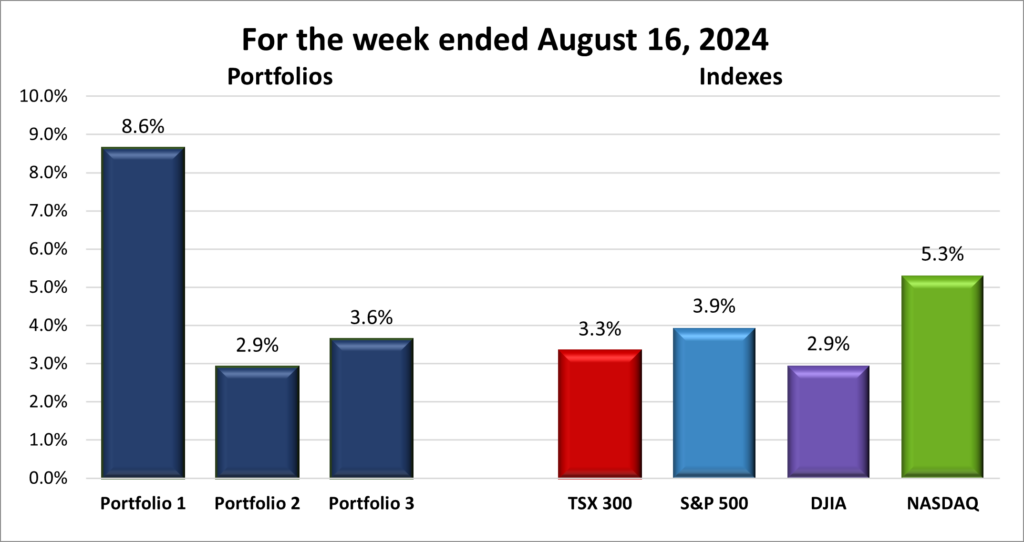
This week’s swift recovery marks a significant turnaround from the volatility of the previous week. As shown in the chart below, all major indexes initially stumbled but have more than made up for the early-month setbacks.
With the markets’ one-day meltdown now in the rearview mirror, there’s growing optimism on both sides of the border. The key question for the Fed no longer seems to be if they will lower US interest rates, but rather by how much. This anticipated shift should stimulate spending and investment, fostering a more favorable economic environment that benefits both nations.
As mentioned above, the latest US inflation and retail sales reports came out this past. Now, let’s see what happened this past week….
Items that may only interest or educate me ….
Canadian Economic news, US Economic news, How can I find reliable investment information?, …
Canadian Economic news
This past week’s key economic data that the Bank of Canada (BoC) considers when deciding whether to raise or lower the interest rate.
Canadian market volatility
After the previous week’s turbulence, where Canada’s Volatility Index (CVIX) spiked to 23.56 due to a weak US labour report and professional investors covering their Japanese loans when the Bank of Japan unexpectedly raised the Japanese interest rate, the index eventually settled at 15.79. This past week brought some reassurance, as the CVIX continued to decline, closing at 11.62 by week’s end. This marks a one-week drop of 26% from the 15.79 level, driven largely by investors recognizing that they had overreacted to the US labour data, leading to a more balanced sentiment.
Tracked as the VIXI on the Toronto Stock Exchange (TSE), the CVIX measures expected market volatility. A reading below 10 indicates a calm, stable market, while a range of 10 to 20 suggests moderate volatility and typical market fluctuations. Readings above 20 point to high volatility and significant market uncertainty. With the CVIX now at 11.62, it signals a market environment marked by normal volatility—cautious but not panicked, reflecting a more measured investor outlook.
US Economic news
This past week’s key data points that the Federal Reserve (Fed) considers when deciding whether to raise or lower the interest rate.
Consumer Price Index
As anticipated, July’s Consumer Price Index (CPI) ticked up by 0.2%, following a slight 0.1% dip in June. On an annual basis, inflation edged up 2.9% for July, just shy of the expected 3%. This marks the smallest annual increase since March 2021, indicating a continued decline in inflation.
Core CPI, which excludes volatile food and energy prices, also rose by 0.2% in July, building on a 0.1% increase from June. Year-over-year, core CPI growth slowed to 3.2% from 3.3% the previous month. Both the monthly and annual core CPI figures were in line with analysts’ forecasts, with the annual increase being the lowest since April 2021.
Breaking down the details, ‘Fuel Oil’ saw the largest monthly price increase, up 0.9%, while ‘Used cars and trucks’ experienced the steepest decline, falling 2.3%. Annually, ‘Transportation services’ led with an 8.8% price increase, whereas ‘Used cars and trucks’ saw the most significant drop, down 10.9%.
Overall, the CPI data confirms that inflation is trending downward and meets expectations. As inflation moves closer to the Fed’s 2% target, this report provides the evidence the Fed needs to consider a rate cut at their September meeting. The market responded positively, with investors now speculating whether the Fed will implement a 0.25% or possibly a 0.5% reduction in rates.
The CPI and core CPI provide essential data to the Fed as they attempt to manage monetary policy and ensure economic stability. CPI reflects overall price changes across a range of goods and services, helping the Fed gauge inflationary pressures and adjust interest rates to maintain price stability. Core CPI, excluding volatile food and energy prices, offers a clearer view of underlying inflation trends, aiding the Fed in focusing on persistent inflation rather than short-term fluctuations. By targeting 2% inflation and tracking these indices, the Fed aims to maintain price stability, support economic growth, and foster a predictable environment for growth.
American market volatility
The CBOE Volatility Index (VIX), often dubbed the market’s “fear gauge,” saw a dramatic surge to 66.04 the previous week—a level not witnessed since the early days of the pandemic in March 2020. This spike was driven by weak labour data hinting at a potential recession and institutional investors rushing to cover their positions in cheap Japanese loans. However, the VIX has since plummeted, signaling a swift stabilization in investor sentiment despite a turbulent start to the month. In a record-setting move, the VIX dropped from its peak of 66.04 to its long-term median of 17.6 in just seven trading days—the fastest descent from such heights ever recorded. By the end of this past week, the VIX had further declined 15% to 14.8, marking its lowest level in three weeks.
The VIX measures expected market volatility over the next 30 days, with readings below 12 indicating a calm and stable market, while values between 12 and 20 suggest normal fluctuations. Levels between 20 and 30 reflect heightened volatility and uncertainty, and readings above 30 signal extreme stress, typically seen during crises. The recent sharp decline in the VIX suggests that market tensions have eased, and investor anxiety has subsided, leading to a more settled market environment.
Consumer Sentiment Index (CSI)
The University of Michigan’s preliminary CSI for August surprised to the upside, rising to 67.8 from July’s final reading of 66.4. Analysts had predicted a slight increase to 66.9, making this the first uptick in four months.
However, the index’s components told a more nuanced story. The Current Economic Conditions component dropped by 2.9% to 60.9, marking its lowest point since December 2022 and a significant 19.3% decline year over year. On the flip side, the Index of Consumer Expectations showed a more optimistic outlook, climbing 4.8% from July to reach 72.1, and posting a 10.2% gain compared to the same time last year.
The boost in overall sentiment seems to be driven largely by renewed optimism among Democrats, particularly after Vice President Kamala Harris became the Democratic presidential candidate. Additionally, while inflation continues to trend downward, consumers still anticipate that prices will remain elevated over the next few years.
Retail Sales
The Commerce Department’s Census Bureau advance estimate for July retail sales showed a solid increase of 1.0%, significantly surpassing the expected 0.3% gain and following a flat result in June. This was the largest monthly jump in a year and a half, driven mainly by a rebound in auto sales after a cyberattack had previously disrupted dealer transactions. Year over year, retail sales were up 2.7%.
On a monthly basis, ‘Motor vehicle & parts dealers’ led with a 3.6% increase, while ‘Miscellaneous store retailers’ saw a 2.5% decline. Annually, ‘Electronics & appliance stores’ posted the biggest gain, up 5.2%, whereas ‘Sporting goods, hobby, musical instrument, & bookstores’ experienced the steepest drop, down 6.8%.
Core retail sales, which exclude motor vehicles, parts, and gasoline station sales, climbed 0.4% for the month and 3.4% year over year. When excluding ‘Motor vehicle & parts dealers,’ ‘Electronics & appliance stores’ saw the largest monthly growth at 1.6%.
Despite this higher-than-expected increase, consumer spending is still below last year’s levels due to inflation that pushed prices higher and higher interest rates making borrowing more expensive. However, the combination of strong consumer spending, a weakening job market, and continued declines in inflation could pave the way for the Fed to consider lowering interest rates.
How can I find reliable investment information and resources?
When you are starting out with investing, finding reliable information and resources is essential but can feel overwhelming given the sheer volume available. To help simplify this, check out the Educational Resources page, where I have compiled a list of books and tools that have been instrumental in expanding my investing knowledge. Additionally, below you will find a selection of resources to jumpstart your investment journey. While this list is not exhaustive, these tools should provide a solid foundation to begin building your wealth and confidence in investing.
1. Educational Websites and Platforms
- Investopedia: Offers a wide array of articles and tutorials on investment concepts.
- Morningstar Canada: Provides in-depth research, analysis, and educational content on stocks, mutual funds, and ETFs.
- Canadian Securities Institute (CSI): A valuable resource for learning about investing.
- The Motley Fool: Known for stock recommendations and investment advice, though access typically requires a subscription for its more detailed content.
2. Books
- “The Intelligent Investor” by Benjamin Graham: A classic on value investing, widely regarded as essential reading.
- “A Random Walk Down Wall Street” by Burton Malkiel: Covers a variety of investment strategies and principles.
- “The Art of Quality Investing” by Compounding Quality and Luc Kroeze: Offers insights into how to identify and invest in high-quality companies.
- “The Wealthy Barber” by David Chilton: A great starting point for beginners who want solid, step-by-step advice on managing their finances responsibly.
- “The Essays of Warren Buffett” by Warren Buffett: A collection of Buffett’s wisdom on investing.
3. Financial News Outlets
- BNN Bloomberg: Delivers up-to-date news and analysis on financial markets.
- Reuters: Offers current market news and investment analysis.
- Yahoo! Finance: Market news and financial information.
- Canadian Financial Post, and The Globe and Mail: Provide insights specific to the Canadian market.
4. Brokerage and Investment Platforms
- TD Direct Investing and TD Easy Trade: Provides educational resources and tools for Canadian investors.
- Questrade and Wealthsimple: Third party trading platforms that offer a range of learning materials and market insights.
- Most Canadian online brokerages offer educational resources and market analysis.
5. Government and Regulatory Websites
- Canadian Securities Administrators (CSA) and Financial Consumer Agency of Canada (FCAC): Offer valuable investor education.
- Investment Industry Regulatory Organization of Canada (IIROC), US Securities and Exchange Commission (SEC), and Financial Industry Regulatory Authority (FINRA): Provide regulatory insights and additional resource.
6. Professional Advice
- Financial Advisors: Certified financial planners (CFPs) can provide personalized advice. Consider consulting a fee-only financial advisor for personalized advice.
I have listed just a few resources that I personally use or have heard of. As you can see, there is a wealth of information available. When diving into investment research, it is important to stay focused and think critically. Begin by questioning the credibility of your sources—ensure they are reputable and unbiased. To verify accuracy, cross-check details from multiple sources and avoid taking information at face value. Building a solid understanding of financial jargon will help you navigate complex content and enhance your decision-making. Prefer insights from experts with recognized qualifications and experience, as their advice is more likely to be reliable. Finally, keep your personal investment goals in focus and seek out information that directly supports your objectives, making sure it is relevant and actionable for your financial journey. And of course, I hope you find valuable insights and learn a thing or two about investing from this site! 😊
Weekly Market Review
Monday: after a week of market turbulence, today’s calm was a welcome break for investors, with the Dow Jones Industrial Average (DJIA) being the only major index to slip into negative territory. The rest of the market held steady as everyone braces for Wednesday’s crucial US inflation report. Meanwhile, oil prices are on the rise, fueled by ongoing tensions in the Middle East.
In Canada, the Toronto Stock Exchange Composite Index (TSX) was the beneficiary of higher oil and commodity prices. In trading, the Basic Materials (miners and fertilizer manufacturers) sector was the big gainer on the day, with the Technology sector suffering the biggest loss.
In the US, a rally in technology companies lifted the Nasdaq Composite Index (Nasdaq) higher and dragged the S&P 500 Index (S&P) barely across the break-even line. In trading, the Technology sector advanced the most, while Telecommunications Services had the digest decline.
Tuesday: the latest US Producer Price Index (PPI) rose less than expected, sending all four indexes higher. The PPI is often a sign of where consumer prices are headed, so investors anticipate tomorrow’s CPI will suggest inflation continues to fall. Oil prices fell after the Organization of Petroleum Exporting Countries lowered their forecast for demand growth, overcoming concerns of tighter supplies due to tensions in the Middle East.
In Canada, the TSX was buoyed by the good news out of the US. In trading, led by the Technology sector, all sectors ended higher except the Telecommunications Services sector.
In the USA, technology stocks led the way as all three indexes rose by at least 1% and hit their highest levels in almost two weeks. Investors turned their focus to Wednesday’s CPI report hoping to see inflation continued its descent. In trading, Technology posted the biggest gain, while the Energy sector was the only sector to lose ground.
Wednesday: the markets reacted favourably to the latest US inflation report, sending all four indexes into the green. This latest inflation data boosts the case for a rate cut in September. Higher US inventories sent oil prices lower.
In Canada, the data showing inflation continues to fall in the US boosted the TSX. In trading, it was a day of broad-based gains, led by the Healthcare sector. Telecommunications Services and Basic Materials were the only sectors to end lower.
In the USA, the S&P and Nasdaq ran their respective winning streaks to five on the latest inflation news. In trading, the Financials sector posted the biggest gain, while Telecommunications Services had the biggest decline.
Thursday: a stronger than expected US retail sales report suggested the US consumer market remains strong sent all four indexes well into the green. Oil prices rose after the latest economic news calmed investors worried about an imminent recession.
In Canada, higher energy and metal prices helped the TSX extend its daily win streak to six, its longest since July 2023. It was a day of broad-based gains in the Canadian sector, led by Technology with Telecommunications Services the only sector to fall back.
In the US, weekly jobless claims fell for the second straight week, adding to the positive retail sales news. In trading, Consumer Staples led all sectors while the Utilities sector was the only one to end lower.
Friday: despite a quiet trading session, all four indexes ended higher after bouncing around in the morning before heading higher in afternoon trading. Oil prices continued to slide on lower demand expectations from China.
In Canada, the TSX extended its winning streak to seven days on the strength of higher commodity prices, particularly the price of gold. In trading on Bay Street, Basic Materials recorded the biggest gain, while Energy was down the most.
In the US of A, the S&P and Nasdaq advanced for the seventh straight day as concerns of a US recession continue to fade. In trading on Wall Street, the Financials sector was the top performer, while Industrials saw the biggest losses.
Weekly Market and Portfolio Review
For the week, the TSX (SPTSX) gained 3.3%, the S&P 500 (SPX) advanced 3.9%, the DJIA (INDU) rose 2.9% and the Nasdaq (CCMP) surged 5.3%.
| Index | Weekly Streak |
| TSX: | 2 – week winning streak |
| S&P: | 1 – week winning streak |
| DJIA: | 1 – week winning streak |
| Nasdaq: | 1 – week winning streak |
 As volatile as the previous week was, this past week could be characterized as calm and upward, with upward being the key word, as shown in the chart above. All four indexes each posted their biggest weekly gain since October 2023 as they recovered the losses from the start of the month.
The fear that gripped the markets earlier seems to have dissipated as volatility indexes in both Canada and the US returned to the ‘normal’ range of 10–20. This range represents typical market conditions with moderate volatility, reflecting day-to-day fluctuations rather than crisis-level swings.
Driving the rally were positive economic signals from the US, including the latest inflation report showing a continued downward trend and stronger-than-expected July retail sales. These indicators suggest that the recession fears that triggered the earlier selloff may have been overblown, and that the Fed is likely to begin cutting rates at their next meeting in September. A robust earnings report from Walmart (NYSE: WMT) further reinforced the strength of the American consumer.
This recent selloff and subsequent rebound are a prime example of the dangers of letting your emotions get the better of you and reacting too quickly to market movements. Short-term traders who panicked and sold off stocks during the initial decline watched as those same stocks rebounded sharply. For instance, Nvidia (NASD: NVDA) traded at $117.60 on August 1, dropped to $94.04 by August 5, and then surged to close at $122.86 by the end of this past week—a textbook case of missing out on recovery by overreacting.
| Portfolio | Weekly Streak |
| Portfolio 1: | 1 – week winning streak |
| Portfolio 2: | 1 – week winning streak |
| Portfolio 3: | 2 – week winning streak |
A good week in the indexes usually translates to gains in the portfolios, and this past week was no exception. As shown in the chart below, the three portfolios posted solid returns, with gains ranging from 2.9% for Portfolio 2 to an impressive 8.6% for Portfolio 1.
Portfolio 1 led the pack, significantly outperforming the major indexes. Nearly 75% of its holdings increased in value, highlighted by significant (more than 10%) gains from Sea Limited (NYSE: SE) up 20%, Nvidia up 15%, Celestica (TSE: CLS) up 13%, and Crew Energy (TSE: CR), which skyrocketed 82% on news of its acquisition by Tourmaline Oil (TSE: TOU). While the bump from Crew Energy was substantial, it was the strong performance of Nvidia and other tech giants that truly drove the portfolio’s success.
Portfolio 2 made a strong comeback, with 82% of its holdings posting gains. Although Crew Energy was the standout with its sharp increase, the portfolio’s overall growth was propelled by incremental gains across other stocks.
Portfolio 3 also delivered, extending its weekly win streak with 86% of its investments gaining value. Adyen (OTCM: ADYYF) surged 19%, and Lithium Americas (TSE: LAC) finally posted a positive week with a 15% increase.
After a few hiccups in recent weeks, it was great to see all three portfolios increase in value. Looking ahead, next week’s Canadian CPI inflation report for July and the Fed’s meeting minutes will be key. If inflation in Canada continues to decline and the Fed hints at a rate cut, we should be in for another good week. 😊
Companies on the Radar
 My radar list had become quite a handful, so instead of expanding it further, I decided to streamline things this week by removing two companies: Propel Holdings (TSE: PRL) and Lumine Group (TSE: LMN).
For Propel Holdings, a third party loans company, the choice boiled down to Propel versus Equitable Bank. With several financial services stocks already in my three portfolios, I am wary of overloading on similar sectors. I see more potential and lower risk with Equitable Bank, so it took the spot.
As for Lumine Group, it has been on my radar for a while due to its impressive lineage as a spinoff of Constellation Software (TSE: CSU), one of Canada’s top-performing firms. There is still a lot to like about Lumine, and I might revisit it later. For now, I am focusing on the six companies listed below that fit better with my current investment strategy
- Whitecap Resources (TSE: WCP), a medium-cap Canadian oil and gas company. The company offers an attractive dividend yield of over 7% per month, which has been steadily growing.
- Equitable Bank, a mid sized (when the number of outstanding shares times the shares prices is between $2 billion to $10 billion) Canadian bank, considered Canada’s 7th bank, which provides financial services to consumers and businesses.
- Birkenstock Holding plc (NYSE: BIRK), a medium cap British company that has been making the iconic Birkenstock shoes since 1774.
- On Holding AG (NYSE: ONON), a medium cap Swiss company, founder-run, sports products company.
- Vertiv Holdings (NYSE: VRT), a large American company that designs and builds infrastructure and continuity solutions to businesses around the world.
- Kelly Partners Group (OTCM: KPGHF), a small Australian accounting firm that is growing through serial acquisition of other small accounting firms in Australia. They have recently expanded into the USA and other English-speaking countries.
Please keep in mind that these are only companies that have piqued my interest. This is not a recommendation or financial advice. You should do your own research or contact a professional before making any investment decisions.
The Radar Check was last updated August 16, 2024.
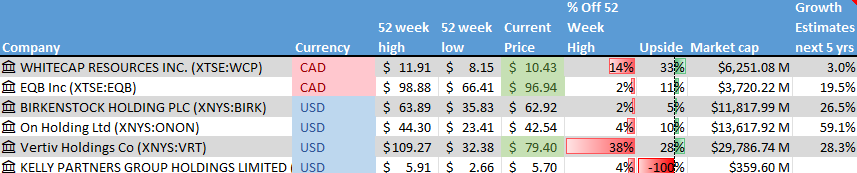

NOTE: Morningstar and Thomson-Reuters analysis is unavailable for Kelly Partners Group most likely because it is a small-cap Australian company with a market value of less than US$360 million and primarily listed on the Australian Stock Exchange. While you can invest in Kelly Partners through the Over-the-Counter Market (OTCM) here in North America, the analysis is not as readily available as it is for companies on major North American exchanges like the Toronto Stock Exchange, New York Stock Exchange, and Nasdaq.
Unlike other non-North American companies I have researched, Yahoo! Finance had no information under the Analysis tab for Kelly Partners. This lack of data meant I could not access any ratings during my routine radar check.
Portfolio Update
Portfolio 1
Portfolio 1 for the week ended August 16, 2024: UP 
- Natural gas producer Crew Energy announced they were being acquired by Tourmaline Oil Corp. for C$1.3 billion. Tourmaline is Canada’s largest natural gas producer by volume and the fifth largest natural gas producer in North America. It is an all-stock transaction with each Crew shareholder receiving 0.114802 of a Tourmaline share in exchange for each Crew share they hold.
- CN Rail (TSE: CNR) took the first step to a phased shutting down of its rail network when it stopped shipping hazardous materials. At the end of the week the company was no longer allowing container imports from its US partner railways. CN said it has taken these steps since there has been little progress in negotiations with the Teamsters Union and the likelihood of a strike or lockout has increased. If CN and Canadian Pacific Kansas City Ltd (TSE: CP) shut down it could play havoc with recently recovered supply chains.
- General Motors (NYSE: GM) recalled over 21 thousand of their SUV electric vehicles (EV) due to concerns of a faulty anti-lock braking system.
- Alphabet’s (NASD: GOOGL) Google announced a new batch of their Pixel smartphones, complete with integrated artificial intelligence (AI).
- Rivian (NASD: RIVN) temporarily suspended production of their delivery van EVs for Amazon (NASD: AMZN) due to a shortage of parts. The company said the part shortage does not impact the production of their SUV and pickup EVs.
Activity
No significant activity to report this week.
Dividends
Dividends Received this week for the following companies:
Canadian $
No C$ dividends this past week.
US $
Apple Inc. (NASD: AAPL)
BSR Real Estate Investment Trust (TSE: HOM.U)
Quarterly Reports
Boston Omaha Corporation
Second quarter 2025 financial results on August 13, 2024
Sea Limited
Second quarter 2024 financial results on August 13, 2024
Home Depot, Inc.
Second quarter 2025 financial results on August 13, 2024
Grab Holdings Limited
Second quarter 2025 financial results on August 15, 2024
Walmart Inc.
Second quarter 2025 financial results on August 15, 2024
Portfolio 2
Portfolio 2 for the week ended August 16, 2024: UP
- Bank of Nova Scotia (TSE: BNS) purchased a minority 14.9% stake in US regional lender KeyCorp (NYSE: KEY) in an all-stock deal that is valued at US$2.8 billion. The deal values KeyCorp’s shares at US$ 17.17 per share and provides at 17% premium over KeyCorp’s last closing price prior to the announcement.
- The Walt Disney Company (NYSE: DIS) announced plans for four new cruise ships and six new themed parks.
In other Disney news, to expedite the approval process with India’s antitrust regulator, the Competition Commission of India (CCI), Disney and Reliance have proposed selling off some of their channels. However, none of their cricket channels are on the chopping block. Given cricket’s immense popularity in India and its status as a beloved national pastime, this decision underscores its significant value in the media landscape.
Disney’s planned new sports streaming partnership with Warner bros Discovery (NASD: WBD) and Fox Corp (NASD: FOX) has been blocked by a lawsuit filed by FuboTV (NYSE: FUBO). The judge ruled the new streaming service would “substantially lessen competition and restrain trade.”
Activity
No significant activity to report this week.
Dividends
Dividends Received this week for the following companies:
Canadian $
SmartCentres Real Estate Investment Trust (TSE: SRU.UN)
US $
No US$ dividends this past week.
Quarterly Reports
No quarterly reports this past week.
Portfolio 3
Portfolio 3 for the week ended August 16, 2024: UP
- Shopify (TSE: SHOP) has partnered with Pivotree (TSEV: PVT) to provide Business-to-Business (B2B) and Direct-to-Consumer (D2C) customers with innovative and scalable e-commerce solutions. As part of the partnership, Pivotree will move their customers onto Shopify’s e-commerce platform.
Activity
No significant activity to report this week.
Dividends
Dividends Received this week for the following companies:
Companies followed by DRIP (Dividend Re-Investment Plan) indicate additional shares were purchased with the dividend. Any cash leftover was added to the cash balance.
Canadian $
SmartCentres Real Estate Investment Trust (TSE: SRU.UN) DRIP
US $
No US$ dividends this past week.
Quarterly Reports
Adyen N.V.
First half 2024 financial results on August 15, 2024