Weekly Update for the week ending May 17, 2024

With inflation stubbornly high, hopes for lower borrowing costs are fading. After three consecutive months of higher-than-expected inflation, you might be wondering: when will interest rates drop? Despite many anticipating a quicker resolution, the Federal Reserve (Fed) has opted to maintain a steady interest rate of 5.5%, waiting for clear signs that inflation is indeed on a downward trajectory.

Keeping borrowing costs high can be frustrating for many. Prospective homeowners are eagerly awaiting lower mortgage rates, businesses are holding off on investments hoping for cheaper borrowing costs, and investors are on the lookout for any rate cut that could spur market growth. Unfortunately, the quick resolution to high inflation rates predicted at the end of 2023 has not materialized. Why? The impact of higher rates has been uneven. Some consumers and businesses locked in lower rates before they rose in 2022, shielding them from the current highs.

In what feels like a standoff between the public and the Fed, both sides seem to be trying to outwait the other. Consumers and businesses might be hoping to outlast the central banks, delaying major loans in the hope that interest rates will soon drop. However, the Fed is confident that their ‘higher for longer’ strategy will gradually bring inflation down to their target of 2% as more people begin to feel the economic pinch.

As we watch and wait for rates to fall, the big question remains: will this “higher for longer” strategy be effective in cooling inflation? The Fed will be patient, awaiting evidence that inflation continues its downward trend. In the meantime, let’s look into what transpired in the markets this past week….

Items that may only interest or educate me ….

Canadian Economic news, US Economic news, Is it better to invest in Canadian or American stocks? ….


Canadian Economic news

This past week’s key economic data that the Bank of Canada (BoC) considers when deciding whether to raise or lower the interest rate.

Canadian market volatility

Over the past week, Canada’s Volatility Index, the Montreal Exchange Volatility Index (VIXC), measured by the TSX 60, drifted lower, ending at 10.19, down from the previous week’s reading of 12.07. The decrease in volatility is likely due to slowing inflation, strong corporate earnings, easing tensions in the Middle East, and the growing likelihood that the BoC will lower interest rates in June.

Often referred to as Canada’s ‘fear gauge,’ the VIXC provides insights into expected volatility within the Canadian stock markets. Typically, readings above 20 signify high volatility, while those below 20 indicate lower levels. At its current reading of 10.19, the VIXC suggests the market remains well below the threshold for high volatility, indicating a generally calmer sentiment among investors.

US Economic news

This past week’s key data points that the Federal Reserve (Fed) considers when deciding whether to raise or lower the interest rate.

Consumer price Index (CPI)

This week’s economic news focused on inflation, with both the Producer Price Index (PPI) and CPI reports being released. The PPI, which tracks prices businesses pay for goods and services, came in higher than expected, raising concerns among investors about rising consumer prices. However, they need not have worried as the Labor Department’s April CPI report, a gauge for goods and service costs across the US economy, showed inflation rose 0.3%, below analysts’ expectations of a 0.4% increase, and down from March’s 0.4% rise. Annually, the rate of inflation declined slightly to 3.4%, matching expectations, after rising 3.5% in the previous month.

The biggest monthly increase was in the ‘Gasoline’ subsector, up 2.8%, while the biggest drop was in the ‘Utility (piped) gas service,’ subsector, down 2.9%. Year over year, ‘Transportation services’ saw the biggest increase, up 11.2%, while the largest decline was in ‘used cars and trucks,’ down 6.9%.

The core CPI, which excludes volatile food and gas prices, slowed to a 0.3% rate of growth, after posting consecutive increases of 0.4% in February and March. Year over year, core CPI slowed to 3.6%, after a 3.8% rise in March. Both the monthly and year-over-year increases matched expectations.

Both all-items CPI, or headline CPI, and core CPI showed a slight slowdown in the pace of inflation growth. This resumption of the downward trend is welcome news to consumers and the Fed alike. For consumers, this could mean some relief from high prices. For the Fed, falling inflation is what they want to see. However, inflation still remains above 3%, and the Fed will want to see several months of inflation data trending downward before changing interest rates. In the meantime, interest rates will remain at 5.5% to ensure inflation is truly heading down to their 2% target. Analysts and investors are now targeting a rate cut for September, with the possibility of another cut later in the year. The sooner a rate cut, the better. 😊

The PPI is an economic indicator that provides a view of inflation from the perspective of the producer rather than the consumer (which is what the CPI measures). If the PPI goes up, it can indicate that prices are increasing, potentially leading to inflation. On the flip side, if the PPI decreases, it might suggest that producers are getting less for their products, which could signal deflation or a drop in demand.

American market volatility

The CBOE Volatility Index (VIX), often referred to as the market’s fear gauge, declined this past week, ending at 11.99, down from the previous week’s reading of 12.55, marking its lowest level since December. This decrease was likely the result of the latest CPI coming in lower than expected, continued robust corporate earnings, and renewed optimism that the Fed will lower interest rates sometime this year. The VIX is generally considered calm when below 20, suggesting investors are less anxious in the near term. However, future economic data and global events could still cause the VIX to fluctuate.

Retail Sales

The Commerce Department’s retail sales advanced estimates for April showed sales were virtually flat, following a downward revised gain of 0.6% in March. Analysts had forecast gains of 0.4%. On an annual basis, retail sales were up 3.0%.

The biggest monthly increase was in ‘gas station’ sales, up 3.1%, while the biggest decrease was in ‘nonstore retailers,’ down 1.2%. Annually, ‘nonstore retailers’ was the big winner, up 7.5%, while ‘furniture and home furnishings stores’ saw the biggest decline, down 8.4%.

Core retail sales, which excludes automobiles, gasoline, and vehicle parts, shrank 0.1% in April, down considerably from a 1.1% increase in March and below analysts’ expectations for a 0.2% increase. However, year over year, core retail sales were up 3.5%.

The monthly data showing a decline in retail sales, suggesting demand was cooling, combined with the recent lower than expected jobs report, suggest the economy is finally starting to soften. For the Fed, who were looking for signs the economy was slowing before they would consider lowering the interest rate, this provides some of the evidence of a slowing economy that they were looking for.

Is it better to invest in Canadian or American stocks?

As Canadian investors, we have the unique advantage of being able to access both Canadian and American markets, offering a wide array of investment opportunities. The decision to invest domestically or across the border involves various factors, including exchange rates and tax implications. Consulting with a CPA tax expert or a certified financial adviser can provide clarity on the latter.

Sector Considerations:

  • Energy and Natural Resources: The Toronto Stock Exchange (TSE) is renowned for these sectors, making it a practical choice for those investments to avoid foreign exchange fees.
  • Technology, Healthcare, Consumer Goods: The US markets, such as the New York Stock Exchange (NYSE) and the Nasdaq Stock Market, offer broader selections in these industries. Although there are strong contenders in Canada, the variety and scale in the US are greater.

The table below showcases the top 10 companies by market capitalization in Canada and the US, as of May 2024. It highlights the sectoral strengths of each market, with Canadian companies excelling in Financials and Energy, while US giants dominate in Technology and Communication Services.

Largest Canadian companies Sector
1 Royal Bank of Canada Financials
2 Shopify Technology
3 Toronto Dominion Bank Financials
4 Canadian Natural Resources Limited Energy
5 Enbridge Inc. Energy
6 The Bank of Nova Scotia Financials
7 Canadian National Railway Industrials
8 Brookfield Asset Management Financials
9 Manulife Financial Corporation Financials
10 BCE Inc. Communication Services
Largest American companies Sector
1 Microsoft Corporation Technology
2 Apple Inc. Technology
3 Nvidia Corporation Technology
4 Alphabet Inc. (Google) Communication Services
5 Amazon.com, Inc. Consumer Cyclical
6 Berkshire Hathaway Inc. Financials
7 Johnson & Johnson Healthcare
8 Tesla, Inc. Consumer Cyclical
9 Meta Platforms, Inc. (Facebook) Communication Services
10 Exxon Mobil Energy

Given this distribution, your sector interest should guide where to invest. For technology, the US market is compelling. For financials, especially banks, staying within Canada may be more beneficial unless you are looking at multinational financial services where US companies like Visa (NYSE: V) and Mastercard (NYSE: MA) also play significant roles.

Strategic Considerations:

Many Canadian companies aim to list on US exchanges to gain exposure and credibility. Conversely, it is rare for US companies to seek listings in Canada. However, when a company, such as Shopify (TSE: SHOP / NYSE: SHOP), is listed on both a Canadian exchange and an American exchange it is called cross listed. Companies cross list to gain broader exposure to investors. For Canadians, purchasing shares on the Canadian exchange can be more economical due to savings on exchange rates. Conversely, US investors would likely buy shares on the American exchange, assuming you can even buy shares on the TSE.

Conclusion:

Choosing between Canadian and American stocks is not straightforward, as both markets offer unique advantages. The TSE excels in the energy, resources, and financial sectors, while the US markets, including NYSE and Nasdaq, are noted for their diverse range of companies, particularly in technology, consumer cyclicals, and healthcare. Implementing a strategy that includes diversification across both countries can be beneficial, helping to balance risks and leverage strengths from each country. However, investors must consider factors like currency exchange rates and tax implications, which can influence returns on foreign investments. Ultimately, your investment decisions should align with your personal financial goals, sector preferences, and risk tolerance.

Goldilocks trade

Following the CPI announcement that inflation had resumed a downward trend, I came across a new term: the Goldilocks trade.

In investing, a “Goldilocks trade” refers to a situation in which economic conditions are perceived as being neither too hot nor too cold, but just right, similar to the porridge in the fairy tale “Goldilocks and the Three Bears.”

In financial markets, a Goldilocks trade typically involves an environment where economic indicators suggest that growth is strong enough to support corporate earnings and stock market performance, but not so strong that it triggers concerns about inflation or aggressive monetary policy tightening by a central bank, such as the Fed or the BoC. It is a delicate balance where economic conditions are considered to be in a sweet spot, fostering investor confidence and optimism.

A Goldilocks trade often leads to a scenario where both stocks and bonds perform well simultaneously, as investors feel comfortable taking on riskier assets like equities while also seeking the safety of fixed-income investments. However, achieving and maintaining a Goldilocks scenario can be challenging, as economic conditions can be fleeting due to various factors such as changes in interest rates, geopolitical events, or unexpected shocks to the economy.


Weekly Market Review

Monday: the week got off to a shaky start with the Nasdaq Composite Index (Nasdaq) the only index to advance. The other three indexes – Toronto Stock Exchange Composite Index (TSX), the S&P 500 Index (S&P), and the Dow Jones Industrial Average (DJIA) – all ended lower. With a US inflation report due Wednesday, many investors are in a wait and see mode. If inflation remains high, the chances of a rate cut this summer diminish, while a lower inflation reading puts a rate cut back on the table. Oil prices edged higher on signs of increasing demand out of China and the potential of the current OPEC+ supply cuts being extended.

In Canada, the TSX ended lower as investors took some profits after last week’s run to a record closing high. In trading, Healthcare and Consumer Cyclicals posted the biggest gains of the Canadian sectors, while Basic Materials (miners and fertilizer manufacturers) and Industrials had the steepest declines.

In the US, the DJIA eight-day win streak came to an end, however, the Nasdaq was higher while the S&P ended slightly lower. In trading, Technology and Healthcare advanced the farthest of the American sectors, while Industrials and Financials lost the most.

Tuesday: Another day of mixed results but this time only the TSX ended lower. The April PPI (another measure of inflation) came in slightly higher than expected, raising concerns about tomorrow’s CPI inflation report. However, investors shook off their concerns after the US announced additional tariffs on a variety of Chinese goods. Oil prices were lower on concerns that higher for longer interest rates could reduce demand.

In Canada, the TSX ended just below the line, weighed down by lower oil prices and the PPI inflation news out of the USA. In trading, Basic Materials and Healthcare gained the most while Technology and Energy dropped the most.

In the US, the Nasdaq set a record close after Fed Chair Jerome Powell reassured investors that he does not expect the Fed to raise rates. In trading, the Financials and Technology sectors rose the most while Consumer Staples and Energy were the only sectors to decline.

Wednesday: all four indexes ended higher, driven by US inflation data that came in below expectations, sparking hopes the Fed will lower interest rates later this year. Oil prices rose after the latest data showed a larger than expected draw on US crude oil offset a forecast for weaker global demand.

In Canada, news of lower inflation in the US led to a rally in the Utility sector. Utility stocks tend to have relatively high dividend yields, making them appealing in a low-interest-rate environment. In trading, the Utilities and Technology sectors were the top performers, while Consumer Staples, Healthcare and Industrials were the only sectors to end lower.

In the USA, lower inflation, flat retail sales and investor optimism helped propel the indexes to record highs. In trading, Technology and Utilities advanced the most, swapping positions with their Canadian counterparts. Energy and Consumer Staples were the only sectors to end in the red.

Thursday: it was a volatile day for the indexes that saw the day end with the TSX the only index to end higher. Comments from three separate Fed officials suggesting rates will likely be higher for longer weighed on the markets, knocking the three American indexes out of positive territory and down into negative territory. Strong demand for fuel products in the US led to oil prices climbing higher.

In Canada, the TSX recorded a second straight day of gains on strong corporate earnings. In trading in the Canadian sectors, Consumer Staples and Healthcare rose the most, while Energy and Telecommunications Services dropped the most.

In the US, coming after a day when all three indexes closed at record highs, the DJIA briefly topped 40,000 before pulling back after comments from Fed officials. In trading, Consumer Staples and Telecommunications Services were the only American sectors to advance, while Energy and Consumer Cyclicals fell the farthest.

Friday: the week ended in the reverse of how it started with the Nasdaq ending lower and the other three indexes closing higher. Gains were limited after a Fed official said she was prepared to raise the US interest rate again if inflation did not resume a downward trend. Oil prices inched higher on growing demand out of China and the US, helping oil post a weekly gain for the first time in three weeks.

In Canada, the TSX was lifted by rising oil and commodity prices. In trading on Bay Street, Basic Materials and Energy recorded the biggest gains, while Healthcare, Consumer Staples, and Utilities were the only sectors to fall.

In the USA, the DJIA closed above 40,000 for the first time, reflecting growing investor confidence that the Fed will lower rates later this year. In trading on Wall Street, Basic Materials and Energy were the biggest winners, while Utilities and Technology suffered the biggest losses.


Weekly Market and Portfolio Review

For the week, the TSX (SPTSX) gained 0.7%, the S&P 500 (SPX) rose 1.5%, the DJIA (INDU) advanced 1.2% and the Nasdaq (CCMP) surged 2.1%.

Index Weekly Streak
TSX: 2 – week winning streak
S&P: 4 – week winning streak
DJIA: 5 – week winning streak
Nasdaq: 4 – week winning streak

Bull market. A good week for the North American stock markets. As shown in the chart above, the major North American stock indexes all enjoyed a positive week, driven by a combination of better-than-expected corporate earnings and the lower than expected US CPI inflation report.

The April CPI report, released this past week, showed inflation declining for the first time in six months. While the Fed welcomed this decline, they indicated that it was not enough to start talking about lowering rates just yet. They want more data to ensure the downward trend in inflation continues to ensure it does not rebound like it did earlier this year.

Inflation, as measured by the CPI, rose at its slowest pace since 2021, and retail sales remained flat on a month-to-month basis. Coupled with stronger-than-expected earnings, these factors fueled investor optimism for a soft landing, a scenario where the economy stays strong while inflation returns to the Fed’s 2% target. This optimism propelled all three major American indexes higher. The DJIA even reached a record high, closing above 40,000 points for the first time.

The TSX stumbled at the start of last week due to declining oil and commodity prices. However, as these prices recovered towards the end of the week, the TSX rallied, buoyed by stronger oil and commodity prices, and further bolstered by optimism in the US markets.

Let us cross our fingers that the May CPI inflation shows inflation continuing to fall. 😊

Portfolio Weekly Streak
Portfolio 1: 4 – week winning streak
Portfolio 2: 2 – week winning streak
Portfolio 3: 1 – week winning streak

Bull market. A good week for the North American stock markets. A good week across the board, with all three portfolios registering a weekly gain, as shown in the chart below.

Portfolio 1 led the pack, even outpacing all four major North American indexes. While there were no significant (10% or more) losses, the portfolio benefited from substantial gains in several stocks, including Magnite (NASD: MGNI) up 29%, Sea Limited (NASD: SE) up 15%, Lightspeed Commerce (TSE: LSPD) up 16%, Hammond Power Solutions (TSE: HPS.A) up 11%, indie Semiconductor (NASD: INDI) up 10%, and Celsius Holdings (NASD: CELH) up 10%. The investment in Hammond a few weeks ago during a dip in the share price is looking good. 😊

Portfolio 2 performed well, surpassing all indexes except the Nasdaq. The number of stocks that posted a weekly gain, highlighted by Hammond Power Solutions’ 11% gain, slightly out numbered those that declined.

Portfolio 3 was the laggard of the three but managed to get back in the win column. Like Portfolio 2, it was relatively evenly split between winners and losers. If not for Magnite’s impressive 29% gain, this portfolio likely would have lost ground this past week.

Overall, the positive performance across all three portfolios is encouraging. With continued strong earnings next week and potential rate cuts on the horizon, I am optimistic that each portfolio will continue to grow in value, paving the way for long term growth.
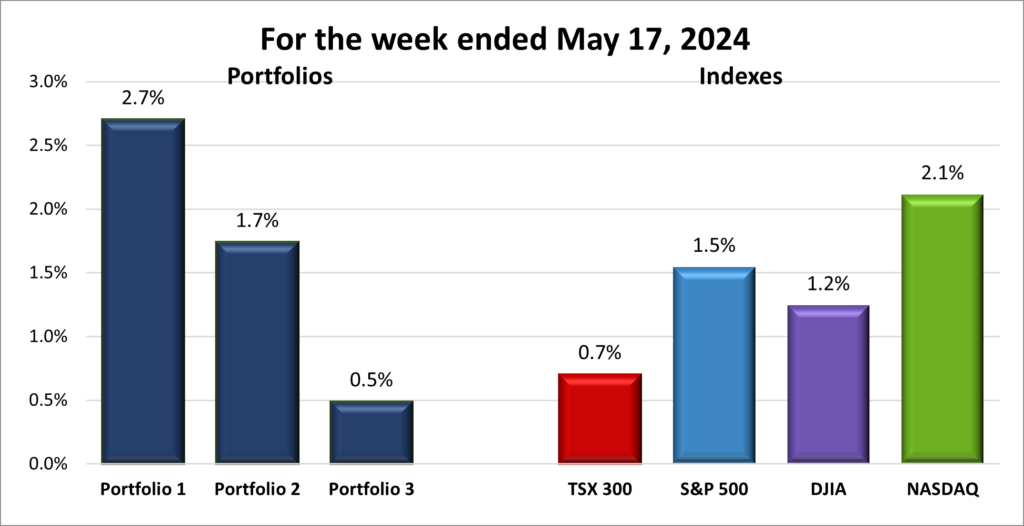
Weekly Portfolio & Index performance
Weekly Portfolio & Index performance for the week ended May 17, 2024.

Companies on the Radar

[radar] This past week, I added British company RELX PLC (NYSE: RELX) to my investing radar. This large-cap organization (shares outstanding X share price greater than US$ 10 billion) provides information-based analytics and decision tools for professional and business customers worldwide. RELX is well diversified across various business sectors, which helps lessen risk. The financials are robust, featuring steadily growing revenue and earnings per share (EPS). Additionally, they consistently pay dividends, offering a reliable source of income. Overall, RELX seems to offer a good blend of stability, growth, and innovation, making it a candidate for inclusion in any of the three portfolios.

With RELX now on the radar, that brings the total to six companies on the radar. It is getting a little crowded, so next week I will need to prune a few from the list.

  • Equitable Bank (TSE: EQB), a mid sized Canadian bank, considered Canada’s 7th bank, that provides financial services to consumers and businesses.
  • MasTec, Inc. (NYSE: MTZ), a mid-sized American engineering firm specializing in the construction of large and complex infrastructure projects.
  • Lumine Group (TSE: LMN), a young Canadian mid sized company that acquires communications and media software companies, and then strengthens and grows those companies.
  • LVMH Moët Hennessy – Louis Vuitton, Société Européenne (OTCM: LVMUY), commonly known as LVMH, is a French multinational conglomerate specializing in luxury goods. It is the world’s largest luxury goods company.
  • Evolution AB (OTCM: EVVTY), a Swedish company that provides live casino solutions for global gaming operators.

Please keep in mind that these are only companies that have piqued my interest. This is not a recommendation or financial advice. You should do your own research or contact a professional before making any investment decisions.

The Radar Check was last updated May 17, 2024.
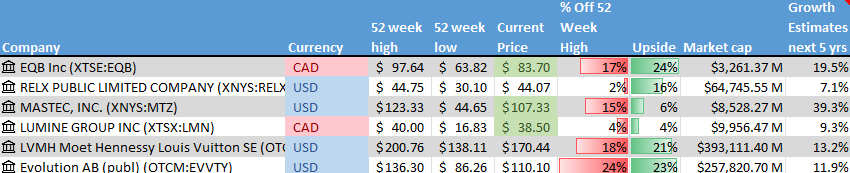
Stock on the Radar List. 1 of 2.
Stock on the Radar List. 2 of 2.

NOTE: Morningstar and Thomson-Reuters analysis is unavailable for Evolution and LVMH from my usual sources because the company’s home stock exchange is in Europe. While it is possible to invest in both companies through the Over-the-Counter Market (OTCM), I do not have access to analysis similar to the data available for companies traded on the major North American stock exchanges (Toronto Stock Exchange, New York Stock Exchange, and Nasdaq Stock market). The Analysts Rating and Price Target for these two companies are from Yahoo! Finance, under the Analysis tab once you have searched for the ticker.


Portfolio Update

Portfolio 1

Portfolio 1 for the week ended May 17, 2024: UP Green Up Arrow, signifying a positive week

  • The US National Highway Traffic Safety Administration (NHTSA) is looking into Amazon’s (NASD: AMZN) Zoox self-driving vehicles. The vehicles have been involved in rear end collisions when pulling up behind motorcyclists. As a motorcyclist myself, it appears autonomous vehicles are one more thing I need to be aware while riding. ☹
    In other Amazon news, the Amazon Web Services (AWS) plans to invest over €1.2 billion in France to increase their cloud computing and artificial intelligence (AI) infrastructure in that region.
    The head of AWS, Adam Selipsky, is leaving Amazon, effective June 3. He will be replaced by senior vice president Matt Garman who has been responsible for AWS’s sales and marketing.
  • The NHTSA is currently investigating Alphabet’s (NASD: GOOGL) Waymo self-driving car division following reports of Waymo vehicles violating traffic safety laws.
    Alphabet’s Google showcased its latest development in AI at Google’s I/O developer event. The latest features include: a version of Gemini known as Flash that is faster and cheaper to run; a prototype that can talk to users about anything captured on their smartphone camera in real time; and an improved Gemini Pro version that allows it to answer questions when provided with thousands of pages of data or an hour or more of video.
    The company also said it was launching its ‘fully revamped’ search engine that is enhanced with AI features. Search results will often favour AI generated responses, called ‘AI Overviews,’ rather than website links. This change is supposed to speed up the retrieval of information.
  • CN Rail (TSE: CNR) halted service on its rail lines in northern Alberta and northern BC due to wildfires.
  • Berkshire Hathaway (NYSE: BRK.B) announced they had made a US$ 6.72 billion investment in the insurance company Chubb.

Activity

No significant activity to report this week.

Dividends

Dividends Received this week for the following companies:

Companies followed by DRIP (Dividend Re-Investment Plan) indicate additional shares were purchased with the dividend. Any cash leftover was added to the cash balance.

Canadian $

Dream Industrial Real Estate Investment Trust (TSE: DIR.UN)

US $

Apple Inc (NASD: AAPL)

BSR Real Estate Investment Trust (HOM.UN)

Quarterly Reports

Boston Omaha Corporation

First quarter 2024 financial results on May 14, 2024

The Home Depot, Inc.

First quarter 2025 financial results on May 14, 2024

Sea Limited

First quarter 2024 financial results on May 14, 2024

Grab Holdings Limited

First quarter 2024 financial results on May 15, 2024

Lightspeed Commerce Inc.

Fourth quarter 2024 financial results on May 16, 2024

Walmart Inc.

First quarter 2025 financial results on May 16, 2024

Portfolio 2

Portfolio 2 for the week ended May 17, 2024: UP Green Up Arrow, signifying a positive week

  • The Walt Disney Company (NYSE: DIS) announced they have dramatically reduced their investment in traditional TV programming. TV shows that have already been broadcast through traditional TV networks are quickly moved to one of Disney’s streaming services. This allows Disney to spread the costs across multiple platforms and reap additional revenue.

Activity

No significant activity to report this week.

Dividends

Dividends Received this week for the following companies:

Companies followed by DRIP (Dividend Re-Investment Plan) indicate additional shares were purchased with the dividend. Any cash leftover was added to the cash balance.

Canadian $

SmartCentres Real Estate Investment Trust (TSE: SRU.UN)

US $

No US$ dividends this past week.

Quarterly Reports

Take-Two Interactive Software, Inc.

Fourth quarter 2024 financial results on May 16, 2024

Portfolio 3

Portfolio 3 for the week ended May 17, 2024: UP Green Up Arrow, signifying a positive week

  • A federal court has ruled Microsoft (NASD: MSFT) must pay a US$ 242 million fine for patent infringement of IPA Technologies’ voice recognition technology that was used in Microsoft’s Cortana virtual-assistant software. Microsoft plans to appeal.
    Microsoft has suggested some of its China based employees consider relocating to regions outside of China amidst regional geopolitical tensions.
    Microsoft announced they will provide an optional Azure cloud service based on AMD’s (NASD: AMD) top of the line AI chip. At their upcoming developers conference they will preview their own AI chip, the Cobalt 100. Microsoft claims the chip is 40% faster than other Arm (NASD: ARM) based chips.
  • GDI Integrated Facility Services Inc. (TSE: GDI) acquired Paramount Building Solutions from investment bank Brown Gibbons Lang & Company. Paramount provides facilities maintenance and commercial cleaning solutions to businesses of all sizes. This acquisition will expand GDI’s footprint into Arizona and Minnesota.

Activity

No significant activity to report this week.

Dividends

Dividends Received this week for the following companies:

Companies followed by DRIP (Dividend Re-Investment Plan) indicate additional shares were purchased with the dividend. Any cash leftover was added to the cash balance.

Canadian $

SmartCentres Real Estate Investment Trust (TSE: SRU.UN) DRIP

US $

No US$ dividends this past week.

Quarterly Reports

No quarterly reports this past week.

Weekly Update for the week ending May 10, 2024

Part of my investment philosophy is to let winners run rather than selling early to lock in gains. This approach has been beneficial with stocks like Nvidia (NASD: NVDA) and Shopify (TSE: SHOP). However, I reduced my holdings in each after they came to represent over 40% of Portfolio 1 and Portfolio 3, respectively, to manage increased volatility.

On the flip side, this strategy has sometimes resulted in missed opportunities for greater profits, as was the case with Illumin Holdings (TSE: ILLM). After surging from C$2.00 to C$32.00 per share in less than a year, it plummeted to C$1.64. Although I made a profit, I could have made more had I sold earlier. ☹

While I generally prefer to let winners run and even expand my investments in them, I recognize there are times when it is wise to sell part of a stake, especially in smaller, more volatile companies.

This past week, I increased my position in a company that has demonstrated strong growth and continues to have great potential. Before I dive into the details of this additional investment, let’s review what else happened in the markets this past week.

Items that may only interest or educate me ….

Canadian Economic news, US Economic news, What are the different types of stocks? ….


Canadian Economic news

This past week’s key economic data that the Bank of Canada (BoC) considers when deciding whether to raise or lower the interest rate.

Labour Force Survey (LFS)

Statistics Canada’s LFS for April highlighted significant job gains, with the economy adding 90,000 jobs—a monthly increase of 0.4% and an annual rise of 1.9%. This substantial increase sharply contrasts with the decline of 2,200 jobs in March and surpassed analysts’ expectations of 18,000 new jobs. It represents the largest employment increase since January 2023, with the majority of new positions being part-time. Year-over-year, full-time employment rose by 1.7%, while part-time employment increased by 2.9%.

The unemployment rate remained steady at 6.1% in April, the highest rate since January 2022. On an annual basis, unemployment is up by 1.0% from last April. Meanwhile, average hourly wages among employees increased by 4.7% annually in April, although this is a slight decrease from the 5.1% rise recorded in March.

This LFS report presents a mixed picture: the surge in job creation is positive, indicating a strong economy, but it also raises questions about whether the BoC will lower the benchmark interest rate at their upcoming June meeting, given the robust labour market. I hope we get the best of both worlds, where the economy remains strong and the BoC cuts the interest rate. 😊

Canadian market volatility

Over the past week, Canada’s Volatility Index, the Montreal Exchange Volatility Index (VIXC), measured by the TSX 60, bounced up and down before finally ending the week at 12.07, down from the previous week’s 12.64. This decrease in volatility is likely due to a combination of factors, including continued strong corporate earnings, easing tensions in the Middle East, and increased likelihood that the BoC will lower interest rates in June.

Often referred to as Canada’s ‘fear gauge,’ the VIXC provides insights into expected volatility within the Canadian stock markets. Typically, readings above 20 signify high volatility, while those below 20 indicate lower levels. At its current reading of 12.07, the VIXC suggests the market remains well below the threshold for high volatility, indicating a generally calmer sentiment among investors.

US Economic news

This past week’s key data points that the Federal Reserve (Fed) considers when deciding whether to raise or lower the interest rate.

American market volatility

The CBOE Volatility Index (VIX), often referred to as the market’s fear gauge, declined this past week, ending at 12.55, down from the previous week’s reading of 13.49, and marking its lowest level since January. This decrease was likely the result of easing tensions in the Middle East, robust corporate earnings, and a cooling labour market. Typically, the VIX ranges from 10 to 20, with readings above 20 indicating heightened market volatility. The current lower VIX suggests reduced investor anxiety in the near term, but future economic data and global events could cause fluctuations.

Consumer Sentiment Index (CSI)

The University of Michigan’s preliminary reading on the CSI dropped sharply to 67.4 in May, down from a final reading of 77.2 in April. Analysts had expected a reading of 76. This significant drop of over 12% marks its lowest point in six months and follows four months of relative stability with readings in the high 70s. However, on an annual basis, the CSI is still up 14.2%.

The lower-than-expected reading reflects consumers’ concerns about slowing economic growth, a cooling labour market, and persistently high inflation, which in turn keeps interest rates elevated.

The final reading for May will be released on May 24, 2024.

What are the different types of stocks?

There are two main types of stocks: common and preferred. They differ in terms of voting rights, dividend priority, and risk profile.

Common Stocks

Common stocks are the most prevalent type of shares, typically what people refer to when they discuss stocks. Holders of common stocks usually have voting rights, which allow them to participate in corporate decisions such as electing board members and approving corporate policies. However, the influence of an individual investor is minimal, given the enormous number of outstanding shares. For example, owning 1,000 shares of Apple (NASD: AAPL) is negligible compared to its billions of outstanding shares.

These stocks are associated with higher potential returns, particularly from young, high-growth companies, such as Shopify, which prefer to reinvest profits to fuel further growth rather than pay dividends. In contrast, well-established companies in slower-growing industries (like utilities or mature tech firms such as Microsoft (NASD: MSFT)) often offer steady dividends, attracting those seeking regular income.

The primary risk with common stocks is evident during a company’s bankruptcy; common shareholders are last in line for any remaining assets, positioning these shares as the riskiest in times of financial distress.

Preferred Stocks

Preferred stocks are less common and operate somewhat like bonds, providing a fixed dividend and thus a regular income stream, which is attractive to income-focused investors. For example, The Royal Bank of Canada’s Series BO preferred shares (TSE: RY.PR.S). These shares pay a fixed non-cumulative preferential cash dividends, payable quarterly. For more detailed information on this series of preferred shares, click here. Preferred shares typically do not confer voting rights, which might deter investors seeking a say in company governance.

Preferred shareholders enjoy a priority over common shareholders in the distribution of assets upon company liquidation, offering a greater degree of security in adverse conditions. However, they still rank below debt holders in the repayment hierarchy. Additionally, issuers of preferred stocks may retain the option to buy back these shares at predetermined prices, providing companies with financial flexibility but potentially capping the gains for investors.


Weekly Market Review

Monday: the momentum from last week carried over, lifting all four major North American indexes – the Toronto Stock Exchange Composite Index (TSX), the S&P 500 Index (S&P), the Dow Jones Industrial Average (DJIA), and the Nasdaq Composite Index (Nasdaq). Investors have renewed optimism after last weeks softer than expected US jobs data that the Fed will lower rates this year, possibly as early as September. Oil prices moved upward on news Saudi Arabia planned to raise the price for crude oil in June, and increased tension in the Middle East.

In Canada, US investor optimism proved contagious as the TSX closed the day at its highest point in three weeks. A day of broad-based gains in the Canadian sector with Technology and Basic Materials (miners and fertilizer manufacturers) leading the way. Healthcare was the only sector to lose ground.

In the US, investor expectations for a rate cut propelled all three indexes to their third straight day of gains. It was a good day for trading in the American sectors, led by Technology and Consumer Cyclicals, with Consumers Staples and Telecommunications Services bringing up the rear.

Tuesday: it was a mixed day for the four indexes, with the Nasdaq the only one to end in the red. The markets moved higher on hopes of a rate cut but reversed course after a Fed official said the Fed was likely to leave the rate unchanged for an extended period to allow inflation to continue falling.

In Canada, the TSX notched its fifth straight win as investors increasingly believe the BoC will lower the interest rate at their June meeting, and that commodity prices will continue to climb. In trading, Basic Materials and Energy ended the deepest in the green, while Healthcare and Consumer Staples ended the deepest in the red.

In the US, the S&P ran its daily winning streak to four, while the DJIA advanced for the fifth straight session. In trading, the Consumer Staples and Utilities sectors posted the biggest gains, while Consumer Cyclicals and Technology declined the most.

Wednesday: the indexes were mostly lower today, with the lone exception of the DJIA which managed to stay in positive territory all session. Taking the wind out of the markets’ sails were comments from a Fed official saying it would take longer, “than previously thought” to get inflation down to the 2% goal. Oil prices edged higher on news that US crude oil inventories were lower than expected as refiners cranked up production in preparation for more driving during the summer.

In Canada, the TSX’s winning streak came to an end as TSX heavyweight Shopify fell 19% after the company projected slower revenue growth over the next few years. As well, investors took some money off the table after the recent run up. In trading, Consumer Staples and Utilities had the biggest gains while Technology and Healthcare had the biggest losses.

In the US, the indexes had a bit of everything today. The DJIA notched a sixth straight day of gains, its longest winning streak of 2024, while the S&P was flat and the Nasdaq lower. In trading, Utilities and Financials were up the most and Basic Materials and Consumer Cyclicals were down the most.

Thursday: the markets rallied after a weekly US jobless report showed the number of unemployed increased to its highest point since last August, suggesting the US economy continues to slowdown. Oil prices edged higher as the world’s two biggest economies (USA and China) reported strong demand.

In Canada, the TSX closed at a record high on the strength of higher commodity prices. In trading, the best performing sectors were Basic Materials and Healthcare, while Technology, Consumer Staples and Consumer Cyclicals were the only sectors to fall.

In the US, the beat goes on for the DJIA as it rose for the seventh consecutive session. The higher unemployment numbers have investors hoping the Fed will lower interest rates. In trading, most of the sectors ended higher, led by Utilities and Basic Materials. Technology was the only American sector to end in the red.

Friday: the week closed on a mixed day for the indexes, with the DJIA and the S&P ending in the green and the TSX and Nasdaq in the red. Investors are await next week’s key US inflation report to get a sense when rates could fall. The price of oil dropped following comments from Fed officials indicated high interest rates could be around for a while, which could lead to lower demand.

In Canada, a higher jobs report that could delay an expected June rate cut by the BoC combined with lower oil prices to send the TSX lower. In trading on Bay Street, Consumer Staples and Industrials posted the biggest gains while Technology and Healthcare suffered the biggest losses.

In the USA, the DJIA extended its win streak to eight to close out its best week since mid December. Consumer sentiment dropped by 13% as consumers grow concerned inflation and interest rates are going in the wrong direction. In trading on Wall Street, Consumer Staples and Technology advanced the most, while Consumer Cyclicals and Energy declined the most.


Weekly Market and Portfolio Review

For the week, the TSX (SPTSX) rose 1.6%, the S&P 500 (SPX) added 1.9%, the DJIA (INDU) climbed 2.2% and the Nasdaq (CCMP) edged higher by 1.1%.

Index Weekly Streak
TSX: 1 – week winning streak
S&P: 3 – week winning streak
DJIA: 4 – week winning streak
Nasdaq: 3 – week winning streak

Bull market. A good week for the North American stock markets. As illustrated in the chart above, all major North American markets ended higher this past week despite a lack of major economic news to drive the markets. Investor optimism stemmed primarily from strong corporate earnings reports, coupled with hopes for a potential rate cut in the fall. However, comments made by several Fed officials throughout the week emphasized that the US benchmark interest rate would need to remain elevated “for a bit longer” due to persistent inflation around the 3% mark. The consensus of the Fed pointed towards maintaining the current rate of 5.5% to eventually cool the American economy to the 2% target, although one official expressed an expectation for rate cuts within the year.

In Canada, the TSX climbed by 1.6%, marking its largest weekly gain in nearly five months, propelled by robust corporate earnings and similar optimism that the Fed could reduce the US interest rates later this year. Additionally, Canadian analysts suggested that with declining inflation in Canada, the BoC could lower the Canadian interest rate as early as June. However, the recent unexpectedly strong job data could delay these cuts, causing the TSX to pullback a bit at the end of the week.

Investors now shift their focus to next week’s US Consumer Price Index inflation report, eagerly looking for signs of progress on inflation and further cues from the Fed regarding potential rate cuts. The outcome of this report will be crucial in determining whether the current market rally can persist or if a pullback is on the horizon. Investors hope that a favorable inflation report could bolster the case for rate cuts both in Canada and the US, further fueling market optimism.

Portfolio Weekly Streak
Portfolio 1: 3 – week winning streak
Portfolio 2: 1 – week winning streak
Portfolio 3: 1 – week losing streak

Bearish market Bull market. A good week for the North American stock markets.This week proved challenging for the three portfolios, particularly in contrast to the broader market, where all four indexes gained at least 1%, as illustrated in the chart below. Although Portfolios 1 and 2 managed to finish in the green, the sharp decline in Portfolio 3 significantly offset these gains.

Portfolio 1 eked out a modest gain, supported by advances in most of its holdings. However, significant losses in Docebo (TSE: DCBO) down 22%, Decisive Dividend (TSEV: DE) down 21%, Navitas Semiconductor (NASD: NVTS) down 14%, and Unity Software (NYSE: U) down 13% dampened overall performance.

Portfolio 2 saw the largest weekly increase, with 72% of the companies posting gains. Though most of those gains were modest, Guardant Health (NASD: GH) stood out with a 17% gain.

Portfolio 3 faced significant challenges. Despite most companies achieving minor gains, a 21% drop in Shopify following a revenue slowdown warning heavily impacted the portfolio. Shopify, previously the largest holding and now the second largest, significantly influences the portfolio’s performance when its share price moves substantially. Additional losses from Telus International (TSE: TIXT) down 20%, and a downturn in Unity Software further compounded the downturn.

It was not the best week overall, but dwelling on the negatives is not helpful. Instead, I am viewing Shopify’s sharp decline as a potential buying opportunity. 😊

Weekly Portfolio & Index performance
Weekly Portfolio & Index performance for the week ended May 10, 2024.

Companies on the Radar

Stocks on my Radar This past week, MasTec, Inc. (NYSE: MTZ), a mid-sized American engineering firm with a market capitalization between $2 billion and $10 billion, came onto my radar. Specializing in the construction of large and complex infrastructure projects, MasTec operates across several industries, including communications and energy solutions. While not necessarily a high-growth company, MasTec is well-positioned to benefit from the expanding build-out of communications systems, electric vehicle (EV) charging stations, renewable energy facilities, and other infrastructure projects. The company’s focus adds a layer of stability and diversification to any of portfolios, sparking my interest to look deeper into what MasTec has to offer.

MasTec joins the other four companies on my radar, listed below.

  • Equitable Bank (TSE: EQB), a mid sized Canadian bank, considered Canada’s 7th bank, that provides financial services to consumers and businesses.
  • Lumine Group (TSE: LMN), a young Canadian mid sized company that acquires communications and media software companies, and then strengthens and grows those companies.
  • LVMH Moët Hennessy – Louis Vuitton, Société Européenne (OTCM: LVMUY), commonly known as LVMH, is a French multinational conglomerate specializing in luxury goods. It is the world’s largest luxury goods company.
  • Evolution AB (OTCM: EVVTY), a Swedish company that provides live casino solutions for global gaming operators.

Please keep in mind that these are only companies that have piqued my interest. This is not a recommendation or financial advice. You should do your own research or contact a professional before making any investment decisions.

The Radar Check was last updated May 10, 2024.

Stock on the Radar List. 1 of 2.
Stock on the Radar List. 2 of 2.

NOTE: Morningstar and Thomson-Reuters analysis is unavailable for Evolution and LVMH from my usual sources because the company’s home stock exchange is in Europe. While it is possible to invest in both companies through the Over-the-Counter Market, I do not have access to analysis similar to the data available for companies traded on the major North American stock exchanges (Toronto Stock Exchange, New York Stock Exchange, and Nasdaq Stock market). The Analysts Rating and Price Target for these two companies are from Yahoo! Finance, under the Analysis tab once you have searched for the ticker.


Portfolio Update

Portfolio 1

Portfolio 1 for the week ended May 10, 2024: UP Green Up Arrow, signifying a positive week

  • Amazon.com’s (NASD: AMZN) Amazon Web Services (AWS) will invest US$ 8.9 billion in the Singapore regions to build out its cloud computing infrastructure.
    In other Amazon news, Amazon.com opened its online shopping service in South Africa. In Germany, AWS entered the global telecom market. Telefonica Germany plans to move one million of their customers onto the AWS cloud late in May.
  • Apple announced they are building their own artificial intelligence (AI) chips for their data centres.
  • General Motors (NYSE: GM) announced the end of the Chevy Malibu. Over nine generations of the model, GM had sold over 10 million of the cars. The Malibu assembly plant will focus on producing EVs such as the Chevrolet Bolt.
  • Navitas Semiconductor (NASD: NVTS) announced that their founder and Chief Executive Officer Gene Sheridan has been named a finalist for Ernst & Young LLP’s Entrepreneur of the Year award.
  • Alphabet (NASD: GOOGL) has asked a British tribunal to stop a lawsuit against its Google business unit. The lawsuit is for US$ 17 billion and states Google has abused its market dominance in the online ad market.
    In other Google news, the company is expanding its partnership with CrowdStrike (NASD: CRWD) to use CrowdStrike’s Falcon cybersecurity platform and Google’s Cloud security operations to enhance their cybersecurity capabilities.

Activity

Bought: Hammond Power Solutions (TSE: HPS.A) – I first invested in this company nearly a year ago, and since that time, Hammond has performed well. Revenues, net income, earnings per share, and free cash flow have all increased. Typically, such improvements in a company’s performance are followed by an increase in its share price—and that is exactly what happened with Hammond. Its share price and annual dividend have more than doubled, making it highly rewarding for shareholders. 😊

Furthermore, Hammond has successfully grown its business. Despite an increase in production capacity, the backlog of orders still grew by 11% in the first quarter of 2024 compared to the same period last year. Hammond is well-positioned to benefit from the global shift from fossil fuels to electric power. The recent dip in its stock price presents a strategic opportunity to increase my investment. This move aligns with my long-term growth strategy and aims to leverage the current positive momentum in their stock performance.

Dividends

Dividends Received this week for the following companies:

Canadian $

No C$ dividends this past week.

US $

Ferrari N.V (NYSE: RACE)

Costco Wholesale Corp (NASD: COST)

Quarterly Reports

Crew Energy Inc.

First quarter 2024 financial results on May 7, 2024

Rivian Automotive, Inc.

First quarter 2024 financial results on May 7, 2024

Datadog, Inc.

First quarter 2024 financial results on May 7, 2024

Celsius Holdings, Inc.

First quarter 2024 financial results on May 7, 2024

Magnite, Inc.

First quarter 2024 financial results on May 8, 2024

The Trade Desk, Inc.

First quarter 2024 financial results on May 8, 2024

Innovative Industrial Properties, Inc.

First quarter 2024 financial results on May 8, 2024

Decisive Dividend Corporation

First quarter 2024 financial results on May 8, 2024

Navitas Semiconductor

First quarter 2024 financial results on May 9, 2024

Telus Corporation

First quarter 2024 financial results on May 9, 2024

GDI Integrated Facility Services Inc.

First quarter 2024 financial results on May 9, 2024

Docebo Inc.

First quarter 2024 financial results on May 9, 2024

Unity Software Inc.

First quarter 2024 financial results on May 9, 2024

indie Semiconductor, Inc.

First quarter 2024 financial results on May 9, 2024

Portfolio 2

Portfolio 2 for the week ended May 10, 2024: UP Green Up Arrow, signifying a positive week

  • Disney (NYSE: DIS) and Comcast (NASD: CMCSA) plan to hire an investment bank to independently value the streaming platform Hulu. The two companies will engage a financial advisor to resolve the dispute over the remaining third of Hulu that Disney intends to purchase from Comcast.
  • Guardant Health announced their technology has been reviewed by over 500 peer scientific journals.

Activity

No significant activity to report this week.

Dividends

Dividends Received this week for the following companies:

No dividends this past week.

Quarterly Reports

Chorus Aviation Inc.

First quarter 2024 financial results on May 6, 2024

Crew Energy Inc.

See report under Portfolio 1.

The Walt Disney Company

Second quarter 2024 financial results on May 7, 2024

Airbnb, Inc.

First quarter 2024 financial results on May 9, 2024

Telus Corporation

See report under Portfolio 1.

Guardant Health, Inc.

First quarter 2024 financial results on May 9, 2024

Mitek Systems, Inc.

First quarter 2024 financial results on May 10, 2024

Portfolio 3

Portfolio 3 for the week ended May 10, 2024: DOWN Red Down Arrow

  • TD Bank (TSE: TD) said they were well on their way in an overhaul of their global anti-money laundering program.
  • Microsoft is in the process of training their own in-house AI language model that that will put the company at the same level as OpenAI (who they currently license for their Copilot service) and Google’s Gemini service.
    In other Microsoft news, after announcing billions in investments in data centres and AI infrastructure in various parts of the world, Microsoft announced they planned to invest over US$ 3.3 billion in Wisconsin to build a new data centre to expand the company’s growing AI initiatives.
  • Brookfield Asset Management (TSE: BAM) announced they are taking a 51% stake in US private credit manager Castlelake for US$ 1.5 billion. Castlelake will retain its current management structure and will continue to operate independently.

Activity

No significant activity to report this week.

Dividends

Dividends Received this week for the following companies:

No dividends this past week.

Quarterly Reports

Real Matters Inc.

Second quarter 2024 financial results on May 7, 2024

goeasy Ltd.

First quarter 2024 financial results on May 7, 2024

Magnite, Inc.

See report under Portfolio 1.

Shopify Inc.

First quarter 2024 financial results on May 8, 2024

Brookfield Asset Management Ltd.

First quarter 2024 financial results on May 8, 2024

GDI Integrated Facility Services Inc.

See report under Portfolio 1.

Telus International Inc.

First quarter 2024 financial results on May 9, 2024

Unity Software Inc.

See report under Portfolio 1.

Brookfield Corporation

First quarter 2024 financial results on May 9, 2024


Weekly Update for the week ending May 3, 2024

This past week, the US Federal Open Market Committee (FOMC) convened to set monetary policy, most notably the US benchmark interest rate. These decisions have a profound influence on investors in both Canada and the United States. Generally, lower interest rates can lead to higher stock prices and a calmer market environment, and happier investors 😊. Conversely, higher rates can introduce volatility and encourage a shift towards more conservative investments.

Beyond investor sentiment, the FOMC’s decisions on the US benchmark interest rate can significantly influence the actions of the Bank of Canada (BoC) with regards to Canada’s interest rate. The relationship between these rates is critical because a substantial difference can have several repercussions on the Canadian economy.

For instance, if Canadian rates fall significantly below US rates, the Canadian dollar could weaken. This depreciation makes US imports—coming from Canada’s largest trading partner—more expensive, potentially driving up inflation in Canada, which is exactly what the BoC aims to prevent. Additionally, a wider interest rate gap might encourage investors to shift their money to the US in search of better returns, which could further weaken the Canadian dollar.

Given these dynamics, the BoC must approach rate adjustments with caution. They might lower the rate as early as June, then pause in July to assess whether inflation continues to decrease. Depending on economic indicators, further cuts could be considered, or rates might remain unchanged until inflation resumes its downward path.

Just as it is important to understand what the BoC decides about Canada’s interest rates, it is equally important to keep an eye on what the Fed does with American interest rates. Understanding these interactions can help you grasp how international economic policies influence markets and investment decisions.

So, let’s see what the Fed decided to do, how the markets reacted, and what else happened this past week….

Items that may only interest or educate me ….

Canadian Economic news, US Economic news, What are stocks, actually?, .…


Canadian Economic news

This past week’s key economic data that the Bank of Canada (BoC) considers when deciding whether to raise or lower the interest rate.

Gross Domestic Product (GDP)

Statistics Canada reported that GDP grew by 0.2% in February, a decrease from the revised growth of 0.5% in January and below analyst predictions of 0.3% growth. Over the past year, the Canadian economy has expanded by 0.8%.

In February, services-producing industries saw a growth of 0.2%, led by a 0.5% increase in ‘Accommodation and food services,’ while the ‘Transportation and warehousing’ sector showed significant annual increase of 4.9%. The goods-producing sectors, however, were flat for the month, with gains in ‘Mining, quarrying, and oil and gas extraction’ (up 2.5%) offset by declines in ‘Utilities’ (down 2.6%). Annually, goods-producing industries contracted by 1.6%, with the largest decline noted in the ‘Construction’ sector (down 3.3%).

The preliminary estimate for GDP growth in March remained unchanged at 0.2%, leading to an advanced estimate of 0.6% growth for the first quarter. Analysts are forecasting a yearly growth rate of 2.5%, with official estimates for March and the first quarter due on May 31.

With the economy slowing and inflation declining, market analysts anticipate a potential interest rate cut by the BoC in June. However, a strong American economy may delay adjustments to US rates. A widening gap between Canadian and American interest rates could lead to a depreciation of the Canadian dollar, raising import costs and potentially driving inflation higher. This scenario could also encourage capital to flow from Canada to the US in search of higher returns. While a weaker Canadian dollar might enhance export competitiveness, it could also increase the cost of imports, adding to inflation pressures. The BoC must carefully balance these factors to stabilize the currency, manage inflation, and support economic growth.

GDP, the total value of all goods and services produced within a country, is a crucial indicator of economic health. An increasing GDP typically signals growing wealth and opportunities, improving living standards, while a declining GDP may indicate economic difficulties such as rising unemployment or reduced consumer spending.

Canadian market volatility

Over the past week, Canada’s Volatility Index (VIXC), measured by the TSX 60 VIX, dropped from 13.67 to 12.64. This decrease in volatility is likely due to a combination of factors, including continued strong corporate earnings, easing tensions in the Middle East, and increased chances that the BoC will lower interest rates in June.

Often referred to as Canada’s ‘fear gauge,’ the VIXC provides insights into expected volatility within the Canadian stock markets. Typically, readings above 20 signify high volatility, while those below 20 indicate lower levels. With the current reading at 12.64, it suggests that the market remains well below the threshold for high volatility.

US Economic news

This past week’s key data points that the Federal Reserve (Fed) considers when deciding whether to raise or lower the interest rate.

Federal Open Market Committee (FOMC)

In a unanimous decision, the Fed announced after its two-day FOMC meeting that it would maintain the current interest rate at 5.5%, marking the sixth consecutive hold since July 2023.

Recent data has consistently shown that the economy, job market, and consumer spending are all holding up well, while unemployment remains low. While these factors indicate a positive economic outlook, they are also contributing to persistent inflation, which remains above the committee’s 2% target. In the post meeting press conference, Fed Chair Jerome Powell said, “there has been a lack of further progress towards the committee’s 2% inflation objective,” signalling interest rates would remain higher for longer.

He downplayed recent speculation about a potential rate hike, suggesting it is “unlikely” to be the next policy move. Given the strong economic fundamentals, the Fed seems willing to wait for inflation to cool naturally rather than force it down with aggressive rate increases. However, Mr. Powell cautioned that it will likely take “longer than previously expected” for inflation to reach the target, revising his initial projections for the year. While he expects inflation to decrease by year-end, he expressed less confidence than earlier in 2024. The Fed Chair did not commit to a rate cut this year, emphasizing that future decisions would be based on incoming economic data.

Labour data

Each month, three labour market reports provide a snapshot of the current state of the American economy. Analyzing the latest data from the Job Openings and Labor Turnover Survey (JOLTS), ADP National Employment Report, and the Employment Situation Report (ESR) provides a comprehensive view of the US labour market and reveals key trends in employment, and wage growth that can influence future economic policy.

Department of Labor’s Job Openings and Labor Turnover Survey (JOLTS)

The latest JOLTS report from the Department of Labor shows a decline in job openings, down to 8.5 million in March from an upwardly revised 8.8 million in February, falling short of the 8.6 million analysts had forecasted. The job openings rate, which measures openings as a percentage of total employment plus openings, decreased to 5.1% in March after holding steady at 5.3% since December. Compared to the same month last year, when the rate was 5.8%, this year’s rate reflects a decrease to 5.1%.

The continued decline in job openings to a three-year low stems from factors such as businesses filling open positions or a downturn in labour demand, potentially indicating an economic slowdown or a reduction in business activities, thus signaling a cooling economy.

ADP Employment Report

The ADP National Employment report for April showed that private payrolls rose by 192,000, slowing down from an upwardly revised 208,000 in March. Analysts had forecast an additional 175,000 jobs. Pay increases remained steady at 5% for those who remained in the same job, although wage growth for job changers dipped slightly, from 10.1% in March to 9.3%, although it remained higher than at the start of 2024. The higher-than-expected private sector employment suggests the job market remains strong, potentially contributing to persistent inflation.

Bureau of Labor Statistics’ Employment Situation Report (ESR).

The Labor Department’s April ESR revealed that nonfarm payrolls increased by 175,000, a decrease from the 303,000 jobs added in March and significantly below analysts’ expectations of 243,000. This marks the smallest job growth in six months. The unemployment rate rose slightly to 3.9% from March’s 3.8%, surpassing analysts’ forecasts of remaining steady at 3.8%. Average hourly earnings in April increased by 0.2% on a monthly basis, consistent with March’s growth. Annually, the average monthly nonfarm payroll additions shrunk by 37% compared to April 2023’s figure of 278,000. Meanwhile, the unemployment rate rose by 0.1% year-over-year, and wages grew by 3.9%.

This report indicates a slowing job market, a slight increase in unemployment, and stable wage growth, which could reassure the Fed that the economy is cooling without overheating. These trends suggest that inflationary pressures are easing, potentially supporting a case for a future interest rate cut by the Fed.

Conclusion

A strong labour market often indicates a growing economy, which can lead to a positive cycle of consumer spending, business investment, and overall economic activity. When people are employed and feel secure in their jobs, they tend to be more confident about spending money. This can boost consumer spending, a major driver of economic growth. However, a strong labour market can also contribute to inflationary pressures because businesses must pay more to attract and retain workers. The higher labour costs are be passed on to consumers in the form of higher prices.

These three labour reports suggest that job openings and hirings are slowing, leading to a possible slowdown of the economy. The slowing wage growth is the likely result of employees having less leverage to negotiate for higher pay due to a potentially growing pool of unemployed individuals.

Overall, these trends collectively suggest that the labour market is cooling, which might relieve inflationary pressures. For the Fed, these conditions could justify contemplating rate cuts if the cooling trend continues and becomes more pronounced.

American market volatility

The CBOE Volatility Index (VIX), often referred to as the market’s fear gauge, ended the week at 13.49, down 10% from the previous week’s reading of 15.03, and its lowest level in over a month. This reduction in the VIX has been influenced by lower tensions in the Middle East, strong corporate earnings, and a slowing labour market, which could signal falling inflation. Typically, the VIX ranges from 10 to 20, with readings above 20 often associated with heightened volatility. While the current lower VIX suggests reduced investor anxiety in the near term, future economic data and global events could cause the VIX to fluctuate.

Consumer Confidence Index (CCI)

The Conference Board reported that the CCI for April unexpectedly fell to 97.0, down from a downwardly revised 103.1 in March. That was the third consecutive decline in consumer confidence, falling well below analysts’ expectations of 104.0.

The CCI consists of two components: the Present Situation Index (PSI) and the Expectations Index (EI). This month, the PSI saw a slight decrease, dropping to 142.9 from 146.8 in March. Meanwhile, the EI experienced a more significant fall, declining from 74.0 to 66.4. Notably, an EI below 80 often signals a potential recession on the horizon.

While consumers’ confidence in their current situation remains relatively stable, concerns about a slowing labour market and persistent inflation are raising concerns about the future economic climate.

The CCI is an important measure of economic sentiment, influencing the Fed’s interest rate decisions and market movements. Its components provide insights into the public’s perception of economic health, with the PSI highlighting current conditions and the EI offering a forward-looking perspective.

What are stocks, actually?

Stocks, commonly referred to as shares, represent ownership in a corporation. When you buy a stock, you’re buying a piece of that company, entitling you to a fraction of its assets and profits proportional to the amount of stock you own.

Corporations can raise capital in two primary ways: by issuing stocks or by borrowing money through bonds or loans. Each unit of stock is referred to as a “share.” While the terms ‘stocks’ and ‘shares’ are often used interchangeably, ‘stock’ can refer to overall ownership in one or more companies, whereas a ‘share’ signifies the smallest unit of that ownership.

Shares are primarily bought and sold on stock exchanges, such as the Toronto Stock Exchange, the New York Stock Exchange, or NASDAQ. Trading on these regulated exchanges ensures transparency and reduces the risk of fraudulent practices, safeguarding investor interests.

When you buy or sell shares, whether through a brokerage or a direct investing account, you will receive confirmation of the transaction. This confirmation details the number of shares you bought or sold and the price per share. It’s worth noting that today, it’s rare to receive a physical stock certificate as evidence of ownership since most records are kept electronically.

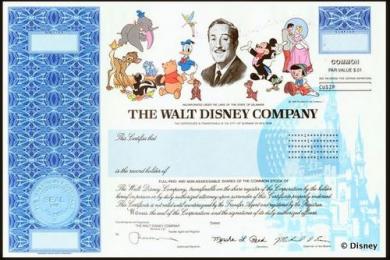
A Walt Disney Company share certificate
A Walt Disney Company share certificate.

Shares of public companies like TD Bank (TSE: TD) and Apple (NASD: AAPL) are integral to many investors’ portfolios, representing a tangible link between personal finance and the broader economic landscape.

The Walt Disney Company (NYSE: DIS) stock certificates were once among the most sought-after because of their colorful designs featuring beloved Disney characters. These certificates were not only investments but also popular gifts from parents and grandparents eager to introduce children to the world of investing. On October 16, 2013, Disney ceased issuing these decorative paper stock certificates to shareholders. Although no longer available, Disney now offers ‘certificates of acquisition’ upon request, which carry no monetary value but maintain the tradition for collectors and fans.


Weekly Market Review

Monday: all four indexes – the Toronto Stock Exchange Composite Index (TSX), the S&P 500 Index (S&P), the Dow Jones Industrial Average (DJIA), and the Nasdaq Composite Index (Nasdaq) – got off to a good start, ending the day in the green. Investors are bracing for a week with more earnings reports, the latest interest rate from the Fed, and US labour data. Oil prices fell as tensions cooled in the mid east, easing supply concerns. More importantly, demand also fell as the latest data showed the Chinese economy, the world’s second largest, remained sluggish, and investors’ fear of higher for longer US interest rates. Lower rates would stimulate economic growth and demand for oil.

In Canada, the TSX was lifted by higher commodity prices. In trading, Utilities and Basic Materials (miners and fertilizer manufacturers) had the biggest gains, while Industrials and Financials were the only two sectors to end lower.

In the US, investors are bracing for what the Fed has to say about future rate cuts and how deep the cuts will be. In trading, Utilities and Consumer Cyclicals advanced the most, while Technology was the only sector to end lower.

Tuesday: it was a red wave across the markets today as all four indexes ended sharply lower. The US Employment Cost Index report showed higher than expected wages and benefits for the first quarter of 2024. Rising wages tend to keep upward pressure on inflation as consumers have more money to spend.

In Canada, lower commodity prices and concerns the Fed will delay rate cuts drove the TSX lower. In trading, Healthcare and Telecommunications were the only sectors to end in the green. Basic Materials and Energy suffered the steepest declines.

In the USA, consumer confidence fell to its lowest point since July 2022 as consumers grew more concerned about future business conditions. All three indexes were sharply lower, complete with a last-minute plunge that saw the Nasdaq end the day 2% lower than it started. The DJIA and S&P were only slightly better, down 1.49% and 1.57%, respectively. In trading, it was a sea of red with all sectors losing ground. Healthcare and Consumer Cyclicals lost the least while Energy and Basic Materials lost the most.

Wednesday: after being down all morning, the markets surged after the Fed’s latest rate announcement, before falling back in the final hour. As well as maintaining the US rate at 5.5%, Fed Chair Powell indicated more work needed to be done to bring inflation lower. Oil prices plunged on news of an unexpected rise in US inventories.

In Canada, the TSX ended the day in the green, boosted by news from the Fed that the next rate decision will likely be a cut. In trading, the Telecommunications Services and Technology gained the most, while Healthcare and Energy suffered the biggest drops.

In the US, the more interest sensitive S&P and Nasdaq both ended in the red, while the DJIA was able to stay in the green. As well, the number of job openings fell to a three-year low, suggesting the labour market was cooling. In trading, Utilities and Healthcare rose the most, while the Energy and Technology sectors fell the farthest.

Thursday: after yesterday’s roller coaster like ride, the markets rallied with all four indexes ending firmly higher. Investors were feeling upbeat after the Fed’s less hawkish guidance on interest rates, feeling that rates cuts this year are still a possibility.

In Canada, overall investor sentiment and the growing likelihood the BoC will lower the interest rate in June lifted the TSX into the green. In trading, Industrials and Consumer Staples posted the biggest gains, while Healthcare and Telecommunications Services ended the deepest in the red.

In the USA, all three indexes ended in the green as investors await tomorrow’s jobs report to get an idea how the American economy is doing. It was a good day in trading, led by the Consumer Cyclicals and Technology sectors. Healthcare and Telecommunications Services were the only two sectors to end in the red.

Friday: the indexes all rose after a weaker than expected US labour report raised hopes for a cut to the US benchmark interest rate. Oil prices were down sharply on concerns delayed interest rate cuts could hamper consumer demand. Oil prices posted their worst weekly loss in three months.

In Canada, the TSX was lifted by investor optimism resulting from the good news out of the US. In trading on Bay Street, it was a day of broad-based gains led by the Technology and Telecommunications Services sectors. The Healthcare and Consumer Cyclicals were the only sector to end in the red.

In the USA, following today’s labour report, all three indexes gained at least 1% today. Investors are now speculating that the Fed could lower rates as soon as September, with possibly two cuts this year. In trading on Wall Street, all sectors ended higher, led by the Technology and Utilities sectors. Trailing the pack were Energy and Healthcare.


Weekly Market and Portfolio Review

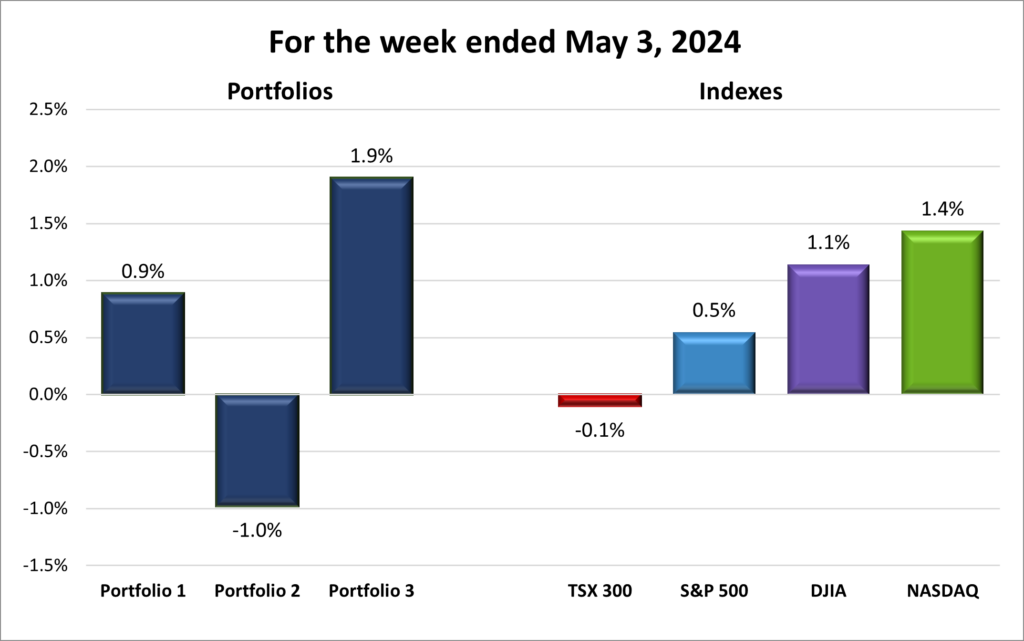
For the week, the TSX (SPTSX) slipped 0.1%, the S&P 500 (SPX) added 0.5%, the DJIA (INDU) advanced 1.1% and the Nasdaq (CCMP) surged 1.4%.

Index Weekly Streak
TSX: 1 – week losing streak
S&P: 2 – week winning streak
DJIA: 3 – week winning streak
Nasdaq: 2 – week winning streak

Bull market. A good week for the North American stock markets. Another positive week unfolded for markets, at least the American markets, buoyed by strong earnings and a rise in investor sentiment. Despite a rocky start due to diminished hopes for a rate cut this year—a stark reversal from earlier expectations—the markets rebounded impressively by week’s end. Initially, a rise in US labour costs, which might prompt the Fed to maintain higher interest rates to combat inflation, rattled investors. These concerns were compounded by data showing robust wage growth and a strong economy, seemingly reducing the justification for the anticipated rate cuts.

Mid-week developments shifted market sentiment. During the FOMC meeting, the Fed announced they were holding the US benchmark interest rate at 5.5% to ensure inflation kept moving downwards to their 2% target. This marked the sixth consecutive hold on the rates. However, it was Fed Chair Jerome Powell’s indication that further rate hikes were less likely, stating, “it is unlikely the next policy move will be a hike,” that spurred a market rally, propelling the major American indexes into positive territory for the week, with the TSX just narrowly missing out.

At the end of the week, US labour data for April revealed signs of a cooling labour market, with fewer job openings and a slight increase in unemployment. This slowdown might be unwelcome news for workers, but it provides a glimmer of hope for those anticipating potential interest rate cuts in the third quarter.

In Canada, the TSX stumbled at the start of the week amid falling commodity prices. However, following the Fed’s announcement, which reduced the likelihood of a US rate hike, there was an increased probability that the BoC might lower its rate at their next meeting in June. The Fed holding the rate at the current level, and possibly lowering the rate in September, would allow the BoC to lower the Canadian rate without diverging too far from the US rate.

Overall, the week ended on a positive note. The three American indexes closed the week higher and all four major North American indexes ended the week with upward momentum. Hopefully, that momentum will carry forward through next week, though no one ever knows what can influence the markets. 😊

Portfolio Weekly Streak
Portfolio 1: 2 – week winning streak
Portfolio 2: 1 – week losing streak
Portfolio 3: 2 – week winning streak

Bull market. A good week for the North American stock markets. If you take a look at the chart below, you can see it was a mixed week for my three portfolios. Portfolios 1 and 3 successfully extended their respective winning streaks, while Portfolio 2 was unable to join them in the win column this past week.

Portfolio 1 saw a modest net gain, despite mixed individual performances. Fortunately, significant (over 10%) gains from Pinterest (NYSE: PINS) up 18%, Decisive Dividend Corp (TSEV: DE) up 11%, and Innovative Industrial Properties (NYSE: IIPR) up 10% compensated for the significant losses recorded by Cloudflare (NYSE: NET) down 16%, and Skyworks Solutions (NASD: SWKS) down 12%.

Portfolio 2 experienced an overall decline, despite most companies showing minor gains. A standout 19% increase in Brookfield Renewable Corp (TSE: BEPC) was overshadowed by a 23% fall in Hammond Power Solutions (TSE: HPS.A). With no specific news to explain the steep decline, it appears to be a pullback after a recent post-earnings run-up, possibly as investors took profits.

Portfolio 3 had a strong week, outperforming both the other portfolios and all four indexes. While most stocks hovered around the baseline, significant gains in Brookfield Renewable Corp and Brookfield Renewable Partners LP (TSE: BEP.UN), both up 19%, amply offset the sharp drop in Cloudflare.

This past week was not as good as the previous week when all three portfolios increased in value, but as Meatloaf used to sing, “Two out of three ain’t bad.” 😊

Weekly Portfolio & Index performance
Weekly Portfolio & Index performance for the week ended May 3, 2024.

Monthly Market and Portfolio Review

For the month, the TSX (SPTSX) fell 2.0%, the S&P 500 (SPX) declined 4.2%, the DJIA (INDU) plunged 5.0% and the Nasdaq (CCMP) dropped 4.4%.

Bearish market At the end of March, I optimistically predicted that April could kick off a bull run. I could not have been more off the mark! Once again, the markets reminded me of the folly in forecasting their movements.

April turned out to be the most challenging month of 2024 so far. Despite the promising momentum from the first quarter, the indexes started a downward trajectory right from the start of April, with only a brief rebound last week. As shown in the accompanying chart, the downtrend was persistent through most of the month.

In the US, strong economic and labour market data for March and April was great for workers but complicated the Fed’s efforts to bring inflation down to their 2% target. Persistent inflation heightened investor anxieties, overshadowing an otherwise strong earnings season. At the year’s start, there was chatter about imminent rate cuts and a potential ‘soft landing’—an economic slowdown where inflation targets are met without triggering a recession. By the end of April, with inflation stubbornly sticking around 3% due to a strong labour market fueling consumer spending, the narrative shifted dramatically. Talk of ‘higher-for-longer’ interest rates resumed, with speculation on when the Fed might begin to lower rates.

In Canada, the economic picture was mixed. Inflation hovered just below 3%, and a weakening job market led the BoC to state that a June rate cut might be possible. However, a potential rate cut and rising commodity and oil prices this were not enough to offset the economic news from the US, causing the TSX to snap a five-month streak of monthly gains.

At the end of the month, strong quarterly earnings helped all four indexes post a weekly gain simultaneously for the only time in April. Unfortunately, not all months can be bullish months for the markets, and April was certainly one of those months. ☹

Bearish market April saw few highlights, with all three portfolios declining in value as shown in the chart below. Apart from the last full week of the month, the portfolios mostly recorded weekly losses.

Portfolio 1 was the best performer of the three, though it still lost over 2%. Nvidia (NASD: NVDA) had a volatile month, ending with a 4% loss. Given its significant weight—over 40% at the beginning of the month—the movements in Nvidia’s share price had a major impact on the portfolio. Semiconductor stocks, in general, faced a tough month.

Portfolio 2 had a lone bright spot with its energy companies performing well amidst the overall downturn.

April was a dismal month for Portfolio 3, dropping more than the others, but it still outperformed the DJIA. 😊 The standout here was Alvopetro Energy (TSEV: ALV), which surged over 18%.

Monthly Portfolio & Index performance
Monthly Portfolio & Index performance for April, 2024.

Companies on the Radar

Stocks on my Radar This past week, no new companies caught my attention. For now, I am content with the four companies listed below.

  • Equitable Bank (TSE: EQB), a mid sized Canadian bank, considered Canada’s 7th bank, that provides financial services to consumers and businesses.
  • Lumine Group (TSE: LMN), a young Canadian mid sized company that acquires communications and media software companies, and then strengthens and grows those companies.
  • LVMH Moët Hennessy – Louis Vuitton, Société Européenne (OTCM: LVMUY), commonly known as LVMH, is a French multinational conglomerate specializing in luxury goods. It is the world’s largest luxury goods company.
  • Evolution AB (OTCM: EVVTY), a Swedish company that provides live casino solutions for global gaming operators.

Please keep in mind that these are only companies that have piqued my interest. This is not a recommendation or financial advice. You should do your own research or contact a professional before making any investment decisions.

The Radar Check was last updated May 3, 2024.

Stock on the Radar List. 1 of 2.
Stock on the Radar List. 2 of 2.

NOTE: Morningstar and Thomson-Reuters analysis is unavailable for Evolution and LVMH from my usual sources because the company’s home stock exchange is in Europe. While it is possible to invest in both companies through the Over-the-Counter Market, I do not have access to analysis similar to the data available for companies traded on the major North American stock exchanges (Toronto Stock Exchange, New York Stock Exchange, and Nasdaq Stock market). The Analysts Rating and Price Target for these two companies are from Yahoo! Finance, under the Analysis tab once you have searched for the ticker.


Portfolio Update

Portfolio 1

Portfolio 1 for the week ended May 3, 2024: UP Green Up Arrow, signifying a positive week

  • Apple’s iPad operating system, iPadOS, has been designated a ‘gatekeeper’ by the European Union’s (EU) anti trust regulator, the European Commission (EC). The EC defines a ‘gatekeeper’ as a platform that acts as an important ‘gateway’ between businesses and consumers in the EU. This means they have a dominant position that could potentially restrict competition.
    At Apple’s quarterly earnings report, the company announced a 4% increase to their dividend, and added US$ 110 billion to their share buyback program. Both are shareholder friendly actions and take the sting out of a weak earnings report.
  • Alphabet’s (NASD: GOOGL) Google plans to invest a total of US$ 3 billion to build a data centre in Indiana and expand existing facilities in Virgina. The build out is to support the increasing demand for artificial intelligence (AI) services on their Google Cloud cloud computing platform.
  • CrowdStrike (NASD: CRWD) announced the had been named the overall leader in cybersecurity threat protection in the KuppingerCole’s Leadership Compass, Identity Threat Detection and Response (ITDR) 2024 report. Always good to see a company you invested in to be considered the best in its field. 😊
    CrowdStrike and Amazon (NASD: AMZN) announced Amazon has consolidated its cybersecurity protection on CrowdStrike’s platform to protect Amazon Web Services platforms and data. In return, CrowdStrike will increase its use of AI and other services on AWS’s platform.
  • Walmart (NYSE: WMT) announced a new private label food brand called ‘bettergoods’ that would see most products sell for under US$ 5.00. Products under this new brand would include dairy products, snacks, soups, and other basic food items across 50 categories.
  • Carnival Cruise Lines (NYSE: CCL) announced their Princess’s fleet has revised the routes and itineraries of its two planned global cruises. Due to geopolitical uncertainties in the Middle East the ships will no longer visit that region, instead they will visit go around South Africa rather than through the Suez Canal.
  • Cameco (TSX: CCO) projects a growing demand for clean energy as a result of the growing demands from the growth of power-hungry data centres and an increasing number of electric vehicles (EV) on the roads. Nuclear energy could be a major source of dependable, carbon free energy to meet the growing demands.
  • Rivian Automotive (NASD: RIVN) received an incentive laden cash deal from the state of Illinois to expand its production capabilities at its Normal, IL factory. Rivian produces its electric vans and their new R2 SUV at this location.

Activity

No significant activity to report this week.

Dividends

Dividends Received this week for the following companies:

Companies followed by DRIP (Dividend Re-Investment Plan) indicate additional shares were purchased with the dividend. Any cash leftover was added to the cash balance.

Canadian $

Toronto-Dominion Bank (TSE: TD) DRIP

Bank of Nova Scotia (TSE: BNS) DRIP

US $

No US$ dividends this past week.

Quarterly Reports

Lattice Semiconductor Corporation

First quarter 2024 financial results on April 29, 2024

Pinterest, Inc.

First quarter 2024 financial results on April 30, 2024

Skyworks Solutions, Inc.

Second quarter 2024 financial results on April 30, 2024

Cameco Corporation

First quarter 2024 financial results on April 30, 2024

PayPal Holdings, Inc.

First quarter 2024 financial results on April 30, 2024

Amazon.com, Inc.

First quarter 2024 financial results on April 30, 2024

Andlauer Healthcare Group Inc.

First quarter 2024 financial results on May 2, 2024

TMX Group Limited

First quarter 2024 financial results on May 2, 2024

BCE Inc.

First quarter 2024 financial results on May 2, 2024

Apple Inc.

Second quarter 2024 financial results on May 2, 2024

Trisura Group Ltd.

First quarter 2024 financial results on May 2, 2024

Cloudflare, Inc.

First quarter 2024 financial results on May 2, 2024

Portfolio 2

Portfolio 2 for the week ended May 3, 2024: DOWN Red Down Arrow

  • The bank of Nova Scotia (TSE: BNS) announced Travis Machen as the CEO and group head of its global banking and markets unit. He will be responsible for expanding the bank’s products and services and increasing high value clients.
  • At its MongoDB.local developer conference, MongoDB, Inc. (NASD: MDB) announced the general availability of MongoDB Atlas Vector Search on Knowledge Bases for Amazon Bedrock. This new offering allows organizations to build generative AI application features using fully managed foundation models more easily.
  • Canadian Natural Resources (TSE: CNQ) announced they are seeking opportunities to substantially increase the crude oil output at their primary oil sands mine in northern Alberta.

Activity

No significant activity to report this week.

Dividends

Dividends Received this week for the following companies:

Companies followed by DRIP (Dividend Re-Investment Plan) indicate additional shares were purchased with the dividend. Any cash leftover was added to the cash balance.

Canadian $

Bank of Nova Scotia (TSE: BNS) DRIP

TC Energy Corp (TSE: TRP)

Dollarama Inc. (TSE: DOL)

US $

No US$ dividends this past week.

Quarterly Reports

Fortis Inc.

First quarter 2024 financial results on May 1, 2024

Canadian Natural Resources Limited

First quarter 2024 financial results on May 2, 2024

Brookfield Renewable Partners L.P.

First quarter 2024 financial results on May 3, 2024

TC Energy Corporation

First quarter 2024 financial results on May 3, 2024

Portfolio 3

Portfolio 3 for the week ended May 3, 2024: UP Green Up Arrow, signifying a positive week

  • Microsoft (NASD: MSFT) announced they plan to spend US$ 1.7 billion over the next four years in Indonesia as part of building out their infrastructure to support the expansion of their cloud computing and AI services.
  • Brookfield Asset Management (TSX: BAM), Brookfield Renewable and Microsoft jointly announced a global renewable energy framework agreement. For Microsoft, they have secured a tremendous amount of renewable energy at a time when it is in short supply. The deal will help Microsoft achieve its goal of reaching zero carbon energy emissions by 2030 as it meets the growing energy demands for its expanding cloud computing and AI infrastructure. For Brookfield, the benefit is that Microsoft is committing to buying the 10.5 gigawatts of renewable energy capacity this project will eventually produce at the prevailing market prices. Brookfield Renewables can now make the necessary investments without worrying about having to sell the energy.
  • TD Bank was fined C$ 9.2 million by the Canada’s anti-money laundering agency – Financial Transactions and Reports Analysis Centre of Canada (FINTRAC). The agency said it discovered non-compliance of anti – money laundering regulations. If that was not bad enough, the US Department of Justice is investigating how Chinese drug traffickers used TD to launder the proceeds from the sale of fentanyl. As well as significant fines, up to US$ 1 billion, TD could face regulatory limitations on its business activities. Ouch! ☹

Activity

No significant activity to report this week.

Dividends

Dividends Received this week for the following companies:

Companies followed by DRIP (Dividend Re-Investment Plan) indicate additional shares were purchased with the dividend. Any cash leftover was added to the cash balance.

Canadian $

Toronto-Dominion Bank (TSE: TD)

US $

No US$ dividends this past week.

Quarterly Reports

Cloudflare, Inc.

See report under Portfolio 1.

Brookfield Renewable Partners L.P.

See report under Portfolio 2.


Weekly Update for the week ending April 26, 2024

For the past three weeks, economic news—covering economic output, labour markets, and inflation—has dominated market movements. This focus shifted this past week as over 40% of the S&P 500 companies reported their earnings. Strong reports, especially from the largest companies, could likely sustain the market’s upward trajectory. However, if earnings reports are underwhelming, the markets may continue the recent pullback.

Additionally, key updates such as the US economic growth data and the Federal Reserve’s preferred inflation measure were released. Ideally, the Fed wants the economy to stay strong while inflation cools down.

Let’s see how this shift toward corporate performance and the latest economic updates impacted the markets over the last week…

Items that may only interest or educate me ….

Canadian Economic news, US Economic news, Does it take a lot of time to invest in stocks? ….


Canadian Economic news

This past week’s key economic data that the Bank of Canada (BoC) considers when deciding whether to raise or lower the interest rate.

Bank of Canada Minutes

With a focus on keeping inflation under control, the BoC’s Governing Council met on April 10th and decided to hold the benchmark interest rate steady at 5.0%, a 23-year high. During their deliberations, they discussed the global economy, the Canadian economy, and the latest inflation data. The minutes from the meeting also reveal a divided council, with differing opinions on the timing of potential rate cuts.

Among the six members, some argued that the economy was performing well, bolstered by stronger-than-expected consumer spending, and continued economic growth in the US. These members believed these factors could prevent a slowdown in core inflation and preferred waiting for more evidence of sustained decreases in inflation before considering rate reductions.

Conversely, other members pointed to the considerable progress made in reducing inflation, which has dipped below 3%, with core inflation also on a downward trend. They expressed concerns that maintaining high rates for too long could unnecessarily suppress economic activity.

Despite these differing views, the council agreed inflation was still too high, but there was a consensus that inflation was likely to continue its decline, supported by favorable indicators such as easing inflation pressures and a cooling job market. The council unanimously agreed that any future rate cuts should be gradual to prevent reigniting inflationary pressures.

In a post-meeting press conference, Governor Tiff Macklem mentioned that a rate cut in June was possible, but it would be contingent on forthcoming data confirming the continued slowdown in inflation. The latest inflation data, released after the April 10 meeting, showed a 2.9% rise in prices in March and a third consecutive month of cooling core inflation. Continued signs of decreasing inflation in April and May could pave the way for a rate cut in June.

Canadian market volatility

Over the past week, Canada’s Volatility Index (VIXC), measured by the TSX 60 VIX, fell more than 10% from last week’s 15.29 to 13.67. This decrease in volatility is likely due to higher commodity prices, easing tensions in the Middle East, and strong corporate earnings.

Often referred to as Canada’s ‘fear gauge,’ the VIXC provides insights into expected volatility within the Canadian stock markets. Typically, readings above 20 signify high volatility, while those below 20 indicate lower levels. With the current reading at 13.67, it suggests that the market remains well below the threshold for high volatility

Retail Sales

Statistics Canada’s February Retail Sales report revealed a 0.1% decline, marking the second consecutive month of declines following a 0.3% drop in January. This was contrary to analysts’ expectations of a 0.1% increase. Year-over-year, retail sales increased by 1.2%. The most significant monthly gain was seen in ‘motor vehicle and parts dealers,’ while the largest annual increase was in ‘general merchandise retailers,’ which rose by 9.3%. On the downside, ‘gasoline stations and fuel vendors’ experienced the largest monthly and annual declines, dropping 2.2% and 4.0%, respectively.

Excluding the volatile sectors of ‘gasoline stations and fuel vendors’ and ‘motor vehicle and parts dealers,’ core retail sales remained unchanged in February, although they showed a 2.4% increase on an annual basis.

The continued decline in retail sales suggests that higher interest rates are still exerting pressure on the Canadian economy. However, a silver lining exists; reduced consumer spending could lead to decreased inflation, potentially encouraging the Bank of Canada to lower the benchmark rate in June.

US Economic news

This past week’s key data points that the Federal Reserve (Fed) considers when deciding whether to raise or lower the interest rate.

Personal Consumption Expenditure (PCE)

The Commerce Department’s Bureau of Economic Analysis’ latest PCE inflation report rose 0.3% in March after a similar increase in February. Year over year, the PCE increased 2.7% in March after rising 2.5% in February. Analysts had been expecting a monthly increase of 0.3% and a yearly increase of 2.6%. The majority of the increase was the result of higher spending on goods such as fuel and food, and services such as healthcare.

Excluding the volatile food and energy components, core PCE rose 0.3% in March. On an annual basis, core PCE came in at 2.8%, matching the February pace. Analysts had projected increases of 0.3% monthly and 2.7% year over year.

While the monthly pace of inflation growth matched expectations, both the headline PCE (all items) and core PCE were higher than expected. The recent data will not provide the Fed with “greater confidence” that inflation is declining and all but eliminates the chances of a June rate cut.

PCE is a crucial indicator of consumer confidence and economic health. Strong PCE growth suggests consumers are spending more, which can boost economic activity. Conversely, weak PCE growth might indicate a slowdown in consumer spending, potentially impacting economic growth.

While PCE and the Consumer Price Index (CPI) both measure inflation, PCE tracks the prices of a wider range of goods and services consumed by all households and non-profit institutions. This includes spending financed by others, like employer-provided health insurance. CPI focuses on the prices of goods and services purchased for out-of-pocket expenses by urban households only. It excludes items like employer-paid health insurance. CPI might tend to show slightly higher inflation rates due to its focus on out-of-pocket expenses

Here is an analogy: Imagine tracking grocery prices for a family. CPI might only look at the price changes for items they always buy, while PCE might consider if they switch to cheaper options due to price hikes.

Of the two, PCE is considered a more comprehensive measure of inflation by the Fed, often using it to guide its monetary policy (interest rate) decisions.

Gross Domestic Product (GDP)

The Commerce Department’s Bureau of Economic Analysis released its advance estimate for the first quarter of 2024, showing GDP growth slowed to an annual pace of 1.6%, an almost two year low and down considerably from the 3.4% increase in the fourth quarter of 2023. This latest rate fell below the analysts’ projection of 2.4%.

This growth was primarily driven by increases in consumer spending, residential and non-residential fixed investments, and government spending across all levels. However, these gains were partially offset by a decrease in private inventory investment. In terms of consumer spending, there was a notable rise in spending on services like healthcare, insurance, and financial services, which was tempered by a decline in spending on goods such as vehicles and parts.

GDP is a key indicator of a country’s economic health. A rising GDP generally signifies a growing economy, while a falling GDP suggests a slowdown. This latest reports suggests the American economy is slowing.

It is important to note that this “advance” estimate is based on source data that are incomplete or subject to further revision. The “second” estimate, which will include more complete data, is scheduled to be released on May 30, 2024.

American market volatility

The CBOE Volatility Index (VIX), often referred to as the market’s fear gauge, ended the week at 15.03, representing a decline of more than 20% from the previous week’s reading of 18.71. Lower tensions in the Middle East and strong corporate earnings have helped reduce the VIX. As the VIX remains below the 20-point threshold commonly associated with heightened volatility, the lower reading signals that investor anxiety is decreasing in the near term.

Consumer Sentiment Index (CSI)

The University of Michigan’s final CSI for this month registered at 77.2, slightly below analysts’ expectations of 77.9 and a near 3% decrease from March’s 79.4. Despite the monthly dip, the index has risen over 21% annually from last year’s 63.7. The modest monthly decline is likely attributable to persistent inflation and a slowing economy. Nevertheless, consumer sentiment has remained relatively stable, fluctuating narrowly between 75 and 80 throughout the year, suggesting that consumers see little change in the economic outlook.

The CSI is a key measure of consumer confidence in the economic direction of the US, with higher values indicating greater consumer optimism.

Does it take a lot of time to invest in stocks?

The short answer is “No, investing in stocks doesn’t necessarily require a lot of time.” However, investing in stocks can take as much or as little time as you choose. If you prefer a hands-off approach, consider investing in a low-cost S&P 500 (S&P) index fund. This type of fund tracks the top 500 stocks on major US exchanges, providing good diversification and mirroring the performance of the S&P 500 with minimal effort on your part. This strategy is an excellent starting point for beginners.

However, if you’re interested in a more hands-on approach, you could spend a considerable amount of time learning about the stock market, researching potential investments (reading financial statements, and articles about the company, etc.), and actively trading. The depth of your involvement depends on how much time you have available, your interest in market dynamics, and your investment goals.

For those who find themselves in between these two approaches, it can be exciting to look for potential breakout companies, akin to finding the next Amazon.com (NASD: AMZN). A hybrid approach might be ideal, offering a balance of risk and opportunities for higher returns. To build a balanced portfolio, you might start with foundational investments in an S&P 500 index fund and a TSX index fund that tracks the Toronto Stock Exchange. This provides a solid base while you periodically explore individual stocks to add to your portfolio.

Ultimately, your investment strategy should fit into your lifestyle. If you’re pressed for time, a passive strategy like investing in an index fund might be preferable. But if you stumble upon a company that excites you, it could be worth exploring further. Remember, the key is to enjoy the process and integrate it into your life in a way that feels rewarding.


Weekly Market Review

Monday: the markets started the week with all four indexes – the Toronto Stock Exchange Composite Index (TSX), the S&P 500 Index (S&P), the Dow Jones Industrial Average (DJIA), and the Nasdaq Composite Index (Nasdaq) – ending higher. Investors are betting that the big technology companies will start to see revenues boosted by their investments in artificial intelligence (AI). Oil prices dipped due to easing tensions in the Middle East and concerns over lower demand resulting from inflation.

In Canada, the TSX stretched its winning streak to four days, riding the coattails of a rebound in the American markets. In trading, Consumer Staples and Industrials posted the biggest gains, while Basic Materials (miners and fertilizer manufacturers) and Healthcare were the only Canadian sectors to end lower.

In the US, the S&P got back over 5000, snapping six straight days of losses. The Nasdaq also broke a six-day losing streak thanks to the rise in technology stocks. In trading, the Financials and Technology sectors recorded the largest gains, while Telecommunications Services and Basic Materials were the only American sectors to end in the red.

Tuesday: investors were bullish ahead of earnings from the big technology companies and the key PCE inflation data on Friday, sending all four indexes into positive territory for the day. Oil inched higher as investors gained confidence in an improved global economic outlook.

In Canada, a rebound in technology stocks pulled the TSX to its highest point in a week. In trading, every sector ended the day higher, led by Technology and Healthcare, with Utilities and Energy trailing the pack.

In the USA, strong earnings from some of the technology heavyweights sent the Nasdaq soaring, gaining almost 1.6% today. As well as being buoyed by technology stocks, the S&P also received a boost from General Motors (NYSE: GM) strong first quarter report. In trading, in a day of broad-based gains Technology and Healthcare were the big winners, while Basic Materials was the only sector to end in the red.

Wednesday: it was a mixed day for the four major North American indexes as investors hope first quarter earnings reports from the big technology companies can jumpstart the rally.

In Canada, the TSX slid lower for the first time in six days of trading. Retail sales for February came in lower than expected, providing more data that the Canadian economy continues to slow. In trading, Consumer Staples and Utilities advanced the most while Industrials and Telecommunications Services declined the most.

In the US, the Nasdaq ended higher, the S&P was flat, while the DJIA ended lower. Investors are waiting for the latest GDP and PCE inflation data due later this week to get a sense of when the Fed could lower the interest rate. In trading, Consumer Staples and Utilities posted the biggest gains, while Industrials and Healthcare recorded the biggest daily losses.

Thursday: the indexes started the session sharply lower and spent the rest of the day recovering those early losses. At the end of the trading day, only the TSX was able to get back into positive territory. The latest US GDP data showed the American economy grew much less than expected, while inflation remained above 3%. Oil prices rose on concerns of increased conflict in the Middle East.

In Canada, higher commodity prices lifted the resource heavy TSX into the green, overcoming the disappointing economic and inflation news out of the US. In trading, Basic Materials, Energy and Consumer Staples were the only Canadian sectors to gain ground, while Technology and Healthcare dropped the most.

In the US, besides the latest economic news, disappointing earnings and forward guidance from Meta Platforms (NASD: META) weighed on the indexes during regular trading hours. In the after-hours market, strong earnings reports from Alphabet (NASD: GOOGL) and Microsoft (NASD: MSFT) lifted the indexes. Hopefully, this upward momentum carries over into tomorrow’s session. In trading, Energy and Basic Materials posted the biggest gains, while Telecommunications Services and Technology posted the biggest losses.

Friday: the positive sentiment from Alphabet’s and Microsoft’s earnings reports helped restore investors’ confidence in technology stocks, propelling all four indexes higher. Oil prices rose on supply concerns in the Middle East.

In Canada, higher commodity prices, helped by a rally in technology stocks, pushed the TSX into positive territory. In trading, Basic Materials and Healthcare posted the biggest gains, while Telecommunications Services and Utilities were the only Canadian sectors to end in the red.

In the US, the S&P snapped three weeks of weekly losses and the Nasdaq snapped a four week weekly losing streak. Both posted their largest weekly gains since November 2023. The latest PCE inflation report was in line with expectations, showing a slight increase in the annual pace of inflation. In trading, the Technology and Consumer Cyclicals sectors advanced the most, while Utilities, Energy, and Consumer Staples were the only American sectors to end lower.


Weekly Market and Portfolio Review

For the week, the TSX (SPTSX) gained 0.7%, the S&P 500 (SPX) rose 2.7%, the DJIA (INDU) advanced 0.7% and the Nasdaq (CCMP) surged 4.2%.

 
Index Weekly Streak
TSX: 1 – week winning streak
S&P: 1 – week winning streak
DJIA: 2 – week winning streak
Nasdaq: 1 – week winning streak

Bull market. A good week for the North American stock markets. After three challenging weeks, all four major North American indexes finally posted a weekly gain. The Nasdaq, in particular, had its strongest week since November, indicating a robust rebound.

Economically, however, the picture remained less optimistic. The latest GDP delivered a double whammy: slowing economic growth coupled with persistent inflationary pressures, hinting at potential stagflation—a situation where the economy decelerates while inflation continues to rise. Moreover, the latest PCE data suggested that inflation remains above the Fed’s comfort zone, likely delaying anticipated rate cuts.

Despite the troubling economic indicators, investor sentiment began to improve as corporate earnings rolled in this past week. In the US, the ‘Magnificent 7’ companies  experienced a loss on paper of nearly US $1 trillion in market value during the previous week’s selloff. However, strong earnings from Alphabet and Microsoft, highlighting significant returns from their respective substantial investments in AI, helped these companies recoup much of their losses and spearheaded a broad market rally. Meanwhile, in Canada, the TSX benefited from the improved investor sentiment and rising commodity prices, which contributed to its gains.

Next week promises more corporate earnings, featuring key reports from Apple (NASD: AAPL) and Amazon.com. Additionally, the Fed’s meeting will once again capture the attention of analysts and investors alike, who are eager for any clues regarding the timing of potential rate reductions within the year.

It is never pleasant to see markets and investments decline, but I viewed the recent pullback as a buying opportunity. I am hopeful that these April showers will set the stage for plenty of flowers in the months ahead. 😊

Portfolio Weekly Streak
Portfolio 1: 1 – week winning streak
Portfolio 2: 1 – week winning streak
Portfolio 3: 1 – week winning streak

Bull market. A good week for the North American stock markets. After being shut out of the weekly gains’ column last week, it was great to see all three portfolios in the win column this week, as illustrated below.

Portfolio 1 had an outstanding week, outperforming all four indexes and the other two portfolios. Last week, semiconductor companies weighed it down, but this week, many of those companies posted significant gains (more than 10%), helping the portfolio reclaim much of last week’s losses. Leading the gains were Navitas Semiconductor (NASD: NVTS) up 21%, Nvidia (NASD: NVDA) up 12%, and Lattice Semiconductor (NASD: LSCC) up 10%. Additionally, most other companies in the portfolio advanced, including Alphabet, which posted an 11% gain following the announcement of a dividend initiation and a share buyback plan, both shareholder-friendly actions.

Portfolio 2 also had a good week, largely driven by MongoDB’s (NASD: MDB) impressive gain of almost 16%.

Portfolio 3, which had been posting losses for the last five weeks, finally snapped that losing streak with a win this past week. Unfortunately, Adyen NV (OTCM: ADYEY) experienced a poor week following a disappointing earnings report and dropped 14%, preventing the portfolio from achieving gains similar to the other two portfolios

Overall, this past week marked a significant recovery from previous losses, although it will take more weeks like this to fully recoup the setbacks from April. The rebound in the technology sector played a crucial role in driving these gains. Looking ahead, I hope the positive momentum continues, fueled by strong earnings reports and favorable outcomes from the upcoming Fed meeting.

Weekly Portfolio & Index performance
Weekly Portfolio & Index performance for the week ended April 26, 2024.

Companies on the Radar

Stocks on my Radar Two new companies popped onto my radar this past week: Grab Holdings (NASD: GRAB) and LVMH Moët Hennessy – Louis Vuitton, Société Européenne (OTCM: LVMUY).

Grab is a large cap technology company based in Singapore, operating throughout Southeast Asia. I was particularly impressed by their expansive portfolio, which includes ride-hailing, food delivery, and digital payments—a trifecta that positions them well in a rapidly growing region. Their regional dominance, as well as their commitment to innovation to economically empower millions of people throughout southeast Asia led me to invest and become a very minority owner. 😊 You can see more about why I chose to invest in the company in the Activity section of Portfolio 1 below.

LVMH is a giant in the luxury goods industry, offering a vast array of products from wines and spirits like Dom Pérignon and Moët & Chandon, to high-end fashion through brands like Louis Vuitton, and even luxury yachts. LVMH is listed primarily on Euronext Paris, ticker 1MC, but is also accessible in North America via the Over-the-Counter Market. The fact that company insiders own 48% of its shares speaks volumes about their confidence and commitment to the company’s success. I am looking forward to delving deeper into this high-end, luxury retail giant.

These two new companies join the three companies listed below:

  • Equitable Bank (TSE: EQB), a mid sized Canadian bank, considered Canada’s 7th bank, that provides financial services to consumers and businesses.
  • Lumine Group (TSE: LMN), a young Canadian mid sized company that acquires communications and media software companies and then strengthens and grows those companies.
  • Evolution AB (OTCM: EVVTY), a Swedish company that provides live casino solutions for global gaming operators.

Please keep in mind that these are only companies that have piqued my interest. This is not a recommendation or financial advice. You should do your own research or contact a professional before making any investment decisions.

The Radar Check was last updated April 26, 2024.

Stock on the Radar List. 1 of 2.
Stock on the Radar List. 2 of 2.

NOTE: Morningstar and Thomson-Reuters analysis is unavailable for Evolution and LVMH from my usual sources because the company’s home stock exchange is in Europe. While it is possible to invest in both companies through the Over-the-Counter Market, I do not have access to analysis similar to the data available for companies traded on the major North American stock exchanges (Toronto Stock Exchange, New York Stock Exchange, and Nasdaq Stock market). The Analysts Rating and Price Target for these two companies are from Yahoo! Finance, under the Analysis tab once you have searched for the ticker.


Portfolio Update

Portfolio 1

Portfolio 1 for the week ended April 26, 2024: UP Green Up Arrow, signifying a positive week

  • Apple is negotiating with FIFA, soccer’s governing body, for global television rights for a new month-long club tournament. The deal is in the US$ 1 billion range and would be the first time FIFA has done a deal with a single global contract.
    In other Apple news, the company shipped 19% fewer iPhones in China in the first quarter than the previous year, lowering their percent of the Chinese market to 15.7%. The bulk of the losses were a result of new products from China’s Huawei.
  • Alphabet announced the start of a quarterly cash dividend program. The first dividend in the amount of US$ 0.20 per share will be paid June 17, 2024. The company also announced a US $70 billion stock buyback.
    A strong first quarter earnings report and news of the dividend sent Alphabet, better known as Google, stock soaring and gave the company a market capitalization (number of outstanding shares X price per share) above US$2 trillion.

Activity

Received interest on TD 1-year cashable GIC.

Bought: Visa (NYSE: V) With some of the proceeds from the sale of Nvidia shares, I increased my investment in Visa, the leading global payments company. Visa commands a significant market share and is a globally recognized brand, qualities that translate into a steady revenue stream and robust profitability. Unlike credit card issuers, Visa earns fees from processing transactions, which shields it from the direct credit risks associated with payment defaults. This business model provides stability and predictability in its revenues.

The growth potential in digital payments, especially in emerging markets, is substantial. As these regions transition from cash to digital payments, Visa’s extensive network and continuous innovations, such as advancements in secure and contactless payment technologies, position it well to capitalize on this shift.

Visa’s financial health is a strong point, marked by consistent growth in revenue, net income, and free cash flow, alongside impressive profit margins and a solid balance sheet.

However, the investment does carry risks, including susceptibility to economic downturns that can depress consumer spending and transaction volumes. The payment sector’s increasing competitiveness requires continual innovation to maintain market leadership. Visa’s regulatory environment is also a critical consideration, as changes could affect operational costs and profitability. Additionally, the inherent risks of cybersecurity pose a threat to Visa’s operations and reputation.

Despite these challenges, the shift towards cashless transactions globally should benefit Visa. By increasing my stake in Visa, I aim to leverage this ongoing trend towards digital payments, expecting it to drive the company’s growth and, subsequently, my long-term wealth accumulation. 😊

Bought: GRAB Holdings After recent investments in well-established companies like Walmart (NYSE: WMT), Amazon, and Visa, I saw an opportunity to diversify with a high-growth potential stock like Grab Holdings. Since its IPO in 2021, Grab’s stock has seen significant fluctuations, currently priced between US$ 2.00 – 3.00, down from a high of US$ 16.37 back in November 2021.

Grab is a leader in Southeast Asia’s ride-hailing and digital payments sectors, which are part of regions experiencing rapid digital adoption and economic growth. Its strategy revolves around a “superapp,” which integrates mobility, delivery, and financial services into a single platform, creating multiple revenue streams and fostering customer loyalty. Importantly, Grab is founder-run, which often results in strong visionary leadership and cohesive strategic direction.

Despite current unprofitability, Grab has demonstrated solid revenue growth, with a 60% increase in the Philippines alone last year. Key financial metrics like gross profit, net income, and free cash flow are trending positively, indicating improving operational efficiency.

Focusing on digital banking and advertising, Grab is well-positioned to leverage Southeast Asia’s expanding middle class and smartphone penetration.

However, as with any growth company, investing in Grab comes with a higher level of risk, especially given its short market history and ongoing losses, which make its long-term profitability uncertain. Competition in Southeast Asia is fierce, and regulatory changes could significantly impact operations, particularly in digital payments and financial services. As well, investing in companies based and operating outside North America carries additional risks such as obtaining accurate and timely information.

Overall, despite its challenges, Grab’s strong market position in a high-growth region offers a significant growth and diversification opportunity. This investment complements my existing holdings in more stable, mature companies, enhancing the overall growth potential of the portfolio.

Dividends

Dividends Received this week for the following companies:

Companies followed by DRIP (Dividend Re-Investment Plan) indicate additional shares were purchased with the dividend. Any cash leftover was added to the cash balance.

Canadian $

BCE Inc (TSE: BCE)

US $

No US$ dividends this past week.

Quarterly Reports

General Motors Co.

First quarter 2024 financial results on April 23, 2024

Visa Inc.

Second quarter 2024 financial results on April 23, 2024

Canadian National Railway Company

First quarter 2024 financial results on April 23, 2024

Celestica Inc.

First quarter 2024 financial results on April 24, 2024

Alphabet Inc.

First quarter 2024 financial results on April 25, 2024

Portfolio 2

Portfolio 2 for the week ended April 26, 2024: UP Green Up Arrow, signifying a positive week

  • Guardant Health (NASD: GH) announced that the US Food and Drug Administration Medical Devices Advisory Committee is set to review Guardant’s premarket approval application for its Shield blood test for colorectal cancer screening on May 23.
  • TC Energy (TSE: TRP) has resumed regular operations of their pipeline from the Alberta oil sands to the US after a break in a pipe caused the pipeline to run at lower capacity. The rupture itself caused a wildfire which has since been put out.

Activity

No significant activity to report this week.

Dividends

Dividends Received this week for the following companies:

Companies followed by DRIP (Dividend Re-Investment Plan) indicate additional shares were purchased with the dividend. Any cash leftover was added to the cash balance.

No dividends this past week.

Quarterly Reports

Microsoft Corp.

Third quarter 2024 financial results on April 25, 2024

Portfolio 3

Portfolio 3 for the week ended April 26, 2024: UP Green Up Arrow, signifying a positive week

  • Microsoft announced an AI model that uses smaller amounts of data to create content and social media posts. The new AI model is called Phi-3-mini.
  • Enghouse (TSE: ENGH) has reached an agreement to acquire SeaChange International, Inc. (OTCM: SEAC). SeaChange provides video streaming capabilities to broadcasters and content owners. The addition of SeaChange’s products will augment Enghouse’s enterprise software capabilities and solutions.

Activity

No significant activity to report this week.

Dividends

Dividends Received this week for the following companies:

Companies followed by DRIP (Dividend Re-Investment Plan) indicate additional shares were purchased with the dividend. Any cash leftover was added to the cash balance.

No dividends this past week.

Quarterly Reports

Microsoft Corp.

See report under Portfolio 2.


Weekly Update for the week ending April 19, 2024

April has not been the easiest month for us investors. We have seen losses across the board, with each week bringing its own set of challenges. The first week the markets dipped following strong US labour data, suggesting the economy might be too warm, which could deter the US Federal Reserve (Fed) from lowering interest rates. In the second week, higher-than-expected inflation data further soured the mood, heightening concerns about persistent high prices. This past week, comments from various Fed officials have added to market jitters. Fed Chair Jerome Powell emphasized that the current 5.5% interest rate could stay in place “as long as needed” to manage inflation, a stance echoed by other officials who see no rush to cut rates.

In Canada, the interest currently sits at 5%, but unlike the buoyant US economy the Canadian economy has been sluggish at best, with a slowing job market. Many analysts anticipate that the BoC may lower the Canadian benchmark rate, possibly as early as June. Should the Fed maintain its rate at 5.5%, or higher, while the BoC cuts rates, Canadians are likely to see a dip in the exchange rate. Lower Canadian rates make investments in Canadian dollars less attractive than those in American dollars, due to the higher returns possible with US investments. This disparity could make US imports more expensive and add to inflationary pressures here at home

Looking forward, it is unknown whether the current market downturn is merely a pause following a robust five-month period of strong growth or the beginning of a more concerning downward trend. Despite the persistent high US interest rate, the US economy remains strong, driven by a robust jobs market and sustained consumer spending, helping the markets climb higher, even though rate cuts have been continually delayed.

I am optimistic that this pause is just a temporary breath-catching moment, potentially offering a strategic buying opportunity. 😊

But let’s not get ahead of ourselves. First, let’s review what happened this past week….

Items that may only interest or educate me ….

Canadian Economic news, US Economic news, How is a TFSA different from an RRSP?, .…


Canadian Economic news

This past week’s key economic data that the Bank of Canada (BoC) considers when deciding whether to raise or lower the interest rate.

Consumer Price Index (CPI)

Statistics Canada reported that inflation, as measured by the latest Consumer Price Index (CPI) report, edged up from February’s 2.8% to 2.9% in March. On a monthly basis, the CPI rose by 0.6%, a notable increase from February’s 0.3% gain.

The most significant monthly price surge was observed in gasoline, which increased by 4.9%. Annually, shelter costs, which include mortgages and rents, recorded the largest increase at 6.5%, followed closely by a 4.5% rise in gas prices driven by higher global oil prices.

One of the BoC’s preferred measure of inflation, the core CPI – which excludes volatile energy and food prices – rose at an annual rate of 2.9%, up slightly from 2.8% in February. On a monthly basis, core CPI accelerated to 0.7%, a significant increase from the previous month’s 0.2% growth.

Despite the slight uptick in annual inflation, many of the CPI subsectors saw a slowdown in the pace of price increases, confirming a broad-based easing of pricing pressures. Excluding volatile gasoline prices, the headline CPI, which encompasses all items, stood at 2.8%. While a further reduction in inflation rates across all measures would have been ideal, the current rates remain within the BoC’s target range of 1% to 3% and are steadily approaching their 2% target.

At their last meeting, Governor Tiff Macklem indicated BoC officials wanted to see more evidence that inflation was continuing to fall. This latest data provide evidence that the rate of inflation is slowing, which could open the door for the central bank to consider lowering the benchmark interest rate at their June meeting.

Canadian market volatility

Over the past week, Canada’s Volatility Index (VIXC), which is measured by the TSX 60 VIX, surged to nearly 18.00 before quickly dropping to below 16.00, ending the week at 15.29—an 18% increase over the week. This spike in volatility is likely due to higher-than-expected US inflation and delays in US interest rate cuts.

Often referred to as Canada’s ‘fear gauge,’ the VIXC provides insights into the expected volatility within the Canadian stock markets. Typically, readings above 20 signify high volatility, while those below 20 indicate lower levels. With the current reading at 15.29, it remains below the high volatility threshold.

US Economic news

This past week’s key data points that the Federal Reserve (Fed) considers when deciding whether to raise or lower the interest rate.

American market volatility

The CBOE Volatility Index (VIX), often referred to as the market’s fear gauge, hovered around 18 for most of the week. However, it spiked to 21.30 early Friday morning due to heightened tensions in the Middle East, before settling at 18.71 by the end of the day. This represents an 8% gain from the previous week’s reading of 17.31. As tensions eased, market volatility subsided. Delays in anticipated interest rate cuts also contribute to investor anxiety. Although the VIX remains below the 20-point threshold commonly associated with heightened volatility, it signals that investor anxiety is increasing in the near term.

Retail Sales

The Commerce Department reported a 0.7% increase in retail sales for March, surpassing analysts’ expectations of a 0.3% rise. This growth follows an upwardly revised 0.9% gain in February, which was the strongest monthly rise in over a year. Annually, retail sales have climbed 4.0%, a significant jump from February’s 1.5% increase.

Despite higher interest rates, the continued growth in retail sales suggests a resilient consumer market, providing the Federal Reserve with further justification to hold off on cutting the U.S. benchmark interest rate.

How is a TFSA different from an RRSP?

As this question involves tax implications, consulting with a financial advisor or tax accountant is recommended to get personalized advice to maximize the benefits of these registered accounts.

Here is my take (remember, I am not a Certified Financial Planner nor an accountant). Inside a TFSA (Tax Free Savings Account) and RRSP (Registered Retirement Savings Plan) you are limited to:

  • Cash
  • Investment funds including mutual funds, exchange-traded funds, and other pooled money products
  • Securities listed on a designated stock exchange
  • Corporate bonds
  • Government bonds

For a complete list of qualifying investments and prohibited investments for RRSPs and TFSAs, check out these links on the Canada Revenue Agency (CRA) website: qualified investments and prohibited investments.

TFSAs and RRSPs are both tax-advantaged accounts, with yearly maximum contribution limits with penalties for exceeding the maximum contribution. However, they differ in how contributions and withdrawals are taxed.

  • RRSPs: Contributions are tax-deductible, lowering your current taxable income. However, when you withdraw money from the RRSP you will have to pay taxes at your tax rate at the time of the withdrawal. In theory you will not make any withdrawals until you retire, and your income is lower than when you made the deposit, allowing you to pay less in taxes than you would have when you made the deposit.
  • TFSAs: A TFSA is an after-tax savings account where your money can grow tax free. Contributions are made with after-tax dollars, but all growth and withdrawals within the account are tax-free. This is a great place for growth stocks as there will be no capital gains taxes on your investments.

Choosing between a TFSA and RRSP depends on your tax bracket now and what you anticipate it to be when you expect to withdraw the money. While both types of accounts are a great way to grow your wealth, you should be aware that if an investment loses money, you cannot claim a capital loss to offset capital gains, as you should do with non-registered accounts.

Other differences governing RRSPs and TFSAs, include:

  • age requirements (you must be 18 to set up a TFSA).
  • terminal age (RRSPs must end by age 71).
  • contribution eligibility (you must have earned income to contribute to an RRSP).
  • TFSA withdrawals may be recontributed the following year.
  • withdrawals from an RRSP may affect the taxpayer’s entitlement to benefits and tax credits, while TFSA withdrawals do not.

At this point, I remind you that I am not a financial planner nor a tax expert. 😊 Consulting a professional financial advisor can help you determine which option is best for your situation.

To illustrate the difference between an RRSP and a TFSA, here is an example. If you deposited $5,000 in your RRSP and bought 100 shares of Shopify (TSX: SHOP) in 2015 when it was $50 per share it would have cost you $5,000. If you decided to sell your Shopify shares in 2021 it would be worth around $1,900 per share or $190,000 for a profit of 185,000. While you would have received a tax deduction in 2015, you would have to pay income tax on the withdrawal. If you withdrew the $190,000 all at once you would put yourself in a very high tax bracket and be taxed accordingly.

In a TFSA, in the same scenario as above, you would now have $190,000 in your TFSA. However, your $190,000 could be withdrawn with no tax deductions. While you would not have gotten a tax deduction in 2015, you could withdraw the full $190,000 without having to pay any tax.

While Shopify is an extreme but true example, not every investment grows that much that quickly. For me, I try to take advantage of my TFSA by placing investments with high growth potential inside my TFSA.

The taxman always gets their pound of flesh, and tax laws can change. To make the most of your TFSA and RRSP to minimize your taxes, it is wise to consult a financial advisor. They can help you make informed decisions, ensuring your investment strategies are tailored to your personal financial situation.


Weekly Market Review

Monday: the markets got off to a quick start before all four major North American indexes – the Toronto Stock Exchange Composite Index (TSX), S&P 500 Index (S&P), the Dow Jones Industrial Average (DJIA), and the Nasdaq Composite Index (Nasdaq) – plunged into the red during mid morning trading and drifted lower throughout the day. Heightened geopolitical tensions between Israel and Iran weighed on the markets. However, oil prices dropped after Israel’s defenses largely limited the damage from an Iranian missile attack.

In Canada, the TSX dropped to a five-week low as investors worried tomorrow’s Federal budget will raise taxes to cover government spending. In trading, Consumer Staples, Telecommunications Services and Consumer Cyclicals were the only Canadian sectors to end the day higher. Technology and Energy fell the most.

In the US, higher than expected retail sales triggered concerns that inflation has stalled, possibly delaying interest rate cuts. The S&P dropped 2.6% over a two-day period, the biggest two day drop in over a year. In trading, all American sectors ended the day lower. Telecommunications Services and Consumer Staples dropped the least while Technology and Consumer Cyclicals dropped the most.

Tuesday: it was a mixed day for the indexes. The DJIA was the only index to end the day higher after Fed Chair Jerome Powell said in a speech that it will probably take “longer than expected” for Fed officials to be convinced inflation was heading lower to their 2% target. Oil prices continued to drift lower on easing supply concerns.

In Canada, despite an inflation report that opened the doors for a June rate cut, the TSX fell to its lowest point in a month as commodities’ prices fell. In trading, Technology was the only sector to end the day in the green. Utilities and Financials posted the biggest declines.

In the US, the DJIA finally got back into the win column after six straight days of declines. However, the thought of higher for longer interest rates caused the S&P and Nasdaq to end the day in the red. In trading, Technology was the only sector to post a gain, while Utilities and Basic Materials (miners and fertilizer manufacturers) recorded the biggest losses.

Wednesday: despite early marginal gains for all four indexes, they quickly fell into the red. At the end of the day, only the TSX was able to climb back into the green. A recent lowering of tensions in the Middle East has caused oil prices to drift downward.

In Canada, the TSX climbed into positive territory on the strength of rising commodity prices. However, the gains were limited by news the Canadian government planned to raise taxes on capital gains from investments. In trading, the Technology and Basic Materials sectors posted the biggest gains, while Industrials and Consumer Cyclicals posted the biggest losses.

In the USA, the S&P notched its first four day losing streak of 2024. The markets were weighed down by investors’ concerns about the timing of the first rate cut and the extent of anticipated rate cuts this year. In trading, Utilities and Basic Materials saw the biggest advances, while Technology and Consumer Cyclicals fell the deepest into the red.

Thursday: the indexes headed upward in morning trading before dropping into negative territory in afternoon trading. The TSX and the DJIA were the only indexes to edge into the green, and they made it into the green by the barest of margins. Despite American sanctions on Iran and Venezuela, oil prices continue to fall as global demand eases.

In Canada, the TSX posted its second straight winning session thanks to higher commodity prices. However, that was limited by concerns of ‘higher for longer’ interest rates in the US. In trading on Bay Street, Basic materials and Utilities had the biggest advances, while Consumer Cyclicals and Industrials fell the furthest.

In America, a member of the Fed echoed other Fed officials saying he did not see any urgency to lower rates, causing the markets to stumble. Investors are now considering that there may not be any cuts this year. In trading on Wall Street, Utilities and Telecommunications Services gained the most while Technology and Consumer Cyclicals dropped the most.

Friday: the week ended with a mixed day in the North American markets. The value oriented TSX and DJIA ended the day in the green while the growth-oriented S&P and Nasdaq ended in the red. Oil prices rose on increased tensions in the Middle East that lead to increased risk to oil supplies.

In Canada, the TSX posted its third consecutive day in the green thanks to higher commodity and oil prices. In trading, Energy and Telecommunications Services advanced the most, while Healthcare and Technology were the only two sectors to lose ground.

In the US, uncertainty about the timing and the extent of rate cuts weighed on the S&P and the Nasdaq, with both stretching their losing streaks to six days. This was the longest losing streak for both indexes since October 2022. In trading, Utilities and Energy posted the biggest gains while the growthier sectors Technology and Consumer Cyclicals were the only two to record a loss.


Weekly Market and Portfolio Review

For the week, the TSX (SPTSX) slipped 0.4%, the S&P 500 (SPX) fell 3.0%, the DJIA (INDU) inched up 0.01% and the Nasdaq (CCMP) plunged 5.5%.

Index Weekly Streak
TSX: 2 – week losing streak
S&P: 3 – week losing streak
DJIA: 1 – week winning streak
Nasdaq: 4 – week losing streak

Bearish market As you can see in the chart above, another weekly loss struck all four major North American indexes, as they continue to be weighed down by higher-than-expected inflation, delayed rate cuts, and escalating geopolitical tensions in the Middle East. This marks the S&P 500’s longest losing streak since September 2023, extending over three weeks.

The combination of strong US economic growth with persistent, or even rising, inflation has sparked fears that the Fed might hike rates again, instead of lowering them as initially anticipated. Many had anticipated the first rate cut as early as March, but now projections have shifted to no sooner than September. In a recent statement, Fed Chair Jerome Powell highlighted that the latest inflation data did not reassure Fed officials that inflation was falling to their target of 2%. He stressed that the Fed is prepared to maintain the current 5.5% interest rate for “as long as needed.”

In Canada, the newly released government budget forecasts a C$40 billion deficit, with expectations of further increases and no clear strategy for achieving fiscal balance. However, the budget’s release had minimal impact on the TSX, which was more influenced by fluctuations in commodity prices and the performance of Canadian technology companies’ stocks. A three day winning streak at the end of the week recoverd most of the losses from the start of the week.

With just one more full week of trading left in April, I hope that the indexes will post a weekly gain to avoid a month of unbroken losses. Even a modest uptick would be a welcome change. 😊

Portfolio Weekly Streak
Portfolio 1:  1 – week losing streak
Portfolio 2:  3 – week losing streak
Portfolio 3:  5 – week losing streak

Bearish market It was a challenging week for my three portfolios, each losing over 2% in value, as illustrated in the chart below, which was more than I anticipated.

Portfolio 1 had a particularly rough week, declining by over 6%. Out of the 53 companies, only 7 (approximately 13%) recorded gains. Nvidia (NASD: NVDA) took a significant (more than 10%) hit, dropping 9% on Friday and 14% for the week. I’m relieved I sold a few shares the week prior. 😊 The other semiconductor stocks also struggled, with Navitas Semiconductor (NASD: NVTS) and indie Semiconductor (NASD: INDI) both down 15%, and Lattice Semiconductor (NASD: LSCC) down 13%. Other notable declines included Celsius Holdings (NASD: CELH) down 13%, Nano-X Imaging (NASD: NNOX) down 11%, Trade Desk (NASD: TTD) down 10%, and Cloudflare (NYSE: NET) also down 10%.

Portfolio 2 performed slightly better than Portfolio 1 but still faced significant setbacks. Mitek Systems (NASD: MITK) dropped 23%, Hammond Power Supply (TSE: HPS.A) decreased by 16%, and Guardant Health (NASD: GH) fell by 11%.

Portfolio 3 was the best of a bad lot, with one notable bright spot: Alvopetro Energy (TSXV: ALV), which surged 11%. This gain was a small consolation in a portfolio that also saw Lithium Americas (TSE: LAC) plummet by 34% and Cloudflare drop by 10%.

Overall, it was a tough week for all three portfolios—one I hope not to repeat. I am hopeful that this market pullback is temporary and that there will be some recovery from this week’s losses in the days ahead. It would be great if, one week soon, I could list just as many stocks posting significant gains. 😊

Weekly Portfolio & Index performance
Weekly Portfolio & Index performance for the week ended April 19, 2024.

Companies on the Radar

Stocks on my Radar This past week, I removed Arista Networks (NYSE: ANET) from my radar list. The decision came after learning that Nvidia, with their AI-enhanced networking products, was a major competitor. Additionally, a recent article highlighted that two investment analysts downgraded Arista from a ‘Buy’ to a ‘Sell.’ A rare recommendation change that caught my attention. I typically avoid investing in companies facing strong competition from established, dominant players. In Arista’s case, battling against Cisco (NASD: CSCO), the leader in networking gear, and Nvidia, a frontrunner in AI technology, prompted me to look for other investment opportunities.

This leaves the three remaining companies below:

  • Equitable Bank (TSE: EQB), a mid sized Canadian bank, considered Canada’s 7th bank, that provides financial services to consumers and businesses.
  • Lumine Group (TSE: LMN), a young Canadian mid sized company that acquires communications and media software companies and then strengthens and grows those companies.
  • Evolution AB (OTCM: EVVTY), a Swedish company that provides live casino solutions for global gaming operators.

Please keep in mind that these are only companies that have piqued my interest. This is not a recommendation or financial advice. You should do your own research or contact a professional before making any investment decisions.

The Radar Check was last updated April 19, 2024.

Stock on the Radar List. 1 of 2.
Stock on the Radar List. 2 of 2.

NOTE: Morningstar and Thomson-Reuters analysis is unavailable for Evolution from my usual sources because the company’s home stock exchange is the Nasdaq Stockholm in Sweden. While it is possible to invest in Evolution through the Over-the-Counter Market, I do not have access to analysis similar to the data available for companies traded on the major North American stock exchanges (Toronto Stock Exchange, New York Stock Exchange, and Nasdaq Stock market). The Analysts Rating and Price Target for Evolution are from Yahoo! Finance, under the Analysis tab once you have searched for the ticker.


Portfolio Update

Portfolio 1

Portfolio 1 for the week ended April 19, 2024: DOWN Red Down Arrow

  • Apple (NASD: AAPL) reported first quarter sales fell almost 10% due to intense competition from rival smartphone manufacturer Samsung.
  • Rivian Automotive (NASD: RIVN) announced they have reduced their workforce by 1% in response to the slowdown in demand for electric vehicles (EVs). That was the second round of layoffs this year.
  • Britain’s privacy regulator says Alphabet’s (NASD: GOOGL) proposed Privacy Sandbox does not go far enough to protect users’ privacy.
  • Amazon (NASD: AMZN) has been ordered by the British government to allow workers at their warehouse in Coventry to vote on joining the GMB union. If workers vote to join the union, it would be the first time outside the US that Amazon will have to deal with a union.

Activity

Bought: Amazon.com With part of the proceeds from selling a few Nvidia shares last week, I purchased additional shares of Amazon.com. Amazon holds a dominant position in online retail, cloud computing, and streaming services, which provides a solid foundation for future success. This optionality allows me to gain exposure to multiple sectors poised for continued growth.

I am particularly drawn to the expanding artificial intelligence (AI) capabilities of their cloud services division, Amazon Web Services (AWS) who have recently extended their collaboration with Nvidia to develop innovative AI capabilities. AWS plans to invest US$150 billion to maintain its edge its other two major cloud competitors – Microsoft (NASD: MSFT) and Alphabet’s Google. According to an internal report, AWS is currently utilized by approximately 1.45 million businesses, which represents a substantial market for their AI services.

Investing in Amazon does come with risks, including an increasingly competitive landscape and the potential for stricter regulation of large tech companies, which could impact profitability. Amazon’s massive scale—with a market capitalization nearing US$2 trillion— may limit its potential for explosive growth compared to smaller companies. However, Amazon is also a well-established company with a proven track record which can translate to a more stable stock price and reduced volatility.

Overall, Amazon represents a solid growth stock, offering less volatility than smaller technology companies.

Dividends

Dividends Received this week for the following companies:

Companies followed by DRIP (Dividend Re-Investment Plan) indicate additional shares were purchased with the dividend. Any cash leftover was added to the cash balance.

No dividends this past week.

Canadian $

Dream Industrial Real Estate Investment Trust (TSE: DIR.UN)

BSR Real Estate Investment Trust (TSE: HOM.UN)

Andlauer Healthcare Group Inc (TSE: AND)

Decisive Dividend Corp (TSXV: DE) DRIP

US $

Innovative Industrial Properties Inc (NYSE: IIPR)

Quarterly Reports

No quarterly reports this past week.

Portfolio 2

Portfolio 2 for the week ended April 19, 2024: DOWN Red Down Arrow

  • TC Energy (TSE: TRP) said they do not expect there to be any service disruptions from the rupture of one of their pipelines in Alberta. The break led to a wildfire, which is now under control, and they will work with the appropriate agencies to investigate the incident and take appropriate actions to prevent similar incidents happening in the future.

Activity

No significant activity to report this week.

Dividends

Dividends Received this week for the following companies:

Companies followed by DRIP (Dividend Re-Investment Plan) indicate additional shares were purchased with the dividend. Any cash leftover was added to the cash balance.

Canadian $

Alimentation Couche-Tard Inc (TSE: ATD)

Dream Industrial Real Estate Investment Trust (TSE: DIR.UN) DRIP

SmartCentres Real Estate Investment Trust (TSE: SRU.UN)

US $

No US$ dividends this past week.

Quarterly Reports

Mitek Systems, Inc.

First quarter 2024 financial results on April 15, 2024

Portfolio 3

Portfolio 3 for the week ended April 19, 2024: DOWN Red Down Arrow

  • Microsoft announced they were investing US$ 1.5 billion in AI company G42, a startup company based in the United Arab Emirates. The investment gives Microsoft a minority stake in G42 as well as a seat on their board of directors. G42 will run all its AI applications on Mcrosoft’s Azure cloud services. As part of the deal, both companies had to provide security assurances to both the American and UAE governments. As part of these assurances, G42 had to divest itself of all investment in China and remove any Chinese hardware from their systems.
    In other Microsoft news, the European Union’s (EU) anti trust regulator the European Commission (EC) concluded that Microsoft’s investment of US$ 13 billion in OpenAI is not an acquisition. If the EC had ruled it was an acquisition, the deal would have been subject to merger rules. However, the EC did not rule out an antitrust investigation of Microsoft over their partnership with OpenAI
  • Lithium Americas (TSE: LAC) announced the plan to raise US$ 275 million by selling 55 million shares for US$ 5 per share. The money will be used to speed up construction of their lithium mine in Nevada. Not only was this a dilution of shareholders equity but the price was significantly below the US$ 6.65 share price at the time of the announcement. This did not impress investors, resulting in a 30% drop in the share price after the announcement. ☹

Activity

No significant activity to report this week.

Dividends

Dividends Received this week for the following companies:

Companies followed by DRIP (Dividend Re-Investment Plan) indicate additional shares were purchased with the dividend. Any cash leftover was added to the cash balance.

Canadian $

Alvopetro Energy Ltd (TSXV: ALV)

goeasy Ltd (TSE: GSY)

US $

No US$ dividends this past week.

Quarterly Reports

No quarterly reports this past week.


2024 First Quarter Review

In the first quarter of 2024, the four major North American indexes – the Toronto Stock Exchange Composite Index (TSX), the S&P 500 Index (S&P), the Dow Jones Industrial Average (DJIA), and the Nasdaq Composite Index (Nasdaq) – successfully continued the upward trajectory initiated by the rally that started in November 2023. Much like last year, the first quarter closed on a high note, hopefully paving the way for another robust year of corporate growth and rising share prices. Fueled by technological advancements, strong corporate earnings, and hopes of interest rate cuts, the market’s resilience might signal more good news for investors.

Let’s take a closer look at what had the bulls running for the first three months of 2024….

A charging black bull with horns

Contents

First Quarter Review

First Quarter Portfolio Update

Looking forward


First Quarter Review

For the first quarter, the TSX (SPTSX) climbed 5.8%, the S&P (SPX) surged 10.2%, the DJIA (INDU) rose 5.6% while the Nasdaq (CCMP) grew 9.1%.

Bull market. A good week for the North American stock markets. In 2023, seven dominant tech giants, known as the “Magnificent 7,” namely Apple (NASD: AAPL), Microsoft (NASD: MSFT), Alphabet (NASD: GOOGL), Amazon (NASD: AMZN), Nvidia (NASD: NVDA), Tesla (NASD: TSLA), and Meta Platforms (NASD: META), led a narrow but impressive rally, driven by explosive growth in artificial intelligence (AI) technology. As we moved into 2024, the market rally widened, although tech stocks still played a key role. However, the Magnificent 7 lost some steam, with Apple and Tesla stumbling due to slowing growth. Since February, other companies, such as Berkshire Hathaway (NYSE: BRK.B), Eli Lilly (NYSE: LLY), and Broadcom (NASD: AVGO), have stepped in to fill the gap left by Apple and Tesla’s decline. Many other firms have reported earnings that beat expectations, pushing share prices and indexes higher, as shown in the chart above.

Now, if you look at the chart below, you’ll see that the first quarter of 2024 saw solid gains across all four main indexes, each rising for five consecutive months. For example, the S&P surged by 10%, marking its best first-quarter performance since 2019. In the US, the tech sector continued to shine, buoyed by the exciting prospects in AI. Strong economic data showed that the American economy and job market remained robust, with consumer sentiment hitting its highest point since 2021. This optimism is partly due to hopes that the US Federal Reserve (Fed) might cut interest rates later this year.

In Canada, investor optimism was also high, boosted by the anticipated Fed rate cut, rising commodity prices, and expectations that the Bank of Canada (BoC) would also lower rates.

Several factors fueled the market’s strong performance: positive economic data in both the US and Canada, a tech sector rally driven by AI excitement, and the potential shift in Fed policy from tightening to easing (raising interest rates to lowering interest rates). Investors are gaining confidence that the Fed can achieve a ‘soft landing,’ where inflation drops to 2% while the economy stays strong.

The TSX rode the wave of broader market trends but got an extra boost from rising commodity prices, especially oil and gas. A weaker Canadian dollar compared to the US dollar also made Canadian exports more attractive on the global stage, adding to the momentum. Plus, expectations of a rate cut from the Bank of Canada (BoC) further fueled investor optimism.

However, it wasn’t all smooth sailing in the first quarter. High inflation delayed expectations for the interest rate cuts initially projected for March.

All in all, the first quarter of 2024 was marked by a strong bull run in North American markets, driven by positive economic indicators, a thriving tech sector, and hopes for lower interest rates from central banks. Let’s hope the bulls keep running in the second quarter! 😊

Quarterly Portfolio & Index performance
First Quarter 2024 (January 1 – March 31) Portfolio & Index performance

Table of Contents


First Quarter Portfolio Updates

The chart below shows the progress of each portfolio over the quarter, with gains every month followed by a pullback in March. Despite the dip, Portfolios 1 and 3 continued to appreciate in value each month, while Portfolio 2 lost ground in March. As you can see, Portfolio 1 consistently outperformed the other two portfolios each month. This strong performance was largely driven by heavyweight technology companies, especially Nvidia. Now, let’s take a brief look at what happened with each portfolio over the quarter.

First Quarter 2024 Portfolio performance
First Quarter 2024 (January 1 – March 31) Portfolio progress

Portfolio 1 for the first quarter: UP Green Up Arrow, signifying a positive week

Portfolio 1 increased in value each month of the quarter, consistently outperforming both the other portfolios and the indexes. It benefited from strong performances by the heavyweight technology firms, especially semiconductor companies. I am very pleased with Portfolio 1’s performance this quarter. 😊

In an effort to streamline the portfolio, I sold off underperformers and companies whose growth has stalled. While most of the stocks sold were at a loss, I successfully locked in gains with Cargojet, kneat.com, and Liberty Media.

ActivitySold: Liberty Media, Quinsam Capital, fuboTV, Roku, Teladoc, Progeny, Cargojet, Tesla, kneat.com.

Bought: Walmart.

Portfolio 1: First Quarter 2024 Performance

Portfolio 2 for the first quarter: UP Green Up Arrow, signifying a positive week

Portfolio 2 overcame a sluggish March to finish the first quarter with an overall gain. The overall market’s upward trend at the beginning of the quarter, along with strong performances from Disney (NYSE: DIS) and Hammond Power Solutions (TSE: HPS.A) in February, contributed to this positive outcome. Despite the challenges, the portfolio ended the quarter on a positive note—a small gain is always preferable to a loss. 😊

Activity: Sold: kneat.com.

Portfolio 2: First Quarter 2024 Performance

Portfolio 3 for the first quarter: UP Green Up Arrow, signifying a positive week

Unlike Portfolio 2, Portfolio 3 increased in value each month of the quarter. However, it was the worst performer among the portfolios and underperformed all the indexes, primarily due to a poor performance by Shopify (TSE: SHOP) in February. Despite this, a win is a win, so I will take it and move on.

Activity: Sold: kneat.com.

Portfolio 3: First Quarter 2024 Performance

Table of Contents


Looking forward

Looking forward, on an open road, at sunrise. Last year, investors closely monitored the Fed for signs of ending interest rate hikes, triggering a robust market rally, especially in technology stocks. This year, the focus remains on the Fed, albeit with a twist – investors are now anticipating potential rate cuts. While this rally is broader, spanning across more sectors, inflation remains a concern, hovering around 3%.

As we enter the second quarter, inflation and the Fed’s actions will remain in the spotlight. The critical question is whether the Fed will initiate rate cuts and achieve a soft landing for the economy. The first quarter offered some promising signs, with the Fed’s preferred inflation gauge, the Personal Consumption Expenditures (PCE) price index, meeting expectations or showing a slight improvement with inflation down slightly more than expected.

In the US, the ongoing growth of the technology sector, a key driver of the recent rally, could propel indexes higher. This period will be pivotal in determining whether substantial investments in AI and its infrastructure translate into tangible profits. The broadening of the rally beyond tech is expected to continue in Q2, potentially reshuffling the best-performing sectors. Value stocks, (more traditional companies with proven track records that are undervalued for some reason) which have trailed behind tech in recent years, may even outperform, as some experts suggest.

In Canada, a potential interest rate cut by the BoC could weaken the Canadian dollar against the US dollar. While this may benefit Canadian exports, it could also raise import costs, potentially driving up domestic prices and putting upward pressure on inflation. Additionally, the Canadian market, heavily weighted towards resource stocks, may face challenges if commodity prices decline, impacting overall market performance.

That said, my track record demonstrates an inability to predict market movements. 😊 I am optimistic about strong first-quarter earnings and potential rate cut signals from both the BoC and the Fed to stimulate the markets. However, numerous headwinds, including mixed earnings reports, sustained elevated interest rates, concerns about an economic slowdown, and geopolitical uncertainties, could derail a bull market.

Regarding the three portfolios, I plan to continue refining Portfolio 1 to a more manageable 25 – 30 high-quality companies. Across all three portfolios, my focus remains on well-managed companies with a proven history of growth and innovation. I will be more cautious with riskier investments, prioritizing consistency in revenues and earnings and minimizing significant debt.

If there is volatility, it should present some buying opportunities. However, as a long-term investor, I will remain focused on the long game, regardless of short-term fluctuations. Nevertheless, it would be excellent for the bull run to continue. 😊

A bull signifying a bull market

Table of Contents