
April has not been the easiest month for us investors. We have seen losses across the board, with each week bringing its own set of challenges. The first week the markets dipped following strong US labour data, suggesting the economy might be too warm, which could deter the US Federal Reserve (Fed) from lowering interest rates. In the second week, higher-than-expected inflation data further soured the mood, heightening concerns about persistent high prices. This past week, comments from various Fed officials have added to market jitters. Fed Chair Jerome Powell emphasized that the current 5.5% interest rate could stay in place “as long as needed” to manage inflation, a stance echoed by other officials who see no rush to cut rates.
In Canada, the interest currently sits at 5%, but unlike the buoyant US economy the Canadian economy has been sluggish at best, with a slowing job market. Many analysts anticipate that the BoC may lower the Canadian benchmark rate, possibly as early as June. Should the Fed maintain its rate at 5.5%, or higher, while the BoC cuts rates, Canadians are likely to see a dip in the exchange rate. Lower Canadian rates make investments in Canadian dollars less attractive than those in American dollars, due to the higher returns possible with US investments. This disparity could make US imports more expensive and add to inflationary pressures here at home
Looking forward, it is unknown whether the current market downturn is merely a pause following a robust five-month period of strong growth or the beginning of a more concerning downward trend. Despite the persistent high US interest rate, the US economy remains strong, driven by a robust jobs market and sustained consumer spending, helping the markets climb higher, even though rate cuts have been continually delayed.
I am optimistic that this pause is just a temporary breath-catching moment, potentially offering a strategic buying opportunity. 😊
But let’s not get ahead of ourselves. First, let’s review what happened this past week….
Items that may only interest or educate me ….
Canadian Economic news, US Economic news, How is a TFSA different from an RRSP?, .…
Canadian Economic news
This past week’s key economic data that the Bank of Canada (BoC) considers when deciding whether to raise or lower the interest rate.
Consumer Price Index (CPI)
Statistics Canada reported that inflation, as measured by the latest Consumer Price Index (CPI) report, edged up from February’s 2.8% to 2.9% in March. On a monthly basis, the CPI rose by 0.6%, a notable increase from February’s 0.3% gain.
The most significant monthly price surge was observed in gasoline, which increased by 4.9%. Annually, shelter costs, which include mortgages and rents, recorded the largest increase at 6.5%, followed closely by a 4.5% rise in gas prices driven by higher global oil prices.
One of the BoC’s preferred measure of inflation, the core CPI – which excludes volatile energy and food prices – rose at an annual rate of 2.9%, up slightly from 2.8% in February. On a monthly basis, core CPI accelerated to 0.7%, a significant increase from the previous month’s 0.2% growth.
Despite the slight uptick in annual inflation, many of the CPI subsectors saw a slowdown in the pace of price increases, confirming a broad-based easing of pricing pressures. Excluding volatile gasoline prices, the headline CPI, which encompasses all items, stood at 2.8%. While a further reduction in inflation rates across all measures would have been ideal, the current rates remain within the BoC’s target range of 1% to 3% and are steadily approaching their 2% target.
At their last meeting, Governor Tiff Macklem indicated BoC officials wanted to see more evidence that inflation was continuing to fall. This latest data provide evidence that the rate of inflation is slowing, which could open the door for the central bank to consider lowering the benchmark interest rate at their June meeting.
Canadian market volatility
Over the past week, Canada’s Volatility Index (VIXC), which is measured by the TSX 60 VIX, surged to nearly 18.00 before quickly dropping to below 16.00, ending the week at 15.29—an 18% increase over the week. This spike in volatility is likely due to higher-than-expected US inflation and delays in US interest rate cuts.
Often referred to as Canada’s ‘fear gauge,’ the VIXC provides insights into the expected volatility within the Canadian stock markets. Typically, readings above 20 signify high volatility, while those below 20 indicate lower levels. With the current reading at 15.29, it remains below the high volatility threshold.
US Economic news
This past week’s key data points that the Federal Reserve (Fed) considers when deciding whether to raise or lower the interest rate.
American market volatility
The CBOE Volatility Index (VIX), often referred to as the market’s fear gauge, hovered around 18 for most of the week. However, it spiked to 21.30 early Friday morning due to heightened tensions in the Middle East, before settling at 18.71 by the end of the day. This represents an 8% gain from the previous week’s reading of 17.31. As tensions eased, market volatility subsided. Delays in anticipated interest rate cuts also contribute to investor anxiety. Although the VIX remains below the 20-point threshold commonly associated with heightened volatility, it signals that investor anxiety is increasing in the near term.
Retail Sales
The Commerce Department reported a 0.7% increase in retail sales for March, surpassing analysts’ expectations of a 0.3% rise. This growth follows an upwardly revised 0.9% gain in February, which was the strongest monthly rise in over a year. Annually, retail sales have climbed 4.0%, a significant jump from February’s 1.5% increase.
Despite higher interest rates, the continued growth in retail sales suggests a resilient consumer market, providing the Federal Reserve with further justification to hold off on cutting the U.S. benchmark interest rate.
How is a TFSA different from an RRSP?
As this question involves tax implications, consulting with a financial advisor or tax accountant is recommended to get personalized advice to maximize the benefits of these registered accounts.
Here is my take (remember, I am not a Certified Financial Planner nor an accountant). Inside a TFSA (Tax Free Savings Account) and RRSP (Registered Retirement Savings Plan) you are limited to:
- Cash
- Investment funds including mutual funds, exchange-traded funds, and other pooled money products
- Securities listed on a designated stock exchange
- Corporate bonds
- Government bonds
For a complete list of qualifying investments and prohibited investments for RRSPs and TFSAs, check out these links on the Canada Revenue Agency (CRA) website: qualified investments and prohibited investments.
TFSAs and RRSPs are both tax-advantaged accounts, with yearly maximum contribution limits with penalties for exceeding the maximum contribution. However, they differ in how contributions and withdrawals are taxed.
- RRSPs: Contributions are tax-deductible, lowering your current taxable income. However, when you withdraw money from the RRSP you will have to pay taxes at your tax rate at the time of the withdrawal. In theory you will not make any withdrawals until you retire, and your income is lower than when you made the deposit, allowing you to pay less in taxes than you would have when you made the deposit.
- TFSAs: A TFSA is an after-tax savings account where your money can grow tax free. Contributions are made with after-tax dollars, but all growth and withdrawals within the account are tax-free. This is a great place for growth stocks as there will be no capital gains taxes on your investments.
Choosing between a TFSA and RRSP depends on your tax bracket now and what you anticipate it to be when you expect to withdraw the money. While both types of accounts are a great way to grow your wealth, you should be aware that if an investment loses money, you cannot claim a capital loss to offset capital gains, as you should do with non-registered accounts.
Other differences governing RRSPs and TFSAs, include:
- age requirements (you must be 18 to set up a TFSA).
- terminal age (RRSPs must end by age 71).
- contribution eligibility (you must have earned income to contribute to an RRSP).
- TFSA withdrawals may be recontributed the following year.
- withdrawals from an RRSP may affect the taxpayer’s entitlement to benefits and tax credits, while TFSA withdrawals do not.
At this point, I remind you that I am not a financial planner nor a tax expert. 😊 Consulting a professional financial advisor can help you determine which option is best for your situation.
To illustrate the difference between an RRSP and a TFSA, here is an example. If you deposited $5,000 in your RRSP and bought 100 shares of Shopify (TSX: SHOP) in 2015 when it was $50 per share it would have cost you $5,000. If you decided to sell your Shopify shares in 2021 it would be worth around $1,900 per share or $190,000 for a profit of 185,000. While you would have received a tax deduction in 2015, you would have to pay income tax on the withdrawal. If you withdrew the $190,000 all at once you would put yourself in a very high tax bracket and be taxed accordingly.
In a TFSA, in the same scenario as above, you would now have $190,000 in your TFSA. However, your $190,000 could be withdrawn with no tax deductions. While you would not have gotten a tax deduction in 2015, you could withdraw the full $190,000 without having to pay any tax.
While Shopify is an extreme but true example, not every investment grows that much that quickly. For me, I try to take advantage of my TFSA by placing investments with high growth potential inside my TFSA.
The taxman always gets their pound of flesh, and tax laws can change. To make the most of your TFSA and RRSP to minimize your taxes, it is wise to consult a financial advisor. They can help you make informed decisions, ensuring your investment strategies are tailored to your personal financial situation.
Weekly Market Review
Monday: the markets got off to a quick start before all four major North American indexes – the Toronto Stock Exchange Composite Index (TSX), S&P 500 Index (S&P), the Dow Jones Industrial Average (DJIA), and the Nasdaq Composite Index (Nasdaq) – plunged into the red during mid morning trading and drifted lower throughout the day. Heightened geopolitical tensions between Israel and Iran weighed on the markets. However, oil prices dropped after Israel’s defenses largely limited the damage from an Iranian missile attack.
In Canada, the TSX dropped to a five-week low as investors worried tomorrow’s Federal budget will raise taxes to cover government spending. In trading, Consumer Staples, Telecommunications Services and Consumer Cyclicals were the only Canadian sectors to end the day higher. Technology and Energy fell the most.
In the US, higher than expected retail sales triggered concerns that inflation has stalled, possibly delaying interest rate cuts. The S&P dropped 2.6% over a two-day period, the biggest two day drop in over a year. In trading, all American sectors ended the day lower. Telecommunications Services and Consumer Staples dropped the least while Technology and Consumer Cyclicals dropped the most.
Tuesday: it was a mixed day for the indexes. The DJIA was the only index to end the day higher after Fed Chair Jerome Powell said in a speech that it will probably take “longer than expected” for Fed officials to be convinced inflation was heading lower to their 2% target. Oil prices continued to drift lower on easing supply concerns.
In Canada, despite an inflation report that opened the doors for a June rate cut, the TSX fell to its lowest point in a month as commodities’ prices fell. In trading, Technology was the only sector to end the day in the green. Utilities and Financials posted the biggest declines.
In the US, the DJIA finally got back into the win column after six straight days of declines. However, the thought of higher for longer interest rates caused the S&P and Nasdaq to end the day in the red. In trading, Technology was the only sector to post a gain, while Utilities and Basic Materials (miners and fertilizer manufacturers) recorded the biggest losses.
Wednesday: despite early marginal gains for all four indexes, they quickly fell into the red. At the end of the day, only the TSX was able to climb back into the green. A recent lowering of tensions in the Middle East has caused oil prices to drift downward.
In Canada, the TSX climbed into positive territory on the strength of rising commodity prices. However, the gains were limited by news the Canadian government planned to raise taxes on capital gains from investments. In trading, the Technology and Basic Materials sectors posted the biggest gains, while Industrials and Consumer Cyclicals posted the biggest losses.
In the USA, the S&P notched its first four day losing streak of 2024. The markets were weighed down by investors’ concerns about the timing of the first rate cut and the extent of anticipated rate cuts this year. In trading, Utilities and Basic Materials saw the biggest advances, while Technology and Consumer Cyclicals fell the deepest into the red.
Thursday: the indexes headed upward in morning trading before dropping into negative territory in afternoon trading. The TSX and the DJIA were the only indexes to edge into the green, and they made it into the green by the barest of margins. Despite American sanctions on Iran and Venezuela, oil prices continue to fall as global demand eases.
In Canada, the TSX posted its second straight winning session thanks to higher commodity prices. However, that was limited by concerns of ‘higher for longer’ interest rates in the US. In trading on Bay Street, Basic materials and Utilities had the biggest advances, while Consumer Cyclicals and Industrials fell the furthest.
In America, a member of the Fed echoed other Fed officials saying he did not see any urgency to lower rates, causing the markets to stumble. Investors are now considering that there may not be any cuts this year. In trading on Wall Street, Utilities and Telecommunications Services gained the most while Technology and Consumer Cyclicals dropped the most.
Friday: the week ended with a mixed day in the North American markets. The value oriented TSX and DJIA ended the day in the green while the growth-oriented S&P and Nasdaq ended in the red. Oil prices rose on increased tensions in the Middle East that lead to increased risk to oil supplies.
In Canada, the TSX posted its third consecutive day in the green thanks to higher commodity and oil prices. In trading, Energy and Telecommunications Services advanced the most, while Healthcare and Technology were the only two sectors to lose ground.
In the US, uncertainty about the timing and the extent of rate cuts weighed on the S&P and the Nasdaq, with both stretching their losing streaks to six days. This was the longest losing streak for both indexes since October 2022. In trading, Utilities and Energy posted the biggest gains while the growthier sectors Technology and Consumer Cyclicals were the only two to record a loss.
Weekly Market and Portfolio Review
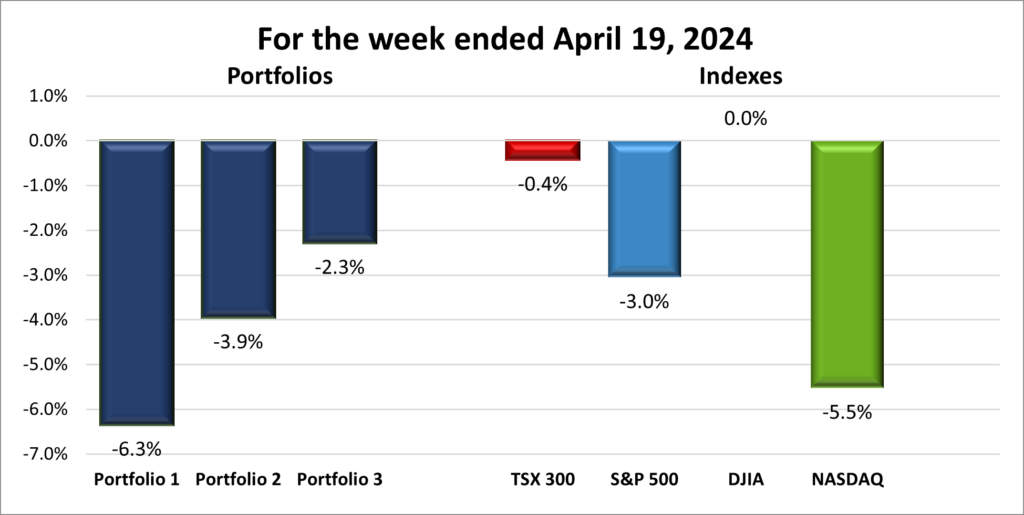
For the week, the TSX (SPTSX) slipped 0.4%, the S&P 500 (SPX) fell 3.0%, the DJIA (INDU) inched up 0.01% and the Nasdaq (CCMP) plunged 5.5%.
| Index | Weekly Streak |
| TSX: | 2 – week losing streak |
| S&P: | 3 – week losing streak |
| DJIA: | 1 – week winning streak |
| Nasdaq: | 4 – week losing streak |
 As you can see in the chart above, another weekly loss struck all four major North American indexes, as they continue to be weighed down by higher-than-expected inflation, delayed rate cuts, and escalating geopolitical tensions in the Middle East. This marks the S&P 500’s longest losing streak since September 2023, extending over three weeks.
The combination of strong US economic growth with persistent, or even rising, inflation has sparked fears that the Fed might hike rates again, instead of lowering them as initially anticipated. Many had anticipated the first rate cut as early as March, but now projections have shifted to no sooner than September. In a recent statement, Fed Chair Jerome Powell highlighted that the latest inflation data did not reassure Fed officials that inflation was falling to their target of 2%. He stressed that the Fed is prepared to maintain the current 5.5% interest rate for “as long as needed.”
In Canada, the newly released government budget forecasts a C$40 billion deficit, with expectations of further increases and no clear strategy for achieving fiscal balance. However, the budget’s release had minimal impact on the TSX, which was more influenced by fluctuations in commodity prices and the performance of Canadian technology companies’ stocks. A three day winning streak at the end of the week recoverd most of the losses from the start of the week.
With just one more full week of trading left in April, I hope that the indexes will post a weekly gain to avoid a month of unbroken losses. Even a modest uptick would be a welcome change. 😊
| Portfolio | Weekly Streak |
| Portfolio 1: | 1 – week losing streak |
| Portfolio 2: | 3 – week losing streak |
| Portfolio 3: | 5 – week losing streak |
It was a challenging week for my three portfolios, each losing over 2% in value, as illustrated in the chart below, which was more than I anticipated.
Portfolio 1 had a particularly rough week, declining by over 6%. Out of the 53 companies, only 7 (approximately 13%) recorded gains. Nvidia (NASD: NVDA) took a significant (more than 10%) hit, dropping 9% on Friday and 14% for the week. I’m relieved I sold a few shares the week prior. 😊 The other semiconductor stocks also struggled, with Navitas Semiconductor (NASD: NVTS) and indie Semiconductor (NASD: INDI) both down 15%, and Lattice Semiconductor (NASD: LSCC) down 13%. Other notable declines included Celsius Holdings (NASD: CELH) down 13%, Nano-X Imaging (NASD: NNOX) down 11%, Trade Desk (NASD: TTD) down 10%, and Cloudflare (NYSE: NET) also down 10%.
Portfolio 2 performed slightly better than Portfolio 1 but still faced significant setbacks. Mitek Systems (NASD: MITK) dropped 23%, Hammond Power Supply (TSE: HPS.A) decreased by 16%, and Guardant Health (NASD: GH) fell by 11%.
Portfolio 3 was the best of a bad lot, with one notable bright spot: Alvopetro Energy (TSXV: ALV), which surged 11%. This gain was a small consolation in a portfolio that also saw Lithium Americas (TSE: LAC) plummet by 34% and Cloudflare drop by 10%.
Overall, it was a tough week for all three portfolios—one I hope not to repeat. I am hopeful that this market pullback is temporary and that there will be some recovery from this week’s losses in the days ahead. It would be great if, one week soon, I could list just as many stocks posting significant gains. 😊
Companies on the Radar
 This past week, I removed Arista Networks (NYSE: ANET) from my radar list. The decision came after learning that Nvidia, with their AI-enhanced networking products, was a major competitor. Additionally, a recent article highlighted that two investment analysts downgraded Arista from a ‘Buy’ to a ‘Sell.’ A rare recommendation change that caught my attention. I typically avoid investing in companies facing strong competition from established, dominant players. In Arista’s case, battling against Cisco (NASD: CSCO), the leader in networking gear, and Nvidia, a frontrunner in AI technology, prompted me to look for other investment opportunities.
This leaves the three remaining companies below:
- Equitable Bank (TSE: EQB), a mid sized Canadian bank, considered Canada’s 7th bank, that provides financial services to consumers and businesses.
- Lumine Group (TSE: LMN), a young Canadian mid sized company that acquires communications and media software companies and then strengthens and grows those companies.
- Evolution AB (OTCM: EVVTY), a Swedish company that provides live casino solutions for global gaming operators.
Please keep in mind that these are only companies that have piqued my interest. This is not a recommendation or financial advice. You should do your own research or contact a professional before making any investment decisions.
The Radar Check was last updated April 19, 2024.


NOTE: Morningstar and Thomson-Reuters analysis is unavailable for Evolution from my usual sources because the company’s home stock exchange is the Nasdaq Stockholm in Sweden. While it is possible to invest in Evolution through the Over-the-Counter Market, I do not have access to analysis similar to the data available for companies traded on the major North American stock exchanges (Toronto Stock Exchange, New York Stock Exchange, and Nasdaq Stock market). The Analysts Rating and Price Target for Evolution are from Yahoo! Finance, under the Analysis tab once you have searched for the ticker.
Portfolio Update
Portfolio 1
Portfolio 1 for the week ended April 19, 2024: DOWN 
- Apple (NASD: AAPL) reported first quarter sales fell almost 10% due to intense competition from rival smartphone manufacturer Samsung.
- Rivian Automotive (NASD: RIVN) announced they have reduced their workforce by 1% in response to the slowdown in demand for electric vehicles (EVs). That was the second round of layoffs this year.
- Britain’s privacy regulator says Alphabet’s (NASD: GOOGL) proposed Privacy Sandbox does not go far enough to protect users’ privacy.
- Amazon (NASD: AMZN) has been ordered by the British government to allow workers at their warehouse in Coventry to vote on joining the GMB union. If workers vote to join the union, it would be the first time outside the US that Amazon will have to deal with a union.
Activity
Bought: Amazon.com With part of the proceeds from selling a few Nvidia shares last week, I purchased additional shares of Amazon.com. Amazon holds a dominant position in online retail, cloud computing, and streaming services, which provides a solid foundation for future success. This optionality allows me to gain exposure to multiple sectors poised for continued growth.
I am particularly drawn to the expanding artificial intelligence (AI) capabilities of their cloud services division, Amazon Web Services (AWS) who have recently extended their collaboration with Nvidia to develop innovative AI capabilities. AWS plans to invest US$150 billion to maintain its edge its other two major cloud competitors – Microsoft (NASD: MSFT) and Alphabet’s Google. According to an internal report, AWS is currently utilized by approximately 1.45 million businesses, which represents a substantial market for their AI services.
Investing in Amazon does come with risks, including an increasingly competitive landscape and the potential for stricter regulation of large tech companies, which could impact profitability. Amazon’s massive scale—with a market capitalization nearing US$2 trillion— may limit its potential for explosive growth compared to smaller companies. However, Amazon is also a well-established company with a proven track record which can translate to a more stable stock price and reduced volatility.
Overall, Amazon represents a solid growth stock, offering less volatility than smaller technology companies.
Dividends
Dividends Received this week for the following companies:
Companies followed by DRIP (Dividend Re-Investment Plan) indicate additional shares were purchased with the dividend. Any cash leftover was added to the cash balance.
No dividends this past week.
Canadian $
Dream Industrial Real Estate Investment Trust (TSE: DIR.UN)
BSR Real Estate Investment Trust (TSE: HOM.UN)
Andlauer Healthcare Group Inc (TSE: AND)
Decisive Dividend Corp (TSXV: DE) DRIP
US $
Innovative Industrial Properties Inc (NYSE: IIPR)
Quarterly Reports
No quarterly reports this past week.
Portfolio 2
Portfolio 2 for the week ended April 19, 2024: DOWN
- TC Energy (TSE: TRP) said they do not expect there to be any service disruptions from the rupture of one of their pipelines in Alberta. The break led to a wildfire, which is now under control, and they will work with the appropriate agencies to investigate the incident and take appropriate actions to prevent similar incidents happening in the future.
Activity
No significant activity to report this week.
Dividends
Dividends Received this week for the following companies:
Companies followed by DRIP (Dividend Re-Investment Plan) indicate additional shares were purchased with the dividend. Any cash leftover was added to the cash balance.
Canadian $
Alimentation Couche-Tard Inc (TSE: ATD)
Dream Industrial Real Estate Investment Trust (TSE: DIR.UN) DRIP
SmartCentres Real Estate Investment Trust (TSE: SRU.UN)
US $
No US$ dividends this past week.
Quarterly Reports
Mitek Systems, Inc.
First quarter 2024 financial results on April 15, 2024
Portfolio 3
Portfolio 3 for the week ended April 19, 2024: DOWN
- Microsoft announced they were investing US$ 1.5 billion in AI company G42, a startup company based in the United Arab Emirates. The investment gives Microsoft a minority stake in G42 as well as a seat on their board of directors. G42 will run all its AI applications on Mcrosoft’s Azure cloud services. As part of the deal, both companies had to provide security assurances to both the American and UAE governments. As part of these assurances, G42 had to divest itself of all investment in China and remove any Chinese hardware from their systems.
In other Microsoft news, the European Union’s (EU) anti trust regulator the European Commission (EC) concluded that Microsoft’s investment of US$ 13 billion in OpenAI is not an acquisition. If the EC had ruled it was an acquisition, the deal would have been subject to merger rules. However, the EC did not rule out an antitrust investigation of Microsoft over their partnership with OpenAI - Lithium Americas (TSE: LAC) announced the plan to raise US$ 275 million by selling 55 million shares for US$ 5 per share. The money will be used to speed up construction of their lithium mine in Nevada. Not only was this a dilution of shareholders equity but the price was significantly below the US$ 6.65 share price at the time of the announcement. This did not impress investors, resulting in a 30% drop in the share price after the announcement. ☹
Activity
No significant activity to report this week.
Dividends
Dividends Received this week for the following companies:
Companies followed by DRIP (Dividend Re-Investment Plan) indicate additional shares were purchased with the dividend. Any cash leftover was added to the cash balance.
Canadian $
Alvopetro Energy Ltd (TSXV: ALV)
goeasy Ltd (TSE: GSY)
US $
No US$ dividends this past week.
Quarterly Reports
No quarterly reports this past week.