Weekly Update for the week ending March 8, 2024

If you belong to a gym, you’ve likely witnessed the annual surge of enthusiastic newcomers in January, only to see their numbers dwindle by month’s end. Fueled by New Year’s resolutions, these gym newbies arrive with ambitious weight loss and fitness goals. However, many find themselves derailed by a combination of factors, including unrealistic expectations of quick results, gym intimidation, scheduling conflicts, and waning motivation.

The journey into investing shares more with this phenomenon than one might initially think. Both require not just a pledge of time and resources but a carefully considered plan tailored to personal aspirations, an ability to handle the inevitable ups and downs, emotional steadiness in decision-making, and, importantly, a network of support to navigate the unpredictable.

However, investing holds a unique advantage – the ability to let your investments work for you, growing your wealth with perhaps less daily effort than a fitness regimen demands. This distinction, among others, might just make the investing journey a bit more appealing to some. 😊

Hopefully, you are now motivated enough to stay with me as we dive into this past week’s updates. What did this past week bring us? Let’s delve in and find out…

Items that may only interest or educate me ….

Canadian Economic news, US Economic news, The market bandwagon, ….


Canadian Economic news

This past week’s key economic data that the Bank of Canada (BoC) considers when deciding whether to raise or lower the interest rate.

Bank of Canada’s monetary policy decision

As expected, Canada’s central bank maintained a pause on its key interest rate, leaving it unchanged at 5%. This was the fifth straight time the BoC has left the rate at 5%. This pause means the lending rates will remain at a 22 year high for consumers and businesses.

More importantly, in the post meeting press conference, BoC Governor Tiff Macklem said it was “still too early to consider lowering the policy interest rate” despite recent inflation data being lower than expected. Mr. Macklem pointed out that core inflation (excludes volatile food and energy prices) was still in the 3.5% range and the BoC wants to see continued reduction in the core inflation towards their 2% target. According to Mr. Macklem, by focusing on core inflation they get a sense of the underlying trend in inflation and where inflation might be headed. The unexpected economic growth at the end of 2023 alleviated any pressure to lower the rate to avoid a recession. If economic growth had remained stagnant there would have been calls to cut the rate to prevent the economy from going into a recession.

He also echoed comments from their last meeting that their discussions were more about how long the rate needed to remain at the current rate rather than if additional rate increases were necessary.

The BoC says they want more data showing underlying inflation continues to fall. I suspect the central bank wants to get a sense of the federal government’s upcoming budget on April 16 before deciding to lower the rate. If the government appears to be about to continue its spending ways, that could put upward pressure on inflation. By maintaining the current rate, the BoC gives itself time to see what new spending is in the federal budget, as well as collect more economic (gross domestic production and job statistics) and inflation (consumer price index and personal consumption expenditures) data.

The next monetary policy meeting for the BoC is scheduled for April 10, 2024.

Labour Force Survey (LFS)

The February Labour Force Survey from Statistics Canada reveals subtle shifts in the country’s employment landscape. Employment inched up 0.2% for the second consecutive month, contributing to an annual growth rate of 1.8%. Despite these gains, the unemployment rate edged up from 5.7% in January to 5.8% in February, largely due to Canada’s rapid population growth. This slight increase reflects a broader trend of steady unemployment rates around 5.8% over recent months.

A bit of good news for the BoC, wage growth appears to be slowing, with February’s year-over-year increase at 5.0%, a slight decrease from January’s 5.3%. Slowing wage growth relieves underlying pressure on inflation.

A closer examination of employment sectors reveals a 0.4% monthly increase in public sector jobs and an annual jump of 4.7%. In contrast, the private sector saw a slight monthly decline of 0.1%, although it recorded a 1.2% increase year over year.

Otherwise, the higher interest rate continues to act as a drag on the Canadian economy. The higher rates dampen consumer spending and subsequently impact business revenues. Combined with rising average wages, this environment challenges companies’ ability to expand their workforce and reinvest profits, potentially contributing to the recent stagnation in GDP growth.

Canadian market volatility

This past week, Canada’s volatility index (VIXC), represented by the TSX 60 VIX, fell to 11.63, a 7% decrease from the previous week’s 12.53. The decline in the VIXC coincided with comments from the BoC regarding when interest rates might drop.

A lower VIXC suggests that investors are less anxious about future market movements. The VIXC gauges volatility within the Canadian stock markets, with readings above 20 generally viewed as ‘high’ and those below 20 as ‘low’. The current reading of 11.63 sits on the lower end of the spectrum, suggesting investors are less anxious about future market moves and that they remain confident in the Canadian markets.

US Economic news

This past week’s key data points that the Federal Reserve (Fed) considers when deciding whether to raise or lower the interest rate.

Mr. Powell went to Washington

This week, Fed Chair Jerome Powell provided testimony to Congress, affirming the likelihood of interest rate cuts within the year. He expressed confidence that the that the US was on “a good path” towards a ‘soft landing,’ citing current conditions as favorable. Moreover, Powell emphasized the Fed’s commitment to keeping their heads down to avoid political distractions and focusing on their primary goal of reducing inflation to the 2% target, particularly throughout the election year.

Labour reports

Three recent labour market reports provide a snapshot of the current state of the American economy. Analyzing the latest data from the Job Openings and Labor Turnover Survey (JOLTS), ADP National Employment Report, and the Employment Situation Summary (ESS) reveals key trends in employment, and wage growth that can influence future economic policy.

Job Openings and Labor Turnover Survey (JOLTS)

The Labor Department’s January JOLTS reported 8.9 million job openings, matching the revised figure for December which had originally come in at 9.026 million. This consistency indicates a stable demand for labour. Throughout 2023, the labour market saw an average of 9.4 million new job openings per month, a decrease from the 11.2 million average in 2022, a year marked by robust re-hiring efforts as America rebounded from the COVID-19 pandemic lockdowns.

ADP National Employment Report

The ADP National Employment Report for February reported the addition of 140,000 jobs in the private sector, slightly below the anticipated 150,000. The report also pointed to a deceleration in wage growth, with February marking a 5.1% year-over-year increase in salaries — the slowest pace of wage gains since August 2021. This suggests a cooling in the labour market’s wage inflation pressures.

The ADP report offers insights into employment trends based on payroll data from ADP’s client base.

Employment Situation Summary (ESS)

The Bureau of Labor Statistics released its ESS for February, revealing an increase in nonfarm payroll jobs by 275,000, surpassing the anticipated 200,000 gain but well below the unexpected increase of 353,000 jobs in January. Despite these job gains, the unemployment rate edged up to 3.9%.

Average hourly earnings saw a modest increase of 0.1% in February, falling short of the 0.3% gain many analysts had predicted, after a stronger rise of 0.6% in January. Year-over-year, wage growth decelerated slightly to 4.3%, meeting expectations but a decrease from the 4.5% growth observed in January.

The latest ESS report suggests January’s increase in job gains was a one-month outlier rather than a true sign of underlying strength in the labour market. Wage growth has also slowed down after January’s jump. Both are good signs that the economy remains strong while inflationary pressures continue to fall.

Summary

These recent JOLTS, ADP, and ESS reports showing a slowdown in new job creation suggest that the American economy remains strong but may be beginning to moderate. The accompanying deceleration in wage growth further hints at diminishing inflationary pressures. While this slowdown might not be good news for workers seeking wage increases, it is good news for the Fed’s objective of cooling the economy. However, despite these indicators, it remains uncertain how this data will influence the Fed’s decisions on when to lower interest rates.

American market volatility

The CBOE Volatility Index (VIX), often viewed as a barometer of market fear and uncertainty, saw a rise of 7% from 13.75 on March 1 to 14.74 on March 8. This uptick suggests signals an anticipation of heightened market volatility in the near term.

The VIX is integral to understanding volatility within the American stock markets, where readings above 20 are typically considered ‘high’, indicating increased fear or uncertainty, while values below 20 are deemed ‘low’, suggesting a calmer market environment. Despite the recent increase, the current VIX level of 14.74 is situated towards the lower end of the spectrum, indicating that while there is a slight rise in investor anxiety, it remains relatively low.

The market bandwagon

When the markets are on an upswing, it is akin to the most sought-after party in town. Have you noticed how during these bullish periods, even individuals who have previously shown little interest in stocks begin obsessively checking updates on the TSX, S&P, Nasdaq, or the latest buzzworthy tip? There is an energy that transforms investing from a mere task into an exhilarating game where it seems everyone is winning. This allure not only draws in new investors but makes them eager to follow every market fluctuation with the zeal of an adventurer.

However, when the tide turns and the markets plummet, it feels as though someone has abruptly stopped the music. The once inviting party loses its charm, and the exit becomes the most popular spot. Why do new investors, so engaged during prosperous times, seemingly vanish at the first hint of a downturn?

Initially, the ascent of the market feels like unwrapping a gift — anticipation often rewarded with delight. Stories of overnight fortunes flood our social media feeds and dominate our conversations, breeding a potent fear of missing out (FOMO) that keeps investors glued to their screens, eager for a share of the goldrush. Yet, when the market faces a downturn, the narrative flips — portfolios that once sparkled with potential now bleed red, replacing triumph with tales of caution and regret. This stark contrast is jarring, particularly for new investors, illustrating the stark realities of risk, and transforming what was once a thrill into a source of anxiety.

Understanding loss aversion — our innate tendency to fear losses more than we value gains — is crucial. This psychological principle means that the pain of seeing investments shrink during a bear market often overshadows the joy of earlier gains. For a novice investor, this pain is not just about financial loss; it is a rude awakening to the inherent risks of the stock market, which can prompt a retreat from the investing world altogether.

One of the first lessons I learned from the market downturn of 2022 was the value of diversification. Having investments spread across various asset classes did not prevent losses but certainly cushioned their impact. This is a fundamental strategy that new investors can learn during challenging times.

Bear markets, despite their intimidation, are filled with learning opportunities. They are the periods that test and ultimately strengthen an investor’s resolve, strategy, and understanding of the market. Engaging with resources — books, online courses, or investment communities — can provide support and deepen your knowledge of the world of investing. Turn these challenges into valuable lessons.

In my own investing journey, the bear market of 2022 was a trial by fire that underscored the importance of patience, diversification, and a long-term perspective. The downturn was a classroom, filled with lessons that no bull market ever could replicate.

So, to all the new investors out there, feeling jittery when the market resembles a roller coaster is completely normal. I, too, started as a new investor once, fully acquainted with those very jitters. Despite having been in the investing game for several years, the bear market of 2022 was far from a joyride. Yet, it is important to remember that perseverance through the downturns does more than just make the upswings feel more rewarding. Along the way, you will amass not just wisdom and experience but potentially grow your wealth as well. 😊


Weekly Market Review

Monday: the markets stumbled out of the gate to start the week with all four indexes ending in the red. Investors were being cautious in a week that features the latest jobs data from Canada and the US. In addition, the BoC meets on Wednesday to provide an update on the Canadian benchmark interest rate, while Fed Chair Jerome Powell is scheduled to testify before the US Congress. Oil prices dropped on lower demand and higher production.

In Canada, lower oil prices and a late afternoon swoon sent the Toronto Stock Exchange Composite Index (TSX) into the red. In trading, Basic Materials (miners and fertilizer manufacturers), Utilities, and Financials were the only Canadian sectors to record a gain, while the biggest losses were incurred by the Healthcare and Consumer Staples sectors.

In the US, the S&P 500 Index (S&P), the Dow Jones Industrial Average (DJIA), and the Nasdaq Composite Index (Nasdaq) all retreated from respective record highs they set last week. Investors are waiting for the latest jobs data to get a sense of how the US economy is performing which in turn could provide insight into the timing of a future rate cut. In trading, Utilities and Basic Materials gained the most, while Consumer Cyclicals and Energy dropped the most.

Tuesday: all four indexes were dragged lower by a retreat in big technology and semiconductor stocks. Investors eyebrows were raised after an official from the Fed said he foresaw only one rate cut this year, and that was in the second half of the year. After chasing AI stocks higher the last few weeks, investors may be taking a breather and are taking some money off the table.

In Canada, gold prices moved to a record high, but it was not enough to offset the pullback in technology stocks. Analysts expect the BoC will maintain the current 5.0% interest rate at their meeting tomorrow. In trading, Energy, Financials and Utilities were the only Canadian sectors to end in the green. The Technology sector ended deep in the red with a 2.7%, no other sector lost more than 1.0%.

In the US, mixed economic data has investors waiting to hear Fed Chair Powell’s semi-annual monetary policy testimony before Congress over the next two days for clues to when the rates may start to fall. In trading, Energy, Telecommunications Services and Financials were the only sectors to finish higher, while Technology and Basic Materials suffered the biggest declines.

Wednesday: after two straight days of losses, the markets rebounded with all four indexes closing in the green. During Fed Chair Powell’s testimony before the House of Representatives, he said, “it will likely be appropriate to begin dialing back policy restraint at some point this year.” Investors took that bit of good news and pushed the markets higher. Oil prices rose on lower US crude oil inventories, the extension of production cuts and expected interest rate cuts later in the year.

In Canada, the BoC maintained the benchmark interest rate at 5% but hinted at lower rates ahead. The good news from the heads of two central banks helped lift the TSX close to a two-year high. In trading, Basic Materials and Consumer Staples led all gainers, while Healthcare and Industrials were the only sectors to retreat.

In the USA, the House of Representatives passed a bill to provide funding for federal government agencies until the end of September. Mr. Powell’s comments that the US economy remained strong, and rates should come down later this year was met with relief by analysts and investors alike. It was a good day in trading with all sectors ending higher except for Consumer Cyclicals. The advance was led by the Basic Materials and Technology sectors.

Thursday: the indexes posted their second straight day of gains as Mr. Powell once again reiterated the Fed’s intention to lower the interest rate sometime this year, provided inflation continues to drop. Oil prices were down but that was not enough to prevent the Energy sector in both countries from advancing.

In Canada, the TSX was lifted by a rally in technology stocks, and higher gold prices. In trading, Technology and Consumer Staples posted the biggest gains, while Healthcare was the only Canadian sector to end lower.

In the US, the S&P appeared to have shrugged off a slow start to the week and raised the closing bar to another record high. The Nasdaq hit an intraday record high before falling back to close just below its all time high. In trading, Technology and Basic Materials were the big winners, while Telecommunications Services was the only American sector not to advance.

Friday: the markets stumbled to start the week and stumbled to end the week. After the two-day run up, many investors took profits in afternoon trading going into the weekend, sending all four indexes into the red. Gold prices remained at an all time high, while oil prices fell on concerns of softening demand from China.

In Canada, the latest employment survey showed more new jobs than expected, higher unemployment and slowing wage growth. The results left investors feeling a rate cut in June may be possible. In trading on Bay Street, Technology, Healthcare and Utilities were the only Canadian sectors to end in the green, while Energy and Telecommunications Services suffered the biggest losses.

In the US, recent jobs data showed both new jobs and unemployment higher than expected, providing investors with increased confidence the Fed may start lowering interest rates in June. In trading on Wall Street, Telecommunications Services and Consumer Staples posted the biggest gains, while Technology and Consumer Cyclicals incurred the biggest losses.


Weekly Market and Portfolio Review

For the week, the TSX (SPTSX) gained 0.9%, the S&P 500 (SPX) slipped 0.3%, the DJIA (INDU) dropped 0.8% and the Nasdaq (CCMP) fell 1.2%.

Index Weekly Streak
TSX: 4-week winning streak
S&P: 1-week losing streak
DJIA: 2-week losing streak
Nasdaq: 1-week losing streak

Bearish market Looking at the chart above, the major North American indexes started slow, gained momentum, and then retreated on Friday. Only the TSX rose, extending its winning streak to four weeks. All three US indexes closed lower, with the DJIA experiencing its worst week since October 2023.

Central bank commentary and jobs reports were key market drivers. In Canada, BoC Governor Macklem hinted at a future rate cut, suggesting the BoC is no longer focused on raising rates. Conversely, Fed officials, including Chair Powell, emphasized the strength of the US economy and jobs market, suggesting they are in no rush to lower rates. However, Powell, in his congressional testimoney this past week, reiterated the possibility of rate cuts later in the year. This was the good news.

The not so good news was labour data from both countries showed continued job growth, with unemployment edging up slightly and wage growth slowing. This data supports the central banks’ view that they can remain patient with interest rate decisions. While the US appears well-positioned for a soft landing, the situation in Canada remains less clear. Still, these reports provide both central banks with more time to monitor inflation data before making policy changes.

With job markets holding steady, attention now shifts to upcoming inflation reports. Next week brings the US Consumer Price Index (CPI) data, followed by Canada’s CPI report the week after. The outcome of these reports will likely influence whether central banks can ease rates sooner rather than later or need to maintain them longer to control inflation. Keep your fingers crossed for falling inflation numbers. 😊

Portfolio Weekly Streak
Portfolio 1: 10-week winning streak
Portfolio 2: 4-week losing streak
Portfolio 3: 1-week losing streak

Bearish market Given the overall poor performance in stock markets this past week—where only the TSX registered a gain—it came as a surprise that Portfolio 1 increased in value, while the other two portfolios lost ground, as illustrated in the chart below.

Looking at the weekly performance of the companies held in Portfolio 1 there were a lot of ups and downs with many companies ending the week either slightly higher or lower. There were a few significant moves (changes in share price greater than 10%) this past week. Gains in Rivian (NASD: RIVN), up 16%, and Celsius Holdings (NASD: CELH) up 10%, were partially offset by losses in Navitas (NASD: NVTS), Nuvei (TSE: NVEI), Tesla (NASD: TSLA) down 16%, 13% and 11%, respectively. Despite all the ups and downs, the significant increase in Nvidia’s share price by US$ 33.62 was a key driver of Portfolio 1’s growth, although a nearly US$100 drop on the final day tempered the overall gains. ☹

Despite solid performances from financial sector companies and a slim majority of companies ending the week slightly higher, a 12% drop in MongoDb’s value (NASD: MDB) weighed heavily on Portfolio 2.

It wasn’t a good week for Portfolio 3. Not only were there no sizable gains, but most of the companies in the portfolio saw their respective share prices decrease slightly. The silver lining would have to be that at least there were no significant drops. 😊

After a strong run to start the year I guess the portfolios were due for a slight pullback but I’d wish Portfolios 2 and 3 would hurry up and join Portfolio 1 in the win column. 😊
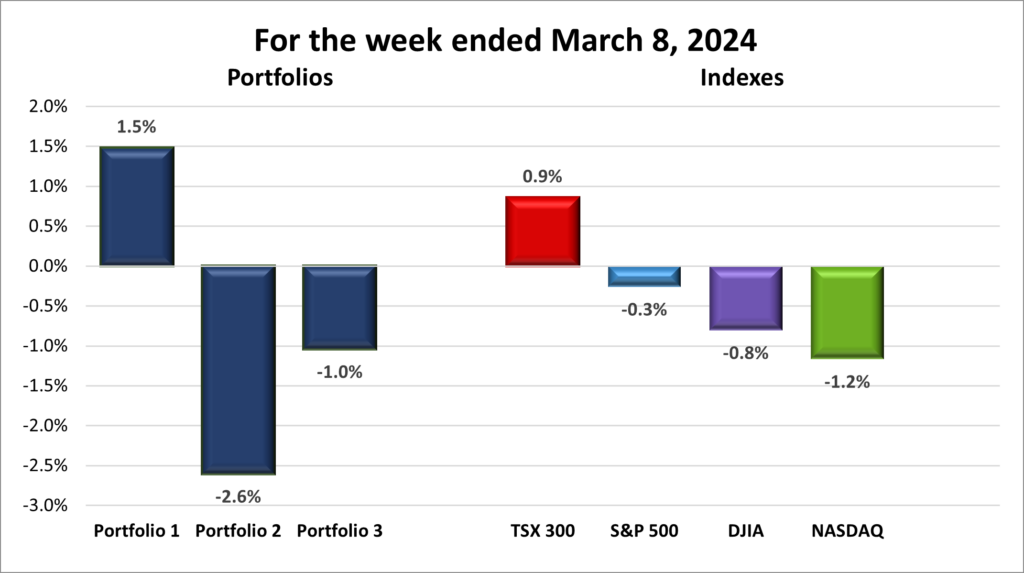
Weekly Portfolio & Index performance
Weekly Portfolio & Index performance for the week ended March 8, 2024.

Companies on the Radar

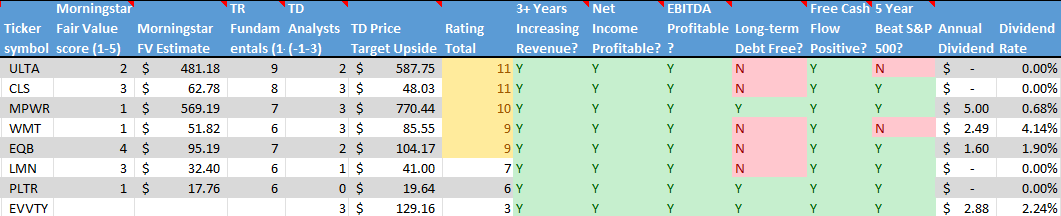
Stocks on my Radar This past week, three new companies came onto my radar – Palantir Technologies (NYSE: PLTR), Monolithic Power Systems (NASD: MPWR), and Evolution AB (OTCM: EVVTY). Despite their significant market capitalizations, these companies could not be more different from each other.

Palantir, an American company, has carved a niche with its AI-enabled software platform, primarily serving intelligence agencies for anti-terrorist efforts. Meanwhile, Monolithic Power, another US based company, is a leader in designing semiconductor-based power electronics solutions for diverse industries. Across the Atlantic, Evolution AB of Sweden is revolutionizing live casino solutions for global gaming operators, enriching the gaming experience for end-users. As you can see, though vastly different, each company provides unique growth prospects and possibilities.

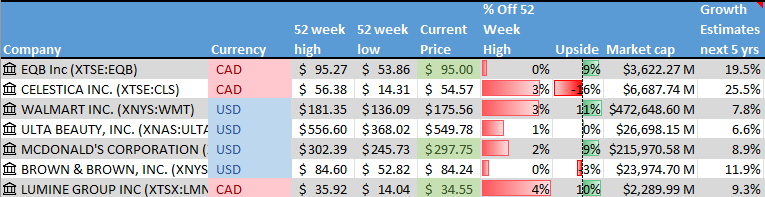
With these three additions, the roster of companies on my radar has expanded to eight companies, making the list a bit crowded. The insights from my radar test, shown below, should help whittle down the list to a more focused group of contenders.

Check back next week to see which of these companies makes the cut to remain on the list.

  • Ulta Beauty (NASD: ULTA), a major American beauty product retailer, with over 25,000 products from 600 brands.
  • Celestica Inc. (TSE: CLS), a medium sized Canadian company that manufactures electronic products and provides supply chain services to companies around the world.
  • Walmart (NYSE: WMT), the large American global retail chain.
  • Equitable Bank (TSE: EQB), a mid sized Canadian bank that provides financial services to consumers and businesses.
  • Lumine Group (TSE: LMN), a young Canadian mid sized company that acquires communications and media software companies and then strengthens and grows those companies.

Please keep in mind that these are only companies that have piqued my interest. This is not a recommendation or financial advice. You should do your own research or contact a professional before making any investment decisions.

The Radar Check was last updated March 8, 2024.
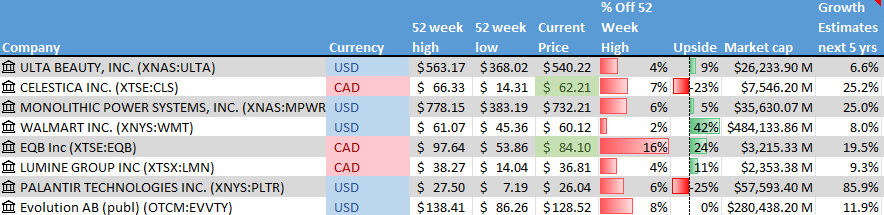
Stock on the Radar List. 1 of 2.
Stock on the Radar List. 2 of 2.

NOTE: Morningstar and Thomson-Reuters analysis is unavailable for Evolution from my usual sources because the company’s home stock exchange is the Nasdaq Stockholm in Sweden. While it is possible to invest in Evolution through the Over The Counter Market, there is no analysis similar to the data available for companies traded on the major North American stock exchanges (Toronto Stock Exchange, New York Stock Exchange, and Nasdaq Stock market).


Portfolio Update

Portfolio 1

Portfolio 1 for the week ended March 8, 2024: UP Green Up Arrow, signifying a positive week

  • Apple (NASD: AAPL) was fined €1.84 billion (US$2 billion) by the European Union antitrust regulators for preventing music streaming rivals from informing users of third party payment options outside Apple’s App Store.
    More bad news for Apple as sales of their iconic iPhones in China fell 24% on an annual basis as Apples’s share of the Chinese market fell to 15.7% from 19% a year ago.
  • Tesla reported lower shipments from their Shanghai gigafactory due to lower sales caused by the Lunar New Year holiday and competition from other electric vehicle (EV) manufacturers.
    Tesla’s German gigafactory is expected to be without electrical power until the middle of March. A suspected arson attack nearby left the factory without power, causing a halt in production.
  • Rivian Automotive (NASD: RIVN) announced three new EVs: a smaller, less expensive electric SUV, the R2, and a R3 crossover along with a high-performance version, the R3X. The smaller EVs are expected to start shipping in 2026 and will be priced well below Rivian’s bigger initial offering – the R1 pickup and SUV. These less expensive EVs are crucial to the success of Rivian as consumer demand for EVs has slowed.
  • The recent run up in Nvidia’s (NASD: NVDA) share price has placed the company at the heels of Apple for the second largest company by market capitalization (number of shares outstanding X share price). During Nvidia’s rally the company has jumped over Amazon.com (NASD: AMZN), Alphabet (NASD: GOOGL) and Saudi Aramco (the world’s largest oil producer).
  • General Motors (NYSE: GM) announced they are resuming delivery of their Chevy Blazer EV after addressing software quality issues. GM also said it has reduced the price of the Blazer and that the EV is once again eligible for the US$ 7,500 rebate available in the US.

Activity

Sold: Teladoc Health, Inc. (NASD: TDOC) During the height of the COVID-19 pandemic, when seeing a family doctor in person was nearly impossible, I invested in Teladoc. This company was a leading provider of remote healthcare services, boasting growing revenues and significant market potential in the burgeoning field of telemedicine. At the time, the prospect of receiving medical assistance via phone or video seemed to have vast potential.

However, as the pandemic subsided, it became apparent that there was a strong preference for in-person doctor visits. This shift in consumer behavior marked a turning point for the telemedicine industry and, consequently, for Teladoc. The company’s previously explosive growth began to slow and broke my reason for investing in the company.

In hindsight, once my reason for investing was busted, I should have acted swiftly to sell my shares. Instead, driven by optimism for a potential rebound, I held on, only to see the share price continue its decline. This week, acknowledging the changed landscape of telemedicine, I made the decision to divest. ☹

Dividends

Dividends Received this week for the following companies:

Companies followed by DRIP (Dividend Re-Investment Plan) indicate additional shares were purchased with the dividend. Any cash leftover was added to the cash balance.

Canadian $

TMX Group Ltd (TSE: X)

US $

No US$ dividends this past week.

Quarterly Reports

Sea Limited

Fourth quarter 2023 financial results on March 4, 2024

Nuvei Corporation

Fourth quarter 2023 financial results on March 5, 2024

Andlauer Healthcare Group Inc.

Fourth quarter 2023 financial results on March 5, 2024

CrowdStrike Holdings, Inc.

Fourth quarter 2023 financial results on March 5, 2024

Crew Energy Inc.

Fourth quarter 2023 financial results on March 7, 2024

Costco Wholesale Corporation

Second quarter 2024 financial results on March 7, 2024

Portfolio 2

Portfolio 2 for the week ended March 8, 2024: DOWN Red Down Arrow

  • TC Energy (TSE: TRP) announced they agreed to sell Portland Natural Gas Transmission System for US$ 1.14 billion. The money will be used to pay off debt and fund other investments. The company plans to sell a minimum of C$ 3 billion worth of assets in an effort to reduce debt.
    in other TC Energy news, the company said it reopened its Keystone pipeline after they voluntarily shut it down to investigate a leak reported by a landowner. The leak proved to be unfounded, but the entire Keystone system was shutdown for five hours while they investigated.

Activity

No significant activity to report this week.

Dividends

Dividends Received this week for the following companies:

Companies followed by DRIP (Dividend Re-Investment Plan) indicate additional shares were purchased with the dividend. Any cash leftover was added to the cash balance.

No dividends this past week.

Quarterly Reports

MongoDB, Inc.

Fourth quarter 2024 financial results on March 7, 2024

Crew Energy

See report under Portfolio 1.

Portfolio 3

Portfolio 3 for the week ended March 8, 2024: DOWN Red Down Arrow

  • The Royal Bank (TSE: RY) announced they plan to triple the amount of money available for renewable energy products to C$ 15 billion by 2030. The bank also plans to increase lending to low carbon energy companies.
  • Cloudflare (NYSE: NET) announced the launch of their Magic Cloud Networking service. This new product provides a cloud-based platform that allows customers to connect and protect their cloud networking infrastructure.

Activity

No significant activity to report this week.

Dividends

Dividends Received this week for the following companies:

Companies followed by DRIP (Dividend Re-Investment Plan) indicate additional shares were purchased with the dividend. Any cash leftover was added to the cash balance.

No dividends this past week.

Quarterly Reports

No quarterly reports this past week.


Weekly Update for the week ending March 1, 2024

The North American stock markets have had a good run through the first two months of 2024. March has a tough act to follow but the month has a reputation for being a strong month for the North American stock markets, with historical trends showing positive movement more often than not. But remember, past performance is not a guarantee of future results.

Investor enthusiasm over all things related to artificial intelligence should continue to drive the markets higher. With fourth quarter earnings almost over, investors will now cast their eyes towards the Federal Reserve. Each bit of economic news, as well as speeches from Fed officials, will be dissected in an attempt to determine when the rates could begin to fall. I am sure there will be lots of ups and downs with each bit of news, hopefully a lot more ups than downs. So, buckle up, the rollercoaster is about to leave the platform.

Before the ride begins, let’s see what happened this past week….

Items that may only interest or educate me ….

Canadian Economic news, US Economic news, US government shutdown avoided, NVIDIA


Canadian Economic news

This past week’s key economic data that the Bank of Canada (BoC) considers when deciding whether to raise or lower the interest rate.

Gross Domestic Product (GDP)

Statistics Canada’s latest report reveals the country’s economy expanded by 1.0% in the fourth quarter on a year-over-year basis, surpassing analysts’ estimates of 0.8% growth. This performance marks a significant improvement compared to the third quarter’s contraction of 1.1%. On a monthly basis, however, GDP growth stalled in December, remaining flat following two months of growth, and falling short of the anticipated 0.2% growth. Year-over-year, the GDP for December increased by 1.1%. Preliminary figures for January look promising, with an advance estimate indicating the economy grew by 0.4%.

This economic expansion reduces the urgency for the BoC to cut the benchmark interest rate. Given the ongoing growth, it is probable that the interest rate will stay at its 22-year high of 5% for the next few months as the BoC focuses on bringing inflation closer to their 2% target. Analysts now anticipate that the central bank may begin to lower the rate after their June meeting, based on the economy’s current strength and inflation’s downward trajectory.

Canadian market volatility

This past week Canada’s volatility index (VIXC) or ‘fear gauge,’ represented by the TSX 60 VIX, rose to 12.53, a slight increase from the previous week’s 11.76.

A rise in the VIXC suggests that investors are feeling a less certain about future market movements. It does not necessarily predict a downturn; it just means people are expecting stock prices to be more erratic.

The VIXC gauges volatility within the Canadian stock markets, with readings above 20 generally viewed as ‘high’ and those below 20 as ‘low.’ The current reading of 12.53 sits on the lower end of the spectrum, indicating a prevailing sense of confidence among investors in the Canadian markets.

US Economic news

This past week’s key data points that the Federal Reserve (Fed) considers when deciding whether to raise or lower the interest rate.

Personal Consumption Expenditures (PCE)

The Bureau of Economic Analysis’ January Personal Consumption Expenditures (PCE) report showed a 0.3% increase in prices, following a 0.2% rise in December. Core PCE, which excludes the more volatile categories of food and energy, rose by 0.4% in January, a significant increase from December’s 0.2% uptick. Both these figures met analyst expectations. Year-over-year, the PCE price index saw a 2.4% increase in January. Over the same 12-month period, the core PCE price index recorded a 2.8% gain in January, slightly down from December’s 2.9% increase.

This annual increase in PCE marks smallest gain in three years, while the monthly increase in core PCE was the biggest increase since the previous February. Although the slowdown in overall inflation growth may not be as much as the Fed might have preferred, investors are hopeful it is sufficient to keep the prospect of an interest rate cut in June alive.

Gross Domestic Product

The Department of Commerce’s second estimate for the fourth quarter Gross Domestic Product (GDP) indicated that the American economy expanded at an annualized rate of 3.2%. This marks a significant slowdown from the third quarter’s growth rate of 4.9%. The revised figure, or second estimate, slightly adjusts the initial ‘advance’ estimate released in January, which had suggested a 3.3% growth rate.

The deceleration in growth during the quarter can primarily be attributed to a slowdown in private inventory investment, alongside declines in federal government spending and consumer expenditures.

Over the course of 2023, the GDP witnessed a 2.5% increase compared to the previous year. This growth was driven predominantly by a rise in consumer spending, alongside increased expenditures by federal, state, and local governments, and an increase in non-residential fixed investment. Conversely, reductions were recorded in residential fixed investment and private inventory investment.

American market volatility

The CBOE Volatility Index (VIX), often seen as a measure of market fear and uncertainty, experienced a marginal decline of 0.64 points from 13.75 to 13.11. This decline suggests a slight increase in investor confidence and a reduction in expectations for market volatility in the near term. Historically, a decrease in the VIX often signals a bullish outlook among investors, anticipating steadier or rising stock prices in the near term.

Consumer Confidence Index

The Conference Board’s Consumer Confidence Index (CCI) for February reported a surprising decline, falling to 106.7 from a revised 110.9 in January, a six-month peak. This decrease, the first in three months, was significantly below the analyst expectations of 115. One has to wonder if this is just a blip in an upward trend given the resilient economy, strong job market, rising stock market, and the anticipation of falling interest rates later in the year. Although confidence has shown improvement since late last year, buoyed by decelerating inflation rates, it remains significantly lower than pre-pandemic levels.

One potential explanation for this unexpected dip in consumer sentiment may be the prevailing political climate, particularly the upcoming presidential election, where both candidates have failed to attract favorable opinions from the majority.

The CCI is a vital economic indicator, gauging the optimism or pessimism consumers feel about the economy and their personal financial situation. This sentiment directly influences their spending decisions, making the CCI a key predictor of economic health. The Fed closely monitors this index, as high consumer confidence suggests that people feel secure financially and are likely to spend more, driving economic growth. Conversely, low consumer confidence, indicating a tendency towards saving rather than spending, can signal an economic slowdown.

Consumer Sentiment Index

The University of Michigan’s final Consumer Sentiment Index (CSI) for February was reported at 76.9, marking a slight decrease from January’s reading of 79.0 but showing a significant improvement of 14.9% over February 2023’s figure of 66.9. This final February reading fell short of the preliminary estimate of 79.6, which matched with analysts’ predictions, and is still below the historical average.

Despite the marginal dip from January, consumer sentiment in February remained healthy, supported by several key factors. These include easing inflation pressures, a resilient economy and job market, appreciating stock market values, and expectations of decreasing interest rates starting in the summer. This combination of factors suggests that while there was a slight month-over-month decline, the overall consumer outlook remains positive, buoyed by the anticipation of favorable economic conditions.

US government shutdown avoided

Once again, members of the US Congress found themselves in a game of brinkmanship before finally reaching a consensus to extend government funding beyond March 1, 2024. This agreement postpones the expiration date for six crucial funding bills—covering the Departments of Agriculture, Justice, Interior, Veterans Affairs, and other federal entities—from March 1 to March 8. Furthermore, the deadline for the subsequent six bills, which finance the Departments of Defense, Labor, Homeland Security, and additional federal agencies that were initially set to expire on March 8, has been extended to March 22. This delay provides lawmakers the necessary time to review and debate the full-year funding legislation.

The Senate Majority Leader, the Speaker of the House, and President Biden negotiated the spending bills necessary to avoid a partial government shutdown. These twelve bills are designed to fund government programs through the end of the fiscal year, which concludes on September 30, 2024. This marks the third instance within a year that efforts to authorize funds to keep the US government operational approached the deadline.

NVIDIA

NVIDIA (NASD: NVDA) has recently captured investor attention, especially following its impressive fourth-quarter earnings report that exceeded expectations and offered a bullish forecast for 2024. The company’s share price has surged over 400% since January 2, 2023, elevating it to the third largest company with a market capitalization (number of shares outstanding X share price) of over US$ 2 trillion.

The surge in Nvidia’s revenue is largely driven by significant investments from major tech companies racing to integrate artificial intelligence (AI) capabilities and secure a position in the burgeoning AI landscape. These companies, with their substantial resources, are not only able to afford Nvidia’s chips but also recognize the strategic importance of not falling behind in this technological revolution. The ongoing investment in AI is translating into tangible applications and, ultimately, substantial revenue streams, highlighting AI’s dual role as both a strategic investment during growth periods and a tool for enhancing efficiency and reducing costs during economic downturns.

With its meteoric rise, I thought it would be interesting to take a closer look at the factors that have captured investors’ attention and propelled the company and its share price to new heights.

NVIDIA’s share in the advanced semiconductor industry is significant. Its focus on AI, high-performance computing, and graphics processing units (GPUs) has propelled it to the forefront. While exact market share percentages can fluctuate, NVIDIA’s dominance in specific segments is undeniable.

Here are some key points about NVIDIA’s position in the advanced semiconductor landscape:

  1. AI and Deep Learning: NVIDIA’s GPUs are widely used for AI training and inference. Their CUDA architecture and specialized hardware (such as Google’s Tensor Cores) make them indispensable for machine learning tasks. Many data centers, research institutions, and companies rely on NVIDIA GPUs for AI workloads.
  2. Automotive: The NVIDIA DRIVE platform is integral to the development of autonomous vehicles, providing essential hardware and software for self-driving technologies. Customers include Audi and Volkswagen.
  3. Gaming: Nvidia continues to dominate the gaming sector with its GeForce series GPUs, especially with the release of the RTX 30 series GPUs, attracting a broad customer base including major hardware manufacturers and creative professionals. Customers include computer hardware manufacturers ASUS and MSI, as well as many other video editors and 3D artists.
  4. Data Centers: GPUs like the A100 are preferred for scientific simulations, data analytics, and deep learning applications, boasting unmatched performance and efficiency. Their customers includes the big three cloud providers and data centre companies Amazon, Microsoft and Google (NASD: GOOGL).
  5. Edge Computing: NVIDIA’s Jetson platform provides AI capabilities at the edge (in devices like drones, robots, and IoT devices). It enables real-time inference without relying on cloud servers.
  6. Healthcare and Life Sciences: Nvidia’s technology supports medical imaging, drug discovery, and genomics research, partnering with leading healthcare companies such as GE Healthcare, Siemens Healthineers, and others.
  7. Partnerships and Collaborations: NVIDIA collaborates with other semiconductor companies, research institutions, and software developers. For example, their partnership with Taiwan Semiconductor Manufacturing (NYSE: TSM) ensures efficient production of advanced chips.

Remember that the semiconductor industry is dynamic, and market shares can change based on technological advancements, competition, and global trends. Past performance does not guarantee future performance, especially with many companies looking to carve out a piece of Nvidia’s market share. However, NVIDIA’s impact and influence remain significant in shaping the future of advanced computing and AI. The company’s success is a testament to its strategic focus on key technological advancements and its ability to cater to diverse, high-demand sectors.


Weekly Market Review

Monday: the four major North American indexes – the Toronto Stock Exchange Composite Index (TSX), the S&P 500 Index (S&P), the Dow Jones Industrial Average (DJIA), and the Nasdaq Composite Index (Nasdaq) – stumbled out of the gate to start the week, with each index ending the day in the red. Oil prices ended higher as demand in Europe for diesel fuel increased.

In Canada, lower commodity prices led to the drop in the TSX today. This week investors will be watching the earnings reports from Canada’s big six banks. Investors will be watching the results to get an idea how well the Canadian economy is performing. Strong reports from the banks are a good indicator that the economy is performing reasonably well. In trading, Consumer Staples, Industrials and Energy were the only sectors to end higher, while Utilities and Telecommunications Services saw the biggest declines.

In the US, it was a quiet day in the markets with no major news to drive the markets. As fourth quarter earnings wrap up, analysts and investors await the PCE index reading later this week to see if inflation continues to fall. In trading, Consumer Cyclicals and Energy were the only sectors to advance, while Utilities and Telecommunications Services experienced the biggest setbacks.

Tuesday: A mixed day for the indexes as investors took profits or sat on the sidelines ahead of the latest US PCE inflation report. Oil prices dipped slightly despite OPEC+ members indicating they were considering extending their voluntary cutback on oil production.

In Canada, the TSX posted its second straight day of losses as the big 6 Canadian banks begin reporting their first quarter results. In trading, the biggest gains were in the Consumer Cyclicals and Consumer Staples sectors, while the Technology, Industrials and Financials were the only sectors to end lower.

In the US, the S&P and Nasdaq finished in the green, while the DJIA ended in the red. Last week’s rally seems to have lost momentum as investors await the latest inflation data. Two Fed officials said separately that they were in no rush to lower rates. In trading, Utilities and Telecommunications Services gained the most, while Energy was the only American sector to end lower.

Wednesday: All four indexes ended lower ahead of Thursday’s latest PCE data. The report is a pivotal point in determining when the US interest rate could start to fall. If the PCE data is similar to the recent Consumer Product Inflation readings on consumer and producer prices, it could cause the Fed to hold rates at current levels longer than the market is anticipating. Conversely, if the data is lower it could open the door to the Fed lowering the interest rate following the April/May meeting.

In Canada, the TSX recorded its third straight decline as investors prepare for tomorrow’s Canadian GDP report and the US PCE inflation report. In trading, Consumer Cyclicals was the only Canadian sector to advance, Healthcare and Telecommunications Services posted the largest drops.

In the US, investors were being cautious, taking some profits before the latest inflation report. In trading, Utilities and Industrials posted the biggest gains, while Healthcare and Energy fell the farthest.

Thursday: the US PCE showed the rate of inflation in the US continues to cool. The latest data matched analysts’ expectations and kept a June rate cut by the Fed on the table. The good news sent all four indexes higher for the day. Oil prices slipped on concerns the combination of lower demand and greater supply from OPEC nations could lead to lower oil prices.

In Canada, the TSX got back on track thanks to stronger than expected growth in the Canadian economy. In trading, the top performing sectors were Energy and Basic Materials (miners and fertilizer manufacturers), while the biggest declines were in the Consumer Staples and Consumer Cyclicals sectors.

In the US, the Nasdaq finally broke its all-time high and the S&P also closed at a new high, both indexes also had there best February since 2015. In trading, Basic Materials and Technology posted the largest gains, while Healthcare and Consumer Staples suffered the biggest losses.

Friday: March started on a high note with all four indexes ending the day higher as investors reacted to yesterday’s inflation report that left the door open for a June rate cut. Oil prices ended higher in anticipation of new supply agreements from OPEC+ nations.

In Canada, the TSX closed near a two year high as a result of higher commodity prices that boosted the share prices of resource companies. The TSX also benefitted from the technology rally in the US. In trading on Bay Street, Basic Materials and Energy spearheaded a broad advance that saw only the Consumer Cyclical sector end lower.

In the US, the S&P and Nasdaq both set new closing highs as the rally in technology companies continued. For the S&P it was its 15th record high of 2024. Nvidia closed the week with a market cap of over US$ 2 trillion, just over six months since it broke the US$ 1 trillion mark. In trading on Wall Street, today’s rally was led by the Technology and Energy sectors. Utilities and Consumer Staples were the only sectors to end lower.


Weekly Market and Portfolio Review

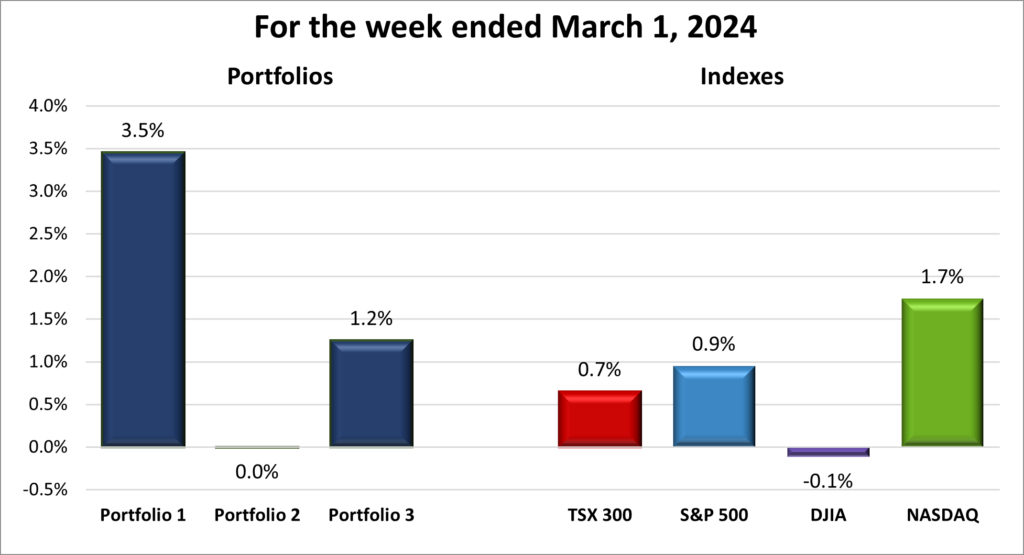
For the week, the TSX (SPTSX) rose 0.7%, the S&P 500 (SPX) added 0.9%, the DJIA (INDU) lost 0.1% and the Nasdaq (CCMP) gained 1.7%.

 
Index Weekly Streak
TSX: 3-week winning streak
S&P: 2-week winning streak
DJIA: 1-week losing streak
Nasdaq: 2-week winning streak

Bull market. A good week for the North American stock markets. The stock market wrapped up the week with a positive rally, extending winning streaks for three major indexes. This upward momentum came despite a wait-and-see approach earlier in the week leading up to the PCE inflation report.

The PCE report, released on Thursday, provided some relief to investors. Inflation came in as expected, marking the lowest annual growth in three years. With the latest inflation numbers from both the US and Canada, investors seem to understand that central banks, despite analyst predictions of June rate cuts, are in no hurry to lower interest rates.

This week’s rally was spurred by the PCE report but was led by technology companies and investor enthusiasm for companies involved with AI. Comments from Fed officials hinting at a potential June rate cut, positive corporate earnings, and investor excitement surrounding AI fueled optimism.

Fourth quarter earnings season wound down this past week as more than 90% of S&P 500 index companies have already reported. Investors will now switch their focus from earnings back to interest rates and when the Fed might lower the benchmark rate.

March started with a bang. Hopefully, it does not go out with a whimper. 😊

Portfolio Weekly Streak
Portfolio 1: 9-week winning streak
Portfolio 2: 3-week losing streak
Portfolio 3: 1-week winning streak

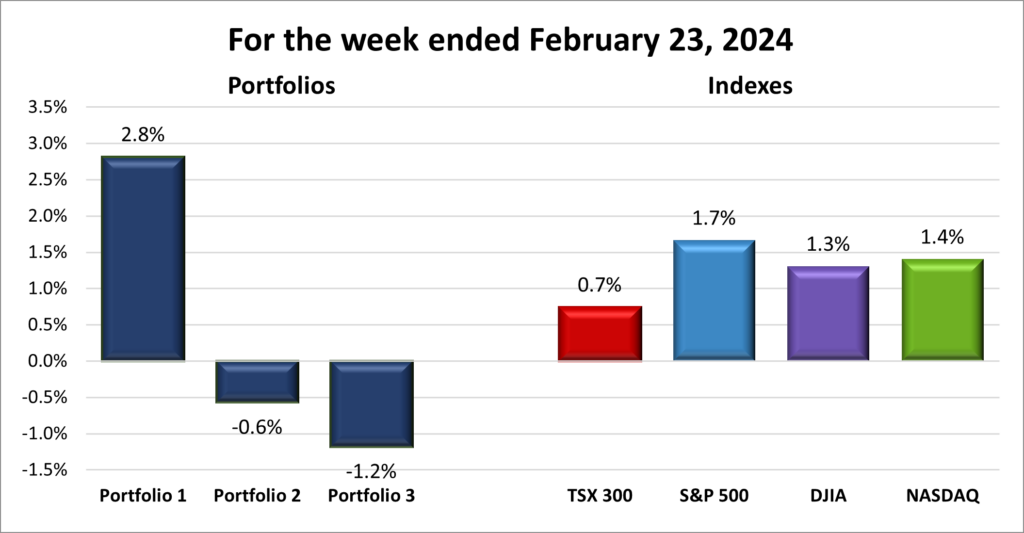
Bull market. A good week for the North American stock markets. Overall, the portfolios had another good week, as shown in the chart below. While I would have liked to have seen Portfolio 2 join the other two portfolios in positive territory, Portfolio 1 led the pack this week, even doubling the Nasdaq, the best performing index.

Portfolio 1 was driven higher by significant (more than 10%) gains in a wide variety of companies, including Magnite (NASD: MGNI) up 31%, %, Nano-X Imaging (NASD: NNOX) up 24%, Celsius Holdings (NASD: CELH) up 23%, indie Semiconductor (NASD: INDI) up 15%, Sea Limited (NYSE: SE) up 13%, and Rivian Automotive (NASD: RIVN) was up 12%. Another positive was that Portfolio 1 did not experience any significant share price drops this past week.

Portfolio 2 essentially broke even this past week. However, upon closer inspection the portfolio was down 0.004% this past week, stretching its weekly losing streak to 3 weeks. Although Canadian Natural Resources (TSE: CNQ) posted an 11% increase, it wasn’t enough to offset small losses elsewhere.

Portfolio 3 also had a good week, though not as impressive as Portfolio 1. The portfolio was lifted by notable gains in Lithium Americas (Argentina) (TSE: LAAC) up 26% and Lithium Americas (TSE: LAC) up 32%. It is encouraging to see that both lithium producers finally reversed the downward trend they had experienced in recent weeks.

Looking ahead to next week, I hope to see the markets maintain their upward trajectory, with all three portfolios ending on a high note. Onward and upward! 😊

Weekly Portfolio & Index performance
Weekly Portfolio & Index performance for the week ended March 1, 2024.

Monthly Market and Portfolio Review

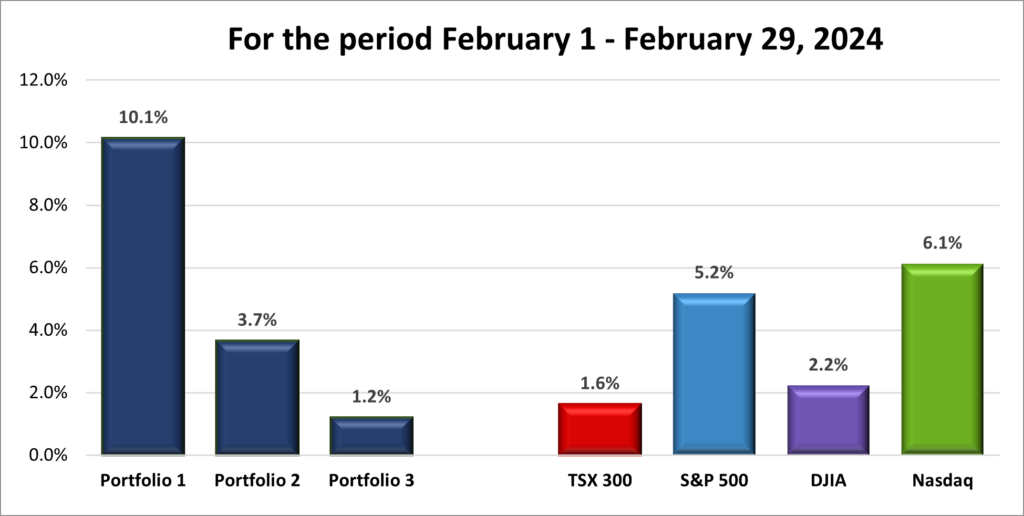
For February, the TSX (SPTSX) rose 1.6%, the S&P 500 (SPX) advanced 5.2%, the DJIA (INDU) gained 2.2% and the Nasdaq (CCMP) surged 6.1%.


Bull market. A good week for the North American stock markets. February marked another strong month for the four major indexes, underscoring the market’s continued upward momentum, as you can see in the chart above. The standout performance of Nvidia’s fourth quarter earnings report and the broader excitement around AI technologies have been pivotal, driving not just sector-specific gains but also influencing the broader market. This AI-led rally has notably benefited semiconductor companies and has been a key factor in the sustained growth of the indexes.

In addition to technological advancements, the corporate sector in both Canada and the US has shown resilience, with many companies beating fourth-quarter 2023 earnings expectations and providing cautiously optimistic future earnings forecasts. This has further buoyed investor confidence.

While initial hopes for a March interest rate cut in the US were tempered by unexpected inflation figures, Fed officials remain optimistic they will be able to start reducing rates within the year, potentially by June. Such adjustments would be beneficial for both consumers and investors, signaling a responsive approach to evolving economic conditions.

The positive earnings season, combined with strong investor interest in AI, has contributed to the fourth consecutive month of gains for the three American indexes (Nasdaq up 6.1%, S&P up 5.2%, the DJIA up 2.2%). Similarly, the TSX experienced fluctuations in commodity and energy prices but ultimately posted a monthly gain of 1.6%, extending its winning streak to its longest since 2021, fueled by the positive sentiment and performance of the US markets.

The alignment of technological advancements and strong corporate performance provides an encouraging start to the year, pointing towards a sustained upward trend in the markets. Hopefully, the markets can keep the monthly winning streaks going.

Bull market. A good week for the North American stock markets. February was not only a favourable month for the broader markets but also for my three portfolios, as illustrated in the chart below. Portfolio 1, riding a nine-week winning streak, had an exceptional month. This stellar performance was fueled by the significant appreciation of Nvidia’s share price and the growth of other tech companies, especially those in the AI sector.

Portfolio 2 also saw a strong performance, buoyed by a 15% increase in Disney shares. The cumulative gains from other holdings in the portfolio more than offset any losses, contributing to its overall success.

However, Portfolio 3’s performance was unexpectedly modest. Given its tech-heavy composition, I anticipated a performance similar to the Nasdaq’s surge. A closer examination pinpointed the main culprit: Shopify (TSE: SHOP), the portfolio’s largest holding, which underperformed in February, dampening the portfolio’s overall gains.

In February, the buoyant market mood lifted all my portfolios, albeit to varying degrees. Some experienced significantly more substantial gains, much to my delight. Hopefully, I will see more months of 10% gains for all three portfolios. 😊

Monthly Portfolio & Index performance
Monthly Portfolio & Index performance for February, 2024.

Companies on the Radar

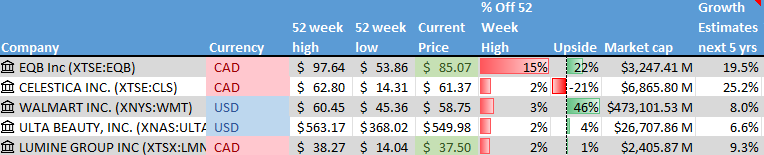
Stocks on my Radar No new companies came across my radar this past week, but I was able to trim the number of companies on my radar list. After adding Walmart (NYSE: WMT) to the radar list last week I decided I didn’t need two of what I consider defensive stocks. I feel Walmart has more upside than Macdonald’s (NYSE: MCD), so I’ve dropped the golden arches from my radar list. I also dropped Brown & Brown (NYSE: BRO) from the list. It appears to be a fine company, but I like the five remaining on the list better.

The five holdovers from last week are:

  • Equitable Bank (TSE: EQB), a mid sized Canadian bank that provides financial services to consumers and businesses.
  • Celestica Inc. (TSE: CLS), a medium sized Canadian company that manufactures electronic products and provides supply chain services to companies around the world.
  • Walmart: the large American global retail chain.
  • Ulta Beauty (NASD: ULTA), a major American beauty product retailer, with over 25,000 products from 600 brands.
  • Lumine Group (TSE: LMN), a young Canadian mid sized company that acquires communications and media software companies and then strengthens and grows those companies.

Please keep in mind that these are only companies that have piqued my interest. This is not a recommendation or financial advice. You should do your own research or contact a professional before making any investment decisions.

The Radar Check was last updated March 1, 2024.

Stock on the Radar List. 1 of 2.
Stock on the Radar List. 2 of 2.

Portfolio Update

Portfolio 1

Portfolio 1 for the week ended March 1, 2024: UP Green Up Arrow, signifying a positive week

  • Berkshire Hathaway’s (NYSE: BRK.B) power company PacifCorp (OTCM: PPWLO) faces the risk of a significant lawsuit over its alleged failure to cover the costs associated with a wildfire in northern California in 2020.
  • Amazon’s (NASD: AMZN) cloud computing unit Amazon Web Services plans to invest US$ 5 billion in Mexico over the next 15 years. The company plans to build data centres to enhance their cloud computing capabilities in the region.
  • A jury has recommended a US$ 12 million fine against Google for infringing on five internet voice calling patents belonging to Flyp, an app maker.
    In separate Google news, the company was slapped with a US$ 2.3 billion lawsuit by 32 media groups. The lawsuit claims the groups suffered financial losses because of Google’s digital advertising practices. It was not a good week on the legal front for Google.
  • Apple (NASD: AAPL) made a surprise announcement when they said they were cancelling their efforts to build an autonomous electric car. The company had been working on the project for almost a decade with almost 2,000 employees working on the project.
    In other Apple news, a touch of irony that European regulators forced Apple to open its in-app payment system to third parties. Now European government agencies have voiced concerns about the security risks associated with allowing third party payment systems onto Apple devices. Government regulators were not happy with Apple’s closed system, now federal agencies are not happy with the open systems.

Activity

Received interest on TD 1-year cashable GIC.

Dividends

Dividends Received this week for the following companies:

Companies followed by DRIP (Dividend Re-Investment Plan) indicate additional shares were purchased with the dividend. Any cash leftover was added to the cash balance.

Canadian $

No C$ dividends this past week.

US $

Visa Inc (NYSE: V)

Quarterly Reports

Cargojet Inc.

Fourth quarter 2023 financial results on February 26, 2024

Innovative Industrial Properties, Inc.

Fourth quarter 2023 financial results on February 26, 2024

Unity Software Inc.

Fourth quarter 2023 financial results on February 26, 2024

The Bank of Nova Scotia

First quarter 2024 financial results on February 27, 2024

Progeny, Inc.

Fourth quarter 2023 financial results on February 27, 2024

GDI Integrated Facility Services Inc.

Fourth quarter 2023 financial results on February 28, 2024

Magnite, Inc.

Fouth quarter 2023 financial results on February 28, 2024

TD Bank Group

First quarter 2024 financial results on February 29, 2024

Navitas Semiconductor Corporation

Fourth quarter 2023 financial results on February 29, 2024

Celsius Holdings, Inc.

Fourth quarter 2023 financial results on February 29, 2024

Portfolio 2

Portfolio 2 for the week ended March 1, 2024: Blue tilde, signifying break even or flat for the period.

  • Disney (NYSE: DIS) announced the merger of Disney’s streaming assets with Indian conglomerate Reliance Industries’ India TV to create a media juggernaut in India. Reliance will put in an additional US$ 1.4 billion into the merged entity, bringing its share of the company to 63%. Disney will own the remaining 37%. The Reliance/Disney unit will have 120 TV channels, two streaming channels, and the streaming rights to key cricket tournaments.
    In other Disney news, the grandchildren of founder Roy and Walt Disney have come out in support of Chief Executive Officer Bob Iger and the current Board of Directors in their battle with activist shareholders.
  • MongoDB (NASD: MDB) announced their Atlas cloud data platform was now available in six more cloud regions, including Canada, Germany, Israel, Italy, and Poland. This brings the availability of the company’s data platform to 117 cloud regions across the three most popular cloud services – Amazon Web Services (AWS), Google Cloud, and Microsoft Azure.
  • A survey done by Guardant Health (NASD: GH) showed doctors and patients strongly agreed that blood-based testing could help narrow the colorectal cancer screening gap between those who regularly take colorectal cancer screening tests and those who don’t by offering a “more pleasant and convenient option.”

Activity

No significant activity to report this week.

Dividends

Dividends Received this week for the following companies:

Companies followed by DRIP (Dividend Re-Investment Plan) indicate additional shares were purchased with the dividend. Any cash leftover was added to the cash balance.

Canadian $

Fortis Inc (TSE: FTS)

US $

No US$ dividends this past week.

Quarterly Reports

BNS

See report under Portfolio 1.

Canadian Natural Resources Limited

Fourth quarter 2023 financial results on February 29, 2024

Portfolio 3

Portfolio 3 for the week ended March 1, 2024: UP Green Up Arrow, signifying a positive week

  • Microsoft (NASD: MSFT), along with Amazon, is facing scrutiny in the European Union (EU) over their supposed domination of the European cloud computing market. Cloud computing rival Alphabet’s Google claims Microsoft is attempting to create a cloud computing monopoly, similar to what they had in desktop computing for a few years.
    In other Microsoft news, the company signed a deal with France’s Mistral AI to provide an alternate AI model to their existing OpenAI model that runs on the Microsoft Azure cloud platform. In exchange for the use of Mistral AI’s AI models, Microsoft made a US$ 16 million-dollar investment in the company. The deal with Mistral AI should provide some protection if European regulators go looking at Microsoft’s relationship with OpenAI.
  • Lithium Americas (Argentina) Corp. (TSE: LAAC) announced Sam Pigott as their next President and Chief Executive Officer (CEO), effective on March 18, 2024. John Kanellitsas, the current President and Interim CEO, as well as the Executive Chair of the Board of Directors, will continue in his role as Chair of the Board.
  • Alvopetro Energy (TSX: ALV) announced its proven reserves fell by 30% in 2023 due to technical difficulties at two if its wells.

Activity

No significant activity to report this week.

Dividends

Dividends Received this week for the following companies:

Companies followed by DRIP (Dividend Re-Investment Plan) indicate additional shares were purchased with the dividend. Any cash leftover was added to the cash balance.

Canadian $

Enghouse Systems Ltd (TSE: ENGH)

Royal Bank of Canada (TSE: RY)

US $

No US$ dividends this past week.

Quarterly Reports

Unity Software Inc.

See report under Portfolio 1.

Royal Bank of Canada

First quarter 2024 financial results on February 28, 2024

Magnite, Inc.

See report under Portfolio 1.

GDI Integrated Facility Services Inc.

See report under Portfolio 1.

TD Bank Group

See report under Portfolio 1.


Weekly Update for the week ending February 23, 2024

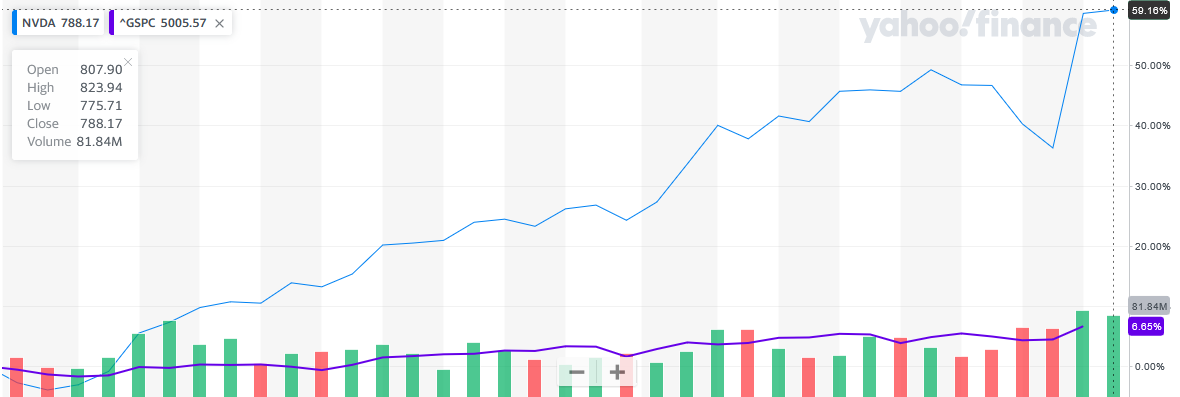
Nvidia (NASD: NVDA) had itself quite the week. Following an impressive earnings presentation, Nvidia not only surpassed revenue and net income forecasts but also offered future earnings guidance that exceeded analyst predictions. Consequently, Nvidia’s stock surged by 17% in just two days, reaching a new all-time high and increasing its market value by about $277 billion. This was the largest single-session market value gain in history. At one point, Nvidia’s valuation briefly exceeded $2 trillion, before settling just under the $2 trillion mark. This made it the third largest company by market capitalization, surpassing giants like Alphabet (NASD: GOOGL) and Amazon (NASD: AMZN).

This performance not only cements Nvidia’s status as a stock market favorite, with a 60% increase since the year began, as shown in the chart below, but also highlights the broad market enthusiasm for artificial intelligence (AI). Nvidia’s latest earnings underscore the massive demand for AI chips, as companies eager to expand their AI capabilities and catch the AI tailwind turn to Nvidia to supply the advanced chips required to run AI applications. This trend is lifting almost every company associated with AI, confirming the sector’s vibrant growth potential.

Nvidia's share price has surged almost 60% since the start of 2024.
Year to date growth of Nvidia compared to the S&P 500.

Nvidia was the principal driver of the markets this past week, but let’s see what else moved the markets this past week….

Items that may only interest or educate me ….

Canadian Economic news, American Economic news, What is Beta?, Changes ….


Canadian Economic news

This past week’s key economic data that the Bank of Canada (BoC) considers when deciding whether to raise or lower the interest rate.

Consumer Price Index

Canada’s January inflation rate, as indicated by the Consumer Price Index (CPI), dropped unexpectedly to below 3%, marking the first decline in seven months. With a rise of just 2.9% year-over-year, according to Statistics Canada, this slowdown from December’s 3.4% increase was below the anticipated 3.2% growth. On a monthly basis, inflation was unchanged in January after falling 0.3% the previous month.

Annually, the biggest increase was in the cost of ‘Shelter’ (rent and mortgages) which increased 6.2%, while the biggest decrease was in the ‘Gasoline,’ down 4.0%. Lower gas prices was the primary driver of the drop in CPI. Month over month, ‘Alcoholic beverages, tobacco products and recreational cannabis’ prices saw the biggest increase, up 1.1%, and the biggest decline was in ‘clothing and footwear,’ down 3.2%.

Core CPI, useful for identifying the underlying inflation trends, excludes volatile food and energy prices to offer a more stable view of inflation. This measure came in at 3.1% for the year, providing insight into the economy’s health beyond the temporary swings in food and energy costs. ‘Alcoholic beverages, tobacco products, and recreational cannabis’ had the largest annual increase within core CPI at 4.2%, while ‘Clothing and footwear’ experienced the biggest drop, decreasing by 1.3%. Month-to-month, core CPI declined slightly by 0.1% in January, indicating a stable inflationary environment when excluding these volatile categories.

This latest CPI report is a positive indicator for the central bank and the broader economy, as it brings inflation within the BoC’s target range of 1% – 3%, raising hopes for potential rate cuts. For consumers, this could translate to lower borrowing costs. For investors, it suggests that companies might have more funds for reinvestment or to return to shareholders through higher dividends and share buybacks, potentially boosting share prices. Although the next BoC meeting on March 6 is unlikely to change the current 5% rate, the door is open for adjustments in future meetings, with many eyes on June 5 as a possible date for a rate reduction.

Canadian market volatility

In Canada, the TSX 60 VIX, also known as Canada’s volatility index (VIXC) or ‘fear gauge,’ closed the week at 11.76, a slight increase from the previous week’s 10.46.

A rise in the VIXC suggests that investors are feeling a bit more nervous or uncertain about future market movements. It does not necessarily predict a downturn; it just means people are expecting stocks to be more erratic.

The VIXC gauges volatility within the Canadian stock markets, with readings above 20 generally viewed as ‘high’ and those below 20 as ‘low.’ The current reading of 11.76 sits on the lower end of the spectrum, indicating a prevailing sense of confidence among investors in the Canadian markets.

Retail sales

Statistics Canada reported a 0.9% increase in December retail sales, exceeding analysts’ expectations of 0.8%. This follows a 0.2% drop in November and reflects the typical holiday season boost. Core retail sales (excluding cars and gas) also grew by 0.5% in December, further highlighting mixed signals in the economy. However, it is too early to declare an economic rebound as preliminary January data shows a 0.4% decline, suggesting continued pressure from interest rates and inflation hovering around 3%.

US Economic news

This past week’s key data points that the Federal Reserve (Fed) considers when deciding whether to raise or lower the interest rate.

Federal Open Market Committee (FOMC) minutes

The Federal Reserve released the minutes from its January 30-31 monetary policy meeting this past week. The minutes indicated that Fed officials were primarily concerned about the risks of cutting rates too soon and remained uncertain about how long to keep interest rates at their current level of 5.5%.

Reviewing economic conditions, Fed members noted that foreign growth remained sluggish, domestic Gross Domestic Product (GDP) growth slowed in Q4 2023, and the labor market remained tight while showing signs of easing. Consumer inflation had declined significantly, with both Personal Consumption Expenditures (PCE) and core PCE falling well below previous year levels, but still exceeding the 2% target.

While acknowledging progress on lowering inflation, the Fed expressed concerns that ongoing economic growth could reignite inflationary pressures. They worried that the resilient economy was limiting the effectiveness of higher interest rates in bringing inflation down to their target. Fed officials indicated they would closely monitor incoming data to assess whether inflation was on a sustainable path towards 2%. Subsequent to the meeting, recent data has shown continued job market strength and persistent inflation.

Despite slightly raising their economic outlook, the Fed remained uncertain about the future. They were concerned that lowering rates prematurely could boost demand, potentially hindering the downward trend of inflation. They forecast PCE and core PCE to decline in 2024 and return to 2% by 2026.

The minutes reinforced comments subsequently made by Fed officials in separate speeches that the Fed saw no urgency in lowering the benchmark interest rate. This cautious stance aligns with subsequent comments from Fed officials, suggesting the Fed will not start rate cuts until their June meeting.

American market volatility

Wall Street’s ‘fear gauge,’ the CBOE Volatility Index (VIX), settled at 13.75 at the end of this week. While a decrease in the VIX to 13.75 from 14.24 is not a dramatic change, it is a sign that investors are slightly less worried about market volatility than they were previously. A lower VIX value suggests that investors are feeling more confident about the stability of the market and are less concerned about significant fluctuations in the near future.

What is Beta?

No, not the Greek letter B. 😊

In the world of investing, understanding risk is crucial. Beta can be used by investors as part of their analysis to understand the risk profile of a stock or other investment compared to the overall market. But beta can seem confusing, especially for new investors. I will try to explain it in simple terms to help you understand what beta means and how to use it in your investment decisions.

I like to think of the stock markets as a bit of a rollercoaster, so I will stick with that analogy for this discussion of beta. Imagine the stock market as a giant rollercoaster. Sometimes it climbs smoothly, offering steady returns (think of a scenic uphill climb). Other times, it plunges and dips dramatically, causing sharp losses (like a wild downhill drop). Beta tells you how closely an individual investment’s ride mirrors the overall market’s rollercoaster.

Here is a break down of what the different beta values mean:

  • Beta of 1: This means the investment moves roughly in line with the market. A 10% market increase translates to a similar 10% change in the investment’s value.
  • Beta greater than 1: This indicates the investment is more volatile than the market. It might rise faster during market upswings but also fall sharper in downturns.
  • Beta less than 1: This suggests the investment is less volatile than the market, offering potentially lower returns but also greater stability during market fluctuations.
  • Beta of 0: This means the investment’s returns are not perfectly correlated with the market, like government bonds.
  • Negative Beta: This is rare but indicates the investment moves opposite the market, like some inverse Exchange Traded Funds (ETFs) designed to profit when the market falls. However, negative beta also comes with its own risks, potentially underperforming during market upswings.

As well, beta can change over time, influenced by company performance, market conditions, and other factors.

If you are risk-averse, prioritizing investments with lower betas might be suitable strategy. On the other hand, if you tolerate higher risk for the potential of higher returns, consider investments with higher betas alongside lower-risk options for a diversified portfolio.

Changes to Weekly Update

In the Portfolio update section, under Quarterly Reports, revenue, net income/loss, and EPS information were included for each company’s quarterly reports. However, this lacked context and did not provide a comprehensive overview of the company’s performance.

Going forward, you will see the company name, the quarter being reported, and a link to the press release (if it contains the financial statements) or directly to the financial statements. This will allow you to gain a more complete understanding of the company’s operations beyond just the numbers.


Weekly Market Review

Monday: the Canadian markets were closed for Family Day and the American markets were closed for George Washington’s Birthday.

Tuesday: the markets started this short week off on a sour note with all four major North American indexes – the Toronto Stock Exchange Composite Index (TSX), the S&P 500 Index (S&P), the Dow Jones Industrial Average (DJIA), and the Nasdaq Composite Index (Nasdaq) – ending lower. This week, all eyes are on market darling Nvidia when it presents its quarterly earnings. If it misses its estimates, or provides forward guidance below analysts’ expectations, it could trigger a drop in the broader market, the technology sector in particular. Oil prices slipped lower on concerns of lower demand.

In Canada, the rate of inflation dropped more than anticipated, giving investors hope for a sooner rather than later rate cut. This good news was offset by concerns that US inflation has stalled, dashing hopes for an early rate cut. In trading, Telecommunications Services and Utilities advanced the most, while Technology and Industrials declined the most.

In the US, this week in earnings its time for many of America’s biggest retailers to show their quarterly earnings. Walmart (NYSE: WMT) got the ball rolling by beating expectations and forecast sales higher than expected. In trading, Consumer Staples and Telecommunications Services gained the most, while Technology and Basic Materials (miners and fertilizer manufacturers) dropped the most.

Wednesday: it appeared all four indexes would end in the red after minutes from the Fed’s last meeting indicated the bank was committed to not lowering the interest rate too early. However, a late rally in anticipation of Nvidia’s earnings reports lifted the S&P and DJIA into the green. Oil prices edged higher on Middle East supply concerns.

In Canada, the TSX was dragged lower by the interest sensitive Technology companies that were negatively impacted by the news the Fed was concerned about lowering the rate too soon. In trading, Energy and Consumer Cyclicals performed the best while Technology and Financials were the biggest losers.

In the USA, in aftermarket trading Nvidia did not disappoint. Revenues and earnings beat analysts estimates. As well, the company’s forecast for current quarter revenue was higher than analysts estimated. Nvidia’s share price soared, along with other AI related companies. At the end of the regular trading session, Energy and Utilities posted the biggest daily gains while Technology and Financials were the only American sectors to end lower.

Thursday: following on the heels of Nvidia’s blow out earnings report yesterday, all four indexes ended firmly in the green today. The amazing earnings report was a result of the demand for AI chips and reassured investors that the demand for AI remained strong. The upbeat mood spread throughout the North American markets, lifting markets around the world as well. Oil prices dipped after a build up of US crude oil inventories.

In Canada, the rally in technology companies in the US spread to Canadian technology companies, helping lift the TSX to a 22-month high. In trading, Consumer Staples and Industrials posted the biggest gains, while Basic Materials and Telecommunications Services were the only sector to fall back.

In America, the S&P and the DJIA closed at all time highs, with the Nasdaq just short of an all time high. The smaller sibling of the Nasdaq, the Nasdaq 100, gained 3% to close at a record high. The last time that occurred was in March 2000. Powered by Nvidia and other AI associated technology companies, the Technology sector was the big winner, followed by Consumer Cyclicals. The Utilities and Telecommunications Sectors were the only sector to end lower.

Friday: the markets ended the day mixed as the AI rally started to lose momentum in afternoon trading, causing the Nasdaq to sink into the red. Oil prices dropped after the Fed signalled it would be at least two more months before the interest rate might start to drop.

In Canada, the rally in technology companies helped the TSX overcome the drag of slumping oil companies as the TSX closed at its highest point since April 2022. In trading, Technology and Basic Materials were the top performers in the Canadian sectors, while the Utilities and Energy sectors dropped the most.

In the US, investors appeared to lock in some of the gains after the 2-day AI inspired rally. Once again, the S&P and DJIA both set new closing highs. In trading, Industrials and Utilities posted the biggest gains of the American sectors, while the Energy and Technology sectors suffered the biggest losses.


Weekly Market and Portfolio Review

For the week, the TSX (SPTSX) rose 0.7%, the S&P 500 (SPX) surged 1.7%, the DJIA (INDU) added 1.3% and the Nasdaq (CCMP) gained 1.4%.

Index Weekly Streak
TSX: 2-week winning streak
S&P: 1-week winning streak
DJIA: 1-week winning streak
Nasdaq: 1-week winning streak

Bull market. A good week for the North American stock markets. Looking at the chart above, it’s evident the four major North American indexes had a rocky start this week, each closing below the bar on Wednesday. This downtrend was triggered by the release of the minutes from the latest FOMC meeting and comments from Fed officials that suggested the Fed saw “no need to rush” rate cuts, dampening hopes for an early interest rate cut. However, the market sentiment shifted dramatically after Nvidia announced its fourth-quarter earnings post-market closure. The company’s stellar report and optimistic forecast ignited a rally, propelling all four indexes into positive territory by week’s end.

Nvidia’s earnings not only exceeded expectations but also confirmed a burgeoning demand for AI chips among technology companies, fuelling a surge in technology stocks. This excitement drove the S&P and DJIA to new highs, with the Nasdaq nearing its record peak. Turning to Canada, the rally extended to the TSX, influenced by Nvidia’s ripple effect. However, the gains were not as large as its American neighbors because the Canadian technology sector is a much smaller component of the TSX (5.4%) than the American technology sector is in the S&P, DJIA, and Nasdaq (27.6%, 17.6%, and 48.4%, respectively).

This week, Nvidia was the star, single-handedly boosting the markets with its success. While Nvidia’s big win shines a light on the exciting possibilities in AI, I am hoping this excitement spreads beyond the technology sector and leads to broad rally across the entire market.

Portfolio Weekly Streak
Portfolio 1: 8-week winning streak
Portfolio 2: 2-week losing streak
Portfolio 3: 2-week losing streak

Bull market. A good week for the North American stock markets. Bearish marketDespite a strong performance from all four major indexes this week, the three portfolios experienced mixed results, as you can see in the chart below. Portfolio 1 managed to overcome significant losses, thanks to a stellar performance by Nvidia, while Portfolios 2 and 3 saw overall declines, hampered by a few underperformers and the absence of offsetting gains.

Portfolio 1 experienced significant declines in several holdings, including Rivian (NASD: RIVN) down 38%, Teladoc Health (NYSE: TDOC) down 31%, Global-E Online (NASD: GLBE) down 19%, indie Semiconductor (NASD: INDI) down 19%, and Navitas (NASD: NVTS) down 14%. Docebo (TSE: DCBO) was the lone company to register a significant gain this past week, up 16%. However, Nvidia’s impressive 7% gain this week, as the portfolio’s largest holding, significantly offset these losses, demonstrating the influence a single stock can have on overall portfolio performance.

Unfortunately, Portfolio 2 did not have a Nvidia-like savior. It suffered notable declines, particularly with Supremex (TSE: SXP) down 14% and Guardant Health (NASD: GH) down 10%, without any significant gains to counterbalance these losses.

Much like Nvidia’s impact on Portfolio 1, Shopify’s (TSE: SHOP), movement tends to dictate the direction for Portfolio 3. Despite no dramatic declines, a slight downturn in Shopify, alongside minor losses across technology holdings, contributed to an overall decrease in portfolio value this week.

The Nvidia-induced rally was the highlight of the week. This week’s performance underscores the significant impact individual stocks can have on one’s portfolio. That is why its important to have a diversified portfolio. Looking forward, I am hoping the rally continues, obviously, but for it to broaden beyond the technology sector. A broad-based rally is much more sustainable than a narrow rally, especially when it is only one company driving the surge. Here is to all three portfolios posting weekly gains once again soon. 😊

Weekly Portfolio & Index performance
Weekly Portfolio & Index performance for the week ended February 23, 2024.

Companies on the Radar

Stocks on my Radar Walmart originally caught my eye in September 2023, but it was not quite the right fit for my investment strategy at the time. That changed this week with Walmart’s acquisition of Vizio (NYSE: VZIO), pulling the retail giant back into my focus. This strategic move transforms Walmart from a traditional, low-growth consumer staples company into a potential powerhouse in the streaming and e-commerce sectors. By acquiring Vizio, Walmart not only enters the digital advertising industry but also positions itself to boost growth through ecommerce. Analysts have suggested Walmart intends to compete against Amazon in the online retail industry, indicating a possible shift towards a growth-oriented strategy. This makes it an interesting time to consider a stake in Walmart. 😊

Walmart joins the six holdovers from last week:

  • Equitable Bank (TSE: EQB), a mid sized Canadian bank that provides financial services to consumers and businesses.
  • McDonald’s (NYSE: MCD), the large sized American global fast-food chain.
  • Ulta Beauty (NASD: ULTA), a major American beauty product retailer, with over 25,000 products from 600 brands.
  • Celestica Inc. (TSE: CLS), a medium sized Canadian company that manufactures electronic products and provides supply chain services to companies around the world.
  • Brown & Brown (NYSE: BRO), a major American firm, specializing in insurance and reinsurance products and services to a wide range of clients around the world.
  • Lumine Group (TSE: LMN), a young Canadian mid sized company that acquires communications and media software companies and then strengthens and grows those companies.

Please keep in mind that these are only companies that have piqued my interest. This is not a recommendation or financial advice. You should do your own research or contact a professional before making any investment decisions.

The Radar Check was last updated February 23, 2024.

Stock on the Radar List. 1 of 2.
Stock on the Radar List. 2 of 2.

Portfolio Update

Portfolio 1

Portfolio 1 for the week ended February 23, 2024: UP Green Up Arrow, signifying a positive week

  • In an effort to attract more AI developers, Alphabet’s Google is making its AI models available to outside developers. These AI models will be free of charge as Alphabet hopes to encourage developers to utilize Google’s cloud services and Google technology.
  • Apple (NASD: AAPL) is upgrading its iMessage messaging platform to protect against iMessage hacking.
  • Nvidia had a knockout earnings report that lifted global markets. Nvidia reported demand for their specialized AI chips continued to outpace their production capabilities.
  • Unlike Nvidia, Rivian Automotive (NASD: RIVN) did the opposite and fell to an all time low after the company indicated growth would be flat for the rest of the year. Higher interest rates and slowing demand for electric vehicles (EVs) were the cause guidance provided by the company.
  • General Motors (NYSE: GM) announced their Cruise self driving vehicle unit was preparing to resume testing their robotaxis. Initially the vehicles will be manually driven and supervised, graduating to self driven after rebuilding “trust with regulators and the public.”

Activity

Sold: Roku (NASD: ROKU) Roku thrived as streaming surged during the pandemic. However, with the sector’s growth stabilizing in the post-pandemic landscape, Roku is encountering mounting challenges. These include the necessity for price reductions to maintain market share, a downturn in advertising revenue, and stiff competition from industry titans such as Apple and Amazon. Further complicating Roku’s position is Walmart’s recent acquisition of Vizio, introducing a powerful new competitor to the streaming platform. With Walmart expected to shift its focus and potentially its in-house product’s operating systems to Vizio and away from Roku, the company’s challenges are likely to intensify. Given these headwinds, and in line with my strategy to streamline the portfolio by focusing on fewer, more promising investments, I have decided to divest from Roku.

Dividends

Dividends Received this week for the following companies:

Companies followed by DRIP (Dividend Re-Investment Plan) indicate additional shares were purchased with the dividend. Any cash leftover was added to the cash balance.

No dividends this past week.

Quarterly Reports

Home Depot, Inc.

Fourth quarter 2024 financial results on February 20, 2024

Rivian Automotive, Inc.

Fourth quarter 2023 financial results on February 21, 2024

Nvidia Corporation

Fourth quarter 2024 financial results on February 21, 2024

Global-E Online Ltd.

Fourth quarter 2023 financial results on February 21, 2024

kneat.com, inc.

Fourth quarter 2023 financial results on February 21, 2024

indie Semiconductor, Inc.

Fourth quarter 2023 financial results on February 22, 2024

Docebo Inc.

Fourth quarter 2023 financial results on February 23, 2024

Berkshire Hathaway Inc.

Fourth quarter 2023 financial results on February 23, 2024

Portfolio 2

Portfolio 2 for the week ended February 23, 2024: DOWN Red Down Arrow

No significant news to report this week.

Activity

No significant activity to report this week.

Dividends

Dividends Received this week for the following companies:

Companies followed by DRIP (Dividend Re-Investment Plan) indicate additional shares were purchased with the dividend. Any cash leftover was added to the cash balance.

Canadian $

Dream Industrial Real Estate Investment Trust (TSE: DIR.UN) DRIP

US $

No US$ dividends this past week.

Quarterly Reports

Kneat.com

See report under Portfolio 1.

iA Financial Corporation Inc.

Fourth quarter 2023 financial results on February 21, 2024

Supremex Inc.

Fourth quarter 2023 financial results on February 22, 2024

Chorus Aviation Inc.

Fourth quarter 2023 financial results on February 22, 2024

Guardant Health, Inc.

Fourth quarter 2023 financial results on February 23, 2024

Portfolio 3

Portfolio 3 for the week ended February 23, 2024: DOWN Red Down Arrow

Activity

No significant activity to report this week.

Dividends

Dividends Received this week for the following companies:

Companies followed by DRIP (Dividend Re-Investment Plan) indicate additional shares were purchased with the dividend. Any cash leftover was added to the cash balance.

No dividends this past week.

Quarterly Reports

Kneat.com

See report under Portfolio 1.


Weekly Update for the week ending February 16, 2024

The past six months have been a rollercoaster ride for investors as expectations regarding the Federal Reserve’s (Fed) interest rate policy shifted gears. Initially, investors and analysts were talking about the Fed maintaining the rate at 5.5% for a while, only to switch towards discussions of potential rate cuts early in 2024. However, recent inflation numbers have brought us back to the “higher for longer” sentiment. The consensus now leans towards the Fed holding steady at the current 5.5% rate for a bit longer than anticipated. Investors are now reconsidering their expectations, eyeing June as the potential window for when the Fed might begin to lower rates.

Let’s take a look at the economic news of the past week and see how it impacted the Canadian and American stock markets as well as the three portfolios ….

Items that may only interest or educate me ….

Canadian Economic news, US Economic news, Bad breath….


Canadian Economic news

This past week’s key economic data that the Bank of Canada (BoC) considers when deciding whether to raise or lower the interest rate.

Canadian market volatility

In Canada, the TSX 60 VIX, also known as Canada’s volatility index (VIXC) or ‘fear gauge,’ reflects the mood of Canadian stock markets. This week, the VIXC experienced a midweek spike to 13.33 following the release of American inflation data, before tapering off to end the week at 10.46, a slight decrease from the previous week’s 11.05.

The VIXC gauges volatility within the Canadian stock markets, with readings above 20 generally viewed as ‘high’ and those below 20 as ‘low.’ The current reading of 10.46 sits on the lower end of the spectrum, indicating a prevailing sense of confidence among investors in the Canadian markets.

US Economic news

This past week’s key data points that the Federal Reserve (Fed) considers when deciding whether to raise or lower the interest rate.

Consumer Price Index (CPI)

The Labor Department’s January CPI report revealed that inflation increased by 0.3% in January, following a 0.2% rise in December. Annually, the CPI rose by 3.1%, a slight deceleration from the 3.4% increase observed in December. Despite the January monthly inflation rate being the lowest since June 2023, they both exceeded analysts’ predictions of a 0.2% monthly and a 2.9% yearly increase.

Taking a closer look, the core CPI, which strips out the volatile costs of food and energy, climbed by 0.4% in January, up slightly from a 0.3% increase from December. On an annual basis, core CPI rose by 3.9% in January. Both numbers exceeded analyst predictions for a 0.3% monthly and 3.7% yearly increase.

Breaking down the details, the most significant monthly price hike was observed in the ‘Utility gas services’ subsector, which jumped by 2.0%. Conversely, ‘Fuel oil’ prices saw the biggest decline, dropping by 4.5%. Excluding the food and energy sectors, the ‘Transportation services’ subsector experienced the highest price increase at 1.0%, while ‘Used cars and trucks’ saw the largest drop, falling by 3.4%.

Looking at the year-over-year changes, ‘Transportation services’ prices surged by 9.5%, making it the subsector with the highest increase, whereas ‘Utility gas service’ prices plummeted by 17.8%. In the core CPI category, ‘Transportation services’ also led the annual price increases, and ‘Used cars and trucks’ recorded the most notable decrease at 3.5%.

The higher-than-anticipated inflation data all but eliminates the chances of the Fed lowering interest rates in their upcoming March meeting, contrary to investors’ hopes for easing inflation figures. This unexpected development led to all four indexes ending sharply lower the day of the news release.

In the days following the report, investors digested the inflation data and were buoyed by a Fed official’s reassurance that the recent data does not disrupt the overall downward inflation trend or the prospect of a soft landing for the US economy. This perspective, suggesting rate cuts are on the horizon—albeit later than hoped—revived investor confidence, propelling stock indexes upward once more.

With a March rate cut now seeming improbable, attention shifts to the Fed’s meeting on April 30 – May 1. Analysts and investors are uncertain about a rate cut in this session unless data between now and then indicates a significant drop in inflation. Expectations are now set on the possibility of the Fed commencing rate reductions at their June 11 – 12 meeting.

However, the question remains: Is this recent inflation data merely a hiccup on the path to lower inflation, or a sign of persistently high inflation? Hopefully, the February CPI report will provide some clarity.

Retail Sales

The Commerce Department’s advanced retail sales data for January indicated a 0.8% decline, marking the most significant month-over-month decrease since March 2023. This downturn comes after a revised 0.4% increase in December. When automobiles are excluded, retail sales dropped by 0.6% in January, a reversal from the 0.4% rise in the preceding month. These figures fell short of analyst expectations, which predicted a modest 0.1% decrease in overall retail sales and a 0.2% increase when excluding automobiles. On an annual basis, retail sales saw a modest increase of 0.6% since January 2023, with a 1.2% rise when vehicle sales are excluded.

The decline in sales could indicate a weakening in the resilience of American consumers, traditionally a cornerstone of the US economy’s strength. This slowdown in consumer spending supports the Fed’s inflation control efforts, as reduced spending can ease inflationary pressures. Consequently, the lower-than-expected retail sales figures may alleviate some of the concerns of the previously reported higher-than-expected CPI data (see the CPI summary above), suggesting higher prices which put upward pressure on inflation. With consumer spending on the decline, the Fed might be less concerned about economic activity reigniting inflation, which is encouraging news for those anticipating a decrease in interest rates.

American market volatility

Following the release of the CPI data this past Tuesday, Wall Street’s ‘fear gauge,’ the CBOE Volatility Index (VIX), spiked to 17.90 – its highest level since November – before settling at 14.24 at week’s end. This increase from last week’s 12.93 reflects investors concerns about the higher inflation data reported in January. However, the current reading remains well below its long-term average of 20, indicating that investors anticipate significantly less volatility in the weeks ahead compared to historical trends. This week is a good example of how the VIX can fluctuate wildly, even on a daily basis.

Consumer Sentiment Index (CSI)

The University of Michigan’s preliminary consumer sentiment index for February edged up to 79.6, a slight increase from January’s figure of 79.0 but below analysts’ expectations of 80. Year-over-year, the index has surged 19.0%, reflecting a significant rebound in consumer confidence since February 2023.

This preliminary reading is the highest level of consumer sentiment since July 2021. Several factors contribute to this boost in consumer confidence: a deceleration in the pace of inflation, and despite higher interest rates the economy continued to grow and the labour market remains strong. Further bolstering consumer optimism are the rising stock markets, falling gas prices, and the anticipation of lower interest rates later this year. However, despite these positive developments, the CSI remains below its pre-pandemic levels, which often hovered around the 100 mark.

The final CSI reading for February will come at the end of the month.

Bad breath

Last week, while talking about the ‘Magnificent 7,’ I stumbled upon an intriguing investing term: ‘bad breath.’ This term is used to describe a market scenario where a narrow rally occurs, meaning the indexes are driven higher by a small number of companies. This phenomenon has been particularly evident in 2024, as the ‘Magnificent 7‘ has shrunk to the ‘Fantastic 4,’ exacerbating the ‘bad breadth’ condition in the US market. The main American indexes are reaching new heights, propelled almost exclusively by these few tech giants.

In investment circles, ‘bad breath’ signifies a market condition where the gains of major stock indexes are disproportionately due to the performance of a select few stocks, rather than a broad-based advance across many sectors. This narrow rally can obscure underlying weaknesses in the broader market, creating a misleading appearance of overall health. Such conditions are scrutinized for their potential to indicate less robust market strength and suggest that without broader participation, the rally’s sustainability is in question.


Weekly Market Review

Monday: the momentum from last week that saw the S&P 500 Index (S&P) close over 5000 for the first time did not carry over to the start of this week. The markets ended the day split, with the more value-oriented Toronto Stock Exchange Composite Index (TSX) and the Dow Jones Industrial Average (DJIA) ending higher, while the more growth-oriented S&P and the Nasdaq Composite Index (Nasdaq) ended lower. On tap this week are more quarterly reports and tomorrow’s US CPI report to see if inflation continued to fall in January. Investors will be looking for clues to when the Fed may start lowering the interest rate.

In Canada, the TSX rose to a 10 day high as investors await the latest US inflation report and signs of future rate cuts. In trading, Energy and Consumer Cyclicals posted the biggest gains, while Technology, Healthcare, and Industrials were the only Canadian sectors to end lower.

In the US, the DJIA set another record close while the Nasdaq briefly surpassed its highest point since November 2021 before sliding back down. In trading in the American sectors, it was a day of broad-based gains, led by the Utilities and Energy sectors. Technology was the only sector to slip.

Tuesday: the indexes stumbled following the latest American CPI report that showed inflation for January was higher than expected. The markets do not like surprises, especially when its bad news like this. As a result, all four indexes ended deeply in the red. Oil prices continued to climb due to supply uncertainties in the Middel East.

In Canada, the TSX had its biggest single day decline since September 2022 because of the inflation news out of the US. In trading, no sector escaped ending in the red. Industrials and Consumer Staples slipped the least while Technology and Basic Materials (miners and fertilizer manufacturers) dropped the most.

In the USA, it was not a good day for the American indexes as all three dropped by more than 1%. The S&P dropped back below the 5,000 mark, while the DJIA had its worst day since March 2022. No sector was safe from the sell off today. Telecommunications Services and Consumer Staples declined the least, while Basic Materials and Financials sank the farthest.

Wednesday: following yesterday’s plunge, the markets rebounded after a Fed official said a few high inflation readings would not shake his belief that inflation is still heading downward towards the Fed’s 2% target. Oil prices sunk as American inventories of crude oil piled up.

In Canada, the TSX was able to recoup much of yesterday’s losses as all Canadian sectors finished in the green. Leading the way were the Technology and Industrials sectors, with Energy and Telecommunications Services bringing up the rear.

In the US, the three American indexes bounced back as well, led by the Technology and Industrials sectors, while Energy and Consumer Staples were the only sectors to end in the red.

Thursday: the markets continued yesterday’s upward momentum with all four indexes ending firmly higher. The latest US retail sales data came in lower than expected, giving investors hope US interest rates might drop sooner than later.

In Canada, the TSX posted its highest gain in over two months thanks to higher commodity prices. The TSX closed today higher than it was before Tuesday’s plunge. All Canadian sectors ended higher with Energy and Technology recording the biggest increase, while Consumer Cyclicals and Telecommunications Services posted the smallest increases.

In the US, preliminary retail sales numbers came in lower than expected raising questions about a slowing economy. The S&P hit a new record high, recovering the losses incurred by the market plunge on Tuesday. In trading, all American sectors ended the day in the green, led by Energy and Financials, with Technology and Consumer Staples trailing the pack.

Friday: It was a mixed day for the indexes with the TSX the only index to end higher. The latest report on US wholesale prices came in higher than expected. The combination of higher consumer prices in the earlier CPI report and now higher wholesale prices has investors worried the Fed will delay lowering the US interest rate. Oil prices rose, after the International Energy Agency warned of slowing demand.

In Canada, higher commodity prices helped push the TSX to its highest point in almost two years. In trading on Bay Street, Telecommunications Services and Basic Materials posted the biggest gains, while the growth-oriented sectors Technology and Consumer Cyclicals were the only sectors in the red.

In the US, the PPI report indicated wholesale prices rose 0.3%, the highest rate of increase in five months. Core wholesale prices, which exclude the volatile food, energy, and trade margins, rose 0.6%, the fastest growth since January 2023. As well, two Fed officials said they wanted to see more evidence inflation was falling but were open to lowering rates at some point this year. In trading on Wall Street, Basic Materials, Healthcare and Energy were the only sectors to end higher. The Technology and Industrials sectors suffered the biggest declines.


Weekly Market and Portfolio Review

For the week, the TSX (SPTSX) rose 1.2%, the S&P 500 (SPX) slipped 0.4%, the DJIA (INDU) declined 0.1% and the Nasdaq (CCMP) fell 1.3%.

Index Weekly Streak
TSX: 1-week winning streak
S&P: 1-week losing streak
DJIA: 1-week losing streak
Nasdaq: 1-week losing streak

Bearish market

It was quite the rollercoaster ride for major North American stock indexes this past week, particularly after two key inflation reports in the US—the Consumer Price Index (CPI) and the Producer Price Index (PPI)—came in higher than expected. Investors, who had been hopeful that falling inflation might pave the way for interest rate cuts, received a reality check. Higher-than-anticipated inflation figures, coupled with hawkish comments from Fed officials indicating there was “more work to do” on inflation, dampened hopes for an imminent easing of interest rates. This led to a weekly decline in the three American indexes, as shown in the chart above.

After a steady buildup in the markets leading up to the CPI announcement, a sharp sell-off occurred on Tuesday. However, markets began their uphill climb the next day, with the DJIA and the S&P setting new all-time highs, only to retreat again following the PPI report Friday morning. The Nasdaq was hit hardest, as the prospect of higher interest rates raises borrowing costs, particularly affecting technology companies that depend on external financing for growth.

In contrast, the TSX outperformed its American counterparts, buoyed by rising energy (oil and natural gas) and commodity (gold and minerals) prices, sectors in which the TSX is heavily invested.

Despite the setbacks from higher inflation data and Fed officials’ hawkish coments, the overall market rally remained relatively resilient. However, we wont know if the markets will rebound or continue to pullback until next week. Looking ahead, I am hopeful that a strong earnings report from Nvidia could reignite the market’s upward trajectory. 😊

Portfolio Weekly Streak
Portfolio 1: 7-week winning streak
Portfolio 2: 1-week losing streak
Portfolio 3: 1-week losing streak

Bearish market With three of the four indexes down for the week, I was pleasantly surprised to see one of the three portfolios managed to buck the trend and post gains, as illustrated in the chart below. Under the circumstances, Portfolio 1 saw an impressive uptick, thanks primarily to substantial gains in The Trade Desk (NASD: TTD), which surged by 24%, and Nano-X Imaging (NASD: NNOX), which skyrocketed by an astonishing 123%. This leap came on the heels of Nvidia (NASD: NVDA) disclosing its investment in Nano-X. While most holdings in this portfolio experienced slight increases or decreases this past week, Roku (NASD: ROKU) suffered a sharp 25% decline. The company’s warning of “weak” future growth amidst rising competition in the streaming sector led to this significant drop.

Portfolio 2 presented a bit of a puzzle. Despite the lack of major losses, the portfolio didn’t fare as well overall. This could be attributed to smaller declines across a broader range of stocks, overshadowing the notable gains in MongoDB (NASD: MDB) and Disney (NYSE: DIS), which were up 16% and 23%, respectively.

Finally, Portfolio 3’s decline was more straightforward to pinpoint. Shopify (TSE: SHOP), which comprises 22% of the portfolio, saw its share price tumble by 12.5% following a revenue growth forecast that fell short of analyst expectations. Though it recouped some of its losses to close the week down by 10%, the impact was significant. That said, not all was gloomy for Portfolio 3, with Telus International (TSE: TIXT) and goeasy (TSE: GSY) posting gains of 20% and 13%, respectively, showcasing some positive movement amidst the challenges.

Weekly Portfolio & Index performance
Weekly Portfolio & Index performance for the week ended February 16, 2024.

Companies on the Radar

Stocks on my Radar Once again, no new companies came across my radar. The six holdovers from last week are:

  • Equitable Bank (TSE: EQB), a mid sized Canadian bank that provides financial services to consumers and businesses.
  • McDonald’s (NYSE: MCD), the large sized American global fast-food chain.
  • Ulta Beauty (NASD: ULTA), a major American beauty product retailer, with over 25,000 products from 600 brands.
  • Celestica Inc. (TSE: CLS), a medium sized Canadian company that manufactures electronic products and provides supply chain services to companies around the world.
  • Brown & Brown (NYSE: BRO), a major American firm, specializing in insurance and reinsurance products and services to a wide range of clients around the world.
  • Lumine Group (TSE: LMN), a young Canadian mid sized company that acquires communications and media software companies and then strengthens and grows those companies.

Please keep in mind that these are only companies that have piqued my interest. This is not a recommendation or financial advice. You should do your own research or contact a professional before making any investment decisions.

The Radar Check was last updated February 16, 2024.

Stock on the Radar List. 1 of 2.
Stock on the Radar List. 2 of 2.

Portfolio Update

Portfolio 1

Portfolio 1 for the week ended February 16, 2024: UP Green Up Arrow, signifying a positive week

  • Not to often that I come across good news that involves two companies in a single portfolio, but this week Celsius Holdings (NASD: CELH), makers of Celsius energy drinks, signed a global, multi year partnership with Ferrari (NYSE: RACE). Celsius will be the official energy drink of one of the most famous racing brands.
  • The European Union’s anti trust regulator, the European Commission, ruled service platforms provided by Apple (NASD: AAPL) and Microsoft (NASD: MSFT) should not be designated as ‘gatekeepers.’ This ruling saved both companies from onerous requirements.
  • Lightspeed Commerce (TSE: LSPD) announced founder and former Chief Executive Officer (CEO) Mr. Dax Dasilva would resume the CEO after the market seemed to lose confidence in the company and Mr. Dasilva’s successor. Despite significant growth in revenues, the share price has lost almost 45% in value since Mr. Dasilva first stepped away from the CEO position.
  • Alphabet’s (NASD: GOOGL) self driving vehicle unit Waymo issued a recall for 444 of its’ self driving cars due to two recent collisions. The accidents were a result of a software error that caused the cars to inaccurately predict the movement of vehicles being towed.
    Alphabet’s more well-known unit, Google, announced they would launch an anti-misinformation campaign across Belgium, France, Germany, Italy, and Poland. I suspect this campaign will make its way to North America in time for the US election in November. 😊
  • General Motors (NYSE: GM) signed a deal with Canadian mining company Nouveau Monde Graphite for a supply of refined graphite for use in its electric batteries. GM will invest $150 million with the miner in exchange for 18,000 tonnes per year of graphite.
    In other GM news, the hardware chief of the company’s Cruise unit resigned as part of the fallout of Cruise suspending operations following a traffic accident.

Activity

No significant activity to report this week.

Dividends

Dividends Received this week for the following companies:

Companies followed by DRIP (Dividend Re-Investment Plan) indicate additional shares were purchased with the dividend. Any cash leftover was added to the cash balance.

Canadian $

Dream Industrial Real Estate Investment Trust (TSE: DIR.UN)

Decisive Dividend Corp (TSE: DE)

US $

Apple Inc (NASD: AAPL)

BSR Real Estate Investment Trust (TSE: HOM.U)

Costco Wholesale Corp (NASD: COST)

Quarterly Reports

Lattice Semiconductor Corporation

All currency listed in thousands of US dollars, except for per share data.

Selected highlights from their fourth quarter 2023 financial results on February 12, 2024

  • Revenue of $170,596 for the three months ended December 30, compared to $175,960 for the same period ended December 31, 2022. A decrease of over 3%.
  • Net income of $98,706 for the three months ended December 30, compared to net income of $51,913 for the same period ended December 31, 2022.
  • Diluted earnings per ordinary share of $0.71 for the three months ended December 30, compared to earnings of $0.38 per share for the same period ended December 31, 2022.


  • Revenue of $737,154 for the year ended December 30, compared to $660,356 for the same period ended December 31, 2022. An increase of almost 12%.
  • Net earnings of $259,061 for the year ended December 30, compared to net earnings of $178,882 for the same period ended December 31, 2022.
  • Diluted earnings per ordinary share of $1.85 for the year ended December 30, compared to earnings of $1.27 per share for the same period ended December 31, 2022.

Datadog, Inc.

All currency listed in thousands of US dollars, except for per share data.

Selected highlights from their fourth quarter 2023 financial results on February 13, 2024

  • Revenue of $589,649 for the three months ended December 31, compared to $469,399 for the same period in 2022. An increase of almost 26%.
  • Net income of $53,993 for the three months ended December 31, compared to a net loss of $29,034 in the same period in 2022.
  • Diluted earnings per ordinary share of $0.15 for the three months ended December 31, compared to a loss of $0.09 per share for the same period in 2022.


  • Revenue of $2,128,359 for the year ended December 31, compared to $1,675,100 for the same period in 2021. An increase of over 27%.
  • Net earnings of $48,568 for the year ended December 31, compared to a net loss of $50,160 in the same period in 2021.
  • Diluted earnings per ordinary share of $0.14 for the year ended December 31, compared to a loss of $0.16 per share for the same period in 2021.

Dream Industrial Real Estate Investment Trust

All currency listed in thousands of Canadian dollars, except for per share data.

Selected highlights from their fourth quarter 2023 financial results on February 13, 2024

  • Revenue of $85,181 for the three months ended December 31, compared to $75,548 for the same period in 2022. An increase of almost 13%.
  • Net loss of $8,817 for the three months ended December 31, compared to a net loss of $34,147 in the same period in 2022.
  • Diluted funds from operations of $0.24 for the three months ended December 31, compared to $0.23 per share for the same period in 2022.


  • Revenue of $334,180 for the year ended December 31, compared to $281,587 for the same period in 2021. An increase of over 27%.
  • Net income of $104,299 for the year ended December 31, compared to net income of $705,885 in the same period in 2021.
  • Diluted funds from operations of $0.98 for the year ended December 31, compared to $0.89 per share for the same period in 2021.

The Trade Desk, Inc.

All currency listed in thousands of US dollars, except for per share data.

Selected highlights from their fourth quarter 2023 financial results on February 15, 2024

  • Revenue of $605,797 for the three months ended December 31, compared to $490,737 for the same period in 2022. An increase of over 23%.
  • Net income of $97,323 for the three months ended December 31, compared to net income of $71,187 in the same period in 2022.
  • Diluted earnings per ordinary share of $0.19 for the three months ended December 31, compared to earnings of $0.14 per share for the same period in 2022.


  • Revenue of $1,946,120 for the year ended December 31, compared to $1,577,795 for the same period in 2021. An increase of over 23%.
  • Net earnings of $178,940 for the year ended December 31, compared to net earnings of $53,385 in the same period in 2021.
  • Diluted earnings per ordinary share of $0.36 for the year ended December 31, compared to earnings of $0.11 per share for the same period in 2021.

Roku, Inc.

All currency listed in thousands of US dollars, except for per share data.

Selected highlights from their fourth quarter 2023 financial results on February 15, 2024

  • Revenue of $984,425 for the three months ended December 31, compared to $867,056 for the same period in 2022. An increase of almost 14%.
  • Net loss of $78,291 for the three months ended December 31, compared to a net loss of $237,197 in the same period in 2022.
  • Diluted loss per ordinary share of $0.55 for the three months ended December 31, compared to a loss of $1.70 per share for the same period in 2022.


  • Revenue of $3,484,619 for the year ended December 31, compared to $3,126,534 for the same period in 2021. An increase of over 11%.
  • Net loss of $709,561 for the year ended December 31, compared to a net loss of $498,005 in the same period in 2021.
  • Diluted loss per ordinary share of $5.01 for the year ended December 31, compared to a loss of $3.62 per share for the same period in 2021.

Portfolio 2

Portfolio 2 for the week ended February 16, 2024: DOWN Red Down Arrow

  • Bank of Nova Scotia’s (TSE: BNS) head of global banking is leaving the bank for Power Corporation (TSE: POW). This is the latest change of senior executives since new CEO Scott Thomson took over. The heads of Canadian banking, wealth management, and international banking have also left the company.

Activity

No significant activity to report this week.

Dividends

Dividends Received this week for the following companies:

Companies followed by DRIP (Dividend Re-Investment Plan) indicate additional shares were purchased with the dividend. Any cash leftover was added to the cash balance.

Canadian $

SmartCentres Real Estate Investment Trust (TSE: SRU.UN)

US $

No US$ dividends this past week.

Quarterly Reports

Airbnb, Inc.

All currency listed in millions of US dollars, except for per share data.

Selected highlights from their fourth quarter 2023 financial results on February 13, 2024

  • Revenue of $2,218 for the three months ended December 31, compared to $1,902 for the same period in 2022. An increase of almost 17%.
  • Net loss of $349 for the three months ended December 31, compared to net earnings of $319 in the same period in 2022.
  • Diluted loss per ordinary share of $0.55 for the three months ended December 31, compared to earnings of $0.48 per share for the same period in 2022.


  • Revenue of $9,917 for the year ended December 31, compared to $8,399 for the same period in 2022. An increase of over 18%.
  • Net earnings of $4,792 for the year ended December 31, compared to net earnings of $1,893 in the same period in 2022.
  • Diluted earnings per ordinary share of $7.24 for the year ended December 31, compared to earnings of $2.79 per share for the same period in 2022.

Dream Industrial Real Estate Investment Trust

See report under Portfolio 1.

TC Energy Corp.

All currency listed in millions of Canadian dollars, except for per share data.

Selected highlights from their fourth quarter 2023 financial results on February 16, 2024

  • Revenue of $4,236 for the three months ended December 31, compared to $4,041 for the same period in 2022. An increase of almost 5%.
  • Net income of $1,615 for the three months ended December 31, compared to a net loss of $1,416 in the same period in 2022.
  • Diluted earnings per ordinary share of $1.41 for the three months ended December 31, compared to a loss of $1.42 per share for the same period in 2022.


  • Revenue of $15,934 for the year ended December 31, compared to $14,977 for the same period in 2021. An increase of over 6%.
  • Net earnings of $3,068 for the year ended December 31, compared to net earnings of $785 in the same period in 2021.
  • Diluted earnings per ordinary share of $2.75 for the year ended December 31, compared to earnings of $0.64 per share for the same period in 2021.

Portfolio 3

Portfolio 3 for the week ended February 16, 2024: DOWN Red Down Arrow

  • Microsoft announced they plan to spend 3.2 billion euros in Germany over the next two years. The investment will go to build up its data centre infrastructure and artificial intelligence (AI) capabilities in Germany.

Activity

No significant activity to report this week.

Dividends

Dividends Received this week for the following companies:

Companies followed by DRIP (Dividend Re-Investment Plan) indicate additional shares were purchased with the dividend. Any cash leftover was added to the cash balance.

Canadian $

SmartCentres Real Estate Investment Trust (TSE: SRU.UN)

US $

No US$ dividends this past week.

Quarterly Reports

goeasy Ltd.

All currency listed in thousands of Canadian dollars, except for per share data.

Selected highlights from their fourth quarter 2023 financial results on February 13, 2024

  • Revenue of $338,112 for the three months ended December 31, compared to $273,326 for the same period in 2022. An increase of almost 24%.
  • Net income of $74,602 for the three months ended December 31, compared to net income of $28,576 in the same period in 2022.
  • Diluted earnings per ordinary share of $4.34 for the three months ended December 31, compared to earnings of $1.71 per share for the same period in 2022.


  • Revenue of $1,250,069 for the year ended December 31, compared to $1,019,336 for the same period in 2021. An increase of almost 23%.
  • Net earnings of $247,898 for the year ended December 31, compared to net earnings of $140,161 in the same period in 2021.
  • Diluted earnings per ordinary share of $14.48 for the year ended December 31, compared to earnings of $8.42 per share for the same period in 2021.

Shopify Inc.

All currency listed in millions of US dollars, except for per share data.

Selected highlights from their fourth quarter 2023 financial results on February 13, 2024

  • Revenue of $2,144 for the three months ended December 31, compared to $1,735 for the same period in 2022. An increase of almost 24%.
  • Net income of $657 for the three months ended December 31, compared to a net loss of $623 in the same period in 2022.
  • Diluted earnings per ordinary share of $0.51 for the three months ended December 31, compared to a loss of $0.49 per share for the same period in 2022.


  • Revenue of $7,060 for the year ended December 31, compared to $5,600 for the same period in 2021. An increase of over 26%.
  • Net earnings of $132 for the year ended December 31, compared to net earnings of $3,460 in the same period in 2021.
  • Diluted earnings per ordinary share of $0.10 for the year ended December 31, compared to a loss of $2.73 per share for the same period in 2021.


Weekly Update for the week ending February 9, 2024

This past week, with a lull in economic news, corporate earnings captured the spotlight – and they certainly delivered. Fueling investor optimism further were the revised US Consumer Price Index numbers for December, indicating lower inflation than initially reported. This shift has led investors to speculate about the potential for the Federal Reserve to lower US interest rates sooner rather than later. Despite these positive signals, it wasn’t all smooth sailing. The TSX faced challenges as concerns grew over the possibility of sustained high interest rates.

Let’s see how these events moved the markets and influenced the portfolios.

Items that may only interest or educate me ….

Canadian Economic news, US Economic news, Time for a change in the Magnificent 7? ….


Canadian Economic news

This past week’s key economic data that the Bank of Canada (BoC) considers when deciding whether to raise or lower the interest rate.

Bank of Canada monetary policy notes

The Bank of Canada’s governing council recently disclosed the deliberations from their monetary policy meeting on January 24, crucial for setting Canada’s benchmark interest rate.

During this meeting, the six-member council evaluated the global economic situation, noting that global economic growth has slowed less than anticipated, thanks in part to a stronger-than-expected US economy. While US consumer spending has remained robust, it is anticipated to slow as higher interest rates begin to dampen spending. In Europe, although economic growth has been mild, it is expected to recover over the next two years. Globally, inflation has decreased, primarily due to lower oil prices, and is projected to reach the 2% target set by numerous central banks.

Domestically, the council agreed that elevated interest rates have moderated consumer spending and job openings have reverted to pre-pandemic levels. However, the persistence of high wage growth, in the absence of productivity improvements, poses a challenge. Inflation, primarily driven by rising shelter costs such as mortgages and rents, remains above 3%. The council projects inflation to stay around 3% until the latter half of 2024 before it starts to taper off, aiming for the 2% target by 2025.

Choosing to maintain the interest rate at 5%, the council expressed concerns that underlying price pressures, like wage increases and shelter costs, could potentially send inflation higher. The consensus was to avoid prematurely reducing rates to avoid future hikes if the inflation trends reverse.

While they did not rule out another rate hike, the council’s future discussions are expected to center on how much longer they should maintain the current rate. They were unsure on the timing of a future rate cut.

In summary, interest rates are set to remain unchanged for the near term. However, in a recent BoC survey, market participants anticipate the rate to start falling from the 22-year high of 5% following the bank’s meeting on April 10. Lets hope the market participants are right. 😊

Labour Force Survey (LFS)

The January Labour Force Survey (LFS) released by Statistics Canada revealed positive developments in the Canadian job market. The economy added 37,000 jobs, significantly exceeding analyst expectations of 15,000 new jobs. This stronger than expected gain reflects a 0.4% monthly increase in employment, and 3.1% increase on an annual basis.

Furthermore, the unemployment rate declined to 5.7% in January, down from 5.8% the previous month and exceeding analyst expectations of a slight uptick to 5.9%. This represents the first decrease in unemployment since December 2022.

Average hourly wages rose by 5.3% on an annual basis after rising 5.4% in December. While this growth remains above the BoC’s target, the slight deceleration offers a potential sign of easing wage pressures. Higher wages tend to put upward pressure on inflation.

A strong labour report, a falling unemployment rate and persistent wage growth provides some breathing room for the BoC to maintain the current interest rate. The stronger than expected employment suggests the BoC will maintain the rate through April and the first cut will not occur until June. With these promising signs of economic growth, it will be interesting in the coming months to see if Canada’s job market continues to grow or if this is just a temporary upswing.

Canadian market volatility

In the great white north, the pulse of the Canadian stock markets – often measured by the ‘fear gauge,’ known as the VIXC, and represented by the TSX 60 VIXI – remained calm, ending the week at 11.05. This is a slightly more relaxed than the previous week’s 11.63. For those new to the term, the VIXC measures market volatility; think of it as the market’s heartbeat, where higher numbers mean more anxiety, and lower ones indicate confidence. This dip in the VIXC reflects a week of strong earnings reports across various sectors, including technology and energy.

With the ‘fear gauge’ readings typically considered ‘high’ above 20 and ‘low’ below 20, the current 11.05 positions the Canadian markets firmly in the low volatility zone. This suggests that investors are feeling pretty good about the Canadian markets’ prospects.

US Economic news

This past week’s key data points that the Federal Reserve (Fed) considers when deciding whether to raise or lower the interest rate.

Consumer Price Index (CPI)

Revisions to the December 2023 Consumer Price Index (CPI) report show that prices rose slightly less than originally reported. The overall CPI, also known as headline CPI, increased 0.2% instead of 0.3%, while core CPI, which excludes the volatile energy and food costs, remained unchanged at 0.3%. This downward revision suggests a slightly reduced pace of inflation in December.

American market volatility

Wall Street continues to breathe easy as the CBOE Volatility Index (VIX), better known as the “fear gauge,” settled at 12.93 to end the week, marking a drop from its 13.85 reading the previous week. This decline echoes the positive investor sentiment following a solid week of corporate earnings reports, confirming investor confidence and market stability. Notably, the current VIX sits well below its long-term average of 20, indicating that investors anticipate significantly less volatility ahead compared to historical trends. While fluctuations are always possible, the VIX’s current low suggests smoother sailing for the markets in the near future.

Time for a change in the Magnificent 7?

It is fascinating to see how quickly the investing landscape can change in just a year. Think back to last year when the ‘Magnificent 7’ – Alphabet (NASD: GOOGL), Amazon.com (NASD: AMZN), Apple (NASD: AAPL), Meta Platforms (NASD: META), Microsoft (NASD: MSFT), Nvidia (NASD: NVDA), and Tesla (NASD: TSLA) – were at the forefront, propelling the S&P 500 to an impressive 24% gain for 2023. Fast forward to today, and the dynamic has shifted somewhat, with only a subset of these tech giants continuing to drive significant growth.

As of close of the North American markets on February 9, we have seen notable performances from four of these companies: Nvidia is leading the pack with a remarkable 45.7% increase, followed by Meta at 32.2%, Amazon at 14.8%, and Microsoft with a solid 11.8% gain. These four have collectively contributed to the bulk of the S&P’s 5.4% gain year-to-date. On the other hand, Alphabet has seen a modest increase of 6.7%, while Apple has declined slightly by about 1.9%, and Tesla has experienced a significant drop of nearly 22.1%.

This shift prompts a reflection on whether the title “Magnificent 7” still fits or if a rebranding might be in order. Given the current performance, “Fantastic 4” could be a more fitting moniker, focusing on those truly driving growth. Alternatively, if we are inclined to include Alphabet in the mix for its positive, albeit modest, contribution, “Fantastic 5” might be a suitable update.

Another perspective could involve refreshing the lineup while retaining the “Magnificent 7” name, retaining the top four or five Magnificent 7 companies, and incorporating large companies like Berkshire Hathaway (NYSE: BRK.B) up 11.9%, and Eli Lilly (NYSE: LLY) up 27%, currently ranked 8th and 9th in weighting in the S&P. This approach would not only maintain the spirit of the original name but also introduce a level of diversification reflective of the evolving market dynamics.

Whether sticking with the status quo or considering a new lineup, it is clear that the tech giants continue to play a pivotal role in shaping the direction of the S&P 500. And I am glad I own six of the current Magnificent 7. 😊


Not much economic news this past week, as a result, market movement was largely a result of corporate earnings. Let’s see how they impacted the markets this past week….

Weekly Market Review

Monday: the markets kicked off the new week with all four indexes ending the day in the red. Driving the markets downward was comments made by Fed Chair Jerome Powell when he appeared on “60 Minutes.” He reiterated that the Fed would move cautiously on deciding when to start lowering the benchmark US interest rate. In other words, the Fed was in no hurry to cut the rate. Oil prices increased due to supply concerns in the Middle East.

In Canada, the Toronto Stock Exchange Composite Index (TSX) was weighed down by weak commodity prices and the diminishing chances of an interest rate cut in the US. In trading, every sector ended in the red. Dropping the least were Industrials and Consumer Cyclicals, while Technology and Basic Materials (miners and fertilizer manufacturers) were the deepest in the red.

In the US, the three main American indexes – the S&P 500 Index (S&P), the Dow Jones Industrial Average (DJIA), and the Nasdaq Composite Index (Nasdaq) – were knocked down as investors come to realize interest rates will not be coming down in March. With interest rates remaining high, treasury bond yields started to rise. In trading, Healthcare and Technology were the only two sectors to end in the green, while Basic Materials were the deepest in the red.

Tuesday: the indexes were up and down like a yoyo all day before a late session rally pushed all four into the green. Moving the markets today were mixed quarterly reports and comments from members of the Fed and the BoC. Oil prices crept higher on news the US Energy Department stated crude oil production would not grow as fast as they earlier predicted.

In Canada, BoC governor Tiff Macklem said more time was required to let the higher rate continue to drive down prices. In trading, it was a day of broad-based gains in the Canadian sectors, led by Healthcare and Financials. Technology was the only sector to end in the red.

In the US, Fed officials separately echoed Fed Chair Powell’s earlier comments that the Fed was not ready to declare the battle with inflation was over, and it was too early to suggest when rates might start to fall. However, one member said the economy was on the path to a soft landing, where higher rates cause inflation to fall back to 2% without the economy going into a recession. In trading, Basic Materials and Healthcare were the big gainers, while Telecommunications Services and Technology were the only sectors to end in the red.

Wednesday: all four indexes ended higher today after another Fed official said the Fed was in no hurry to lower the US interest rate. However, she said the Fed was getting closer to it 2% target and rate cuts could occur “later this year.” Oil prices continued their climb as concerns about supplies from the Middle East continue to lift the price.

In Canada, the TSX ended the session barely in the green. Technology and Industrials were the only sectors to end higher, while Utilities and Healthcare were the farthest in the red of the remaining sectors.

In the US, strong quarterly earnings reports helped the S&P close at another record high and is quickly closing in on the 5,000 mark for the first time ever. In trading, the Technology and Industrials were the best performers, while Telecommunications Services and Consumer Staples and Energy were the only sectors to slip lower.

Thursday: After a slow start that saw all four indexes in the red, the markets rallied in the afternoon to send all three American indexes into the green while the TSX fell short. A mixed bag of earnings results was the main driver of the indexes today. Oil prices rose after Israel rejected a Hamas ceasefire proposal.

In Canada, the TSX fell as investors come to grips with Canadian interest rates remaining higher for longer. In trading, Technology and Energy were the leading Canadian sectors, while Telecommunications Services and Utilities suffered the biggest declines.

In the USA, upbeat earnings lifted the S&P to another record high, briefly breaking the 5,000-point level for the first time ever before closing slightly below the mark. The DJIA also set a new high. In trading in the American markets, Energy and Consumer Cyclicals posted the biggest gains, while Telecommunications Services and Utilities dropped the most.

Friday: a mixed day in the markets that saw the DJIA as the only index to end the day in the red. A revision to US December inflation data showed inflation fell more than initially reported, causing investors to believe the US interest rate may start to fall sooner rather than later in 2024. Oil prices continued to rise on supply concerns because of ongoing tensions in the Middle East.

In Canada, a strong jobs report for January and upward momentum from the US markets lifted the TSX into positive territory to close at its highest level in one week. In trading on Bay Street, the Technology and Industrials sectors drove the index higher, while Consumer Cyclicals dropped the most.

In the US, the combination of positive inflation news with more strong earnings reports gave investors reason to celebrate, sending the technology heavy Nasdaq briefly above the 16,000 level and the S&P to close over the 5,000 mark for the first time ever. In trading on Wall Street, the American sectors were led higher by Technology and Consumer Cyclicals. Energy and Consumer Staples were the only two sectors to end lower.


Weekly Market and Portfolio Review

For the week, the TSX (SPTSX) slipped 0.4%, the S&P 500 (SPX) advanced 1.4%, the DJIA (INDU) was flat, and the Nasdaq (CCMP) gained 2.3%.

Index Weekly Streak
TSX: 2-week losing streak
S&P: 5-week winning streak
DJIA: 5-week winning streak
Nasdaq: 5-week winning streak

Bull market. A good week for the North American stock markets. After comments from Federal Reserve members momentarily halted the momentum, corporate earnings took center stage to reignite the upward trend. The earnings reports did not disappoint. They were not only better than expected but also demonstrated a remarkable consistency that propelled American markets to new heights, as illustrated in the accompanying chart above. Adding to the optimism were inflation figures for December, which showed a smaller increase than previously reported, leading investors to anticipate a potential cut in US interest rates sooner rather than later.

This week marked a milestone as the S&P 500 crossed the 5,000 mark for the first time, establishing a new record high. The DJIA also reached a record level. Despite a seemingly stagnant performance, the DJIA managed a modest gain of 0.04% over the week, subtly extending its winning streak. The Nasdaq briefly surpassed 16,000 before settling just shy of it, approaching its all-time high set in November 2021.

Conversely, the TSX experienced a minor setback despite an uptick in oil prices. The index was affected by falling commodity prices and a robust Canadian employment report, which revealed job growth significantly exceeding expectations. While a strong job market is beneficial for the economy, it reduces the urgency for the Bank of Canada to lower the benchmark interest rate—a move many investors had been hoping would happen sooner rather than later.

Overall, the gains of the American indexes easily compensated for the TSX’s minor slip. Hopefully, next week’s US CPI report shows inflation continuing to drop, opening the door for the Fed to lower the US interest rates in the late spring. The thought of rate cuts would certainly give investors something to get excited about, and most likely send all four indexes higher and into the win column. 😊

Portfolio Weekly Streak
Portfolio 1: 6-week winning streak
Portfolio 2: 6-week winning streak
Portfolio 3: 1-week winning streak

Bull market. A good week for the North American stock markets. This week marked a strong performance for all three portfolios, each topping the best performing index, the Nasdaq, as illustrated in the accompanying chart below. Portfolio 1 stood out as the top performer, driven by significant gains (share price changes greater than 10% up or down) in the technology sector. Cloudflare (NYSE: NET) led with a remarkable 31% increase, followed by notable advances in semiconductor firms: Lattice Semiconductor (NASD: LSCC) surged by 12%, Navitas Semiconductor (NASD: NVTS) by 19%, and indie Semiconductor (NASD: INDI) by 25%. Other contributors included Celsius Holdings (NASD: CELH) with a 12% uplift and Nuvei (TSE: NVEI) with an 11% rise. However, a 25% decline in Lightspeed Commerce Inc (TSE: LSPD) tempered Portfolio 1’s overall gain. Additionally, Nvidia and CrowdStrike reached new all-time highs, with Amazon hitting a 52-week peak.

Portfolio 2 also enjoyed a good week, propelled by MongoDB (NASD: MDB) and Disney (NYSE: DIS), which saw increases of 13% and 10%, respectively. Microsoft’s climb to an all-time high further boosted this portfolio’s performance.

Portfolio 3, though slightly lagging behind its counterparts, still fared well. Alongside Cloudflare’s impressive rally, it benefited from Adyen’s (NASD: ADYEY) 24% jump, and a 10% rise in Shopify’s (TSE: SHOP) share price, rounding off a week that saw all three portfolios grow in value.

Weekly Portfolio & Index performance
Weekly Portfolio & Index performance for the week ended February 9, 2024.

Companies on the Radar

Stocks on my Radar This week, the radar list is undergoing a refresh, welcoming Brown & Brown (NYSE: BRO) and bidding farewell to Kinaxis (TSE: KXS). Both Kinaxis and Celestica (TSE: CLS) operate within the supply chain sector. However, I prefer Celestica because in addition to offering supply chain solutions, it also manufactures electronic devices integral to the supply chain. This dual revenue stream, encompassing both product manufacturing and supply chain solutions, positions Celestica more favorably on my list compared to Kinaxis, which focuses on cloud-based supply chain solutions. While Kinaxis’s recurring revenue model is very appealing, my preference leans towards Celestica’s broader revenue base.

Brown & Brown, a major American firm, specializes in selling insurance and reinsurance products and services to a wide range of clients, including individuals, businesses, and organizations worldwide. As a family-owned entity known for its strategic acquisitions, Brown & Brown consistently seeks to broaden its market presence and venture into new arenas through regular purchases of other companies. This growth strategy has yielded positive outcomes, with the company showing steady increases in revenue, net income, earnings per share, and cash flow over the past three years. Additionally, the company offers a modest dividend, serving as an added bonus for investors.

Brown & Brown joins the other five holdover companies from the previous week on the Radar List shown below:

  • Equitable Bank (TSE: EQB), a mid sized Canadian bank that provides financial services to consumers and businesses.
  • McDonald’s (NYSE: MCD), the large sized American global fast-food chain.
  • Ulta Beauty (NASD: ULTA), a major American beauty product retailer, with over 25,000 products from 600 brands.
  • Celestica Inc., a medium sized Canadian company that manufactures electronic products and provides supply chain services to companies around the world.
  • Lumine Group (TSE: LMN), a young Canadian mid sized company that acquires communications and media software companies and then strengthens and grows those companies.

Please keep in mind that these are only companies that have piqued my interest. This is not a recommendation or financial advice. You should do your own research or contact a professional before making any investment decisions.

The Radar Check was last updated February 9, 2024.

Stock on the Radar List. 1 of 2.
Stock on the Radar List. 2 of 2.

Portfolio Update

Portfolio 1

Portfolio 1 for the week ended February 9, 2024: UP Green Up Arrow, signifying a positive week

  • Costco’s (NASD: COST) Chief Financial Officer (CFO) Richard Galanti is scheduled to leave the company on March 15 after being in that role for over 30 years. He will be replaced by Gary Millerchip, the CFO at The Kroger Co. (NYSE: KR). Mr. Galanti will remain in an advisory role until January 2025 to ensure continuity.
  • CrowdStrike (NASD: CRWD) was the only vendor selected among eight other cybersecurity providers as Customers’ Choice in the 2024 Gartner Peer Insights Voice of the Customer for Vulnerability Assessment. The Peer Insights are opinions of individual end users based on their own experiences.
  • Telus (TSE: T) announced that through their network upgrade from copper wire to fibreglass strands, the company reduced their greenhouse gas emissions by 7,400 tons since 2018. In addition, the 3,600 tons of reclaimed copper has been recycled or strategically repurposed. Better network quality and speeds, and better for the environment. Well done! 😊
  • Alphabet’s Google renamed its AI chatbot from Bard to Gemini. They also announced a more powerful version of the chatbot called Gemini Advanced, available via subscription for US$ 19.99 per month.
  • BCE Inc. (TSE: BCE) announced they planned to let go 4,800 employees as the company attempts to lower expenses during uncertain times for the Canadian media company.
  • Nvidia announced they plan to create a business unit that will build custom artificial intelligence (AI) chips for other companies, including Microsoft, Google, and Amazon.

Activity

Sold: Liberty Live Group (NASD: LLYVK) A few shares were received as part of the Formula One Group (NASD: FWONK) restructuring. I was not interested in Liberty Live so as part of my goal to lower the number of companies in this portfolio, this was an obvious company to let go.

Sold: Quinsam Capital Corporation (CN: QCA) Quinsam is an investment bank that specializes in the cannabis industry. Shares were purchased in 2018 hoping one of Quinsam’s investments would be able to take advantage of the then impending legalization of cannabis in Canada. Unfortunately, the cannabis market has not lived up to the hype and none of Quinsam’s investments have paid off. I do not see anything ever coming of Quinsam so as part of my goal to lower the number of companies in the portfolio, all remaining shares have been sold.

Sold: FuboTV (NYSE: FUBO) I bought Fubo back in 2021 when it was a sports streaming service that featured live gambling on its sports programming. The company dropped live betting and became a sports streaming service only. I should have sold it then but held on hoping it would get bought by another bigger streaming service company looking for live content. This never happened and is highly unlikely with the recent creation of a new super sports streaming service provided by the sports networks of Disney, Fox Corporation (NASD: FOX), and Warner Bros. Discovery (NASD: WBD).

Dividends

Dividends Received this week for the following companies:

Companies followed by DRIP (Dividend Re-Investment Plan) indicate additional shares were purchased with the dividend. Any cash leftover was added to the cash balance.

No dividends this past week.

Quarterly Reports

TMX Group Limited

All currency listed in millions of Canadian dollars, except for per share data.

Selected highlights from their fourth quarter 2023 financial results on February 5, 2024

  • Revenue of $301.5 for the three months ended December 31, compared to $275.7 for the same period in 2022. An increase of over 9%.
  • Net income of $94.4 for the three months ended December 31, compared to net income of $110.5 in the same period in 2022.
  • Diluted earnings per ordinary share of $0.31 for the three months ended December 31, compared to earnings of $0.37 per share for the same period in 2022.


  • Revenue of $1,194.1 for the year ended December 31, compared to $1,114.9 for the same period in 2022. An increase of over 7%.
  • Net earnings of $388.2 for the year ended December 31, compared to net earnings of $581.8 in the same period in 2022.
  • Diluted earnings per ordinary share of $1.28 for the year ended December 31, compared to earnings of $1.94 per share for the same period in 2022.

PayPal Holdings, Inc.

All currency listed in millions of US dollars, except for per share data.

Selected highlights from their fourth quarter 2023 financial results on February 7, 2024

  • Revenue of $8,026 for the three months ended December 31, compared to $7,383 for the same period in 2022. An increase of almost 9%.
  • Net income of $1,402 for the three months ended December 31, compared to net income of $921 in the same period in 2022.
  • Diluted earnings per ordinary share of $1.29 for the three months ended December 31, compared to earnings of $0.81 per share for the same period in 2022.


  • Revenue of $29,771 for the year ended December 31, compared to $27,518 for the same period in 2022. An increase of over 8%.
  • Net earnings of $4,246 for the year ended December 31, compared to net earnings of $2,419 in the same period in 2022.
  • Diluted earnings per ordinary share of $3.84 for the year ended December 31, compared to earnings of $2.09 per share for the same period in 2022.

BCE Inc.

All currency listed in millions of Canadian dollars, except for per share data.

Selected highlights from their fourth quarter 2023 financial results on February 8, 2024

  • Revenue of $6,473 for the three months ended December 31, compared to $6,439 for the same period in 2022. An increase of less than 1%.
  • Net income of $435 for the three months ended December 31, compared to net income of $567 in the same period in 2022.
  • Diluted earnings per ordinary share of $0.97 for the three months ended December 31, compared to earnings of $0.92 per share for the same period in 2022.


  • Revenue of $24,673 for the year ended December 31, compared to $24,174 for the same period in 2022. An increase of over 2%.
  • Net earnings of $2,327 for the year ended December 31, compared to net earnings of $2,926 in the same period in 2022.
  • Diluted earnings per ordinary share of $3.87 for the year ended December 31, compared to earnings of $3.68 per share for the same period in 2022.

Pinterest, Inc.

All currency listed in thousands of US dollars, except for per share data.

Selected highlights from their fourth quarter 2023 financial results on February 8, 2024

  • Revenue of $981,262 for the three months ended December 31, compared to $877,209 for the same period in 2022. An increase of almost 12%.
  • Net income of $201,178 for the three months ended December 31, compared to net income of $17,491 in the same period in 2022.
  • Diluted earnings per ordinary share of $0.29 for the three months ended December 31, compared to earnings of $0.03 per share for the same period in 2022.


  • Revenue of $3,055,071 for the year ended December 31, compared to $2,802,574 for the same period in 2022. An increase of over 9%.
  • Net loss of $35,610 for the year ended December 31, compared to a net loss of $96,047 in the same period in 2022.
  • Diluted loss per ordinary share of $0.05 for the year ended December 31, compared to a loss of $0.14 per share for the same period in 2022.

Lightspeed Commerce Inc.

All currency listed in thousands of US dollars, except for per share data.

Selected highlights from their third quarter 2024 financial results on February 8, 2024

  • Revenue of $239,695 for the three months ended December 31, compared to $188,697 for the same period in 2022. An increase of over 27%.
  • Net loss of $40,229 for the three months ended December 31, compared to a net loss of $814,802 in the same period in 2022.
  • Diluted loss per ordinary share of $0.26 for the three months ended December 31, compared to a loss of $5.39 per share for the same period in 2022.


  • Revenue of $679,054 for the nine months ended December 31, compared to $546,278 for the same period in 2022. An increase of over 24%.
  • Net loss of $131,424 for the nine months ended December 31, compared to a net loss of $995,541 in the same period in 2022.
  • Diluted loss per ordinary share of $0.86 for the nine months ended December 31, compared to a loss of $6.64 per share for the same period in 2022.

Cloudflare, Inc.

All currency listed in thousands of US dollars, except for per share data.

Selected highlights from their fourth quarter 2023 financial results on February 8, 2024

  • Revenue of $362,473 for the three months ended December 31, compared to $274,700 for the same period in 2022. An increase of almost 32%.
  • Net loss of $27,865 for the three months ended December 31, compared to a net loss of $45,917 in the same period in 2022.
  • Diluted loss per ordinary share of $0.08 for the three months ended December 31, compared to a loss of $0.14 per share for the same period in 2022.


  • Revenue of $1,296,745 for the year ended December 31, compared to $975,241 for the same period in 2022. An increase of almost 33%.
  • Net loss of $183,949 for the year ended December 31, compared to a net loss of $193,381 in the same period in 2022.
  • Diluted loss per ordinary share of $0.55 for the year ended December 31, compared to a loss of $0.59 per share for the same period in 2022.

Trisura Group Ltd.

All currency listed in thousands of Canadian dollars, except for per share data.

Selected highlights from their fourth quarter 2023 financial results on February 8, 2024

  • Revenue of $754,953 for the three months ended December 31, compared to $595,742 for the same period in 2022. An increase of over 26%.
  • Net income of $11,320 for the three months ended December 31, compared to a net loss of $40,710 in the same period in 2022.


  • Revenue of $2,789,187 for the year ended December 31, compared to $2,014,915 for the same period in 2022. An increase of over 38%.
  • Net earnings of $66,941 for the year ended December 31, compared to net earnings of $27,795 in the same period in 2022.

Telus Corporation

All currency listed in millions of Canadian dollars, except for per share data.

Selected highlights from their fourth quarter 2023 financial results on February 9, 2024

  • Revenue of $5,198 for the three months ended December 31, compared to $5,058 for the same period in 2022. An increase of almost 3%.
  • Net income of $310 for the three months ended December 31, compared to net income of $265 in the same period in 2022.
  • Basic earnings per ordinary share of $0.20 for the three months ended December 31, compared to earnings of $0.17 per share for the same period in 2022.


  • Revenue of $20,116 for the year ended December 31, compared to $18,412 for the same period in 2022. An increase of over 9%.
  • Net earnings of $867 for the year ended December 31, compared to net earnings of $1,718 in the same period in 2022.
  • Diluted earnings per ordinary share of $0.58 for the year ended December 31, compared to earnings of $1.15 per share for the same period in 2022.

Portfolio 2

Portfolio 2 for the week ended February 9, 2024: UP Green Up Arrow, signifying a positive week

  • Disney is teaming up with Fox Corporation and Warner Bros. Discovery to create a super sports streaming service. The service would feature content from Disney’s ESPN, Fox’s FS1, and Warner’s TNT, TBS and TruTV. The new service will offer live sporting events from all the major leagues and be offered directly to consumers. The revenues will be split evenly between the three companies and is expected to start in the fall.
    in other Disney news, the company made a US$ 1.5 billion investment in Epic Games, the company behind ‘Fortnite.’ Together they will work together to create a “huge Disney universe” that will allow game players to interact with Disney characters.
    The company also increased its dividend by 50% to US$ 0.45 per share, and announced they would begin a US$ 3 billion buyback of their shares. Both are shareholder friendly actions.
    Disney will use AI to help companies fit their commercials to fit the mood of the scene within a show. The contextual advertising tool is known as ‘Disney’s Magic Words.’
  • MongoDB announced they were a founding member of the US Intelligence Safety Institute Consortium (AISIC), which was established under the US Department of Commerce umbrella. The consortium is intended to create safe and trustworthy AI.

Activity

No significant activity to report this week.

Dividends

Dividends Received this week for the following companies:

Companies followed by DRIP (Dividend Re-Investment Plan) indicate additional shares were purchased with the dividend. Any cash leftover was added to the cash balance.

No dividends this past week.

Quarterly Reports

The Walt Disney Company

All currency listed in millions of US dollars, except for per share data.

Selected highlights from their first quarter 2024 financial results on February 7, 2024

  • Revenue of $23,549 for the quarter ended December 30, 2023, compared to $23,512 for the quarter ended December 31, 2022. An increase of less than 1%.
  • Net income of $2,151 for the quarter ended December 30, 2023, compared to net income of $1,361 for the quarter ended December 31, 2022.
  • Diluted earnings per ordinary share of $1.04 for the quarter ended December 30, 2023, compared to earnings of $0.70 per share for the quarter ended December 31, 2022.


Take-Two Interactive Software, Inc.

All currency listed in millions of US dollars, except for per share data.

Selected highlights from their third quarter 2024 financial results on February 9, 2024

  • Revenue of $1,366.3 for the three months ended December 31, compared to $1,407.8 for the same period in 2022. A decrease of almost 3%.
  • Net loss of $91.6 for the three months ended December 31, compared to a net loss of $153.4 in the same period in 2022.
  • Diluted earnings per ordinary share of $0.54 for the three months ended December 31, compared to earnings of $0.91 per share for the same period in 2022.


  • Revenue of $3,950.2 for the nine months ended December 31, compared to $3903.7 for the same period in 2022. An increase of over 1%.
  • Net loss of $841.2 for the nine months ended December 31, compared to a net loss of $514.4 in the same period in 2022.
  • Diluted loss per ordinary share of $4.95 for the nine months ended December 31, compared to a loss of $3.27 per share for the same period in 2022.

Fortis Inc.

All currency listed in millions of Canadian dollars, except for per share data.

Selected highlights from their fourth quarter 2023 financial results on February 9, 2024

  • Revenue of $2,885 for the three months ended December 31, compared to $3,168 for the same period in 2022. A decrease of almost 9%.
  • Net income of $381 for the three months ended December 31, compared to net income of $370 in the same period in 2022.
  • Diluted earnings per ordinary share of $0.78 for the three months ended December 31, compared to earnings of $0.77 per share for the same period in 2022.


  • Revenue of $11,517 for the year ended December 31, compared to $11,043 for the same period in 2022. An increase of over 4%.
  • Net earnings of $1,710 for the year ended December 31, compared to net earnings of $1,514 in the same period in 2022.
  • Diluted earnings per ordinary share of $3.10 for the year ended December 31, compared to earnings of $2.78 per share for the same period in 2022.

Telus

See report under Portfolio 1.

Portfolio 3

Portfolio 3 for the week ended February 9, 2024: UP Green Up Arrow, signifying a positive week

  • Brookfield Asset management (TSE: BAM) raised $10 billion for its ‘Brookfield Global Transition Fund (BGTF II).’ The fund will invest in companies and technologies that will boost the pace of transitioning to a net zero economy, or an economic state where the amount of greenhouse gases emitted into the atmosphere is balanced by an equivalent amount being removed or offset.

Activity

No significant activity to report this week.

Dividends

Dividends Received this week for the following companies:

Companies followed by DRIP (Dividend Re-Investment Plan) indicate additional shares were purchased with the dividend. Any cash leftover was added to the cash balance.

No dividends this past week.

Quarterly Reports

Brookfield Asset Management Ltd.

All currency listed in millions of US dollars, except for per share data.

Selected highlights from their fourth quarter 2023 financial results on February 7, 2024

  • Revenue of $1,130 for the three months ended December 31, compared to $1,117 for the same period in 2022. An increase of over 1%.
  • Net income of $531 for the three months ended December 31, compared to net income of $613 in the same period in 2022.
  • Diluted earnings per ordinary share of $0.23 for the three months ended December 31, compared to earnings of $0.31 per share for the same period in 2022.


  • Revenue of $4,062 for the year ended December 31, compared to $3,627 for the same period in 2022. An increase of over 73%.
  • Net earnings of $2,137 for the year ended December 31, compared to net earnings of $2,865 in the same period in 2022.
  • Diluted earnings per ordinary share of $1.12 for the year ended December 31, compared to earnings of $1.17 per share for the same period in 2022.

Brookfield Corporation

All currency listed in millions of US dollars, except for per share data.

Selected highlights from their fourth quarter 2023 financial results on February 8, 2024

  • Revenue of $24,518 for the three months ended December 31, compared to $24,213 for the same period in 2022. An increase of over 2%.
  • Net income of $3,134 for the three months ended December 31, compared to net income of $44 in the same period in 2022.
  • Diluted earnings per ordinary share of $0.42 for the three months ended December 31, compared to a loss of $0.23 per share for the same period in 2022.


  • Revenue of $95,924 for the year ended December 31, compared to $92,769 for the same period in 2022. An increase of over 3%.
  • Net earnings of $5,105 for the year ended December 31, compared to net earnings of $5,195 in the same period in 2022.
  • Diluted earnings per ordinary share of $0.61 for the year ended December 31, compared to earnings of $1.19 per share for the same period in 2022.

Adyen

All currency listed in thousands of Euro dollars, except for per share data.

Selected highlights from their second half 2023 financial results on February 9, 2024

  • Revenue of €886,954 for the six months ended December 31, compared to €721,637for the same period in 2022. An increase of almost 23%.
  • Net income of €416,149 for the six months ended December 31, compared to net income of €282,002 in the same period in 2022.
  • Diluted earnings per ordinary share of €13.36 for the six months ended December 31, compared to earnings of €9.08 per share for the same period in 2022.


Cloudflare

See report under Portfolio 1.

Telus International Inc.

All currency listed in millions of US dollars, except for per share data.

Selected highlights from their fourth quarter 2023 financial results on February 9, 2024

  • Revenue of $692 for the three months ended December 31, compared to $630 for the same period in 2022. An increase of almost 10%.
  • Net income of $38 for the three months ended December 31, compared to net income of $34 in the same period in 2022.
  • Diluted earnings per ordinary share of $0.10 for the three months ended December 31, compared to earnings of $0.13 per share for the same period in 2022.


  • Revenue of $2,708 for the twelve months ended December 31, compared to $2,468 for the same period in 2022. An increase of almost 10%.
  • Net earnings of $54 for the twelve months ended December 31, compared to net earnings of $183 in the same period in 2022.
  • Diluted earnings per ordinary share of $0.18 for the twelve months ended December 31, compared to earnings of $0.68 per share for the same period in 2022.


Weekly Update for the week ending February 2, 2024

Another week brings us to yet another set of all-time highs for the S&P and DJIA! Despite a mid-week dip caused by the Federal Reserve’s decision to keep US interest rates steady, and caution it was unlikely the rate would go down in March, these indexes rebounded to set new records. The Nasdaq followed suit, closing the week at its highest point in two years. Unfortunately, the TSX didn’t share in the fortune, closing the week on a less positive note. ☹

Items that may only interest or educate me ….

Canadian Economic news, US Economic news, Federal Open Market Committee decision, Isn’t it too risky to invest in the stock market?


Canadian Economic news

This past week’s key economic data that the Bank of Canada (BoC) considers when deciding whether to raise or lower the interest rate.

Gross Domestic Product (GDP)

Statistics Canada’s latest economic data revealed a stronger-than-expected growth in the country’s GDP for November, recording a 0.2% increase from October, surpassing analysts’ projections of a 0.1% growth. This marked a positive shift after three months of stagnant growth and two months of contraction.

The growth was predominantly driven by the goods-producing industries, which saw a 0.6% increase, compared to a modest 0.1% rise in the services-producing industries. Within the goods-producing sector, ‘Agriculture, Forestry, Fishing, and Hunting’ led with a 2.4% increase, while ‘Construction’ experienced a slight decline of 0.2%. In the services sector, ‘Transportation and Warehousing’ increased by 0.8%, but ‘Management of Companies and Enterprises’ faced a significant drop of 7.8%.

On a year-over-year basis, the GDP grew by 1.1%. The services-producing industries contributed a 1.7% increase, with ‘Retail Trade’ showing the largest growth at 3.7%. However, ‘Management of Companies and Enterprises’ saw a substantial contraction of 38.5%. In the goods-producing sector, there was an overall decline of 0.6%, with ‘Mining, Quarrying, and Oil and Gas Extraction’ being the only subsector to experience growth at 2.6%. The most notable decrease was in the ‘Agriculture, Forestry, Fishing, and Hunting’ subsector, which fell by 8.7%

If preliminary data indicating a 0.3% growth in December is confirmed, it would signal a rebound in the fourth quarter following a contraction in the third quarter, bringing the GDP growth for 2023 to an estimated 1.5%. This stronger-than-expected economic performance lessens the pressure on the BoC to reduce the benchmark interest rate. With higher GDP indicating robust economic activity, the need for stimulating measures like lower interest rates diminishes, as such policies are typically implemented to boost borrowing and spending during slower economic periods. If the economy continues to exhibit solid growth, the BoC might be less inclined to lower rates.

Canadian market volatility

The Canadian stock markets’ ‘fear gauge,’ (VIXC) represented by the TSX 60 VIXI, ended the week at 11.63, marking a slight increase from the previous week’s reading of 11.49. This heightened volatility is likely attributed to the US Federal Reserve’s decision to keep interest rates unchanged, along with a decline in energy and commodity prices.

The VIXC’s volatility thresholds are generally categorized as “high” for readings above 20 and “low” for those below 20. Despite the slight uptick in volatility, the current reading of 11.63 remains well below the threshold, indicating that investors are still confident and optimistic about the Canadian markets.

US Economic news

This past week’s key data points that the Federal Reserve (Fed) considers when deciding whether to raise or lower the interest rate.

Jobs

Recent reports on job openings, private payroll growth, and nonfarm payroll employment provide a comprehensive view of the current state of the US job market.

Job Openings and Labor Turnover Survey (JOLTS)

The latest JOLTS data for December highlighted a modest uptick in job openings, reaching 9.026 million and surpassing analysts’ forecasts. This figure, slightly above November’s revised count of 8.925 million, highlights the resilience of the job market, typically a positive indicator for the stock market. The ‘Professional and Business Services’ sector saw the biggest increase, adding 239,000 openings, whereas the ‘Leisure and Hospitality’ sector suffered the biggest decrease, losing 131,000 openings.

ADP National Employment Report

According to the ADP report for January, the trend of slowing employment growth in 2023 persisted into the new year. The latest data showed private payrolls added 107,000 jobs in January, down from December’s revised figure of 158,000 and falling short of the expected 145,000 new jobs. The report also indicated a continued slowing in wage growth. For those who remained in their jobs, wages typically increased by 5.2%, down slightly from 5.4% in December, while those switching jobs generally received a 7.2% increase in wages.

Employment Situation Report (ESR)

The January ESR from the Labor Department showed a significant jump in nonfarm payroll employment, with 353,000 new jobs – almost doubling the forecasted 180,000 and following a revised increase of 333,000 new jobs in December. The ‘Private education and health services’ subsector saw the biggest monthly gain, up by 112,000, while employment in the ‘Mining and logging’ subsector saw a decrease of 6,000 jobs. The unemployment rate for January remained at 3.7% for the third straight month. Average hourly earnings rose 0.6%, up from December’s gain of 0.4%, and the year over year wage increase was 4.5%, indicating wage growth remains strong.

The robust economy is underscored by the JOLTS and ESR reports, which show a strong job market, while the ADP report indicates a slowdown in hiring and wage growth. These mixed signals suggest a cautious optimism for achieving a ‘soft landing,’ where inflation eases to 2% without triggering a recession. However, this may cause the Fed to delay potential interest rate cuts (investors had hoped for cuts as early as March) until the second quarter.

American market volatility

The CBOE Volatility Index (VIX), also known as the ‘fear gauge,’ rose to 13.85 at the end of the week, after reaching 13.26 the previous week. The slight increase came after a week of good labour data that beat expectations and overall decent corporate quarterly earnings. However, the VIX remains well below its historical average of around 20, reflecting continued investor optimism. A strong economy and labour market, coupled with shrinking inflation should provide investors with reason for optimism.

The VIX is a measure of the US investors’ expectation of short-term volatility based on S&P 500 options prices.

Consumer Confidence Index (CCI)

The Conference Board’s Consumer Confidence Index (CCI) climbed to its highest level since December 2021, registering at 114.8 in January, up from a revised figure of 108.0 in December. This increase reflects a combination of factors including a strong economy, a robust job market, decreasing inflation, and discussions by the Fed about lowering the benchmark interest rate.

Consumer Sentiment Index (CSI)

The University of Michigan’s Consumer Sentiment Index (CSI) for January saw a significant increase, registering a final reading of 79.0, which marks a 13.3% increase from December’s 69.7. Year-over-year, this represents an impressive 21.7% surge from 64.9 in January 2023, reaching its highest level since the markets surged during the summer 2021. The jump observed in January ranks as the sixth-largest increase since the survey began in 1978.

This surge in consumer sentiment is likely attributed to easing inflationary pressures and the sustained strength of the economy. The survey also revealed that consumers now expect inflation to taper off to 2.9%, the most optimistic outlook since December 2020.

The CSI offers insight into American consumers’ perceptions of their personal financial situations and their outlook on the broader economy, suggesting increased confidence amidst an improving economic landscape.

Federal Open Market Committee (FOMC) decision

Following the conclusion of the FOMC’s two-day meeting on January 31, the Fed announced they would maintain the US benchmark interest rate at 5.25 – 5.5%, which was widely anticipated by analysts. This decision was largely influenced by the continued strength in the labour market and inflation rates that remain above the Fed’s target of 2%, although there have been signs of inflation falling as the pace of price growth continues to slow. The Fed also acknowledged global uncertainties, such as the ongoing conflicts in Ukraine and the Middle East, along with potential risks associated with rising interest rates worldwide.

In his remarks after the meeting, Chair Jerome Powell indicated that a reduction in the benchmark rate at the upcoming March meeting seemed unlikely. The FOMC’s position is that a rate cut would be premature “until there is greater confidence that inflation is moving sustainably toward 2 percent.” Chair Powell expressed skepticism the FOMC would reach this level of confidence by their next meeting in March. In other words, the Fed wants to see more data indicating inflation continues to fall towards their goal of 2% before they start lowering the interest rate.

It appears that the benchmark rate will stay at 5.5% at least until the end of April. This means the borrowing costs remain higher for longer for both personal and business loans. The FOMC stated that any future rate adjustments will be guided by incoming data and the overall economic outlook.

But isn’t it too risky to invest in the stock market?

Previously I discussed ‘What is investing?’ and ‘Why should I invest in the stock market?’ This week, I will discuss a question I hear frequently – “Isn’t it too risky to invest in the stock market?”

Investing in the stock market offers significant growth potential, but it also carries the risk of financial loss. As someone who has experienced both wins and losses in the market, I understand this reality all too well. Historically, the market has demonstrated promising long-term growth; for instance, the S&P 500 has risen over 335% since September 1, 2001. However, it is important to remember that past performance is not a guarantee of future results. Investing demands a long-term perspective and effective risk management.

In the past two decades, we have witnessed three major ‘black swan’ events – unforeseen occurrences like 9/11, the banking crisis of 2008, and the COVID-19 pandemic. Despite the initial market downturns these events caused, recovery has always followed. From September 11, 2001, to February 2, 2024, the Canadian TSX Composite Index (TSX) has grown over 208%, and the US S&P 500 Index (S&P) has increased by more than 376%, as shown in this chart below.

TSX and S&P since Sept. 11, 2001 to Feb. 2, 2024

While short-term market dips are inevitable, with patience and time, the markets have historically recovered, allowing investments to grow. However, if you anticipate a need for your funds in the short term (within one to three years), it is advisable to avoid investing in the stock market due to potential downturns.

Investment decisions are highly personal. You should only venture into the stock market if you are comfortable with the idea of investing, can tolerate market volatility, and accept the risk of potential losses. If you decide to invest, be prepared to dedicate time to researching companies or understanding the fees associated with Electronically Traded Funds (ETFs) and mutual funds. Just as you would not buy the first car you see on a car lot; you should not invest without doing your homework.

However, be honest about how much time and effort you are willing to invest. At a minimum you will need to set up an investment account and transfer funds into your new investing account. For those seeking minimal effort, consider ETFs, which bundle a group of stocks together. For example, an S&P ETF tracks the top 500 companies in the US, and a TSX ETF covers the top companies on the Toronto Stock Exchange, offering a mix of Canadian and American market exposure and some risk diversification.

Remember, when indexes like the S&P or TSX rise, so does the value of your investment, and vice versa. But historically, over the long term, these indexes have trended upward.

Consider setting up a monthly automatic transfer from your bank to your investment account, periodically purchasing additional shares in your ETFs. This approach allows your investment to grow over time with minimal effort.

Keep in mind, I am not a financial advisor, and it is crucial to seek professional advice before making any investment decisions.


Last week the markets were influenced by strong economic news and quarterly earnings. This week it was US jobs reports, the Fed, and more corporate earnings. Let’s see all those factors influenced the markets past week….

Weekly Market Review

Monday: all four indexes – the TSX, the S&P, the Dow Jones Industrial Average (DJIA), and the Nasdaq Composite Index (Nasdaq) – ended higher at the start of a busy week. The Fed will announce the latest update to US interest rates, the latest US employment data and many of the biggest and most influential technology companies announce their fourth quarter earnings. Oil prices slid lower on concerns about lagging demand from China.

In Canada, the TSX posted a new 20 month high on the strength of a surge in the technology sector. In trading, Technology and Consumer Staples advanced the most while Energy was the only sector not to advance.

In the US, the S&P closed at another all time high thanks to a broad rally across the American sectors, led by the Consumer Cyclicals and Technology sectors. Energy and Telecommunications Services were the only sectors to end lower.

Tuesday: a mixed day for the indexes with the growth-oriented Nasdaq and S&P ending lower as investors took some of their recent gains off the table as they awaited earnings reports from five of the Magnificent 7 companies. The value-oriented TSA and DJIA finished in the green, with the DJIA once again setting a new closing high. Oil prices rose after the International Monetary Fund presented optimistic economic growth projections of 3.1% for the upcoming year, up from 2.9% growth in October.

In Canada, the TSX reached a 21-month high thanks to gains in the Energy sector, which posted the biggest gains of all the Canadian sectors. At the other end of the spectrum, Telecommunications Services and Consumer Staples lost the most ground.

In the US, job openings in the US were higher than expected. That is great for workers but not so great for those hoping the Fed will lower the interest rate sooner rather than later. If companies are competing for workers that will drive up wages which puts upward pressure on inflation. In trading, Energy and Financials were the big winners, while Technology and Consumer Cyclicals suffered the biggest declines.

Wednesday: all four indexes fell sharply after the Fed announced they would maintain the current 5.5% US interest rate and a rate cut in March was unlikely. Oil prices dipped on news of lower economic activity out of China, lowering demand, and higher US inventories, increasing supply. With higher supply and less demand, prices could only go down.

In Canada, lower oil prices combined with the news from the Fed to send the TSX tumbling. In trading, it was a day of losses across all Canadian sectors. Industrials and Healthcare dropped the least, while Technology and Energy had the steepest declines.

In America, all sectors ended the day in the red. The Healthcare and Utilities sectors were the best performers of a bad lot, while Technology and Energy sectors were the deepest in the red.

Thursday: a day after their biggest drop in four months, the markets rebounded with all four indexes ending the session in the green.

In Canada, after the TSX’s biggest drop in two weeks, the TSX resumed its upward momentum on the strength of promising US manufacturing data and higher commodity prices. Trading on the TSX was led by the Basic Materials (miners and fertilizer manufacturers) and Industrials sectors. Technology, Energy and Financials were the only sector to end the day lower.

In the US, investors returned to the markets after yesterdays selloff and prepared for Friday’s employment report. Three of the Magnificent 7 companies reported today. Amazon (NASD: AMZN) beat fourth quarter earnings expectations and provided an optimistic outlook going forward. Meta (NASD: META) beat earning expectations, announced a US$ 50 billion share buyback, as well as a US$ 0.50 cash dividend, its first ever dividend. Apple (NASD: AAPL) also beat revenue expectations but got punished by investors when it reported it missed its sales targets for China due to strong domestic competition. In trading, all sectors advanced led by Utilities and Consumer Staples. Bringing up the rear were the Financials and Energy sectors.

Friday: the markets were mixed today as investors reacted to a much higher than anticipated US monthly jobs report. The strong jobs data likely means US interest rates will remain higher for longer. Despite the OPEC+ group’s decision to maintain current production levels, oil prices sunk on the strong US jobs news which increased the chances that interest rates would remain unchanged until May at the earliest.

In Canada, the likelihood of higher interest rates for longer led to a drop in oil and commodity prices, causing the TSX to finish the day in the red. In trading on Bay Street, Technology and Industrials posted the biggest advances, while Basic Materials and Energy suffered the biggest losses.

In the US, the momentum generated yesterday by strong earnings reports from Amazon and Meta carried over into today. The jobs report and strong earnings reports boosted investor confidence, sending all three American indexes higher, with the S&P setting another record high. On Wall Street, the markets were led higher by the Technology and Consumer Cyclicals sectors, over coming losses in the Telecommunications Services and Utilities sectors.


Weekly Market and Portfolio Review

For the week, the TSX (SPTSX) slipped 0.2%, the S&P 500 (SPX) advanced 1.4%, the DJIA (INDU) rose 1.4% and the Nasdaq (CCMP) gained 1.1%.

Index Weekly Streak
TSX: 1-week losing streak
S&P: 4-week winning streak
DJIA: 4-week winning streak
Nasdaq: 4-week winning streak

Bull market. A good week for the North American stock markets. Another week, another round of fresh all-time highs for the S&P and DJIA! As shown in the chart above, even a mid-week plunge triggered by the Fed’s stance on interest rates couldn’t stop these two indices from closing at new records. The Nasdaq also managed to climb to a two-year high, thanks to a boost from tech giants like Amazon and Meta.

Strong earnings across most sectors, particularly in technology, fueled the market rally. Additionally, surprisingly high January employment numbers in the US bolstered investor confidence despite the higher interest rates. While this is positive news for the job market, it likely reduces the chances of near-term Fed rate cuts.

The TSX faced a different story. While its technology sector gained 2.6%, declines in key sectors like basic materials (-1.1%) and energy (-2.2%) dragged the index down. These two sectors hold significant weight (30%) in the TSX, impacting its overall performance.

Overall, with three out of the four major North American indexes gaining at least 1%, it was a positive week. Naturally, a green week across all four indices would be ideal, but the strong gains in the US markets certainly outweigh the TSX’s slip. Hopefully, this was just a temporary setback for the TSX, and it will join the others in the green next week! 😊

Portfolio Weekly Streak
Portfolio 1: 4-week winning streak
Portfolio 2: 4-week winning streak
Portfolio 3: 1-week losing streak

Bull market. A good week for the North American stock markets. The past week showcased mixed performances across the portfolios, as illustrated in the chart below. Portfolios 1 and 2 significantly outperformed the benchmarks, while Portfolio 3’s growth remained almost static.

Portfolio 1 achieved success thanks to an 11% surge in both General Motors (NYSE: GM) and Ferrari (NYSE: RACE). Furthermore, Nvidia (NASD: NVDA) had a substantial increase in its share price, up US$ 51, marking an impressive achievement for just one week. 😊

Portfolio 2, while not having any companies with substantial gains or losses, it saw a general uptick in share prices across most of its companies. Its largest holding, MongoDB (NASD: MDB), helped boost the portfolio with a 9% increase in its share price.

Portfolio 3 technically lost value this past week, down 0.03%, so it was essentially flat. Portfolio 3’s companies hovered around the breakeven line with the execption of Lithium Americas (Argentina) (TSE: LAAC) which saw its share price decline by 12%. Without this drag, Portfolio 3 probably would have joined its peers in the green. However, a loss, no matter how small, is still a loss, which is why it is now on a losing streak, as indicted in the table above. ☹

Here’s hoping Portfolio 3 will break its losing streak and rejoin the others in the win column next week. 😊

Weekly Portfolio & Index performance
Weekly Portfolio & Index performance for the week ended February 2, 2024.

Monthly Market and Portfolio Review

For the month, the TSX (SPTSX) inched up 0.3%, the S&P 500 (SPX) added 1.6%, the DJIA (INDU) rose 1.2% and the Nasdaq (CCMP) advanced 1.0%.


Bull market. A good week for the North American stock markets. As of January 30, the stock market indexes showed respectable increases for the month: the TSX was up 1.3%, the S&P 500 was up 3.3%, the DJIA was up 2.1%, and the Nasdaq was up 3.3%. However, following the Fed’s announcement on January 31 that they did not foresee lowering the US interest rate at their upcoming March meeting, all four indexes saw their monthly gains fall 42% or more to the amounts shown in the chart below. Ouch!

Despite this setback, all indexes still managed to record monthly gains, getting the year off to a positive start. While the Fed’s announcement poured cold water on investor optimism, the overall economic outlook remains cautiously positive. The US economy appears on track for a ‘soft landing’, inflation seems to be under control, and all four indexes are hovering near their record highs.

Factors contributing to the earlier rise in the markets included investor optimism about a potential reduction in interest rates by the Fed, perhaps as early as March. Additionally, ongoing geopolitical tensions in Ukraine and the Middle East, along with mixed results from corporate fourth quarter earnings reports, played a role in influencing market sentiments.

Bull market. A good week for the North American stock markets.While the stock market indexes saw their January gains significantly drop on the last day of the month, two of the three portfolios didn’t fare much better. The portfolios rose throughout the month, driven by rising markets and their holdings in the mega technology companies. However, they to felt the sting of the Fed’s comments. Portfolio 1’s monthly gain fell from 8.6% to 6.2%, a drop of 23%, Portfolio 2 fell from 3.4% to 1.5%, for a fall of 48%, and Portfolio 3 went from 4.0% to 1.5%, for a 54% plunge. Fortunately, all three still were still able to register monthly gains, with Portfolio 1 more than tripling any other index or portfolio.

Monthly Portfolio & Index performance
Monthly Portfolio & Index performance for January, 2024.

Companies on the Radar

Stocks on my Radar Ulta Beauty (NASD: ULTA) joins the Radar List this week. The company, a major American beauty product retailer, offers over 25,000 products from 600 brands, including well-known names like Armani, Dolce & Gabana, and Lancôme. They boast one of the top loyalty programs in North America, contributing to a strong customer base that provides a reliable source of income. Importantly, their net sales and net income have grown consistently since the end of the pandemic, demonstrating positive financial performance. However, like any company, past performance does not guarantee future performance. I plan to do a deeper dive into the company to better understand the company, its potential, and its challenges.

Ulta joins the other five companies from the previous week on the Radar List shown below:

  • Equitable Bank (TSE: EQB), a mid sized Canadian bank that provides financial services to consumers and businesses.
  • McDonald’s (NYSE: MCD), the large sized American global fast-food chain.
  • Celestica Inc. (TSE: CLS), a medium sized Canadian company that manufactures electronic products and provides supply chain services to companies around the world.
  • Kinaxis (TSE: KXS), a Canadian mid sized company that provides cloud based supply chain solutions to customers around the world.
  • Lumine Group (TSE: LMN), a young Canadian mid sized company that acquires communications and media software companies and then strengthens and grows the companies.

Please keep in mind that these are only companies that have piqued my interest. This is not a recommendation or financial advice. You should do your own research or contact a professional before making any investment decisions.

The Radar Check was last updated February 2, 2024.

Stock on the Radar List. 1 of 2.
Stock on the Radar List. 2 of 2.

Portfolio Update

Portfolio 1

Portfolio 1 for the week ended February 2, 2024: UP Green Up Arrow, signifying a positive week

  • Amazon’s planned acquisition of iRobot (NASD: IRBT) came to an end due to opposition from antitrust regulators in the US and the European Union (EU). The EU regulators said they would veto the deal because Amazon could unfairly promote their robotic vacuum products at the expense of the competition. The US regulators felt the deal would give Amazon another method to gather personal data, such as house layout, floor space and furniture.
  • General Motors share price surged after the company reported net income rose 5.2% and provided an upbeat outlook for the year. The company also indicated they would take more shareholder friendly actions, such as dividends and share buybacks.
  • PayPal (NASD: PYPL) became the latest technology company to trim its workforce. The company announced it was reducing its headcount by about 2,500 employees, or 9% of its personnel.
  • Celsius Holdings’ (NASD: CELH) Celsius Energy drinks are now finally available in Canada. According to their announcement, it is the fastest growing energy drink in the US. To locate a retailer in Canada, check out www.celsius.ca
  • Nvidia has developed an artificial intelligence (AI) chip specifically for the Chinese market. The chip meets all US export guidelines for shipping high end electronic products to China. This should give a boost to revenues.
  • Tesla (NASD: TSLA) announced there would be a shareholder vote to move the company’s state of incorporation from Delaware to Texas. Currently, I see no benefit to the company by doing this. It seems more likely that founder Elon Musk is mad at the Delaware judge who invalidated Mr. Musk’s US$ 56 billion pay package as the Chief Executive Officer of Tesla.
    Tesla has issued a recall for almost all its electric vehicles (EV) in the US to fix an incorrect font size on warning lights which could increase the risk of a collision.
  • Cloudflare (NYSE: NET) reported that it caught a group of hackers trying to dig deep into their network last year. The company reported the impact was “extremely limited,” however, hackers did access “some documentation and a limited amount of source code” before they were ejected the next day. The company called in fellow cybersecurity firm CrowdStrike (NASD: CRWD) to assist close the breach.

Activity

No significant activity to report this week.

Dividends

Dividends Received this week for the following companies:

Companies followed by DRIP (Dividend Re-Investment Plan) indicate additional shares were purchased with the dividend. Any cash leftover was added to the cash balance.

Canadian $

Toronto-Dominion Bank (TSE: TD)

Bank of Nova Scotia (TSE: BNS) DRIP

US $

No US$ dividends this past week.

Quarterly Reports

General Motors Co.

All currency listed in millions of US dollars, except for per share data.

Selected highlights from their fourth quarter 2023 financial results on January 30, 2024

  • Revenue of $42,980 for the three months ended December 31, compared to $43,108 for the same period in 2022. A decrease of almost 3%.
  • Net income of $2,102 for the three months ended December 31, compared to net income of $1,999 in the same period in 2022.
  • Diluted earnings per ordinary share of $1.59 for the three months ended December 31, compared to earnings of $1.39 per share for the same period in 2022.


  • Revenue of $171,842 for the year ended December 31, compared to $156,735 for the same period in 2022. An increase of over 9%.
  • Net earnings of $10,127 for the year ended December 31, compared to net earnings of $9,934 in the same period in 2022.
  • Diluted earnings per ordinary share of $7.32 for the year ended December 31, compared to earnings of $6.13 per share for the same period in 2022.

Alphabet Inc.

All currency listed in millions of US dollars, except for per share data.

Selected highlights from their fourth quarter 2023 financial results on January 30, 2024

  • Revenue of $86,310 for the three months ended December 31, compared to $76,048 for the same period in 2022. An increase of over 13%.
  • Net income of $20,687 for the three months ended December 31, compared to net income of $13,624 in the same period in 2022.
  • Diluted earnings per ordinary share of $1.64 for the three months ended December 31, compared to earnings of $1.05 per share for the same period in 2022.


  • Revenue of $307,394 for the year ended December 31, compared to $282,836 for the same period in 2022. An increase of over 8%.
  • Net earnings of $73,795 for the year ended December 31, compared to net earnings of $59,972 in the same period in 2022.
  • Diluted earnings per ordinary share of $5.80 for the year ended December 31, compared to earnings of $4.56 per share for the same period in 2022.

Skyworks Solutions, Inc.

All currency listed in millions of US dollars, except for per share data.

Selected highlights from their first quarter 2024 financial results on January 30, 2024

  • Revenue of $1,201.5 for the three months ended December 29, compared to $1,329.3 for the three months ended December 30, 2022. A decrease of almost 10%.
  • Net income of $231.3 for the three months ended December 29, compared to net income of $309.4 for the three months ended December 30, 2022.
  • Diluted earnings per ordinary share of $1.44 for the three months ended December 31, compared to earnings of $1.93 per share for the three months ended December 30, 2022.


Amazon.com, Inc.

All currency listed in millions of US dollars, except for per share data.

Selected highlights from their fourth quarter 2023 financial results on February 1, 2024

  • Revenue of $169,961 for the three months ended December 31, compared to $149,204 for the same period in 2022. An increase of almost 14%.
  • Net income of $10,624 for the three months ended December 31, compared to net income of $278 in the same period in 2022.
  • Diluted earnings per ordinary share of $1.03 for the three months ended December 31, compared to earnings of $0.03 per share for the same period in 2022.


  • Revenue of $574,785 for the six months ended December 31, compared to $513,983 for the same period in 2022. An increase of almost 12%.
  • Net earnings of $30,425 for the six months ended December 31, compared to a net loss of $2,722 in the same period in 2022.
  • Diluted earnings per ordinary share of $2.90 for the six months ended December 31, compared to a loss of $0.27 per share for the same period in 2022.

Apple Inc.

All currency listed in millions of US dollars, except for per share data.

Selected highlights from their first quarter 2024 financial results on February 1, 2024

  • Revenue of $119,575 for the three months ended December 30, compared to $117,154 for the three months ended December 31, 2022. An increase of over 2%.
  • Net income of $33,916 for the three months ended December 30, compared to net income of $29,998 three months ended December 31, 2022.
  • Diluted earnings per ordinary share of $2.18 for the three months ended December 30, compared to earnings of $1.88 per share three months ended December 31, 2022.


Ferrari N.V.

All currency listed in millions of Euros, except for per share data.

Selected highlights from their fourth quarter 2023 financial results on February 1, 2024

  • Revenue of €1,523 for the three months ended December 31, compared to €1,368 for the same period in 2022. An increase of over 11%.
  • Net income of €294 for the three months ended December 31, compared to net income of €221 in the same period in 2022.
  • Diluted earnings per ordinary share of €1.62 for the three months ended December 31, compared to earnings of €1.21 per share for the same period in 2022.


  • Revenue of €5,970 for the twelve months ended December 31, compared to €5,095 for the same period in 2022. An increase of over 17%.
  • Net earnings of €1,257 for the twelve months ended December 31, compared to net earnings of €939 in the same period in 2022.
  • Diluted earnings per ordinary share of €6.90 for the twelve months ended December 31, compared to earnings of €5.09 per share for the same period in 2022.

Portfolio 2

Portfolio 2 for the week ended February 2, 2024: UP Green Up Arrow, signifying a positive week

  • Alimentation Couche-Tard (TSE: ATD) announced it planned to open an additional 60 Circle K branded stores in Wisconsin. The stores will provide fuel and food services, as well as car cleaning facilities. Circle K plans to build 500 stores in the next five years, many of them in North America.
  • Walt Disney’s (NYSE: DIS) lawsuit alleging Florida Governor Ron DeSantis retaliated against the company was dismissed by a federal court judge. Disney claims the governor enacted two laws that effectively gave the state control over the district where Disney is located and allowed the state to pick the board of supervisors for the new district. Disney plans to appeal this decision.
  • The Bank of Nova Scotia (TSE: BNS) received 21 awards at the FundGrade A+ Awards. These awards are presented annual to investment funds and their managers who demonstrate “consistent, outstanding, risk-adjusted performance throughout the year.”

Activity

No significant activity to report this week.

Dividends

Dividends Received this week for the following companies:

Companies followed by DRIP (Dividend Re-Investment Plan) indicate additional shares were purchased with the dividend. Any cash leftover was added to the cash balance.

Canadian $

Bank of Nova Scotia (TSE: BNS) DRIP

TC Energy Corp (TSE: TRP)

Dollarama Inc (TSE: DOL)

US $

No US$ dividends this past week.

Quarterly Reports

Microsoft Corp.

All currency listed in millions of US dollars, except for per share data.

Selected highlights from their second quarter 2024 financial results on January 30, 2024

  • Revenue of $62,020 for the three months ended December 31, compared to $52,747 for the same period in 2022. An increase of almost 18%.
  • Net income of $21,870 for the three months ended December 31, compared to net income of $16,425 in the same period in 2022.
  • Diluted earnings per ordinary share of $2.93 for the three months ended December 31, compared to earnings of $2.20 per share for the same period in 2022.


  • Revenue of $118,537 for the six months ended December 31, compared to $102,869 for the same period in 2022. An increase of over 15%.
  • Net earnings of $44,161 for the six months ended December 31, compared to net earnings of $33,981 in the same period in 2022.
  • Diluted earnings per ordinary share of $5.92 for the six months ended December 31, compared to earnings of $4.54 per share for the same period in 2022.

Brookfield Renewable Partners L.P.

All currency listed in millions of US dollars, except for per share data.

Selected highlights from their fourth quarter 2023 financial results on February 2, 2024

  • Revenue of $1,323 for the three months ended December 31, compared to $1,196 for the same period in 2022. An increase of almost 11%.
  • Net income of $264 for the three months ended December 31, compared to net income of $60 in the same period in 2022.
  • Diluted earnings per ordinary share of $0.01 for the three months ended December 31, compared to a loss of $0.16 per share for the same period in 2022.


  • Revenue of $5,038 for the twelve months ended December 31, compared to $4,711 for the same period in 2021. An increase of almost 7%.
  • Net earnings of $616 for the twelve months ended December 31, compared to net earnings of $135 in the same period in 2022.
  • Diluted loss per ordinary share of $0.32 for the twelve months ended December 31, compared to a loss of $0.60 per share for the same period in 2022.

Portfolio 3

Portfolio 3 for the week ended February 2, 2024: Blue tilde, signifying break even or flat for the period.

  • Microsoft’s (NASD: MSFT) fourth quarter earnings beat expectations for both the top (revenue) and bottom lines (net income). Net income was up 33%, their best quarterly performance since September 2021. The main driver of the increased revenues was their AI enhanced cloud services.
  • Royal Bank’s (TSE: RY) US banking entity, City National Bank, received a US$ 65 million fine because of faulty risk management and internal controls. The Office of the Comptroller of the Currency (OCC) issued a cease-and-desist order to City National, requiring them to take “broad and comprehensive corrective actions to improve its strategic plan.”
  • GDI Integrated Facility Services (TSE: GDI) announced they have sold their Superior Solutions janitorial products distribution business to Imperial Dade Canada. GDI will retain the chemical manufacturing part of Superior Solutions.

Activity

No significant activity to report this week.

Dividends

Dividends Received this week for the following companies:

Companies followed by DRIP (Dividend Re-Investment Plan) indicate additional shares were purchased with the dividend. Any cash leftover was added to the cash balance.

Canadian $

Toronto-Dominion Bank (TSE: TD)

US $

No US$ dividends this past week.

Quarterly Reports

Microsoft Corp.

See report under Portfolio 2.

Brookfield Renewable Partners L.P.

See report under Portfolio 2.

Real Matters Inc.

All currency listed in thousands of US dollars, except for per share data.

Selected highlights from their first quarter 2024 financial results on February 1, 2024

  • Revenue of $35,445 for the three months ended December 31, compared to $38,165 for the same period in 2022. A decrease of over 7%.
  • Net loss of $3,598 for the three months ended December 31, compared to a net loss of $4,619 in the same period in 2022.
  • Diluted loss per ordinary share of $0.05 for the three months ended December 31, compared to a loss of $0.06 per share for the same period in 2022.