Items that may only interest or educate me ….
Canadian economic news, US Economic news, Global central banks raise interest rates, Canadian banks must increase their reserves, ….
Canadian economic news
Bank of Canada meeting minutes
According to the Bank of Canada’s (BoC) June 7 meeting minutes, the decision to increase the benchmark interest rate was influenced by various factors. One key concern was the persistence of high core inflation figures in many major global economies, which had not exhibited signs of declining. Core inflation, which excludes the volatile components of food and energy, provides a clearer indication of underlying inflationary pressures in an economy. The fact that core inflation remained elevated in multiple global economies raised concerns at the BoC.
The minutes also revealed several higher-than-expected domestic economic indicators that influenced the decision to increase the benchmark interest rate. The Canadian economy ( as measured by Gross Domestic Product) came in above the BoC’s expectations, indicating a strong level of economic activity. Personal consumption remained strong, indicating sustained consumer spending. Business investment and exports experienced solid gains, highlighting increased business confidence and international demand for Canadian goods and services. Finally, the members acknowledged a “resurgence in household spending growth, the pickup in consumer confidence, and the slowing in disinflationary momentum.”
With all these factors in mind, the members recognized the need to address the potential risks of inflationary pressures resulting from strong consumer spending and the slowing disinflationary momentum. The minutes also showed the BoC’s would monitor incoming data and assess its impact on the economy before making any future decisions.
Speaking of incoming data….
Retail sales
After experiencing a 1.4% decline in March, Canadian retail sales rebounded with a vengeance in April, surpassing estimates with a monthly increase of 1.1%. It was a broad based gain as eight of the nine subsectors saw sales increases. General merchandise and beverages led the way with gains of 3.3% and 1.5%, respectively. The furniture subsector was the only one to experience a decline. Core retail sales, which excludes automobile, automotive parts, and gas sales, also showed a healthy increase of 1.5%.
On an annual basis, retail sales in April recorded grew by 2.9%. Convenience retailers and vending machine operators, and health and personal care retailers saw the biggest gains at 11.6% and 10.1%, respectively. On the other hand, fuel vendors and building supplies experienced significant declines of 13.7% and 8.5%, respectively. Core retail sales posted an increase of 3.9%.
When retail sales increase, it indicates that consumers are spending more, which can further stimulate economic growth. This increased demand for goods and services can put upward pressure on prices, leading to inflationary pressures. The increased demand following the pandemic, combined with supply chain disruptions and bottlenecks, played a significant role in how we got into this situation.
These stronger than expected retail sales numbers present a challenge for the BoC in its fight against inflation. Furthermore, Statistics Canada predicts a further 0.5% increase in retail sales for May. With two consecutive months of expanding retail sales, it is highly likely that the BoC will opt to raise the benchmark interest rate again during its upcoming session in July.
Product Price Index
May’s Industrial Product Price Index (IPPI) data revealed a notable decline of 1.0% on a monthly basis, following a 0.2% drop in April. On an annual basis, the IPPI recorded a significant decrease of 6.3%. Among the sectors, refined petroleum, energy products, and softwood lumber experienced the most substantial declines in April. Core IPPI, IPPI less energy and petroleum products, fell 0.4% from April, and dropped 1.6% since May 2022
The IPPI measures the average change over time in the selling prices received by domestic producers for their industrial products. The drop in IPPI indicates a decline in the prices received by Canadian producers, indicating potential downward pressure on inflation. This is good news in the eyes of the BoC.
US Economic news
Fed Reserve (Fed) Chair Jerome Powell presented his semi-annual monetary policy testimony to the US House Financial Affairs Committee on Wednesday, followed by a second day of testimony before the US Senate Banking Committee on Thursday. Consistent with his comments following the Fed’s decision to pause rate hikes the previous week, Mr. Powell reiterated his stance during both sessions: the Fed is likely to raise interest rates at least once more this year due to the persistently high inflation in the service sector of the economy and the unexpectedly tight job market. Another Fed member echoed this sentiment earlier during the Senate session.
Mr. Powell acknowledged the decline in inflation since last summer, citing May’s inflation rate of 4.1% compared to June 2022’s 9.1%. The decrease in inflation was primarily driven by lower prices for groceries and gas, essential expenses which are immediately felt by consumers. However, inflation remains stubbornly high in more discretionary sectors of the economy. Concurrently, unemployment has remained low, currently at 3.7%, as the demand for labor continues to surpass the available workforce. Such a tight labour market inevitably leads to higher wages.
Concluding his two days of testimony, Mr. Powell reiterated that the Fed has not reached the end of its interest rate hike cycle. However, they will carefully analyze the data and adjust interest rates at a “careful pace” going forward.
Global central banks raise interest rates
In the current landscape of central banks, the US stands out as the only central bank that has decided to skip its interest rate hikes. While the Fed has indicated it will resume increasing rates in July, other central banks, such as Canada and Australia, have already resumed their interest rate hike campaigns. This aligns with numerous central banks worldwide that continue to raise rates in their efforts to combat inflation and achieve their respective 2% targets. This week, several more central banks have continued their rate hike trend.
In response to higher-than-expected inflation in the United Kingdom (UK), which reached 8.7%, the Bank of England raised its benchmark interest rate by a surprising 0.5% to 5.0%, marking a 15-year high. This marked the 13th consecutive interest rate hike for the bank. Likewise, the Swiss National Bank, Switzerland’s central bank, increased its policy interest rate by 0.25% to 1.75%, marking the fifth consecutive increase.
Norway’s central bank, Norges Bank, raised its benchmark interest rate by 0.5% basis to 3.75%, also reaching a 15-year high. They further indicated their expectation of another increase in August, with the rate potentially rising to 4.25% during the autumn.
In the previous week, the European Central Bank (ECB), the central bank of the European Union (EU), raised its rate by 0.25% to 3.5%. This marked their eighth consecutive increase since July 2022 for the EU’s 20 countries and their economies. The ECB has stated that additional rate hikes are planned, with the next one expected as early as their upcoming meeting in July.
The primary purpose of the higher interest rates implemented by these central banks is to curb inflation by making borrowing money more expensive for individuals and businesses. The increased interest charges theoretically leave individuals and businesses with less disposable income, thereby reducing demand and alleviating pressure on prices.
Canadian banks must increase their reserves
The recent surge in interest rates in Canada has led to an increase in payment amounts on consumer and business debts. Consequently, the risk of borrowers defaulting on their debts has heightened due to the higher interest rates. Furthermore, recent global banking issues have raised concerns about the global financial system, further exacerbating these concerns. In response, Canada’s Office of the Superintendent of Financial Institutions (OSFI) has decided to raise the amount of money that the country’s major lenders must set aside as a buffer by 0.5%, bringing the total to 3.5%. This change is scheduled to take effect on November 1.
Anticipating potential payment defaults by consumers and businesses alike, Canada’s big six banks had already allocated additional funds to account for possible late or non-payments. Consequently, the new directive from OSFI will further increase these mandatory reserves, reflecting growing concerns about potential rises in defaults for consumer loans, mortgages, and business loans.
In addition to addressing the previously mentioned concerns, the OSFI’s decision to raise the reserve rate aims to further strengthen the Canadian banking system, as well as enhance confidence in the Canadian financial system. However, this positive step for the banking sector comes with a trade-off. Canadian banks will have less cash flowing down to their bottom line and less cash available for shareholder-friendly initiatives such as dividends and share buybacks.
With all that dry news, let’s hope what happened this past week was more exciting see ….
Weekly Market Review
Monday: The American markets and their associated indexes – the S&P 500 Index (S&P), the Dow Jones Industrial Average (DJIA), and the Nasdaq Composite Index (Nasdaq) – were closed for the federal Juneteenth holiday.
In Canada, the Toronto Stock Exchange Composite Index (TSX) was open for business and ended a tad lower. Investors contemplated another interest rate hike in July as well as the possibility of a recession towards the end of the year. In trading, Utilities and Consumer Staples were the only two sectors to end in the green. Technology and Telecommunications Services had the biggest drops.
Tuesday: All four indexes ended lower as investors took some profits after the rally over the past few weeks. As well, concerns about the world’s second largest economy (China) weighed on investors.
In Canada, the resource heavy TSX ran its losing streak to three due to lower commodity prices (gold and oil, among others). The defensive sectors Consumer Staples and Utilities were the only Canadian sectors to advance. The commodity sectors Basic Materials (miners and fertilizer manufacturers) and Energy had the biggest daily declines.
In the US, on top of concerns over the Chinese economy, investors await the Fed Chair Jerome Powell’s semi-annual appearance before the US Congress. They are hoping to gain insight into the direction of future rates hikes. In trading, it was a broad-based day of losses in the American sectors. Consumer Cyclicals and Healthcare fell the least, while Energy and Basic Materials had the biggest drops.
Wednesday: All four indexes ended the day lower after the Fed indicated it would be “appropriate to raise interest rates somewhat further by the end of the year.” That was consistent with the Fed’s post meeting press conference where they forecast of two more increases in 2023.
In Canada, The TSX fell after retail sales for April grew more than predicted, opening the door for another interest rate hike. In trading, Energy and Industrials were the only Canadian sectors to end in the green. Technology and Consumer Staples dropped the farthest.
In the US, all three indexes ran their losing streak to three after the Fed Chair Powell confirmed to Congress the likelihood additional rate increases would be necessary to bring inflation down to their goal of 2%. Advancing sectors in the American sectors were led by Energy and Utilities, while Technology and Consumer Cyclicals led the decliners downward.
Thursday: The day after testimony from the Fed Chair that interest rates will need to go higher to get inflation under control led to a mixed day for the markets. The TSX dropped, the Nasdaq and S&P climbed, and the DJIA was flat. After a second day of testimony, this time before the US Senate, Mr. Powell reiterated his view that additional rate hikes this year will be necessary because of persistently high inflation.
In Canada, the resource heavy TSX once again ended the day lower as falling commodities prices continue to drag the TSX lower. In trading on Bay Steet, defensive sectors Industrials, Consumer Staples and Telecommunications Services were the only sectors to advance. Energy and Consumer Cyclicals posted the biggest loss for the day.
In the US, technology stocks rebounded despite tough talk from the Fed about raising rates at least once more. Investors believe the Fed will only raise the interest rate once more, not twice as the Fed has suggested. Investors responded by moving back into interest sensitive sectors. Trading on Wall Street was led by Technology and Consumer Cyclicals, while Energy and Financials had the biggest declines.
Friday: All four indexes ended lower after the Fed spooked investors saying more rate hikes are needed to bring down inflation. After the recent runup in the markets and in light of potentially higher interest rates, many investors have decided to sell some holdings to book some of their gains.
In Canada, a sixth straight day of declines sent the TSX to a three-month low. This was caused by falling oil prices brought on by concerns of higher interest rates. In trading, Technology and Consumer Staples were the only Canadian sectors to end in positive territory, while the Utilities and Energy sectors had the biggest declines.
In the US, additional comments today from Fed members echoing previous comments about the need for additional rate hikes led to a broad sell off in the American markets. Every American sector ended in the red. Dropping the least were Healthcare and Telecommunications Services, while Utilities and Consumer Cyclicals fell the most.
Weekly Market and Portfolio Review
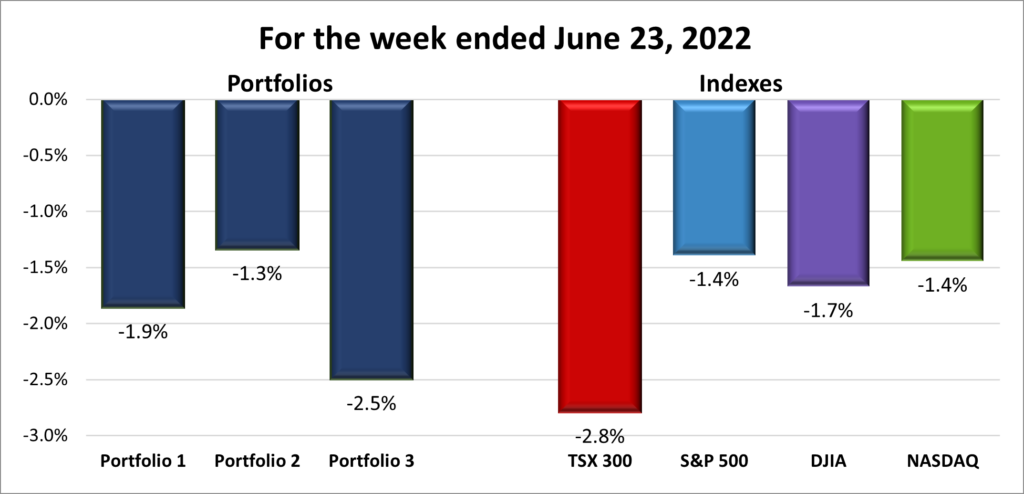
For the week, the TSX (SPTSX) plunged 2.8%, the S&P 500 (SPX) sank 1.4%, the DJIA (INDU) dropped 1.7% and the Nasdaq (CCMP) broke its eight-week winning streak, falling 1.4%.
 As shown in the chart above, all four indexes experienced declines over the past week. The market was primarily influenced by the testimony of the Fed’s Chairman before the US Congress, where he indicated the strong likelihood of future interest rate hikes. Although he mentioned the Fed would be cautious while considering possible hikes, investors predominantly focused on the prospect of higher rates. Consequently, many chose to capitalize on their gains in response to the Fed’s announcement.
In the US, the drop in the S&P and Nasdaq indexes can be attributed to the decline in mega-cap companies and other growth-oriented artificial intelligence (AI) companies. These companies had previously driven the indexes higher during the strong second quarter.
In Canada, the TSX index experienced a renewed decline driven by multiple factors, including concerns about a potential recession, weakened demand for commodities from China, and a decline in oil prices. The anticipation of higher interest rates added to the worries, as it could potentially contribute to a global economic slowdown and subsequently decrease the demand for oil.
It has been quite some time since all three indexes experienced a weekly decline. However, when all four indexes are down by more than 1%, it is a challenge for any of the three portfolios to achieve a weekly gain. Unfortunately, the downward movement in the indexes affected all three portfolios, resulting in losses across the board. Among the portfolios, Portfolio 2 stood out as the best performer, benefiting from its more balanced composition. In times of market downturns, the typically more aggressive Portfolios 1 and 3 tend to experience sharper drops compared to the relatively stable Portfolio 2. This week was no exception. I hope that this week’s decline is only a temporary breather before the markets resume the upward trend that has prevailed for most of the year.
Companies on the Radar
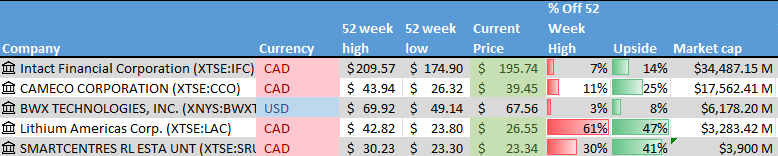
 Once again, no new companies came onto my radar so my Radar List remains the same as previous weeks, with the same five companies:
- Intact Financial (TSX: IFC): A Canadian mid-size insurance company that offers home, car, and business insurance in Canada, the US, and the UK.
- Cameco (TSX: CCO): A large Canadian company involved in uranium mining, sales, and the construction of nuclear reactor components.
- BWX Technologies (NYSE: BWXT): A mid cap size American company specializing in the construction and sale of nuclear components to customers worldwide, including the US Navy.
- Lithium Americas (TSX: LAC): A mid size Canadian company operating lithium mines in the USA and Argentina. They are a provider of lithium to the emerging electric vehicle battery industry.
- Smartcentres Real Estate Investment Trust (TSX: SRU.UN): A mid size fully integrated REIT that owns and manages a number of income producing shopping centres and retails spaces throughout Canada. They are planning to develop these properties for mixed retail, office, residential and storage.
The Radar Check was last updated June 23, 2023.

Portfolio Update
Portfolio 1
Portfolio 1 for the week ended June 23, 2023: DOWN 
- Lightspeed Commerce Inc. (TSX: LSPD) announced they have extended their partnership with the PGA of Canada to be their official golf management software partner. The software provides PGA of Canada members with insights into how they can provide a better all-around experience for their customer while they are at their facilities.
- Rivian (NASD: RIVN) plans to join the Tesla (NASD: TSLA) charging club. Rivian will join GM (NYSE: GM) and Ford (NYSE: F) and adapt their vehicles to Tesla’s charging standard. For Rivian, this will provide access to Tesla’s charging network, the largest in the North America, in addition to their own expanding charging network. For Tesla, it provides another customer for their charging network as Tesla leads the charge to electrify North America. It brings Tesla one step closer to becoming the industry standard, at least in North America.
Separately, Washington state announced any EV charging companies that wanted access to federal funds to build out the charging infrastructure in the state would have to include the Tesla charging plug. - Following on the heels of EU’s lawsuit against Alphabet’s (NASD: GOOGL) Google, Gannett Media (NYSE: GCI), the US’s largest newspaper chain, is suing Google for monopolizing the digital ad industry.
- The US Federal Trade Commission (FTC) alleged Amazon (NASD: AMZN) used manipulative practises to enroll millions of customers into their Amazon Prime service without their consent. The FTC also accused Amazon of making it hard for customers to get out of their subscription.
- In other FTC news, Alphabet filed a complaint against archrival Microsoft, claiming Microsoft used their dominant position in business and enterprise software to push customers towards their cloud services at the expense of Alphabet. Hmmm, I wonder if Google is aware of the irony that they have been accused of doing the same thing with their dominant position in the digital advertising industry.
- After getting signoff from Britain’s antitrust watchdog, Amazon now faces a four-month antitrust investigation from the EU over its tentative acquisition of iRobot (NASD: IRBT). It seems longer to get a deal approved than to come up with a deal. ☹
Activity
No significant activity to report this week.
Dividends
Dividends Received this week for the following companies:
Companies followed by DRIP (Dividend Re-Investment Plan) indicate additional shares were purchased with the dividend. Any cash leftover was added to the cash balance.
Canadian $
No C$ dividends this past week.
US $
Skyworks Solutions Inc (NASD: SWKS)
Quarterly Reports
No quarterly reports this past week.
Portfolio 2
Portfolio 2 for the week ended June 23, 2023: DOWN
- Telus (TSX: T) announced they have partnered with Australia’s Jolt, an electric vehicle (EV) charging company. Telus plans to install up to 5,000 fast chargers across Canada. I am guessing Telus will add Wi-Fi capabilities to these charging stations to expand the Telus network.
- Brookfield Infrastructure Partners LP (TSX: BIP.UN) acquired a stake in Compass Datacenters. Compass manages datacentres used for cloud computing and is one of the fastest growing companies in North America as cloud computing demands continue to rise.
- MongoDB (NASD: MDB) announced they have partnered with Google to allow developers to use AI tools to build new generative AI applications.
Activity
No significant activity to report this week.
Dividends
Dividends Received this week for the following companies:
Companies followed by DRIP (Dividend Re-Investment Plan) indicate additional shares were purchased with the dividend. Any cash leftover was added to the cash balance.
Canadian $
Supremex Inc. (TSX: SXP)
US $
No US$ dividends this past week.
Quarterly Reports
No quarterly reports this past week,
Portfolio 3
Portfolio 3 for the week ended June 23, 2023: DOWN
- Adyen (OTCM: ADYEY) is now a preferred enterprise payments partner for Shopify (TSX: SHOP). Together they will partner to enhance payment capabilities for enterprise merchants to improve sales in the e-commerce industry.
- Goeasy’s (TSX: GSY) wholly owned subsidiary LendCare Capital Inc. has partnered with 123Dentist to be their preferred financing partner. The deal will allow 123Dentist’s patient to quickly apply for financing for essential dental services.
Activity
No significant activity to report this week.
Dividends
Dividends Received this week for the following companies:
Companies followed by DRIP (Dividend Re-Investment Plan) indicate additional shares were purchased with the dividend. Any cash leftover was added to the cash balance.
No dividends this past week.
Quarterly Reports
No quarterly reports this past week.