
Last week, I touched on why October has a bit of a reputation as a volatile month in the markets—historical crashes, rapid recoveries, and plenty of unpredictability. So, what should you expect for your portfolio this October? Let us take a look.
First off, volatility does not necessarily mean disaster. In fact, it can create opportunities, especially for long-term investors. If you see sharp drops in certain stocks or sectors, it could be a chance to add to your positions or get into new ones at discounted prices. But timing the market is tricky—so keep your long-term goals in mind (you have set some long-term goals, right?) rather than reacting emotionally to short-term swings.
One reason October can be choppy is because it is a transitional period. Third quarter earnings season begins, and companies report their third quarter results, which can send share prices soaring or sinking based on whether they beat or miss expectations. Couple that with the market’s usual jitters over interest rates, inflation, and economic outlooks, and you have the perfect recipe for some turbulence.
But here is the key takeaway: volatility is part of the game. For us investors, October is not a time to panic—it is a time to stay focused on our strategies. If you have done your homework and have solid investments, market dips can be short-lived bumps in the road.
An effective way to navigate this volatility is by sticking to strategies like dollar-cost averaging or rebalancing your portfolio. If you have already got your radar list of potential opportunities (like I do 😉), you can keep an eye on them for any sharp price drops that you can take advantage of (that buy low theory 😊). And remember, diversification is your best friend when the market gets shaky.
At the end of the day, October volatility does not change the fundamentals of a sound investment strategy. Use it to your advantage—whether that means sitting tight or making some moves—but stay disciplined and think long term. When the dust settles, those who stayed the course will likely come out on top. 💪📈
So, while October can bring its fair share of market ups and downs, stay focused on your strategy and long-term goals. Now, let’s see what happened this past week….
Items that may only interest or educate me ….
Canadian Economic news, US Economic news, The Potential breakup of google, ….
Canadian Economic news
This past week’s key economic data that the Bank of Canada (BoC) considers when deciding whether to raise or lower the interest rate.
Labour Force Survey (LFS)
Statistics Canada’s Labour Force Survey for September surprised to the upside, with the economy adding 46,700 jobs—more than double August’s 22,100 increase and marking a strong rebound after four months of stagnation. Analysts had predicted 27,000 new jobs, so this data came as a pleasant surprise. On an annual basis, employment grew by 1.5%.
In a further positive sign, the unemployment rate dipped for the first time since January, falling to 6.5% from August’s 6.6%, beating expectations of it rising to 6.7%. However, compared to September 2023, unemployment is still up by 0.9%. Interestingly, despite the drop in unemployment, the employment rate ticked down slightly from 60.8% in August to 60.7%, likely due to the rapidly growing population.
Wage growth also showed signs of cooling, with average hourly earnings rising by 4.6% compared to September 2023, down from 5.0% in August.
This latest data contradicts the narrative many analysts were expecting—a cooling job market paired with rising unemployment. Now, the key question for the BoC and investors is whether these stronger jobs numbers and falling unemployment are an anomaly or a sign the Canadian economy is turning a corner. Given the volatility of monthly labour reports, a few more months of consistent improvement will be needed to draw any firm conclusions.
Despite this stronger-than-expected report, many analysts still expect the BoC to continue cutting rates, with opinions split between a 0.25% and 0.5% reduction, although this latest data weakens the case for a 0.5% cut. One way or another, all eyes are on October 23 for the BoC’s next move.
Canadian market volatility
Canada’s Volatility Index (CVIX) started the week at 11.34 and held relatively steady as it gradually drifted lower to close at 10.21. While Friday’s stronger-than-expected jobs report caused a brief bump, the CVIX had resumed its downward trend by the end of the day. This week’s slight dip shows that market sentiment remains steady, even with some positive economic surprises.
Tracked under the ticker VIXI on the Toronto Stock Exchange (TSE), the CVIX gauges anticipated market volatility. A reading below 10 suggests calm and stable market conditions, while values between 10 and 20 indicate moderate volatility with typical market fluctuations. When the index climbs above 20, it signals heightened uncertainty and the likelihood of more turbulent market conditions.
US Economic news
This past week’s key data points that the Federal Reserve (Fed) considers when deciding whether to raise or lower the interest rate.
Federal Open Market Committee (FOMC) minutes
The minutes from the September 17–18, 2024, FOMC meeting were released this past week, offering a closer look into the Fed’s thinking, outlook, and plans. Members acknowledged that the economy continued to grow at a solid pace, despite slowing job gains and a slight increase in unemployment, which remains relatively low. They also touched on the brief market volatility in early August, driven by speculative trades unwinding after statements from the Bank of Japan and weaker-than-expected July employment data. However, they noted that markets quickly bounced back. Additionally, many foreign central banks have already begun cutting their benchmark rates.
Domestically, economic activity showed signs of resilience. GDP growth remained solid, unemployment ticked up to 4.2%, CPI had dropped significantly from last year, and PCE inflation had slowed to 2.5% annually. Core CPI goods’ prices also declined in recent months. While inflation remains somewhat elevated, Fed members expressed growing confidence that it is steadily moving toward their 2% target. They also noted that the balance of risks between inflation and employment appeared more aligned than in previous months. In the stock market, officials pointed out that major indexes recovered from their early August dip and ended the month higher overall.
Fed staff forecasted continued solid economic growth, with GDP expected to remain in line with previous projections, though unemployment is expected to rise slightly. Nearly all members agreed that inflation was moving in the right direction, viewing earlier first-quarter spikes as temporary.
Given these developments, the FOMC opted for a 0.5% rate cut, lowering the benchmark interest rate to 4.75–5.0%. One member dissented, favouring a smaller 0.25% cut. Nonetheless, all members reaffirmed their commitment to promoting maximum employment and achieving the 2% inflation target. Future rate decisions, they emphasized, will depend on incoming data, including labour market conditions, inflation trends, and global financial developments.
Consumer price Index (CPI)
The latest US inflation data for September showed a slightly higher-than-expected monthly increase. According to the Labor Department, the CPI rose by 0.2% for the third consecutive month, exceeding forecasts of a 0.1% rise. Year-over-year, headline inflation (all items) slowed to 2.4%, the lowest rate since February 2021, compared to a 2.5% increase in August. Analysts had anticipated a 2.3% reading.
Looking at the details, ‘Transportation services’ component saw the largest monthly jump, rising 1.4%, while ‘Fuel oil’ prices dropped sharply by 6.0%. Over the past year, ‘Transportation services’ have surged 8.5%, while ‘Fuel oil’ recorded a significant decline of 22.4%. On a more positive note, ‘Shelter’ costs, which include mortgage and rent payments, slowed to 4.9% annually from August’s 5.2%.
Core CPI, which excludes food and energy prices, maintained a 0.3% monthly increase, matching August’s gain. Annually, core CPI edged up to 3.3%, slightly above August’s 3.2% rate. Analysts had expected readings of 0.2% and 3.2%, respectively.
Overall, the September report offers a mixed picture. Headline inflation continues its downward trend but remained higher than expected, while core inflation, a key indicator of future price trends, stalled in its decline. This suggests the Fed is unlikely to pursue a 0.5% rate cut at their next meeting. Most analysts are now predicting the Fed will opt for a 0.25% rate reduction at their November meeting.
Remember, lower inflation means prices are rising at a slower pace—not that prices are falling. 😊
American market volatility
The CBOE Volatility Index (VIX), often referred to as the market’s “fear gauge,” began the week at 20.84 and remained above 20 throughout, ultimately closing at 20.52. Midweek, the VIX surged to 23.07, driven by increased uncertainty following stronger-than-expected inflation data, which raised questions about the economy’s outlook.
The VIX measures expected market volatility over the next 30 days. Readings below 12 suggest calm, stable conditions, while levels between 12 and 20 indicate normal market fluctuations. When the index falls in the 20 to 30 range, it signals rising uncertainty, and levels above 30 point to heightened stress, often linked to significant market disruptions or crises.
Consumer Sentiment Index (CSI)
The preliminary reading of the University of Michigan’s CSI slipped to 68.9 in October, ending two months of gains. This marks a decline from September’s 70.1 and falls short of analysts’ expectations of 70.8. While the index dropped 1.7% month-over-month, it was still up 8.0% compared to the same time last year.
Breaking down the components, the Current Economic Conditions reading dipped slightly to 62.7 from 63.3 in September, down 0.9% for the month and a significant 11.2% below its reading a year ago. The Index of Consumer Expectations also softened, falling from 74.4 in September to 72.9 in October—a 2.0% monthly drop, but a substantial 22.9% increase year-over-year.
High prices have now surpassed inflation as the top concern for consumers, with many expecting inflation to continue easing. Looking ahead, there is a sense of caution, with consumers anticipating a slight worsening of their economic situation over the next year. However, some may be reserving judgment on their future prospects, potentially waiting to see the outcome of the upcoming election before forming a clearer view.
The Potential Breakup of Google: What It Could Mean for Alphabet
The US Department of Justice (DOJ) is currently considering breaking up Google, a move that could have significant consequences for Alphabet (NASD: GOOGL), its parent company, and the broader tech industry. If the breakup proceeds, some of Google’s most valuable units could be split off, including its core search engine, which dominates global search traffic, its advertising platforms like AdWords and AdSense that generate a large portion of Alphabet’s revenue, its Android operating system, a critical part of Google’s ecosystem, and its popular web browser, Chrome, which is tied to a suite of services that extend Google’s reach.
For Alphabet, this breakup would likely result in a substantial loss of revenue, as these key units are heavy contributors to its bottom line. It would also dismantle the synergy between Google’s interconnected businesses, where services like search, ads, and browser work together to create more value. A breakup could increase competition in the search, advertising, and browser markets, which might benefit consumers but pose challenges for the split-off entities. Additional regulatory actions could include preventing Google from collecting sensitive user data, requiring it to make its search results and indexes available to rivals, or allowing websites to opt out of their content being used to train AI products. Moreover, as Google tries to catch up with current artificial intelligence (AI) frontrunner Microsoft (NASD: MSFT), the disruption could stall its progress in AI, a crucial area for future growth. Newly independent units would also face heightened regulatory scrutiny and increased compliance costs, adding further pressure.
From an investment perspective, the impact could be profound. Alphabet’s share price may take a hit as investors view the breakup as a loss of future growth potential and a blow to the company’s overall value. Ultimately, the effects of breaking up Google will depend on how the split is structured, the evolving competitive landscape, and the long-term performance of the hived-off businesses. Both the tech world and investors are watching closely.
Weekly Market Review
Monday: the week got off to a rough start with all four major North American indexes – the Toronto Stock Exchange Composite Index (TSX), the S&P 500 Index (S&P), the Dow Jones Industrial Average (DJIA), and the Nasdaq Composite Index (Nasdaq) – ending firmly in the red. Investors are coming to the conclusion that after last week’s blow out jobs data that the chances of another 0.5% rate cut are very slim. Oil prices extended their rally over growing concerns of supply disruptions caused by increased tensions in the Middle East.
In Canada, increased likelihood of a smaller rate cut by the Fed weighed on the TSX, while higher oil prices limited the fall. In trading, the Energy sector was the only sector to move higher, while the Utilities sector had the biggest decline.
In the US, investors were now betting on a 0.25% rate cut, with no cut being a distant second option. In trading, similar to Canada, the Energy sector was the only one to post a gain with Utilities falling the farthest.
Tuesday: a good day for the American indexes as they recovered most of Monday’s losses, a not so good day for the TSX as the index posted a second straight loss. Investors moved back into technology companies ahead of the latest update on US inflation later this week, and upcoming third quarter earnings reports. Oil prices dropped sharply on news of potential ceasefire talks between Israel and Hezbollah.
In Canada, the country recorded a bigger than expected trade deficit. This was the sixth consecutive monthly deficit. Declining oil prices, combined with China’s lacklustre economic stimulus efforts, weighed on the market overshadowing gains in the Technology sector. In daily trading, Technology emerged as the top performer, while the Energy sector faced the steepest losses.
In the US, investors were awaiting the latest inflation data to gauge the Fed’s next move. If inflation aligns with expectations, a 0.25% rate cut is likely, but if it is too high, the Fed may hold off. In trading, Technology led the gains, while Energy took the biggest hit.
Wednesday: a good day in the markets after minutes from the Fed’s last meeting showed most of the members were in favour of the 0.5% rate cut. Investors are eagerly awaiting tomorrow’s US inflation report for clues on the Fed’s next move regarding interest rates. The data could strengthen the case for further rate cuts by the Fed.
In Canada, the TSX set another record high close, riding on the coattails of the American markets. In trading, the Technology sector was once again the top gainer, while Communications Services was the only sector to lose ground.
In the US, the S&P and DJIA both set record high closes once again as investors grew optimistic that inflation data will increase the chances of another rate cut. In trading, Healthcare posted the biggest gain, while Utilities recorded the biggest loss.
Thursday: in a reversal of index performance on Tuesday, the TSX ended higher while the three American indexes all ended lower after the latest US inflation data came in higher than expected. Investors are now leaning towards a 0.25% rate cut, otherwise the Fed may leave the rate unchanged. Oil prices surged due to supply concerns stemming from geopolitical tensions in the Middle East and potential supply disruptions from Hurricane Milton, which cut power and supply lines across Florida.
In Canada, higher oil and commodity prices lifted the TSX to another record high close. In trading, the Energy sector scored the biggest win, while Financials had the biggest loss thanks to TD Bank’s really bad day.
In the US, jobless claims came in higher than expected, putting the Fed in a tight spot as they try to balance their two primary goals: controlling inflation and promoting maximum employment. In trading, the Energy sector had the day’s biggest advance, while Communications Services had the biggest decline.
Friday: strong earnings reports from major American banks set the tone for the market today putting investors in an upbeat mood, pushing all four indexes higher. Oil prices fell for the second day as investors are concerned about hurricane Milton’s impact on demand from the southeast US. Oil prices fell on ongoing concerns of lower demand caused by Hurricane Milton.
In Canada, the TSX closed at another record high, lifted by the positive news out of the US. In trading on Bay Street, the Technology sector advanced the most, while Consumer Staples was the only sector to fall back.
In the USA, The S&P ended above 5,800 for the first time as it set another record high. The DJIA also ended the week on a positive note, notching a record high at the close. In trading on Wall Street, the Financials sector posted the biggest increase, while Technology and Consumer Cyclicals were the only sectors to finish lower.
Weekly Market and Portfolio Review
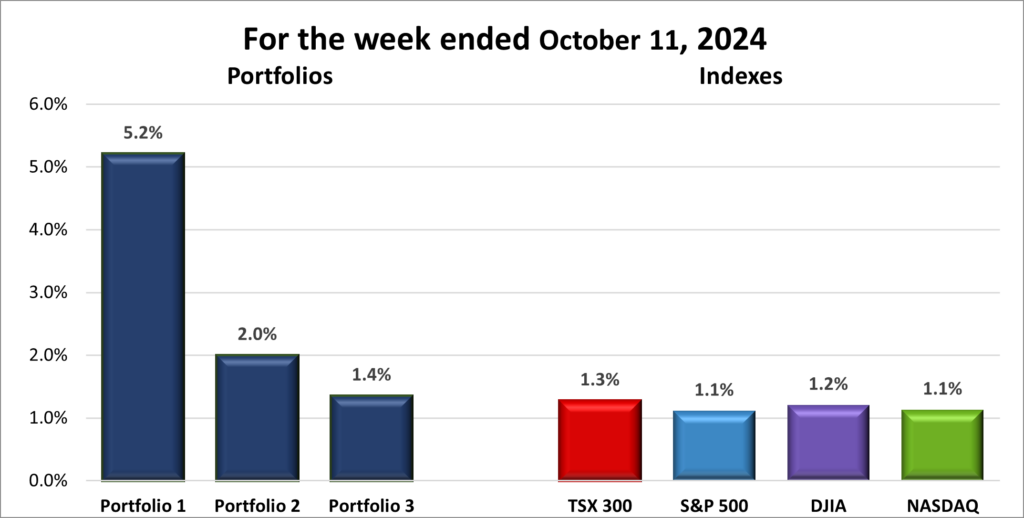
For the week, the TSX (SPTSX) gained 1.3%, the S&P 500 (SPX) increased 1.1%, the DJIA (INDU) rose 1.2% and the Nasdaq (CCMP) grew 1.1%.
| Index | Weekly Streak |
| TSX: | 5 – week winning streak |
| S&P: | 5 – week winning streak |
| DJIA: | 5 – week winning streak |
| Nasdaq: | 5 – week winning streak |
 After a shaky start to October, the markets rode a welcome updraft this past week, finishing in the green. All four major indexes extended their winning streaks to five weeks, kicking off the first full week of October with strong momentum, as reflected in the weekly progress chart above.
At the beginning of the week, investors were spooked by the previous week’s US labour report, which reignited concerns over the “no landing” scenario—where the economy continues to grow, but inflation creeps back in. The blowout report revealed the fastest job growth in six months, an unexpected drop in unemployment, and rising wages, leading to fears that the Fed might hold off on rate cuts to prevent inflation from flaring up again.
As the week progressed, optimism returned ahead of the US CPI inflation report. However, that hope was short-lived when the data came in hotter than expected. Hopes for a 0.5% rate cut were dashed, and while the markets initially reacted negatively, they quickly shook it off, with all four indexes ending the week higher. Now, a 0.25% rate cut by the Fed seems like the more probable outcome, with the possibility of rates staying unchanged still on the table—albeit a distant second option. With inflation and unemployment both on the rise, the Fed faces the delicate task of balancing these two competing forces.
The start of the third-quarter earnings season also helped buoy the markets. US banks kicked off earnings season with strong results, boosting investor sentiment and sparking hopes that we might see strong earnings across the board. Solid performance in the Financials sector is often a good indicator for the economy as a whole. Healthy bank earnings suggest robust lending activity, low default rates, and growing business investment—all signs of a thriving economy. When banks are doing well, it signals that consumers and businesses are borrowing, spending, and investing, which drives broader economic growth.
In Canada, the TSX has gained 2.4% since the start of October, fuelled by lower rates, the prospect of further cuts, and a more than 12% surge in oil prices. The latest labour survey also delivered a boost, with job growth exceeding expectations and unemployment falling – a positive sign for the economy. The TSX further benefitted from the optimism in American markets, riding the wave of momentum as we head into next week.
With the October Effect – where investors traditionally fear market declines in October – lingering in the back of my mind, I was pleasantly surprised to see a solid week across the board, with gains and positive momentum heading into next week. Strong earnings are rolling in, and economic data is holding steady, giving us plenty of reasons to stay confident. If oil prices and job growth maintain their upward trends, the markets could have even more upside. Here is hoping the markets’ winning streak reaches six! 😊
| Portfolio | Weekly Streak |
| Portfolio 1: | 5 – week winning streak |
| Portfolio 2: | 1 – week winning streak |
| Portfolio 3: | 5 – week winning streak |
It turned out to be a solid week for all three portfolios, with each landing in the win column, as shown in the chart below. Midweek, I was expecting losses from Portfolios 2 and 3, so it was a pleasant surprise to see all three finish in the green!
Portfolio 1 had a standout week, handily outperforming both the other two portfolios and all four indexes. Not only did 70% of its holdings post gains, but its largest position, Nvidia (NASD: NVDA), surged over 7%. Since its low on August 7, Nvidia’s stock has climbed more than 36% – not too shabby for two months of work! 😊
Adding to the momentum, Celestica (TSE: CLS) soared 19%, Decisive Dividend (TSEV: DE) jumped 18%, Cloudflare (NYSE: NET) rose 12%, and CrowdStrike (NASD: CRWD) climbed 10%. The Trade Desk (NASD: TTD) also hit an all-time high during the week.
Portfolio 2 snapped a two-week losing streak with a strong showing, as 53% of its holdings posted gains and no major losses weighed it down. MongoDB (NASD: MDB) led the way with an impressive 11% gain, and iAG Financial Group (TSE: IAG) and Dollarama (TSE: DOL) hit new all-time highs.
Portfolio 3 lagged behind the other portfolios but still outperformed the indexes! 😊 With 63% of its holdings posting gains, it managed to keep its weekly win streak alive, thanks to notable contributions like Cloudflare’s impressive 12% increase and a 10% rise from Lithium Americas (Argentina) (TSE: LAAC). However, a rough week for TD Bank (TSE: TD) held back its overall performance.
It is always a good week when all three portfolios outperform the indexes, especially during a week where they all advanced. 😊 With an impressive showing from Portfolio 1, solid gains from the others, and a few stocks hitting new highs, there’s definitely positive momentum heading into next week. Here is hoping the winning streaks continues! 😊
Companies on the Radar
 Another week with no new additions to my radar list—though I am not actively hunting for fresh opportunities right now. That said, if the markets take a sharp dip, I will be looking to either add to my current holdings or jump on one of the companies listed below.
As always, these are not buy recommendations—be sure to do your own research and make decisions that align with your personal financial goals!
- On Holding AG (NYSE: ONON), a medium cap Swiss company, founder-run, sports products company.
- Zoetis Inc. (NYSE: ZTS), a leading animal health company that discovers, develops, manufactures, and commercializes vaccines, medicines, diagnostics, and other technologies for both companion animals and livestock.
- Coca-Cola (NYSE: KO), a global beverage giant, best known for its flagship soft drink, Coca-Cola. They offer a wide range of non-alcoholic drinks, including sodas, juices, teas, and bottled water, catering to consumers worldwide.
The Radar Check was last updated October 11, 2024.


Portfolio Update
Portfolio 1
Portfolio 1 for the week ended October 11, 2024: UP 
- Alphabet’s Google has been ordered to open up its Google Play app store to other competitors.
- Amazon (NASD: AMZN) announced they were testing out new technology that should eliminate a few seconds off the delivery of each package, adding up to faster delivery times. The new system is called Vision Assisted Package Retrieval. It works by shining a green light on packages so that the driver does not have to waste time reading labels. The technology will be installed on roughly 1,000 delivery vehicles.
- In an attempt to woo buyers, General Motors (NYSE: GM) is offering buyers of their electrical vehicles (EV) a home storage option that can store and transfer solar energy. The new GM Energy PowerBank could significantly reduce the impact of power outages, providing enough energy to power the average home for up to 20 hours during an outage.
Activity
Tourmaline Oil Corp (TSE: TOU) completed their acquisition of Crew Energy. As part of the deal, shareholders of Crew Energy received 0.114802 of a common share of Tourmaline. The acquisition of Crew Energy was a strategic move that strengthens Tourmaline position in the Northeast British Columbia region and positioning it as a leading player in the Canadian natural gas sector.
Dividends
Dividends Received this week for the following companies:
Companies followed by DRIP (Dividend Re-Investment Plan) indicate additional shares were purchased with the dividend. Any cash leftover was added to the cash balance.
Canadian $
Telus Corp (TSE: T) DRIP
US $
No US$ dividends this past week.
Quarterly Reports
No quarterly reports this past week.
Portfolio 2
Portfolio 2 for the week ended October 11, 2024: UP
- Canadian Natural Resources (TSE: CNQ) plans to purchase some of Chevron’s oil sands and shale assets in an all-cash transaction valued at $6.5 billion. The acquisition will increase Canadian Natural’s stake in the Athabasca Oil Sands Project to 90%. The assets are expected to improve their cash flow which will be used to pay down debt, then used in shareholder friendly actions such as dividends and share buybacks.
- Alimentation Couche-Tard (TSE: ATD) submitted a revised, non-binding proposal to Japan’s Seven & i Holdings Co. Ltd. (OTCM: SVNDY) in an effort to acquire all of the company’s 7-Eleven stores. The new offer is said to be in the US$47 billion range and would see ATD add approximately 85,800 7-Eleven stores to ATD’s existing more than 16,800 stores that operate in over 31 countries.
Activity
Tourmaline Oil Corp completed their acquisition of Crew Energy. See Portfolio 1 for more information
Dividends
Dividends Received this week for the following companies:
Companies followed by DRIP (Dividend Re-Investment Plan) indicate additional shares were purchased with the dividend. Any cash leftover was added to the cash balance.
Canadian $
Telus Corp (TSE: T) DRIP
Brookfield Renewable Partners LP (TSE: BEP.UN)
US $
No US$ dividends this past week.
Quarterly Reports
No quarterly reports this past week.
Portfolio 3
Portfolio 3 for the week ended October 11, 2024: UP
- TD Bank was hit with US$3 billion fine and faces restrictions on its growth in the US after being found guilty of allowing drug cartels to launder money over several years. This makes TD the largest bank in US history to plead guilty to violating federal anti-money laundering laws. As a shareholder, it is frustrating to see TD involved in such a scandal, not to mention the sharp drop in its share price. On the bright side, though, that dip could mean snagging an extra share through the dividend reinvestment program when the next quarterly payout rolls around. 😊
- Brookfield Asset Management (TSE: BAM) announced they will buy European real estate company Tritax EuroBox (LSE: EBOX), owners of warehouses and distribution centres throughout Europe.
Activity
No significant activity to report this week.
Dividends
Dividends Received this week for the following companies:
Canadian $
Brookfield Renewable Partners LP (TSE: BEP.UN)
US $
Quarterly Reports
No quarterly reports this past week.