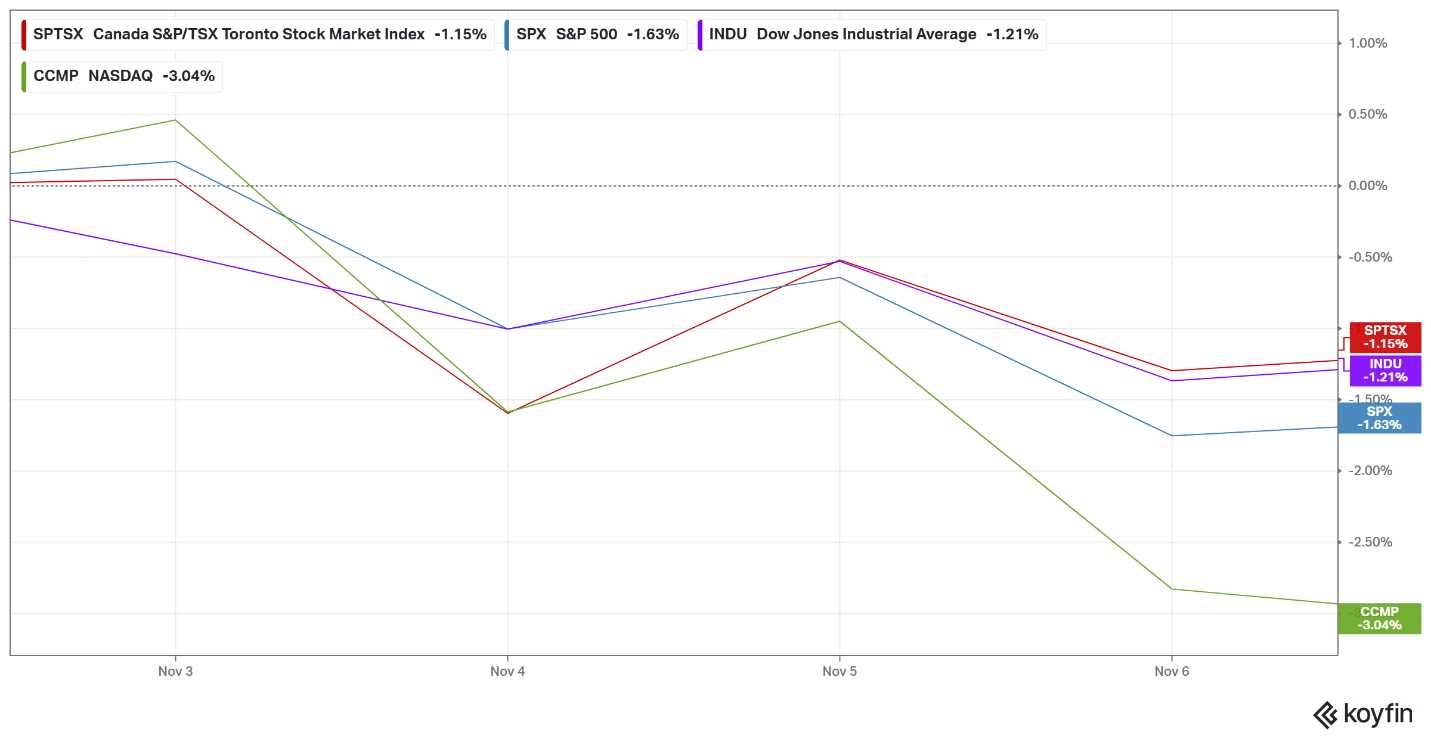
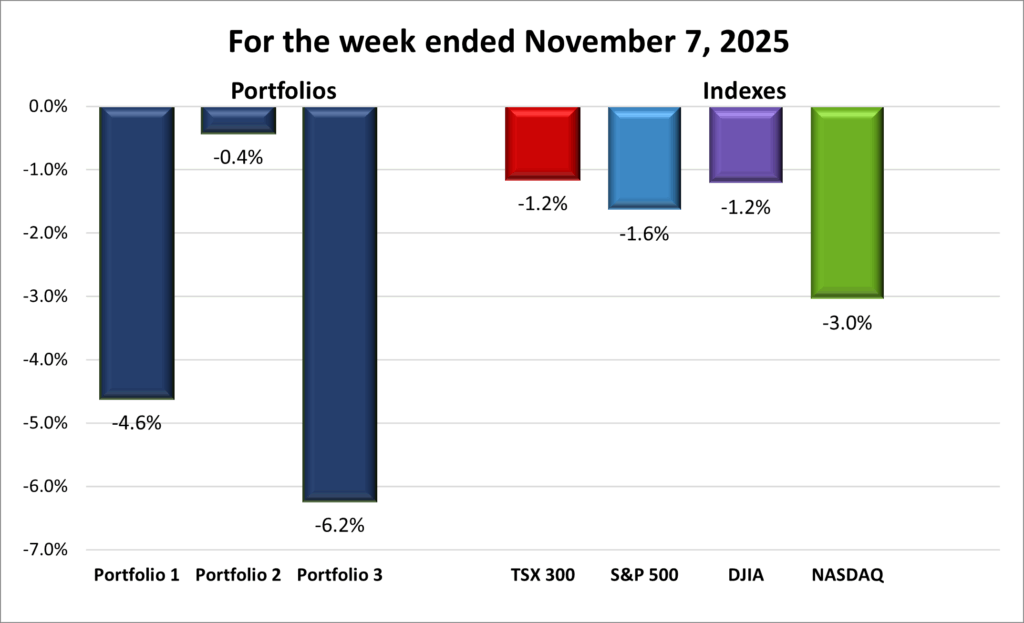
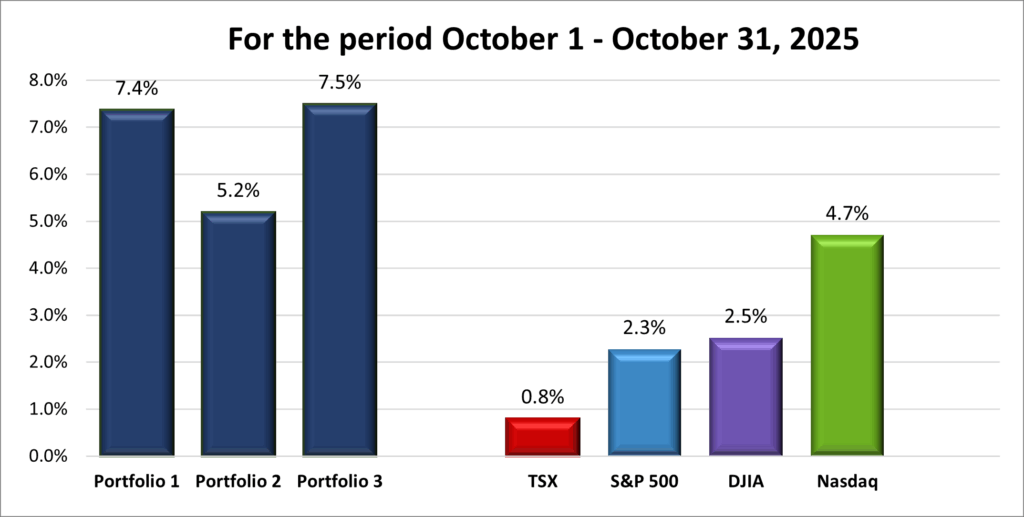
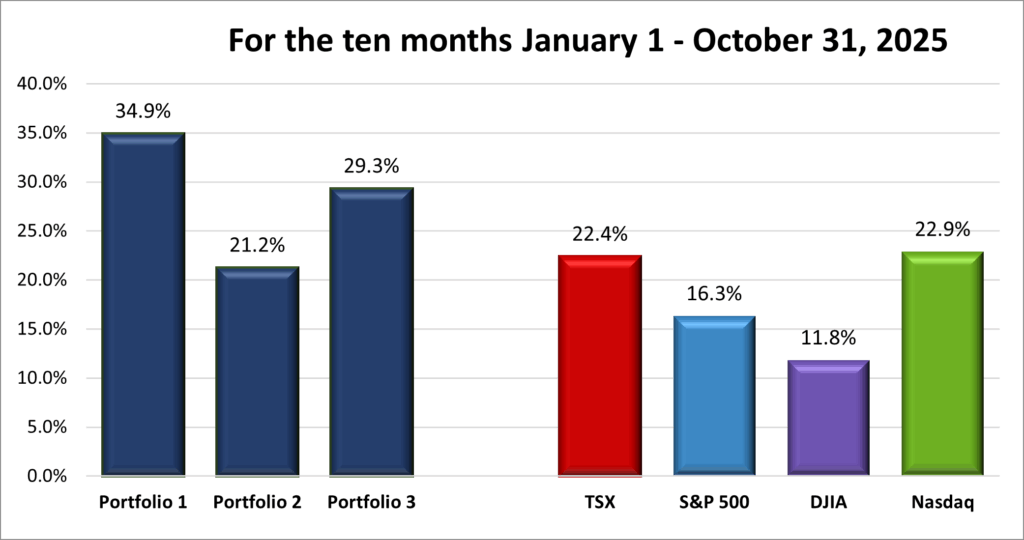
Weekly Update for the week ending November 28, 2025

The TSX: From Trading Club to Major Market

A few weeks ago, while writing the weekly portfolio update, I came across a stock I assumed was on the Toronto Stock Exchange, only to discover it was actually on the TSX Venture Exchange. Then I saw another company I thought was a Venture listing but was actually on the main TSX. That mix-up sent me down a rabbit hole about how the Exchange works and its history. I found the story surprisingly interesting, and this week I thought I’d share some of that history behind Canada’s largest stock market – the Toronto Stock Exchange (TSX).

The TSX’s story begins in 1852, when a group of Toronto brokers formed an informal trading club. By 1861, they incorporated as the Toronto Stock Exchange, making it one of the oldest exchanges in the world. It became part of the TMX Group in 2001 and adopted the shorter “TSX” branding. While it has kept up with modern technology, the TSX still carries a sense of history and stability that reflects Canada’s economic backbone – banking, energy, mining, and industrials. Long before the rest of the world embraced electronic trading, the TSX was ahead of the curve – it went fully electronic in 1997, well before many major global exchanges made the switch. Until the mid-90s, it even quoted prices in old-school fractions like eighths and sixteenths, a holdover from its early British influences. Located in Toronto’s financial district at 130 King Street, the exchange operates entirely electronically today, but its influence runs through almost every part of the Canadian economy.

Where the TSX really stands out is in its two-tier structure. The main TSX is home to established companies with larger market caps, stronger financials, and long operating histories – the big banks like Royal Bank (TSE: RY) and TD (TSE: TD), energy giants like TC Energy (TSE: TRP), railways like CN Rail (TSE: CN), and more recently, a rising wave of tech names such as Shopify (TSE: SHOP), Celestica (TSE: CLS), and clean-energy firms like Brookfield Renewable Partners (TSX: BEP.UN). The TSX Venture Exchange, on the other hand, is where younger, early-stage public companies list. These are often small-cap or micro-cap firms, particularly in mining exploration, energy, and emerging technologies, looking to raise their first meaningful rounds of public capital.

The relationship between the two exchanges is almost like a built-in growth ladder. Companies that start on the Venture exchange can “graduate” to the main TSX once they meet requirements around market cap, financial strength, governance, and liquidity. Many of Canada’s most successful firms followed this path: start small, build momentum, then move up once they’ve proven they can play on the bigger stage. That said, not every company chooses to move up; for some, staying on the Venture exchange makes more sense if growth is slow, plans are uncertain, or the costs of a TSX listing aren’t justified.

Behind the scenes, the TSX runs on a modern electronic infrastructure similar to other major global exchanges. Trades are matched in milliseconds, and liquidity is supported by a deep pool of domestic and international institutions. On an average day, the TSX sees tens of millions of shares traded across hundreds of listed companies, reflecting steady participation from banks, pension funds, asset managers, and retail investors alike. It may not move at the same blistering pace as the Nasdaq Exchange, but the TSX’s combination of stability, liquidity, and sector strength makes it a cornerstone for Canadian investors, and for global investors with an eye on Canada’s resource-rich economy.

We’ll save the full story of Canada’s Venture Exchange — along with the history of the New York Stock Exchange and Nasdaq — for the coming weeks. For now, with the TSX’s history and structure fresh in mind, here’s a look at the market moves that kept investors busy over the past week…


Items that may only interest or educate me ….

Canadian Economic news, US Economic news, ….

Canadian Economic news

This past week’s key economic data that the Bank of Canada (BoC) considers when deciding whether to raise or lower the interest rate.

Gross Domestic Product (GDP)

September Report

Canada’s economy showed a bit more life in September than many expected. Statistics Canada reported that real GDP grew 0.2% month over month, reversing a small 0.1% dip in August. It wasn’t a huge surge, but it was enough to suggest the economy might be catching its breath after a tough summer.

Most of the momentum came from goods-producing industries, which climbed 0.6%. Utilities led the pack with a solid 0.9% gain, while construction slipped 0.2%, the only goods-producing sector to decline. Services also improved, rising 0.1%, with transportation and warehousing standing out at 1.2%, although management of companies and enterprises pulled back 2.0%.

Looking at the past year, goods-producing industries were up 1.4%, powered by a 5.2% jump in mining, quarrying, and oil and gas extraction. Utilities, however, fell 3.1%. Services grew 0.9% year over year, helped by a 2.5% rise in accommodation and food services. The biggest drag was a 22.8% decline in management of companies and enterprises.

Overall, September’s GDP lift feels like a small but welcome break in the recent slowdown. It hints at some resilience, though growth remains uneven. The outlook is cautious: early estimates suggest a 0.3% GDP drop in October, so the rebound may not last without stronger consumer spending and investment.

For those new to the term, ‘real GDP’ isn’t just a fancy way of saying GDP. GDP measures the total value of all goods and services a country produces, basically the size of the economy in dollars. Real GDP does the same, but adjusts for inflation, showing whether the economy is truly growing rather than just getting more expensive.

Third Quarter Report

Canada’s economy staged a modest but meaningful comeback in the third quarter of 2025. Real GDP grew 0.6% from the previous quarter, reversing the 0.5% contraction in Q2. That works out to a 2.6% annualized growth rate, topping expectations and giving the economy a much-needed win.

The lift came from stronger trade and higher government spending. Imports dropped sharply, the biggest quarterly decline since 2022, while exports crept higher, boosted by a 6.7% surge in crude oil and bitumen shipments. Government capital spending rose 2.9%, with more money flowing into infrastructure and military projects. Together, these offset weakness elsewhere.

Still, the rebound wasn’t broad. Household spending slipped slightly, and business investment barely moved. Overall domestic demand, which combines consumption and investment, was essentially flat. In other words, most growth came from net exports and government projects rather than a widespread upswing across the economy.

The third quarter delivered a patchwork recovery – enough to avoid a technical recession, which occurs when the economy shrinks for two quarters in a row. Stronger energy exports and higher government outlays provided stability, but underlying momentum remains fragile. Early signs point to a possible GDP pullback in October, so the gains may need more support to turn into a lasting trend.

Combined with September’s rebound, the third quarter growth gives the economy a bit more breathing room. It suggests Canada may be more resilient than feared after the trade-driven slump earlier this year. Still, the uneven nature of the rebound highlights ongoing risks: consumer and business demand remain soft, and much depends on commodity prices and global trade developments.

Canadian Market Volatility

Canada’s volatility gauge – the S&P/TSX 60 Volatility Index (VIXC) – spent the early part of the week hovering around 17.65 before sliding under 15 mid-week and closing at 14.13. If you’re not familiar with the VIXC, it is basically Canada’s market mood meter. Readings in the low teens usually mean the Canadian market feels steady, while higher readings point to investors getting a bit jittery. Finishing the week just shy of 14 suggests a market that’s relaxed but still keeping an eye on the road – not tense, just calmly alert.

US Economic news

This past week’s key data points that the Federal Reserve (Fed) considers when deciding whether to raise or lower the interest rate.

Personal Consumption Expenditures (PCE)

The Personal Consumption Expenditures (PCE) report was delayed due to the recent government shutdown. The September report is now scheduled for December 5, 2025, while the releases for October and November have not yet been set.

PCE is the inflation gauge most closely watched by the Fed and often guides interest rate decisions. With this key measure missing as the Fed heads into its year-end meeting, Fed officials and investors face an added layer of uncertainty about the current inflation picture.

Gross Domestic Product (GDP)

Normally, the Bureau of Economic Analysis (BEA) publishes three estimates per quarter – advance, second, and third – gradually refining the picture of economic growth. Due to the recently ended government shutdown, the BEA has delayed the release of third-quarter GDP data. The advance estimate, originally scheduled for October 30, was canceled, and the second estimate, due November 26, has also been pushed back. These delays leave a temporary gap in the data, so we won’t have a clear view of third-quarter GDP until the estimates are released.

Retail Sales

According to the latest (and long-delayed) release from the US Census Bureau, retail and food services sales rose 0.2% in September, below the expected 0.4% gain. Growth is still happening, but the slowdown from August’s 0.6% increase suggests late-summer momentum is fading. On a year-over-year basis, sales were up 4.3%, indicating consumers haven’t fully pulled back yet.

The details reveal where Americans are focusing their spending. Miscellaneous retailers posted the biggest monthly gain at 2.9%, and year-to-date they’re up 8.2%, reflecting continued purchases of smaller, everyday items and services. By contrast, sporting goods, hobby, musical instruments, and bookstores fell 2.5% in September, while building materials and garden supplies are down 2.4% year-to-date, highlighting a pullback in bigger-ticket and discretionary purchases. Together, these trends suggest consumers haven’t closed their wallets but are choosing carefully, prioritizing practical purchases over larger, less essential items.

Core retail sales, which exclude autos, parts, and gasoline, rose just 0.1%, down from August’s 0.7% and below the expected 0.3%. Year-over-year, core sales were up 4.2%. The modest increase reflects the same pattern: spending continues, but enthusiasm is waning. The softer core reading aligns with the recent drop in consumer confidence, reinforcing that US consumers, while still active, are growing more cautious.

Month to month, the trend is clearly softening. It’s not a dramatic pullback, but it’s enough to matter. For companies heavily tied to consumer demand, slower sales growth can translate into tighter margins and choppier earnings.

Consumer Confidence Index (CCI)

The Conference Board’s CCI took a noticeable hit in November, dropping to 88.7. That is not only below expectations of 93.4 but also well under October’s 94.6 and far off the 111.7 logged last November. It’s a clear sign that consumers are feeling the strain from persistent inflation, a softening labour market, and growing economic uncertainty.

The “Present Situation” sub-index, which tracks how people feel about business conditions and the job market right now, slipped to 126.9 from 129.3. But the bigger story is what’s happening in expectations. The “Expectations” sub-index, which measures the outlook for the next six months, tumbled to 63.2, down from roughly 71.5 in October. This marks ten straight months below the critical 80 mark, a level that has historically flashed early recession signals. In short, people aren’t confident about where things are heading.

The report also shows rising concern across the board: jobs, income, the economy, inflation, and sticky prices. Uncertainty around trade, tariffs, and policy continues to weigh on confidence, and the recent federal government shutdown only piled on. These themes showed up repeatedly in the survey’s write-in comments.

So, what does the headline number of 88.7 really tell us? Consumers are still spending, but they’re becoming more cautious. The shift may be subtle, but it matters. When the confidence cushion thins out, the odds of a sharper slowdown start to climb. Compared with the same time last year, this drop in confidence stands out as one of the more noticeable changes in the economic landscape.

The economy isn’t falling apart, but the mood is clearly softening. Confidence plays a big role in how much people are willing to spend, which in turn affects corporate earnings and markets. The sharp dive in expectations is the key early-warning indicator here – if people doubt things will improve, slower growth often follows, as is starting to show up in retail sales.

American Market Volatility

The CBOE Volatility Index (VIX), often called the market’s “fear gauge,” had a noticeably calmer week compared to the last. It opened around 22.69 and drifted lower throughout the week, closing at 16.35. The pullback likely reflects growing confidence that the Fed is preparing for another 0.25% rate cut, along with a lighter, holiday-tinged mood around Thanksgiving. Think of the VIX as the market’s mood ring: even with the drop, readings above 25 still indicate unease. It’s not full-on panic, but a “seatbelt fastened” kind of vibe as investors wait for clearer signals from the Fed.


Weekly Market and Portfolio Review

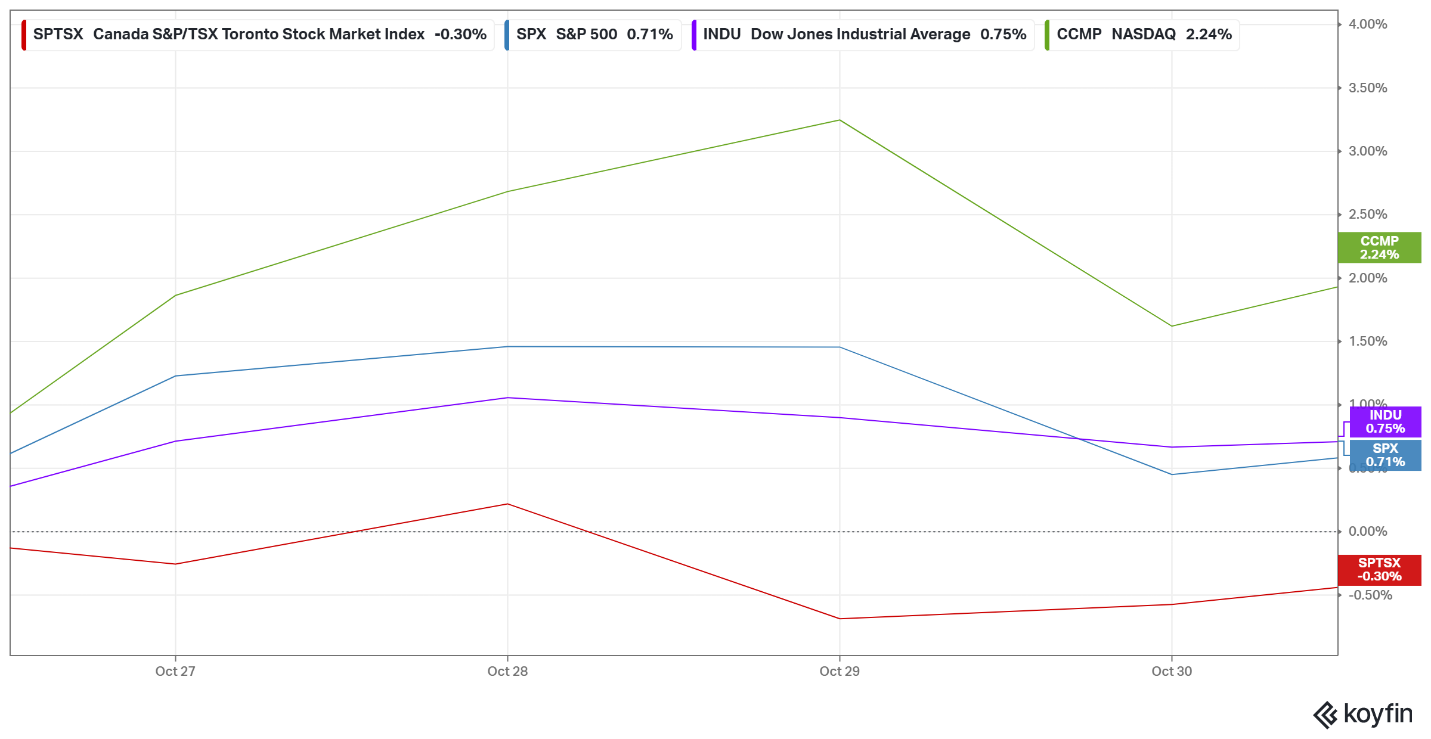
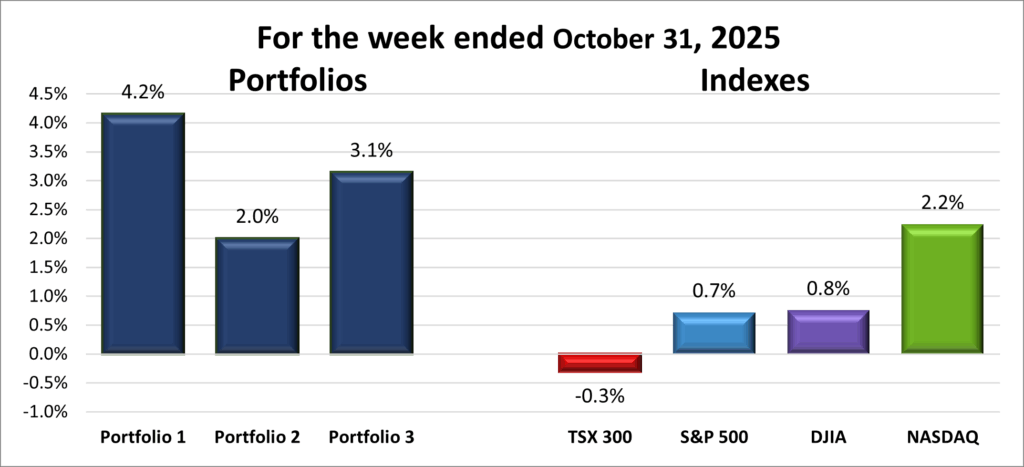
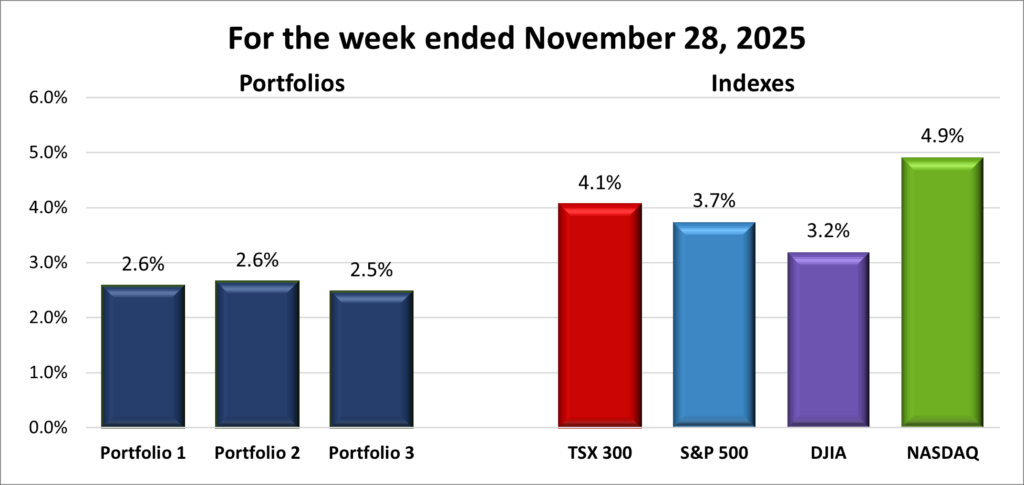
For the week, the TSX (SPTSX) jumped 4.1%, the S&P 500 (SPX) gained 3.7%, the DJIA (INDU) advanced 3.2% and the Nasdaq (CCMP) surged 4.9%.

 
Index Weekly Streak
TSX: 1 – week winning streak
S&P: 1 – week winning streak
DJIA: 1 – week winning streak
Nasdaq: 1 – week winning streak

Bull market. A good week for the North American stock markets. After a few grinding, directionless weeks, the markets finally found something to cheer about. Investors came into Monday carrying the momentum from the previous Friday, and it didn’t take long for that optimism to pick up steam. All four major indexes – the Toronto Stock Exchange Composite Index (TSX), S&P 500 (S&P), Dow Jones Industrial Average (DJIA), and the Nasdaq Composite (Nasdaq) – jumped strongly out of the gate, with the Nasdaq posting its biggest single-day move since May 2025. That early spark set the tone for what became an unexpectedly upbeat stretch.

The American markets might have had a holiday-shortened week, but nothing about the performance felt slow. All three major US indexes pushed their winning streaks to five sessions. The S&P logged its strongest Thanksgiving week since 2012, climbing 4.1%, while the Nasdaq – helped by a resurgence in artificial intelligence (AI) related names – booked its best holiday week since 2008 with a gain of more than 4%.

The real catalyst was a sudden burst of optimism around a possible Fed rate cut. Just a week earlier, most analysts had written off the chances of a final 2025 cut, thanks to the lack of fresh US economic data caused by the government shutdown. The data that finally arrived was mostly stale September information, although it did show weaker-than-expected retail sales. Consumer confidence also slipped to its lowest level since April, highlighting how much trade uncertainty has been weighing on households.

Then came the spark that flipped the script: a fourth Fed official suggested the central bank could cut rates without derailing progress on inflation. That comment instantly reshaped expectations. Investors shifted from bracing for rates to stay locked at 4% to expecting a December cut, and the odds of a 0.25% rate cut climbed toward 80%. Softer inflation signs, shaky confidence, and cooling consumer spending only reinforced that view.

With rate-cut hopes back in the spotlight, major technology stocks surged. The rally started in AI names and quickly spread across the sector, as if the technology sector was trying to make up for an entire choppy month in just a few sessions. That breakout helped pull the S&P and DJIA into positive territory for November and minimized some of the Nasdaq’s losses. Once upward momentum kicked in, it broadened across the market and gave the week a far more upbeat finish than anyone expected days earlier.

North of the border, Canadian markets quietly matched the positive vibe. The TSX extended its winning streak to six straight sessions and set a new record high each day this week. The week opened strong on the same wave of confidence that the Fed might move ahead with a December rate cut. Since Canadian markets often move in step with US rate expectations, that shift gave the TSX an immediate lift. Commodities also helped, with gold, silver, and other resource stocks catching steady buying after a volatile stretch. To top it off, Ottawa and Alberta signed a Memorandum of Understanding late in the week that could pave the way for a new pipeline from Alberta to Canada’s west coast, giving the energy-heavy index another dose of good news.

By the time the week wrapped up, all four major indexes were riding the renewed optimism around lower rates and had pushed the anxiety over stretched AI valuations into the background. Black Friday kicked off the holiday shopping season, adding another boost of confidence — the kind of spark that hopefully marks the start of a true Santa Claus rally. 😊

Portfolio Weekly Streak
Portfolio 1: 1 – week winning streak
Portfolio 2: 1 – week winning streak
Portfolio 3: 1 – week winning streak

Bull market. A good week for the North American stock markets. After a few lacklustre weeks, it was great to see all three portfolios ride the rising tide of the markets to snap their losing streaks and get back in the win column. The resurgence in technology stocks provided the biggest lift, but the broad-based rally ensured that all three ended solidly in the green for the week.

Portfolio 1 posted an impressive 2.6% weekly gain, with 84% of its companies finishing higher. The big news was a deal between Alphabet (NASD: GOOGL) (Google) and Meta Platforms (NASD: META), more commonly known as Facebook, where Google will supply Facebook with billions of dollars’ worth of its custom-built AI chips, known as tensor processing units (TPUs), for use in Meta’s data centres. The news helped push Alphabet above US$300 for the first time as it set a new high. There was more good news with Celestica surging 19%, Navitas Semiconductor (NASD: NVTS) up 17%, Hammond Power Solutions (TSE: HPS.A) gaining 11%, and Cameco (TSE: CCO) adding 10%. Apple (NASD: AAPL), the Bank of Nova Scotia (TSE: BNS), and Walmart (NYSE: WMT) also set fresh record highs.

Portfolio 2 ended up being the week’s top performer (once you go out to two decimal places), climbing 2.6% with 78% of its holdings finishing in the green. Hammond Power Solutions jumped 11%, Zoetis (NYSE: ZTS) gained 10%, and Aritzia (TSE: ATZ) set yet another record high. It feels like ever since I became an owner, it’s been hitting a new high every week. That’s the kind of company I like. 😊

Portfolio 3 wasn’t far behind, putting up a solid 2.5% gain – the kind of week that would usually take first place, just not this time. About 75% of the portfolio moved higher, helped along by an 18% surge in Lithium Americas (TSE: LAC) and another strong performance from Vertiv Holdings (NYSE: VRT), which climbed 13%. Now, if only one of my top two holdings, Nvidia (NASD: NVDA) or Shopify could have a week like that. 😊

Not bad. Not bad at all! If the rest of November had looked like this, I’d have been smiling a whole lot more. 😊
Stock on the Radar List. 1 of 2.
Weekly Portfolio & Index performance for the week ended November 28, 2025.

Companies on the Radar

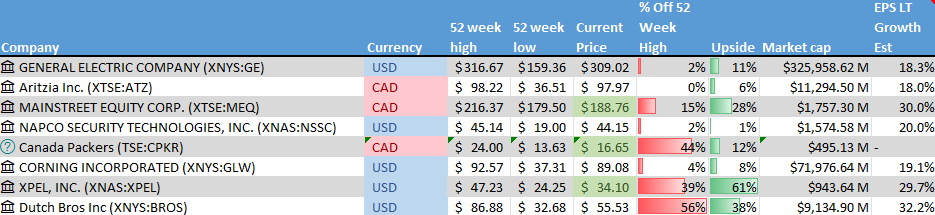
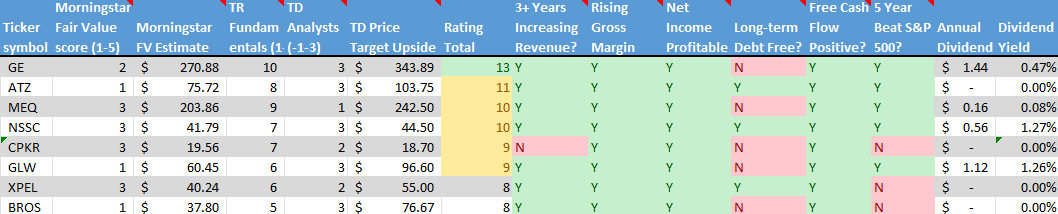
Stocks on my Radar It was another quiet week on my radar, with nothing new jumping out or grabbing my interest, a welcome change of pace after how companies were coming and going at the start of November. The six companies below are still the front-runners if I end up adding a new name to any of the portfolios.

  1. GE Aerospace (NYSE: GE): This is the large American aviation and defence business that remained after General Electric split into three separate companies in 2024. It has been on a strong run thanks to high demand for commercial jet engines as global air travel continues to recover. The company focuses on aircraft propulsion systems and services for both commercial and military customers, and it’s also moving into drones. As a global leader in jet engines and aircraft systems, GE Aerospace offers exposure to long-term trends in travel, defence spending, and emerging aviation technology.
  2. Napco Security Technologies, Inc. (NASD: NSSC): A small US company that provides security hardware and systems like smart locks, intrusion alarms, fire alarms, and access control solutions. It sells through a network of distributors and installers, and has been increasing its recurring service revenue – something investors usually like to see. As demand for security and smart home products grows, Napco has multiple avenues for expansion.
  3. Corning Incorporated (NYSE: GLW): A large US company known for specialty glass and optical technologies. Corning is the longstanding supplier of the glass used in iPhones and is also benefiting from the surge in demand for high quality fiber optics as datacentres expand to support AI and cloud computing. The company is riding several tailwinds with long-term growth potential.
  4. Mainstreet Equity Corp. (TSE: MEQ): A Calgary-based real estate company focused on mid-market apartment buildings across Western Canada. Their business model is straightforward: buy underperforming buildings, renovate them, improve operations, and increase rental income. With strong demand for rentals, a disciplined approach, and shares that trade below the estimated value of the properties, Mainstreet offers a combination of income, stability, and long-term upside.
  5. Dutch Bros Inc. (NYSE: BROS): A rapidly expanding drive-thru coffee chain in the US, known for its energetic customer service and customizable drinks. The company is aiming to open at least 160 new locations by the end of 2025 and has long-term goals of surpassing 2,000 stores. Strong brand loyalty, especially in the Western US, makes this an interesting high-growth story – though still in an aggressive build-out phase.
  6. XPEL, Inc. (NASD: XPEL): A growing, founder-led maker of protective films, coatings, and related products – best known for automotive paint protection film. XPEL has been expanding into window films and architectural applications, and sells through multiple channels, giving it both reach and control. It’s a company with a focused niche and strong brand recognition in that niche.

As always, these are not buy recommendations. Make sure to do your own research and choose investments that fit your personal financial goals.

The Radar Check was last updated November 28, 2025.

Stock on the Radar List. 1 of 2.
Stock on the Radar List. 2 of 2.

That’s a wrap for this week, thanks for reading may your portfolio stay green and your dividends steady. See you next time!


Weekly Update for the week ending November 21, 2025

Nvidia Saves the Day

Heading into this week, investors were nervous. Many were worried about a possible artificial intelligence (AI) bubble and that valuations for leading AI and technology companies had gotten overheated. All eyes were on the star of the emerging AI industry — Nvidia (NASD: NVDA). Would the company beat, meet, or miss its revenue targets? And perhaps just as important, what did it expect for the next quarter?

Nvidia isn’t just another technology company, it’s the engine behind the AI boom and, at times, the most valuable company on the planet. Its chips power everything from ChatGPT-style AI to self-driving cars to the massive datacentres that keep the digital world running. When Nvidia reports earnings, markets pay attention because it often sets the tone for the entire technology sector.

This quarter, Nvidia didn’t just meet expectations – it crushed them. Revenue hit US$57 billion, topping the roughly US$55 billion analysts forecast. The standout was the datacentre division, home to Nvidia’s AI chips, which pulled in US$51 billion, up ~66% year over year. And looking ahead, Nvidia forecast around US$65 billion in revenue for the fourth quarter, again beating Wall Street’s expectations.

CEO Jensen Huang highlighted that demand for AI hardware is still explosive. Orders from cloud giants are massive, and the newest Blackwell chips are selling faster than they can make them. The AI infrastructure build-out is clearly in full throttle.

For investors, this is huge. Nvidia’s results signal that AI isn’t hype – it’s scaling. Because Nvidia sits at the centre of the AI ecosystem, its momentum often lifts other technology names too. As long as demand stays strong and geopolitical risks (like export restrictions) don’t interfere, this could keep driving technology markets higher.

Had Nvidia only met or missed expectations, the reaction could have been very different: technology and AI-linked stocks might have pulled back sharply, investor enthusiasm around AI growth could have cooled, and the broader market might have paused – or worse. That shows just how pivotal Nvidia is: its results can sway not only the AI sector but the technology market as a whole.

As a (very, very, very small) owner of Nvidia, I’m relieved they had a strong third quarter. Not only did it boost the share price, but it also lifted many other technology companies tied to AI. Since Nvidia is the largest holding in two of my portfolios, this news provides a solid lift for them – both directly from Nvidia and indirectly from the positive tailwinds across other AI-related companies, giving all three portfolios a boost. 😊

While Nvidia’s blockbuster quarter grabbed headlines, it wasn’t the only thing moving markets this week. Investors were also digesting economic updates, from Canadian inflation to US labour data, alongside corporate earnings. Here’s a look at what moved the markets and how my portfolios fared.


Items that may only interest or educate me ….

Canadian Economic news, US Economic news, ….

Canadian Economic news

This past week’s key economic data that the Bank of Canada (BoC) considers when deciding whether to raise or lower the interest rate.

Consumer Price Index (CPI)

The latest CPI report from Statistics Canada showed inflation rising 2.2% year over year in October, a slight cooldown from September’s 2.4% pace. Analysts were looking for 2.1%, so it came in just a touch hotter than expected. Month to month, prices rose 0.2%, matching estimates and following a modest 0.1% gain in September.

The month’s biggest mover was clothing and footwear, which jumped 1.3%, while gas prices fell 4.8% from September. The bigger story, though, is the year-over-year drop in gasoline: prices were down 9.4% in October, compared with a 4.1% decline the month before. That’s doing a lot of the heavy lifting in pulling headline inflation lower.

Food inflation remains elevated at 3.4% year over year, but even that has eased from September’s 4.0%. Shelter costs, everything from rent to mortgage interest, rose 2.5%, just a shade below September’s 2.6%, and they’re still one of the most stubborn pressure points for households.

Where things get tricky is the BoC’s preferred core measure. Core CPI rose 2.7% year over year, up from 2.4% in September. On a monthly basis, core inflation jumped 0.7%, a sharp turn from the slight decline the month before. That shows that even though headline (all items) inflation is drifting lower, the underlying price pressures the BoC watches most closely are still running hotter than they’d like, reinforcing their view that the current 2.5% rate doesn’t need to be adjusted.

For consumers, this mix means the cost of living is easing in places, but not enough to shift the interest-rate environment anytime soon. The BoC pays close attention to core inflation, and with those numbers picking up, there’s not much room for another rate cut at their December meeting.

So, we’re in that frustrating middle ground: inflation is cooling, but not fast enough to give the Bank confidence to change direction. “Good enough” isn’t “great,” and until the core data cools more consistently, the Bank is likely to stay cautious.

Retail Trade

After a small uptick in August, Canadian retail sales cooled in September, hinting at more careful spending by households. Statistics Canada’s report showed a 0.7% decline, following the previous month’s 1% gain. On a year-over-year basis, sales were up 3.4%, down from 4.9%, signaling that retail growth is slowing compared with last year.

The decline was broad-based, with six of nine major retail subsectors seeing lower sales. Motor vehicle and parts dealers led the drop at ‑2.9%, while gasoline stations were one of the few bright spots, rising 1.9% in dollar terms, though volumes actually fell. Over the past year, the biggest gains came from clothing, accessories, shoes, jewelry, luggage, and leather goods retailers, which saw sales climb 11.2%, while building materials, garden equipment, and supplies dealers fell 1.1%.

Looking at core retail sales, which strip out volatile categories like gas and motor vehicles, September was essentially flat following a 1.1% rise in August, and core sales are up 4.1% year over year. That shows underlying demand is holding, even as headline numbers soften.

Taken together, the data suggest more cautious consumers. Soft monthly and quarterly numbers (July -0.8%, August +0.1%, September -0.7%) indicate households may be pulling back, especially on big-ticket items like vehicles. Yet the steady core sales hint that some sectors are holding up despite the slowdown.

Looking ahead, early estimates for October suggest retail sales were relatively flat, continuing the trend of soft consumer spending and reinforcing that households are still cautious.

Canadian Market Volatility

Canada’s volatility gauge – the S&P/TSX 60 Volatility Index (VIXC) – spent the week on slightly shakier ground than usual. It opened around 17.83 and hovered between 18 and 20 as investors digested a mix of inflation data, earnings, and shifting rate expectations.

Mid-week, the VIXC briefly shot above 25 after Canada’s latest inflation report showed core prices ticking higher, trimming hopes for a December rate cut. That spike didn’t last, though. The index quickly slipped back toward 20, then fell below 15.5 as Nvidia’s blockbuster earnings sent a wave of optimism across global technology markets, Canada included.

The calm didn’t hold forever. As the initial excitement faded, the VIXC drifted upward to the 18 range, finishing the week just under 18 at 17.96 – squarely in that “cautious but not stressed” zone.

For anyone new to it, the VIXC is basically Canada’s market mood meter. Low readings (usually in the low teens) suggest smooth sailing, while higher numbers point to nervous investors bracing for bumps. Ending the week near 18 signals a watchful, slightly tense market – alert, but far from panic mode.

US Economic news

This past week’s key data points that the Federal Reserve (Fed) considers when deciding whether to raise or lower the interest rate.

Federal Open Market Committee (FOMC) minutes

The Fed released the minutes from its October 28–29 meeting this week, giving investors a clearer sense of what drove its decision to cut interest rates by another 0.25% to 3.75%–4.00%. This was the second straight rate cut after roughly nine months of holding steady at 4.5%, even as inflation bounced around and economic momentum shifted.

The tone of the minutes shows a central bank that’s easing policy, but doing so carefully. Officials noted that the economy is still growing at a moderate pace, though hiring has cooled and inflation has edged higher compared with earlier in the year. That helps explain why the Fed is willing to trim rates, but not without hesitation.

The real eye-opener was the split inside the committee. Some members argued the economy could use more support, even favouring a 0.5% cut, while others worried that moving too fast might undo the progress made on inflation and preferred keeping rates at 4.25%. Several officials stressed that they want clearer signs of improvement before committing to what comes next.

For investors, the takeaway is pretty straightforward: the Fed is easing, but it’s not in any rush. Markets probably shouldn’t expect a rapid series of cuts. And for us Canadians, when the US takes a cautious approach, that tone usually spills into our markets too as we wait for these rate cuts to work their way through the economy.

Labour Data

The Labor Department’s Bureau of Labor Statistics finally released its September Employment Situation Summary after weeks of delay, and the numbers landed with a bit more energy than anyone expected. Nonfarm payrolls jumped by 119,000 jobs, a sharp turnaround from August’s downwardly revised drop of 4,000 and well ahead of the 50,000 new jobs economists were looking for. Even so, the unemployment rate inched up to 4.4% from 4.3%, showing a labour market that’s still moving – just not at full speed.

Wages told a similar story. Average hourly earnings rose 0.2% in September, slightly cooler than August’s 0.3%, while the year-over-year pace came in at 3.7%. Solid, but nothing overheated.

Overall, it paints a “steady but softening” picture. The US is still adding jobs, which reassures markets the economy isn’t rolling over and supports the case for rates staying put. But the uptick in unemployment and easing wage growth hint at pockets of cooling that could justify a cut, just not urgently. With that mix, the Fed has very little incentive to move quickly, and more analysts are pulling back from the idea of a December cut.

What really muddies the waters is the data gap. The government shutdown prevented the full collection of October’s household-survey data, so we won’t get a standalone October report. Instead, October and November will be bundled together and released in December. Making it even tougher for Fed officials: the BLS has pushed the November report to six days after the Fed’s December meeting. That means this September release is the last full labour snapshot the Fed will have before making its final rate decision of 2025.

For us investors, it all adds up to a “steady, not spectacular” backdrop. The economy isn’t breaking, but it’s definitely cooling around the edges. Companies still have room to grow – just in a calmer, less turbocharged environment. 😊

Consumer Sentiment Index (CSI)

The University of Michigan’s final CSI for November came in at 51, slightly above the expected 50.3 but down 4.9% from October’s 53.6. Compared with a year ago, sentiment has dropped a striking 29%.

Digging deeper, the Current Economic Conditions gauge, which reflects how people feel about their jobs and personal finances, fell to 51.1, down 12.8% from last month and 20% from a year ago, highlighting just how cautious consumers feel right now. This marks one of the lowest levels in the survey’s history. The Expectations Index, which looks at what consumers anticipate over the next six months, edged up slightly to 51.0, a 1.4% gain from October but still down 33.7% from November 2024. On the inflation front, consumers expect prices to rise about 4.5% over the next year and 3.4% over the next five years.

The picture this paints is one of cautious consumers. Many report feeling worse off right now, with personal finances and big-ticket purchases taking a hit. Factors like a prolonged government shutdown and higher unemployment have played a role. As well, the perceived probability of losing one’s job is also worse this month and at its highest level since 2020, the year of the global pandemic. That said, there’s a glimmer of hope for the months ahead, with expectations slightly brighter. Interestingly, households with larger stock portfolios feel significantly more positive, buoyed by gains over the past six months – though even that optimism could be tempered by recent market volatility.

For us investors, this drop in sentiment is worth noting. Consumers’ caution could translate into weaker spending, which matters because consumer demand drives a large portion of economic growth. Companies relying heavily on discretionary spending may face headwinds, while those with strong pricing power, resilient business models, and less sensitivity to consumer sentiment are positioned to weather the caution. This is why I want to own the world’s best companies – they tend to continue to outperform in tough economic times.

American Market Volatility

The CBOE Volatility Index (VIX) – the market’s “fear gauge” – had quite a ride this week. It opened near 19.58 and drifted higher as investors braced for Nvidia’s earnings, hovering around 22 before finishing the day at 23.69, its highest close since April 24. The next session brought a quick sigh of relief when the VIX dipped below 20… but that didn’t stick. Concerns about stretched AI valuations and the possibility of the Fed keeping rates steady sent the fear gauge shooting past 27.5.

By the end of the week, the VIX eased back to 23.43. Not exactly calm waters, but at least the needle moved in the right direction – lower.

Think of the VIX as the market’s mood ring. Even with that late-week pullback, anything above 25 shows investors are uneasy. It’s not full-on panic, but definitely a “seatbelt fastened” kind of vibe as markets wait for clearer signals from earnings and the Fed.


Weekly Market and Portfolio Review

For the week, the TSX (SPTSX) dipped 0.5%, the S&P 500 (SPX) fell 1.9%, the DJIA (INDU) declined 1.9% and the Nasdaq (CCMP) dropped 2.7%.

Index Weekly Streak
TSX: 1 – week losing streak
S&P: 1 – week losing streak
DJIA: 1 – week losing streak
Nasdaq: 3 – week losing streak

Bearish market November continues to be a grind, with all four major North American indexes — the Toronto Stock Exchange Composite Index (TSX), the S&P 500 (S&P), the Dow Jones Industrial Average (DJIA), and the Nasdaq Composite (Nasdaq) — finishing the week in the red and sitting well below their recent highs. For the US markets, it was the roughest stretch in seven months, echoing the nerves last seen during the trade-related volatility earlier in the year. The S&P and DJIA are now more than 4% off their peaks, and the Nasdaq has slipped over 7%. The pullback seems to be driven more by shifting sentiment than by anything earnings or fundamentals are signalling.

Earnings dominated the week, and everything revolved around Nvidia. As the backbone of the global AI boom, its earnings reports tend to move more than just its own stock. This time, though, the pressure was especially intense. Concerns about lofty valuations, talk of cooling AI demand, and even some big investment funds trimming positions had investors bracing for a miss that could rattle the entire technology sector. Instead, Nvidia smashed expectations and issued strong guidance, signalling that AI spending remains robust. The report briefly eased bubble chatter and boosted technology stocks, helping the indexes break their four-day losing streak. Markets jumped again the next morning on Nvidia’s momentum, but the optimism faded by the afternoon. Indexes reversed sharply, giving the S&P its biggest intraday swing since the onset of trade tensions in April, as worries about an AI bubble and uncertainty over a December rate cut resurfaced.

Retail earnings brought things back down to earth. Walmart (NYSE: WMT), Home Depot (NYSE: HD), and other major retailers showed that American consumers are still spending, just more carefully. Essentials continue to hold up, while discretionary categories like electronics and home décor have softened. It’s an early sign that the consumer – the engine of the US recovery – may finally be cooling.

Labour data complicated things further. The delayed September jobs report came in stronger than expected, suggesting the economy isn’t weakening as much as feared. But a small uptick in unemployment showed that conditions aren’t completely firm either. With no November jobs or inflation data available before the Fed’s final meeting of the year, expectations for a December rate cut dimmed. Then, the very next day, a Fed official hinted that a cut could happen without jeopardizing progress on getting inflation down to the Fed’s target of 2%. Markets loved the sound of that, and the indexes finished the week on a more positive note.

In Canada, the TSX held up better than the major American indexes, though it’s still down over 2% from its recent record high. Gold and energy helped cushion the drop. On the economic front, Canada’s latest inflation report came in mixed, which cooled hopes for a December rate cut from the BoC. Retail sales added to the cautious tone, showing that Canadians are beginning to pull back on spending, especially on big-ticket items like vehicles — a signal that economic momentum may be slowing.

Two pieces of US news also shaped the TSX this week. Nvidia’s strong results briefly boosted Canadian technology stocks, though concerns about stretched valuations and AI froth quickly pulled the sector back down. Then, at the end of the week, rising expectations of a potential US rate cut helped the TSX claw back much of the week’s losses, and providing a more upbeat tone heading into next week.

Portfolio Weekly Streak
Portfolio 1: 3 – week losing streak
Portfolio 2: 1 – week losing streak
Portfolio 3: 3 – week losing streak

Bearish market Going into this week, I was a bit nervous – Nvidia is the largest holding in Portfolios 1 and 3, and a stumble there could have dragged both portfolios and much of the technology sector down. Considering all three portfolios have a technology bias (Portfolio 2 less so), as Marvin the Martian might say, “that would not have been a good thing. Not a good thing at all.” Fortunately, Nvidia delivered, preventing what could have been a really ugly week. Instead, it was simply an ugly week.

Portfolio 1 had the roughest week, falling 3.5% and extending its weekly losing streak. Only 34% of companies in the portfolio finished higher. Notable decliners included Datadog (NASD: DDOG) down 13%, and Cloudflare (NYSE: NET) and Arista Networks (NASD: ANET), both off 11%. On the bright side, Alphabet (NASD: GOOGL) hit a record high after Warren Buffett’s Berkshire Hathaway (NYSE: BRK.B) invested US$4.9 billion — a clear vote of confidence in Google. It’s nice to know I’m in good company as an owner. 😊

Portfolio 2, more balanced by design, softened the blow, dipping only 1.9%, with 53% of holdings finishing higher. There were no standout gains, but also no major losses, which is exactly the stability I expect from this portfolio. I was especially pleased to see newcomer Aritzia (TSE: ATZ) set a record high — the first of many, I hope. 😊

Portfolio 3 landed roughly in the middle, down 2.4%. About half its holdings managed small gains, but Cloudflare’s 11% drop, coupled with a network outage early in the week, highlights the ongoing challenges technology companies faced.

At the end of the week, the portfolios felt a lot like the markets themselves – a mix of ups and mostly downs, with a few bright spots limiting the damage. While Nvidia didn’t post a weekly gain, its stellar earnings report helped steady the technology sector and my tech-heavy portfolios. Hopefully, the investor optimism and upward momentum at the end of the week carries over into next week, and we can finish the month with gains across the board. 😊

Weekly Portfolio & Index performance
Weekly Portfolio & Index performance for the week ended November 21, 2025.

Companies on the Radar

Stocks on my Radar After a flurry of buying and selling lately, it’s actually kind of nice to have a week where nothing new jumped onto my radar. Gives me a chance to catch my breath and get back to digging deeper into the six companies already on my list.

  1. GE Aerospace (NYSE: GE): This is the large American aviation and defence business that remained after General Electric split into three separate companies in 2024. It has been on a strong run thanks to high demand for commercial jet engines as global air travel continues to recover. The company focuses on aircraft propulsion systems and services for both commercial and military customers, and it’s also moving into drones. As a global leader in jet engines and aircraft systems, GE Aerospace offers exposure to long-term trends in travel, defence spending, and emerging aviation technology.
  2. Napco Security Technologies, Inc. (NASD: NSSC): A small US company that provides security hardware and systems like smart locks, intrusion alarms, fire alarms, and access control solutions. It sells through a network of distributors and installers, and has been increasing its recurring service revenue – something investors usually like to see. As demand for security and smart home products grows, Napco has multiple avenues for expansion.
  3. Corning Incorporated (NYSE: GLW): A large US company known for specialty glass and optical technologies. Corning is the longstanding supplier of the glass used in iPhones and is also benefiting from the surge in demand for high quality fiber optics as datacentres expand to support AI and cloud computing. The company is riding several tailwinds with long-term growth potential.
  4. Mainstreet Equity Corp. (TSE: MEQ): A Calgary-based real estate company focused on mid-market apartment buildings across Western Canada. Their business model is straightforward: buy underperforming buildings, renovate them, improve operations, and increase rental income. With strong demand for rentals, a disciplined approach, and shares that trade below the estimated value of the properties, Mainstreet offers a combination of income, stability, and long-term upside.
  5. Dutch Bros Inc. (NYSE: BROS): A rapidly expanding drive-thru coffee chain in the US, known for its energetic customer service and customizable drinks. The company is aiming to open at least 160 new locations by the end of 2025 and has long-term goals of surpassing 2,000 stores. Strong brand loyalty, especially in the Western US, makes this an interesting high-growth story – though still in an aggressive build-out phase.
  6. XPEL, Inc. (NASD: XPEL): A growing, founder-led maker of protective films, coatings, and related products – best known for automotive paint protection film. XPEL has been expanding into window films and architectural applications, and sells through multiple channels, giving it both reach and control. It’s a company with a focused niche and strong brand recognition in that niche.

As always, these are not buy recommendations. Make sure to do your own research and choose investments that fit your personal financial goals.

The Radar Check was last updated November 21, 2025.

Stock on the Radar List. 1 of 2.
Stock on the Radar List. 2 of 2.


That’s a wrap for this week, thanks for reading may your portfolio stay green and your dividends steady. See you next time!


Weekly Update for the week ending November 14, 2025

The US Government Reopens – What It Means for Investors

The US government had been shut down since October 1 and finally re-opened on November 13. In my October 3 Weekly Update, I talked about what caused the shutdown and what the likely impacts might be from an investing perspective. Now that it’s over, it’s a good time to look at what ended the standoff — and what it means for us as investors.

The halt in federal operations began at midnight on October 1, 2025, when funding for the federal government expired after Congress failed to pass a continuing resolution or full appropriations for the 2026 fiscal year. The major sticking point was the status of tax credits under the Affordable Care Act (ACA). Democrats pushed to extend the credits to keep insurance premiums lower for millions of Americans, while Republicans – backed by the President – opposed including that in the deal.

Over the next six weeks, the effects rippled through the US economy. Hundreds of thousands of federal workers were furloughed or worked without pay, key economic data releases were delayed, and everyday services slowed or stopped altogether. Travellers faced airport disruptions, families turned to food banks, and consumer confidence took a hit. One analysis estimated that each week of the shutdown shaved roughly 0.1–0.2% off GDP growth, a pretty big drag on the economy considering it lasted six weeks.

On November 9–10, the Senate approved a funding deal, passing a continuing resolution to fund most agencies through January 30, 2026. The agreement restores pay to furloughed employees, reverses layoffs tied to the shutdown of federal agencies, and reauthorizes key programs — including food assistance — that were stretched during the funding gap. The compromise didn’t include the ACA tax credit extension Democrats wanted, but it did include a promise to hold a separate vote on that issue in December. The legislation passed the House on Wednesday evening and was signed into law by President Trump later that night.

After 43 days, making it the longest shutdown in American history and the second under President Trump, the government is finally back open for business. While the shutdown created plenty of headlines and short-term volatility, its resolution brings some much-needed relief for both Americans and the markets.

For Americans, the reopening is a welcome reset. Hundreds of thousands of federal employees are back at work, paycheques are flowing again, and that should help lift consumer spending and confidence. Programs that stalled – from scientific research to permits, visas, and benefits – can now resume, helping households and businesses that rely on those services.

For us investors, the reopening removes a major source of uncertainty. Markets often respond positively once a shutdown ends because a big unknown has been resolved. The return of key economic data from the Bureau of Labor Statistics (which releases jobs and inflation reports like the Consumer Price Index) and the Bureau of Economic Analysis (which publishes Gross Domestic Product and Personal Consumption Expenditures, the Fed’s preferred inflation gauge) gives both the Fed and investors the information they need to make better decisions. With the data pipeline restored, markets can refocus on fundamentals, corporate earnings, and the Fed’s interest rate policy instead of political drama.

Canadian investors and markets will feel some relief too. A functioning US government means smoother trade, stronger demand for Canadian exports, and less stress on cross-border supply chains. It also gives clearer signals to Canadian policymakers and investors. In short, while the shutdown rattled nerves, the reopening restores a sense of normalcy – and history shows markets usually recover quickly once uncertainty clears. 😊

With Washington finally back in action, markets can turn their attention to what really matters – earnings, economic data, and central bank interest rate policy. It’s been a chaotic few weeks, but investors can now look forward to more clarity in the data and less noise from politics. So, with the federal funding standoff behind us, let’s take a look at how the markets performed this week, and how my portfolios held up.


Items that may only interest or educate me ….

Canadian Economic news, US Economic news, ….

Canadian Economic news

This past week’s key economic data that the Bank of Canada (BoC) considers when deciding whether to raise or lower the interest rate.

Bank of Canada minutes

On October 29, 2025, the Bank of Canada cut its overnight rate by 0.25% to 2.25%, noting this level likely represents the lower bound for interest rates in the current environment. The minutes, which were released this week, highlighted slower economic growth, soft exports, weak business investment, a cooling labour market with rising unemployment, and concerns about the impact of US tariffs on the Canadian economy. Inflation remains within the Bank’s 1%–3% target range and is expected to stay near target over the medium term. Future policy adjustments will depend on how the economy and inflation evolve.

The minutes emphasised that the rate cut is intended to support economic activity while keeping inflation in check. The Bank also resumed publishing full economic and inflation projections, providing greater transparency about its outlook and interest rate considerations.

Looking ahead, the Bank’s next rate announcement comes on December 10. Investors will be watching closely for signals about 2026 policy, especially since surveys suggest rates may hold steady for some time.

Canadian Market Volatility

Canada’s volatility gauge, the S&P/TSX 60 Volatility Index (VIXC), started the week around 15.15 and stayed fairly calm, hovering between 15 and 16 for most of the week before ending the week at 18.13. There were, however, a couple of brief jolts above 20. The fact that the VIXC quickly dropped back below 17.5 after each spike suggests that investors were alert but not alarmed. These moves looked more like momentary flickers of worry than a genuine loss of confidence.

For anyone new to it, the VIXC acts as a barometer of investor nerves in Canada. Lower readings, usually in the low teens, indicate calmer markets, while higher levels suggest investors are bracing for more volatility. Finishing the week back near 18 points to a cautious, watchful mood – far from panic.

US Economic news

This past week’s key data points that the Federal Reserve (Fed) considers when deciding whether to raise or lower the interest rate.

Government Data is Back

The historic 43-day shutdown has finally ended, bringing the US government back online. With the government back in action, investors can expect the release of key economic reports that were delayed during the stoppage. Most of the September data should roll out fairly quickly since it was already collected before the government grinded to a halt. October data, however, is a different story – much of it wasn’t gathered at all, meaning some reports could be skipped entirely. The White House has even said that reports delayed by the shutdown “will be permanently impaired” and probably will never be released. Still, the long-awaited September figures should bring some much-needed clarity on how the economy is performing and provide insight into whether another rate cut might be on the table at the Fed’s December meeting. The return of official data will finally lift some of the fog that’s been hanging over the US economic picture.

American Market Volatility

The CBOE Volatility Index (VIX), often called the market’s “fear gauge”, started the week around 18.18 before quickly falling to the 17.5 level, where it stayed for most of the week. But by Thursday, worries that the Fed might pause rate cuts, along with fresh talk of an artificial intelligence (AI) bubble, pushed volatility higher. The fear gauge jumped above 21 then drifted downward to end the week at 20.07.

Think of the VIX as the market’s mood ring — it tracks how anxious or confident investors feel. Even with that mid-week spike, a close just above 20 suggests a cautious, wait-and-see attitude. Investors aren’t panicking, but they’re definitely keeping one eye on the exits.


Weekly Market and Portfolio Review

For the week, the TSX (SPTSX) climbed 1.4%, the S&P 500 (SPX) inched higher 0.1%, the DJIA (INDU) grew 0.3% and the Nasdaq (CCMP) slipped 0.5%.

A graph with different colored lines AI-generated content may be incorrect.
Weekly Portfolio & Index performance for the week ended November 14, 2025.
Index Weekly Streak
TSX: 1 – week winning streak
S&P: 1 – week winning streak
DJIA: 1 – week winning streak
Nasdaq: 2 – week losing streak

Bull market. A good week for the North American stock markets. The markets carried forward the upward momentum from last week, with the Toronto Stock Exchange Composite Index (TSX), the S&P 500 (S&P), and the Nasdaq Composite (Nasdaq) each climbing at least 1.4% at the start of the week. The Dow Jones Industrial Average (DJIA) lagged slightly, rising 0.8%, but still rode the momentum to notch a record high the next day. After those early gains, the American indexes swung into a rollercoaster pattern, delivering the most volatile stretch in weeks, including the sharpest one-day drop in over a month.

With third-quarter earnings season winding down and official, major economic news on pause due to the government stoppage, markets were pushed and pulled by familiar forces. The weeks-long shutdown had taken a toll on consumer confidence and the broader economy, with sentiment dipping near record lows. This week, optimism over the imminent, and eventual, end of the shutdown helped lift markets, as investors looked forward to the return of government economic data and an easing of the shutdown’s drag on growth. While much of October’s data may never be released due to collection gaps, the September reports should offer insight into how the economy is holding up and whether another rate cut could be on the table at the Fed’s December meeting.

The lack of official data has made it harder for the Fed to gauge the economy and for analysts to predict its next move. After a series of hawkish comments from Fed officials this week, many investors now expect the Fed to hold the benchmark rate at 3.75% at their December meeting. A week earlier, investors were pricing in a roughly 90% chance of another cut; that probability has now fallen to about 50%, marking a sharp swing in sentiment.

Meanwhile, technology stocks, especially AI-related companies, stumbled as concerns over high valuations and softer-than-expected forecasts hit the sector. Earnings season added to the turbulence: while many companies beat expectations, a handful of big tech disappointments stirred fears of an “AI bubble,” prompting investors to rotate out of high-valuation stocks. That shift put downward pressure on the technology heavy Nasdaq and capped gains in the S&P.

In Canada, while the American indexes were bouncing around, the TSX mostly kept climbing. Stronger gold and commodity prices, solid earnings, and some spillover optimism from the American government reopening helped push the index to a record high midweek. It did lose a bit of steam afterward as investors digested the possibility of interest rates holding steady in both countries and as the downdraft from US markets drifted north. Still, Friday’s bounce in gold and oil prices helped the TSX finish the week on an upbeat note.

Overall, rising commodity prices and relief over a functioning US government offered welcome support. Even so, interest rate worries and renewed doubts about the durability of the AI boom weighed heavily on tech stocks and ultimately pushed the Nasdaq into the red. The week felt like a mix of helpful tailwinds and tech-driven headwinds — gains were possible, but it was a grind.

Now attention turns to next week. The official US labour data for September is back on the calendar, and both analysts and the Fed will be watching closely. But for investors, the main event is Nvidia’s (NASD: NVDA) third-quarter earnings. It’s the report many see as a test of whether the AI story still has momentum or whether the recent wobble in tech is the start of something more painful.

Portfolio Weekly Streak
Portfolio 1: 2 – week losing streak
Portfolio 2: 1 – week winning streak
Portfolio 3: 2 – week losing streak

Bearish marketBull market. A good week for the North American stock markets. Halfway through the week, I was feeling pretty good about my three portfolios. The TSX and the DJIA had both hit all-time highs, the US government looked ready to reopen, and the overall mood felt upbeat. What could go wrong? 😊
Well… Thursday went wrong. Markets took a sharp turn lower, and by the end of the day, only one of my portfolios was still floating. Even with a small bounce on Friday, it wasn’t enough to pull the other two back above water. ☹

Portfolio 1 slid 1.2%, with just 30% of its companies finishing the week higher. The tech-heavy lineup felt the full weight of the AI pullback, though a few energy names helped soften the impact. There weren’t many bright spots, but Datadog (NASD: DDOG) and CrowdStrike (NASD: CRWD) both set all-time highs before drifting back and ending the week lower. The biggest drags were Hammond Power Solutions (TSE: HPS.A) and Cloudflare (NYSE: NET), both down 12%, along with Cameco (TSE: CCO), which fell 11%.

Portfolio 2 was the lone bright spot. A 0.9% gain isn’t exactly fireworks, but after the last week, it felt good to see it back in the win column. It didn’t have any standout surges, but steady strength from its energy names and broad, modest gains across the portfolio – with 60% of holdings finishing positive – kept it in the green, even with Hammond Power Solutions’ 12% slide.

Portfolio 3 had the toughest week, dropping 1.3%. It only holds one energy name, and that one chose the wrong direction too. ☹ The real hit came from its two largest positions – Nvidia and Shopify (TSE: SHOP) – both pulling back, combined with a general decline across the board, including Cloudflare’s 12% drop. Only about 20% of the portfolio managed a gain, leaving it firmly underwater for the week.

With all the uncertainty swirling around the markets – from interest rate jitters to the tech pullback – it’s no surprise my portfolios felt the waves too. The push-and-pull between strong commodity prices and renewed worries about an AI bubble basically played out inside my accounts in real time. Now all eyes turn to Nvidia. If the company delivers another stellar earnings report, Portfolios 1 and 3 could easily join Portfolio 2 in the win column. If the results disappoint, though, we might be in for another choppy stretch. Fingers crossed. 😊

Weekly Portfolio & Index performance
Weekly Portfolio & Index performance for the week ended November 14, 2025.

Companies on the Radar

Stocks on my Radar It’s been a hectic few weeks on my radar with companies jumping on and off, but things finally settled down. Only one new name showed up this week — Constellation Software (TSE: CSU). Normally a stock with that kind of price tag wouldn’t land on my radar, but a ~37% pullback brought it into a range that actually made sense to explore. After hearing multiple analysts talk about adding to their CSU positions and spotting some insider buying, Constellation didn’t stay a “maybe” for long. It earned a quick stop on the radar before heading straight into Portfolio 1.

With Constellation’s short visit now wrapped up, my radar list is back to the six companies listed below:

  • GE Aerospace (NYSE: GE): This is the large American aviation and defence business that remained after General Electric split into three separate companies in 2024. It has been on a strong run thanks to high demand for commercial jet engines as global air travel continues to recover. The company focuses on aircraft propulsion systems and services for both commercial and military customers, and it’s also moving into drones. As a global leader in jet engines and aircraft systems, GE Aerospace offers exposure to long-term trends in travel, defence spending, and emerging aviation technology.
  • Napco Security Technologies, Inc. (NASD: NSSC): A small US company that provides security hardware and systems like smart locks, intrusion alarms, fire alarms, and access control solutions. It sells through a network of distributors and installers, and has been increasing its recurring service revenue – something investors usually like to see. As demand for security and smart home products grows, Napco has multiple avenues for expansion.
  • Corning Incorporated (NYSE: GLW): A large US company known for specialty glass and optical technologies. Corning is the longstanding supplier of the glass used in iPhones and is also benefiting from the surge in demand for high quality fiber optics as data centres expand to support AI and cloud computing. The company is riding several tailwinds with long-term growth potential.
  • Mainstreet Equity Corp. (TSE: MEQ): A Calgary-based real estate company focused on mid-market apartment buildings across Western Canada. Their business model is straightforward: buy underperforming buildings, renovate them, improve operations, and increase rental income. With strong demand for rentals, a disciplined approach, and shares that trade below the estimated value of the properties, Mainstreet offers a combination of income, stability, and long-term upside.
  • Dutch Bros Inc. (NYSE: BROS): A rapidly expanding drive-thru coffee chain in the US, known for its energetic customer service and customizable drinks. The company is aiming to open at least 160 new locations by the end of 2025 and has long-term goals of surpassing 2,000 stores. Strong brand loyalty, especially in the Western US, makes this an interesting high-growth story – though still in an aggressive build-out phase.
  • XPEL, Inc. (NASD: XPEL): A growing, founder-led maker of protective films, coatings, and related products – best known for automotive paint protection film. XPEL has been expanding into window films and architectural applications, and sells through multiple channels, giving it both reach and control. It’s a company with a focused niche and strong brand recognition in that niche.

As always, these are not buy recommendations. Make sure to do your own research and choose investments that fit your personal financial goals.

The Radar Check was last updated November 14, 2025.

Stock on the Radar List. 1 of 2.
Stock on the Radar List. 2 of 2.

Portfolio Update

Portfolio 1

Bought: Constellation Software. This Canadian company grabbed my attention because it has spent decades doing something most companies simply aren’t good at: quietly buying small, steady, not-so-flashy software businesses and turning them into long-term winners. These are niche companies with loyal customers, predictable revenue, and very little competition. Constellation has built a whole system around finding them, buying them at sensible prices, and then giving strong managers the freedom to keep running them well. That model has turned into a reliable engine of growth that doesn’t depend on hype cycles or big moonshot bets.

What really stands out is how consistent the company is. Even as it’s grown into a giant, it still behaves like a disciplined operator focused on cash flow, smart reinvestment, and returns on capital — all the ingredients long-term investors love. When the stock finally pulled back in a meaningful way, it created a rare opening for people who’ve been watching it from afar to take a closer look.

It also helps that Constellation’s DNA is still very much shaped by its founder, Mark Leonard. He stepped down as CEO in September 2025 due to health reasons, but he’s still on the Board and remains a guiding force behind the company’s strategy and capital allocation mindset. His successor, Mark Miller, had been with Constellation and its Volaris group for more than 30 years before taking the top job. Prior to becoming the CEO, he had been the Chief operating Officer since 2013, working closely with Mr. Leonard. He knows the business inside and out, and that kind of continuity makes the leadership transition feel a lot smoother.

Of course, no company is risk-free. Constellation relies heavily on finding and integrating niche software businesses, and the model comes with competition, technology shifts, and leverage to manage. Those risks, though, have always been part of how the company operates — and it has navigated them well for decades. The recent slide in the share price mostly came from concerns about how emerging AI tools might affect legacy software businesses, combined with uncertainty around the CEO transition.

To me, Constellation’s long-term track record of disciplined growth was too good to ignore, and the recent pullback created a rare chance to become an owner of one of Canada’s true business success stories at a discount. I’m happy to own a small piece of it (very small, but still 😊). It felt like the perfect moment to join in as an owner of one of the country’s strongest and most resilient companies.

That’s a wrap for this week, thanks for reading may your portfolio stay green and your dividends steady. See you next time!

Weekly Update for the week ending November 7, 2025

The Budget Is Here – Now What for Long-Term Investors?

This week, the Canadian government released its latest federal budget – essentially Ottawa’s financial game plan for the year ahead. Budgets can feel like giant spreadsheets, but at their core they show what the government wants to prioritize and where the money is going. This one focuses on boosting affordability (especially housing), supporting economic growth, and continuing to invest in clean energy and infrastructure. In the words of Daenerys Targaryen, “Let’s begin.” 😊

The budget lays out how much the government plans to spend, how much revenue it expects to bring in, and what it’s prioritizing. In this case, the goals are to “build the strongest economy in the G7,” improve long-term productivity and infrastructure, and reduce Canada’s reliance on the US as its main trading partner.

A few highlights stand out:

  • A projected deficit of about $78.3 billion, meaning spending is well above revenue – adding roughly that same amount to the national debt.
  • Major funding for housing, transportation, health care, defence, and clean-economy programs.
  • A new trade diversification strategy aimed at strengthening economic ties beyond the US.

The size of the deficit is the big story. Last year’s shortfall was around $43 billion, so this is a noticeable jump. Higher deficits mean more borrowing, which lifts the national debt and increases the amount the government must spend on interest. That’s not necessarily negative if the money helps boost productivity – for example, improving infrastructure and energy systems can support growth over time. But more borrowing can also keep interest rates higher for longer, since governments, households, and businesses are all competing for the same pool of capital. And as debt servicing costs rise, there’s less room for future tax cuts or new programs. For us long-term investors, this is mostly background context — but it does mean that the level of interest rates is still an important force in company performance.

Budgets don’t usually move markets overnight like central bank decisions, but the themes can shape momentum. More homebuilding support could gradually help construction and materials companies. Continued clean-energy funding may provide stability for firms already leaning into the renewables space. Meanwhile, a higher deficit could translate into higher borrowing costs across the economy.

For us as investors, the core approach doesn’t change. The emphasis on housing, infrastructure, and clean energy could benefit companies tied to those areas over time, while a slower path to lowering debt means debt-heavy businesses may feel more pressure. But the long-term strategy stays the same: own strong, resilient companies that can grow earnings across different economic environments. Governments shift priorities year to year – well-run businesses keep building through every cycle

Now that we’ve covered the basics of Ottawa’s budget, let’s check out what else moved the markets this week – and how my three portfolios fared along the way.


Items that may only interest or educate me ….

Canadian Economic news, US Economic news, ….

Canadian Economic News

This past week’s key economic data that the Bank of Canada (BoC) considers when deciding whether to raise or lower the interest rate.

Labour Force Survey

Statistics Canada’s October Labour Force Survey came in much stronger than expected. The economy added 67,000 jobs in October, following a gain of 60,400 in September. Analysts had been expecting a slight decline, so this marks a second straight month of strength after a two-month stretch where job growth had been flat or negative. The increase in hiring also helped push the unemployment rate down from 7.1% to 6.9%, instead of holding steady as forecasters expected.

Most of the gains came from service-related industries – especially wholesale and retail trade, transportation and warehousing, and information, culture and recreation. Construction, however, saw job losses, which shows the momentum isn’t evenly spread across the economy. Wage growth came in around 3.5% year-over-year, up a touch from September’s 3.3%.

For the BoC, this data is a mixed but generally encouraging signal. A resilient job market supports consumer spending, but only modest wage growth means the report isn’t likely to reignite inflation pressures. That makes a rate cut at December’s meeting unlikely – the Bank is more likely to hold steady at 2.25% and allow the earlier cuts to continue working their way through the economy. Hopefully, these are the early signs of economic recovery.

Canadian Market Volatility

Canada’s volatility gauge, the S&P/TSX 60 Volatility Index (VIXC), ended last week around 15.5 a fairly calm reading. But when markets reopened on Monday, it briefly jumped to 21.2 before quickly settling back into the 16–17 range and eventually closing the week at 15.96. That sharp move wasn’t about a sudden surge of fear it was mostly a “calendar reset” effect as the index rolled into pricing a new month of options, which naturally builds in a bit more uncertainty. Once trading adjusted to the new expiry cycle, the fear gauge returned to where it started, slightly below 16.0.

For anyone new to it, the VIXC acts like a barometer of investor nerves in Canada. Lower readings (usually in the low teens) suggest calmer markets, while higher levels mean investors are bracing for more volatility. Finishing the week back near 16 suggests a cautious tone, but nothing close to panic.

US Economic News

This past week’s key data points that the Federal Reserve (Fed) considers when deciding whether to raise or lower the interest rate.

Labour Data

Because of the ongoing US government shutdown, a lot of the usual economic data that the Fed and investors rely on hasn’t been released. Reports like job openings and nonfarm payrolls were supposed to come out this week, but they’ve been paused – which means we’re missing some important clues about how the American economy is doing. For now, the ADP Employment Report is the main piece of labour data we have to work with.

ADP Employment Report

The latest ADP report, which looks at private sector hiring only, showed that the US added about 42,000 jobs in October. That’s a solid improvement after September’s decline and slightly better than what analysts were expecting. Wage growth also held at around 4.5% year-over-year, which suggests people are still getting raises, though the pace has been gradually slowing.

Most of the hiring happened in sectors like trade, transportation, utilities, education, and healthcare. Larger companies also added more workers, which helped lift the overall numbers. Meanwhile, areas such as professional and business services, technology and information, and leisure and hospitality lost jobs – a reminder that the labour market isn’t moving in one clear direction right now.

It’s also important to keep in mind that the ADP report is just one slice of the full picture. Normally, we’d compare it against several other government reports to get a sharper read on where the economy and job market are heading. With those missing for now, things are a bit less clear – and the longer the shutdown continues, the harder it becomes to know how strong (or weak) the labour market really is.

Consumer Sentiment Index (CSI)

The University of Michigan released its preliminary consumer sentiment reading for November, and it came in lower than expected at 50.3. That’s down from 53.6 in October and well below the 53.2 analysts were looking for. Sentiment has now fallen about 6% month over month and is sitting nearly 30% below where it was a year ago. We’re now back near the levels seen during the high-inflation stretch of 2022 – some of the weakest readings in the index’s history.

Breaking it down a bit, the Current Conditions Index (how people feel about their finances and job situation today) dropped sharply to a record low of 52.3, while the Expectations Index (which looks six months ahead) slipped to 49.0. Both declines were broad based, across all income groups, age groups, and political leanings. The ongoing US government shutdown seems to be the main driver, raising concerns about paycheques, benefits, and the broader economy.

Why does consumer sentiment matter? When consumers feel uncertain, they tend to spend less. Since consumer spending is the engine of the US economy, weaker sentiment can put pressure on corporate earnings, especially in retail and consumer-focused sectors. It also complicates things for the Fed: falling confidence paired with still-elevated inflation expectations makes deciding on interest rates even trickier. And when consumers get cautious, investors often do too.

For us as long-term investors, the message is straightforward: consumers are uneasy right now, and that may weigh on spending – but the investing approach doesn’t change. We stay focused on quality, resilience, and companies that can keep growing through different economic environments.

American Market Volatility

The CBOE Volatility Index (VIX) – often called the market’s “fear gauge” – started the week around 17. As the days went on, worries about stretched valuations in artificial intelligence (AI) stocks began to creep in, pushing the VIX higher. Then a private-sector labour report showed the highest number of layoffs since 2003, which added to the unease. The VIX briefly jumped above 20 before settling at 19.08 by the end of the week.

Think of the VIX as the market’s mood ring – it reflects how anxious or confident investors are feeling. Even with that mid-week spike, a close under 20 suggests investors aren’t panicking, but they’re not relaxed either. It’s a cautious, wait-and-see mood rather than full-on optimism or fear.


Weekly Market and Portfolio Review

For the week, the TSX (SPTSX) dipped 1.2%, the S&P 500 (SPX) dropped 1.6%, the DJIA (INDU) declined 1.2% and the Nasdaq (CCMP) plunged 3.0%.

A graph with different colored lines AI-generated content may be incorrect.
Weekly Portfolio & Index performance for the week ended November 7, 2025.
Index Weekly Streak
TSX: 2 – week losing streak
S&P: 1 – week losing streak
DJIA: 1 – week losing streak
Nasdaq: 1 – week losing streak

Bearish market The markets took a breather this week as worries over pricey stocks, a potential AI bubble, weaker-than-expected US labour data, and the ongoing government shutdown cooled investor enthusiasm. All four major indexes finished lower. The Toronto Stock Exchange Composite Index (TSX) notched its second straight weekly decline, while the S&P 500 (S&P), Dow Jones Industrial Average (DJIA), and Nasdaq Composite (Nasdaq) all saw their recent winning streaks come to a halt. It was the biggest weekly drop for US markets since April, when trade tensions last grabbed the spotlight.

The week started on a hopeful note. News of Amazon.com’s (NASD: AMZN) US$38 billion partnership with OpenAI helped calm fears that the company was losing ground in the AI arms race. But that optimism faded quickly. Several large American banks warned that stock prices for leading AI players had raced far ahead of their earnings, prompting many investors to take profits. Earnings themselves weren’t bad – just not strong enough to support some of the bigger expectations that had built up.

At the same time, the ongoing US government shutdown continued to delay key economic reports, leaving investors to rely on private-sector data that painted a mixed picture. One firm pointed to stronger hiring, another flagged layoffs at a two-decade high, and a third suggested job losses in October. The longer the shutdown drags on, the thicker the fog of economic uncertainty becomes. That uncertainty is weighing on consumer sentiment, as Americans face rising inflation, higher unemployment, an ongoing government shutdown, and tensions from a global trade dispute. Sentiment has slipped back to levels last seen during the 2022 inflation spike, adding even more caution to the market mood.

Trade policy returned to centre court as the US Supreme Court (see what I did there 😊) heard arguments about whether the administration has the authority to impose broad tariffs without Congress approval. Several justices questioned those powers. A ruling against the administration could force changes in existing tariffs, with ripple effects on global supply chains, including Canadian companies with US exposure.

In Canada, the TSX eased lower as investors became more cautious, especially in interest-sensitive and higher-growth sectors. A pullback in major US technology names spilled over into Canadian technology stocks, while softer oil prices weighed on the energy sector. Since technology and energy have been two of the TSX’s main engines this year, both cooling at the same time pulled the index down. Corporate earnings were generally steady but didn’t offer enough momentum to offset the caution. The Canadian labour report added another layer as both the number of new jobs and unemployment came in better than expected. That’s normally a clear positive, but in the current environment it also raises questions about what the BoC may do at their December meeting, the last of the 2025.

Overall, the mood wasn’t gloomy, just cautious. There was optimism from big technology partnerships and steady earnings, balanced by signs that the broader economy may be showing a few cracks in jobs and trade. After several strong months, investors mostly stepped back to reassess and wait for clearer signals before making their next moves. It felt more like a pause to catch our breath than any major shift in direction. At least I hope that’s the case. 😊

Portfolio Weekly Streak
Portfolio 1: 1 – week losing streak
Portfolio 2: 1 – week losing streak
Portfolio 3: 1 – week losing streak

Bearish market After three weeks of gains, the markets hit the pause button, and all three portfolios felt the sting. Two of them ended deep in the red, and the week ended up like a “bad, worse, worst” scenario. It was the kind of week where even strong performers couldn’t fully offset the heavier losses.

Portfolio 1 had a bad week, falling 4.6%. Only 30% of its holdings gained ground, including bright spots like Datadog (NASD: DDOG) up 16% and International Petroleum (TSE: IPCO) up 12%. Cloudflare (NYSE: NET) and Amazon.com also hit new highs before slipping back at the end of the week. Unfortunately, the losses were deeper and more widespread, with Celsius Holdings (NASD: CELH) plunging 29%, Navitas Semiconductor (NASD: NVTS) down 23%, Kraken Robotics (TSE: PNG) down 18%, and several others including Magnite (NASD: MGNI), Arista Networks (NYSE: ANET), Hammond Power Solutions (TSE: HPS.A), Shopify (TSE: SHOP), The Trade Desk (NASD: TTD), Lattice Semiconductor (NASD: LSCC), and Cameco (TSE: CCO) dropping between 10% and 16%.

Portfolio 2 was the “best” of the three, because it was the least bad, declining only 0.4%. Interestingly, it outperformed all four major indexes. It also had a portfolio best 42% of the holdings post weekly gains, including iA Financial (TSE: IAG) hitting a record high. The main drags were Zoetis (NYSE: ZTS), down 16%, and Hammond Power Solutions dropping 14%.

Portfolio 3 was the worst performer, losing 6.2% in value and falling more than any of the indexes. Only 15% of its holdings finished the week up. ☹ Highlights were scarce, but the lowlights were dramatic: goeasy (TSE: GSY) tumbled 30%, including a 17% drop the day it missed revenue and earnings estimates. Magnite lost 16%, and Shopify fell 14%.

Overall, it was a tough week across the board. A reminder that markets don’t move in a straight line and short-term volatility is part of the game. Despite the setbacks, this week is just a small bump in the longer journey of wealth through investing. 😊

Weekly Portfolio & Index performance
Weekly Portfolio & Index performance for the week ended November 7, 2025.

Companies on the Radar

Stocks on my Radar There was a bit of movement on my radar list this week, but only in one direction – off. After a busy stretch of new names being added, things stayed quiet on the incoming side. The change this week was the removal of Canada Packers (TSE: CPKR), the small-cap Canadian pork producer focused on premium, value-added products. It’s graduating from the radar list and finding a home in Portfolio 3. We also say goodbye to Aritzia (TSE: ATZ), the Canadian women’s fashion retailer, which is now part of Portfolio 2.

With those moves, the radar list now sits at these six names from last week:

  • GE Aerospace (NYSE: GE): This is the large American aviation and defence business that remained after General Electric split into three separate companies in 2024. It has been on a strong run thanks to high demand for commercial jet engines as global air travel continues to recover. The company focuses on aircraft propulsion systems and services for both commercial and military customers, and it’s also moving into drones. As a global leader in jet engines and aircraft systems, GE Aerospace offers exposure to long-term trends in travel, defence spending, and emerging aviation technology.
  • Corning Incorporated (NYSE: GLW): A large US company known for specialty glass and optical technologies. Corning is the longstanding supplier of the glass used in iPhones and is also benefiting from the surge in demand for high quality fiber optics as data centres expand to support AI and cloud computing. The company is riding several tailwinds with long-term growth potential.
  • Mainstreet Equity Corp. (TSE: MEQ): A Calgary-based real estate company focused on mid-market apartment buildings across Western Canada. Their business model is straightforward: buy underperforming buildings, renovate them, improve operations, and increase rental income. With strong demand for rentals, a disciplined approach, and shares that trade below the estimated value of the properties, Mainstreet offers a combination of income, stability, and long-term upside.
  • Napco Security Technologies, Inc. (NASD: NSSC): A small US company that provides security hardware and systems like smart locks, intrusion alarms, fire alarms, and access control solutions. It sells through a network of distributors and installers, and has been increasing its recurring service revenue – something investors usually like to see. As demand for security and smart home products grows, Napco has multiple avenues for expansion.
  • XPEL, Inc. (NASD: XPEL): A growing, founder-led maker of protective films, coatings, and related products – best known for automotive paint protection film. XPEL has been expanding into window films and architectural applications, and sells through multiple channels, giving it both reach and control. It’s a company with a focused niche and strong brand recognition in that niche.
  • Dutch Bros Inc. (NYSE: BROS): A rapidly expanding drive-thru coffee chain in the US, known for its energetic customer service and customizable drinks. The company is aiming to open at least 160 new locations by the end of 2025 and has long-term goals of surpassing 2,000 stores. Strong brand loyalty, especially in the Western US, makes this an interesting high-growth story – though still in an aggressive build-out phase.

As always, these are not buy recommendations. Make sure to do your own research and choose investments that fit your personal financial goals.

The Radar Check was last updated November 7, 2025.

Stock on the Radar List. 1 of 2.
Stock on the Radar List. 2 of 2.

Portfolio Update

Portfolio 2

Bought: Aritzia (TSE: ATZ) This Canadian women’s fashion retailer is known for its in-house brands and curated, upscale shopping experience. The company started in Vancouver and has steadily expanded across North America, with a growing presence in major American cities. Instead of carrying a wide mix of third-party labels, Aritzia designs and controls most of the apparel it sells. That gives the company more control over branding, pricing, and margins – and when the product resonates, it really resonates.

The business model is straightforward: design women’s clothing → manufacture it (with partners) → sell directly to customers through boutiques and online. Because the clothing is sold under Aritzia’s own labels (like Wilfred, TNA, and Babaton), the company keeps more of the value it creates compared to retailers that resell other brands. The focus is on “everyday luxury” – high-quality, stylish basics and seasonal pieces that sit between fast fashion and designer pricing.

What I like about Aritzia is the combination of brand strength and long runway for US growth. The company already has a loyal Canadian customer base, and its US expansion is still in early innings. Stores in New York, Chicago, and Los Angeles have been performing well, and management plans to continue opening new locations while improving e-commerce. When a retailer has a brand that clicks with its audience, scaling it across markets can be powerful – especially when the company controls the product from design to sale.

Another appealing factor is Aritzia’s focus on improving profitability after several years of heavy growth investment. This includes optimizing store operations, strengthening inventory management, and refining its supply chain. If executed well, these efforts could drive margin recovery as revenue grows – a combination that can significantly lift earnings over time.

Of course, there are risks. Retail is competitive, fashion trends shift quickly, and misjudging demand or inventory can hurt profitability. The US rollout isn’t guaranteed – some brands expand smoothly across borders, others stumble. Efficiency improvements also need to translate into real margin gains.

For me, it comes down to brand strength and growth potential. Aritzia has proven it can attract and maintain loyal women customers, and early traction in the US suggests there’s plenty of room for continued expansion. I’m confident that management will keep executing well, growing revenue and expanding margins – and when a business performs like that, the share price usually follows. 😊

I’m adding it to Portfolio 2 as a long-term growth play, to boost the growth potential of the entire portfolio while adding a bit of diversity for stability. I only wish I had bought it earlier, back when it first came on my radar in late June – since then, it’s gone up 42%! Hopefully there’s more share price growth like that to come. 😊

Portfolio 3

Bought: Canada Packers (TSE: CPKR). The small-cap, newly independent Canadian company spun out from Maple Leaf Foods’ (TSE: MFI) pork operations. As an independent business, it’s positioned as a vertically integrated pork producer focused on premium, value-added products, selling both domestically and internationally.

As part of the spin-out, Canada Packers has a long-term supply agreement with Maple Leaf to supply pork to maple Leaf’s prepared-meats division. This gives the company a stable “anchor customer,” reducing reliance on volatile spot markets and providing a base of predictable demand. That stability is one of the reasons I found this investment particularly appealing.

In simple terms, Canada Packers raises or sources hogs, processes them into pork products – including cuts and value-added items – and sells them to customers. As mentioned, Maple Leaf is one major customer, while the rest of its sales come from domestic and export markets. Being vertically integrated means the company controls multiple steps of the process, which can help capture more of the profit margin. By focusing on premium products rather than commodity pork, Canada Packers has the potential for higher margins and less price competition.

What I like about this investment is that it combines stability and growth potential. The supply deal with Maple Leaf reduces uncertainty, vertical integration allows the company to capture more of the value chain, and premium-focused products help protect margins from commodity swings. On top of that, the company has signaled it plans to pay a dividend once cash flows stabilize, adding an income component to the investment.

As with all investments, there are risks. Hog and pork production is sensitive to feed costs, labour, energy, disease, regulation, and export rules – all of which can squeeze margins. Meat businesses are cyclical, so demand and prices can fluctuate. As well, being a spin-out, Canada Packers has a limited independent track record, though most senior executives came from Maple Leaf and bring valuable experience. Global competition is another factor, and dividends aren’t guaranteed until declared and sustained.

For me, I’m looking to add diversity and stability to the technology-heavy Portfolio 3. By investing just a few weeks after the spin-out and before the dividend announcement, I’m taking a bit of a risk but positioning myself at the start of the company’s journey. The business model is easy to grasp – raise hogs → process pork → sell to customers – making it a clear, easy-to-understand story. If the company executes well, there’s potential for both income from a future dividend and growth from global expansion and margin improvements. But execution is key – if they deliver, it could be a double win. 😊

That’s a wrap for this week, thanks for reading may your portfolio stay green and your dividends steady. See you next time!

Monthly Portfolio Update October 2025

Monthly Market and Portfolio Review

Bull market. A good week for the North American stock markets. For the sixth month in a row, all four major North American indexes finished in the green: the Toronto Stock Exchange Composite Index (TSX), the S&P 500 Index (S&P), the Dow Jones Industrial Average (DJIA), and the Nasdaq Composite Index (Nasdaq). The Nasdaq continued to lead the pack, rising more than 4% for the second straight month and marking its seventh monthly gain in a row – its longest stretch since early 2018. The TSX, S&P, and DJIA each posted their sixth straight monthly gain, with the DJIA’s streak being its longest since January 2018, the TSX’s longest since mid-2021, and the S&P’s longest since late 2021.

South of the border, a big driver this month was the Fed cutting its benchmark interest rate to 3.75–4.00%. Cheaper borrowing means businesses can invest more, and households can spend more, which usually helps companies grow profits and lifts stock prices. The Fed did warn that future cuts aren’t guaranteed, so while optimism picked up, investors are still watching the data closely – especially with the US government shutdown adding extra uncertainty.

Corporate earnings season added fuel to the rally. Many large companies – especially in technology and areas tied to artificial intelligence (AI) – reported results that exceeded expectations, helping the Nasdaq outperform. However, the overall pace of earnings growth has slowed compared to earlier this year, so there’s still a sense of caution about how sustainable the strength is.

Trade headlines added some ups and downs. Early in the month, concerns around tariffs and China’s rare-earth export policies weighed on sentiment. But by the end of October, negotiations had taken a more cooperative tone, which helped support US markets. Meanwhile, broader economic data continued to point to a “not too hot, not too cold” backdrop – steady growth with easing inflation – which is generally supportive for equities.

North of the border, the TSX continued its climb, helped by lower interest rates, stronger performance in resource sectors, and signs of stabilization in trade relations. The Bank of Canada (BoC) cut its key interest rate by 0.25% to 2.25%, its second straight cut, acknowledging slower economic growth and softer business investment while inflation remained close to target.

The materials and energy sectors were key contributors to the TSX’s gains, supported by rising oil, precious metals (especially gold), and critical mineral prices. However, Canada’s economic data painted a mixed picture overall. Some labour market figures held up reasonably well, but growth is still weak and export-heavy sectors continue to face headwinds. The BoC’s latest outlook reflects this balance – easing policy to support the economy, but cautious about doing too much too quickly.

Overall, investors ended the month with a fairly positive backdrop: lower interest rates, solid earnings, and some easing in trade tensions. That said, there’s still a sense of caution – markets have already priced in a lot of this good news, so any unexpected data or headlines could shift sentiment quickly.

Portfolio Monthly Streak
Portfolio 1: 6 – month winning streak
Portfolio 2: 7 – month winning streak
Portfolio 3: 6 – month winning streak

Bull market. A good week for the North American stock markets. It was another strong month for all three portfolios, with each outperforming the Nasdaq – the top-performing index, as shown in Chart 1 below. All three posted gains in four of the five weeks, showing broad consistency across the month.

Portfolio 1 booked another solid month, rising 7.4%. Leadership came from a mix of AI, technology hardware, and industrial names. Navitas Semiconductor (NASD: NVTS) stood out, jumping twice – first after unveiling a new chip for Nvidia’s (NASD: NVDA) next-generation AI systems, and then again on momentum. Shopify (TSE: SHOP), TD Bank (TSE: TD), Nvidia, Formula 1 Group (NASD: FWONK), Celestica ((TSE: CLS), Cameco (TSE: CCO), Walmart (NYSE: WMT), CrowdStrike (NASD: CRWD), Cloudflare (NYSE: NET), Apple (NASD: AAPL) and Alphabet (NASD: GOOGL) all hit new highs, while Hammond Power Solutions (TSE: HPS.A) added a late boost. A few pullbacks – including Carnival Corporation (NYSE: CCL), Ferrari (NYSE: RACE), Sea Limited (NYSE: SE), and Magnite (NASD: MGNI) – had limited impact because they were smaller positions. Overall, winners outweighed losers, and the portfolio’s core themes – AI, cloud security, and global energy infrastructure – remained firmly in play. 😊

Portfolio 2 had a steady month, finishing up 5.2%. Gains were widely spread, with new highs from Take-Two Interactive (NASD: TTWO) and iA Financial (TSE: IAG). Hammond Power Solutions and Guardant Health (NASD: GH) delivered strong boosts at key points, helping maintain upward momentum. A few energy names softened as oil prices dipped, but those declines were minor and didn’t derail the overall trend. This portfolio continues to benefit from broad participation and balance – delivering consistent, steady growth that adds up over time.

Portfolio 3 also had a strong month, rising 7.5%. Momentum came from standout positions that drove performance at different points. Lithium Americas (TSE: LAC) extended its impressive late-September rally with another double-digit gain to start the month, while Vertiv Holdings (NYSE: VRT) and Shopify reached new highs. Cloudflare capped the month with a surge to a record high, adding extra fuel to the portfolio. There were some pullbacks – Lithium Americas saw a couple of sharp declines after its rally at the start of the month, and Magnite dipped – but strong performances from core holdings and broad participation kept the overall trajectory positive.

Overall, October was a solid month for all three portfolios, with a mix of steady, dividend growers and high-growth companies working together to deliver gains. Markets always have ups and downs, but the portfolios’ strong performance this month is a reminder that broad participation and staying invested pay off over time – helping you grow your wealth through investing. 😊

With two of the more volatile months behind us and stronger-than-expected gains in September and October, we head into November – historically one of the best months for investing. I’m cautiously optimistic about a seasonally strong finish to the year, though I’ve been wrong before 😊.

Monthly Portfolio & Index performance
Chart 1: Monthly Performance

Year to date, Portfolio 1 leads the pack with an impressive 34.9% gain, followed by Portfolio 3 at 29.3%, boosted by its strong October. Portfolio 2 trails with a solid 21.2% increase. Among the major indexes, the TSX has climbed 22.4%, the S&P 16.3%, the DJIA 11.8%, and the Nasdaq has outperformed them all with a 22.9% gain.

10 Months YTD Portfolio & Index performance
Chart 2: YTD Performance

What My Three Portfolios Did in October

Portfolio 1 for October 2025: UP Green Up Arrow, signifying a positive week

Activity

Bought: Arista Networks (NYSE: ANET) see October 31 update.

Sold: indie Semiconductor (NASD: INDI) see October 17 update.

Sold: Docebo (TSE: DCBO) see October 24 update.

Sold: PayPal (NASD: PYPL) see October 24 update.

Sold: Skyworks Solutions (NASD: SWKS) see October 31 update.

Dividends Received this month:

Companies followed by DRIP (Dividend Re-Investment Plan) indicate additional shares were purchased with the dividend. Any cash leftover was added to the cash balance.

Canadian $

Telus (TSE: T) DRIP

Dream Industrial Real Estate Investment Trust (TSE: DIR.UN) DRIP

Decisive Dividends (TSE: DE) DRIP

BCE Inc (TSE: BCE) DRIP

US $

Nvidia Corp (NASD: NVDA)

BSR Real Estate Investment Trust (TSE: HOM.U)

Quarterly Reports

Interactive Brokers Group, Inc.

Third quarter 2025 financial results on October 16, 2025

Hammond Power Solutions Inc.

Third quarter 2025 financial results on October 23, 2025

TMX Group Limited

Third quarter 2025 financial results on October 27, 2025

Celestica Inc.

Third quarter 2025 financial results on October 28, 2025

Visa Inc.

Fourth quarter 2025 financial results on October 28, 2025

Alphabet Inc.

Third quarter 2025 financial results on October 29, 2025

Cloudflare, Inc.

Third quarter 2025 financial results on October 30, 2025

Apple Inc.

Fourth quarter 2025 financial results on October 30, 2025

Amazon.com, Inc.

Third quarter 2025 financial results on October 30, 2025

Canadian National Railway Company

Third quarter 2025 financial results on October 31, 2025

Portfolio 2 for October 2025: UP Green Up Arrow, signifying a positive week

Activity

No significant activity to report this month.

Dividends Received this month:

Canadian $

Canadian Natural Resources (T: CNQ)

Telus (TSE: T) DRIP

Brookfield Renewable Partners LP (TSE: BEP.UN)

South Bow Corp (TSE: SOBO)

Whitecap Resources Inc (TSE: WCP) DRIP

SmartCentres Real Estate Investment Trust (TSE: SRU.UN)

Dream Industrial Real Estate Investment Trust (TSE: DIR.UN) DRIP

US $

No US$ dividends this past month.

Quarterly Reports

Whitecap Resources Inc.

Third quarter 2025 financial results on October 22, 2025

Hammond Power Solutions Inc.

See report under Portfolio 1.

Guardant Health, Inc.

Third quarter 2025 financial results on October 29, 2025

Microsoft Corp.

First quarter 2026 financial results on October 29, 2025

Portfolio 3 for October 2025: UP Green Up Arrow, signifying a positive week

Activity

Bought: Brookfield Corporation (TSX: BN) see October 10 update.

Bought: Brookfield Wealth Solutions (TSX: BNT) see October 10 update.

Sold: Adyen N.V. (OTCM: ADYEY) see October 10 update.

Sold: Real Matters (TSE: REAL) see October 17 update.

Dividends Received this month:

Canadian $

Brookfield Corp (TSE: BN)

Brookfield Asset Management (TSE: BAM)

TD US Equity Index ETF (TSE: TPU)

Alvopetro Energy Ltd (TSEV: ALV)

SmartCentres Real Estate Investment Trust (TSE: SRU.UN) DRIP

Brookfield Renewable Partners LP (TSE: BEP.UN)

goeasy Ltd. (TSE: GSY)

Brookfield Wealth Solutions (TSE: BNT)

US $

Nvidia Corp (NASD: NVDA)

Quarterly Reports

Vertiv Holdings Co.

Third quarter 2025 financial results on October 22, 2025

Microsoft Corp.

See report under Portfolio 2.

Cloudflare, Inc.

See report under Portfolio 1.


Weekly Update for the week ending October 31, 2025

A Little Less Tension on the Trade Front

Global trade tensions eased a bit this week after US President Trump and China’s President Xi Jinping met face-to-face in Busan ahead of the Asia-Pacific Economic Cooperation (APEC) summit. Trump did not attend the full leaders’ summit, but the bilateral meeting between the two leaders was the main focus for markets anyway. Going in, Trump described it as a “G2” meeting – a nod to the reality that these are the world’s two largest economies and when they talk, everyone else feels the impact. The discussion lasted over an hour and a half, and the tone afterward was surprisingly warm. Trump called it a “12” out of 10, while Xi emphasized cooperation over retaliation, saying a trade deal could bring “peace of mind” not just to their two countries, but to economies around the world.

The goals were straightforward: reduce tariffs, stabilize supply chains, and avoid escalating into something economically damaging. And there were some concrete outcomes. China agreed to resume large US agricultural purchases, including soybeans – good news for American farmers. Beijing also said it would suspend proposed export controls on rare earth minerals for at least a year, easing pressure on industries that depend on them. On the US side, Washington will scale back some tariffs on Chinese goods and hold off on planned increases.

That said, this isn’t a full resolution. Much of what was announced looks more like a temporary truce than a long-term agreement. Major sticking points – Taiwan, restrictions on advanced semiconductor technology (even though Trump did signal he’s open to future discussions about Nvidia’s (NASD: NVDA) artificial intelligence (AI) chips), and long-term control over high-value manufacturing – all are still unresolved. And as always, follow-through matters. Promises in trade talks are one thing, as we’ve seen in past negotiation rounds in Geneva and London, but consistent implementation is another.

For Canada, any easing of US-China tensions is generally positive. Our economy is closely tied to both countries through trade and global supply chains. When the two biggest players step back from conflict, it reduces uncertainty, supports demand for Canadian exports, and helps steady the markets. It doesn’t solve everything – but it does take one potential shock off the table for now.

For us investors, this meeting matters because calmer trade conditions reduce the risk of surprise tariff moves or supply-chain disruptions – both of which can hit markets hard. But the US-China relationship remains complicated, and progress in this area tends to happen in steps rather than big breakthroughs. So, while this is a bit of good news, the story is far from over. For now, though, it’s one less thing weighing on the outlook. 😊

All in all, the tension between the US and China eased off, and that helped calm some of the market nerves we’ve seen over the past few months. Now, let’s take a look at what else moved the markets this past week – and how those moves showed up in the portfolios.


Items that may only interest or educate me ….

Canadian Economic News, US Economic News, ….

Canadian Economic News

This past week’s key economic data that the Bank of Canada (BoC) considers when deciding whether to raise or lower the interest rate.

Bank of Canada Rate Decision

As widely expected, the Bank of Canada cut its key interest rate again, lowering it by 0.25% to 2.25%, the lowest level since mid-2022. This marks the second cut in a row. The Bank didn’t commit to further cuts, but it left the door open depending on how economic conditions unfold. Governor Tiff Macklem noted that the current rate is “about right” for balancing inflation control with the reality of slower growth.

The reasoning is fairly straightforward: the Canadian economy has cooled. Exports have weakened, business investment has slowed, and unemployment has been edging higher. Inflation, meanwhile, has continued to drift toward the Bank’s 2% target. With price pressures easing and growth softening, BoC officials felt comfortable offering a bit more support to the economy.

For Canadians, the effects will vary. Those with variable-rate mortgages or loans tied to the benchmark rate may see slightly lower payments. Savers may start to notice softer returns on high-interest accounts and GICs. For investors, lower rates usually provide a modest lift to markets – especially growth-oriented sectors like technology – but it’s worth remembering that rate cuts are also a signal that the economy needs a bit of help. So this isn’t purely a “good news” moment.

What happens next depends on how inflation and growth evolve. If inflation stays contained and economic data is still soft, the Bank may continue to lower rates. If inflation starts to heat up again, the Bank could pause – meaning it would stop cutting rates for a while and hold them steady to see how the economy adjusts. And, as always, developments in the US will shape the timeline – when the America sneezes, we know how it goes. 😊

Gross Domestic Product (GDP)

Statistics Canada released new data this week showing that Canada’s economy shrank by 0.3% in August, which was weaker than expectations for flat growth. This follows an upwardly revised 0.3% increase in July, but the bigger picture is that GDP has now fallen in four of the last five months – a sign the economy is under some pressure.

The weakness came from both sides of the economy in August. Goods-producing industries fell 0.6%, weighed down by manufacturing (-0.5%) and mining, quarrying and oil & gas (-0.7%). Only agriculture and related sectors managed to hold steady. On the services side, activity dipped 0.1%, although there were some bright spots: retail trade rose 0.9%, however, management and holding companies dropped sharply.

Looking year-over-year, goods-producing industries have slipped 0.5%, with manufacturing down 3.2%, while mining and energy sectors are still holding up relatively well. Meanwhile, services are up 1.1% compared to a year ago, led by strong growth in retail (+3.8%) – though that big drop in management companies stands out there as well.

There is a bit of good news: early estimates suggest GDP may have inched up by 0.1% in September, which could mean the economy avoids a technical recession (two quarters of contraction in a row). It’s not a strong rebound, but it does hint that things may be stabilizing rather than spiraling.

Although the BoC suggested they’re finished lowering rates for now, the weaker GDP numbers make it more likely they’ll keep rates lower for longer – and if the slowdown continues, another cut could be back on the table. For us investors, a softer economic backdrop means quality matters more than ever. Companies with resilient business models, steady cash flow, and less reliance on global demand tend to hold up better when growth slows.

Canadian Market Volatility

Canada’s volatility gauge, the S&P/TSX 60 Volatility Index (VIXC), opened the week at 15.77 and spent most of the time hovering in a fairly calm range between 15.5 and 16.0, finishing at 15.55. There were a couple of quick dips, though. The index briefly fell to 13.35 after US–China trade tensions cooled, and later touched 12.32 following rate cuts from both the Bank of Canada and the Fed. But in both cases, that calm didn’t stick – the VIXC quickly moved back into the mid-15s.

For anyone new to it, the VIXC acts like a barometer of investor nerves in Canada. Lower readings (generally in the low teens) signal calmer markets, while higher levels suggest investors are bracing for more volatility. Ending the week around 15.5 suggests a bit of caution remains – but no sign of fear taking over.

US Economic News

This past week’s key data points that the Federal Reserve (Fed) considers when deciding whether to raise or lower the interest rate.

Federal Reserve Rate Decision

As expected by most analysts, following the conclusion of the Federal Open Market Committee (FOMC) meeting, the Fed cut interest rates by 0.25%, bringing the US benchmark rate to 3.75%–4.00%. This is the second consecutive cut. The Fed cited a slowing economy – job growth has cooled, and businesses are becoming more cautious. Inflation has been easing, but not in a straight line, and with the government shutdown still disrupting some economic data, the Fed is trying to support growth without overdoing it.

The decision wasn’t unanimous. One Fed member wanted a larger 0.50% cut to give the economy more support, while another argued for no cut at all, saying inflation isn’t where they’d like it. This is the first time since September 2019 that there were dissents on both sides, showing the Fed isn’t fully aligned on the path forward.

And that brings us to the key question investors care about: Will the Fed cut again in December? Chair Jerome Powell made it clear that another cut is possible but “not a foregone conclusion – far from it.” In other words, the Fed is watching incoming data carefully and isn’t committing to a set path.

For us investors, lower interest rates generally make borrowing cheaper for companies and consumers, which can boost spending, investment, and economic growth – a positive for markets, especially growth-focused sectors like technology. Stocks may get a short-term lift as cheaper financing improves corporate profits and makes bonds slightly less attractive. But the rate cut also signals caution: the Fed is acknowledging the economy is slowing, which can keep some investors wary.

Consumer Confidence Index (CCI)

The Conference Board’s latest CCI suggests consumer confidence is still on the cautious side. The overall index came in slightly above expectations (94.6 versus 93.4 forecast) but dipped from 95.6 last month – signalling households are treading water. The Present Situation Index moved higher to 129.3, which shows consumers generally see current business conditions and the labour market as okay for now. The flip side is the forward-looking Expectations Index, which slipped to 71.5 – well below the “80” level that often lines up with tougher economic periods ahead.

In general, people are relatively comfortable about today, but less confident about the future. Since consumer spending drives a large share of the US economy, that gap – steady present sentiment but shaky outlook – could hint at slower activity in the months ahead.

American Market Volatility

The CBOE Volatility Index (VIX) – often called the market’s “fear gauge” – began the week at 15.65 and remained fairly steady, trading mostly between 16 and 17. It ticked higher mid-week after the Fed signaled that another rate cut isn’t a sure thing and a few of the heavyweight technology companies delivered mixed earnings results. Anxiety continued to build, pushing the VIX above 18, before easing back and closing at 17.44 by week’s end.

Think of the VIX like the market’s mood ring – it shows how nervous or relaxed investors are feeling. Readings below 20 generally mean things are calmer, and that’s what we’re seeing now. Investors aren’t panicking, but they’re not overly confident either. It’s a cautious, “wait-and-see” kind of mood.


Weekly Market and Portfolio Review

For the week, the TSX (SPTSX) slipped 0.3%, the S&P 500 (SPX) gained 0.7%, the DJIA (INDU) advanced 0.8% and the Nasdaq (CCMP) climbed 2.2%.

A graph of different colored lines AI-generated content may be incorrect.
Weekly Portfolio & Index performance for the week ended October 31, 2025.
Index Weekly Streak
TSX: 1 – week losing streak
S&P: 3 – week winning streak
DJIA: 3 – week winning streak
Nasdaq: 3 – week winning streak

Bull market. A good week for the North American stock markets. Overall, it was a strong week for the markets. The three major US indexes – the S&P 500 (S&P), Dow Jones Industrial Average (DJIA), and Nasdaq Composite (Nasdaq) – continued their climb, hitting multiple new record highs, with the S&P pushing above 6,800 for the first time. That strength helped offset the softer performance of the Toronto Stock Exchange Composite Index (TSX). Investors began the week on an upbeat note, looking ahead to the Fed’s latest interest rate decision and earnings from several heavyweight technology companies.

A cooler-than-expected US inflation report paved the way for the Fed to cut rates by another 0.25%, as widely expected. The vote wasn’t unanimous, hinting at some internal debate. While the cut was welcomed, the Fed’s message that future cuts aren’t guaranteed added a bit of caution, especially for sectors sensitive to interest rates, even as the broader market pushed higher.

Earnings were mixed. Some of the heavyweight technology companies delivered solid revenue growth but tempered their results with cautious guidance. A few large industrial and consumer companies also flagged slower demand, reinforcing the idea that the economy is still cooling.

Nvidia grabbed the spotlight, announcing it will build AI supercomputers for the US Department of Energy and reporting over US$500 billion in demand for its AI chips. This pushed its market cap past US$5 trillion, the first company to do so, and cemented its central role in the ongoing AI boom. There was also talk that President Trump would raise Nvidia’s advanced AI chips during his upcoming meeting with China’s President Xi. Meanwhile, Amazon (NASD: AMZN) reassured investors with strong growth in its cloud computing business, showing that AI-related investments by tech giants are starting to pay off. Microsoft (NASD: MSFT) also restructured its deal with OpenAI (the developer of ChatGPT), paving the way for OpenAI to go public while Microsoft keeps a 27% stake, keeping it deeply involved in the AI boom.

Globally, the tone between the US and China improved ahead of the Trump–Xi meeting. Easing trade tensions helped calm some market nerves and discussions about rolling back tariffs lifted globally exposed sectors like semiconductors and advanced manufacturing. Still, nothing has been formally agreed to, so markets are still sensitive to headlines.

In Canada, the TSX didn’t get the same boost. Gold, which had driven much of the index earlier this year, cooled below US$4,000 per ounce as easing trade tensions reduced demand for safe-haven assets such as gold. Investors shifted toward riskier bets like tech, performing strongly in the US.

The Bank of Canada also cut its benchmark rate by another 0.25% to 2.25% and hinted that this might be the last cut for a while. At the same time, it lowered its growth outlook, which added a bit of caution to the mood. With the federal budget coming next week, investors are now watching to see whether the deficit comes in higher than last year’s C$43 billion shortfall.

On the corporate front, there were bright spots. Canadian companies Cameco (TSE: CCO) and Brookfield Asset Management (TSE: BAM) announced plans to build at least US$80 billion in new nuclear reactors in the US, giving energy investors a boost.

All in all, it was a constructive week. US markets closed at record highs in four out of five sessions, while the TSX lagged a bit due to softer gold prices. Lower interest rates in both countries offered some relief to consumers and businesses. Even with a mix of optimism and caution in the air, confidence held up and the markets continued to drift higher. And with talk of OpenAI possibly going public, I’ll definitely be keeping an eye on that – it has the potential to be one of the more interesting IPOs we’ve seen in a while. 😊

Portfolio Weekly Streak
Portfolio 1: 3 – week winning streak
Portfolio 2: 3 – week winning streak
Portfolio 3: 3 – week winning streak

Bull market. A good week for the North American stock markets. Despite a generally positive week in the markets, it turned out to be an especially strong week for the portfolios. Interestingly, the gains weren’t driven by broad strength across all holdings. In fact, in each portfolio, fewer than half of the companies finished the week in the green. Instead, the main driver was that many of the largest holdings had big weeks – and when your biggest positions move higher, the portfolio moves with them.

Portfolio 1 led the way, rising 4.2%. It also had the highest share of weekly winners at 48%. Standout performers included Cameco (+17%), Hammond Power Solutions (TSE: HPS.A) (+16%), Cloudflare (NYSE: NET) (+14%), and Celestica (+13%). On the downside, Pulse Seismic (TSE: PSD) fell 14% and Magnite (NASD: MGNI) slipped 11%, though both are smaller positions, so the impact was limited.

The real story in Portfolio 1 was the strength among its largest holdings. Seven of the top eleven positions hit new record highs, including Nvidia, CrowdStrike (NASD: CRWD), Alphabet (NASD: GOOGL), Amazon, Shopify (TSE: SHOP), Apple (NASD: AAPL), Celestica (TSE: CLS), and Cloudflare. TD Bank (TSE: TD), and Cameco also it record highs. Strong earnings, ongoing enthusiasm around AI, and positive sentiment around cloud computing all helped push those leaders higher.

Portfolio 2 came in on the lighter side this week but still gained 2.0%, just behind the Nasdaq’s 2.2% move, the top performing index. About 46% of holdings rose, with the clear standout being Guardant Health (NASD: GH) (+29%) after reporting stronger-than-expected earnings and raising full-year guidance.

Portfolio 3 landed in the middle, gaining 3.1%. Only 42% of its holdings were weekly winners, but there were still some strong performances. Cloudflare (+14%), while Vertiv Holdings (NYSE: VRT), and Shopify all set new record highs. On the other side, Lithium Americas (TSE: LAC) fell 13% and Magnite declined 11%.

Overall, this week capped off what turned out to be a surprisingly strong month – especially for a period that’s often known for volatility. The takeaway is simple: when your best companies (your strongest, highest-conviction holdings) are also your largest positions, good things happen. This week, that alignment was clear.

Here’s hoping the market momentum continues as we head into the final stretch of 2025 – historically two of the stronger months for investors. 😊

Weekly Portfolio & Index performance
Weekly Portfolio & Index performance for the week ended October 31, 2025.

Companies on the Radar

Stocks on my Radar After three new companies joined my radar list last week, there was more movement again this week – with a newcomer joining, a familiar face returning, one name moving to the back burner, and one company graduating into a portfolio.

The newest addition is Canada Packers (TSE: CPKR), a small-cap Canadian company spun off from Maple Leaf Foods’ (TSE: MFI) pork business. Now standing on its own, Canada Packers is a vertically integrated pork producer focused on premium, value-added products. Maple Leaf still holds a 16% stake and has a long-term supply agreement for Canada Packers to supply its prepared-meats division. The company also plans to pay a healthy, sustainable dividend. While it’s not likely to have tech-style growth, Canada Packers could bring some welcome stability, diversification, and income potential – especially once that dividend kicks in.

Note: Because CPKR only began trading on October 2, 2025, my usual data sources (TD Direct Investing, fiscal.ai, and Yahoo! Finance) are still a bit thin – so I haven’t been able to run my full Quick Test on it just yet.

Returning to the radar is Aritzia (TSE: ATZ), the Canadian fashion retailer known for its “everyday luxury” approach – stylish, well-made women’s fashions that doesn’t hit luxury-brand price tags. Aritzia first appeared on my radar in June 2025, and it’s starting to look interesting again. After a slower period last year, the company seems to be regaining momentum, particularly in the US, where sales now account for more than half of total revenue. Strong growth from new boutiques and a thriving online channel, along with improving margins, suggests the business is back on the upswing.

With the recent pullback in gold prices, Kinross Gold (TSE: K) is moving off the radar list for now. I’ve always found gold difficult to assess – it’s heavily influenced by global factors that don’t always follow clear fundamentals. I may revisit this space later, but for the moment, I’m stepping back.

Meanwhile, Arista Networks (NYSE: ANET) has officially found a new home in Portfolio 1 (see the Portfolio 1 section below for the full write-up). It always feels good when a company makes the transition from the radar list into an actual holding. It will feel even better if it performs like Celestica. 😊

With these changes – and the remaining holdovers from last week – my radar list stays at eight. I was hoping to trim it, but when interesting companies show up… they show up. 😊

  • GE Aerospace (NYSE: GE): a large American company that emerged after General Electric split into three separate businesses in 2024, and it’s been flying high ever since. The stock has surged thanks to strong demand for commercial jet engines as global air travel continues to rebound. GE Aerospace focuses on propulsion systems and services for both commercial and military aircraft and is even expanding into the fast-growing drone market. As a global leader in jet engines, aircraft systems, and MRO (maintenance, repair, and overhaul) services, it offers exposure to aviation growth, defence spending, and cutting-edge technology – a nice mix of stability and long-term growth potential.
  • Mainstreet Equity Corp. (TSE: MEQ): a Calgary-based real estate company focused on mid-market apartment buildings – typically under 100 units – across Western Canada. It buys underperforming properties at below-market prices, renovates them, and increases rental income through improved operations. With strong demand for rental housing, a repeatable value-add strategy, and a solid balance sheet, Mainstreet offers a compelling mix of income and growth. Shares currently trade below net asset value, giving investors a margin of safety alongside steady cash flow and long-term upside.
  • Napco Security Technologies, Inc. (NASD: NSSC): a small American owner/operator security firm that provides electronic locks, intrusion and fire alarms, access control systems, and video surveillance solutions for homes, businesses, and institutions. With a broad network of distributors and installers, growing recurring service revenue, and smart home integrations, the company has several avenues for growth. The company is riding the tailwind of an increasing demand for security products.
  • Corning Incorporated (NYSE: GLW): a large cap American company that is a leader in specialty glass, optical fiber, environmental technology, life sciences, and other specialty glasses. They have been the supplier of the glass used in Apple’s iPhones since 2007, and they are riding the tailwind of an AI-driven fiber optic boom.
  • XPEL, Inc. (NASD: XPEL): a growing American founder run company that produces high-quality protective films, coatings, and related products, primarily for cars but increasingly for architectural and other applications, such as paint protection film (PPF), window tint, and ceramic coatings. The company sells through multiple channels giving it both reach and control.
  • Dutch Bros Inc. (NYSE: BROS): a mid-cap American company rapidly expanding its drive-thru coffee chain. Known for high-quality, hand-crafted beverages and top-notch customer service, Dutch Bros plans to open at least 160 new locations across the US by the end of 2025, aiming for over 2,000 stores by 2029. With strong brand loyalty, especially in the Western US, this is a high growth, aggressively expanding company with the potential for significant gains.

As always, these are not buy recommendations. Make sure to do your own research and choose investments that fit your personal financial goals.

The Radar Check was last updated October 31, 2025.

Stock on the Radar List. 1 of 2.
Stock on the Radar List. 2 of 2.

Portfolio Update

Portfolio 1

Bought: Arista Networks (NYSE: ANET) Arista Networks is essentially building the “highways” of the internet – especially for the big cloud and AI players. Their networking hardware and software power the massive data centres behind cloud computing, streaming, and now the AI boom. As more companies shift their operations and AI workloads into the cloud, the need for fast, reliable, and scalable networking keeps rising – and that’s exactly where Arista excels. What stands out to me is that Arista doesn’t just sell equipment once and move on; it also earns ongoing revenue through software and support contracts, which helps keep profits steady and predictable. The company has built a strong reputation for performance and reliability, and once customers adopt Arista’s systems, switching away becomes difficult – giving it a real competitive edge. Combine that with a strong balance sheet, solid profitability, and a long runway for growth as cloud and AI infrastructure continue to expand, and Arista becomes a classic “picks-and-shovels” play in one of the biggest technology trends of this decade – supplying the essential tools behind the scenes.

Of course, there are risks. A large portion of Arista’s revenue comes from just a few major customers like Microsoft and Amazon. If any of them reduce spending or shift to another vendor, the impact would be noticeable. The networking market is also highly competitive, and companies like Cisco Systems (NASD: CSCO) have the resources to push hard for market share. On top of that, Arista is viewed as a high-quality growth stock, which means the share price can be sensitive to broader market sentiment – even if the business itself continues to perform well.

After taking the time to review the fundamentals and understand the business model, I felt comfortable investing. Arista may not be the flashiest name in AI, but it plays a critical role behind the scenes – powering the infrastructure that makes AI possible. It’s a financially strong company with solid execution and a clear role in the long-term growth story of cloud and AI. For me, it’s a well-positioned, durable addition to the portfolio with lots of upside.

Sold: Skyworks Solutions (NASD: SWKS) I bought this radio-frequency (RF) semiconductor manufacturer back in January 2019, when the 5G network rollout was ramping up and smartphone demand looked unstoppable. These chips are the components that let your phone (and other wireless devices) communicate with cell towers, Wi-Fi networks, Bluetooth devices, and so on. The stock performed really well – even climbing to nearly US$200 during the pandemic – but since peaking in mid-2021, it’s been trending downward. Smartphone growth has cooled, and Skyworks remained heavily dependent on just a handful of very large customers, which made its revenues less flexible than I’d like.

As I’ve been tightening and optimizing my portfolio, Skyworks ended up near the bottom of the list in terms of long-term growth potential and compound annual growth rate. So I decided to lock in profits and redirect that capital toward areas with stronger, more durable tailwinds – such as cloud infrastructure and AI-driven networking.

And of course – right after I sold, Skyworks announced a deal to acquire a rival and become a supplier of RF chips for iPhones, just as Apple is seeing stronger sales. Sometimes timing really is everything. 😊

That’s a wrap for this week, thanks for reading may your portfolio stay green and your dividends steady. See you next time!