Weekly Update for the week ending October 24, 2025

Rare Earths: Tiny Metals, Massive Impact, Major Contention

Last week, we talked about trade tensions between China and the US – the world’s two largest economies. One key flashpoint in those talks is rare earth elements. Rare earths might sound like something from a sci-fi movie, but they’re actually critical to everything from your smartphone to fighter jets – and they’re at the centre of the China- US trade debate.

What are rare earth elements?
Rare earth elements, often shortened to rare earths, aren’t actually rare. They’re a group of 17 metallic elements that are fairly common in the Earth’s crust but rarely found in concentrations high enough to mine economically. The real challenge isn’t finding them – it’s extracting and refining them, which is expensive, energy-intensive, and environmentally tricky. That’s why only a handful of countries dominate global supply.

Where they come from
China dominates the rare earth market, producing 60–70% of the world’s supply and controlling nearly 90% of global refining capacity. That means even if another country mines these metals, China often does the final processing. Other producers include the US (mainly the Mountain Pass mine in California), Australia, and emerging players like Myanmar and Vietnam. Canada has potential too, with several exploration projects in Quebec and the Northwest Territories, but large-scale production hasn’t started yet. The US, meanwhile, doesn’t produce enough domestically and relies heavily on imports – mostly from China – which makes it vulnerable to supply disruptions.

Why they matter
Rare earths are used in tiny amounts but are essential to modern technology. Think of them as the vitamins of modern tech – small but critical for everything from iPhones to fighter jets (and if you’re a chemistry nerd, you’ll appreciate these relatively unknown elements 😊)

  • Electric vehicles (EVs): powerful magnets in motors depend on neodymium (Nd) and dysprosium (Dy) – the same magnets that make Teslas and other EVs drive smoothly.
  • Wind turbines: rare-earth magnets use neodymium (Nd), dysprosium (Dy), and praseodymium (Pr) to boost efficiency, helping wind farms generate more electricity with less wind.
  • Smartphones, laptops, and electronics: touchscreens, speakers, and hard drives rely on cerium (Ce), lanthanum (La), neodymium (Nd), praseodymium (Pr), and europium (Eu) – basically every device you scroll, type, or stream on daily.
  • Defence and aerospace: guidance systems, jet engines, and radar require samarium (Sm), neodymium (Nd), and yttrium (Y) – the tech that keeps planes flying safely and jets hitting their targets accurately.
  • Green tech (LED lights, solar panels): efficiency and colour quality come from yttrium (Y), europium (Eu), terbium (Tb), and cerium (Ce) – powering brighter lights and better solar panels for cleaner energy.

Why it matters now
China’s dominance means any move it makes, like tightening export controls, can ripple through global markets. Rare earths often become a political and economic lever during trade tensions. The US and its allies are trying to build alternative supply chains, but it’s slow and expensive work. The tension isn’t just about trade balances; it’s about control over a resource that underpins modern technology, clean energy, and defence. For the US, that dependency is a big vulnerability; for China, it’s strategic leverage.

For investors, this has real implications. Supply constraints can drive up costs, squeeze profit margins in EV and tech companies, and sometimes create short-term opportunities in mining stocks outside China. For long-term investors, it’s a reminder that geopolitics and materials security are closely tied to innovation and growth sectors – especially clean energy and semiconductors. In short, rare earths show how global politics can directly affect the companies we invest in – so it pays to keep an eye on these tiny but mighty metals.

While rare earths show the big-picture interplay of geopolitics and technology, the markets keep moving too. Let’s take a look at what happened this week across the Canadian and American markets and how it affected the three portfolios…


Items that may only interest or educate me ….

When Currencies Falter, Canadian Economic news, US Economic news, ….

When Currencies Falter, Gold Glitters

Before this past week, gold had already surged an incredible 65% in 2025, driven by strong central bank buying and a wave of investors seeking safety. Even after this week’s pullback, the precious metal remains up more than 55% year to date. Many investors view it as a hedge against the weakening of paper money – what’s often called a “debasement trade.” But what exactly does that mean? Let’s take a closer look.

The term “debasement” originally referred to when governments literally reduced the precious metal content in coins (like mixing silver with cheaper metals) to stretch their money supply – effectively making each coin worth less. Today, it’s used more broadly to describe the erosion of a currency’s purchasing power.

A debasement trade happens when investors think a country’s currency, like the American dollar, is losing real value. That can occur when government debt piles up, deficits grow, or the Federal Reserve keeps interest rates too low for too long. In those situations, investors often turn to gold for protection. It doesn’t pay interest, but it tends to hold its purchasing power over time – which makes it appealing when money seems to buy less with each passing year.

We’ve seen this play out before. During the early 2020s, when inflation was running hot and governments were spending heavily, gold prices jumped as investors tried to protect their wealth from the falling value of their dollars. More recently, in 2024 and 2025, large US and Canadian budget deficits – combined with expectations of future rate cuts – reignited those fears. That sparked a surge of buying in gold and other hard assets, a classic debasement trade, as people moved out of cash and into assets that felt more secure.

With debt rising and deficits widening on both sides of the border, it’s no wonder the price of gold is soaring – and it’s got me thinking about adding a gold company to my portfolio. 😊

Canadian Economic news

This past week’s key economic data that the Bank of Canada (BoC) considers when deciding whether to raise or lower the interest rate.

Consumer Price Index (CPI)

Statistics Canada reported that inflation in Canada came in a little hotter than expected in September. Prices rose 0.1% month over month, reversing August’s 0.1% decline and beating forecasts that called for another drop. On an annual basis, the CPI accelerated to 2.4%, up from 1.9% in August and slightly above the 2.3% analysts had expected.

Gasoline prices saw the biggest monthly increase, climbing 1.9%, while transportation costs posted the largest drop, falling 0.5%. Year over year, food prices had the biggest gain, up 3.8%, while gasoline saw the steepest decline, down 4.1% and staying cheaper than a year ago. Shelter costs, which include rent and mortgage interest, continued to weigh on overall inflation, rising 2.6%, the same pace as in August.

Core inflation, which excludes more volatile items like food and gas, fell 0.1% from August, while the annual rate held steady at 2.4% – a reminder that underlying price pressures remain.

This slightly stronger-than-expected inflation report gives the BoC a reason to stay cautious, but not necessarily to change course. While 2.4% might look good compared with the peaks we’ve seen in recent years, the uptick breaks the cooling trend and shows that price pressures haven’t fully disappeared. Still, inflation remains close to the target range, and with the economy showing signs of strain, the focus has shifted toward supporting growth rather than fighting inflation.

The Bank already trimmed its policy rate by 0.25% to 2.50% in mid-September, and most analysts expect another cut next week to help cushion a slowing economy and a soft job market. A lower rate would ease pressure on borrowers and businesses, giving households some breathing room after two challenging years of high rates and stubborn inflation.

Retail Sales

Retail sales bounced back in August, rising 1.0% after a 0.8% drop in July – right in line with expectations. On a yearly basis, sales were up 4.9% versus 4.0% in July, showing that Canadians are still spending despite higher borrowing costs.

The biggest monthly gains came from clothing and footwear stores, up 3.2%, while building and garden retailers slipped 0.3%. Over the past year, auto and parts dealers have led the way with a 6.1% gain, while gas stations were the weakest, down 5.2%.

When you strip out the more volatile auto and fuel categories – what economists call “core retail sales” – the picture looks steadier. Core sales grew 1.1% in August after a 1.2% drop in July and were up a healthy 5.9% year over year. That tells us households are still spending in other areas, even if they’ve tightened up on some everyday items.

Since consumer spending drives much of Canada’s economy, this rebound is a welcome sign of resilience after a soft July. It suggests shoppers haven’t completely shut their wallets – good news for retailers and consumer-focused businesses. But an early estimate for September points to a possible 0.7% decline, hinting that the slowdown might not be far behind.

For the Bank of Canada, the numbers are a mixed bag. August’s recovery hints that consumers still have some gas left in the tank, but the softer September preview may keep the Bank cautious. If spending cools further, it could strengthen the case for rate cuts sooner rather than later.

For us investors, this retail data shows the economy is still holding together, but cracks are beginning to show. Consumer strength has kept earnings steady for many retailers and service companies, but if spending fades, profits could come under pressure – especially in more discretionary areas like travel, apparel, and home improvement.

At the same time, weaker sales could boost the odds of a rate cut in the coming months. Lower borrowing costs would generally be a positive for markets, particularly for rate-sensitive sectors like real estate, utilities, and growth stocks.

So, while August’s bounce was encouraging, the bigger story may be what comes next – whether consumers keep spending or finally start to tap the brakes.

Canadian Market Volatility

Canada’s volatility gauge, the S&P/TSX 60 Volatility Index (VIXC), opened the week at 18.33. Investors stayed fairly calm through most of the week, with the index hovering around the 18 mark until midweek. It then took what looked like a step down to 17.28 Thursday morning followed by another sharp move lower to 16.10 late Thursday. The gauge jumped back above 16.75 on Friday after President Trump called off trade negotiations with Canada but drifted lower throughout the day to end at 16.14.

For anyone new to it, the VIXC is basically a barometer of investor nerves in Canada. When it’s sitting in the single digits or low teens, markets are calm. Once it climbs into the high teens or beyond, it shows investors are getting uneasy and bracing for more volatility ahead. With the index finishing just above 16, it suggests that while there’s still some caution in the air.

US Economic news

This past week’s key data points that the Federal Reserve (Fed) considers when deciding whether to raise or lower the interest rate.

Consumer Price Index (CPI)

The Bureau of Labor Statistics’ latest CPI report, delayed by the government shutdown, showed inflation rose slightly less than expected in September. Prices increased 0.3% month-over-month, following a 0.4% gain in August, while year-over-year inflation came in at 3.0%, just below analysts’ 3.1% forecast.

On a monthly basis, gasoline prices saw the biggest increase, with a gain of 4.1%, while electricity prices fell 0.5%. Over the past year, utility (piped) gas service – the natural gas delivered through pipelines to homes and businesses for heating, cooking, and other energy needs – surged 11.7%, while gasoline fell 0.5%. Shelter costs, which includes mortgages, rent, and homeowner expenses, rose another 0.4% in September, keeping steady pressure on households, though the annual pace edged slightly lower to 3.6%.

Core CPI, which strips out the more volatile food and energy prices, rose 0.2% month-over-month after two consecutive 0.3% gains. On an annual basis, core inflation held at 3.0%, just below expectations of 3.1%.

While inflation is still stubbornly high, softer labour-market data adds a twist. The most recent jobs data showed growth slowed to roughly 22,000 in August, and weekly unemployment claims were approaching four-year highs. Put together with the 3.0% year-over-year pace of inflation, it suggests the economy is in a delicate spot: prices are still rising, but people are starting to spend less because job growth is slowing, and wages aren’t increasing as fast. For the Fed, that means walking a fine line. However, they’ve said they have shifted to prioritizing supporting the weakening labour market, which has investors widely anticipating a 0.25% rate cut at the upcoming meeting next week.

Consumer Sentiment Index (CSI)

The University of Michigan’s final CSI reading for October came in at 53.6, down from the early estimate of 55.0 and just below September’s 55.1. That’s a big drop from a year ago, when sentiment sat at 70.5 – a 24% decline that shows just how much confidence has cooled over the past year.

The Current Economic Conditions gauge, which reflects how people feel about their job security and personal finances, fell to 58.6. Meanwhile, the Expectations Index, which looks ahead to what consumers think the next six months may bring, slipped further, highlighting growing unease about the road ahead. On the inflation front, consumers expect prices to rise by about 4.6% over the next year, and around 3.9% over the next five years.

All this suggests that people aren’t feeling great about their finances, and they’re even less upbeat about the future. That kind of sentiment doesn’t inspire high spending, which means growth tied to consumer behaviour could stay muted. With the CSI stuck in the mid-50s, well below its long-run average, households appear cautious – and that matters for investors because when people hold back on spending, company earnings and market growth can slow too.

American Market Volatility

The CBOE Volatility Index (VIX) – often called the market’s “fear gauge” – started the week at 20.53 before easing into a calmer range between 19.5 and 17.5, eventually closing at 16.37. Markets stayed relatively steady, aside from a brief flare-up above 20 after President Trump said he was prepared to consider steep restrictions on software exports to China. The fear gauge cooled off again once Trump confirmed that the US and China would meet next week to get trade talks back on track.

Think of the VIX as the market’s mood ring – it reflects how nervous or relaxed investors are feeling. With readings now slipping below 20, it suggests investors have stepped back from panic mode, though a sense of caution still lingers. In short, the market isn’t fearful, but it’s not exactly carefree either.


Weekly Market and Portfolio Review

For the week, the TSX (SPTSX) gained 0.8%, the S&P 500 (SPX) climbed 1.9%, the DJIA (INDU) jumped 2.2% and the Nasdaq (CCMP) surged 2.3%.
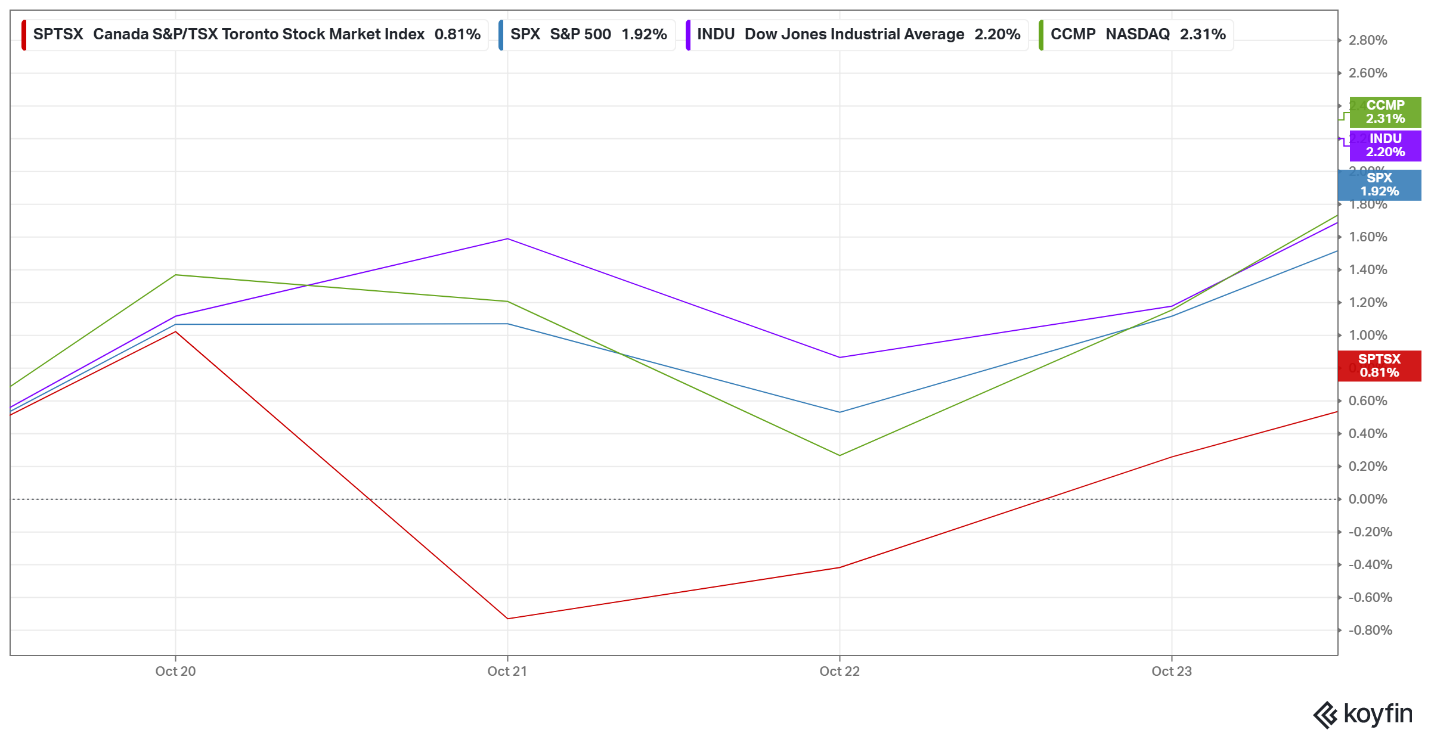
A graph with different colored lines AI-generated content may be incorrect.
Weekly Portfolio & Index performance for the week ended October 24, 2025.
Index Weekly Streak
TSX: 2 – week winning streak
S&P: 2 – week winning streak
DJIA: 2 – week winning streak
Nasdaq: 2 – week winning streak

Bull market. A good week for the North American stock markets. This week was another wild ride for the markets, fuelled by a fresh batch of major earnings reports, new inflation data from south of the border, and ongoing trade tensions. The Toronto Stock Exchange Composite Index (TSX), the S&P 500 (S&P), the Dow Jones Industrial Average (DJIA), and the Nasdaq Composite (Nasdaq) all kicked off the week with gains of 1% or more. To bookend the week that saw all four indexes extend their winning streaks to two, all three major American indexes finished the week at record highs.

Investors were upbeat heading into a wave of high-profile earnings this week, hoping to get a clearer sense of the American economy’s strength. With much government economic data still delayed by the ongoing shutdown, analysts leaned on corporate results for clues about the health of the economy.

Third-quarter earnings generally came in stronger than expected, boosting confidence in technology, industrial, and financial stocks. The S&P and Nasdaq climbed on solid results from several big names that showed resilience in both revenue and profit margins.

On the economic front, the US government shutdown – now the second longest in history – continued to cast a shadow over markets. While much of the usual data has been on hold, the Bureau of Labor Statistics released the September Consumer Price Index (CPI) this week, a week later than usual, so the Social Security Administration could determine its 2026 cost-of-living adjustment. The report revealed that inflation is still elevated but came in slightly below expectations. Meanwhile, job growth is slowing and unemployment claims are rising. Combining this information suggests the Fed faces a delicate balancing act – inflation is still high, but the economy is showing signs of cooling. Investors are now pricing in a likely 0.25% rate cut at next week’s meeting.

Trade headlines once again grabbed attention as the US–China negotiations took another turn. After fresh tariff threats from both sides early in the week, news that President Trump and Chinese officials would meet to get talks back on track helped calm some nerves. Things were less friendly on the US–Canada front, though – the US abruptly declared trade negotiations with Canada “terminated” after the Ontario government aired television ads in the US featuring former President Ronald Reagan, much admired by Republicans, criticizing tariffs and warning they cause job losses and trade wars. Trump, a strong proponent of tariffs, was reportedly not impressed. 😊

Meanwhile, the latest University of Michigan survey shows consumers remain cautious. People aren’t feeling confident about their finances or jobs, which can weigh on spending – a key driver of economic growth.

In Canada, the TSX had a mixed week. A sharp midweek drop driven by gold’s biggest one-day percentage fall in over 12 years, combined with higher-than-expected inflation, pushed the index into negative territory. Rising oil and other commodity prices, along with a recovery in gold prices, later helped the TSX recover and finish the week slightly positive.

All in all, markets reflected optimism from strong earnings and rising commodity prices, which more than offset inflation worries and trade uncertainty. Next week could be even better, with the first of the Magnificent 7 companies set to report third-quarter earnings and both central banks expected to lower their benchmark interest rates. Fingers crossed. 😊

Portfolio Weekly Streak
Portfolio 1: 2 – week winning streak
Portfolio 2: 2 – week winning streak
Portfolio 3: 2 – week winning streak

Bull market. A good week for the North American stock markets. As I’ve often said, when markets have a good week, the portfolios usually follow — and this week was no exception. All three extended their winning streaks to two straight weeks, boosted by strength in the mega-cap technology names, and even the weakest portfolio kept pace with the best-performing index.

Portfolio 1 was the laggard this week, rising 2.3%, equalling Nasdaq, the top performer of the indexes. The portfolio saw 62% of its holdings post a weekly gains, led by Hammond Power Solutions (TSE: HPS.A) with a massive 28% jump, while Kraken Robotics (TSE: PNG) climbed 13%. Several holdings also set fresh record highs, including Apple (NASD: AAPL), which surged on strong demand for its new iPhone 17, and Alphabet (NASD: GOOGL), after signing a major deal with AnthropicAI to supply up to a million of Google’s custom artificial intelligence (AI) chips for its Claude chatbot. Celestica (TSE: CLS), Shopify (TSE: SHOP), and CrowdStrike (NASD: CRWD) also joined the record-high club this week.

Portfolio 2 had another steady week, rising 2.5% as 68% of its holdings finished higher. Hammond Power Solutions once again stood out with its impressive 28% gain, helping drive the portfolio higher overall.

Portfolio 3 took top honours, gaining 3.3% for the week. An impressive 78% of its holdings advanced, including record highs from Vertiv Holdings (NYSE: VRT) and Shopify.

All in all, it was a solid week across the board – momentum is clearly building, and the portfolios are benefiting as investor confidence returns. With earnings season picking up and both central banks set to announce rate decisions, next week should offer plenty of opportunities for more movement, preferably upward. Here’s hoping those winning streaks continue. 😊
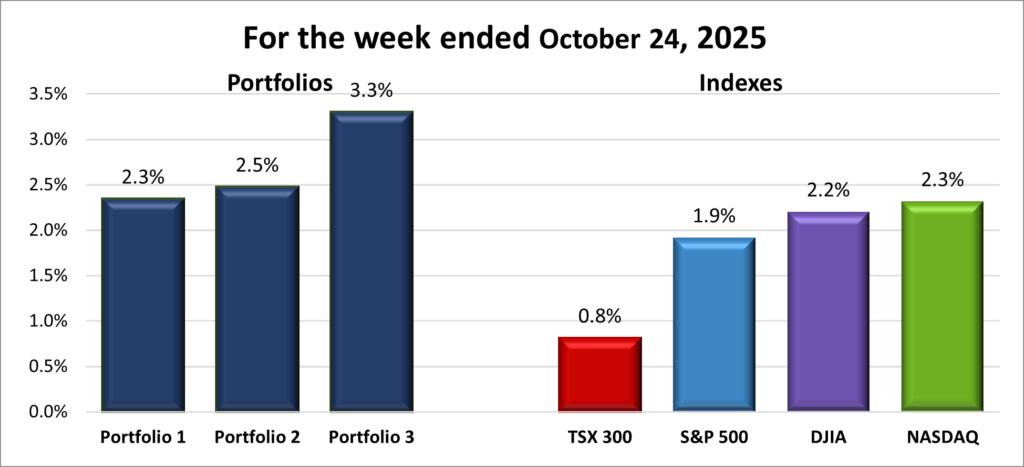
Weekly Portfolio & Index performance
Weekly Portfolio & Index performance for the week ended October 24, 2025.

Companies on the Radar

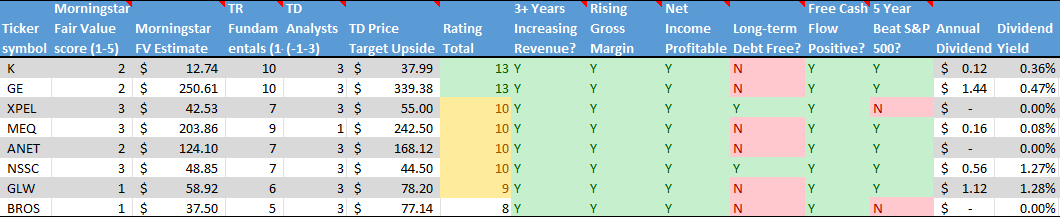
Stocks on my Radar This week, a few new names came across my radar – almost to the point of being too many! 😊 Joining the five holdovers from last week are three new possibilities, spanning a fast-growing food services company, a multi-billion-dollar industrial giant, and a gold miner.

First up is Dutch Bros Inc. (NYSE: BROS), a mid-cap American company rapidly expanding its drive-thru coffee chain. Known for high-quality, hand-crafted beverages and top-notch customer service, Dutch Bros plans to open at least 160 new locations across the US by the end of 2025, aiming for over 2,000 stores by 2029. With strong brand loyalty, especially in the Western US, this is a high-growth, aggressively expanding company with the potential for significant gains, but with that potential comes higher risk.

Next, we have GE Aerospace (NYSE: GE), which emerged after General Electric’s breakup in 2024. It focuses on aviation propulsion, systems, and services for commercial and military aircraft — and is also moving into the fast-growing drone sector. As a global leader in jet engines, aircraft systems, and maintenance, repair, and overhaul (MRO) services, GE Aerospace offers exposure to global aviation growth, defense spending, and cutting-edge technology. It offers a mix of stability and long-term growth.

Finally, Kinross Gold Corporation (TSE: K) is a Canadian gold miner with operations across the Americas and Africa. Gold often serves as a safe haven in uncertain times, and Kinross offers a way to gain exposure without buying the metal directly. With steady production, global diversification, and growth potential, it can act as a defensive play while still benefiting from rising gold prices. The recent pullback in gold has made this an interesting potential entry point.

These three join the five companies already on my radar, bringing the total to eight names – a mix of growth, industrial strength, and defensive plays. With each offering something different, it’s shaping up to be an exciting set of possibilities to explore over the long term.

  • XPEL, Inc. (NASD: XPEL): a growing American founder run company that produces high-quality protective films, coatings, and related products, primarily for cars but increasingly for architectural and other applications, such as paint protection film (PPF), window tint, and ceramic coatings. The company sells through multiple channels giving it both reach and control.
  • Mainstreet Equity Corp. (TSE: MEQ): a Calgary-based real estate company focused on mid-market apartment buildings – typically under 100 units – across Western Canada. It buys underperforming properties at below-market prices, renovates them, and increases rental income through improved operations. With strong demand for rental housing, a repeatable value-add strategy, and a solid balance sheet, Mainstreet offers a compelling mix of income and growth. Shares currently trade below net asset value, giving investors a margin of safety alongside steady cash flow and long-term upside.
  • Arista Networks (NYSE: ANET): an American company that designs and sells advanced networking hardware and software, with a focus on high-speed, low-latency switches for its key markets: data centres, AI, cloud computing, and financial trading. The company has been riding the AI tailwind with solid demand from its core markets, especially in AI and cloud data centres. It also has a hefty share buyback program and increasing investments from some of the top institutional investment companies.
  • Napco Security Technologies, Inc. (NASD: NSSC): a small American owner/operator security firm that provides electronic locks, intrusion and fire alarms, access control systems, and video surveillance solutions for homes, businesses, and institutions. With a broad network of distributors and installers, growing recurring service revenue, and smart home integrations, the company has several avenues for growth. The company is riding the tailwind of an increasing demand for security products.
  • Corning Incorporated (NYSE: GLW): a large cap American company that is a leader in specialty glass, optical fiber, environmental technology, life sciences, and other specialty glasses. They have been the supplier of the glass used in Apple’s iPhones since 2007, and they are riding the tailwind of an AI-driven fiber optic boom.

As always, these are not buy recommendations. Make sure to do your own research and choose investments that fit your personal financial goals.

The Radar Check was last updated October 24, 2025.
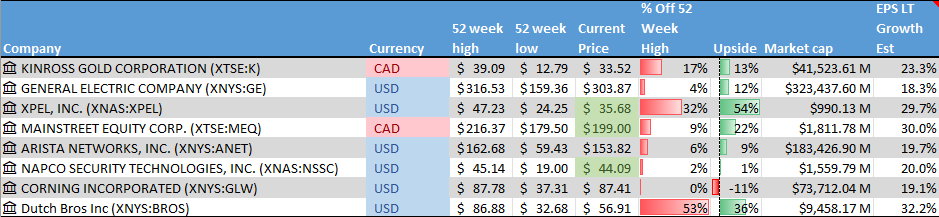
Stock on the Radar List. 1 of 2.
Stock on the Radar List. 2 of 2.

Portfolio Update

Portfolio 1

Sold: Docebo (TSE: DCBO) I first invested in Docebo, the corporate learning company, in May 2020. As the share price climbed, I added to my position twice more – in June and again in August of that year. The stock peaked at just over C$110 in June 2021, but its growth has cooled since those early years.

The company isn’t where I’d hoped it would be by now, and it doesn’t look like it’s headed there anytime soon. I made money on the first two investments but lost a bit on the last one, finishing about even overall.

As part of my effort to trim down the number of holdings in Portfolio 1 – and with better opportunities showing up on my radar – I decided it was time to sell and redirect the capital into stronger prospects.

Sold: PayPal (NASD: PYPL) I first invested in PayPal back in 2018, when it was growing fast and viewed as one of the dominant players in digital payments. It performed so well in those early months that I picked up more shares just four months later. For a few years, the growth story looked rock solid – especially during the pandemic in 2020, when online shopping surged and PayPal was adding millions of new users each quarter. By the summer of 2021, the share price had climbed above US$300, and everything was looking great.

Over time though, competition in the digital payments space intensified, and PayPal hasn’t been able to keep up the same pace of innovation or growth it once had. Margins have narrowed, user growth has slowed, and newer fintech players and payment options have taken a bigger share of the market. The 2022 bear market didn’t help either – the stock dropped below US$100 and has stayed there ever since.

At this point, it seems like PayPal’s strongest growth years are behind it, so I decided to sell my position and put that money back to work in opportunities with more upside potential. It’s always tough letting go of a long-term holding, but getting rid of underperformers is essential to finding new winners and growing your wealth through investing. 😊

Portfolio 3

Sold: Enghouse (TSE: ENGH) As I mentioned when I sold some of my Enghouse shares back in March 2025, while the markets continue to rise, Enghouse has continued to fall. The stock has underwhelmed and underperformed, and even with its dividend – currently yielding over 5% – my investment is still down more than 48%. I gave the company a few more months, but in hindsight, I should have sold all my shares back in March, if not earlier. I’m now redeploying that cash into better opportunities. Onward and upward.

That’s a wrap for this week, thanks for reading may your portfolio stay green and your dividends steady. See you next time!
Weekly Update for the week ending October 17, 2025

Trade Tensions Flare, Again

Since President Trump returned to office in January, his administration has been trying to reshape global trade in America’s favour. One of his earliest targets was China, the world’s second largest economy, trailing only the US. Since both sides have recently began ratcheting up the trade tension again, with new tariffs, export controls, and tit-for-tat sanctions making headlines, I thought it would be a good time to review the situation and what it could mean for investors everywhere – including here in Canada.

Where we were: After a few months of cautious détente, the US–China relationship had felt like a pause rather than a solution – both sides had signalled they wanted to avoid open conflict, but big structural disputes over technology, supply chains and rare earths never went away.

Quick timeline (how we got here):

  • Oct 9–12: China tightened rules on rare-earth exports and related technology – critical for chips, electric vehicles, and defense supply chains.
  • Oct 10: The US threatened sweeping tariffs on Chinese goods, including an additional 100% tariff on top of existing tariffs, increasing market volatility.
  • Oct 12–14: China defended its export curbs and introduced retaliatory measures; both sides implemented tit-for-tat port/ship fees and targeted sanctions, expanding the dispute beyond tariffs and technology into shipping and logistics.

Impact on the Canadian economy:

Canada is closely tied to both the US and global supply chains, so trade disruptions between the world’s two largest economies could quickly ripple north. If Chinese demand for US goods drops, US manufacturers may scale back production, reducing their need for Canadian raw materials and components. At the same time, if China retaliates against US exports, Canada may see temporary opportunities to fill gaps, but uncertainty around commodity prices and trade flows will rise. Energy, mining, manufacturing, and forestry could all feel the impact, and the Canadian dollar may weaken as investors seek safe-haven currencies like the US dollar.

What this means for investors:

The renewed tension increases market uncertainty, and, markets hate uncertainty. Volatility is likely, particularly in sectors tied to global supply chains: semiconductors, autos, industrials, and any business reliant on rare-earth materials. Higher shipping costs and restricted inputs can squeeze margins, slow earnings growth, and put pressure on stock prices. Conversely, safe-haven assets like gold and high-quality bonds often benefit during these types of shocks.

Implications for Canadian investors:

For Canadian investors, the effects will be uneven. Some exporters may benefit if they can fill gaps left by disrupted US-China trade, while companies closely tied to global supply chains or reliant on exports could face headwinds. Sectors like autos, industrials, and mining are likely to experience the biggest swings. For long-term investors, the key is to focus on high-quality companies with strong balance sheets and diversified markets, which are usually more resilient during geopolitical or trade-related uncertainty.

All of this shows why it pays to keep an eye on the bigger picture, especially if you own companies tied to global trade, technology, or commodities – which most of us do. Let’s now take a look at how these trade tensions, along with the start of third-quarter earnings season, shaped the markets and my portfolios this past week.


Items that may only interest or educate me ….

Canadian Economic news, US Economic news

Canadian Economic news

This past week’s key economic data that the Bank of Canada (BoC) considers when deciding whether to raise or lower the interest rate.

Canadian Market Volatility

Canada’s volatility gauge, the S&P/TSX 60 Volatility Index (VIXC), jumped to 20.18 at the start of the week as renewed China–US trade tensions rattled investors. It then eased into a calmer range between 16.4 and 17.75 for most of the week, but worries resurfaced late in the week after disappointing results from US regional banks pushed the index back above 18 on Thursday, before it closed at 18.81.

For anyone new to it, the VIXC is basically a barometer of investor nerves in Canada. When it’s in the single digits or low teens, markets are calm. Once it climbs into the high teens or beyond, it shows investors are getting uneasy and bracing for more swings ahead. With the index ending just above 18, it suggests that while there’s some tension in the air, Bay Street isn’t panicking – just staying alert.

US Economic news

This past week’s key data points that the Federal Reserve (Fed) considers when deciding whether to raise or lower the interest rate.

The shutdown, which began on October 1, has delayed several key government economic data releases. Among the data delayed is this week’s Consumer Price Index and Retail Trade reports. Updates will start again when the Federal government resumes operations.

American Market Volatility

The CBOE Volatility Index (VIX), often called the market’s “fear gauge,” started the week at 19.45 and bounced between 18.50 and 22.50 as renewed trade tensions with China pushed it above 20. Strong earnings from major US banks helped calm nerves and hinted that the economy was still on solid footing. That relief didn’t last, though – weak results from regional banks reignited worries and sent the fear gauge surging past 25 on Thursday, then above 28 on Friday, its highest level since May, before settling at 20.78.

Think of the VIX as the market’s mood ring. With readings now hovering above 20, it shows that investors are getting uneasy and bracing for more volatility. While it’s not a sign of panic, it does suggest that caution and uncertainty are starting to creep back into the market.


Weekly Market and Portfolio Review

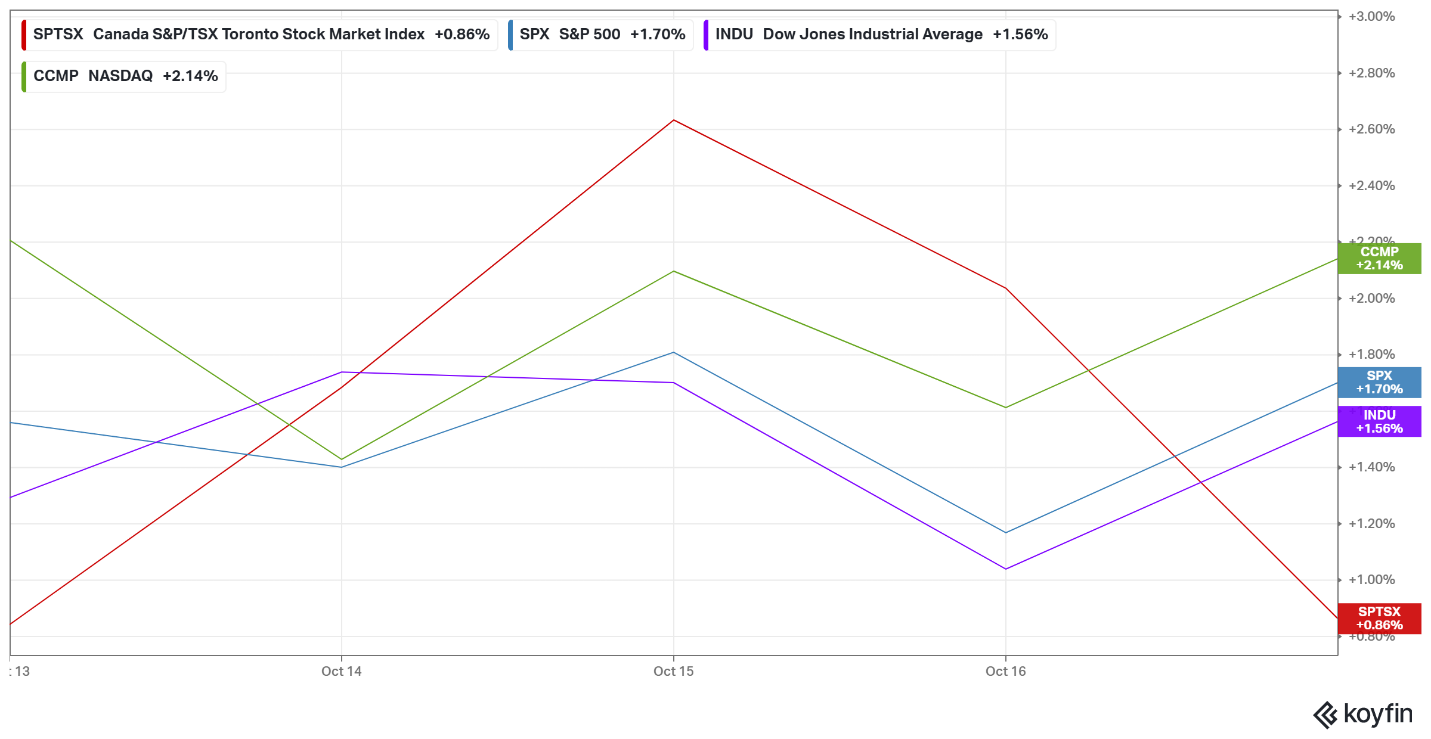
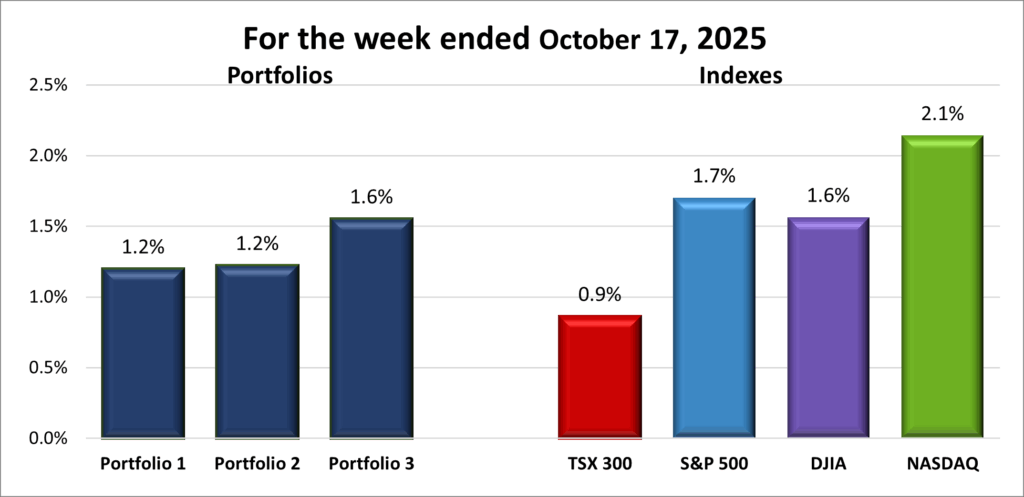
For the week, the TSX (SPTSX) rose 0.9%, the S&P 500 (SPX) climbed 1.7%, the DJIA (INDU) advanced 1.6% and the Nasdaq (CCMP) jumped 2.1%.

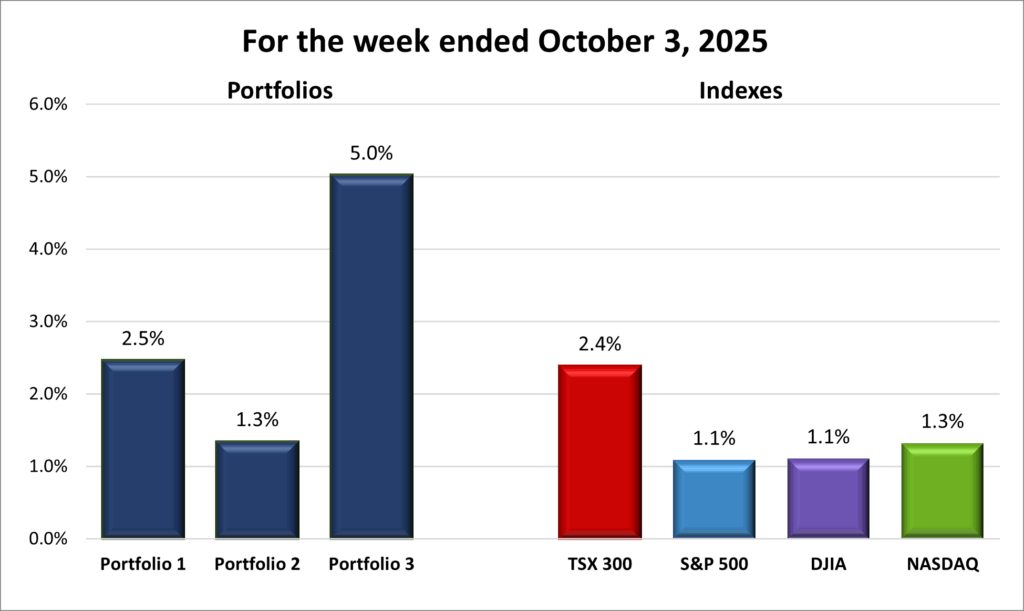
Weekly Portfolio & Index performance for the week ended October 3, 2025.
Weekly Portfolio & Index performance for the week ended October 17, 2025.
Index Weekly Streak
TSX: 1 – week winning streak
S&P: 1 – week winning streak
DJIA: 1 – week winning streak
Nasdaq: 1 – week winning streak

Bull market. A good week for the North American stock markets. The rollercoaster continued for the major North American indexes – the Toronto Stock Exchange Composite Index (TSX), the S&P 500 Index (S&P), the Dow Jones Industrial Average (DJIA), and the Nasdaq Composite Index (Nasdaq) – as they started strong, dipped midweek, and then clawed back gains to finish higher. The TSX posted the smallest weekly gain, but still managed to notch another record high before pulling back at the end of the week.

Markets spent the week reacting to a mix of trade headlines, artificial intelligence (AI) excitement, and early earnings reports. After last Friday’s selloff, US markets rebounded sharply on Monday when President Trump reassured investors with his “Don’t worry about China — it’ll all be fine!” comment. The optimism faded quickly, though, after the US announced plans to impose an additional 100% tariff on top of existing duties on Chinese imports starting November 1, while also tightening export controls on key software. China hit back with sanctions on US -linked firms, defended its rare-earth export curbs, and matched new American port fees on Chinese vessels with new port fees of their own on American vessels. The dispute has now spilled from technology and manufacturing into shipping and raw materials – a reminder that when the world’s two largest economies clash, no one wins in trade wars. Fortunately, tensions eased by week’s end after Trump said talks with China were progressing well and admitted that a 100% tariff on top of existing duties would be unsustainable for both sides.

The ongoing US government shutdown, now in its third week and the third longest in history, delayed the release of key economic reports, including the Consumer Price Index scheduled for this week. With limited fresh data, the Fed faces added uncertainty heading into its October 28–29 meeting, making earnings reports even more closely watched for clues on the economy. Strong results from major American banks early in the week lifted sentiment, suggesting resilience in consumer spending and business activity. But later in the week, weak results from two regional banks warning about higher loan losses reignited concerns over credit quality, dragging down the financial sector and broader markets. Rising loan losses often hint that borrowers are struggling to keep up with debt payments, which can point to tightening financial conditions or a slowing economy. Investors also worry that problems in smaller banks could spread to larger institutions, reducing credit availability and shaking confidence across the financial system. Fortunately, sentiment improved at week’s end after several other regional banks posted solid earnings, helping calm investor jitters and lift markets heading into the weekend.

AI optimism remained a steady tailwind for technology companies, helping lift the Nasdaq to its best day since late May after OpenAI, the developer of ChatGPT, announced a major new partnership with chipmaker Broadcom (NASD: AVGO). The deal includes plans to build custom AI chips and the massive data-centre systems that will power them. OpenAI will design the chips and system architecture, while Broadcom will handle manufacturing and networking – essentially building the infrastructure that ties it all together.

In Canada, the TSX had a strong week, climbing to a record high. Expectations of potential rate cuts, fueled by dovish US Fed commentary, lifted hopes that borrowing costs could ease sooner than expected. Rising metal and gold prices gave the index extra support, with resource-heavy sectors leading the way. Weaker oil, a softer loonie, and the renewed US–China trade tensions tempered some of those gains. Corporate earnings added another layer to the market’s mood – strong results from major banks initially lifted sentiment, while weaker reports from regional banks reminded investors that uncertainty is far from over.

Overall, the week showed how quickly market sentiment can shift with every trade headline and earnings surprise. Optimism around AI and strong bank results lifted stocks early on but worries about regional banks and US–China tensions kept investors cautious. By week’s end, easing trade tensions and reassuring results from regional banks helped steady nerves and sent investors into the weekend in a more upbeat mood. With earnings season picking up and key economic data still delayed, next week should bring more clues about where the economy and markets are headed.

Portfolio Weekly Streak
Portfolio 1: 1 – week winning streak
Portfolio 2: 1 – week winning streak
Portfolio 3: 1 – week winning streak

Bull market. A good week for the North American stock markets. This week turned out to be a pleasant surprise after all three portfolios lost ground the previous week. Only Portfolio 2 had more than half its holdings finish higher, but all three managed to post gains.

Portfolio 1 rose 1.2%, with 42% of holdings ending the week in the green. Celestica ((TSE: CLS) and Walmart (NYSE: WMT) both hit record highs, while Cameco (TSE: CCO) briefly reached a new peak before slipping to finish lower for the week. Navitas Semiconductor (NASD: NVTS) gave the portfolio a big lift, soaring 69% after launching a new chip designed to support Nvidia’s next-generation AI systems. Offsetting some of those gains was an 11% drop from Sea Limited (NYSE: SE).

Portfolio 2 got back in the win column with a 1.2% weekly gain. It was the only portfolio with a majority of holdings advancing, as 59% of its stocks moved higher. There were no standout winners or laggards – just broad-based participation that nudged the portfolio back into the weekly win column, making it ten weekly gains in the last eleven weeks.

Portfolio 3 was the biggest surprise. Only 30% of its holdings finished higher, yet it still managed a 1.6% gain. Even its two largest positions ended slightly lower. It’s baffling, but I’ll take it. 😊

Overall, the week turned out better than expected. It would’ve been nice to see broader participation, but any time portfolios post gains, especially after a down week, I’m more than happy to take the win. 😊

Weekly Portfolio & Index performance
Weekly Portfolio & Index performance for the week ended October 17, 2025.

Companies on the Radar

Stocks on my Radar No new companies popped up on my radar this past week, but I did remove one. While running my Quick Test on Tornado Infrastructure Equipment Ltd. (TSEV: TGH) – a small Canadian builder of hydrovac trucks – I found out it’s being bought by The Toro Company (NYSE: TTC) for C$1.92 per share, with the deal expected to close in early 2026. Since TGH is trading at C$1.89, there’s very little upside left before it’s absorbed by TTC. It would’ve been a dumb move to buy in now, but it’s a good reminder to always do your due diligence before investing your hard-earned money. 😊

Meanwhile, I’m still trimming long-time underperformers from my portfolios to build cash that I can put to work in stronger opportunities – possibly some of the five holdovers listed below.

  • Mainstreet Equity Corp. (TSE: MEQ): a Calgary-based real estate company focused on mid-market apartment buildings – typically under 100 units – across Western Canada. It buys underperforming properties at below-market prices, renovates them, and increases rental income through improved operations. With strong demand for rental housing, a repeatable value-add strategy, and a solid balance sheet, Mainstreet offers a compelling mix of income and growth. Shares currently trade below net asset value, giving investors a margin of safety alongside steady cash flow and long-term upside.
  • Napco Security Technologies, Inc. (NASD: NSSC): a small American owner/operator security firm that provides electronic locks, intrusion and fire alarms, access control systems, and video surveillance solutions for homes, businesses, and institutions. With a broad network of distributors and installers, growing recurring service revenue, and smart home integrations, the company has several avenues for growth. The company is riding the tailwind of an increasing demand for security products.
  • Arista Networks (NYSE: ANET): an American company that designs and sells advanced networking hardware and software, with a focus on high-speed, low-latency switches for its key markets: data centres, AI, cloud computing, and financial trading. The company has been riding the AI tailwind with solid demand from its core markets, especially in AI and cloud data centres. It also has a hefty share buyback program and increasing investments from some of the top institutional investment companies.
  • Corning Incorporated (NYSE: GLW): a large cap American company that is a leader in specialty glass, optical fiber, environmental technology, life sciences, and other specialty glasses. They have been the supplier of the glass used in Apple’s iPhones since 2007, and they are riding the tailwind of an AI-driven fiber optic boom.
  • XPEL, Inc. (NASD: XPEL): a growing American founder run company that produces high-quality protective films, coatings, and related products, primarily for cars but increasingly for architectural and other applications, such as paint protection film (PPF), window tint, and ceramic coatings. The company sells through multiple channels giving it both reach and control.

As always, these are not buy recommendations. Make sure to do your own research and choose investments that fit your personal financial goals.

The Radar Check was last updated October 17, 2025.

Stock on the Radar List. 1 of 2.
Stock on the Radar List. 2 of 2.

Portfolio Update

Portfolio 1

Sold: Indie Semiconductor (NASD: INDI) After holding shares in the company for two years, I decided it was time to move on. When I first invested, I thought Indie Semiconductor had an exciting opportunity – supplying chips for cars and driver-assistance systems – but the results just haven’t lived up to expectations. Revenue has been growing, but the company is still unprofitable, and frequent share issuances have made it harder for investors to see meaningful progress in the stock price.

INDI has also struggled to build steady momentum in a competitive market where larger chipmakers hold a clear advantage. Rather than waiting years for a potential turnaround, I chose to sell my shares and put that money to work in more promising opportunities.

Portfolio 3

Sold: Real Matters (TSE: REAL) After five years, I lost patience with Real Matters, the mortgage appraisal and title services company. When I invested in the company in January 2020, the business looked like it was gaining real traction – and it did for a while. The stock surged to around $32 by August 2020, but the momentum didn’t last. Within a year, it had fallen below $15, and today it trades just above $7, about 20% below the price I paid. ☹

Real Matters’ performance is still closely tied to housing and refinancing volumes, and higher interest rates have weighed heavily on both. Growth and profitability have been inconsistent, and the company hasn’t shown the steady growth or competitive edge I was hoping for. At this point, I’ve decided to move on and redeploy that capital into companies with stronger momentum, and a better chance of immediate or near-term growth.

That’s a wrap for this week, thanks for reading may your portfolio stay green and your dividends steady. See you next time!
Weekly Update for the week ending October 10, 2025

Will October be Trick or Treat for Investors?

After an unusually strong September, we’re stepping into the witching month – a time with a well-earned reputation for market drama. October has long carried a spooky aura on Wall Street, and for good reason. It’s seen some of the biggest market crashes in history. The Great Crash of 1929 kicked off the Great Depression after years of speculation and margin buying came undone, sending the Dow Jones Industrial Average (DJIA) tumbling nearly 90% from its peak and taking 25 years to fully recover. In 1987, “Black Monday” struck when computer-driven trading and panic selling triggered a record one-day drop of 22.6%, though markets managed to rebound within two years. It remains one of the worst single-day declines in Canadian market history. And in 2008, the collapse of the American housing market and the global credit freeze sent the S&P 500 (S&P) plunging 57% and the Toronto Stock Exchange (TSX) dropped about 16%, with a full recovery taking about four years.

Yet despite those infamous moments, October isn’t the market villain it’s often made out to be. Historically, it’s been more of a turning point – a month when markets often rebound after September’s weakness. Some even call it the “bear killer,” since several recoveries have started right around this time. But when September’s been strong, like this year, October tends to act more like a pause button than a launchpad, as investors catch their breath before the final stretch of the year.

For Canadian investors, the story isn’t much different. The TSX has often followed the same seasonal rhythm as American markets – sluggish through September, then stronger into year-end – though swings in energy and materials prices can make the ride bumpier. When oil prices firm up heading into winter, the TSX has historically gotten an extra lift, especially from its heavyweight energy and mining names.

Looking past October, the fourth quarter has traditionally been one of the best stretches for investors. Strong holiday spending, year-end portfolio rebalancing, and a generally upbeat mood have helped make the fourth quarter the most consistently positive period for the S&P, averaging gains of about 4% to 5% over time. So, while October’s history may raise eyebrows thanks to a few dramatic moments, both October and the fourth quarter have been kind to investors overall. Seasonality isn’t guaranteed, of course – but history still leans in favour of the bulls as we head toward year-end. Let’s hope that trend continues. 😊

So, with all that history in mind, how did markets actually behave this past week? After a strong September, investors were watching closely to see whether the momentum would continue, or if October would live up to its scary reputation. Let’s take a closer look at how the witching month has kicked off for markets so far.


Items that may only interest or educate me ….

The Bull Turns 3, Canadian Economic news, US Economic news ….

The Bull Turns 3

October 12, 2025, marks the third anniversary of the current bull market – a milestone that might surprise anyone who remembers how gloomy things felt back in 2022. I still remember that bear market (when stocks fell more than 20% from their highs), watching my portfolios drop week after week was not fun. A bull market, by contrast, means stocks have been rising for an extended period, usually by 20% or more from their lows.

The market hit rock bottom on October 12, 2022, when the S&P sank to its lowest point after months of surging inflation, soaring interest rates, and recession fears. From that low, the market has come roaring back, with the S&P surging nearly 90% and the TSX climbing almost 64% over the past three years.

Much of that rally has been driven by the heavyweight technology companies – the “Magnificent 7” – and the explosive growth of artificial intelligence (AI). What started as a niche tech story has become a full-blown market catalyst, drawing in investors and sending share prices soaring. Not bad for a bull market that began when optimism was in short supply. 😊

Canadian Economic news

This past week’s key economic data that the Bank of Canada (BoC) considers when deciding whether to raise or lower the interest rate.

Labour Force Survey (LFS)

According to Statistics Canada, the Canadian economy added 60,400 mostly full-time jobs in September, far exceeding expectations for just 5,000 and nearly offsetting August’s loss of 65,500. The unemployment rate held steady at 7.1%, defying forecasts for a small uptick to 7.2%, which suggests more people are entering the workforce rather than leaving it.

The biggest job gains came from the agriculture industry, which jumped 6.1% for the month, while wholesale and retail trade, along with transportation and warehousing, saw declines of 0.7%. On a year-over-year basis, employment in utilities surged 10.4%, while business, building, and other support services dropped 3.5%.

Wage growth remains moderate, with average hourly earnings rising 3.3% from a year ago, slightly higher than August’s 3.2%. Youth unemployment, however, climbed to 14.7%, showing younger workers are still having a tough time landing steady jobs.

All in all, September’s report showed surprising strength in Canada’s labour market, signalling resilience despite broader economic headwinds. But with rising wages and uneven job growth across sectors, the BoC will likely stay cautious as it weighs inflation risks going forward.

Canadian Market Volatility

Canada’s volatility gauge, the S&P/TSX 60 Volatility Index (VIXC), opened the week at 11.50 and stayed mostly calm, hovering around the 12 mark. But on Friday, it spiked as high as 19.25 after a stronger-than-expected labour report, confirmation that sector-specific US tariffs will remain in place, and, most importantly, renewed US threats of a massive tariff hike on China, which was the main driver of the late-week jump. The index later eased to finish the week at 11.55 as markets shook off the initial shock from the China tariff news.

For anyone new to it, the VIXC is basically a barometer of investor nerves in Canada. When it’s in the single digits or low teens, markets are calm. But once it moves into the mid-teens or higher, it signals growing unease and the potential for choppier trading ahead. Even with Friday’s spike, the index ended near the lower end of its normal range – suggesting that, for now, Bay Street remains more relaxed than rattled.

US Economic news

This past week’s key data points that the Federal Reserve (Fed) considers when deciding whether to raise or lower the interest rate.

The shutdown, which began on October 1, has delayed several key government economic data releases. Among the data delayed is this week’s Bureau of Labor Statistics’ Employment Situation Report, more commonly known as the monthly jobs report. Updates will start again when the Federal government resumes operations.

Federal Open Market Committee (FOMC) minutes

The Fed released the minutes from its September 16–17 meeting this week, giving investors a closer look at what policymakers were thinking when they decided to cut interest rates by a quarter point. Most members supported the move, though a few preferred a larger 0.5% cut. Others were more cautious, still concerned that inflation hadn’t cooled enough to justify moving too quickly. The split shows that while the Fed is leaning toward more rate cuts, it’s not in a hurry to rush down that path.

The minutes also revealed growing concern about the labour market. Officials noted that hiring has slowed, job gains have come in weaker than expected, and the risks to employment are starting to tilt to the downside. That cooling job market is one of the main reasons the Fed opted to cut rates in the first place – lower borrowing costs can help keep businesses investing and hiring.

Inflation, however, is still a sticking point. While some members felt price pressures had begun to ease, others warned that risks haven’t gone away, especially with higher input costs and tariffs still in play. This ongoing tug-of-war between inflation and slowing growth has left the Fed in a tough spot – trying to support the economy without reigniting price pressures.

For us investors, the takeaway is that the Fed remains cautious but open to adjusting rates as needed. The committee sees room for further cuts if the economy weakens, but with inflation still hovering above their 2% target and key data delayed by the government shutdown, the path forward is uncertain. Markets will likely see a few more twists and turns before the Fed’s next move comes into focus.

Consumer Sentiment Index (CSI)

The University of Michigan’s preliminary October CSI came in at 55.0, just a touch above expectations (54.2) and virtually unchanged from September’s final reading of 55.1. Compared to a year ago, though, sentiment has dropped 22%, showing how much confidence has cooled over the past year.

The Current Economic Conditions Index, which reflects how people feel about their job security and personal finances, ticked up 1.0% month over month to 61.0, though it’s still down 6.0% from a year ago. Meanwhile, the Expectations Index, which looks six months ahead, slipped 1.0% to 51.2, down a hefty 30.9% year over year.

On the inflation front, short-term expectations (one year ahead) eased slightly to 4.6% from 4.7%, while the five-year outlook held steady around 3.7%.

Consumer sentiment offers a glimpse into how everyday Americans feel about the economy, and that can shape spending, borrowing, and corporate earnings. This month’s steady reading suggests confidence isn’t improving, but it’s not falling off a cliff either. The small dip in inflation expectations gives the Fed a bit of breathing room, though worries about prices, wages, and the job market still linger.

In short, despite the US government shutdown entering its second week, consumers’ views didn’t shift much. Sentiment remains cautious – neither a big win nor a major warning sign – but Americans clearly haven’t shaken off their economic worries just yet.

American Market Volatility

The CBOE Volatility Index (VIX), often called the market’s “fear gauge,” opened the week at 16.74 and stayed relatively calm through Thursday, hovering between 16 and 17. But it spiked above 22.2 after President Trump threatened massive new tariffs on Chinese goods following China added new port fees on American ships, launched an antitrust investigation into American technology company Qualcomm (NASD: QCOM), and slowed exports of rare earth minerals to the US. The VIX stayed above 20 for the rest of the day and ended the week at 21.66.

Think of the VIX as a market mood ring. When it’s in the 12–20 range, investors are generally calm. Once it climbs higher, it signals growing unease and the possibility of bumpier trading ahead. A rising VIX doesn’t always mean panic, but it does show caution creeping back into the market.


Weekly Market and Portfolio Review

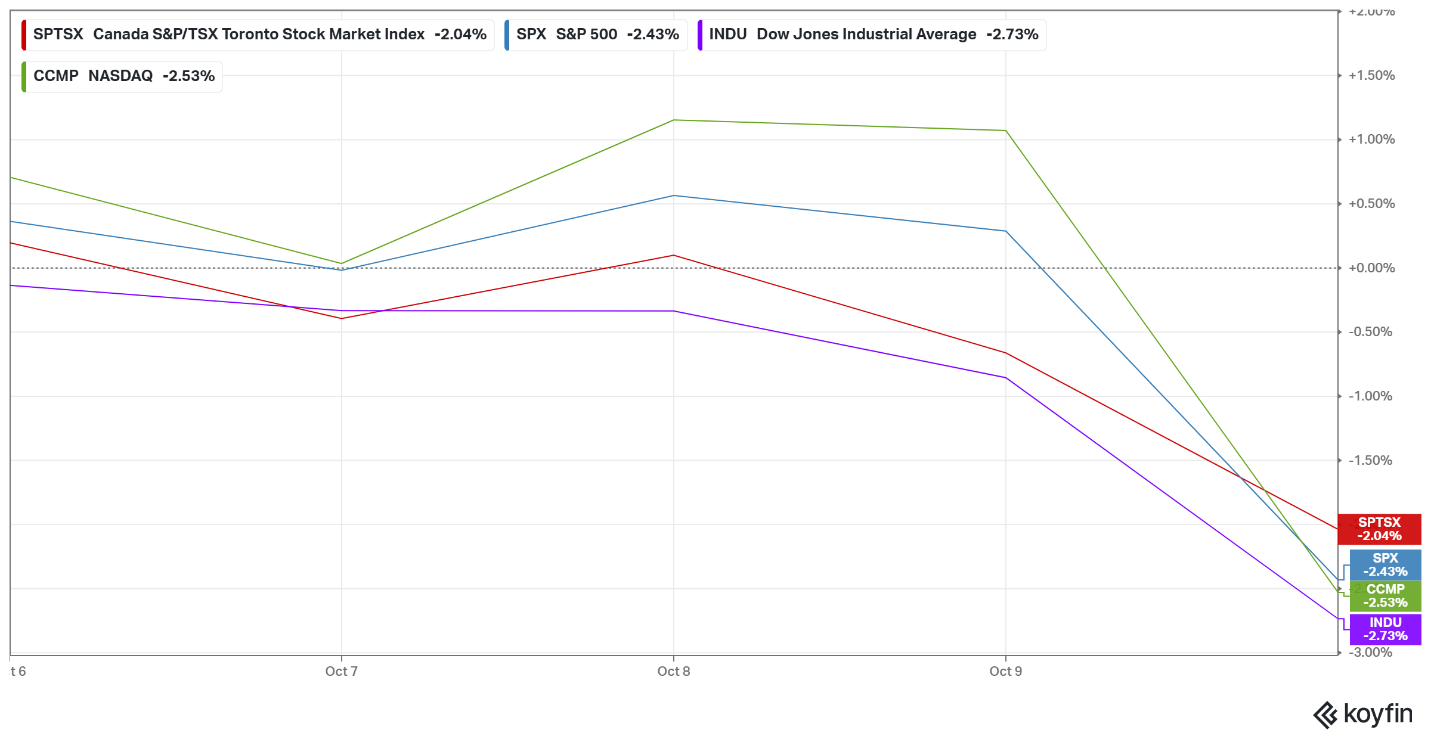
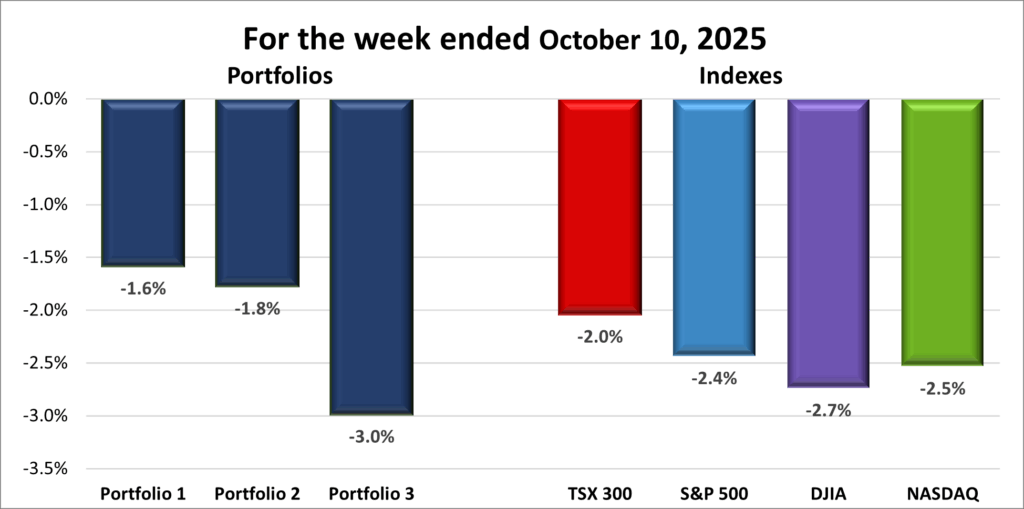
For the week, the TSX (SPTSX) lost 2.0%, the S&P (SPX) dropped 2.4%, the DJIA (INDU) fell 2.7% and the Nasdaq (CCMP) sank 2.5%.

A graph of different colored lines AI-generated content may be incorrect.
Weekly progress of the four major North American indexes.
Index Weekly Streak
TSX: 1 – week losing streak
S&P: 1 – week losing streak
DJIA: 1 – week losing streak
Nasdaq: 1 – week losing streak

Bearish market With no fresh economic data and earnings season about to kick off, investors spent most of the week in “wait and see” mode. Markets rode a rollercoaster, swinging between optimism and doubt before a last-minute plunge sent all four major indexes into negative territory for the week.

At the start of the week, the TSX, the S&P, and the Nasdaq Composite (Nasdaq) all extended their daily win streaks to seven before running into a wall of doubt over AI’s profitability. From there, the indexes seesawed between gains and losses – and, like any good rollercoaster, ended with a steep drop. The TSX, S&P, and Nasdaq each logged their biggest single-day declines since April. On a weekly basis, the S&P posted its sharpest loss since May, while both the TSX and Nasdaq saw their steepest declines since April. And in case you thought the DJIA escaped the pain, it finished lower every day of the week and plunged more than 800 points, or 1.9%, on Friday alone. Ouch!

Among the biggest market drivers were the mega-cap tech companies riding the ongoing AI boom, the release of the FOMC meeting minutes, anticipation for next week’s earnings reports, and trade tariffs. Early in the week, chipmaker AMD (NASD: AMD) lit up the markets after announcing a multiyear deal with OpenAI – the maker of ChatGPT – to supply advanced AI chips. The agreement, expected to bring in tens of billions in annual revenue, also gives OpenAI the option to purchase up to 10% of AMD, fueling hopes that the AI rally still has momentum.

That optimism faded midweek after a report raised doubts about the profitability of renting out AI computing power. The news cooled enthusiasm and reignited concerns that the rapid run-up in AI stocks could be forming a bubble. With that uncertainty, investors turned their attention back to the Fed for guidance.

With the US government shutdown, into its tenth day (at the time of this post), the release of the FOMC minutes took centre stage. Markets initially rallied after learning most members felt it “would be appropriate to ease policy further over the remainder of this year,” with nearly half expecting three rate cuts in 2025 (the first came in September). With fresh data limited, investors are now eyeing earnings season for clues on the economy, while some have shifted toward safe-haven assets like gold.

On the trade front, for most of the week there wasn’t much news beyond President Trump announcing a new 25% tariff on all foreign-made medium and heavy-duty trucks. The calmness was shattered when Trump rattled markets by threatening a “massive increase” in tariffs on Chinese imports, responding to Beijing’s recent export controls on rare earth elements, the addition of new port fees on American ships, and launching an antitrust investigation into American technology giant Qualcomm. The escalation marks a major setback in trade relations between the world’s two largest economies, raising fears of renewed tensions, disrupted supply chains, and higher costs for consumers and businesses. The markets’ tumble underscores how sensitive investors remain to trade uncertainty and unexpected social media announcements.

In Canada, the TSX followed a similar ride – starting strong thanks to firm commodity prices (especially gold) and some spillover from the US AI rally, but losing steam later in the week. Canada’s merchandise trade deficit widened sharply in August to C$6.3 billion, the second largest on record, as exports fell about 3% and imports inched up nearly 1%. The data points to global headwinds and ongoing US tariffs weighing on Canadian exports, suggesting trade could remain a weak spot heading into fall.

Adding to the mix, Canada’s labour market surprised on the upside in September, with 60,000 mostly full-time jobs added and the unemployment rate holding steady at 7.1%. The strong report shows the job market remains resilient, though younger workers are still facing challenges. The surprising strength also dims the chances of a near-term BoC rate cut, as solid employment suggests the economy is holding up better than expected.

Finally, Statistics Canada warned it may have to delay its upcoming international trade report if the American government shutdown continues. Since roughly 70% of Canadian exports go to the US, missing American data would make it difficult to get a clear picture of how Canada’s trade story is really shaping up.

Investors started the week cautiously optimistic, keeping a close eye on the US economy and the kickoff of third-quarter earnings for clues about another potential Fed rate cut — but when trade tensions flared up, that optimism faded fast. In Canada, strong job gains were a bright spot, even as trade challenges lingered. With earnings season ramping up and uncertainty over the US outlook still hanging in the air, this market rollercoaster could keep rolling for a few more weeks. Still, with that sharp drop to end the week, some buying opportunities might just pop up next week. 😊

Portfolio Weekly Streak
Portfolio 1: 1 – week losing streak
Portfolio 2: 1 – week losing streak
Portfolio 3: 1 – week losing streak

Bearish market As markets plunged late in the week, my three portfolios followed suit. Heading into Friday, Portfolios 1 and 3 were comfortably in the green, while Portfolio 2 was down just 0.5% — not bad considering the mixed performance across indexes. But when markets tanked on news that President Trump was threatening major new tariffs on China, the selloff pulled all three portfolios into the red. The decline was broad-based, with most holdings finishing the week lower.

Portfolio 1 held up the best, losing only 1.6% of its value. About a quarter of its holdings managed to post gains. There weren’t any standout winners, but there were a few sharp drops – Ferrari (NYSE: RACE) slid 20% after disappointing guidance pointed to slower growth ahead, while Magnite (NASD: MGNI) and Skyworks Solutions (NYSE: SWKS) dropped 13% and 10%, respectively. Before Friday’s selloff, though, Formula 1 Group (NASD: FWONK), Shopify (TSE: SHOP), and Cameco (TSE: CCO) all hit record highs, offering a nice reminder of the strength beneath the surface.

Portfolio 2 slipped 1.8%, enough to snap its nine week win streak. Only 18% of holdings posted weekly gains, but there were no major moves in either direction, which helped limit the damage. iA Financial (TSE: IAG) was a bright spot, touching a record high during the week.

Portfolio 3 had the roughest ride, plunging from up 1.4% on Thursday to a 3.0% loss by Friday’s close. Only 10% of its holdings ended the week higher, including Vertiv Holdings (NYSE: VRT), which reached another record high. Despite ending lower on the week, Shopify managed to set a record high before tailing off. Offsetting that strength were steep drops from Lithium Americas (TSE: LAC), down 19% after a strong two-week rally, and Magnite, which fell 13%.

As a result of the last-minute sell-off, there wasn’t a lot of good news, and the week ended on a shaky note. Sure, the markets threw a curveball at the end, but some of the holdings still managed to shine. Several hit record highs, showing pockets of strength and resilience. Volatility is just part of the ride, and weeks like this keep investing, uh, interesting. Yeah, that’s the word: interesting. 😊 Let’s see what surprises next week has in store – hopefully all three portfolios get back on the winning track! 😊

Weekly Portfolio & Index performance
Weekly Portfolio & Index performance for the week ended October 10, 2025.

Companies on the Radar

Stocks on my Radar No new companies came across my radar this past week, as I spent most of the time doing some housekeeping for Portfolio 3. I trimmed a long-term underperformer that hadn’t lived up to expectations, making room to focus on stronger prospects ahead, and increased my position in two exiting holdings. For now, the six companies below are still on my radar:

  • Mainstreet Equity Corp. (TSE: MEQ): a Calgary-based real estate company focused on mid-market apartment buildings – typically under 100 units – across Western Canada. It buys underperforming properties at below-market prices, renovates them, and increases rental income through improved operations. With strong demand for rental housing, a repeatable value-add strategy, and a solid balance sheet, Mainstreet offers a compelling mix of income and growth. Shares currently trade below net asset value, giving investors a margin of safety alongside steady cash flow and long-term upside.
  • Napco Security Technologies, Inc. (NASD: NSSC): a small American owner/operator security firm that provides electronic locks, intrusion and fire alarms, access control systems, and video surveillance solutions for homes, businesses, and institutions. With a broad network of distributors and installers, growing recurring service revenue, and smart home integrations, the company has several avenues for growth. The company is riding the tailwind of an increasing demand for security products.
  • XPEL, Inc. (NASD: XPEL): a growing American founder run company that produces high-quality protective films, coatings, and related products, primarily for cars but increasingly for architectural and other applications, such as paint protection film (PPF), window tint, and ceramic coatings. The company sells through multiple channels giving it both reach and control.
  • Tornado Infrastructure Equipment Ltd. (TSEV: TGH): a small Canadian industrial company that designs, builds, and sells hydrovac trucks across North America, while also generating recurring revenue through rentals, parts, and maintenance – making it more than just a pure equipment play.
  • Arista Networks (NYSE: ANET): an American company that designs and sells advanced networking hardware and software, with a focus on high-speed, low-latency switches for its key markets: data centres, AI, cloud computing, and financial trading. The company has been riding the AI tailwind with solid demand from its core markets, especially in AI and cloud data centres. It also has a hefty share buyback program and increasing investments from some of the top institutional investment companies.
  • Corning Incorporated (NYSE: GLW): a large cap American company that is a leader in specialty glass, optical fiber, environmental technology, life sciences, and other specialty glasses. They have been the supplier of the glass used in Apple’s iPhones since 2007, and they are riding the tailwind of an AI-driven fiber optic boom.

As always, these are not buy recommendations. Make sure to do your own research and choose investments that fit your personal financial goals.

The Radar Check was last updated October 10, 2025.

Stock on the Radar List. 1 of 2.
Stock on the Radar List. 2 of 2.

Portfolio Updates

Portfolio 3

Brookfield Corporation (TSX: BN) and Brookfield Wealth Solutions (TSX: BNT) split on a 3-for-2 basis. While I will get one extra share of each company for every two I already hold, my ownership in both companies is still very, very, very small. 😊

Bought: Brookfield Corp. I picked up a few more shares of Brookfield, often called the Berkshire Hathaway (NYSE: BRK.B) of Canada, and for good reason. Like Warren Buffett’s empire, Brookfield is a collection of high-quality businesses spanning infrastructure, real estate, renewable power, and private equity. CEO Bruce Flatt, sometimes nicknamed “Canada’s Warren Buffett,” has built a reputation for disciplined, long-term investing and smart capital allocation.

Brookfield’s structure mirrors Berkshire’s, with the parent company holding large stakes in several strong, independently run subsidiaries including: Brookfield Renewables (TSE: BEP.UN), Brookfield Asset Management (TSE: BAM), Brookfield Infrastructure (TSE: BIP.UN), and Brookfield Wealth Solutions. By reinvesting steady cash flows and focusing on compounding value over time, Brookfield has grown into one of Canada’s most globally recognized companies – a go-to name for investors seeking exposure to real assets without having to pick individual winners.

Its diverse mix of businesses gives it resilience through market cycles, while a growing base of fee-related earnings provides reliable, recurring cash flow – something us long-term investors can really appreciate. With a strong management team, meaningful insider ownership, and ongoing share buybacks, Brookfield continues to earn my confidence in its ability to create lasting shareholder value.

The stock still trades around fair value, and following Warren Buffett’s timeless advice – “It’s better to buy a great company at a fair price than a fair company at a great price” – I decided to top up my position. Instead of trying to guess which Brookfield arm might outperform, I’d rather own the parent and get a piece of them all. 😊

Bought: Brookfield Wealth Solutions I added a few more shares of Brookfield Wealth Solutions, to get more direct exposure to the company which has quietly been building a strong presence in the insurance and annuity space. Its expanding pension risk transfer and annuity business provides steady, long-term cash flow, the kind of dependable income that helps smooth out portfolio volatility. With a growing global footprint, including its recent move into the United Kingdom market through the Just Group PLC (LSE: JUST) acquisition, BNT looks well-positioned for continued growth. Management has also shown discipline with its balance sheet and a clear commitment to shareholder returns through consistent distributions.

All in all, it felt like a good time to top up my position in this quietly powerful member of the Brookfield family. Together with my purchase of more Brookfield Corporation, discussed above, both moves felt like smart, steady additions – doubling down on a proven, globally diversified platform built for long-term compounding.

Sold: Adyen N.V. (OTCM: ADYEY) Adyen is a Dutch fintech company offering a global payments platform for online, mobile, and point-of-sale transactions. I invested in the company back in December 2020, and the share price is still well below my purchase price. Recently, the stock has struggled due to slowing sales growth – the company reported its slowest growth ever – rising competition in key markets, and regulatory challenges, including US tariffs. With these headwinds and no sign the share price will surpass my entry point any time soon, I decided it was a good time to exit my position and reallocate the capital to more promising opportunities.

That’s a wrap for this week, thanks for reading may your portfolio stay green and your dividends steady. See you next time!

Monthly Portfolio Update September 2025

Monthly Market and Portfolio Review

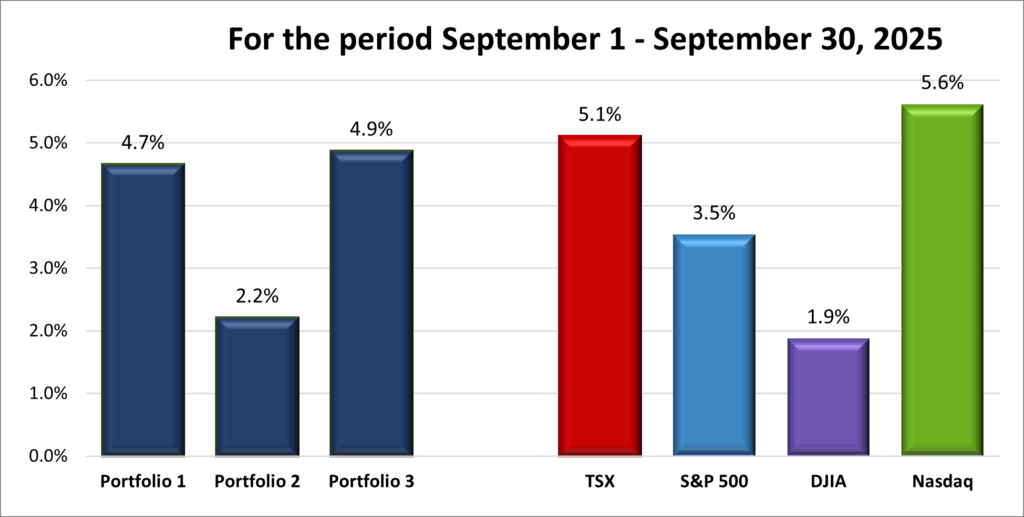
Bull market. A good week for the North American stock markets. September flipped the script on its usual reputation as a tough month for stocks. North American markets finished the month strong, capping a solid third quarter and extending impressive streaks of gains. The Toronto Stock Exchange Composite Index (TSX) surged 5.1%, while the S&P 500 Index (S&P) climbed 3.5%, the Dow Jones Industrial Average (DJIA) added 1.9%, and the Nasdaq Composite Index (Nasdaq) jumped 5.6%. Record highs were a recurring theme: the Nasdaq and S&P hit multiple peaks to post their best September since 2010 and strongest third quarter since 2020, while the Dow notched its fifth straight monthly gain. Up north, the TSX marked its fifth consecutive monthly advance.

What really moved markets was a coordinated reduction in interest rates: on September 17, 2025 the Bank of Canada surprised some by cutting its benchmark interest rate by 0.25% points to 2.50%, and roughly an hour later the Federal Reserve matched that with its own 0.25% cut to 4.00–4.25%. That back-to-back action read as a synchronous easing move – it lowered borrowing costs, pushed investors into rate-sensitive assets, and gave an immediate lift to stocks, especially sectors that benefit from cheaper financing.

Economic data painted a mixed picture. In the US, Personal Consumption Expenditures inflation readings were broadly in line with expectations, but job growth eased and consumer confidence slid to its weakest level since April, which kept investor sentiment cautious. In Canada, a small economic uptick (as measured by Gross Domestic Product) in July halted a run of contractions and eased fears of a deeper downturn, though manufacturing activity stayed soft and global demand headwinds lingered. That blend of “not terrible” hard data and weakening soft signals allowed markets to rally while still keeping a watchful eye on risks.

Trade headlines added texture rather than fireworks. September mostly confirmed earlier moves – the US–European Union (EU) auto tariff fix that was negotiated over the summer was formally implemented, and American officials reiterated that hefty tariffs on Chinese goods remain the “status quo,” which tempered hopes for a quick thaw. Canada benefited indirectly from the calmer US–EU outcome, and resource and export sectors cheered the lower interest rates, even as uncertainty over some US tariffs and new levies (timber, lumber, furniture) kept exporters cautious.

Across indexes, the drivers looked different because the market makeup differs: the Nasdaq and S&P were lifted by a handful of mega-cap tech names riding the artificial intelligence (AI) tailwind, the DJIA leaned on industrials and the dovish policy tone, and the TSX got a big boost from energy, basic materials (miners and fertilizer producers) and other resource-heavy sectors that tend to outperform when rates fall and risk appetite returns. The rally was broad based, and while a possible US government shutdown and trade uncertainty linger in the background, September proved that markets can still find plenty of reasons to push higher. 😊

Portfolio Monthly Streak
Portfolio 1: 5 – month winning streak
Portfolio 2: 6 – month winning streak
Portfolio 3: 5 – month winning streak

Bull market. A good week for the North American stock markets. What’s usually a tricky month for stocks ended up delivering solid gains, lifting all three portfolios in September. Here’s a look at how each performed and the standout movers that shaped the month.

Portfolio 1 rose 4.7%, powered by all-time highs from Celestica (TSE: CLS), Alphabet (NASD: GOOGL), Nvidia (NASD: NVDA), Cameco (TSE: CCO), and TD Bank (TSE: TD). Technology led the charge: Alphabet’s 11% September gain capped a 38% jump in Q3 – its best quarter since 2005 – as it avoided antitrust penalties and benefitted from surging demand for AI. Solid gains from CrowdStrike (NASD: CRWD), Navitas Semiconductor (NASD: NVTS), Lattice Semiconductor (NASD: LSCC), and Cloudflare (NYSE: NET), a 39% pop from Kraken Robotics (TSE: PNG), and strong momentum from Grab Holdings (NASD: GRAB) added fuel. Trade Desk (NASD: TTD) and Magnite (NASD: MGNI) stumbled, and Nvidia wavered briefly on US-China trade jitters, but winners far outpaced losers. 😊

Portfolio 2 added 2.2% on the back of steady performance. Three of four weeks ended higher, with nearly 60% of holdings advancing even during the flat week. Highlights included record highs from iA Financial (TSE: IAG), Take-Two Interactive (NASD: TTWO), South Bow (TSE: SOBO), and TC Energy (TSE: TRP), plus a late rally from Microsoft (NASD: MSFT) after it avoided a significant EU fine. Supremex (TSE: SXP) slipped 13%, but broad-based gains kept the portfolio moving upward. 😊

Portfolio 3 had the rockiest ride of the three, but still came out on top with a 4.9% gain. After starting the month under pressure from a dip in Nvidia, the portfolio bounced back with a broad-based rally driven by some standout performances. The clear star was Lithium Americas (TSE: LAC), which nearly doubled (up 97%) on renewed investor excitement, while Royal Bank of Canada (TSE: RY) and TD Bank also reached fresh highs. Despite a few bumps in the final week, Nvidia’s resilience and strong showings from the banks kept the portfolio firmly on track. 😊

All in all, September was rewarding across the board. Record highs, standout rallies, and a few surprises kept momentum alive. With central bank support and resilient companies leading the way, the portfolios head into October on solid footing – and I’m looking forward to seeing what the next month brings. 😊

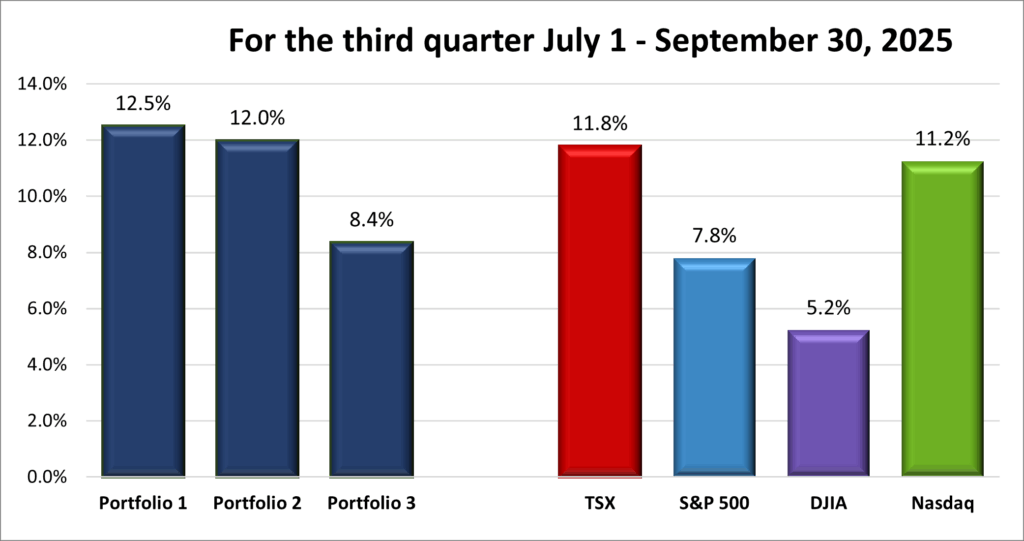
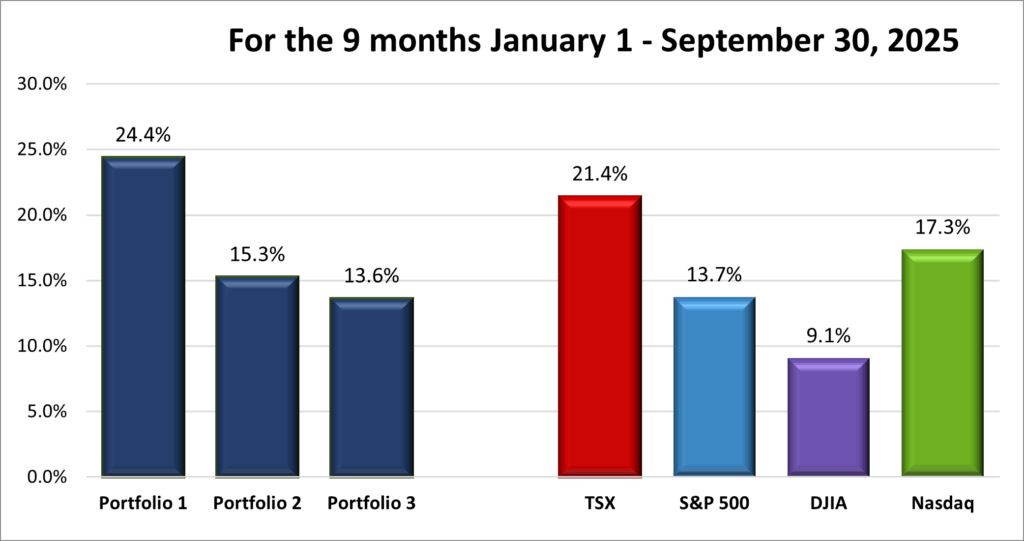
Monthly Portfolio & Index performance
Chart 1: Monthly Performance

For the quarter, Portfolios 1 and 2 led the way with gains of 12.5% and 12.0%, while Portfolio 3 trailed at 8.4%. Among the indexes, the TSX soared 11.8%, extending its quarterly win streak to five, the S&P climbed 7.8%, the DJIA rose 5.2%, and the Nasdaq surged 11.2%.

Third Quarter Portfolio & Index performance
Chart 2: Quarterly Performance

Year to date, Portfolio 1 leads the pack with an impressive 24.4% increase in value, followed by Portfolio 2 at 15.3% and Portfolio 3 at 13.6%. Among the indexes, the TSX has soared 21.4%, the S&P climbed 13.7%, the DJIA rose 9.1%, and the Nasdaq jumped 17.3%.

9 Months YTD Portfolio & Index performance
Chart 3: YTD Performance

What My Three Portfolios Did in September

Portfolio 1 for September 2025: UP Green Up Arrow, signifying a positive week

Activity

No significant activity to report this month.

Dividends Received this month:

Companies followed by DRIP (Dividend Re-Investment Plan) indicate additional shares were purchased with the dividend. Any cash leftover was added to the cash balance.

Canadian $

Yellow Pages (TSE: Y)

BSR Real Estate Investment Trust (TSE: HOM.U)

Dream Industrial Real Estate Investment Trust (TSE: DIR.UN) DRIP

Decisive Dividend Corp (TSEV: DE) DRIP

Hammond Power Solutions (TSE: HPS.A)

Canadian National Railway Company (TSE: CNR)

Tourmaline Oil Corp (TSE: TOU)

US $

Walmart (NYSE: WMT)

Visa (NYSE: V)

Alphabet Inc. (NASD: GOOGL)

Skyworks Solutions Inc (NASD: SWKS)

Home Depot (NYSE: HD)

Quarterly Reports

Costco Wholesale Corporation

Fourth quarter 2025 financial results on September 25, 2025

Carnival Corporation & plc

Third quarter 2025 financial results on September 29, 2025

Portfolio 2 for September 2025: UP Green Up Arrow, signifying a positive week

Activity

No significant activity to report this month.

Dividends Received this month:

Canadian $

Fortis (TSE: FTS)

Whitecap Resources (TSE: WCP) DRIP

SmartCentres Real Estate Investment Trust (TSE: SRU.UN)

Dream Industrial Real Estate Investment Trust (TSE: DIR.UN) DRIP

Alimentation Couche-Tard Inc (TSE: ATD)

Brookfield Infrastructure Partners LP (TSE: BIP.UN)

Brookfield Infrastructure Corp (TSE: BIPC)

iA Financial Corporation Inc (TSE: IAG)

Tourmaline Oil Corp (TSE: TOU)

US $

Zoetis Inc. (NYSE: ZTS)

Microsoft (NASD: MSFT)

Quarterly Reports

Alimentation Couche-Tard Inc.

First quarter 2026 financial results on September 2, 2025

Portfolio 3 for September 2025: UP Green Up Arrow, signifying a positive week

Activity

No significant activity to report this month.

Dividends Received this month:

Canadian $

SmartCentres Real Estate Investment Trust (TSE: SRU.UN) DRIP

Brookfield Wealth Solutions (TSE: BNT)

Brookfield Renewable Corp (TSE: BEPC)

Brookfield Asset Management (TSE: BAM)

US $

Microsoft (NASD: MSFT)

Vertiv Holdings (NYSE: VRT)

Quarterly Reports

Enghouse Systems Ltd.

Third quarter 2025 financial results on September 4, 2025


Weekly Update for the week ending October 3, 2025

A Government Shutdown Doesn’t Mean a Market Meltdown

This past week, funding for the US government expired at midnight on September 30. With Republicans and Democrats dug in, no deal was reached to pass a temporary spending bill and avert a shutdown. As a result, the government was suspended for the 15th time since 1981, halting scientific research, financial oversight, environmental cleanup, and a wide range of other services. About 750,000 federal workers were ordered to stay home, while others – including the armed forces and Border Patrol agents – continued working without pay (they’ll be paid retroactively once operations resume). A shutdown usually doesn’t send markets into free fall, but it does tend to stir up volatility on both sides of the border. So, let’s take a look at what a US government shutdown actually is and what it means for us investors.

A shutdown happens when Congress can’t agree on a budget or stopgap funding measures, forcing many federal agencies to close or scale back operations. Essential services keep running, but hundreds of thousands of government workers are furloughed without pay, and many public services grind to a halt until funding is restored. That lack of paycheques can ripple into consumer spending and confidence if the shutdown drags on.

The biggest immediate impact for investors isn’t that markets stop functioning – it’s that critical economic data releases get delayed. Agencies like the Bureau of Labor Statistics (BLS), which produces jobs data, the unemployment rate, and inflation reports like Consumer Price Index, and the Bureau of Economic Analysis (BEA), which publishes Gross Domestic Product and Personal Consumption Expenditure inflation (a favourite of the Fed), would have to pause. With data blacked out, investors and policymakers alike lose important data about where the economy is headed. With official reports stalled, investors often turn to alternative data – things like private payroll surveys or credit card spending trends – and many take on more defensive positions as they brace for potential swings in asset prices.

For markets, shutdowns bring short-term uncertainty and nervous trading, but history shows the economic damage is usually limited. In 2013, a 16-day shutdown over healthcare funding triggered an initial dip in the S&P 500, only for stocks to rebound once a deal was struck. The 2018–19 shutdown – the longest in history at 35 days – weighed on sentiment but didn’t stop the market from climbing, as investors focused on earnings and Fed policy. In short, shutdowns rattle nerves more than they alter the long-term trajectory.

For investors, the bigger worry is what shutdowns signal: deepening political gridlock in Washington. Battles over spending and the debt ceiling can raise concerns about fiscal discipline and send investors toward safe havens like bonds or gold, often at the expense of stock prices.

And for us Canadian investors, the ripples travel north quickly. When Wall Street stumbles, Bay Street usually follows. A shutdown adds uncertainty for Canadian companies tied to US demand, pressures the US dollar, and delays data that Canadian policymakers and markets rely on. It’s one more reminder that while shutdowns may start in Washington, their effects are felt well beyond America’s borders.

At the end of the day, shutdowns make headlines, but history shows markets usually take them in stride once the dust settles. For us investors, what really matters is how companies are performing and where interest rates are headed. So, let’s move from Washington’s gridlock to the week in the markets – and see how my portfolios made out.


Items that may only interest or educate me ….

US Government Takes Stake in Another Public Company, Canadian Economic news, US Economic news, ….

US Government Takes Stake in Another Public Company

Last week I mentioned that the US government was weighing a stake in Lithium Americas (TSE: LAC) to shore up access to lithium, the critical metal behind electric vehicle (EV) batteries. This week, it became official: the Department of Energy (DOE) is taking a 5% equity stake in Lithium Americas, plus another 5% in its Thacker Pass mine joint venture with General Motors (NYSE: GM). The deal comes alongside a US$2.26 billion loan to help build out Thacker Pass, which is on track to become one of the largest lithium mines in North America.

Lithium is at the heart of EV batteries and renewable energy storage, yet the US still depends heavily on imports, especially from China, for refined supply. By taking a direct stake, Washington is signaling just how serious it is about securing domestic supply chains. For Lithium Americas, government backing not only boosts credibility but also provides the financial firepower to accelerate development.

For investors, the US government’s move is a major vote of confidence. It shows that Lithium Americas now has both the funding and political backing to get Thacker Pass off the ground. Of course, risks remain – mining is a tough business and lithium prices can swing wildly – but the odds of this project becoming reality just went up, along with the value of my investment in the company. 😊

Canadian Economic news

This past week’s key economic data that the Bank of Canada (BoC) considers when deciding whether to raise or lower the interest rate.

Bank of Canada minutes

On September 17, 2025, the BoC cut its overnight rate by 0.25% to 2.50%, the first cut in six months and the lowest level in three years. The minutes showed there was debate around holding at 2.75%, given inflation still near the top of the bank’s 1%–3% target range, resilient consumer spending, and uncertainty over whether earlier cuts had fully worked their way through the economy. But in the end, mounting headwinds tipped the balance toward a cut.

The decision was driven by four main concerns:

  1. Labour market strain – Canada lost over 100,000 jobs in two months, pushing unemployment to a nine-year high (excluding pandemic years).
  2. Economic contraction – GDP shrank 1.6% in the second quarter, weighed down by weaker exports and business investment, even as consumer spending and housing stayed firm.
  3. Easing inflation – Headline CPI cooled to 1.9%, while core inflation held between 2.5–3%.
  4. Trade pressures – US tariffs on steel, aluminum, autos, lumber, and copper added more stress to an already slowing economy.

For investors, the message is clear: borrowing costs are heading lower, a tailwind for consumers and housing. At the same time, the move highlights real worries about growth and trade, meaning financials may feel some pressure while more defensive sectors like consumer staples and utilities could be better positioned.

Looking ahead, the Bank’s next policy announcement comes on October 29, when it will also release its Monetary Policy Report. That report is basically the Bank’s playbook – it lays out how they see the economy performing, what risks they’re watching, and where interest rates might be headed next. Until then, the BoC has signaled it’s ready to cut again if conditions get worse.

Canadian Market Volatility

Canada’s volatility gauge, the S&P/TSX 60 Volatility Index (VIXC), had a calm week overall, opening at 11.23, hovering mostly between 11 and 11.5, and easing to close at 10.96. The only odd move came at the October 2 open, when it briefly plunged to 9.25 before bouncing back above 10 within minutes. That quick drop was just a quirk of how the market opens – when buy and sell orders are matched at the opening bell, volatility indexes can flicker before settling into their normal range.

For those new to it, the VIXC is like a barometer of investor nerves in Canada. When it sits in the single digits to low teens, markets are usually calm. Once it climbs into the mid-teens or higher, it signals traders are getting more uneasy and bracing for turbulence. With the index closing near the lower end of its usual range, the mood on Bay Street looked more relaxed than rattled to end the week.

US Economic news

This past week’s key data points that the Federal Reserve (Fed) considers when deciding whether to raise or lower the interest rate.

Consumer Confidence Index (CCI)

According to The Conference Board, in September US consumer confidence fell more than expected, with the CCI dropping to 94.2, its lowest level since April. The Present Situation Index, reflecting views on current business and labour conditions, dropped 7 points to 125.4 – its largest drop in a year. The forward-looking Expectations Index fell to 73.4, staying below the 80 mark and signaling that consumers expect a challenging economic period ahead.

The report suggests Americans are growing more uneasy about the job market, with perceptions of job availability hitting a multi-year low. Rising costs for essentials and softer labour conditions are adding to the concerns.

For markets, this hints at a slowing economy and may boost expectations for Fed rate cuts. For us investors, it suggests that consumer-reliant sectors like retail and travel could face headwinds, while defensive sectors like groceries and healthcare often hold up better.

Labour data

This week’s labour data from three major reports – the Job Openings and Labor Turnover Survey (JOLTS), the ADP Employment Report, and the Employment Situation Summary (ESS) – gives a full snapshot of the US job market. Each report looks at a different angle: JOLTS tracks demand for workers through openings, hires, and quits; ADP previews private-sector payroll growth; and the ESS, also known as the monthly jobs report, delivers the big picture with unemployment, job gains, and wage growth. Together, they show whether the job market is heating up or starting to cool.

Labor Department’s Job Openings and Labor Turnover Survey

The August JOLTS report showed job openings ticking up slightly to 7.23 million, just 19,000 higher than July. The broader takeaway: the job market looks to be leveling off. Companies aren’t aggressively hiring anymore, but they’re also not cutting in big numbers – signalling cooling demand but still-stable employment. For the Fed, that softer trend adds to the case for more rate cuts, giving them room to support growth.

ADP Employment Report

ADP’s September data showed private employers shed 32,000 jobs, compared with expectations for a 50,000 gain. Adding to the surprise, August was revised from a reported 54,000 increase to a small 3,000 loss. The weakness was broad-based, with leisure and hospitality hit hardest. Since ADP only covers private-sector jobs, it excludes government workers, the takeaway is clear: hiring momentum is fading. With jobs long considered the backbone of the US economy, this slowdown makes another Fed rate cut more likely and nudges markets toward dovish expectations. And with the government shutdown delaying official data, private reports like ADP carry extra weight and can swing markets more than usual.

Bureau of Labor Statistics’ Employment Situation Report (ESR)

The US government shutdown has put key economic data on hold. September’s nonfarm payrolls report, a closely watched measure of job growth, won’t be released until the government reopens and agencies get back to normal operations.

Summary

The latest JOLTS and ADP reports show the US labour market is losing steam. Job openings are flattening, private payrolls are slipping, and confidence in the job market is fading. While companies aren’t cutting staff en masse, the pace of hiring is clearly slowing. For the Fed, that provides more cover to ease interest rates, but for investors it signals an economy that’s shifting down a gear. The US government shutdown won’t help the labour situation either – the shutdown temporarily slows the economy, and the longer it drags on, the harder it is for growth to fully bounce back.

American Market Volatility

The CBOE Volatility Index (VIX), often called the market’s “fear gauge,” showed some jitters this past week but stayed within a relatively calm range. It opened at 15.85, bounced between 16 and 17 over the following days, and closed the week at 16.65. The only real flare-up came the morning after the US government shutdown, when the VIX briefly jumped above 17.2 before quickly easing back below 17 once regular trading began.

Think of the VIX as a market mood ring. When it’s in the 12 to 20 range, investors are generally calm and steady. Once it pushes higher, it’s a sign traders are growing uneasy and bracing for bumpier days ahead. A rising VIX doesn’t always mean panic, but it does mean caution is creeping back into the market.


Weekly Market and Portfolio Review

For the week, the TSX (SPTSX) surged 2.4%, the S&P 500 (SPX) rose 1.1%, the DJIA (INDU) grew 1.1% and the Nasdaq (CCMP) climbed 1.3%.

A graph with different colored lines AI-generated content may be incorrect.
Weekly progress of the four major North American indexes.
Index Weekly Streak
TSX: 1 – week winning streak
S&P: 1 – week winning streak
DJIA: 1 – week winning streak
Nasdaq: 1 – week winning streak

Bull market. A good week for the North American stock markets. After stumbling the week before, the markets bounced back in a big way, with all major indexes kicking off new weekly winning streaks. The Toronto Stock Exchange Composite Index (TSX) stretched its win streak to six days, setting multiple record highs along the way. South of the border, the S&P 500 (S&P), Dow Jones Industrial Average (DJIA), and Nasdaq Composite Index (Nasdaq) all set record highs multiple times, with the S&P crossing the 6,700 mark for the first time and the DJIA briefly topping 47,000 for the first time ever before falling back.

The US government shutdown that began on October 1 initially cast a shadow, with economists warning it could drain billions from the economy each week. One immediate casualty was the Bureau of Labor Statistics, which had to delay its closely watched September jobs report. With no nonfarm payrolls data, investors leaned on private reports like ADP’s, which showed a cooling labour market and strengthened expectations of another Fed rate cut.

Trade tensions resurfaced after President Trump announced new tariffs – a 10% duty on softwood lumber and a 25% levy on kitchen cabinets, vanities, and upholstered wood products. For Canadian exporters, the pain is acute: combined duties on lumber shipments now top 45%. Trump also reignited the threat of 100% tariffs on foreign-made movies, keeping markets on edge.

Balancing out the political noise was a rally in artificial intelligence (AI) stocks, which gave markets a powerful tailwind. Investors piled into chipmakers and AI infrastructure companies after news that the private company OpenAI was valued at roughly $500 billion. The eye-popping figure reignited excitement around AI’s growth potential, sending the tech-heavy Nasdaq higher and lifting the broader S&P.

In Canada, gold’s surge to record highs lifted resource and mining stocks, giving the TSX a boost. Resilient commodity prices and strong corporate earnings added support, even as manufacturing data painted a weaker picture with falling output, new orders, and exports. The latest Purchasing Managers’ Index (PMI) signaled a cooling labour market and the steepest drop in backlogs in five years. While that points to a slowing economy, it also strengthens the case for the BoC to cut rates at its next meeting later this month.

All told, booming AI enthusiasm and firm commodity prices kept Canadian markets moving higher, but trade risks, weak manufacturing, and political uncertainty from the US shutdown tempered the optimism.

Overall, it was an encouraging rebound for markets, even with Washington’s gridlock hanging over investors. For now, the shutdown clouds the near-term picture, but the longer-term story is still being driven by AI optimism and strong commodities.

Portfolio Weekly Streak
Portfolio 1: 1 – week winning streak
Portfolio 2: 9 – week winning streak
Portfolio 3: 1 – week winning streak

Bull market. A good week for the North American stock markets. After last week’s mixed results, when only Portfolio 2 managed a slim gain, it was great to see all three portfolios finish in the green. Even better, the gains came from across the board rather than one or two stocks carrying the load. And as a bonus, Portfolios 1 and 2 outperformed the strongest of the major indexes.

Portfolio 1 got back on track with a 2.5% gain. About 64% of its holdings moved higher, led by a 12% jump in Navitas Semiconductor (NASD: NVTS) and a 13% surge in Shopify (TSE: SHOP), sending it to a new high. TD Bank (TSE: TD) and Nvidia (NASD: NVDA) also reached record levels. The main setback came from Carnival Corporation (NYSE: CCL), which slipped 11%.

Portfolio 2 didn’t post the biggest gain, rising 1.3%, but it outpaced both the S&P and the DJIA and boasted the broadest participation – with 70% of holdings moving higher. Take-Two Interactive (NASD: TTWO) set a fresh high, while lower oil prices held back the portfolio’s energy names, limiting the upside. ☹

Portfolio 3 led the way with a strong 5.0% gain – more than double the TSX, the week’s best-performing index. Like the others, breadth was solid, with 63% of holdings moving higher, but a couple of standouts stole the show. Lithium Americas followed last week’s 103% surge with another 43% jump, while Vertiv Holdings (NYSE: VRT) climbed 12% to a new high. To top it off, five of the six largest holdings ended the week higher, adding extra fuel to the advance. 😊

All in all, it was a week to smile about – strong gains, broad participation, and fresh highs across all three portfolios. With AI excitement and solid commodities backing the markets, here’s hoping this momentum carries into next week and beyond! 😊

Weekly Portfolio & Index performance
Weekly Portfolio & Index performance for the week ended October 3, 2025.

Companies on the Radar

Stocks on my Radar This past week, two small-cap (market value under US$2 billion), owner/operator companies – which tend to outperform over the long term – caught my attention: Napco Security Technologies, Inc. (NASD: NSSC) and XPEL, Inc. (NASD: XPEL).

Napco provides electronic locks, intrusion and fire alarms, access control systems, and video surveillance solutions for homes, businesses, and institutions. With a broad network of distributors and installers, growing recurring service revenue, and smart home integrations, the company has several avenues for growth. Rising concerns around safety and security give Napco a strong tailwind.

Founder and CEO Richard L. Soloway has guided Napco since its inception. Aside from a 2023 accounting hiccup – where inventory and cost-accounting errors overstated profits and temporarily knocked the stock price down – the company has steadily grown revenues and maintained strong gross margins, supported by a solid balance sheet. Napco has since strengthened internal controls and addressed these issues.

Despite short-term uncertainty, Napco’s market position, recurring revenue focus, and broad product portfolio make it a company worth taking a closer look at. With demand for security continuing to rise, its long-term prospects remain compelling.

XPEL produces high-quality protective films, coatings, and related products, primarily for cars but increasingly for architectural and other applications – think paint protection film (PPF), window tint, and ceramic coatings. The company sells through multiple channels – authorized installers, dealers, direct online, company-owned centres, and franchisees – giving it both reach and control.

Demand for XPEL’s products is growing alongside EV adoption and the rising demand for car-detailing. Strong partnerships with automakers like Tesla, Rivian, Porsche, and Jaguar Land Rover highlight its market influence. In July, Tesla expanded its collaboration by offering XPEL PPF on the Model 3 and Y, underscoring the company’s growing role in EVs. Beyond automotive, XPEL is branching into architectural films and coatings, opening additional growth opportunities.

XPEL is led by co-founder and CEO Ryan Pape, who transformed the company from a $1 million market cap to over $2 billion, delivering an impressive return on investment. Under Pape’s leadership, XPEL has expanded its products and global presence, becoming a leader in the automotive protective film industry. With multiple levers for expansion, XPEL is definitely a company to I want to learn more about.

With these two additions joining the four holdovers from last week (listed below), my radar list now features six intriguing companies.

  • Mainstreet Equity Corp. (TSE: MEQ): a Calgary-based real estate company focused on mid-market apartment buildings – typically under 100 units – across Western Canada. It buys underperforming properties at below-market prices, renovates them, and increases rental income through improved operations. With strong demand for rental housing, a repeatable value-add strategy, and a solid balance sheet, Mainstreet offers a compelling mix of income and growth. Shares currently trade below net asset value, giving investors a margin of safety alongside steady cash flow and long-term upside.
  • Tornado Infrastructure Equipment Ltd. (TSEV: TGH): a small Canadian industrial company that designs, builds, and sells hydrovac trucks across North America, while also generating recurring revenue through rentals, parts, and maintenance – making it more than just a pure equipment play.
  • Arista Networks (NYSE: ANET): an American company that designs and sells advanced networking hardware and software, with a focus on high-speed, low-latency switches for its key markets: data centres, AI, cloud computing, and financial trading. The company has been riding the AI tailwind with solid demand from its core markets, especially in AI and cloud data centres. It also has a hefty share buyback program and increasing investments from some of the top institutional investment companies.
  • Corning Incorporated (NYSE: GLW): a large cap American company that is a leader in specialty glass, optical fiber, environmental technology, life sciences, and other specialty glasses. They have been the supplier of the glass used in Apple’s iPhones since 2007, and they are riding the tailwind of an AI-driven fiber optic boom.

As always, these are not buy recommendations. Make sure to do your own research and choose investments that fit your personal financial goals.

The Radar Check was last updated October 3, 2025.

Stock on the Radar List. 1 of 2..

Stock on the Radar List. 2 of 2.


That’s a wrap for this week, thanks for reading may your portfolio stay green and your dividends steady. See you next time!

Weekly Update for the week ending September 26, 2025

How Government Moves Can Drive Companies

Big moves don’t always come from companies themselves – sometimes, it’s governments that shake up markets. This week, the US government stepped more directly into the race for critical resources, with lithium the latest focus. With demand for electric vehicles (EV) and clean energy storage rising, Washington is making moves to secure supply chains and reduce reliance on imports.

That push was front and centre with the Canadian company Lithium Americas (TSE: LAC). Shares surged in after-hours trading after reports that the US government is looking to renegotiate a $2.26B loan tied to its Thacker Pass project in Nevada. As part of the talks, Washington may seek up to a 10% stake in the company – a strong signal of just how strategic this project has become.

We’ve seen this playbook before. Earlier this year, the US government secured a stake in Intel (NASD: INTC) as part of its broader effort to rebuild domestic chipmaking capacity. Lithium Americas could be the next example of Washington using ownership stakes to lock down critical supply chains and support industries essential to the country’s economic future.

For us investors, it’s a good reminder that markets aren’t just moved by earnings reports or product launches. Government policy, financing, and even ownership can dramatically reshape a company’s outlook. In this case, Washington is making it clear how serious it is about securing lithium – the building block of EV batteries and clean energy storage. And with Thacker Pass set to become the Western Hemisphere’s largest lithium source by 2028, it’s easy to see why the US wants a seat at the table.

As a shareholder, I see the potential government stake as a double-edged sword. On the upside, it can bring stability, easier access to funding, and political support for strategic projects. On the downside, it may dilute existing shareholders, add political strings and extra oversight, and expose the company to shifting government priorities. For now, though, I’ll happily sit back and enjoy nearly doubling my position’s value since the announcement. 😊

While the spotlight was on Lithium Americas this week, the rest of the market had plenty of action too. Let’s take a look at how the major indexes moved, what drove market sentiment, and how my three portfolios held up over the past week – there were some interesting developments to keep an eye on. 😊


Items that may only interest or educate me ….

Canadian economic news, US economic news, ….

Canadian Economic News

This past week’s key economic data that the Bank of Canada (BoC) considers when deciding whether to raise or lower the interest rate.

Gross Domestic Product (GDP)

Statistics Canada reported that Canada’s GDP grew 0.2% in July, the first increase in four months following a slight 0.1% decline in June. Analysts had expected a 0.1% rise, so the economy slightly outperformed expectations. This growth was largely driven by a 0.6% rebound in goods-producing industries, with all sectors in that group posting gains. Services-producing industries edged up 0.1%, supported by wholesale trade and real estate, while retail trade saw a small pullback. Overall, 11 of the 20 industrial sectors expanded.

Month over month, goods-producing industries were led by mining and energy, which jumped 1.4%, while construction and agriculture grew more modestly. Services gains were driven by transportation and warehousing, though retail and arts and entertainment slipped. On a yearly basis, GDP rose 0.9%, with mining and finance seeing strong gains while the management of companies sector fell sharply.

Overall, July’s data points to a modest rebound, with some sectors bouncing back while others lag. Advance estimates suggest August GDP was essentially flat, highlighting the uneven pace of Canada’s economic recovery.

Canadian Market Volatility

Canada’s volatility gauge, the S&P/TSX 60 Volatility Index (VIXC), opened the week at 9.77 and steadily climbed, briefly spiking above 11.5 on news of a stronger-than-expected US economy. It then eased back below 11 after data showed the Canadian economy grew for the first time in four months and US inflation came in as expected, finishing the week at 10.77.

For those new to it, the VIXC is like a barometer of investor nerves in Canada. When it sits in the single digits to low teens, markets are usually calm. Once it climbs into the mid-teens or higher, it signals traders are getting more uneasy and bracing for turbulence. With the index closing near the lower end of its usual range, the mood on Bay Street looked more relaxed than rattled to end the week.

US Economic News

This past week’s key data points that the Federal Reserve (Fed) considers when deciding whether to raise or lower the interest rate.

Gross Domestic Product (GDP)

The US economy turned in a stronger showing than expected in the second quarter. The Commerce Department’s Bureau of Economic Analysis (BEA) reported that GDP grew at a 3.8% annualized pace in its final estimate – above the earlier 3.3% reading and far stronger than the 0.6% growth we saw in the first quarter.

The upgrade came mainly from consumers spending more than expected, alongside fewer imports and a narrower trade deficit. At the same time, some areas like business investment and exports were revised lower, showing the growth wasn’t entirely broad-based.

For us investors, the message is clear: the American economy is running hotter than many thought. That’s a double-edged sword. Stronger growth can fuel company earnings, but it also gives the Fed less incentive to keep cutting rates. Keep in mind, the Fed doesn’t want to add fuel to an already-strong economy. The biggest risk now is whether consumers, the backbone of the US economy, can keep spending at this pace as inflation, debt, and employment pressures build.

In short, investors may welcome the growth surprise, but they’ll also stay cautious. The Fed’s next moves could hinge less on GDP and more on whether inflation remains sticky and the labour market continues to cool.

Personal Consumption Expenditures Price Index (PCE)

The BEA’s August PCE report showed inflation moving largely in line with expectations. Headline PCE, or all items, rose 0.3% in August, a touch higher than July’s 0.2%, bringing the annual rate to 2.7% versus 2.6% last month. Core PCE, which strips out food and energy, gained 0.2% on the month after July’s 0.3% uptick, with the annual pace climbing to 2.9% from 2.6%. In short, the numbers matched what analysts were looking for – no major surprises for the markets.

The data signals that inflation isn’t cooling just yet – instead, it’s proving sticky, with both headline and core running above the Fed’s 2% target. At the same time, consumer spending is still growing, underlining the economy’s resilience. That combination keeps the Fed in a tricky spot: move too quickly on rate cuts and risk fuelling more inflation or hold back and risk slowing growth. For now, the central bank seems more likely to tread carefully before making big moves.

For investors, this means uncertainty remains the theme. Companies with strong pricing power, the ability to protect margins by passing on costs, may be better positioned. Diversification is also important, since inflation-hedging assets like commodities and real assets can help balance risk. Real assets are things you can physically touch or use, such as real estate, infrastructure, or farmland, and they often hold value better during inflation. On the flip side, rate-sensitive sectors – industries that rely heavily on borrowing, like utilities, real estate, or some consumer discretionary companies – could stay under pressure until the Fed signals more confidence that inflation is heading toward its target.

Consumer Sentiment Index (CSI)

The University of Michigan’s final Consumer Sentiment Index (CSI) for September came in at 55.1, a touch below expectations of 55.4 and down 5.3% from August’s 58.2. Compared to a year ago, sentiment has tumbled 21.6%, showing how cautious households have become.

Breaking it down, the Current Economic Conditions Index – which gauges how people feel about their present situation, from job security to personal finances – slipped to 60.4, down 2.1% month over month and 5.3% year over year. The Expectations Index, which looks six months ahead, saw a steeper drop, falling 7.5% to 51.7 and down a hefty 30.6% from last year.

On inflation, short-term expectations (one year ahead) eased slightly to about 4.7% from 4.8%, but longer-term expectations crept up to around 3.7%. Sentiment weakness was broad across age, income, and education groups, though investors with larger stock holdings were more resilient, while those with smaller or no portfolios felt the pinch more sharply.

For us investors, the key takeaway is that while consumer spending has remained strong according to the latest GDP report, households are clearly growing more cautious about the future, especially with prices still weighing on budgets. Since consumer activity drives the bulk of the US economy, this dip in confidence could eventually translate into slower spending, making it worth watching closely alongside hard data like GDP and retail sales.

American Market Volatility

The CBOE Volatility Index (VIX), often called the market’s “fear gauge,” was relatively calm this week, but there were bumps along the way. Starting at 16.14, it jumped above 17 after Fed Chair Powell warned the Fed would move cautiously on future rate cuts. It spiked above 17 several more times on anticipation of labour, GDP, and PCE inflation data before settling back down to 15.29 by week’s end.

Think of the VIX as a market mood ring. When it’s in the 12 to 20 range, investors are generally calm and steady. Once it pushes higher, it’s a sign traders are growing uneasy and bracing for bumpier days ahead. A rising VIX doesn’t always mean panic, but it does mean caution is creeping back into the market.


Weekly Market and Portfolio Review

For the week, the TSX (SPTSX) ended slightly lower, dropping 0.02%, the S&P 500 (SPX) fell 0.3%, the DJIA (INDU) dipped 0.1% while the Nasdaq (CCMP) tumbled 0.7%.

A graph with different colored lines AI-generated content may be incorrect.
Weekly progress of the four major North American indexes.
Index Weekly Streak
TSX: 1 – week losing streak
S&P: 1 – week losing streak
DJIA: 1 – week losing streak
Nasdaq: 1 – week losing streak

Bearish market The week started on a high note, with all four major North American indexes – the Toronto Stock Exchange Composite Index (TSX), the S&P 500 (S&P), the Dow Jones Industrial Average (DJIA), and the Nasdaq Composite (Nasdaq) – extending their streak of record highs. But the celebration didn’t last long. Fed Chair Powell’s reminder that the central bank would move cautiously on future rate cuts cooled the rally, a quick reality check that September’s trademark volatility was still in play.

By midweek, US markets slipped as stronger-than-expected GDP upended expectations for aggressive rate cuts. The economy grew faster than first thought in the second quarter, thanks to resilient consumer spending. Normally a positive sign, the strength raised concerns about how far the Fed can go with cuts without risking an overheated economy. Optimism faded and economic growth that might have been a tailwind turned into a policy headwind. PCE inflation, the Fed’s preferred gauge, came in largely as expected, though underlying price pressures remained sticky.

Trade tensions added more fuel to the fire. President Trump escalated tariff wars with US trading partners, rolling out sector-specific levies: a 100% tariff on branded pharmaceuticals not manufactured in the US; 25% on imported heavy-duty trucks; 50% on kitchen cabinets, bathroom vanities, and related products; and 30% on upholstered furniture. Set to take effect October 1, the measures clouded the global trade outlook just as negotiations with partners like South Korea showed glimmers of progress. Investors were left weighing solid economic growth against the risks of policy and trade setbacks.

North of the border, the TSX snapped its seven-week winning streak, though resource strength softened the blow. Gold and oil prices climbed, giving miners and energy stocks a lift. Lithium Americas surged on reports the US government may take up to a 10% stake in its Thacker Pass project as part of a loan renegotiation – a move tied to Washington’s drive to secure critical minerals for EV supply chains. On the flip side, tech heavyweight Constellation Software (TSE: CSU) slipped after longtime president Mark Leonard resigned for health reasons, dragging the sector lower. On the economic front, July GDP showed a modest rebound, but third-quarter growth is tracking flat, adding to the cautious tone.

In the end, a pair of strong trading sessions bookended a choppy week in both countries. With commodity prices holding firm, economic growth beating expectations on both sides of the border, and US inflation coming in as forecast, investors had reason to feel a bit more optimistic heading into next week. 😊

Portfolio Weekly Streak
Portfolio 1: 1 – week losing streak
Portfolio 2: 8 – week winning streak
Portfolio 3: 1 – week losing streak

Bearish marketBull market. A good week for the North American stock markets. Not the best week in the markets, but at least none of the major indexes fell more than 1%. My portfolios, however, had a tougher time – though there were still some bright spots to highlight.

Portfolio 1 slipped 0.3%, splitting evenly between winners and losers. The highlights included all-time highs from Nvidia (NASD: NVDA), Cameco (TSE: CCO), and Celestica (TSE: CLS), plus a 10% jump from indie Semiconductor (NASD: INDI). The drag came from Magnite (NASD: MGNI), which tumbled 14%.

Portfolio 2 was one of the bright spots, pulling off a 0.6% gain. It wasn’t flashy, but in a down week, a win is a win. 😊 Portfolio 2 also had the best percentage of weekly winners, with 59%. Take-Two Interactive (NASD: TTWO) and South Bow (TSE: SOBO) both hit all-time highs during a tough week.

Portfolio 3 had the roughest ride, falling 1.5%, with only a third of holdings finishing the week higher. The big story was Lithium Americas, which surged as much as 90% after reports that the US government may take up to a 10% stake in the company – and it had doubled by week’s end. On the flip side, Magnite’s 14% slide hurt, but thanks to Nvidia’s 1.7% gain (and heavy portfolio weighting), the damage was at least partly cushioned.

All told, it was a mixed week across the three portfolios, with some big wins and some setbacks. Even in a choppy market, a few standout performances reminded me that there are always opportunities to celebrate. 😊

Weekly Portfolio & Index performance
Weekly Portfolio & Index performance for the week ended September 26, 2025.

Companies on the Radar

Stocks on my Radar No new names landed on my radar this week, but I did some tidying up by trimming Copart (NASD: CPRT) from the list. Copart is a solid operator, running one of the world’s largest online vehicle auction platforms, but I felt my attention was better spent on other opportunities – either among the companies already in my three portfolios or those that are still on my radar list.

For now, my radar list consists of the four holdovers from last week:

  • Mainstreet Equity Corp. (TSE: MEQ): a Calgary-based real estate company focused on mid-market apartment buildings – typically under 100 units – across Western Canada. It buys underperforming properties at below-market prices, renovates them, and increases rental income through improved operations. With strong demand for rental housing, a repeatable value-add strategy, and a solid balance sheet, Mainstreet offers a compelling mix of income and growth. Shares currently trade below net asset value, giving investors a margin of safety alongside steady cash flow and long-term upside.
  • Tornado Infrastructure Equipment Ltd. (TSEV: TGH), a small Canadian industrial company that designs, builds, and sells hydrovac trucks across North America, while also generating recurring revenue through rentals, parts, and maintenance – making it more than just a pure equipment play.
  • Arista Networks (NYSE: ANET): an American company that designs and sells advanced networking hardware and software, with a focus on high-speed, low-latency switches for its key markets: data centres, artificial intelligence (AI), cloud computing, and financial trading. The company has been riding the AI tailwind with solid demand from its core markets, especially in AI and cloud data centres. It also has a hefty share buyback program and increasing investments from some of the top institutional investment companies.
  • Corning Incorporated (NYSE: GLW): a large cap American company that is a leader in specialty glass, optical fiber, environmental technology, life sciences, and other specialty glasses. They have been the supplier of the glass used in Apple’s iPhones since 2007, and they are riding the tailwind of an AI-driven fiber optic boom.

As always, these are not buy recommendations. Make sure to do your own research and choose investments that fit your personal financial goals.

The Radar Check was last updated September 26, 2025.

Stock on the Radar List. 1 of 2.
Stock on the Radar List. 2 of 2.


That’s a wrap for this week, thanks for reading may your portfolio stay green and your dividends steady. See you next time!