Items that may only interest or educate me ….
Canadian CPI, landings, Canadian deficit, a bunch of US data …
The Canadian Consumer Price Index (CPI) dropped to 5.9% on a year over year basis but rose by 0.5% compared to December. Economists had anticipated 6.2% and 0.7%, respectively. The main driver of inflation was higher grocery and restaurant prices, which were up 10.4% on a yearly basis. Core CPI (CPI less energy and food) rose 4.9% on a yearly basis, down from December’s 5.3% increase.
The latest CPI rate was a pleasant surprise as it was the first time since February 2022 that inflation was below 6%, when it was 5.7%. The lower-than-expected rise in inflation is a good counter to the higher-than-expected jobs report. It should allow the Bank of Canada (BoC) to stay the course on its plan to pause hikes to Canada’s benchmark interest rate. It’s still early but the BoC decision to conditionally pause interest rate hikes looks like it will last at least through their next session on March 8.
‘Hard landing’, ‘soft landing’, now ‘no landing’. No, I’m not talking about a plane. Rather, a landing is how an economy transitions from a period of growth to a period of stability (soft) or contraction (hard). A ‘no landing’ is when global economic growth is robust, and inflation remains higher for longer. For months, analysts and investors have been talking about whether the BoC and the US Federal Reserve (Fed) can avoid a ‘hard landing’ or thread the needle with a ‘soft landing’.
Recent Canadian data showing surprisingly strong employment numbers with cooling year over year inflation numbers suggests the BoC may pull off a soft landing. However, in the US of A, strong employment with inflation remaining high is causing investors to consider the ‘no landing’ scenario. At the start of the year, analysts were suggesting the Fed would pause interest rate hikes but the recent minutes from the Fed’s last meeting indicate there are more hikes ahead. Analysts are now almost certain the benchmark interest rate will rise above 5% and are unlikely to decline until 2024. Concern now is unless the economy cools and inflation starts to fall, the interest rate could reach 6%. The higher the interest rates, the more expensive it is to borrow money. Companies must funnel more cash to pay down debt rather than invest it in themselves, thus slowing down their growth.
Let’s hope both the Canadian and American economic planes are able to pull off soft landings because the other two options are not good. A recession or higher interest rates we can all do without.
The Canadian deficit for the period April 1, 2022, through December 31, 2022 came in at C$ 5.54 billion. Not a small number by any measure but much better than the C$ 70.11 billion recorded the previous year. On a monthly basis, Canada had a C$ 1.98 billon deficit in December 2022 compared to a deficit of C$ 3.58 billion the previous December.
Thanks to higher interest rates and surging oil prices, government revenues were up 11.4%. Expenses dropped 12.3% as Covid-19 programs came to an end. Let’s hope the government keeps reeling in expenses. It would be even better if they could focus on paying down Canada’s debt to free up money for other needs.
An array of US economic data this past week revealed weekly jobless claims fell; Gross Domestic Product grew 2.7% in the fourth quarter; consumer spending had its biggest jump in two years, rising 1.8% in January; and wages rose by 0.9%. Topping it off was data from one of the Fed’s most watched inflation gauges, the US Personal Consumption Expenditures (PCE) index, jumped 0.6% in January after gaining only 0.2% in December. On a yearly basis, the PCE was up 5.4% in January, barely higher than December’s 5.3%. The core PCE (PCE less food and energy components) gained 0.6%, up from December’s 0.4%. On a yearly basis, core PCE increased 4.7% for January, higher than December’s 4.6%.
What does all this data mean? Besides causing eyes to glaze over, all the numbers suggest the Fed will boost the US benchmark interest rate by at least 0.25% in March, followed by another 0.25% or more increase in May. In other words, the US interest rate is going up and will stay up longer.
It seems counterintuitive but in inflationary times, such as the one we are currently in, good employment news is bad for the markets. More people working, making more money, means more demand for goods. More demand leads to higher prices and a hot economy. Unfortunately, it often requires higher interest rate to cool off the economy.
If you managed to wade through all those numbers, let’s see what happened in the markets this past week….
Weekly Market Review
Monday: the Toronto Stock Exchange Composite Index (TSX), the S&P 500 Index (S&P), the Dow Jones Industrial Average (DJIA), and the Nasdaq Composite Index (Nasdaq) – were closed for Family Day in Canada and Presidents Day in the US.
Tuesday: The short week got off to a rough start as all four major North American indexes ended down sharply. Investors were concerned about ongoing inflation and starting to believe the Fed when they say interest rates could be higher for longer.
In Canada, the TSX closed at a six-week low despite the January Consumer Price Index (CPI) data showing inflation in Canada fell to 5.9%. This lower than expected inflation rate should help the Bank of Canada hold the line on the benchmark Canadian interest rate at the next session. It was a full on retreat in the Canadian sectors with the Telecommunications Services and Industrials down the least, while the interest sensitive Technology and Consumer Cyclicals fell the farthest.
In the US, it was the biggest drop in the US markets since mid December. By the end of the day, the DJIA had given back all its gains in 2023. As well as fears of higher, longer US interest rates, big box retailers Home Depot (NYSE:HD) and Walmart (NYSE:WMT) both had unimpressive earnings reports and disappointing forecasts for 2023. In trading, it was a broad-based collapse in the US sectors with Consumer Cyclicals and Energy down the least and Consumer Cyclicals and Technology down the most.
Wednesday: Another yoyo day in the markets, ending in mixed results. Only the Nasdaq was able to end the day higher than it started, breaking its three-day losing streak. Investors waited for the minutes from the last Fed meeting which revealed the Fed felt further interest rate hikes would be necessary, however, at a slower pace. Oil prices continue to fall as investors are becoming concerned higher interest rates will slow economic growth which in turn will slow fuel demand.
In Canada, the TSX experienced its fourth straight day of declines, largely on falling energy prices. On the Toronto Stock Exchange (TSE), Consumer Cyclicals and Technology were the biggest gainers of the Canadian sectors, while Basic Materials (miners and fertilizer manufacturers) dropped the most.
In the US, the S&P and DJIA dropped into the red at the end of the trading day, extending their losing streaks to four days. On Wall Street, it was another day of across the board declines for the three American indexes. Consumer Staples and Technology sectors did the best of the American S&P sectors, falling the least, while Industrials and Financials fell the most.
Thursday: Fears of future increases to the US interest rate sent the four indexes on quite the ride. The three American indexes were able to climb into the green at the end of the day, while the TSX tipped into the red at the last minute. The price of oil rebounded in anticipation of Russia drastically cutting oil production in March, and increased demand from China.
In Canada, the TSX ran its losing streak to five on concerns Canadian banks will report lower than expected earnings. In the market, the Canadian sectors Healthcare and Energy advanced the most while the Basic Materials and Financials dropped the most.
In the US, the S&P and DJIA joined the Nasdaq on the winning side for the first time this week. The latest economic data showed new unemployment claims fell last week indicating the jobs market is still strong. Another report showed the US Gross Domestic Product grew 2.7%, indicating the US economy continues to grow. While this is good news for American workers, its likely to cause the Fed to once again raise the US interest rate. In trading today, the American Energy and Technology sectors posted the largest advances, while Telecommunications Services and Utilities had the biggest declines.
Friday: It was a tale of two countries as the TSX nudged above the line at the end of the day while the three American indexes dropped sharply and stayed there for the rest of the day. Ongoing concerns about a cutback in Russian oil exports tightening global oil supplies caused oil prices to rise for the second straight day.
In Canada, higher energy prices and a strong earnings report from one of Canada’s big six banks were enough to overcome the drag of strong US economic, pulling the TSX into the green. In the Canadian market, only the Energy, Consumer Staples and Financials ended the day higher. Of the remaining Canadian sectors, Technology and healthcare dropped the most.
South of the 49th, the latest US economic data showed US inflation was falling slower than the Fed had hoped, causing the three American indexes to post their biggest weekly drop of 2023. Investors are worried about the Fed will raise the interest rate aggressively at their next meeting, and rates will stay higher, longer. In the US markets, Energy was the only American sector to advance, while Technology and Consumer Cyclicals fell the farthest.
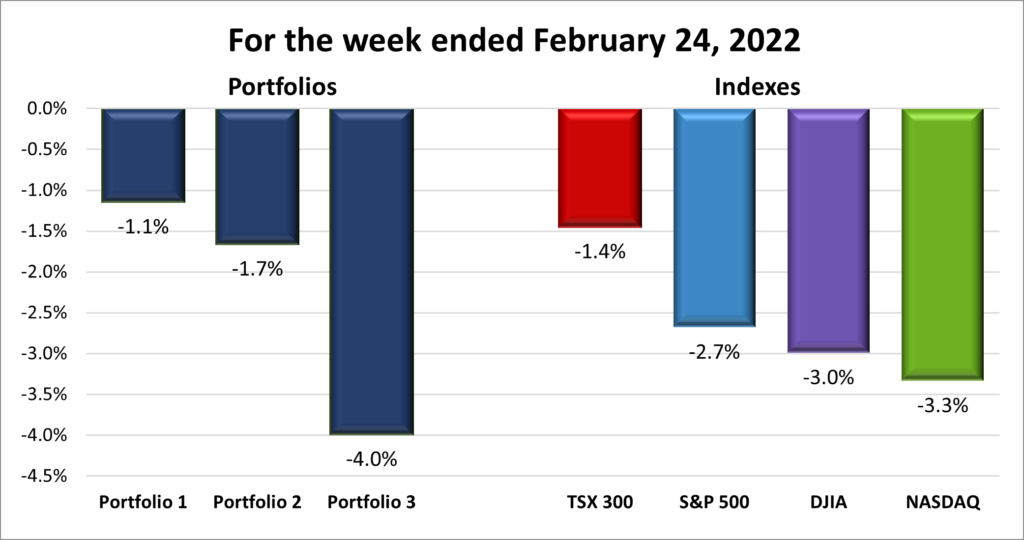
For the week, the TSX dropped 1.4%, the S&P 500 fell 2.7%, the Dow posted its fourth straight weekly decline, dropping 3.0% and the Nasdaq tumbled 3.3%.
Weekly Portfolio Review

For the second time this month, all four major North American indexes lost ground, as you can see above. If it wasn’t for the Nasdaq advancing last week, all three American indexes wouldn’t have a positive week since the end of January. Unlike last week, all four indexes dropped sharply on the first day of a short week, drifted upward and dropped sharply to close out the week. Once again, the main driver of the markets was fear of how the Fed would interpret strong US economic data. Where investors once felt the end of interest rate hikes was near, they now feel not only will rates go higher, but they will stick around longer.
The TSX was not immune to negative investor sentiment as it was caught by the undertow caused by the Fed on the US markets.
As for the three Portfolios, it was no surprise they all fell lower, as shown in the chart below. With not one index ending the week in positive territory, I had little hope they could repeat last week’s performance and end in the green when three of four indexes were in the red. There was no single company responsible for the downfall of a portfolio. Investor fear of rate hikes sent the markets lower, and the portfolios dropped with the outgoing tide.
Companies on the Radar
 A few small cap companies came onto the radar this past week. The first is Kits Eyecare (TSX:KITS), a Canadian company operating an online eyeglass platform. The other company is Hammond Power Solutions (TSX:HPS.A), another Canadian company manufacturing transformers used in a wide variety of industries worldwide. Given the increase of electrification, this could be an interesting opportunity. I know nothing about either company, so I need to dig deeper to understand their respective industries, how they fit into the industry, their potential and their risks.
Goodbye to International Petroleum (TSX:IPCO). The Energy sector in general continues to drift lower on fears higher interest rates will lead to lower demand. I think there are better opportunities outside the Energy sector, such as the four below, and perhaps the two mentioned above.
- Intact Financial (TSX:IFC): a mid size insurance company supplying home, car and business insurance in Canada, the US, and the UK.
- Supremex: (TSX:SXP) a small cap company selling packing solutions throughout Canada and the USA.
- ON Semiconductor (NASD:ON) an American company that makes intelligent sensor and power solutions that enable the electrification of the automotive industry.
- Jabil Inc. (NYSE:JBL), an American company with global operations that specializes in providing manufacturing services and solutions.
The Radar Check was last updated February 24, 2022.


Portfolio Update
Portfolio 1
Portfolio 1 for the week ended February 24, 2023: DOWN 
- After surging demand for Home Depot products during the pandemic years, the company is reporting slowing demand for home improvement supplies as inflation has made home projects more expensive. As well as higher cost for products, Home Depot is increasing wages across the board to retain staff. Slowing revenue growth and growing expenses is not a good combination.
- Amazon’s (NASD:AMZN) Amazon Web Services (AWS) is developing their own artificial intelligence (AI) chatbot to help AWS developers integrate AI into their own products.
- Apple (NASD:AAPL) is working on way to measure a person’s glucose level without the need to draw blood. It would be great if Apple could develop a non-invasive and continuous glucose monitoring device for diabetics everywhere. It would also open new opportunities in a new sector (healthcare) that many investors never considered when they invested in Apple.
- Alphabet (NASD:GOOGL) has partnered with Mercedes Benz (OTCM:MBGYY) to provide super computer like performance in every Mercedes outfitted with automated driving sensors. The partnership will offer real time traffic information and rerouting, the ability to stream YouTube on a vehicle’s entertainment system, along with other Google apps such as Google Maps and Google Assistant.
To ensure a supply of advanced semiconductors for Mercedes’s new smart cars, Mercedes struck a revenue sharing agreement with Nvidia (NASD:NVDA). - Nvidia posted higher than expected earnings on the strength of demand for its advanced chips that are used in AI systems. Nvidia has become the de facto chipmaker for data centres, the metaverse and now AI. I don’t know who will win the AI arms race – Microsoft, Google, or someone else – but Nvidia is most likely to be the chips powering the AI engines.
- General Motors (NYSE:GM) plans to suspend production at one of its truck plants due to slowing demand. The last time production was suspended at the manufacturing facility was due to supply chain issues brought on by the pandemic. Now, the higher cost of borrowing money is making it more expensive to buy a new vehicle and lowering demand.
Activity
Sold: Trisura Group Ltd. (TSX:TSU) has done very well for me but they rescheduled their fourth quarter earnings report to as yet unnamed date. I can’t think of any positive reason to pushback an earnings announcement. Its likely they are negotiating with auditors over how to present some bad news and put a positive spin on it. When the earnings come out, I suspect the share price will take a hit. I’ve done well with Trisura and barring a major problem, I plan to buy back the shares once the bad news is baked into the price. Hopefully make a few bucks. 😊
Dividends
Dividends Received this week for the following companies:
Companies followed by DRIP (Dividend Re-Investment Plan) indicate additional shares were purchased with the dividend. Any cash leftover was added to the cash balance.
Canadian $
Quinsam Capital Corp (TSX:QCA)
US $
No US$ dividends this past week.
Quarterly Reports
Home Depot Inc.
All currency listed in millions of US dollars, except per share data.
Selected highlights from their fourth quarter 2022 financial results on February 21, 2023
- Revenue of $35,831 for the three months ended December 31, compared to $35,719 for the same period in 2021. An increase of 0.3%.
- Net income of $3,362 for the three months ended December 31, compared to net income of $3,352 in the same period in 2021.
- Diluted earnings per ordinary share of $3.30 for the three months ended December 31, compared to $3.23 for the same period in 2021.
- Revenue of $157,403 for the year ended December 31, compared to $4151,157 for the same period in 2021. An increase of over 4%.
- Net earnings of $17,105 for the year ended December 31, compared to net earnings of $16,433 in the same period in 2021.
- Diluted earnings per ordinary share of $16.69 for the year ended December 31, compared to $15.53 for the same period in 2021.
Kneat.com Inc.
All currency listed in Canadian dollars, except per share data.
Selected highlights from their fourth quarter 2022 financial results on February 22, 2023
- Revenue of $7,250,039 for the three months ended December 31, compared to $6,263,039 for the same period in 2021. An increase of almost 18%.
- Net income of $458,919 for the three months ended December 31, compared to net loss of $1,549,736 in the same period in 2021.
- Diluted earnings per ordinary share of $0.01 for the three months ended December 31, compared to a loss per share of $0.02 for the same period in 2021.
- Revenue of $23,749,201 for the year ended December 31, compared to $15,501,350 for the same period in 2021. An increase of over 73%.
- Net loss of $9,148,188 for the year ended December 31, compared to net loss of $9,858,528 in the same period in 2021.
- Diluted loss per ordinary share of $0.12 for the year ended December 31, compared to a loss per share of $0.13 for the same period in 2021.
Teledoc Health, Inc.
All currency listed in thousands of US dollars, except per share data.
Selected highlights from their fourth quarter 2022 financial results on February 22, 2023
- Revenue of $637,709 for the three months ended December 31, compared to $554,235 for the same period in 2021. An increase of over 15%.
- Net loss of $3,180,071 for the three months ended December 31, compared to net loss of $10,985 in the same period in 2021.
- Diluted loss per ordinary share of $23.49 for the three months ended December 31, compared to a loss per share of to $0.07 for the same period in 2021.
- Revenue of $2,406,840 for the year ended December 31, compared to $2,032,707 for the same period in 2021. An increase of over 18%.
- Net loss of $13,659,531 the year ended December 31, compared to net loss of $428,793 in the same period in 2021.
- Diluted earnings per ordinary share of $84.60 for the year ended December 31, compared to a loss per share of $2.73 for the same period in 2021.
Magnite, Inc.
All currency listed in thousands of US dollars, except per share data
Selected highlights from their fourth quarter 2022 financial results on February 22, 2023
- Revenue of $175,399 for the three months ended December 31, compared to $161,286 for the same period in 2021. An increase of over 8%.
- Net loss of $36,385 for the three months ended December 31, compared to net income of $453 in the same period in 2021.
- Diluted loss per ordinary share of $0.27 for the three months ended December 31, compared to $0 for the same period in 2021.
- Revenue of $577,069 for the year ended December 31, compared to $468,413 for the same period in 2021. An increase of over 23%.
- Net loss of $130,323 for the year ended December 31, compared to net earnings of $65 in the same period in 2021.
- Diluted loss per ordinary share of $0.98 for the year ended December 31, compared to $0 for the same period in 2021.
Global-e Online Ltd.
All currency listed in thousands of US dollars, except per share data.
Selected highlights from their fourth quarter 2022 financial results on February 22, 2023
- Revenue of $82,717 for the three months ended December 31, compared to $139,865 for the same period in 2021. A decrease of over 40%.
- Net loss of $22,491 for the three months ended December 31, compared to net loss of $28,471 in the same period in 2021.
- Diluted loss per ordinary share of $0.15 for the three months ended December 31, compared to a loss of $0.18 for the same period in 2021.
- Revenue of $7245,274 for the year ended December 31, compared to $409,049 for the same period in 2021. A decrease of over 40%.
- Net loss of $74,933 for the year ended December 31, compared to net loss of $195,405 in the same period in 2021.
- Diluted loss per ordinary share of $0.74 for the year ended December 31, compared to a loss per share of $1.24 for the same period in 2021.
Nvidia Corp.
All currency listed in millions of US dollars, except per share data.
Selected highlights from their fourth quarter 2022 financial results on February 22, 2023
- Revenue of $6,051 for the three months ended December 31, compared to $7,643 for the same period in 2021. A decrease of almost 21%.
- Net income of $1,414 for the three months ended December 31, compared to net income of $3,003 in the same period in 2021.
- Diluted earnings per ordinary share of $0.57 for the three months ended December 31, compared to $1.18 for the same period in 2021.
- Revenue of $26,974 for the year ended December 31, compared to $26,914 for the same period in 2021. An increase of less than 1%.
- Net earnings of $4,368 for the year ended December 31, compared to net earnings of $9,752 in the same period in 2021.
- Diluted earnings per ordinary share of $1.74 for the year ended December 31, compared to $3.85 for the same period in 2021.
Unity Software Inc.
All currency listed in thousands of US dollars, except per share data
Selected highlights from their fourth quarter 2022 financial results on February 22, 2023
- Revenue of $450,974 for the three months ended December 31, compared to $315,864 for the same period in 2021. An increase of almost 43%.
- Net loss of $287,754 for the three months ended December 31, compared to net loss of $161,653 in the same period in 2021.
- Diluted loss per ordinary share of $0.82 for the three months ended December 31, compared to a loss per share of $0.56 for the same period in 2021.
- Revenue of $1,391,024 for the year ended December 31, compared to $1,110,526 for the same period in 2021. An increase of over 25%.
- Net loss of $919,488 for the year ended December 31, compared to net loss of $533,047 in the same period in 2021.
- Diluted loss per ordinary share of $2.96 for the year ended December 31, compared to a loss per share of $1.89 for the same period in 2021.
Portfolio 2
Portfolio 2 for the week ended February 24, 2023: DOWN
- Walt Disney’s (NYSE:DIS) ‘Avatar: The Way of Water’ became the third highest-grossing film of all time worldwide over the weekend, with revenues of US$ 2.24 billion.
- Kneat.com (TSX:KSI) signed a three-year deal with a global healthcare company. The company will initially deploy Kneat’s Kneat Gx solution to replace a paper intensive process for one business unit, and upgrade two other units from a hybrid (manual/digital) process to a full digital process.
- Telus (TSX:T) has teamed up with Amazon’s AWS to develop Telus’s smart living solution. The service will make it easier for Telus customers to install and manage the growing number of ‘smart’ home devices and services.
Activity
Singapore’s GIC (managers of Singapore’s foreign reserves) and Dream Industrial Real Estate Income Trust (REIT) (TSX:DIR.UN) closed their acquisition of Summit Industrial Income REIT. Summit unitholders received C$ 23.50 per unit. I made an initial investment in 2018, with a second investment in 2020. Not a bad return on an investment that cost an average C$ 11.30. Fortunately, this investment is in a Tax-Free Savings Account so there is no tax on the capital gains. 😊
Dividends
Dividends Received this week for the following companies:
Companies followed by DRIP (Dividend Re-Investment Plan) indicate additional shares were purchased with the dividend. Any cash leftover was added to the cash balance.
No dividends this past week.
Quarterly Reports
Kneat.com Inc.
All currency listed in Canadian dollars, except per share data.
Selected highlights from their fourth quarter 2022 financial results on February 22, 2023
- Revenue of $7,250,039 for the three months ended December 31, compared to $6,263,039 for the same period in 2021. An increase of almost 18%.
- Net income of $458,919 for the three months ended December 31, compared to net loss of $1,549,736 in the same period in 2021.
- Diluted earnings per ordinary share of $0.01 for the three months ended December 31, compared to a loss per share of $0.02 for the same period in 2021.
- Revenue of $23,749,201 for the year ended December 31, compared to $15,501,350 for the same period in 2021. An increase of over 73%.
- Net loss of $9,148,188 for the year ended December 31, compared to net loss of $9,858,528 in the same period in 2021.
- Diluted loss per ordinary share of $0.12 for the year ended December 31, compared to a loss per share of $0.13 for the same period in 2021.
Guardant Health, Inc.
All currency listed in thousands of US dollars, except per share data.
Selected highlights from their fourth quarter 2022 financial results on February 23, 2023
- Revenue of $126,891 for the three months ended December 31, compared to $108,108 for the same period in 2021. An increase of over 17%.
- Net loss of $139,934 for the three months ended December 31, compared to net loss of $90,911 in the same period in 2021.
- Diluted loss per ordinary share of $1.36 for the three months ended December 31, compared to a loss of $0.89 for the same period in 2021.
- Revenue of $449,538 for the year ended December 31, compared to $373,653 for the same period in 2021. An increase of over 20%.
- Net loss of $654,588 for the year ended December 31, compared to net loss of $384,770 in the same period in 2021.
- Diluted loss per ordinary share of $6.41 for the year ended December 31, compared to a loss of $4.00 for the same period in 2021.
Portfolio 3
Portfolio 3 for the week ended February 24, 2023: DOWN
- Microsoft (NASD:MSFT) signed a 10 year deal with Nvidia to ensure Activision Blizzard (NASD:ATVI) games will be available on Nvidia’s gaming platform. This is an attempt to show regulators that if Microsoft’s acquisition of Activision is successful, the games will be available on platforms other than Microsoft’s Xbox. This deal is similar to the 10-year deal struck previously with Nintendo. Sony is the last major gaming platform against the acquisition.
- Brookfield Corporation (TSX:BN) lowered its bid to acquire Australian energy company Origin Energy after the Australian government capped gas prices. The latest offer is for A$ 15.33 billion, not far from the original offer of A$ 15.5 billion.
- Shopify (TSX:SHOP) is rolling out recent improvements to their partner program. These changes include: Shopify Partners can earn more from referring other merchants to Shopify’s platform; improved resources to grow their businesses; and more opportunities to interact and engage with Shopify.
Activity
No significant activity to report this week.
Dividends
Dividends Received this week for the following companies:
Companies followed by DRIP (Dividend Re-Investment Plan) indicate additional shares were purchased with the dividend. Any cash leftover was added to the cash balance.
No dividends this past week.
Quarterly Reports
Magnite, Inc.
All currency listed in thousands of US dollars, except per share data.
Selected highlights from their fourth quarter 2022 financial results on February 22, 2023
- Revenue of $175,399 for the three months ended December 31, compared to $161,286 for the same period in 2021. An increase of over 8%.
- Net loss of $36,385 for the three months ended December 31, compared to net income of $453 in the same period in 2021.
- Diluted loss per ordinary share of $0.27 for the three months ended December 31, compared to $0 for the same period in 2021.
- Revenue of $577,069 for the year ended December 31, compared to $468,413 for the same period in 2021. An increase of over 23%.
- Net loss of $130,323 for the year ended December 31, compared to net earnings of $65 in the same period in 2021.
- Diluted loss per ordinary share of $0.98 for the year ended December 31, compared to $0 for the same period in 2021.
Kneat.com Inc.
All currency listed in Canadian dollars, except per share data.
Selected highlights from their fourth quarter 2022 financial results on February 22, 2023
- Revenue of $7,250,039 for the three months ended December 31, compared to $6,263,039 for the same period in 2021. An increase of almost 18%.
- Net income of $458,919 for the three months ended December 31, compared to net loss of $1,549,736 in the same period in 2021.
- Diluted earnings per ordinary share of $0.01 for the three months ended December 31, compared to a loss per share of $0.02 for the same period in 2021.
- Revenue of $23,749,201 for the year ended December 31, compared to $15,501,350 for the same period in 2021. An increase of over 73%.
- Net loss of $9,148,188 for the year ended December 31, compared to net loss of $9,858,528 in the same period in 2021.
- Diluted loss per ordinary share of $0.12 for the year ended December 31, compared to a loss per share of $0.13 for the same period in 2021.
Unity Software Inc.
All currency listed in thousands of US dollars, except per share data
Selected highlights from their fourth quarter 2022 financial results on February 22, 2023
- Revenue of $450,974 for the three months ended December 31, compared to $315,864 for the same period in 2021. An increase of almost 43%.
- Net loss of $287,754 for the three months ended December 31, compared to net loss of $161,653 in the same period in 2021.
- Diluted loss per ordinary share of $0.82 for the three months ended December 31, compared to a loss per share of $0.56 for the same period in 2021.
- Revenue of $1,391,024 for the year ended December 31, compared to $1,110,526 for the same period in 2021. An increase of over 25%.
- Net loss of $919,488 for the year ended December 31, compared to net loss of $533,047 in the same period in 2021.
- Diluted loss per ordinary share of $2.96 for the year ended December 31, compared to a loss per share of $1.89 for the same period in 2021.