
Monthly Market and Portfolio Review
| Indexes | Monthly Streak |
| TSX: | 10 – month winning streak |
| S&P: | 1 – month losing streak |
| DJIA: | 10 – month winning streak |
| Nasdaq: | 1 – month losing streak |

 February was a choppy month for the markets – or, as I like to call it, the month disrupted… by AI 😊. After a solid start, swings in artificial intelligence (AI) sentiment and broader economic worries became the defining themes, showing up differently across the four major North American indexes.
Despite the volatility, the Toronto Stock Exchange Composite Index (TSX) and the Dow Jones Industrial Average (DJIA) extended their winning streaks. For the TSX, it was the biggest monthly gain since November 2020, while the DJIA recorded its longest monthly streak since a ten-month climb that ended in January 2018.
The story wasn’t the same for the tech-heavy Nasdaq Composite (Nasdaq), where AI uncertainty weighed heavily – and to a lesser extent the S&P 500 (S&P).
Two competing AI fears dominated investor thinking. First, there was worry that massive spending on AI infrastructure – billions poured into chips, data centres, and cloud capacity – might not pay off anytime soon, potentially squeezing profits in the near term.
Then the narrative shifted. Investors began asking who might be disrupted by AI – and how quickly. If AI can automate coding, research, design, and customer service, what happens to companies charging premium subscription fees for those services? Software stocks felt the pressure of AI disruption first.
Put simply, investors went from worrying about near-term profitability to questioning long-term business models. That combination became a headwind for tech-heavy indexes like the Nasdaq and the S&P, while money rotated into larger, established industrial and “old economy” names – many found in the DJIA – seen as less exposed to AI disruption.
At the same time, tariff policy uncertainty returned. After the Supreme Court struck down President Trump’s broad global tariffs, a new 15% tariff framework was quickly announced, adding new unpredictability. Markets don’t like surprises, especially when they affect trade, supply chains, and corporate margins.
Economic data added another layer of tension. Mixed inflation readings kept investors guessing about the timing of Fed rate cuts. Each report that suggested a resilient economy reduced the chances of near-term cuts – and when rate-cut expectations fade, growth stocks tend to feel the pressure first.
Earnings season played its part as well. While many companies delivered solid results, guidance mattered more than the headlines. Any hint of margin pressure, slowing demand, or cautious outlooks sparked quick sell-offs. With markets near highs, even “good but not great” results could trigger pullbacks.
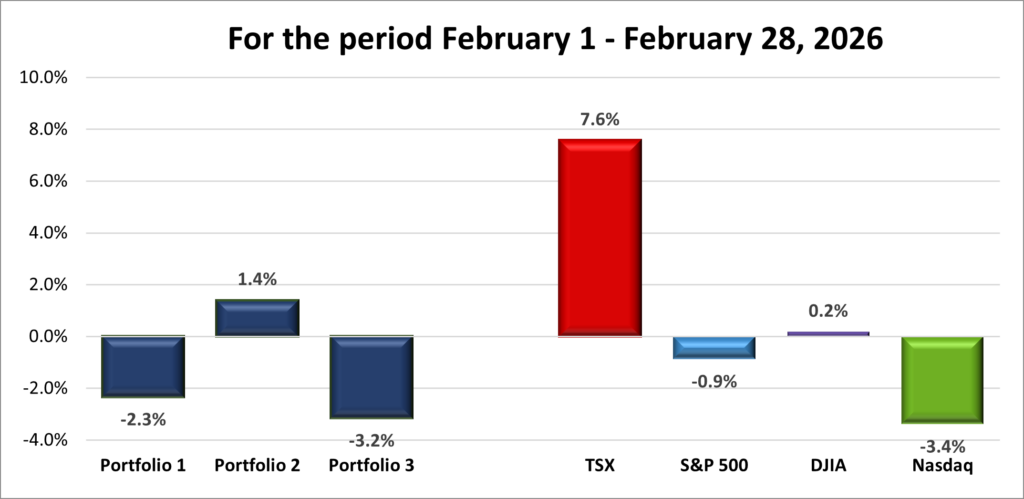
In Canada, the story was brighter. The S&P/TSX Composite Index added 7.6%, marking its biggest monthly gain since November 2020 and extending its winning streak to 10 straight months – the longest since 2017.
The TSX’s strength came down to composition. Unlike the Nasdaq, Canada’s benchmark isn’t heavily concentrated in fast-growing technology stocks priced for big future expectations. Instead, it leans toward financials, energy, materials, and industrials – the very sectors that benefited as investors rotated away from AI-sensitive growth names.
Energy was a key driver. Oil prices rose amid ongoing supply discipline and growing geopolitical tension, and the TSX tends to move when energy moves. Materials (precious metals, mining, and other commodity producers) contributed as well, particularly gold, which drew investor attention amid interest rate and tariff uncertainty. Financials anchored the rally, supported by strong earnings from Canada’s Big Six banks and stable credit trends.
In short, February reinforced a familiar theme: when US growth-heavy indexes wobble, Canada’s more value-oriented, resource-tilted market can chart its own path. This time, the rotation away from high-flying technology and toward tangible cash-flow businesses worked firmly in the TSX’s favour.
| Portfolio | Monthly Streak | |
| Portfolio 1: | 4 – month losing streak | |
| Portfolio 2: | 1 – month winning streak | |
| Portfolio 3: | 2 – month losing streak |
February didn’t treat my three portfolios much better than January, or the broader markets. Portfolio 2 was the only one to finish the month higher. Given that Portfolios 1 and 3 are more technology-heavy, with meaningful exposure to AI-related companies, it wasn’t surprising to see them extend their losing streaks amid February’s volatility driven by concerns of AI spending and disruption.
Portfolio 1 declined 2.3%, finishing lower in three of the four weeks. Weakness in several larger technology holdings – including Amazon (NASD: AMZN), Shopify (TSE: SHOP), Datadog (NASD: DDOG), Magnite (NASD: MGNI), and particularly Nvidia (NASD: NVDA) – outweighed fairly broad strength beneath the surface. In many weeks, more than half of the companies in the portfolio actually moved higher, and several even hit new highs. But when a few bigger positions struggle, they can dictate the overall result. February was a clear example of that.
Portfolio 2 quietly delivered a 1.4% gain for the month. While the weekly increases were modest – generally 1% or less – they added up. Energy exposure proved to be a steady tailwind, with South Bow (TSE: SOBO) and TC Energy (TSE: TRP) reaching record highs as oil prices strengthened. Mitek Systems (NASD: MITK) was another standout, posting multiple double-digit weekly gains. Even here, position size played a role: although most holdings frequently advanced, larger moves in bigger positions had the greatest influence on performance.
Portfolio 3 had the toughest month, declining 3.2%. Its performance was largely driven by its two largest holdings, Nvidia and Shopify, which together make up roughly half the portfolio. Both finished the month slightly higher, but weekly pullbacks along the way had an outsized impact, weighing on the portfolios. When your biggest positions dip, even briefly, they can drag the entire portfolio down.
There were strong rallies too. When Nvidia and Shopify advanced, the portfolio led the group in the two weeks it posted a weekly gain. Gains from Vertiv Holdings (NYSE: VRT), Cloudflare Inc (NYSE: NET), and Brookfield Infrastructure Corporation (TSE: BIPC) also helped. Still, February reinforced a key lesson: in a concentrated portfolio, short-term swings in the largest holdings can dominate the monthly result – even if those companies end the month in positive territory.
AI disrupted the markets – and it shook my portfolios, some more than others. February was volatile, but there were still bright spots: record highs in several holdings, steady energy and financial names, and standout weeks from multiple companies. The month also showed the impact of portfolio structure: the more balanced Portfolio 2 posted a gain, while the tech-heavy Portfolios 1 and 3, each dominated by a single large holding, lost value.
Year to Date
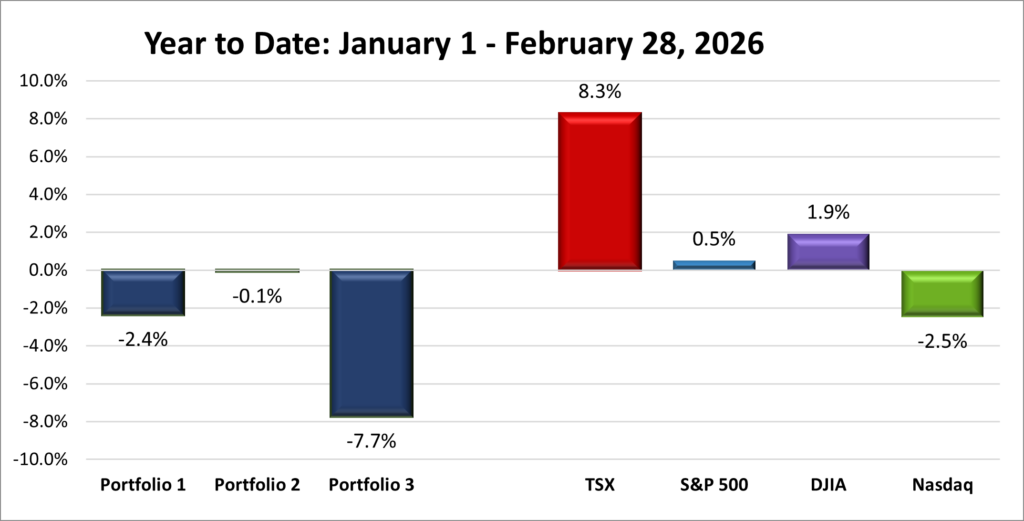
Year to date, Portfolio 2 holds the early “lead,” down just 0.1% in 2026 – an improvement from its 1.5% loss at the end of January – while the other two portfolios sit further in the red. Portfolio 1 has slipped to a 2.4% loss after starting the year nearly flat. Portfolio 3 has had the toughest stretch, with its decline widening from 4.7% at the end of January to 7.7% after two months.
Much of that difference comes down to portfolio structure. Portfolio 2’s largest holding is Bank of Nova Scotia (TSE: BNS), whereas the largest position in the other two portfolios is Nvidia. Portfolio 2 is also more balanced overall, with less exposure to technology and AI-related companies. That mix has helped it hold up better during the recent volatility that has weighed on many AI-linked stocks.
Looking at the broader markets, the TSX has vaulted into the early lead with an 8.3% gain year to date. The DJIA follows with a 1.9% increase, while the S&P is barely in positive territory at 0.5%. The more technology-focused Nasdaq has moved in the opposite direction, slipping to a 2.5% loss on the year.
The difference largely reflects market composition. Canada’s TSX is heavily weighted toward resource and financial companies, which have held up well recently, while the major US indexes – particularly the Nasdaq – have been more exposed to swings in sentiment around AI spending and the potential for AI-driven disruption.
What My Three Portfolios Did in February 2026
Portfolio 1 for February 2026: DOWN 
Activity
No significant activity to report this month.
Dividends Received this month:
Companies followed by DRIP (Dividend Re-Investment Plan) indicate additional shares were purchased with the dividend. Any cash leftover was added to the cash balance.
Canadian $
TD Bank (TSE: TD) DRIP
Bank of Nova Scotia (TSE: BNS) DRIP
Dream Industrial Real Estate Investment Trust (TSE: DIR.UN)
Decisive Dividend Corp (TSE: DE) DRIP
US $
Apple (NASD: AAPL)
Costco Wholesale Corp (NASD: COST)
BSR Real Estate Investment Trust (TSE: HOM.U)
Quarterly Reports
Alphabet Inc.
Fourth quarter 2025 financial results on February 4, 2026
BCE Inc.
Fourth quarter 2025 financial results on February 5, 2026
Amazon.com, Inc.
Fourth quarter 2025 financial results on February 5, 2026
TMX Group Limited
Fourth quarter 2025 financial results on February 5, 2026
Datadog, Inc.
Fourth quarter 2025 financial results on February 10, 2026
Lattice Semiconductor Corporation
Fourth quarter 2025 financial results on February 10, 2026
Cloudflare, Inc.
Fourth quarter 2025 financial results on February 10, 2026
Shopify Inc.
Fourth quarter 2025 financial results on February 11, 2026
Grab Holdings Limited
Fourth quarter 2025 financial results on February 11, 2026
TELUS Corporation
Fourth quarter 2025 financial results on February 12, 2026
Arista Networks, Inc.
Fourth quarter 2025 financial results on February 12, 2026
Trisura Group Ltd.
Fourth quarter 2025 financial results on February 13, 2026
Cameco Corporation
Fourth quarter 2025 financial results on February 13, 2026
Walmart Inc.
Fourth quarter 2025 financial results on February 19, 2026
The Home Depot
Fourth quarter 2025 financial results on February 24, 2026
The Bank of Nova Scotia
Fourth quarter 2025 financial results on February 24, 2026
Navitas Semiconductor
Fourth quarter 2025 financial results on February 24, 2026
Nvidia Corporation
Fourth quarter 2025 financial results on February 25, 2026
The Trade Desk, Inc.
Fourth quarter 2025 financial results on February 25, 2026
Magnite, Inc.
Fourth quarter 2025 financial results on February 25, 2026
TD Bank Group
Fourth quarter 2025 financial results on February 26, 2026
Celsius Holdings, Inc.
Fourth quarter 2025 financial results on February 26, 2026
Portfolio 2 for February 2026: UP 
Activity
No significant activity to report this month.
Dividends Received this month:
Canadian $
Dollarama (TSE: DOL)
Bank of Nova Scotia (TSE: BNS) DRIP
TC Energy (TSE: TRP)
Dream Industrial Real Estate Investment Trust (TSE: DIR.UN)
SmartCentres Real Estate Investment Trust (TSE: SRU.UN)
Whitecap Resources Inc (TSE: WCP)
US $
No US$ dividends this past week.
Quarterly Reports
The Walt Disney Company
First quarter 2026 financial results on February 2, 2026
Take-Two Interactive Software, Inc.
Third quarter 2025 financial results on February 3, 2026
Mitek Systems, Inc.
First quarter 2026 financial results on February 5, 2026
SmartCentres Real Estate Investment Trust
Fourth quarter 2025 financial results on February 11, 2026
Airbnb, Inc.
Fourth quarter 2025 financial results on February 12, 2026
Zoetis Inc.
Fourth quarter 2025 financial results on February 12, 2026
Fortis Inc.
Fourth quarter 2025 financial results on February 12, 2026
Birkenstock Holding plc
First quarter 2026 financial results on February 12, 2026
TELUS Corporation
See report under Portfolio 1.
TC Energy Corporation
Fourth quarter 2025 financial results on February 13, 2026
iA Financial Group
Fourth quarter 2025 financial results on February 17, 2026
Supremex Inc.
Fourth quarter 2025 financial results on February 19, 2026
Guardant Health, Inc.
Fourth quarter 2025 financial results on February 19, 2026
Whitecap Resources Inc.
Fourth quarter 2025 financial results on February 23, 2026
Bank of Nova Scotia
See report under Portfolio 1.
Portfolio 3 for February 2026: DOWN
Activity
No significant activity to report this month.
Dividends Received this month:
Canadian $
TD Bank (TSE: TD)
SmartCentres Real Estate Investment Trust (TSE: SRU.UN)
US $
No US$ dividends this past week.
Quarterly Reports
Cloudflare, Inc.
See report under Portfolio 1.
Shopify Inc.
See report under Portfolio 1.
Vertiv Holdings Co
Fourth quarter 2025 financial results on February 11, 2026
SmartCentres Real Estate Investment Trust
See report under Portfolio 2.
Brookfield Corporation
Fourth quarter 2025 financial results on February 12, 2026
Magnite, Inc.
See report under Portfolio 1.
Nvidia Corporation
See report under Portfolio 1.
TD Bank Group
See report under Portfolio 1.
Rocket Lab Corporation
Fourth quarter 2025 financial results on February 26, 2026
Royal Bank of Canada
Fourth quarter 2025 financial results on February 26, 2026