Weekly Update for the week ending April 4, 2025

For the past few weeks, I’ve been talking about tariffs – what they are, how they affect consumers, and how they affect the Canadian dollar. But tariffs rarely happen in isolation. When one country imposes them, the other often fires back with its own set of retaliatory tariffs. With this week’s announcement of sweeping US tariffs on imports from almost all trading partners, it’s the perfect time to discuss the next round of the trade war: counter tariffs.

What Are Counter Tariffs?

Counter tariffs are retaliatory taxes placed on imports in response to tariffs imposed by another country. Think of it as a trade war’s return volley – countries use them to push back against what they see as unfair trade practices and to protect their own industries.

For example, if the US slaps tariffs on Canadian steel, Canada might respond with tariffs on US agricultural products or machinery. This tit-for-tat approach can escalate quickly, affecting businesses, consumers, and the broader economy.

Canada’s Retaliatory Tariffs

In response to the US’s higher tariffs on Canadian steel, aluminum, and other products, Canada rolled out its own set of retaliatory tariffs. These counter tariffs targeted a range of US exports, including agricultural goods, machinery, and consumer products.

How Will These Tariffs Impact the US Economy?

Retaliatory tariffs don’t just hurt the country they’re aimed at – they ripple through businesses, consumers, and trade relationships. In the US, prices on imported goods could climb, making everyday purchases more expensive. American exporters, especially in agriculture and manufacturing, might see demand drop as Canadian buyers look elsewhere. Supply chains could take a hit too, raising costs for American businesses that rely on Canadian imports. And if prices keep rising, inflation could become another headache for the economy.

What Happens If More Countries Retaliate?

It’s not just Canada. The US has imposed tariffs on almost all its trading partners, affecting countries worldwide, including China, Mexico, the European Union, and Japan. If they all retaliate, the economic fallout could be even greater. American industries that rely on exports might see sharp declines in sales, while inflationary pressures push prices higher across the board. Economic growth could take a hit, with some estimates suggesting these trade disputes could shave up to 0.4% off US GDP. And if tensions escalate further, markets could become more volatile as investors react to shifting global trade policies.

The Impact on Canada

While Canada’s counter tariffs are meant to push back against US trade measures, they could also bring some challenges at home. Higher tariffs on American goods mean Canadian consumers may face rising prices, especially for products that don’t have easy substitutes. Businesses that rely on American imports for raw materials could see their costs climb, which might eat into profits or even force them to raise prices.

Inflation could become another concern. If costs keep rising, it could strain household budgets and put pressure on the broader economy. Certain industries, like manufacturing and agriculture, could be hit the hardest, depending on which goods are targeted. And if the standoff drags on, businesses may struggle with uncertainty, making it harder to plan and invest.

In the end, while counter tariffs aim to level the playing field, they also create economic headwinds. How much damage they do – and how long the standoff lasts – will depend on whether Canada and the US can find common ground, not to mention how other trading partners respond.

With President Trump taking aim at America’s trading partners this past week – and them firing back – investors had plenty to digest. Let’s take a look at how tariffs shook things up and what else moved the markets this past week ….


Items that may only interest or educate me ….

Canadian Economic news, US Economic news, Tariffs for all, ….

Canadian Economic news

This past week’s key economic data that the Bank of Canada (BoC) considers when deciding whether to raise or lower the interest rate.

Trade Surplus

Canada’s trade balance took a sharp turn in February, flipping from a surplus of a downwardly revised C$3.13 billion in January to a deficit of C$1.52 billion. That’s a big miss compared to analysts’ expectations of a C$3.55 billion surplus.

Exports tumbled 5.5% to C$70.11 billion, with declines across 10 of 11 product categories – especially in energy products and motor vehicles. Meanwhile, imports inched up 0.88% to C$71.63 billion, as businesses adjusted inventories ahead of potential US tariff changes.

Despite the unexpected deficit, trade activity remains strong, with both exports and imports still hovering near record levels. The real question is whether this is just a one-month blip or the start of something bigger. With new tariffs in play, I’d bet on the latter. ☹

Labour Force Survey (LFS)

Canada’s job market hit a rough patch in March. According to Statistics Canada, the country lost 32,600 jobs (-0.2%) – the first decline since January 2022 and a sharp contrast to analyst expectations of a 10,000-job gain. This follows February’s modest 1,100-job increase. On an annual basis, employment is still up 1.7%, but the latest drop suggests momentum may be fading.

As expected, the unemployment rate inched up to 6.7% from 6.6%, marking its first rise since November 2024. The decline was driven by a loss of 62,000 full-time jobs, partially offset by gains in part-time positions. Wages provided a small silver lining, with average hourly earnings up 3.6% year-over-year – though that’s a slight slowdown from February’s 3.8% increase.

Economic uncertainties continue to weigh on hiring, with inflation, shifting consumer habits, and new US tariffs on key Canadian exports – including steel, aluminum, and automobiles – adding pressure. These trade disruptions have hit manufacturing and supply chains hard, and the latest job numbers suggest the effects are rippling through the broader economy.

Canadian market volatility

The S&P/TSX 60 VIX (VIXC), which tracks expected volatility in the Canadian market, showed signs of investor unease this week. It opened at 16.23, and unlike its US counterpart, the VIXC remained range-bound between 14.25 and 15.6 for most of the week. But as tensions escalated over new US tariffs and Canada’s retaliatory response, the VIXC jumped to 19.43 – signalling that market uncertainty wasn’t just an American problem. By Friday, it had settled slightly, closing the week at 18.39 – above the calm zone, but not high enough to suggest panic among investors… unlike its American cousin (how’s that for a fine example of foreshadowing? 😊)

For those unfamiliar with the VIXC, think of it as the Canadian market’s stress meter. A reading below 10 signals strong investor confidence, 10 to 20 is business as usual, and anything above 20 suggests uncertainty is starting to take hold.

US Economic news

This past week’s key data points that the Federal Reserve (Fed) considers when deciding whether to raise or lower the interest rate.

Labour data

The latest updates from the Job Openings and Labor Turnover Survey (JOLTS), the ADP Employment Report, and the Employment Situation Summary (ESS) offer a snapshot of the US labour market – showing continued resilience, but also some signs of stress on the horizon.

JOLTS

The latest JOLTS report from the US Bureau of Labor Statistics showed job openings held fairly steady in February at 7.568 million, down slightly from January’s upwardly revised 7.762 million – and well below the 8.445 million from a year ago. The data came in just under forecasts of 7.616 million. The ratio of job openings to unemployed persons dipped to 1.07 from 1.2, suggesting a gradual cooling in demand for workers.

This softening is likely tied to rising economic uncertainty, especially around tariffs on imports. Still, demand for labour remained strong.

(Quick reminder: JOLTS tracks job openings as of the last business day of the month—in this case, February.)

ADP

The ADP report showed private payrolls grew by 155,000 in March – nearly double February’s upwardly revised 84,000 and well above expectations of 105,000. The manufacturing sector led the gains, while hiring in construction cooled. Wages remained firm, with job-stayers seeing a 4.6% year-over-year increase and job-changers landing a 6.5% bump.

ESS

March’s headline jobs report landed with a positive surprise. According to the BLS, the US economy added 228,000 jobs, a solid jump from February’s 151,000 and well above the 12-month average of 158,000. Analysts were expecting just 135,000, making this a stronger-than-expected report.

The unemployment rate edged up to 4.2% from 4.1%, continuing to bounce around the narrow 4.0% –4.2% range it’s been in since May 2024. Wage growth was steady, with average hourly earnings rising 0.3% month-over-month, matching February’s pace. Year-over-year wage growth ticked down slightly to 3.8% from 4.0% in February, just under the 3.9% economists had forecasted.

While the labour market still looks solid, the slight uptick in unemployment and cooling wage momentum may give the Fed some breathing room – especially with trade tensions ramping up.

Implications

The labour market was holding up reasonably well before this month’s full-blown trade wars kicked off. Despite growing concerns over tariffs and broader economic uncertainty, hiring remained resilient, with job gains beating expectations and wage growth holding steady.

That said, some early signs of stress are starting to show. Job openings have fallen, and the ratio of openings to unemployed workers has dipped. The unemployment rate has crept up to 4.2%, and wage growth, while still positive, is gradually cooling. These are subtle shifts, but they suggest the labour market’s momentum may be slowing.

Now that the US has launched trade disputes with all its major partners, the real test begins. The question isn’t whether the labour market is still strong – it is – but whether it can stay that way in the face of rising economic headwinds. The next few months will be key in showing whether this resilience holds – or if cracks start to form.

American market volatility

The CBOE Volatility Index (VIX), often referred to as the market’s “fear gauge,” opened the week at an already elevated 21.70 as investors braced for the fallout from new US tariffs and the expected retaliation from key trading partners. Volatility remained high, with the VIX bouncing between 21.0 and 25.0 for much of the week. But the day after the tariffs were announced, uncertainty spiked, sending the VIX to a three-week high of 29.96. Things didn’t calm down from there – the next day, the fear gauge surged into the 40s, closing the week at 45.31, a five year high.

While that’s a big jump, it’s still well below the panic levels of past crises—like the 82.69 spike on March 16, 2020, during the COVID market meltdown, or the all-time high of 89.53 during the 2008 financial crisis. Still, markets clearly aren’t shrugging off the current trade war drama.

For those new to the VIX, think of it as the stock market’s stress meter. A reading below 12 signals calm waters, 12 to 20 reflects normal market swings, and anything above 20 suggests growing uncertainty. When it pushes past 30, markets are in full-blown turmoil.

Tariffs for all

After weeks of threats, delays, and partial rollouts, President Trump has officially launched what could be a full-scale global trade war. The newly announced tariffs are one of the most sweeping increases in trade barriers in recent history. Here’s what’s changing:

  • A 10% Baseline Tariff will now apply to all imports, except for goods that meet the rules of the United States-Mexico-Canada Agreement (USMCA).
  • Country-Specific Tariffs will hit certain nations even harder. China faces a 34% tariff on imports (on top of existing tariffs), the European Union gets hit with 20%, and Vietnam sees the highest at 46%.
  • Automobile Tariffs will rise to 25% for all foreign-made cars starting at midnight. Canadian-made vehicles are partially exempt, but only for their US sourced components.
  • De Minimis Exemption Closure – Starting May 2, items valued under $800, which were previously exempt from tariffs, will now face a steep 54% tax. This exemption has long allowed low-value goods to enter the US tariff-free, benefiting businesses and individuals who ship small items across borders. Its removal means significantly higher costs for imported low-value products.

In 2024, the average US tariff rate sat at just 2.5%, generating roughly $83 billion in revenue. With these sweeping new measures, some investment firms estimate the average tariff rate will jump to around 29%. If import volumes hold steady, that means a massive surge in tax revenue—but also a major cost increase for businesses and consumers.

The administration argues that these tariffs will strengthen domestic manufacturing and reduce reliance on foreign goods. Some of the revenue is expected to fund infrastructure projects and support American industry, though the exact details are still unclear. For now, businesses, investors, and trading partners are bracing for the impact.

Canada Fires Back
Canada didn’t just sit on the sidelines after the US ramped up tariffs on Canadian steel, aluminum, and other products. Instead, it fired back with its own set of retaliatory tariffs, targeting a wide range of American exports – everything from agricultural goods to machinery to everyday consumer products. While Canada was spared in Wednesday’s latest round of US tariffs, the federal government responded by slapping a 25% tariff on US made vehicles that don’t meet USMCA standards – mirroring the 25% duty President Trump imposed on Canadian cars.

The goal? To send a clear message: if you hit us with tariffs, we’ll hit you back. But while these counter tariffs are meant to level the playing field, they also come with risks. Canadian businesses that depend on US imports could see their costs go up, and consumers might feel the pinch at the checkout as certain products become more expensive.

It’s a classic case of economic push and pull. The longer the standoff lasts, the more pressure it could put on both economies – raising prices, squeezing profits, and creating uncertainty for businesses trying to plan ahead.


Weekly Market and Portfolio Review

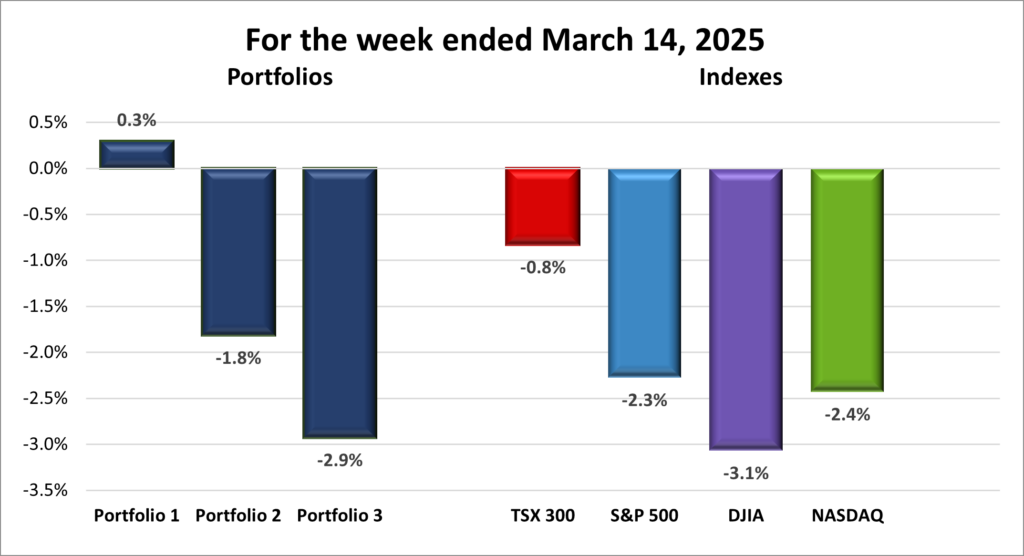
For the week, the TSX (SPTSX) fell 6.3%, the S&P 500 (SPX) dropped 9.1%, the DJIA (INDU) sunk 7.9% and the Nasdaq (CCMP) plunged 10.0%.

 
Index Weekly Streak
TSX: 2 – week losing streak
S&P: 2 – week losing streak
DJIA: 2 – week losing streak
Nasdaq: 2 – week losing streak

Bearish market Thanks to a sweeping round of unnecessary US tariffs – what The New York Times called “the dumbest trade war ever” – markets just had their worst week since March 2020, when COVID first rocked the world. As shown in the weekly graph above, everything was cruising along… until Wednesday afternoon, when President Trump officially launched a trade war against nearly every country on Earth.

Normally, a blockbuster US jobs report would’ve stolen the spotlight. But not this time. Markets tanked, and the damage was historic. The Toronto Stock Exchange Composite Index (TSX), the S&P 500 (S&P), and Dow Jones Industrial Average (DJIA) all slid into correction territory (10%+ declines from recent highs), while the Nasdaq Composite (Nasdaq) plunged into a full-blown bear market, down more than 20%. In just two days, companies in the S&P shed a jaw-dropping US$5 trillion in value – surpassing even the worst of March 2020. The ‘Magnificent Seven’ alone lost US$1.8 trillion in market cap.

So… how did we get here?

At the start of the week, markets were uneasy. Investors were on edge, unsure how steep the tariffs might be. Still, despite the nerves, markets drifted slightly higher through Wednesday. Then, after the closing bell, President Trump dropped the hammer: a 10% tariff floor on almost all trading partners, with many facing much higher rates. It’s the biggest tariff hike in over a century, dismantling a global trading system in place since the end of World War II. The new tariffs, covering over 180 countries, take effect April 5 and 9.

Markets were stunned – and reacted swiftly. Stocks plunged in after-hours trading Wednesday, and by Thursday’s close, the S&P was down 4.8%, wiping out US$2.4 trillion in value. The Nasdaq fell nearly 5.9% – its worst day since early 2020. The DJIA dropped 3.9%, its fifth-worst day on record. In Canada, the TSX dropped “only” 3.8% – its biggest one-day loss since June 2020.

As if that wasn’t enough, China retaliated Friday morning with 34% tariffs of its own, effective April 10, sending markets tumbling once again. And to make matters worse, Fed Chair Jerome Powell warned the tariffs could fuel inflation and slow economic growth—two things investors really don’t want to hear.

The big fear now? That this spirals into a global trade war, tipping the US into recession – and possibly dragging the rest of the world with it. It’s a sharp reversal from November, when investors were cheering the new administration and hoping for tax cuts and business-friendly policies. Instead, markets have been retreating ever since President Trump returned to office.

Canada may not have been named among the worst 25 offenders, but we didn’t get off easy. A new 25% tariff on foreign-made vehicles includes Canadian cars – though it only applies to non- US content. The US also stuck with earlier tariffs: 10% on Canadian energy exports and 25% on steel and aluminum. In total, the TSX dropped 8.4% over those two days.

With US tariffs now at their highest levels since the 1940s, the pressure on the economy – and inflation – is almost certain to rise. And with that, investor uncertainty is only deepening. The question now is how businesses and households will respond.

If there’s a silver lining, it’s this: the Fed may now be more inclined to cut rates sooner – maybe even as early as June – to help cushion the blow. But the damage has already been done. And the road ahead looks anything but smooth.

Portfolio Weekly Streak
Portfolio 1: 3 – week losing streak
Portfolio 2: 2 – week losing streak
Portfolio 3: 2 – week losing streak

Bearish market This week wasn’t kind to my portfolios either – especially with the mega-cap tech stocks that had been doing the heavy lifting the past two years suddenly taking a nosedive. There were way too many double-digit losers to list, so instead I decided to highlight the rare bright spots: the companies that actually managed to finish the week in the green.

Portfolio 1 had a rough ride, dropping 10.4%. Only three companies – just 6% of the portfolio – managed to post gains. Honestly, I was surprised it wasn’t a complete shutout. The trio that pulled it off? Telus (TSE: T), Celsius Holdings (NASD: CELH), and Andlauer Healthcare (TSE: AND). Meanwhile, names like Nvidia (NASD: NVDA) tumbled more than 10%, leading a tech-heavy slide.

Portfolio 2 fared the best of the bunch, though that’s not saying much. It fell 5.1%, with four companies – or 14% of the holdings – managing to fight off the tariff-induced selloff. The winners this week were Fortis (TSE: FTS), Telus, Alimentation Couche-Tard (TSE: ATD), and Dollarama (TSE: DOL).

And then there’s Portfolio 3, which had the worst week of them all. It plunged 10.6%, and not a single holding posted a gain. Not even a fractional uptick. Just… ouch. 😞

After a week like this, it’s tempting to want to hit the eject button – but weeks like these are also a reminder of why staying invested and focused on the long-term matters. Volatility is part of the investing game, especially when global events stir up this much uncertainty. For now, I’m holding steady keeping an eye on how markets digest the tariffs, how other countries respond, and how both the BoC and the Fed react to slowing economies and rising inflation. The last time markets dropped this far, they rebounded strongly over the next year and a half. Here’s hoping next week brings a bit more calm – and marks the start of another strong rebound. 🤞

Weekly Portfolio & Index performance
Weekly Portfolio & Index performance for the week ended April 4, 2025.

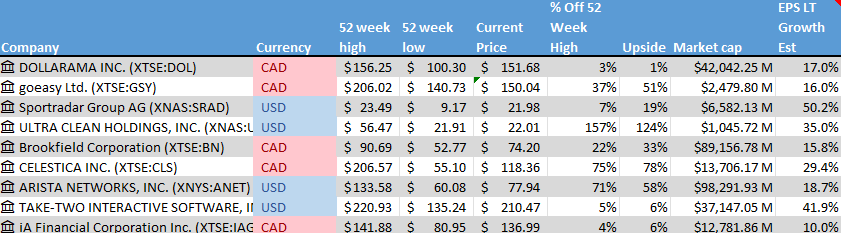
Companies on the Radar

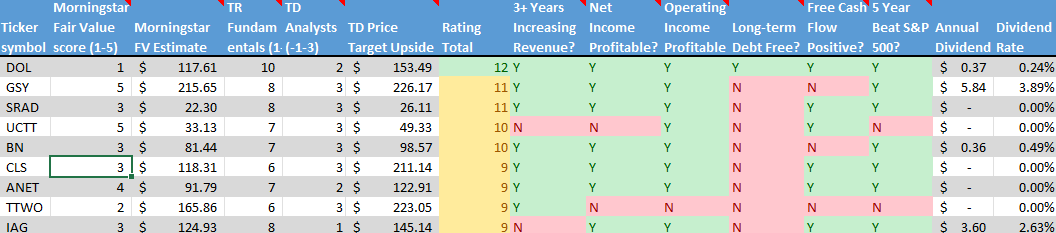
Stocks on my Radar My radar list kicked off the week with nine companies, but with economic uncertainty mounting – thanks to tariffs (essentially another form of taxes) and companies bracing for lower revenues and profits – I’m shifting my focus toward dividend-paying stocks. These companies provide a steady income stream, helping to offset market turbulence while adding resilience and reducing overall portfolio risk.

Tariffs create headwinds for businesses, especially high-growth companies that rely on global supply chains and international markets. Rising costs and trade disruptions can squeeze earnings, leading to stock price volatility and slower expansion. That’s why dividend-paying companies are looking more attractive to me right now. They tend to be well-established, financially stable, and less dependent on aggressive growth strategies. Their dividends act as a cushion during market downturns, and reinvesting those payouts can help compound returns over time – an added bonus for long-term investors like me.

With this in mind, I’ve pushed non-dividend payers like Sportradar Group AG (NASD: SRAD), Ultra Clean Holdings (NASD: UCTT), Celestica Inc. (TSE: CLS), Arista Networks ((NYSE: ANET), and Take-Two Interactive Software (NASD: TTWO) to the outer edges of my radar. That doesn’t mean they’re off the table entirely – if one of these stocks drops to a price that’s too good to ignore, I’ll seriously consider becoming an owner.

With five companies moving to the sidelines, two new names have caught my attention: Barrick Gold Corporation (TSE: ABX) and LPL Financial Holdings Inc. (NASD: LPLA). Barrick, a large-cap Canadian company, is one of the world’s largest gold and copper miners, with operations spanning the globe. LPLA, a large-cap US firm, provides an integrated brokerage and investment advisory platform for independent financial advisors.

With these to new additions, my list is down to the six companies, including the four holdovers from last week listed below:

  • Brookfield Corporation (TSE: BN): A large cap Canadian alternative asset manager and REIT/Real Estate Investment Manager.
  • Dollarama: A large cap Canadian company that operates a growing chain of discount stores across Canada and is expanding into South America.
  • goeasy Ltd. (TSE: GSY): A mid cap Canadian company that provides non-prime leasing and lending services to consumers in Canada.
  • iA Financial Corporation (TSE: IAG): A large cap Canadian company that provides insurance products in Canada and the US.

As always, these are not buy recommendations – be sure to do your own research and make decisions that align with your personal financial goals!

The Radar Check was last updated April 4, 2025.

Stock on the Radar List. 1 of 2.
Stock on the Radar List. 2 of 2.


That’s a wrap for this week—see you next time! Happy investing!
 

Weekly Update for the week ending March 28, 2025

Economists and analysts have been bringing up the word ‘stagflation’ lately – and that’s not a good thing. It’s an economic scenario no one wants, where growth stalls while prices keep rising. The term might sound complicated but understanding it now can help you avoid surprises later. So this week, I thought I’d go over what stagflation is and explain it in a way that’s easy to understand.

What is Stagflation?

Imagine you’re driving in bumper-to-bumper traffic – moving painfully slow – but at the same time, your car’s engine is overheating. That’s basically stagflation in economic terms: the economy isn’t growing much (or at all), but prices keep rising. Normally, inflation happens when the economy is booming, and a slowdown helps cool things down. But stagflation flips the script, combining slow growth with rising costs – something that can leave consumers squeezed and businesses struggling.

How Stagflation Impacts Markets

Stagflation doesn’t hit every part of the market the same way. Some sectors feel the pressure, while others hold up better:

  • Stocks: Companies face rising costs while demand weakens, which can hurt profits. Investors often shift towards defensive sectors like healthcare and consumer staples—industries that sell essentials people need no matter what.
  • Bonds: Inflation erodes the value of bond payouts, and if central banks hike interest rates to fight inflation, bond prices can take another hit.
  • Commodities: Gold and energy tend to attract investors during inflationary times since their prices often rise along with everything else.

What Can Investors Do?

If stagflation sticks around, investors may want to adjust their approach:

  • Diversify across different asset classes to help balance risk.
  • Focus on quality – companies with strong financials and pricing power (the ability to pass higher costs onto customers) tend to hold up better.
  • Look at inflation-resistant assets like certain commodities or inflation-linked bonds.
  • Stay informed – markets shift, and central bank policies can change the game quickly. A steady, long-term perspective usually beats reacting out of fear.

Lessons from the Past, Clues for the Present

The 1970s saw one of the worst stagflation periods, showing that there’s no one-size-fits-all solution. But history also reminds us that economies and markets adapt. While some sectors might struggle, innovation-driven areas – like technology or renewable energy – could still offer opportunities if companies find ways to outpace rising costs.

Stagflation isn’t just a buzzword – it’s a challenge that forces investors to think differently.  It might seem like a daunting concept, but by understanding its components and preparing strategically, you’ll be better positioned to navigate turbulent times. Remember, even uncertain times can present new opportunities. 😊

With that in mind, let’s take a look at what’s been happening in the markets this week


Items that may only interest or educate me ….

Canadian Economic news, US Economic news, …

Canadian Economic news

This past week’s key economic data that the Bank of Canada (BoC) considers when deciding whether to raise or lower the interest rate.

Bank of Canada minutes

The Bank of Canada released the minutes from its March 12 meeting this past week, offering insight into its decision to cut the policy interest rate by 0.25% to 2.75% – marking the seventh straight cut. Interestingly, the minutes suggest the central bank might have kept rates steady at 3% if not for the uncertainty surrounding US tariffs on Canadian goods.

Despite stronger-than-expected economic growth and inflation hovering near the 2% target, the threat of tariffs and heightened uncertainty had started to weigh on business and consumer confidence, leading to the rate cut. Policymakers also voiced concerns about inflationary pressures linked to trade disruptions and a weaker Canadian dollar, underscoring the tricky balancing act the BoC faces.

Gross Domestic Product (GDP)

After a surprise jump in annualized fourth-quarter growth, Canada’s economy continued its momentum into the new year. Statistics Canada reported that GDP rose 0.4% in January, beating expectations of a 0.3% increase and accelerating from December’s 0.2% gain.

The biggest boost came from goods-producing industries, which surged 1.1% – their strongest monthly gain in over three years. The ‘Mining, quarrying, and oil and gas extraction’ sector led the way with a 1.8% jump, while ‘Manufacturing’ rebounded with a 0.8% increase. Oil and gas extraction remained the economy’s biggest growth driver, expanding 2.6% in January.

On a year-over-year basis, GDP grew 2.4%, reflecting steady economic expansion, largely fueled by resource-heavy sectors. The ‘Mining, quarrying, and oil and gas extraction’ sector saw a notable 7.7% increase from a year ago.

However, the outlook isn’t all rosy. January’s growth may have been driven by a temporary export push to get ahead of tariffs and a short-term boost from the GST tax break that spurred spending. Preliminary February estimates suggest momentum stalled, with GDP flat for the month. Weakness in retail trade and real estate points to softening consumer spending and housing activity, offsetting gains elsewhere. While January’s data is encouraging, mixed signals from February highlight potential headwinds, from sectoral slowdowns to broader economic uncertainties. Trade tensions and looming tariffs could further pressure businesses by raising costs and complicating the growth outlook.

Canadian market volatility

Canada’s Volatility Index (VIXC) had a relatively calm week, starting at 16.07 before dipping into the 14.0 range, where it remained for most of the week, closing at 14.47. There was a brief dip below 12, driven by optimism that US tariffs might be scaled back, but that quickly faded. The real excitement came towards the end of the week, when the index briefly spiked to 17.92 after news of higher-than-expected US inflation data, before settling back into the 14 range.

For those unfamiliar with the VIXC (traded as VIXI on the TSX), think of it as the market’s anxiety gauge. A reading below 10 signals strong investor confidence, while a range between 10 and 20 is business as usual. When it crosses 20, however, it’s a sign that uncertainty is starting to take hold.

US Economic news

This past week’s key data points that the Federal Reserve (Fed) considers when deciding whether to raise or lower the interest rate.

Consumer Confidence Index (CCI)

Consumer confidence took another hit in March, with the Conference Board’s index dropping to 92.9 from 98.3 in February – its fourth straight decline. This follows February’s steep drop, which was the sharpest in over three years. Analysts had expected a reading of 94, so this miss adds to concerns about the economic outlook.

The Present Situation Index, which tracks current business and job conditions, slipped to 134.5, but the real worry is the Expectations Index. It tumbled 9.6 points to 65.2 – well below the 80 threshold that often signals a recession, and its lowest level in 12 years.

This decline reflects mounting concerns over the economy and persistent inflation, which remains above the Fed’s 2% target. With consumer confidence fading, consumer spending – which drives 70% of the American economy – could weaken, putting pressure on growth. For us investors, that means more market uncertainty. Sectors reliant on discretionary spending, like retail and travel, may struggle, while defensive industries like utilities could hold up better.

Gross Domestic Product (GDP)

The Bureau of Economic Analysis (BEA) released its third and final report on US GDP, confirming the economy grew 2.4% in the fourth quarter – slightly above both the previous estimate and analysts’ expectations of 2.3%. However, this marks a notable slowdown from the 3.1% growth seen in Q3.

The economy was largely propped up by strong consumer and government spending, though this was partly offset by a drop in investment. A decline in imports, which subtract from GDP, also provided a small boost.

Overall, the report paints a mixed picture – steady consumer spending kept growth afloat, but weaker investment and trade pressures hint at growing challenges. For the full year, the US economy expanded 2.8%, slightly below 2023’s 2.9% pace. Looking ahead to 2025, uncertainty looms. With President Trump’s tariffs set to impact nearly all imported goods, inflation could rise, investment may slow, and businesses could face a tougher climate. Many estimates put first-quarter growth below 1.5%, with a real risk of contraction.

Personal Consumption Expenditures (PCE)

The BEA’s latest inflation report confirmed that price pressures remained stubborn in February. The PCE price index rose 0.3% month-over-month and 2.5% year-over-year, matching January’s increases and meeting expectations.

However, the bigger concern is core PCE—the Fed’s preferred inflation gauge, which strips out the volatile food and energy components. It came in hotter than expected, rising 0.4% for the month (above the 0.3% forecast) and 2.8% year-over-year, exceeding estimates of 2.7%.

This suggests inflation isn’t easing as quickly as hoped, particularly in core categories less affected by short-term volatility. With trade tensions rising and new tariffs looming, inflation risks could intensify, making it harder for the Fed to bring inflation down to its 2% target and start cutting interest rates to support the economy.

Consumer Sentiment Index (CSI)

The University of Michigan’s final Consumer Sentiment Index reading for March came in at 57.0, lower than both the initial estimate of 57.9 and analysts’ expectations. That’s an 11.9% drop from February’s 64.7 and a steep 28.2% decline from a year ago, marking the third straight month of falling sentiment and the lowest reading since November 2022.

Looking at the two major subcomponents, the Current Economic Conditions Index, which measures how consumers feel about their current finances situation, dipped to 63.8 from 65.7 – a 2.9% decline and 22.7% lower than last March. The bigger concern is the Index of Consumer Expectations, which gauges optimism about the next six months. It dropped sharply to 52.6, down 17.8% from last month and 32.0% year-over-year.

This sharp decline in sentiment signals growing economic uncertainty. Consumers are increasingly worried about rising unemployment and inflation, two key factors that could weigh on spending – a major driver of economic growth. Inflation expectations for the next year have surged to 5%, up from 4.3% last month, suggesting that households are bracing for higher costs, which could further strain budgets. At the same time, two-thirds of consumers – across all demographics – now expect unemployment to rise in the coming year, the highest level of concern since 2009.

With confidence slipping, policymakers face a tough challenge: balancing inflation control while supporting economic growth. If consumer pessimism leads to weaker spending, it could slow down the economy even further. The road ahead looks uncertain, and how these concerns play out in the job market and inflation trends will be critical in shaping the next moves by the Fed.

American market volatility

The CBOE Volatility Index (VIX), often called the market’s ‘fear gauge,’ kicked off the week at a moderately elevated 19.13 before steadily trending lower and plateauing in the 17.50 range by midweek. However, the fear gauge started to rise again towards the end of the week, spurred on by tariff concerns, higher inflation data, and plummeting consumer sentiment. The VIX closed the week at 21.65 – signaling that heightened market uncertainty led to increased investor anxiety and volatility in the markets.

For those unfamiliar with the VIX, think of it as a stress meter for stocks. A reading below 12 signals calm conditions, while 12 to 20 reflects typical market fluctuations. Above 20, uncertainty is creeping in, and anything over 30 suggests markets are in turmoil.


Weekly Market and Portfolio Review

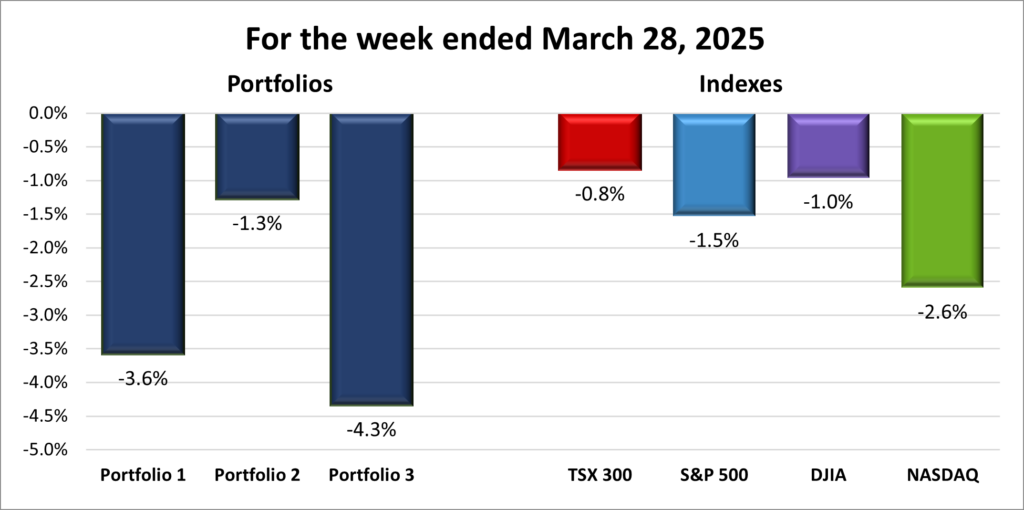
For the week, the TSX (SPTSX) fell 0.8%, the S&P 500 (SPX) slipped 1.5%, the DJIA (INDU) declined 1.0% and the Nasdaq (CCMP) dropped 2.6%.

Index Weekly Streak
TSX: 1 – week losing streak
S&P: 1 – week losing streak
DJIA: 1 – week losing streak
Nasdaq: 1 – week losing streak

Bearish market The markets had a bumpy ride this week. All four major indexes – the Toronto Stock Exchange Composite Index (TSX), the S&P 500 Index (S&P), the Dow Jones Industrial Average (DJIA), and the Nasdaq Composite Index (Nasdaq) – climbed steadily to start the week, only to plunge sharply by the end, as shown in the chart above. Early on, President Trump hinted at giving “a lot of countries breaks” on upcoming tariffs, suggesting a more targeted approach than initially expected. Investors cheered, sending markets higher. But by midweek, Trump toughened his stance, saying he didn’t want “too many exceptions.” He also accelerated the timeline for copper tariffs, slapped a 25% tax on all auto imports, and threatened further action against Canada and the EU if they retaliated together.

On the economic front, the final fourth quarter GDP report confirmed a slowing economy, while the latest inflation data showed core inflation rising both monthly and yearly. Investors are increasingly worried about the US economy slipping into recession – or worse, stagflation – especially if tariffs exacerbate stubborn inflation and weak growth.

Trade tensions have fueled a wave of uncertainty, sending consumer sentiment and confidence sharply lower, as reflected in this past week’s CSI and CCI reports. Inflation and job security fears are weighing on consumers, who may cut back on spending, putting pressure on businesses across multiple sectors. Rising inflation expectations are already straining household budgets, while concerns over rising unemployment add to the unease. Even Walmart (NYSE: WMT) – which had a strong 2024 – is warning of lower profits ahead due to tariff-related cost pressures. This growing pessimism could ripple through the economy, leading to weaker investment and slower growth. And if the US economy struggles, Canada won’t be far behind.

Just last week, Fed Chair Jerome Powell reassured markets that the US economy remained strong and the labour market stable. But this week’s data challenges that view, forcing investors to reassess the risks ahead.

In Canada, inflation expectations are rising sharply as consumers brace for trade wars that could push prices higher. If inflation gains traction while the economy weakens, the BoC could find itself in a tough spot – potentially needing to raise rates at a time when the economy might require lower ones instead.

This was not a good week by any measure. Next week isn’t shaping up to be much better, with US tariffs set to take effect and retaliatory tariffs likely to follow. If nothing else, it should be a volatile ride. Or, if you’re a glass-half-full kind of person, a week full of buying opportunities. 😊

Portfolio Weekly Streak
Portfolio 1: 2 – week losing streak
Portfolio 2: 1 – week losing streak
Portfolio 3: 1 – week losing streak

Bearish market After last week’s surprising gains, the momentum fizzled out, with all three portfolios ending in the red. ☹ One bright spot? President Trump’s 25% tariff on all auto imports sent shares of North American automakers and parts manufacturers tumbling. Selling my General Motors (NYSE: GM) shares earlier over tariff concerns is looking like one of my better decisions. Unfortunately, that was about the only good news this week.

Portfolio 1 extended its losing streak to two weeks, dropping 1.4% as only 31% of its holdings managed a gain. The sell-off in heavyweight tech stocks did the real damage, but also weighing on the portfolio were steep losses from Navitas Semiconductor (NASD: NVTS), down 21%; Celestica (TSE: CLS), down 16%; Magnite (NASD: MGNI), down 14%; Lattice Semiconductor (NASD: LSCC), down 11%; and Shopify (TSE: SHOP), down 10%.

Portfolio 2 was holding onto gains heading into Friday, but the market plunge dragged it down, finishing the week with a 1.3% loss. Still, it fared the best among the three, with 40% of its holdings managing a gain – an achievement in this brutal week.

Portfolio 3 had the roughest week, with only 14% of its holdings finishing in positive territory. On top of that, it suffered some hefty declines, with Vertiv Holdings (NYSE: VRT) down 18%, Magnite down 14%, and Shopify down 10%.

Once again, there’s little to say as the markets await the implementation of tariffs and retalitory tariffs. It was a tough week all around. Next week will see the start of a new month. I don’t have high expectations in this looming tariff environment, but hopefully the rest of April will be better than March with a return to rising markets.

Weekly Portfolio & Index performance
Weekly Portfolio & Index performance for the week ended March 28, 2025.

Companies on the Radar

Stocks on my Radar Last week, my radar list had 13 companies—a mix of carryovers, new names, and existing holdings. That’s way too many, so most of the week was spent trimming it down. I’ve since removed four companies – Whitecap Resources (TSE: WCP), Interactive Brokers (NASD: IBKR), Berkshire Hathaway (NYSE: BRK.B), and Palo Alto Networks (NASD: PANW). Even with nine names left, that’s still more than I’d like, and I’m aiming to narrow it down to five or fewer next week.

With more tariffs set to kick in on April 2, volatility could pick up as the day approaches. If the market dips, I’ll be watching for opportunities to buy quality companies at discount prices.

  • Sportradar Group AG (NASD: SRAD): A mid-cap Swiss company specializing in sports data, content, and integrity services that support businesses in sports, media, and betting industries.
  • Dollarama (TSE: DOL): A large cap Canadian company that operates a growing chain of discount stores across Canada and is expanding into South America.
  • goeasy Ltd. (TSE: GSY): A mid cap Canadian company that provides non-prime leasing and lending services to consumers in Canada.
  • Ultra Clean Holdings (NASD: UCTT): A small-cap American company specializing in critical components and ultra-high purity cleaning and analytical services in the semiconductor industry.
  • Brookfield Corporation (TSE: BN): A large cap Canadian alternative asset manager and REIT/Real Estate Investment Manager.
  • iA Financial Corporation (TSE: IAG): A large cap Canadian company that provides insurance products in Canada and the US.
  • Celestica Inc. (TSE: CLS): A medium sized Canadian company that manufactures electronic products and provides supply chain services to companies around the world.
  • Arista Networks ((NYSE: ANET): A large cap American company specializing in networking products for global enterprises.
  • Take-Two Interactive Software (NASD: TTWO): A large cap American company that develops interactive entertainment for consumers around the globe.

As always, these are not buy recommendations – be sure to do your own research and make decisions that align with your personal financial goals!

The Radar Check was last updated March 28, 2025.

Stock on the Radar List. 1 of 2.
Stock on the Radar List. 2 of 2.

Portfolio Update

Portfolio 3

Sold: Lithium Argentina (TSE: LAR)

I originally bought Lithium Americas (TSE: LAC) in the summer of 2023, back when Lithium Argentina was still part of LAC. At the time, surging electric vehicle (EV) demand made lithium—a key ingredient in EV batteries—seem like a solid investment. Then came the split: LAC became a Nevada-focused miner, while LAR took on operations in Argentina (as the name suggests! 😊).

Since then, it’s been a tough ride. LAR’s share price has steadily declined, down nearly 70%, and demand for EVs has cooled. This year alone, the stock is down 11.2% year-to-date, currently trading around C$3.25—far closer to its 52-week low of C$2.86 than its highs.

The broader lithium sector hasn’t helped. Demand is still unpredictable, competition is fierce, and geopolitical risks—especially in Argentina—add more uncertainty. On top of that, the latest wave of US tariffs could disrupt the industry further. Lithium prices remain volatile, and investor sentiment on the sector has been all over the place.

Lastly, LAR recently restructured and relocated to Switzerland. While this could pay off long-term, it introduces even more short-term uncertainty—something investors tend to avoid, especially with trade tensions heating up.

Given all this, I decided to sell my shares and move on to better opportunities. It’s never easy to walk away from an investment, but sometimes, stepping aside is the smartest move.

That’s a wrap for this week—see you next time! Happy investing!
 

Weekly Update for the week ending March 21, 2025

How Tariff Wars Are Impacting the Canadian Dollar—And What It Means for Us

With all the talk about tariffs and their effect on the Canadian and US economies, I started wondering – what do these trade battles mean for the already weak Canadian dollar? My first thought? It can’t be good. But that made me realize I wasn’t entirely sure how tariffs influence our currency or what that means for us as consumers, businesses, and investors. As Daenerys Targaryen would say, “Let’s begin!”

Why Tariffs Matter for the Canadian Dollar

The ongoing tariff war – sparked by President Trump’s levies on Canada and met with retaliatory tariffs from the Canadian government – has added uncertainty to global trade. As a country that depends on exports, Canada isn’t immune to the fallout. Here’s how these tariffs are putting pressure on the Canadian dollar:

  1. Tariffs Make Goods More Expensive Tariffs are basically taxes on imports and exports. When the US imposes tariffs on Canadian goods, it makes them more expensive for American buyers. That can lead to fewer Canadian products being sold internationally, which brings us to the next point….
  2. Fewer Exports Mean Less Demand for Canadian Dollars Here’s where the Canadian dollar (CAD) comes into play: When other countries buy Canadian goods, they need CAD to pay for them. But if tariffs make Canadian exports less competitive, fewer international buyers will be purchasing them – meaning less demand for our currency. This can weaken the CAD compared to other major currencies, like the US dollar (USD).
  3. Investors and Risk Sentiment Trade wars create uncertainty, and investors hate uncertainty. When global trade tensions rise, investors tend to move their money into “safe haven” currencies like the US dollar. This can weaken the CAD even further since it’s seen as more vulnerable to trade disruptions.
  4. Commodities and the CAD Canada’s economy is heavily tied to commodities like oil, gas, and metals. Tariff wars can hurt global trade, lowering demand for these resources. Since the CAD often moves in sync with commodity prices, a drop in demand for oil or minerals can put even more downward pressure on our currency.

In Summary

Tariffs disrupt trade by making goods more expensive, which can hurt Canadian exports. Fewer exports mean less demand for the Canadian dollar, and trade uncertainties can scare off investors, further weakening the CAD. For Canadian consumers, businesses, and investors, these pressures are felt in day-to-day expenses, operational costs, and market movements.

What This Means for Consumers, Businesses, and Investors

For consumers, tariffs often translate to higher prices on imported goods, from electronics to clothing and even groceries. Companies facing increased costs due to tariffs tend to pass those expenses on to shoppers. On top of that, a weaker Canadian dollar makes everything more expensive, including gas, travel, and online purchases from the US. With imports becoming pricier, some Canadians may start shifting their spending habits toward locally made products as a way to manage costs.

For businesses, the impact can be even more direct. Canadian exporters may struggle to compete in global markets if tariffs make their products too expensive. That could mean lower sales and, in some cases, job losses. Meanwhile, companies that rely on imported raw materials are also feeling the pinch, as tariffs drive up supply costs and squeeze profit margins. The uncertainty surrounding trade disputes can make things worse, leading some businesses to put expansion plans on hold or rethink their supply chains.

For investors, tariff wars add another layer of risk to the markets. A weaker Canadian dollar can affect returns on both domestic and international investments, making currency fluctuations something to watch closely. Trade uncertainty also fuels market volatility, which can create opportunities for experienced investors but may be nerve-wracking for beginners. Certain industries – particularly those reliant on exports – could face challenges, while companies focused on domestic markets might gain a competitive edge.

Final Thoughts

Tariff wars have thrown another wrench into an already uncertain global economy, and the Canadian dollar is feeling the pressure. The ripple effects are wide-reaching – higher prices for consumers, costlier operations for businesses, and increased market volatility for investors.

With tariffs continuing to put pressure on the Canadian dollar and adding uncertainty for businesses and consumers, markets have been reacting in their own way. This past week brought fresh economic information in both Canada and the US, and just as importantly, the latest rate decision and economic outlook from the US Federal Reserve. Let’s see how that information affected the markets and the three portfolios….


Items that may only interest or educate me ….

The Fed’s latest rate decision, Canadian Economic news, US Economic news, ….

The Fed’s latest rate decision

As expected, the Fed’s Federal Open Market Committee (FOMC) kept interest rates unchanged at 4.25% – 4.5%. But the bigger news was they still plan to cut rates twice in 2025, in line with their December forecast, which would bring the benchmark rate down to 3.75% – 4.0% by year-end.

Along with the rate decision, the Fed updated its economic projections. Inflation, measured by the Fed’s preferred PCE index, is now expected to end the year at 2.7%, up from the previous 2.5% forecast, before gradually reaching the 2% target by 2027. The unemployment rate is projected to tick up to 4.4% this year, compared to the earlier estimate of 4.3%, before stabilizing at 4.3% in 2026. Meanwhile, GDP growth for 2025 was revised down to 1.7% from the previous 2.1% estimate, with 1.8% growth expected in 2026. The Fed noted that “uncertainty around the economic outlook has increased,” a key factor in its downward revision. At the same time, it acknowledged that trade policy could complicate economic forecasts.

While the Fed didn’t explicitly mention tariffs, analysts warn that global trade tensions could fuel inflation while also dragging down growth – a classic recipe for stagflation. With so many moving parts, the Fed is taking a cautious approach, balancing inflation concerns with the risk of slowing the economy too much.

Canadian Economic news

This past week’s key economic data that the Bank of Canada (BoC) considers when deciding whether to raise or lower the interest rate.

Consumer Price Index (CPI)

Statistics Canada reported that annual inflation jumped to 2.6% in February, up from 1.9% in January – the highest reading in eight months. This also marks the first time since last summer that inflation has climbed above 2%, the midpoint of the BoC’s target range. Monthly inflation also surged, rising 1.1% in February compared to just 0.1% in January, much higher than the 0.6% analysts had expected.

Looking at the numbers, some categories saw sharper price increases than others. Compared to January, ‘Recreation, education, and reading’ prices saw the biggest jump at 3.4%, while ‘Transportation’ costs crept up just 0.3%. On a yearly basis, ‘Gasoline’ prices surged 5.1%, making it the biggest driver of inflation, while ‘Alcohol, tobacco, and cannabis’ products had the smallest increase at 0.6%. Meanwhile, the all-important ‘Shelter’ category – covering mortgage costs and rent – rose 4.2% year-over-year and 0.2% month-over-month.

Core inflation, which strips out volatile food and energy prices, also moved higher for the first time in three months. It rose 0.9% in February, pushing the annual core CPI rate up to 2.9% from 2.2% in January.

The end of the GST/HST tax break in mid-February was one of the factors behind the inflation spike. Since sales taxes are included in CPI calculations, the return of the GST directly pushed prices higher (who said higher taxes don’t make things more expensive? 😊). Now, the BoC is shifting its focus to tariffs, watching closely to see if US tariffs and Canada’s countermeasures drive costs even higher.

With inflation picking up speed – both in headline and core measures – the BoC may rethink its plans for rate cuts. Keeping rates steady for now could help prevent further weakening of the Canadian dollar and maintain a more stable economic environment.

Retail sales

According to Statistics Canada, retail sales in Canada fell more than expected in January, declining 0.6% after an upwardly revised 2.6% jump in December. Analysts had expected a smaller drop of 0.4%. On an annual basis, however, sales grew 4.2%, slightly above December’s 3.9% pace.

Core retail sales – which exclude gasoline, fuel vendors, and auto sales – also came in weaker than forecast, slipping 0.2% after a 2.7% gain in December. Analysts had anticipated a smaller 0.1% decline. Year-over-year growth, however, remained steady at 3.0%, matching expectations.

To make matters worse, an early estimate for February points to another 0.4% decline. If confirmed, this would mark the first back-to-back drop in retail sales since mid-2023 – a potential sign that Canadian consumers are tightening their wallets amid economic uncertainty. While some analysts see January’s decline as a return to normal after December’s GST holiday boost, the bigger question is whether consumer spending is losing momentum. Since household spending is a key driver of Gross Domestic Product, a prolonged slowdown could weigh on economic growth in the months ahead.

Canadian market volatility

Canada’s Volatility Index (VIXC) started the week at 16.84, briefly spiking to 18.90 before settling back below 17 and drifting lower as the week went on. By Friday, it closed at 14.33 – indicating that market volatility remained within a typical range. With little new tariff-related news, there wasn’t much to rattle investors.

For those unfamiliar with the VIXC (traded as VIXI on the TSX), think of it as a barometer for market anxiety. A reading below 10 signals strong investor confidence, while 10 to 20 suggests normal market fluctuations. When it rises above 20, uncertainty starts to dominate. This week’s brief jump suggests investors were reacting to shifting economic signals but weren’t bracing for major turbulence.

US Economic news

This past week’s key data points that the Federal Reserve (Fed) considers when deciding whether to raise or lower the interest rate.

Retail Sales

Retail sales in February came in weaker than expected, and to make matters worse, January’s numbers were revised even lower. According to the Commerce Department, retail sales rose just 0.2% last month, missing the forecasted 0.6% increase. Meanwhile, January’s sales were revised down to a sharp 1.2% decline – the biggest monthly decline since July 2021.

On a year-over-year basis, retail sales were up 3.1%, but that’s a step down from January’s revised 3.9% gain. Core retail sales, which strip out autos, vehicle parts, and gas stations, fared a bit better with a 0.5% increase in February after falling 0.8% the previous month. Still, the year-over-year growth in core sales slowed slightly to 3.5% from 3.6% in January.

The data suggests consumers are holding back on spending, likely due to inflation concerns and uncertainty stemming from President Trump’s tariffs on America’s biggest trading partners. Some analysts warn that weaker consumer activity could weigh on first-quarter GDP growth, with a potential contraction now in the conversation.

American market volatility

The CBOE Volatility Index (VIX), often called the market’s “fear gauge,” kicked off the week at a volatile 22.9 before steadily trending lower, eventually dipping just below 20. By Friday, it closed at 19.28 – signaling that market tensions eased, and volatility returned to a more typical range.

A few factors likely contributed to this decline: no major tariff-related developments, the Fed maintaining its pause on rate cuts while hinting at two possible cuts later this year, and a lack of any alarming economic data. With no fresh catalysts to shake investor confidence, fear in the market subsided.

For those unfamiliar with the VIX, think of it as a stress meter for stocks. A reading below 12 signals calm conditions, while 12 to 20 reflects typical market fluctuations. Above 20, uncertainty is creeping in, and anything over 30 suggests markets are in turmoil. With the VIX settling under 20, investor sentiment suggests worries are cooling – for now – though cautious optimism remains the dominant theme.


Weekly Market and Portfolio Review

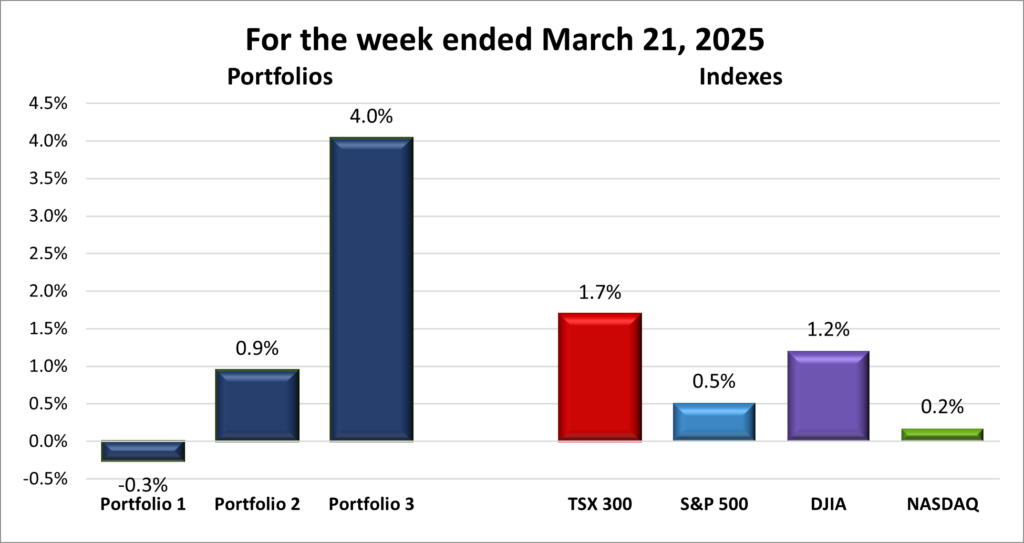
For the week, the TSX (SPTSX) rose 1.7%, the S&P 500 (SPX) increased 0.5%, the DJIA (INDU) advanced 1.2% and the Nasdaq (CCMP) edged higher by 0.2%.

 
Index Weekly Streak
TSX: 1 – week winning streak
S&P: 1 – week winning streak
DJIA: 1 – week winning streak
Nasdaq: 1 – week winning streak

Bull market. A good week for the North American stock markets. After a choppy week of ups and downs, all four major indexes finally snapped their losing streaks, as you can see in the chart above. The Toronto Stock Exchange Composite Index (TSX) and Dow Jones Industrial Average (DJIA) ended two-week slides, while the S&P 500 Index (S&P) and Nasdaq Composite Index (Nasdaq) broke four-week streaks.

The week kicked off with the US retail sales report, which, along with the previous week’s inflation data, pointed to a slight cooling in inflation. That reassured investors that the Fed might not need to take aggressive action on interest rates. However, the real market mover was the Fed’s latest rate decision.

The Fed faced a tough balancing act – juggling sticky inflation, slowing growth, and uncertainty over Trump’s trade policies. Despite the challenge, Fed Chair Jerome Powell struck an optimistic tone in his post meeting press conference, stating the Fed was holding the US benchmark rate at 4.5% and reaffirming expectations for two rate cuts later this year.

Markets initially rallied after Powell reassured investors that tariff-driven inflation would be ‘transitory’ and that recession risks remained low. Hopes for rates to drop to 4.0% by year-end fueled optimism. However, the relief rally was short-lived as concerns over stagflation risks quickly took centre stage, causing gains to fade.

Trade uncertainty added another layer of volatility, with concerns over looming reciprocal tariffs weighing on sentiment. US indexes seemed poised to extend their losing streaks, only to be saved by a last-minute comment from Trump, suggesting he had some ‘flexibility’ on the upcoming tariffs. This comment pushed the American indexes into the green for the day. What does ‘flexibility’ mean? We’ll find out soon enough.

In Canada, the TSX was boosted by rising oil prices, driven by new US sanctions on Iran, heightened tensions in the Middle East, and the ongoing Russia-Ukraine war. The positive sentiment from the Fed’s outlook also supported the market, though gains were capped by uncertainty over the tariffs set to take effect on April 2.

Going forward, the fate of the markets this year may depend on whether tariff-fueled inflation truly is transitory, as Powell suggests. If not, the US could find itself grappling with stagflation fears. In the meantime, the recent sell-off has pulled some high-flying stocks back down to fair value, or even into bargain territory, providing opportunities to become an owner of some of the world’s best companies.

Portfolio Weekly Streak
Portfolio 1: 1 – week losing streak
Portfolio 2: 1 – week winning streak
Portfolio 3: 1 – week winning streak

Bull market. A good week for the North American stock markets. This week turned out better than expected, with two of the three portfolios finishing in the green, as you can see in the chart below, despite markets swinging up and down throughout the week. There weren’t any major standout gains or losses, just steady, solid performance across the board.

Portfolio 1 came close to breaking even, missing out by just 0.3%. On the bright side, 60% of the companies in the portfolio gained value over the week. However, Nvidia (NASD: NVDA), which makes up over 36% of the portfolio, slipped 4% for the week, ultimately dragging the portfolio into the red.

Portfolio 2 had a solid week, rising 0.8% as 77% of its holdings posted gains. The energy sector stocks in particular had a strong showing, lifting the portfolio higher.

Portfolio 3 stole the spotlight with a 4.0% gain – almost double the TSX’s weekly return, the top performing index. An impressive 95% of its holdings finished in the green, with Evolution AB (OTCM: EVVTY) being the only stock to drop.

Given how choppy the markets were, I was pleasantly surprised to see all three portfolios finish higher – even if one barely moved. 😊 But the real surprise? Portfolio 3’s near-perfect performance! That’ll be a tough act to beat, but I’d love to see one of them pull it off. 😊

Weekly Portfolio & Index performance
Weekly Portfolio & Index performance for the week ended March 21, 2025.

Companies on the Radar

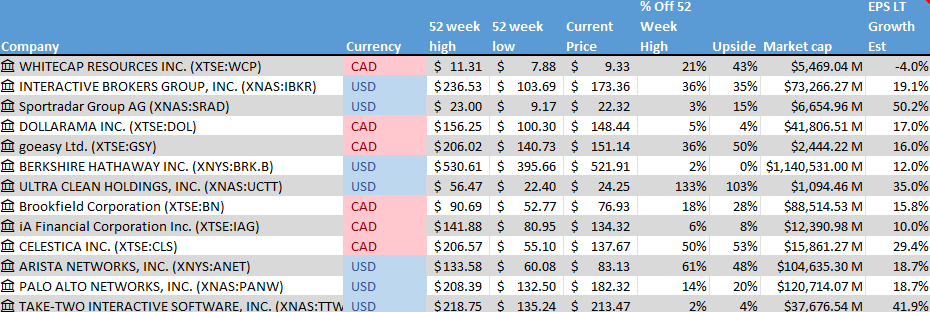
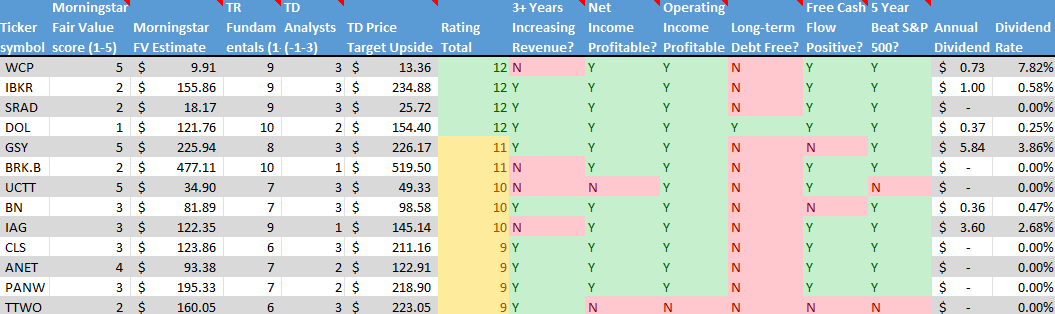
Stocks on my Radar With market volatility still running high, I’ve been hesitant to jump into new investments. Instead, I’ve focused on adding to companies I already own—businesses I know well that have delivered strong performance or growing dividends since I first invested (even if my stake is microscopic! 😊). Many of these stocks have dipped due to market uncertainty surrounding tariffs, making now a good time to add to existing positions. Case in point: my recent addition to Canadian Natural Resources (TSE: CNQ) (see Portfolio Updates below).

For this week’s ‘Companies on the Radar,’ I’ve added stocks from my existing portfolios that I’m considering increasing my stake in. That brings the list to 13 names: three holdovers from last week (with Axon Enterprise, Inc. (NASD: AXON) dropped), two new companies that recently caught my attention, and eight current holdings I’m eyeing for potential top-ups.

  • Whitecap Resources (TSE: WCP): A medium-cap Canadian oil and gas company. The company offers an impressive monthly dividend yield of over 7% per month, which has grown steadily.
  • Interactive Brokers (NASD: IBKR): A large-cap American online brokerage firm known for its advanced trading platform used by professionals and retail investors like us at all levels.
  • Sportradar Group AG (NASD: SRAD): A mid-cap Swiss company specializing in sports data, content, and integrity services that support businesses in sports, media, and betting industries.
  • Dollarama (TSE: DOL): A large cap Canadian company that operates a growing chain of discount stores across Canada and is expanding into South America.
  • goeasy Ltd. (TSE: GSY): a mid cap Canadian company that provides non-prime leasing and lending services to consumers in Canada.
  • Berkshire Hathaway (NYSE: BRK.B): The mega cap American conglomerate managed by Warren Buffet.
  • Ultra Clean Holdings (NASD: UCTT): A small-cap American company specializing in critical components and ultra-high purity cleaning and analytical services in the semiconductor industry.
  • Brookfield Corporation (TSE: BN): A large cap Canadian alternative asset manager and REIT/Real Estate Investment Manager.
  • iA Financial Corporation (TSE: IAG): A large cap Canadian company that provides insurance products in Canada and the US.
  • Celestica Inc. (TSE: CLS): a medium sized Canadian company that manufactures electronic products and provides supply chain services to companies around the world.
  • Arista Networks ((NYSE: ANET): A large cap American company specializing in networking products for global enterprises.
  • Palo Alto Networks (NASD: PANW): A large cap American company providing cybersecurity solutions to companies around the world.
  • Take-Two Interactive Software (NASD: TTWO): A large cap American company that develops interactive entertainment for consumers around the globe.

As always, these are not buy recommendations – be sure to do your own research and make decisions that align with your personal financial goals!

The Radar Check was last updated March 21, 2025.

Stock on the Radar List. 1 of 2.
Stock on the Radar List. 2 of 2.

Portfolio Updates

Portfolio 2

Bought: Canadian Natural Resources

I first invested in Canadian Natural Resources in August 2022, drawn by its steadily growing dividend and strong position in the energy sector. Since then, the stock has gained 23%, and its dividend—which has been increasing for 25 years—has provided a reliable income stream. This week, I added to my position, locking in a solid 5.3% dividend yield and the potential for 17% earnings growth over the next five years. Not bad for a well-established energy company.

What I’ve come to appreciate about CNQ is its efficiency in turning a profit, even when energy markets face challenges. It is still one of Canada’s biggest and most dependable producers, consistently generating strong cash flow—which it often returns to investors.

With the stock pulling back slightly due to market turbulence caused by the uncertainty of looming tariffs, I saw an opportunity to buy at a discount. Given its history of steady performance, strong cash flow, and dependable, rising dividends, adding to my position felt like a smart move. 😊

Portfolio 3

Sold: Telus international (TSE: TIXT)

I first invested in TIXT back in February 2021, right as the post-COVID bull market was lifting almost every tech stock. At the time, I saw potential for it to become a major Canadian – if not international – tech player. But over time, it started to feel more like a glorified Managed Services Provider (MSP) rather than an industry leader. Things were fine until the 2022 bear market hit, and from there, it was a steady decline – even as broader markets rebounded in late 2022. Fast forward to the end of 2024, and the numbers weren’t looking great. Revenue was down, net income had declined for two straight years, and the company closed out the year with a net loss.

After two years of underperformance, I finally decided to cut my losses and reallocate the funds to better opportunities. Sometimes, it’s just better to move on.

Sold: Enghouse Systems (TSE: ENGH)

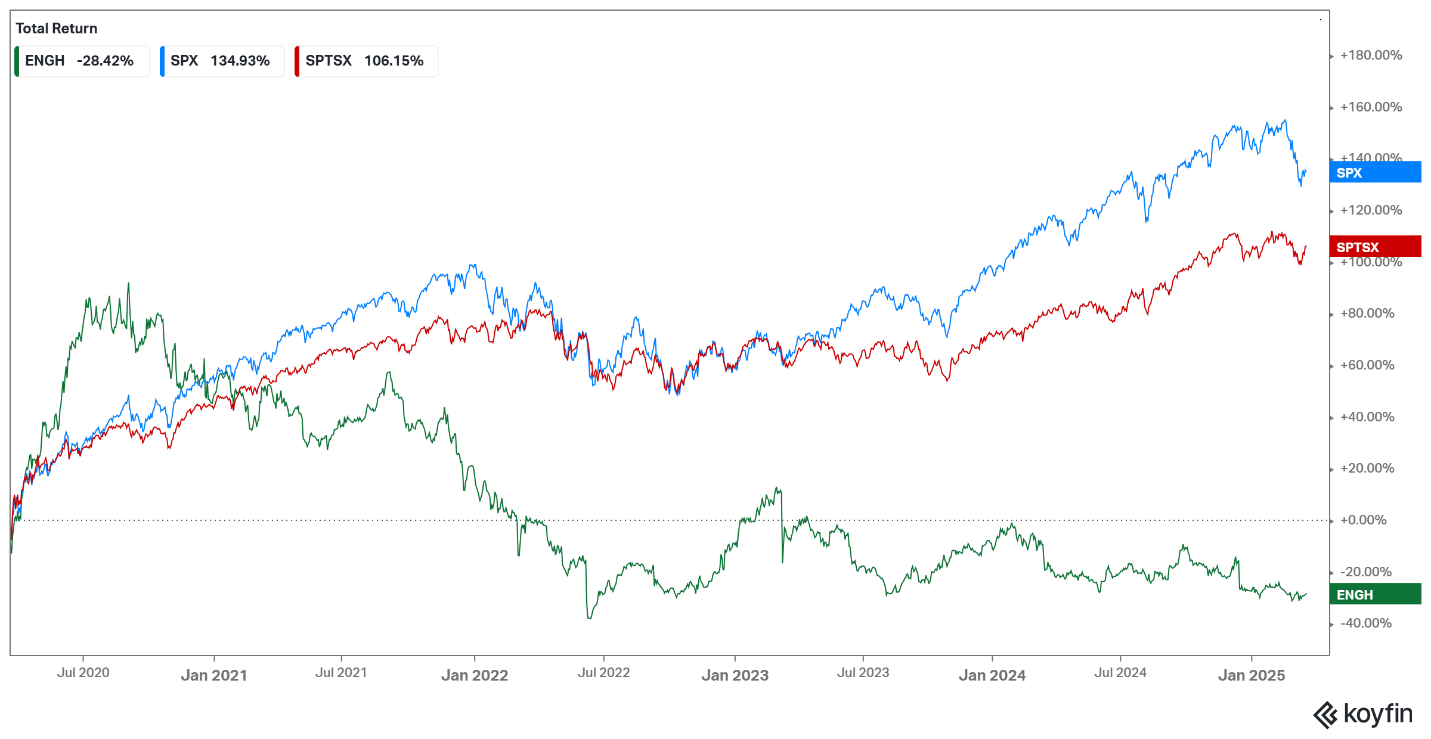
I first invested in Enghouse back in January 2020, aiming for long-term growth and steady dividend income. The company delivered strong growth in the first year, so I added to my position in early 2021 after the stock had climbed 20%. While that seemed like a solid move, the stock had already peaked in mid-2020 and was on a steady decline when I bought more (though at the time, I thought it was just a dip – it turned into a prolonged slide). It eventually stabilized around C$30 during the 2022 bear market but never truly rebounded.

Looking at the bigger picture, while the TSX and S&P have surged over the past five years, Enghouse has lagged, drifting lower instead of recovering. As the chart below shows, there’s a clear divergence between Enghouse and the TSX and S&P, which serve as strong benchmarks for the Canadian and US markets. Given that underperformance, I considered selling all my shares but ultimately decided to trim my position instead. Despite the weak stock performance, Enghouse has remained profitable, with revenue, net income, and cash flow all increasing over the last two years. Plus, the dividend still provides some income, and as a small-cap company, there’s always the potential for future growth.

5 year performance of ENGH versus the TSX and S&P 500. By selling some shares, I’ve freed up cash for better opportunities while keeping a foot in the door in case Enghouse regains momentum. For now, I’ll hold onto a smaller position to collect dividends and see if the company can turn things around.

That’s a wrap for this week—see you next time! Happy investing!
 

Weekly Update for the week ending March 14, 2025

This past week, the Dow Jones Industrial Average (DJIA) dropped below its 200-day moving average (DMA). OK, you say, but what does this mean, and why should we care? Well, let’s take a closer look at two of the most commonly watched moving averages: the 200-DMA and its shorter-term counterpart, the 50-DMA.

What Are Moving Averages?

Moving averages are tools investors use to smooth out daily price fluctuations and identify trends. The 200-day moving average (200-DMA) tracks long-term trends, while the 50-day moving average (50-DMA) focuses on shorter-term movements.

The 200-Day Moving Average: The Long-Term Trend Tracker

The 200-DMA represents the average closing price of a stock or index over the last 200 trading days. It’s a key indicator of the long-term trend – helping investors gauge if a stock is trending up, down, or moving sideways.

Why It Matters:

  • Bearish Signal: A drop below the 200-DMA can signal weakening long-term momentum.
  • Investor Sentiment: Falling below this level can shake investor confidence and lead to further declines.
  • Support Level: The 200-DMA often acts as support. If a stock falls below it, that support can turn into resistance.

💡 Think of the 200-DMA as the track of a roller coaster. When the track is steadily climbing, the ride feels smooth. But if it starts sloping downward, it could signal a rough drop ahead. Investors brace themselves, deciding whether to ride it out or prepare for more turbulence.

The 50-Day Moving Average: The Short-Term Pulse

The 50-DMA tracks the average over the past 50 days, making it more sensitive to recent price movements and helping investors spot short-term trends.

Why It Matters:

  • Short-Term Bearish Signal: A drop below the 50-DMA may indicate a short-term downtrend.
  • Investor Sentiment Shift: If a stock consistently trades below its 50-DMA, it could suggest weakening confidence.
  • Potential Opportunity: Some investors view a dip below the 50-DMA as a potential buying opportunity, assuming the stock will bounce back.

💡 If the 200-DMA is the track guiding the entire roller coaster, the 50-DMA is like the smaller hills and dips along the way. When the ride stays above these smaller hills, the momentum feels strong. But if each hill dips below the last, it could signal a slowdown, or a sharper drop ahead. Investors watch these shifts to gauge whether momentum is fading or still strong.

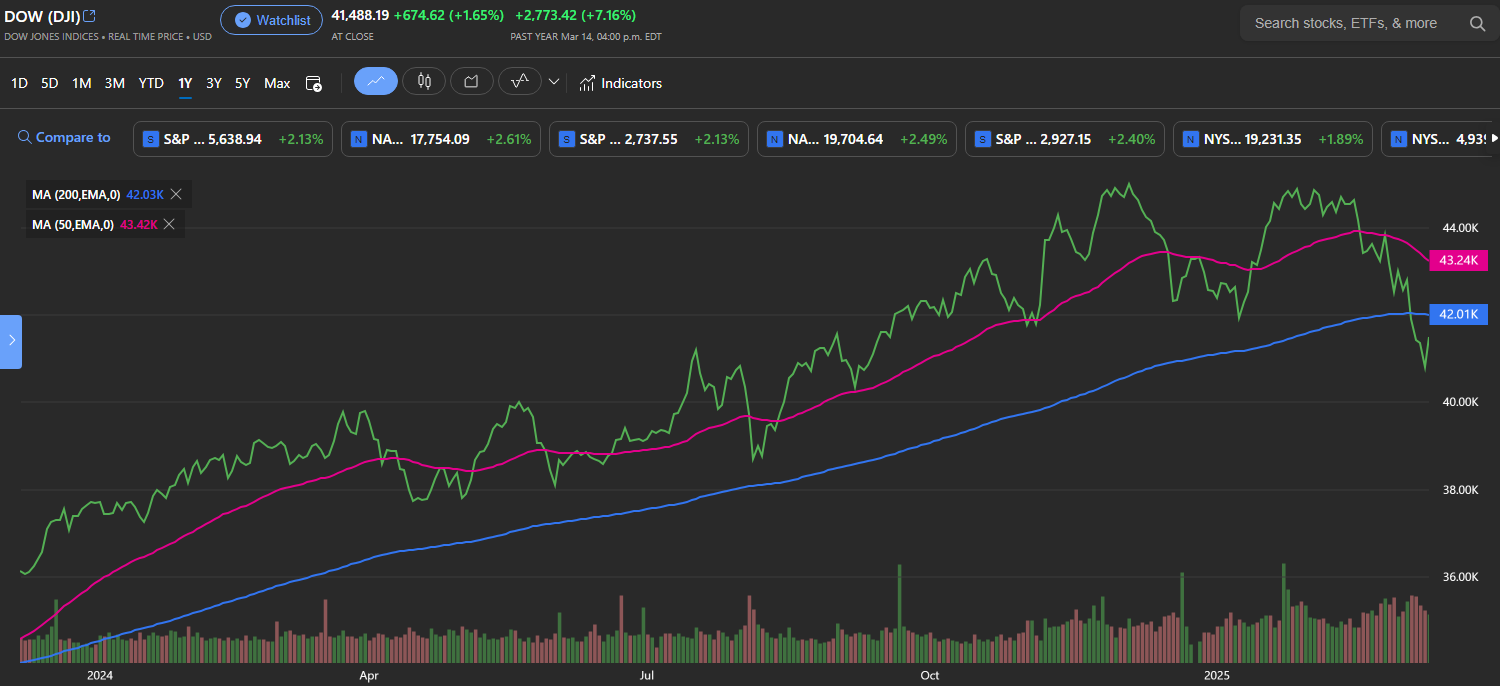
In this chart below of DJIA’s 1-year performance as of March 14, the pink line represents the 50-DMA, while the blue line is the 200-DMA. As you can see, the 50-DMA reacts faster than the 200-DMA, rising and falling more quickly. You can see the DJIA has dropped below both the 50 and 200 DMAs.

The DJIA's 1 year performance showing the index dropping below the 50 DMA and 200 DMA.
The DJIA’s 1 year performance with the 50 DMA and 200 DMA.

Comparing the 200-DMA and 50-DMA

Feature 200-DMA 50-DMA
Timeframe Long-term (200 days) Short-term (50 days)
Sensitivity Less reactive to price swings More sensitive to price changes
Usage Used by long-term investors Used by short-term traders
Signals Crossing below = potential long-term downtrend Crossing below = possible short-term weakness

The Golden Cross & Death Cross

When the 50-DMA crosses the 200-DMA, it signals important market trends:

  • Golden Cross: When the 50-DMA crosses above the 200-DMA, it suggests potential strength.
  • Death Cross: When the 50-DMA falls below the 200-DMA, it signals potential weakness.

💡 Imagine the 200-DMA as a slow-moving train tracking the big picture, while the 50-DMA is a zippy sports car reacting to the twists and turns. Both offer valuable perspectives on market trends.

Final Thoughts

Moving averages aren’t foolproof, but they offer valuable insights into market direction. A dip below a moving average doesn’t guarantee disaster, and a rise above doesn’t promise endless gains. I use them to gauge the overall market trend or the momentum of a specific stock. These moving averages are just one of many tools in my toolbox as I aim to grow my wealth through investing. 😊

Now that we’ve covered how moving averages can provide a clearer view of the market’s direction, let’s take a look at what moved the markets this past week and how those movements influenced the DMAs…


Items that may only interest or educate me ….

Canadian Economic news, US Economic news

Canadian Economic news

This past week’s key economic data that the Bank of Canada (BoC) considers when deciding whether to raise or lower the interest rate.

Bank of Canada rate decision

As expected, the BoC lowered its key interest rate by 0.25% to 2.75% in an effort to counter the impact of US tariffs. This marks the second rate cut of the year and the seventh consecutive reduction, bringing rates down a total of 2.25% from 5.0% just nine months ago.

The decision comes as Canada faces fresh economic challenges from rising trade tensions and US tariffs, which could slow growth and push inflation higher. BoC Governor Tiff Macklem acknowledged these risks, stating that the bank will “proceed carefully with any further changes” as it balances inflation concerns with the need to support the economy. He emphasized that while Canada started the year in solid shape, with inflation near their 2% target, uncertainty surrounding US tariffs is already dampening economic confidence. Macklem also cautioned, “Depending on the extent and duration of new US tariffs, the economic impact could be severe.”

What this means for the economy

The BoC’s rate cut aims to stimulate growth by making borrowing cheaper, but US trade tensions add an element of uncertainty. While the economy has been strong, the bank warns that tariffs are causing consumers and businesses to become more cautious.

For consumers, lower rates mean cheaper mortgages, loans, and credit cards, providing some relief. Homeowners with variable-rate mortgages will see smaller payments. However, if tariffs drive up import costs, those savings could be offset by higher prices.

For businesses, lower borrowing costs can help fund expansion and investment. However, trade uncertainty may cause delays in hiring and spending, especially in export-heavy industries like manufacturing and natural resources, which are particularly vulnerable to US tariffs.

For us investors, lower rates allow companies to borrow more cheaply to grow their businesses, which can boost profits and, in turn, stock prices. This often leads to more investors buying stocks, pushing the market even higher.

Overall, while the rate cut offers short-term relief, its full impact depends on how trade tensions unfold. If tariffs continue to weigh on confidence, the BoC may need to adjust its approach again. For now, uncertainty remains the biggest challenge.

Canadian market volatility

Canada’s Volatility Index (VIXC) kicked off the week at 14.63 but didn’t stay there for long. By midweek, it had climbed into the 16-point range, occasionally spiking as high as 17.0. The BoC’s rate cut and signs of slowing US inflation kept the index fluctuating before it ultimately settled at 16.43 to close out the week.

For those new to the VIXC (traded as VIXI on the TSX), think of it as a gauge of market nerves. When it’s below 10, investors are feeling confident, while readings between 10 and 20 reflect normal market ups and downs. If it climbs above 20, uncertainty is taking over. This week’s midweek jump suggests investors were reacting to shifting economic signals but weren’t hitting the panic button.

US Economic news

This past week’s key data points that the Federal Reserve (Fed) considers when deciding whether to raise or lower the interest rate.

Labour data

Job Openings and Labor Turnover Survey (JOLTS)

The latest JOLTS report from the US Bureau of Labor Statistics (BLS) showed January job openings rising to 7.75 million, up from December’s revised 7.5 million, signaling strong hiring demand. However, openings remain 728,000 lower than a year ago. With 1.2 job openings per unemployed person, the labour market remains tight, reinforcing the economy’s resilience. That said, since JOLTS covers January while last week’s ADP and Employment Situation Summary reports reflected February data, it offers little new insight beyond confirming that the job market remains stable but faces some emerging headwinds. However, it does indicate that President trump inherited a strong labour market.

Consumer Price Index (CPI)

The latest CPI inflation report for February 2025 shows that prices cooled more than expected, offering some relief to investors. Headline CPI, which tracks the overall cost of goods and services, rose 2.8% year-over-year, slightly below the expected 2.9% and down from 3.0% in January. On a monthly basis, prices increased 0.2%, also coming in lower than the forecasted 0.3%, after a sharper 0.5% jump in January.

Looking at specific price changes, ‘Utility gas services’ saw the biggest increase, jumping 2.5% in February. Meanwhile, ‘Gasoline’ and ‘New vehicle’ prices both fell 1.0%, helping ease inflation pressures. Compared to last year, ‘Transportation services’ and ‘Utility gas services’ costs were up 6.0%, while ‘Fuel oil’ prices dropped 5.1%, making it the biggest annual decliner.

Housing costs – including rent and mortgages – rose 0.3% monthly, slowing from 0.4% in January. Over the past year, shelter inflation cooled to 4.2%, a positive sign for affordability concerns.

Core CPI, which strips out volatile food and energy prices, also showed signs of easing. It rose 0.2% in February, down from 0.4% in January, while the annual rate slowed to 3.1% from 3.3% – its lowest level since April 2021. Both figures came in slightly softer than expected.

For us investors, this is good news. Softer inflation eases pressure on the Fed, making it more likely that they could cut interest rates later this year. Lower rates tend to boost stocks, as they make borrowing cheaper for businesses and improve overall market sentiment. The markets responded favourably, with all four major indexes moving higher after three straight days of losses.

While inflation isn’t fully tamed yet, today’s report suggests it’s moving in the right direction, paving the way for a more investor-friendly environment in the months ahead. Now, if only those tariffs – threatening to push prices higher – would go away. 😊

Consumer Sentiment Index (CSI)

The University of Michigan’s preliminary Consumer Sentiment Index reading for March tumbled to 57.9 from 64.7 in February, well below expectations of 63.1. This marks the third consecutive monthly decline and a 22% drop since the start of the year, bringing sentiment to its lowest level since July 2022. The 10.5% slide from last month and the 27.1% decline from a year ago highlight growing consumer unease.

Digging into the details: The Current Economic Conditions Index, which reflects how consumers feel about their financial situation, dipped to 63.5 from 65.7—a 3.3% drop from February and 23% lower than a year ago. The bigger hit came from the Index of Consumer Expectations, which measures optimism for the next six months. It plunged to 54.2, down 15.3% from February and a steep 30% from March 2024’s reading of 77.4%. The decline was broad-based, cutting across all demographics and political groups.

So, what does this mean? The sharp drop suggests households are growing increasingly cautious, likely due to rising inflation expectations and uncertainty over economic policies. When policies – such as tariffs or trade restrictions – are constantly shifting, it makes it harder for consumers to plan for the future. When confidence falls, people tend to save more and spend less, which can slow economic growth since consumer spending is a key driver of GDP.

For us investors, weaker sentiment can lead to increased market volatility. When consumers hold back on major purchases, corporate profits can take a hit, weighing on stock prices. Meanwhile, rising inflation concerns could pressure the Fed to adjust its interest rate strategy, adding another layer of uncertainty.

In short, this latest drop in consumer sentiment is a warning sign that both the economy and markets may face some headwinds in the months ahead.

American market volatility

The CBOE Volatility Index (VIX), often called the market’s “fear gauge,” started the week at 24.70 and hovered between 24.50 and 27.50 for most of the week. It briefly spiked just below 29 before easing back to 21.77 at the end of a volatile week. The main culprit behind the market jitters? The back-and-forth over potential electricity tariffs between Canada and the US But with both sides ultimately backing down, along with better-than-expected inflation data, the VIX had cooled off by the end of the week.

For those new to the VIX, think of it as the market’s stress meter. A reading below 12 means smooth sailing, 12 to 20 signals typical market swings, and anything above 20 suggests rising anxiety. When it climbs past 30, buckle up – markets are in turmoil. With the VIX closing above 20, traders are clearly bracing for volatility ahead.


Weekly Market and Portfolio Review

For the week, the TSX (SPTSX) dropped 0.8%, the S&P 500 (SPX) slipped 2.3%, the DJIA (INDU) declined 3.1% and the Nasdaq (CCMP) lost 2.4%.

 
Index Weekly Streak
TSX: 2 – week losing streak
S&P: 4 – week losing streak
DJIA: 2 – week losing streak
Nasdaq: 4 – week losing streak

Bearish market This past week picked up right where last week’s selloff left off, as shown in the chart above, with markets still rattled by US trade wars. Investors are growing more risk-averse, fearing a recession – or worse, stagflation, where economic growth stalls while inflation stays high, in this case due to tariffs. President Trump downplayed concerns, calling it a mere “period of transition.

It was another rough week for stocks, capped by one of the worst trading days in three years. Tariff whiplash, market volatility, and economic uncertainty fueled the selloff. The US government narrowly avoided a shutdown, but that wasn’t enough to calm investor nerves. The TSX slipped 0.8%, while the S&P 500 (S&P), DJIA, and Nasdaq Composite Index (Nasdaq) all dropped more than 2%.

The post-election market optimism has vanished, replaced by tariff-driven chaos. Unpredictable trade policies are hitting industries across the board, with consumers pulling back on everything from essentials to travel. Investor confidence is slipping too. Even us retail investors – who’d normally ‘buy the dip’ – are hesitant, wondering if stock prices have further to fall.

Monday kicked off with a steep drop, delivering the worst market returns in three years. The Nasdaq was down nearly 15% in under a month, with heavyweight tech stocks among the hardest hit. Typically, tech thrives in bullish markets, but this week, it was the last place anyone wanted to be.

The S&P fell below its 200-day moving average, a key support level, for the first time since November 2023. A day later, it officially entered correction territory, down more than 10% from its February 19 high. The decline was historic – just 16 trading days to correction, making it the fifth-fastest drop in the last 75 years. This also marks the third time under Trump’s presidency (2018, 2020, and now 2025) that the S&P has suffered one of the fastest corrections on record. The Nasdaq hit correction territory the previous week.

Amid the turmoil, there was one bright spot – better-than-expected US inflation data. If you’ve been holding gold, you’re probably smiling, as it surged past US$3,000 per troy ounce. But any optimism was overshadowed by Trump’s trade war with allies and the lingering threat of a US government shutdown.

Here in Canada, the BoC cut its benchmark rate to stimulate growth amid escalating US trade tensions. That uncertainty weighed on investor sentiment, stretching the TSX’s weekly losing streak to two.

Fortunately, the week ended on a strong note with a late rally. Whether the momentum lasts is anyone’s guess, but we’ll find out soon enough. Hopefully, it wasn’t just a ‘buy the dip’ rally – maybe, just maybe, it’s the start of a winning streak. 😊

Portfolio Weekly Streak
Portfolio 1: 1 – week winning streak
Portfolio 2: 2 – week losing streak
Portfolio 3: 4 – week losing streak

Bearish market Given the shaky market environment, I expected all three portfolios to take a hit this week. But to my surprise, my three portfolios played out like a classic Western – The Good, the Bad, and the Ugly. 😊

The Good

Portfolio 1 rode off into the sunset with a 0.3% gain, defying the broader market selloff. Only 31% of holdings finished in the green, but one heavyweight carried the load – Nvidia (NASD: NVDA) surged 10%, easily outweighing losses elsewhere, including a 15% drop from The Trade Desk (NASD: TTD). Just last week, I was frustrated about Nvidia’s oversized weight in this portfolio. This week? It was the lone gunslinger keeping things afloat.

The Bad

Portfolio 2 took a hit, falling 1.8%. It actually had the most winners (39% of holdings posted gains), including an 11% jump from Guardant Health (NASD: GH). But the losses outnumbered the victories, leaving this portfolio stuck in no man’s land.

The Ugly

And then there was Portfolio 3—the outlaw that got run out of town, sinking 2.9%. Only 21% of its holdings managed gains, and none were big enough to matter. The only saving grace? No catastrophic losses. Otherwise, the damage could have been a whole lot worse.

Right now, investor fears are outweighing solid earnings and economic data, dragging the markets lower. With the portfolios following suit, it’s starting to feel like 2022, when all four major indexes cratered 20% or more, and each of the portfolios lost 27% or more. It wasn’t fun then. It isn’t fun now! ☹

Weekly Portfolio & Index performance
Weekly Portfolio & Index performance for the week ended March 14, 2025.

Companies on the Radar

Stocks on my Radar After a rough week in the markets – and with volatility likely sticking around for a while – I’ve hit pause on searching for new companies to add to my portfolios. Meanwhile, with Rubrik, Inc. (NASD: RBRK) tumbling over 34% since early February, it’s officially off my radar. Mind you, that 27% jump following its earnings report this week did give me pause. That brings my watchlist down to the four companies below:

  • Interactive Brokers (NASD: IBKR), A large-cap American online brokerage firm known for its advanced trading platform used by professionals and retail investors like us at all levels.
  • Sportradar Group AG (NASD: SRAD): A mid-cap Swiss company specializing in sports data, content, and integrity services that support businesses in sports, media, and betting industries.
  • Ultra Clean Holdings (NASD: UCTT): A small-cap American company specializing in critical components and ultra-high purity cleaning and analytical services in the semiconductor industry.
  • Axon Enterprise, Inc. (NASD: AXON): A large-cap American innovator in body cameras, TASER devices, and cloud-based evidence management software, serving law enforcement and public safety agencies.

As always, these are not buy recommendations – be sure to do your own research and make decisions that align with your personal financial goals!

The Radar Check was last updated March 14, 2025.

Stock on the Radar List. 1 of 2.
Stock on the Radar List. 2 of 2.


That’s a wrap for this week—see you next time! Happy investing!


Weekly Update for the week ending March 7, 2025

In my February 7 Weekly Update, I discussed tariffs and their impact on consumers. With the US implementing tariffs on Canada and Mexico this past week – and Canada immediately retaliating, while Mexico held off implementing tariffs for now (as of the time of this post) – I wanted to dig deeper into how tariffs actually work. Beyond just driving up prices, tariffs play a significant role in trade and investing. So, what exactly are tariffs? Let’s take a look.

What Are Tariffs?

A tariff is essentially a tax on imported (or sometimes exported) goods. Think of it as a fee added to products crossing a border. While tariffs generate revenue for governments, they also serve as a strategic tool—making foreign goods more expensive to protect domestic industries.

How Do Tariffs Work?

  1. Government Imposes the Tariff: A country’s government decides to apply a tariff, either as a policy measure or as part of a trade dispute.
  2. Collected at the Border: Customs agencies (like the Canada Border Services Agency or the US Customs and Border Protection) charge the tariff when imported goods arrive.
  3. Passed on to Businesses & Consumers: Importers pay the tariff upfront, but the cost often gets passed down to businesses and, ultimately, consumers through higher prices.
  4. Trade & Economic Impact:
    1. Protectionism: Tariffs help local industries compete by making imports more expensive. For example, the US currently applies a combined 27% duty on Canadian softwood lumber. The US claims that Canadian lumber producers receive unfair subsidies from their government, allowing them to sell lumber at lower prices in the US market.
    2. Government Revenue: While the primary goal is not always revenue generation, tariffs can bring in income for governments. For instance, President Trump floated the idea of using tariffs to help pay for tax cuts, particularly on nations seen as adversaries. This was part of a broader discussion about extending his 2017 tax cuts and introducing new tax exemptions.
    3. Trade Negotiations & Retaliation: Countries often use tariffs as leverage in trade deals or as part of tit-for-tat disputes – like the current situation between the US, Canada, and Mexico. The US is using tariffs to push Canada on issues such as border control and security. Given President Trump’s history, it’s likely this leverage will be used again on any future trade irritants, including allegations of unfair trade practices.

Are Tariffs Just Another Tax?

While tariffs function similarly to taxes in that they raise government revenue, their main purpose is different. Unlike income or sales taxes, which fund public services, tariffs are designed to influence trade by protecting local industries and regulating market behavior. They’re a tool for shaping economic policy, not just for funding government initiatives.

Who Applies & Collects Tariffs?

Governments impose tariffs, either through legislation or executive action. Once in place, customs agencies collect the money at the border based on the type and value of goods being imported. The revenue flows into the government’s treasury, just like other taxes.

Why Should Us Investors Care?

Tariffs can shake up markets in several ways:

  • Stock Prices & Market Volatility: Companies that rely on imports often face higher costs, while domestic producers may benefit. During President Trump’s first term, the US slapped tariffs of 25% on steel and 10% on aluminum imports from Canada. This hit US automakers and construction firms, which depend on Canadian metals, leading to stock price swings for companies like General Motors and Ford. Meanwhile, domestic steel and aluminum producers like US Steel and Nucor saw temporary gains as tariffs made foreign metals more expensive, giving them a competitive edge.
  • Supply Chain Disruptions: Higher costs on imported materials force businesses to adjust pricing, sourcing, or production strategies. When the US imposed tariffs on auto parts, production costs surged, leaving automakers with two choices – absorb the hit or pass it on. You can probably guess which one they will choose. 😊
  • Trade Tensions & Economic Uncertainty: Retaliatory tariffs can escalate disputes, impacting everything from consumer prices to investor confidence. Recent US consumer sentiment and confidence readings have dropped as people brace for higher prices, fearing inflation will rise and force interest rates to stay higher for longer. And how have markets reacted to the renewed tariff threats? Spoiler alert: they’ve dropped sharply.
  • Long-Term Industry Trends: Tariffs aren’t always permanent – many are renegotiated or removed over time. Understanding these shifts can help investors anticipate market changes.

Tariffs might seem like just another trade policy or negotiating tool, but their effects ripple across industries, markets, and entire economies, shaping trade relationships and international negotiations. From driving up consumer prices to fueling market volatility, they create challenges for consumers and opportunities for us investors. 😊

With tariffs back in the spotlight, their impact on markets is something investors can’t ignore. Now, let’s take a look at how markets performed this week and what’s been driving investor sentiment.


Items that may only interest or educate me ….

More Changes, Canadian Economic news, US Economic news, An Unnecessary Trade War, ….

More changes

In my January 17, 2025 ‘Weekly Update,” I mentioned removing the ‘Weekly Market Review’ section to keep things more focused. Now, I’m streamlining further by dropping the ‘Portfolio Update’ section, which listed Buys, Sells, Dividends Paid, and Earnings Reports for each of the three portfolios. Since this section doesn’t change much week to week, cutting it helps keep the updates tighter.

For those who want to see the detailed activity of each portfolio, I’ve created a ‘Monthly Update.’ Posted once a month, it will include everything from the ‘Portfolio Update’ section, organized by portfolio. This keeps the ‘Weekly Update’ concise while still providing a full breakdown for those interested.

Canadian Economic news

This past week’s key economic data that the Bank of Canada (BoC) considers when deciding whether to raise or lower the interest rate.

Trade Surplus

Statistics Canada reported that Canada recorded a higher-than-expected merchandise trade surplus of C$3.97 billion in January 2025, more than doubling December’s upwardly revised surplus of $1.69 billion and far surpassing analysts’ predictions of $1.28 billion. The surge was fueled by a record trade surplus with the US, Canada’s top trading partner. American companies rushed to front-load orders – particularly for automobiles and vehicle parts – ahead of potential 25% tariffs, while higher oil and natural gas prices further boosted the value of exports.

Labour Force Survey (LFS)

February’s job numbers from Statistics Canada came in far below expectations. Instead of the projected 20,000 new jobs, the economy eked out just 1,100 – marking a sharp drop from January’s impressive 76,000 gain and ending a three-month streak of solid growth. On the bright side, employment is still up 1.9% year-over-year.

Despite the sluggish job growth, the unemployment rate held steady at 6.6% after two months of decline. Workers did see a small win, though – average hourly wages rose 3.8% over the past year, edging out January’s 3.5% increase.

It’s hard to say whether the weaker job numbers reflected uncertainty over what were then looming tariffs, but this latest data could add pressure on the BoC to cut interest rates at their next meeting on March 12 – potentially lowering the benchmark rate to 2.75% to stimulate the economy. And with trade tensions still hanging over markets, further cuts could be in the cards.

Canadian market volatility

Canada’s Volatility Index (VIXC) kicked off the week at 13.23 but didn’t stay there for long. It quickly surged into the 15.5 range and remained between 15 and 16, with occasional spikes and dips, before settling at 14.72 by week’s end. Heightened concerns over tariffs kept the index on edge, reflecting the market’s nervous sentiment.

For those unfamiliar with the VIXC (traded as VIXI on the Toronto Stock Exchange), think of it as Canada’s market “stress-o-meter.” Readings below 10 indicate calm seas, while 10 to 20 signals typical market ups and downs. If the VIXC climbs above 20, it’s a sign of rising uncertainty, and things can start to feel a bit more turbulent.

US Economic news

This past week’s key data points that the Federal Reserve (Fed) considers when deciding whether to raise or lower the interest rate.

Labour data

The latest labour reports from the Job Openings and Labor Turnover Survey (JOLTS), the ADP Employment Report (ADP), and the Employment Situation Summary (ESS) provide a snapshot of the US labour market, highlighting both its strength and potential challenges.

JOLTS

For as long as I’ve been covering US labour data, the JOLTS report has been the usual kickoff of labour data, followed by ADP and the ESS at the end of the week. But this month, JOLTS is fashionably late – pushed back to March 11 for reasons unknown. So, we’ll just have to wait a little longer for those job openings numbers. Something to look forward to next week! 😊

ADP

The ADP data for February showed US private payrolls rising by just 77,000 – well below expectations of 140,000 and a sharp drop from January’s 183,000 gain. This marks the smallest increase since July 2024, signaling a hiring slowdown, particularly in trade, transportation, education, and healthcare. Small businesses also saw a decline in employment.

The data suggests the labour market is cooling, possibly reflecting employer caution amid economic uncertainties like policy shifts and the looming impact of tariffs on consumer spending. While leisure and hospitality showed some resilience, the broader trend points to more cautious hiring.

ESS

February’s ESS data reinforced signs of a slowdown, with the US economy adding 151,000 jobs – missing forecasts of 160,000. This followed a downwardly revised gain of 125,000 jobs in January, indicating weaker hiring momentum.

The unemployment rate ticked up to 4.1%, rising from 4.0% in January and 3.9% a year ago, suggesting a labour market that is gradually cooling.

Wage growth also lost steam. Average hourly earnings rose just 0.3% for the month, down from January’s 0.5% increase. That slowdown brought annual wage growth to 4.0%, slipping slightly from the previous month’s 4.1%.

Implications

This week’s labour data suggests the job market is relatively stable but is running into some headwinds. Hiring is still growing, but it’s falling short of expectations, and the rising unemployment rate – paired with slowing wage growth – points to a cooling trend. Employers may be taking a more cautious approach, while easing wage growth suggests the fierce competition for workers could be subsiding.

One of the biggest headwinds was likely the looming tariffs, hanging over February like a storm cloud. By driving up business costs, fueling uncertainty, and influencing consumer behaviour, they likely contributed to the slowdown. Together, these factors can make companies more hesitant to expand, weighing on job growth and leaving the labour market on shakier ground.

American market volatility

The CBOE Volatility Index (VIX) – often called the market’s “fear gauge” – started the week at 19.83 and quickly jumped above 20, reflecting heightened uncertainty over impending tariffs. Once the tariffs took effect, it fluctuated between 20 and 26.5 throughout the week, peaking on Thursday with a close of 24.87—the highest since December 18. Although the index eased slightly by week’s end, closing at 23.37, it remained in territory that keeps investors on edge, signaling increased market uncertainty and heightened volatility, which often leads to wilder market swings.

For those new to the VIX, think of it as the market’s stress meter. A reading below 12 means smooth sailing, 12 to 20 signals typical market swings, and anything above 20 suggests rising anxiety. When it climbs past 30, buckle up—markets are in turmoil. With the VIX closing above 20, traders are clearly bracing for volatility ahead

An Unnecessary Trade War

This past week, US President Trump kicked off what some are calling the dumbest trade war ever, slapping a hefty 25% tariff on almost all Canadian goods – though oil and energy products got off a little easier with a 10% tariff. Naturally, Canada wasn’t going to let that slide. In response, the Canadian government fired back with its own 25% retaliatory tariffs on a broad mix of American products, including:

  • Food & beverages: Poultry, dairy, fruits, vegetables, coffee, tea, and alcohol (wine, beer, and spirits).
  • Consumer goods: Cosmetics, toiletries, clothing, and kitchenware.
  • Building materials: Lumber, plywood, and flooring.
  • Other items: Tires, stationery, and certain paper products.

These weren’t just random choices – the Canadian government strategically picked goods that would maximize economic and political impact. Many of these products, like agricultural goods and alcohol, are major US exports, making the tariffs a direct hit on industries that rely heavily on Canadian buyers. The idea is to create pressure on American producers and exporters while minimizing the harm to Canadian consumers, who have alternatives to many of these goods. Politically, the tariffs target key US states – think Wisconsin and Iowa, where dairy and poultry are vital – hoping lawmakers will push back against the trade war.

If that wasn’t enough, President Trump also slapped 25% tariffs on Mexico, the US’s largest trading partner after Canada. Now, the US finds itself locked in economic battles with its two biggest trading partners and closest neighbours – both signatories to the Canada-United States-Mexico Agreement (CUSMA). This is the same deal Trump signed in 2020 and called “the greatest trade deal ever made,” claiming it was a huge improvement over NAFTA.

At the end of the day, it’s a calculated move by Canada to stand its ground while making sure the message is loud and clear: no one wins in trade wars. Unless, of course, President Trump has another reason for stirring the pot. 😒


Weekly Market and Portfolio Review

For the week, the TSX (SPTSX) shed 2.5%, the S&P 500 (SPX) lost 3.1%, the DJIA (INDU) fell 2.4% and the Nasdaq (CCMP) plunged 3.5%.

The chart that usually appears in this space is unavailable this week due to discrepancies in the data.

Index Weekly Streak
TSX: 1 – week losing streak
S&P: 3 – week losing streak
DJIA: 1 – week losing streak
Nasdaq: 3 – week losing streak

Bearish market Investors didn’t take kindly to the uncertainty sparked by what’s being called the dumbest trade war in history, launched by President Trump. As a result, all four major North American indexes – the Toronto Stock Exchange Composite Index (TSX), the S&P 500 Index (S&P), the Dow Jones Industrial Average (DJIA), and the Nasdaq Composite Index (Nasdaq) – sank deeper into the red, extending the previous week’s losses. The S&P posted its worst weekly decline since September 2024, while the Nasdaq officially entered a market correction (when a stock index or individual stock drops 10% or more from its recent high).

February ended on a weak note as the artificial intelligence rally lost steam, consumer confidence hit multi-year lows, and the looming threat of tariffs cast a shadow over both the Canadian and American economies. This week, those fears became reality – then were temporarily paused – disrupting the $900 billion annual trade relationship between Canada and the US, their largest trading partnership. Analysts warn that tariffs could fuel inflation, drive interest rates higher, and curb consumer and business spending.

The markets felt the impact almost immediately. A wave of selling hit at the start of the week, with investors rattled by the potential economic fallout caused by the tariffs. By Tuesday, the S&P had erased all its post-election gains, sinking to a four-month low. Oil prices also ended the week lower, weighed down by concerns that slowing economic activity could dent demand.

Now, I can’t help but wonder – is the bull market of the last two years just catching its breath, or is this lingering tariff uncertainty a sign of prolonged weakness? By week’s end, facing global backlash, retaliatory tariffs that raised prices across the board, and a plunging stock market, President Trump paused tariffs on Canada and Mexico until April 2.

Combine tariffs with signs of slowing economies in both countries, and a great deal of uncertainty has crept into the markets. And as I’ve said before, the markets hate uncertainty – this week’s results made that abundantly clear.

Next week could be a pivotal one for the markets, with tariffs still casting a shadow over both economies. In Canada, investors will be waiting for the BoC’s latest rate decision where a 0.25% cut is expected, while in the US, fresh inflation data and consumer sentiment readings could set the tone for what’s ahead. With uncertainty running high, volatility is likely – creating opportunities for those willing to be greedy while others are fearful. 😊

Portfolio Weekly Streak
Portfolio 1: 3 – week losing streak
Portfolio 2: 1 – week losing streak
Portfolio 3: 3 – week losing streak

Bearish market It was a brutal week across the board, with all three portfolios taking a sharp hit, as reflected in the weekly performance chart below.

Portfolio 1 had a rough week, tumbling 6.1%, as just 25% of its holdings managed to post gains. TMX Group (TSE: X) was a rare bright spot, hitting an all-time high to end the week in positive territory. Unfortunately, that lone victory was drowned out by steep losses elsewhere. Celestica (TSE: CLS) plunged 20%, while Magnite (NASD: MGNI) and CrowdStrike (NASD: CRWD) both tumbled 16%. Carnival Corp (NYSE: CCL) lost 14%, Cloudflare (NYSE: NET) slid 13%, and Shopify (TSE: SHOP) dropped 12%. With Nvidia (NASD: NVDA) – the portfolio’s largest holding – also slipping, there was little hope of turning things around.

Portfolio 2 fared the best of the bunch, only losing 4.9% of its value. A bright spot was Dollarama (TSE: DOL), which reached an all-time high on its way to a weekly gain. But with only 29% of holdings in the green, the gains couldn’t outweigh the damage elsewhere. The biggest blow came from MongoDB (NASD: MDB), which plunged 30%, while Brookfield Infrastructure Partners LP (TSE: BIP.UN) and South Bow Corp (TSE: SOBO) both dropped 10%.

Portfolio 3 took the hardest hit this week, sinking 6.2% and extending its losing streak to three weeks, with only 30% of its holdings finishing in the green. Lithium Americas Corp (TSE: LAC) provided a rare bright spot, jumping 13%, but that wasn’t nearly enough to offset the wave of losses elsewhere. Magnite tumbled 16%, Brookfield Asset Management (TSE: BAM) slid 15%, while Cloudflare and Shopify dropped 13% and 12%, respectively.

There’s not much to say after a week like that other than to borrow a line from Marvin the Martian once again: “Not good. Not good at all!” Hopefully, next week brings a turnaround—but with the uncertainty of tariffs remaining, I’m not holding my breath. ☹

Weekly Portfolio & Index performance
Weekly Portfolio & Index performance for the week ended March 7, 2025.

Companies on the Radar

Stocks on my Radar No new companies made it onto my radar this past week. With tariffs dominating headlines – first as a looming threat and now a reality – I’ve been more focused on assessing the impact on my existing holdings rather than scouting for new opportunities.

That said, I took a step back and realized my radar list is entirely made up of American companies, with no Canadian names in the mix. Given the current political environment, I’ll be making more of an effort to spot Canadian companies I’d be proud to own. And if I come across compelling opportunities on both sides of the border, all things being equal, I’ll likely lean toward home turf when it’s time to invest.

For now, my radar list remains unchanged, featuring these five companies:

  • Sportradar Group AG (NASD: SRAD): A mid-cap Swiss company specializing in sports data, content, and integrity services that support businesses in sports, media, and betting industries.
  • Interactive Brokers (NASD: IBKR), A large-cap American online brokerage firm known for its advanced trading platform used by professionals and retail investors like us at all levels.
  • Ultra Clean Holdings (NASD: UCTT): A small-cap American company specializing in critical components and ultra-high purity cleaning and analytical services in the semiconductor industry.
  • Rubrik, Inc. (NASD: RBRK): A high-growth, large-cap American cybersecurity firm.
  • Axon Enterprise, Inc. (NASD: AXON): A large-cap American innovator in body cameras, TASER devices, and cloud-based evidence management software, serving law enforcement and public safety agencies.

As always, these are not buy recommendations – be sure to do your own research and make decisions that align with your personal financial goals!

The Radar Check was last updated March 7, 2025.

Stock on the Radar List. 1 of 2.
Stock on the Radar List. 2 of 2.

And that’s it for this week.


Monthly Portfolio Update February 2025

Monthly Market and Portfolio Review

Bearish market February was a rollercoaster for North American markets, with early gains wiped out by a sharp drop at month’s end, as shown in the chart below.

The biggest market mover was renewed tariff threats on Canada, Mexico, and China. While investors initially reacted with uncertainty, many began tuning out the ongoing trade drama as the month progressed. Still, concerns lingered over how tariffs could hit consumer confidence and economic growth.

The technology sector took a hit, with stocks like Nvidia (NASD: NVDA) and Tesla (NASD: TSLA) sliding on mixed earnings and shifting sentiment. Inflation worries, weaker consumer confidence, and uncertainty over interest rates only added to the pressure, fueling fears of prolonged higher rates and a slowing economy.

In Canada, tariff uncertainty kept markets on edge, but the economic outlook remained resilient. Growth is projected at 1.8% for 2025—outpacing potential output—while inflation stayed near the Bank of Canada’s 2% target. Strong earnings from the Big Six banks and solid GDP growth helped offset some losses.

By month’s end, inflation concerns, trade uncertainty, and signs of a cooling US economy kept markets under pressure. Meanwhile, Canada’s economy showed stability, though tariffs remained a wildcard.

To put February’s performance into perspective, here’s how the major indexes fared: The TSX (SPTSX) dipped 0.6%, the S&P 500 (SPX) lost 1.4%, the DJIA (INDU) slipped 1.6%, and the Nasdaq (CCMP) took the biggest hit, dropping 4.0%.

The chart below tracks how these indexes moved throughout the month, reflecting the ups and downs driven by ongoing trade uncertainty.

 
Portfolio Monthly Streak
Portfolio 1: 1 – month losing streak
Portfolio 2: 1 – month losing streak
Portfolio 3: 1 – month losing streak

Bearish market With all four indexes ending February in the red, it’s no shock that all three portfolios followed suit. Still, that doesn’t make it any less disappointing. ☹ Last month, I was hoping Portfolio 3’s 6.5% gain would set the tone—turns out, I should’ve specified positive gains. Instead, all three finished in the red.

Portfolio 1 started strong with a two-week win streak but got dragged down by the Magnificent 7 selloff, closing the month down 1.3% as concerns over slowing AI growth weighed on tech stocks.

Portfolio 2 seesawed between red and green before settling at -1.9%. It was the least volatile of the three, staying within 1.2% of the flatline.

Portfolio 3 took the hardest hit, dropping 4.2%. Aside from a strong second week, it struggled in three of the four weeks—hard to get ahead when you’re always playing defense.

February didn’t go as planned, but that’s investing—ups, downs, and plenty of surprises. With earnings season wrapped up, March will be all about economic data, tariff concerns, and ongoing political and geopolitical uncertainty. A rebound is possible, but volatility seems likely. Here’s to a stronger month ahead—hopefully with greener pastures where the bulls can run wild! 😊

Monthly Portfolio & Index performance
Monthly Portfolio & Index performance for February 2025.

What My Three Portfolios Did in February

Portfolio 1 for February 2025: DOWN Red Down Arrow

Activity

Bought: Alphabet.com (NASD: GOOGL) see Feb 7 update.

Bought: Amazon.com (NASD: AMZN) see Feb 7 update.

Bought: Walmart (NYSE: WMT) see Feb 21 update.

Sold: A covered call option on some Nvidia shares. See Feb 14 update.

Dividends Received this month:

Companies followed by DRIP (Dividend Re-Investment Plan) indicate additional shares were purchased with the dividend. Any cash leftover was added to the cash balance.

Canadian $

BSR Real Estate Investment Trust (TSE: HOM.UN)

Dream Industrial Real Estate Investment Trust (TSE: DIR.UN) DRIP

Decisive Dividend Corp (TSE: DE)

Bank of Nova Scotia (TSE: BNS) DRIP

US $

Costco Wholesale Corp (NASD: COST)

Apple Inc. (NASD: AAPL)

Quarterly Reports

TMX Group Limited

Fourth quarter 2024 financial results on February 3, 2025

Alphabet Inc.

Fourth quarter 2024 financial results on February 4, 2025

PayPal Holdings, Inc.

Fourth quarter 2024 financial results on February 4, 2025

Skyworks Solutions, Inc.

First quarter 2025 financial results on February 5, 2025

Amazon.com, Inc.

Fourth quarter 2025 financial results on February 6, 2025

BCE Inc.

First quarter 2025 financial results on February 6, 2025

Cloudflare, Inc.

Fourth quarter 2025 financial results on February 6, 2025

Ferrari N.V.

Fourth quarter 2024 financial results on February 4, 2025

Lattice Semiconductor Corporation

Fourth quarter 2024 financial results on February 10, 2025

Shopify Inc.

Fourth quarter 2024 financial results on February 11, 2025

The Trade Desk, Inc.

Fourth quarter 2024 financial results on February 12, 2025

Datadog, Inc.

Fourth quarter 2024 financial results on February 13, 2025

TELUS Corporation

Fourth quarter 2024 financial results on February 13, 2025

Trisura Group Ltd.

Fourth quarter 2024 financial results on February 13, 2025

Cameco Corporation

Fourth quarter 2024 financial results on February 20, 2025

Walmart Inc.

Fourth quarter 2024 financial results on February 20, 2025

Grab Holdings Limited

Fourth quarter 2024 financial results on February 20, 2025

indi Semiconductor, Inc.

Fourth quarter 2024 financial results on February 20, 2025

Celsius Holdings, Inc.

Fourth quarter 2024 financial results on February 20, 2025

Navitas Semiconductor 

Fourth quarter 2024 financial results on February 24, 2025

The Bank of Nova Scotia

First quarter 2025 financial results on February 25, 2025

The Home Depot

Fourth quarter 2024 financial results on February 25, 2025

Andlauer Healthcare Group Inc.

Fourth quarter 2024 financial results on February 26, 2025

Nvidia Corporation

Fourth quarter 2024 financial results on February 26, 2025

Magnite, Inc.

Fourth quarter 2024 financial results on February 26, 2025

TD Bank Group

First quarter 2025 financial results on February 27, 2025

Docebo Inc.

Fourth quarter 2024 financial results on February 28, 2025

Portfolio 2 for February 2025: DOWN Red Down Arrow

Activity

No activity to report this month.

Dividends Received this month:

Canadian $

SmartCentres Real Estate Investment Trust (TSE: SRU.UN)

Whitecap Resources Inc (TSE: WCP) DRIP

TC Energy (TSE: TRP)

Bank of Nova Scotia (TSE: BNS) DRIP

Dollarama (TSE: DOL)

US $

No US$ dividends this month.

Quarterly Reports

The Walt Disney Company

First quarter 2025 financial results on February 5, 2025

Take-Two Interactive Software, Inc.

Third quarter 2025 financial results on February 6, 2025

SmartCentres Real Estate Investment Trust

Fourth quarter 2024 financial results on February 12, 2025

Mitek Systems, Inc.

Fourth quarter 2024 financial results on February 13, 2025

Zoetis Inc.

Fourth quarter 2024 financial results on February 13, 2025

TELUS Corporation

See report under Portfolio 1.

Airbnb, Inc.

Fourth quarter 2024 financial results on February 13, 2025

Fortis Inc.

Fourth quarter 2024 financial results on February 14, 2025

TC Energy Corporation

Fourth quarter 2024 financial results on February 14, 2025

iA Financial Group

Fourth quarter 2024 financial results on February 18, 2025

Whitecap Resources Inc.

Fourth quarter 2024 financial results on February 19, 2025

Birkenstock Holding plc

First quarter 2025 financial results on February 20, 2025

Guardant Health, Inc.

Fourth quarter 2024 financial results on February 20, 2025

Supremex Inc.

Fourth quarter 2024 financial results on February 20, 2025

The Bank of Nova Scotia

See report under Portfolio 1.

Portfolio 3 for February 2025: DOWN Red Down Arrow

Activity

No activity to report this month.

Dividends Received this month:

Canadian $

Enghouse Systems Ltd (TSE: ENGH)

SmartCentres Real Estate Investment Trust (TSE: SRU.UN) DRIP

US $

No US$ dividends this month.

Quarterly Reports

Shopify Inc.

See report under Portfolio 1.

Vertiv Holdings Co.

Fourth quarter 2024 financial results on February 12, 2025

Brookfield Asset Management Ltd.

Fourth quarter 2024 financial results on February 12, 2025

Brookfield Corporation

Fourth quarter 2024 financial results on February 13, 2025

goeasy Ltd.

Fourth quarter 2024 financial results on February 13, 2025

Telus Digital

Fourth quarter 2024 financial results on February 13, 2025

Magnite, Inc.

See report under Portfolio 1.

TD Bank Group

See report under Portfolio 1.

Royal Bank of Canada

First quarter 2025 financial results on February 27, 2025

Cloudflare, Inc.

See report under Portfolio 1.