Weekly Update for the week ending August 15, 2025

Paying to Play: What Nvidia and AMD’s China Access Means for Investors

The Trump administration has struck a highly unusual deal with Nvidia (NASD: NVDA) and AMD (NASD: AMD) to sell certain artificial intelligence (AI) chips to China – Nvidia’s H20 and AMD’s MI308 – the companies must hand over 15% of those sales to the US government. In return, they get the export licenses needed to ship the chips to China. This effectively reopens a market that had been closed off under earlier restrictions.

While it might sound like a simple trade-off – a cut for the US, access for the companies – it sets a dangerous precedent:

1. Mixing security with money.
Export controls are meant to keep sensitive technology out of the wrong hands, not raise revenue. Linking approval to a 15% payout turns a national security decision into a business deal – and risks making US policy look like it’s for sale.

2. A possible blueprint for other industries.
If this becomes normal, any company – in aerospace, pharmaceuticals, or defence – could be told to “pay up” for the right to export. That turns global market access into a government toll booth.

3. A legal minefield.
The US Constitution bans export taxes unless Congress approves them. While this is being called a “license fee,” legal experts say it looks and acts like an export tax, which could spark court challenges and messy reversals.

4. Asking for retaliation.
Other countries, including China, could respond with their own “license fees” on US companies, leading to a tit-for-tat trade fight – and no one wins in trade wars.

5. More uncertainty for global business.
Companies plan years ahead based on stable rules. If export permissions can be negotiated deal-by-deal with the president, it creates unpredictability – a real risk for industries like AI chips with global supply chains.

For Nvidia and AMD, this might feel like a win compared to being locked out of China entirely, but the long-term costs to policy stability, legal clarity, and global trade norms could be much higher.

For us investors, the takeaway is clear: this deal shows how political decisions can change a company’s fortunes overnight – for better or worse. Nvidia and AMD regained access to a massive market, but at the cost of a permanent cut to their sales revenues. It’s a reminder that stock prices don’t just move on earnings and product launches – they also react to government policy, trade agreements, and geopolitical tensions. For investors, keeping an eye on the political landscape is just as important as following quarterly results.

And while this “pay-to-play” deal grabbed early headlines last week, it wasn’t the only story shaping the markets. Fresh US inflation data and retail sales figures offered a glimpse of how tariffs are filtering through the economy and affecting consumer and investor sentiment. Let’s take a look at what else moved the markets – and what it could mean for us going forward. 😊


Items that may only interest or educate me ….

Canadian Economic news, US Economic news

Canadian Economic news

This past week’s key economic data that the Bank of Canada (BoC) considers when deciding whether to raise or lower the interest rate.

Bank of Canada minutes

The Bank of Canada held its key policy rate steady at 2.75% during its late July meeting, signaling a cautious approach as it balances tariffs, inflation, and economic momentum. The minutes reveal a split among policymakers: some believe the rate cuts since June 2024 may already be enough to support the economy through the shock of tariffs, while others feel additional easing could be needed if growth slows further.

Tariffs are on the Bank’s radar, but they aren’t yet a crisis. So far, US tariffs have had a modest impact on consumer prices, and inflation expectations remain anchored. That said, the BoC noted that rising underlying inflation and ongoing trade disruptions keep risks elevated. Officials considered several scenarios – tariffs staying the same, de-escalating, or escalating – and while none triggered a sharp inflation spike yet, the uncertainty has policymakers on alert.

For now, the Canadian economy is holding up. Despite falling exports and trade tensions, business spending, consumer demand, and employment remain stable. Still, upcoming inflation and labour market data will be closely watched, as they will guide the Bank’s next move ahead of the September 17 decision.

In short, the BoC isn’t signaling immediate rate cuts, but it hasn’t ruled them out. If inflation continues to ease and economic growth softens, rate reductions could come later this year.

Canadian Market Volatility

Canada’s volatility gauge, the S&P/TSX 60 Volatility Index (VIXC), started the week at 10.33 but spiked into the 11.4 range as jitters over US inflation rippled through markets. Once the latest US CPI report landed in line with expectations, the tension eased and the VIXC drifted between 10.8 and 10.1 before dropping to 9.88 at the end of the trading session – a calm finish to a choppy few days.

Think of the VIXC like a “fear gauge” for the Canadian stock market. When investors feel uneasy, often due to uncertainty or sudden news, this index ticks higher. Lower numbers, like where it ended the week, signal calmer sentiment. It’s a helpful snapshot of market mood, especially for anyone new to investing.

US Economic news

This past week’s key data points that the Federal Reserve (Fed) considers when deciding whether to raise or lower the interest rate.

Consumer Price Index (CPI)

The latest inflation report from the Bureau of Labor Statistics (BLS) gave investors a reason to smile. Headline CPI, which tracks the cost of everything from groceries to gas, rose 0.2% in July, matching expectations after June’s 0.3% bump. On a yearly basis, prices climbed 2.7%, slightly cooler than analysts’ 2.8% forecast.

Energy prices were a mixed bag: fuel oil (for home heating) jumped 1.8%, while gasoline prices dropped 2.2% in July and is now down 9.5% over the past year. Utility (piped) gas service remained stubbornly high, up 13.8% year-over-year.

The biggest weight keeping inflation elevated were Shelter costs. Rent and homeowner expenses ticked up another 0.2% last month, pushing the annual rise to 3.7%, just a hair lower than June.

Core CPI, which strips out the more volatile food and energy components, rose 0.3% in July, the largest monthly increase in six months. Year-over-year, core inflation came in at 3.1%, hotter than the expected 3.0% and up from June’s 2.9%.

For investors, this was “good enough.” The S&P 500 (S&P) hit a record high as traders now see a September Fed rate cut as highly likely. Lower rates mean cheaper borrowing for companies and consumers – and that’s a tailwind for stocks.

Retail Sales

The latest US Census Bureau retail sales report showed consumer spending cooled in July, with headline sales rising 0.5% after a stronger 0.9% gain in June (revised upward). On a year-over-year basis, sales climbed 3.9%, matching June’s pace and analysts’ expectations.

The standout monthly gain came from motor vehicle and parts dealers, up 1.6%, while miscellaneous retailers saw the steepest monthly drop at 1.7%. Over the past year, spending at miscellaneous retailers jumped 10.6%, while gasoline stations posted the largest decline, falling 2.9%.

Core retail sales, which exclude autos, parts, and gasoline, rose just 0.2% in July, slowing sharply from June’s revised 0.6% increase. Year over year, core sales gained 4.4%, slightly above June’s 4.1%.

While consumer demand remains resilient, momentum has clearly eased from early summer. A sizable portion of the gain may reflect higher prices on imported goods due to tariffs, rather than stronger buying activity. Discretionary categories like dining and electronics saw signs of pullback, suggesting that rising costs are eating into household budgets.

Tariff concerns may also be influencing the timing of purchases. If shoppers anticipated higher prices once tariffs took effect on August 7, many may have accelerated buying in June and July – a “pull forward” effect that often precedes tax hikes or cost increases. While that can temporarily boost sales, it often sets the stage for softer demand in the months that follow. If that’s the case here, the summer’s strength could give way to a cooler autumn for retail.

Consumer Sentiment Index (CSI)

American consumer sentiment appears to have lost the upward momentum seen in July, according to the University of Michigan’s preliminary August reading. The index fell to 58.6, below expectations of 62.0 and down 5% from July’s 61.7. This marks the first decline in four months, reflecting growing unease among American consumers. Year over year, sentiment is down 13.7%, signaling a significant drop in confidence compared to last August. Overall sentiment is still far below the 101 seen before the pandemic, suggesting the US economy is unlikely to accelerate anytime soon.

The decline came from both sides of the index. The Current Conditions Index, which gauges how people feel about their personal finances and the economy right now, dropped 10.4%, from 68.0 in July to 60.9 in August, and is down slightly (0.7%) from a year ago. This points to reduced confidence about the present, likely influenced by rising prices and economic uncertainties.

The Expectations Index, which looks ahead six months, slipped slightly to 57.2 from July’s 57.7, but is down more than 20% from a year ago. While the monthly drop is modest, it highlights caution about the future, with inflation and job security concerns weighing on outlooks.

Consumers remain focused on rising prices and job security. Both short- and long-term inflation expectations increased, while buying conditions for durable goods fell sharply – a sign that higher prices are making shoppers hesitant to commit to big-ticket purchases. This softer sentiment suggests the public is bracing for costlier times ahead. Even if spending hasn’t yet declined, these mood shifts can serve as an early warning of a slowdown in consumer spending, which drives much of the US economy. Softer sentiment often precedes weaker retail sales, slower economic growth, and potentially lower corporate earnings. For investors, it signals that sectors tied to consumer demand – like retail, autos, and discretionary goods – could face pressure in the months ahead.

American Market Volatility

Wall Street’s “fear gauge” – the CBOE Volatility Index (VIX) – started the week at 15.81 and crept up to 16.5 as traders braced for the latest consumer inflation data (CPI). When the report matched expectations, nerves eased and the VIX slid below 15.5, touching 14.5. But a hotter-than-expected producer price index (PPI) report, which tracks the costs businesses pay for the materials needed to make their products and can foreshadow consumer prices, sent it back above 15 before where it closed the week at 15.09.

If you’re new to the VIX, think of it as a real-time pulse check on investor anxiety. It tends to spike when markets get rattled – whether from geopolitical flare-ups, inflation surprises, or something like the Fed chair getting unexpectedly replaced. When fear rises, so does the VIX.

A reading between 12 and 20 suggests calm conditions. Once it pushes past 20, traders start bracing for bigger swings. The higher it climbs, the more uncertainty is being priced into the market.


Weekly Market and Portfolio Review

For the week, the TSX (SPTSX) advanced 0.5%, the S&P 500 (SPX) rose 0.9%, the DJIA (INDU) jumped 1.7% and the Nasdaq (CCMP) gained 0.8%.

 
Index Weekly Streak
TSX: 2 – week winning streak
S&P: 2 – week winning streak
DJIA: 2 – week winning streak
Nasdaq: 2 – week winning streak

Bull market. A good week for the North American stock markets. It was another strong week in the markets, with the Toronto Stock Exchange Composite Index (TSX), S&P, and Nasdaq Composite Index (Nasdaq) setting multiple record highs. The S&P posted a three-day mid-week winning streak, while the Dow Jones Industrial Average (DJIA) came close to a new peak.

Trade tensions eased slightly after the US extended its tariff truce with China for another 90 days, reducing fears of an immediate escalation. Still, ongoing negotiations over tariffs and trade policy continued to shape investor sentiment.

In a move seen as setting a risky precedent, President Trump announced that Nvidia and AMD could sell AI-specific chips to China, provided the US government receives 15% of the revenue. Critics warned this “pay-to-play” approach could link export approvals to revenue rather than national security.

On the policy front, Trump named loyalist E.J. Antoni as the new BLS commissioner, sparking concern that the agency’s reputation as a politically independent “gold standard” for economic data could be at risk.

Economic data released during the week painted a mixed picture. The Consumer Price Index (CPI), which measures the average change in prices paid by urban consumers, suggested consumer inflation remains moderate. Core CPI increased at its fastest pace since the start of the year. Investors initially cheered, focusing on the headline number and ignoring the underlying numbers, sending markets higher, especially technology heavyweights that have been driving market gains since October 2023. But that momentum faltered with the release of the Producer Price Index (PPI), which tracks changes in prices paid by domestic producers. PPI came in well above expectations, and on an annual basis it rose the most since February 2025. Core PPI, which strips out the volatile food and energy components, recorded its biggest gain since 2022, signaling rising inflationary pressures at the wholesale level.

While CPI shows consumer prices are stable for now, the PPI suggests businesses are facing higher input costs – partly due to tariffs – that could eventually reach consumers. Adding to the complexity, July retail sales slowed, hinting that higher prices may be weighing on discretionary spending. On a yearly basis, however, sales are still solid. Meanwhile, American consumer sentiment dipped in August for the first time in four months, reflecting concerns over prices, job security, and the economic outlook. Together, the data tempered hopes for a September Fed rate cut, though most analysts still expect one.

The Fed now faces a difficult choice: cut rates to support growth and risk fueling inflation or keep rates high and risk slowing the economy further. Rising inflation alongside cooling growth and employment leaves little room for error.

In Canada, it was another positive week for the TSX, as investors weighed economic data (mainly from the US), BoC minutes, and trade headlines. Optimism over the 90-day US–China tariff truce supported sentiment. At home, in the BoC meeting minutes, the governors noted that while US tariffs have so far had only a modest effect on Canadian consumer prices, ongoing trade uncertainty could threaten both inflation and business investment.

Overall, it was a week of record highs, easing trade tensions, and inflation surprises, leaving investors upbeat but cautious as markets extended their gains for another week.

Portfolio Weekly Streak
Portfolio 1: 2 – week winning streak
Portfolio 2: 2 – week winning streak
Portfolio 3: 1 – week losing streak

Bull market. A good week for the North American stock markets.Bearish market With the flurry of record highs across the major indexes this week, I expected my three portfolios to post stronger gains, but the results were a bit more mixed.

Portfolio 1 delivered a respectable 1.7% gain for the week, matching the DJIA, the top performer of the indexes. A solid 62% of its holdings finished higher, powered by a 19% jump in Sea Limited (NYSE: SE) after a string second quarter earnings report, and an 11% rise in indie Semiconductor (NASD: INDI). Celestica (TSE: CLS) also notched yet another all-time high. I really wished I bought more Celestica when the share price dropped in April. ☹

Portfolio 2 kept pace with Portfolio 1, also gaining 1.7%, with two-thirds of its holdings finishing in the green. While no single stock stole the spotlight, weakness in energy names, held back by lower oil prices, put a lid on what could have been stronger gains.

Portfolio 3 was the lone laggard, dipping 0.9%. Just half of its holdings finished higher, while pullbacks in its three biggest positions – Nvidia, Shopify (TSE: SHOP), and Microsoft (NASD: MSFT) – weighed heavily. This portfolio tends to soar when its heavyweights are firing, but when two or more stumble in the same week, the impact is hard to miss. ☹

Not the clean sweep I was hoping for, but as Meat Loaf once sang, “Two out of three ain’t bad.” 😊 Here’s to Portfolio 3 bouncing back next week and the other two keeping their winning streaks alive.
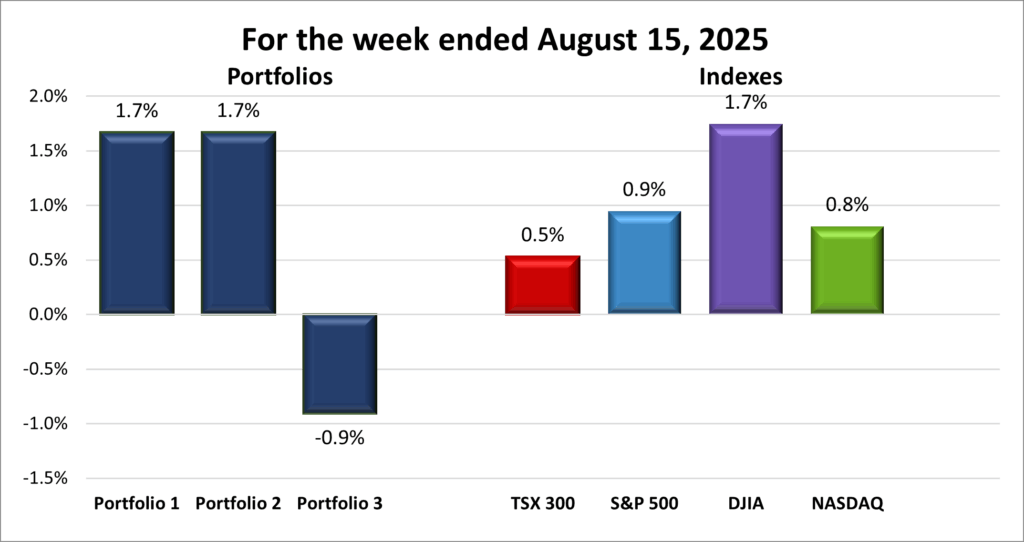
Weekly Portfolio & Index performance
Weekly Portfolio & Index performance for the week ended August 15, 2025.

Companies on the Radar

Stocks on my Radar One new name just popped onto my radar this week – Corning Incorporated (NYSE: GLW). I was digging for companies that could ride the AI wave indirectly when I stumbled across them. Like most people, I knew Corning as “the glass company,” but that’s an outdated view. Today, they’re a leader in specialty glass, optical fiber, environmental technology, life sciences, and other specialty glasses.

Their sales have nearly doubled on the back of soaring demand for high-capacity fiber optic cable in AI – powered data centres. And their Apple connection runs deep. Corning has supplied iPhone glass since 2007. Now, Apple (NASD: AAPL) is doubling down, investing $2.5 billion in a new Kentucky facility that will make Corning the sole US producer of iPhone and Apple Watch cover glass.

Corning is the kind of technology/legacy company I love – an established brand finding new life through innovation and strategic partnerships. Between their Apple deal and the AI-driven fiber optic boom, there’s a lot of optionality here, and I’m looking forward to digging deeper.

Corning now joins the three other companies currently on my radar list:

  • Mainstreet Equity Corp. (TSE: MEQ): a Calgary-based real estate company focused on mid-market apartment buildings – typically under 100 units – across Western Canada. It buys underperforming properties at below-market prices, renovates them, and increases rental income through improved operations. With strong demand for rental housing, a repeatable value-add strategy, and a solid balance sheet, Mainstreet offers a compelling mix of income and growth. Shares currently trade below net asset value, giving investors a margin of safety alongside steady cash flow and long-term upside.
  • Secure Energy Services (TSE: SES): a Canadian industrial company that focuses on environmental and waste management services for energy and industrial clients. It offers recycling, disposal, and infrastructure support across North America.
  • Copart (NASD: CPRT): this American company runs one of the world’s largest online vehicle auction platforms, specializing in salvage cars from accidents and natural disasters. It sells on behalf of insurers, dealerships, rental companies, and individuals. Copart earns revenue through transaction fees, storage, transportation, and listing services. Its digital model, global buyer network, and asset-light approach support strong margins and steady growth. With no long-term debt and rising tailwinds from vehicle values and insurance claims, it’s a steady growth story that’s earned a spot on my radar.

As always, these are not buy recommendations. Make sure to do your own research and choose investments that fit your personal financial goals.

The Radar Check was last updated August 15, 2025.

Stock on the Radar List. 1 of 2.

Stock on the Radar List. 2 of 2.


That’s a wrap for this week, thanks for reading may your portfolio stay green and your dividends steady. See you next time!
 

Weekly Update for the week ending August 8, 2025

An Ominous Start to a Historically Volatile Month

Well, August didn’t waste any time making waves. Both the Canadian and US markets opened the month with sharp declines on August 1, but the storm clouds actually started forming the day before. President Trump signed an executive order imposing new import duties, ranging from 10% to 41%, on about 90 countries. Canada was hit with a hefty 35% rate, alongside India, Taiwan, and others. The tariffs didn’t take effect until August 7, but the announcement alone rattled markets, fuelling worries about renewed trade tensions and rising inflation risks.

Then came Friday’s US jobs report, which landed with a thud. Payroll growth in July came in roughly 25% below expectations, and to make matters worse, May and June were revised down by a combined 258,000 jobs. That raised fresh concerns about a slowing economy.

Instead of addressing the slowdown, Trump turned on the messenger by firing the head of the US Bureau of Labor Statistics (BLS) shortly after the report was released. Markets didn’t immediately panic, but the move raised red flags about the credibility of official economic data. Analysts warned that if investors lose trust in key numbers like inflation or employment, it could shake market confidence and eventually lead to higher borrowing costs.

Unfortunately, this wasn’t a one-off. The President has also taken repeated shots at Fed Chair Jerome Powell, including public threats and calls for the Fed to “do as it’s told.” That kind of political pressure puts the central bank’s independence into question, and when trust in both the data and the Fed starts to crack, volatility tends to follow.

We’re only one week into August, and markets are already facing the kind of turbulence the month is known for. It’s not usually the worst month for investors, but it’s often choppy thanks to low trading volume, with many investors on vacation. That leaves markets more vulnerable to headlines – and if there’s one thing this US administration isn’t short on, it’s headlines.

So far, August is shaping up to be every bit as volatile as its reputation suggests.

With all that in mind, let’s take a closer look at what caused the markets to rebound this past week, and how it affected each of my portfolios as we move further into what’s already shaping up to be a volatile August.


Items that may only interest or educate me ….

Canadian Economic news, American Economic news, ….

Canadian Economic news

This past week’s key economic data that the Bank of Canada (BoC) considers when deciding whether to raise or lower the interest rate.

Labour Force Survey (LFS)

The latest Statistics Canada labour data showed that Canada’s labour market stumbled in July, shedding 41,000 jobs, the first monthly decline since March and a sharp reversal from June’s 83,100 gain. Analysts had expected a modest increase of 13,500 jobs, making the drop all the more surprising. Most of the losses were in full-time roles and heavily concentrated among youth aged 15 to 24, where employment fell by 34,000. That age group is now facing its highest unemployment rate since 2010 (excluding the pandemic), jumping to 14.6%, with many returning students still struggling to find summer work.

Despite the decline in jobs, the unemployment rate held steady at 6.9%, slightly better than the 7% analysts had forecast, but only because fewer people were actively participating in the labour force. A more troubling trend is the rise in long-term unemployment: nearly one in four job seekers has been unemployed for 27 weeks or more, the highest proportion (outside of COVID years) since 1998.

On the wage front, average hourly pay for permanent employees rose 3.3% year-over-year, slightly higher than June’s 3.2% and above expectations. The average hourly wage ticked up to $36.16 from $36.01.

All in all, July’s report adds to the growing signs that Canada’s economy is losing momentum, especially among younger workers and in consumer-driven sectors. While modest wage growth might give the BoC reason for caution, rising unemployment and weak participation could tip the scales toward a rate cut later this year, hopefully as early as the next BoC meeting in September, assuming inflation stays under control.

Canadian Market Volatility

Canada’s volatility gauge, the S&P/TSX 60 Volatility Index (VIXC), opened the shortened week at 11.01 and traded mostly between 10.0 and 11.0. It briefly dipped to 9.5 midweek as investors grew hopeful that soft US labour data might prompt the Fed to cut interest rates. But that optimism faded quickly, and the VIXC bounced back to the upper 10s before closing the week at 10.63.

If you’re new to the VIXC, think of it as Canada’s version of a fear gauge. A reading below 10 suggests investors are feeling relaxed. Between 10 and 20 points to a steady, business-as-usual market. But once it climbs above 20, that’s when investor nerves start to show and market swings tend to get sharper.

US Economic news

This past week’s key data points that the Federal Reserve (Fed) considers when deciding whether to raise or lower the interest rate.

American Market Volatility

After opening at 20.56, Wall Street’s “fear gauge” – the CBOE Volatility Index (VIX) – drifted lower for most of the week, trading between 18 and 16. A brief jump to 19 came on news of a potential 250% tariff on pharmaceuticals, but the VIX quickly resumed its downward journey to end the week at 15.15.

If you’re new to the VIX, think of it as a real-time pulse check on investor anxiety. It tends to spike when markets get rattled – whether from geopolitical flare-ups, inflation surprises, or something like the Fed chair getting unexpectedly replaced. When fear rises, so does the VIX.

A reading between 12 and 20 suggests calm conditions. Once it pushes past 20, traders start bracing for bigger swings. The higher it climbs, the more uncertainty is being priced into the market.


Weekly Market and Portfolio Review

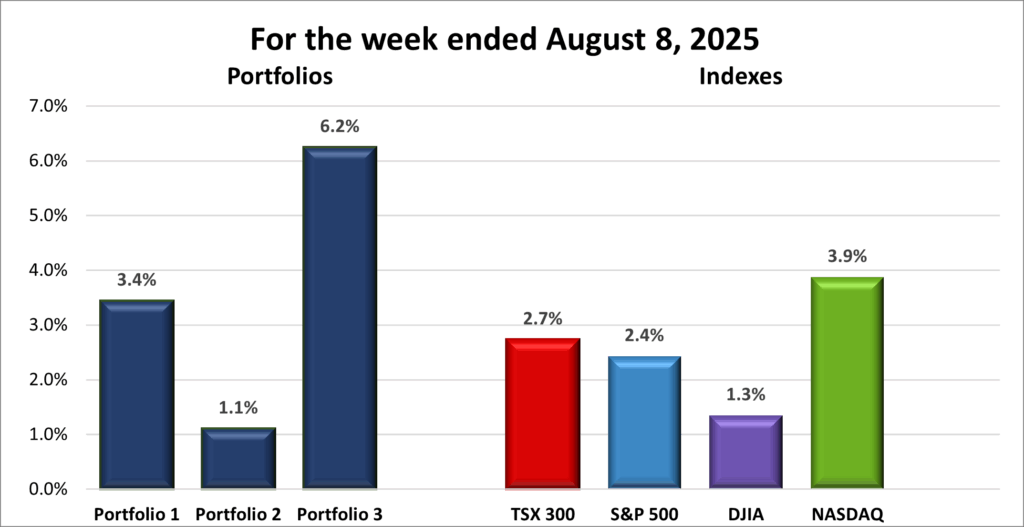
For the week, the TSX (SPTSX) gained 2.7%, the S&P 500 (SPX) rose 2.4%, the DJIA (INDU) rose 1.3% and the Nasdaq (CCMP) surged 3.9%.

Index Weekly Streak
TSX: 1 – week winning streak
S&P: 1 – week winning streak
DJIA: 1 – week winning streak
Nasdaq: 1 – week winning streak

Bull market. A good week for the North American stock markets. After ending the prior week on a sour note, markets started this one cautiously before powering higher, with the Toronto Stock Exchange Composite Index (TSX) and the Nasdaq Composite (Nasdaq) each notching record highs twice this past week.

Monday saw all three major American indexes bounce back sharply from the previous week’s selloff, which was caused by weak job data and fresh tariff announcements. The S&P 500 (S&P), Dow Jones Industrial Average (DJIA), and Nasdaq each rose at least 1.3%. With Canadian markets closed for the civic holiday, the TSX made up for lost time Tuesday, surging more than 2% to a record high, then topping it the very next day.

Analysts and Investors spent the early part of the week digesting President Trump’s shooting of the messenger of a weak labour market, as well as his continuing attacks on Fed Chair Jerome Powell, stoking concerns about the credibility of US government data and Fed decision-making. Trump appointed Stephen Miran, current chair of the Council of Economic Advisors, to temporarily fill a Fed vacancy, while Fed Governor Christopher Wallace appeared as the frontrunner for the chairmanship. Both are considered to favour lowering interest rates.

Ironically, the softer US jobs data provided a silver lining for markets: it boosted hopes for a rate cut in September. Investors bet that a cooling labour market would outweigh the inflationary risks from Trump’s latest round of tariffs, which came into effect this week. The measures covered nearly 200 trading partners, with rates ranging from 10% to 50%, pushing the average US import duty to its highest in a century. Trump also threatened steep new tariffs on India for buying Russian oil, along with massive duties on pharmaceuticals and foreign-made semiconductors – while exempting companies manufacturing in the US or planning to.

Midweek, technology companies took the wheel. Apple (NASD: AAPL) soared after announcing a US$100 billion US manufacturing investment – sidestepping a 50% tariff on goods made in India and lifting the broader tech sector higher. The rally helped push the major indexes back into positive territory despite ongoing trade jitters.

In Canada, the TSX posted its strongest week since September 2024, powered in part by Shopify’s (TSX: SHOP) blowout second quarter results and upbeat third quarter outlook. Shares jumped 21%, making it the most valuable company on the TSX, overtaking Royal Bank of Canada (TSX: RY). I’m happy to report both names are in Portfolio 3. 😊

On the down side, Canada’s labour market showed strain, shedding 41,000 jobs in July – more than had been added in June – driving employment to an eight-month low. The weakness reinforced expectations for a potential BoC rate cut. Meanwhile, new US tariffs on Canadian goods took effect Thursday, though most trade between the two countries is still protected under Canada-US-Mexico Agreement.

In short, the week was a tug-of-war between tariff tensions and weak job data on one side, and surging technology stocks, corporate investment, and growing optimism for rate cuts on the other – with the bulls ultimately coming out on top.

Portfolio Weekly Streak
Portfolio 1: 1 – week winning streak
Portfolio 2: 1 – week winning streak
Portfolio 3: 1 – week winning streak

Bull market. A good week for the North American stock markets. A rising tide really did lift all boats last week – and all three of my portfolios sailed higher. Just like in the broader market, it was a tech-driven rally doing most of the heavy lifting.

Portfolio 1 climbed 3.4%, with 64% of holdings finishing the week in the green. Standouts included Shopify soaring 27%, Lattice Semiconductor (NASD: LSCC) up 25%, Celsius Holdings (NASD: CELH) jumping 15%, and Apple adding 12%. On the flip side, Navitas Semiconductor (NASD: NVTS) slid 17%, and The Trade Desk (NASD: TTD) plunged over 38% after guiding that third-quarter revenue would likely come in only slightly above expectations – a dramatic fall that clipped what could have been an even better week.

Portfolio 2 was the laggard, up 1.1%, with 51% of holdings posting gains. Guardant Health (NASD: GH) led the charge with a 29% surge, followed by Mitek Systems (NASD: MITK) up 11%. Microsoft (NASD: MSFT) and Fortis (TSE: FTS) both reached record highs during the week, but Microsoft couldn’t maintain the momentum and slid lower to record a weekly loss. ☹

Portfolio 3 took top honors, jumping 6.2%. Gains were spread across 59% of holdings, highlighted by Shopify’s 27% pop and goeasy (TSE: GSY) rising 10%.

All told, it was another enjoyable week across the board, with each portfolio delivering gains in line with its goals and strategy. Strength in the technology sector provided a welcome tailwind, while solid contributions from other sectors added extra lift. With all three portfolios moving higher together, we head into the new week more confident than after the prior week’s slide of more than 1% in all indexes and portfolios, and ready for whatever twists and turns August brings.

Weekly Portfolio & Index performance
Weekly Portfolio & Index performance for the week ended August 8, 2025.

Companies on the Radar

Stocks on my Radar No new companies appeared on my radar this past week, but I did remove three: Aritzia ((TSE: ATZ), Amer Sports (NYSE: AS), and TerraVest Industries (TSE: TVK). It might seem surprising to drop the top three names from my Radar Test, but after running them through my updated Quick Test, all three scored below 70%. That doesn’t mean they’re bad companies – they just don’t meet my current criteria.

They may still be solid picks for other investors, but I’m looking for companies that check more of my boxes. Fortunately, a few did: the three remaining stocks on my radar all scored above 80%, which means they’re moving on to the next phase – my Deep Dive analysis (once I finish refining that checklist!).

So after a bit of pruning, my radar list is now made up of these three companies:

  • Mainstreet Equity Corp. (TSE: MEQ): a Calgary-based real estate company focused on mid-market apartment buildings – typically under 100 units – across Western Canada. It buys underperforming properties at below-market prices, renovates them, and increases rental income through improved operations. With strong demand for rental housing, a repeatable value-add strategy, and a solid balance sheet, Mainstreet offers a compelling mix of income and growth. Shares currently trade below net asset value, giving investors a margin of safety alongside steady cash flow and long-term upside.
  • Secure Energy Services (TSE: SES): a Canadian industrial company that focuses on environmental and waste management services for energy and industrial clients. It offers recycling, disposal, and infrastructure support across North America.
  • Copart (NASD: CPRT): this American company runs one of the world’s largest online vehicle auction platforms, specializing in salvage cars from accidents and natural disasters. It sells on behalf of insurers, dealerships, rental companies, and individuals. Copart earns revenue through transaction fees, storage, transportation, and listing services. Its digital model, global buyer network, and asset-light approach support strong margins and steady growth. With no long-term debt and rising tailwinds from vehicle values and insurance claims, it’s a steady growth story that’s earned a spot on my radar.

As always, these are not buy recommendations. Make sure to do your own research and choose investments that fit your personal financial goals.

The Radar Check was last updated August 8, 2025.

Stock on the Radar List. 1 of 2.
Stock on the Radar List. 2 of 2.


That’s a wrap for this week, thanks for reading may your portfolio stay green and your dividends steady. See you next time!

 

Monthly Portfolio Update July 2025

Monthly Market and Portfolio Review

Bull market. A good week for the North American stock markets. July was another milestone month for markets, powered by strong corporate earnings, growing artificial intelligence (AI) excitement, cautious central banks, and signs that both economies might be cooling. The Toronto Stock Exchange Composite Index (TSX), S&P 500 Index (S&P), Dow Jones Industrial Average (DJIA), and Nasdaq Composite Index (Nasdaq) all surged to record highs mid-month, fuelled by optimism on multiple fronts. But those gains didn’t fully stick – markets pulled back in the final stretch as fresh trade tensions and persistent inflation concerns crept back into the picture.

The S&P 500, TSX, and DJIA notched their third straight monthly gain, while the Nasdaq extended its streak to four. Big tech remained the market’s main engine, with Microsoft (NASD: MSFT) and Meta (NASD: META) reporting blockbuster earnings that boosted confidence in the future of AI and cloud computing. That momentum helped push the S&P and Nasdaq to new highs early in the month.

Meanwhile, central banks remained cautious. The Bank of Canada held its overnight rate steady at 2.75%, signalling that while inflation is easing, rate cuts aren’t likely unless the economy weakens further. The US Federal Reserve (Fed) also left its benchmark rate unchanged at 4.50%, with Fed Chair Jerome Powell sticking to a data-driven, wait-and-see message – making it clear any rate cuts probably won’t come until late 2025. For now, that gave markets some breathing room without fuelling overheating concerns.

On the trade front, early optimism helped lift sentiment. Deals with the European Union and Japan, along with talk of potential tariff rollbacks, gave investors more to cheer about. But the mood shifted in the final days of July when President Trump announced new tariffs on countries including Brazil and India, and imposed a steep 35% tariff on Canadian imports not covered by the Canada–United States–Mexico Agreement. That, combined with sticky inflation data, was enough to drag markets off their highs to end the month.

So, while July brought fresh highs and renewed optimism, it also reminded us that trade policy and inflation haven’t gone away. Heading into August, us investors might need to buckle up – more trade headlines and mixed economic signals could make for a choppier ride.

Portfolio Monthly Streak
Portfolio 1: 3 – month winning streak
Portfolio 2: 4 – month winning streak
Portfolio 3: 3 – month winning streak

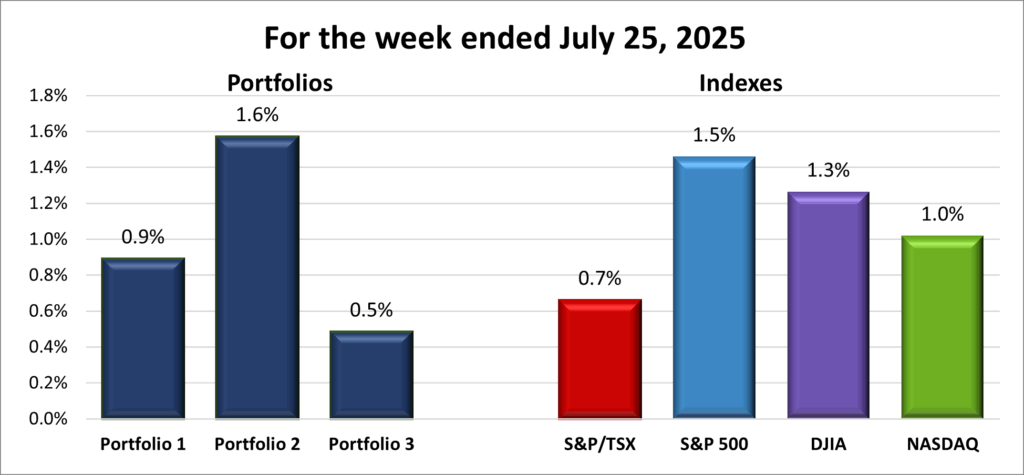
Bull market. A good week for the North American stock markets. While July didn’t quite match June’s momentum, it still turned out to be another solid month across the board. All three of my portfolios finished higher, as shown in the monthly performance chart below. Each posted weekly gains in four out of five weeks, with Portfolios 1 and 3 even outpacing the Nasdaq—the top-performing index in July. Portfolio 2 also held its ground, matching the S&P’s monthly gain, which came in second among the major indexes.

Portfolio 1 rose 5.0%, fuelled by a wave of record-setting highs across several holdings. Heavyweights Nvidia (NASD: NVDA) and Celestica (TSE: CLS) led the charge, with CLS hitting a fresh all-time high every single week of the month. Portfolio 2 posted a steady 2.2% gain – its fourth consecutive monthly advance, the longest streak among the three. Its results were driven more by consistent growth than big surges, though a few names did reach new highs.

Portfolio 3 claimed the top spot in July, jumping 7.5% on broad-based strength. It got a major lift from Shopify (TSX: SHOP) and portfolio newcomer Nvidia.

While July’s gains kept the winning streak alive, August might be more challenging. Seasonal volatility tends to creep in this time of year, and with inflation data, interest rate speculation, earnings season winding down, and tariffs set to hit all of America’s trading partners, markets could face more turbulence ahead. I’ll be watching closely for any buying opportunities – but for now, the goal is to keep the streak alive and close out the summer on a strong note. 😊

Monthly Portfolio & Index performance
Monthly Portfolio & Index performance for July 2025.

What My Three Portfolios Did in July

Portfolio 1 for July 2025: UP Green Up Arrow, signifying a positive week

Activity

Sold: some Nvidia shares. See July 4 Weekly Update

Transferred Out: some Nvidia shares. See July 11 Weekly Update

Dividends Received this month:

Companies followed by DRIP (Dividend Re-Investment Plan) indicate additional shares were purchased with the dividend. Any cash leftover was added to the cash balance.

Canadian $

Telus (TSE: T) DRIP

BSR Real Estate Investment Trust (TSE: HOM.U)

Decisive Dividend Corp (YSE: DE) DRIP

Dream Industrial Real Estate Investment Trust (TSE: DIR.UN) DRIP

BCE Inc (TSE: BCE) DRIP

TD Bank (TSE: TD) DRIP

US $

Nvidia (NASD: NVDA)

Quarterly Reports

Interactive Brokers Group

Second quarter 2025 financial results on July 17, 2025

CN Rail

Second quarter 2025 financial results on July 22, 2025

Alphabet Inc.

Second quarter 2025 financial results on July 23, 2025

Hammond Power Solutions Inc.

Second quarter 2025 financial results on July 24, 2025

Celestica Inc.

Second quarter 2025 financial results on July 28, 2025

Visa Inc.

Third quarter 2025 financial results on July 29, 2025

PayPal Holdings, Inc.

Second quarter 2025 financial results on July 29, 2025

Tourmaline Oil Corp.

Second quarter 2025 financial results on July 30, 2025

Cameco Corporation

Second quarter 2025 financial results on July 31, 2025

Apple Inc.

Third quarter 2025 financial results on July 31, 2025

Cloudflare, Inc.

Second quarter 2025 financial results on July 31, 2025

Ferrari N.V.

First half 2025 financial results on July 31, 2025

TMX Group Limited

Second quarter 2025 financial results on July 31, 2025

Amazon.com, Inc.

Second quarter 2025 financial results on July 31, 2025

Grab Holdings Limited

Second quarter 2025 financial results on July 31, 2025

Portfolio 2 for July 2025: UP Green Up Arrow, signifying a positive week

Activity

No significant activity to report this month.

Dividends Received this month:

Canadian $

Canadian Natural Resources Ltd (TSE: CNQ) DRIP

Telus (TSE: T) DRIP

Brookfield Renewable Partners LP (TSE: BEP.UN)

Whitecap Resources Inc (TSE: WCP) DRIP

South Bow Corp (TSE: SOBO)

SmartCentres Real Estate Investment Trust (TSE: SRU.UN)

Dream Industrial Real Estate Investment Trust (TSE: DIR.UN) DRIP

US $

Walt Disney Co.

Quarterly Reports

Whitecap Resources Inc.

Second quarter 2025 financial results on July 23, 2025

Hammond Power Solutions Inc.

See report under Portfolio 1.

Tourmaline Oil Corp.

See report under Portfolio 1.

Guardant Health, Inc.

Second quarter 2025 financial results on July 30, 2025

Microsoft Corp.

Fourth quarter 2025 financial results on July 30, 2025

TC Energy Corporation

Second quarter 2025 financial results on July 31, 2025

Portfolio 3 for July 2025: UP Green Up Arrow, signifying a positive week

Activity

Transferred In: Some Nvidia shares from Portfolio 1. See July 11 Weekly Update

Dividends Received this month:

Canadian $

Brookfield Asset Management (TSE: BAM)

Brookfield Renewable Partners LP (TSE: BEP.UN)

Alvopetro Energy Ltd (TSE: ALV)

SmartCentres Real Estate Investment Trust (TSE: SRU.UN)

goeasy Ltd (TSE: GSY)

TD US Equity Index ETF (TSE: TPU)

TD Bank (TSE: TD)

US $

No US$ dividends this past month.

Quarterly Reports

Vertiv Holdings Co.

Second quarter 2025 financial results on July 30, 2025

Microsoft Corp.

See report under Portfolio 2.

Cloudflare, Inc.

See report under Portfolio 1.

Real Matters Inc.

Third quarter 2025 financial results on July 31, 2025

Monthly Portfolio Update July 2025


Weekly Update for the week ending August 1, 2025

Liberation Day, part 2

President Trump kicked off a new wave of tariffs this week, reigniting global trade tensions. The move came just days after progress with the European Union (EU) and Japan had boosted market optimism – but that optimism is now giving way to concern.

The latest action includes a sweeping 35% tariff on Canadian goods not covered by CUSMA, which caught many by surprise. It also targets exports from Brazil, India, and other trading partners, with tariffs ranging from 10% to 25%. These new duties hit a wide range of products, from industrial parts and electronics to everyday consumer goods, raising fears of a broader trade war.

The White House says the goals are to address “long-standing imbalances,” protect US manufacturing, and penalize countries allegedly benefiting from unfair trade practices. But for investors, it’s a sharp reminder that trade policy can shift quickly and have real ripple effects on markets. Companies that rely on global supply chains may face higher costs, and if other countries retaliate, things could escalate even further.

In short, the trade front just got a lot more complicated. Trump’s tariff blitz marks a major escalation – levying new duties on nearly 70 countries, including key allies like Canada and India. Markets sold off sharply, and global businesses are recalibrating. It’s a volatile pivot into August, with big implications for commodity prices, supply chains, and investor sentiment.

For us investors, it’s a strong reminder that politics and investing go hand in hand. Even if you’re focused on fundamentals, global events like this can shake up entire sectors. Staying informed isn’t just smart, it’s part of being a thoughtful long-term investor.

With so much happening on the global stage, July was a reminder that even during a solid earnings season, big-picture news can take centre stage. From interest rate decisions to trade tensions and shifting market sentiment, there was a lot for us investors to digest. Let’s take a look at how the major indexes performed, what drove them, and how my portfolios held up through it all.


Items that may only interest or educate me ….

Let’s Make a Deal, Canadian Economic news, US Economic news, .…

Let’s Make a Deal

The US and EU struck a major trade deal on July 27 to avoid a full-blown trade war, agreeing to a 15% cap on most tariffs of EU imports instead of the much steeper ones that had been threatened. While not ideal, the deal brings some stability to global markets, especially with the EU pledging to buy $750 billion in US energy and invest another $600 billion into the US economy. Certain industries like aircraft parts and semiconductor equipment were spared from tariffs entirely, but most goods, including cars and branded pharmaceuticals, will still face that 15% rate.

Canadian Economic news

This past week’s key economic data that the Bank of Canada (BoC) considers when deciding whether to raise or lower the interest rate.

Bank of Canada Rate Announcement

As widely expected, the BoC held its policy rate steady at 2.75% today, marking the third consecutive hold. Despite solid job growth and resilient consumer spending, the Bank is opting for caution. Core inflation remains stubborn at 3.1%, slightly above the upper end of its 1–3% target range, while uncertainty from US trade policy and elevated tariffs continues to cloud the economic outlook.

Governor Tiff Macklem warned that tariffs are reducing economic efficiency and income, and if left unresolved, could lead to permanently lower growth. While the economy has shown resilience, there’s still too much uncertainty for the BoC to commit to cutting rates just yet.

For now, mortgage rates and borrowing costs are expected to stay where they are. But if the economy loses momentum and inflation continues to ease, the BoC has left the door open to rate cuts later this year. In the meantime, it will continue watching inflation and trade developments closely and adjust policy as needed.

Gross Domestic Product (GDP)

Data from Statistics Canada showed Canada’s economy shrank by 0.1% in May, following a similar 0.1% dip in April, marking two straight months of contraction. The monthly decline was driven by weaker output in sectors like ‘Mining,’ which is more sensitive to higher interest rates, and ‘Retail trade,’ which is feeling the impact of tariff pressures. Gains in ‘Manufacturing’ and ‘Transportation and warehousing’ weren’t enough to offset the broader slowdown. Looking at the past year, the biggest gains came from ‘Retail trade,’ while the steepest decline was in ‘Manufacturing.’

Statistics Canada’s early estimate for June points to a small 0.1% rebound, which would help the economy narrowly avoid a negative second quarter – just enough to sidestep a technical recession. But overall, growth has clearly stalled.

For us investors, this kind of soft data keeps the pressure on the BoC to consider rate cuts later this year in hopes of jumpstarting the economy. At the same time, it’s a reminder that the Canadian economy may be entering a more sluggish phase, so staying focused on resilient businesses that can perform well even in tough times becomes all the more important.

Canadian Market Volatility

Canada’s volatility barometer, the S&P/TSX 60 Volatility Index (VIXC), started the week at 9.97 and hovered between 10.0 and 11.0 until Friday, when it rose above 11, rising as high as 11.92, before settling back to 10.02 by the close. The jump on Friday likely reflected investor reaction to the latest escalation in the US-Canada trade dispute and weaker-than-expected US jobs data.

If you’re new to the VIXC, think of it as Canada’s version of a fear gauge. A reading below 10 suggests investors are feeling relaxed. Between 10 and 20 points to a steady, business-as-usual market. But once it climbs above 20, that’s when investor nerves start to show and market swings tend to get sharper.

US Economic news

This past week’s key data points that the Federal Reserve (Fed) considers when deciding whether to raise or lower the interest rate.

Federal Reserve Rate Announcement

At the July 29-30, 2025, meeting of the Federal Reserve Open Market Committee (FOMC), the Fed decided to hold interest rates steady once again, keeping its benchmark rate at 4.25%–4.50%. This marks the fifth straight pause, as policymakers continue trying to ease inflation to their goal of 2% without derailing economic growth. Fed Chair Jerome Powell described the current stance as “moderately restrictive” – tight enough to cool inflation, but not so tight that it risks stalling the economy.

The Fed pointed to signs of slower growth and growing risks from US tariffs as reasons to stay cautious. Interestingly, two of the nine FOMC members – Michelle Bowman and Christopher Waller, both appointed by President Trump in his first term – voted against the decision, calling for an immediate 0.25% cut. That’s the most dissent the Fed has seen in over 30 years, highlighting growing internal debate over the path forward.

While political pressure for rate cuts is building – especially from Trump, who has been openly critical – Powell reaffirmed the importance of the Fed’s independence. He emphasized that monetary policy decisions must remain grounded in economic data, not politics, in order to maintain the confidence of markets and the public. With inflation easing and the labour market still solid, the Fed sees no need to rush and gave little sign of when borrowing costs might be lowered, though it hasn’t ruled out cuts later this year.

For now, borrowing costs stay unchanged. Mortgage rates, credit cards, and business loans tied to Fed policy are likely to stay where they are – at least until the data tells a different story.

Consumer Confidence Index (CCI)

The Conference Board’s CCI ticked up to 97.2 in July, rising from a revised 95.2 in June – a stronger reading than analysts had expected. The Present Situation Index, which reflects how consumers view current business and labour conditions, edged down slightly to 131.5 from last month’s revised 133.0. Meanwhile, the Expectations Index, which tracks sentiment about future business, income, and job prospects, climbed 4.5 points to 74.4. While that’s an improvement from June, it marks the sixth straight month the index has stayed below 80 – a level often seen as a recession warning.

Consumer confidence is still running lower than it was a year ago, and nearly 20% of consumers now say jobs are “hard to get” – the weakest labour sentiment since March 2021. Tariffs are still top of mind for many, as they’re widely associated with higher prices. Overall, while confidence is inching back into more optimistic territory, the rebound is far from dramatic. Sentiment is still well below 2024 levels, and that fits with the broader trend: steady but cautious growth, where people are willing to spend but remain wary of job security and inflation pressures.

Gross Domestic Product (GDP)

According to the Commerce Department’s Bureau of Economic Analysis (BEA), the American economy bounced back in the second quarter of 2025, growing at an annualized rate of 3.0%, according to today’s advance GDP estimate. That was well above analysts’ expectations for a 2.4% increase and a sharp turnaround from the 0.5% contraction in the first quarter. While the headline number looks strong, much of the growth came from a sharp drop in imports, which reduced the trade deficit and gave GDP an artificial boost. In other words, the economy didn’t necessarily produce more – it just bought less from other countries, likely due to higher prices caused by US tariffs.

Consumer spending picked up slightly, rising 1.4% after a soft start to the year, though it remains below the stronger levels seen in 2024. Business investment and housing continued to lag, likely weighed down by high interest rates and ongoing trade uncertainty. A more telling measure of real demand – what households and businesses actually spent – grew just 1.2%, the slowest pace in over two years.

For the Fed, this report supports the case for holding interest rates steady. While headline growth looks encouraging, the underlying data points to a cautious economy. If momentum fades further and inflation continues to ease, rate cuts could still be on the table later this year.

For us investors, it’s a good reminder to look past the headlines. A 3% GDP print might sound like a big comeback, but the fine print shows a recovery that’s still on shaky ground.

Personal Consumption Expenditures (PCE)

The BEA’s latest PCE report shows inflation heating up slightly in June. Headline PCE, which includes food and energy, rose 2.6% year-over-year, up from 2.3% in May, while core PCE – the Fed’s preferred inflation gauge that strips out the more volatile food and energy prices – ticked up to 2.8%, above the expected 2.7%. On a monthly basis, both measures rose 0.3%, matching expectations but still pointing to ongoing price pressures.

This uptick in inflation, especially in core goods (which rose 0.4% in June), suggests that tariffs are starting to push prices higher. That’s likely to keep the Fed’s attention, and it reinforces their latest decision to hold interest rates steady at 4.50%. With inflation proving stickier than hoped, the chances of a rate cut in September are looking slimmer.

For us investors, this latest inflation data means we’ll likely need to wait a bit longer for interest rate cuts. Higher rates for longer can weigh on growth stocks, especially those that rely on borrowing to fund future expansion. At the same time, it may continue to pressure consumer spending and corporate profits, which could slow the broader economy. For those of us investing for the long term, it helps to stay focused on companies built to weather different rate environments and tune out the noise as markets adjust. 😊

Labour data

The latest updates from the JOLTS, the ADP Employment Report, and the ESS offer a snapshot of the US labour market. Together, they point to a job market that’s still standing but showing more cracks beneath the surface.

Job Openings and Labor Turnover Survey (JOLTS)

The US Bureau of Labor Statistics reported job openings fell to 7.43 million in June, down from 7.71 million in May and below the expected 7.55 million. This monthly report gives us insight into labour demand by tracking openings, hiring, quits, and layoffs – offering important clues on whether the job market is heating up or cooling off.

The latest numbers suggest businesses are tapping the brakes on hiring as economic uncertainty lingers. For us investors, this adds to the growing sense that the job market is cooling, not collapsing, which supports the idea that the Fed may continue holding rates steady. But if this softening trend continues, the case for rate cuts later this year could strengthen.

ADP Employment Report

According to ADP, private employers added 104,000 jobs in July – comfortably beating forecasts of around 75,000. This rebound follows June’s revised loss of 23,000 jobs (originally reported as -33,000), suggesting hiring picked up faster than expected.

The upside surprise points to growing employer confidence, likely helped by easing trade headwinds and firmer consumer demand. While the rebound doesn’t scream overheating, it’s enough to reinforce the Fed’s current hold-steady stance, while still leaving the door open for cuts if broader conditions weaken.

Employment Situation Summary (ESS)

The US economy added just 73,000 nonfarm jobs in July – the slowest pace this year and well below the 100,000 consensus estimate. Adding to the disappointment, May and June job gains were revised down by a combined 258,000 jobs. June’s number was slashed from 147,000 to just 14,000, and May from 144,000 to 19,000, completely reshaping the recent hiring picture.

The unemployment rate ticked up to 4.2%, in line with expectations, and has hovered between 4.0% and 4.2% since May 2024. Average hourly earnings rose 0.3% for the month, with year-over-year wage growth likely creeping up to 3.9%.

Altogether, July’s report reveals a labour market that’s clearly slowing – weak job creation, rising unemployment, and deep revisions that erased most of June’s perceived strength.

Summary

This week’s labour data tells a mixed but increasingly cautious story. JOLTS shows weakening demand, ADP reveals a rebound from a soft patch, and the ESS confirms the slowdown with underwhelming job gains and heavy downward revisions. On its own, this data might have supported the case for future rate cuts. But paired with this week’s June PCE report that showed inflation ticking back up to 2.6% and core inflation stuck at 2.8%, it muddies the waters for the Fed. We’re now looking at a cooling labour market and sticky inflation, which keeps rate decisions uncertain and investors on edge.

Consumer Sentiment Index (CSI)

Consumer sentiment ticked up slightly in July, reaching its highest level in five months. The University of Michigan’s Consumer Sentiment Index rose to 61.8 from 60.7 in June, a modest 1.6% increase. While still 7.1% lower than a year ago and well below the long-term average of 84, it marks a small step in the right direction. The reading also came in just shy of expectations, with analysts calling for 62.

Looking closer, the Current Conditions Index – which reflects how people feel about their present situation, including job security and personal finances – climbed to 68.0 from 64.8. That’s a solid 4.9% monthly gain and 8.5% higher than last year, suggesting growing confidence in current conditions. Meanwhile, the Expectations Index, which looks six months ahead, dipped to 57.7 from 58.1, a 0.7% monthly decline and down 16.1% year over year, pointing to continued caution about the future.

Interestingly, sentiment improved among stockholders but fell among non-investors, hinting at a growing divide in how different groups are experiencing the economy. Overall, while people are feeling a bit better about the present, uncertainty about what’s next still looms large. It’s as if the economy is in idle, stable for now, but with no clear sign it’s ready to shift into drive.

For consumer-driven sectors like retail, travel, or discretionary spending, that hesitation could mean a slower recovery—even if the mood on the ground is starting to brighten.

American Market Volatility

Wall Street’s “fear gauge,” the CBOE Volatility Index (VIX), continued drifting lower for most of the week, opening at 15.15 following news that the US had reached a trade framework agreement with the EU. It hovered around the 15 mark until Friday, when it suddenly spiked to 21.90 before settling at 20.38 by the end of the session. The late-week surge appeared to be triggered by a one-two punch: the US imposing tariffs on nearly all of its major trading partners, and a disappointing jobs report that not only missed expectations but also included sharp downward revisions to the prior two months.

If you’re new to the VIX, think of it as a real-time pulse check on investor anxiety. It tends to spike when markets get rattled—whether from geopolitical flare-ups, inflation surprises, or something like the Fed chair getting unexpectedly replaced. When fear rises, so does the VIX.

A reading between 12 and 20 suggests calm conditions. Once it pushes past 20, traders start bracing for bigger swings. The higher it climbs, the more uncertainty is being priced into the market.


Weekly Market and Portfolio Review

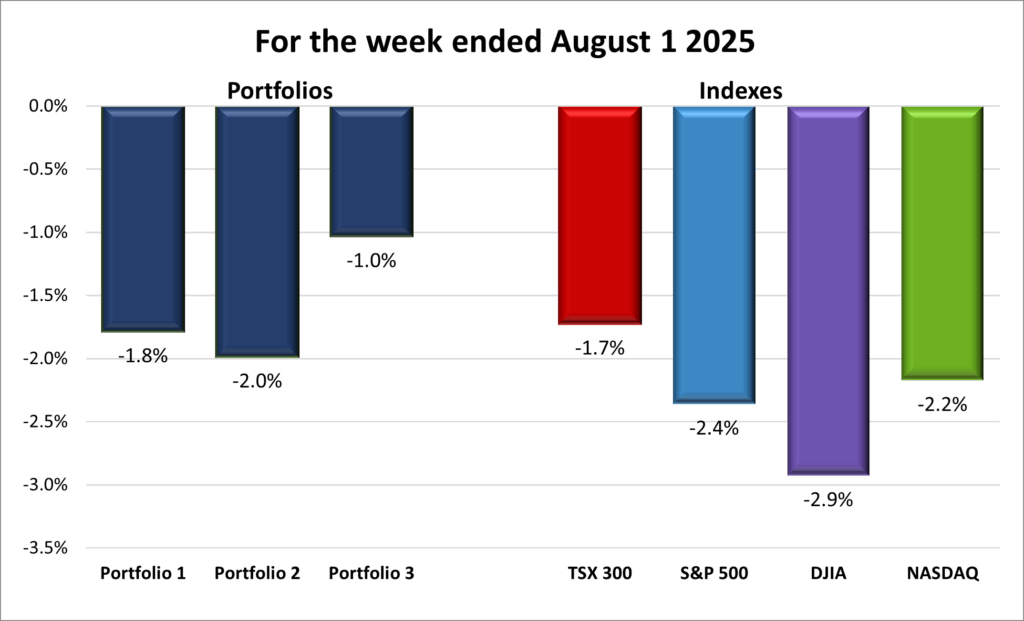
For the week, the TSX (SPTSX) declined 1.7%, the S&P 500 (SPX) fell 2.4%, the DJIA (INDU) dropped 2.9% and the Nasdaq (CCMP) lost 2.2%.

 
Index Weekly Streak
TSX: 1 – week losing streak
S&P: 1 – week losing streak
DJIA: 1 – week losing streak
Nasdaq: 1 – week losing streak

Bearish market This past week was packed with market-moving events – central bank rate decisions, a flood of economic data, and earnings from some of the biggest technology names. Even with all that momentum, the major indexes couldn’t quite hold their gains. The S&P 500 Index (S&P), Nasdaq Composite Index (Nasdaq), and Toronto Stock Exchange Composite Index (TSX) all hit fresh record highs during the week, with the S&P notching its sixth straight closing high to begin the week. However, by Friday, all four major indexes, including the Dow Jones Industrial Average (DJIA), finished lower on the week, thanks to a drop of over 1% for each of the American indexes and nearly a 1% drop on the TSX on the last day of the week.

In the US, the Fed was front and centre, holding interest rates steady at 4.25%–4.50% as widely expected. Fed Chair Powell struck a patient, data-dependent tone, which markets initially welcomed. But as the week went on, optimism faded. Labour data sent mixed signals – initial jobless claims stayed low, yet announced job cuts jumped. Then came Friday’s employment report, showing weaker-than-expected job growth and sharp downward revisions to hiring over the past two months. That opened the door for a potential rate cut at the Fed’s next meeting in September. Offsetting that, however, was the Fed’s preferred inflation gauge – core PCE – which rose to 2.8% year over year, a reminder that inflation is still proving stubborn.

Following the release of the jobs report, President Trump fired the head of the US Bureau of Labor Statistics (BLS), alleging that the employment numbers had been manipulated for political reasons – though no evidence has been presented to support the claim. The move is extraordinary, especially coming after a weaker-than-expected jobs report, and raises serious concerns about the independence and credibility of US economic data. For investors, it adds a new layer of uncertainty – not just about the Fed’s next move, but about whether we can continue to trust the numbers that shape market expectations.

Big Tech earnings helped keep things afloat. Microsoft (NASD: MSFT) and Alphabet (NASD: GOOGL), both beat expectations, especially in artificial intelligence (AI) and cloud segments, reinforcing the growing excitement around artificial intelligence. Their strong results boosted investor confidence in AI and helped limit the week’s losses – especially for the Nasdaq.

Later in the week, trade took centre stage again. Markets got an early boost on news the US had finalized a deal with the EU, settling on 15% tariffs instead of the previously threatened 30%. Hopes rose further as talks with China resumed. But by midweek, tensions flared. President Trump announced a new wave of tariffs on dozens of trading partners, including India, Brazil, and key copper exports. He also approved a tariff hike on Canadian goods to 35%, though products covered under the Canada-US-Mexico Agreement (CUSMA) are exempt. To allow more time to negotiate deals with other partners, the implementation date was pushed back by a week – but the renewed uncertainty rattled investors.

In Canada, the TSX followed a similar script – rising early on trade optimism and higher oil and gold prices, then losing steam as the week wore on. The index even hit a new all-time high before pulling back. The BoC held its policy rate steady at 2.75%, as expected, but struck a cautious tone. With inflation proving sticky and growth weakening, it signalled that rate cuts aren’t on the table just yet. That view was backed by May’s GDP report, which showed the economy shrank 0.1% – the second monthly dip in a row – raising fresh concerns about a broader slowdown, especially in manufacturing and retail.

Trade tensions also weighed on the TSX later in the week. Despite early optimism, the market pulled back as investors grappled with the uncertainty from new US tariffs and their potential impact on Canadian exports. It was a reminder that even close trading partners can face sudden shifts, keeping markets on edge.

All in all, despite the ups and downs, it was a week that showed just how much investors are juggling – earnings, inflation, central bank decisions, and trade twists all at once. But strong corporate results, especially from tech, and signs of continued resilience in the economy helped keep market optimism alive. As we head into August, investors remain cautiously hopeful that rate cuts are still on the horizon and trade tensions will cool. There’s a lot to keep an eye on, but there’s also plenty of opportunity if you’re in it for the long haul. 😊

Portfolio Weekly Streak
Portfolio 1: 1 – week losing streak
Portfolio 2: 1 – week losing streak
Portfolio 3: 1 – week losing streak

Bearish market It wasn’t shaping up to be a great week for the three portfolios heading into Friday. Portfolio 3 was still up 1%, and the other two were only slightly down. But that changed quickly after the release of weak US labour data and the subsequent firing of the head of the BLS, sparking concerns over political interference. All three portfolios fell more than 1% on Friday alone, ending the week in the red. On the bright side, they still outperformed all major US indexes – a small consolation. ☹

Portfolio 1 dropped 1.8%, with just 14% of its holdings finishing in the green. Steep losses from PayPal (NASD: PYPL) and Ferrari (NYSE: RACE), both down 15%, along with Datadog (NASD: DDOG) and Navitas Semiconductor (NASD: NVTS), each down 10%, weighed heavily. A rare highlight was Celestica ((TSE: CLS), which hit a record high and gained 14%.

Portfolio 2 had the toughest week, falling 2.0% despite posting the highest percentage of gainers at 22%. There were no standouts on the upside, while MongoDB (NASD: MDB) sank 10%, dragging the portfolio lower.

Portfolio 3 held up the best, losing 1%. Although only 18% of its holdings ended higher, it avoided any major winners or losers – except for Lithium Americas (TSE: LAC), which slid 14%.

Overall, it was a rough week. The firing of the BLS chief and continued verbal attacks on the Fed raise serious concerns about political interference, shaking investor confidence in the data that guides monetary policy. Layer on the global trade uncertainty, and it’s no surprise volatility ticked up – especially in the US. That said, the market pullback may offer buying opportunities for us long-term investors in the weeks ahead. 😊

Weekly Portfolio & Index performance
Weekly Portfolio & Index performance for the week ended August 1, 2025.

Companies on the Radar

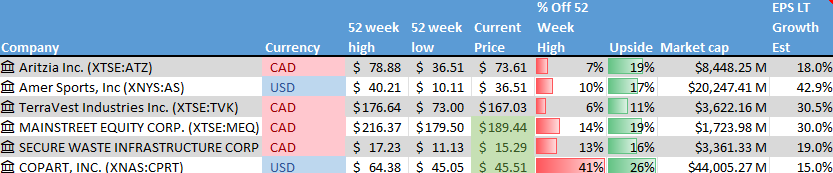
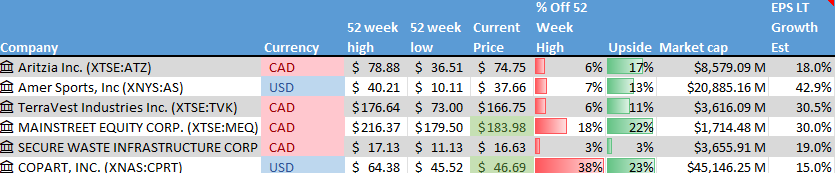
Stocks on my Radar Instead of scouting for new companies to add to the radar this past week, I focused on updating two of the key tools I use when deciding whether to become a part owner in a business: my Quick Test and Deep Dive checklists. I first built these back in 2020–2021, and while they’ve held up well, I’ve learned a lot about investing since then, it felt like the right time for a refresh.

The Quick Test (Step 2 in my process, right after the initial Radar Check, the results shown below in the two tables) is now an 11-question checklist designed to quickly screen out companies that don’t meet my core criteria. If a company passes that stage, it moves on to the Deep Dive (Step 3), where I take a much closer look at its products, customers, moat, management, financials, and long-term potential before deciding if it’s worth owning.

I’m still refining the Deep Dive, so I haven’t had much time this week to look for new opportunities. For now, my radar is still focused on these six companies:

  • Aritzia (TSE: ATZ): a fashion retailer and design house known for its upscale in-house brands of women’s clothing and accessories. It controls everything from design to distribution and sells through more than 130 boutiques across North America, along with a fast-growing online platform. Its main markets are Canada and the US, where it continues to expand.
  • Amer Sports (NYSE: AS): a Finnish sporting goods company that went public in February 2024. It owns premium global brands like Wilson, Salomon, Arc’teryx, Atomic, and Louisville Slugger, selling in over 100 countries. Revenue comes from both retail partners and a growing direct-to-consumer (DTC) segment through branded stores and online sales. With strong revenue growth, expanding DTC margins, and a valuation below peers, Amer offers an attractive mix of growth and value. As a consumer-focused company riding the health and outdoor trend, it’s definitely caught my eye.
  • TerraVest Industries (TSE: TVK): an industrial manufacturer serving the energy, agriculture, and transportation sectors across North America. Its products include propane tanks, ammonia storage vessels used in farming, natural gas transport vehicles, and various energy processing systems. It’s a solid operator in essential industries.
  • Mainstreet Equity Corp. (TSE: MEQ): a Calgary-based real estate company focused on mid-market apartment buildings – typically under 100 units – across Western Canada. It buys underperforming properties at below-market prices, renovates them, and increases rental income through improved operations. With strong demand for rental housing, a repeatable value-add strategy, and a solid balance sheet, Mainstreet offers a compelling mix of income and growth. Shares currently trade below net asset value, giving investors a margin of safety alongside steady cash flow and long-term upside.
  • Secure Energy Services (TSE: SES): a Canadian industrial company that focuses on environmental and waste management services for energy and industrial clients. It offers recycling, disposal, and infrastructure support across North America.
  • Copart (NASD: CPRT): this American company runs one of the world’s largest online vehicle auction platforms, specializing in salvage cars from accidents and natural disasters. It sells on behalf of insurers, dealerships, rental companies, and individuals. Copart earns revenue through transaction fees, storage, transportation, and listing services. Its digital model, global buyer network, and asset-light approach support strong margins and steady growth. With no long-term debt and rising tailwinds from vehicle values and insurance claims, it’s a steady growth story that’s earned a spot on my radar.

As always, these are not buy recommendations. Make sure to do your own research and choose investments that fit your personal financial goals.

The Radar Check was last updated August 1, 2025.

Stock on the Radar List. 1 of 2.
Stock on the Radar List. 2 of 2.


That’s a wrap for this week, thanks for reading may your portfolio stay green and your dividends steady. See you next time!

 

Weekly Update for the week ending July 25, 2025

Dominoes start to fall

Since President Trump’s April 2 “Liberation Day” announcement – imposing sweeping tariffs on nearly all imports, starting with a universal 10% base and rising to “reciprocal” rates as high as 54% – the US has been scrambling to strike new trade deals. With a 90-day pause in effect for negotiations and court challenges mounting, several countries have already hammered out agreements aimed at easing tariff threats and stabilizing trade ties.

Each deal is tailored to the partner: some offer tariff relief, others open access to key sectors, but all share one goal – softening the blow of a trade war no one wants. Here’s a scorecard of the formal deals signed since April 2, 2025:

Post–Liberation Day Trade Deals

Partner Threatened Tariff Final Tariff What the US Gains in Return
Japan ~25% on autos & goods 15% $550 billion Japanese investment, increased US access to agricultural and auto sectors
Indonesia 32% 19% Removal of critical-mineral export restrictions; 0% on most US goods; Indonesia opens market to Boeing, ag, energy.
Philippines ~19% 19% on their goods, 0% on US goods Zero tariffs on US exports, reciprocal tariff maintained.
Vietnam 46% 10% baseline US exports spared higher tariffs.
United Kingdom Reciprocal possible (~10–54%) 10% baseline Deal restored baseline rate, averting worst-case hikes.
China Up to 54% (34 % + others) 10% applied during pause Deal paused further escalation; 10% baseline tariff maintained.

These deals represent partial retreats from the sweeping tariff plan. Some, like Japan’s, are especially impactful – slashing auto tariffs and securing huge investment commitments that boosted investor sentiment. Markets reacted favourably, with the Toronto Stock Exchange Composite Index (TSX), the S&P 500 (S&P), and Nasdaq Composite Index (Nasdaq) hitting fresh record highs after the Japan deal was announced.

But big players like Canada, the European Union (EU), and Brazil are still staring down potential tariffs of 30–50% if no agreement is reached by the August 1 deadline.

Why Trade Deals Matter (Especially for Investors)

At their core, trade deals are about setting the rules – who can sell what, where, and at what cost. For investors, they reduce uncertainty and help businesses plan across borders. And as we all know: markets hate uncertainty.

Trump’s Liberation Day tariffs introduced more of it. While deals with countries like Japan and Indonesia have calmed some nerves, relationships with major allies – especially Canada and the EU – remain unresolved.

That kind of limbo hits both Canadian and US markets. Canadian exporters in autos, manufacturing, and agriculture rely heavily on US access. Without a deal, they face sudden tariffs, border delays, or retaliation. At the same time, American firms depending on Canadian inputs see rising costs and supply chain snags.

And here’s the real kicker: businesses hate surprises. When they can’t plan ahead, they freeze – delaying hiring, expansions, or new investments. That caution trickles into markets, fuelling volatility and dragging on growth. For us investors, it’s a clear reminder that global politics can shake markets and portfolios just as much as earnings reports.

With the August 1 deadline fast approaching, and key players like Canada, the EU, and Brazil still at the table, the stakes are high. If no deals are reached, hefty tariffs could take effect – rippling across supply chains and rattling markets. Whether this is all tough negotiating or the start of something more fractured, one thing’s for sure: geopolitics isn’t just background noise anymore – it’s front and centre in the market story.

With trade tensions continuing to drive market sentiment, let’s take a closer look at how the major indexes performed this week and how my three portfolios held up.


Items that may only interest or educate me ….

Canadian economic news, US economic news, ….

Canadian Economic news

This past week’s key economic data that the Bank of Canada (BoC) considers when deciding whether to raise or lower the interest rate.

Retail Sales

According to Statistics Canada, retail sales in Canada slipped by 1.1% in May, following a modest 0.3% gain in April. The decline didn’t come as a surprise to analysts, but it still points to some softening in consumer spending. The biggest drag came from new car dealers, where sales fell 4.6% – likely because many buyers rushed to make purchases earlier in the year ahead of expected tariffs. On the flip side, jewellery, luggage, and leather goods retailers saw the strongest growth, up 3.8% for the month.

Looking at year-over-year numbers, total retail sales were up 4.9%, slightly below April’s 5.0% pace. Used car dealers led the way with a 15.8% jump compared to last year, while gasoline stations posted the steepest drop, down 8.4%, hinting that consumers may be cutting back on everyday purchases.

Core retail sales, which strip out the more volatile auto and gas categories, were flat in May after a small 0.1% rise in April. Still, they’re up 5.3% from a year ago, an improvement over April’s 3.7% pace. But the overall picture shows momentum cooling, both in headline and core spending.

StatsCan’s early estimate suggests June could bring a 1.6% rebound, which might mean May’s dip was just a temporary pause. Even so, with over 30% of retailers reporting impacts from US trade tensions and consumers still adjusting to higher borrowing costs, the outlook remains uncertain. Slowing retail sales can be an early sign that households are becoming more cautious, which could weigh on economic growth in the months ahead. For investors, this raises questions about the strength of consumer-driven sectors and whether the BoC may have more room, or pressure, to cut interest rates if spending continues to cool.

Canadian Market Volatility

Canada’s volatility barometer, the S&P/TSX 60 Volatility Index (VIXC), opened the week at 9.49 and gradually drifted higher, briefly rising above 10 as investors grew concerned that tariffs could spike to 35% if a trade deal with the US isn’t reached by the August 1 deadline. But by Friday, those worries had eased, and the VIXC dipped back below 10 to close the week at 9.87.

If you’re new to the VIXC, think of it as Canada’s version of a fear gauge. A reading below 10 suggests investors are feeling relaxed. Between 10 and 20 points to a steady, business-as-usual market. But once it climbs above 20, that’s when investor nerves start to show and market swings tend to get sharper.

US Economic news

This past week’s key data points that the Federal Reserve (Fed) considers when deciding whether to raise or lower the interest rate.

American Market Volatility

Wall Street’s “fear gauge,” the CBOE Volatility Index (VIX), continued drifting lower this week. It opened at 16.87 and steadily declined, closing Friday at 14.93 – its lowest level in five months. Dropping below 15 for the VIX is uncommon and signals a market that’s unusually calm. The last time the VIX closed lower than this was back in early 2024, during a more stable stretch before volatility began creeping back.

A few things helped ease investor nerves this week. The announcement of a trade deal between the US and Japan boosted confidence that other agreements might follow before the August 1 deadline. And stronger-than-expected earnings from Alphabet (NASD: GOOGL) reassured investors that big artificial intelligence (AI) bets are starting to pay off.

If you’re new to the VIX, think of it as a real-time pulse check on investor anxiety. It tends to spike when markets get rattled – whether from geopolitical flare-ups, inflation surprises, or something like firing the head of the Fed. When fear rises, so does the VIX.

Generally, a reading between 12 and 20 suggests calm conditions. Once it pushes past 20, traders start bracing for bigger swings. The higher it goes, the more uncertainty is priced in.


Weekly Market and Portfolio Review

For the week, the TSX (SPTSX) rose 0.7%, the S&P 500 (SPX) surged 1.5%, the DJIA (INDU) climbed 1.3% and the Nasdaq (CCMP) advanced 1.0%.

Index Weekly Streak
TSX: 2 – week winning streak
S&P: 2 – week winning streak
DJIA: 1 – week winning streak
Nasdaq: 2 – week winning streak

Bull market. A good week for the North American stock markets. Markets stayed in rally mode this week, as you can see in the weekly progress chart above, with the S&P 500 breaking through 6,300 for the first time and not looking back – closing at a new record every single day. The last time the S&P had a week of closing highs was in November 2021. The Nasdaq wasn’t far behind, hitting fresh highs on four out of five trading days, including a three-day streak to wrap up the week. While the DJIA didn’t notch a record, it still delivered a solid gain and came within striking distance of its own all-time high. All three major American indexes finished the week up more than 1%.

Driving the optimism was a mix of trade progress and strong earnings.

On the trade front, the US signed new deals with the Philippines and Indonesia, each including a 19% tariff on imports. A more impactful agreement followed with Japan, a major trading partner, setting a 15% duty on Japanese goods. Markets saw these as signs that more deals could land before the August 1 deadline – possibly including one with the EU that would be similar to the deal struck with Japan. If deals are not struck by the deadline, trading partners risk facing “reciprocal” tariffs, where the US would match the average tariff level those countries place on American exports. In many cases, that would mean significantly steeper costs to sell into the US.

Earnings season also played a major role. Tesla (NASD: TSLA) missed expectations, but Alphabet delivered stronger-than-expected results, easing fears that AI spending might be cooling. Instead, it reinforced the belief that Big Tech’s massive AI investments are starting to pay off. Alphabet’s performance helped lift the mood, and share prices, across the broader AI and technology space, pushing both the S&P 500 and Nasdaq to record territory.

In Canada, the TSX posted two record closes, including a new all-time high on Friday. The rally was driven by renewed trade optimism, a boost from rising gold and copper prices, and a spillover effect from upbeat US earnings. Still, some clouds linger. With the August 1 tariff deadline looming – and President Trump warning he could impose 35% duties unilaterally – there’s still real doubt over whether Ottawa and Washington will strike a deal. Canadian negotiators had hoped to avoid any tariffs but now seem resigned to at least some duties on exports heading south.

Looking ahead, next week could be pivotal. Both the Fed and the BoC are set to hold their final summer meetings, a wave of economic data is on deck, and a flood of earnings, including a few more Magnificent 7 heavyweights, is expected. Add in Trump’s self-imposed August deadline for global trade deals, and markets could be in for a lively ride.

Portfolio Weekly Streak
Portfolio 1: 2 – week winning streak
Portfolio 2: 2 – week winning streak
Portfolio 3: 2 – week winning streak`

Bull market. A good week for the North American stock markets. After all three portfolios bounced back the previous week, and with all four major indexes posting gains, I was hoping the momentum would carry through. And sure enough, all three extended their weekly win streaks to two with another week of gains, as you can see in the chart below.

Portfolio 1 managed a modest 0.9% gain. The main drag was indie Semiconductor (NASD: INDI), which fell 11%, though it’s a small position. That dip was more than offset by gains in 56% of the holdings, including new all-time highs from Ferrari (NASD: RACE) and Celestica (TSE: CLS).

Portfolio 2 was the standout this week, climbing 1.6%, despite only 51% of its holdings posting gains. There were no big movers in either direction, just steady strength across the board. That was enough to top the week’s leaderboard, even beating out the S&P 500, the top performing index.

Portfolio 3 looked set for a weekly loss heading into Friday, but a strong finish flipped it into the green with a 0.5% gain. While not as eye-catching as the previous week’s 4.9% surge, it was still a solid result and kept the winning streak alive. Interestingly, it had the highest percentage of weekly winners, with 59% of holdings ending the week in positive territory.

All in all, a decent week, nothing too dramatic, but steady progress. With earnings season in full swing and trade talks heating up, I’m expecting more twists and turns ahead. Volatility cooled over the past week, but I’ll be watching how markets respond to upcoming economic data and any new developments on the trade front. Maybe a buying opportunity will present itself.

While the gains weren’t as big as the week before, I’ll gladly take them—and hopefully make it three in a row next week. 😊

Weekly Portfolio & Index performance
Weekly Portfolio & Index performance for the week ended July 25, 2025.

Companies on the Radar

Stocks on my Radar Once again, no new companies caught my attention this week, but I did remove one from my radar list: Nordisk A/S (NYSE: NVO). I had been considering becoming a (very small) part-owner, but the company chose not to renew its Canadian patent (CA 2,601,784) covering semaglutide, the active ingredient in Ozempic and Wegovy. That opens the door for generic competitors once data exclusivity ends in January 2026, putting future market share and profits in Canada at risk.

While the lapse only affects the Canadian market, it’s still Novo’s second largest for these products. Generic launches could drive prices down by 50–80%, hitting local revenues and margins hard. And if generics gain traction here, it could encourage similar challenges in other markets.

This might end up being a non-event if Novo successfully defends its position through other patents or strategies – but with plenty of other promising companies out there, I’d rather focus on opportunities without this kind of uncertainty hanging over them. With Novo Nordisk off the list, I’m down to the six companies below:

  • Aritzia (TSE: ATZ): a fashion retailer and design house known for its upscale in-house brands of women’s clothing and accessories. It controls everything from design to distribution and sells through more than 130 boutiques across North America, along with a fast-growing online platform. Its main markets are Canada and the US, where it continues to expand.
  • Amer Sports (NYSE: AS): a Finnish sporting goods company that went public in February 2024. It owns premium global brands like Wilson, Salomon, Arc’teryx, Atomic, and Louisville Slugger, selling in over 100 countries. Revenue comes from both retail partners and a growing direct-to-consumer (DTC) segment through branded stores and online sales. With strong revenue growth, expanding DTC margins, and a valuation below peers, Amer offers an attractive mix of growth and value. As a consumer-focused company riding the health and outdoor trend, it’s definitely caught my eye.
  • TerraVest Industries (TSE: TVK): an industrial manufacturer serving the energy, agriculture, and transportation sectors across North America. Its products include propane tanks, ammonia storage vessels used in farming, natural gas transport vehicles, and various energy processing systems. It’s a solid operator in essential industries.
  • Mainstreet Equity Corp. (TSE: MEQ): a Calgary-based real estate company focused on mid-market apartment buildings – typically under 100 units – across Western Canada. It acquires underperforming properties at below-market prices, renovates them, and increases rental income through improved operations. With strong demand for rental housing, a repeatable value-add strategy, and a solid balance sheet, Mainstreet offers a compelling mix of income and growth. Shares currently trade below net asset value, giving investors a margin of safety alongside steady cash flow and long-term upside.
  • Secure Energy Services (TSE: SES): an industrial company that focuses on environmental and waste management services for energy and industrial clients. It offers recycling, disposal, and infrastructure support across North America. For anyone interested in sustainability and infrastructure, this one’s worth keeping an eye on.
  • Copart (NASD: CPRT): this American company runs one of the world’s largest online vehicle auction platforms, specializing in salvage cars from accidents and natural disasters. It sells on behalf of insurers, dealerships, rental companies, and individuals. Copart earns revenue through transaction fees, storage, transportation, and listing services. Its digital model, global buyer network, and asset-light approach support strong margins and steady growth. With no long-term debt and rising tailwinds from vehicle values and insurance claims, it’s a steady growth story that’s earned a spot on my radar.

As always, these are not buy recommendations. Make sure to do your own research and choose investments that fit your personal financial goals.

The Radar Check was last updated July 25, 2025.

Stock on the Radar List. 1 of 2.
Stock on the Radar List. 2 of 2.


That’s a wrap for this week, thanks for reading may your portfolio stay green and your dividends steady. See you next time!


Weekly Update for the week ending July 18, 2025

Tariff Scorecard: Keeping Score in the Latest Wave of Tariffs

Tariffs are once again front and centre in investors’ minds. Since returning to office, President Trump has hit several major trading partners with new levies and rolled out a wave of new threats. The list is growing fast, with entire countries and key sectors in the crosshairs, making it tough to keep track of what’s actually in effect and what’s still just a warning shot.

So, here’s a quick recap.

Completed Trade Deals

Let’s start with the countries that struck deals – where threatened tariffs were avoided or reduced in exchange for concessions:

Country Final US Tariff After Deal What the US Gave in Return Date Signed
UK Autos, steel, aluminum (10% instead of 25%) Access for UK goods (beef, ethanol, aerospace), reduced duties May 8, 2025
Vietnam 20% tariff (cut from 46% threat) Zero tariffs on US imports; anti-transshipment clause July 2, 2025
China Rollback of recent duties China to ease retaliatory tariffs; export rare earths Mid-June 2025
Indonesia 19% tariff (down from 32% threat) US tariffs removed; Indonesia to buy US energy, planes, and agricultural goods July 15, 2025

Major Tariff Threats Still in Play

In early July, Trump launched a sweeping tariff campaign, threatening steep new duties unless deals are reached by August 1.

Canada and Mexico were hit with proposed tariffs of 30–35%, part of a push for what the administration calls “reciprocal” trade. The European Union (EU) faces similar 30% threats, while China is staring down average tariffs of 40–55%, especially focused on autos and electronics. Brazil was slapped with a 50% threat, tied to political tensions over the prosecution of former Brazilian President Bolsonaro. Trump also announced a 100% tariff on all Russian goods, contingent on a peace deal in Ukraine – and warned that any country doing business with Russia, including China and India, could face secondary penalties. Even the BRICS bloc is under pressure, with a 10% surcharge floated in response to moves that could weaken the US dollar’s global role.

Country / Region Tariff Threat Triggered By Date Announced
Canada 35% on non-USMCA goods Part of “reciprocal” trade campaign July 7, 2025
Mexico 30% on all goods Border/security concerns July 12, 2025
EU 30% on all goods Response to trade imbalances July 12, 2025
China 40–55% average Targeting BRICS, autos, electronics Early July 2025
Brazil 50% on all goods Retaliation over Bolsonaro prosecution July 9, 2025
Russia 100% on all exports Linked to Ukraine peace ultimatum July 14, 2025
BRICS bloc +10% surcharge Currency concerns threatening USD dominance Early July 2025

Sector Tariffs: Applied & Threatened

In addition to country-specific measures, Trump has also rolled out or floated tariffs on entire sectors. He argues these will strengthen domestic production and secure critical supply chains. So far, only two have been formally implemented – but more are clearly in the administration’s sights.

Sector Tariff Rate Status & Details Date Announced
Steel & Aluminum 50% Already implemented globally; includes downstream goods like appliances Mar 12, 2025
Automobiles & Auto Parts 25% In effect on most imports; some exemptions under USMCA Mar 26, 2025
Copper 50% (threatened) Pending outcome of investigation into supply chain resilience Late June–July 2025
Pharmaceuticals Up to 200% (threatened) Under investigation; potential for very high tariffs by month-end July 8 & ongoing
Semiconductors & Equipment 25%+ (threatened) Probe underway; tariffs flagged for late summer Feb 18 & ongoing

While the threats keep coming, markets haven’t been reacting the way they did during Trump’s first tariff push. After sweeping announcements in early July, stocks barely flinched. Investors seem to have adapted to the familiar Trump playbook: threaten massive tariffs, create urgency, and then walk them back if a deal is reached.

Now that we’ve covered the tariff drama, let’s take a look at what else moved the markets this past week – from inflation data on both sides of the border to portfolio performance and the stocks that caught my eye.


Items that may only interest or educate me ….

Nvidia Surges, Canadian Economic news, US Economic news, ….

Nvidia Surges

This week, the Trump administration gave Nvidia (NASD: NVDA) the green light to resume sales of its H20 artificial intelligence (AI) chips to China. These chips had been blocked under export rules introduced by the Biden administration, which led to over US$4.5 billion in inventory write-downs and an estimated $2.5 billion in lost sales. Reopening access to China – one of Nvidia’s most important markets – is a big win for the company.

China accounts for around $17 billion of Nvidia’s annual sales, and analysts estimate that renewed access could add $10–15 billion in topline revenue over the next couple of years. That could translate into an extra $0.25 to $0.50 per share in earnings by fiscal 2026. The market didn’t wait long to react – Nvidia’s stock jumped on the news, pushing it back toward record highs.

The rebound adds to Nvidia’s already massive momentum. The company recently became the first public firm to hit a $4 trillion market cap, thanks to its dominant position in AI chips. With Microsoft (NASD: MSFT), Amazon (NASD: AMZN), and Alphabet (NASD: GOOGL) all ramping up their AI infrastructure, Nvidia remains at the centre of it all – and there’s growing talk it could become the first $5 trillion company.

In a Nutshell

Nvidia’s rally isn’t just another tech-stock bounce – it’s the result of a major policy shift combined with surging global demand for AI. Regaining access to the Chinese market means recovering billions, boosting future earnings, and reinforcing confidence in AI’s long-term growth. Unless something unexpected shakes up geopolitics or AI budgets, this rally feels more strategic than speculative.

Canadian Economic news

This past week’s key economic data that the Bank of Canada (BoC) considers when deciding whether to raise or lower the interest rate.

Consumer Price Index (CPI)

Canada’s latest inflation report from Statistics Canada came in mostly as expected. In June, prices rose 1.9% year-over-year, a slight uptick from 1.7% in May, and exactly what economists were predicting. On a monthly basis, inflation slowed to just 0.1%, after jumping 0.6% the month before.

Over the past year, the biggest price increases came from food and shelter, both up 2.9%, while gasoline prices dropped the most, falling 13.4%. Looking at just June, transportation costs rose 0.5% – the main driver of the month’s overall gain – while gas prices edged down again, falling 0.7%.

A key highlight in this report is that shelter costs dropped below 3% for the first time in over four years, settling at 2.9% year-over-year. Shelter is a big deal in inflation reports because it makes up nearly 30% of the CPI basket of costs measured and includes things like rent and mortgage interest. While it’s encouraging to see this easing, mortgage costs and rents are still rising, just at a slower pace.

Core inflation, which leaves out more volatile items like food and gas to give a better sense of underlying price trends, rose just 0.1% in June, down from 0.6% in May. On a yearly basis, it’s holding steady at 2.6%, still above the BoC’s 2% target.

For us investors this means headline inflation remains low, but underlying inflation is still stubbornly high and is not cooling fast enough to convince the BoC to cut rates anytime soon. With core prices staying sticky and job growth still strong, markets now see a rate cut more likely later this summer – if not early fall.

Canadian Market Volatility

Canada’s volatility barometer, the S&P/TSX 60 Volatility Index (VIXC), opened the week at 7.96, shrugging off President Trump’s threat of 35% tariffs. It stayed rangebound between 8.0 and 9.0 for most of the week, with a brief jump above 10 when speculation swirled that Trump might fire the Fed Chair for not cutting interest rates. After that brushfire was put out, the VIXC eased back below 9 – only to pop up again, closing at 9.36 on news Trump was considering steeper tariffs on the European Union.

In a bit of foreshadowing, if American rumours can rattle the Canadian market, you can bet they’ll rattle the US markets even more.

If you’re new to the VIXC, think of it as Canada’s version of a fear gauge. A reading below 10 suggests investors are feeling calm. Between 10 and 20 signals a steady, business-as-usual market. But once it climbs above 20, that’s when nerves start to show and volatility picks up.

US Economic news

This past week’s key data points that the Federal Reserve (Fed) considers when deciding whether to raise or lower the interest rate.

Consumer Price Index (CPI)

The latest US inflation report came in right on target. According to the Bureau of Labor Statistics, consumer prices rose 0.3% in June, up from 0.1% in May. That pushed the annual inflation rate to 2.7%, a modest rise from 2.4% the month before, with both readings landing in line with analyst expectations.

Taking a closer look, fuel oil—used for home heating—posted the biggest monthly gain, up 1.0%, while used car and truck prices fell 0.7%. Over the past year, natural gas delivered to homes surged 14.2%, the largest increase among all components. At the same time, gasoline prices dropped 8.3%, offering some relief at the pump.

Shelter costs, the largest part of the CPI basket, continue to drive overall inflation. Rents and homeowner-related expenses rose another 0.2% in June, pushing the annual increase to 3.8%. That steady climb remains a key factor keeping inflation elevated.

Core inflation, which strips out food and energy, ticked up 0.2% in June, slightly below expectations, but still up from 0.1% in May. The annual rate rose to 3.0%, from 2.8% a month earlier. While it’s not a dramatic jump, it shows that underlying price pressures are still sticking around.

Analysts also pointed out that prices for many imported goods are starting to rise – a sign that President Trump’s new trade tariffs are beginning to make their way into consumer prices. Categories like furniture, appliances, and clothing, products typically manufactured abroad, are seeing steady increases. While the overall impact on inflation remains limited for now, the pressure is clearly building.

With headline inflation running above the Fed’s 2% target and core inflation hovering near 3%, most investors don’t expect a rate cut before September. The Fed appears to be staying in “wait-and-see” mode as it monitors how tariffs and other pressures play out over the coming months.

Retail Sales

The latest retail sales report from the US Census Bureau showed that consumer spending bounced back in June, with sales rising 0.6% after a 0.9% drop in May. That easily beat expectations of a 0.1% gain. On a year-over-year basis, retail sales climbed 3.9%, up from 3.3% the month before.

A good chunk of that rebound likely reflects higher prices from newly imposed tariffs – especially on goods that are typically imported like furniture, appliances, toys, and sporting goods – rather than a surge in demand. Still, consumers seemed more willing to spend on everyday items too, with categories like clothing and restaurants posting solid monthly gains. The biggest month-over-month jump came from motor vehicle and parts dealers, up 1.2%, while furniture and electronics retailers both saw slight declines of 0.1%. On a yearly basis, health and personal care spending led the way with an 8.3% increase, while gasoline stations posted the steepest drop, down 4.4%.

Core retail sales, which strip out autos, parts, and gas, also rose 0.6% in June, a notable pickup from May’s revised 0.2% gain. Compared to last year, core sales were up 4.1%, slightly softer than May’s 4.6% pace.

All in all, the June numbers suggest consumers are still holding up, but once you factor in tariff-driven price hikes, the real strength might not be as solid as it looks on the surface. With tariffs back in the spotlight, both investors and the Fed will be watching closely to see how spending and inflation trends develop from here.

Consumer Sentiment Index (CSI)

US consumer sentiment picked up a bit of momentum in July, according to the University of Michigan’s preliminary reading. The index rose to 61.8, its highest level since February, slightly topping expectations of 61.5 and climbing 1.8% from June’s reading of 60.7. That said, it’s still nearly 7% lower than it was a year ago.

The lift came from both sides of the index. The Current Conditions Index, which gauges how people feel about their personal finances and the economy right now, rose to 66.8 from 64.8 – a 3.1% gain month-over-month and a 6.5% increase from last year. The Expectations Index, which looks ahead six months, edged up to 58.6 from 58.1. That’s a modest monthly gain, but still down nearly 15% compared to July 2024.

Trade tensions have cooled somewhat, but they’re still simmering on the front burner. Surveys showed consumer confidence is still sensitive to uncertainty around trade policy, while other factors like taxes or government spending didn’t have much impact. Sentiment is still working its way back after plunging near record lows during the peak of tariff tensions in April and May.

The latest increase suggests Americans are feeling a little less uneasy about the economy – but are still a long way from the more confident days before the pandemic. For context, the CSI averaged between 90 and 100 in the years leading up to 2020. At 61.8 today, it’s a reminder that stability on the trade front will be key if sentiment is going to keep improving – and both the Fed and investors will be watching closely for any signs of fallout.

American Market Volatility

Wall Street’s “fear gauge,” the CBOE Volatility Index (VIX), continued drifting lower this week. It opened at 17.73 and spent most of the week hovering between 15.51 and 17.50 before closing at 16.41. There was a brief spike above 19 midweek after rumours circulated that President Trump was considering firing Fed Chair Jerome Powell. The White House quickly dismissed the story, but if the move had actually happened, the VIX likely would have surged well past 20 amid heightened uncertainty over Fed independence and policy direction.

If you’re new to the VIX, think of it as a real-time pulse check on investor nerves. It typically rises when markets get jittery – whether from geopolitical tension, surprise inflation data, or, say, firing the head of the Fed. When investors start pulling back from riskier assets like technology stocks, market swings get sharper, and the VIX starts to climb.

A reading between 12 and 20 usually signals a relatively calm market. But once it pushes past 20, it means traders are starting to price in more turbulence. The higher it goes, the more anxiety is baked into the markets.


Weekly Market and Portfolio Review

For the week, the TSX (SPTSX) gained 1.1%, the S&P 500 (SPX) added 0.6%, the DJIA (INDU) slipped 0.1% and the Nasdaq (CCMP) climbed 1.5%.

Index Weekly Streak
TSX: 1 – week winning streak
S&P: 1 – week winning streak
DJIA: 2 – week losing streak
Nasdaq: 1 – week winning streak

Bull market. A good week for the North American stock markets. The markets bounced back this week, recovering from last week’s losses, with all but the Dow Jones Industrial Average (DJIA) landing back in the win column, as shown in the weekly progress chart above. The Toronto Stock Exchange Composite Index (TSX), the S&P 500 (S&P), and the Nasdaq Composite Index (Nasdaq) all moved higher, with both the TSX and S&P hitting new record highs. But it was the Nasdaq that really stole the spotlight – closing at record highs in six of the past seven sessions, thanks largely to Nvidia.

The chipmaker’s stock surged after announcing it would resume sales of its H20 AI chips to China. This decision was approved by the Trump administration as part of a broader deal that would give American companies access to badly needed rare earth minerals. Nvidia’s rally lifted other chip stocks as well, fuelling the Nasdaq’s strong momentum.

A mix of Nvidia excitement, economic data, the kickoff of second-quarter earnings season, and another round of trade threats all played a role in driving markets this week. But compared to previous weeks, Trump’s tariff talk didn’t shake investors the way it initially did. After threatening Canada with 35% tariffs the week before, Trump followed up with similar warnings to the EU and Mexico – each facing possible 30% tariffs. Talks are ongoing, and while all three countries have vowed to retaliate, none have acted yet.

But Trump didn’t stop there. He also threatened Russia with 100% tariffs unless it reaches a peace deal with Ukraine within 50 days. To increase pressure, he warned that countries buying Russian oil – including China and India – could face “secondary” tariffs. It’s clear Trump is using economic leverage to influence global diplomacy. Yet despite the aggressive rhetoric, markets barely flinched – suggesting investors view these threats more as negotiating tactics than hard policy.

On the economic front, inflation inched higher. After four straight months of cooler-than-expected CPI reports, both headline and core inflation came in hotter than forecast. That likely slammed the door on any chance of a July rate cut by the Fed. Meanwhile, US retail sales beat expectations, which gave markets a temporary lift – though some analysts pointed out that higher prices may have been the main driver, not an increase in consumer spending.

Still, markets held steady, helped by strong quarterly results from major American banks, many of which reported solid profits and healthy balance sheets. That helped reassure investors that the economy remains on firm ground. Also lifting spirits was a wave of upbeat corporate results – what Wall Street calls “beat and raise” reports – where companies not only post better-than-expected earnings, but also raise their forecasts for future performance. It’s the kind of one-two punch investors love, and it helped push US indexes to new record highs.

In Canada, the week began with news of potential 35% US tariffs, which caused the TSX to stumble out of the gate. But markets treated the move as a negotiation signal rather than an immediate threat, and the index quickly regained its footing – going on to set two new record highs. Inflation rose modestly, cooling hopes for a summer rate cut from the BoC. Still, Canadian markets held firm through the global noise – a sign of growing investor confidence at home.

All in all, it was a week where markets showed real resilience. Between inflation surprises, the kickoff to second-quarter earnings, threats to replace the head of the Fed, and more trade tension, there was no shortage of chances for markets to overreact. But investors largely tuned out the noise and pushed markets higher. With more earnings on deck and central banks keeping a close eye on inflation and the economic data, the next few weeks could bring some interesting buying opportunities. 😊

Portfolio Weekly Streak
Portfolio 1: 1 – week winning streak
Portfolio 2: 1 – week winning streak
Portfolio 3: 1 – week winning streak`

Bull market. A good week for the North American stock markets. Each of my three portfolios got back on the winning track this week, as shown in the weekly performance chart below. It was a solid showing overall, especially for the more aggressive Portfolios 1 and 3, which rode the strength of technology stocks and a surging Nasdaq to big gains.

Portfolio 1 had a strong week, beating all the major indexes with an increase in value of 3.1%. About 68% of its holdings finished in the green, led by indie Semiconductor (NASD: INDI), which surged 23%, and Navitas Semiconductor (NASD: NVTS), up 17%. Sea Limited (NYSE: SE) and Shopify (TSX: SHOP) also contributed, each rising 12%. Adding extra fuel were record-setting runs by Celestica (TSX: CLS), which hit a new all-time high, and Cameco (TSX: CCO), which notched multiple record highs as it climbed steadily throughout the week.

Portfolio 2 posted a 1.5% gain – outpacing the indexes but trailing the other two portfolios. It also had the lowest percentage of winners, with just 66% of holdings finishing higher. The standout was Alimentation Couche-Tard (TSX: ATD), which jumped 10% after pulling its bid to acquire Seven & i Holdings, the parent company of 7-Eleven.

Portfolio 3 came out on top, beating both the indexes and the other portfolios with a 4.9% weekly gain. A whopping 95% of its holdings ended in the green, boosted by a 14% jump in Lithium Americas (TSX: LAC), Shopify’s 12% pop, and a nice bump from the portfolio’s newest and largest holding – Nvidia. Always nice when all but one stock posts a gain. 😊

After last week’s stumble, it was great to see all three portfolios bounce back. The surge in the Nasdaq and strength in technology stocks certainly didn’t hurt the technology-heavy portfolios. 😊 With earnings season picking up and the likelihood of more tariff threats as the August 1 deadline approaches, there’s bound to be some turbulence ahead – but for now, it’s nice to end the week firmly in the green. Onward and upward! 😊

Weekly Portfolio & Index performance
Weekly Portfolio & Index performance for the week ended July 18, 2025.

Companies on the Radar

Stocks on my Radar No new companies landed on my radar this week, but I was all set to remove Secure Energy Services (TSE: SES)), the environmental and waste management firm that supports energy and industrial clients. Then, as I started writing this section, I took one more look at the numbers. Over the past year, the stock is up more than 35%, and nearly 900% over the past five years. That’s an impressive run, especially for a company with zero connection to the AI hype. Definitely worth another look.

Here’s a quick review of this diverse group of seven companies from the previous week:

  • Aritzia (TSE: ATZ): a fashion retailer and design house known for its upscale in-house brands of women’s clothing and accessories. It controls everything from design to distribution and sells through more than 130 boutiques across North America, along with a fast-growing online platform. Its main markets are Canada and the US, where it continues to expand.
  • Amer Sports (NYSE: AS): a Finnish sporting goods company that went public in February 2024. It owns premium global brands like Wilson, Salomon, Arc’teryx, Atomic, and Louisville Slugger, selling in over 100 countries. Revenue comes from both retail partners and a growing direct-to-consumer (DTC) segment through branded stores and online sales. With strong revenue growth, expanding DTC margins, and a valuation below peers, Amer offers an attractive mix of growth and value. As a consumer-focused company riding the health and outdoor trend, it’s definitely caught my eye.
  • TerraVest Industries (TSE: TVK): an industrial manufacturer serving the energy, agriculture, and transportation sectors across North America. Its products include propane tanks, ammonia storage vessels used in farming, natural gas transport vehicles, and various energy processing systems. It’s a solid operator in essential industries.
  • Mainstreet Equity Corp. (TSE: MEQ): a Calgary-based real estate company focused on mid-market apartment buildings – typically under 100 units – across Western Canada. It acquires underperforming properties at below-market prices, renovates them, and increases rental income through improved operations. With strong demand for rental housing, a repeatable value-add strategy, and a solid balance sheet, Mainstreet offers a compelling mix of income and growth. Shares currently trade below net asset value, giving investors a margin of safety alongside steady cash flow and long-term upside.
  • Secure Energy Services: an industrial company that focuses on environmental and waste management services for energy and industrial clients. It offers recycling, disposal, and infrastructure support across North America. For anyone interested in sustainability and infrastructure, this one’s worth keeping an eye on.
  • Copart (NASD: CPRT): this American company runs one of the world’s largest online vehicle auction platforms, specializing in salvage cars from accidents and natural disasters. It sells on behalf of insurers, dealerships, rental companies, and individuals. Copart earns revenue through transaction fees, storage, transportation, and listing services. Its digital model, global buyer network, and asset-light approach support strong margins and steady growth. With no long-term debt and rising tailwinds from vehicle values and insurance claims, it’s a steady growth story that’s earned a spot on my radar.
  • Nordisk A/S (NYSE: NVO): a global leader in diabetes and obesity care, thanks to products such as: Ozempic (for type 2 diabetes), Wegovy (for obesity), and Rybelsus (an oral version for diabetes). These products have pushed the company into the forefront of diabetes and medical weight loss solutions.

As always, these are not buy recommendations. Make sure to do your own research and choose investments that fit your personal financial goals.

The Radar Check was last updated July 18, 2025.

Stock on the Radar List. 1 of 2.
Stock on the Radar List. 2 of 2.


That’s a wrap for this week, thanks for reading may your portfolio stay green and your dividends steady. See you next time!